CONTENTS
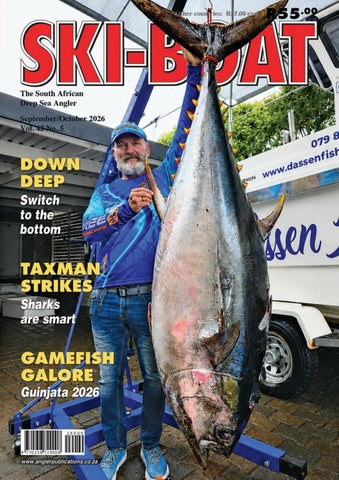
September/October 2026 Volume 42 Number 5 COVER: Bigeye Giant Loaded Martin du Plessis with the 138.5kg bigeye tuna he landed off Hout Bay. See page 7.
FEATURES
7
Deep-Water Giants Landing a 138.6kg bigeye tuna on stand-up tackle — by Martin du Plessis
13
Offshore Transition From gamefish to bottomfish: KZN’s seasonal offshore switch — by Mark Justham
22
Mission Accomplished 2026 Guinjata Bonanza reportback — by Quentin Clark
24
13
Winning Ways Tactics to take you to the top off Guinjata — by Paul du Toit Jnr
31
Decoding Your Sounder Part 2: How to ID bottomfish and strucure — by John Minnie
36
Learning From Those in the Know Navico Group execs give SA a glimpse of what’s to come — by Erwin Bursik
43
Tax Season
24
Sharks are smarter than we give them credit for — by Geremy Cliff
51
Dream Result at a Dream Venue 85th Anniversary ILTTA, Cabo San Lucas — by Wade Martin
43
DEPARTMENTS 4
Editorial — by Erwin Bursik
49
Subscription Page
38
SADSAA News
61
Mercury Junior Anglers
41
Awards for Excellence in Fishing
63
Business Classifieds & Directory
48
Shimano Reel Kids
64
Rapala Lip — Last Word from the Ladies
The official magazine of the South African Deep Sea Angling Association
DO YOU PREFER AN EZINE? FIND US FOR FREE ON WWW.ISSUU.COM
Publisher: Erwin Bursik Editor: Sheena Carnie Advertising Executive: Mark Wilson Editorial Assistant: Lynette Oakley Contributors: Erwin Bursik, Quentin Clark, Geremy Cliff, Martin du Plessis, Paul du Toit Jnr, Mark Justham, Wade Martin, John Minnie and Ilze Myburgh. ADVERTISING – National Sales: Mark Wilson, Manager — 073 748 6107 Lyn Oakley — 082 907 7733 Lyn Adams — 083 588 0217 Velia Tonkin — 072 218 6383 Publishers: Angler Publications cc PO Box 20545, Durban North 4016 Telephone: (031) 572-2289 e-mail: angler@mags.co.za Subscriptions to SKI-BOAT: R270 per annum (six issues). New subscriptions and renewals: SKI-BOAT Subscriptions Department Telephone: (031) 572-2289 • e-mail: angler@mags.co.za • Through www.anglerpublications.co.za, or E-zine through <www.issuu.com> Printing: Novus Print, Cape Town Distribution: On The Dot <Portia.Nguyuza@onthedot.co.za> Full production is done in-house by Angler Publications & Promotions on Apple Macintosh software and hardware. SKI-BOAT Magazine, ISSN 0258-7297, is published six times a year by Angler Publications & Promotions cc, Reg. No. CK 88/05863/23, and is distributed by On the Dot, as well as directly by the publishers to retail stores throughout South Africa. • Copyright of all material is expressly reserved and nothing may be reproduced in part or whole without the permission of the publishers. • While every effort is made to ensure the accuracy of the contents of this magazine, the publishers do not accept responsibility for omissions or errors or their consequences. Views expressed in this magazine are not necessarily those of the publishers, the managing editor, editor, editorial staff or the South African Deep Sea Angling Association.
4 • SKI-BOAT September/October 2026
EDITORIAL
THE MARVELS OF MODERN SCIENCE
H
INDSIGHT is a privilege afforded to those of us who have been around the block a few times. In the particular context of our sport of deep sea angling, I’ve been around the block more than a few times and have learned lots, forgotten lots, and realised I still have a lot more to learn. All sports and hobbies require one to assimilate an enormous amount of knowledge to become successful in one’s eventual quest while, at the same time, hopefully enjoying oneself. Deep sea fishing is no different. In our chosen sport, boats, outboard motors, Erwin Bursik fishing tackle, electronics, weather and sea conPublisher ditions are just a few of the things we have to deal with before we can get out on the ocean and into the “space” where we’re able to target our quarry and, hopefully, experience the thrill of a screaming reel. While I have largely been very successful in this arena, I recently realised that in one facet of our sport I feel like I have been floundering around in the dark, not getting the full advantage of my equipment. The realisation struck home while I was attending a presentation at the DSBC relating to onboard electronics. However, while looking around at the faces of my fellow offshore boaters who were also in attendance, I was comforted when I noted that I wasn’t the only one experiencing this dilemma. In years gone by, attempting to fish areas beyond one’s own port of operation brought with it the inevitable “where to?” and “how to?” queries about the “new area” of exploration. Sometimes it took repeated conversations with mates, urging them to please tell me where to fish an area I was attempting to tackle for the first time. Reliable as the advice usually was, the uncertainty was always there too – would I be able to find the spot by using their directions and landmarks? “Forget the past of books full of landmarks and use GPS and sonar to concentrate on catching fish rather than just spending time looking for them!” people say. And, yes, don’t worry, I have moved out of the dark ages. The technology has certainly made it easier to pinpoint good fishing grounds in much less time than it used to take. But it also requires a different set of skills, some of which are harder to master after a certain age. I’m working on it, though, and my basic ability to use modern GPS and sounder units has definitely encouraged me to try new destinations. There is something quite unreal about bobbing around on blue water many miles offshore, with the land being a faint blur on a distant horizon, and wondering, “Where am I?” Then a quick call to a mate delivers a few marks, you switch the sounder on, input the coordinates, and suddenly the vast blue ocean opens up, unveiling what’s below. Suddenly a frustrating day turns into an interesting and productive one. The age of exploration is not over, and undertaking a trip to a new area can be incredibly exciting. Readers of SKI-BOAT magazine will no doubt have noticed and appreciated the articles we’ve run not only on when and how to target the numerous species we hunt, but also specifically where to target them. Many of our contributors have been extremely generous about sharing marks in our series of 26 “Where to Fish” articles over the last four-and-a-half years which have covered most of South Africa’s coastline and also some of southern Moçambique’s coastline. We hope this series has extended your knowledge and widened your horizons with regard to the multitude of opportunities the wider Southern African coastline has to offer. If you have missed any of this series, you can order back issues of the magazines, find the articles on our website (www.anglerpublications.co.za) or read them in the free digital issues (www.issuu.com/sheenacarnie/docs). They will give you some great tips on where to start fishing wherever you happen to find yourself on the ocean. Just type the marks into your fishfinder, let down your lines, and hopefully soon the reels will start screaming. The marvels of modern technology indeed! Till the next tide.
Erwin Bursik
TACTICS
Landing a 138.6kg bigeye tuna on stand-up tackle By Martin du Plessis
E
VERY fisherman heading out of Hout Bay, Gordon’s Bay, or Yzerfontein Harbour dreams of hearing the reel scream as a yellowfin tuna jumps onto a lure in the spread or inhales your piece of chum drifting away from you. Yellowfin are, after all, the bread-and-butter tuna of the Cape fishery. But, every now and then, the ocean throws you a surprise. That’s what I love about fishing: start with a game plan, but always be ready to adapt if necessary and expect the unexpected.
We met Vic Warrington from Dassen Eiland Visvang Charters at Yzerfontein Harbour on a chilly May morning.When I saw the boat arrive with the 13 matching 80 lb stand-up “sticks” all in a row, the meticulous tackle, and Vic’s systematic handling and launching of the boat, I knew we were “in the game”. We headed out on a bearing of 270 degrees and due east in search of warm water. Our target temperature to start
fishing: 16 degrees plus. Our target species: yellowfin tuna. The funny thing about bigeye tuna is that very few anglers actually leave the harbour intending to catch one. THE CAPE’S MYSTERIOUS VISITOR Unlike yellowfin tuna which are targeted almost daily during the season, bigeye are generally considered an accidental bonus – a very welcome bycatch
while fishing for yellowfin. That isn’t because they’re rare. In fact, bigeye migrate through Cape waters every season. The problem is that they spend much of their lives where fishermen can’t easily reach them. Built for life in the deep, bigeye tuna possess unusually large eyes that allow them to see in the dim light hundreds of metres below the surface. Modern tagging studies have
SKI-BOAT September/October 2026 • 7
The autor, Martin du Plessis, sporting his giant 138.6kg bigeye tuna.
DID YOU KNOW? IGEYE tuna can dive to over 500 metres while maintaining a body temperature significantly warmer than the surrounding water. Their eyes are almost twice the size of a yellowfin’s of similar length, helping them hunt in near darkness. Bigeye tuna have a higher fat content than yellowfin, making them especially prized for sashimi and sushi. A 138.6kg bigeye can be over 20 years old, depending on growth conditions. If they are built for deep water, why do we occasionally catch them on the surface? The answer is simple: food. Cape waters are among the richest marine ecosystems on earth.The cold, nutrient-rich Benguela Current drives enormous blooms of plankton, which support sardines, anchovies, maasbanker, squid and countless other bait species. Where bait gathers, predators follow. When conditions are right, bigeye join yellowfin in feeding frenzies near the surface, especially when baitfish become concentrated by temperature breaks, current lines or shoals of dolphins and seabirds. During these brief windows, a fish perfectly adapted to hunting in darkness becomes vulnerable to a lure skipping across the surface or a Rapala alongside the prop-wash. The dull and overcast conditions on the day we went out could also have been a factor. When everything aligns, that’s when anglers get lucky.
B
shown that they regularly dive between 300 and 500 metres during daylight hours, to depths where the water is cold and light levels are extremely low. At night, they often rise closer to the surface to feed on the layers of squid, baitfish and other small organisms that also moves upwards. Bigeye tuna have always been part of the South African offshore fishery, although they have never been caught in the same numbers as yellowfin. Commercial longliners encounter them far more frequently because their gear enables them to fish much deeper than regular anglers do with conventional trolling tackle. For recreational anglers, every bigeye remains something of a trophy. Fish exceeding 100kg are not uncommon, making any specimen over 130kg a truly memorable catch. 8 • SKI-BOAT September/October 2026
HOW CAPE ANGLERS CATCH THEM Among recreational anglers, most bigeye in the Cape are caught while trolling spreads or while chumming for yellowfin tuna. High-speed skirted lures and swimming lures account for the majority of the fish. Occasionally they are taken on live bait or vertical jigs when tuna schools remain close to the boat, but trolling and chumming continues to produce most captures. The 138.6kg beauty I caught in May fell to a Rapala Sailfish X-Rap Magnum 40 deep fished short right. The fight was everything one would expect from a fish built to spend its life in deep water. Powerful, relentless runs alternated with stubborn circles beneath the boat as the fish repeatedly used its weight and stamina to its advantage.
WHERE & WHEN TO FIND THEM Although there are no guarantees, bigeye are most often encountered during the Cape tuna season from late autumn /early winter, particularly between April and June when warm offshore water pushes close to the Cape Peninsula. October is also a great time of year for them but the weather at this time of year often keeps the boats off the water. The same conditions that produce excellent yellowfin fishing can occasionally deliver one of these elusive giants.And so it was for us. On this particular day, we didn’t find the warm water where we expected it to be, and after travelling due east for two hours, we changed course and headed a little north. We saw three trawlers on the horizon, and when we got withing 2km of them,Vic signalled for us to put out the spread. The good first impression I had of Vic and how organised he is quadrupled when we started fishing! The man is a Master with a capital “M”! His backline spread was simply awesome, consisting of a combination of nine rods with spreader bars and Rapalas fished in specific positions and at strategic distances. The water was only 15.3°C – colder than what we would have liked it to be – but there were plenty of birds and bait balls around us which was a good sign. The plan was to pull the spread for about 30 minutes, then switch over to chumming when the trawlers pulled their nets. We had just settled down after fine-tuning the spread, and my mind was buzzing with all the activity around us. My adrenaline started to build with the anticipation of what would jump on and when kept. The trawlers were about 800m away from us when the right, short rod with a Rapala started to bend and that “ratchet music” started to play.Adrenaline levels spiked. “Fish on! Fish on! Fish on!” The other lines were brought in and the deck was cleared while I secured the harness and found my corner on the boat to do battle. After about 15 minutes, we knew it was a big fish.The tell-tale sign was hundreds of metres of 80 lb line peeling off. The fish went straight down to the deep, then it came to the surface, and at one stage it swam directly towards us for about 100m. It repeated this erratic action for about an hour before settling into its signature “tuna circles”. That 30m depth seems to be where a tuna puts in its last stand.This fish sat at that 30m mark for 45 minutes. It took 300mm of line then I gained 400mm. Then it took 500mm of line and I gained 200mm. It was a dogged tussle for each millimetre of line!
Martin and Vic proudly weighing the ‘Catch of the Day’. When I got it to 25m, I felt it change its usual spiral pattern and I felt its head lift. A small feeling of victory crept in – contained victory, though, as there was still a fight ahead. Then we saw colour. Minutes later, the bus popped up onto the surface just out of gaffing distance. Every fisherman knows that feeling – when you see
colour and then see the fish on the surface knowing that your tackle has been on max for three hours, and knowing that you have the boat and motors to contend with now too. Tackle fatigue, human fatigue, desperation at the end, the boat hull, the motors – any of these could pop the line right at the end! SKI-BOAT September/October 2026 • 9
Bigeye tuna are excellent tablefare and this one fed ten families. IDB (IN-DA-BOAT) The fish made one last circle and Vic gaffed it! After a gruelling battle lasting three hours and 15 minutes on stand-up tackle, one of the Cape’s true deepwater giants finally hit the deck. It took three people to load it! Some fish are planned. Others simply happen. We headed offshore that day hoping for yellowfin. The lures were rigged for yellowfin, the spread was set for yellowfin, and the day’s conversation revolved around yellowfin. The ocean had other ideas. Three hours and 15 minutes after the strike, a magnificent 138.6kg bigeye tuna lay alongside the boat, a fish few Cape anglers specifically target, but one every tuna fisherman dreams of seeing.
10 • SKI-BOAT September/October 2014
MORE THAN A TROPHY It’s easy to become fixated on the numbers: 138.6 kilograms, three hours and 15 minutes.A fish of a lifetime. But the story didn’t end on the boat at the harbour. Bigeye tuna are regarded as outstanding table fare and are prized by sushi chefs around the world for their rich flesh, particularly the beautifully marbled belly meat. Thick steaks are equally spectacular, whether simply grilled over hot coals or quickly seared to leave the centre perfectly rare. Nothing from this fish went to waste. The catch was carefully processed, with steaks shared among ten families
across South Africa. Around our own table we enjoyed beautiful sashimi and lightly seared tuna steaks – simple food that reminded everyone why these fish are so highly regarded in some of the world’s finest restaurants. Perhaps that’s one of the best traditions in recreational fishing. The excitement of the strike eventually fades. The photographs get filed away. The scales stop mattering. But weeks later, families are still enjoying meals together, friends are still retelling the story of the fight, and every steak brings back memories of an unforgettable day on the Atlantic. That’s a far more satisfying measure of success than any number on a scale.
TACTICS
OFFSHORE TRANSITION From gamefish to bottomfish: KZN’s seasonal offshore switch By Mark Justham S the warm-water gamefishing season in Durban, KwaZuluNatal, starts to fade, many anglers pack away their game-
A
fish trolling gear and start preparing for one of the most exciting periods of offshore fishing and my favourite season – the transition into bottomfish season.
This change does not happen overnight. As the water cools, baitfish movement changes, current patterns shift, and many offshore species move
Tyler and Ryan Matchett with two beautiful geelbek caught off Durban.
SKI-BOAT September/October 2026 • 13
from chasing high-speed prey to feeding around structure, reefs and pinnacles. For Durban anglers, this is the time to change tactics, slow things down and start hunting quality bottom species.
This sounder screenshot clearly shows bait at different levels in the water column. Learning to read your sounder well will radically improve your catch rate.
THE SEASONAL SHIFT During the warmer months, Durban’s offshore waters are dominated by pelagic gamefish such as: • Dorado • Tuna species • Wahoo • King mackerel (’cuda) These fish are often targeted through the use of trolling lures, live bait and drifting with dead baits. As temperatures drop, the focus moves towards bottom species like: • Rockcod (various species) • Amberjack • Englishman • Scotsman • Slinger • Soldiers • Geelbek • Daga salmon (when available) • Red steenbras (occasionally) The key difference is that bottomfishing is about finding the right piece of ground and presenting a bait or jig accurately. FINDING BOTTOMFISH: READING YOUR FISHFINDER A fishfinder is one of the biggest advantages a modern offshore angler has, but many people .look for the wrong things. Technology has come a long way with modern units that have features such as 3D and live scope. You are not always looking for big arches. Small bits of f luff on your sounder could indicate soldiers or even half kob. Look out for hard bottom sections. Hard reef usually shows as: • A thick, solid bottom line • Strong colour return • Uneven structure • Drop off or change in structrue This is where many reef fish live. John Minnie’s article elsewhere in this issue gives more detail on how to read your sounder to identify the right structure. Large predators like amberjack often sit just above the reef. Fish sitting tight to structure often appear as: • Small arches close to the bottom • Clusters above the reef • Suspended marks slightly off the structure Small dense marks higher in the water column can indicate baitfish, and if you spot baitfish, predators may be nearby.
Mark Justham, Nigel Gregson and Dustin Herholdt were thrilled with their haul of half kob, geelbek and rockcod after a day’s fishing off Durban. 14 • SKI-BOAT September/October 2026
TYPICAL DURBAN DEPTHS AND TARGETS The depths at which you’ll find fish change with location, water tempera-
ture and conditions, but these are common starting points. • 20–40 metres These depths are usually good for smaller rockcod, soldiers, Englishman, amberjack (smaller specimens) and slinger. Good baits for these species are sardines, chokka, squid strips, prawns and small live baits. • 40–70 metres These depths often holds bigger rockcod, slinger, Scotsman, amberjack, Englishman, musselcracker, daga salmon, geelbek and smaller half kob. For these species I suggest baits such as whole squid, whole sardines, a chokka and sardine combination, a mackerel fillet, or live bait. My favourite live bait is mackerel. • 70–120+ metres This zone lends itself to more serious bottomfishing. Targets here will be large amberjack, bigger rockcod, geelbek, half kob, bigger soldiers and trawl soldiers (in deeper water of 100m-plus). My suggested baits for these fish would be whole mackerel, live bait, large squid, fresh fillets or whole sardines.
Figure 1: Soldier & rockcod fixed trace
200–250mm hook snoot 300mm hook snoot
2/0 circle hook
4/0 circle hook
350–400mm hook snoot
200–250mm hook snoot
6/0 circle hook
80-100 lb hook snoot 600mm long
BOTTOMFISHING TRACES The traditional Durban bottomfish setup is simple and effective, and there are two alternatives, a sliding trace and a fixed trace. Sliding Trace This is popular when targetting bigger fish and is good for shy feeders because fish can pick up the bait without feeling heavy resistance. For this trace, you’ll have a main line, then a sliding sinker line which is generally longer than your hook line, then a single swivel, a leader snoot (80–100 lb line) and finish it off with an 8/0–12/0 circle hook, depending on the size of your bait. For the leader I use 0.80mm–1.2mm nylon, or switch to fluorocarbon when the fish are being fussy.
Figure 2: Slinger fixed trace
2/0 circle hook
200–250mm hook snoot 8/0 circle hook 4/0 circle hook
0.8m long sinker line
Sinker
350mm hook snoot
6/0 circle hook
Fixed Bottom Trace I use this style of trace when fishing deeper or rougher ground. The advantages are that it helps lift fish away from reef and gives the angler better control with heavy sinkers. The diagram alongside shows a three-hook trace commonly used for red fish and rockcods. BAIT Squid/chokka is one of the most reliable bottomfish baits. It works well for rockcod, slinger and soldiers. Sardines are great attractor baits. They are often combined with squid.
Sinker The author’s preferred style of sinker. SKI-BOAT September/October 2026 • 15
Figure 3: Running trace
Note that the sinker snoot runs freely on the main line
80–100 lb sinker snoot 1.8m to 2.5m long
Sinker
Mackerel is excellent for bigger predators. Live bait is deadly when targeting amberjack, kingfish and daga salmon. My first choice is a live mackerel. THE RISE OF JIGGING Traditional bottomfishing is still extremely effective, but modern jigging has changed offshore fishing. A standard bottomfishing rod is designed to hold heavy sinkers, drop bait straight down, and fight fish vertically.
0.8mm–1.2mm nylon hook snoot 1.4m to 1.8m long
8/0–12/0 circle hook
A typical setup would be: • 8ft rod with heavy backbone • Scarbough reel • 60–100 lb braid • Mono/fluro leader In this style of fishing, the angler waits (patiently) for the bite. Jigging rods are built differently. They are shorter, lighter, and are designed to work a lure and fight powerful fish under the boat. Instead of waiting, the angler creates movement. When anglers undertake vertical jigging, they mark fish on their sounders, then drop a metal jig to the depths at which the fish are located. The angler works the jig by repeatedly dropping the jig and lifting the rod, changing speed and rhythm as they work the jig. This imitates an injured baitfish. This method works well when targetting amberjack, yellowtail kingfish, tuna and rock predators, but really all fish tend to eat the jig. JIG TYPES Slow pitch jigs are designed to produce a f luttering action. They’re good for most bottomfish, but especially rockcod, slinger and amberjack.They are the best ones for when fish are feeding slowly. As the name implies, speed jigs are designed to produce fast movement. They’re especially good when targetting kingfish, tuna and amberjack. BAIT VS JIGGING Some anglers prefer bait fishing and others prefer jigging. I think there’s a
time and place for both. Use bait when: • Fish are feeding slowly • Current is strong • Fish are tight to the reef • You want a trophy bottomfish Use jigs when: • Fish are showing above structure • You see suspended marks • Predators are active • You want to cover more water DURBAN BOTTOMFISHING TIPS Each region will have its own “secrets”, but Durban is my hometown and these are the rules I fish according to. Many of them will be universal. • Don’t anchor on the first reef you find; spend some time looking for good structure and showings. • Mark every productive spot on your GPS. • Match your sinker weight to the prevailing current; if the sinker is too heavy it kills sensitivity. • Fresh bait beats frozen bait, so use it whenever possible. • Don’t ignore small marks on the sounder; they can be the signs of feeding fish. • Big fish often sit slightly away from the obvious structure, so keep an eye out for them. The move from gamefishing to bottomfishing is not the end of the offshore season; it simply requires a change of style. Durban’s reefs offer some of the most rewarding fishing of the year for anglers who understand the water, read their electronics and adapt their approach. All the above-mentioned fish make for excellent eating, so your family will also rejoince when you return home after a successful day’s fishing. Please always remember stick to the bag limits and limit your catch as some of our bottomfish are under huge pressure.
Above: A few rigged slow pitch jigs ready to go. This type of jig produces a fluttering action and works especially well for targeting rockcod, slinger and amberjack. Left: Danie van Oudtshoorn about to release a GT caught on jig. 16 • SKI-BOAT September/October 2026
SKI-BOAT September/October 2026 • 17
W
HILE it may not be the self-learning AI that dominates today’s headlines, Furuno’s ACCU-FISH™ and Bottom Discrimination technologies represent exactly the kind of intelligent decision making that makes time on the water more productive. Instead of leaving anglers to interpret every sonar return themselves, Furuno’s advanced signal-processing algorithms analyse the information in real time, so that you spend less time guessing and more time fishing. For decades, experienced skippers have relied on instinct to read fish arches, distinguish hard reef from soft sand, and decide whether a mark on the screen was worth investigating. That experience remains invaluable, but today’s technology provides another set of eyes beneath the boat. Using the built-in fishfinder in the Furuno TZMAP, TZTouchE and TZTXL, as well as the Stand-Alone FCV-600/800, paired with compatible transducers like the legendary 600W 525T-PWD transommount, anglers can unlock two of Furuno’s most impressive sonar technologies. ACCU-FISH intelligently analyses each sonar return by examining echo strength, shape, duration and beam geometry to estimate the size of individual fish. Rather than simply displaying another fish icon, it estimates whether the target below is worth dropping a lure for. Is it a school of undersized fish or a quality specimen? ACCU-FISH provides an instant estimate, allowing anglers to make faster, more informed decisions. Bottom Discrimination is equally as impressive. Successful anglers know that understanding the bottom composition and structure is crucial. Different species gravitate to different habitats, and knowing whether you’re fishing over rock, gravel, sand or mud can make the difference between
an average day and an unforgettable one. By analysing the acoustic characteristics of the returning bottom echo, bottom discrimination automatically classifies the seabed and displays the most likely bottom composition. Instead of relying solely on interpreting the thickness and colour of the bottom line, anglers receive immediate, easy-to-understand information that helps them locate productive ground with confidence. Some may argue that this isn’t “real AI”. Perhaps not in the sense of cloud computing or machine learning, but it certainly demonstrates intelligent automation. In many ways, it’s exactly the kind of AI that matters most – technology that delivers better results without making the user work harder. It’s best paired with the 525T-PWD (P66) that has earned “legendary” status among recreational anglers and has, for years, been regarded as one of the best-value transducers available, consistently delivering performance that rivals far more expensive installations. Compact, reliable and easy to install, the P66 has become the transducer of choice for thousands of ski-boats, but now has a hidden secret weapon – ACCU-FISH! Its ability to produce clean, accurate sonar returns allows the TZMAP’s built-in sounder to perform well beyond expectations. This is one of those rare products that genuinely punches well above its weight, proving that outstanding sonar performance doesn’t have to come with a premium price tag. The future of fishing isn’t about replacing the angler; it’s about giving the angler better information faster, and Furuno has been doing exactly that for years. For more info about ACCU-FISH or other Furuno’s products, visit: www.furuno.co.za Taylor Marine South Africa – Exclusive Distributor of Furuno. •
COMPETITIONS
2026 Guinjata Bonanza – Powered by Yamaha & Status Trucks By Quentin Clark Photos by Justin Klusener
NOTHER Guinjata Bonanza done and dusted! After a very
A
uncertain beginning to the year due to a cyclone and floods in Moçambique and severe fuel shortages, the competition still managed to achieve the highest number of entries since Covid. Against all odds, the 2026 Bonanza was back with more boats, more anglers, more excitement and a bigger prize list (thanks to our generous sponsors) than ever before.
PERFECT CONDITIONS, FIERCE COMPETITION Despite the rocky start to the year, the weather played along beautifully, giving competitors five tough fishing days with an extreme high-pressure system in play. Spirits were high, and every weighin brought fresh drama as boats battled for leaderboard positions. In the ski-boat division, Uli Buli stamped their authority with consistency across all five days, finishing top of the leaderboard with 1 084.9 points. Doogle II came in second with 627.5 22 • SKI-BOAT September/October 2026
points, and Dr Sangoma took third place with 502.3 points. Top angler overall was Paul du Toit Jnr, fishing on Uli Buli. His catches included a beautiful 21kg amberjack, and his final points tally was 170.7. Other standouts among the individual anglers were Rory Idleman (Doogle II, 143 points), Peter Jacob (Dr Sangoma, 142.2 points), and Mike van Vuuren (Johnny Boy, 135.6 points). The jetski anglers were also very busy, weighing 41 fish on Day 5 alone – a record haul for the division. Of course everyone was vying for the main prize – two Yamaha 100hp motors for the biggest fish overall. Kelvin Stokes (Doogle II) walked away with those thanks to his 21kg wahoo. Other notable catches included a 17.8kg wahoo caught by Dylan Venske (Antman), a 15.1kg greater barracuda caught by Jorn Landman (Prime Zulu II), and a 15kg GT caught by Richard Griffiths (Scallywag). As always, the Wednesday night function was a highlight, with prego rolls from Millennium Meats, Potency, Jägermeister shots, and tug-of-war antics carrying the party well into Thursday morning. Prizegiving capped off the week
with huge applause for Uli Buli’s triumph in the ski-boat division, Silverado’s victory in the jetski division, and Kelvin Stokes’ Yamaha-winning wahoo. Top lady angler was Eugenê du Plessis (Seadation) and top junior angler was Dylan Venske (Antman). A WORD OF THANKS This year’s Bonanza would not have been possible without the unwavering support of our sponsors.Their generosity ensured not only a record value of prizes but also the smooth running of the competition from start to finish. Special recognition goes to Status Trucks Sales, Linex Yamaha Lynwood and Yamaha Marine South Africa, whose contributions powered the event at every level. We also extend heartfelt thanks to Millennium Meats, Airmar, Garmin, MRE, Rhino Man, and many others who stood behind the Bonanza. Their commitment to the sport and to the community is what makes this event thrive year after year. The Guinjata Bonanza truly is the ultimate test of skill, endurance, and spirit on the Mozambican waters. Paul du Toit captures that perfectly in his story (overleaf) of how Uli Buli won. See you there next year!•
WINNING WAYS! By Paul du Toit Jnr
W
HAT a feeling! Winning the 2026 Guinjata Bonanza was such a high for those of us on Uli Buli. Each year our preparation starts months ahead of the comp, and I’m sure that is a large part of our success. Evenings and weekends are spent building traces and making homemade lures such as bucktails and “squidy” jigs. With specific needs in mind, we have developed our own lures, branded as PDT, and have had great success with them. We hardly ever take a lure from a packet straight to the water. Instead, we spend countless hours finetuning and rebuilding tackle to achieve our desired outcome. You never know what you’ll find in the open water, so we make sure we’re prepared for any and every scenario. We usually try to spend a couple of 24 • SKI-BOAT September/October 2026
days on the water to scout the area and discover what the ocean has to offer, but this time around we only had the Saturday morning to “practise fish”. We set out a few fast-trolling lures and scanned the area, trying to identify which areas had the most bait and potential fish. We also took note of the water clarity, temperature and current at each location, as these play a big role. Our “pre-fish” session quickly brought the realisation that the fishing in general would be extremely challenging.This put a different spin on our initial gameplan. Sunday was spent finetuning our setup, packing the boat, re-tying all the leader lines, double checking reel drags and making sure everyone in the team knew exactly what their role and responsibility was. ΩOn Day 1 we were met with a beautiful sunrise, as only the east coast of Africa can provide. With a call from beach control on the radio, Uli Buli
was off. Our gameplan was to target the elusive amberjack each morning as a way of hopefully setting us up for the rest of the day. As we got closer to one of our marks, the nervous feeling quickly turned into anticipation as the fishfinder confirmed we were on a good spot. On the first drop, while we were still working out the drift direction, we hooked two big fish.The fight was on! With a lot of skill and a bit of luck we managed to land both fish. What a start! Five minutes in and we had two 12kg amberjacks on our scorecard. The most challenging thing about our gameplan is when we find a spot where the fish are biting and then we must leave them to go and look for a different species. As we travel from one spot to the next, we’re always on the lookout for any signs of life such as birds or bait on the surface.As we moved south towards Legogo, we saw some bonnies on the
Henry Bam with an amberjack about to be released off Uli Buli.
surface, and within seconds we had two daisies out the back and a couple of Speed Pro lures trolling closer, looking for a live bonnie or a different species. We caught some bonnies quite soon after this, but all in the 4kg range. Hoping one would make the cut, we decided to move on to the Holes at Legogo. We spent the rest of the morning working the main ledge at Legogo, drifting with bait but continuously jigging and popping or spinning off the front of the boat. The fishing in the area was slow, but we landed two decent ’cuda, which helped to add weight to our bag and multiply our species count. Some fish were splashing to the east out towards the deeper water, so we took a chance and headed in that direction. We noticed a temperature break and some cleaner water on the 65m mark. Met with some undersized skipjacks in the area, we knew that the yellowfin tuna would not be far away, and staying on top of the skipjacks paid off. Initially, the yellowfin were a bit shy, so we set our spread as far back as possible, and that added two decent yel-
Paul du Toit Jnr ready to release a sailfish off Uli Buli.
lowfin to our bag. With a well-weighted bag and four species, we were chuffed with our day. We ended up top of the leaderboard with 243.6 points, closely followed by Doogle II and Prime Zulu. TUESDAY Day 2 proved to be the most challenging day of the week. The plan was to start by landing an amberjack as quickly as possible, however, the ocean had other plans. We headed to the same spot as the day before, but the showing on the fishfinder disappeared and so did the fish.After countless drifts and trying different spots, we quickly realised this was a lost cause.We decided to move to our usual spot at Legogo and try our best to get onto the board. We managed to get one ’cuda and a 5kg green jobfish on the jig. We knew we had to look for species, so we went to the area where we’d found the yellowfin the day before, and spent hours trolling around without success. We made the difficult decision to go scratch around and search for that elu-
sive amberjack. Fortunately, with just minutes to spare before lines up, Henry Bam hooked and landed a 15kg amber. It was a rather dismal day for us. We’d managed to land three species, but had dropped down to fourth place overall, with 344.7 points. Prime Zulu was in first place and Doogle II a close third. WEDNESDAY Day 3 was our make-or-break day. To stay in the game, we knew we had to give it our all. For a start, we had to change our gameplan.We took an 18km run south to Legogo, to land an early morning bite along the main ledge at The Holes. This proved successful, and we landed multiple ’cuda and bonnies before the other boats arrived. Before it got too late, we decided to take advantage of the early morning amberjack bite and head out east towards the 80m mark. When we reached the spot, we noticed a small bump on the fishfinder. We decided to turn around and do a quick drop. We positioned the boat, made the drop and immediately douSKI-BOAT September/October 2026 • 25
Top jetski for 2026 was Silverado with 136.2 points.
Kelvin Stokes (fishing on Doogle II) walked away with two 100hp Yamaha motors thanks to his 21kg wahoo. bled up on two giants.With line peeling from the reel, we tried our level best to stop the fish and gain some line. Unfortunately, one of the fish was too strong and swam into the reef. Luckily, my fish stayed hooked. I got his head turned around and managed to gain some line, then the dogfight began. A couple of minutes later (while holding our breath) we could finally see the fish as the first signs of colour broke the surface. The whole boat erupted in cheers as we pulled the giant amberjack into the boat. The fish measured 21kg on the ruler, and this would prove to be the biggest released fish of the tournament. We now had substantial weight in our bag, and needed to take advantage of the multiplying factor by adding a different species to the tally, so we headed back towards The Holes. As we approached The Holes, we saw at least twelve boats fishing in one
Top lady angler for 2026 was Eugenê du Plessis, fishing off Seadation. She scored 71.6 points.
small spot along the ledge. We knew this boat pressure would make fishing very difficult, but we joined them anyway and were very fortunate to land an 8kg yellow spotted kingfish. We then made a difficult call to run back to Paindane, and spent the last hour on our home reef. When we arrived at Paindane, the northerly wind had picked up and the current was crazy! Our only choice was to put out a spread of trolling lures and hope for a lucky bite. Persistence is key, because with just five minutes to spare and all hope lost, the small Islander Lure at the back started screaming. We all held our breath as we pulled the fish out and were happy to see a decent sized yellowfin. This turned our average day into a GREAT day.We ended the day in third place with 591.5 points, only a couple of points behind the leaders.
THURSDAY Day 4 was looking promising, with our gameplan set and the weather playing along nicely. We made our way south towards Legogo to take advantage of the early morning bite. It had become evident that as soon as the boats arrived, the fish activity died down. We needed to tick off one or two fish and, if possible, multiple species by the first call up at 9.00 am. As soon as some other boats arrived, we moved out towards the 80m amberjack marks and spent an hour or two working different pinnacles along the main ledge. For the most part, we were jigging with 250g to 400g high speed jigs. We also had one crew member working a slow-pitch flutter-type jig. As soon as we had caught a couple of ambers, we headed back inshore to the 30m- to 40m ledge in front of Legogo and spent the remainder of the SKI-BOAT September/October 2026 • 27
Top boat for Guinjata 2026 was Uli Buli with an incredible 1 084.9 points.
Doogle II took second place with 627.5 points. day working that area. We ended the day with a goodweighted bag and a multiplying factor of four species which took us to top of the leaderboard with 798.50 points, ahead of Prime Zulu and Doogle II. FRIDAY We had been operating like a well-oiled machine and were consistently adding to our daily points. On Day 5 we knew we had to take every opportunity given to us to stay ahead in the competition. As we arrived at our regular spot in front of Legogo, we were met with a feeding frenzy. We managed to land three yellowfin tuna and a ’cuda before any other boats arrived. Given this positive start to the day, we decided to work the outside of the ledge with a spread of small konas rigged with bonito “belly shines”, hoping for a different species. It didn’t take long before we hooked into a billfish. This is always a gamble on light tackle, and unfortunately, we lost the fish five minutes into the fight. We were disappointed, but we knew we had a gameplan to follow and stayed 28 • SKI-BOAT September/October 2014
Dr Sangoma came third with 502.3 points.
true to it. We decided to give it one more go. As soon as the spread was put out and we made a turn to the left, heading back to the ledge, the left long started screaming, followed by a tailwalking sailfish that put on a beautiful show. The fight was on, and we were ecstatic when we got our hands on the TOP TEN BOATS Uli Buli . . . . . . . . . . . . . .1 084.9 pts Doogle II . . . . . . . . . . . . . .627.5 pts Dr Sangoma . . . . . . . . . . .502.3 pts Lucky Luke . . . . . . . . . . . .463.8 pts Scallywag . . . . . . . . . . . . .349.9 pts Johnny Boy . . . . . . . . . . . .292.8 pts XT Sea . . . . . . . . . . . . . . . . .246 pts Casper . . . . . . . . . . . . . . .189.5 pts Seadation . . . . . . . . . . . . . . .162 pts Pescadon . . . . . . . . . . . . .132.6 pts TOP FIVE JETSKIS Silverado . . . . . . . . . . . . .136.2 pts Jetfisher Juan . . . . . . . . . .114.2 pts XtaSea . . . . . . . . . . . . . . . . .51.5 pts Antman . . . . . . . . . . . . . . . .51.3 pts Viper . . . . . . . . . . . . . . . . . . .38 pts
bill and successfully released the fish to fight another day. The most difficult part of the day was finding and landing another amberjack.What should have been the easiest of the lot turned into a mammoth task, as the current and wind did not play along. However, with persistence and hours of effort we eventually had some success with a measly 5kg amber, butwe celebrated its contribution to our points as if it were a world record fish. What a way to end the last day of this awesome competition, in first place with 1 084.90 points. Well done to Doogle II (second place with 627.5 points) and Dr Sangoma (third place with 502.30 points). With the last fish weighed, we had accomplished our mission of winning the Guinjata Bonanza Species Competition! In closing, team Uli Buli would like to thank all the organisers, committee, sponsors and competitors for yet another outstanding competition. We will most definitely be back next year.
30 • SKI-BOAT September/October 2026
TECHNOLOGY
Part 2: How to identify bottomfish and structure on a fishfinder By John Minnie
O
NE of the biggest challenges facing any bottomfish angler is learning to distinguish between fish and structure. Many anglers see a coloured m a s s o n t h e i r f i s h f i n d e r a n d i m m e d i a t e ly assume it is fish, while others pass over productive marks b e c a u s e t h e y b e l i e ve t h e y a re l o o k i n g a t re e f. Understanding what your sounder is showing you can dramatically improve your catch rate. For the examples shown in this ar ticle, I used a Lowrance HDS with High CHIRP and Palette 13, which is one of the best colour palettes on Lowrance sounders for bottomfishing. Palette 13 provides excellent separation between hard bottom, soft bottom, reef, and fish holding tight to the structure. UNDERSTANDING PALETTE 13 Before trying to identify fish, it is important to understand what the colours on your screen represent. On this palette, black and dark brown indicate the strongest sonar return. This normally represents very hard reef or rock. Orange shows medium strength returns and often represents rough reef, broken rock or hard sand. Yellow and red indicate weaker returns, usually the outer edge of the reef or fish reflecting the sonar. Blue and purple represent the weakest returns and often show suspended fish, baitfish or the soft edges of a school. The key is not simply looking at the colours, but also understanding where those colours appear in relation to the bottom. READING BOTTOM STRUCTURE One of the biggest mistakes anglers make is focusing only on fish. Experienced skippers first study the structure
before looking for fish. Fish relate to structure because it provides food and protection for them. Ask yourself: • Is the bottom hard or soft? • Is it flat or rising? • Are there cracks or pinnacles? • Is there relief that will hold fish? Hard reef reflects far more sonar energy than sand. On Palette 13 on the Lowrance units, this appears as a thick black base with a bright orange layer and a strong red outline Soft sand appears much thinner and lacks the heavy black core. Most bottomfish species prefer to hang around hard reef because it supports baitfish, crustaceans and other food. FISH VERSUS STRUCTURE Learning the difference between structure and fish is the most valuable skill to have when reading sonar. Features of structure: • Continuous • Solid • Uniform colours • Sharp edges • Thick hard return Features of fish: • Irregular shapes • Softer colours • Gaps between returns • Rounded edges • Often separated from the reef Once you begin recognising these differences, your confidence in interpreting what’s showing on your sonar will increase dramatically.
Brett Bartho with a beautiful yellowtail. Learning to read your sounder properly will greatly improve your chances of success.
HOW TO IDENTIFY YELLOWTAIL
• The school follows the contour of the pinnacle rather than becoming part of it. A common mistake is thinking these returns are simply an extension of the reef.The clear colour change and separation indicate a large school of fish. If you drifted over this mark with live bait or vertical jigs, this would be an excellent place to fish. TARGETING GEELBEK
Yellowtail holding on a pinnacle. This screenshot is an excellent example of a productive yellowtail reef.The sonar shows the bottom rising dramatically from approximately 74 metres to around 62 metres, creating a steep underwater pinnacle. Notice how the reef is displayed as a thick black core surrounded by orange and yellow. This tells us the reef is extremely hard, making it ideal habitat for baitfish. The most important feature of this screenshot, however, is what appears on the right-hand edge of the pinnacle. There is a cloud of blue, purple, red and yellow returns sitting just off the face of the reef. This is not part of the structure; these coloured returns are individual fish packed tightly together. Yellowtail often school on the up-current side or just over the edge of a pinnacle, where baitfish are forced upward by the current. Instead of sitting directly at the bottom, they hold slightly above it, waiting to ambush baitfish. Several clues indicate these are yellowtail: • They are suspended just above the reef. • They form dense clusters rather than a solid bottom return. • There is visible separation between the reef and the fish.
Geelbek holding tight to the bottom. Geelbek behave very differently to yellowtail. Instead of suspending above the reef, geelbek spend much of their time holding extremely close to the seabed. This makes it much harder to identify them. At first glance, many anglers would simply see a rough bottom. If you lookclosely, however, you can see something different. The seabed forms a consistent hard return, but sitting directly on top of the bottom is a thin band of brighter colours. These are not part of the reef; they represent fish lying only a metre or two above the seabed.
SKI-BOAT September/October 2026 • 33
There are several signs that these are geelbek: • The fish appear as a slightly thickened top edge of the bottom. • Small bumps and humps extend upward from the reef. • The fish are tightly grouped rather than scattered. • They remain glued to the contour of the seabed. Geelbek often appear merely as a “fuzzy” or uneven upper edge on an otherwise clean bottom return.This is why many anglers drive straight over them without ever dropping a bait.
WHY ZOOM MATTERS One of the best features on a Lowrance fishfinder is Bottom Zoom. Many bottom species sit within oneor two metres of the seabed. Without zoom, these fish simply blend into the bottom. With a 4x or 5x Bottom Zoom enabled, fish become clearly separated from the structure. This is especially important when targeting geelbek, daga salmon, rockcod, soldiers, red Roman and copper steenbras Many fish that are invisible on the normal screen become obvious once the bottom is magnified.
READING FISH BEHAVIOUR Your sonar also tells you how fish are FINAL THOUGHTS behaving. Fish suspended high above A fishfinder is much more than just a the reef are normally active and feeddepth finder;it is a window into the ing. Fish holding tight against the botunderwater world. The more time you tom are often less aggressive and spend studying what appears on the require slower presentations. screen, the better you will become at When fish move up off the reef, recognising productive structure and they become easier to catch because distinguishing fish from reef. Cameron Sim was all smiles they are actively chasing bait. Mastering these subtle differences is after his sounder led him The yellowtail image demonstrates what separates an angler who simply to land this whopper. how pelagic predators often position finds reefs from one who consistently themselves above steep pinnacles, finds fish. By understanding bottom creating clear schools separated from the reef. The geelbek hardness, recognising fish returns, and using Bottom Zoom image shows why bottom species are more difficult to identiwith Palette 13, you can make better decisions about when to fy, appearing as subtle thickening and irregularities along the stop, where to drift, and ultimately will put more quality fish top of the seabed. in the boat.
34 • SKI-BOAT September/October 2026
TECHNOLOGY
LEARNING FROM THOSE IN THE KNOW Navico Group execs give SA a glimpse of what’s to come In this image from a Lowrance sounder, the combination of DownScan Imaging and CHIRP provides an especially clear view of targets. The fish literally light up, removing the need for a more complex split-screen view. Image courtesy of Navico. By Erwin Bursik
L
OWRANCE South Africa was honoured to have two of the top executives of their parent company, Navico, visit our country recently. They came to share news of the latest innovations to the group’s systems, hint at some of the forward projections, and also to see for themselves what we South African offshore anglers need and the way we use the Lowrance equipment in our waters. Jeremiah Clark (Vice President of Product Management – Electronic Systems, Navico) and Sam Carlisle (Director of Product Management – Electronic Systems, Navico) got to see Lowrance’s electronic systems put through their paces during a full day’s bass fishing on inland waters, and also
out on the ocean with Daryl Bartho. Daryl gave them a real treat in the form of a surf launch off the northern KwaZulu-Natal coast, and the visitors got to experience the type of inshore and deep water offshore angling their Lowrance units are used for in South Africa. While they were here, I had the opportunity to attend a Lowrance dealer- and ambassador seminar in Durban, where the two men gave a very interesting presentation. I also had a casual morning meeting with them. There we discussed their current product range and I got to ask a few questions I personally wanted clarification on. To be honest, it was a meeting I faced with some trepidation after being exposed to some of the highly technical talk about super-sophisticated technolo-
gy at the dealers’ function. However, I thoroughly enjoyed our morning meeting as they explained things more at my level of reduced technical understanding. During the late 1980s and again in the early 1990s, I got to meet Darrell Lowrance, the founder of Lowrance Electronics, first for a day’s fishing here off my boat Sea Lord, and then when I visited the company’s headquarters and factory in Tulsa, Oklahoma. For those who haven’t heard the story, while Darrell was aboard my boat, he started uncoupling my Lowrance sounder from my dashboard. When I asked him why, he answered, “I’m tossing it overboard as you clearly don’t believe what it’s showing, so you obviously have no need of a sounder!” He made a good point, and I have
These screenshots from some of Lowrance’s newest units show great improvements in the way they display high-res bathymetry (HRD) and shaded relief. These particular images show the incredible detail of Diep Gat Canyon (south) at Sodwana, an area so many of us fish. Images courtesy of Navico. 36 • SKI-BOAT September/October 2026
Sam Carlisle (Director of Product Management – Electronic Systems, Navico), Liz Plotz (Managing Director, Lowrance SA), Erwin Bursik (Publisher, SKI-BOAT magazine) and Jeremiah Clark (Vice President of Product Management – Electronic Systems, Navico) marvel at how much technology has advanced since the development of Erwin’s first sounder, one of Lowrance’s early models that still recorded its findings on paper. never forgotten it. Today, some 40 years later, I still make a big effort to fully “understand” my Lowrance sounder. Back to the present, and viewing machines in a totally different format, producing images that today portray far more detail than even the Lowrance HDS-10 I have on my boat today. Sam had completely baffled me the evening before with some of the technology he was talking about, but the next morning he spent a fair bit of time explaining their thinking and what they’re planning going forward. It’s impressive. One of my big questions was: when will we be able to view the actual reef structure and fish down to 50 feet as
though viewing it on our home TV? I didn’t get a direct answer, but Sam’s glimmer of a smile gave me an indication that they’re working on it. Having said that, on some of the images they shared at the dealers’ function, I was able to see the shape of a fish swimming upwards across the screen, not just the usual markings I am used to. It’s exciting, to say the least! Another aspect that I’ve paid some attention to – but not really enough – since Darrell first showed it to me on my original paper sounder, is the importance of seeing the thermocline on the sounder during a day’s fishing. For those who don’t know, the thermocline is the zone at which water temperature
This screenshot shows a thermocline just beneath the 200ft mark, and (centre, top) the arch of a good-sized fish. One can often see ’cuda moving up or down towards the thermocline and then moving away from it again, to remain in the temperature of their choice. Image courtesy of Navico.
changes rapidly, causing a density change (and something of a barrier) between the warmer water above and the much colder water below. Jeremiah and Sam fish extensively both on inland waters and offshore back in the USA, and both of them were very vocal on this subject, explaining that physical trials during subsurface diving confirmed that both fresh- and saltwater fish resist moving through these thermoclines. Bear in mind, then that if the fish are showing below the thermo and your baits are above it (or vice versa), you’re not going to get any bites. During my many years of inshore gamefishing, especially for ’cuda, I have occasionally taken this into account and adjusted the depth of my bait while fishing, both on the drift and while trolling, to ensure it’s in the same zone as the fish, but probably didn’t give the theory the credence it really warranted. Having listened to Jeremiah and Sam, I will certainly pay a lot more attention to ensuring I position my ’cuda baits at the correct depth above or below the thermocline, depending on where the fish are showing on my sounder. I’m thrilled that Navico saw fit to send two of their top executives to South Africa, both to show off the latest equipment they have available and, more importantly, so that they could experience the conditions in which South African anglers put their products to the test. I benefitted greatly from attending the dealer seminar, but I learned even more from meeting these two gents and chatting openly about the exciting future of this company that is a household name in South Africa. SKI-BOAT September/October 2026 • 37
SADSAA NEWS & VIEWS THE COLOURS WE WEAR Representing with pride and humility By Jean Schoonhoven
T
HERE are few moments in competitive deep-sea angling that compare with receiving your first Club Colours. For many anglers, it is the first real milestone on their competitive journey. It’s proof that the years of dedication, early mornings, missed family occasions, long hours on the water and countless kilometres travelled to tournaments have finally been recognised. It is a proud moment, and one that most anglers remember for their whole lives. For some, that journey continues. Consistent performances and commitment may lead to Provincial Colours. Beyond that, a select group of anglers will earn SADSAA Colours through national selection, highlighting them as being among the leading competitive deep-sea anglers in South Africa. Then comes the pinnacle of our sport: Protea Colours. The opportunity to represent South Africa internationally is the high-
Anton van den Berg SADSAA President est honour any competitive deep-sea angler can achieve. Each step is harder to reach than the last. Each level also carries greater responsibility than the one before. When anglers receive their Colours, it is natural for them to feel proud of
what they have achieved.After all, those Colours have been earned through commitment, perseverance and performance. But there is another way to look at them. The Colours you wear did not begin with you. Long before you ever represented your club, province, SADSAA or South Africa, generations of anglers wore those same Colours. They built clubs from the ground up.They gave up evenings to attend committee meetings, organised competitions, mentored juniors, served as skippers, observers and officials, and represented their organisations with pride both on and off the water. Some achieved remarkable success on the tournament circuit while others never won a major title. Either way, every one of them contributed to the reputation that those Colours carry. When you receive your Colours, you are not becoming the owner of that reputation; you are becoming its custo-
Ava Burnand, Lily Joyce and Alan Gourveia have Club Colours for Durban Ski-Boat Club.
Cameron Johnston, Alex Tyldesley and Cornel van Zyl proudly wear their Natal Provincial Colours.
38 • SKI-BOAT September/October 2026
dian. That responsibility grows with every level of representation. When you wear Club Colours, you represent ever y member who has worn those Colours before you and everyone who continues to build that club today. When you wear Provincial Colours, you represent an entire province and the anglers who spent decades establishing its reputation within competitive deep-sea angling. When you wear SADSAA Colours, you represent the national body that has guided and developed organised competitive deep-sea angling in South Africa for generations. When you wear Protea Colours, you carry the hopes of a nation and the legacy of ever y South African angler who has stood proudly in the Green and Gold before you. The higher the Colours, the greater the responsibility. The higher the Colours, the more people are watching. Ever y tournament has juniors standing beside the boats before sunrise. There are aspiring anglers watching the prize giving, following results on social media and dreaming of one day earning the same Colours. They notice far more than we sometimes realise. They notice how experienced anglers speak to launch officials when the queue is long. They notice how competitors treat one another after a difficult day. They notice who thanks the volunteers who have spent countless hours making a tournament possible. They notice who is prepared to share knowledge and encourage the next generation. Long before they remember who won a particular tournament, they remember the people who made them feel welcome. Those moments shape the future of our sport. One conversation on the slipway. One invitation to fish.
Leon (skipper), Wesley Uys, Mri Myburgh and Geraldine Breedt, proudly wear SADSAA Colours.
One experienced angler taking the time to explain a rig or offer advice. These simple acts often inspire a young angler far more than any trophy ever could. Competitive deep-sea angling has always been built on healthy rivalry. Every team wants to win; every angler wants to perform at their best. That competitive spirit is what drives us to improve. But winning has never been the only measure of success. The anglers who are remembered most fondly are seldom those who simply filled the trophy cabinet. They are the ones who represented their Colours with humility. The skipper who stopped to assist another crew experiencing mechanical problems. The angler who congratulated a rival after being narrowly beaten. The team that accepted disappointment with dignity and celebrated victory with humility. The club member who quietly gave years of service without expecting recognition. Those people strengthen the reputation of the Colours they wear. The ocean has a remarkable way of keeping every angler humble. One day everything goes according to plan, the next day the fish refuse to bite, the weather changes unexpectedly or equipment fails at the worst possible moment. Character is revealed most clearly when things do not go our way. How we respond in those moments says far more about us than any podium finish ever will. That responsibility does not end when the boat is back on its trailer. Representative anglers carry their Colours wherever they go. At the launch site, in the clubhouse, at the fuel station, on social media and within their communities, they are recognised as representatives of something much bigger than themselves.
Their words and actions influence how others view their club, province, SADSAA and even South African competitive deep-sea angling as a whole. That is a responsibility that should never be underestimated. As anglers, we often speak about leaving healthy fish stocks for future generations. That is essential, but we should also ask ourselves another question: What kind of reputation are we leaving for the anglers who will one day earn the same Colours? Will they inherit clubs known for good sportsmanship and camaraderie? Will they inherit provincial teams respected for their integrity? Will they inherit a SADSAA that continues to set the standard for organised competitive deep-sea angling? Will future Protea anglers be proud to follow in our footsteps? Those questions matter just as much as the results recorded at the end of a tournament. Eventually every competitive career comes to an end. The trophies will gather dust, records will be broken, new anglers will earn their place, and another generation will proudly wear the Colours we once wore. When that day comes, very few people will remember exactly how many fish we caught or how many tournaments we won. They will remember something far more important: they will remember how we represented our Colours. Every set of Colours carries the history of those who wore them before us. Every one of us could add another chapter to that history. The privilege of wearing Club Colours, Provincial Colours, SADSAA Colours or Protea Colours lasts only for a season in the story of our sport; the legacy we leave behind lasts far longer. Wear your Colours with pride. Wear them with humility. Above all, leave them more respected than the day you first earned the privilege of wearing them.
Brendan Davids, Albert Burger and Paul Smith have earned their Protea Colours.
SKI-BOAT September/October 2026 • 39
APPLICATION FORM I hereby apply for The Excellence in Angling Awards, powered by Basil Manning, in the category:
Meritorious Fish
Outstanding Catch
Tick the appropriate box and supply us with the following information. PLEASE REMEMBER TO PRINT CLEARLY!
Applicant’s Details: Name: ................................................... Address: ................................................ ............................................................... ...................................... Code: ............. Tel No: .................................................. E-mail: ............................................................... Club (if member): ..................................... ............................................................... I, the undersigned, agree to abide by the rules of this award. Signature: ..............................................
Meritorious Fish Species: ................................................ Weight: .................................................. Date of Capture: ................................... Where Caught: ...................................... Skipper's Name: .................................... Outstanding Catch Category applied for 3:1
5:1
7:1
10:1
(tick appropriate box): Species: ................................................ Weight: .................................................. Line class: ............................................. Date of Capture: .................................... Where Caught: ...................................... Skipper’s Name: .................................... Digital emailed photographs should be high-resolution and sent to
angler@mags.co.za 40 • SKI-BOAT September/October 2026
YOUR favourite offshore angling magazine, SKI-BOAT, in conjunction with Basil Manning and the South African Deep Sea Angling Association, is proud to offer all South African skiboaters the unique opportunity to win awards for excellence in angling. All deep sea anglers who achieve laid down standards of excellence will be entitled to apply for The Excellence in Angling Awards, powered by Basil Manning. Upon ratification by a panel of adjudicators, the angler will receive a handsome digital certificate,suitably inscribed. The Excellence in Angling Award will be made for fish caught in two sections: 1) Meritorious Fish This award is for a fish that’s a memorable achievement for the angler, if not a personal best, and is not confined to the species listed below. Tackle used is of no consideration here, the fish's weight or release status being the main criterion. 2) Outstanding Catch To satisfy the requirements for this award, anglers can catch any recognised fish species.As a guideline, the weight of that fish must equal or exceed the suggested weights below, or certain laid down fish weight:line class ratios. Awards will be made in the following ratio categories: 3:1 – Bronze Award 5:1 – Silver Award 7:1 – Silver Award 10:1 – Gold Award. Applies to IGFA line class 1kg, 2kg, 4kg, 6kg, 10kg, 15kg, 24kg, 37kg and 60kg.
RULES: 1) There is no restriction on the number of awards which can be applied for. 2) Award applicants must submit a photograph of the relevant fish with the application form and a photograph of the angler with the fish. 3) SKI-BOAT reserves the right to use the photograph as it sees fit. 4) Entries must be on the official form which is included in all issues of the magazine. 5) Entries must be received within 45 days of capture. 6) No witnesses of the catch are required. The award is made in the true spirit of sportsmanship and relies on the integrity of the angler to make a just claim. 7) A selection of award winners’ names will be announced in future issues of SKIBOAT, along with relevant photographs. 8) Award applicants should allow 30-45 days for processing of applications. 9) There is no charge for these awards. SPECIES: SUGGESTED WEIGHT: Barracuda 15kg Dorado 12kg Kingfish (Ignobilis) 20kg Garrick (Leervis) 12kg King Mackerel (’Cuda) 15kg Black Marlin 100kg Blue Marlin 100kg Striped Marlin 60kg Prodigal Son 15kg Sailfish (Pacific) 25kg Spearfish (Longbill) 20kg Spearfish (Shortbill) 20kg Tarpon 45kg Tuna (Big Eye) 50kg Tuna (Longfin) 25kg Tuna (Yellowfin) 50kg Wahoo 15kg Yellowtail 15kg
RELEASED BILLFISH AND GT (Ignobilis) KINGFISH
With the strong trend towards releasing these and other fish, we have decided to amend the award rules to provide for acknowledgement of all released fish. All we need is a photo of the fish being released or prior to release (e.g. GT held next to the boat) and the approximate weight of the fish which should fall in line with the stipulated weights set out above. In line with this trend we will not be carrying photographs on the awards page of any billfish or GTs aside from those that are released.
Martin du Plessis earns a Gold Meritorious Award for this stunning 138.6kg bigeye tuna caught off Cape Town on 22 May 2026.
Daniel Ballance has been awarded a Gold Meritorious Award for this 27kg king mackerel caught off Legogo, Mozambique on 23 December 2025.
Reyno Nel has been awarded a Gold Meritorious Award for his 65kg yellowfin tuna caught off St Francis Bay on 2 May 2026.
Lucas Landman has been awarded a Gold Meritorious Award for his 32.7kg ’cuda caught off Richards Bay on 19 May 2026.
Candice Coetzer has been awarded a Gold Meritorious Award for her 82.9kg yellowfin tuna caught off St Francis Bay on 17 March 2026.
PREDATORS
A blacktip shark cruising at sunrise off Durban. Photo by Bryan Hart.
Sharks are smarter than we give them credit for By Geremy Cliff
M
Y immediate response on reading Erwin Bursik’s Editorial in the March/April 2026 issue of SKI-BOAT magazine, was that sharks are smarter than we give them credit for. Erwin was lamenting the increasing incidence of sharks “taxing” local skiboat anglers’ catches. This is yet another case of human–wildlife conflict involving sharks on the KwaZulu-Natal (KZN) coastline. It’s not new. Back in the 1930s there were references in the Natal Mercury to small sharks, which we assume to be dusky sharks, as pests and bait thieves at pop-
ular shore angling locations like Beachwood and the North- and South Piers. In the 1940s a spate of shark attacks, including seven fatalities, plagued Durban and ultimately resulted in the installation of shark nets along the Durban beachfront in 1952. With their deployment, Durban has not experienced a serious shark-inflicted injury at any of its many recreational beaches in over seven decades. In the infamous Black December of 1957, there were three serious shark attacks, of which two were fatal, in the Uvongo–Margate area. Further incidents occurred at popular South Coast swimming beaches in January and
April of 1958, which resulted in holidaymakers leaving the coast in droves, bringing severe economic hardship to the local tourist industry. SHARK CONTROL MEASURES It was only in the early 1960s, with the evolution of the outboard motor, that ski-boats along the KZN north- and south coasts were able to launch through the surf to deploy and service shark nets at the most popular swimming beaches. The large numbers of small dusky sharks caught by shore anglers made the headlines again in the 1960s and 1970s. It was postulated that the most likely cause for this proliferation was SKI-BOAT September/October 2026 • 43
the removal of large predatory sharks by the shark nets. Since the early 2000s the number of nets has been greatly reduced at all protected beaches, with some replaced by drumlines fishing alongside the remaining nets.The drumlines each have a single large hook suspended beneath a large f loat. Historically, a drum was used, hence the origin of the term in Queensland, Australia, where they were first introduced in 1962. Drumlines are far more selective than nets and rarely catch rays, turtles, dolphins or several shark species, such as the raggedtooth shark.After several decades of KZN net deployment and the resulting capture of several thousand sharks, it is ironic that there are now concerns of too many sharks close inshore. Counting the number of sharks and other marine fish in the ocean is not a simple process, unlike aerial surveys to count terrestrial animals, such as antelope or rhino. Drones have proved useful in many parts of the world for surveying airbreathing dolphins and whales, but most sharks rarely spend much time on the surface, usually favouring deeper water closer to the sea bed, often in murky conditions. As a result, scientists are forced to use indirect means to estimate the abundance of these animals. One of these methods is the use of tag-recapture statistics and associated mathematical modelling. Here longterm data are critical to determine changes over time, and therefore I urge anglers to support the National Cooperative Tagging Program that ORI has been running for several decades. Erwin has raised a valid concern, but there is no evidence of an increase in the numbers of large pelagic sharks inhabiting our nearshore waters.
Lee Jackson recently had a great day’s fishing off Durban, catching and releasing a few garrick, but this one got taxed before it could reach the boat. They lost another whole garrick to a shark just after this one was attacked. Anglers who have been fishing for decades report that in the past the sharks never used to go for garrick or snoek, but it seems their tastes have changed. Lee says these fish were taken inside the drum lines. 44 • SKI-BOAT September/October 2026
44% TAX RATE In 2003 the KZN Sharks Board conducted a brief survey involving six skiboat anglers based between Zinkwazi and Port Edward.An estimated 341 fish were lost to sharks on nearly half (44%) of 126 trips, with an average of six bottomfish lost per trip, compared to one gamefish. I suspect that these statistics may have increased with the passage of time.This begs the question: why? There is a simple explanation. Sharks have learnt to associate the sound of outboard motors with a free meal, as most of the boats launch to fish. Removing a ’cuda or a geelbek struggling at the end of an angler’s line is a lot quicker and easier than capturing a free-swimming fish. This process is described in scientific terminology as shark depredation, defined as the partial or complete removal of a captured species by a shark.
FINELY TUNED SENSES As predators, large pelagic sharks are equipped with a number of finely tuned sensors to detect prey and to help them avoid being predated themselves, especially when they are small. Unlike humans, sharks do not rely primarily on their eyesight, and many species commonly frequent turbid water. Most are more active at night as their eyes are able to detect movement in very low light levels. Sharks have little need to detect fine detail, and most species have very poor colour vision. Zambezi sharks, which are common in highly turbid water, have among the smallest eyes of all pelagic sharks. Smell is important to them, however, and sharks have often been described as “swimming noses”, with suggestions that they can detect a drop of blood in a large swimming pool. Such detection is dependent on the direction of the current. The oil from sardines after mass feeding by sharks, dolphins and gannets during the sardine run can drift several hundreds of metres, while a dead and decomposing whale may emit a chum slick several kilometres long, hence the popularity of shark fishing from Durban’s South Pier prior to the closure of the whaling station in 1975. Sharks are known to be repelled by certain chemicals, termed necromones, from the tissues of rotting sharks, but the water currents prevalent off our coast will rapidly disperse these chemicals. Sharks are extremely sensitive to electric fields, which they use at very close range to detect prey buried in the sand.This might also explain why some large sharks, especially white sharks, occasionally mouth an outboard motor, which creates a strong electrical field when it is connected to a battery. This electro-sensitivity is unlikely to play a role in sharks detecting and then taking anglers’ fish, but it has been a catalyst in the development of personal shark repellents, primarily for use by surfers, who are the group of recreational water users who have incurred the highest number of shark-inflicted injuries. Sharks are also sensitive to magnetic fields, but these are much weaker than electrical fields and therefore are less likely to deter a highly aroused shark. GOOD VIBRATIONS The primary sense of sharks is soundand vibration detection. The subtle difference between these two forms of mechanical energy will not be discussed here. Water is an extremely good conductor of noise, and even divers can clearly hear the calls of distant humpback whales and the sounds of approaching
Drum lines such as this one have been deployed off popular swimming beaches in KwaZulu-Natal alongside, or instead of the old shark nets. Photo supplied by Geremy Cliff.
This blacktip shark seems to have a hook-related injury. It appears as if the hook has been cut out of the corner of the jaw. Blacktip sharks swim close to the surface, often in packs; they are highly agile and fast moving. They lack V-shaped cutting teeth in the upper jaw which restricts their diet to mainly small shoaling fish, but they are capable of biting through a ’cuda. Photo by Bryan Hart. boats and ships, but they have no perception of direction, as the sounds travel so much faster in the water than in air. Sharks have a pair of internal ears, each with a minute opening on the top of the head, as well as a lateral line with a series of closely spaced sensory pores running down the side of the body. Sharks are particularly sensitive to low-frequency sounds, such as those emitted by a fish struggling on the end of an angler’s line. These sounds are very different from those of a fish swimming in the water column. Sharks have, therefore, been conditioned to respond to the boat engine
noise, knowing that if they remain close by, they will soon be provided with an easy meal. The vibrations emitted by several large shoaling fish like geelbek and kob struggling on hooks at the same time must be irresistible to a nearby shark. POSSIBLE SOLUTION? If boat anglers are prepared to wait 15 minutes (my arbitrar y guess) after switching off their motors before they start fishing, it is conceivable that nearby sharks may lose interest and move away. I realise that this is not feasible when trolling for ’cuda and other gameSKI-BOAT September/October 2026 • 45
SPECIFIC THUGS A handful of shark species are the major culprits hassling KZN ski-boat anglers. Blacktip sharks are present throughout the year and are by far the most common shark seen in shark chumming operations at Aliwal Shoal and Protea Banks, where they congregate in large packs. Zambezi sharks are seen in summer, but either as solitary individuals or in much smaller groups; they usually move north to the warmer waters of Moçambique in May before returning in November. Dusky sharks are ver y common along the southern half of the KZN coast for much of the year (especially during the sardine run), along with copper sharks, which are winter visitors from the cooler Cape waters. Newborn dusky sharks use the KZN coast as a nursery area, but these one-metre-long individuals are too small to tackle gamefish. White and tiger sharks may also take anglers’ catches, but they are generally solitary and are not nearly as common as the other species. Raggedtooth sharks have sharp, spike-like teeth better suited to seizing smaller fish than biting/cutting through larger fish. Scalloped hammerheads have small teeth and narrow mouths which restrict their involvement, especially for the juveniles which are often seen swimming as lone individuals at the surface.
Shark predation is a global problem for anglers. Francois Botha lost most of his good-sized wahoo to a shark off Moçambique. fish. For those instances, an electrical shark repellent is worth investigating. There is no evidence that sharks are able to detect the signals of echo sounders/fishfinders, with most recreational units operating in the ultrasonic range of 50–200 kHz. Sharks are tuned to much lower frequencies below 1 000 Hz. SKI-BOATS VS PADDLESKIS Unfortunately, I don’t have stats to be able to compare depredation involving ski-boat anglers with those of paddleski anglers, who make very little noise in their paddling. I understand that the paddleski anglers generally fish closer inshore, targeting snoek/queen macker46 • SKI-BOAT September/October 2026
el and not ’cuda/king mackerel. Perhaps this makes a significant difference. It would be an interesting exercise to compare depredation losses in these two components of the fishery. Sharks are easily conditioned to congregate at popular dive sites through repeated chumming or baiting, known as “provisioning”. This occurs all over the world and has become a major tourist attraction, although it is now banned in many locations. In South Africa, the Marine Living Resources Act permits dive operators to use chum to attract sharks, but direct feeding/provisioning is not allowed. Local levels of compliance are not necessarily absolute.
GLOBAL PROBLEM This shark depredation problem is not confined to KZN, and occurs in recreational fisheries in several parts of the world. Recent scientific studies in the USA and Australia confirm that there is no silver-bullet solution, and highlight that potential mitigation options may only marginally reduce the conflict, but not eliminate it. Such measures which are available to local ski-boat anglers include the use of electrical shark deterrents, modifications to angling practices, and a reduction of shark populations. The last option will be highly controversial, and individual shark behaviour is likely to be more important than simply the number of sharks in the fishing area. Trolling for ’cuda is a longstanding angling practice, and for this situation it’s worth considering sliding a personal electrical shark repellent device designed for surfers down the line as soon as a fish is hooked. Some words of caution: the repellent device may repel a solitary shark but is likely to be far less effective when there is competition between two or more sharks for that prized fish. They’re expensive to purchase, but it’s a great opportunity for some experimentation.
SKI-BOAT September/October 2026 • 47
NEW RECORD LOADING... By JC Lubbe (9)
I
HAVE already had quite a few fishing adventures in my nine years on earth. I think the first fish I caught was a “mozzie” – it was a nice fight for a four-year-old.When I first started fishing, I was just happy to catch the bait and then maybe take a little nap. When I got bigger, I wanted to also catch dorado, tuna and ’cuda like my dad. When I was five, I finally had my first dorrie on. I hoped that it would be a marlin, but it was a small dorado, and Dad said we should release it, and allow it to get bigger. I wasn’t happy then, but now I know why we did it. Last year December we went to the Durban Ski-Boat Club and entered the Dorado Bonanza, but I didn’t catch any dorado – instead I caught a 22.8kg wahoo! That’s the biggest one for the juniors at our club, and I’m still on the board at the office. When my dad told me that I was chosen for the interclub competition for our club, I couldn’t believe it! I was so excited and couldn’t wait to get on the water. At the interclub competition, on our first day we got teamed up with Family Time and its skipper, Uncle Mark.We caught a barracuda, got bitten off by a wahoo, and lost a sailfish. On the second day we went out with Uncle Nigel on Reel Connection.We caught nine dorado and two tuna, and that put us in tenth place out of 25 teams. We were then selected to represent the juniors at the Umkomaas Ski-Boat Club inter-club competition in April. We had G&T skipped by Uncle Graham for both days. On the first day I caugh a ’cuda and a blacktip kingfish. On the second day I caught a bonnie, a ’cuda and big yellowspotted kingfish. The yellowspotted kingfish gave me a good fight, but I pushed through and got it onto the boat. When we got to the scale to weigh our catch for the day, I first weighed the bonnie, then the ’cuda, and then Uncle Brett told me in front of everybody to try and pickup the yellowspotted kingfish. Everybody laughed, because I couldn’t do it by myself. Some of the men helped me pick it up and put it on the scale. After Uncle Brett saw the weight, he shook my hand and said that he was sure that Uncle Graham and Uncle Mark (Mark Justham, not the first Uncle Mark of my story) would’ve made sure that my leader and traces were correct, and that we should measure them, because he thought that the fish might be a Junior record on 10kg line. I felt a bit overwhelmed because everyone was looking at me. Later that night at the prize giving I received the award for the most meritorious fish (I’m not sure what that means, but I got cool prizes!) for the yellow spotted kingfish. Uncle Brett confirmed that the fish is a pending juniors’ record. I can’t wait for our next fishing trip!
Subscribe to
between 1 July and 1 October 2026 and win
YOUR NEXT YEAR’S SUBSCRIPTION ABSOLUTELY FREE! Three lucky subscribers will each win a full year’s subscription to SKI-BOAT magazine, valued at the newsstand price of R330. This means, should you subscribe and win, you will receive your next year’s subscription ABSOLUTELY FREE!
DON’T DELAY, SUBSCRIBE TODAY! 1 YEAR — 6 ISSUES
R330
Now R270,00
E V SA 8% 1
All about action!
Yes! Enter my subscription to SKI-BOAT Magazine I save 18% on the newsstand price! 1 Year (6 issues) only R270.00. Save R60.00! New subscriber Existing subscriber
ALSO AVAILABLE AS AN E-ZINE. Get your FREE digital subscription at www.issuu.com
All about boats! Name . . . . . . . . . . . . . . . . . . . . . . . . . . . . . . . . . . . . . . . . . . . . . . . . . . . . . . . . . . . . . . . . . Physical Address
........................................................
...................................................................... . . . . . . . . . . . . . . . . . . . . . . . . . . . . . . . . . . . . . . . . . . . . . . . . . . . . Code: . . . . . . . . . . . . Telephone . . . . . . . . . . . . . . . . . . . . . . . . . . . . . . . . . . . . . . . . . . . . . . . . . . . . . . . . . . . . .
All about fishing!
Cellphone . . . . . . . . . . . . . . . . . . . . . . . . . . . . . . . . . . . . . . . . . . . . . . . . . . . . . . . . . . . . . . Email . . . . . . . . . . . . . . . . . . . . . . . . . . . . . . . . . . . . . . . . . . . . . . . . . . . . . . . . . . . . . . . . . . Unfortunately, due to postal issues beyond our control, we are no longer accepting international subscriptions for the paper version of SKI-BOAT. However, anyone is able to access the digital version for free on www.issuu.com
NEW SUBSCRIBERS: Before you pay into our account please email angler@mags.co.za so we can check we have deliveries to your area. FREE DIGITAL E-ZINE ON WWW.ISSUU.COM SKI-BOAT September/October 2026 • 49
50• SKI-BOAT September/October 2026
INTERNATIONAL
By Wade Martin ABO San Lucas, Mexico, has been on my bucket list for ages, but as a “maybe one day will be one day” destination. Finally getting the opportunity to fish there was a dream come true. This year Cabo San Lucas, Mexico was the destination for the 85th ILTTA
C
(International Light Tackle Tournaments Association) which is regarded as one of the premium light tackle billfishing tournaments on the calendar. In June 2026 I had the honour of fishing in this tournament for the Texas Tournament Anglers Association. My father, fellow South African and accom-
plished Protea angler Dave “Gaffer Dog” Martin was also fishing the ILTTA, but, alas, for a different team. He fished for Lighthouse Point Saltwater Sportsman Association, Florida.Although we would have loved to fish for our association and/or country, unfortunately neither were able to enter a team, so it was a SKI-BOAT September/October 2026 • 51
Dave and Wade Martin’s practice days ahead of the tournament gave them a chance to get a feel for the local boats, captains and fishing conditions. Between them, they caught and released 12 marlin on their three practice days. A great start! great honour for us to be invited to fish for these two renowned American sportfishing associations. Attracting top tier anglers from around the world, the ILTTA emphasises fairness and levelling the playing fields, so local anglers of the host country, don’t necessarily have an advantage over a visiting country’s angler. In line with this thinking, the ILTTA is not like traditional tournaments where three or four anglers all fish together on the same boat as a team and are permitted to use either multiplier or grinder reels, along with various dead- or live baits and hook types. ADJUSTING TO THE RULES At this event, the teams of three anglers are split up onto different boats with two competing anglers (three anglers per boat) from different teams. Anglers rotate onto a different boat with different fellow competitors each day, so they never fish with their own teammates, or with the same anglers or on the same boat twice. There are quite a few other rules to keep in mind too: • It’s a billfish-only event, and all billfish count the same points. • Anglers fish strictly to IGFA rules using 20 lb (9.1kg) Test IGFA line provided by the tournament. • Each angler is allowed two rods, but only one rod is to be used at a time. • Only multiplier reels are allowed, no grinders or other type of reels. • Only tournament-provided ballyhoo/halfbeaks are to be used. 52 • SKI-BOAT September/October 2026
• Only tournament-provided circle hooks are to be used (usually 8/0). • Only tournament-provided terminal leaders are to be used (usually 60- or 80 lb fluorocarbon). For this particular comp, 100 lb was utilised due to the longer fighting times on marlin as opposed to sailfish. • Anglers rotate position on the boat clockwise every 30 minutes, i.e. left rigger to flats – flats to right rigger – right rigger to left rigger and so on. • Only 30 minutes of fight time is permitted from hook up to release.The line has to be cut if the fish is not released within the 30 minutes. In the case of double- and triple hookups, the angler who hooked up first “owns the boat”, and their fish gets priority. Once the first angler’s fish is released, the angler who hooked up second then takes over and “owns the boat” and their 30 minute window begins, and so on. These rules shaped the way we approached our practice days and the tournament in general. Cabo San Lucas is roughly 16 000km (25–30 hours travelling), from Jo’burg. Given the distance, costs and sacrifices for a trip like this, one takes full advantage of being there. If you can, I feel it’s vital to get in some practice days before a tournament like this starts.That allows you to gather critical information, and to familiarise yourself with the boats, captains, mates, waters and – importantly – the bite. Although the target species are the same as those we catch in South Africa,
the way in which they are targeted and caught differs at various locations around the world. This is due to their immediate eco system, the currents and the type of food source available in those waters. Practice days also provide an excellent opportunity for us to get to do what we love, without pressure: have some fun fishing accompanied by loads of laughter and excitement. I have never fished Cabo or Mexico for that matter, so to say I was “hot on the teaser” to get out on the water is an understatement. We had four practice days planned, and after some travel challenges flying to Cabo, finally arriving at the stunning Breathless Cabo San Lucas Resort & Spa, was a God send. We had to get our rods and reels prepared for fishing the next day, but first it was time for a shower and of course when in Mexico, you do like the Mexicans – you drink tequila! It was a great introduction to the area, but you know what they say: what happens in Cabo stays in Cabo! Cabo San Lucas in May and June is known for its striped marlin, and particularly for circle-hook live-bait fishing. However, the blue marlin were also around, and so were some sailfish, but they were early for their season, and there were fewer of them. Naturally, the boats you charter for your practice days are inclined to fish the local way as it produces better results and higher numbers, but that would not help us at all, given the tournament parameters and the required
Cabo San Lucas
In May and June, Cabo San Lucas, Mexico, is known for its striped marlin fishing. The anglers also caught blue marlin and some early season sailfish. use of tournament bait (ballyhoo). Yes, no doubt we would have caught more fish live bait fishing, however we were there to practise and so we practised the way we were going to compete. Practising that way gave us an opportunity to understand how aggressive or lazy the bite generally was, to check out the general size of the fish around, and to get a feeling for how aggressively they fight. That would give us an idea of how best to hook and fight the fish, because targeting marlin on 20 lb line is very different from targeting them on 30 lb and 50 lb line. Although striped marlin do not get as big as blue- or black marlin, you still require a lot of finesse to hook and release these majestic fish. PRACTICE MAKES PERFECT Dave and I were pumped to get on the water on our first practice day. We boarded our chartered vessel, the 31ft Bertram Tiburon, and headed out past the famous El Arco – Arch of Cabo San Lucas. The wind was up, and the seas were not particularly pleasant, but we were excited to get at it and see what we could do. The captain, Rico, advised that fishing the Pacific side of the peninsula wasn’t possible due to high winds and rough sea conditions, so we headed east into the Sea of Cortez. This suited us, because it was likely that we were going to fish the Sea of Cortez in the tournament too. That first day ended a bit early as the charter wasn’t familiar with our SKI-BOAT September/October 2026 • 53
The flags tell the tale. Whether it’s four releases for the day or one, what’s not to smile about? style of fishing and had only loaded ten ballyhoo. Although they had live bait, we were set on fishing according to the tournament style, so we sacrificed a few livies and swam them as dead bait. We ended off the day with six striped marlin, three each. Both of us went three from four, and Dave also provided our dinner – a beautiful mahi (dorado). When we evaluated the first day’s fishing, we concluded that in the morning we found the bite to be lazier and we had to feed the fish a bit longer as they seemed to hold the bait in their mouths for longer before swallowing. We also observed that we were getting more strikes by dropping our baits far further back than usual from the outriggers. In the afternoon, the bite became more aggressive and we found we got more raises coming off the teasers.This turned out to be vital information when it came to the tournament itself. After our good release tally on the first practice day, we were excited and optimistic about day two. The next day we were moved to another boat due to a double booking oversight, but we and turned it into a positive. It was a perfect opportunity to experience the different vessels and captains in the f leet, as these were also the chartered vessels for the tournament. This time we were on another 31ft Bertram, Ruthless, captained by Capt Berto, with his son Jorge as the mate. Both are renowned in Cabo, so we were happy to be aboard and pick up any little tricks or pointers they might be willing to share. Out of the marina, we headed back to the Sea of Cortez in search of some needle noses. The wind was still up, gusting 40–45km/h. Armed with the 54 • SKI-BOAT September/October 2026
previous day’s knowledge, we set the spread further back than the day before and, as hoped, it produced results. Dave released three striped marlin from four hookups, and I and released two striped marlin from three hookups. We ended the day with five from seven which is a great day’s fishing by any standards. That afternoon the weather turned even uglier, and practice day three hung in the balance. The next day the sun rose – and so did the wind. It was predicted to gust at 55km/h-plus, so we knew it was going to be a bumpy ride, but in true South African spirit, we went anyway! STORMY SEAS We were on yet another 31ft Bertram this time – Minerva 2, with Capt Victor and mate Stephan. After roughly a 90minute steam to the fishing grounds, we would have been happy with a “bumpy ride”. What we encountered was way worse. The bite had fallen off completely and we suspected it was due to the weather and pressure systems moving in. The swell such that the captain had to disengage the throttle heading up the swell and then re-engage the throttle down the swell. We also had a side swell that had waves breaking over the gunnel and stern. My mind immediately thought back to the scene in Forrest Gump where Lieutenant Dan sits on top of the mast during the hurricane challenging the storm and God, screaming,“You call this a storm? Come on! Show me what you got! You’ll never sink this boat!” On our boat we had pretty much decided that it wasn’t worth getting tossed around like rag dolls before the
tournament.And then – boom – a marly came up on the left teaser! I was on the flats, so I dropped my ballyhoo back while the captain pulled in the teaser, bringing the marly right past my waiting bait. I got her to switch attractions, and she B-lined my bait. I patiently waited for the bite, and then she hit it. I left the reel in freespool, then I locked up, waited for the pull on the rod, and bam! She was on! Given the rough seas and high winds, this was going to be a helluva fight.After a great tussle I had her alongside the boat for a lovely pic and then sent her on her way again. The conditions steadily worsened and we had no more bites, so after another hour we headed back to the marina. Happily, we made it back in time for the FIFA World Cup opening match, between South Africa and Mexico. What an experience it was to be in Mexico for that. On the fishing side we ended the day with the single striped marlin, going one from one for the day. It was a bit disappointing, but, as they say, an average day on the water is still better than a great day in the office. The weather continued to deteriorate, so we made the difficult decision to call off our fourth and final practice day, and enjoy some R&R instead. Just like that, registration day was upon us and all the teams from around the world started arriving. On days like this there’s always plenty of joyful interaction, loads of hugs, handshakes and loud laughs while catching up with old friends and meeting new ones. ILTTA is a very special tournament like that; participants are treated like family and are embraced as such.
The Cabo San Lucas marina is crowded with beautiful sportfishers like these. Once we’d collected our “goodie bags” containing our line and a few comp treats, including a bespoke “Bite Me” lure displaying the ILTTA and Mexican flags in the head, we could start prepping our reels and equipment for the comp. The rest of the day was spent at the pool, stripping and respooling line, helping each other out, and sharing stories of past and recent catches.The energy was high. With prep done and team colours proudly donned, it was time for the opening ceremony and the highly anticipated boat draw. At the ILTTA, each angler comes up on stage to “push the button” which then spits out your boat draw for each day for the week. Thereafter, there is a kind of scramble to figure out who will be fishing with whom on what days. It all adds to the incredible atmosphere. With boats draws done and a lekker meal in our bellies, it was time to try to sleep. I say “try”, as the excitement always gets to me and I battle to get a full night’s sleep the night before the first day of a comp. SLOW START After a few hours’ sleep we were up early and ready to rock ’n roll.The wind had subsided and the weather was looking good, so the gees was at an all-time high. With an obligator y good luck morning tequila and high fives all round, Team TTA (Texas Tournament Anglers) were pumped, and went our separate ways to find our boats. I’d drawn a 33ft Bertram named Ole Ole – a well known vessel which competes in the Bisbees – Triple Crown Tournaments in Cabo.We headed out to the Sea of Cortez, with the ocean still
recovering from the previous few days high winds and unsettled waters. Just as we’d found on our practice days, the morning bite was slow and not many boats in the fleet were calling in hookups or releases. Another of the tournament rules is that information is shared to the fleet, so when there is a hookup, the captain will radio in the hookup with co-ords or the general area. Other boats then invariably come to the area and try to take advantage of a “hot bite”. This gives all the anglers more of an opportunity to hook up and release fish. It was an exceptionally quiet morning, and we had to wait until 12:06pm before our boat saw any action. At last we had a bill come up briefly on the left teaser and then it vanished. At the time, I was on the left long (left rigger) so naturally you have laser focus at this point, because the fish could go to any bait in the spread. Thankfully, it decided to stay on the left side, and a few moments later, I felt a tug and the rigger clip snapped open. Rod always in hand and ready, I free spooled – feeling and waiting for the line to really start stripping off my reel. I prefer to go on instinct and feel instead of taking a “counting” approach. When I thought the time was right, I locked up and it was game on. It was a decent fish and it took some drag alterations and reduction to ensure it stayed in the top water layer.A decent fight ensued, but ultimately I won the battle and released a beautiful striped marlin. Amilcar from Guatemala was able to release a striped marlin one hour later, and that was all the boat saw for the day. The bait used was a naked ballyhoo rigged with a ringer swivel.
IT’S A NEW DAY With the weather improving further, and the new moon fully engaged, things looked promising for a good day’s fishing. Given that it was a bit of a slower day the day before, I felt I needed to do a little extra to attract the fish to my bait in particular, so I waited until I was on the rigger, and on the very rare occasion, I placed my rod in the gunnel and grabbed a bait from the cooler box. Then I went into my little bag of tricks and decided on a little purple slammer, so I rigged a ballyhoo with a 1.5 oz weight, as I wanted the bait to swim a little deeper in the water. The other two anglers on the boat were running naked ballyhoo, so thought a bit of a different look in the water would create some attention. I was right. At roughly 10:12am, the right rigger popped. I did as usual: free spooled, locked up and bang – on! It is at this point that we will the fish to jump so we can ID it and confirm it as a billfish, ideally narrowing down the species too. Almost on command, the fish jumped, but this was no billfish I had ever encountered before, and that’s because it wasn’t. Instead, it was a silky shark. Renowned for their agility, they often launch themselves out of the water in spectacular acrobatic breaches and twisting displays. They generally use this explosive speed and vertical leaping ability to hunt fast-moving prey like tuna. Seeing that we were fishing with mono and circle hooks, I thought it was just a matter of time before he would bite the line and go on his merry way, but that was not the case. I fought the fish to the boat, where we observed a SKI-BOAT September/October 2026 • 55
Anglers put in some hard work trying to win these tournaments, but there’s still time to have fun with new and old friends. perfect corner-of-the-jaw hook up which kept the line away from its razor sharp teeth. It was a first for me – my first silky shark on circle hook. I wanted to rig another slammer bait because it seemed to have made an impact, but it was time to rotate on the boat. Once I was settled on the left rigger, I got ready to prepare another bait, but then I saw a bit of a splash behind my regular bait. I popped my line out the rigger and then I felt the bite. It was a lazy bite, so I free spooled longer than normal, and then she jumped – a beautiful sailfish. As my fish jumped, Pablo Guzman from Guatemala also had a bite off the flats, and so we were double up on sails. As I had hooked up first, I “owned the boat” and we went after my fish first. She was very well behaved and came to the boat quite quickly. Not two minutes after I’d released my fish, Pablo released his. It is important to note release times because that becomes critical in the case of a tie. Five minutes can make the difference between first and fifth place. Unfortunately, that was the only action we had billfish wise for the day, and I ended one for one on sailfish. After day two at these events, there is a lazy day on which the host country usually organises an excursion for the competitors, and we get to experience the authentic culture and highlights of that country. Instead of going on an excursion, we did it a bit differently this year, with most of the competitors meeting up at the pool area where we enjoyed music, some drinks, pool volleyball and delicious food. This gave us a prime opportunity to solidify friendships and really just have a good time. BACK TO BUSINESS Sporting a deserved “tappit knock”, I was sitting down the score board at 13 out of 39 anglers, with TTA sitting fourth out of 12 in the team standings. We needed a good day to move up. I 56 • SKI-BOAT September/October 2026
guess what they say may just be true – that a “babbelas” catches fish, because it was a helluva day. It was a day of making every opportunity count, including the misfortunes of the other competitors on the boat. For Day 3 I had drawn Big Yahoo, a 46ft Viking.To say I fell in love wouldn’t suffice. It’s one of the most comfortable boats I have ever fished on, with the Seakeeper stabiliser system being the cherry on the top. We observed a much more aggressive bite on this day, and saw more of the fish coming up on the teasers, so the flats were the place to be. But you needed to be sharp, because the fish didn’t give you multiple chances; they were window shopping, and if you got a chance, best you took it quickly. Noticing the more aggressive action on the teasers, I rigged two ballyhoo’s with chugger heads and ringer swivel for when I was on the riggers, as a means of grabbing the fish’s attention if they moved off the teasers and dropped back behind the baits. This paid dividends when my competitors didn’t manage to get the bite or missed the bite on the teaser and “sancocho’d”. Sancocho is the slang term used when a fish eats your bait but you miss the hookup and reel back only the head of the baitfish. It’s a light-hearted way of saying the fish got a free meal while the angler missed the opportunity. In Central America and Mexico, it’s one of the most common expressions heard aboard billfishing boats. I proceeded to release two striped marlin off the riggers – first the left rigger (ballyhoo bait with pink chugger head) and then the right rigger (naked ballyhoo bait on ringer swivel). It was a difficult bite, where you had to feel the fish because it was holding the bait instead of swallowing it. My third striped marlin came off the right teaser. I was swimming my bait about 3m behind the teaser, so when I saw the fish on the teaser, I brought my
bait all the way up so it sat in front of the fish. We had a very good crew and captain, and the captain waited for the perfect timing to take the teasers out of the path of the fish, and I then moved my bait further over, literally almost putting the bait between its eyes. She jumped on it hard, and with a quick lock up, she was vas! She was a spicy one, giving us a lovely show and then grey hounding away from the boat. Staying calm, the other anglers brought in their lines and the mate took care of the teasers, and then we had to chase quite hard as she had stripped two-thirds of my spool by that time, roughly 350–400m of line. It is in scenarios like this that retrieval ratios on your reel really make the difference. Shimano Talica 20 BFC’s, my weapons of choice, have a 6.7:1 ratio (retrieving 152cm per handle crank) which allows us to chase hard and retrieve line without losing tension. I got a lot of line back and the tug of war was on. She was stubborn and didn’t want to come up, so I told the mate to instruct the captain not to reverse on the fish. I was going to reduce my drag to roughly 3 lb and take the pressure off the fish.This usually entices them to come up, which it did. She was now in the top water, and I had to keep her there.The captain saw what I was doing and reacted perfectly, both with boat position and speed. Not long after that, she was released and I had three striped marlin to my name for the day. Shortly after the release we were back at it again, and soon two more marlin came up – one on the left teaser and the other on the right long, where I was after the rotation. My Mexican competitor sancocho’d and lost his fish, but I managed to get the hookup. The fish was doing a lot of abovewater head shakes, trying to get rid of the hook, and the fight continued for another few minutes but then – poof, gone. I felt slack on the line and my heart sank. I got the line and hook back,
so we presumed it was either billwrapped or just not a good hook up. Either way, it was a lost fish. With our 3pm cut-off time approaching, the boat started heading towards the marina. I was on the flats for the last rotation from 2:30pm, still super focused, but feeling really happy with the day’s efforts. I was talking to German, the Mexican competitor, when I felt a tug on my line. I didn’t immediately free spool, but waited to see if it was a bill knock or a bite, and then the proper pull came and the jump – it was a stunning sailfish. It was already 2:51pm, so with no time to waste, and using every bit of experience I had, I got to work. By 2:58pm she was released. It had been an unbelievable day’s fishing for me, but I wished we had more time so we could perhaps go looking for a blue and I would finally get my sought-after grand slam after coming close so many times. I presumed the whole f leet had done well for the day, and expected to hear of many releases, but that wasn’t the case. Most of the boats had struggled a bit. I ended the day three for four on striped marlin and one for one on sailfish, which made me top angler for Day 3.That was a win on its own. I was also fortunate to be sitting as top angler overall, with TTA in second place overall in the team standings. A LAST PUSH Going into the final day of competition, the pressure was on. The weather had turned a bit, with the wind picking up and the ocean a little on its head. However, there was no way that was stopping us. I went into Day 4 with a 200-point lead (two fish), meaning second place required 300 points (three fish) – and me not to released any fish – to take top spot. It was a tall ask, but with fishing anything is possible. For the final day I’d drawn Hot Rod, a 42ft Flybridge Sport Fisher which wasn’t doing particularly well in the tournament. However, when there is nothing you can do about something there is no use wasting energy worrying about it – just get the job done. Pumped and ready to go, with the morning tequila still burning in my chest, I was optimistic for the day. As it turned out it was an extremely slow day on the water for us, although we worked hard. We swopped and changed teasers and dredges, and I rigged several different skirted baits and changed baits on every rotation to see if I could attract fish to my bait. The boat just couldn’t raise fish. At this point I had no idea how the second-placed angler was doing, so stress levels were pretty high, but before despondency could creep in, I
Left: Dave and Wade Martin celebrate Wade placing second in the individual angler standings. Right: Wade Martin, Glenn Gavit, JJ Price and Bill Gavit of the Texas Tournament Anglers Association. Bill (Glenn’s father) can no longer fish the tournament due to health reasons, but the team did him proud. remembered my own motto: “Fish hard and fish to the last minute!” That was my mindset; I wasn’t giving up, and if I had a line in the water, I had a chance – that’s all I needed. We had to wait until 2.05pm to see a fish, a marly, come up on the left teaser, then it swopped to the right teaser, and then it disappeared. Classic window-shopping fashion. A minute or so passed and nothing, then suddenly the right rigger popped. I happened to be on the right rigger, so my eyes lit up like the fourth of July. “Yes please, it’s on!” I remember saying to myself. I had a ballyhoo skirted with a Jacha jelly head (yellow-orangegreen) on a circle hook and ringer swivel, so the difference in bait action and bubbles may have just done the trick. The marlin took off to the left, and I had to navigate around the other lines, teaser lines & outriggers. It was still peeling line – and then it was off. I was devastated.All I could do was hope that Juan Carlos, who was sitting in second place, had failed to release three fish so I could retain that coveted top spot. As the final minutes of competition ticked away, there was nothing left to do but wind in and point the bow towards Cabo Marina. We’d worked every trick we knew. We’d changed teasers, experimented with different skirt combinations, adjusted bait presentations and fished every minute with purpose. Yet the ocean had made its decision. Fishing has a way of humbling even the most prepared angler. THE FINAL RECKONING As we idled into the marina and mobile phones finally regained signal, the unofficial results began filtering through the fleet. Every angler was checking messages, trying to piece together how the final day had unfolded. Mine came through almost immediately. Juan Carlos had done exactly what I had hoped he wouldn’t – four releases. Just like that, the 200-point lead I had fought so hard to build and defend over three days had disappeared. In a single 58 • SKI-BOAT September/October 2026
afternoon, I had gone from leading one of the world’s most prestigious lighttackle tournaments to finishing second overall. It hurt, it really did. After months of preparation, travelling more than 16 000km, and leaving everything on the water, coming so close naturally stings. That’s the beauty – and the cruelty – of competitive fishing. Until the final line is wound in, nothing is guaranteed. However, as the emotions settled, disappointment gradually gave way to perspective. I had travelled halfway around the world to compete against anglers who call these waters home. Men who fish Cabo’s legendary marlin grounds day in and day out, and who instinctively understand the currents, bait movements and subtle changes in fish behaviour that only years of experience can teach.And for three days, I had stood shoulder to shoulder with them. Not only had I been competitive, but I had led one of the world’s oldest and most respected light-tackle billfish tournaments going into the final day.To know it took an exceptional performance of four billfish on the last afternoon to overhaul my lead gave me an enormous sense of accomplishment. Sometimes you simply must tip your hat to a world-class performance, and Juan Carlos deserved every bit of his victory. Looking back now, I realise that success isn’t always measured by the trophy you carry home. Sometimes it’s measured by proving, to yourself, that you belong. Cabo gave me unforgettable fishing. It gave me lifelong friendships with TOP TEN ANGLERS 1. Juan Carlos Torruella . . . . . . .900 2. Wade Martin . . . . . . . . . . . . . . .600 3. TJ Schulz . . . . . . . . . . . . . . . . . .600 4. Javier Pira . . . . . . . . . . . . . . . . .600 5. Jose Rodriguez Santana . . . . . .500 6. Rafael Antonio Tovar . . . . . . . .500 7. Alvaro De la Hoz . . . . . . . . . . .500 8. Pablo Guzman . . . . . . . . . . . . .400 9. Dave Martin . . . . . . . . . . . . . . .400 10. Orlando Soto . . . . . . . . . . . . . .300
anglers from around the world who all share the same passion. It also reinforced why tournaments like the ILTTA are so special. Beyond the competition, they bring together people from different countries, cultures and languages through a mutual respect for the fish, the sport and each other. Most importantly, it reminded me just how fortunate we are as South Africans. SADSAA has produced generations of exceptional light-tackle anglers who have earned the respect of the international billfishing community, and once again South Africa showed that it can compete with the very best anywhere in the world. A special mention must go to Dave “Gaffer Dog” Martin, who produced an outstanding tournament of his own, finishing ninth overall in a field of 39 elite anglers.To share an experience like this with my dad, representing different associations but carr ying the same South African pride, is something neither of us will ever forget. It was also an incredible privilege to fish for the Texas Tournament Anglers Association alongside my legendary teammates, Glenn Gavit and JJ Price. Wearing their colours and competing for such a respected organisation was an honour that I will always cherish. As the sun set over Cabo San Lucas and the celebrations continued around the marina, I found myself smiling. Not because I had finished second, but because I had lived a dream that many anglers only ever imagine. I had tested myself against some of the finest lighttackle anglers in the world on their home waters. I have learned. I have grown. I feel I have earned their respect. And, perhaps most satisfying of all, I left Mexico with an even stronger belief that with selfbelief you can stand toe-to-toe with anyone in the world.All praise and glory to God for blessing me with the skills and opportunity to do what I love! Now there’s only one thing left to do: start planning the next adventure. Salud compadres!
SKI-BOAT September/October 2026 • 59
JUNIOR WINNER
2026 SHIMANO REEL KID OF THE YEAR
N
INE-year-old Max de Robillard is our 2026 Shimano Reel Kid of the Year! His Reel Kids story appeared in the May 2026 issue of SKI-BOAT, and his name was pulled out of the hat in our annual lucky draw. As a result, he won a beautiful Shimano Tiagra rod and reel which he was super excited to put to use on his next fishing trip with his dad and brother. Each issue one junior’s story features on our Reel Kids page. That junior angler receives a bag of goodies from Shimano and and once a year those names go into hat and the lucky winner receives a rod and reel. You don’t need to have caught a big fish or won a competition, we just want to hear about why you love fishing and about one of your days out on the ocean. All the details are on page 48 of this issue, but you can email your photos and stories to <sheena@mags.co.za>. I can’t wait to read them, so what are you waiting for? Get busy writing!
AD INDEX Basil Manning . . . . . . . . . . . . . . . . . .35 Billfish 15 000 . . . . . . . . . . . . . . . . . . .6 Bush Song Cottage . . . . . . . . . . . . . . .47 Club Marine Insurance . . . . . . . . . . .17 CRC Q-Fish . . . . . . . . . . . . . . . . . . . . .10 Cross Country Insurance . . . . . . . . .30 Dassen Island Charters . . . . . . . . . . .10 Delarey Charters . . . . . . . . . . . . . . . .50 Durban Marine . . . . . . . . . . . . . . . . .20 Garmin . . . . . . . . . . . . . . . . . . . . . . . .11 GE Cat . . . . . . . . . . . . . . . . . . . . . . . . .42 Guinjata sponsors thanks . . . . . . . . .29 JK Photography . . . . . . . . . . . . . . . .50 Looper . . . . . . . . . . . . . . . . . . . . . . . .50 Lowrance . . . . . . . . . . . . . . . . . . . . . . .1 Lowrance . . . . . . . . . . . . . . . . . . . . . .34 Mako Eyewear . . . . . . . . . . . . . . . . . .59 MDM Services – Raymarine . . . . . . . .2 Mercury – Rutherford Marine . . . . .12 Mercury – Rutherford Marine . . . . .60 Natal Caravans & Marine . . . . . . . .IBC Natal Caravans & Marine . . . . . . . .IFC Property for Sale . . . . . . . . . . . . . . . .47 Santa Maria Chalets . . . . . . . . . . . . . .50 Seaport Supply . . . . . . . . . . . . . . . . . .5 Solly’s Angler’s Corner . . . . . . . . . . .30 Strike Footwear . . . . . . . . . . . . . . . . .59 Supercat . . . . . . . . . . . . . . . . . . . . . . .33 Taylor Marine SA – Furuno . . . . . . . .18 Vanguard Insurance . . . . . . . . . . . .OBC Winch-In . . . . . . . . . . . . . . . . . . . . . .17 Yamaha . . . . . . . . . . . . . . . . . . . . . . .26
DEADLINE FOR THE NOVEMBER 2026 ISSUE OF
IS 9 SEPTEMBER 2026. BOOK YOUR SPACE NOW. CALL: 073 748 6107 or EMAIL <mark@mags.co.za>
BUSINESS CLASSIFIEDS & DIRECTORY
62 • SKI-BOAT September/October 2024
SKI-BOAT September/October 2026 • 63
RAPALA LIP
Last word from the ladies
THE SAD & THE SWEAT P By Ilze Myburgh
EOPLE often ask me why I love fishing. The answer has never been, “Because we always catch fish.” Fishing is about hope, perseverance and the stories the ocean gives us. Some end in celebration, others in disappointment – and a Rapala lip or two. Just two days before one of the most memorable days on the water,Team Skylar Blue competed as the SADSAA Masters Team in the SADSAA Billfish Internationals. The anglers were Wade Martin, Stiaan du Plooy and Mark Cockcroft. My husband, Christo Myburgh, was skippering the boat. For four days, 19 boats launched from Sodwana Bay carrying some of Southern Africa’s finest anglers. Provincial teams, Protea anglers, Masters teams and international teams all shared one goal – to raise a marlin or sailfish. Every morning began with hope. Every skipper searched tirelessly, following current lines, watching birds, changing lures and trying every trick in the book. Christo left nothing to chance, and nor did the other skippers. The weather was beautiful, the ocean looked alive and every day felt like it could be the day.Yet, as the hours passed and the lines stayed quiet, optimism slowly gave way to determination. Nobody stopped believing. Nobody stopped trying. But the ocean had other plans. After four full days of fishing, only two billfish had been caught between all 19 boats – one marlin and one sailfish. None of the international teams managed to catch a billfish and, despite fishing until the very last minute, Team Skylar Blue also came home empty-handed. Not because they hadn’t worked hard enough, but because sometimes the ocean simply says,“Not today.” It hurt. That’s fishing, though. It often results in Rapala lips. Most people only see the photographs of smiling anglers holding trophy fish. They don’t see the endless lure changes, the long hours without a bite or the quiet ride back to the beach, wondering what more could have been done. Those are the sad days. But without them, the successful days would not feel nearly as special. Just two days later, Skylar Blue launched through the surf once again.The tournament was behind us, but hope wasn’t. As the first rays of sunlight lit up the Indian Ocean, humpback whales surfaced in the distance while pods of spinner dolphins danced alongside the boat. Before a lure had even touched the water, we were reminded that simply being out there was already a privilege.There is something special about a Sodwana sunrise that fills every angler with excitement, no
64 • SKI-BOAT September/October 2026
matter what happened the day before. Then the silence was broken.A reel screamed. Anyone who’s fought a yellowfin knows the feeling. They dig deep, your shoulders burn, your forearms ache and sweat runs down your face as you tell yourself,“Just one more turn.” That’s the sweat. Yellowfin never make it easy. Just when you think you’ve gained the upper hand, they find another burst of power and head back into the depths. Every metre of line feels earned, and every turn of the reel brings a mixture of hope and exhaustion. Minute after minute, the battle continued until a silver flash appeared beneath the boat. Christo calmly positioned Skylar Blue. The gaff was ready and, seconds later, my 26kg yellowfin tuna slid onto the deck. I was flooded with emotions: relief, excitement, gratitude. Not just for the fish, but also because only two days earlier we’d experienced one of the toughest billfish tournaments in recent memory. The very same ocean that had humbled 19 boats had now rewarded us with an unforgettable catch. That wasn’t the end of the day’s action, though. By the time we headed back to the beach, we’d landed three beautiful yellowfin tuna. That’s offshore fishing – one day you’re wondering if the fish even exist, two days later you’re celebrating a trip you’ll remember for the rest of your life. Of course, the ocean always has one more lesson waiting. Every offshore angler knows the heartbreak of fighting a beautiful tuna all the way to the boat, only for a shark to appear from nowhere and steal your prize. Suddenly everyone is shouting, winding as fast as possible and hoping to beat the taxman. Sometimes you win, but most of the time the shark reminds you that you’re fishing in its world. You can get angr, or you can laugh.We’ve learnt to laugh. One of my favourite memories from that yellowfin trip happened back at the cleaning station. After all the excitement, someone balanced a tuna head on my head for a photo, and we laughed until our stomachs hurt. It reminded me that fishing isn’t just about what’s in the fish box. It’s about the people you share it with. It’s about whales breaching beside the boat, spinner dolphins surfing your wake, marlin crashing a lure, dorado lighting up the water – and even the sharks that constantly remind you they’re part of the story too. Sometimes you bring home fish, sometimes you bring home a lesson. Either way, the ocean gives you another reason to launch again.That’s The Sad and the Sweat.
Demo & Preowned Luxury
price
R315 950
price
by natal caravans & marine
R249 950
2020 INVADER QUATTRO
2013 JURGENS PENTA
price
price
R385 000
2024 CLUB OVERLANDER
R235 000
2023 VAGABOND ROGUE
price
R199 950
2010 GYPSEY REGAL
price
R235 950
2017 SPRITE SWING
Contact Gavin Kiloh +27 31 702 7291
price
R1 600 000
2021 DISCOVERER 4
info@natalcaravans.co.za www.natalcaravans.co.za 1 Wareing Road, Pinetown
price
R175 950
2018 ECHO 4