CONTENTS
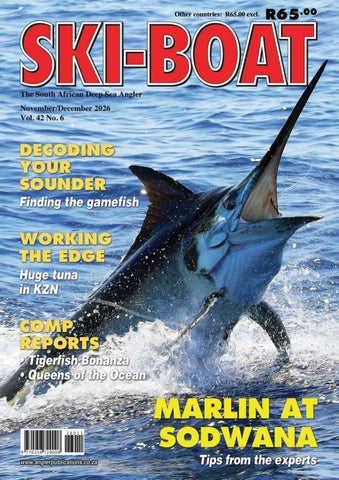
November/December 2026 Volume 42 Number 6 COVER: Marlin Magic This ±400 lb black marlin was caught on a swimbait off Linene in the Bazaruto Archipelago, aboard Strenue. Photo by Duarte Rato.
FEATURES
6
Targeting Marlin off Sodwana Tips from those in the know — by Henk du Plessis
14
From Strangers to Queens of the Ocean Ladies teach a masterclass in St Lucia — by Jean Schoonhoven
22
Working the Edge
44
Targeting big yellowfin tuna in Northern KZN — by Jean Schoonhoven
29
Landing the Big One A whopper of a yellowfin caught off St Lucia — by Fransien Myburg
33
Decoding Your Sounder Part 3: Finding gamefish before you drop a bait — by John Minnie
41
A Night of Legends SA big game fisherman inducted into the Hall of Fame — by Vic Warrington
22
44
Taming Tigers 2026 Tigerfish Bonanza at Pongolapoort Dam — by Mark Wilson & Dave Veldman
49
Silver Arrows of the Sea Prepping for the ’cuda season — by Justin Paynter
49
DEPARTMENTS 4
Editorial — by Erwin Bursik
59
Shimano Reel Kids
54
SADSAA News
61
Mercury Junior Anglers
57
Awards for Excellence in Fishing
63
Business Classifieds & Directory
58
Subscription Page
64
Rapala Lip — Last Word from Liska Tait
The official magazine of the South African Deep Sea Angling Association
DO YOU PREFER AN EZINE? FIND US FOR FREE ON WWW.ISSUU.COM
Publisher: Erwin Bursik Editor: Sheena Carnie Advertising Executive: Mark Wilson Editorial Assistant: Lynette Oakley Contributors: Henk du Plessis, Deirdre du Plooy, John Minnie, Fransien Myburg, Justin Paynter, Jean Schoonhoven, Liska Tait, Dave Veldman, Vic Warrington and Mark Wilson. ADVERTISING – National Sales: Mark Wilson, Manager — 073 748 6107 Lyn Oakley — 082 907 7733 Lyn Adams — 083 588 0217 Publishers: Angler Publications cc PO Box 20545, Durban North 4016 Telephone: (031) 572-2289 e-mail: angler@mags.co.za Subscriptions to SKI-BOAT: R270 per annum (six issues). New subscriptions and renewals: SKI-BOAT Subscriptions Department Telephone: (031) 572-2289 • e-mail: angler@mags.co.za • Through www.anglerpublications.co.za, or E-zine through <www.issuu.com> Printing: Novus Print, Cape Town Distribution: On The Dot <Portia.Nguyuza@onthedot.co.za> Full production is done in-house by Angler Publications & Promotions on Apple Macintosh software and hardware. SKI-BOAT Magazine, ISSN 0258-7297, is published six times a year by Angler Publications & Promotions cc, Reg. No. CK 88/05863/23, and is distributed by On the Dot, as well as directly by the publishers to retail stores throughout South Africa. • Copyright of all material is expressly reserved and nothing may be reproduced in part or whole without the permission of the publishers. • While every effort is made to ensure the accuracy of the contents of this magazine, the publishers do not accept responsibility for omissions or errors or their consequences. Views expressed in this magazine are not necessarily those of the publishers, the managing editor, editor, editorial staff or the South African Deep Sea Angling Association.
4 • SKI-BOAT November/December 2026
EDITORIAL
WHOSE FISH IS BIGGER?
C
OMPETITION within angling has, since time immemorial, played a big role in the sport. In fact, you can bet that long before there were official competitions, back when Neanderthal men were catching fish for dinner, they would have been checking to see who caught the biggest one. Moving to more modern times, in the early 19th Century comparisons of size, weight and numbers gained momentum as anglers began recording details of their catches before depositing them in the kitchen for meal preparation. Man’s desire to prove his competence and display his catch led to us keeping lists of fishing records, to note for perpetuity the size and Erwin Bursik weight of the best catches. Brian Cohen is just Publisher one of the anglers who has made their mark in the record books. On page 41 of this issue you can read that he has now been inducted into the South African Hall of Fame for his achievements. With catch records came the desire to prove our ability in a more tangible way on a level “playing field”, so to speak. Thus began the move to holding more organised fishing competitions – in our case fishing the same area at the same time and recording the number and weight or length of the fish caught. During the 1970s the Umhlanga Ski-Boat Club hosted the very first open deep sea festival where ski-boats launched from Durban and Umhlanga, and fished the area from Tongaat River Mouth to The Cutting south of Durban, weighing all the catches at Umhlanga Ski-Boat Club. A small number of prizes were offered to attract participants. So successful was it, that the event grew exponentially, and bigger and better prizes were offered by commercial supporters of the sport. In fact the competition was so successful that similar events soon popped up all around South Africa. Nowadays, these annual “bonanzas” are held right around the coast from central Moçambique down to the Cape, with some of them offering magnificent prizes. Even an average ski-boater can enter, catch a great fish, and walk away with a prize valued at up to R1 million. You only have to look at the reports on the 2026 Queens of the Ocean competition (page 14) and Tigerfish Bonanza (page 44) in this issue to see just how popular this type of competition has become. These events are now organised and administered at a level that is highly professional and a credit to the sport as a whole, and are huge fun, even for those who don’t win. In addition to these bonanza-style events, there is the much more serious side of fishing competitions – the pure format interclub, interprovincial, national and international competitions that form the backbone of competitive angling, overseen by the South African Deep Sea Angling Association (SADSAA). The SADSAA News report on page 54 of this issue will give you a taste of these if you’ve never been involved at that level. Having been involved since the start of the Umhlanga Festival, and having fished at club, provincial, national and international level, I believe all competitive angling feeds off both the bonanza-style and “official” style of tournaments and I really encourage all offshore anglers to experience both dimensions of the sport off our coast if they can. These events offer a real opportunity for anglers to learn from one another and to grow their fishing circle. In recent years we have witnessed not only the ever-increasing competence of our senior anglers in the international arena, but also the influx of many more junior and lady anglers into the sport of deep sea angling, who have proved their aptitude both locally and in the international angling arena. Of course these kinds of events also require an immense amount of effort from the clubs and associations, and generous sponsorship from the commercial sector that supports offshore angling. If you have the opportunity to get involved in any way, I encourage you to do so. It’s often hard work, but the rewards are great, and our sport always needs new people to put up their hands and spread the load. As we near the end of 2026 and our 42nd year of publishing SKI-BOAT magazine, we wish all our readers a very merry Christmas and an exciting 2027 participating in the sport we derive so much pleasure from. Until the next tide.
Erwin Bursik
TACTICS
6 • SKI-BOAT November/December 2026
By Henk du Plessis
C
OME November every year, Sodwana Bay is flooded with anglers and back-to-back competitions, with everyone hunting for billfish. On my boat, Oom C-Breeze, we use a variety of methods to target this area’s billfish, including live bait, pitch bait and trolled lures. Our tactics vary depending on the season. Due to the vast number of sharks at Sodwana, it has become nearly impossible to fish with live bait during the summer months. We do use live bonnies, skipjack and yellowfin tuna from May up to September, but as soon as the water temperature rises you will lose 90% of your live bait to sharks.
Seeing as we’re heading into summer now, in this article we will focus on trolling lures. The biggest advantage of this method is the vast area you can cover in one day. Mako sharks will occasionally still take a lure, but not that often. SKIRTED LURES During November, December and January we see a lot of striped marlin in between the blue- and black marlin off Sodwana. Striped marlin are the nemesis of many marlin fishermen. Sometimes you will get up to five or six strikes during the day from them without any hookups. To turn that situation around, from November to the end
SKI-BOAT November/December 2026 • 7
SODWANA FISHING SPOTS GPS MARKS A B C D E F G H I J K L
M
N
O
P Q R S T U V
Black Rock 27 08.357S 32 50.035E 27 09.997S 32 49.238E Rocktail — ’cuda 27 11.161S 32 48.978E Rocktail — livebait 27 10.895S 32 48.725E Elusive 27 14.960S 32 47.384E Island Rock 27 17.120S 32 46.630E Island Rock — livebait 27 17.289S 32 46.806E Piet 27 17.767S E32 47.314E ’Cuda 27 20.346S 32 45.409E Mabibi — livebait 27 20.356S 32 45.409E GT Spot 27 23.519S 32 43.951E Sailfish Knoppie; 45m depth 27 33.627S 32 41.627E Mseni — baitfish; 12m depth 27 33.817S 32 40.565E Diepgat — ’cuda; 18m depth 27 36.863S 32 40.656E Diepgat — ’cuda; 40m depth 27 36.503S 32 39.920E King Marlin Reef 1 27 39.917S 32 40.295E King Marlin Reef 2 27 40.440S 32 40.165E King Marlin Reef 3 27 40.590S 32 40.089E King Marlin Reef 4 27 40.703S 32 40.000E King Marlin Reef 5 27 40.799S 32 39.934E King Marlin Reef 6 27 40.980S 32 39.880E Red Sands; 20m depth 27 43.097S 32 38.297E
10 • SKI-BOAT November/December 2026
of January, I rig my lures with a single hook that is half a hook length outside the skirt. It’s crucial that the hook always faces down. Since I have changed my hook setups to single hooks, I tend to land 50% of the striped marlin strikes. In about 80% of these cases, the hook is embedded in the nose/bill area and not in the fish’s mouth. Blue marlin are different. They tend to eat the lure with their mouths open and, more often than not, a blue will eat your lure right next to or right behind the boat. As a rule of thumb, you will get marlin strikes from first light up to 08h00 and then again from 11h00 to 13h00 when the sun is right above your head. The fish tend to be shallower during the early hours and seem to move deeper offshore later in the day, so I vary my location as the day progresses. In the early morning up to 09h00 I will work the water depths from 200m up to 450m, and from 11h00 you will find me on the 700- to 800m contours. At Sodwana Bay we also get shortbill spearfish from November up to the end of January. They just love the deep water and about 80% of these fish are caught in 800- to 900m depths, so if that’s what you’re looking for, head out deep.
Some of Henk’s favourite lures, rigged with the hook facing down and protruding half a hook length outside the skirt. In summer, when the sharks are around in big numbers, he prefers using lures to live bait. LURE SELECTION & PLACEMENT My rule is to run bigger lures close to the boat and smaller lures further back. I use Trevor’s Terror (Big T Lures) on both my short rods, then I swim a smaller Tube (Pulsator Lures) or Stripey Tickler (Pulsator) and a Mangili (Fishing Pro Shop) on my two long rods. On my long line (Japan) I will fit a medium bird with a small Tube (Pulsator) or Vuta (Big T) or Evoque
(Tropical Dream Tackle). Colour selection is up to the angler. More often than not, you will get your blue marlin on the two short lines and the black- and striped marlin on the three lines further away from the boat. Anglers often mention that they only get strikes on their two short rods, and ask why that is.The answer is short and sweet: your long lines are too far from the boat. In my opinion, the long
HENK’S TYPICAL MARLIN SPREAD Long: 45-50m Short: 25m
Japan: ±70m
2m
Short: 25m Long: 45-50m lines (aside from your Japan line) should not be further than 45- or 50m behind the boat. FIGHTING & RELEASING MARLIN A lot of fishermen get into a fish just to lose it after an hour or so, usually right next to or under the boat. I have a few tips for fighting marlin that may reduce the number of times that happens. First, never change the angle on a fish. If the marlin is on your starboard side behind the boat during the fight, the skipper must make sure the fish stays on the starboard side. If the fish
moves over to the port side and the skipper doesn’t correct course to keep it on the starboard side, the fish will invariably throw the hook. Second, always fight the fish downstream (with the current). Fighting it upstream (against the current) means more oxygen for the fish and a prolonged fight. Third, never stop the boat while you have a marlin on the line.As soon as the fish starts to overtake your boat, there’s a greater risk that it will end up underneath the boat with propellers spinning. Next thing you know the line will
12 • SKI-BOAT November/December 2026
be cut and it will end in an “aahh shame” story. In my experience, most injuries caused by marlin to fishermen happen when the boat stops while the leader man is busy with the fish next to the boat. As a rule of thumb, I keep both motors on 1 000 rpm when the marlin is behind or next to the boat. Fourth, the leader man must always bring the fish in on the downside of the current. You don’t want the current to push a tired marlin underneath your boat because it will end in tears with a lost fish.
COMPETITION
Ladies teach a masterclass in St Lucia By Jean Schoonhoven, photos by Justin Klusener
T
HREE ladies, one last minute skipper, and a weekend that became about far more than winning. On 13 July 2026, I wasn’t going to the Queens of the Ocean competition in St Lucia. Less than a month later, I was standing at prizegiving alongside three ladies I hadn’t known from a bar of soap, wondering whether a broken gaff
and a lost yellowfin well north of 30kg had just cost us first place at the biggest ladies-only surf-launch fishing competition in the world. But I’m getting ahead of myself. This year, a record 46 teams and 131 female anglers descended on St Lucia in early August for the Queens of the Ocean Ladies Fishing Tournament. Two days of fishing, early morning surf launches, serious competition and an incredible camaraderie between the teams lay ahead.
14 • SKI-BOAT November/December 2026
HOW TEAM ZAZU CAME TOGETHER Robin Vermaak had originally agreed to skipper a team consisting of Lauriska Hillermann, Marianne Meyer and Ulrike Schlüter, but he had to travel overseas over the tournament weekend and in mid-July he asked whether I would step in. I agreed, and suddenly Zazu was going to St Lucia. The three ladies were already friends; I was the new addition, and I had never met any of them before the Thursday afternoon. Over sushi at John
Deirdre du Plooy 40.1kg Yellowfin tuna
Marianne Meyer 23.5kg Yellowfin tuna
Lauriska Hillermann 26.3kg Yellowfin tuna
Velia Tonkin 28.8kg Yellowfin tuna
Dory’s that evening,Team Zazu began to take shape. Our “hoofmeisie”, as the team captains are called, was Lauriska. She had grown up fishing with her dad, Protea billfish angler Danie Visser, who fishes out of Sodwana on his boat Lauriska. It was immediately clear that she knows what she’s doing. Lauriska also decided we didn’t need an additional male gillie onboard. She was confident she could handle the deck alongside me while still fishing as
Liani Stassen 24.5kg Yellowfin tuna
Ulrike Schlüter 21kg Yellowfin tuna
part of the team. Having now fished with her, I can say without hesitation that Lauriska can seriously fish and knows her way around a boat. I genuinely believe she could outfish most of the guys I have fished with over the years. Marianne and Ulrike, on the other hand, had never caught a deep sea fish before. That gave me a very simple goal for the weekend: get every girl on the boat at least one fish. As it turned out, destiny had slightly bigger plans.
Narissa Asher-wood 12.1kg king mackerel
Ursula Strydom 20.1kg Wahoo
RISK IT TO GET THE BISCUIT The alarm went off at 03:30 on Friday. Just after 04:00 we hooked up Zazu and headed towards the beach, determined to be in the queue by 04:20.Teams were only allowed onto the beach from 05:00, but with 46 boats needing to launch safely through the Mapelane surf, we wanted to be early. It took around 40 minutes to get the entire fleet safely behind the backline and only then, after a blessing of the fleet, did the tournament get underway.
SKI-BOAT November/December 2026 • 15
Go time! I had done some research before the tournament and had a feeling our best chance was going to be deep. The ocean wasn’t lekker, though, and running deep was a gamble. We would lose valuable fishing time getting there and, if I was wrong, we could spend a large part of the morning searching while other teams caught fish closer in. I explained my thinking to the girls. They trusted the call, and we went deep. Sometimes you have to risk it to get the biscuit. About an hour and a half later, three rods went away. Before long we’d boated three yellowfin tuna, all between about 23kg and 25kg. For two ladies who had never caught a deep sea fish, Marianne and Ulrike had just received one hell of an introduction. Team Zazu had also found its rhythm. The music was loud, the girls were dancing between strikes, the laughter never really stopped and the energy onboard was infectious. I’ve always believed a happy boat catches fish, and Team Zazu seemed to have exactly the right juju. Maybe the tuna liked our playlist. Maybe they simply came over to see what all the noise was about. Whatever it was, the reels kept screaming. By around 11:30, we
had 11 fish onboard – a mixture of yellowfin and skipjack tuna. My original goal had already been achieved, now we had a tactical decision to make. The Queens scoring system rewards species diversity, with your total bag weight being multiplied by the number of qualifying species caught. We already had yellowfin as one species, and all other tuna counted as another species, so we were on two. One more species could completely change our score.The problem was that we would be leaving feeding yellowfin to go and look for it. It wasn’t an easy call, but the potential reward was too big to ignore. The gamble almost paid off. On our way back, we spotted a sailfish basking on the surface in the sun.There was our third species. We quickly pitched a live bait to it, but the sailfish wanted absolutely nothing to do with us. Maybe we should have turned the music up. Around 14:00, it was time to head in; we had to be in the weigh in queue at St Lucia Ski-Boat Club by 15:30. On the beach, we discovered another problem. How exactly do you get 11 tuna into the weigh-in queue when half of them don’t fit in your fish bag? In the end we loaded all 11 tuna
straight onto the back of the bakkie. When we got to weigh in with our bakkie load, containers magically appeared, people jumped in to assist, and we got our fish to the scales. The weigh in was an experience in itself. All the teams were there, with plenty of cheering and banter as the fish came through. Our 11 tuna were successfully weighed, although there was one little sting in the tail.The biggest fish of Day 1 was a 25.1kg yellowfin caught by Anel Erike aboard Two Oceans II. We missed it by just 100 grams.That’s fishing. That evening rods and reels temporarily made way for the tournament’s movie-themed dress-up evening. Team Zazu went with Alice in Wonderland. The other teams had gone all in too, with The Mask, Toy Story, Mad Max, The Lorax, Top Gun, Masters of the Universe, 50 First Dates (Baits) and plenty more represented. It was one of those evenings that showed exactly what Queens of the Ocean is about. Everyone wanted to win on the water, but once the lines were up, the laughter and camaraderie between the teams took over. Eventually, reality called. Another 03:30 alarm was waiting, and Saturday
SKI-BOAT November/December 2026 • 17
was going to be more than just the final fishing day for one member of Team Zazu – it was also Lauriska’s birthday. THE DAY THE GAFF BROKE When the shotgun start released us on Saturday, I pointed Zazu deep again.This time the tuna made us work harder. It took about two hours before we found them, but eventually the reels started screaming again. By around 12:30, we had ten fish onboard and started working our way shallower. Then, at approximately 12:50, all hell broke loose. All four rods went away. Four rods. Four tuna. Three ladies allowed to fight them. The dancing stopped rather quickly. Three of the fish came to the boat relatively quickly. The fourth was different. This was a proper yellowfin, pushing far north of 30kg, and it kept us busy considerably longer. Eventually I got hold of the leader and the fish came within range. Lauriska put in a perfect gaff shot. We had it. Or so we thought. As we lifted the yellowfin from the water, the gaff broke. The very same gaff we had used successfully the entire weekend. The yellowfin hit the water and took off. The hook straightened and a good fish disappeared back into the Indian Ocean with the gaff hook still in it. For a few seconds there wasn’t much to say. We had done everything right, but sometimes fishing simply reminds you who’s in charge. We eventually headed to the weigh-in with 13 fish of two species for Day 2 – four over 23kg and nine over 10kg. Then Team Cyclone arrived.They had about eight big yellowfin onboard, all over the 22kg mark. Among them was a magnificent 40.1kg yellowfin caught by Deirdre du Plooy.That would prove to be the biggest fish ever weighed at the Queens tournament. We looked at their fish, then we thought about ours. Suddenly that broken gaff started haunting us. Had that one yellowfin just cost us the Queens of the Ocean? We had to wait to find out. QUEENS OF THE OCEAN Across the tournament, 152 fish were brought to the scales, with 12 species weighed or released, among them two marlin and one sailfish which were successfully released. Of the 46 boats entered, 34 weighed or released fish. Of those 152 fish, 24 were caught by the three ladies on Zazu. When the winners were announced that night, Team Zazu was heralded as overall winners of the 2026 Queens of the Ocean Ladies Fishing Tournament! But the team result was only part of the story.All three of our anglers finished in the top ten, even though two of them had never before caught a deep sea fish, and the field included many experienced
TOP 10 BOATS 1. Zazu . . . . . . . . . . . . . . . . .613.8 pts 2. Cyclone . . . . . . . . . . . . . . .513.4 pts 3. Mitsu-Fishi . . . . . . . . . . .313.8 pts 4. Against All Odds . . . . . . .213.2 pts 5. Woep Wap . . . . . . . . . . . .163.8 pts 6. Queen Pine . . . . . . . . . . .133.6 pts 7. Tails Up . . . . . . . . . . . . . .119.0 pts 8. Sabiki . . . . . . . . . . . . . . . .113.2 pts 9. Free Spirit . . . . . . . . . . . .104.3 pts 10. SMG Yamaha . . . . . . . . . .102.8 pts
TOP 10 ANGLERS 1. Geraldine Breedt, Cyclone 153.3 points 2. Lauriska Hillerman, Zazu 137.9 points 3. Deirdre du Plooy, Cyclone 103.4 points 4. Marianne Meyer, Zazu 97.2 points 5. Finn-Lee Reyneke, Mitsu-Fishi 73.7 points 6. Ulrike Schlüter, Zazu 71.8 points 7. Francine Stander, Against All Odds 66.8 points 8. Natalie Long, Mitsu-Fishi 66.2 points 9. Nicolene Stander, Against All Odds 61.0 points 10. Liani Stassen, Sabiki 53.9 points SKI-BOAT November/December 2026 • 19
Left: Geraldine Breedt with her 30kg yellowfin tuna that contributed to her overall crowning tally. Geraldine had this to say ... What an unforgettable experience at Queens of the Ocean 2026! I am incredibly proud to have walked away as Top Lady Angler and for Team Cyclone to have achieved second place overall – an accomplishment that means so much to me. What made it even more special was sharing this incredible experience with my best friend and fellow avid angler, Deirdre. There is nothing quite like fishing alongside someone who shares the same passion, excitement and determination for the sport. Being surrounded by so many enthusiastic and talented ladies made Queens of the Ocean 2026 truly unforgettable. The friendships, laughter and competitive spirit made every moment worthwhile. Having Furuno equipment on board also gave us a valuable edge on the water. Being able to rely on quality technology helped us read the conditions, locate the fish, and make the most of every opportunity, proving that good equipment combined with teamwork and determination can make all the difference. I’m extremely grateful for this achievement and proud to be part of a competition that celebrates women and their passion for deep-sea fishing. Here’s to strong women, great friendships, big fish and many more tight lines! provincial, SADSAA and Protea anglers. That, for me, was every bit as impressive as the trophy. MORE THAN THE RESULT Queens of the Ocean offers serious competitive fishing, but the tournament is about much more than a scoreboard. It gives ladies who may never otherwise experience competitive deep sea fishing the opportunity to get onto the water alongside some of the best female anglers in the country. And the camaraderie is something special. Teams helped one another. Ladies celebrated each other’s catches. There was cheering around the scales, laughter at the evening functions and genuine sportsmanship between people who had spent the day trying to beat one another. A tournament like this doesn’t happen by accident. A sincere thank you must go to Velia Tonkin and her organising committee for the countless hours and enormous effort that go into making Queens of the Ocean what it is. To the sponsors, thank you for supporting an event that continues to create opportunities for ladies to fish competitively and grow within our sport. To the NSRI, beach control, launch officials, safety personnel, ground staff, weigh-in team, security, St Lucia Ski-Boat Club staff and every volunteer behind the scenes, thank you. Getting 46 boats and their crews safely through the surf, onto the ocean and back again over two days is an achievement in itself. And to the other 45 teams, thank you for the competition, the laughs and the camaraderie.
SKI-BOAT November/December 2026 • 21
TACTICS Jean Schoonhoven with his personal best yellowfin tuna – an 81.4kg beauty that was caught off Dawsons, between Mapelane and Richards Bay, while he was working the 800 metre contour.
WORKING THE
EDGE Targeting big yellowfin from Cape Vidal to Richards Bay
By Jean Schoonhoven
T
HERE is something about a yellowfin tuna bite that never becomes ordinar y. One moment the spread is running cleanly behind the boat, and the next the water erupts.A reel starts screaming and a fish built almost entirely for speed heads for the horizon. From Richards Bay to Cape Vidal, yellowfin can be encountered throughout much of the year. In my experience, the larger fish are most consistently found from mid-March to late April, and again during August and September. Evidence of this was the fact that 32 yellowfin over 20kg were caught off St Lucia during this year’s Queens of the Ocean competition which was held in early August, including one 40kg fish. A 74.6kg specimen was caught a week later (story alongside). The periods during which we see these big fish off the northern KwaZulu-Natal coast shift with the water temperature, the Agulhas current and the availability of bait. Yellowfin along this coastline range from smaller schooling fish to powerful specimens well over 50kg, with fish in the 80 to 100kg class often encountered in the deeper water. There is no single lure, colour or GPS mark that produces every time. Consistent success comes from reading the available information, finding the part of the ocean that looks alive, and presenting a clean spread that covers different positions and depths.
FINDING PRODUCTIVE WATER Finding productive water begins before I launch. I use the Furuno TZ Weather service on my Furuno TZtouchXL to study sea-surface temperature, sea-surface height, ocean currents and chlorophyll concentration. Looking at these layers together gives me an idea of where warm and cool water meet, where the current changes direction, and where cleaner blue water borders water containing more plankton. These changes can reveal temperature breaks, current edges and eddies that may concentrate bait and feeding predators. In simple terms, an eddy is a large area of rotating water that forms alongside, or separates from, the main current. It is similar to the circular movement beside a fast-flowing river, except that an ocean eddy can extend across many kilometres. It does not resemble a whirlpool and is seldom visible from the boat. Sea-surface height and current information help reveal an eddy’s circular movement, while temperature and chlorophyll show where warm, plankton-rich water meets cleaner blue water. That boundary is often more
Some of Jean’s favourite lipped lures for targetting yellowfin tuna. important than the highest temperature or chlorophyll reading because baitfish may gather along it. I use this information to identify areas worth investigating rather than running to an old GPS mark and hoping the fish are still there. Yesterday’s productive mark can be empty today because the current, temperature or bait has moved. A day offshore is already expensive, particularly when fuel is considered, and searching blindly wastes time and money. Technology cannot guarantee I’ll catch a fish, but it can narrow the search area and focus my effort on water showing genuine potential. Used correctly, it can make the difference between a long boat ride and a productive fishing trip. Anglers without Furuno TZ Weather can use FishTrack, RipCharts or SatFish.
The free Copernicus Marine MyOcean Viewer is more technical but also provides useful information. Even a basic temperature chart can reveal a break before launching. This information gives me a starting point, not a guaranteed mark. Once I get to the area I’ve pinpointed, I check the actual temperature, water colour, current, working birds, flying fish and bait on the sounder. During the 2026 Queens of the Ocean tournament, this approach led us to a warmer patch holding substantial bird activity on both fishing days. A few birds travelling with purpose or flying fish suddenly lifting ahead of the boat may be the first indication of predators below. When the electronic information and visible signs agree, I know the area is worth working properly.
SKI-BOAT November/December 2026 • 23
FOLLOWING THE FOOD CHAIN Yellowfin are seldom the only predators in productive water. I often catch dorado, wahoo and even marlin while trolling for larger tuna. Skipjack may also be feeding around the same concentration of baitfish. Their presence confirms that the food chain is active, even if the first strike is not from the species I’m actively targeting. I do not leave an area simply because the first fish is a dorado or wahoo. That strike may confirm that I have found the right water, and larger yellowfin may be feeding deeper or nearby. The baitfish may include flying fish, bonito, mackerel and smaller tuna species.Their size and behaviour should influence the lure selection.When small baitfish are being pushed to the surface, a smaller lipped or skirted lure may be more effective than a large marlin lure. WORKING DEEPER CONTOURS Yellowfin can be caught closer inshore, and good fish regularly surprise anglers targeting other gamefish, but when I deliberately look for larger tuna, I prefer to work deep water. Most of my success with better fish has come from around the 700 metre contour to beyond 1 000 metres. Whether I work north towards Cape Vidal or south towards Richards Bay, I am looking for warm, clean water, current and bait coming together over the deeper contours. The distance you have to travel offshore to get to the deep water changes as you move along the coast, because the contours do not run uniformly. I therefore think in terms of depth, water structure and signs of life rather than distance from the launch site. However, you have to keep the distance top of mind for safety’s sake. Cape Vidal, St Lucia and Mapelane are all surf-launch sites, so weather, fuel range, current, daylight and crew condition must be considered. The trip does not end when the last lure comes out; enough fuel and daylight must remain for a safe return and beaching. BUILDING THE SPREAD My normal tuna spread consists of five lines arranged in a V formation. One lure runs relatively close to the boat, while the remaining lures are positioned much further back. At times, it appears that the larger yellowfin are wary of the boat and prop wash, so the skirted lures are often set at roughly twice the distance at which I would run them in a normal marlin spread. I still keep one lure close, though, because marlin and other predators will often rise into the prop wash. I run the skirted lures from the out-
Tuna in da boat! riggers and centre rigger.The additional height changes the angle at which the line enters the water and at which the lure is pulled through it. This helps the lure to surface, breathe and dive again in a consistent cycle, while also allowing me to position the longer lines cleanly across the spread. The towing angle must suit the individual lure because too much height can cause it to tumble or blow out, while too little can flatten its action. I sometimes fish an entire spread of lipped lures, but on other days, I use lipped lures short and skirted lures further back, providing different actions and depths. I deliberately combine different sizes and models. Some work near the surface, while others dig deeper. Yellowfin may attack bait on top during one pass and hold several metres below it on the next.
Running different lipped lures together covers more of the water column and shows where the fish are feeding. If a deeper lure repeatedly produces, I can adjust more of the spread into that zone or bring it shallower when surface lures begin producing. My regular lipped-lure selection includes Williamson Speed Pro 160 and 180 models, Halco Laser Pro 140 and 160s, and Nomad DTX 145 and 165s. Design, bib angle, towing position and speed all affect their working depth, so it is important to understand each lure’s action behind the boat. The skirted side of my spread is more varied. Productive cupped-face lures include the Ilander Black Hole, Seastar and Express heads, Pulsator Stripey Tickler, Bonita Smoker and Tropical Dream Evogue. Slant-head options include the Marlin Magnet, Tropical Dream Roxy and Baby Spear.
SKI-BOAT November/December 2026 • 25
RICHARDS BAY FISHING SPOTS 1 Mapelane Pinnacle 2 Mapelane Ledge 3 Dingos, Scavenger, Potatoe, Buddies 4 Kitchen 5 50m Ledge [north] 6 Nhlabane Pinnacle 7 Drukgang 8 Kasteel 9 Groenkop 10 Pipeline 11 South Pier 12 Arm Mans 13 Len 14 Small High Point 15 Jackpot 16 Patingo
COORDINATES
Where appropriate, I add a strip bait to the cupped-face lures. It adds scent, bulk and natural movement, but must be rigged straight. A spinning strip bait twists the leader and spoils the lure’s action. On the long and shotgun lines, I often place a small teaser bird ahead of the lure. It creates surface disturbance and makes the distant presentation easier to see. From below, it suggests fleeing bait, with the lure following as the vulnerable straggler. The bird must attract attention without causing the rig to tumble. Colour will always be debated, but I place greater value on action, size, position and the bait present. Purple, pink, black, blue, silver, green and natural patterns all have their day. When tuna are feeding on small bait, downsizing may matter more than changing colour. Some anglers may choose to add more to their spread, but I believe that five properly positioned lures are more valuable than a crowded spread that tangles when the boat turns. Each lure needs its own lane and must be checked regularly for weed, damaged bait or poor action. SPEED WITH PURPOSE When targeting big tuna, I generally troll at speeds between 7- and 12 knots, which is slightly faster than I would
normally pull a marlin spread. The final speed depends on the sea, current and lures in the water. The GPS reading is only a starting point. The real test is how the spread is swimming. The lipped lures must hold their track without rolling, blowing out or jumping. Skirted lures should work consistently, come up for air and return without tumbling. Strip baits must remain straight. The same GPS speed can produce different action down-sea and into the sea. I would rather adjust speed and have all five lures working than hold at 12 knots while two blow out. A lure pulled outside its effective range is merely occupying a rod holder. The crew should watch the spread rather than waiting for a ratchet. A boil, flash or explosion of white water may indicate that a fish has missed a lure and could return if the boat maintains speed. TACKLE FOR THE UNEXPECTED FISH When targeting bigger yellowfin, I like to use tackle in the 50- to 80 lb class with 150- to 200 lb wind-on leaders. On my boat, I use Talica 25 reels with braid backing and approximately 100- to 150 metres of 50 lb mono top shot. My Talica 50s carry braid backing with a similar length of 80 lb mono top shot. The braid provides capacity for a
Lighthouse Ledge 2828600S 03247000E Scavenger 2828900S 03227300E Mapelane Pinnacle South 2830600S 03224700E Buddies 2836300S 03223700E Hlobane Pinnacle 2840700S 03216000E Scavenger 2841200S 03233200E Kasteel North 2842500S 03220300E Groenkop Snoek 2844900S 03210900E Groenkop Snoek 2845000S 03210900E Drukgang 2845600S 03224600E Kasteel South 2846000S 03218100E Pipeline 2848600S 03207900E Pipeline 2848700S 03208100E Pipeline 2848700S 03208200E Pipeline 2848800S 03208700E Arm mans 2852600S 03203500E Len 2854000S 03207400E Patingo 2857700S 03202300E Small High Point 2858000S 03209500E
SKI-BOAT November/December 2026 • 27
long first run, while the mono top shot gives me the line class and stretch I prefer. My 50 lb outfits carry approximately 7kg of drag at strike, and the 80 lb outfits approximately 12kg, measured rather than guessed. My PB yellowfin weighed 81.4kg and was caught off Dawsons, between Mapelane and Richards Bay, while we were working the 800 metre contour. It took a skirted lure running behind a teaser bird on the long-right rod. That fish reinforced several principles I still follow: work the deeper water, position some lures well behind the boat, and use surface disturbance to draw attention to the presentation. It also demonstrated why I do not rig only for the average fish.When a tuna of that size takes a long lure, then line capacity, dependable drag pressure, a strong wind-on leader and every connection in the system immediately matter. Every part of the tackle must be checked before the spread goes out, from the first knot to the final crimp. Wind-on connections, swivels, leaders, hooks and split rings must all be in perfect condition. A fish can outfight the angler or throw the hook, but it should never be lost because of preventable tackle failure. A successful day on the water starts at home with proper tackle preparation. THE MULTIPLYING FACTOR One yellowfin strike should not immediately bring the boat to a stop. When the first rod goes, I normally maintain the same speed for approximately a minute, sometimes slightly longer, to try to convert it into a multiple strike. On several occasions, we’ve had all five rods go. Yellowfin frequently feed in groups, and holding course and speed gives the rest of the school time to attack the spread.
Of course, having multiple hookups places increased pressure on the crew, but that is a problem worth preparing for. Everyone must understand their responsibilities before the first bite. One person must remain on the wheel, anglers need to move without crossing lines or burning one another off, and unused rods must be cleared in a controlled order. The skipper should mark the strike position as soon as it happens. Once the fish are controlled, consider the current, temperature edge, birds and angle of the first pass. Repeating that line is often more effective than circling the GPS mark. FINISHING THE FIGHT The first run is normally spectacular, while the final part is slower and more physical. Once a large yellowfin settles below the boat and begins circling, the fight becomes a test of pressure, boat handling and patience. The skipper remains part of the fight until the fish is secured. Small movements of the boat can maintain a safe line angle, keeping it clear of the hull and motors. The angler should apply steady pressure, avoid high-sticking, and recover line immediately when the fish turns towards the boat. The final stage is one of the main reasons I use a good-quality wind-on leader – it can be wound through the rod guides and onto the reel. If the tuna is circling a few metres below the boat, the crew can take controlled pressure on the leader and guide the fish within gaffing range without being stopped by a swivel at the rod tip. The person handling the leader must wear suitable gloves, keep the line clear of everyone aboard, and never
28 • SKI-BOAT November/December 2026
wrap the leader around a hand or arm. A large tuna can surge without warning, even when it appears exhausted, and if the line is wrapped around your arm or hand you can be pulled overboard or suffer serious injury. The final few metres are where many good fish are lost.The gaff should only be committed when the fish is properly presented. When boating a larger tuna, I recommend using a second gaff in case the first one pulls out, breaks or tears free. Each crew member must know their role before the fish comes within range. DETAILS MAKE THE DIFFERENCE Successfully targeting big yellowfin from Richards Bay to Cape Vidal is not about one secret lure or somebody else’s coordinates. It is about getting the small decisions right. • Study the available ocean-conditions information. • Confirm the conditions through the temperature, current, birds, flying fish and bait on the sounder. • Work the deeper contours. • Keep the five-line spread clean. • Cover the water column with different lipped lures. • Position the skirted lures further back. • Rig for the fish that may arrive, not only the fish you caught last time. • When the first reel goes, keep the boat at a constant speed long enough to give the rest of the school another opportunity. There are few sights more satisfying than that of five lures running cleanly through blue water alive with birds and bait. At that point, the preparation is done, the crew is ready and all that remains is the sound every tuna angler is waiting for: a ratchet beginning to scream.
LANDING THE BIG ONE Right: Fransien Myburg and Michelle Theunnissen with the 74.6kg tuna they caught out deep off St Lucia. By Fransien Myburg T this year’s Queens of the Ocean competition, many of the ladies caught the most beautiful tuna, but those of us on Aqua-Joy only landed one little 6.7kg tuna. Hardly a fish at all! The weekend after the Queens was André Verster’s 40th birthday celebration in St Lucia. The crews of Aqua-Joy, Wizard and Hannock had one mission: find the tuna out deep! On Saturday 15 August, Ockie and Michelle Theunnissen, my husband Chris and I went out on Hannock. Our game plan was to use medium-sized lures on our outriggers with deep divers at the back. It was early morning on the 1 000m mark and all the lures were swimming perfectly.The water had the most beautiful colour, and there were birds here and there. Suddenly Ockie looked past me and said,“There they are.” He turned us towards a huge flock of birds that was diving in and out of the water, and the tuna that were jumping beneath them.We’d found them! Soon enough, the outrigger snapped and the reel screamed. Michelle took the active rod while Chris and I cleared all the others. We strapped the stand-up harness on Michelle, and she fought the tuna well, pulling it in and keeping tension on the line. Meanwhile Ockie skippered like a pro, keeping the boat on top of the fish, which helped a lot. Eventually Michelle’s back begin to ache and she convinced me to take over from her. The moment I took the rod I knew it was a big fish – not one I was going to pull without a bucket! This wasn’t my first rodeo with a big tuna – I landed my previous one of 73kg after a 45 minute fight on a W50 using a Black Magic harness. This time we didn’t have a Black Magic or a fighting chair, and Michelle and I fought the tuna on a W30 reel with 30 lb line. Ockie and Chris stood on either side of me, guiding me while the tuna circled below. “Keep your rod at 90 degrees, and when it comes up from the right side you wind.” At this stage that was not an easy task, and my left arm ached from holding the rod, but I knew every small wind would help. There was huge relief when I saw
A
the rubber band on the line. “Keep calm, you won’t lose the fish,” Ockie reassured me when we saw it coming closer. Eventually he asked if I was ready for him to take the leader. If he knew how scared I was after some previous leader efforts that went wrong, he would have known how difficult it was to say yes, but the fish was close and I knew we had it. Just 24 minutes after we’d hooked it, Ockie took the 150 lb leader, pulled the fish closer, and Chris gaffed it. Success! Once it was onboard, we could fully
celebrate.We’d landed a 74.6kg tuna on the 1 000m mark off St. Lucia, on a meduim-sized kona! The 1 000m contour was alive that day, with birds that flocked together, giant squids here and there, and also an area of the sea where the surface looked different to the rest. When we entered that flat surface, we got strikes. Wizard and Sabiki were fishing close to us, and we all circled the same area and found more tuna. We hooked up and had fun with a few triple strikes. Definitely a day to remember!
SKI-BOAT November/December 2026 • 29
ADVERTORIAL
READ THE OCEAN LIKE A PRO ONE LAYER IS A CLUE – FOUR TELL A STORY
E
XPERIENCED fishermen have always read the signs: temperature changes, water colour, current lines, birds and bait. Experience is important, but now we have another set of information, and it’s a GAME CHANGER! TZWeather with oceanographic data, a feature on Furuno’s latest range of TZT multi-function displays (TZTMAP,TZTE, TZTXL) brings several large-scale ocean clues onto the plotter screen before you spend time and fuel searching blindly.
SEA SURFACE HEIGHT (SSH) Shows the structure of the ocean. A low SSH anomaly can be associated with a raised thermocline and upwelling, bringing colder, nutrient-rich water closer to the surface layer. This can support phytoplankton, zooplankton and ultimately bait.
SEA SURFACE TEMPERATURE (SST) Shows where different temperature bodies meet, temperature patterns, and breaks between water masses. A temperature break can identify an edge worth investigating.
Don’t rely on any single weather layer as a “fish finder”. The value is in combining the layers to understand where productive water, fronts and bait-concentrating structure are coming together. One layer is a clue, four layers tells a story: Find the most productive feeding areas by using vital information. Less guesswork, targeted search areas based on more informed decisions.
CHLOROPHYLL Helps show productive water and its boundaries, indicating biologically productive water. Also helps identify the boundary between productive water and cleaner oceanic water.
OCEAN CURRENT Shows how water is moving and how nutrients, plankton and bait may be pushed together or carried along an edge, showing where productivity and bait may be concentrated when these layers line up.
HOW TO PUT IT TOGETHER Start with SSH & current: Find the larger ocean structures. Look for eddies, cur-
1. rent boundaries and areas where SHH contours tighten.Ask:Where is the water moving and where are the strongest edges? Add SST: Look for the temperature break that sits on or close to the SSH/current
2. boundary.When the physical structure and temperature edge agree, the area becomes more interesting.
3. Add chlorophyll: Look for productive water meeting cleaner water along the
same edge.This can identify a productive boundary and potential feeding zone.
Look for agreement: The strongest search area is where several indicators line 4. up, not where one layer happens to show an attractive number.
5.
Verify: Oceanographic data narrows the search. On the water, confirm it with birds, bait, water colour and your own fishing experience.
POWERED BY TAYLOR MARINE SOUTH AFRICA
For more information on how Furuno plotters with built-in TZWeather or TZProfessional with OceanO can improve your fishing, visit: www.furuno.co.za
BACK TO BASICS Daryl Bartho with a fresh-from-the water GT caught and released in Third Lake at Kosi Bay.
Part 3: Finding gamefish before you drop a bait By John Minnie
F
OR many ski-boat anglers, their sounder is still primarily used to tell them how deep the water is. If you spend enough time looking at what is happening between the transducer and the bottom, though, it will become a window into the underwater world. The trick is not to stare at the screen looking for a perfect fish-shaped arch. Instead, learn to recognise bait, individual targets, fish concentrations, depth preferences, and the relationship between fish and structure. The four Lowrance screenshots accompanying this article provide some excellent real-world examples. They show king mackerel, GTs and yellowspot kingfish, and demonstrate just how differently fish can appear on a sounder.
LOOK FOR A PATTERN One of the first lessons any angler needs to learn is that fish don’t always appear as the textbook arches shown in sonar manuals. An arch is produced as a fish moves through the sonar cone.The return becomes stronger as the fish passes through the strongest part of the cone and then weakens again as it moves away. In the real world, however, fish are moving, the boat is moving and the sonar settings are constantly influencing the picture. The result can be an arch, streak, blob, line or dense patch of colour. Trying to identify a species from one sonar mark alone is a dangerous game. Instead, look at the whole picture, and ask some pertinent questions: SKI-BOAT November/December 2026 • 33
Brett Bartho with a croc ’cuda (king mackerel) caught after he carefully analysed what his Lowrance sounder was showing.
• • • • • •
Where are the fish? How deep are they? Is there bait nearby? What is the bottom doing? Are the marks isolated or grouped? And, perhaps most importantly, do they behave consistently when you make another pass?
EXAMPLE 1: KING MACKEREL This first screenshot comes from a Lowrance Elite-4 CHIRP, with the bottom sitting at approximately 35 metres. Several distinct returns can be seen suspended above the seabed. This is a good example of why it pays to watch the entire water column.The fish aren’t necessarily sitting directly on the reef; instead, the targets are suspended above it, with individual marks appearing at different depths. In this instance, the fish were identified as king mackerel. The important lesson isn’t that a particular shape on the screen equals a king mackerel. It is that the depth, individual suspended targets, and surrounding conditions created a picture that was worth investigating. For the angler, that means not automatically dropping a bait to the bottom simply because the sounder says 35 metres. If the fish are showing at 15–25 metres, that’s where you should be thinking about presenting your bait.
SKIPPER’S TIP The depth reading tells you where the bottom is; the fish arches tell you where the fishing is.
Andrew Brits shows off a freshly caught yellowspot kingfish.
EXAMPLE 2: GTs The screenshot above is particularly interesting because it shows the same general water column on two frequencies – 200 kHz and 50 kHz. On the 200 kHz side, individual and relatively defined marks can be seen in the water column. The 50 kHz side presents the picture differently, with a broader and stronger concentration of returns. The fish in this instance were GTs – giant trevally. Again, the important lesson isn’t that every GT will look exactly like this. Sonar does not have a magic “GT setting”. Instead, experienced anglers learn to recognise the strength, position and context of the marks. A large predatory fish can produce a strong return, but several fish close together can also create a substantial patch of colour.This is why comparing frequencies can be so useful. The higher-frequency image can provide greater detail and target separation, while the lower-frequency view can give a broader picture of what is happening below the boat.
EXAMPLE 3: YELLOWSPOT KINGFISH The third screenshot is another excellent illustration of the difference between a single fish and a concentration of targets. Here the sounder is working in approximately 45 metres of water, and the screen shows a large, strong return extending through a substantial portion of the water column. The fish were yellowspot kingfish. This is where anglers can easily make a mistake. The instinct is to look at a big patch of colour and think: “That’s one massive fish.” But sonar doesn’t work quite that simply. A dense return can represent several fish packed together, bait, multiple overlapping targets or a combination of fish and bait. What matters is learning to recognise the character of the return, by asking more pertinent questions: • Are there individual targets within the mass? • Is the return changing as the boat moves? • Does the mark remain at a particular depth? • Are there smaller targets around it? These clues can tell you much more than simply judging the size of the coloured patch. SKI-BOAT November/December 2026 • 35
Brett Bartho with a beaut of a GT. Spending time learning to read your sounder properly will pay dividends.
EXAMPLE 4: YELLOWSPOT KINGFISH WITH GTs BELOW The screenshot above is arguably the most interesting of the group. Here we can see a major concentration of fish/activity extending roughly from 10- to 30 metres, while a separate group of stronger returns appears lower in the water column, around 40 metres. This showing represents a fascinating predator–prey situation. The upper fish were yellowspot kingfish, while the fish showing underneath them were GTs. Now the sounder is telling us something much more valuable than simply “fish at 20 metres”. It is showing us different groups of fish occupying different parts of the water column. This is exactly the type of information that can influence how an experienced skipper fishes the spot. If your target fish are holding at 15–25 metres, there is little reason to spend the entire day fishing the bottom at 45 metres. Likewise, the separate group underneath the main concentration tells you that there is more happening beneath the obvious bait/fish layer. BAIT IS OFTEN THE BIGGEST CLUE One of the most important things you can learn about a sounder is how to recognise bait. Bait may appear as a cloud, a thick band, scattered marks or a large concentration of individual returns. Don’t expect it to look like a collection of perfectly formed arches. Once you’ve learnt what bait looks like, start looking for the fish associated with it. The bigger predator may be below the bait, above the bait, on the edge of the bait, inside the bait, or completely separate from it. This is why the best sounder operators aren’t simply looking for fish, they’re looking for relationships. Bait + structure + predators + the right depth = a reason to fish. THE BOTTOM MATTERS While suspended fish are exciting, don’t ignore the bottom. A change from flat bottom to a rise, ledge, pinnacle or drop-off can create a feeding opportunity. Pay attention to how sharply the bottom rises or falls and how hard the return appears.A hard reef generally produces a stronger, more defined bottom return than softer sediment. Once you know the bottom, you can start interpreting what’s happening above it. A group of fish sitting 10 metres above a flat bottom is interesting. A group of fish sitting 10 metres above a pinnacle or ledge can be very interesting.
DON’T CONFUSE COLOUR WITH SIZE The colourful Lowrance screen looks impressive, but the strongest colour doesn’t necessarily mean the biggest fish. Colour represents the strength of the sonar return, and that can be influenced by fish size, fish density, fish position within the sonar cone, fish orientation, bottom hardness, sonar frequency, sensitivity and other settings. A large group of smaller fish can therefore produce an enormous-looking return. Conversely, a single fish can appear as a relatively small but very distinct mark. This is why experience matters.The more time you spend looking at your sounder and then seeing what you actually catch, the better your interpretation becomes. MAKE ANOTHER PASS One of the simplest ways to improve your understanding of the sonar reading is also one of the most overlooked: Go back over the fish. If you see an interesting mark, don’t immediately assume you’ve understood it. Make another pass. Watch the depth. Watch the fish. Watch whether the fish are moving up or down in the returns or stay together. Watch whether the fish are moving up or down in the water column. If the same group continues to appear at approximately the same depth, you can have much more confidence in what you’re looking at. This is where your GPS becomes another important part of the system. Mark the spot. Record the depth. Remember the conditions. Over time, you’ll begin building a mental picture of how that particular area fishes, and your improved catches will show it.
SKIPPER’S TIP When you find a big concentration of fish, don’t just look at the middle of it; make sure you also look underneath and around it. Predators may be sitting below, above or on the edges of a bait school.
36 • SKI-BOAT November/December 2026
40• SKI-BOAT November/December 2026
PEOPLE
A NIGHT OF
LEGENDS South African big game fisherman inducted into the Hall of Fame By Vic Warrington
I
Above: Brian Cohen with his 383.6kg (845 lb) All Africa record North Atlantic bluefin tuna caught in January 1973.
Right: Fish Hoek resident Brian Cohen with the awards he has received for his big-game angling achievements – his Springbok blazer, two State President’s Awards, and his Hall of Fame trophy.
N the history of South African big-game tuna fishing, few names carry the weight, achievement and lasting legacy of Brian Harry Cohen. Back in the 1960s and ’70s Brian made history by catching record-sized bluefin tuna in the Cape, and now he’s made history by being the first angler to be inducted into the South African Hall of Fame. Born in Simon’s Town on 14 May 1948, Brian briefly studied law at the University of Cape Town before focusing on entrepreneurship – a decision that would ultimately lead to an extraordinary career in both business and sport. But Brian’s real passion began much earlier. At the age of ten, he started fishing with his father, Vic Cohen, aboard their boat La Morva. Father and son shared a passion for big-game fishing, with the magnificent Atlantic bluefin tuna their principal quarry. In 1963, Vic caught a gigantic 702 lb (318.4kg) bluefin tuna off the beach at Fish Hoek. That extraordinary catch marked the beginning of what would become known as the Bluefin Era in False Bay. Brian was only 15 when he landed his first giant bluefin tuna. It weighed an incredible 402 lb (182kg). He went on to establish a South African junior record with a 601 lb (272.6kg) giant bluefin tuna. Cape Town soon became internationally recognised as a giant bluefin tuna destination. Brian was at the centre of it all. After catching about 43 giant bluefin tuna, he bought his first boat and established a big-game fishing charter operation that would become famous in its own right. His guests included some remarkable people like John F. Kennedy Jr., Pik Botha, Professor Chris Barnard, John Paul Young, Frankie Laine, Rob Louw, SKI-BOAT November/December 2026 • 41
people like the late Nelson Mandela and Archbishop Desmond Tutu are included,” he said. A week later, Cohen received another call informing him that he had been selected for induction. The South African Hall of Fame honours extraordinary South Africans in sports, arts, leadership and culture. Johnny Burger, chairman of the organisation, said Brian’s inclusion recognised a South African story that had made an impact both on and off the sporting field.
Johnny Burger (Chairman of SA Hall of Fame), Eugene Lewis, Vic Warriner and Brian Cohen at the Night of Legends event in Simon’s Town. Magnus Malan, Johan Kriek, Garth le Roux and Vladimir Trechikoff. Brian’s achievements in competitive angling saw him being awarded his Springbok colours and representing South Africa internationally on numerous occasions. And then came the fish that would cement his place in the history books. On 12 January 1973, Brian landed an extraordinary 845 lb (383.6kg) bluefin tuna, establishing the South African and All-Africa record. Caught on rod and reel under IGFA rules, the fish remains one of the defining achievements in African big-game fishing. Brian’s sporting achievements were recognised at the highest level in 1972 and again in 1973 when he was awarded the State President’s Award. However, his achievements were not confined to the ocean. Brian went on to become Chairman of Tuna Marine Group, and his business interests eventually stretched across several indus-
tries, with his influence extending well beyond fishing and business. And now another honour has been added to an already remarkable legacy. Earlier this year, I contacted the South African Hall of Fame with the intention of nominating Brian as an exemplar y sportsman and angler – without Brian knowing. The Hall of Fame committee agreed Brian was worthy of the honour, and on 18 September 2026, at the Simon’s Town Yacht Club, Brian Cohen was inducted into the South African Hall of Fame. A giant among anglers, a South African sporting legend, and, in my opinion, the greatest South African biggame fisherman ever. Congratulations, Brian. Your place in South African fishing history is now secured forever! Brian said the call from the South African Hall of Fame informing him that he had been nominated came as a complete surprise.“I was very excited, but I thought I would never make it because
MORE THAN ONE LEGEND Brian wasn’t the only angler celebrated on 18 September at the inaugural Night of Legends, conceived by George Language of Cape Point Tuna Charters, where more than 100 guests gathered to honour the remaining pioneers of False Bay’s tuna-fishing heritage. With only a handful of the original legends still with us, the event created a powerful time of recognition and reflection. In addition to Brian, fellow legends Andrew Perrins and Hennie Crous were celebrated for their decades of service, skill and leadership within the seafaring community, while artist Gian Groen received warm appreciation for his creative contribution to the night’s atmosphere. Beyond honouring history, the event carried a meaningful purpose: raising funds for Andrew Perrins of Skiboat Mobile, whose unwavering commitment to safety at sea has supported countless anglers and skippers around Cape Point. Thanks to the generosity of attendees and sponsors, just over R40 000 was raised in support of his ongoing work. Cape Point Tuna Charters extends sincere gratitude to every sponsor, supporter, and guest who helped make the Night of Legends an unforgettable celebration of heritage, community, and the enduring spirit of South African offshore fishing.
COMPETITION
By Mark Wilson
I
N 1996 the Sodwana Angling Club hosted the ver y first official Tigerfish Bonanza fished at the Pongolapoort/Jozini Dam. Aurthur Duvenage of D7 Unique Boats, along with some other intrepid pioneers, had a vision for a tigerfish bonanza. Their idea has not only stood the test of time, but is now confirmed as the largest freshwater tournament of its kind in the southern hemisphere. SKI-BOAT magazine got involved as an official sponsor in 2002 and we have attended the Bonanza religiously ever since. As with all events of this size, the organising committee have faced many challenges over the years, whether they were acts of God or adapting to the culture of catch-and-release which they embraced without hesitation. This year the Bonanza drew an impressive entry of 304 boats carrying 1 056 anglers. Having attended the Bonanza myself for over 20 years, I recently sat back to consider what it is that draws anglers back year after year. For a start, there’s the setting. The committee works hand in hand with
Ezemvelo KZN Wildlife, and conservation is a top priority. Where else can you spend a day out on the water hunting those elusive tigerfish, while also enjoying the sight of elephants, rhinos, giraffe and a host of other wildlife around the shores of the dam? Secondly, the camp area, which is literally home for the duration of the Bonanza, is well laid out, electricity is on hand, and ablutions are well maintained. Food and beverages are freely available for purchase, and the organised entertainment keeps the “gees” alive even if you’ve had a tough day on the water and the tigerfish were scarce. Thirdly, the sponsors have remained loyal and generous and the high quality prizes keep the anglers motivated year after year. This year the top individual angler received a Wave Glider on a trailer sponsored by Hansie Duvenhage from D7 Boating – Unique Boats, sporting a 100hp Yamaha outboard motor from Yamaha Marine South Africa. This combination is valued at R550 000. And, finally, you’ve got the dedicated committee who put the whole thing together with incredible passion. Well done, Simeon van Heerden (Chairman)
44 • SKI-BOAT November/December 2026
and your team; the 30th Tigerfish Bonanza was the best ever! This year the weather gods were very accommodating and allowed us to enjoy the full fishing sessions on all three days from 24 to 26 September. All the fish caught are measured on a provided measuring mat and are then safely released again. The rules stipulated that only tigerfish over 400mm would count towards a team’s tally, and this year that was no problem at all, with 799 fish making the cut. Two possible sources of bragging rights could be targeted – the top team category which took into account the total length of the team’s four best fish, and the individual angler categor y which would be won by the longest fish at this year’s Bonanza. After three days, during which the leader changed regularly, Dave Veldman from Team Patches was crowned the overall winner at this year’s Tigerfish Bonanza thanks to his fantastic 695mm specimen. Mbokwane took first place in the team division beating Hot Barrels by 135mm. Dave shared the story of how they became top dogs at this year’s event...
Pongolapoort Dam September 2026
Patchy Start Turned Around By Dave Veldman
T
HIS was my third Bonanza and my first teaming up with my son James (14) and his best friend, Luke Heaver (14), as my good mate Luke Fr yer was away in Kruger.We all come from the Hluhluwe area and often head up to Jozini Dam on weekends to try catch a decent tiger. My sons James and Benjamin have been lucky in the past to land some decent fish, but nothing like what we achieved at this comp. For this tournament, a big contingent of us come up from the various game reserves and farms in the area. Anita from the club assists with our requests to camp in a block so we can all enjoy each other’s company and share a couple of beers together. Somehow our camp has been named “Camp Spionkop”. Thanks, Anita, for all this effort to keep us all happy. We headed out on Day 1 with much
hope, but unfortunately Patches, the Alucraft from 1987 that I share with my business partner and good mate Luke Fryer, had some motor trouble so we had to stick around the slipway and pump station upriver. We tried all the tricks – live bait, ground baits and even spinning – but fishing was tough. Eventually we had a decent pull on a ground bait, but the fish got snagged on some underwater structure. After a lot of effort trying to untangle the fish, we lost it. We headed back in around 14h00 and did some work on Patches’ motor, replacing the spark plugs and getting a fresh fuel drum. On Day 2 Patches was purring again. This gave us some confidence, and as the flares went off, we headed upriver. We got there early and fished ground baits and live bait but didn’t see much action. Around 09h00 James and Luke suggested we head to the spot where we’d had the pull the day before.
After all, if there was one fish there, there must be more. So off we went.After a lekker breakfast fry up cooked up by the boys, we put out our rods and all settled in for a light snooze. Our snooze was short lived, as we had a decent pull on a livey. Then we lost it. That pattern was repeated over and over – big chomps or pulls on liveys that we failed to hook, until finally we hooked one. I think our tally was seven fish lost and one caught! By that stage we had basically run out of decent live bait. This fish gave an incredible fight, and we somehow managed to keep it out of the treacherous structure underneath the surface until Luke could net the fish. When we saw the size of it, all three of us were shell shocked that we had actually landed a fish like this. None of us had expected to pull in a 680mm beast! On the Keepnet video we recorded there was some serious shaking taking place to ensure we measured the
SKI-BOAT November/December 2026 • 45
Dave Veldman 695mm tigerfish
Hanre Loots 635mm tigerfish
Alistair Feuilherade 680mm tigerfish
Juandre Lotriet 660mm tigerfish
Andre Steffen 650mm tigerfish John Frankiskos 470mm tigerfish
Mark Wilson 460mm tigerfish
fish correctly and got it all on record before releasing it. After the adrenaline had settled and we knew that Keepnet had recorded the fish successfully, we sent new baits out carefully hooked. We had decided we wouldn’t use any more ground baits, just liveys, due to the time it took to clear the ground baits every time we got a bite. About 90% of the time they got snagged while we were trying to clear the deck, and the traces were lost. The ground baits were also getting no interest for a change. Towards the end of Day 2, when Luke was next up on the sticks, we had another great take and managed to set the hook. The fish jumped three times
in the few minutes we had him on and it looked like another cracker of a fish, but unfortunately this tiger also got snagged up on the structure under the surface. We spent about 20 minutes trying to free it, but unfortunately the tiger got away. By 14h00 we’d run out of live bait, so we headed back to the slipway. On Day 3 we decided that we were going straight back to the same spot where we’d hooked our big one the day before. The weather was cloudy and cool and the water there was still relatively clean. Our liveys were fresh, and while we were still busy fiddling and setting up for the day, one of them was destroyed with no hook-up! We lost another fish before 06h15, then shortly
46 • SKI-BOAT November/December 2026
Andre Thirion 655mm tigerfish
afterwards another went under the boat and was lost. We set up another two baits and soon had another pull. It was James’s turn. His tackle wasn’t the greatest set up for a tigerfish – a Daiwa Crossfire with 20 lb braid on a Backline boat rod 4–6kg. It’s an incredible rod, but very light at the tip. Despite that, James fought the fish like a pro. There were some panicked moments as it went around the nose in close proximity to the anchor rope, but somehow he managed to get the tiger up to the net where Luke netted it.This time we were a lot better at the Keepnet recording process, and we measured the fish at 650mm before safely releasing it.
We couldn’t believe we had two fish well over 600mm! WOW! We baited up a fresh livey, still with just the two rods out. Around 08h30 Luke and I saw a fish splash on the surface about 20m from our bait. “Here comes some action!” we chorused.And we were right! Seconds later we had a decent pull. I let him eat maybe too much, then we gave him a good strike and we were on again. I could feel this was a cracker because he gave a run like a wahoo. I tried really hard to keep him on the surface, but the line got snagged up. The boys pulled anchor and James took the wheel. Off we went, regaining our line and moving towards the fish. I could still feel the fish occasionally shaking his head, so I knew we were connected. James decided to start the manoeuvre an old tigerfishing dog, Graham Gerrard, had taught us some years ago for unsnagging a snagged fish, and eventually the fish popped up. We couldn’t believe it! Luke attempted to net the tiger, but the fish sped off again and the lighttipped rod broke at the tip! Huge panic ensued, but after one last attempt, Luke managed to net the fish.The three of us let out a huge cheer of relief and quickly got busy removing the hook and measuring the fish on the mat. At first he measured at 700mm, but upon a second inspection we confirmed it was 695mm. Three fish well over 600mm – things were looking good! The Keepnet app was due to shut down at 09h00 so we tried our best to get one more fish. All we needed was a 400mm fish to secure longest team score for the comp, but unfortunately the fish went completely off the bite. Still, we had that 695mm beauty in the metaphorical bag. All we’d set out to achieve was to catch four fish and be up there in the top 50 or so places, so to have a tenth place finisher (650mm), a tied third place (680mm) and the first place fish (695mm) was incredible and an absolute privilege. Team Patches and the Spionkop camping team will definitely be back in full force next year for the Tigerfish Bonanza. Special thanks to Hansie Duvenhage from D7 Boating and Yamaha South Africa for supplying an incredible prize, and to the Sodwana Hengelklub for hosting an amazing event. Very importantly, thank you to my father, Paul Veldman, for instilling the love of fishing into me from a young age. It’s now my a privilege to share this love with my boys, James and Benjamin. Finally, thank you to my wife and best friend, Judy Veldman, who puts up with all our fishing trips. I think all the compos and fishing trips we have been on have finally paid off!
Hansie Duvenhage (left) from D7 Boats and Anthony Daniels (right) from Yamaha handed over the prize boat to Team Patches.
SKI-BOAT November/December 2026 • 47
TACTICS
Prepping for the ’cuda season
Claire Joyce clearly had the recipe right the day she landed this ’cuda (king mackerel) off Durban. Now’s it’s time to start prepping for the 2027 season.
By Justin Paynter
F
ORMULA 1 racing has been nail-biting all season. The silver arrows (Mercedes) have dominated the constructors’ title and are back on top after a few years. That’s no surprise, really, and was always predicted. Out on the ocean, what are we predicting about our own silver arrows (king mackerel) for the upcoming season, and when should we start getting ready?
LAST SEASON The last ’cuda season certainly wasn’t the best one we’ve had over the last few years. We saw some slabs being brought to the scales, but the quantity and quality of the fish wasn’t what we expected. It just felt like it never really got going. I think our first real concerning sign was the fact that Vidal didn’t fire at all. Normally around October, the first pictures of ’cuda start making their appearances on social media.We also usually see the odd sailfish with a Pulsator Duster hanging out its mouth on a GoPro clip during this time. That didn’t happen last season.All we saw were dorado and more dorado. Around Christmas time the guys at Mtunzini and Zinkwazi quietly fly under the radar and enjoy the early season fish at high points after they have boated a few dorado. The odd Umdloti kayaker will then post a pic or two of a shoal-size ’cuda that has made its way down the coast in early January. Around the beginning of February, the fish start to appear in bigger numbers, and as we move through March, April and May, the real fun begins. I do believe that most of your usual spots will work early on in the season, but most anglers get so excited about catching dorado in summer that they don’t actually target the ’cuda. Reflecting on last season, there were a couple of days that the guys (including me) got an absolute hiding. It still haunts me today, just thinking about it... We launched early, got bait and ran around to the Bluff. Within minutes, my Saltist 40 was screaming like an F1 car down the straight.The fish was changing gears and the spool was getting smaller and smaller. Just as I got the fish under control, the line went slack. A few colourful words escaped my mouth. When I reeled my line back in, I saw that my entire trace was still there.The hook had literally just fallen out its mouth. My mate Mark Brewitt, looked at me but didn’t say too much.We set our rods again, and no sooner was the last rod in than his rod buckled over – so much so that he battled to get his rod out the holder. The fish ran off with about 180m of line, then Mark turned it and started fighting. The ’cuda was coming nicely towards the boat and he had it under control when it came off. When Mark reeled his trace back in and we looked at it, I turned to him and said,“Yup, you see, it wasn’t just me!” Once again the hook had just fallen out of its mouth! Right, round three! This time I did away with the single hooks and changed to a trace that had two trebles. I also set my drag a lot tighter before putting my rod back into the T-top rod holder. I wasn’t even back at the steering wheel before the rod was doubled over. Same as the last two times, the fish took line, I managed to get it under control, and then the hook just fell out of its mouth! I was dumbfounded, as my trace had one single and two treble hooks, and I’d set a tighter drag. By now I had completely lost my sense of humour. But the race wasn’t over, I assured Mark. Surely we would get ahead on the next lap... To cut a long story short, we tried everything; we were even setting the hooks like a shore angler would, but still no luck.We ended up going 9-0! We eventually headed home, licking our wounds. Matt Swemmer decided he would go out the next day and show me how it was done.Well, he ended up 7-0. The hardest part is not understanding how this could have happened. Mark and I even had a walla walla out that had six
Some days are diamonds, some days are stone, sang John Denver. Lily Joyce (above) and Justin Paynter (below) show proof that they have both caught some decent cuda, but it’s not always like that ...
Mark Brewitt and Justin Paynter have been refining their traces and bait prep ahead of the 2027 ’cuda season and hope the experiments with different types of wire pay off and result in a higher landing rate.
52 • SKI-BOAT November/December 2026
Justin Paynter’s traditional ’cuda trace generally worked well in the past, but it might be time for a change.
Mark Brewitt smiles broadly after breaking the code and landing this solid king mackerel (cuda) off Durban.
trebles in it and that didn’t stick either. As any good angler – or F1 team – knows, after a whipping you need to go home, reflect, and maybe change your tactics.
you get what you pay for. Any good ’cuda angler will tell you that you need to spend money on decent rods and reels. To start with, you need a reel that is smooth and which has a drag that doesn’t stick, because that causes a snatching effect when you’re fighting a fish. Your rod must have some backbone, but also a nice flexible tip to allow your live bait to move freely, which makes it look more natural.You can’t go ’cuda fishing with a 6ft standup rod that you would use for tuna in the Cape or at Shelley Beach. Now, before the season starts properly, is the time to overhaul your rods and reels at your local tackle shop. Get your reels serviced, your rod guides checked, and please, whatever else you do, change the line. On my reels I have 300m of 40 lb braid as backing, then I normally put 200m of Maxima ultra green on top. Go for anything between 10kg and 16kg line class. This is also a good time to service your downrigger. Any great ’cuda angler knows that a downrigger is your answer to success. If you don’t have one, put it on your Christmas list.
CHANGE UP After reflecting on that horrendous weekend, we have gone back to the drawing board and have decided that we are going to try nylon-coated wire for the upcoming season. For years we have used the American Fishing Wire, but we all know that there have been times when a large ’cuda sliced clean through it, or the wire got stuck in its teeth and parted off the hook, or the ’cuda got close to the boat and started shaking its head, kinked the wire and snapped it off. Our thinking is that the flex that the nylon-coated wire offers should allow a better hook set and should reduce the chances of us being bitten off. Well, that’s the theory anyway; only time will tell if we’re right. These pages show some examples of our traditional traces and also some of the ones we’re going to use for the 2027 season. We have super high expectations of them – just like the expectations we had of Aston Martin this season. Let’s hope our traces produce better results than the Aston Martin team did, otherwise it’s back to the drawing board again. BAIT As we move towards summer, now is the time to stock up on bait and ensure you are ready for the upcoming season. For me, bait is critical for a fruitful season.At the start of summer, my deep freeze will contain around 300 mackerel, 50 bonnies and 50 walla wallas. I also like to have around 100 redeye in stock. Most anglers underestimate this bait.At this time of year you get the big ones, and it is worth spending some time catching them. RODS AND REELS Good tackle is just as important as good bait. Remember that
TRACES As we all know Mercedes is currently dominating and will probably dominate for the rest of the year. So, while you’re watching the F1 on a Sunday, take out your ’cuda stuff and make traces while you watch. You can go through 10 to 15 traces a day if the fish are wild or if your fishing mates don’t really know what they’re doing and they wind the swivel through the top eye of the rod. That creates a magnificent kink in the wire, and if you do put that trace in the water and you get a pull, there is a very good chance that the fish will win the fight. Hopefully my luck will change, but if not, we’ll go back to the drawing board – something Aston Martin is currently doing. I’ll let you know how things go in the 2027 season. SKI-BOAT November/December 2026 • 53
SADSAA NEWS & VIEWS TOURNAMENT CULTURE By Jean Schoonhoven
A
SK competitive deep-sea anglers what they remember most about tournaments they fished ten or twenty years ago, and the answer is not always the fish. The big catches are certainly remembered, as are the painful losses, but some of our strongest memories have very little to do with the scoreboard.They are of the early mornings at the launch, the travelling, the banter, seeing old friends from other provinces, and sitting around the clubhouse after fishing. They are also of the moments when something went wrong and competitors who were desperately trying to beat one another earlier were suddenly the first people to offer help. That is tournament culture. It’s a big part of what keeps competitive deepsea anglers coming back year after year.
LONG BEFORE LINES IN A tournament starts well before the first day’s fishing. There are weeks of preparation – reels are serviced, line is checked, traces are made and tackle boxes are packed and repacked. Boats need attention, and there is always something that suddenly becomes essential two days before departure. Then the travelling begins. Eventually you get there and familiar faces start appearing.You may not have seen some of the anglers since the previous Nationals or Interprovincial, but within minutes the conversation continues exactly where it stopped. There are handshakes, old stories, friendly rivalry, and a great deal of confidence. Everyone has done their homework, and everyone has a plan. On the first morning, the ocean gets its opportunity to correct everyone’s predictions.That is fishing. 54 • SKI-BOAT November/December 2026
Anton van den Berg SADSAA President
THE MORNING OF A TOURNAMENT There is something about a tournament launch before sunrise that never really loses its appeal. Lights cut through the darkness. Engines start. Crews make final checks, and somebody inevitably starts looking for something they were certain had been packed the previous evening. At a beach launch there is another element entirely. Skippers watch the surf; crews prepare boats, and launch officials are already working. Once things start moving, there is little room for indecision. You can often recognise an experienced team without knowing who they are. They are seldom the loudest, they are simply organised. Everyone knows their job, tackle is ready, safety equipment has been checked, and nobody is trying to solve yesterday’s problems five minutes before launch. Then the boats are away and the talking stops.The game has begun.
COMPETITION IMPROVES ANGLERS There is no point pretending otherwise: we enter tournaments because we want to compete. Once lines are in, everybody wants to find the fish first. Nobody willingly broadcasts the position of productive water, and the radio often becomes noticeably quieter when a team starts finding fish. Tournament fishing puts pressure on an angler that an ordinary day’s fishing simply cannot reproduce.There is a starting time, a lines up time and a scoreboard. The fish you nearly caught earns exactly the same number of points as the one you never saw. That pressure exposes weaknesses quickly. The knot you thought would hold doesn’t. Yesterday’s productive water is empty today, and you have to decide whether to stay, move or change your approach. Sometimes you make the right call. Sometimes you spend the trip home explaining why you didn’t. Either way, you learn. LEARNING FROM OTHERS Perhaps one of the greatest benefits of competitive deep-sea angling never appears in the final results. It is the knowledge we gain from one another. Most of us begin fishing with the same group of people. We learn the techniques used on that boat and within that club, and over time those methods become normal to us. Competitive angling changes that. As an angler progresses through Club, Provincial and National competitions, they do not always choose who they fish with. The respective selectors have the responsibility of putting together the strongest and most balanced teams available.That can put you on a boat with anglers you have never fished with before, and it can be one of
the best things that happens to you. One angler may rig a bait differently. Another has refined a particular trolling spread. Someone reads birds, current, water colour or electronics differently.A skipper may position the boat during a fight in a way you have never experienced. At first, you might think,“That’s not how we do it.”Then you see it work. Nobody knows everything about deep sea fishing. No matter how experienced you become, somebody knows something you don’t. In this way, knowledge moves between anglers, boats, clubs and provinces, and our sport becomes stronger because of it. RIVALS TODAY, MATES TOMORROW Tournament fishing creates an interesting relationship between competitors. You genuinely want to beat your rivals, but that rival may later become your teammate. Two anglers who competed fiercely against one another at a Provincial or National tournament may later find themselves travelling together to compete nationally or internationally as teammates. Perhaps that is why healthy rivalry seldom needs to become personal. We compete hard, but when somebody fishes better than us, we congratulate them. Then we try to beat them next time. WHEN THINGS GO AWRY Every tournament angler eventually learns that getting themselves and their tackle to the first day’s fishing can sometimes be an achievement in itself. Sometimes a boat flips in the surf and, while lives are hopefully saved, tackle is lost, Sometimes the airline sends your tackle on a trip by itself, or you stop somewhere for a quick bite to eat and while you’re gone, someone liberates your tackle from the vehicle. Whatever the story, your challenge remains: tomorrow morning is lines in. This is where tournament culture takes over. Word gets around that a team needs help, and suddenly tackle starts appearing. A spare rod. A reel. Terminal tackle from one box, lures from another. Somebody simply says, “Take what you need.” Soon a crew who thought their tournament might be over before it started has enough equipment to fish. The people helping are the same people who intend to beat them the following day. The rod they lend could catch the winning fish. They know that. They lend it anyway. In that moment, you are not the opposition, you are simply another angler who needs a hand.
TROUBLE AT SEA Some assistance has nothing to do with tackle. Perhaps a boat develops engine trouble during a tournament. Another team may be sitting on productive water and desperately need one more fish. Then the call comes: another boat needs assistance. Usually there isn’t much discussion – lines come in, and the team gives up valuable fishing time to stand by, help where possible or tow the boat towards safety. Those lost minutes or hours could change their tournament result, but it doesn’t matter. Today it is their engine that has failed; tomorrow it could be yours. That is more than sportsmanship, it is seamanship, and it should always come before the scoreboard. THE TOURNAMENT NOBODY SEES While competitors concentrate on fishing, another tournament is happening quietly behind the scenes. Officials, organisers and volunteers have often been working for months before the first team arrives. Each day, launch officials are working before most competitors have properly woken up. Scorers and weighmasters are still busy while everyone else discusses the day’s fishing. Tournament committees deal with problems most anglers never know existed. Then there is the Weather Committee. When conditions become questionable, an amazing number of anglers suddenly qualify as meteorologists. Everybody has an opinion, usually supported by whichever weather app agrees with them. Meanwhile, a handful of people must make a decision that affects everyone. Nobody tows a boat halfway across South Africa, takes leave from work and spends the money involved in a major tournament hoping for a blowout, but no result is worth compromising the safety of a crew. Without these behind-the-scenes workers, there is no tournament. LINES UP! Something changes when lines-up is called. The information that was carefully guarded all day suddenly becomes easier to obtain. “Where did you find them?” “What did you get it on?” Then comes the sentence heard at almost every fishing tournament: “You should have seen the one we lost!” By the time the story reaches the clubhouse, that fish may already have grown considerably. Something important is happening. Different generations are talking fishing. Competitors discuss what worked
and what didn’t. Somebody explains why they changed tactics. Another talks about water conditions or a particular bait. This is where knowledge, stories and traditions move from one generation to another. JUNIORS ARE WATCHING Junior development involves far more than teaching youngsters how to tie knots, rig tackle and catch fish. They are watching ever ything around them. They notice the experienced angler who takes five minutes to answer a question. They notice the skipper who includes the youngest crew member in discussions. They see how successful teams behave when they win and how good anglers respond when they don’t. Most youngsters learn their first fishing techniques from family and friends, and when they are young, Dad’s way is naturally the right way. Then they arrive at a junior tournament. Suddenly another junior rigs a bait differently. Someone ties a knot they have never seen. Another has been taught a completely different way of fighting a fish. At first the reaction might be, “That’s not how my dad does it.” Then it works, and they learn there’s more than one way to catch a fish. WHY WE KEEP COMING BACK Most competitive anglers will lose far more tournaments than they ever win. If trophies were the only reason, we did this, many of us would have stopped years ago. We return because we enjoy testing ourselves against good anglers, because every tournament teaches us something, and because fishing with different people makes us better. We return to see old rivals and friends from around the country, to hear the stories and probably tell a few of our own. Somewhere along the way, a Nationals or Interprovincial stops feeling like just another competition and starts feeling a little like a reunion that happens to involve fishing. In the decades to come, the boats will change, electronics will improve, and tackle and techniques will evolve. Hopefully the culture will not. We should always compete hard and always want to win, but we should also be able to help another team get back onto the water, pull our lines in when someone needs assistance, share what we know with a new teammate, and shake the winners’ hands on the days they’re better than us. That is tournament culture. SKI-BOAT November/December 2026 • 55
APPLICATION FORM I hereby apply for The Excellence in Angling Awards, powered by Basil Manning, in the category:
Meritorious Fish
Outstanding Catch
Tick the appropriate box and supply us with the following information. PLEASE REMEMBER TO PRINT CLEARLY!
Applicant’s Details: Name: ................................................... Address: ................................................ ............................................................... ...................................... Code: ............. Tel No: .................................................. E-mail: ............................................................... Club (if member): ..................................... ............................................................... I, the undersigned, agree to abide by the rules of this award. Signature: ..............................................
Meritorious Fish Species: ................................................ Weight: .................................................. Date of Capture: ................................... Where Caught: ...................................... Skipper's Name: .................................... Outstanding Catch Category applied for 3:1
5:1
7:1
10:1
(tick appropriate box): Species: ................................................ Weight: .................................................. Line class: ............................................. Date of Capture: .................................... Where Caught: ...................................... Skipper’s Name: .................................... Digital emailed photographs should be high-resolution and sent to
angler@mags.co.za 56 • SKI-BOAT Nov/Dec 2026
YOUR favourite offshore angling magazine, SKI-BOAT, in conjunction with Basil Manning and the South African Deep Sea Angling Association, is proud to offer all South African skiboaters the unique opportunity to win awards for excellence in angling. All deep sea anglers who achieve laid down standards of excellence will be entitled to apply for The Excellence in Angling Awards, powered by Basil Manning. Upon ratification by a panel of adjudicators, the angler will receive a handsome digital certificate,suitably inscribed. The Excellence in Angling Award will be made for fish caught in two sections: 1) Meritorious Fish This award is for a fish that’s a memorable achievement for the angler, if not a personal best, and is not confined to the species listed below. Tackle used is of no consideration here, the fish's weight or release status being the main criterion. 2) Outstanding Catch To satisfy the requirements for this award, anglers can catch any recognised fish species.As a guideline, the weight of that fish must equal or exceed the suggested weights below, or certain laid down fish weight:line class ratios. Awards will be made in the following ratio categories: 3:1 – Bronze Award 5:1 – Silver Award 7:1 – Silver Award 10:1 – Gold Award. Applies to IGFA line class 1kg, 2kg, 4kg, 6kg, 10kg, 15kg, 24kg, 37kg and 60kg.
RULES: 1) There is no restriction on the number of awards which can be applied for. 2) Award applicants must submit a photograph of the relevant fish with the application form and a photograph of the angler with the fish. 3) SKI-BOAT reserves the right to use the photograph as it sees fit. 4) Entries must be on the official form which is included in all issues of the magazine. 5) Entries must be received within 45 days of capture. 6) No witnesses of the catch are required. The award is made in the true spirit of sportsmanship and relies on the integrity of the angler to make a just claim. 7) A selection of award winners’ names will be announced in future issues of SKIBOAT, along with relevant photographs. 8) Award applicants should allow 30-45 days for processing of applications. 9) There is no charge for these awards. SPECIES: SUGGESTED WEIGHT: Barracuda 15kg Dorado 12kg Kingfish (Ignobilis) 20kg Garrick (Leervis) 12kg King Mackerel (’Cuda) 15kg Black Marlin 100kg Blue Marlin 100kg Striped Marlin 60kg Prodigal Son 15kg Sailfish (Pacific) 25kg Spearfish (Longbill) 20kg Spearfish (Shortbill) 20kg Tarpon 45kg Tuna (Big Eye) 50kg Tuna (Longfin) 25kg Tuna (Yellowfin) 50kg Wahoo 15kg Yellowtail 15kg
RELEASED BILLFISH AND GT (Ignobilis) KINGFISH
With the strong trend towards releasing these and other fish, we have decided to amend the award rules to provide for acknowledgement of all released fish. All we need is a photo of the fish being released or prior to release (e.g. GT held next to the boat) and the approximate weight of the fish which should fall in line with the stipulated weights set out above. In line with this trend we will not be carrying photographs on the awards page of any billfish or GTs aside from those that are released.
Willie le Grange
Delia Jewaskiewitz
earns a Gold Meritorious Award for this stunning 31.8kg amberjack caught off Durban on 16 June 2026.
has been awarded a Gold Meritorious Award for this 16.95kg king mackerel caught off Scottburgh on 11 April 2026.
Frikkie Rall has been awarded a Gold Meritorious Award for his 20.2kg wahoo caught off Paindane, Mozambique on 25 July 2026.
Alan Gouveia has been awarded a Gold Meritorious Award for his 17.5kg ’cuda caught off Durban on 7 June 2026.
Vanessa Fourie has been awarded a Gold Meritorious Award for her 134cm GT caught and released off Cape Vidal on 18 July 2026.
Subscribe to
between 1 November 2026 and 1 February 2027 and win
YOUR NEXT YEAR’S SUBSCRIPTION ABSOLUTELY FREE! Three lucky subscribers will each win a full year’s subscription to SKI-BOAT magazine, valued at the newsstand price of R390. This means, should you subscribe and win, you will receive your next year’s subscription ABSOLUTELY FREE!
DON’T DELAY, SUBSCRIBE TODAY! 1 YEAR — 6 ISSUES
R390
Now R330,00
E V SA 5% 1
All about action!
Yes! Enter my subscription to SKI-BOAT Magazine I save 15% on the newsstand price! 1 Year (6 issues) only R330.00. Save R60.00! New subscriber Existing subscriber
ALSO AVAILABLE AS AN E-ZINE. Get your FREE digital subscription at www.issuu.com
All about boats! Name . . . . . . . . . . . . . . . . . . . . . . . . . . . . . . . . . . . . . . . . . . . . . . . . . . . . . . . . . . . . . . . . . Physical Address
........................................................
...................................................................... . . . . . . . . . . . . . . . . . . . . . . . . . . . . . . . . . . . . . . . . . . . . . . . . . . . . Code: . . . . . . . . . . . . Telephone . . . . . . . . . . . . . . . . . . . . . . . . . . . . . . . . . . . . . . . . . . . . . . . . . . . . . . . . . . . . .
All about fishing!
Cellphone . . . . . . . . . . . . . . . . . . . . . . . . . . . . . . . . . . . . . . . . . . . . . . . . . . . . . . . . . . . . . . Email . . . . . . . . . . . . . . . . . . . . . . . . . . . . . . . . . . . . . . . . . . . . . . . . . . . . . . . . . . . . . . . . . . Unfortunately, due to postal issues beyond our control, we are no longer accepting international subscriptions for the paper version of SKI-BOAT. However, anyone is able to access the digital version for free on www.issuu.com
NEW SUBSCRIBERS: Before you pay into our account please email angler@mags.co.za so we can check we have deliveries to your area. FREE DIGITAL E-ZINE ON WWW.ISSUU.COM 58 • SKI-BOAT November/December 2026
TUNA ON THE TABLE By Dominic Martins (11)
W
HILE fishing along the KwaZulu-Natal North Coast aboard our boat, Oceans Eleven, with my dad, mom, little sister and friends, I have become obsessed with everything to do with fishing.This all started from a very young age, with my very first surf launch from Tinley Manor at the age of three! On 26 May 2026 my dad surprised me with a trip to Cape Town for some big tuna fishing. My parents always keep these trips a surprise, because if they told me in advance, I wouldn’t be able to concentrate at school with all of the excitement. Early the next morning we met our skipper, Uncle Roland, at the Hout Bay Harbour and boarded his beautiful Butt Cat 930 Gamefisher, Valhalla. We made our way out to sea in the darkness, and were eventually greeted by sunrise and some daylight. The trip to the fishing grounds took almost two hours in a fairly choppy sea with some patches of wind and rain. After arriving at the spot, we got set up and started to fish. We had to pick numbers to decide fairly who would get the first and subsequent rods.We managed to land some nice tuna while I patiently waited for my turn, wondering if I would even get a turn seeing as I was the only kid on the boat and maybe a little too young to tangle with these bigger fish. While I waited, I entertained myself by helping out around the boat, taking photos and videos, and casting the poppers. Eventually another rod went off while we were chumming, and Uncle Roland called out: “Dom you’re up”. I was so happy and couldn’t wait for the fight! While Uncle Roland grabbed the rod and secured the fish, my dad adjusted my Black Magic harness and tethered me to the boat so that I wouldn’t get pulled into the water during the fight. The fight lasted 40 or so minutes before we could see the yellowfin’s colour coming up the water column. The fish made a couple more runs and turns at the boat, making me quite nervous as I have lost many fish at the boat in the past. With my arms sore and heart racing, I was over the moon when we managed to get the gaffs into the fish and load it onto the boat. My dad was so proud of me! It was a fishing moment that I will remember forever. Thank you Uncle Roland from “Fishing Valhalla” for getting us there and back safely, putting us on the fish and for giving me this incredible opportunity. Having missed two days of school, I was pleased to return with some tuna for my teacher. She was also then happy that I had skipped school to go fishing! I can’t wait for our next trip!
AD INDEX
MARKETPLACE
BA Tackle . . . . . . . . . . . . . . . . . . . . . .13 Basil Manning . . . . . . . . . . . . . . . . . .26
MEET JONO WATKINS
Cape Point Tuna Charters . . . . . . . . .42 Club Marine Insurance . . . . . . . . . . .18 Cross Country Insurance Brokers . .40 Dassen Eiland Charters . . . . . . . . . . .40 Delarey Charters . . . . . . . . . . . . . . . .21 Durban Marine . . . . . . . . . . . . . . . . . .38 Furuno SA – Taylor Marine . . . . . . .30 Garmin . . . . . . . . . . . . . . . . . . . . . . . .43 JK Photography
. . . . . . . . . . . . . . . .21
Looper Media . . . . . . . . . . . . . . . . . . .10 Lowrance . . . . . . . . . . . . . . . . . . . . . . .1
FURUNO’s new man in KZN
Lowrance . . . . . . . . . . . . . . . . . . . . . .32 MDM Services – Raymarine . . . . . . . . .2 Mercury – Rutherford Marine . . . . . . .5
F
URUNO South Africa is pleased to introduce Jono Watkins, their Light Marine Sales Representative for KwaZulu-Natal (KZN). Born and raised in Durban, Jono has spent much of his life on the ocean, with fishing being a passion since he was just three or four years old. Growing up on the water gave him a natural interest in boats, fishing and marine electronics. He fondly recalls his father asking him to keep an eye on the sounder or navigate the boat back up for another drift. Those early experiences sparked an interest in marine technology that has developed into a career with Furuno. Since joining the KZN team, Jono has embraced the opportunity to expand his technical knowledge of Furuno’s extensive product range, from established equipment to the latest marine electronics technology. His practical fishing experience, combined with his growing product expertise, puts him in a strong position to understand customers’ needs, recommend the right equipment and help them get the most out of their investment. For Jono, the opportunity to com-
Mercury – Rutherford Marine . . . . . .60 bine his career with his passion for fishing is what makes the role particularly rewarding. “What I enjoy most about my role is being able to work with marine electronics while staying closely connected to fishing, boating and the ocean. I’m passionate about helping customers choose the right equipment and making sure they know how to get the best out of it. “I look forward to building strong relationships with our KZN customers, sharing my knowledge and helping fellow fishermen get more out of their time on the water.There’s nothing more satisfying than hearing a customer tell me how easy their Furuno equipment is to use and how it’s improved their fishing experience.” With his enthusiasm for fishing, firsthand experience on the water and commitment to customer service, Jono is looking forward to supporting the recreational boating and sportfishing community throughout KwaZulu-Natal. For Furuno sales and product enquiries in KZN, contact Jono on 083 274 4695 or email <jonathan. watkins@taylormarine.co.za>.
62 • SKI-BOAT November/December 2026
Mozambique Sportfishing Charters .10 Mynmanne Competition . . . . . . . . . . .8 Natal Caravans & Marine . . . . . . . . .IBC Natal Caravans & Marine . . . . . . . . .IFC Nhoxani Villas . . . . . . . . . . . . . . . . . .48 Oom C-Breeze Charters . . . . . . . . . . .12 Port Alfred Gamefish Classic . . . . . .32 Pulsator Lures . . . . . . . . . . . . . . . . . .11 Q-Fish . . . . . . . . . . . . . . . . . . . . . . . . .40 Queens of the Ocean . . . . . . . . . . . . .21 Richards Bay Marine . . . . . . . . . . . . .24 Seaport Supply . . . . . . . . . . . . . . . . . .37 Solly’s Angler’s Corner . . . . . . . . . . .10 St Francis Yamaha . . . . . . . . . . . . . . .50 Supercat . . . . . . . . . . . . . . . . . . . . . . .28 Vanguard Insurance . . . . . . . . . . . .OBC Winch-In . . . . . . . . . . . . . . . . . . . . . . .48 Yamaha . . . . . . . . . . . . . . . . . . . . . . . .16
BUSINESS CLASSIFIEDS & DIRECTORY
62 • SKI-BOAT September/October 2024
SKI-BOAT November/December 2026 • 63
Last word from the ladies
RAPALA LIP
Superwoman, the Tuna & One Very Expensive Mistake By Liska Tait
I
T was only my second Queens of the Ocean tournament, and I was already excited before we even got onto the water for the 2026 event. Last year was such a jol – fishing with friends and enjoying plenty of laughs while tr ying to sur vive the ocean without completely losing my breakfast. This year Narissa Asherwood and I changed things up a bit: we had our boat, our husbands as skipper and gillie, and a theme – movie characters. Naturally, we went with 50 First Dates – or rather “50 First Baits”. Okay, perhaps not naturally, but once the fake coconut bras and solid white contact lens came into the picture, there was no turning back. The first day’s fishing started slowly. We were finding bait balls, looking for fish, and generally having a whale of a time. There were plenty of laughs on the boat, good music, good friends, and that feeling you get when everyone is just happy to be out on the water. For me, there was another victory happening in the background: I wasn’t seasick! Anyone who knows me knows this was basically a miracle. I’ve spent so much time dreading fishing trips because of the nausea, that simply being able to enjoy myself on the boat felt like an achievement. Suddenly, I wasn’t thinking about whether I was going to feel sick, I was thinking about catching fish. And then things got interesting. We decided to troll for some snoek and moved into a shallower section. That’s when we came across a bait ball, and there were some seriously decent tuna underneath it.
I grabbed the flick stick, I cast, and, in what can only be described as a spectacular display of fishing expertise (or fluke), my first cast practically hit a tuna in the face. Instead of calmly doing what any experienced angler would do, I panicked. I froze. I didn’t even reel. Then, suddenly, I realised: fish on! This wasn’t a little fish; this was a proper tuna. We estimated it was somewhere around 20kg, and I was absolutely convinced this fish was coming home with me. I was Superwoman. I had cast. I had hooked. I was reeling. Everything was going perfectly. For about five minutes... The tuna eventually came underneath the boat, which is where the situation went from exciting to slightly chaotic. I was trying to follow him around the back, watching the engines and the propellers, while simultaneously trying not to lose the fish. And then came the moment that still makes me want to scream. The tuna dipped again. Instead of putting my rod into the water and following him properly, I got caught up at the back of the boat. My rod ended up stuck against the rod holders. I couldn’t get it out quickly enough. The line got caught. And – snap. Gone. Just like that. My 20kg tuna disappeared, along with what I was convinced was going to be one of the greatest fishing moments of my life. The heartbreak was real. I had gone from feeling like Superwoman to standing at the back of the boat staring at a broken line, wondering how on earth I had managed to mess that one up.
64 • SKI-BOAT November/December 2026
But that’s fishing; sometimes you win and sometimes the fish wins. And sometimes you hand the fish victory on a silver platter because you got yourself stuck behind a rod holder. Despite the heartbreak, we headed back in for the weigh-in, and that’s when we realised that the day hadn’t been a complete disaster. Narissa and I were the only two women to catch a ’cuda, which was pretty damn special. So, while I didn’t get my tuna to the scales, I still had something to be proud of. Then it was time to get dressed up. Out came the fake coconut bras and all the ridiculousness that came with our “50 First Baits” theme.There were plenty of laughs, great music, good friends, and that unmistakable Queens feeling that makes the whole competition about so much more than just fishing. Looking back, I think the biggest thing I took away from Queens this year wasn’t the fish I caught, it was the confidence. Not too long ago, the thought of spending a full day on the ocean would have had me worrying about nausea before I’d even stepped onto the boat. This time, I was laughing, casting, fighting a fish and genuinely loving every second of it. Yes, I lost the tuna. Yes, I made a spectacular mess of the fight. And yes, I will probably never stop thinking about what that fish could have weighed. But somewhere between the bait, the laughter, the broken line and the fake coconut bra, I realised something: I think I’ve officially caught the fishing bug. And next time that tuna comes along, I’ll be ready for him.
Demo & Preowned Luxury
price
R315 950
price
by natal caravans & marine
R249 950
2020 INVADER QUATTRO
2013 JURGENS PENTA
price
price
R385 000
2024 CLUB OVERLANDER
R235 000
2023 VAGABOND ROGUE
price
R199 950
2010 GYPSEY REGAL
price
R235 950
2017 SPRITE SWING
Contact Gavin Kiloh +27 31 702 7291
price
R1 600 000
2021 DISCOVERER 4
info@natalcaravans.co.za www.natalcaravans.co.za 1 Wareing Road, Pinetown
price
R175 950
2018 ECHO 4