Angler Publications cc POBox 20545, Durban North 4016 Telephone: (031) 572-2289
e-mail: angler@mags.co.za
Subscriptions to SKI-BOAT: R270 per annum (six issues).
New subscriptions and renewals:
SKI-BOAT Subscriptions Department Telephone: (031) 572-2289
• e-mail: angler@mags.co.za
• Through www.anglerpublications.co.za, or E-zine through <www.issuu.com>
Printing: Novus Print, Cape Town Distribution: On The Dot <Portia.Nguyuza@onthedot.co.za>
Full production is done in-house by Angler Publications & Promotions on Apple Macintosh software and hardware.
SKI-BOAT Magazine, ISSN 0258-7297, is published six times a year by Angler Publications & Promotions cc, Reg. No. CK 88/05863/23, and is distributed by On the Dot, as well as directly by the publishers to retail stores throughout South Africa.
• Copyright of all material is expressly reserved and nothing may be reproduced in part or whole without the permission of the publishers.
• While every effort is made to ensure the accuracy of the contents of this magazine, the publishers do not accept responsibility for omissions or errors or their consequences.
Views expressed in this magazine are not necessarily those of the publishers, the managing editor, editor, editorial staff or the South African Deep Sea Angling Association.
Erwin Bursik Publisher
AGREATPRIVILEGE THATI APPRECIATE
SOME of you may be surprised to read this considering my decades of boating experience, but each and every time I sit down to pen a boat review, I question my temerity at doing so. The craft I take control of, essentially judge, and eventually expose to SKI-BOAT’s broad readership weigh heavily on my mind.
In reality, I take an individual or company’s “new baby”, like the Kosi Cat 23 featured in this issue, and, after spending a few hours on the water with it, make comments on months –even years – of thought, work, dedication and pride. It’s a tough situation for both the manufacturer and me.
They have placed their new creation in my hands to play with on the ocean and to eventually share my experience, observations and, hopefully, impartial findings of the said craft with the world. My responsibility, as I see it, is to assess the craft while being absolutely fair to both the readers (and potential buyers), as well as the manufacturers. I try my very best to be impartial in this regard.
I’m certainly no big boat manufacturer, but I have personally built two craft. The first – a Derek Leslie designed Ski-Vee – my brother, Ed, and I built in our home’s car port when we were in our mid teens. It was a solid boat that floated well, and while we never took it to sea, we used it extensively in Durban Bay and on various estuaries on the KZN North Coast.
Later, after some ten years of ski-boating, Allan Cunningham and I built a 17ft6inch Ace Craft from a kit. It was an incredible adventure for two mates, both of whom had minimal woodworking skills at that point, let alone much boat building experience. Fortunately, all went well, and the first Sea Lord was duly launched off Durban Ski-Boat Club. She was our pride and joy for many years until Allan and I purchased a glassfibre Rob Craft which we used for nearly 20 years.
This background just serves to back up my “qualifications” to undertake boat reviews. This joyful and nervewracking part of my work was first instigated by the late Dave Rorke who was editor of Ski-Scene magazine at the time. I wrote a number of reviews for them before we started SKI-BOAT. Nearly 50 years and 400 boat reviews later – having tested everything from small 14ft6in Ski-Vees to 56ft multimillion rand sportfishers – I still undertake a review with trepidation. I still feel the responsibility to our readers as well as the boat designers and manufacturers to provide a review that is as honest and accurate as I can provide.
To the many, many boat builders in South Africa and internationally who have trusted me to review your craft, whether at point of manufacture or when the craft arrived in SA, I extend my sincere gratitude for the opportunity. Thank you to all of you who have given me access to your factories, manufacturing information and advice, and who have allowed me to expose your craft to the world after on-water trials. You have exponentially expanded my knowledge and on-water pleasure by permitting me to take the helm of so very many craft.
I don’t take this privilege lightly. Till the next tide.
Erwin Bursik
By Charles Hayter
INHACA and Santa Maria are fast becoming popular destinations for sportsfishermen,and for good reason.There is an extremely diverse fishery on offer that produces a lot for all styles of fishing,and the area offers good accommodation and activities for the whole family,not just fishing.
In the November 2025 issue of SKI-BOAT I covered the gamefishing opportunities available around Santa Maria.This time,Erwin Bursik asked me to provide a bit more insight into the billfishery on offer.The billfishery here appears to be one
of great opportunity,with great numbers of fish being caught by the small fleet of boats that do put in the time and effort.
When I first heard of blue- and striped marlin being caught at Inhaca,I was very surprised to learn of the high numbers.About 12 years ago,just before going on a trip,I had heard of a local competition taking place from Maputo,with some boats seeing in excess of 15 fish in a day.Needless to say,the excitement was at an all time high in anticipation of what could come.
A friend in Maputo verified this information and said that they had seen and caught fish all over.His instructions were
Part 26:Billfishing off Inhaca & Santa Maria
clear:head to the 350m contour,set your spread and start working the area from there.
We did just that on the first morning out and it took all of about 15 minutes to hook into our first blue marlin,a decent fish of around 350lb.We were off to a good start.
The fishing that followed in the next few days was incredible,and on our best day we released three fish from about eight bites,if I recall correctly,having raised around 13 fish.It was pandemonium at times.The marlin were literally shoaling,and we were getting bites while setting the lines,before we could even place them into the outrigger clips.
Since then,I have fished Inhaca fairly consistently for marlin,with great results every year.
I subsequently met Stuart Simpson and Ryan Williamson and decided to visit Cape Verde and fish with them in 2016.It was an incredible opportunity and the amount I learnt there was amazing!
With this experience to draw on,we began to really build on our success and have had days of world class fishing off Inhaca.Our best result to date was releasing six marlin in a day – four blues and two stripes (two double hook-ups) with 12 fish in five days.
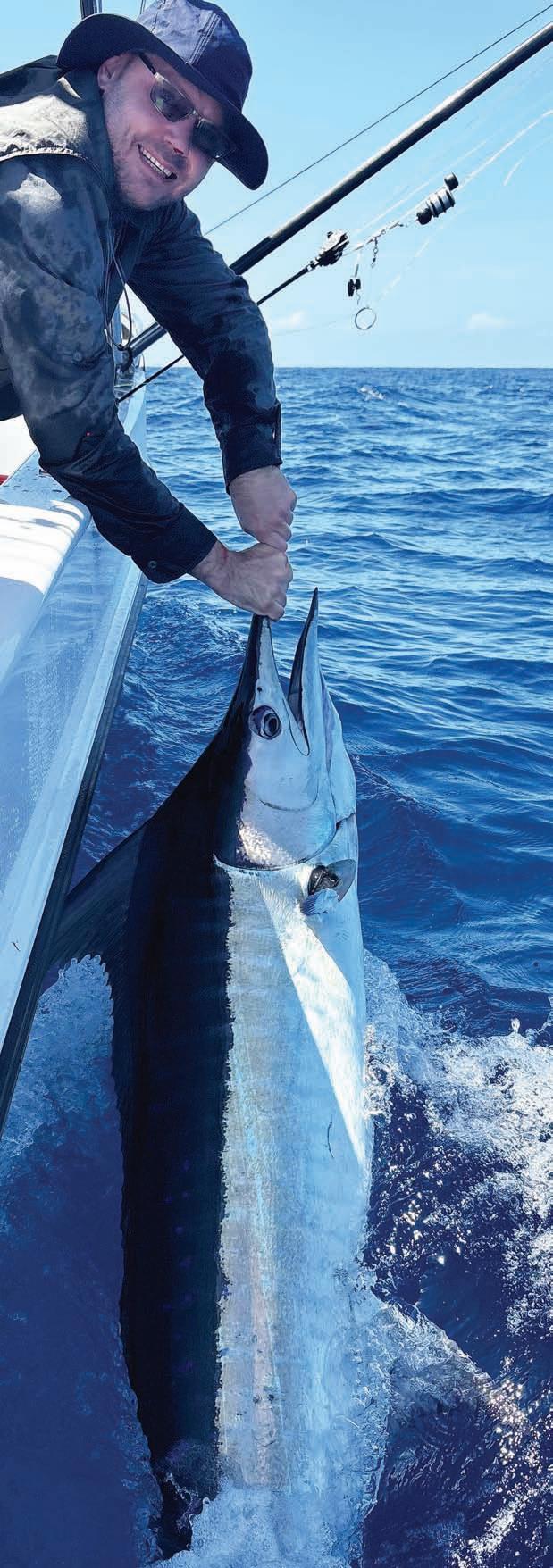
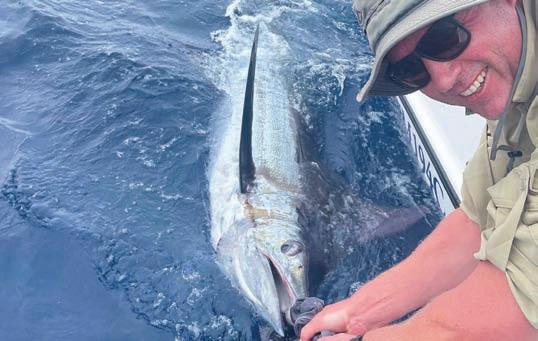
A beautiful blue marlin caught aboard FourPlay with Capt. Duarte Rato. Photo by Duarte Rato.
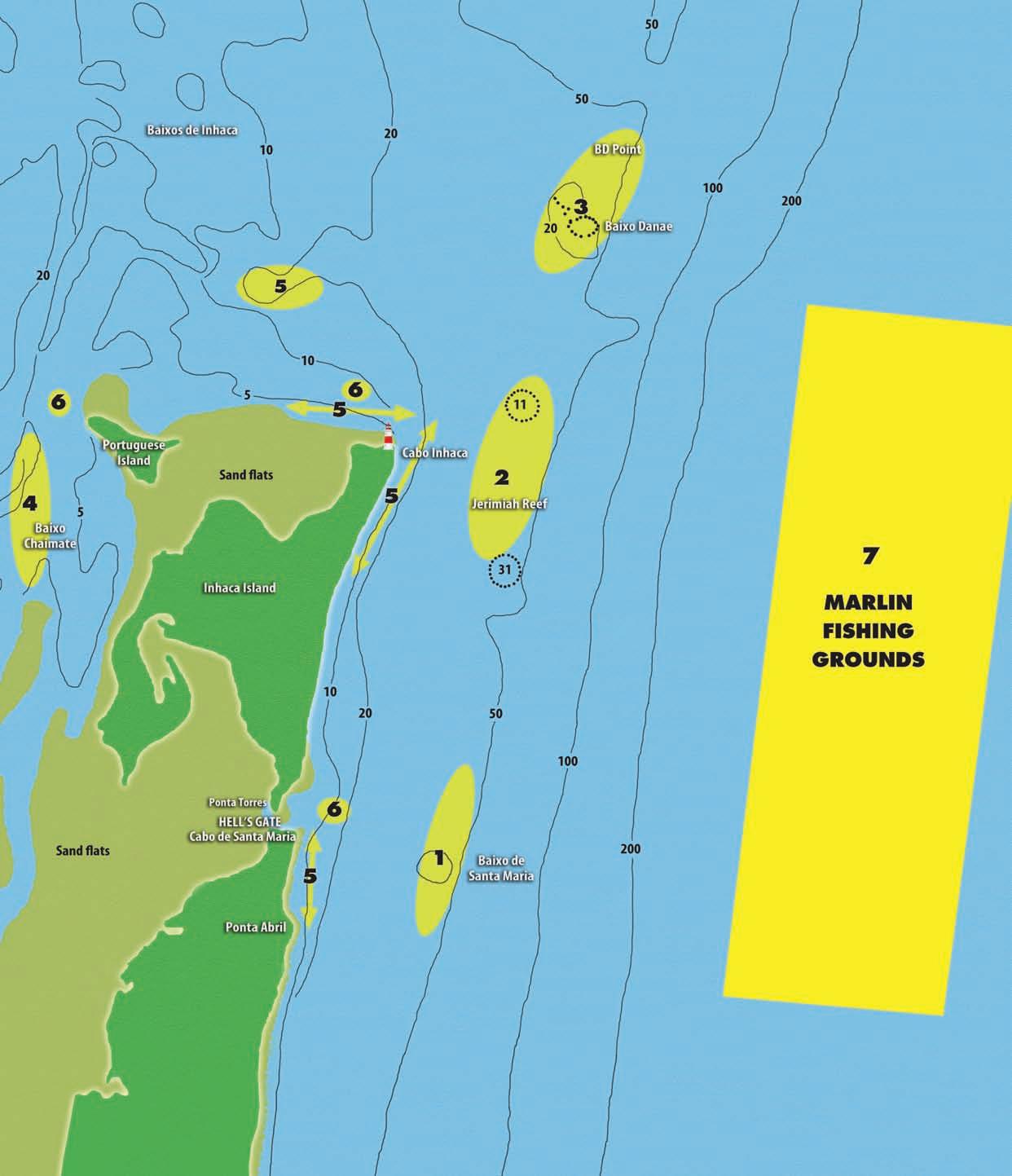
MAP KEY:
3.
4.
5. Sand flats and shallow reefs surrounding inhaca
6. Various bait spots
7. Marlin fishing grounds
BAIT SPOTS:
(Bait that can be found includes karapao, maasbanker, Portuguese sardines and mackerel)
26º4.868’S · 32º58.191’E
25º57.273’S · 32º59.340’E
25º57.251’S · 32º59.272’E
GAMEFISH SPOTS:
BD Point (25º53.023’S · 33º3.983’E)
Baixo Danae (25º54.175’S · 33º2.941’E)
Jeremiah (25º56.393’S · 33º3.466’E)
Baixo De Santa Maria (26º5.735’S · 33º0.470’E)
Baixo Chaimate (25º59.369’S · 32º52.973’E)
1. Baixo de Santa Maria
2. Jeremiah Reef
Baixo Danae and BD Point
Baixo Chaimate
Other boats have also caught and released a lot of billfish in the area.Bearing in mind that these are mostly recreational anglers,one can only wonder what a professional crew could do when the bite is hot.
THE FISHERY
Inhaca is a bit of a strange place to fish because there is no real structure out deep to speak of like canyons and steep drop-offs etc that one would usually fish.
However,on the inside shallow reefs,there are plenty of pinnacles and drop-offs.You’ll find loads of of bait like bonito, skipjacks and yellowfin around this structure.A good number of black marlin and sailfish can be caught in these areas,and we have had good success targeting them on livebaits as well as lures.
According to Duarte Rato,areas like the Poco/well (2543445S 3305080E),Baixo 24 (2553006S3303967E), and outside Jeremiah Reef and Santa Maria Bank are the main areas for black marlin.
Out past the drop-off,there is not much structure to speak of and one needs to find current lines and thermoclines which hold bait.
We often find shoals of skipjacks,dolphins and pilot whales out in the deep,and they are good indicators of where the food is.In my opinion,you need to have decent electronic equipment that can help with these tasks.
TACTICS
Once you do find bait,you need to work these areas and try to find a fish.
If you raise a fish,stick to that specific area for quite a while as we tend to find there are usually a few fish together. We have also found that it’s a good idea to stick around that same depth where you found the first fish.
The area out deep where the fish tend to be found is large (see the marked area on the map alongside) and you need to cover ground in your search for a bite.
The tidal and moon phases play an important role in deciding when to fish.We have found that generally when there is more movement in the water,like around the spring tides,there seems to be more bait,and the marlin are more actively hunting and are more aggressive.
It is apparent that when you have consistent weather conditions and good water,you definitely see a difference in fish behaviour and feeding patterns around the different moon phases.
BILLFISH
The size of the fish varies quite a bit.We found that most of the blues and blacks tend to be in the 150- to 300lb class, with the occasional 350- to 450lb fish in the mix.The stripeys in this area seem to mostly be 100- to 150lb fish.
I have,however,heard of some bigger fish being caught, and in March 2018 Carl Jankowitz,fishing with Capt.Duarte Rato,caught a really large blue that was a magnificent specimen.
According to Duarte,“The fish was hooked at 3.12pm on the way back in.It was hooked in 177m of water,which is very unusual,on a Bahama Phoebe lure.The fight lasted just under two hours.The fish got tailwrapped and had to be slowly worked to the surface and unfortunately was dead when it got to the boat.The crew could not get a scale to weigh it,but the fish’s measurements were:138 inches length,74 inches girth and 20.8 inches anal girth.”
SEASONS
The best time of year to target blue- and striped marlin specifically off Inhaca and Santa Maria would probably be from the end of January to the end of March.The better quality fish are usually more prevalent later in the season.
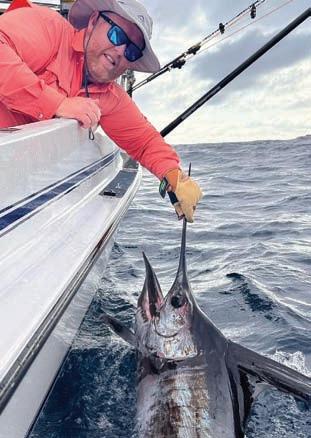
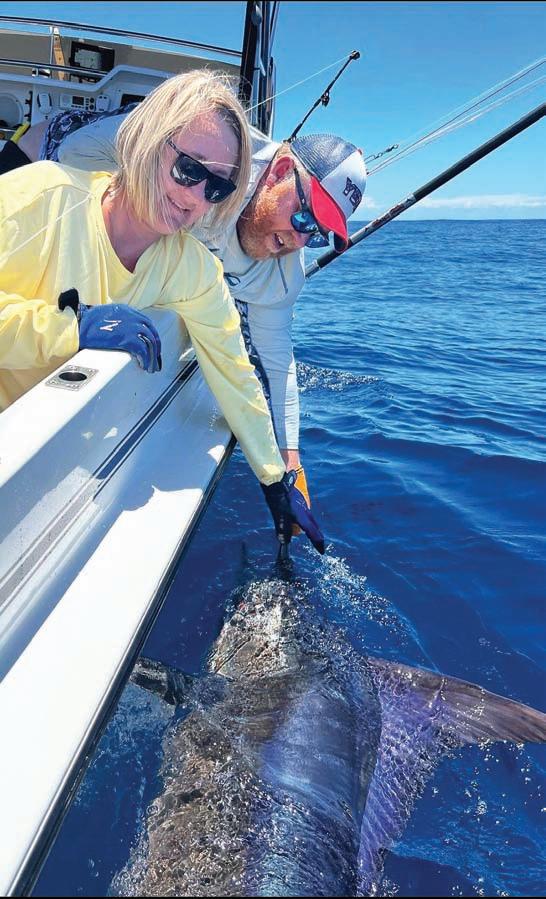
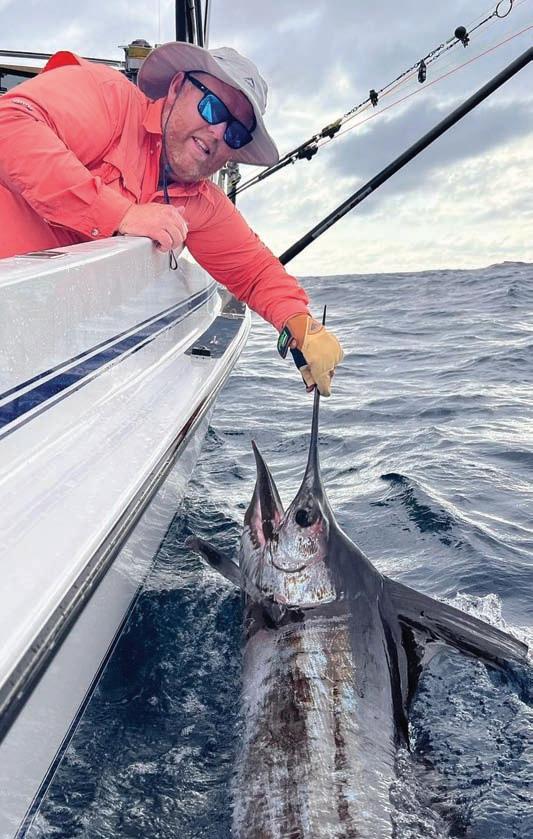
Right: Mark Sauber prepares to release a blue marlin caught off Reel Tite, off Inhaca.
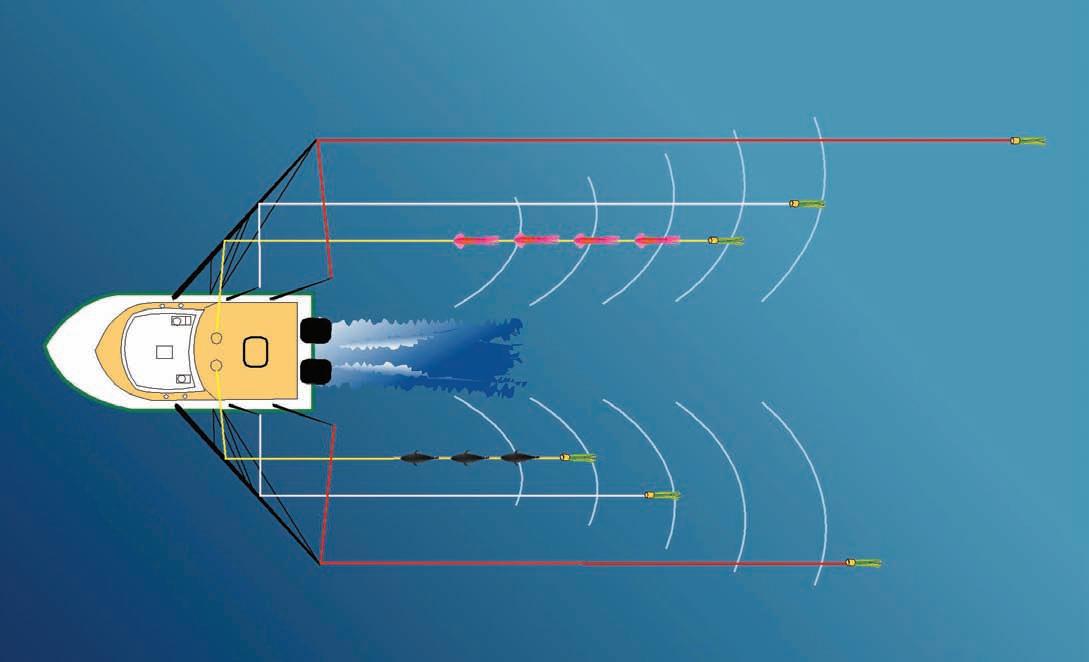
TYPICAL LURESPREAD
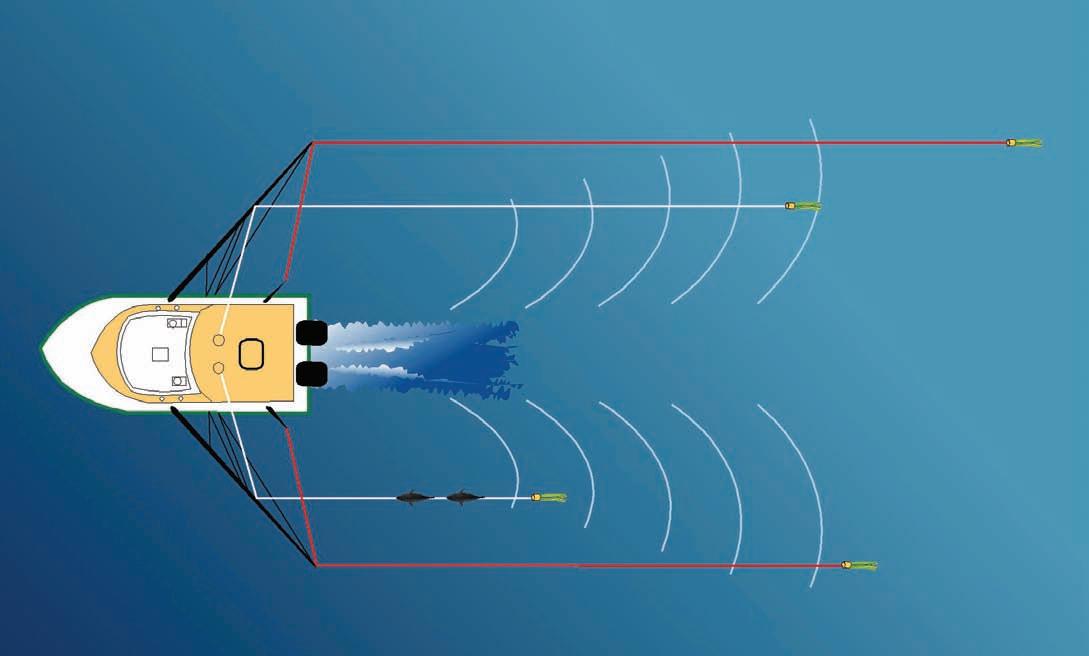
TYPICAL SWITCHBAITSPREAD
Having said that,we have regularly caught fish in October and November,and have found that black marlin seem to be more prolific in May and June,with sailfish also more common then.
LURES & TACKLE
We mostly focus on the “bait and switch”method of targeting billfish in this area,so we tend to fish slightly lighter tackle than most.
We predominantly fish with stand-up tackle.Tiagra,Talica and Penn 50 reels loaded with 100- to 150lb braid backing
with 80- to 130lb topshot and short bent-butt style rods are our weapons of choice,with a Black Magic harness.
For the bait with this method,we generally use a frigate tuna on a circle hook or a halfbeak inside a soft chugger head.
We place a lot of emphasis on trying to get the fish in quickly,and use the boat to assist with this.We generally fish with light drags to keep the fish up on the surface.This gives the fish the best chance of survival.By not fighting it for hours,you can get it boatside,take a quick picture for your wall,and release the fish in a healthy state to recover and grow.
Small (25-30cm) lure
Small (25-30cm) lure
Squid chain with teaser lure behind
Tuna mudflaps with teaser lure behind
Medium (30-35cm) lure
Medium (30-35cm) lure
Pulley
Pulley
Teaser reel
Teaser reel
Tuna mudflaps or squid chain with big lure behind
Pulley
Teaser reel
Medium (30-35cm) lure
Small (25-30cm) lure
Teaser lure
Pulley
Teaser reel
What we have found works well is fishing a very simple spread of two rods with hooked lures and two teasers which are bigger lures with daisy chains or tuna mudflaps.
If you are not up for trying to tease the fish in and pitch a bait,then I suggest fishing two nice big teasers with four smaller lures behind these two teasers.
We just find that if you raise fish on a teaser,they’re very aggressive,and when they fall back onto the lures we get a good bite out of them.
Some good choices to start with for teasers would be lures like the Pulsator Wriggler or Dominator,the Bonze Lures Violator and/or Viper,the Bahama Lures Phoebe,or any of
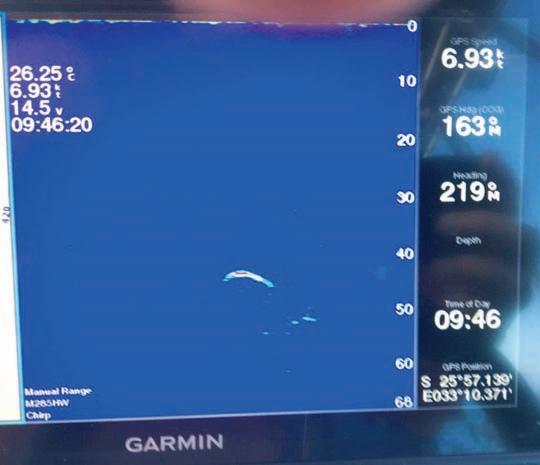
Above: Marking a marlin on the souonder out deep. Left: Jeanene Hayter with a striped marlin caught on Reel Tite. Below: Garth Lancefield with a stripie caught off Rumbler.
your favourite lures that have an aggressive surface action.
Lures to run with hooks would be smaller to medium lures like the Pulsator Stripey Tickler,Marlin Magnet or Bonze Jackhammer,Kraken,BTK and Here for the Party,as well as the tried and trusted Ilander Express.These have all produced many fish for me and others who frequently fish these waters.
BLACKMARLININSHORE
Black marlin tend to feed in water ranging from 15- to 50m deep and they are often hooked when fishing for gamefish in shallow water.They are mostly targeted on livebait and general lure spreads around the main reefs and pinnacles.
Although I don’t specifically target them,some anglers do and have a lot of fun with these smaller billfish without going all the way out to the 350m contour.
REGULATIONS
Make sure you go to the Maritimo police office (either in Maputo or Santa Maria) to obtain a fishing licence and a map showing where you can and can’t fish,and bear in mind that bottomfishing and vertical jigging are banned.You will be fishing inside the Ponta do Ouro Partial Marine Reserve,so if you’re caught doing something illegal,you will be in trouble.
It’s very much a gentleman’s agreement that we release all billfish,amberjacks,queenfish,GTs and other kingfish species caught in this area,so please adhere to that even if you’re just visiting.
It is very important that we manage these resources carefully and do our small part to ensure they remain healthy.The local residents are very reliant on tourism for their livelihoods, and the more sustainable it is for them,the better it is for everyone.
GETTING THERE
Santa Maria and Inhaca are situated roughly 35km from Maputo as the crow flies across the Maputo Bay.There are two ways of getting to Santa Maria.
The first option is to drive through the Elephant Reserve, but you’ll need a 4x4 vehicle for that.The sandy road can be difficult to navigate,especially in the rainy season which usually is from November to February.
The second option is to head all the way into Maputo and then make your way to either the marina or Clube Naval which are both situated in the harbour.From there you will head across the bay to your accommodation of choice.
You’ll need some local knowledge to get across the bay and must watch the tides carefully to ensure you don’t get stuck on the sand flats.
Be very respectful of launching through Hell’s Gate,especially when you have an outgoing spring tide against a northeasterly wind.It can get very,very ugly,and many skippers have had bad experiences in this treacherous piece of water, with some paying the ultimate price.
Speak to some locals and do extra research about the expected conditions at the time you’ll be visiting,and take the local skippers’advice on the launch.If there is any doubt,wait for the tide to change,as the water usually flattens out reasonably well with an incoming tide.
There are numerous decent operators in the area that offer charters should you not want to tow your boat and would rather take the easier route of chartering a boat.
Happy fishing!
If readers have any other questions, they’re welcome to contact the author on <charles@mhfishing.co.za>.
Good days aboard Reel Tite off Inhaca.
Santa Maria is perfectly situated to be a
By Duarte Rato
Duarte Rato, a renowned charter captain in Moçambique, grew up in the Inhaca/Santa Maria area and shared some of his history and tips with us ...
THIS blue marlin fishery was unknown until around 2010.I believe the pioneer of this fishery was Irving Stevenson who used to have the Gone Fishing operation out of Inhaca and,at one time,ran a sportfisher (Overdraft) from there.We believe he was the first to successfully ply these waters out wide for blue- and striped marlin.
He then gave those waypoints to a few of us.However,it was only years later that Eduardo Duarte,on his boat Nakisay, decided to go and explore out wide on those marks that Irving had given us.For a couple of years he kept it quiet and won all the fishing competitions in the area.Then everyone else caught up with what he was doing and started going out wide.The rest,as they say,is history.
In the years before we knew there was a healthy blue marlin fishery out wide,we only used to target black marlin, almost exclusively using live bait.Although there were some good numbers of fish,they were not very big.In March 1994 I caught a fish which was the biggest of that era that weighed around 500lb (the scale bottomed out at 200kg).
I have seen pictures of what looked like a very big black marlin that was lost a couple of years ago off the Inhaca light-
Besides the world class blue marlin fishing, the shallower waters of the Santa Maria/Inhaca area also produce good black marlin fishing. This is one of two black marlin released (out of five bites) on live bait aboard Kambaku in the Poco/well area off Inhaca. Photo by Duarte Rato.
house,but nowadays most boats targeting marlin in the area go wide for blues,so there are not really a lot of boats specifically targeting blacks.However,they are regularly caught as bycatch,both on live bait and while trolling lures.
When we fished for blues in Santa Maria we regularly trolled all the way back and then spent the last hour trolling the marlin lures in shallower water and often caught small black marlin.
If you’re specifically targeting black marlin,live bait would be the preferred method,and areas like the Poco/well (2543445S 3305080E),Baixo 24 (2553006S3303967E), and outside Jeremiah and Santa Maria Bank are the main areas.
Bait and switch is our favourite way of fishing for blues, but we only do it when we have the right boat/equipment and especially the right crew.Otherwise we fish with lures only.
I would say that one of the main attractions of the Inhaca/Santa Maria area is that the potential for achieving a grand slam and a super grand slam is high.Boats fairly often catch three billfish species in a single day.
I remember fishing in my friend Luis Nunes’boat, Kambaku,in January 2014,and we went wide and got a nice sized blue marlin,a striped marlin and a sailfish in the morning.Mid-afternoon,we went to shallower water to try and get a black marlin for the super grand slam,and were unlucky to have the hooks pull on two fish.
From what we have experienced,and even though there are not a lot of big blues caught,the offshore waters around Inhaca/Santa Maria are world class with regard to the sheer number of blue- and striped marlin they produce,and the realistic opportunity of catching black marlin and sailfish in shallower waters.
One has to acknowledge that most boats fishing the area are crewed by weekend anglers.If the area were to be fished by professional crews doing a serious bait and switch program during the whole season (November to April) the numbers could be staggering and might well rival some of the best blue marlin fisheries anywhere in the world.
Above: The crew on Kambaku with a grand slam of a blue marlin, striped marlin and sailfish. They tried for a black marlin to get the super grand slam but lost two fish. Photo by Duarte Rato.
AWORTHY
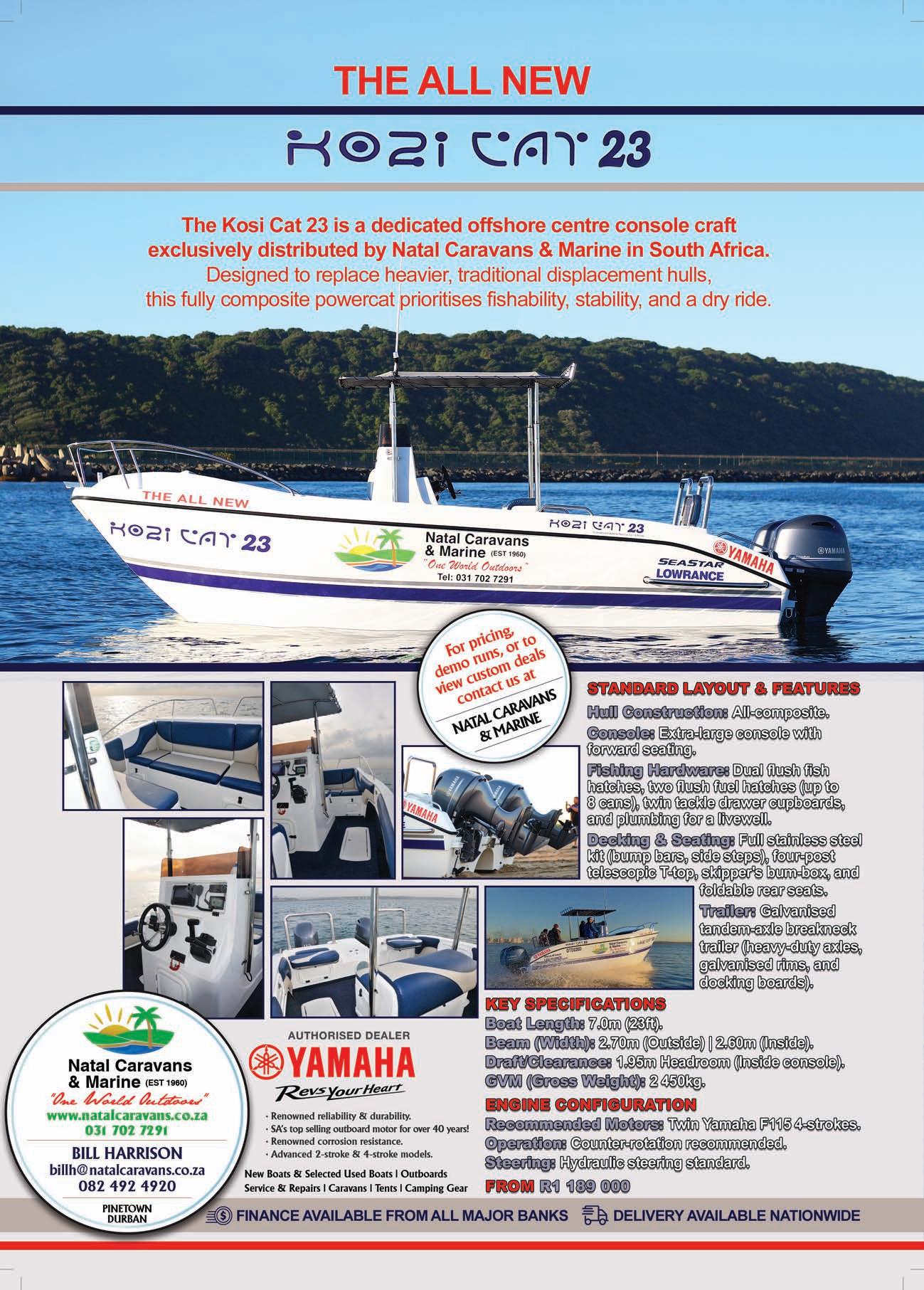
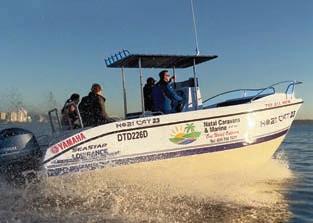
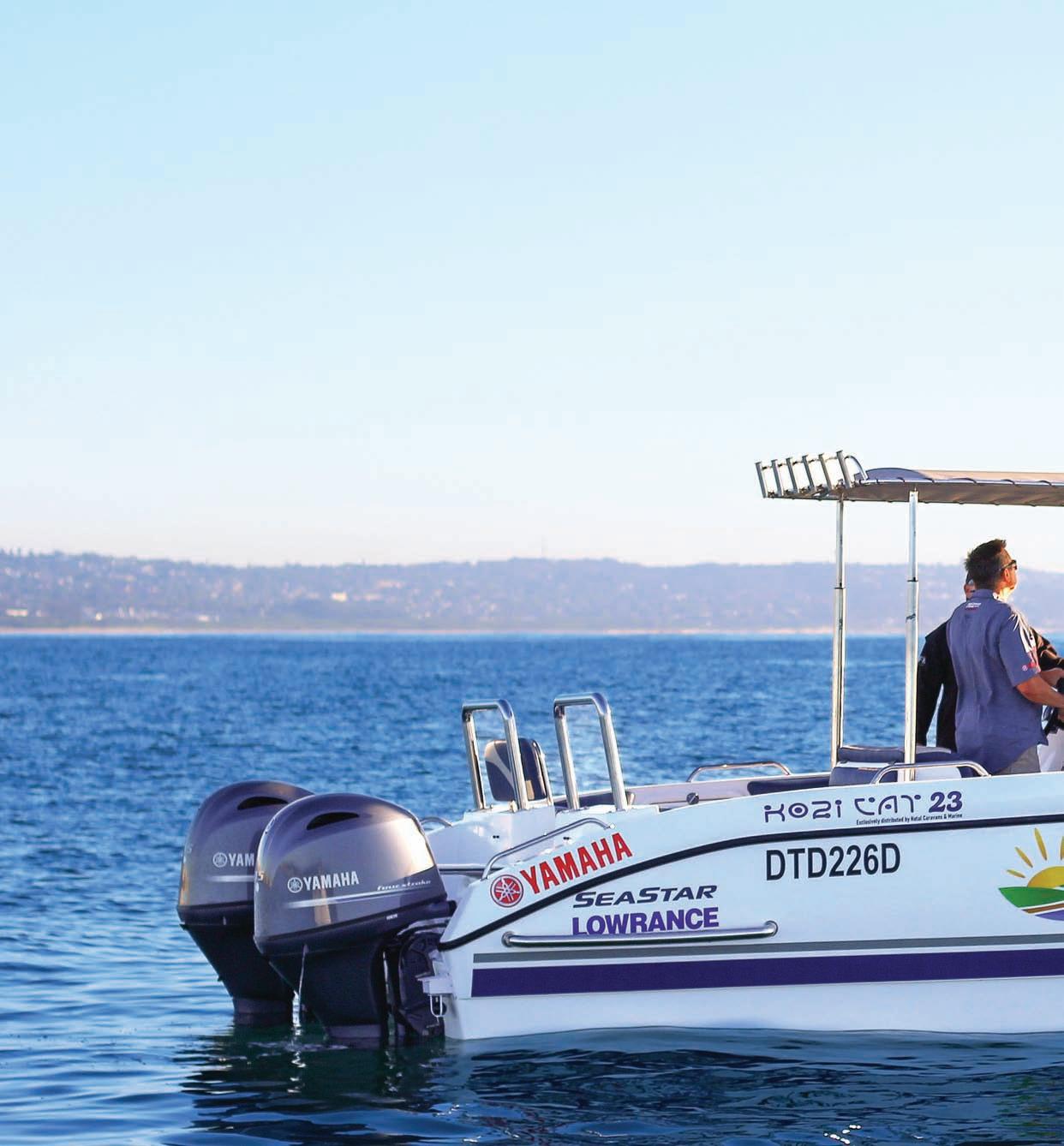
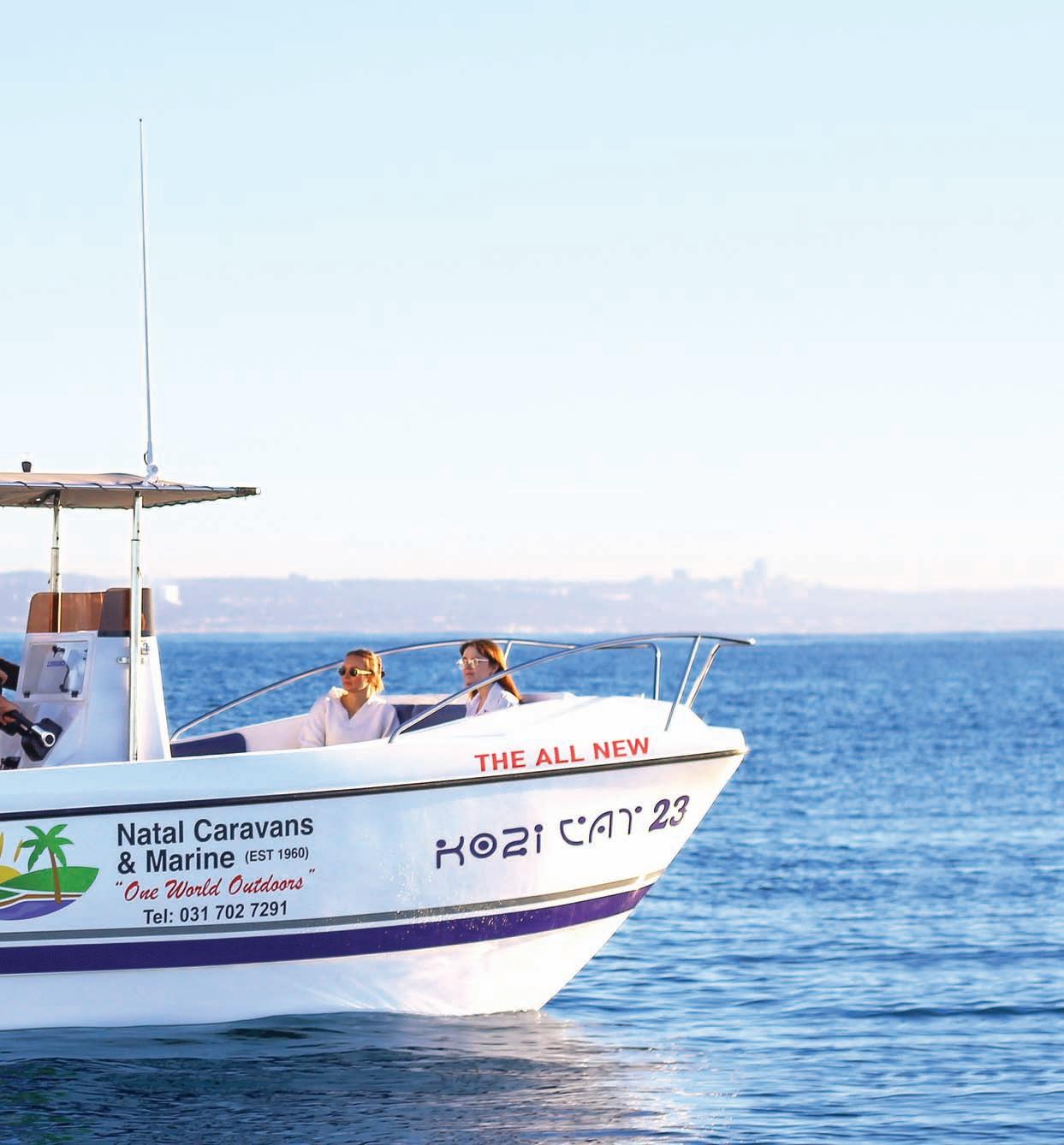
Introducing the Kosi Cat23 by Natal Caravans & Marine
Reviewed by Erwin Bursik
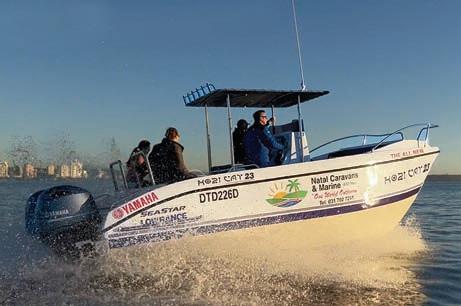
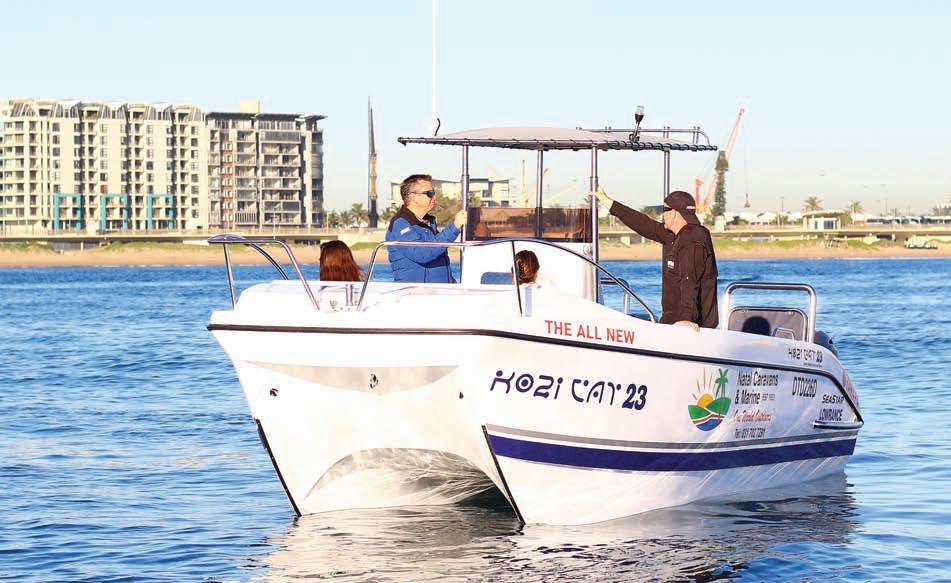
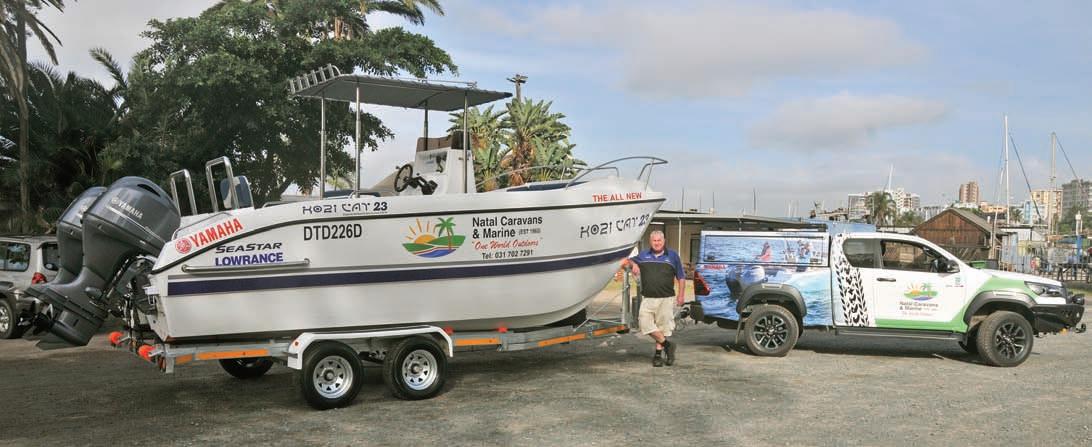
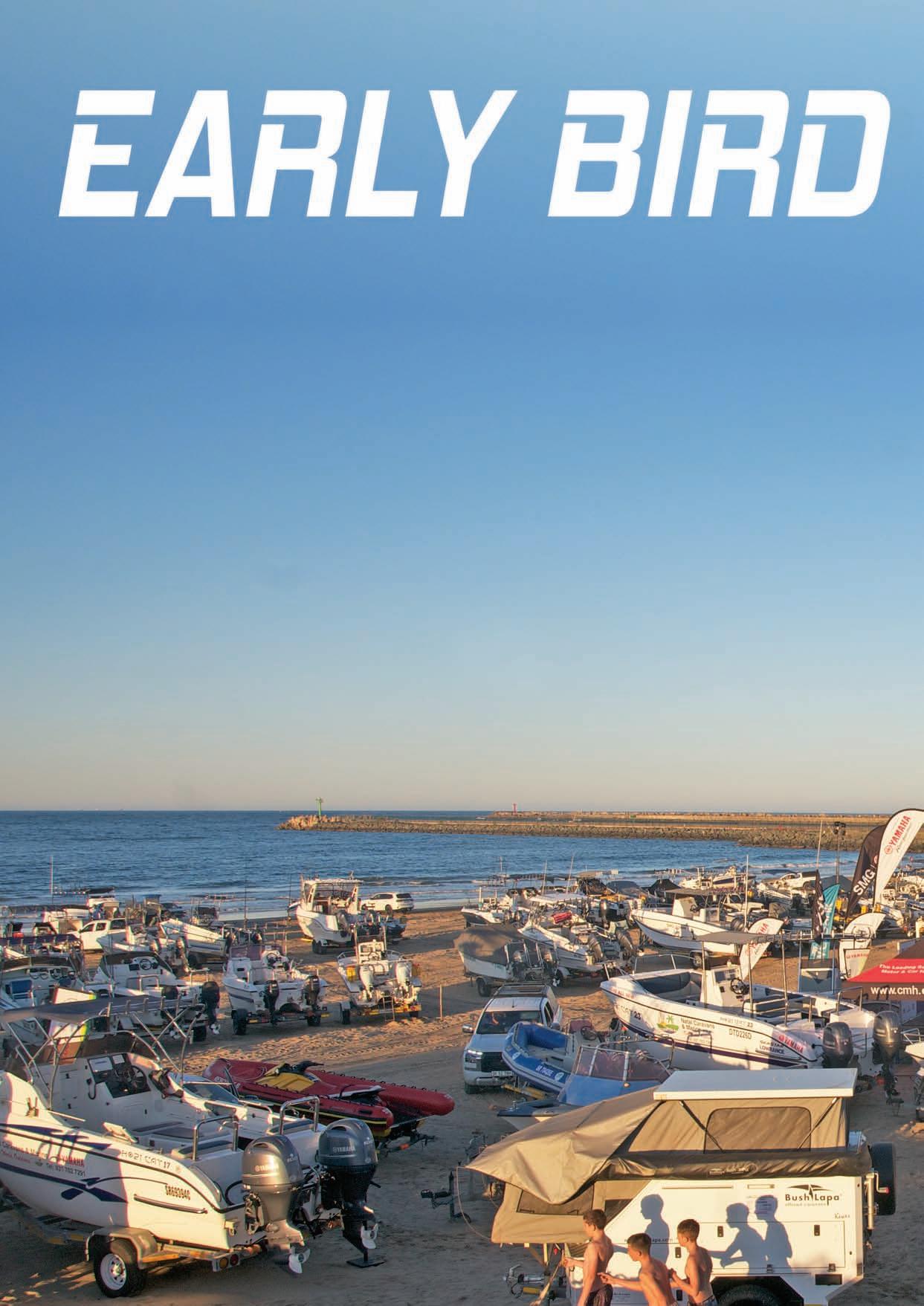
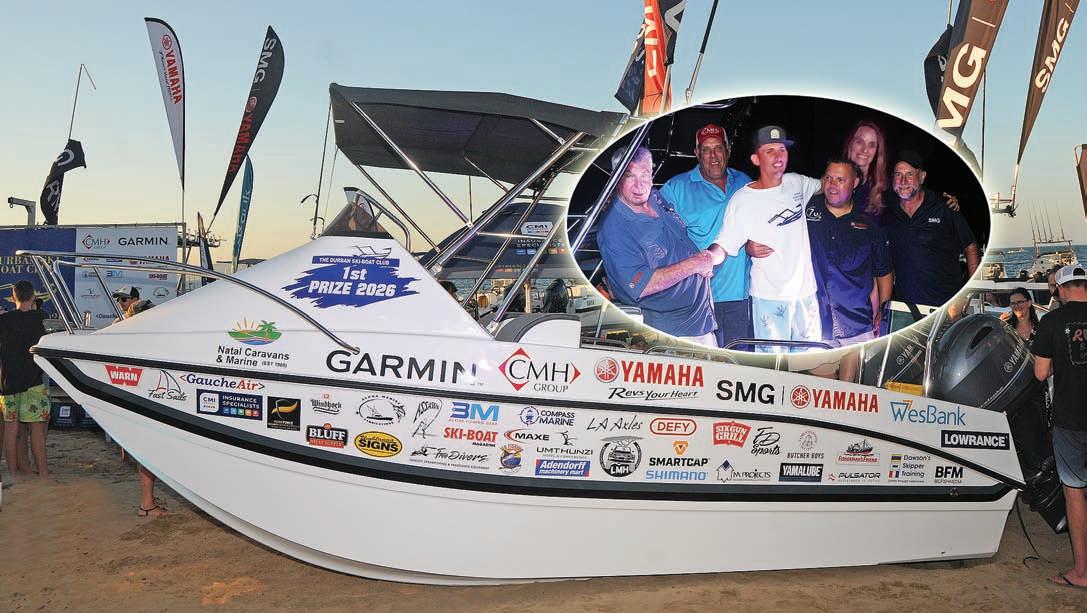
THIS long-awaited “flagship”of the Natal Caravans & Marine’s fleet made her official appearance during the annual Durban Ski-Boat Club Festival in April 2026. There,the Kosi Cat23 – and 288 other boats – proudly took to the water during the spectacular start of the competition.The Kosi Cat was later displayed in all her glory on the beach,alongside the
first place prize craft.
Having seen her launch earlier in the day,many competitors and spectators took the opportunity to examine the Kosi Cat23 up close on the beach, and I was among them.Natal Caravans & Marine’s Bill Harrison had already asked me to formally review this new craft for the magazine,and I was very impressed by her looks,so I eagerly awaited the opportunity to get a real feel for the latest addition to the fleet.
Kosi Cat has been around for many, many years as Natal Caravans’“house
brand”and has become a frontrunner in the mid-range ski-boat market in South Africa.I well remember spending a day out at sea off Bazaruto Island in the early 1980s,fishing off a Kosi Cat,and I returned highly impressed with this “small”craft’s ride and fishability as an inshore charter boat.
The last time SKI-BOAT carried a review on a Kosi Cat was in 2012 when Heinrich Kleyn reviewed the Kosi Cat17FC.By that stage the original 16ft and 18ft 6in models had already been on the market for a number of
Photos by Marcello Richards for RCPhotography, and Erwin Bursik
FLAGSHIP
years.The 17ft craft carried many refinements and finishes that gained her a positive share of the South African market.
Our review day soon arrived,and I once again came face to face with the Kosi Cat23 when we launched her at the Natal Rod & Reel Club’s slipway. Her look,feel and ride proved Bill was justified in saying that she’s a really special craft.
The term “mid-range ski-boat”that I mentioned earlier is perhaps a misnomer,as each craft coming onto the
South African market has a predetermined target.In this instance,Natal Caravans & Marine have upped their aim and produced a craft that can hold its head high in the upper range of 6metre offshore sportfishing craft in South Africa,with regard to style,comfort,and the full range of offshore demands.
With five of us aboard the Kosi Cat23,we launched from Durban Harbour into a sea that had felt the full effects of the offshore winds that prevail in autumn.The resultant lateral
chop challenges any ski-boat proceeding northwards at this time of the year.
When turning a craft to leave Durban’s harbour,one gets a distinct feel of its reaction as the boat moves from the dead water of the harbour into the channel that exits through Durban’s notorious “bar”.This is when the craft one is skippering really comes to life and sets the standard for what can be expected out at sea in what will become the craft’s “playground”for many years to come.
Bill had invited his wife,Dawn,to
join us on our review.I was pleasantly surprised,but also felt a degree of apprehension as to whether I could fully test the craft’s performance without damaging Bill’s “fair lady”.
In summation,I didn’t tread lightly as I had a job to do.After the show was over,Dawn still talked to me,so clearly my antics with the craft had not scarred her physically or mentally.Seriously, though,the Kosi Cat23 has such a soft and comfortable ride that there was no need to “soft pedal”the trial.
The first thing I noticed was the craft’s stability during a full range of slow and speed trials.I was impressed by her ability to attain and hold these trials in a sea that was,as mentioned, hammered by the cross-sea land wind that all of us who fish out of Durban don’t like very much.
This effect is especially heavily felt when heading into the north-east,as we were,and even more so directly off Umgeni Mouth.In these conditions,the sea is short,rough,and directly on one’s port beam,so the sponsons drop regularly and there’s extra consequential spray from that.That all makes it my least-desired long-range ride.However,
messy conditions like this are great for testing a craft’s performance.
The Kosi Cat23 has a substantial overhead canopy which affects the aerodynamics,but by adjusting the motor trim laterally and by adjusting bow lift,I could reach the required speeds and maintain a comfortable ride, even when pursuing the above-mentioned course in these conditions.
Nowadays many of the bigger skiboats have a full cabin to shield the crew,so the question of spray throwing has largely become immaterial. However,this is not the case for the Kosi Cat23,and I had to utilise chine support,lateral motor trim and attack angle to produce a soft,dry ride.Thanks to the craft’s ability to throw any spray aft and low,I was able to keep Lady Dawn relatively dry.
The next critical performance check was to test how the Kosi Cat23 would handle the surf launch conditions we experience in South Africa,especially on the KwaZulu-Natal coast where lateral stability and strong out-the-hole performance are major requirements.
In the surf,it’s crucial that a ski-boat be able to “jump”out of the hole and
get onto the plane very quickly.With the Kosi Cat23 I tested,her twin Yamaha 115hp motors did just that with some reserve power in hand if critically needed.I found I had all the torque I needed to dig her out of a tight turn hole,whether it was to port or starboard,hold her on landing,and then immediately power up and face whatever came next.
I felt very comfortable with her throttle controls,and even with selfinduced delays I felt the efficient resumption of control and motor torque were more than adequate.
Then there’s the old question:will she manage if one motor cuts out in the surf? It’s a question that has a minefield of variables,but I fully believe that each of the 115hp Yamahas will get you out of trouble.I did a lot of trials with her running on one motor,both with one dragging and with one lifted,and feel happy in the motors’performance.
A few years ago I came in at Guinjata on one 100hp motor with the other lifted.There were five of us onboard and it was traumatic,but we made it,so I know what’s required. During our review of the Kosi Cat23,
she covered distances at just on 20knots on each motor with the other lifted,with five adults aboard.
I performed many trials on her at low troll speed in all directions and then up to high speed trolling (8 knots),and her ride was very comfortable throughout.The Kosi Cat23 also provides a very stable platform when fishing out on the ocean.For the technically minded readers,she throws a very tight wake at up to 8 knots SOG.
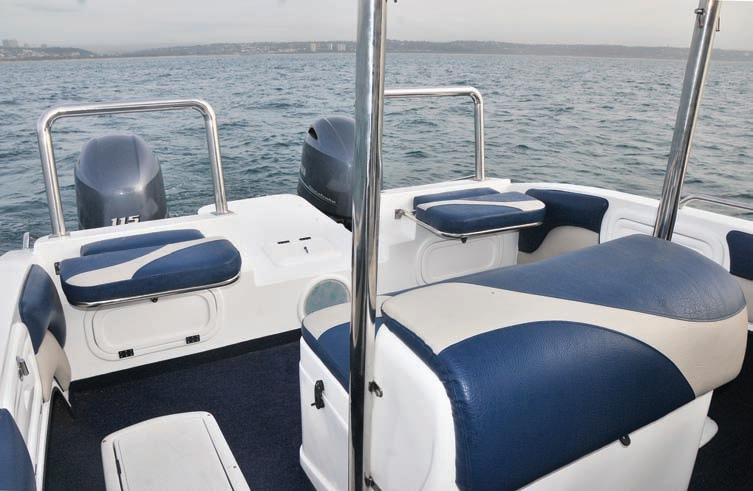
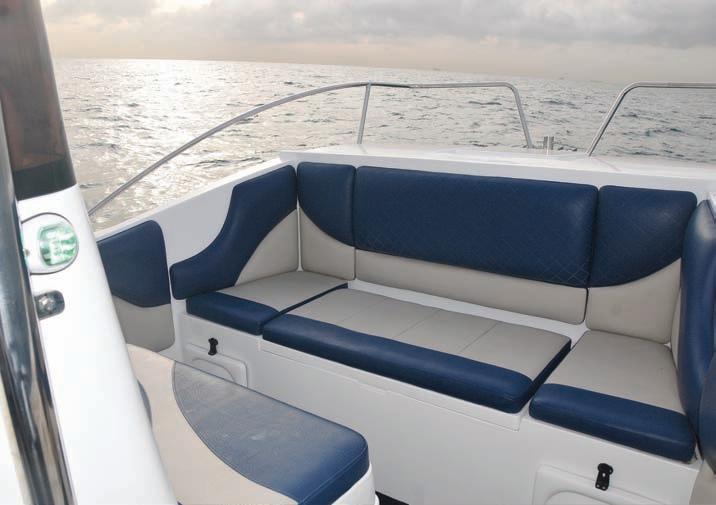
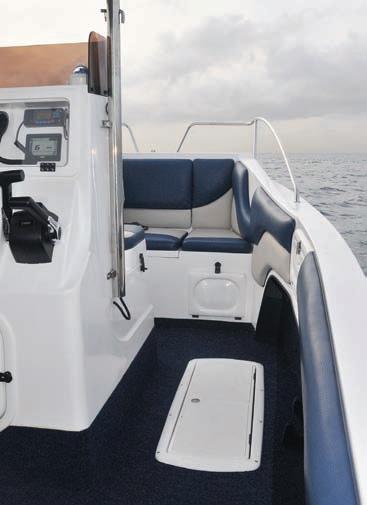
With five of us onboard,I never felt crowded,whether when manoeuvring, trolling or drifting.There was more than adequate space to walk the deck and an above-normal amount of seating.
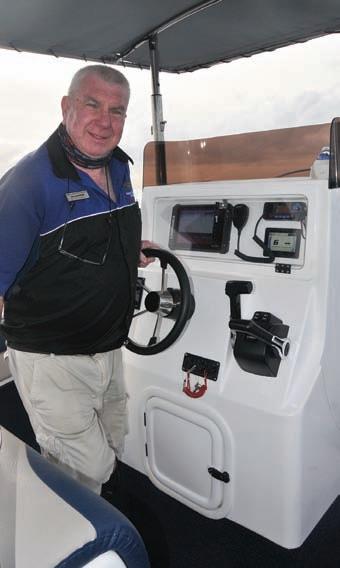
Being a skipper,the helm station is obviously of utmost importance to me; not only its centralised positioning,but also the visibility and comfort when trolling for hours on end.In addition,I also don’t appreciate being showered by spray.I found the Kosi Cat23’s console was very well situated and offered unrestricted visibility forward as well as
aft,even during tight manoeuvres and while trailering.The instrumentation, especially the sonar displays,was also perfectly sited for me.
With the number and variety of craft I am exposed to these days and the quality and finesse of those presented to me,I am finding it difficult not to nit-pick when it comes to layout and finishes.Having the ability to go back over 40 years of reviewing craft and seeing the incredible innovations of design and finishes makes my task both incredibly difficult and incredibly easy.
Boat building has changed immensely in recent times with regard to design, as well as the quality of the hull and deck mouldings and the finishes when it comes to the deck layout and hardware being incorporated.As each of us has a different budget and different preferences,and that’s very subjective,I prefer to provide a general overview of the boat’s layout and finishes,and leave the individual buyer to decide whether a particular craft will satisfy their
expectations.
My obligation is to use photos and on-water observations to apprise readers of what craft are available on the market,and to assess,as best as I can, the hull-over-water abilities of said craft. All the same,it’s always best for potential buyers to physically get onto the said craft and take it to sea themselves.
That being said,the above-deck features on the Kosi Cat23,including her helm station facilities,the hatches,seating and storage lockers,have been designed based on years of custom requirements Bill has formulated.As a result,the Kosi Cat23 is a very well thought-out craft that’s been well fabricated and finished off to a very high standard indeed.
There was good reason that this craft was the centre of attention on the beach at the 2026 Durban Ski-Boat Club Festival,and I think we’re going to be hearing plenty of good things about her from anyone lucky enough to buy one.
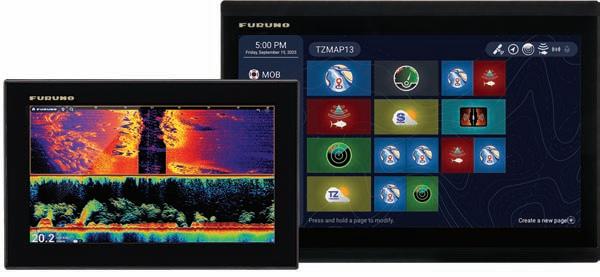
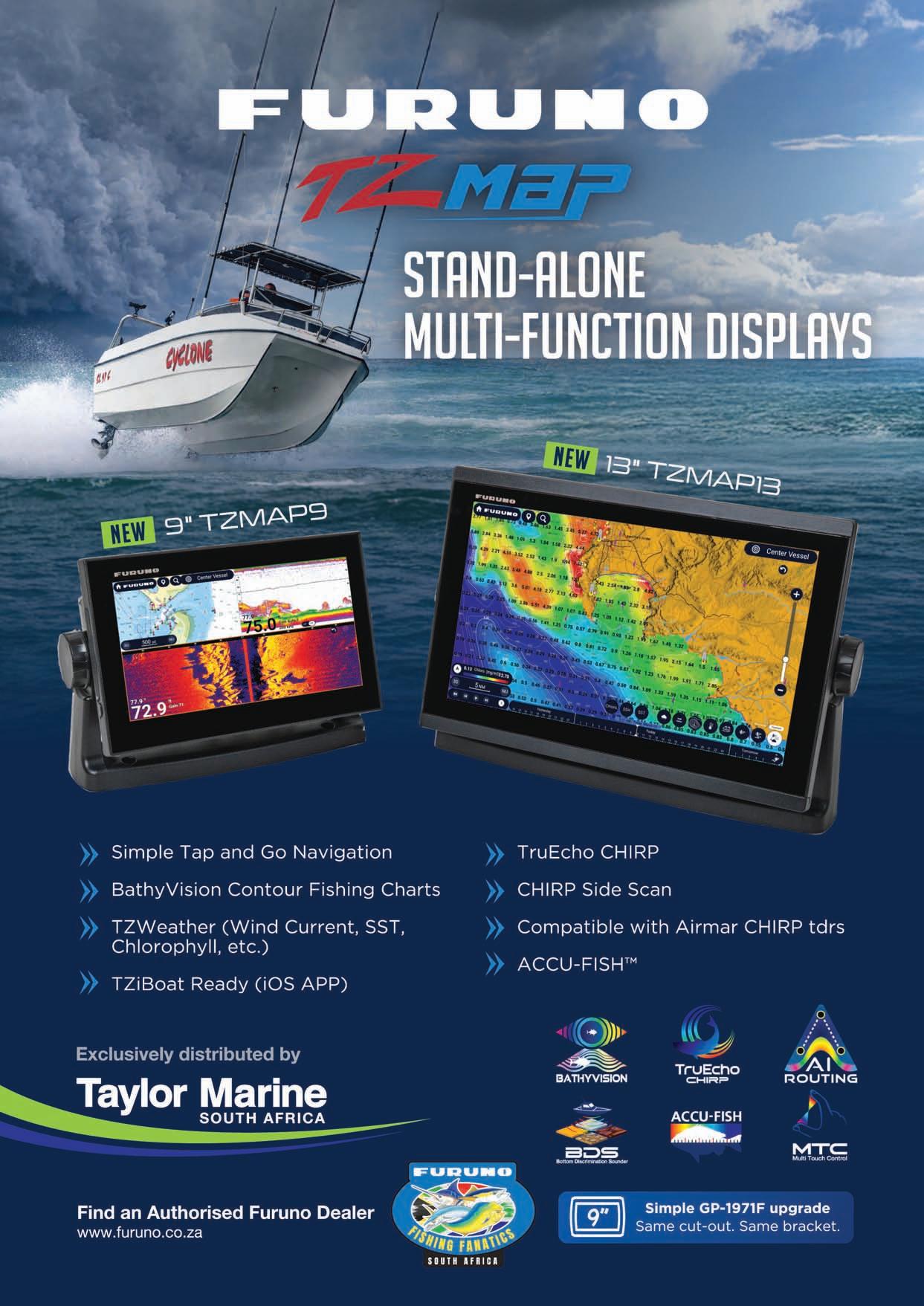
SUCCESSFUL offshore fishing has always been about stacking odds in your favour.Good crew,a reliable boat,quality electronics and solid preparation are essential.The new Furuno TZMAP13 and Furuno TZMAP9 with built-in TZWeather represent another major step in that evolution.
By combining navigation,award-winning fishfinder technology, BathyVision fishing charts,and advanced oceanographic intelligence into one easy-to-use platform,Furuno is giving anglers the ability to make better decisions before and during every trip offshore.
tuna,marlin,dorado,and wahoo are heavily influenced by water temperature and converging current lines.Even half a degree can make the difference between a dead ocean and a productive bite.
Many would simply call that the unfair advantage,as this is not just another chart plotter with a weather overlay.It is a complete fishing intelligence platform designed to put real oceanographic data directly onto your screen without juggling multiple smartphone apps,subscriptions,screenshots,or complicated downloads.
WEATHER INTELLIGENCE WHERE YOU ACTUALLY NEED IT
Safety is always first priority,and most skippers are familiar with checking the weather conditions.You know the drill: open one app for wind,another for swell and a different one for sea surface temperature and perhaps another for chlorophyll or current information.Then try to mentally overlay all that information onto your chart plotter.The new TZMAP Plotter changes that completely.
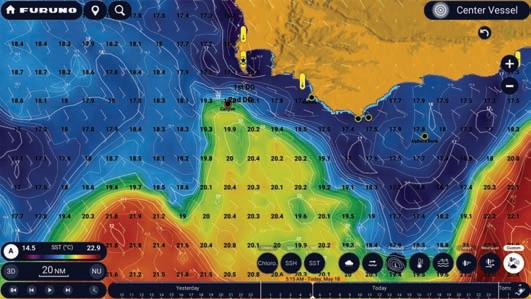
With Furuno’s built-in TZWeather application,the weather and oceanographic data is simply downloaded directly onto the plotter itself.The data is then overlaid directly onto your navigation charts in real time.No switching between apps,no guessing and,best of all,no manually plotting marks from a phone screenshot.Everything appears exactly where it matters,on your chart.
SEA SURFACE TEMPERATURE (SST)
Ask any experienced offshore skipper and they will tell you that SST breaks are fish magnets.Pelagic species like yellowfin
With TZWeather,SST overlays become incredibly easy to interpret.The plotter displays temperature gradients in full colour with contour lines directly over your charts,allowing skippers to identify temperature breaks,warm water pushes,current edges and up-wellings.Rather than blindly searching vast areas of ocean,skippers can now target specific temperature lines with precision.
SEE THE CLEAN WATER BEFORE YOU ARRIVE
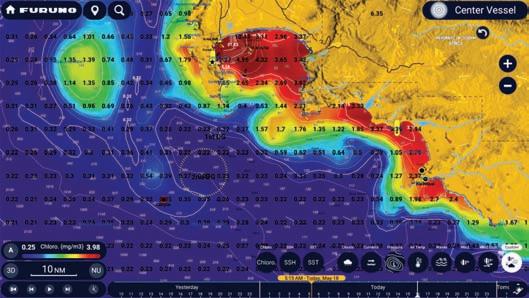
One of the most powerful features for offshore fishermen is chlorophyll mapping.Chlorophyll data essentially shows water clarity and plankton concentration.Dirty green water with high chlorophyll levels often indicates less productive conditions for certain pelagic species,while cleaner blue water can signal prime hunting grounds.The ability to overlay chlorophyll readings directly onto the plotter allows anglers to locate blue water,clean-to-dirty water transitions,and current convergence zones –all areas likely to hold bait fish.
SIMPLICITY IS THE REAL WINNER
The real brilliance of Furuno’s TZMAP system is not just the data itself;it’s the simplicity of the system.Modern electronics often overwhelm users with complexity.Furuno has taken sophisticated oceanographic information and made it genuinely usable for sportfishing.TZMAP brings everything together into one integrated platform.
Fuel is expensive,weather windows are limited,and time on the water matters.TZWeather helps eliminate guesswork before you head out to sea.
Visit www.taylormarine.co.zahome of the exclusive importer and distributor for Furuno Marine Electronics in SA.
TECHTALK
By John Minnie
EVERY we day we rely more on technology to help us do things we used to do manually.Fishing is no exception.In the past,sailors would navigate by the stars, now we have GPS.To determine the water depth,they would “swing the lead”by letting out a marked 25-fathom long
line with a lead weight on the end;now your sounder will simply give you a reading.Anglers used to rely purely on local knowledge and birds to show them where to fish,now we use fishfinders/sounders.
So,you’ve got the boat and you’ve got a sounder.Now what? As with most technology,you’ll only get the best out of your sounder if you know what to look for and what to ask it.
How to interpret what you’re really seeing
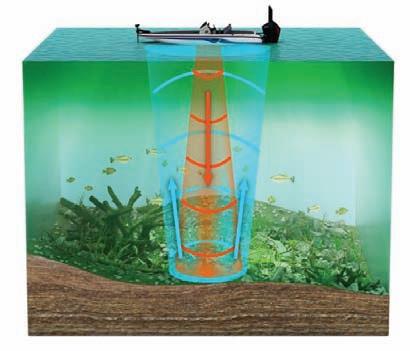
Left: Sonar works by transmitting soundwaves from a transducer on the boat, and measuring them when they bounce back.
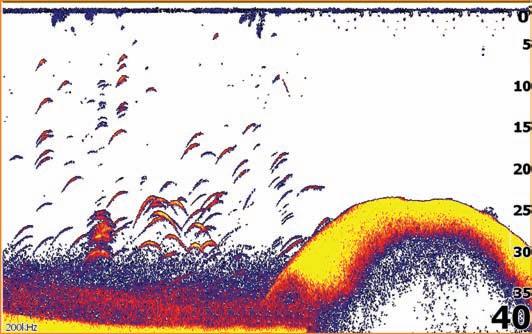
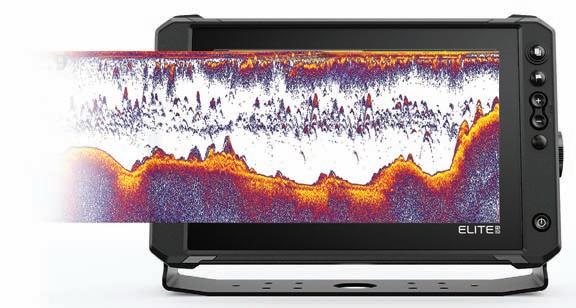
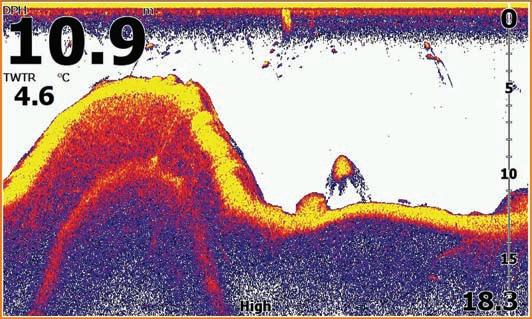
Right: A typical screenshot on a traditional sonar unit, showing the fish as arches.
In this article,we’ll explain what you’re actually seeing on your screen and how to get the best out of your sounder so that you go home with a decent haul of fish – or at least know where to find them.Actually catching those you see on your screen is a whole different story!
WHAT IS A FISHFINDER?
Fishfinders are advanced sonar systems designed to show what is happening beneath the surface of the water.While they’re commonly referred to as “fishfinders”,these units do far more than simply locate fish.They also display bottom composition,underwater structure,baitfish and individual fish behaviour using several types of sonar technology.
To use a fishfinder effectively,it is important to understand how sonar works,what the screen is actually displaying,and how to interpret your unit’s specific features such as CHIRP, DownScan Imaging,and SideScan.
HOW SONAR WORKS
At the core of every fishfinder is sonar,which stands for “Sound Navigation and Ranging”.The system works by transmitting sound waves from a transducer mounted on the boat. These sound waves travel through the water and reflect off objects such as the bottom,wrecks,structure,shoals of baitfish and individual fish.
The sound waves then return to the transducer.The fishfinder measures the time it takes for the sound to return and converts that information into an image on the screen.The screen will then show the depth of the water,the bottom pro-
rock or metal wreckage reflect sound strongly and appear brighter or thicker,while soft bottoms like sand or mud reflect less sound and appear lighter or thinner.This allows anglers to differentiate between bottom hardness,structure and fish.
Transitions between hard and soft bottom are key areas to watch,as they often attract baitfish and predators.
WHAT THE FISHFINDER IS ACTUALLY DETECTING
One of the most important concepts to understand when interpreting what you see on a fishfinder screen is that it is not detecting the entire body of a fish.Instead,sonar primarily detects the fish’s internal swim bladder.
The swim bladder is a gas-filled organ that helps fish regulate buoyancy.Gas reflects sonar extremely well,making the swim bladder the strongest sonar return from a fish.This is why fish appear as arches,dots or lines on the display rather than realistic fish shapes.The size,brightness,and shape of the mark depend on the size of the swim bladder,the fish’s orientation,and its position within the sonar beam.
Fish that are tight to the bottom or structure may be difficult to see because their swim bladder return blends with the stronger return from rock,metal,or wreckage.
UNDERSTANDING FISH ARCHES AND MARKS
Fish arches occur when a fish swims through the sonar cone. As the fish enters the cone,the return begins to appear.The strongest return occurs when the fish is directly under the transducer,forming the peak of the arch.As the fish exits the cone,the signal fades.
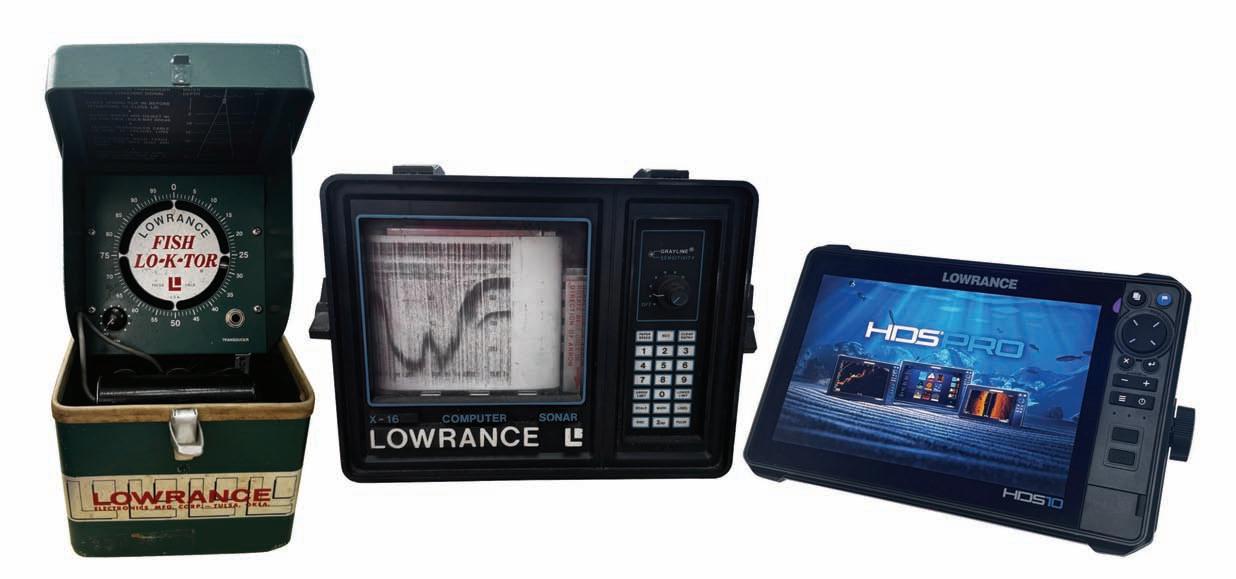
Sounders have come a long way since Lowrance introduced the world to the “Little Green Box” in 1957. Their aptly named Fish LO-K-TOR was the first transistorised sonar product to display individual fish and show their depth.
With CHIRP enabled,individual fish can be distinguished more easily from structure or bait.Fish arches appear cleaner and more defined,making it easier to tell whether a mark is a fish or part of the bottom.CHIRP is especially useful when fishing around wrecks and reefs where fish are holding close to structure.
DOWNSCAN IMAGING
DownScan Imaging is another newer feature on some fishfinders;it provides a photo-like view of what is directly beneath the boat.Instead of showing arches,DownScan displays fish as small bright dots or short lines.With this feature, structure such as wrecks,rocks and vegetation appears with much greater detail than with traditional sonar.
DownScan is extremely helpful for identifying whether marks are fish or structure.When combined with traditional sonar,anglers can see both the shape of the structure and the precise position of fish holding near it.
SIDESCAN IMAGING
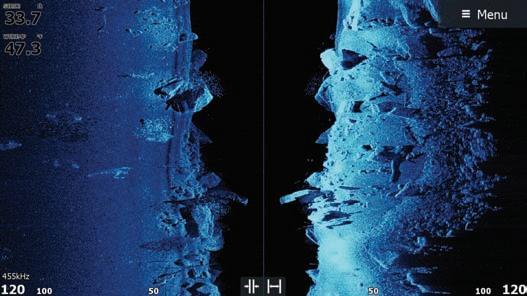
SideScan imaging allows anglers to see what is happening on both sides of the boat,often out to hundreds of feet depending on your particular fishfinder.This feature is especially valuable for locating wrecks,reefs and fish without driving directly over them.
On SideScan,fish appear as bright dots with dark shadows behind them.The shadow shows how far the fish is suspended off the bottom.Structure such as wrecks appears as bright shapes with long shadows,making it easy to identify height and orientation.
SideScan is one of the most effective tools for finding fish holding along edges or slightly away from structure.
FISHREVEAL TECHNOLOGY
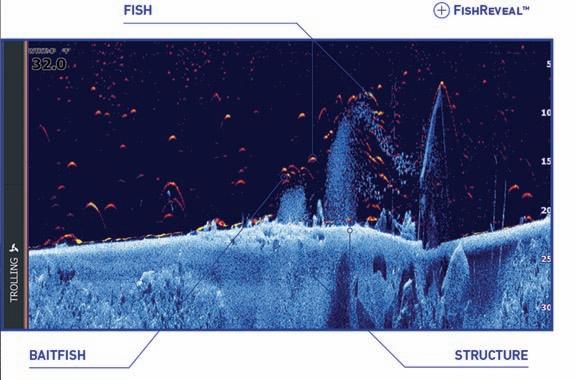
Some units combine CHIRP sonar and DownScan Imaging into a single view called FishReveal.In this mode,fish appear
as clear arches overlaid on detailed DownScan structure.This eliminates guesswork by showing fish clearly,while still displaying structure underneath.
FishReveal is particularly useful when fishing wrecks or reefs where fish are tight to cover and difficult to separate from the bottom.
TRACKBACK
Some of the newest sounders have a “trackback”feature.This powerful scroll-back feature allows you to review previously recorded sonar history on your fishfinder.It essentially functions like a DVR for your sonar,letting you see objects or structures that have already moved off the live screen.
If you spot a fish or interesting structure (like a drop-off or rock pile) but don’t react quickly enough to mark it,you can scroll back through the history and place your cursor directly on that item.
If your unit has this feature,when you mark a spot in the sonar history,the unit uses linked GPS data to save a waypoint at that exact geographic location even if it’s now far behind your boat.Instead of having to turn the boat around and guess where you saw a mark,you can mark it from your seat and navigate precisely back to it.
Units with this function also enable you to mark fish or bait while travelling at higher speeds,and then circle back to the saved point.
BAITFISH AND PREDATORY FISH
Baitfish typically appear as clouds or clusters on traditional sonar.On units that have DownScan and SideScan technology, baitfish show as dense groups of small dots.Predatory fish are
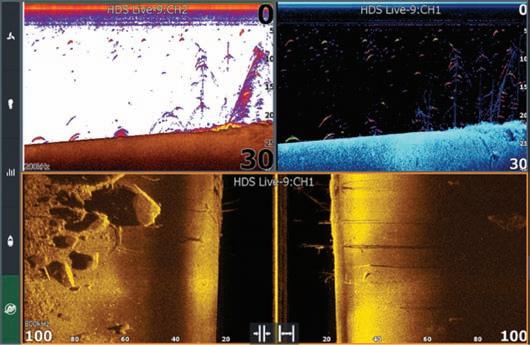
This SideScan image on a Lowrance unit shows the structure on either side of the boat.
The Trackback function allows you to review previously recorded sonar history on your sounder.
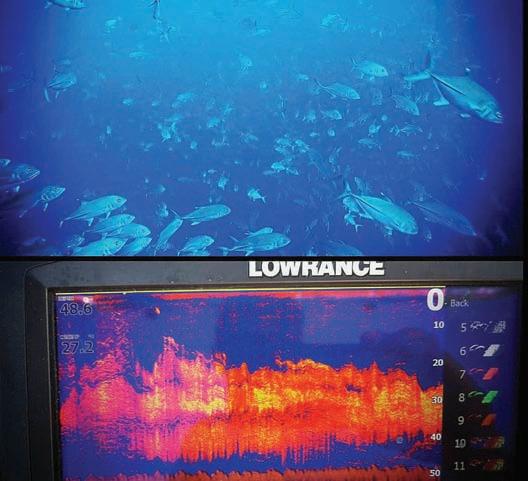
Real-time footage of the shoal of fish shown on this sounder.
FishReveal mode on this Lowrance sounder clearly differentiates between fish and structure.
Above: Traditional CHIRP sonar showing classic fish arches above the bottom return. Below: Using a combination of your unit’s features will give you a full picture of what’s happening.
often positioned near or below these bait schools.
Recognising this relationship helps anglers understand whether fish marks indicate active feeding or fish simply holding near structure.
SENSITIVITY AND SETTINGS
Proper adjustment of sensitivity,contrast and frequency is critical for accurate interpretation of what you’re seeing on your screen.Sensitivity controls how much detail appears on the screen;too little sensitivity hides fish,while too much adds clutter.
Higher frequencies provide better detail in shallow water, while lower frequencies offer better depth penetration.Most units allow anglers to adjust these settings to match conditions and depth.
SEEING THE BOTTOM CLEARLY
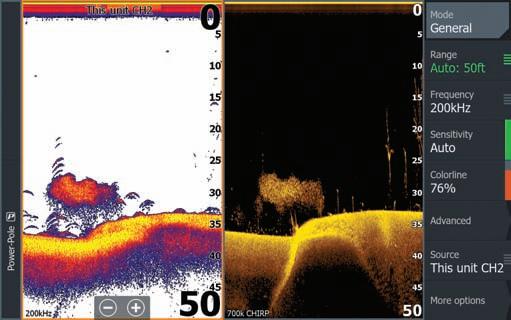
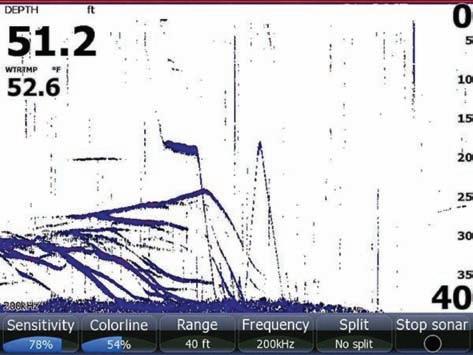
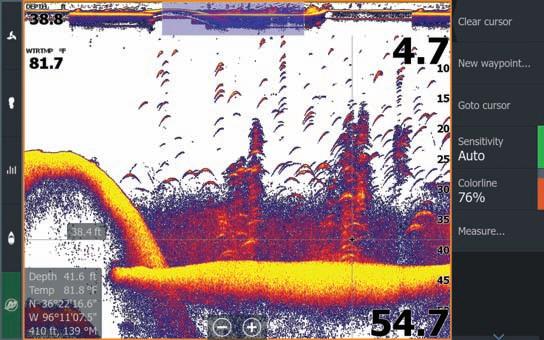
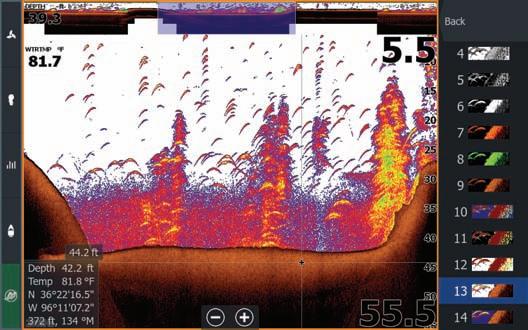
When reading sonar,clarity is everything.These real-world screenshots (alongside) show how simply changing the colour palette can dramatically improve your ability to identify bottom,structure and fish.
Palette 1:The bottom and structure appear in similar colours,making it difficult to distinguish between terrain and fish.Fish holding tight to structure are easily lost.
Palette 13:The bottom is clearly defined in brown,while structure and fish stand out in contrasting colours.Fish arches and bait schools are immediately visible,even when they’re tight to the seabed.
When you’re targeting bottomfish,the ability to quickly identify where fish are holding is critical.Palette 13 removes guesswork by clearly separating bottom,structure,and fish, allowing for more precise positioning and bait presentation.
While Palette 1 is useful for analysing bottom hardness, Palette 13 is the superior choice for practical fishing.
With practice,your fishfinder will become an essential tool for understanding fish behaviour,structure and underwater environments,rather than just a screen showing random marks.
This split screen, above, shows traditional sonar (left) and DownScan (right). On this sonar, below, fish show as dense, smaller arches. Vegetation or debris is less distinct.
Colour Palette 1 is useful for analysing bottom hardness, but there’s not much to distinguish between structure and fish.
If readers have any queries on how to get the best out of their sounders, John Minnie of Lowrance SA is happy to help. Message him on 0824436738 or email <steph@lowrance.co.za>.
Switching to colour Palette 13 makes things much clearer.
2026 Durban Ski-Boat Club Festival
By Sheena Carnie
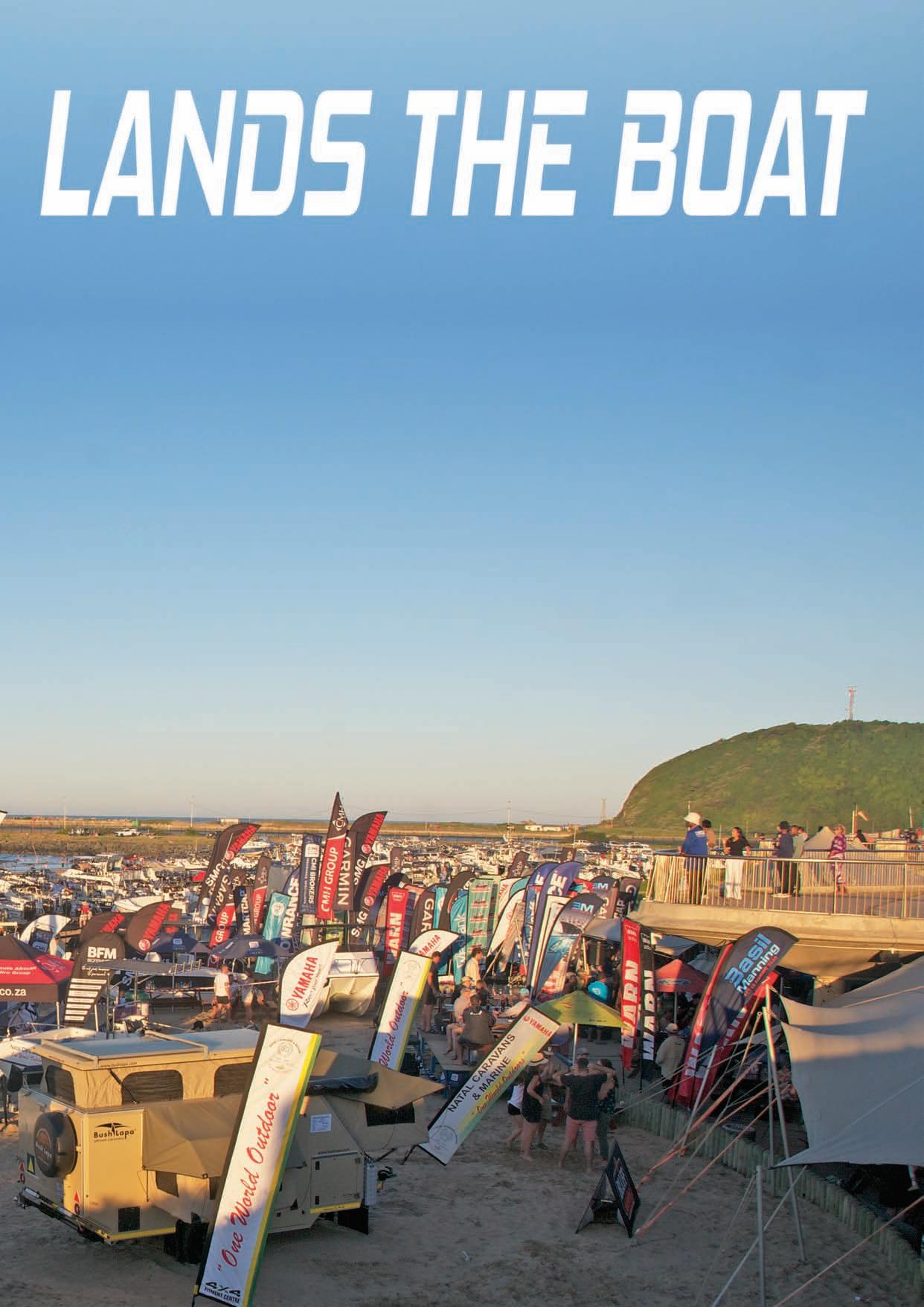
FUN in the sun – with or without the fish.That seems to have been the theme at this year’s Durban Ski-Boat Club Festival.
Once again the clubhouse down at Durban’s Point area was pumping with music and people all weekend long from 24 to 26 April,while the beach in front of the club bore testimony to the huge number of boats that had launched before sunrise.
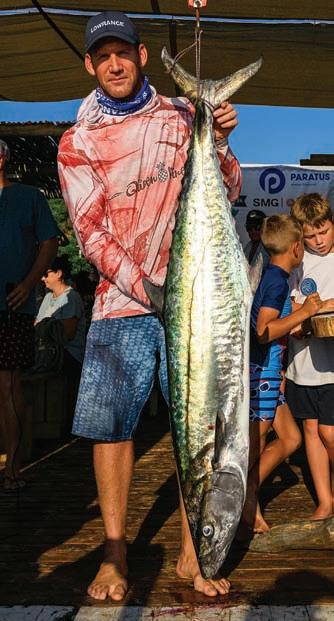
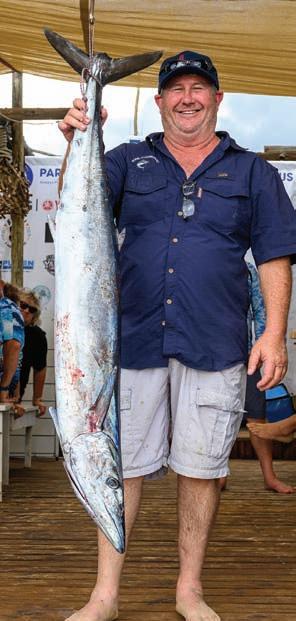
This year 288 boats carrying 782 anglers took part in the event,confirming its ongoing popularity.Everyone had their eyes fixed on the main prize: a beautiful Seacat 565 fitted with twin 100hp Yamaha motors,valued at over R1million.,that would go to the angler who caught the heaviest king mackerel (’cuda).
While the weather gods were kind
to the beach goers and the sun shone gloriously all weekend,Neptune kept his sea critters close to home and fishing conditions were tough,especially on the Saturday.Only those who persevered triumphed.
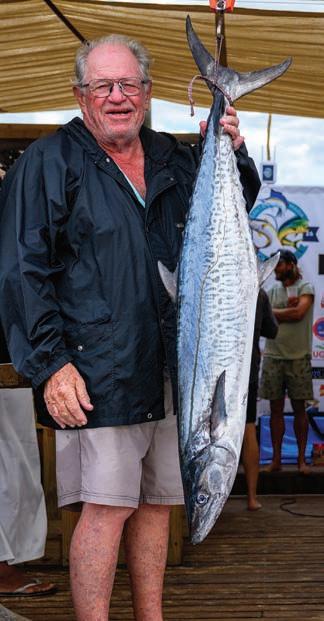
The fish were also a bit smaller than usual this year,with the heaviest’cuda pulling the scales to 23.86kg and the tenth heaviest weighing 18.02kg.
On the Saturday,Teagan Short had trouble with one of his motors and only just made it to weigh-in on time.He thought his luck had changed when he ended the day with his 23kg’cuda at the top of the leaderboard.
Sadly for him,by 9.30am on the Sunday Wesley Smith had weighed in a king mackerel that pulled the scales to 23.86kg.
Third place went to Deon Naidoo with a 22.36kg ’cuda.
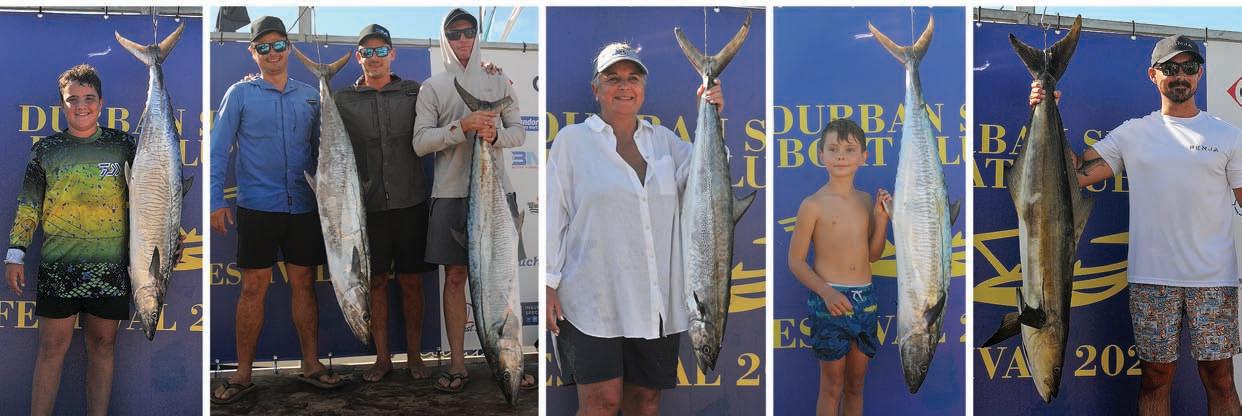
In the end 62’cuda were brought
to the scales,weighing a total of 873.54kg.In addititon to the’cuda, some dorado,prodigal son,yellowfin tuna and snoek also came out.
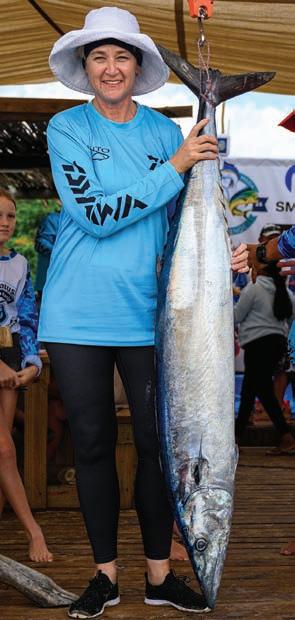
The ladies seemed to have a really tough time with the fishing this year. Sally Seppings caught the biggest snoek,a 6.98kg fish,and young Tori Bartho received the prize for biggest ’cuda caught by a lady,thanks to her 12.48kg fish.
Dwayne Boshoff surprised everyone when he caught a new species on the Saturday:a python!
The unfortunate snake somehow ended up 2.5km out to sea off Durban. Luckily for the python,Dwayne and his dad spotted it,brought it onboard and kept it in a hatch until they could get a local snake expert down to the beach to collect it.Their kindness earned them a bonus prize of R2000 from Basil Manning.
Wesley
was thrilled that his 23.86kg
landed him the first place prize of a
and
Smith
’cuda
magnificent Seacat 565 with Yamaha motors
a whole lot of extras. Bill Harrison (Natal Caravans & Marine), Rob Downs (CMH), Melvin Victor (Yamaha), Megan Shepard (CMI) and Anthony Ellis (SMG) were on hand to congratulate him.
The ultimate winner,Wesley Smith, was happy to share the story of how he landed the prize-winning fish...
“On Saturday,27 April 2026,we launched in the dark and encountered choppy seas with a light north-easterly wind.I was fishing aboard Harleigh alongside skipper Wayne Daniels and crew member Chris Reid.
“We made our way to the Bluff grounds,and after a quiet morning,I got my first pull around 12.30pm.It was a screamer on the surface,but unfortunately it bit through the wire trace and got away.Despite the disappointment, the rest of the day was still enjoyable, although fairly quiet on the fishing side.
“Day two brought much calmer sea conditions,and we decided to head back to the same area for another shot. This time,everything came together perfectly.I managed to strike early and successfully landed an impressive ’cuda.
“Full of excitement,we put some new baits into the water hoping to find another big fish swimming around.After 30 minutes,though,we made a team decision to go and weigh the fish in the
PRIZEWINNERS
TOPTEN ’CUDA
1. Wesley Smith
2. Tegan Short
3. Deon Naidoo
4. Ryan Pellew
5. Blayne Wareham
6. Max Killan
7. Codi Pretorius
8. Mark Justham
9. Andrew Carstens
10. Deon Naidoo
BIGGESTOFOTHERSPECIES
.23.86kg
.23.00kg
.22.36kg
.21.52kg
.20.44kg
.19.46kg
.19.34kg
.18.86kg
.18.28kg
.18.02kg
Barend Nienaber . . . . . .8.56kg dorado
Andre Labuschagne 16.90kg prodigal
son
Jared Edmond .17.12kg yellowfin tuna
SallySeppings
JOP JUNIORS
Easton Potgieter
Blake Otto
Tyler Shepard
TOPLADY
Tori Bartho .
.6.98kg snoek
.16.50kg ’cuda
.14.90kg ’cuda
.13.74kg ’cuda
.12.48kg ’cuda
hatch,so we headed back to Durban Ski-Boat Club.
“After a short swim from the boat to shore,dragging my fish behind me,and with adrenaline pumping,I hoisted the fish over my shoulders and ran up the beach towards the weigh station.
“When the fish was finally hung on the scale,it weighed an incredible 23.86kg.That’s when it hit me:it was the leading fish.
“The excitement was overwhelming.It honestly didn’t feel real.All we could do was hope that no one else would land a bigger fish.To pass the time,we headed back out to continue fishing and try our luck again,but the wait for cutoff felt endless.As the cutoff time of 2.30pm approached,the nerves really started to set in.
“Finally,once the scales closed,it was confirmed we had the winning fish for the DSBC Festival!
“Standing on the stage at prize giving and receiving the boat was one of the most incredible moments of my life. A massive shout out to Durban Ski-Boat Club,and all the sponsors who made the event possible.”•
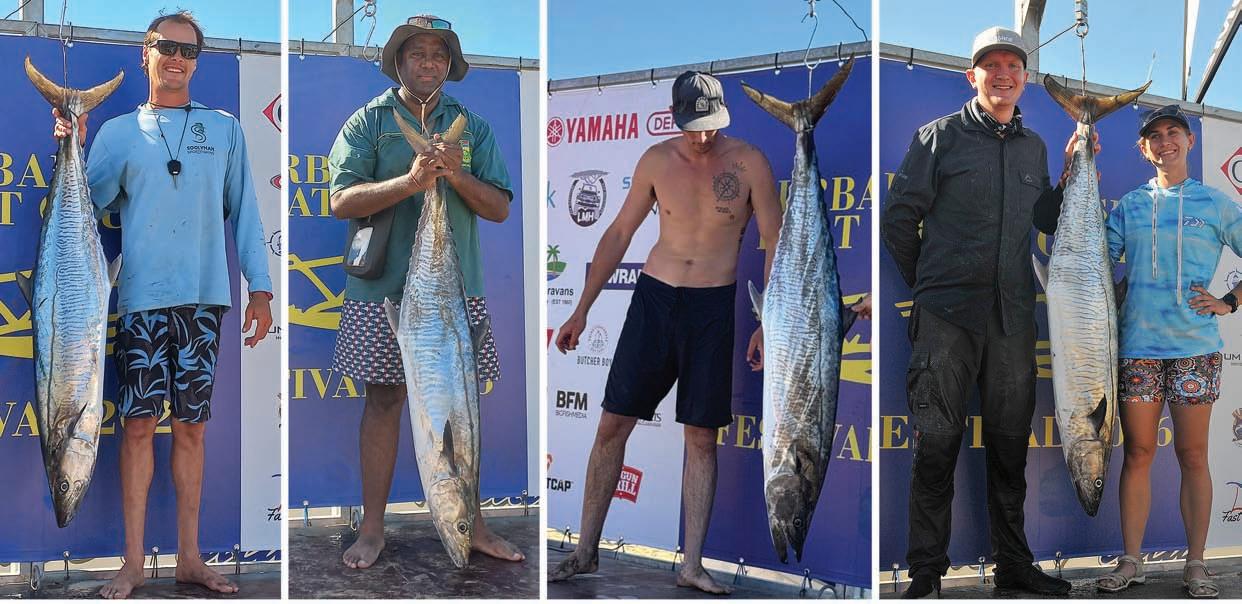
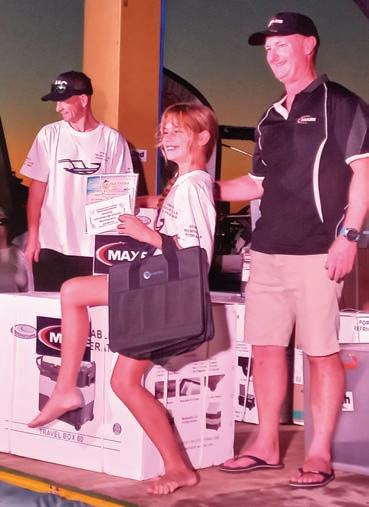
Above: A delighted Tori Bartho took the prize for top lady with a 12.48kg ’cuda.
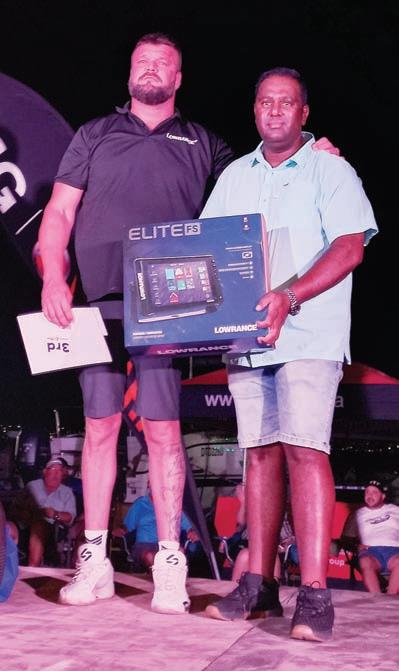
Left: Deon Naidoo’s 22.36kg ’cuda clinched third place for him.
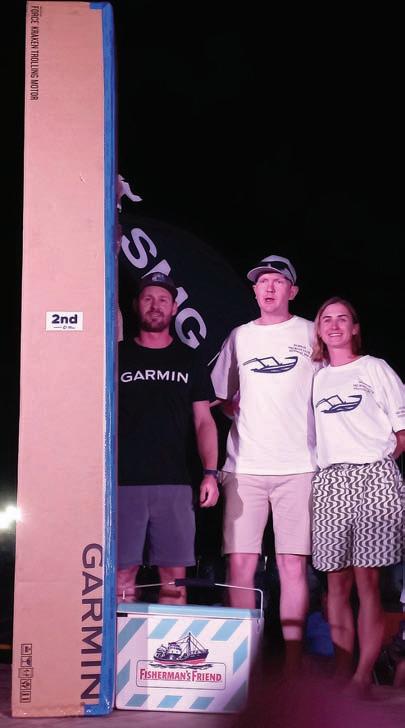
Far left: Tegan Short took second place with a 23kg ’cuda.
A word from the organisers...
By Hilton Kidger
ANOTHER Durban Ski-Boat Club Festival under the belt,and what an event it was! I had the pleasure of Liz Plotz’s company for a short time on the Saturday.
Her question to me was,“How long have I been involved in this event?”
My immediate response was,“As long as you’ve been with Lowrance.”
By cross-checking certain events and asking MrKnowledge (aka Erwin Bursik of SKI-BOAT magazine) we pinpointed the start of our “relationship”as the start of the festival 25 years ago.
One of the reasons we got this event up and running in 2001 was to contribute our bit to tourism and to show the authorities the positive impact it had on accommodation at the Point and other areas,and the GDP in general.It may be hard to believe,but recreational angling contributes more to the GDP than rugby and cricket combined.Just think of the value of a boat,a 4x4 vehicle,the tackle,fuel and accommdation hire.It adds up very quickly.
It also reminded us that,to get things going,we needed money;in other words,sponsors.
Along with Yamaha,Lowrance,Natal Caravans & Marine,Warn Winches, SKIBOAT and WesBank,who were “founder investors”,we got cracking.Twenty-five years later all these sponsors are still with us,which is a huge testimony to the marketing value of this event.
As part of recalling that history,I remembered the time we were short of
money in 2007.I phoned up the late Ronnie Watson of WesBank,who took the call while he was watching the Rugby World Cup in Paris.
The conversation went like this:
“Ronnie,we need R150000.”
“You’ve got it,Hilton.Somebody will phone you on Monday.”
On the Monday,somebody phoned. “I was told to phone you about R150000,”they said.“How do I get the money to you?”
“You will receive an invoice in an hour,”I replied.The money arrived in our bank account the same day!
Today,it is not that easy,and it is up to us,the DSBC Committee,to make sure we offer maximum value to our sponsors.Sadly,Craig Whitehead,who is retiring from WesBank,could not be with us at the festival this year. Wesbank,through Craig,has been a great supporter of the festival over many years.
This event truly is blessed with many loyal and generous sponsors,who are all listed on the thank you page alongside. Please support them in return.
This year Big Fish Media played an amazing role in our marketing campaign,using social media to highlight our festival and the names of our sponsors to our angling mates from all over the country in the build up to D-Day.
Regarding sponsors,a special thanks must go to the CMH Group,which provided 11 4x4 vehicles that assisted our tractor specialists in launching and beaching the boats.
Their financial commitment to the DSBC Festival and ski-boating as a whole is huge.To start with,that’s at least 11 tanks of fuel:R27500.Then the vehicles went to Barry Lancaster of LMH to fit the winch plates: 11xR6500= R71500.Add on the winches:11xR18000 = R198000.Add on the tow bars:11xR8000 = R88000.We know that part of the capital outlay will be recovered,but someone has to outlay the original R385000.
We also greatly appreciate the 11 drivers who gave up their family time to assist at the festival.
With the cost of fuel increasing as it did,we thought entries might soften, but that was not the case at all.This year the event attracted just under 800 anglers and 288 boats,plus the families, friends and general spectators who came along to enjoy themselves.The vibe on the water,in the marquee and on the beach was just incredible!
What a pleasure it was for the committee and sponsors to hand out around R1,6million worth of prizes to some of the participants.
A last few very special thank yous: to the PWC staff who gave a stellar performance and never stopped smiling;to our tractor drivers who did a sterling job and played such a vital role in moving the boats safely;and to Kelly Gray and her team who superbly handled the T-shirts and registration as they have done for over 20 years.
See you again on the last weekend in April 2027.
Fishing Platte Island,Seychelles
By Warren Bennett
SEYCHELLES has,over the years,crept into my heart,the same way Moçambique has for many South Africans. When it comes to chasing big dogtooth tuna,in my opinion,there simply is no better place on the planet –or at least not that I know of – which has such an abundance of world class size fish,be it on the drop off or around Seychelles’outer islands.
Having undertaken several trips to Seychelles over recent years,I’ve learnt that timing is everything.And by timing,I mean weather.Seychelles is subjected to months of strong trade winds which switch direction twice a season;in between is some of the calmest weather imaginable – little rain,no wind,and crystal-clear water.
We chose April for our most recent trip,as it’s arguably the most stable month of weather during the year.The water can be warm at times,which means fishing a bit deeper becomes the order of the day, but if you want nearly guaranteed calm seas,this is the month to target.
We were not disappointed.
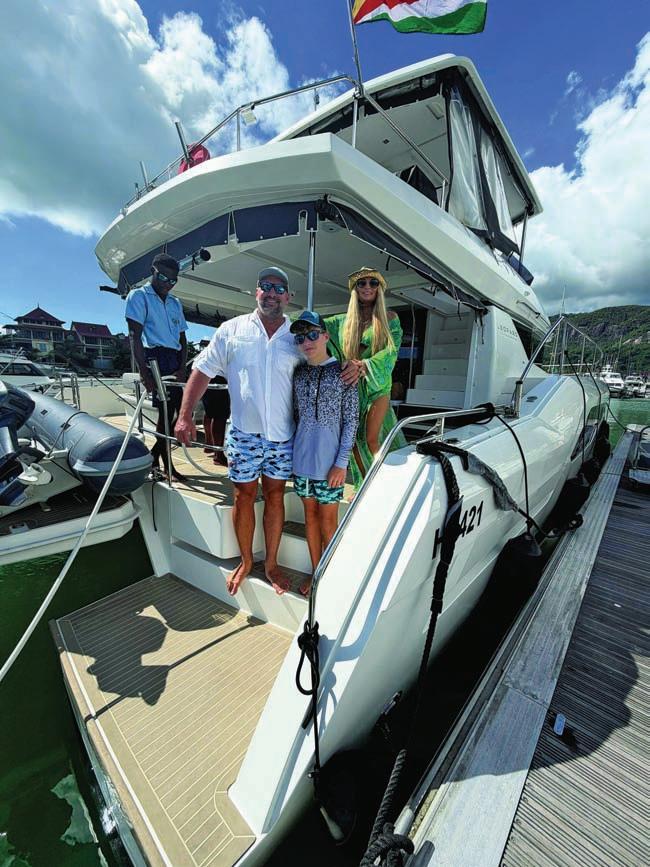
Having decided to focus on the fishing around Platte Island which lies approximately 65 nautical miles south of Mahe,a liveaboard yacht was essential this time around. Chartering these vessels is easy enough, but they book up fast,so you need to book at least a year in advance.
I’d never fished around Platte before, and as I knew that the vessel I had chartered was more recreational focused and not a traditional fishing charter yacht,I tapped into the knowledge of those who have been there before.I would especially like to thank Mark de la Hey,Sean Mather and Rod Thorington for the advice they gave me, which ultimately culminated in me ticking off the fish I have been chasing for years.
GETTINGTHERE
After a short five-hour flight from Johannesburg,my wife (Lee),my son (Kyle),Kyle’s friend (Jono Hepburn) and I arrived on the island in the late afternoon.Next came the nervous wait at the luggage carrousel to collect our bags and see if our rod tubes had safely made the journey with us.They had! We set off to the hotel to unpack,enjoy a cocktail or two, and head down for a quick light tackle session off the beach before dinner.
The next day I met up with a local legend,Sean Mather,to download as much as I could from his years of experience fishing these waters.Then we shot across to meet up with another local legend,Andy Banane,who had rigged up some insane jig assist hooks with 420lb assist cord – a must in these waters!
The yacht charters typically work on a 2pm departure,so we had time for a quick visit to the tackle store in Eden Island for some last-minute shopping.One can never have enough tackle out there,and they have a fantastic range of just about everything you will ever need to fish these waters.
But why Platte? Platte has a reputation for producing serious doggie action,both in terms of numbers and size.For some reason,it also hasn’t fallen victim to the same levels of shark activity found on the outer islands to the south west.That’s most likely because there is far less fishing activity around this island compared to others.
On a previous trip to the south western outer islands,I endured the heartbreak of having a 100kg-plus doggie devoured by not one but several sharks a mere 10metres from the boat.Devastating is an understatement.It’s a memory that has haunted me ever since,and something that I wanted to put right on this trip.
We hopped on the yacht at our scheduled departure time and sat down with the captain to plot the course for the next week or so of fishing. It was then that I realised I was truly alone on the fishing front.Our captain, whilst a fantastic seaman,was not a fisherman;nor were his crew.Eeeekkk! Thank heavens for the research I’d done ahead of time or we would have been in serious trouble,heading into the deep blue yonder with no clue where to even start looking for where to fish.
We opted to head straight to the drop off and anchor at the outermost anchorage sitting in approximately 20metres of water on the edge of the plateau,1nm before the drop off starts to fall away into depths that are unanchorable for most vessels.
Cocktails at sunset with Lee were in order as we waited for the nighttime fun to begin.These anchorages really come to life at night,with shoals of fish attracted to the light emitted by the vessel,and boy did we have some fun.Within minutes of putting the back lights on we were greeted by a large shoal of big eye kingies – dozens of them,and decent sizes too.We caught them literally cast for cast,and then some barracudas,small GTs,and all sorts of other bits and bobs joined the party.
Warren, Kyle and Lee Bennett on the liveaboard yacht that made their fishing dreams come true.
ACTIONFROMTHESTART
The next morning we woke up to the sound of the anchor being pulled.I immediately headed up to the bridge to assess conditions and enjoy a coffee at sunrise,as we started making our way to the first marks on the south eastern “Drop”.
The sea was looking incredible – no wind,no swell. Our stomachs fluttered with excitement while we got our rods ready,anticipating what lay ahead of us.We were not disappointed.
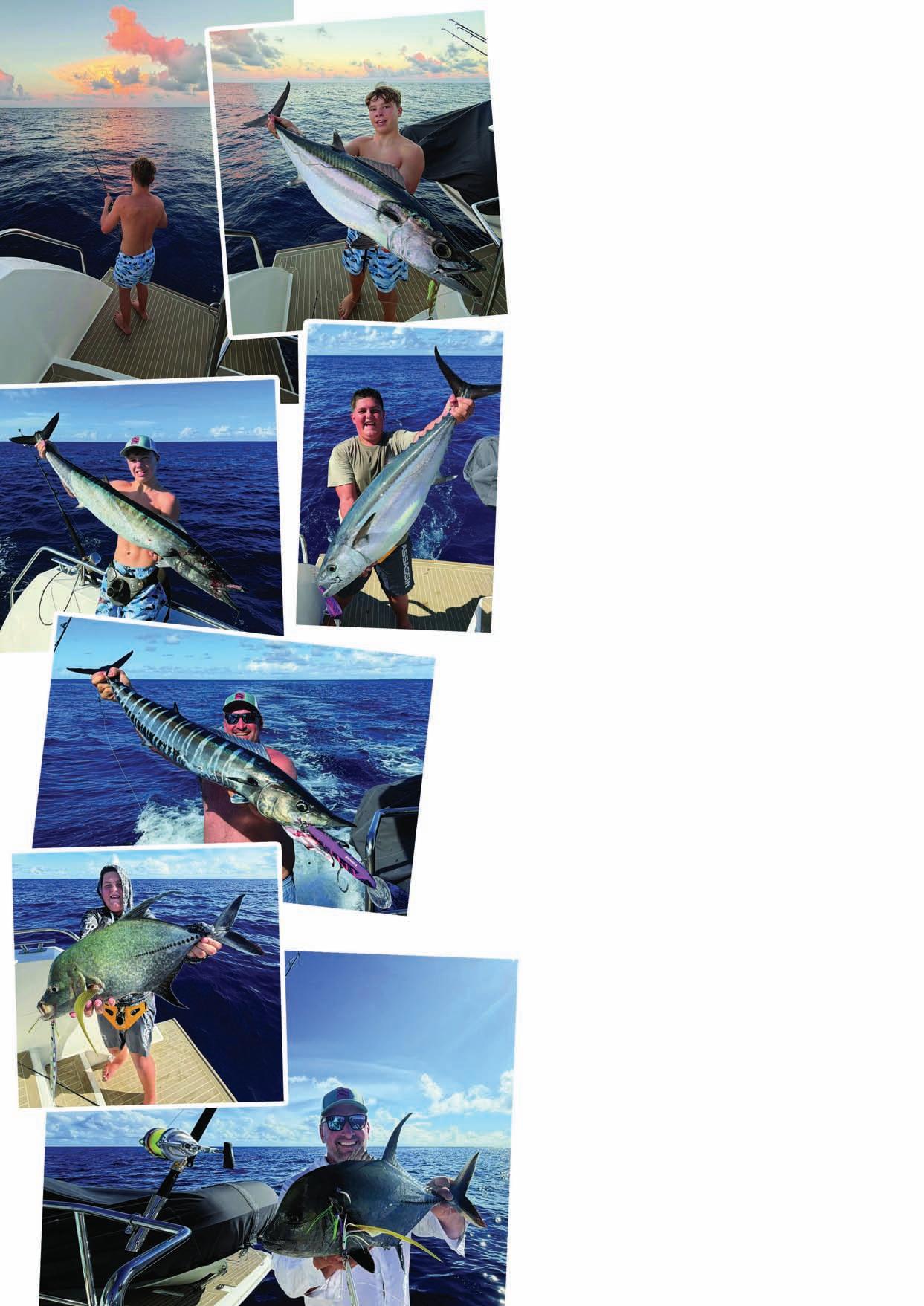
On Kyle’s first drop he snagged himself a respectable 25kg doggie,followed by loads of jobfish, bludgers,black jacks and other species.Having stretched the arms and worked up a bit of a sweat,it was time to head over to Platte in search of some beasts of the sea.
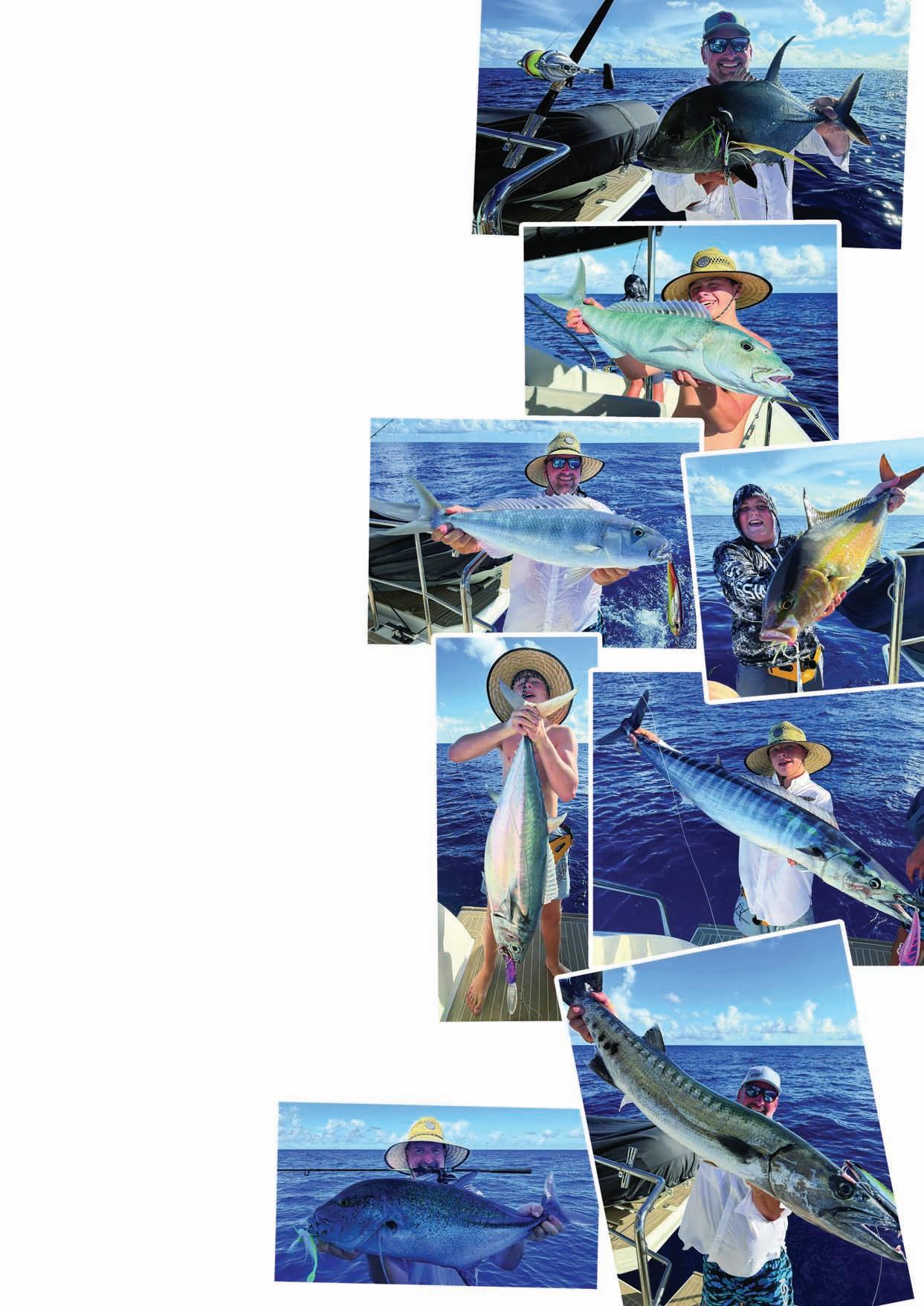
The crossing was largely uneventful,with a couple of small- to medium size wahoo,a few dorado and some bonitos keeping us entertained.When we reached Platte we enjoyed a quick lunch while we planned our angle of attack,starting on the west drop of the island.
As we weren’t familiar with the area,we decided to spend the afternoon trolling some deep-diving Nomad DTX 220 lures together with some Madscad 200s.which can all be trolled at high speeds.The DTX 220s dive down to 40ft,so they’re ideal for seeking out the doggies,while the Madscad 200s run shallower and are good for targeting wahoo and tuna.
Within two minutes we were into our first doggie! That was followed by a few wahoo,and then another doggie,followed by another two in short succession. They weren’t massive fish – 20- to 30kg in size – but it was a great start and lots of fun for Kyle and Jono.
With the sun setting,and us having identified a few areas holding good numbers of doggies,we decided to head into the sheltered anchorage to enjoy the sunset,a delicious meal and a relaxed evening.
The next day we awoke to yet another stunning morning. The sea was glassy and calm,but with a little more swell than the day before.We decided to head to the south western edge of the atoll for some top water action casting poppers and stick baits at the back of the reef,hoping for some GTs and bluefin trevally.
Wanting to get there while the tide was favourable,we opted to run along the 70m contour line,staying away from the doggies. Once again the bite was red hot straight away – wahoo after wahoo after wahoo on the Madscads,and some dorado and tuna on the Konas.They were no monsters,but a heap of fun,and who can complain about catching a dozen or so wahoo in the two hour journey to the south?
The weather had been very settled for several weeks preceding our arrival,so the water temperatures had risen considerably.That had turned the GTs off the bite almost completely.We managed a few small ones and several great size bluefin,but it was not quite what we were looking for in terms of that top water GT bite.
Eventually we stopped for lunch and took it easy for a few hours,jumping in for a swim every now and then,killing some time while we waited for the tidal push along the western drop which usually gets the doggies on the chew.
At around 3pm we started making our way to the areas we had identified the previous day,hoping that the doggies would be there again.This time we focused exclusively on the deep diving lures.
LIKE FISHINGINANAQUARIUM
When we approached the first pinnacle,we immediately knew we were in for something special.As far as the eye could see the ocean was alive with thousands of bonitos,small tuna,rainbow runners and flying fish.We spotted a few sailfish too,but kept to our
discipline and adjusted our path to avoid them as we were on a mission for the dogs.
As we got to the ledge,the two DTX220s screamed off. Kyle grabbed the closest rod which happened to have a nice 35kg class doggie on the end of the line.I dashed over to grab the other rod which was still screaming off,dragging line off the Talica 50 as if the drag wasn’t even there – and it was set high!
I helplessly held the rod,knowing that we had hooked a good fish in the worst possible place,with the ledge directly in its path,as doggies instinctively head for deep water as quickly as possible.I could feel the line being dragged over reef and waited for the inevitable break off,which happened minutes later. It was game over – the first big dog of the trip lost!
With the showings absolutely wild on the sounder,we switched to jigs and got stuck into a few more 20- to 35kg fish,together with a few nice size barracuda.We’d had a great day by the time we stopped,but our bucket list fish still seemed out of reach.
The weather changed drastically overnight,and the next day we woke up to the sound of rain belting down,coupled with a wind squall.The conditions looked ominous,with small localised storms all around us.
As I sat pondering what to do,I was reminded of the many stories I’d heard that the big dogs cannot leave a live bonito alone. I decided that it might be a good morning to take things easy – slow troll some live baits around and hope we’d get lucky with a few good ones.
The run from the anchorage to the dropoff provided the perfect opportunity to slide out some daisy chains,and we had two nice size bonnies at the back of the boat in no time at all.They were bigger than I’d have thought to be ideal,but would make tasty treats for the doggies nonetheless.
TARGETINGAMONSTER
The rig was pretty simple:two large,thick-gauge single hooks spaced approximately 120mm apart,with 150lb mono running to a swivel about 2metres away,clipped onto the main line on the Talica 50s.We slow trolled them out to the drop off,attached a 28ounce sinker using the old fashioned elastic trick,and dropped the first bonito down 25metres or so.
With the rain belting down,we took shelter while keeping a close eye on the rod in eager anticipation of “that bite”.After a few minutes the ratchet went and the line started to slowly peel off the rod.Kyle ran to the rod, set the hooks and we were ON!
A few minutes into the fight we realised that this was not a doggie,but a greedy barracuda.My ever trusty Toit Pliers in hand,I steered clear of its razor-sharp teeth while we released it,and got set getting the next bait out.
Two minutes later the rod went again.This time slow and steady – shark.We were not off to a great start!
Out of bait,we made our way shallower again and got ourselves another bonito,this one bigger than the previous two we’d used.We took a chance,adjusted the distance between hooks,and headed back to the drop-off, this time a little further north,around the north western edge of the atoll.
The water there was a bit greener owing to the water draining off the flats on the island.A solid colour line was perfectly positioned right next to the area I’d been told holds big dogs.
We stared at the rod for what felt like an eternity,but was probably only 15 minutes or so.Suddenly the rod bounced,and the bobbing from the bonito stopped.The
line started to slowly – very slowly – peel off the reel.It had to be a doggie! A big doggie!
BUCKETLISTTICKED
Kyle ran over,grabbed the rod,and allowed the fish to swim off slowly with the bait in its mouth.Dogtooth tuna tend to chew on the livebait a bit,crushing it before swallowing it,and then swimming off at any speed.
Suddenly,the line started to speed up,it was time to strike!
Kyle set the hooks in four aggressive strikes, and all hell broke loose.The line tightened up and started screaming off.We tightened the drag to keep the fish up and slow his descent towards the drop-off.Applying maximum pressure,Kyle fought the fish for as long as he could while I got myself set up in the Black Magic harness.I clipped myself in,and it was game on!
What followed was the most intense,terrifying and exhilarating battle I’ve ever had.I knew I was finally on with a proper one,with more control,serious terminal tackle,and the best reel possible for this application.
A little while later I could feel the fish was starting to come up,and I kept the pressure on. After a few more nervous moments,we saw a giant shape appear from the depths approximately 30metres behind the boat. At last – the monster we had been chasing! Playing the fish as best I could to avoid too much barrel rolling on the surface which can fray even the toughest of leaders,I steadily gained line until the fish was at the back step of the yacht.I screamed, Kyle screamed,the captain screamed! Literally everyone on the boat was either high fiving or jumping up and down on the spot shouting in celebration.
After a few quick pictures and a brief swim with the fish to help it revive,the fish I had been chasing all these years was safely swimming back to the depths of the ocean it calls home.Job done!
After a great night spent celebrating with many a cocktail,we woke up at around 7am and decided to dedicate the day to some light tackle action in the shallower reefs. After that we did some stick baiting around the shoals of fusiliers,finishing off the day with some deep water jigging for amberjacks in the 150- to 180m zone we’d stumbled across the day before.
What is insane,is that all of this was done literally within the space of one kilometre.As these atolls have extreme depth changes,you can be in 20m one minute,60m the next and,in the blink of an eye,find yourself in the 120– 180m zone.
The variety of species is also insane!
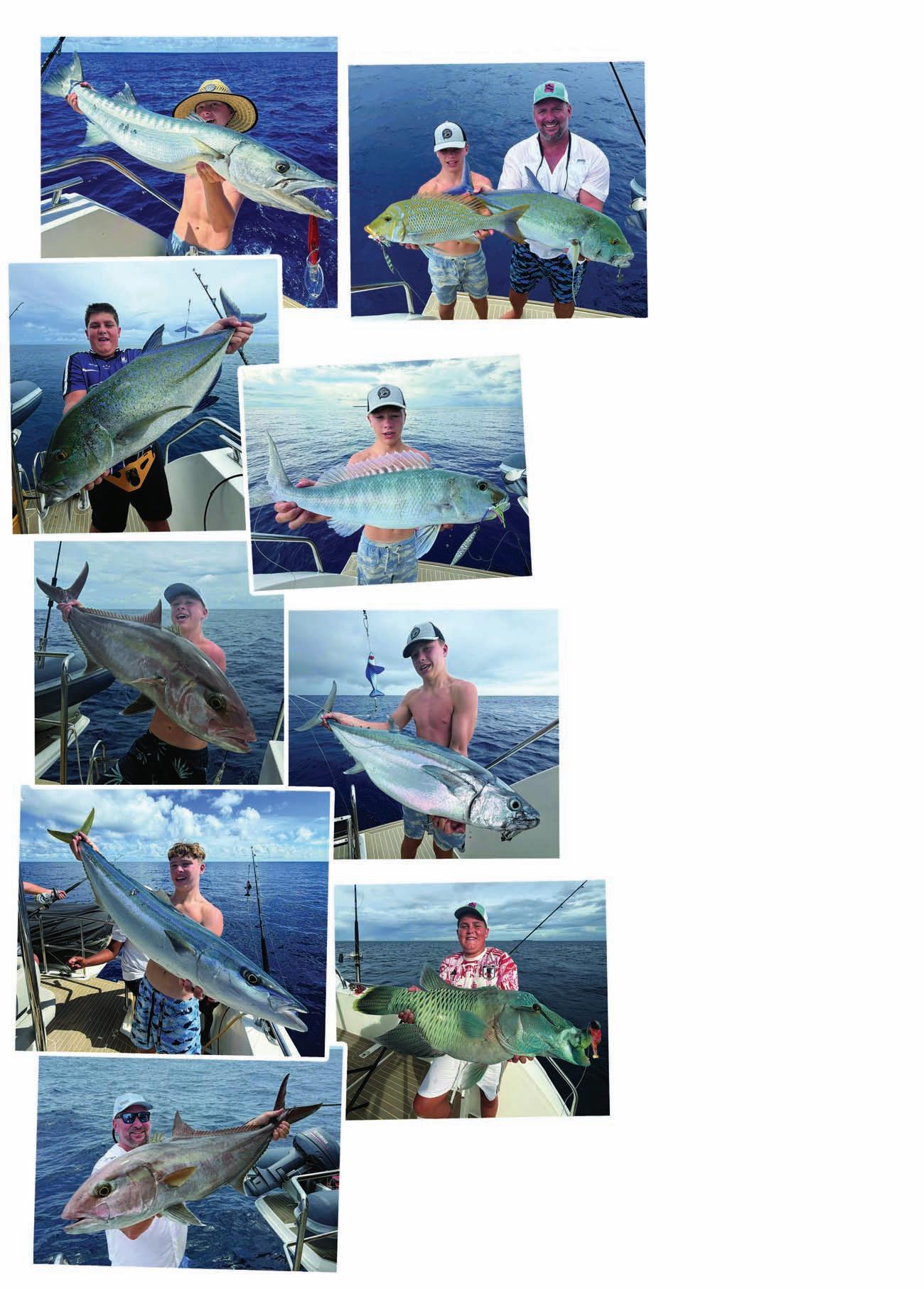
The shallows did not disappoint,nor did the deep jigging with many an amber landed.The new Mayday stickbaits I tried caught doggies,the biggest rainbow runner I have ever seen,bluefins,jobfish,and even nearly landed a bus
of a sailie.Unfortunately that came unhooked before we could get a photo.
LAST HURRAH
Just when we thought this trip couldn’t get any better,the best was yet to come.
On our last drift on our last day,Jono pulled out a 5-inch Nomad Live Ops Jerksquid and hooked into something that we will never forget.His Assassin Abyss Slow Jigging rod bent nearly in half as the fish took its first slow,steady,heavy run. Perplexed,we assumed he’d hooked a grouper,but the fight was different. Knowing he had a light leader,Jono played the fish like a magician at the back of the boat,slowly nursing it up from the depths.
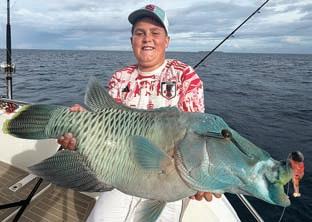
After a few minutes,we eventually saw colour,now even more confused as to what it could be.At last the clouds broke,and suddenly we could identify that this was no grouper,it was a Napoleon wrasse! Well done lad – what a fish!
On our final day we plotted a course back to Mahe,but chose an angle that would see us hit the Mahe Plateau some distance south along the South Eastern Drop as its known.There again we got stuck into some incredible amberjacks,a few doggies up to 40kg or so,and even a couple of wahoo on the jig for good measure.
It was getting late,so,with sore arms,we decided to put out a few Pulsator Konas rigged with MH Fishing Malolo Teaser Birds,and make our way steadily towards Mahe following the drop-off just in case we could get lucky with something on the way back.
As we approached the last main pressure point along the drop,the Stripy Tickler Pink kona screamed off in a huge explosion of water.With line disappearing off the reel,the drag set to max and the 40m edge not too far away,Kyle pulled that fish harder than I’ve seen him pull any fish before.
It wasn’t long before we got the number plate:another awesome doggie,and a class fish by all accounts! After a few quick pics,we had the fish back in the water swimming off to fight another day.
What a way to end the trip! With our cups full and happy hearts,we set sail for Mahe – job done! We will be back for more!
A special thank you to our sponsors and the incredible brands that continue to support us and make these sorts of trips possible.
SADSAA NEWS & VIEWS
APPLYINGFORRECORDS
Your complete how-to guide
By Peet Koekemoer SADSAA Records Officer
WHETHER you’re a seasoned ski-boat angler or a youngster heading out on your first deep sea trip,catching a fish worthy of a record is something truly special.But what happens after the catch? How do you turn that incredible moment into an officially recognised record? In this guide we break down everything you need to know about South African Deep Sea Angling Association (SADSAA) and All Africa records – the categories,the rules,and the steps to follow so your catch counts.
WHO CAN APPLY?
SADSAA records are open to any angler affiliated to a SADSAA member club with paid-up affiliation fees.If you are not a member of a club,you can still apply for an All Africa record as any angler catching a qualifying fish in African territorial waters is eligible.All rules are fully aligned with the IGFA (International Game Fish Association) International Angling Rules,so one set of rules covers SADSAA,All Africa and even IGFA World Records.
RECORD CATEGORIES AT A GLANCE
All-Tackle:The heaviest fish of a species caught in any line class up to 60kg (130lb).This is the classic “biggest fish” record.
All-Tackle Length:The longest fish of an eligible species,measured and released alive.This is a pure catch-andrelease category and is fantastic for conservation.
Line Class:Records kept according to the breaking strength of the line.
Anton van den Berg SADSAAPresident
Classes range from 1kg (2lb) all the way up to 60kg (130lb).The fish must weigh at least 50% of the line class used.
Tippet Class:Similar to Line Class but for flyfishing tackle,with classes from 1kg to 10kg (20lb).
YOUNG ANGLERS’ TIME TO SHINE!
SADSAA also has dedicated record categories for our younger generation.If you are 16 or under,there is a record waiting for you:
Smallfry (Ages 10 and under): Separate records for girls (F-Smallfry) and boys (M-Smallfry).
Junior (Ages 11–16):Separate records for girls (F-Junior) and boys (MJunior).
A major benefit for young anglers is that their fish do not have to be weighed on land;they can be weighed on the boat.However,if they choose to weigh the fish on the boat,the fish must then be released alive,and video evidence of the fish swimming away is essential.This means youngsters can set records while putting the fish back to fight another day!
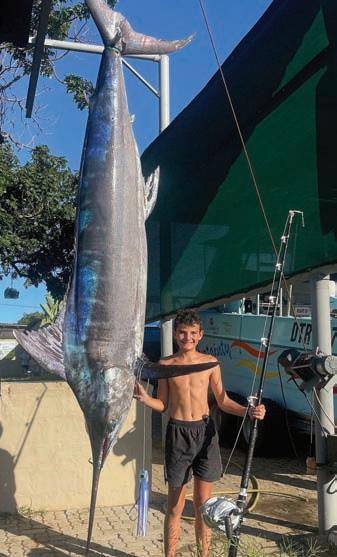
A young angler proudly displaying his marlin. A clear photo of the fish, angler, tackle and scale reading is essential for your record application.
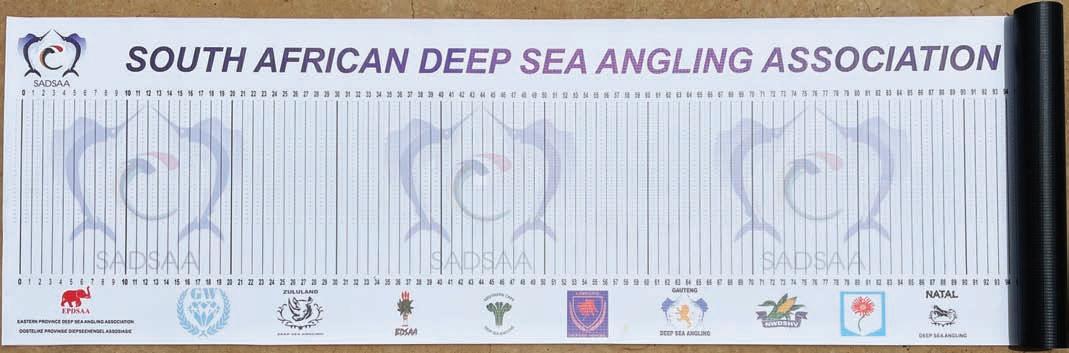
This measuring tape has clear markings but not the required solid nose stop. Email admin@sadsaa.co.za to ask about tapes.
MEASURE, PHOTOGRAPH, RELEASE
The All-Tackle Length category is where conservation meets competition.The fish must be measured,photographed and released alive – video evidence is essential.If the fish does not swim away on its own,the record is disqualified.
Measuring Your Catch
The fish must be placed on a proper measuring device on a flat surface.The snout must touch the front stop (nose stop) and be free of lures or hands. Measurements are taken from the tip of the snout to the rear centre edge of the tail.All measurements are in centimetres and must be rounded down to the nearest whole centimetre – for example,a fish measuring between 87and 88cm is recorded as 87cm.
Measuring Tape Requirements
For IGFA World Records,it’s mandatory to use the official IGFA measuring device.We understand that due to the Rand/Dollar exchange rate,importing the official IGFA tape can be very expensive for South African anglers. The good news is that for SADSAA and All Africa length records,we will accept a replica measuring tape provided it meets two important requirements:
1.It must have a front stop (nose stop) – a solid barrier at the zero end where the fish’s snout rests against.
2.It must have clear,accurate markings – the centimetre graduations must be clearly visible and legible in the photographs of the fish on the tape.
This means every angler in South Africa can participate in length records without the financial barrier of importing equipment.
WEIGHING REQUIREMENTS
For weight-based records (All-Tackle, Line Class,Tippet Class),fish must be weighed on scales certified for accuracy within the past 12 months.Adult records (Men and Women,ages 17+) require the fish to be weighed on land.
Junior and Smallfry records allow weighing on the boat.The weight of any sling,platform or rope used must be deducted.No estimated weights are accepted – only the actual reading shown on the scale.
WHAT YOU NEED TOAPPLY Photographs
Good quality photographs are critical. You need:a clear full-length photo of the fish (broadside to the camera with fins extended) for species identification;a photo of the angler with the fish;a photo of the rod and reel;and a photo of the scale showing the weight (or the fish on the measuring tape for length records).
Photograph the fish from various angles.For sharks,include photos of the teeth and the head from above. Remember – hold the fish horizontally,never vertically,to prevent injury.
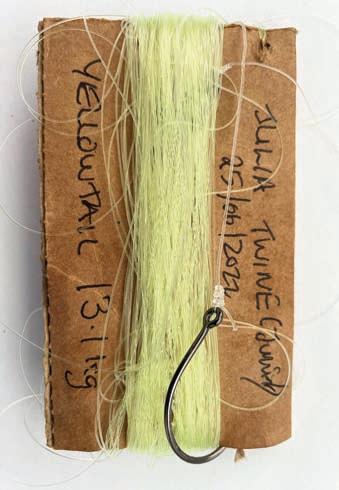
Line sample
Your application must include the entire leader (with hooks),the double line,and at least 5 metres (preferably 15 metres) of line closest to the hook –all in one piece.
A great tip is to wind the line neatly around a piece of stiff cardboard with notches cut in the ends.Write your name,the species,the date and the specified line strength on the cardboard.Tangled or damaged line samples will not be accepted.
HOW TO REGISTER YOUR RECORD
1:Ascertain if your catch qualifies. Check the current records with your club or the SADSAA Records Officer.
2:Handle the fish correctly for the category you are applying for. Ensure the fish is released alive for length,Junior and Smallfry records.
3:Take all the required photographs and measurements immediately.
4:Preserve your line sample carefully as described above.
5:Complete the official SADSAA or All Africa record application form.
6:Submit the application through your SADSAA-affiliated club (for SADSAA records) or directly to the SADSAA Records Officer (for All Africa records).
Claims for fish caught in South African waters must be received within 60 days of the catch.All Africa records from other African waters have 90 days.
BEATING AN EXISTING RECORD
For weight records,if the existing record is under 11.33kg (25lb),your fish must weigh at least 56.69g (2oz) more.If the record is 11.33kg or heavier,your fish must exceed it by at least half a percent.
For length records,the fish must be at least 2cm longer than the existing record.If your fish matches the existing record but does not exceed it by the required margin,it is considered a tie.
GET INVOLVED!
Whether you are chasing a marlin on heavy tackle or are a youngster releasing a yellowtail on light line,there is a record category for you.
SADSAA and All Africa records are about recognising great catches while putting conservation first.So,next time you are on the water and you hook into something special,be prepared! Download the full application requirements and forms from <www.sadsaa.co.za>.
For any questions about record catches,contact the SADSAA Records Officer,Peet Koekemoer by emailing <records@sadsaa.co.za>.
Right: A perfectly prepared line sample – neatly wound on cardboard with all details clearly marked.
APPLICATION FORM
I hereby apply for The Excellence in Angling Awards, powered by Basil Manning, in the category:
Meritorious Fish Outstanding Catch
Tick the appropriate box and supply us with the following information.
Digital emailed photographs should be high-resolution and sent to angler@mags.co.za
YOUR favourite offshore angling magazine, SKI-BOAT, in conjunction with Basil Manning and the South African Deep Sea Angling Association, is proud to offer all South African skiboaters the unique opportunity to win awards for excellence in angling.
All deep sea anglers who achieve laid down standards of excellence will be entitled to apply for The Excellence in Angling Awards, powered by Basil Manning.Upon ratification by a panel of adjudicators,the angler will receive a handsome digital certificate,suitably inscribed.
The Excellence in Angling Awardwill be made for fish caught in two sections:
1)
Meritorious Fish
This award is for a fish that’s a memorable achievement for the angler,if not a personal best,and is not confined to the species listed below.Tackle used is of no consideration here,the fish's weight or release status being the main criterion.
2)
Outstanding Catch
To satisfy the requirements for this award, anglers can catch any recognised fish species.As a guideline,the weight of that fish must equal or exceed the suggested weights below,or certain laid down fish weight:line class ratios.
Awards will be made in the following ratio categories:
3:1 – Bronze Award
5:1 – Silver Award
7:1 – Silver Award
10:1 – Gold Award.
Applies to IGFA line class 1kg,2kg,4kg,6kg, 10kg,15kg,24kg,37kg and 60kg.
RULES:
There is no restriction on the number of awards which can be applied for.
Award applicants must submit a photograph of the relevant fish with the application form and a photograph of the angler with the fish.
SKI-BOAT reserves the right to use the photograph as it sees fit.
Entries must be on the official form which is included in all issues of the magazine. Entries must be received within 45 days of capture. No witnesses of the catch are required. The award is made in the true spirit of sportsmanship and relies on the integrity of the angler to make a just claim.
Aselection of award winners’names will be announced in future issues of SKIBOAT, along with relevant photographs. Award applicants should allow 30-45 days for processing of applications. There is no charge for these awards.
(Ignobilis) 20kg
RELEASED BILLFISH AND GT (Ignobilis) KINGFISH
With the strong trend towards releasing these and other fish, we have decided to amend the award rules to provide for acknowledgement of all released fish.
All we need is a photo of the fish being released or prior to release (e.g. GT held next to the boat) and the approximate weight of the fish which should fall in line with the stipulated weights set out above.
In line with this trend we will not be carrying photographs on the awards page of any billfish or GTs aside from those that are released. SPECIES: SUGGESTED
André Labuschagne earns a Gold Meritorious Award for this stunning 83kg yellowfin tuna caught off St Francis Bay on 2 May 2026.
Gert Coertze has been awarded a Gold Meritorious Award for this stunning ±20kg prodigal son caught off Sodwana Bay in April 2026.
Sophie Jewaskiewitz has been awarded a Gold Meritorious Award for her 8.4kg yellowfin tuna caught off Pennington on 2 May 2026.
Soné Els has been awarded a Gold Meritorious Award for her 20.4kg king mackerel caught off Richards Bay on 2 May 2026.
Jaco Smit has been awarded a Gold Meritorious Award for his ±50kg dogtooth tuna caught in the Seychelles in March 2026.
SANTA SHINES AGAIN
2026 Santa Maria Fishing Challenge
Article by Erwin Bursik
Photos by Justin Klusener
THE 2026 Santa Maria Fishing Challenge has cemented the magnificence of this exotic venue in my mind thanks to the diverse and challenging fishing experienced by all the anglers at this year’s event.
Early each morning,35 craft – some local and many crossing the bay from Maputo – were lined up on the beach by their trusted “gillies”.Participants were able to virtually step out of their villas and onto their craft in the pre-dawn darkness,ready for the slow chug towards the vast Indian Ocean through the respected “Hell’s Gate”.
This year the gate was wide,deep and pretty much an easy run out to what I am convinced is the finest offshore fishing Southern Africa has to offer.
To be clear,Hell’s Gate is often treacherous when the massive tidal surges emptying through the southern reaches of Maputo Bay meet the ocean.However,a prohibitive exit through Hell’s Gate need not block your access to good fishing.Skippers can motor at speed up the inside channel of Inhaca Island and exit around Portuguese Island and reach Baixo Danae reef almost as quickly as they can when exiting via Hell’s Gate.
Launching and fishing in this area is generally not difficult because,as happens around the Bazaruto Archipelago,where vast, shallow waterways regularly empty and fill,these naturally rich waterways are refreshed twice every 24 hours.The fishing pressure is also extremely low.
Over and above the localised possibilities around Santa Maria and Inhaca,the ocean from Macaneta (on the mainland,north of Maputo) right down to Milibangalala on the Santa Maria peninsula offers reefs,drop offs,and exciting inshore fishing possibilities.
To most anglers,especially us ski-boaters,when we see the boats,birds and shoals of active bonnies,as we frequently saw around Santa Maria,it’s a case of:“Let’s go fishing – now!”
And so,the anglers aboard those 35 boats,set off into this fishing mecca to test their skills and target the gamefish willing to play.
But,fishing is fishing,and it’s often challenging even in the most idyllic settings.That’s especially true in competitions like this, where one needs to build up points based on both the number of different gamefish species allowed to be weighed/measured,and their sizes.It was imperative that anglers target many diverse species,so both fishing skill and extensive exploration were required.
To further complicate the task at this event,many of the king-
fish species and the abundant bottomfish could not be loaded.They had to be measured on the supplied mat,and photographic evidence of release was required if we wanted to add them to our points tally.
For most of the boats,a quick few ’cuda boated early each morning started the points accumulation process.After that, teams had to spread far and wide,deploying a variety of skills and fishing methods to get the multipliers such as tuna, wahoo,prodigal son,kingfish and billfish,in an effort to build up their points.
It sounds a lot easier than it was.Our team on Queen Pine chased up and down 20- to 30km of the coastline,and worked out from the backline to the 80- to 100ft drop-offs, trolling and popping all the way.No deep jigging is permitted in this competition,and
Young Brooklyn Puren spent the competition week running up and down being as helful as she possibly could be. As a just reward, Gondwana Collection gifted Brooklyn and her family accommodation at one of their luxury lodges in Namibia.
eventually all one heard on the boat was the whipping of braid as our team “wacked”the surface.
These efforts resulted in us finishing in second place.First would have been better,but we weren’t unhappy with second.Well done to Gone Overboard who made the right choices that enabled them to overtake us on the last day.
I must say that the major reason for our success was that we persistently worked around the reefs we were able to locate.
Due to the fact that Queen Pine is already booked into next year’s Santa Maria Challenge,I have been told that I must keep my “trap”shut,and not reveal any further details or fishing secrets.
Suffice it to say that this event,with its limited number of participants and its carnival-onthe-beach weigh-in and daily prize givings – made exceptionally festive by the compulsory R&Rs – is one of the most enjoyable I attend on an annual basis.
If you get an opportunity to fish the Santa Maria region –whether in this competition or not – grab it with both hands.
Gone Overboard finished the comp in top spot this year. Queen Pine fished hard and finished in second place.
BLUEWATER GLORY
Marlin fishing in Angola
By Jaco Hendriksz
THE third Lobito International Billfish Classic took place in Angola in the last week of March 2026. Representing South Africa, was a unique Protea team consisting of me, my wife (Mariëtte), my son (Jan-Hendrik), and well respected and accomplished sailfish angler George Breedt.
In addition to the general excitement of competing internationally, this team carried special significance for us as a family. At a spectacular and very emotional colours evening, JanHendrik (a third-generation Protea angler) received his Protea blazer from his grandfather, Jan Hendriksz. It also marked a historic occasion for SADSAA, as it’s the first Protea team featuring a father, mother and son competing together.
This year 23 teams entered the event, hailing from Angola, England, Azores, Portugal, Croatia, and South Africa. For Team South Africa, this would become far more than just another international tournament; it turned into a test of adaptability, teamwork, endurance and pure angling passion!
We flew to Luanda and were warmly welcomed by tournament host Alfredo Viegas with “Bem Vindo a Angola!”– Welcome to Angola.We would hear the same words countless times over the next week.
Alfredo’s hospitality and attention to detail immediately stood out.From transport to logistics and day-to-day arrangements,Alfredo ensured the team lacked nothing.
Our journey to Lobito,originally an estimated six- to seven-hour drive eventually became a 12-hour back-breaking trip over rough roads.Fortunately,the spectacular scenery softened the blow. Giant baobab trees,endless bushveld landscapes and remote villages gave us a true taste of Angola.
Our first day in Lobito,the sailfish capital of Angola and home to some of the friendliest people in Africa,was dedicated to rigging tackle and preparing the boat for the week ahead.
As an own-boat tournament,there was no boat draw.We were offered a choice of three boats and eventually settled on Luana,a comfortable 32-foot sportfisher.The skipper and deckhand quickly became part of Team South Africa,and we spent seven most enjoyable days together.
The tournament programme consisted of three practice days,one rest day and four competition days.
FINDINGTHESAILIES
The previous year’s tournament produced an astonishing 175 sailfish and three blue marlin over four days. However,the reports leading into the 2026 event suggested the sailfish migra-
tion had not yet materialised.Most of the fleet had travelled by sea from Luanda,and captains consistently reported Sailfish far north of Lobito, but very little activity closer to the tournament grounds.
The scoring system was straightforward:
Sailfish release – 300 points
Blue marlin release – 1050 points Dorado – weight x 2
Wahoo and yellowfin tuna – weight x 3
The calculations quickly began. Would enough sailfish be caught to outscore a blue marlin? Would we be able to catch blue marlin consistently every day? Only time would tell!
Our first practice day was all about finding sailfish and figuring out exactly what was going on.It started off reasonably well,with Mariëtte and I both landing weighable dorado.We were using ballyhoo swim baits rigged with circle hooks among a spread of teasers and dredges.
Unlike at many other sailfish destinations,here the anglers rig and handle the baits themselves while the deckhands mainly manage teasers and boat work.This suited us perfectly.The locals were intrigued by our methods,so JanHendrik and George gave a brief tackle talk on bait rigging for some of the local gillies while we were there.
ACHANGEOFTACTICS
By 11o’clock on our first practice day, the skipper and crew were getting anxious.They convinced us to try a mixed heavy- and light tackle spread,seeing that neither we nor the rest of the fleet around us,had raised any sailfish.
They suggested one big chuggertype teaser in the middle of the spread and one larger marlin lure on the long, with ballyhoo baits in between.This is not our style of fishing,but,as the saying goes,when in Rome do as the Romans do.
My concern was whether our lures would perform sufficiently at the reduced speed that accommodates swim baits.Fortunately,our tackle bag included an array of Tropical Dream and Pulsator lures.Soon we had a Black & Red TD Swazi on left long smoking fairly well.
I was not convinced that this was a great spread or something I would even consider as an option going forward, but within an hour of altering our spread,we had a strike on the Swazi.
Nobody saw the fish eating,and shortly after I got set up in the Black Magic harness,the line went slack.We all assumed it was a gamefish of some sort,but within seconds our minds changed.
A huge blue marlin jumped right next to the boat with a very familiar looking Black & Red Swazi firmly hooked in the upper jaw!
The fish jumped towards the boat and passed us at an alarming speed.The fight was on!
Jan-Hendrik took the leader 13 minutes into an action-packed fight,and we released a solid 500lb blue marlin on 50lb stand-up tackle after a spectacular leader shuffle by our “new cap”.
We missed another strike on the same lure barely ten minutes after we reset the spread,and then all went quiet.
Jan-Hendrik Hendriksz, a new cap in 2026, received his Protea blazer from his grandfather, Jan Hendriksz.
Jaco Hendriksz, George Breedt, SADSAA President Anton van den Berg, Jan-Hendrik Hendriksz and Mariëtte Hendriksz at the colours evening. This is the first Protea team featuring a husband and wife and their son.
DESPERATELYSEEKINGSAILIES
On the second practice day,we travelled 20 miles north in search of the elusive sailfish but again found no real action.
Our final practice day was intended as a full marlin experiment to determine how many strikes could realistically be expected during a day dedicated solely to blue marlin fishing. Ironically,this was the first day sailfish appeared.
We quickly changed back to a lighttackle spread and George managed to release two sailfish,while Jan-Hendrik and Mariëtte released one sailie each.
The highlight of the day,however, was when a huge blue marlin ate JanHendrik’s 8kg dorado rigged with a circule hook,birdie and leader right next to the boat,then turned around and ate another four small dorado swimming next to our dredge.The marlin simply chased them to the surface,smacked two at a time,turned around and swallowed them not more than ten metres behind the boat.It was one of the most spectacular displays of predatory behaviour any of us had ever witnessed.
After three practice days we were none the wiser on what to target.
The original call for nominations specified sailfish as the primary target species,with the occasional blue marlin expected in the mix.Although we did have some sailfish action on our last effort,it was evident that the anticipated sailfish migration simply never arrived.
Instead,Lobito was loaded with blue marlin,and not just numbers of fish,but also genuinely large fish ranging between 400lb and 800lb.
The diverse skills within this particular team proved to be a major advantage.Conditions required frequent transitions between heavy-tackle marlin fishing and light-tackle sailfishing.Every member of the team brought extensive experience across these varying disciplines.
NORESTFOREAGERANGLERS
Our rest day was spent rigging baits, preparing tackle for both marlin and sailfish,and enjoying some excursions.
Jan-Hendrik had made friends with some local competitors and was invited to join an Angolan team aboard the impressive Tudofish sportfisher.
He spent a most enjoyable day with them,learned some Angolan fishing methods,and managed to catch another sailfish while we were enjoying Caxaramba refreshments at the local distillery.
Andries Maree,SASACC president, had a scheduled meeting with the Angolan Fishing Federation during our tournament in Lobito,and he was kind enough to bring along our trusted
Team work makes the dream work!
Pulsator Papau and Monster Tube teasers from South Africa,in time for the start of the tournament.
GETTINGDOWNTOBUSINESS
Early on day one of the tournament, Mariëtte,Jan-Hendrik and George managed to land one dorado each to get Team South Africa onto the scoreboard. We started with a full light-tackle sailfish spread,but it was soon evident that the sailfish had disappeared completely, and by 10 o’clock we switched to a full marlin spread.
Soon afterwards,we raised a massive blue marlin on our Pulsator Papau teaser.Jan-Hendrik pitched a bait on our 80lb stand-up outfit,and the fish switched to the bait almost immediately.After a textbook pitch,we were tight.
After the marlin’s first jump,we all realised this was the fish of a lifetime. The fight lasted 40minutes,ten of that on the leader.I can honestly say that was the biggest test of my skills on a leader ever.
The fish was very green when I took the leader after 20minutes,and after a couple of spectacular jumps on the leader and another 10minute fight, we managed to get the fish under control and planing next to the boat.
The fish appeared to be well over 700lb but,as with the previous marlin, it was not in good shape and lacked the big belly our blue marlin are renowned for.Nevertheless,it was a great start to the comp and Team South Africa ended Day One in third position overall.
Day Two produced valuable dorado points.Mine weighed 12.7kg,George’s weighed 9.8kg,and Mariëtte’s weighed 9.6kg.With only three dorado allowed per day,these fish became crucial tiebreakers between teams with similar
billfish release totals.
Fishing across the fleet remained tough,with only two blue marlin and four sailfish released for the day.
ONEFINALPUSH
Day Three followed a similar pattern. While the fleet managed three blue marlin and four sailfish,Team South Africa slipped to fifth place heading into the final day.Everything would come down to one final push.
The final day delivered exactly the kind of excitement anglers dream about.Early in the day we had a fair sized blue marlin jumping onto our TD Swazi twice,completely missing it both times.
We thought we’d had our chance for the day,but we were in for a treat. We rigged our Monster Tube with a 12/0 Sta-Stuk stiff rig,and it smoked like a train on shotgun.At midday,a big blue inhaled our lure and started to jump towards the boat.After completing two full circles and landing on the 130lb top shot multiple times,Jan-Hendrik settled into the fight with the boat backing up onto the fish at a rate of knots.
The line parted after five minutes due to the fish landing on the line!
It was a devastating loss,but the team refused to quit.A few minutes before lines up,we went tight again with a frisky 500lb blue that was hooked on a Green & Black Pulsator Tube on right long.We’d decided beforehand to work on a 15minute rotation system during the tournament, and it was Jan-Hendrik’s timeslot that produced again.
After a 20minute fight and several spectacular jumps on the leader,we successfully released another quality blue marlin.By now,Team South Africa
was operating with near-perfect rhythm.Every angler,deckhand and crew member understood their role instinctively;a fitting end to an extraordinary tournament.
When the final scores were tallied, Team South Africa secured an impressive fourth-place finish against a field dominated by highly experienced local Angolan teams.
WORLD CLASSALLROUND
But the results tell only part of the story.The tournament showcased not only world-class fishing,but also the world-class camaraderie,sportsmanship and passion that make international angling so special.It also highlighted Angola’s incredible potential as a billfish destination.The hospitality,the people,the fishery and the sheer quality of blue marlin encountered throughout the week left a lasting impression on everyone involved.
Perhaps the best indication of the trip’s success was the fact that several of our trusted Pulsator and Tropical Dream lures never returned to South Africa.They were eagerly claimed by local anglers after witnessing their performance firsthand.
The prize giving got completely rained out thanks to an open-roof venue,but honestly nobody cared by then.We had made lifelong friends, experienced unbelievable hospitality and caught some spectacular fish.One very exciting part of the event was seeing an all-ladies team competing. Hopefully we can also send a Protea ladies team to Angola in the future.
Angola will definitely see us again, and hopefully,in the near future,we will also see some Angolan anglers competing in South African waters.
Angola’s blue marlin are a feisty lot and put up a great fight that properly tests the leaderman’s skill and nerves.
ADAYIWILLNEVERFORGET!
By Dustin Walklate (11)
THE Durban Interclub fishing trip was one of the most exciting experiences of my life! We entered as a junior team from Richards Bay,and I was fishing with my teammates Ava (11) and Juandre (14). Our manager was Uncle Kevin.I love fishing with him because of all his knowledge about fishing and the different techniques he teaches us.
On day one,before the launch,I wasn’t feeling very well.I felt a bit sick,and was worried that it might ruin my day,but I still really wanted to fish.Once we got out to sea, the fresh air helped a bit and I started feeling better.
Not long after we started,Ava caught the first fish – a beautiful dorado! We were all so excited and cheered for her.Soon after that,Juandre caught a bonito,which made things even better for our team.
Next it was my turn on the rod.We started fishing in 50m of water using a walla walla rig down to the bottom.
Suddenly the reel started screaming as the line rushed off.We all jumped up in excitement.I rushed to grab the rod,but I struggled to get it out of the rod holder at first.
My heart was pounding,but I finally managed to lift it up. Icould feel the fish was deep.
At first I felt pure joy and excitement,but after a while my arms started to get really tired.The fight went on for about 20 minutes,and it felt like forever! Uncle Kevin kept encouraging me and telling me what to do,which really helped me keep going.
Finally,I started getting the fish closer to the boat.When it came into view,we saw it was a big couta! Uncle Kevin gaffed the fish and pulled it onto the boat.
As soon as it was onboard,I was overcome with joy and excitement.My teammates were cheering and celebrating with me.We knew it was a really good fish,and we all tried to guess how much it weighed.
When we got back to the beach,my parents were waiting to see what I had caught.When they saw the couta, they were shocked and so proud.It made me feel amazing.
At the weigh-in,my fish weighed 22.18kg! It’s the biggest fish I have ever caught.
This was a day I will never forget.
1 YEAR — 6 ISSUES R 3 3 0 Yes! Enter my subscription to SKI-BOAT Magazine I save 18% on the newsstand price! 1 Year (6 issues) only R270.00.Save R60.00! New
Disappointment and Delight
The two sides of fishing
By Fransien Myburg
THERE is nothing more exciting than an impulsive entry for a fishing comp – except when it is at Santa Maria,Moçambique! Few places hold the charm, peace and beauty of Santa,not to mention the beautiful sunsets.And the spoil of being able to walk from your room straight to the boat carrying only your backpack is the cherry on top.
Team Aqua-Joy was fishing on Rafaella for this year’s Santa Maria Fishing Challenge,and our rods and reels were ready for action! By 4am each day we were up,packing boat and getting everything in order so that we could be on the water as soon as first light arrived.
For those who haven’t been there,you have Santa Maria Peninsula to the south and Inhaca Island to the north,and the gap in between is known as Hell’s Gate.Launching through Hell’s Gate is quite an experience,but our skipper did a great job of getting us out and back in one piece.
Out on the ocean on day one,it wasn’t long before the fun and games began.Andre was first on with a ’cuda.Then Andries hooked a fish.
“Guys,this is a weird fight.”he said.
“Maybe it’s a marlin,”I suggested excitedly.I was wrong, though,it was a sailfish! Our second species had been caught.
At this event the weigh-in and beach bar are close to the water’s edge,and every day it was a treat to see the boats coming in – and to check had the heaviest fish bags.
“Pampoen”is the signature drink at the Santa Maria Challenge.They are very nice and you have to drink one whenever you are there.But be very aware;I said one! Too many of them and you could turn into a pampoen!
We ended in seventh place after day one,and were determined to keep up the good work.
Moçambique’s fishing is really something to get exited about,but there’s also the hard luck factor that comes into play,like when you hook a kingie and it runs you off against the rocks.Rapala Lip strikes!
Another day,while I was fighting a barracuda we saw another one swimming with it towards the boat. “Pitchhhhh!” was the cry,but apparently our pitch bait didnt look appetizing to the second barracuda.That brought on a small Rapala Lip,but never mind,a nice one was released it was my first!
Later,while drifting we saw baitfish jumping next to the boat.Liam threw a popper towards the jumping fish,and ... fish on! A sailfish! It was our second one for the week – the first one was caught on a bucktail and the second one on a popper.How awesome is that?
All our Rapala Lips had been banished.But not for long ...
The next day,Joe was busy fighting a really good jobfish while Andries fought a ’cuda.Suddenly,a shark came and taxed Joe’s jobfish!
Yikes! Big Rapala Lips crept in.I just wanted to cry;it was a huge fish and our fourth species of the day.But,that’s fishing for you,so we lifted our heads and prepared to try again.
At the start of day five we were lying in fifth place.We struggled to get any bites,that day,though.It’s not surprising that the Rapala Lips creep out when you give your best and nothing bites.
With an hour of fishing left,everybody on the boat was flicking and throwing bucktails,when suddenly the Tyrnos 16 with a livebait started to scream.It sounded like it was about to seize! We knew we’d hooked a huge fish.
As Andries fought it,the fish came up and we caught a glimpse:we were right,it was a huge ’cuda! Just too far away for Chris to gaff it,it went down under again and I stood aside.Chris leaned forward and was about to gaff it when a shark came in and took the fish off!
“NOOO!”cried Andries.His cry echoed in my soul.I couldn’t believe it;we’d just lost a calcutta winner! Our Rapala Lips were on the floor.
But,on the way back to the beach,all the good memories filled my mind.We’d had an awesome week of fishing and it was a huge blessing to be on the sea with a great team.
We came fifth overall,and we loved almost every second of it.The memories will last a life time.