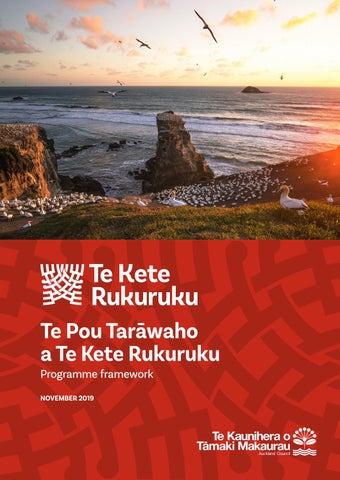
Te Pou TarÄ waho a Te Kete Rukuruku Programme framework NOVEMBER 2019
Contents Te Kete Rukuruku vision and purpose ........................................................................................................... 01 Vision > Purpose > Outcomes ..................................................................................................................... 02 Te Kete Rukuruku programme governance and operational structure ................................04 Terms of reference .................................................................................................................................................06 Principles pertaining to the representation of mana whenua interests .................................... 08 Māori language policy ........................................................................................................................................ 09 Mihi / Ackowledgement ................................................................................................................................ 10 He Whakamārama / Foreword .................................................................................................................. 11 Kupu Whakataki / Introduction ................................................................................................................ 12 Te Koronga / Purpose ..................................................................................................................................... 13 Ngā Mātāpono / Principles ..........................................................................................................................13 Ngā Tikanga / Conventions .........................................................................................................................14 Te Kete Rukuku – stages and timing for naming process ....................................................................15 Data handling frameworks ................................................................................................................................16 Te Kete Rukuruku process ............................................................................................................................ 16 He Whare mātauranga mo Te Kete Rukuruku A mātauranga management & data handling framework ......................................................... 18 Glossary of terms ............................................................................................................................................20 Mātauranga and intellectual property management principles .................................................... 21 Mātauranga management labelling ............................................................................................................22 Traditional knowledge labels for Te Kete Rukuruku - at a glance ........................................... 24 FAQ ........................................................................................................................................................................ 26 Mātauranga management agreement template ...........................................................................28 Communications approach ............................................................................................................................... 31 Local board area map ......................................................................................................................................... 32 Te Kete Rukuruku 2019-2020 meeting dates ............................................................................................33
Te Kete Rukuruku vision and purpose VISION The rich Māori history and culture of Tāmaki Makaurau is part of everyday life for future generations of Māori and Auckland residents.
PURPOSE Te Kete Rukuruku is a culture and identity programme involving the collection and sharing of stories unique to Tāmaki Makaurau. A subset of this programme is the Māori naming of parks and places which involves the reclamation or identification of new Māori names and narratives across Tāmaki Makaurau.
PŪRĀKAU •
Te Kete Rukuruku was a small, finely woven kete containing kūmara and taro seeds and was hand held throughout the sea voyage from Hawaiki to Aotearoa.
•
Its kaitiaki or protector was Whakaotirangi, the Chieftainess of Te Arawa and Tainui waka
•
The kūmara seeds were planted in the gardens on Maunga Rei through to Remu-wera and the entire Tāmaki Region.
•
The proverb holds a deeper meaning of long-range planning to create sustenance for future generations
•
The seeds have a direct relationship to the whenua and the waka tūpuna
Māori tūpuna ensured the safe passage and planting of seeds from Hawaiki Mana Whenua wish to nourish new generations through the seeds of treasured stories
1
Vision > Purpose > Outcomes COMMUNITY OUTREACH Visible Māori names and stories that raise pride in and knowledge of the unique Māori identity of Tāmaki Makaurau for residents and visitors.
WORKSTREAM
3 YEAR WORK PROGRAMME
2019/20
2020/21
MĀTAURANGA
NAMING
Implementation of agreements including application in SAP, GIS, Te Waharoa
Tranche 1 / phase 1 of naming complete for 9 boards
Communication and education around mātauranga management
2020-24 work programmes established for local boards
Ongoing implementation of agreements
Tranche 1 / phase 2 of naming complete for 5 additional boards
Ongoing communication and education around mātauranga management
Deliver tranche two of naming
2021/22
MEASURES (TARGET)
ESTABLISHMENT YEAR 2017/18
TARGET 2018/19
Mātauranga management agreements in place.
22
40
19 mana whenua engaged.
11
17
Number of stories with specific end use IP agreements for community outreach
0
0
Established baseline- 9%
10%
Percentage of parks and places with a Māori name
2
TE KETE RUKURUKU
BUSINESS PRACTICE Te Kete Rukuruku supports all mana whenua story telling in a way that sustains and protects Māori cultural identity, knowledge and practice while enabling a consistent approach to Māori naming and telling cultural narratives.
NARRATIVES
DIGITAL
COMMUNITY OUTREACH
Story capture with mātauranga management agreements in place for up 38 stories
Naming database developed for easy mana whenua input and easy Council access to adopted names
Signage – 14 parks across 14 local boards with bi-lingual signage and new names
Commence production of community outreach stories for Project 2021
Feasibility study for app or other platform for sharing names with public for 2021
Project 2021 – scoped
Promo videos x 3 complete
Te Waharoa scoped and tested
Signage renewals
Story capture with mātauranga management agreements in place for up 20 stories
Te Waharoa developed
Project 2021 delivered
Production for community outreach stories for Project 2021 complete
Naming app or similar launched for public access
Signage renewals
Story capture with mātauranga management agreements in place for up 20 stories
TARGET 2019/20
TARGET 2020/21
TARGET 2021/22
60
80
100
17
17
17
10
20
30
11%
16%
22%
TE PŪTAKETANGA / PROGRAMME FRAMEWORK: VISION AND PURPOSE
3
Te Kete Rukuruku programme governance and operational structure
GOVERNANCE LEVEL - PROGRAMME
INDEPENDENT MANA WHENUA GOVERNANCE ENTITIES (19)
OPERATIONAL LEVEL - PROGRAMME
Mana Whenua Kaitiaki Forum
Mana Whenua working group (19 mana whenua reps)
OPERATIONAL LEVEL - PROJECT
Programme Manager
Individual Mana Whenua input into projects
MANA WHENUA STRUCTURE 4
TE KETE RUKURUKU
PROJECTGOVERNING BODY AND LOCAL BOARDS (1+21)
Māori Outcomes Steering Group
Council strategic guidance: Providing funding, reporting and integrating projects across the Council whānau
Te Kete Rukuruku Programme Sponsor and sponsors rep
Role of the sponsor: Providing strategic advice, investment support, risk and performance assessment.
Wider council stakeholders and programme support
Delivery: • Programme planning andreporting • Provide resource including programme support • Ensure integration and delivery of outcome across the Council whānau
supported by programme team
Projects to deliver Mātauranga workstream
Projects to deliver Naming workstream
Projects to deliver Narrative workstream
Projects to deliver Digital workstream
Projects to deliver Community Outreach workstream
COUNCIL PROJECT GOVERNANCE AND STRUCTURE AROUND EACH PROJECT COUNCIL PROGRAMME STRUCTURE TE PŪTAKETANGA / PROGRAMME FRAMEWORK: VISION AND PURPOSE
5
Mana Whenua Working Group Terms of Reference Adopted September 2018
PURPOSE Assist in the sound and robust management of the programme to achieve the agreed objectives and goals. This includes: •
Decision making (providing direction) to the Programme Manager and Programme Sponsor,
•
Reporting through the Te Toa Takitini work programme (which is reported to the Kaitiaki Forum),
•
Reviewing and adopting programme wide documents and collateral,
•
Auditing/managing programme risks.
Decisions of the working group will not dictate or override decisions of individual iwi pertaining to their names or stories but rather guide the programme approach in a way that supports individual iwi to continue to contribute names and stories
PROGRAMME BACKGROUND AND STRUCTURE 1. Te Kete Rukuruku is a mana whenua and Auckland Council partnership programme which involves the collection and telling of unique stories of Tāmaki Makaurau. 2. The partnership is represented through one on one relationships between local boards or the governing body and individual mana whenua AND/OR through collective co-management as it relates to the overall programme. 3. The core programme is funded by Council and decision making on funding matters is retained with Council.
FUNCTIONS The functions of the Mana Whenua Working Group include: •
Receiving and reviewing the programme plan and other key documents, and providing to the Programme Manager recommended changes to those plans and/or endorsing,
•
Receiving and reviewing regular programme reports from the Programme Manager and providing recommendations to assist to deliver the programme successfully according to the objectives, scope, time, quality and cost in accordance with the Programme Plan,
•
Making recommendations to the individual mana whenua governance to support any decision where it is deemed necessary (noting that the Kaitiaki Forum has endorsed this programme being driven at an operational level).
•
Acting as a key professional forum to communicate appropriate programme information back to key stakeholders within or relevant to their own organisation,
6
TE KETE RUKURUKU
•
Ensuring that appropriate programme assurance activities occur for the most critical aspect of the programme’s performance and deliverables,
•
Providing advice on decisions that will have a material impact on the programme, and on key documents and issues,
•
Agreeing milestones and managing high level risks,
•
Committing to a programme that is consistent with the resources available and required to deliver a successful programme outcome, and
•
Meeting on a regular, approximately monthly, basis.
PRINCIPLES PERTAINING TO THE REPRESENTATION OF MANA WHENUA INTERESTS 1. Mana Motuhake – each iwi group has its own authority to determine how it will apply its values and principles in its own area. While there are overlapping interests between multiple iwi to one place, the working group cannot determine issues on behalf of an iwi. This principle also acknowledges that the mana whenua are entitled to disagree. 2. Programme requirements remain with the programme - the forum does not transfer the responsibility to meet programme requirements to individual mana whenua. Mana whenua must individually take responsibility for the completion of programme objectives as they see fit. 3. Effective and efficient use of time and resource - while recognising the mana motuhake of the 19 respective iwi entities, there are matters that can be dealt with collectively. The working group will help to identify where this is appropriate. 4. Working Group as the clearing house – this principle balances mana motuhake and efficient use of time and resource. Where it is identified that substantive discussions, either for approval or for input, are best dealt with outside the forum by way of one on one engagement with iwi, then the forum can help to determine the process. 5. Timeliness – the working group will need to remain adaptable and cognisant of the wider demands on mana whenua while also providing some certainty and consistency for decision making. 6. Relationships – honour the importance of individual and strong relationships between mana whenua and Council. Invest in these relationships. 7. No surprises – provide a level of reliability and certainty about where and how programmes of work is at. 8. A long term partnership – enable a positive partnership whereby Auckland Council and Mana Whenua look for opportunities to do more than the sum of the parts from the programme. TE PŪTAKETANGA / PROGRAMME FRAMEWORK: VISION AND PURPOSE
7
Principles pertaining to the representation of mana whenua interests 1. Mana Motuhake – each iwi group has its own authority to determine how it will apply its values and principles in its own area. While there are overlapping interests between multiple iwi to one place, the working group cannot determine issues on behalf of an iwi. This principle also acknowledges that the mana whenua are entitled to disagree. 2. Programme requirements remain with the programme - the forum does not transfer the responsibility to meet programme requirements to individual mana whenua. Mana whenua must individually take responsibility for the completion of programme objectives as they see fit. 3. Effective and efficient use of time and resource - while recognising the mana motuhake of the 19 respective iwi entities, there are matters that can be dealt with collectively. The working group will help to identify where this is appropriate. 4. Working Group as the clearing house – this principle balances mana motuhake and efficient use of time and resource. Where it is identified that substantive discussions, either for approval or for input, are best dealt with outside the forum by way of one on one engagement with iwi, then the forum can help to determine the process. 5. Timeliness – the working group will need to remain adaptable and cognisant of the wider demands on mana whenua while also providing some certainty and consistency for decision making. 6. Relationships – honour the importance of individual and strong relationships between mana whenua and Council. Invest in these relationships. 7. No surprises – provide a level of reliability and certainty about where and how programmes of work is at. 8. A long term partnership – enable a positive partnership whereby Auckland Council and Mana Whenua look for opportunities to do more than the sum of the parts from the programme.
8
TE KETE RUKURUKU
Māori Language Policy
TE PŪTAKETANGA / PROGRAMME FRAMEWORK: MĀORI LANGUAGE POLICY
9
Mihi Acknowledgement
Ko te reo te mauri o te mana māori Ko te kupu te mauri o te reo māori E rua ēnei wehenga kōrero e hāngai tonu ana ki runga i te reo māori Ko te reo, nō te atua mai The language is the life force of the mana māori The word is the life force of the language These two ideas are absolutely crucial to the māori language A language, which is a gift to us from the creator Sir James Henare Waitangi Tribunal Hearings, 1985, Wai 11.
10
TE KETE RUKURUKU
He Whakamārama Foreword
MĀORI LANGUAGE AND AUCKLAND’S UNIQUE IDENTITY Auckland Council recognises that Māori language is a cultural treasure and an official language of New Zealand. We acknowlege that Māori language and culture forms a critical part of “a Māori identity that is Auckland’s point of difference in the world”. Through this policy and the related implementation plan Council is committed to the Māori language being seen, heard, spoken and learnt throughout Tāmaki Makaurau Auckland and that Council is able to contribute to the celebration, protection, revitalisation and the integration of Māori Language throughout its functions and activities.
MĀORI LANGUAGE FRAMEWORK We have developed a Māori Language Framework to underpin how Council gives effect to this policy.
OUTCOME AREA POTENTIAL
EXPLANATION
ACTION AREAS
Te Reo te Kitea Māori Language that is visible
Te Reo te Kitea is about Council’s • Bilingual Signage • Dual Naming of Council contribution to the visibility of facilities the Māori language throughout • Road Naming Auckland
Te Reo te Rongohia Māori Language that is heard
Te Reo te Rongohia is about Council’s contribution to the Māori language heard throughout Auckland
• Digital audio platforms • Civic events • Call Centre
Te Reo te Kōrerohia Māori Language that is spoken
Te Reo te Kōrerohia is about Council’s contribution to the Māori language spoken throughout Auckland
• Customer Reception • Business meetings • Hearings
Te reo te Ākona Māori Language that is Learnt
Te reo te Ākona is about Council’s contribution to the Māori language learnt throughout Auckland
• Māori language immersion spaces • Digital learning platforms • Interpretive signs
TE PŪTAKETANGA / PROGRAMME FRAMEWORK: MĀORI LANGUAGE POLICY
11
Kupu Whakataki Introduction Auckland Council is committed to meeting its responsibilities under the Treaty of Waitangi and its broader legal obligations to Māori. The council recognises these responsibilities are distinct from the Crown’s Treaty obligations and fall within a local government Auckland context. These commitments are articulated in the council’s key strategic planning documents – the Auckland Plan, the Long-term Plan, Local Board Plans and the Unitary Plan. In responding to Council’s commitments and obligations to Māori in a way that will improve outcomes for all, Whiria Te Muka Tangata – The Māori Responsiveness Framework has been developed. Its purpose is to enhance and guide Auckland Council and it’s family’s responsiveness to Māori. The Framework articulates that Council will work to ensure its policies and actions consider: • the recognition and protection of Māori rights and interests within Tāmaki Makaurau, and • how to address and contribute to the needs and aspirations of Māori. The Māori Language Policy provides a practical means for Council to fulfil its commitments and obligations to Māori.
12
TE KETE RUKURUKU
Te Koronga Purpose The purpose of the Māori Language Policy is to direct and guide the actions of Auckland Council, in relation to the celebration, integration, protection and revitalisation of the Māori language in council business. Auckland Council aims to: • Ensure that anyone who receives or uses Auckland Council’s services or contributes to the democratic process has the choice to do so in Māori or English. • Encourage the use of the Māori language in the community.
Ngā Mātāpono Principles The principles that underpin this Māori Language Policy are: - Māori language is a cultural treasure which is at the heart of Māori identity - dialects reflect tribal identity and considerations have been made in this document - because te reo Māori is an official language of Aotearoa, it shall receive equal status to the English and Sign languages - Auckland Council is committed to celebrating Māori identity - ‘Auckland’s point of difference in the world’.
TE PŪTAKETANGA / PROGRAMME FRAMEWORK: MĀORI LANGUAGE POLICY
13
Ngā Tikanga Conventions The Auckland Council group will apply these practices to all official communications and publications when using the Māori language: i.
Refer to the ‘Guidelines for Māori Language Orthography’ by Te Taura Whiri i te Reo Māori The Māori Language Commission when applying Māori language in its written form. This publication gives current best practice for the written word and is the convention Auckland Council will follow. Mana whenua, should they choose, shall be exempt from those guidelines. They may determine for themselves the spelling that will differ in order to reflect their identity, dialect and narratives.
ii. Mana whenua interpretations of their stories and relationships to Tāmaki Makaurau remain the intellectual property of mana whenua. iii. Written reference to ancestral names will be with the express permission of mana whenua. iv. The Māori language will be incorporated into Auckland Council’s proceedings, operations, delivery and communications including: - key documents and publications - meetings and events - other communications such as media releases, websites, signage and interpretation. v. When using the Māori language in written or spoken communications, Auckland Council will include an English translation except when the words or phrases are in such common usage that it is considered unnecessary. For example; whānau, iwi, hapū. vi. Auckland Council will encourage the use and correct application of the Māori language in its communications, publications and signage. In general the Māori language shall precede English, however there are some exceptions to this. For example; Where navigation aids, maritime safety or emergency responses appear or in the digital environment and when the search function would be affected. In these cases English will precede Māori. For example; Emergency Exit, First Aid, Assembly Point, Fire Alarm. vii. Transliterations will not be used except where there is no alternative. viii. The Māori Language Policy and related implementation plan will inform other Auckland Council group protocols and policies on: - signage and interpretation - dual-language naming - road naming
14
TE KETE RUKURUKU
Te Kete Rukuku – stages and timing for naming process 3 MONTHS
1.5 MONTHS
• Research parks or places (6 weeks)*
• MW identify interest in local board areas*
• Board workshop (6 weeks)* • Board meeting (6 weeks)*
• MW interests amalgamated and put against each site and distributed (2 weeks)
• Distribute names to MW (1 week)
• workshop overlapping interests (4 weeks)
*these steps overlap each other. Time will extend if local board need more than one workshop
• distribute agreed list (1 week)
PHASE ONE Local board prioritisation
*This is completed much earlier in process and is the starting point. *If needed, go back to board if there is a large list that will turn into a multi-year approach or if there is a site that cannot PHASE TWO be named at this Mana whenua time more than one workshop overlapping
interest
4 MONTHS • Gifting between mana whenua and local boards - not public (6 weeks)*
PHASE FOUR Gifting process
PHASE THREE Mana whenua naming
• Agree signage approach (8 weeks)* • Prepare local board reports and communication plan (8 weeks)* • Report and public communications (1 week) • Gazettal (4 weeks) *these steps overlap each other. Note: installing signage and associated story telling will take at least one year following gifting where funding permits.
3 MONTHS • Research/approve names - MW own process (8 weeks) • Recirculate all names (1 week) • Circulate within iwi and confirm tikanga back to Council (3 weeks)
TE PŪTAKETANGA / PROGRAMME FRAMEWORK: STAGES AND TIMING
15
Data handling frameworks STORY CAPTURE
SECURE STORAGE
Iwi chooses to record story(s)
TE KETE RUKURUKU INITIATED BY CAPTURE
STEP 1 Plan agree process, kōnae and information management
Kaitiaki Agreement
Auckland Libraries to securely store story(s)
NO
YES
SECURE STORAGE Option 1 Auckland Libraries
STEP 2 Interview wānanga multiple sessions
STEP 3 Post-interview analysis. Abstracting, indexing, storylining, writing, metadata creation
STEP 6 Masters archived as per agreed IM plan, ongoing administration
0THER STORIES CAPTURED MĀORINAMING PROJECT 16
Māori naming project process
Sites of significance project stories AT stories (naming projects) Other stories
TE KETE RUKURUKU
SECURE STORAGE Option 2 Iwi have their own archive setup
SECURE STORAGE Option 3 Iwi use another repository (e.g. Ngā Taonga Kōrero)
STEP 4 Post-interview product editing and media production
STEP 5 Digital file handling as per agreed information management plan and agreed use scenarios
SECURE STORAGE
STEP 7 IP and kaitiaki agreements for agreed scenarios (published works) and metadata
BY PRI AGREE ONLY
OR EMENT
Te Kete Rukuruku process USE
EXTERNAL PARTY USE
REUSE BY PRIOR ARRANGEMENT
Council wishes to use story content
Metadata about secured stories
Search database for available stories / metadata
Identify potential story(s) REUSE STORY POOL
Discuss proposed use with iwi story owner
NO
Iwi agree to proposed use?
YES
Story is not used
Council project uses story as agreed (may involve iwi in implementing use)
TE PŪTAKETANGA / PROGRAMME FRAMEWORK: DATA HANDLING FRAMEWORKS
17
Data handling frameworks PHASES Phase Key: Operational Capture Use Store
18
1. IP & MĀTAURANGA MANAGEMENT Mana whenua & Council agree a purpose and plan for the capture, use and placement of iwi mātauranga, e.g: a placename or story, image or icon gifted for council use
2. RESEARCH & CAPTURE
3. POST-CAPTURE (1)
Interviews/field capture or handover of mātauranga. E.g writing, lists of of names and information about them, recordings, images, artwork
Logging, databasing, indexing, story lining, writing, metadata creation
MĀTAURANGA/ INFORMATION MANAGEMENT PRINCIPLE
Operational documentation. Files open to council record keeping and LGOIMA standards.
Traditional knowledge culturally sensitive
Traditional knowledge culturally sensitive
CAPTURE PLAN (E.G. INTERVIEWS, DIGITISATION, WRITING)
Research &/or capture plan. List of names for consideration; interview plan & capture schedule for storytelling
Agree preferred research and info capture modes with mana whenua. E.g audio &/or video, digitisation, wānanga, archival research
Finding tools: adding metadata, preparing abstracts & indexes
IP, DATA MANAGEMENT & COMPLIANCE
Capture, storage and use agreement recorded. Statement of works agreed
As per plan agreed with mana whenua in naming and storytelling statement of works
Indexes, abstracts and database entries for names and stories approved by mana whenua
USE
Operational paperwork for in-house record keeping, compliance. Templates, databases, registers and reporting, e.g: local boards, mana whenua fora
Private/not for publication, handling as agreed for processing.
Working files with Council & contractors for processing, editing
HANDLING (IM/IKM/ PUBLISHING)
Operational storage. Project records and planning documents only.
Processing. Sharing with Council staff & contractors as appropriate for production, editing, archiving and lodging place names in databases
Temporary and/or cloud-based
ARCHIVING
Operational - Council Acts including LGOIMA
Repository. Backups; approved names, stories etc added to database/s or deposited for archiving
Notes and records related to naming, story versions and working files deleted or recorded as agreed
MODEL OF PRACTICE/ CO-CREATION EFFORTS
Distinguish between operational and mātauranga or taonga records for Te Kete Rukuruku.
Kaitiakitanga (mana whenua), Kaipupuritanga (council or other nominated institution)
Kaitiakitanga and Kaipupuritanga
TE KETE RUKURUKU
He whare mātauranga mo Te Kete Rukuruku A mātauranga management & data handling framework
4. POST-CAPTURE (2) Story editing & production for naming, peacemaking and storytelling
5. DIGITAL FILE HANDLING Master recordings, field data, processed for end use scenarios
6. USE AGREEMENT
7. MASTERS ARCHIVED
Agreement for name/s, story, image, or creative work to be used under agreement. May cover one or multiple types of mātauranga; signed by Council and mana whenua nominee
For stories and place naming knowledge drawn from longer interviews or archival research. Agreed as part of IM plan.
Traditional knowledge culturally sensitive
Traditional knowledge culturally sensitive
Traditional knowledge community outreach; research and education OR traditional knowledge commercial (depending on proposed use)
Traditional knowledge secret
Production for approved use as per agreed scenarios, to particular programme outputs
Post interview processing; lodging of naming information including source/s of mana whenua information
TKR helps mana whenua and boards present naming stories in required formats. E.g written narratives, AV installations, story and design placement for platemaking
Capture to archival standards. Best effort to record both content and context for naming and place making. This info part of metadata record for Council.
Intellectual property agreement in place
As per information management plan
As per IP/mātauranga management agreement
As per management plan with nominated repository
Production for agreed storytelling, place making & archiving
No publishing; sharing for review and feedback
As per agreed use. E.g facility naming, research collection, place making, public event, booklet, GIS app
Mana whenua
Te Kete Rukuruku databases: libraries for stories & research collections, GPS list for naming data; linked
Contractors, council departments, nominated archive
Council department project lead, libraries, parks & facilities GIS database, as agreed
Mana whenua and/or approved repository
Version control: editing versions, drafts, naming database & story entries back to mana whenua for approval before publishing
Council archive for off-line interim storage or nominated repository
Raw files returned to mana whenua; produced stories and naming data stored for access and reuse as per mātauranga agreement
Mana whenua and/or approved repository
Kaitiakitanga & kaipupuritanga
Kaitiakitanga & kaipupuritanga
Kaitiakitanga & kaipupuritanga
Kaitiakitanga & kaipupuritanga
TE PŪTAKETANGA / PROGRAMME FRAMEWORK: DATA HANDLING FRAMEWORKS
19
Glossary of terms MĀTAURANGA
Knowledge, wisdom, understanding, skill
WĀNANGA
To meet and discuss, deliberate, consider; conference, forum, educational seminar
RANGAHAU
To seek, search out, pursue, research, investigate
METADATA
Data that provides information about Te Kete Rukuruku stories and mātauranga
IP
Intellectual property
IM
Information management
TKM
Traditional knowledge management
LGOIMA
Local Government Official Information and Meetings Act, 1987
KAITIAKI (MANA WHENUA)
Trustee, minder, guard, custodian, guardian, caregiver, keeper, steward of mātauranga and rangahau
KAIPUPURI (COUNCIL)
Literally holder, in reference to the negotiated handling of Te Kete Rukuruku mātauranga gifted to Council by mana whenua kaitiaki
20
TE KETE RUKURUKU
Mātauranga and intellectual property management principles HEI WHAKAMĀRAMA Background Te Kete Rukuruku programme promotes mana whenua-mandated capture, storage and application of rangahau (research) and mātauranga (ao Māori knowledge) for storytelling, place naming, and place making in Tāmaki Makaurau. Te Kete Rukuruku promotes a mātauranga management approach that acknowledges mana kaitiaki as foundational. Council recognises mana whenua ownership of their stories as taonga and does not assert any ownership of mātauranga, place names or stories gifted or conditionally provided for this programme, or related projects. A traditional knowledge management approach provides a framework for capture, use and storage. This includes negotiated use scenarios for stories, placenames and mātauranga being shared. This emphasises, as a first step, research and education outreach applications, an agreed priority for Te Kete Rukurkuku storytelling, and the Māori naming of parks and places. Scenarios for other, possible future uses are being shaped as examples. This acknowledges the evolving nature of Te Kete Rukuruku as a model of practice for Council, and the continued development of relationships as the programme reaches across the wider Council whānau. A mātauranga management framework guides Te Kete Rukuruku work streams: capture, store and use. This model emphasizes the principle of appropriate access for approved purpose at each stage of handling, acknowledging that mātauranga for Te Kete Rukuruku is traditionally, and not usually, available to the Council. Mana whenua are free to assert the terms of engagement for their material at all stages, from discussions about capture through to end use scenarios.
NGĀ TOHU WHAKAHAERE Traditional knowledge labels Traditional knowledge labels are instructions for kaipupuri (for example, librarians, researchers and council staff handling mātauranga) and administrators to respect designated handling and circulation conditions and, where appropriate, manage Te Kete Rukuruku metadata, names and stories for approved activities. These are designated into two broad categories: non-commercial (NC) and commercial (C) NC - research, education outreach, Māori place naming & place making C - for a commercial or economic undertaking, issue or development
TE PŪTAKETANGA / PROGRAMME FRAMEWORK
21
HEI TAUIRA Use scenarios & examples Appropriate use for approved purpose is the intended outcome for Te Kete Rukuruku mātauranga & IP agreements. To this end, a range of ‘use scenarios’ are being modelled and discussed. In the first instance these are being applied to individual stories, or story collections.
WHAT ARE USE SCENARIOS? Agreed use refers to specific agreements for use of mātauranga being gathered for Te Kete Rukuruku. These will be negotiated on a case by case basis with mana whenua, with capture, use and storage arrangements reflected in an information management plan. As use scenarios (or applications for use) may change over time, a range of options are considered. Agreement terms, therefore, may vary from collection to collection, media item to media item. Three use pathways are being applied to Te Kete Rukuruku mātauranga management approvals in this phase of work. These are designed to cover a range of anticipated use scenarios, while leaving flexibility for negotiation and mana whenua direction on a caseby-case basis. These principles are reflected in the mātauranga management labelling system that has been developed for Te Kete Rukuruku.
22
TE KETE RUKURUKU
Mātauranga management labelling PURPOSE This section responds to a question tabled at the last hui seeking clarification around how Te Kete Rukuruku (TKR) intellectual property and mātauranga management protocols apply for names being gifted for the naming (or renaming) of parks and places. It reiterates background and context for the TKR knowledge management framework, and how this approach was designed to protect mana whenua knowledge from being appropriated or used outside of the specific purposes it was supplied for.
BACKGROUND The set of traditional knowledge labels presented below were designed to clearly communicate the conditions and rules for using and/or displaying mana whenua mātauranga being shared for Te Kete Rukuruku (TKR) storytelling and naming work streams. They assume two key things about mātauranga being shared for this programme: 1. Ownership of mana whenua knowledge remains with mana whenua in perpetuity. Unless explicitly negotiated and mutually agreed by the council and mana whenua, commercial use is not an intended use for mātauranga/ traditional knowledge being gifted solely for storytelling or naming purposes. This use category is defined as non commercial community outreach for research and education purposes. 2. Where a commercial use scenario is proposed by council (i.e using a name or story for a project generating commercial or economic return), mana whenua will be consulted and an additional agreement entered into. This will clearly outline the scope and conditions for the use of mana whenua copyright or intellectual property in a commercial context. Where a commercial use proposal comes from outside of council, all negotiating and decision making authority will rest with mana whenua.
CONTEXT Mātauranga management documents relating to this topic which have been previously tabled and approved by the TKR steering group, as reflected in the programme Statement of Works, are: 1. He whare mātauranga mō Te Kete Rukurkuku, the programme’s seven-stage knowledge and data handling framework that is connected to the programme’s Statement of Works. 2. A background document explaining that TKR mātauranga management principles imply that all information supplied for the purpose of naming and/or storytelling remains the intellectual property of mana whenua, and will be used by council for approved purposes only. This defines the approved parameters for community outreach for research and education, and non commercial use. 3. Template TKR intellectual property & mātauranga management agreement. This was drafted for use in the storytelling workstream. It contains a mana whenua ownership statement, a clause outlining how council will protect mana whenua knowledge, terms of engagement for the use agreement, stories covered by the agreement, and any specific conditions that mana whenua have. TE PŪTAKETANGA / PROGRAMME FRAMEWORK: MĀTAURANGA MANAGEMENT
23
TRADITIONAL KNOWLEDGE LABELS FOR TE KETE RUKURUKU AT A GLANCE More information on how this labelling system works in practice is outlined in the FAQ list below. As TKR is still in the relatively early stages of generating names and stories, this FAQ is designed to reflect our anticipated scenarios for use and display. It is a starting point for considering how the TKR mātauranga management framework will roll out in practice as we reach more advanced and public-facing stages in our work programme. These knowledge management labels are intended for use on use agreements, signage, websites, databases, promotional collateral and any other place where council and communities interact with mana whenua knowledge generated by this programme. They demonstrate the special handling and consideration that must be given to mana whenua knowledge, and address the (incorrect) presumption of public ownership that is often assumed for traditional knowledge in public domain. MM label tohu/image
24
Mātauranga management label name & description
Applies to naming scenarios?
Description & notes
Traditional Y knowledge - multiple communities (TK MC)
Y
This label indicates that a story or name has been generated via input from more than one mana whenua group. Information about who has been involved in the naming or story development process will be prominently displayed or made accessible in relation to this item. For examples in databases, websites on signage and interpretative material.
Traditional knowledge culturally sensitive (TK CS)
Y
Y
This label indicates that a name or story is culturally sensitive and not intended for reuse or reproduction in any form. It is a label that indicates single use approval, for example, for naming a place or park, or a story approved for use in a defined exhibition or installation.
Traditional knowledge unverified (TK NV)
N*
Y
This label indicates that while a name or story in public circulation may appear to contain mana whenua knowledge, source of this name or story has not been verified through Te Kete Rukuruku processes.
Traditional knowledge verified (TK V)
Y
Y
This label indicates that the name or story in circulation has been provided or endorsed by mana whenua. Any information or signage not bearing this label has not come from approved mana whenua sources, and lacks validity.
TE KETE RUKURUKU
Applies to story scenarios?
MM label tohu/image
Mātauranga management label name & description
Applies to story scenarios?
Applies to naming scenarios?
Description & notes
Traditional knowledge community outreach (research and education) (TK O)
Y
Y
This label indicates that the name or story in circulation has been approved for use in community outreach scenarios that relate to education purposes, and non commercial research (e.g students, teachers, iwi, hapū)
Traditional knowledge - non commercial use (TK NC)
Y
Y
This label indicates that the mana whenua knowledge in question has been shared or gifted for non commercial use only. It contains mana whenua intellectual property which may also be copyrighted. Any use beyond this scope will trigger a commercial use negotiation between mana whenua, council or the third party applicant.
Traditional knowledge - approved commercial use (TK C)
Only if a commercial use scenario is approved
Only if a commercial use scenario is approved
This label indicates that a commercial use contract is in place for a specified name or story. Where this label is displayed, an additional commercial use agreement will have been negotiated and signed by mana whenua and the party being granted access to knowledge for their own commercial gain. The appropriate terms and conditions of such agreements are up to individual mana whenua negotiators.
Contested knowledge in public domain (MW C)
Y
Y
This label indicates that while a name or story in public domain may appear to contain traditional knowledge, the historical accuracy of this information is contested by mana whenua and its reuse is not endorsed.
*Because the storytelling workstream is all about obtaining verified narratives, so this is implicit in TKR. However, the non-verified label may be used for Māori stories in public domain inside council which haven’t been generated by this programme. TE PŪTAKETANGA / PROGRAMME FRAMEWORK: MĀTAURANGA MANAGEMENT
25
FAQ How many labels can be applied to names? As many as you like Where are they used? They are designed to be used wherever a mana whenua name, or information about the park or place it relates to is in public domain. How does this traditional knowledge labelling approach work in the context of naming? Mana whenua names gifted to council are intended to restore mana to Tāmaki landscapes. These will be the name promoted and presented as verified by mana whenua, and adopted by the Local Boards. These names will be prominent on council signage, in council databases and reports, and interpretative displays providing historical context for a given park or place. They will not be used by council for commercial purposes without the express permission of mana whenua, negotiation over the terms of agreement, and an additional legal contract being entered into. What is the legal situation with TK labelling & our relationship with council? Good Faith. In Aotearoa common/civil law, good faith is premised on honest and a sincere intention to deal fairly with others. Good faith is an abstract and comprehensive term that encompasses a sincere belief or motive without any malice or the desire to defraud others. It derives from the translation of the Latin term bona fide, and courts use the two terms interchangeably. It is a feature of New Zealand employment law premised on dealing with each other honestly, openly, and without misleading each other. It requires parties to be active and constructive in establishing and maintaining a productive relationship in which they are responsive and communicative. What about my intellectual property and copyright over the name we give council? The council assumes no ownership over any of the names or stories being shared through this programme. Gifting a name for TKR in no way diminishes the intellectual property or copyright (if your name or story is licenced under copyright law) that mana whenua asserts over their mātauranga/traditional knowledge. We anticipate that noncommercial use scenarios will adequately cover the vast majority of names and stories being shared. Traditional knowledge labels are additionally used to communicate the provenance and approved use parameters for mana whenua knowledge, both inside and outside of council. With this end in mind, they can be applied to signage, databases, websites - any of the places where people are coming into contact with mātauranga being generated through this programme. What if I don’t like how an external party is using the name I’ve given for a park or place? Council will do everything within its control to ensure that names being gifted are treated with the mana they deserve. This includes an ongoing discussion with this steering group as use scenarios develop, or new projects come on stream that may want to use your mātauranga. Mana whenua will be made aware of all requests for naming, or proposed applications for names, that come through to TKR from Local Boards. In cases where the inappropriate application of a name verified by mana whenua name sits within council control, a take down and/or cease and desist order will be issued. In the case of 26
TE KETE RUKURUKU
inappropriate use by an external party, council will advise mana whenua on options for legal redress or achieving a mediated solution. If this happens, what legal protection do I have? Copyright is a tool to recognise your rights over your work. It contains no special provision for traditional or mana whenua knowledge or the kind of culturally exclusive ownership rights emphasised in the TKR knowledge management framework. Copyright law in this country does not prevent someone else from independently producing the same ‘work’ as you, which is how the law interprets claims on intellectual property. In short, copyright law applies in situations where someone else wants to make money for your work. Obtaining a commercial use licence or clearance to use mana whenua names in this way is inherent in the TKR way of working. Where breaches involve external parties, a legal process may be initiated by mana whenua. As council does not own any of the mātauranga being shared or gifted for TKR, any legal challenges around unacceptable use must be initiated by mana whenua. What else we can do? Ask the external party to cease and desist and/or negotiate an acceptable commercial agreement with you. File a claim with the Waitangi Tribunal - see Wai 262 Education - ensure that the name you are gifting is accompanied by stories and information to increase public awareness of its meaning, and why it’s not appropriate for it be used in certain ways.
RECOMMENDED ACTIONS Note the background information on this issue as additional to the IP/måtauranga management framework previously approved Approve the proposed process for extending of the Te Kete Rukuruku IP/måtauranga management framework to cover the naming of parks and places Approve or amend the proposed wording clarification intended to specify this process within the programme’s Statement of Works The gifting of names for the naming of parks and places implies that these names will be used only for non-commercial, community outreach and education purposes. Council will use the names only for approved purposes, as outlined in the mātauranga management framework for Te Kete Rukuruku. As such, any proposals or approaches that council become of aware of that are commercially-driven will be referred back to mana whenua for a negotiated legal solution. Adopted August 2019.
TE PŪTAKETANGA / PROGRAMME FRAMEWORK: MĀTAURANGA MANAGEMENT
27
Mātauranga management agreement template Intellectual property & mātauranga management agreement with: [MANA WHENUA NAME] (‘Mana Whenua’) and Te Kaunihera o Tāmaki Makaurau Auckland Council (‘the Council’) Outlining agreed handling and and use scenarios for [MANA WHENUA NAME] stories and names gifted for Te Kete Rukuruku research, naming and/or story telling projects [STIPULATE WHICH OF THESE ARE RELEVANT TO THIS AGREEMENT] by Mana Whenua for approved end use scenarios.
1. OWNERSHIP STATEMENT For the purposes of this agreement, ownership encompasses all concepts and terminologies related to traditional ownership and intellectual property. Ownership of any [MANA WHENUA NAME] mātauranga (Mana Whenua knowledge) conceived for, or shared for agreed purposes related to Te Kete Rukuruku and outlined herein remain with the Mana Whenua originator and/or the Mana Whenua nominated kaitiaki. This agreement relates specifically to [MANA WHENUA NAME] gifted mātauranga for the purpose of [EG NAMING, STORYTELLING, PLACEMAKING – STATE SPECIFIC USE THIS AGREEMENT COVERS]
2. PROTECTION OF MANA WHENUA NAMES AND STORIES The Council will engage with gifted stories in a manner deemed appropriate by [MANA WHENUA NAME]. The Council understands and agrees that traditional and intellectual property (IP) ownership of any ao Māori rangahau (waiata, karakia, kupu, imagery, whakatauki, for example) created or offered for Te Kete Rukuruku remains with the originator of this knowledge, and not with the Council or its affiliates. The Council appreciates that this condition has been agreed to from the outset. Within this, the principle of appropriate use for approved purpose is the intended outcome of Te Kete Rukuruku. The Council and its subsidiaries will not reuse any Mana Whenua names or stories generated for Te Kete Rukuruku without the permission of [MANA WHENUA NAME]. No enduring permission is assumed or inferred through this agreement; detailed terms may be stipulated on a case-by-case basic at the discretion of Mana Whenua partners.
3. TERMS OF ENGAGEMENT This agreement relates specifically to [DETAIL WHAT THIS AGREEMENT COVERS]. It covers mātauranga in the form of knowledge gifted by [MANA WHENUA NAME] for the purpose of theme-based storytelling, and/or place naming. It details Mana Whenua approvals, conditions and/or exceptions for the reuse of nominated stories and/ or names, for specified purposes. It confirms the appropriate mātauranga management label for each approved use scenario, a guide for Mana Whenua expectations and Council actions for the care and handling of Mana Whenua intellectual property and traditional knowledge. 28
TE KETE RUKURUKU
The process documents a) He whare mātauranga mō Te Kete Rukuruku and b) Intellectual property management principles for Te Kete Rukuruku and c) the programme’s Statement of Works with [MANA WHENUA NAME] should be read in relation to this agreement. These documents outline the mātauranga management and data handling principles stipulated by Mana Whenua partners for Te Kete Rukuruku. These collectively agreed principles do not replace Mana Whenua authority to negotiate alternative terms for any stories covered by this agreement, or change these terms by variation at any point.
4. APPROVALS & CONDITIONS This agreement outlines approvals and conditions for [MANA WHENUA NAME] gifted [NAMES AND/OR NARRATIVES – AMEND AS REQUIRED] recorded for [NAME OF STORYTELLING PROJECT AND/OR NAMING SCENARIO COVERED], as well as any related research material, metadata, collection abstracts, transcripts and indexes. Specifically: 1) [MANA WHENUA NAME AND FULL LIST OF THE LIST OF THE INDIVIDUAL PARK NAMES/SUPPLIED MEANINGS/STORIES COVERED BY THIS AGREEMENT] USE STATEMENT [MANA WHENUA NAME] approve mātauranga listed in this agreement for reuse in the following contexts and as per the terms and conditions approved by Mana Whenua partners and set out in related process documentation, and/or according to any additional terms or conditions listed below. [MANA WHENUA TO STIPULATE] 1. TKO - EDUCATION & OUTREACH (NON-COMMERCIAL)
Yes No Yes with the following conditions or exceptions: ................................................................................................................................................................................... ................................................................................................................................................................................... ................................................................................................................................................................................... 2. TKNC - RESEARCH (NON-COMMERCIAL)
Yes No Yes with the following conditions or exceptions: ................................................................................................................................................................................... ................................................................................................................................................................................... ................................................................................................................................................................................... TE PŪTAKETANGA / PROGRAMME FRAMEWORK
29
3. TK C - COMMERCIAL APPLICATIONS (CONDITIONAL)
Yes No Yes with the following conditions or exceptions: ................................................................................................................................................................................... ................................................................................................................................................................................... ................................................................................................................................................................................... This agreement may be varied by either [MANA WHENUA NAME] and/or mutual agreement, in writing and co-signed, at any time. Agreement date and version:
......../......../.................
Agreement review date :
......../......../.................
Notes: ................................................................................................................................................................................... ................................................................................................................................................................................... ................................................................................................................................................................................... ................................................................................................................................................................................... ................................................................................................................................................................................... ................................................................................................................................................................................... ................................................................................................................................................................................... ................................................................................................................................................................................... SIGNATORIES: For [MANA WHENUA PARTNER]:
..............................................................................................................
Date (DD/MM/YYYY):
......../......../.................
Nominated contact:
.............................................................................................................
Secondary contact:
.............................................................................................................
For Auckland Council:
.............................................................................................................
Date: (DD/MM/YYYY):
......../......../.................
Nominated contact:
.............................................................................................................
Secondary contact:
.............................................................................................................
30
TE KETE RUKURUKU
Communications approach WE WILL: • Inform the community about this project and demonstrate our commitment to te reo Māori through the introduction of the Māori language in our community facilities • Raise awareness and understanding of an area’s rich Māori history and values through storytelling • Support te reo Māori being seen, spoken, heard and learned throughout Tāmaki Makaurau • Develop our unique Māori identity • Celebrate our partnership with mana whenua • Recognise the Māori language as a cultural treasure and an official language of New Zealand • Enrich our parks and facilities with Māori stories
TE PŪTAKETANGA / PROGRAMME FRAMEWORK: COMMUNICATIONS APPROACH
31
Local Board area map
32
Albert-Eden
Kaipātiki
Puketāpapa
Devonport - Takapuna
Māngere - Ōtāhuhu
Rodney
Franklin
Manurewa
Upper Harbour
Great Barrier
Maungakiekie - Tāmaki
Waiheke
Henderson - Massey
Ōrākei
Waitākere Ranges
Hibiscus and Bays
Ōtara - Papatoetoe
Waitematā
Howick
Papakura
Whau
TE KETE RUKURUKU
TE KETE RUKURUKU 2019-2020 MEETING DATES November ............................................20/Nov/19 December .............................................18/Dec/19 February ................................................19/Feb/20 March .....................................................18/Mar/20 April ..........................................................15/Apr/20 May ......................................................22/May/20 June ..........................................................17/Jun/20 July ............................................................15/Jul/20
CONTACT teketerukuruku@aucklandcouncil.govt.nz
All photography sourced at Unsplash.com Te Kete Rukuruku would like to thank and credit the following for making their beautiful work available: Cover Thomas Necklen: Muriwai, Auckland P1
Greg Nunes: Karaka Beach, Auckland
P9
Vern Ooi: Maungakeikei / One Tree Hill, Auckland
P12
Yoann Laheurte: Piha, Auckland
P20
Greg Nunes: Musick Point, Auckland
P22
Steve Philip: Muriwai, Auckland
P31
Vern Ooi: Maungakeikei / One Tree Hill, Auckland TE PŪTAKETANGA / PROGRAMME FRAMEWORK
33