
Learning about farming, from start to Finnish
Amboy farm has a day of grow-and-tell with visiting farmers from the other side of the world
By TAMMIE SLOUP FarmWeek
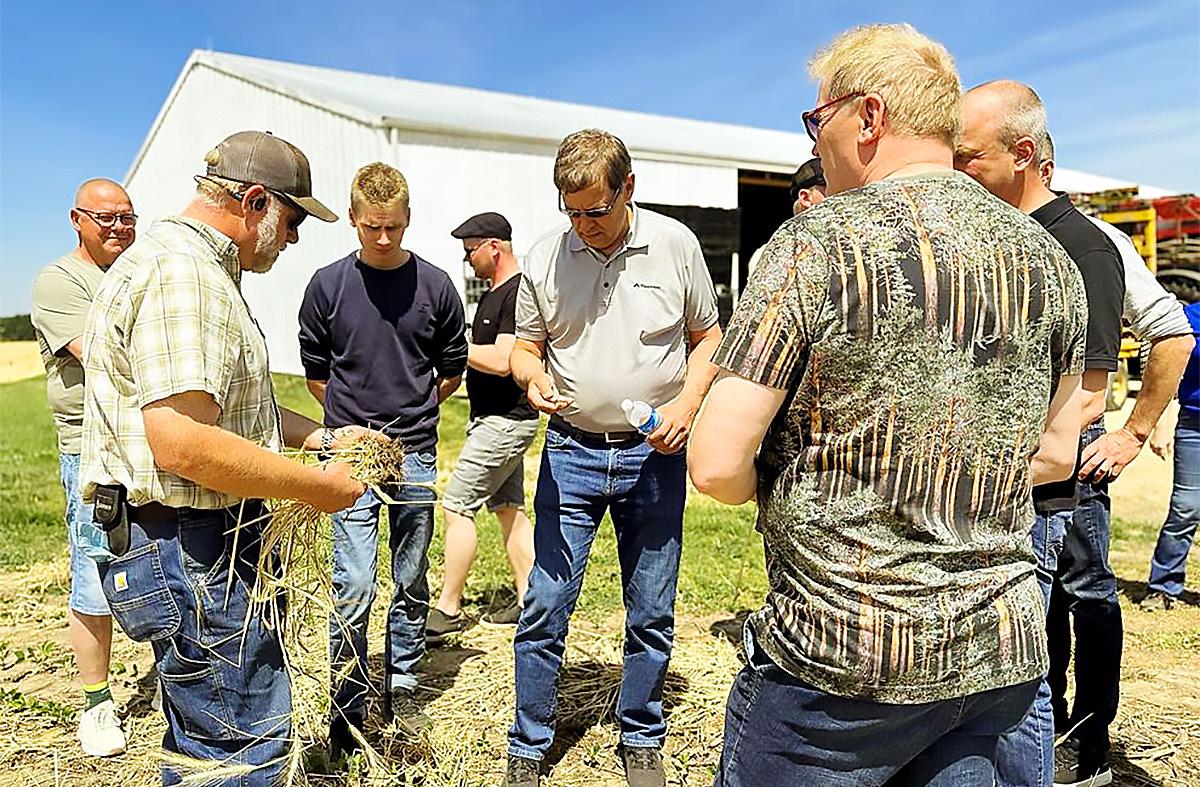
Adam Henkel pulled a clump of cereal rye from his farm ground while holding up the root to demonstrate to a group of farmers from Finland how his cover crop improves soil health and reduces erosion.
For about two hours June 2, about 25 Finnish farmers peppered Henkel with questions about his conservation practices, farm technology, Illinois’ climate, farmland prices, seed production and subsidy programs during a stop at his Amboy farm.
The tour, organized by Farmimatkat, a Finnish travel agency specializing in agriculture, took farmers to farms and other stops throughout Illinois and Wisconsin during the weeklong visit.
Henkel, who is president of the Lee County Farm Bureau, often hosts farmers and others from across the globe on his farm, where he and his family grow corn, soybeans and seed corn. They also grow cereal rye to seed their own cover crops. Several days earlier, a group of German farmers stopped at his farm.
FINNISH cont’d to page 17
Lee County Farm Bureau
President Adam Henkel (at left, in cap) talks with visiting Finnish farmers about the benefits of his cereal rye cover crop.
Tammie Sloup/FarmWeekNow.com
TODAY’S FARM
A high-tech, and really high tech, approach to farming
UI researchers map tillage trends with machine learning and photos taken from space
By HANNAH SPANGLER FarmWeek
Conservation tillage practices such as no-till and strip tillage play a key role in soil health and resilience. But understanding where, when and how often those practices are used across the Corn Belt has been a challenge.
That is, until researchers turned their eyes to the sky.
Researchers at the University of Illinois are taking a different approach, with satellite imagery and machine learning, to better track tillage practices in the Midwest. The new “dynamic framework” mapped corn and soybean fields from 2000 through 2022, creating one of the most detailed long-term looks at regional tillage trends. It’s another major innovation from the Agroecosystem Sustainability Center, led by Kaiyu Guan, founding director of the center and professor.
“Mapping tillage practices across large areas is important to quantify the long-term impacts on soil health, erosion and water management. But current data are mainly obtained from farmer surveys,” said Xiaocui Wu, a U of I research scientist on the team who detailed the methodology and findings in a new paper published earlier this month.
While useful, survey datasets often do not capture year-to-year changes or field-level variability, Wu said. Other information comes from satellite imagery that estimates crop residue as a proxy for tillage, but those approaches are often limited to smaller geographic areas.
“In small regions, soil and climate conditions are usually similar, so researchers can apply a fixed threshold to separate tillage practices,” Wu told FarmWeek. “But when you apply that approach across larger regions, soil type, moisture, precipitation and temperature are all very different, and satellite signals vary across space and time.”
FINNISH cont’d from page 16
“It’s always neat getting foreign countries’ farmers talking agriculture, how they do things, how many things we have in common, the regulations, how different they are,” Henkel told FarmWeek.
The Finnish farmers said that while their farms are typically smaller than in America, they still practice many of the same conservation measures and receive subsidies. They mainly grow wheat, barley, oats and rye, and also raise livestock.
Riku Uotila, who’s traveled to America many times, raises 100,000 chicken broilers and grows 30

The research team addressed what other studies and information on tillage lack by using a framework that combines satellite-based crop residue indicators with environmental variables such as soil and weather conditions. Machine learning models adjust satellite data thresholds by county and year, rather than relying on a single static value, which dynamically determines tillage practices at local scales.
Researchers classified tillage into three categories — no-till, reduced till and conventional tillage — focusing on the Midwest’s primary corn and soybean production region across 12 states, including Illinois and Iowa.
Results showed conservation tillage has increased gradually across the Midwest over the past two decades, but adoption patterns vary by crop and region. In Illinois and southern Michigan, conventional tillage has slightly increased, while reduced tillage has slightly declined in corn systems over the past two decades. In soybean systems, the shift has been less pronounced, but trends generally moved toward greater use of reduced tillage.
In contrast, no-till adoption increased steadily across parts of the eastern Great Plains, Iowa and southwestern Minnesota for both corn and soybean systems, often replacing reduced tillage. No-till adoption is generally higher in drier areas, such as the Great Plains, where leaving residue on the soil surface helps
acres of wheat for the animals about two hours from Helsinki. He was particularly interested in Henkel’s precision agriculture techniques, including no-till and strip-tilling.
“He’s been growing up with all these techniques, he’s taking advantage of modern machines and modern ways to farm,” Uotila told FarmWeek.
Henkel continues to utilize his agronomy degree and background as he looks to maximize output while also improving the farm for future generations.
The seventh-generation farmer explained to the tour group his family’s tradition of embracing conservation practices dates back decades.
conserve moisture. Warmer regions also have higher adoption rates because slower soil warming under residue is less likely to delay planting.
“The tillage map is a starting point,” Guan said, explaining that from here, farmers and policymakers can use these maps to understand the long-term impacts of tillage decisions.
With a clear picture of how tillage practices vary by region, crop and year, Guan added, researchers can begin linking those patterns to outcomes such as soil health, water movement and crop yields. The broader view could then help policymakers evaluate whether conservation programs are having the intended effect and where additional outreach or incentives may be needed.
At the farm level, insights into how to connect tillage history with long-term crop yield resilience and variability would help farmers make better management decisions. By better understanding how practices like no-till or reduced tillage perform over time and under different conditions, farmers may be able to weigh tradeoffs and adjust their systems accordingly.
“Farmers have so many different decisions to make. So having some more data-driven insights will help,” Guan said.
This story was distributed through a cooperative project between Illinois Farm Bureau and the Illinois Press Association. For more food and farming news, visit FarmWeekNow.com.
They made the choice to go 100% no-till on their farm in the early 1990s and by the early 2000s, they moved to strip-till corn. Next, they began experimenting with cover crops to help feed the earthworms.
“(The earthworms) are doing the tillage for us,” he told the group.
Farmimatkat’s Johanna Vesa said she organizes about 20 tours a year all over the world, but especially enjoys visiting the Midwest due to its agricultural makeup.
This story was distributed through a cooperative project between Illinois Farm Bureau and the Illinois Press Association. For more food and farming news, visit FarmWeekNow.com.
TODAY’S FARM
Helping farmers take a First Pass at learning more
Applicator training headed up by instructors with 80+ years of experience under their belt
By TOM C. DORAN tdoran@shawmedia.com
If it’s true that experience is the best teacher, then farmers who signed up for an upcoming applicator class will be in good hands.
A pair of instructors will bring more than 80 years combined experience in the applicator and ag retail space to training sessions they’ll lead this summer.
Gary Cornell and Greg Yoder will serve as instructors in the Illinois Fertilizer and Chemical Association’s new First Pass Applicator Training.
Two sessions are scheduled — July 14-15 and Sept. 15-16 — at IFCA’s headquarters, 10226 E. 1400 North Road in Bloomington. There’s a limit of 22 attendees per course, and the registration is $500 per person. Go to ifca.com/Training/First_Pass to register.
For those who miss out, more classes will be available next year.
INSTRUCTORS cont’d to page 19





AgriNews photo/Tom C. Doran
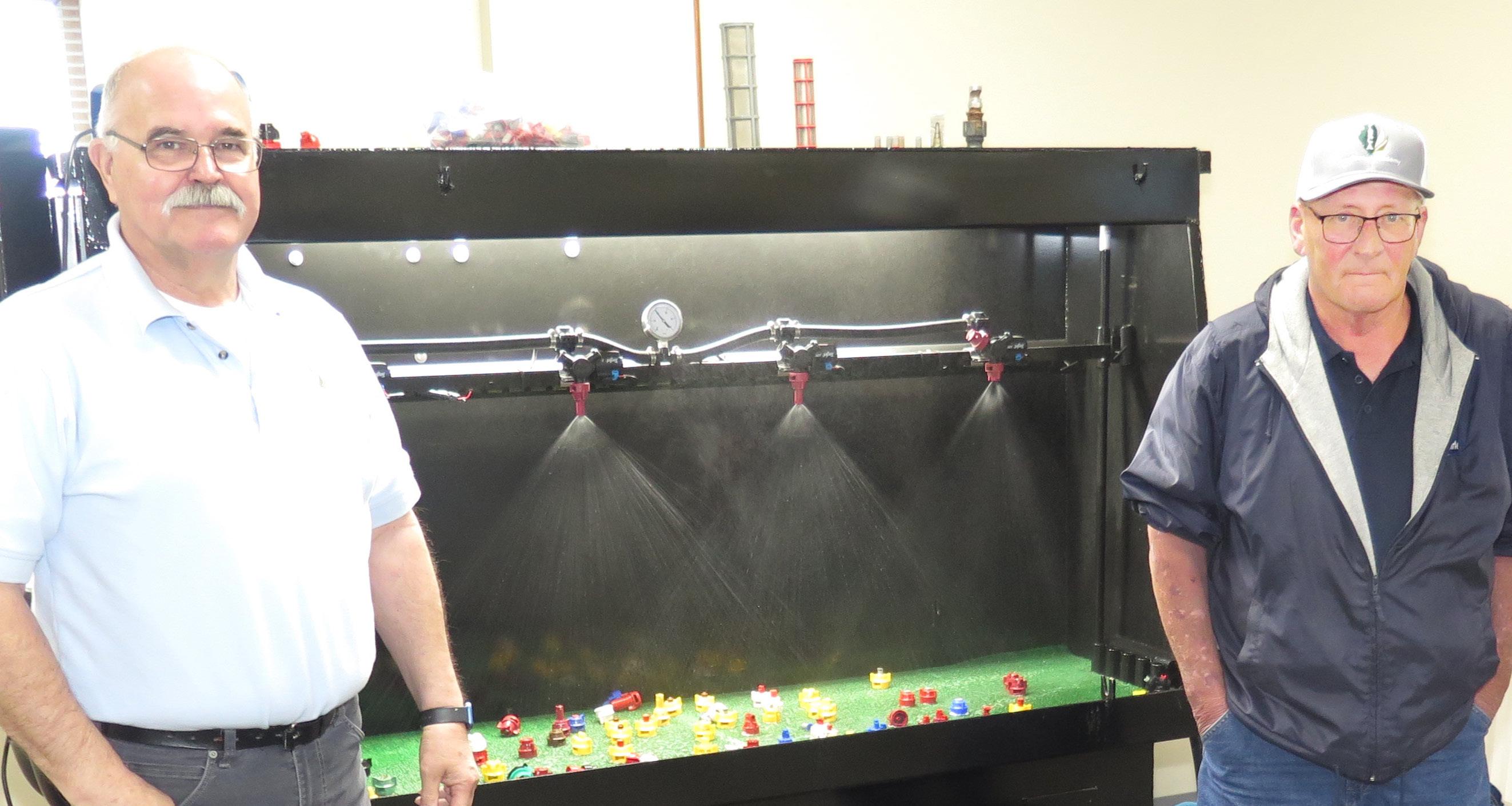
Gary Cornell (left) and Greg Yoder demonstrate the spray table that shows examples of the different nozzles used for applications. Cornell and Yoder are instructors for Illinois Fertilizer and Chemical Association’s new First Pass Applicator Training.
TODAY’S FARM
INSTRUCTORS cont’d from page 18
Working his way up
Cornell began his career in ag retail as an operator in 1975. Through the years, he was also a crop consultant in seed sales.
His teaching experience extends beyond agriculture, spending 10 years instructing an Emergency Medical Technician basic class at the Towanda Fire Department where he was also an EMT and firefighter. He later served on the Danvers Fire Department’s ambulance service.
After retiring in 2018, Cornell became an instructor at the Asmark Institute in Bloomington where he taught for seven years.
During his career in ag retail, Cornell saw the industry transition toward more safety and greater precision.
“When I started, our sprayers were real simple, no cabs, no power steering, everything was speed and pressure, and most of the time you didn’t even know your speed,” he said.
“We worked our way up over the years into the more advanced rigs, where nowadays people starting out don’t have that advantage of working their way up. It’s all of a sudden, here’s a 120-foot boom, all electronics, and take off, and it’s like a million dollars for a sprayer.
“Our class here specifically teaches the basics. We talk about the labels and surfactants. I do a pretty extensive review of the different nozzles and everything on a spray table we have here. It gives them a visual on how all the nozzles work.
“Back when I started, we had one nozzle. There wasn’t any change in nozzles, but with the new chemicals, a lot of times a label will specify that you have to use this nozzle, you have to go this fast, you have to run this pressure, in order to stay compliant with the label.
“We don’t really go into the monitors because there’s too many different monitors out there. We try to teach some of the basics of the monitors like when you’re running a guidance or whatever, you set an AB line when you first started a field. To a lot of the people just starting off, they’re not really familiar with them. It kind of gives them a heads up on what they’re going to
be doing.”
A graduate of the ‘school of hard knocks’
Yoder had a 35-year career as a customer applicator at a local co-op. Since his retirement, he’s been farming for about 13 years.
“I started when Asmark opened this school to begin with. They hired me as a trainer in 2016. It was a three-and-a-half-day course then and we’re condensing it down to two days. Back then we had the course, and then we spent one day outside with the sprayers,” he said.
“We had people from all over the United States, a couple people from Canada and we had some from South Africa back then in the course. I really enjoyed it. I made sure it didn’t interfere with my farming. We did it in the summer, then we’d take the fall off and we did a couple of winter classes, too, at times. It worked out real well.”
Yoder brings his 35 years as a customer applicator and his experience “at the school of hard knocks” to the classroom.
“I started at the local elevator when I was 18 years old. We didn’t even have a custom application equipment then, but then we got into it in the next couple of years. I just kind of grew up on it. I did it my whole life and after so many years I became the plant manager,” he said.
Referring to his and Cornell’s combined 82 years in the fertilizer business, Yoder added, “there’s not a lot that we haven’t seen.”
“I hope we get people to come. I think it’s very important that these young people know from the grassroots up what’s going on with this spraying, because it’s just not, ‘here’s a sprayer, get in it and go,’” he said.
“You need to know what’s going on, and we teach a lot of that — surrounding crops, wind, labels. There is a lot of stuff we cover. I just think it’s important for these guys to have training.
“There’s not a lot of farm kids out there anymore and so you’re getting a pull from maybe urban areas or something like from people who are interested in agriculture.”
This article originally appeared in Shaw Media’s AgriNews. More farm news can be found at agrinews.com.
Agency Inc. Oregon 815-732-3148
Leffelman & Associates Amboy – 815-857-2125
LaMoille – 815-638-2171
Sublette – 815-849-5219
Transport troubles could dull competitive edge
Issues on America’s rivers and rails could take a toll on bottom lines in the ag industry
By TAMMIE SLOUP FarmWeek
The U.S. grain transportation system, particularly the inland waterways, is considered a competitive edge for America’s farmers. But a century-old lock and dam system along the Mississippi River and a pending rail merger could present challenges in the future.
“Part of the success we’ve had in exports is because we have this really efficient intermodal system of river and rail and roads that all work together, and it’s important to keep those systems up, because when we’re talking about moving such the large volume that we produce here, being able to get that to an export destination efficiently is really important,” National Corn Growers Association Chief Economist Krista Swanson told FarmWeek.
Illinois is a bit different from other states with its vicinity to the Mississippi, Illinois and Ohio rivers, which allows for more “exposure to the international market than some other places,” said Collin Watters,

IL Corn’s director of exports and logistics.
The Mississippi River system is one of the most critical logistics corridors for the U.S. corn export system, which makes advocating for federal investments to modernize the waterways a priority for IL Corn and the Illinois Farm Bureau.
During a Leaders to Washington trip earlier this year, members advocated for legislator support to improve infrastructure along the Mississippi, particularly the aging lock and dam system.
Tom Heinold, chief of the operations division of the U.S. Army Corps of Engineers Rock Island District, said routine maintenance has pretty much stayed on schedule, but non-routine repairs have not been well funded the past couple years.
“I think 2022 was the last time we got a large infusion of infrastructure money for our locks and dams and so things are breaking faster than we can repair them right now,” Heinold told FarmWeek. “But I have to caveat that and say that during the 2000s, 2010s, and the first couple of years of the 2020s, we took very good care of the locks. ... My next big concern is the dams.

Those dam gates out there, there are a few hundred of them across all of our dams between the St. Louis, Rock Island and St. Paul districts, and they have gone largely unmaintained ... and they’re starting to show signs of decay.”
According to the USDA, close to 60% of U.S. grain exports are shipped by barge and roughly 32 million tons of corn per year are barged down the Mississippi River system to Louisiana export terminals.
Barges dominate because Midwestern corn can be loaded on rivers and moved cheaply to Gulf export ports. Most corn used within the U.S. moves by truck or rail to ethanol plants, feedlots or processors.
“Right now, we do have a competitive edge because we’ve invested in this (river) system, and it’s reliable and very, very efficient. If we fail to invest in this system (in the future), that price point could go the other way, and Brazil and other ag producing nations in South America, for instance, could eat us alive,” Heinold warned.
TRANSPORT cont’d to page 21

TODAY’S FARM
TRANSPORT
cont’d from page 20
Drought and consistent low water levels in the lower Mississippi also continue to be a concern, while the upper river is “looking pretty good,” Heinold said.
“On the lower river, they have gone for about four years in a drought condition, and unfortunately, that condition, more or less, is persisting. We’ve got some recent rain, but it hasn’t been enough to cancel out the drought and put a great deal of water back into the river system down south. The system is all connected, so it might be worth watching the potential drought on the lower river.”
This could mean light-loading barges, which in turn affects prices.
“When you have to make more trips with a tow boat to get the same product to market, that gets passed on,” he said.
Pending rail merger
Farmers and ag groups also are watching the proposed $85 billion merger between Union Pacific and Norfolk Southern, which could significantly alter rail competition, shipping costs and service reliability for agricultural shippers if approved by federal regulators.
The railroads filed a revised merger application on April 30 following the Surface Transportation Board’s rejection of the railroads’ initial merger application for being incomplete. The deal would create the
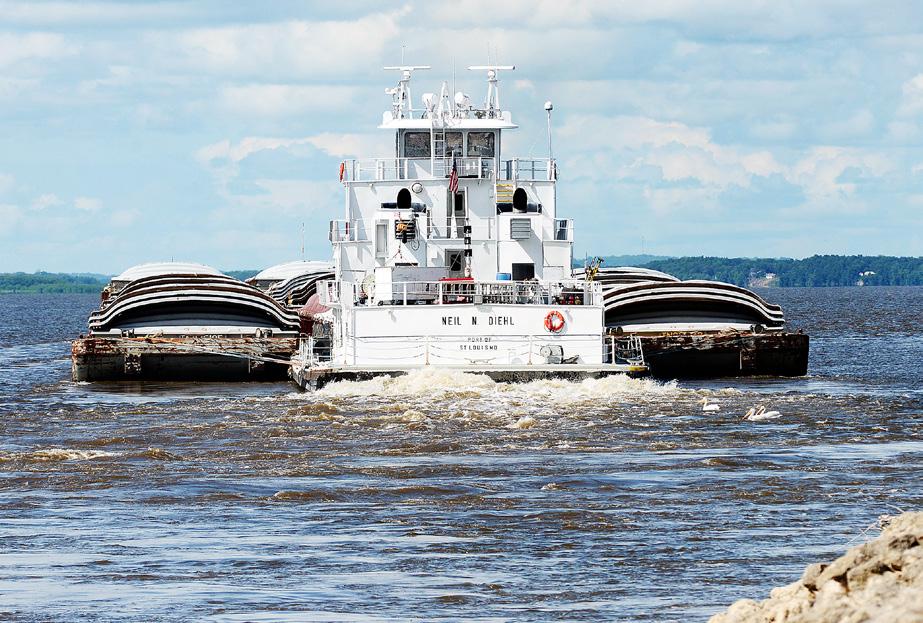
A towboat pushes barges north on the Mississippi River after passing through Lock & Dam 13 near Fulton in 2025.
nation’s first coast-to-coast freight railroad.
The board could make a decision by 2027.
In 2023 alone, US railroads carried more than 80 million tons of corn, much of it originating in the Midwest and Northern Plains and moving toward coastal ports or major processing hubs.
Mexico is the top export market for U.S. corn. About two-thirds of the grain the US ships to Mexico moves by rail. Disruptions in rail transport to Mexico could erode the US’s proximity advantage, cause storage backups and weaken basis.
American Farm Bureau Federation launches farm photo contest
The American Farm Bureau Federation has always focused on farms, now it wants it members to do the same.
The farm advocate organization is sponsoring a photo contest to celebrate the contributions of America’s farmers. The contest is part of Farm Bureau’s FARM 250 initiative, marking the nation’s 250th anniversary.
FARM 250 is a year-long initiative focusing on four pillars in agriculture: Feeding families, Advancing innovation, Rural resilience and Mindful stewardship
The contest winner will receive a trip to the 2027 American Farm Bureau Convention in Charlotte, North Carolina, and an iPhone 17.
America’s history “is rooted in every crop, pasture and dairy barn from coast to coast,” said AFBF President Zippy Duvall in a news release, and the photo contest “is a great opportunity for farmers to share the images of what means the most to them on their own farms and ranches, and will showcase the beauty of agriculture across all 50 states and Puerto Rico.”
The contest runs through Sept. 9, 2026. The winner must be a Farm Bureau member. Go to fb.org/initiative/farm250 to submit photos, and for more information about FARM 250.
The railroads claim the deal would save shippers an estimated $3.5 billion annually, improve service reliability, divert freight from trucks to rail, retain shipper options and cut consumer costs while protecting union jobs.
But the ag industry aren’t so sure.
“For agriculture and rural America, the central question is not whether railroads could operate a larger network, but how further concentration would affect pricing power, service reliability and accountability in markets where shippers already have limited alternatives,” American Farm Bureau Federation Economist Daniel Munch wrote in a recent Market Intel.
When rail rates rise, farmers have limited ability to offset the increase, Munch wrote. Commodity prices are set in global markets; input costs are largely fixed in the short run and production decisions cannot be easily adjusted after harvest. As a result, higher rail rates will be absorbed directly into farm margins.
“The risk of the UP-NS merger is clear. It would leave farmers more dependent on fewer railroads at a time when they already have almost no ability to walk away from higher costs or poor service,” Munch said.
— Rhiannon Branch contributed to this story
This story was distributed through a cooperative project between Illinois Farm Bureau and the Illinois Press Association. For more food and farming news, visit FarmWeekNow.com.




Earleen Hinton/Shaw Media
TODAY’S FARM
People are heading to the poles
n What’s the word these days in housing?
Well, for some, it’s a word they may not have heard before, but one that more people have been saying recently: Barndominiums
By CODY CUTTER Sauk Valley Media
When you first hear it, the word “barndominium” can feel like a contradiction — part barn, part condominium — something more like a novelty than a place to live. But the unlikely pair are actually right at home together, and more and more of them are popping up across the country.
At its core, a barndominium is a fully livable home built using post-frame, or pole barn, construction. While the finished interior looks much like a traditional house, the building itself is what sets it apart. Instead of relying on continuous foundation walls and interior load-bearing supports, post-frame buildings use columns or posts placed at regular intervals to carry the weight of the structure.
Barndominiums have become increasingly popular across rural America in recent years, as a growing number of people choose to swap city living for the wide open space of the kind of place that looks like it says, “C’mon in and sit for a spell.” These hybrid homes are also giving homeowners a different way to think about the room under their roof, and a Remington, Indiana-based company is happy to help clients open their mind — and their space.
FBi Buildings has been constructing post-frame buildings for decades, including agricultural, commercial and residential structures, in a market area that includes six Midwest states, including Illinois’ Sauk Valley region (go to fbibuildings.com/about-us/ourservice-area/ for its service area).
FBi marketing director Angie Dobson said the construction method is what truly separates barndominiums from traditional homes.
“A barndominium is similar to stick-built construction in terms of being something you can live in, but the biggest difference is that, construction-wise, it’s built very similar to a pole barn,” Dobson said. “We’re using columns or posts every 8 feet. The difference is that we can go as wide as 100 feet and not have any type of internal supports.”
That open-span floor plan is a major draw. Without interior columns interrupting the floor plan, homeowners have far more flexibility in how they design their living space, making it easier to design large, open kitchens, vaulted ceilings, expansive great rooms (a large room that plays various roles; a sort of family room/living room/study), and attached workshops or garages.
While versions of barndominium-style homes have existed for years, Dobson said interest surged during the coronavirus pandemic as people rethought where
and how they wanted to live during extended downtime.
“Everyone was staying home and didn’t have a choice but to enhance their property,” Dobson said. “We saw a lot of people moving out from larger suburbs to escape and go somewhere rural or out in the country. The barndominium craze really heightened then.”
Since barndominiums often resemble pole barns, people may assume that the cost of building one can be significantly less than a traditional home, but “that’s not entirely the case.” Dobson says. While there can be some savings from their more open floor plans, “You’re still finishing out the interior with all of this.”
While post-frame construction can offer efficiencies in materials and speed, the interior of a barndominium still includes all the same elements as a conventional home: plumbing, electrical, insulation, drywall, flooring and finishes. While the post-frame shell can be erected quickly, interior finishes still require a time and investment similar to a conventional homes. There can, however, be some savings realized from the reduced long-term maintenance that comes with owning a barndominium.
Whereas a traditional home may have vinyl siding and a shingle roof, barndominiums often feature steel exteriors and more durable metal roofing. For many homeowners, that means fewer repairs and less upkeep over time, Dobson said.
The buildings come in a variety of styles, with plenty of room for a variety of different floor plans to suit buyers’ desires. Current trends include longer porches and more windows.
Once the buyer has lined everything up for their new home — land, permits, etc. — the building can go up in a relatively short amount of time.
“What we’re seeing on our end is that people like the simplicity of post-frame construction,” Dobson said. “Depending on how large the building is going to be, we can easily have it up by 6 to 8 weeks from when a customer signs a contract.”
FBi Buildings will build the structure, but the inte-
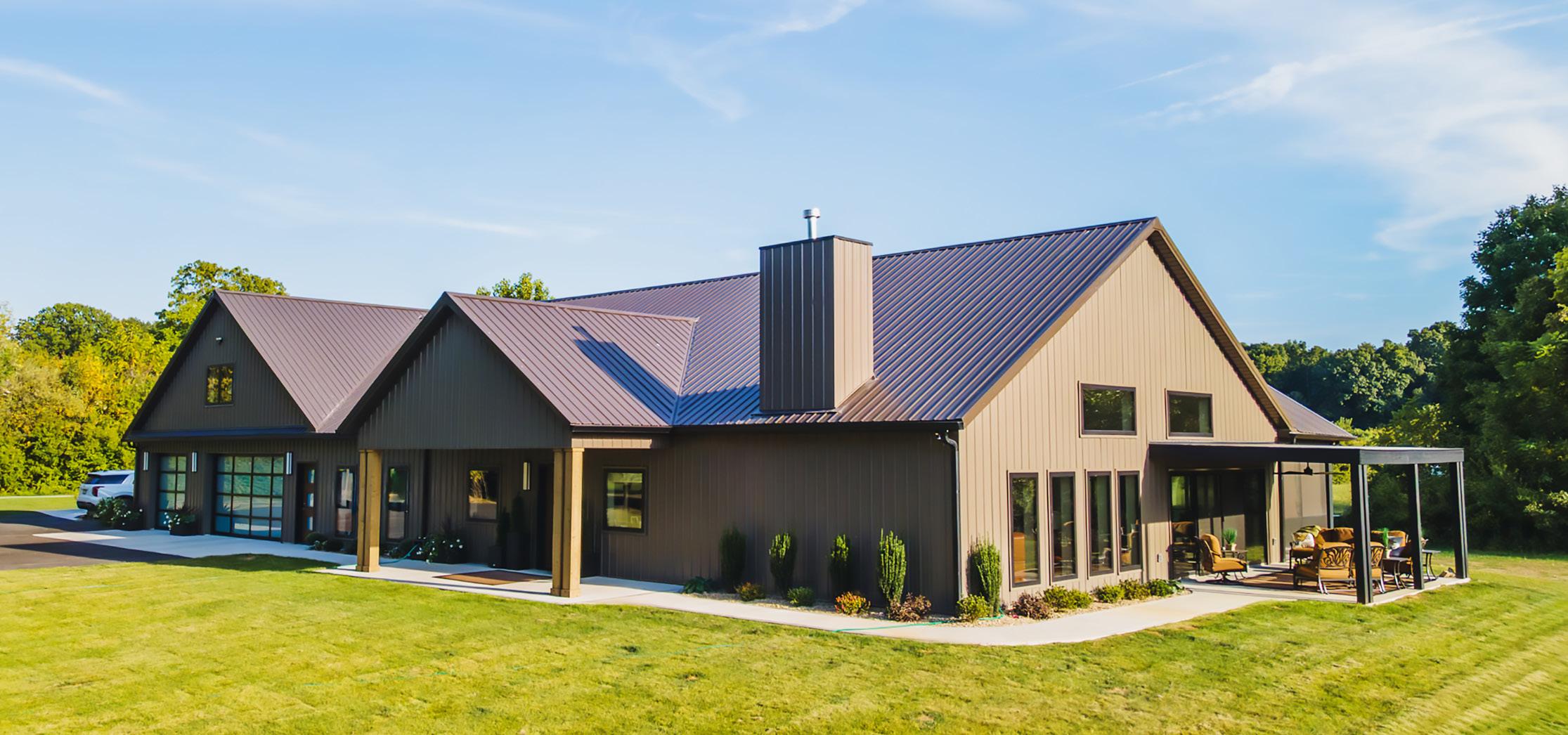
Barndominiums combine laid-back luxury with some of the charm of a farm. Seen here is one of FBi Buildings’ projects.
rior work is taken care of by a general contractor. Buyers can line up their own, or FBI can help with connecting them one from their network of trusted general contractors.
In 2025, FBi partnered with Back Forty Buildings, which allowed homeowners to choose from several pre-designed floor plans, or use them as starting points to customize their own. While many plans feature twostory layouts, Dobson said one-story living also has become increasingly popular, particularly among older homeowners.
Others enjoy hybrid spaces that combine living quarters with workshops, garages or hobby areas under one roof. Those larger garage-focused designs are “shouses,” blending shop and house into a single structure.
“Maybe they’re a farmer or someone who has a hobby and works on cars, they’ll include a larger shop space that’s attached to their house,” Dobson said. “They have just one building to go to and from with.”
As with any home build, barndominiums come with considerations beyond design. Zoning regulations, permitting requirements and financing options can vary by county and lender. Not all banks are familiar with post-frame homes, and that makes early conversations with lenders and local officials essential. But once all the t’s have been crossed and all the i’s have been dotted, homeowners can look forward to a rustic and roomy residence that they can call home.
Demand for barndominiums continues to grow, Dobson said. Only a short time into the new year, the company had already received more inquiries in January 2026 than the same month last year.
It’s becoming a building market that builds on its own success. The more barndominiums go up, the more people see them, and the more people see them, the more they become interested in one.
“All it takes is a couple of designs and people see that and go, ‘That’s what I want to have,’” she said.
Shaw Media reporter Cody Cutter can be reached at 815-632-2532 or ccutter@shawmedia.com.
Photo: FBi Buildings