
By HANNAH SPANGLER FarmWeek
A pair of young farmers from Ogle County are among the four FFA members recommended as Illinois’ American Star nominees.
Justin Myers of the Forreston FFA and Kade Boatman of the Byron FFA join Benjamin Biros (Seneca FFA) and Jaron Black (Streator FFA) in being selected from 232 approved American FFA Degree candidates — the largest number of members in Illinois FFA history to be recommended for the National FFA Organization’s highest honor.
According the National FFA, the American FFA Degree is a recognition of a member’s commitment to their chapter and state association. The honor reflects the significant work students put into their supervised agricultural experiences (SAE), as well as the leadership and community service they demonstrated throughout their time in FFA.
To be selected as Star candidates, these students have gone above and beyond to earn consideration for top honors at the national level. They will be recog-
nized at the 98th Annual Illinois FFA State Convention in Springfield, June 9-11, and are expected to learn later in the summer whether they are among the 16 finalists chosen by National FFA.
At 11 years old, Justin Myers, a third-generation farmer, was already driving a combine. He was only assigned to finish a 5-acre patch of land, but Myers said his family’s neighbors still couldn’t believe it was him.
“I don’t really want to do anything else,” he said of his decision to return to the family farm full time after earning his associate degree in ag business and crop production from Highland Community College.
Myers managed multiple SAEs, incorporating every aspect of the family farm — corn, soybeans, hay, cattle and sheep. He also kept a land management record book for the 33 acres he owns and cash rents in Cullom (Livingston County). That experience helped him later secure a beginning farmer and rancher loan from the Farm Service Agency, allowing him to pick up another 70 acres closer to home. His
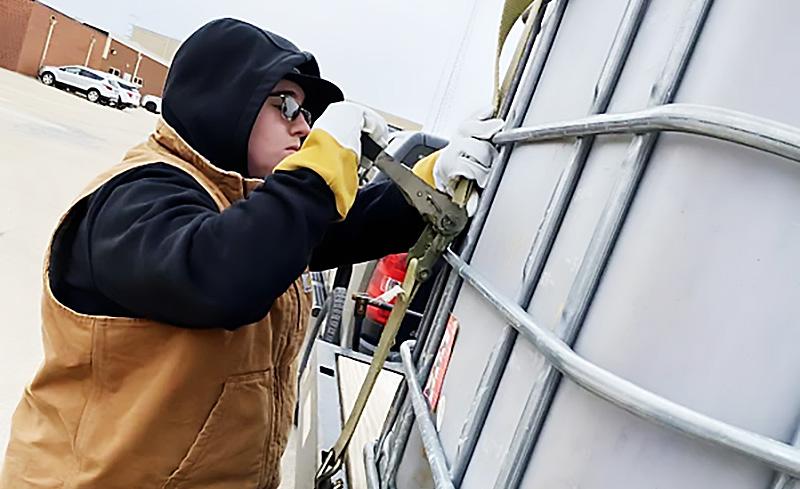
Myers, Forreston FFA.
family farms about 3,300 acres in total.
Obtaining his American FFA Degree will be an incredible honor, Myers said, noting it isn’t commonly earned in his chapter. Having a shot at American Star Farmer is an added bonus. “I was interested of course, I just didn’t know if I would actually make it this far,” he said.
Sondergoth: Don’t let fear and
By MARTHA BLUM | SHAW MEDIA AGRINEWS mblum@shawmedia.com
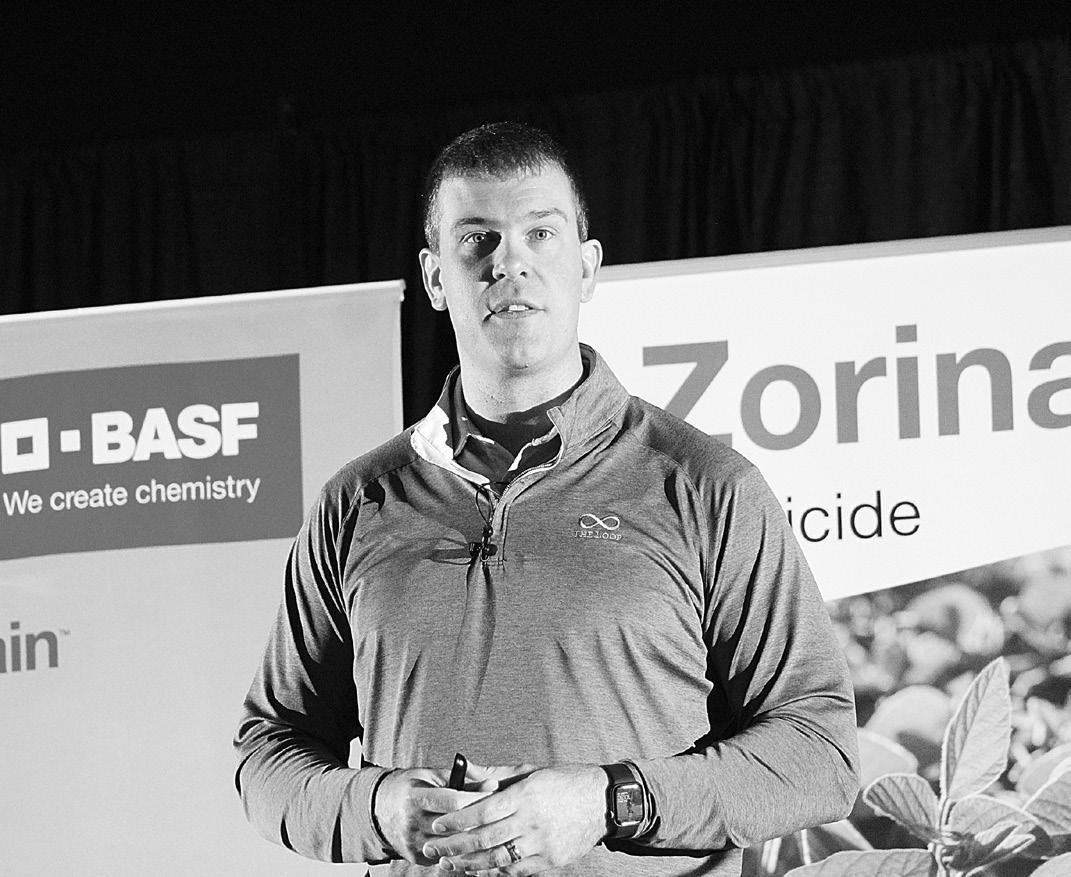
DAVENPORT, Iowa — A Dixon man has a message for the ag industry: If you’re hesitant about adding artificial intelligence to your operation, give it some more thought — and let AI give you some more thought.
During a recent presentation at the BASF Symposium in Davenport, Ben Sondgeroth told the audience that AI as a thought partner is the best way to leverage the technology to its fullest.
“When we use AI as a thought partner, we are allowing it to work with us to make the best versions of ourselves,” said Sondgeroth, owner of Exploring EdTech.
And those who don’t take on that partner? They do so at their own risk.
“If we don’t embrace AI or use it, the person who is using it and doing the same role as you is going to accomplish his tasks faster and he is going to get to another farm quicker than you,” he
As a sixth-generation Hereford breeder, Kade Boatman said his future will always include cattle. His researchbased SAE helped him understand the breed even better.
His project examined the scurred gene in Hereford cattle, which causes small, movable horn-like growths and is considered an undesirable trait. Over five years and more than 350 calves, Boatman discovered a nub trait inside the skin and proved it correlates with whether the scurred gene is passed to the next generation.
“During my research, I was able to visit with breeders at cattle shows and sales to see if they were seeing some of the same things I was finding in my research,” Boatman said. Many were, he noted, reflecting a broader trend.
When he first joined FFA, Boatman said he didn’t picture himself becoming a Star finalist. His twin sister had a beef placement SAE, so he shifted to research to try something new to avoid having a similar record book.
“I knew this was a problem within our herd, so I decided to take a chance
said. “That person is ultimately going to become the person who takes your job because he can do more without actually spending more time to do it.”
He understands people’s concern, but says much of it is unfounded.
“There is a big fear that AI is going to mean the loss of the ability for humans to have their own judgment and then we lose out on human relationships,” Sondgeroth said during the symposium.
“That’s a legitimate concern; however, if you use it as a partner instead of just doing things for you, you can talk to more customers and have better relationships,” he said. “AI can help free up your time, but only if it is used responsibly and correctly.”
As owner of Exploring EdTech, Sondgeroth created the business “as a space for people who are curious about using technology to improve the way they work, learn, and lead.”
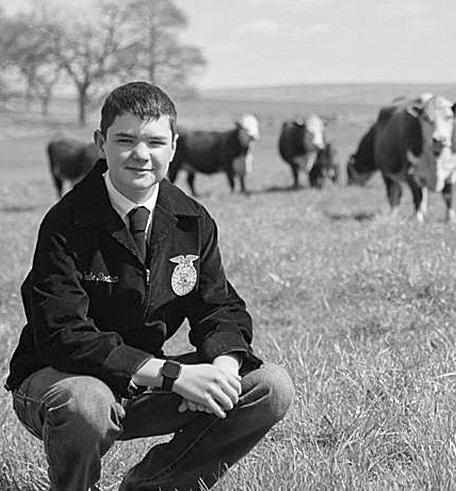
and start up this project,” he told FarmWeek.
Now an American Star in Agriscience candidate, Boatman is considering a career in research. As a freshman at Lakeland College, he plans to earn an ag business degree after transferring and explore interests in animal genetics and auctioneering.
The other two nominees are Benjamin Biros and Jaron Black, both from LaSalle County.
Gotofarmweeknow.com toreadmoreIllinoisfarmnews.

AI cont’d from page 24
24 also keeps tabs on what’s new in technology, interprets it, and teaches it to educators throughout northwest Illinois as a lead regional educational technology coordinator for the Learning Technology Center of Illinois, an Illinois State Board of Education program. He is one of five in his position, each serving a specific region of the state, and is based out of the Lee-Ogle-Whiteside County Regional Office of Education in Sterling – where his father, Robert, once served as regional superintendent.
“It cannot think for itself, it cannot create new content and it does not have an imagination,” Sondgeroth said. “It takes information that it has been trained on and it is able to give that information to you in a way that makes sense for you.”
AI is going to replace some jobs, the educational technology leader said, but it is not going to take everybody’s job.
“And it is going to create a lot of jobs,” Sondgeroth said.
Over the past three years, Sondgeroth has fully embraced AI.
“I don’t think I have been more creative or more efficient and productive than ever before,” he said. “It’s all because I am able to use artificial intelligence to help me accomplish what I set out to do that day.”
Many people are using AI and might not even realize it.
To learn more about Sondergoth’s business, Exploring EdTech, go to exploringedtech.com.
“Goggle Maps uses AI to help you get to places,” Sondgeroth said. “If you have Siri or Alexa, you used AI.”
When searching on Goggle, the AI summary at the top of the response was generated by AI.
“AI is all around us, so it’s about maximizing it now,” the educational technology leader said.
A person does not have to be a computer scientist to get the most out of AI, Sondgeroth said.
“AI systems are trained on trillions of pieces of data and they are only able to work if they have the data they need to give you a response,” he said. “Those pieces of data are coming from across the Internet.”
All the pieces of information go into the database, Sondgeroth said, and they get broken up into a bunch of little pieces.
“When you ask a question, it finds all those pieces and gives you a response, predicting that is what you want it to do for you,” he said.
One word can make the whole answer wrong.
“So, as awesome as AI is, this is where we always must have caution when using it,” Sondgeroth said. “We always want to be proofreading everything that we do.”
Proper prompting is very important when using Gemini, ChatGPT, Claude or Copilot.
“When you are prompting, make sure you include three things: context, specificity and structure,” Sondgeroth said.
“Think of it as you’re talking to another person,” he said. “If you ask a bad question or a less detailed question to somebody, you are not going to get a very good answer.”
When engaging with AI, don’t stop with the first thing it tells you, Sondgeroth said.
“Ask questions, follow up and tell it, that it is wrong,” he said. “Challenge it, just like you would somebody in your office. That’s how you get the most out of artificial intelligence.”
AI cannot do all the work for a person.
“You are still the expert and you are the one that has watched that field for decades and has all the data,” Sondgeroth said. “ChatGPT can just help you make sense of it. That’s what AI is good for.”
If AI can save 10 minutes a day answering emails, 20 minutes summarizing notes and 30 minutes analyzing spreadsheets or data, that one hour per day can equal over 250 hours per year.
“Then you can spend more time with humans, get more work done and be more efficient,” Sondgeroth said.
“Don’t enter a world where AI thinks for us, enter a world where AI works with us,” he said.
GotoShawMedia’sAgriNews toreadmorefarmnews,atagrinews-pubs.com/







By TOM C. DORAN | SHAW MEDIA AGRINEWS tdoran@shawmedia.com
WASHINGTON — The “I” states each lost several hundred farms from 2024 to 2025, along with declines in acreage, according to the U.S. Department of Agriculture’s Land in Farms report.
Land in farms consists of agricultural land used for crops, pasture, or grazing. Also included is woodland and wasteland not actually under cultivation or used for pasture or grazing, provided it was part of the farm operator’s total operation. It also includes acres in Conservation Reserve Program, Wetland Reserve Easements and other government conservation programs.
Midwest highlights from the report can be found on the following page, but overall, Illinois saw a 200,000-acre loss of land in farms, from 26.3 million acres in 2024 to 26.1 million last year. The number of farms dropped from 70,000 to 69,600 over that same time, and the average farm size dropped by one acre, to 375.
Indiana was unchanged year over year, with 14.5 million acres of land in farms. The number of farms fell from 52,000 to 51,500, while the average farm size increased by three to 282 acres.
Iowa lost 100,000 acres of farm land, going from 30 million to 29.9 million acres, and saw a loss of 500 farms to 86,200. The average farm size inched up, though from 346 acres in 2023 to 347 acres in 2024.
The number of U.S. farms in 2025 was estimated at 1.865 million, down 15,000 farms from 2024. The number of farms decreased in all sales classes except the $1 million or more sales class.
In 2025, 48% of all farms had less than $10,000 in sales and 78.8% had less than $100,000 in sales. In 2025, 9.9% of all farms had sales of $500,000 or more.
Total land in farms, at 873.95 million acres, decreased 2.510 million acres from 2024. The land in farms decreased in all sales classes except the $1,000,000 or more
In 2025, USDA’s National Agricultural Statistics Service implemented a statistical modeling approach to generate survey indications. This approach was in response to the decision to not conduct the June area survey while continuing to produce critical data about U.S. agriculture.
Prior to 2025, NASS collected data during the June agricultural survey using sampling procedures to ensure every farm and ranch had a chance of being selected. NASS used a multiple sampling frame approach to count farms and measure land in farms.
An area sampling frame that divided all land into segments is built for every state except Alaska. A sample of segments was selected in each state except Alaska and Hawaii and enumerated in early June.
“Highly trained interviewers located each sampled segment and identified every farm and ranch operating in the segment and the number of acres in each operation. These data were used to compute summaries of farm numbers and land in farms,” the report said.
“Additionally, all farms found in the segments were checked against a list of farms and ranches maintained by NASS to determine if the farm is on the list provided a measure of incompleteness of the list. The summarized totals for these non-overlap, or not-on-list, operations were combined with summarized totals collected from a sample selected from the list to calculate additional indications of farms and land in farms.”
In 2025, the modeling effort incorporated historic trends and previous 10 years of survey estimates. This stopgap approach allowed the data series to continue and was roughly consistent with prior year procedures when survey data were available.
sales class, which was up by 850,000 acres.
In 2025, 25.7% of all farmland was operated by farms with less than $100,000 in sales, while 50.1% of all farmland was operated by farms with sales of $500,000 or more.
The average farm size for 2025 was 469 acres, up from 466 acres in 2024.
The largest decline at the state level was Texas, which lost 2,000 operations. Texas remains the state with the highest number of farms, far outpacing all others at 229,000.
No state saw an increase in farms, but multiple states did indicate no change from the prior year.
GotoShawMedia’sAgriNewspublicationtoread morefarmnews,atagrinews-pubs.com/

Agency Inc. Oregon 815-732-3148
Leffelman & Associates Amboy – 815-857-2125
LaMoille – 815-638-2171
Sublette – 815-849-5219

The I’s still have it (cont’d from previous page)
$1,000-$9,999
Number of farms
Notes:
The report also included data for farms based on the gross value of agricultural products sold. Government program payments are also included. NC = No change
Read the full report
Go to nass.usda.gov/ Publications/Todays_Reports/ reports/fnlo0226.pdf
$10,000-$99,999
Number of farms
$100,000-$249,999
$250,000-$499,999
$500,000-$999,999
Lee County:

15.27+/- Acres. S17 Dixon Twp. Over 1,400 feet of Rock River Frontage! Rare riverfront opportunity, between Elks Page Park & the Seven Mile Branch. North side of property has a hill with gorgeous views overlooking the river, and currently has an older cabin & 3 car detached garage (both being sold as-is). This serene property also boasts trails through wooded areas, and tons of space to be molded to meet your recreational needs.
Prices increase for good, fair land; sales soften for excellent, average quality
By TOM C. DORAN | SHAW MEDIA AGRINEWS tdoran@shawmedia.com
BLOOMINGTON, Ill. — Two years after peak highs, the average sales price of top Illinois farmland saw slight yearover-year declines.
An in-depth look at Prairie State farmland sales in 2025, trends and expectations were featured in the Illinois Society of Professional Farm Managers and Rural Appraisers’ annual land values report.
The average sales prices paid for excellent quality farmland in 2025 declined 3.27% to $15,846 per acre and saw a 3.18% decline on median price paid to $15,984 per acre.
The statewide average price paid for good quality land increased 0.07% to $12,502, and the median was 0.66% higher to $12,498 per acre.
Average quality land statewide was down 0.60% to $9,933, while the median average dropped 4.01% to $9,436 per acre.
The average sale price for farmland in the fair category increased 2.39% from 2024 to $8,338, while the median average was down 4.57% to $7,512.
Excellent quality farmland averages over 220 bushels of corn per acre in a normal year with a soil productivity index of 133 or higher. Good quality farmland averages 200 to 220 bushels per acre, with a PI of 117 to 132.
Average quality farmland averages 180 to 200 bushels per acre with a PI of 100 to 116 and no irrigation. Fair quality farmland averages below 180 bushels per acre and has a PI under 100.
“In talking with colleagues, I think a lot of people probably assumed maybe that decline would be a little bit more. I was one of those, and I think sometimes if you get to some of those regions that saw $18,000, $19,000, $20,000-plus per acre, you are probably seeing a bigger decline than 3%. But as far as a state average goes, there was a 3.27% decline,” said Luke Worrell, of Worrell
Respondents to the survey conducted by the ISPFMRA were also asked about their expectations going forward. Here are the highlights:
• 61% expect farmland prices to decline in 2026. In total, 50% of the respondents expect farmland prices to decline up to 5%, while 11% expect prices to decline between 5% and 10%. Of the remaining respondents, 25% expect farmland prices to remain the same while 14% expect an increase.
• 81% expect the agricultural economy to contract modestly . That percentage is lower than in 2025, when 93% expected the agricultural economy to contract.
Land Services in Jacksonville in west-central Illinois.
Worrell, general chairman of ISPFMRA’s 31st annual farmland values survey, noted the trend similarities in the market over the last two years.
“When we were here two years ago, I think we expected these numbers to come down sharper,” Worrell said.
“Even after a couple years of slight decreases in excellent land, we’re still up 50% from where we were in 2020,” from $10,870 in 2020 to $15,846 in 2025 statewide average sale price.
“We’re kind of looking like we were in 2013-2015 where we saw a steep rise and then we had a decline, and then just kind of hung out for a few years. Time will tell if that’s indeed what we end up doing,” he said.
The statewide average sale price for excellent land was $12,538 per acre in 2013 and dropped to $11,653 in 2015, followed by a flattening out in the $10,000s the next five years before jumping to $13,734 in 2021.
“There was a lot of activity in Illinois agricultural in 2025. Largely reported was a continued movement in a downward direction from the euphoric highs and crazy markets of 2021-2023,” Worrell said.
“Volatility in our grain and land markets is something for which we have all grown accustomed. We should continue to expect it. There is no shortage of ‘news’ that impacts us here in Illinois agriculture. It isn’t simply weather as it might have once been. Markets
• 60% of the survey respondents expect interest rates to decrease in 2026. Declining interest rates would be expected to positively impact farmland prices.
• 72% expect corn prices to between $4 and $4.50 per bushel while 19% expect prices paid to be under $4 and only 4% expect it to be over $5.
• 69% of respondents expect costs to increase in 2026. Most respondents expected costs to remain the same when asked in the 2025 survey.
• Survey respondents estimated that 62% of land purchases required some form
shift on a dime these days for the Illinois farmer.
“Swings can be triggered by anything from a tweet to tariffs, Brazil to China, and on and on. These topics have continued to move our markets here in
of debt financing. Of those financing with debt, the amount of debt financing averaged 54% of the purchase price.
• Farmers accounted for 58% of the buyers, with 56% being local farmers and 2% being relocating farmers. Individual investors who would not farm the land were the next largest group, accounting for 34% of the buyers. Local investors accounted for 16% of the buyers and non-local investors accounted for 12%. Institutions accounted for 8% of all buyers.
Read the report
Go to nass.usda.gov/Publications/Todays_ Reports/reports/fnlo0226.pdf
the early part of 2026. While the data in the report highlights 2025, we are largely experiencing the same dynamics at time of publication.”
GotoShawMedia’sAgriNews toreadmorefarmnews,atagrinews-pubs.com/




By MARTHA BLUM mblum@shawmedia.com
HENNEPIN, Ill. — About an hour south of the Sauk Valley, in a little town in Illinois’ smallest county, a biofuel company is feeding and fueling the world.
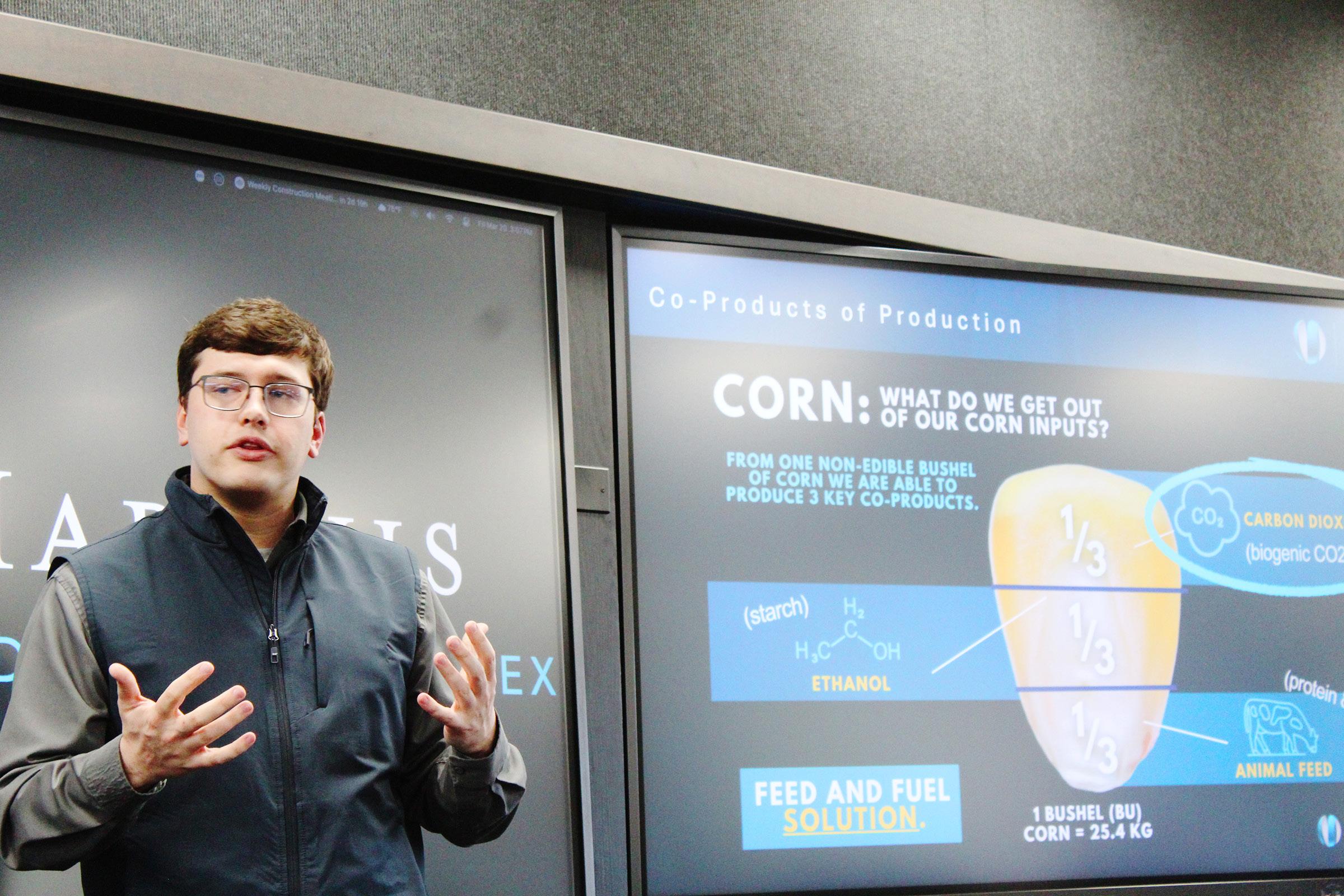
“About 60% of our ethanol and 95% of our animal feed leaves the country and feeds international demand,” said Tyler Angus, technical analyst at the Marquis Energy in Putnam County.
“We have sold products to 42 countries on all six inhabited continents,” he said during a presentation at the Illinois Agri-Women annual meeting March 20 in Hennepin.
The company, which celebrated its 50th year in business in 2025, started as a trucking company, hauling grain and expanded by adding grain elevators to the business.
“They built a fertilizer asset here and that was the first unmanned, fully automatic liquid fertilizer terminal on the Illinois River,” said Austin Heim, vice president and director of grain operations at Marquis.
“In 2005, they bought the ground where the ethanol plant is now and sold all their businesses — the farmland, grain elevators, trucking company, fertilizer assets — and went all in on ethanol,” he said.
Ethanol production began in April 2008. The facility has expanded over the years and now produces about 400 million gallons of ethanol annually.
“That makes us the largest dry mill ethanol plant in North America,” Heim said. “We are the second largest in the world after a Brazilian plant.”
“We export to a lot of different countries and they have different specs for ethanol,” he said. “So, we make a lot of different specs so that we have the spec you need today and that allows us to move with the market.”
“In 2018, we opened our global trading arm with our office in Singapore,” Angus said. “We have eight employees there that handle all the international trade we do for ethanol and animal feed.”
From 575 to 600 semi-trucks of corn are dumped at the Putnam County facility, Monday through Friday.
“We buy grain from the north side of Peoria up to the Wisconsin line,” Heim said.
“Every day we use about 400,000 bushels of corn,” Angus added.
In addition to the ethanol fuel, the facility also produces 1 million tons of animal feed and 76,000 pounds of distillers corn oil which is used to make renewable diesel.
“When COVID hit in 2020, the state of Illinois called and asked us to make 12-ounce pump bottles of hand sanitizer for hospitals,” Heim said. “They called us on Thursday afternoon and we were filling bottles in an old maintenance shed by Monday because we are will-
Illinois Urbana-Champaign with a bachelor’s degree in animal science in 2021 and joined the Marquis team in 2022, where he works with high-protein feed ingredients.
ing to move quickly.”
Since then, Marquis has built a bottling facility which features large windows that provide natural light to employees operating the bottling line.
“We bottle things like Clorox, Bath & Body products or any cleaner and perfume that has alcohol as a sterilizing or evaporating agent,” Angus said. “It switches from month to month and the company sends us a tote with their special sauce and we blend it with water, alcohol and bottle it.”
The administration building also features lots of natural light.
“All the offices are along the outside of the building, so every office has a window,” Heim said. “The Marquis family believes natural light is good for mental health.”
Another natural resource that plays a big part on the company’s success? A river. Much of their international market? “We could not do that if we were not located on the Illinois River,” said Angus.
About 450 employees work at the Hennepin loca -
tion, representing 74 different ZIP codes.
“We have about 120 vehicles in our fleet and we run E30 in all of them,” Heim said. “They are not flex-fuel vehicles and we have had no issues in the 15 years that we have been running E30; and all employees who do not have a company vehicle receive a free fuel credit every month.”
“Our combined heat and power plant generates about 80% of electricity,” Angus said. “We use the leftover steam from generating that electricity and recycle it for heat in our facilities.”
Expansion continues at the Marquis facility with the purchase of land which was a former steel plant.
“We have 3,800 acres and our favorite neighbor is ourselves,” Heim said.
“We have lights on 24 hours, seven days a week, there are some weird smells and a lot of traffic,” he said. “Nobody wants to be a neighbor to that, so if we can insulate ourselves with some land, that helps.”
GotoShawMedia’sAgriNews toreadmorefarmnews,atagrinews-pubs.com/