Sauk Valley Media/ shawlocal.com/sauk-valley • Wednesday, November 4, 2026
SHAW MEDIA
16
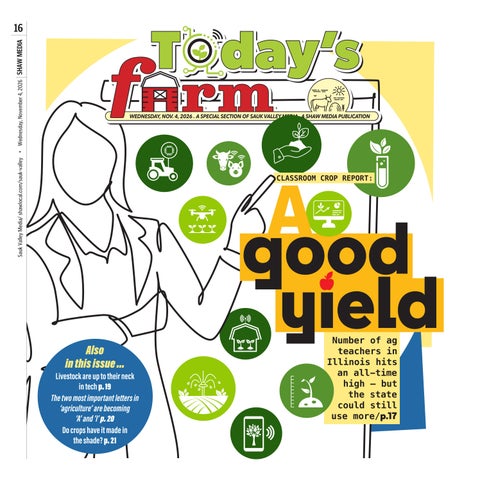
Also in this issue ...
Livestock are up to their neck in tech p. 19 The two most important letters in ‘agriculture’ are becoming ‘A’ and ‘I’ p. 20 Do crops have it made in the shade? p. 21
Classroom crop report: A good yield Number of ag teachers in Illinois hits all-time high, but the state could still use more By PHYLLIS COULTER FarmWeek For the first time since 2017, all agricultural teacher positions in Illinois schools were filled at the start of the school year. In all, a total of 593 agriculture teachers are on the payroll throughout the state this school year — an all-time high. Ten years ago, there were 413 ag teachers. “We are retaining more of our teachers than ever, and the percentage leaving the profession continues to decline,” said Jennifer Waters, Facilitating Coordination in Agricultural Education (FCAE) state coordinator. FCAE, funded by the Illinois State Board of Education (ISBE), aims to improve agriculture-related education. The number of jobs available in Illinois changes annually as districts shift staffing. More middle schools are introducing FFA; some schools are shuttering programs, while others are adding a teacher or changing duties. The total number of ag education programs in the state continues to grow — from 334 in 2017 to 410 in 2026. “Agricultural education programs continue to expand across Illinois year after year. We attribute this growth to sustained state investment in agricultural education, the diversity of course content and opportunities we offer and a growing interest in building strong middle school programs,” Waters said. “Today, agricultural education reaches students in grades 5-12, with FFA membership available to students in grades 7-12. Currently, 152 agricultural education programs (37% of programs statewide) serve middle school students, compared with just 73 programs (23%), when I began with FCAE in 2012-13. We are also seeing programs grow in capacity, with 137 programs (35%), now led by two or more agriculture teachers. We are seeing programs expand in reach and growing in strength in Illinois,” Waters said.
Welcoming new teachers First-time teachers are filling 42 jobs this school year throughout Illinois. Among them, Dana Merriman, one of 25 ag education graduates earlier in 2026, started her first teaching job at Rock Falls on Aug. 13. Merriman began her duties after the school board voted to bring back the program, after an absence of many years. Part of Merriman’s job is bringing an FFA program back to the school after years without one. She said she already has support from businesses, the community and Farm Bureau. Merriman chose to be an ag teacher for a combination of reasons. She was inspired by agricultural opportunities at a high school discovery program; she worked as an intern with Lee County Farm Bureau and its Ag in the Classroom program and enjoyed teaching gymnastics to children. “I decided this is what I want to do,” she said.
More teachers still needed While new teachers help, Jay Solomonson, Illinois State University’s (ISU) agricultural education program coordinator and professor, said Illinois still isn’t producing enough ag teachers to meet its needs. A total of 28 students graduated from four Illinois ag education programs this year, but there were 72 job openings. A combination of returning teachers, retained teachers and programs such as alternative educator licenses help fill the gap. Teachers who have a provisional license are licensed to teach in the pathway in which they have work-based agricultural experience. They do not need to take any additional assessments or complete additional coursework. Their licensure renewal is the same as a teacher with a Professional Educators License.
TEACHERS cont’d to page 18
Since 1869
Protecting What Built Our Communities Local Homes. Local Farms. Local People.
For over 150 years, Bradford Mutual Insurance Company has stood beside and protected the families who helped build this region. From homes and farms to renters and landlords, including machinery, toys, and jewelry, we provide dependable protection designed for rural living. Member-owned. Locally trusted. Here when it matters most.
Contact your local Bradford Mutual agent today and experience insurance built on integrity, stability, and community.
Home Protection
Farm Coverage
Equipment & Property Protection
Adami Agency LLC
Hepner Insurance Agency
Mel Saad Insurance Agency
Rock Falls 815-625-6220
Baylor Insurance Agency Oregon 815-973-2906
Bob Norton Agency Annawan 309-935-6942
Byron Insurance Agency Byron 815-234-3211
Eckburg Insurance Agency Rochelle 815-888-3030
Hanford Insurance Agency
Erie – 309-944-8671 Geneseo – 309-944-5151 Port Byron – 309-944-8649 Prophetstown – 309-944-8670
Orion 309-526-8256
Hugh Miller Insurance Agency Rock Falls 815-626-1300
Huizenga & Wierenga Insurance Agency Fulton 815-589-2255 Kaczmarzyk Agency Inc. Oregon 815-732-3148
Leffelman & Associates Amboy – 815-857-2125 LaMoille – 815-638-2171 Sublette – 815-849-5219
Erie 309-659-2470
Miller Insurance Group Rochelle 815-561-9911 PMIA Inc – Jon Mattox Sterling 815-626-7445 One Digital Rochelle 815-562-4152 Sauk Valley Insurance Services Dixon 815-288-2541
Sellman Cox Agency Geneseo 309-944-1451
Stenzel Insurance Agency Franklin Grove 815-456-2319
The Cornerstone Agency Morrison – 815-438-3923 Sterling – 815-438-3923 Tampico – 815-438-3923
Our Contact Information 120 W. South Street, Franklin Grove 815-456-2334 www.bradfordmutual.com
17 SHAW MEDIA Sauk Valley Media/ shawlocal.com/sauk-valley • Wednesday, November 4, 2026
TODAY’S FARM
Sauk Valley Media/ shawlocal.com/sauk-valley • Wednesday, November 4, 2026
SHAW MEDIA
18
TODAY’S FARM TEACHERS cont’d from page 17 “For the coming year, 19 of our incoming teachers hold an Educator License with Stipulations. Nearly 30% of current Illinois ag teachers hold this license and did not attend a university to become an agricultural education instructor, rather they have workplace experience in the agriculture industry combined with 60 hours of college level credit,” Waters said. Some college students decide to be an ag teacher to be close to agriculture, Western Illinois University agricultural education professor Dusti Ingles told FarmWeek. With start-up costs so high today to get into farming, teaching gives people a way to connect with agriculture, much like it did during the 1980s farm financial crisis. Further, people are attracted to teaching jobs in times of economic downturn because they offer security. Many of Ingles’ students are first-generation college students from low-income households of various backgrounds, seeking a secure career, she said.
Alex T. Paschal/apaschal@shawmedia.com
Rock Falls High School FFA advisor Dana Merriman (center) is working to grow the new ag program at the school. To learn more about RFHS’s ag program, and Merriman’s work on it, read Shaw Media’s article at tinyurl.com/4kz3ryt3
Retirees unretire More teachers are also returning to the classroom, often because of a
Matt Hermes Designated Managing Broker
Specializing in Farm Sales & Management
1254 N. Galena, Dixon 815-288-4648
Ogle County: 88.45 +/- Acres. S28 Scott Township.
change in circumstances, a move or other family changes, Waters said. Nationally, 7% of teachers filling
2025 positions were returning teachers, according to the Association for Agricultural Education’s annual supply and demand report, Solomonson noted. “Six of the new 2026 Illinois ag teachers are returning to the profession after retiring or taking a break for a bit,” Waters said, reflecting a national trend. But even more teachers are deciding not to leave at all. The statewide teacher retention rate rose to 93.6% in 2025, said Solomonson, using data from the American Association for Agriculture Education. He credited ISBE grants and efforts of several agricultural and education-related organizations for improvements in retention rates. In his research on ag teacher retention, Solomonson found one of the primary factors teachers leave is “overwhelming workloads.” He teaches state and national groups and his own ISU students about time management and establishing work-life balance.
This article originally appeared in Illinois Farm Bureau’s FarmWeek Now. Read more at FarmWeekNow.com.
Season after season we are your partner in growth. With more than 200 years of agricultural experience, we’re the partner you can count on to help your operation grow.
Located just southwest of Davis Junction. Farm is almost entirely tillable. BUYERS ARE LOOKING - CALL ME ABOUT LISTING YOUR FARM TODAY!
Member
Morrison 815-772-4011 • Fulton 815-589-9090 Sterling 815-625-4300 • Rock Falls 815-625-1110 Dixon 815-284-8500
TODAY’S FARM
19
What’s all the buzz? It’s the collars keeping farm animals fenced in — without fences By MARTHA BLUM mblum@shawmedia.com EFFINGHAM, Ill. — Virtual fencing systems remove the boundaries of where cattle, sheep and goat producers can graze their animals. “I encourage the dreamers when it comes to this technology,” said Kaitlyn Dozler, virtual fence program manager at the Center for Regenerative Agriculture at the University of Missouri. “The opportunities are endless and I like to talk about thinking outside of the square,” she said during a presentation at the Heart of America Grazing Con-
ference in July, hosted by the Illinois Grazing Lands Coalition, the Illinois Forage and Grassland Council, the U.S. Department of Agriculture’s National Resources Conservation Service and University of Illinois Extension. Dozler has been working with virtual fence technology for about four years. “The university received a grant from the National Fish and Wildlife Foundation to introduce virtual fencing to Missouri producers,” the program manager said. “I have five private producers across the state that we have given 50 virtual fence collars to, from four companies — Nofence, Halter, eShepherd and Monil,” she said. “They are using the collars like they purchased them and I get weekly updates on what has gone really well and what has not worked.” The systems use GPS coordinates to establish the virtual fence boundaries. Producers can use their phone, tablet or
Protecting what you’ve built. Today and for generations.
Check Out Our Agent Locator on Our Website www.pfmic.com
Prophetstown Farmers Mutual Insurance Co. A Leader in Farm Insurance
(815) 537-2251 406 Washington Street Prophetstown, IL 61277
laptop to draw the virtual fence and then the GPS coordinates are uploaded onto the collar. The collar recognizes the GPS coordinates as the animal Dozler moves throughout a field. When the animal starts to approach the virtual fence boundary, it will be met with a highpitched sound that gets higher and faster. “If the animal turns to go away, the sound will get quieter and slow down,” Dozler said. “If the cow walks through the audio cue, she will be met with an electrical pulse,” she said. “It will hit the animal up to three times, turn off and the owner will get a notification on his phone that the cow has exited the virtual fence boundary.”
The virtual fence acts as a one-way gate so animals can enter back into the virtual fence without any repercussions. “Nine times out of 10, due to herd dynamics, the cow will walk herself back in,” Dozler said. “And she won’t even know she is going through it.” Once the cow is back in the virtual fence area, the collar will reactivate and turn on. “If the cow tries to leave again, she will be met with that sound and shock,” Dozler said. Training is a key component of utilizing a virtual fence system. “It is based on associative learning,” Dozler said. “The animals need to learn to associate the sounds and shock cues with the boundary.” On average, the program manager said, the training takes five to seven days.
FENCING cont’d to page 20
"GREAT DEALS GREAT SERVICE SINCE 1926"
VAESSEN BROTHERS CHEVROLET, INC. HIGHWAY 52 SUBLETTE, IL 61367 800-227-5203
WWW.VAESSENBROTHERS.COM
SHAW MEDIA Sauk Valley Media/ shawlocal.com/sauk-valley • Wednesday, November 4, 2026
Livestock are up to their neck in tech
Sauk Valley Media/ shawlocal.com/sauk-valley • Wednesday, November 4, 2026
SHAW MEDIA
20
TODAY’S FARM
You can’t spell ‘agriculture’ without an ‘A’ and ‘I’ And it’s getting harder to run a farm without those two letters, too By DENNIS BOWMAN University of Illinois Extension Service Illinois horseradish growers have a weed problem: there are relatively few herbicides labeled for the crop. So researchers began teaching an AI sys-
FENCING cont’d from page 19 “But I have seen cows learn it as fast as a couple of hours,” she said. “And I’ve seen livestock that really struggle with the system and eventually they are pulled out of the herd because they cannot figure out what the stimulus are trying to tell them.” For training, Dozler advises choosing a pasture with a strong physical permanent fence and on day one overlay the virtual fence on the physical fence. “When the livestock interacts with the physical fence, they hear the sound, get the shock and start to associate those two in their brain,” she said. On day two, one side of the virtual fence is moved in, to make the paddock area smaller. Each day, the producer moves the virtual fence line in, to make the paddock smaller and smaller until day seven of the training. “With a lot of the apps, you can click on the collars and it will tell you the number of sounds and the number of shocks the animal had that day,” Dozler said. “So, you can have a pretty clear idea of which animals in your herd have picked it up the fastest.” There are different types of virtual fencing systems, including some that are cellular based. “These collars use the same cellular network that your phone uses to send a text or make calls,” Dozler said. “As long as you are in cellular service and collars are in cellular service, you will be able to manage those cows whether you are sitting on a beach in Hawaii or you are sitting here at this
tem to tell horseradish plants apart from everything else growing around them, so equipment could target only the unwanted plants. That kind of project is exactly why artificial intelligence, or AI, has become one of the most talked-about new technologies in agriculture. But what does AI actually mean for farmers?
At its simplest, AI allows computers and machines to learn from data, recognize patterns, solve problems and make decisions. In agriculture, that can mean using information from sensors, drones, satellites, machinery, weather and soil data to help farmers make better decisions or allow equip-
ment to perform tasks with less human intervention. AI is not a single technology. Farmers are already encountering several forms of it ... • Predictive AI has been used for years to forecast yields, disease outbreaks and other potential outcomes. • Machine-embedded AI is being built directly into equipment, such as sprayers, tractors and combines.
meeting today,” she said. “You are able to see the animals and change the fences.” Base stations act as a relay point to pass information back and forth between the collars and the app. “Vence relies on base stations and depending on your topography, you could potentially need four or five base stations to cover your ranch,” Dozler said. “Halter is currently the only company that the collars communicate directly to satellites,” she said. “You can be somewhere without a cell tower around, and as long as the collar can see directly to a satellite, you will be able to use it, so this is an exciting advancement to the technology and the University of Missouri will be getting a couple of them.” Producers have the ability to create different shapes of pastures for grazing their animals with a virtual fence. “I have seen producers make an alleyway down a country road to move their cows from one pasture to another,” Dozler said. “One of the cool features of the virtual fence technology is you can schedule the moves,” she said. “A lot of my producers used it last year during harvest and planned the moves for the next one to two days, then they did not have to think about it for a couple of days.” With the real-time livestock tracking, producers can get an updated GPS location of an animal about every 10 to 20 minutes. “I had a producer during harvest that had about three cows left to calve, and when he saw one of the cows off by herself, he knew she was probably getting ready to calve,” Dozler said. “He
had his dad check and there was a new calf on the ground and he never stopped the combine.” Another feature is cattle behavior alerts that indicate the neckband has either dropped off or the animal is no longer moving. “There was a situation in Montana where a cow got stuck in a pasture pond and the producer is pretty confident that cow would have probably died if it
was not for the alert,” Dozler said. Virtual fencing technology is continuously updating and improving. “The animal health components such as calving detection and heat detection are coming within the next year,” Dozler said.
AI cont’d to page 21
This article originally appeared in Shaw Media’s AgriNews. Go toagrinews-pubs.com/ to read more farm news.
Advocating and educating on behalf of Lee County agriculture!
Don’t have a membership?
JOIN TODAY!
MEMBERSHIP BENEFITS, LOCAL DISCOUNTS, AND MORE!
ADVOCACY
A strong voice for agriculture at all levels of government.
EDUCATION
Resources and programs that support farmers and the community
LOCAL COMMUNITY Connecting and DISCOUNTS
Save with exclusive supporting the people benefits from local and who keep Lee County growing. national partners.
CONTACT US: Lee County Farm Bureau | www.leecfb.org | (815) 857-3551
TODAY’S FARM • Generative AI tools can answer questions, analyze images and create reports. • Agentic AI, a newer concept, goes a step further by allowing AI to complete a series of tasks using multiple tools — for example, checking weather, soil conditions and equipment readiness together rather than one at a time. Some of these applications are already moving from research into practical agriculture. Take that horseradish project mentioned earlier. The system doesn’t necessarily need to identify every weed by name. It simply needs to recognize what is horseradish and what isn’t, allowing it to target unwanted plants — a narrower, more achievable task than full weed identification. AI can also work with drones. One system uses drone imagery to map a farmstead and identify individual trees, buildings, water and other features. The AI can then help create an application map and flight route so a
spray drone can autonomously treat each tree. Generative AI offers another set of possibilities. For example, a farmer can upload a photoBowman graph of a soybean field and ask an AI system what might be wrong. The system can examine symptoms such as yellow leaves and dry soil and suggest possibilities including nutrient deficiency, drought stress or pest damage. The important word here is “possibilities.” AI can help organize information and point us toward potential answers, but it should not replace local expertise or field verification. That is one of the most important lessons when using AI in agriculture: Don’t assume an AI answer is correct simply because it sounds convincing. Generative AI can sometimes “hallucinate,” or produce information that isn’t accurate. AI systems can also lack
current information, and algorithms developed under one set of conditions may not perform well somewhere else. An Illinois nitrogen-management experiment provided an early reminder of this. An algorithm developed for Oklahoma did not perform adequately under Illinois conditions. It reduced nitrogen use, but the resulting yield loss, 33 bushels per acre, far outweighed any savings on fertilizer. So where is AI headed? I expect some of the biggest changes will come from AI becoming increasingly integrated into farm equipment and farm-management systems. Instead of simply providing information, AI will increasingly help machines determine what to do in the field. Generative AI will also become a more useful decision-support tool, helping farmers sort through the tremendous amount of agricultural information available today. And agentic AI may eventually allow farmers to give a system a goal — such as getting everything ready for planting — and have it
check weather, soil conditions, inventories, equipment readiness and work assignments. We are still in the early stages of this technology. Farmers don’t need to become computer scientists to benefit from AI. They do need to understand what these tools can — and cannot — do, identify real problems where AI might provide value, and verify important information before making costly management decisions. The question isn’t whether AI will become part of agriculture. It is already happening. The more important question is how we can use it responsibly to make better decisions and solve realworld problems. Try it first on lower-risk work, sorting field notes or drafting a scouting report, before letting it weigh in on a fertility or spray decision.
N. Dennis Bowman is a University of Illinois Extension Digital Agriculture Specialist. Learn more about him at https://extension.illinois. edu/staff/n-dennis-bowman
SHAW MEDIA Sauk Valley Media/ shawlocal.com/sauk-valley • Wednesday, November 4, 2026
AI cont’d from page 20
21
Sauk Valley Media/ shawlocal.com/sauk-valley • Wednesday, November 4, 2026
SHAW MEDIA
22
TODAY’S FARM
Do crops have it made in the shade? Researchers study what grows best under solar panels
At the Agrivoltaics Field Day on Aug. 5, DoKyoung “D.K.” Lee, University of Illinois plant breeding, genetics and bioenergy crop agronomist, discusses how solar panel shade impacts crops.
By PHYLLIS COULTER FarmWeek Researchers at the University of Illinois shed some light on the subject of growing crops in the shade of solar panels during an Agrivoltaics Field Day at the U of I energy farm this past summer. “There’s a lot of interest in agrivoltaics,” DoKyoung “D.K.” Lee, a U of I plant breeding, genetics and bioenergy crop agronomist, told FarmWeek of people wanting to know more about the dual use of land for solar energy production and agriculture. “It’s not only about agronomic practices, but also economics.” Some agrivoltaic research at the farm focuses on how shade affects crop yield. In three years of study, research shows shade caused by solar panels can reduce soybean yields by about half. However, for grain sorghum, “the yield penalty was minimal as the greater kernel size compensated the lower grain numbers,” Lee said. Based on the recent harvest of winter wheat, Lee said the grain yield was reduced by about 40% due to shading in the rows directly under the panel, compared with wheat in full sun. The impact of shade on crops also depends on the arrangement of the solar panels, he noted. The research is part of the Sustainably Co-locating Agricultural and Photovoltaic Electricity Systems project, which aims to blend agriculture and solar power in a way to boost U.S. farmers’ resilience and income while maintaining food production and ramping up renewable energy. While modern commercial-sized equipment cannot be used in the trials with solar panels, small equipment can, “but you have to be careful,” Lee said. For the arrangement of 20 feet between the panels, a four-row planter can be used with 10 feet of plantable space, and for 40 feet arrangement, a 12-row planter can be used with 30 feet plantable space. Some testing was done at the U of I
Photo courtesy of April Wendling, University of Illinois
energy farm and some at a utility-scale solar farm. The research also involved row crops, including soybeans, grain sorghum, winter wheat and horticulture crops including tomatoes and greens — but not field corn because of its height. In 2024, researchers added forage crops, including alfalfa, red clover, orchard grass, tall fescue and timothy grass. Forage may be one of the more practical options for larger-scale production on a solar farm, Lee said. When growing forages, some researchers and farmers include livestock, often sheep. “We aren’t able to accommodate livestock in research here,” he said, but noted the combination may be more profitable. Other research focuses on the impact the solar panels have on soil quality, carbon intensity and potential for heavy metal contamination. “We haven’t seen any heavy metal in the soil,” Lee noted. Current funding of the five-year project ends this year, but Lee hopes it will be extended because there is more work to be done. “As we produce electricity on the farm, we need to know the consequences or benefits from the practice,” he added.
This story was distributed through a cooperative project between Illinois Farm Bureau and the Illinois Press Association. For more food and farming news, visit FarmWeekNow.com.
SM-ST2361032