Fall pastures
Ogle County to host workshop and walk on Wednesday – Page 2
Farmland values
They are down, but don’t panic, according to the experts – Page 4
Veteran dairyman
Oscar Koenig has milked cows for more than 70 years – Page 8
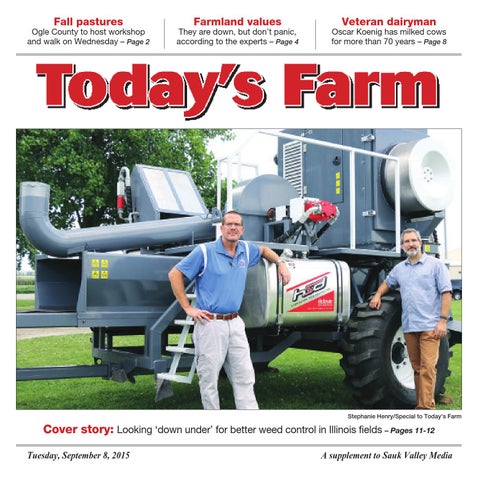
Stephanie Henry/Special to Today’s Farm
Cover story: Looking ‘down under’ for better weed control in Illinois fields – Pages 11-12 Tuesday, September 8, 2015
A supplement to Sauk Valley Media
Today’s Farm
PAGE 2
Sauk Valley Media • September 8, 2015
U OF I EXTENSION
Tips on getting more from fall pastures Workshop and pasture walk Wednesday in Ogle County U of I Extension
Grazing standing pasture is the most cost-effective way to feed ruminant livestock. There are ways to improve productivity and carrying capacity of pastures well into the fall. “Pasture is an underutilized resource in many parts of northwestern Illinois,” said Andy Larson, Extension educator for Local Food Systems and Small Farms, “With a bit more planning and management, we could support a lot more grazing livestock in this area,” Larson said.
On Wednesday, Sept. 9, farmers are invited to join specialists from University of Illinois Extension and Illinois Natural Resources Conservation Service for a workshop and pasture walk on grazing management for fall pasture. During the classroom portion, grass-based livestock producers will learn about: Fundamentals of improved grazing management, including careful planning of rotations and stocking rates – Andy Larson, Extension educator for local foods and small farms. Extending the grazing season with alternative forages, like cover crops, annuals, stockpile, and corn stalks – Travis Meteer, Extension educator for commercial livestock. Building durable and economical fencing
and water systems that best fit a pasture and a budget – Matt Bunger, NRCS grasslands specialist. How and when grazing livestock can productively utilize woodland pasture with minimal negative consequences – Jay Solomon, Extension educator for energy and environmental stewardship. During the pasture walk at Dietrich Ranch, Dan and Erin Dietrich will discuss managementintensive and contract grazing, high-stock density grazing, optimizing a grazing system for diversified livestock species, and selling identity-preserved products through niche markets. The classroom portion of the program will begin at 1 p.m. Wednesday in the boardroom of the River Valley Complex at 605 Main St. in Leaf River
Today’s Farm celebrates agriculture in the Sauk Valley and beyond. It is published by Sauk Valley Media six times a year – in January, March, May, July, September and November. We welcome story ideas about interesting local people who are involved with agriculture. Call Jim Dunn at 800-798-4085, ext. 5511, or send an email to jdunn@saukvalley.com.
Lee County: 38 +/- acres in excellent location between Dixon & Sterling. $9,000/acre. Lee County: 40 +/- acres, approx. 22.5 tillable with pasture on Naylor Rd. Ogle County: 182 acres, 98% tillable Class A farm in Woosung Twp. SALE PENDING! Ogle County: 80 acres, 96% tillable, excellent soils. SOLD! typed in Cosmos extra bold
We Have Buyers - We Need Land!
Matt Hermes, Broker
Specializing in Farm Sales & Management
N.. G Galena, Dixon 11254 254 N alena, D ixon 8815-288-4648 15-288-464 8
(formerly the Leaf River School). At 5:15 p.m., participants will travel 3 miles south to Dietrich Ranch near Mount Morris for
dinner and a pasture walk beginning at 5:30 and concluding around 7:30. Cost for the program, including educational
materials, dinner, and pasture walk, is $25. Contact the Ogle County Extension office at 815732-2191 for registration information.
Today’s Farm
September 8, 2015 • Sauk Valley Media
PAGE 3
AGRICULTURAL INNOVATION
Kenaf may be a crop alternative for region Faber plant is native to eastcentral Africa
prosperity in the United States and in Third World equatorial countries with kenaf, a fiber plant native to east-central Africa that’s used for food and fiber for products like rope, twine, and rugs. It’s a sustainable crop that requires little to no herbicides, pesticides or maintenance. It grows about a foot a week, and unlike industrial hemp, is noninvasive in the U.S. It absorbs high levels of carbon dioxide from the air, and can be used in water purification, sewage treatment, and soil improvement. Kenaf was introduced in parts of the U.S. in the late 1950s for use as fiber and paper pulp. As part of an effort to
BY TOM KOCAL Shaw Media tkocal@shawmedia.com
LANARK – Agriculture is the No. 1 industry in Illinois. The state always is at the top of the list in hay, corn and soybean production, and leads the nation in pumpkin and horseradish cultivation. A Kentucky businessman thinks kenaf could be Illinois’ next super crop. Martin Smith, owner of United Global CoOpportunities, hopes to create jobs and economic
Purdue University
This is the flower of a kenaf plant, a warmseason annual fiber crop closely related to cotton. The stalks grow quite tall. The plant’s commercial applications continue to be studied. make vehicles more sustainable, Ford and BMW are using kenaf in automobile bodies. Its first
Your energy partner for the future
FALL OIL SALE
implementation was in the 2013 Ford Escape. The BMW i3 uses kenaf in its black surrounds. Kenaf’s use is expected to offset 300,000 pounds of oil-based resin a year in North America and should reduce the weight of door bolsters by 25 percent. Smith was in northwestern Illinois recently to discuss kenaf with area farmers and dairy/beef producers. He hopes to get farmers to plant kenaf as an alternative crop to corn and soybeans. Tests in Kentucky have determined that cattle preferred kenaf and received higher nutritional value from it than from hay or corn silage; that it is easy to
digest; and that, because of its high fiber content, cattle will eat less, he said. “Kenaf can be planted in areas with poor soil conditions, making acreage that can’t be used highly productive,” Smith said. “Because of its low maintenance and high yields, it would be a costeffective alternative.” In addition, kenaf will produce four to five times more wood pulp in one growing season than a 27-year stand of cultivated pines, he said. But northern Illinois presents a problem. “Kenaf wants to grow in long light, like near the equator,” he said. “In America, it’s not able to produce a seed.
Make Your Farm, Home & Business Communication More Efficient, Profitable, and Enjoyable! C
Intercept those important phone calls
August 1 - September 30, 2015 Receive the following discounts on grease and lubes taken and invoiced between the above dates.
LUBRICANTS & GREASE
~Business Telephone Systems~ Two Way Radio
~Call Us~
Packaged Only: Includes Quarts to 55 Gal Drums
Lubes
20¢ per gallon
Grease
10¢ per pound
“The Third World countries that are able to develop the seed ... will be able to pay for agriculture and manufacturing equipment through us consuming their seed, ... which allows us – an industrialized nation – to pursue economic development with a nonindustrialized nation, buying their seed to grow here in the U.S., and developing technologies that liberate both of us. “Some places near the equator have two or three growing seasons. They could produce electricity, gasoline, and diesel fuel cheaper, quicker, and better than we can as an industrialized nation, simply by the nature of the plant,” he said.
Keep an eye on things!
~Security Cameras & Systems~
Lock in the balance of your fall fuel needs with a contract.
Please give us a call. !"#$%
&'()*+$,#
-./$%/
012345637678
012320736968
584377530048
Don’t Take A Chance, Call Radio Ranch!
Since 1954 Whiteside County Airport 10924 Hoover Road, Rock Falls 815-622-9000
Today’s Farm
PAGE 4
Sauk Valley Media • September 8, 2015
FARMLAND VALUES
Experts speak about 2014 ‘correction’ Advice: Don’t panic, watch interest rates BY BRENDEN WEST bwest@saukvalley.com 800-798-4085, ext. 5529
For the first time in the 21st century, agricultural land values – be they excellent or fair – collectively dropped for Illinois in 2014. That’s not a cause for great concern, however. Local and statewide land appraisers agree: this market shift is a correction, not a bubble that’s bursting. Keith Zoeller is a Sterling-based accredited farm manager and a
long-standing member of the Illinois Society of Professional Farm Managers and Rural Appraisers. His experience locally spans 33 years, and he says he’s “seen it all.” The market drop, naturally, might concern some landowners, Zoeller said. But it’s nothing close to what happened to the market when he started in the 1980s – a period in which Zoeller observed a 25-percent national drop-off in farm values. “I’ve seen the bottom; I’ve seen the top,” Zoeller said. “I don’t think we’ll see what we saw in the 1980s. I think our prices should level out a little more.” The land market is driv-
LOOKINGFOR ALITTLEMORE HORSEPOWER?
‘‘
I don’t think we’ll see what we saw in the 1980s. I think our prices should level out a little more.
’’
Keith Zoeller
en by commodity grain prices. At its peak in the new millennium, the price of corn reached $7 a bushel. Last year, that number fell to $3.50, giving producers about half the revenue they’d seen. Soybeans and other grains had similar declines, Zoeller said. When grain prices were
high, Zoeller said, investors were buying land left and right. Now that prices have leveled off, the net income for land and its yield is lower, making those investors less apt to buy. “Our land values had drastically increased over the last 4 to 5 years. A lot of it had to do with corn and soy prices going sky high,” Zoeller said. “The farmers were making lots of money. They decided that it’s time to start buying land. ... “I think a lot of your land investors that were in the market before are just sitting back now and waiting to see where the good prices are going to,” he added. “When you can’t get a
HARDEN’S REPAIR
Specializing in heavy duty truck and trailer repairs of all types for 29 years.
FOR ALL YOUR AGRICULTURAL REPAIR NEEDS
return on the property, investors aren’t going to buy it.” Zoeller estimated that during the upswing, 70 percent of land purchases were being made by land investors. Most of the purchases now are being made by individual producers because “they have other ways to make it pay.” “If they can get a return, they’ll buy the ground,” Zoeller said. Auctioneer Tom Tumbleson, owner of Tumbleson Auction Co. of Princeton in Bureau County, said land prices had soared in the Midwest in recent years – and not just because of rising grain prices. “Land prices have esca-
lated tremendously in the last 5 years all over the Midwest,” Tumbleson said. “The reason for it is not the grain or corn or bean prices; it’s because people want to invest their money in land. It has to do with the interest rate and what they do with their money.” Tumbleson added there are certain tax advantages for those who buy and sell land for income tax purposes, Tumbleson said he’s seen farmland sell in the area for $13,000 to $15,000 an acre. Likewise, he’s also seen pasture and timber land go up as well. LAND CONTINUED ON 5
33 Years of Service Built on Honesty, Integrity & Service • Home Heating
• Grain Drying
• LP Gas Heaters
• LP Tank Sales & Service
• Gas Grills
• Forward Contract for LP Gas for Farmers
• Hot Water Heaters
• Guaranteed Winter Rates
607 Willett Ave., Dixon • 815-284-4435 TRACTOR RADIATORS & AGRICULTURAL CHARGE AIR COOLERS
24-HOUR SERVICE • 7 DAYS A WEEK
“Great Deals, Great Service, Since 1926”
Rt. 52 N. Sublette, IL Ph. 815/849-5232 or 1-800-227-5203 After 6, 849-5251
WWW.VAESSENBROTHERS.COM
IF IT HAS A RADIATOR, WE CAN GET IT. BOBCAT RADIATORS • AG RADIATORS CHARGE AIR COOLERS
TRUCK, AG, INDUSTRIAL
Burkardt’s LP Gas Located on Rt. 26 - 2 miles south of Polo Business: 815-946-3081 • Home : 815-946-3080
Today’s Farm
September 8, 2015 • Sauk Valley Media
PAGE 5
Fluctuation in land prices tied to commodity prices LAND
CONTINUED FROM 4
“Honestly, it’s usually farmers and investors buying this land, but the percentage is mostly neighbors,” he said, adding he recently sold a farm in Bureau County for $8,600 an acre. In 1966, that same farm sold for $600 an acre. “It was just an average farm. It wasn’t nothing that was top shelf,” he said. “And then I sold another that went for $15,000 an acre, which was all tillable.” Tumbleson said he sees a cycle in land/real estate sales, adding he’s seen ups and downs. “The trends fluctuate,” he said. The correction is taking place on a national scale, said Ryan Drollette, a farm management educator with the Iowa State University Extension office in Iowa City. However, it’s hitting vari-
ous pockets at a different rate. In Iowa, he said, the correction has been delayed. In states such as Illinois and Indiana, it has taken hold sooner. Experts don’t know what’s in store for land and commodity prices, Drollette said. “There’s some sentiment that we’re going to continue to see it correct downward,” Drollette said. “It’s just a matter of how far we see it correct downward.” His role in the state is to educate, but farmers are constantly asking him the same questions: Should they sell now, what is their land worth, and how far down will the correction spiral? Drollette doesn’t have the answers, but he recommends that landowners get their land professionally appraised if they’re looking for solutions. “I can’t tell people if they should sell now,” Drollette said. “I can give
Philip Marruffo/pmarruffo@svnmail.com
When area farmers plant their fields in the spring, they hope their fall harvest yields enough crop to recoup their costs and make a profit. With recent lower commodity prices, the price of land also has declined. them a general ballpark figure. I always tell individuals, If you want an actual value ... call up a land appraiser.” On the lending side, commodity prices aren’t the only thing for land buyers to watch. Dave Aberle is the vice president of 1st Farm Credit Services in Rock Falls, a branch of the largest ag lender in Illi-
nois. He pays mind to the interest rates, which have been low for several years. All the while, ag land borrowing ticked up during the fall 2014, according to the Kansas City Federal Reserve. Experts anticipate interest rates will eventually go up, again affecting land values. “The big factor that
influences land values is commodity prices and what interest rates are doing,” Aberle said. “Commodity prices were high and interest rates were low, so that’s what got the land prices to go up so high.” Locally, he says, the rate of borrowing has decreased over several years. His recent clientele is almost exclusively individual farmers. “At one time, there might have been 20 percent [investors seeking loans],” Aberle said. “Now it’s virtually zero – less than 5 percent. Investors haven’t been too interested since [values] jumped up the last 3 years.” He recommends land buyers keep in mind what they’re able to afford. It’s a personal decision. “Make sure you’re looking at your cash flows, and make sure you can handle a drop in commodity prices,” Aberle said. “You’re going to
have to subsidize your purchases with today’s prices. If that farm isn’t going to pay for itself, you’re going to have to generate income to pay for that farm.” Paying attention to the interest rates, he added, is another good barometer for forecasting what the market is going to do. Even so, experts have no way of knowing specifically how prices will fluctuate. There’s no need to panic, but the best advice Aberle and Zoeller can give is to just be aware. “Monitor what’s taking place,” Aberle said. Tim Eggers, field agricultural economist at Iowa State University, agrees. “This is not an alarmist type of situation,” he said. “It is merely a recognition of lower profitability and the fact that producers have been in the primary land purchasers.” Terri Simon contributed to this report.
STRONG PROTECTION FOR SMALL AND LARGE FARMS We offer quality insurance protection for today’s complex farming operations with friendly, local service and a knowledgeable staff to back it up. For competitive rates and great service from a local insurance company, call one of our local agents. Call one of our friendly agents today! Hugh F. Miller Insurance Agency, Inc. Rock Falls 815-626-1300
First Class Insurance Agency Milledgeville
815-225-7777
Dixon
815-284-7070
Dimond Brothers Insurance Agency Ohio 815-376-2954
Scholl Insurance Agency Polo 815-946-2324
After all, it’s a local call! Sauk Valley Insurance Services Dixon 815-288-2541
Dimond Brothers Insurance Agency Amboy 815-857-3966
Today’s Farm
PAGE 6
Sauk Valley Media • September 8, 2015
COMMUNITY-SUPPORTED AGRICULTURE
Alex T. Paschal/apaschal@saukvalley.com
Adolfo Parra, owner of Belly Fire Farms of rural Mount Morris, explains how the community-supported agriculture operation runs as he points out the different plots of crops. More than 100 varieties of vegetables are grown on the farm.
Belly Fire Farms part of trendy growth More than 100 veggie varieties grown at Mount Morris CSA farm BY CHRISTI WARREN cwarren@saukvalley.com 800-798-4085, ext. 5521
Belly Fire Farms in Mount Morris is small; there’s no doubt about it.
Adolfo Parra, 39, stays at home to work the land while his wife, Danica Hoehn, 35, goes off to Rockford to work. Their 3-year-old son, Octavio, along with
puppy Pineapple, patrols the grounds, too, keeping a steady eye on the chickens and sampling wild berries to ensure they’re as yummy as possible. Judging by the amount
of times Octavio went back to the bushes on one particular summer day, they were quite yummy. Belly Fire Farms is part of an increasingly popular market base in Amer-
ica: CSA farms, which stands for communitysupported agriculture. Community-supported because neighbors sign up, and pay up front, before the planting season, and then based on the number of custom-
ers, Adolfo knows how much produce to grow. The idea has been around for more than 25 years, but it’s only just gaining popularity as a mainstream method of buying groceries – shares, they’re called. VEGGIES CONTINUED ON 7
September 8, 2015 • Sauk Valley Media
Today’s Farm
PAGE 7
Belly Fire offers eggs, herbs, soap and more VEGGIES
CONTINUED FROM 6
They are picked up weekly or every other week, depending on what people sign up for, at the farm, where they get to see the ground their carrots come from, talk to Adolfo and his wife, and pet Pineapple. That’s one of the main benefits of CSAs from the standpoint of buyers: to be able to develop a relationship with their local
farmer, and to feel like they’re taking part in the growing process. Belly Fire grows more than 100 varieties of vegetables, but also produces milk soaps, eggs, herbs, and more. 2015 is the family’s third CSA year. The first year, only five people signed up for share boxes. The second year, 15. This year, 25 have signed up for summer shares. The government doesn’t track CSA farms, so there is no official number
when it comes to tallying them throughout the United States. But LocalHarvest, an organization that connects consumers with farmers, has more than 4,000 CSAs in its database. A directory compiled by the Illinois Institute for Rural Affairs at Western Illinois University lists about 40 CSAs in Illinois, though it was created in 2007. “The response is happening slowly,” Adolfo said. “But it’s growing.”
Photos by Alex T. Paschal/apaschal@saukvalley.com
ABOVE: Wild mulberries hang from a tree on Belly Fire Farms, Mount Morris.
BELOW: Along with fresh fruits and vegetables, herbs are grown on Belly Fire Farms.
Fresh eggs can also be had at Belly Fire Farms, as well as milk soaps and herbs.
Today’s Farm
PAGE 8
Sauk Valley Media • September 8, 2015
EVERGREEN LAWN FARM
A lot more than cattle goes into dairy farm Oscar Koenig has operated it for more than 70 years now BY DAVE FOX Special to Today’s Farm
Dave Fox/ Special to Today’s Farm
Oscar Koenig talks about his years on Evergreen Lawn Farm as he looks through an album where each cow born into his herd is numbered, photographed, and tracked by ancestral bloodline. Koenig said there is a lot of work involved in running a dairy farm, and “it’s what has kept me going like I am.”
Got milk? Oscar Koenig of rural Tampico does. Matter of fact, he’s had milk for 89 years now, all from the same farm. “I was born here, and have been here on this farm my entire life,” he said during a recent interview. His father died when Koenig was 13 years old. From that point on, Oscar began the labor-intensive task of twice-daily milking, and other farm chores, with help from some aunts and cousins from his mother’s side of the family. Always a dairy farm?
DEDICATED
“My father milked some cows,” he said, “but at that time, everybody had quite a variety of ways to make money with their farms. “Back then, we had dual-purpose cattle,” he explained. “We sold the bulls for beef and milked the females, so there was at least two sources of income that way.” Koenig, and his cattle, have come a long way through the years. His herd now consists of 110 registered Holsteins. “They produce the lowest-fat milk, which is what people want these days,” he said with a grin. In the beginning, the farm sported Guernseys, but Koenig eventually felt a need to change breeds. “Guernseys were more frail, their milk had a higher fat content, and they weren’t really as desirable for meat,” he said. “We changed over to Holsteins back around
to serving your ag lending needs.
1949, basically for those reasons.” After helping his mother and other relatives run the farm for 4 years, Koenig “took over” the helm at the age of 17. “The downside was that I never went on to high school,” he said, “but there is another side to that.” Feeling the need to continue his education later in life, he went to Sterling High School in 1960 and earned his GED diploma. “After that, I went to Sauk [Valley Community College], taking one class at a time for 16 years, and got two degrees,” he said. “When I’d graduated, some people encouraged me to run for the college
Harry’s Farm Tire, Inc. 16262 WALLER RD (RT 84) FULTON, IL.
309-887-4447 ON-FARM SERVICE
Where you come first.
4 Locations in Amboy & Dixon
800-216-0008
www.fnbamboy.com
only thing he gets elsewhere, buying it from other local markets. “I grow 120 acres of corn each year, and about 40 acres of that is made into silage,” he said. “The other part of that is used for grain feeding, and we usually have enough corn left over to be able to sell some of it on the local markets.” Oats, also used for feed, are grown on an additional 60 acres. “That really helps with the feed, and the straw from that crop is used for bedding for both the heifers and the calves,” he said. A self-proclaimed conservationist, Koenig likes to stick with what works. DAIRY CONTINUED ON 9
We offer services including, but not limited to…
“Serving the area for over 30 years”
The First National Bank in Amboy
board, so I did. I served on that board for 8 years.” All that while running a dairy farm, which involves more than cattle. “Running a dairy farm is very labor-intensive, especially with the size of herd I milk twice a day,” he said. With the self-sufficiency that is a mainstay with farmers, Koenig also grows most of the feed needed to maintain his herd. “We have about 60 acres of hay, which we cut and bale three to four times a year,” he said. “The first time, we do an additional 20 acres of hay in what is then used as pasture the rest of the summer.” Soybean meal is the
• RIMS AND WHEELS • SEMI TRACTOR TRAILER • FARM & IMPLEMENT TIRES
• Sewer Rodding • Sewer Televising & Steaming • Franklin Livestock Waterers • Site Plumbing • Backflow Prevention & Maintenance • Boilerss • Bathroom Remodels • KOHLER Products • Garbage Disposals • Furnaces • Drainfields & Septics • Backhoe • Air Conditioning • Goulds Jet Pumps • Wat r Heaters • Sump Pumps • Submersible Water Pumps • Sewage Pumps • Sewer Line Repairs • Softeners • Water Service Repairs • Underground Boring RESIDENTIAL • COMMERCIAL • FARM • INDUSTRIAL
ALL MAJOR BRANDS Firestone, Titan, Goodyear, Michelin, BF Goodrich, General, Bridgestone, Cooper, Uniroyal, Multi-Mile, Michelin, Bandag and Recaps STOP IN OR CALL FOR PRICES
IL Licensed 055-000988
Family owned and operated since 1967!
502 IL Rt. 2, Dixon • 815-284-2044
Today’s Farm
September 8, 2015 • Sauk Valley Media
PAGE 9
Dairy farmer interested in robotic milking DAIRY
CONTINUED FROM 8
“I still follow the same soil conservation and crop rotation plan that the conservation people set up for me back around 1950,” he said, “and I think it works really well. Soil conservation is very important. “We have a slurry store that holds the liquid manure, which is knifed into the soil twice a year, spring and fall. It greatly reduces the need for fertilizer.” Not the kind to fix what’s not broken, Koenig is yet progressive in his thinking as well. “I am very interested in robotic milking,” he said, “and it’s something I’m putting a lot of thought into. “With robotic machinery that is on the market now, it does all the milking and it actually produces more milk, because with robotics, the cows can be milked up to five times a day instead of two.” The farm currently produces about 12,000 pounds of milk every
2 days, and at a weight of 8.5 pounds a gallon, that’s more than 700 gallons a day, which could be increased substantially with robotics. “I haven’t made any decision on it yet,” he said, “but I am putting a lot of thought into it.” Koenig obviously believes strongly in what he does. “I’ve eaten a lot of dairy, in a lot of forms, though the years,” he said. With another smile, he confided that for many years, he finished his noon meal with pecan pie and a healthy serving of butter pecan ice cream. “I went through Lifeline screening just recently,” he said, “and was told I have a good heart and that there is absolutely no hindrance to my blood flow.” He did admit to cutting back somewhat on his ice cream intake. He now favors dark chocolate Klondike bars, and enjoys adding Ovaltine to his milk frequently. With no sign of slowing down, Koenig said he has enjoyed traveling extensively, and has been on
Dave Fox/Special to Today’s Farm
Cows wait to be milked on Evergreen Lawn Farm in rural Tampico, which Oscar Koenig has called home for all of his 89 years. His herd now consists of 110 registered Holsteins. every continent except Antarctica. “Dairy is a lot of work, but it’s always been a good, healthy thing,” he said, “and it’s what has
The most reliable name in the fi fieeld
Gehant Bank Over 118 Years of Community Banking
Committed to the Next Century of Serving Our Communities
2514 Johnson St., West Brooklyn, IL Phone 815-628-3121 Fax 815-628-3551 Hrs: Tue-Sat 8am-3pm, Closed Sun & Mon
OOOOO According to independent rating by Bauer Financial
www.gehantbank.com
kept me going like I am. “Of course, I’m not a 40-year-old anymore,” he said with a chuckle, “but I’m not ready to give up just yet, either.” • FARM • VEHICLE • CROP • HAIL
• PROPERTY • HEALTH • LIFE • COMMERCIAL
Mickley Insurance Agency
Sandrock Insurance Agency
Todd Mickley, Luke Sandrock, Gerald Widolff
Greg Sandrock, Drew Emery, Tyler Sandrock
102 W. Main St., Morrison 815-772-2793
107 Main St., Tampico 815-438-3923
ToddMickley@2cornerstone.com
sanins@essex1.com
www.2cornerstone.com
Get More with LS Tractor’s Compact & Utility Tractors
S U BLE T T E
More Standard Features
ME CHANICAL
More For Your Money Stop by & check one out today!
2025 SUBLETTE ROAD SUBLETTE 815-849-5223
More Versatility
1417 CHICAGO AVE DIXON 815-288-5223
Today’s Farm
PAGE 10
Sauk Valley Media • September 8, 2015
CONSERVATION AND LAND IMPROVEMENT
A lesson in small wetlands creation Expo shows how soil nutrients can be captured and not lost BY GOLDIE RAPP Shaw Media grapp@shawmedia.com
OHIO – The first-ever Bureau County conservation expo was last month at Thacker Farms, just outside Ohio. The 3-day event allowed area farmers to explore conservation and land improvement practices, including cover crops, grassed waterway, tile drainage, filter strips and more. The expo was organized by the Illinois Land Improvement Contractors Association, the Wetlands Initiative, and other partners. Janet Doubet, executive director of the Land Improvement Contractors Association, said being able to have the chance to host the expo, to allow farmers to see some of the conservation practices now being followed, helps rid their hesitance on the ideas they may have about the new applications. The highlight of the event was watching the construction of a CP39 wetland on the Thacker property, which will be
F
used to naturally capture and remove excess nutrients from tile drainage. Doubet said with the Nutrient Loss Reduction Strategy now being the buzz in the farming industry, many farmers are being directed to look at more conservation practices such as the constructed wetland. The Illinois Nutrient Loss Reduction Strategy is a state effort to improve water quality at home and downstream by reducing nitrogen and phosphorus levels in lakes, streams and rivers. The strategy lays out a comprehensive suite of best management practices for reducing nutrient loads from wastewater treatment plants and urban and agricultural runoff. “With these shows, when you get the volunteers and grants, it provides the opportunity to install the wetland at a minimum cost to the landowner, to participating agencies and you have the ability to do the monitoring and come up with the real hard data that’s going to drive promoting the practice down
M & IND P I ING
Goldie Rapp/grapp@shawmedia.com
Roger Windham, a soil scientist for the Natural Resources Conservation Service, gives a soil demonstration comparing ground that is planted with a cover crop vs. ground with no cover crop at the Conservation Expo, which was held last month at Thacker Farms, outside Ohio. the road,” Doubet said. Jill Kostel, senior environmental engineer for the Wetlands Initiative, further explained that all people – from urban activities to rural activities – have to do their part with the Nutrient Loss Reduction Strategy. “What we’re trying to say is, Nutrient run-off is a success. Productivity is a great success, and it’s just a side effect of that
1-800-940-8289 leave message ALL COLORS! Tri-State Paintingg
acre wetland that takes farming operations out. We’re saying, ‘No, this is a constructed wetland. It’s tiny and compacted. It’s shallow with only being about 18-inches deep. You want to average about one foot so it’s not like a restored wetland.’” The wetland area at the Thacker farm is about 4.2-acres in size, which includes the surround-
L
Patt Costtelllo
House • Barns Morton Sheds Barn Repairs Metal Roofs
success,” she said. While there are three practices that aid in removing excess nutrients, a constructed wetland is just one practice that can help manage what’s coming through the tile. “We realize when people hear wetlands, they have a whole different picture of what we’re talking about,” she said. “They are thinking 1,000-
ing buffer. The cost to construct the wetland is estimated to be between $20,000 and $25,000, but the price of a constructed wetland is based on size. The wetland practice is available for reimbursement under the Conservation Reserve Program or the Environmental Quality Incentives Program of the Farm Bill. It has a high cap cost at the beginning, but lasts 50 years, Kostel said. “We would like to show, over time, your return investment is very good because this is not something that you try one year, and then you’re not interested in it. This is a commitment. It’s a big decision for a landowner to give up this much acreage for 50 to 70 years,” she said. Kostel said constructed wetlands are not put on prime farmland. The goal of a wetland is to intercept tile drainage and let natural processes in the wetland remove the nitrogen. Kostel said she hopes to do a few more wetland demonstrations in the area, so more farmers can see it’s about what works and fits into their landscape. “I’d like to show it’s not a cookie cutter,” she said.
FREE ESTIMATES! Auger Dealler
Big enough to serv rve you, small enough to know you.
Servicing all makes and models of farm equipment
ELEVATOR • TRUCKING FERTILIZER • SEED
542 US. Rt. 52 • Sublette 815-849-9010
Rochelle 815-562-8723 Amboy/Lee Center 815-857-3523 / 3521 ww w ww.maplehurstfarms.com ww
September 8, 2015 • Sauk Valley Media
Today’s Farm
PAGE 11
AGRICULTURAL TECHNOLOGY
U of I to test Aussie seed destructor Machine could be Midwest’s new tool in fight vs. weeds BY STEPHANIE HENRY U of I Extension
URBANA – It’s a piece of equipment that probably isn’t on many Midwest farmers’ radars at this time, but could eventually be a new tool against the growing herbicideresistant weed problem, said a University of Illinois crop scientist. With the effectiveness of many herbicide options being compromised because of the evolution of weed resistance and no new products on the immediate horizon, Aaron Hager said now is the time to look at nonchemical tactics that can be integrated into a management system. Hager and Adam Davis, a crop scientist at the U of I and the USDA, were
recently awarded funding from the USDA to bring the Harrington Seed Destructor, which was developed and is used in Australia, to the U of I South Farms. The seed destructor is a portable mill that attaches to the combine. As the combine collects the chaff at harvest, the pullbehind mill pulverizes the weed seeds, preventing them from growing into new plants the following spring. The idea is to control the weeds at harvest. The seed destructor was on display at last month’s Department of Crop Sciences’ annual Agronomy Day on the U of I South Farms. Hager said while Australia’s problem weed species are different from those in central Illinois, producers in that country have seen similar resistance evolution problems, particularly with ryegrass.
Stephanie Henry/Special to Today’s Farm
Aaron Hager (left) and Adam Davis pose with the Harrington Seed Destructor at U of I South Farms. The machine, invented in Australia, is pulled behind a combine. It destroys weed seeds found in the chaff, thus reducing the recurrence of weeds in the field the next year. The machine will be tested by U of I to determine whether it would work in Illinois.
SEED CONTINUED ON 12
We’re proud to be a part of this community’s farming tradition, and we care about the well-being and continued success of our local farmers. That’s why you can turn to us for quality financial advice and assistance, from affordable ag loans and farm mortgages to everyday banking needs and retirement planning.
Stop in and speak to Matthew Scholl today about your farm’s growth potential! •Ag Loans •Commercial Loans •Real Estate Loans
WWW.VERNSFARMSUPPLY.COM
Milledgeville State Bank
451 N. Main Ave, Milledgeville, IL 61051 www.milledgevillebank.com
Matthew Scholl Ag Loan Officer
Today’s Farm
PAGE 12
Sauk Valley Media • September 8, 2015
Trials could take 2-3 years SEED
CONTINUED FROM 11
However, Australian farmers using the seed destructor are seeing some success. The company that manufactures the machine reports that the seed destructor destroys at least 95 percent of annual weed seeds. “Their most problematic species in Australia is ryegrass. Here we talk about multiple resistance of waterhemp, but truth be told, theirs is worse,” Hager said. “Based on the success that they’ve seen in Australia, we would be confident in saying that, on some of our larger-seeded species, it would be effective. We need to get
a better feel of how it will work on these smallerseeded species.” Davis has designed a research project at Urbana to evaluate the impact the machine could have on herbicide evolution in waterhemp. Davis said they hope to find out whether they can control herbicide-resistant waterhemp populations in a given year, and whether they can reduce the increase of herbicide resistance genotypes in a field over time. “It’s not Palmer amaranth, but waterhemp is certainly a problematic species that we have. It is similar in seed size to Palmer amaranth,” Hager said. Hager said he expects the project could take 2 to 3 years before they
have the needed data and an understanding of how effective the seed destructor will be in reducing seed return to the soil. The experiment will also look at how to integrate the machine into a system with other management practices. “We’ll continue to need herbicides,” Hager said. “Hopefully this will be something that adds another tool by using a technique that we haven’t used much before.” For now, Hager said they are on a wait-andsee basis to determine how the machine will work against Midwest weed species. Hager, Davis, and their crew are still working to retrofit the seed destructor to a combine to begin the planned research trials.
EVERY SEASON, YEAR AFTER YEAR EXPECT THE SAME THING. RESULTS.
From tillage to harvest, being accurate can save you time on any field operation. That’s why Case IH has displays, navigation controllers and receivers specifically for your machines. So plant more effectively, harvest more efficiently and avoid under and over spray application with Case IH Advanced Farming Systems.
AFS 372 RECEIVER Dual-frequency for higher accuracy.
AFS PRO 700 CONTROL CENTER Single monitor for all applications
Harvest the full potential of your farming operation.
NAV II CONTROLER Continually corrects for exact position
Call on Mike Farrell and his 30 years of farm loan experience and see how Sterling Federal Bank can help your operation grow! Call Mike Farrell 815-622-3371 or 309-781-3110
VISIT US TODAY FOR MORE INFORMATION
Locally owned since 1885!
928 S Division Ave Polo, IL 61064 (815) 946-2393
200 North St., Prophetstown, IL 61277 815 -537-2304
www.birkeys.com
Case IH is a trademark registered in the United States and many other countries, owned by or licensed to CNH Industrial N.V., its subsidiaries or affiliates.