Aquaculture
Landlocked Midwest farmers take up fish farming – Page 5
Future oriented
Northern Illinois grain dryer factory looks ahead – Page 8
2015 forecast
Declines predicted in Illinois farmers’ income – Page 10
typed in Cosmos extra bold
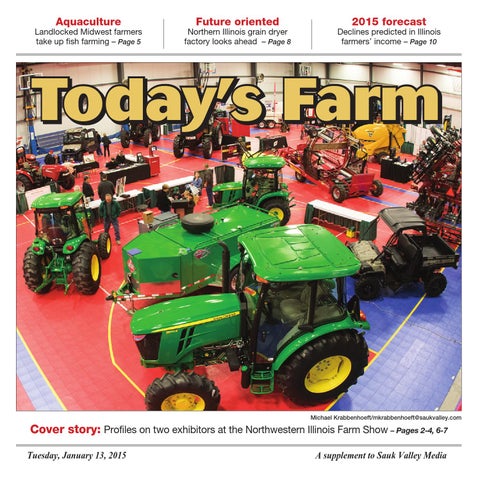
Michael Krabbenhoeft/mkrabbenhoeft@saukvalley.com
Cover story: Profiles on two exhibitors at the Northwestern Illinois Farm Show – Pages 2-4, 6-7 Tuesday, January 13, 2015
A supplement to Sauk Valley Media
Today’s Farm
PAGE 2
Sauk Valley Media • January 13, 2015
EXHIBITOR PROFILE | NORTHWESTERN ILLINOIS FARM SHOW
Wooden barns out; post-frame buildings in Cleary builds many structures for use on farm BY DAVE FOX Special to Today’s Farm
Old wooden barns have dotted the agricultural landscape throughout America practically since the start of farming here. In a multitude of shapes and sizes, the structures were designed according to the needs of the farming operation and, for decades, were built during “barn raisings” lasting a day or two. Farm hands from an entire neighborhood would pitch in with labor until the job was done. Much as farming itself has changed the past few decades, so has the type of building being constructed and used in various ag operations. Matthew Lilly, Oregon branch manager of Cleary Building Corp., said during a recent interview there are a number of reasons for the building changes. Cleary is “a full-line
building supplier of post-frame buildings, and the vast majority of our work is ag-related, Lilly said. “Steel buildings are much more cost-effective than the old wood barns used to be,” Lilly said. “Construction itself is just a lot more costeffective than it used to be. The cost of wood and lumber in the older buildings is astronomical now, especially compared to the lumber used in our buildings. “These buildings now are designed to be more economical and very space efficient,” he said. NEWER POST-FRAME steel buildings can also be much safer than old barns, he said. For example, in the hot summer months, old barns with full hay mows sometimes catch fire because of poor ventilation, along with several other factors. Because of the age of those structures, many times the entire barn will burn beyond repair, resulting in loss of hay and possi-
bly the endangerment of livestock. “Air circulation is designed into our buildings, and ventilation is an important part of any farm structure,” Lilly said. “This is all taken into consideration with
each of our structures. We want to ensure the hay stays dry and safe, and the livestock stays healthy.” Cleary Building Corp. has been in business since 1978, Lilly said, and has had an office in Oregon for 7 or 8 years now.
2514 Johnson St., West Brooklyn, IL Phone 815-628-3121 Fax 815-628-3551 Hrs: Tue-Sat 8am-3pm, Closed Sun & Mon
OOOOO According to independent rating by Bauer Financial
www.gehantbank.com
CLEARY CONTINUED ON 3
We Can Protect the Blank!
®
Over 117 Years of Community Banking Committed to the Next Century of Serving Our Communities
he said, “but all of our buildings are designed, engineered, and built to whatever specs are needed for a particular situation. We work with the farmer to best suit his needs.
I need crop insurance for acres
The most reliable name in the fi fieeld
Gehant Bank
The district office there covers a geographical area from the Wisconsin border south to Interstate 80, and from the Mississippi River east to Interstate 39. A number of building plans are available for a wide range of uses,
1st Farm Credit Services® YO U R
F I R S T
C H O I C E
207 W. 21st Street Rock Falls, IL 61071 (800) 688-3276 1101 Pines Road • Oregon, IL 61061 (800) 388-1061 www.1stfarmcredit.com
Agricultural Financing Crop Insurance Home Loans Appraisals Leasing Agribusiness and More.
Equal Credit Opportunity Lender. Equal Housing Lender. Crop Insurance is available to all qualifying producers regardless of race, color, national origin, gender, religion, age, disability, political beliefs, sexual orientation, and marital or family status.
January 13, 2015 • Sauk Valley Media
Today’s Farm
PAGE 3
Working closely with clients key to success CLEARY
CONTINUED FROM 2
“We don’t have a cookie-cutter building that we just drop on your farm, because every farmer’s needs are different,” Lilly said. Working closely with the client to ensure that exact needs are met is an important part of how the Cleary staff does business, he said. “We can do as much or as little as the customer needs,” he said. “Of course, the more challenging buildings are going to be much more intricate. For example, a milking parlor where there are a lot of cattle moving around, and the need for a clean, dry, warm environment gets
even more complicated because there is also a need for lots of space for waiting cattle and for equipment.” Types of buildings available for farm use include machinery storage, repair shops, cattle sheds, milking parlors, hog confinement sheds, horse arenas with stalls, and a number of other structures. “If you have animals, we can do a building to suit your needs,” he said. In addition to agricultural buildings, Cleary workers can construct a number of commercial and municipal structures. “We’ve also put up fire stations, too, and they get pretty complicated,” Lilly said. “Any commercial buildings have a lot more
code and regulations to deal with, and we have to think more about the variety of needs served by the building itself.” Construction time for most buildings is relatively short. “The length of time depends on the building and also on the weather, but on average, a machineshed kit would hit the ground at the site in about 5 weeks,” Lilly said. “Our building crews are very efficient, and it takes them about 2 weeks to get the whole thing up and done, so a total of about 2 months on average.” All buildings are covered under warranty, as well, although explaining one cover-all warranty would be difficult, according to Dave Fox/Special to Today’s Farm Lilly. John Lloyd (left) and Matt Lilly explain intricacies of Cleary buildings at the Northwestern Illinois Farm Show in Sterling in December. BUILDINGS CONTINUED ON 4
RESIDENTIAL • COMMERCIAL • FARM • INDUSTRIAL
We
er e i es i ludi , b t t l i m d o…
• Sewer Rodding • Sewer Televising & Steaming • Franklin Livestock Waterers • Site Plumbing • Backflow Prevention & Maintenance • Garbage Disposals • Bathroom Remodels • Drainfields & Septics • Backhoe • Boilers • Furnaces • Air Conditioning • KOHLER Products • Water Heaters • Goulds Jet Pumps • Submersible Water Pumps • Sump Pumps • ewage Pumps • Sewer Linee Repairs • Water Service Repairs • Underground Boring
HARDEN’S REPAIR
Specializing in heavy duty truck and trailer repairs of all types for 29 years.
FOR ALL YOUR AGRICULTURAL REPAIR NEEDS
LOOKING FOR ALITTLE MORE HORSEPOWER?
607 Willett Ave., Dixon • 815-284-4435 TRACTOR RADIATORS & AGRICULTURAL CHARGE AIR COOLERS
IF IT HAS A RADIATOR, WE CAN GET IT. RESIDENTIAL • COMMERCIAL • FARM • INDUSTRIAL IL Licensed 058-061599
Family owned and operated since 1967!
502 IL Rt. 2, Dixon • 815-284-2044
BOBCAT RADIATORS • AG RADIATORS CHARGE AIR COOLERS
TRUCK, AG, INDUSTRIAL
“Great Deals, Great Service, Since 1926”
Rt. 52 N. Sublette, IL Ph. 815/849-5232 or 1-800-227-5203 After 6, 849-5251
WWW.VAESSENBROTHERS.COM
Today’s Farm
PAGE 4
Sauk Valley Media • January 13, 2015
Farmers expect the job to be done right BUILDINGS
CONTINUED FROM 3
“The warranties are complicated due to the many different facets involved, but generally workmanship is for a year, and the paint on the steel is good for 35 years, and then there are other aspects, too,” he said. Enjoying every part of his work, Lilly said there
are several things he really likes about the agricultural aspect. “Most farms are generational, so when a farmer does a new building or a new roof, he doesn’t want the next generation or two to have to re-do it,” he said. “He doesn’t want them to have to mess with anything he’s done. He wants it to be there, and to be done right so that the
‘‘
Most farms are generational, so when a farmer does a new building or a new roof, he doesn’t want the next generaiton or two to have to re-do it. He doesn’t want them to have to mess with anything he’s done. He wants it to be there, and to be done right. ... Matthew Lilly
others later on can focus on crops, equipment and
A GREAT WAY TO GET AROUND! GOLF CARTS
’’
livestock instead of the buildings, so it’s really
satisfying being able to help them with buildings like that where there won’t be any worries later on. “Farmers are generally down-to-earth people who know what they want, and I really enjoy talking with them, finding out exactly what they want, and how I can provide it so they can focus on making money for the farm,” he said.
Cleary Building Corp. www.clearybuilding. com 1010 W. Pines Road, Oregon IL 61061 Phone: 815-732-9101 Matthew Lilly, branch manager mlilly@clearybuilding. com Cell phone: 815-9733994 Corporate headquarters: 190 Paoli St., Verona, WI 53593 Phone: 800-373-5550
rve Call to rese r te in w r you ace storage sp
NEW & USED SALES & SERVICE
Check out our accessories…
Tires, Brush Guard, Cargo Box, Windshields, Seat Belts, Plows, Back Seats, Stereos, & More! Layaway, Financing & Delivery Available!
610 River Lane, Dixon 815.285.3481 www.razorcarts.com
RENT TO OWN! NO CREDIT CHECK!
MONTHLY PAYMENTS AS LOW AS $66 9x12 Metal Budget Series for $1,495* 10x16 Cedar Cottage Shed for $2,795*
10x16 Cedar or Metal Side Lofted Barn for $2995* Victorian Play House for $1,474*
* +tax
Portable Garage Treated Cedar Barn
FREE LOCAL DELIVERY and PLACEMENT (a $200 value!)
Dixon Barn Yard 610 River Lane, Dixon • 815.285.3481 (Ask for Tasha)
Victorian Play Houses Chicken Coops Available
Located at
Alton Irrigation, Inc. 8096 Luther Road Rock Falls, IL 61071
(815)438-2730
Today’s Farm
January 13, 2015 • Sauk Valley Media
PAGE 5
AG TRENDS
Fish farming reaches landlocked Midwest U.S. farmers begin to adopt aquaculture
tomatoes commercially. About a year ago, they built a warehouse with 18 tanks to produce about 140,000 pounds of barramundi a year. “We’re in a developing urban area, so finding ground to continue our row crop operation and to keep it sustainable was a challenge,” Garwood said. “So, we began looking out for other ways we could stay in agriculture.”
BY MARGERY A. BECK The Associated Press
O
MAHA, Nebraska – The latest of five generations who have worked the same ground in northeastern Nebraska, 52-year-old Scott Garwood, isn’t growing corn or cattle – it’s fish. Specifically, thousands of an Australian freshwater species called barramundi – often dubbed Asian sea bass because of its similar sweet, white flaky flesh – in large tanks inside a warehouse. With global consumption of seafood outpacing wild fish populations, many have turned from roving the world’s waters to aquaculture, using coastal net pens or ponds to raise freshwater and saltwater species. But the emerging trend of indoor aquaculture is bringing the surf to America’s turf. Farmers are increasingly embracing the practice as a way to stay in agriculture and participate in what’s billed as “green” food production, with virtually no chance of their fish spreading disease or genetic mutation into the wild. AND SUCH TANK systems can be placed almost anywhere – from Minnesota to Florida – because temperature and water quality can be controlled. Moreover, there’s a market for these landgrown fish. The U.S. imports more than 90 percent of the 4.5 bil-
AP
Scott Garwood of Cardinal Farms returns to the fish tank Asian sea bass called barramundi in Dakota City, Nebraska, last month. Farmers in the Midwest are increasingly turning to land-based, indoor fish farms to grow everything from freshwater trout to Atlantic salmon and sea bass.
‘‘
There is a need for marine aquaculture so we can leave the wild stock alone so they can recover. We don’t hunt and gather chickens or cows. Why do we still do it for fish? Yonathan Zohar, University of Maryland
lion pounds of seafood it consumes a year. Globally, aquaculture supplies more than 50 percent of all seafood produced for human consumption, but only a fraction comes from the United States, according to the National Oceanic and Atmospheric Administration Fisheries. Even less is known about how much the U.S. produces in indoor tanks.
’’
“I’m afraid to tell you, the U.S. is way behind the rest of the world in terms of developing aquaculture or keeping up with production of aquaculture,” says Dr. Yonathan Zohar, chairman of the Department of Marine Biotechnology at the University of Maryland. “If you look at the U.S. production numbers, it’s mostly catfish – which is a good
industry, but we need to be looking at some of the marine species we’ve been running out of.” Some critics have suggested that the tanks – sometimes called closed containment systems – could be susceptible to catastrophic losses in the event of a power and backup generator outage. But Zohar, whose life work is in aquaculture, says the advantages outweigh “what-if” scenarios. Land-based tank fish farming nearly eliminates fish manure runoff and water waste through use of water recirculating and treatment systems, he noted. “This technology lets us ... raise fish in a very clean environment,
very optimized for their health,” said Steven Summerfelt, who is the director of The Conservation Fund’s Freshwater Institute in West Virginia. “It’s free from disease. We haven’t used antibiotics, pesticides, anything, to treat the water or the fish for over a decade, because we keep the diseases out.” Summerfelt had assumed those factors would drive the demand for tank-raised fish, but found, “What consumers really love is that it’s locally grown.” Garwood and his father first branched out from row crops and livestock about 10 years ago, building a quarter-acre greenhouse to grow
WITHIN THE NEXT 2 years, Garwood hopes to expand to 48 tanks and become part of a fish producing cooperative with other Midwest fish farms – including Iowa’s First. The central Iowa fishery recently paired with VeroBlue Farms to build an indoor operation expected to produce 4 million pounds of fish annually by 2017, VeroBlue President Keith Driver said. VeroBlue and other U.S. fish farms currently import fry – recently hatched fish about a quarter-inch long – from a fish hatchery in Australia. They nurture the fish to about 2 to 21⁄2 pounds for market. “As you can imagine, you can bring over a lot of little quarter-inch fish relatively cheap,” Driver said. “You need to hit a really big volume before it makes sense to put in your own hatchery and duplicate all that work.” Zohar and others say growing the world’s food fish in tanks is no passing fad. “There is a need for marine aquaculture so we can leave the wild stock alone so they can recover,” Zohar said. “We don’t hunt and gather chickens or cows. Why do we still do it for fish?”
Today’s Farm
PAGE 6
Sauk Valley Media • January 13, 2015
EXHIBITOR PROFILE | NORTHWESTERN ILLINOIS FARM SHOW
Technology maximizes production potential Crop IMS gives farmers benefit of ag-specific data, information BY DAVE FOX Special to Today’s Farm
Frank Tipton is a firm believer in combining field intelligence, technology, equipment, and data analysis in a way that helps farmers maximize their potential in all areas of agriculture. Tipton, who lives in Thomson, is a precision agriculture hardware sales person with Crop IMS (Information Management Services), and works from the company’s Milledgeville office.
“Technology is no different in agriculture than it is in your home PC,” Tipton said during a recent interview. “It just goes forward much quicker.” Using a blend of ag-specific technology to maximize profits for farmers, Crop IMS has 18 full-time employees in its tech department. The company is spread between western Kentucky and Stevens Point, Wisconsin. “From your field to your computer, and everything in between, Crop IMS provides the perfect marriage of data collection and management with precision agricultural technology,” according to the company’s website.
“It’s vitally important for a grower to make sure they have the hardware they need to get their work done,” Tipton said. “They need to communicate what they want to do, now and in the future, with their hardware supplier so they have the right equipment. We can then make it work in the best possible way for them,” he said. Using on-board computer systems, GPS technology, yield monitors, Wi-Fi, and other technology and services, farmers can maximize use of their seed in the spring to avoid seed loss, and can even manage fertilizer applications down to a one-fourth inch precision to avoid the loss of
soil nutrients and ensure the right amount of chemicals are directed at seeds as they are planted and during the growing season. “We sell, install, and calibrate the grower’s equipment, and we do it in a way that the equipment is in the grower’s comfort zone,” Tipton said. “The farmer has to be able to understand and use it all properly for maximum results. “The tech equipment gives the grower a report card on what they are growing. It’s an efficiency tool, and for it to work best, we can build on it from one year to the next.” CROP IMS CONTINUED ON 7
www.FarmersNationalBank.com Dave Fox/Special to Today’s Farm
Frank Tipton of Thomson speaks with customers about Crop IMS (Information Management Services) at the annual Northwestern Illinois Farm Show in Sterling in December. Use of information, technology and equipment in harmony can produce better yields and results for farmers at reduced expenses. • 67.04 acres, Bureau County 0/ e • 80 acres, 66 tillable, Ogle County 9 0/ e • 115.6 acres, 87 tillable, Whiteside County • 266 acres, 236 tillable, Whiteside County • 180,000 bushel grain storage, scale & scale house 0, 0
RE/MAX Sauk Valley 815-631-8550 cell 815-284-4663
NorthernIllinoisFarms.com
Harry’s Farm Tire, Inc.
Geneseo • Prophetstown • Morrison Garett Plumley, Mike Urish, Doug Vanderlaan, Steve Taets, Bill Dale Farmers National Bank Ag Lenders Garett Plumley, Mike Urish, Doug Vanderlaan, Steve Taets, Bill Dale
“Serving the area for over 30 years”
16262 WALLER RD (RT 84) FULTON, IL.
309-887-4447 ON-FARM SERVICE • RIMS AND WHEELS • SEMI TRACTOR TRAILER • FARM & IMPLEMENT TIRES ALL MAJOR BRANDS Firestone, Titan, Goodyear, Michelin, BF Goodrich, General, Bridgestone, Cooper, Uniroyal, Multi-Mile, Michelin, Bandag and Recaps STOP IN OR CALL FOR PRICES
• Ag is “what we do” and “who we are” • Ranked each year in the top 100 Ag Banks in the Nation • Access to $8,000,000 per farm customer • Call one of our Ag Lenders today! (309) 944-0580 Geneseo, IL
(815) 537-2348 Prophetstown, IL
(815) 772-3700 Morrison, IL
Serving Northwest Illinois For 112 Years
January 13, 2015 • Sauk Valley Media
Today’s Farm
PAGE 7
System helps farmers adjust seeding and fertilizer CROP IMS
CONTINUED FROM 6
For example, a yield monitor can be used with Wi-Fi and a “cloud” (the electronic storage kind), so that the farmer can compile data and learn from comparison reports one year to the next. “It’s an ideal tool for them to learn and benefit from, so they can maximize their own individual productivity and time savings,” Tipton said. The yield monitor is placed in the combine during harvest. It can be combined with GPS technology, a flow sensor, moisture sensor, and other such tools. “Then we calibrate it, and we map the variability across the field,” he said. “We can then take that map, and compare it with a similar planting map, and then we can examine soil types in a particular field according to Google
Dave Fox/ Special to Today’s Farm
GPS can be used in conjunction with Repeatable RTK (real-time kinetics) in the field to control the flow of seed during planting season so seed is not being planted in waterways or other areas where production would be reduced. Earth, and we can see the differing results across the field. “This sort of thing really helps to see strengths and weaknesses in how things were done in a given year, which, in turn, makes it much easier to adjust for the next year,” he said. Standard GPS can provide 8-inch to 10-inch
accuracy across the field during cultivation, he said. A newer GPS service known as “repeatable RTK [real time kinetic]” can provide up to onefourth of an inch accuracy on seeding and fertilizer applications. “With the repeatable service, we can do a fertilizer app this fall, and then plant next spring along that exact same path, along the exact same line where the fertilizer was put down,” he said. Tipton emphasized the need for “repeatable” GPS in order to be that accurate. “With standard GPS, you might have one fencepost or marker as a reference point,” he said. “But then, what do you do if the ground has shifted that one point slightly during the winter? It might not be totally accurate.” One company, My Way RTK, “has set up 80 base stations in Illinois, about 20 miles apart, which gives
you a much more stationary reference system, which is a whole lot more accurate,” Tipton said. Another system that improves yields and profits is known as a row clutch. “Overlap in planting is a bad deterrent to getting the best possible yields,” Tipton said. “We put a row clutch on the planter that will shut off certain rows that have already been planted, such as when the grower is making turns in the field and so forth,” he said. “There’s no point in wasting seed.” Sensors are “vitally important as well,” he said. “We have sensors that
we use to assist with fertilizer apps, that can sense different shades of green in the plants, and
can adjust the fertilizers accordingly,” Tipton said. Many other technologies are available to increase productivity and reduce waste, and Crop IMS can deal with many of them and maximize the farmer’s productivity in many ways. “With 20 years in technology, I’ve seen a lot of companies come and go, but Crop IMS seems to just keep growing and getting better. Growers need to buy from, and deal with, companies that can address their specific issues, and companies that will be there for years to come, to address their needs. “For me, that’s what it’s all about,” Tipton said.
Today’s Farm celebrates agriculture in the Sauk Valley and beyond. It is published by Sauk Valley Media six times a year – in January, March, May, July, September and November. We welcome story ideas about interesting local people who are involved with agriculture. Call Jim Dunn at 800-798-4085, ext. 5511, or send an email to jdunn@saukvalley.com.
typed in Cosmos extra bold
typed in Cosmos extra bold
Crop IMS (Information Management Services) Specializing in hardware and technology for increased efficiency and profitability in farming www.cropims.com Frank Tipton, Precision Ag Hardware Sales, Thomson 815-590-8206 ftipton@cropims.com Brent Rains, Illinois Consultant Unit Manager, Collinsville 618-407-6184 rainsb@cropims.com
Today’s Farm
PAGE 8
Sauk Valley Media • January 13, 2015
AGRIBUSINESS | MATHEWS CO.
Grain dryer factory builds for the future Illinois company keeping up with changing times BY ALLISON GOODRICH Shaw Media agoodrich@shawmedia.com
CRYSTAL LAKE – A lot has changed since Judy Sedlack was visiting her father’s business as a teenager, playing with the nuts and bolts of the agricultural equipment manufactured there. She recalled the memory years later, sitting in a board room discussing the 60th anniversary of Mathews Co., the familyowned grain dryer manufacturing business her father started in 1954. “We got a taste of this business at a pretty young age,” Sedlack said, referring to herself and her brother, David Mathews. “Dad was an inventor,
a very forward-thinking man.” What started as a small operation with 30 employees, Mathews Co., 500 Industrial Ave., Crystal Lake, has evolved into a global manufacturer with nearly 100 employees, making products equipped for the 21st century. Sedlack said she and her brother, both co-owners, took over when their father died in 1983. Over the past 10 years, she said, the reins gradually have been turning over to Sedlack’s children – Deb Batterham and Jeff Sedlack, who also are both co-owners and on the board of directors. Touting a 2-year-old mantra, “Building for the Future,” Batterham said the 60-year-old company has undergone several changes in recent years in order to keep up with changing times.
Big enough to serve you, small enough to know you u.
ELEVATOR • TRUCKING • FERTILIZER • SEED Rochelle 815-562-8723 Amboy/Lee Center 815-857-3523 / 3521 ww www ww.maplehurstfarms.com
She attributed those advances largely to company president Joseph Shulfer. Shulfer said since he began with the company, improvements in aspects of the equipments’ capacity and control were some of the necessary changes as technology has reshaped the agricultural landscape. “When I started a little over 5 years ago, those were kind of our two main initiatives – capacity and control,” he said. “Since then, we’ve completely redesigned our 10-foot tower dryers and our 12-foot dryers to make them more accurately achieve those capacities.” MATTHEWS CONTINUED ON 9
Photo submitted
Mathews Co. employee Chris Schultz works to install a high-voltage cabinet on a grain dryer at the Crystal Lake facility.
GOING ON VACATION? Keep in touch with the news of the Sauk Valley
Today’s Farm
January 13, 2015 • Sauk Valley Media
PAGE 9
Drying system refined to handle hybrid crops “M-C Trax is a remote system so you can monitor your dryer anywhere as long as you have an Internet connection,” Shulfer said. “I would say about 75 to 80 percent of our customers will add that on to their machine.” Looking ahead, Shulfer and Batterham said several projects were slated for the future, but neither gave specifics.
One aspect Sedlack hopes won’t change, though, is Mathews Co. being a family-owned business. She described the moment her two kids decided to be part of the company as “pivotal” – the family succession, she added, instills confidence in customers. “I see the grandkids coming into the business, but I always
encourage them, as I did my children, to get other jobs before coming here because it’s good to get a perspective on how others do business,” she said, adding her expectations for the company’s future are high. “I have every confidence this company is going to continue to grow at the rate it has been, and probably even at an accelerated rate.”
LIVE UNITED Photo submitted
Mathews Co. employee Manny Ramirez assembles a discharge sweep in a drying unit at the family-owned facility in Crystal Lake. The company is celebrating its 60th year.
MATTHEWS
CONTINUED FROM 8
Now that hybrid crops are becoming more common, Shulfer said, the way in which those grains dry has changed, too.
“You have to tweak your specs over time as those varieties evolve, and we’ve done that, and we’ve been very successful so far,” he said. On the control side, Shulfer said the machine’s new touchscreen control panels
D g Dreaming
are you
look entirely different than the ones Sedlack fiddled with as a teenager. And with a system developed in the past few years, clients can monitor their Mathews Co. products from anywhere in the world.
of a new
Kitchen or Bath?
We’ll help re-design your kitchen to your unique style & needs and keep your costs down.
FREE DESIGNS BY
Jocelyn Lilly, Kitchen Design: 815-266-1354
Bring the Beauty of StarMark into Your Home. Ask about our
FREE Upgrade Specials
MILLEDGEVILLE DO-IT-BEST HOME CENTER Free Estimates • Free Measuring • Free Delivery Railroad and Cochran Streets Milledgeville, IL (800) 788-7677 toll free
United Way of Whiteside County is reaching out to the farming community to participate in the annual fund raising campaign. By working with local elevators all across the county, United Way is providing an easy way for farmers to support the campaign by simply designating a small amount of grain as a donation whenever they deliver it to local elevators. United Way of Whiteside County is a local, independent organization which works to support 19 local nonprofit agencies and programs providing health and human services to our friends, neighbors, co-workers and relatives. 99 percent of everything raised in Whiteside County stays in Whiteside County. Just one percent of what is collected is paid to United Way Worldwide in order to use the logo and take advantage of training opportunities at no cost.
Together, we get results no one could accomplish alone. That’s what it means to LIVE UNITED.
United Way of Whiteside County
P.O. Box 806 Sterling, IL 61081-0806 (815) 625-7973 www.uwwhiteside.org
Today’s Farm
PAGE 10
Sauk Valley Media • January 13, 2015
2015 FORECAST
Declines predicted in Illinois farm income Ag economists review options for farmers BY DON DODSON Tribune News Service
CHAMPAIGN – Illinois grain farmers will likely need to cut their expenditures in 2015, with University of Illinois agricultural economists projecting sharply lower farm income for the 2014-15 and 2015-16 marketing years. Net income per farm has averaged well over $100,000 in each of the four previous years, falling to $127,000 in 2013 after reaching a high of about $300,000 in 2012. But net incomes for the current marketing year – which began Sept. 1 and runs through Aug. 31, 2015 – are projected to average well below $100,000 per farm, said UI ag economist Gary Schnitkey. Projections of net income for grain farms the next year are even lower. Farmers are left with four options. They can
cut back on purchases of new machinery, look for ways to slash seed and fertilizer costs, negotiate a lower cash rent, or examine family living expenses to see where cuts can be made, Schnitkey said. Sharply lower prices for corn and soybeans in 2014 resulted in big drops in gross farm revenue. On average, gross revenue was sufficient to cover a farmer’s nonland costs – such as fertilizer, seed, pesticides and machinery depreciation – but it wasn’t enough to also cover cash rents paid to farm someone else’s land. “IN MANY CASES, cash rents need to be lowered,” Schnitkey said. If rents can’t be lowered, it may no longer be prudent to farm that land, he said. The average cash rent in Champaign County in 2014 was $253 an acre, according to the U.S. Department of Agriculture. Averages for other area counties included $283 an acre in Vermilion County, $294 an acre in • FARM • VEHICLE • CROP
• HAIL • PROPERTY • HEALTH
• LIFE • COMMERCIAL
‘‘
The more likely outcome is a series of positive and negative runs of varying but shorter lengths [regarding prospects for corn and bean prices].
’’
Darrel Good, agricultural economist
Douglas County, and $303 an acre in Piatt County. Schnitkey and colleagues from the UI College of Agricultural, Consumer and Environmental Sciences discussed the market during the annual Illinois Farm Economics Summit held recently at the I Hotel and Conference Center in Champaign. Similar presentations were made in DeKalb, Peoria, Springfield and Mount Vernon. Farmers got a glimpse of where corn and soybean prices may go in the coming year from agricultural economist Darrel Good.
Corn prices, which are averaging close to $3.50 a bushel this marketing year, are expected to rebound to the low- to mid-$4 range next year, if production declines as expected, he said. Good noted that the U.S. has had two consecutive record-large corn crops and said a much smaller crop is expected next year. As a result of recent production, U.S. corn stocks were expected to end the year at a 10-year high, he said. Soybean prices, which are expected to average nearly $10 a bushel this
marketing year, are projected to fall to the upper $9 range during the 201516 marketing year, he said. This year’s bumper crop of beans was expected to boost the nation’s soybean stocks to an 8-year high. South America also had a record-large soybean crop. Despite the glut, soybean prices didn’t fall as much as corn prices did, largely because China has shown strong demand for soybeans. Discussing long-term prospects for corn and soybean prices, Good and his colleagues said it’s unlikely that either crop will enjoy another long run of above-average prices, as was the case a few years ago. But it’s also unlikely they’ll have a long run of belowaverage prices. “The more likely outcome is a series of positive and negative runs of varying but shorter
P
eabudy’s Inc.
MANUFACTURER OF HIGH PERFORMANCE FERTILIZER APPLICATION EQUIPMENT
IT’S THAT TIME OF YEAR AGAIN Mickley Insurance Agency
Sandrock Insurance Agency Greg Sandrock, Drew Emery, Tyler Sandrock 107 Main St., Tampico 815-438-3923 sanins@essex1.com
www.2cornerstone.com
www.DaltonAg.com 800-342-7498
602 E.Van Buren - Lenox,Iowa 50851 Office@DaltonAg.com Serving farming families for 19 years
B SU
TE MECHANI LET CA
SHO OP:
815-849-55223
L
Todd Mickley, Luke Sandrock, Gerald Widolff 102 W. Main St., Morrison 815-772-2793 ToddMickley@2cornerstone.com
Contact your Dalton Ag equipment specialist at Peabudy’s Inc.for all of your fertilizer application equipment needs.
CELLL:
815-994-7543
www.sublettemechanicalequipment.com
lengths,” they said in an analysis written for the summit. In other projections, Good said: Wheat prices may go up a bit in the coming year. The average price for the 2014 wheat crop is expected to be about $5 a bushel, and he looks for the price to rise to about $5.50 a bushel in 2015. The rest of the world had back-to-back large wheat crops in 2013 and 2014. Hog prices are likely to go down. The average price of hogs was about $64 in 2013 and $76 in 2014, but it’s expected to fall to $65 in 2015, with the highest prices being paid in the first half of the year. Cattle prices may drift upward. They averaged about $155 in 2014 and are projected to average about $160 in 2015, with the highest prices again being paid early in the year.
Today’s Farm
January 13, 2015 • Sauk Valley Media
PAGE 11
SUSTAINABLE DIETS
Some farmers irked by eating guide ideas Environmental impact might be considered BY MARY CLARE JALONICK The Associated Press
WASHINGTON – The government issues dietary guidelines every 5 years to encourage Americans to eat healthier. This year’s version may look at what is healthy for the environment, too. A new focus on the environment would mean asking people to choose more fruits, vegetables, nuts, whole grains and other plant-based foods – possibly at the expense of meat. The beef and agriculture industries are crying foul, saying an environmental agenda has no place in what has always been a practical blueprint for a healthy lifestyle. An advisory panel to the Agriculture and Health and Human Services Departments has been discussing the idea of sustainability in public meetings, indicating that its recommendations, expected this month, may address the environment. The two departments will take those recommendations into account as they craft the final dietary
AP
Cattle eat in a feedlot in O’Brien, Florida, in a 2013 file photo. Dietary guidelines released by the government every 5 years lay out recommendations for healthy eating. The next version may look at what is healthy for the environment, too. The idea of looking at how food is grown – not just how it is eaten – has already provoked outrage from the agriculture and food industries and even Congress. guidelines, expected by the end of the year. The guidelines are the basis for USDA’s “My Plate” icon that replaced the well-known food pyramid in 2010 and is designed to help Americans with healthy eating. The guidelines will also be integrated into school lunch meal patterns and other federal eating programs. A draft recommendation circulated by the
advisory committee in December said a sustainable diet helps ensure food access for both the current population and future generations. A dietary pattern higher in plant-based foods and lower in animal-based foods is “more health promoting and is associated with lesser environmental impact than is the current average U.S. diet,” the draft said. That appears to take at
Snowblowers, Chainsaws & More!
AG TECH
401 E 4TH ST, MILLEDGEVILLE 815-225-7846
least partial aim at the beef industry. A study by the journal Proceedings
of the National Academy of Sciences last year said raising beef for the American dinner table is more harmful to the environment than other meat industries such as pork and chicken. The study said that compared with other popular animal proteins, beef produces more heattrapping gases per calorie, puts out more waterpolluting nitrogen, takes more water for irrigation, and uses more land. As the advisory committee has discussed the idea, doctors and academics on the panel have framed sustainability in terms of conserving food resources and also what are the healthiest foods. There is “compatibility and overlap” between what’s good for health and good for the environment, the panel has said. The meat industry has fought for years to ensure that the dietary guide-
lines do not call for eating less meat. The guidelines now recommend eating lean meats instead of reducing meat altogether, advice that the current advisory committee has debated. A draft discussed at the panel’s Dec. 15 meeting says a healthy dietary pattern includes fewer “red and processed meats” than are currently consumed. After that meeting, the National Cattlemen’s Beef Association sent out a statement by doctor and cattle producer Richard Thorpe calling the committee biased and the draft meat recommendations absurd. He said lean beef has a role in healthy diets. The American Meat Institute issued comments calling any attempt to take lean meat out of a healthy dietary pattern “stunning” and “arbitrary.” Objections are coming from Congress, too.
Proud To Serve The American Farmer The First National Bank in Amboy Where you come first. 4 Locations in Amboy & Dixon
800-216-0008
www.fnbamboy.com
Today’s Farm
PAGE 12
Sauk Valley Media • January 13, 2015
Providing insurance coverage for local homes and farms since 1869
Adami Insurance Agency 712 First Avenue, Rock Falls 815-625-6220 meagan@wmccinc.com
Hugh F. Miller Insurance Agency, Inc.
First State Insurance 385 Chicago Rd, Paw Paw 815-627-8552 gsaf74@yahoo.com
Kirchhofer Insurance Store
801 First Avenue, Rock Falls 815-626-1300 hughmillerinsurance.com
102 N. Elm, Franklin Grove 815-456-2319 fferinsurance.com kirchhoff
Sauk Valley Insurance Services
Miller Insurance Group
Cornerstone Insurance Agency
Amboy 102 W. Main, 815-857-2125 Morrison ffelmanassoc@comcast.net lisa.leff 815-772-7782 lsandrock@2cornerstone.com LaMoille 815-638-2171 ffelmanassoc.com linda@leff
Mel Saad Agency 928 8th Avenue, Erie 309-659-2470 saad@mchsi.com
109 6th Street, Dixon 815-288-2541 www.saukvalleyinsurance.com
427 N. Main Street, Rochelle 815-561-9911
VanderVinne Agency
Schuneman-Hanford Insurance Agency
Query Insurance Agency, Inc.
127 E. Main St. Morrison 815-772-8900 angievandervinne@yahoo.com
312 Washington St, Prophetstown (815) 537.2301 www.hanford-ins.com
B V-A
330 May Mart rt Drive, Rochelle 815-562-4152 mail@queryinsurance.com
Leffelman & Associates
tte Sublett 815-849-5219 ffelmanassoc.com chris@leff
Baylor Insurance Agency Lee Center 815-857-2716 rbaylor1@gmail.com
BRADFORD VICTOR-ADAMS
We also test Row Meters!
MUTUAL INSURANCE COMPANY Member Owned and Operated
Our Contact Information 120 W. South Street, Franklin Grove 815-456-2334 www.bradfordmutual.com
Polo 928 S. Division 815-946-2393
www.birkeys.com
Prophetstown 200 North Street 815-537-2304