Livin’ the dream
Vocational ag teacher does what she was meant to do – Page 2
Ag trends
Women in agriculture no longer a rarity, or a stereotype – Page 4
Farm issues
Changing legislative landscape ahead for agriculture – Page 9
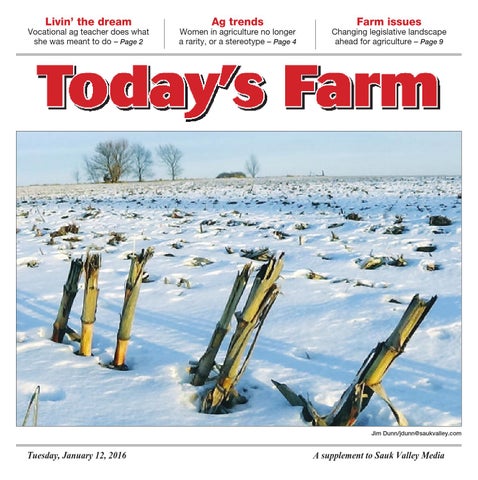
Jim Dunn/jdunn@saukvalley.com
Tuesday, January 12, 2016
A supplement to Sauk Valley Media
Today’s Farm
PAGE 2
Sauk Valley Media • January 12, 2016
AGRICULTURAL EDUCATION
Living the dream with vocational agriculture
‘‘
This award encompasses what it means to be an agriculture teacher. Donna Page
’’
Philip Marruffo/pmarruffo@saukvalley.com
Donna Page said she had wanted to teach agriculture since she was a kid. “I plan to be an agriculture teacher until I die or retire,” she said.
Ag teacher doing what she was meant to do BY JERMAINE PIGEE jpigee@saukvalley.com 815-625-3600, ext. 5525
Donna Page has known since she was a teenager what she wanted to do with her life. “I knew I wanted to be an agriculture teacher, because I wanted to share my passion with students,” said Page, who teaches at Rochelle Township High School. “By having this career and doing this job and having this passion, it allowed me to combine all of the things I love.” And clearly she’s good at what she does, having earned the Illinois Association of Vocational Agriculture Teachers’ Excellence in Teaching Award on Aug. 18 at the Illinois State Fair. Page was one of five district winners competing for the honor. She and dis-
trict Superintendent Jamie Craven were interviewed before the announcement was made. “This award encompasses what it means to be an agriculture teacher,” said Page, 33. “I have students that come in and not know anything about agriculture. If I can teach them something that is beneficial to them, I’ve done my job.” Kara Thomas, an 18-year-old senior at RTHS, saw Page win the award firsthand. “She thought someone else was getting the award,” Thomas said. “They said her name and I started freaking out. Her jaw dropped, and it was fantastic.” Page said she was humbled and surprised to win the award. “Agriculture is the number one industry in Illi-
nois and one of the top industries in the United States,” she said. “Getting students to understand that agriculture is important is an important aspect of my job.” Page grew up on a grain and cattle farm in downstate Pinckneyville and moved north to begin her career after graduating from Southern Illinois University at Carbondale in 2004. She received her degree in general agriculture, with a specialization in agriculture education. “It was only natural for me to take agriculture classes,” Page said. “I saw the benefits of ag education.” She was hired by RTHS right out of college 11 years ago, and has been teaching ag ever since. TEACHER CONTINUED ON 3
114 West Third Street PO Box 157 Prophetstown, IL 61277 815-537-2348
700 US Highway 6 East PO Box 180 Geneseo, IL 61254 309-944-0580
1100 East Lincolnway PO Box 230 Morrison, IL 61270 815-772-3700
Today’s Farm
January 12, 2016 • Sauk Valley Media
PAGE 3
She teaches agriculture and life lessons, too TEACHER
CONTINUED FROM 2
“I plan to stay in agriculture going forward,” Page said. “I don’t see myself ever getting out of agriculture. I plan to be an agriculture teacher until I die or retire.” Some of Page’s students are thrilled to have her as a teacher. “She doesn’t just teach
Photos by Philip Marruffo/pmarruffo@saukvalley.com
ABOVE: Andrew Myers, a junior at Rochelle Township High School, trims a plant with FFA teacher Donna Page inside the greenhouse. Page received the Illinois Association of Vocational Agriculture Teachers’ Excellence in Teaching Award. BELOW: Kara Thomas, a senior, waters the class’s poinsettias as teacher Donna Page looks on.
Lee Co: 38 +/- acres in excellent location between Dixon & Sterling. $9,000/acre Jo Daviess Co: 173 +/- acres. Excellent hunting w/barn, large garage & ½ mi exclusive access to Apple River. Jo Daviess Co: 160 +/- acres. Excellent hunting & timber, 4BR farmhouse & outbuilding w/apartment. Ogle Co: 182 Ac, Excellent location off Sterling & Unity Rds. Class A Farm SOLD! Ogle Co: 80 Ac, Eagle Point Twp, excellent soils & mostly tillable. SOLD!
We Have Buyers - We Need Land!
Matt Hermes, Broker
Specializing in Farm Sales & Management
Galen na, Dixon 1254 N. Galena, 815-288-44648 815-288-4648
‘‘
This is a class that I actually learn something ... that I will use.
’’
Andrew Myers
you about agriculture in general,” Thomas said. “She teaches you life lessons as well. I probably
would not have broken out of my shy, quiet shell if it wasn’t for her pushing me to join Future Farmers of America.” Andrew Myers, a 16-year-old junior at the school, said he is able to get something from her class. “This is a class that I actually learn something,” he said. “I’m actually able to learn something that I will use.”
Today’s Farm
PAGE 4
Sauk Valley Media • January 12, 2016
AGRICULTURAL TRENDS
Equity on the farm long since a fact of life Women in agriculture are no longer a rarity, or a stereotype BY KATHLEEN A. SCHULTZ kschultz@saukvalley.com 815-625-3600, ext. 5535
It’s a familiar image: The farm wife in the slightly worn cotton dress, drying her hands on her apron as she turns from the sink/stove/table with a warm but equally worn smile, heads out the door and onto the porch to call the kids/husband/farmhands in for breakfast/ lunch/supper. Familiar, yes, but far, far, from the truth. For 30 years now, “farm wives” have been evolving well beyond the perception that their primary function is to cook, clean and keep the home fires burning. They’re also accountants, procurement officers, combine drivers, mechanics, vets ... equal partners in the business of keeping the family farm afloat and, often, promoting the industry in general. And more and more, they’re also the boss. The USDA’s Economic Research Service released a report in April 2013 that showed that the share of women farmers nationwide nearly tripled, from 5 percent in 1978, the year the Census of Agriculture began asking for gender data on principal operators, to 14 percent in 2007. By 2012, 288,264 women were principal operators. Toss in secondary operators, and the number jumps to 969,672 female farmers, 30 percent of all farmers nationwide. (Most secondary opera-
tors, about 96 percent, work alongside a male principal, usually their husbands, data show.) In Illinois, there are 24,265 women farmers. That’s 23 percent of all farmers in the state, helping work nearly 6 million acres with a yearly economic impact of nearly $374 million. About 6,900 are principal operators – the person making the
‘‘
I think as women we just have to have the confidence in ourselves, that we can pursue the same areas that men do, and that we have the same knowledge and experience that they do behind us.
’’
Rachel Vaessen
day-to-day decisions. In Iowa, 32,167 women, 25 percent of all farmers, work 9.1 million acres that bring $474 million to the state each year. More than 7,100 are principal operators. In general, the women who run farms nationwide are older than their male counterparts, and most of the farms they run are smaller – 78 percent have sales of less than $10,000. And the number of younger women entering farming is higher than the number of older
women leaving the field, data show. These days, though, not all women in agriculture are looking at life on the farm. Rachel Vaessen of Sublette is a 20-year-old crop sciences major at the University of Illinois. She grew up watching her grandparents, Louie and Carol Vaessen, run the family’s centennial farm in Sublette – Carol, a lifelong farm wife, always pitching in, sometimes even hauling grain to the elevator during harvest, among many other responsibilities. Their son, her father, Michael Vaessen, owns and operates Sublette Mechanical, a farm machinery repair shop where her mother, Carol, also works, and where Rachel helped out as a teen. He and his two brothers still work the farm as well. Rachel has known for a while that agriculture is in her future, although she won’t be taking the traditional farm wife’s path. She plans to become an agronomist for a major ag company after graduation. “I joined FFA in high school, ... that’s where my passion for the ag field evolved,” she said. And although she plans to return to Sublette, “I don’t necessarily need to live on the farm” to pursue her career. She was pleasantly surprised to find the numbers of men and women studying crop sciences at U of I to be fairly evenly matched. In fact, “there are a lot more girls than I thought there would be.” Her advice to women looking to advance in
agriculture: Get the experience. Get an internship. Volunteer. Whatever you need to do “so you have some knowledge and experience that will help you land the job that you’re most interested in.” Rachel, in fact, is a member of the U of I Collegiate Farm Bureau and the Sigma Alpha
professional agriculture sorority, which brings in ag speakers to talk to the young women about available careers and professional development and leadership opportunities. Like many young women today, she’s not finding her gender to be the obstacle it might have been 30 years ago.
“I think as women we just have to have the confidence in ourselves, that we can pursue the same areas that men do, and that we have the same knowledge and experience that they do behind us.” Her grandmother agrees. TRENDS CONTINUED ON 5
2016 Kick Off Specials! RazorCarts is now a Authorized Dealer selling brand new 2015 models! We offer
0%
FINANCING for 24 months!
GOLF CARTS NEW & USED SALES & SERVICE ACCESSORIES
Many brands & colors to choose from!
610 River Lane, Dixon 815.285.3481 www.razorcarts.com
DIXON BARN YARD HAS KICKED OFF THE NEW YEAR WITH A BANG! Portable Garage
Pre-Order
Your Barn, Garden Shed, Chicken
Coop Or Play House Today In Time For Spring!
Dixon Barn Yard 610 River Lane, Dixon • 815.285.3481 (Ask for Holly)
Located at
January 12, 2016 • Sauk Valley Media
Today’s Farm
PAGE 5
Taking on new frontiers TRENDS
CONTINUED FROM 4
Carol Vaessen has farmed all of her 74 years – she grew up helping her father farm in Putnam County, then married Louis 49 years ago. Her background was a requirement – “you had to be a farmer “ to marry a Vaessen, she said with a laugh. Although her days of driving the grain truck or tractor are over – “I’m too old, I’ll admit it” – she still keeps busy. “I raise chickens, I raise broilers and sell them, I’ve got a garden and my own strawberry patch, I have apple trees and make applesauce for Rachel to take back to school.” And she couldn’t be prouder of Rachel, who she sees joining the Submitted ranks of women taking Rachel Vaessen examines the root development of a soybean plant on the fam- on a new frontier in agriily’s centennial farm in rural Sublette. Rachel is a crop sciences major at the Uni- culture. “There’s so many versity of Illinois.
opportunities for them that at my time would only have been for men,” she said. “It’s wonderful that they can go out and do the things, know how to do them, and the men listen to them!” That’s one of the biggest victories: These days, the men do listen, said Annette Sweeney, president of Iowa Agri Women. Sweeney, of Alden, Iowa, was a state representative from 2009 to 2013, and farms with her husband and two sons. Women have made great strides in the industry, she said, noting that “there’s more gals at Iowa State University in the veterinary college than there are guys,” and that the number of women enrolling in agribusiness and STEM-related courses is steadily on the rise. She also pays tribute to those women who choose primarily to
work the land. “I think it’s great that people get to experience their passion, for ladies to be able to experience their passion, whether it be for what I like to call ‘dirt therapy,’ or whether they like to work with livestock. ...” And while she’s glad to see young women taking on more ag-related careers, she does think many aren’t as cognizant as they should be of their history, and are perhaps a bit dismissive of those who came before, bearing the farm wife standard. “One thing I see is, the young gals that are making great strides are a little bit discriminatory to us older gals who blazed the trail,” Sweeney said. Overall, though, she’s encouraged by the change in mentality she’s seen, especially over the past 15 years or so, Sweeney said. STRIDES CONTINUED ON 6
Count on Mike Farrell’s years of experience to assist you in planning for your future.
Mike Farrell Ag Loan Officer 815-622-3371 or 309-781-3110
Today’s Farm
PAGE 6
Sauk Valley Media • January 12, 2016
U OF I EXTENSION
Focus on fruit, strawberries, vegetables Conference scheduled for Feb. 9 and 10 U of I Extension
O’FALLON – Illinois growers will gather for the 2016 Gateway Small Fruit and Vegetable Conference on Feb. 9-10. The 2-day program, sponsored by University of Illinois Extension, will be held at the Regency Conference
Center in O’Fallon. Registration starts at 8 a.m., and the program runs 8:30 a.m. to 4:15 p.m. each day. Elizabeth Wahle, U of I Extension horticulture educator, says that the program includes presenters from University of Illinois, University of Missouri Extension, University of Arkansas, University of Kentucky, Purdue University, and from the small fruit, strawberry and vegetable grower support industry.
Feb. 9 The Feb. 9 program will feature Small Fruit School classes: Blackberry Variety Trials; Optimizing Irrigation and Fertilization in Blueberries; Bramble Weed Control; Broadmites in Small Fruit, Another Bad Combination; Update on Spotted Wing Drosophila and Current Research; and other topics. Also on Feb. 9 – Vegetable School classes: Insect Control over Multiple
Harvests; Selecting the Best Vegetable Cultivars; Managing Insect Pests in Cucurbit Crops; Disease Management in Tomato Production, Brussels Sprout Production; Tips for Growing Cauliflower; and other topics.
Feb. 10 The Feb. 10 program will bring: ABCs of Strawberry Production; Extending Strawberry Production Season in High Tunnels; Fresh Market Table Grapes; Back to Basics: Manag-
ing Soil Fertility in Small Fruits; Engaging Kids on the Farm; and other topics. Also on Feb. 10 – New in Watermelons and Cantaloupe; Considerations for Vegetable Grafting; Back to Basics – Exploring Cover Crops; Succession Planting and Season Extension; Understanding, Choosing and Protecting Pollinators; and other topics. Advance registration by Feb. 2 is $50 per farm. Late and at-door registration is $60 per
farm. The registration fee includes one copy of the 2016 Midwest Small Fruit Spray Guide, or 2016 Midwest Vegetable Production Guide for Commercial Growers. For more details and online registration, visit http://web.extension. illinois.edu/mms. Or, contact Wahle by phone 618-344-4230 or email, wahle@illinois. edu. If you need disability accommodations to participate in this program, please call by Feb. 5.
‘They get it – the wife is part of the operation’ STRIDES
CONTINUED FROM 5
It’s an ever-improving landscape, and not solely because of the women. When she was in her late 20s, back in 1983, her dad got sick and Sweeney came home to run the farm. She had no brothers, and wasn’t yet married. “I started buying farm equipment, and back then, if they didn’t know my dad, they wouldn’t do business with me. Now there’s females
selling equipment.” When she and her farmer husband, David, married a few years later, “My grandma hated it that I went to work outside. My husband thought, ‘Well, she’s part of the operation’.” And when she became the first Republican woman to lead the Iowa House Agriculture Committee, “I didn’t get the feeling [from male counterparts] that, just because she’s a girl, she doesn’t know anything about agriculture.” That attitude – or lack
thereof – happily has taken root, and spread, she said. “The younger men, I’m going to give them kudos,” Sweeney said.
“These young guys are coming in with the mentality that she’s part of the operation, she’s not just a spouse, she’s a farmer, too. That age bracket,
they get it – the wife is part of the operation.” That’s what makes for a great partnership, she said. “We always need both
genders, because the genders are wired differently ... and when we use that difference as a tool to be productive, it can’t be beat.”
P
eabudy’s Inc.
MANUFACTURER OF HIGH PERFORMANCE FERTILIZER APPLICATION EQUIPMENT
• FARM •VEHICLE
• CROP • HAIL
• PROPERTY • HEALTH
• LIFE • COMMERCIAL
IT’S THAT TIME OF YEAR AGAIN Contact your Dalton Ag equipment specialist at Peabudy’s Inc.for all of your fertilizer application equipment needs.
www.DaltonAg.com 800-342-7498
602 E.Van Buren - Lenox,Iowa 50851 Office@DaltonAg.com Serving farming families for 19 years
Mickley Insurance Agency Todd Mickley, Luke Sandrock, Gerard Widolff 102 W. Main St., Morrison 815-772-2793 ToddMickley@2cornerstone.com
Sandrock Insurance Agency Greg Sandrock, Drew Emery, Tyler Sandrock 107 Main St., Tampico 815-438-3923 sanins@essex1.com
www.2cornerstone.com
January 12, 2016 • Sauk Valley Media
Today’s Farm
PAGE 7
AGRICULTURAL TRENDS
Women don’t let women farm alone On it she chronicles “the not-so-glamorous journey from single-minded career girl to mother, cook, cleaner, gardener, chauffeur and official farm ‘go-fer’.” In fact, talking, writing, tweeting, and “liking” agriculture has become part of her daily routine. It’s her way of reaching out to other women in the field, offering advice, support, inspiration, recipes. ... The blog’s a good read, whether you’re agricultural, or not so much. Among the newest in more formal resources is the Women in Agriculture Mentoring Network, established in February by USDA Deputy Secretary Krysta Harden, “to support and engage women across
all areas of agriculture and to foster professional partnerships between women with shared backgrounds, interests, and professional goals.” Via the email agwomenlead@usda.gov, women are invited “to share your suggestions, stories and other snippets on how we can build a new generation of women leaders in agriculture.” Once you email the address, you automatically are added to the network. Go to blogs.usda.gov and click on Women in Ag to join the conversation with women of all ages, races and ag persuasions nationwide. SUPPORT CONTINUED ON 8
GOING ON VACATION? Alex T. Paschal/apaschal@saukvalley.com
After being named a national Face of Farming, Katie Pratt of rural Dixon was urged to try her hand at Twitter, something she’s just getting to know.
Support system has grown lately BY KATHLEEN A. SCHULTZ kschultz@saukvalley.com 815-625-3600, ext. 5535
Thanks in large part to the ongoing boom in social media, the support system for women in agriculture is growing by leaps and bounds. Take, for instance, Katie Pratt of rural Dixon. She’s a role model for young women looking to have it all: the farm, the family, the career. In addition to helping husband Andy on the corn and soybean farm his family has worked for seven generations, and in
addition to raising their two little ones, Ethan and Natalie, she’s the go-to girl for educators, organizations and others looking to learn more about the culture of agriculture. Her credentials are long: There’s Katie Pratt, spokeswoman for the U.S. Farmers and Ranchers Alliance; Katie Pratt, agriculture literacy coordinator for Lee County Farm Bureau Ag in the Classroom; Katie Pratt, secretary of the Lee County Fair Association; Katie Pratt, pen pals with Chicago-area classes through the Adopt-AClassroom program; Katie Pratt, member of the Illinois 4-H Hall of Fame; Katie Pratt, fre-
quent ag speaker, workshop leader, come-tourour-farm guide. ... And in her spare time,
she also writes a daily blog, “Rural Route 2: The Life and Times of an Illinois Farm Girl.”
The most reliable name in the fi fieeld
Gehant Bank
Over 119 Years of Community Banking
Committed to the Next Century of Serving Our Communities
West Brooklyn Triumph (815)-628-3121 (815)-539-3121 www.gehantbank.com
OOOOO According to independent rating by Bauer Financial
Keep in touch with the news of the Sauk Valley
Today’s Farm
PAGE 8
Sauk Valley Media • January 12, 2016
Online resources strengthen women’s roles SUPPORT
CONTINUED FROM 7
And check out #womeninag on Twitter. Here are just a few other sources: • Illinois Agri-Women, illinoisagriwomen. org and on Facebook, is affiliated with American Agri Women, at the nation’s oldest organization devoted to women in agriculture (americanagriwomen.org and on Facebook). Its goal is to promote “a better understanding of agriculture and the family farm system.” Dues are $50 a year; a membership form is available on the website. In addition to providing information and scholarships, it sponsors a yearly conference,
Women Changing the Face of Agriculture, for young women in high school and college who are interested in a career in agriculture who can meet one-on-one with presenters representing a broad spectrum of the agriculture industry. The next conference is March 4 at Illinois State University; find Women Changing the Face of Agriculture on Facebook or go to womenchangingthefaceofagriculture.com to learn more. • Iowa Agri Women, iowawomeninag.org and on Facebook, also is affiliated with American Agri Women. Its mission: “to be the leading resource and advocate for women engaged in all aspects of agriculture” and “to provide the educational opportunities women
LOOKINGFOR ALITTLEMORE HORSEPOWER?
need to increase their skills in making business and financing decisions. We also seek to provide women opportunities to build networks and friendships with other women actively involved in today’s agricultural industry.” • Annie’s Project, extension.iastate.edu/annie/, is “an educational program dedicated to strengthening women’s roles in the modern farm enterprise that fosters problem-solving, recordkeeping, and decisionmaking skills in farm women.” An outgrowth of Illinois Agri-Women, the Iowa State University Extension now runs the program, which offers classes to farm and ranch women in 34 states. • The USDA’s Women in Agriculture Learning
Network, extension.org/ womeninag, the aim of which “is to help women in agriculture improve their quality of life by providing them with resources to make better business decisions while maintaining a balance with family and personal obligations. This national initiative is developing a new portal for education, technical assistance and support of women farmers, ranchers and producers.”
Blogs • “Uptown Girl: A (Working) Farm Wife’s Blog” by Kate Lambert, who grew up in Northern Illinois, not on a farm but active in FFA and showing livestock, who married a Missouri farmer, at uptownsheep.com.
TRUCK, AG, INDUSTRIAL
IF IT HAS A RADIATOR, WE CAN GET IT. • BOBCAT RADIATORS • AG RADIATORS • CHARGE AIR COOLERS • TRACTOR RADIATORS • AGRICULTURAL CHARGE AIR COOLERS Specializing in heavy duty truck and trailer repairs of all types for 29 years.
“Great Deals, Great Service, Since 1926”
Rt. 52 N. Sublette, IL Ph. 815/849-5232 or 1-800-227-5203 After 6, 849-5251
WWW.VAESSENBROTHERS.COM
HARDEN’S REPAIR FOR ALL YOUR AGRICULTURAL REPAIR NEEDS 607 WILLETT AVENUE, DIXON • 815-284-4435
• “Corn, Beans, Pigs, Kids: Discovering ‘Fields of Opportunity’ as a Farmer, Wife, Mom and Volunteer,” cornbeanspigskids.com, by young northern Iowa farmer Val Plagge. • The Midwest Organic & Sustainable Education Service’s Rural Women’s Project, on Facebook and at mosesorganic.org, which “supports women farmers and food-based ecopreneurs, providing resources, networking and collaborative opportunities to champion new business start-ups that support food system change.” Its 27th annual Organic Farming Conference, the biggest in the nation on organic and sustainable farming, is coming up Feb. 25-27 in LaCrosse, Wisconsin.
IN BRIEF Dairy meeting set for Jan. 19 FREEPORT – A regional Illinois dairy meeting sponsored by Illinois Milk Producers Association and the University of Illinois is scheduled for Jan. 19 at Highland Community College, in H Building, 2998 W. Pearl City Road, Freeport. Program topics include silage quality, heifer development and calf-raising strategies, dairy checkoff at work, milk quality and antibiotic residue avoidance, and improving milk quality panel. There will be no pre-registration this year; please register onsite. The registration fee is $15. For information, contact nmoore@ilfb.org or visit www.illinoismilk.org. – U of I Extension
34 Years of Service Built on Honesty, Integrity & Service • Home Heating
• Grain Drying
• LP Gas Heaters
• LP Tank Sales & Service
• Gas Grills
• Forward Contract for LP Gas for Farmers
• Hot Water Heaters
• Guaranteed Winter Rates
24-HOUR SERVICE • 7 DAYS A WEEK
Burkardt’s LP Gas Located on Rt. 26 - 2 miles south of Polo Business: 815-946-3081 • Home : 815-946-3080
Today’s Farm
January 12, 2016 • Sauk Valley Media
PAGE 9
LIVESTOCK PRODUCTION
Lower hog prices could curb herd expansion BY DAN GRANT FarmWeekNow.com
Hog prices in 2016 will remain flat to $3 lower than 2015, according to a prediction by Ron Plain, an ag economist with the University of Missouri. The national negotiated barrow and gilt price and the recent Iowa-Minnesota hog price hovered
around $47 to $48 per hundredweight, just a year removed from the run to record, triple-digit prices in 2014. “My guess is we’ll see a little lower hog prices in 2016 than in 2015,” Plain said. What happened to the hog market to cause the dramatic swing in prices? Farmers responded
to the market and produced more pigs. They also got a handle on porcine epidemic diarrhea virus (PEDV). Plain predicts hog slaughter this year could increase 1 percent from 2015 and challenge the record of 116.45 million head processed in 2008. “Producers were very successful controlling
the disease [PEDV] in 2015,” Plain said. “As a result, there’s a lot more hogs than we thought and lower prices than we expected.” The inventory of all hogs and pigs as of Dec. 1 totaled 68.3 million head, up 1 percent from last year. The breeding inventory (6 million head) and market hog
inventory (62.3 million head) also increased 1 percent from a year ago, USDA reported in its most recent quarterly hogs and pigs report. The larger herd was due in part to increased efficiency as the number of pigs saved per litter reached a record 10.53 from September through November.
In Illinois, producers expanded at an even greater rate as the Dec. 1 inventory of all hogs and pigs (5.05 million head) jumped 7 percent from last year. Plain looks for pig farmers to put the brakes on expansion this year after margins tightened considerably from a year ago.
ILLINOIS GENERAL ASSEMBLY
Changing legislative landscape ahead for agriculture Some ‘Friends of Ag’ retiring BY KAY SHIPMAN FarmWeekNow.com
Illinois agriculture and voters in some General Assembly districts know familiar names will be missing from ballots this year. About 15 lawmakers are not seeking reelection in the General Assembly. “Among those who are leaving, we see some good long-term friends of agriculture,” said Kevin Semlow, Illinois Farm Bureau director of state legislation. “This gives farmers and others involved in agriculture a unique opportunity to work with new legislators,” he said. Bill Bodine, IFB associate director of state legislation, said, “We’ve worked with many of these members on our issues and as leaders and/or members of the House and Senate agriculture committees.” A few of the legislators not running for their current
‘‘
It is imperative for our success in the Statehouse that farmers get to know their local and ‘adopted’ legislators and become an information source for them when issues arise in Springfield.
’’
Bill Bodine
seats are former House Agriculture and Conservation Committee Chairman Pat Verschoore, D-Milan; two-time Senate Agriculture Committee Chairman John State Rep. Don Moffitt S u l l i v a n , D-Rushville; Assistant House Majority Leader Frank Mautino, D-Spring Valley; and Republican House Agriculture and Conservation Committee spokesperson
Don Moffitt, R-Gilson. Voters may not realize the cumulative legislator change ahead for agriculture, according to Russell Orrill, IFB assistant director of state legislation. “While many legislators who support agricultural issues remain, the legislators not running will be missed,” Orrill said. Change brings challenges and opportunity, according to Semlow. “We in agriculture have to step up and reach out to the new generation of legislators, and help them understand the importance of farming and the impact the state government has on farmers and their farms,” he said. “The key with legislators – whether rural or urban – is that they realize the importance of agriculture to the entire Illinois economy,” Semlow said. Of the candidates running for the Legislature, their backgrounds are more diverse compared to previous election cycles, Semlow said. “Given the demographics of Illinois, we’re seeing more urban represen-
tation, which increases the importance of farmers to reach out to new legislators,” he said.
“It is imperative for our success in the Statehouse that farmers get to know their local and ‘adopted’
legislators and become an information source for them when issues arise in Springfield,” Bodine said.
Providing insurance coverage for local homes and farms since 1869 Adami Insurance Agency
Kirchhofer Insurance Store
Rock Falls • 815-625-6220
Franklin Grove • 815-456-2319
Hugh F. Miller Insurance Agency, Inc.
Miller Insurance Group
Rock Falls • 815-626-1300
Sauk Valley Insurance Services Dixon • 815-288-2541
Schuneman-Hanford Insurance Agency
Prophetstown • (815) 537.2301
First State Insurance
Rochelle • 815-561-9911
Query Insurance Agency, Inc. Rochelle • 815-562-4152
Cornerstone Insurance Agency
VanderVinne Agency Morrison • 815-772-8900
Leffelman & Associates Amboy • 815-857-2125 LaMoille • 815-638-2171 Sublett tte • 815-849-5219
Baylor Insurance Agency Lee Center • 815-857-2716
Morrison • 815-772-7782
Mel Saad Agency Erie • 309-659-2470
Paw Paw • 815-627-8552
B V-A
BRADFORD VICTOR-ADAMS
MUTUAL INSURANCE COMPANY Member Owned and Operated
Our Contact Information 120 W. South Street Franklin Grove 815-456-2334 www.bradfordmutual.com
Today’s Farm
PAGE 10
Sauk Valley Media • January 12, 2016
U OF I EXTENSION
Learn small farming skills from home Small Farms Winter Webinars begin Thursday U of I Extension
Did you know that, even in the dead of winter, you can learn to raise Shiitake mushrooms, blackberries, and honeybees? Your fields and gardens may be snowed over, but it is the perfect time to develop your skills in small farming and local food production. University of Illinois Extension will once again be hosting the Small Farms Winter Webinar Series – featuring practical lunch-hour presentations on small farm enterprises and strategies you can use. Tune in right from your desk at noon every Thursday from Jan. 14 through March 31. “Since farm life is seldom convenient during the colder months, it’s nice to have these down-to-earth learning opportunities available
right at your fingertips – no gloves or long johns required,” said Andy Larson, Extension educator in Local Food Systems and Small Farms, who will be providing a lesson on pastured poultry production. “Winter is great for planning your next growing season, so let’s talk about ways you can improve or diversify your small farm in 2016,” Larson said. In addition to the topics mentioned already, the Small Farms Winter Webinar Series will include presentations on cover crops, grazing, farm ponds, soil fertility, improving efficiency, food grain production, and new food safety rules. Each webinar will be presented by a University of Illinois Extension educator, timed to fit within your lunch hour, and recorded for future viewing in case you have to miss the live session. It’s easy, and free, to register for the Small Farms Winter Webinars. Sign up for as many as
you want at go.illinois. edu/WinterWebinar2016. “We’ll send you a webinar reminder, log-on instructions, and how to access the archived recording,” Larson said. If you do not have broadband Internet capable of streaming video, call your local Extension office to see if they offer live viewing. “Come in out of the cold and spend an hour thinking and learning about what you want to do on your farm when things warm up,” Larson said. “There’s nothing like a few great ideas to get the blood flowing again.” If you need a reasonable accommodation to participate in this program, contact your local Extension office.
Webinar topics: Jan. 14 – Lean Farming: Cutting Waste and Maximizing Efficiency on Small Farms, Zack Grant, U of I Extension local food systems and small farms educator Jan. 21 – Soils and Soil Fertility for Small Farms,
Are you
F EE DESIGNS BY
J cel n
ly, itchen esi n:
815-266-1354
of a new Kitcch Ki hen or B Bath? h? We’ll help re-deesign your kitchen en to your unique style & neeeds & keep ep your costs down.
Mike Roegge, U of I Extension local food systems and small farms educator Jan. 28 – Farm Pond Ecology: Managing for Desirable Plants and Fish, David Shiley, U of I Extension local food systems and small farms educator Feb. 4 – Producing Shiitake Mushrooms, Grant McCarty, U of I Extension local food systems and small farms educator Feb. 11 – Managing Horse Pastures on Small Farms and Acreages, Jamie Washburn, U of I Extension local food systems and small farms educator Feb. 18 – The Emerging Local Grain Economy in Illinois, Bill Davison, U of I Extension local food
systems and small farms educator Feb. 25 – Food Safety Modernization Act: Changes for Small Scale Producers, Laurie George, U of I Extension local food systems and small farms educator March 3 – Getting Your Beehives Ready for Spring, Doug Gucker, U of I Extension local food systems and small farms educator March 10 – Raising Meat Birds on Pasture, Andy Larson, U of I Extension local food systems and small farms educator March 17 – Using Cover Crops on Small Farms, Nathan Johanning, U of I Extension local food systems and small farms educator
March 24 – Growing Great Blackberries, Bronwyn Aly, U of I Extension local food systems and small farms educator March 31 – Setting Up a Grazing System on a Small Farm, Jay Solomon, U of I Extension energy and environmental stewardship educator Register at go.illinois. edu/WinterWebinar2016. The webinars can be accessed online; go to http://web.extension.illinois.edu/smallfarm/webinar.html. Participants can also register to view an archived, recorded version of each webinar. Information will be provided via email the Monday after airing for viewing.
RESIDENTIAL • COMMERCIAL • FARM • INDUSTRIAL
We
fer e ices including, but not limit d to…
• Sewer Rodding • Sewer Televising & Steaming • Franklin Livestock Waterers • Site Plumbing • Backflow Prevention & Maintenance • Garbage Disposals • Bathroom Remodels • Drainfields & Septics • Backhoe • Boilers • Furnaces • Air Conditioning • KOHLER Products • Water Heaters • Goulds Jet Pumps • Submersible Water Pumps • Sump Pumps • Sewage Pumps • Sewer Line Repairs • Water Service Repairs • Underground Boring
Come Check out our DESIGN CENTER!
MILLEDGEVILLE DO-IT-BEST HOME CENTER Free Estimates, Free Measuring,Free Delivery. Bring the Beauty of StarMark intoYour Home. Railroad and Cochran Sts. Milledgeville, IL • 800-788-7677 Toll Free
RESIDENTIAL • COMMERCIAL • FARM • INDUSTRIAL IL Licensed 055-000988
Family owned and operated since 1967!
502 IL Rt. 2, Dixon • 815-284-2044
January 12, 2016 • Sauk Valley Media
Today’s Farm
PAGE 11
GRAIN MARKETS
Ethanol production, consumption trended higher during past year Biofuels support demand for corn BY DEBRA LEVEY LARSON U of I Extension
URBANA – Estimates from the U.S. Energy Information Administration (EIA) indicate that U.S. production of fuel ethanol totaled 14.313 billion gallons during the 2014 calendar year. That quantity is 1.02 billion gallons more than produced in 2013 and about 384 million gallons more than the previous record production in 2011. University of Illinois agricultural economist Darrel Good provided the analysis of ethanol production and corn consumption prospects for 2016 that follows. • • • For the first 9 months of 2015, EIA monthly estimates indicate that domestic ethanol production was 3.6 percent larger than during the same period in 2014. Weekly EIA estimates indicate that ethanol production in October and November of 2015 exceeded that of a year ago by 3.1 percent. Production in December is expected to be slightly smaller than the record monthly production of 1.295 billion gallons in December 2014. For 2015, ethanol production will likely be at least 3 percent larger than in 2014, reaching about 14.745 billion gallons. Production at that
level will require about 5.25 billion bushels of feedstock, mostly corn, for conventional ethanol production in 2015. Estimates of domestic ethanol consumption are based on EIA estimates of the volume of fuel ethanol production, imports, exports, and changes in domestic stock levels. Consumption was a record 13.444 billion gallons in 2014. Of that total, about 13.353 billion gallons was conventional ethanol made almost entirely from corn. Consumption during the first 9 months of 2015 was 4 percent larger than during the same period last year. Consumption for the year is on pace to reach 13.982 billion gallons, with about 13.897 billion gallons being conventional ethanol. Domestic ethanol consumption during the year ahead will be influenced by two related factors. The first follows from the biofuels volume requirements in the EPA final rulemaking for 2014-16 RFS standards released on Nov. 30. Those standards require 18.11 billion gallons of biofuels consumption in 2016, 1.18 billion more than required in 2015, and 710 million gallons more than in the preliminary rulemaking released in May. The requirement for advanced biofuels was set at 3.61 billion gallons, 730 million more than the 2015 requirement and 380 million more than was required in the pre-
liminary rulemaking. The difference between the total and the advanced requirement is the implied requirement for conventional biofuel (ethanol). The Darrel conventionGood al requirement is referred to as an implied requirement because it can also be satisfied with discretionary blending of advanced biofuels. That implied requirement is at 14.5 billion gallons for 2016, up from 14.05 billion gallons in 2015 and 14.0 billion gallons in the preliminary rulemaking for 2016. The second and related factor that will influence domestic ethanol consumption is the expected level of domestic gasoline consumption because the blending requirements are actually enforced as a fraction of gasoline consumption. BASED ON EIA projections, consumption is expected to increase from 139.38 billion gallons in 2015 to 139.96 billion gallons in 2016. That expected increase of 580 million gallons follows an expected increase of 2.9 billion gallons in 2015. The conventional ethanol mandate of 14.5 billion gallons reflects an expected small increase in the E-10 blend wall and a “push” to include larger quantities of higher ethanol blends (E-15 and
E-85) in the domestic fuel supply. If the 2016 gasoline consumption forecast is correct, the E-10 blend wall will be 13.996 billion gallons. Because some gasoline is consumed without ethanol and some with higher ethanol blends, the effective E-10 blend wall is thought to be 13.856 billion gallons (9.9 percent of gasoline consumption). A portion of the 13.856 billion gallons will be provided in the form of advanced ethanol, including cellulosic, but mostly imported Brazilian ethanol. The EPA projects consumption of advanced ethanol in 2015 at only 85 million gallons. We estimate that about 70 million gallons of that total will be Brazilian ethanol. That consumption is projected to increase to 249 million gallons in 2016 based on much larger imports of Brazilian ethanol in response to changing fuel standards in California. That would leave the conventional ethanol E-10 blend wall at 13.607 billion gallons. In addition to E-10, however, some ethanol will be consumed in higher blends, mostly E-85. The EPA has projected E-85 consumption in 2016 at 400 million gallons. That would be equivalent to 296 million gallons of ethanol, assuming an average blend of 74 percent ethanol. Total consumption of conventional ethanol
‘‘
Domestic conventional ethanol consumption in 2016 could be about 200 million gallons larger than projected, requiring an additional 70 million bushels of feedstock.
’’
Darrel Good
would be projected at 13.903 billion gallons, essentially the same as consumed in 2015. The difference between the RFS requirement of 14.5 billion gallons and the projected consumption of 13.903 billion gallons (597 million gallons) would have to be met with some combination of retirement of RINs stocks, additional quantities of E-85, or blending of additional quantities of advanced biofuels. If ethanol exports in 2016 are near the level of 2015, and there is no change in the level of ethanol stocks in 2016, the projected level of domestic consumption of conventional ethanol in 2016 points to about the same requirement for conventional ethanol feedstock (mostly corn) in 2016 as in 2015. This outcome is very different from the initial reaction that an increase in the implied conven-
tional ethanol requirement from the preliminary to final rulemaking for 2016 of 500 million gallons would result in a measurable increase in feedstock consumption. THE PROJECTED level of domestic conventional ethanol consumption in 2016 developed here could be conservative for two reasons. First, the projection of domestic gasoline consumption appears conservative. A more plausible scenario with continued low gasoline prices might be for gasoline consumption to be about 2 billion gallons larger than the current EIA projection. Second, the projection of ethanol imports may be too aggressive, depending on how California fuel policy unfolds. On the other hand, the EPA projection of E-85 consumption in 2016 may be a bit too high. Domestic conventional ethanol consumption in 2016 could be about 200 million gallons larger than projected, requiring an additional 70 million bushels of feedstock. Still, feedstock consumption would be only slightly larger than in 2015. A larger increase in fe eds toc k con sum ption will require some combination of a larger increase in domestic gasoline consumption, larger consumption of higher ethanol blends, and an increase in ethanol exports.
Today’s Farm
PAGE 12
Sauk Valley Media • January 12, 2016
LIVESTOCK PRODUCTION
Beef producers invited ATTENTION READERS: to Driftless Region event Conference set for Feb. 4-5 U of I Extension
DUBUQUE, Iowa – The Driftless Region Beef Conference for beef producers from four states will be Feb. 4-5 at the Grand River Conference Center. The focus of the fourth annual conference is efficient and economic beef and forage production in Iowa, Illinois, Minnesota and Wisconsin. The Thursday afternoon program, which begins at 1 p.m. Feb. 4, will concentrate on animal health and handling. An evening discussion will explore innovative practices being used by beef producers. The Friday morning (Feb. 5) agenda features six breakout sessions for feedlot operations and
Extension
Beef cattle production will be discussed Feb. 4-5 at the Driftless Region Beef Conference. cow-calf producers and ends at 11:45 a.m. Key speakers are Jan Shearer, Patrick Gunn and Erika Lundy, Iowa State University; Derrell Peel, Oklahoma State University; Allison Meyer, University of Missouri; Kris Ringwall, North Dakota State University; David Kammel, Dan Undersander, Dan Schaefer and Bill Halfman, University of Wisconsin; Nicole Rambo, University of Min-
nesota; and Jim Lowe, University of Illinois. The early registration fee is $85 per person and must be received prior to midnight Jan. 22. The price increases to $115 after that date. More information on topics, speakers and lodging is available at aep. iastate.edu/beef. Registration with links for online and mail forms are available on the conference website. The Driftless Region Beef Conference is sponsored by University of Illinois Extension, ISU Extension and Outreach, University of Minnesota Extension, and University of Wisconsin Extension. For more information or to receive a brochure, call Denise Schwab, beef specialist with ISU Extension and Outreach, at 319-7219624.
DEDICATED to serving your ag lending needs.
Sauk Valley Media and Bureau County Republican are publishing a
QUILTED BARN BOOK in 2016 If you would like your barn to be included in this publication, please submit a photo, along with some basic information to: Sauk Valley Media, Quilted Barn Book 3200 E. Lincolnway, Sterling, IL 61081 or Bureau County Republican, Quilted Barn Book 800 Ace Rd., Princeton, IL 61356
Owner(s) of barn: __________________________________ Phone number: ____________________________________ Address of barn: ___________________________________ Information about barn: _____________________________
The First National Bank in Amboy Where you come first.
4 Locations in Amboy & Dixon
800-216-0008
www.fnbamboy.com
__________________________________________________ __________________________________________________