SPECIAL ANNIVERSARY
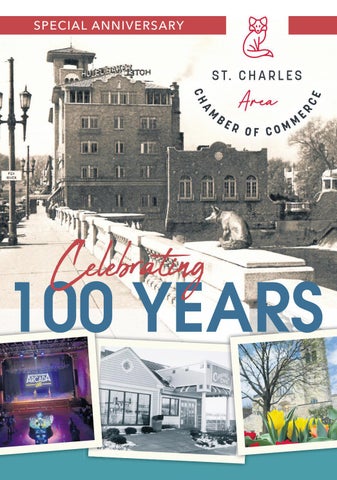
Celebrating 100 YEARS ST. CHARLES AREA CHAMBER OF COMMERCE 2021 WWW.STCAREACHAMBER.COM
St.Charles PulloutBook.indd 1
1
10/6/21 5:23 PM
100 anniversary
WELCOME TO OUR
th
T
SPECIAL SECTION
he arrival of 2022 marks a very special occasion for the St. Charles Area Chamber of Commerce: We are celebrating 100 years of supporting the business community! While the Chamber takes pride in each year’s annual Chamber Guide and Membership Directory, this year deserves a special section to celebrate the last 100 years of growth. As the Board Chairman for 2022-23, I’m pleased to present these pages to you.
In this book, you’ll find an extensive timeline of the business community, giving you a “then and now” backstory to landmark community spots like Hotel Baker and Rehm Electric. Thank you to the St. Charles History Museum for graciously providing such an extensive, interesting look at our history over the years. The section also previews the Chamber’s annual Charlemagne Gala, which this year will be a culmination of our 100-year celebrations. Please join us on Feb. 11, 2022, as this will be a night to remember. I encourage you to spend some time reading and learning about the wonderful community that’s been created in St. Charles over the last century, detailed within this special section. Our growth has allowed businesses and families in Kane County to flourish, form connections with each other and more. Nestled on the banks of the Fox River, our growing downtown and its surrounding area offers a spot for everyone to thrive, largely cultivated over the last 100 years of intentional business development and community partnerships.
Thank you to our membership for allowing us to serve you, and thank you to the thousands of St. Charles citizens who provide such a safe, clean, enjoyable place to live, work and do business. Enjoy this special section, as we highlight the past and look forward to the future.
Debbie Gurley Debbie Gurley Chairman of the Board, 2022-23
2
ST. CHARLES AREA CHAMBER OF COMMERCE 2021 WWW.STCAREACHAMBER.COM
St.Charles PulloutBook.indd 2
10/6/21 5:23 PM
St. Charles Area Business
TIMELINE Compiled and written by St. Charles History Museum staff
G
iven that heritage is one of St. Charles’ principles, it felt only right to acknowledge the history that has gone into the creation of St. Charles’ thriving community. Thank you to St. Charles History Museum and its staff for the following research and stories!
BAKER MEMORIAL UNITED METHODIST CHURCH: 1837 Standing as impressive as ever on Main Street, between Third and Fourth avenues, is the current Baker Methodist Church, built in 1954. The original congregation was founded in 1837, shortly after settlers had arrived in the area. The location of the parish would also change through the years, with services originating at a schoolhouse that was at Fourth and Cedar avenues. The church most recently sat on the land where St. Mark’s Lutheran Church now stands. In 1954, Colonel Edward Baker had today’s church built as a memorial toward his parents, Edward and Martha, who had generously aided in the congregation’s early communal efforts in St. Charles.
GARFIELD FARM MUSEUM: 1841 Since the 1840s, Garfield Farm has stood at its location along Route 38 and Garfield Road. Timothy and Harriet Garfield, who originally resided in Vermont, moved to the rich soil of northern Illinois with their eight children. Here they staked a claim to a 440acre tract of land and constructed a log house at the fork of the Chicago-St. Charles-Sycamore ST. CHARLES AREA CHAMBER OF COMMERCE 2021 WWW.STCAREACHAMBER.COM
St.Charles PulloutBook.indd 3
3
10/6/21 5:23 PM
and Oregon roads. Many travelers would stop by the area, and with this aspect in mind, the Garfields expanded to be innkeepers as well as farmers. However, with technological advancements like the steam engine, less travelers would need to seek a place of respite from travel, and thus the innkeeping business of Garfield farm died out.
repairs and improvements were made to the building, the church was dedicated as the Swedish Evangelical Bethlehem Lutheran Church of the Augustana Synod. In 1956, as a gift from the Norris family, the congregation was given its present-day location on a 5-acre tract of land at 1145 N. Fifth Ave.
In 1859, the youngest son, Robert, was given inheritance of the farm, and converted its operation to dairy farming. Robert’s wife, Hannah Mighell Garfield, described to her four daughters the future of the farm, stating it would work to serve as a museum in later years, to honor the settlers of the area. With this nurturing idea, youngest daughter Elva Ruth Garfield made the foundation to make this story a reality. In 1977, Elva Garfield would form the Garfield Heritage Society, Inc. in order to preserve the Garfield family’s home, developing it into an 1840s living history museum.
Today, the Bethlehem Lutheran Church serves a congregation of over 1,500 people, with pastors and volunteers all working to benefit their church and community.
BETHLEHEM LUTHERAN CHURCH: 1882 The role of immigrants played a vital role in the establishment of St. Charles. One of these individuals, a Swedish Immigrant named Nils Jansson, came to the Fox River Valley in 1849. While not being a deeply devotional man, his wife was a pious woman. Individuals like her and other immigrants sought the spiritual traditions of their home country. Jansson, who was touched by this extension toward his home as well, gathered funds to found a house of worship. An influx of Swedish immigrants to the area helped to bring the fruitful creation of the first Lutheran church in St. Charles in 1852. On Easter Day in 1853, though, the church was found to be missing! With no place to attend services, the congregation made their way to Geneva and attended services there until 1882, when Lutherans living in the area met with the purpose of planning a formal organization, and bought the property of the Free Methodists at a sum of $1,500. After necessary
4
ST. CHARLES PUBLIC LIBRARY: 1888 St. Charles’s first library started when a handful of individuals met in 1888 to make plans to create the first Library Association, which became legally incorporated in 1889. The location of the library continued to change between the late 19th and early 20th centuries, with numerous volumes in continuous circulation. A subscription system would be implemented, with an annual member fee of $2. The overarching goal of the Association was to institute a free public library, and they were able to get the issue on the ballot in 1901, but this proposal failed. It would take another attempt, in 1906, to make the library a tax-supported institution. That year, a letter was written to Andrew Carnegie, asking for a donation to help with building a new library. Carnegie, ever the philanthropist towards smalltown libraries, wrote back that he would provide $12,500 to help erect a new library, with the remaining $15,000 being supported through community donations. Through the years, the library has undergone multiple renovations and additions, with the most recent one being completed in 2021. In the works for over a decade, the library underwent an $18.6 million renovation and minor expansion that would modernize and upgrade the library, in order to continue to be a cherished aspect of the St. Charles community and beyond.
ST. CHARLES AREA CHAMBER OF COMMERCE 2021 WWW.STCAREACHAMBER.COM
St.Charles PulloutBook.indd 4
10/6/21 5:23 PM
COLONIAL CAFE AND ICE CREAM: 1901 Dairies have a longstanding history in St. Charles. At the turn of the 20th century, multiple dairy routes operated throughout the city. One of the most notable dairies, which still operates today as Colonial Ice Cream, was Anderson Dairy. In 1901, Simon Anderson purchased a milk route from Nicholls & Akin and began his new career venture. In 1910, Simon added ice cream to his production list, and in 1917, bought the Ramsey Ice Cream Company, which had been the primary ice cream producer in St. Charles. In the early 1920s, Anderson Dairy became associated with the Colonial Ice Cream Company. Colonial Ice Cream’s owner Eddie Willnitz of Plainfield would pick up his ice cream from the Anderson Ice Cream “substation” in Aurora and take it back to Plainfield to sell. A few years later, Willnitz sold his route and the Colonial name to the Andersons. In 1932, Colonial opened its first retail store at 120 N. Third St. in St. Charles and continued to expand its enterprise throughout the following decades. In 1957, Joe Anderson opened Snappy Snack at 1108 W. Main St. After four more Snappy Snacks opened, Joe Anderson was ready to take his businesses in a new direction. Opening a Colonial Ice Cream and Sandwich shop in 1959, Colonial continued its expansion into the restaurant business. The decades to come were even more successful as more eateries were opened and became full-service restaurants, eventually changing the name to Colonial Cafes.
Commonwealth and began to work at the Child City of Mooseheart in Batavia, instructing boys in electrical work. After quitting his job there, Rehm planned to open his own electrical business, and on Dec. 6, 1924, Rehm’s Electrical Shop officially opened. In 1927, Rehm was appointed Superintendent of Light and Water for the city of St. Charles and worked both jobs for the next six years. Not only did Rehm Electric sell electrical appliances and supply electricians to the St. Charles area, but Rehm also built connections that originally lit up the Buckingham Fountain in Chicago in 1927. After that successful job, Rehm was hired to install electrical equipment in Hotel Baker, which included the lights under the Rainbow Room floor. Rehm Electric survived the Great Depression and continues to thrive as a family business today. The business is still located in downtown St. Charles at 215 W. Main St. ST. CHARLES COUNTRY CLUB: 1924 Established in 1924, the St. Charles Country Club has long been providing a quaint and elegant setting for their services and facilities. The land that the country club now stands on was originally farmland owned by O.S. Pollard. After the formation of a Country Club committee, this land was purchased with a loan from Lester and Dellora Norris. The ground was now set for a fine golf course and clubhouse.
Colonial Cafe still operates today within the Anderson family. REHM ELECTRIC: 1924 LeRoy Rehm began his electrical career at 21 when he attended the Lewis Institute in Chicago and began working at Commonwealth Edison. After saving enough money, he built a home in St. Charles when he was 25. Rehm left work at
ST. CHARLES AREA CHAMBER OF COMMERCE 2021 WWW.STCAREACHAMBER.COM
St.Charles PulloutBook.indd 5
5
10/6/21 5:23 PM
The course was originally designed by Tom Bendeloe, a well-known designer from American City Planners. For the clubhouse design, the Country Club hired Chicago architect George G. Elmslie, who was famous for his unique “Modern American” architecture. Today, the St. Charles Country Club offers a wide variety of events, activities and facilities to those who attend this historic retreat. WASCO NURSERY: 1925 Founded by Lynn Jay, Wasco Nursery has been in the business of growing “hardy trees with local roots” to local farmers since 1925. Wasco Nursery quickly became a father and son business when Lynn’s son Robert (“Bob”) became involved with the business in the late 1930s. They were able to earn a reputation from around the community due to their strong horticultural expertise. Bob would continue to grow the business throughout the 1940s, and in 1952 would purchase the business entirely. Despite expanding the land in 1966, Bob Jay would purchase a 90-acre farm along Route 64, and would move operations there in 1968.
6
Much like with his own father, Bob’s son, R.L. Jay, would begin to take an interest in the business as well. Together they would add more services and products to the business. Today, Wasco Nursery and Garden Center is owned by Matt Zerby. The business now comprises two farms totaling nearly 140 acres for landscape and design services, and an 8-acre retail garden center. ARCADA THEATRE: 1926 Since 1926, the beautiful Arcada Theatre has stood on Main Street as one of St. Charles’ defining landmarks. Another gift of Lester and Dellora Norris and their family, the Theatre was built as a center for arts and entertainment in the community. Outfitted with the finest furnishings and decorations money could buy, the Theatre rivaled the lavish theaters of downtown Chicago and officially put St. Charles on the map as a destination. Ahead of its opening, one reporter said, “It is the last word of elegance and will itself set the country talking about St. Charles.” The Theatre, designed by Elmer Behrns in the Spanish revival style, was to resemble an open courtyard of colonial Spain. Complete with columns, faux balconies and a mock skylight above the main hall with twinkling stars, the Theatre was designed to be an immersive experience. Over the years, the Arcada Theatre would come under several new owners, until 2005 when Ron Onesti and the Onesti Entertainment Company took over operation of the Theatre. The Hurst family purchased the building in 2019. Under their direction, the structure would receive an expansive renovation, with the addition of two new restaurants, a new bar, new bathrooms, a new courtyard and even a few hotel rooms.
ST. CHARLES AREA CHAMBER OF COMMERCE 2021 WWW.STCAREACHAMBER.COM
St.Charles PulloutBook.indd 6
10/6/21 5:23 PM
HOTEL BAKER: 1928 Erected in 1928 at the site of what used to be the Excelsior/Haines Mill is the Hotel Baker. The mill that stood before was owned by Charles Haines, and had been operated from 1837 until 1919, when it burned down in a fire. After it was destroyed, the site stood vacant for several years. With talk being made about putting another factory up, Edward Baker purchased the site in 1926, as he believed the heart of downtown shouldn’t feature a factory as its focal point.
added to the Blue Goose’s grocery selection.
The architectural firm of Wolf, Sexton, Harper & Trueax was hired to design the building. After its construction, the Hotel Baker was considered the finest example of Spanish-Moroccan style for its time. When the Hotel Baker opened for its operations, accommodations started at $2.50 a night, and by 1947 a room could cost up to $6. During the 1930s and 1940s, the Baker establishment earned a moniker as the “Honeymoon Hotel” due to its proximity to the Fox River, Pottawatomie Park and the Arcada Theatre.
Spending over 40 years at the First and Illinois location, the city of St. Charles approached the Blue Goose about relocating the store to make way for the First Street Development project. Blue Goose accepted the city’s offer and moved a couple blocks south between First and Second streets. The Lencioni family continues to operate Blue Goose with the same passion and vision of Nancy Lencioni back in 1928.
The Hotel Baker would host several prominent names at its accommodations through the years, such as John F. Kennedy, Gerald Ford and Chicago Mayor Richard J. Daley. The Hotel Baker is listed on the National Register of Historic Places by the National Parks Service due to its architectural and historical significance. BLUE GOOSE: 1928 Annunciata “Nancy” Lencioni began her fruit and vegetable stand in 1928 at a small front on Main Street. The name of the business was inspired by a wooden crate with a blue goose on it, and Blue Goose Fruit and Vegetable became the official name. The first of four locations was located at 205 W. Main St. in the Gartner building block, where for 12 years the Lencionis enjoyed their successful business. After surviving the Great Depression, Blue Goose needed a larger space and moved to the corner of Third and Main Street. In 1947, meat was
In 1963, Blue Goose began construction on its third location, at First and Illinois Streets, which allowed them to expand their products and become a supermarket. Nancy Lencioni’s son Vasco was owner at the time, and construction of the new store fit his philosophy of how to stay in business: changing with the times. Blue Goose was the first self-service store in the area, the first to have scanners and checkout counters, and the first store to have refrigerated display cases.
EVERGREEN PUB & GRILL: 1928 For the first 75 years of development, Seventh Street was commonly thought as being the western boundary for the populated portion of St. Charles. In 1928, Gus Van Glabeke bought Teddy Van Aiken’s house at 14th Street and opened a tavern, Gus's Evergreen Tavern — a gutsy move at the height of Prohibition. Drawing a number of customers from the nearby Belgium Town, the establishment would expand into hosting the Belgian pastimes of Pigeon Racing and Rolle Bolle, otherwise known as Belgian Bowling. In 1947, the business was sold to Ray Triest, and the name was changed to Ray’s Evergreen Tavern, becoming a treasured watering hole among the Belgians and other residents in the area. As St. Charles continued to expand, and Main Street property became more and more desirable, fears emerged that the old building with its storied past would be torn down; yet, in 2008, the building was saved, becoming today’s Evergreen Pub & Grill. ST. CHARLES AREA CHAMBER OF COMMERCE 2021 WWW.STCAREACHAMBER.COM
St.Charles PulloutBook.indd 7
7
10/6/21 5:23 PM
ST. CHARLES MUNICIPAL CENTER: 1940 Standing on the banks of the Fox River with its impressive tower is the St. Charles Municipal Center. The new city hall was meant as a gift to the residents of St. Charles from the Baker and Norris families. Residents and visitors alike were quick to become delighted over the new riverfront, with gardens, paths and a hotel to transform the riverside from a “back yard to a front yard.” Since 1836, the site had been occupied by several mills and a factory — until 1929, when Lester J. Norris acquired the riverside plot. Built at the cost of $25,000, the Municipal Center was designed by architects R. Harold Zook and D. Coder Taylor in the Art Moderne style, which was popular at the time. Characterized by its tower and stepped surfaces, the new Municipal Center would include administrative offices, city council chambers and a museum to house local artifacts and documents. The St. Charles Municipal Center today serves as the town’s city hall to a population of 33,366 people, 2,122 businesses and 194 restaurants.
opened its doors on Thanksgiving Day of 1940. Originally starting at 25 beds, Delnor Hospital would quickly begin to expand its facilities through the addition of different departments, services and care. In 1991, Delnor Hospital would merge with the Community Hospital in Geneva to form today’s Delnor Hospital along Randall and Keslinger roads. Today, the original Delnor Hospital along Route 25 is used as a senior living center, comprising a multilevel, 110-unit facility. THE VILLAGE SQUIRE: 1974 Compromising four locations, The Village Squire prides itself on being a family-owned and -operated business since its inception. Intent on the American dream, brothers George and Paul Karas immigrated to the United States from Greece and initiated the original Village Squire in West Dundee, followed by
DELNOR HOSPITAL: 1940 As far back as 1923, Lester J. and Dellora A. Norris had been contemplating the idea of gifting a hospital to the St. Charles community. The following year, the Norris couple donated the first funds toward making the hospital a reality. By combining the first three letters of Dellora’s name, and the first three letters of the Norris name, the name Delnor was decided on for this new hospital. Edward H. Fairbanks was employed as the hospital’s architect, while New York designer Dorothy Draper was designated as interior designer of all nonmedical areas of the building. Valuing comfort over all else, Delnor Hospital finally
8
ST. CHARLES AREA CHAMBER OF COMMERCE 2021 WWW.STCAREACHAMBER.COM
St.Charles PulloutBook.indd 8
10/6/21 5:24 PM
the Crystal Lake, McHenry and South Elgin locations, respectively. Serving the Fox Valley area since 1974, The Village Squire has been a staple among the community through its serving of comforting food in an English pub-style setting. NORRIS CULTURAL ARTS CENTER: 1978 In 1972, the Norris couple donated 70 acres of the land east of Dunham Road with a $4.25 million dollar gift to build a cultural arts and recreation center. By 1977, today’s campus of St. Charles East High School would be established on that land, while the following year saw the founding of the arts and recreation centers. Making up a portion of the Norris Campus at St. Charles East High School is the Dellora A. Norris Cultural Arts Center, a 1,000-seat performing arts theater and expansive dual-level arts gallery. The Norris Cultural Arts Center has made a name for itself by bringing Chicago-quality entertainment to the western suburban community, as well as playing a vital role in the influence of performing and visual arts in the community and abroad. Numerous bands and performers have been able to leave their mark on the town of St. Charles, with such names as the Joffrey Ballet, Ramsey Lewis, and the U.S. Air Force Band of Mid-America being among the many to do so. MT. ST. MARY PARK: 1984 The land that Mt. St. Mary Park now rests on has an extensive history, with written accounts of the land dating back to the days of the Civil War. The site was part of the Farnsworth estate, with the land being given to Gen. John Farnsworth, the man credited with
organizing the 8th Illinois Cavalry at Abraham Lincoln’s behest. John Farnsworth would build what would be called locally the Farnsworth Mansion on the land that now contains the Viewpointe subdivision, above Mt. St. Mary Park. In 1879 Farnsworth would return to Washington, D.C., but his mansion would serve another purpose later on. In 1907 a Catholic high school for girls was opened in the estate overlooking the Fox River. This school functioned under the supervision of the Dominican Sisters of New York as Mount Saint Mary’s Academy, and after multiple years of success, an expansive, gothic-style addition would be constructed alongside the Farnsworth Mansion in 1926. The entire campus would overlook the banks of the Fox River, with sprawling paths complete with concrete exercise courts running to the water’s edge. In 1984, the park that still remained at the river’s banks would officially earn its name as Mt. St. Mary Park, with the St. Charles Park District holding a three-day schedule of activities to commemorate the honor.
ST. CHARLES AREA CHAMBER OF COMMERCE 2021 WWW.STCAREACHAMBER.COM
St.Charles PulloutBook.indd 9
9
10/6/21 5:24 PM
HERITAGE WORTH
H
The city of St. Charles offers an active do wntown and opport unities for families and businesses
Celebrating
By Chris Walker | Photos provided by city of St. Charles
excellent or good place to live. Their satisfaction is no doubt due in part to the collaborative efforts of the city with the chamber.
eritage is at the forefront of the mission statement of the city of St. Charles. What has happened in the past has undoubtedly shaped the city into what it is today and what it will become tomorrow.
“We work closely with the St. Charles Area Chamber of Commerce to create an environment that encourages a variety of businesses to prosper, providing amazing choices for our residents,” Vitek says. “The community supports local businesses and the businesses give back and are active in the community.”
Similarly, the St. Charles Area Chamber of Commerce has been a big part of the city’s heritage and is about to celebrate its 100th anniversary, having been founded in 1922, less than a century into St. Charles’ history. “The chamber has done a really good job of being that conduit for the community,” St. Charles Mayor Lora Vitek says. “They do a great job of networking to connect businesses to the community and the city.” The numbers show that without a doubt, St. Charles is a wonderful
10
place for families to make their home as well as for businesses to set up shop. A 2020 survey of St. Charles residents revealed 99% of them consider St. Charles an
Vitek explains that the city values the roles local businesses play in a diverse and vibrant economy, and therefore city staff and the Chamber remain committed to assisting those businesses. “We share a common goal of
ST. CHARLES AREA CHAMBER OF COMMERCE 2021 WWW.STCAREACHAMBER.COM
St.Charles PulloutBook.indd 10
10/6/21 5:24 PM
creating opportunities in which businesses thrive,” she says. “City staff works closely with the Chamber and other community organizations to drive economic growth and make a destination where people, businesses and tourism prosper.” It certainly drew Vitek to St. Charles. “That’s why I moved here over 10 years ago,” she says. “It felt like small businesses were doing well within the urban feel of our downtown, along with the opportunities for recreation and parks. I think St. Charles has a nice balance of that.”
logos
THROUGH THE YEARS The St. Charles Area Chamber of Commerce has stayed current with its membership and community — and so, too, have its logos. Take a look at these examples of branding over the years, including the 100th anniversary Charlemagne logo!
The collaborative effort of the various organizations in town has gone a long way towards the city and the Chamber’s continued success. “I think when you look at all these organizations you know they do a good job of communicating what’s happening in St. Charles and the impact they can have in the community,” Vitek says. “What I’ve seen as an alderman and now as mayor, is we aren’t operating in silos. We know what we’re doing impacts one another.” Today, St. Charles continues to offer topnotch entertainment mixed in with a delightful downtown area, wonderful parks and a busy schedule of events, including unforgettable parades and now a 100th anniversary worthy of celebration. “Congratulations to the St. Charles Area Chamber of Commerce on celebrating 100 years of serving St. Charles businesses,” Vitek says. “Some of those businesses got their start more than a century ago and are still thriving today.” That’s quite the heritage.
ST. CHARLES AREA CHAMBER OF COMMERCE 2021 WWW.STCAREACHAMBER.COM
St.Charles PulloutBook.indd 11
11
10/6/21 5:24 PM
The legend of
CHARLEMAGNE CHARLEM By C.V. Amenoff, St. Charles Mayor 1966-73
The Charlemagne award started in 1968, by the Chamber, based on this legend.
I
t was autumn — the year, 1831. The sun in the west was lending its last full rays to add greater resplendence to the autumnal livery of the trees and bushes lining the banks of the meandering river coursing its way through the wilderness. All was peaceful and serene, the silence being broken only by the sound of wildlife making their way through the bushes homeward at dusk, or the fish at play in the fast-moving river. Occasionally the sound of a musket could be heard in the distant prairies to the east. Four fox stretched out lazily on the banks of the river at the foot of the trail leading to their den, awaiting the return of their father, Charlemagne. He had left early in the morning to listen in at an emergency session of the Indian chiefs whose tribal lands were being threatened by the white men, now coming to settle in this area. As the sun dipped below the horizon, Charlemagne
12
came into view, trotting slowly to join his family. Immediately the four fox fell in line as Charlemagne had led them up the trail to their den. It was readily apparent to the four sons that their father was in a troubled mood and sad, sad as he was when their mother died a few years before. Impatiently they awaited his report on the council of the Indian Chiefs. After resting a few minutes, Charlemagne started to talk and, with a voice somewhat choked with emotion, addressed his sons. “My sons, my report to you is sad. The Black Hawk War has ended. The white men are now coming to settle along the banks of the river, taking these lands of the wilderness which have been the happy hunting grounds of the Sacs, the Fox and the Pottawatomies. I trembled today in my listening spot as I heard Chief Waubonsie of the Pottawatomies related his experiences with the white men. ‘They cannot be
trusted,’ the old chief pointed out, ‘and it is now apparent that we cannot live side by side, there can be no coexistence. Our only move now is to go further west.’” The other chiefs who had gathered for the council nodded their approval of the westward move, and soon they left to ride home to tell their tribes of these new plans. Charlemagne continued, “When the white man comes to the banks of this river and sees this beautiful spot in the valley where the Fox River flows — and remember, my sons, this river is named for our Indian neighbors, the Fox tribe up in Wisconsin where the river has its source — here is where the white man will choose to settle. “These men upon arrival will first build their homes on the hills overlooking this river. Land will be cleared so that they can plant their crops in the spring. They will build a millwheel on western bank. Stores will open. Industry will
ST. CHARLES AREA CHAMBER OF COMMERCE 2021 WWW.STCAREACHAMBER.COM
St.Charles PulloutBook.indd 12
10/6/21 5:24 PM
come. Schools will be built, and soon Church spires will rise up in the community. This is the pattern of settlement of the white man. “Now, I am old, and it will be hard for me to adjust to these changes. I have tried to be a good father to you. I have taught you all the tricks and the cunning of our kind. “You are now able to take care of yourselves, and you can adjust your lives to these white men. As for myself, I have only a few more years to live. Tonight, I shall leave you and go west to be with my Indian friends. This is as it should be. Your needs for me are no more. “I have never given you names, preferring that you be known only as the four sons of Charlemagne, so that there shall always be unity among you for the great tasks ahead. This has been our happy home. It is important that the settlement which arises on the banks of this river will develop a character unique among other communities that will be settled by the white man. I would like you, my four sons, to be the guardians of this growing settlement, to see that it does become a great community in which men can live, can work, can be educated, can worship and can play. “You, my firstborn, are to be the guardian of the civic, the business, the industrial life of this community. “Education will become important in the life of this growing community. And you, my second son, are to be the guardian of this educational and cultural expression. “Soon after this community has been settled, men will band together to worship, and you, my third son, are to be entrusted with the guardianship of this religious expression. “Amid this beautiful setting, it is only natural that recreation will flourish, and you, my last-born, shall be the guardian of this natural recreation expression of man living in these surroundings. “As for me, I shall now leave you to join my Indian friends.” Finishing his talk, Charlemagne then bade farewell to his four sons and walked out of the den into the night and westward. These four sons of Charlemagne are now represented on the Main Street Bridge, monumental guardians of this community. Today, St. Charles is truly a great community, the Pride of the Fox, located in the Beauty Spot of the Fox River Valley. It is a community where men can live, can work, can be educated, can worship and can play. The guardianship of his four sons is now testamentary to the will of Charlemagne. Today… The City of St. Charles, Illinois, is guided by the four driving principles in its Mission: Heritage. Community. Service. Opportunity. Together, these principles create a thriving environment for people who live or visit here, and for businesses to prosper. Our City has gained national recognition as a family-friendly town and wide acclaim for its architecture, living up to its nickname Pride of the Fox.
Flowers OF THE
HOUR By Allison Bills
G
litz, glam and jazz — the roaring ’20s had it all, and so will the St. Charles Area Chamber of Commerce’s 100th Annual Charlemagne Awards Gala. The centennial event will have a 1920s theme and will honor local businesses and community members. To help transform the event into a night Jay Gatsby would be proud of, the chamber has enlisted the help of St. Charles Florist and Boutique. “Themed parties are always fun, no matter what,” says John Windisch, design manager at St. Charles Florist and Boutique. “It’s always fun to coordinate flowers with the theme of a party, whether it’s a huge event or small.”
Windisch’s floral design will be centered around red roses with gold vases and accent leaves to create a high/low design and give the flowers depth. He will also be incorporating feathers into the design wherever possible. “The ‘Great Gatsby’ is all blacks, gold, white and a main accent color,” Windisch says. “When we got the color scheme, we knew the best way to go.” St. Charles Florist and Boutique will also be incorporating ivy into the design as an homage to the floral sponsor, Ivy Academy. “Everything will have ivy coming out of it and the tables will have it fluffed around the centerpieces,” Windisch adds. The Charlemagne Gala will be held Feb. 11 at Q Center. “I’m looking forward to helping celebrate the 100th anniversary of the chamber,” Windisch says. “It’s kind of cool it’s been around that long and we get to celebrate a milestone like that.” ST. CHARLES AREA CHAMBER OF COMMERCE 2021 WWW.STCAREACHAMBER.COM
St.Charles PulloutBook.indd 13
13
10/6/21 5:24 PM
3 ICONIC PARK DISTRICT FACILITIES
Then & Now
From a former school to farmland, these parks now serve an important community purpose By the St. Charles Park District
W
hile each of the 64 parks and facilities in St. Charles offers so much to enjoy, there are a few favorites in the collection where residents can find the ultimate combination of entertainment and enjoyment, solitude and interaction among friends and animals.
14
Mt. St. Mary Park, Primrose Farm and River Bend Community Park each have a long history in the community, established well before they were part of the official park district roster of locations. These spots are well worth a visit throughout the year to take in their history and enjoy the beauty of the changing seasons.
MT. ST. MARY PARK In 1907, the Sisters of St. Dominic of Adrian, Michigan, opened the Mount St. Mary Catholic Academy in the Farnsworth Mansion. In 1910, they purchased an additional 23
acres across the road to prevent factories from blocking the river view. Originally, they used this land as pasture for the school’s animals and gradually developed it into athletic fields, tennis courts and a golf course with a summer pavilion and walking paths. In 1967, the park district leased this land from the Sisters, who were facing financial problems. During the ’70s and ’80s, the Park District acquired additional property to make up today’s 29-acre park. This downtown, riverside park currently offers tennis, basketball, fishing, a skate park, an arboretum, a paddle sport launch, a playground, rentable
ST. CHARLES AREA CHAMBER OF COMMERCE 2021 WWW.STCAREACHAMBER.COM
St.Charles PulloutBook.indd 14
10/6/21 5:24 PM
Learn more about these and other facilit ies at www.stcpark s.org!
pavilion areas and a sculpture exhibit alongside its popular paved walking trails.
PRIMROSE FARM PARK This park site is named in honor of three distinct farming families of the late 1800s: the Primrose Farm, the Johnson Farm and the Spriet Farm. As the park district acquired and developed the 183-acre property, it not only wanted to offer modern recreation opportunities — such as sand volleyball, basketball, tennis, a playground and multiuse fields — but also celebrate the origin of agriculture education of the Fox Valley area by dedicating the southeast corner of the park. That area is now Primrose Farm, a restored 1930s working farm that opened to the public in 2008. RIVER BEND COMMUNITY PARK When the state of Illinois
decided to close its youth detention center at this site in 2002, the park district, along with the Kane County Forest Preserve and the Illinois Department of Natural Resources, worked together with the residents of the River Bend Community Group to create a community park and maximize the land’s potential for improved aesthetics and usability. In 2007, the forest preserve acquired these 45.8 acres, demolished existing buildings and cleared the land. Five years later, the park district opened this one-stop destination of recreation opportunities — ballfields, basketball, tennis, trails, a fishing pond, dog park, skate park, playground and rentable pavilion. This project is a testament to public appeal, government responsiveness and community partnerships working together to achieve a goal and surpassing expectations. ST. CHARLES AREA CHAMBER OF COMMERCE 2021 WWW.STCAREACHAMBER.COM
St.Charles PulloutBook.indd 15
15
10/6/21 5:24 PM
highlighting 100
YEARS
History museum’s timeline will be showcased at Charlemagne Gala By Diane Krieger Spivak
P
lans for the St. Charles Area Chamber of Commerce’s Charlemagne Gala are in place for the February 2022 event. This year’s event celebrates a milestone for the Chamber: its 100th anniversary. The annual event honors chamber members who have gone above and beyond to invest in the community in various ways. But in addition to awards, this special year includes a history of Chamber businesses, courtesy of the efforts of the St. Charles History Museum.
16
The museum staff is currently researching to provide images and historical information for every existing business that was an original member of the Chamber going back to 1922, according to the museum’s executive director, Lindsay Judd. The information will be compiled into a booklet. “We are also working on a timeline that illustrates all these businesses,” says Judd. The screen-mounted timeline will be on display at the actual event, available digitally. “People can scan QR codes on their phones
View the St. Charles History Museum’s b usiness timeline, star ting on P. 3!
and learn more information about the businesses,” she says. “It’s really neat, because St. Charles was a small town and then, at the turn of the century, all these big industries came in and really helped to develop the community.” Judd says it’s impressive to not only see the history of the Chamber itself, but to note that, “Without the Chamber a lot of these businesses may not have been able to get a leg up, especially coming from outside the community, and take root. It’s neat
ST. CHARLES AREA CHAMBER OF COMMERCE 2021 WWW.STCAREACHAMBER.COM
St.Charles PulloutBook.indd 16
10/6/21 5:24 PM
PAST to see the importance of the Chamber in the role it played and how important the businesses are for St. Charles itself.” Judd is excited about the project. “I think we should be celebrating these businesses, and learning about the history of where they came from. By doing this booklet, by doing this timeline, we’re really creating a focused topic of them.” So far, staff has uncovered interesting information. “I’m hoping to capture stuff we didn’t know before or the community didn’t know before,” she says. “It’s always fun to do a project like this because there’s that learning aspect of it.” Museum staff use a wide variety of primary and secondary sources. Primary sources are original documents like letters, correspondences, invoices and photographs. Secondary sources include newspaper clippings or firsthand accounts, like oral history interviews. “Because we are a local history museum, we have all this in our archives,” says Judd. “We’re excited to share the rich history of these businesses and the Chamber,” she adds. “It’s a celebration of our community as well.”
Charlemagne WINNERS
C
ongratulations to the dozens of individuals who have received the Charlemagne Award! This award celebrates and honors citizens who have spent their lives positively contributing and improving St. Charles. The 2021 winner will be announced at the Charlemagne Gala — the 100th anniversary gala! — in February.
2020: Dr. John Mason 1990: Joann Collins-Pace 2019: Robert Gorecki 1989: Terry F. Grove 2018: Jeff Hunt 1988: Lawrence E. “Larry” Dempsey 2017: Clint Hull Mayor Fred 2016: Darlene Riebe 1987: T.L. Norris 2015: John Hoscheit 1986: Chester and Barbara 2014: Steve Martin Anderson Richard 2013: Gloria Klimek 1985: “Bud” Ziegler 2012: Marce G. Van Glabek Dr. 1984: Robert A MacNeille Jr. 2011: William Kelly 1983: William and Mary Barth 2010: John Robert Collins 1983: Fred and Phyllis Kaiser 2009: Sue McDowell 1982: Ruby Frank 2008: Don and Tory Haines Caryl 1981: Senator John Grotberg 2007: Van Overmeiren Dr. 1980: Lester J. Norris 2006: Vernon and Vee Guynn 1979: Bill Fisher and Dr. Josephine 2005: Terry Andrew Nickless Fisher 2004: Betsy Penny 1978: Max L. Hunt 2003: Robert Miller 1977: Joe K. Anderson 2002: Charles Brown 1976: C.V. Amenoff 2001: Howard L. Wallin 1975: Wirth Gustafson 2000: Jim Martin 1974: Edward “Doc” Healy 1999: Robert Hoge 1973: Karl Gartner 1998: Vern and Sharon Oie John 1973: Joseph C. Gaffney 1997: H. Wredling 1972: Carl Anderson 1996: Walter C. Foulkes 1971: Dellora A. Norris 1995: Ellen Johnsen 1970: George E. Thompson 1994: William P. Zimmerman 1969: Rev. David J. Ekstrom 1993: James N. Urhausen 1968: George Neumark 1992: R.E. Lee Norris 1967: Robert A MacNeille ST. CHARLES AREA CHAMBER OF COMMERCE 2021 1991: Thomas S. Anderson WWW.STCAREACHAMBER.COM
17
St.Charles PulloutBook.indd 17
10/6/21 5:24 PM
Serving the Community IN
IMPORTANT W
St. Charles Township maintains roads, cemeteries and services for its 50,000+ citizens By Chris Walker | Photos provided by St. Charles Township
T
he promise of rich farmland, opportunity and adventure drew settlers to St. Charles Township over 170 years ago.
“The township was started in 1849,” St. Charles Township Supervisor Ron Johnson says. “In 1851 we had our first supervisor (F.H. Bowman) and he ran again and was chosen in 1856 and 1860.”
Today, St. Charles Township has a population of 51,672 that includes all of St. Charles and portions of Campton Hills, South Elgin and Wayne. St. Charles Township is one of the 85 counties in the state to operate under the township form of government and one of more than 1,400 Illinois townships. Just to give you an idea of how long ago it was that St. Charles Township came about, Herman Melville had already published
18
“Moby Dick,” but Abraham Lincoln had yet to be elected America’s 16th president. In 1922, which is the year that the St. Charles Area Chamber of Commerce started, the Lincoln Memorial was dedicated in Washington, D.C. “I think I’m about the 18th supervisor since 1849,” Johnson says. “And our population has grown for the whole township including unincorporated areas. Basically we have the cemeteries that we are maintaining all the time and then there’s the maintenance of the road district which is almost 90 miles of roads we take care of, and the assessor has almost 22,000 parcels that they assess, and of course, the supervisor’s office is basically there for general assistance.” Sometimes that assistance is in support of the St. Charles Area Chamber of Commerce. “To my knowledge, we have always
worked well with the Chamber when requested,” Johnson says. By law, townships are required to perform three key functions: general assistance, property assessments and maintenance of road and bridges. The St. Charles Township Road District, which is staffed by a highway commissioner and six fulltime road maintenance positions, serves an area encompassing a bit more than 36 square miles. Interestingly, the township is larger than the statutory definition because the county board agreed to remove a portion of the Boy’s School from Campton Township and awarded it to St. Charles Township nearly 90 years ago. The township’s geographic boundaries are commonly defined as Kautz Road on the east, Happy Hills Road and Dean Street on the west, Bricher Road on the south and
ST. CHARLES AREA CHAMBER OF COMMERCE 2021 WWW.STCAREACHAMBER.COM
St.Charles PulloutBook.indd 18
10/6/21 5:24 PM
NT WAYS Learn more at www.stcharlestownship.org!
McDonald Road on the north. The township began maintaining cemeteries in 1945 when it took over the North and South cemeteries, with the South one predating the city back to 1815. Over the years, the township added the Little Woods (1951), Prairie (1957), Union (1972) and Round Grove (1997) cemeteries. In addition, the Columbarium at Union Cemetery, which offers a beautiful picturesque setting for the interment of cremains, was constructed in 2015. Today, four of the cemeteries remain active. South and Round Grove are no longer active interment locations. Other notable township services include voter registration, complimentary notary public and sponsorship of Ride in Kane for senior citizens. St. Charles Township is located at 1725 Dean St. and has offices for its supervisor, clerk, town board of trustees, assessor and road district office, which also houses a maintenance office. Additionally, the township has a cemetery office at Union Cemetery.
4 NEIGHBORHOOD ORGANIZATIONS By Hannah Hoffmeister
C
ommunity groups are part of the fabric of St. Charles. Here are just some of the highlights of the services they provide. Thank you to these civic organizations for the work they do!
CITY OF ST. CHARLES Operating out of the St. Charles Municipal Building, the city of St. Charles serves thousands of residents with utilities, yard waste, emergency responses and more. The St. Charles City Council meets on the first Monday of the month; joining through video continues to be an option for residents to participate remotely. Visit www.stcharlesil. gov to learn more. ST. CHARLES BUSINESS ALLIANCE With a mission of driving “economic growth to make the St. Charles Community a destination where people, businesses & tourism thrive,” the St. Charles Business Alliance’s website is full of ideas for planning adventures in the area. The organization plans and hosts community favorites like Jazz Weekend, Scarecrow Festival and Holiday Homecoming. Learn more at www.stcalliance.org. ST. CHARLES PARK DISTRICT Older than the St. Charles Area Chamber of Commerce by about 10 years, the St. Charles Park District has long served local residents with parks, pools, playgrounds and other amenities. A constantly updated list of activities, classes and events are available at www.stcparks.org. The time is always right for a round of miniature golf or trip to the dog park! ST. CHARLES PUBLIC LIBRARY New knowledge is always available to be checked out at the St. Charles Public Library. Renovated this year but retaining its legacy as a Carnegie library, the space often hosts events, including book clubs and story time. Be sure to stop by soon for a new book, audiobook or movie. Visit www.scpld.org to learn more. ST. CHARLES AREA CHAMBER OF COMMERCE 2021 WWW.STCAREACHAMBER.COM
St.Charles PulloutBook.indd 19
19
10/6/21 5:24 PM
WE WANT TO THANK OUR CENTENNIAL DONORS FOR THEIR SUPPORT.
An Enormous Thank-You to:
20
ST. CHARLES AREA CHAMBER OF COMMERCE 2021 WWW.STCAREACHAMBER.COM
St.Charles PulloutBook.indd 20
10/6/21 5:24 PM