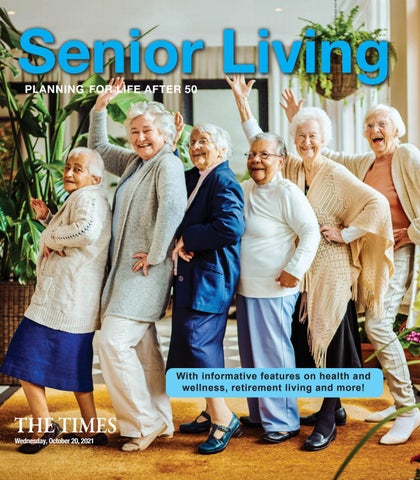
Senior Living PLANNING FOR LIFE AFTER 50
With informative features on health and wellness, retirement living and more!
THE TIMES Wednesday, October 20, 2021
The Times - Delivering Your Community • Wednesday, October 20, 2021
SENIOR LIVING
2
➤
➤➤➤
Senior Living
➤➤➤➤
Senior communities offering lifestyles Living life to the fullest does not need to stop when adults near or reach retirement age. Age-restricted housing communities once bore the stereotype of having limited recreational options and dated surroundings. But modern senior homes and facilities are all about catering to active lifestyles — with some communities offering resort-like amenities and pristine properties. Furthermore, certain communities provide niche offerings for people who are looking for something even a little more different. Eligibility to live in these communities varies, but generally speaking one resident in the home must be age 55 or older. According to research by TRI Pointe Homes, of the 75 million people who comprise the Baby Boomer generation who are eligible for age-qualified communities, more than 32 million would consider living in such a community. The website 55places. com, which specializes in promoting age-restricted communities, indicates Florida has the most age-restricted communities in the country, followed by New Jersey. Arbutus Ridge Seaside Community for Active Adults was the first comprehensive retirement community built in Canada. Choosing an age-restricted community requires consideration of a host of factors, including the amenities residents most desire and the cost of a facility. The following factors can help people decide which community is most suitable for them. Style of home Homes built in retirement communities are designed to be comfortable and convenient for aging residents. Many are single-floor units. Certain communities may be comprised of apartments, condos or townhouses, while others may be single, detached residences. Amenities When comparing age-restricted communities, consider the amenities available. Do they include on-site dining, transportation, travel assistance, pools, fitness centers, walking trails, or outdoor sports facilities? Some communities have “aging in place” amenities, which means residents can move from independent living to assisted living to skilled nursing care as their needs change. Make a list of interests and then match them to a community that can fit your needs. Costs Costs vary considerably. Investopedia advises seniors to consider the community’s location and what is being offered, as these factors will affect costs. In addition to rent or mortgages, most communities also
SM-CL1926593
have monthly maintenance or homeowners association fees that need to be compared and considered. Read contracts carefully to see which other costs are included. Specialized features Unique men and women call for unique communities. If standard agerestricted communities do not fit the bill, 55places.com says there are specialized offerings for people who spend retirement in an RV; desire homes that align with their heritage; communities just for postal workers; or communities tied to a local college to continue lifelong learning. Age-restricted retirement communities are evolving and many specialize in catering to active lifestyles.
avoid being ticketed. • Freedom to come and go: When traveling in an RV, there are no set check-in-/check-out times to follow or boarding times to meet. RV travel can be strictly on your schedule. • Plenty of help: Others who have embraced the RV lifestyle tend to be very friendly and ready to make new acquaintances at campgrounds and other stops. Those with more experience may be willing to share their expertise and pitch in to offer tips for better excursions. • Creature comforts: People who vacation or choose to live in their RVs tend to keep familiar items and essentials on hand. Those can include preferred linens, clothing, toiletries, books, games, and more. When taking such items along, there’s no need to pack and unpack much for any trip. • Follow the weather: If desired, RVers can pick up and follow the jet stream. If 70-degree days are your thing, then follow those temperatures coast-to-coast. If you like skiing or snowboarding, you can head to colder climates. • Downsize: The RVIA says that RVs are available across a wide range of price points. So if the idea is to trade in a stationary house for an RV, you may be able to do so for as little as $6,000 to as much as $500,000. The RV lifestyle may attract soon-to-be retirees. There are various advantages to getting on board.
Make sure you’re
PROTECTED from the flu virus
Plan Ahead to Ensure that Your Wishes are Honored
An exclusive option for families choosing cremation, our serene garden offers a place of permanent remembrance
25
$
Call us today for more information:
Oakwood Memorial Park
2405 Champlain St. • Ottawa • 815-433-0313 oakwoodmemorialpark.net
for Uninsured
Providing the assistance you need to maintain the independence you desire.
• Available Daily • No Appointment Necessary • Walk-ins Welcome
CALL TODAY TO SCHEDULE A TOUR. 800 W. Bluff St. Marseilles, IL 61341
801 E. Etna Road, Ottawa 815-431-1400 hw-ottawa-slf.com
(815) 795-2700 www.schottspharmacy.com
Compounding Specialists: G. A. Carlson, R.Ph. & K.E. Anderson, R.Ph.
SM-CL1926122
Managed by Gardant Management Solutions
The Times - Delivering Your Community • Wednesday, October 20, 2021
Individuals who are approaching retirement or those who already have said goodbye to the working world may find they are ready to make some life changes. Travel is something many older adults enjoy when they have much more free time to see the sights. Recreational vehicles are great ways for people to get out and about. An RV is more than just a way to get around; for many people it becomes a lifestyle. According to the RV Industry Association, about 10 million American households own RVs. There have been more RVs on the road in recent years, and there are now more facilities to accommodate them. RVIA says there are now roughly 18,000 campgrounds around the country, and certain facilities are pushing to improve and upgrade campgrounds in national parks and on federal lands. Individuals considering if the RV lifestyle is for them can refer to this list of RVing benefits. • Inexpensive travel (or living): RVers may be attracted by the idea of low-cost travel that doesn’t involve hotels and airfare and greatly reduces their reliance on restaurants while traveling. RVs can be rented for roughly $100 to $500 per day, and RV parks usually run between $35 and $50 per night, according to Allianz Travel Insurance. To keep the costs down even more, certain truck stops, big box retailers, churches, hotels, movie theaters, casinos, rest stops and other roadside locations will allow free overnight parking. Just verify before staying to
3
SENIOR LIVING
➤ ➤➤➤➤ Seniors can enjoy the advantages of RV travel Senior Living
➤➤➤
The Times - Delivering Your Community • Wednesday, October 20, 2021
SENIOR LIVING
4
➤
Senior Living
➤➤➤
➤➤➤➤
How often to see the doctor
Routine health checkups are a key part of staying healthy. Older adults may feel like they’re always visiting one doctor or another. But what is an acceptable frequency for doctor appointments? The answer isn’t always so cut and dry, and many health professionals have mixed feelings even among themselves over the magic number. The Centers for Disease Control and Prevention recommends adults over the age of 65 visit the doctor more than twice as often as 18- to 44-year-olds. According to Paul Takahashi, a physician at the Mayo Clinic in Rochester, Minn., adults should see their primary care physicians at least once a year to make sure diseases are being properly managed and to stay current on preventative screenings. Visiting the doctor more frequently does not necessarily add up to better health, and it actually can do the opposite. Dr. Peter Abadir, an associate professor of medicine at the Johns Hopkins University School of Medicine, says frequent visits to health facilties where sick people congregate puts one at a higher risk of illness or infection. Visiting the doctor only when necessary is one way to avoid risky exposure.
Doctor visit frequency is not a one-size-fitsall answer. A yearly physical or checkup is a given, even for people who are healthy. People with a family history of certain conditions, like sleep disorders, cancer, high blood pressure, and other conditions, may need to see a doctor more frequently than those with no such histories. In addition, patients may need referrals to certain specialists who work together to provide an overall health plan. That can increase the number of appointments and shorten the intervals between them. Johnson Memorial Health offers
SAME ORTHOPEDIC EXPERTS. SAME OFFICE LOCATIONS.
NEW PRACTICE NAME.
some statistics. • People visit the doctor four times a year on average. • Studies show that poor or uninsured people prolong the time between doctor’s visits. • Individuals with high blood pressure may need to see the doctor four times a year to ensure medications are working properly. • Patients on dialysis see the doctor several times a week. Dr. Jennifer Caudle, a family physician and assistant professor at Rowan University School of Osteopathic Medicine in Stratford, NJ, says too often people visit the doctor only when they are really sick. That works to their disadvantage because the appointment will focus only on treating the illness instead of addressing other preventative care and screenings. Balance is necessary in regard to health care. Patients can work together with their doctors to develop screening schedules that are customized to their particular profiles. These schedules can be modified as health history information changes or as patients age. Doctors can dial back or increase health visits as needed.
The physicians with Rezin Orthopedics have joined Morris Hospital Orthopedics & Sports Medicine! You can continue to count on them for expert care and treatment of problems associated with the neck and back, shoulder, elbow, hand, knee, hip, foot and ankle. Ask about our onsite therapy services and new patient portal! For more information, go to morrishospital.org/orthopedics, or call a location near you!
Dr. Mir Ali Orthopedic Spine Surgeon
Dr. Raymond Meyer Orthopedic Surgeon
Dr. Kyle Pearson Foot & Ankle Surgeon
Dr. Keith Rezin Orthopedic Surgeon
Dr. Stephen Treacy Orthopedic Surgeon
Dr. Robert Williams Orthopedic Surgeon
• Morris 815-942-4875 • Joliet 815-741-4000 • Ottawa (Gemini Circle) 815-433-0850
➤➤➤➤
Decisions surrounding assisted living facilities are not always easy. Men and women may be reluctant to leave their homes while family members may be worried about how their aging loved ones will adjust to life in an assisted living facility. Though modern assisted living facilities cater to residents with an array of needs and interests, the hesitation about whether or not to move into such a facility is understandable. One of the concerns seniors and their families may have about assisted living facilities is how to remain in touch with loved ones. Thankfully, staying connected is easier than ever before. That ease of connection has been on full display throughout the COVID-19 pandemic, during which aging men and women have been urged to limit contact with people outside their households in an effort to reduce their risk of contracting the virus. When the pandemic is in the rearview mirror, seniors can continue to employ various strategies to stay connected with their families
after moving into an assisted living facility. • Embrace technology. It’s understandable that seniors are sometimes hesitant to utilize technology. Having spent much of their lives without smartphones and Zoom calls, it may seem like adjusting to a world where such things are now widely utilized will be incredibly difficult. However, modern technology is userfriendly, meaning seniors won’t need much, if any, technical expertise or experience to utilize an assortment of devices that can help them stay in touch. Ask a relative to show you the ropes of a new device or request that staff at the facility teach residents the basics of using devices to stay connected with family. Staff may help set up Zoom calls or help residents learn the ropes of texting. • Make a weekly communication commitment. Work with family members to set up a time each week when you can communicate directly with them. If family lives nearby, this might take the form of a weekly family meal at a loved one’s
Hear like no other.
Preplanning alleviates the stress & burden on your loved ones while also ensuring your final wishes are known.
The new ReSound ONE™
ReSound ONE™ offers the best rechargeable battery life in the industry with up to 30 hours** of battery life or 25 hours with the ability to stream as much as you want. ReSound ONE truly keeps you connected to people and technology you need to become ONE with your world. ** Expected battery life dependent on active features, the use of wireless accessories, hearing loss, device age and sound environment.
Bernard J. Torri, M.A. Clinical Audiologist OTTAWA PERU
Let our staff assist you with getting started.
Live well. Plan Ahead
North Ottawa Plaza, 2741 N. Columbus St. 1921 4th Street, with Eye Care Professional
CALL TODAY (815) 434-4748
home. If family lives too far away for routine inperson meals, set up a time each week for a family Zoom call. • Continue to engage with your interests and fellow hobbyists. If you were an avid reader who loved to discuss and recommend books to your loved ones, then continue to do so after moving into an assisted living facility. Sports fans who bonded with their loved ones over a shared passion for a favorite team can keep following their team and discussing the latest big game with their friends and family via email, texts or video calls. Various studies have discovered the positive effects that hobbies can have on long-term physical and mental health. Staying engaged with your passions can keep lines of communication open with friends and family and benefit your overall health. Keeping the lines of communication with loved ones open can help aging men and women as they transition to life in assisted living facilities.
301 S. Park Street • Streator 815.672.2320 www.solontelford.com SM-CL1925796
The Times - Delivering Your Community • Wednesday, October 20, 2021
How to stay connected with loved ones after moving into an assisted living facility
5
SENIOR LIVING
➤
Senior Living
➤➤➤
➤
➤➤➤
Senior Living
➤➤➤➤
The Times - Delivering Your Community • Wednesday, October 20, 2021
SENIOR LIVING
6
How exercise can help you live longer There are many reasons to get in shape. Weight loss is a prime motivator, as is reversing a negative health effect, such as high cholesterol or increased diabetes risk. Routine exercise also can improve life expectancy. WebMD says exercise keeps the body and brain healthy. That’s why exercise should be an important component of daily life no matter one’s age. Research published in the journal Immune Aging found that how people age is 75 percent lifestyle and only 25 percent genetics, which underscores the importance of the lifestyle choices people make.
Cardiorespiratory fitness
Many health experts say that cardiorespiratory fitness may be just as valuable a metric to determine overall health as blood pressure and lipid levels. People with a high aerobic capacity can deliver oxygen to tissues and cells efficiently to fuel exercise, according to data published in 2014 in the journal Aging & Disease. In a study involving 11,335 women, researchers compared
V02 max, also known as aerobic capacity, in women with mortality data. Women who were fit from a cardiovascular perspective had a lower death rate from all causes, irrespective of the women’s weight.
Manage stress and mood
Exercise has direct stress-busting benefits that can promote longevity. The Mayo Clinic says physical activity can increase the production of endorphins, which are the body’s feel-good neurotransmitters. In addition, exercise can imitate the effects of stress, helping the body adjust its flight or fight response accordingly, and help them cope with mildly stressful situations. While engaged in exercise, people may forget about their problems as they are focused on the activity at hand.
Improve bone health
Strength training and physical activity can stave off the effects of frailty and osteoporosis, which affects bone strength. A study published in the Journal of Internal Medicine in 2017 found
that hip fractures are associated with diminished quality of life and survival among the elderly. One in three adults aged 50 and over dies within 12 months of suffering a hip fracture, and older adults have a five- to eight-times greater risk of dying within three months following a hip fracture. Building muscle strength, balance and bone density through exercise can reduce falls and frailty, helping to prevent fracture-related health risks.
Addresses sarcopenia
The health and wellness resource Healthline defines sarcopenia as the loss of muscle mass specifically related to aging. Doctors once considered this muscle loss inevitable, and it can affect stamina and lead to weakness. However, new indications suggest that exercise is the main treatment regimen for sarcopenia, particularly resistance training. This is designed to improve muscle strength and help balance hormone levels by turning protein into energy for older adults. These are just some of the ways exercise can help older adults live longer, healthier lives.
One of the perks of getting older is having more time to devote to recreation and traveling. According to the U.S. Census Bureau, there are roughly 52 million people who are age 65 or older in the United States. With a $1.6 trillion total net worth, seniors spend more on groceries, pharmaceutical items and travel and leisure than any other demographic. Age does not have to restrict one’s ability to travel, and with age comes experience and more opportunities to enjoy travel. Before taking off for parts unknown, men and women over 50 can take steps to ensure their excursions are as safe as they are memorable. 1. Consider risk. The coronavirus pandemic of 2020 taught the world that situations can change rapidly. Before booking any travel, weigh the risks and the benefits of a trip. Determine if COVID-19 is spreading where you live or at your destination. Older adults have a higher risk for severe illness caused by the virus. Until you are vaccinated, it may be best to wait to travel. 2. Use senior-friendly services. Seek out travel services that offer the best perks for
older adults. Many travel providers no longer offer senior discounts, but they may offer other benefits, such as early boarding or assistance with traveling from gates to baggage areas.
3. Get travel insurance. According to Liz
Dahl, cofounder of Boomer Travel Patrol, a website featuring expert advice geared toward the Baby Boomer demographic, travel insurance can be essential for older travelers. Older travelers may be more at risk of falling or getting sick and some may need extra medication if travel is interrupted or delayed. Travel insurance can provide extra coverage for a relatively low price if something goes wrong. 4. Don’t advertise your absence. It may be tempting to upload photos of your beachside vacation to social media as you are immersed in paradise. Unfortunately, seniors tend to be targets for thieves because they are seen as vulnerable. Don’t make the job easier by advertising you are away from home. In addition, have a neighbor
™
periodically pick up your mail and set lights on timers to give the impression you are home even when you’re not. 5. Share your itinerary. Keep loved ones apprised of your general travel itinerary, especially if you are traveling solo, recommends AARP. Keep a mobile phone on you at all times.
6. Pack copies of important documents.
In the event paperwork is lost while traveling, request copies of prescriptions and/or statements of medical conditions from each physician and medical treatment center so you have a second set. Keep copies of your passport, driver’s license, insurance cards, travel tickets, and other documents as well. Seniors have the ability to travel much more than other age groups. Make the experience enjoyable by focusing on safety.
EvergreenPlace SUPPORTIVE LIVING
Choose Heritage and Evergreen for expert creative, skillful and compassionate care in an unpredictable time. We have been implementing the best practices as guided by W the CDC and IDPH: Regular COVID testing among staff and
residents, wearing PPE, expert evidence-based nursing, and
now COVID vaccine clinics in house. It’s now more important n than ever to establish a plan for the future whether for an assisted living lifestyle or planning an elective surgery.
We are resilient in the face of challenges! • Let us help overcome social isolation with our 24/7 in-person support! • Staying current with best information sources and following best practices. • When you need us most, you can count on Heritage and Evergreen to keep your loved one safe!”
Call us today to learn the details and ask your own questions. Your confidence is our success! 1525 E. Main St. • Streator, IL Call Us! (815) 672-4516 • HeritageOfCare.com/Streator
SM-CL1925848
1529 E. Main St. • Streator, IL Call Us! (815) 672-0903 • EvergreenSLC.com/Streator
The Times - Delivering Your Community • Wednesday, October 20, 2021
6 tips for seniors to travel safely
7
SENIOR LIVING
➤
➤➤➤➤
Senior Living
➤➤➤
The Times - Delivering Your Community • Wednesday, October 20, 2021
SENIOR LIVING
8
➤
➤➤➤➤
Senior Living
➤➤➤
What seniors should know about herbal medicines A lifelong commitment to healthy living can improve life expectancy and quality of life while reducing a person’s risk for various conditions and diseases, including cancer and heart disease. Healthy lifestyle choices like eating a nutritious diet and exercising regularly can greatly reduce a person’s risk for various ailments, but such choices don’t eliminate that risk entirely. As a result, even health-conscious men and women may need to rely on medication to stay healthy. That’s especially true for seniors since age is a risk factor for various conditions. A 2014 analysis that appeared in the Archives of Gerontology and Geriatrics examined nearly 1,300 published articles that focused on the use of herbal supplements by elderly patients. Though only 16 of those articles met the researchers’ criteria, the analysis concluded that herbal supplement usage is common among elderly patients, as was a lack of dialogue about such supplements between medical professionals and seniors. A concerted effort to initiate such dialogue on the part of both patients and health care providers can help shed light on herbal medicines so people taking them, including seniors, can learn more about what they’re putting into their bodies. What are herbal medicines? The National Health Service of the United
shed light on the potential side effects of herbal medicines and whether or not they’re safe.
Kingdom, a widely respected and publicly funded health care system, describes herbal medicines as those with active ingredients made from plant parts like leaves, roots or flowers. Because herbal medicines are made from plant parts, many people assume they’re safe to take without consulting a physician. However, the NHS urges people to treat herbal medicines with the same care and respect as they would more conventional medicines. Herbal medicines can affect the body in various ways. A frank discussion with a physician can
This is Retirement Living
Why should seniors be concerned about herbal medicines? The NHS notes that seniors taking other medications may experience problems if they begin taking herbal medicines as well. The National Center for Complementary and Integrative Health, which is part of the U.S. Department of Health and Human Services, notes that more well-designed studies are necessary to fully evaluate interactions between herbal medicines and prescription drugs. However, the NCCIH notes that some evidence points to some harmful effects of mixing the two. For example, the NCCIH reports that prolonged exposure to concentrated garlic extracts may reduce the efficacy of some drugs. The potential for these types of interactions should be enough to compel seniors to think twice before taking herbal medicines without first consulting their physicians. In addition, the NHS has developed a list of various types of people for whom herbal medicines may not be suitable, and that list includes the elderly. Seniors considering herbal medicines should discuss the pros and cons of such products with their physicians prior to taking anything.
Relax, recuperate and enjoy your rehabilitation getaway
"Let us worry about making meals and shoveling snow while you make new friends" • Stress free prepared meals in our elegant dining room • Weekly housekeeping including linen services • All utilities, except telephone plus complimentary cable TV and wireless internet • Security and comfort in a like minded community
Come see for yourself. We’d love to show you around.
Streator
815-672-1900 SM-CL1925284
Not-for-profit Provider No simplythefinest.net
Peru
815-224-2200
704 East Glover Street • Phone: 815-431-4900
Skilled Nursing & Rehabilitation Resort Medicare, Private Insurance, & Worker’s Compensation accepted.
SM-CL1924357
5 Star Rated Center
If you are unable to return home after your surgery, stay at the only Rehabilitation Resort in the area. Our very own in-house therapy team will have you back on your feet and back at home in no time- but while your here, enjoy our luxurious Deluxe Private Suites, dine in one of our 7 Dining Rooms, and enjoy all the amenities our famous “Main Street” has to offer. Stop in today and tour the difference.