agmag
DEKALB COUNTY
WINTER 2025
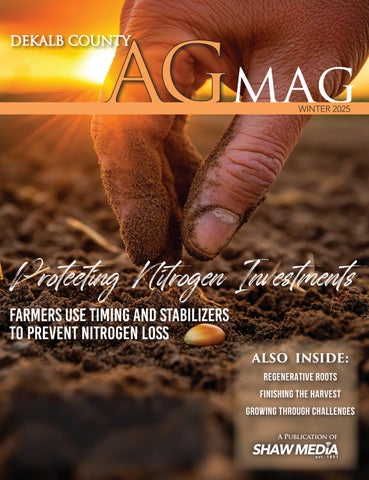
Protecting Nitrogen Investments Farmers use timing and stabilizers to prevent nitrogen loss ALSO INSIDE: REGENERATIVE ROOTS FINISHING THE HARVEST GROWING THROUGH CHALLENGES A Publication of
DDC_AgMag_112125.indd 1
11/6/25 6:29 PM
ONE WITH ROOTS. A proud Agribusiness partner since 1857. As one of America’s leading Ag banks, we know the value of a handshake and a relationship you can rely on. Season to season, FNBO has the tools, financing and expertise to help you rise to the challenge.
/agribusiness Member FDIC
2 | DeKalb County AG MAG | Winter 2025
DDC_AgMag_112125.indd 2
11/6/25 6:29 PM
agmag
DeKalb County
4 6 8 10
REGENERATIVE ROOTS
One farmer’s story of soil and sustainability
FINISHING THE HARVEST
Sunflowers mark the final crop for Riskedal Farms this fall
GROWING THROUGH CHALLENGES
Northern Illinois farmers saw ideal starts and tough middles
PROTECTING NITROGEN INVESTMENTS
Farmers use timing and stabilizers to prevent nitrogen loss
agmag
DeKalb County
Published by Shaw Media Project Manager: Lisa Angel
Design & Layout: Sophia Gibilisco Articles and advertisements are property of Shaw Media. No portion of DeKalb County Ag Mag may be produced without written consent of the publisher.
Winter 2025 | DeKalb County AG MAG | 3
DDC_AgMag_112125.indd 3
11/6/25 6:29 PM
Farmer writes book about
regenerative practices By: Martha Blum • AgriNews Publications
Dan Sanderson wrote a book to help his customers understand the regenerative farming practices he uses on his farm in DeKalb County.
W
orking with consumers who want to learn more about how their food is produced sparked Dan Sanderson to write a book about his regenerative farming practices.
“I would not have ever dreamed I would write a book,” said Sanderson, owner of Pasture Grazed Regenerative Farm, who is a lifelong farmer in DeKalb County along with his wife, Hattie, and their children, Trent Sanderson and Rosie Trump. The idea for his book, “Grounded: One Farmer’s Journey to Regenerative Agriculture,” came from the people who have attended the family’s Farm-to-Table event on the farm in September, Sanderson said. “We hand out a questionnaire at the event and there were a lot of comments from people who wished they had something to read ahead of the event about regenerative agriculture,” he explained. “So, I’m speaking to the people we’re selling our products to, to explain a little bit about what we’re doing.” For years, it has been a family tradition for Sanderson to prepare homemade pizzas from scratch on Sunday nights for his family. “I go to a dairy in Wisconsin and get specialty cheese and somewhere along the way I thought it would be fun to make my own pizza crust,” he recalled. Sanderson bought a little mill and started milling wheat, rye, and even some cornmeal, and began making his own pizza crusts. “Rosie makes the pizza sauce from tomatoes in our garden, and whether anybody is coming or not, Hattie and I are having pizza on Sunday nights, and it is open to our kids and grandkids.” Sanderson partnered with a baker in Mt. Morris to make frozen pizza crusts from his ground rye, corn meal and wheat. “When I want to make a pizza, I pull out a frozen crust, throw my ingredients on, put it in a 500-degree oven and we have pizza in five minutes. Rosie markets that idea—come to our family table and we’ll show you how we do Sunday night pizza,” he said about the Farm-to-Table events. “We try to incorporate all local ingredients from farmers in the area because we want to promote everyone.” The event includes a tour of the 160-acre Pasture Grazed farm, which includes about 30 cow-calf pairs, a 60-ewe flock and a few pigs. “All the meat we sell from Pasture Grazed is value-added and consumer direct,” Sanderson said. “Our focus is selling halves and quarters of beef, and we have a small farm store to sell individual cuts, but the store is open by appointment only.”
At The Core The recipient of the 2025 Illinois Leopold Conservation Award, Sanderson has planted cover crops, which is one aspect of regenerative farming, on his farm since the beginning of his farming career. “Set-aside acres were the normal because we were in a time when there was an overabundance of production,” he recalled. 4 | DeKalb County AG MAG | Winter 2025
DDC_AgMag_112125.indd 4
11/6/25 6:29 PM
“You had to plant a cover crop on the set-aside acres and we saw the results of resting the ground for a year,” he said. “The Soil and Water Conservation Districts would have programs to promote cover crops so my family was always trying something.”
“They get harvested in July and then we plant cover crops.” Sanderson said there will be an animal impact on every acre because by Aug. 1, the animals are coming off our permanent pasture and going on the cover crops. In addition, Sanderson will farm about 2,600 acres of certified organic in 2026.
Through these programs, the farmers learned what worked and what did not work. “On my organic acres, when I do fall tillage, I plant cover crops,” he noted. “Because they were cost-share programs, I wasn’t financially at risk, so I was willing to do them,” Sanderson said. “We flew on spring barley and cereal rye yesterday and we’re Then the internet and YouTube came along, and Sanderson came across the Soil Health Academy classes. “In September 2017, Trent and I were part of the first class, and it was a threeday school at Gabe Brown’s ranch in North Dakota.” Sanderson went to the school thinking he was a forwardthinker since he had tried a lot of things, and he understood soil health. “I came away from there realizing that I had so much to learn,” he admitted. “I had undervalued the life in the soil, and it is hard to see biology in the soil. Mother Nature hates monocultures—she wants diversity, but with commodity agriculture we’re trying to grow a single crop.”
Body & Soil On the Pasture Grazed farm, about 25 acres are permanent pasture. “We graze animals there during the summer while we’re growing small grains on the other acres,” Sanderson said.
working those in on our soybean acres today. The spring barley will jump up quickly this fall and the frost will kill it, but the cereal rye will green up in the spring, so I will have something green there until I plant my next organic crop.” Transitioning fields to organic production is a process. “I don’t see it as a corn crop or a bean crop,” Sanderson said. “I need to do each field a little different, because the context is different in each field.” “Transitioning to organic is expensive,” he said. “My soil is different, and I would never have seen it if I had not made the transition, but it is not an easy transition.”
For more information about the farm, go to www.pasture-grazed.com.
Winter 2025 | DeKalb County AG MAG | 5
DDC_AgMag_112125.indd 5
11/6/25 6:29 PM
Harvest nears completion Sunflowers will be the last crop gathered
By: Martha Blum • AgriNews Publications
W
ith the warm, dry conditions, harvest is almost complete at Riskedal Farms, where some corn and sunflowers remain to be picked. “Soybeans are done and they were average,” said Stephen Riskedal, who farms together with his dad, Brad, and his grandfather, Steve. Stephen said it was exciting to be average when they cut a lot of costs on soybeans this year by reducing herbicides, because they opted to use cover crops to suppress weeds. “We hit the soybeans hard early on, so we got a lot of them out at 12% to 13% moisture,” he said. “One or two days we stopped earlier in the evening and waited until the next morning to get an extra point of moisture.” The sorghum is harvested, which was a new crop for the farmers this year. “It fell a little short of our goal, but there are some things we can do to definitely improve it,” Stephen said. “For a new crop, I’m not going to throw it out after the first year.” According to Stephen, both the sorghum and sunflowers were grown for birdseed, and the sunflowers will be the last crop for the farmers to harvest this fall. The sunflowers require a killing frost to help them dry down. “We have 500 or less acres of corn left to harvest,” the farmer said on Oct. 21. “We’ve been working with low-nitrogen corn and learning how cycling nutrients can reduce nitrogen applications. So, one of our big wins is we had one field that was above average actual production history that we did on 0.41 pounds of nitrogen per bushel.” Stephen spends a significant amount of time during the fall planting cover crops with a 40-foot air seeder. “Cover crops will be planted on 100% of our ground and some will have wheat. We plant cover crops, including radishes, lentils, flax and mustard with our wheat right in the furrow, which are all things that do some pretty good things for the soil, but also winter kill,” he said. “Right now, they are growing well with wheat, and once it turns cold enough,
they’ll die off and the wheat will come back next spring.” The radishes help scavenge nutrients, and as they decompose, they give those nutrients to the wheat roots, Stephen explained. “The mustard helps reduce soybean cyst nematode numbers. We don’t have a soybean cyst nematode problem, but this is another tool in our toolbox.” For fields that will be soybeans in 2026, Stephen plants primarily cereal rye and for some fields, rapeseed is blended with it. “Ahead of corn, I plant a blend of winter barley, balansa clover, and rapeseed, which is a new blend for us this year,” he said. “The major goals are erosion control and weed suppression with a little bit of nitrogen fixation with the clover.” One thing he likes about the rapeseed is its winter hardiness. “It exudes an acid from its roots that helps make phosphorus more soluble,” he said. “A lot of phosphorus gets locked up in our soil and when you apply DAP you might only get 10 to 15% available, so these root exudates help make the phosphorus plant available.” The sunflowers this year were a double crop after wheat, and they were interseeded with buckwheat, mustard, radish and flax. “We picked cover crops that were short and wouldn’t compete with the sunflowers,” Stephen said. “As the sunflowers are dying, there are still plants in the undergrowth that are photosynthesizing and doing good stuff for the soil.” Buckwheat also solubilizes phosphorus, but it is a warmseason plant whereas rapeseed is a cool-season plant. “The more I learn about different things plants can do for the soil, the more excited I get,” Stephen said.
Grazing Season Stephen already has plans to make some changes for next year with the cattle that are grazing a field with a 12-way cover crop blend.
6 | DeKalb County AG MAG | Winter 2025
DDC_AgMag_112125.indd 6
11/6/25 6:29 PM
“I have about 150 calves that came in over a one- to two-week period and a lot of them were in small groups. I’ve learned that I’m going to try to get larger groups from fewer places with better vaccinations to avoid some heartache next year,” he said. “But in total, it has gone well, and I have had some great support from local cattle producers who have given me advice, as well as a veterinarian who has been phenomenal to work with.” The cattle have respected the single-wire hot fence to partition the field. “Moving them has worked really well, and I think I have a good stocking rate,” Stephen said. “I’ll probably have extra forage and that might allow me to extend my grazing season, but water is my limiting factor on how long I can graze the cattle.”
Country Lights This is a busy time for the Country Lights candle business that is operated by Stephen’s older brother, Darren, and his wife, Kendall, from their home in southern Wisconsin. “This is go-time for the candle fundraisers since the majority are in the fall before Christmas,” Darren said. In addition, the Riskedals set up a booth at the National FFA Convention & Expo in Indianapolis to promote fundraising opportunities for FFA chapters. “The convention is almost a reunion for us because we see people that Kendall and I knew back when we were in FFA and 4-H,” Darren said. As a result of participating in events like the National FFA Convention, the family has shipped candles from coast to coast. “We’ve sent candles to Maine, Alaska and a lot to Florida and Texas,” Darren said. “I’ll bet it’s 20 states that have organizations doing fundraisers.” One of the challenges with the fundraisers, he explained, was the large number of orders they would receive shortly after Thanksgiving. “Until they sent me the orders, I would have zero idea of how many they sold or what fragrances they sold,” he said.
To address this challenge, Darren built an app that organizations can use for taking electronic orders for the candles, wax melts and fidget sniffers. “The orders are sent to me instantly, so I can track how many each school is selling and the fragrances, which makes the planning and logistics a lot easier,” he noted. “One of the really powerful things about the app is it turns a fundraiser into a competition amongst the students. It tracks a leader board that compares them to people in the organization, as well as across the whole group of organizations we have doing fundraisers.” The kids have really liked the app, Darren said, and they are comfortable with electronic ordering. “It makes it easier on whoever is organizing the fundraiser because they don’t have to manually enter all of the orders into a spreadsheet to send to me,” he said. “I’m hoping that also reduces some of the errors because there’s no manual moving of numbers.” Another big change will occur for the family in November, when Darren will be working full-time with the candle business and leaving his other job. “It has been our goal for the candles to be a full-time job for one or both of us,” said Darren, who has worked as a precision equipment specialist since graduating from the University of Illinois. “It will be a change because I was at the same job for almost 10 years,” he said. “If they had given me a reason to leave, it would be a lot easier to do, but that’s just not the truth, because I’ve enjoyed it.” Working full-time with Country Lights will allow Darren to develop some new products for the business, such as room sprays or air fresheners. “The extra stuff has not happened, like the things to make the business better and grow, because we just haven’t had the time to do it right,” he said. “We’ve done what needed to be done to sustain it because that’s what we had time to do.”
Winter 2025 | DeKalb County AG MAG | 7
DDC_AgMag_112125.indd 7
11/6/25 6:29 PM
Growi n g season’s successes, challenges By Tom C. Doran • AgriNews Publications
T
he 2025 corn and soybean growing season ended as it started—ideal conditions— along with the usual and unusual challenges sandwiched in between. Crystal Williams, Pioneer agronomist in DeKalb County, recapped the northern Illinois growing season.
Planting began ahead of schedule. “A lot of people utilized opportunities to plant mid-April, depending on conditions and eagerness to get started or how willing they were to get started early,” Williams said. “If they hadn’t gotten started then, a lot of people did start planting the last few days of April. Those dates seemed like they were the problem child days. Every spring has some days that, ‘Oh, I wish I didn’t plant’ or it might have caused some headaches. Those last few days of April were certainly that.” Soil conditions were ideal until the end of April. “Our soils worked up really beautifully this year, then we ended up getting a cool, heavy-like driving rain. We truly had garden soil for planting conditions, and that rain caused a lot of crusting in some of that area,” she said.
July and heat that crop had a lot of energy to drive through and just shot up quite a bit. Things turned around quite a bit,” Williams said.
“
Looking at the weather conditions and how that affected the corn rootworm populations, really any time we have a dry fall, followed by a dry spring, dry May and June, we’re going to have pretty favorable survival rates of corn rootworms.
“
Crystal Williams
–—Crystal Williams, Pioneer agronomist in DeKalb County.
“We had good post-application windows, but from a fungicide timing standpoint, between corn and soybeans, it all kind of ran together a little bit. So, it was a little chaotic for much of that area.”
Pests Corn rootworm continues to be a significant pest in many northern Illinois counties.
“Looking at the weather conditions and how that affected the corn rootworm populations, really The heavy rains forced some replants in the later planted crop, and the need for rotary hoeing due to soil any time we have crusting. Temperatures cooled toward the end of May, a dry fall, followed by a dry spring, slowing heat accumulation and crop development. dry May and June, we’re going to have pretty favorable survival “It was dry and hot in June, which it seems like has rates of corn rootworms,” Williams said. “There been kind of the norm the last couple of years. That being said, once we did get our shots of rain finally in was pretty heavy pest pressure this year. We’ve been kind of building that population. It’s very cyclical. 8 | DeKalb County AG MAG | Winter 2025
DDC_AgMag_112125.indd 8
11/6/25 6:29 PM
s
According to Williams, there have been some conversations this year in terms of ‘what are we going to do to change and control this corn rootworm population.’ “Maybe a field popped up that didn’t seem like it had a problem, or we didn’t realize there was an issue, and this year we did find one. Rotating to soybeans is the easiest way in managing weeds in that field, as well, and is really the best way we can suppress a significant amount of corn rootworm.”
Diseases Southern rust, tar spot, sudden death syndrome, and other diseases also popped up during the growing season. “Southern rust seemed to have stayed a little bit farther west. You can find southern rust and tar spot in northern Illinois. I heard of southern rust down in the Macomb area, and the next thing it was up by the Quad Cities and kind of followed the Mississippi River up and then blew east a little bit,” Williams said. “I feel like there was a little bit more pressure in Lee and Ogle counties than there was in DeKalb, in my opinion, but not that you couldn’t find it.” Williams said sudden death syndrome in soybeans was significant this year. “A great treatment for that would be IleVO with your seed treatment. Some people cut that out this year because of input costs and different things. Anytime that we extend the time that soybeans are protected while they are
below ground and not emerged, that’s really where we can inoculate a little bit earlier in that season,” she explained. “There was also a little bit of white mold, which is typically what we deal with, but it seemed like there was not as much white mold pressure this year.”
Corn Acres Northern Illinois continued to lean toward corn in 2025. “We do have quite a bit of continuous corn and I’d say we tended to run a little bit more corn even this last year because of markets. On average, I would say there’s a minimum of two to three years of corn-on-corn. Some stick to a two-year corn, one-year soybean rotation. Then there’s obviously more years of continuous corn than that, too,” Williams said.
Harvest The crops dried down quickly in the fall, helped by the hot, dry weather. There was a lot of sub-20% corn in early October, which is typically not common in northern Illinois. “I harvested a plot on Oct. 1 that was 100-day to 116-day, and everything was right around between 13% and 16%. It was planted in mid-May. It was pretty surprising to see that,” Williams said. “I think I said earlier this year I wouldn’t expect to be harvesting 15% corn again this year, and here I made myself out to be a liar.”
firststatebank.biz | 800.362.9623
We Are Ag Strong Committed to Your Farm, Your Future Winter 2025 | DeKalb County AG MAG | 9
DDC_AgMag_112125.indd 9
11/6/25 6:29 PM
Tools to protect costly nitrogen investment By Tom C. Doran • AgriNews Publications
Fall applications are convenient, but can be risky due to potential losses from leaching, denitrification and volatilization. Pre-plant nitrogen has a lower risk of loss than fall-applied nitrogen, but can be delayed by weather, potentially delaying planting beyond the optimum window. Having a nitrogen strategy, spreading nitrogen applications throughout the season and using stabilizers can help protect nitrogen investments and improve efficiency. “I can’t put a number on it, but I do have a fair amount of people who do run fall anhydrous applications,” said Crystal Williams, Pioneer agronomist in DeKalb County.
Recommendations A starting point for fall nitrogen applications is soil temperature. “Make sure that soil temperatures are 50 degrees and below, as well as trending downward. We definitely had some fields applied last year, and a couple of days later, it was 80 degrees outside. That’s never a good day,” Williams said. Cooler soils slow the activity of bacteria that convert ammonium to nitrate, which is the form most vulnerable to leaching and denitrification. It is also important to stick with ammonium sources, such as anhydrous ammonia, and avoid nitrate-based fertilizers when applying in the fall. A key challenge in nitrogen management is that once nitrogen converts to nitrate in the
soil, a process called nitrification, it becomes highly mobile and susceptible to leaching or denitrification, a microbial process that occurs in water-saturated soils. Denitrification not only reduces nitrogen available to crops, but also releases nitrous oxide, a potent greenhouse gas. These losses are especially problematic in the fall and spring, when soil is cool and wet and plant uptake is low.
Stabilizers Nitrogen stabilizers help mitigate those risks by slowing down the chemical process that leads to nitrogen loss. “Utilizing a nitrogen stabilizer has been a really key one and not all of them are created equally. Our N-Serve and Instinct NXTGEN nitrogen stabilizers stand out to me. N-Serve and Instinct and those nitrapyrins nitrogen stabilizers are not water-based, and keeping that nitrogen in the root zone where it’s needed is extremely important,” Williams said. Nitrification inhibitors, such as nitrapyrins, delay the conversion of ammonium to nitrate, keeping nitrogen in a more stable form that’s less likely to leach or be lost to denitrification. These products are especially effective in fall applications, as they remain active longer in cool soil conditions. “I found that based on the total amount of nitrapyrin sold in the industry last year, it resulted in 21 million pounds of nitrogen that did not end up in rivers because of utilizing that. That’s pretty significant,” Williams said. “We even decrease greenhouse gases by 51% when we utilize a nitrapyrin and decrease leaching by 16%. So, it’s definitely a tool. According to Williams, some people go the approach of just adding extra nitrogen and that’s not really the most effective use. It’s going to disappear anyway, oftentimes back into local waterways.
Urease inhibitors, such as NBPT, are used with surface-applied urea or UAN to slow the conversion of urea into ammonia gas, which can be lost to the atmosphere. This is particularly useful in no-till or reduced-tillage systems where urea is not incorporated into the soil. NBPT works by blocking the urease enzyme that drives this conversion, buying time until rainfall or irrigation can move the nitrogen into the soil. While yield responses to nitrogen stabilizers can vary depending on conditions, they provide an important form of insurance against unpredictable weather and nitrogen loss.
“
By using the right stabilizer with the appropriate nitrogen source and application timing, farmers can significantly improve nitrogen use efficiency, protect their investment and reduce environmental impact.
“
W
ith the harvest near the finish line, corn growers turn toward their nitrogen plans for the 2026 growing season that may include a fall application. Nitrogen is critical for corn growth, but its volatility often leaves farmers searching for the best source, rate and timing of the vital input.
–—Crystal Williams, Pioneer agronomist in DeKalb County.
The greatest value of nitrogen stabilizers can be seen when nitrogen is applied well before the crop needs it, such as in fall or early spring, or in fields prone to nitrogen loss due to poor drainage, sandy soils or tile drainage systems. “I do have a fair amount of people turning towards split applications,” Williams said. “They apply some nitrogen in the fall and then later as a post-pass or side dressing in-season, which is a really great way because that corn crop uses 80% of those nitrogen needs after V6. “We need to make sure that we still have that nitrogen available later in the season. When the heat and the moisture both are taking away from our nitrogen supply, that’s where we want to make sure we had it when we need it.”
10 | DeKalb County AG MAG | Winter 2025
DDC_AgMag_112125.indd 10
11/6/25 6:29 PM
SM-CL2224477
Winter 2025 | DeKalb County AG MAG | 11
DDC_AgMag_112125.indd 11
11/6/25 6:29 PM
PERSONAL • FARM • COMMERCIAL AWE INSURANCE AGENCY
AWE INSURANCE AGENCY We are a local agency providing our clients comprehensive solutions to meet their needs. If at any time you would like a review of your insurance program, please contact us. We welcome theTODAY! opportunity to be of service to you! CALL 815-784-6614 CALL TODAY! 815-784-6614 428 MAIN ST,ST, GENOA, IL 60135 428WW MAIN GENOA, IL 60135
AWE INSURANCE AGENCY 428 W. Main Street • Genoa
815-784-6614 DDC_AgMag_112125.indd 12
11/6/25 6:29 PM