





• Familystartnon-profitto aid community
•Solar an opportunity, not a threat
•Award triggers donation to renovate school ag department
•and more...
























By ERICA QUINLAN equinlan@shawmedia.com
PERU, Ind. — When Alexandra Merritt saw the need for more food bank access in southern Miami County, she took action.
As a high school student in 2019, Merritt reached out to local farmers and members of the ag community to request donations for a new initiative: Harvest for Hunger.
Through these efforts, the program raised $2,875 its first year, with 100% of the proceeds going directly to Miami County Helping Hands food bank.
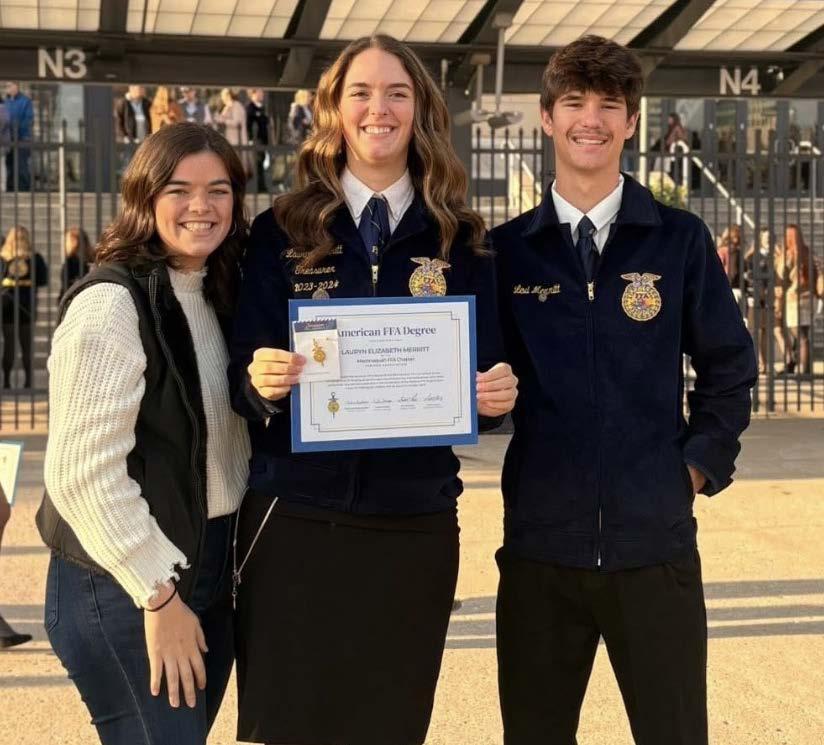
Now college students, Alexandra and her sister, Lauryn, continue growing the program, along with their help of their brother, Levi, who is in high school.
Their ongoing efforts reflect a commitment to fighting food insecurity and supporting their local community.
“Harvest for Hunger became a meaningful way for me to combine that passion for giving back with my love for agriculture,” Alexandra said.
“Food insecurity exists in every community, and through this project, we saw an opportunity to make a difference in the community.”
Since 2019, Harvest for Hunger has experienced significant growth in both reach and impact. So far, the program has raised nearly $71,000 and recently started supporting the Amboy Friends Food Pantry.
“In 2021, we hosted a Kickoff to Harvest Dinner as a way to thank and recognize the agricultural community for their continued support,” Alexandra said.
“This dinner marked an important step in building stronger relationships and further growing the program’s presence and impact.”
She has been blown away by the overwhelming willingness of community members to show up and help their neighbors.
“Each year, more individuals — especially family friends and community members not originally on our contact list — have reached out wanting to contribute,” she said.


“That level of support has been incredibly meaningful, as it shows the strength of the community we’ve built and the shared commitment to helping others. It’s a powerful reminder that when people come together, they can make a real difference.”
When the siblings started Harvest for Hunger, they quickly learned the impact food security has on Miami County.
“Our own school has a 60% free and reduced lunch rating,” Alexandra said., “It was hard to understand how, as farmers, we are raising an abundant food supply, but that many people don’t have the resources to access it through grocery stores.”
Each year when they deliver the donation check to Helping Hands, the Merritts are rewarded with the knowledge that they’ve made a difference.
“Seeing firsthand how the funds are making a difference brings everything full circle and reinforces the purpose behind our efforts,” Alexandra said.
“It’s also a powerful reminder of the reality many people face: 1 in 5 children go to bed hungry and 1 in 6 adults experience food insecurity, unsure of where their next meal will come from.
“While many of us take for granted having three meals a day, these moments highlight the importance of continuing to give back and support those in our own community.”
Looking ahead, the Merritts hope to see Harvest for Hunger continue to grow and become a lasting tradition.
After Levi graduates in 2029, the goal is to transition the program to the Maconaquah FFA Chapter, allowing more students to take ownership and carry the mission forward.
“While we still plan to stay involved in an advisory role, having the FFA chapter lead the effort will help expand its impact and ensure its sustainability for years to come,” Alexandra said.
“Ultimately, we hope Harvest for Hunger continues to inspire others to give back and strengthen the connection between agriculture and community support.”
Those who are interested in donating to Harvest for Hunger can reach out to Alexandra at alexandrajae20@ gmail.com or Lauryn at laurynmerritt26@gmail.com.





By TOM C. DORAN tdoran@shawmedia.com
GROVELAND, Ill. — Brad Zimmerman’s father, Phil, was an early adopter of no-till and always looking for ways to improve his farm.
He is now carrying on the idea of looking outside the box with an even more holistic approach to crop production that focuses on plant and soil health.
“Dad was a fourth-generation farmer and he was one of the first ones to go to no-till in about the mid-1980s. He was still using anhydrous, but started doing strip-till with the anhydrous bar in the early 1990s. He basically sold the chisel, field cultivator and all that stuff,” he said.
A move to no-tilling in the 1980s was not on most farmers’ bingo card.
“He was always somebody that would look to do things better and differently, not be afraid to try things, and he didn’t care what other people said,” Zimmerman said.
He believes one of the factors that led to his dad’s move to conservation tillage was his conversations with other growers.
Phil worked for Sommer Brothers Seed Company where he was in charge of detasseling and delivered seed in the winter.
“He’d go to New York, Michigan, Ohio, and talk to all these different farmers and get ideas of what to try and bring that back to our farm,” Zimmerman said.
After his dad passed in 2013, Zimmerman came back to the farm, continuing his dad’s legacy, and also began making his own mark on the land that included cover crops.
He soon became a certified crop adviser, joined the Tazewell County Soil and Water Conservation District board. In 2018, Zimmerman enrolled in the Precision Conservation Management program through the Illinois Corn Growers Association, a program he continues with today.
Zimmerman also started his business, SeedOnomy, in 2013.
“I was selling seed corn while I was farming because I wanted something else to do and guys would ask me different questions. They knew I was in the SWCD and into cover crops and things like that,” he said.
“SeedOnomy came about as a kind of a shell of a lot of the things that I do, whether it’s corn and soybean seed,
cover crops, soil testing, tissue testing, or nutrient building.
“I sell corn, soybeans, wheat, cover crops. I’m a Channel dealer. I work with Saddle Butte for cover crops and there are a couple smaller organic seed companies that I work with, as well.”
Zimmerman has also teamed up with Brad Forkner, Nutrient Management Specialists, Cherry, and Trenton Carley, Fullthrottle Ag Service, Watseka, to form Targeted Plant Nutrition.
“We have planter box treatments, we have in-furrow starters and we have several different foliars that we’re working on, all with the same premise of multiple modes of nutritional movement,” he said.
He’s also among the specialists on the Avant Ag Tech team. Avant provides a comprehensive soil health consulting program designed to help producers maximize crop performance, improve soil biology and achieve long-term profitability.
Zimmerman utilizes a multifaceted approach in his crop fertility program.
“What we’ve been doing the last five years is basically a nontraditional fertility program,” he said.
“We use products like ocean minerals, dry humates, liquid fulvics, humics, sugars, aloe, kelp and a lot of these things that aren’t traditionally sold by fertilizer purveyors, but they’re very useful in terms of a biostimulant or feeding the crop or getting nutrients into the crop.
“It all began when I started working with Brad Forkner. His main thing was multiple modes of nutritional movement. So, we use fulvics, we use aminos, we use sugars, we use carbons to get nutrients into the plant so they’re more efficient.”
Zimmerman’s fertility plan varies by field location and crop.
“We found that by becoming more efficient in all the other things that are involved in the nitrogen process, molybdenum, cobalt, nickel, a lot of these co-enzymes that make your nitrogen process work better, nitrogen fixing better and keeping the plant healthier, you’re a lot more efficient with that nitrogen,”he said.
“Nitrogen is basically an energy source. So are phosphorus and potassium. It’s all stored energy. It’s kinetic energy stored in those bonds. And when you break those bonds or a plant uses it, that energy is released and it’s
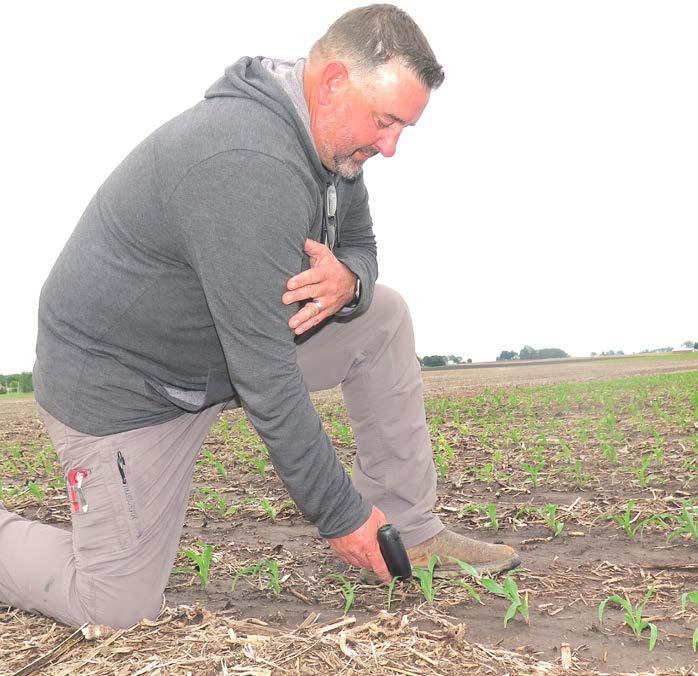
Brad Zimmerman uses his Senseen Nutriscope tissue tester on corn for instant measurements of chlorophyll, Brix level, plant health score, nitrogen, phosphorus, potassium and other plant contents. The device connects to an app via his cellphone’s Bluetooth. The tissue tester is calibrated to sap test and eliminates the need to take leaf samples, send them to a lab and wait for results.
utilized for a certain process.
“Different types of nitrogen have different types of energies with them, as well. When you help facilitate that breakdown or have a healthier plant that’s able to better utilize it, then you’re getting more efficient use of it. We grew 282-bushel corn on a farm on 150 pounds of nitrogen.
“I’ll preface that by saying that we didn’t start out by doing that, but we’ve earned the right to do that based on a lot of the soil health principles that we’ve done, making the soil healthier and banding it at the right time, with the right product, all that, and then supplementing it with biology.”
Zimmerman applies synthetic fertilizer twice throughout the year.
“We do strips in the fall as tillage to warm up the soil, and we’ll come back in the springtime with the strip freshener and put on liquid nitrogen. It’s got nitrogen, sulfur, humics, molybdenum, boron, five different sugars, kelp
and ocean minerals in that strip in one pass,” he said. “Then we’ll plant it, and we’ll come back and do a Y-drop pass at V5, V6.
“I haven’t used dry fertilizer — phosphorous and potassium — in the last four years. Everything that we do is banded on the planter or foliar-applied.”
Zimmerman was asked about his farming strategies compared to the “conventional” approaches.
“We can’t farm the same way that we did 30 years ago. My dad was a great farmer because he could fix stuff. Back in the ‘80s and ‘90s, he could repair things, he could fabricate. I’m not as good as him, but today’s farmers need to be more team leaders and CEOs and decision-makers versus being somebody that is a good operator or is a good mechanic,” he said.
“It’s the same thing with fertility.
do it better.
“We’re blessed to have the wonderful soil. That’s made us lazy farmers. We’re definitely blessed and we just can’t take that for granted. We can’t lose that.
“One thing my dad always told me was to leave something better than what you found it. So, we’re trying to build up organic matter, build up earthworm populations and build up carbon. It’s hard to do when you’re when you’re doing some of the things that traditional farming has taught us to do.”
Zimmerman has carried on with his dad’s legacy of innovation to the next level. He was asked what he sees in farming 20 years down the road.
“If I think of what farming was 20 years ago, we’ve got a lot better in terms of measuring what we we put on or what we need to put on. The genetics have gotten exceptionally better. So, I would think that would continue to improve,” he said.
“As far as machinery goes, you’re
probably going to see a split between going bigger and bigger and bigger and then also smaller and smaller and smaller. I would anticipate robotics to become heavily involved.
“Data is gonna be continually more valuable, and especially as we can manipulate it with AI, and learn. Guys are going to learn differently. We’ll probably not see farm shows anymore because we’ll be able to learn in different ways.
“I think you’re probably going to see a lot more collaboration between growers versus what we saw 20 years ago. Guys were pretty close to the vest and not willing to share, whereas now I think you’re going to have to. You’re going to have to collaborate a whole lot more.
“I’d like to see more diversity in crops, too. It’s not necessarily organic, but let’s get some more oilseeds going. I think canola is going to be a big deal. CoverCress is going to become used more and more. I’d like for us to grow more fiber in terms of like hemp to make clothes, bags, rope and things like that.
“I think it’s going to be interesting. It’s going to be a lot of fun.”




By COLLEEN CALLAHAN
“It’s not the strongest species that survives, it’s the one that adapts, adopts and accepts change.” Why do I begin with this quote? Because it applies to the consideration of “planting” solar panels on farm ground.
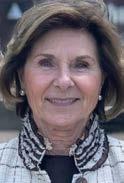
As we see more solar fields dotting our rural landscape, it’s understandable to question if this is the best use of our productive Illinois land. Shouldn’t we focus on feeding a growing population?
I believe we can harvest both the sun and foodstuffs. Here’s why.
Illinois has more than 27 million acres of farmland, about 19.7 million classified as prime. Backed by data, even if every solar panel in Illinois today was installed on agricultural land, we’d only use 0.1% of that land.
And it’s projected that even five years from now, when thousands more megawatts of solar are added, we’d still use just 0.5% of our farmland.
That’s not a threat. It’s an opportunity.
Solar development doesn’t permanently pave over the land for a housing subdivision or a shopping mall. Rather, when decommissioned 30 or 35 years later, the panels are removed, and the land is restored, often in better condition than before.
With pollinator-friendly plantings under and around the panels — whose root systems are twice as deep as those of corn or soybeans — soil health, water infiltration and biodiversity are all improved.
And I haven’t mentioned the financial stability of harvesting this new crop!
The benefit to both the landowner and the neighboring community is unmatched, particularly during this time of uncertainty.
When “planting” solar panels, you don’t choose between crops or renewable energy. You harvest both. As one farmer said, it’s like “farming the sun” when the corn market doesn’t
cooperate.
As a former director of USDA Rural Development in Illinois, I am familiar with the challenges of securing funding for much-needed improvements in our rural communities.
Solar infuses a dramatic increase in property tax revenue. Since 2003, Illinois has increased its renewable energy tax revenue from $235 to more than $64 million in 2022.
In Marshall County in 2023, a two-megawatt solar project generated more than $12,000 in property tax, compared to just over $1,000 in revenue from the neighboring farm.
That 12-times increase, paid by the solar developer, helped the schools, the fire protection district and social services.
Additionally, don’t overlook the fact that someone must build these community solar projects, which means creating jobs.
Long term, solar by itself won’t provide all the energy we need. But it is a crucial component of the clean energy matrix, the sun being an abundant re-


source we have taken for granted.
Now, Illinois has a chance to be a leader not only in agriculture, but also in renewable energy. Because the state of Illinois has set a goal of achieving 100% clean energy by 2050 through the Climate and Equitable Jobs Act, we can reach it in a way that respects our roots, protects our natural resources and provides benefits to farmers and rural residents.
Let’s accept that the sun is one of our most powerful and consistent resources. Let’s adapt to farming it wisely.
Let’s adopt the view that the sun can shine even brighter for the generations to come, because solar is not a threat. It’s an opportunity.
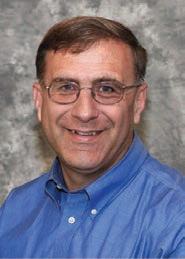
Colleen Callahan spent 32 years as a farm broadcaster and served as Illinois director of U.S. Department of Agriculture’s Rural Development and director of the Illinois Department of Natural Resources.



By TOM C. DORAN tdoran@shawmedia.com
ALTONA, Ill. — Tyler Main
t ook a temporary westward detour after graduating from Illinois State University 10 years ago this month.
Main grew up on the family farm in Knox County in west-central Illinois, where corn, soybeans and livestock production are the norm. He opted to get some firsthand experience in wheat production at a scale not seen in the Prairie State.
“I spent the summer after college on the wheat harvest out west. I cut wheat basically from Memorial Day to Labor Day with a family from South Dakota. It was a great experience and they were awesome people,” he said.
The road that led Main to
the summer job in the western Corn Belt began when he was admittedly “goofing off in high school.”
“My wife, who’s an ag teacher, won’t like to hear this, but I was probably goofing off in ag class while in computer lab. My buddies and I would always stumble across these farming websites and there was one on the wheat harvest out west. I always thought that would be a cool experience,” he said.
Fast-forward to his senior year at ISU in 2016.
“I wasn’t sure if I was going to be able to come home to the farm or not. I was in my apartment during college
and I typed typed in ‘Case IH wheat harvest.’ It came up with the Krumbach family out of Parker, S.D.,” he said.
“I found their website and sent Blake Krumbach an email, told him a little bit about me, sent my resume and ask if he was interested. He called me and said they were looking for another guy and it was just kind of one of those things that worked out. They were phenomenal people, good Christian people and just an excellent experience.
“I drove up to South Dakota. Then we convoyed down to start wheat harvest in Oklahoma, then we went to Kansas, Nebraska and Montana to harvest wheat. We spent about a month in Montana, which was beautiful country.”
They used three Case combines to harvest the wheat and

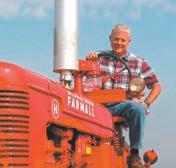
had one or two grain carts, depending on the need.
“I was in the grain cart pretty much all summer, and then in August when we got to Montana, I was able to get into a combine and I spent the rest of my time in a combine. It was great to get into a combine for a change of scenery,” Main said.
“I would highly encourage anybody to pursue that if they get the chance. It was one of those once-in-a-lifetime things that I probably might not ever do again. Hopefully, I will be able to catch up with them some day and see those people I worked for.”
It was a unique learning experience for the young farmer.
“I didn’t know anything about wheat, and in Montana alone we cut like seven different crops. We had winter
wheat, spring wheat, lentils. I can’t name them all now, but it was a little bit of everything. So, it was very, very cool to get to participate in that and see that,” he said.
As the wheat harvest was wrapping up, the timing could not have been better.
“I then had the chance to come back home at the end of August, early September. I was lucky enough that they were able to find a spot for me to come back and join the operation here. I know not everybody has that chance, that opportunity, so I’m thankful for that and learned a lot,” Main said.
“It’ll be 10 years this August that I came back to the home farm.”



By MARTHA BLUM mblum@shawmedia.com
HEYWORTH, Ill. — Big changes will be happening over the summer for the agricultural rooms at Heyworth High School.
Renovations will start on both the outside and inside of the building once the school year is complete.
“All of the things in the shop and classroom are going into storage,” said Kara Barling, agricultural teacher and FFA adviser at Heyworth High School.
“We are getting all new doors and windows, storage, air conditioning and heating systems,” Barling said. “We are getting new cabinets so that will make it cleaner and more organized.”
“There is a group of kids that spend a lot of time here, and having a space that is going to be more welcoming, I think is really great,” she said. “The kids are really excited.”
It was a goal for the school to invest money in this portion of the school over the next several years. However, thanks to a donation the project has been accelerated.
Last year, Heyworth received the Outstanding Middle/Secondary Agriculture Program of the Year award from the Illinois Association of Vocational Agriculture Teachers.
“It was nice to be honored with that award, since I am a single-teacher program,” the educator said.
“The award looks at the program as a whole, not just from the FFA perspective,” said Barling, who has taught at Heyworth since 2016.
“It includes if we are increasing college and career readiness and if the kids can get certifications. Students that take the vet science class are certified in animal CPR and first aid.”
As a result of this award, the Heyworth school received an anonymous donation of $750,000 to renovate the agricultural building.
“This man saw that we won the award on the news and he chose us for a charitable donation because he has an interest in agriculture and education,” the FFA adviser said. “When I heard the number from my superintendent, I cried a lot.”
Barling did not originally plan for a career as an ag teacher.
“My original plan was to go to vet school, so I thought I should join FFA,” she said. “By the end of my freshman year in high school, I decided I was going to be an ag teacher and here I
am.”
At Illinois State University, Barling completed a degree in ag education and taught at Fisher High School for two years.
“I student taught at Heyworth, and when my cooperating teacher was stepping down, he called me and said, ‘Come take my job,’ and I said OK,” she said.
In 2023, Barling completed her master’s degree from ISU in ag education.
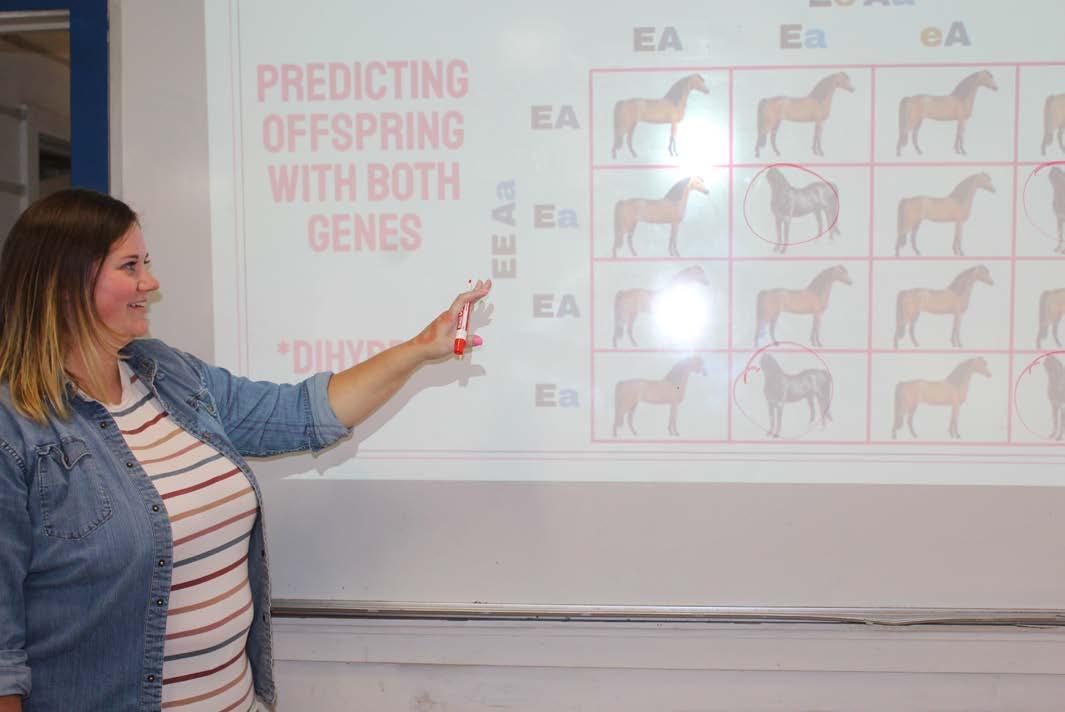
At Heyworth, Barling teaches an eighth-grade exploratory class and an Intro to Agriculture class for freshman students.
“For the sophomores, the class focuses on physical science, physics and engineering in agriculture,” she said. “So, we talk about mechanics, electricity and now we are learning about concrete.”
Additional classes include animal science and veterinary science.
“This is the first year for dual-credit classes with Heartland Community
College for agricultural economics and horticulture,” Barling said.
Currently, 156 students are members of the Heyworth FFA Chapter.
“When I started here, I had about 60 FFA members,” Barling said. “Having the eighth grade class helps a lot with recruitment and retention.”
The FFA members are quite active in FFA activities, social events and community service projects.
“We went to 18 contests this year for section and state, we have two state qualifiers for proficiency awards, five alumni scholarships and one of our members earning his State FFA degree,” Barling said.
Some of the FFA activities include a trivia night, alumni auction, plant sale and Ag Expo with a petting zoo.
“For the Ag Expo, we invite the pre-K through third grade students and we have activities for the kids to do,” Barling said. “This year the kids got a punch card, and when they went to each area, we punched their card
and when they finished the kids got a prize.”
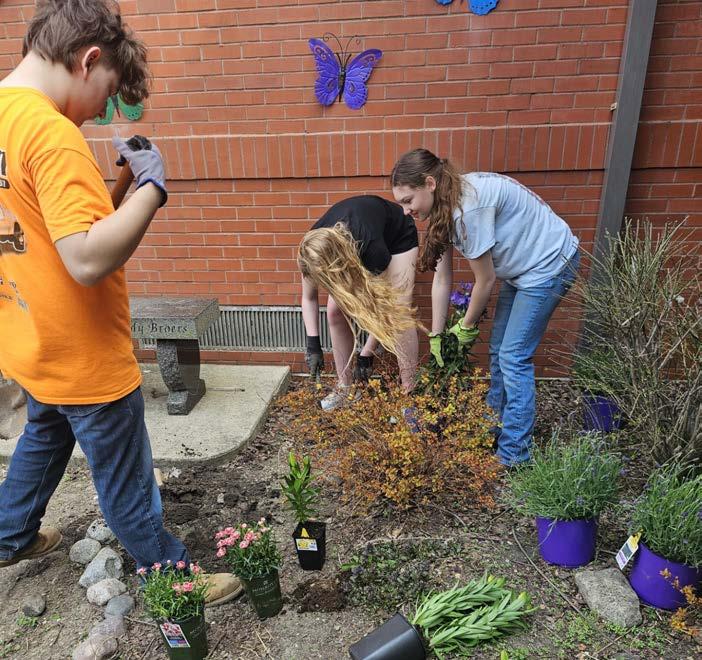
The high school students are responsible for maintaining the butterfly garden at the elementary school.
“That is a space with benches and seats where the kids go outside and read,” Barling said.
“We do the weeding and last year we redid all the mulching,” she said. “The year before that, we repainted some of the decorations, so each year we do something to keep it nice.”
Barling set up a point system for the members of the chapter.
“They earn points for going to events, and at the end of the year, we crown the most active member,” she said. “If you are in the top 10, that earns you a trip to the state and national FFA conventions.”
The point system, Barling said, is an easy way to keep the members accountable.
“I find it works really well, because if students want it, they can make it hap -
she said.
“It creates a sense of competition, but it also brings people closer,” said Alaina Backlund, who was recently elected the chapter historian for the upcoming year. “We are a pretty close group and typically the same group of kids go to a lot of the contests.”
For community service, the FFA chapter works with the Farm Bureau’s Harvest for All program.
“It helps with food insecurity and this year we did 342 man hours, we donated $610 and we collected 439 pounds of food,” Barling said.
“One of our students made a rug with our Hornet mascot,” Backlund said. “If you brought cans of food to the football game, you got a raffle ticket and the winner of the raffle received the rug.”
Heyworth FFA members assist at the Day of the Dozer event, held in September in Bloomington. During this day, kids have the opportunity to check out heavy machinery such as excavators and bulldozers.
“It raises money for the ‘Stay 4’ Project, which focuses on encouraging kids to stay all four years in high school,” Barling said.
“We were the welcoming committee and we gave out plastic hard hats that the kids got to cover with stickers,” Backlund added.
Earlier this year, Barling received the Alumni Excellence in Teaching Award from the College of Education at ISU.
“This is an award for teachers who have been in the classroom for at least 10 years,” she said. “I was one of eight people who received the award.”
Barling is a member of the Agricultural Education Advisory Council at ISU.
“We work with the student teachers and I sit in on the interviews with the students to determine which school we should place them,” she said.
“I also did a little research with Dr. Solomonson, to look at the work-life balance for ag teachers,” she noted.
This summer, Barling will add one more award, when she receives the Section 9 Golden Owl award from the Illinois Association of Vocational Agricultural Teachers at the group’s annual conference.

Main wants to see community, residents thrive
By TOM C. DORAN tdoran@shawmedia.com
ALTONA, Ill. — Heroes don’t wear capes. They’re paged at 3 a.m. to fight a fire, the next day they’re advocating for ag on Capitol Hill and the following day pitching in for the local FFA.
Oh, yes, and then there are those full-time jobs of raising corn, soybeans and livestock, while being a husband and father.
Tyler Main does all of that and much more behind the scenes to serve the community he loves, while being a booster for agricultural causes that have impacts well beyond his family’s Knox County farm.
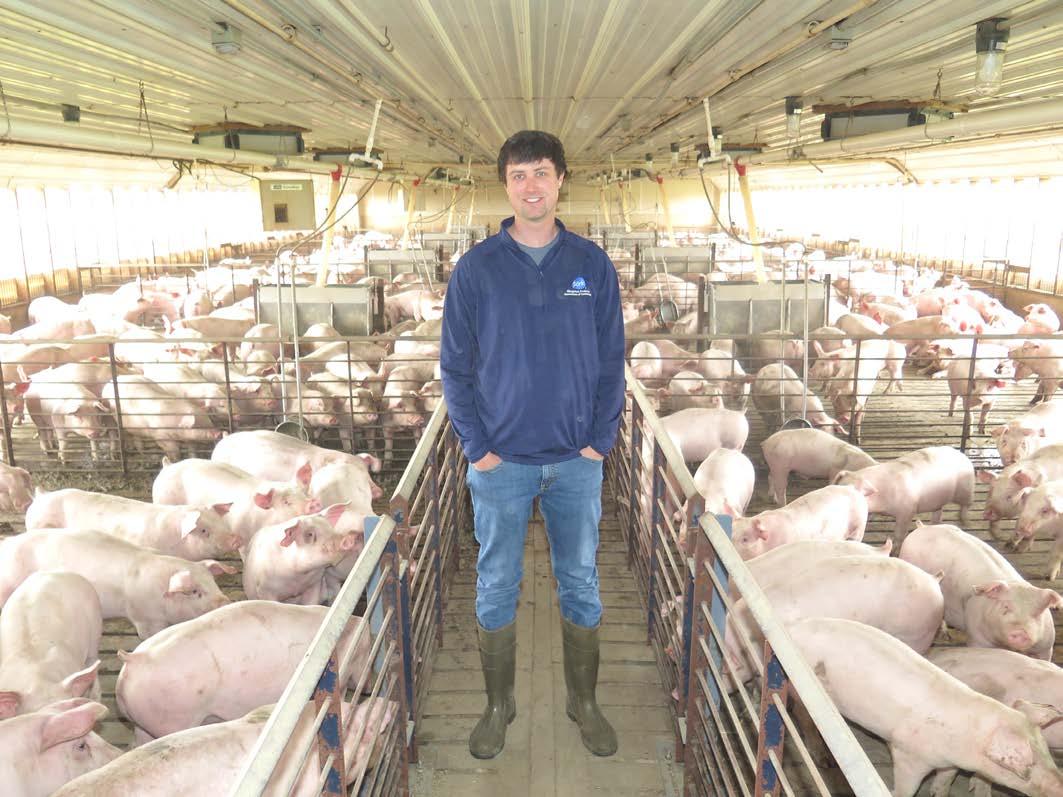
Main has an independent wean-tofinish swine operation, along with producing corn and soybeans on the family farm west of Altona in west-central Illinois.
His wife, Elise, is an ag teacher and FFA adviser at ROWVA School District and they have a 1-year-old son, Mitchell.
“We’re independent and we don’t have any sows on the farm. My dad, Pete, and my uncle, Steve, own sows in a sow-share cooperative along with some other owners. So, we own all the pigs on our farm,” said Main on May 5.
“We got 1,283 pigs shipped in this morning and that many more coming in on Thursday to fill that building up. We’re responsible for about 16,000 head of pigs a year, and we’re feeding closer to 25,000 to 30,000 head.
“I’ve been back to the farm since I got out of college nearly 10 years ago. I do all of the day-to-day stuff. I farm some of my own land, and my wife and I have a few cows that we mess around with.”
His grandfather, father and uncle have all been pork producers. Main was able to return to the farm after attending Black Hawk College East in Kewanee and then earning a bachelor’s degree at Illinois State University, majoring in agronomy management.
“My uncle took a step back from the farm when I came home from college and he’s kind of semi-retired. He doesn’t do as much day to day anymore, but still has financial ownership and all of that,” he said.
Main primarily uses a 50-50 corn-soybean rotation, but is a little heavier on corn this year.
“We put 180 acres back to corn this year. It’s on a farm that has a lot of fertility. It had a lot of hog manure over the years. So, we’re trying to utilize that fertility and we put it back to corn again this year,” he said.
His willingness to step up and help is in Main’s DNA.
“My dad and my uncle have always
been ones to jump in and lend a hand. I think that’s definitely been paid back to us, too. My dad was hurt in a farm accident a few years ago and all the neighbors jumped in and rallied and helped us finish the harvest that year,” he said.
“Dad sat on several boards when I was younger and my uncle’s always been involved and he’s still involved in the Knox County Pork Producers board and was on the state pork board.
“I’m just very passionate about agriculture, especially here in Knox County and my local community in Altona, and it’s just a way to give back and promote the industry.”
Carrying on the tradition, Main joined the Knox County Pork Producers board when he returned home from
college and is in his fourth year serving on the Illinois Pork Producers Association board.
“I’d actually just got off the Knox County Pork board because I wanted to do a little less and then Cheryl Walsh from Peoria County cornered me at the Illinois Farm Bureau annual meeting in Chicago and asked me if I would be interested in being on the IPPA board. I kind of hee-hawed around and eventually said yes and I’m glad I did because it’s been a great experience and I’m very glad to have that opportunity,” he said.
Main is currently enrolled in the Pork Leadership Institute through the National Pork Producers Council and National Pork Board.
“There’s 19 of us in the group from
across the country. We met in Des Moines, Iowa, in January for a couple days. We were in Washington, D.C., the second week of April for a few days lobbying and doing some leadership things. It’s a yearlong program. We meet again in June and we’ll go back to D.C. in the fall. It’s been a good experience so far,” he said.
“As an independent producer, it’s nice to see exactly where your pork checkoff dollars are being spent, have an input on what they’re doing with those dollars and how they’re being utilized and marketed.
“What I enjoy so much is all the opportunities I’ve had with all the networking and get to know people, what they do and things about their operation, even if they’re not in agriculture per se. It’s an industry that I care about deeply, have long ties to and plan to be involved for a long time.”
Main joined the Altona Fire Department about nine years ago and is a certified first responder.
“I really enjoy that as a way to give
back to my community, and being involved in my community is important. I really enjoy this community where I’m from, and I want to see it thrive and the people thrive in it,” he said.
“I also try to be involved with the Grover Community Church in Altona as much as I can be, attending church and events. It’s the same church I grew up in and I plan to have my kids grow up in it, too. It’s very important to me and our family to have that experience and that life.”
Main is in his second year as president of the Knox County Corn Growers board, an organization that will have its 40th annual meeting this summer.
“It’s been around for a long time. Hopefully we can keep that going. It’s getting harder and harder to find people who want to sit on those boards and do those things,” he said.
“We’ve got a good group of guys on that board and I really enjoy that organization. We work with the Illinois Corn Growers Association on some promotions and things. We’re just
trying to promote corn here in Knox County the best we can.”
He’s also been an active member of the Knox County Farm Bureau, including serving a three-year term on the board.
“We’ve got a great Farm Bureau in Knox County and staff. It’s very active with the kids in livestock and 4-H programs,” Main said.
“I got involved with the Knox County Farm Bureau Young Leaders when I was fresh out of high school. I’ve been involved with that for a long time now. I was chairman for about three years a few years ago, and I’m still involved in the Young Leaders.”
Main’s involvement in various organizations and dedicating time toward his community centers around opportunities.
“I’ve always tried to take advantage of every opportunity that I’ve been given, whether it’s being a board or a trip through Farm Bureau or whoever. I just try to always take as many of those opportunities that I can,” he
said.
“I’ve met a ton of great people. I’ve done a lot of cool things and have seen a lot of things, but at the same time, especially now as I have a son here at home and a young family, it’s definitely getting harder and harder to do those things. So, I’m glad I’ve been involved as much as I have up until this point.”
Behind the each everyday hero is a supportive family.
“I couldn’t do what I do with all of these organizations without my wife holding things down here at home, and she has a busy schedule, too, as ag teacher and FFA advisor at ROWVA. There’s a lot of nights where we just pass coming and going and who’s got daycare duty and who’s got Mitchell tonight,” Main said.
“I’m thankful to have her and all that she does for me and for our family, and my parents are also close to help with babysitting when they’re able to.”