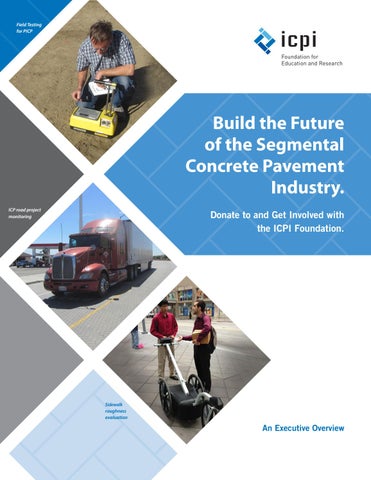
Field Testing for PICP
Build the Future of the Segmental Concrete Pavement Industry. ICP road project monitoring
Donate to and Get Involved with the ICPI Foundation.
Sidewalk roughness evaluation
An Executive Overview
ICPI Foundation for Education and Research
What is the ROI for the Foundation’s Research Programs? “ Ideal strives to be regarded as a resource to architects, engineers, design professionals and contractors by providing sound, reliable, useful information. The research and data derived from the programs funded by the Foundation helps validate the information we seek to convey. When we achieve their understanding, acceptance and confidence, the adoption and use of the products we manufacture and sell are incorporated into their project design and construction.” —Larry Nicolai, Sr. Vice President, Pavers by Ideal
Key Foundation Facts Established:
Classification:
Endowment Secured:
2000
U.S. 501(c)(3) charitable and educational non-profit organization, making donors eligible for taxdeductible contributions
$5.3 million in pledges through June 1, 2018
Contributors:
Investment Strategy:
Contact:
79 corporations and individuals
Protect the endowment while utilizing interest and gains on those investments to fund programs
Charles McGrath, ICPI Executive Director, at (703) 657-6900 or cmcgrath@icpi.org
2 • I N T E R L O C K I N G C O N C R E T E PA V E M E N T I N S T I T U T E • W W W . I C P I . O R G
ICPI Foundation for Education and Research
What’s the Foundation’s Mission? To fund targeted educational and research programs and industry tools that will benefit the segmental concrete paver industry, in line with the strategic goals of ICPI, in a financially sustainable way. If you want to see what the industry will look like years from now, look at the work the ICPI Foundation for Education and Research is doing today. Established in 2000, the Foundation funds projects that help position members, contributors and the industry for a stronger, profitable and more secure future. The ICPI Foundation accomplishes its mission by: • Conducting and disseminating studies and research that enhance and improve knowledge, acceptance and use of interlocking concrete pavement systems. • Supporting and creating education programs, seminars and courses that improve and develop knowledge, understanding and professional abilities within the interlocking concrete pavement industry, as well as those in related industries with an interest in interlocking concrete pavement systems. • Developing educational resources that optimize construction and maintenance of segmental concrete pavement systems. The Foundation leverages state-of-the-art research and technology to support the industry’s future health and stability with high priority to: • New engineering/architectural applications and programs that enhance segmental concrete pavement products, production efficiencies, design, life cycle costs, maintenance and performance, sustainable aspects of pavement as well as urban and environmental design. • Innovative curricula development and implementation by university faculty of segmental concrete pavement systems for civil engineering, landscape architecture and architecture students. • Research that increases construction and installation efficiencies through automated methods, especially those integrating factory production with on-site installation technologies.
I N T E R L O C K I N G C O N C R E T E PA V E M E N T I N S T I T U T E • W W W . I C P I . O R G • 3
ICPI Foundation for Education and Research
How Have ICPI Foundation-funded Projects Increased Paver Sales? The Foundation follows a strategic approach when selecting projects to fund: 1. Demonstrate that segmental concrete pavement systems are a strong, durable structural surface 2. Help landscape architects, engineers, and contractors understand how best to design interlocking concrete paver projects 3. Determine best practices for maintenance 4. Perform life-cycle cost analysis to demonstrate the financial viability and structural benefits of segmental concrete pavement systems
Westin Hotel at Denver International Airport, Denver, CO
Firstenburg Community Center Project, Vancouver, WA
Southeast Atlanta Green Infrastructure Initiative, Atlanta
4 • I N T E R L O C K I N G C O N C R E T E PA V E M E N T I N S T I T U T E • W W W . I C P I . O R G
ICPI Foundation for Education and Research
Challenge Develop structural design guidelines and procedures that will increase the use of PICP on roads among engineers, government officials, and contractors. Research Project University of California-Davis full-scale load testing and mechanistic modeling of permeable interlocking concrete pavement (PICP). Design tables emerged from full-scale loading testing that saves significant money due to more efficient designs based on the the number of annual days PICP holds water in its subbase reservoir. Caltrans accepted this research by including design tables in the permeable pavement guidance on their website. Additionally, the design tables were incorporated into the ASCE/ ANSI Standard Guide on Permeable Interlocking Concrete Pavement. Besides structural design, this ASCE national standard covers hydrologic design, construction and maintenance. In addition, the design tables are included in ICPI’s manual on PICP. Moreover, the design tables will be included in ICPI’s Permeable Design Pro software program for structural and hydrologic design. Industry Advancement “ This project was important for my company and the industry. Foundation staff worked hand-and-hand with UC-Davis and the California Department of Transportation (Caltrans) on the state’s pervious pavement design guidelines. Getting the structural design guidelines and procedures approved by Caltrans provides a real level of confidence for engineers, government officials, and contractors. The guidelines establish PICP as a validated and useful solution for municipalities, state government, and even private commercial projects. In particular, the ICPI cross section and PICP Class 4 Aggregate Base Thickness Chart have been very helpful in working with designers not only in California, but also in Nevada.” —Ron Illium, P.E., Regional Engineer for Basalite
I N T E R L O C K I N G C O N C R E T E PA V E M E N T I N S T I T U T E • W W W . I C P I . O R G • 5
ICPI Foundation for Education and Research
Challenge Evaluate stormwater management practices using permeable interlocking concrete pavement in cold climates. Research Project Two-year Monitoring Study of Permeable Interlocking Concrete Pavement at the University of New Hampshire The University’s Stormwater Center (UNHSC), well-known for evaluation of stormwater management practices in cold climates, conducted a two-year monitoring study of a permeable interlocking concrete pavement (PICP). The UNH retrofitted Hood House Drive in the center of the campus in Durham with 13,500 sf of PICP. The removed asphalt pavement included no stormwater control measures and conveyed surface runoff into the municipal storm sewer. The study results confirmed that PICP eliminates stormwater runoff in cold climates and is an effective tool for removing sediment, nutrients and metals through infiltration even during winter months. The study also verified that PICP does not heave from winter freezing and thawing. PICP provides opportunities for brining of deicing materials for preventing ice buildup.
Industry Advancement “Knowing and educating the customer about the latest Foundation research provides me with a significant advantage over competitors who are less informed. I can refer to the Foundation’s work with the University of New Hampshire Stormwater Center (see this page) when I discuss cold-weather PICP project benefits. If a customer has questions about different joint widths and jointing stones sizes at various slopes, I can point to the Foundation’s research project with the University of Missouri (see page 8).” —Kevin Earley, Director Commercial Belgard Pavers, Oldcastle
6 • I N T E R L O C K I N G C O N C R E T E PA V E M E N T I N S T I T U T E • W W W . I C P I . O R G
University of New Hampshire Hood House Drive Typical Cross Section
ICPI Foundation for Education and Research
Challenge Determine what joint widths and jointing stones sizes perform best at various slopes. Research Project University of Missouri PICP Hydraulic Testing and Design PICP designers needed answers for inlet capacity of PICP, because it enters into design especially when there is run-on entering PICP from adjacent impervious surfaces and roofs. How much run-on can PICP take before generating runoff? How much run-on can PICP take when in a clogged state before generating runoff? To answer these questions and others, researchers designed and built a laboratory flow testing device to measure the horizontal inflow and overflow from PICP. Numerous tests were conducted on PICP with 6, 10 and 12.5 mm joints and No. 8 and 9 jointing aggregates at various slopes. Testing included clogging studies with high concentrations of total suspended solids. Some of the discoveries and design insights: • Horizontal inflow rates across PICP surfaces is 11-35% lower than vertical infiltration rate measured using ASTM C1781 Standard Test Method for Surface Infiltration Rate of Permeable Unit Pavement Systems. Differences are higher for 6 mm wide joints
Laboratory flow testing device for University of Missouri PICP hydraulic research
• After maintenance, recapture of near initial infiltration rates are lower for 6 mm wide joints after cleaning than wider joints. • 6 mm wide joints infiltrate well up to 2% slope; wider joints advised at higher slopes. • 6 mm joints with No. 9 aggregates clog five times faster than 12. 5 mm joints with No. 8 aggregates. • 10 and 12.5 mm wide joints indicate little difference in horizontal & vertical flows at any slope. • 45° herringbone has slightly lower infiltration than 90°. • Deliverables include an Excel tool that determines the hydraulic characteristics a site can attain.
I N T E R L O C K I N G C O N C R E T E PA V E M E N T I N S T I T U T E • W W W . I C P I . O R G • 7
ICPI Foundation for Education and Research
Challenge Determine the types and thicknesses of paving slabs and planks are suitable for different traffic conditions. Research Project Structural Design Research on Slabs, Planks and Thin Pavers The use of concrete paving slabs and planks is increasing in residential, commercial and municipal applications, especially among applications with some exposure to vehicular traffic. The Foundation funded finite element modeling to investigate pavement thickness recommendations for paving slabs, planks, and thin pavers. The research recommendations have been incorporated into a draft of Tech Spec 24: Structural Design of Segmental Concrete Paving Slab and Plank Pavement Systems. Finite element modeling to investigate pavement thickness recommendations for paving slabs, planks, and thin pavers by Applied Research Associates, Inc.
Industry Advancement “ A common question I receive from customers and designers is what type of paver, slab or plank they should use for a particular application. The common response was the aspect ratio. However, this doesn’t apply well to larger format pavers. Through ICPI and the Foundation, we were able to fund and perform finite element analysis that clearly defined what type and thickness of product are suitable for different traffic conditions. This will be a tremendous asset to Oaks and the industry.” —Glenn Herold, P.Eng., Director of Commercial Solutions for Oaks Concrete Products
8 • I N T E R L O C K I N G C O N C R E T E PA V E M E N T I N S T I T U T E • W W W . I C P I . O R G
ICPI Foundation for Education and Research
What Foundation Research Projects Are Underway and What Does the Foundation Hope to Accomplish? “ I’m really excited about the life-cycle cost research for PICP. PICP can help transform the commerical side of the industry. The Foundation’s research will shine a positive light on PICP and help make it a more recognized and implemented solution for infrastructure and other commercial applications.” —David Pitre, Director of Engineering Products, Keystone Hardscapes
Currently, the Foundation is funding and conducting a number of projects with a significant impact on commercial sales of interlocking concrete pavers and permeable interlocking concrete pavers. In addition to developing tools to help engineers and landscape architects design projects and help owners understanding how to maintain them, the Foundation is tackling one of the most important challenges—demonstrating the cost-effectiveness of segmental concrete pavement systems through life-cycle cost analysis. PICP Life Cycle Cost Analysis (LCCA), Tools and Training This project surveys the life-cycle costs of selected PICP projects, influencing factors, and monetization of PICP lifetime benefits. This resulted in development of an Excel tool for calculating LCCAs accompanied by a report that provides rationale on accounting for off-site benefits. The project includes training materials for ICPI member sales force and a training workshop. A list of potential PICP projects for LCCA has been provided for review. These will be converted to case studies with training materials for ICPI commercial sales representatives. ICPI is already rolling out this tool to its members. Full-scale Load Testing of Paving Slabs and Planks Paving slab & ICPI members donated paving slab and plank materials, plus land at a manufacturer’s plank full-scale testing yard to build a full-scale load testing area. The testing will help validate finite element modeling previously funded by the Foundation that resulted in vehicular traffic design tables for slabs and planks. Trucks loaded with pavers make many passes over the paving units until they crack. The load data and resulting performance will be compared to the design tables to validate or adjust them. Load testing will likely take one to two years. I N T E R L O C K I N G C O N C R E T E PA V E M E N T I N S T I T U T E • W W W . I C P I . O R G • 9
ICPI Foundation for Education and Research
Municipal Interlocking Concrete Pavement Performance Modeling This project consists of two contracts with consultants who model the impacts of interlocking concrete pavement (ICP) within municipal pavement management systems using ASTM pavement condition analysis methods. Total life performance costs under various maintenance cost scenarios will be developed and compared to that for asphalt and concrete. This will help determine if there is a compelling life-cycle cost case for municipalities to move from asphalt or concrete pavements to ICP. The municipal pavement management systems examined will include networks and typical pavement sections from low or medium volume streets in Nashville, Tennessee; Boston, Massachusetts; and Leesburg, Virginia. Deliverables are expected late in 2018 which include PowerPoint presentations for use by ICPI members. Winter Operational and Maintenance Best Management Practices (BMPs) for Permeable Interlocking Concrete Pavers Managed by the University of Toronto with funding from the Canadian government, this project includes construction of two permeable pavement test areas at the Toronto and Region Conservation Authority in 2017. One area will be clogged with sediment and the effectiveness of various cleaning equipment tested. The other area will study deicer use compared to that used on conventional impervious asphalt pavement. The project starts in winter 2018 and continues for two years.
Winter Operational and Maintenance for PICP
ICP Road Project Monitoring The Foundation funded this proposal at $10,000 to Applied Research Associates, Inc. for three-years of condition surveys and falling weight deflectometer testing of Howard Road, a 1-mile, truck-intensive stretch in Westley, CA. The Stanislaus County Public Works Department will contribute an additional $10,000. Non-destructive structural testing using a falling weight deflectometer will be conducted during the wet (winter) season. The timing of this project is important as the County is considering the use of 3.5 million sf of concrete pavers for roads in an industrial park. The outcome of this study will likely influence the use of concrete pavers on these roads.
1 0 • I N T E R L O C K I N G C O N C R E T E PA V E M E N T I N S T I T U T E • W W W . I C P I . O R G
ICPI Foundation for Education and Research
Landscape Architecture Foundation Performance Series Case Studies This project resulted in curation of case studies on performance of projects using ICP and PICP on the Landscape Architecture Foundation’s Landscape Performance Series website. This was completed last year. See https://landscapeperformance. org/collections/segmental-pavement. ICPI developed the next deliverable, a learning module on performance of segmental concrete paving. This presentation includes tools to measure economic, environmental, and social benefits of segmental concrete paving. This presentation is available on https://landscapeperformance.org/training/segmental-concrete-pavements. This information is important to an increasing number of practicing landscape architects who use performance metrics on various landscape systems for clients. Road Map for Permeable Pavements Conference, University of California at Davis The Foundation and other pavement industry contributors funded an invitation-only national conference November 14-15, 2017 in Davis. More than 50 stakeholders representing industry, government agencies, academia, and consultants developed a road map for expanding the use of permeable pavements. The deliverables identified many barriers to adoption and prescribed steps to overcome them. The conference provides direction for the Foundation for possible future research investments in permeable interlocking concrete pavement, and confirmed current ones. The deliverables from the conference are on www.ucprc.ucdavis.edu/permPvmt. Sidewalk Roughness Evaluation PathVu received a grant to measure roughness of various ICP and PICP surfaces for compatibility with sidewalk roughness guidelines being considered by the U.S. Access Board. Sites are roughly divided between ICP and PICP. The intent is to measure as many different chamfer configurations and joint widths as possible, as these are substantial influencers of surface roughness. Such measurements will be compared to roughness indices and wheelchair user comfort developed by the University of Pittsburgh for the US Access Board.
I N T E R L O C K I N G C O N C R E T E PA V E M E N T I N S T I T U T E • W W W . I C P I . O R G • 1 1
ICPI Foundation for Education and Research
Projects Funded as of June 1, 2018 Education Grants 2006 8th International Conference on Concrete Block Paving $279,000 2010 University of Georgia: Paveshare website for landscape architecture students $120,984 Landscape Architecture Foundation: 2015 Landscape Performance Series Case Study Mini-grants $25,000 Landscape Architecture Foundation: 2018 Learning Module on Segmental Concrete Pavement Performance $75,000 University of California at Davis: 2017 Permeable Pavements Road Map Conference $15,000 ________________________________________________________________________________________ $514,984
Research Grants Interlocking Concrete Pavement University of Pittsburgh: 2014 ICP Smoothness Testing Technology $35,000 Martha VanGeem, PE: 2017 Product Category Rules for Segmental Concrete Paving Prods. $20,000 Pathvu, Inc: 2018 ICP & PICP Smoothness Testing $22,000 Applied Research Associates, Inc. & Pavement Technical Solutions, Inc: 2019 ICP Performance Modeling & Case Studies $131,000 Applied Research Associates, Inc: 2021 ICP Road Evaluation for Stanislaus County Public Works Dept. $10,000 ________________________________________________________________________________________ $219,000
Permeable Interlocking Concrete Pavement University of New Hampshire: 2013 PICP Cold Climate Evaluation $47,000 University of California (Davis) Pavement Research Center: 2014 PICP Structural Testing $190,000 Toronto & Region Conservation Authority: 2015 PICP Monitoring in Cold Climates $10,000 North Carolina State University: 2015 PICP Monitoring in Poor Soils $10,283 University of Missouri at Kansas City: 2016 PICP Hydraulic Research $112,519 Applied Research Associates, Inc: 2018 PICP Life Cycle Cost Tools & Case Studies $85,955 University of Toronto: 2019 PICP Cleaning & Winter Evaluation $80,000 Wisconsin Department of Natural Resources: 2019 PICP No-infiltration Evaluation $79,918 Applied Research Associates, Inc: 2019 Permeable Design Pro Software Upgrades $48,430 ASCE LID Visitor Parking Project $87,500 ________________________________________________________________________________________ $750,605
Slabs and Planks Applied Research Associates, Inc: 2016 Slab & Plank Finite Element Modeling $100,350 ICPI Foundation: 2020 Load Testing/Validation of Finite Element Modeling $35,000 ________________________________________________________________________________________ $135,350
TOTAL: $1,619,939
1 2 • I N T E R L O C K I N G C O N C R E T E PA V E M E N T I N S T I T U T E • W W W . I C P I . O R G
ICPI Foundation for Education and Research
How Can You Get Involved? The ICPI Foundation created an endowment funded by pledges from industry supporters. It is a U.S. 501(c)(3) charitable and educational non-profit organization, making donors eligible for tax-deductible contributions. Typically, pledges to the endowment are paid over five years. Trustees employ an investment strategy to protect the endowment while utilizing interest and gains on those investments to fund programs.
Why Invest in the ICPI Foundation? Many technical and education challenges faced by the industry that will affect your business are being addressed by the ICPI Foundation. Donating is an investment in your future company. Your contribution supports the industry from which you, your family, or corporation has benefited over the years.
Investment Levels The Paver Society Chairman’s Cabinet $500,000 + Trustee’s Council $250,000 + Founder $150,000 + Ambassador $100,000 + Governor $50,000 + Regent $25,000 + Other Giving Opportunities Fellow $15,000 + Patron $10,000 + Benefactor $5,000 + Sponsor $3,000 + Friend $1,000 +
I N T E R L O C K I N G C O N C R E T E PA V E M E N T I N S T I T U T E • W W W . I C P I . O R G • 1 3
ICPI Foundation for Education and Research
Foundation FAQs Are contributions tax deductible? Yes. The
Foundation is a 501(c)(3) non-profit, taxexempt, education/research corporation. U.S. and Canadian companies can contribute and take their contribution as a business expense. Personal contributions are considered charitable donations in the U.S., but not in Canada. The ICPI Foundation recommends seeking advice from a tax consultant regarding specific tax advantages from a contribution. Must pledges be paid all at once? No. Pledge payments can be made over one to five years paid annually, semi-annually or quarterly. Can only cash be donated? No. The ICPI Foundation
can also accept stock if it can be transferred electronically with a Depository Trust & Clearing Corporation number. Donations other than cash or stocks can be accepted. Please contact the ICPI Foundation for more information. How are contributions recognized? Those investing
in the industry through a pledge donation to the Foundation will be recognized according to their wishes. A formalized, public recognition program in accordance with the donor’s level of contribution includes specially designed lapel pins, display recognition noting the donor’s support, public acknowledgements and formal recognition ceremonies at ICPI’s Annual and Summer Meetings; recognition locally and nationally in industry publications such as Interlock Design magazine; and honored guests at special receptions for Foundation donors.
What portion of the donations will be spent on fundraising? None. All the costs of the Foundation
for the Future Endowment Campaign have been underwritten by a grant from ICPI to the Foundation until the endowment reaches five million dollars. What portion of the donations are spent on administration costs to run the Foundation?
The generally accepted cost of operation for a non-profit U.S. foundation is 10% to 20%. The ICPI Board of Directors has agreed that ICPI cover the administrative and governance costs for the Foundation until the endowment reaches five million dollars. How will the endowment be invested and what will be the return? The Board of Trustees establishes
an investment policy. The policy is considered conservative with approximately 40% of the endowment invested in equities and the remainder in fixed income. The investment goal is a 5–7% net annual return. When are programs funded? Programs are funded from the investment return on the invested principle or endowment. The timing of program funding depends largely on securing pledges, with timely payment on pledges secured. What is the process for getting programs funded?
The Foundation Program Committee considers project proposals and makes recommendations to the Board of Trustees. How can I get more information on the Foundation?
To learn more about supporting the Foundation and how you can become involved, contact Charles McGrath, ICPI Executive Director at (703) 657-6900 or cmcgrath@icpi.org.
1 4 • I N T E R L O C K I N G C O N C R E T E PA V E M E N T I N S T I T U T E • W W W . I C P I . O R G
ICPI Foundation for Education and Research
Contributors through October 31, 2018 The Paver Society Chairman’s Cabinet, $500,000+ Columbia Machine, Inc. Oldcastle Architectural, Inc. Pavestone, a Quikrete Company Unilock
Trustees, $250,000+ Besser Company Lafarge North America, Inc.
Founder, $150,000+ MASA GmbH/MASA-USA, LLC
Ambassador, $100,000+ ACM Chemistries, Inc. Argos Cement USA CEMEX USA Essroc Cement Hess Group Lehigh Hanson, Inc. Mutual Materials Corporation Nicolock Paving Stones Pathfinder Systems/Tiger International St. Marys Cement Inc. Venator Materials Corp.
Governor, $50,000+ Acker Stone Industries Basalite Concrete Products KOBRA Molds, LLC LANXESS Corporation OAKS By Brampton Brick Rampf Molds Industries, Inc. Rekers (NA), Inc.
Regent, $25,000+
Benefactor, $5,000+
Anchor Block Company BASF Construction Chemicals Bogert Concrete Products Midwest Block & Brick National Cement Company of Alabama ORCO Block & Hardscape Pavers by Ideal Solomon Colors, Inc. Standley Batch Systems, Inc. Unit Paving, Inc. Willamette Graystone, Inc.
Fred Adams Paving Company, Inc. Dancing Bear, Inc. Earth Shelter Developers Euclid Chemical Company Richard Goode ICPI Central Florida Chapter Matt & Ingrid Lynch Lee & Sylvia Martin Eric Milot David & Sarah Pitre Chris Ross Ross Yantzi’s Pavestone Plus Ltd. Stone Age Pavers, Inc.
Endowment Campaign Fellow, $15,000+ Ed & Diva Fioroni GCP Applied Technologies Krete Industries, Inc. Santerra Stonecraft Fred & Paula Schultz & Family Team ICPI Foundation (Mt. Rainier Climb)
Patron, $10,000+ Steve Berry Joseph & Tress Bowen Brown’s Concrete Products Limited GIE+EXPO/Sellers Expositions Hardscapes USA Ironsmith, Inc. Charles & Isabel McGrath RCP Block & Brick, Inc. Seal N’ Lock System Corporation Bobby Staten TEKA North America, Inc. Tremron Group
Sponsor, $3,000+ Ray Clark Rick Crooks Oberfield’s, Inc. Richard’s Paint Manufacturing Co., Inc. Bill Schneider Southwest Specialties Gary & Debbie Stowe
Friend, $1,000+ Advanced Concrete Technologies, Inc. Continental Hardscape Systems, LLC iwi group, LLC SEK, Inc. Site Technologies, Inc.
I N T E R L O C K I N G C O N C R E T E PA V E M E N T I N S T I T U T E • W W W . I C P I . O R G • 1 5
ICPI Foundation for Education and Research
ICPI Foundation for Education and Research Board of Trustees 2018–2019 Richard Goode, Chair CEO Columbia Machine, Inc.
Charles Gamarekian Chairman & CEO Cambridge Pavers, Inc.
David Pitre, Chair Elect Director of Engineering Products Keystone Hardscapes
Manfred Herold President Brown’s Concrete Products, Ltd.
Ted Light, Secretary/Treasurer Vice President—Operations ACM Chemistries, Inc.
Travis Hilldore VP of Sales & Marketing Pathfinder Systems/Tiger USA
Roberto Nicolia, Immediate Past Chair CEO/President Nicolock Paving Stones
Larry Nicolai Senior Vice President Pavers by Ideal
Fred Adams, Jr. President Fred Adams Paving Co., Inc.
Kendall Anderegg, Ex Officio President and COO Mutual Materials Company
Steve Berry COO Oldcastle APG
Marshall Brown, PhD, Ex-Officio President ACM Chemistries, Inc.
Joe Bowen Chairman Mutual Materials Company
Charles McGrath, Staff Liaison Executive Director ICPI Foundation for Education and Research
Andrew Bryant President Unilock Group of Companies Dave Carter President Oaks Concrete Products Kevin Curtis President and CEO Besser Company Kevin Earley Director, Commercial Belgard Pavers Oldcastle Architectural, Inc. Ed Fioroni, PhD VP of CDC Sales Keystone Hardscapes
1 6 • I N T E R L O C K I N G C O N C R E T E PA V E M E N T I N S T I T U T E • W W W . I C P I . O R G
Westlake Shopping Center, Peoria, IL
ICPI Foundation for Education and Research
Please Contribute to the ICPI Foundation for Education and Research The ICPI Foundation is a driving force behind the growing segmental concrete pavement industry. As you have read in this prospectus, Foundation projects are now helping ICPI members to develop new products, improve design and installation best practices, and increase the use of interlocking concrete pavement and permeable interlocking concrete pavement throughout the United States and Canada. We hope your company will join with other industry leaders in this effort to build a strong, successful future for segmental concrete pavement. Therefore, we respectively request that you consider an investment pledge to help the Foundation continue its successful research programs. Your pledge payments can be made over one to five years, paid annually, semi-annually or quarterly. In turn, your company’s citizenship in the industry will be recognized at major ICPI meetings and in ICPI member communications. Your company will also receive an invitation to participate in a strategic role within the endowment campaign and the Foundation. Most importantly, this is your opportunity to help ensure we are a forward-thinking, innovative industry that responds to the evolving needs of designers and their clients. The future is being built now by the ICPI Foundation. Please consider a pledge today and contact Charles McGrath at (703) 657-6885.
Sincerely,
Richard Goode CEO Columbia Machine, Inc. Chair, ICPI Foundation for Education & Research
Kendall Anderegg President and COO Mutual Materials Company Chair, Interlocking Concrete Pavement Institute
I N T E R L O C K I N G C O N C R E T E PA V E M E N T I N S T I T U T E • W W W . I C P I . O R G • 1 7
“ When I visit customers and prospects, I like to refer to the latest research reports from third-party sources to demonstrate interlocking concrete pavement products are a preferred solution. The Foundation research helps me establish our expertise and quality of product solutions with designers.” —Kevin Earley, Director Commercial Belgard Pavers, Oldcastle
ICPI Foundation for Education and Research 14801 Murdock Street, Suite 230 Chantilly, VA 20151 Tel: (703) 657-6900 Email: icpi@icpi.org