Head Office Turweston Aerodrome, Nr Brackley, Northants NN13 5YD
Telephone for engineering and commercial 01280 846786 LIGHT AVIATION
Editor ED HICKS
Email ed.hicks@laa.uk.com
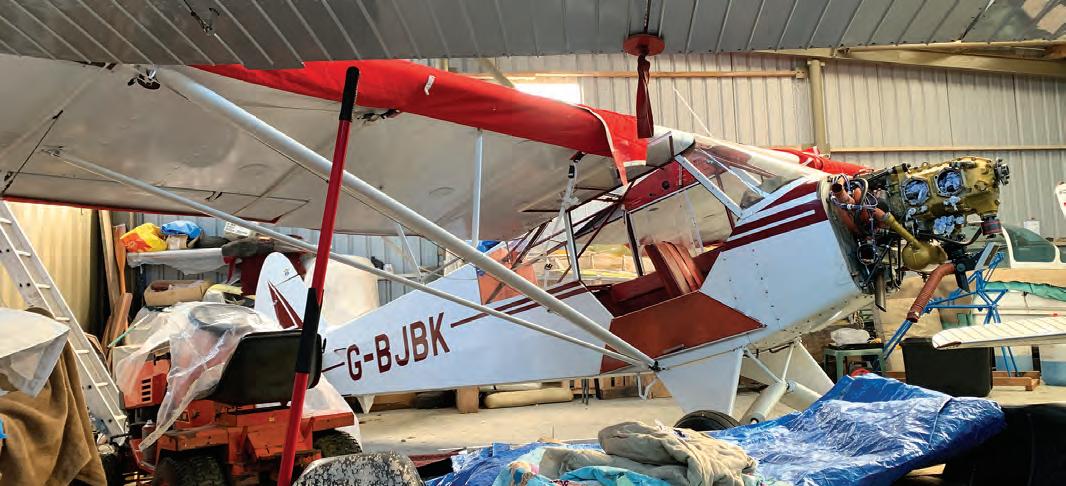
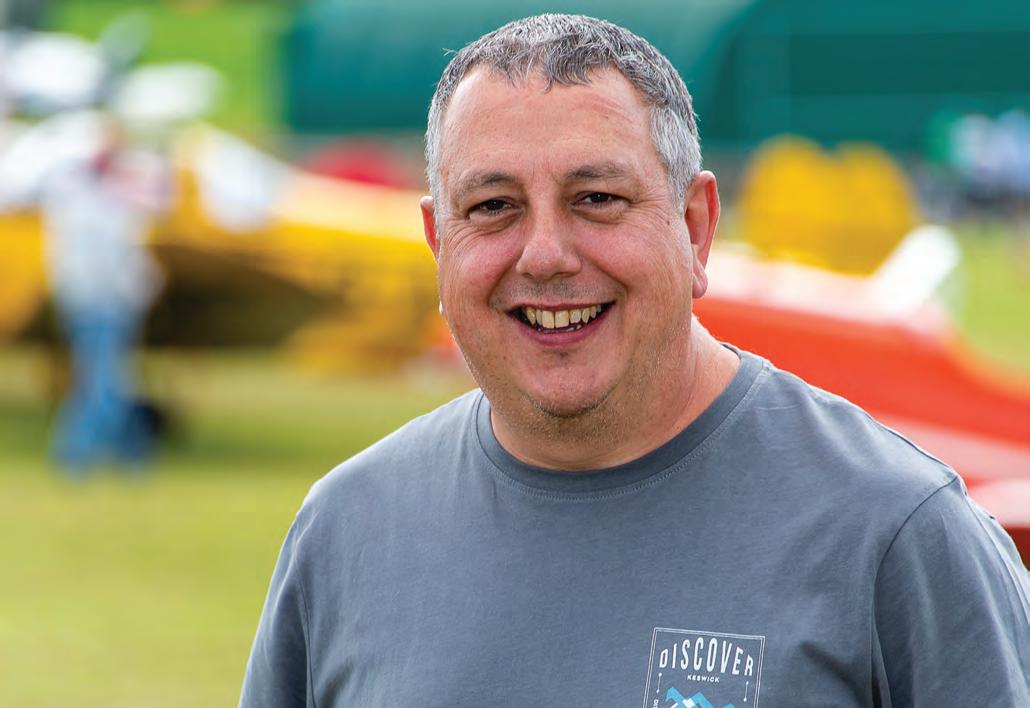
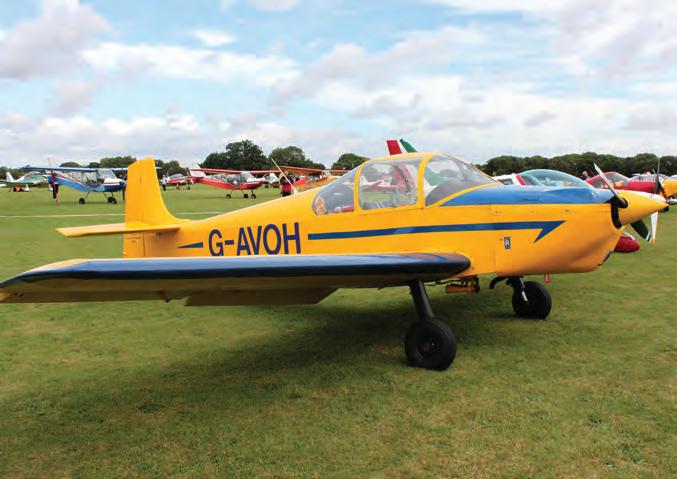
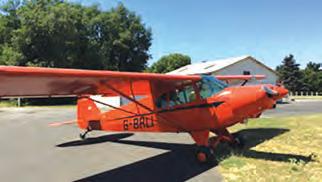
Ed’s hangar queen Cub as found, just waiting to get back in the air.
Hangar queens…
Some aeroplanes speak to your soul, and so it was the case when, at the beginning of the new year, I shook hands on the sale of a new-to-me aeroplane project, a Piper PA18-95 Super Cub.
Sitting in the back of a hangar on a small grass strip, when I first popped its cabin doors open and looked inside, I found myself thinking back to when I learned to fly on its bigger brother, the PA18-150. Here was an aeroplane that whispered to me… ‘come on, this will be fun’.
Owned, flown and loved for many years by one owner, it was involved in a small incident at its home strip, and while the repairs were all well carried out, it never quite crossed the finish line to completion.
So it sat for a number of years in its hangar… luckily protected by its set of Cambrai Covers. Eventually the elderly owner decided to sell and it was my real honour to take on an aeroplane that clearly held a lot of memories for the chap whose hand I shook to agree a sale.
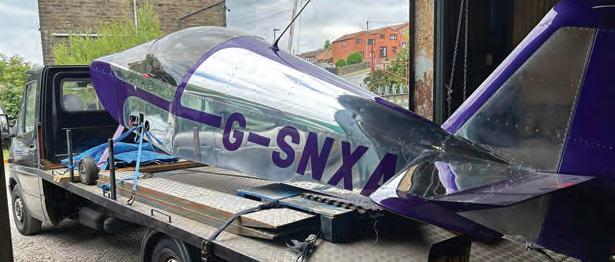
With the help of my LAA Inspector, Toby, friends Jonathan and Nye, and the brilliant transport expertise of Tim Wakeman from Recovair, we were able to get the aeroplane dismantled, securely loaded and safely transported back to my base at Wadswick.
Since then, I’ve been busy dismantling further, inspecting, and making plans. The engine will be getting some new cylinders, there’s some weight to come out of it, which involves doing things such as swapping the vacuum gyros for a uAvionix AV30, plus there are a few cosmetic jobs to do inside the cockpit to add my own stamp to it.
It’s all achievable – with a bit of graft –and should be fun along the way. I’ll keep you posted…
If you’ve got a similar hangar queen story, we’d love to hear about it for the magazine.
You never know, maybe your own adventure with an aeroplane that just needs a little love to get it flying again, is just waiting behind a hangar door…
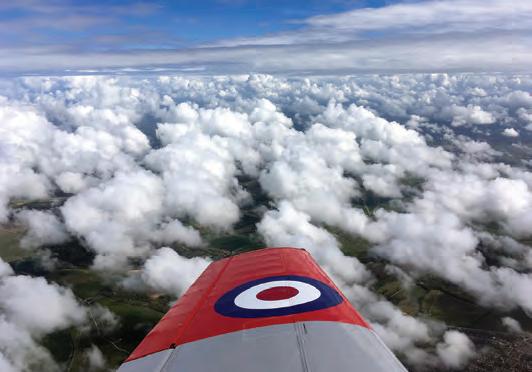
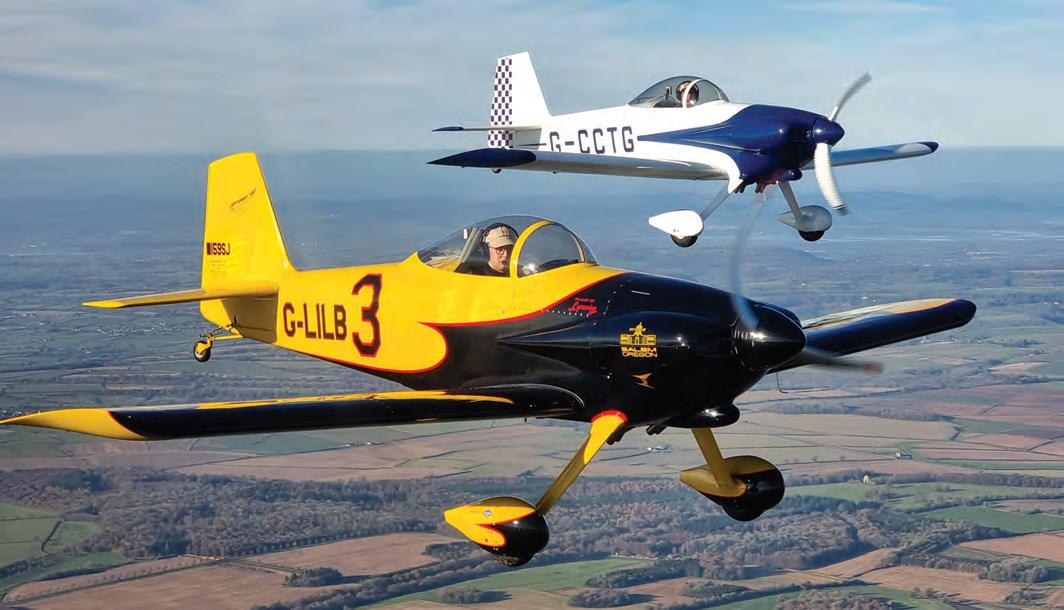
A quick reminder, if you have a great photo that you think captures the joy of flight in LAA aircraft, don’t forget to enter the LAA photo competition. As an extra incentive, LAA HQ has just secured 12 complimentary tickets – one for each month’s photo competition winner, for airshows at the Shuttleworth Collection at Old Warden (except the Proms Weekend).
FEATURES
12 PROJECT NEWS
A Sonex takes to the skies, plus an epic build of a Jodel D140e that took place on a barge in Bristol Docks. Plus New Projects and Cleared to Fly
16 FLIGHT TEST
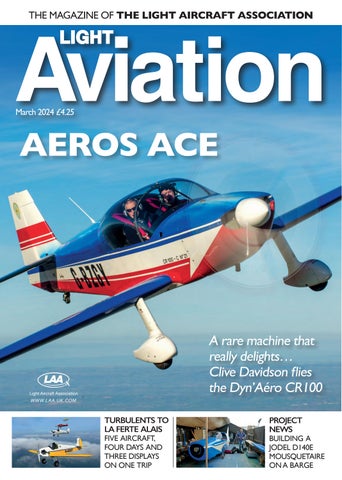
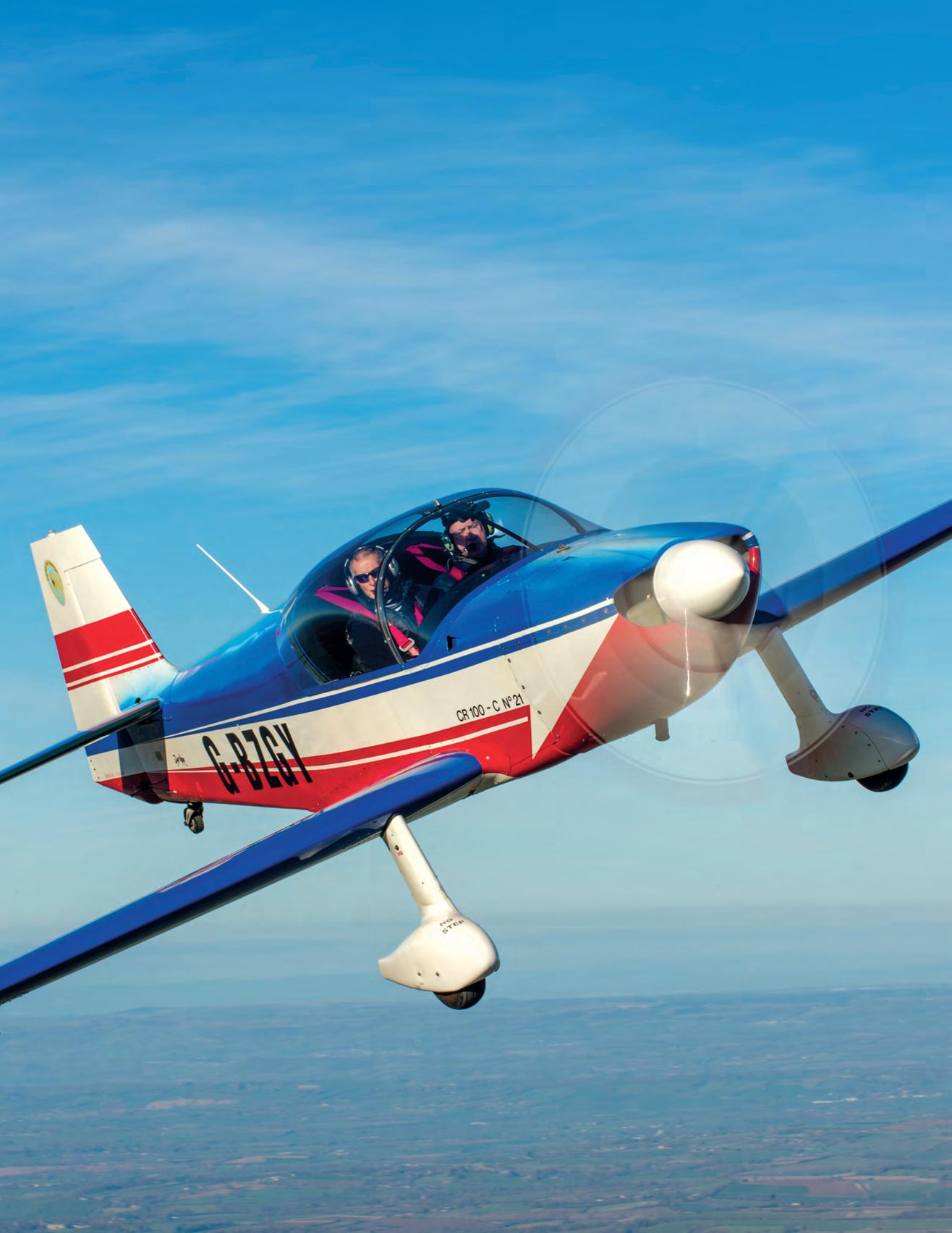
Clive Davidson gets his hands on the unique in the UK Dyn’Aéro CR100, and finds it a joy for flying aerobatics
28 FLYING ADVENTURE
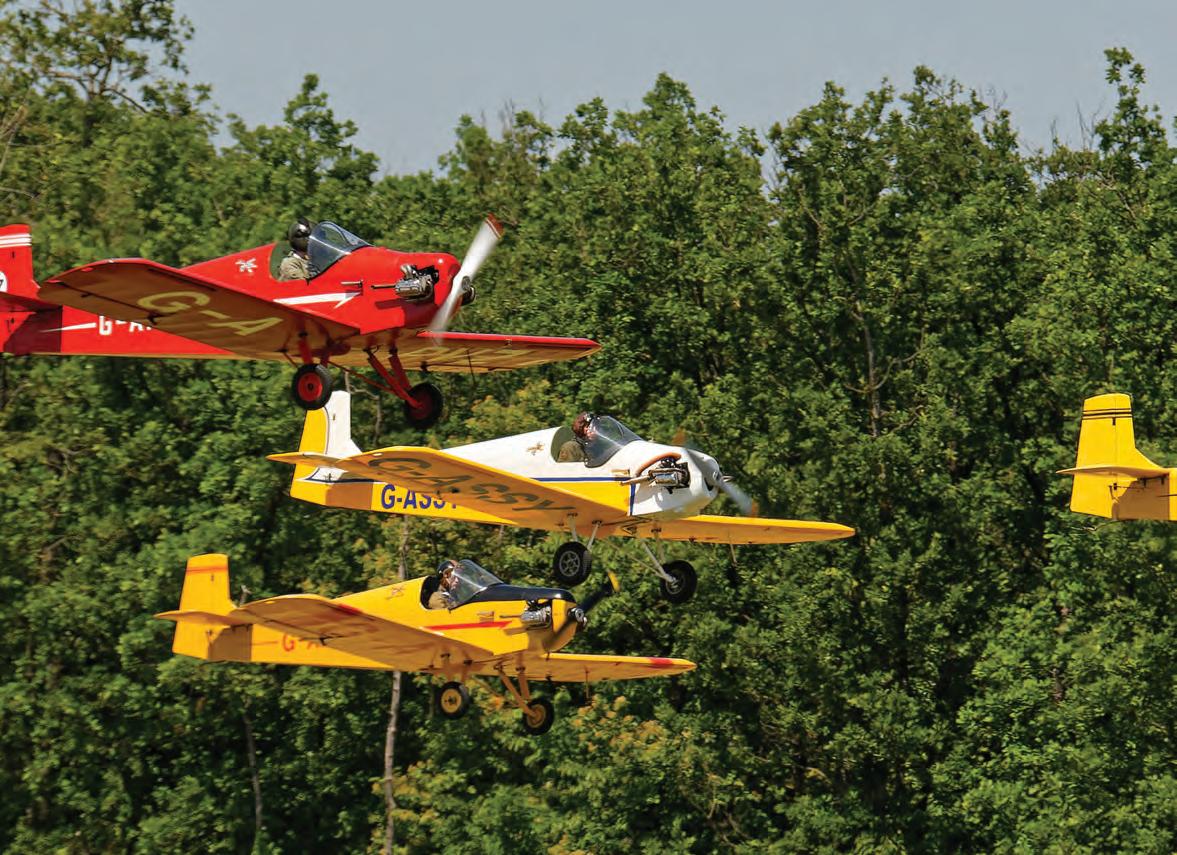
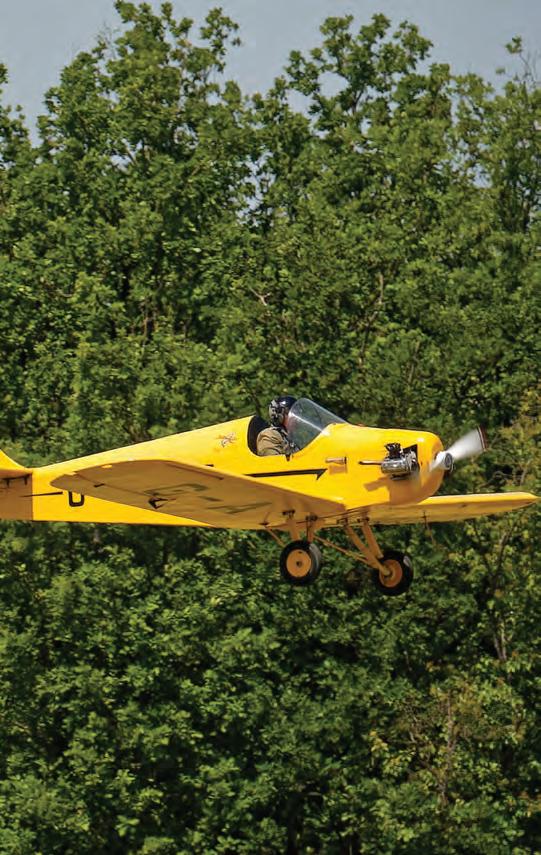
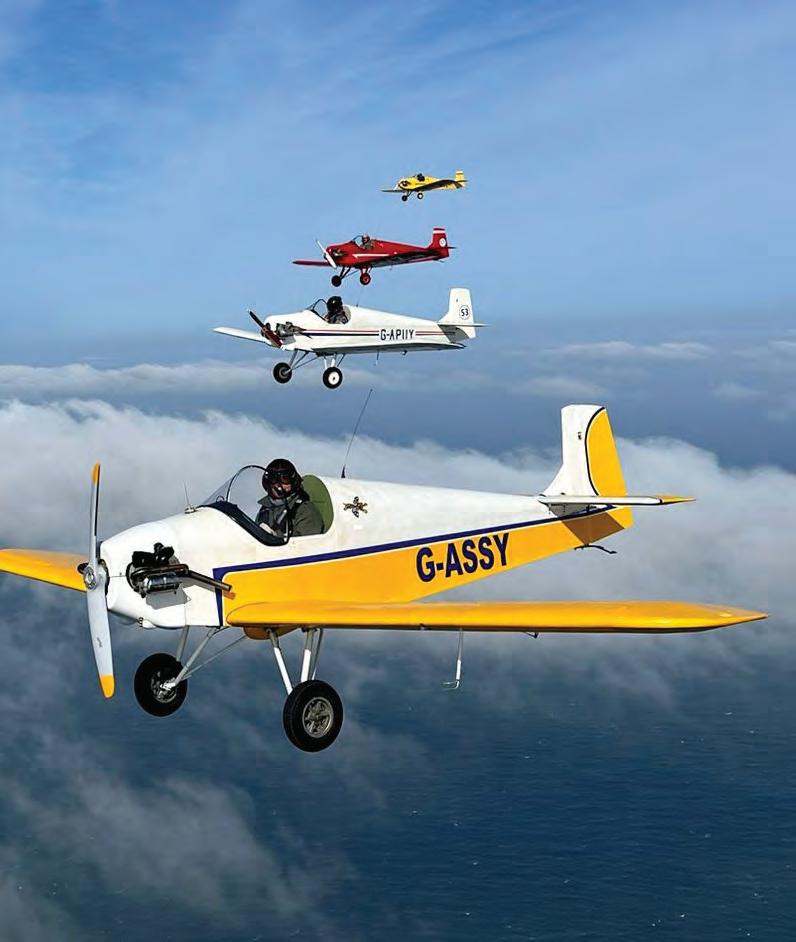
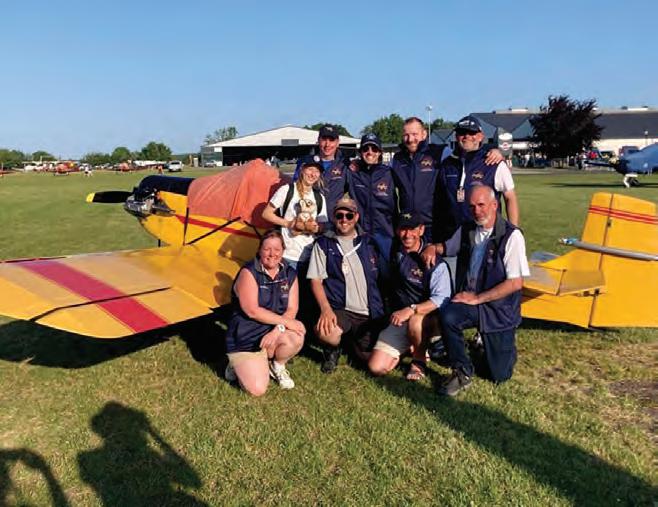
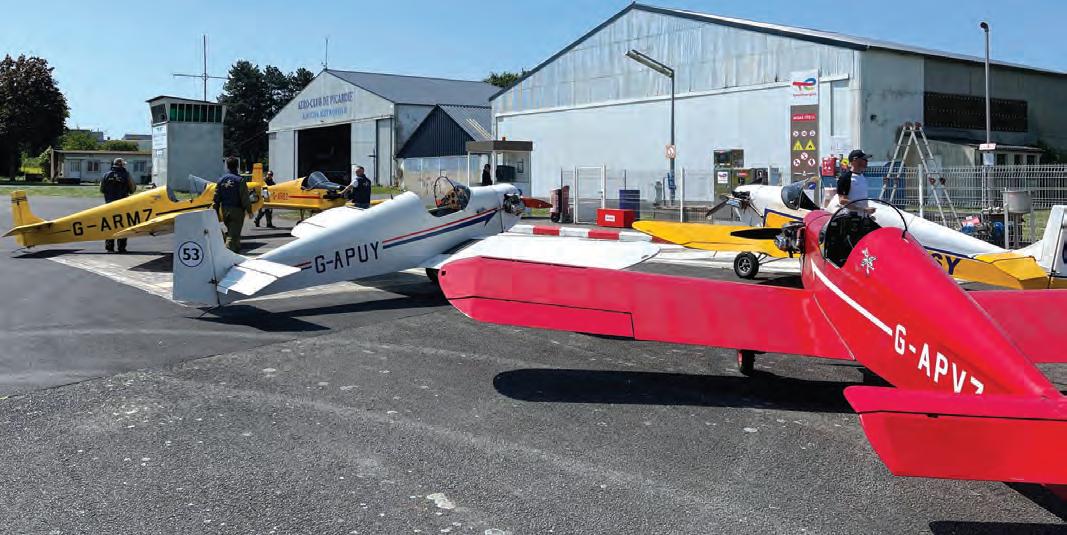
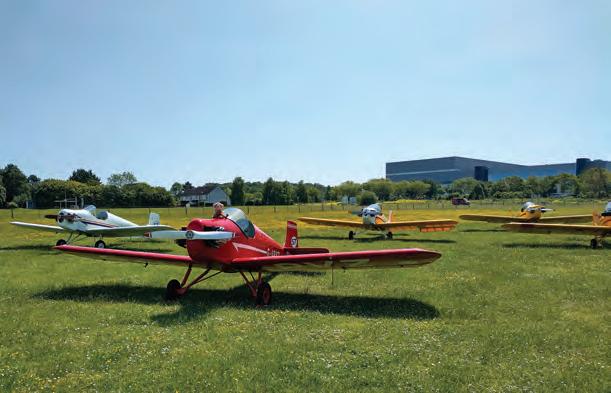
The tale of five Turbulents, four days and three displays at the famous French airshow, La Ferte Alais. Richard Vary reports
36 YES: ‘2,024’ IN 2024!
As part of a special initiative for the year, the LAA Youth & Education Support Strut has a grand plan to get young people flying
38 ENGINEERING MATTERS
Aircraft maintenance programmes, can your aircraft use unleaded fuel, and common snags when it comes to Permit Revalidation Documentation
47 MEET THE MEMBERS
We chat to long-term member Paul Lawrence, a stalwart Rally veteran, who just loves volunteering
52 LAA PHOTO COMPETITION
The first round of entries for the 2024 LAA photo competition is in, and there are some real crackers. It’s running all year, so send us your photos!
LAA’ers feature in Dawn to Dusk awards
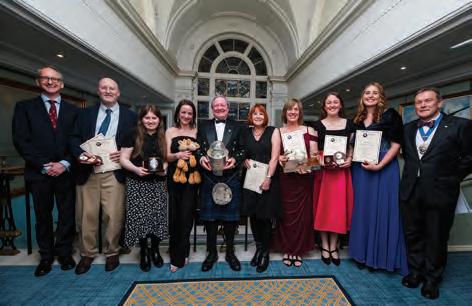
LAA members made a strong showing at The International Pooleys Dawn to Dusk Competition Awards Dinner, held at the RAF Club in London on 8 February.
The top award, the Duke of Edinburgh Trophy was won by Derek Pake and Kate Turner for their challenge, Eireborne Derek’s Prestwick-based RV-8 flew a circumnavigation of Ireland, flying over the 83 WWII Irish Republic Coastal Watch lookout points, and some of the 19 Northern Ireland WWII airfields and seaplane bases.
The Icarus Trophy for the best solo entry was presented to Michael Wood, who drew the symbol of Ukrainian Resistance in the sky above Scotland, flying his SD1 Minisport SSDR.
The Microlight Trophy was awarded to Dr Peter Griffiths for his Abandoned Railways of Southern Scotland challenge that he flew from Strathaven, in his Skyranger Classic.
The Bonney Trophy was awarded to Nic Orchard for her adventure, Temporarily Unsure of Position, flown in her Aeronca Champ.
The Family Award was presented to Angus and Fiona Macaskill for their 50 Kisses – For Our 50th Wedding Anniversary 1973-2023, adventure.
Grants, Awards and Red Wheel Plaques for Aviation
The National Transport Trust would like to hear from anyone working on a vintage aircraft restoration project who would like recognition for their project and a helping hand financially when the project is near completion. The Trust is a charity dedicated to the preservation of all modes of heritage transport and recent awards have been made to the Britten-Norman Islander G-AVCN, the English Klemm, Airymouse, and a VAC young people’s restoration project on the Linnet. The Trust also promotes heritage
In the commended category, David Pitman and Gavin Johns were recognised for their adventure, Celebrating 100 Years of Endurance Motor Racing at Le Mans and in particular the Contribution made by British Motor Manufacturers
The Dawn to Dusk Competition, now in its 60th year, provides a unique aeronautical challenge participating in a day’s flying using an aircraft of the competitor’s choice. The competition is an opportunity to further your flying, to expand your horizons and to give you the excuse you need to have the flying adventure that you have always wanted to have.
Entries are now open for 2024, and can be flown at any time of the year, with the cut off date for submission of pilot’s logs falling on the last day of September. Entries received after this date will be entered into the following year’s competition. Click on the How to Enter tab on www.pooleys.com/ dawn-to-dusk, or email enquiries@pooleysdawntodusk.com for more information.
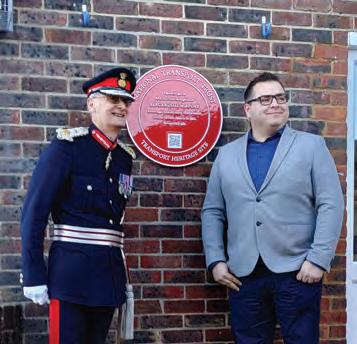
transport with a Red Wheel for significant places and buildings which have been involved with all forms of transport, including aviation. In January, Blackbushe Airport celebrated the erection of a Red Wheel by the control tower at a wartime airfield which played a significant role as RAF Hartford Bridge. The Hill of Oaks on Windermere, where Waterbird took her first flight in 1911, and White Cross Bay, site of one of Britain’s Short Sunderland Flying Boat factories, also have NTT Red Wheels to celebrate their history.
The NTT would like to hear from anyone who has an ongoing restoration project, or a nomination for a Red Wheel site, to get in touch as soon as possible for the 2024 awards. www.nationaltransporttrust.org.uk Anne Hughes (VAC Chair and NTT Trustee)
GAAC seeks funding
The General Aviation Awareness Council is involved with helping many airfields with complex planning issues, and has just launched a ‘Save our Airfields’ campaign. To help with this work, the GAAC hopes to raise £10,000 in 2024 to fund ongoing work. www.gaac.org.uk/save-our-airfieldsfundraising-campaign
LAA needs YOU!
A reminder that the LAA is seeking applicants for two important roles. The first is for the Head of Technical Training, where we are looking for someone new to take on this role and enhance the number and types of training we offer
The second is for the Pilot Coaching Scheme Chief Coach role. Pilot Coaching is another area that the LAA is looking to enhance, so this is an opportunity for someone new to make a real difference.
The roles are fully expensed. Apply in the first instance to office@laa.uk.com
Air Race school introduction weekend
Ahead of the 2024 season of events, races, and experiences, the Royal Aero Club – Racing, Rally and Records Association of Great Britain is hosting an Air Race Introduction weekend at Popham Airfield on Saturday 20 and Sunday 21 April.
The days are free to attend for pilots who have, or close to, a minimum of 100 hours P1. Both days are identical and so you just have to choose which day you wish to attend. Any interested pilot can meet the team and gather information on the British Air Racing series of weekend air races and all our other activities.
During the morning, there will be a short groundschool that will include air race theory, rules, regulations and techniques, and after lunch, if you have flown in with your own aircraft, there will be an option of taking an experienced air race check pilot as passenger, who will explain and mentor the basic flying and navigation skills required around a short demonstration course, There is also the option on the Saturday evening to meet club members at a social event at The Wheatsheaf Pub and Hotel, RG25 2BB. Accommodation can also be booked here if required. Please register for a place by contacting Jonathan Willis at jdm.willis@gmail.com or Julie Scott at juliescott009@gmail.com and we will look forward to meeting you, and for more information, please visit www.BritishAirRacing.org/become-a-racer
Changes to international GA flights
On 6 April 2024 the new General Aviation (Persons on Board, Flight Information and Civil Penalties) Regulations 2024 come into effect, applying to all General Aviation aircraft making international flights, which are expecting to arrive in, and depart from, the UK (including within the Common Travel Area).
International GA flights that are arriving in, or departing from, the UK will be required to submit information online about the flight and persons on board (both passengers and crew), no earlier than 48 hours and no later than two hours prior to the expected time of departure.
Pilots are reminded that General Aviation Reports emailed directly to Border Force will not be compliant and will not be accepted.
Acceptable online submission methods include the Government’s free-to-use submit a GAR ‘sGAR’ web service, or via an approved existing third-party application, such as private member subscriptions to applications like Airbox, Cloud Aviation, Online GAR, SkyDemon and Rocket Route. A full published list of acceptable third-party applications will be published on gov.uk.
Failing to comply with the 2024 regulations may result in a civil penalty of up to £10,000 per breach. www.gov.uk
Kemble Fly-In to commemorate MacRobertson Race
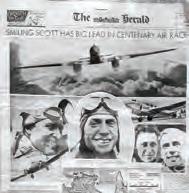
Over the weekend of 28 and 29 September, pilots are invited to a Fly-In at Kemble, organised by the BullPup Flyers to celebrate the 90th anniversary of the MacRobertson race from Mildenhall to Melbourne. Tony Blake explains. “We all know the stunning red DH Comet flown by CWA Scott and Tom Campbell-Black that won, but there were other competitors like the DH Puss Moth, DH Rapide, Miles Falcon or Hawk Major which are still represented on the UK register, and we would be delighted to see them along with the modern day equivalents that we all enjoy flying. However, it is not just about the aircraft, it is a chance for pilots of today to learn about the generation of pilots who laid the foundation for private flying as we know it today. There were the unknowns, like Harold Brook with only 100 hours in his log book who flew with Ella Lay, who had only just gained her pilots licence.
“We shall, in particular, remember the winning pilot, CWA Scott, because his grandson, Tim Barron, will give an after dinner speech at the pilots supper. Also planned are presentations by Martin Jones, who is rebuilding Jim Mollison and Amy Johnson’s DH Comet, Black Magic and from the DH Museum.
“The format of the event is the Fly-In to Kemble on Saturday 28, the pilots supper in the evening in Cirencester, then vintage bus back to Kemble on Sunday 29 with a mass Fly-Out. The airfield is closed to the public and incoming flights on Sunday so the Fly-Out can proceed uninterrupted.”
If you would like to express an interest in attending, then email the BullPup Flyers Secretary tonyblake38@hotmail.com and keep an eye on the website www.bullpupflyers-skyhawks.com
BRA activities for 2024
Gyro fans! The British Rotorcraft Association will be holding its AGM during the Popham Microlight Trade Fair on Saturday 4 May at 1400, plus there will be a dedicated Gyro area on the flight line offering plenty of gyro’s to see.
LAA HQ open day: 1 June
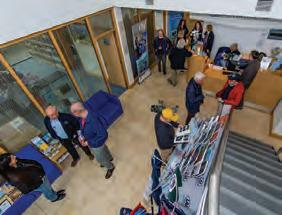
On Saturday 1 June, the LAA will be hosting an HQ open day at Turweston. Come along and meet LAA CEO Simon Tilling, plus members of the Engineering and administration team. Free refreshments will be on hand throughout the day, plus a catering van will be on hand for food purchases.
The BRA Gyro Record Breaker event will take place on Saturday June 1 at EGBO Wolverhampton Halfpenny Green. The Association will be attempting to substantially break their existing Guinness world record of 71 gyros, and hope that the change of venue might help attract 100 or more aircraft. www.britishrotorcraftassociation.org
New General Aviation Alliance EC stance
The General Aviation Alliance (GAA) has released its updated Electronic Conspicuity Position Paper outlining the organisation’s stance on the integration and advancement of electronic conspicuity technologies for all UK aviation.
Key highlights of the updated Electronic Conspicuity Position Paper include Technology Integration, Standardisation and Interoperability, Government and Regulatory Engagement, and Research and Development Investment.
The General Aviation Alliance invites stakeholders, industry partners, and the general public to review the updated EC Position Paper, gaalliance.org.uk/position-and-data-papers
Letters
We are always pleased to receive your letters, photos of your flying, and your feedback. Please email the editor at ed.hicks@laa.uk.com
EC rebate scheme
Dear Ed,
Further to recent LA magazine correspondence about the soon-to-be-expired EU rebate scheme for EC devices, I’ll take this opportunity to remind LAA members (and others) that this rebate scheme relates to an individual.
I bought my first EC device a few years ago, and on acquiring a second aircraft last year (both aircraft are in an LAA group of several different owners), I purchased a second EC device for the second aircraft in the interest of safety.
The EU refund for the second device was refused by the CAA (in accordance with the ruling), but this was not made apparently* clear by either the CAA, or the vendor – both devices having been purchased from the same vendor under the same name (me).
Had I known this in advance, I would have asked one of the other group members of the second aircraft to purchase the EC device. I was tempted to send the second device back to the vendor for a refund (and hence be without an EC device in the second aircraft), but I didn’t.
This silly situation is not conducive to airspace safety, especially since there are still funds out there to promote the purchase of EC devices.
Robert Lees.
* I don’t blame the CAA/ It’s in its documentation once you look for it… but it’s not obvious.
Avgas and EC
Hi Ed,
Thanks for the great work on the magazine. I have two things for you. Firstly, thanks to you and Ian Fraser (and Ruth Kelly – Ed) for a great article on the future of aviation fuel. It was very enlightening and shows the many possibilities that are coming. I did think that synthetic fuel (synfuel) was kind of conspicuously absent, and given that Zero Petroleum has recently set up at nearby Bicester Airfield, then a Part 3 on synfuel might be a good opportunity? The RAF have flown with it tinyurl.com/rafsynfuel.
Secondly, thanks for the positive words on the CAA-sponsored GASCo / Jarvis Bagshaw EC Human Factors study. I advised some of the tech aspects of the trial and flew a trial sortie with the renowned human performance scientist, Steve Jarvis, in a LAA Permit Chipmunk from Turweston. So, as an LAA
member, the organisation’s views were considered, having read various EC articles in Light Aviation, as well as reading the comments in the Letters section. The eye-tracking technology used in the trial was very useful in understanding how we use EC in various types, and several lessons were learned where we can educate to improve its use. You can expect to see some of those lessons drawn out in upcoming GASCo Safety Evenings, which augments the learning material in the video. tinyurl.com/ HumanfactorsandEC
The trial was something that had not been done before for GA and shows the CAA’s commitment to understanding the effects of it on our aviation sector, which is a good thing.
Keep up the good work and thanks again for your efforts.
Gary Coleman
Future of fuels
Dear Ed,
We note last month’s correspondence on fuel and must raise a point about the letter to Jon Viner from RA Philips. Shell and Esso ‘Super’ fuels are not 99 octane MON. They are 99 octane RON which is closer to 87 octane MON, an important difference for our engines.
The ‘blanket statement’ on ethanol was lifted directly from the current version of CAA’s CAP 747 and perhaps a pertinent question could be ‘does the LAA document trump the CAA’s one on the subject’?
Either way, the various regulations and specifications pertaining to this are a mire of contradictory and confusing bumph, many are out of date and need to be revised.
That is why we wrote ‘you really need to understand your engine, its fuel systems requirements and associated regulations’ before you use mogas. We were pleased to note LAA Engineering’s postscript to the second part of the article promises action and look forward to reporting on some clear and unambiguous direction.
Let’s hope the CAA do likewise.
Ian Fraser & Ruth Kelly
LAA Engineering CTO Jon Viner replies: “Ian asks whether ‘the LAA documents trump the CAA’s one on the subject’ – he is referring to GC no.7 which is entitled ‘use of unleaded aviation gasoline (avgas) UL 91 in Annex I aircraft’, so the document doesn’t relate to the use or otherwise of mogas. Further, in GC7, it notes ‘the use of mogas containing alcohol is generally prohibited in aircraft’ (emphasis
added): that doesn’t mean it’s prohibited. CAA has advised us that GC7 is not intended to prohibit mogas containing alcohol and that procedures promulgated by CAA-approved organisations (e.g. LAA) are still valid. CAA’s CAP562 (Civil Aircraft Airworthiness Information and Procedures) leaflet 28-20 also still refers to the deleted GCs on mogas and discusses alternative routes for approval of fuels in aircraft.”
Next generation
Hi Ed,
Happy new year! I preferred the calm, cold, clear and crisp of a week or two ago than the current (as I write) dreary gales and rain, oh well…
Anyway. I thought one of your lines on your ‘Next generation’ editorial (Editorial, December 23 issue) might have brought a flurry of comments in the letters section of the January 24 mag – but it didn’t. You noted the ‘handful’ of Association members who insured you and allowed you to fly their underutilised Permit aircraft... I guess you were extremely lucky, or I’ve been extremely unlucky. In 30+ years of PPL, NPPL, glider and motor glider flying from a dozen or more airfields, and amassing circa 1,500hr total (so, not a vast amount, but ~50hr per annum averaged), I have not once been offered to fly anyone else’s aircraft on that kind of goodwill basis, let alone regularly, never mind by a handful of people! (To note, I’m more of a steady-Eddie pilot than a barnstormer, so that isn’t a concern!).
Yes, I’ve been flying with other people in their aircraft… yes, I’ve been offered shares or bought into syndicates… but I’ve never even got wind of the opportunity of ‘just flying’ other people’s aeroplanes.
I’m not sure what my point is. I don’t own my own aircraft – and if I did, would I let someone else fly my pride and joy? No, probably not!
I even remember, in my ‘yoof’, in the early 1980s, going frequently to Shoreham Airport with a friend, some sandwiches and a notebook to watch the flying – wandering round the hangars, as you could then. And, a couple of times being asked by based pilots if we fancied a short sightseeing flight as they were ‘going up anyway’, which was incredible as a 13 or 14 year old. The thought now of taking someone else’s (unknown) kid on a flight seems like a generation long past, but the question very much is how we get young people interested and engaged in our sport
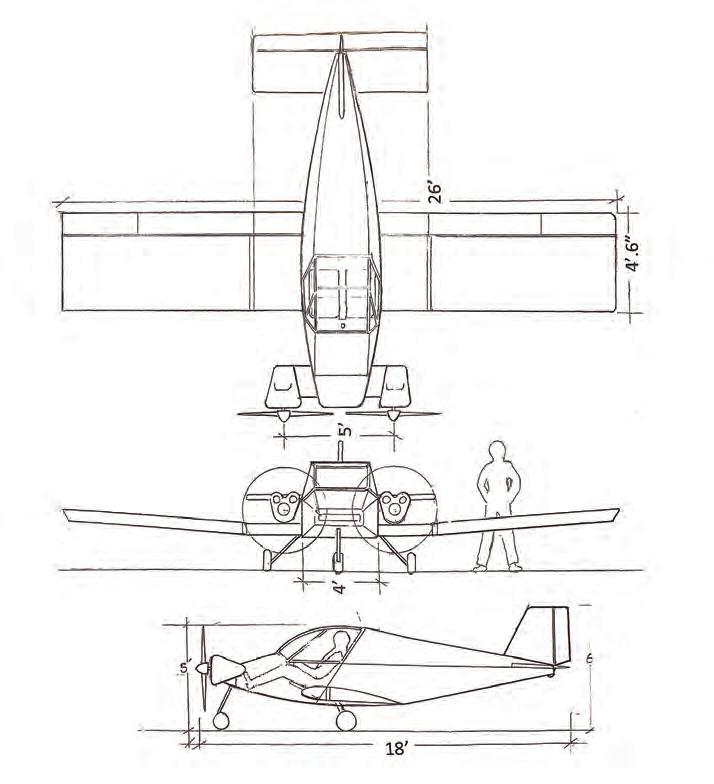
Right Gerry Knee’s design for a modern, affordable plans-built two-seat aeroplane, intended to be built for around £16,000. Is it time for a design competition to promote such an idea, asks Ed the Editor?
and hobby – specifically not those wealthier ones whose parents own their own aircraft.
I especially love flying as a passenger in ‘more unusual’ or ‘less common’ aircraft. I’m not necessarily talking about Gulfstreams or P-51 Mustangs – I’ve never been in a Fuji, I’ve never been in an Auster, I’ve never been in a Jabiru, I’ve only been up in one Van’s series (RV-7), I’d love to go in LAA CEO Simon Tilling’s Navion, but I find nowadays that if you chat to people and glide the conversation towards a short flight ‘sometime’ (and I’d be happy to share costs), there seems to be a certain suspicion about ‘are you trying to catch me out’ or ‘why did you choose me’ or even they sound interested and just forget – I think in many cases, people who fly the same aircraft regularly don’t see the point, or don’t understand the enjoyment, that other people would get from even a 10 minute ‘local’.
I’ve rambled enough. The world is very different to how it was 30 or 40 years ago. I don’t suppose there are many teenagers who’d enjoy the sandwiches and notebook thing in the same way as I did back then!
Please retain my anonymity – I couldn’t take the disappointment of people I know coming forwards and saying ‘oh, you could have flown my so-and-so in 1990 if only you’d asked’…!
Regards,
A member who just loves to fly.
Ed replies: Thanks for writing. When I joined the then PFA, it was a Bristol Strut fly-out and the opportunity of a cost-sharing ride that opened doors, which led to many more future flying opportunities.
We all know that most aeroplanes are underutilised, and that their engines hugely
benefit from being used regularly. While I guess I was lucky to find owners who were keen to keep their aircraft active, I have had conversations with a handful of other pilots who have been similarly fortunate – so it does happen. I don’t know that there’s a magic formula, it just takes the opportunity of a conversation.
While I recognise it’s not for everyone, I can say the friendships and camaraderie that have grown from it for me over the years have often eclipsed the initial flying opportunity.
New aviators
Dear Ed,
Both the current and former LAA CEO’s expressed concerns about the lack of younger aviators. With more than 1,100hr, mainly LAA type flying and ownership, I feel that I have a
good understanding of the costs involved, and how these impact the budgets of those wanting to fly, and the conflict with today’s limited disposal incomes.
To address this I believe we have to get back to basics, with an easy-to-build from plans two-seat aircraft, so that build and ownership costs could be shared by at least two people. With this in mind I have proposed a project which I believe could be built for about the cost of a new Rotax 912. (Ed –Circa £16k) Gerry Knee.
Ed replies: Thanks Gerry, that’s a really interesting concept. I’d like to know more about it. Perhaps it’s time for a low-cost homebuilt design competition for a two-seat aircraft?
Obituary
Alan Chalkley 1933 – 2024
Members will be saddened to hear of the passing of Alan Chalkley on February 12.
Alan was a stalwart of the LAA, having joined the PFA, as it was then, in 1957 and been involved in the founding of the Vintage Aircraft Club, which celebrates its 60th anniversary this year, and the North Wales Strut.
Having learned to fly gliders with the Kent Gliding Club in his youth, and later becoming an instructor, Alan joined the RAF in 1951 where he trained on the Percival Prentice before being sent for more advanced training to the USA. He progressed through the T-6 Texan, Lockheed T-33 Shooting Star, and the F-84 Thunderjet before returning to Europe where he flew his favourite type, the F-86 Sabre, for the RAF in the 2nd Tactical Air Force, mainly in Germany. He left the RAF in 1955 and joined BOAC.
This was a period in aviation history when piston-engined airliners were the order of the day and Alan flew the Boeing Stratocruiser and the Bristol Britannia before moving onto the jet engine VC10 from 1964 and the B747 Jumbo from 1973. With the merger of BOAC and BEA (to become British Airways), and a resulting need for the company to shed pilots, Alan decided to move on to carry out Boeing overload training with Korean Air and Malaysian Airways until retirement.
Alan had not forsaken light aircraft during this time however, and in 1962 he purchased a near derelict J3 Cub he had found languishing on an airfield in the US and brought it back to the UK in pieces – over many flights – in the hold of whichever airliner he was flying. He restored it and flew it as G-ASPS for 52 years before he sold it to the present owner, former LAA CEO Steve Slater, in 2014. He also owned and flew Comper Swift G-ACTF, which currently resides with the Shuttleworth Collection, from 1972-1996.
Alan also penned the Over the Hedge column in Light Aviation, and prior to that in its previous guise as ‘Popular Flying’. Initially the column was titled Vintage News and because his employer at
the time, BOAC, was rather touchy about its pilots authoring articles in magazines, he wrote under the pseudonym of John Beeswax. Vintage fly-ins, news of aircraft restorations and advice on caring for vintage types were the column’s raison d’etre.
Alan was living in Camberley in 1965 and was the Vintage Aircraft Group secretary when he composed his first Vintage News, typewritten on foolscap, banda machine printed magazines as secretary of what was then called the Vintage Aircraft Group. The group was affiliated to the PFA and Alan’s regular reports on the club’s activities were printed in the PFA’s Popular Flying. In the 1973 July / August issue he explained that the group had made the decision to change its name to the Vintage Aircraft Club. Always a gentleman and supporter of the club, Alan will be much missed by all in the VAC.
In 1982 Alan and Beryl visited Anglesey with friends Joyce and Carl Butler, who had founded the Heart of England Strut. Carl had been invited to give a talk to a group of pilots at RAF Mona, extolling the virtues of the PFA, which was so enthusiastically received it was decided, with Alan’s encouragement, to establish a North Wales Strut there and then. Alan kept in touch with the new Strut and six years later, he and Beryl moved to North Wales and Alan was actively involved as Strut secretary for many years. In 1992 he also became an Inspector, helping many in his local area with the upkeep of their aircraft.
Apart from his aviation activities, Alan was a long-time member of the Royal British Legion and was Branch Secretary of the Rhoshirwaun branch in North Wales from 1989-2015. He was an active case worker, helping many veterans, as well as organising fundraising and working on the annual Poppy Appeal.
Above all else though, Alan was one of life’s lovely people and the world was a better place for his presence. Our condolences to Beryl, his family, and his many friends.
Brian Hope, with thanks to Neil Wilson, Gareth Roberts (North Wales Strut), and Anne Hughes (Chair of the VAC).
Straight and Level Updates from LAA HQ
A new mission
Simon Tilling CEO
It’s been 11 months since I took on the CEO role, and in that time I have met or spoken to many members and received feedback on many facets of the Association, its challenges and occasionally, some positives! I have been absorbing all this feedback. Recently I met with the LAA Board to propose and discuss a strategy for the next few years. It was a very productive meeting and we have identified five key themes that I and the team are going to focus on and develop
● Safety and airworthiness of fleet
● Efficient and effective engineering services
● Protection of our freedoms – airfields, airspace, regulation etc
● Training and coaching – owners, pilots, builders and enthusiasts
● An ‘Open to all’ aviation community
As you can see there are some themes that are to be expected and that we are already delivering on, here the aim is to optimise and enhance. There are also areas where we need to develop a bigger and bolder vision, and then there is the new theme of an aviation community. The mission is to create an aviation community, open to all, that will be a dynamic and supportive
Renewal and refresh
Eryl Smith Chairman
Looking out on a wet and windswept landscape as I write this piece it’s hard to imagine that the flying season is just around the corner. Nevertheless, the first tentative signs of spring are appearing, the daylight hours are gradually extending and the clock change at the end of the month will herald longer flying days.
For some there has been the opportunity over the winter to grab those precious days of still gin blue sky when the flight radar screens seem full of GA aircraft taking advantage of the moment. I look forward to seeing examples of such members’ flights captured in the LAA 2024 photo contest announced in last month’s magazine. But for many it’s probably been a case of wrapping the aircraft away for the winter, cursing the waterlogged airfield or toiling in the hangar to progress the build, completing the Mod, or undertaking much-needed TLC or maintenance in readiness for the coming season. I hope those hours of work are paying dividends… and that there’s light at the end of the tunnel, where thoughts can begin to turn to planning for the coming flying season.
For those of you who have taken advantage of the opportunity
environment that fosters a love for flying and all things aviation while promoting education, safety, and a sense of community among its members.
There is a lot to be done to develop plans and deliverables for each of these themes, which is my task in the next month or so. I am also looking at how best to engage with you, the members, so you can be part of the process to create the future while remaining agile and flexible. Clearly email exchanges between 7,000 members would present a challenge. More updates will follow via the magazine and other channels.
As most of you will hopefully have seen in the January issue, we are reducing the amount of letters we send out, for several reasons: cost, time, and the environment. In the past we have sent up to 20,000 letters a year, you can imagine the amount of paper this consumes. This does mean we need to rely on email as our preferred method of communication, wherever possible. Can I please ask you all to ensure that we have your correct email address, and that you ensure LAA emails do not get diverted to your Spam or Junk folders? That will help us continue to deliver news about membership renewals, the Rally, events, and LAA training. ■
to move your Permit renewal into the winter months I hope this will enable you to enjoy a full summer of flying without having to plan in the break for the maintenance and renewal process. It will also help ease the peak Permit renew pressure on the HQ team!
As Simon reports, together with the Board, we have been focused on renewing and refreshing the LAA Strategy. Our commitment remains to improving service to and communications with members. At the same time with Simon’s vision and energy we will look to expand the training and education offer and seek ways to build a wider membership base. There is much work to do and through the magazine we will continue to report on progress throughout the year.
In parallel with this work, the Board is reviewing the Association’s governance arrangements, particularly the committee and working group structures needed for the efficient functioning of the Association and to provide support to Simon as we move forward. We are also refreshing the Strut and Club Governance documentation ahead of the coming flying season. All ‘dry stuff’ you might say, but imperative to ensure that we can support and protect Clubs, Struts and officers as they plan and hold meetings and events throughout the year.
Elsewhere, we continue to build our partnership with Leicester Aero Club as the planning effort for this year’s Rally gathers momentum. I look forward to being able to share our plans for the event in next month’s magazine. ■
Inspiring members to take on their own aircraft build or restoration project
Compiled by Mike Slaughter
Project News
The worst is over, we are in March, the clocks change on the very last day of this month and, down here in the South West, sunset will be at 8pm soon after. I think that’s an amazingly uplifting thought as we come out of the dark months and have the whole season ahead of us.
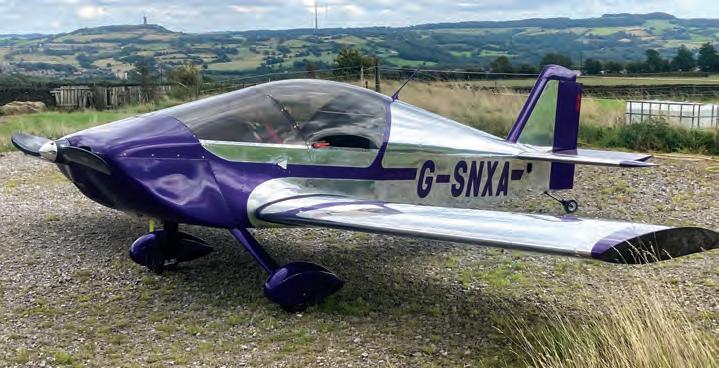
I don’t know why, but Sonex aircraft don’t seem that numerous in the UK. John Monnett aircraft have been around for more than 50 years and after the Sonerai designs, the fuselage profile became a consistent trademark of his creations, a canopy that extends forward in one straight line down the top of the cowling to the spinner. Perhaps it’s that unusual shape that puts people off? I think it is simply elegant, and were I able to start a project tomorrow, a Sonex would be right up there in the top three contenders.
Not a large aircraft by any means, the Sonex airframe has a charming simplicity of form and, on a low power engine, it is quicker than most. Dare I say it, a contender for a poor man’s RV? Futuristic in appearance, it’s also futuristic in propulsion, there is at least one
G-SNXA (LAA 337-14984) Sonex
By Steve Ridge
Steve started flying in 2011, he tried to buy a Sonex shortly after but it wasn’t to be, and he ended up building a Skyranger. For a while he was also part-owner and builder of Europa G-STES with Steve Ivell, a project we covered here at the end of 2021. That aircraft was notable for having been vandalised with an angle grinder while still with its initial builder, you may recall the pictures. In the background, Steve still harboured thoughts of a Sonex, it was unfinished
example being built in the US with electric power (disapproving groans in the background) and of course there’s the Sub Sonex, effectively a single-seat Sonex with a small jet engine on its back. It’s worth looking at the Sonex website. I was taken by an EAA video in the Sonerai section titled ‘It all started on the kitchen table’. And, wander off to its YouTube channel and have a scan through its videos, including nearly 30 on how to assemble your AeroVee engine – fascinating.
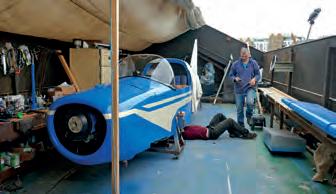
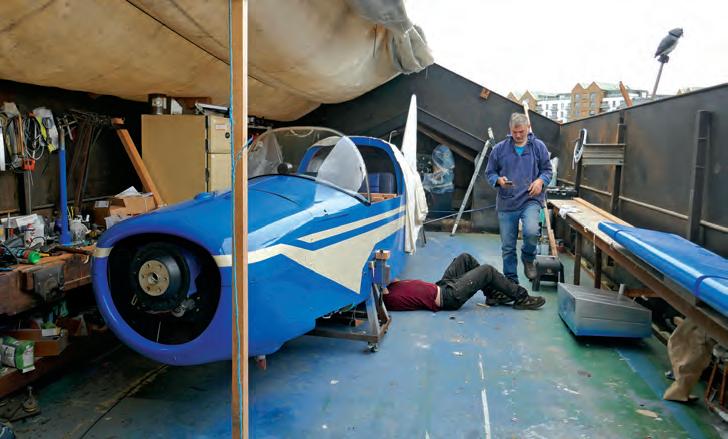
From the equivalent of a petit aluminium sports car to a lovely wooden four-seat gentleman’s carriage of the air. Wesley Massam’s gorgeous Jodel 140 is a gentle giant of an aircraft crafted in a very unusual build location. Every project is a huge adventure for its owner and we build where circumstance allows us to, but I don’t recall anything being built on a barge before, let alone something with a huge one piece wing like a Jodel.
To get in touch with Project News, and tell your story, report a milestone or just to send a picture, email: projectnews@laa.uk.com Please share your story!
business. Then in October 2022 a part-built project popped up on the internet and the rest, as they say…
As taken on, Steve’s kit has a conventional undercarriage and is a first phase or ‘A’ type Sonex. A fairly traditional flat pack aircraft kit, not a final size drilled, Cleco together and rivet level of pre-fabrication, as some of the very modern kits are. However, everything was pilot drilled by the factory, requiring opening out to final size on assembly, the leading edge wraps were pre-bent and all the ribs are pressed and flat – due to stamping, curved and flanged profiles like wing ribs usually come out of a
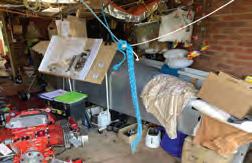
Above The kit as viewed at the sellers garage, note the AeroVee engine bottom left.
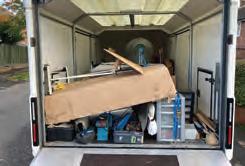
Above All packed up and ready to transport to Steve’s workshop.
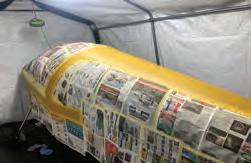
Above Painting X Ray Alpha Christmas 2022, a party tent makes a great spray booth.
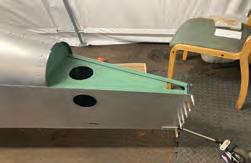
Above First job, fit the tailwheel.
press banana shaped, leaving a builder to flute the edges and ‘flatten’ them. Ordered today, a Sonex kit is supplied as a ‘B’ model and there is a high degree of CNC laser cut prefabrication. In fact, there is now a quick build assembly option available, featuring pre-assembled wings and fuselage, along with a pre-cut and fitted canopy. The current B model makes the aircraft wider at the firewall by a few inches either side providing a larger engine bay, fuel tank and dash panel.
Traditionally, Sonex has supplied two canopies with its kits allowing the builder a spare, just in case. Following a crack while ‘nibbling’ his canopy to fit, Steve did end up using number two. He said Sonex kits are not supplied with a build manual as such, but a very large booklet that contains the whole aircraft build plans, basically a full set of engineering drawings. There is an option in North America to scratch build a Sonex and it is this plans booklet that you would work from, however, scratch building is only for the legacy or ‘A’ model. Steve had a problem and needed some replacement parts around the wing mounting area, all of the new pieces came perfectly CNC cut and got him going again. He said that he’s found plenty of Stateside builder support in forums etc and that the factory also provides excellent assistance when approached.
As purchased, the kit came configured for a AeroVee 2.1 engine, an interesting option, a VW-based engine that itself is supplied as a kit for builder assembly, which must be great for detailed knowledge of one’s power plant when it comes to later maintenance. He didn’t take the AeroVee 2.1 intending to use the only other LAA approved engine option, a six-cylinder Jabiru, which he had built by Kev Hyam at Camit UK. Only the non-turbo AeroVee 2.1 is approved by the LAA, Steve confirmed that he and flying buddy, Steve, are both ‘full size gentlemen’ and felt that the 80hp would struggle to get them in and out of Crosland Moor, their home base. As a result a factory order was needed for a new engine mount and here’s where the A/B model becomes significant. The factory is building B model parts with stock available off the shelf, so his A type engine mount was a special order and took 12 weeks to be produced.
From taking on the build to finishing, it took Steve just more than a year, he’s very fortunate in that he is an independent Land Rover specialist with a big workshop. He was able to cone off a suitable area of the workshop for the project. Working day complete, it was simply a few paces across his factory unit to be able to carry on with the aircraft. He thinks on average that he spent a couple of evenings a week and most weekends to finish the project.
When collected, the tail, wings and control surfaces were already built and signed off. The fuse rear section was already riveted, leaving the forward section to finish, including construction of the rear carry through, riveting
the main spar box and setting the wing geometry, the spars and fuselage were drilled through to set the same. Steve then riveted the underside and fitted out the instrument panel to complete the basic structure.
Of course, forward of the firewall there was a fair bit to do, the original engine mount had to come off and be replaced with the new one, which dictated the removal of the undercarriage, as like an RV, the main gear fixes to the engine frame. It was then a case of fitting the new engine and removing the original wiring, again because of the different engine. With all that done it was just a matter of obtaining the final sign off.
The dash is rather petite, being the ‘A’ model, and was supplied with an MGL Discovery Lite panel as there is not that much room and the Discovery contains almost all of the functionality that’s needed. He had to replace the supplied RDAC, the firewall side sender unit that collects all the engine data and passes it to the panel down a single wire, as it was for a four-cylinder motor and he needed the six-cylinder variant. The dash essentially has room for the MGL panel, a couple of 2.5 inch standby steam gauges, a couple of switches and breakers and that's it, so no difficult choices there then. He’s squeezed in a Trig TY91 radio on the panel, but the TT21 transponder is configured in headless mode, its operation being onscreen through the MGL panel.
Above All packed up and ready to go to the airfield.
Below Sitting pretty after its first engine run at Crosland Moor.
Above The engine in build at CamitUK.
Above The Jabiru 3300 overhauled and collected from CamitUK.
Above Interior trim as supplied with the kit.
Above This finished and compact panel all wired and ready to fit.
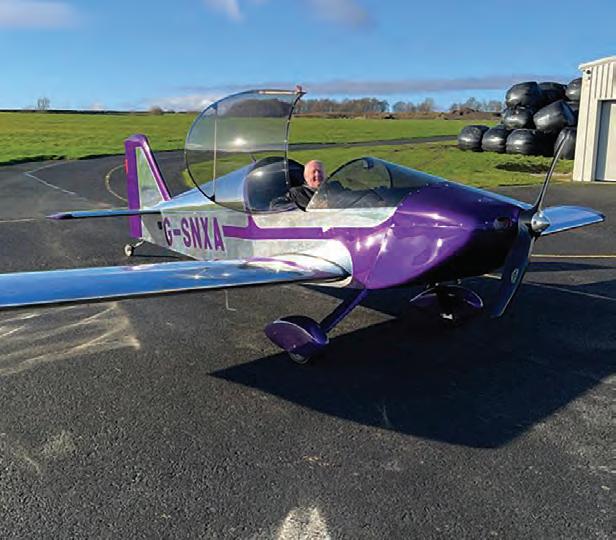
Finishing the aircraft, Steve has primarily polished the metal structure and painted the composite components, referring to the scheme as polished and purple. Polishing is not an uncommon approach, saves weight and time in a queue for the paint shop. Quite a few of the factory aircraft are in a polished finish and Sonex provides all of the materials required along with a video tutorial covering how to achieve it. Saving painting time also appealed as Steve had sold his Skyranger and needed a flying machine. He said that polishing is never really finished, often needing a bit of touching up here and there, perhaps a once a year mop over to maintain the shine – and then there are those inquisitive fingers that just can’t help themselves and leave smudges.
The first flight took place on Saturday 6 January 2024 by Nigel Jones who was also the Inspector for Steve’s part of the build. No big surprises have been encountered and Nigel reported that the aircraft felt fast.
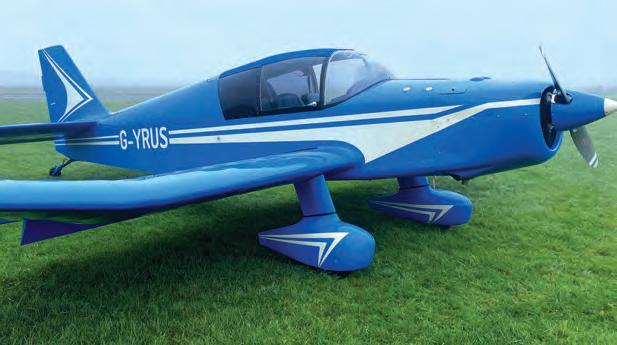
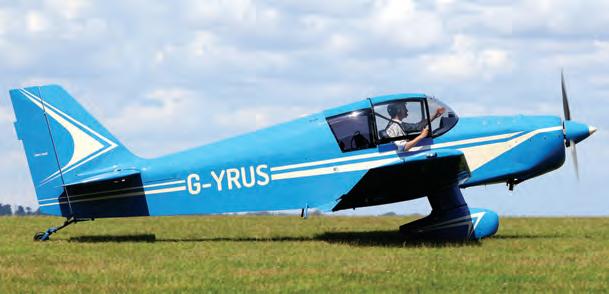
G-YRUS (PFA 251-14090) Jodel D140e
By Wesley Massam
Where to begin? I’ve always sailed, and back in 2003 had a large Gaff Cutter I had built with my father. My then-wife hated water but loved flying in big aeroplanes. We needed a hobby that we could do together and so I thought flying could be for us. Being put off by the costs I decided to try and build my own within the PFA system. I had a background in composites, having built offshore racing yachts, but my real passion is wooden structures, so a wood and fabric aircraft seemed the obvious choice.
After a little research I decided that a Jodel D140 was the ultimate load carrying wood and fabric LAA type. A plan was hatched and a set of drawings bought, along with the rights to build one. In 2003 the project was registered with the PFA and shortly afterwards I received a letter from Francis Donaldson advising me that I might be better off choosing a smaller aircraft for my first project. This was all the encouragement that I needed to push on with the project! Little did I know the wisdom of his words…
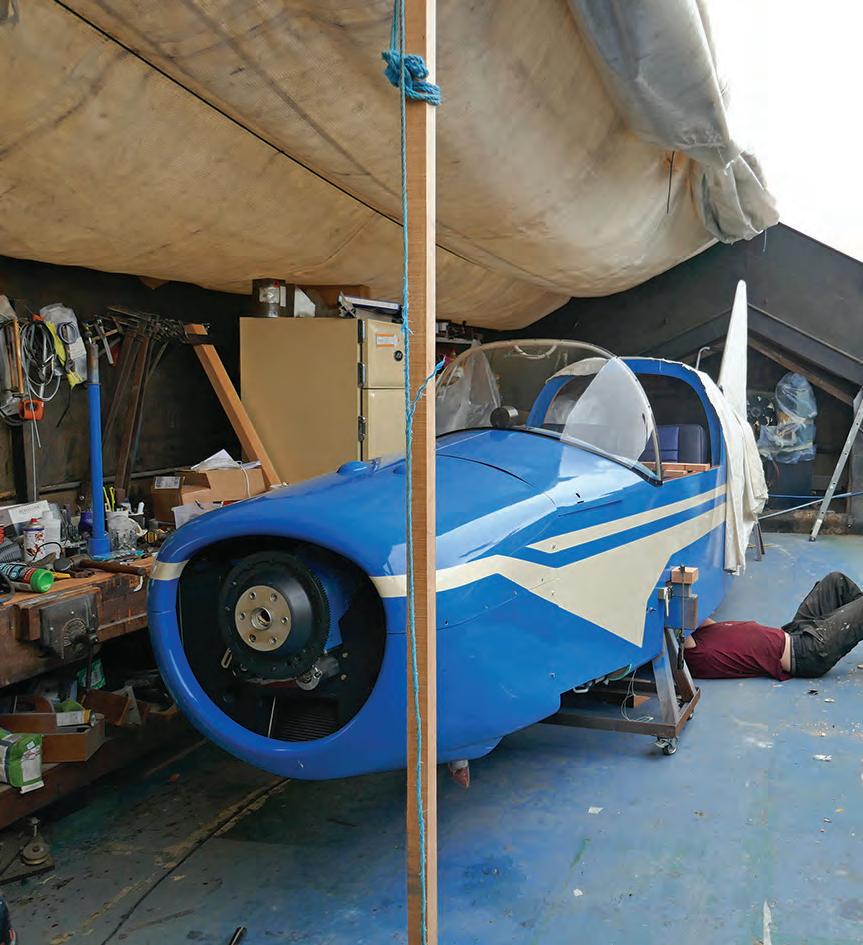
My workshop is a 85ft x 20ft foot barge in Bristol Harbour. I had previously used it to build a Laurent Giles 30 ton gaff cutter and restore two VW Beetles that competed in the historic Monte Carlo rally. Surely a small aeroplane would be easy?
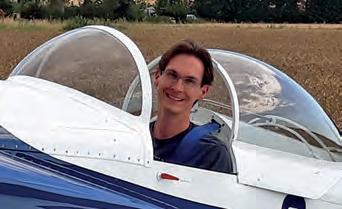
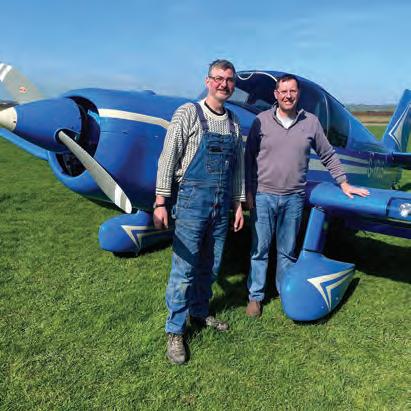
Below top All smiles -Wesley (left) with test pilot Will Greenwood
Below bottom Lovely blue colour scheme is striking.
rudder, then maybe I could build an aeroplane!
Job number one – drive to France to buy lots of plywood from the original plywood supplier to Jodel and Robin aircraft. With more sheets that I could ever imagine using, I headed back. Next I set off to Oregon, USA, to select top quality fir and get it certified for aircraft use. This was subsequently used for all the structural components.
Building started with the rudder. All projects have to start somewhere and if I could master the techniques of making and glueing ribs and bonding plywood on the
As years passed, with life happening all the while, the barge slowly filled with larger and larger components, until after 12 years, all the wooden parts were complete. I then turned my attention to fabrication of the steel parts. The sheer number of individual parts required was quite daunting. I bought my rudder hinges from a well-known UK supplier, but at such cost that I realised all other fabricating would need to be in-house. It was around this time that I met Lou and John Rex, who were experts in all things steel and had recently completed their own D140. With the help of their many jigs and advice, I was able to fabricate all of the remaining parts myself. Around that point, somebody with many years of flying experience recommended that I actually tried flying before I committed even more time to the project. In his words: ‘… you might find flying is not for you’. So, off to Bournemouth for an intensive course over the winter months with Derek Davidson. Luckily I loved it and went on to join a long-established group flying a PA38 tomahawk at Bristol Airport. As the years passed, unfortunately so did my Inspector, Tim Cox. Luckily, I had a good friend in LAA Inspector Miles McCallum, whose many years of expertise would help guide me through the final stages.
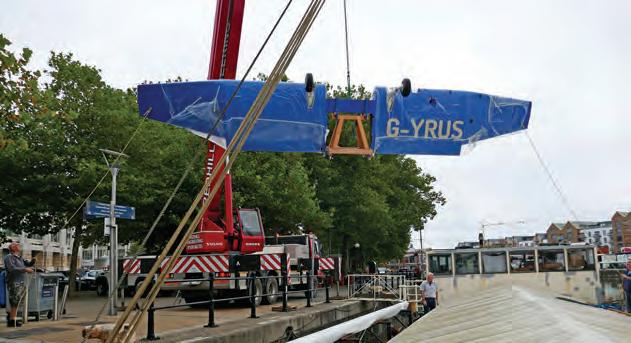
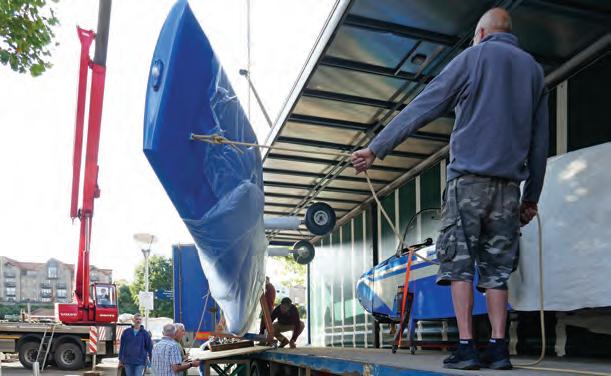
In September 2021, I was ready to roll back the roof
Inspector and test pilot Nigel Jones after maiden flight.
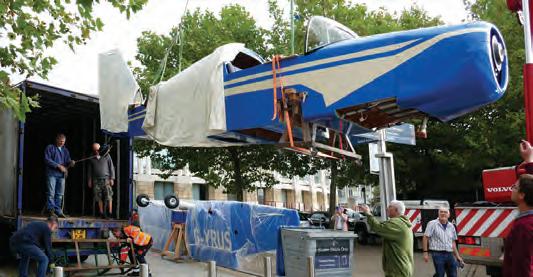
covers of the barge and hire a crane to start lifting the individual components onto an articulated lorry. Much to the amusement of passing boats and the people in Bristol City Docks.
I had settled on keeping the aeroplane at the wonderful, friendly, historic airfield at Middlezoy on the Somerset levels. Amazingly, we managed to assemble the fuselage and wing within the same day it was transported, making best use of the hired crane. Then began 13 months of fettling and finishing jobs which I had been unable to do prior to the aeroplane being in one piece. By October 2022, the aircraft was complete and all build stages had been signed off by Miles. Then began the process of initial Permit application. Little did I realise that this was a job in itself and if it wasn’t for the help and support of my Inspector, I would have given up!
So we find ourselves in July 2023 and flight testing, which was completed by Will Greenwood, a fellow Jodel D140 owner. This was done in the minimum number of hours, without any issues. Now my heart held its breath, waiting. Once the Permit to fly came through, I had only to get a tailwheel and constant speed propeller endorsement, and I was free to fly.
So, 20 years, two wives, three houses and a boat later, I am sitting on the airfield with a big grin, ready to take to the skies on my own. I am happy to report that with over 24 hours of flight time (mainly to Guy Ritchie’s lovely cafe at Compton Abbas), this beautiful aircraft is exceeding all my expectations and I am planning many adventures.
A big thank you to so many lovely people, particularly Lou and John Rex, Miles and all the Engineering staff at LAA headquarters. n
Sling
Mr M Lanham, 32 Law View, Leven, Fife, KY8
Above Uniform Sierra on one of its many early outings to Compton Abbas.
Above Wing was the first component to leave the barge.
Fuselage on the barge, ready for its lift to terra firma.
Below Not an everyday sight in Bristol docks.
Above Craning the components into the lorry.
Aeros Ace
Clive Davidson gets his hands on the unique in the UK
Dyn’Aéro CR100, and finds it a joy for flying aerobatics
Photography Ed Hicks
Flight Test
Ihave no desire to diminish nor reduce the initial excitement and sheer application required to learn how to fly, but there does appear to be a stage when after gaining a licence, often joked as a ‘licence to learn’, an unexpected plateau appears. Further horizons are considered. It may be the desire to fly further afield, maybe a cross Channel check, or perhaps join a syndicate and check out in a new type, or to perhaps fly and travel in IMC. Motivations and choices are many. For Brian Appleby, his thoughts were of getting his tailwheel rating and start broadening his handling with aerobatics. He landed on the notion of getting a CAP 10, the French side-by-side, tailwheel, low-wing monoplane that has good handling, both capable and practical, and very popular. This popularity was a stumbling block as examples were few and far between. But… he saw one aircraft advertised that might fit the bill. It too was French, but pretty well unknown here. Knowing that reconnaissance is never wasted, Brian went to take a look…
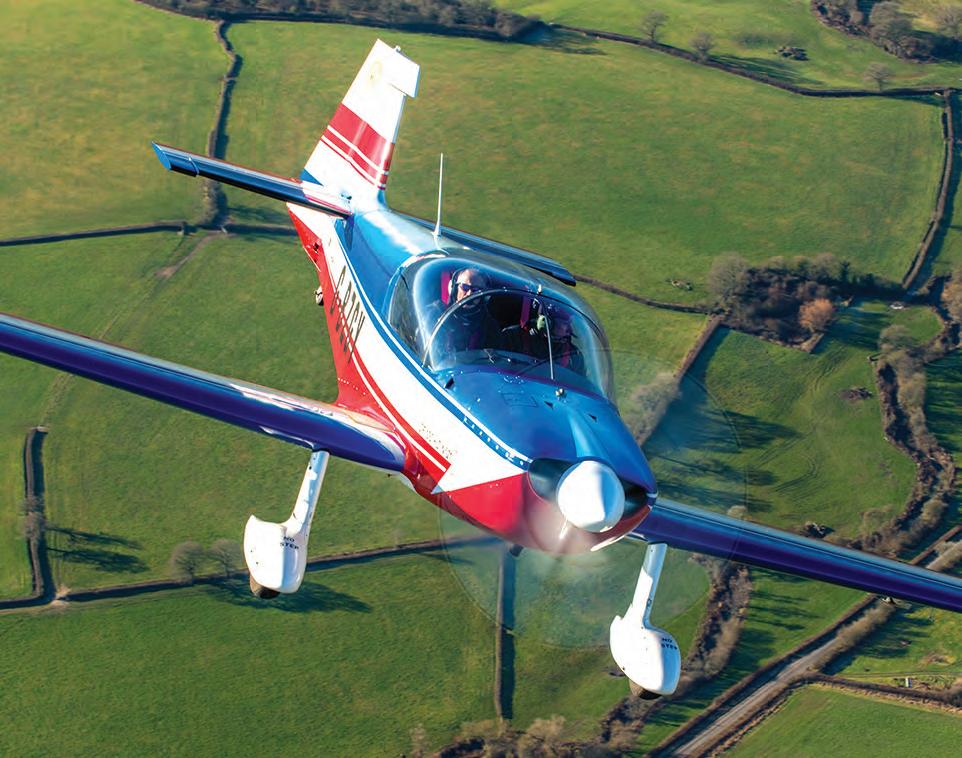
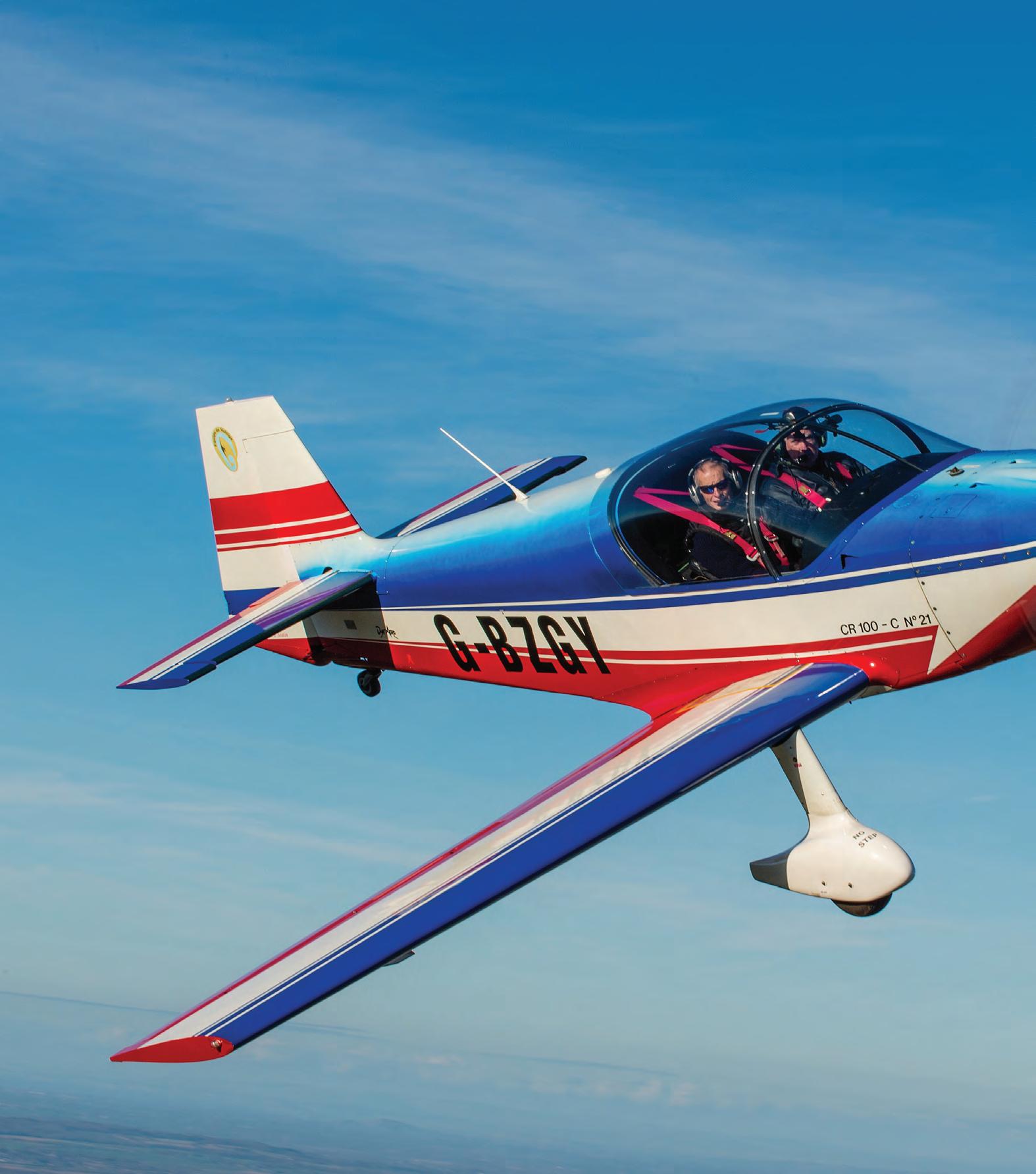
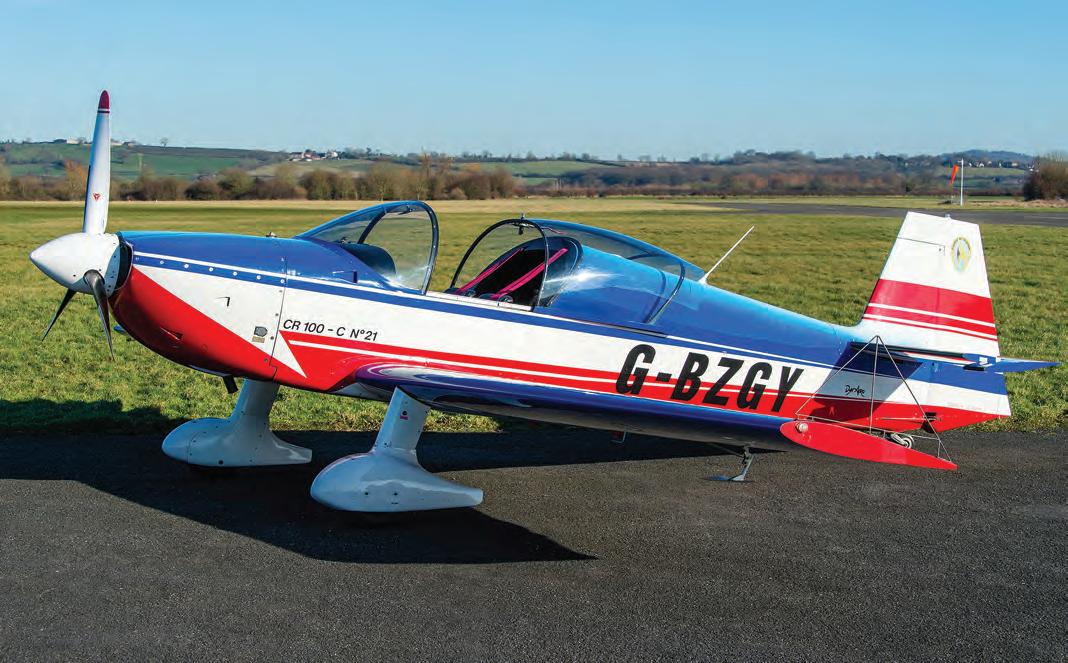
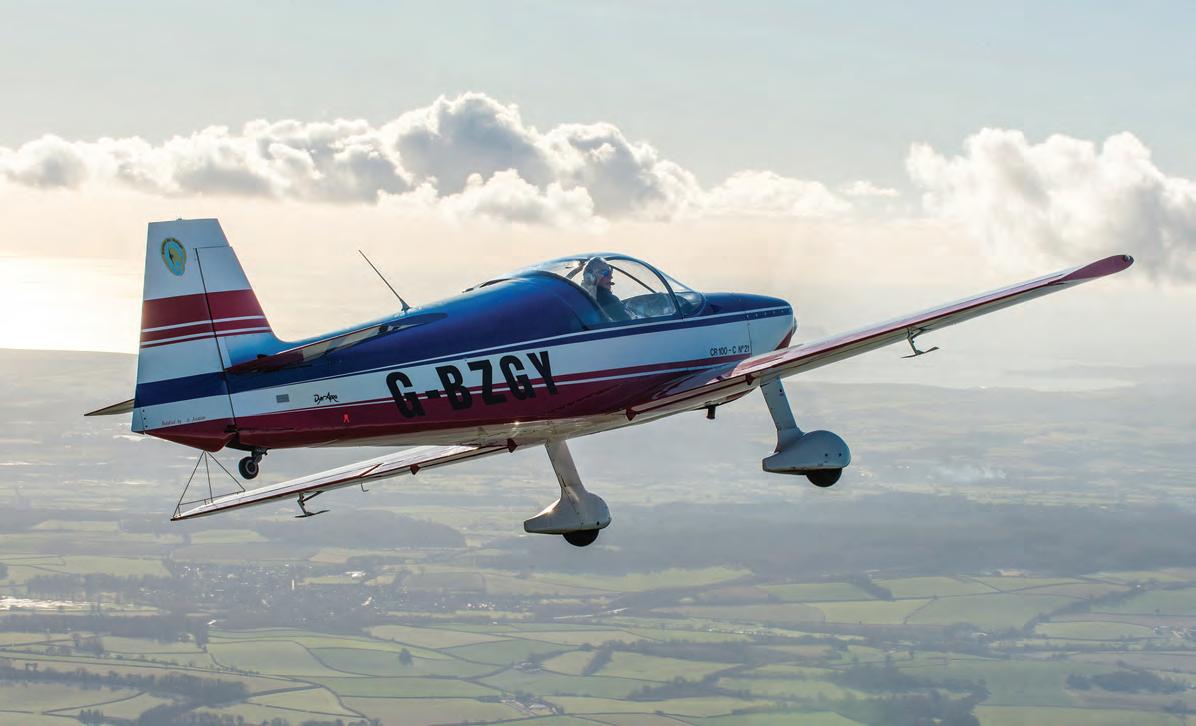
It transpired that, while it appeared much like a CAP 10, it was in fact a Dyn’Aéro CR100, stressed to an impressive +8 and -6 g. Imported into the UK by Cole Aviation in 2000, it was granted permission to operate on a UK Permit with LAA. Brian bought it, and has been a delighted owner for more than 15 years. It is unique in the UK, being the only one to have escaped from France. It is a beauty, one of just two factory-built versions and initially ordered by the French Air Force.
The letters of CR in the Dyn Aero CR 100 designation title are for its designer Christophe Robin, son of Pierre Robin, the renowned aircraft manufacturer that along with Jean Delemontez gave us the wooden DR100 series and the DR200 range, all notable for their distinctive cranked wing, as of the Jodel range.
Christophe entered the aircraft construction business himself, forming Dyn’Aéro in 1992. The company is probably best known for turning Michel Colomban’s metal MC100 Ban-Bi, into the carbon fibre MCR 01 – a number of VLA Sportster and microlight ULC models have been built in the UK. But before that, Dyn’Aéro produced kits for the CR100 homebuilt market selling the concept of being both a practical tourer for clubs with the dual advantage ‘sizzle’ of aerobatics. The type first flew in August 1992, and 37 kits were sold, but these also include an uprated
version of 200hp, the CR110 and a top of the range all carbon fibre CR120. This version first flew in 1996 and had a reduced wingspan, but with larger and longer ailerons, giving it a higher rate of roll, but it lost its flaps in pursuit of rapidity. There was also a nosewheel version in 2000, designated the CR100T.
Real presence
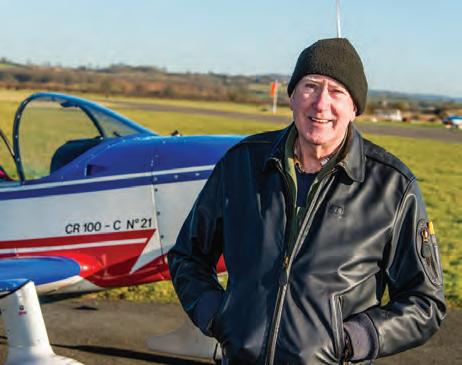
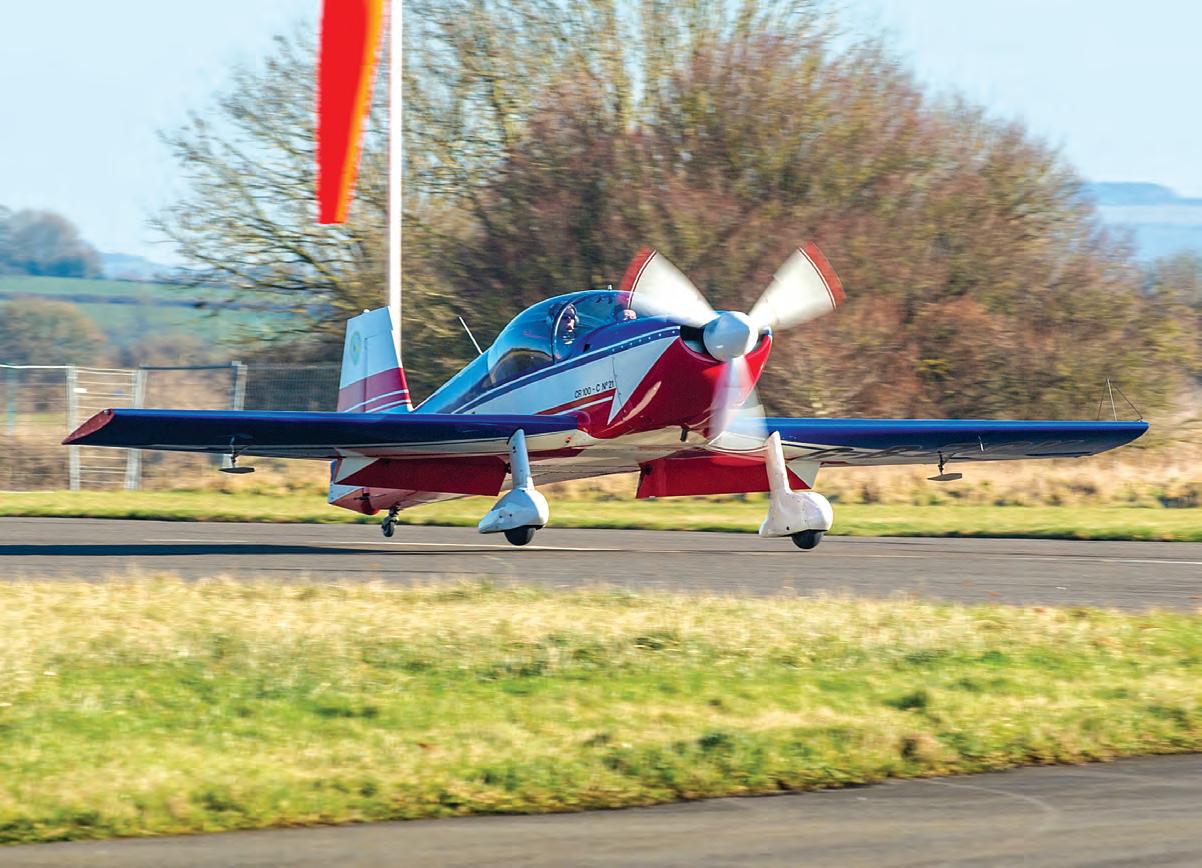
The CR100 was neatly three-pointed onto Henstridge’s Runway 24 by Dave Howell, having flown from its base at Wolverhampton Halfpenny Green. Dave has, in the past, allowed me to fly three of his aircraft, all for Light Aviation
They have all been single-seaters though, so today, thanks to the two-seat CR100, it will be the first time we have flown together. The first of the single-seaters was a Taylor Titch, the second the diminutive Smith Miniplane and more recently an impressive half-scale WAR FW 190, all of which are aeroplanes you ‘wear’. I still regret not trying to buy Dave’s Titch, rather than holding out for a Cassutt…
The CR100 is slightly different for Dave, as it wasn’t an aeroplane he had purchased. Instead, owner Brian, has invited Dave to join him in flying the aeroplane to make sure it stays well exercised.
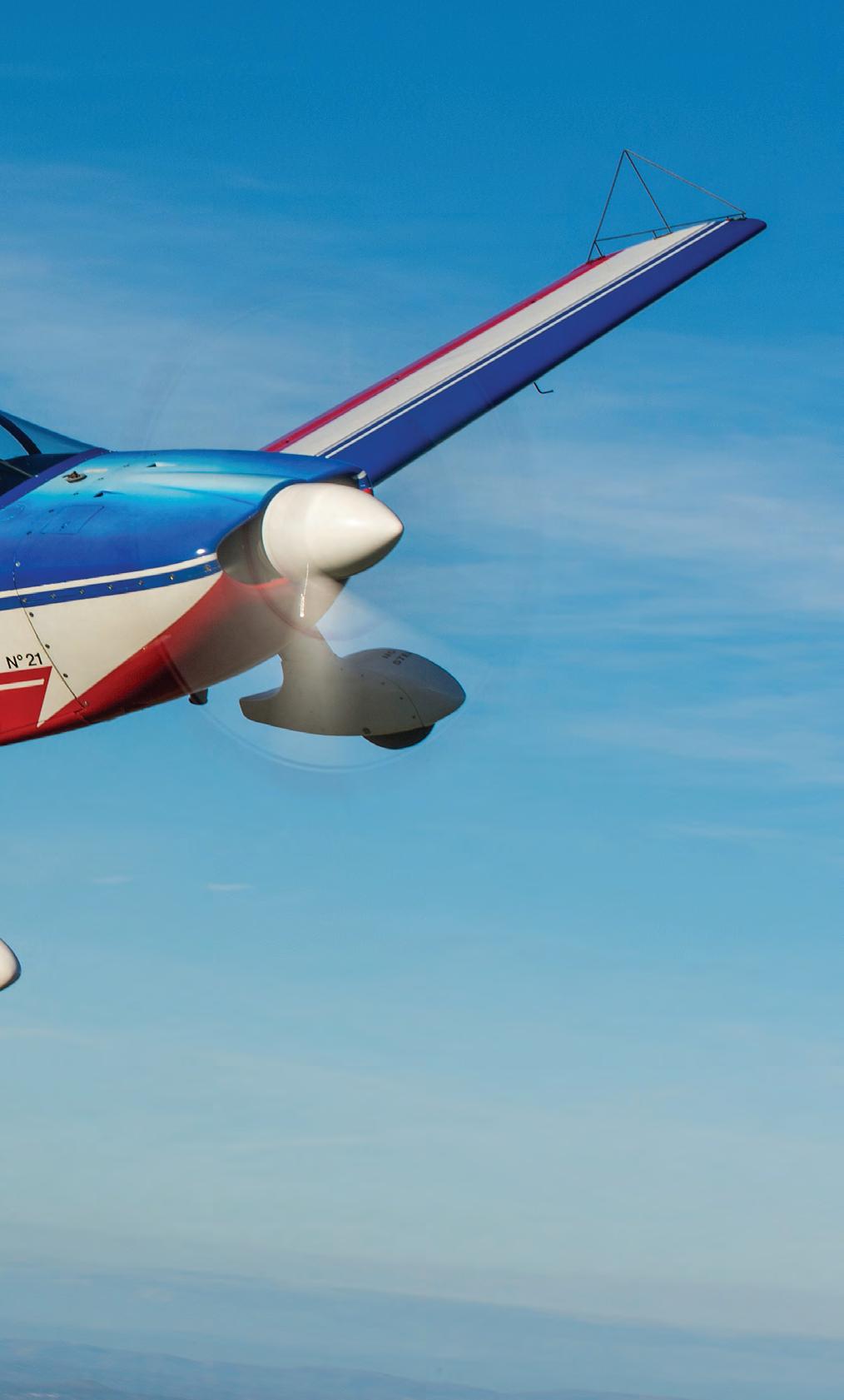
I have to admit that the CR100 was slightly larger than I had envisioned. Powered by a 180hp Lycoming AEIO-360-B2F fitted with a three-blade MTV-9-13-C constant speed prop’, it has a 760kg / 1,675lb aerobatic weight and a wing area of 116.6 sq.ft. / 10.83 sq m. With a power loading of 9.3lb per hp, as a comparison the PA28 Cherokee 140 is 15lb per hp.
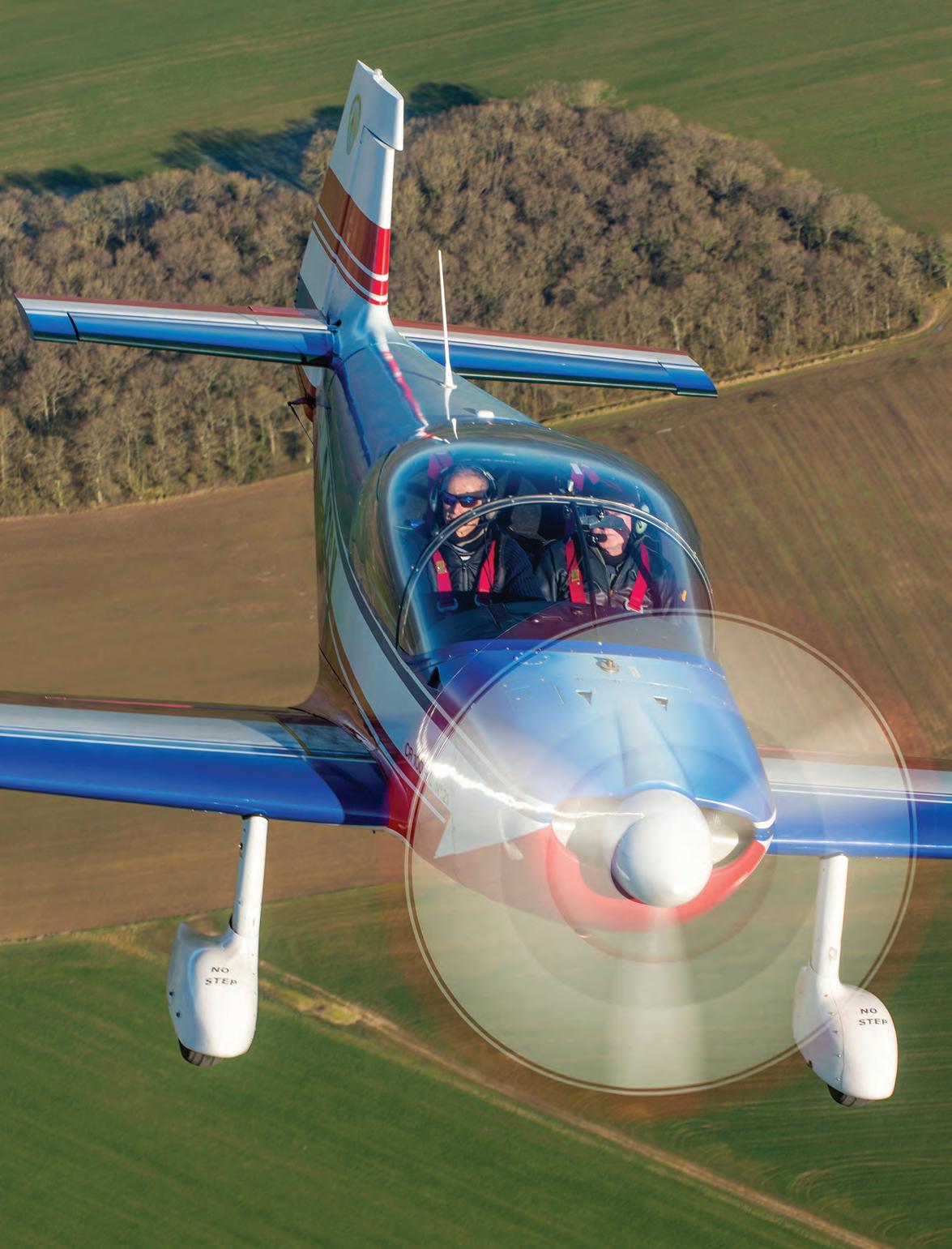
The aircraft has real presence as it sits, with its zero dihedral wing, waiting for us on the Henstridge ramp. It’s
“While the CR100 is mainly built from wood, the main spar is wrapped in carbon fibre for increased strength allowing a full +8g and -6 at its aerobatic weight”
in terrific condition, with a patriotic ‘bleu, blanc et rouge’ colour scheme. While the CR100 is mainly built from wood, the main spar is wrapped in carbon fibre for increased strength allowing a full +8g and -6 at its aerobatic weight. The Cap 10B in comparison is ‘just’ +6 and -4.5 g. The max take-off weight is 850kg / 1,874lb, a full 90kg / 200lb above the aerobatic weight. Although the fuel tank holds 85 litres, our flight will only start with 60. In general, with mild aerobatics, I would expect to use only half of these published positive values and less than a third of the negative. A quick look into the cockpit shows the G-Meter with plus three-and-a-half, minus a-half. At a guess that was a loop and an aileron roll.
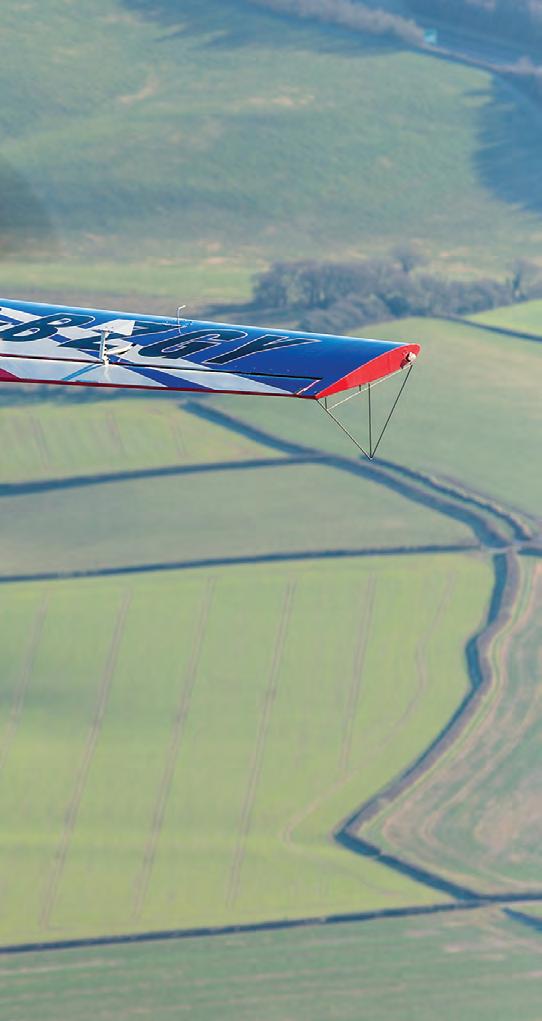
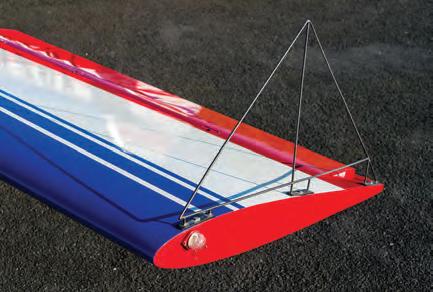
The left wing has a wire aerobatic sighting gauge, to align with the horizon during both vertical, up or downward lines, as well as flying a 45° line. Moving an aileron, its feel is both light, balanced and near friction-free. The system uses pushrods which allows the pilot to feel truly connected. The ailerons are frise type, and appear to have the same angle of up and down deflection. Their trailing edges are unusually blunt and quite thick. Apparently this
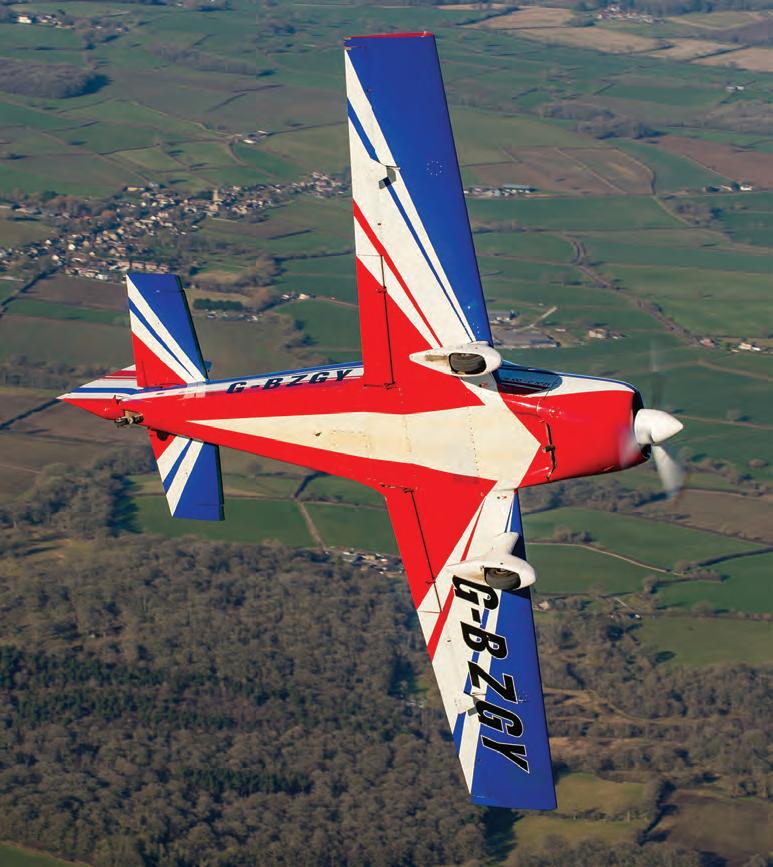
Left ’GY is in terrific condition, and you might be surprised, closing in on turning 30 years old.
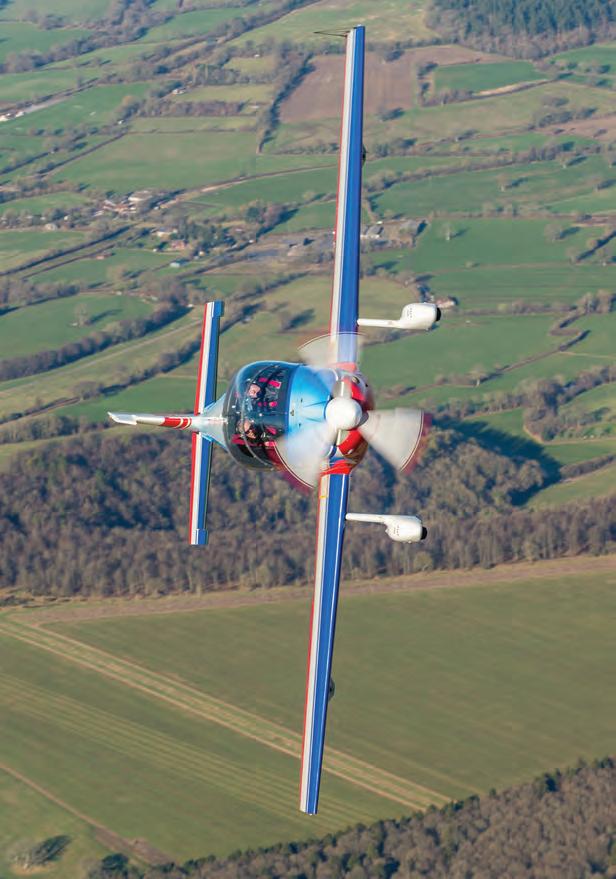
Below It’s a machine with real presence – zero dihedral wing hints strongly at aerobatics intentions of the design.
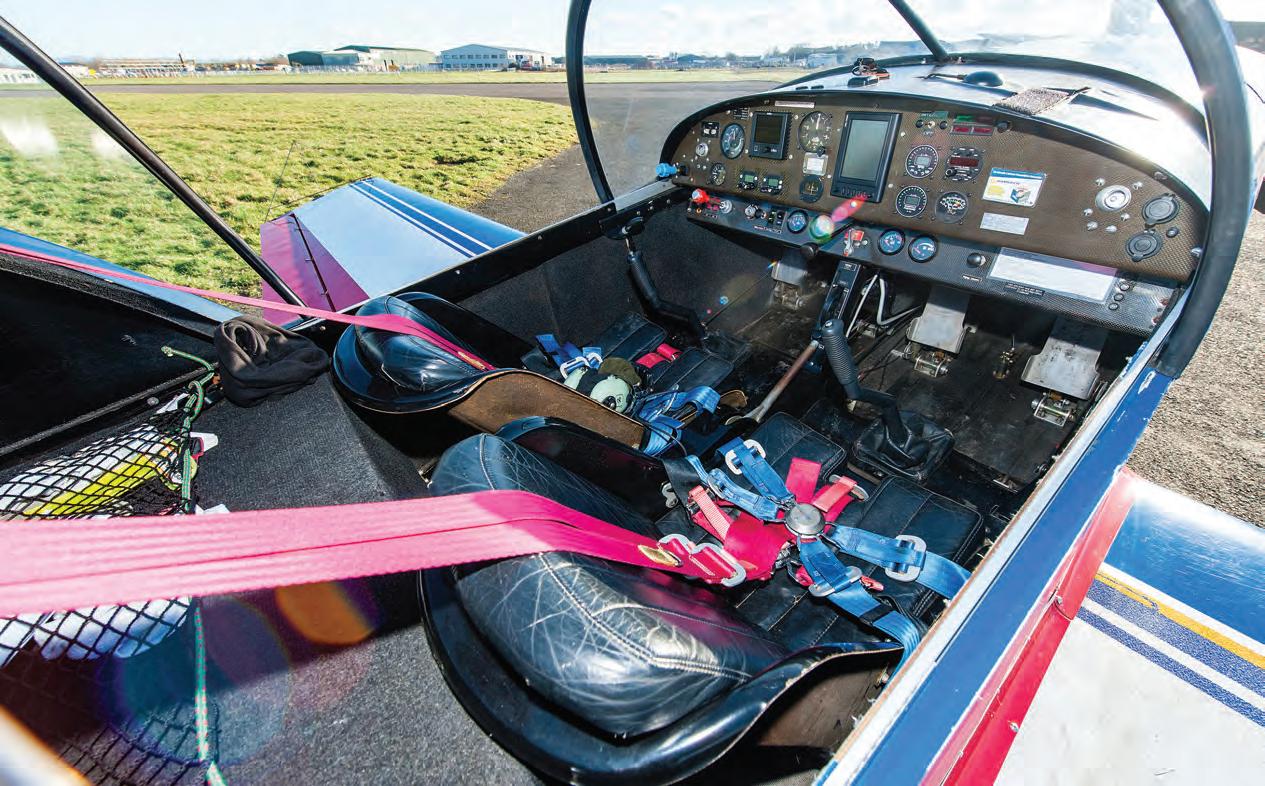
Above Cockpit is sparse but very functional. Seats and rudder pedals adjust to make for perfect pilot comfort. Note the two sets of harnesses.
makes for a very efficient control as little turbulence is generated compared to a thin or narrow radius trailing edge. Looking under the wing, at the mid-aileron point, each surface has a spade. This is a simple flat aerodynamic aid fixed to the aileron and helps reduce the stick force when rolling. When the aileron is neutral the spade is facing directly into wind, and when the aileron is applied the spade too is deflected, and its flat surface is forcibly pushed by the wind making the action of application faster.
Tail feathers
Just like the ailerons, Golf Yankee’s rudder and elevators also have the blunt trailing edges, and the elevators have large unshielded aerodynamic balances that extend right to the front of the tailplane’s leading edge. The fin and rudder size and shape are reminiscent of the Zlin 526 Trener, a marvellous handling Czech aircraft. Noteworthy is the fact that the elevator’s trailing edge aligns with the rudder’s upright hinge line, ensuring that during spin recovery none of the rudder area is blanked by the elevator ‘slipstream shadow’. The rudder’s generous
“The ailerons are frise type, and seem to have the same angle of up and down deflection. Their trailing edges are unusually blunt and quite thick”
proportions allows for maintaining effectiveness at lower speeds, good all-round response within the speed range, and great control in maintaining attitudes particularly in the rolling plane, i.e. holding a nose attitude in a slow roll, to the precision of an eight point roll. There is an inboard elevator trimmer on the right elevator.
The solid tailwheel is fully castering which, combined with toe brakes, means the aircraft is easy to manoeuvre in confined runway areas. However, this has a downside edge, in as much that, coupled with a partially flat-sided fuselage and a generous-sized fin, all crosswinds must require deft footwork to keep straight, particularly during the potential perils of a strong crosswind landing. The CR100’s published crosswind limit is 25kt, which seems rather high. I have to wonder at that, as a general rule 0.2 of the stall speed is often given as a crosswind limit. Brian tells me it can handle 20kt at 90°. That in itself would be sporting for most types and, dare I say, pilots too?
The undercarriage has a nice wide track, the legs and tyres neatly faired. Tyre pressure is stencilled at the base of the spat at 33 psi, while there is a ‘NO STEP’ warning on the top of the spat, presumably to prevent refuellers from being tempted to use them as a step to see into the forward fuselage fuel tank filler, located just behind the engine.
In the cockpit
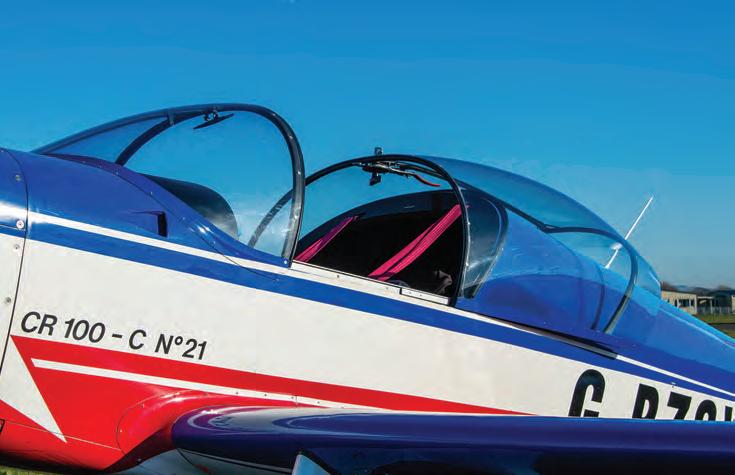
Standing on either of the marked wing walkways the central canopy locking device may be turned and unlatched, the direction of rotation is clearly marked with a big curved red arrow. Very handy should a rescuer need to get access. On the inside, a large red handle allows you to
quickly and easily jettison the canopy should you be wearing a parachute and decide to bail out.
As I climb in, I spot that the headset plug points are placed at the mid-point between the seats and on the rear luggage shelf. If I had already strapped in I might not have found these straight away. Talking of the luggage shelf, a handy elasticated net is provided to prevent any items you might have to carry from floating free during any upside down, negative g manoeuvres.
Settling into the seat, there are two sets of straps to wrangle. The red set are standard aerobatic five point harnesses, the fifth one being a low central negative G strap, or crotch strap. When this is fastened around the legs and lap, with the shoulder straps in place but not tightened yet, the second blue set, further anchors the pilot, this time to the seat’s framework. Both sets make for a very secure set up – which you want if you’re turning the world upside down. With the slack(ish) shoulder straps you can still move around, reaching for switches, headsets, maps and so on. There is a slight cut in the seating between the legs so the stick may be brought all of the way back.
The seat is adjustable and the rudder pedals may be moved forward or aft by pulling an instrument panelmounted black knob. As it happened, both were perfectly positioned for me. I was slightly surprised that the pedals, although being broad and with toe brakes, had no stirrups to prevent feet sliding from the rudders during negative g. Any extended time inverted while pushing the stick
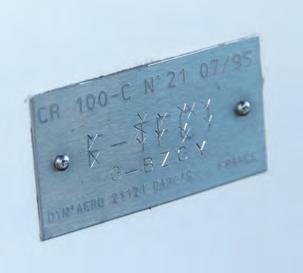
Below Data plate records some airframe history changes.
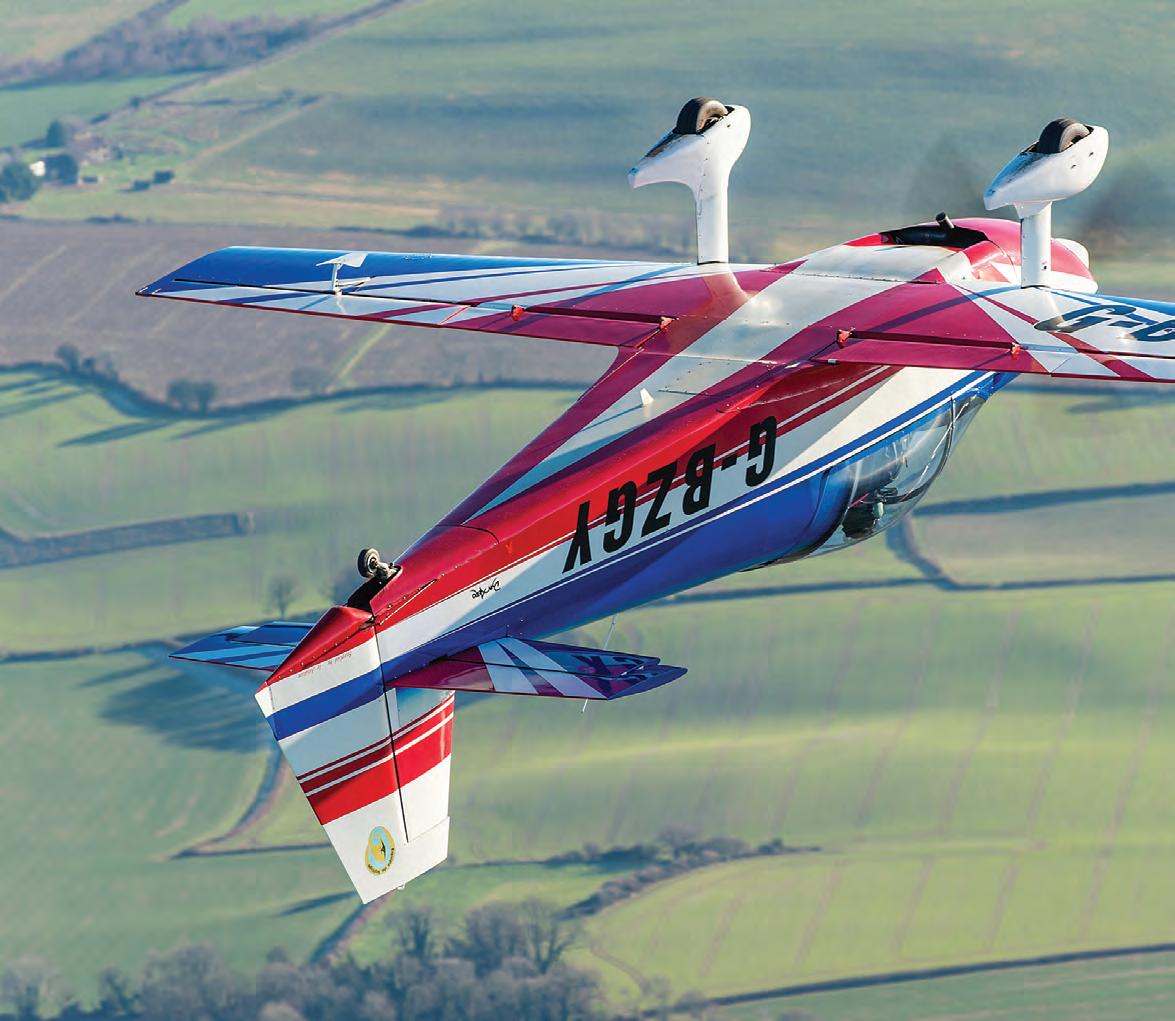
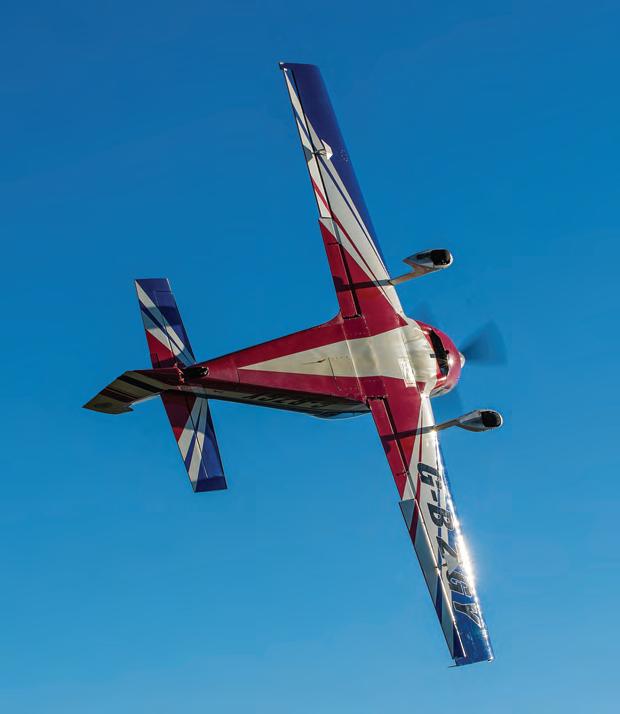
Bottom left Dynamic stripes on the underside help aerobatic judges discern top from bottom.
Bottom right This CR100 was one of two ordered by the French l’Equipe de Voltige – the Armee de l’Air aerobatic school.
Above Fabulous sliding canopy.
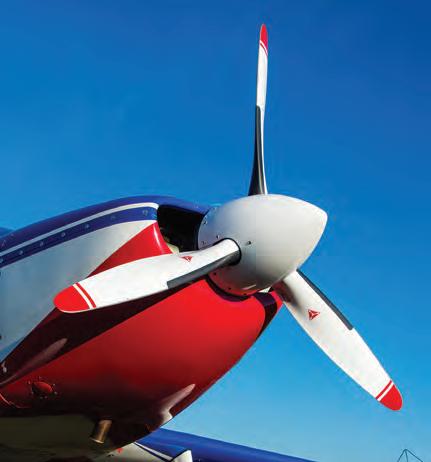
Left Three-blade MT propeller.
forward, and it becomes awkward to hold feet on the pedals. If it’s just for the odd slow roll, this is no problem.
On the left-hand side of the carbon fibre instrument panel is the ASI, a G-Meter below, an altimeter and a slip ball. As the ASI is in km / hr there is possibly an advantageous flexibility in starting to think in terms of this numeric system, after all, when looking for flap figures it’s the white arc on the dial I am going to be checking the needle on a coloured band rather than interpreting a not-too-common numbered value on a dial. The white arc figures range with full aileron movement up to 300 km/h on the original French ASI and then a caution range up to the red-lined Vne of 350 km/h. The simple inboard flaps have three positions: up, take-off and full for approach and landing. The flaps may be used up to 182 km/h and the lever for them is positioned between the two seats. I note that it is clear of the inboard harness anchor points – I mention that only because, when buckling into a Super
“The simple inboard flaps have three positions: up, take-off and full for approach and landing. They may be used up to 182 km/h”
Emeraude recently, I found I had managed to get a lap strap wrapped around a similar type of flap lever. For a moment, not having enough length to buckle up, I had thought for a moment, “Surely I hadn’t put on that much weight?”
The compact control heads for a TRIG radio and transponder sit under an AvMap Ultra EFIS. A vintage Bendix King Skymap, according to Brian, remains in the panel ‘to fill what would otherwise be a hole’.
Finally, there is a punkah louvre air vent on each side to freshen the crew sitting under the expansive glazing on the numerous sun-filled days we seem to be having! Joking aside, the view from this cockpit is the best that could be hoped for, with the only view-blocking obstacle being the adjacent pilot, your partner in crime, but hopefully he will be scanning the sky and ground for any potential traffic and threats. As the aircraft attitude on the ground is not particularly steep, the view forward while taxying is better than expected, and would later prove to be no obstacle at all.
The engine management indicators displaying oil temp and pressure, rpm and manifold pressure as well as fuel flow are on the right directly in front of the fellow in the right-hand seat.
A sub-panel extends over the width of the cockpit, home to a red battery master, alternator switch and four circuit breakers. The mixture control sits at a slightly odd angle beside the combined magneto and starter switch.
Above Perfectly inverted with some slight forward stick, the CR100 loves to aerobat. Note spades on ailerons.
Above With smooth controls, CR100 ‘really talks to you’.
Far left Entering the slow roll with opposing rudder and partially deflected ailerons.
Left Wingtipsighting device.
Below left Normally a single-seat flyer, Dave Howell enjoys his ‘loaner’ CR100.
“The canopy offers outstanding visibility, plus the CR100 boasts light controls and a responsive engine and prop combination”
There are two black handled throttles, one on the left wall of the cockpit for the left seater, and one central on the panel for the right seater. Immediately beneath is the fuel selector, which when selected ‘On’ has an indicator that points down south. Immediately below is the elevator trimmer along with its position indicator which is easy to use from both seats. I have to reach over to the P1 side sole red mixture and further still for the blue-topped vernier prop control. Dave said he’d look after these. Fine fellow.
Going flying
Below If you just need to get somewhere, the CR100 will cruise happily at 140kt.
The start involves master on, selecting the fuel tank on, fuel pump on, pressure registered, a good look around with a warning ‘prop clear’, toe brakes on, a keyed crank of the starter and the blades merge to a blur as the she catches and runs smoothly. Standard power checks when warm and a cycling of the prop creates a lovely deep whoosh note, an increase of manifold pressure as the engine works harder for the labouring prop pitch change towards coarse and a return to fine confirms all is functioning well as hoped for. Take off checks and safety
brief complete, it’s time to keep straight with countering right rudder as the power comes on, the wings lift to leave our shadow which quickly shrinks behind us.
The take-off roll had taken just eight seconds and the book quotes 1,500fpm using 130 km/hr, or just a tad over 80mph or a smidge under 70kt. Whatever the instruments said, it was obvious we had a good climb rate, as we very quickly caught up with the photoship that had departed ahead of us.
Having overshot the ideal formation, I repositioned under and up into echelon left. The canopy offers outstanding visibility, and combined with the CR100’s light controls and responsive engine and prop combination made the photoshoot a real delight. At the end of the shoot, and with all four sets of straps retightened, we take the lead and roll inverted and hold wings level upside down for the final shots. We tried it twice and the second time we didn’t have so many flecks of dirt rise from the footwells to rest on the inside of the canopy. It brings a whole new meaning to the term ‘dandruff’ and a reminder that the cockpits of aerobatic machines need to be kept as scrupulously clean as possible!
Freed from flying in close proximity I had the chance to look at her stability. In pitch the CR100 behaves and returns to her trimmed speed at height after the nose was displaced, fine. From a constant heading sideslip then releasing the rudder, she promptly heads back to where we had been pointing, fine. But lateral stability? I can’t comment and say she has none. The best I could say is, it’s lacking, but isn’t that what you want in an aerosfocused machine? From another constant heading slip where the controls are crossed, when the stick is released
Above Effective flaps and constant speed prop help make landing easy.
The CR100 has a remarkable 25kt published crosswind limit.
there is absolutely no sign of the lowered wing rising. It just sits there and the aircraft sides off to a low wing dive.
What did I expect as she has no dihedral at all! If she had some typical dihedral it would make her inverted flight more unstable as then it would act as anhedral.
Stalls erect and inverted with slight inboard generated turbulence striking the tail, give good warning to ease off – this is an aeroplane that really speaks to you.
Rolling
Fully applied aileron rolls to the left are quoted at 195° a second and marginally slower with the engine and prop rotation to the right. This may sound fast, but the hand and eye soon adapt to the tempo, being able to stop it with wings level on the horizon ahead.
Slow rolls commenced from straight and level were good and the rudder had ample area to hold the nose high enough at the two knife edge positions.
Pointed rolls were also within her capabilities. The upward line drawn for stall turns is far more than I have been used to of late and the trick of using opposite rudder (right) progressively as the speed decays, enhances the promptly applied left rudder for the pivot at the slowest part of the manoeuvre at the very top. I was perhaps just a little too slow as the canopy rattled as the nose just started to cut down through the horizon. I couldn’t tell you at what speed to ‘kick’ for the rotation, I just went on ‘feel’ alone.
Although I had been enjoying myself, it is quite something else to sit as a passenger while somebody else throws you around.
Not being able to anticipate the string of manoeuvres and the G might not be for everyone, but Dave is a trooper. I asked if he might show a loop and an aileron roll. The loop was well shaped and the roll commenced from a safe high nose which brought the nose back to straight and level.
I asked his indulgence for a gentle clearing wing-over to a sweeping barrel roll.
It is enjoyable being able to manoeuvre from straight and level and not have to monitor prop rpm, rather than diving your socks off to get speed without over revving the engine. Delightful. I would have loved to have spun her and flick rolled, but there are limits when flying with friends, and so with amiability still intact, and Dave with only a slightly whitened pallor, we decide to cruise back to Henstridge.
Brian tells me he uses a handy ball park figure of less than 40 litres an hour with 2,400rpm set and wide open throttle. We landed back at Henstridge with me being a bit skittish on the roll out from a fair three pointer.
Enjoyed it? I certainly did, and have to thank Brian Appleby for answering all sorts of questions on the phone, as well as Dave for the time he spent, not only ferrying ‘Golf Yankee down, but stoically sitting through my aeros.
Brian and I hope to fly the CR100 together later in the season. I hope he likes aeros!
Now… I wonder if she can manage a knife edge spin…? ■
DYN’AÉRO CR100 SPECIFICATIONS
General characteristics
Height 5ft 11in
Wing area 116 sq ft
Empty Weight 560kg, 1,235lb
Gross Weight 850kg, 1,874lb
Max Aero Weight 760kg, 1,675lb
Performance
Vne 380 km hr, 210 kt
Max Cruise 316km hr, 171kt
Cruise 260km hr, 140kt
Rate of Climb 1,500ft min
Roll rate 195° a second. G Limits +8 -6
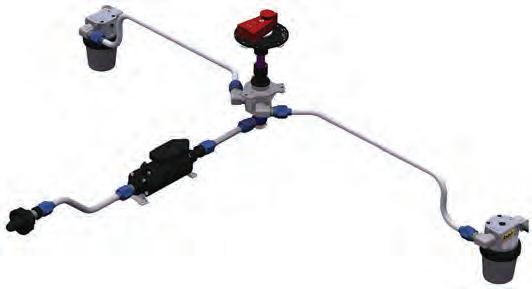
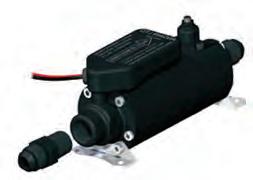
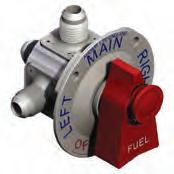
ANDAIR FUEL SYSTEM COMPONENTS COMBINE MODULAR DESIGN, SUPERB QUALITY AND THE FLEXIBILITY TO SUIT ANY AIRCRAFT BUILD PROJECT.
Having built a reputation for excellence in the design and manufacture of light aircraft fuel system components within the amateur-build aircraft sector, Andair has now established a significant presence in the commercial aviation market as well. www.andair.co.uk
Take part in webinars from experts like Patty Wagstaff, use our free landing vouchers to save hundreds of pounds, read and watch all our content and connect with new people!
Five Fly To La Ferte…
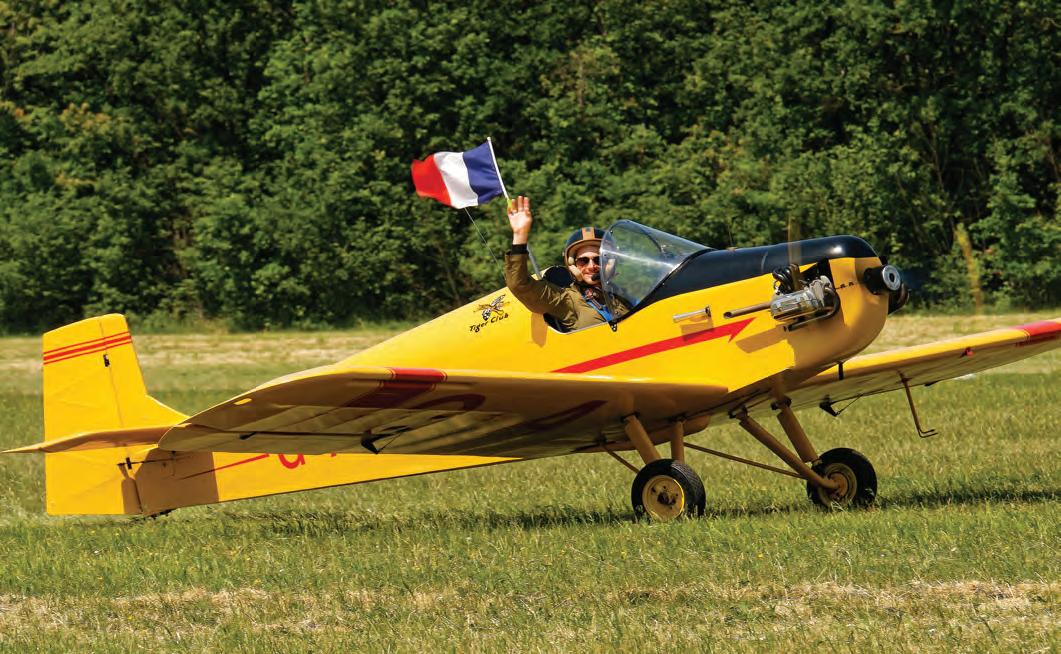
Richard Vary relates the tale of five Turbulents, four days and three displays at a famous French airshow
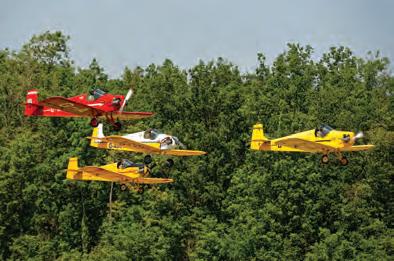
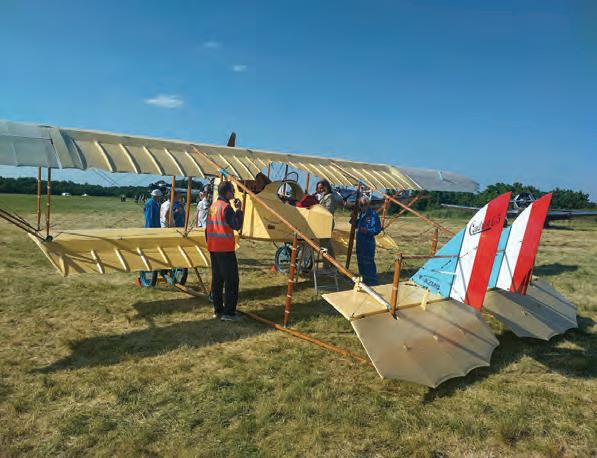
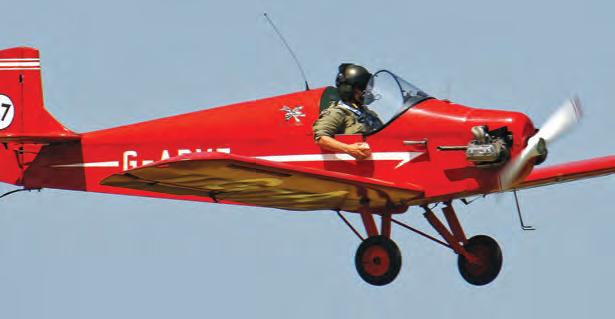
It had been a long day, but this was the last leg. I sat in the cockpit, engine puttering at idle, on the taxiway, nose pointing 45° across the runway. The north-east wind blew hard off the sea, rocking the wings of my red Turbulent as I watched Alex open the throttle of his aircraft and roll. Ahead of us, three more Turbulents in a Vic formation fought their way into the headwind, waiting for us to join them. As Alex left the ground, I pushed the throttle forward, accelerating diagonally across the broad tarmac runway behind him. I wasn’t concerned about his wake turbulence – in this wind it was already long behind me.
The tailskid left the ground almost immediately, and a second later we were airborne, runway edge markers passing underneath as my Turb pointed its nose up, clawing through the turbulence. Catching the others, we headed out over the foam-flecked waters of the Channel. A few clouds raced south-west as we climbed through the haze into the clear blue. The wind was stronger still up here, but it was across our path, and the air was smoother. It would be an hour before we saw the welcome sight of our home airfield, but at least we would have an into-wind, grass runway when we got there.
Jol Vel Fotografie
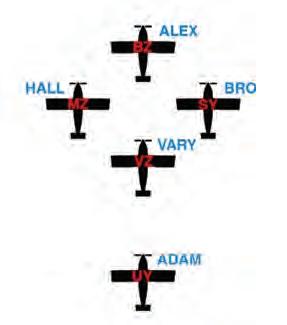
Our journey had started four days ago, on a sunny May morning. Four pilots dragged five Turbulents out into the sunlight, checking them over carefully. I cleaned the canopy of VZ, the red machine that I would take to France. David ‘“Bro’ Brothers was making tea and checking the Metars. We would have a tailwind across the Channel – that was the good news. It was increasing. That was less good news… too much northerly would put us out of crosswind limits at Le Touquet. We could go to Calais, but it was in the wrong direction.
Adam ‘Visor’ Parnell was unpacking his kit, including flying helmet with its menacing black visor. If there was ever a movie made of us, he’d be the bad guy. Dave ‘Straggler’ Hall checked the oil in MZ, the yellow aircraft that would become his home for the day. MZ lacked power, and Dave would inevitably lag behind the formation in transits.
Missing was Alex ‘Jailbird’ Reynier, who was yet to
Above left Two pairs take off at La Ferte Alais.
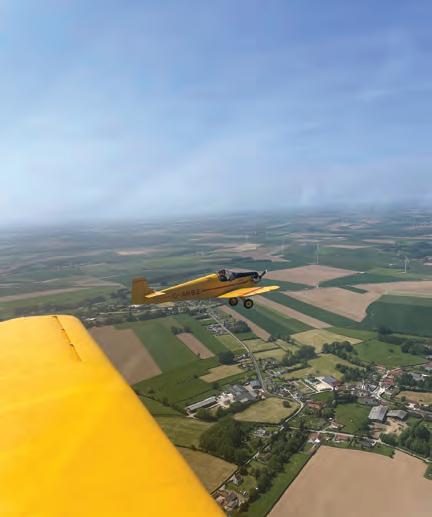
Above right Somewhere over the Channel.
Opposite left Arrow formation: the briefing I hadn’t paid enough attention to…
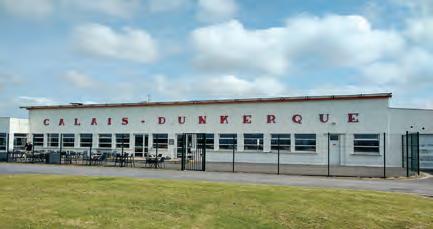
Below right Calais terminal … with hot chocolate.
“We would have a tailwind across the Channel – that was the good news. It was increasing – that was the less good news…”
earn his callsign. He was stuck in traffic. Tempting as it was to follow the Turb Team code (those who fall behind are left behind), Alex had filed our flight plans, was leading the transit, and was the only one of us who spoke French.
Bro put the kettle on and checked XC Weather. Straggler polished flies off the prop… every extra ounce of thrust mattered for MZ. The increasing wind ruffled the long grass beside the runway. Five geese flew honking overhead, in a perfect Vic, mocking our intentions. Having eyes on the side of your head would be a significant advantage for a formation pilot, I thought. We waited.
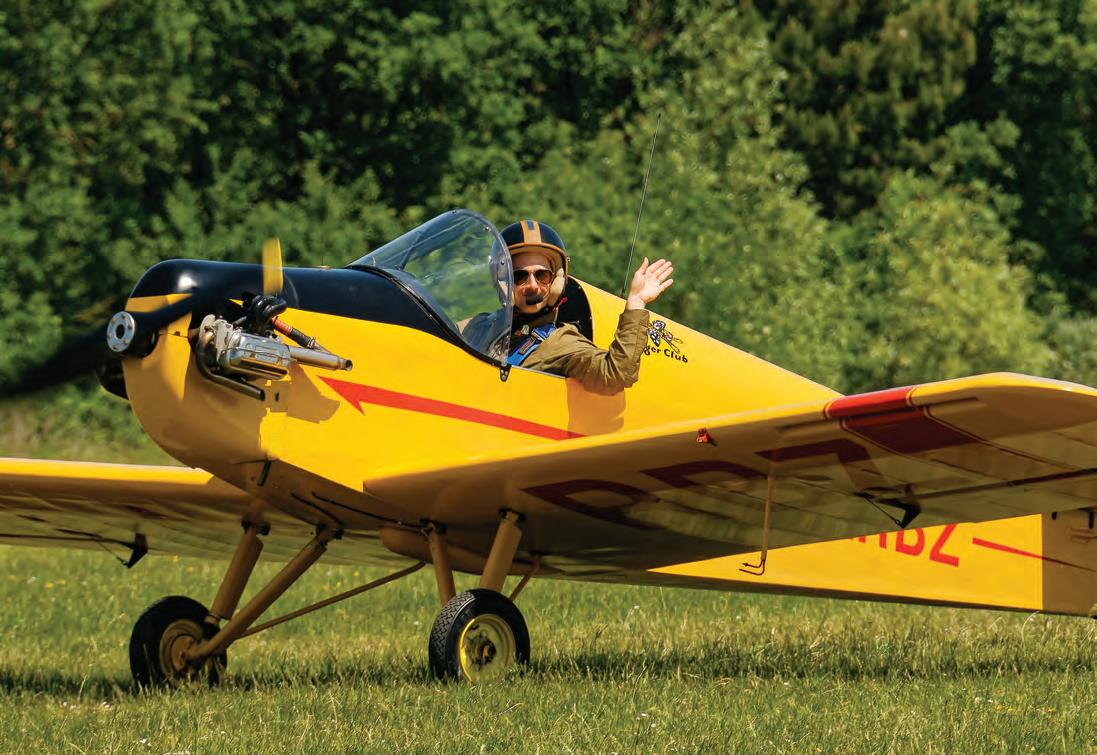
A little after nine, and only half an hour late on our flight plan, we took off in pairs. Alex, heavily wrapped in fleeces and sheepskin, was wedged into the cockpit of BZ. I was a little envious: BZ, finished in a deep glossy yellow with red wing bands, is the fastest of the fleet. Speed of course is relative, we are talking about a
Over France, heading south-west.
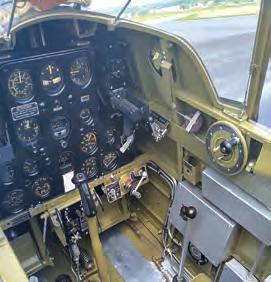
Inset The cockpit of the Curtiss Hawk.
Turbulent, and in formation you are confined to the pace of the slowest. But BZ remains my favourite. On his wing, Bro flew SY, yellow with a white fuselage top. SY lacked BZ’s performance. ‘Minus two’ called Bro, struggling to keep station in the climb.
Straggler followed in MZ. I sat easily on his wing with performance to spare. Behind us Visor trailed in UY, a white aircraft with a blue and red stripe, and racing number 53, known as Herbie the Turb.
Arrowhead formation
We climbed out and headed for Dover. “Form arrow” called Alex. I drifted out to a broad, five aircraft, arrowhead formation. “Arrow”, called Alex, exasperated. “Wots that?” I asked. “Diamond with a tail,” he explained. “Weren’t you listening?”. I had tried, but there had been a lot of briefing, and it was sunny and warm on the grass.
I returned to my position at the back of the diamond, with Visor forming the tail.
Broken clouds sat at 1,200ft all the way to the coast. Below them it was bumpy, but Southend’s airspace was
“Broken clouds sat at 1,200ft, and it was bumpy below, but we managed until we could climb through”
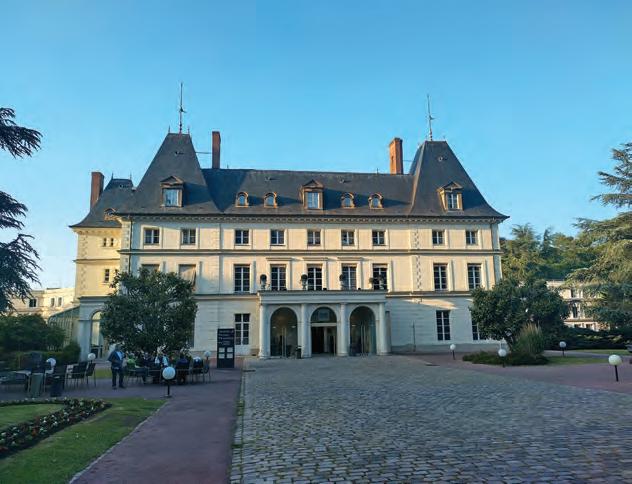
Above right Hotel Domaine de Fremigny, our comfortable accommodation
Below left The Caudron. Don’t get your toes under those skids.
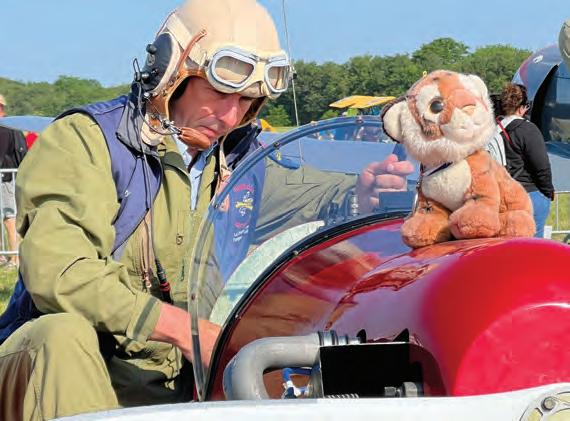
Below right Team mascot Turbi the Tiger ensuring I do my checks.
through. Deep blue skies contrasted against the perfect white of the clouds, and the vivid reds, yellows and whites of our pretty aircraft. We relaxed formation. I climbed to the right, and dived left onto Visor, who broke left and down. I followed, my extra energy allowing me to gain on him. We tailchased around clouds until the formation had drawn well ahead, then opened the throttles until we caught them back up. It was glorious.
Ahead the Channel stretched, blue and calm. A ferry churned up a white wake as it headed for Calais, not a great deal slower than us. BZ was creeping ahead. “Minus two” called someone. “Aircraft calling, say again”, called London Information, chiding us for speaking on their frequency. We pretended it wasn’t us.
We continued the climb. The air was still, not a bump disturbed us. Above, the blue sky stretched endlessly. Far, far below us, the blue waters barely moved. The engine purred. The radio was silent. The other aircraft hung, motionless, in the sky to my left. With absolutely no sense of movement and not used to such altitudes I started to get vertigo. I felt as if I was sitting on a flagpole, and with the slightest movement I would topple off. I gripped the stick, anxiety rising in my throat. I forced myself to adopt a pattern: horizon level, compass not moving, in formation position, turn and slip centred, airspeed 75, position OK, rpm, oil pressure, etc. Everything was fine, but my instincts screamed that this was all wrong. I breathed and ignored them. Eventually Alex signalled to descend, Cap Gris Nez approached. Five noses pointed downwards, revs increasing and airspeed rising to 80, 90, 100kt. He waggled his wings for us to form up, and I slid into my box position, grateful to have other aircraft around me again.
Curtiss Hawk below!
Alex was taking French on the radio. “Contact, 10 o’clock low,” called Bro. There, just above the waves, streaked a Spitfire. No, it was too small to be a Spitfire. “It’s OK, I’m talking to him, he’s coming to have a look at us,” replied Alex. A Curtiss Hawk, snub-nosed, compact and powerful, came underneath us and popped up the other side, before waving, opening up and shooting on to Le Touquet. We joined downwind, moved from arrow (i.e. diamond with a tail) to a left echelon (all in a diagonal line), and peeled off one by one to land. Having fuelled, we sat down to lunch and were joined by the Curtis pilot, who later let us climb up into his aircraft. He too was going to La Ferte Alais, so we challenged him to a race. He laughed. With 1,200hp I imagine that he arrived while we were still starting engines.
Above Alex
‘BZ.
with red
the fastest in the fleet.
The next leg took us along the coast and inland, west of Paris to Les Mureaux. This is a grass strip on the edge of the town of the same name, which sits in a curve on the Seine. Alex had phoned ahead and got permission and instructions, which he explained to us on our charts. The circuit goes around the town, and final approach is along the river. Ten minutes out we called, and received a reply. All good. We joined crosswind, calling again, and called a third time on the downwind. We spread out into a long line and set up for a long slow final. Below, the river flowed lazily. Houses with gardens stretched down to the water, with white boats tied up on the banks. Valley sides started to come up on our left as we descended. The town lay to our right. Ahead Alex was approaching the threshold and rounding out to land when there was a sharp exchange in French over the radio. At the back of the line I was getting a little close to Bro and considered going around, but it was a very wide runway. I held off until I saw him clearing right, then let VZ settle on the grass and rolled past his tail as he exited. We taxied back.
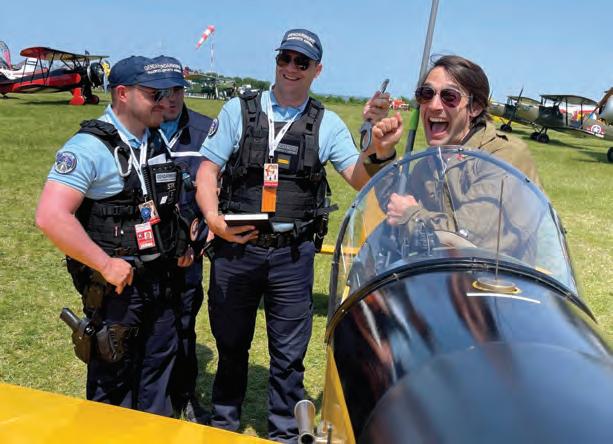
All was not well. An angry young man in a high-viz vest with a clipboard was approaching Alex, gesticulating and speaking rapidly. We had, it seemed, committed a number of offences. The airfield was notamed closed to visitors.
“An angry man in a high-viz vest was approaching Alex, gesticulating and speaking rapidly. We had, it seemed, committed a number of offences”
in
Yellow
stripes,
We had also landed short of the displaced threshold (on careful inspection markings were visible in the grass, but had not been re-painted since it was last mowed). And we had landed two at a time on the runway (guilty). He did not accept Alex’s protestations that we had called ahead and had permission – this was ‘impossible’. Alex showed him the phone record on his mobile, which had recorded the time and duration of the call. The gendarmes would have to be called.
“I guess there’s no chance of a cup of tea, then,” said Bro plaintively.
After a while, dissent appeared among the French ranks. An older gentleman asked if we were the team going to La Ferte Alais. We were. Attitudes quickly changed, why had we not said? Nevertheless, the gendarmerie were now involved. While three armed police stood around Alex and questioned him, it occurred to us that we only needed four pilots for the display. La Ferte Alais was only a hop away. We could probably make it. Come to think of it, we didn’t really need Alex any more.
“While three armed police stood around Alex and questioned him, it occurred to us that we only needed four pilots for the display…”
“Lock him up,” we cheered, but quietly in case he heard.
Just a misunderstanding…
We were too late. The gendarmes were mollified by Alex’s phone record. They would write up the event as a misunderstanding and Alex would not, to our immense disappointment, do time. He came back towards us.
“Thanks for the support,” he said, without any hint of irony. He hadn’t heard us.
The gendarmerie’s intervention did little to appease angry-clipboard-man, who required that we leave within 10 minutes. “Send him a bottle of whisky,” advised the older gentleman.
We departed post-haste for the last hop to La Ferte Alais. We were ahead of the timeslot that they had scheduled to receive us, but fortunately they were able to
Jol Vel Fotografie
Jailbird narrowly misses a balloon.
Adam’s menacing black visor and a flour bomb.
Bro goes through the limbo in G-ASSY.
“Two Spitfires escorted a DC-3 then flew a striking close aerobatic display, while the DC-3 itself showed off, pulling a vertical wing-over”
fit us in early. The welcome at La Ferte Alais could not have been more of a contrast. Many hands helped move the aircraft into a hangar space that they had cleared for us. A brand new Audi was ours to use as we pleased.
“What was your route?” I was asked in conversation. “London, Le Touquet then Les Mureaux,” I replied. “Where?” our hosts asked. “Les Mureaux,” I repeated. Blank looks. Straggler stepped in: “Les Mureaux” he explained, adding the raspy throat sound of the French “R”. More blank looks. “Ah, Les Mureaux,” said a passing spectator, pronouncing it, to our ears, exactly as we had done. Our hosts’ faces lit up with comprehension. “I used to work in Le Touquet, I am used to English pilots,” she explained. Straggler looked at me. “That’s literally what we said,” he growled.
The ground crew had caught us up, and dinner was steaks and beer. We stole cigarettes from Alan ‘Smoke on’ Fuller, head of the ground crew. It was getting late. I should go to bed. But Alan had bought Cognacs. After those I really would go to bed. “Just one more,” ground crew member Steve Jenkinson twisted my arm. Then there was… “Just another one.” And suddenly it was 2am, and it really was definitely bedtime.
Fast, noisy jets…
We had three days of the Le Temps de Helices display. The line-up was spectacular. There were fast, noisy jets:
Above Les Mureaux’ ‘most wanted’ taxis in …
Below … and ‘cuffed by the gendarmes.
Rafales and the Patrouille de France. My ‘Just One More’ headache did not appreciate them one bit. Sixteen Harvards (some of which were decorated to resemble Zeros) performed a re-enactment of the attack on Pearl Harbor, with huge explosions. They were seen off by a Kittyhawk and the Curtis Hawk, and, amazingly, a Corsair. A Junkers 52 and a Storch represented the Luftwaffe. Two Spitfires escorted a DC-3 then flew a spectacular close aerobatic display, while the DC-3 itself showed off, pulling a vertical wing-over. A Skyraider and three Trojans represented the Vietnam era, the throb of their hugely powerful radial engines filling the air. Fokker Triplanes and SE5s engaged in low level dogfights, while two more flights of four biplanes patrolled overhead, so the sky was filled. While I can appreciate the gleaming metal and
“La Ferte Alais has a collection to rival Shuttleworth, with a Bleriot, a Deperdussin and a Caudron”
power of later aircraft, my particular favourites are the delicate, wood and linen Edwardian era aircraft. La Ferte Alais has a collection to rival Shuttleworth, and they were all wheeled out of the hangars. On the flying programme was a Bleriot, a Deperdussin and a Caudron.
The Bleriot had a Le Rhone rotary, so the smell of castor oil wafted over the crowd. It never left the ground, its wing warping would not cope with the crosswind. But the Deperdussin and Caudron were fitted with ailerons, which are not original, but are a sympathetic modification to make these aircraft usable on today’s long, narrow airstrips. Both flew. I watched the Deperdussin perform a long wheeler landing, and asked the pilot why he didn’t three point it. He invited me to sit in the cockpit. With the tail down you can see nothing forward. This isn’t like a Tiger Moth, where ‘just’ the nose gets in the way, the entire wing is in your eyeline, and blocks everything from left to right. Once the tail drops, you can see only backwards.
Ground crew
The Caudron was flown by Katy Theimer, an impressive pilot of the collection. She had learned of my interest and invited me to be part of her ground crew for the display. We dragged the aircraft out, with her showing me where to hold it. My French is not good, so instruction was mostly given by a bark of “l’Anglais”, and signed instructions: watch this, move your toes from under that skid if you want to keep them, etc. But one of the team, Michel Germaine, could speak good English and he patiently explained every aspect of the machine to me. With Katy he showed me how to start and operate the large radial engine. With it running, I was invited to jump in a jeep to accompany the Caudron to the end of the
Above Ground crew ready to set the explosives
Below The team, in all our sunburned
glory.
runway, where we would hold it down for power checks, help it turn, and stand beside it as it took off. This was a huge privilege. As the Jeep followed the Caudron past the spectators, I waved to them. “Traitor” shouted the Turb Team.
We flew three Turbulent displays and the reception was fantastic. The crowd was large ~17,000 or so each day. So many people, from the fast jet pilots in their tailored pale blue flight suits, to members of the public, went out of their way to tell us how much they enjoyed our limbo, balloon popping, and flour bombs, a barnstorming routine never seen in France. Families came to look at our tiny aircraft, children sitting in the cockpits whilst proud parents took photos. We handed out Turbulent Team stickers to the children, who loved them. Bro gave stickers to women in summer dresses, inviting them to sit in his aircraft.
On our last display, the gendarmerie were waiting for us in force. Notified that Alex was now Les Mureaux’ most wanted, and in on the joke, they stopped him as he taxied in, breathalysed him and handcuffed him as we cheered them on. They posed for photos with us before the aircraft.
Headwind forecast…
All too soon it was Sunday night. The crowds had dissipated. The sun was low. A barbecue of grilled sausages for the pilots. A Bronco, equipped with LED lights and firework pods, lit up the still evening sky. It had been an incredible three days. But the light breeze was already picking up. The Deperdussin pilot abandoned his sausages and departed promptly for his home field. Overnight the wind was forecast to increase and, bad news, for us it would be a headwind.
We got up early and prepared our respective aeroplanes. Michel Geindre, the Flight Display Director, and Katy arrived to thank us and see us off. Departure was hairy, the strong north-easterly curling over the trees and pushing the aircraft down as they clawed for height, but soon we were formed up in arrow. A prison passed by us underneath, and I could hear Alex’s breathing quicken.
After one stop we were over the Marne, to the east of Paris. The sun reflected off the waters. A barge lazily motored around the meanders, and the green, flat land stretched endlessly ahead of us. Next up was the Somme, which is very different in appearance. While the Marne is narrow and defined, the Somme sprawls messily out of its bed into a series of lakes, surrounded by overhanging willow trees, their leaves trailing in the water. I imagined ladies of the Belle Époque in white dresses and gentlemen in waistcoats, punting along this lazy river to picnic in the shade on the river banks. How surprised they would have been to look up and see five brightly coloured flying machines overhead.
We reached Amiens, where we parked the aircraft in a patch of buttercups and, dishevelled in our oil stained flying overalls, walked towards the airfield café. On a beautifully maintained flag-stoned patio stood a woman in a white summer dress. We were out of place. Inside, the
Jol
elegantly dark painted walls hung paintings, and our flying boots left grass clippings on the polished wooden floor.
A waiter showed us to a table set with crisp white napkins and silver cutlery. A glass-fronted cabinet had bottles of champagne. “No”, said Alex firmly, before I could even ask.
One day, I will come back to have lunch at Amiens, but I will pack a clean white shirt, and I will shave before departure…
After a very good lunch, marred only by the lack of Champagne, we strapped our sore backsides again into the aircraft for the last leg to Calais.
We departed in a finger four formation take-off and pointed north. A haze was setting in, and the air down low was bumpy, but to climb above it meant an increasing headwind. Headwind or not, we did not like the idea of crossing the Channel with no visible horizon. I opened the throttle of VZ and we slowly made our way to 4,000ft. It was cold.
Far below my leading edge, three brightly coloured dots skimmed over the green below. I was clear of the haze. “I have 58kt ground speed,” I called. “We have 62. Not too bad,” replied Alex. “Are you coming back down any time?” “Yes. It’s freezing up here!” I replied. Carb heat on, throttle back, and a long slow descent back into my formation position.
Hues of sunshine
The coast came slowly into view. Clouds scudded above us, the landscape looking dull and flat without the contrasts and hues of sunshine. To our left was the ferry port at Calais, its concrete arms stretching out into the rough waters to shelter the boats within. The ground crew would be in the queue of cars that we could see.
“Headwind or not, we did not like the idea of crossing the Channel with no visible horizon…”
Above Arrival at La Ferte Alais.
Inset Turbi the Tiger enjoys a well earned beer.
Below Parked in the buttercups at Amiens.
The sea was grey, capped with white as the wind blew spray off the wave tops. We circled in tight formation in the overhead, joined downwind, spaced out and set up for final, dipping our upwind wings and side-slipping into the wind towards the tarmac strip.
The Turbulent’s very low wing makes them better able to cope with a crosswind on the ground, but even so, as I touched I felt my upwind wing lift. Full left aileron, alert on
the rudders, and I was down. Two of the pilots had given up trying to taxi in the crosswind and were pushing their aircraft to the fuel point like a wheelbarrow. With full right brake I was just able to taxi VZ across the wind. The aircraft needed fuel, and I needed a hot chocolate.
For days after our return we received emails and messages of thanks and support from our hosts, other pilots, and the many photographers who had captured us in the display. It had been a successful trip, and another great display for the Tiger Club’s Turbulent Display Team.
But it was tinged with sadness. We received news that Glyn Richards, long standing team member and the instructor who had started many of us on formation flying, had passed away as we left for France. BZ, pride of our fleet, had been Glyn’s aircraft. I hope that he was watching us from above with pride. ■
Flying 2,024 in ‘24 with YES
As part of a special initiative for the year, the LAA Youth & Education Support Strut has a grand plan to get young people flying. Pete White has more details…
Our major theme for YES this special year of 2024 is 2,024 in ’24 and we are focusing on facilitating as many flights for young people as we can achieve and our target is – 2,024. To reach our target, YES – the LAA’s Youth & Education Support Strut – invites all Struts, flying schools & clubs, groups, airfields, organisations and individual pilots to join us to fly as many young people as is possible in 2024.
We will be making a concerted effort throughout the UK to reach the target of 2,024 future adults flown in the year. That’s a whole 12 months to do it, and some of you have already started the ball rolling. So all we need now is for you to join us and be involved in the UK’s number one challenge of flying as many young aviators as we all can!
As an aside, we can guarantee that once you have experienced the joy of introducing young aviators to the world of aviation, both you, and they, will never look back. It is simply a life-changing experience to be able to pass
on your skills, enthusiasm and experience to ‘tomorrow’s adults’.
Our aim is to fly them throughout the year with this challenge, but we have chosen July as the bumper month when we will all make an extra effort. The July Push!
Once you have looked at the YES website for tips and inspiration, contact your local club, airfield, group, or wherever you fly from, and chat to your pilot pals to enthuse them all – and perhaps create a mini event where the flying of young people could become an occasion with the parents supporting you in your endeavours. Potential Young Aviators are known to us all as pilots and we can all help by advising of the nearest participating airfield or club that can help out with the flight. I must say that any flight with a young person is always such a thrill and a joyful experience for them, especially if it is their first time. But please remember as pilots that you are obviously insured and experienced in taking passengers, but if there are any questions beforehand, look again at the YES website for
All images their target of flying 2,024 ypung people in 2024, YES need your help.
2024-helpful-guidance/
As soon as you have completed your programme of flying please record the flights with the required details through the YES website at http://yesflyers.org.uk.
Membership to YES is FREE, yes FREE! Please complete the membership form on the YES website (http:// yesflyers.org.uk) to join us and support our future through Young Aviators!
As a national group we provide an experience for young people in aviation and STEAM, and point youngsters in the direction of aviation, whether they wish to fly an aircraft, become an engineer or to be a part of the numerous support roles to keep aircraft in the air. Or regardless of whether they wish to get involved in aviation, we do, however, want them to realise there are many options available for their futures.
So, 2024 will be a big year for us, join us and it could be a big year for you too! ■
The latest LAA Engineering topics and investigations. Compiled by Nick Stone
Engineering Matters
Including: Aircraft maintenance programmes, can your aircraft use unleaded fuel, and common snags when it comes to Permit Revalidation Documentation
Welcome to Engineering Matters – the section of Light Aviation that is dedicated to discussing all manner of topics concerning both technical and operational aspects of the LAA fleet. We all learn by sharing information, so if you
Jabiru engine 2200/3300 propeller flange failures
Members are doubtless aware of ongoing issues over the Jabiru engine flywheel bolts, an issue that has, to a limited degree, also affected a small number of propeller flanges, which is potentially due to their attachment employing the same method as the flywheel. While this has been more associated with the fourcylinder 2200, there has been a (very) few cases of failures of the larger six-cylinder 3300 prop hub attachments.
have anything to say that you think would benefit others, or have experienced an interesting technical issue or component failure, then please contact us with a description of what you encountered and include accompanying pictures. Send your submissions to LAA Engineering at engineering@laa.uk.com.
Unfortunately, we have had a report of one such failure to the prop hub of one of the LAA fleet.
A Jabiru 3300 engine had run 471 since new, and 391 since being upgraded to the ‘solid tappet’ configuration. Although this was not the issue, it was noted.
The aircraft owner had asked an Inspector to take a look at his aircraft after he discovered movement at the propeller hub/crankshaft joint during his pre-flight inspection.
The owner had explained that on the downwind leg of his previous flight he felt a sudden, but slight, change in the engine that felt like an ‘ignition issue’ (the Jabiru has coils), and was running rough. Having landed, he carried out an ignition check which seemed to confirm his suspicions, and indeed, he found a couple of HT leads loose at the distributor caps.
The owner always turns his prop over to feel the compressions as part of his pre-flight inspection routine, which was when he discovered the issue.
Jabiru 3300 engine, loose bolts found on removal of propeller.
Whenever possible, LAA Engineering tries to maintain awareness of manufacturer-issued Instructions for Continued Airworthiness (ICA) and distribute them to owners as soon as possible, dependant on the nature of the issue and more importantly, if it is thought to have airworthiness implications.
Unfortunately, with more than 500 aircraft types on the LAAadministered fleet, it is simply not possible to monitor every airframe, engine, propeller and equipment manufacturer. It has to be said that some manufacturers are better than others at informing their customers of potential problems. With such a diverse fleet there are many aircraft that do not have the support of the manufacturers – the former certificate of airworthiness aircraft being transferred to the LAA as orphan aircraft is a good example.
In the vintage aircraft sector, there are many owners’ groups that support various types, are a great source of information and will highlight any potential airworthiness issues. Most of these groups are run by volunteers with a passion for vintage aircraft and aviation, and they do a great support job.
This is not limited to vintage aircraft across the LAA fleet – there are enthusiastic owner groups supporting other members with advice and help which goes a long way in airworthiness achievement.
Type Acceptance Data Sheets (TADS) will include references to ICA and contact details of manufacturers but again, it is impossible to update TADS on a daily basis. If, as an owner, you find
Looking at the end of the crank, it is clear to see that three of the 3/8in UNF attachment bolts have failed, not simultaneously, but in three distinct phases. The remaining three bolts were all loose and would have failed very soon after. Incidentally, the bolts do have the remnants of the locking compound over the engagement depth, and I assume it was the specified Loctite 620, but have no way of confirming.
So if you operate a Jabiru engine, keep an eye on both the flywheel and prop flange bolts!
something that should be added or removed, please let us know. It remains the responsibility of LAA aircraft owners to check for relevant Service Bulletins (SB) and Airworthiness Directives (AD).
Normally, a regulating authority (CAA, FAA etc) will issue an Airworthiness Directive that (legally) mandates a Service Bulletin. Occasionally, an AD will be issued in its own right without reference to any other ICA. That said, usually there is time for consultation with manufacturers and regulating authorities when it is thought that the effects of a mandatory AD may have considerable impact on a particular manufacturer or type. This is currently evident with the Piper Service Bulletin 1379 (Rudder Post Replacement) and the FAA Airworthiness Directive currently under consideration.
Having been contacted by a concerned LAA member about the consequences of this AD and the effect on other members in the LAA who own Piper aircraft, as an organisation we have forwarded our airworthiness view to the FAA in Oklahoma to help give them a balanced view of the implications to the wider fleet, not just those aircraft in the United States. We have quite a large number of Piper fabric-covered aircraft in our fleet flying, with a number currently under restoration.
As a member organisation it is important that we ensure the airworthiness and safety of our members and the public. It is also important that we support the wellbeing and the rights of the membership to be consulted on matters that will affect the enjoyment of their aircraft.
Above Remains of the bolts left in the crankshaft
Right Remains of the propeller boss and the remains of the bolts
Aircraft Maintenance Programmes: aka – What can the owner do maintenance-wise?
LAA aircraft ownership, be it a plans-built homebuilt, former certified aircraft, or kit built machine, opens up an exciting world that many members sometimes find daunting with so much to learn and new skills to attain.
Many members have owned aircraft Certificate of Airworthiness (CofA) and have seen the benefits of moving over to the LAA Permit system. Some, in fact, bring their aircraft into the LAA fleet. The aircraft being transferred from a CAA CofA to a LAA Permit to fly if the aircraft meets the requirements for transfer.
The list of aircraft types eligible to transfer continues to grow year-on-year. Aircraft that have in the past been held on a CofA can very quickly become orphan aircraft, when a type certificate holder opts to give up the type certificate or simply the company goes out of business.
Let’s be honest, there are some negatives to transferring an aircraft to the Permit system, but on balance most owners find that the positives far outweigh the negatives. On the positive side many aircraft that have languished at the back of the hangar for economic reasons can potentially be returned to flight on a Permit and give continued pleasure to members.
Most member’s exposure to maintenance tends to be through unreliable car and motorbike ownership, which have been maintained on a very small or non-existing budget. The skills of motor maintenance are gained through necessity and fortunately
they tend to be retained. But now you have moved to a world of aeronautics where everything is difficult and only licenced engineers, having done years of studying and thousands of hours in the hangar, can maintain your aircraft! Nothing could be further from the truth, don’t believe the hangar myths. Aircraft maintenance can be carried out under supervision with some good basic mechanical skills, common sense and, most importantly, an inquisitive mind that is happy to ask questions. What also needs to be remembered is that some of the owners build their aircraft and consequently know it better than anyone else, having spent many hours building it.
Yes, there are rules to follow and there are certain things that need to be carried out or be supervised by a suitably qualified LAA Inspector. As a new owner a good starting point is to get in touch with a local LAA Inspector and build a relationship with them so they can understand your abilities and needs.
Confidence to carry out the maintenance of your aircraft is often the stumbling block for a new owner. The way to get over this is getting your local Inspector to oversee you during your scheduled maintenance tasks, which will build your confidence and enable you to ask questions and further expand your knowledge.
You could also benefit from attending an engine maintenance
Above Engine maintenance may seem complicated at first…
course run by the LAA. With even the simplest aircraft, the work needed may be much more extensive than you thought, and it works best if this is set out in a regular pattern, which is known as a maintenance schedule.
For many, but not all, LAA aircraft, the choice of maintenance schedule is up to the owner, and the only prescribed requirement being to keep the aircraft airworthy and undergo an annual Permit to fly renewal inspection. It is important to check the Permit to Fly Operating Limitations document to see if the maintenance schedule is specified or not.
Over the last few years, to ensure continued airworthiness, the LAA has developed a scheduled-maintenance programme which suits many of the diverse aircraft in its fleet, called the Owner Maintenance Schedule (OMS).
The key element of an individual OMS is that, while based on a standard schedule that incorporates the lessons learned from past maintenance experience and mistakes, it is bespoke, being modified to suit the individual aircraft’s operating environment and specialist type requirements.
As the years pass, the aircraft’s OMS can be developed to reflect the changes in maintenance requirements it’s faced with. Changes in operation might include, for example, more members coming into a group, resulting in the aircraft seeing greater utilisation, or a move from an airfield with a hard runway and long taxiways to a grass farm strip.
As your engine continues to age and is running in many cases ‘on condition’, it may be an idea to amend your maintenance schedule to change the periodicities on oil and filter changes from 50 to 25 hours. Yes, it will cost a little more in time and money, but it may help you detect an issue earlier and could prevent what could be an expensive engine repair or, worst of all, a potential engine failure.
If the basic maintenance schedule isn’t specified on your Permit to Fly Operating Limitations document, then there are quite a few maintenance schedule templates to choose from, all calling for specific items to be checked or changed at intervals of, for example, 50 hours, 100 hours, annually, 1,000 hours etc. These days, most kitplane manufacturers include a maintenance schedule along with the build instructions, often found in the Pilot’s Operating Handbook (POH).
In the absence of specific manufacturer’s maintenance schedules, many light aircraft operating in the UK are maintained to the CAA’s Light Aircraft Maintenance Schedule (LAMS), or the Light Aircraft Maintenance Programme (LAMP), which is in effect a modernised version although it has now been discontinued.
The LAA website includes an owner maintenance schedule that can be downloaded as a Word document for ease of adaptation on-screen to your own aircraft’s needs and requirements.
The annual requirement to revalidate the Permit to Fly leads many owners to assume that the only maintenance requirement for their aircraft is the annual ‘service’.
Although, in some cases it may appear logical to align maintenance activity with the annual Permit renewal, it’s certainly not true that scheduled maintenance must be coupled to the Permit renewal inspection, it is important to note that carrying out the simple list of checks included in the Permit renewal form is not sufficient to keep your aircraft airworthy in the long term.
Your Inspector needs to be happy with the state of the aircraft at ‘Permit revalidation’. At the same time the Inspector can also advise you on how to achieve your longer-term ambition of keeping the aircraft, not only in an airworthy state, but in good condition, which will increase your peace of mind while flying.
The relationship between you and your LAA Inspector within the LAA Permit to Fly environment, is probably the most important relationship you need to develop. Remember that when it comes to the revalidation process, the Inspector’s primary responsibility is to carry out an airworthiness review of your machine, not to carry out
Continued overleaf...
Above Lycoming IO360 requires regular and extensive maintenance.
Below Cam damage found during maintenance.
Continued from overleaf...
routine maintenance. It is important to accept what your Inspector says – they don’t like giving you bad news, as much as you don’t like receiving it!
It may be that you have a commercial arrangement with your Inspector or maintenance facility, but it is important that the lines between the Permit revalidation inspection and the Annual maintenance are understood.
Many owners, especially those owners flying less than the average 50 hours a year, find that designing a three -year ‘rolling’ schedule can work well. In this type of schedule the annual inspection’s depth, although thorough, is basically a straightforward ‘panels off’ inspection, reflecting the typically small number of hours that the aircraft has completed since last year. Every three years, based on the old CAA star annual inspection, a more in-depth inspection can be made, requiring a degree of strip-down to access areas not otherwise visible. In this cyclic inspection model, the second deep inspection point, six years often coincides with manufacturer’s overhaul / inspection requirements, which is especially true if you are operating with a variable pitch propeller.
Although under the CAA ML regulations there is no requirement to follow the manufacturer’s instruction for overhaul dates, and if it is possible to operate the propeller on condition with the approval of the Inspector signing-off the Permit Revalidation, this is based on the history of the propeller and the knowledge the Inspector has of the propeller.
A declaration is entered into the log books to the effect that the owner is no longer going to follow the manufacturer’s requirements and run on condition. It is important that the owner understands the effects of this, and it is suggested that every second period that the propeller is stripped down for inspection, in particular for corrosion of the clamps and bearings and ensuring the seals have not degraded.
Maintenance of the propeller during these extended periods must be carried out including regular greasing (covered in the maintenance manual) and checks for oil / grease leaks indicating potential seal failure.
One of the factors often not taken into account is the storage environment of the aircraft and its propeller, which potentially could accelerate internal deterioration and corrosion.
Along with a comprehensive maintenance schedule, properly used, the aircraft logbooks help keep track of when essential maintenance is required and what has been done in the past. The ‘pink’ and ‘green’ pages provided at the back of the logbooks facilitate recording the completion and ‘due by’ points for routine maintenance tasks and repetitive actions arising out of Air Directives (AD), Mandatory Permit Directives (MPD) and Service Bulletins (SB) issued by the manufactures, also including the change intervals for limited life items (which are not on all aircraft).
It is often found when carrying out Aircraft Continuing Airworthiness Monitoring (ACAM) audits of LAA aircraft, that aircraft logbooks have not been completed to an entirely satisfactory standard. It has been found during ACAM Audits that owners are not always using the pink or green pages in the best possible way to help them in the proper management of the aircraft’s maintenance. This is a pity because looking after an aircraft is no simple matter and proper use of the logbooks helps you keep everything in order and in date.
As a newer aircraft owner – or even a seasoned owner – the paperwork side of the aircraft maintenance and airworthiness can be a headache. Your Inspector will be able to help you navigate your way through this and hopefully after some guidance you will come to understand its importance and benefit.
Cleaning the aircraft on a regular basis, particularly if you operate on a farm strip, will help you come across previously unseen damage potential covered by mud and dirt. Caring for your aeroplane properly will pay huge dividends in the long term in preserving its appearance, value, and most importantly, safety.
’To try and help owners navigate the maze that is the ongoing general aviation fuel saga, 100LL, all the potential replacement fuels for 100LL and of course UL91.
AOPA has produced an online database where owners and operators can check to see what fuel their aircraft engine is approved to use. It should be remembered that it remains the owner / operator’s responsibility to ensure that the information is correct and that the correct fuel is used. The database relates to the engine type and there may be other restrictions regarding the type of fuel used that are airframe / fuel-system related. This information should only be used as a guide and not as acceptance.
Please note: Some of the uncertified Lycoming engines intended mostly for the Van’s RV aircraft have a Y prefix to the engine code – for example YIO360. These types do not always show up on the database. tinyurl.com/AOPAunleaded
Above Rotax 912 light sport engine that benefits from regular servicing.
Lucy Wootton: Chief Inspector notes
Updates from the LAA Chief Inspector.
Project Slingshot Visit
In late January, I was privileged to make a second visit to Project Slingshot – a Sling 2 being built by students from Aston University Engineering Academy (AUEA). I last visited about a year ago and it was great to see the students’ progress and how well the project is being managed, given the large number of people involved. LAA Inspector, Mark Davies, is the Inspector signing off the build stages of the project, with LAA Member, Test Pilot and Air Cdre (Rtd), Al Seymour, overseeing the project. Several LAA members continue to help the students with the build, along with staff from AEUA and other external volunteers – it is fantastic to see such a team effort!
New Inspectors
I am pleased to welcome two new LAA Inspectors – Patryk Nelkowski and Pete Nicholson, who came to an LAA Inspector Assessment Day in January.
Patryk Nelkowski: Patryk is a UK CAA licensed aircraft engineer (B1.1/B1.2/B3) based in the South West of England. Currently in the Greater London area on Pilatus, Cirrus and Tecnam aircraft as part of his day job. He has a wide-ranging aircraft maintenance background, with experience on commercial aircraft, such as the A220, Dash 8, and Embraers right through to Cessnas, Pipers, RVs and a variety of other aircraft including warbirds. In his spare time, he is involved in the maintenance and restoration of classic cars and historic military vehicles and their engines.
Pete Nicholson: After studying an engineering degree, Pete’s professional career covered a wide range of electronic and communications systems, during which flying and maintaining both powered aircraft and gliders was a passionate hobby. After being lucky enough to take early retirement, his hobby has become a significant part of his activities and he particularly enjoys using his background and experience to work on avionics systems.
LAA Engineering Housekeeping
Permit Revalidation Documentation As we’ve been processing Permit revalidations at Turweston HQ, it has been noticed that the repetitive errors and mistakes seem to keep turning up. We do understand that in fact this could be the way the question is worded or indeed constructed. To that end we are looking at improving the presentation of those questions and amending other parts of the permit revalidation process to improve efficiency.
What is important is the accuracy of the information put into the documents. Both the engineering content and the flight test information, as well as some of the items picked up during the process, may seem trivial but we need to have accurate data to enable us to provide the best possible airworthiness oversight we can.
All too often, required information that should have been included (worksheets, weight and balance schedules) are missing and chasing
Below Inspector training seminar at
Inspector Training Seminars
In early February, I ran an Inspector Training Seminar at the Imperial War Museum, Duxford, with the assistance of my colleagues – Andy Draper (Head of Flight Test) and Cris Fernandez (Airworthiness Engineer).
Sixteen Inspectors were in attendance, as part of the mandatory requirement for all Inspectors to attend training once every four years. We had a great day – lots of knowledge shared and interesting discussions!
The final seminar of this ‘Inspector Year’ will be at the National Space Centre, near Leicester, in March.
up the missing items then delays the Permit renewal, which can be frustrating for members.
Most common snags causing delays with Permit revalidations are as follows:
● Permit Revalidation Application
● Owners not all current LAA members
● Airworthiness Reviews
● Incorrect TADS number quoted (If there is not a valid TADS number for your aircraft type simply enter TADS000)
● Engine and/or propeller type description incomplete (e.g. ‘Sensenich wood’ rather than ‘Sensenich W74CK-42’, or ‘Hartzell HC2YK’ rather than ‘Hartzell HC2YK-1BF/F7662’ the blade numbers at the end are important)
Above Lucy, Andy Draper and new Airworthiness Engineer, Cris Fernandez.
IWM Duxford.
Continued from overleaf...
● Entry identifying the aircraft maintenance schedule being used left blank or an unconvincing reference is given
● Nothing entered against ‘scheduled maintenance carried out since last airworthiness review’ (not even an annual) aircraft with low utilisation 50 hours or less should at least have a six month maintenance check carried out in the event the 50 hours has not been achieved.
● Description of work carried out since last revalidation includes items that trigger a request for copies of worksheets and / or duplicate inspection records, or copy of amended weight schedule
● Box not ticked to confirm compliance with Mandatory Permit Directives, Airworthiness Directives or LAA MTDs/AILs (remember on ex-certified aircraft there is an overarching Mandatory Permit Directive (MPD) sating all the aircraft ADs must be complied with)
● Date of last weighing is very far in the past. It is recommended that all aircraft, this also includes microlights that used to be every five years, are weighed every 10 years. In some cases, aircraft are found at 25 years-plus since last weighed.
● Inspector did not have appropriate approval (e.g. no wood approval on a/c with wooden wings. (this can be checked on the LAA inspector Map)
● Standard mods have been incorporated but no MOD 1 form has been included or submitted.
● No mention of a recently introduced required mod having been fitted since the last Permit Renewal
● Aircraft has open mods associated with it on the database (this can be checked on ‘my aircraft data’.
Recent Alerts & AILs
Recently issued instructions for continued airworthiness. (Please check the LAA website for further details).
ALPI Pioneer 200, 300 & 400 (All variants)
MTD-02-2024
TADS 000, 330 & 334 Affects all aircraft fitted with electric pitch trim.
The control horn on the elevator trim tab on a Pioneer 300 failed in flight, which resulted in severe trim tab flutter. A safe landing was made and there was no further damage to the aircraft.
The failure has been investigated and two conclusions drawn:
LAA Engineering charges
LAA Project Registration
Kit Built Aircraft
Plans Built Aircraft
Initial Permit issue
Up to 450kg
451-999kg
1,000kg and above
Permit Revalidation
(can now be paid online via LAA Shop)
Up to 450kg
451-999kg
1,000kg and above
Factory-built gyroplanes* (all weights)
● During check flight tests: Aircraft flown at a loaded weight less than 90% of max take-off weight, aircraft not flown within permitted centre of gravity (CofG) range, Vne not reached and occasionally, the Vne has been exceeded. Vne figure claimed inconsistent with Vne stated on operating limitations document (which should be checked before any flight test is carried out), time-to-climb seriously inconsistent with times reported in previous years which tends to ring alarm bells, airspeed at which climb carried out not stated (best climb speed should be in the POH if an aircraft has one), random boxes not ticked (for example was landing satisfactory yes/no), aircraft check flown when Permit expired and without a PFRC, or outside of PFRC dates (this potentially becomes very complicated with insurance companies if the unthinkable happens)
● Permit Flight Release Certificate dated incorrectly – more than 30 days endurance
● Forms submitted in incorrect electronic format (PDF format is most helpful)
● One or more of the required forms missing
● Time periods between forms being received exceed permitted time periods.
Just before you send off your documents or send them via email it is worthwhile to go through them again and ensure everything is in place, ensuring all the facts and figures are correct.
If you come across a question that you feel could have been worded or presented better, please let us know, as this will help us resolve any issues.
1. Although a genuine Alpi part, the horn is to an obsolete design, which is of a different geometry and less robust than the current design.
2. The failure probably started as wear in the hole that allowed the trim tab to chatter, eventually failing the part in the manner shown.
It has not been able to determine if and when the obsolete design was delivered to the UK, but – given the failure – it has been decided to require all UK aircraft to have a horn to the more robust current design fitted.
Although there is no knowledge of the current design failing in a similar manner, it
is prudent to regularly check the elevator control system for free-play and wear.
£350
£50
£700
£800
£900
£230
£280
£310
£310
*Gyros note: if the last Renewal wasn’t administered by the LAA, an extra fee of £125 applies
Modification application
Prototype modification minimum £100
Repeat modification minimum £50
Transfer (from C of A to Permit or CAA
Permit to LAA Permit)
Up to 450kg
Project
Change of G-Registration fee
Issue of Permit documents following G-Reg change
£60
Replacement Documents
£320
£280 451 to 999kg
1,000kg and above
Four-seat aircraft
Manufacturer’s/agent’s type acceptance fee
£360
£2,000
PLEASE NOTE: When you’re submitting documents using an A4-sized envelope, a first-class stamp is insufficient postage. Lost, stolen etc (fee is per document)
£25
Failed Alpi Pioneer elevator trim tab control horn.
Struts 4U
Andrew Caldecott rounds up Struts news and views
Acouple of great stories made it through to my inbox recently. The first, from the team at Shropshire Aero Club at Sleap Airfield, concerning a tremendous response when an incident occurred while some film work was taking place. Airfield manager and LAA member, Bruce Buglass, picks up the story.
“During some filming for a TV show that was taking place at the airfield, a member of the public involved suddenly collapsed.
“The operations staff and fire crew responded at once, and quickly started first aid. After finding no pulse, those involved commenced CPR, shortly followed by four shocks by the defibrillator. Twenty-five minutes of CPR later, the air ambulance and land ambulances arrived at the same time, by which point the patient had a pulse and was breathing – thanks to the heroic effort of the staff and members.
“The patient was put in an induced coma by the
Above Staff and members from Shropshire Aero Club at Sleap Airfield, paid a major part in saving the life of a member of the public, thanks to their first aid training and professionalism.
helimed doctor, and airlifted to Stoke hospital. The ambulance crews were extremely impressed with the efforts of the SAC team. After a few days of ICU, the patient is now talking, out of intensive care and recovering in hospital.
“I am unbelievably proud of my team, who didn’t hesitate to jump in to give full CPR, mouth-to-mouth and worked absolutely seamlessly.
“A huge congratulations to Alex, Max, Nick, Sophie, Will and Scott and also to the superb efforts of SAC members; Owen Rees, Mike Hunter, Bob Pooler, Gary Fredricks, Nick Wakefield, Dave Martin Snr and Glen Molloy. A big thank you to the professional ambulance crews and also the TV production crew.
“I think we should all feel incredibly lucky to have such a great team at our great airfield.”
West Midlands ambulance service later commented, “The immediate intervention of the airfield crew certainly saved this person’s life. The value of first aid training,
Strut Calendar
Please contact your local Strut to check the details before attending the calendar events. specifically CPR and defibrillator, are highlighted. The training for CPR is very straightforward.”
Remember the following:
● Always shout for help
● Dial 999: The ambulance controller is your best friend, they will tell you and guide you through all the things you need to do while you are waiting for the paramedics
● Identify your location: WHAT3WORDS is a great way to do this
● Put your phone on speaker, place it by the head of the patient. They will be listening to what’s happening and what’s going on
● Send somebody for the defibrillator
● Begin compressions immediately
● Do not be afraid of the defibrillator, it is very easy to use, follow the instructions – it talks to you. It is selfexplanatory, it will tell you what to do, and if a shock needs to be given, it will tell you.
This incident highlights the necessity of first aid training. There are a variety of training courses available, but even the basic simple CPR and defibrillator instruction can save a life. Is it something your Strut has considered?
There’s also been some great news from Bodmin Airfield, which has just been awarded County Wildlife Site status from Cornwall Council, Natural England and Cornwall Wildlife Trust.
The site has been approved for designation on account of the important Lowland Meadow habitat present.
Jay Gates, airfield manager said, “We are very happy with the decision that Bodmin Airfield has been awarded County Wildlife Site status, with the approval of a triumvirate of Cornwall Council, Natural England and the Cornwall Wildlife Trust. It gives us a protection status below that of SSSI, which is a great protection should any future developers come calling. The Countryside Stewardship grants look inviting!
“My legacy is complete!”
Congratulations Jay, retirement will be even sweeter having achieved this great historic milestone.
As I mentioned in the last Struts4U column, anniversary dates seem to be abundant this year. The RAF Red Arrows is 60 this year, and is celebrating with the ‘Return of the nine!’. So watch out around RAF Waddington as they prepare for its diamond season.
YES’s ‘2024 in 2024’ facilitation (asking pilots to get young aviators flying) is progressing. It includes a new logo and the notification process will be available on the YES website shortly. The process of becoming involved will be short and simple. Information will be forthcoming very soon. Just a reminder. The 2024 YES Youth Conference 2024 takes place on Saturday 23 March at Old Warden. Membership is FREE, and helps develop young aviators to keep GA alive and progressive.
Finally, are there any autogyro flyers with news and events? We’d love to include them here in Struts4U. ■
East of Scotland Strut: Harrow Hotel, Dalkeith. 2000. Contact: Tim Raynor hipe@btinternet.com
East Midlands Strut: Meeting on the first Tuesday of the month on Zoom until further notice due to venue availability. Contact: tonyrazzell2@ gmail.com We also have a Facebook group and upload recordings of some meetings where we have speakers. Gloster Strut: Contact: Harry Hopkins phone 07902 650619 harry.hopkins@ talktalk.net
March 12 – The Mew Gull presented by David Beale Highlands & Islands: Contact: b.w.spence@btinternet.com 01381 620535.
Kent Strut: Contact: Steve Hoskins hoskinsltd@outlook.com 07768 984507.
LiNSY Trent Valley Strut: Trent Valley Gliding Club, Kirton Lindsey. pilotbarry1951@gmail. com http:// linsystrut.wixsite.com/website
North East Strut: There are no meetings at present, but if you would like to help to get the NES operational again please get in touch with the Strut Coordinator, David Millin. david.millin@ sea-sea.com
North Western Strut: The Clubhouse, Boysnope. 1400. Third Thursday each month. Contact: cliffmort@btinternet. com 07813 497427. Club dates on the website.
North Wales Strut: Caernarfon Airport, Dinas Dinlle. First Sunday of the month – HEMS Bistro Café. 1300. Contact: Gareth Roberts gtrwales@gmail.com 07876 483414.
Oxford Group: Sturdy’s Castle Country Inn, Banbury Road, Kidlington, OX5 3EP. Second Wednesday each month. March 13 Geoffrey New: Flying the Vulcan, April 10 Lucy Wootton: LAA Inspector Update. Contact LAAOxford@gmail.com www.oxfordlaa. co.uk
Redhill Strut: The Castle, Millers Lane, Outwood, Redhill, Surrey, RH1 5QB. Pub contact – 01342 844491. Third Tuesday of each month, meet at
1900-1930. Contact: david@milstead. me.uk
Shobdon Strut: Hotspur Café, Shobdon Airfield, Hereford HR6 9NR. 1930. Second Thursday of the month. Contact: Keith Taylor bushebiggles@ sky.com
Southern Strut: ‘Longshore’, Brighton Rd, Shoreham-by-Sea BN43 5LD. First Wednesday of the month 1930 for 2000. Contact palmersfarm@sky.com
The Joystick Club: Activities throughout the year. Pedal planes and simulators at Old Warden Air Shows. Contact: Mike Clews, m.clews@sky. com. 07775 847914. www.joystickclub. co.uk
Vale of York Strut: Chocks Away Café, Rufforth East Airfield. 1900. Contact: Chris Holliday 07860 787801 valeofyorkstrutlaa@gmail.com www. valeofyorkstrutlaa.wordpress.com
Wessex Strut: Monthly meetings at Henstridge Airfield Clubhouse See www.wessexstrut.org.uk for details of upcoming events. Wessex Strut Fly-in, Henstridge 26 May. Local fortnightly walks are also organised. Contact Neil Wilson at chairman@wessexstrut.org. uk
West Midlands Strut: There are no meetings at present but if you would like to help to get the WMS operational again please get in touch with the Strut Coordinator, David Millin. david.millin@ sea-sea.com
West of Scotland Strut: Various locations in the Greater Glasgow area. Contact: Graeme Park graemepark01@gmail.com
Youth & Education Support (YES) – YES also available for Strut talks/ presentations. Contact: Stewart Luck captainluck@hotmail.com (Contact 07974188395 to volunteer.)
TYPE GROUPS
Beagle Pup Club: 2 March Committee meeting, Gamston, 20 April Beagles join VPAC in Sleap. 6 May Committee meeting, Gamston, 11 May Hot Dogs & Dogs, Blackbushe. Neil Tucker’s event for Aerobility
Aeronca Club of Great Britain: April 27 Turweston – VAC Fly-in
The Vintage Piper Aircraft Club: 20 April: Sleap
• A copy of the Struts Handbook can be found on the LAA website.
• Please contact your local Strut to check the details before attending the calendar events.
Keep calm and Rally on…
We chat to Paul Lawrence, a stalwart Rally veteran, who just loves volunteering
Why aviation, what started your interest?
It would have been the summer of 1975. I think we were all at Thruxton with mum, dad and my brothers Neil and Michael. The aeroplane would have been a Cessna 150 G-AWBX, as this was my dad’s favourite 150, which Western Air Training had at the time. Dad had decided to start learning to fly on the day I was born in June 1970, so he headed off to Thruxton a little while after, to start his lessons. Growing up we would spend the weekends at Thruxton. I used to fly with most of the instructors, during the late 1970s the CFI was the great Barry Dyke, I also remember Chris Edmondson as another instructor. The evenings spent at the bar and playing the Space Invader arcade machine. During the late 1970s and early 1980s, mum and dad would take the caravan to Thruxton when it
was race weekends. Not only could we watch the drivers practising, but we could walk around the pits and look at all the racing teams, and as kids we got to sit in a lot of the cars. Dad was good friends with Stan Warrick at the time – his nephew Derek Warwick was racing in Formula Ford, and eventually getting to F1.
Tell us about your personal learning to fly journey?
In the summer of 1992, I talked to Barry at Thruxton, which by then was the Wiltshire Aeroplane Company. Funnily enough it still had C150 ‘BX. Barry was insistent that I should learn to fly in the Condor G-AVOH rather than the 150 or the T67. I soloed ‘OH after seven hours of training on Saturday 19 September 1992. I managed around 14 hours before the funds dried up. I managed a few more hours in 1997 in the T67B – by then the Wiltshire Aeroplane Company was Western Air
Left Paul started learning to fly in Condor G-AVOH.
Below left Hour building in Florida.
Training. But it would be 2001 when we all ended up in Florida for a family holiday and my wife Jackie suggested I should find a local flying school. After a few weeks of searching before we left for Florida, I found Britannia Flight school at Winter Haven. The only aeroplane I could use was Cessna 172N N73668, which I could use for the two weeks we were in Florida. I literally got all the solo work done and the cross-country completed before it was time to fly back home. By this time Barry was back at Western Air Training at Thruxton and then had the same 172N model, G-OVFR, so after completing the remaining exams and a few extra hours in the UK, I obtained my PPL on the 19 October 2001. While it had taken a while, I still managed it in around 48 hours.
How has the LAA helped your flying?
After around three years of hiring the C172 at Thruxton I decided to look around for a share. In 1999 I moved up to the East Midland area for my job, and I saw an advert in the back of Popular Flying for a share in Jodel 112 G-BFNG based at Leicester. I met Tony Myers and the first part was to make sure I could fit in! The weather was misty and overcast that day so my first flight was with Pete Jeffcote, one of the other part-owners a few weeks later.
After a couple of hours of conversion with John Pugh, I was free to go. Barry’s suggestion of flying the Condor all those years before had paid off! It has now been nearly 19 years of flying ‘NG. Pete has become one of my great friends, and he has jumped in to become my number two, right-hand man at Rallies in
Your family has a strong history with the creation of Popham Airfield – tell us about that. And, what do you think about the plans to use the site for a new Garden Village?
Around 1975 I can remember going to this large woodland area and field that my dad was helping to clear. Over the next few years, the crew built sections of the airfield. My dad would borrow a lorry from a friend and help Jim Espin to pick up the prefabricated buildings.
The first fly-in I remember at Popham was the 1976 International Fly-in. At the time there were still large parts of the airfield waiting for the grass to grow… and I would imagine the hot summer of 1976 would not have helped. As I was growing up, I would help set up fly-ins on weekends and help sell raffle tickets on the Sunday – first prize was a flight in the club’s Cessna 172 G-AVUA. My dad used to hire Uniform Alpha most of the time until he bought a share in the RFC flying group around the early 1980s.
For my work experience at school, they tried to put me
Above left Paul completed his PPL in Cessna 172 G-OVFR, and used it for his first flying Rally visit in 2003.
Left Paul spent his early years at Popham Airfield, while his dad helped Jim Espin create the airfield.
in a factory in Newbury, but instead I spent a week at Popham helping the engineer carry out a Permit inspection on an Aeronca Champ. I was around 15 and dad bought the old caravan down for me to stay in. Once Jim had sold Popham to Charles Church, my dad, by that time, was helping to build the hangers at Brimpton as well as help in rebuilding the Piston Provost’s that Alan House owned. My dad would fly Alan’s 172 for support when Alan displayed the Provost’s at airshows.
I never imagined we would have had the Grass Roots Fly-In at Popham. It’s a lot different from the time I spent in the 1980s, but it was nice spending time at a place where happy memories were made. My first aerobatic and microlight flights were from Popham. Graham Horder had a Bolkow Monson, which I spent all day polishing. My reward was aerobatics in the evening. He then replaced it with a SF260 G-MACH, which I think he still owns. I remember a flight in that place when I was 15 and could not believe how quick it was!
I find it hard to believe that they want to turn Popham into a large village. No infrastructure and next to a noisy main road. One thing that has not changed since the 1970s is the noise from A303. Hopefully lack of infrastructure such as decent drainage and sewage, and the site being in a beautiful part of the countryside might put an end to it for a few decades at least.
You’ve been coming to LAA Rallies since you were a child, what are your favourite memories from the event through the years? Tell us a bit about the volunteer team, too
My first Rally as a child was Sywell 1978. We camped in the caravan, and the weather was awful!
For Leicester in 1979/80 and 1981 it was just me, my dad and my brother Neil. One of the young kids I used to fly model planes, or play football with, was Mike Souch. I would not imagine that one day Leicester would be my home airfield and the LAA
would be taking the Rally back for 2024. The Rally Workers Strut is looking forward to having it back at Leicester.
From 1982 to 1990 it was at Cranfield and as I got older, I would help with the Andover Strut, running the campsite. We’d put up fences and I can remember a year where I ended up doing some marshalling of aeroplanes.
Then 1991 to 1993 were at Wroughton – and 1992 sticks in my mind due to the atrocious weather we had.
Above Paul’s dad helped Alan House with the restoration of both his Piston Provosts.
Above right The PFA Rallies at Leicester were some of Paul’s earliest, as a child.
Below Paul really enjoys the camaraderie of the Rally Workers Strut.
I really enjoyed the Cranfield years: 1994 to 2002 (we missed 2001 because of Foot and Mouth). By 1994 I was looking for other ways to help with Rally set up, so I asked head electrician Geoff Church if he needed a hand. His test question was could I wire a 13amp socket, to which the answer was yes. I then became one of the core Rally electricians, known as sparkies, and worked along Geoff every year after that.
By the Kemble Rally years, 2002 -2006, the electrics were a massive part of the setting up. We would normally have up to three or four large deliveries during the week and it would take a good week to set up. Geoff decided to retire in 2006, so I was promoted to Sparkie One. Geoff was on speed dial for advice but by the time he got to site on Thursday, it was all under control!
Sywell 2010-2021 (minus 2020 for covid). Sywell was
after the site electrics. From the late 1990s we designed and built a plug and run system for the Rally exhibition area. Then we could plug in the sockets rather than wire everything up in twin and earth. Our kit had been stored in a container since 2006, and in the intervening years we discovered that 3,000m of cable had gone missing! Luckily all our plug and run system was still in the container. I retrieved everything I thought we needed and installed the 2010 Rally with new cables.
Then it was arranging, sorting out and plumbing the showers and toilets, then setting up the car park ready for the weekend. Then we would man the car park, marshalling with our famous orange or red giant foam pointy fingers. It was fun how famous that aspect became.
I came up with the ‘Rally Workers Strut’ mainly as the volunteers were all from different parts of the UK and Europe. We
Above Volunteering at the Rally is important to Paul, here as part of the car parking marshals, raising funds for the Air Ambulance.
could have called ourselves the ‘International Strut’, but we thought Rally Workers Strut sounded better, plus we would have our own fly-in once a year!
We’ve really enjoyed the camaraderie of the Rally Workers’ campsite, everybody staying in their camper vans, caravans and sharing barbecues on the weekends. We stayed in the Aviator Hotel once, and while it was nice, we always felt it was more fun to be part of the camping group. In 2014 Jackie and I looked around for a second-hand caravan, and ended up finding a new one with some end-of-season discount. From that point on, our caravan has formed the HQ for the LAA Rally Workers Strut.
Do you have other non-aviation hobbies / interests?
We use the caravan a lot from April onwards. One of our favourite places for our main holiday is the Lake District, so we base ourselves at Keswick and from there enjoy walking, cycling and kayaking – without hardly using the car. Other places we enjoy are the Peak District, Malvern Hills, Rutland Water and the Isle of Wight.
Above Paul has a share in Jodel D112 G-BFNG.
Above right Paul flying the Jodel with his wife, Jackie.
Left Touring the south coast in the Jodel.
We love taking the caravan to the Isle of Wight. My mum was brought up there and I still have family, and always remember fantastic holidays growing up when visiting my grandparents.
If the weather is good, Pete Jeffcote brings the Jodel down to Sandown, so Jackie and I can then have a bimble flying around the island. On previous occasions Pete and I have flown down to IoW on a Friday and spent a weekend visiting places on the south coast, but using Sandown as a base.
Right If he had the time, Paul would love to start work on a Brandli BX2 Cherry homebuilt.
What are you currently flying, and do you have any ‘fantasy hangar’ aircraft that you’d love to own?
Most of my flying is around Leicester in the Jodel, but I would often nip down to Popham or Brimpton to see mum and dad. My dad passed away in 2020 but he would spend a lot of time at Popham or Brimpton. Having part-owned the Jodel for nearly 20 years I do wonder what I would buy if I came into some money? A bigger Jodel might be nice like a DR1050 or a D140, but an RV would be top of the list for a kit-built aeroplane.
How many hours and types have you flown?
In total I have 330 hours. A couple were in a T67B between flying the Condor and finishing the PPL in the 172. On a couple of bi-annuals when the Jodel was not available, I did hire the club 152 – I could not believe what a brick it was to fly! Dave, the instructor, said with another hour of circuits I could be checked out and fly solo in it… I turned the offer down! The club’s Decathlon was great fun, spending an hour doing aerobatics with the late, great Nick Houghton. I did fly a Chipmunk in the ATC from RAF Abingdon when I got the chance in the mid 1980s. The instructor on my first flight asked, “Have you flown before?”, when I had the controls. I said I’d flown with my dad, so he said, “Carry on and take us to 3,000ft on this heading and then we’ll do some aerobatics if you like?” That was a very enjoyable hour, and like so many pilots, I thought the Chipmunk was nice to fly.
Have you ever fancied the idea of building an aeroplane?
During the Cranfield Rallies in the 1980s I liked the look of the Swiss Brandli BX-2 Cherry, mainly as it was plan-built. I bought some plans in 2000, then a couple of years ago I bought all the materials and another set of plans which were advertised in Light Aviation. So far, the materials are still in the garage and will probably be there until I retire. I just don’t have enough spare time at the moment!
Any favourite aviation books?
During the 1980s I was part of Newbury’s 211 ATC
Above Aircraft recognition handbooks were invaluable to Paul when he was an ATC cadet.
Right Flying in the Jodel with good friend Pete Jeffcote (left).
squadrons aircraft recognition team. During that time we were one of the top teams. My speciality was light aircraft and my id skills were especially useful during the annual Air Britain Aircraft Recognition competition that used to be held at the Royal Air Force Museum at Hendon.
The ATC competition finals were always held on the same day. The good books at the time were the Jane’s Aircraft Recognition Handbook and the annual Observer’s Book of Aircraft. They were very popular in the 1980s. I still have mine… I must dig them out from the loft!
Any aviation heroes – if so who and why?
The only aviation heroes would be my dad for taking me up flying as a kid. Barry Dyke who I will always thank for his clever idea of getting me to do my first hours in the Condor. The last person would be Pete Jeffcote. Pete has kept the Jodel flying for more than 20 years and has been a good friend for nearly 19 years.
Nobody really knows how old he is (including Pete!)… but I just wish I am like him when I get to his age. ■
Photo Competition
Thanks for your entries for the first month of the LAA photo competition. The competition runs all year and is all about the joy of flight with LAA aircraft.
Above Morning run-up –Peter Richie
Right Fokker DR1 landing – Nigel Harrison
Opposite page right Sherwood Ranger –John Fielding
Above Spinnaker Tower – Tony Nowak
Above Wingtip rain shower – Keir Williams
Above Isaacs Fury at LAA HQ – Frederick Finch
Above Over North Wales – Richard Keech
Above Isaacs Fury quartet – Dave Fry
Above French Air Force Super Cub – Graham Wasey
Want to enter? Send your photos as jpeg files of at least 1Mb along with a brief description of what’s going on in the photo to ed.hicks@laa.uk.com and office@laa.uk.com and include your name and LAA membership number.
Above Chipmunk and clouds – Tony Sinclair
Above Bedtime reading – Ben Jeffery
Below Van’s Aircraft RV-3 duo – Sheldon Holy
Classifieds March
For all display or commercial advertising enquiries please contact 01280 846786 office@laa.uk.com
You can email your classified advertisement direct to the LAA at the following address: office@laa.uk.com
Deadline for booking and copy: 20 March 2024
If you would like to place an aircraft for sale advert please see details below:
MEMBERS’ ADVERTISEMENTS
Up to 30 words: £6; 31-50 words: £12
Up to 50 words with a coloured photo: £45
NON-MEMBERS’ADVERTISEMENTS
Up to 30 words: £22; 31-50 words: £44
Up to 50 words with a coloured photo: £60 www.laa.uk.com
LAA Engineering advice to buyers:
AIRCRAFT APPROVED? Members and readers should note that the inclusion of all advertisements in the commercial or classified sections of this magazine does not necessarily mean that the product or service is approved by the LAA. In particular, aircraft types, or examples of types advertised, may not, for a variety of reasons, be of a type or standard that is eligible for the issue of a LAA Permit to Fly. You should not assume that an aircraft type not currently on the LAA accepted type list will eventually be accepted.
IMPORTED AIRCRAFT? Due to unfavourable experiences, the purchase and import of completed homebuilt aircraft from abroad is especially discouraged.
TIME TO BUILD? When evaluating kits/designs, it should borne in mind that technical details, performance figures and handling characteristics are often quoted for a factory-produced aircraft flying under ideal conditions. It is wise, therefore, to seek the opinion of existing builders and owners of the type. You should also take your own skill and circumstances into consideration when calculating build times. The manufacturer’s build time should be taken as a guide only.
AMATEUR BUILDING All LAA aircraft builders and potential builders are reminded that in order to qualify for a LAA Permit to Fly, homebuilt aircraft must be genuinely amateur built. For these purposes the CAA provide a definition of amateur built in their publication CAP 659, available from LAA. An extract from CAP 659 reads “The building and operation of the aircraft will be solely for the education and recreation of the amateur builder. This means that he would not be permitted to commission someone else to build his aircraft”. An aircraft built outside the CAA’s definition could result in an expensive garden ornament.
AIRCRAFT FOR SALE
J5 Cub 1941. Airframe 3580hrs, Lycoming 290 2790hrs, Mode A TXPDR, Garmin 8.33 Radio. Permit to 21/09/24. The slightly wider cockpit of this rare model, offers a great environment to enjoy the touring capabilities of this lovely vintage aircraft. £68000 ono. davideardley@mac.com 07543 643208.
G-CGCN MCR-01 CLUB. Carbon airframe and wing skins. Independent fuel tank. Permit February 2025. Five year refurbishment completed January. Hoses and fuel pump replaced. Built 2009. 404 hours. Rotax ULS 912. ARPLAS VP propeller with smart avionics controller. Voyager G2 EFIS. Trig transponder (TT21/TC20). Funkwerk ATR 833 radio. £60000. Donaldjsmith1954@gmail.com
AIRCRAFT WANTED
STOL aircraft wanted. Must be in excellent flying condition. Eurofox, Kitfox 7, Zenair 750 or similar. Please contact geffwright@gmail.com
ENGINES FOR SALE
Lycoming IO-360-C1C6, 200HP, 959hrs – sensible offers. Dual certified (FAA & EASA 145 Approved) by Multiflight. Centrilube ‘drilled’ Camshaft and Lifters (320hrs). Refurbished Magnetos. Examined following prop strike, no damage, reassembled with new parts and corrosion inhibitor. Suit Arrows, Mooneys, Pitts, RVs etc. Contact Tim: 07771 725021, timtett68@gmail.com
Rotax 912ULS for sale. TBO to 15yrs/2000hrs. Available end May 2024. Fitted to factory built CSA SportCruiser supplied new to owner 2009. 1,240 flight hours at 01 Feb 2024. May be seen flying North Herts airstrip. Can be operated on-condition beyond TBO under CAA and LAA regulation. Always hangared and serviced at 50hr intervals. Run almost exclusively unleaded fuel. New Rotax soft-start ignition packs and matching flywheel installed. All Service Bulletins applied and up to date. Full service records and engine log available. Known to and regularly serviced by Kevin Dilks. £7,495 no VAT. Call 079320 22770
FOR SALE
Trig TT21 Transponder and Trig TY 91 VHF Radio £1500.00 for both. Mob 07810 673 998
CO-PILOT WANTED
Pilot/aircraft owner in his 50’s looking forward to UK-Continental touring hopes to find a female companion with similar interests. Please write to PO Box 304, Hexham, NE46 9JD. Thank you.
PROJECTS
Flitzer Biplane build project, complete with tooling. Tail surfaces and assorted wing components already constructed. Contact Adam for additional details on this unique opportunity 07474 428 415
SHARES FOR SALE
Mk.26 Spitfire. 1 Share available for this immaculately finished 80% replica kit, with Isuzu V6 engine. Due to be completed Summer 2024. MOD dispensation to carry military markings and camouflage paint scheme. Hangared on private airstrip near Winchester. Sensible offers. Please contact Martyn on 07563 207 985
Christen Eagle II - half share for sale - £30k. (priced for quick sale due probate) Registration Number: G - EEGL Year of manufacture: 1985. Total Airframe Hours: 480. Total Engine Hours: 480. Hours since top overhaul: 105. Permit to Fly to October 2024. Low-time propeller. New Magnetos’. Currently based & hangared at Andrewsfield. Contact: swoboda576@gmail.com Tel: 07711132885
One quarter non -equity share available in my VANS RV9A . 160 HP O-320 , 320 hours SMOH. 130 Kts economy cruise . Hangared at Dunkeswell in hangar of 2 aircraft. Great stable but responsive touring aircraft. £5K returnable deposit .£150 per month , £73 per hour wet. Robin Charles 01404 815204 evenings. robinjcharles@btinternet.com
SERVICES
Aircraft Weighing - Light Aircraft Weighing Service in East Yorkshire and surrounding area. For details contact Demraview Ltd. Email: Demraview@gmail.com Mob: 07984 810 761
Engine Overhaul. Zero time Major engine overhauls carried out on all types, since 1976, c/w dynamometer run-in and test. Bonner Engineering, Shoreham Airport. Contact Bill Bonner: 01 273 440250. aerobonner@aol.com
WHERE TO GO
Aselection of flying events you’ll definitely want to add to the calendar for 2024.
Don’t forget, GASCo is always running Safety Evenings up and down the country. We’ll list them here, plus it’s worth keeping an eye on its website, www.gasco.org.uk, for further updates.
As always, check the Royal Aero Club Events website for the latest
March
19 Wycombe Air Park GASCo Safety Evening (Pre book required)
20 Salmesbury GASCo Safety Evening
22-23 Lake District Europe Air Sports General Assembly and AGM
25 Online via Zoom GASCo Safety Evening
information and web links for many of the events: http://events.royalaeroclub.org/events.htm
Our thanks to the Royal Aero Club and to Dave Wise for the use of its excellent calendar of events. If you have an event you want to advertise on the list, please email the details to Dave at: dave.wise@ btinternet.com
Planning ahead
Apr 7 North Coates Whirlybird Fly-in (PPR)
Apr 8 Popham GASCo Safety Evening
Apr 8 Welshpool GASCo Safety Evening
Apr 9-14 Lakeland Florida Sun n’ Fun
Apr 12-13 Compton Abbas Spring Vintage fly-in (PPR)