Threefree landingsand a handy 50% off museum offer
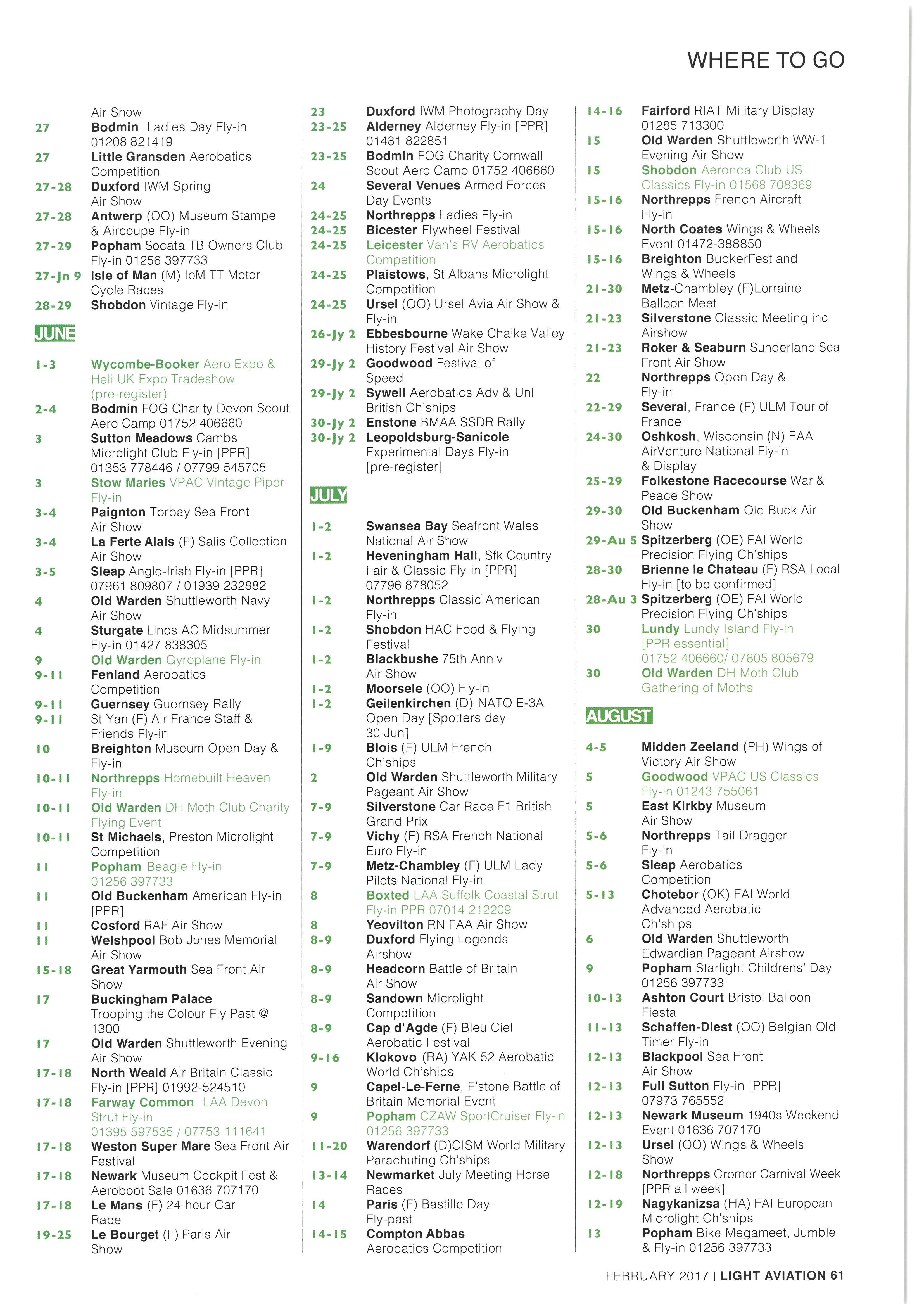
59 WHERETO GO
Fly-insand eventsduring2017to help planfortheyear ahead
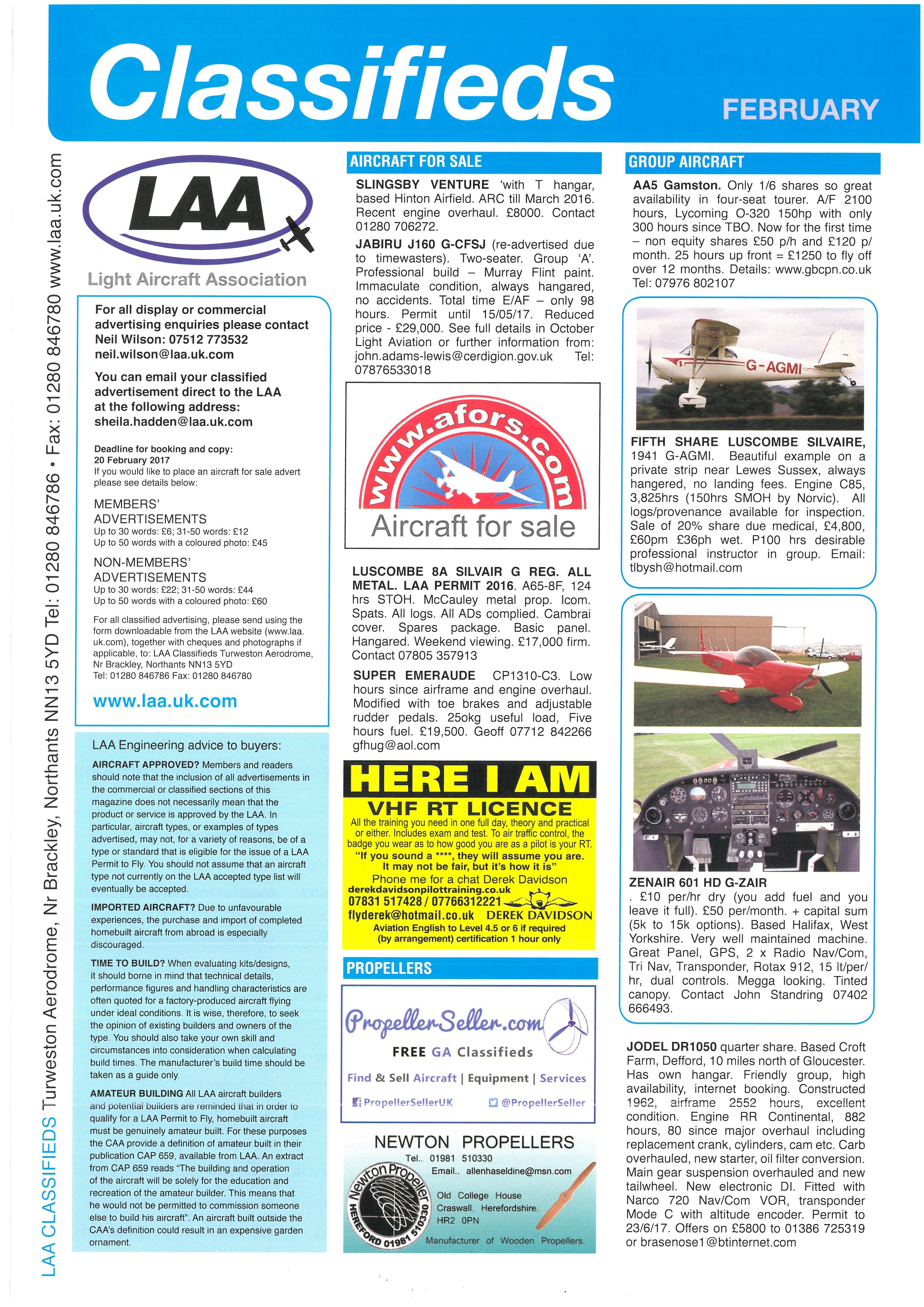
62 LAA CLASSIFIEDS
Aircraft, parts and services for sale
65 CEOTHOUGHTS
Record numbers for the LAA last year
months after having lived in sunny Kenya for seven years. The weeks of endless damp and dreary days, the airstrip too boggy to fly and the sky looking so uninviting, tend to sap my morale a bit.
But wait, so far this winter we have had very little rain in the south and our strip at Slinfold has remained surprisingly firm, although we have to be careful to avoid the wetter days that would damage all of the hard work that the owner of the strip has put in. | am writing this in mid-January and the sun is shining and the light frost is disappearing. Time to go flying?
If not, it will not take too long to heat my well insulated workshop so that | can do a few more jobs on the Alpi Pioneer, or | could go to the strip and do a couple of small maintenance jobs on the Europa and end up drinking tea and getting roped in to help with another owner’s maintenance task. That is the real pleasure in owning a Permit aircraft overseen by the LAA.
Earlier this week | was invited to Henstridge, home of the Wessex Strut, to present their annual awards and to have a chat about the key issues that face our Association over the next few years. Unfortunately the weather did not cooperate, so plan B was to drive. Despite a good briefing from Strut Chairman Neil Wilson, | got completely lost once | got within a mile of the airfield entrance in the pitch dark.
“It is easy, just follow the signs for Tiger Moth flights and look for the building with the big C on it,” said Neil. Yes but the signs were on six foot poles and my headlights only go up a couple of feet!
| eventually found my way and received a warm welcome and a steaming cup of tea in the bustling clubhouse.
The Wessex Strut is undoubtedly one of
our more successful Struts with more than 110 members, and they are hosted by a helpful airfield owner who really gets the LAA way of doing things.
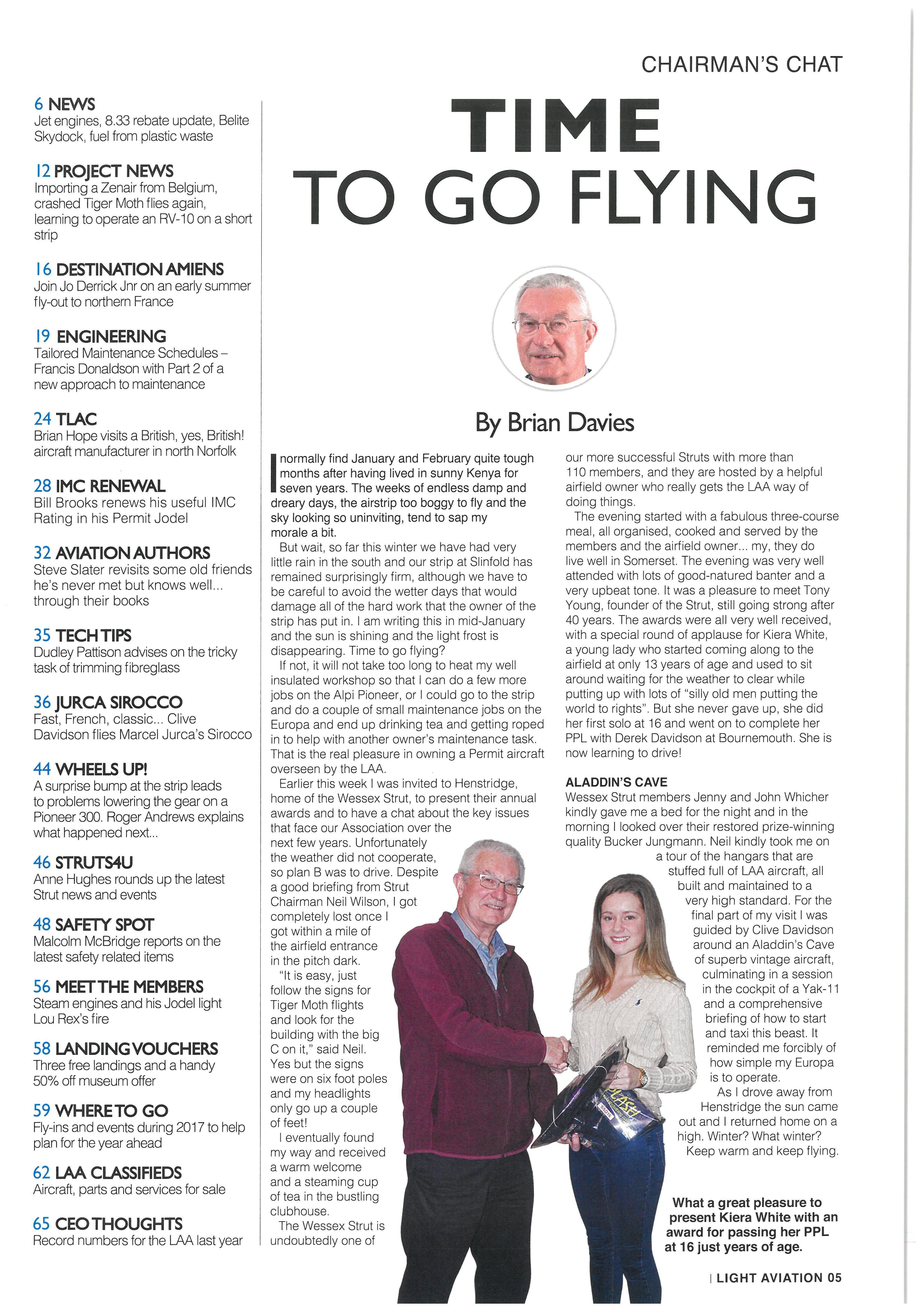
The evening started with a fabulous three-course meal, all organised, cooked and served by the members and the airfield owner... my, they do live well in Somerset. The evening was very well attended with lots of good-natured banter and a very upbeat tone. It was a pleasure to meet Tony Young, founder of the Strut, still going strong after 40 years. The awards were all very well received, with a special round of applause for Kiera White, a young lady who started coming along to the airfield at only 13 years of age and used to sit around waiting for the weather to clear while putting up with lots of “silly old men putting the world to rights”. But she never gave up, she did her first solo at 16 and went on to complete her PPL with Derek Davidson at Bournemouth. She is now learning to drive!
ALADDIN’S CAVE
Wessex Strut members Jenny and John Whicher kindly gave me a bed for the night and in the morning | looked over their restored prize-winning quality Bucker Jungmann. Neil kindly took me on a tour of the hangars that are stuffed full of LAA aircraft, all built and maintained to a very high standard. Forthe final part of my visit | was guided by Clive Davidson around an Aladdin’s Cave of superb vintage aircraft, culminating in a session in the cockpit of a Yak-11 and a comprehensive briefing of how to start and taxi this beast. It reminded me forcibly of how simple my Europa is to operate.
As | drove away from Henstridge the sun came out and | returned home on a high. Winter? What winter? Keep warm and keep flying.
What a great pleasure to present Kiera White with an award for passing her PPL at 16 just years of age.
Amongst the other significant increases in existing Lycoming AEIO-360.
craftsman in metal, back in the late 1980s scopeavailabletoLAAmembersfollowing Originallyplannedtohavethejetengines Benniestartedmakingasinglemodeljet the CAA’s issue of our new approval under mounted under the belly, similar to that for his own interest, in his garage. Then, BCAR A8-26, our Association is now able on the well-known jet-boosted Waco that succumbing to modelling friends’ requests, to include jet and electric powered aircraft appears on the US display circuit, Richard agreed to make a batch of 15. amongst its fleet. now plans to locate the jets on either side In 1994 he and wife Anita formed AMT
Hitting the ground running, as it were, of and external to the fuselage, mounted to manufacture a gas turbine producing in the closing months of 2016 LAA staff on transverse tubular beams. Having seen 90 Newtons of thrust at 90,000rpm. visitedYASAmotorsofOxfordtodiscuss andheardasimilar,butsmallergasturbine—_TheircurrentbiggestengineistheLynx, the design, installation and flight test being tested to full thrust on AMT’s test rig which produces over 1,500N (340lbf) of aspects of the axial flux electric motors in a sound-deadening anechoic chamber, thrust at 45,000rpm for a weight of 17kg that are intended for use in a couple of Francis said, “The pilot sitting alongside (37lb). Despite their compact size, such innovative LAA projects. two of these monsters is going to need performance from a high-quality package
Our Chief Engineer, Francis Donaldson, an unusually courageous spirit - and a does not come cheap; intended to power also visited the Eindhoven base of AMT particularly effective pair of earplugs!” military drones, these Lynx motors Netherlands, along with LAA aerobatic AMT Netherlands is a small, family-run cost significantly more than the typical display pilot Richard Goodwin, to learn company that started off developing small Lycoming or Continental in an LAA aircraft. about the possibility of fitting a pair of small gas turbines for model aeroplanes, but has Work on the jet mod is progressing, turbo-jets to Richard’s Pitts S2S through expanded into the much more lucrative with engineering support from Eddie theLAAmodificationscheme. marketforUAVsand,latterly,assustainers|SaurenmanofSaurenmanAeroWorks
Well known for his energetic display for full-size gliders. in the USA, who as well as having a routines in the Pitts, Richard has put in for AMT produce 90% of the parts of the great deal of experience with Pitts type a mod which, if it goes ahead, would give engines in-house, and Francis was able aircraft, was also involved with the brightly painted Pitts a thrust to weight to see literally every part of the engine the design of the ratio of better than 1:1 when the pair of during a four hour tour, hosted by bosses jet Waco
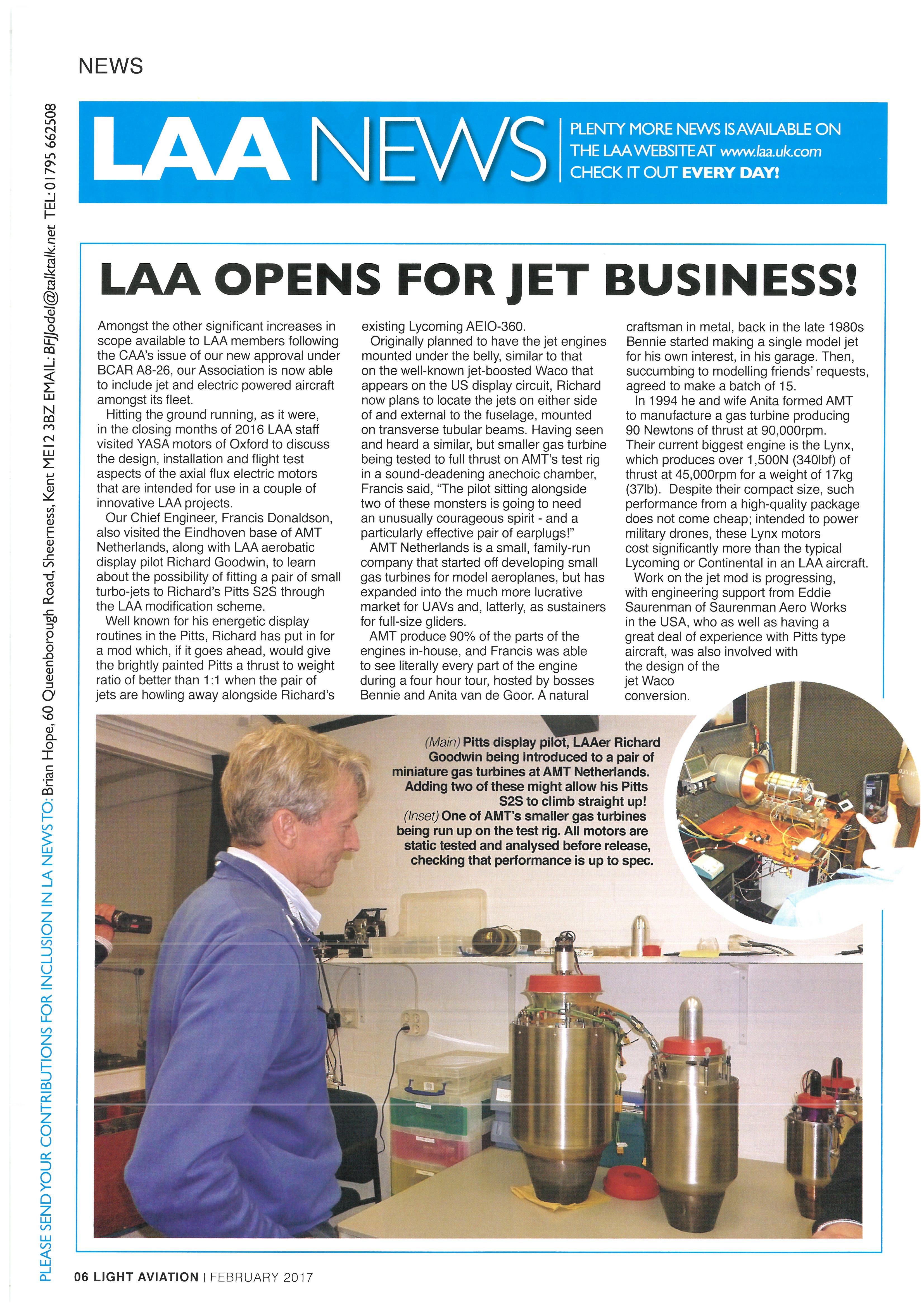
- S2S to climb straight up! , (Inset)One of AMT’s smaller gas turbines ‘ being run up on the test rig. All motors are static tested and analysed before release, checking that performance is up to spec.
The first of what is expected to be four ‘Meet the LAA’ sessions will take place as the guests of the LAA Wessex Strut at Henstridge Airfield on the weekend of 22 and 23 April. We’ve chosen this location as being easily accessible from all areas of the west country, with the happy coincidence that it’s also the Strut’s 40th Anniversary fly-in.
The idea of the ‘Meet the LAA’event is for staff and board members to meet with members face-to face and chat about any issues they wish to raise. Everybody is welcome to come along and have their say, or just to listen to what is going on. We look forward to seeing a good crowd. More details next month.
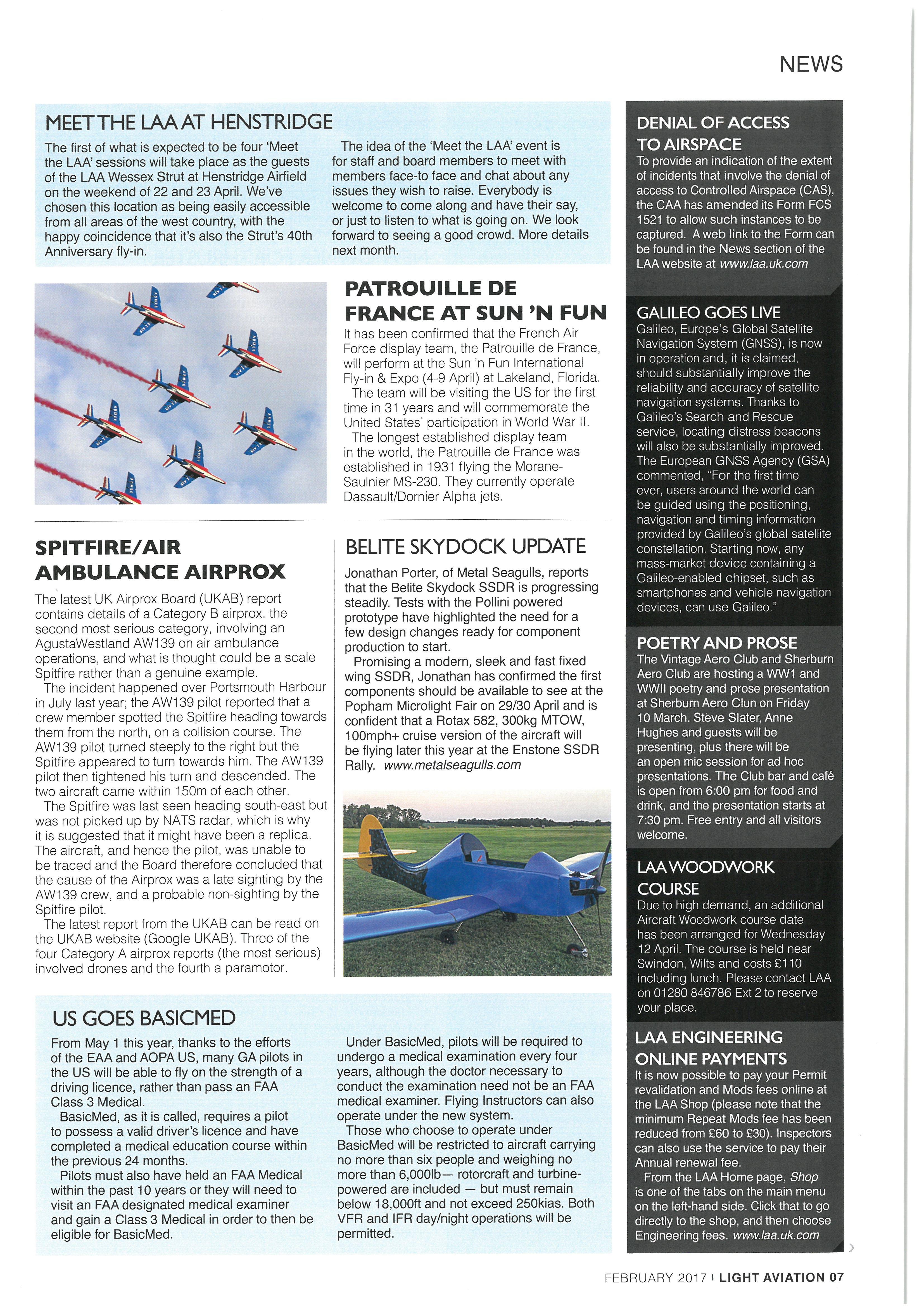
PATROUILLE DE FRANCE AT SUN ’N FUN
It has been confirmed that the French Air Force display team, the Patrouille de France, will perform at the Sun ’n Fun International Fly-in & Expo (4-9 April) at Lakeland, Florida.
The team will be visiting the US for the first time in 31 years and will commemorate the United States’ participation in World War II.
The longest established display team in the world, the Patrouille de France was established in 1931 flying the MoraneSaulnier MS-230. They currently operate Dassault/Dornier Alpha jets.
SPITFIRE/AIR AMBULANCE AIRPROX
The latest UK Airprox Board (UKAB) report contains details of a Category B airprox, the second most serious category, involving an AgustaWestland AW139 on air ambulance operations, and what is thought could be a scale Spitfire rather than a genuine example.
The incident happened over Portsmouth Harbour in July last year; the AW139 pilot reported that a crew member spotted the Spitfire heading towards hem from the north, on a collision course. The AW139 pilot turned steeply to the right but the Spitfire appeared to turn towards him. The AW139 pilot then tightened his turn and descended. The wo aircraft came within 150m of each other.
The Spitfire was last seen heading south-east but was not picked up by NATS radar, which is why itissuggestedthatitmighthavebeenareplica.
The aircraft, and hence the pilot, was unable to be traced and the Board therefore concluded that he cause of the Airprox was a late sighting by the AW139 crew, and a probable non-sighting by the Spitfire pilot.
The latest report from the UKAB can be read on the UKAB website (Google UKAB). Three of the four Category A airprox reports (the most serious) involved drones and the fourth a paramotor.
US GOES BASICMED
From May 1this year, thanks to the efforts of the EAA and AOPA US, many GA pilots in the US will be able to fly on the strength of a driving licence, rather than pass an FAA Class 3 Medical.
BasicMed, as it is called, requires a pilot topossess a validdriver’slicenceandhave completed a medical education course within the previous 24 months.
Pilots must also have held an FAA Medical within the past 10 years or they will need to visit an FAAdesignated medical examiner and gain a Class 3 Medical in order to then be eligible for BasicMed.
BELITE SKYDOCK UPDATE
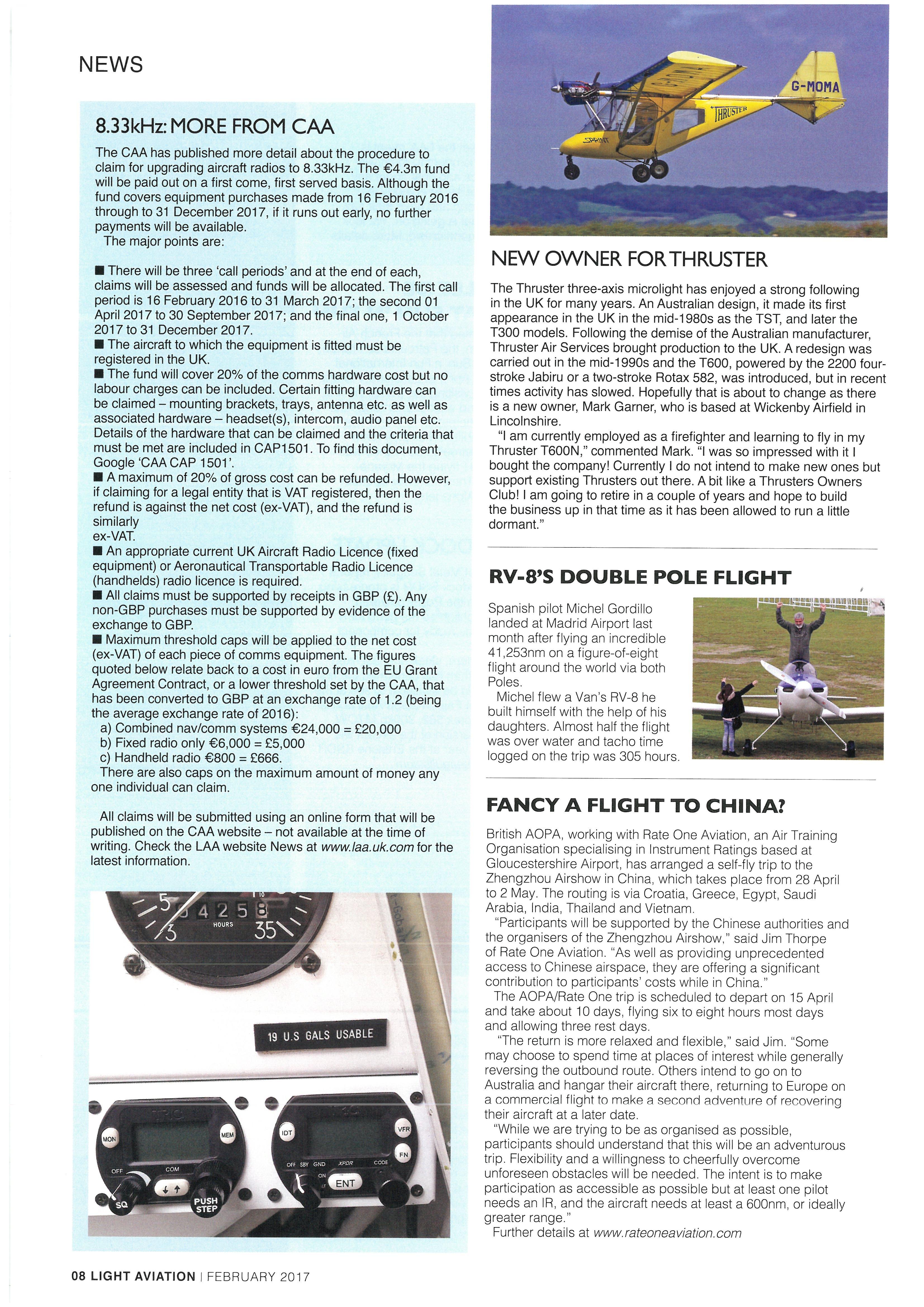
Jonathan Porter, of Metal Seagulls, reports that the Belite Skydock SSDR is progressing steadily. Tests with the Pollini powered prototype have highlighted the need for a few design changes ready for component production to start.
Promising a modern, sleek and fast fixed
permitted. wing SSDR, Jonathan has confirmed the first components should be available to see at the
Popham Microlight Fair on 29/30 April and is confident that a Rotax 582, 300kg MTOW, 100mph+ cruise version of the aircraft will be flying later this year at the Enstone SSDR Rally. www.metalseagulls.com
Under BasicMed, pilots will be required to undergo a medical examination every four years, although the doctor necessary to conduct the examination need not be an FAA medical examiner. Flying Instructors can also operate under the new system. Those who choose to operate under BasicMed will be restricted to aircraft carrying no more than six people and weighing no more than 6,000Ilb— rotorcraft and turbinepowered are included but must remain below 18,000ft and not exceed 250kias. Both VFR and IFR day/night operations will be
DENIAL OF ACCESS TO AIRSPACE
To provide an indication of the extent of incidents that involve the denial of access to Controlled Airspace (CAS), the CAA has amended its Form FCS 1521 to allow such instances to be captured. Aweb link to the Form can be found in the News section of the LAA website at www.laa.uk.com
GALILEO GOES LIVE
Galileo, Europe’s Global Satellite Navigation System (GNSS), is now in operation and, it is claimed, should substantially improve the reliability and accuracy of satellite navigation systems. Thanks to Galileo’s Search and Rescue service, locating distress beacons will also be substantially improved. The European GNSS Agency (GSA) commented, “For the first time ever, users around the world can be guided using the positioning, navigation and timing information provided by Galileo’s global satellite constellation. Starting now, any mass-market device containing a Galileo-enabled chipset, such as smartphones and vehicle navigation devices, can use Galileo.”
POETRYAND PROSE
The Vintage Aero Club and Sherburn Aero Club are hosting a WW1 and WWII poetry and prose presentation at Sherburn Aero Clun on Friday 10 March. Steve Slater, Anne Hughes and guests will be presenting, plus there will be an open mic session for ad hoc presentations. The Club bar and café is open from 6:00 pm for food and drink, and the presentation starts at 7:30 pm. Free entry and all visitors LAAwelcome.WOODWORK
COURSE
Due to high demand, an additional Aircraft Woodwork course date has been arranged for Wednesday 12 April. The course is held near Swindon, Wilts and costs £110 including lunch. Please contact LAA on 01280 846786 Ext 2 to reserve your place.
LAA ENGINEERING ONLINE PAYMENTS
It is now possible to pay your Permit revalidation and Mods fees online at the LAA Shop (please note that the minimum Repeat Mods fee has been reduced from £60 to £30). Inspectors can also use the service to pay their Annual renewal fee.
From the LAA Home page, Shop is one of the tabs on the main menu on the left-hand side. Click that to go directly to the shop, and then choose Engineering fees. www.laa.uk.com
8.33kHz: MORE FROM CAA
The CAA has published more detail about the procedure to claim for upgrading aircraft radios to 8.33kHz. The €4.3m fund willbepaidoutonafirst come,firstservedbasis.Althoughthe fund covers equipment purchases made from 16 February 2016 through to 31 December 2017, if it runs out early, no further payments will be available.
The major points are:
@There will be three ‘call periods’ and at the end of each, claims will be assessed and funds will be allocated. The first call period is 16 February 2016 to 31 March 2017; the second 01 April 2017 to 30 September 2017; and the final one, 1 October 2017 to 31 December 2017.
@The aircraft to which the equipment is fitted must be registered inthe UK.
@ The fund will cover 20% of the comms hardware cost but no labour charges can be included. Certain fitting hardware can be claimed mounting brackets, trays, antenna etc. as well as associated hardware headset(s), intercom, audio panel etc. Details of the hardware that can be claimed and the criteria that must be met are included in CAP1501. To find this document, Google ‘CAACAP 1501’.
@A maximum of 20% of gross cost can be refunded. However, if claiming for a legal entity that is VATregistered, then the refund is againstthe net cost (ex-VAT),and the refund is similarly ex-VAT.
@An appropriate current UK Aircraft Radio Licence (fixed equipment) orAeronautical Transportable Radio Licence (handhelds)radio licence is required.
@All claims must be supported by receipts in GBP (£).Any non-GBP purchases must be supported by evidence of the exchange to GBP.
@Maximum threshold caps will be applied to the net cost (ex-VAT)of each piece of comms equipment. The figures quoted below relate back to a cost in euro from the EU Grant Agreement Contract, or a lower threshold set by the CAA, that has been converted to GBP at an exchange rate of 1.2 (being the average exchange rate of 2016):
a) Combined nav/comm systems €24,000 = £20,000
b) Fixed radio only €6,000 = £5,000
c) Handheld radio €800 = £666.
There are also caps on the maximum amount of money any one individualcan claim. All claims will be submitted using an online form that will be published onthe CAA website not available at the time of writing. Checkthe LAAwebsite News at www.laa.uk.comfor the latest information.
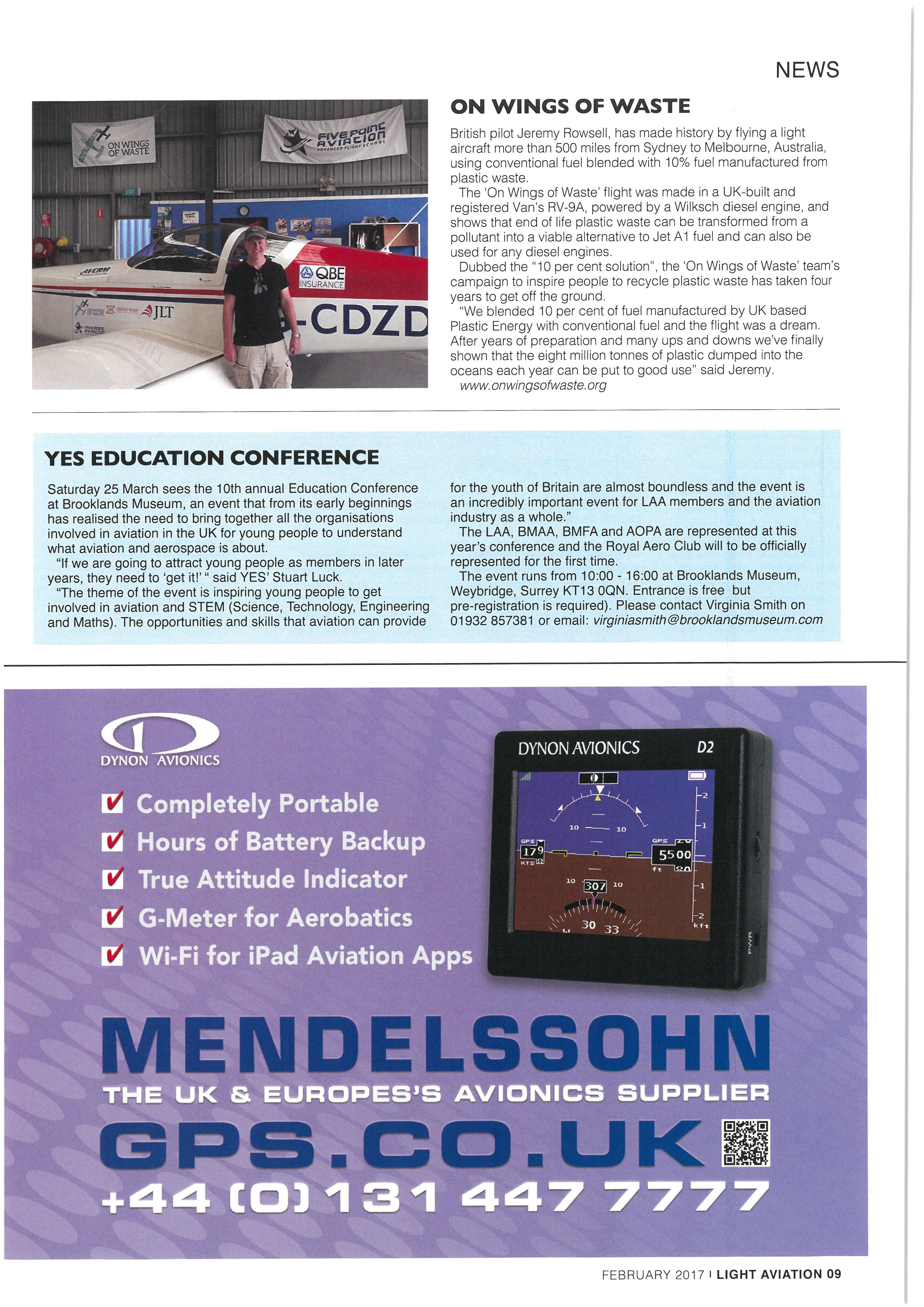
The Thruster three-axis microlight has enjoyed a strong following in the UK for many years. An Australian design, it made its first appearance in the UK in the mid-1980s as the TST, and later the T300 models. Followingthe demise of the Australian manufacturer, Thruster Air Services brought production to the UK. A redesign was carried out in the mid-1990s and the T600, powered by the 2200 fourstroke Jabiru or a two-stroke Rotax 582, was introduced, but in recent times activity has slowed. Hopefully that is about to change as there is a new owner, Mark Garner, who is based at Wickenby Airfield in Lincolnshire.
“lamcurrentlyemployedasa firefighterandlearningtoflyinmy Thruster T600N,” commented Mark. “I was so impressed with it | bought the company! Currently | do not intend to make new ones but support existing Thrusters out there. A bit like a Thrusters Owners Club! | am going to retire in a couple of years and hope to build thebusinessupinthattimeasithasbeenallowedtorunalittle dormant.”
RV-8’S DOUBLE POLE FLIGHT
Spanish pilot Michel Gordillo landed at Madrid Airport last month after flying an incredible 41,253nmona figure-of-eight flight around the world via both Poles.
Michel flew a Van’s RV-8 he built himself with the help of his daughters. Almost half the flight was over water and tacho time logged on the trip was 305 hours.
FANCY A FLIGHT TO CHINA?
British AOPA, working with Rate One Aviation, an Air Training Organisation specialising in Instrument Ratings based at Gloucestershire Airport, has arranged a self-fly trip to the Zhengzhou Airshow in China, which takes place from 28 April to 2 May. The routing is via Croatia, Greece, Egypt, Saudi Arabia, India, Thailand and Vietnam.
“Participants will be supported by the Chinese authorities and the organisers of the Zhengzhou Airshow,” said Jim Thorpe of Rate One Aviation. “As well as providing unprecedented access to Chinese airspace, they are offering a significant contribution to participants’ costs while in China.”
The AOPA/Rate One trip is scheduled to depart on 15 April and take about 10 days, flying six to eight hours most days and allowing three rest days.
“The return is more relaxed and flexible,” said Jim. “Some may choose to spend time at places of interest while generally reversing the outbound route. Others intend to go on to Australia and hangar their aircraft there, returning to Europe on a commercial flight to make a second adventure of recovering their aircraft at a later date.
“While we are trying to be as organised as possible, participants should understand that this will be an adventurous trip. Flexibility and a willingness to cheerfully overcome unforeseen obstacles will be needed. The intent is to make participation as accessible as possible but at least one pilot needs an IR,and the aircraft needs at least a 60Onm, or ideally greater range.”
Further details at www.rateoneaviation.com
ON WINGS OF WASTE
British pilot Jeremy Rowsell, has made history by flying alight aircraft more than 500 miles from Sydney to Melbourne, Australia, using conventional fuel blended with 10% fuel manufactured from plastic waste.
The ‘On Wings of Waste’ flight was made in a UK-built and registered Van’s RV-9A, powered by a Wilksch diesel engine, and shows that end of life plastic waste can be transformed from a pollutant into a viable alternative to Jet A1 fuel and can also be used for any diesel engines.
Dubbed the “10 per cent solution”, the ‘On Wings of Waste’ team’s campaign to inspire people to recycle plastic waste has taken four years to get off the ground.
“We blended 10 per cent of fuel manufactured by UK based Plastic Energy with conventional fuel and the flight was a dream. After years of preparation and many ups and downs we've finally shown that the eight million tonnes of plastic dumped into the oceans each year can be put to good use” said Jeremy.
www.onwingsofwaste.org
YES EDUCATION CONFERENCE
Saturday 25 March sees the 10th annual Education Conference at Brooklands Museum, an event that from its early beginnings has realised the need to bring together all the organisations involved in aviation in the UK for young people to understand what aviation and aerospace is about.
“If we are going to attract young people as members in later years, they need to ‘get it!’“ said YES’ Stuart Luck. “The theme of the event is inspiring young people to get involved in aviation and STEM (Science, Technology, Engineering and Maths). The opportunities and skills that aviation can provide
for the youth of Britain are almost boundless and the event is an incredibly important event for LAA members and the aviation industry as a whole.”
The LAA, BMAA, BMFA and AOPA are represented at this year’s conference and the Royal Aero Club will to be officially represented for the first time.
The event runs from 10:00 - 16:00 at Brooklands Museum, Weybridge, Surrey KT13 OQN. Entrance is free but pre-registration is required). Please contact Virginia Smith on 01932 857381 or email: virginiasmith@brooklandsmuseum.com
A weighty matter InNovember’sLightAviation, Steve Slater asked for response to a Government request on what the GA sector wanted. Well, | can say quite briefly what | want! | want the LAA, BMAA and CAA to get their heads together and sort out a unified standard for pilot and aircraft licensing for sub-500kg MTOW three-axis machines.
Now, you may say | am the author of my own downfall, and you could be right; but | suspect | am not alone. Let me explain. | had the 13th Eurostar kit to reach these shores and it was built as a 450kg microlight under the LAA. | soon realised that it didn’t have enough spare load capacity over and above its 267kg empty weight, but a conversion to a 480kg SSEA merely required the fitting of an electric fuel pump at a cost of about £60.
However, it then cost very much more to train for an NPPL (SSEA) to fly it! | chose to fly the Eurostar to a training airfield whilst it was still a microlight and to train in a C152. | didn’t mind that too much, as the NPPL (SSEA) would allow me to fly a range of aircraft rather different from the then-typical microlight, so it was sensible to expect to qualify for a ‘heavier’ licence. What | did mind was that my PPL(M) ultimately lapsed. That was because | didn’t want to be flying my SSEA Eurostar to another training airfield to spend several hundred pounds a year hopping into the school’s microlight Eurostar, or similar, to keep up microlight hours.
After 600 hours, my first Eurostar wassoldand| builtasecondone as a 480kg machine but to the microlight 267kg empty weight, again under the LAA. That proved to be a good decision as the subsequent purchaser of this aircraft subsequently converted it back to a 450kg microlight.
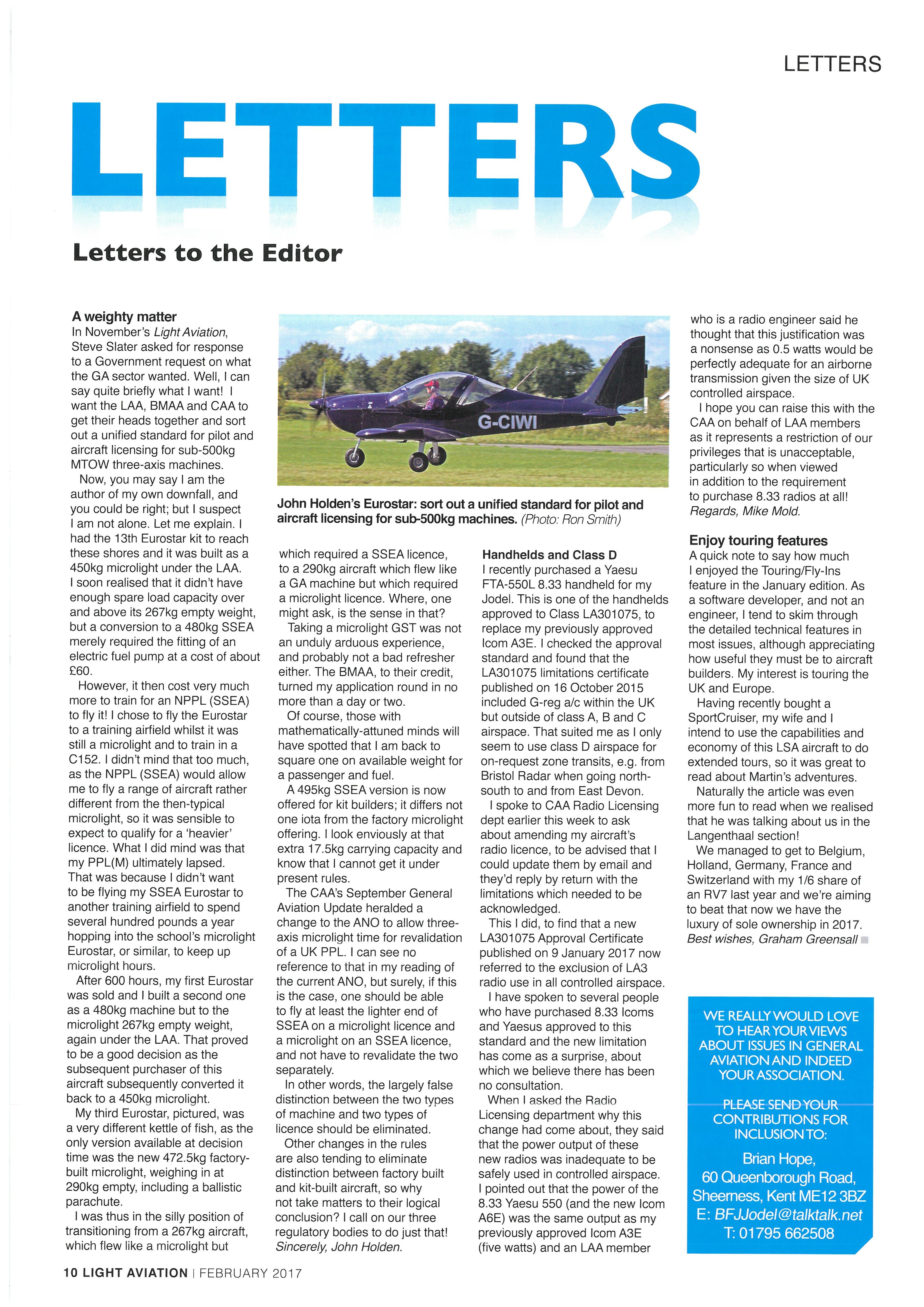
My third Eurostar, pictured, was a very different kettle of fish, as the only version available at decision time was the new 472.5kg factorybuilt microlight, weighing in at 290kg empty, including a ballistic parachute.
| was thus in the silly position of transitioning from a 267kg aircraft, which flew like a microlight but
which required a SSEA licence, to a 290kg aircraft which flew like a GA machine but which required a microlight licence. Where, one might ask, is the sense in that?
Taking a microlight GST was not an unduly arduous experience, and probably not a bad refresher either. The BMAA, to their credit, turned my application round in no more than a day or two.
Of course, those with mathematically-attuned minds will have spotted that | am back to square one on available weight for a passenger and fuel.
A 495kg SSEA version is now offered for kit builders; it differs not one iota from the factory microlight offering. | look enviously at that extra 17.5kg carrying capacity and know that | cannot get it under present rules.
The CAA’s September General Aviation Update heralded a change to the ANO to allow threeaxis microlight time for revalidation of a UK PPL. | can see no reference to that in my reading of the current ANO, but surely, if this is the case, one should be able to fly at least the lighter end of SSEA on a microlight licence and a microlight on an SSEA licence, and not have to revalidate the two separately.
In other words, the largely false distinction between the two types of machine and two types of licence should be eliminated. Other changes in the rules are also tending to eliminate distinction between factory built and kit-built aircraft, so why not take matters to their logical conclusion? | call on our three regulatory bodies to do just that!
Sincerely, John Holden.
Handhelds and Class D | recently purchased a Yaesu FTA-550L 8.33 handheld for my Jodel. This is one of the handhelds approved to Class LA301075, to replace my previously approved Icom ASE. | checked the approval standard and found that the LA301075 limitations certificate published on 16 October 2015 included G-reg a/c within the UK but outside of class A, B and C airspace. That suited me as | only seem to use class D airspace for on-request zone transits, e.g. from Bristol Radar when going northsouth to and from East Devon.
| spoke to CAA Radio Licensing dept earlier this week to ask about amending my aircraft’s radio licence, to be advised that | could update them by email and they'd reply by return with the limitations which needed to be acknowledged.
This | did, to find that a new LA301075 Approval Certificate published on 9 January 2017 now referred to the exclusion of LA3 radio use in all controlled airspace.
| have spoken to several people who have purchased 8.33 Ilcoms and Yaesus approved to this standard and the new limitation has come as a surprise, about which we believe there has been no consultation.
When | asked the Radio Licensing department why this change had come about, they said that the power output of these new radios was inadequate to be safely used in controlled airspace. | pointed out that the power of the 8.33 Yaesu 550 (and the new Icom AGE) was the same output as my previously approved Icom A3E (five watts) and an LAA member
who is a radio engineer said he thought that this justification was a nonsense as 0.5 watts would be perfectly adequate for an airborne transmission given the size of UK controlled airspace.
| hope you can raise this with the CAA on behalf of LAA members as it represents a restriction of our privileges that is unacceptable, particularly so when viewed in addition to the requirement to purchase 8.33 radios at all!
Regards, Mike Mold.
Enjoy touring features
A quick note to say how much | enjoyed the Touring/Fly-Ins feature in the January edition. As a software developer, and not an engineer, |tend to skim through the detailed technical features in most issues, although appreciating how useful they must be to aircraft builders. My interest is touring the UK and Europe.
Having recently bought a SportCruiser, my wife and | intend to use the capabilities and economy of this LSA aircraft to do extended tours, so it was great to read about Martin’s adventures.
Naturally the article was even more fun to read when we realised that he was talking about us in the Langenthaal section!
We managed to get to Belgium, Holland, Germany, France and Switzerland with my 1/6 share of an RV7 last year and we’re aiming to beat that now we have the luxury of sole ownership in 2017. Best wishes, Graham Greensall
WEREALLYWOULDLOVE TOHEARYOURVIEWS ABOUT ISSUES IN GENERAL AVIATION AND INDEED YOUR ASSOCIATION.
PLEASE SENDYOUR CONTRIBUTIONS FOR INCLUSIONTO:
the Christmas holidays are out of the way. Here we are with January already behind us and a one hour improvement in daylight at the end of the afternoon. Itjust gets better from here.
There were a surprising number of projects granted their Permit to Test in our darkest month; there is nothing quite like the natural milestone of a new year to spur on that final push for completion. Good luck with the test schedules and maybe sharealittle ofyourexperiencewithProjectNewsinthecoming months?
Our new project registration data is from the short working month of December, so no surprise that there are only two new builds underway, interestingly both scratch builds. Some say that life is too short to build that way but | can understand that for some, the ultimate satisfaction comes for using primary engineering skills to turn unformed raw material into a flying aircraft. | wish them good fortune on their journey.
Last month, Carl Meek provided an account of the part-built RV-10 he took on when its previous owner simply ran out of space to complete it. Carl made terrific progress in finishing the project and then polished off the test flying in a similarly rapid fashion. This month we hear of his progress, having receivedthefullPermittoFlyandalreadymadeafirst crosschannel flight.
Coming the other way, lain Donnelly rescues a cannibalised Zenair 601 from Belgium and has some good advice for those considering the import of a project.
News of a couple of successful first flights too, for Basil Fairston and Pat Piggott’s SSDRSpacek SD1, G-SSDI,and Cathy Silk’s restored Tiger Moth G-AVPJ. Well done one and all.
Please keep your generous submissions coming. To get in touch with Project News, and tell your story, report a milestone or just to send a picture, email: projectnews@laa-archive.org.ukYour stories inspire and encourage fellow members.
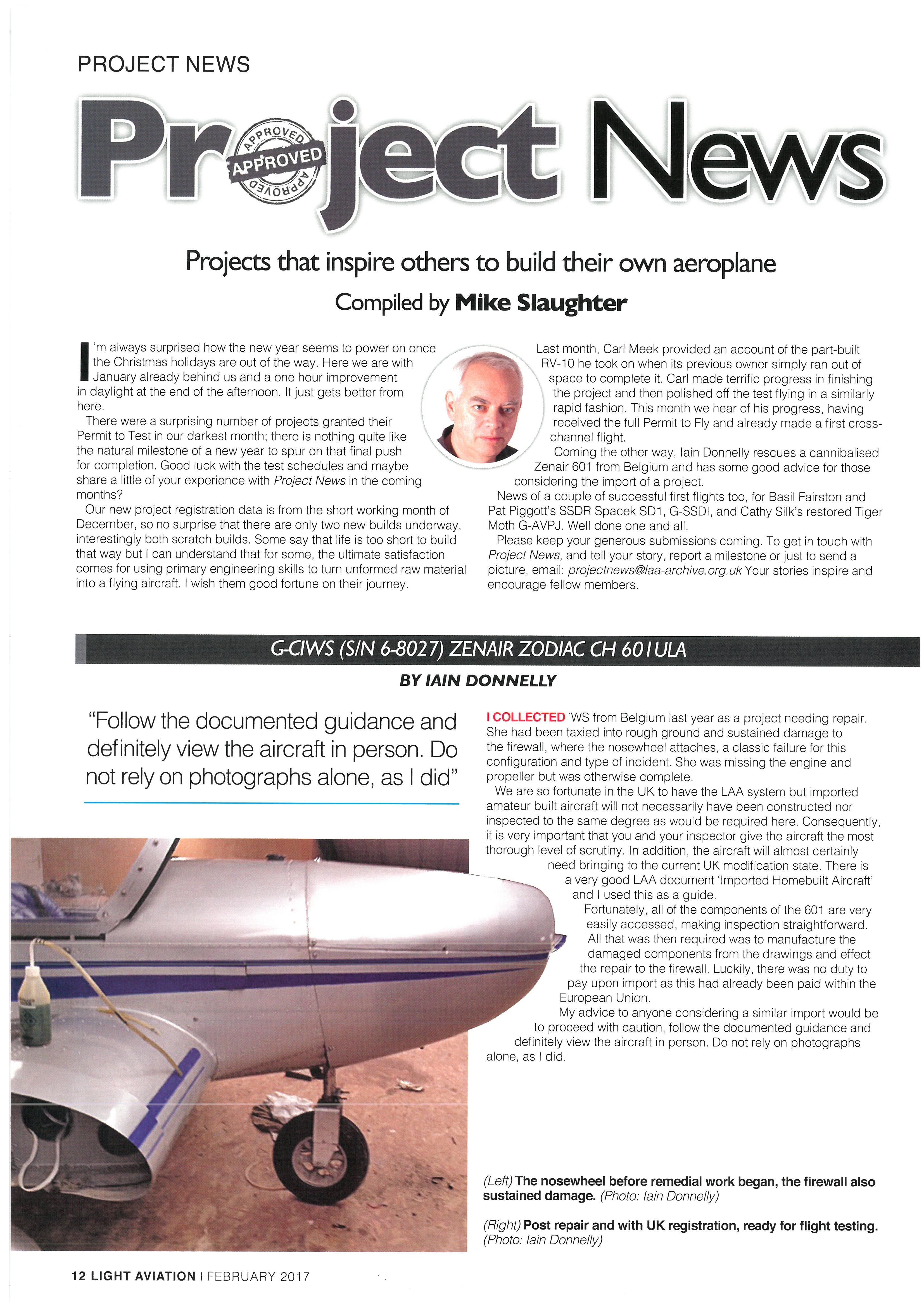
| COLLECTED WS from Belgium last year as a project needing repair. She had been taxied into rough ground and sustained damage to the firewall, where the nosewheel attaches, a classic failure for this configuration and type of incident. She was missing the engine and propeller but was otherwise complete.
We are so fortunate in the UK to have the LAA system but imported amateur built aircraft will not necessarily have been constructed nor inspected to the same degree as would be required here. Consequently, it is very important that you and your inspector give the aircraft the most thorough level of scrutiny. In addition, the aircraft will almost certainly need bringing to the current UK modification state. There is avery good LAA document ‘Imported Homebuilt Aircraft’ and | used this as a guide.
Fortunately, all of the components of the 601 are very easily accessed, making inspection straightforward. All that was then required was to manufacture the damaged components from the drawings and effect the repair to the firewall. Luckily, there was no duty to pay upon import as this had already been paid within the European Union.
My advice to anyone considering a similar import would be to proceed with caution, follow the documented guidance and definitely view the aircraft in person. Do not rely on photographs alone, as | did.
(Left)The nosewheel before remedial work began, the firewall also sustained damage. (Photo:/ain Donnelly)
(Right)Post repair and with UK registration, ready for flight testing. (Photo:lain Donnelly)
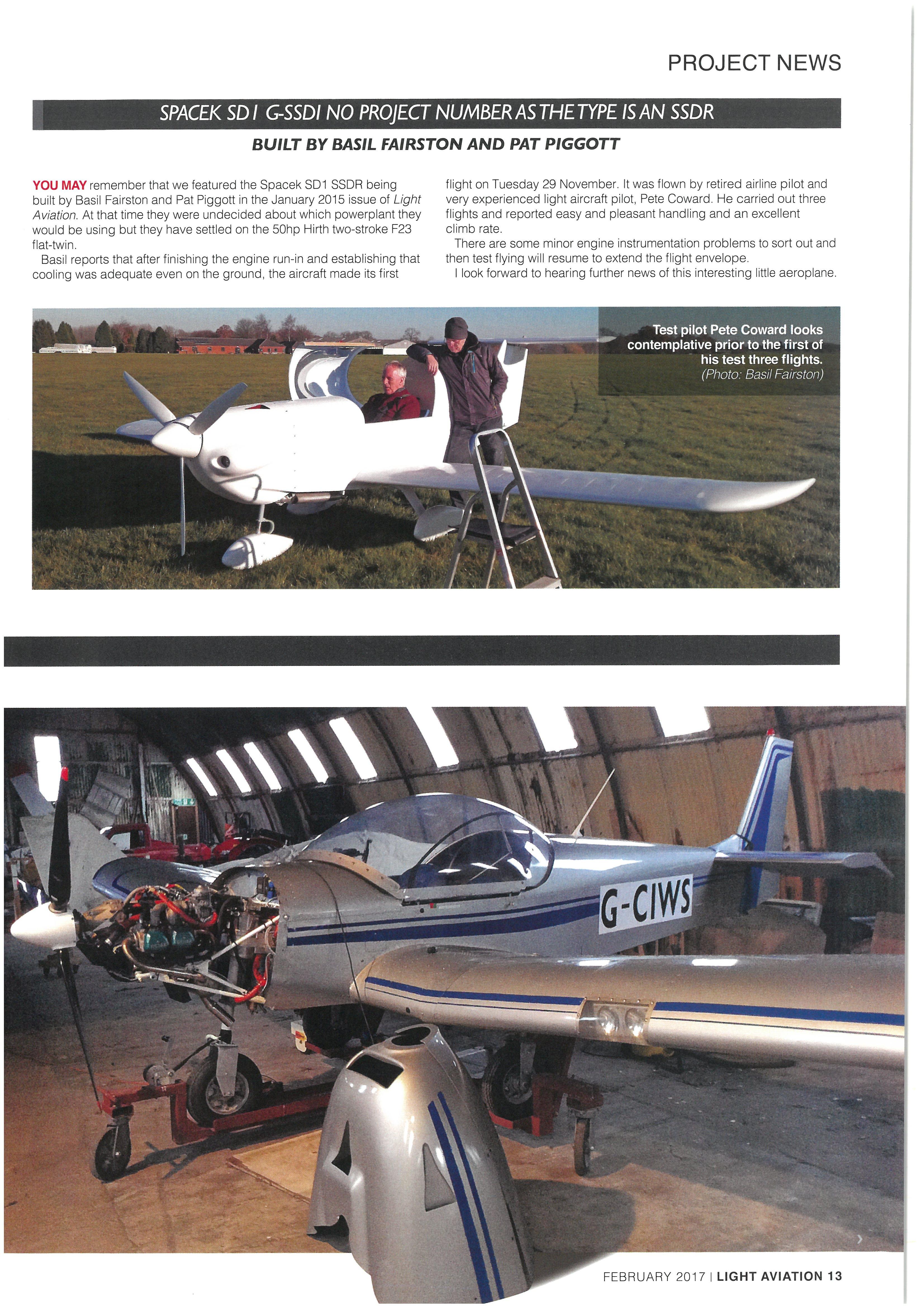
YOU MAY remember that we featured the Spacek SD1 SSDR being built by Basil Fairston and Pat Piggott in the January 2015 issue of Light Aviation. At that time they were undecided about which powerplant they would be using but they have settled on the 5Ohp Hirth two-stroke F23 flat-twin.
Basil reports that after finishing the engine run-in and establishing that cooling was adequate even on the ground, the aircraft made its first
flight on Tuesday 29 November. Itwas flown by retired airline pilot and very experienced light aircraft pilot, Pete Coward. He carried out three flights and reported easy and pleasant handling and an excellent climb rate.
There are some minor engine instrumentation problems to sort out and then test flying will resume to extend the flight envelope. | look forward to hearing further news of this interesting littleaeroplane.
Test pilot Pete Coward looks contemplative prior to the first of his test three flights.
(Photo: Basil Fairston)
G-AVP]DH82ATIGERMOTH(S/N86326)
FROM TIM BADHAM
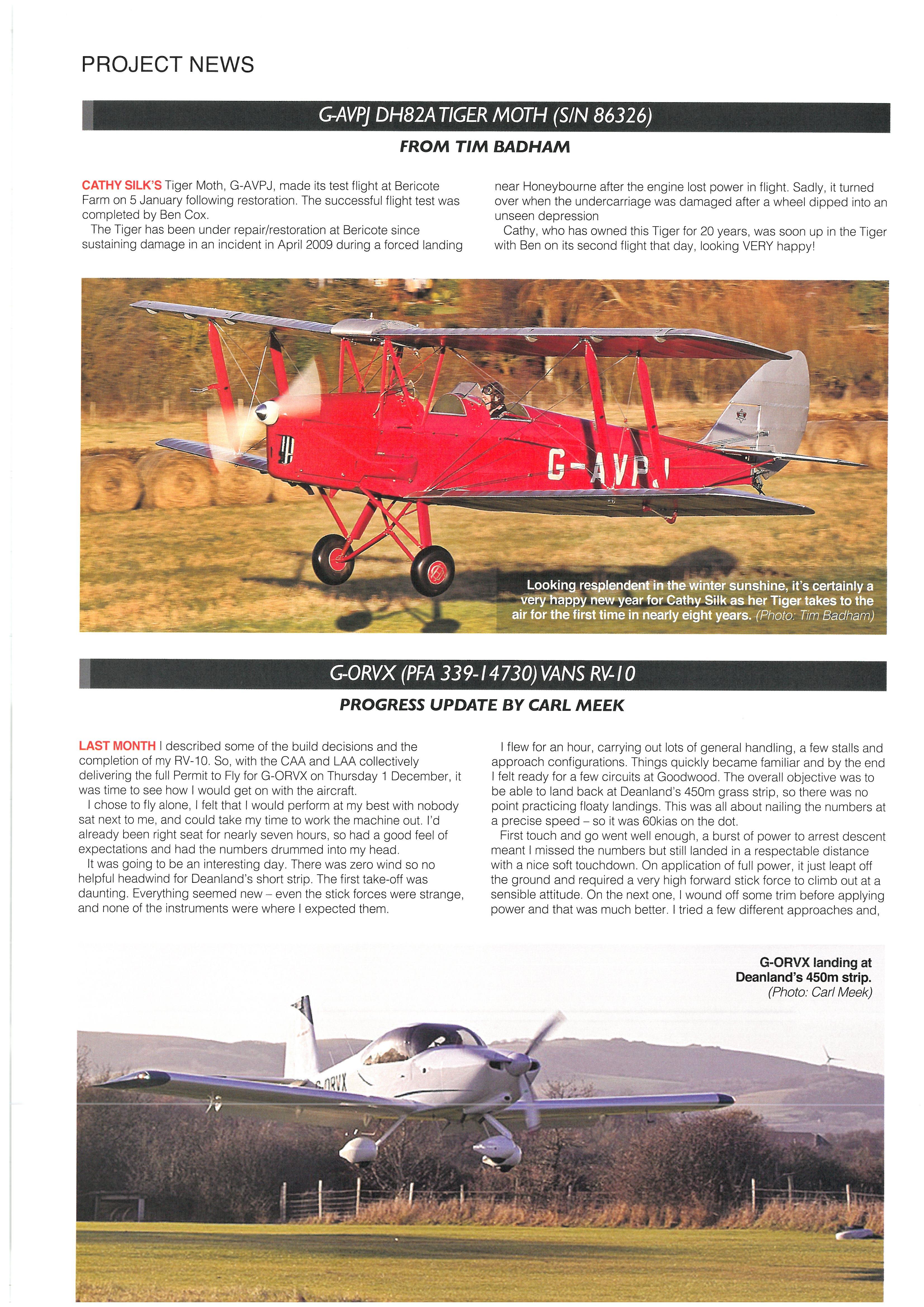
Tiger Moth, G-AVPJ, made its test flight at Bericote near Honeybourne after the engine lost power in flight. Sadly, it turned Farm on 5 January following restoration. The successful flight test was over when the undercarriage was damaged after a wheel dipped into an completed by Ben Cox. unseen depression
The Tiger has been under repair/restoration at Bericote since Cathy, who has owned this Tiger for 20 years, was soon up in the Tiger sustaining damage in an incident in April 2009 during a forced landing with Ben on its second flight that day, looking VERY happy!
, 5a eeiarer
Lookingresplendentinthewintersunshine,it’scertainly a veryhappynewyearforCathySilkasherTigertakestothe airforthefirsttimeinnearlyeightyears.(Photo:TimBadham)
G-ORVX(PFA339-14730)VANSRV-10
| described some of the build decisions and the | flew for an hour, carrying out lots of general handling, a few stalls and completion of my RV-10.So, with the CAA and LAA collectively approach configurations. Things quickly became familiar and by the end delivering the full Permit to Fly for G-ORVX on Thursday 1 December, it | felt ready for a few circuits at Goodwood. The overall objective was to was time to see how | would get on with the aircraft. be able to land back at Deanland’s 450m grass strip, so there was no | chose to fly alone, | felt that | would perform at my best with nobody point practicing floaty landings. This was all about nailing the numbers at sat next to me, and could take my time to work the machine out. I'd a precise speed -so it was 6Okias on the dot. already been right seat for nearly seven hours, so had a good feel of First touch and go went well enough, a burst of power to arrest descent expectations and had the numbers drummed into my head. meant | missed the numbers but still landed in a respectable distance It was going to be an interesting day. There was zero wind so no with a nice soft touchdown. On application of full power, it just leapt off helpful headwind for Deanland’s short strip. The first take-off was the ground and required a very high forward stick force to climb out at a daunting. Everything seemed new even the stick forces were strange, sensible attitude. On the next one, | wound off some trim before applying and none of the instruments were where | expected them. power and that was much better. | tried a few different approaches and,
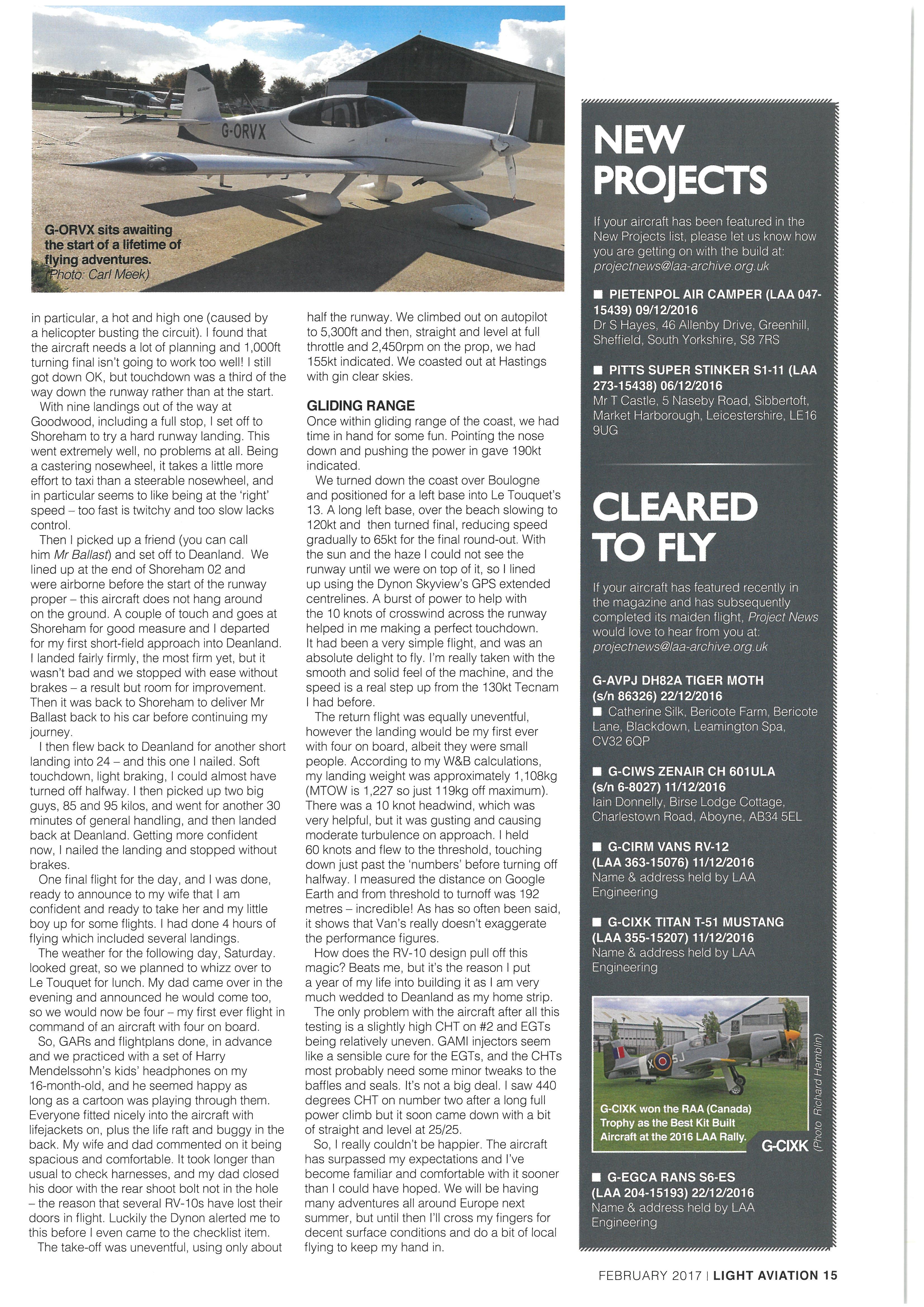
G-ORVX landing at Deanland’s 450m strip. (Photo:
Carl Meek)
in particular, a hot and high one (caused by a helicopter busting the circuit). | found that the aircraft needs a lot of planning and 1,00Oft turning final isn’t going to work too well! | still gotdownOK,buttouchdownwasathird ofthe way down the runway rather than at the start. With nine landings out of the way at Goodwood,including a fullstop,|setoffto Shoreham to try a hard runway landing. This went extremely well, no problems at all. Being acasteringnosewheel,ittakesalittle more effort to taxi than a steerable nosewheel, and in particular seems to like being at the ‘right’ speed too fast is twitchy and too slow lacks control.
Then|pickedupa friend(youcancall him Mr Ballast) and set off to Deanland. We lined up at the end of Shoreham 02 and were airborne before the start of the runway proper this aircraft does not hang around on the ground. A couple of touch and goes at Shoreham for good measure and | departed for my first short-field approach into Deanland. | landed fairly firmly, the most firm yet, but it wasn’t bad and we stopped with ease without brakes a result but room for improvement. Then it was back to Shoreham to deliver Mr Ballast back to his car before continuing my journey.
| then flew back to Deanland for another short landing into 24 and this one | nailed. Soft touchdown, light braking, | could almost have turned off halfway. | then picked up two big guys, 85 and 95 kilos, and went for another 30 minutes of general handling, and then landed back at Deanland. Getting more confident now, | nailed the landing and stopped without brakes.
One final flight for the day, and | was done, ready to announce to my wife that | am confident and ready to take her and my little boy up for some flights. | had done 4 hours of flying which included several landings.
The weather for the following day, Saturday. looked great, so we planned to whizz over to Le Touquet for lunch. My dad came over in the evening and announced he would come too, so we would now be four my first ever flight in command of an aircraft with four on board.
So, GARs and flightplans done, in advance and we practiced with a set of Harry Mendelssohn's kids’ headphones on my 16-month-old, and he seemed happy as long as a cartoon was playing through them. Everyone fitted nicely into the aircraft with lifejackets on, plus the life raft and buggy in the back. My wife and dad commented on it being spacious and comfortable. It took longer than usual to check harnesses, and my dad closed his door with the rear shoot bolt not in the hole the reason that several RV-10s have lost their doors inflight. Luckily the Dynon alerted me to this before | even came to the checklist item. The take-off was uneventful, using only about
GLIDING RANGE
Once within gliding range of the coast, we had time in handfor somefun. Pointingthe nose down and pushing the power in gave 190kt indicated.
We turned down the coast over Boulogne and positioned for a left base into Le Touquet’s 13. A long left base, over the beach slowing to 120kt and then turned final, reducing speed gradually to 65kt for the final round-out. With the sun and the haze | could not see the runway until we were on top of it, so | lined up using the Dynon Skyview’s GPS extended centrelines. A burst of power to help with the 10 knots of crosswind across the runway helped in me making a perfect touchdown. It had been a very simple flight, and was an absolute delight to fly. I’m really taken with the smooth and solid feel of the machine, and the speed is a real step up from the 130kt Tecnam | had before.
The return flight was equally uneventful, however the landing would be my first ever with four on board, albeit they were small people. According to my W&B calculations, my landing weight was approximately 1,108kg (MTOW is 1,227 so just 119kg off maximum). There was a 10 knot headwind, which was very helpful, but it was gusting and causing moderate turbulence on approach. | held 60 knots and flew to the threshold, touching down just past the ‘numbers’ before turning off halfway. | measured the distance on Google Earth and from threshold to turnoff was 192 metres incredible! As has so often been said, it shows that Van’s really doesn’t exaggerate the performance figures.
How does the RV-10 design pull off this magic? Beats me, but it’s the reason | put a year of my life into building it as | am very much wedded to Deanland as my home strip. The only problem with the aircraft after all this testing is a slightly high CHT on #2 and EGTs being relatively uneven. GAMI injectors seem like a sensible cure for the EGTs, and the CHTs most probably need some minor tweaks to the baffles and seals. It’s not a big deal. | saw 440 degrees CHT on number two after a long full power climb but it soon came down with a bit of straight and level at 25/25.
So, | really couldn't be happier. The aircraft has surpassed my expectations and I’ve become familiar and comfortable with it sooner than | could have hoped. We will be having many adventures all around Europe next summer, but until then I'll cross my fingers for decent surface conditions and do a bit of local flying to keep my hand in.
m@PIETENPOL AIR CAMPER (LAA 04715439) 09/12/2016
Dr S Hayes, 46 Allenby Drive, Greenhill, Sheffield, South Yorkshire, S8 7RS
lf your aircraft has featured recently in the magazine and has subsequently completed its maiden flight, Project News would love to hear from you at: projectnews@laa-archive. org.uk
G-CIXK won the RAA (Canada) Trophy as the Best Kit Built Aircraft at the 2016 LAA Rally.
m@G-EGCA RANS S6-ES (LAA 204-15193) 22/12/2016
Name & address held by LAA Engineering
ack in the summer of 1999 there was a quite spectacular solar eclipse, an event made even more special for certain groups of lucky aviators. Some flew out to the far south-west and the Scilly Islands, where the best views in the country were promised. On the day the weather was rather cloudy and those who were actually airborne and above cloud throughout the eclipse got the best views.
Others went across to Amiens, in northern France, for a similarly promised vantage point. At the time, | was still trying to find my feet flying taildraggers (pun intended), with my first visit to Amiens being a week before the event itself. | went with our editor as my safety pilot, to pave the way for a number of members
from the Kent Strut who planned to fly in the following weekend. It was all quite an adventure after the flying club environment | had been used to up to that point.
Unfortunately, | wasn’t quite up to going solo, particularly in the crosswind promised for the eclipse weekend and as Brian was already committed to taking his own aircraft with a passenger, | was left ‘home alone’. It’s worth noting when you read articles of seemingly great adventures, we were all tyros once but in time, if you keep at it, experience builds and the world truly does become your oyster.
For the ‘blonde’ and |, Amiens has become one of our favourite stopovers and we tend to nip over for a night or two whenever possible, as it’s so easily accessible from our part of the
world. Until last October it was possible to fly direct but sadly, in part due to security issues and partially due to cut-backs in France, the Customs and Immigration facilities have been withdrawn.
The fact that the radio is ‘French-only’ can also put people off, but despite rumours to the contrary the requirement is not an act of bloodymindedness by the French. The controllers that do speak to us in English, wherever they are, have had to pass the necessary RT exams to be able to do so and some smaller airfields don't have suitably trained operators.
| would guess that a weekend would be enough to learn sufficient ‘Aviation French’ to get by. It’s a little like French menus not that hard if you’re prepared to learn a dozen or so
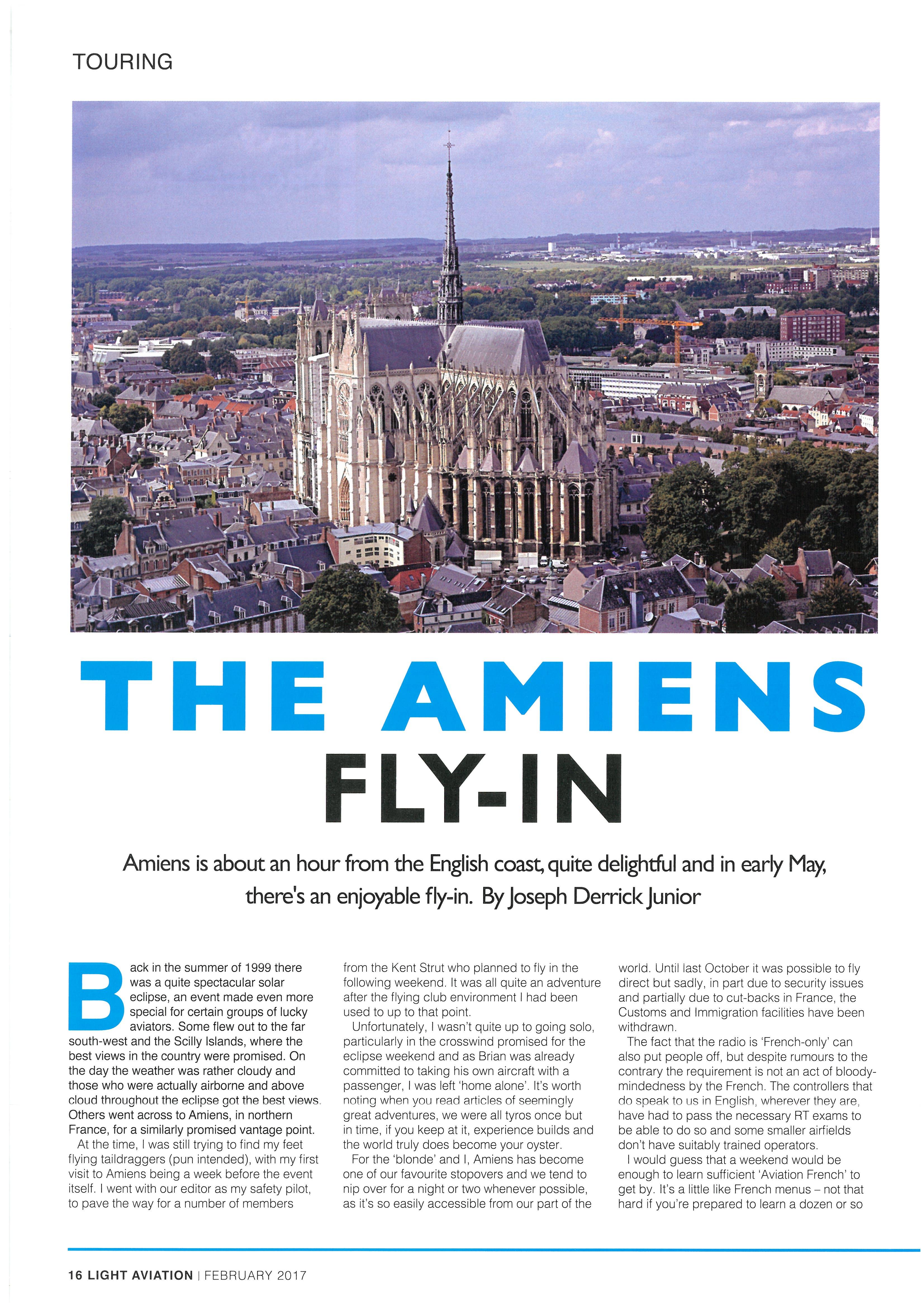
(Main)Built in the 13th century, Amiens cathedral remains the tallest completed cathedral in France, a magnificent building inside and out.
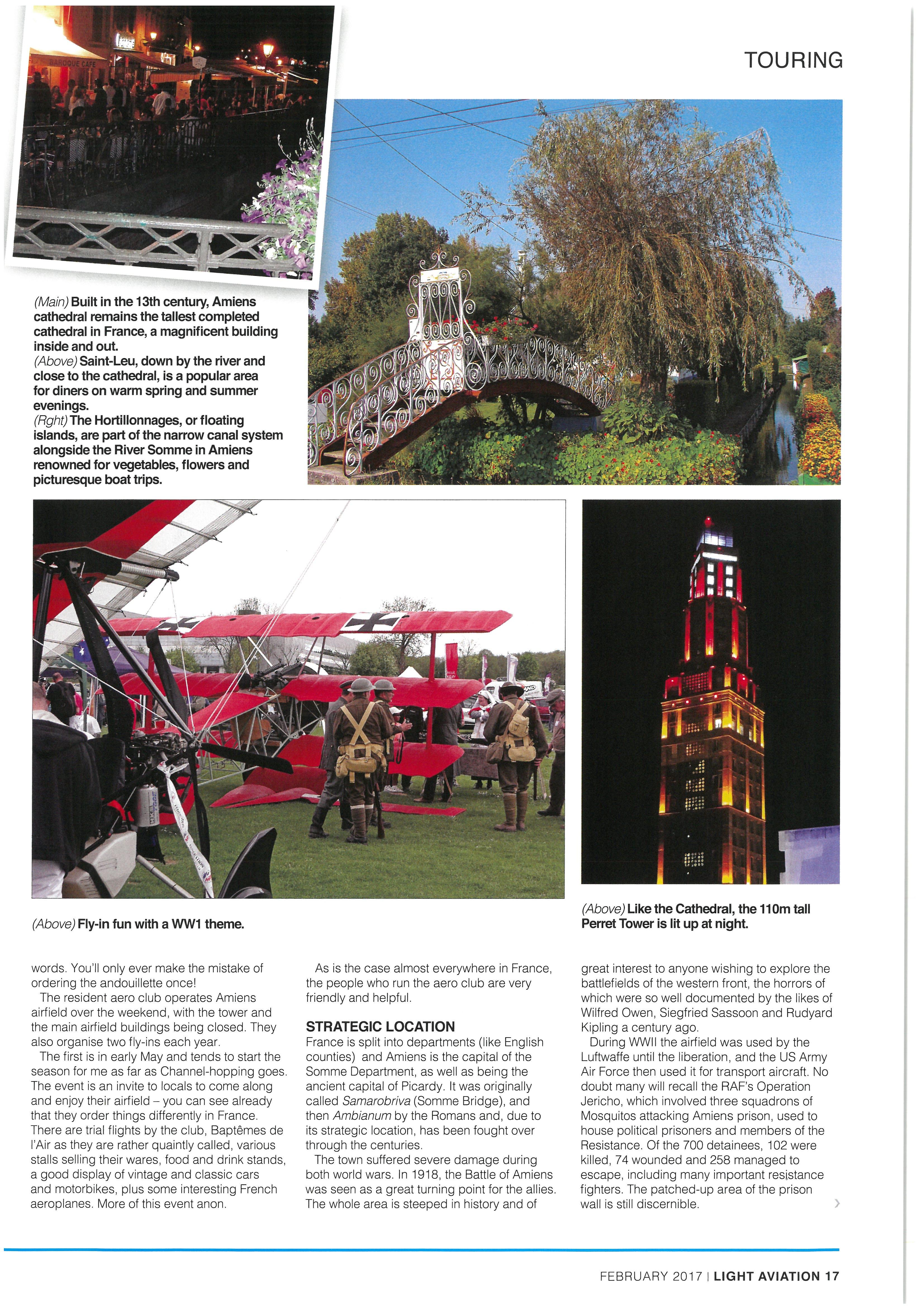
(Above)Saint-Leu, down bythe river and close to the cathedral, is a popular area for diners on warm spring and summer evenings.
(Rght)The Hortillonnages, or floating islands, are part of the narrowcanal system alongside the River Somme in Amiens renowned for vegetables, flowers and picturesque boat trips.
bh (Above)Fly-infun with aWW1theme.
words. You'll only ever make the mistake of ordering the andouillette once!
The resident aero club operates Amiens airfield over the weekend, with the tower and the main airfield buildings being closed. They also organise two fly-ins each year.
The first is in early May and tends to start the season for me as faras Channel-hopping goes. The event is an invite to locals to come along and enjoy their airfield you can see already that they order things differently in France.
There are trial flights by the club, Baptémes de Air as they are rather quaintly called, various stalls selling their wares, food and drink stands, a good display of vintage and classic cars and motorbikes, plus some interesting French aeroplanes. More of this event anon.
As is the case almost everywhere in France, the people who run the aero club are very friendly and helpful.
STRATEGIC LOCATION
France is split into departments (like English counties) and Amiens is the capital of the Somme Department, as well as being the ancient capital of Picardy. It was originally called Samarobriva (Somme Bridge), and then Ambianum by the Romans and, due to its strategic location, has been fought over through the centuries.
The town suffered severe damage during both world wars. In 1918, the Battle of Amiens was seen as a great turning point for the allies. The whole area is steeped in history and of
great interest to anyone wishing to explore the battlefields of the western front, the horrors of which were so well documented by the likes of Wilfred Owen, Siegfried Sassoon and Rudyard Kipling a century ago.
During WWII the airfield was used by the Luftwaffe until the liberation, and the US Army Air Force then used it for transport aircraft. No doubt many will recall the RAF’s Operation Jericho, which involved three squadrons of Mosquitos attacking Amiens prison, used to house political prisoners and members of the Resistance. Of the 700 detainees, 102 were killed, 74 wounded and 258 managed to escape, including many important resistance fighters. The patched-up area of the prison wall is still discernible.
(Above) Like the Cathedral, the 110m tall Perret Tower is lit up at night.
TOURING
By chance, around the same period, further up near the coast one of the aero club member's father was playing in afield as a small boy and witnessed an American bomber crash-land and the capture of its crew by the Germans. The crew all survived except one, who was later found to have jumped out of the aircraft before it made contact with terra firma. Years later, with the help of the internet, they managed to trace not only the aircraft, but also the co-pilot, who was the last surviving crew member. The town provided funding and invited him and his wife for a holiday and an emotional celebration in a touching show of gratitude.
As far as tourist attractions go, a visit to the Hortillonnages (floating gardens) in one of the ‘barques a cornet’ (special boats) is a very pleasant way to explore the ‘rieux’ (small canals) that are prevalent in this part of the region. The vegetables and flowers that are cultivated there are sold by the waterway, in the Saint-Leu area, on a Saturday morning. On the third Sunday in June the vendors dress in traditional costume and sell their wares from theirboatsintime-honouredfashion,anevent | have thus far unfortunately missed.
ART DECO
Jules Verne wrote some of his most famous works in Amiens and his house is open to the public as a museum. The Notre Dame cathedral, in the centre, is a UNESCO world heritage site and its exterior is spectacularly lit up on summer evenings. Every detail is brought out in different colours, from the lines of kings, their robes, crowns, to the gargoyles truly amazing!
Also worthy of mention are the distinctive and art deco style train station and the Tour Perret, a 110-metre skyscraper, both designed by Auguste Perret and completed in 1955. On a clear day the tower and the cathedral are the first things you'll spot when flying-in. If you can’t see them, the viz must be bad!
For food go down to the Saint-Leu area where the restaurants are lined up along the water’s edge. Expect to pay around €30 a head including wine. Try ‘ficelle picarde’, a local specialty as a starter it’s a kind of rolled, stuffed pancake. If you want a specific restaurant or a table by the water's edge, booking is essential in season. If you’re easygoing, one of eateries always seems to have space.
Getting to Amiens these days will involve clearing customs elsewhere. Le Touquet or Calais (less expensive) are the obvious choices, and then it’s only a 30-40 minutes light to Amiens. Filefor one and have the other as a diversion. If it is windy, at least one of them will be reasonably into wind. Amiens has along tarmac runway and a very wide grass one, usefulfor offsetting a crosswind. The anding fee is €8 during the week and free at weekends, with fuel available, except, of course at lunchtimes. There is a restaurant at the field open Monday -Friday). I’ve not eaten there, yet, So cannot vouch for it.
About 10 minutes walk away (turn right on he main road that runs down the side of the airfield, then straight across the roundabout), you'll find the Glisy Commercial Centre, with several hotels. Rooms start from about €35 a night, pre-booked. There’s a huge supermarket, a myriad of shops and a choice of restaurants. Personally, unless | arrive late or need to go early, | prefer to take the bus into town for €1.20. A Not or No will take you to the station
in the centre; the bus stop is opposite the supermarket. Taxis cost about €20, with phone numbers listed outside the aero club. In town hotel prices start at around €45.
POPULAR WITH BRITS
Now, back to the May fly-in. | stumbled on it by chance about 10 years ago and my Jodel was the only G-registered attendee. In recent years it has become quite popular with the Brits, with more than 20 aircraft from the UK last year. It was also good to meet-up again with Guy Valvekens, organiser of the Schaffen-Diest fly-in in Belgium (the subject of a future article).
A group of 14 of us went out for dinner, which always makes for a pleasant evening, and serves as a great example of what our kind of flying has to offer. Regardless of whether you know anyone beforehand or not, by the time you head home you'll have a whole bunch of new friends.
This year the event takes place on Friday, Saturday and Sunday, 12-14 May. For those who would like to attend the fly-in or would likeabitmoreinfo,dropmealine. Ifyou’re comfortable getting there on your own and would like to join us, you'll be most welcome. Conversely if you need a bit of help or want to fly in loose formation, we can arrange that too. | and members of the Kent Strut will be on hand to help with the formalities and to
shepherd across anybody that needs further reassurance and help, although | must stress that this is not intended to be a major crossChannel training weekend.
The plan is that we fly over from Rochester to Calais on Saturday, departing at around 13.00 hours local UK. If you arrive on Friday and want to stay overnight in Rochester, we will do our best to arrange lifts to and from hotels.
On Saturday there will be people to help both at the UK end as well as on the French side at Calais and Amiens. Return to UK will be on Sunday or, for those who wish, Monday (which is when | plan to return). Each evening we will have a meal together in the Saint-Leu area of Amiens town. If you can’t fly across, you'll be just as welcome if you come by car. If you’re passionate about flying and France you will certainly be amongst friends.
| know Brian Hope intends coming along to help out, although he speaks French like somebody who wished they'd paid more attention at school, and he'll be coming by car or motorbike so you won't be alone.
Next month: Joseph Derrick Junior is off to St Mary’s on the Isles of Scilly. Contact him at: stoneacreaviation@yahoo.co.uk
C1TSALhe 7" Ja AS
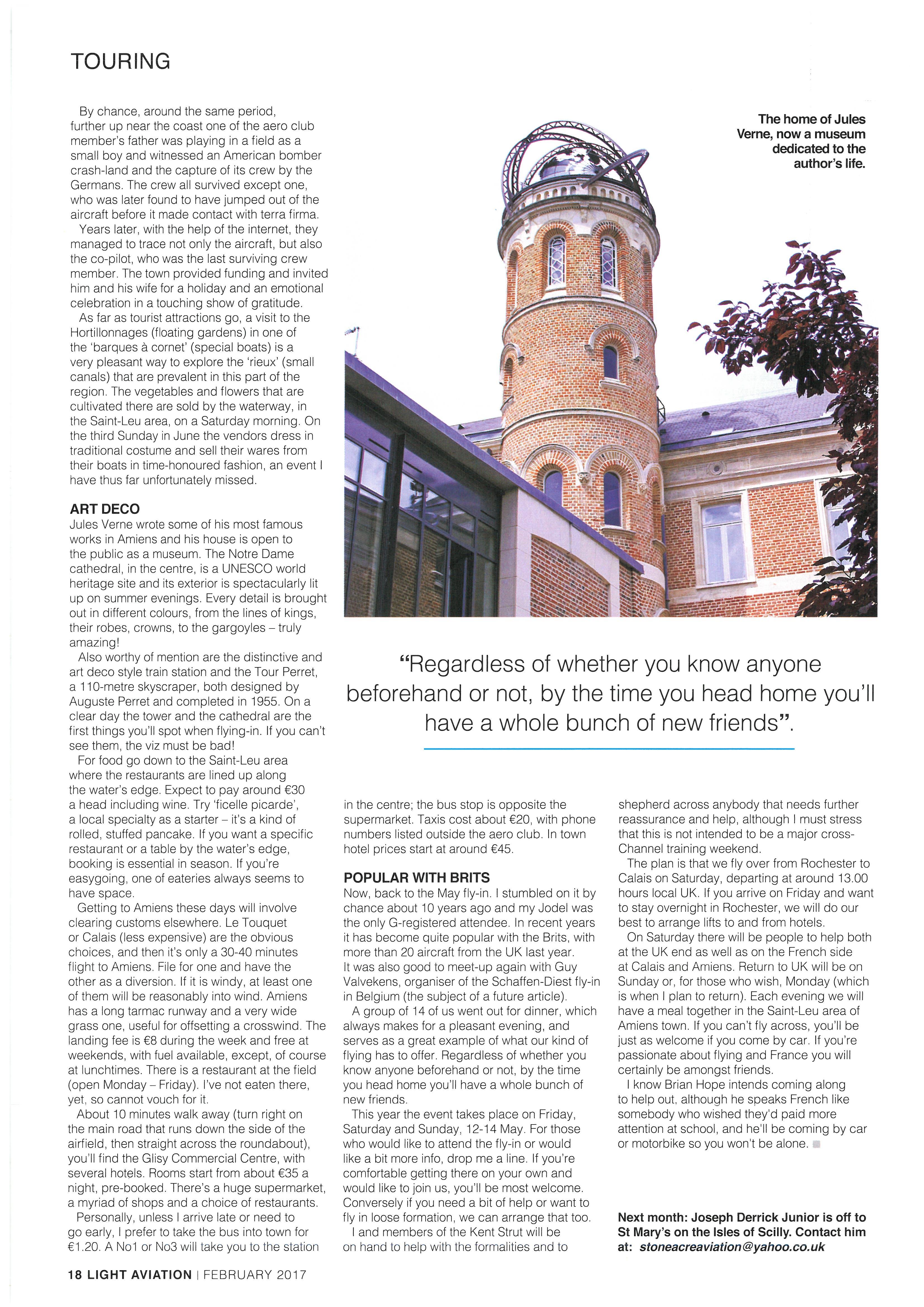
The home of Jules Verne, now a dedicatedmuseum to the author’s life.
ast month | discussed aircraft maintenance planning and the different approaches that aircraft owners adopt to fulfil the requirement on every LAA aircraft’s Permit to Flythat the aircraft can only be flown if the aircraft is maintained in an airworthy state. This month we explore how to go about creating a tailored maintenance schedule that takes into account the features of the particular aircraft, its usage, age and the depth of the owner's pocket.
HOW DO! START TO PUT TOGETHER A TAILORED MAINTENANCE SCHEDULE?
Many aeroplane types are provided with maintenance schedules by the manufacturer, which form an obvious first choice as the starting point for your tailored maintenance schedule. After all, no-one Knows more about your aircraft and how to look after it than the manufacturer, right?
Well, probably. Ifyou do use a manufacturer's schedule, we’d suggest transforming it into a Word document or spreadsheet so that you can easily edit itto your own requirements. If there is no manufacturer's schedule available, a good alternative isthe LAA’s generic maintenance schedule, which you can download as a Word document from the LAA website, for just this reason.
NOW, GET TAILORING
First of all, you can probably exercise your ‘delete’ button by knocking out maintenance items relating to any equipment that your aircraft isn’t fitted with. If your starting point is the LAA generic schedule and your aircraft is a fixed-gear job with a fixed-pitch prop, you'll find there’s plenty of line items that you can get rid of because the things they relate to simply aren't fitted.
Then, while the schedule is in an unembellished bare-bones form, sanity-check it line by line. Does every instruction really make sense? Some manufacturers seem to regard the maintenance schedule as something of an afterthought that they've had to do to tick a box, but have put scant effort into the detail. Whether this is an attempt to soft-pedal the actual amount of maintenance work that’s
needed to keep their product airworthy is often hard to say.
The periodicity of the various maintenance items may have been devised with a particular type of utilisation in mind, for example typical club use where it’s flying every day, which may be inappropriate if applied to a private aircraft with flies much more rarely.
One manufacturer’s schedule suggested that the tailplane of their popular kitplane needs to be removed only every 500 hours’ flying to check the mountings for signs of issues developing. With the typical sole-owned kitplane averaging less than 50 hours flying a
year that meant that the metal parts, made of a highly corrodible alloy, would go more than ten years between a good inspection opportunity. Of course, it’s a matter of judgement and you don’t want to increase the risk of damage through too frequent intervention, but we’d suggest that for a low utilisation aircraft, this particular check be scheduled at every 500 hours or three years, whichever comes sooner. Or, if removing and re-fitting the tailplane was a very straightforward job, consider bringing it in as an annual task.
Next, incorporate the maintenance requirements of the things that are fitted,
ENGINEERING
but perhaps weren't envisaged by the person who wrote the original schedule. You may have a different engine and propeller combination, for example, so you'll have to check the maintenance schedules provided by your engine and prop makers and substitute those into your aircraft's developing schedule. If your aircraft type was designed for a Rotax engine, for example, but yours has a custom Jabiru engine installation, you can go to the Jabiru website, pull up their engine maintenance schedule and cut and paste it into your tailored schedule, substituting for the Rotax-related bits. The same goes for magnetos, fuel pumps, alternators, constant speed units etc.
APPROPRIATE MAINTENANCE FOR SPECIAL FEATURES
You may have extras such as a ballistic chute that has a required schedule for its re-packing, or an air bottle for a starter system that needs a regular pressure test. Remember that some jobs may need doing more frequently than the 50 hour/six-monthly check, others may
“Remember that than the check”
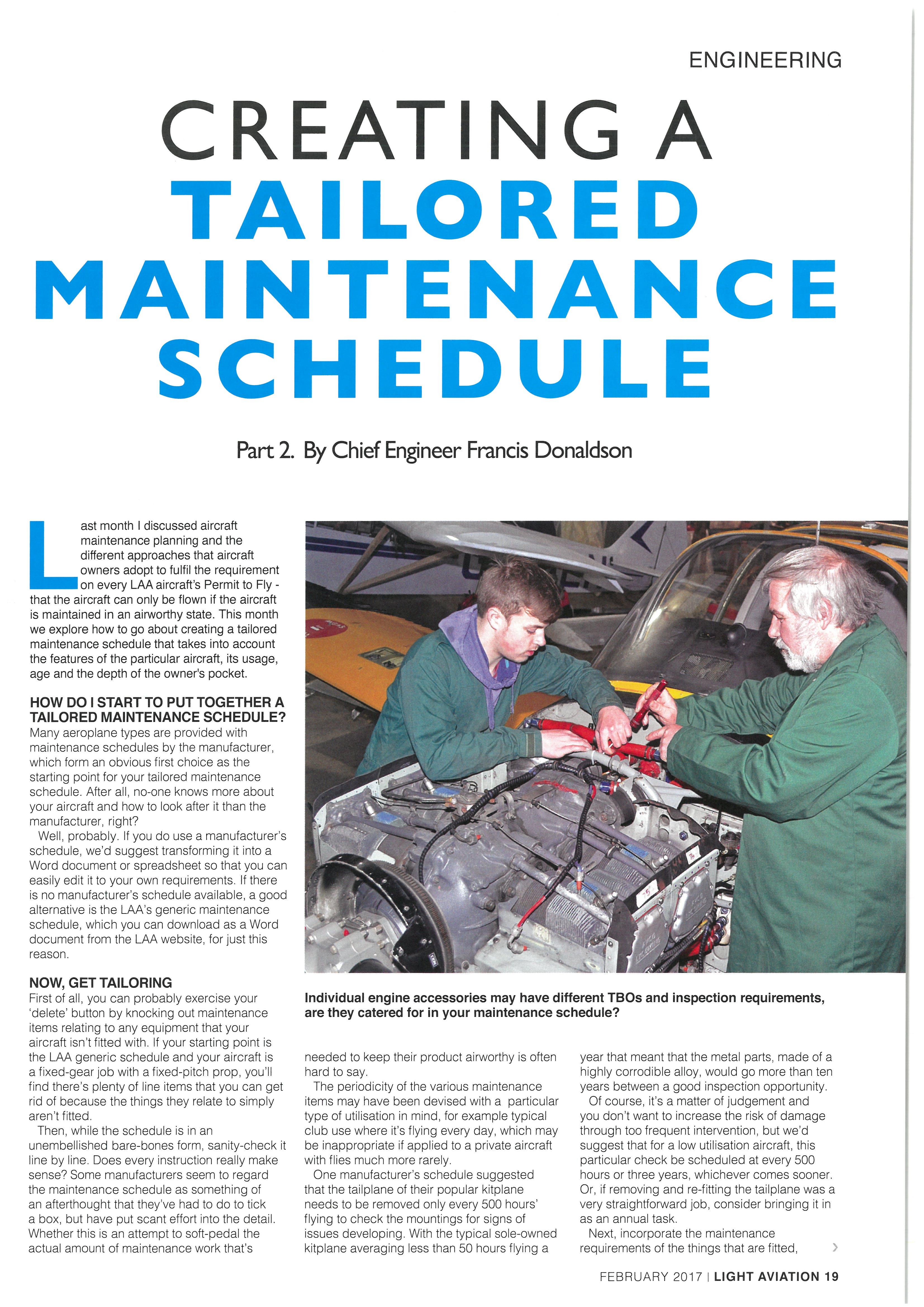
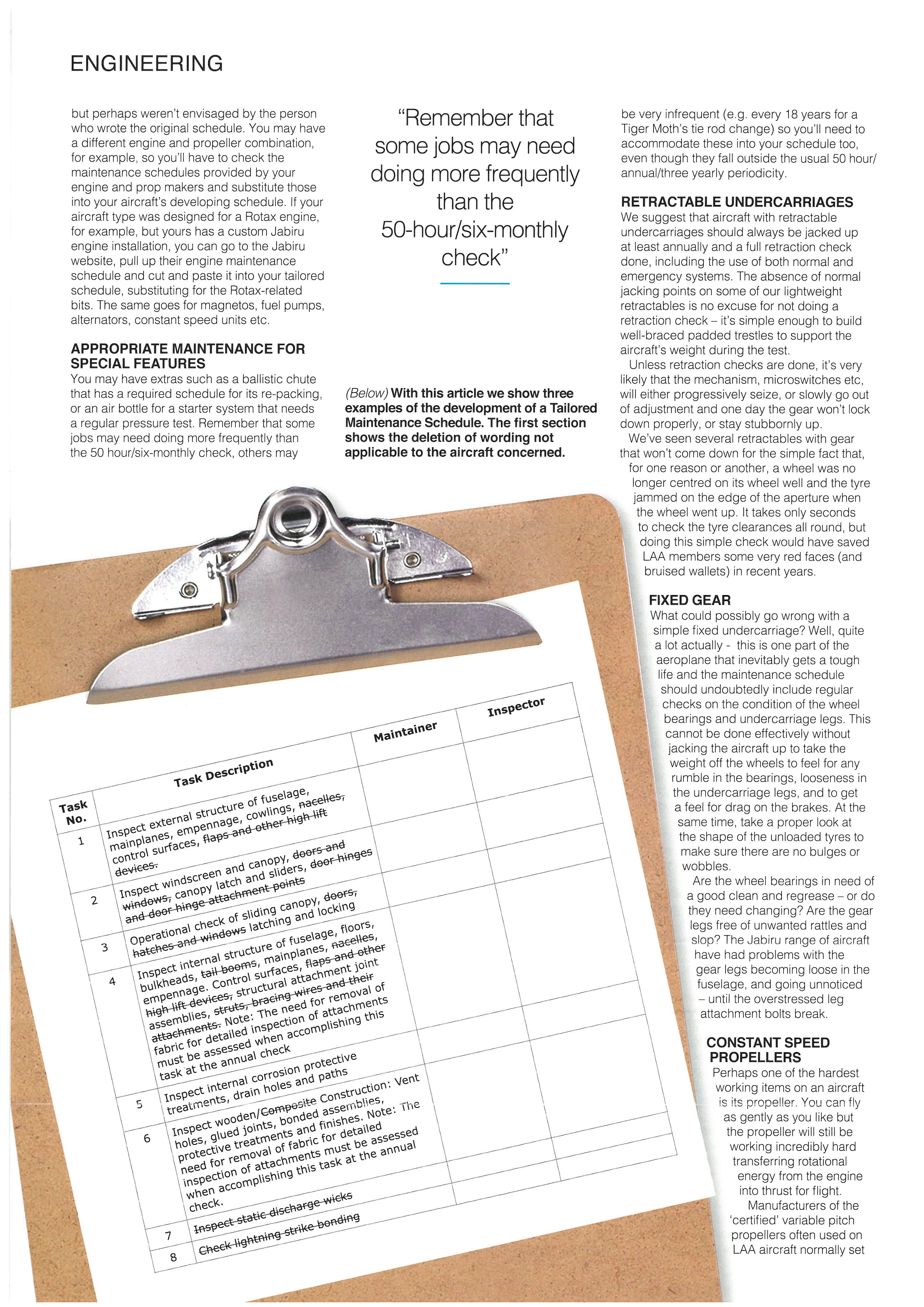
(Below)With this article we show three examples of the development of a Tailored Maintenance Schedule. The first section shows the deletion of wording not applicable to the aircraft concerned.
be very infrequent (e.g. every 18years for a Tiger Moth’s tie rod change) so you'll need to accommodate these into your schedule too, even though they fall outside the usual 50 hour/ annual/three yearly periodicity.
RETRACTABLE UNDERCARRIAGES
We suggest that aircraft with retractable undercarriages should always be jacked up atleastannuallyanda fullretractioncheck done, including the use of both normal and emergency systems. The absence of normal jacking points on some of our lightweight retractables is no excuse for not doing a retractioncheckit’s simpleenoughtobuild well-braced padded trestles to support the aircraft's weight during the test.
Unless retraction checks are done, it’s very likely that the mechanism, microswitches etc, will either progressively seize, or slowly go out of adjustment and one day the gear won't lock down properly, or stay stubbornly up. We've seen several retractables with gear that won't come down for the simple fact that, for one reason or another, a wheel was no longer centred on its wheel well and the tyre jammed on the edge of the aperture when the wheel went up. It takes only seconds to check the tyre clearances all round, but doing this simple check would have saved LAA members some very red faces (and bruised wallets) in recent years.
FIXED GEAR
What could possibly go wrong with a simple fixed undercarriage? Well, quite a lot actually - this is one part of the aeroplane that inevitably gets a tough life and the maintenance schedule should undoubtedly include regular checks on the condition of the wheel bearings and undercarriage legs. This cannot be done effectively without jacking the aircraft up to take the weight off the wheels to feel for any rumble in the bearings, looseness in the undercarriage legs, and to get a feel for drag on the brakes. At the same time, take a proper look at the shape of the unloaded tyres to make sure there are no bulges or wobbles.
Are the wheel bearings in need of a good clean and regrease or do they need changing? Are the gear legs free of unwanted rattles and slop? The Jabiru range of aircraft have had problems with the gear legs becoming loose in the fuselage, and going unnoticed until the overstressed leg attachment bolts break.
CONSTANT SPEED PROPELLERS
Perhaps one of the hardest working items on an aircraft is Its propeller. You can fly as gently as you like but the propeller will still be working incredibly hard transferring rotational energy from the engine into thrust for flight. Manufacturers of the ‘certified’ variable pitch propellers often used on LAA aircraft normally set \
their propeller overhaul requirements in terms of operating hours and calendar time. For most currently used propellers the TBO (time between overhaul) is somewhere between 1,000 and 2,000 hours, determined by wear (all moving parts will eventually wear out and, eventually, stop functioning properly) and by fatigue considerations.
The second overhaul requirement relates to calendar time; note that this calendar time limit doesn’t relate to time ‘in service’ but simply to time on the planet. Issues relating to time concern problems of corrosion (often on components hidden inside the hub) and a general degradation of flexible seals and of the oils and greases used to lubricate the unit.
Normally, manufacturers design the propellers to allow their calendar life limits roughly to coincide with the anticipated using up of the permitted operating hours, based on an expected annual usage rate. The typical six yearly calendar life for these props, so contentious among LAA owners, is therefore no particular problem for operators doing 300 hours a year, but this is roughly ten times the typical annual utilisation for an LAA aircraft, which inevitably run up against the propeller’s calendar limit first.
Because so many VP propellers used on LAA aircraft get caught in a situation where they've only flown-off a couple of hundred hours at the six year ‘calendar overhaul’ point, the LAA has been working with the propeller manufacturers over the last few years to come up with an LAA inspection scheme which is more appropriate for normal LAA usage patterns, which emphasises the calendar age related issues over those of wear and fatigue.
We're trialling an inspection programme right now and call it the LAA Low hours Propeller Inspection Protocol, or LPIPfor short.We'llbeexplainingthisinalittle more detail over the coming months and we hope that a more ‘appropriate’ inspection routine for propellers will reduce the running costs for a certified VP prop, while preserving safety.
Of course, scheduled propeller maintenance in-between overhauls must be carried out in accordance with the maker’s instructions and these requirements vary considerably between propeller types (even between models). Inevitably these include removing the spinner and conducting a close visual inspection of the whole propeller, checking for signs of cracks, leaking grease, excessive blade free-play and other signs of distress. If you're operating a VP propeller, then be sure to have a copy of the instruction and service manual to hand and add the routine maintenance points into your tailored maintenance schedule.
also often include the need which you will need to schedule”
SERVICE INFORMATION
You'll need to go through the requirements of any ADs, MPDs, LAA AILs and manufacturers’ service bulletins to find out those items with reoccurring maintenance actions or inspections which can be included in your tailored schedule.
To see what applies to your aircraft type, check the LAA Type Acceptance Data Sheets (TADS)and past copies of Safety Spot,which you can download off the LAA website. Remember that actions called for by ADs are legally mandatory for ex-certified aircraft and mandated by LAA policy for other types, as are AlLs that are so classified.
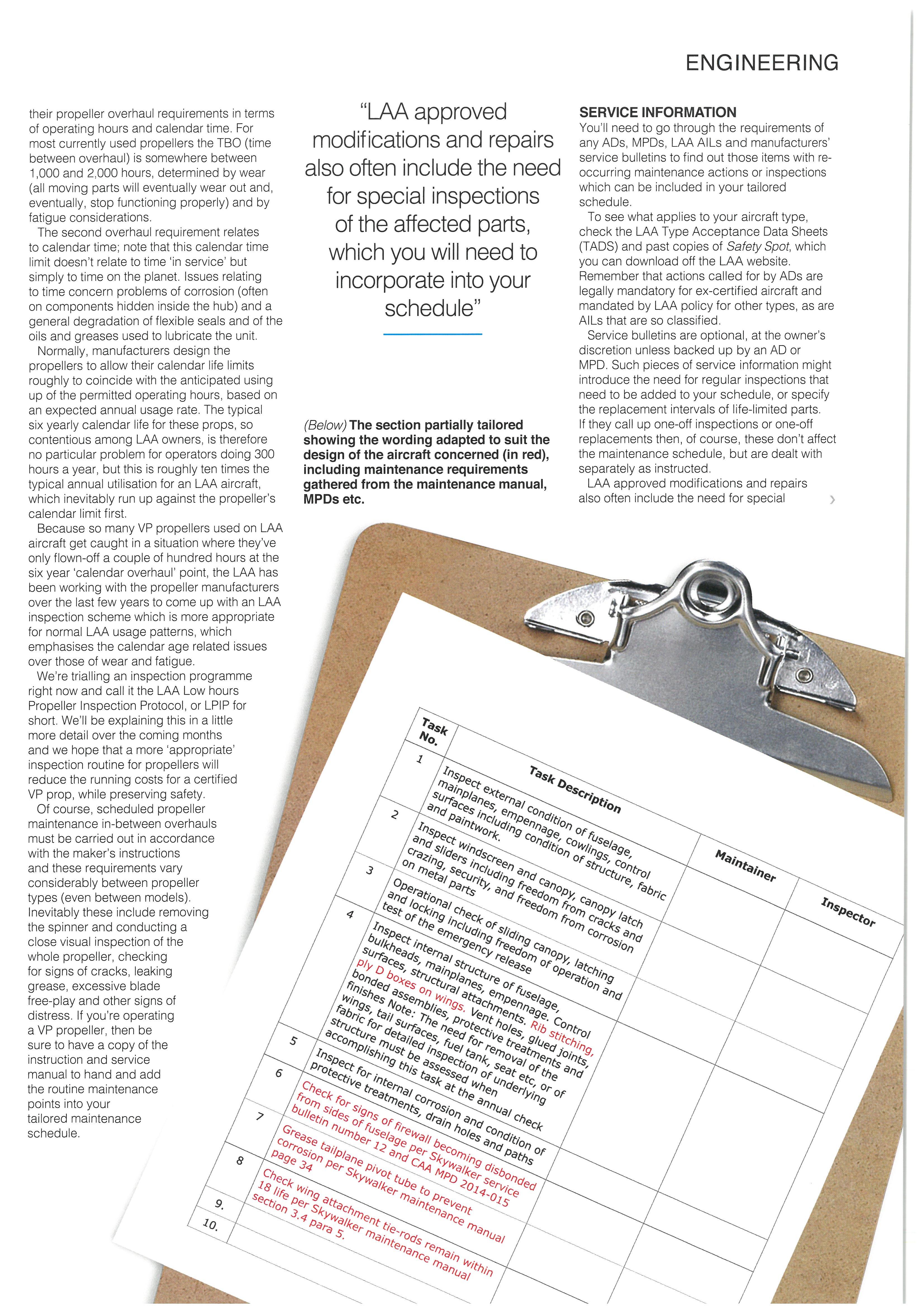
(Below)The section partially tailored showing the wording adapted to suit the design of the aircraft concerned (in red), including maintenance requirements gathered from the maintenance manual, MPDs etc.
Service bulletins are optional, at the owner’s discretion unless backed up by an AD or MPD. Such pieces of service information might introduce the need for regular inspections that need to be added to your schedule, or specify the replacement intervals of life-limited parts. If they call up one-off inspections or one-off replacements then, of course, these don’t affect the maintenance schedule, but are dealt with separately as instructed.
LAA approved modifications and repairs also often include the need for special ed
ENGINEERING
inspections of the affected parts, which you will need to incorporate into your schedule. So, if your aircraft contains LAA mods, look out the mod approval sheets from LAA and check the section containing instructions for continued airworthiness. Not sure if your aircraft has LAA mods or not? Owners can check this out online using the member’s section of the LAA website.
Nowadays most such service information can be sourced from the web, or via the links on the maintenance pages of the LAA website. When finding MPDs, remember that while most MPDs are contained in the CAA’s CAP 661, the most recent ones are listed separately.
LOW OR HIGH UTILISATION
As in the kitplane tailplane example above, aircraft with low utilisation may need the maintenance schedule tailored by introducing calendar-based inspection intervals on items previously specified based on hours flown, to put a ‘back-stop’ on the length of time between doing these checks.
This applies particularly to issues such as corrosion, rot, cracking tyres and so on, which are largely time dependent, but not for wear, cracking etc, which come about due to usage rather than storage. You should always consider bringing the oil change interval onto a calendar basis, at least as a backstop, rather than leaving the same oil in year on year waiting to reach its 50-hour point. An extra oil change or two will be a lot cheaper than a new camshaft and a set of cam followers.
Conversely, for aircraft with high utilisation,
"Parts may be of unknown have been involved in all sorts of misadventures in a
and particularly, those subjected to an inordinately punishing take-off and landing cycle (such as glider tugs), you may need to raise the frequency of inspections associated with high wear items such as the undercarriage and its mountings, which will take quite a beating, especially if operated off a rough field. Glider tugs have more than the usual amount of wear and tear on the undercarriage because of the much longer take-off runs involved with a glider strung on the back.
AGED ITEMS
If the aircraft is ancient, or embodies ancient parts, then you may want to increase the frequency of checks because the design or manufacture is questionable, or because many of the parts may be approaching the ends of their useful lives. Parts may be of unknown history and therefore may have been involved in all sorts of misadventures in a previous life. You might want to change the inspection he
interval from a 50-hour cycle to a ten or 20 hour cycle, for example. Some of the most ancient engines in the LAA fleet, the rotaries, have an overhaul life of about 20 hours and both they, and the airframes that they attach to, are given a very thorough check after every few sorties.
ON CONDITION ENGINES
If the engine is operating ‘on condition’ past its TBO, or is approaching TBO, then it’s particularly important to monitor its condition (oil pressures, compressions, max rpm etc.) so that any deteriorating trend can be spotted before the engine enters a terminal decline, and the engine withdrawn from service before itbecomes a highrisk.Inthiscasethetailored maintenance schedule should include prompts for regularly recording of this data, and ideally provide a format for recording the numbers that allow trends to be easily checked.
NEW THINGS CAN GO WRONG TOO
Conversely, with a brand new homebuilt or a totally rebuilt vintage aircraft, the first 50 or 100 hours’ use may well throw up ‘initial build’ and ‘infant mortality’ problems (vibration-fatigued brackets, cracked baffles, cowling hot-spots and wear points etc) which will need sorting out before the aircraft can settle into its most reliable mid-life operating phase. If the aircraft is a prototype or highly modified one, then it will be even more likely to need attention during its early days, for no new designs work exactly right straight from the drawing board. With any newly built aircraft you
should consider reducing the time between inspections during its first few seasons, while all these youthful problems are emerging.
HOW THE AIRCRAFT IS STORED
Clearly, if your aircraft lives outdoors then it will be much more likely to suffer the effects of weathering than if it is hangared, so consider altering your maintenance schedule to reflect this. These days it’s pretty much accepted that being parked out exposed to the sun, wind and rain is no place for a fabric-covered wooden aeroplane, but these conditions take their toll on metal and composite aeroplanes too. For an aircraft that lives outside, to minimise the impact your schedule should perhaps include more regular lubrication of hinges and joints, and closer attention to preserving the protective finishes than for an aircraft that's hangared, as well as, of course, greater attention to canopy and door seals to keep rainwater from pooling in the cockpit.
lf you use a cover, make sure it’s a quality item that won't be carried away by the first gale, or worse, flog itself half-undone against the paintwork and canopy and damage the surfaces. With an aircraft parked outside there's a greater benefit in plugging off the cowl intakes and exits,
exhausts etc. to keep out moisture and wildlife. There’s an Extra that I’ve several times seen at the local airfield parked outside, facing ‘out of wind’ causing its exquisite oversized control surfaces to slam from stop to stop in the breeze. Apart from the obvious action of encouraging securing the stick with the harness while parked, iffor some reason the risk of this abuse was inevitable, |’d want to tailor its
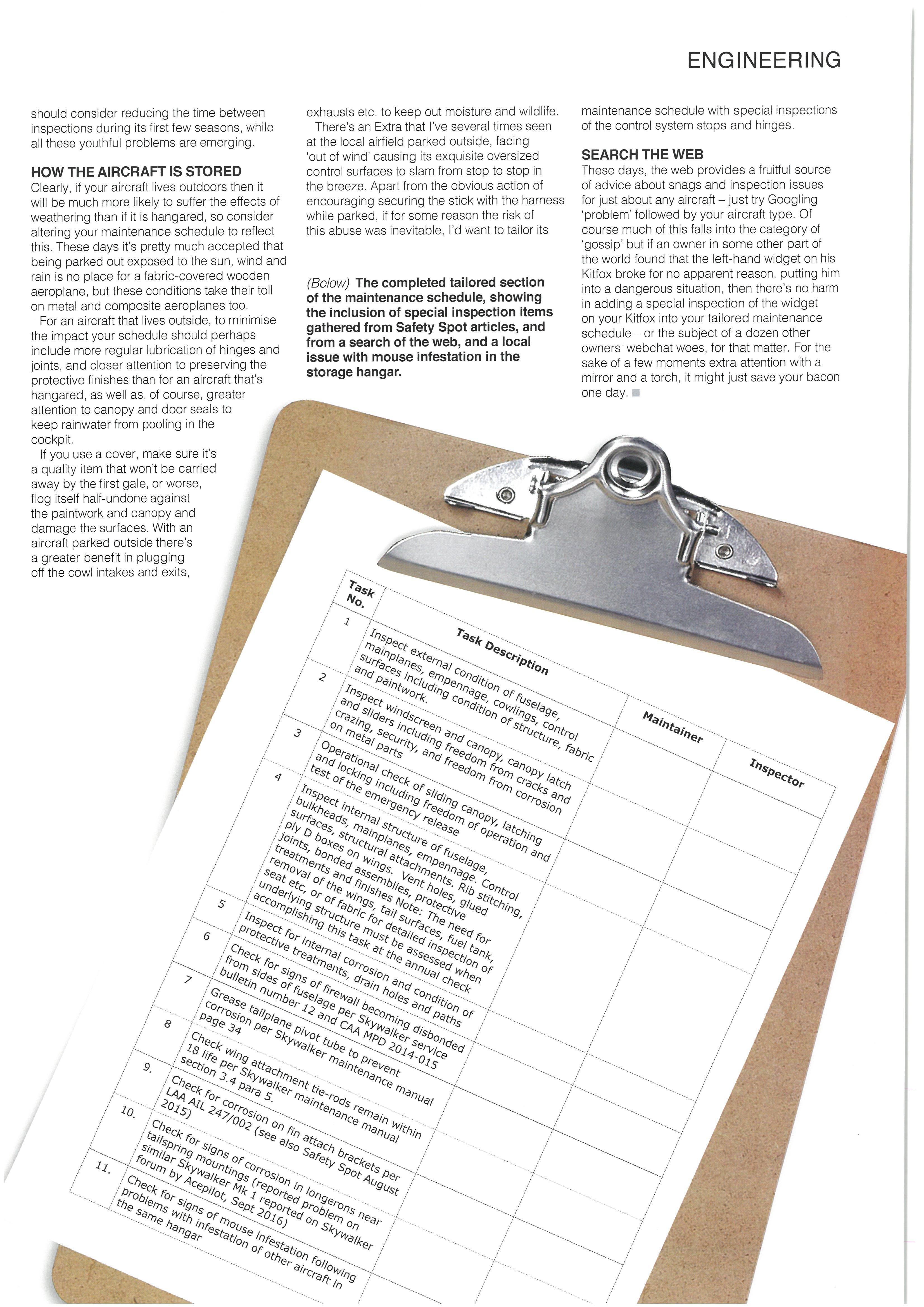
(Below) The completed tailored section of the maintenance schedule, showing the inclusion of special inspection items gathered from Safety Spot articles, and from a search of the web, and a local issue with mouse infestation in the storage hangar.
maintenance schedule with special inspections of the control system stops and hinges.
have had an open-ended invitation from Paul Hendry-Smith to visit The Light Aircraft Company (TLAC)for a while and in early November | finallymanagedtowendmy way up the M11 to Norfolk to discover a little more about this go-ahead small business that offers no fewer than three British-built aeroplanes spanning the microlight, light aircraft and SSDR categories.
If you think for a moment, that in itself is quite unique in the UK. Whilst we have a healthy number of agents importing kit aircraft from around the world, Paul’s enterprise is currently the only company in the country actively manufacturing kitsand complete British threeaxis aircraft.
My first surprise was that Paul only came into the aviation business as a result of buying the Sherwood Ranger project about ten years ago. Prior to that he had been a production engineer, both at home and abroad, latterly in the family business of industrial cleaning products and chemical manufacture. Paul had started to learn to fly at Swanton Morley as a teenager in 1975 and had just gone solo when his job took him overseas. He’d sort of fell out of love with flying anyway, an over-zealous
BY BRIAN HOPE
instructor having carried out some rather uncomfortable spinning exercises that had made him feel ill, so he was in no rush to get back to it.
Some years later he and his wife moved house and his wife discovered that a chap a couple of doors down, Robin Whitby, had a TigerMoth.InevitablyPaulwentfora ridein the Moth and re-found his passion for flying, he and Robin remaining firm friends ever since.
Before long Paul was off to Fresno in California for a four-week PPL course and, on his return, he bought a Gardan Horizon, in which he did a lot of flying.
Not long after Paul and his father Ivor acquired TLAC, the family sold the chemical business and, not wanting to stay idle, bought a small maintenance operation at Little Snoring. This not only gave them a base for the aircraft manufacturing business, it gave them a second income stream. Subsequently they bought a C152 and a C172 which he hires out tospreadhisbusinessinterestsalittle farther.
They now employ two licensed engineers, plus an unlicensed engineer in the maintenance business, and four in the manufacturing/aircraft building section,
including a full-time CNC machinist. The Sherwood Ranger project was acquired from Dudley Pattison, who had actually formed The Light Aircraft Company to develop the design into a saleable kit. Its designer, Russ Light, had sold a few fairly basic kits, indeed Paul had considered buying one, but sadly Russ passed away just as he was beginning to sell basic kits both at home and overseas.
Duds, who had already retired and was looking for something to keep him occupied, readily admits he took on more than he ever imagined with the Ranger, so he sold the complete package, including the company, to Paul and Ivor in 2007.
Paul then started the long road of productionising the Sherwood Ranger into a high-quality kit aircraft. The design utilises a riveted gusset and tube fuselage and tail, with alloy tube spars and plywood ribs for the wing. Part of the process in improving the aircraft has been to raise the all-up weight to 450kg from its original 3890kg,and to design some relatively minor changes to the airframe to give it +6/-4 g capability for solo aerobatic approval for the light aircraft variant at 370kg auw. There are structural differences between the
microlight and the aerobatic airframe, it is not simply a case of flying the former at a reduced all-up weight. The aerobatic clearance is imminent.
The degree of work involved and the financial investment required in getting to this stage should not be underestimated. Paul has installed several pieces of CNC equipment to manufacture the machined components in the design they even make their own wheel hubs and brake drums for example - and a CNC three-axis router to accurately cut out all the metal brackets and ply ribs, etc. Tube cutting and bending equipment was installed, plus high-end welding equipment, and of course many jigs and fixtures to build the various subassemblies.
buy large quantities to justify its production. The first kits were sold in 2009 and subsequently the company has acquired the necessary CAA approvals to manufacture and build complete, ready to fly microlight versions of the Sherwood Ranger. This will allow the aircrafttobeusedasa trainerbyflightschools and for hire and reward, opening up new markets for the aircraft.
ESCAPADE
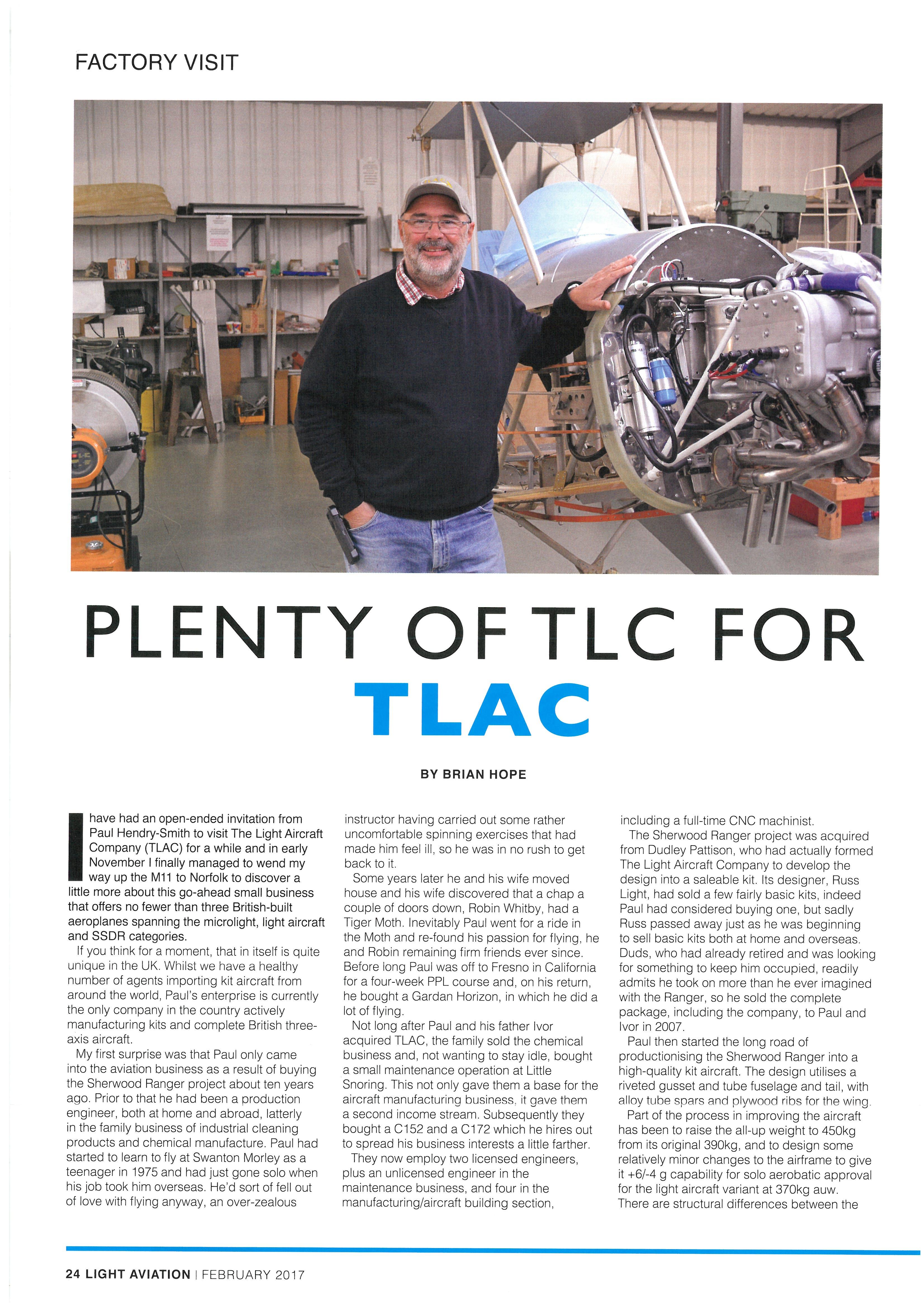
(Main) Paul with a D-Motor engined Sherwood Ranger. He is very enthusiastic about this Belgian side-valve engine which is very light and makes over 90hp.
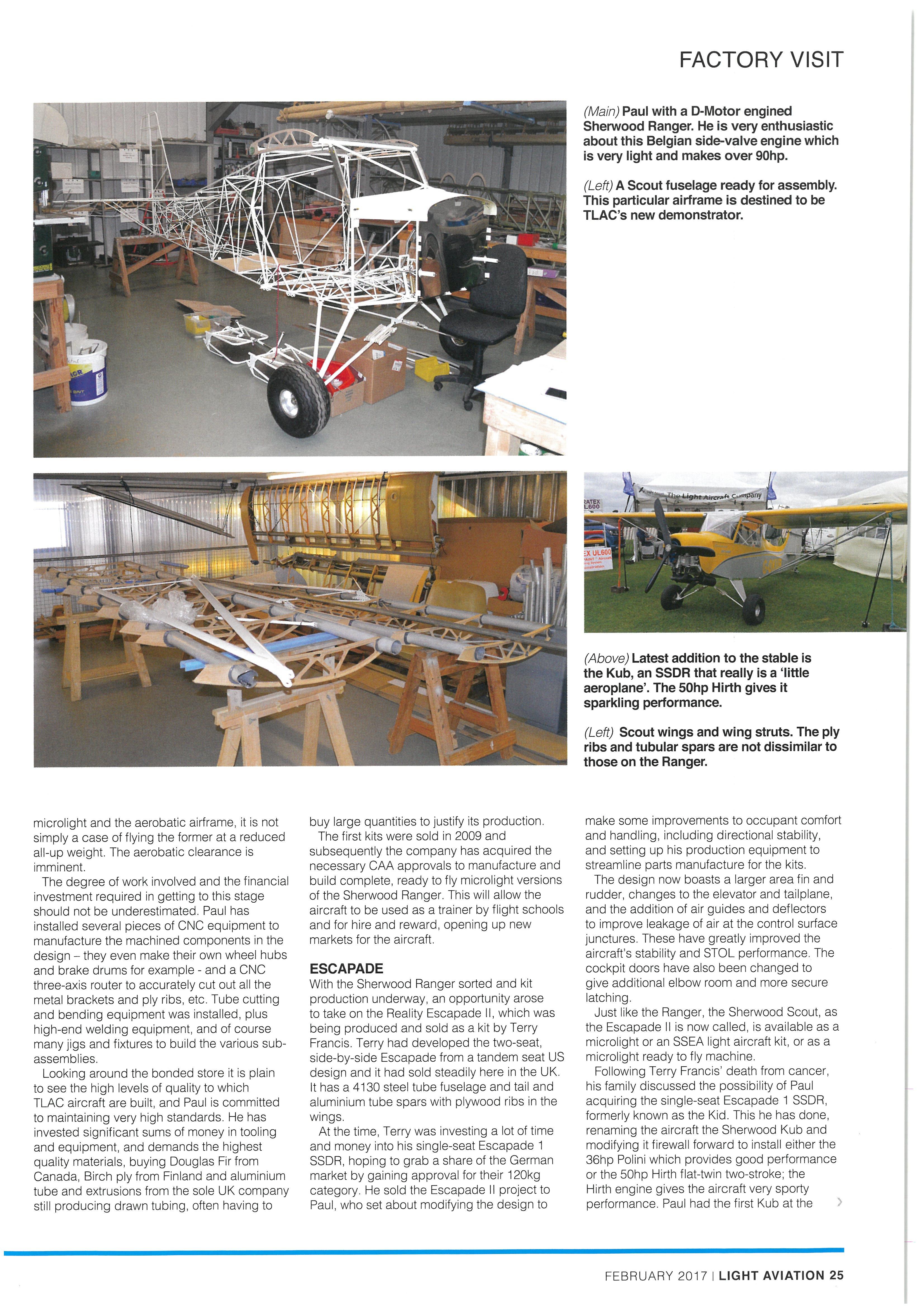
(Left)A Scout fuselage ready for assembly. This particular airframe is destined to be TLAC’s new demonstrator.
(Left) Scout wings and wing struts. The ply ribs and tubular spars are not dissimilar to those on the Ranger.
make some improvements to occupant comfort and handling, including directional stability, and setting up his production equipment to streamline parts manufacture for the kits.
The design now boasts a larger area fin and rudder, changes to the elevator and tailplane, and the addition of air guides and deflectors to improve leakage of air at the control surface junctures. These have greatly improved the aircraft's stability and STOL performance. The cockpit doors have also been changed to give additional elbow room and more secure latching.
Just like the Ranger, the Sherwood Scout, as the Escapade II is now called, is available as a microlight or an SSEA light aircraft kit, or as a microlight ready to fly machine.
Looking around the bonded store it is plain to see the high levels of quality to which TLAC aircraft are built, and Paul is committed to maintaining very high standards. He has invested significant sums of money in tooling and equipment, and demands the highest quality materials, buying Douglas Firfrom Canada, Birch ply from Finland and aluminium tube and extrusions from the sole UK company still producing drawn tubing, often having to
With the Sherwood Ranger sorted and kit production underway, an opportunity arose to take on the Reality Escapade II, which was being produced and sold as a kit by Terry Francis. Terry had developed the two-seat, side-by-side Escapade from a tandem seat US design and it had sold steadily here in the UK. It has a 4130 steel tube fuselage and tail and aluminium tube spars with plywood ribs in the wings. At the time, Terry was investing alot of time and money into his single-seat Escapade 1 SSDR, hoping to grab a share of the German market by gaining approval for their 120kg category. He sold the Escapade |! project to Paul, who set about modifying the design to
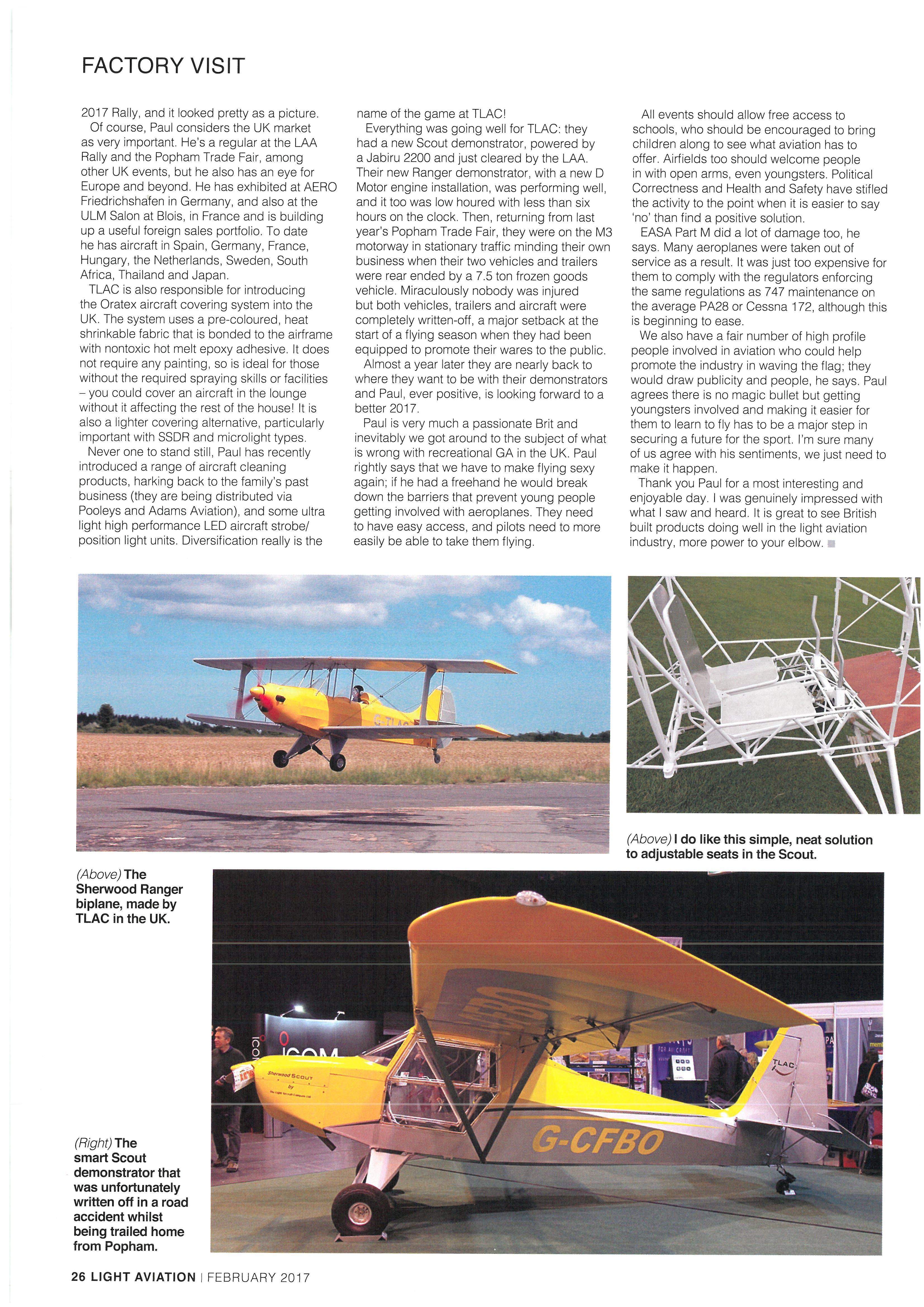
Following Terry Francis’ death from cancer, his family discussed the possibility of Paul acquiring the single-seat Escapade 1 SSDR, formerly known as the Kid. This he has done, renaming the aircraft the Sherwood Kub and modifying it firewall forward to install either the 36hp Polini which provides good performance or the 50hp Hirth flat-twin two-stroke; the Hirth engine gives the aircraft very sporty performance. Paul had the first Kub at the Sa SS SS aa]
FACTORY VISIT
2017 Rally, and it looked pretty as a picture. Of course, Paul considers the UK market as very important. He’s a regular at the LAA Rally and the Popham Trade Fair, among other UK events, but he also has an eye for Europe and beyond. He has exhibited at AERO Friedrichshafen in Germany, and also at the ULM Salon at Blois, in France and is building up a useful foreign sales portfolio. To date he has aircraft in Spain, Germany, France, Hungary, the Netherlands, Sweden, South Africa, Thailand and Japan.
TLAC is also responsible for introducing he Oratex aircraft covering system into the UK. The system uses a pre-coloured, heat shrinkable fabric that is bonded to the airframe with nontoxic hot melt epoxy adhesive. It does not require any painting, so is ideal for those without the required spraying skills or facilities you could cover an aircraft in the lounge without it affecting the rest of the house! It is also a lighter covering alternative, particularly important with SSDRand microlight types. Never one to stand still, Paul has recently introduced a range of aircraft cleaning products, harking back to the family’s past business (they are being distributed via Pooleys and Adams Aviation), and some ultra light high performance LED aircraft strobe/ position light units. Diversification really is the
name of the game at TLAC!
Everything was going well for TLAC: they had a new Scout demonstrator, powered by a Jabiru 2200 and just cleared by the LAA. Their new Ranger demonstrator, with a new D Motor engine installation, was performing well, and it too was low houred with less than six hours on the clock. Then, returning from last year's Popham Trade Fair, they were on the M3 motorway in stationary traffic minding their own business when their two vehicles and trailers were rear ended by a 7.5 ton frozen goods vehicle. Miraculously nobody was injured but both vehicles, trailers and aircraft were completely written-off, a major setback at the start of a flying season when they had been equipped to promote their wares to the public.
Almost a year later they are nearly back to where they want to be with their demonstrators and Paul, ever positive, is looking forward to a better 2017.
Paul is very much a passionate Brit and inevitably we got around to the subject of what is wrong with recreational GA in the UK. Paul rightly says that we have to make flying sexy again; if he had a freehand he would break down the barriers that prevent young people getting involved with aeroplanes. They need to have easy access, and pilots need to more easily be able to take them flying.
All events should allow free access to schools, who should be encouraged to bring children along to see what aviation has to offer. Airfields too should welcome people in with open arms, even youngsters. Political Correctness and Health and Safety have stifled the activity to the point when it is easier to say ‘no’ than find a positive solution.
EASAPartMdida lotofdamagetoo,he says. Many aeroplanes were taken out of service as a result. It was just too expensive for them to comply with the regulators enforcing the same regulations as 747 maintenance on the average PA28 or Cessna 172, although this is beginning to ease.
We also have a fair number of high profile people involved in aviation who could help promote the industry in waving the flag; they would draw publicity and people, he says. Paul agrees there is no magic bullet but getting youngsters involved and making it easier for them to learn to fly has to be a major step in securing a future for the sport. I'm sure many of us agree with his sentiments, we just need to make it happen.
Thank you Paul for a most interesting and enjoyable day. | was genuinely impressed with what | saw and heard. It is great to see British built products doing well in the light aviation industry, more power to your elbow.
(Above) The Sherwood Ranger biplane, made by TLAC in the UK.
(Right)The smart Scout demonstrator that was unfortunately written off in a road accident whilst being trailed home from Popham.
(Above) | do likethis simple, neat solution to adjustable seats in the Scout.
e are now able to gain approval for certain LAA
Permit aircraft to fly in IMC. It is very early days of course and the likelinood seems to be that quite a few types will not be able to gain approval. However, there is no reason why a pilot should not gain an IMC Rating (now an IR(R)) in a suitably equipped Permit aircraft in VMC conditions, plus it is interesting and useful to practice the art in VMC. Training for an IMC Rating is interesting in itself, | think it gives you more respect for the weather and your limitations, not less.
| have had my IMC Rating since 1986, when Harvey Britten was my instructor at Cranfield College of Aeronautics. An ex-RAF pilot and gliding enthusiast, he became the chief flying instructor there. The college had two Beagle Pups, which were built like Rolls-Royces and the 100hp version was powered by their version of the O-200. They had beautiful handling but terrible climb performance! Harvey’s training technique involved a hood and a rolled-up newspaper. When, under the hood and duress, | once forgot to select QFE and remained on the QNH but applied
a Decision Height as if had selected QFE, wham! went the newspaper on my head. “You plonker” he said, “you’ve failed! You would have flown us straight into the ground!” Well, that’s a lesson have never forgotten. He taught me how to do VDF approaches, where you repeatedly ask the approach facility for QDMs (bearings to fly to reach the station).
To home in, if you hear the bearings increasing, then you steer higher bearings until there is no change. Passing overhead is signified by the bearings becoming reciprocal. Then, you turn onto the correct outbound track whereupon you have to steer less if you hear more. Time the outbound track, do a procedure turn and then descend to a Decision Height (typically 600ft on the QFE for a non precision approach).
Some years later used this for real in an AX2000 microlight | was delivering to Nottingham one early morning with no GPS, when fog formed below me in a matter minutes. managed to get in to Kidlington where the runway was just visible, by requesting QDMs. In the 1990s | got a job doing composites research for British Aerospace at Cranfield, which allowed me to justify a share in an old Rallye MS885, G-BETO, for commuting,
and several times did IMC approaches into Cranfield. | can recall one occasion where moved my head down to reset the transponder and when looked up, the artificial horizon was tipped over and the airspeed heading rapidly for VNE! | remembered my training, levelled the wings and carried on, somewhat shaken. The group progressed from the Rallye to a stately Cessna F172, G-ASNW, which | flew happily for 20 years until saw an advertisementforaJodelDR1050project. | rebuilt G-AWWO, fitted it with a Rotax 912S engine and MGL Voyager avionics, with a back-up suction turn gyro, analogue ASI, ALT and compass. It was a dream to build and fly an aeroplane to my own specification, and | achieved it thanks to the LAA.
JAMES BOND
My EASAPPLrequires a biennial flight review of one hour with an instructor, and normally time it so do the IMC revalidation in the same flight. have done this a few times with Bob Cole, a highly-experienced test pilot and raconteur who instructs at Thruxton. To me, he has the appearance and manner of Roger
On one occasion, | needed spinning practice because | was flight testing the Flight Design CT2K, so we did 30 minutes of spinning in a Firefly followed by IMC flying, quite a challenge! asked Bob if he would mind doing my next IMC revalidation in the Jodel, which he was quite happy to do in VMC conditions with me foggled (goggles with frosted lenses except for a small section at the bottom enabling only the instrument panel to be seen).
As instrument flying has developed, the navigation aids available have required progressively less pilot interpretation and the pilot/machine interface has improved. VDF approaches, as have described, are quite hard work, requiring numbers and times to be translated into a mental map of what’s happening.TheADFisalittle betterbutstill taxing, especially when doing holds in a strong wind. Based on the medium wave, this aid is also affected by all the weird effects heard on an old transistor radio.
VHF based VOR, ILS and DME are all much more precise but then there is still the problem of receiving information from all the various instruments and combining it in your head. The classic technique is the ‘selective radial scan’
“Properinstructionand practice are vital,you have to be trained to disregard your balance organs, believe in the instruments and process the information from them”
where the AH is used as the master instrument from which you refer to the others and return.
Concentrate on one parameter too much, such as airspeed, and something else, say altitude, goes awry.
In good VMC conditions, the visual cues suppress those coming from the balance organs and, unfortunately, our ears are not equipped with gyroscopes, only semicircular canals which sense acceleration. You can be in a tight turn and be under the impression you are straight, or vice versa. If you move your head, you get very confusing balance messages, as did looking down at that transponder.So,properinstructionand practiceare vital,youhavetobetrainedto disregard your balance organs, believe in the instruments and process the information from them.
The MGL Voyager | use has a simulator which can be run on a PC. It reproduces all the appearance and behaviour of the real aircraft instrument, including working GPS maps. All the simulator data can be transferred to the real aircraft instrument, or vice versa, by an SD card. It can be linked to Microsoft Flight Simulator using software which can be downloaded from the MGL website. Properly
Now we have EFIS screens like MGL, Dynon and Garmin giving ‘synthetic vision’ backed up by a GPS map. This gives such good situational awareness that it might be tempting to try DIY IMC. Well, know someone who did it andbecamedisorientatedinCloud.Heisonly alive because he was lucky enough to have a ballistic parachute and the presence of mind to use it just in time.
Moore as James Bond. ae
e are now able to gain approval for certain LAA Permit aircraft to fly in IMC. It is very early days of course and the likelihood seems to be that quite a few types will not be able to gain approval. However, there is no reason why a pilot should not gain an IMC Rating (now an IR(R)) in a suitably equipped Permit aircraft in VMC conditions, plus it is interesting and useful to practice the art in VMC. Training for an IMC Rating is interesting in itself, | think it gives you more respect for the weather and your limitations, not less.
| have had my IMC Rating since 1986, when Harvey Britten was my instructor at Cranfield College of Aeronautics. An ex-RAF pilot and gliding enthusiast, he became the chief flying instructor there. The college had two Beagle Pups, which were built like Rolls-Royces and the 100hp version was powered by their version of the O-200. They had beautiful handling but terrible climb performance! Harvey's training technique involved a hood and a rolled-up newspaper. When, under the hood and duress, | once forgot to select QFE and remained on the QNH but applied
a Decision Height as if | had selected QFE, wham! went the newspaper on my head. “You plonker” he said, “you've failed! You would have flown us straight into the ground!” Well, that’s a lesson | have never forgotten.
He taught me how to do VDF approaches, where you repeatedly ask the approach facility for QDMs (bearings to fly to reach the station). To home in, if you hear the bearings increasing, then you steer higher bearings until there is no change. Passing overhead is signified by the bearings becoming reciprocal. Then, you turn onto the correct outbound track whereupon you have to steer less if you hear more. Time the outbound track, do a procedure turn and then descend to a Decision Height (typically 600ft on the QFE for a non precision approach).
Some years later | used this for real in an AX2000 microlight | was delivering to Nottingham one early morning with no GPS, when fog formed below me in a matter minutes. | managed to get in to Kidlington where the runway was just visible, by requesting QDMs.
In the 1990s | got a job doing composites research for British Aerospace at Cranfield, which allowed me to justify a share in an old Rallye MS885, G-BETO, for commuting,
and several times | did IMC approaches into Cranfield. | can recall one occasion where | moved my head down to reset the transponder and when | looked up, the artificial horizon was tipped over and the airspeed heading rapidly for VNE! | remembered my training, levelled the wings and carried on, somewhat shaken.
The group progressed from the Rallye to a stately Cessna F172, G-ASNW, which | flew happily for 20 years until | saw an advertisement for a Jodel DR1050 project. | rebuilt G-AWWO, fitted it with a Rotax 912S engine and MGL Voyager avionics, with a back-up suction turn gyro, analogue ASI, ALT and compass. It was a dream to build and fly an aeroplane to my own specification, and | achieved it thanks to the LAA.
JAMES BOND
My EASA PPL requires a biennial flight review of one hour with an instructor, and normally | time it so | do the IMC revalidation in the same flight. | have done this a few times with Bob Cole, a highly-experienced test pilot and raconteur who instructs at Thruxton. To me, he has the appearance and manner of Roger Moore as James Bond.
On one occasion, | needed spinning practice because | was flight testing the Flight Design CT2K, so we did 30 minutes of spinning in a Firefly followed by IMC flying, quite a challenge! | asked Bob if he would mind doing my next IMC revalidation in the Jodel, which he was quite happy to do in VMC conditions with me foggled (goggles with frosted lenses except for a small section at the bottom enabling only the instrument panel to be seen).
As instrument flying has developed, the navigation aids available have required progressively less pilot interpretation and the pilot/machine interface has improved. VDF approaches, as | have described, are quite hard work, requiring numbers and times to be translated into a mental map of what's happening.TheADFisalittle betterbutstill taxing, especially when doing holds in a strong wind. Based on the medium wave, this aid is also affected by all the weird effects heard on an old transistor radio.
VHF based VOR, ILS and DME are all much more precise but then there is still the problem of receiving information from all the various instruments and combining it in your head. The classic technique is the ‘selective radial scan’
have to be trained to organs, believe in the instruments and process the information from them”
where the AH is used as the master instrument from which you refer to the others and return. Concentrate on one parameter too much, such as airspeed, and something else, say altitude, goes awry.
Now we have EFIS screens like MGL, Dynon and Garmin giving ‘synthetic vision’ backed up by a GPS map. This gives such good situational awareness that it might be tempting to try DIY IMC. Well, | know someone who did it
and became disorientated in cloud. He is only alive because he was lucky enough to have a ballistic parachute and the presence of mind to use it just in time.
In good VMC conditions, the visual cues suppress those coming from the balance organs and, unfortunately, our ears are not equipped with gyroscopes, only semicircular canals which sense acceleration. You can be in a tight turn and be under the impression you are straight, or vice versa. If you move your head, you get very confusing balance messages, as | did looking down at that ransponder. So, proper instruction and practice are vital, you have to be trained to disregard your balance organs, believe in the instruments and process the information from hem.
The MGL Voyager | use has a simulator which can be run on a PC. It reproduces all he appearance and behaviour of the real aircraft instrument, including working GPS maps. All the simulator data can be transferred o the real aircraft instrument, or vice versa, by an SD card. It can be linked to Microsoft Flight Simulator using software which can be downloaded from the MGL website. Properly
StiatemasinteleNatVoyager
M 1 PC simulation 1. 1am flying a Cessna 172 on MS flight simulator linked to the MGL Odyssey simulator. | am showing two | windows so | can see both simulators working. | have left Thruxton EGHO and am heading north-east to my intercept point for a | GLSapproachto runway27atBurbagInternational.|amoff courseto therightandtheterrainis showingyellowas|amtoolow.
| 2 PC Simulation 2. Now | have reached the intercept point with the glide path and have turned onto the runway 27 heading and am following the GLS approach. | am slightly below the glidepath and lined up with the approach onto runway 27. The display is flashing ‘terrain’.
3 PC Simulation 3. Now | am at the runway 27 threshold and off to the left. It is much harder to fly the simulator accurately than the real thing. Only in my dreams is BB International smooth grey tarmac!
4 Reality 1. | have left Thruxton and am heading north towards the intercept point.
5 Reality 2. Here | have reached the intercept point and turned onto the runway heading, am above the glidepath and off to the right. The weather is getting worse!
6 Reality 3. 1am now on the glideslope, lined up with the approach. Burbag International runway 27 is directly on the nose.
7 Reality 4. On the runway, just after landing, the instrument shows a wonderful tarmac runway, though the Jodel prefers grass.
pei A
set up, you can ‘virtually’ fly around your local airfields or anywhere else in the world.
The MGL instrument reads a 'Navidat' file which contains all the navigation coordinates and runway data. By knowing the precise runway coordinates at each end, the instrument can display a course deviation indicator and glideslope, enabling 'GLS' approaches to be flown (ILS type approaches based on GPS). Because the system is based on GPS, there is no need for a ground based facility. By editing the Navidat file, GLS approaches may be set up for your local farm strip or any other feature you prefer. As well as the traditional ILS presentation, there is a synthetic vision version where crosses are shown coming up from the runway threshold at the selected approach angle (usually a three degree glideslope). You can navigate to an intercept point by following HITS(Highway In The Sky) boxes. At the intercept point, the display changes to a GLS approach, line up the crosses and you are on the glidepath.
The instrument also provides for VOR tracking practice using GVOR (GPS based on real VOR beacon locations); it is connected to an electronic gyro (AHRS or artificial horizon sensor) and a magnetometer for the AH and compass displays. It is possible to get a horizon display based on GPSflight path. So, how did my revalidation go? After getting a bit wound up about it, Bob put me at ease in his usual disarming way. After take-off, we headed north-east and at 1,200ft he put my foggles on. Despite being a turbulent day, found it much easier to hold headings and altitudes than with traditional instruments. This was mainly because all the information was in one place and superimposed on a horizon display, so there was less need for scanning. At the same time, a moving GPS map confirmed where was. We selected the Compton VOR by using the GVOR and tracked it.
We got there alright, then he turned the MGL display off and asked me to look down while he did some confusing turns, climbs and dives. then had to recover, using just the turn gyro. We also did some turns onto headings using
much easier to hold
than with traditional instruments”
only the compass. From your PPLtraining, you will recall that if you are flying west in the northern hemisphere and you turn onto north, magnetic dip causes the compass to speed up so you have to carry on turning about 30 degrees after the compass indicates north.
When you level out the compass will gradually come back onto the north heading. Turning onto south, the compass lags behind. Bob told me the compass is most stable when descending on a southerly heading, which is what you would do if forced to descend throughcloudona limitedpanel.
The MGL is generally reliable and has two hours of back-up power from a separate battery should the master supply fail. However, | have had a couple of occasions on my old Navidat file where it lost the plot and the failure mode was that the screen freezes. The only clue in cruising flight is that the flight time icon stopped flashing. Rebooting it never failed to clear the problem. Having sorted the Navidat file | have had no repeats, but | am alert to the possibility. The MGL manual has warnings not to use it in IMC, probably for litigation reasons.
| also run SkyDemon on my phone, which is a brilliant back-up provided the GPS network is operating.
Generally, find the weather is often flyable VMC or not at all. The recommended minimum altitude for an approach using an IMC Rating is 600ft for non-precision or 400ft for a precision approach. Also, my passengers generally
dislikeflyinginIMCconditions.Therefore, | would still choose not to plough off into a 600ft cloudbase.
So, assuming the 'VFRonly' placard is removed from G-AWWO’s panel, how would | use the IMC option?
1 In deteriorating weather, for an IMC trained pilot, it is often much safer to climb to a position of safety rather than to scud run. It gives you time to contact a radio facility, listen to Volmet and make a plan.
2 Cross-channel flying where the grey sky blends into a grey horizon.
3 Forthe joy of flying in smooth air with unlimited visibility on top of cloud legal in France VFR but not here.
4 When flying to coastal airfields, after staying overnight we have woken to orographic cloud and mist. It’s useful to be able to depart when the weather inland is clear. \
5 For the satisfaction of practising it.
1 The holder of the IR(Restricted)must not fly as pilot incommand or as co-pilot of an aeroplane flying inClass A, B or C airspace in circumstances which require compliance withtheinstrumentflightrules.
2 The holder of the IR(Restricted)must not ly as pilot in command or co-pilot of an aeroplane on a special visual flight rules light in a control zone in a flight visibility of ess than three kilometres.
3 The holder of the IR(Restricted)must not ly as pilot in command or co-pilot of an aeroplane when the aeroplane is taking off or landing at any place ifthe flight visibility below cloud is less than 1,800 metres.
4 The holder of the IR(Restricted) must not ly as pilot in command or as co-pilot of an aeroplane outside the airspace of the United Kingdom in circumstances which require compliance withthe instrumentflight rules.
Hiss.natody.
1 PC simulation 1. | am flying a Cessna 172 on MS flight simulator linked to the MGL Odyssey simulator. | am showing two windows so | can see both simulators working. | have left Thruxton EGHO and am heading north-east to my intercept point for a GLS approach to runway 27 at Burbag International. | am off course to the right and the terrain is showing yellow as | am too low.
2 PC Simulation 2. Now | have reached the intercept point with the glide path and have turned onto the runway 27 heading and am following the GLS approach. | am slightly below the glidepath and lined up with the approach onto runway 27. The display is flashing ‘terrain’.
3 PC Simulation 3. Now | am at the runway 27 threshold and off to the left. It is much harder to fly the simulator accurately than the real thing. Only in my dreams is BB International smooth grey tarmac!
4 Reality 1. | have left Thruxton and am heading north towards the intercept point.
5 Reality 2. Here | have reached the intercept point and turned onto the runway heading, | am above the glidepath and off to the right. The weather is getting worse!
6 Reality 3. | am now on the glideslope, lined up with the approach. Burbag International runway 27 is directly on the nose.
7 Reality 4. On the runway, just after landing, the instrument shows a wonderful tarmac runway, though the Jodel prefers grass.
set up, you can ‘virtually’ fly around your local airfields or anywhere else in the world.
The MGL instrument reads a 'Navidat' file which contains all the navigation coordinates and runway data. By knowing the precise runway coordinates at each end, the instrument can display a course deviation indicator and glideslope, enabling 'GLS' approaches to be flown (ILS type approaches based on GPS). Because the system is based on GPS, there is no need for a ground based facility. By editing the Navidat file, GLS approaches may be set up for your local farm strip or any other feature you prefer. As well as the traditional ILS presentation, there is a synthetic vision version where crosses are shown coming up from the runway threshold at the selected approach angle (usually a three degree glideslope). You can navigate to an intercept point by following HITS(Highway In The Sky) boxes. At the intercept point, the display changes to a GLS approach, line up the crosses and you are on the glidepath. The instrument also provides for VOR tracking practice using GVOR (GPS based on real VOR beacon locations); it is connected to an electronic gyro (AHRS or artificial horizon sensor) and a magnetometer for the AH and compass displays. It is possible to get a horizon display based on GPS flight path. So, how did my revalidation go? After getting a bit wound up about it, Bob put me at ease in his usual disarming way. After take-off, we headed north-east and at 1,200ft he put my foggleson.Despitebeingaturbulentday,| found it much easier to hold headings and altitudes than with traditional instruments. This was mainly because all the information was in one place and superimposed on a horizon display, so there was less need for scanning. At the same time, a moving GPS map confirmed where |was. We selected the Compton VOR by using the GVOR and tracked it. We got there alright, then he turned the MGL display off and asked me to look down while he did some confusing turns, climbs and dives. | then had to recover, using just the turn gyro. We also did some turns onto headings using
it much easier to hold than with traditional instruments”
only the compass. From your PPLtraining, you will recall that if you are flying west in the northern hemisphere and you turn onto north, magnetic dip causes the compass to speed up so you have to carry on turning about 30 degrees after the compass indicates north. When you level out the compass will gradually come back onto the north heading. Turning onto south, the compass lags behind. Bob told me the compass is most stable when descending on a southerly heading, which is what you would do if forced to descend throughcloudonalimited panel.
The MGL is generally reliable and has two hours of back-up power from a separate battery should the master supply fail. However, | have had a couple of occasions on my old Navidat file where it lost the plot and the failure mode was that the screen freezes. The only clue in cruising flight is that the flight time icon stopped flashing. Rebooting it never failed to clear the problem. Having sorted the Navidat file | have had no repeats, but | am alert to the possibility. The MGL manual has warnings not to use it in IMC, probably for litigation reasons. | also run SkyDemon on my phone, which is a brilliant back-up provided the GPS network is operating.
Generally, | find the weather is often flyable VMC or not at all. The recommended minimum altitude for an approach using an IMC Rating is 600ft for non-precision or 400ft for a precision approach. Also, my passengers generally
dislikeflyinginIMCconditions.Therefore, | would still choose not to plough off into a 60Oft cloudbase.
So, assuming the 'VFRonly’ placard is removed from G-AWWO’s panel, how would | use the IMC option?
1 In deteriorating weather, for an IMC trained pilot, it is often much safer to climb to a position of safety rather than to scud run. It gives you time to contact a radio facility, listen to Volmet andmakea plan.
2 Cross-channel flying where the grey sky blends into a grey horizon.
3 For the joy of flying in smooth air with unlimited visibility on top of cloud legal in France VFR but not here.
4 When flying to coastal airfields, after staying overnight we have woken to orographic cloud and mist. It’s useful to be able to depart when the weather inland is clear.
5 For the satisfaction of practising it.
1 The holder of the IR(Restricted) must not fly as pilot in command or as co-pilot of an aeroplane flying in ClassA, B or C airspace in circumstances which require compliance with the instrumentflight rules.
2 The holder of the IR(Restricted)must not fly as pilot incommand or co-pilot of an aeroplane on a special visual flight rules flightinacontrolzoneinaflight visibilityof less than three kilometres.
3 The holder of the IR(Restricted) must not fly as pilot incommand or co-pilot of an aeroplane when the aeroplane istaking off or landing at any place ifthe flight visibility below cloud is less than 1,800 metres.
4 The holder of the IR(Restricted)must not fly as pilot incommand or as co-pilot of an aeroplane outside the airspace of the United Kingdom in circumstances which require compliance withthe instrumentflight rules.
he words and enthusiasm of some great writers leap off the pages and inflame our passion for flight. Some of the authors’ names may be familiar, others and their works less so, but who were the people behind the words? On a chilly rainy winter’s weekend, | decided to do a little research and find out.
BIGGLES AND ALL THAT
is characters, including Captain James Bigglesworth, Ginger Hebblethwaite and the onourable Algernon (Algy) Lacey, may have been fictional, but William Earl, (W.E.)Johns was a larger than life character and a wellregarded aviation writer and editor in his own right. Like many of his generation, he also had genuine wartime experience to draw upon.
Born in Bengeo in Hertfordshire in 1893, Johns was initially apprenticed as, of all things, a sanitary inspector in Swaffham, Norfolk. On 4 October 1913, he joined the Territorial Army as a cavalry private in the Norfolk Yeomanry and subsequently served in the trenches in Gallipoli, in Suez and Salonika before volunteering for the Royal Flying Corps. In September 1917 he was granted a temporary commission as a Second Lieutenant and was posted back to England to earn to fly.
Just as he used the rank of Captain (which he never attained in the military) as an easier title or younger readers to understand, Johns never challenged the misconception that he was a Sopwith Camel-mounted fighter pilot. Infact, he irstservedinthenolessriskyroleofa flying instructor on BE-2s and Avros at Narborough, Norfolk and at Marske-on-Sea in Yorkshire, going on to join No 55 Squadron RAF in July 1918 to fly de Havilland DH-4 day bombers. On 16 September 1918 he failed to return from a raid to Mannheim. Hit by anti-aircraft fire, which killed his observer Lt. Alfred Amey, and then attacked by six Fokker D.VII aircraft, Johns crash landed about 40 miles behind the lines and was taken prisoner. He remained incarcerated till the end of the war. His family had merely been informed that he had been listed as missing, so when he returned on Christmas Day 1918 and walked through the kitchen door, as Johns commented, ‘much to
my surprise, the housemaid fainted’. Johns elected to remain in the RAF on reduced pay as a non-flying Flying Officer, working in the recruitment branch. It was at this time he began to augment his earnings with writing and illustrating articles on flying and by 1927, when his commission ended, Johns was established primarily as an illustrator. His first
aviation articles were non-fiction, augmenting his artistic contributions to illustrated magazines and, from 1932, he became the editor of the magazine Popular Flying.
His fictional airman James Bigglesworth, appeared in a short story in the first edition of the magazine in April 1932 and, in August 1932, John Hamilton published a collection of Biggles stories as The Camels Are Coming. Itwas the first of more than 100 Biggles books from an overall total of close to 200 books written by Johns featuring characters and subjects as varied as space flight and alpine gardening.
Johns passed away from a heart attack at the age of 75 on 21 June 1968, while still writing the unfinished Biggles Does Some Homework. Biggles transcended both world wars, and even ventured into the jet age, but many believe that it was Johns’ early writing, based on his personal memories of the First World War, such as Biggles of266, or merely about the art of early flying, such as Biggles Learns to Fly,that were his best works.
Always stocky, later stout, he was apparently the personification of a bon viveur and was never happier than when spinning a good yarn, preferably about flying. His legacy is the infectious enthusiasm that inspired budding pilots who went on to fly everything from Spitfires to Concorde, even Space Shuttles. What would he have made of that?
CECIL LEWIS
While W. E. Johns’ most famous works were fictional, Sagittarius Rising is perhaps the most celebrated autobiography of the era, telling the story of the flying career of Cecil Arthur Lewis. In 1915, as a tall, gawky 17-year-old, Lewis joined the Royal Flying Corps straight from Oundle School after lying about his age and, after learning to fly at Brooklands, was within a matter of weeks posted to France.
As the least experienced, and therefore most disposable pilot in the ‘pool’ at St Omer, he was posted to fly the twitchy and accident-prone Morane Parasol with No 3 Squadron. He grew to love the sensitive handling of the aircraft and his reconnaissance work in the type during the Battle of the Somme led to his being awarded the Military Cross.
In 1917, Lewis joined the elite No 56 Squadron, flying SE-5afighter aircraft and being credited with eight victories. He was subsequently posted back to home defence anti-bomber squadrons back in England, before returning to France in late 1918 asa captain and flight commander with No. 152 (Night-Fighter) Squadron,flying the Sopwith Camel.
Sagittarius Rising also records how, after the war, Lewis, still just 21, was hired by the Vickers company to teach Chinese pilots how to fly, and to establish a Peking—Shanghaiair service using Vickers Commercials, the civilian version of the Vickers Vimy bomber. Lewis returned to England when the project was abandoned by Vickers after a couple of years, and bade a temporary farewell to flying to become a writer and playwright.
In 1922, he became one of the first five employees of the British Broadcasting Company, but ultimately he flew again during WWII and post-war, before moving to Corfu where he spent the latter years of his life. When he died in 1997, just shy of his 99th birthday, his passing marked the death of the last surviving British flying ace of World War I.
DUNCAN GRINNELL-MILNE
Wind in Wires, by Duncan Grinnell-Milne MC DFC, is rather less Known than the works of those above, yet this humble paperback is without doubt one of the most prized items on my bookshelf. First published in 1933 and republished as a paperback in 1966 and in 2014, it covers two distinct periods of the Great War. It first chronicles Grinnell-Milne’s experiences from 1915 when, as an 18-year-old, he trained at Shoreham on Maurice Farman ‘Longhorns’, which were already an anachronism. In comparison, the twin-boom Caudron “with powerful 80-horsepower ‘Gnome’ engine” and the Royal Aircraft Factory BE-2 “believed to attain no less than 76 miles per hour at full speed”, were the state-of-the-art aspirations of the teenage flyers.
Grinnell-Milne was posted to 16 Squadron, flying BE-2c aircraft from Merville in northern France. His book makes it clear that it was not a happy unit. Discipline and morale were poor and he refers to its introverted commanding officer as “the stuffed shirt”. History records the CO as future ACM Sir Hugh Dowding, who was still Known as “stuffy” even as he masterminded victory in the Battle of Britain.
In May 1916, Grinnell-Milne was shot down and spent two years as a prisoner of war before escaping and returning to England. As an exPoW he was officially banned from returning to the front, but by surreptitiously shuffling papers in a squadron office, he allowed himself to return to aerial combat and writes with obvious pride of flying SE-5aaircraft with 56 Squadron until the end of the war.
NEVIL SHUTE
Readers of a certain age will no doubt be well aware of the aviation connections contained within the best-sellers written by Shute, such as Stephen Morris, An Old Captivity, Round the Bend and No Highway. The experience behind those aviation connections is every bit as interesting as his fiction.
Nevil Shute Norway was born in London in 1899 and began his aviation career as a stress calculator with the de Havilland Aircraft Company at Stag Lane, Hendon. In 1924 he moved on, to become Chief Calculator, then Deputy Chief Engineer on the R100 airship project for the Vickers company, working with the legendary Barnes Wallis. When Wallis left the project, he became the Chief Engineer, taking part in the
flighttrialsoftheairship,including
transatlantic crossings.
In his excellent autobiography, Ay Slide Rule, Shute explains that he wrote primarily as relaxation during this period, using his abbreviated penname to protect his engineering career from any potential negative publicity in connection with his novels. In Slide Rule he is also highly critical of the lack of design oversight of the governmentdeveloped airship R101, which led to its fatal 1930 crash in France, ending British interest in airship development. He then chronicles the creation of his own aircraft company, Airspeed, initially in a former trolleybus garage in York before moving to Portsmouth.
Among Airspeed’s innovations were the industry-first adoption of the hydraulic retractable undercarriage for the Airspeed Courier, for which Shute was made a Fellow of the Royal Aeronautical Society. A further accolade was the adoption of the twin-engined Envoy aircraft by the King's Flight and, with the approach of WW2, a military training version of the Envoy was developed, the Airspeed Oxford.
After the war, in 1947 he flew his Percival Proctor from England to Australia and back. He subsequently settled in Melbourne, which explains why many of his later novels such as A Town Like Alice and On the Beach feature an Antipodean backdrop.
JACK PARHAM
Not so well-known, Jack Parham’s wonderful book Flying for Fun is a must-read for anyone who enjoys low and slow flying for pleasure’s sake. It chronicles his flying in the latter years of the 1930s in a 36hp, two-cylinder powered Aeronca C2, and his delight in using itas a viewpoint to observe the English countryside. The book has been reprinted several
The final pages, written in early 1919 as the unit's last wartime commanding officer supervising the dispersal of comrades and the disbandment of the squadron, yet still just 23 years old, remains one of the most emotional endingsofanyflyingbook| haveeverread. (Topright)Sagittarius Rising is the flying careerof Cecil Lewis. (Middle)BE-2cand SE5a flying. (Bottomright)Forthe love of flying low and slow...
AVIATION WRITERS
was made in the 1980s and can be found on YouTube. However, the story behind Major General Hetman Jack Parham is equally interesting. A Wiltshire farmer's son, he served in both World Wars as a gunnery officer and was an innovator in the field of air observation for artillery.
During the Second World War, Parham developed the concept of using light aircraft such as Austers as ‘aerial observation posts’ and this led to the creation of Army AOP units linked direct to the artillery. Anead of the liberation of North Africa, then Europe, this development was also taken up by the US Army with its Piper ‘Grasshoppers’ and it still forms a key part of the Army Air Corps role today.
DAVID GARNETT
If you are ever scouting around an old book shop and find a copy of A Rabbit in the Air, : ignore the price, don't & hesitate,justbuyit. . =
The book is aclassic, chronicling the trials
of a student pilot i learning to fly on the de Havilland Moths of Marshall’s Flying School at Cambridge. Garnett eventually gets to the day, in July 1930 when, after 36 lessons and 28 hours of dual instruction, he actually flies his first solo. It is said that after the flight all he did was to quietly smile, climb from the cockpit and sign up for more lessons.
In his book though, we later read of his reaction on the drive home. “] asked myself alone, in the supercilious voice which has so often been used to me, “Have you gone solo yet?” “Yes”. “Have you gone solo?” “YES!!”
David or ‘Bunny’ Garnett, was an unconventional character who, as a conscientious objector during the First World War, went to France with the Friends War Victims Relief Committee and afterwards worked on the land at Garsington Manor in Oxfordshire. Here he became a member of ‘the Bloomsbury set’ of aesthetes and intellectuals including economist John Maynard Keynes and writers E. M. Forster, Duncan Grant, Lytton Strachey and Hermione Lee, the author of Virginia Woolf.
Garnett later became the literary editor of the NewStatesman, then during the Second World War joined the Air Ministrywith the rank of flight lieutenant Royal Air Force Volunteer Reserve. He later became an intelligence officer in the political warfare executive. Post-war he was a successful book publisher, but for me Rabbit in the Air sums up atrue love for flying.
ANTOINE DE SAINT-EXUPERY
Before disappearing on a reconnaissance flight over the Mediterranean in 1944, Antoine Marie Jean-Baptiste Roger, Vicomte de Saint-Exupéry cemented a global reputation as a writer, poet, aristocrat, journalist and aviator. ‘Saint-Ex’ began his flying career in the 1920swith the French Air Force, but by the end of the decade had become one of the pioneers of international postal flight, flying with Aéropostale between Toulouse, Casablanca and Dakar.
He was later the airfield manager for the Cape Juby airfield in the Spanish zone of South Morocco, in the Sahara desert. His
duties included negotiating the safe release of downed fliers taken hostage by hostile Moors, a perilous task which earned him his first Légion d'honneur from the French Government.
In 1929, Saint-Exupéry was transferred to Argentina, where he was appointed director of the Aeroposta Argentina airline. He surveyed new air routes across South America as well as flying air mail and search missions looking for downed fliers in the Andes.
In the early 1930s, his first books Courier Sud (Southern Mail) and Volde Nuit (Night Flight) established Saint-Exupéry as a rising star in the literary world. Then, on 30 December 1935, Saint-Exupéry along with his mechanicnavigator André Prévot, crashed in the Sahara desert during an attempt to break the speed record in a Paris-to-Saigon air race.
Both Saint-Exupéry and Prévot miraculously survived the crash and the intense desert heat. Lost among the sand dunes, their sole supplies were grapes, two oranges, a thermos of sweet coffee, chocolate, a handful of crackers, and a small ration of wine. These meagre supplies sustained them for four days till they were discovered by a lone Bedouin on a camel, who saved their lives. This experience features in his 19389memoir, Wind, Sand and Stars and Saint-Exupéry's classic novel The Little Prince, begins with a pilot marooned in the desert.
Following the German invasion of France in 1940, Saint-Exupéry flew Bloch MB.174 aircraft with the GR II/33 reconnaissance squadron of
(Right)The famed Antione de SaintExupery wrote some of the most evocative stories.
the Armée de I'Air, before moving to America and Canada during the early years of the war. If anyone queries this move across the Atlantic, one should set it against the clear heroism required to fly inthose final weeks of the Battle of France, when the French Air Force suffered almost 100% casualties. Saint Ex’s autobiographical story Flight to Arras is a sobering read.
Even the story of his disappearance in 1944 has taken on the aspect of a legend. SaintExupéry, then aged 44, made his final flight from Corsica with the Free French Air Force in an F-5B Lightning, a photo-reconnaissance version of the Lockheed P-38. The aircraft never returned and Saint-Exupéry’s body was never found. Then, in September 1998, afishermanfoundasilver identitybracelet bearing the names of Saint-Exupéry and of his wife Consuelo, hooked to a piece of fabric, presumably from his flight suit. In the year 2000, the partial remains of a Lockheed Lightning were found on the seabed off the coast of Marseille, near where the bracelet had been found.
| bet I’m not alone in that these authors and their characters, created and fed my passion to fly and ultimately, thanks to the LAA, to own an aeroplane. They may be friends | have never met, but they grace my bookshelf with many others of a similar ilk and will undoubtedly like the passion for aeroplanes, stay with me
ven if you are building an aircraft in wood or aluminium, the chances are that you will come across some fibreglass work. The alloy tube, wood andfabricSherwoodRangerthat| am adding the finishing touches to has plastic cowls, wingtips and spinner, for example. Even RVs have fibreglass cowls, spats, spinner and wingtips as it is a convenient way to arrive at nicely shaped, double curvature components. These fibreglass components will need working on, usually cutting off excess material. Sometimes a scribed line is moulded into the component as a guide, but it may simply be left to the builder to determine his own boundaries and mark his own scribe lines.
Formanyyears|haveuseda toolthat|didn’t know the name of... I'm still not totally sure! On one toolstore website, | found a very similar item which went by the grand title of ‘1/4in Saw and Drill bit/Reamer/Router file bit’. Something of a mouthful but itjust about sums up what the tool will do, although | am not too sure about the reference to reaming.
| use two methods to form holes and notches, etc. in fibreglass. One is to chain drill, with
(Above) This shows a spinner with the chain holes already drilled and the special drill bit in the power drill.
(Top right) The hatch in the top of the D-Motor cowl of the Ranger sports cooling louvres. The ends of the louvres have been formed with a stepped hole cutter and the chain holes have yet to be drilled inside the scribe lines. The scribe lines have been made more visible with the use of a marker pen and the ink partially washed off with a rag damp with thinners.
(Above right)The finished Sherwood Ranger spinner fitted around a Hercules propeller. It’s interesting to note that with a Hercules prop you are supplied with two short expanding plastic sleeves that slide over the propeller to protect it during the fitting of a spinner. Good thinking!
If you have any tips regarding building or maintenance, please don't be shy, share them with your fellow members. Contact BrianHopeatbrian.hope@laa.uk.com
a 1/4in diameter drill or similar, close to the perimeter of the area to be removed, and leave something like two or three millimetres from the edge of each hole to the scribed line. Then | join the holes together using a needle file, or possiblyajuniorhacksawblade,orevena modeller’s stiff razor saw.
The second method is to chain drill and then plunge the router bit into one of the holes and side cut into the next hole and so on. Some thought has to be given as to which way the bit will want to go, like any router it will work better going one way rather than the other. Experiment and practise on scrap.
Either method will produce a hole with a very jagged edge which can be attacked successfully with a file. A half-round file is favourite as it has a flat face for the straight lines and the curved face is useful for any curved lines.
Itis alsopossible,althoughalittle more dangerous, to dispense with the chain hole drilling completely and just plunge the router bit in and guide its progress with a firm grip on the drill. This method is certainly deserving of some practice if you haven’t done it before.
Clive Davidsonfliesa high-performancetwo-seater from the penof MarcelJurca,one of the classicdesignersof homebuiltaircraft
CliveDavidsonfliesahigh-performancetwo-seaterfrom the penof MarcelJurca,oneof the classicdesignersof homebuiltaircraft
(Above) The large fin and rudder are evident from this perspective.
(Right)The prototype single-seat Tempéte which first flew in 1956.
(Below) Owner Peter Watts is justifiably proud of his superbaircraft
irocco: a hot desert wind from North Africa, blowing at hurricane speeds through the southern Mediterranean. | think Marcel Jurca’s choice of name for his high performance two-seat retractable is very appropriate and one can only imagine the impact it had on the homebuilding movement when it arrived on the scene in 1962. | have been wracking my brains to work out whether it has the distinction of being the first retractable plans-built it's certainly a contender.
My thoughts wandered back to the Polikarpov 116,which was the mainstay of the Russian air force at the beginning of WWII, it was the first monoplane retractable fighter to enter service anywhere in the world, in 1934. It first flew in anger in the Spanish Civil war two years later, having been supplied to the Republicans by Stalin. The gear was wound up and down by hand, 42 revolutions how's that for Russian irony!
Marcel Jurca is often thought of as one of the classic French homebuilt aircraft designers of the post-war period but he was in fact Romanian. Born in 1921, he went on to join the Romanian army and flew twin-engine Henschel 129 ground attack aircraft for the axis powers during WWII. He settled in France soon after the war ended and became an electrical engineer in Paris.
His first aircraft design attempt was the MJ-1, which remained unbuilt as he soon realised it was never going to be satisfactory due to his lack of experience. Instead, to learn more about wooden aircraft construction, he bought a set of plans from the fledgling Jodel company and built a Jodel D112, which he flew for the first time in 1954. In later life, he commented that he asked numerous questions of Jean Delemontez and his own designs owed much to what he learned from him.
Armed with this new knowledge, Jurca’s second design, the MJ-2 Tempéte (Tempest), the prototype of which first flew in June 1956, became a great success. As a former military pilot, Jurca had a passion for fighter aircraft and hisTempéte was a single-seat, aerobatic The very flat stance of the Sirocco is evident from this taxying shot. You can see why a 3-blade prop is required.
wood and fabric ‘mini-fighter’ with a blown canopy. Its defining features were the chunky appearance conferred by the combination of a voluminousfuselageperchedona pairofvery short wings, and its Jodel style undercarriage fitted with the wheels positioned on the inner side of the legs rather than the more usual outer side.
Like Jurca’s later designs, the type was developed over several years and from its lowly 65hp Continental engine start point, ultimately it was possible to build the type with a 180hp powerplant. The engine of choice however, proved to be the Continental C90.
The MJ-3 and -4 were further developments of the MJ-2, the -3 being a Tempéte fuselage with Sirocco wings and the -4 featuring an enlarged swept empennage. The next all new design was the two seat MJ-5, the Sirocco, which continues the naming theme related to wind and to some extent the design elements of the Tempéte, it being somewhat similar to a tandem Tempéte in appearance. The initial variant featured fixed gear, again with the wheels mounted on the inner side of the legs, but power was courtesy of the 150hp Lycoming. The rounded tail of the single seater had also changed to a much larger, and somewhat sexier, swept fin and rudder. The prototype flew in 1962.
Once again development of the concept continued, with a retractable variant and, ultimately a two-seat side-by-side, the Autan (a south-easterly wind that blows across the Languedoc into the Tarn and Garonne valleys). The subject of this air test is a retractable Sirocco powered by a 220hp Franklin 6A-350-C1 (as once fitted to the Rallye Minerva).
TheMJ-6wasalighttwin,aprototypeof which was never completed and then Jurca moved on to what was his true passion, fighter-scale and full-size replicas with engines from 200hp up to 600hp. The MJ-7 Gnatsum (Mustang in reverse) can be built as a twothirds or three-quarters scale, or full-size machine. The MJ-8 is a FW190 replica that can be had as three-quarters or full-size. The
FLIGHT TEST
MJ-9 is a three-quarters or full size replica Me109; the Md -10 is a three-quarters or fullsize Spitfire; and the MJ-12 is a three-quarters Curtiss P40. These are all complex wooden plans-built aircraft, so have only been built in relatively low numbers.
SUBJECT AIRCRAFT, G-CEAO
Alpha Oscar sits low to the ground, and the aircraft's parked stance is near flat for a tailwheel aeroplane. That shapely nose doesn't look as if it obscures the P1 (front) seat view much above the horizon at all. You would normally expect more of a pronounced raked attitude from a tailwheel aircraft, particularly so with the amount of power, 220hp no less, sitting within those neatly fitted cowlings. A three bladed constant speed is required to absorb all that power and allow for ground clearance.
It is a strikingly attractive aeroplane, all the more so when one considers the design is that of a 55-year-old homebuilt. That rudder is very substantial, and fortunately aerodynamically balanced, so it shouldn't take too much heft to get a reaction.
It was built by the current owner, Peter Watts, proprietor of Retro Track and Air (UK) Ltd., who specialize in classic and vintage race car and aircraft restoration, particularly engines. That expertise is evident in the quality of the Sirocco, which flew for the first time in 2006. It issurprisinglyroomy.|wasa littleapprehensive as Peter was happy for me to fly the aircraft but only as P2 from the rear seat, and at 6ft 1in | wondered whether | would fit under the canopy, as it starts to slope down towards the turtledeck near the rear occupant’s seating position. That fuselage is cavernous however, and the canopy doesn’t actually start until around shoulder height.
The main undercarriage retracts inwards and the leg fairings, which are often the restricting limitation as regards extension and retraction speeds, are each of two overlapping sections, the upper hinged to the underside of the wing and the lower attached to the gear legs. As the legs pivot up and into their wells, the upper fairings hinge up to close the gap at the top
FLIGHT TEST
of the leg to conceal the now horizontal and retracted underarriage. The lower arc of the wheel remains uncovered, but does at least sit fully retracted.
The one-piece wing has a span of 7.34m (24.5ft) is of constant chord, making construction a littleeasierforthehomebuilder.
The surface is covered in plywood, as are the ailerons and simple flaps. The ailerons are both differential and frise, two design features that greatly reduce adverse yaw.
My first reaction when seeing her for the first time was ‘marvellous!’ as this unusually short, stubby flat wing itself alone hinted at neutral stability and manoeuvrability, just what one needs for agility. Walking around to the front, there’s an impression of anhedral (downward sloping wings) - but this isjust an optical illusion, caused by the triangular ‘fillets’ on the inboard leading edges into which the wheels retract.
An interesting wing fence located just outboard of each wheel box apparently prevents the outward span-wise flow of air, to tame the stall. They can also help regenerate the airflow downstream, and in our case, perhaps improve the flaps’ capabilities.
Early diagrams of the Sirocco show straight wing tips, with end plates to help suppress the wing tip vortices caused by the inevitable
change of pressure between the upper and lower wing surfaces, and so minimise drag. However, as the design progressed, this style went out of favour and 'AO’s wing tips are raked, or fluted upwards, to trap the streaming air beneath, causing it to be shed outboard as far as possible.
An unsupported, cantilever tailplane with separate elevator was also an early feature but, as engine powers ranged from a C90 to the Franklin 220hp, lower tailplane struts were added.
The wings house fuel tanks of 10 imperial gallons a side (there is also a forward fuselage tank of 16 gal, giving 36 in total). The tanks are located at the root end of the wing, where removable panels allow access. The wing/ fuselage fairings are quite enormous but make for a lovely, flowing junction.
The Sirocco appears visually to be tail heavy as the fuselage sweeps generously upwards to a spectacularly tall tail. Most distinctive and rather striking!
The fin extends above the height of the Canopy and the rudder is proportionally far larger than any other | can draw from memory. | imagine that only small deflections of the rudder might be needed in cruise climbs and gentle angles of bank, but wondered about
a tall fin and rudder sometimes work against you in the second half of a slow roll, when large deflections are often induced to hold the nose up when passing through knife-edge flight. Being so long and far from the fin's rudder brackets, | asked Peter if he had heard of any rudder mounting, or possible flexing problems within the Sirocco fleet. A shake of his head and a smile reassured me.
CHROMED SPINNER
Looking under the fuselage, the twin exhausts travel straight back to under the cockpit and centrally between these two burnished tubes is a triangular nav' fin. There are also four circular inspection panels, all flush with the undersurface. A further useful addition by the builder is a plug socket to charge the battery overnight when in the hangar.
At the sharp end, literally, the shining chromed spinner hides the circular hub of three red-tipped MT propeller blades, with semi scimitar curved edges.
The front screen rises gradually from the nose and fares nicely into the opening section of the canopy, which slides right back to the sweep of the rising fin. Entry into the cockpit is via the port (left) side wingwalk, and though the low trailing edge makes climbing onto the wing very easy, it’s a fair swing of the right leg to get
it over the very tall fuselage side and onto the seat. It's not so bad if you are tall and active, but interesting for those of smaller stature and ‘not as flexible as they were 30 years ago’ knees!
Once inside you settle into very nice red leather seats, equipped with five-point harnesses that would not look out of place on a Chipmunk.
Starting with the instruments in my rear cockpit position, | am reminded of Disney's Jungle Book ethos - 'the bare necessities of life!’ The panel is mounted at eye level on the back of the front seater's headrest and turnover ‘par’, it rather reminds me of a LongEZ, and holds but three instruments, at the top an ASI in mph with an inner ring of knots, below that an altimeterandatthebottomaslip ball.
Conventionally, on the left is a throttle, but there is no propeller pitch or mixture lever. On the right is a trim lever of a similar size, which works smoothly without any undue friction in the natural forward nose down, back nose up sense. must admit to forgetting its location when airborne... more fool me.
Peter wanted to make sure that had enough knee room when fully exercising the rudder pedals. All good, however one possible ‘gotcha’ is that the front seat lap strap’s anchorages are low and the straps rise
diagonally and run close to my shins, but they are clear and there is little prospect of them snagging my trousers, which are wrapped around ankles and tucked into thick socks in an attempt to minimise any cold draughts. Such ingrained sartorial inelegance befits open cockpit practicalities | had earlier been giving a lesson in a Tiger Moth.
The front seat, naturally, has slightly more space and, quite understandably, rather more instrumentation. As the legs slide either side of the central console and the fuel tank beyond, one’s hands naturally clasp the throttle and stick, which has a right-handed grip and whose throw does not snag any cockpit ‘features’ or switches. The rudder pedals are nonadjustable and have heel brakes. The throttle and mixture are sited together on the left fuselage side with a common friction screw, but unusually the light blue pitch lever is mounted on the panel. The front centre section of the panel is well presented and logical; the basic six instruments with a compass sitting atop. The manifold and RPM gauges are on the left side panel with the tumbler magneto switches, combined EGT and CHT gauges and an oil pressure gauge.
The right-hand panel has the fuel primer, a tank contents gauge with a separate selection switch to choose which tank, left, right or
fuselage, you wish to know the contents of. There’s also a fuel pressure gauge and a guarded start button.
A momentary search for the tank on/off and selector finds it centrally placed on the cockpit floor near the stick's shaft. It is a simple on/ off affair as the tankage is arranged so the main tank is used first until half full, and is then automatically fed equally from the wing tanks, topping it up continuously until they are emptied. Although the airframe is stressed for aerobatics, unfortunately this was precluded as today's crew, full wing tanks and half main tank, placed us outside of the permitted aerobatic envelope, both in overall weight and centre of gravity.
Right at the base of the centre console panel sits the Trig radio and transponder and above these is a Skymap. Next comes an oil temperature gauge, a 'G' meter and the redknobbed undercarriage selector. The selector is in the central, detented position, from which the knob has to be pulled out before being able to raise (move up) or lower (move down) the undercarriage before returning it to the detente. There are small, subtle but very necessary u/c position indicator lights on the uppermost lip of the main panel. The left and right individual sets of red and green lights sit on their appropriate sides, either side of
FLIGHT TEST
of the leg to conceal the now horizontal and retracted underarriage. The lower arc of the wheel remains uncovered, but does at least sit fully retracted.
The one-piece wing has a span of 7.34m (24.5ft) is of constant chord, making constructionalittle easierforthehomebuilder.
The surface is covered in plywood, as are the ailerons and simple flaps. The ailerons are both differential and frise, two design features that greatly reduce adverse yaw.
My first reaction when seeing her for the first time was 'marvellous!' as this unusually short, stubby flat wing itself alone hinted at neutral stability and manoeuvrability, just what one needs for agility. Walking around to the front, there’s an impression of anhedral (downward sloping wings) - but this is just an optical illusion, caused by the triangular ‘fillets’ on the inboard leading edges into which the wheels retract.
An interesting wing fence located just outboard of each wheel box apparently prevents the outward span-wise flow of air, to tame the stall. They can also help regenerate the airflow downstream, and in our case, perhaps improve the flaps' capabilities.
Early diagrams of the Sirocco show straight wing tips, with end plates to help suppress
change of pressure between the upper and lower wing surfaces, and so minimise drag. However, as the design progressed, this style went out of favour and 'AO’s wing tips are raked, or fluted upwards, to trap the streaming air beneath, causing it to be shed outboard as far as possible.
An unsupported, cantilever tailolane with separate elevator was also an early feature but, as engine powers ranged from a C90 to the Franklin 220hp, lower tailplane struts were added.
The wings house fuel tanks of 10 imperial gallons a side (there is also a forward fuselage tank of 16 gal, giving 36 in total). The tanks are located at the root end of the wing, where removable panels allow access. The wing/ fuselage fairings are quite enormous but make for a lovely, flowing junction.
The Sirocco appears visually to be tail heavy as the fuselage sweeps generously upwards to a spectacularly tall tail. Most distinctive and rather striking!
The fin extends above the height of the canopy and the rudder is proportionally far larger than any other | can draw from memory. | imagine that only small deflections of the rudder might be needed in cruise climbs and gentle angles of bank, but wondered about applied foot pressures and the gearing. Such
a tall fin and rudder sometimes work against you in the second half of a slow roll, when large deflections are often induced to hold the nose up when passing through knife-edge flight. Being so long and far from the fin's rudder brackets, | asked Peter if he had heard of any rudder mounting, or possible flexing problems within the Sirocco fleet. A shake of his head and a smile reassured me.
CHROMED SPINNER
Looking under the fuselage, the twin exhausts travel straight back to under the cockpit and centrally between these two burnished tubes is a triangular nav' fin. There are also four circular inspection panels, all flush with the undersurface. A further useful addition by the builder is a plug socket to charge the battery overnight when in the hangar.
At the sharp end, literally, the shining chromed spinner hides the circular hub of three red-tipped MT propeller blades, with semi scimitar curved edges.
The front screen rises gradually from the nose and fares nicely into the opening section of the canopy, which slides right back to the sweep of the rising fin. Entry into the cockpit is via the port (left) side wingwalk, and though the low trailing edge makes climbing onto the wing very easy, it’s a fair swing of the right leg to get
it over the very tall fuselage side and onto the seat. It's not so bad if you are tall and active, but interesting for those of smaller stature and ‘not as flexible as they were 30 years ago’ knees!
Once inside you settle into very nice red leather seats, equipped with five-point harnesses that would not look out of place ona Chipmunk.
Starting with the instruments in my rear cockpit position, | am reminded of Disney's Jungle Book ethos - 'the bare necessities of life!' The panel is mounted at eye level on the back of the front seater's headrest and turnover ‘par’, it rather reminds me of a LongEZ, and holds but three instruments, at the top an ASI in mph with an inner ring of knots, below that an altimeterandatthebottom a slipball.
Conventionally, on the left is a throttle, but there is no propeller pitch or mixture lever. On the right is a trim lever of a similar size, which works smoothly without any undue friction in the natural forward nose down, back nose up sense. | must admit to forgetting its location when airborne... more fool me.
Peter wanted to make sure that | had enough knee room when fully exercising the rudder pedals. All good, however one possible ‘gotcha’ is that the front seat lap strap’s anchorages are low and the straps rise
diagonally and run close to my shins, but they areclearandthereis littleprospectofthem snagging my trousers, which are wrapped around ankles and tucked into thick socks in an attempt to minimise any cold draughts. Such ingrained sartorial inelegance befits open cockpit practicalities | had earlier been giving a lesson in a Tiger Moth.
The front seat, naturally, has slightly more space and, quite understandably, rather more instrumentation. As the legs slide either side of the central console and the fuel tank beyond, one’s hands naturally clasp the throttle and stick, which has a right-handed grip and whose throw does not snag any cockpit ‘features’ or switches. The rudder pedals are nonadjustable and have heel brakes. The throttle and mixture are sited together on the left fuselage side with a common friction screw, but unusually the light blue pitch lever is mounted on the panel. The front centre section of the panel is well presented and logical; the basic six instruments with a compass sitting atop. The manifold and RPM gauges are on the left side panel with the tumbler magneto switches, combined EGT and CHT gauges and an oil pressure gauge.
The right-hand panel has the fuel primer, a tank contents gauge with a separate selection switch to choose which tank, left, right or
fuselage, you wish to know the contents of. There’s also a fuel pressure gauge and a guarded start button.
A momentary search for the tank on/off and selector finds it centrally placed on the cockpit floor near the stick's shaft. It is a simple on/ off affair as the tankage is arranged so the main tank is used first until half full, and is then automatically fed equally from the wing tanks, topping it up continuously until they are emptied. Although the airframe is stressed for aerobatics, unfortunately this was precluded as today's crew, full wing tanks and half main tank, placed us outside of the permitted aerobatic envelope, both in overall weight and centre of gravity.
Right at the base of the centre console panel sits the Trig radio and transponder and above these is a Skymap. Next comes an oil temperature gauge, a 'G' meter and the redknobbed undercarriage selector. The selector is in the central, detented position, from which the knob has to be pulled out before being able to raise (move up) or lower (move down) the undercarriage before returning it to the detente. There are small, subtle but very necessary u/c position indicator lights on the uppermost lip of the main panel. The left and right individual sets of red and green lights sit on their appropriate sides, either side of
FLIGHT TEST
the registration placard, so P1 only needs to glance down slightly to check the undercarriage is as needed for the relevant stage of flight. If that big red knob fails to deliver the expected action, there is a fold out emergency handle on the right-hand sidewall which, via a toothed belt, operates the wind down cross-shaft which passes under the pilot's knees.
Topping out the central panel is a row of contact breakers, sited immediately below the systems switches which occupy the lower edge of the main panel left to right being: master, generator, fuel boost pump and flap. As in the rear, the right sidewall accommodates the elevator trimmer.
All things considered this is a comfortable cockpit and feels ‘right’, from the seating position, reach of the stick and distance from the instrument panel. It has everything that you might desire from a well laid out set of performance and condition instruments, a simple systems arrangement and a good view of the world, from twisting around for the rear three quarters view, to looking out at the horizon over the nose (even on the ground). It also has a feeling of great security, strapped in with that five-point harness, and sufficient shoulder width with no need for a canted head as if being terribly, terribly humble.
TIME FOR THE OFF
The carburetted Frank!in starts readily and after warming her up in the cold winter air, we taxy easily and positively for runway 07, 1100 metres of verdant green carpet stretching towards Badminton House.
Power checks and a cycling of the propeller, 42 LIGHT AVIATION | FEBRUARY 2017
vital actions and thoughts of what choices we had should it not go to plan completed, Peter lined up. It was a bonus for me in the back being able to see forward, over his left shoulder, and as | could hear the throttle being opened to a base note of increasing power, the manifold pressure rose smoothly and progressively to 29in and the rom needle swung anti-clockwise to 2,700rpm.
Pushing my head slightly more sideways against the canopy, | could see the airspeed rising and the tail rose as the weight came off the tailwheel; | could feel the synchronised right rudder pressure keeping us straight. We sat at this attitude for a few moments and then, at around 7Omph, she eased herself off with only the smallest persuasion.
We stayed in ground effect as speed increased and then established ourselves in the climb. Having passed the upwind end of the strip, Peter’s right shoulder dipped as he changed hands and leant forward and the ‘gear’ was selected up. Another change of hands and the power was brought back to 26in and the prop to 2,600rpm. | could see we had 120mph on the ASI and Peter commented that we were going uphill well, indicating a climb rate of 1,500ft/min, very good indeed when you consider that both seats were filled and we were close to max all-up weight. Solo and light Peter says she will climb at 2,000ft/min.
Levelling out, the speed was permitted to rise and cruise power was set at 23in and 2,300rpm, which gave us just under 160mph. Peter handed over control and |, seeing the dot of what | hoped was the camera ship above the horizon at the pre-arranged height and
heading, set about catching it.
The growing dot gradually transformed into a distinct C182, and we were soon settled into echelon left formation to start the photo-shoot. Left, right, up, down, we bobbed about the clear blue sky as Neil took his pictures, the Sirocco responding to my every squeeze and movement like the old pro she is.
THUMBS-UP
Having been given the wave off and a positive, white-gloved thumbs-up, it was time to have some fun before heading back to the home strip and to see what other traits Aloha Oscar has. Trimmed for the cruise it is time to see how well she holds, and returns to a trimmed speed if disturbed. She has to regain her trimmed speed from a nose down stick push of 10° and an increase in speed of 10mph and then release. The down and up cycles diminish in three phugoids, they took a while and | had to be patient, particularly as the third fall and rise was so slight. We lost barely 30ft as she settled back to straight and level.
Before the flight | had been warned that the stall was ‘abrupt’ so, sky checked for any traffic, the throttle was brought fully aft with a touch of balancing rudder, it was pleasantly quieter and, as the speed decayed the ailerons could be sensed to be slacker in response.
The ASI needle edged lower on the green arc and | stopped any lateral stick deflection, making sure the ailerons were aligned at the trailing edge. All good so far as we passed 80mph, then 75, just going to increase the nose attitude ever so slightly higher now... at 72 mph there was a rapid stick judder, not a buzz,
FLIGHT TEST
but a quick nervous stick shaking and the nose sank away with the right wing following low at about 10° down. Gentle aileron proved effective in levelling the wings, a nice trait. Stick positively and sufficiently forward to unstall made for a sweet recovery. The next was recovered with stick, accompanying power (balancing with rudder) for minimum height loss. As soon as the stick went forward all services were resumed almost instantly. OK, that is quite manageable, let's look at the stall in the turn. Right turn first. Cruise power 23 squared, nose above the horizon, trimmed and 30° of bank, in balance. As we gained height she quite naturally wanted to increase he angle of bank, and with the altimeter initially ooking healthier by the moment until the soeed slowly fell away. She started to give up and, with the controls all held still, she rolled slowly o the left as if saying she had had enough. As he wings reached level we recovered with the stick forward to neutral. 72mph again. And we lew away.
The next one, to the left, had her set up in he same way and we anticipated a similar surrendering of rolling out of the turn. This she did, rolling to the right, but at 86mph, some 14mph sooner than to the left. Should we have allowed these departures from the high nose turn to develop, we would have, not unnaturally, spun. No problem with that ordinarily, except today we were over aerobatic weight and in the exiting dive might pull somewhere near limiting numbers. Strangely enough, when attempting stalls in descending turns, an aircraft's natural reaction is to flick from the spiral into a spin. Don't try this at home without a practical fellow who knows about these things; that is probably a knowledgeable, able, experienced and current aerobatic QF.
‘AO is endowed (and | use the term favourably) with a slight forward centre of gravity. As a rule, a too far forward c of g makes an aircraft tend to become superstable but to lack stick-back elevator authority (the nose cannot be raised at slow speed), whereas a toofaraftcofg makesanaircraft more unstable and tail-heavy, up to a point, more manoeuvrable, but perhaps lacking an effective forward stick authority. The forward c of g is the safer of the two. Quite some years ago, | volunteered to spin inverted solo in a Yak 52, refitted with a higher-powered version (420hp) of the standard Ivchenko M-14P engine. The anomaly was that this newer, more powerful engine was also heavier. It transpired
that this made the inverted spin simplicity itself to exit as the more forward centre of gravity meant this Yak would recover from the inverted autorotation as soon as you gave it the opportunity, exiting of its own accord into a spiral dive. It might well have been different with another bod in the back.
Nextcamea lateralstabilitycheck,|was interested to see how the combination of a tall fin and rudder and the lack of any dihedral might affect this. With the left wing held 20° low and the nose held up with opposite rudder to retain straight flight, and then the stick released, the aircraft responded by levelling the wings at a very slow rate. But from the same slipping manoeuvre, this time the rudder being released to test the directional stability, | did expect a more positive result with our tall and imposing rudder and fin. Although the result was quicker than in the previous lateral check, the directional response upon relaxing the rudder pedal wasn't instantaneous - positive yes, but ‘restrained’ is probably the term that fits. Repeating the exercise with right aileron and left rudder produced the same result. Restrained or not, she can be well trimmed in low and high speed cruise on this calm, low temperature day. Accelerating and decelerating, climbing and descending at different soeeds and power settings all required good rudder appreciation but not a high poundage of footwork to balance, just a squeeze being enough.
Straight and level at 24 inches of manifold pressure and 2,400 gives an indicated speed of 150mph, burning 8.5-9 imp galls (39-41 litres) an hour. A slight nudge forward on the throttle and prop shows 165mph, whilst raising the Db level slightly to 26 squared (26 inches and 2,600rpm) gives 18O0mph,156kt.
LANDING
We start to slow as we get back into the circuit, the gear limiting speed is 125mph, 109kt and the flaps are selected at less than 105mph. | was only ghosting the stick as these were selected, but there appeared to be only the slightest of pitch change for the first few degrees lowered, and hardly any more with the drag flap.
On approach we held 105mph initially, reducing to 9Omph over the hedge. Once assured of getting in, we reduced the power significantly and lowered the nose. The prop' at some point went quietly and imperceptibly intofine.Fromthisattitude,|couldseetothe
side of Peter, over the nose and see the strip and some of the undershoot. The flare, with hat short undercarriage was low. Settling into ground effect, the stick was slowly being eased ully back to a gentle three-pointer to roll along he grass. The Sirocco's hangar is conveniently situated at the mid-point of the 1,100m strip, just by a slight bump which we met as we slowed!
Taxy off, cool down, checks and shut down. Delightful! There are always a few comments after every flight and | was rather keen to make sure | hadn't upset my host with the proximity o the photo ship he had been very quiet during the shoot. No problem, all was well. "Did you like her?" Peter asked, to receive an unhesitating, "Yes!". "Then you must come back for some aeros.".|’m certainly looking forward to that!
Thank you Peter for a very enjoyable and warm flight on a winter's day.
GENERAL CHARACTERISTICS
Crew: One pilot
Capacity: 1 passenger
Length: 6.20m (20.6ft 2in)
Wingspan: 7.34m (24.5ft Oin)
Height: 2.80m (ft 3in)
Wing area: 10.0sq m (108sq ft)
Empty weight: 430kg (947Ib)
Gross weight: 920kg (2,030Ib)
Powerplant: 1 x Lycoming O-320, 110 kW (150hp)
PERFORMANCE
Maximum speed: 320km/h (199mph)
Cruising speed: 240km/h (149mph)
Stall speed: 105km/h (65mph)
Range: 1,300km (800 miles)
Endurance: 4 hours 20 min
Service ceiling: 16,400ft
G limits: +6/-3
he outbound flight was unremarkable and, as Nigel and | walked up the farm strip to the pub to have lunch with a group of old friends, we commented on the rather severe looking bump at the eastern end of the strip. Little did we know how much that bump was going to feature in the return flight, hindsight is a wonderful thing!
After a very convivial lunch, washed down with ginger beer, we started up and taxied out for departure. On the take-off roll we were reminded of the bump - we hit it with rather more enthusiasm than | would have liked. It really was quite severe and provoked casual comment from both of us, but we thought no more of it, everything appeared perfectly normal as we retracted the gear.
On reaching Bidford gliding site, our destination, the gear was selected down but we only got green lights from the nose and left leg. We continued the approach while we attempted recycling the gear but the circuit breaker tripped, Sowe went around. A manual retraction was carried out and the circuit breaker was reset to confirm the status of the gear, as the power supply for the green lights comes from the same supply as the motor. However, the blue light, to show that the electric motor is operating, was illuminated. We then purposely tripped the breaker and a manual lowering of the undercarriage
was Carried out. Resetting the breaker again unfortunately gave us the same result and, asthereisnooneatBidfordtomake a visual check for us, and no rescue service either, we decided that a diversion was called for. We chose nearby Wellesbourne because it has a grass runway, ATC and fire cover. We decided that if the gear could not be fully deployed it would be best to land wheels up, as for an offairport landing. This became Plan A.
We carried out a quick fuel check, which confirmed there was no rush as we had at least 45 minutes to try to sort things out. We left the gear extended for the short transit and requested a fly-bytoconfirmthegearleg positions. The Tower confirmed that we did not have a normal gear configuration, so PlanA was put into action. We retracted the gear and requested another fly-by because there are no positive indications in the cockpit that the gear is retracted.
On this occasion, ATC reported that the starboard leg was abnormal, the leg was extended but the wheel was offset by 45 degrees. The port leg was also reported to be extended. With this new information we decided that if some gear was down, and could not be retracted, then the best course of action would be to land with all available gear down - Plan B.
We informed Wellesbourne of our decision and the undercarriage was extended manually,
as far as possible. We considered another fly-by but decided that it would not give us any new information so we rejected the idea.
We briefed ourselves and prepared for an emergency landing during which the gear was expected to collapse. If only part of the gear collapsed, we considered it most likely to be the starboard leg so the use of 18 grass at Wellesbourne meant that any swing due to that leg collapsing would cause the aircraft to yaw into the open field and not out towards the hard runway.
We also discussed trying to avoid shock loading the engine and decided that during the flare | would turn both mags off. This would be the prompt for Nigel to turn off the fuel, while | made the appropriate switch selections to motor the prop to horizontal to avoid engine damage. We decided to use landing flap to reduce the approach speed as much as possible.
We prepared the cockpit for an emergency landing, i.e. all GPS etc were dismounted and stowed along with other loose articles, and we tightened our harnesses. At this point an emergency was declared and we joined the circuit on downwind.
The flare went according to plan and all three gear legs collapsed on touchdown. Thankfully the prop was undamaged, even though | had not quite achieved an exactly horizontal positioning. The actual roll out (slide-out?) was
(Above) Mangled gear leg.
(Right)Landing slither was surprisingly short.
“An emergency was declared... the flare touchdown”
very short 45 metres from gear collapse as shown by witness marks on the grass. When the aircraft came to rest we exited, as briefed, without undue delay. The fire service followed the aircraft on its landing and were in attendance as the aircraft came to a halt. After a short time spent securing the aircraft, and retracting the flaps to prevent further damage, we made our way to the airfield café, where we made notes on what had happened before we forgot or started chatting to people.
WHATWOULD | DODIFFERENTLY NEXT TIME?
| had never actually manually lowered the gear before.When|tried itforthisemergency, it appeared very stiff but how stiff should it be? Itwould have been good to know the answer to that one so when flying an aircraft with a manual gear lowering facility in future, | will practice using it.
We had quite a discussion on how to save the prop and prevent shock loading the engine. Unfortunately, due to the positions of the magneto, starter and master switches, this required several hand changes on the stick. As the magneto switches were not switched off until the start of the flare, to avoid landing short on a hard cross runway, this left very little time for nudging the propeller to horizontal at a critical point of the landing. More time would have been useful and getting Nigel to unguard and move the start switch before turning off the
fuelwouldhavebeena betterallocationofthe time available.
WHAT WENT WELL?
| must emphasise that this was a crew operation, Nigel and | have both been flying since the mid 1960s and are comfortable with dual-crew operation. As soon as a problem was identified we worked together to try to resolve it and we both felt comfortable chucking ideas into the pot, and equally comfortable being told that something might not be a good idea because of whatever.
As soon as it became obvious that it was likely to be an abnormal landing the diversion was agreed, endurance was calculated and we decided to use as much time as we needed to try to sort it out.
The choice of diversion was a good one as we had a grass runway for the eventual landing, ATC to report on our gear configuration, and fire cover should it all go awry. Plan A was found to be a non-starter as the gear would not come back up, so Plan B was formed.
We both contributed generously to the pre-landing brief, removal of loose articles, who was to do what on landing, and when to declare the emergency etc.
AND SOME LUCK?
The actual propeller handling was a considerable distraction during landing. This,
in retrospect, had unexpected benefits. As my full concentration was not available during the flare, the flare itself was not prolonged and the aircraft touched down not long after the round-out, in a substantially level attitude. A prolonged flare would have resulted in a touchdown in a higher nose-up attitude, which just might have caused the aircraft to pitch forward with perhaps a less satisfactory result.
The desire to touch down at as slow a speed as possible | now consider unnecessary as the aircraft decelerated and stopped very quickly. This represented a deceleration of about 1g, or what your car handbrake has to deliver to get an MOT. | feel that the flat attitude on touchdown was more beneficial than a slower speed.
There was no damage to the gear mounting and there is virtually no damage to the fuselage skin, which is GRP. Eventhe VHF aerial mounting between the main wheels was undamaged!
And finally, our thanks are due to all the staff at Wellesbourne, to Jonathan in the tower, who must have been very eager to pass on what he saw during the fly-bys but, with true professionalism, waited until we asked rather than interrupt us. To the fire crew, who were on scene before | even had a chance to look sideways, and to Michael, the airfield manager, who used his farm machinery, and expertise, to get the aircraft tucked up in a hangar without any further damage within a couple of hours.
ooking through the monthly Strut meetings across the UK, there are so many interesting and inspiring talks on the calendar it is tempting to get into the car almost weekly and come and join in! Of particular interest is the following article which highlights the courage and dedication of Mission Aviation Fellowship (MAF).
A Christian charity, MAF was founded just after WWII with the aim of bringing spiritual and physical help to isolated people in remote areas of the world. The challenges of flying in countries like Lesotho, Papua, Ecuador and D.R.Congo were outlined in a talk given pilots and is based on a talk given by LAA member Bryan Pill last month at Redhill. Bryan explains: 46 LIGHT AVIATION | FEBRUARY 2017
(Below) When MAF arrives it's always a major attraction for local villagers.
(Below main) Kids love aeroplanes the world over and this rudimentary toy has tremendous charm.
"The lush green carpet with the silver Nile winking in the crisp morning air was already a memory as the murram bushlands browned into mile after mile of dry dusty reddish-ochre scrub. Flying in Africa is magical and harsh in the dry season, yet beautiful and challenging when the rains arrive, turning dust bowls into skidpans and quagmires.
"Joining overhead, | spot a vehicle some distance away as | curve onto the downwind, and before | know it | am on short final. The military tank roars onto the dirt strip kicking up a small wall of thick red dust as it churns up the airstrip. Whilst | have the edge on him as far as speed, he is ahead of me and is not that intent on giving way, despite ‘my rights’. Wisdom overrules, full power and arc around for another short final. Flying with Mission Aviation Fellowship has never been dull.
"As an LAA member, | had the pleasure last year to speak to a number of Struts about my 22 years of flying as a bush pilot with MAF. My role this last two years has changed slightly, now | am helping to look for the next generation of staff that will keep this amazing work going.
"| have loved telling tales of some of our operations in some odd places, and also helping pass on some useful tips to the strip pilot. We have had many an amusing evening talking about the challenges of operating single-engine piston (mainly the C206 and C210) and turbine aircraft (Caravan) on and off jungle and desert unimproved runways in Chad, South Sudan, Tanzania and a few other countries. Somehow, enroute | managed to acquire seven commercial licenses!
"We often work in really remote countries bringing help, hope and healing to some of the world’s remotest communities. MAF has some 135 small aircraft operating in 26 countries, working in partnering with 1,500 organisations, many of which are household names. We fly all sorts of remarkable people, doing amazing stuff, flying everything from polio vaccine and patients to the kitchen sink for a hospital.
"For those Struts who wish a return visit then my keys don't float everything | know about flying floats should do the trick. | trained in a straight float Maule in the US but learnt that keys don’t float in a C185 in Uganda, and a turbine amphibious Beaver in Bangladesh! March’s talk will be at the Gloster Strut meeting.” (E: bryan.pill@maf-uk.org)
STRUT MEETINGS
Note that some struts make a small charge towards costs for non-strut members but all are welcome to attend the gatherings.
Andover Strut
Spitfire Club, Popham Airfield, 19.30
Contact keith.picton@ntlworld.com
13 February tba
13 March Airlander and beyond! By Andrew Barber
Bristol Strut
BAWA Club, Filton, 19.30
Contact tw@bristol-wing.co.uk
7 February GASCo Safety Evening.
7 March RAF Cold War intelligence-gathering operations in and around the Berlin Air Corridors, by Paul Hickley
Devon Strut
The Ley Arms, Kenn, Exeter, 19.30
Contact david.millin@sea-sea.com
9 February AGM followed by Steve Slater, CEO of LAA
9 March PilotAware collision awareness system, by Keith Vinning
East of Scotland Strut
Harrow Hotel, Dalkeith, 20.00
Contact inrgibson001@btinternet.com
East Midlands Strut
The Plough, Normanton-on-Soar, Leics. 19.30 for 20.00
Contact tony@uraniborg.freeserve.co.uk
13 February ‘The Webster Whirlwind’, by Ron Webster
Gloster Strut
The Victory Club, Lypiatt Road, Cheltenham Contact harry.hopkins@talktalk.net
14 February RAFand War Display Team flying, by Dave Linney
14 March Flying Floatplanes in Africa with MAF, by Bryan Pill
Highlands & Islands
Highland Aviation, Inverness Airport, 19.30
Contact b.w.spence@btinternet.com /01381 620535
Kent Strut
Cobtree Manor Golf Club, Maidstone, Kent. 20.00
Contact gary.james.smith@btinternet.com
LINSY Trent Valley Strut
Trent Valley Gliding Club
Contact pilotbarry1951@gmail.com http:/linsystrut. wixsite.com/website February No meeting
8 March Spirit of Goole Sherwood Ranger (Build a Plane project), by Kirton Lindsey
North East Strut
Fishburn Airfield, 19.30
Contact simonmjohnston@btinternet.com
North Western Strut
Barton, Manchester 20.00
Contact cliffmort@btinternet.com /01925 227674
8 February AGM
8 March John Bridges of the AAIB
North Wales Strut
Caernarfon Airport, Dinas Dinlle, 29m
Contact Gareth Roberts 01492 478497
5February A PictorialHistoryofRAFandCivil Aviation 1920-1929
5 March Peenemunde and its aftermath, by Gareth Roberts
Oxford Group
The Duke of Marlborough, Woodleys, Woodstock, Oxford, 20.00
Contact laaoxford@gmail.com
8 February '‘Foxy’sFiftieth', the restoration of the prototype Beagle Pup, by Anne Hughes and David Collings
8 March Preparations for a world record breaking flight in the RV7,by Mark Manwaring
Redhill Strut
Three Horseshoes, Ironsbottom, 19.30
Contact: david@milstead.me.uk
Shobdon Strut
Shobdon Airfield, 19.30
Contact dmjohnstone@btinternet.com
/07507 488246
9 February GASCo Safety Evening
9 March The History of the Glider Regiment, by Bob Walters
Southern Strut
The Swiss Cottage, Shoreham-by-Sea, 20.00
Contact palmersfarm@sky.com
1 February thr 13min video, 'EarlyJets of the RAF'
1 March 'We've never had it so good’ Transport in the 6'Os-80s, by Tony Gardiner
Contact Alan Jackson alan@electricmail.me.uk /07899 954016
Vale of York Strut
Full Sutton Flying Club 20.00
Contact Dave Allen 07973 765 552/ daveallen324@gmail.com
22 February ‘Full Sutton to Calais’, with recorded radio calls, by Alan Kilbride
Wessex Strut
Henstridge, 19.00 (food) 20.00 meeting
Contact neil.wilson@laa.uk.com
20 February Yeovilton Air Traffic Control
20 March Long Range Touring including UK, Ireland and Europe, by Dave Gibson and Martin Charlick
West of Scotland Strut
Bowfield Country Club, Howwood, PAY 1DZ Contact 01505 612493/ nkg@barnbeth.demon.co.uk
Following last month’s column, we were pleased to have positive feedback, including a few words from John Webster, secretary of the Air Transport Auxiliary Association, who was interested in the Devon Strut’s contribution about the ATA.
Regarding the photo captioned Jackie Moggeridge in a Spitfire, John writes, “Jackie is pictured in a Meteor jet during her post-ATA days in the RAFVR. She was thus one of very few women to pilot such aircraft and, sadly, was thwarted in her ambition to be the first woman to fly one through the sound barrier!
“| might add that, of note, the fact that although the Meteor saw no real operational use during WWII, the pilots of ATA were involved in ferrying no fewer than 59 of them before its disbandment.”
Thank you to all who got in touch. Please email me at struts4u@laa.uk.com and tell us about talks/evenings your Strut or Group is planning and those enjoyed recently. Please also include me in your mailing list for newseltter distribution.
am pleased to say that my campaign of self-denial inthe chocolate department is now starting to pay off and the slope on my weight graph is, with some reluctance, starting to become solidly negative (rather than something akin to a ECG trace). Persistence in sticking to my new year resolutions seems to be paying off.
I'm writing this mid-January, the lake outside our offices here at Turweston aerodrome is frozen solid and the grass is covered with a beautiful white sheen, and there’s a lovely light casting long tight shadows. It’s a welcome change as it’s been foggy and damp for the last couple of weeks here in the south Northamptonshire borders. It’s one of those mornings when one just has to be pleased to be a person on the planet.
Actually, it’s first thing in the morning, ‘the best part of the day’, and |’m the only person in the building. Give it half an hour and chaos will reign again, after all, we’re in the process of moving offices so a quiet space is hard to
find. I’m shifting upstairs which, thinking about those stairs, might help my aim to recapture a sylph-like figure... though | know I'll never be 20 again, it’s always good to have a goal.
So, in amongst the territory changing here, what's been happening in the LAA’s continuing airworthiness world?
Firstly, thanks to all of you who have sent in comments about some of the previously featured issues. | say this at least once a year so it must be true, ‘Safety Spot is only as good as the content sent in by you’. | think the column works because it reflects real issues faced by LAA members. As the author, I’m very lucky of course that, with such a large and diverse fleet of aircraft, my desk is usually quite full of incident and accident reports which form the ingredients of a hopefully interesting dish. Please keep your stories coming in.
If you are new to the LAA, and therefore Safety Spot, then | should point out that all of the previous Safety Spots, back to 2008, are available to read from our website,
www.laa.uk.com From the front page, click on ‘Our Publications’ and Safety Spots will be one of the next selections.
Whilst I’m chatting about this, it would be worth suggesting that, once you are ‘online’ you take a wander through the section entitled Technical Leaflets, there’s a whole library of good advice and technical information in here which is definitely worth a read (click Aircraft and Technical, then Data Library). If you are a regular reader you will know that LAA Engineering is moving towards a Type Acceptance Data Sheet (TADS) method of ype information promulgation. In the fullness of ime, bearing in mind it’s quite a big project, we hope to provide a link to type-specific issues that have been discussed in Safety Spot in a ype’s TADS.
That said, all continuing airworthiness engineers know that an incident is only very rarely the result of one failure point. In fact, from experience, accidents and incidents affecting humans are generally the end-point of
a story containing many characters.
Often, the best safety-related ‘stories’ discuss generalisations in the human condition, rather than specific technical failings. In other words, though it’s essential to establish the most likely cause(s) for a failure, the facts surrounding an actual event itself can only really ever act as feedstock for creative safety responses.
The issues discussed in this month’s Safety Spot are a good case in point. Firstly, we'll talk about a specific incident where a DHC-1 Chipmunk aircraft ran away when the engine started during a hand-start. Yes, | echo your thoughts, “What, another one?” We'll then move on to issues that might have been prevented by owners having a better inspection regime.
So, let’s get going with a story where a pilot, and possibly his passenger, could have been killed because correct engine start-up procedures weren't followed.
DHC-1 CHIPMUNK
RUNAWAY AFTER ENGINE START
I'm not sure that there can be any aviation-lover who was a teeny in the 1970s who hasn't got a soft spot for the Chippy. For me it was the first powered aircraft I’d ever flown in, although as a ‘just starting’ air cadet only four feet something tall, the flight, during a Summercamp at RAF Little Rissington, was less of a visual experience than mostfirst flights are because, even with a booster cushion between my bum and the Irvin parachute, | couldn’t see out the sides of the aircraft! It is possible that this vertical challenge helped me later on because all of my early hands-on flying was done on instruments!
turning it over. Though still permitted, most of the Coffman units were replaced with electric starters when the aircraft transferred to civvy street. Perhaps because of the explosive nature of the start, or maybe just because military discipline reigned, starting the Gipsy before a flight was a very formal affair. “Fuel on Brakes on Throttle Closed - Switches Off”. Signal, with a ‘thumbs-down’ clearly to the ground crewman who then carefully primed the engine. When primed and sucked in, and assured that all personnel clear: “Switches on Throttle set - Contact”.
| only remember one occasion when this procedure didn’t end up with an engine rotating under its own steam. This was when a Coffman unit jammed and the cockpit ended up being filled with burnt cordite fumes... | smelt like a gun cabinet for some weeks after that!
Personally, perhaps because of this early training, I’ve always treated any engine start as an important procedure. It is, when you think about it, but in this modern age, where everything seems to work first time without any operator skill needed, perhaps it’s easy to get lackadaisical.
The engine was not playing ball and didn't seem to want to start despite multiple swings; it soon became clear to the onlookers that the pilot was getting tired. Then, almost as a surprise, the engine started and immediately accelerated to “a very high rom’.
The aircraft wasn’t chocked and moved forward immediately the engine started, the rotating propeller narrowly missing the pilot. Fortunately, the pilot, who was clearly no sloth, jumped clear and was almost immediately struck by the port wing. He was unable to stop the aircraft's forward movement and, as quickly as possible, he worked his way to the wingtio where, with a supreme effort, managed to redirect the aircraft from a forward direction to a rotational one. If this wasn’t such a serious situation one might think it the plot of a Laurel and Hardy sketch from a bygone era.
Anyway, inthose days, many RAF engines were started using the Coffman cartridge starter. The Coffman used a blank shotgun-like cartridge containing Cordite that, when fired, pushed a piston forward. A screw thread, driven by the piston, engaged with the engine,
To start from the beginning, and I’m using multiple reports to piece together the story, the aircraft overflew the airfield, conducted a circuit, landed, taxied up to the pumps for fuel and stopped. The aircraft was refuelled and moved away from the pumps by hand. The pilot then re-boarded the aircraft and prepared to start the engine to continue his journey; a non-pilot friend occupied the rear seat. The pilot attempted to start the engine using the electric starter, but the battery apparently didn’t have enough oomph to turn the propeller sufficiently quickly to achieve a start. The pilot then, probably cursing under his breath, got out having decided to start the engine by hand-swinging the propeller. There were a number of other aviators about watching proceedings. (Above)The tailwheel on this DHC-1was damaged when it struck the edge of the concrete apron sideways after control was lostduring a hand start. You’ll need to read the text to understand what happened. (Photo:Supplied)
Naturally, all this happened very quickly indeed and it took a few moments for the onlookers to realise what was going on and begin to react. The aircraft, still accelerating, described a number of ellipses over the apron, eventually reaching the edge of the smooth surface. Unfortunately there was quite a step between the grass of the airfield and the concrete hard standing, and during the course of these pirouettes, the tailwheel got swiped, causing quite serious damage to the tailwheel assembly and possibly structural damage elsewhere..
By this time, one of the fellow aviators managed to grab the starboard wing and, with the aid of a couple of other chaps, the aircraft was brought to a halt. The pilot was able to climbaboardandshutdowntheengine. | don’t have any further information regarding the mental state of the untrained passenger, but | feel sure that he might think twice before getting into an aircraft again.
| certainly don’t want to get ‘preachy’ here, misfortune can sit around any corner, but there is Clearly a great disparity between what
(Above) When the owner removed the tail cone, the damage to the lower and, though not shown, the upper bulkhead attachments became clear. Though it’s early days in the inspection process, we’re hoping that the damage is limited to the rear brackets and doesn’t involve the fuselage or tailplane structure.
(Photo: Rex Ford)
(Above) | took this picture of the tailwheel/ tailplane support structure of an ‘underrebuild’Chipmunk here at Turweston. As you can see, there’s a lot going on and this rearbulkheadisbeingaskedtodoa lot of work during normal operation. You will also note that the basic geometry doesn’t lend itself well to excessive side-loads. This bulkhead and associated bracketry needs regular inspection.
(Photo: Malcolm McBride)
(Right) These pictures help to tell the failure sequence story in a recent event where the owner and LAAInspector discovered that the Europa aircraft’s engine was effectively being held in place by only one engine mount bolt. The picture on the left shows the in-situ port upper bolt, the oxide and fretting shows us that this bolt has been broken for some time. The right picture is of the port lower bolt (see that it’s been drilled to accept an easy-out). You can see that there’s clear fretting in the face and corrosion is present on the bolts fracture face. The failure sequence looks to be: port upper first, then port lower, then starboard lower engine mount frame... probably because it wasn’t able to resist the side to side movement of the (now) only partially restrained engine. (Photo:Roger Sheridan)
(Right) Europa owner Roger Sheridan, bought his aircraft from the original builder in March 2015 and operated the aircraft ‘successfully’through the 2015 season. Through the spring of 2016, the aircraft was refurbished and brought up to ‘top quality’ status! Another successful year followed, and all was well until, in December 2016, the engine started misbehaving - misfiring, vibration, difficult to start - so Roger bought himself a soft-start module, hoping the problem was connected with the ignition timing. Unfortunately, the engine was still vibrating badly so he decided to bite-thebullet and ask his inspector to take a look. On close inspection it was found the both the port engine mounting boiits had broken and the lower starboard engine mount frame support was badly cracked. In essence, the engine was being held into the airframe by one 10mm cap bolt.
(Photo: Europa Aircraft)
(Above) This picture, taken from the DHC-1’s repair manual, shows how complicated the tail-wheel assembly really is. The main support arm is fixed to the rear fuselage bulkhead by cast brackets, these brackets resist the primary side to side loads during normal operation. The shock absorber is connected to a bracket mounted on the tailplane.
(Photo: de-Havilland Aircraft)
(Above) Roger sent us the remains of the failed port top engine mounting bolt from his Europa Monowheel. Note the clear evidence of high-cycle low-stress fatigue in this fracture face, also notethe corrosion in the rolled thread which may have led to corrosion pits in the thread itself which, when established, would have caused local stress concentrations. Notice also the multiple failure origins around the circumference (notching between 360° and c. 170°). (Photo: Malcolm McBride)
should have been and what was. There are a few simple lessons here that must be taken on board. Let’s not beat about the bush, this incident could have resulted in the death of two, possibly more, people. | can imagine a situation where the pilot, having been struck by the propeller, would not have been able to stop the aircraft which, with the untrained passenger aboard, would continue accelerating to take-off speed across the airfield. As it turned out, the damage was limited to serious damage to the aircraft a full survey has yet to be carried out. Let’s start the brief dissection of events from first principles; why was the battery flat, effectively the first hole in the cheese?
Well, the aircraft’s inspector for the previous renewal inspection noted that the battery, or the charging system, needed attention because, when presented for the annual, the battery was nearly flat. The owner assured the inspector that he was going to replace the battery. Should he have signed the aircraft out in this condition? Food for thought from an inspector's point of view.
Secondly, if a hand start is necessary, especially with an ergonomically difficult aircraft like the Chipmunk, take every precaution to ensure that the aircraft, whatever the engine does, cannot move. Never rely on untrained personnel. Never assume that a person, however clever they might appear, understands the difference between a trim wheel and a throttle lever. Notice, | haven’t used the words ‘chocks’, which may or not always be available, or any specific method, which varies widely between aircraft types, indeed, even between experts. In this case there were trained chaps about, qualified and experienced pilots who, with some type briefing, would have been able to take charge in the aircraft’s cockpit. I’m sure they would have been happy to help. As | said earlier, | don’t want to sound preachy, but we’ve had too many near misses with engine hand-starting over the last couple of years and too many aircraft have been damaged, some beyond economical repair. Regular readers of this feature will know that there have also been a number of serious injuries where limbs have been lost or permanently damaged, and at least one death in a ground-related propeller accident. For goodness sake, before engaging the engine starter, be it electrical, explosive or muscle powered, engage the brain first.
EUROPA MONOWHEEL/ROTAX 912 ENGINE MOUNTING BOLT FAILURE
This is the first of two very similar stories concerning the security of engines in airframes. This first story concerns a Europa, the second has an Evektor EV-97 taking the lead part though, in truth, the main character could be drawn at random from any aircraft at the audition.
| received an email from LAA’er Roger Sheridan with a link to a video he’d made showing horrible engine vibration at low rom with his Europa Mono. Certainly it was clear from the video that something wasn't quite right as the engine was bouncing about badly in the engine compartment to the point where it looked like there might be damage any time soon.
Roger bought his Europa from the original builder in March 2015 and loved the aircraft, which had a good maintenance history and had completed about 500 hours flying time (and 700 or so landings). Many of you will be aware
thattheearly9seriesRotaxengineshada bit of an issue with rough running after start-up, in some installations the rough running could sometimes prevent the engine from getting up to idle soeed. Conrad Beale, the Rotax expert, worked out what was happening to cause this startingissueanddesigned a bitofcircuitry to cure the problem; he called it the Soft Start module.
To start an engine from stationary, engine designers normally devise a way of bringing the point where the ignition sparks just after top dead centre, rather than before it. Engine manufacturers refer this as retarding the spark. During normal running, the spark has to be advanced to allow the necessary time for combustion to be properly synched with the power stroke.
On very early cars and motorcycles, this was often done by the driver using a lever at the centre of the steering wheel or on the handlebars. Later, vacuum or centrifugal drivers were added to automatically retard the spark for starting. Later again, these timing devices became electronically mediated the Rotax 9 Series employs an electronic advanceretard system based on engine rpm.
What Conrad discovered was that if one cylinder fired, because it’s a very low inertia engine, it accelerated sufficiently to tell the timing sensor to advance the spark; this was instantaneous and could happen before the next cylinder fired. This very early firing, relative to real rom, meant that the engine either stopped dead or ran in a very lumpy way. In other words, Rotax’s initial ignition system was an either/or device.
Conrad’s solution to this was to introduce a time delay in the timing’s change-over circuitry which prevented the ignition timing from advancing to its normal running setting just long enough for all the cylinders to start firing, therefore allowing the engine rpm to rise above the critical point where it could successfully sustain the more advanced ignition timing. This used to be called getting the engine ‘over the hump’. The Soft Start module transformed the starting characteristics of this engine and later on, Rotax incorporated a similar device into the engines, with this delayed start module incorporated into the timing circuitry at initial build.
Roger thought initially that the engine had started to run roughly because it had got damp,soheborrowed a hairdryerandwarmed the unit for a while and tried again. This time the engine ran far more smoothly. The next day he had to go through the same performance to get the engine running properly again. Bemused at what might be going wrong, Roger asked a Rotax engineer at ‘FLYER Live’. The engineer suggested the Soft Start module. Duly purchased and fitted, Roger was upset to find that the engine was still jumping about in the airframe!
In the end, Roger got his inspector to come and have a look; he could see that the engine wasn't firmly ‘in’ the airframe and found, by looking a littlecloser,thattwoofthefour attachment bolts were broken worse still, when the engine was removed from the engine mounting frame, a large crack was found in the frame effectively the engine was being held in place by just one attachment bolt.
| think that it’s very likely that during a normal start-up the engine was wobbling about so much that the fuel in the carburettor was splashing about which, in turn, messed up the
fuel air mixture.
| guess that the first lesson here is that if something changes in the behaviour of a piece of equipment then it’s imperative that you establish why the change has occurred. You wouldn't, after all, just paint the ceiling in the corner of your living room because it was turning brown. You'd try first to find out ‘why the stain?’
We'll never know for certain if it was the rough start-ups that caused the bolts to break, or the broken bolts that caused the rough starts, but we’re issuing an Airworthiness Information Leaflet requiring Europa owners to check tighten the engine mount frame to engine connections on their aircraft as soon as possible. It’s clear, from the corrosion present on the fracture faces of the failed bolts that these bolts had been failing for some time, but this hadn't been noticed.
Next time you carry out a walk round preflight check on your aircraft, open up the engine compartment and physically check that the engine is firmly held in place by giving it good heave in different directions, to see if there is undue movement or suspicious noises. If you can’t see the attachment clearly, and some of the attaching bolts in some Rotax installations are difficult to see, then use a torch and a mirror. The last thing anybody wants when flying is for the engine to fall out, and the Europa we've just discussed was only one bolt and a thin section of 4130 tube away from that.
EV-97 EUROSTAR ENGINE MOUNTING BOLT FAILURE
Almost the only reason why I’m featuring this incident under a separate heading is so that the issue can be added to the EV-97’s TADS, as we've discussed earlier this is part of our cunning plan to give owners better access to specific to type safety information.
Now we're here we might as well tell the story, it’s subtly different from the earlier tale featuring the Europa. Gareth wrote me the following email. | hadn't heard from him by the way since 2012 when, by coincidence, he suffered an engine mount bolt failure on his Auster Kingsland. If you want to read about this you can download the article from the LAA website (July 2012).
Gareth writes:
Hello Malcolm, we were prepping our aeroplane for its Permit inspection this afternoon when we found the attached. We'd noticed some vibration recently when flying and on inspection it appeared there was more movement in the engine/mount than there should be in one direction. Turned out the front lower port engine bolt had failed.
The aeroplane has just short of 1,500 hours on it now. The only thing keeping the broken bolt in place was the plastic cap on the engine mount. The other end of the bolt is still in the engine block. LAA Inspector Dave Bonsall (from Dukeries Aviation at Netherthorpe, his brother Mark is our LAA Inspector) happened to be passing the hanger and had a quick look. We intend removing the engine and taking it to the Bonsalls for them to remove the broken piece still in the engine and check the engine mount for any possible damage.
Assuming they can get the broken piece out, and the engine mount is not damaged, we intend on replacing all the engine mount bolts. We'd welcome your thoughts on this
(Above) This drawing, reduced from an original manufacturers design drawing, shows a side-view of the Evektor EV-97 Rotax engine installation. The installation is essentially similar to the installation seen in the Europa, where the engine mount frame is solidly mounted to the engine using four ten millimetre bolts and the frame is attached to the fuselage firewall through rubber vibration mounts. Clearly, with this type of engine installation the key mechanical connections, and therefore key inspection points, are the engine mounting frame to engine connection and the engine frame mounting to firewall. between the engine and the engine mounting frame and damaged rubber isolation mounts will end up causing fatigue failure. (Photo:EvektorAircraft)
4.2.
4.3 Pre-flightinspection
(Left) The EV-97is an extremely wellsupported type, especially here in the UK where there’s an excellent agent (Light Sports Aviation at BookerAerodrome) looking primarily after the factory-built machines, and the LAA which has primary responsibility for the amateur kit-built machines. Of course Evektor themselves are still very much in business and very pro-active where continuing airworthiness safety is concerned. Hear, hear to that. This picture shows a page from the highquality ‘factory supplied’ Pilots Operating Handbook, most of you will, I’m sure, recognise the pre-flight (walk-around) inspection plan. Personally | think that this picturewould be better if the top engine cowl was off during the inspection, reminding us that the engine shouldn’t be thoughtofasa‘fileandforget’itemonly needed to be checked thoroughly at the 50 or 100 hr inspection point.
(Photo: Evektor Aircraft)
matter, is it something other Eurostar owners need to be checking for?
Thanks Gareth for the report and yes, we will be issuing an Airworthiness Information Leaflet to the LAA’s EV-97fleet offering some advice about this. | sooke with Dave Bonsall and asked him how he was going to remove the embedded bolt from the engine without damaging the engine’s crankcase. | explained that removing the bolt from the Europa engine previously discussed was proving troublesome and that, after breaking off the easy-out they had resorted to taking the crankcase to a company specialising in spark erosion. As an aside, | spoke to one of the engineers at the spark erosion company and he’s promised me a couple of pictures of the process. I’d never heard of this method for removing troublesome bolts before. I'll try to feature this in the March Safety Spot.
Anyway, Dave said that he’s developed a secret method involving a TIG welder; but then Dave, and for that matter Mark, are both very experienced welders. | don’t think that this is a method for the faint of heart.
The lesson here, similar really to the story featuring the Europa bolt failure, ifyou notice something not quite right, a change to the normal behaviour of a mechanical system or device, check it out. In this case it was slight engine vibration, easy to ignore, but something’s causing it. Take time to check out what that is.
ISAACS FURY II IN FLIGHT LEADING EDGE FAILURE
| received a call from Isaacs Fury owner, Ed Styles, explaining that he’d just had a minor problem with his aircraft which required him to land at an airstrip somewhere in Essex. He explained that, “[he’d] made a good landing and there was no ‘other’ damage to the aircraft”. |thanked him for letting us know that he'd had a problem and, reaching across my desk for the day-book, asked him why he’d had to land somewhere unintended. | was, if truth be told, expecting Ed to explain that the engine had been playing up could it have been icing? but when Ed started telling the story | noticed that my body was starting to sit to attention.
Ed explained as | quietly wrote: “I'd been at about 3,000ft practicing a few gentle aerobatics, just to the south of Ingatestone, Essex. | entered a loop in the normal way and all was well until, at the bottom, | felt like I’d flown through turbulence, not bad turbulence, more like bumps in the air.”
| suggested that he may just have described a perfect loop and asked whether he might have flown through his own wake. Ed thought for amoment and said that was a possibility, though he didn’t think so, it was more like clear air turbulence. | asked what happened next.
“Well, everything happened quite quickly then. There was a bit of a bang, thump rather, then the aircraft rolled and yawed to the left very suddenly. | looked around the airframe and everything seemed intact though it was difficult to keep the aircraft straight. | know this area well because it’s my usual aerobatic practice area. My base, Damyns Hall has a height restriction right over it so | head over here quite often. Luckily, the small airstrip at Napps Field was virtually within gliding range so | carefully flew the aircraft there to put it down. As | explained, the landing was uneventful.”
Ed continued that he’d just sent me some pictures and a video he took with his mobile phone and, sure enough, the ping alerting me to a new arrival in my inbox sounded.
I've featured the picture Ed sent showing the fabric damage to the top of the port wing which, I’m sure you will agree, is quite extensive. My boss, Francis Donaldson, and | travelled over to Napps Field to take a look for ourselves and see what may have happened to cause this partial leading edge failure. We met the aircraft's inspector, Richard Kimberley, and Ed on acold, wet and windy morning. Richard has been mentoring Ed and flies the aircraft himself regularly. Ed has owned the aircraft since the middle of 2015 and is an experienced flyer his usual steed is a commuter aircraft out of London City airport.
During our inspection, we removed the fabric from the top surface of the leading edge region. As you can see from the attached photographs, most of the ribs attaching the leading edge in place have broken, which has allowed the very beefy leading edge member to be forced upwards a couple of inches by the airflow. As the leading edge member moved, so it slackened the fabric covering between the main spar and the leading edge itself. The rest of the wing and its attachments were sound. Because the loose fabric would no doubt have been thrashing about, most of the forward sections of the ribs are broken in multiple places but there is a clue to one possible reason for this failure in the few broken, but mostly intact, rios near the leading edge. Once the fabric had been peeled off the leading edge, there was a clear sign that the leading edge itself was bruised, as if it had at some stage suffered some strike damage. After discussion, we all felt that the signs pointed to some previous hangar damage, possibly the leading edge being swung into a hangar steel support, and because the leading edge member is so thick, the fact that it had broken a few leading edge ribs was missed at the time. We're still not 100% sure why this leading edge has failed, it’s in Richard’s workshop now undergoing an extensive repair. The strongest suggestion is that this wing had
(Above) This picture shows LAA’er Ed Styles’beautiful Isaacs Fury sometime before the aircraft’s port wing leading edge structure failed as the aircraft was being pulled out of a loop. The incident is described more fully in the accompanying text, but suffice to say here that it was definitely a white knuckle ride for the pilot. Because Ed kept a clear head after the in-flight failure and managed to regain at least partial control, there was no further damage to the airframe found after landing. (Photo:G-/INFOpic)
(Above) Though we cannot be completely sure, we think that it is possiblethat this Isaacs Fury suffered a bash to its leading edge, somewhere near the tip, at some point in the past: it is possiblethat this impact broke two or three of the leading edge ribs, weakening the wing’s leading edge structure. It may be that inner ribs failed sequentially over time, perhaps because they were being overloaded taking the stress from their missing brothers, finally leading, whilst the aircraft was manoeuvring well within its design limits, to a complete failure of the leading edge. (Photo Malcolm McBride)
(Above) This is a picture of the port top wing taken straight after the emergency landing; as you can see there is severe fabric damage, though the leading edge looks intact. Further inspection revealed that the forward section of the wing ribs (forward of the main spar) had almost completely failed, which allowed the leading edge member to be forced upwards an inch or two which, in turn, slackened the fabric causing an enormous amount of drag. Fortunatelythe leading edge member remained attached at both the inboard and outboard ends. (Photo:Ed Styles)
(Above) Though we cannot be completely sure, we think this Isaacs Fury suffered a bash to its leading edge, somewhere near the tip. It is possible that this impact broke two or three of the leading edge ribs, weakening the wing’s leading edge structure. It may be that inner ribs failed sequentially over time, perhaps because they were being overloaded taking the stress from their missing brothers.
(Photo: Malcolm McBride)
(Above) This is a close-up picture of the forward sections of the ribs at the outboard end of the port upper wing of the Isaacs Fury involved in the recent, and very unusual, wing structure failure. Look closely at the top member of the rib and you can see that it has broken, probably in compression. Notice that, just inboard of the leading edge member to tip hoop scarf joint, that the leading edge is bruised.
(Photo: Malcolm McBride)
(Above) Two reasons for this photo of the Isaacs Fury. One, you can see that it is actually quite easy to check the structure of the ribs, especially around the leading edge. A simple ‘tap test will tell you if all’s well below the fabric and, by running your thumb along the top and bottom of the rib, you should be able to pick-up any cracking in the rib’s structure. The second reason is that it shows that you cannot inspect the top surface of high mounted wing without climbing up steps. We’ve spoken elsewhere about not spotting problems early (by removing engine cowls regularly), just because it’s difficult to see doesn’t mean that the top surface of a high wing aircraft doesn’t need checking!
(Photo: Malcolm McBride)
been damaged on the ground and the high loads it needed to resist pulling out from a loop sequentially overloaded the remaining undamaged ribs rather like unzipping a zip fastener. | think that the lesson here, and we should try to extract one, is that even if an area of the aircraft is difficult to inspect, and the top of a Fury wing cannot be inspected properly without a step-ladder, it doesn’t mean that it doesn't need checking. ‘Out of sight’ mustn't mean ‘out of mind’.
Looking at the word-count at the bottom of my computer screen shows me that I’m now ‘out of space’... so Fair Winds.
STOP
PRESS: VAN’S SB 16-12-16
LAA Engineering has become aware of a Van's Service Bulletin (SB) affecting all Van’s RV-8 taildragger aircraft. The SB requires aircraft built from the Quick-Build kit tobe inspected to ensure that the main undercarriage centre section bolts are fitted hese may have been missed out during build.
The RV-8wing was load tested with these bolts in place though the bolts themselves are only used as a connection in the nosewheel versions. Van's Aircraft have stated the fitment of these bolts is carried out ‘before further flight’ as they cannot be sure
of the wing’s integrity should these bolts be missing. Though the SB only affects the QB kits at least one example where these bolts have been missed out of a scratch built example has been discovered in the LAA fleet.
LAA Engineering is exploring ways in which this SB can be accomplished without endangering the structural integrity of the main spar carry through. We will be writing to owners of RV-8 aircraft as soon as possible letting them know how they should proceed should they find the bolts missing on their aircraft. For further details of, and access to, this SB see the LAA Alert on the LAA Website.
elcomeLou. Canyoutell us something aboutyourcurrentday jobandpastcareer? I'mretirednowbutmyworkinglifestartedwhen
| joined the Army in 1958 as a boy apprentice at Chepstow in Monmouthshire, there to learn the trade of engine fitter plant. | spent three years there, passing out at the age of 18 into the men’s service.
One year later,following the aftermath of Hurricane Hatti, | was in British Honduras attempting to rebuild the airport camp and assisting the local community.
Next | saw service abroad in Germany (12 years), then on to Singapore, and building the 5,000ft airfield at Loeng Nok Tha in the North East of Thailand (three years). My remaining service was in the UK and Ireland.
| also had the pleasure of going back to Chepstow as permanent staff to teach the trade before becoming the sergeant major of the Royal School of Military Engineering in Wainscott, near Rochester in Kent with 237 permanent staff and a student population that fluctuated between 1500 to 2000 students.
| received a New Year's Military Honour in 1966, and got married in October of that same year to Margaret. After leaving the service | worked for Keller, designing and building drilling rigs for various duties. My last ‘big job’ was the Pergau Hydro Electric Scheme in Malaysia in 1992 but | was also involved in Docklands and Heathrow St Pancras Expressway.
Margaret and | have three sons, all of whom have followed me into engineering one is MDofa drillingequipmentmanufacturer, another is a Formula 1 engine design engineer with the Mercedes AMG at Brixworth in Northamptonshire, and the third, John, shares another passion of mine, steam engines, and runs ‘John Rex Model Engineers’ building models ranging from 1/3 to 1/2 scale and providing boilers and model engineering services. He also helped me build my Jodel, G-JRME.
In recent years, | was on the Board of Directors serving as Engineering Director, and eventually elected as Chairman of Sherburn Aero Club. It was well worth the time and effort to be able to give something back to the hobby of flying we all love.
Whatinspiredyouto becomeanengineer?
My father was an engineer by profession, having worked all over the Middle East. His last job was CE to Drillexco in Saudi Arabia. He too was a model engineer in his spare time, his main interest being five-inch gauge steam locomotives. | got interested in his hobby, which is why | took up engineering. Earlier than that though it was Keil Kraft aeroplanes and gliders. Like many kids back then, | always seem to have all kinds of interests. | once made a canoe with my friend and to seal the material we painted it on the outside with a can of paint | found in father’s shed. When we tried it out the paint came through the weave onto our pants. Mother nearly wept because | had ruined a good pair of trousers, but father laughed and said, “You have learned a good lesson - ask, don't blunder on”. It has stood me in good stead.
Inwhat,whereandwhenwasyourfirst flight?
My first light aeroplane flight was with my brother-in-law David Hodgson, in his Rallye ST 150 G-PIGGS based at Wombleton. We wentoutovertotheeastcoastandback-| can still see it clearly in my mind, | was really impressed.
Priortothat,when|wasintheforces, |
spent more than 120 hours’ front seat in Bell 47G, Sioux and Scout Mk1 helicopters, great experience but it was the Rallye that did the trick.
Do you have other non-aviation hobbies or interests?
Yes, | enjoy all facets of engineering. | have made a 1/3 scale Burrel Traction Engine, followed by a 1/3 scale Foden steam lorry, which | scaled down from full size and redesigned the valve gear. Now produced in 1/2 scale it is 10ft long and weighs 1.5 tons, you can purchase one from John. | have also madeatotal offivelivesteamlocomotives,all five-inch gauge.
| also get involved with the National Model Engineering and Modelling Exhibition, which is held at Doncaster in May. It is considered to be one of the top model shows.
Another activity that gives me a buzz is building and flying radio-control model helicopters. They are up to 1.8m from blade to tail and can travel at up to 6Omph.
How did you hear about the LAA?
| had read Pilot magazine on and off for many years, and when | was looking for an aeroplane to buy, in March 1996 | read a Peter Underhill
review on the Jodel D140E. In those days, a C150 or PA28 was selling for silly money, and if | wanted to do serious touring they were not a viable proposition. David also read the article and suggested | built one, and so | contacted the PFA. |was given their phone number and had a chat with Francis; if the plans were available he agreed that he would put it through to the CAA as a four-seater; that’s another story.
| have been a member of the (PFA) LAA since 1998 when we applied for approval to build the first four-seater from plans.
How hasthe LAAhelpedyou?
The LAA has allowed me, with their support, to build, maintain and fly my aircraft with no EASA interference or exorbitant price increases. At the end of the day all we want is to fly and enjoy the moment.
Autopilot, Brake, Undercarriage and Electrical mods for my Jodel were simplification itself; read what is requested, submit the correct information and everything should go smoothly.
Have you been involved in any other builds since finishing the Jodel?
We, that is Adrian White, Phil Craven, Steve Wicks, Stuart Mcfarlane and | are completing
(Above) Lou at the controls of the Jodel.
(Right)Lou’s superb Jodel D140 coming in to land at his home airfield of Sherburn.
(Below right)This picture of the Jodel wing during construction speaks volumes for Lou and John’s craftsmanship.
engine failure in 2004 near Sheffield and was purchased by the late David Fenton. Wedecideditwouldbeafitting tributein his memory to assemble, rig and finish the restoration project he started, for Tricia his wife. We are still working closely with Francis to overcome some of the detail required but it isn’t far off flying again.
How many types of aircraft you have flown?
Only eight types, including the usual Cessna 150 and 172, but | very much enjoyed flying in the based Miles Messenger with the owner out of Sherburn. | don’t have any that | didn’t enjoy, but the Jodel is my clear favourite. I’m very proud of the aeroplane and the finish we achieved with it.
What have been your best aviation moments?
The first flight of an aeroplane you have built yourself takes some beating! Also my longest flight to date, which was from Sherburn to Vichy, in France, for the RSA Rally. Unbeknown to us we won the cup for Best Homebuilt; it was presented to us later that year at the LAA Rally at Sywell by the RSA President. | have also won the Air Squadron Trophy for Best Plans-Built and the Wilkinson Sword, for Best Jodel, at our own Rally too.
Do you have any aviation heroes?
Yes, Brian Trubshaw. | met him once at Filton when a group of instructors from the Army Apprentices College in Chepstow were invited to a day at the factory, eventually going on board Concorde 002. What an achievement to test fly that aeroplane, no computer simulation to ensure everything will go ok.
Any advicefor fellow pilots?
Always use your checklist for pre-flight. What! You haven't got one. Get one and, if interrupted doingyourpre-flight,startagain.|knowalot of people out there will say why do | need a checklist? Soend some time at an airfield and you will soon see why, taxying with tie downs and pitot covers still attached, and even tow
FOR FEBRUARY 2017
Thismonthwehavethreefreelandingvouchers
Three free landings this month: Beccles in Suffolk, Chilton Park Donington Park Grand Prix Collection at Castle Donington in in Oxfordshire, and Pembrey in Wales, plus a 50% discount Derbyshire. Please present the actual voucher, not a photocopy, off the adult admission (valid for one or more adults) to the when claiming your landing or museum entry discount.
Beccles is located in unrestricted airspace and welcome for all. Please PPR, as there is sometimes offers attractions such as the nearby historic town parachuting taking place. Be careful of possible of the same name, and Ellough Park Raceway windshear on the approach to runway 27. Avgas where you can have a go at kart racing. The airfield available during opening hours. Radio is 120.375 clubhouse offers tea, coffee and snacks. LAA www.rainair.co.uk inspector Rainer Forster is based here so a warm
La La FREELANDING FORFEBRUARY2017
ChilternParkisafriendlygrassairfieldsetamongst—_centrelineofrunway04/22.Nooverheadjoinsand the lovely Chilterns, not far from Wallingford. no fuel available. Located within the RAF Benson Although primarily for microlights and gyrocopters, MATZ and there can be helicopter activity during it is also suitable for light aircraft. Join on the the week. Call Benson 120.90 and then Chiltern permanent deadside to the east of AD at 1,O000ft, Radio on 134.025. There may be no reply so and descend to circuit height. Please land on make blind calls. www.chiltern.aero
FREE LANDING FOR FEBRUARY 2017 *WEEKENDS ONLY* = a a
A great little airport in South Wales that has a marina, and 14th-century Kidwelly Castle, there renowned restaurant, open Saturday and Sunday, is plenty to do. Why not make a weekend of it! offering an excellent Sunday roast lunch. With a Avgas available. Call Pembrey radio 124.400. The number of professional golf courses, seven miles voucher is only available at weekends. of beach, a country park with ski slope, a horse www.pembreyairport.com racing course, motor racing circuit, a nearby
DONINGTON PARK GRAND PRIX COLLECTION
he fine weather on Tuesday 3 January offered the pilots of Mourne Flying Club the opportunity to fly the nest for a coffee break at the Ulster Flying Club at Newtownards, over here in Northern Ireland. Four aircraft managed to take flight from three of the Club’s four grass airstrips (all four strips are within a 15 mile radius). Two Jodels from Aughrim were joined by an Aeronca Champ from Mullaglass and another Champ from Gransha.
Pat Irvine and his wife Jacqueline flew Jodel DR1040, G-EIAP, and Archie Alderdice enjoyed some loose formation flying in his DR1050M,
G-BIOI, with son Thomas in Champ G-OTOE. The second Champ, G-AVDT, was flown by Neil Cheney. The third Alderdice generation (Archie and Samuel) were also accommodated on this outing future pilots perhaps!
LAA inspector Colin O'Neill greeted the flyers and they were able to view his hangar projects. Cloud Nine restaurant was a welcome sight for the group, fresh coffee and sweet bites taking the chill from their bones.
With few aircraft movements, in the early afternoon the group were soon airborne and joined up for the flight home.
After 20 minutes or so, they split for their
ANOTHER EXAMPLE 6 of the joys of winter flying was kindly sent in by Breighton’sThe Real Aeroplane Club member Peter Lamb. "| took some air to air shots of a member's recently acquired Stearman inthe lateafternoon,just as the mist was slowly coming in,"he writes. Very serene, although | don’t think I'd want to be up too much longer!
respective strips having enjoyed a pleasant winter jolly, hopefully a foretaste of many enjoyable jaunts to be had in the year ahead.
As the daylight faded the hangar doors closed silently until another day.
(Main)Jodel and Champ frolic in the sunshine en route to Newtownards.
(Top left)Leaving Ards for our home bases. It wasa lovelydaytofly butsurprisinglyquiet.
(Below left)Awelcome warm snack and coffee at the Cloud Nine airfield restaurant.
Goodwood GASCo Safety
Evening
Otley, Yorks GASCo Safety
Evening
MAM Coventry RRRA Air Racing
AGM, Symposium & Dinner
Sturgate Lincs AC Breakfast
Patrol & Fly-in 01427 838305
Leicester GASCo Safety
Evening
Enstone GASCo Safety
Evening
Bristol GASCo Safety
Evening
East Midlands Airport GASCo Safety Evening
Newquay Airport GASCo Safety
Evening
Shobdon GASCo Safety
Evening
North Hill GC, Honiton GASCo
Safety Evening
Sywell VAC Lunch Meeting
Compton Abbas GASCo Safety
Evening
Haverfordwest GASCo Safety
Evening
Masterton (ZK) Wings Over Wairarapa Airshow
Bruntingthorpe Lightning Night
Photo Shoot
Warminster GASCo Safety
Evening
Northrepps Icicle Fly-in
Sandbach GASCo Safety
Evening
Barton GASCo Safety
Evening
Old
Evening
Sherburn VAC Poetry
Evening
Northrepps Mad March Fly-in
Crowfield GASCo Safety Evening
events and they usually start at around 7:30 in the evening.
Capel-Le-Ferne, F’stone Battle of Britain Memorial Event
Popham CZAW SportCruiser Fly-in 01256 397733
Warendorf (D)CISM World Military Parachuting Ch’ships
Newmarket July Meeting Horse
Races
Paris (F) Bastille Day Fly-past
Compton Abbas
Aerobatics Competition
WHERE TO GO
Fairford RIAT Military Display
01285 713300
Old Warden Shuttleworth WW-1
Evening Air Show
Shobdon Aeronca Club US
Classics Fly-in 01568 708369
Northrepps French Aircraft Fly-in
North Coates Wings & Wheels
Event 01472-388850
Breighton BuckerFest and Wings & Wheels
Metz-Chambley (F)Lorraine
Balloon Meet
Silverstone Classic Meeting inc
Airshow
Roker & Seaburn Sunderland Sea Front Air Show
Northrepps Open Day & Fly-in
Several, France (F) ULM Tour of France
Oshkosh, Wisconsin (N) EAA
AirVenture National Fly-in & Display
Folkestone Racecourse War & Peace Show
Old Buckenham Old Buck Air Show 29-Au 5 Spitzerberg (OE) FAI!World
Precision Flying Ch’ships
28-30
Brienne le Chateau (F) RSA Local Fly-in [to be confirmed] 28-Au 3 Spitzerberg (OE) FAI World
30
Precision Flying Ch’ships
Lundy Lundy Island Fly-in [PPR essential] 01752 406660/ 07805 805679
Old Warden DH Moth Club Gathering of Moths AUGUST
Midden Zeeland (PH) Wings of Victory Air Show
Goodwood VPAC US Classics Fly-in 01243 755061
East Kirkby Museum Air Show
Northrepps Tail Dragger Fly-in
Sleap Aerobatics
Competition
Chotebor (OK) FA! World
Advanced Aerobatic Ch’ships
Old Warden Shuttleworth
Edwardian Pageant Airshow
Popham Starlight Childrens’ Day 01256 397733
Ashton Court Bristol Balloon Fiesta
Schaffen-Diest (OO) Belgian Old Timer Fly-in
Blackpool Sea Front Air Show
Full Sutton Fly-in [PPR] 07973 765552
Newark Museum 1940s Weekend Event 01636 707170
Ursel (OO) Wings & Wheels Show
Northrepps Cromer Carnival Week [PPR all week]
Nagykanizsa (HA) FAI European Microlight Ch’ships
Popham Bike Megameet, Jumble & Fly-in 01256 397733
2017 | LIGHT AVIATION
Light Aircraft Association
For all display or commercial advertising enquiries please contact Neil Wilson: 07512 773532 neil.wilson@laa.uk.com
You can email your classified advertisement direct to the LAA at the following address: sheila.hadden@laa.uk.com
Deadline for booking and copy: 20 February 2017
If you would like to place an aircraft for sale advert please see details below:
MEMBERS’ ADVERTISEMENTS
Up to 30 words: £6; 31-50 words: £12
Up to 50 words with a coloured photo: £45
NON-MEMBERS’ ADVERTISEMENTS
Up to 30 words: £22; 31-50 words: £44
Up to 50 words with a coloured photo: £60
For all classified advertising, please send using the form downloadable from the LAA website (www.laa. uk.com), together with cheques and photographs if applicable, to: LAA Classifieds Turweston Aerodrome, Nr Brackley, Northants NN13 5YD Tel:01280846786Fax:01280846780 www.laa.uk.com
LAA Engineering advice to buyers:
AIRCRAFT APPROVED? Members and readers should note that the inclusion of all advertisements in the commercial or classified sections of this magazine does not necessarily mean that the product or service is approved by the LAA. In particular, aircraft types, or examples of types advertised, may not, for a variety of reasons, be of a type or standard that is eligible for the issue of a LAA Permit to Fly. You should not assume that an aircraft type not currently on the LAA accepted type list will eventually be accepted.
IMPORTED AIRCRAFT? Due to unfavourable experiences, the purchase and import of completed homebuilt aircraft from abroad is especially discouraged.
TIME TO BUILD? When evaluating kits/designs, it should borne in mind that technical details, performance figures and handling characteristics are often quoted for a factory-produced aircraft flying under ideal conditions. It is wise, therefore, to seek the opinion of existing builders and owners of the type. You should also take your own skill and circumstances into consideration when calculating build times. The manufacturer’s build time should be taken as a guide only.
AMATEUR BUILDING All LAA aircraft builders and poiential buiiders are reminded that in order to qualify for a LAA Permit to Fly, homebuilt aircraft must be genuinely amateur built. For these purposes the CAA provide a definition of amateur built in their publication CAP 659, available from LAA. An extract from CAP 659 reads “The building and operation of the aircraft will be solely for the education and recreation of the amateur builder. This means that he would not be permitted to commission someone else to build his aircraft’. An aircraft built outside the CAA's definition could result in an expensive garden ornament.
Veey8=
SLINGSBY VENTURE ‘with T hangar, based Hinton Airfield. ARC till March 2016. Recent engine overhaul. £8000. Contact 01280 706272.
JABIRU J160 G-CFSJ (re-advertised due to timewasters). Two-seater. Group ‘A’. Professional build Murray Flint paint. Immaculate condition, always hangared, no accidents. Total time E/AF only 98 hours. Permit until 15/05/17. Reduced price - £29,000. See full details in October Light Aviation or further information from: john.adams-lewis@cerdigion.gov.uk __ Tel: 07876533018
AA5 Gamston. Only 1/6 shares so great availability in four-seat tourer. A/F 2100 hours, Lycoming O-320 150hp with only 300 hours since TBO. Now for the first time non equity shares £50 p/h and £120 p/ month. 25 hours up front = £1250 to fly off over 12 months. Details: www.gbcpn.co.uk Tel: 07976 802107
LUSCOMBE 8A SILVAIR G REG. ALL METAL. LAA PERMIT 2016. A65-8F, 124 hrs STOH. McCauley metal prop. Icom. Spats. All logs. All ADs complied. Cambrai cover. Spares package. Basic panel. Hangared. Weekend viewing. £17,000 firm. Contact 07805 357913
SUPER EMERAUDE- CP1310-C3. Low hours since airframe and engine overhaul. Modified with toe brakes and adjustable rudder pedals. 250kg useful load, Five hours fuel. £19,500. Geoff 07712 842266 gfhug@aol.com
FIFTH SHARE LUSCOMBE SILVAIRE, 1941 G-AGMI. Beautiful example on a private strip near Lewes Sussex, always hangered, no landing fees. Engine C85, 3,825hrs (150hrs SMOH by Norvic). All logs/provenance available for inspection. Sale of 20% share due medical, £4,800, £60pm £36ph wet. P100 hrs desirable professional instructor in group. Email: tlbysh@hotmail.com
ZENAIR 601 HD G-ZAIR
£10 per/hr dry (you add fuel and you leave it full). £50 per/month. + capital sum (5k to 15k options). Based Halifax, West Yorkshire. Very well maintained machine. Great Panel, GPS, 2 x Radio Nav/Com, Tri Nav, Transponder, Rotax 912, 15 It/per/ hr, dual controls. Megga looking. Tinted canopy. Contact John Standring 07402 666493.
JODEL DR1050 quarter share. Based Croft Farm, Defford, 10 miles north of Gloucester. Has own hangar. Friendly group, high availability, internet booking. Constructed 1962, airframe 2552 hours, excellent condition. Engine RR Continental, 882 hours, 80 since major overhaul including replacement crank, cylinders, cam etc. Carb overhauled, new starter, oil filter conversion. Main gear suspension overhauled and new tailwheel. New electronic DI. Fitted with Narco 720 Nav/Com VOR, transponder Mode C with altitude encoder. Permit to 23/6/17. Offers on £5800 to 01386 725319 or brasenose1 @btinternet.com
1/4 SHARE VAN’S RV6. (G-BZVN - Based Booker. Airframe 600 hours, Superior XIO-360 180hp new January 2016. Hartzell constant speed prop. Excellent kit. Professionally maintained by Lewis Aviation. £16k. Andrew 07795 232568. JODEL DR1050 (G-ATWA. One sixth share. Airframe 4897 hours. O-200 engine 1695 hours. New alternator and recent new cylinders. Based at Nottingham. £2950. £95 per month. £48 per flying hour. Permit valid until 18/08/2017. Contact Trev Williams 07765 140796 or Email: trevwills@ btinternet.com Le
WANTED. Tyres and tubes for a long road tow for Sonerai, 500 x 5 x 6ply or similar. Henry Carter, Kite246@gmail.com Tel: 07797 729619.
MCCAULEY METAL prop 1A100MLM 69” x 56”. The best propeller for the Jodel D150Mascaret. Very good condition. £850 ono. Tel: 01653 690465 or 07881 207027.
SPIN ON OIL FILTER ADAPTER to fit Continental O-200, C90, C85, C75 (-12, -14, -16). Will help members with Mod paperwork, £250. For details see LAA magazine August 2016. Julian Mills: Mobile 07976 530563. Email: jom.aviation@gmail. com
THERMAL ARC INVERTER TIG/arc professional welder. Ally/stainless/mild steel, TIG never used. Welds 12+mm to razor blades. 13A plug. £1500 new but now £550. Call 01305 832387.
WANTED, GUNGMANN or similar rev counter and ASI, 0 200 knots, both with case diameter 3 1/16th inches. Please call Tony 01757 288344.
AIRCRAFT SERVICES
RECENTLY RETIRED established inspector available for permit inspections and general help with projects etc. Workshop facilities and hangarage available. Essex Norfolk and Suffolk areas covered. John Cook 07817 543 754 or hatzflyer2@ gmail.com
WELDING SERVICES= (mobile), CAA approved for 4130. steel airframes manufacture and repair. Custom exhaust systems and_=aluminium fuel tanks undertaken. Manchester based. Contact Julian Mills on 07976 530563. Email: jom. aviation@gmail.com
was delighted that, just before Christmas, we were able to announce that the LAA was set to start the New Year with a new record. We started 2017 recording more than 2,800 active aircraft flying on LAA Permits to Fly for the first time in the Association’s history. In addition, the number of aircraft in-build with ‘project’ status stands at a total of 1,500, with a significant number of additional aircraft under restoration.
The increase in the size of the active LAA fleet, which has doubled since the year 2000, reflects both the increased popularity of affordable home-built and kit-built aircraft, and the transition to Permit to Fly status of a number former Certificated types which were ‘orphaned’ as a result of the ending of support by type certificate holders.
Prime among these are the de Havilland Tiger Moth and Chipmunk, as well as others such as Jodels, the Auster fleet and Scottish Aviation Bulldog. A fast-growing gyroplane sector, with over 120 aircraft of 13 different types, is also a significant contributor.
In contrast to many areas of the aviation sector which are showing decline, our continuing robustness is also matched by our membership numbers. They ended the year at 7,643, almost identical to when we started 2016 with7,646.Weowea bigthankyoutoallLAA staff and members for making this possible.
Looking forward into the year ahead and beyond, | am writing this just a week or so ahead of a big strategy pow-wow which will involve all our Board directors and will be driven, to a great extent, by the information gleaned from the Member survey we carried out last year.
Prime among the feedback received, both from the Member survey and from the many Strut meetings which both myself and our Chairman, Brian Davies, have visited over the last year, has been the need for those working for the LAA membership to be more accessible and visible. Many have bemoaned the old ‘National Council’ which, while unwieldy and focused only on the input from a small proportion of members, did at least form a direct connection between members, Struts and staff, via its quarterly meetings.
In response, we have started to make plans
“In contrast to many areas of the aviation sector which are
for anumber of LAA staff and directors to attend a series of three or four ‘Meet the LAA’ meetings around the UK in the coming months. They won't be flashy or mini-rallies, more a chance for members and staff to get together to discuss where we are going and how we can best serve a membership whose aircraft and aspirations are becomingly increasingly diverse.
If you compare our fleet today with a decade or more ago, it is increasingly consisting of more complex aircraft, with avionics, autopilots and constant speed props now almost the norm rather than rarities on new builds. In addition, many members are increasingly relying on commercial help with aspects of the build, repair and maintenance of their aircraft. This brings in commercial pressures, higher expectations and the need for appropriate extra rigour.
So saying, we have to balance this with ensuring that those of us with lower value aircraft, who enjoy self-maintenance and independence, are still served in a light-touch environment appropriate to our needs. We also should never forget we all do this for FUN, and we should ensure regulation (whether our own, or from the CAA or EASA) does not get in the way of that.
The first of our ‘Meet the LAA’ sessions will take place as the guests of the LAA Wessex
Strut at Henstridge on the weekend of 22-23 April. We’ve chosen this location as easily accessible from all areas of the west country and with the happy co-incidence that it also coincides with the Strut’s 40th Anniversary celebrations. Watch out for more on this event in next month’s Light Aviation, and if you would likeasimilareventinyourarea,dropmea line at LAA HQ!
NEW TOWER
Talking of LAA HQ, anyone who has flown into our base at Turweston will have seen some exciting new developments around the airfield. Prime among them is a spectacular new tower building containing administration offices, a restaurant and airfield control. It is great to see such investment in a GA airfield and better still to see it rewarded (as the winter weather allows) with a busy runway, parking area and café.
The LAA is now taking advantage of the access to new parts of the HQ building after removal of the airfield offices to their new tower. We're developing new, more versatile LAA engineering and administration areas and, most importantly, new member facilities.
Come early March we'll be opening a new ‘drop-in lounge’ for members waiting for documentation, discussing engineering matters or simply to just join us for a coffee and a look at some of our magazine archive. There'll be a classroom and workshop to allow activities, such as the LAA Education metal working courses, to be offered ina more salubrious environment than our former portakabin! Already our first courses of 2017 are sold out, Sowe’re now working flat-out to get the classrooms ship-shape!
Metalworking, woodworking, engine and electronics courses have been a key part of LAA’s member offering for several years now, but with the move in recent years to an increasing number of ‘buyers and flyers’ as well as builders among our membership, our new classrooms and adjacent hangar will also be hosting a wider range of courses such as owner self-maintenance and even simple ‘what goes on under the skin’ training days. We'll be launching these shortly, so keep an eye on www.laa.uk.com— and the magazine.
£2perbook)
/ PFADatasheets
TakingyouPlaces THE ULTIMATE LIGHT 4 SEATER AIRPLANE 125KTAS CRUISE ON 25 LITRES PER HOUR TheAirplaneFactoryisbreakingboundariesandtakingyouplaceswiththeultimateLight2&4 seaterSlingairplanenowavailableintheUK!ProudlyintroducingTimHardyastheofficialDealer for theUKandROI.Kickoffwithanempennagekitandwingkitfrom£11,500foraSling2or£14,500 aSling4,deliveredtoyourdoorinoneweek,inclusiveofshippingandVAT.Freequotations.Please
email tim@airplanefactory.co.ukfor further information. +447876791069|tim@airplanefactory.co.uk
The Airplane Factory UK www.airplanefactory.co.uk
AEROSPACE LIMITED
PropelerTypes
EngineTypes aelawdal Lycoming McCauley loyaltarsalcal Sensenich Gipsy FaireyReed Prattand Whitney De Havilland ..and many others
wt PWV Calacaiecits a Help/Advice no obligation ™.
EASA/CAA/FAA APPROVED OVERHAUL OF AIRCRAFTENGINES,PROPELLERS&ANCILLARIES Typeresponsiblefor safetywith the CAAregardingallGipsyEngines.