Here'sa greatchance to planahead for GA events inearly2016
50 SAFETY
SPOT
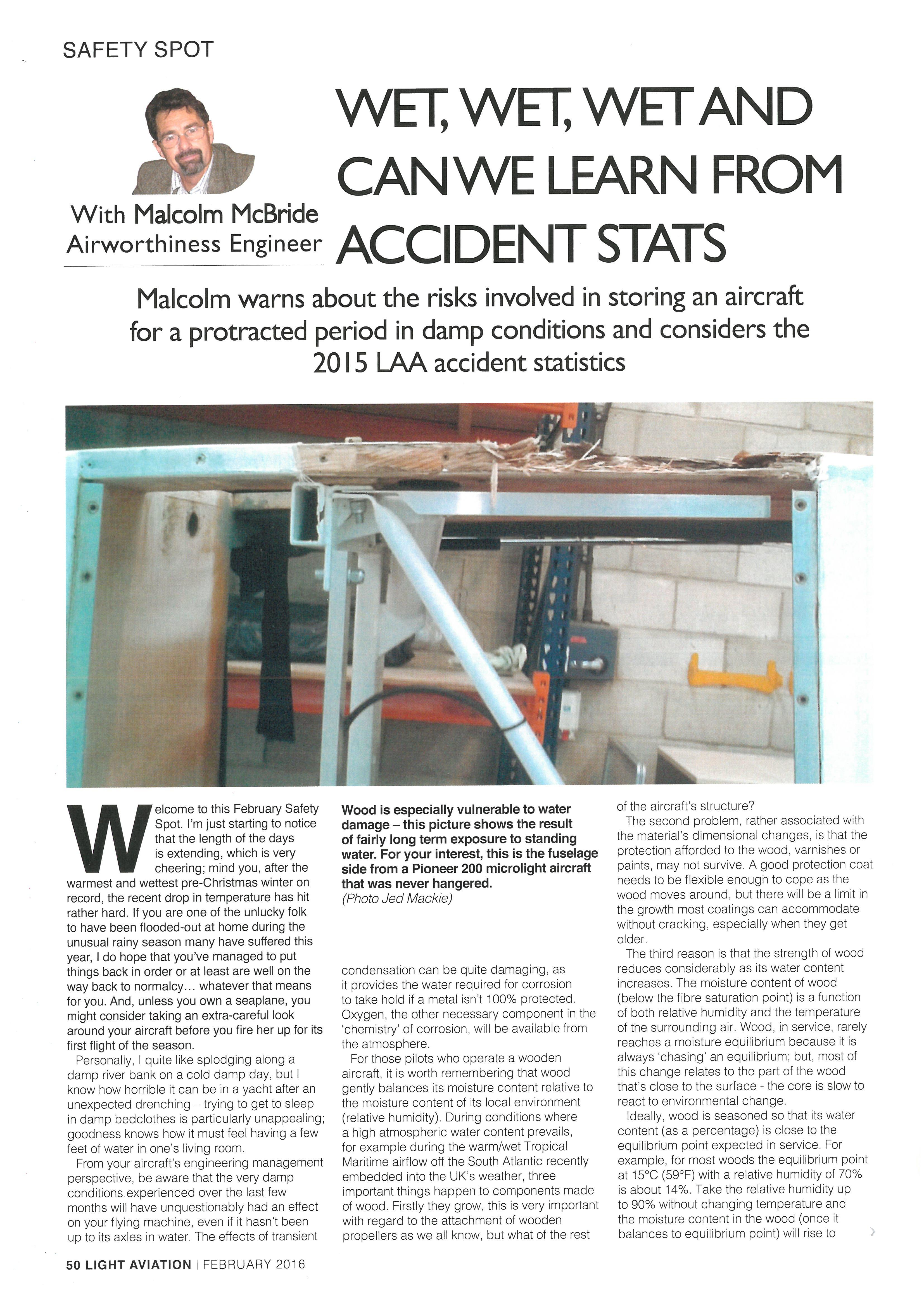
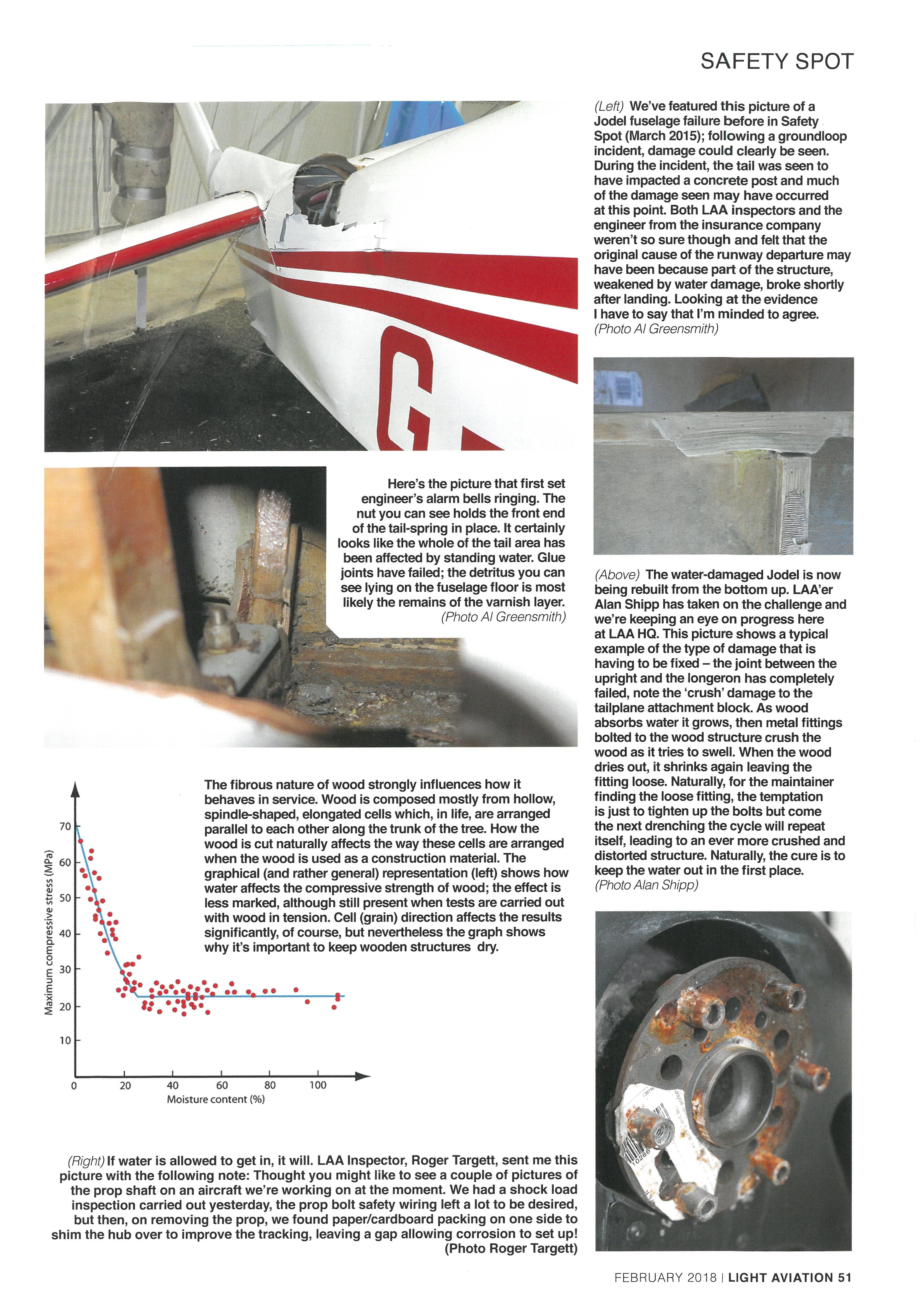
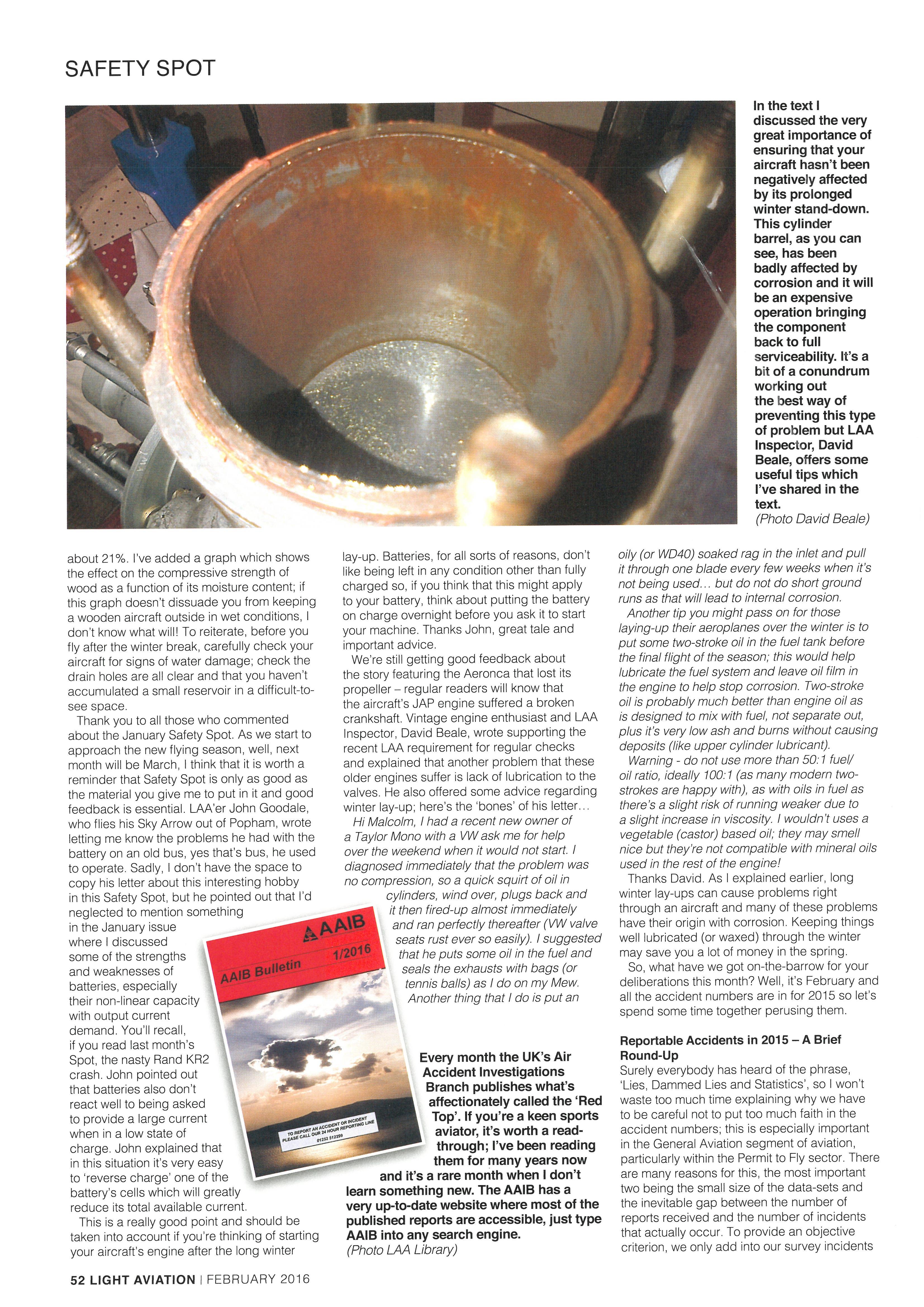
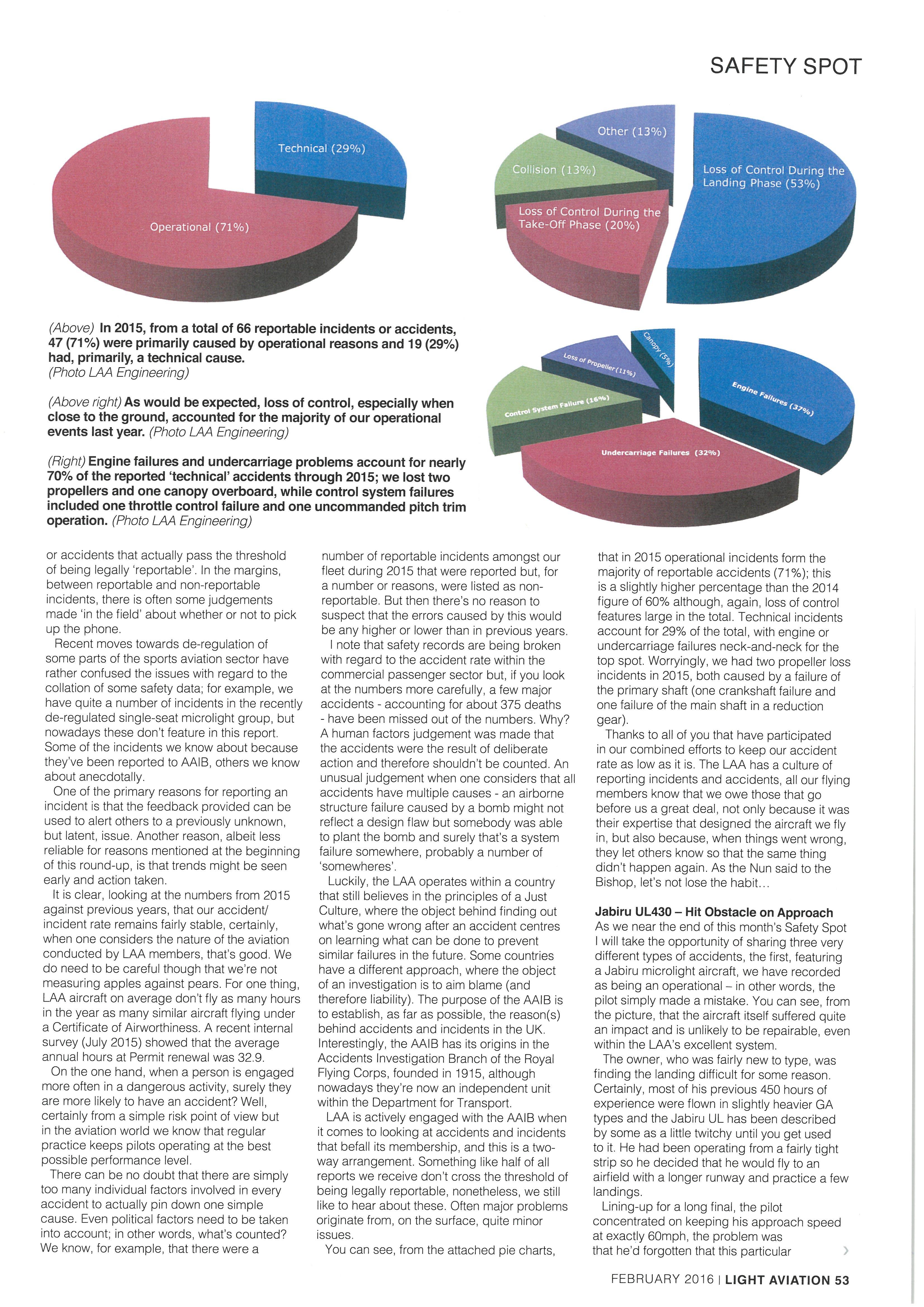
Malcolm highlights the damage caused by storing aircraft in damp conditions and takes a look at the 2015 LAA accident statistics
58 LANDINGVOUCHERS
Twoairfieldstovisitfor free plusone reduced pricetovisitduring February,, and £3 offthe HaynesMotorMuseum
59 CEOTHOUGHTS
Steve Slater urges pilots to ‘de-rust’ theirflying skillsafterweeks of poor weather has limited their air time
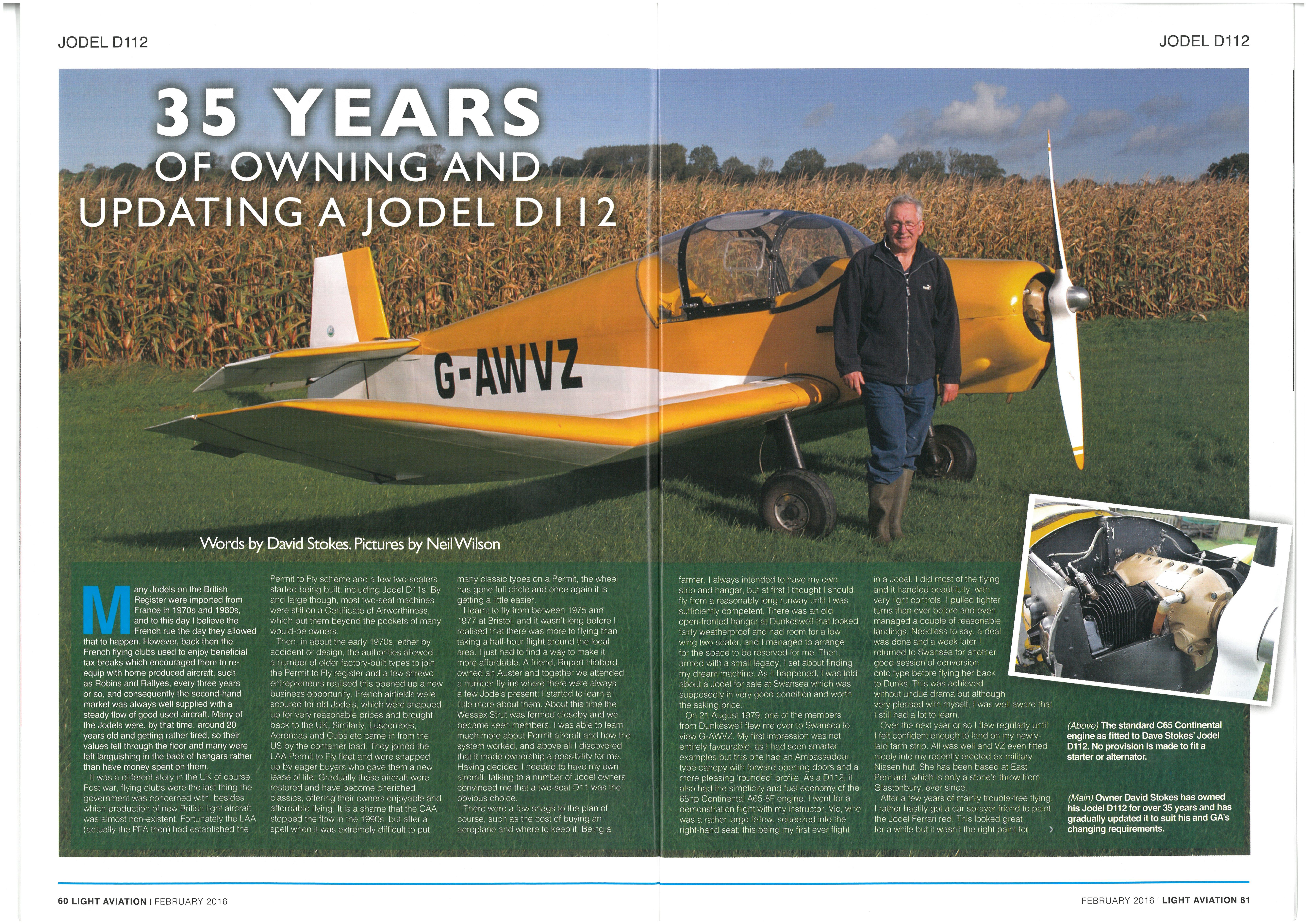
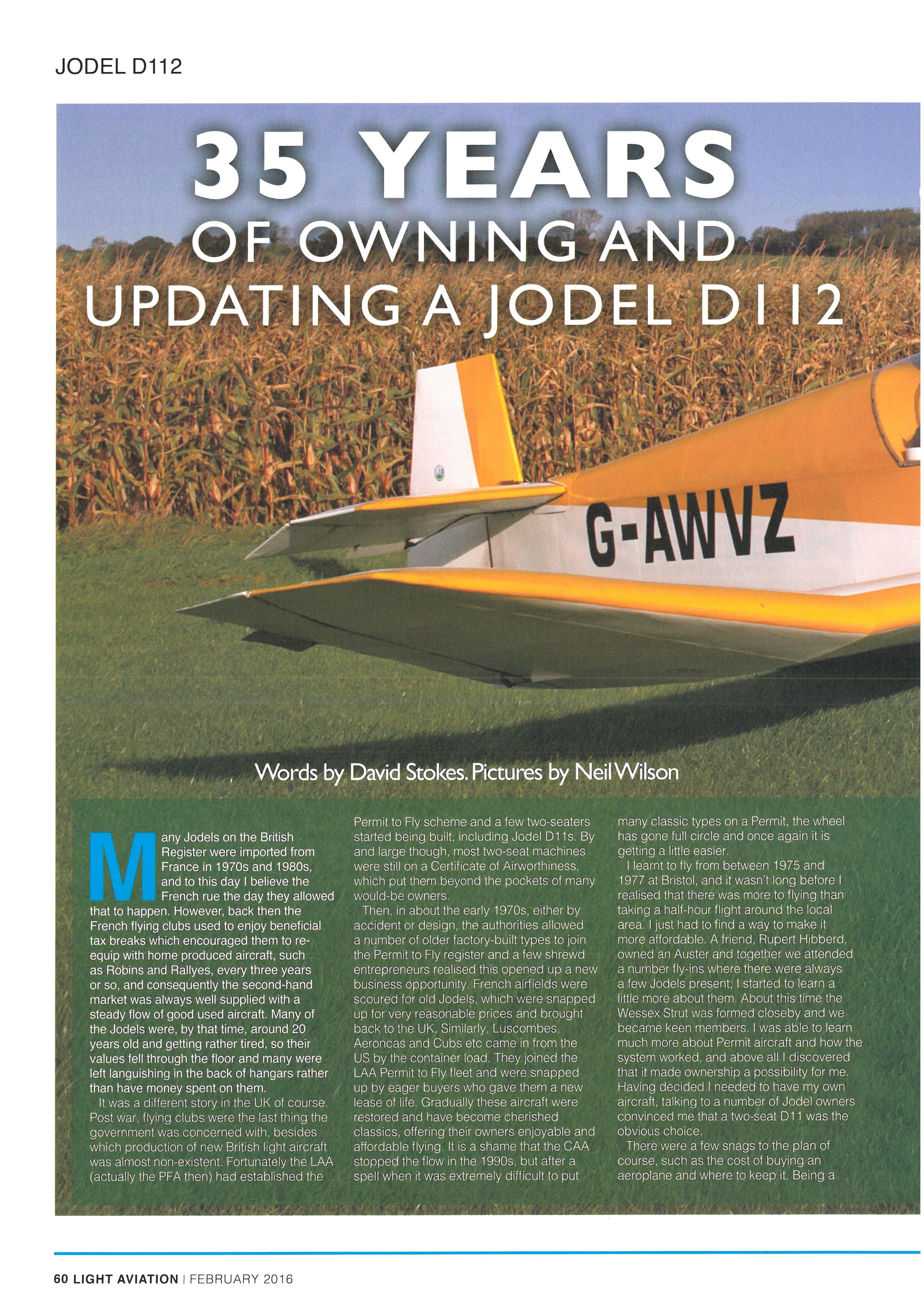
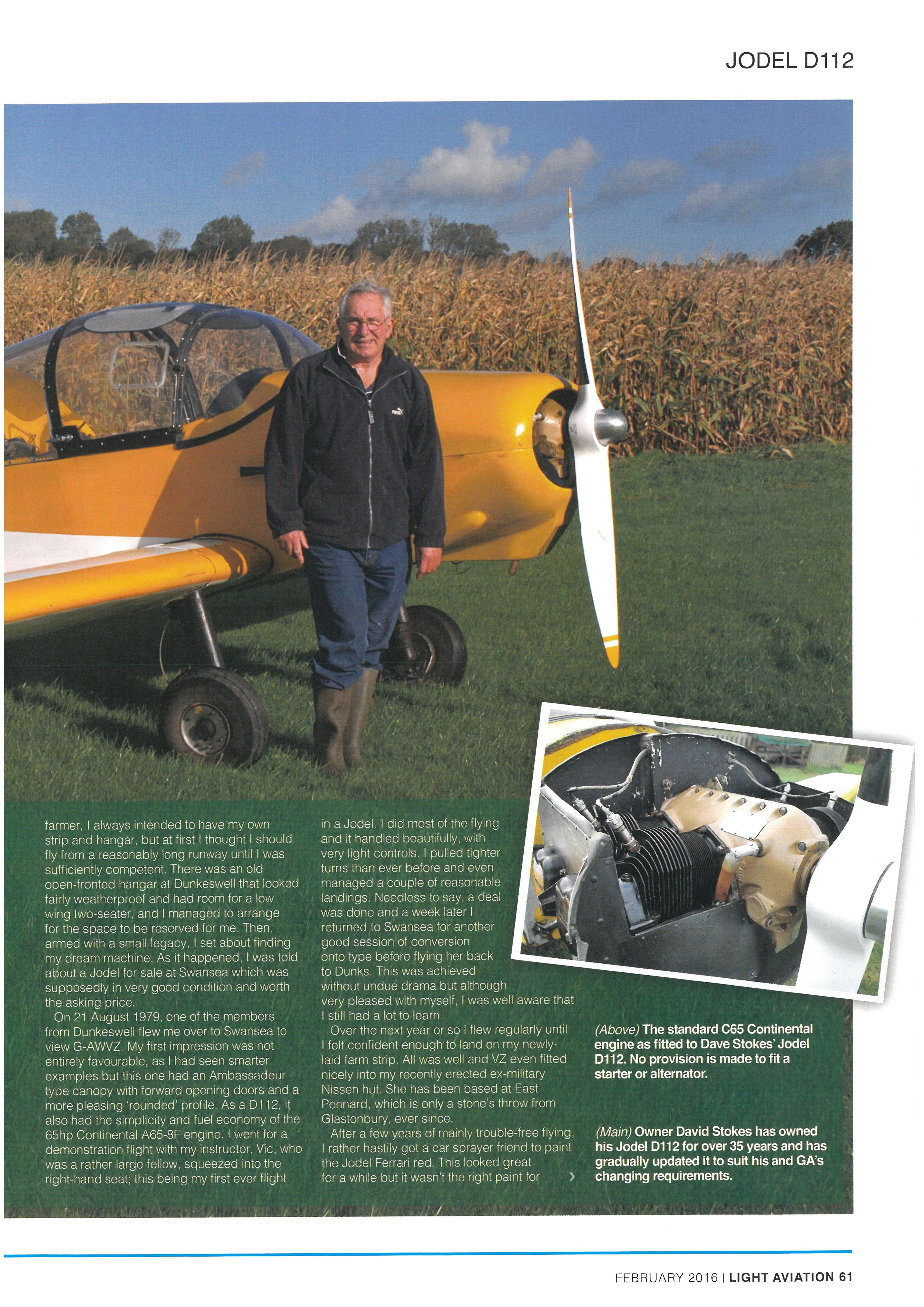
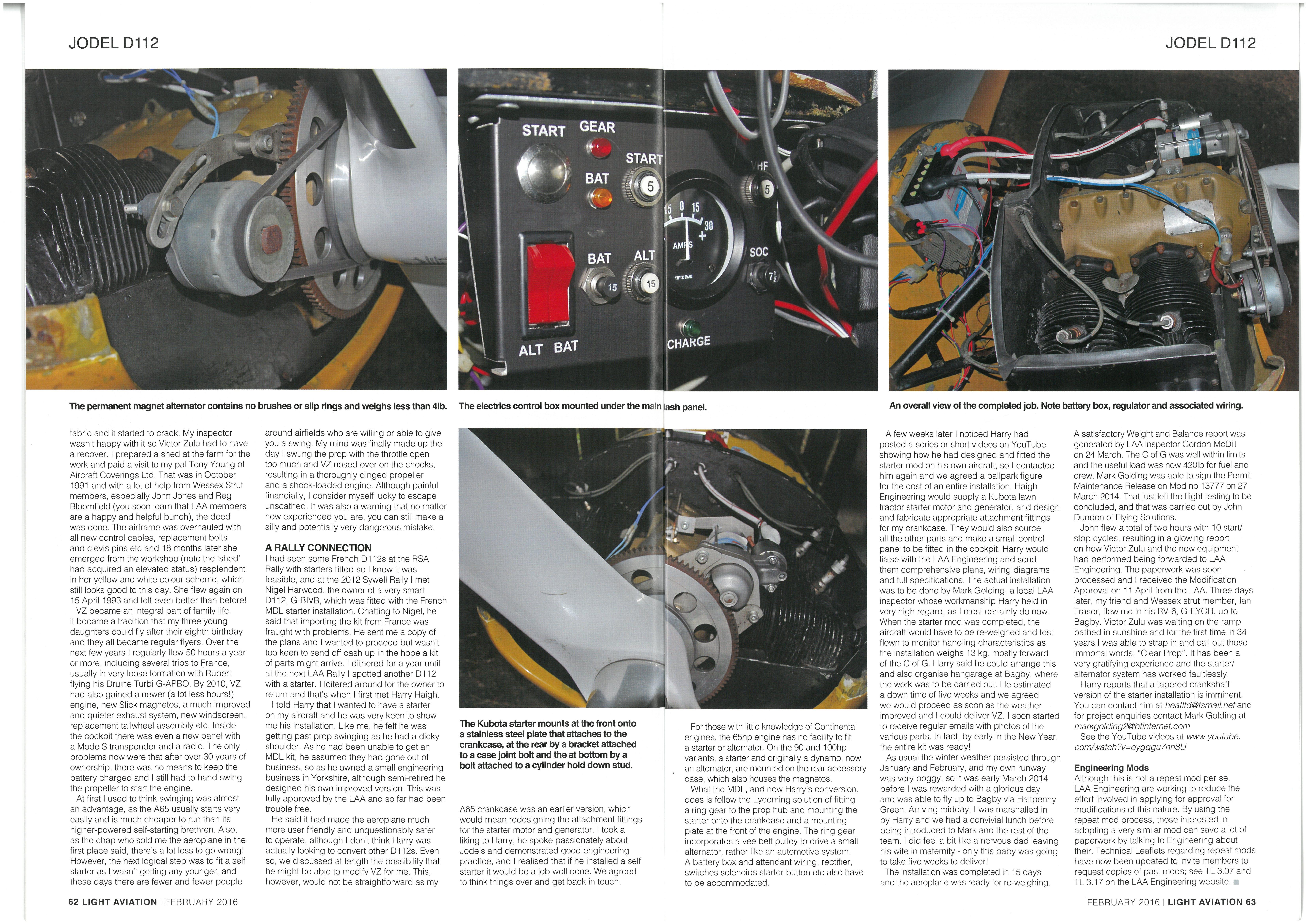
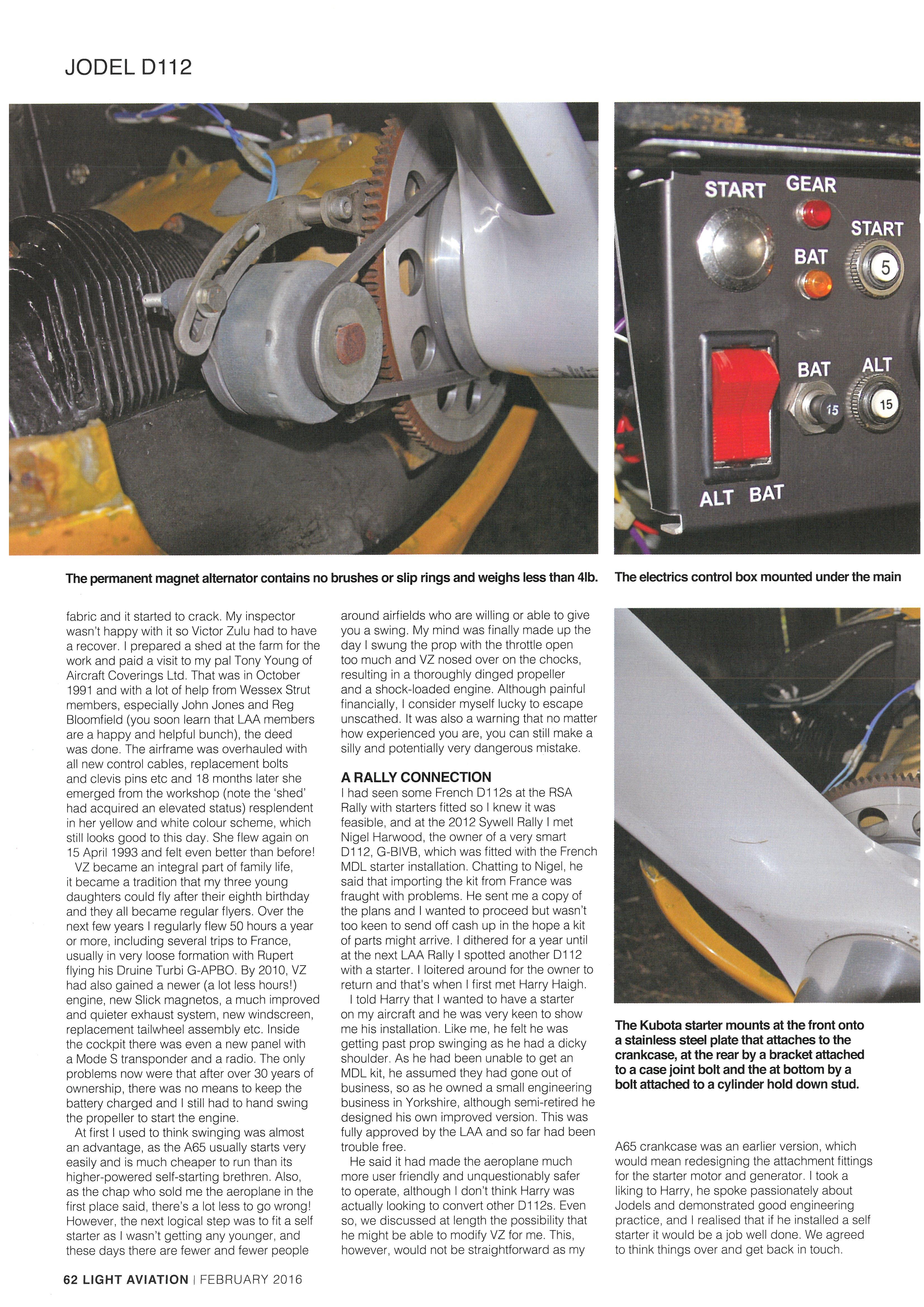
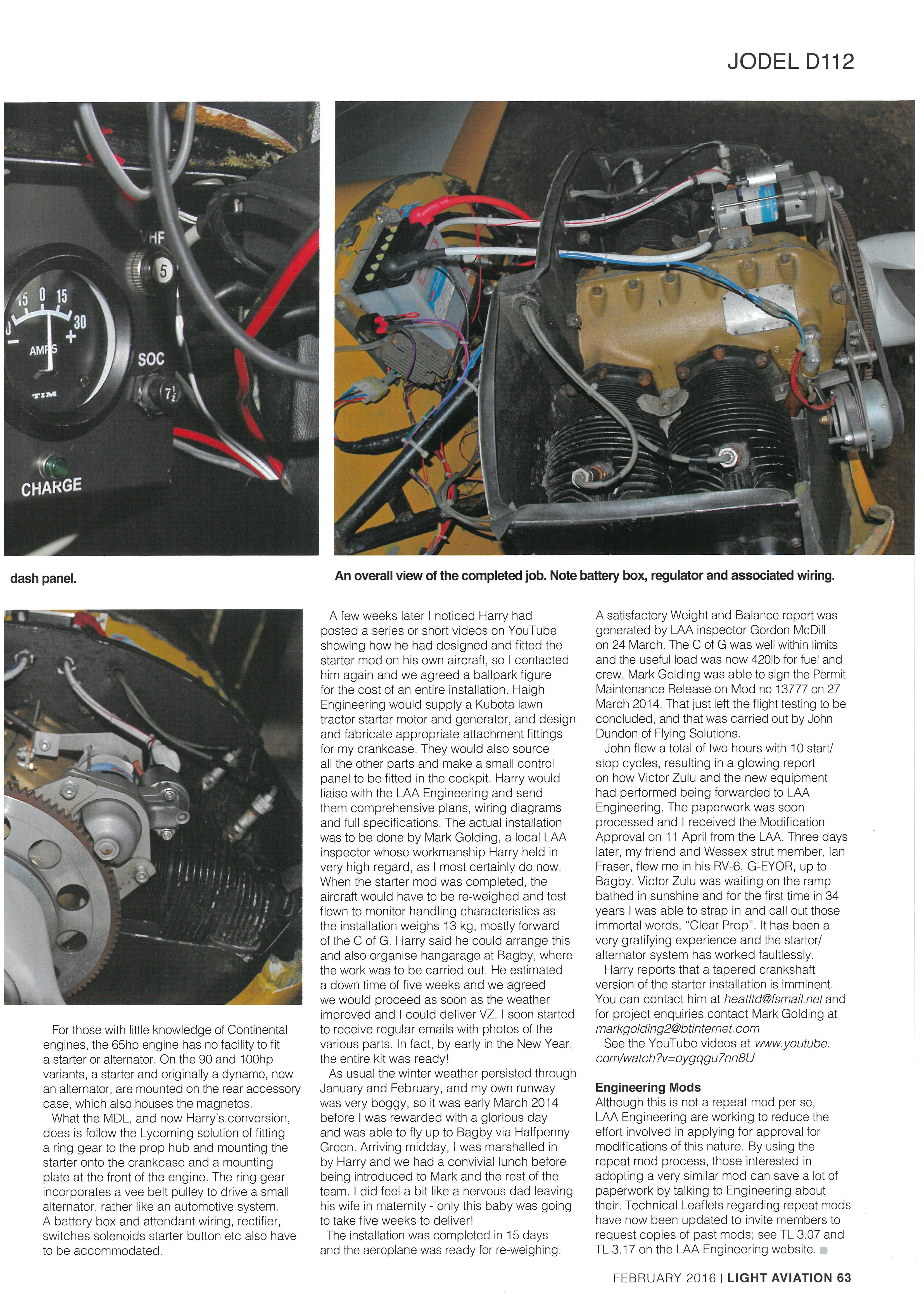
62JODELSTARTER
‘Clear prop’ how LAA member
David Stokeshas updated hisJodel’s electrics and fitted a starter motor
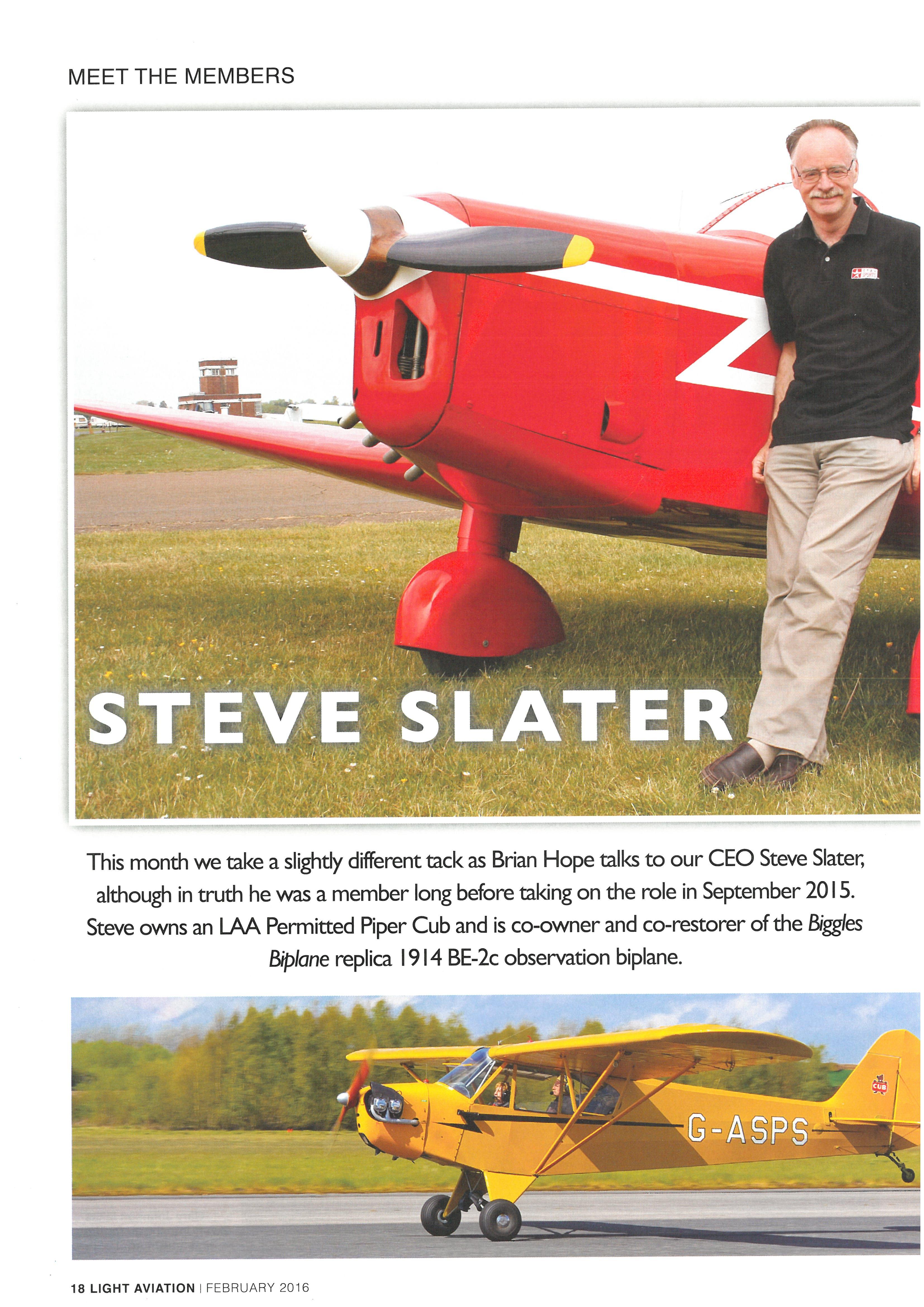
uring my chat last month | talked about
only be a matter of time before we had passenger carrying quad-copters. Well blow me down, within days the Chinese press announced the launch of the Enang 184! My home strip at Slinfold is water-logged at the moment so one of these would enable me to fly during the winter months. Where do | place my order?
Fortunately | have plenty to keep me busy, learning a new skillforme fabriccovering. | know this is one of the oldest skills for home builders but for me, and | suspect quite a few others, learning a new personal skill still gives me a buzz. The Alpi Pioneer covering system does not use conventional gluing and rib stitching techniques, and there is no doping or UV protection. All surface protection and finishing uses automotive two-pack acrylic primer and top coat. After much research, | have also decided to carry out the painting so | have purchased a secondhand HVLP spraying system and | will be turning my workshop into a spray booth once the fabric covering is complete. Another new skill to learn!
Talking of skills, | have been studying the new LAA Wings scheme to see what | could learn in order to qualify. My time in Africa gave me exposure to a fair amount of long distance flying, including taking part in a number of precision navigation competitions. Flying to within a second of your predicted time and within one hundred metres of your planned course was definitely a new skill for me, with lots of ‘| Learned About Flying From That’ moments that are probably best not repeated. Those are skills that fade with time and today | would probably break out in a sweat if my GPS failed. Maybe it is time to renew those skills?
During the summer | asked Andy Draper to oversee my revalidation biennial flight with an instructor under the LAA PilotCoaching Scheme. What a wonderful service that is. In response to the usual question “What do you want to do?”, | asked Andy to help me explore the low speed end of my Europa’s flight envelope. The Europa is a slippery aircraft and it can bite if mishandled at very slow speeds so it was a very useful hour. Thanks Andy, | hope | did not scare you too much!
One area | have tried to improve on since | returned to the UK is my knowledge of the many technical subjects ‘that make up sports and recreational flying. | have alwaysregarded a lackof knowledge in a subject as an opportunity to learn something new.When|first satbehind a Rotax 912 engine, | booked a place on Conrad Beale’s excellent overhaul course to give me confidence in what was an unconventional design at that time. | also learned a great deal about our unpredictable weather patterns by attending the splendid Met Office Weather Decision Making and Meteorology for Aviators course at their HQ in Exeter. Before starting work on my Europa, | attended the factory course on composite construction and Dudley Pattison’s woodworking course was a revelation to a composite aircraft builder such as me. It is just a pity that the Alpi Pioneerhas most of the interesting wooden construction already complete.
Although | am keen to study and develop new skills, | try not to forget that sports and recreational flying is meant to be fun. If it does not bring a smile to your face then maybe you need a new learning challenge to remind you of your earlier years. My wife, Donna, reminds me of this every time | see the badge on her old golfing hat.
rs The Ehang 184 Sw quadcopterwheredo| place my order?
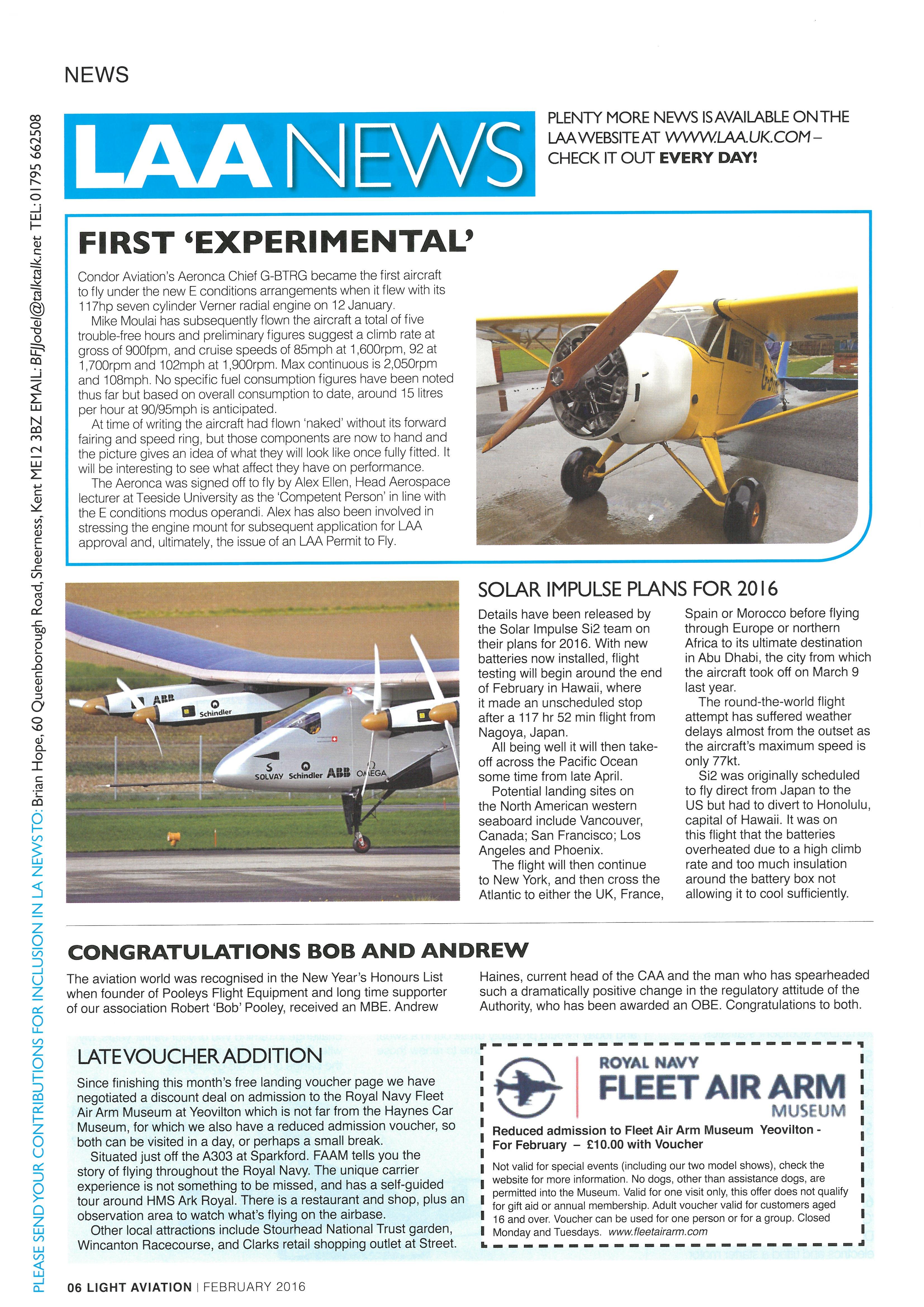
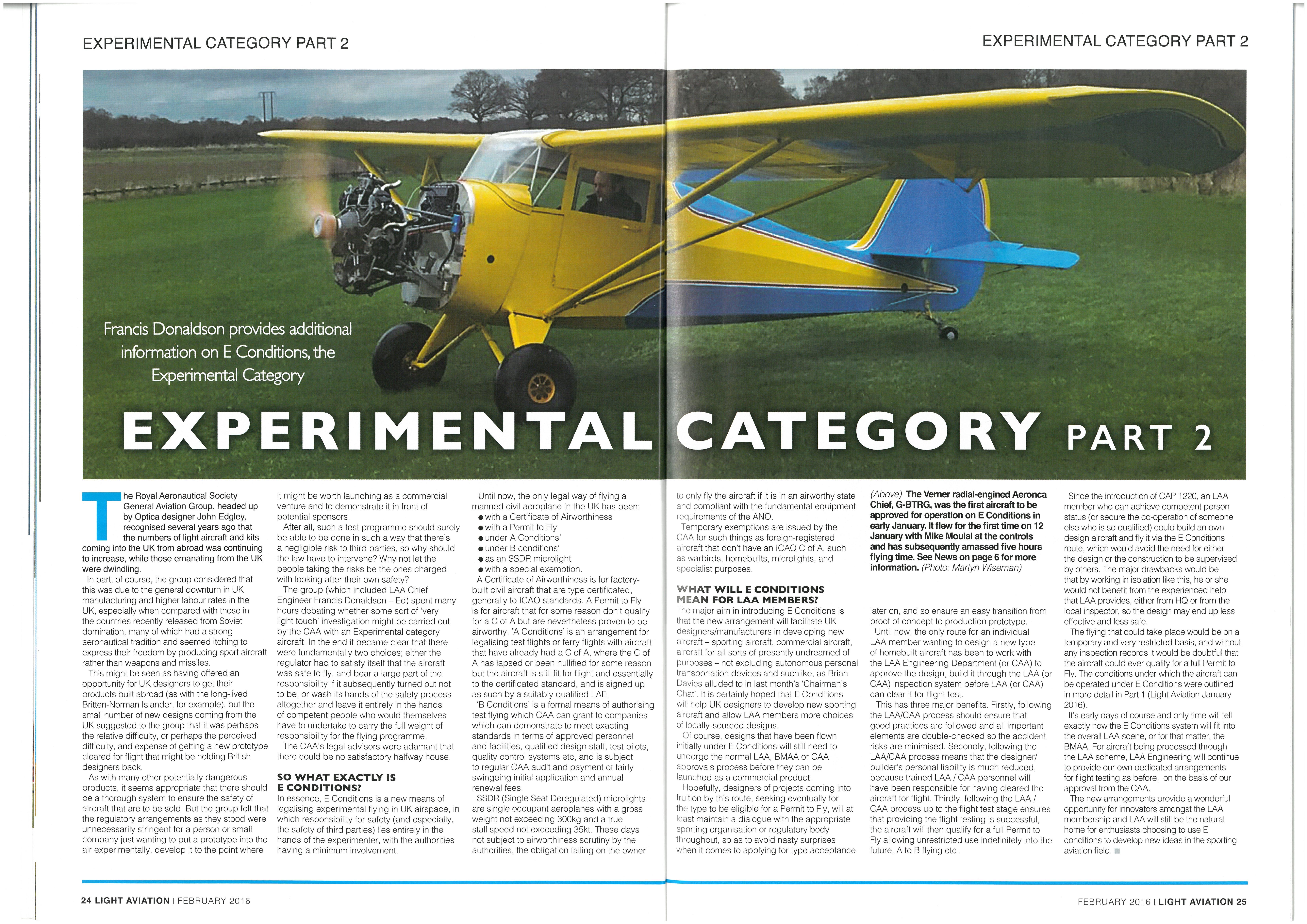
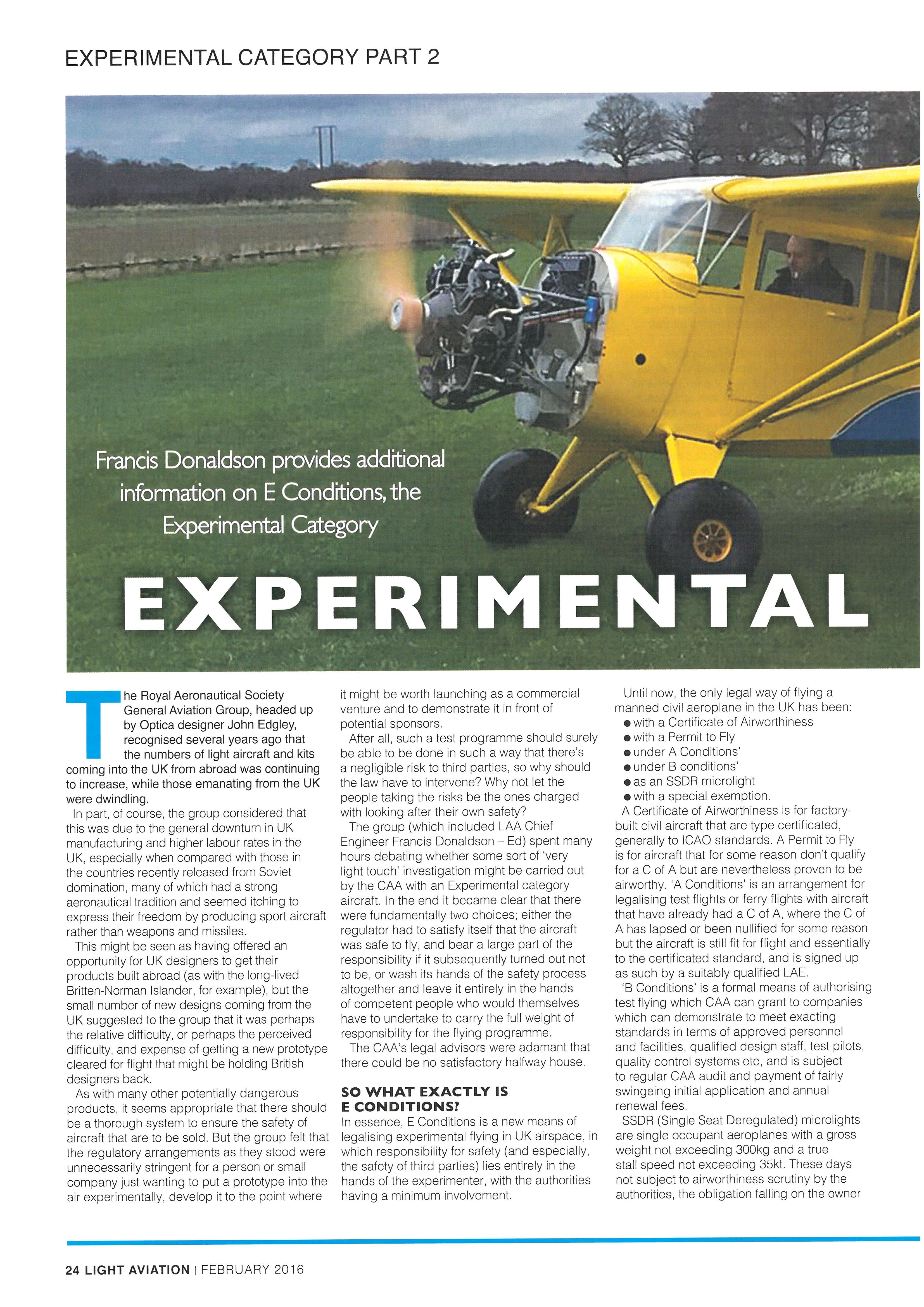
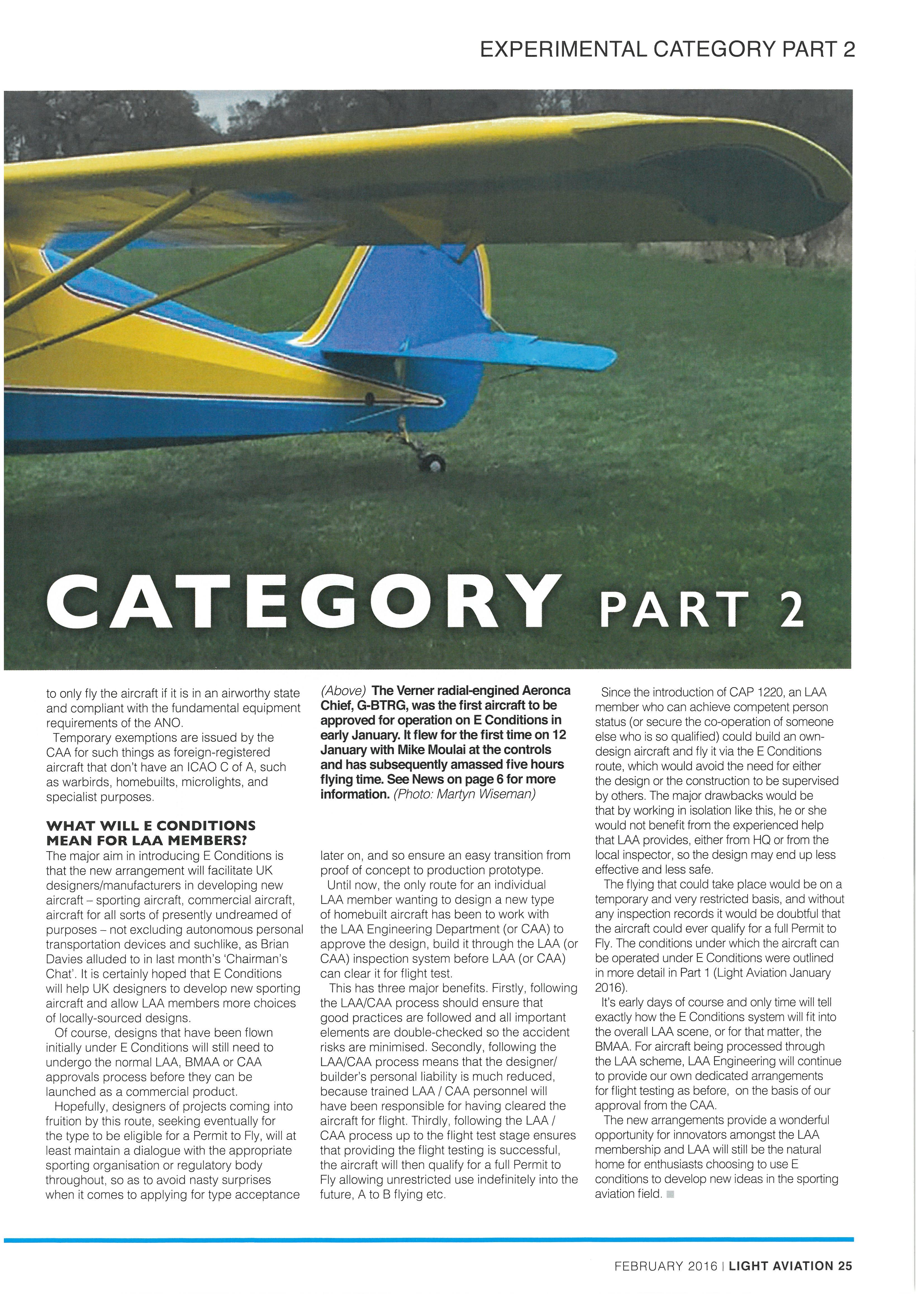
Condor Aviation’s Aeronca Chief G-BTRG became the first aircraft to fly under the new Econditions arrangements when itflew with its 117hp seven cylinder Verner radial engine on 12January.
Mike Moulai has subsequently flown the aircraft a total of five trouble-free hours and preliminary figures suggest a climb rate at gross of 900fpm, and cruise speeds of 8Smph at 1,600rpm, 92 at 1,700rom and 102mph at 1,900rpm. Max continuous is 2,050rpm and 108mph. No specific fuel consumption figures have been noted thus far but based on overall consumption to date, around 15 litres per hour at 90/95mph is anticipated.
At time of writing the aircraft had flown ‘naked’ without its forward fairing and speed ring, but those components are now to hand and the picture gives an idea of what they will look like once fully fitted. It will be interestingto see what affectthey have on performance.
The Aeronca was signed off to fly by Alex Ellen,Head Aerospace lecturer at Teeside University as the ‘Competent Person’ in linewith the Econditions modus operandi. Alex has also been involved in stressing the engine mount for subsequent application for LAA approval and, ultimately,the issueof an LAA Permitto Fly.
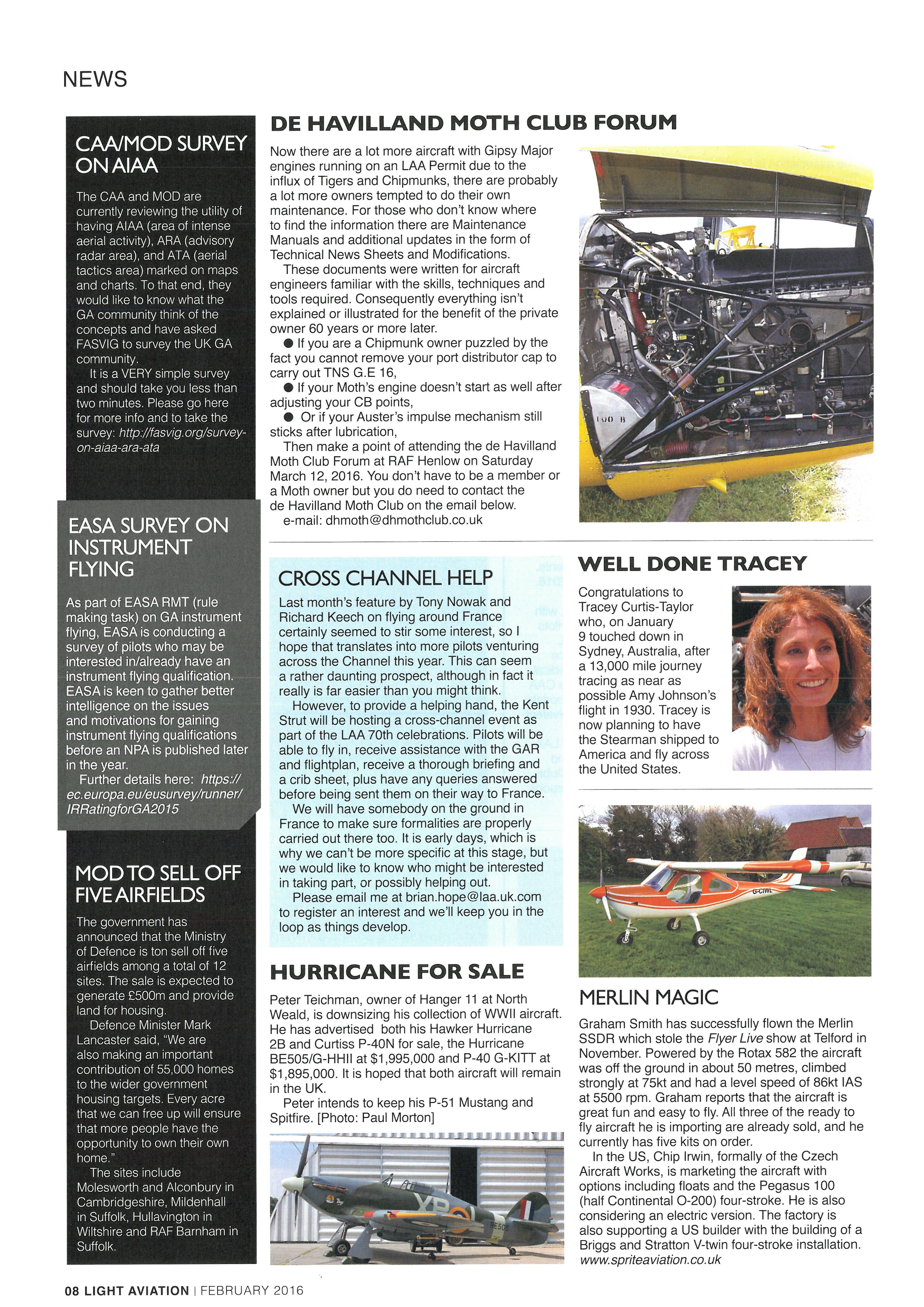
Details have been released by the Solar Impulse Si2 team on their plans for 2016. With new batteries now installed, flight testing will begin around the end of February in Hawaii, where it made an unscheduled stop after a 117 hr 52 min flight from Nagoya, Japan.
All being well it will then takeoff across the Pacific Ocean some time from late April.
Potential landing sites on the North American western seaboard include Vancouver, Canada; San Francisco; Los Angeles and Phoenix.
The flight will then continue to New York, and then cross the Atlantic to either the UK, France,
06LIGHTAVIATION CONGRATULATIONS|FEBRUARY2016BOB AND
Spain or Morocco before flying through Europe or northern Africa to its ultimate destination in Abu Dhabi, the city from which the aircraft took off on March 9 last year.
The round-the-world flight attempt has suffered weather delays almost from the outset as the aircraft's maximum speed is only 77kt.
Si2 was originally scheduled to fly direct from Japan to the US but had to divert to Honolulu, capital of Hawaii. It was on this flight that the batteries overheated due to a high climb rate and too much insulation around the battery box not allowing it to cool sufficiently.
The aviation world was recognised in the New Year’s Honours List when founder of Pooleys Flight Equipment and long time supporter of our association Robert ‘Bob’ Pooley, received an MBE. Andrew
LATEVOUCHERADDITION
Since finishing this month’s free landing voucher page we have negotiated a discount deal on admission to the Royal Navy Fleet Air Arm Museum at Yeovilton which is not far from the Haynes Car Museum, for which we also have a reduced admission voucher, so both can be visited in a day, or perhaps a small break.
Situated just off the A303 at Sparkford. FAAM tells you the story of flying throughout the Royal Navy.The unique carrier experience is not something to be missed, and has a self-guided tour around HMS Ark Royal. There is a restaurant and shop, plus an observation area to watch what’s flying on the airbase.
Other local attractions include Stourhead National Trust garden, Wincanton Racecourse, and Clarks retail shopping outlet at Street.
KIT AGENTS’ SEMINAR
The association is hosting a seminar for kit agents at Turweston on Wednesday February 24 to both encourage current and potential kit suppliers and also explore how : ;
inthefuture.PresentationsA :tt}e Att]tu deC
and discussion topics include:
@Getting new types approved through the LAA
@ Continued airworthiness
@ Interfaces between agent, manufacturer, customerand LAA; and what might be done to improve the system. Ifyou are an existing or potential kit supplier you are welcome to attend but please pre-register with HQ. A fee | of £20 per person will be payable on the day to cover admin and refreshments. Tel: 01280 846786. |
CHANGES FOR PASSENGER FLYING AT LAA EVENTS |
Since 2012 when the LAA Member Club Regulations were | introduced, the pilot licensing scene has changed substantially, with the introductionof EASA licenses includingthe LAPL, and changes to some CAA medical requirements, with potentially | more to come this year. This has influenced the LAA Board’s thinking on the licensing and medical requirements for pilots who wish to carry third party passenger at LAAflying events. | The Board has now approved a modified approach for 2016. Pilotscarryingthird party passengers must be LAA Members, hold a valid ATPL, CPL, PPL, LAPL or NPPL, with | the appropriate class rating for the aircraft to be flown. Pilots must also hold a current EASA Class 1, Class 2 or LAPL medical certificate appropriate to the type of pilot’s licence held. There is no age limit for pilots holding an EASAmedical certificate.Pilotsupto70yearsold,holdingaNPPLoraCAA |} PPL, may also demonstrate fitness to fly using the appropriate NPPL Medical Declaration for carrying passengers (equivalent to Group 2 DVLAstandard).
The Board also wants to remind the committees of all LAA Member Clubs that flying events should be organised and run in accordance with the Member Club Regulations.Clubs should notify the LAA of events and make their annual reports asroquied
ROBIN
STEPS DOWN
Due to pressing work and family commitments, Lord (Robin) Rotherwick has reluctantly decided to stand down from the LAA Board, ending the second of two terms as a PFAand LAA Directorinwhichhehasservedtheorganisationsince1997.
The CAA and MOD are currently reviewing the utility of having AIAA (area of intense aerial activity), ARA (advisory radar area), and ATA (aerial tactics area) marked on maps and charts. To that end, they would like to know what the GA community think of the concepts and have asked FASVIG to survey the UK GA community.
It is a VERY simple survey and should take you less than two minutes. Please go here for more info and to take the survey: htto.//fasvig.org/surveyon-alaa-ara-ata
EASA SURVEY ON INSTRUMENT FLYING
As part of EASA RMT (rule making task) on GA instrument flying, EASA is conducting a survey of pilots who may be interested in/already have an instrument flying qualification. EASA is keen to gather better intelligence on the issues and motivations for gaining instrument flying qualifications before an NPAis published later in the year.
Further details here: https:// ec.europa.eu/eusurvey/runner/ IRRatingforGA2015 MODTO SELL OFF FIVE AIRFIELDS
The government has announced that the Ministry of Defence is ton sell off five airfieldsamong a totalof12 sites. The sale is expected to generate £500m and provide land for housing.
Defence Minister Mark Lancaster said, “We are also making an important contribution of 55,000 homes to the wider government housing targets. Every acre that we can free up will ensure that more people have the opportunity to own their own home.”
The sites include Molesworth and Alconbury in Cambridgeshire, Mildenhall in Suffolk, Hullavington in Wiltshire and RAF Barnham in Suffolk.
Now there are a lot more aircraft with Gipsy Major engines running on an LAA Permit due to the influx of Tigers and Chipmunks, there are probably a lot more owners tempted to do their own maintenance. For those who don’t know where to find the information there are Maintenance Manuals and additional updates in the form of Technical News Sheets and Modifications.
These documents were written for aircraft engineers familiar with the skills, techniques and tools required. Consequently everything isn’t explained or illustrated for the benefit of the private owner 60 years or more later.
@Ifyou are a Chipmunk owner puzzled by the fact you cannot remove your port distributor cap to carry out TNS G.E 16,
@Ifyour Moth’s engine doesn’t start as well after adjusting your CB points,
@ Or if your Auster’s impulse mechanism still sticks after lubrication,
Thenmakea pointofattendingthedeHavilland Moth Club Forum at RAF Henlow on Saturday March 12, 2016. You don’t have to be a member or a Moth owner but you do need to contact the de Havilland Moth Club on the email below.
e-mail: dhmoth@dhmothclub.co.uk
CROSS CHANNEL HELP
Last month’s feature by Tony Nowak and Richard Keech on flying around France certainly seemed to stir some interest, so | hope that translates into more pilots venturing across the Channel this year. This can seem a rather daunting prospect, although in fact it really is far easier than you might think.
However, to provide a helping hand, the Kent Strut will be hosting a cross-channel event as part of the LAA 70th celebrations. Pilots will be able to fly in, receive assistance with the GAR and flightplan, receive a thorough briefing and a crib sheet, plus have any queries answered before being sent them on their way to France.
We will have somebody on the ground in France to make sure formalities are properly carried out there too. It is early days, which is why we can’t be more specific at this stage, but we would like to know who might be interested in taking part, or possibly helping out.
Please email me at brian.hope @laa.uk.com to register an interest and we'll keep you in the loop as things develop.
HURRICANE FOR SALE
Peter Teichman, owner of Hanger 11 at North Weald, is downsizing his collection of WWII aircraft. He has advertised both his Hawker Hurricane 2B and Curtiss P-40N for sale, the Hurricane BE505/G-HHII at $1,995,000 and P-40 G-KITT at $1,895,000. It is hoped that both aircraft will remain in the UK.
Peter intends to keep his P-51 Mustang and Spitfire. [Photo: Paul ELSESMorton] Se eeee ee
Congratulations to TraceyCurtis-Taylor who, on January 9 touched down in Sydney, Australia, after a 13,000 mile journey tracing as near as possible Amy Johnson’s flight in 1930. Tracey is now planning to have the Stearman shipped to America and fly across the United States.
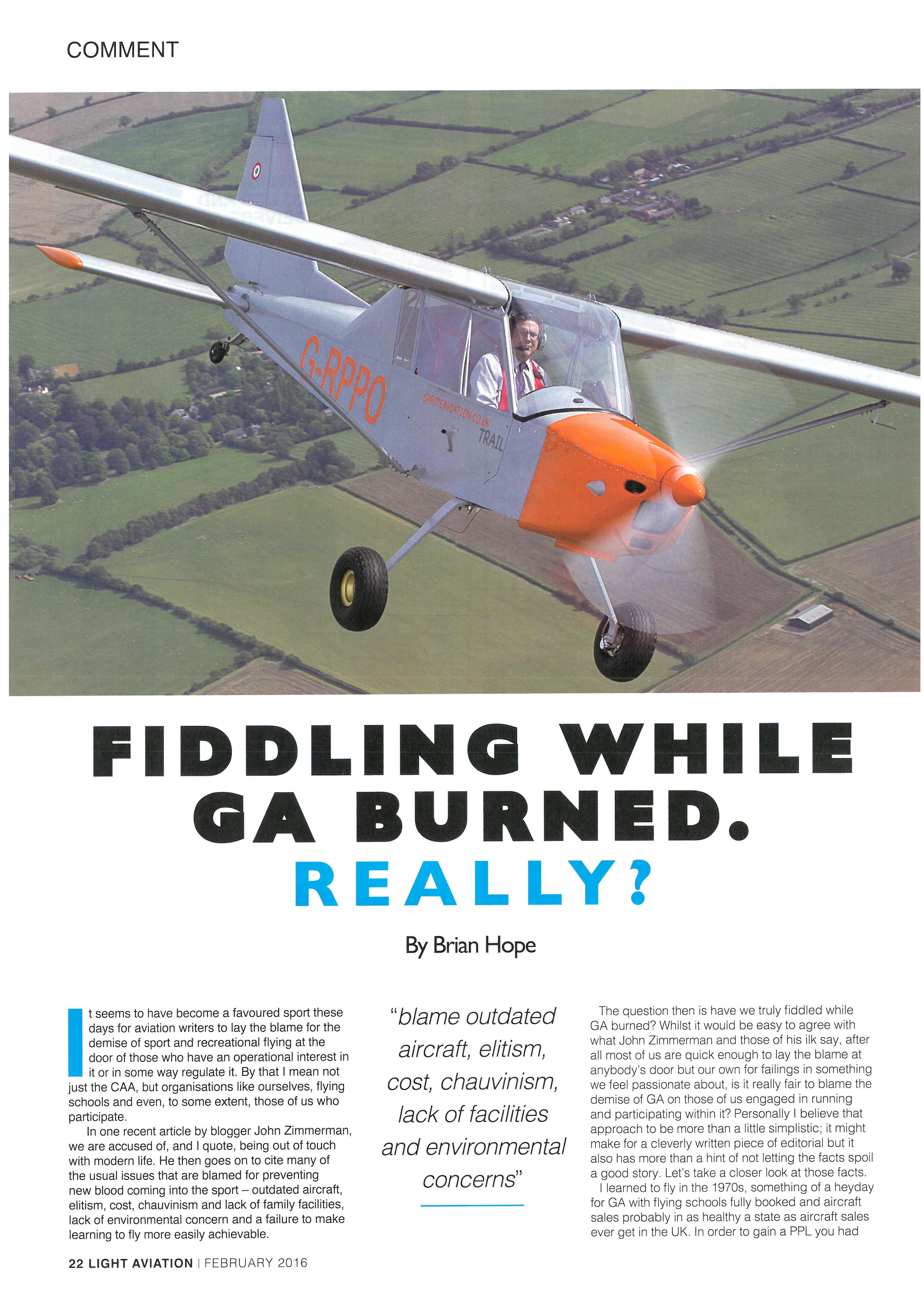
Graham Smith has successfully flown the Merlin SSDR which stole the Flyer Live show at Telford in November. Powered by the Rotax 582 the aircraft was off the ground in about 50 metres, climbed strongly at 75kt and had a level speed of 86kt IAS at 5500 rpm. Graham reports that the aircraft is great fun and easy to fly.All three of the ready to fly aircraft he is importing are already sold, and he currently has five kits on order.
In the US, Chip Irwin, formally of the Czech Aircraft Works, is marketing the aircraft with options including floats and the Pegasus 100 (half Continental O-200) four-stroke. He is also considering an electric version. The factory is also supporting a US builder with the building of a Briggs and Stratton V-twin four-stroke installation. www.spriteaviation.co.uk
t can’t by now have escaped anyone’s attention that we have a notable anniversary to celebrate this year. It was 70 years ago that the Ultra Light Aircraft Association was formed. From humble beginnings it grew from a handful of members to a thriving organisation, having changed its name to the Popular FlyingAssociation, and subsequently to the LAA. From the outset its key aims have remained the same to promote affordable flying and to encourage flying for fun!
So, what can we do to celebrate the 70th birthday and use these celebrations to make sure those aims continue to be enjoyed by members and fellow enthusiasts, old and new?
Well, first of all, a big thank you to all those who have already been in touch with ideas and suggestions. Some of them are mentioned below and are already being planned, but if you’ve got an idea that isn’t on these pages, please do let us know. Better still, if you and some friends want to make your own personal LAA 70 event happen, then go for it! Just let us know so we can share your initiative with even more friends.
The already highly-successful LAA Rally at Sywell, this year on September 2, 3 and 4 will be the natural focal point for our main celebrations, although we plan to have a wide range of activities around the UK (and even further afield) leading up to it.
Among the ideas that we are currently reviewing is a dedicated LAA 70 marquee, which would accommodate both a selection of aircraft representing the seven decades of the organization, along with owners and key people from each decade on hand to offer ‘show and tell sessions’, explaining the aircraft and some of their experiences with them.
The marquee may also contain an LAA 70 Auditorium, or ‘Speakers’ Corner’, with a range of guest speakers and film shows showing Rallies of years gone by. If anybody fancies volunteering to help with these great ideas over the rally weekend, we’d love to hear from you. Fancy a challenge? ‘How about 70 Days To Build An Aircraft’? It sounds bonkers, but it can be done. The aim would be for a team of builders to start a project 70 days before the LAA Rally, complete the final assembly during the event, ground run and check the aircraft on Saturday or Sunday, and then fly it on the Monday. It could be a great opportunity for a
says Steve Slater
kit manufacturer and parts suppliers to promote their products, as well as for LAA members to show off their skills. Let’s hear from you!
Throughout the LAA 70 year, we hope we can recognise the efforts and the skills of builders whose projects will be started or completed during the anniversary year.
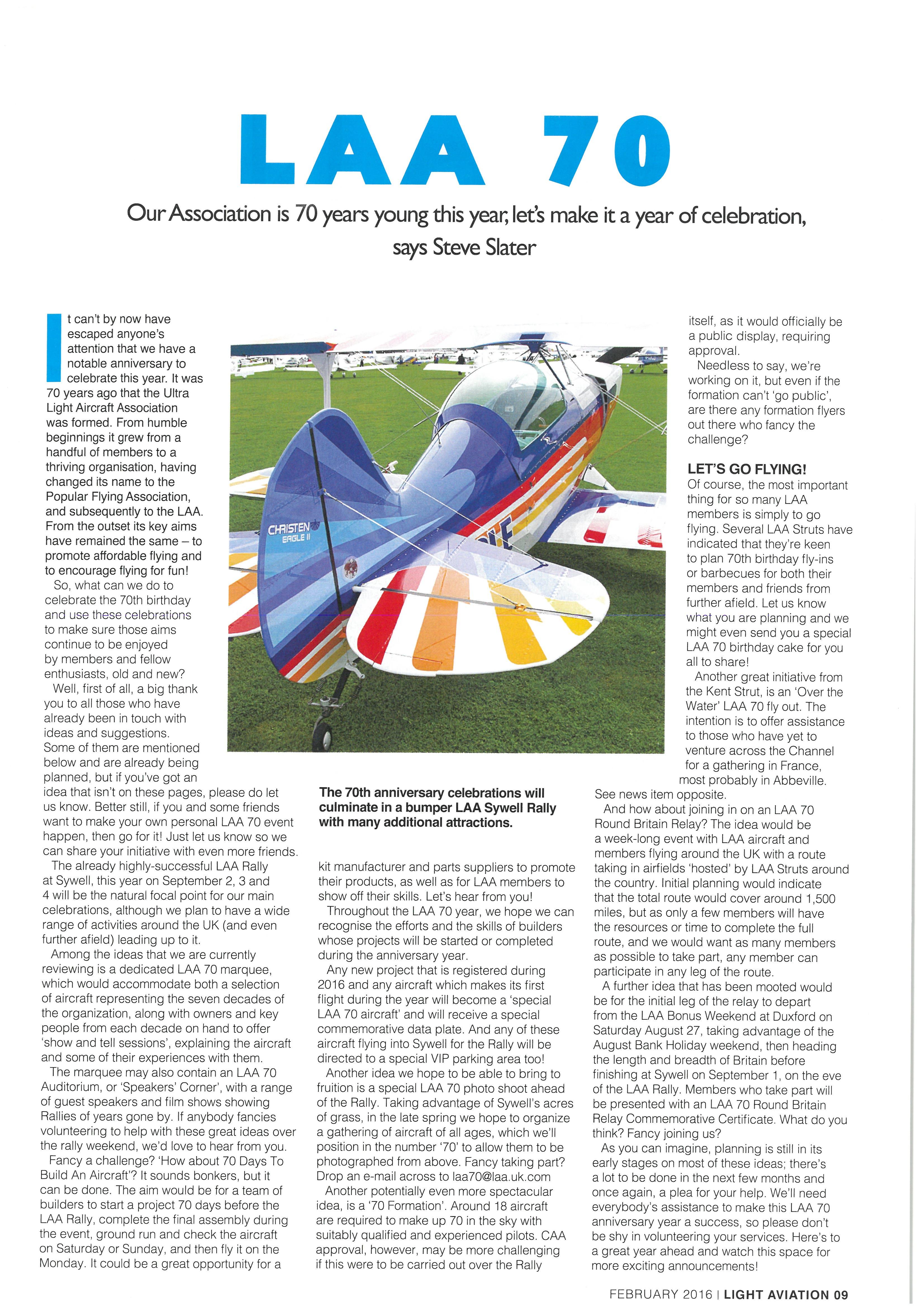
Any new project that is registered during 2016 and any aircraft which makes its first flightduringtheyearwillbecome a ‘special LAA 70 aircraft’ and will receive a special commemorative data plate. And any of these aircraft flying into Sywell for the Rallywill be directed to a special VIP parking area too! Another idea we hope to be able to bring to fruition is a special LAA 70 photo shoot ahead of the Rally. Taking advantage of Sywell’s acres of grass, in the late spring we hope to organize a gathering of aircraft of all ages, which we'll position in the number ‘70’ to allow them to be photographed from above. Fancy taking part? Drop an e-mail across to laa70@laa.uk.com
Another potentially even more spectacular idea, is a ‘70 Formation’. Around 18 aircraft are required to make up 70 in the sky with suitably qualified and experienced pilots. CAA approval, however, may be more challenging if this were to be carried out over the Rally
itself, as it would officially be a public display, requiring approval.
Needless to say, we’re working on it, but even if the formation can’t ‘go public’, are there any formation flyers out there who fancy the challenge?
LET’S
GO FLYING!
Of course, the most important hing for so many LAA members is simply to go lying. Several LAA Struts have indicated that they’re keen 0 plan 70th birthday fly-ins or barbecues for both their members and friends from urther afield. Let us know what you are planning and we might even send you a special LAA 70 birthday cake for you all to share!
Another great initiative from he Kent Strut, is an ‘Over the Water’ LAA 70 fly out. The intention is to offer assistance o those who have yet to venture across the Channel or a gathering in France, most probably inAbbeville. See news item opposite.
And how about joining in on an LAA 70 Round Britain Relay?The idea would be a week-long event with LAA aircraft and members flying around the UK with a route taking in airfields ‘hosted’ by LAA Struts around the country. Initial planning would indicate that the total route would cover around 1,500 miles, but as only a few members will have the resources or time to complete the full route, and we would want as many members as possible to take part, any member can participate in any leg of the route.
A further idea that has been mooted would be for the initial leg of the relay to depart from the LAA Bonus Weekend at Duxford on Saturday August 27, taking advantage of the August Bank Holiday weekend, then heading the length and breadth of Britain before finishing at Sywell on September 1,on the eve of the LAA Rally. Members who take part will be presented with an LAA 70 Round Britain Relay Commemorative Certificate. What do you think? Fancy joining us?
Asyoucanimagine,planning is stillinits early stages on most of these ideas: there’s a lot to be done in the next few months and once again, a plea for your help. We'll need everybody's assistance to make this LAA 70 anniversary year a success, so please don't be shy in volunteering your services. Here’s to a great year ahead and watch this space for more exciting announcements!
range of stories; as always, many thanks for your contributions. Mike Carter has sent an update on his Van's RV-7 project, with which he is currently around the mid-point of the build. Mike’s report gives an interesting insight into the lack of space issue that most builders are confronted with. Also featured is a story from Richard Cole, lead builder for the Yorkshire Gliding Club for their
second EuroFOXtug, G-CIOF. As an increasingly popular replacement for the traditional glider tug workhorses, Richard explains the merits of their new generation tug fleet.
Keep your stories coming in; Project News is an ideal place for you to show the fruits of your hard work and gives inspiration for not only potential builders, but existing builders who may be flagging a bit. You can contact Project News at projectnews@laa-archive.org.uk
of July, with the metal part of the empennage completed and safely tucked away in a spare bedroom, it was time to start on the wings. Having only a 10x17ft workshop, there was much juggling and head-scratching to decide how things should be organised, and finally accepting that |was only going to have to be able to build one wing at a time. Progress has been slow but constant, with much time spent puzzling over the best way to tackle a job and then plucking up the couragetomakeastart.
The first nail-biting task was countersinking the spar and having tested several methods found on the internet, | ended up using the method specified by Van's. This hasn’t been the only time | considered deviating
from the Van's instructions but each time | have finally done it their way and with good results. No wonder progress has been slow! Where possible | have tried to complete parts for both wings at the same time, so both spars are countersunk and plate-nuts fitted, rear spar parts prepared, all ribs straightened and deburred etc. This should help catch up on some of the lost time when | build the second wing. Priming has been another issue. With the empennage, the parts were relatively small and | was able to outsource this task. However, with some parts too large to fit in the car, | had to find a way to do at least some of this at home. Having insufficient suitable space in the workshop meantdoingitoutdoorsbut,bydodgingshowersandgustsofwind, |
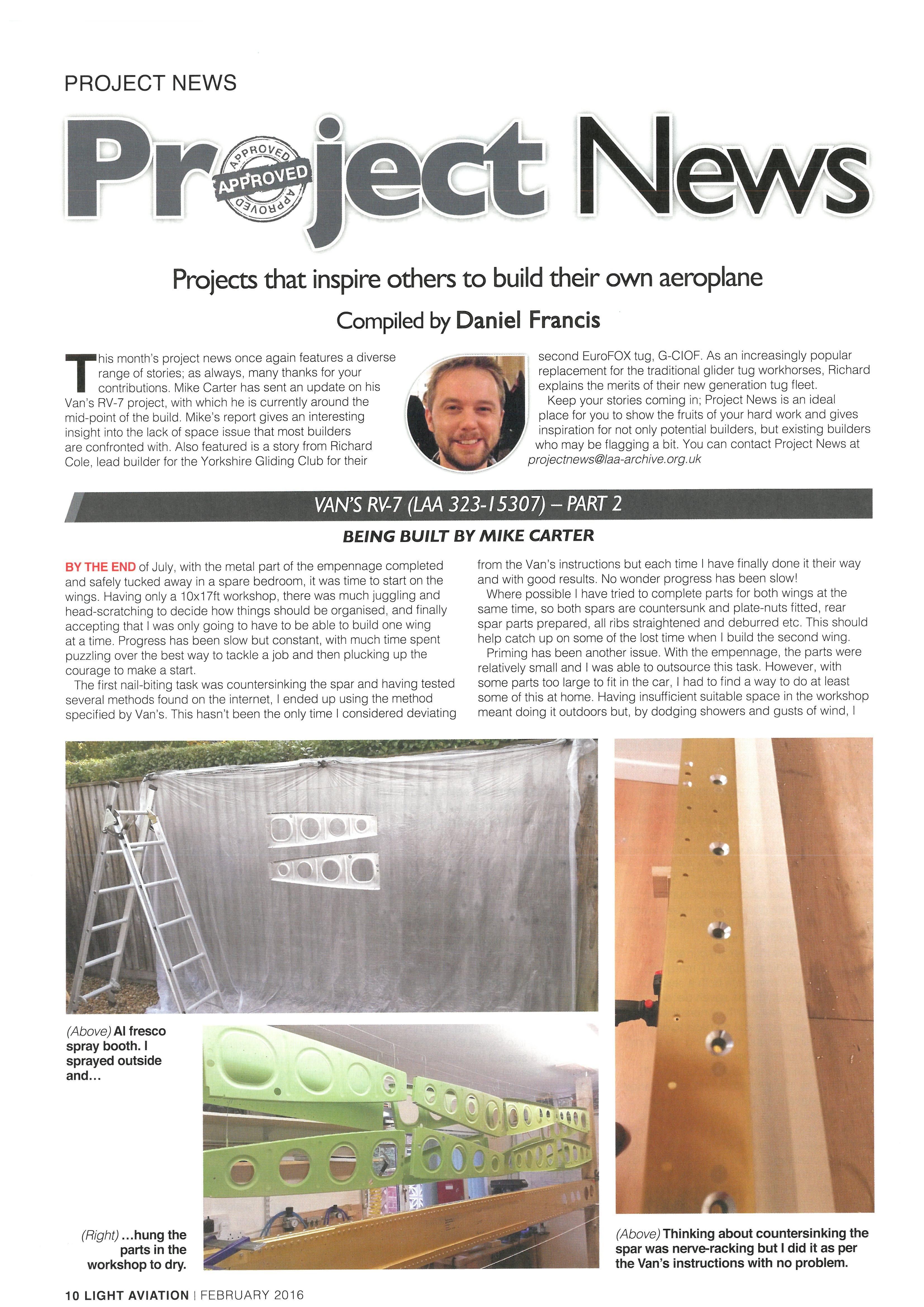
(Above)Thinking about countersinking the sparwasnerve-rackingbut| diditasper the Van’s instructions with no problem.
found taking the parts from a nice warm workshop, spraying them and then hanging them back up in the warm workshop to dry has produced very acceptable results.
Having got to the stage where the main ribs were riveted to the main spar and rear spar, the top skins were drilled primed and dimpled, and fuel tank parts prepared and steadily glued together, it was time to attach the prepared leading edge (or bleedin edge as it has become known) to the main spar. This has been another source of much debate, as while it is just possible to rivet the end ribs with solid rivets, the three centre ribs are an absolute bugger, requiring the flexibility of an Olympic gymnast and dexterity of a surgeon, all done while working completely blind. Cherry rivets approved by Van's were fast becoming the method of choice, until fellow builder Robert Powell, having recently achieved success with this task, offered to call round with his inspector Adam Lewis to demonstrate that this seemingly impossible task was in fact doable. Their donation of time and DNA was very much appreciated.
To be continued...
BY RICHARD
G-CIOFEUROFOX
AFTER FIVE MONTHS’ work in the workshop and in the back of Yorkshire Gliding Club’s ‘vintage’ hangar, our new tug, Rotax 912 iSpowered G-CIOF,flew for the first time on 29 December 2015. The new aircraft joins G-MOYR, a 912ULS-powered EuroFOX, as a replacement for the Club’s venerable Super Cub. Both aircraft were acquired by the club with the help of the Philip Wills Memorial Trust. Early indications show that the fuel injected Rotaxengine produces appreciably more power at towing rpm than the twin carburetted version, and the aircraft flies and handles just as nicely as her sister ship.
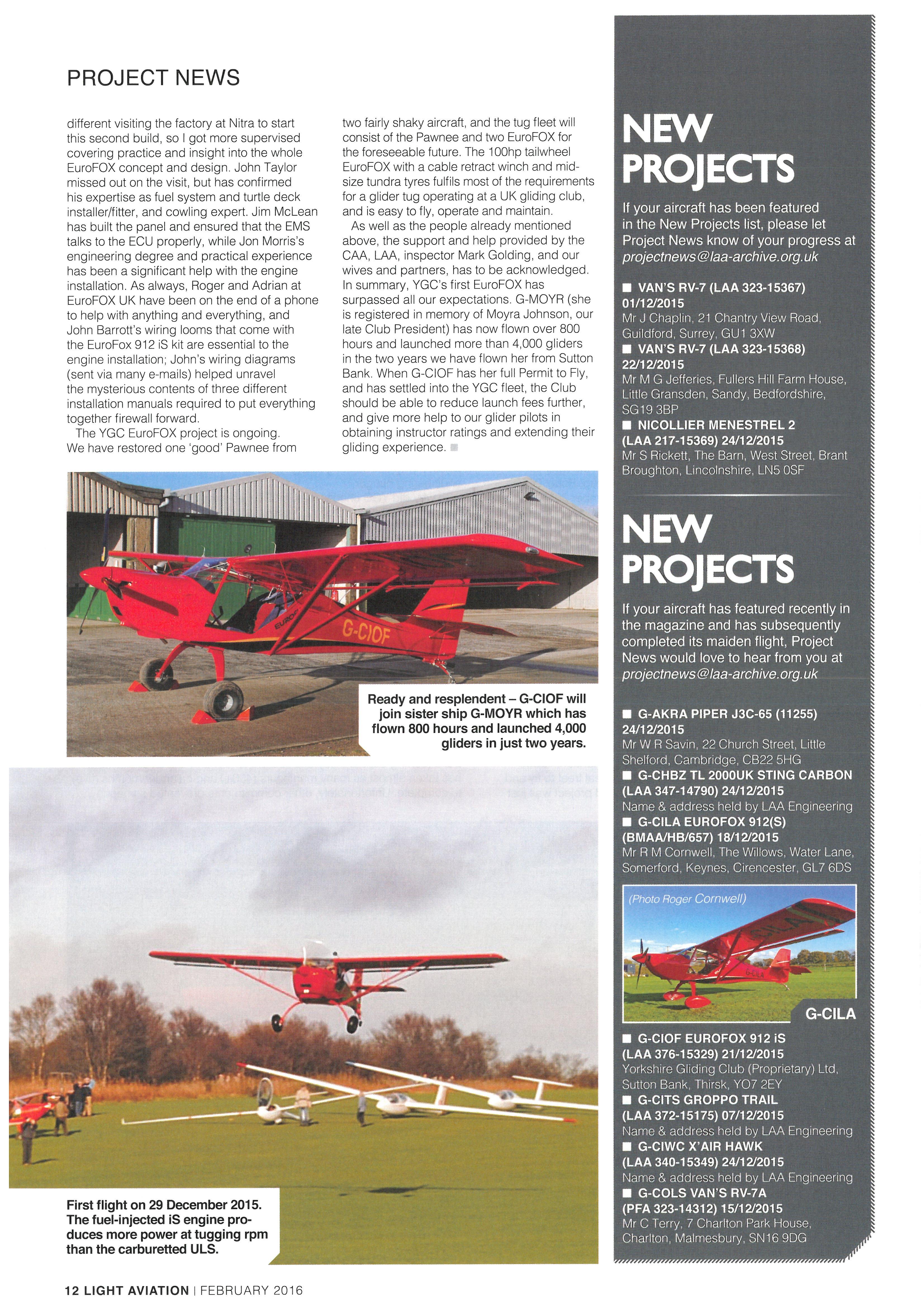
My flying background is mainly RAF FastJet, QFI and Examiner. Alongside a full military flying career, | have maintained an obsession with gliding as a sport, and have instructed, examined and flown glider tugs since the late 60s and early 70s. After the EuroFOX demonstration flights and some fairly ‘hard rules’ glider towing trials at Sutton Bank in late 2012, YGC ordered our first EuroFOX and | started the build in Slovakia at Aeropro’s factory in January 2013. This was my first build project but after discussion with Roger Cornwell and Adrian Lloyd, we decided that | should do G-MOYR’s shake down and test flying. Apart from testing a 1/3 scale Focke Wolfe 190 (which really was a wolf in sheep’s clothing), | had previously qualified as a Maintenance Test Pilot on Jet Provost, Lightning, Phantom, Hawk, F/A18HornetandTornadoF3.TheEuroFOxX isa realtreattoflyand fine tuning the littletow plane at the end of the build project was just YGC’s second EuroFOX takes shape in the club’s hangar.
as satisfying as tweaking heavy metal aircraft fresh from the factory or engineering hangar.
So why did YGC choose the EuroFOX as a replacement for the Cub/ Pawnee fleet that the Club had operated for decades? Firstand foremost was the need to dramatically cut the cost of maintaining two Pawnees and a Super Cub, which were draining the coffers and had put the Club on an unstoppable financial ‘final glide’ from which there was no apparent recovery. Apart from the maintenance costs, the old tugs were extremely tired, unreliable and quite fragile in their old age; Sutton Bank is quite bumpy in places, and both a Pawnee and the Super Cub had suffered undercarriage collapses during the previous couple of years. The Banbury Gliding Club was already operating a EuroFOX under the LAA Engineering regime as an Annex II aircraft and their experience, and that of the Club in Slovakia, effectively sealed the deal. Three years on from the start of the YGC EuroFOX project, we operate the aircraft at a fraction of the cost of a Pawnee, and have reduced launch charges by 20%. The savings have also enabled the Club to build a new hangar for the tugs, and offer training and development opportunities for junior glider pilots at reduced cost.
Building the second EuroFOXwas more straightforward than our first build (sorting out the tricky bits second time round is a lot easier), but has taken almost as many man hours (400+) and calendar months (five) to complete. Unfortunately, other commitments prevented someone
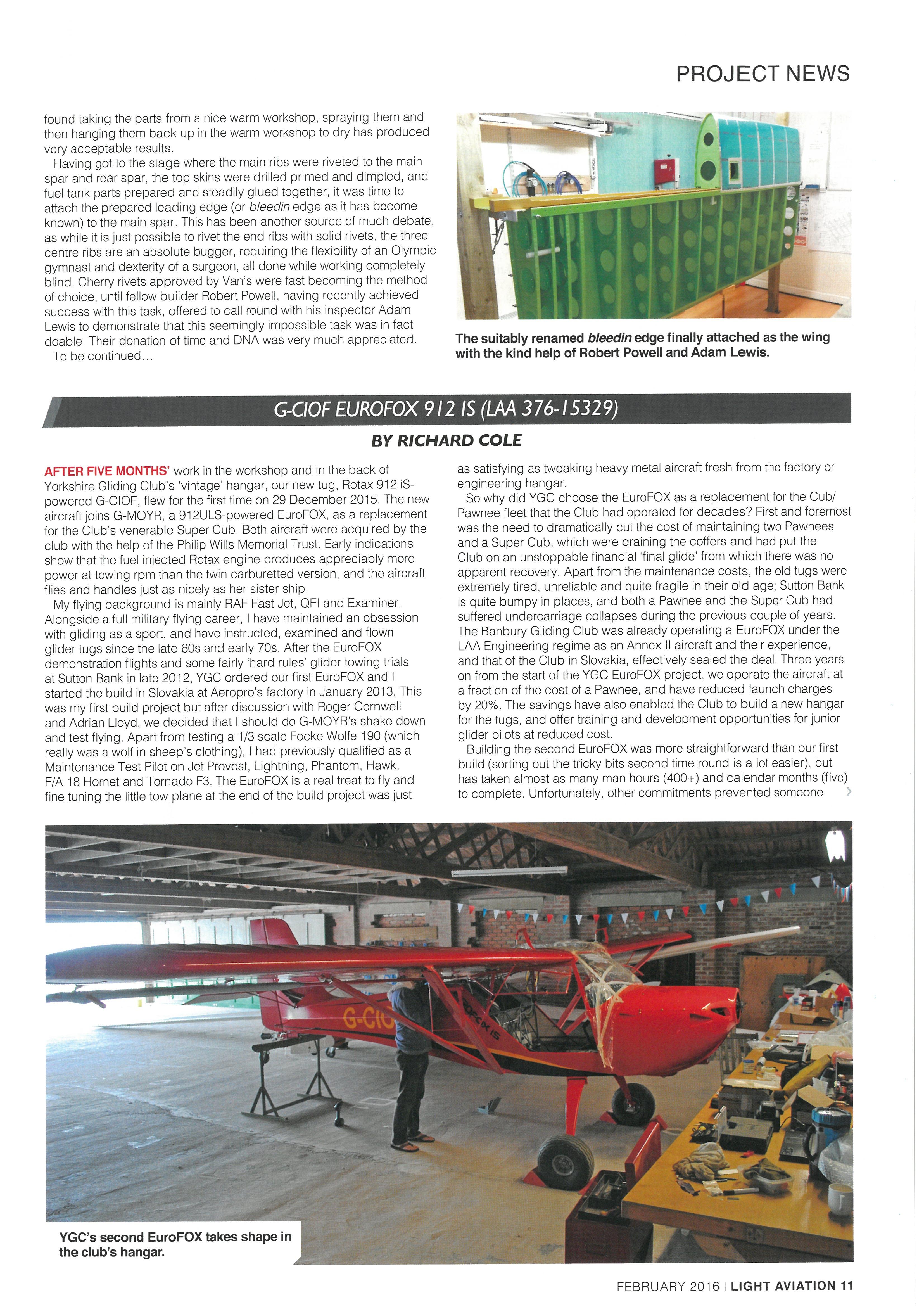
The suitably renamed bleedin edge finally attached as the wing with the kind help of Robert Powell and Adam Lewis.
COLE
PROJECT NEWS
different visiting the factory at Nitra to start this second build, so | got more supervised covering practice and insight into the whole EuroFOX concept and design. John Taylor missed out on the visit, but has confirmed his expertise as fuel system and turtle deck installer/fitter, and cowling expert. Jim McLean has built the panel and ensured that the EMS alks to the ECU properly, while Jon Morris’s engineering degree and practical experience hasbeena significanthelpwiththeengine installation. As always, Roger and Adrian at EuroFOX UK have been on the end of a phone o help with anything and everything, and John Barrott’s wiring looms that come with he EuroFox 912 iS kit are essential to the engine installation; John’s wiring diagrams (sent via many e-mails) helped unravel the mysterious contents of three different installation manuals required to put everything together firewall forward.
The YGC EuroFOX project is ongoing. We have restored one ‘good’ Pawnee from
two fairly shaky aircraft, and the tug fleet will consist of the Pawnee and two EuroFOX for the foreseeable future. The 100hp tailwheel EuroFOX with a cable retract winch and midsize tundra tyres fulfils most of the requirements for a glider tug operating at a UK gliding club, and is easy to fly, operate and maintain.
As well as the people already mentioned above, the support and help provided by the CAA, LAA, inspector Mark Golding, and our wives and partners, has to be acknowledged. In summary, YGC’s first EuroFOX has surpassed all our expectations. G-MOYR (she is registered in memory of Moyra Johnson, our late Club President) has now flown over 800 hours and launched more than 4,000 gliders in the two years we have flown her from Sutton Bank. When G-CIOF has her full Permit to Fly, and has settled into the YGC fleet, the Club should be able to reduce launch fees further, and give more help to our glider pilots in obtaining instructor ratings and extending their
NEW
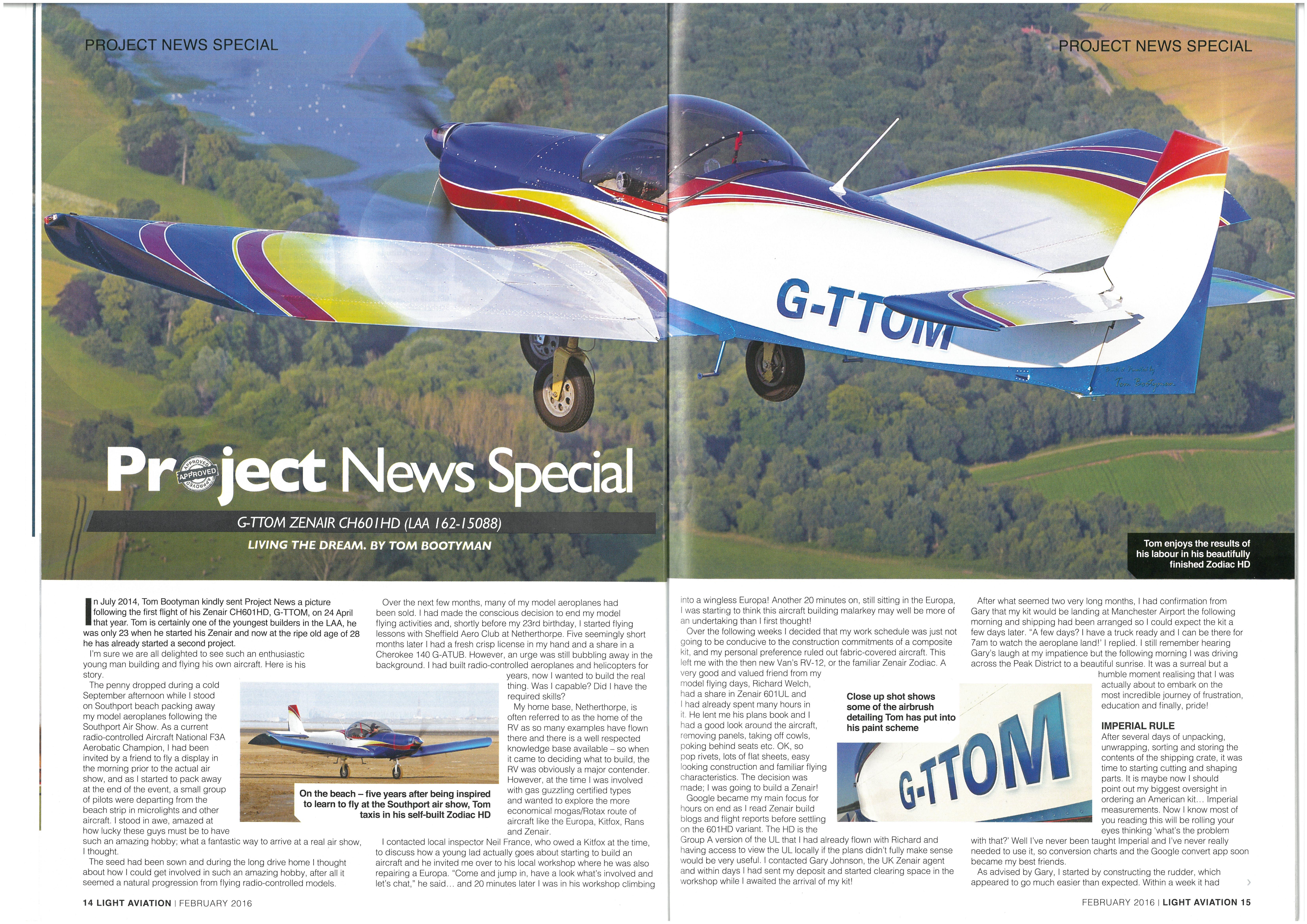
Firstflight on 29 December 2015.
The fuel-injected iS engine produces more power at tugging rpm than the carburetted ULS.
Ready and resplendent G-CIOF will join sister ship G-MOYR which has flown 800 hours and launched 4,000 gliders in just two years.
PROJECTS lfyouraircrafthasbeenfeaturedintheNewProjectslist,please let ProjectNewsknowofyourprogress at projectnews@laa-archive.org.uk
Mr S Rickett, The Barn, West Street, Brant Broughton, Lincolnshire, LN5 OSF
NEW PROJECTS
If your aircraft has featured recently in the magazine and has subsequently completed its maiden flight, Project News would love to hear from you at projectnews @laa-archive.org.uk
@ G-AKRA PIPER J3C-65 (11255) 24/12/2015
Mr W R Savin, 22 Church Street, Little Shelford, Cambridge, CB22 5HG
following the first flight of his Zenair CH601HD, G-TTOM, on 24 April that year. Tom is certainly one of the youngest builders in the LAA, he was only 23 when he started his Zenair and now at the ripe old age of 28 he has already started a second project.
I'm sure we are all delighted to see such an enthusiastic young man building and flying his own aircraft. Here is his story.
The penny dropped during a cold September afternoon while | stood on Southport beach packing away my model aeroplanes following the Southport Air Show. As a current radio-controlled Aircraft National F3A Aerobatic Champion, | had been invited by a friend to fly a display in the morning prior to the actual air show, and as | started to pack away at the end of the event, a small group of pilots were departing from the beach strip in microlights and other aircraft. | stood in awe, amazed at how lucky these guys must be to have such an amazing hobby; what a fantastic way to arrive at a real air show, | thought.
The seed had been sown and during the long drive home | thought about how | could get involved in such an amazing hobby, after all it seemed a natural progression from flying radio-controlled models.
Over the next few months, many of my model aeroplanes had been sold. | had made the conscious decision to end my model flying activities and, shortly before my 28rd birthday, | started flying lessons with Sheffield Aero Club at Netherthorpe. Five seemingly short months later | had a fresh crisp license in my hand and a share ina Cherokee 140 G-ATUB. However, an urge was still bubbling away in the background. | had built radio-controlled aeroplanes and helicopters for years, now | wanted to build the real thing. Was | capable? Did | have the required skills?
My home base, Netherthorpe, is often referred to as the home of the RV as so many examples have flown there and there is a well respected knowledge base available so when it came to deciding what to build, the RVwas obviously a major contender. However, at the time | was involved with gas guzzling certified types and wanted to explore the more economical mogas/Rotax route of aircraft like the Europa, Kitfox, Rans and Zenair.
| contacted local inspector Neil France, who owed a Kitfox at the time, to discuss how a young lad actually goes about starting to build an aircraft and he invited me over to his local workshop where he was also repairing a Europa. “Come and jump in, have a look what's involved and let’s chat,” he said... and 20 minutes later | was in his workshop climbing
into a wingless Europa! Another 20 minutes on, still sitting in the Europa, | was starting to think this aircraft building malarkey may well be more of anundertakingthan| firstthought!
Close up shot shows some of the airbrush detailing Tom has put into
Over the following weeks | decided that my work schedule was just not going to be conducive to the construction commitments of a composite kit, and my personal preference ruled out fabric-covered aircraft. This left me with the then new Van's RV-12, or the familiar Zenair Zodiac. A very good and valued friend from my model flying days, Richard Welch, had a share in Zenair GO1UL and | had already spent many hours in it. He lent me his plans book and | had a good look around the aircraft, removing panels, taking off cowls, poking behind seats etc. OK, so pop rivets, lots of flat sheets, easy looking construction and familiar flying characteristics. The decision was made; | was going to build a Zenair!
Google became my main focus for hours on end as | read Zenair build blogs and flight reports before settling on the 601HD variant. The HD is the Group A version of the UL that | had already flown with Richard and having access to view the UL locally if the plans didn’t fully make sense would be very useful. | contacted Gary Johnson, the UK Zenair agent and within days | had sent my deposit and started clearing space in the workshop while | awaited the arrival of my kit!
After what seemed two very long months, | had confirmation from Gary that my kit would be landing at Manchester Airport the following morning and shipping had been arranged so | could expect the kit a few days later. “A few days? | have a truck ready and | can be there for 7am to watch the aeroplane land!’ | replied. | still remember hearing Gary’s laugh at my impatience but the following morning | was driving across the Peak District to a beautiful sunrise. It was a surreal but a humble moment realising that | was actually about to embark on the most incredible journey of frustration, education and finally, pride!
IMPERIAL RULE
After several days of unpacking, unwrapping, sorting and storing the contents of the shipping crate, it was time to starting cutting and shaping parts. It is maybe now | should point out my biggest oversight in ordering an American kit... Imperial measurements. Now | know most of you reading this will be rolling your eyes thinking ‘what's the problem with that?’ Well I've never been taught Imperial and I’ve never really needed to use it, Soconversion charts and the Google convert app soon became my best friends.
As advised by Gary, | started by constructing the rudder, which
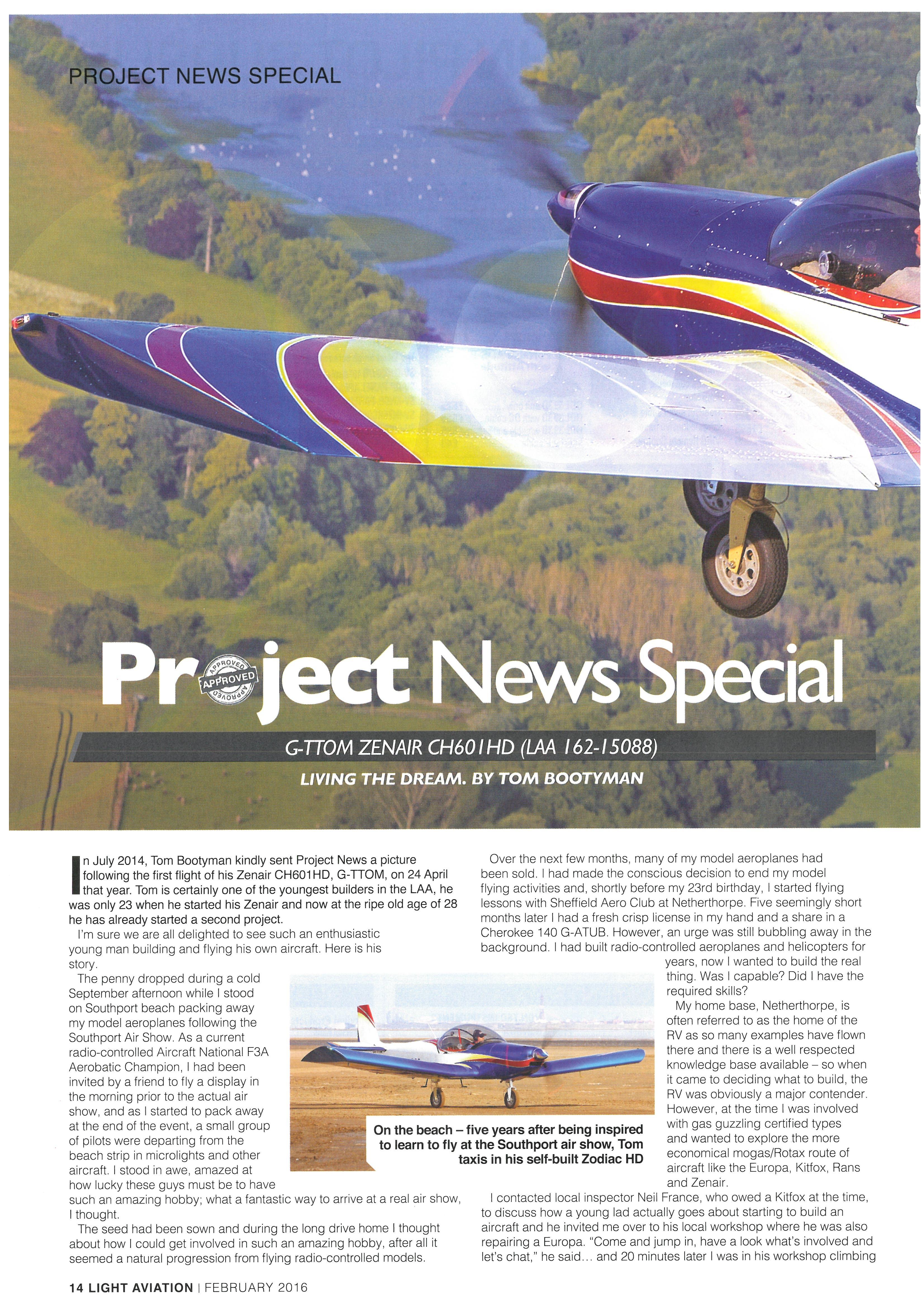
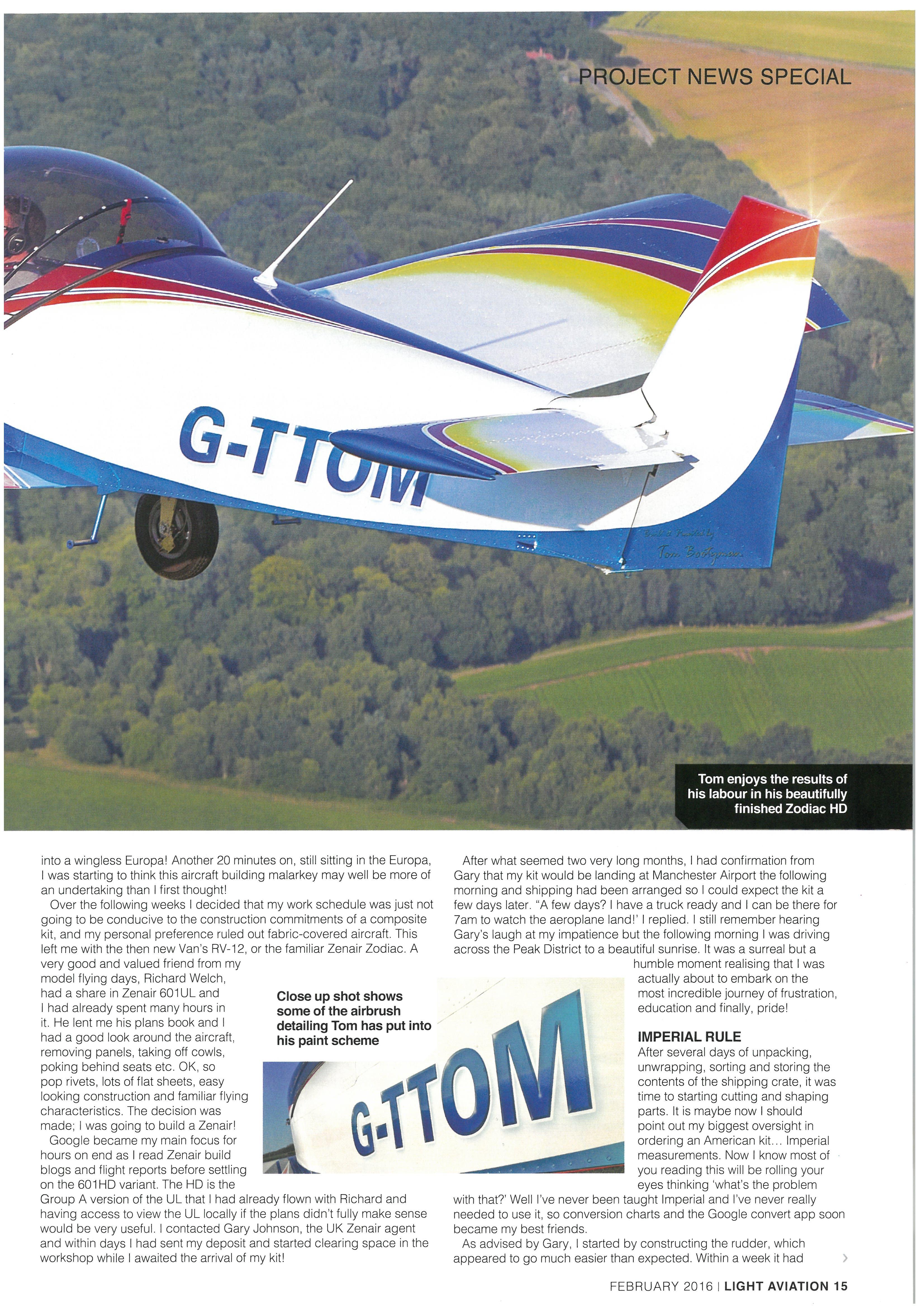
Tom enjoys the results of his labour in his beautifully finished Zodiac HD
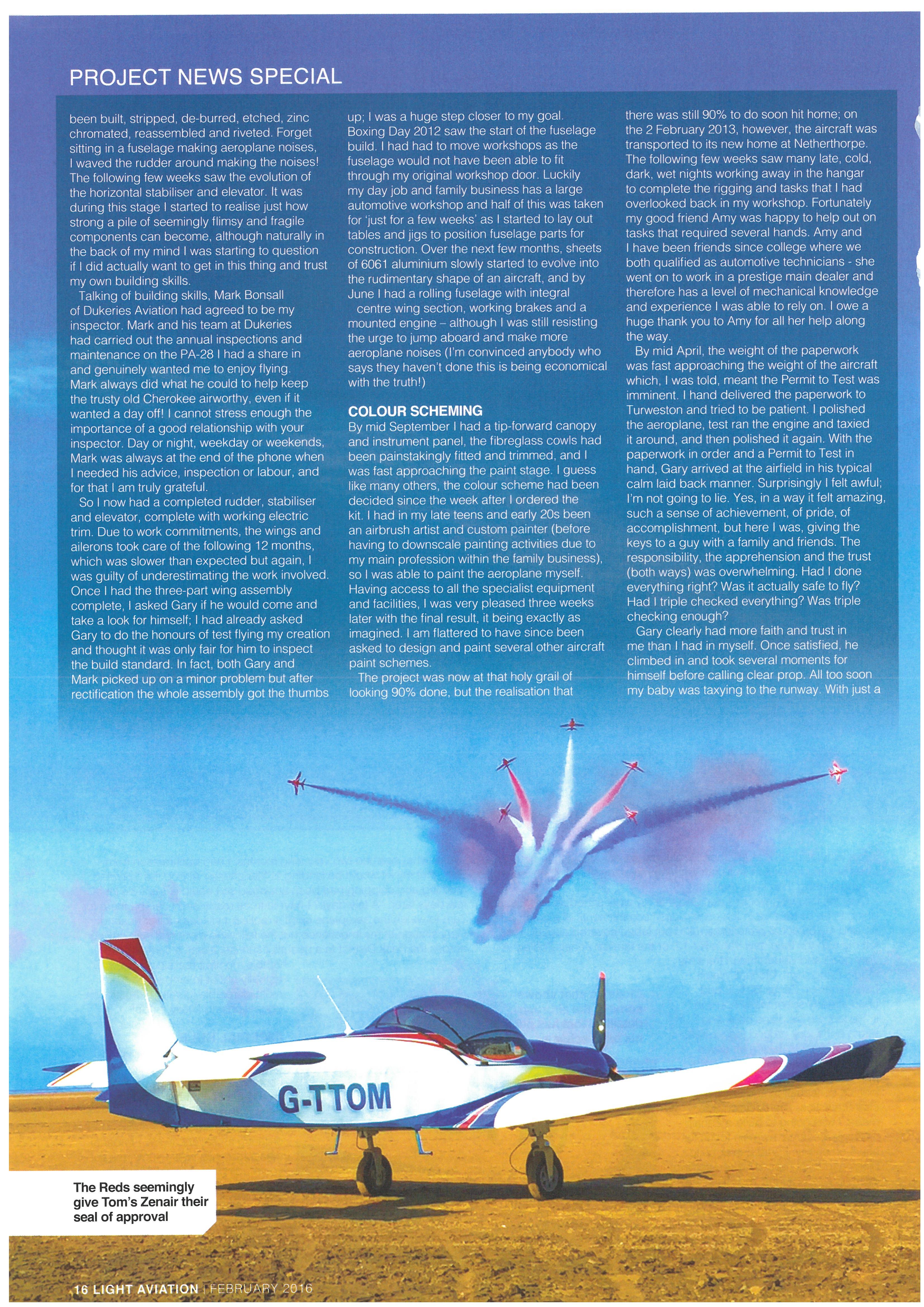
The Reds seemingly give Tom’s Zenair their seal of approval 16
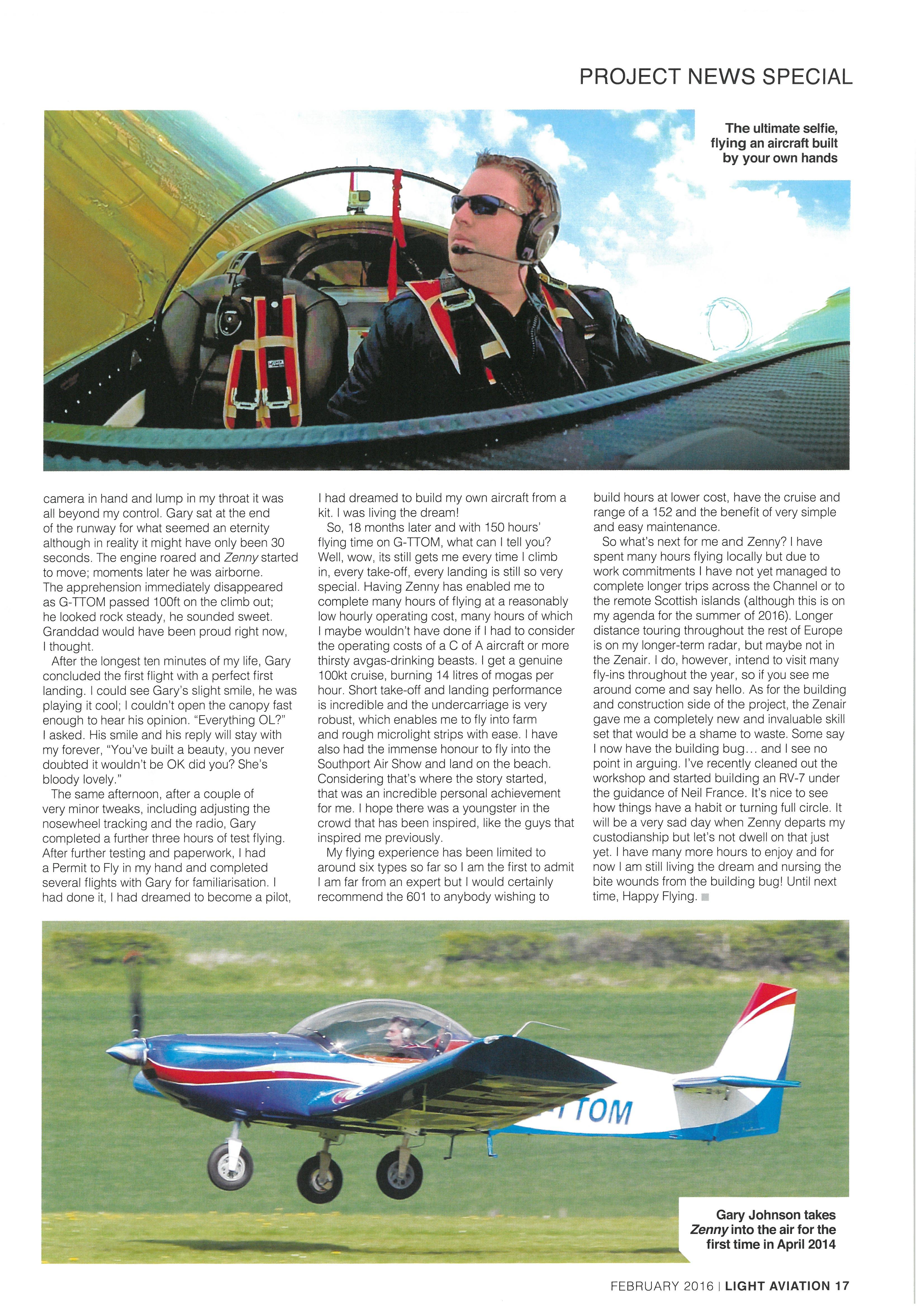
camera in hand and lump in my throat it was all beyond my control. Gary sat at the end of the runway for what seemed an eternity although in reality it might have only been 30 seconds. The engine roared and Zenny started oOmove; moments later he was airborne. The apprehension immediately disappeared as G-TTOM passed 100ft on the climb out; he looked rock steady, he sounded sweet. Granddad would have been proud right now, thought.
After the longest ten minutes of my life, Gary concluded the first flight with a perfect first anding. | could see Gary’s slight smile, he was playing it cool; | couldn’t open the canopy fast enough to hear his opinion. “Everything OL?” asked. His smile and his reply will stay with my forever, “You've built a beauty, you never doubted itwouldn’t be OK did you? She’s bloody lovely.”
The same afternoon, after a couple of very minor tweaks, including adjusting the nosewheel tracking and the radio, Gary completed a furtherthreehoursoftestflying. After further testing and paperwork, | had a Permit to Fly in my hand and completed severalflightswithGaryforfamiliarisation. | haddoneit,|haddreamedtobecome a pilot,
| had dreamed to build my own aircraft from a kit. | was living the dream!
So, 18 months later and with 150 hours’ flyingtimeonG-TTOM,whatcan|tell you?
Well, wow, its still gets me every time | climb in, every take-off, every landing is still so very special. Having Zenny has enabled me to complete many hours of flying at a reasonably low hourly operating cost, many hours of which | maybe wouldn't have done if | had to consider the operating costs of a C of A aircraft or more thirsty avgas-drinking beasts. | get a genuine 100kt cruise, burning 14 litres of mogas per hour. Short take-off and landing performance is incredible and the undercarriage is very robust,whichenablesmeto flyintofarm and rough microlight strips with ease. | have also had the immense honour to fly into the Southport Air Show and land on the beach.
Considering that’s where the story started, that was an incredible personal achievement for me. | hope there was a youngster in the crowd that has been inspired, like the guys that inspired me previously.
My flying experience has been limited to around six types so far so | am the first to admit | am far from an expert but | would certainly
build hours at lower cost, have the cruise and range of a 152 and the benefit of very simple and easy maintenance.
So what’s next for me and Zenny? | have spent many hours flying locally but due to work commitments | have not yet managed to complete longer trips across the Channel or to the remote Scottish islands (although this is on my agenda for the summer of 2016). Longer distance touring throughout the rest of Europe is on my longer-term radar, but maybe not in the Zenair. | do, however, intend to visit many fly-ins throughout the year, so if you see me around come and say hello. As for the building and construction side of the project, the Zenair gave me a completely new and invaluable skill set that would be a shame to waste. Some say | now have the building bug... and | see no point in arguing. I’ve recently cleaned out the workshop and started building an RV-7under the guidance of Neil France. It’s nice to see how things have a habit or turning full circle. It will be a very sad day when Zenny departs my custodianship but let’s not dwell on that just yet. | have many more hours to enjoy and for now | am still living the dream and nursing the bite wounds from the building bug! Until next time, HappyFlying. Gary Johnson takes Zenny into the air for the first time in April 2014
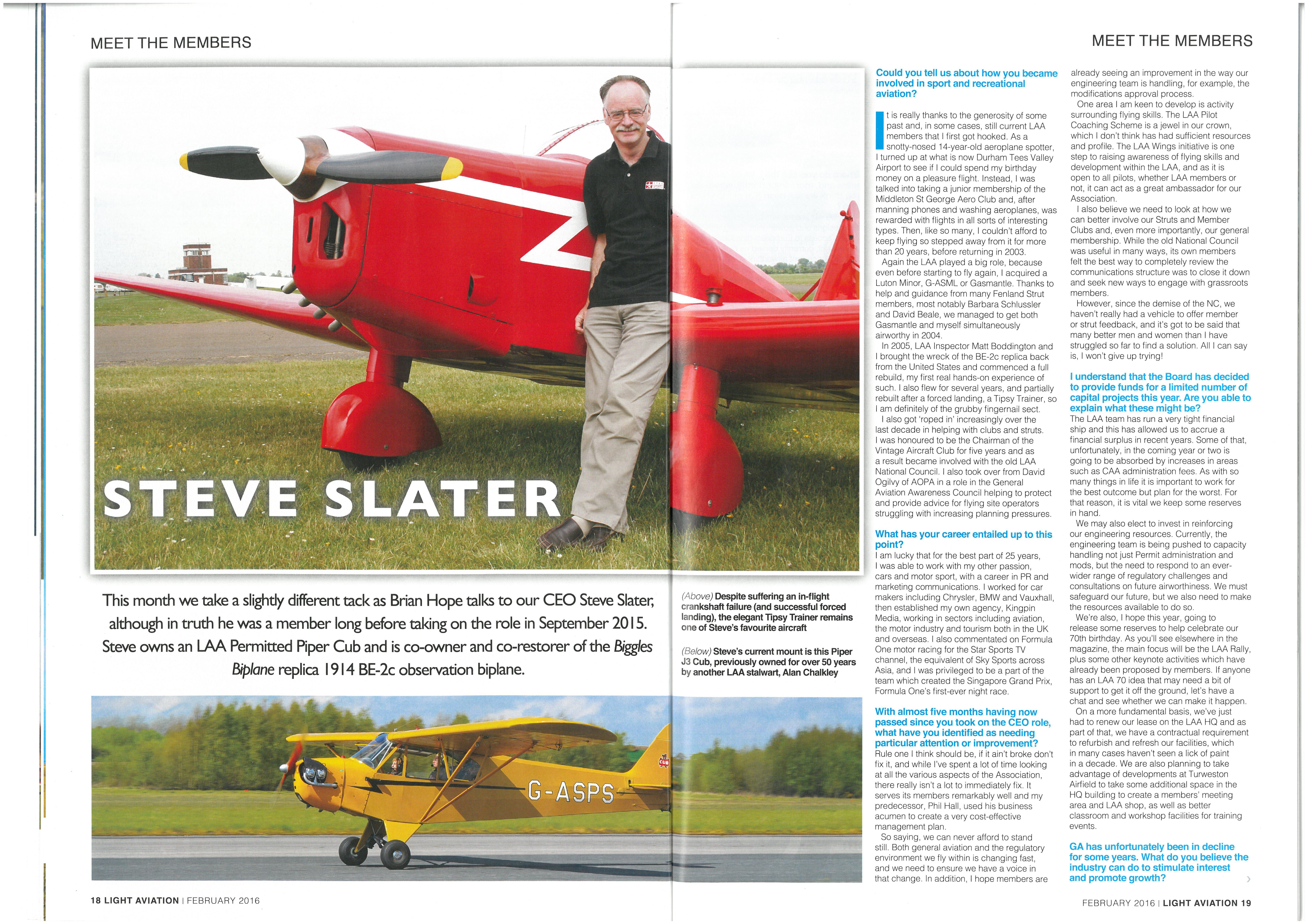
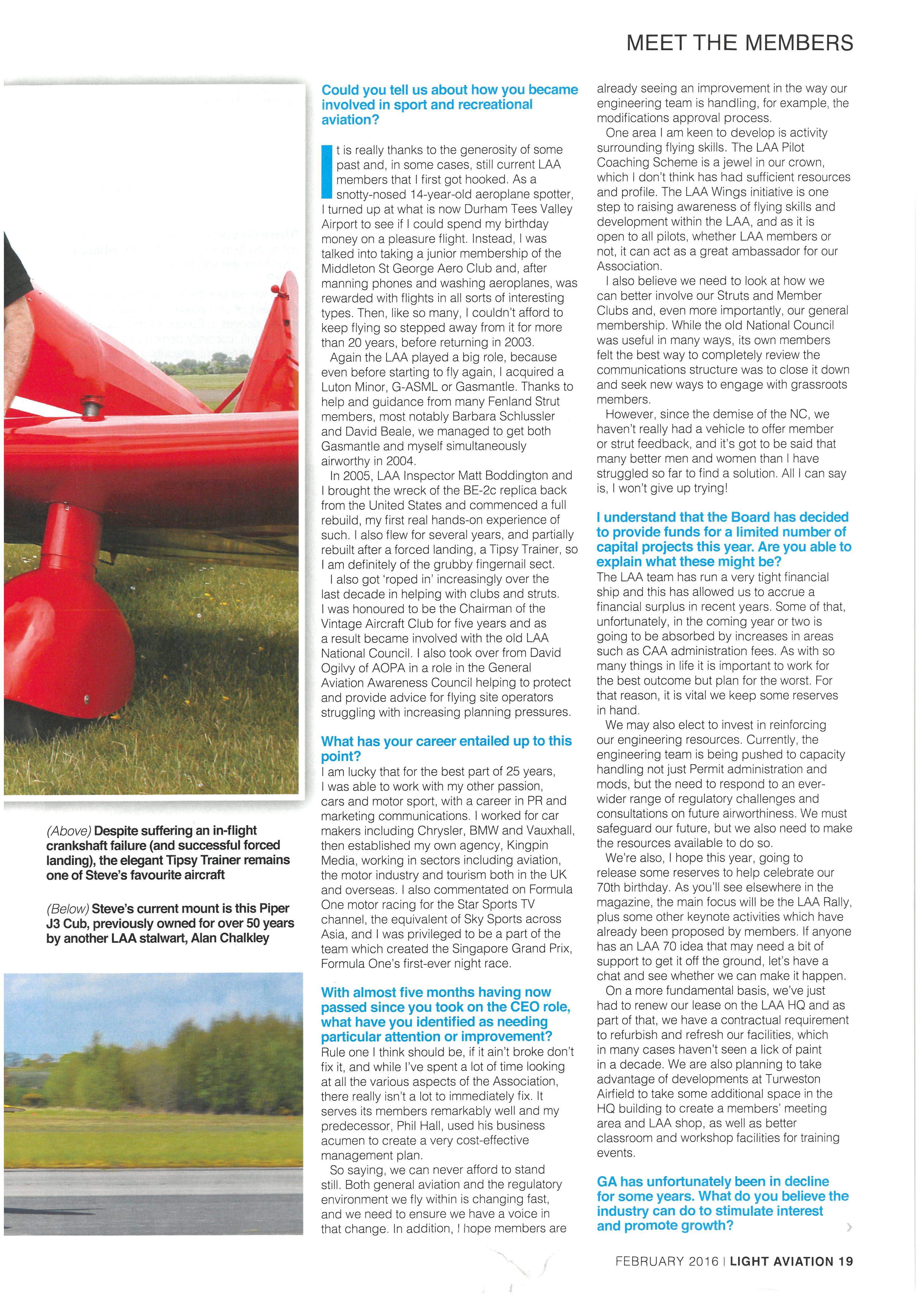
(Above) Despite suffering an in-flight crankshaft failure (and successful forced landing), the elegant Tipsy Trainer remains one of Steve’s favourite aircraft
(Below)Steve’s current mount isthis Piper J3 Cub, previously owned for over 50 years by another LAAstalwart, Alan Chalkley
Could you tell us about how you became involved in sport and recreational aviation?
t is really thanks to the generosity of some past and, in some cases, still current LAA members that| first got hooked. As a snotty-nosed 14-year-old aeroplane spotter, | turned up at what is now Durham Tees Valley Airport to see if | could spend my birthday money on a pleasure flight. Instead, | was talked into taking a junior membership of the Middleton St George Aero Club and, after manning phones and washing aeroplanes, was rewarded with flights in all sorts of interesting types. Then, like so many, | couldn't afford to keep flying so stepped away from it for more than 20 years, before returning in 2003.
Again the LAA played a big role, because even before starting to fly again, | acquired a Luton Minor, G-ASML or Gasmantle. Thanks to help and guidance from many Fenland Strut members, most notably Barbara Schlussler and David Beale, we managed to get both Gasmantle and myself simultaneously airworthy in 2004.
In 2005, LAA Inspector Matt Boddington and | brought the wreck of the BE-2c replica back fromtheUnitedStatesandcommencedafull rebuild, my first real hands-on experience of such. | also flew for several years, and partially rebuilt after a forced landing, a Tipsy Trainer, so | am definitely of the grubby fingernail sect. | also got ‘roped in’ increasingly over the last decade in helping with clubs and struts. | was honoured to be the Chairman of the Vintage Aircraft Club for five years and as a result became involved with the old LAA National Council. | also took over from David Ogilvy of AOPA in a role in the General Aviation Awareness Council helping to protect and provide advice for flying site operators struggling with increasing planning pressures.
What has your career entailed up to this point?
| am lucky that for the best part of 25 years, | was able to work with my other passion, cars and motor sport, with a career in PR and marketing communications. | worked for car makers including Chrysler, BMW and Vauxhall, then established my own agency, Kingpin Media, working in sectors including aviation, the motor industry and tourism both in the UK and overseas. | also commentated on Formula One motor racing for the Star Sports TV channel, the equivalent of Sky Sports across Asia, and | was privileged to be a part of the team which created the Singapore Grand Prix, Formula One’s first-ever night race.
With almost five months having now passed since you took on the CEO role, what have you identified as needing particular attention or improvement?
Rule one | think should be, if it ain’t broke don't fixit,andwhileI’vespent a lotoftimelooking at all the various aspects of the Association, there really isn’t a lot to immediately fix. It serves its members remarkably well and my predecessor, Phil Hall, used his business acumen to create a very cost-effective management plan.
MEET THE MEMBERS
So saying, we can never afford to stand still. Both general aviation and the regulatory environment we fly within is changing fast, and we need to ensure we have a voice in that change. In addition, ! hope members are
already seeing an improvement inthe way our engineering team is handling, for example, the modifications approval process.
One area | am keen to develop is activity surrounding flying skills. The LAA Pilot Coaching Scheme is a jewel in our crown, which | don’t think has had sufficient resources and profile. The LAA Wings initiative is one step to raising awareness of flying skills and development within the LAA, and as it is open to all pilots, whether LAA members or not, it can act as a great ambassador for our Association.
| also believe we need to look at how we can better involve our Struts and Member Clubs and, even more importantly, our general membership. While the old National Council was useful in many ways, its own members felt the best way to completely review the communications structure was to close it down and seek new ways to engage with grassroots members.
However, since the demise of the NC, we haven't really had a vehicle to offer member or strut feedback, and it’s got to be said that many better men and women than | have struggled so far to find a solution. All | can say is, | won't give up trying!
| understand that the Board has decided to provide funds for a limited number of capital projects this year. Are you able to explain what these might be?
The LAA team has run a very tight financial ship and this has allowed us to accrue a financial surplus in recent years. Some of that, unfortunately, in the coming year or two is going to be absorbed by increases in areas such as CAA administration fees. As with so many things in life it is important to work for the best outcome but plan for the worst. For that reason, it is vital we keep some reserves in hand.
We may also elect to invest in reinforcing our engineering resources. Currently, the engineering team is being pushed to capacity handling not just Permit administration and mods, but the need to respond to an everwider range of regulatory challenges and consultations on future airworthiness. We must safeguard our future, but we also need to make the resources available to do so.
We're also, | hope this year, going to release some reserves to help celebrate our 70th birthday. As you'll see elsewhere in the magazine, the main focus will be the LAA Rally, plus some other keynote activities which have already been proposed by members. If anyone hasanLAA70ideathatmayneeda bitof support to get it off the ground, let's have a chat and see whether we can make it happen. On a more fundamental basis, we've just had to renew our lease on the LAA HQ and as part of that, we have a contractual requirement to refurbish and refresh our facilities, which inmanycaseshaven'tseenalick ofpaint in a decade. We are also planning to take advantage of developments at Turweston Airfield to take some additional space in the HQ building to create a members’ meeting area and LAA shop, as well as better classroom and workshop facilities for training events.
GA has unfortunately been in decline for some years. What do you believe the industry can do to stimulate interest and promote growth?
MEET THE MEMBERS
With 7,700 individual members, the good news is that the LAA is Britain’s leading powered sport flying body. However, if we are brutally honest, the Association’s main success in recent years is that our membership has fallen slower than the other similar organisations around us. That means we need to recruit new members. | think all sport aviation organisation should work together to do that because | have no doubt that once an initial contact is made and people get to experience flying for fun, some will, like us, get hooked. What all aviation organisations need to do is make that initial contact and convince folk they can afford to learn to fly. Then thereafter, we can work on convincing them that our route to affordable flying is the one they should take.
We are seeing more change in how personal aviation is regulated than at any time since the UK CAA was established nearly 45 years ago. How should we, as an association, be dealing with this change and do you see it in any way as a threat to us?
Yes, the regulatory world around us is changing rapidly. The CAA is taking an ever shrinking role and the European regulator, EASA, a greater interest in sport aviation. And ever-greater levels of autonomy are being pressed upon us, sometimes whether we need it or not! Certainly this changing environment will mean changes in the way we do things in the future, but my feeling is we should look upon this as an opportunity rather than a threat.
2016 marks 70 years since the Association came into being and nobody can deny it has come a very long way and has stayed true to its ethos.Doyoubelievethatethosis still wholly relevant to today’s society?
Largely yes. | think the core ethos of ‘affordable flying’ is as strong as ever, as is our excellent social side with great people and events. Even when some gainsayers complain about ‘expensive’ designs such as RVs, it should be rememberedthat the reasonthey are so popular is they offer a level of performance and capability in advance of production types
costing twice as much!
It does seem that there is a move away from lengthier homebuild projects and | think we may well see more people joining us to ‘buy, fly and fix’ rather than embarking on new projects. So ever better-produced kits and, if we can achieve it, legislation enabling assistedbuild projects, may provide the key to future SUCCESS.
Where do you see the LAA in another 70 years and, more importantly, where do you think we will be in five or ten years’ time?
| think we will see the arrival of some innovative new designs and power units, along with greater access to European-developed kits and aircraft, currently denied us by being outside our current airworthiness approvals. It might, however, mean a radical review of how we handle, for example, design approval or continued airworthiness. But one thing | know will not change the LAA’s commitment to working for its members and helping facilitate affordable flying for fun.
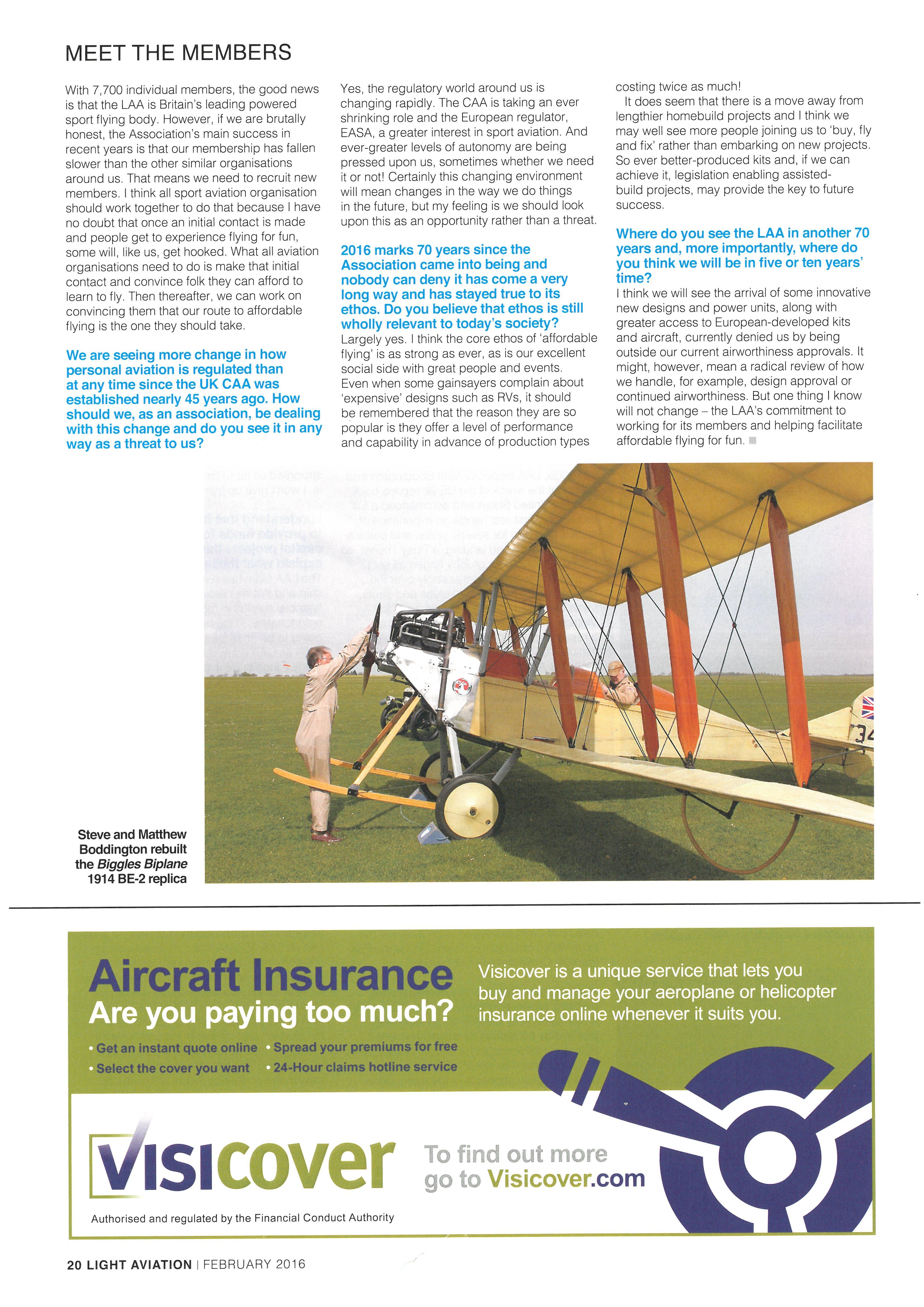
Steve and Matthew Boddington rebuilt the Biggles Biplane 1914 BE-2 replica
t seemstohavebecome a favouredsportthese days for aviation writers to lay the blame for the demise of sport and recreational flying at the door of those who have an operational interest in it or in some way regulate it. By that | mean not just the CAA, butorganisations like ourselves, flying schools and even, to some extent, those of us who participate.
In one recent article by blogger John Zimmerman, we are accused of, and | quote, being out of touch with modern life. He then goes on to cite many of the usual issues that are blamed for preventing new blood coming into the sport outdated aircraft, elitism, cost, chauvinism and lack of family facilities, lackofenvironmentalconcernanda failuretomake learning to fly more easily achievable.
“blame outdated aircratt, elitism, cost, chauvinism, lack of facilities and environmental concerns”
The question then is have we truly fiddled while GA burned? Whilst it would be easy to agree with what John Zimmerman and those of his ilk say, after all most of us are quick enough to lay the blame at anybody's door but our own for failings in something we feel passionate about, is it really fair to blame the demise of GA on those of us engaged in running and participating within it?Personally | believe that approachtobemorethanalittle simplistic;itmight make for a cleverly written piece of editorial but it also has more than a hint of not letting the facts spoil a good story. Let's take a closer look at those facts. | learned to fly in the 1970s, something of a heyday for GA with flying schools fully booked and aircraft sales probably in as healthy a state as aircraft sales ever get in the UK. In order to gain a PPL you had
to complete a minimum 43-hour course and pass a Class 2 Medical. If you couldn't pass the Class 2 Medical then you couldn't fly, end of story.
Today you can undertake a 25-hour NPPL course and medically your own General Practitioner can approve you fit to fly, based on your medical history. The likelihood is that soon you won't even have to do that for certain UK licences.
Having learnt to fly, if you wanted to own an aircraft, you either bought a fully-certified club type machine or one of its more sophisticated stablemates, or you invested in a set of plans and started carving a piece of wood (there were very few secondhand Permit aircraft available).
Today there are all manner of options, including kitplanes, microlights and LSA, all new concepts and certainly the later variants using modern, quieter and lower emission powerplants compared to what was available in the 70s. Most are also considerably more affordable both in terms of initial purchase and operation than similar age certified offerings.
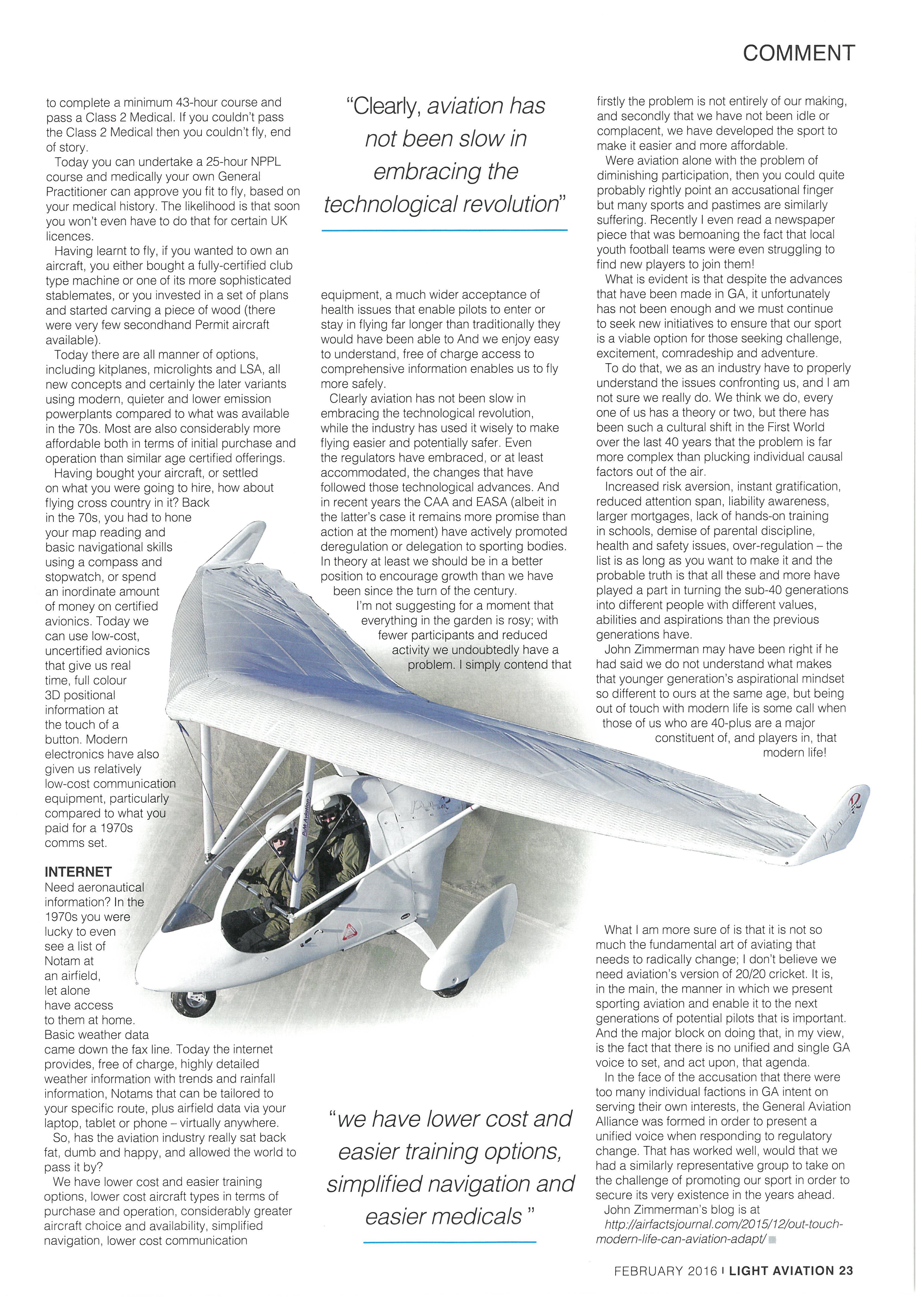
Having bought your aircraft, or settled on what you were going to hire, how about flying cross country in it? Back in the 70s, you had to hone your map reading and basic navigational skills using a compass and eee stopwatch, or spend ;
an inordinate amount of moneyoncertified / avionics. Today we WS can use low-cost, uncertified avionics that give us real time, full colour 3D positional information at the touch of a button. Modern electronics have also given us relatively low-cost communication equipment, particularly compared to what you paid for a 1970s comms set.
INTERNET
eed aeronautical information? In the 1970s you were ucky to even seealistof , otam at an airfield, et alone = have access o them at home. Basic weather data came down the fax line. Today the internet provides, free of charge, highly detailed weather information with trends and rainfall information, Notams that can be tailored to your specific route, plus airfield data via your laptop, tablet or phone -virtually anywhere. So, has the aviation industry really sat back fat, dumb and happy, and allowed the world to pass it by?
We have lower cost and easier training options, lower cost aircraft types in terms of purchase and operation, considerably greater aircraft choice and availability, simplified navigation, lower cost communication
“Clearly,aviation has not been slow in embracing the technological revolution J
equipment, a much wider acceptance of health issues that enable pilots to enter or stay in flying far longer than traditionally they would have been able to And we enjoy easy to understand, free of charge access to comprehensive information enables us to fly more safely.
Clearly aviation has not been slow in embracing the technological revolution, while the industry has used it wisely to make flying easier and potentially safer. Even the regulators have embraced, or at least accommodated, the changes that have followed those technological advances. And in recent years the CAA and EASA (albeit in the latter's case it remains more promise than action at the moment) have actively promoted deregulation or delegation to sporting bodies. In theory at least we should be in a better position to encourage growth than we have beensincetheturnofthecentury. \ I’mnotsuggestingforamomentthat
everything in the garden is rosy; with fewer participants and reduced activity we undoubtedly have a problem. | simply contend that
firstly the problem is not entirely of our making, and secondly that we have not been idle or complacent, we have developed the sport to make it easier and more affordable.
Were aviation alone with the problem of diminishing participation, then you could quite probably rightly point an accusational finger but many sports and pastimes are similarly suffering. Recently | even read a newspaper piece that was bemoaning the fact that local youth football teams were even struggling to find new players to join them!
What is evident is that despite the advances that have been made in GA, it unfortunately has not been enough and we must continue to seek new initiatives to ensure that our sport is a viable option for those seeking challenge, excitement, comradeship and adventure.
To do that, we as an industry have to properly understand the issues confronting us, and | am not sure we really do. We think we do, every oneofushasa theoryortwo,buttherehas been such a Cultural shift in the First World over the last 40 years that the problem is far more complex than plucking individual causal factors out of the air.
Increased risk aversion, instant gratification, reduced attention span, liability awareness, larger mortgages, lack of hands-on training in schools, demise of parental discipline, health and safety issues, over-regulation the list is as long as you want to make it and the probable truth is that all these and more have played a part in turning the sub-40 generations into different people with different values, abilities and aspirations than the previous generations have.
John Zimmerman may have been right if he had said we do not understand what makes that younger generation’s aspirational mindset so different to ours at the same age, but being out of touch with modern life is some call when those of us who are 40-plus are a major constituent of, and players in, that modern life!
“we have lower cost and easier training options, simplified navigation and easier medicals ”
What | am more sure of is that it is not so much the fundamental art of aviating that needs to radically change; | don’t believe we need aviation’s version of 20/20 cricket. It is, in the main, the manner in which we present sporting aviation and enable it to the next generations of potential pilots that is important. And the major block on doing that, in my view, is the fact that there is no unified and single GA voice to set, and act upon, that agenda. In the face of the accusation that there were too many individual factions in GA intent on serving their own interests, the General Aviation Alliance was formed in order to present a unified voice when responding to regulatory change. That has worked well, would that we had a similarly representative group to take on the challenge of promoting our sport in order to secure its very existence in the years ahead.
John Zimmerman’s blog is at http.//airfactsjournal.com/20 15/12/out-touchmodern-life-can-aviation-adapt/
he Royal Aeronautical Society
General Aviation Group, headed up by Optica designer John Edgley, recognised several years ago that the numbers of light aircraft and kits coming into the UK from abroad was continuing to increase, while those emanating from the UK were dwindling.
In part, of course, the group considered that this was due to the general downturn in UK manufacturing and higher labour rates inthe UK, especially when compared with those in the countries recently released from Soviet domination, many of which had a strong aeronautical tradition and seemed itching to express their freedom by producing sport aircraft rather than weapons and missiles.
This might be seen as having offered an opportunity for UK designers to get their products built abroad (as with the long-lived Britten-Norman Islander, for example), but the small number of new designs coming from the UK suggested to the group that it was perhaps the relative difficulty, or perhaps the perceived difficulty, and expense of getting a new prototype cleared for flight that might be holding British designers back.
As with many other potentially dangerous products, it seems appropriate that there should be a thorough system to ensure the safety of aircraft that are to be sold. But the group felt that the regulatory arrangements as they stood were unnecessarily stringent for a person or small company just wanting to put a prototype into the air experimentally, develop itto the point where
it might be worth launching as a commercial venture and to demonstrate it in front of potential sponsors.
After all, such a test programme should surely be able to be done in such a way that there’s a negligible risk to third parties, so why should the law have to intervene? Why not let the people taking the risks be the ones charged with looking after their own safety?
The group (which included LAA Chief Engineer Francis Donaldson Ed) spent many hours debating whether some sort of ‘very light touch’ investigation might be carried out by the CAA with an Experimental category aircraft. In the end it became clear that there were fundamentally two choices; either the regulator had to satisfy itself that theaircraft was safe to fly, and bear a large part of the responsibility if it subsequently turned out not to be, or wash its hands of the safety process altogether and leave it entirely in the hands of competent people who would themselves have to undertake to carry the full weight of responsibility for the flying programme.
The CAA’s legal advisors were adamant that there could be no satisfactory halfway house.
SO WHAT EXACTLY IS E CONDITIONS?
In essence, E Conditions is a new means of legalising experimental flying in UK airspace, in which responsibility for safety (and especially, the safety of third parties) lies entirely in the hands of the experimenter, with the authorities having a minimum involvement.
Until now, the only legal way of flying a manned civil aeroplane in the UK has been: e with a Certificate of Airworthiness
e@with a Permit to Fly
@under A Conditions’ @under B conditions’ @asan SSDR microlight e with a special exemption.
A Certificate of Airworthiness is for factorybuilt civil aircraft that are type certificated, generally to ICAO standards. A Permit to Fly is for aircraft that for some reason don't qualify for aC of A but are nevertheless proven to be airworthy. ‘A Conditions’ is an arrangement for legalising test flights or ferry flights with aircraft that have already had aC of A, where the C of A has lapsed or been nullified for some reason but the aircraft is still fit for flight and essentially to the certificated standard, and is signed up as such by a suitably qualified LAE.
‘B Conditions’ is a formal means of authorising test flying which CAA can grant to companies which can demonstrate to meet exacting standards in terms of approved personnel and facilities, qualified design staff, test pilots, quality control systems etc, and is subject to regular CAA audit and payment of fairly swingeing initial application and annual renewal fees.
SSDR(Single Seat Deregulated) microlights are single occupant aeroplanes with a gross weightnotexceeding300kganda true stall soeed not exceeding 35kt. These days not subject to airworthiness scrutiny by the authorities, the obligation falling on the owner SB EE SE
to only fly the aircraft if it is in an airworthy state and compliant with the fundamental equipment requirements of the ANO.
Temporary exemptions are issued by the CAA for such things as foreign-registered aircraft that don’t have an ICAO C of A, such as warbirds, homebuilts, microlights, and specialist purposes.
WHAT WILL E CONDITIONS MEAN FOR LAA MEMBERS?
The major aim in introducing E Conditions is that the new arrangement will facilitate UK designers/manufacturers in developing new aircraft sporting aircraft, commercial aircraft, aircraft for all sorts of presently undreamed of purposes not excluding autonomous personal transportation devices and suchlike, as Brian Davies alluded to in last month’s ‘Chairman's Chat’. It is certainly hoped that E Conditions will help UK designers to develop new sporting aircraft and allow LAA members more choices of locally-sourced designs.
Of course, designs that have been flown initially under E Conditions will still need to undergo the normal LAA, BMAA or CAA approvals process before they can be launched as a commercial product.
Hopefully, designers of projects coming into fruition by this route, seeking eventually for the type to be eligible for a Permit to Fly, will at least maintain a dialogue with the appropriate sporting organisation or regulatory body throughout, so as to avoid nasty surprises when it comes to applying for type acceptance
(Above) The Verner radial-engined Aeronca Chief, G-BTRG, was the first aircraftto be approved for operation on EConditions in early January. Itflew for the first time on 12 January with Mike Moulai at the controls and has subsequently amassed five hours flying time. See News on page 6for more information. (Photo: Martyn Wiseman)
later on, and so ensure an easy transition from proof of concept to production prototype.
Until now, the only route for an individual LAA member wanting to design a new type of homebuilt aircraft has been to work with the LAA Engineering Department (or CAA) to approve the design, build it through the LAA (or CAA) inspection system before LAA (or CAA) can Clear it for flight test.
This has three major benefits. Firstly, following the LAA/CAA process should ensure that good practices are followed and all important elements are double-checked so the accident risks are minimised. Secondly, following the |AA/CAA process means that the designer/ builder's personal liability is much reduced, becausetrainedLAA/ CAApersonnelwill have been responsible for having cleared the aircraftforflight.Thirdly,followingtheLAA / CAA process up to the flight test stage ensures hat providing the flight testing is successful, he aircraft will then qualify for a full Permit to Flyallowing unrestricted use indefinitely into the uture, A to B flying etc.
Since the introduction of CAP 1220, an LAA member who can achieve competent person status (or secure the co-operation of someone else who is so qualified) could build an owndesign aircraft and fly itvia the EConditions route, which would avoid the need for either the design or the construction to be supervised by others.The major drawbacks would be that by working in isolationlike this, he or she would not benefit from the experienced help that LAA provides, either from HQ or from the local inspector, so the design may end up less effective and less safe.
The flying that could take place would be on a temporary and very restricted basis, and without any inspection records itwould be doubtful that the aircraft could ever qualify for a full Permitto Fly.The conditions under which the aircraft can be operated under EConditions were outlined in more detail in Part 1(Light AviationJanuary 2016).
It's early days of course and only time will tell exactly how the E Conditions system will fit into the overall LAA scene, or for that matter, the BMAA. For aircraft being processed through the LAA scheme, LAA Engineering will continue to provide our own dedicated arrangements for flight testing as before, on the basis of our approval from the CAA.
The new arrangements provide a wonderful opportunity for innovators amongst the LAA membership and LAA will still be the natural home for enthusiasts choosing to use E conditions to develop new ideas inthe sporting aviation field.
ach of us has our unique story of how we ‘got into the air’, but Patricia Mawuli has an inspirational story that is certainly very different to any of us born in the UK.
Patricia does not know exactly when she was born because her birth was not registered, but it was sometime in the 1980s in the West African bushlands of Ghana, where under-five mortality is amongst the highest on the planet. Her father, a fisherman, died when she was just a few weeks old, and her mother, a ‘head-load trader’ was subsequently driven out of the village and Patricia was passed amongst family members to be cared for.
As is common in many developing nations, when a family has challenges a spiritual cause is sought a child often being blamed for ‘bringing bad luck’. Consequently, as a toddler Patricia was sent to be sacrificed (killed to relieve the family from a curse) at a local shrine. This is not as uncommon as we may think, even today. Unaware of why or where she was, but perhaps with an inbuilt survival instinct, Patricia toddled away, and was lost for a few days in the wilderness.
Finally, found by her paternal grandmother, she was taken in and cared for. As her grandmother worked in the fields she spent her days sat under a tree playing with sticks
and drawing in the dirt where, despite the predominance of malaria, tuberculosis, schistosomiasis, snakes, scorpions, etc., she survived. Once in her teens she was sent to live at her uncle’s farm near Akosombo.
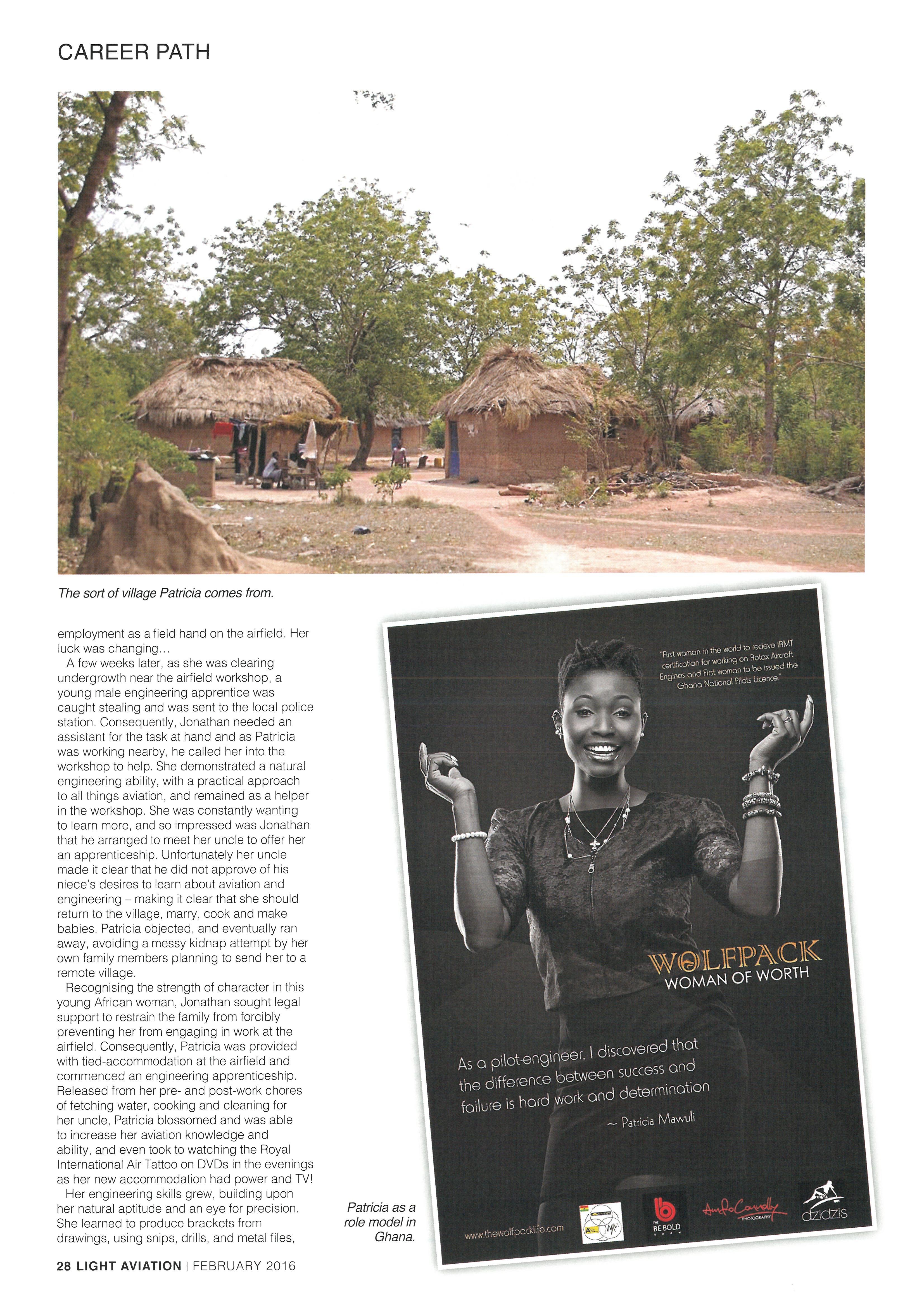
Life certainly didn’t get any easier though; she had to fetch water each morning, and ensure that the men folk were catered for, cooking on an open fire in the middle of the collection of thatched huts. At the end of each long day her bed was a straw mat on the dirt floor of a partially collapsed mud hut. In order to earn enough money to keep herself in school, she would collect firewood from the scrubland around the farm.
School was not a place of safety and comfort either. One of her teachers had a dream that Patricia turned into an owl and could fly. It was decided that this was an omen that she was a witch, and consequently she was locked into the local church overnight in an attempt to ‘cleanse her’. Fortunately, she overcame such traumas and worse besides, but her childhood was not an abnormal scenario for a young woman from a rural area in Ghana.
Then, one warm, sticky, afternoon, whilst cutting wood with her machete, she spotted a small aircraft zooming towards her, on a collision course with her or so it seemed. Thinking she was in trouble and that the aircraft
was chasing her, she climbed into a tree to hide. Suddenly, the engine roared and the aircraft climbed away back up into the sky, as it was actually carrying out a practice engine failureona trainingflight.Patriciapeeredoutof the tree and watched to see where the aircraft headed.Alittle shaken,butexhilaratedand enthralled as she had never seen an aircraft close up before, she decided she would have to find out where the aircraft came from.
Off she set, and tracked the machine to a small airfield, where Jonathan Porter, a British national, had started a social-entrepreneurship using X-Air and Zenith aircraft, and established the Rotax Distributorship for West Africa.
Dressed in a green sports top, a homemade wrap around skirt and flip-flops, Patricia asked if she could have a job. However, due to the cultural challenges of employing women in a male dominated culture, Jonathan simply said, No, we do not employ women, and turned on his heels to return to the work at hand.
Undeterred, Patricia called back / will work for free... Recognising that Patricia was not your average youngster, Jonathan picked up a machete and a pickaxe and said to her Here, take these and help the men clear those trees for the new runway. Not only did Patricia clear the trees she did it better than the men. Within a few days, she was in paid
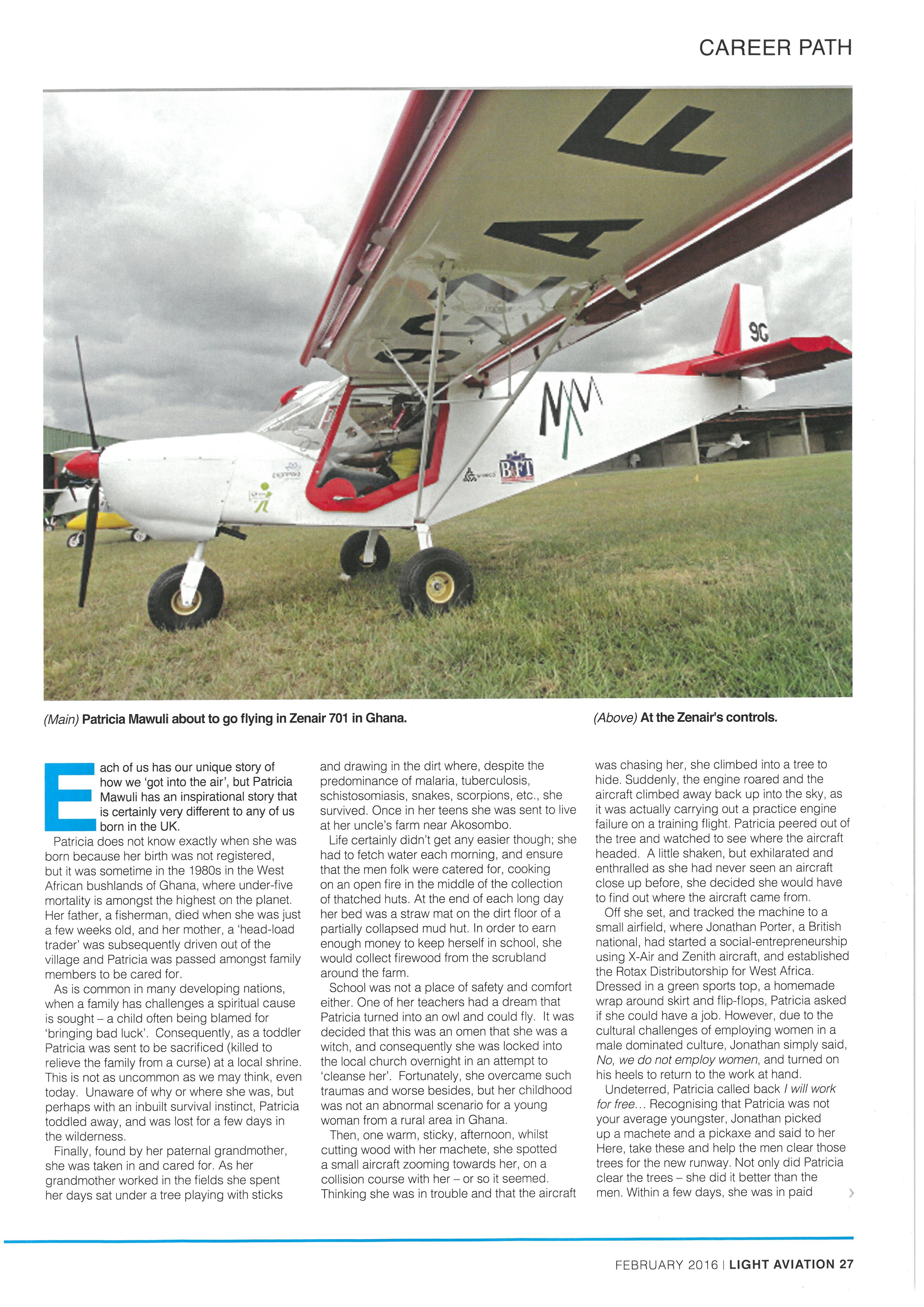
(Main) Patricia Mawuli about to go flying in Zenair 701in Ghana.
(Above) At the Zenair's controls.
The sort of village Patricia comes from.
employment as a field hand on the airfield. Her luck was Changing...
A few weeks later, as she was clearing undergrowth near the airfield workshop, a young male engineering apprentice was caught stealing and was sent to the local police station. Consequently, Jonathan needed an assistant for the task at hand and as Patricia was working nearby, he called her into the workshop to help. She demonstrated a natural engineering ability, with a practical approach to all things aviation, and remained as a helper in the workshop. She was constantly wanting to learn more, and so impressed was Jonathan that he arranged to meet her uncle to offer her an apprenticeship. Unfortunately her uncle made it clear that he did not approve of his niece’s desires to learn about aviation and engineering making it clear that she should return to the village, marry, cook and make babies. Patricia objected, and eventually ran away, avoiding a messy kidnap attempt by her own family members planning to send her to a remote village.
Recognising the strength of character in this young African woman, Jonathan sought legal support to restrain the family from forcibly preventing her from engaging in work at the airfield. Consequently, Patricia was provided with tied-accommodation at the airfield and commenced an engineering apprenticeship. Released from her pre- and post-work chores of fetching water, cooking and cleaning for her uncle, Patricia blossomed and was able to increase her aviation knowledge and ability, and even took to watching the Royal International Air Tattoo on DVDs in the evenings as her new accommodation had power and TV! Her engineering skills grew, building upon her natural aptitude and an eye for precision. She learned to produce brackets from drawings, using snips, drills, and metal files,
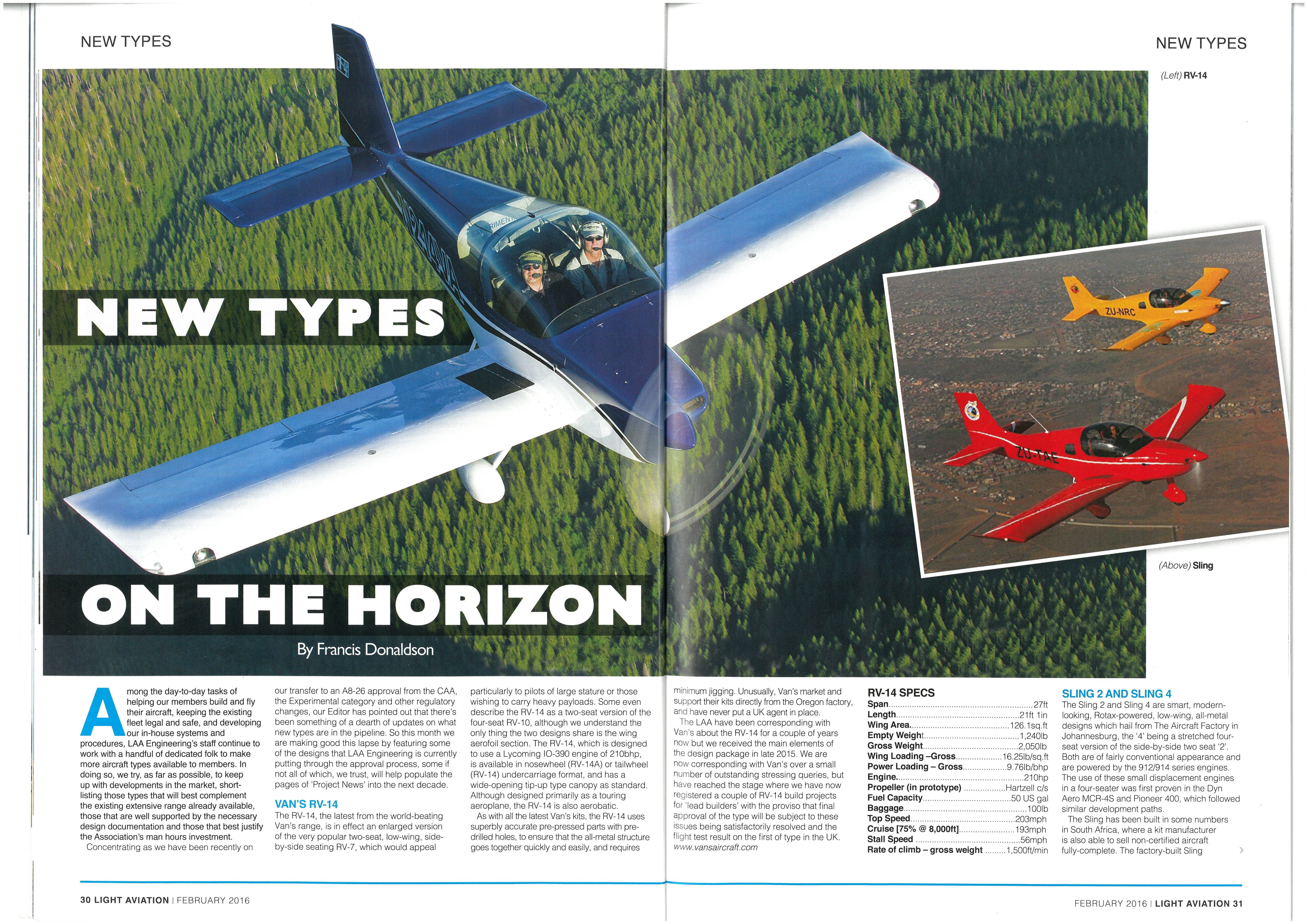
Ghana.
Patricia as a role modelin
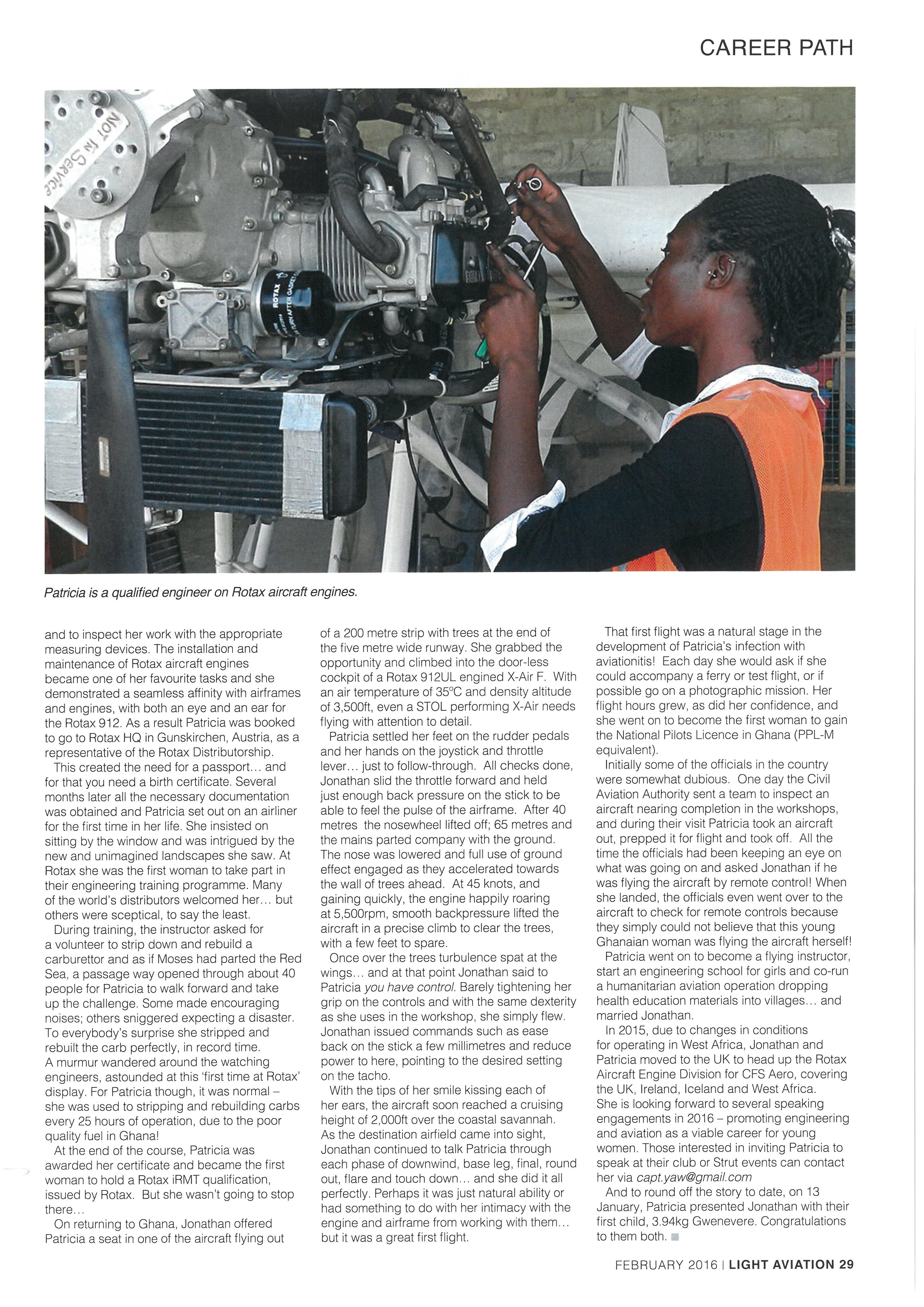
and to inspect her work with the appropriate measuring devices. The installation and maintenance of Rotax aircraft engines became one of her favourite tasks and she demonstrated a seamless affinity with airframes and engines, with both an eye and an ear for he Rotax 912. As a result Patricia was booked 0 go to Rotax HQ in Gunskirchen, Austria, as a representative of the Rotax Distributorship.
This created the need for a passport... and orthatyouneeda birthcertificate.Several months later all the necessary documentation was obtained and Patricia set out on an airliner or the first time in her life. She insisted on sitting by the window and was intrigued by the new and unimagined landscapes she saw. At Rotax she was the first woman to take part in heir engineering training programme. Many of the world’s distributors welcomed her... but others were sceptical, to say the least. During training, the instructor asked for a volunteer to strip down and rebuild a carburettor and as if Moses had parted the Red Sea, a passage way opened through about 40 people for Patricia to walk forward and take up the challenge. Some made encouraging noises; others sniggered expecting a disaster. To everybody’s surprise she stripped and rebuilt the carb perfectly, in record time. A murmur wandered around the watching engineers, astounded at this ‘first time at Rotax’ display. For Patricia though, it was normal she was used to stripping and rebuilding carbs every 25 hours of operation, due to the poor quality fuel in Ghana!
At the end of the course, Patricia was awarded her certificate and became the first woman to hold a Rotax iRMT qualification, issued by Rotax. But she wasn’t going to stop there...
On returning to Ghana, Jonathan offered Patricia a seat in one of the aircraft flying out
of a 200 metre strip with trees at the end of the five metre wide runway. She grabbed the opportunity and climbed into the door-less cockpit of a Rotax 912UL engined X-Air F. With an air temperature of 35°C and density altitude of 3,500ft, even a STOL performing X-Air needs flying with attention to detail.
Patricia settled her feet on the rudder pedals and her hands on the joystick and throttle lever... just to follow-through. All checks done, Jonathan slid the throttle forward and held just enough back pressure on the stick to be able to feel the pulse of the airframe. After 40 metres the nosewheel lifted off; 65 metres and the mains parted company with the ground. The nose was lowered and full use of ground effect engaged as they accelerated towards the wall of trees ahead. At 45 knots, and gaining quickly, the engine happily roaring at 5,500rpm, smooth backpressure lifted the aircraft in a precise climb to clear the trees, with a few feet to spare.
Once over the trees turbulence spat at the wings... and at that point Jonathan said to Patricia you have control. Barely tightening her grip on the controls and with the same dexterity as she uses in the workshop, she simply flew. Jonathan issued commands such as ease back on the stick a few millimetres and reduce power to here, pointing to the desired setting on the tacho.
With the tips of her smile kissing each of her ears, the aircraft soon reached a cruising height of 2,000ft over the coastal savannah. As the destination airfield came into sight, Jonathan continued to talk Patricia through each phase of downwind, base leg, final, round out, flare and touch down... and she did it all perfectly. Perhaps it was just natural ability or had something to do with her intimacy with the engine and airframe from working with them... but it was a great first flight.
That first flight was a natural stage in the development of Patricia’s infection with aviationitis! Each day she would ask if she couldaccompanyaferry ortestflight,orif possible go on a photographic mission. Her flight hours grew, as did her confidence, and she went on to become the first woman to gain the National Pilots Licence in Ghana (PPL-M equivalent).
Initially some of the officials in the country were somewhat dubious. One day the Civil Aviation Authority sent a team to inspect an aircraft nearing completion in the workshops, and during their visit Patricia took an aircraft out, prepped it for flight and took off. All the time the officials had been keeping an eye on what was going on and asked Jonathan if he was flying the aircraft by remote control! When | she landed, the officials even went over to the aircraft to check for remote controls because they simply could not believe that this young Ghanaian woman was flying the aircraft herself!
Patriciawentontobecomeaflying instructor, start an engineering school for girls and co-run a humanitarian aviation operation dropping health education materials into villages... and married Jonathan.
In 2015, due to changes in conditions for operating in West Africa, Jonathan and Patricia moved to the UK to head up the Rotax Aircraft Engine Division for CFS Aero, covering the UK, Ireland, Iceland and West Africa. She is looking forward to several speaking engagements in 2016 promoting engineering and aviation as a viable career for young women. Those interested in inviting Patricia to speak at their club or Strut events can contact her via capt.yaw@gmail.com
And to round off the story to date, on 13 January, Patricia presented Jonathan with their first child, 3.94kg Gwenevere. Congratulations to them both.
mong the day-to-day tasks of helping our members build and fly their aircraft, keeping the existing fleet legal and safe, and developing our in-house systems and procedures, LAA Engineering's staff continue to work with a handful of dedicated folk to make more aircraft types available to members. In doing so, we try, as far as possible, to keep up with developments in the market, shortlisting those types that will best complement the existing extensive range already available, those that are well supported by the necessary design documentation and those that best justify the Association’s man hours investment.
. ¥ ByFrancisDonaldson
our transfer to an A8-26 approval from the CAA, the Experimental category and other regulatory changes, our Editor has pointed out that there’s been something of a dearth of updates on what new types are in the pipeline. So this month we are making good this lapse by featuring some of the designs that LAA Engineering is currently putting through the approval process, some if not all of which, we trust, will help populate the pages of ‘Project News’ into the next decade.
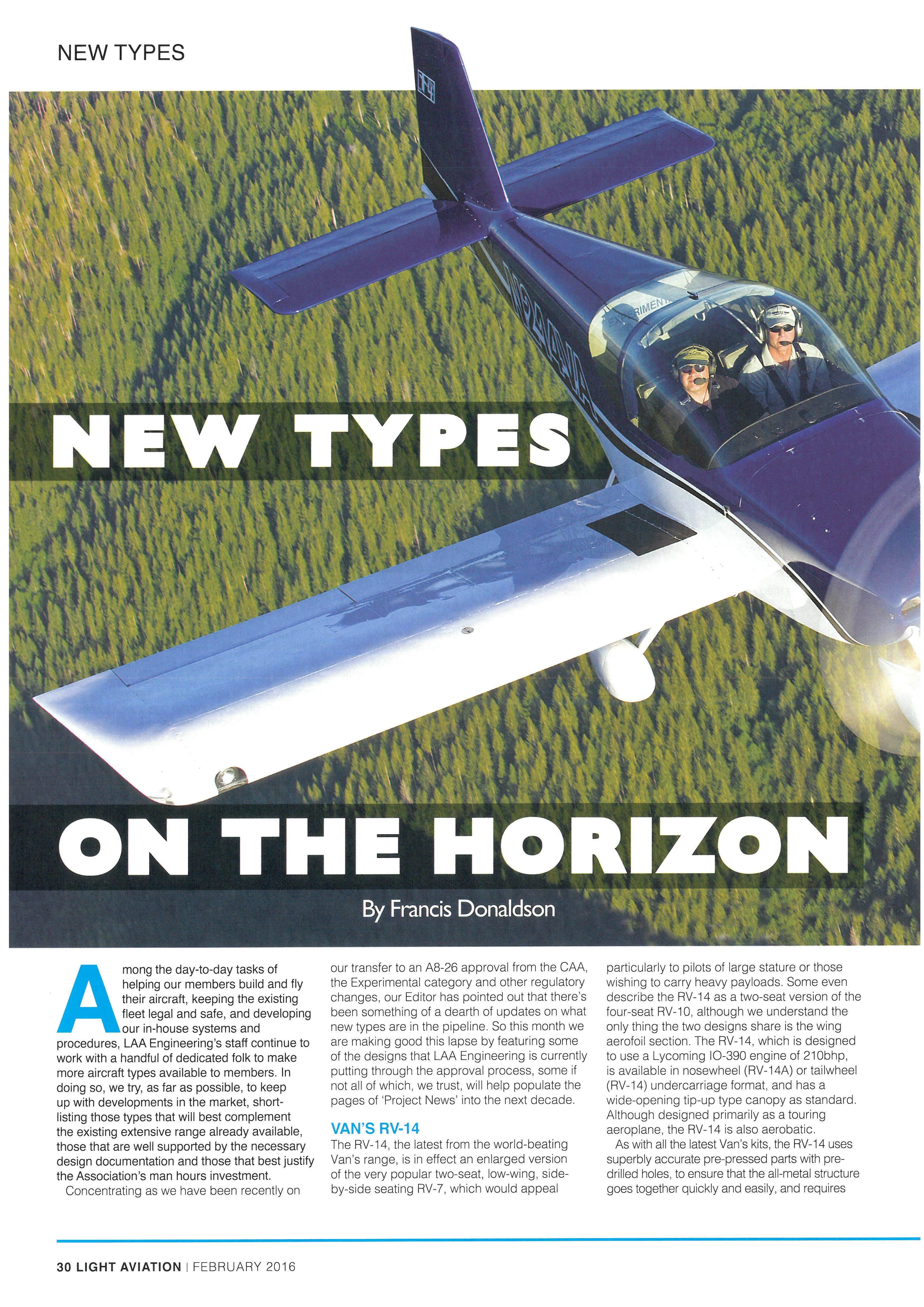
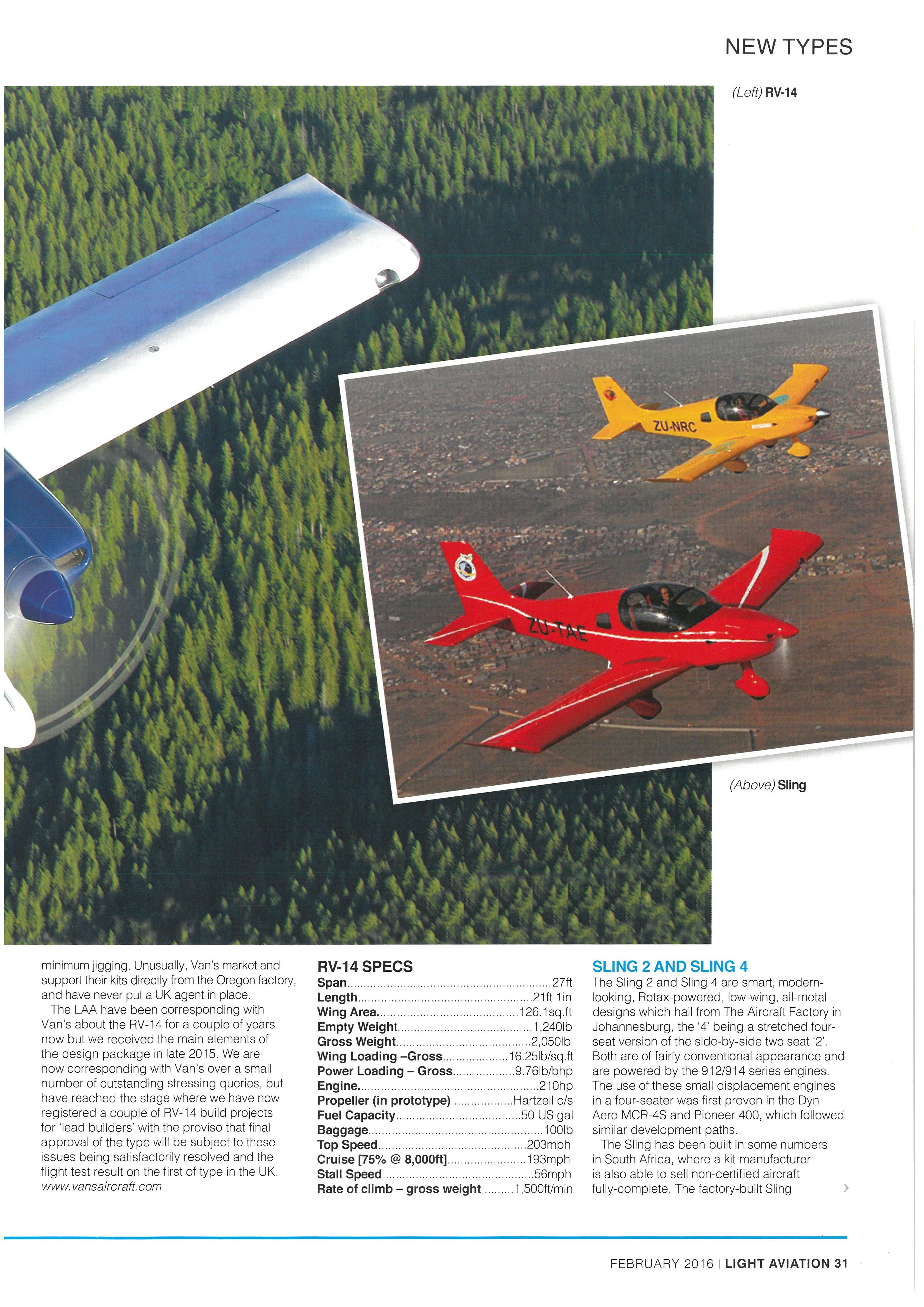
VAN’S RV-14
The RV-14, the latest from the world-beating Van's range, is in effect an enlarged version of the very popular two-seat, low-wing, sideby-side seating RV-7, which would appeal , ,
particularly to pilots of large stature or those wishing to carry heavy payloads. Some even describe the RV-14 as a two-seat version of the four-seat RV-10, although we understand the only thing the two designs share is the wing aerofoil section. The RV-14, which is designed to use a Lycoming !O-390 engine of 210bhp, is available in nosewheel (RV-14A) or tailwheel (RV-14) undercarriage format, and has a wide-opening tip-up type canopy as standard. Although designed primarily as a touring aeroplane, the RV-14 is also aerobatic.
As with all the latest Van's kits, the RV-14 uses superbly accurate pre-pressed parts with predrilled holes, to ensure that the all-metal structure goes together quickly and easily,and requires re a SS SSSESRSSTS ES
Concentrating as we have been recently on
minimum jigging. Unusually,Van's marketand support their kits directly from the Oregon factory, and have never put a UK agent in place.
The LAA have been corresponding with Van's about the RV-14 for a couple of years now but we received the main elements of the design package in late 2015. We are now corresponding with Van’s over a small number of outstanding stressing queries, but have reached the stage where we have now registered a couple of RV-14 build projects for ‘lead builders’ with the proviso that final approval of the type will be subject to these issues being satisfactorily resolved and the flight test result on the first of type in the UK. www. vansaircraft.com
SLING 2 AND SLING 4
The Sling 2 and Sling 4 are smart, modernlooking, Rotax-powered, low-wing, all-metal designs which hail from The Aircraft Factory in Johannesburg, the ‘4’ being a stretched fourseat version of the side-by-side two seat ‘2’. Both are of fairly conventional appearance and are powered by the 912/914 series engines. The use of these small displacement engines in a four-seater was first proven in the Dyn Aero MCR-4S and Pioneer 400, which followed similar development paths.
The Sling has been built in some numbers in South Africa, where a kit manufacturer is also able to sell non-certified aircraft fully-complete. The factory-built Sling
(Left) RV-14
(Above) Sling
NEW TYPES
has achieved popularity in flying schools, the absence of a type certificate apparently being no bar to such use in South Africa. Sling demonstrators have carried out some monumental long distance flights, twice being flown around the world as well as making the trip to Oshkosh to attend AirVenture, one time routing home via LAA’s Turweston base for HQ staff to examine the aircraft.
Following a recent approach from the kit manufacturer, LAA Engineering are currently checking the weighty paperwork package which accompanies the application, which shows how the aircraft’s structure has been proven by an extensive series of limit and ultimate load tests, and the performance and handling checked out by many welldocumented flight tests.
Not content to release their products onto the distant market in the normal way, the manufacturers are keen to set up a builder's centre for Sling types in the UK. Here builders could work on their projects under trained supervision and benefit from factory jigs and tools, whilst still abiding by the UK ‘s 51% rule to make sure that the aircraft would qualify as amateur-built on completion. While the Sling 2 would compete with many other types of twoseaters already available to build in the UK, the four-seat version, if it can be approved, would be unique as a lightweight four-seater of trusty all-metal construction, in the same category as the composite Jabiru 430 and wood and fabric Pioneer 400. As with the RVdesigns, the Sling aircraft make extensive use of pre-drilled holes and CNC parts to reduce the build time. airplanefactory.co.za
SLING 4 SPECS
Standard Empty Weight.............. 1,036|b/470kg
Maximum Useful Load................... 992Ib/450kg
Cruise Speed 75% Power @ 6,000ft AMSL.................... 120KTAS/138mph
Stall Speed Clean..................A7KCAS/54mph
Stall Speed - Full Flaps............ 42KCAS/48mph
Max Demonstrated
Crosswind Component.......... 15 KCAS/17mph
Take-off Ground
Roll on Concrete..................e700ft/2138m
Landing Distance Braked 500ft/152m
Rate of Climb - Sea Level..............0...... 750fom
Maximum Operating Altitude............... 15,000ft
Range @ 75% Power with 45min Reserve.................780nm/1,450km
PANTHER
The Panther, from Sport Performance Aviation of Florida, is an all-metal, single-seat, sport/ aerobatic aircraft, visually not unlike a Van's RV-3. Itfeatures folding wings and has been designed to be able to accommodate pilots of large size and to use a wide variety of engines from the Rotax and Jabiru models, up through the flat-six automotive Chevrolet Corvair conversions, small Continentals and even the Lycoming O-320. Unusually, the superb looking Panther’s all-metal structure is largely of riveted sheet aluminium type but he forward fuselage is a welded steel tube spaceframe. This spaceframe incorporates all he major load-bearing structure and pick-up points for the wings, undercarriage, engine rame, seatbelt and rear fuselage. The builder, receiving the welded frame pre-made in the kit, will have a considerable headstart over a kit with a conventional all-sheet metal uselage.
With hangarage fees in this country representing a substantial part of any light aircraft's annual running costs, the ability to take the aircraft home at the end of the season is a very attractive feature and, on paper at least, the Panther’s foldable wing is a
strong draw. Aimed at the budget end of the market, the Panther, like the RV range, seems particularly well matched to the UK grass strip, sport flying scene and not surprisingly hasattractedafair bitofinterestamongLAA members. LAA Engineering has so far reviewed the drawings and manuals, and is in negotiation with the designer about what stressing data he can provide.
As with so many single-seaters, no sooner was the Panther seen around the bazaars than the designer found himself besieged by requests for a two-seat version. Inevitably, with the development of the equally exciting tandem seat Cougar, whilst satisfying the US kit sales for the Panther, meeting the requirements for the UK market has not been a top priority for designer Dan Weseman. However, with goodwill flowing from both sides of the Atlantic, LAA Engineering expect to see substantial progress with this type in 2016. flywithspa.com
EmptyWeight............00..0.es650-850lb GSEWe TSaocssrsexxesnzsmrnsoreeeeeeeorenmcewe «1,150lb FUEL... tenteercteeerninierey 27 gal ERQING.......cccinimmmcamnnammmeenemene100-120hp
Corvair, Lycoming, Jabiru, UL Top Speed ccestrititsistasvivavivsssstvisssseseareareeseesreenes 160-200mph NAIVE,ccmansesmenmsmnenesissaneemaenesneRCSswaaeons220mph Aerobatic Capacity ..........0..0.00..cc. +6/-4.4g
JUST AIRCRAFT SUPERSTOL
The Just Aircraft SuperSTOL, from South Carolina, is a distant American relative of the familiar high-wing Escapade, although scarcely recognisable as such at first glance. Available as a kit for use with Rotax 912-ULS and 914 engines, the beefed-up SuperSTOL has a stretched wing span, stretched tail surfaces and stands tall on a very, very softly-sprung, long-stroke undercarriage fitted with massive high flotation tundra tyres for off-airfield use. Developed from the previous Highlander model, itself a derivative of the original Escapade, the SuperSTOL version introduces automatic wing leading edge slats which, in concert with the high lift wing and huge fowler flaps, produce somewhat breath-taking short take-off and landing performance. Like the Escapade and many other Kitfox /Avid Flyer derivatives, the SuperSTOL has a fuselage of welded steel tube construction while the wings are built up around a pair of large diameter aluminium tube spars.
LAA Engineering has been in correspondence with the designer for some time and has reviewed the existing manuals, design data and test reports. While this data has not been found to be comprehensive, based on the substantial amount of satisfactory in-service history that has been built up on the type, LAA Engineering has given the tentative go-ahead to a kit to be imported so that the remaining aspects can be studied first-hand on the lead build project.
STOLflying opens up fascinating possibilities for flying off-piste, and the SuperSTOL is even more optimised for the rough-field environment than the familiar all-aluminium CH701 kitplane from Zenair. Very low stall speeds and highpower, high-lift, high-drag airframes bring their own set of challenges to the pilot and it's good to see that Bob Pooler of Avalanche Aviation, the UK agent for Just Aircraft, is a
Lookingfurther ahead, in addition to the types described above, LAA Engineering has also started negotiations over the following aircraft. The Onex, a single-seat, reduced scale folding wing version of the popular two-seat Sonex.
very experienced flying instructor who intends to offer customers not only seasoned advice on the special STOLflying techniques for the SuperSTOL, but also the option of a thorough strip flying/STOL conversion course. www.avalancheaviation.co.uk
SUPERSTOL SPECS
WINGSPAN.0.00 cccteens 30ft 2in
The exciting single-seat, jet-powered SubSonex.As a turbine-powered aircraft, this will be a significant step for LAA, as our current approval from the CAA only deals with piston engines (in its broader interpretation i.e. including Wankeltypes).
Seating capacity...2
CabinWidth...cece cece 44in
Baggage area... cece 32 cu.ft
Cruise speed with 29in tyres and cruise PFOP eeeceeeeeeteeecnsseeeeeriens90-100mph
Stall, power off, no flaps......... less than 35mph
Take-off distance at 1,320lIb....... less than 100ft
Landing distance at 1,320lb.......lessthan 100ft
SEAREY
The amphibious Searey from Florida-based Progressive Aerodyne Inc has been under survey by the LAA for many years. The design has undergone a number of changes along the way (partly on LAA’s advice, partly to meet Light Sport requirements for LSA sales), including completely new and larger tail surfaces, but at last the number of remaining issues has shrunk to the point where type acceptance is expected shortly. There are several more traditional plans-built amphibians already on the LAA list (Volmer Sportsman, Osprey II and Anderson Kingfisher), and we’ve seen several modern land-based kitplanes in the UK fitted retrospectively with floats, but the Searey is the first modern kitplane we've come close to clearing that’s a purpose-built amphibious seaplane.
The Searey has strut-braced wings and tail surfaces of aluminium tubular construction, with pre-sewn polyester covering in the form of pull-on bags, very much reminiscent of
Searey
NEW TYPES
those on a Rans S6 or Xair Hawk. The tailboom is formed by a large diameter aluminium tube, while the hull is either a carbon fibre or glass-fibre shell built over a bolted framework of aluminium tubes, angles and channels. The bottom of the hull is massively reinforced for puncture-resistance, particularly important as the hull has no water-tight compartments. The tailwheel type undercarriage is retractable (including the tailwheel) under the action of an electric screw jack; another electric jack operates the plain flaps. Lightweight moulded composite wing tip floats are fitted.
Our attempt some years ago to clear the SMAN Petrel, an ultralight biplane seaplane, failed after the first of tyoe turned out to have vicious stall/spin characteristics, so it’s beenarelief tofindthattheSearey’sflight characteristics are benign. Flight tests on the UK prototype, owned and built by Tony Reid, showed that the high-mounted engine, inevitable with the seaplane layout, appeared to produce only moderate pitch trim changes with power. Indeed, for a party piece the late Patrick Gallagher, who was a partner in the project, demonstrated that their Searey could take off by itself, hands-off the stick, simply by opening the throttle and keeping it straight with his feet.
Service ceiling.....................12,500ft (3,700m)
Rate of climb................0.00...600fpm (3.05m/s)
The list of four-seat aircraft available to LAA members to build is still quite short, the current range being the Pioneer 400, Jabiru 430 and Van's RV-10,and for plans-builders, the Jodel DR1050 or D140. Another four-seat design which has attracted attention among LAA’ers is the Bearhawk, a strut-braced, high-winger configuredlikea tailwheelMauleorSuper Cub. Designed as a heavy lifting shortfield utility aircraft, it has a massive range and a useful turn of speed when powered by a Lycoming 0-360 or similar power unit. The Bearhawk is of fabric covered metal construction, the fuselage and tail being of welded steeltube while the wings are fabricated from aluminium sheet and strip. Progressinclearing the design through the LAA has been slow because of the absence of stressing information from the kit manufacturer to address issuesraised about the structural design. To make up this shortfall, an LAA member, keen to build the type, is now seeking to get the design stressedindetailretrospectivelyby a respected consultant stressengineer. Ifthis works out as planned, we lookforward to seeing this very promisingand usefulaeroplaneprogress to the next stage in due course. www.bearhawkaircraft.com
BEARHAWK
SPEC
US SEcrsneceeezomnereeeesummmenerseroers memance33it Wing Area... cetteteres 80sq.ft LONG... iisnncneemeneccmcoemmenen23tt. 6in
Fuel Capacity........ 50 Gal (standard) 72 gallons (optional, w/aux tanks)
Cruise Speed (180hp)........... 135-140mph, TAS LANGINGSCOsesccccnssuv8swscumeeceercons40mph,IAS Take-off Roll.........00..0.cece 200-500ft
Rate of Climb @gross............. 1,500-1,700fpom Range @ 65% eStore650 mi Range@50%€St.......... ees 900mi
While small scale replicas of fighters from both world wars are not uncommon, the Flying Legend Tucano is a rather unique 75% scale rendition of the Embraer turboprop trainer, familiar in our the skies in the RAF’s high visibility black paint scheme. The kitplane Tucano, available in kit form from Flying Legends in Sicily, is of riveted aluminium alloy construction and closely resembles the original. Even at 75% scale, the single-piece canopy which spans both of the tandem cockpits, is huge and creates a strong visual feature. So too does the seating position which, as with the fullsize aircraft, has the rear seat elevated several inches to give the occupant a clear forward view past the front pilot. A retractable tricycle undercarriage is fitted, hydraulically operated. Uniquely, the Flying Legend Tucano is powered by a Rotax 912-ULS engine fitted with a mechanically-driven supercharger, this being a custom conversion designed to give modest boost. The jury’s still out on this conversion and
whether the standard engine will cope with the raised power output, but it is certainly an interesting adaption.
After studying the designer's initial submissions, the LAA have now registered a single example of the kit which has been imported to the UK to form the basis of the LAA’s type investigation. The Tucano design is evolving quite rapidly, with a reinforced structure being introduced to allow aerobatic clearance and an increased max gross weight, all of which will need to be investigated as part of LAA’s checks.
Stall speed.......... 7 km/h (47mph; 40kt) flaps up Neverexceedspeed.295km/h(183mph;159kt)
HANGCecccissaniseseracnereseas900km(559mi;486nm) g limits.............. +4,4/-2.2 (to be raised to +6-3)
Rate of climb...................... 1,080ft/min (5.5m/s)
TWO SEAT FLITZER Z2
Visitors to the Homebuilders Centre at the LAA Sywell Rally in recent years may have spotted some very high quality woodwork indeed on display. If so, most likely it was on the prototype of Lynn Williams’ Flitzer Z2 design, which is being built by LAA member Simon Randle. Simon kindly brought the fuselage along in 2014, while last year he brought along an immaculate almost completed pair of wings to delight us.
The Z2 is an enlarged version of the original single-seat Z21 Flitzer, seating two in tandem in separate open cockpits. Initially intended to be
powered by an 80hp Aerovee VW conversion, other engines such as the Rotec R2800 radial engine (as successfully used on thesingle seat Z-1R version built by Dudley Pattinson) are also being considered and the radial would no doubt look just as superb on the two-seater too. Other news from the Flitzerstable (hangar?) is that the prototype of the single seat Z-1S model, built by Vic Long in Norfolk, is flying on test successfully with a UL Power UL260 motor, and is soon to be flight test evaluated by Dan Griffith for its aerobatic trials and full Permit to Fly issue. The Z-1S model is slightly more compact than the Z-21 design, with deepersection, broader-chord wings allowing it to be stressed to +6, -3g rather than the +4.4 -2.2 of the Z-21. It also features rounded wing tips,
four ailerons (rather than two) and a different tailplane configuration. www.flitzerbiplane.com
LAA homebuilt types generally fall intotwo categories those very few that are timeless (usually, but not always plans-built) such as the Pietenpol Aircamper, PittsSpecial, Midget Mustang, Falco and Van's RVs;and the vast majorityofothertypeswhichhave a limited lifespan as a commercial product. These latter hit the market in a flood of publicity, and are flavour of the month for a year or two but sales quickly peter out once the initialdemand is
to attract another group of builders for whom the replacement hits their personal spot. Of course, to a large degree, aircraft types sink or swim depending on the quality of the
for those types of foreign origin (and let's face it, almost all are) that are marketed through a UK agent, the capability of the agent is often critical to the commercial success of a new design. The successful agent will not only champion his product, he will project manage the passage of the design through the UK approvals process so as to get the quickest
and easiest ride. He will build and fly the ‘UK prototype’ so that he sees the type through to full approval before expecting others to risk building something that may end up not being approved. Building one himself also means he can advise follow-on builders from the position of one who understands what it’s like to stand, drill in hand, wondering if it's safe to drill that hole or whether it should be left till later and, once the build is finished, how to fine-tune the aircraft to make it handle ‘just so’. All this counts a great deal towards being able to provide an effective ‘builder helpline’ and preserve customer morale, and so keep alive that so-important momentum to carry the project through the inevitable distractions and dark periods.
The agent should also maintain a close liaison with the manufacturer so as to keep abreast of upcoming developments and ensure that the kits continue to arrive in the UK approved format, any changes or new options being investigated in good time so that builders are not faced with unexpected
surprises at the end of the build. He should also pass on any service bulletins and other safety information from the manufacturer and liaise with LAA over any safety issuesthat arise with the type in service.
Because of the importance of the kitagent’s role in successfully promoting and supporting LAA-accepted types, LAA Engineering is to host a workshop for kit agents atTurwestonon 24 February, where these and other related topics can be aired for the first time in a group format. By providing this opportunity, we aimto not only improve the service to members involved in building kits, but also to further expand the range of types available, the numbers of projects started (and finished!) and help create amore structured approach with which to go forward with our new A8-26 approval.
lf you are an existing kit agent you will have already been contacted, but potential agents are also welcome to attend. Pre-registration is required (contact the office on 01280 846786) and a £20 per person fee will be collected on the day to cover costs and refreshments.
eaders may recall my report ona visit to Flabob Airfield last spring and that it was but one small part of a two-week trip to California and Arizona by my friend Dave and me. Our wives had let us off the leash, preferring to stay at home rather than ‘enjoy’ our bucket list itinerary of airfields, aircraft and motor museums to celebrate Dave’s 70th birthday. So | thought I'd put pen to paper and recall some of the highlights of the rest of the trip, hopefully to inspire a few more members to indulge themselves in the future.
view from the
We travelled in late April/early May (to tie in with the Chino Airshow) and the bulk of our trip was from our point of arrival, San Francisco, southwards to LA and beyond. Our vehicle of choice was a Hyundai Santa Fe, tall enough to provide a decent view out, comfortable for long journeys yet not so huge that it drank too much fuel. On leaving the airport, we decided on the spur of the moment to do a lap of San Francisco Bay, not particularly clever at Som on a Friday but it would be our only opportunity so we set off over the Oakland and Bay bridges, before the iconic Golden Gate bridge, where
A
Big Sur, a 90-mile section of fabulous Pacific coastline from Carmel in the north to San Simeon in the south, tracked by Highway 1.
The author stands beside General Sherman, a Sequoia tree estimated to be over 2,000 years old. These ancient trees were once under threat of being totally destroyed but conservationists have fortunately preserved them.
we stopped for photos in the well-positioned parking areas. By the time we got to our hotel at Pacifica it was raining. Surely this can’t be right! | thought. What was it Mark Twain said about summer in San Francisco?
Next morning we started South and thankfully things brightened up as we stopped at San Jose for a walk around this lovely cosmopolitan town. On the outskirts we visited the Canepa Motorsports museum and, as luck would have it,Ourarrivalcoincidedwitha visitfromthe Porsche Club of California, for whom they had opened the workshops and garage behind the museum. They had all gone off to lunch and we
in 2008,onlyto
had the place to ourselves, and what a place for a pair of motorsport enthusiasts They had two Porsche 917s, as driven by Jo Siffert and Pedro Rodriquez, plus Formula 1 cars and a mix of Ferraris, Corvettes and a few gullwing Mercedes Benz cars being serviced, plus many more. www.canepa.com
Then it was onto Laguna Seca race track just outside another very pleasant town, Monterey. Situated amongst rolling hills, the circuit features the famous steep downhill bends section called the Corkscrew; Moto GP fans will recall Valentino Rossi's incredible overtake of
Marquez do the same to him in 2013. There is a service road around the track, so as there was nobody around to say we couldn't, we followed the track round for a lap. Great stuff it is similar to Brands Hatch (the full circuit) in distance and undulation. We spent a superb evening at a restaurant on the pier at Monterey Bay, with plenty of pelicans and sea lions nearby to entertain us.
Our plans for day two, Sunday, were scuppered somewhat as Highway 1 (the Pacific Coast Highway) was closed for a marathon, so we stayed an extra day and used the local toll road ($7) to make a
CaseyStonerhere
haveMark Seals by the score at Piedras Blancas at the southern end of the Big Sur.
scenic 17 mile drive which includes Pebble Beach and Cyprus Pointgolf courses, as well as some of the most fabulous houses and Pacific Ocean views.
Monday saw us on the section of Highway 1 known as the Big Sur which starts from Carmel, just south of Monteray and is the most astounding coastal road. Driving south puts you on the coast side of the road, making it easier to pull over and take in the views. There were artists taking advantage of a lovely warm and sunny day, sun worshippers on beautiful sandy beaches and deserted craggy cliffs. The drive got better at every turn and near the lower end of the 90 mile Big Sur section is a seal sanctuary where about 800 of the beasts were basking on the sand. You don’t see that at Bognor!
SEQUOIA NATIONAL PARK
We continued on past Hearst Castle and then turned inland at Morro Bay, heading for our next stop at the Sequoia National Park. This is farming and wine country and with Dave's experience as an agricultural company rep, he was able to impart a good degree of information about what we saw on the threehour drive. We stayed at conveniently situated Three Rivers, within 15 minutes of the park, and next morning entered what is one of America’s finest achievements their National Parks. The parks are so well looked after and protected yet the tourist is well served with good roads, ample parking and helpful staff. We visited what they said is the world’s largest living thing, General Sherman, a sequoia tree which reckoned to be over 2,000 years old; | didn’t
38 LIGHT AVIATION | FEBRUARY 2016
A Japanese Zero brought by the Commemorative Air Force for display at the Chino Airshow.
have the heart to suggest to the Ranger that perhaps the Great Barrier Reef was older.
After taking in the sights and pine scented smells of the Sequoia forest, we continued on to Kings Canyon Park next door, with views of snow-topped mountains in the distance. There are undoubtedly some fabulous natural wonders to see and visit in Southern California.
Next day it was on to Riverside, just outside Los Angeles, which was to be our base for the next five nights. We routed via the Mojave Desert and past the famous Edwards Air Force base, where so much experimental flight testing has taken place over the years. Although it is nothing like our Boscombe Down, where you can see the runways from the A303, having read books and watched films about Edwards, | was very pleased to even just be able to stand outside the main gate and take pictures of the B-52 that is on show there. We also saw both Mojave Air Park and Victorville, where hundreds of old (and not so old) airliners are being stripped and recycled.
Riverside is a good base for this part of California, it is safe to walk around and there are plenty of restaurants, while it is also far enough out of LA without being too distant. We visited Flabob Airport, home of EAA Chapter One and the Tom Wathen Centre (July 2015 Light Aviation) in the morning and after lunch went to Chino, to visit the Yanks Aviation
Museum. The airfield has both the Yanks and the Planes of Fame museums, and the former has a wonderful array of ‘Golden Age’ aircraft on display, including Curtiss Robin, Travelairs, American Eagle, Wacos and more, many that | have only ever seen in magazines over the years. Throw in a P-38, P-51 and P-47 heading a large collection of warbirds, and you no doubt get the picture. www.yanksair.com
Outside, they were getting ready for the Chino Airshow the next day and an interesting mix of aircraft were parked for display, including four Saab Drakens. | peered around a hanger door and spotted a rare A-20 Havoc bomber being finished off after a very long restoration, and was soon to fly again.
The temperature on the ramp was about 100°F and there is often a fairly strong dry wind as well, so you must wear a hat and drink plenty of fluid. | noticed that all the spotters and flyers who are regular visitors were wearing long sleeved shirts, applying suncream and drinking water all day long. Don't underestimate the risk of sunburn and heatstroke in this part of the world.
A welcome surprise, especially given the need to take on fluids, was the selection of great craft beers that are brewed on the West coast. We were expecting the usual Miller, Bud and other lightweight stuff, but proper IPAwas available everywhere.
We were back to Chino the next morning to look around the Planes of Fame museum before attending the airshow. The museum houses another incredible list of aeroplanes, including both Japanese and German World War || aeroplanes, with a Japanese Zero and
The USS Midway aircraft carrier, moored within walking distance of downtown San Diego and kept in superb condition. Wellwortha visit.
a Judy bomber being rebuilt. There’s also an interesting collection of very early water-based racing machines, and others from Reno, as well as a boneyard of stuff outside. Owned by Jim Maloney, this is where in many ways, large scale aircraft restoration really started; Chino is without doubt one of the best airfields | have ever visited. It offers museums, a huge variety of based aircraft plus the famous Flo’s Café, where we ate another good meal, complete with far too large portions. Think Duxford but on a much larger scale.
For the first time Chino had introduced a twilight display on the Friday evening and how lucky we were to see it, it was perfection. The Chino Hills made a superb backdrop with the evening sun catching the aircraft in a lovely golden light. The Canadians had brought their special livered CF-18, while the Lockheed F-22 Raptor performed incredible moves with its vectored thrust engine nozzles. With about 10 Mustangs and every type of warbird you would want to see (except a Hurricane), it made for a very memorable show. But for me the aeroplanes that looked the best in the light and gave the place real atmosphere were the Ryan PT-22s,Travelairs and a Peashooter that used their different speeds to create a variety of formations as they orbited the airfield. Magic. www.planesoffame.org
MARCH AIR FORCE MUSEUM
Rather than have a second day at the show, we decided to go instead to the March Air Force Museum, only about 20 minutes from Riverside. This is another big collection, including an SR-71, KC-97L tanker, B-47, B-29 and much
“Chino had introduced a twilight display on the Fridayevening and how lucky we were to see tt,it was perfection”
more. Most are outside, so it was another day of drinking water and finding shade where we could. Well worth going though, as the museum is right next to the main base, so there was a good selection of operational aircraft flying. www.marchtield.org
Many years ago, David had built a model of the USSlowa battleship; he stillhas it in his study, so we decided that as the realthing is moored up at Long Beach we would visit it.Another thing the Americans do well is recognise their service veterans, and when you buy your ticket they ask you if you were in their services. If you were, when you board the ship they announce over the tannoy (forexample) “Wewelcome Major Don Jones from the 8th Airforce to our ship today,” withanaccompanyingfanfare.Itmayseem a bit cheesy to some, but itwouldn't hurt if we had a littlemore overt pride and appreciation here inthe UK nowand again. www.pacificbattleship.com Wehada lookattheQueenMary,which looks rather sad these days, but didn’t go for a tour, and unfortunately the Petersen Collection,
which has a fantastic assembly of cars, was closed for refurbishment an excuse for another visit maybe! www.petersen.org
Next day was Monday and in the morning David went to the nearby Riverside International Automotive Museum that houses the Dan Gurney Car Collection, which has Chaparral sports and other race cars that he raced around the world. Meanwhile | returned to Flabob, and was lucky enough to get a ride in Travelair D-4D SkySiren. In the afternoon we continued South to San Diego, an historic city with Balboa Park in the centre that offers visitors a history trail, as well as a city museum. Tuesday took us to the US Marine Air Station Miramar, which houses the Flying Leathernecks Museum. All the aircraft are outside and although there were a few unusual aircraft, they were not preserved in the best of condition. www.flyingleathernecks.org
After lunch we went to San Diego seafront to visit the vast USS Midway aircraft carrier and found it to be really excellent. You can wander around the ship at your own pace, although guided tours are run to the bridge, as the steps up and down are steep and itis nota particularly large area. Back on deck it is well laid out with an aircraft on the catapult ready for launch. You can walk right over the bow of the ship, as there are two walkways that poke out. As | was standing there taking pictures, one of the old America’s Cup yachts sailed right past and underneath me, with its mast about the same height that | was standing, making for some good pictures looking right down onto it. | later sent the pictures to the company who own it, who in turn sent them to their
CALIFORNIA“AllDREAMING day long there were A-10 gunships, C-130 Hercules and F-16s flashing around” TheseS3ALockheedVikingsrepresentedatinyfractionoftheaircraftparkedinthedesertatDavis-Monthan.
atitsinstallationnearTucsoninArizona,nowamuseum.
clients who had hired the yacht for the day. | recommend the Midway as a must co visit if you are in San Diego. www.midway.org
We wandered into town in the evening and picked a bar with loads of craft beers. By chance | sat on a bar stool that was next to a chap who lives in California, but was originally born in England. We told him of our trip, and it turned out that he visits the Flying Legends Show at Duxford most years. It is odd, that of all the people we could have met it was someone with the same keen aviation interests. It’s a small world sometimes.
Wednesday 6th May was going to be our longest drive of the trip. Leaving San Diego we were heading for Tucson in Arizona, routing via Highway 8 and Yuma. Within an hour of leaving San Diego, and sea level, we had climbed steadily along the highway (there was very little traffic so we made good use of the cruise control) and saw a sign saying 6,000ft! It didn’t seem like it, although the car was rocking about quite a bit. We pulled into a layby at the top of the mountain where the road cuts through the rock and a huge area of desert lay before us. We went to get out of the car but could hardly open the doors, as the wind was so strong. We all know that wind generally increases with height but with wheels staying on terra firma we were quite taken by surprise.
We had scheduled about eight hours for this run across the desert and passed sand dunes, very isolated farms, some with beef production on a vast scale and others with all manner of crops, including oranges and lemons. What impressed us was although we were ina desert, as soon as there was a water resource
nearby it is being pumped onto vast fields for crops or grazing.
Passing through Yuma we didn’t see any of the locally based F-35s flying so continued into Tucson, which has for many years been on my wish list. Not only does it offer so many things aeronautical, it is also home of many of the cowboy films |watched when growing up. | had tried my luck by emailing the Pima Air Museum before we left home to see if we could get shown around when we visited. Their Director of Restoration, James Stemm, made himself available, and gave us a very interesting tour of the facilities. They have a huge collection of aeroplanes, both inside and out, and we chatted to a lady volunteer who was skilfully covering some wings with PolyFiber(themuseumhasa lotofaircraft waiting for restoration behind the scenes). The standard of the aeroplanes that had been restored was good, but in the very dry desert heat and atmosphere corrosion isn’t really a problem.
The exhibition hangers are air conditioned, which is a good job as again the temperature outside was very high, although the very low humidity did make it more bearable. The site has over 300 aeroplanes on display, from an Aerolines Super Guppy to Wacos and everything in between. David was particularly pleased to see a Convair B-58 Hustler and | some of the Harriers (1have a long family history with the tyoe) and many oddities such as the Budd RB-1 cargo plane that was mostly made out of spot welded stainless steel. A Consolidated B-24 Liberator and many other warbirds are housed indoors, as well as some
The rather odd Budd RB-1 at Pima Air Museum. Designed as a transport aircraft WWII in spot welded stainless steel as a precaution against possible shortages in aluminium, it never saw service but its innovative design, if not its build material, influenced ageneration of post war transports.
EAA and GA types, so you can cool down and also enjoy a break in the restaurant. Well worth avisit.www.pimair.org
DAVID MONTHAN BONEYARD
From Pima you can buy tickets and visit the well known 309th AMAARG , or as many will Know it, the Davis Monthan Boneyard that is located opposite; a coach takes less than ten minutes to reach the main gate. For many years | have seen pictures of thousands of ex US military aeroplanes waiting their turn to be either cut up, sold or re-engineered before going back into service. Although there are not as many aircraft here as there once was, there are still about 4,000 parked row upon row out in the desert. It is quite something to see what they have taken outofserviceandis justsittinghere.Obviously some are older than others, but C-5 Galaxies, loads of F-16s (too many to count) AH-1 Cobra gunships, US Navy Vikings, hundreds of F-4 Phantoms and what seemed miles of C-130 Hercules it does make you think a bit. Monthan is also an active USAF base, so all day long there were A-10 gunships, C-130 Hercules and F-16s flashing around.
On the Friday afternoon we went for a drive South to a defunct nuclear Titan missile site, which offers tours underground where visitors are shown how the controllers lived in fairly basic conditions, never knowing if they were about to be asked to finish off the world; not a job either David or | fancied very much! There is still a missile (thankfully now deactivated) sitting in its pod. www.titanmissilemuseum.org
Our last day took us to Phoenix where we visited the Penske Motor Racing Museum Roger Penske’s teams have won the Indy 500, Daytona, Nascar and numerous other races and that drew our holiday to a close. ASwe got back over London, we had to orbit and we saw the Red Arrows flying across London as part of the VE Day celebrations. A fitting end to our trip.
California offers the aviation and car buff so much to see, we were on the go for the entire fortnight and barely scratched the surface. April/May is a good time to go, as it has not yet reached its hottest. It is a great place for our type of flying too - VFR most days, cheap fuel and lots of small welcoming airports, many with no landing fees, coffee on offer and even a courtesy car to run you to a hotel or nearby town. Ifyou don’t self fly, scenic flights are often available including Travelairs at Montgomery Field, helicopters around Los Angeles and float planes over San Francisco bay. You can plan most of what you want to do ahead of time via the internet.
Thanks to Harry Geier and Jerry Wilkins at Planes of Fame, and James Stemm at Pima for their help and information.
HOW GOES THE E-GO?
t is nearly nine years since the LAA launched a microlight competition to spearhead the development of new designs to meet the recently announced SSDR (Single Seat De-Regulated)category.The CAA rules called for a maximum empty weight of 115kg, a maximum stall speed of 35kt and a maximum wing loading of 10kg per square metre which, to be honest, was something of a compromise to get what was the quite radical concept of allowing completely unregulated, non foot-launched powered flying machines to fly in the UK. The inevitably large wing area pretty well guaranteed that a typical microlight builttotheformulawouldbearelatively slow, low energy machine. However, the competition had two categories, effectively SSsimplea
‘traditional’construction, and state of the art. It was hoped that the latter would encourage some ‘out of the box’ thinking and maybe push the limitations of the design criteria to the extremes of creativity. And that is exactly what happened.
Giotto Castelli and Tony Bishop, two aeronautical engineers who had built an MCRO1Club together, presented an all composite canard design with a fully-enclosed glider type cockpit offering light aircraft performance. Called the E-Plane, the design took first place in its category and spurred Giotto to continue developing the design so they could build a prototype whilst Tony looked into market opportunities and possible collaborations.
After enlisting the help of a number of volunteers, including graduates in appropriate fields, by 2011 the design was at a point where it was considered a viable machine, the aircraft's name was changed to e-Go and e-Go aeroplanes Ltd was formed with £500K of Angel funding to build a prototype and develop it for production.
In 2012 the fledgling company was struck a devastatingblowwhenafire causedbyfault with the curing oven, destroyed the offices, although thankfully no design data was lost. Undeterred, the team picked themselves up and on 21 July 2013, the prototype flew for the first time, with test pilot Keith Dennison at the controls, at Tibenham airfield, in Norfolk. There is no doubt that building light costs
(Main)Test pilot Keith Dennison brings the e-Go into land.
money, and to meet the 115kg max empty weight the e-Go has had to be built almost exclusively in carbon fibre. It was therefore something of a mixed blessing when, in early 2014, the CAA announced that the SSDR rules were changing. A maximum all up weight of 300kg would now be allowed and, whilst the 35kt stall soeed requirement was retained, the wing loading rule was abandoned and designers were able to use smaller wings to promote faster cruise speeds, with high lift devices flaps or leading edge slats for example - incorporated to keep the stall speed within limits. That said, as of this moment in time, a very limited number of currently available SSDR machines have gone down this road. What it has meant for e-Go though,
is that certain complex and costly design solutions necessary to make the 115kg empty weight have proved unnecessary.
| asked Giotto if, starting again under the current SSDR rules, he would have done anything radically different. Apart from some of the weight saving issues, he said no because the canard arrangement has so many advantages fighter like visibility and safe stall characteristics, for instance. e-Go aeroplanes were actually contributors to the changes, sitting on the sub-committee to help define the new rules and believing it a good thing in the long term. They recognise that the earlier 115kgrequirementhadaddeda discipline to the design exercise because literally every
gram had to be justified. It is always easier torelaxandaddalittle weighttoagood,light design than it is to trim weight.
So, with the design of the aircraft established to the point where production moulds could be finalised and built, first deliveries were promised for 2015. The inevitable delays that can affect any product launch, particularly one from a small, limited resource company, has meant that date has slipped but the first production aircraft is currently well underway and the first customer is now expected to receive his aircraft by the end of April 2016.
Customers are another issue of course, because ultimately it will be the number of people prepared to pay the current £50K plus VAT asking price that decides whether
HOW GOES THE E-GO?
the e-Go survives. Nobody really knows whether a high-end, technically advanced SSDR can carve its own niche market. The SSDR category has generally been considered to be useful for offering a low-cost, entry evelmachinesandthee-Go is thefirstto urn that on it head and offer a sophisticated lying machine equipped with Mode S and 8.33 radio, and a Kanardia NESIS III EFIS inked to an e-Go data acquisition system and the Rotron Wankel rotary engine’s ECU via CANbus. You could perhaps compare that o the likes of Breitling offering sophisticated £15K watches when you can get a Timex for £20. They have a successful business because hey are selling their watches to a completely different market rather than to people who simply want to know what time it is.
FIRST PRODUCTION MACHINE
So, where is e-Go now, at the beginning of 2016 and looking to deliver its first production machine within a matter of weeks? Malcolm Bird, who flies a SportCruiser and a homebuilt Rotorway helicopter, has been with the company for five years and is the executive chairman, very kindly agreed to chat about the project and show me around the e-Go facility near Cambridge.
The first surprise was that the company had not been built on the back of development funding from the various government and regional schemes, although good and full use has been made of the UK R&D tax credit system. The entire cost of developing the aircraft has come from private individuals
Prototype with its clothes off. There’s a radiators and fan each side. Note alloy fuel tanks (petrol and oil) behind seat bulkhead, on production aircraft they
and companies who have wanted to support a new British enterprise. Readers may recall that a second fundraising call was made in 2014 when £900K was raised, partly by crowdfunding.
Before moving onto the aircraft itself, we discussed what direction the company might be going in now that the design had been settled and production was commencing. A cost reduction exercise is already underway and is seen as a vital requirement to try and prevent any further increase in retail price. Almost certainly some airframe parts of the aircraft could be made in glass rather that carbon, and components such as the aileron torque tubes, which are especially made in carbon by an outside contractor, could be substituted for stock aluminium alloy.
The engine too is a high cost item. Built by Rotron in the UK, this single rotor, 300cc powerplant produces 30hp at 7,500rpm. It is compact and lightweight (the core block weighs only 12kg) but its pedigree as a drone engine for the military means its complex metallurgy and other design aspects have been developed without cost being an overriding moderator. e-Go has already radically cut the price of the ECU by having its own unit manufactured by a US/Chinese company for a fraction of the original unit's price.
The aircraft was originally developed against a claimed 40hp for the engine but that power rating has dropped 25% in the real world. The company has recently installed a dynamometer in order to allow accurate characterisation of RTE eT
PeSePiesqeeserIeMs ss _gre _—— * a
the engine and development to claw back some of that power (Rotron reputedly gets more than 40hp in certain drone applications). Changing the engine for an alternative would be difficult but not impossible, and perhaps an electric or hybrid powerplant or even a small turbine lies in the future, depending on whether customers want short periods of intense fun or amore relaxed, longer range and economical experience. Incidentally, the Rotron features a total loss oil system. Rather like a ‘modern’ twostroke, oil is pumped to the vital organs before being burned in the combustion process. The fuel/oil mix is around 80:1, the two remote electric oil pumps, like the remote water pump, being controlled by the ECU. The aircraft features two small radiators with electric fans to keep them cool while the aircraft is on the ground. As soon as the aircraft has accelerated to 40kt and thus sufficient cooling air is passing through the radiators, the ECU turns the fans off. This automation is all part of the operational simplicity which is part of the aircraft's appeal. The production aircraft will have a single switch which controls everything electrical, meaning that the pilot will not have to concern himself with switching on pumps, charging systems, instruments etc.
Certification of the aircraft is certainly high up on the list of possibilities. It has been designed to comply with appropriate design codes, the required additional composite safety factors have been included in the structure for example, as approval for a number of foreign markets is being considered. Initially, however, the ASTM approval standard for SLSA is the
frontrunner because there has been significant interest in the aircraft in North America.
Thereisalmost a hintofironyinthatakit is also being talked about. The E-Plane was originally conceived as a kit but the company decided that it was prudent to prove the manufacturing processes to be safe and secure before deciding on what a homebuilder could reasonably do. The original criticality of hitting the 115Kg empty weight was also a major factor with a bit of extra resin a 118kg e-Go would have been an expensive ornament! So, it was decided that ready-to-fly was the optimal option. After the factory built aircraft has proved the design and production processes, and with the subsequent change in the SSDR criteria, the company now plans to offer a kit, the major components being supplied as sub-assemblies and the avionics as an option. Add to that reduced company labour costs and you have a kit that could tempt more traditional homebuilder buyers. Moving on to a completely different tack, Giotto is also keen to look into developing a threeseat version of the aircraft.
It must be said though that none of the above options are even remotely firmed up, for now the target is set purely on getting completed aircraft out to the early customers and seeing how the market develops. A new CEO is being sought and in which direction the company goes once he is in place will ultimately depend on his and the board's vision.
Moving out into the factory, it is evident that it is currently a low volume production facility.
Pre-preg carbon is laid-up by hand in polyester glass moulds with peel ply added at locations which will later need to be bonded to other components. The assembly is then vacuum bagged and cured in an oven at 100°C for about five hours. Depending on application, certain components are simply made from a couple of layers of carbon, others with up to 20 layers and some are a carbon/foam/carbon sandwich. Following the earlier fire, the curing oven is now sited remotely from the main building and has all manner of failsafe features that shut it down if a problem arises.
The moulds themselves are worthy of mention. Heavy tooling block and it is so very heavy! is used to make a pattern of a component from the CAD file by an outside contractor they have large computer controlled milling machines to carve out the pattern. The pattern is then used to make the mould, and it is simply layer after layer of glass bonded with polyester resin to over 1cm thickness.
The completed parts are bonded together to make sub-assemblies which ultimately become the complete aircraft. The wings are interesting in that a skin is laid into the wing jig followed by a thin sheet of heat activated adhesive. The front and rear spars and a number of ribs then go in all correctly jigged in place followed by carved foam blocks, hollowed out to save weight, which completely fill the voids. Another glued sheet is laid on and then the other skin. The whole is compressed between the moulds and cured to produce a completed wing panel.
HOW GOES THE E-GO?
A complete main wing panel weighs lessthan 20kg.
The prototype was sitting in the factory with its covers off and reveals the amount of effort that has gone into proving the airframe. Strain gauges have been placed around the airframe to see how it fares in flight, the data logger also keeping track of engine performance. The inside of the rearfuselage is a non-electrician’s nightmare but the company is geared up to make its own wiring loom for production aircraft, which will have less complex electronics as the company’s own ECU is a single box instead of Rotron’s two. There will be no requirement for the flight test data boom and most of the strain gauges will not be included.
Changes to the systems in the production aircraft include the throttle, which will be a conventional lever/cable rather than the ‘fly by wire’ potentiometer in the prototype, and an electric rather than manual trim system. The trim is actually a spring bias system on the stick, although the spring is in fact a carbon/ glass fibre rod. The change to the throttle is primarily because it will save an awful lot of hassle when they seek airworthiness approval for the aircraft.
The prototype has a good few camera mounts and certainly wears the battle scars of a development aeroplane as changes have inevitably been made along the way as new ideas are tried. It did, however, fly well from the outset and anyone who has seen it displayed will have been impressed by
(Left)Acompleted wing assembly and, behind, the substantial mould/jig.
(Bottomleft) Giotto Castelli, the young Italian designer of the e-Go.
(Below)Thefuselageforms an effectivesafety cell. Thecarry-throughsparsarebolted rather than glassedinto the tub. Asshown(seatmould alsoinstalled) it weighsabout 12kgbut is incredibly stiff. [Photo: Brian Hope] FEBRUARY 2016 | LIGHT AVIATION 45
HOW GOES THE E-GO?
The glider style canopy and low sill height make entry and egress very easy.
e-Go displays its agility but it’s equally at home at cross-country flying.
its agility and ability to perform in a very small display box. Itwill, for instance, turn through 360° injust seven seconds. Unfortunately test pilot Keith Dennison was out of the country at the time of my visit but the production aircraft numbers and characteristics are pretty well established.
Empty weight of the aircraft will be 138kg and maximum all up weight is 270kg. This provides +4/-2 utility category stress margins and allows a useful load of 132kg, up to 110 kg of which can be the pilot (minimum pilot weight is 60kg). There is space for up to 15kg of baggage behind the seat.
With the production aircraft being considerably ‘cleaner’ than the prototype, it is expected that the initial rate of climb at all up weight will be 700fom and the cruise will be 9Oktat 7,000rpm (a 2.75:1 belt reduction drive converts that to a prop speed of 2,550rpm).
Reducing to 6,700rpm only loses a few knots on the cruise speed but fuel burn at this setting is a miserly seven litres an hour. The carbon fuel tank, mounted on the back of the seat bulkhead, holds 30 litres, providing a normal cruise range of well over 300nm. Oil tank
Capacity is 2. 1It.
Max straight and level soeed may be just over 90kt and VNE 120kt. A ballistic chute is an option, as is a purpose designed road trailer.
The main wing is set at zero angle of incidence when the aircraft is sitting on the ground, so it is necessary to get the aircraft rolling fast enough on the take-off run to provide the canard with sufficient lift to raise the nose, whereupon the aircraft pops off the ground immediately as the main wing starts
to provide lift. Typical take-off run on a hard runway is 120m but it can be significantly longer on grass. On the production version, the main wheels have been moved 11cm farther forward to reduce the weight the canard needs to lift to get the mainplane flying, and thus reduce the take-off roll. Landing roll is of the order of 100m.
Keith has reported that the ride quality of the aeroplane, even in fairly turbulent conditions, is surprisingly good despite the low wing loading. The lower wing loading of the e-Go has meant that the aerofoil of the canard, which provides 50% of the aircraft’s required lift at 9Okt, is not as sensitive to insects or rain as some higher wing loading canards.
Flight testing has shown that in typical canard fashion, when the stall is reached the aircraft nods down to keep the main wing unstalled. In fact, when Keith holds the stick fully back with the engine at idle, the aircraft descends at just 300fpm as the canard stalls and unstalls, and the aircraft will even turn in this condition without drama. It does sound like it is an aircraft that will look after the pilot, even hamfisted ones!
Optimum L/D is in the order of 16:1 at 45kt, which means that unlike many SSDRs it does not lose penetration as soon as the throttle is closed, which on one hand makes the approach easier. However, it also means that it has a quite flat approach, although you can use the rudders together, as per Rutan designs, to create drag and thus steepen the approach. One thing you must do though is have the aircraft wheeled on before the stall because you certainly don’t want the canard to
HOW GOES THE E-GO?
stall and dump the front wheel onto the ground while the main wheels are still in the air.
In terms of usability, the glider style canopy and low mounted canard give unrivalled visibility, and the shoulder width of 60cm (23.5in) is pretty generous. The wings can be removed by moving a single lever each side with the aileron controls connecting and disconnecting automatically. Likewise the canard fits and removes without the need to touch the elevator controls. The rudder pedals are adjustable and differential brakes are fitted (the nose wheel castors).
Initially at least, the e-Go will be available in any colour as long as it is white, and the chances are that it will be vinyl-wrapped rather than painted; this will allow a known weight of ‘finish’ (the prototype had 4kg of additional paint added to cover paint blemishes), and will also overcome the issue of surface pin holes whichrequire a lotoffillingandpreparationto eliminate prior to painting.
| certainly wish the e-Go team well. They have designed, developed and productionised a British light aeroplane, and there aren't too many people who can say they’ve done that in the last 40 years.
It remains to be seen how the market responds.Therehasbeena highlevelof interest in the UK and the US, and | hope that is translated into firm orders when the first customer orders are filled and we see examples of the aircraft at fly-ins and rallies (it would certainly be great to see at least one at Sywell for our 70th anniversary Rally). Plansare to complete three aircraft this year and step up production slowly from 2017.
Lift to drag ratio is 16:1 at 45kt so the e-Go doesn’t lose momentum as soon as you close the throttle.
the finished carbon fuel tank.
WHERE TO GO
Compton Abbas GASCo Safety Presentation 01747 811767
elcome to this February Safety Spot. I’m just starting to notice that the length of the days is extending, which is very cheering; mind you, after the warmest and wettest pre-Christmas winter on record, the recent drop in temperature has hit rather hard. If you are one of the unlucky folk to have been flooded-out at home during the unusual rainy season many have suffered this year, | do hope that you’ve managed to put things back in order or at least are well on the way back to normalcy... whatever that means for you. And, unless you own a seaplane, you might consider taking an extra-careful look around your aircraft before you fire her up for its first flight of the season.
Personally, | quite like splodging along a damp river bank on a cold damp day, but | know how horrible it can be in a yacht after an unexpected drenching -trying to get to sleep in damp bedclothes is particularly unappealing; goodness knows how it must feel having a few feet of water in one’s living room.
From your aircraft's engineering management perspective, be aware that the very damp conditions experienced over the last few months will have unquestionably had an effect on your flying machine, even if it hasn't been up to its axles in water. The effects of transient
Wood is especially vulnerable to water damage - this picture shows the result of fairly long term exposure to standing water. For your interest, this is the fuselage side from a Pioneer 200 microlight aircraft that was never hangered.
(Photo Jed Mackie)
condensation can be quite damaging, as it provides the water required for corrosion to take hold if a metal isn’t 100% protected. Oxygen, the other necessary component in the ‘chemistry’ of corrosion, will be available from the atmosphere.
For those pilots who operate a wooden aircraft, it is worth remembering that wood gently balances its moisture content relative to the moisture content of its local environment (relative humidity). During conditions where a high atmospheric water content prevails, for example during the warm/wet Tropical Maritime airflow off the South Atlantic recently embedded into the UK’s weather, three important things happen to components made of wood. Firstly they grow, this is very important with regard to the attachment of wooden propellers as we all know, but what of the rest
of the aircraft's structure?
The second problem, rather associated with the material’s dimensional changes, is that the protection afforded to the wood, varnishes or paints, may not survive. A good protection coat needs to be flexible enough to cope as the wood moves around, but there will be a limit in the growth most coatings can accommodate without cracking, especially when they get older.
The third reason is that the strength of wood reduces considerably as its water content increases. The moisture content of wood (below the fibre saturation point) is a function of both relative humidity and the temperature of the surrounding air. Wood, in service, rarely reaches a moisture equilibrium because it is always ‘chasing’ an equilibrium; but, most of this change relates to the part of the wood that’s close to the surface - the core is slow to react to environmental change.
Ideally, wood is seasoned so that its water content (as a percentage) is close to the equilibrium point expected in service. For example, for most woods the equilibrium point at 15°C (59°F) with a relative humidity of 70% is about 14%. Take the relative humidity up to 90% without changing temperature and the moisture content in the wood (once it balances to equilibrium point) will rise to
Here’s the picture that first set engineer’s alarm bells ringing. The nut you can see holds the front end of the tail-spring in place. Itcertainly looks like the whole of the tail area has been affected by standing water. Glue joints have failed; the detritus you can see lying on the fuselage floor is most likelythe remains of the varnish layer.
(Photo Al Greensmith)
The fibrous nature of wood strongly influences how it behaves in service. Wood is composed mostly from hollow, spindle-shaped, elongated cells which, in life, are arranged parallel to each other along the trunk of the tree. How the wood is cut naturally affects the way these cells are arranged when the wood is used as a construction material. The graphical (and rather general) representation (left) shows how water affects the compressive strength of wood; the effect is less marked, although still present when tests are carried out with wood in tension. Cell (grain) direction affects the results significantly, of course, but nevertheless the graph shows why it’s importantto keep wooden structures dry.
(Left) We've featured this pictureof a Jodel fuselage failure before in Safety Spot (March 2015);following a groundloop incident, damage could clearly be seen. During the incident, the tail was seen to have impacted a concrete post and much of the damage seen may have occurred at this point. Both LAA inspectors and the engineer from the insurance company weren’t so sure though and felt that the original cause of the runway departure may have been because part of the structure, weakened by water damage, broke shortly after landing. Looking at the evidence | have to say that I’m minded to agree.
(Photo Al Greensmith)
(Right)lf water is allowed to get in, it will. LAA Inspector, Roger Targett, sent me this picture with the following note: Thought you might like to see a couple of pictures of the prop shaft on an aircraft we’re working on at the moment. We had a shock load inspection carried out yesterday, the prop bolt safety wiring left a lot to be desired, but then, on removing the prop, we found paper/cardboard packing on one side to shim the hub over to improve the tracking, leaving a gap allowing corrosion to set up!
(Photo Roger Targett)
(Above) The water-damaged Jodel is now being rebuilt from the bottom up. LAA’er Alan Shipp has taken on the challenge and we’re keeping an eye on progress here atLAAHQ.Thispictureshowsatypical example of the type of damage that is having to befixed the joint between the upright and the longeron has completely failed, note the ‘crush’damage to the tailplane attachment block. As wood absorbs water it grows, then metal fittings bolted to the wood structure crush the wood as it tries to swell. When the wood dries out, itshrinks again leaving the fitting loose. Naturally, for the maintainer finding the loose fitting, the temptation is just to tighten upthe bolts but come the next drenching the cycle will repeat itself, leading to an ever more crushed and distorted structure. Naturally,the cure is to keep the water out in the first place.
(PhotoAlan Shipp)
about 21%. I’ve added a graph which shows the effect on the compressive strength of woodasa functionofitsmoisturecontent; if this graph doesn’t dissuade you from keeping a wooden aircraft outside in wet conditions, | don't know what will! To reiterate, before you fly after the winter break, carefully check your aircraft for signs of water damage; check the drain holes are all clear and that you haven't accumulated a small reservoir in a difficult-tosee space.
Thank you to all those who commented about the January Safety Spot. As we start to approach the new flying season, well, next month will be March, | think that it is worth a reminder that Safety Spot is only as good as the material you give me to put in it and good feedback is essential. LAA’er John Goodale, who flies his Sky Arrow out of Popham, wrote letting me know the problems he had with the battery on an old bus, yes that’s bus, he used to operate. Sadly, | don’t have the space to copy his letter about this interesting hobby in this Safety Spot, but he pointed out that I’d neglected to mention something in the January issue where | discussed some of the strengths | andweaknesses of \ batteries, especially their non-linear capacity with output current demand. You'll recall, if you read last month’s Spot, the nasty Rand KR2 crash. John pointed out that batteries also don't react well to being asked to provide a large current when in a low state of charge. John explained that in this situation it’s very easy to ‘reverse charge’ one of the battery’s cells which will greatly reduce its total available current. This is a really good point and should be taken into account if you're thinking of starting your aircraft's engine after the long winter
lay-up. Batteries, for all sorts of reasons, don't like being left in any condition other than fully charged so, if you think that this might apply to your battery, think about putting the battery on charge overnight before you ask it to start your machine. Thanks John, great tale and important advice.
We're still getting good feedback about the story featuring the Aeronca that lost its propeller regular readers will know that the aircraft's JAP engine suffered a broken crankshaft. Vintage engine enthusiast and LAA Inspector, David Beale, wrote supporting the recent LAA requirement for regular checks and explained that another problem that these older engines suffer is lack of lubrication to the valves. He also offered some advice regarding winter lay-up; here’s the ‘bones’ of his letter... Hi Malcolm, | had a recent new owner of aTaylorMonowithaVWaskmeforhelp over the weekend when it would not start. | diagnosed immediately that theproblem was no compression, so a quick squirt of oil in cylinders, wind over, plugs back and it then fired-up almost immediately and ran perfectly thereafter (VW valve seats rust ever so easily). | suggested that he puts some oil in the fuel and seals the exhausts with bags (or tennis balls) as | do on my Mew. Another thing that | do is put an
Every month the UK’s Air Accident Investigations Branch publishes what’s affectionately called the ‘Red Top’. If you’re a keen sports aviator, it’s worth a readthrough; I’ve been reading them for many years now and it’s a rare month when | don’t learn something new. The AAIB has a very up-to-date website where most of the published reports are accessible, just type AAIB into any search engine.
(Photo LAA Library)
In the text | discussed the very great importance of ensuring that your aircraft hasn’t been negatively affected by its prolonged winter stand-down. This cylinder barrel, as you can see, has been badly affected by corrosion and it will be an expensive operation bringing the component back to full serviceability. li’s a bit of a conundrum working out the best way of preventing this type of problem but LAA Inspector, David Beale, offers some useful tips which I’ve shared in the text.
(Photo David Beale)
oily (or WD40) soaked rag in the inlet andpull it through one blade every few weeks when it's not being used... but do not do short ground runs as that will lead to internal corrosion.
Another tip you might pass on for those laying-up their aeroplanes over the winter is to put some two-stroke oil in the fuel tank before the final flight of the season; this would help lubricate the fuel system and leave oil film in the engine to help stop corrosion. Two-stroke oil is probablymuch better than engine oil as is designed to mix with fuel, not separate out, plus it’s very low ash and burns without causing deposits (like upper cylinder lubricant).
Warning - do not use more than 50:1 fuel/ oil ratio, ideally 100:1 (as many modern twostrokes are happy with), as with oils in fuel as there’s a slight risk of running weaker due to a slight increase in viscosity. | wouldn't uses a vegetable (castor) based oil; they may smell nice but they're not compatible with mineral oils used in the rest of the engine!
Thanks David. As | explained earlier, long winter lay-ups can cause problems right through an aircraft and many of these problems have their origin with corrosion. Keeping things well lubricated (or waxed) through the winter may save you a lot of money in the spring.
So, what have we got on-the-barrow for your deliberations this month? Well, it’s February and all the accident numbers are in for 2015 so let's spend some time together perusing them.
ReportableAccidents in 2015 A Brief Round-Up
Surely everybody has heard of the phrase, ‘Lies, Dammed Lies and Statistics’, so | won't waste too much time explaining why we have to be careful not to put too much faith in the accident numbers; this is especially important in the General Aviation segment of aviation, particularly within the Permit to Fly sector. There are many reasons for this, the most important two being the small size of the data-sets and the inevitable gap between the number of reports received and the number of incidents that actually occur. To provide an objective criterion, we only add into our survey incidents
Technical(29%) Operational(71%) (Above) In 2015, from a total of 66 reportable incidents or accidents, 47 (71%) were primarily caused by operational reasons and 19 (29%) had, primarily, a technical cause.
(PhotoLAA Engineering) (Above right)As would be expected, loss of control, especially when close to the ground, accounted for the majority of our operational events last year. (PhotoLAA Engineering) (Right)Engine failures and undercarriage problems account for nearly 70% of the reported ‘technical’ accidents through 2015; we losttwo propellers and one canopy overboard, while control system failures included one throttle control failure and one uncommanded pitch trim operation. (PhotoLAA Engineering) or accidents that actually pass the threshold of being legally ‘reportable’. In the margins, between reportable and non-reportable incidents, there is often some judgements made ‘in the field’ about whether or not to pick up the phone.
Recent moves towards de-regulation of some parts of the sports aviation sector have rather confused the issues with regard to the collation of some safety data; for example, we have quite a number of incidents in the recently de-regulated single-seat microlight group, but nowadays these don’t feature in this report. Some of the incidents we know about because they've been reported to AAIB, others we know about anecdotally.
One of the primary reasons for reporting an incident is that the feedback provided can be used to alert others to a previously unknown, but latent, issue. Another reason, albeit less reliable for reasons mentioned at the beginning of this round-up, is that trends might be seen early and action taken.
It is clear, looking at the numbers from 2015 against previous years, that our accident/ incident rate remains fairly stable, certainly, when one considers the nature of the aviation conducted by LAA members, that’s good. We do need to be careful though that we're not measuring apples against pears. For one thing, LAA aircraft on average don't fly as many hours in the year as many similar aircraft flying under a Certificate of Airworthiness. A recent internal survey (July 2015) showed that the average annual hours at Permit renewal was 32.9.
On the one hand, when a person is engaged more often in a dangerous activity, surely they are more likely to have an accident? Well, certainly from a simple risk point of view but in the aviation world we know that regular practice keeps pilots operating at the best possible performance level.
There can be no doubt that there are simply too many individual factors involved in every accident to actually pin down one simple cause. Even political factors need to be taken into account; in other words, what's counted? We know, for example, that there were a
number of reportable incidents amongst our fleet during 2015 that were reported but, for a number or reasons, were listed as nonreportable. But then there’s no reason to suspect that the errors caused by this would be any higher or lower than in previous years. | note that safety records are being broken with regard to the accident rate within the commercial passenger sector but, if you look at the numbers more carefully, a few major accidents - accounting for about 375 deaths - have been missed out of the numbers. Why? A human factors judgement was made that the accidents were the result of deliberate action and therefore shouldn't be counted. An unusual judgement when one considers that all accidents have multiple causes - an airborne structure failure caused by a bomb might not reflect a design flaw but somebody was able to plant the bomb and surely that’s a system failure somewhere, probably a number of ‘somewheres’.
Luckily, the LAA operates within a country that still believes in the principles of a Just Culture, where the object behind finding out what’s gone wrong after an accident centres on learning what can be done to prevent similar failures in the future. Some countries have a different approach, where the object of an investigation is to aim blame (and therefore liability). The purpose of the AAIB is to establish, as far as possible, the reason(s) behind accidents and incidents in the UK. Interestingly, the AAIB has its origins in the Accidents Investigation Branch of the Royal Flying Corps, founded in 1915, although nowadays they’re now an independent unit within the Department for Transport.
LAA is actively engaged with the AAIB when it comes to looking at accidents and incidents that befall its membership, and this is a twoway arrangement. Something like half of all reports we receive don’t cross the threshold of being legally reportable, nonetheless, we still like to hear about these. Often major problems originate from, on the surface, quite minor issues.
that in 2015 operational incidents form the majority of reportable accidents (71%); this is a slightly higher percentage than the 2014 figure of 60% although, again, loss of control features large in the total. Technical incidents account for 29% of the total, with engine or undercarriage failures neck-and-neck for the top spot. Worryingly, we had two propeller loss incidentsin2015,bothcausedbya failureof the primary shaft (one crankshaft failure and one failure of the main shaft in a reduction gear).
Thanks to all of you that have participated in our combined efforts to keep our accident rate as low as it is. The LAA has a culture of reporting incidents and accidents, all our flying members know that we owe those that go before us a great deal, not only because it was their expertise that designed the aircraft we fly in, but also because, when things went wrong, they let others know so that the same thing didn’t happen again. As the Nun said to the Bishop, let’s not lose the habit...
Jabiru UL430 Hit Obstacle on Approach
As we near the end of this month’s Safety Spot | will take the opportunity of sharing three very different types of accidents, the first, featuring a Jabiru microlight aircraft, we have recorded as being an operational in other words, the pilot simply made a mistake. You can see, from the picture, that the aircraft itself suffered quite an impact and is unlikely to be repairable, even within the LAA’s excellent system.
The owner, who was fairly new to type, was finding the landing difficult for some reason. Certainly, most of his previous 450 hours of experience were flown in slightly heavier GA types and the Jabiru UL has been described bysomeasalittletwitchyuntilyougetused toit.Hehadbeenoperatingfromafairly tight strip so he decided that he would fly to an airfield with a longer runway and practice a few landings.
Lining-up for a long final, the pilot concentrated on keeping his approach speed at exactly GOmph,the problem was that he'd forgotten that this particular
You can see, from the attached pie charts, Collision (13%)
Other (13%) Loss of Control During the Landing Phase (53%)
Loss of Control During the Take-Off Phase (20%)
Undercarriage Failures (32%)
The pilot of this Jabiru inadvertently caught a mainwheel on a lamp post during the final stages of an approach to an unfamiliar airfield. As you can see, the aircraft was very badly damaged but both occupants, whilst suffering quite serious back injuries, survived the experience and are now both well on the way to a full recovery. Considering the nature of the accident, this Jabiru fuselage has remained pretty intact, perhaps a testament to good design. | briefly discuss this accident in the text and | feature it as an accident that would be listed as purely operational. (PhotoAA/B)
runway was displaced into the field some distance because of some tall street lamps surrounding a small factory unit and had set up an approach to the original position of the runway. He didn’t see the 23ft high street lamp that contacted the undercarriage and doesn’t remember much else about the incident.
Whilst this incident is operational, so almost by default, pilot error, | do hope that you see that there are other components to this accident. I’ve taken a look at the plates for this airfield and they're not brilliant, for example, whilst they're marked, there’s no specific warning about the obstacles on the approach, even though this is not the first accident at this site. | only say this to remind readers that it's a very rare accident that only has one cause.
I'm glad to say that the pilot and his passenger have now nearly fully recovered and the pilot at least is looking forward to getting behind the controls of another aircraft. Fair play.
Europa Trigear - Runway Excursion
This accident, our second brief delve into the 2015 accident statistics, is an example where a technical failure precipitated an operational one. To start us off, let’s review the pilot's description of events.
The aircraft was departing the airstrip on a flight to another aerodrome, a similar flight to one that the pilothad completed two days previously. Following normal pre-flight and pre-departure checks, during which the pilotset the all-flying tailplane trim tab to the take-off position, the aircraft started its take-off roll on 05. The pilot estimated the wind during the take-off to be northerly at 8kt.
During the take-off roll, the pilotreported that he had to apply increasing forward pressure on the control column to maintain pitch control, until the pressure was sufficient that he had to use both hands. The pilotnoticed that the cockpit-mounted pitch trim indicator was displaying full nose up trim and that it had changed from the position set prior to commencing the take-off roll.
This picture shows a Europa that’s being completely re-wired, it’s also having a complete instrument upgrade.
This is a good example of an operation incident with a technical initiator. Notice the stick-grip contains unprotected switches, these operate the radio’s press-to-talkfacility and, relevant here, the pitch trim. The aircraft suffered what the pilot thought was a complete control failure during an otherwise normal take-off. He aborted the take-off fairly promptly but ran out of runway damaging the undercarriage and the propeller. (PhotoDavid Joyce)
Thepilot closed the throttle and applied the brakes, but as the aircraft decelerated it weather-cocked into the crosswind and departed the runway to the left, coming to rest in a crop of standing wheat approximately 30-40m from the runway edge. The aircraft's propeller and main landing legs were damaged in the accident.
Thepilot shut the engine down and both occupants, who were uninjured, departed the aircraft without further incident. Thepilot confirmed that the tailplane trim tab was in the full nose-up position.
A post-accident check of the electricallyactuated pitch trim system showed that it operated normally, and the cause of the pitch trim runaway on the accident flight was notidentified. Thepilotreported that having considered his actions during the accident, he regretted notclosing the throttle earlier during the take-off roll, once the problem with the pitch trim became apparent, as this may have reduced the severity of the subsequent runway excursion.
Naturally, | spoke to the pilot who was adamant that he had set the trim to the correct position for take-off and I’m sure that he believes this to be the case. Looking at this incident from rather a narrow perspective, there are four possibilities that should be considered; the first and second are that the pilot was mistaken and he had forgotten to set the correct pitch, or that he had set the pitch trim to the wrong position before take-off. Both these options should be thought about primarily as operational although, to widen the perspective, we should ask whether the pitch trim indicator is appropriate for its task.
The third option here is that the pitch trim was accidentally operated during the beginning of the take-off roll. Notice that this aircraft had stick-mounted pitch trim actuation buttons; could it be that, gripping the control stick, the pilot accidentally activated the pitch trim servo? Again, this scenario is possible and would fit into the operational folder. But are
“Could itbe that, gripping the control stick, the pilot accidentally activated the pitch trim servo?”
stick-top pitch trim buttons sensible in this type of aircraft? There have been a number of accidents where this type of stick grip has been implicated, for example, where pilots have rested a chart on the stick and the weight of the chart has been enough to depress the trim switch.
The fourth possible reason is that, for some reason, the servo fired-up on its own. That's definitely a technical cause. As it turned out, a fault was found in the aircraft's wiring which may have been the culprit. So, should we categorise this as an operational incident now we know that there was an electrical fault? Well, that’s what we've done, although it has to be said that the aircraft should be able to be flown with a jammed trimmer; part of a pilot's conversion training to type should include an exercise where a completely out of trim situation is rehearsed. This pilot had not had this experience, so when it happened in real life he didn’t immediately recognise what was going on.
| do hope that you're beginning to see just how difficult it is to accurately pigeon hole an accident into one or other category. Incidentally, the pilot, in his report, said that he regretted not acting sooner once he realised that there was a problem. Of course, he’s making this judgement in retrospect, a fantasy place where nobody ever gets anything wrong, so | advised him not to be hard on himself. After all, his aircraft's very nearly ready to fly again, and it’s got a brand new panel (and a
correctly wired pitch trim relay!). Perhaps this next example will be easier to categorise, it’s just a simple engine failure after all.
ARV Super II Hewland Engine Failure Serious Damage on Landing
It might surprise you to know that, as far as legal process is concerned, an engine failure in an aircraft is not in itself a ‘reportable’ incident, unless the aircraft is damaged during the subsequent forced landing. If it is damaged during the landing, then some would say it’s operational, i.e. pilot error. “Hang on a minute,” | hear you exclaim. “Surely that can’t be fair? Get real - a pilot can’t be expected to pull off a perfect field landing every time, whatever the circumstances,whatevertheaircrafttype.”| agree that this sounds a bit harsh and, as a general policy, LAA Engineering likes to hear about all the engine failures suffered by its members, even if the field landing’s a greaser. Actually, that’s true of any major failure in the engine, drive train, propeller, aircraft's structure or flight control system.
In reality, in many cases an accident must be considered part technical, part operational. In this example, where the engine stopped just as the aircraft levelled-out after climbing away from the airfield, the pilot carried out a very competent field landing only, in the very last few seconds, to be confronted by a tree stump which, as you can see from the attached picture, wrecked the aircraft. So, because the engine stopped, we'll list this as primarily a technical failure, but there were still some operational lessons to be learnt from it. Like in the last couple of examples, this pilot was new to this type of aircraft; in fact he’d never operated a two-stroke engine before. Now, if you take a look at the scuff marks on the piston (pictured) you'll probably guess that lubrication and temperature probably played a role in this engine failure. History tells us that two-strokes do not like being throttled back quickly after a long climb, this is because the engine gets pretty hot during the climb,
Thispictureshowstheaftermathofa failedfieldlandingafteranenginefailureshortly after take-off. It’s unlikely, very sadly, that this ARV Super IIwill ever fly again. | feature this accident because it is primarily a technical failure in the final stage of an otherwise textbook forced landing where the pilot hit an unseen tree stump. (PhotoAndrew Barley)
probably fairly close to its limit and, if you pull back the throttle quickly, you stop fuel getting to the engine. Because the lubrication oil is carried around the engine by the fuel in this type of engine, closing the throttle effectively starves the engine of oil. Also, as with many engines, the mixture strength with most two strokes is automatically richened at full throttle, for extra cooling, coming back a bit on the throttle weakens the mixture.
Most long-in-the-tooth microlighters who operate two strokes will warn prospective operators of this weakness - I’ve got a few pistons in my memories box at home just like the one shown in the picture!
From this brief snapshot into three of the many events we’re looking at, you will see that there is acommon theme running through the, on the surface, widely different events. You'll notice that all three of the pilots were fairly new to their respective aircraft, perhaps demonstrating a weakness in the ‘conversion to type’ process. Also, it has to be said, none of the mechanical failures in themselves should have led to an accident, although it’s easy to see how they did. OK, out of space and time. Fair Winds.
(Above) The Hewland-powered ARV’s engine stopped because the piston ‘picked-up’against the barrel wall; two-stroke engines can be prone to this type of failure as | discuss in the accompanying text. (PhotoAndrew Barley)
LAAProjectRegistration Transfer
Three more nicelyspreadout locationsfor the freeor reducedlandingsthis month,with Becclesin East Anglia,Haverforwestinsouth-westWalesandKirkbrideupinthenorthwest.Onceagainwehave a discountdealwith amuseum,thistime the HaynesMotor MuseumnearSparkfordinSomerset. The museumopenedamajorextensioninApril 2014andnow housesover400carsandmotorcycles. Itiscertainlywellwortha visit.Enjoy!
BySteveSlater
s | sit here with a blank page in front of me, at least | feel a bit better than Malcolm McBride sitting in an adjacent office. Asked at the start of the new month (and year for that matter) for our regular monthly review of safety-related incidents in December, he sort of shuffled his feet apologetically and said, “Actually, there aren’t any”. Heaven knows what he’s going to write in Safety Spot!
The simple fact is that the combination of sodden airfields and sodding weather meant that few of us managed to get airborne in December, hence a lack of incidents. However it raises the question, when you do get to fly again, just how current will you be?
Of course, there are those of you with hundreds or thousands of hours on type, for whom getting airborne is as natural as riding a bike. But what of the rest of us? | seem to recollect that frontline RAFpilots are regarded as non-current if they haven't flown in the past seven days. Now my Piper Cub is hardly a Typhoon but if I'vebeen away from the cockpit for a week or three, | certainly don’t believe I’m at the peak of my currency.
So what should we do if we haven't flown for a while? Well, | believe the first thing is to minimise distractions, both during a nice, quiet, unhurried pre-flight inspection and for the flight itself. Whatever the legalities of your three take-offs and landings in the previous 90 days, is it really wise tocarry a passenger if you are feeling a bit rusty?
Once in the air, part of your ‘rust removal’ exercise (I've just heard that Malcolm is writing about corrosion in winter hangars, so it fits!) might be to carry out some general handling exercises. Maybe, if the winter cloudbase allows a bit of extra height, finesse your flying near the stall, then perhaps challenge yourself on how accurately you maintain your altitude and direction on the compass. Heading back to the airfield, how about a practice forced landing and if circuit conditions allow, a glide approach to that (| am sure) greaser of a landing right on the numbers.
All in all, throw in a few gentle challenges to spice up your flying, whether it’s a short winter local (maker sure it is long enough to fully warm the oil!) or a cold day cross-country for that welcoming clubhouse cuppa. It might
“Allinall,throw ina few gentle challenges to spice up your flying, whether it’s a short winter local or a cold day cross-country for that welcoming clubhouse Cuppa.”
be a few weeks before you fly again, so make the most of it, and please, make sure we don't have any incidents for Malcolm to report on. When he’s scratching his head for ideas, that’s a very good thing!
A big thank you to everyone who dropped me a line with ideas for helping celebrate the organisation's 7Othbirthday this year. You'll see more on these ideas elsewhere in this magazine, but | thought | might close with a reminder from 70 years ago, on the challenges our forerunners faced.
In those early post-war days, aeroplanes and almost every material was in short supply and as far as the Air Ministry was concerned, flying for fun was an anathema. Their only prior experience of homebuilt aeroplanes was Henri Mignet’s Flying Flea craze of the mid-1930s, which rapidly soured as aerodynamic failings in the design led to fatalities. It isn’t too surprising that in some ministerial quarters, homebuilt aeroplanes were regarded as a novel form of potential suicide.
Thank heaven then for people like the still irrepressible Arthur W. G. Ord-Hume, one of the first members of the Ultra-Light Aircraft Association. He acquired a humble Luton Minor that had suffered a pre-war landing accident in Lincolnshire and had been stored in a shed. It was in poor condition and well over 100 miles from Arthur’s home in Pinner, north London,
but those details seemed to elude the young Arthur, who duly set out with a friend in a prewar Standard 8 motor car to retrieve it and tow it home. That they duly did, towing the aircraft on its undercarriage with the wings strapped to the bumpers and running boards on each side of the car, rendering side vision only possible via an observer standing to look through the car’s open sunroof.
As Arthur recounts in his highly recommended book ‘Flight on Frail Wings’, the lengthy journey down the Great North Road had various interesting interludes. “Things progressed well,” he wrote, “until we reached Newarkwhenwemeta ship’spropellerona low-loader coming the other way...”
The Luton Minor had been acquired because, while any idea of a new-built home constructed aircraft was firmly vetoed by the men at the Ministry, it was possible to restore to flight a pre-war aeroplane. Arthur duly embarked on a reconstruction of G-AFIR, which he described as “jacking up the registration letters and building an aeroplane underneath them.”
In due course the Luton Minor sat on the grass at Elstree aerodrome, immaculate in new wood and fabric, with a shiny new 36 horsepower JAP two-cylinder engine on the nose, ready to fly with one significant exception. That all important Permit to Fly.
Someone in the Ministry had objected to the fact that the aircraft had a new (therefore more reliable) engine, and refused to issue the Permit. After exhausting all the regular channels, Arthur still had a plan up his sleeve.
He announced the first flight date and arranged for a reporter from the Daily Mail newspaper tobepresent,lurednot justbytheprospectof an amateur making the first flight but also by the prospect of his being arrested for doing so. He also arranged for the local ‘bobby’ to cycle up to from the village to be on hand to do the necessary with the handcuffs.
Both the reporter and policeman were thwarted however when, literally minutes before Arthur was due to swing the propeller, a motorcycle messenger appeared from the Ministry carrying the all-important bit of paper. Arthur and the Luton Minor were duly airborne legally in short order!
And we worry about too much legislation today!
any Jodels on the British Register were imported from France in 1970s and 1980s, and to this day | believe the French rue the day they allowed that to happen. However, back then the French flying clubs used to enjoy beneficial tax breaks which encouraged them to reequip with home produced aircraft, such as Robins and Rallyes, every three years Orso, and consequently the second-hand market was always well supplied with a steady flow of good used aircraft. Many of the Jodels were, by that time, around 20 years old and getting rather tired, so their values fell through the floor and many were left languishing in the back of hangars rather than have money spent on them. lt was a different story in the UK of course. Post war, flying clubs were the last thing the government was concerned with, besides which production of new British light aircraft was almost non-existent. Fortunately the LAA (actually the PFA then) had established the 60 LIGHT AVIATION | FEBRUARY 2016
PermittoFlyschemeanda fewtwo-seaters started being built, including Jodel D11s. By and large though, most two-seat machines were still on a Certificate of Airworthiness, which put them beyond the pockets of many would-be owners.
Then, in about the early 1970s, either by accident or design, the authorities allowed a number of older factory-built types to join the Permit to Fly register and a few shrewd entrepreneurs realised this opened up a new business opportunity. French airfields were scoured for old Jodels, which were snapped up for very reasonable prices and brought back to the UK, Similarly, Luscombes, Aeroncas and Cubs etc came in from the US by the container load. They joined the LAA Permit to Fly fleet and were snapped up by eager buyers who gave them a new lease of life. Gradually these aircraft were restored and have become cherished classics, offering their owners enjoyable and affordable flying. It is a shame that the CAA stopped the flow in the 1990s, but after a spell when it was extremely difficult to put 4
many classic types on a Permit, the wheel has gone full circle and once again it is gettinga littleeasier.
| learnt to fly from between 1975 and 1977 at Bristol, and it wasn't long before | realised that there was more to flying than taking a half-hour flight around the local area. | just had to find a way to make it more affordable. A friend, Rupert Hibberd, owned an Auster and together we attended a number fly-ins where there were always a few Jodels present; | started to learn a little more about them. About this time the Wessex Strut was formed closeby and we became keen members. | was able to learn much more about Permit aircraft and how the system worked, and above all | discovered that it made ownership a possibility for me. Having decided | needed to have my own aircraft, talking to a number of Jodel owners convinced me that a two-seat D11 was the obvious choice.
There were a few snags to the plan of course, such as the cost of buying an aeroplane and where to keep it. Being a
farmer, | always intended to have my own strip and hangar, but at first | thought | should fly from a reasonably long runway until | was sufficiently competent. There was an old open-fronted hangar at Dunkeswell that looked fairly weatherproof and had room for a low wing two-seater, and | managed to arrange for the space to be reserved for me. Then, armed with a small legacy, | set about finding my dream machine. As it happened, | was told about a Jodel for sale at Swansea which was supposedly in very good condition and worth the asking price.
in a Jodel. | did most of the flying and it handled beautifully, with very light controls. | pulled tighter turns than ever before and even managed a couple of reasonable landings. Needless to say, a deal was done and a week later | returned to Swansea for another good session of conversion onto type before flying her back to Dunks. This was achieved without undue drama but although very pleased with myself, | was well aware that still had a lot to learn.
(ONV=\aiigi-mal=).4m(=1-Oem toa t=1e6lamealt felt confident enough to land on my newlyaid farm strip. All was well and VZ even fitted nicely into my recently erected ex-military issen hut. She has been based at East Pennard, which is only a stone's throw from Glastonbury, ever since.
On 21 August 1979, one of the members from Dunkeswell flew me over to Swansea to view G-AWVZ. My first impression was not entirely favourable, as | had seen smarter examples but this one had an Ambassadeur type canopy with forward opening doors and a more pleasing ‘rounded’ profile. As a D112, it also had the simplicity and fuel economy of the 65hp Continental A65-8F engine. | went for a demonstration flight with my instructor, Vic, who was a rather large fellow, squeezed into the right-hand seat; this being my first ever flight
(Above) The standard C65 Continental engine as fitted to Dave Stokes’ Jodel D112.No provision is made to fit a starter or alternator.
Leeeee errr eee rrrreerrrr
After a few years of mainly trouble-free flying, rather hastily got a car sprayer friend to paint the Jodel Ferrari red. This looked great or a while but it wasn't the right paint for >
(Main) Owner David Stokes has owned his Jodel D112 for over 35 years and has gradually updated itto suit his and GA’s changing requirements.
fabric and it started to crack. My inspector wasn't happy with it so Victor Zulu had to have a recover. | prepared a shed at the farm for the work and paid a visit to my pal Tony Young of Aircraft Coverings Ltd. That was in October 1991 and with a lot of help from Wessex Strut members, especially John Jones and Reg Bloomfield (you soon learn that LAA members are a happy and helpful bunch), the deed was done. The airframe was overhauled with all new control cables, replacement bolts and clevis pins etc and 18 months later she emerged from the workshop (note the ‘shed’ had acquired an elevated status) resplendent in her yellow and white colour scheme, which still looks good to this day. She flew again on 15 April 1993 and felt even better than before!
VZ became an integral part of family life, it became a tradition that my three young daughters could fly after their eighth birthday and they all became regular flyers. Over the next few years | regularly flew 50 hours a year or more, including several trips to France, usually in very loose formation with Rupert flying his Druine Turbi G-APBO. By 2010, VZ had also gained a newer (a lot less hours!) engine, new Slick magnetos, a much improved and quieter exhaust system, new windscreen, replacement tailwheel assembly etc. Inside the cockpit there was even a new panel with a Mode S transponder and a radio. The only problems now were that after over 30 years of ownership, there was no means to keep the battery charged and | still had to hand swing the propeller to start the engine.
At first | used to think swinging was almost an advantage, as the A65 usually starts very easily and is much cheaper to run than its higher-powered self-starting brethren. Also, as the chap who sold me the aeroplane in the first place said, there’s a lot less to go wrong! However, the next logical step was to fit a self starter as | wasn’t getting any younger, and these days there are fewer and fewer people
around airfields who are willing or able to give you a swing. My mind was finally made up the day | swung the prop with the throttle open too much and VZ nosed over on the chocks, resulting in a thoroughly dinged propeller and a shock-loaded engine. Although painful financially, | consider myself lucky to escape unscathed. It was also a warning that no matter how experienced you are, you can still make a silly and potentially very dangerous mistake.
A RALLY CONNECTION
| had seen some French D112s at the RSA Rally with starters fitted so | Knew it was feasible, and at the 2012 Sywell Rally | met Nigel Harwood, the owner of a very smart D112, G-BIVB, which was fitted with the French MDL starter installation. Chatting to Nigel, he said that importing the kit from France was fraught with problems. He sent me a copy of the plans and | wanted to proceed but wasn't too keen to send off cash up in the hope akit of parts might arrive. | dithered for a year until at the next LAA Rally | spotted another D112 with a starter. | loitered around for the owner to return and that’s when | first met Harry Haigh. | told Harry that | wanted to have a starter on my aircraft and he was very keen to show me his installation. Like me, he felt he was gettingpastpropswingingashehada dicky shoulder. As he had been unable to get an MDL kit, he assumed they had gone out of business, so as he owned a small engineering business in Yorkshire, although semi-retired he designed his own improved version. This was fully approved by the LAA and so far had been trouble free.
He said it had made the aeroplane much more user friendly and unquestionably safer to operate, although | don’t think Harry was actually looking to convert other D112s. Even so, we discussed at length the possibility that he might be able to modify VZ for me. This, however, would not be straightforward as my
A65 crankcase was an earlier version, which would mean redesigning the attachment fittings for the starter motor and generator. | took a liking to Harry, he spoke passionately about Jodels and demonstrated good engineering practice, and | realised that if he installed a self starter it would be a job well done. We agreed to think things over and get back in touch.
b Pelee
dash panel.
For those with little knowledge of Continental engines, the 65hp engine has no facility to fit a starter or alternator. On the 90 and 100hp variants, a starter and originally a dynamo, now an alternator, are mounted on the rear accessory case, which also houses the magnetos. What the MDL, and now Harry’s conversion, does is follow the Lycoming solution of fitting a ring gear to the prop hub and mounting the starter onto the crankcase and a mounting plate at the front of the engine. The ring gear incorporates a vee belt pulley to drive a small alternator, rather like an automotive system. A battery box and attendant wiring, rectifier, switches solenoids starter button etc also have
A few weeks later | noticed Harry had posted a series or short videos on YouTube showing how he had designed and fitted the starter mod on his own aircraft, so | contacted himagainandweagreeda ballparkfigure for the cost of an entire installation. Haigh Engineering would supply a Kubota lawn tractor starter motor and generator, and design and fabricate appropriate attachment fittings for my crankcase. They would also source all the other parts and make a small control panel to be fitted in the cockpit. Harry would liaise with the LAA Engineering and send them comprehensive plans, wiring diagrams and full specifications. The actual installation was to be done by Mark Golding, a local LAA inspector whose workmanship Harry held in very high regard, as | most certainly do now. When the starter mod was completed, the aircraft would have to be re-weighed and test flown to monitor handling characteristics as the installation weighs 13 kg, mostly forward of the C of G. Harry said he could arrange this and also organise hangarage at Bagby, where the work was to be carried out. He estimated a down time of five weeks and we agreed we would proceed as soon as the weather improved and | could deliver VZ. | soon started to receive regular emails with photos of the various parts. In fact, by early in the New Year, the entire kit was ready!
As usual the winter weather persisted through January and February, and my own runway was very boggy, so it was early March 2014 before | was rewarded with a glorious day and was able to fly up to Bagby via Halfpenny Green. Arriving midday, | was marshalled in by Harry and we had a convivial lunch before being introduced to Mark and the rest of the team. | did feel a bit like a nervous dad leaving his wife in maternity - only this baby was going to take five weeks to deliver!
The installation was completed in 15 days and the aeroplane was ready for re-weighing.
A satisfactory Weight and Balance report was generated by LAA inspector Gordon McDill on 24 March. The C of G was well within limits and the useful load was now 420lb for fuel and crew. Mark Golding was able to sign the Permit Maintenance Release on Mod no 13777 on 27 March 2014. Thatjust leftthe flight testing to be concluded, and that was carried out by John Dundon of Flying Solutions.
John flew a total of two hours with 10 start/ stop cycles, resulting in a glowing report on how Victor Zulu and the new equipment had performed being forwarded to LAA Engineering. The paperwork was soon processed and | received the Modification Approval on 11 April from the LAA. Three days later, my friend and Wessex strut member, lan Fraser, flew me in his RV-6, G-EYOR, up to Bagby. Victor Zulu was waiting on the ramp bathed in sunshine and for the first time in 34 years | was able to strap in and call out those immortal words, “Clear Prop”. It has been a very gratifying experience and the starter/ alternator system has worked faultlessly.
Harry reports that a tapered crankshaft version of the starter installation is imminent. You can contact him at heatltd@fsmail.net and for project enquiries contact Mark Golding at markgolding2@btinternet.com
See the YouTube videos at www.youtube. com/watch?v=oygqgu/nn&U
Engineering Mods
Although this is not a repeat mod per se, LAA Engineering are working to reduce the effort involved in applying for approval for modifications of this nature. By using the repeat mod process, those interested in adoptingaverysimilarmodcansavealot of paperwork by talking to Engineering about their. Technical Leaflets regarding repeat mods have now been updated to invite members to request copies of past mods; see TL 3.07 and TL 3.17 on the LAA Engineering website.
Light Aircraft Association
For all display or commercial advertising enquiries please contact Neil Wilson: 07512 773532 neil.wilson@laa.uk.com
You can email your classified advertisement direct to the LAA at the following address: sheila.hadden@laa.uk.com
Deadline for booking and copy: 22 February
If you would like to place an aircraft for sale advert please see details below:
MEMBERS’ ADVERTISEMENTS
Up to 30 words: £6; 31-50 words: £12
Up to 50 words with a coloured photo: £45
NON-MEMBERS’ ADVERTISEMENTS
Up to 30 words: £22; 31-50 words: £44
Up to 50 words with a coloured photo: £60
For all classified advertising, please send using the form downloadable from the LAA website (www.laa. uk.com), together with cheques and photographs if applicable, to: LAA Classifieds Turweston Aerodrome,
Nr Brackley, Northants NN13 5YD
Tel: 01280 846786 Fax: 01280 846780
JODEL D112, G-AZFF. Manufacturer: Wassmer Aviation. Continental A65. 2065 hrs. SMOH. Permit till Aug.2016. Good instrumentation. Two place intercom. Good condition inside and out. Based in Kilkenny. Price,£13000ono.Tel.00353872527930.
STEENSKYBOLTNreg. Built1990offers. Auster Autocrat airframe 1946 offers. Cirrus Minor engine offers. Dome hangar, galvanised steel frame needs new cover, offers. Phone 07736 234503 or 01797 280056.
SLINGSBY VENTURE with T hangar. Based Hinton airfield. ARC till March 2016. Recent engine overhaul. £8000. Contact 01280 706272.
DH82A TIGER MOTH G-ANHK. 1940. Airframe 385 hours. Engine 730 hours. New tie rods. New stainless wires. Hoffman propeller. Rebuilt after take-off accident. Permit 12 November 2016. Medical forces sale. £45,000. Joe Iliffe 01635 578176. West Berkshire.
LAA Engineering advice to buyers: AIRCRAFT APPROVED? Members and readers should note that the inclusion of all advertisements in the commercial or classified sections of this magazine does not necessarily mean that the product or service is approved by the LAA. In particular, aircraft types, or examples of types advertised, may not, for a variety of reasons, be of a type or standard that is eligible for the issue of a LAA Permit to Fly. You should not assume that an aircraft type not currently on the LAA accepted type list will eventually be accepted.
IMPORTED AIRCRAFT? Due to unfavourable experiences, the purchase and import of completed homebuilt aircraft from abroad is especially discouraged.
TIME TO BUILD? When evaluating kits/designs, it should borne in mind that technica! details, performance figures and handling characteristics are often quoted for a factory-produced aircraft flying under ideal conditions. It is wise, therefore, to seek the opinion of existing builders and owners of the type. You should also take your own skill and circumstances into consideration when calculating build times. The manufacturer’s build time should be taken as a guide only.
AMATEUR BUILDING All LAA aircraft builders and potential builders are reminded that in order to qualify for a LAA Permit to Fly, homebuilt aircraft must be genuinely amateur built. For these purposes the CAA provide a definition of amateur built in their publication CAP 659, available from LAA. An extract from CAP 659 reads “The building and operation of the aircraft will be solely for the education and recreation of the amateur builder. This means that he would not be permitted to commission someone else to build his aircraft”. An aircraft built outside the CAA’s definition could result in an expensive garden ornament.
DE HAVILLAND Hornet Moth DH87B. Well run group at Oaksey Park offering an additional share in our beautiful 1936 G-ADNE ‘Ariadne’. Successful applicant will have tailwheel experience and be able to satisfy our QFI. £12,000 for a fifth share. Please call or email John McMillan at 07837 815269 or hornetmothshare@ gmail.com
JODEL DR1050-M1 Sicile-Record, built 1964 by CEA. Rebuilt 2012 with new fabric, paint, and rewire. TTA 2925hrs TTE 815hrs. Equipped with King KX155 nav/ comm, KN64DME, and KNS81 Area Nav. The Sicile-Record has a 325kg useful load and a fuel capacity of 146 litres. New permit until Dec 2016. £22,500. Phone Adrian on 07860 667807.
GARMIN 695/696 portable avaition GPS, | purchased this about four years ago and it has been used about six times. The battery was replaced about 18 months ago. All handbooks and accessories available. Bst offer secures this top quality GPS. Contact Rod - Tel: 07770 448891.
MITCHEL MX170B £450. DG, Model No DG-02 £100. VOR Narco NAV-11 £100. 07836 589898 or Email; Sa300.Duster@ Virgin.net
RV-6A, ESTATE SALE. 80% complete, includes all tools and workshop material. Make offer. More info on www.planetime.nl orcallSimon +31653 771 334 (Netherlands)
ISAACS FURY project for sale. Allwing ribs and partial set of tail parts. Drawings and documents. francishanford@lineone.net
RV-9A PROJECT FOR SALE. Partly built complete kit inc panel. Needs 0-320 engine. For more information text email address to 07929 540 097.
PITTS SPECIAL project 90% complete. Tel 07849 657618 for further information.
EUROPA XS TRI-GEAR, complete kit with factory made flaps, ailerons, rudder, tailplane, trim tabs. Firewall forward kit, Speed kit, Rotax 912ULS, Flydat, Airmaster AP332 propeller. Finger brakes, tie-down mod, suspension springs. Factory build trolley, resin pump. Wings not closed, cockpit module to finish. No serious offer refused. m45lag@gmail.com
NEW NON-EQUITY SYNDICATE - Modern well equipped Aero AT-3 aircraft with 100kt cruise, hangared at Sywell Aerodrome. Good availability and online booking facilities. Minimum experience of 100hrs total time. Type conversion training is available. £100 per month, £65 per hour wet. Contact Phil Hall - 01604 491112 or info@sywellaerodrome.co.uk
MCAULLY FLYING GROUP (www. mcaullyflyinggroup.org). Non-equity IMC C172 in north Norfolk. £250 refundable group share. £82.50/hour wet + £60/month or £125/hour wet + £30/month. Good availability. Online booking. Contact Peter Hayward 01692 402810.
AA5 GROUP GAMSTON. Only 1/6shares so great availability in four-seat tourer. A/F 2100 hours, Lycoming O-320 150hp with only 300 hours since TBO. Now forthe first time non equity shares £50 p/h and £120 p/month. 25 hours up front = £1250 to fly off over 12 months. Details: www.gbcpn.co.uk Tel: 07976 802107.
BEAGLE PUP 150. North Weald. Shares £1500. £88 per Hobbs hour wet plus £88 per month. Mode S transponder. New Garmin 255C radio. Online booking. Details Kevin Smith 07810 621883.
GROUP FORMING TO BUILD RV-12. Third member wanted to complete our builders’ group in Kingston/Wimbledon area. Contact Mark 07941 166018 mark@ thirdrocksystems.co.uk or blloyd61@ gmail.com
& | LIGHT AIRCRAFT SERVICES
|Aircraft Weighing - LAA Permit Inspections DynamicPropeller Balancing Aircraft Repairs Hi-tech roll on/roll off scales for your safety& assurance With a full W&B report www.lightaircraftservices.co.uk www.eeziweigh.co.uk Call RoySears 01543482063or 07976602110
EXPERIENCED BUILDER, Pilot, LAA Inspectorfor wood, metal and composite aircraft. Offers his services for repair work, recovering and spraying. Finishing off projects, assistance with kits and insurancework, building, inspection and Permit renewals. Also a weighing service using the latest computer pads for the most accurate weight possible! For further details contactMike Hanley- Tel: 01872 560771, Mobile:07703781628,E-mailmwhilyby@ btinternet.com
LYCOMING O-320-D3G engine in good running order, including _carburetter. Removed from an aero club aircraft at 2398 hours. Magneto 1000 hour inspection satisfied at 2135 hours. Located in Jersey, already palleted for shipping anywhere in the UK. VAT will be applicable. Full logs. 01534 742373.
LYCOMING 0-320 A2B (ESD) for sale. Recent complete rebuild to 160hp. Zero time. LAA permit issued 24/3/14. £POA. wtmnco@btinternet.com
ROTAX 914. Still in its box. Accessories include radiators,two alternators,andoil tanks. £15k. Lycoming O-320 —H2AD.No paperwork, £3k. Europa exhaust, £250. Europapropellersystem,Arplastelectric, £950. Warp Drive Three-bladed prop, £41300.Air filter, Rapco p/n ra-09-18-1, £50. Amphibiousfloats1150Ibs displacement. Complete with spreader bars, £7k. 07836 589898orEmail;Sa300.Duster@Virgin.net
NEW RV-6-7-8-9 VETTERMAN crossover exhaust, incl muff (1)O-320/360 vertical induction, £700 + postage. New Aero Instrument AN5812-12 heated pitot tube, £600 + postage. More info, Chris 01614 321263.
Mobile: 07833602430 Email:buddha2469@gmail.com
BoseA20
re arch 207
T ~~a erpiealae4AI)
hethleUy“fJj
Benelux
1:1000000scalegivesa clear,and
;
COMPLETE VIEWoftheUnitedKingdom, lreland, Benelux and Northern France.