Head Office Turweston Aerodrome, Nr Brackley, Northants NN13 5YD
Telephone for engineering and commercial 01280 846786
LIGHT AVIATION MAGAZINE
Editor ED HICKS
Email ed.hicks@laa.uk.com
Design and Print SEAGER PUBLISHING
Production Editor LIZI BROWN
Art Editor LISA DAVIES
Opinions expressed by the authors and correspondents are not necessarily those of the Editor or the LAA. No part of this publication may be reproduced in any form without permission.
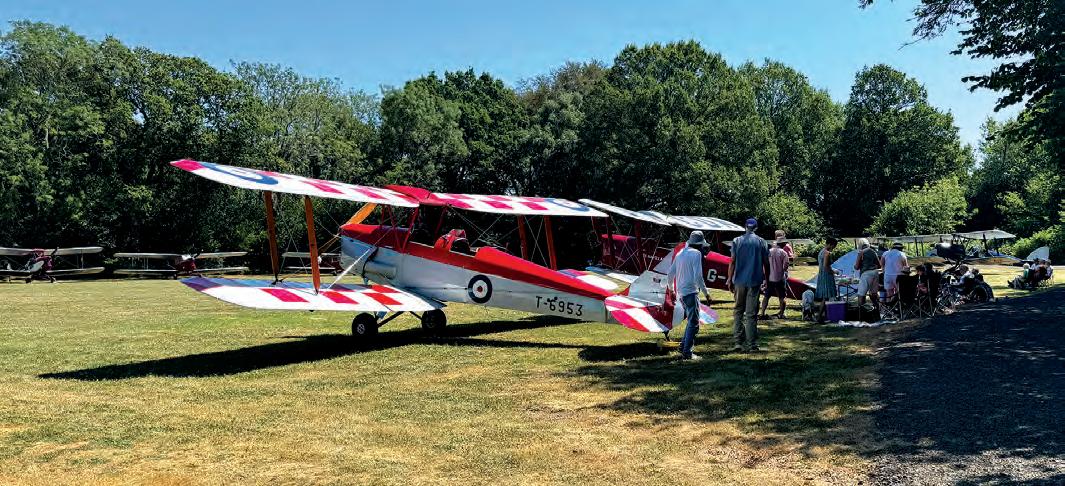
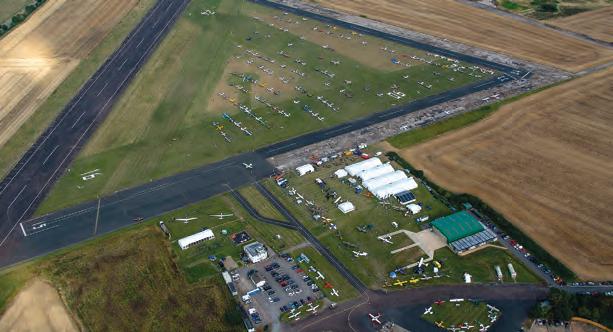
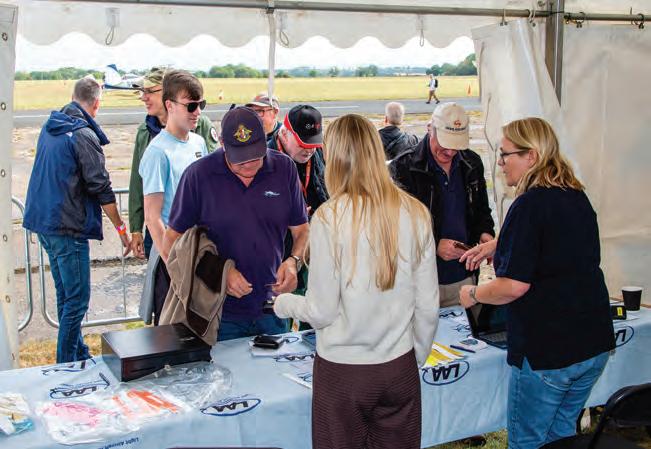
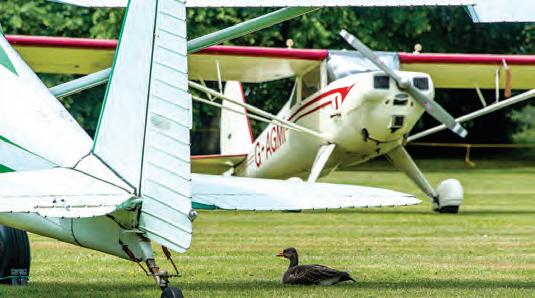
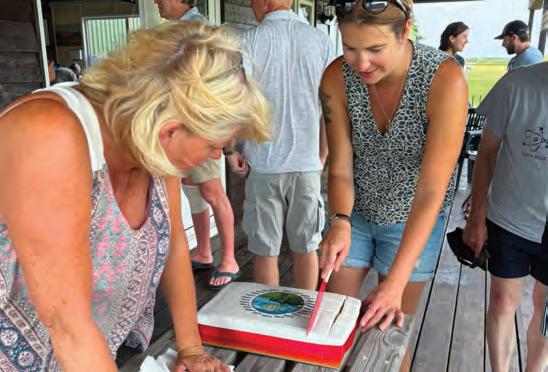
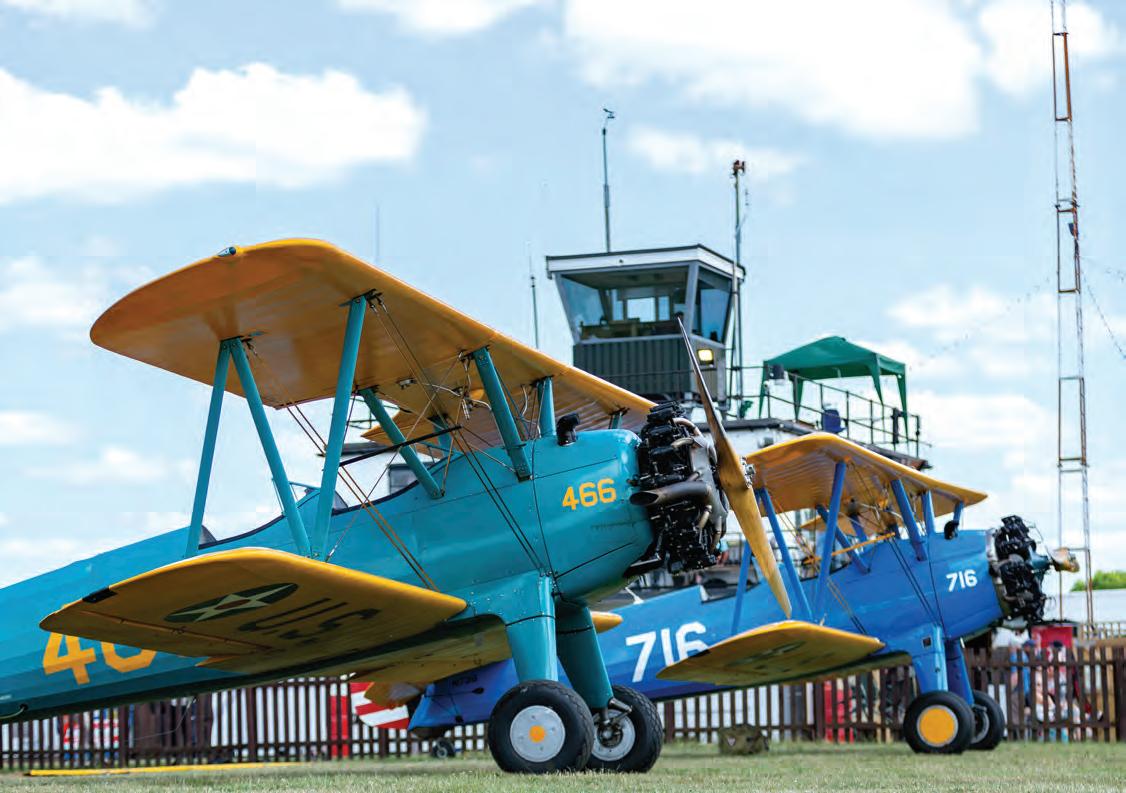
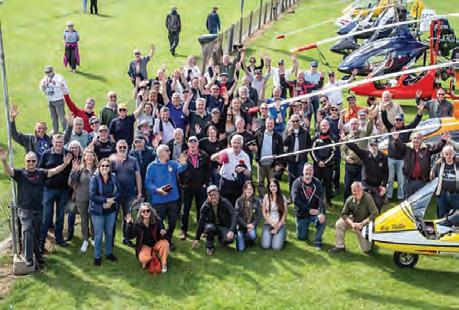
Just one of the many scenes of people – and aeroplanes –at West
Rally incoming…
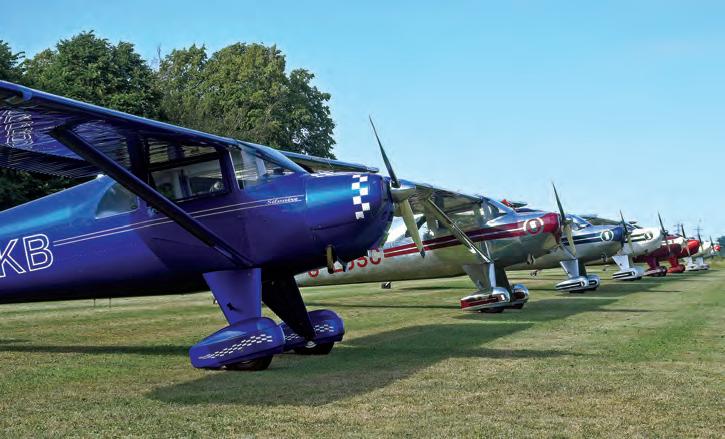
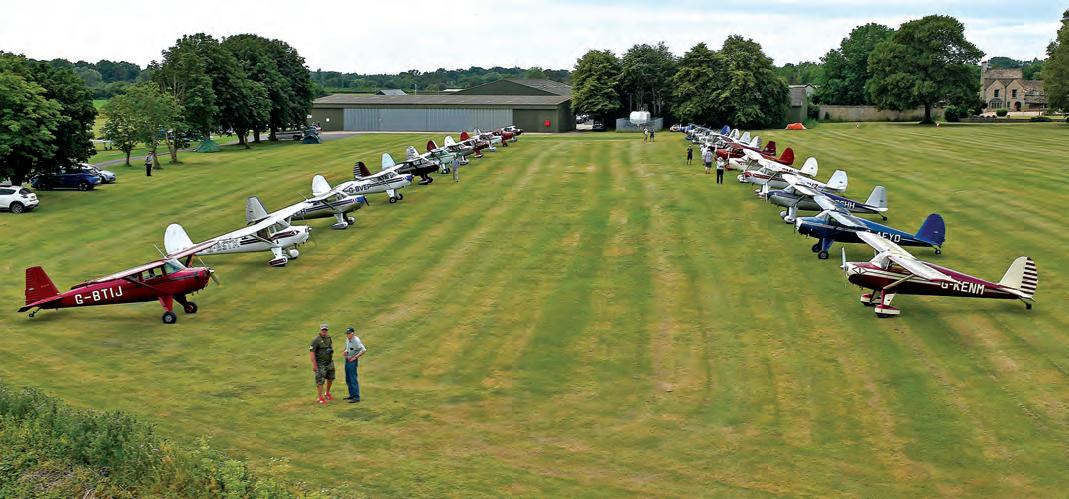
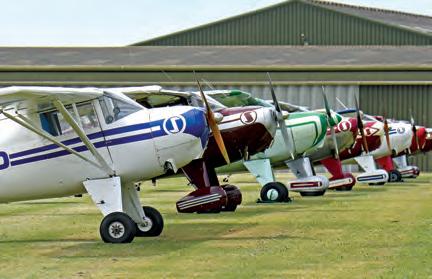
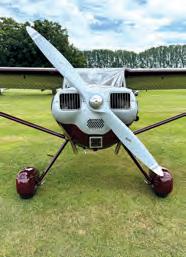
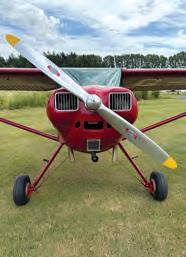
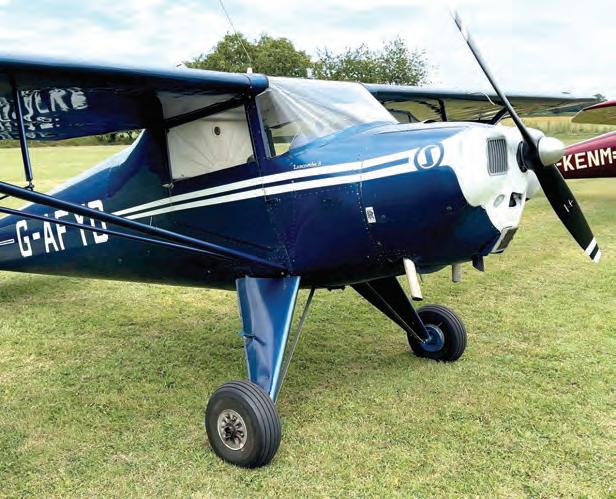
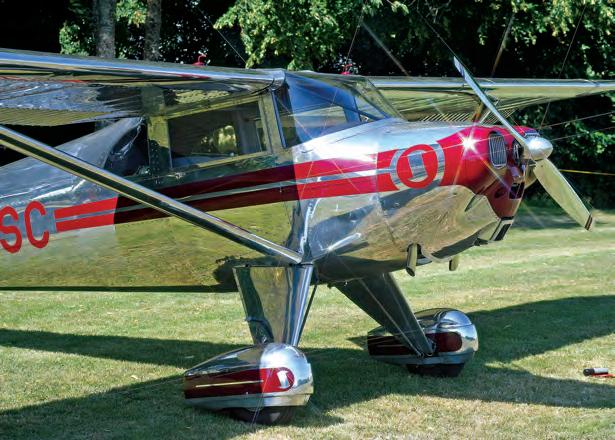
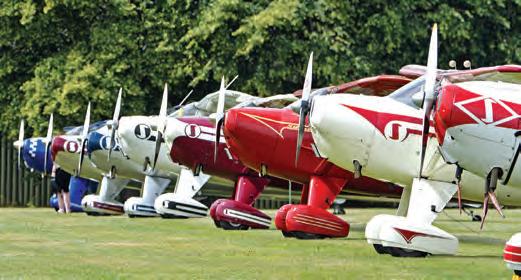
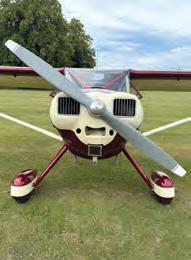
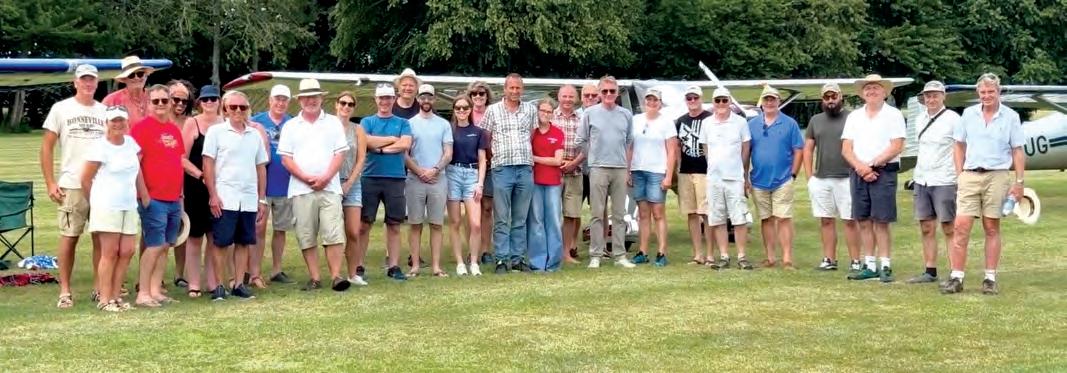
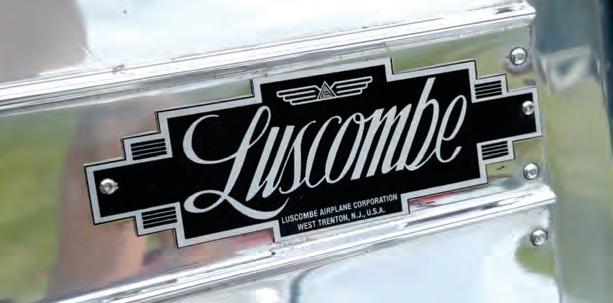
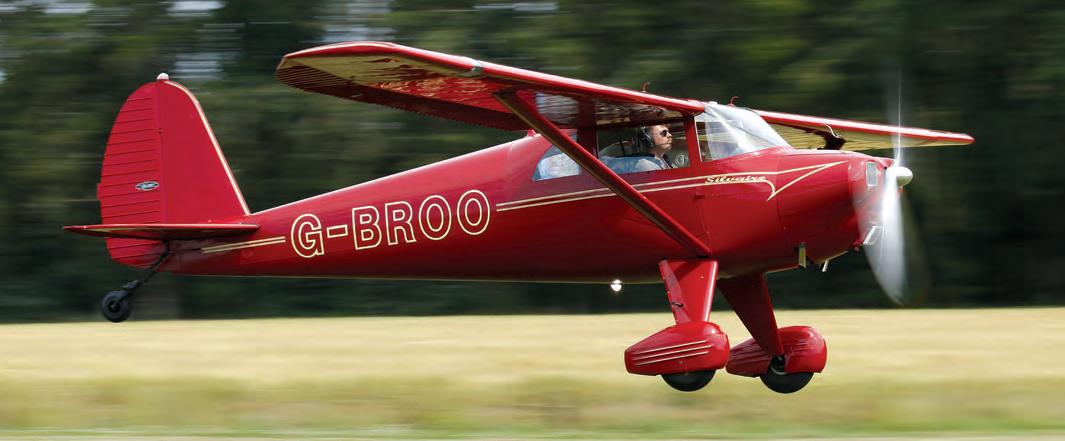
If you’ve been able to survive the heat, I hope you’ve been enjoying some of the fantastic fly-ins that have been taking place during the summer, so far. I dropped into a brilliant gathering of Luscombes at the glorious Oaksey Park Airfield at the end of June – more on that on page 30 of this issue.
Plus, I know loads of LAA members made it to an utterly scorching and fabulous SleapKosh for a wonderful weekend of fly-in festival fun.
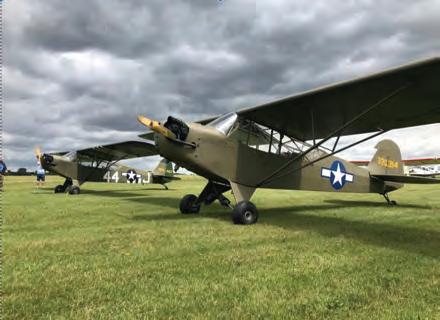
I pointed the Super Cub towards West Tistead on the same Saturday as Sleap to head towards the charity invitational fly-in that’s held there annually.
Setting off early to beat the heat, it was a pretty smooth ride down. I’d not been there before, but soon learned that Tistead is a lovely spot for an event, with a long, grass runway and an intriguing taxi that leads you to a parking area surrounded by tall trees, which meant there was always cool shade to find.
The event raised nearly £2,500 for the Hampshire Air Ambulance, and it was fantastic to see local families and car clubs enjoying the day among the aircraft.
There was a casualty of the day though… My Cub’s glareshield cover, which I lovingly crafted from aerospace grade Kydex during the return to flight works – it’s what they make cabin window trim from in the airliner world – got so hot it that it decided to thermo-form itself into something resembling a 3D relief map of the Yorkshire Dales.
It provided a very visual reminder of how hot things can get in a cockpit when aircraft are parked, and makes me think I’ll need some kind of sunshade in future!
Luckily, I have a template and more material, so I will make a replacement while I’m doing the Permit Revalidation work which I need to get on with after I get back from Oshkosh.
While it might not be the enormity of Oshkosh, this year’s LAA Rally at the brilliant Leicester Airport is our own event, and with plenty of plans to celebrate 80 years of the Association, it promises to be a very special one indeed.
Turn to page 12 for the latest details from Event Organiser, Nancy Lillington.
I look forward to seeing many of you there!
ed.hicks@laa.uk.com
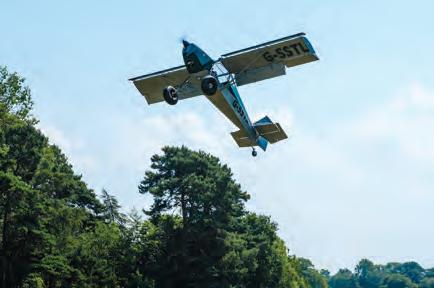
Tistead.
TRANSAIR FLIGHT EQUIPMENT
FEATURES
14 LAA RALLY PREVIEW
After months of planning, preparation and anticipation, the LAA Rally is almost here. Find out all the latest updates.
16 PROJECT NEWS
Mike Aston had never undertaken any form of aircraft restoration. Read all about his Aeroprakt A22 Foxbat project.
20 SPECIAL FEATURE
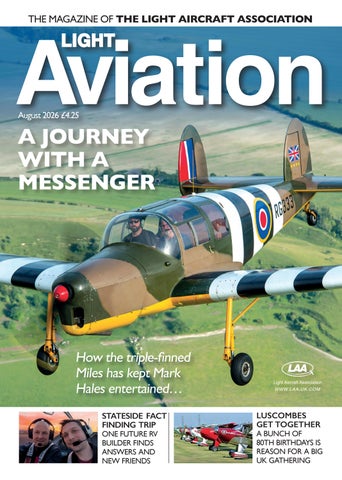
Mark Hales reflects on what it means to be the custodian of a Messenger, with his Miles journey now fully satisfied…
30 EVENT REPORT
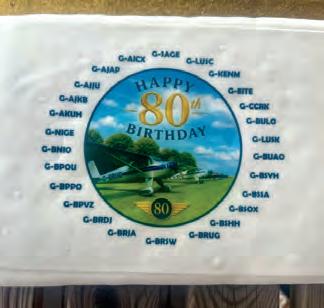
Nigel Barratt, decided a birthday bash was needed to celebrate the 80th birthday of lots of UK Luscombes…
34 COACHING CORNER
PCS HoT, Christine Carlin, asks, with things seemingly getting hotter, are you fully prepared?
36 ADVENTURE
With plans to order an RV-14, Andy Torkington headed to the US for an off-season trip of fact-finding.
42 ENGINEERING MATTERS
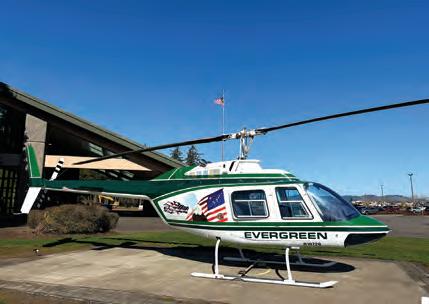
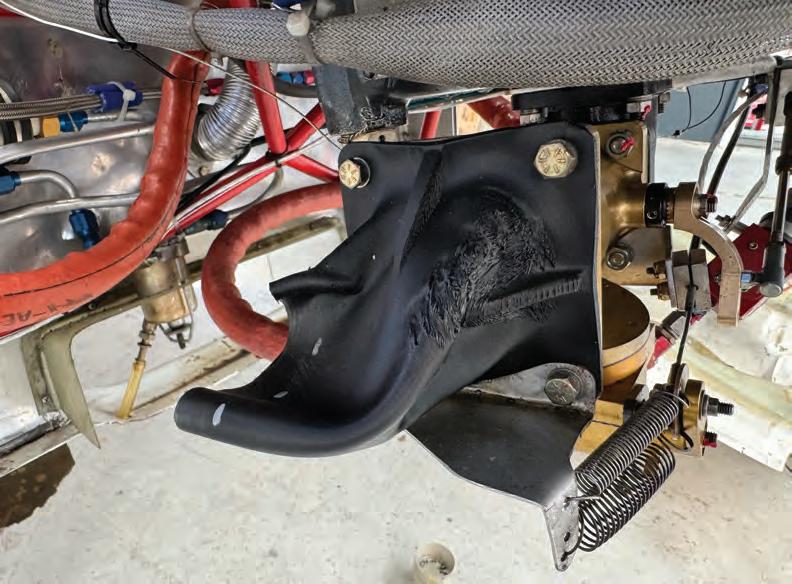
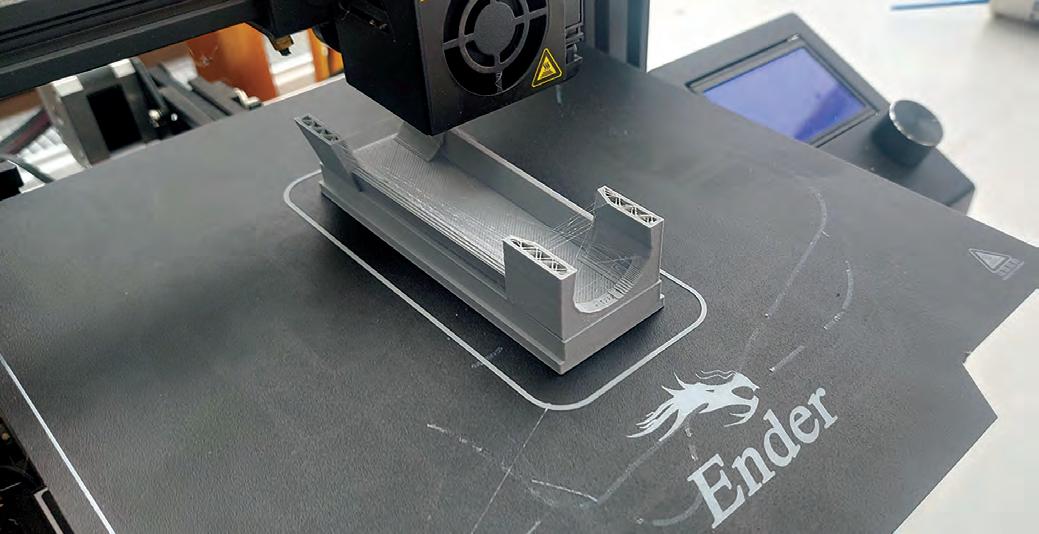
Considering the challenges of 3D printing for use in making parts for aircraft, heat and its effects on airframes.
52 PHOTO COMPETITION
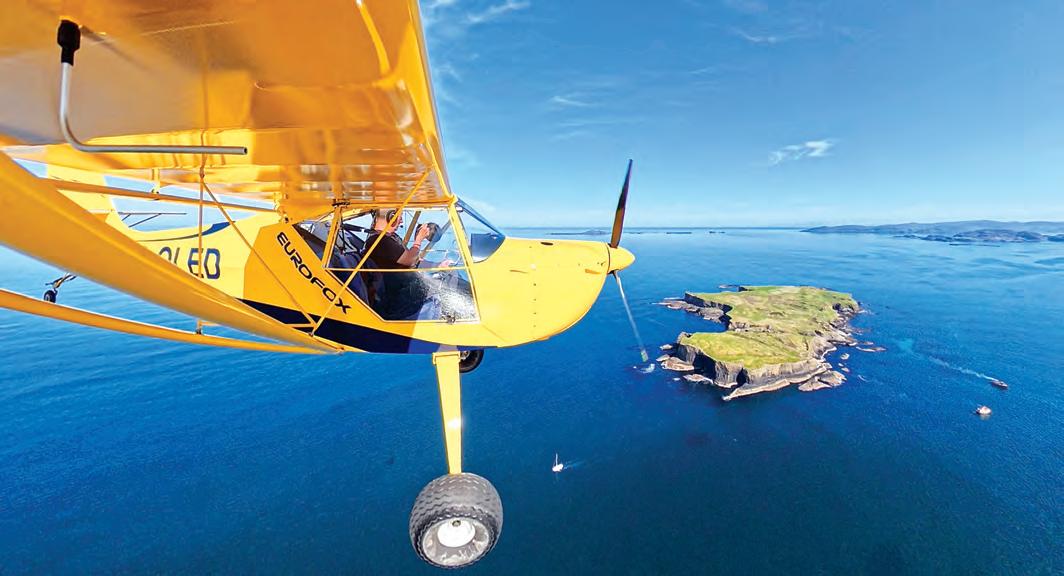
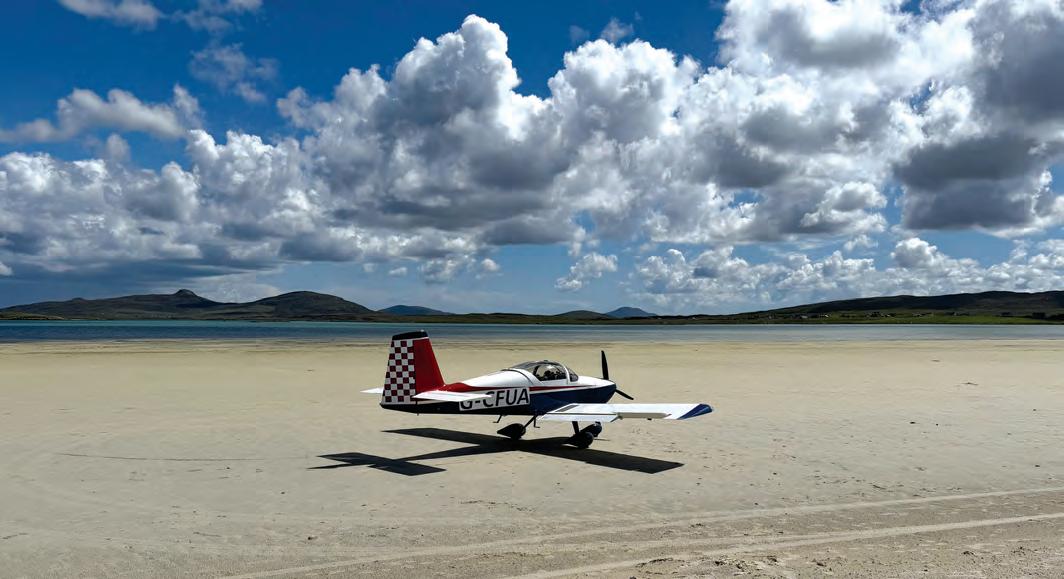
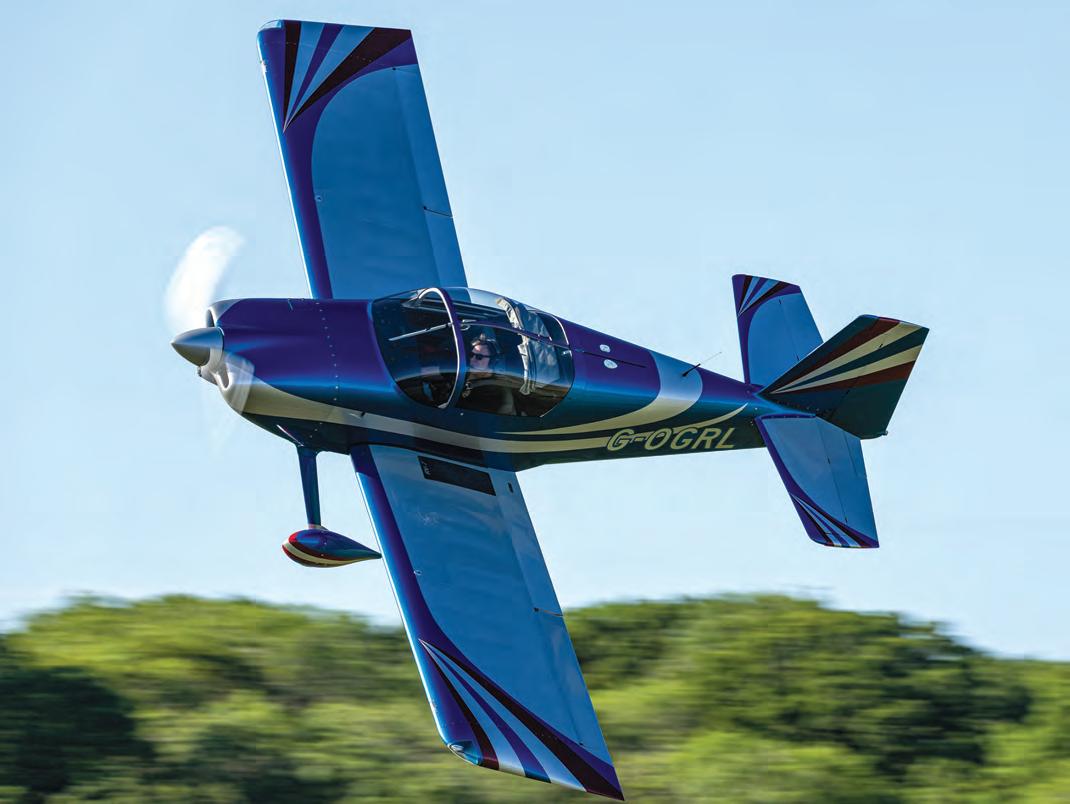
A quartet of glorious images taken by LAA members, while out and about.
CAA launches EC consultation
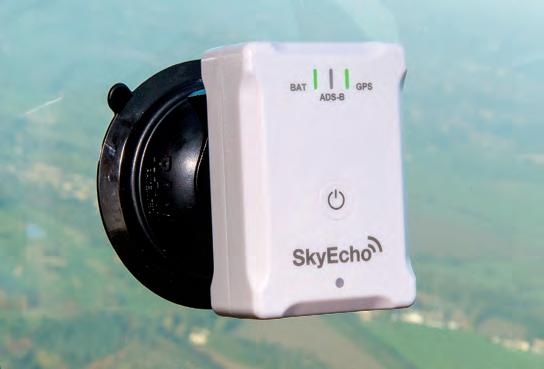
The UK Civil Aviation Authority has taken its biggest step yet towards making electronic conspicuity (EC) mandatory in the UK, launching a consultation on proposals that would require many aircraft operating below 10,000ft to carry an approved EC device.
The consultation runs until 22 September 2026, and seeks views on a proposed mandate covering aircraft operating in UK sovereign airspace below FL100.
The CAA is seeking responses from private pilots, aircraft owners, flying clubs, airfields, manufacturers, drone operators and other airspace users, asking for comments on which aircraft should be included, how the requirement should be introduced, the costs of compliance, transition periods, and whether there are alternative ways of achieving the same safety benefits.
Transport (DfT) following earlier technical studies and industry engagement. The CAA said the DfT has concluded that a national EC Mandate is needed.
The proposal is part of the CAA’s wider Airspace Modernisation Strategy and has been developed jointly with the Department for
Metal Seagulls to wind down
Pembrokeshire-based Metal Seagulls Ltd, has announced a voluntary, solvent wind-down of its operations. The wellknown company has been the UK agent for Zenair Aircraft and UL Power Engines.
“We are sad to see Metal Seagulls close its hangar doors after nearly 11 years of service, but it is the right decision with the economic and personal challenges faced by the company and its directors at this time,” explains Jonathan Porter, Director of Metal Seagulls Ltd. Jonathan is managing
on-going mobility challenges after a leg injury in 2025 and has not been able to provide a great deal of physical support to the workshops for the last nine months.
Patricia Porter, Director of Metal Seagulls Ltd added, “We are grateful to our customers, suppliers and the wider light aviation community for their support over the years, and we intend to work closely with clients during the wind-down to keep disruption to a minimum, ensuring where possible ongoing support as applicable.”
The firm expects to suspend hangar operations end of August, and complete the wind down in the following months.
LAA Educational Courses coming up
New dates have been made available for two popular LAA Educational Courses.
● Aircraft Fabric Covering: 16 & 17 September 2026, and: 21 & 22 October 2026 Cost is £406 for members and £426 for non-members. This hands-on course includes all materials and lunches.
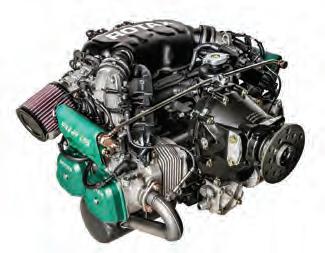
● Rotax Carburetted: 28 November 2026 and 27 February 2027
To book any of the above or if you have any queries, please call Cheryl Routledge on 01280 846786 or cheryl.routledge@laa.uk.com. We can only confirm your place upon payment.
Please check the course section of the LAA website for more upcoming dates for all our other workshops! www.lightaircraftassociation.co.uk/courses
PMD when going foreign
Recently, an incident in France highlighted that not all foreign border nor law enforcement agents are aware that it is legal for a UK PPL holder to be flying a non-Part 21 Permit aircraft in that country using a CAA Pilot Medical Declaration.
The incident in question saw an LAA member ramp-checked at an airfield where the local gendarmerie called into question the validity of the pilot’s PMD, which led to the pilot having his aircraft impounded pending investigation.
The ramp check occurred because the pilot infringed a restricted area, an error the pilot does acknowledge. However, the pilot was left completely unable to defend his use of a PMD as the officers were not aware of the validity of this document.
Subsequent action taken by the LAA and in particular member Dave White, author of the April 2026 Light Aviation: Going Foreign article, helped clear up their misunderstanding around the validity of the PMD.
LAA members are reminded that a CAA PMD is a valid document for travelling with a Permit aircraft in France.
New CAA Mandatory Permit Directive affects popular Rotax four-stroke engines
The UK Civil Aviation Authority (CAA) has published Emergency Mandatory Permit Directive MPD-2026-003-E, which was issued on 30 June 2026 and became effective on 7 July 2026. The directive applies to Rotax 912 UL, 912 ULS, 912 iS Sport, and 914 UL series engines fitted with affected propeller gearboxes as defined in the MPD. The MPD mandates inspection of the affected propeller gearboxes due to a potential assembly process deviation that could result in oil loss and/or an inflight engine shutdown. The urgency of the actions required
Cognitive health study help needed
The Advanced Cognitive Engineering Laboratory (ACE Lab) at Carleton University in Canada, alongside support from Imperial College London, is currently looking for pilots in the UK to participate in an aviation research study with the goal of improving flight safety.
Via the study, UK pilots can help the ACE Lab validate a tool it has created for GA pilots to monitor their cognitive health
Thruxton invites pilots to a Triple Challenge
Thruxton Airfield has joined forces with Popham Airfield and Solent Airport for a simple and fun competition over the Bank Holiday weekend on 29-30 August.
Called the Thruxton Triple Challenge, it’s been organised by Mike Pearson, formerly manager of Popham and now Aviation Consultant to Thruxton Aerodrome.
Mike told LAA, “There has been lots of change with Thruxton Aerodrome under new ownership with much investment taking place under Alex Thistlethwaite, Solent Airport is now being managed by Matt Wilkins, and Popham is now managed by David Hammer. So with everyone changing seats and with me now Aviation Consultant for Thruxton, we thought it was time to invite pilots to revisit all three airfields.”
Designed as a fun weekend for pilots of all skills the Triple Challenge route involves
Obituary
This MPD follows a very similar Emergency MPD issued in December 2025 relating to the Rotax 915iS and 916iS series engines, Emergency MPD 2025-006-E.
The directive (MPD-2026-003-E) can be downloaded from the CAA website or from the LAA website News section. Details have been sent to all LAA full plus members by email.
www.caa.co.uk/publication/ download/29220
called the ‘CANFLY’. The study runs for the duration of the summer. Participation in the study is confidential and participants who complete the study will have a chance to win one of the available cash prize draws. For those who are eligible and interested, please sign up via the google form below or email the ACE Lab at acelabresearch@ gmail.com: https://docs.google.com/ forms/d/e/1FAIpQLScpl5Iq9XP3iAlGmZQmv kMYbJ1IQgpfJAh8S6aaxx6kUSfuTw/ viewform?usp=header depends on a number of factors – for the most seriously affected engines mandatory action is required before next flight.
around 70nm of flying, depending on routing, a spot landing at Popham, a timed arrival challenge at Solent and a tricky taxing test at Thruxton. There are prizes all the way and 150 litres of avgas available in a free draw for all competitors. Plus, £10 of the £35 entry fee will go to Aerobility, with the remainder covering landing fees for all three airfields.
Mike adds, “There will be catering facilities and camping available at Thruxton and Popham if you are flying from far away. For locals, the routing between the airfields is short, so a nice social low-cost weekend with some simple challenges.”
n More here: www.popham-airfield.co.uk/ thruxton-triple-challenge-2026
Nicola Wright
1981 – 2026
On 26 June the Wessex Strut and the Henstridge flying community lost one of their brightest lights, Nicola Wright, in an aviation accident.
After learning to fly early in 2025, Nicola had crammed an enormous amount into a short flying career.
After initial PPL training in a C42, Nicola completed Group A and a complex type conversion in a Piper Arrow, before going on to complete a tailwheel course in a Cub, then an aerobatic rating in a T67 Firefly. On the ground, her desire to help out at Henstridge also saw Nicola recently get her Air Ground Radio Operators certificate.
Nicola had also developed a great love of skydiving after learning to fly, completing both A and B licences and racking up an impressive number of jumps in a short timeframe. As something of a superwoman, Nicola also recently completed multiple scuba diving qualifications in addition to being a wife and mum, and HR director of a busy and highly successful medical supplies business.
Nicola shared her love of flying with husband Graham, who is also a well-known and much-loved member of the Henstridge flying community and operator of multiple aircraft. As well as Graham, Nic leaves children, Alice, Henry, Kitty and Arthur.
Nicola’s adventurous spirit and determination to achieve have left an enduring mark on many of us.
She achieved so much in aviation in a short time with incredible energy and resolve, but also took every step diligently and seriously. She is loved and missed by so many.
Adrian Eves.
Letters
We are always pleased to receive your letters, photos of your flying, and your feedback. Please email the editor at ed.hicks@laa.uk.com
Going Foreign
Ed.
Further to the article on Going Foreign. For us members in France, ‘Going Foreign’ means flying TO the UK. So, I went into the Border Force site to file a GAR.
New security measures, three ways of checking, an SMS to a UK mobile number, but not to a French mobile number.
My UK Bank (NatWest) can send a ‘One Time Pin’ to my French mobile, but not the UK Government. Hmmmm!
The third choice was a series of security questions, but I could never find the appropriate page.
I wrote to Border Force via CONTACT –and I am still waiting for a reply.
I went with option 2 and downloaded an Authentication app. It worked, it was hard going, which makes me wonder how many overseas visitors there will be to this year’s Rally?
Plan A is to see you there. Great mag, keep the articles coming. Terry Froggatt.
Gyros & Standards Document 44
Dear Ed,
Jonathan Cope’s recent letter on Standards Document 44 raised an important issue that deserves wider discussion.
Nobody disputes that the CAA has a responsibility to promote aviation safety.
Equally, few would argue against having published standards to ensure consistency in pilot training and licensing. Standards Document 44 undoubtedly provides a useful framework for gyroplane licensing and instruction.
However, we should not lose sight of the fact that SD44 is guidance, not legislation. It explains how the CAA expects applicants to meet the legal requirements, but it is not, in itself, the law. That distinction is important because aviation has always relied on engineering judgement, practical experience and common sense, as much as written procedures.
My concern is that the CAA has become increasingly process-driven.
Since Brexit, it appears to have struggled to replace many experienced aviation and engineering specialists. Whether through retirements or departures, that depth of knowledge seems harder to find today.
Too often, users of the CAA portal are left with the impression that compliance has become an exercise in ticking boxes rather
than considering whether an alternative approach achieves the same level of safety.
As pilots, we all understand that rules exist for good reasons. Equally, there should be room for competent people to present an alternative means of compliance where circumstances justify it. If every situation is judged solely by whether it matches a document, innovation and practical problemsolving inevitably suffer.
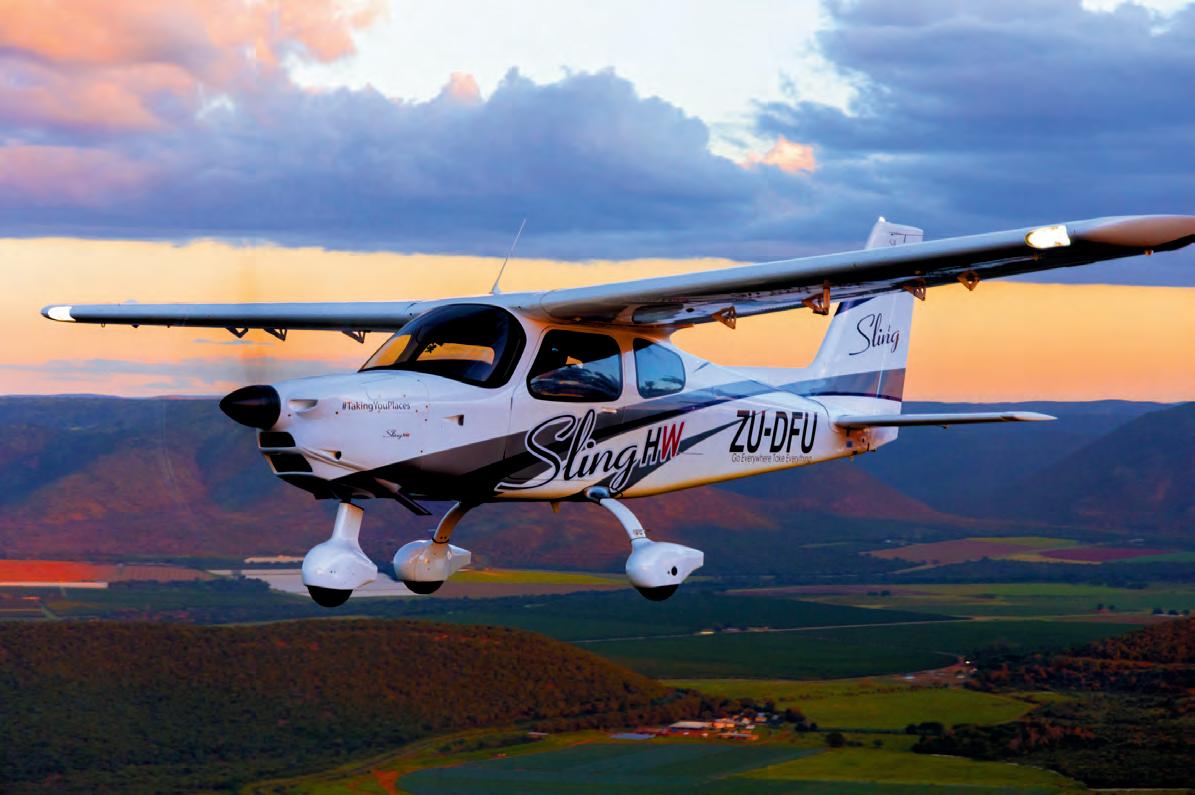
I write from personal experience. I was fortunate to fly gyroplanes for many years, logging around 300 hours as Pilot in Command before reluctantly selling my MTO Sport to help fund the deposit for a Sling High Wing kit aircraft.
During my time in the gyro community, I saw first-hand the professionalism of instructors, examiners and engineers, whose knowledge was based not only on written guidance, but on thousands of hours of practical aviation experience.
Aviation has always advanced because experienced people were prepared to question existing practice and improve upon it. Guidance documents are valuable, but they should remain ‘guidance’. They should support sound judgement, not replace it.
Ultimately, the safest aviation environment is one where regulations, guidance and professional experience work together. We should be careful not to allow bureaucracy to become a substitute for common sense. Kind regards, Paul Harrison.
LoM Love
I was interested to read Benoit Denet’s account of the engine installation in Victor Reuter’s Stampe, replacing the type’s inverted Renault four with a Walter LoM. I have recently taken over a project started by LAA Inspector, Phil Hall, which is to create a universal LoM installation for pretty much anything old, inverted and air cooled, and that includes the French Renault 4P, Spanish ENMA Tigre, de Havilland Gipsy fours, and probably some I don’t know about yet.
The motivation was simple; I had mistakenly acquired an Auster J1N which had been nicely restored about 20 years ago by an acknowledged expert on type and it did have a Gipsy Major engine on its nose – for which there were log books showing relentless maintenance to Public Transport standards – but since it hadn’t run for a while, I didn’t fancy the prospect of tracking down serviceable parts, should it need any.
Meanwhile, a full overhaul by the Inverted Four Specialists apparently now costs between £40 and £50,000...
The LoM comes with gear driven overhead cam, electric start, fuel injection (and a supercharger), it’s lighter than a Gipsy and will fit inside the standard cowls. It’s also very nicely engineered, and since the ones that came with the project were manufactured in the 1980s rather than the 1940s – not to mention the fact that the factory in Czechia is still in business, and is happy to supply new parts at (relatively) reasonable cost – the only genuinely surprising thing is that there aren’t more such conversions flying.
Phil has done a nice job so far, keeping everything simple and robust, but was happy to find someone to take it over. Goodness knows why that someone should be me – I have only just gained approval to test fly my diesel Jodel project after four years of discussion – but hopefully, the substitution of one inverted four cylinder, direct-drive aircraft engine, for another one, shouldn’t create quite so many hurdles. So far it seems like a perfect solution, but I’ll let you know… Regards, Mark Hales.
Back to the skies?
Ed,
So, the 1,400 Out of Permit Aircraft (OPA) creeps quietly onto the Straight & Level horizon again (Eryl Smith’s: Chairman’s Chat in the June 2026 issue). We are told the Back the Skies initiative has stalled, but nothing has been heard since 2024. I doubt it ever took off! If the LAA is serious about restoring any of these OPA to flight it needs an action plan with an offer to attract the owners of OPA. Such will require commitment of manpower, and probably finance, both of which can only come from LAA HQ.
A pilot scheme (pun intended) would make sense. How about this?
Contact in date order a manageable number of owners (200?) whose Permit has lapsed for at least three years with the following offer:-
● A free Permit renewal subject to completing the necessary inspection/ airworthiness review.
or
● If not wishing to renew but willing to sell as a project, three months free advertising in the magazine.
Right Photos of Chipmunk G-AMUF in the July issue’s Chipmunk 80 feature brought memories flooding
Either of these offers might prompt owners to action and represent revenue foregone and so are effectively cost free.
In the second group, a free pre-inspection to establish the scale of work necessary to renew should ideally be offered to facilitate a sale. Modest funding or altruistic Inspectors necessary. This is a straightforward scheme, which would quickly eliminate some proportion of OPA for which owners feel it is not appropriate, and for the others, test whether there is any reasonable probability of bringing OPA back to flight. If successful (benchmarks to be decided), simply expand down the calendar list or extend the offer to all OPA owners as resources committed allow. If this or any other plan is adopted a biannual report should appear in the magazine.
Taking a positive view and assuming some success of this or any other scheme, I fear another problem may emerge. Where are the people willing and able to take on these projects?
Over the years the Association has been heavily focused on promotion and support of modern and very expensive kit aircraft. Nothing has been done to promote the development of light aircraft maintenance skills or group flying where in the past these skills were learned and encouraged. Where is the Light Aircraft Maintenance Course I recall was promised some time ago? Instead of Meet the Members how about Meet The Group, which might increase awareness of group flying and encourage members to follow this path into ownership?
These are merely thoughts from one wondering mind having read the Straight & Level page in the June issue, as I mentioned. Other better proposals may be available, but if any of the 1,400 are ever to be restored to flight, the Association urgently needs a plan and a commitment to action.
Best wishes, Malcolm Rogan.
LAA CEO Simon Tilling replies: We have made a number of attempts over many years to address this challenge with little success to date for various reasons. I am more than happy to have another try and have already contacted Malcolm to see how we can expand on his thoughts and ideas to make this happen. I will ensure we report back on the results of this restarted initiative. If anyone has an aircraft that they want to get back in the skies please mail me as we will be looking for opportunities to test our programme
GPS Jamming
Dear Ed,
A couple of weeks ago a friend and I were flying in the Wye valley area when the AP dropped out and an EFB map quit simultaneously. We were aware of a GPS jamming Notam centred around the Brecon region 40 miles away, but I have not experienced that jamming range before.
Our GPS(s) recovered as we moved away. A military jammer seemed the most likely explanation of – at least – two wholly independent GPS devices failing simultaneously. I made a mental note that maybe it was time for another tech article in the Light Aviation mag on the vulnerability of dependence on GPS in GA.
Thus, it was with concern that I read yesterday about a foreign Electronic Warfare ship positioned just south of St Catherines Point IOW (right on the recommended VFR route to France) – and that said ship was reported to have fired on a civilian yacht plying a similar route.
Whatever the truth or reasons behind that event and the risk of being shot down is another debate, but one role of such a ship is jamming or spoofing GPS. It is, of course, unlikely to Notam its intent to do so. GPS jamming has become an increasing feature of modern conflict and is not just limited to the territories at war.
May I suggest that we all should be cautious of our dependence on GPS as our primary means of navigation and be aware it might be feeding us false data or none at all. Our electronic maps, position indicator, some heading instruments, AP, EC and phone could all quit together. Be prepared!
Ian Fraser.
Chipmunks
Greetings,
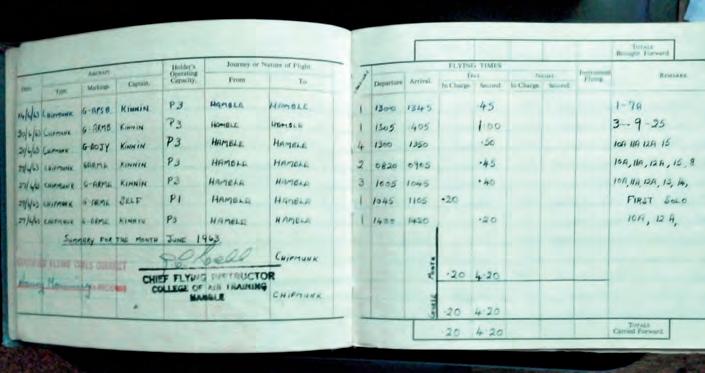
I have just read the July 2026 edition of the LAA magazine. The article on Chipmunks and in particular the photo of G-AMUF, which I flew at the College of Air Training in July 1963. This was three days after I flew my first
Chipmunk solo in G-ARME. I enclose photos of the two logbook pages. My instructor, the late Paddy Kinnin, put his instructing neck on the line since I was from the wild Western Isles of Scotland and had not been anywhere near an aeroplane before.
Boy did that photo bring back some memories!, Hector Maclean (Ex BA).
CO uh-oh
Ed,
I was interested in Damian Murphy’s experience flying his Currie Wot (Light Aviation June 2026).
When initially flying the Flitzer Z-1 prototype (in 1996) I’d detected exhaust fumes in the cockpit. This was exacerbated by helical flow from the left-hand tractor propeller, dumping fumes inwards from the right-hand cockpit side. A CO indicator patch was fitted, but the ‘fix’ was to attach a six-inch long ventral deflector blade, abeam and aft of the paired exhaust pipe tails. This worked immediately by delivering the helix behind the cockpit and was incorporated into the drawings.
The pipe tails exhausted in close proximity to each other, under the lower cowling, which results in a satisfyingly ‘solid roar’ from the engine, rather than the meek ‘fluttery sound’ delivered via bilateral ‘siamesed’ pipes as often fitted. This is performative and part of the ‘vintage aspects’ of the design!
Incidentally, side-slipping to the left is a comfortable manoeuvre, but slipping steeply to the right, looking over the cockpit edge, the ‘upflow’ will tear the pilot’s goggles off.
The latest Flitzer Z-21A to fly is based in Kentucky, and the owner is very pleased with its performance. Like another Z-21 based in Michigan, it replicates wartime printed lozenge fabric; something that was used for a while, post-WWI in Weimar Germany, while stocks lasted.
By now most owners will have been through the online Permit revalidation process, which went live in spring 2025. The automation of the process, along with a simplified online application process and the removal of some items such as the requirement for an annual check flight (for most types), has proved to be a great success – and the results of our online survey confirm that the system and process have increased user satisfaction dramatically.
We are now turning our attention to improving the MODs and Repair process. We began consultations with a working group of owners, and Inspectors, earlier in the summer and have now defined the objectives of the project.
Our aim is the following:-
● Make the process as simple and as efficient as possible
Chairman’s chat Eryl Smith Chairman
I● Make it clear and easily understand what applicants need to do
● Give a clear expectation of how long the process is likely to take
● Move as much as the process as possible outside of HQ
● Provide easy-to-access updates on MOD request progress
● Reduce, wherever possible, the need for back-and-forth emails
● Reduce the need for ‘In progress’ requests to return to the back of any queues
● The modified aircraft must still be at least as safe as provided for by the current system
As with the Permit project this will involve process change, IT investment, training and education, and plenty of communication. The project is now active and I will ensure we keep you all updated with progress via the magazine and emails.
I am really looking forward to the new process/system and I am sure it will deliver the improvements we have been asked for –watch this space! ■
am writing this article fresh from returning from SleapKosh 2026, and can I say, what a weekend! Shropshire’s answer to Sun ’n Fun? Wall-to-wall sunshine and aircraft of all shapes and sizes. Great air displays, a growing exhibitor presence, good food, live music, events and fun. All with aviation at its heart. Hats off to Bruce Buglass and the young energetic team of staff and volunteers at Sleap who put the event on – an immense effort!
LAA had a stand and, once again, the opportunity to meet and chat with many members who attended the event. Thank-you to all who took the opportunity to talk with myself and fellow directors who were present. The comments and feedback are invaluable. We are grateful for the positive comments and, while we may not be able to address all the issues raised, take to heart the concerns we also receive.
Events such as SleapKosh and our own Rally provide an opportunity to take stock of recreational aviation and, among all the fun, raise some serious questions about our future direction of travel. A big theme in conversations over the weekend centred on ‘where does the next generation of pilots and aircraft owners come from’? Sleap stood out as a beacon for a younger generation. So how do we encourage more young people to experience the joy of flight? How can we show young aspiring
aviators that flying can be affordable? The same goes for technical skills. Where, and how, do we engage in the agenda to promote STEM activity (Science Technology Engineering and Maths) that is so badly needed for the future of the aviation sector at all levels?
At our Rally this year, in addition to all our usual activities, we will provide opportunities for young people and families to learn more about aviation technology skills, as well as showcasing our fleet and the fun of recreational flying. Elsewhere, we recently participated in TecGirls Festival 2026, representing light aviation as part of a two-day programme to inspire girls’ interest in STEM subjects. While our primary focus will always remain supporting our members to build, own, maintain and operate their aircraft we too have a role to play in encouraging the next generation in aviation and our prospective membership. I am delighted that we have among our directors, individuals with experience and passion for this task. As we learn from these experiences we will be developing our future strategy for this important activity.
With the peak of summer upon us there are many smaller flying events throughout the country, run by Struts, Type Clubs and airfields all providing great opportunities for fly-ins, BBQs and social gatherings. Please support the teams putting the events on.
Our Rally at Leicester is fast approaching and our final planning is in hand with full details available elsewhere in the magazine and on the LAA website. I look forward to seeing you at the Rally. Whatever your plans are for summer, fly safe. ■
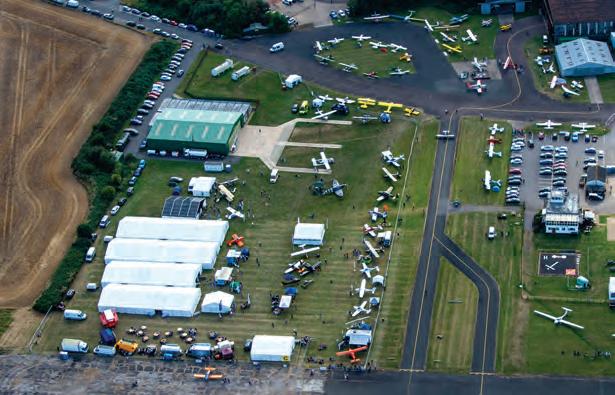
The countdown is well and truly on! After months of planning, preparation and anticipation, the LAA Rally is almost here, and it’s shaping up to be one of our biggest and most exciting events yet.
Whether you’re arriving by air or by road, flying in for the day or making a long weekend of it, there’s something for everyone to enjoy. It’s less than two months away and we’re excited to see you! We’d like to say a big thank-you to all our event partners; Garmin Aviation, Pooleys Flight Equipment and LAS Aerospace. You’ll be able to meet them all at the Rally in the Homebuilders tent, Speaker’s Corner and around the site for a chat.
Below
Fabulous Leicester Airfield awaits!
Rally 80
is GO!
Everything is ready!
Now it’s time to join us at the 2026 LAA Rally, says Nancy Lillington
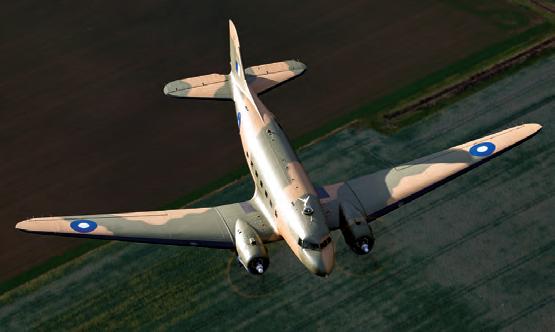
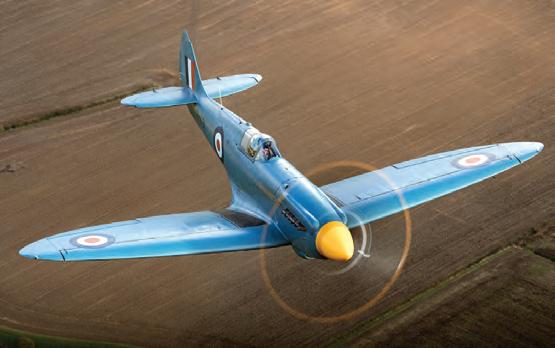
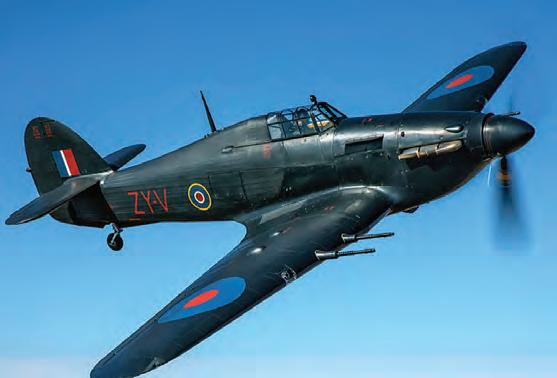
A daily salute from the Battle of Britain Memorial Flight
We are thrilled to announce that one of this year’s highlights will be a spectacular flypast by the Battle of Britain Memorial Flight on each day of the Rally. BBMF has confirmed a flypast for each day of the LAA Rally. The current flypast schedule is:
04/09/2026 – between 1350-1410
05/09/2026 – between 1320-1340
06/09/2026 – between 1320-1340
The precise composition of BBMF aircraft will be confirmed nearer the time, but promises to include the Dakota and the flight’s fighter aircraft.
Few sights stir the emotions quite like seeing these iconic aircraft overhead. We’re delighted to be welcoming the BBMF as part of this year’s programme.
Be sure to have your cameras ready and take a moment to appreciate these living symbols of our aviation heritage.
An incredible static aircraft line-up
The Rally has always been about celebrating aviation in all its forms, and this year’s static aircraft display promises to be one of the most varied we’ve ever assembled. From beautifully crafted homebuilt aircraft and classic types to cutting-edge designs, military visitors, vintage aircraft and exciting modern machines, there will be something to
captivate every aviation enthusiast. The invitations are out, and responses are coming in! Our line-up for the 80th anniversary aircraft static display is taking shape. Our aim is to showcase examples of aircraft from the 80 years of ULAA, PFA and LAA from our earliest years through to contemporary types. Beyond some of the familiar models within the fleet, we’ll celebrate some of the unique ‘one-of’ designs that reflect the skill and ingenuity of members. We are also providing a platform for type clubs to showcase specific aircraft types and promote the activities they undertake to support type owners, share information, source scarce parts and promote the type to prospective owners. We’ll have representatives from the Aeronca, Europa, Vintage Piper Clubs, Van’s RVs, examples of rotorcraft on behalf of British Rotorcraft Association that now make up some six percent of our Permit fleet and members from within the Vintage Aircraft Club, and many more!
It promises to be an exciting static display. If you have an aircraft you would like to display as part of the 80th anniversary display, please let us know.
Awards and trophies
Always a high point of the Rally, there will once again be a fine selection of aircraft whose owners enter their aircraft for the Rally Awards, whether that be best of type, a newly completed project or refurbishment or simply an aircraft that has been lovingly maintained and cherished. Full details of the awards and trophies, together with information on entry, can be found via the LAA Rally website.
It’s a rare opportunity to get up close to such a diverse collection of aircraft, meet the owners and pilots, and hear the stories behind them. Whether your passion is historic aviation, engineering innovation or recreational flying, you’ll find plenty to inspire you!
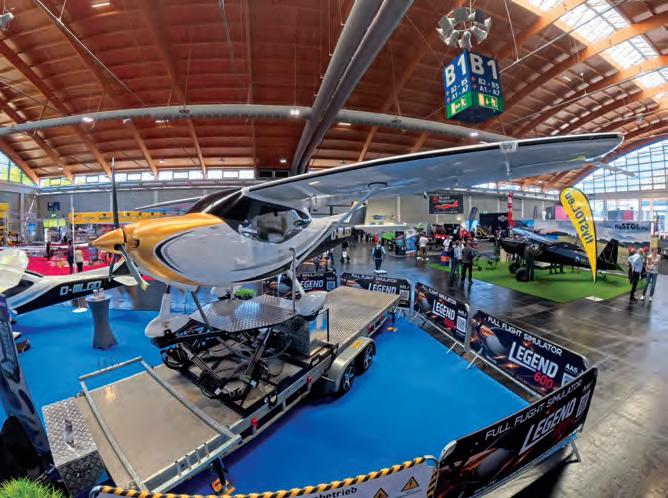
Flight simulator: Your introduction to the Legend 600!
It was a big hit at AERO Friedrichshafen, so we are very excited that the Legend 600 simulator will be at the Rally
realistic this full size three-axis simulator really is.
Discover the new STEM Zone
New for this year is our dedicated STEM Zone, designed to inspire the next generation of engineers, pilots and aviation professionals.
Above The Rally will see a daily flypast from aircraft of the Battle of Britain Memorial Flight, including the Dakota, Spitfire and Hurricane.
Below All the way from Germany, the brilliant Legend 600 flight simulator!
The Air Cadets will be bringing immersive flight simulators, giving visitors the chance to experience flying for themselves, while numerous university engineering departments from across the UK will be showcasing some of the exciting projects their students are working on and talking about engineering through their interactive displays such as wind tunnels, morphing wings, wing structures, robots, various types of UAV and much more!
Expect hands-on activities, interactive demonstrations, immersive simulators, innovative engineering displays and plenty of opportunities to speak with those shaping the future of aviation. We’re working with some major organisations to bring you fun, interactive activity for the young at heart!
It’s a fantastic addition to the Rally and one that the whole family can enjoy. Kids will also be able to make their own paper aeroplanes on our ‘make a plane’ table. But, the big question will be, whose can fly the furthest?
The LAA Engineering team, Inspectors, Pilot Coaching Scheme team, new LICACS – Ladies in Light Aviation Circles group and more, will again be in the LAA area. Come and have a chat for advice and expertise. You can
Homebuilders at the heart of the Rally
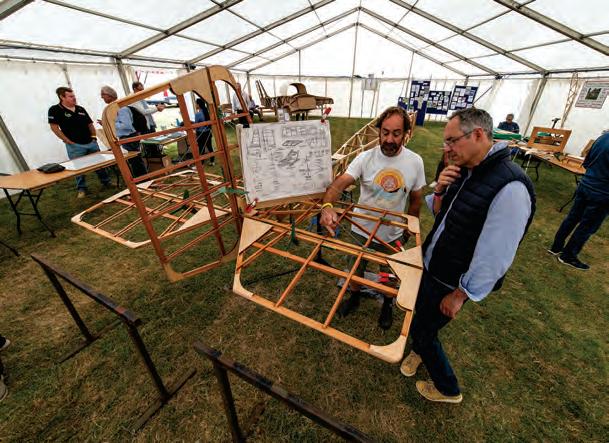
Homebuilding has always been central to the LAA, and this year’s Rally celebrates that tradition more than ever. Whether you’re thinking about starting your first project, midway through a build, a repair, or proudly flying your completed aircraft, there will be something to interest you.
Visit the Homebuilders area to meet experienced builders, learn new techniques, see projects at every stage of construction and discover the wealth of support available through the Association. There’s no substitute for speaking with those who’ve already completed the journey. As you may have seen from previous Rally Updates; Tony Razzell, Alan Lovejoy and Alan James are organising and running the Homebuilders tent this year.
At present, we have one committed airframe with a couple more in the pipeline. We would like to be able to exhibit more projects. We fully appreciate the commitment needed to ensure this happens. To that end, if anyone within a reasonable distance of Leicester would like to give some thought to helping us achieve a well-balanced display, we can offer help with transport costs as well as setting up in the Homebuilders tent.
Furthermore, we plan on having several hands-on activities each of which would need a volunteer to staff and support the activity. Come along to the ‘have a go area’, with bench-top activity and learn a new skill. Activities will include:
● A wire locking competition, aircraft metal work, tool sharpening, to name but a few! We have lots of activities for you this year to experience!
● Why not stay for the evening entertainment where
Above Been thinking about a new project? Then the Homebuilders Tent can help answer your questions and teach you new skills towards making a start.
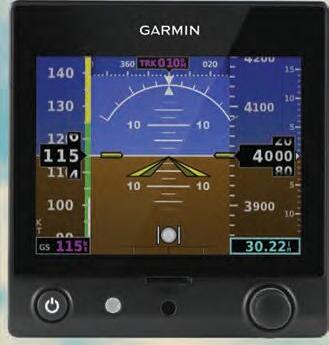
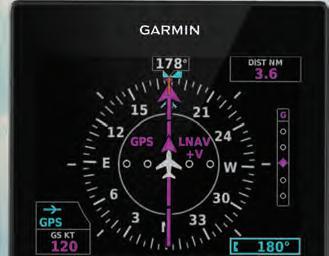
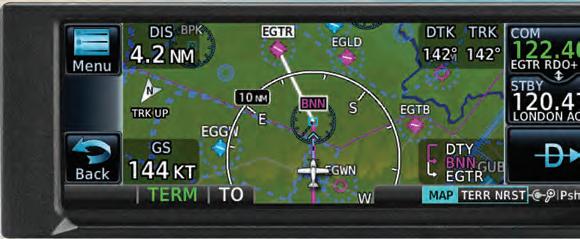
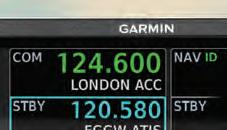
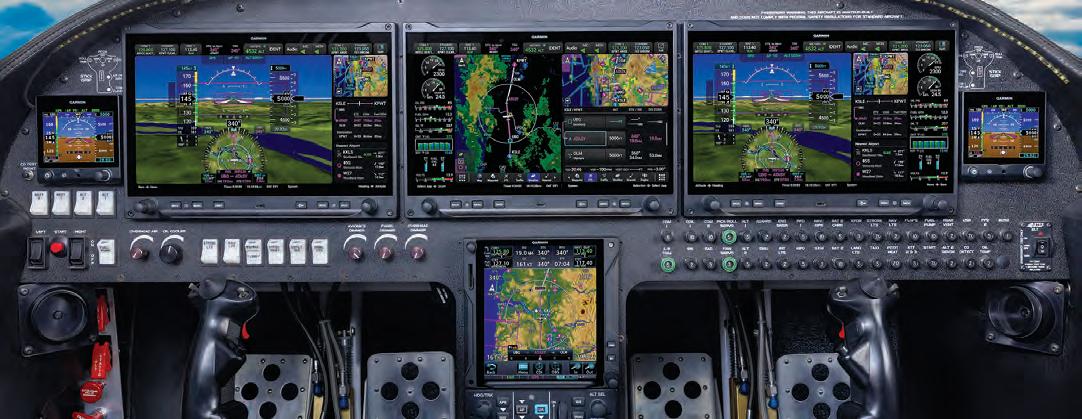
Below The Rally sees the UK debut of Garmin’s new AXIS avionics system, giving visitors the chance to be among the first to get handson.
there’s always lots of socialising and you can talk about your new found skill?
If you need any further information, please do not hesitate to contact Tony in the first instant or the two Alans on: Tony: 07484 873206 (tonyrazzell2@gmail.com). Alan L: 07831 606075. Alan J: 07743 268006.
A packed programme of exhibitors, expert speakers and an exclusive UK launch!
The exhibition areas will once again feature a wide range of aviation companies, equipment suppliers, aircraft manufacturers, service providers and aviation organisations, making the Rally one of the UK’s premier opportunities to discover the latest products and services.
Full details will be displayed on our social media. It is proving to be an action packed event showground this year which will be bursting at the seams. We will also have the much-loved Flea Market return for another year, so bring your goods to sell.
• UK launch of the new Garmin AXIS avionics system at the Rally!
Garmin Aviation’s groundbreaking new AXIS avionics platform for certified and Permit aircraft is making its UK debut at this year’s Rally. This exciting next generation system represents a major step forward in EFIS technology, offering pilots enhanced capability, connectivity, and situational awareness.
LX Avionics will be demonstrating the Garmin AXIS system throughout the event, giving Rally visitors an exclusive first look at one of the most eagerly awaited avionics packages in recent years. Don’t miss the chance to see the future of flight instrumentation in action!
• Speaker ’s Corner
Our speaker programme is equally impressive, with expert presentations running throughout the event. Topics range from flight safety, aircraft maintenance and engineering to homebuilding, adventure flying, innovation and aviation experiences. Whether you’re looking to expand your knowledge or simply hear some fascinating stories, there’s sure to be a session worth attending. We also have some of our LAA Inspectors speaking this year. Watch out for the schedule of speakers on social media and the LAA website.
• A wide range of exhibitors
There will be the regular exhibitors alongside lots of new
exhibitors for 2026. All the details will also be in your special 80th limited edition Rally programme which you’ll be given at the entrance gates.
Entertainment and food after flying ends
There will be plenty of choice of food units on site throughout the event alongside a bar, and plenty of seating! But… the Rally doesn’t stop when the flying finishes for the day!
Each evening offers a chance to relax, catch up with friends and enjoy a great atmosphere. Expect live entertainment, good food, refreshments and plenty of opportunities to share flying stories with fellow members and visitors alike. It’s one of the highlights of the Rally weekend and a wonderful way to round off each day. There will even be a fire pit! Updated details can be found on the LAA website.
What what’s on the menu and schedule each night?
● Thursday: Arrival days will be Curry Night – informal and time to relax.
● Fridays: Fish & Chips, including free attendance to the Comedy Night.
● Saturday: ‘The Ring of Fire’ Western Night, BBQ, western music and a large fire pit to sit around and have a good catch up with friends over a beer!
Volunteering
Do you fancy volunteering at the Rally this year or know someone who would? On Sunday we also have a ‘Wrap Party’ for event volunteers as a thank you for all their help and support. Contact Nancy at nancy.lillington@laa.uk. com to register your interest and have a chat.
Stay for the whole weekend
Why rush home? Camping is available throughout the Rally, whether you prefer sleeping under the wing beside your aircraft or making use of the dedicated campsite.
Staying on site means you’ll enjoy the full Rally experience, from early morning arrivals to the evening entertainment, while making the most of everything the event has to offer. There are also plenty of good hotels around Leicester and the local area.
Take home a piece of the Rally
No Rally visit is complete without a stop at the LAA merchandise stand.
Alongside our popular range of clothing, caps, accessories and souvenirs, this year we’ll also be launching a selection of exclusive 80th anniversary merchandise to celebrate this significant milestone in the Association’s history.
These limited-edition items have been created especially for the anniversary year, making them the perfect keepsake of both the Rally and 80 years of the Light Aircraft Association.
Be sure to visit early to avoid missing out on your favourites. We will also be selling the special Rally posters celebrating 80 years of the LAA. There also be some amazing goodies and freebies for you this year from our sponsorship partners.
Above A busy exhibitor area awaits…
Below Why not join in the fun and help out by volunteering at the Rally?
Tickets and flying slots available now
If you haven’t already secured your place, now is the time! Visitor tickets are available. Flying slots have now been released as capacity allows.
If you’re planning to fly in, please remember that all pilots must read and fully understand the Pilot Notes before booking an arrival slot
By purchasing a slot, pilots are confirming that they have read and agree to comply with the published procedures, helping to ensure a safe and enjoyable event for everyone.
We remind visiting pilots to read the Notams and that there will be a RAT in place for the nearby Victory Show. Please be aware that there will also be a space in the slot system to accommodate the BBMF flypast each day.
Don’t leave it too late, both tickets and flying arrivals are expected to be in high demand as the Rally approaches!
We look forward to welcoming members, families, friends and aviation enthusiasts from across the UK – and internationally – for three unforgettable days celebrating recreational aviation!
Whether you’re coming to admire remarkable aircraft, learn something new, meet old friends, camp under the stars or simply soak up the unique atmosphere, the LAA Rally promises another even more action packed and memorable weekend.
Keep an eye out on our LAA social media, website and
Inspiring members to take on their own aircraft build or restoration project
Compiled by Mike Slaughter
Project News
Member, Mike Aston, has kindly been in touch with Project News this month to provide us with a report on his Foxbat restoration. His project was in Permit and flying when he bought it, believing it just needed a little TLC, plus some retrospective maintenance so that he’d be enjoying it within no time. I recall that we’ve told this tale before in Project News where the need for a little TLC has turned into a sizable restoration.
Mike’s Foxbat is about 20 years old but suffered from significant corrosion creeping under the paintwork, probably resulting in more work to resolve than preparing and spraying a new aircraft for the first time. Once you start dismantling an aircraft it’s inevitable that other ‘opportunities’ for improvement set themselves out in front of you.
Mike makes the point that there is nothing quite so educational as dismantling and rebuilding an aircraft to provide a feeling of intimate understanding of the structure. It subsequently makes the DI check much less of a mystery.
Take a look at Mike’s report, it’s an interesting read, and a voyage of discovery for someone who’d never undertaken any form of aircraft restoration before. His story serves as a reminder that we can all achieve anything if we put our mind to it, have a positive attitude and solicit advice and guidance from the right people and sources.
Mike got in touch with Project News completely unprompted – just hinting! To get in touch with Project News, and tell your story, report a milestone or just to send a picture, email: projectnews@laa.uk.com
Please share your story!
G-CDHX (PFA 317-14297) Aeroprakt A22 Foxbat
By Mike Aston
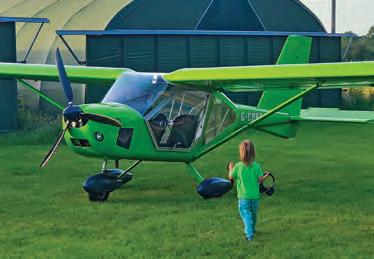
G-CDHX is an Aeroprakt A22 Foxbat, specifically one of the first to fly in the UK back in 2005. It is an exceptional aircraft with forgiving characteristics, spacious cockpit and outstanding all-round visibility thanks to its full height bubble doors and large viewports located within the fuselage.
When combined with its 100hp Rotax engine, 80 litre fuel capacity, low stall speed and 90-100kt cruise, it creates a compelling tourer with solid short field qualities capable of holding its own against the more modern Eurofox.
In October 2024, I purchased G-CDHX as a fully permitted aircraft that on the surface just needed a bit of TLC on the paintwork over the winter. What actually transpired was a Pandora’s Box of technical issues, brought on through poor historical ownership and missing records, which resulted in an 18-month restoration project to bring Hotel Xray back to its former glory.
In November 2024, the aircraft underwent a full ground-up inspection of the engine and airframe by the workshop team at Clench Common. The original engine was found to have had the crankcase split open DIY-style, possibly relating to fretting issues known in the Rotax
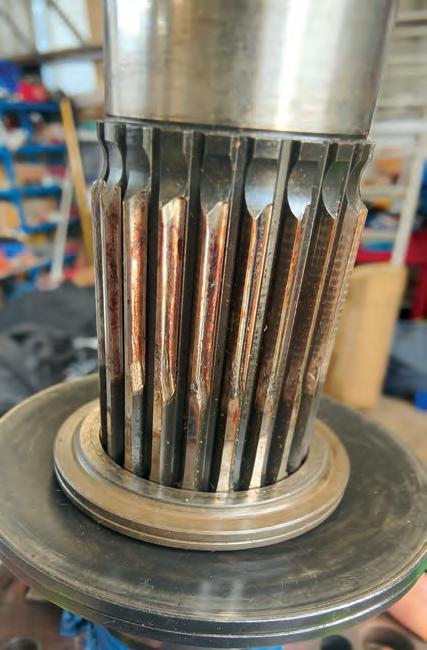
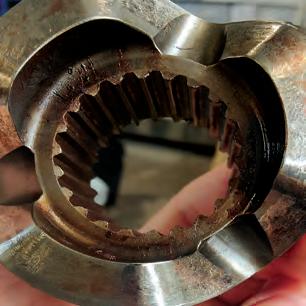
engines around 2005, which had resulted in a small, but consistent, oil leak. More worryingly, the propshaft was severely bent, likely as a result of an undocumented propstrike. This, in turn, had almost completely destroyed the gearbox to an alarming level over a period of previous flight hours.
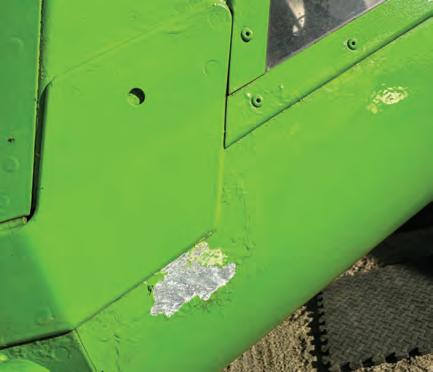
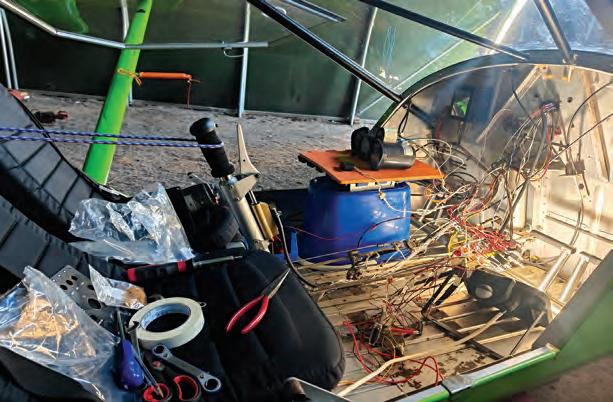
The airframe inspection also unearthed a little more than just a few cosmetic paint issues – it revealed some widespread corrosion that had not been addressed properly by previous owners. Inside the cockpit itself there were overloaded switches, broken circuit breakers and some wiring configurations that even Blue Peter would
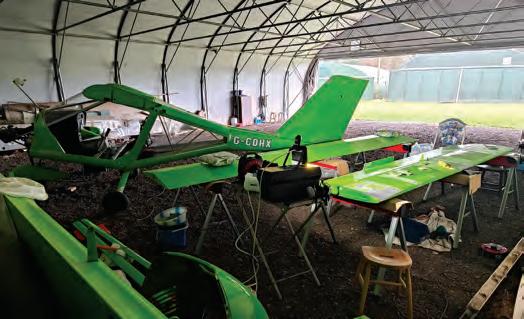
Mike’s hangar with the Foxbat being stripped down in the early days.
Far left This is not what a Rotax gearbox shaft spline normally looks like after little more than 900 hours in operation
Left These teeth did not leave the factory this shape.
Below Panel out in an attempt to rationalise some of the original cabling.
have balked at! Now that the size of the challenge had been discovered, all that remained was to decide what to do about it. With absolutely no previous aircraft build or restoration experience this was going to be a huge undertaking for a new owner, but he was determined to see ’HX fly again.
The first task was to dismantle the airframe so that each of the individual parts could be cleaned down and worked on more easily. This also included removal of the original engine for which a replacement Rotax 912 ULS had to be sourced.
The fuselage treatment was the first port of call and, to begin with, ACF50 was applied internally throughout.
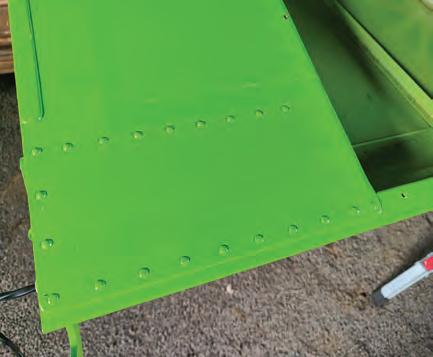
Externally, each area that showed signs of paint cracking or flaking was marked out.
I sought advice from a few companies in the aerospace industry about how best to approach the stripping back of the old paintwork. Most suggested using an orbital sander with an 80 grit pad to speed this process up. However, I was a little concerned this would be too aggressive especially around the many rivet heads in the fuselage. A couple of other companies recommended industrial paint strippers, but I had also read that if this isn’t neutralised properly then it can cause significant problems with new paint down the line. In the end, I opted for a much more controllable, albeit substantially lengthier, manual approach using Scotch pads and
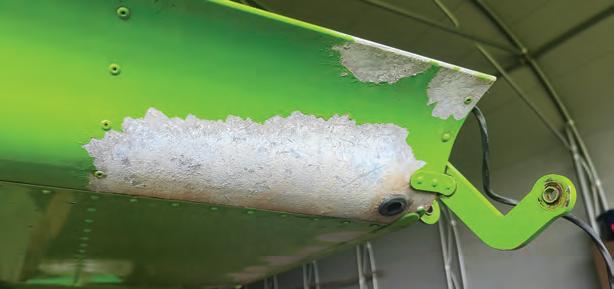
Three above From the top, these three shots that show how Mike dealt with the corrosion problems, from start, to finish. A thorough job.
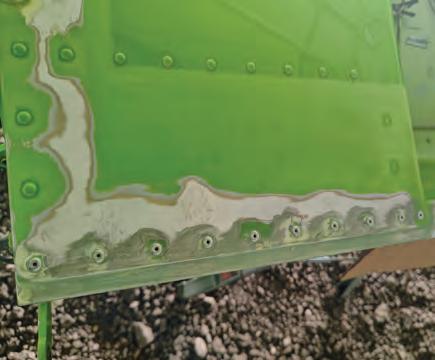
Corrosion had really taken hold underneath the paint on this section of the fuselage.
120/240 grit sanding pads. The Scotch pads and plastic flexible scraper were used to remove any flaking paint, then using the 120/240 grit sanding pads any underlying oxidisation was gently lifted back to good aluminium and blended with the surrounding paintwork, taking particular care around the many rivet heads.
Even though the areas of bad paint and oxidisation were small individually across the fuselage, there were quite a lot of them, and so by the time all these areas had been sanded back and the surrounding areas prepped, it resulted in practically a full fuselage respray being needed. It had taken the best part of seven months to prepare the fuselage ready for spraying. Working in an unheated hangar over the winter months had proven quite challenging, so I decided to wait until the warmer weather before attempting to entertain any priming and paint spraying.
In May 2025, I contacted Advanced Paints in Doncaster to help provide the primer and paint for the respray. Staff spent a full day in their industrial booth testing and tweaking to provide an exact colour match for G-CDHX’s colour scheme. The technician had mentioned that providing a paint match for a brand new aircraft is easy, but to match a paint with 20 years of weathering is definitely more challenging. During all of the alchemy that took place on the day I remembered thinking that I wish I had a spray environment like the guys in Doncaster, rather than a cold and dark hangar. Alas, no such luck!
But, I did walk away with an excellent colour match for ’HX. So with the primer and paint provided – and the promise of warmer temperatures on the way – I began work on the fuselage respray.
Initially two coats of 1k etch primer were applied to all the affected areas then gently sanded smooth to ensure
no ridges nor steps were present, this was followed with two light coats of 2K gloss acrylic matching the original paint scheme. Spraying inside a hangar is definitely not the same as an industrial booth like the one I’d envied in Doncaster, and managing lighting, temperatures, humidity and ventilation all created some difficult challenges which meant that spraying days were limited, which definitely added to the timeline.
Eventually though, with the fuselage finished I was able to progress onto the horizontal stabiliser. This had shown significant signs of paint cracking and oxidisation and the prospect of completely replacing this with a new stabiliser from Aeroprakt was considered. However, upon further close inspection by the project’s Inspector, it was clear the original could be restored fully, which was a welcome relief given the cost of a new stabiliser!
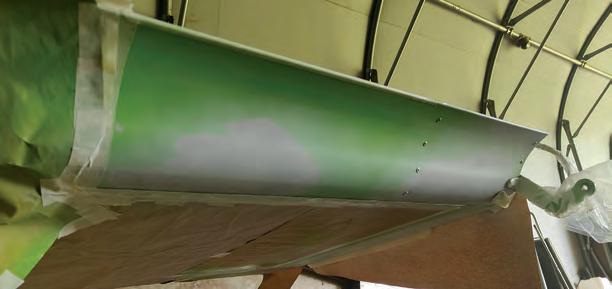
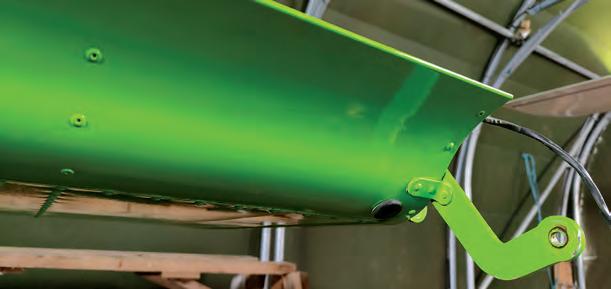
In parallel to work on the horizontal stabiliser, I also began work on the wings. Both wing tanks were fully removed and the internal wing cavities inspected. The wing internals were in remarkably good condition so some general cleaning was all that was required here. However, the trailing edge behind the wing tanks on both wings needed some work to remove oxidisation. This required the removal of around 10 rivets along the trailing edge of each wing to allow full sanding and treatment of these areas, then the internal wing tank recesses and trailing edges were primed, resprayed and riveted.
After the challenges of managing the spraying environment on the fuselage in the hangar, I set up a much more controllable environment in my garage using heaters and fans to control the humidity, temperature and ventilation. The spraying progressed much quicker than before, as the environment was far more stable and consistent, leading to great results in a shorter timeframe.
The technicians at Advanced Paints were also available on the phone to offer advice on best temperatures and humidity levels to aim for.
After more than 12 months on the project, and with the fuselage, stabilisers and wings now fully completed, the aircraft was put back together ready to have its replacement Rotax motor installed. This replacement had come from a Skyranger Nynja 912s and had been incredibly well maintained.
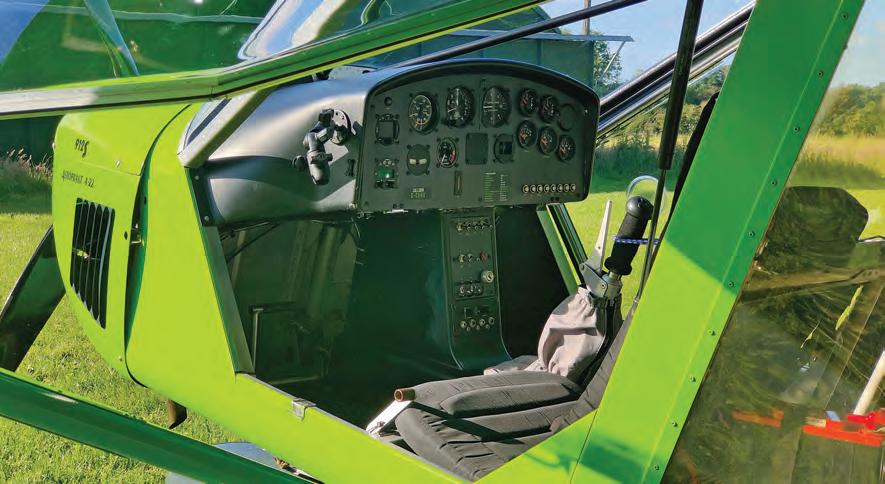
While the engine was en route to me, attention moved to the avionics and electrics. The overall condition of the installation was poor with many switches and breakers overloaded and some not working at all. Combined with a general birdsnest of wires behind the instrument panel I decided that everything had to go! With the cockpit mouldings and instruments removed, all of the old wiring, switches and breakers were systematically removed and replacement components ordered from LAS Aerospace. I also took the opportunity to redesign the instrument panel and replace some old weighty dials (a single turn-and-slip indicator weighing in at 1.2kg) with newer lightweight VDO gauges.
Once the new wiring was ready, a mock-up panel was
Right and far right
The wing root inboard of the fuel tank before and after restoration.
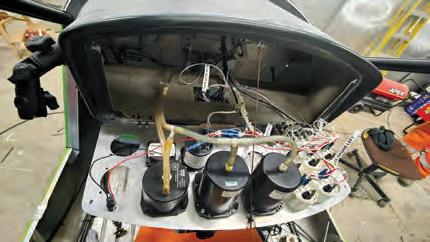
Right Hinged at its bottom edge, the instrument panel tips rearward for easy servicing.
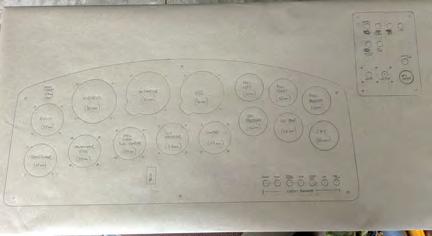
Right Creating a full-size drawing of the revised panel layout.
created to check the positioning of the new switches and gauges. Then a new 1.2mm aluminium panel was laser cut by a local firm and I finished this with primer and a matt grey 2K Acrylic to match the new spinner and spats.
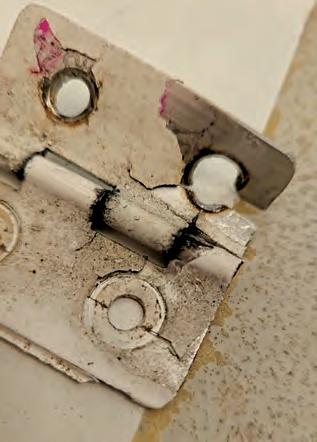
The final instrument panel was installed along with easy access hinges to make future inspections a breeze.
With the replacement engine installed and tested, and all new wiring and panel in place, G-CDHX was ready for some initial ground-runs and a lot of paperwork to be submitted to the LAA. The project document I created detailing each part of the restoration totalled 55 pages, along with all the required worksheets, maintenance schedules and logbook entries. Francis Donaldson, from the LAA, headed up the LAA engineering side of things, coincidentally, Francis had involvement with Hotel Xray back in 2005 when it first flew.
With nearly two hours of total ground-run testing and a temporary permit to test issued by the LAA, the Foxbat had its first successful test flight earlier this month and is expected to pass the remaining testing with flying colours (literally) very soon.
I have learned so much in the past 18 months. Restoring an aircraft, whether by choice or circumstance, is definitely not everyone’s cup of tea and having little to no experience nor knowledge adds to the challenge (and timelines) considerably.
Learning to be religious about every process, such as
Cleared To Fly
If your aircraft has featured recently in the magazine and has subsequently completed its maiden flight, Project News would like to hear from you at: projectnews@laa.uk.com
■ G-AESE DH87B Hornet Moth (s/n 8108) 2/6/2026
Hampshire
■ G-CEIB Yak-18A (s/n 1160403) 12/6/2026
W Yorkshire
■ G-CMUH KFA Safari (LAA 402-15695) 29/6/2026
Hants
■ G-MBMM Sling 4 TSi (LAA 400A-15865) 26/6/2026
W Sussex
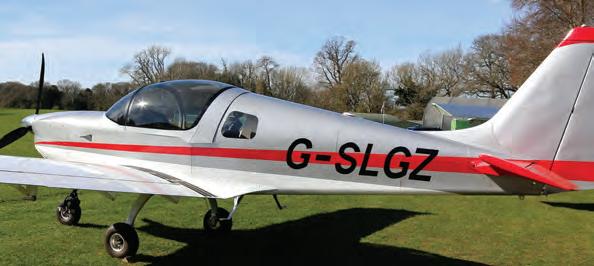
■ G-SLGZ Sling 2 (LAA 399-15717) 11/6/2026
Hants
Left The renewed instrument panel looks great in the Foxbat cabin.
weighing and recording everything that gets restored or replaced, or labelling every bolt or nut so you can find them again six months later – all make big differences down the line. This all said, having had such a close relationship with every nut, bolt and pin gives you a far greater and more tangible confidence in your aircraft that arguably not all pilots have.
Restoring an aircraft definitely brings the relationship between aviator and aircraft much closer together. ■
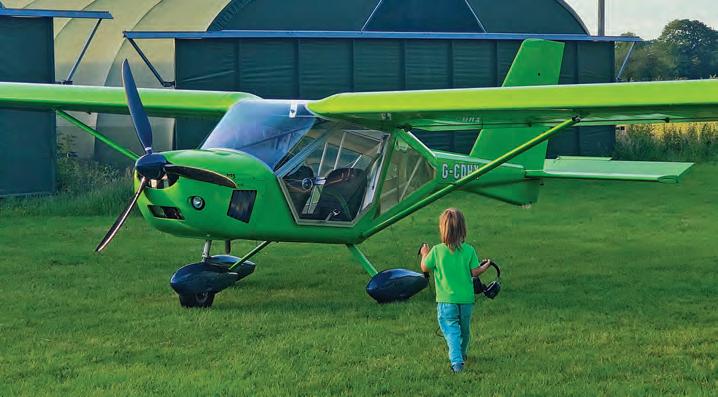
Below The completed restoration – let’s go flying, dad!
Sling 2 'Golf-Zulu waiting for its Permit to Test to arrive earlier this year.
A journey with a Messenger
Aeroplanes that don’t conform to the norms are what make flying more interesting, and it’s why Mark Hales has owned more than one Miles aeroplane, and for the last few years, been custodian of a Messenger…
Photography Ed Hicks
It didn’t start with a Messenger... the obsession to own something Wooden and British that is. It was around 2007 and I’d been flying for a while, during which time I’d worked my way through countless examples of aviation inspiration, some ordinary, some less so, but the common theme was that they had to be different. Just as it had been for so many years with cars and bikes, things which were proven and usable, sorted and reliable and for which parts were easily obtainable were just, well, less interesting... And it wasn’t just a perverse desire to stand out from the herd, it’s because departures from the engineering norm
inevitably offer a different flying or driving experience. Creators who were looking for something else, who were willing to take risks with design and construction. Like Juan de la Cierva, Burt Rutan, or yes, the Miles Brothers, to mention just a few. And there’s the point. If you go along with their inspiration, you too might discover what they were looking for.
That inspiration was never more apparent than during the 1930s. Powered flight was only three decades old, the war to end all wars was receding into history and designers were still searching for things they didn’t yet know. There was also the unique visual style, where form
seemed as important as function. Initially, I set out to find a Percival Vega Gull of which about 90 were built in the mid to late 1930s, then a Miles Falcon (only 36 ever made), then a Percival of any kind (there was a Q6 twin on the Isle of Man...). and then a Miles of any sort. The Brothers Miles, George ‘GH’ and Frederick ‘FG’ were nothing if not a creative ferment and they produced so many interesting and beautiful designs in considerable volume. It’s a mystery to me why they haven’t been better regarded when compared with say, a contemporary de Havilland which looked much more like a product of the previous decade.
There was a trip to Lognes, to the east of Paris, where apparently, a Miles Falcon had been parked outside for years before the airfield was moved a couple of miles. The Falcon is the one with the seductive reverse-angled art deco windscreen and trousered undercarriage, made at Woodley in the 1930s and so very redolent of the time. Was it stashed in somebody’s lockup, or at the back of one of those little corrugated hangars somewhere in the middle of France? I never discovered it. Meanwhile, history suggested that another Falcon had sat on a pole for many years at the entrance to a car breakers yard in Aix en Provence. Another Continental odyssey revealed the Falcon was no longer occupying its metal Eyrie and no one seemed to know what had happened to it, or indeed, why it might have been of interest to a Gallic recycler of automotive components. Quite how I would have retrieved it from its mounting, or got it back home, I hadn’t considered. That’s the thing about zeal...
Eventually a Gemini
There are many more in a similar vein, including the Miles Whitney Straight in Northern Ireland, whose demise began with a simple engine problem and a precautionary landing at Newtownards, close to the place where Miles opened a factory in 1946. The Messenger in the pictures was built there. The Straight had sat outside for a while until it was purchased by a farmer who towed it to his brother’s barn behind a tractor and thoughtfully covered it with heavy carpet. When I saw it, the roof had leaked and the weight of sodden grey Wilton had collapsed the whole plywood structure like so much papier mache. None of which had any bearing on the owner’s idea of value.
Back to 2007 and it had become obvious that neither a Percival nor Falcon were likely options, but not before I had collected a 200HP six cylinder Gipsy Queen engine, and a constant-speed Fairey-Reed propeller, both of which would have been handy accessories to Proctor ownership. The obsession’s eventual and unlikely fix then, came in the form of a Miles Gemini twin which had been advertised for some time in the usual places – there was no Afors in those days... I’d read the advert again and again, and yes, it was definitely a Miles but each time common sense had prevailed because despite my deep-rooted iconoclastic tendencies, it was hard not to be influenced by the negative propaganda. It was a twin and my rating had lapsed and besides, it wouldn’t fly on one engine, was difficult to handle on two – especially near the ground – and there were no parts available to maintain the engines. Not one but two inverted Blackburns, very similar in construction and appearance to a Gipsy and with magnesium crankcases which were likely to develop
“The Messenger, which the Aviation Grapevine suggested might still be for sale, seemed like an obvious solution”
cracks even if they hadn’t already, mounted on a wing which might fall apart at any moment because it was held together with milk-based glue. It was, however, still a Miles and since I hadn’t found anything else, it would have to do. It was airworthy and flying on a CofA, so at least the basics should be sound.
The Gemini to which I was eventually drawn like a moth to a candle, turned out to be an interesting experience – hugely enjoyable once out of the hangar and in the air, but so often frustrating when the wheels were back on the ground and especially, when the hangar doors slid shut. It wasn’t the wooden construction – that had been extensively restored during the 1980s – it was the minor ancillaries, most of which were probably around 70 years old. The electric motors which retracted the undercarriage, generators, fuel pumps, and especially, magnetos. There’s a reason why American ones sit in plain view, adjusted via slots and pinch bolts...
And then, a Messenger
It was a decade’s experience I wouldn’t have missed for the world though, but wonderful though the Gemini was in the air, its size meant it was always at the back of the North Coates hangar, and moving seven aeroplanes to extract it, putting them all back, then repeating the process when I returned meant that a quick hour’s bimble round the skies of Lincolnshire on a fine evening was more of a chore than it should have been, especially when it was usually just me doing it. That and the aforementioned maintenance burden of two old and inverted engines. I don’t know why it took so long, but the Messenger which the Aviation Grapevine suggested might still be for sale, suddenly seemed like an obvious solution. And it was a Miles.
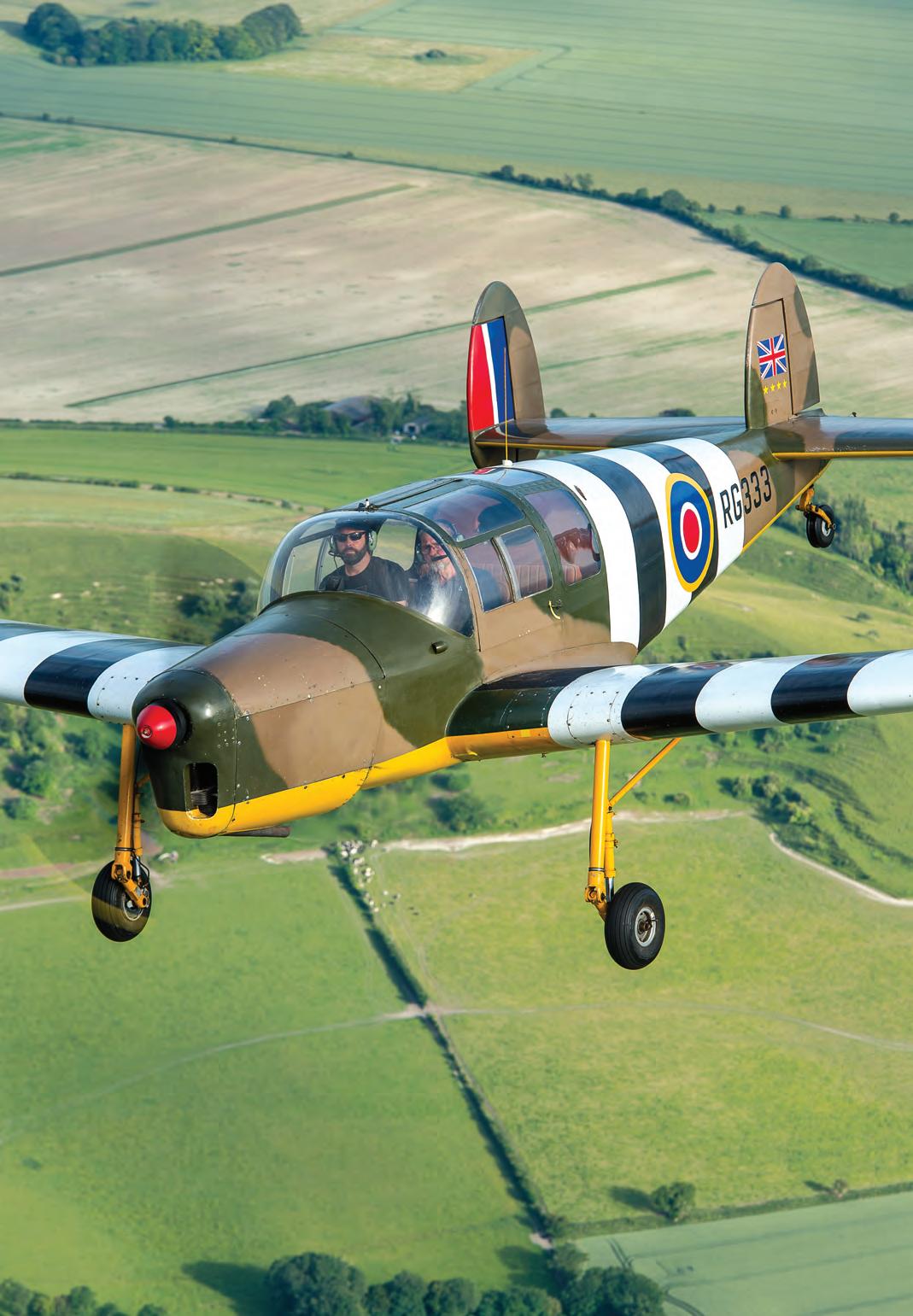
Above Messenger is right at home on British strips.
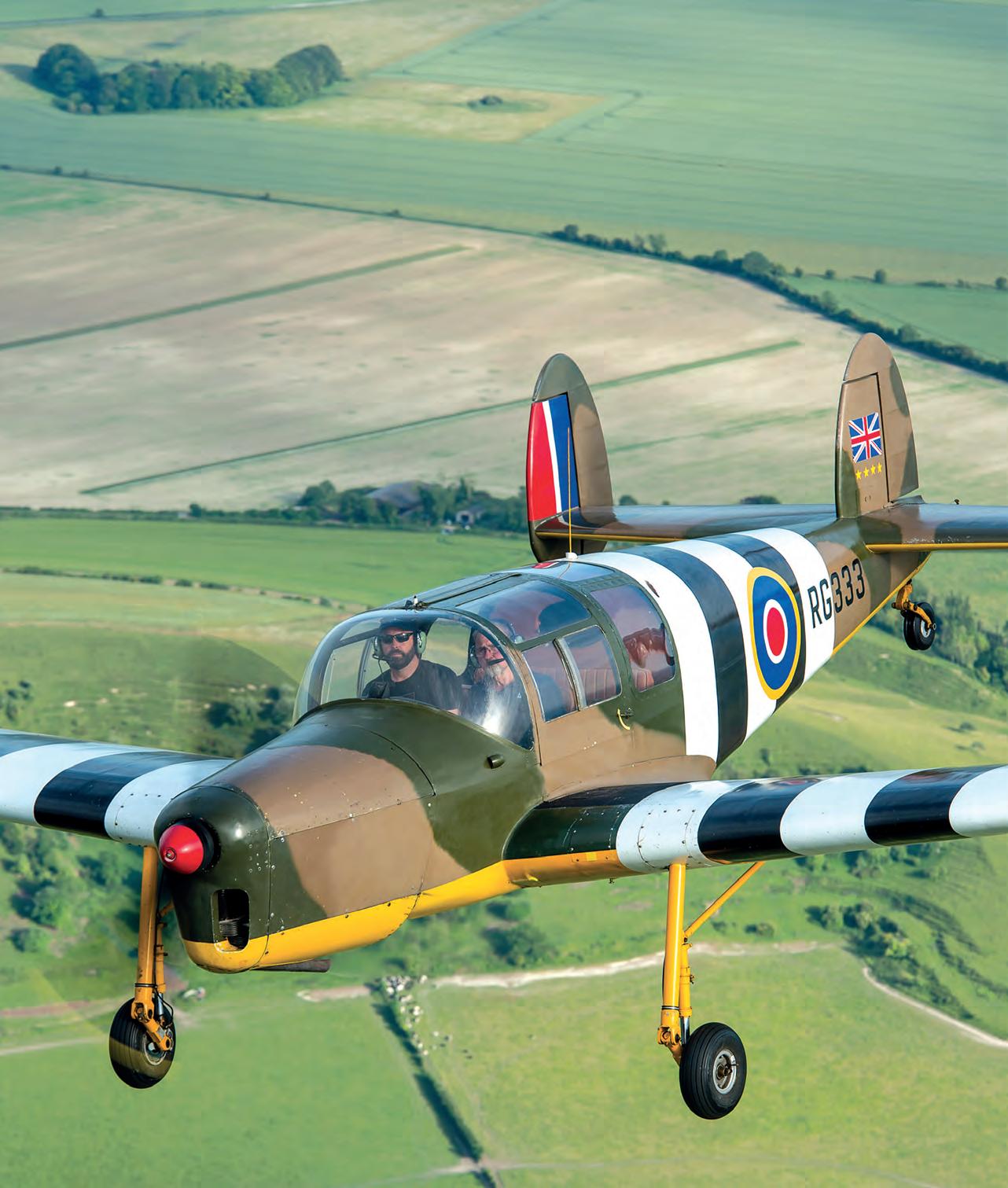
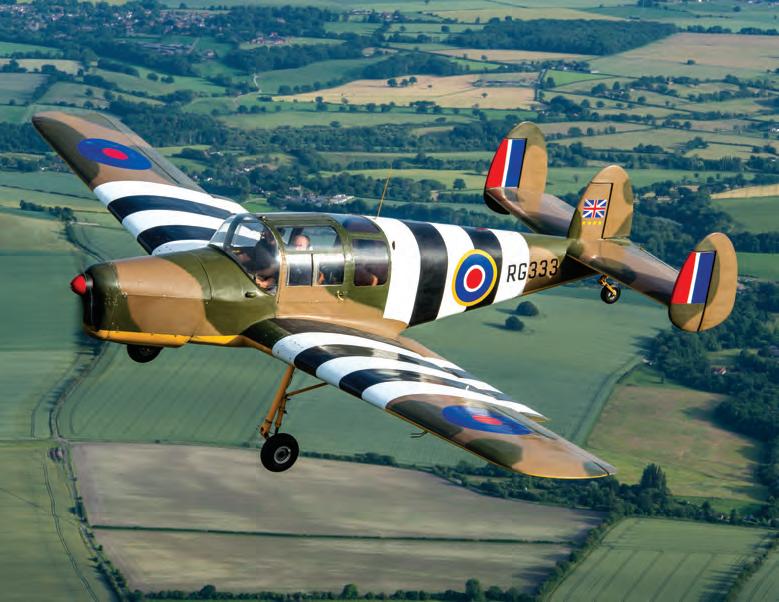
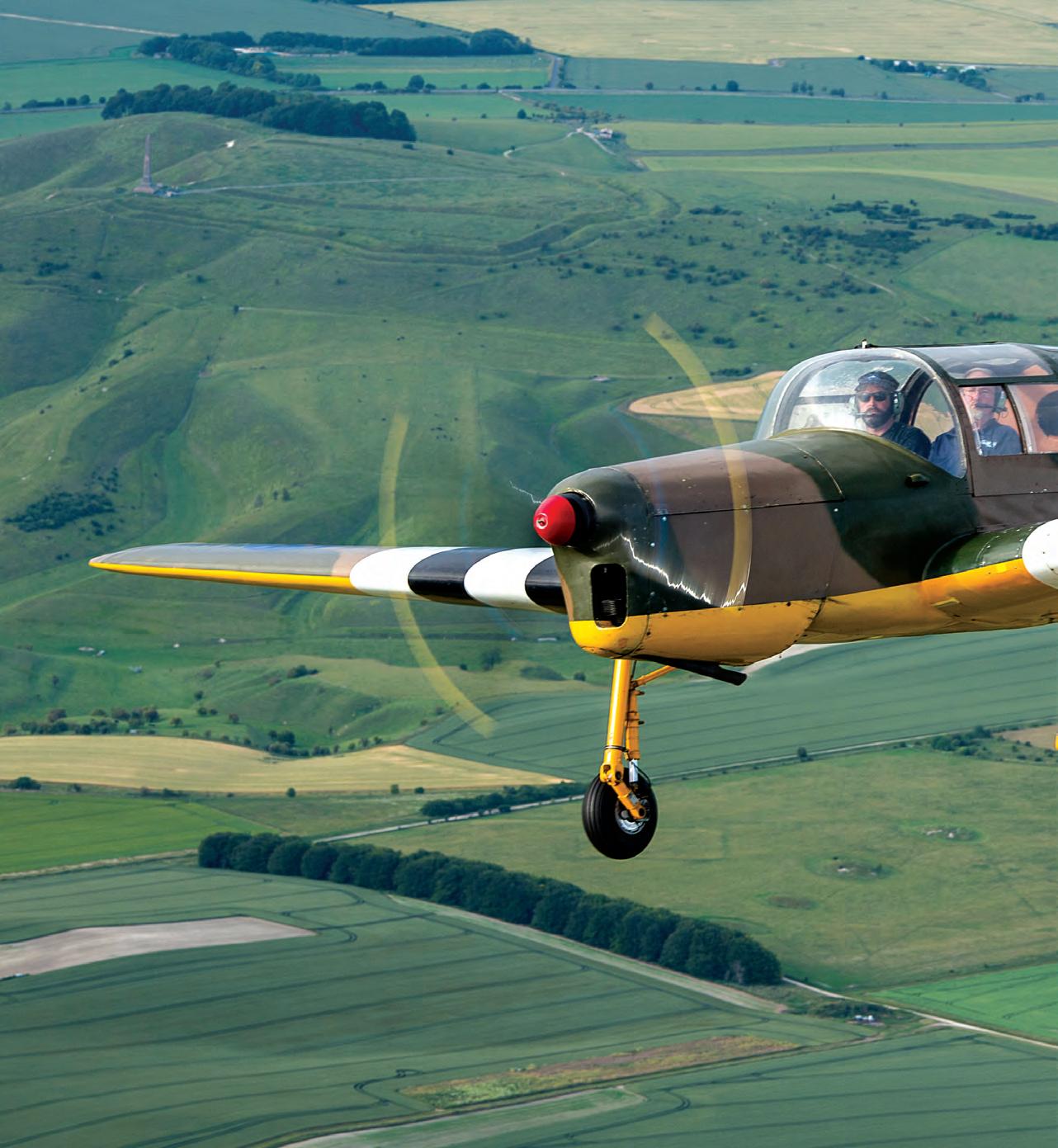
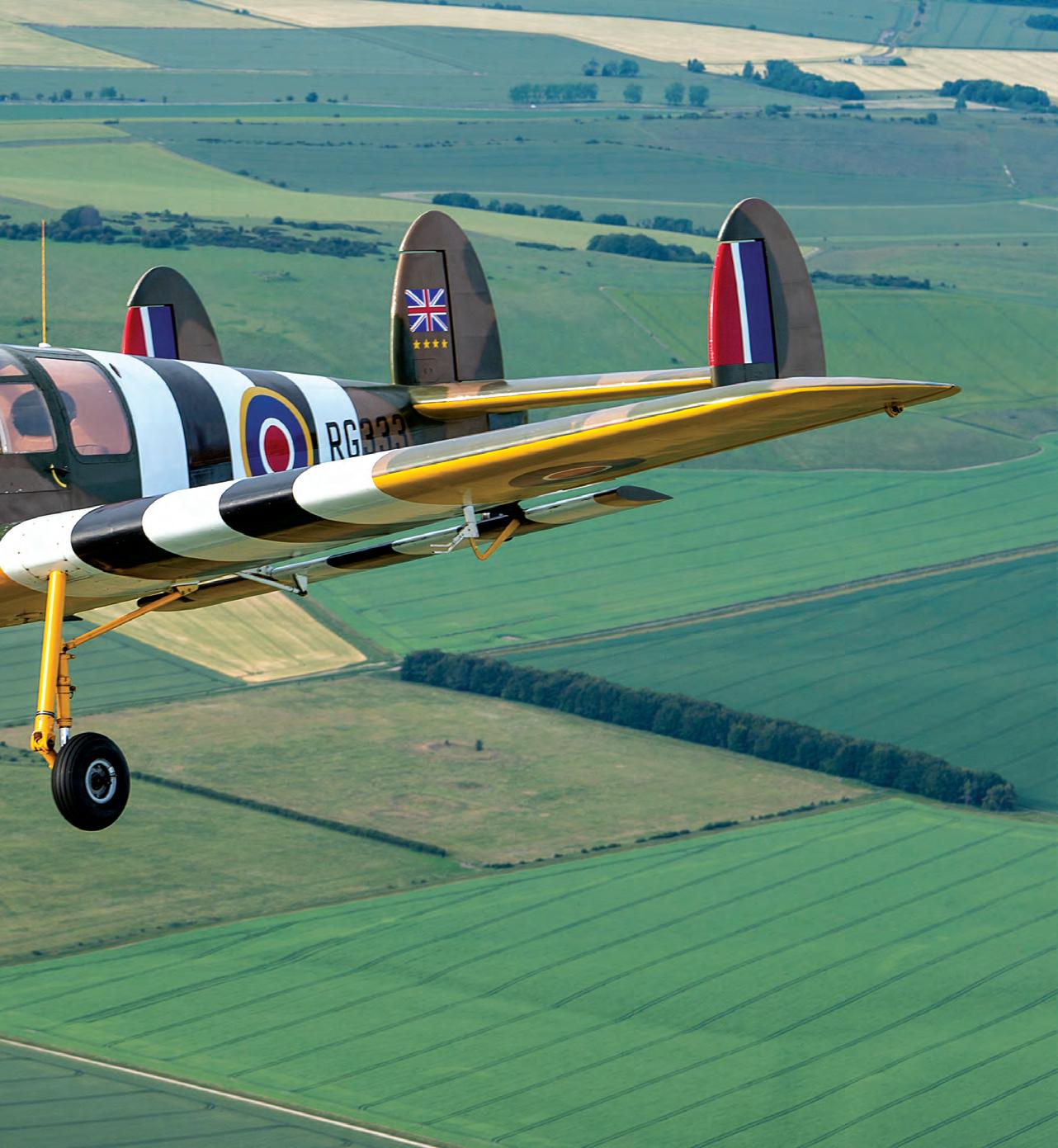
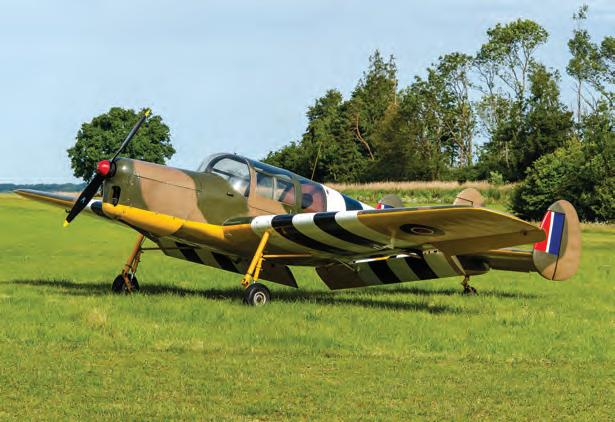
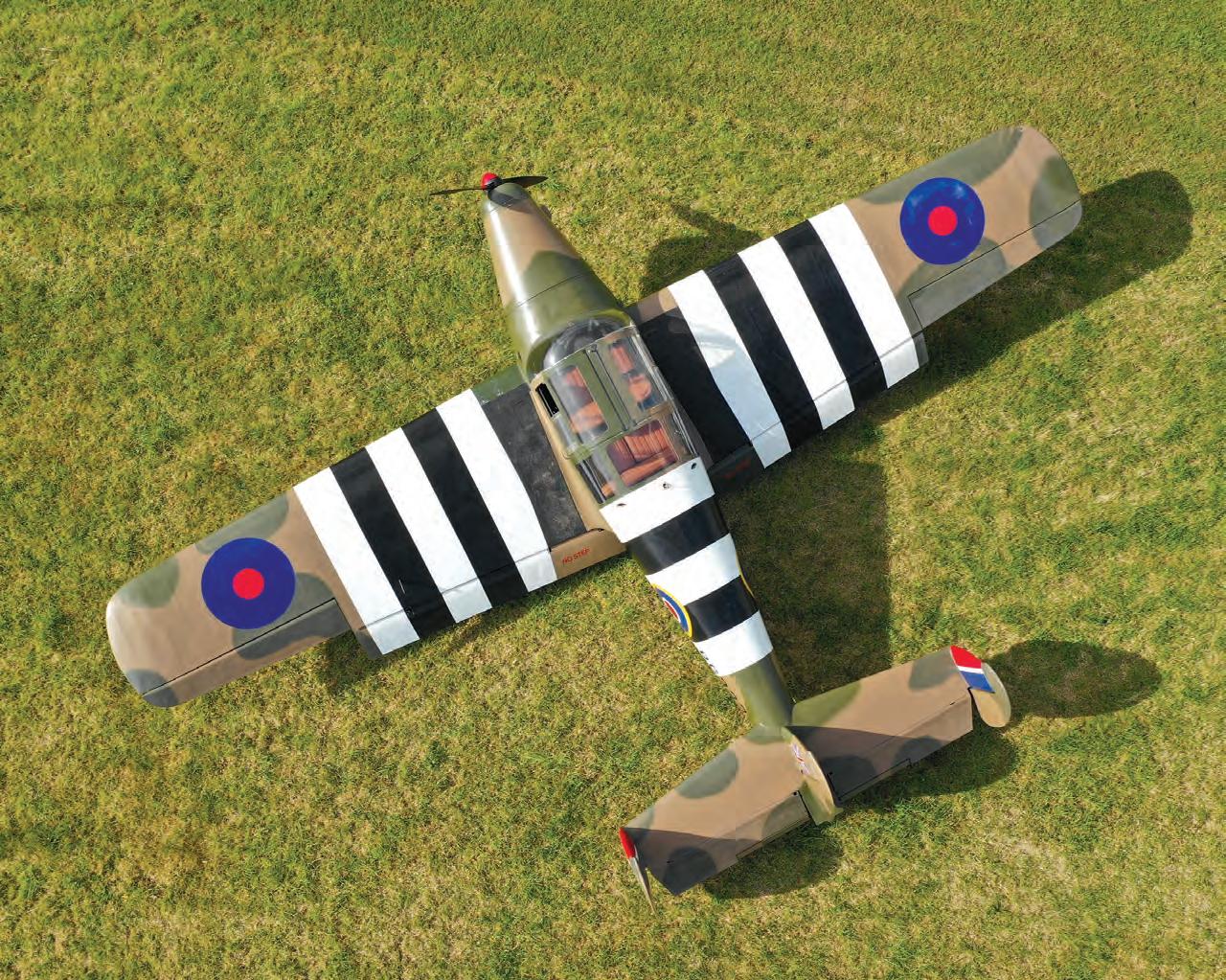
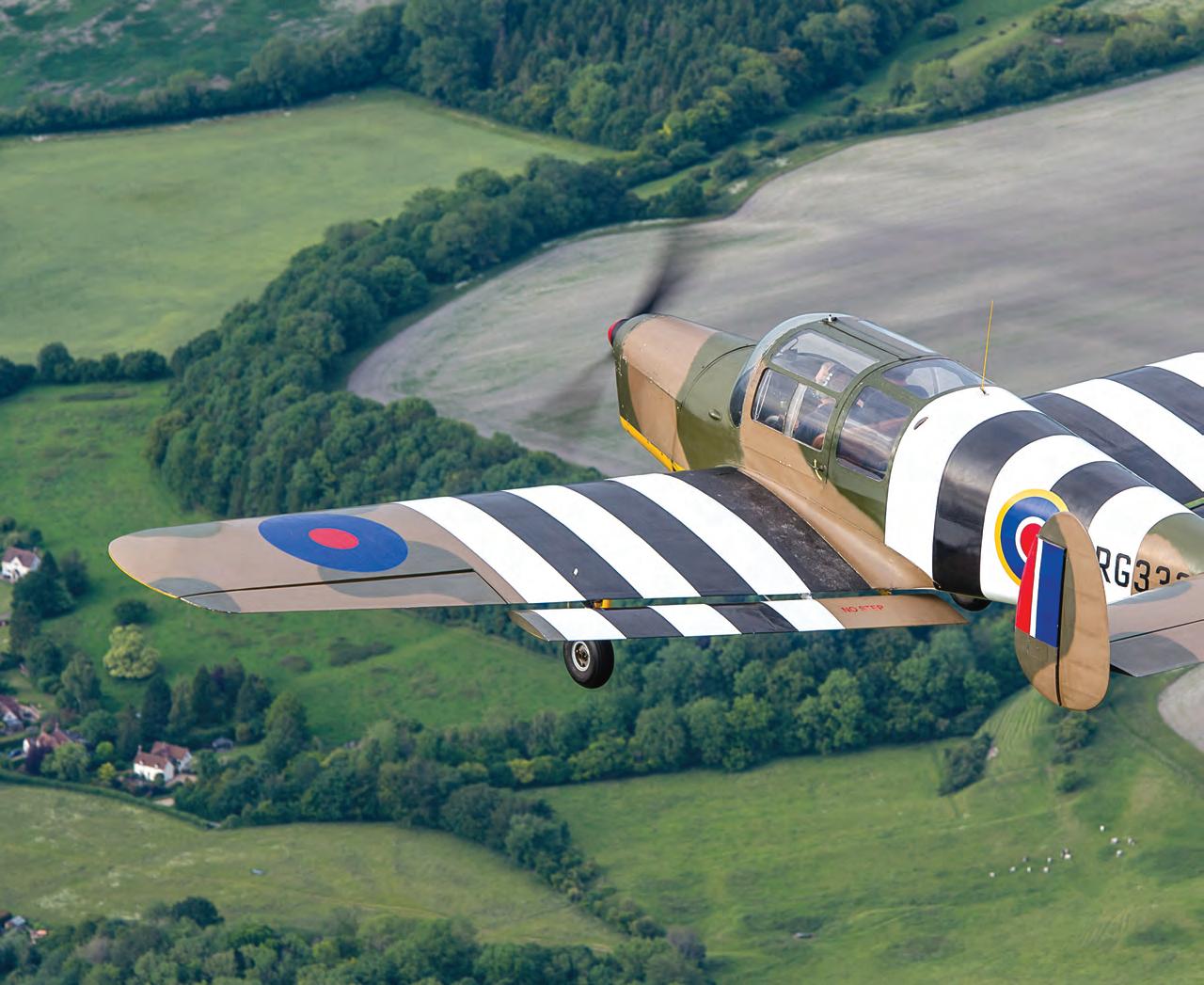
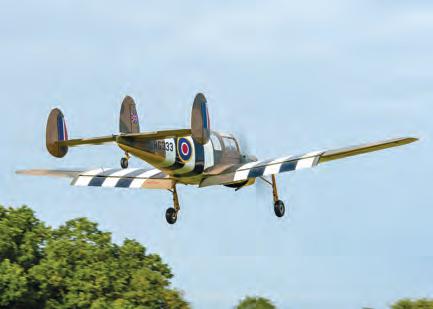
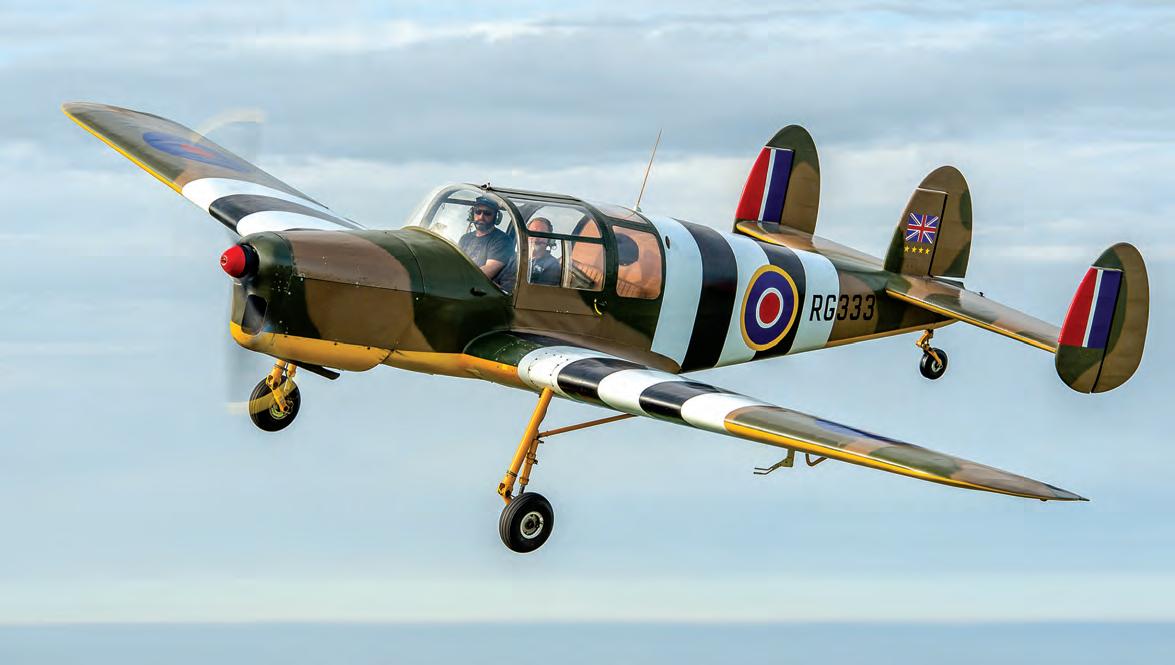
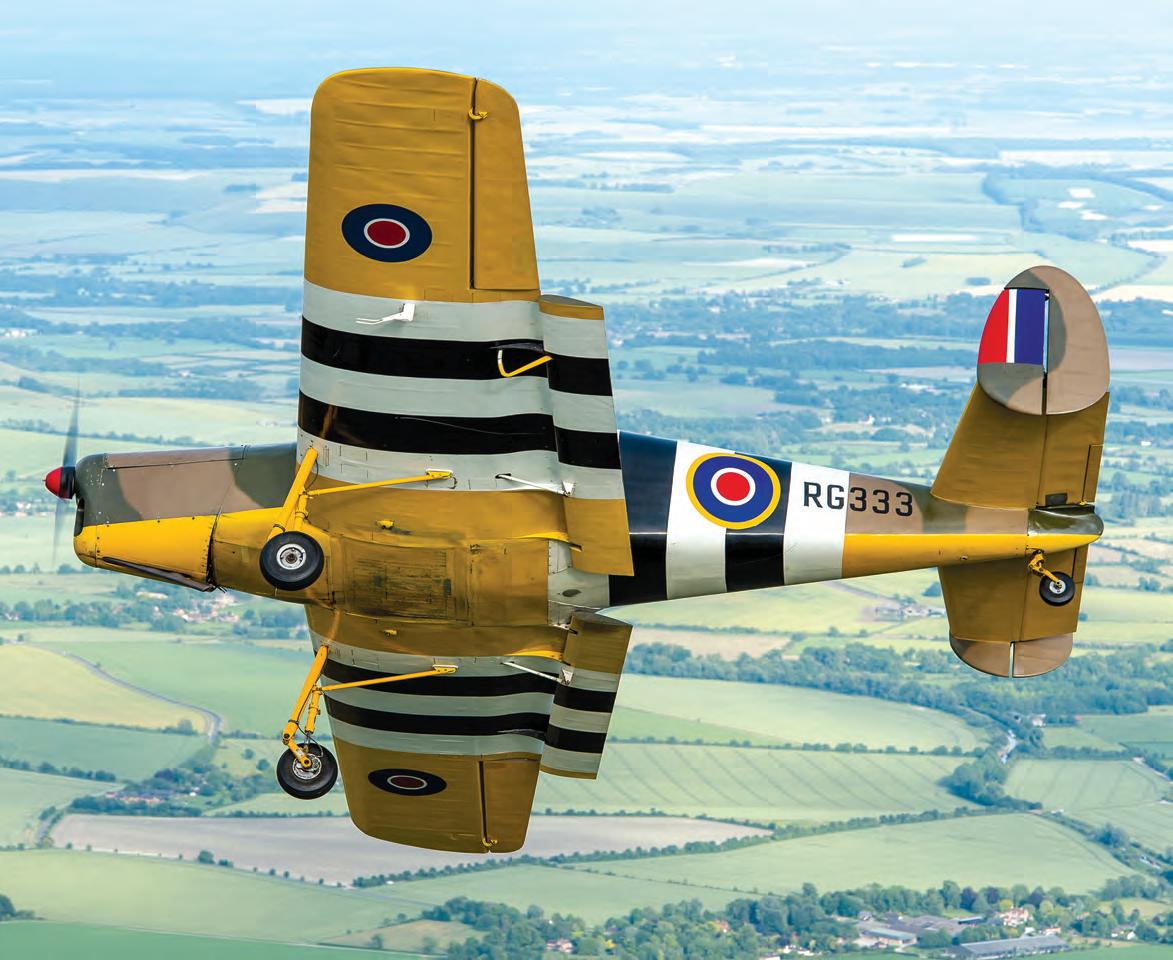
Left Made in Northern Ireland in 1946, current layout and livery is an accurate recreation of RG333, which was one of Field Marshal Bernard Montgomery’s two Messengers during the Normandy campaign.
The Gemini twin had been developed from George Miles’s original Messenger, proposed in 1942 as a military liaison but summarily rejected by the Ministry in favour of the steel-framed Taylorcraft/Auster. Thanks to the persistence of a group of army officers, who recognised the Messenger’s obvious benefits, in 1943 Miles did eventually receive an order from the army for 21 Mk4 military spec Messengers featuring bigger windows in the rear (visibility from the cockpit was already a design goal) and was powered by a de Havilland Gipsy Major rather than the Blackburn Cirrus fitted to the post-war civilian models. Field Marshal Bernard Montgomery had two at his disposal (RH378 and RG333) for the Normandy campaign.
The Gemini had to be sold to make way for the new acquisition, its new custodian Stu was immediately seduced by the Gemini flying experience and easily fell under the Miles spell. In 2018, Inspector mate Miles McCallum and I journeyed to Middle Wallop to carry out a
“A carefully recreated homage to Bernard Montgomery’s Normandy transport of choice…”
basic annual on ‘RG333’, the carefully recreated homage to Bernard Mongomery’s Normandy transport of choice. It too was still flying on a CofA, and the paperwork – dating back to Day One and its acceptance flight at Woodley, following the ferry flight from Newtownards – said it had already been prepared for a CofA. Should be simple then…
Nearly two years later, I had replaced the fuel tanks, overhauled the engine’s cylinders, fitted a new carburettor, sorted out the magnetos and the ignition harnesses, fixed the brakes, fitted new radios, chased the interference... and a hundred-and-one other jobs, including transfer to the LAA fleet. I’d also persuaded a local farmer to rent me the edge of one of his fields, so even if the Messenger was identical in size to the Gemini from which it was developed, it was lighter and would be easier to manage, plus I had made an electric tug from a supermarket trolley gatherer to push it out of the shed, and installed a winch to pull it back in. And if this all sounds like a flawed rationale, the reward for all the graft was available whenever I took to the air. Just like it was with the Gemini.
Of carb tickling and dribbling fuel…
The joy begins like this.
Pull the propeller through four compressions –cylinders are upside down and any oil that might have dribbled past the piston rings is incompressible – and although I’ve never actually found any, the potential punishment for missing this step is a bent connecting rod.
Above Flaps are extended to make the clamber up the wing easier. Ailerons droop at the same time for extra STOL capability.
That’s old and inverted for you. You can prime a cold engine either by opening a cowl hatch, pulling down the cable which tickles the carburettor float and wobble one of the pumps on the back of the engine, before clambering back up the wing and into the cockpit. Or you can do it the easy way... The Cirrus Major’s twin Amal fuel pumps are driven by a single quill shaft and if that breaks, you have a problem, so I added an electric pump and a pressure gauge. Pull the cockpit knob which duplicates the undercowl carb tickler via a cable, and switch on the pump. Two seconds for the carb to flood, watch the pressure drop to prove it, two more seconds while neat fuel guzzles from the carb’s overflow and into the inlet manifold, then hit the starter. Wait any longer and the excess fuel runs to the back of the manifold (steeply inclined, in line with the fuselage), pours out of the drain and onto the grass. It also misses cylinders one to three... You can judge your skill set in this department by the brown patches dotting the emerald sward. Don’t you just love Old and British?
Wide and roomy cockpit
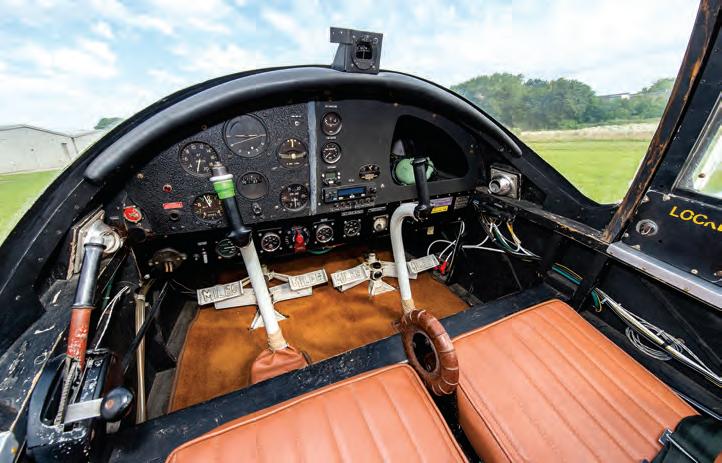
It always feels like too much juice though, and the engine which, from cold, catches first blade, has to clear its throat. Give it more on the lever than feels right. Add some air to the mixture and clear the surplus... Thump, Shunt, Cough, Rumble, Rumble. Set 800rpm but remember there’s two-and-a-half gallons of 100 grade in the oil tank, so no point in overheating the back cylinders in search of temperature which won’t rise enough on tickover. Settle back into a basic but comfortable seat. Survey the cockpit, which is wide and roomy and although the deck angle is
Above Full blind flying panel driven by a large wet vacuum pump. Handbrake to the left of the throttle is essential for steering on the ground. Big winding wheel between the seats is to extend the flaps and droop the ailerons.
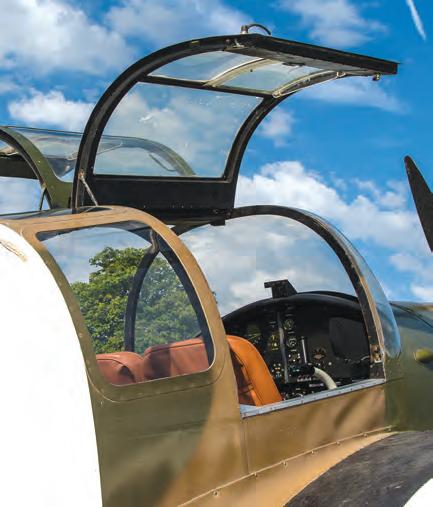
Left Huge doors allow access to both front and rear seats. Would originally have been self supporting by a large bungee and intended to be slammed shut. Squared-off rear windows match those fitted to the military Mk4 Messenger.
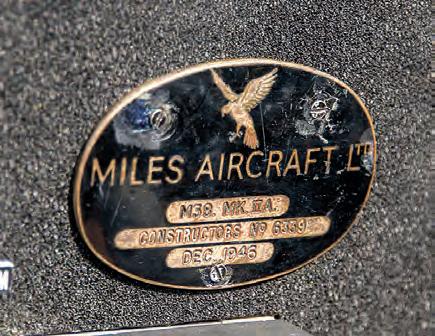
Left Original enamel nameplate was reunited with the airframe thanks to a kindly fellow Miles enthusiast.
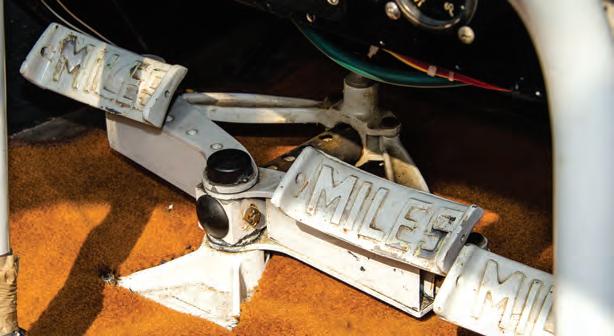
Below Cantilever rudder bar. Adjustment is via a spring loaded clevis pin in front of the pivot.
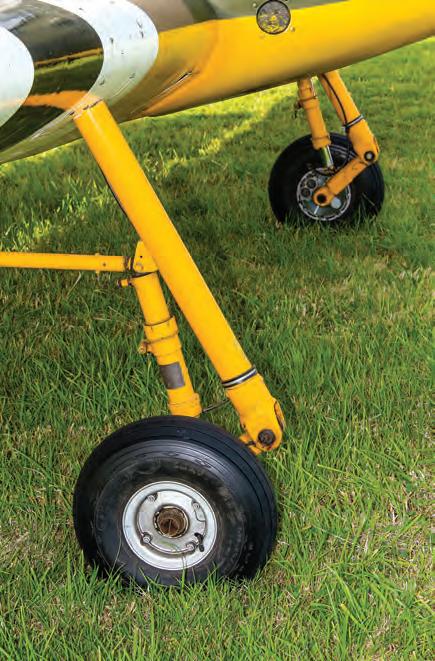
Above Big strong legs, long stroke give a supple ride.
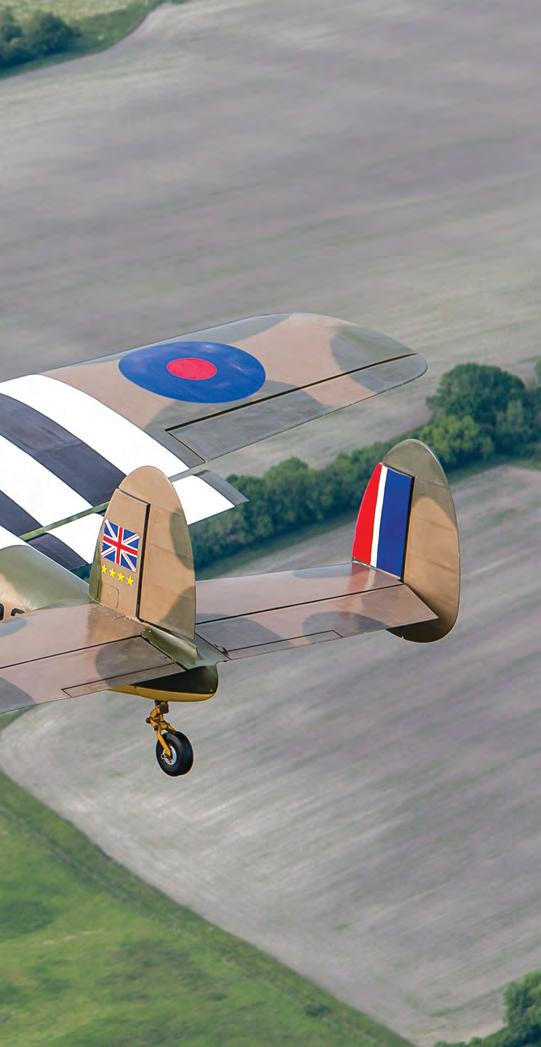
Above While Gemini twin only has two fins, Messenger's middle one was added for extra low-speed stability. Size of flaps is apparent in this view, adding to wing area when retracted. Substantial tailwheel is oleo sprung.
steep, the screen wraps round enough to see past the edges, just as George intended. The rudder pedals, which immediately feel like a footrest, are just one of so many lovely engineering touches; they are actually a rotating bar mounted on a pedestal with a clever cantilever system to keep each foot pad flat to the feet while at the same time offering a wide range of adjustment. From there, control input from the size 13s reaches the triple rudders via rods stretching the length of the fuselage to multiple bellcranks, rose joints and rods. Same for the ailerons and elevators, there are no cables anywhere so there’s barely any friction, no breakout force, the feel is light and direct with no lost motion while cables take up the slack. It’s one of the aeroplane’s sublime features, like the difference in feel between rack and pinion steering and an old style steering box on a vintage car.
Roll forward and check both brakes together, then
“There are no cables anywhere so there’s barely any friction… the feel is light and direct…”
each side in turn, and head for the threshold and the usual checks before lining up. Somebody in the dim and distant kindly fitted mine with a set of Dunlop discs from a Chipmunk, while Messengers also feature a similar differential braking concept to the Chipmunk’s, where the handbrake – just to the left of the power lever – operates both brakes equally when the rudders are straight, but varies the effort to whichever side when you steer. Nabbing a nasty crosswind swing means you must be ready to grab the brake lever before you push the rudder pedal because that will increase the braking effort to the upwind wheel at the first prod of your foot. It’s easier than it sounds and completely intuitive once you’re used to it.
I don’t bother with flap for take-off, although the book says you can if you’re loaded up. Click the brake on one notch just in case to sharpen up the brakes, then push the power lever until it meets resistance, then push harder. That opens the flap which lets cold air into the carb from the outside and adds the last few degrees on the butterfly. Look for about 2,200rpm and 50-ish mph while pushing the stick forward to lift the tail. If there’s a wind from the side, keeping it straight might need another tug on the brake and a couple of prods on the bar, then in as much time as it takes to read the words, the Messenger turns into that magic carpet which wafts you airborne. Let the stick forward while winding the trim nose down and in no time 500 feet will appear on the altimeter. More forward
trim brings up 100mph, throttle back to 2,000rpm and head for the horizon. There’s about four hours in the tanks at about 7.5 gallons per hour and it’s a style of progress I’ve not found anywhere else. If I wasn’t sure what I was looking for, I think I might have found it.
Light, but responsive
The controls are light but responsive, the cockpit is spacious, the view is panoramic and the way it rides the air is like nothing else. I can float about the sky, transported immediately back to 1946. It’s amazing how a vintage aeroplane can do that, and in a way that old cars can’t. Something about the air feeling much the same as it did 80 years ago, while the roads are definitely different.
Stalls, if you’re interested, are hard to find unless you barge into one. Most of the time, the Messenger will just sink with the ASI showing around 30mph. Full flaps and an aggressive entry will sometimes drop a wing, but if you manage to encounter that without trying, you'd deserve everything you got. But now, it's time to land, or the usual bit of excitement at the end of a soothing flight.
Final approach is slow, 60mph seems to be the best speed over the threshold, especially as flap limit is 75mph – or not a very big window when they need plenty of winding on the big Bakelite wheel between the seats. There’s 30° available but two up, I’ll only use 20, and the indicator pops out of the top of the Port wing to say as
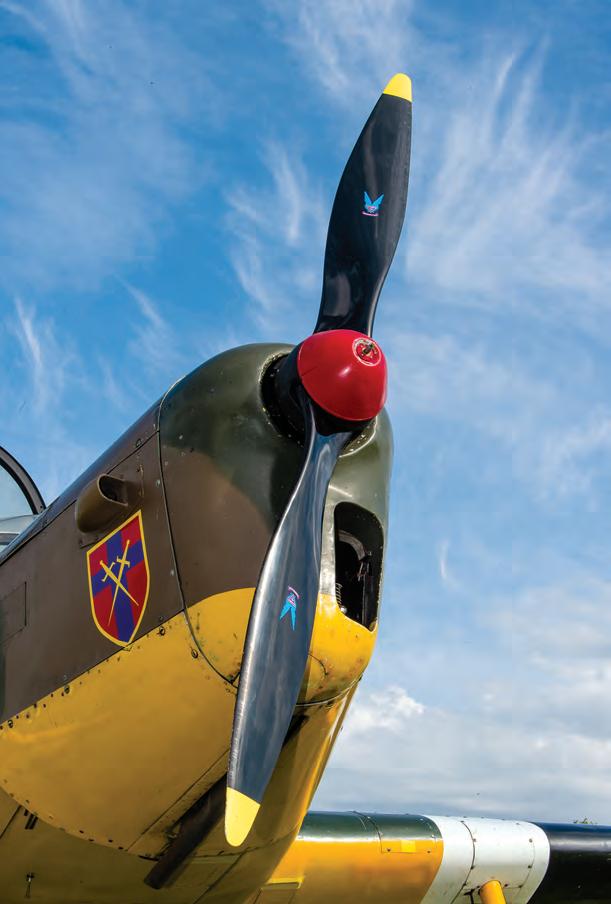
Above Crossed swords emblem is the 21st Army Group’s badge, which Montgomery also wore on his beret. Big metal Fairey Reed propeller is twisted from a single aluminium billet.
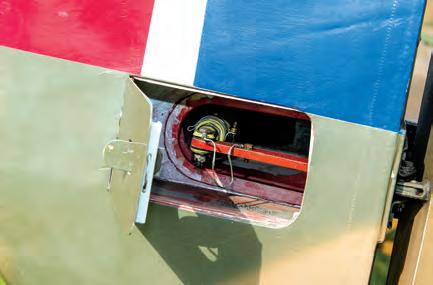
Left Control surfaces are operated exclusively by rods. Rudders feature multiple bellcranks and shafts inboard of the hatch.
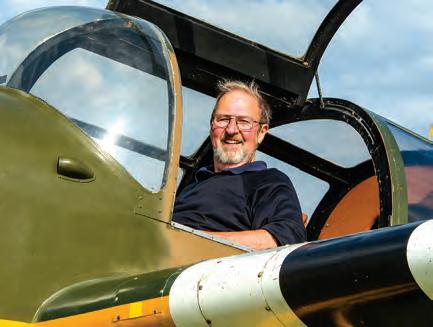
Left That's a Messenger grin… Mark Hales in the cool seat.
“The ailerons droop at the same time when lowering the flaps, so that’s a lot of drag ”
Above right Spot the ailerons dropping with the lowered flaps.
Below Three fins makes for a pretty unique look…
much. The ailerons droop at the same time so that’s a lot of drag and losing just the right amount of speed before you can get everything done within the window, and then losing altitude, is easy to misjudge. I’ll either end up having to add power to get to the threshold at 60mph with the nose too high, or find myself trying to lose height so I don’t gain speed at the threshold and float halfway down the runway. The wings are big and they love to fly, flaps or no flaps – an extra five mph means a lot to a Messenger. Maintain 60mph on the clock and keep it level while I feel for the gentle ripple as tyres touch the turf, then as soon as they do, shove the stick forward. That immediately takes any angle off the wing and pins the wheels down. If I let the stick come back even a small amount, the wing will attack the air and fly again and the only way to avoid the annoying balloon is a bit of power to settle it back on. Always does, and always leaves me with the annoying sense that I should have done that first time...
The stalky undercarriage and trailing link undercarriage is massively strong and super supple, intended for the challenges of wartime liaison duties which might involve use of an ad hoc runway, so if I don’t get it right, I know the undercarriage will simply flex its knuckles and soak
everything up. I’d even forgotten about the sun baked ripples in my strip until I taxied something else recently... Landing on the main wheels is my preference and having started a wheeler at about 60mph, by the time I’m rolling out, the speed has ebbed to less than 30, so the landing is still very short. The party piece is to keep the tail up until what seems like walking pace but I hardly ever need brakes on grass until I need to steer off the runway. By comparison, a three-pointer is not quite so reliable.
Hefty tailwheel tyre
The tailwheel is under the fuselage rather than out the back and wears a hefty dual contact tyre – shared originally with a Piston Provost but these days wearing one from a Polish Wilga – and it’s free castoring, or almost... Mounted on a forked wishbone with a long stroke oleo gas strut, there’s a circular track with detents to accommodate a pair of ball bearings which act like a conventional breakout lock but without the slap and clatter from the control cables as it breaks free. When the weight is on the tyre, the bearings sit in the detent and hold the wheel straight for take-off but they don’t stop the oleo absorbing the bumps. Clever, but simple, and a defence
against the original’s braking system which uses a pair of tiny drums borrowed from an Auster (which features a steerable tailwheel), and which don’t appear to be intended for any practical use... The intention was that you pull the Messenger’s stick back to plant the tail on the ground and access the locking detents as you crank on the power for takeoff, then when the three fins begin to come alive, push to lift the tail properly into the airflow. Landing is the reverse but without the power, but inevitably you have less control over the speed. It was probably a great solution for big grassy spaces. Less so when negotiating tarmac taxiways with lots of bends...
But what of that negative propaganda? The glue problems and the oily upside down engine and its many foibles, and of course, the fact that only about 90 were made before Miles were forced out of business in 1947, so there haven’t been any new parts manufactured for three quarters of a century. If the aeroplane is in possession of a certificate though, there’s a better chance that glue problems will have been addressed. It’s not a guarantee, but a better chance. This one was done in the 1980s, and provided it continues to live in a hangar, I’m predicting survival for a great deal longer than its owner. And if the worst should happen, wood is still wood and the manual contains repair schemes for every conceivable kind of damage.
That leaves the larger inverted Blackburn engine, of which there is only one, rather than two, but which were made in even lesser quantities so there is an even smaller supply of parts. It’s something of an irony that when hardly
any of them are flying, any parts that do surface have almost no market and command a more reasonable price. With a little help from a network of enthusiasts, I’ve now collected enough of the more challenging bits – castings and the like – to last the aeroplane’s lifetime. The rest, should they be needed, can be reverse engineered to better than new standards thanks to computer controlled machinery and a better understanding of material technology.
My Miles journey has been fully satisfied and other projects await, so it’s time to find a new custodian to enjoy the quirks and delights of a Messenger. There have been times throughout my Miles tenure when I could see why people might have taken the readily available option, but now I’ve seen what George was looking for, I know which I prefer... ■
MILES M38 MESSENGER
MANUFACTURER SPECIFICATIONS
General characteristics
Length 24 ft 0 in
Wingspan 36 ft 2 in
Empty Weight 1,438 lb
Gross Weight 2,400lb
Engine Blackburn Cirrus
Major III
Fuel Capacity 140L
Prop Fairey Reed
Performance
Cruise 100kt
Stall 22kt
Range 400nm
Rate of climb 750 ft/min
Take-off run to 50 ft: (15 m): 230 m
Landing run from 50 ft: 200 m
Above Peeling away. Spot thehe flap indicator - a simple cranked strip attached to the outboard edge of the port flap, curving up through the wing to poke out of the top surface.
The Big Luscombe Birthday Bash
With lots of UK Luscombes celebrating their 80th birthday in 2026, long-time owner of Luscombe 8E G-BRUG, Nigel Barratt, decided a big-get together was in order… Photography by Graham Wasey unless noted
While polishing and maintaining G-BRUG, my 1946 Luscombe 8E model, over the last 37 years, I’d been thinking of how she, and other similar models built in the same year, could celebrate their 80th anniversary.
The model 8 Luscombe, conceived by Don Luscombe and his team in the US in the mid-1930s, first flew in 1937. Built with a metal monocoque construction with fabric-covered wings, from its beautiful cowling to those corrugated tail surfaces, it was ahead of its time. Powered by the new mighty Continental A65, the model 8A gave a
Luscombes to the left of me…
22 Luscombes gathered at Oaksey Park
very competitive turn of speed in relation to her competitors.
As the US entered the war in 1941, all Luscombe production stopped, but resumed again in 1946, where production of the model 8A, now a fully metal monocoque construction, along with the advanced model 8E with wing tanks, electrics and the mighty C-85 gave competitors even more of a headache. So much so, Cessna took two Luscombe models to its factory to study this iconic, aesthetically pleasing light aircraft. Rumour was that it could see the Luscombe design was indeed ahead of its time in its design. It’s funny how the Cessna 120 and 140 and Luscombe models bear an uncanny resemblance to each other…
So, nearly 80 years on, I started forming a plan on how to celebrate the long life of these remaining UK-based Luscombes. One hundred or so were imported through the 1970s and the early 1990s, but, sadly, not all of them are still flying.
G-AFYD, the UK’s oldest Luscombe, imported by Cliff Lovell in 1979, has recently transferred to the LAA Permit system.
Immaculately shiny 8E, G-LUSC.
… Luscombes to the right
Goose remained Luscombe-loyal throughout the day.
A silver Silvaire…
I’d been organising the Luscombe rallies at Oaksey Park Airfield over the last 21 years to keep these beauties on the map and couldn’t think of a better place to hold it, Sywell being a close second.
For 2026, with so many of the UK Luscombes celebrating an 80th birthday, having been built in the incredible General Aviation boom year of 1946, with the help of Steph Murchison, my number two, along with an important small team based locally in Wiltshire, 22 Luscombes (of around 27-30 actively still flying), attended an 80th anniversary bash at Oaksey, along with those models that are older and a little younger. Who would think the amazing Luscombe engineering team and Don’s vision would see so many still flying in the world today many years on?
Shear love, sweat, money and dedication, along with the LAA’s invaluable Permit scheme, which also celebrates its 80th anniversary this year, has helped keep these wonderful aircraft very much in the air, providing many hours of well deserved fun. I can imagine a few will still be going when they make the 100 years mark!
The photos say it all… n
Longest distance arrival was Mark Chambers who flew Luscombe 8E, G-BROO from Aughrim, Northern Ireland.
Toby Bridges
Above Most of the happy band of Luscombe owners!
Big Luscombe Bash Attendees
Name RegistrationModelYear
Chris Roberts
G-AFYD8F1939
Richard Pink G-BVEP8A1940
Andy Clarke & Duncan Campbell G-AGMI8E1941
Dave Snook G-BTCJ8E1941
Simon Pratt & Mike Negus
G-BSUD8A1941
Michael Lynn G-BRSW8A1946
Nigel Barratt & Steph Murchison James G-BRUG8E1946
Pete Bush & Michelle Craft G-BSHH8E1946
Tom Carter & Nicola Rouch
G-AJKB8E1946
Mike & Tim LivermoreG-BPVZ8E1946
Phil & Lorraine LaycockG-LUSK8F1946
Christophe NaraharaG-BSSA8E1946
Chris Carder G-LUSC8E1946
Marcus Hawkins & Leigh Goodsell G-KENM8E1946
Richard & Jo KimberleyG-CCRK8A1946
Martyn Skeer G-BVGY8E1947
Nicholas HemmingG-BRHX8E1947
Simon Hornsby G-BTIJ8E1947
Joe Drury G-BSTX8A1947
Mark Chambers G-BROO8E1948
Martin Orr G-BTCH8E1948
Paul Isherwood G-LUSI8F1951
Christophe Narahara
Coaching Corner…
When the heat is on…
Heat poses challenges to aircraft and pilots, says PCS HoT Christine Carlin, and asks, as it is seemingly getting hotter, are you prepared?
With all the heatwaves we’ve been having and the fact that they are likely to become more commonplace, I thought a quick look at how heat can affect our general flying might be quite pertinent.
High temperatures can pose a serious and often underestimated threat to the safe operation of light aircraft. It reduces air density, degrades performance, lengthens both the take-off and landing distances required, it can stress avionics, and elevate the risk of pilot heat-related impairment.
International Standard Atmosphere (ISA)
ISA is a standard against which to compare the actual atmosphere. It is based on the following values:
Standard Mean Sea Level Pressure is 1013.2 hPa – it falls at approximately 1 hPa per 30ft gained in altitude.
Standard Mean Sea Level Temperature is +15°C – it falls at approximately 2°C per 1,000ft gained in altitude. Standard Density is 1,225kg/m3. Air density depends upon temperature and pressure.
Pressure altitude
Pressure altitude is aerodrome elevation corrected for ambient pressure. Simply, if while on the ground, the altimeter subscale is set to 1013 hPa, the altimeter will indicate Pressure Altitude.
Left Hot, thin air means less lift… and that means no steep climb outs, so if you need to clear an obstacle on take-off, then plan ahead.
Density altitude
Density altitude is pressure altitude corrected for temperature. Density altitude rises as temperature increases, even at sea level. Density increases at approximately 120ft for every °C above ISA for a specific pressure altitude.
i.e. Density Altitude = Pressure Altitude + [120 x (Outside Air Temperature – Standard Temperature)]
So, in the example above, if the OAT at the aerodrome is +30°C:
ISA temperature = +15°C - 1°C (adjusting for airfield elevation of 500 feet) = 14°C
Density Altitude = Pressure Altitude of 1,040ft + [120 x 16 (actual temp 30°C – ISA temp 14°C)] = 1040 ft + 1920ft =2,960ft!
That’s 2,460ft greater than the actual aerodrome elevation.
Impact on lift
Lift is directly proportional to air density. The higher the density altitude, the less dense (or ‘thinner’) the air is. In hotter, thinner air, the wing produces less lift. Therefore, the aircraft must accelerate to a higher true airspeed to achieve the same lift. This results in a longer take-off roll and increases the landing distance.
Engine performance
Engines, especially normally aspirated ones, depend upon oxygen for combustion. Hotter, less dense air contains fewer oxygen molecules per unit volume, reducing the engine power output, rate of climb and acceleration during take-off. Also, in hot conditions, the engine temperature limit may be reached prior to the engine producing its max thrust. Engine temperatures may be monitored by cylinder head temperature (CHT) or exhaust gas temperature (EGT).
Operational consequences
Take-off: Warm weather operations significantly increases the take-off distance required due to reduced engine power, propeller efficiency and aerodynamic lift and, therefore, a prolonged exposure to drag. Together, these factors can dramatically extend the take-off roll, especially at max take-off weight.
Climb rate: A reduced climb rate is another dangerous consequence of a high density altitude. A light aircraft that normally climbs at 700-900 fpm may struggle to achieve
200-300 fpm. This can compromise obstacle clearance, terrain avoidance, cooling airflow over the engine, missed approach climb performance and the ability to out-climb downdraughts or turbulence.
Landing: Landing distance increases because a higher true airspeed is required for the same indicated approach speed, the aircraft has more kinetic energy due to the air being thinner and braking effectiveness may be reduced on hot, softened tarmac. Hot conditions can result in connective activity and lead to turbulence on approach, which can be quite severe, especially on short final.
Payload: Max take-off weight must often be reduced to maintain safe margins. This may mean leaving passengers behind, reducing the amount of fuel carried, delaying or even cancelling departure. Be aware that if you depart early in the day when the temperature is cooler, the afternoon temperature may hamper aircraft performance. Remember – if in doubt, there’s no doubt – don’t go!
The CAA Safety Sense Leaflet 09: Weight, Balance and Performance has some excellent examples of how to calculate performance – just use the Pilot Operating Handbook or Manual specific to your aeroplane.
Engine: A high ambient temperature increases the likelihood of cylinder head temperatures being exceeded, oil temperature spikes, detonation or pre-ignition or a vapour lock in fuel systems.
Avionics: Modern avionics, especially glass cockpits, and devices such as tablets or smartphones, are vulnerable to heat. Avionics can easily overheat in warm temperatures, in particular if they are exposed to bright sunlight through a glass windshield. Failure or partial failure can be a major distraction and an overheating device that is on charge could create a fire hazard. Intense sunlight may make the screen difficult, if not impossible, to see. The CAA recommends that a paper chart, which is accessible, marked and folded for the relevant route be carried. Just remember that during hot weather in-flight visibility can be extremely poor and even though the sky looks beautiful and blue from the ground, due to haze, it can be almost like flying in fog once you are airborne.
Heat stress and fatigue
High cockpit temperatures can impair a pilot’s performance. Dehydration, heat exhaustion, sunstroke, and even sunburn can lead to dizziness, muscle cramps, nausea, difficulty breathing and cognitive impairment and even fainting. These conditions can degrade flight performance and decision making, especially during high workload phases such as take-off, landing and aerobatic manoeuvres. Airshows and summer flying events are particularly risky, as pilots may be exposed to cockpit heat for extended periods before take-off.
Also, consider passengers. Keeping the interior cool may be difficult, or even impossible. Due to heightened convectivity the flight may experience increased, even severe turbulence, leading to nausea and even vomiting, particularly if they are unaccustomed to light aircraft flying.
Right iPads get hot all too easily, especially in the
Also, even with clear blue skies, haze can be present. If it is, visibility – especially when flying into sun – can be extremely poor, even marginal VMC. This can completely spoil the passenger experience and unless the pilot is current on flying solely by reference to instruments, poses a serious risk to the safety of the flight.
Mitigation mechanisms
● Being mindful of density altitude, calculate the take-off and landing distances required using POH charts.
● Reduce aircraft weight and consider picking passengers up from a close airfield that has a significantly longer runway if available.
● Plan departure and return times during the cooler parts of the day.
● Manage engine and systems closely. Continuously monitor temperatures such as oil, CHT and EGT.
● Adjust mixture for optimal combustion. Watch for detonation/backfiring and if you experience these, move the mixture richer.
● Avoid prolonged ground operations.
● Use climb profiles that balance cooling airflow with performance needs.
● Use proper flap settings for your aircraft.
● Remind yourself of your aircraft’s shortfield techniques.
● Avoid steep turns after take-off.
● Be prepared to abort your take-off early or to initiate a go-around on landing.
● Hydrate before, during and after flight.
● Use cockpit ventilation effectively.
● Wear breathable clothing.
● Avoid flying when fatigued.
● Ensure devices are fully charged.
● Carry paper charts.
● Sick bags for passengers could come in very handy.
● If appropriate wear a cap, but ensure that it doesn’t impair lookout.
Conclusion
As global temperatures rise, heat-related aviation hazards will become more frequent. Extreme heat events are becoming more common in the UK and Europe. Pilots must develop a deeper understanding of warm weather operations and adopt proactive mitigation strategies.
Heat is a performance killer and a safety threat. Respect it, plan for it, and teach others to do the same. ■
summer sun.
Stateside homebuilding adventure
Hungry for information, and with plans to order an RV-14, Andy Torkington headed to the US for an incredible value off-season trip of fact-finding –meeting friends old – and new…
Since learning to fly in 2014, it had always been my intention to build a Van’s RV when the kids were older, and life was no longer in the way. With retirement from 30 years of police service approaching, it was time to do some due diligence in the United States.
I had lots of questions. Luckily, there’s great info to hand on the Vans Air Force (VAF) forums, so one rainy Sunday in spring 2025 I logged on and started a thread as ‘a future UK builder looking to increase his knowledge’.
The response was incredible and I was inundated with offers of hangar tours, buddy flights, places to stay and open invitations across the continental US and Canada.
My wife concluded that this was one trip I should undertake alone, as there would be less beach and more pointing at small aircraft, so before she finished her
Georgia.
sentence, I sat down with a popular internet search engine.
I had a list of places and people I wanted to visit and, as I was stateside, considered the opportunity to visit all four of my friends who live in North America and Canada.
It was going to be busy and require some driving, but it could be done. February looked like a good time with reasonable flight costs, car rental and decent motel availability.
I wanted to visit Aircraft Spruce and Speciality at Peachtree City Airport, Georgia, and had also received a lovely message from Vern Darley who founded the Full Throttle Formation Team – a huge team – it counts 65 RV aircraft and 100 members in its number.
Vern put me in touch with Allen Nelson at Synergy Air, a builder assist centre at Newnan Coweta Airport,
Above Falcon RV Squadron – beer and pizza at Peachtree City Airport,
Georgia, which offered to entertain me, and I was intrigued to see the world of build assist.
As a regular Friday night catch-up watcher of YouTube, I’d been watching content from the well-known US painters, Evoke Aviation. Based in Gadsden, Alabama, it was only a couple of hours drive from Peachtree. An email reply said ‘pop along for a tour and some top tips’, so I made a note of that.
Clearly, the main goal of my trip would be to visit Van’s Aircraft in Aurora, Oregon. Until now I’d just been a customer for its annual calendar, but with a kit order on the cards it was time for a factory tour and demonstration flight. I sent a message to Ryan Moss via Instagram. Ryan maintains a detailed YouTube builders VLOG channel RyanFlysPDX, which has inspired me to keep my dream alive. He flies his RV-7A from Twin Oaks Airpark, Oregon, just down the road from Van’s. He replied saying we should meet up and he would show me around, and maybe we could eat some cheese…
On the suggestion of VAF, I also lined up visits to Advanced Flight Systems, which is only three miles from Van’s, in Canby, Oregon; and Aeroleds, which is based in Boise, Idaho. Luckily, this was only 40 minutes from my fourth, and final friend stop who, in American terms, lives just around the corner. If I did get to Idaho, Jerry Karlsberg had contacted me on VAF and said he would show me his RV-14 that he keeps at Nampa Field.
Top tricks and tips
I compiled a list of questions on my iPad that covered everything from the purchase order, extras, omissions, top tricks and tips, what would you do differently… and so on. It covered shipping, airframe, engine and prop, paint, electronics and avionics, lighting and upholstery tooling and, of course, the build. My intention was to send this out to everyone I met and respectfully request their relevant responses to inform my decisions. After all, they’d built, and now, flew one. Using the multicity function on Trip. com, after fiddling with the routing and dates, my plan had
me leaving from Manchester in late February, for Boston, MA, before heading to Toronto, ON, then Atlanta, GA, Portland, OR; and Boise, ID – then head for home. I thought I had made a mistake when the cost showed as £1,069 for 10 flights and 5,000 miles of travel. I checked it again and it was correct, so I booked it.
The first four nights allowed me to visit three friends in the Boston, Buffalo and Toronto areas before my factfinding journey commenced. While waiting to depart Toronto for Atlanta, I received WhatsApp from Don Roberts out of Peachtree City Airport, GA, and who leads the Falcon RV Squadron formation team – he said there was an event in the hangar that evening with beer and pizza and, as he’d already bought mine, I really should turn up! I collected my rental car at Atlanta and drove to meet Allen Nelson at Synergy Air, located at Newnan Coweta Airport, GA. Allen gave me the full tour of his amazing hangar, which is a popular builder assist facility and was a hive of activity, particularly with the RV-14 model to which most of my questions relate. Despite being fantastically busy, Allen showed me several aircraft under construction and provided questions and follow up to all my questions. A more knowledgeable RV builder, I think I would struggle to meet.
Thirty minutes later, I arrived at Aircraft Spruce, Peachtree City Airport, and treated myself to some bits and pieces, then drove a few hundred yards to the Don’s hangar for the main event. I met lots of RV builders and their aircraft, many of whom were retired Delta Airlines captains – the main Delta base of operations being in Atlanta. With a two-and-half hour drive to Gadsden,
Top left A Van’s RV-10 being painted at Evoke Aircraft Design, Alabama.
Bottom left Noccalula Falls, Alabama.
Below A selfie with Jonathan and Autumn of Evoke Aircraft.
“Clearly, the main goal of my trip would be to visit Van’s Aircraft in Aurora, Oregon”
Top Arrival at Van’s
Above A dream a decade old – a tour of the Van’s factory.
Top right The sole Van’s RV-5 hangs above all the Van’s demonstration fleet.
Above right Demo RV-14.
Below left The Town Square, Covington, Georgia.
Below inset Sheriff Rosco P Coltrane chasing the General Lee through Covington (Hazzard County).
Alabama, I only managed a couple of hours in their amazing company, but immensely worthwhile and a cracking bunch of people, all living their best lives. I am eternally grateful for their friendship and generosity and, one day, I shall return.
The following morning it was a short drive over to Evoke Aircraft Design at Northeast Alabama Regional Airport. I had learned a lot from its five-minute ‘Behind the Schemes’ videos on YouTube. Being in the company of both Jonathan McCormick, and his wife Autumn, for the full tour was superb and gave me plenty to think about when it comes time for my own aeroplane’s paint. I cannot thank them enough for their hospitality, so sent their dog, Jet, a little something from Amazon by way of thanks from a British friend.
After lunch, and a quick visit to Alabama’s impressive Noccalula Falls, I headed back to Georgia for an evening flight out of Atlanta. As a Dukes of Hazard fan I had to pay my respects to corrupt County Commissioner Boss Hogg and his inept Sheriff Rosco P. Coltrane. I visited the Boars Nest (now a Lutheran Church) and took a slightly more sedentary spin around Covington Town Square, where
much of the series was filmed… some say the General Lee’s tyre marks can still be seen. A little off topic, but great to see!
An Alaskan Airlines evening flight and some strong headwinds saw a diversion from Atlanta, GA into Boise, ID, for fuel, then into Seattle, WA, where I had already missed my connection and been booked on the first flight the next day, so spent a somewhat uncomfortable night in Seattle Tacoma Airport departures.
The first flight out that morning took me to Portland and, rental car collected, on my way to Van’s Aircraft, in nervous anticipation of realising a dream I had been having for the past 12 years.
My tour guide was Gary Keyser, a South African chap who loved Van’s Aircraft so much, he relocated into the northern hemisphere to work for them. My hour tour went on much longer (possibly due to my accent, distance travelled and questions asked), but I was shown everything from the raw aluminium having the blue protective covering applied, to the welding of the engine mounts. It takes nine hours to fabricate a mount for the nosewheel RV-14A and up to 14 hours for the tailwheel
Aircraft, Aurora, Oregon.
Above and right Today it’s a Lutheran Church, but it was Boss Hogg’s Boars Nest in Dukes of Hazzard.
version. Walking into the demo aeroplane hangarm I finally saw all of those RV’s that I have seen in videos. A surprise, the solitary RV-5, was suspended above them all from the hangar roof.
They talk about the RV grin. I flew with my demo pilot, Kevin, for 40 minutes in the RV-14 and let me tell you, that grin lasts for days. I will run out of superlatives should I try to describe the fun we had. It was an incredible day, with perfect weather, and I am so pleased I made the trip and got to do some flying. It took me a while to come down that night, but I had a better sleep than the previous evening – on a hard plastic seat in Seattle Airport.
Panel planning
Next morning I drove to Canby and, in the capable hands of Kyle George, was given a hardware demonstration and tour of Advanced Flight Systems. Fiddling with kit does make you think about panel planning, and I saw some amazing panels under construction. I asked a thousand questions – and all were answered – so I left happy and clutching several brochures.
A sightseeing break, as Ryan Moss was working but was around later that day, gave me a chance to visit Multnomah Falls and Columbia River Gorge, before driving up to Timberline Lodge, perched atop Mount Hood, a former volcano and ski resort. Although not the inspiration for Stephen King’s The Shining, it was the location of the external filming, and is stunning in appearance and location. I did see the signs telling me to fit snow chains, but didn’t have any, so it was a slower drive down than I anticipated… Oregon is simply stunning – and I recommend it to anyone considering a visit.
Later at Twin Oaks Airpark I made my way to Ryan’s hangar, where, to my amazement and testament to his incredible generosity, we pulled out his superb RV-7A, pre-flighted it and took off for Tillamook Airport, crossing Gold Peak as we headed west towards the Pacific Ocean.
There is a huge hangar at Tillamook which houses a museum and was a former US Navy Air Station and former blimp hangar. It is the largest clear span wooden structure in the world and huge by any standard. Tillamook
was deserted, but we took the keys to one of the two courtesy cars and headed into town to sample some of the famous local cheese. Now Ryan’s comment all those months ago finally made sense!
An unforgettable flight
Upon our return we dropped the car and keys back, tripled clicked the PTT and turned on the runway lights, as dusk was approaching. Twenty-five minutes later we were back at Twin Oaks with the most beautiful sunset over the flight line. I wasn’t expecting a flight, but it was one I shall never forget. Another incredible day and I got to sample my second RV in as many days.
My final day in Oregon dawned and I was up early to visit Evergreen Air and Space Museum in McMinnville. It was recommended by Ryan and did not disappoint, as it houses the gargantuan Hughes H-4 Hercules, better known by its nickname, Spruce Goose. The aircraft was a prototype strategic airlift flying boat designed during WWII and intended to transport troops and supplies across the Atlantic. It cost $18m to build ($335m today) and was never completed to fly in time for its anticipated wartime role. That Spruce Goose name was from its critics, but in reality it was built almost entirely of Birch wood due to wartime restrictions on the use of aluminium. Eight Pratt and Whitney R4360 Wasp major engines each had 3,000hp.
My guide was a retired Vietnam veteran who used to fly the Huey during the conflict. An incredibly knowledgeable chap who knew every inch of the H-4 and regaled me with stories of grown men running within the wing on start-up and in flight and carrying fire extinguishers, should one of the engines cause a fire. He apologised profusely
Far left Multnomah Falls, Oregon.
Far left bottom Mount Hood, Oregon.
Left Timberline Lodge, Oregon which featured in The Shining
Below Mr Hughes’ H-4 Hercules tour guide.
Bottom The largest clear span wooden structure in the world – the airship hangar at Tillamook Airport, Oregon.
Idaho, where every turn is more incredible than the last.
Below Idaho City, General Store.
that it was not possible for me to try Mr Hughes’ actual hat on, sit in the pilot’s seat, or take a walk down the wing, as this was not available to the public.
Before I could speak, he told me he was trying to get fired anyway, so removed the chain, allowing me access, ushered me into the Captain’s seat and placed Mr Hughes’ hat on my head for photographs. I was disappointed when he had to go for lunch, as I very much enjoyed his company, but he did let me have a quick walk down the wing!
The museum houses more than 150 military and civilian aircraft, unmanned aerial vehicles, including an SR-71 Blackbird and Titan II rocket. The exhibits are jaw-dropping, with a white and green 747 as a gate guardian and a local swimming pool next door, with a 747 on the roof and water slides coming out of it!
That evening I flew to Boise, Idaho, to meet the last friend of the trip for a fun weekend of steak and shooting. I am a big fan of the TV series Yellowstone, and even hundreds of miles from where it is filmed, it all looked very similar.
All too quickly it was Monday 1 March, so with my final car of the trip, headed for Aeroleds in Boise.
I had met Ryan Edmark previously at Aero Friedrichshafen, and he gave me a tour of the facility and the manufacture and testing area, plus saw some new kit
under development. I’ve been interested in its AeroSun VXI wingtip, so it was good to get hands-on with that before I think about ordering some – they do make high-quality kit.
I then drove to Nampa Field Airport and met Jerry Karlsbery, who showed me around his beautiful RV-14. This was the first day of questionable weather I had encountered and so Jerry was doing some maintenance, but it was a pleasure to take up some of his time and again, another acquaintance made thanks to VAF – and a new contact in my phone book.
As the weather cleared that afternoon, I drove up into the mountains to Idaho city. Not quite a city, but an old gold prospecting town of a different age. My gold miner’s lodge was stunning and perhaps the best value accommodation of my trip, at a princely $46 a night.
I was shattered, having met so many people, asked so many questions, driven 1,500 miles and had boots on the ground in four different time zones, in two countries and eight states in 12 days.
The next day I began my journey home. Boise – Salt Lake City – Amsterdam – Manchester. The departure from Boise was something else, with the Air National Guard A-10 Thunderbolt’s all lined up on the apron.
For anyone reading this who is considering a similar fact-finding mission, I wholly recommend it.
It was cost effective and will pay dividends given the contacts I have made and responses to my questions. Car rental is less than $50 a day, motel accommodation similar and perfectly fine. Food is plentiful and cheap. Driving is easy – everything works – and there are no pot holes.
Everyone is incredibly friendly and AvGas was the equivalent of £1.02 a litre, with no landing fees and a free courtesy car.
Even months later, I am still on something of a high, but the trip has armed me with the answers to all my questions. I decided to head to Oshkosh to place my order, so my bag is packed and I’m just about to leave…
But more on that some other time. n
Top Captain’s seat and Howard Hughes’ hat in the Spruce Goose.
Above Immaculate Jet Ranger at the Evergreen Air and Space Museum.
One day courses
DATE COURSE TITLE LOCATION
Mon 7th Sep Flight Planning & In-flight decision making
Tues 8th Sep Rotax 912 ownership (SOLD OUT)
Mon 14th Sep SkyDemon
Tues 15th SepFirst Aid for pilots
Weds 16th SepChannel Crossing
Sun 11th Oct Flight Planning & In-flight decision making
Mon 12th Oct SkyDemon
Tues 13th OctChannel Crossing
Weds 14th OctFirst Aid for pilots
Mon 19th OctRotax 912 ownership
• Open to all pilots of any type of aircraft
• Expert-led by BMAA experts/instructors
• Small group size of 12 per course to maximise learning
• Ideal for students, newly qualified or experienced pilots
• Counts towards BMAA Wings scheme
£195 for BMAA members
£215 for non-members
For questions or BMAA new member discount code contact Jeremy at safety@bmaa.org
Scan for more info & booking
The latest LAA Engineering topics and investigations Compiled by Lucy Wootton
Engineering Matters
Including: Challenges of 3D printing parts for aircraft, advice about dealing with extreme summer heatwaves, a fresh look for the ‘Find an Inspector’ map, and Europa gull wing door hinge failures’
Welcome to Engineering Matters – the section of Light Aviation that is dedicated to discussing all manner of topics concerning both technical and operational aspects of the LAA fleet.
We all learn by sharing information, so if you
Additive
have anything to say that you think would benefit others, or have experienced an interesting technical issue or component failure, then please contact us with a description of what you encountered and include accompanying pictures. Send your submissions to LAA Engineering at engineering@laa.uk.com
Manufacturing (aka 3D printing) downs Cozy
In 2025 a Cozy aircraft operating on an LAA Permit to Fly crashed due to engine failure on final approach. It was determined by the AAIB that the intake air duct bolted to the engine’s throttle body had collapsed and cut off the intake air supply to the engine, causing the engine to lose power. The AAIB determined that unbeknown to LAA Engineering, a modification carried out three years previously had used an engine air intake duct manufactured by 3D printing, rather than moulded in glass-fibre as shown on the Cozy drawing. Tests carried out by the AAIB showed that samples taken from the 3D printed duct had a glass transition temperature
Right The collapsed intake duct that caused a power failure on a Cozy aircraft due to the 3D printed part having exceeded its glass transition temperature.
(the temperature at which certain materials switch from a rigid state into a soft, flexible state) of only 53-54°C. This was significantly lower than that of the glass-reinforced plastic (GRP) moulded component, shown on the Cozy drawings, which specified an epoxy which has a glass transition temperature of 84°C, after post-curing. The 3D-printed part also lacked the aluminium reinforcing ring that is a feature of the original design. The AAIB report states that the owner believed from the vendor of the 3D-printed part that it was made from CF-ABS (carbon fibre – acrylonitrile butadiene styrene) filament material, with a glass transition temperature of 105°C.
Different types of plastic used in 3D printing have widely differing physical characteristics including strength, fracture toughness, combustibility and, importantly, glass transition temperature (Tg).
AAIB’s tests showing the Tg of the test samples to be about 54°C imply the failed duct was possibly made of a PLA plastic. The issue was therefore not simply a consequence of material selection, but of unverified statements about material identity, processing method and in-service behaviour. While 3D printing is an exciting new technology, which is inevitably starting to find its way into various homebuilt aircraft applications, this accident highlights the importance of choosing materials and manufacturing methods appropriate to the role of the component in question and the environment in which it operates. As discussed in the ‘case study’ in last month’s Engineering Matters, It also highlights the importance of declaring to LAA Engineering any significant modifications, including substitution of 3D printed parts for otherwise manufactured ones, so that they can be technically assessed.
The Devil’s in the detail
3D printing/Additive Manufacturing can produce parts with excellent strength, accuracy, and reliability, but only when the relationship between material, process, and geometry is properly understood and controlled. Unlike conventional stock materials, the properties of a printed component cannot be assumed from its material name alone, nor from published data sheet values. Build orientation, thermal history, post-processing, environmental exposure, and time under load can all materially affect performance. Builders should, therefore, assume that additional evidence, justification, or specialist input will be required to support engineering assumptions for printed aircraft components. Examples of key characteristics include material composition but also, very importantly, the manufacturing process, settings used etc, which strongly influence the mechanical properties of the part. It is therefore essential that any mechanical properties used for design have been verified for the specific material and combination of parameters used, as well as for geometries and build conditions representative of the intended application. Examples of key parameters which can be important include the extrusion nozzle diameter, the layer thickness, hatch infill, bed temperature and post-process heat treatment (if any).
Above When 3D printing, a large number of factors will affect the performance of a printed part.
Manufacturing orientation
Most 3D printing processes produce material with some degree of anisotropy, meaning the mechanical properties are not identical in all directions. For some processes the difference in strength and stiffness can be as much as 50% or more, depending on the direction of loading relative to the layer direction – similar to a component made in wood, where the direction of the wood’s grain is crucial. In a 3D-printed part it is often found that the force needed to split apart the layers of the component is less than that required to break it when the load is in the same plane as the layers. The orientation of the part during the printing process can therefore significantly affect its in-service behaviour.
Quality control
LAA members creating 3D printed parts themselves using a home 3D printing set-up should be aware that due to the effect of the variables described above on the component’s physical characteristics, approval is unlikely to be granted for parts made in this way if they are of a flight-critical nature, for example canopy latch parts, fuel system parts, engine control system parts etc.
Approval for non-critical parts, such as covers for electrical components or fairings, instrument fascias, punkah-louvres etc would be relatively straightforward. However, those printing components themselves are strongly encouraged to carry out their own tests on representative parts, including the environmental conditions in which the part will operate and the effect of ageing.
If having 3D parts made commercially, LAA members are advised to use manufacturers meeting appropriate industry manufacturing quality control standards. Though things are moving on rapidly, we suspect that using 3D printed parts in flight-critical applications is still some way off – and adequate quality control provisions would certainly be key to this being permitted.
For further information see the newly issued Technical Leaflet TL 3.30 ‘Parts Produced by Additive Manufacturing (3D Printing). Special thanks to Jon Meyer for his advice and guidance in preparing this article and the Technical Leaflet. Lucy Wootton
Phew,
what a scorcher!
Writing this in early July, the forecasters are warning of a third heatwave being imminent – and reminding us of how ambient temperature records tumbled during the last one. Warm weather is one thing, and the long summer evenings have brought some wonderful flying opportunities as usual this year, but the kind of temperatures we’ve seen do have the potential to cause us flying folk problems, so it’s perhaps timely to have a quick gallop through some of the most significant issues to watch out for – and preferably – steer clear of.
First of all, the effect of temperature on the performance of our aircraft. In our normally moderate climate the effects of ambient temperature changes on field performance and climb rate are usually pretty negligible – the same doesn’t apply once temperatures get up into the high 20s and 30s however. Less dense air means the aircraft has to reach a higher airspeed before lift-off, and using an engine that, when normally aspirated, produces less power. Take-off distances can be markedly increased and an aeroplane with modest climb performance may be affected to the point where you get a closer view of the trees at the end of the runway than you feel comfortable with – or even, be incapable of climbing out of ground effect at all. Check your field lengths and your Pilot’s Operating Handbook, if you have one –see how the ambient temperature affects the distance to reach 50ft. If your field length looks at all marginal, consider doing a trial take off at light weight, flown solo, to test the wisdom of loading the aeroplane up to a higher weight. Gyro pilots should remember that where their take-off distance is concerned, gyros seem more affected by density altitude than fixed-wing aircraft.
And what about our airframes? We’ve talked about 3D printed parts already this month, but many conventionally moulded composite airframes also have quite modest temperature limits, above which they will be compromised strength-wise, or even, in some cases, buckle out of shape under the weight of the aeroplane just sitting on the ground. It’s well known that the upper surfaces of composite aircraft are usually given a white finish to better reflect the sun’s heat, but with many resin systems dark-coloured trim lines and under surfaces are not immune to problems either – the heat can be reflected up onto the undersurfaces by the ground. We’ve seen Europas with dark trim where the fuselage surfaces have buckled permanently in the coloured areas under the effect of the sun’s heat – with indeterminate effect on the strength of the monocoque. Aeroplanes like this are just not suitable for being left outside all day under a viciously baking sun – if you doubt the effect of the
colour making a difference just feel the black registration letters on a white painted aeroplane on a sunny day.
Wooden aircraft are also vulnerable to heat. Interestingly, the types of urea-formaldehyde glues, long approved for use in building wooden aircraft, have now fallen from favour in Australia because of problems with heat affecting the strength of the glue.
With climate change becoming a reality, will we start to see similar issues in the UK? Any wooden structure doesn’t take kindly to changes in moisture content, which can create huge and damaging internal stresses due to the different expansion rates of the wood, and the plywood skinning, with moisture content changes.
A 2% change in moisture content creates relatively small expansions and contractions along the length of the grain, but much more significant movements across the grain. The consequence is that whenever two pieces of wood are glued together with the grain in the two pieces perpendicular – the uprights in a rib glued to the vertical faces of a plank type spar, for example – the scene is set for internal stresses with changes in moisture, and the likelihood of cracks or distortions.
Across the grain, the expansion rates are also different in the direction parallel with the annual growth rings to that perpendicular to them. This means that the cross-section of a rectangular or square shaped piece of timber, 2”x2”, say, may end up trying to change into a parallelogram or rhombus section – you can just imagine the internal stresses this can cause in a box spar built with spar booms made in this way. The answer is, as far as possible, to avoid subjecting a wooden aircraft to long periods of excessive heat – for example, being locked away in a dark-painted container or hangar with no ventilation.
Above A crack in a wooden wing spar, possibly due to a heavy landing or possibly a shrinkage crack due to the wood drying out excessively over a prolonged period of hot weather. The picture shows how a router has been used to explore the depth of the crack. Whatever the cause, the cracked wood is going to need to be replaced – a major repair job.
Above Gyros seem more affected by density altitude than fixed-wing aircraft
As mentioned, wood swells and shrinks relatively small amounts along the grain. One way that we can observe these small changes is with wooden aircraft’s control cables, which you may find going slack during the heat of summer.
The control cable tension makes a sensitive indicator of the fact that the length of the wing or fuselage has shrunk fractionally so that the pulleys and cranks that the cables link up to are now closer together than before. Of course, the thermal expansion rate of the cable itself also plays a part in this.
After a prolonged period of hot weather, watch out for signs of the ailerons or elevator controls becoming sloppy because of the cables no longer being taut, possibly triggering control surface flutter. It has happened – even the commonplace Jodel had problems in the early days with aileron flutter with slack cables –you can see online a video clip of a Jodel hanging in a wind tunnel in France in the 1950s, merrily fluttering its ailerons. This resulted in an Airworthiness Directive, still in place today, about aileron cable tension checks on Jodels. Aircraft with external wire bracing, such as most biplanes, also suffer slackening of the rigging wires after prolonged periods of hot weather, and may also need fine tuning of the wire tensions with the changing seasons. With an aluminium airframe, the opposite occurs – steel cables will tend to tighten in hot conditions.
Another serious issue with wood shrinkage is the resulting tendency for the propeller bolts attaching wooden props to become loose and no longer clamp the propeller hub tightly to the driving face on the engine or gearbox’s flange. Left unchecked, this results in the prop fretting at this interface with the torque impulses from the engine. This usually ends either with the propeller bolts breaking through fatigue, letting the propeller fly off by itself, or if the pilot’s lucky, a burning wood smell that alerts them to the need for an immediate forced landing – their propeller either scorched or smouldering. A long period of hot weather merits an unscheduled special check on prop bolt tightness – just remember it may need slackening again come the winter, or the bolts may risk crushing the propeller as the wooden hub swells again.
Engines and fuel systems are the other big issue with high ambient temperatures. Remember that engine manufacturers usually recommend different viscosities of lubricating oils depending on the range of ambient temperatures that you operate in. The moderate climate we’ve enjoyed in the UK has perhaps made us lazy about this and accustomed us to using the same oil all year round. Multigrade oils help a bit, of course, but an oil that suits your engine in nearfreezing conditions is probably not going to give optimum lubrication when the oil in the oil tank starts the day at 30C. Of course, we are used to seeing much higher oil temperatures than that once the engine reaches its equilibrium temperature. The oil temperature stabilises when the heat input from the engine is matched by the cooling effect of the ambient air rushing through the oil cooler and past the oil tank – the hotter the ambient air the hotter the oil is going to get before thermal balance is achieved. A crude thermocouple-type oil temperature gauge may not tell the truth, on a hot day. Without the benefit of a cowl flap, oil thermostat or other controlling influence, thermodynamics dictate that your oil temperatures are going to run hotter on a hot day – not perhaps exactly pro-rata, but not far off. Not all LAA aircraft have oil temperature gauges, relying on dropping oil pressure as a warning of high oil temperature.
To avoid such a drama – and possibly engine damage – before contemplating operating in extremes of ambient temperature, check what viscosity of oil your engine manufacturer recommends for these conditions.
Above ‘Mogas users need to recognise the special limitations due to the higher vapour pressure of these fuels compared to aviation fuels’.
The same goes for CHTs which, like oil temperatures, are influenced by ambient temperatures – and not always accurately reflected by a thermocouple type gauge. Many pilot’s operating handbooks include ‘normal maximum’ CHT figures and a higher, ‘emergency short-term’ figure. With a typical air-cooled aero engine, straying beyond the emergency short term CHT will almost invariably damage the engine – cylinder heads may warp, valve seats come loose, or the properties of the alloy heads may be permanently changed for the worse by the unwelcome heat treatment. Treat the engine kindly if you must fly in these conditions – maintain wide margins beneath the red lines and the engine will repay you in terms of longevity and reliability. Some aircraft, particularly glider tugs, have maximum ambient operating temperatures stated on the Permit to Fly operating limitations documents, usually because these are the hottest conditions where the engine cools adequately when subjected to a prolonged full-power climb at the low airspeeds associated with towing a slow glider. Keeping within this ambient temperature limit does not mean you can ignore the engine’s actual T’s & P’s, of course. Continued overleaf...
A scorching hot day by the sea – a short runway. On take-off, will the engine have the power to lift you over that line of trees on the rising ground?
Continued from overleaf...
Finally, we come to the fuel and the fuel system. Bear in mind that for all LAA aircraft except factory-built microlights and factory-built gyroplanes, where the POH may include a specific-to-type limit, the maximum permitted fuel tank temperature for using mogas is only 20C. This is due to the greater perceived risk of the fuel causing vapour locks due to its higher vapour pressure than aviation fuels. This is not the maximum ambient temperature, note – it’s the temperature of the fuel in the tank. On a hot day it would be possible to pour cool fuel in the tank, take-off and climb up to cooler air at altitude before the fuel in the tank had time to warm up. On the other hand, an aeroplane with a fuel tank painted a dark colour, or located under a dark-coloured turtle deck, left out in the sun may, before long, have fuel in the tank that’s several degrees above ambient. This was brought home to me once when I went to Italy to evaluate a Sonex as part of the UK type-acceptance process for a new type. I found that whenever I raised the aircraft’s nose to more than a shallow climb angle, the engine cut out. Lowering the nose a fraction brought the engine back on song. Having travelled all that way to try the aircraft I wanted to get as much from the flight as possible, so I cruised around trying out this and that while keeping the airfield below and a safe
Europa gull wing door hinge failure
Our thanks to LAA Inspector – and Europa Club Engineering Rep. Clive Sutton – for bringing to our attention a recent failure of the rear hinge of one of the gull wing cabin doors on a Europa. Clive points out that more than one instance of these hinges failing has occurred over the years – the most recent in the past few weeks. Of the two known to Clive, both were discovered on the ground when the aircraft was stationary – fortunately, because the Europa door is latched at both of the bottom corners, a failure of either hinge would not result in the door coming open or departing in flight. In the most recent incident, the pilot reported that on opening the aircraft door, the ‘door came off’ at the rear hinge attachment – also twisting the forward hinge on its fixings as it did so. In both cases, the drilled flange of the hinge that attaches to the door had fractured horizontally, propagating from the rear fixing hole. In one case, the countersinking for the rearmost attachment setscrew where the fracture occurred appeared to have aggressively
Left The broken rear hinge from a Europa gull wing door, which very inconveniently gave way while touring in Luxembourg.
forced landing strategy constantly in mind. After landing, and pointing out the defect to the owner and his friends, I was told that it was my fault for flying at midday after the aeroplane, which sported a matt-black anti-dazzle patch over the fuel tank bay, had been left outside while we were going over it in detail during the morning. We never do that, they told me – not when using mogas!
The ideal answer for most mogas-users would be to use UL91 or UL94 fuel, which have the same vapour pressure, and therefore the same resistance to vapour formation as 100LL Avgas but without the environment-damaging lead content, plug fouling or Rotax woes. Of course, neither are as readily available as mogas but hopefully the situation will improve with time as demand increases.
Meanwhile, whenever using mogas the advice to check that full power is available during run-ups, before committing to flight is particularly pertinent in hot weather conditions, as is keeping the fuel system in peak condition without restrictions to fuel lines caused by kinks at bends, partially clogged filters or selector valves where the ports aren’t aligned when selected ‘on’.
Plus, don’t forget the pilot. Dehydration, sunstroke and sunburn are all debilitating. Wear a hat! Francis Donaldson
Anecdotally, it appears that these hinge failures have occurred only to pre-Mod 66 aircraft. Clive suggests that one of the clues that the rear hinge might be stressed unduly when closed is an upward bulge/misfit of the door from its door frame moulding in the area of the rear hinge.
Left An almost identical door hinge failure developing in the hinge of another Europa
Clive points out that another contributing factor may have been the factory gas-strut arrangement applying a residual force on the MS20001-5 hinge when the door is closed. The Europa factory offers Modification 66 to improve the operation of the door opening mechanism and change the locations of the gas strut attachments – which reduces the loading on the door hinges when closed.
Clive suggests that as a result of these occurrences, Europa owners should check the security/integrity of their door hinges at their next opportunity and ensure that a close inspection of the hinges and their fixings are included in their annual maintenance inspection. He also reminds owners to avoid the risk of straining the hinges by avoiding leaving their doors open in windy conditions, or when running their engines up on the ground or when taxying. Should a crack or insecurity be found, a repair by replacement is relatively straightforward as per the build manual – but must be duly certified in the logbook by your Inspector before next flight.
Clive also recommends an informal report to the Europa Club Safety Officer on such occurrences, as well as to the LAA, which would also aid collation of statistics associated with this potential failure area. Francis Donaldson
‘Find an Inspector’ map gets a fresh new look
Finding the right LAA Inspector is now easier than ever, thanks to a recent update to the online Find an Inspector map.
Left The revised format of the Inspector map showing some of the new features
The refreshed platform features a modern
design, improved performance and a more intuitive user experience across desktop, tablet and mobile devices. Faster loading times and a streamlined layout helps members quickly find the information they need.
To find an Inspector for your aircraft type, visit the Inspector Map on our website at findinspector.lightaircraftassociation.co.uk or access it through the Engineering section of the LAA website by selecting ‘Find an Inspector’.
Left The details of an individual Inspector’s approval are brought up by clicking on the marker on the map.
One of the key new features is the ‘Near Me’ search function, which allows users to locate Inspectors within a chosen radius of their current location. Enhanced category filters make it simpler to search for specific approval types, while redesigned category tables provide a clearer and more accessible presentation of Inspector information. New shortcut buttons for Permit Revalidation and the Category Key provide quick, convenient access to both features. If you’re looking for an LAA Inspector close to home or searching for a specialist approval category, the updated map provides a quicker and more user-friendly way to do so. Michaela Higgs
Recent Alerts, Technical Service Bulletins & Mandatory Technical Directives
This MTD has been issued to mandate the removal of cracked E-Props Durandal HexMc® hubs from service. These cracks were the subject of LAA Alert A-10-2025, which requested that any evidence of cracks be reported to LAA Engineering before further flight. Since publication of this Alert, Engineering has taken advice on the subject, concluding that these cracks are most likely caused by over-tightening of the bolts, as suggested by E-Props. E-Props maintain that these cracks do not pose a safety risk, but LAA Engineering has not received sufficient evidence to support the long-term reliability of cracked Durandal HexMc® hubs.
Mandatory Technical Directive MTD-06-2025 Issue 2 Europa Tailplane Torque Tube Clamp Mod Failure
This MTD has been raised to Issue 2 following owner feedback. Issue 1 of this MTD erroneously stated that both halves of a Version A clamp had broken and fallen apart. It has now been determined that it was both Version A clamps which failed on the
LAA Engineering charges
LAA Project Registration
Kit Built Aircraft
Plans Built Aircraft
Initial Permit issue
Up to 450kg
£373
£54
same aircraft, but only one half of each clamp had failed. Although this reduces the probability of control jamming due to fallen parts, it highlights the potential for clamp failures. Given that Version C clamps are manufactured to provide a precise fit on the individual torque tube assembly, thus avoiding any built in stress, and no failures of Version C clamps have ever been reported, an annual inspection interval is considered appropriate to align with FSB006 despite Version C clamps sharing some features of Version A clamps. Several modifications for both tapered and larger tailplane torque tube pins have also been embodied, as well as modifications for replacements of these pins with bolts. However, these modifications alone do not necessarily prevent overload of torque tube pinholes or definitively stop wear from developing over time.
Alert A-07-2025 Issue 2 Cracking of aileron servo-tab pushrod. Issue 2 of the alert has been raised to clarify the difference between an electric servo-operated trim tab controllable by the pilot and an automatically-operated tab to lighten the stick forces, which, confusingly, is called a servo tab.
*Gyros note: if the last Renewal wasn’t administered by the LAA, an extra fee of £160 applies
Modification application
Prototype modification
£107
£750 451-999kg
1,000kg and above
Permit Revalidation
Up to 450kg
£857
£964
Repeat modification application
Hourly rate beyond two hours work
£54
£59
Transfer (from C of A to Permit or CAA Permit to LAA Permit)
£336
£ 283 451-999kg
1,000kg and above
£368
Up to 450kg
451 to 999kg
£ 298
£342 1,000kg and above
£384 Category change Group A to microlight
Change of G-Registration fee
Issue of Permit documents following G-Reg
Save money with free landing vouchers, learn from experts with our library of webinars and get full access to all of FLYER’s online content. All from just £6/month.
ANDAIR FUEL SYSTEM COMPONENTS COMBINE MODULAR DESIGN, SUPERB QUALITY AND THE FLEXIBILITY TO SUIT ANY AIRCRAFT BUILD PROJECT.
Having built a reputation for excellence in the design and manufacture of light aircraft fuel system components within the amateur-build aircraft sector, Andair has now established a significant presence in the commercial aviation market as well.
A unique opportunity has arisen to acquire a substantial family home set in a third of an acre of mature woodland and garden adjacent to the private Temple Bruer Airfield.
In the heart of Bomber County located between RAF Waddington, RAF Cranwell and RAF Digby near the highly sought after and acclaimed thriving villages of Navenby and Wellingore this stone and slate detached property comprises 5 bedrooms, 2 bathrooms, study and playroom on the first level above 2 reception rooms, a utility, wc and a large family room comprising kitchen, lounge, study and dining areas with double bifold door access to the patio and garden to the side and rear.
The semi-rural location is located at the end of a quiet country lane set amongst green lanes and under big skies that come alive at night with uninterrupted views of the stars.
East Coast mainline links exist a short drive away at Grantham and Newark with direct links to London in around an hour.
The property is being marketed by Purple Bricks where full details can be found on their website as well as on Rightmove and Zoopla. Alternatively interested buyers can contact the seller Andrew direct on 07721 758637.
Neville Parton rounds up Struts news and views from around the UK
Iam delighted to be able to include reports from some our Type Clubs in this month’s Struts 4U, with fly-outs for the Vintage Piper Aircraft Club, an amazing destination for the Europa Club, and the British Rotorcraft Association, which managed to host a Guinness Record Breaking event at Old Warden!
Of course, that’s in addition to the wide range of Strut events – read on, and see who has been doing what around the UK.
● British Rotorcraft Association
On Saturday 13 June the British Rotorcraft Association co-hosted with Shuttleworth, the Guinness Gyro Record Breaker event for 2026. To make this a success it had to beat 71 gyros landing at a single UK airfield in an eight-hour window, and despite the gusty weather and a few that could not attend through Permit, or mechanical issues, a new record of 88 was achieved, with 11 different types. A large French contingent helped a lot in making this happen – in fact, 19 aircraft attended from France and were warmly welcomed to what has now become an international event. Paul Kerry, from Perth, was the pilot who travelled the furthest in the UK to take part in this event, and a special thank-you is owed to Wallis Heritage
Above Not your average fly-out… Europa Club members in the Lofoten Islands.
Below Pilots of the 71 gyros that took part in the British Rotorcraft Association record breaking gyro fly-in.
and Elliot Wallis for bringing along Little Nellie, Zeus and Ken’s record breaker..
● Cambridge & Bedford Strut
Cambs & Bedford Strut held its second-ever meeting on Wednesday 1 July, and, despite the England men’s football World Cup game being on the same evening, there was a decent attendance. Tony Bishop gave a fascinating presentation on his trip to, around and back from Libya in 2005 in his MCR01 Banbi, and his later day work on innovative flying machines. The next meeting is planned for sometime around late September or early October.
● Cornwall Strut
The weather gods really appear to have it in for the Bodmin Strut at the moment, as its ‘Action Stations’ event, which was planned for 6 June, unfortunately went the same way as the Ladies Day the month before, with even the birds walking! The hosting team sprang into action again with guided hangar tours, and the visitors who did make it all seemed to enjoy themselves.
● East of Scotland Strut
Paul Fowler is a member of the Aviation Preservation Society of Scotland, and came along to the June Strut meeting to give a very informative talk about 3D printing.
The Spitfire cockpit simulator (which he brought along to our 2025 fly-in), is his personal project, which he is fitting it out with a complete set of fully working controls and instruments. Everything inside was made by him, which is where the 3D printing comes in.
Using publicly available 3D print files, originally developed for the Battle of Britain Memorial Flight’s cockpit simulator it uses for training, Paul has printed all the main flight controls for his Spitfire from these files. While BBMF uses VR for all the rest of the cockpit, Paul decided to make all his instrumentation work – and designed and built the rest. When BBMF found out about his instruments, it contacted Paul directly to see if he
could build five particular ones, so it could simulate engine issues in real time. This he has done – and the quality, accuracy and ingenuity in manufacture has to be seen to be believed.
● Europa
Club
The Europa Club recently had a group fly-out to the Lofoten Islands and Arctic Ocean, with a total of seven aircraft making the trip. Unlike many of us in the UK, it enjoyed a magical trip in perfect weather, with the Arctic Ocean coastal temperature sitting at around 26C.
●
Redhill Strut
The Redhill Strut recently celebrated a long-awaited milestone, launching its first fly-out in several years with a trip to Henstridge. Challenging, gusty conditions put everyone’s skills to the test, but four aircraft successfully braved the elements to make the journey. Unfortunately, it wasn’t smooth sailing for the entire fleet; two aeroplanes were forced to remain grounded at home due to a combination of the strong gusts and a frustrating, broken-down fuel pump back at Redhill. Despite the setbacks for some, it was a fantastic – and highly anticipated – return to group flying for the Strut!
● Vintage Piper Aircraft Club
The ‘Eastern Gathering’ of the VPAC took place on 13 June at Old Buckenham and, despite some challenging weather conditions, 25 aircraft and crews managed to make it by air, with another five arriving by road.
Fortunately the day remained dry, as the Cub yellow VPAC gazebo was obviously highly attractive to the local flies which swarmed into it in abundance – all members chose to stay outside!
The crew at Old Buckenham were very welcoming, and thanks were certainly due to the Aerodrome Manager, Matt Wilkins, and all the team, together with locally based VPACer, Ian Ward, who was the voice of ‘Buckenham Radio’ for just about the whole day. ■
Strut Calendar
Please contact your local Strut to check the details before attending the calendar events.
Andover Strut: Meetings second Monday of the month. Spitfire Club, Popham Airfield, SO21 3BD. Contact Bob Howarth email: bobhowarth99@ btinternet.com Phone 07719 156631 British Rotorcraft Association: britishrotorcraftassociation.co.uk/events
Bristol Strut: 8 Aug 26 – Strut Fly-in at Oaksey Park – more details from events@bristolstrut.uk Regular meetings at BAWA, 589 Southmead Road, Filton, Bristol, BS34 7RF. Contact: chairman@bristolstrut.uk Up to date details of meetings at www. bristolstrut.uk
Cambs & Beds Strut: Next meeting late Sep/early Oct. Sun Inn, Waterbeach, Cambs. Contact Tony Barber and Andrew Norman via cambridgebedfordstrut@gmail.com for further information.
Cornwall Strut: End of Season Fly-In, 12 Sept. Meetings at The Clubhouse, Bodmin Airfield. Contact Pete White pete@aeronca.co.uk 01752 406660. Devon Strut: Contact: david.millin@ sea-sea.com Evening Events at the Exeter Court Hotel, Kennford, Exeter, from 1930. East of Scotland Strut:. Fly-in at East Fortune East, 1-2 August. Contact Keith Griggs closer to the time on 07710 547338. Regular meetings at Harrow Hotel, Dalkeith. 20:00 hrs first Monday of the month. Contact: Tim Raynor hipe@btinternet.com Strut website at http://www.eos-strut.org/ East Midlands Strut: Meeting at 1930 on the first Tuesday of the month at The Plough, Main St., Normanton on Soar, nr Loughborough, LE12 5HB. Contact Tony Razzell on 07484 873206 or email tonyrazzell2@gmail.com We also have a Facebook group and upload recordings of some meetings where we have speakers.
Gloster Strut: Now on its summer season of activities at Croft Farm, Defford – meeting on the second Tuesday of the month at 1930, with a BBQ at 1800 for those who pre-book. Contact: Harry Hopkins phone 07902 650619 harry.hopkins@talktalk.net Highlands & Islands: 8 Aug –Highland Strut Fly-in at Dornoch airfield. Contact: laahighlandstrutnews@outlook.com
Kent Strut: Contact: Steve Hoskins hoskinsltd@outlook.com 07768 984507 or laakentstrut@gmail.com
North Western Strut: The Clubhouse, Barton Aerodrome. 1400. Third Thursday each month. Contact: cliffmort@btinternet.com 07813 497427.
North Wales Strut: Caernarfon Airport, Dinas Dinlle. First Sunday of the month
Oxford Group: Sturdy’s Castle Country Inn, Banbury Road, Kidlington, OX5 3EP. Second Wednesday each month. Contact LAAOxford@gmail.com or www.oxfordlaa.co.uk.
Redhill Strut: The Bell, Outwood Lane, Outwood, Redhill RH1 5PN. Third Tuesday of each month, meet at 19:15-19:45. Contact: Jason Smith at trumpethilllodge@hotmail.com
Shobdon Strut: Hotspur Café, Shobdon Airfield, Hereford HR6 9NR. 1930. Second Thursday of the month. Contact: Keith Taylor bushebiggles@ sky.com
Southern Strut: 1 July 26 – talk by Paul Smiddy, author of ‘Moonlight Crusaders’ 1930 for 2000, at The Longshore, Brighton Road, Shoreham by Sea, BN43 5LD. Contact palmersfarm@sky.com
Strathtay Strut: 25 July 26: Strut Fly-in (in conjunction with the Scottish Aero Club) at Perth Airport. Details at https://www.scottishaeroclub.org.uk/ events-2/ Contact: keith.boardman@ peopleserve.co.uk 07785 244146.
The Joystick Club: Activities throughout the year. Contact: Mike Clews, mgclews@gmail.com. 07775 847914. www.joystickclub.co.uk Vale of York Strut: Meetings are held at 1900 on the third Thursday of October-May in the Clubhouse at York Gliding Centre, Rufforth Airfield, YO23 3NA. Contact: Chris Holliday 07860 787801, valeofyorkstrutlaa@gmail.com, LAA Vale of York Strut on Facebook for meeting details.
Vintage Aircraft Club: General Contacts: Anne Hughes (chair@ vintageaircraftclub.org.uk) or Jean Pooley (events@vintageaircraftclub. org.uk) Website vintageaircraftclub.org. uk
Wessex Strut: Now on its summer programme – see www.wessexstrut. org.uk for details of upcoming events. Local fortnightly walks are also organised. Contact Neil Wilson at chairman@wessexstrut.org.uk West of Scotland Flyers: Contact Bob Logan to be added to the Strut events mailing list. Contact: boblogan707@ gmail.com
• Please contact your local Strut to check the details before attending the calendar events.
The Redhill Strut headed to Henstridge…
Vintage Pipers gathered at Old Buckenham.
Photo Competition
The LAA’s photo competition celebrates the joy of flight with LAA aircraft. It’s open to all LAA members, send your photos (at least 1MB) to ed.hicks@laa.uk.com / office@laa.uk.com and we’ll publish the best ones here throughout the year…
Above Simon Ledingham – Fingal’s Cave, Staffa
Above Iain Macleod – Sollas RV
Above Lorcan Richardson – Spirited Seven
Above Toby Bridges – Eurostar at Henstridge
LAA Navy Fleece LAA Sapphire Hoodie
LAA Burgundy Hoodie
LAA Softshell Jacket LAA Burgundy Rugby Shirt
LAA Green Rugby Shirt
LAA Green Polo Shirt
LAA Black Polo Shirt
LAA Umbrella
LAA Remove Before Flight
LAA Key Ring
LAA Navy Polo Shirt
Blue Kids T-Shirt
LAA Mug
LAA Charcoal Polo Shirt
Red Kids T-Shirt
LAA Peaked Cap
Trump Cards
Charts
& Memory Sticks Aircraft Plans
LAA Red Polo Shirt
Pink Kids T-Shirt
Lockyears Flight Guide
A Great Read for All
Please go to the LAA website retail pages to purchase any of the below.
A Century of British Aeroplanes in old Photographs
Airborne Animals and Cockpit Companions - Air Force Mascots of WW2
Aircraft Technical Knowledge for the Private Pilot
Aircraft Weight and Balance Handbook FAA-H-8083-1A
Aircraft Welding
Alternative Engines
Autogyros, Gyroplanes and Gyrocopters - Same Aircraft, Different Names
Aviation Mechanic Handbook - 8th Edition
Avionics for the Pilot - an Intro to navigational and radio systems for aircraft
Chasing the MorningSun
Circuits and Bumps - Reminiscences of an Airman in War and Peace with the
RAF and Civil Airlines 1943 - 64
De Havilland Tiger Moth 1931-1945 Owners Workshop Manual
Empire of the Clouds - the Golden Era of Britain's Aircraft
Extraordinary Weather
Flight - The Complete History of Aviation
Fly By Wire - the Gees, the Glide and the 'Miracle' on the Hudson
Flying Flea - Henri Mignets Pou-Du-Ciel
Flying in Post-War Skies - Private & Club Aviation 1946-1980 Arthur Ord-Hume
Flying on your own Wings - A Complete Guide to Understanding Light Airplane Design
G-AVDF - the Beagle Pup Prototype - Return to the Skies
Juan de la Cierva and his Autogiros
Propellerhead
SE5, Royal Aircraft Factory
Sheet Metal Handbook
Sopwith Camel 1916-20 Owners Workshop Manual
Standard Aircraft Handbook for Mechanics and Technicians
Stick & Rudder - an Explanation of the Art of Flying
Supermarine Spitfire Owners Workshop Manual
The First Home-Built Aeroplanes
The Lympne Trials - searching for an ideal light plane
The Naked Pilot - The Human Factor in Aircraft Accidents
The
The Theory of Flight for the Layman
Theory of Wing Sections including a Summary of Airfoil Data
You can email your classified advertisement direct to the LAA at the following address: office@laa.uk.com
For all display or commercial advertising enquiries please contact Phil 07770 807035 advertising@laa.uk.com
Deadline for booking and copy: 17 August 2026
If you would like to place an aircraft for sale advert please see details below:
MEMBERS’ ADVERTISEMENTS
Up to 30 words: £6; 31-50 words: £12
Up to 50 words with a coloured photo: £45
NON-MEMBERS’ADVERTISEMENTS
Up to 30 words: £22; 31-50 words: £44
Up to 50 words with a coloured photo: £60 www.laa.uk.com
AIRCRAFT FOR SALE
Mission 108 - For Sale. 600 Hours Engine. Airframe 500 hours. New DUC prop. Wing Fold. Permit to Fly to March 2027. Powered by 100hp Rotax 912iS. Fully documented service history. £80,000.00. Contact Peter Mailer 07748614874 petermailer@btinternet.com
Avid Speedwing G-CURV Rotax 582, essentially a new aircraft as only test hours since completion in 2019. Located near Cambridge. £12,000. Contact: Ken 07803584312 ken@ fenendfarm.co.uk
August
AIRCRAFT FOR SALE
Sequoia Falco F8L. G-OCAD, known as the Ferrari of the Skies, features extensive Garmin Avionics, autopilot, ADS-B in/out, ELT, radar altimeter, P-Mags, and PilotAware. Cruising at 160 knots with Lycoming IO320 840 hours since TO, satisfactory borescope, 5hr range, 273kg useable load. Offers around £125,000. iaviate@icloud.com
Streak Shadow. Black head ROTAX new rings, floats, refurbished heads and gearbox 980 Hrs. Extra long range tank and extra long rear seat legroom/stowage. Wing fold and stays. Radio and turn and slip gauge. Sound condition £10,950. John 07876110003
Sherwood Ranger XP, Jabiru 2200, approx 50 hrs engine & airframe. Factory refurbishment 2020. Wing fold, top wing tank, tundra tyres, new Icom handheld & headset. Permit to Sept 2026. Based South Coast. £19,900 Contact Mick - 07774 157095.
Europa XS Tri-Gear G-CHOX
One owner from new. Less than 740 hours. Rotax 912S. Available now with a permit to February 2027. Offers from £40,000. To request full details email goffmoore@icloud.com
AIRCRAFT FOR SALE
Zenair CH601HD, Rotax 912ULS 100hp, Permit to June 2027, less than 500 hours TT, £21,500. Full details and photographs at www.zenair601hd.weebly.com Tel: 07706 071100
T61C Motor Glider G-AZPC. Built 1972. Engine: Stark Stamo 1500, electric start. 110 hours since O/H (repair on LAA exemption). Winch hook. Total hours on airframe: 3868. New Permit. Runs on Mogas 1.5 galls/hour. Fabric and paint in good condition. Carb ice detector, Funke radio, good quality ANR headsets, uses no oil. For sale only because gliding club losing site. Canopy cover and trolley. Any reasonable offers please. Email Richard at rks@richardkimberleyservices.co.uk and call 07850570231
SHARES FOR SALE
1/8 share available in long established friendly Chipmunk syndicate based at Goodwood. Recent full engine overhaul by Vintec including magnetos. Current hours at 8 April 26, Engine 36, airframe 12631. Internet booking system. Tail wheel experience required. Available through Goodwood Flying School if required.
Jodel D120A Share for sale Lancashire. Share available in well maintained Jodel D120A group operating from a 400M farm strip. Recently refurbished and comes with its own hangar. Minimum 100 hours of P1 experience preferably tailwheel although training conversion possible. Attractive costs for group A flying in a well established & experienced group with excellent availability. Contact Details: 07764 464474
PROJECTS FOR SALE
1929 DH60G G-AAEG. Kit including Gipsy 1 engine, flying surfaces, controlbox, many new parts including tank, nosebowl, fittings, dataplate, exhaust, etc. Comprehensive drawings and documents. Asking £15,000. Ian, Worcestershire vintageminor@gmail.com
1940 DH82 Queen Bee project, V4760. Sole ORIGINAL survivor. Full history at www. vintageminor.co.uk/V4760/History/History.html. A unique and historic survivor that must be returned to UK skies. Asking £15,000 Ian, Worcestershire vintageminor@gmail.com
DH60 Moth wing kit - 8 new spars, ribs, fittings. Large quantity Tiger Moth spares. New Gipsy Major to upright conversion kit - sump, oil system components. Ian, Worcestershire vintageminor@gmail.com
Sonex Tri-gear + Jabiru 3300. Total project for sale or possible share considered if buyer close by. All main structures complete. Instruments and virtually everything else included to complete. Sonex company now secure after recent buy-out. Sensible offers considered. Full details and arrange viewing, phil.laight@hotmail.co.uk 07941 956 697 (location, Worcester area)
PROPERTY FOR SALE
Fly from your home? 12-bedroom luxury property with runway and hangars, Cambridgeshire. Converted barn function room, swimming pool. Offers IRO £2,500,000. Private sale. Contact vendor’s agent: 07782 413 146
ENGINE OVERHAUL. Zero time Major engine overhauls on all types, max 670 h.p., dyno run in and full power test.Bonner Engineering, Shoreham Airport. Contact Bill Bonner: 01 273 440250 aerobonner@aol.com
SERVICES Aircraft Weighing. Light Aircraft Weighing Service in Yorkshire, Lincolnshire and surrounding areas. For details contact Demraview Ltd. Email: Demraview@gmail.com Mob: 07984 810 761
ADVERTISING@LAA.UK.COM
Aircraft Transportation Specialists Specialist vehicles to move your aircraft safely
The flying season continues, as does the hot, sunny weather, in (most of) the UK and beyond. And, of course, the fly-ins and airshows are aplenty!
Among the long list of events in August are the 1940s Weekender at Sleap, and the Summer Vintage fly-in at Compton Abbas. There are a plethora to choose from – so take your pick!
August
1 Popham Jodel and French-built aircraft fly-in
1 Husbands Bosworth Camping under wing fly-in (PPR)
1-2 Haverfordwest Summer fly-in (PPR)
7-9 Leicester BAeA Aerobatics Competition (PPR)
8 Oaksey Park Bristol Strut fly-in (PPR)
8 Fenland Ralye Rally (PPR)
8 Steventon Aces High Gallery Chipmunk80 fly-in (PPR)
8-9 Breighton Aeronca Fly-In (PPR)
14 Bodmin AeroDine Big BBQ and Fly-In (PPR)
14-16 Krems Igo Etrich Club Efleva fly-in
15 Old Warden Shuttleworth Flying Proms Air Show (PPR)
15 Shobdon Music & Fly-in and Camp (PPR)
15 Sturgate Fly-in and BBQ (PPR)
15 Wickenby VPAC Fly-in (PPR)
Check with Dave Wise’s Aviation Events website for the latest information, web links for details of events, and a full list for the rest of the year. NOTE THAT THE ADDRESS FOR DAVE’S LIST HAS CHANGED. IT IS NOW: flydw.org.uk/events.htm
If you have an event you wish to advertise on the list, please email the details to Dave at: dave.wise@btinternet.com
15-16 Breighton G For George Weekender (PPR)
15-16 Compton Abbas De Havilland fly-in (PPR)
15-16 Sleap 1940s Weekender (PPR)
16 Stow Maries Airshow (PPR)
20 Popham Evening BBQ fly-in (PPR)
21-23 Biel Kappelen Experimental Association of Switzerland Efleva Flyin
22 Old Warden Vintage Aircraft Club fly-in (PPR)
22-23 Compton Abbas Summer Vintage fly-in (PPR)
22-23 Sherburn RRRA Air Race (PPR)
29 Henstridge Wings and Wheels fly-in (PPR)
29 Sherburn Centenary fly-in (PPR)
29-30 Thruxton/Popham/Lee on Solent Triple Challenge (PPR)
30 Fenland Wings and Wheels 2026 (PPR)
30 Little Gransden Air and Car show
Planning ahead
Sept 4-6 Leicester LAA Rally
Sept 4-6
Alderney Alderney Annual fly-in (PPR)
Sept 5 Galway Breakfast fly-in (PPR)
Sept 5-7 Blois ULM Microlight show
Sept 12 Bodmin LAA Cornwall Strut Flyin (PPR)
Sept 12 Popham Eurofox, Eurostar and Europa fly-in