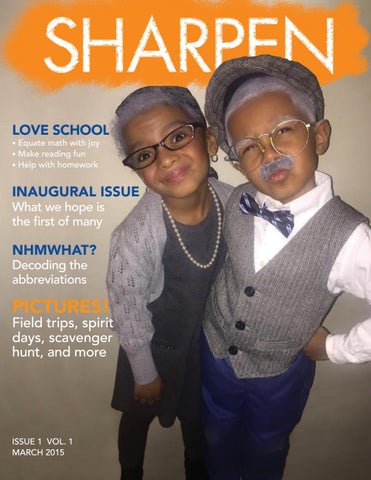
Love sChooL • Equate math with joy • Make reading fun • Help with homework
InAugurAL Issue
What we hope is the first of many
nhMWhAt?
Decoding the abbreviations
PICtures!
PHoTo CReDiT
Field trips, spirit days, scavenger hunt, and more
ISSUE 1 VOL. 1 MARCH 2015
In this issue 100th day of school, Career Day, field trips, and holiday pictures
How this came to be Page 3
Page 20
Love sChooL • Equate math with joy • Make reading fun • Help with homework
InAugurAL Issue
What we hope is the first of many
nhMWhAt?
Math strategies Page 6
Decoding the abbreviations
Reading tips
PICtures!
Check out our glossary Page 30
Field trips, spirit days, scavenger hunt, and more
PHoTo CReDiT
Page 8
“We are not makers of history. We are made by history.”
ISSUE 1 VOL. 1 MARCH 2015
—Martin Luther King Jr. The Walker Centarians, Karen Mira-Padilla
3 Fit to B’Hurst Explanation of why this thing exists. 4 All the Talk Ideas for summer, uniform company change, remembering blocks time, DonorsChoose. org, Erin Merryn’s Law, and more. 6 Equating Math with Joy A story about math and why we should all learn to embrace it.
8 How to Love Reading Covering Ms. Vansickle’s guide to falling in love with reading, what happens during some of the time spent reading in school, book shopping, and more. 12 Project Based Learning Lots of pictures from the bread unit: kneading dough, visiting bakeries, eating pizza, and hosting museum tours. 16 Sharing Our Diversity Bringing Lunar New Year into the classroom
2 Sharpen | March 2015
18 Black History Month Scavenger Hunt What it looked like for the kids to go hunting down facts.
26 More #TBT Pajama Day, Thanksgiving, Halloween, and B’Hursting with Books reading event
20 100th Day of School Little 100-year-old scholars
28 What’s Happening in Art and Science? Updates and useful terms
21 Career Day Picturing future employment 22 New York Hall of Science Pictures from a trip long ago that you might not have seen before 24 Trips to Schmitt Farm and the Big Apple Circus A serious throwback
30 More Around Town Applying to Pre-K and free literacy programs 32 Glossary Definitions for all those terms you might not understand
Mr. McSorley and Principal Dant greet scholars on Halloween
What To Know Now 18 March Tooth Fairy visist SABH
fit to b’hurst This probably all started for me about 13 years ago. Not the first time I produced a publication, but the first time I heard a teacher screaming at her students that they were not going to fourth grade. I was in the hallway, drawing murals on the classroom doors because some happy paint was going to cover up the fact this teacher thought her kids were all idiots and life was unbelievably unfair under Bloomberg’s new rules. I swore then I would never raise my unborn children in this city. So, of course, I meet a guy, he already has a daughter, and there go my plans to never raise children here.
30 March Spring Break starts
My goal here is to help parents (and step-parents and extended family) understand what is working and give a voice to ideas for how it could be better. I’d like all the adults to feel as attached and committed to this school as I believe most of the scholars are.
6 April School re-opens
After 10 years of public school in this neighborhood, two terrible experiences with the Pre-K and Kindergarten lotteries, and a year of searching for other options while going broke with Catholic schools, I am thrilled my Kindergartener was pulled from the SA wait list. But I get that not everyone is a fan.
Yuri nazarov, madeline vega
27 March Crazy Hair or Hat Day Last day for yearbook orders
2 April City school survey deadline
We’d love for everyone to share. Send pictures, thoughts and stories to contribute_sabh@yahoo.com.
—Madeline Vega
The entire contents of Sharpen are protected by copyright and may not be reproduced without expressed written consent of the publisher. Sharpen accepts no responsibility for unsolicited manuscripts and/or photographs and assumes no liability for products or services advertised herein. Sharpen reserves the right to edit, rewrite, refuse or reuse material, is not responsible for errors or omissions and may feature same in other mediums for any and all purporses. Comments and inquiries can be directed to contribute_sabh@yahoo.com.
March 2015 | Sharpen 3
All the talk Places to check out Some of the camps local families are talking about:
Brooklyn Gymnastics and Dance brooklyngymdance.com 3048 Brighton 1st St., 11235 Spring and summer camps Big Apple Games A free full-day program from PSAL.org starts 7/7
what to do over break Spring Break and summer vacation might be short, but the amount of planning that goes into finding the right camp is long. If the rather creepy karate instructor is making the rounds in this neighborhood with his flyers, then the clock really must be ticking to find a place to send the kids this summer. Comparing the costs and class structures is overwhelming. Does your child want to cook or swim? Is computer time necessary? The staff will re-apply sunscreen? It’s a lot to ask. Check out Bensonhurst Parents and Schools on Facebook for more recommendations.
Mill Basin Day Camp Call 718.251.6200 to learn about bus service to extended-day camp. Little Gym 8681 18th Ave., 11214 The summer camp days are short but fun. Stillwell Avenue Prep stillwellprepschool.com Recommended for its long day and weekly trips, plus meals included.
“Even when she naps, her hands are locked.” — Melanie Bourne
from Facebook
The same, but not At one of the informational meetings last Spring, the woman from admissions emphasized how Success Academy dedicates weeks to teaching scholars how to go to school. She made it sound so novel, I was surprised to see the regular public school kindergarteners holding hands and stopping at doorways. The difference? SA-BH hallways have tape lines and colorful paint, and every scholar shakes hands with the teacher before re-entering classroom. One was obviously a happier place.
4 Sharpen | March 2015
offset.com (gymnast), melanie bourne (car seat), madeline vega (hallway)
Offset.com photography, not a Brooklyn camp
Marks JCH 7802 Bay Parkway, 11214 Applications for this summer are available now.
donors choose While Success Academy scholars have access to school supplies and food throughout the day, the same opportunity is not available to so many kids across this country. UGA in the Blocks Room, using real life structures for inspiration.
How was school today?
An easy way to help and give back is to visit donorschoose.org where you can browse a variety of projects and causes.
Am I the only parent who forgets her child has blocks (and chess)? I remember being really excited about blocks once the concept was better explained at an informational meeting, but I never ask. I probably only remember to ask about science or art because flyers come home with updates. And even then the answers are minimal. My son can talk for hours about Skylanders but has very little to say about school—unless it’s who has which characters from Skylanders.
SA-BH shares pictures and video from the Blocks Room on the Community page (UGA built New York City), and the main Success Academy Facebook page shares gravity-defying structures built by scholars at other locations. It’s worth a peek if you can’t remember why you should ask about blocks. —M. Vega
Erin merryn’s law
leah robertson
As of October 2014, 19 states have passed Erin’s Law, which requires public schools to teach elementary and middle school children to speak up if they are abused. New York is not one of those states. Three times the bill has passed the State Senate only to die at the Assembly for Education Committee. In New York, the Board of Regents determine learning standards and the school districts determine curriculum in conjunction with their teachers. Perhaps it’s time the Board of Regents heard how important this change would be.
uniform change Success Academy will switch uniform vendors for the 2015-2016 school year. If you are in need of replacement items this school year, you will have to wait until after March 30. No uniform items will be available between March 13 and March 30. Starting March 30, JWE items will be available through FlynnO’Hara. If you don’t want more JWE items, wait until June to place your order.
“If I had a therapy dog, it would take care of me when I’m sick. You’d still have to bring me soup.” — Kal from Brandeis March 2015 | Sharpen 5
equating math with joy If you are someone who enjoyed the concrete rules and answers of math, you might be horrified by “new math.” Now there are many ways to the right answer. How are you supposed to help your scholar answer the Number Story correctly if there’s not one answer?
Even the hardest puzzles have a solution.
First, homework at this age is meant to reinforce school work—which is teaching them to think. If your child completes a Try It Again and it’s still wrong, it helps the teachers figure out what your child needs.
Second, eveyone likes to see a smiley face or sticker, but at this age the idea that it’s okay to fail also needs to be reinforced. Gifted children tend to be more resistant to trying new skills later because they are so afraid to not do well on the first attempt. So how can we help with math when it feels like there is no right answer? Emphasize the thinking. “When are we eating?” is a math problem, but that’s also torture. It’s more fun to take a question like “How much does Earth weigh?” and ask “How would we figure that out?” Google is great, but so is demonstrating how to think through a problem. Are Math Facts and Number Stories opposites? Number Story answers are easier to find after a scholar has mastered Math Facts. If you already know that
more help for at home With so many education tools for sale, it’s easy to forget there are lot of free options we can try first
6 Sharpen | March 2015
Make sure your scholar is set up to do work at home free from distractions. No one wants to be alone to work, but sometimes that’s why work gets done faster.
Create a set of flashcards small enough for your scholar to pull out anytime she has free time. Have her help by writing math facts in lots of different colors.
when you dread the 100 chart
Set a timer
3 and 7 make 10, you don’t have to count the entire group by one’s or even count on. It’s easier for a scholar to double check the work. Math Facts support Number Stories. What is a ten stick? Like an abacus, ten sticks help scholars translate problems into something concrete. It helps to count the blocks in her hand instead of what she drew to be sure she came up with the right solution. It’s also easier for you to demonstrate how to combine numbers (which will help with advanced techniques that score more points on tests).Teachers have extra sets ready for children to bring home. Are flashcards necessary? Yes, but you have to make them work for your
Make a homemade puzzle by writing just one number on each index card. Write plus, minus, and equal signs on more cards. Mix up the cards to create number sentences.
scholar and your family. Using them as the basis for games or to cure boredom a few minutes at a time can help make flashcards seem less awful. See “More Help for at Home.” How can we improve our test scores? Seriously time the No Hesitation (NHM) practice pages. If you’re not sure if a page is NHM, go ahead and time it. For Number Stories, make sure your scholar is clearly demonstrating how he came up with the answer, how he counted. The unit should be written next to the final answer. Be sure to ask the teacher to clarify what the score meant so you know exactly what to work on.
Go on a hunt around the house (or while you’re out shopping) for 2D and 3D shapes. What’s the smallest rectangle you can find? What’s the biggest oval? Do you see any patterns?
5
15 14 13 12
10
Fill it out vertically or diagonally Use a treat at the end of each row Only fill out two rows each day Use colored pencils if flashcards are too boring
Messy handwriting can throw off a correct answer. Scholars should count blocks to check answers.
Spend some time on starfall.com (look in the block on the right for math games) or PBSkids.org/games/math for free activities.
Only look at them for one minute at a time Your scholar takes a step for each right answer. Now it’s a race. March 2015 | Sharpen 7
how to love reading
There is no such thing as a child who hates to read; there are only children who have not found the right book. —Frank Serafini 8 Sharpen | March 2015
Do I have to read? Children learn to read fluently by hearing someone else read fluently. They learn to love books by listening to the adults they love sound like they love books. What should I read? It’s much easier to read to an infant than a child who has interests and opinions. For the most part, infants will listen to any article in Sports Illustrated or the entire
length of Crime and Punishment without complaint. But children who are ready to read on their own want to hear imaginative tales read by someone who sounds invested in the characters. What if my scholar doesn’t want to sit and listen? There are times when you will read and you will be the only one listening. If you are trying to model that reading is important but also fun, keep reading. Make sure you are entertaining yourself, and you will probably be entertaining your scholar. (Anyone who has tried audio books can tell you that even professional readers can ruin the experience of listening.) Are you reading in a comfortable place with few distractions? Carve out a space that feels special and cozy. It only has to be big enough for you, your scholar, and some books. Pause to ask questions to remind your scholar that he isn’t listening, but don’t let scolding derail what could be a good time. What kinds of questions am I supposed to ask? A good story has at least one problem that needs to be solved. Sometimes the problem is obvious and the entire book is about solving the problem, such as planting a garden or getting prepared for school. You
jane mount/idealbookshelf.com
The real magic of any book is its ability to transport the reader some place else. You are no longer in that classroom or on the subway or waiting for an appointment—you are taming wild animals or meeting royalty or driving a mega machine. Books can take you anywhere as long as you are willing to give them your attention.
can ask questions about how well the characters are working together or if your scholar thinks these are good solutions. “What would you do?” “Is she being nice?” “What do you think will happen next?”
Sometimes the problem unfolds after a misunderstanding. Ask questions to see if you scholar can tell where things are starting to go wrong and what might become a problem.
Other times, there doesn’t seem to be a problem at all, like most of the non-fiction books in your scholar’s book baggie. Look at the pictures and create problems. “Could a cactus live there?” “Would you sit on an egg for that long?” “Is that his lunchbox? Does he have to eat lunch in the cab?”
Reading becomes more fun when the questions help readers become more engaged in a story. Teaching young readers to put themselves into the book can help them remember what happened because they are learning to feel like they were actually in the story.
Favorite authors
Looking for inspiration on what to read with your child?
Hans Christian Anderson Dr. Seuss Eric Carle Kevin Henkes Grace Lin Christopher Paul Curtis Philip Pullman J.K. Rowling
madeline vega
not to be negative, but don’t say that On the PBS site for parents (pbs.org/parents), there are dozens of articles and hundreds of tips for how to help your scholar at home. There is even a list of “What Not to Say to Emerging Readers.” It sounds horrific, but it helps paint the picture of why the scholars in pictures from school might look so
happy to be reading in class but are reluctant to read at home. Emerging readers need to feel comfortable in order to be confident. Building a fort to hide in or reading to a stuffed animal instead of real people are part of creating a safe, non-judgmental space.
March 2015 | Sharpen 9
Ms. Raser asked the scholars in her reading group to transport themselves to a magical library. They all closed their eyes and took themselves to a beach in Hawaii in order to help Ms. Raser model good reading habits for the group of scholars on the rug.
reading (cont.) Is there something besides flashcards? There are plenty of games to play with printed flashcards and animated options available online, but the first way to avoid using flashcards so often is to read all the time. Point to all the words in a book as you read. It might sound too baby-ish for you to point, but it reinforces your scholar’s connection with the sight words. (And it models good habits.) Point out words on signs and packages. Demonstrate where words are all the time and what they mean.
—Mason Cooley
The Winter bulletin board reminds us “There’s snow better time for family reading.”
10 Sharpen | March 2015
If you ever watched the Sprout channel around 2010, you probably saw the guilt-inducing commercials for Your Baby Can Read, showing toddlers reading words off flashcards. Your Baby Can Read was a series of DVDs that used a variety of clips and voices to teach viewers a series of phrases. The Federal Trade Commission stepped in to stop the company from making false claims, such as “your baby can read.” But that’s how reading works—recognizing the letters and what they represent. The DVDs were so appealing because learning to read should be fun and stress-free.
madeline vega
Reading gives us a place to go when we have to stay where we are.
Scholars practice sight words with Ms. Raser on the rug. Mr. Graves’ group practices by taking turns as Mr. Graves makes his way down the line, racing to get through a certain number of cards. In yet another room, a scholar is asked to read aloud for the group.
practicing intonation with picture books
Getting the hang of emphasizing the question marks, bold words, and differentiating character voices doesn’t have to be serious
One of the first books Kal brought home was Owen & Mzee: The True Story of a Remarkable Friendship. We read it a bunch of times and marveled at the strange combination of a baby hippo and a very old tortoise becoming inseparable. Then Kal started to read books on his own, and we
didn’t really mention Owen or Mzee again. Months later, I went to the library to pull new books. I found Mama which only has two words in it: “Mama” and “Baby.” It seemed perfect for practicing reading with meaning. The way the baby hippo says “mama” is going to
be different when he’s happy, when he’s eating, when a tsunami rolls in, when he can’t find his mom, when strange men take him some place new, when he meets the tortoise, when the tortoise finally accepts him... It became a game. Now he’s more willing to be a dramatic reader with more books. —M.Vega
book shopping Sometimes it’s hard to get excited about reading with your scholar when you know you’re about to listen to another Roots book for the thousandth time or they’ve simply brought the same nonfiction book home again. While scholars are directed to choose books from certain levels when shopping in the classroom, it’s important to find books that capture their imagination at home. Local library locations might lack recognizable characters, but keep pulling books off different shelves to make it feel like a game. There’s a winner in there somewhere! And if that fails, spend time reading in a store. Not as comfortable, but still fun.
March 2015 | Sharpen 11
project based learning
The finished breads made by Kindergarteners. On the far right are gluten-free loaves. Kindergarteners mixed and kneaded bread dough at school. The lunch staff judged the finished products.
12 Sharpen | March 2015
principal dant
Kindergarteners and First Graders used bread to learn how things grow, change, and reproduce. They talked about where bread comes from and learned how yeast works. At home, at school, and on field trips, they baked breads and pizzas. They counted, described, and enjoyed bread.
ivonne cruz (doorway), principal dant (top right), angela fundo sovanji (Tastebuds top and bottom right), kourkoze khadija (bottom left), edwin rivera
Carnegie Mellon visits the Kings Highway Bakery to learn how Italian bread is made. The ingredients become dough that is rolled into long loaves that go into the box to rise. After 20 minutes, the now larger loaves go into the oven to grow more and bake.
Kindergarteners visit Tastebuds kitchen to make their own pizza dough, which they turned into what might be the best field trip lunch option yet.
March 2015 | Sharpen 13
bread museums
Scholars, teachers, and volunteers helped to decorate the museums with signs, maps, sculptures, and mostly the work scholars created throughout the PBL.
14 Sharpen | March 2015
Lela Nokhratyan (top right), leah robertson (middle left), principal dant (middle right), Madeline Vega (bottom)
At the end of the PBL, scholars presented what they learned by transforming each classroom into a bread museum. Each scholar took on a role at the museum, like Map Exert or Mold Expert. They greeted visitors, guiding them through the written observations and works of art. One class demonstrated how to grind wheat into flour in their farm-to-table section. Every class had a selection of bread to taste, a preview of what could be made using the recipe book of their collected how-to stories.
principal dant (top left, top center, middle), Kourkoze Khadija (top right), Almira Monastyrskiy (bottom right), svetlana fisher (bottom left)
Each museum displayed work completed in math, science, art, and writing workshops that helped give scholars a better understanding of how many kinds of breads there are and where they come from.
Scholars and their families taste some of the varities of bread their classmates brought to share.
March 2015 | Sharpen 15
The first Lunar New Year at SA-BH didn’t have to be a decision for some families about whether to celebrate or skip school as they brought the celebration into the classroom. Photographed by Polina Bulman
sharing our diversity Each class read Bringing in the New Year by Grace Lin, the tale of a Chinese American family preparing for the Lunar New Year. They sweep out the dust of the old year, hang decorations, and make dumplings. There is a great, long dragon parade at the end!
Volunteers assembled goodie bags, found music to listen to during craft time, and helped the children turn lucky envelopes into lanterns. The lanterns represent the light of hope for the new year.
16 Sharpen | March 2015
polinabulman.com
This year, Lunar New Year fell on Thursday. Parents planned activities and snacks to bring into the classrooms to help all the students understand the significance of the holiday. Students were invited to wear red, which symbolizes good fortune and joy.
marina vasilyeva (field study), principal dant (“possible� sign)
Some of the hard work, treat bags, and traditional attire. Each scholar received a mandarin orange, which represents wealth.
exploring the neighborhood In February, First Graders took a walk around the school neighborhood to go out and see who works in the community. They visited Rite Aid, and talked to the pharmacist and cashier. Then they walked to the flower shop to talk to the florist.
March 2015 | Sharpen 17
Photographed by Polina Bulman
historical scavenger hunt To honor Black History Month, volunteers helped devise a scavenger hunt, leading scholars on a search for facts about people who made a difference in American history and culture. Scholars picked up coloring pages with figures such as Jackie Robinson and Rosa Parks for answering questions correctly.
Some of the names were new to scholars while others, like the artist Faith Ringgold, they had already learned about in class. When Kindergarteners studied pattern making in art, Ms. Rodriguez discussed Faith Ringgold’s contributions to the Civil Rights and Women’s Rights movements.
polinabulman.com
Scholars on the move, hoping to make it to all the stations.
18 Sharpen | March 2015
Scholars look for information on posters and signs to help them fill in their charts—a grid with historical names and causes.
Principal dant (bulletin board)
little people, big changes
Brandeis won Silver in the network-wide competition with this Civil Rightsthemed reading bulletin board, “Never too young to change the world.” While it included the thoughtful goal from one Brandeis scholar to educate everyone about cultural differences, it also showcased Ruby Bridges, a 1st grader in 1960 whose only goal was to attend school. As a pioneer in integration, she had to be escorted to school by U.S. Marshals for months to protect her from vicious mobs. It’s hard to look around the classrooms at SA-BH and imagine integration was ever an unwelcome idea.
March 2015 | Sharpen 19
Aging Kindergarteners and First Graders to look 100 years old was serious business for some families that really got into the spirit with hair color, wigs, mature clothing, and canes. This crew had a lot of spirit for the 100th day of school.
20 Sharpen | March 2015
Monica, Nayda Rey, Almira Monastyrskiy, Natasha Delbe, Yuri Nazarov, leah robertson, stephanie jagroop
Scholars dressed like centenarians to celebrate 100 days
Angela Fundo Sovjan, Silvana Neyjovich Seidenberg, Karen Mira-Padilla, Tamika Ramos-Moscol, Lianibacoa Koki
100th day of school
career day
leah robertson, principal dant
It was time to try on a new hat for some teachers
Zoo keeper, super hero scientist, and hair stylist hopefuls were in class with these future police officers, doctors, teachers, and chefs. There were even firefighters, artists, pilots, football players, construction workers, and captains present.
March 2015 | Sharpen 21
new york hall of science The museum boasts that a visit here is a hands-on, energetic educational experience where you can indulge your curiosity and nurture your creativity. The SA-BH scholars proved that statement is true.
Scholars learn about illusions with slanting floors and convex mirrors.
22 Sharpen | March 2015
Jennifer mauro (top left, bottom right), maria natanzon (top center), Elegance noir (top right), karen mira-padilla (bottom left)
Scholars test out technology and energy concepts.
melanie bourne (top left), jennifer mauro (top right), lana dziouba (bottom left),
karen mira-padilla (bottom center and right), bridget deleon (right center)
Scholars explore giant bubbles, a wall that freezes their shadows, and microscopic cultures.
March 2015 | Sharpen 23
Scholars were immersed in an authentic farm environment to learn about pumpkins and vegetables. They heard about the steps in planting and caring for produce, visited a pen with sheep, and were able to pick their own pumpkins. There was even time to play on the farm’s wooden playsets.
Scholars brought home a pumpkin and radishes that they picked on the farm.
24 Sharpen | March 2015
Scholars arrive (left) and meet one of the farm team members (center). Ms. Raser and her scholars take the tractor-drawn wagon (right).
nataliya voloshyn (top right, bottom right), tamika ramos-moscol (bottom left), polina bulman (middle right), lisa ryan (top right, center) jacqueline doran (top center)
F&W Schmitt’s family farm
big apple circus
stephanie jagroop, jor tan (children in audience)
The goal of the Big Apple Circus is to invigorate communities with the joy and wonder of a classical circus with trapeze artists, contortionists, quickchange artists, and animal performers.
Some of the circus acts go back eight generations and have performed all over the world.
Scholars arrive at the Lincoln Center, take in the show, and fall asleep on the way back to school.
March 2015 | Sharpen 25
In December, scholars and teachers were cozy all day long.
thanksgiving SA-BH took the opportunity to emphasize its diversity by hosting a global Thanksgiving. Sushi and empanadas were served alongside the traditional sweet potatoes and dinner rolls. The savvier parents made it into other classrooms to try more food. The West Chester dish of Olivier, a Russian salad, was completely empty by the end of the party.
26 Sharpen | March 2015
leah robertson (Pajama Day), Albina Volkova (Thanksgiving left, center, and bottom middle two), lisa ryan (Thanksgiving top and middle right), lela Nokhratyan (bottom left)
pajama day
halloween
Yuri nazarov (top left, top center, wide shot of gym), stephanie jagroop (top right), Principal Dant (close shots of families reading)
Parents, scholars, and staff got into the spirit for the parade around the school on Halloween. The staff were Toy Story characters.
b’hursting with books night In October, families were invited to come up to the gym after dismissal to read and share ideas about reading. Families brought their own blankets and books, but SA-BH provided the popcorn (and space to run after enough books and popcorn had been consumed).
March 2015 | Sharpen 27
art Kindergarten and First Grade scholars study the work of specific artists to learn new techniques and create art work that ties in with the Project Based Learning units about bread and community. Ms. Rodriguez tells us more.
The self-portrait and stamping bulletin board from February.
Right now First Grade is focusing on community, and we are examining the artwork of Romare Bearden. Scholars have already started sketching buildings in their community which will lead towards the creation of mixed media artworks. Now that the weather is nicer, families can walk with their scholars through their neighborhoods to really look at the architecture of the different buildings.
Egg Carton Projects at Home Even though Ms. Rodriguez does not need more egg cartons, you can still put them to good use at home. 1. Plant a seed! Use egg cartons as mini pots. 2. Make a faux flower for Spring. Cut the egg cups off the carton, paint them, make a hole in the bottom, and attach a pompom and pipe cleaner as a stem. 3. Create some creatures! Egg cups are great modular sculpting materials. Arrange them to create caterpillars and insects or cut out pieces to make legs and heads for four-legged creatures. Assemble them with glue, embellish with paint or markers, and take a picture to send Ms. Rodriguez.
28 Sharpen | March 2015
Kindergarten artists are currently learning about color theory through paint exploration. We are looking at artists such as Jim Dine and Pablo Picasso to understand warm and cool colors. Artists also learned about primary and secondary colors by reading Mouse Paint by Ellen Stoll Walsh. Previously, the Kindergarteners studied the works of Faith Ringgold and Andy Warhol while learning techniques for creating patterns and stamping. If you have extra cardboard at home that you had hoped to send along to school (Ms. Rodriguez is no longer collecting!), you can turn it into your own stamping project at home. Bend and cut cardboard tubes into different shapes, dip the cardboard in tempera paint, and stamp to create patterns.
madeline vega, leah robertson, polina bulman
Ms. Rodriguez with her drying rack monitors (left). One of the dolls created by Kindergarteners (right).
My Roots scholars (First Grade) have been learning about Central Park, so it would be great if families could visit the park over Spring Break as well. The man who designed Central Park also designed Prospect Park, so that could be a good alternative if families can’t travel into Manhattan.
science Maybe you’ve heard your scholar using some new big words that you don’t remember coming up in any of their reading homework. It could be part of all they are learning with Mr. Carreker.
Principal dant (top left, right), polina bulman (bottom left)
Kindergarteners learned early programming skills with BeeBots.
First Graders dissect owl pellets in January.
SCientific Vocabulary mass • a measure of the amount of matter that makes up an object Spring bulletin board about dinosaurs.
The first time I visited the SA-BH science room, I was surprised to see taller tables and stools. It looks like a room where someone might actually use a beaker and Bunsen burner. While the long list of vocabulary for First Graders (phalanges, cranium, stabilize) might seem daunting, it’s also exciting that scholars have the opportunity to accurately describe their work. —M.V.
force • a push or pull upon an object resulting from the object’s interaction with another object
energy • the ability to do work robot • a machine that can do things on its own when you give it some directions
program • to input directions into a robot or other machine
navigate • to control the directions of travel March 2015 | Sharpen 29
more around town APPLYING TO PRE-K March 16 - April 24 If your child is turning four in 2015, you might already know the SA lottery for Pre-K seats does not include our —Yuri Nazarov school location. Options continue to change citywide, but here is what we understand now. Most (not all) private pre-schools as well as all district schools offering pre-K this year will be full day pre-K for this application. There are still some half-day free Pre-K programs, like the Tiny Tots Playhouse in Bay Ridge, that will continue to be half day, but those are a small minority. The best way to know for sure is to call the pre-school directly, but here is how to do this on http://schools.nyc.gov/ChoicesEnrollment/PreK/ Resources/default.htm There two Brooklyn directory links—click both of them. The first, “2015 Brooklyn Pre-K Directory,” is the main list of district schools and features. The second, “2015 Brooklyn Pre-K Directory Update,” does not list features. You need to check both lists to figure out what’s really available to you.
While the City is working to add Pre-K to every school, there are different styles of Pre-K because they are relying on outside companies for classrooms. Brooklyn Family Information Session to discuss all Pre-K options
March 17 6 - 7:30 p.m. Clara Barton High School 901 Classon Avenue
Free Pre-K in a district school perhaps your zoned elementary or another school nearby.
Free Pre-K at a daycares/pre-school (Community Based Early Childhood Centers) is a private pre-school, which gets public funding and provides free Pre-K. Free full-day Pre-K + additional paid hours (to have, say, 8 a.m. – 6 p.m. coverage). These additional hours are often called “wraparound” or “enrichment” and are a paid service, provided by the pre-school. Private Pre-K process is the same as it was last year, but you should contact the pre-school and confirm because some private paid pre-schools may have switched to city-funded free Pre-K this year.
For parents who are interested in free Pre-K, all free Pre-K enrollments must now be done centrally through the application on the schools.nyc.gov website. Parents rank the Pre-K’s they like in their order of preference. There is some shortage of available free Pre-K seats, so you should generally pick more than one location on your application, just in case. Mach 16 – April 24 is the enrollment period. http://schools.nyc.gov/ChoicesEnrollment/PreK/default.htm Many other pre-schools that are not yet on the list might be offering Pre-K in September, so call your favorite pre-school and ask. To find locations near you, check maps.nyc.gov/upk/ More discussions and updates can be found at www.facebook.com/groups/bensonhurstparentsandschools
Please share with us In an effort to better represent our school community and reach more families, we’d love to hear from everyone. Send your pictures, ideas, and observations to contribute_sabh@yahoo.com or, if you aren’t sure you have anything to contribute, send an email to survey_sabh@yahoo.com to receive random questions like “What is your scholar’s favorite song?” We hope to hear from you soon.
30 Sharpen | March 2015
If you enjoyed this issue and would like to see more, be sure to send your photos, ideas, and stories to contribute_sabh@ yahoo.com.
Visit maps.nyc.gov/upk to see locations and details. Click “Continue...” to explore the map. Locations are color coded and can filtered to show only the options that interest you.
Or if you would rather chime in on an informal poll (like “Is your scholar excited for the Frozen short?”), send an email with the word subscribe to survey_sabh@yahoo.com.
Ready, Set, Kindergarten! Brooklyn Public Library’s popular school-readiness program, Ready Set, Kindergarten! is back for Spring 2015! We are now in 30 Brooklyn branches! Parents, caregivers and children ages 3-5, please join up in exploring math, science and literacy through reading, writing, talking, playing and singing. Programs start the first weekend of March and run for six sessions. Check http://www.bklynlibrary.org/ for dates and locations. The Flatlands branch specifically offers the program to children with (and without) special needs.
Ready, Set, Kindergarten! is a series of six programs which include a free, fun, family storytime for children 3-5 years and their parents or caregivers. At each program we demonstrate playful literacy, math, and science activities parents can do with their children to get them ready for school. After each session, families will be able to take home books or other learning materials so they can continue to play, read, and learn all year long. As a weekend program, it is ideal for working parents with children currently in Pre-K.
March 2015 | Sharpen 31
glossary Magic 5 F&P IA
Eyes for watching Ears for listening Hands are locked Legs are crossed Mouth is always silent Fountas & Pinnell leveled books system; the standard used to decide a scholar’s reading level. Interim Assessment, a big test but never the end of the world
ELA
English Language Arts
PBL
Project Based Learning, a mutli-disciplinary way of learning about one subject
PCEC
The Success Academy version of a PTA
NHM
No Hesitation Math, testing math facts
Base 10
Being able to recognize a group rather than counting 1, 2, 3... It garners more points when showing work on number story problems.
Spelling Bee UPK
A scholar is given a word and must spell it aloud from memory Universal Pre-Kindergarten, available to children turning 4 in 2015, though not available at SABH because we are above the 2nd floor. (See Page 30)
Values
Definition
Examples of how family can model ACTION values
Agency
To take responsibility for one’s own actions
Addressing issues proactively and constructively
Curiosity
To always ask questions
Taking an active part in your scholar’s education by attending family events and monitoring homework
Try and Try
To always give your best
Ensuring that your scholar is following our school policies (e.g. in school every day for the whole day, on time)
Integrity
To be honest and trustworthy
Treating school staff and community members with resepct and honesty
Others
To be a nice and thoughtful member of one’s community
Participating in school events and field studies. Staying active in the Parent Council. Volunteering when you can
No Shortcuts
To never look for the easy way out
Doing everything that is necessary to help your scholar achieve success, no matter how difficult the task
32 Sharpen | March 2015