
Forklift Safety Halo Lights Vs Laser Lights:
Which Is Better For Your Facility?
Warehouse operations have evolved rapidly over the past decade. Facilities are moving faster, handling higher volumes, and operating across multiple shifts. With this growth comes a familiar challenge: forklift related incidents continue to pose serious safety risks, especially in high traffic environments. One of the biggest contributors to these incidents is limited visibility Operators often navigate tight aisles, while pedestrians move unpredictably through shared workspaces. Traditional warnings such as horns and mirrors help, but they depend heavily on human attention. This is why forkli
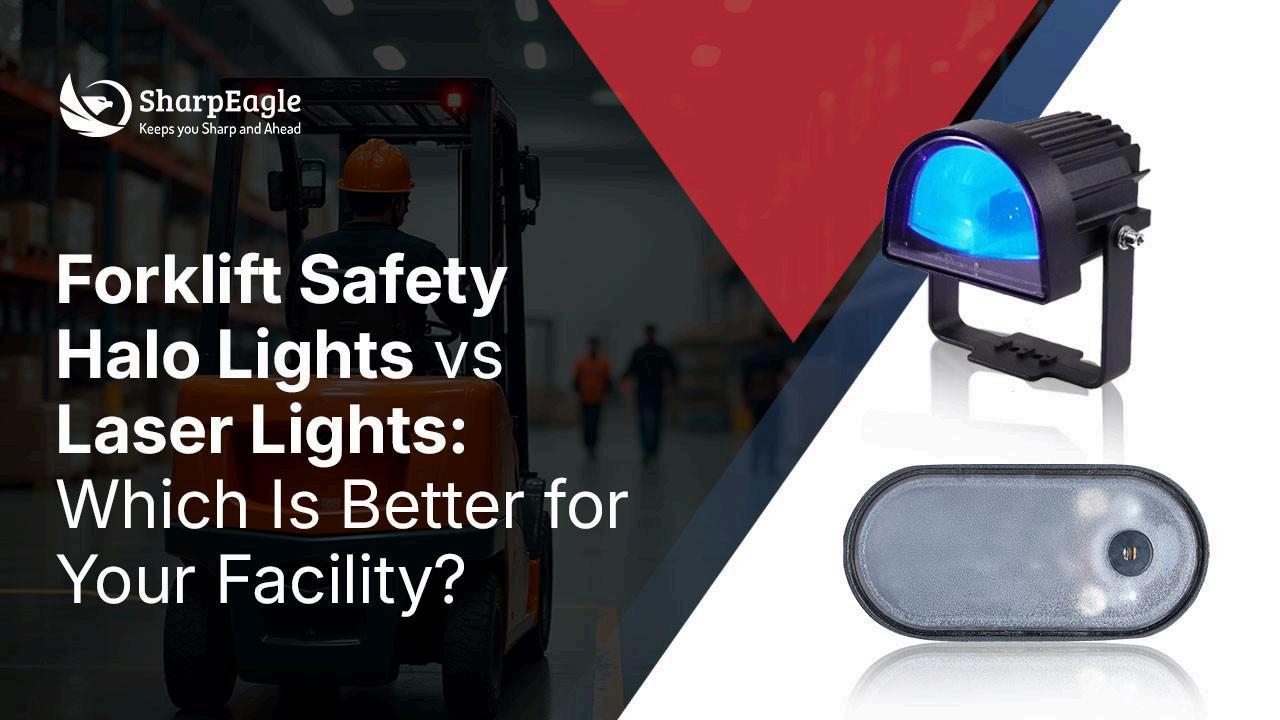
ft safety lights have become a core part of modern warehouse safety strategies. Among the most effective options today are forklift halo safety lights and forklift laser safety lights Both improve visibility, but they work in different ways.
The purpose of this guide is to provide a clear, practical halo vs laser forklift lights comparison so you can determine which solution best fits your facility’s safety and operational needs.
What Are Forklift Halo and Laser Lights?
Forklift halo and laser systems are both types of forklift visual warning lights, but their projection styles and safety functions differ significantly. Halo lights create a bright circular or oval light pattern around the forklift, forming a visible safety perimeter
This 360 degree glow helps pedestrians recognize the forklift’s operating zone from multiple angles. Laser lights, on the other hand, project sharp, well-defined lines or shapes on the floor. These patterns are designed to mark specific danger zones or travel paths with high precision.
The core components of both systems typically include
• High intensity LED or laser module
• Mounting bracket for forklift installation
• Electrical connection to vehicle power
• Protective industrial housing
While both fall under industrial forklift safety lighting, their applications and strengths vary depending on the environment.
Why Forklift Safety Lighting Is Essential
In busy facilities, prevention depends on early awareness. Visual lighting systems give workers an immediate understanding of where equipment is moving and where danger zones exist.
Forklift lighting solutions help organizations
• Prevent collisions in high traffic areas
• Improve pedestrian awareness without relying on sound
• Reduce blind-spot related incidents
• Support safety expectations in the UK, UAE, and KSA
A strong warehouse pedestrian safety lights strategy often combines multiple visual tools to create layered protection across the facility
How Halo and Laser Lights Work
Both lighting systems are mounted directly onto the forklift, typically at the rear, sides, or overhead guard. Once powered, they project visible warning patterns onto the floor surrounding the vehicle. Halo lights produce a continuous glowing ring that moves with the forklift. This creates a moving safety bubble that pedestrians can easily recognize. Laser projection forklift lights generate sharp lines or boxed zones on the floor These act like virtual boundaries, clearly marking areas workers should avoid.
Most systems operate continuously when the forklift is running, though some advanced setups can respond to motion or speed. In both cases, the goal is the same: provide early visual warning to reduce reaction time.
Key Features of Halo Lights
Forklift halo safety lights are popular because of their simplicity and wide visibility
They are especially useful in environments where forklifts move frequently around pedestrians.
Key characteristics include
• True 360 degree visibility around the forklift
• Bright LED illumination visible in most lighting conditions
• Rugged construction suitable for industrial environments
• Reliable performance in both day and night operations
• Simple installation and easy retrofit onto existing fleets
Halo lights are often chosen for facilities that want broad awareness without complex setup.
Key Features of Laser Lights
Forklift laser safety lights focus on precision rather than full perimeter glow They are designed to create clearly defined floor markings that guide pedestrian behavior.
Important features include
• Sharp floor projection patterns such as lines or rectangles
• Directional warnings for specific hazard zones
• Adjustable projection distance and focus
• Effective performance in warehouses, cold storage, and outdoor docks
• High precision with minimal visual spill
Because of their accuracy, laser systems are widely used where controlled pedestrian flow is required.
Benefits of Using Halo and Laser Lights
Both technologies deliver measurable safety improvements when implemented correctly The choice often depends on operational priorities rather than overall effectiveness.
Facilities typically experience
● Reduced forklift and pedestrian accidents
● Improved operator awareness in congested areas
● Stronger alignment with workplace safety expectations
● Minimal training requirements for staff
● Cost effective safety enhancement compared to incident costs
Well-planned forklift LED safety lights installations often pay for themselves through reduced damage and downtime.
Applications of Halo and Laser Lights
Different environments benefit from different lighting approaches. Understanding your operational layout is key to selecting the right system.
Common applications include
• Warehouses and distribution centers
• Manufacturing and assembly lines
• Cold storage facilities with low visibility
• Loading docks and high traffic intersections
• Automotive and heavy industry plants
In many facilities, forklift blind spot lights are deployed in combination for maximum coverage.
Halo Lights vs Laser Lights: Direct Comparison
When evaluating halo vs laser solutions, the differences become clearer in real operational contexts.
Coverage area
Halo lights provide wide 360 degree visibility Laser lights focus on targeted zones.
Pedestrian visibility and response
Halo lights offer general awareness. Laser lights provide precise boundary warnings.
Installation and maintenance
Halo systems are usually simpler to install. Laser systems may require more careful alignment.
Cost and ROI
Halo lights are typically more budget friendly upfront. Laser systems may deliver higher precision benefits in complex layouts.
Environmental performance
Halo lights perform well in general warehouse lighting. Laser lights excel in controlled environments where sharp projections remain visible.
Best use scenarios
Halo lights suit busy mixed traffic zones. Laser lights are ideal for controlled pedestrian pathways and high precision safety areas.
How to Choose the Right Forklift Safety Light
Selecting between halo and laser systems should be based on real operational needs, not trends.
Key decision factors include
• Warehouse size and traffic density
• Level of pedestrian exposure
• Forklift types and fleet composition
• Indoor versus outdoor operations
• Compatibility with existing safety systems
Many facilities benefit from combining both technologies to create a stronger industrial forklift safety lighting strategy.