REPORT 2025
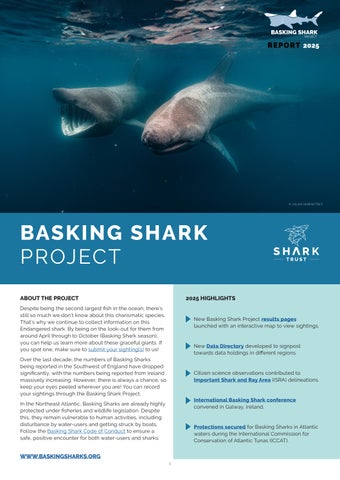
© JULIAN HEBENSTREIT
BASKING SHARK PROJECT ABOUT THE PROJECT
2025 HIGHLIGHTS
Despite being the second largest fish in the ocean, there’s still so much we don’t know about this charismatic species. That’s why we continue to collect information on this Endangered shark. By being on the look-out for them from around April through to October (Basking Shark season), you can help us learn more about these graceful giants. If you spot one, make sure to submit your sighting(s) to us!
New Basking Shark Project results pages launched with an interactive map to view sightings.
New Data Directory developed to signpost towards data holdings in different regions.
Over the last decade, the numbers of Basking Sharks being reported in the Southwest of England have dropped significantly, with the numbers being reported from Ireland massively increasing. However, there is always a chance, so keep your eyes peeled wherever you are! You can record your sightings through the Basking Shark Project.
Citizen science observations contributed to Important Shark and Ray Area (ISRA) delineations.
International Basking Shark conference convened in Galway, Ireland.
In the Northeast Atlantic, Basking Sharks are already highly protected under fisheries and wildlife legislation. Despite this, they remain vulnerable to human activities, including disturbance by water-users and getting struck by boats. Follow the Basking Shark Code of Conduct to ensure a safe, positive encounter for both water-users and sharks.
Protections secured for Basking Sharks in Atlantic waters during the International Commission for Conservation of Atlantic Tunas (ICCAT).
WWW.BASKINGSHARKS.ORG 1
BASKING SHARK SIGHTINGS COLLECTING VITAL DATA
This year saw our first report from South Africa - along with this fantastic drone shot!
SIGHTINGS 2025 In 2025, 25 reports, accounting for 71 individual sharks, were submitted to the Shark Trust from around the world. Of these, 63 of the sharks were from UK and Ireland. The other eight sharks were reported from Canada, the USA, Iceland, Portugal and South Africa! Since about 2014 the numbers of sharks reported to this project have been pretty low, compared to receiving reports of over 2,000 sharks in 2013. However, this doesn’t mean that the Basking Sharks are in trouble - just that they’ve moved! While our dataset may look a little sparse, the Irish Basking Shark Group recieved records totalling over 3,000 sharks in 2024 and over 1,000 in 2025!
© JEAN TRESFON
Please do continue to report any Basking Sharks that you see!
If you spot a Basking Shark please report your sighting to us, with as much information as possible. If you have a photo please submit this too so we can verify your record.
25
71
REPORTS
SHARKS
160 121
THANK YOU for supporting our Basking Shark Project. RECORD your sighting and find out more about the project at baskingsharks. org or submit your sighting using our SHARK TRUST CITIZEN SCIENCE APP.
BASKING SHARK HOTSPOTS PLUS NUMBER OF BASKING SHARKS REPORTED
52
HEBRIDES AND WESTERN SCOTLAND
1
50
+7 reported elsewhere around the UK & Ireland
2021
+8 reported from the rest of the world
282 2023
2022
2024 2025
Thanks to everyone who has submitted their sightings.
IRELAND
Scan the QR code to see the brand new, interactive, BASKING SHARK RESULTS DASHBOARD.
71
69
3
SOUTHWEST ENGLAND
2
We look forward to seeing, and hearing, about your shark encounters in 2026!
BASKING SHARK DATA DIRECTORY COOPERATION AND COORDINATION OF DATA
Citizen science is a fantastic tool for long term and wide-reaching data collection. However, multiple regional projects collect Basking Shark data and it can be complicated to understand who holds Basking Shark data and what type of data this represents. If these different datasets are used in isolation, changes in sightings from one dataset could be misinterpreted as a biological trend, rather than a result of social trends and project engagement. Following the Basking Shark Forum (hosted by the Shark Trust in February 2024), and the enthusiasm that was shared for better connectivity of data, the Shark Trust has developed a Basking Shark Data Directory.
The number of records and Basking Shark sightings (split by region and year) reported to the Shark Trust’s Basking Shark Project. This also includes data from the Marine Conservation Society’s Basking Shark Watch and the Manx Whale and Dolphin Watch,
This directory signposts towards projects and organisations that hold Basking Shark data, including the type of data (e.g. sightings, tracking or photo-ID) and the data owners. This directory will present a more informed image to researchers, policy makers, and any other interested parties.
We hope that this directory will be used by a broad range of individuals and organisations, including researchers, governments, environmental consultants, and students. So far, this directory holds summary information on eleven Basking Shark datasets, representing projects working across the North Atlantic, the Mediterranean and the North Pacific. A huge thank you to all the organisations that have contributed to the directory! See baskingsharks.org for more information!
3
OTHER BASKING SHARK NEWS BASKING SHARK CONFERENCE GALWAY, IRELAND
During the conference, presentations covered the latest advances in research and technology, and showcased what conservation measures have been achieved since the closure of Basking Shark fisheries in the mid-1990s. This conference offered a fantastic opportunity to reconnect with colleagues from other regions and focus attention on the awe-inspiring Basking Shark!
International Commission for Conservation of Atlantic Tunas (ICCAT) An Atlantic wide Prohibition for Basking Shark retention was adopted through the International Commission for the Conservation of Atlantic Tunas (ICCAT) in late 2025. Strengthening the prohibition are additional requirements for the development of safe handling protocols and other mitigation measures to reduce capture of this Endangered species.
© SWIMMING HEAD PRODUCTIONS
In late August, we attended the International Conference on Basking Sharks, organised by the Irish Basking Shark Group. Here we hosted a workshop on data management, to help foster engagement with the new online Basking Shark Data Directory.
Read the full blog here here..
IMPORTANT SHARK AND RAY AREAS (ISRAS) In May 2025, the Important Shark and Ray Areas (ISRA) initiative set out to identify key areas for sharks and rays in the European Atlantic. The identification of these areas provides governments, fisheries managers, and conservation groups with evidence-based information to help guide protection efforts. Thanks to the hard work of all our dedicated citizen scientists, the Shark Trust was able to contribute data from around the UK and Ireland to this process. Read the full blog here and view the eAtlas for all ISRA delineations here. 4
BASKING SHARK ISRAS DELINEATED USING SHARK TRUST DATA
INFORMATION & CONTACTS
Thinking of going on a boat tour to see Basking Sharks? We recommend seeking out a WiSe accredited tour operator. The Wildlife Safe (WiSe) scheme provides training and accreditation for tour operators. Advising them on how to best view and interact with large marine wildlife, while minimising disturbance. To find a WiSe accredited tour operator visit www.wisescheme.org.
BASKING SHARKS IN DISTRESS If you witness disturbance or harassment of a Basking Shark, please report it to the National Wildlife Crime Unit immediately. For more information visit the UK National Wildlife Crime Unit website www.nwcu.police.uk
CODE OF CONDUCT ENJOY WATCHING BASKING SHARKS SAFELY Basking Sharks are very sensitive to disturbance and harassment by people. In all the excitement of seeing Basking Sharks, it can be tempting to get a closer look. But, tour operator boats, small motor boats, jet-skis and even unmotorised crafts such as kayaks or SUPs could end up striking them if they get too close. As well as causing physical harm, water-users can also disrupt their natural behaviour - such as feeding, courting and mating. Follow the Code of Conduct so you can enjoy watching Basking Sharks safely and ensure a positive, safe experience for both you and the shark. Despite often being called ‘gentle giants’, Basking Sharks can be the size and weight of a bus, have strong powerful tails, and can breach out of the water with little to no warning. They warrant respect. It’s illegal to intentionally disturb or harass Basking Sharks in UK and Irish waters. Anyone doing so could face up to six months in prison and a large fine.
Scan the QR code to see the BASKING SHARK CODE OF CONDUCT video.
BASKING SHARK
CODE OF CONDUCT Guidelines to help water-users reduce the risk of injuring or harassing Basking Sharks. DID YOU KNOW?
GENERAL ADVICE
REMEMBER!
Do not approach within 100m. If you encounter Basking Sharks be aware:
For every shark visible on the surface there are likely to be more hidden below.
STRANDED SHARKS If you find a live stranded shark contact: England or Wales - the British Divers Marine Life Rescue: 01825 765546 (Monday to Friday 9-5pm) or 07787433412 Scotland - the Scottish Society for the Prevention of Cruelty to Animals (SSPCA): 03000 999 999
Although mostly placid, Basking Sharks can startle if disturbed, often thrashing their tail with enormous power.
Be extremely cautious in areas where Basking Sharks have been seen breaching.
●Avoid pairs or large numbers of sharks following each other closely. This may be courting behaviour and they should not be disturbed. Maintain a distance of at least 500m.
SWIMMERS, DIVERS & SURFERS:
Basking Sharks are legally protected in the UK. It’s illegal to intentionally kill, injure, recklessly disturb or harass Basking Sharks in British waters. Any person committing such an offence could face up to 6 months in prison and a large fine.
Observe which direction they’re swimming. Then quietly position yourself alongside their anticipated course for a safe and enjoyable view. Wait for them to come to you.
KAYAKS & SUP’S: 4m Maintain a distance of at least 4m and be wary of the tail Do not touch the sharks Do not swim towards them if they are near you Ideally, swimmers should remain on the surface – stay in a group, rather than spreading out around the sharks No more than 4 people in the water within 100m of a shark at any time
Never paddle directly towards the sharks or allow several kayaks to surround them – this could make them dive or act unpredictably Remain calm and quiet – avoid sudden movements which will disturb the sharks Stay in a group, rather than spreading out around the sharks
BOAT USERS:
For dead stranded sharks contact the Cetacean Stranding’s Investigation Programme (CSIP): 0800 6520333.
6
knots
Never chase a shark or direct a vessel towards them – this could make them dive or act unpredictably When sharks are sighted, restrict speed to below 6 knots and/or operate under sail
Try not to cross their path so the sharks can maintain their course without changing direction or speed Never use your paddle or kayak to touch a shark
When closer than 100m, switch the engine to neutral to avoid injuring sharks Avoid sudden changes in speed Do not allow several vessels to surround the shark(s) Jet-skis should not approach Basking Sharks Record your sighting
baskingsharks.org | sharktrust.org
5
© CHARLES HOOD
BOAT TOURS