BASKING SHARK PROJECT
ABOUT THE PROJECT
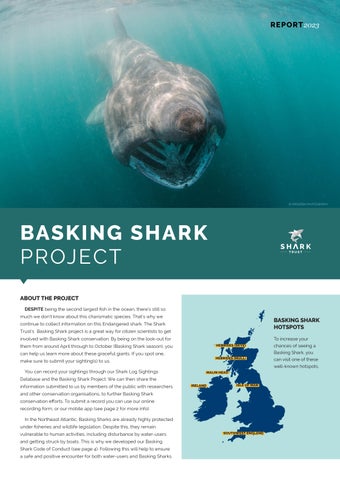
DESPITE being the second largest fish in the ocean, there’s still so much we don’t know about this charismatic species. That’s why we continue to collect information on this Endangered shark. The Shark Trust’s Basking Shark project is a great way for citizen scientists to get involved with Basking Shark conservation. By being on the look-out for them from around April through to October (Basking Shark season), you can help us learn more about these graceful giants. If you spot one, make sure to submit your sighting(s) to us.
You can record your sightings through our Shark Log Sightings Database and the Basking Shark Project. We can then share the information submitted to us by members of the public with researchers and other conservation organisations, to further Basking Shark conservation efforts. To submit a record you can use our online recording form, or our mobile app (see page 2 for more info).
In the Northeast Atlantic, Basking Sharks are already highly protected under fisheries and wildlife legislation. Despite this, they remain vulnerable to human activities, including disturbance by water-users and getting struck by boats. This is why we developed our Basking Shark Code of Conduct (see page 4). Following this will help to ensure a safe and positive encounter for both water-users and Basking Sharks.

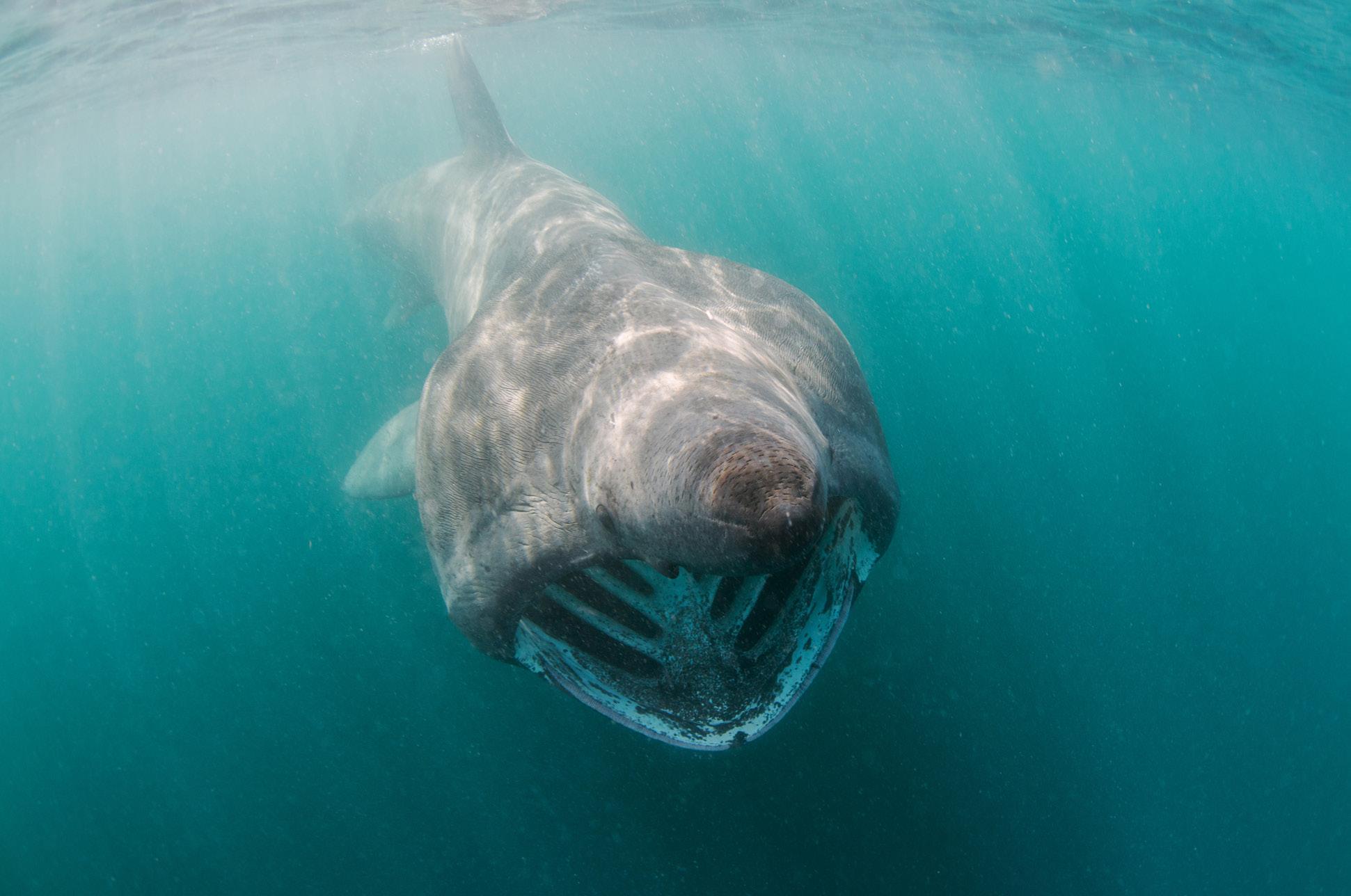
SHARK HOTSPOTS
To increase your chances of seeing a Basking Shark, you can visit one of these well-known hotspots.
REPORT 2023
BASKING
IRELAND
SOUTHWEST ENGLAND
HEBRIDES (MULL)
HEBRIDES (SKYE)
MALIN HEAD ISLE OF MAN
© FROGFISH PHOTOGRAPHY
BASKING SHARK SIGHTINGS SIGHTINGS 2023
If you spot a Basking Shark please report your sighting to us, with as much information as possible. If you have a photo please submit this too so we can verify your record.
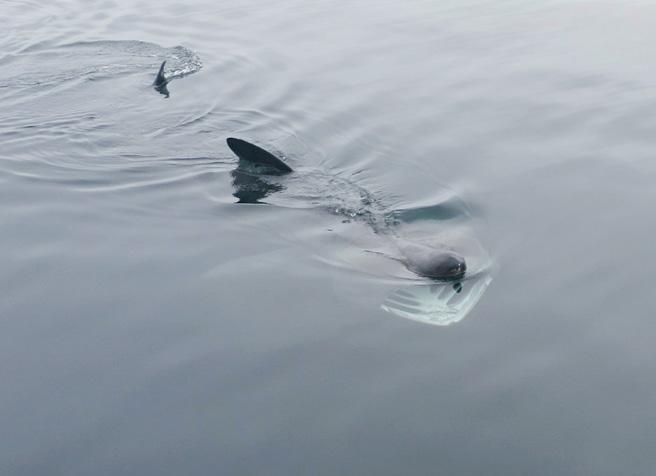
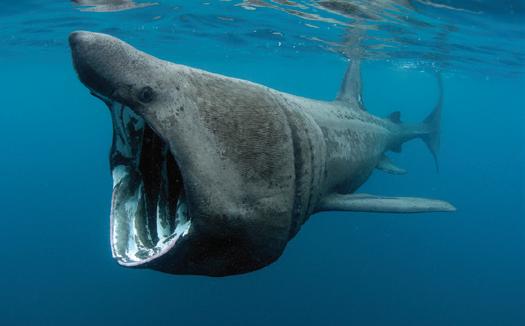
To identify Basking Shark feeding at the surface, the key thing to look for is three points that break the surface: the snout the dorsal and the caudal fin. Some people may think that this is three sharks, so we encourage people to bear this in mind when recording sightings. But please also remember that where there is one there are often others!

In 2023, nine reports (accounting for 14 sharks) were submitted to us from around the UK. Though the numbers of sharks being reported to the Basking Shark Project appear to be declining, particularly around the Southwest of England, this could be due to several reasons: are the reducing reports due to fewer sharks being seen, or, are there simply fewer people recording their Basking Shark sightings?
We are aiming to unpick these factors over the next few years, so please help us by reporting any Basking Sharks that you see! If you’ve gone out looking for Basking Sharks in a known hotspot, but don’t see any, that is important information too!
9 REPORTS
14 SHARKS
Thanks to everyone who submitted their sightings.
We look forward to seeing, and hearing, about your shark encounters in 2024!
THANK YOU for supporting our Basking Shark Project. RECORD your sighting and find out more about the project at baskingsharks.org Or submit your sighting using our SHARK TRUST CITIZEN SCIENCE APP Scan the QR code to download the app, or search ‘Shark Trust’ in the app store.
7 1 IRELAND SOUTHWEST ENGLAND HEBRIDES AND ISLE OF MAN BASKING SHARK HOTSPOTS PLUS NUMBER OF BASKING SHARKS REPORTED 6 reported elsewhere around the UK & Ireland
COLLECTING VITAL DATA 282 2019 2020 2021 2022 2023 47 69 114 52 SHETLAND Keep an eye out for the distinctive three points breaking the surface!
WESTERN SCOTLAND 14
© NICHOLAS MCCAFFREY
BASKING SHARK FORUM
ON February 1st 2024* the Shark Trust hosted the Basking Shark Forum, the second such event following the Global Basking Shark Summit in 2009.
The Forum was an online event for researchers, conservationists, tour operators and enthusiasts alike. Over the course of the day there was a mix of presentations, covering the key updates and research from the Basking Shark community from the last 15 years. We saw a total of 18 presentations covering:
*While we appreciate that this event not in 2023, the Basking Shark Forum was held before the 2024 season, so we wanted to include it this report!
» Overviews of the last 15 years
» Behaviour and Biology
» Spatial ecology and policy
» Data and collaboration
These presentation sessions were followed by Q&As and a discussion session, with the intention to hold various workshops in the near future. The Basking Shark Forum was a great success and we are excited to see how this event can encourage future collaborations, partnerships and foster new ideas.
BASKING SHARK DATA
Outside of the records reported to our sightings database, we have records from:
» The Isle of Man’s Manx Basking Shark Watch (now run by the Manx Whale and Dolphin Watch)
» The Marine Conservation Society’s Basking Shark Watch database (which has been cleaned and reformatted by the Unversity of Exeter and NatureScot) Along with some improvements to our own systems, these datasets will soon be added to the main database. Stay tuned!
The long term nature of this dataset makes the Basking Shark Project a valuable resource, and we are looking forward to seeing how it will be used in the future!
“
” ARE FEWER SHARKS BEING SEEN? OR, ARE THERE SIMPLY FEWER PEOPLE RECORDING THEIR SIGHTINGS?
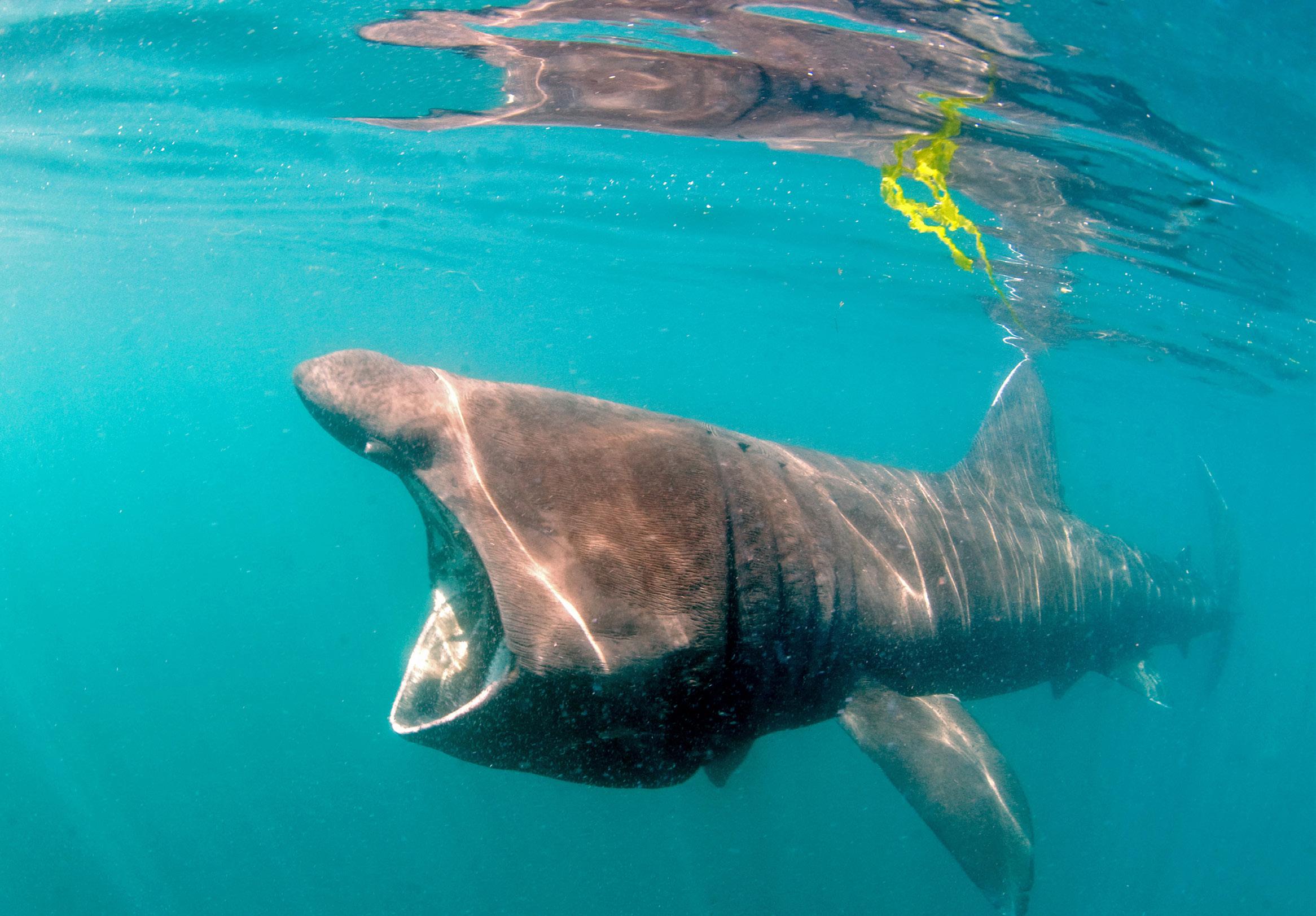
© BFROGFISH PHOTOGRAPHY
FEBRURAY 1 ST 2024
INFORMATION & CONTACTS
BOAT TOURS
Thinking of going on a boat tour to see Basking Sharks? We recommend seeking out a WiSe accredited tour operator. The Wildlife Safe (WiSe) scheme provides training and accreditation for tour operators. Advising them on how to best view and interact with large marine wildlife, while minimising disturbance. To find a WiSe accredited tour operator visit www.wisescheme.org
BASKING SHARKS IN DISTRESS
If you witness disturbance or harassment of a Basking Shark, please report it to the National Wildlife Crime Unit immediately. For more information visit the UK National Wildlife Crime Unit website www.nwcu.police.uk
STRANDED SHARKS
If you find a live stranded shark contact:
England or Wales - the British Divers Marine Life Rescue: 01825 765546 (Monday to Friday 9-5pm) or 07787433412
Scotland - the Scottish Society for the Prevention of Cruelty to Animals (SSPCA): 03000 999 999
For dead stranded sharks contact the Cetacean Stranding’s Investigation Programme (CSIP): 0800 6520333.
CODE OF CONDUCT
Basking Sharks are very sensitive to disturbance and harassment by people. In all the excitement of seeing Basking Sharks, it can be tempting to get a closer look. But, tour operator boats, small motor boats, jet-skis and even unmotorised crafts such as kayaks or SUPs can all end up striking them if they get too close. As well as causing physical harm, water-users can also disrupt their natural behaviour - such as feeding, courting and mating.
Follow the Code of Conduct so you can enjoy watching Basking Sharks safely and ensure a positive, safe experience for both you and the shark.
Despite often being called ‘gentle giants’, Basking Sharks can be the size and weight of a bus, have strong powerful tails, and can breach out of the water. They warrant respect. It’s illegal to intentionally disturb or harass Basking Sharks in UK and Irish waters. Anyone doing so could face up to 6 months in prison and a large fine.
BASKING SHARK CODE OF CONDUCT
Guidelines to help water-users reduce the risk of injuring or harassing Basking Sharks.
GENERAL ADVICE
Do not approach within 100m
If you encounter Basking Sharks be aware:
REMEMBER!
© CHARLES HOOD
KAYAKS & SUP’S: BOAT USERS: Never chase a shark or direct a vessel towards them – this could make them dive or act unpredictably When sharks are sighted, restrict speed to below 6 knots and/or operate under sail When closer than 100m, switch the engine to neutral to avoid injuring sharks Avoid sudden changes in speed Do not allow several vessels to surround the shark(s) Jet-skis should not approach Basking Sharks 6 knots SWIMMERS, DIVERS & SURFERS: Maintain a distance of at least 4m and be wary of the tail Do not touch the sharks Do not swim towards them if they are near you Ideally, swimmers should remain on the surface – stay in a group, rather than spreading out around the sharks No more than 4 people in the water within 100m of a shark at any time 4m
YOU KNOW?
Sharks are legally protected in the UK. It’s illegal to intentionally kill, injure, recklessly
Basking Sharks
person committing
an
face
6 months in prison
a
fine.
which direction they’re swimming Then quietly position yourself alongside their anticipated course for a safe and enjoyable view. Wait for them to come to you.
DID
Basking
disturb or harass
in British waters. Any
such
offence could
up to
and
large
Observe
surface there
to be more hidden below.
pairs or large numbers of sharks following each other closely. This may be courting behaviour and they should not be disturbed. Maintain
distance
at least
paddle directly towards the sharks or allow several kayaks to surround them – this could make them dive or act unpredictably Remain calm and quiet –avoid sudden movements which will disturb the sharks Stay in a group, rather than spreading out around the sharks
not to cross their path so the sharks can maintain their course without changing direction or speed
use your paddle or kayak to touch a shark
| sharktrust.org Don’t forget to take pictures of the fins for the Photo-ID Project and record your sighting Although mostly placid, Basking Sharks can startle if disturbed, often thrashing their tail with enormous power. Be extremely cautious in areas where Basking Sharks have been seen breaching.
For every shark visible on the
are likely
●Avoid
a
of
500m. Never
Try
Never
baskingsharks.org