The gender pension gap: why age 28 matters
Helping women feel good, investing

Helping women feel good, investing
Pensions can easily slip to the back of our minds. It’s a bit like being told to floss: we know we need to do it, but after everything else we deal with in a day, it falls off the agenda.
But what feels like just another item slipping off the to-do list has turned into a massive problem for many women later in life, as they find themselves without the savings pot they need to enjoy the retirement they hoped for.
HMRC figures estimate that women hold 48% less in their pension than men. But what causes it?
It’s impossible to ignore salary differences. In 2025, the Office for National Statistics reported that women working full time in the UK were paid, on average, 6.9% less than men. That’s a sizeable difference in take home pay, but it also means that women are paying less into their pension each month, which can have a snowballing effect on their final pension pot over time. As many women take career breaks to have children or to care for family, cracks start appearing from missed or lower contributions in the key years when pension growth is so important.
These cracks manifest as a gender pension gap – the difference in what women and men can get from their pensions in retirement.
Among AJ Bell customers, men and women’s pension contributions begin to diverge at age 28. In this report, we dive into exactly what happens at 28 that puts men and women on a different journey, and also our suggested solutions for individuals, pensions providers and policymakers.
At AJ Bell, we believe investing should feel good, not scary.
AJ Bell Money Matters is our way of helping to overcome barriers along the way, whether that be natural barriers such as a career break to start a family, lower disposable income levels or, put bluntly, the perception that investing isn’t for them.
Created for women by women, AJ Bell Money Matters’ mission is to help women feel good, investing.
Before age 28, neither men nor women put much emphasis on their pension saving. Only 6% of women and 9% of men mark pensions as a high financial priority before reaching age 28. Understandably, they have more urgent needs for their money, with 15% of men and 24% of women responding that their top financial priority at this age is simply ‘getting by’.
Top financial priority is simply ‘getting by’
24%
15%
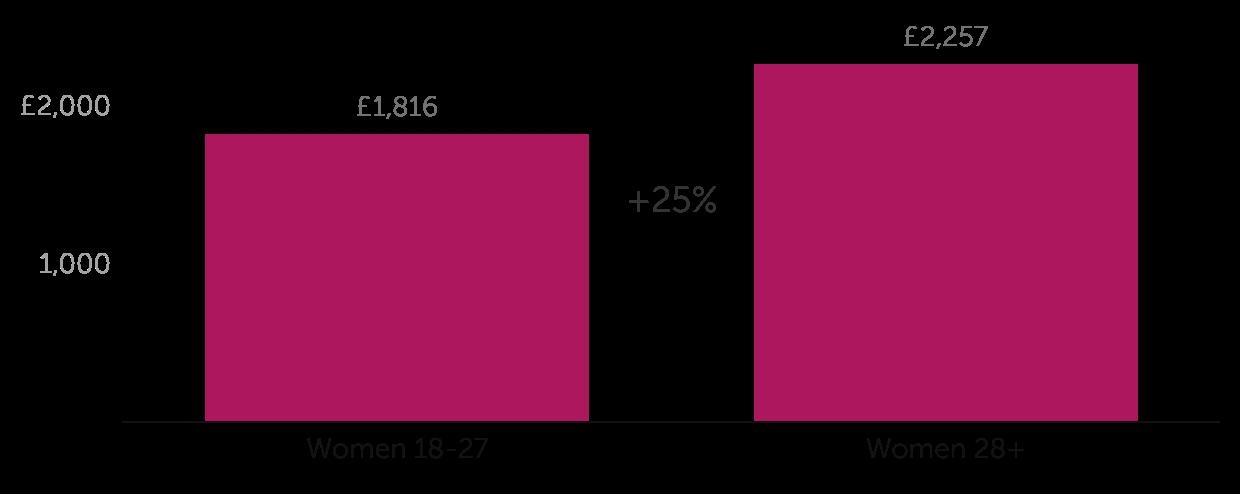
Women in their 20s also expect they’ll need a lower amount of money from their pensions in retirement. The average amount women under the age of 28 told us they wanted from their pensions was £1,816 a month in today’s money, compared to £2,268 for men of the same age.
But it’s not for a lack of drive: women in this age bracket were much more likely than men to have defined financial goals, such as buying a home and saving for children, showing an ambition to start building individual wealth for specific targets.
The reality of life at that point for many is that there’s just not enough money in the bank to stretch finances beyond the basics, even if they have financial goals in mind.
Source of survey data: AJ Bell/Opinium, 2-7 April 2026, 2,000 nationally representative Brits plus a boost survey of 100 28-year-olds.
At 28, this story starts shifting, and we see women begin to fall behind in their contributions.
Source: Average SIPP value by age and gender on AJ Bell as of 23/04/2026
Men get more serious about their long-term personal finances, with 22% naming retirement as a priority. They also start to recognise the steps needed to future-proof their finances, with specific goals such as paying off debts and adding to their emergency savings.
But for women, retirement savings remain far down the priority list. Just 8% of women note retirement savings as a top priority at this point in life. Women also don’t name long-term financial goals like retirement, paying off debts, and emergency savings as priorities higher than men. Instead, they focus on life events, such as saving for a house, for children, and for travel, perhaps hinting to how financial providers can better serve women.
None of those priorities are necessarily wrong or right. But it shows how those divides can begin to emerge, as men set off on the pension saving journey and women remain static.
Day to day living costs
Holidays
Buying my first house
Adding to my emergency savings
Hobbies
Surviving day-to-day and getting by
Saving for a major purchase (e.g. a new car, second home etc.)
Saving for a major life event (e.g. wedding)
Saving for children/ grandchildren
Paying off unsecured debts
(e.g. credit cards, loans)
13th priority
Saving for retirement
Day to day living costs
Adding to my emergency savings
Holidays
Paying off unsecured debts
(e.g. credit cards, loans)
Hobbies
Saving for a major purchase (e.g. a new car, second home etc.)
Surviving day-to-day and getting by
Buying my first house
Saving for retirement
Saving for a major life event (e.g. wedding)
It’s not surprising that people tend to put retirement towards the bottom of the priority pile when there are closer, more tangible goals to aim for. At 28, many will be starting to think about getting married or starting a family and graduates might also be looking over their shoulder at their student debt balance. Plus, the ONS’ most recent data suggests the average woman in the UK has her first child at 29, which is a both a huge life event and a financial shift.
But unfortunately, if these competing priorities mean actively choosing not to boost pension contributions, younger women could miss out on some of the power of a longer timeframe and the early years of compound investment growth.
While women at 28 are more focused on buying their first home and saving for their children, they do realise that they will want more in retirement. While men’s desired monthly income from their pensions remains the same as they reach 28 as before, women increase what they want their pensions to give them by £441 to £2,257 each month, almost exactly the same as men’s.
Whilst this suggests a growing recognition of what retirement might cost, the priority placed on what is needed to achieve those savings is still falling behind shorter-term and family-focused needs.

While the ‘priority gap’ is stark, the differences between men and women at age 28 go far beyond their financial goals. Working patterns often start to take divergent paths for women at this age, and the pension system isn’t as effective at scooping up these variable paths as it is for those who continue in a more linear career trajectory.
Age 28 is the time many women might start to take career breaks to have children. A lower priority for retirement savings will naturally mean pension contributions can slip down the pecking order, and they might even stop contributing altogether during longer periods of maternity leave. Less money rolling into pensions means the heavy lifting is left to any growth achieved on those earlier investments.
Auto-enrolment has done wonders to get more workers saving for retirement, and get many of them starting earlier, but the system means that many people are adopting a ‘set and forget’ approach – either not saving enough, or in some cases, not saving into a pension at all. And when women take breaks in their careers, no longer benefitting from these automatic contributions, the gap starts to appear quickly.
Even as women begin to return to work, many choose part-time work or selfemployment. For women between the ages of 29 and 40, 21% said they were working part time, in comparison to just 5% of men.
Self-employed people do not benefit from auto-enrolment, and those who are working part-time are only enrolled if they are earning £10,000 each year from the same employer. So, if they work across a number of different jobs, they might also miss out on employer contributions into their pensions.
The priority gap between men and women surrounding their pension doesn’t last forever. As women hit age 41, they begin to prioritise their pension equally to men. Almost one in three (29%) women aged 41-55 name their pension as a financial priority, compared with 30% of men.
So what happens at age 41 that makes women turn their attention to their pension? Retirement is creeping closer, but women might also have more time and a sense of agency. Those who had children in their late twenties or early thirties could find themselves with the chance to focus more on themselves and their future finances, and they might have also achieved those earlier goals such as owning a property and saving for children.
Although women catch up with men when it comes to prioritising their pension, it’s unlikely they’ll close the gap in pension contributions. As for women of all ages, the median contribution gap for those aged 41 to 55 remains at 3% between women and men. And to make up for lost years of money paid in and compounding investments, women’s pension contributions would have to far outstrip men’s by this age to level the playing field.
But it’s never too late to make a difference – at age 41, if £100 a month is added to a pension, by the time retirement rolls around in say 20 years, an extra pot of over £42,500 could have built up. That increases to over £66,700 if the payments continued until 67 (the current state pension age) all helping to support a more comfortable retirement and perhaps well-earned treat or two.
This £100 a month would cost a basic rate taxpayer just £80 a month, and even less for those who pay tax at a higher rate.
This is assuming your pension pot grows by 6% each year and includes annual charges of 0.6% and all dealing charges. Pension and tax rules apply.
We asked over 1,000 women aged 29-89 to share what they would or wouldn’t have changed about their finances if they were 28 again. Most wished they had saved or invested more, but others recognised that they simply did what they could at the time. Many of these women were 28 at a time when the gender pay gap was even wider than today.
I couldn’t have done anything differently due to the circumstances at the time.
Some women also reflected on how having a family to care for affected their ability to build up their own finances. Instead of prioritising their own financial wellbeing, they felt a duty to look after their children and prioritise their needs. This was not mentioned by any men as a barrier to pension saving in their answers.
I had three kids when I was 28. All of my money was spent on them.
While very few women seemed to regret starting a family, some seemed to regret beginning to have children before their own finances were in a comfortable place. There’s never a one-size-fits all, as another woman responded that she wished she would have focused more on family and having children rather than just building her savings. Interestingly, this was a much more common thread among responses from men, who wished they had bought a larger house for their children, or spent more on travel at the time.
But it’s not all regret – many women said they’d have done the same again, reflecting on lives well lived and finances well managed. The changes that are taking place, such as a narrowing gender pay gap and widespread implementation of automatic enrolment, mean that many women are contributing to their pensions earlier, even when it’s not yet a financial priority.
I wouldn’t do anything differently.
Many people put thinking about their pensions into the ‘too hard’ bucket, but learning about your pension early and showing it some love can help you save more for retirement. If you’re employed, discover how much you and your employer pay in, and what fund your pension is invested in. Don’t be afraid to explore beyond the default option; yes, it could be right for you, but you may find there are better alternatives out there more suited to your own life and goals. Your pension provider will offer an estimate of your potential retirement income, which you can check against what you’d like to receive in retirement. The Retirement Living Standards are a useful resource to get started, and if your projected savings seem insufficient, it’s easier to explore ways to improve the situation, such as increasing your contributions or adjusting your investment approach.
If you live with a partner, you’ll need to be frank about your household finances. Many people consider their household income as one pot to make sure their mortgage is paid whatever happens – so it’s worth considering the same for topping up your respective pensions. If you’re thinking about starting a family, then check out what happens to your pension contributions. If your contributions dip by taking maternity leave or switching to part-time work, your partner may be able to help make up the difference by paying into your pot or gifting you the funds to invest.
Automatic enrolment sets the rules on minimum contributions, but many employers will pay more if you make a similar commitment. This means more ‘free money’ into your pension pot. Even if you don’t qualify to be automatically added, you can ask your employer to add you to the scheme.
Self-employed people are left to choose their own pension route, but there are ready-made options out there to help narrow down the investment choice if you’d rather not manage it all yourself.
If you live with a partner, you’ll need to be frank about your household finances.
If
Either way, pensions offer significant tax benefits, especially on what you pay in. For some pensions you get all your tax savings upfront. But if you pay into a SIPP or another personal pension and you are a higher or additional rate taxpayer, you may have to claim more income tax relief directly from the government.
I was 28 again,
I’d pay more in to my pensions and save more on a regular basis sooner.
You can claim any higher or additional rate pension tax relief via the government website, or by sending HMRC a letter.

Pension contributions are based on pay, so if women are paid more, their pensions will be healthier for it. Policymakers must continue to strive to close the gender pay gap by making sure women are given the same career opportunities, and importantly, the same pay as their male counterparts.
Automatic enrolment has been an incredible success in creating more pension savers but it’s not without its faults. The law was changed in 2023 to lower the minimum age from 22 to 18 and to base minimum contributions on the first pound of pay upwards. The government should now work together with employers to set out a clear plan for when these changes will happen. This could give businesses enough time to prepare and make sure the increases can be managed smoothly and affordably. In addition, the government should reduce the automatic enrolment trigger of £10,000 to £6,240 (the national insurance contribution lower earnings limit). Automatic enrolment criteria should also apply to an individual’s total income rather than be assessed per job. Both of these changes would help more women become part of the automatic enrolment success story.
People need confidence and trust in the pensions system. But too often there has been fevered speculation that the government is about to reduce some of the key tax advantages of pensions. The Treasury needs to recognise that people’s fears are real and move swiftly to close speculation where it arises. By committing to a ‘pensions tax lock’ to maintain current tax advantages for at least the rest of this Parliament, the government can give individuals the certainty and peace of mind to save for the long term.
Closing the gender pensions gap isn’t just about personal decisions – it’s about individual action, industry shifts and policy changes that help more women feel confident about their long-term future.
There is no perfect formula to saving for retirement, and we all have different needs and wants for what it might look like. Being aware of the importance of your pension, and showing it some love through all stages of your life, is essential to building a more comfortable future.
Back then, we saved appropriately for the future. It’s not our fault that the government changed the goal posts.
Salaries and pension contributions are often modelled as a steady rise until retirement, but this is rarely the case. Women may take career breaks to care for children or parents, work parttime or face slower career progression than men. Pension communications should reflect diverse life experiences rather than a linear or one-size-fits-all approach.
Pension providers can help women make the most of the financial incentives on offer through saving into a pension by raising awareness of matched employer contributions and government tax relief on pension contributions. Demonstrate the power
of compound interest and the benefit of starting to save as early as possible. This includes the ability of pension contributions to reduce the income that is tested against eligibility for the full tax-free personal allowance and childcare support including child benefit.
I think I planned reasonably well, although I have always felt pensions were
so difficult to understand.
I
wish I had had more knowledge about them when I was younger.
Pensions often seem complicated, but the basics are actually quite straightforward: start saving as soon as you can, keep making regular contributions, and make the most of the extra money you can get from your employer and the government. By avoiding confusing legal and technical language and simply highlighting these key points, pension providers can help women feel confident about their pensions, not overwhelmed by language and policy.
Closing the gender pensions gap isn’t just about personal decisions – it’s about individual action, industry shifts and policy changes that help more women feel confident about their long-term future.
There is no perfect formula to saving for retirement, and we all have different needs and wants for what it might look like. Being aware of the importance of your pension, and showing it some love through all stages of your life, is essential to building a more comfortable future.
What are your financial priorities currently?
How have they changed in the past five or ten years?
What does your dream retirement look like?
How much do you think you’ll need each month for your dream retirement plans?