SHAPE America’s comprehensive Physical Best program equips physical educators to teach and assess health-related fitness using standards-based activities that complement any PE curriculum
Long considered the gold standard for teaching fitness education in PE, Physical Best is used in schools and taught in undergraduate PETE programs nationwide
Why Choose Physical Best?
Designed for elementary, middle school and high school settings, Physical Best helps students identify movement opportunities that are personally enjoyable and meaningful
Learn more about what sets Physical Best apart!
Explore Resources and Professional Learning
Textbook: Used in undergraduate PETE courses nationwide and trusted by K-12 educators and administrators, this best-selling text has been updated to align with the new SHAPE America National Physical Education Standards It also includes digital access to 250 ready-to-use activities for elementary and secondary settings.
Workshops: Two all-new interactive Physical Best workshops (Health-Related Fitness in PE and Goal-Setting in PE) equip teachers with practical strategies to enhance health-related fitness instruction and assessment in ways that are effective and relevant for today’s students. Available as half-day sessions, they can also be combined into a full-day Physical Best training for K-12 teams and districts
Students gain the knowledge and skills to move with confidence and learn to:
Set personal health-related fitness goals;
Complete self-assessments to monitor progress;
Develop new goals to continue their physical literacy journey
Certificate Exam: This two-hour, multiplechoice test provides educators with a way to demonstrate competence in health-related fitness education instruction and assessment. The exam is also frequently used in PETE programs as an assessment tool or extra credit opportunity for classes that use the Physical Best textbook.
Study Guide: This guide supports preparation for the Physical Best Specialist Certificate Exam Perfect for PETE students and K-12 teachers using the latest edition of the Physical Best text, as well as certificate holders nearing renewal.
National Standards
Partner Pyramid Workout
Elementary (Grades 3-5)
Learning Objectives
Standard 2: Applies knowledge related to movement and fitness concepts
2.5.7 Defines and provides examples of movement activities for developing the health-related fitness components
Standard 3: Develops social skills through movement
3.5.3 Demonstrates respectful behaviors that contribute to positive social interaction in group activities
Equipment
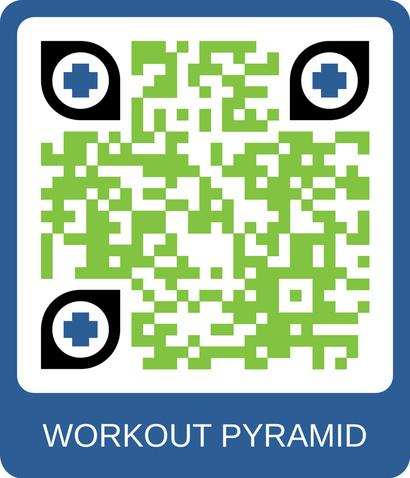
Music + one workout pyramid handout/student
Introduction of Concepts
Students will identify which exercises develop cardiorespiratory endurance, muscular endurance, and flexibility
Students demonstrate appropriate behavior when working with different partners
Health-Related Fitness Components
Cardiorespiratory endurance
Muscular endurance
Flexibility
Setup
Hand out Partner Pyramid Poster to students
Tell students that this warm-up activity works on cardiorespiratory endurance, muscular endurance, and flexibility. Encourage them to work hard and try to do more repetitions than before.
Directions
1 Show students the workout pyramid in the form of a poster, wall projection, or handout Explain how to work down the pyramid: “Start at the top, then choose an exercise on the next row down that is in contact with the previous exercise. Continue in this way through the last row. For example, everyone starts with jumping jacks, then chooses either push-ups or squats Next, if you did squats, choose either hip flexor stretch or butterfly stretch Then, if you did hip flexor stretch, choose either tuck jumps or burpees. You always pick an exercise beneath the one you just did.”
2 Explain that students start with a partner (assigned however you prefer) and do the first exercise with them for one minute while music plays When the music stops, they find a new partner with whom to complete the next exercise (once the music begins). The new exercise must connect (on the pyramid) to the last exercise done by one or both of the partners Students continue in this manner until they finish the final row of the pyramid
3.Start the music to signal students to begin their first exercise; after one minute, stop the music.
4 Give students 15 seconds to find a new partner and choose their next exercise They must agree with their new partner on which exercise to do
5.Restart the music and play it for one minute while students complete the new exercise. Then stop the music again and give students 15 seconds to find a new partner and choose the next exercise.
6 Continue this pattern until one exercise in each row has been completed
Closure
Partner Pyramid Workout
Elementary (Grades 3-5)
Ask students to do a think-pair-share to identify one cardiorespiratory endurance, one muscular endurance, and one flexibility exercise
Which activities were the most challenging for you? What can you do to improve?
Which exercises worked on cardiorespiratory endurance? Muscular endurance? Flexibility?
Teaching Tip
Designate an area where students who are unable to find a new partner can go to find one.
Assessment
Ask students to identify how each activity they performed in class relates to the development of cardiorespiratory endurance, muscular endurance, and flexibility
Observe student behavior when working with different partners
Variations
Mix exercises for cardiorespiratory endurance, muscular endurance, and flexibility throughout the pyramid instead of organizing them by row Ask students to discuss with their partner which component their chosen exercise works on before starting it
Instead of mixing, use only exercises from one health-related fitness component; for instance, use exercises only for cardiorespiratory endurance to provide a cardio workout
Put muscle names in the pyramid and ask students to complete an exercise that works or stretches a given muscle
Increase or decrease the number of rows depending on how much time you want to spend on the activity
Use a projector and have students go through the exercises by looking at the screen instead of all the handouts
Adaptation and Inclusion
Instead of providing only a single pyramid, allow students to choose from beginner, intermediate, and advanced versions
Include exercises at a variety of levels on each row of the pyramid
Home Extension
Encourage students to participate in this activity outside of class. It requires minimal work to perform at home with parents or guardians and siblings.
National Standards
Fitness Adventure
Middle School (Grades 6-8)
Learning Objectives
Standard 1: Develops a variety of motor skills
1.8.3 Demonstrates appropriate form in a variety of healthrelated fitness activities
Standard 2: Applies knowledge related to movement and fitness concepts
2.8.9 Identifies and compares the components of health and skill-related fitness
2.8.15 Demonstrates knowledge of heart rate and describes its relationship to aerobic fitness.
Standard 3: Develops social skills through movement.
3.8.2 Demonstrates consideration for others and contributes positively to the group or team
Equipment
Six to eight cones or line markers
Four jump ropes
Poly spots, enough to create an area for teams to cross Blocks or beanbags, as many as possible, for one end of the shuttle runs
Carpet square or scooter
Station cards
One worksheet per group
Students will demonstrate correct form while performing fitness exercises
Students will work collaboratively to complete fitness activity challenges
Students will demonstrate positive verbal and physical behaviors while exercising with group members
Students will demonstrate knowledge of health-related fitness concepts and health-enhancing behaviors by answering teacher-led questions
Health-Related Fitness Components
One answer key Fitness
Introduction of Concepts
Cardiorespiratory endurance
Body composition
Flexibility
Muscular strength
Muscular endurance
Setup
Set up stations around the room as follows
Station 1: Set up six to eight line markers 5 to 6 feet (15-18 m) apart
Station 2: No setup is required
Station 3: Provide enough jump ropes that each member of a team has one
Station 4: Evenly space poly spots 3 to 4 feet (09-12 m) apart, or farther if desired
Station 5: Set up several shuttle run piles 10 to 15 feet (30-45 m) apart Place piles of beanbags on one end and piles of blocks on the other
Station 6: Place a carpet square or scooter in an empty area.
By exploring options and making choices, students will work together to complete various fitness challenge tasks and assess their knowledge and understanding of nutrition and health-related fitness components Students will collect, or lose, fitness points as they go through various activity challenges
Directions
1 For a warm-up, students should form teams of three or four and play tag If tagged, a student spins around twice, then reenters the game Students should play for about two minutes before coming together to discuss how the exercise helps maintain a healthy heart.
2.The Fitness Adventure Station Cards give clear instructions regarding the setup of the stations, each of which describes an activity and asks a health question. Assign teams to different stations around the room. As teams complete the task at their station, they come back to you to answer the health question. A correct answer earns a health point toward immunity or disease prevention. An incorrect answer gets an unhealthy point deduction from the team’s score.
3.Students move to the next station.
4.For a cool-down, students complete a walk-and-talk to review the answers with their group.
Closure
Fitness Adventure
Middle School (Grades 6-8)
Bring students together to discuss the answers to the questions and any other relevant information about health and fitness concepts
Teaching Tips
Allow a certain amount of time for each team to complete each task
Keep a chart of points earned and deducted for each team
To avoid excessive competition, modify scoring so that all teams that complete the tasks in a prescribed amount of time earn a point
Create your own health- or skill-related fitness component, fitness guideline, and fitness principle questions
Assessment
Ask students to write a reflective journal entry about their experience of working collaboratively with their teammates.
Administer an exit slip on health-related fitness components.
Assess students’ knowledge of the health-related fitness components, guidelines, and principles.
Variations
Redirect the health questions to be related to the FITT guidelines For example, how does frequency of physical activity help us become more fit?
Solicit and incorporate questions from students’ other classes to review content prior to a test.
Adaptation and Inclusion
Students with limited mobility may require the assistance of an aide
Allow students to work to their level of ability and participate at their own intensity level
Home Extension
Ask students to research three health questions, write down the answers, and present them in class.
National Standards
Four-Corner Heart-Healthy Warm-Up and Cool-Down High School
(Grades 9-12)
Learning Objectives
Standard 2: Applies knowledge related to movement and fitness concepts
2.12.8 Designs and implements a plan that applies knowledge of aerobic, strength and endurance, and flexibility training exercises
Equipment
Music player
Music in 30-second segments alternating with 10 seconds of silence eight 30/10 units for a moderate warm-up and eight 30/10 units for stretching (Recommendation: Intervals app for smart devices)
One 4-inch (10 cm) strip of modeling clay
Four benefits posters Leader warm-up and cool-down cards
Introduction of Concepts
Students will explain the benefits of a warm-up and a cooldown
Students will describe the appropriate sequence of a warmup and a cool-down
Health-Related Fitness Components
Cardiorespiratory endurance
Flexibility
Setup
Fitness Concepts
Definition
Health benefits
Warm-up and cool-down
Place a benefits poster on each of the four walls of the activity area
A warm-up increases body temperature and muscle elasticity, thereby improving the muscles’ ability to perform work and reducing the risk of injury.
A cool-down reverses the process of a warm-up A proper cool-down may reduce muscle soreness, helps bring body temperature back to normal, and allows muscles to flush wastes generated by exercise
Directions
1 Hang a Benefits of Warming Up and Cooling Down Poster on the middle of each of the four walls of the activity area
2 Explain the purpose of a warm-up Reinforce the importance of warming up by drawing an analogy between muscles and modeling clay Take a cold piece of modeling clay and try to stretch it; it will snap in two Then take the same clay and work it in your hands until it is warm and pliable Stretch the warmed clay; it will not break Ask students to describe the difference between the two demonstrations Then ask them what could happen to our bodies if we do not properly warm up (their answers should relate this to the cold clay).
3.Describe the two phases of a warm-up: physical activity and stretching. Emphasize that the two phases work together to loosen and relax the muscles and prepare the body for more vigorous activity.
4.Explain that the goal of this activity is to gradually increase the heart rate and to help students understand how warming up can prevent injury. (If you’re using the lesson as a cool-down, explain that the goal of the activity is to gradually decrease heart rate, bring body temperature back to normal, and minimize muscle soreness.)
5.Select four students to lead the activity. Give each leader a Warm-Up and Cool-Down Card stating which activity the student will lead for 30 seconds.
6 Ask each leader to stand to the right of one of the benefits posters Arrange other students in lines, facing leader 1 (see diagram) Encourage students to read the benefits posters during their activity
(Directions Continued)
Four-Corner Heart-Healthy Warm-Up and Cool-Down High School
(Grades 9-12)
7 As the music begins, leader 1 starts walking in place, which signals the other students (including the other leaders) to do the same
8 At the end of the first 30 seconds of music, students jog slowly in place as they make a one-quarter turn to the right to face leader 2. Students continue to jog in place until leader 2 begins the next activity. All other students follow leader 2’s example.
9.After 30 seconds, all students jog in place as they make a one-quarter turn to the right to face leader 3, and the same process is followed for leader 4
Closure
Bring students together to discuss the appropriate sequence of a warm-up and a cool-down
Teaching Tips
Laminate the Benefits of Warming Up and Cooling Down Posters to preserve them for many years. Give students of all abilities a chance to serve as leaders of the activity
Assessment
Ask students what changes they observed in their bodies when warming up and when cooling down Ask them why it is important for our body to respond the way it does
Ask students to design a poster or digital slide presentation that delivers facts about, and benefits of, warming up and cooling down.
Variations
Incorporate skill development into the activity by requiring students to use or create a variety of dance steps or other skills for each leader to incorporate
Select a variety of flexibility exercises for leaders to demonstrate.
Adaptation and Inclusion
Allow students with physical disabilities to adapt the movements appropriately For example, instead of jogging, a student with a movement disability might march
When given the opportunity to be a leader, allow a student with speech difficulty to demonstrate the movement or activity while a peer provides the voice
For students with hearing impairments, match them with hearing peers to assist with transitions. If using music, place speakers sideways and on or close to the floor to create rhythmic vibrations that may be sensed by a student with a hearing challenge In addition, stopping the beat may provide a cue to move to the next phase
Home Extension
Have students design, at home instead of in class, a poster or digital slide presentation that delivers facts about, and benefits of, warming up and cooling down.