Learning Progressions Guidance
Did you know?
The new SHAPE America National Physical Education Standards are organized into grade-span learning indicators that help unpack the overall standard statement and articulate the content within that standard.
To help you further unpack each standard, the textbook National Physical Education Standards, Fourth Edition, includes new learning progressions for your use!
The learning progressions address the varying performance levels that students may display when moving toward skill competency and the promotion of mastery.
Why is this important?
You can use the learning progressions to track observable and measurable student progress, differentiate instruction, and assist with your planning!
National Physical Education Standards
The National Physical Education Standards serve as overarching goals for physical education curricula.
Grade-Span
Learning Indicators
Grade-span learning indicators articulate content areas and show more specific goals that lead toward progress of the standards.
Learning progressions provide sample sequential tasks addressing a range of skill abilities that can be used to unpack the grade-span learning indicators.
SHAPE America Sets the Standard®
Sample 1 Scenario
Jamie has a class of first-grade students. He is doing a unit on nonlocomotor skills. He could use the learning progressions at the beginning of a lesson as success criteria, by showing students the sequential steps toward the proposed objective. Students could track their own progress throughout the unit and know where they are in relation to meeting the learning indicator. Jamie could also use the learning progressions throughout the unit as a quick formative assessment check-in.
Grade-Span Learning Indicator: 1.2.5
Demonstrates balancing on different body parts in a non-dynamic environment.
Learning Progressions
Maintains momentary stillness on different bases of support.
Maintains stillness on different bases of support with different body shapes. Balances on different bases of support, combining levels and shapes. Balances in an inverted position with one foot above head while maintaining stillness.
This shows the sequential progression going from easy to more challenging criteria.
Dig Deeper
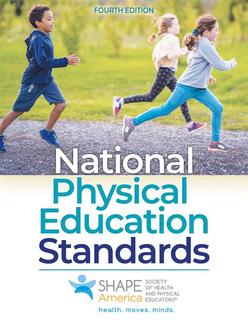
National Physical Education Standards, Fourth Edition, is the go-to book for all physical education teachers It provides the framework for creating curricula, designing lesson plans, and developing assessments. Get your copy today!
Visit bit.ly/NPES-Book.
Sample 2 Scenario
Julisa’s sixth-grade class is engaging in a variety of meaningful activities with a unit focusing on identifying the impact of physical activity intensity on the human body. She could use the learning progressions in an exploratory task to gather baseline data on students' competence relative to the grade-span learning indicator. Julisa could then use that information to modify future lesson planning.
Grade-Span Learning Indicator:
2.8.13
Explains the relationship of aerobic fitness and RPE Scale to physical activity effort.
Learning Progressions
Defines aerobic fitness and describes its relationship to Borg Rating of Perceived Exertion Scale (RPE).
Explains how intensity of exercise impacts physical activity.
Defines how the RPE scale can be used to determine the perception of the work effort or intensity of exercise.
Defines how the RPE scale can be used to adjust workout intensity during physical activity.
Since Julisa’s class is new to middle school, she is unsure of their prior knowledge. After creating an initial exploratory task that supported the grade-span learning indicator, she noticed a large portion of the class had prior knowledge of the first learning progression and was ready to learn more about the second learning progression.
Julisa now intends to use the second learning progression as her next lesson focus, to move students forward in skill