
Appropriate Instructional Practice Guidelines for K-12 Physical Education
GUIDANCE DOCUMENT

Appropriate Instructional Practice Guidelines for K-12 Physical Education
GUIDANCE DOCUMENT
Acknowledgements
DocumentAuthors:
ShannonC.Mulhearn(Co-Chair),LanderUniversity
LeAnnOlson(Co-Chair),EastTennesseeStateUniversity
EmilyClapham,UniversityofRhodeIsland
TashannaGillenwater-Catron,Gillenwater&AssociatesEducationalConsulting
HillaryGlencross,SalemStateUniversity
TanjianLiang,CentralWashingtonUniversity
LeannaLawson(Ph.D.StudentRepresentative),UniversityofNorthernColorado
SamanthaMiller(Ph.D.StudentRepresentative),WayneStateUniversity
CraigNieman,UniversityofSouthFlorida
NiloRamos,CoastalCarolinaUniversity
Special thanks to previous SHAPE America Professional Preparation Council members who contributed to early revisions of this document: Jan Bishop, Stacy Imagbe, Leah Ketcheson, Elizabeth Sharp, and Ben Schwamberger.
Copyright © 2026 by SHAPE America | All rights reserved.
PO Box 225
Annapolis Junction, MD 20701
800-213-9527
SHAPE America – Society of Health and Physical Educators serves as the voice for 200,000+ health and physical education professionals across the United States The organization’s extensive community includes a diverse membership of health and physical educators, as well as advocates, supporters, and 50+ state affiliate organizations
Since its founding in 1885, the organization has defined excellence in school-based health education and physical education For decades, SHAPE America’s National Physical Education Standards have served as the foundation for well-designed physical education programs across the country, just as the SHAPE America National Health Education Standards serve as the foundation for effective skills-based health education Together, these national standards provide a comprehensive framework for educators to deliver high-quality instruction and make a positive difference in the health and well-being of every preK-12 student
Find additional resources at shapeamerica org
This document details appropriate instructional practice guidelines for K-12 physical education
The practices are organized into five main sections:
• Learning Environment
• Instructional Strategies
• Curriculum
• Assessment
• Professionalism
Within each section, you’ll find subsections focused on specific areas of concern in physical education. These subsections outline recommended practices along with examples and suggestions for implementation in physical education classes.
The Learning Environment section includes:
• Establishing the Learning Environment
• Exercise as Punishment
• Safety
• Belonging and Access
• Competition and Cooperation
• Teacher Enthusiasm
The Instructional Strategies section includes:
• Expectations for Student Learning
• Class Organization
• Class Design
• Learning Time
• Maximizing Participation
• Teaching/Learning Styles
• Success Rate
• Teacher Feedback
• Technology Use
The Curriculum section includes:
• Productive Motor Skill Learning Experiences
• Concept Knowledge
• Regular Participation
• Developing Health-Related and Skill-Related Fitness
• Social and Affective Skills
• Valuing Physical Activity
• Interdisciplinary Instruction
• Special Events
The Assessment section includes:
• Assessment Use
• Variety of Assessments
• Fitness Testing
• Testing Procedures
• Reporting Student Progress
• Grading
• Program Assessment
The Professionalism section includes:
• Professional Growth
• Professional Learning Community
• Advocacy
The practices mentioned are not meant to be an exhaustive list. These are basic instructional practices. Many other practices that should be included in an excellent program are not enumerated here, but the list does include the practices observed in gymnasiums, pools, and fields across the United States.
Practice
1.1.1 The teacher systematically plans for, develops, and maintains a positive learning environment that is focused on maximizing learning and participation in an atmosphere that allows students to feel safe (physically and emotionally), supported, and unafraid to make mistakes.
1.1.1.a The teacher preemptively mitigates risk by ensuring the learning area is free of obstacles or items that could cause physical injury.
1.1.1.b The teacher plans assessments that are based on skill attempts and progress as opposed to perfection.
1.1.1.c The teacher encourages all students to be respectful of one another.
1.1.1.d The teacher avoids calling attention to students who are struggling with a skill and works with them individually so as to help them feel comfortable during physical education class.
1.1.2 The environment is supportive of all students and promotes developing a positive self-concept. Students are allowed to try, to fail, and to try again, free of criticism or harassment from the teacher or other students.
1.1.2.a The teacher shows respect and provides praise to all students who are actively attempting skills and lead-ups.
1.1.2.b The teacher looks for and encourages students to also look around for students who are not included and invites them to join with a group of their peers.
1.1.2.c The teacher plans for motor skill progressions and encourages all students to engage in activities at their current ability level.
1.1.3 Programs are designed to guide students to take responsibility for their own behavior and learning. Emphasis is on intrinsic, rather than extrinsic, incentives.
1.1.3.a The teacher uses praise and teaches students how to feel proud of themselves for accomplishing challenges during class.
1.1.3.b Teachers avoid threatening students with poor grades or punishments and, instead, focus on positive psychomotor, cognitive, and affective outcomes of students’ participation.
1.1.3.c At the start of each semester, students complete an interest survey indicating preferred physical activities (e.g., basketball, yoga, fitness circuits, dance, or individual lifetime sports). The teacher uses this information to design units that balance curriculum standards with student interests, ensuring greater engagement and ownership in learning.
1.1.4 Fair and consistent classroom-management practices encourage student responsibility for positive behavior. Students are included in the process of developing class rules/agreements.
1.1.4.a The students participate in a discussion at the beginning of the year to agree upon class rules and expectations.
1.1.4.b The rules are clear and establish predictable consequences that are the same across all individuals.
1.1.5 Bullying, taunting, and inappropriate student remarks and behaviors are dealt with immediately and firmly.
1.1.5.a The teacher clearly communicates that no verbal or non-verbal behaviors that are hurtful to other students are appropriate or acceptable in physical education classes.
1.1.5.b The teacher addresses all instances of questionable behaviors consistently and ensures that all students understand why the behavior was identified as inappropriate.
Practice
1.2.1 Teachers promote exercise for its contribution to a healthy lifestyle. Students are encouraged to participate in physical activity and exercise outside of the physical education setting for enjoyment, skill
1.2.1.a The teacher relates the current lesson to activities and resources students have access to outside of school.
development, and health reasons.
1.2.1.b The teacher leads students in goal-setting so students acknowledge ongoing achievements and recognize how their participation inside and outside of class is connected to their progress.
1.2.1.c Exercise and physical activity are never used as punishment so as to avoid creating negative associations with movement.
1.3.1 Activities are selected carefully and modified to ensure a safe learning environment for students. Safety is actively taught. Emergency action plans are posted and practiced.
1.3.1.a Safety procedures are considered during the planning of classes and noted in each lesson plan.
1.3.1.b The teacher has safety practices posted during lessons.
1.3.1.c Students are held accountable for following safety procedures and taught to also hold one another accountable for these (for instance, not allowing any swinging of bats or golf clubs in close proximity to others).
1.3.1.d The teacher describes risk assessment to students to encourage that safe practices are also followed when students engage in physical activities outside of class (such as during recess or at home).
1.3.1.e Students are aware of what to do in an emergency.
1.3.2. Content is selected carefully to ensure that it matches students’ skill levels and is safe for all students, regardless of their skill level.
1.3.2.a The teacher assesses each class’s skills and has planned activities that are appropriate for that group of students’ abilities and motor needs.
1.3.2.b The teacher plans modifications for all activities that allow for students of all skill levels to be appropriately challenged while also experiencing success.
1.3.3 Teachers maintain up-to-date first aid, AED, and CPR certifications.
1.3.4 Facilities and equipment are maintained and inspected regularly for safety hazards.
1.3.2.c Signage is designed in a way to ensure all students can understand (for instance, pictures for young students who cannot yet read).
1.3.2.d Games or tasks that target people (such as dodgeball) are not used; target games with objects are chosen instead.
1.3.3.a Teachers ensure their teaching space is equipped with first aid supplies and an AED.
1.3.4.a The teacher ensures there is a system in place for reporting facility issues to upper administration.
1.3.4.b Regular walk- throughs are conducted of all learning spaces used during physical education classes to preemptively identify potential safety hazards.
1.3.4.c Equipment is checked to ensure all is in proper working order to prevent injuries due to malfunction or too much wear and tear.
1.3.5 Physical education class size is consistent with those of other subject areas.
1.3.5.a Teachers advocate for safe and manageable class sizes for all physical education classes.
1.3.5.b Administrators respect that physical education should not be used as a place to send excess students during teacher shortages (e.g. substitute or hiring teacher shortage).
1.3.5.c Teachers avoid combining classes and instead come up with other strategies to accommodate a colleague who is completing other activities.
1.3.6 Teachers ensure student safety by monitoring class closely.
1.3.6.a Teachers consistently roam around the entire teaching space to ensure they can see all students.
1.3.6.b The teacher is mindful of keeping their back to the wall or to unused spaces as opposed to turning their back on students.
1.3.6.c The teacher utilizes time between classes or requests another adult’s presence if they need to step away from the class for any reason, so students are never left unsupervised.
1.4.1 Teachers create an environment that is supportive of all students, regardless of race, ethnic origin, gender, sexual orientation, religion, or physical ability. Such differences are acknowledged, appreciated, and respected.
1.4.1.a The teacher displays diverse cultural artwork, multilingual signs, and posters representing different backgrounds, abilities, and family structures to ensure every student sees themselves reflected in the classroom.
1.4.1.b Classroom norms are co-created with students, emphasizing respect, empathy, and listening to others’ perspectives. The teacher models inclusive language and promptly addresses discriminatory comments or behaviors.
1.4.2 Teachers intentionally select activities and materials that represent a culturally diverse environment.
1.4.3 All students have equal opportunities to participate and interact with the teacher. All students, regardless of developmental level and ability, are challenged at an appropriate level.
1.4.2.a The teacher integrates music from different regions during warm-ups or cooldowns to celebrate global rhythms and movement styles.
1.4.2.b A classroom display highlights “Games Around the World,” featuring photos, maps, and brief descriptions of each game’s history and connection to community and culture.
1.4.3.a The teacher rotates students through all roles and positions (e.g., offense, defense, referee, team captain) so everyone experiences leadership and skill-based opportunities.
1.4.4 All students are encouraged, supported, and socialized toward successful achievement in all content taught in physical education.
1.4.3.b Teachers work to provide feedback to all students regardless of skill, gender, etc.
1.4.4.a During team selection, the teacher assigns mixed-gender and mixed-ability groups to ensure collaboration and reduce stereotypes.
1.4.4.b The teacher provides frequent verbal encouragement and celebrates small wins.
1.4.4.c The teacher encourages participation of all students in all activities (e.g., both dance and football are for everyone).
1.4.5 Teachers use gender-neutral language.
1.4.6 Per IDEA, teachers make sure to create adaptations and modifications that align with each student’s IEP.
1.4.5.a The teacher uses inclusive language such as “players,” “dancers,” or “athletes ”
1.4.5.b Rather than using “guys,” whole groups are addressed as “students,” “folks,” or “everyone.”
1.4.6.a The teacher sets up a modified obstacle course with wider balance beams and shorter distances, allowing students of all skill levels to complete the activity alongside peers.
1.4.6.b The teacher adapts equipment so students can fully participate in all activities. For example, the teacher provides a student with limited hand strength a lighter racquet or a racquet with a larger handle to participate in a tennis activity.
1.4.6.c To promote IEP goals related to socialization, the teacher adjusts the rules of a game that encourages teamwork. For example, in a small-sided basketball game, students must pass to every teammate before scoring.
1.4.7 Various levels of achievement are provided for all students to succeed in skills, outcomes, and activities. Lessons/activities are adapted for students of all abilities or fitness levels.
1.4.7.a The teacher emphasizes personal goals and students’ desire for growth in various ways. For example, the teacher provides discussions on individual goals and ways to achieve them based on movement preferences.
1.4.8 Teachers provide appropriate modifications and adaptations for students with temporary limitations that allow for continued participation and engagement.
1.4.7.b The teacher offers tiered skill progressions. For example, the teacher provides students with a choice of varying dance sequences (e.g., Level 1, Level 2, Level 3) that best match their ability and personal goals.
1.4.8.a The teacher provides alternative activities that allow students to safely participate. For example, a student with a broken arm participates in lower-body exercises during fitness stations.
1.4.8.b The teacher considers other learning domains that engage the student in the content outside of psychomotor when mobility is limited.
Practice Examples/Suggestions for Implementation
1.5.1 Teachers develop learning experiences that help students understand the nature of and the different kinds of competition. The concepts of teamwork and being a good sport are taught and emphasized.
1.5.1.a The teacher allows for various ways to engage in the activity such as providing varying levels of activities (e.g., beginner, intermediate, or advanced levels for mini-golf) for students to selfselect.
1.5.1.b The teacher implements activities where success depends on teamwork and cooperation instead of individual wins. For example, students participate in activities where the focus is on improving as a team (e.g., shortening times, lessening mistakes, improving strategy) rather than solely competing against the other teams.
1.5.1.c The teacher provides opportunities to reflect on competition and sports personship. For example, after a cumulative large group game, the teacher assigns a journal reflection on how students managed winning or losing.
1.5.2 Students are given opportunities to choose their competitive environment. Teachers encourage positive competitive situations through personal goal setting and/or team play.
1.5.3 Students are guided to understand that some students prefer competitive situations, while others do not; either preference is acceptable.
1.5.2.a The teacher utilizes modified games to provide more opportunities for students to engage in various levels of competition. For example, the teacher offers small-sided games (e.g., where teams keep score) and team challenges (e.g., teams are given tasks to complete together).
1.5.2.b The teacher emphasizes growth and improvement at the individual and group level. For example, during a fitness unit, students record their baseline performance for the plank hold and track improvements throughout the unit.
1.5.3.a The teacher highlights opportunities that exist in the community where all levels of competition and engagement are considered. For example, the teacher provides resources about recreational leagues, intervarsity athletics, and movement classes.
1.5.3.b The teacher provides an opportunity for reflection on personal preferences of competitive situations. For example, the teacher facilitates a class discussion emphasizing how both competitive and cooperative scenarios can be fun and valuable.
1.5.3.c The teacher gives students the option to participate competitively or cooperatively. For example, during a small-sided volleyball game, the students can choose to participate in various levels of competition (e.g., recreational, professional, or cooperative).
1.6.1 The teacher shows enthusiasm for an active, healthy lifestyle. 1.6.1.a The teacher uses varied tone, inflection, and encouraging language to create energy and excitement during lessons.
1.6.1.b The teacher expresses genuine passion for physical activity and its benefits (e.g., “I love how being active makes me feel more focused and energized!”).
1.6.1.c The teacher reinforces the value of lifelong fitness and wellness by connecting activities to real-world benefits.
1.6.1.d The teacher demonstrates all skills and fitness activities with enthusiasm and visible enjoyment without bias toward only those activities in which they personally engage.
2.1.1 Clear goals and objectives for student learning and performance are communicated to students, parents/guardians, and administrators. Students are held accountable for those expectations through various strategies
2.1.1.a The teacher posts daily learning objectives and performance targets on the board or digital platforms. Unit overviews and rubrics outlining expected skills and concepts are shared with students and parents/guardians at the start of each unit. Administrators receive curriculum maps and pacing guides that align objectives with state/national standards.
2.1.1.b Students develop personal fitness or skill improvement goals at the beginning of each unit (e.g., improving cardiovascular endurance or mastering a specific skill), and goal sheets and reflection journals are used to track progress toward objectives.
2.1.1.c Teachers provide formative feedback during practice and skill application tasks. Observation checklists and digital tracking tools are used to monitor student engagement, performance, and growth. Progress is regularly communicated with students and shared in conferences with parents/guardians as needed.
2.1.1.d Performance-based assessments (e.g., skill demonstrations, fitness benchmarks) are administered to measure student progress. Written or digital assessments (e.g., quizzes, exit tickets) check for understanding of concepts and rules. Summative evaluations (e.g., end-of-unit performance rubrics, fitness portfolios) ensure accountability to the communicated goals and objectives.
Practice
2.2.1 Teachers form pairs, groups, and teams in ways that preserve every student’s dignity and self-respect.
Examples/Suggestions for Implementation
2.2.1.a The teacher uses game cards, popsicle sticks, dice rolls, or digital randomizers to create pairs or teams or assigns groups by nonperformance factors such as birthdays, favorite colors, or numbers to avoid bias.
2.2.1.b The teacher places students in groups based on similar skill levels when introducing new activities, ensuring equitable opportunities for success and safety.
2.2.1.c When working on cooperative activities, the teacher ensures a mix of skill levels so all students can contribute and learn from one another. The teacher clearly explains the educational purpose behind skill-based grouping to students to maintain dignity and respect.
2.2.1.d Students are organized into squads, color teams, or number groups that remain consistent throughout a unit or grading period, and the teacher rotates leadership roles within groups so all students have opportunities to contribute in meaningful ways
Practice
2.3.1 Physical education classes begin with an instant activity, anticipatory set, and physical warm-up; proceed to the instructional focus and fitness activities; and close with a physiological cooldown and a review of instructional objectives.
Examples/Suggestions for Implementation
2.3.1.a Students begin class immediately with a quick activity (e.g., jogging laps, dance warm-up, or a tag game) designed to engage them physically and mentally.
2.3.1.b Warm-ups are age-appropriate and tailored to the demands of the lesson (see 2.3.2).
2.3.2 Dynamic stretching is incorporated in the warm-up and static stretching in the cool-down portions of class. Appropriate technique is taught for both. Dynamic stretching is preceded by a general body warm-up; static stretching follows cool-down activity that sufficiently lowers the heart rate
2.3.1.c The teacher intentionally provides instruction on and time for students to practice skill development (see 2.6), game strategies, and/or fitness concepts through demonstrations, guided practice, and feedback to ensure understanding.
2.3.1.d The teacher plans for time to allow students to engage in lowintensity activities (e.g., slow walking, mindful stretching) to safely lower heart rate.
2.3.1.e At the end of each lesson, the teacher helps students reflect on the skills, concepts, and fitness components practiced during the lesson.
2.3.2.a Students are directed to begin class with light aerobic movements prior to engaging in dynamic stretching, such as jogging, jump rope, or a short game, to gradually increase their heart rate and blood flow.
2.3.2.b The teacher provides explicit instruction on maintaining control, posture, and range of motion during dynamic movements and uses progressive integration of sport- or activity-specific dynamic stretches (e.g., shuffles before basketball, butt kicks before sprinting).
2.3.2.c The teacher plans low-intensity activities, such as slow walking or light ball-handling drills, to gradually lower students’ heart rates as they transition into static stretching targeting major muscle groups used in the activity.
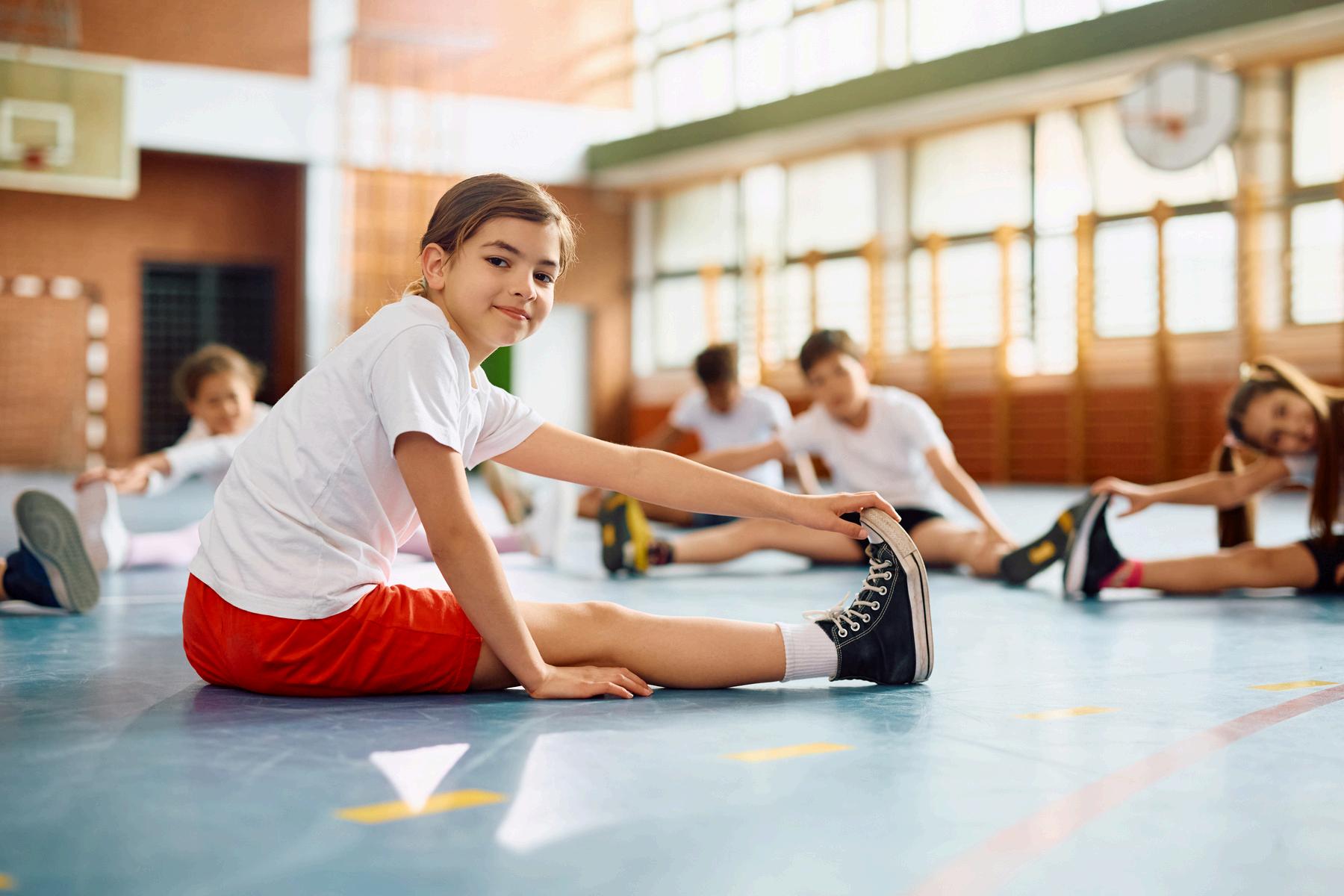
2.3.2.d The teacher teaches, demonstrates, and reinforces safe stretching principles (e.g., no bouncing, hold 15-30 seconds, breathe normally).
Practice
2.4.1 The teacher plans for skill and concept instruction and provides adequate time for practice, skill development and feedback based on appropriate skill analysis.
2.4.1.a Daily lesson objectives include both skill execution (e.g., dribbling, serving, striking) and conceptual understanding (e.g., offensive/defensive strategies, principles of movement).
2.4.1.b Practice time is maximized by minimizing wait time and ensuring active participation (See 2.5).
2.4.1.c The teacher anticipates common errors and is prepared to provide feedback to enhance skill development (See 2.9).
2.4.1.d The teacher has assessment tools developed and ready for use during lessons to provide the appropriate type of feedback (See 4.1 and 4.2).
2.4.2 Lessons are planned to provide multiple opportunities for students to develop, revisit, and refine skill and concept competencies within and across units, ensuring growth and readiness over time. Teachers implement a variety of age-appropriate units of sufficient length for students, designed to build competencies from year to year progressively. The majority of class time is devoted to content-specific tasks within the domains, with intentional design for moderate-tovigorous activities included in each lesson
2.4.2.a Instructional tasks are developmentally appropriate and intentionally sequenced to support growth over multiple years.
2.4.2.b The teacher plans lessons so that skills are progressed sequentially from simple to more complex over time such as introducing proper jumping and landing and balancing skills on the floor prior to introducing skills on elevated equipment like benches and balance beams to promote growth and readiness.
2.4.2.c Students are provided multiple practice opportunities in varied contexts (e.g., individual drills, partner practice, small-sided games).
2.4.2.d Students demonstrate growth over time through revisiting and refining previously taught skills and concepts.
2.4.2.e When considering unit and lesson plans across the full year, the teacher plans for at least 50% of cumulative class time to involve student activity within moderate-to-vigorous physical activity. This is not per class to allow for teaching skills such as archery, golf, throwing and catching which may not be as vigorous beyond the warm-up, while during other skills such as invasion games, fitness, and competitions, students may be more vigorously engaged for more of the class time (See 2.3.1 for overall class design).
Practice
2.5.1 Teachers organize their classes to maximize opportunities for all students to learn and be physically active. Enough equipment is provided so that students spend virtually no time waiting for turns or standing in lines.
2.5.1.a The teacher uses small-sided games (see 2.5.2) or station/circuit formats to increase participation and reduce downtime.
2.5.1.b Each student has access to the necessary equipment to allow simultaneous participation by all (e.g., one ball per student during dribbling practice).
2.5.1.c The teacher provides access to modified equipment (e.g., foam balls, cones, resistance bands) so that all students can actively participate, regardless of their skill level.
2.5.1.d Avoid elimination games or long waiting lines by modifying traditional activities (e.g., small-sided games, rotating groups).
2.5.1.e When students are in lines, the teacher includes activities to do while waiting (e.g. body weight exercises, static skill development, cognitive analysis of a peer, cognitive work related to the activity).
2.5.2 The teacher uses small-sided games (1 v 1, 2 v 2, etc.) or lead-up activities/games to allow students ample opportunity to participate.
2.5.2.a The teacher creates a simplified version of traditional games during skill-focused activities to keep groups small and ensure all students are involved (e.g., “keep-away” for passing, “king of the court” for net games).
2.5.2.b The teacher integrates modified rules (e.g., ball must be passed three times before a shot on goal, creating smaller goals, shorter distances, no dribbling) to emphasize specific skills.
2.5.2.c The teacher incorporates cooperative lead-up games that prioritize teamwork, communication, and problem-solving such as having partners working at a net to have the longest rally as opposed to playing against each other for single points.
Practice
2.6.1 The teacher uses a variety of teaching styles to provide for students’ success, depending on lesson objectives and content and students’ varied learning needs.
2.6.1.a Direct Instruction: The teacher demonstrates proper technique and provides clear, step-by-step guidance (e.g., skill demonstrations in volleyball serving). This is useful for introducing new skills or safety procedures.
2.6.1.b Guided Discovery: The teacher poses movement challenges or problem-solving tasks (e.g., “Find three different ways to move across the gym without using your feet”). This style encourages creativity, critical thinking, and exploration.
2.6.1.c Cooperative Learning: Students work in pairs or small groups to practice skills and provide peer feedback (e.g., partner passing drills in soccer). This style builds communication and teamwork skills.
2.6.1.d Station or Task Teaching: Multiple skill stations set up (e.g., fitness circuit, basketball shooting, dribbling, defense footwork) so students rotate and practice a variety of tasks. This style maximizes practice opportunities and differentiates instruction.
2.6.1.e Reciprocal/Peer Teaching: Students work in assigned pairs: one performs while the other observes using a teacher-provided checklist or rubric, then they switch roles. This style promotes accountability and deeper understanding.
2.6.2 The teacher allows students guided choices in matters such as equipment, rule modification, or type of skill practice.
2.6.1.f Self-Check/Individualized Practice: Students assess their own performance against criteria (e.g., heart rate monitoring, skill checklists). This style supports self-directed learning and goal-setting.
2.6.1.g Divergent Discovery/Student-Centered Learning: Provide challenges with multiple possible solutions (e.g., “Find three different ways to successfully keep the ball in play with your partner”). This strategy allows students to design movement patterns, offensive plays, or new game variations that meet learning objectives.
2.6.2.a The teacher provides a variety of options for equipment, and students select appropriately sized balls, racquets, or jump ropes to match their skill level and comfort.
2.6.2.b After ensuring all students have basic control and understanding of skills, they are invited to adjust game rules (e.g., reducing playing space, altering scoring systems, limiting dribbles in basketball) to match their skill level or group needs while the teacher guides modifications to maintain fairness, safety, and instructional intent.
2.6.2.c The teacher develops different task sheets or skill drills targeting the same objective (e.g., practicing chest passes, bounce passes, or overhead passes in basketball), and students are allowed to choose their activity.
2.6.2.d Students design a new game or variation of an activity, applying rules, equipment, and strategies; the teacher facilitates reflection and discussion on how modifications impact skill practice and game play.
2.6.3 The teacher emphasizes rigor, critical-thinking, and problemsolving strategies by using higher-order questions, student-centered teaching styles, and purposeful student discussion.
2.6.3.a The teacher poses open-ended questions that require analysis and decision-making (e.g., “How can you adjust your defensive strategy if your opponent is faster than you?”).
2.6.3.b Students are encouraged to compare, evaluate, and justify choices in skill application or game strategies as the teacher uses reflective prompts at lesson closure (e.g., “What worked best for your team today, and why?”).
2.6.3.c The teacher uses student-centered teaching styles. (See 2.6.1b-g).
2.6.3.d Students are challenged to analyze how different training methods affect performance and fitness outcomes such as applying principles of biomechanics or energy systems to improve skill efficiency.
Practice
2.7.1 Students practice skills at high rates of success adjusted for individual skill levels within a “Try again; mistakes are okay” learning environment.
Examples/Suggestions for Implementation
2.7.1.a Teachers use observations of student success rate during tasks to make adjustments to instruction or tasks for the whole class and for individuals.
2.7.1.b Teachers modify activities by adjusting equipment (e.g., larger or lighter balls, lowered nets) to support varying ability levels.
2.7.1.c The teacher uses specific, constructive feedback (e.g., “Great follow-through now try stepping forward with your opposite foot”).
2.7.1.d Mistakes are framed as opportunities to learn rather than failures. The teacher models resilience by demonstrating skills, intentionally making errors, and showing how to self-correct.
2.7.1.e Students are given multiple, repeated opportunities to practice each skill in varied contexts (e.g., drills, small-sided games, stations).
Practice
2.8.1 The teacher utilizes appropriate feedback techniques to enhance student learning on a consistent basis.
Examples/Suggestions for Implementation
2.8.1.a The teacher reinforces effort and appropriate performance with encouraging language (e.g., “Great hustle to get into position!”) and recognizes incremental improvement to build confidence and motivation.
2.8.1.b The teacher uses precise instructional cues tied to performance criteria (e.g., “Snap your wrist at the top of your volleyball serve” instead of “Good job”).
2.8.1.c The teacher circulates during practice and ensures every student receives feedback multiple times per lesson.
2.8.1.d Individual, group, and whole-class feedback are used as appropriate.
2.8.1.e The teacher combines verbal cues, visual demonstrations, and physical prompts (when appropriate) to enhance understanding.
2.8.1.f The teacher provides opportunities for feedback from peers.
2.8.1.g Different types of feedback are used based on the situation (e.g. general, specific, positive, corrective, evaluative, congruent, individual, whole-class).
Practice Examples/Suggestions for Implementation
2.9.1 The teacher includes technology to enhance the lesson’s effectiveness when available.
2.9.1.a The teacher refers to SHAPE America’s Appropriate Use of Technology in Physical Education document to guide their use of technology and ensure it is enhancing students’ learning as opposed to distracting from learning.
2.9.1.b The teacher uses a projector or large display screen to show lesson objectives, diagrams, and visuals (e.g., GIFs, video clips) for clarity.
2.9.1.c The teacher integrates mobile apps for video skill analysis and allowing students to watch and reflect on their performance.
2.9.1.d The teacher integrates heart rate monitors, pedometers, or fitness apps to track student activity levels and effort and displays realtime activity data to encourage accountability and motivation.
2.9.1.e The teacher provides QR codes linking to video tutorials or task cards for station-based learning, and students are permitted to use devices to research strategies, create short demo videos, or design modified games.
2.9.1.f The teacher incorporates interactive polling or quiz platforms (e.g., Kahoot, Quizizz) to reinforce concept understanding.
Practice
3.1.1 The physical education curriculum has a clearly stated scope and sequence based on goals and objectives that are developmentally appropriate for all students and that are derived from national or state standards.
3.1.1.a The physical education curriculum is mapped with ageappropriate developmental goals and objectives, ensuring a balanced variety of activities beyond the teacher’s personal preferences, all aligned to national and/or state standards.
3.1.1.b A middle or high school PE program rotates through units in yoga, pickleball, cycling, strength training, and outdoor education alongside traditional sports, ensuring exposure to both team-based and lifelong activities.
3.1.2 The teacher designs developmentally appropriate lessons that build students’ fundamental motor skills, integrate physiological and biomechanical concepts, and promote health-enhancing physical activities, applying them across diverse settings to foster lifelong physical activity and ensure success for all students.
3.1.2.a The teacher provides extension and/or refinement tasks that build on fundamental motor skills to work toward application in specific activities/sports.
3.1.2.b A lesson on overhand throwing includes demonstrations of proper arm mechanics. Students practice overhand throws, and the teacher discusses how body alignment affects accuracy and safety.
3.1.2.c The teacher selects learning activities that are developmentally appropriate. For example, teaching the underhand serve, rather than the jump serve, to sixth-graders in volleyball.
3.1.3 Instruction follows a scope and sequence that is designed to scaffold prior learning and develop mature forms of skills and strategies.
3.1.3.a In a dance unit, students learn basic steps and rhythms, then gradually combine them into more complex sequences, eventually performing choreographed routines that integrate timing, spacing, and expression.
3.1.4 Teachers design developmentally appropriate lessons and progressions that can be adapted for different classes and grade levels, allowing students to build on previously learned content and skills, apply them across multiple activities, and gain proficiency in lifetime physical activities as they get older.
3.1.4.a Instruction varies, allowing all students to build on previously learned skills and experience new challenges appropriate to their growth. For example, a class might focus on basic dribbling and passing skills in basketball, while the following year, they revisit these skills in more complex game scenarios, introducing strategy.
3.1.4.b Teachers intentionally vertically align learning experiences for K-12. For example, designing a developmentally appropriate unit on striking skills (e.g., tennis, pickleball, or badminton) might begin in the lower grades by teaching basic hand-eye coordination using balloons or foam paddles. Students practice striking stationary objects, focusing on control and consistency. As students progress to middle school, the teacher introduces moving targets, rallies, and basic rules of net games, helping students apply the fundamental skills they learned earlier to more dynamic situations. In high school, the teacher expands the lesson sequence to include game strategies, scoring systems, and peer officiating, allowing students to demonstrate both skill proficiency and tactical understanding.
3.1.5 When two or more physical educators are working together: Teachers use team or collaborative teaching strategies to provide more activity options and enhance individual feedback.
3.1.5.a During a unit on basketball, two teachers co-teach the class. One teacher leads skill stations focusing on dribbling and passing, while the other circulates to give individualized feedback and correct technique.
3.1.5.b Teachers provide options to practice similar skills/concepts. For example, one teacher could work with students in a basketball context while another works in a handball context.
3.1.6 Rhythmic activities and dance: The teacher includes a variety of rhythmic, expressive, creative, and culturally enriching dance experiences designed with students’ physical, cultural, emotional, and social abilities in mind.
3.1.6.a The teacher introduces students to hip-hop, salsa, and traditional African dance. Students first learn basic steps individually, then in small groups, creating short routines that reflect their cultural backgrounds and personal creativity.
3.1.6.b The teacher modifies movements for students with differing physical abilities and encourages expressive interpretation, fostering both social interaction and confidence while respecting each student’s cultural and emotional comfort level.
3.1.7 Games and sports instruction: Teachers select, design, sequence, and modify games, sports, and activities to enhance motor skills, fitness, and tactical understanding, while also promoting social skills, personal connections, and lifetime physical pursuits. There are clear distinctions between physical education classes and athletic practices.
3.1.7.a For example, in a small-sided soccer game: rules are adjusted to give every student more ball touches; students rotate positions; and the teacher provides feedback to develop skills, tactical understanding, and teamwork, promoting lifelong physical activity.
3.1.7.b Physical education classes are open and engaging to all students, not just members of school sports teams.
3.1.8 Educational gymnastics: Lessons develop skills appropriate to students’ abilities and confidence in balancing, rolling, jumping and landing, climbing and transferring weight. Students practice on equipment designed to match their gymnastic abilities and confidence.
3.1.8.a Students rotate through stations with mats, balance beams, and low climbing structures. Each station is adapted to students’ abilities.
3.1.8.b Beginners practice basic rolls and balance exercises on low beams, while more advanced students work on controlled jumps and weight transfers.
3.1.8.c The teacher provides guidance and feedback, ensuring all students build confidence, coordination, and safe movement skills.
3.2 Concept Knowledge
3.2.1 Developmentally appropriate strategies, tactics, exercise science, skill analysis using critical-element cues, and fitness concepts are included throughout the curriculum.
3.2.1.a During a volleyball unit, the teacher demonstrates proper serving technique using critical-element cues. Students practice in small groups while receiving feedback on form, then apply strategies and tactics in mini-games.
3.2.1.b Before a throwing and catching lesson, students complete a five-minute warm-up that targets the shoulders, arms, and upper back. These exercises prepare the muscles for accurate throws and secure catches, reinforcing the connection between fitness and skill performance.
3.2.2 Students are educated to make informed choices about fitness, wellness, and nutrition as they relate to physical activity and performance.
3.2.2.a Teachers connect physical education lessons to real-life wellness by introducing students to local fitness centers, community sports leagues, or wellness programs and then explaining how to access them.
3.2.2.b Teachers go beyond an overview of dietary guidelines by guiding students to create a personal nutrition plan or meal choices that reflect the USDA recommendations.
3.2.2.c Teachers teach students how to evaluate and select qualified personal trainers or fitness professionals, providing criteria and resources for making informed decisions.
Practice Examples/Suggestions for Implementation
3.3.1 The teacher extends experiences from in-class activity lessons to community and family activities, promoting a physically active lifestyle.
3.3.1.a Teachers provide information about local parks, recreational programs, and sports or fitness organizations that align with content learned in class.
3.3.1.b Students are encouraged to participate in family or community physical activities that reinforce concepts and skills from class. For example, practicing throwing skills with a parent or sibling; working on free-throw shooting at home or community center with a friend/classmate; developing a dance routine.
3.3.1.c Lessons include projects or assignments that connect students with community resources. For example: attending a local fitness event, using recreational facilities, or exploring a local park.
Practice
3.4.1 Fitness activities focus on health- and skill-related components while skill-related components are emphasized in relation to skill development. Fitness education is intentionally infused into a variety of activities and movement experiences, allowing students to analyze and apply each health- and skill-related fitness component, understand its connections to skill development, and relate it to multiple areas of instruction and everyday life.
Examples/Suggestions for Implementation
3.4.1.a Physical fitness instruction includes structured, varied activities that engage students in meaningful skill and health development rather than repetitive mass exercises. For example, the teacher integrates balance while practicing set shooting in basketball; students develop and perform activities that integrate skill development and fitness.
3.4.1.b Fitness activities are purposeful and connected to lifelong learning benefits. For example, students participate in (middle school) and create (high school) circuit training that combines cardiovascular, agility, strength, power, and flexibility exercises, while discussing how each activity supports long-term health, energy, and daily functional fitness.
3.4.1.c Students learn the components of skill-related fitness (agility, balance, coordination, speed, reaction time, and power) and healthrelated fitness (cardiovascular endurance, muscular strength, muscular endurance, flexibility, and body composition) and are instructed in ways to develop each.
3.4.1.d Training principles (e.g., FITT, overload, progression) are taught and applied to the development of health- and skill-related components of fitness.
3.4.2 The teacher helps students understand and use assessment data to set short- and long-term goals and develop a personal fitness plan.
3.4.2.a Assessment data is applied to design personalized fitness plans that support each student’s growth in health-related and skill-related components of fitness (middle school/high school).
3.4.2.b Teachers help students use fitness assessment results to set individualized SMART goals (high school).
Practice
3.5.1 Teachers intentionally design activities that allow students opportunities to work together for the purpose of developing social skills and learning responsible behavior. Situations are designed purposefully for teaching these skills as opposed to leaving them for “teachable moments” only. Instructional strategies are reinforced across multiple learning contexts.
3.5.1.a Instruction incorporates strategies such as student choice of equipment, peer teaching, group work, and class involvement in establishing rules to foster cooperation, personal responsibility, and social skill development. For example, the teacher allows students to pick the size and color of their hula-hoop (elementary); create activities to practice a specific skill (middle school); and select activity/skill for development (high school).
3.5.1.b Teachers intentionally develop students’ social and affective skills, rather than assuming these skills will emerge automatically through participation. For example, a teacher may structure cooperative games that require communication, turn-taking, and conflict resolution (elementary); explicitly reflect with students on how these skills were applied and can be transferred to other settings (middle school); and discuss with students how these behaviors will impact their social interaction in physical activity and otherwise (high school).
3.5.1.c Teachers provide explicit instruction and guidance to help students build a repertoire of social and affective skills and assign leadership roles to students of varying abilities to promote inclusion and collaboration. For example, the teacher randomly selects student(s) as helper(s) (elementary); selects students to peer/group teach (middle school); assigns refereeing and coaching roles to specific students (high school).
Practice
3.6.1 Teachers provide opportunities for students to experience satisfaction and joy from regular participation in physical activity.
3.6.1.a Teachers provide practice opportunities for students to master skills and apply them in dynamic contexts. For example, after mastering fundamental motor skills, students develop a routine to perform them (elementary); after mastering backhand throwing, students play a modified Ultimate Frisbee game (middle school); students go on a hike at the local park to apply hiking skills (high school).
3.6.1.b Teachers create an inclusive and supportive environment where all students have opportunities to participate in and enjoy physical activity. For example, the teacher lets each student choose what ball to use when working on underhand throwing (elementary); students present a non-traditional cultural activity to their peers (middle school); in a Sport Education model, the teacher might assign students to different team roles such player, coach, referee, or statistician rotating these roles throughout a season so every student can actively participate, contribute, and enjoy the experience (high school).
3.6.1.c Lessons are structured to provide reflection (e.g., they do not use physical activity as punishment) that fosters students’ appreciation for the benefits and enjoyment of lifelong physical activity. For example, the teacher discusses with students the benefits of playing with friends (elementary); how participation in physical activity helps students develop their health (middle school); and how students may select activities that will address their personal needs (high school).
3.6.2 Teachers help students understand that moderate-to-vigorous physical activity can be planned or spontaneous within our day in many ways.
3.6.2.a The teacher points out opportunities at the school for before-, during-, and after-school activities that increase heart rate or make students breathe hard, such as playing with a sibling or friends at home (elementary), biking with friends in the neighborhood (middle school), or jogging at the local park (high school).
Practice
3.7.1 Teachers connect physical education concepts with concepts from other disciplines such as literacy, STEAM, and social studies to enhance students’ physical literacy journey.
Examples/Suggestions for Implementation
3.7.1.a The teacher creates a worksheet where students must calculate their scores [using math skills] according to the targets students hit when kicking a soccer ball (elementary).
3.7.1.b The teacher discusses the physical measurements of the basketball court [geometry] and ties in concepts of force [physics] when teaching the free throw (middle school).
3.7.1 c The teacher discusses how students generate force [physics] by performing the critical elements when throwing a baseball, including torque and velocity concepts (high school).
3.7.1.d The history and cultural roles of activities are discussed (e.g., golf originated in Scotland [history], which is located here on the map [geography]; tennis in France where is that? Futsal in Uruguay where is that?)
Practice
3.8.1 Teachers plan events so every student participates fully and derives satisfaction and joy from a festival of physical activity linked to the physical education program.
Examples/Suggestions for Implementation
3.8.1.a The teacher organizes a field day with activities like relays, obstacle courses, and target games, all modified for varying skill levels. Recognition is given for effort, teamwork, and participation, ensuring every student enjoys and fully engages in the event.
3.8.1.b The teacher may organize an “active schools festival” at the end of a fitness or movement unit. Instead of hosting a competitive tournament, the teacher creates a variety of stations that highlight the skills students have learned throughout the year, such as jump rope challenges, scooter relays, cooperative parachute games, dance activities, and target throwing stations. Students rotate through these activities in small, mixed-ability groups, ensuring that everyone participates at their own comfort level. Teachers and student leaders encourage effort and teamwork rather than emphasizing winning or rankings.
3.8.1.c Students are given opportunities to choose some activities, set personal goals (such as number of jumps or laps), and celebrate their achievements with peers. Music, positive reinforcement, and a festive atmosphere contribute to a sense of fun and belonging. By designing the event around participation and personal success, rather than competition, the PE teacher ensures that every student regardless of skill level — feels included, accomplished, and connected to the physical education program.
Practice Examples/Suggestions for Implementation
4.1.1 Formative and summative assessments constitute ongoing and integral parts of the learning process for all students, including those with disabilities.
4.1.1.a Assess state/national standards/objectives.
4.1.1.b Formative assessment is consistent and utilized for teacher reflection during and after class to alter instruction and plan next steps.
4.1.1.c Summative assessments are conducted mid- or end-ofsemester to allow the teacher to reflect on changes in alignment and instructional programming.
Practice Examples/Suggestions for Implementation
4.2.1 Teachers systematically teach and assess all domains (psychomotor, cognitive, social, and affective) using a variety of assessment techniques.
4.2.1.a Teachers can assess student learning by utilizing a variety of techniques, such as rating scales and checklists to score psychomotor skills and technique; quizzes or strategic diagrams to evaluate cognitive knowledge of rules, strategy, and fitness concepts; and exit tickets and reflection journals to gauge social and affective qualities like effort, sports personship, and value for activity.
4.2.1.b Self-, peer-, and teacher-given assessment opportunities are implemented.
4.2.2 Assessments include clearly defined criteria that are articulated and demonstrated to students as part of instruction before the assessment
4.2.1.c The teacher is aware of and follows the district and state policies regarding assessment.
4.2.2.a The rubric is provided to students and clearly explained during instructions.
Practice Examples/Suggestions for Implementation
4.3.1 Teachers use fitness assessment as part of the ongoing process of helping students understand, enjoy, improve, and/or maintain their physical fitness and well-being
4.3.2 Students are physically prepared in each fitness component so they can complete the assessments safely.
4.3.1.a After assessments, students are taught how to set goals for improvement that are revisited during the school year.
4.3.1.b Teachers give students proper notice of when fitness testing will occur.
4.3.2.a Teachers must design the curriculum to teach and practice each fitness component using progressively challenging exercises and focusing on safe and correct technique before formal testing occurs. Examples could include dynamic warm-ups, fitness stations, circuit training, fitness games, etc.
Practice
4.4.1 Teachers make every effort to create testing situations that are private, non-threatening, educational, and encouraging.
Examples/Suggestions for Implementation
4.4.1.a The teacher explains what the test is designed to measure and makes accommodations or modifications when appropriate.
4.4.1.b The teacher creates a supportive environment by encouraging cheering for peers during their participation and high-fiving them when they have completed their assessment.
4.4.2 Teachers encourage students to avoid comparisons with others and, instead, use testing results as a catalyst for personal improvement.
4.4.1.c The teacher has students facing away from one another during the curl-up test to avoid having them feel like everyone is watching them.
4.2.2.a Teachers require students to set SMART goals (specific, measurable, achievable, relevant, time-bound) based on their own previous performance (pre-test data). Students use private fitness portfolios or journals to track progress, ensuring only the student and teacher view the data, thereby eliminating public peer comparison.
4.2.2.b Teachers use tools like reflection worksheets with prompts that encourage students to analyze their current results only against their past results. Teachers provide individualized written feedback that focuses on the student’s progress and offers next steps for personal growth, rather than comparing them to class averages.
Practice
4.5.1 Test results are shared privately with students and their guardians as a tool for developing personal goals and strategies for maintaining and increasing the respective fitness components.
Examples/Suggestions
4.5.1.a Teachers could utilize a secure digital platform (e.g., student portal or LMS) where only the student and parent/guardian have access, or distribute a sealed, individualized printout directly to the student for home delivery.
4.5.2 The teacher provides regular reports of student progress to students and guardians using a variety of continuous formative evaluations and assessments.
4.5.2.a The teacher sends students home with heart rate monitor printouts, step sheets, or dance performance rubrics that show what the student did during physical education.
Practice
4.6.1 Grades are based on thoughtfully identified components that are aligned with course goals and state/national standards.
4.6.2 Teachers describe to students the components of and criteria included in their grade, and the rationale for each.
Practice
4.7.1 Data on student achievement is used to evaluate program effectiveness on a regular basis.
Examples/Suggestions for Implementation
4.6.1.a Psychomotor skills and fitness grades are based on objective rubrics to assess skill technique (e.g., throwing form) and scores that measure personal improvement on fitness components (e.g., pacer test, push-ups).
4.6.1.b Cognitive knowledge and strategy grades are based on quizzes, strategic diagrams, and written plans (e.g., personal fitness goals). This verifies students can apply knowledge to make informed decisions about movement, health, and tactics.
4.6.1.c Social and affective behavior grades are based on observable criteria such as effort, cooperation, and sports personship, often using teacher observation and peer assessments.
4.6.2.a Teachers create and provide students with a syllabus as a formal document that clearly describes the grade components, criteria, and connection to the academic standards, ensuring transparency and alignment with course goals.
Examples/Suggestions for Implementation
4.7.1.a At the end of each unit, the teacher sets aside time to formally reflect on assessment data gathered on the standards-based student learning outcomes and the effectiveness of what was taught and how it was presented.
4.7.1.b The teacher collaborates with a peer to get an outside perspective on data and practices.
4.7.2 Teachers use assessment tools such as PECAT, SHAPE America’s Physical Education Program Checklist, and WSCC (Whole School, Whole Community, Whole Child) to evaluate program effectiveness on a regular basis and implement changes based on data.
4.7.2.a Use PECAT data to pinpoint areas where the curriculum is weak (e.g., lacking in cognitive instruction or social/affective learning objectives) and target those areas for revision. For example, if the data shows a low score in “Health-Related Fitness Knowledge,” the teacher implements a personal fitness planning unit to address the cognitive gap.
4.7.2.b If the SHAPE America Physical Education Program Checklist reveals that students are receiving less than the recommended instructional time, the teacher uses the data to advocate for schedule changes.
4.7.2.c If WSCC review shows students are sedentary during classroom transition time, the physical education teacher can collaborate with teachers to implement “brain break” activities and transitions learned in physical education, thus supporting the “Physical Activity” component of the WSCC model.
Practice
5.1.1 The teacher continually seeks new information to stay current and affirm students’ culturally diverse identities.
Examples/Suggestions for Implementation
5.1.1.a The teacher implements instructional practices that reflect students’ community dynamics, reads journals, attends conferences, and attends in-services
5.1.1.b The teacher regularly engages in professional development (PD) to learn about new teaching methodologies, movement patterns, and effective assessment techniques.
Practice
5.2.1 The teacher is the physical activity expert and helps facilitate movement opportunities with the school. Physical education is a valued part of the school curriculum and the teacher advocates for quality physical activity opportunities for students.
Examples/Suggestions for Implementation
5.2.1.a The teacher shares resources and provides support to classroom teachers related to integrating movement into academic content.
5.2.1.b The teacher showcases student achievement and upcoming physical activity opportunities with administrators and parents through newsletters, school websites, or open-house demonstrations.
5.2.1.c The teacher models active behavior by consistently being seen engaging in physical activity, such as leading a walking group during breaks, participating in school events, or greeting students while actively moving in the gym.
Practice
5.3.1 The teacher informs guardians, administrators, and the public regularly about culturally relevant physical education program goals and activities.
Examples/Suggestions
5.3.1.a The teacher promotes public awareness by addressing students’ diversity, equity, and inclusion in physical education.
5.3.1.b The teacher provides dates on the school website related to upcoming units, including games and activities from different countries.
5.3.1.c The teacher hangs signage throughout the public spaces in the school that celebrate countries represented during a Sport Education unit
5.3.2 The teacher helps create a school culture of physical activity by celebrating students’ community dynamics that influence learning.
5.3.3 The teacher promotes physical activity inside and outside of physical education through the components of CSPAP, creating a positive, active environment for students to engage in.
5.3.2.a The teacher affirms all students’ culturally diverse identities and accommodates their diverse needs and perspectives in the learning environment.
5.3.2.b The teacher creates space where all students bring their prior knowledge to the learning context through being themselves and living their lives in and beyond the classroom.
5.3.3.a The teacher makes lessons engaging and ensures students achieve moderate-to-vigorous physical activity time during class. They teach transferable skills and strategies to encourage lifelong activity.
5.3.3.b The teacher organizes, sponsors, or promotes intramural sports, fitness clubs (e.g., running club, yoga club), or active games time (e.g., open gym) outside of regular school hours. They may also coach interscholastic sports.
5.3.3.c The teacher acts as a consultant to supervise recess staff or classroom teachers, helping them organize structured, engaging games that maximize activity time and minimize conflict.
5.3.4 The teacher advocates to stakeholders (students, administrators, colleagues, parents, community members) to provide students with instructional physical education time in line with SHAPE America and the CDC recommendations.
5.3.3.d The teacher champions staff wellness by organizing or leading physical activities for colleagues (e.g., staff walking challenges, afterschool fitness classes).
5.3.3.e The teacher organizes Family Fitness Nights, “Walk to School” days, or coordinates with community organizations (e.g., local parks department, youth sports leagues) to provide students and families with information and resources for local physical activity opportunities.
5.3.4.a The teacher can present data to administrators that connects increased instructional physical education time (SHAPE America recommendation: 150 minutes/week for elementary; 225 minutes/week for secondary) to improved academic outcomes (e.g., test scores, focus) and attendance.
5.3.4.b The teacher could build cross-curricular support for colleagues by demonstrating how structured physical education time provides a necessary physical and cognitive break that improves student focus and readiness to learn in core academic subjects.
5.3.4.c The teacher can share health outcome statistics (e.g., trends in youth inactivity or mental health) with parents/guardians to emphasize that required instructional physical education time is the only reliable way to ensure their child receives adequate structured physical activity and health education necessary for lifelong wellness and development.
5.3.4.d The teacher could highlight the personal benefits of the physical education curriculum and explain to students that increased physical education time directly reduces stress, improves mood, and teaches lifelong, transferable movement skills and healthy habits they will use as adults.
5.3.4.e The teacher can frame quality physical education as an investment in the local community’s future health and workforce to community members. They can also advocate that ensuring students develop active, healthy habits in school reduces future public healthcare burdens and cultivates more productive, healthy citizens.
Suggested Citation:
Society of Health and Physical Educators (SHAPE America) (2026). Appropriate Instructional Practice Guidelines for K-12 Physical Education [Guidance Document]. Annapolis Junction, MD: Author
Standard 1: Develops a variety of motor skills.
Standard 2: Applies knowledge related to movement and fitness concepts.
Standard 3: Develops social skills through movement.
Standard 4: Develops personal skills, identifies personal benefits of movement, and chooses to engage in physical activity.
Learn more about SHAPE America’s National Physical Education Standards >>