AWARE Garrett Seminary
Winter 2025
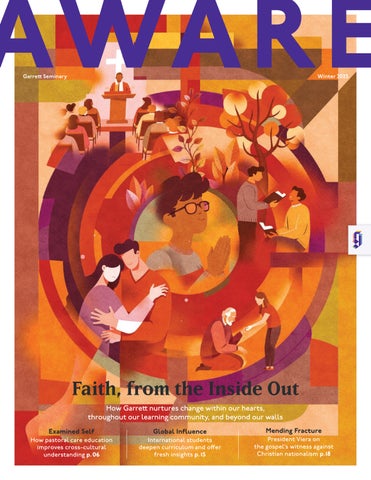
Faith, from the Inside Out How Garrett nurtures change within our hearts, throughout our learning community, and beyond our walls Examined Self
Global Influence
Mending Fracture
How pastoral care education improves cross-cultural understanding p. 06
International students deepen curriculum and offer fresh insights p. 15
President Viera on the gospel’s witness against Christian nationalism p. 18
contents
Garrett the
Collective
Whoever you are, wherever you go. Theological education for all.
aware magazine | winter 2025
Liturgy for the First Sunday in Advent
Orders of Worship for Lay Leaders
pg 20
A prayer calling for the church to proclaim that Black Lives Matter
Liberating Theologies: Hope, Imagination, and Resisting Otherwise
While Waiting for A Diagnosis
A Prayer for Discerning the Spirit.
Coming January 21. See a sneak peek at Collective Advent resources
AWA R E | Winter 2025
garrett seminary
02
On the Cover:
Illustration by Alberto Espi.
For the thriving of the church and the healing of the world, make a gift today!
Aware magazine is published biannually by the offices of development and marketing and communications for alums and friends of Garrett-Evangelical Theological Seminary, a graduate school of theology related to The United Methodist Church with an ecumenical outreach.
Feedback and comments for the Aware editorial board should be directed to seminary.relations@Garrett.edu All stories and photos are the property of Garrett-Evangelical Theological Seminary and may not be used without permission. Copyright © 2025 Garrett -Evangelical Theological Seminary. All rights reserved.
03
Presidential Perspective
04
Love Your Neighbor Well
06
Care is Contextual
07
Invisible Mask
10
Learn from Your Neighbor’s Wisdom
14
Serving Classes, Church, and Culture
15
Learning Beyond Borders
16
Build a Better World in which Your Neighbor Can Live
17
From Exchange to Co-Creation
18
Unwinding Empire
20
Love Breaks Every Barrier
21
Lighting the Path to Seminary
22
Alum Notes
23
In Memoriam
Love invites us within and beyond ourselves
PHOTO BY BRIAN MCCONKEY
I
t may sound trite to say, but we are living through a leadership crisis. Cultural institutions are faltering. Glib aphorisms and base antagonism masquerade as wisdom. Neighbors go hungry because our congressional leaders can’t agree on even baseline measures to keep the government open. These aren’t just failures of policy or personality—they reveal a deeper confusion about what ethical power is, what kind of people we should become, and which values should shape our common life. For a seminary like Garrett, these questions strike at the heart of our mission. As a school formed in the way of Jesus, we are called not only to critique the failures of leadership that surround us, but to nurture an alternative— leaders who embody compassion, courage, and a profound sense of interdependence. How do we prepare such leaders? What commitments do our graduates carry into a world so desperately in need of healing? This issue of Aware explores these very questions. It’s organized around three movements of the Spirit that flow through Garrett’s life together: faith
that cultivates self-knowledge within us, belonging among us, and transformation beyond us. Each story reveals how the work of formation ripples outward into communities of compassion and service. Against a broader culture that’s deafened by the chorus of “What’s in it for me?” our community is asking the biblical question: “How can I love my neighbor well?” This charge begins in rigorous self-reflection. Our master’s program in pastoral care and counseling—now our fastest-growing program—offers a window into this dynamic. Its traumainformed approach to care teaches students to see beneath symptoms to the systems that perpetuate suffering. Even those who are not pursuing chaplaincy or clinical counseling find in this work a deepened awareness of how to lead with empathy and accountability. In classrooms alive with geographic, ethnic, and theological diversity, students learn to love people as they are—to meet them with cultural humility and theological imagination. It is a wondrous gift to live in a community of people who ask these questions of themselves and one
Blessings from our family to yours,
The Reverend Dr. Javier Viera President
03 garrett seminary
Nurturing the Many Faces of God
another. That inward discipline of reflection and care gives our students and faculty the clarity and courage to navigate complex realities without being consumed by ego or fear. It is what allows them to innovate with purpose— to take risks grounded in responsibility to the larger human story. Here, faith and understanding cross-pollinate, and learning itself becomes a sacred act of building a more just and hopeful world. The fruits of that formation are visible far beyond our walls. Our alumni lead congregations, nonprofits, movements, and classrooms that embody love as a public ethic. Our donors and friends make this possible—those who give time, wisdom, and treasure—because they believe that leadership shaped by love can heal a fractured culture. Through your support, Garrett builds partnerships that move decoloniality from theory into practice, confront abusive power with prophetic courage, and resource communities pursuing justice and joy. This is how we measure leadership: by how moral imagination, social consciousness, and spiritual depth ripple outward into the world. Rooted in self-understanding, sustained through collaboration, we labor for the thriving of the church and the healing of the world. May this issue remind you of the sacred work you share in—and inspire you to deepen that partnership as together we nurture the many faces of God in our time.
aware magazine | winter 2025
presidential perspective
inside us
garrett seminary
04
LOVE YOUR NEIGHBOR WELL
We cannot provide meaningful compassion if we do not know the people to whom we minister
E
ffective care weds intimate self-knowledge, psychological research, and cultural understanding. It’s rare to find an instructor who excels at all dimensions to this calling. The Rev. Dr. Esther Acolatse, Garrett’s Harry R. Kendall Professor of Practical Theology and World Christianity, brings a holistic vision—one that draws just as readily from cutting-edge studies as it does ancestral wisdom. Ph.D. student Charles Adonteng, who
studies with Dr. Acolatse as his advisor, says this approach invites learners to bring all of themselves into the classroom. “I have not only observed her unique and expansive teaching, which includes perspectives from marginalized communities, especially from African cultures, but I have also experienced the pastoral care environment she co-creates with her students in the classroom,” says Adonteng. “This environment makes the learning space
Aware Magazine (AM): Why is theology important when understanding care? Dr. Esther Acolatse (EA): We all have faith enough. People may say they don’t believe in spirits, principalities and powers, outside things that control us, but we give ourselves every day to invisible forces, let them intrude in our lives. We have driverless cars! People are primed to believe that something higher than them is responsible for their care. There’s always that tacit dimension, an assumption in a symbiotic relationship with beings we cannot see. Erikkson puts it well when he starts his psychosocial development with navigating trust versus mistrust, making hope the linchpin rather than despair. If you navigate trust versus mistrust well enough, what you get is hope. That is what unlocks all the other developmental trajectories—they depend on hope in this transcendent other. This notion was always among humans until the Enlightenment. We all had an idea of a spiritual presence that we assumed real in our physical life. Coming from that perspective means that you enter pastoral caring with the assumption that God is already present in how different cultures name and narrate their caring needs. That is what you must use to try and help them, instead coming from outside their cultural understanding of what is happening. AM: How do you train students to care within this paradigm? EA: It begins with inculcating attentive listening skills, making sure that they are aware of their own cultural biases so that they can listen to people across cultures. We must move them beyond sympathy with the person and their cultural perspective, even past empathy,
PHOTO COURTESY OF ESTHER ACOLATSE
aware magazine | winter 2025
vulnerable, encouraging students to think and engage confidently in the seemingly impossible.” Aware interviewed Dr. Acolatse about this approach, and where her research is headed.
AM: What is unique about Garrett as a learning environment for pastoral care and counseling? EA: Garrett’s approach is both person-centered and reflects systems theory. However, we are not only trying to care for the individual, we are also asking what destructive features in the individual’s environment impinge on their flourishing. So, in my course on psychologies of liberation, we discuss how race, colonialism, and patriarchy work together, and how to give people resources for dismantling that harm.
“It is the internal work of the caregiver to navigate their own understanding of the presenting problem.”
We are also one of the most diverse faculty and student populations that I have experienced. We have a way to think globally with people that enhances our own local contexts. I invite students to think scripturally, from their local languages. What does your mother tongue say when you read the scripture? That is the one literature that we all have in common, and when we each bring that to our conversation, we receive a richer perspective on how we think about God, and how we then deal with the messiness of life that is presented in the individual caring encounter. AM: Where is your research leading you now? EA: I’ve always tried to get the Church to think globally as well as contextually. My work straddles Africa, which I
know best, and the West. Currently, I’m working on how we can remission the church in an age of migrant angst. What is the global church up to? Why do we seem to have lost our voice amid everything that is going on? I’m not hearing the church speaking to this moment. In addition to how we can care for migrants among us, I want to see if I can teach the church to learn what repentance and forgiveness looks like for past mistakes, even for future ones, while still doing the work. My people say that it is only the one who goes to fetch water from the river with a clay pot who breaks the pot. If you’re not doing anything, you’re not going to make any mistakes. Mistakes are for people who are doing things, and fear of mistakes should not prevent us from doing what needs to be done. AM: Why is the Church struggling to respond in this moment? EA: It feels to me like the Church is no longer a scripture people. We are more likely to pull a sociological or psychological resource to deal with our issues than a theological one. Then, we work in an arena where people can best us because they are the gurus of those resources we are pulling. How can I return us to our main resource? People already come primed, reflecting theologically. They may not name this theological reflection God, or even a personal being. But there is already in that tacit dimension a primal cry, always reaching to transcendence. God has made this person fully free while fully loved—these are the bounds. How can I help them navigate their life within these two truths? If the only way I can read human brokenness is psychological, sociological, without a theological understanding, then I am in the wrong place. But if I can say it is running away from the self that God intended us to be which is causing all our issues, if that is how I refract even the word we call sin, then I have work to do, confronting the refusal of the self to be the self it was made to be. †
05 garrett seminary
to what we call interpathy. You are still situated within your culture but can move into the other person’s culture and return to your own having learned something that facilitates true dialogue. You create a caring environment where the other sees you, seeing them—a multidirectional seeing and being seen. There is also a delicate dance between Christian or received theology and psychodynamic processes. It is the internal work of the caregiver to navigate their own understanding of the presenting problem and how they read the person’s culture, both theologically and psychologically. We must understand that what is most important is the care of the person—their flourishing. How can you offer care without diminishing their cultural and religious perspective, helping them flourish even within a psychospiritual perspective that may be intertwined with the problem’s source? Their ability to function psychologically trumps what you assume to be theologically right. Even if they misunderstand the work of the Spirit and the work of Jesus in their midst, it is more important that you first give them psychological resources. Then, as you continue to work with them, you can begin to flesh out what is theologically inadequate in their account of what is going on. But I tell students, please don’t bring your Jesus and replace their Jesus with your Jesus. That is not how we do it, because they need that Jesus.
aware magazine | winter 2025
inside us
inside us
Care is Contextual By Allie Lundblad
garrett seminary
06
and the more of God we begin to understand. We are challenged to navigate nuance and grapple with complexity in a way that we otherwise wouldn’t. In doing so, our conversations highlight differences to which we must attend in our work as counselors and pastoral caregivers, differences that might otherwise have gone unacknowledged. When so much of counseling and caregiving is about helping others feel seen and heard, being able to recognize and acknowledge those differences matters. Being a part of conversations like those in our family therapy class helps me to be a better pastoral caregiver and a better pastoral theologian. In recent years, pastoral theologians, among others, have increasingly written about the risks
“We are challenged to navigate nuance and grapple with complexity.”
of treating psychology as though it is objective and morally neutral when it often functions in ways that are anything but. Think, for example, of diagnoses that are applied in ways biased by race, gender, or class and used to discount people. Another major critique is that there is a cultural tendency in the United States to frame problems solely through the lens of mental health when advocacy and justice work are also clearly needed. This frame stifles analysis of the systems in which we live and how they contribute to our collective mental health crises. My teachers and fellow students— international and from the U.S.—in the counseling programs at Garrett insist on a different framework, one that doesn’t avoid issues of class and of culture, one that recognizes a fuller breadth of the realities in which people live. That’s made possible by an unwavering commitment to compassion and by the wisdom that this community brings, each person speaking from their own context, in its own particularities. As a student, I am grateful for that wisdom. I’m grateful to be in classrooms with people who humble and inspire me. Humbled and inspired, it turns out, is a great way to learn. †
PHOTO COURTESY OF ALLISON LUNDBLAD
aware magazine | winter 2025
I
think of myself as a good writer, a good student, a good test taker… in English. “In English” is likely not a caveat I would have noticed or named before coming to Garrett. It’s now one of my favorite things about this place, though, that I am so often in a classroom with people whose minds were first shaped by a different language than my own—different sounds, different multiplicities of meaning, different idioms from different contexts—and whose minds are continuously stretched and sharpened by the task of translation. This idea—that all our minds are shaped by our particularities—is central to Garrett’s curriculum as I’ve experienced it in the Pastoral Theology PhD program. Like every PhD program at Garrett, it began with biblical and theological hermeneutics, which asked us to consider how our interpretations of sacred texts are shaped by our own intellectual heritage and social context. My postcolonial theology class offered a powerful case-in-point as it examined how the historical realities of colonialism continue to shape culture and systems of power. My class in intersectionality and theology explored the interplay and implications of the many identities we all carry. In fact, every course I’ve taken here has invited me to think deeply about my own identities, as they inform my experience, highlighting certain aspects and leaving me unaware of others. At Garrett, this reality has both ethical and theological implications: the more voices we hear and perspectives we consider, the closer to truth and justice we come,
aware magazine | winter 2025
inside us
garrett seminary
07
INVISIBLE MASK
An Interview with Dr. AHyun Lee By Allie Lundblad
PHOTO BY IV Y JOE KURUVILA
Y
ou might think Dr. AHyun Lee’s new book Protestant Clergy Sexual Misconduct and Intercultural Pastoral Care: Invisible Mask has nothing to do with you or your church. “You might think, ‘My church didn’t have that kind of traumatic experience,’” she says. “But here I want to invite a different question: ‘If I’m wrong, how would I know, and are we ready to respond?” The conversation about clergy sexual abuse is, after all, an uncomfortable one many of us would prefer to avoid. That
discomfort is mirrored in the academy. Dr. Lee found that research spikes after highly publicized cases and then dissipates as attention fades. In the cases she studied, she also saw how quickly churches moved to cover up abuse. She hopes her new book will invite a fuller, sustained conversation, that together we might have “the courage to tell the truth about clergy sexual abuse and the courage to imagine the church as a safe place again.” I was grateful to have an opportunity to talk with Dr. Lee about her new book
and what she hopes pastoral caregivers and church leaders will learn. Our conversation is below, edited for length and clarity. Allie Lundblad (AL): Dr. AHyun, thank you so much for speaking with me! Could you begin by briefly describing your book? Dr. AHyun Lee (LEE): My case study is focused on Korean protestant churches, not only those in Korea but also in the United States and in diaspora congregations across the
inside us
aware magazine | winter 2025
world. The reason I’m saying case study is that it’s one case that shows us how culture and theology impact any form of harm or violence, and how we can explore healing and care together. All the complexity can be explored because it is not only in the Korean church. You can also apply these ideas to your own context, because patriarchy, heteronormativity, militarized leadership styles, purity cultures, or colonial missionary legacies, impact any faith community.
garrett seminary
08
AL: Why was it important to you to examine clergy sexual abuse specifically in Korean Protestant churches? And how did the particularities of that context affect your conclusions? LEE: In psychological thinking, culture is not just something out there, right? We internalize it, live in it, with it, and for it. It’s related to your belongingness, your sense of self, or your self-worth, so it’s not a simple layer when you talk about culture. Think about whiteness in U.S. churches, patriarchy, or even how productivity becomes a virtue in our current capitalistic system. For example, in my ordination process, I had been told to introduce myself in military style. While other colleagues prepared for their interview based on the content, I had to stand in the corner, practicing military-style introductions, because I didn’t go to the army. In Korean culture, the army is mandatory for men, so for a male-dominant culture, that’s a very normative thing. That’s a simple example, but it shows how the church and culture are connected. This book starts with the Korean context, my own experience as pastor or leader, but at the same time shows how culture is involved with analysis of abuse and how church culture can victimize people. That’s why I called it an invisible mask. AL: Let’s follow that concept of invisible masks. You talk about these invisible masks that obscure the realities of the situation. What are
Want more resources like these? Scan the QR code below or visit garrett. edu/collective to learn more.
or will survivors and victims be left to carry that burden alone?
those masks and how do we recognize them? LEE: This book comes from listening to stories of abuse in our faith community for many, many years. During the pandemic, when we were all talking about masks, I started reflecting on the masks we cannot see. Invisible masks are the ones we wear sometimes without even realizing. The perpetrator hides behind spiritual authority, and institutions hide behind their reputation. Congregations hide behind harmony or the idea of a family. Survivors often hide behind silence for the sake of safety. As with actual masks, these masks cover but do not erase what’s underneath. Eventually, what is hidden comes out whether we are ready for it or not. The question is, will we unmask together as a community
AL: What do you hope that church leaders and pastoral caregivers will take away from reading your book? LEE: When we talk about pastoral care, we talk a lot about centering care-seekers. The implication is that you are going to hear their story, right? The assumption is right there. But what if the person is not even able to say anything? Then what does it mean to center victim-survivors? I hope leaders and caregivers will think about what it means to center victim-survivors and reframe that idea. It’s not their responsibility to speak up about their pain and ask for change. It’s more a need for communal accountability. It’s important for church leaders and caregivers to have some training about a trauma-informed approach. Because you are not just talking about one person’s trauma, but how all those traumas impact the community. That’s one thing. Also, those things easily become institutionalized to protect the church’s reputation, so you need to be aware of policy changes, accountability processes, good rituals, and language used in bulletins and sermons. It’s all needed.
“Will we unmask together as a community or will survivors and victims be left to carry that burden alone?”
AL: Do you have specific advice for how churches can center the experiences of victim-survivors in ways that are healing and not re-traumatizing? LEE: Most of the victim-survivors of clergy sexual abuse take decades to begin to speak about it. You need to understand, it’s a long journey. Because it’s a long journey for the victim-survivor, their identity is not stuck with the one identity. Their identity is victim, but at the same time, survivor, but at the same time, coper, but even thriver, too. Understanding that plurality and thinking about their current moment and need—honoring their need, their pace, their choice—is crucial when you are providing care for
AL: How do churches do that? Seek healing for the whole community? LEE: People often misread clergy sexual abuse as romance. It is not. It’s about power, so analyzing power dynamics in the church context is crucial to providing care. That’s not just power dynamic analysis. It’s also about who the leader is, what kind of voice is heard, how decisions are made, and what kind of transparency policy is in place. Analyzing those things is crucial as a pastoral caregiver. In the church context, always be intentional about creating rituals of lament and truth-telling processes, making space for people to express their emotions, saying things out loud, even joyful things out loud. Make intentional space when you are sharing joy and concern, rather than just sharing who is sick and praying. Make a place where those things can really be shared and accepted. Intentionally
“Healing is communal. It cannot happen only in therapy alone or only through individual resiliency.”
healing and communal care. Both need to come along together. That’s why my title emphasized intercultural pastoral care, because healing is communal. It cannot happen only in therapy alone or only through individual resiliency. We need community and institutions that tell the truth and share power and stay for the long haul. In other words, we all have a role. Dr. Lee concluded our conversation by suggesting that pastoral caregivers and church leaders start small, with “one policy, one practice, one ritual moment that centers victim-survivors.” For victim-survivors themselves, she offered these words of encouragement from Soo Jee Chae, quoted in the book’s conclusion: “No matter how much time has passed, it’s never too late for healing…You who are now willing to face your wounds in order to recover are truly courageous. The healing journey that begins now will not be easy, but you don’t need to worry because you are not alone.” †
inclusive language is crucial. And of course, creating policies and external partnerships of support and accountability is important too. Those are so important, because as I mentioned, it’s a long journey for victim-survivors and it’s the same way for the church. It’s not a one-time thing, but every day’s intentional changes make a difference for the future, too. AL: You got at this a little bit already, but how did your own understanding of clergy sexual abuse change as you work on this or was anything surprising or unexpected in your conclusions? LEE: Institutions can betray, not just individuals. Over and over, I saw how systems, policy, leadership, cultures, and reputation can silence victim-survivors and protect abusive power. That’s why my book centers both victim-survivors’ agency and institutional accountability, both victim-survivors’
09 garrett seminary
victim-survivors. This issue also comes with a lot of complexity and intersectionality. For example, one of the studies I did was a case where the family was undocumented. Usually, in immigrant contexts, church is the first place they get support and resources when they move to the United States. When that church becomes a place of abuse, then there’s no place they can go because of their status and, worse, they lack resources and language access. Church is the cultural support place, financial support place, legal support place, and language support place, too. So, the other part we need to think about is what kind of resources or support systems we can provide. It’s usually not about helping individual victim-survivors. It’s about asking how the whole community of faith can heal. Rather than focusing on those who are victims, understand that this is a big, long journey and focus on how churches as a whole community can seek healing together along with the victim-survivors.
aware magazine | winter 2025
inside us
Dr. AHyun Lee’s new book Protestant Clergy Sexual Misconduct and Intercultural Pastoral Care: Invisible Mask is out now! Scan the QR code to order your copy.
aware magazine | winter 2025
among us
garrett seminary
10
LEARN FROM YOUR NEIGHBOR’S WISDOM By Benjamin Perry & Allie Lundblad
G
arrett students bring more than dreams. Increasingly, the seminary draws learners who arrive with abundant professional experience, garnered across a vibrant array of cultural contexts. Classrooms brim with their insights, helping everyone better discern how to faithfully follow God, strengthen churches, and offer healing to an aching world. Here are three such learners: These are their stories.
Shouldering the Family Stole Dr. Daniel Cobb | MDiv Dr. Daniel Cobb holds his great-great-grandfather’s diary at arm’s length, pages crinkled yellow with age but florid script still plainly visible. Cleanly printed on the top of the page is the date: January 1, 1878. Inside Rev. William Cobb recounts his days traveling and preaching the Word in Upstate New York as an elder in the Methodist Episcopal Church—the United Methodist Church wouldn’t be
PHOTO BY BENJAMIN PERRY
A stunning inheritance. Dr. Cobb has long treasured these family heirlooms, but looks forward to exploring their depths in greater detail while he studies.
some ways it’s a dramatic, life-altering choice, but in others he sees it as a continuation of motivations that have long fueled him. “I’ve always felt a deep passion for teaching and serving, to be what the Reverend Justin Coleman calls ‘an architect of community,’” he notes. “That’s what gives us meaning and purpose. We don’t exist as solitary beings, we can only exist in relationship to and with others, and those relationships matter.” From the moment he arrived on Garrett’s campus, he felt at peace with his choice. “It’s so energizing to be at a place where you’re surrounded by people who clearly share those values and can help me understand them in ways I’m just beginning to think about,”
he reports with joy. “Garrett is special in the seriousness with which it considers formation and discernment. I expect I will be ordained, but I’m so curious where that road will take me.” Dr. Cobb’s unique background offers myriad possibilities to blend his academic work with his future ministry. He’s already been appointed by Dr. Timothy Eberhart as a Center for Ecological Regeneration Scholar. In that capacity, he’ll work closely with Garrett’s ongoing Indigenous Study Committee as they prepare a report on Garrett’s historical, theological, and institutional relationship with Midwest Native peoples and recommend reparative actions. That work to push United Methodist institutions to be accountable for harm, however, extends well beyond Garrett. “I was already very much interested in matters of truth, reconciliation, and repair as a scholar of Native America,” he says. “I’m excited how being at Garrett will give me an opportunity to do that work in new and meaningful ways.” Dr. Cobb’s passion isn’t just intellectual, it’s personal; deeply intertwined with how he understands his family’s own history. “I do know how deeply my father is committed to the Social Gospel, but I don’t know how my ancestors thought about the relationship between economic or racial justice and the church. These histories can get complicated very quickly,” he observes. “I’ve never had the time or space to investigate those family legacies in depth, and I am terribly excited to make coming to a fuller understanding of my inheritance a part of my journey.” Wherever that path leads, it offers the chance to engage the past and labor for present healing in a country that badly needs to travel that same road. “I’m not willing to give up on the role that Christians and Christianity can play in creating a better world,” he offers with conviction. “It is not just that the church can do good work and undo the damage that people and institutions have done in the name of Christ. It’s that it must.”
11 garrett seminary
born for nearly another century. It’s a stunning inheritance: The contemporary Dr. Cobb traces his lineage across five consecutive generations of Methodist ministers. After a long and thriving career in academia, he is ready to join them. “When the call came this time, I just couldn’t refuse it,” Dr. Cobb confesses. “It’s counterintuitive—I am a full professor, I’ve done lots of publishing, I have secured my place in my field, and yet this suddenly felt like the right moment.” It’s certainly not the first time he’s heard God’s whisper drawing him toward ministry. He considered enrolling in seminary when he finished his undergraduate program at Messiah College but instead chose to pursue an M.A. and Ph.D. in History, specializing in Native America. In a noteworthy academic career, he served as assistant director of The Newberry Library’s D’Arcy McNickle Center for American Indian and Indigenous Studies in Chicago, then taught for more than twenty years at Miami University of Ohio and the University of North Carolina at Chapel Hill. Despite professional accolades like winning the inaugural Labriola Center American Indian National Book Award, being named the Fulbright Bicentennial Distinguished Chair in North American Studies at the University of Helsinki, and creating the Great Courses on Native Peoples of North America in partnership with The Teaching Company and the Smithsonian’s National Museum of the American Indian, he couldn’t shake the feeling that he was drawn toward a different path. “The meaning that I used to make in my life through teaching, research, and service just was not fulfilling me,” he says. “Simultaneously I looked at what’s happening in the Church and thought, ‘This is a fight that’s too important not to win.’” So, Dr. Cobb finally yielded to the voice that had drawn him toward ministry for decades, sold his house, held an estate sale, and enrolled in the institution that educated his father. In
aware magazine | winter 2025
among us
among us
garrett seminary
12
Rev. Moises Mendez, DMin When Rev. Moises Mendez accepted a pastoral position in Blue Island, Illinois, he wasn’t just answering a call to ministry—he was returning to serve the people who raised him. “That’s where I grew up, where I cut my teeth, and although I’d left the community, the community never left my heart,” he says with affection. “Ironically my name is Moses, and Moses shouldn’t have made it out of the hood. His mom innovated with love, put him in a basket, and he was given an inordinate amount of privilege. But that privilege was for a purpose. My mom innovated, too—it was through her love she figured out how to do as Moses’ mother did: innovate from love and necessity.” For Rev. Mendez, that means utilizing the business experience he garnered in the aeronautics industry. In 2023, he started the Hope Center to empower residents in the Chicago suburb. Now, he’s beginning the Garrett Seminary Doctor of Ministry program in strategic leadership for Black congregations to learn how he can deepen the center’s social impact ministries and expand his church’s reach. Blue Island is a predominantly Black and brown neighborhood full of families who experience economic precarity. Rev. Mendez is no stranger to these challenges. The child of Mexican immigrants,
the program’s partnership with the Kellogg School of Business’ certificate in non-profit management to courses that deepen the biblical foundation for the Hope Center’s work, he’s thrilled to explore how he can stoke communal transformation. Throughout our conversation, Rev. Mendez radiates the passion of someone who knows he is exactly where God needs him to be. “If you would have told a young Moy at age 16, ‘You’re going to pursue a doctorate one day, you’ll have an MBA, and you’ll have opportunities to repay your community,’ I would have found it very difficult to believe,” he says. “I feel a great sense of responsibility, and this work is the best way I can live out my gratitude before God.” By investing in the next generations, he hopes to expand people’s moral imagination, their sense for what can be possible. “With my advisor’s help, I want to use my dissertation to provide robust solutions for problems right here in Chicago,” he concludes. “That’s why I’m right back in the place where I started.”
Just Like Jesus Aabiskar Sharma | MAPCC Aabiskar Sharma is a big fan of Jesus. Their vibes match. Jesus, after all, empowered women, cared for everyone, and sought justice for the marginalized. Those are Sharma’s passions, too. “And Jesus was a forgiver,” she adds. “I’m a forgiver too. As Martin Luther
PHOTO BY BENJAMIN PERRY
aware magazine | winter 2025 2024
Nurturing Hope in Chicagoland
his parents made significant sacrifices to help him navigate school and afford college. But that didn’t mean a cushy life for Rev. Mendez and his siblings; the youngest of four, he can remember his brothers fighting over who would sleep on the couch while the others made do with a sleeping bag on the floor. It’s part of why he’s convinced the church must offer more than faith resources to folks who live through material struggles. “I wanted to meet more than just folks’ spiritual needs,” he says. “I wanted to figure out how I could address the social and economic problems taking place in our community.” Hope Center Blue Island focuses on three distinct areas of economic development—technology, agriculture, and automechanics—offering skillshares and training programs designed to help participants jumpstart careers in lucrative fields. The agriculture initiative also seeks to alleviate food security by hosting workshops on everything from germinating seedlings, hydroponic cultivation, to food canning protocols. “We are created in God’s image, which means we are called to be co-creators in His work,” he observes with pride. “At the Hope Center, that calling takes shape in tangible ways: helping our neighbors build self-agency by tackling food insecurity, opening pathways for economic empowerment and mobility, and equipping community members to launch their own small ventures through access to microloans.” The center has already had a dynamic effect on the neighborhood; in its first year of operation, more than 10,000 people benefited from its programs and services. When considering where he could develop skills to widen its impact, however, Garrett’s DMin program perfectly matched Rev. Mendez’s goals. “I’ve been hanging out with a lot of Methodist folks in the past two years, and they’ve talked about justice in a way that’s stretched how I understand God,” he confesses. “It’s a perspective that emanates justice and truth by empowering the whole person.” From
PHOTO BY BENJAMIN PERRY
“I started learning about Jesus on my own. Nobody forced me. I was going through Google, searching Bible verses and learning about Jesus.”
people who really care about it. I told them that I was really interested in addressing mental illness and maybe in the future I would want to do psychology. They were so happy, I was able to see the need.” Eventually, Sharma did go to India to study psychology and then made the decision to come to the United States for further education after she was encouraged by Bishop Laurie and Rev. Gary Haller, United Methodist clergy whom she’d met in Nepal. They took her to visit Morningside University, where
she then completed a degree in Counseling Psychology, Religious Studies, and Non-Profit Management. Sharma’s friendship with the Hallers also coincided with a major shift in her religious life. Just a few months before meeting them, Sharma, who was raised as a practicing Hindu, attended a service with her sister at the Punjabi Church of Signs and Wonders. “I felt something, and it was weird,” she said. “I was like, ‘Huh. Let me check out who this dude Jesus is.’ Then I started learning about Jesus on my own. Nobody forced me. I was going through Google, searching Bible verses and learning about Jesus.” After arriving in the U.S. for school, Sharma asked the Hallers if they would take her to visit a church, and they readily agreed. Then, at a United Methodist Church in Milwaukee, Sharma again experienced that sense of connection and welcome and decided to be baptized. When the Hallers suggested that she look at Garrett for graduate school, Sharma was excited that she could study to be a counselor and nurture her faith at the same time. She was also impressed by Garrett’s values and the fact that it was founded by a woman, Eliza Clark Garrett. Plus, Chicago reminded her of Kathmandu. “There is something about Chicago that reminds me of home. We don’t have such huge buildings, but still there is something,” she says. “Maybe it’s the people.” Now, Sharma is excited to be here. She has plans to earn the M.A. in Pastoral Care and Counseling and then return to India where she hopes to start both a counseling practice and a nonprofit that supports education for women. She also envisions doing doctoral work with a focus on intergenerational trauma before too long. Despite the challenges, she’s committed to providing care for people who otherwise would not have access or be able to afford it. Sharma hopes to help as many people as possible—just like Jesus, but with her own spin. †
13 garrett seminary
King Jr. said, ‘I have decided to stick with love. Hate is too great a burden to bear. With Jesus, it was all about love, love, love. He would go to the tax collectors, be with them, and just forgive. We should do that. We should learn how to forgive more.” Sharma, who was born in Nepal, remembers a childhood full of questions about things that just didn’t seem quite right to her. Why, for example, did her family serve lower caste workers with an entirely different set of utensils than the family themselves used? Why were boys allowed to play outside while girls had to spend their time “learning to be the ideal wife?” And why were “all the women in the kitchen working while all the men were outside of the kitchen enjoying the food?” Sharma remembers being told that as a woman she would have to compromise. She was unsatisfied with that answer and that vision of womanhood, for herself or for others. “It was so hard for me to find that role model where I could say, ‘Oh, I want to be like her!’” Sharma says. Then one day, scrolling through YouTube, she came across a documentary about Malala Yousafzai. Malala’s story—her advocacy for women’s education and her perseverance even after being shot—was inspirational. “That was motivating. She was a role model for me. For a girl who was in Nepal and struggling to find a role model who could help me, she was the one.” Sharma’s own passion for learning also started young. She remembers going over to friends’ houses and ending up with the adults, watching the news, wanting to “know big things.” As an adult, Sharma became a nurse, and it was in nursing school that she first encountered psychology through a class in Behavioral Science. Working at a rehabilitation center, Sharma talked with patients’ families about the stereotypes and taboos that people face when struggling with mental illness. “We were there to support them, and they were really thankful,” she says. “They were so happy that there are
aware magazine | winter 2025
among us
garrett seminary
14
Serving Classes, Church, and Culture Postcolonial scholarship doesn’t only happen on the page—it shapes classroom structures
A
lthough Dr. Dong Hyeon Jeong has taught Introduction to New Testament for 15 years, he finds that Garrett’s unique academic context continues to shape his approach. “For the last two years, my class had about 80 students—both online and in-person. The online students aren’t just people in the U.S. I have folks from Korea, India, and Zimbabwe. The course offers a global perspective but also a global challenge to reimagine
education in ways that are sensitive to difference cultural contexts,” he says. “I’ve been asking them, ‘are the readings diverse enough?’ Do you feel like your community and context are represented by at least one required reading?’” The challenges of a global classroom extend beyond what appears on the syllabus. It’s also crucial to consider how students can receive those materials. “It’s given me a chance to grow pedagogically, to be mindful
of things like making sure textbooks are available online so students can easily purchase them,” he says. “You may think, ‘Oh, with Amazon they have delivery in two days,’ but is that the same when you are somewhere in Myanmar?” The stratospheric costs of many academic texts can also create burdens to access and affordability. “They don’t need another $100 textbook to buy,” Dr. Jeong contends. “So I look for cheap textbooks or even provide free ones when I can.” On top of pedagogical shifts, Dr. Jeong’s teaching also increasingly employs insights he’s gained through research. Since the publication of his book Embracing the Nonhuman in the Gospel of Mark Dr. Jeong has become a frequent author of chapters and articles on the Bible and ecology, and particularly the ways that intersects with ethnic identity. “A lot of minoritized groups are accused of being speciesist, of not caring for the earth but instead only caring about issues of racism. But why can’t we do both?” he asks. “In the gospel of Mark, we see the animalization of the other, the turning of individuals into inanimate objects worthy of being killed.” Through a postcolonial lens, Dr. Jeong reinterprets the gospel as the story of a colonized messiah who embraces the nonhuman, while also encouraging readers to reimagine how humans, animals and our environment are interconnected. While this may sound like a more academic approach to the gospel, part of what renders Dr. Jeong such a beloved professor is how he helps students draw connections between what they learn in class and what they teach from the pulpit. “Biblical studies can get very heady and technical, so I always edit my lectures to be mindful of the church. When students say, ‘What does this have to do with my ministry or my chaplaincy?’ those are legitimate questions,” he explains. “So, I’m not just thinking academically but also pastorally—and not just one church, but different church perspectives.” †
PHOTO BY IV Y JOE KURUVILA
aware magazine | winter 2025 2024
among us
By Benjamin Perry
“I
come from a people whose histories have been officially recorded for over 2,300 years. Our students bring those long traditions that still influence how they see the world, different sets of knowledge that enrich the entire community.” Dr. Anne Joh’s eyes light up when she discusses international student’s impact on Garrett’s classrooms. In her role as the Harry R. Kendall Professor of Christian Theology and Postcolonial Studies, this passion isn’t just personal, it’s also her professional analysis for how institutions like Garrett can commit to decolonizing theological higher education—and why all students benefit from that work. “Our institutions still sustain the aftermath of colonialism.” she says. “Having students from around the world helps us broaden our perspectives and reimagine what it means to be human together.” By committing to this ethic through structural and epistemological changes, Garrett is building an educational community that reflects the global church, nurtures collaborative work, and deepens all students’ learning. When Academic Dean Jennifer Harvey arrived at Garrett two years ago, she was delighted to find this process already well-underway. “Faculty conducted an audit of the entire curriculum, engaging one another around questions of who is on the syllabi, who gets read, which narratives are central to our pedagogy,”
she recalls. “It’s very common in higher education for folks to say, ‘We want to center marginalized voices,’ but often Eurocentric, white, male perspectives are still experienced as normative. That conversation is fundamentally different when you have a faculty whose ‘center’ is profoundly global.” Nearly half of Garrett’s professors grew up outside the United States, hailing from twelve different countries spanning four continents. Those experiences shape education, for students and their colleagues alike. It has also attracted unprecedented international diversity among the seminary’s incoming classes, illuminating new opportunities for cross-cultural learning. Rev. Paola Márquez is a Ph.D. candidate in Christian education with a minor in Theological and Ethical studies, and they are quick to name how transnational conversations impact their work. Born and educated in Colombia, Rev. Márquez’s doctoral research focuses on complicating Latiné notions of mestizaje and its liberatory potential. “Because my work is particularly concerned with mestizaje’s relationship to Blackness, my thought partners have primarily been African-American students and students from the continent,” they share. “It’s fascinating to see people asking similar questions about race and theology in Living Out the Global Church. Students come to Garrett from five different continents, shaping our community through their faith, insights, and questions.
Northern Africa and helps me bring more textured questions to my own project.” This intercultural exchange also decentralizes expertise and wisdom. “It enables us to become teachers for one another,” Rev. Márquez observes. “We cannot become attached to ideas of absolute truth but instead understand what works in each of our communities. Particularly now, Indigenous, Black, and other immigrant communities have so many knowledges of care and resistance to authoritarianism.” The truth Garrett has uncovered is that the Christian values which shape flourishing faith communities also nurture a fertile, dynamic learning environment. “There’s already so much destruction in the world, we live it every minute,” Dr. Joh confesses. “More and more, I feel the Christian call to discipleship—to embody kindness and love our neighbor—has a powerful effect within the classroom, too. At the end of the day, when the world is on fire, what really matters is the life we create together.” Ultimately, that deeper belonging is embodied in the journey many international students make to study on Garrett’s campus, and the gifts they bring with them. “We get the incredible opportunity as an educational community to prepare leaders from the very communities where the church is growing quickest,” Dean Harvey notes. As Garrett trains leaders to serve communities and bolster collective flourishing, these students’ stories are a living testimony to what people can accomplish through love and dedication. They’re an invitation to travel further together. “We all must work on the selfdecolonial project to find the mental liberation that comes from that unlearning,” Dr. Joh concludes. “That process is always mutually enriching.” †
15 garrett seminary
Learning Beyond Borders
aware magazine | winter 2025
among us
beyond us
aware magazine | winter 2025
The text below is excerpted from a sermon that Bishop Dan Schwerin delivered at the 53rd anniversary celebration for MARCHA (Methodists Associated Representing the Cause of Hispanic Americans). Reflecting on 2 Kings 6:8-23 and speaking directly into the crises afflicting many Latiné communities, the Garrett trustee and Bishop of Northern Illinois-Wisconsin Episcopal Area offered the assurance that “There is Always More God than Meets the Eye.” Scan the QR code to watch his full remarks.
garrett seminary
16
E
ven now, when the empire is targeting Hispanic and Latino people, we suffer racial profiling, and the empire is abusing our sisters and brothers and mothers and pastors— while the empire is making widows and orphans, God would not say, “Do not be afraid,” if God was not following God’s word with salvation. Even now there is a fabric of mutual benefit in the universe, and, what King called a single garment of destiny that holds us, and in that garment of destiny, we live in an interbeing, and interdependence that no one can step outside, and no one person can control. That fabric is ubuntu, the fact that my wellbeing is your wellbeing and your wellbeing is my wellbeing, and I cannot
1
@Lana at beige.party on Mastodon, Not Yet Begun to Fight
Grounded in the Gospel. The church needs ministers who enter the pulpit boldly, leaning on the Bible’s potent witness to cry out against policies that harm God’s people.
be well if you are not well. What people see and feel is not under the control of empire. There is always more God than meets the eye, and we will proceed as the way opens. We live in a world where no one nation can produce an iPhone and the world will not allow one man to make them go hungry—we are in an inescapable web of mutual benefit. No one person and his band of cowards can control God’s well-ordered good of creation. No one person can control the sun at its rising. No one person can control the moon in its nightly paths. No deceiver can deceive forever! “If you are using undocumented
Do not be afraid. Do not be afraid, do not be afraid. There are more of us than there are of them! I believe the creative hand that sketched out Easter will come to us in Christ.
immigrants’ tax records to find and kidnap them, then it was never about them paying taxes. If you show up at their places of employment, then it was never about them not working. If you were showing up at courthouses, then it was never about getting them to do it ‘the right way.’ If you are kidnapping women and children, then it was never about the criminals. If you’re refusing to give them due process, then it was never about the constitution. If you are building concentration camps in Florida to keep people in cages, then it was never about the border. If you’re spending billions to do this, then it was never about the economy.”1 And if you are doing all of this in the name of Jesus, Jesus will say, ‘even when you did it to the least of these, you did it also to me.’ The text is asking us, can you follow the prophet? Can you walk through the unseeing that is humankind and come out of this for peace and prosperity? Can you impact the web of mutual benefit and refuse to leave this mutual benefit now? Especially now? Do not be afraid, there are more of us than there are of them! Tell the Senators. Tell the House. Tell the ones who are in hiding, tell the ones doing the math—there are more of us than there are of them. There is always more God than meets the eye. A way will be made. †
I believe a way will be made for our good. I believe there are more of us than there are of them! I believe there is always more God than meets the eye. Thanks be to God. Amen.
PHOTO BY VIVIANNE LAMAY
BUILD A BETTER WORLD IN WHICH YOUR NEIGHBOR CAN LIVE
beyond us
From Exchange to CoCreation
PHOTO BY VIVIANNE LAMAY
F
or centuries, Christian institutions in the United States initiated and sustained paternalistic relationships with Latin American communities that perpetuated colonial harm. In church contexts, these relationships might take the form of missionary trips where a group from the United States visits a community in Latin America to do something for them. This often involves a construction or renovation, a large investment that could have paid local workers instead. In the academy, these paternalistic relationships hinge on the notion that ideas coming from a U.S. context are universal and applicable to Latin America, while the ideas emerging from Latin America are only relevant in their context. As Garrett Seminary begins a new partnership with the Methodist Church in Chile, our collaboration is shaped by deep awareness of these dynamics’ history and repercussions, and a commitment to their dismantling. In the Spring of 2025, Garrett inaugurated this partnership with a visit from Rev. Miguel Ulloa, director of the Methodist Seminary of Chile, who taught at Garrett’s Escuela de Ministerio, training pastors and lay leaders across the United Methodist North Central Jurisdiction. A few weeks later, a delegation from Garrett traveled to Chile to learn about the Methodist Church and its seminary’s work throughout the
country. Dr. Emma Escobar, Director of Centro Raices Latinas at Garrett, describes this partnership as a project built on mutuality and a model for relationships the Centro Raices seeks to cultivate across the region. Both trips disrupted the dominant dynamic that would frame Garrett as teacher and the Chilean church as student, denying the possibility of reciprocal learning and mutual enrichment. “As Methodists, we have a common language of theology and tradition that unites us and gives us an opportunity to expand what the dialogue between North and South America can look like,” reflects Rev. Miguel Ulloa. “Despite the differences of our contexts, we have shared concerns, and this dialogue allows us to learn from one another’s responses to those issues.” The Methodist Church in Chile was founded by North American missionaries almost 150 years ago. Following the Wesleyan teachings of personal piety and social holiness, the church developed vibrant education, social care, and healthcare ministries. During their time in Chile, the Garrett delegation witnessed these ministries at work through visits to schools and clinics across the country. Reflecting on what she learned while visiting English immersion schools in the north of Chile, Dr. Escobar highlighted the way these schools contextualize their curriculum, including, for example, an effort to
begin teaching indigenous languages as part of the Chilean government’s project to reclaim Chilean indigeneity. This conversation about indigeneity and Indigenous rights is one of the concerns that the Methodist Church in Chile and Garrett share. In the last few years, Chile has made important progress in advancing Indigenous rights, yet Rev. Ulloa believes that the church in Chile still has significant work to do in this area. He hopes that partnership with Garrett’s Center for Ecological Regeneration can help, so Methodist leaders in Chile access resources that will help them raise consciousness in congregations about Indigenous Chileans’ lived realities and Christianity’s historical complicity in their oppression. As this partnership continues to develop and grow, both Garrett and the seminary in Chile will have opportunities to welcome students and faculty from each institution. In the near future, Garrett students will be able to complete their field education in Chile, and Chilean faculty will continue to support the Spanish-language programming at Garrett. “The ministry and programming of the Methodist Church in Chile will be a great resource for U.S. students and ministry leaders,” reflects Dr. Escobar. “We have much to learn from our Chilean siblings’ impactful and creative work.” †
aware magazine | winter 2025
By Wendy Cordero Rugama
Coming together at the table. From left to right, Rev. Miguel Ulloa, President Javier Viera, and Bishop Jorge Merino Riffo embrace reciprocal partnership between Garrett and the Methodist Church of Chile.
17 garrett seminary
Nurturing decolonial partnership in Chile
beyond us
Unwinding Empire
garrett seminary
18
This article responds to Dr. Naveen Rao’s reflection on religious nationalism in India. Find Dr. Viera and Dr. Rao’s full thoughts on the Garrett Collective by scanning the QR code.
T
he rise of religious nationalism is inseparable from the history of colonialism and the wreckage of empire. Whether it emerges through Hindutva in India, Islamism in Pakistan, or Christian nationalism in the United States, these movements root their ideological legitimacy in the fractures and failures of colonial departure. As Dr. Rao so powerfully articulates in his sweeping and sobering overview, “the British did not really transfer power, they simply abandoned it.” That abandonment—hasty, cynical, and driven more by imperial fatigue than responsibility—left a vacuum quickly filled by those who wielded religious identity as a weapon. Where imperial policy once sowed division, religious nationalism took over the task. Make no mistake: Religious nationalism wields an existential pull. It offers a compelling certainty, claims of safety and security which, while fundamentally brittle and grounded on the degradation of people who fall outside its mantle, can be remarkably attractive amid widespread uncertainty and chaos. Understanding the precise nature of this relationship must guide how we cultivate spiritual humility and invite people to untether nationalism from their religious identities. The case of India exemplifies this
dynamic with devastating clarity. The violence that followed Partition—millions displaced and countless dead—was not merely the consequence of geopolitical redrawing. It was the culmination of a long campaign of divide-and-rule, where British authorities deliberately deepened communal divisions to suppress resistance and facilitate control. It is widely accepted that one of the British Empire’s chief means for subjugating large swaths of the world was to pit local religious and ethnic groups against one another. Through this approach, the British were able to send a relatively limited number of English troops—amplified into a far larger army by supplementing those forces with local, indigenous warriors. Again and again, this tactic proved a powerful tool: Whether recruiting African tribes to suppress historic enemies or offering Hindu troops the opportunity to overthrow Muslim rule, the British knowingly exacerbated pre-existing sociocultural divisions to their advantage. After more than a century of deliberately stoking antagonism and resentment
between Hindus and Muslims across the Indian subcontinent, the ensuing riots, murder, and mass-displacement was an all-too-predictable consequence to the abrupt and callous exit. Dr. Rao outlines this choice’s stark consequences in one sentence: “This ethnic cleansing resulted in a holocaust that killed hundreds of thousands and created an estimated 10 million refugees.” Dr. Rao’s narrative rightly attends to how Hindutva ideology emerged within this historical context, bolstered by a widespread sense of Hindu dispossession and anxiety. The specter of an “enemy within”—the Muslim neighbor allegedly loyal to Pakistan—is a familiar feature of nationalist rhetoric. So, too, is the theological claim that religious identity is the only true identity, the only reliable anchor in turbulent times. This reductionism thrives amid fear. Its allure lies in its simplicity: in a world destabilized by colonial trauma, economic uncertainty, and global disorder, religious nationalism promises order, purity, and belonging. For people who know Christian Nationalist history in the United States,
PHOTO COLLAGE FROM ISTOCK: ILBUSCA; EVGENY GROMOV; ONFOKUS
aware magazine | winter 2025
By Rev. Dr. Javier A. Viera President, Garrett Seminary
we think, believe, and relate. Therefore, decolonizing our religious traditions is not just about opposing nationalism—it is about liberating theology itself from imperial residue. Hindutva, Christian nationalism, and Islamist theocracy are not “returns” to religious tradition; they are imperial mutations of it. Second, we must recover a theology of convivencia—a concept rooted in medieval Iberian history, but revitalized by Latina historians like Maria Rosa Menocal and theologians such as Michelle González Maldonado. Convivencia does not imply naive harmony but describes a complex, negotiated coexistence among Jews, Muslims,
“Where imperial policy once sowed division, religious nationalism took over the task.” and Christians under Andalusian rule. As González argues, convivencia is a theological posture that resists purity and orthodoxies in favor of mutual flourishing. Such a vision is urgently needed in multireligious democracies like India and the United States, where the temptation of majoritarianism threatens democratic life and sullies religious traditions to reflect majoritarian political aims and existential fears. Third, any spiritual resistance to religious nationalism must embrace what Paulo Freire calls critical consciousnesss (conscientização). In Pedagogy of the Oppressed, Freire teaches that liberation is only possible when people recognize the structures that dehumanize them—and each other. Religious nationalism depends on unexamined
loyalties and mythologies. Breaking its spell requires communities to ask uncomfortable questions: Who benefits from this theology? Who is excluded? Whose voice is missing? This critical lens must become part of religious formation across traditions. Without it, piety too easily becomes complicity. Finally, we must take seriously the global implications of this struggle. Dr. Rao closes with a stirring invocation of India’s constitution—a document that enshrines justice, liberty, equality, and fraternity. That document, like the U.S. Constitution, is often betrayed in practice. Yet its aspiration remains a vital source of hope. The preamble’s call to “secure to all its citizens… fraternity assuring the dignity of the individual and the unity and integrity of the Nation” is not only a vision for India—it is a theological claim. It declares that unity is not sameness, that dignity belongs to all, and that the purpose of a nation is not domination but mutual care and thriving. This ethic must guide us. Relationships like the one between Dr. Rao and myself—and between Garrett Seminary and Leonard Theological College— represent more than academic collaboration and exchange. They are acts of resistance. They model what philosopher Enrique Dussel in his book Ethics of Liberation calls “ethical proximity,” a relational ethic that places the suffering other at the center of our moral vision. In that sense, they are sacramental: visible signs of an invisible grace, a grace that resists empire and rewrites the story. In the face of Hindutva, Christian nationalism, and all their kin, we are called not just to critique but to imagine. To build classrooms, pulpits, and political movements where convivencia is practiced and celebrated. To form leaders who, shaped by critical consciousness and spiritual humility, can resist the cheap certainties of nationalist religion. And to proclaim— against all odds—that another world is still possible. †
19 garrett seminary
this story sounds ominously familiar. Christian Nationalism has similarly created a series of enemies from which the people must be protected, ones that threaten the supposed purity of white Christians—all to further the goal of building empire. In the founding of the country, indigenous communities were frequently cast into this role. They were declared less-than-human because they were not Christians and were presented as a recurrent existential threat that must be eliminated for the nation to prosper. Repeatedly, Christian Nationalism demonstrated the flexibility of these tactics, the ability to find new threats to Christian safety. After 9/11, for example, that same Christian Nationalist propaganda was deployed to characterize Muslims as violent and evil to justify the invasions of Iraq and Afghanistan. Today, Hispanic immigrants have become the new “threat from within.” President Trump has repeatedly invoked Christian Nationalist tropes to dehumanize migrants, describing them as hordes of invaders who must be cast out to make the country prosperous and pure. What links Christian Nationalism in the U.S. and Hindu Nationalism in India, among others, is the consistency of these strategies across time and geography which underscores their ideological function: they are not about faith, but about power. Yet, while Dr. Rao and I are in full agreement about the dangers of religious nationalism and its colonial inheritance, I believe more must be said about the kind of resistance we are called to cultivate. If empire breeds fundamentalisms, what kind of spiritual and political formation can disrupt this cycle? First, I propose we begin with what Argentine-Mexican philosopher and decolonial theologian Enrique Dussel calls transmodernity—a radical reimagining of history that centers the epistemologies and spiritualities of those long silenced by Western modernity. Dussel argues that coloniality is not merely political but existential: it shapes how
aware magazine | winter 2025
beyond us
garrett seminary
20
LOVE BREAKS EVERY BARRIER “T
heological education for all.” That’s the Garrett Collective’s promise. When the platform launches January 21, users will be able to access robust theological resources, courses, and cohorts regardless of their geographic location, the amount of time they can commit to theological inquiry, or the consistency with which they can use the internet. The Collective amplifies voices from across the church, particularly perspectives which have not been centered, and a tiered pricing model ensures that cost is not prohibitive. Whether you’re a pastor with too many demands on your time or a lay person looking to dig deeper, wisdom awaits. As we celebrate God’s birth in our midst, the liturgies and prayers below are just a few ways that the Collective invites you to live into that story.
Come, Let Us Adore Him — A Liturgy for Advent First Sunday, from the Opening Sentences: Almighty God, give us grace that we may cast away the works of darkness, and put upon us the armour of light, now in
the time of this mortal life, in which thy Son Jesus Christ came to visit us in great humility; that in the last day, he shall come again. Second Sunday, from the Candle Lighting: In a world driven by a passion to maintain the status quo, we choose to live with a passion for God’s peace, to listen to those who call us to righteousness, and to submit ourselves to God’s grace, that we might be refined and purified until we reflect God’s love throughout the earth. Third Sunday, from the Opening Prayer: More than anything, you are hope, Oh God. Your hope is like grass that grows everywhere. When the land is barren, suddenly from nothing, grass emerges. You are our grass. When we cannot see the horizon, when we do not have dreams, when injustice seems to prevail, we are raised by you, Oh Hope, and we can continue our journeys knowing that in the midst of the fog, hope comes. Fourth Sunday, from the Collect: You chose to be with us in the blur and mystery of our lives. In the midst of lists
and rush, you are with us as a song that echoes in our minds, as the light of a candle, as a card from a friend. They are signs of your presence. We turn to you this season and pray that you will bring joy and healing, blessing and hope in us. Let something wonderful begin in us— something surprising and holy. May your hand be upon us. Let your love fill us. Let your joy overwhelm us. Let our longing for you be met on a coming holy night. From “A Prayer for Darkness on the Longest Night” Oh God, here we are at the longest night. From here the nights get shorter, the days get longer. It will be easier to walk home in the evening. But, God, I will miss the moon and her company. I will miss the stars that twinkle earlier in the evening, when the night comes sooner. I will miss the peace that night brings. We stray from you when we say that darkness is wrong…Here in the dark, I can nestle in your love. † Want more resources like these? Scan the QR code below or visit garrett.edu/ collective to learn more.
ISTOCK: RYANJLANE
aware magazine | winter 2025 2024
beyond us
alums
Lighting the Path to Seminary “Garrett has taken all the excuses away,” reflects Rev. Kent Lundy.
COURTESY OF GARRETT SEMINARY
about five years, a period that has included both the pandemic and disaffiliation, when so many Methodist congregations left the denomination. During that time, she was encouraged by those who felt called to serve as United Methodist pastors and who were looking for “that grounded Wesleyan United Methodist theology” that Garrett offers. “There were many times during that process when someone would come to me saying, ‘You know, I feel like God is calling me into ministry,’ and I would respond, ‘Really? Look at the mess that we’re in right now.’ And they would say, ‘Yes, God is still calling me and I want to be a United Methodist pastor. I want to move us forward as a denomination,’” she recalls. “That filled me with a lot of hope in some really dark days.” For these admissionaries, prospective students are a source of reassurance even as they face very real challenges. It’s a good thing, then, that Garrett has not only removed so many barriers to theological education but is already living into what the church might become. As GrandonMayer describes it, Garrett works to “give access to everyone, regardless of race, gender, or ordination status. There are people who might never think to enter a seminary building, but now the seminary is going to them.” If you’re interested in serving as a Garrett admissionary, please email grant.swanson@garrett.edu. †
21 garrett seminary
to go to seminary because I was given a 100% scholarship from the institution where I did my MDiv. There are other people out there who have the passion, have the call, but don’t have the opportunities or don’t know the route. I feel called—first as a Hispanic woman then as Hispanic clergy—to help others the same way I was helped.” Admissionary Justin DaMetz, who regularly lunches with students at his alma mater, Oklahoma City University, also encounters considerable questions about the practical details of life at Garrett and in Chicago. As he describes the city, classes, professors, and the strong sense of community, he emphasizes that Garrett is a place for exploration, where questions are welcome. He also finds that many students are glad to hear that Garrett is open and affirming, and DaMetz is grateful to be able to offer this example of progressive Christianity. “There is a fracturing culturally around who our image of a Christian is at a national level,” he said. “Cultivating the next generation, giving a different vision of what Christianity means, that’s really important work.” The fractured culture DaMetz describes is also reflected in a fracturing church, making the prospect of theological education that much more challenging and that much more important. Rev. Marti Lundy has served as the district superintendent of the Northern Lakes region for
aware magazine | winter Summer2025 2025
K
ent and his wife Rev. Marti Lundy are Garrett Seminary “admissionaries,” people committed to representing Garrett to those who may be sensing a call to ministry, to theological education, or to a time of broader exploration and discernment. Admissionaries stay up-to-date on seminary news, meet with prospective students one-on-one or at educational events, and help connect prospective students with Garrett’s admissions team for further conversation. Kent, a military chaplain himself, is excited to speak with those interested in military chaplaincy about the many resources available to them—including financial assistance through the United States Air Force chaplain candidate program—and, of course Garrett Seminary. Garrett, he says, has found the “sweet spot” balance between residential and online opportunities, one of the many reasons “there shouldn’t be any excuses for not seeking a seminary education anymore.” Logistics of life at Garrett, particularly financial aid, are often a top concern of the prospective students. Rev. Fabiola Grandon-Mayer, Director of Connectional Ministries for the Northern Illinois Conference and a Garrett Trustee, encourages prospective students to “think big.” To support those big ideas and aspirations, she also walks with them as they navigate logistics and financial barriers. For her, it’s an important way of giving back. “I’m from Chile,” Grandon-Mayer said, “and I only had the opportunity
aware magazine | winter 2025 2024
alums
Alum Notes Dr. Samuel Wong (G-ETS 1967) has co-authored a book, Reeradicate Racism: In Search of a Level Playing Field (Independently published). Bishop Gregory Ingram (G-ETS 1975) has published a book, He Restoreth My Soul. Mr. David C. Meyer (G-ETS 1976) wrote a book, Chronicle of an Obsession: Love, Death, and the Prostate (Finishing Line Press). Rev. R Bruce Weiman (G-ETS 1979) was inducted into the United Methodist Association of Communicators Hall of Fame in recognition of his 42 years of
service in video ministry. Rev. Dr. L. Bernard Jakes (G-ETS 1999) was appointed by Illinois Governor J.D. Pritzker to the Chicago Transit Authority Board, where he will serve as Vice-Chairman and Chairman of Finance and Budget. Rev. Julie Wilson (G-ETS 2011) has co-authored the children’s book, Three For Me (The Book Deal). Rev. Shay Craig (G-ETS 2012) was elected bishop of the Fargo-based Diocese of North Dakota.
Rev. Katharine Steele (G-ETS 2016) has published a book, The Sacred Spark: Exploring the Hidden Gifts of ADHD in Spiritual Leadership (Tehom Center Publishing). Dr. Kate Hanch (G-ETS 2020) has been named director of the Baptist House of Studies at Southern Methodist University Perkins School of Theology. Rev. D’ana Downing (G-ETS 2022) joined the staff of Virginia Theological Seminary as Program Coordinator for the Saint Nicholas Center for Faith and Justice.
COURTESY OF GARRETT SEMINARY
garrett seminary
22
alums
PHOTO BY JELLEKE VANOOTEGHEM/UNSPLASH
John E. Moxley, GTS 1962, Ocala, FL, died April 24, 2025.
Richard E. Huskey, GTS 1974, Danville, PA, died June 15, 2025.
Calvin Hartman, ETS 1954, Lecompton, KS, died December 25, 2024.
Dale E. Owens, GTS 1962, Springfield, PA, died September 13, 2025.
Anthony G. Danhelka, G-ETS 1975, Saint Charles, IL, died April 29, 2024.
Doris G. Sherry, GBI 1954, Stayton, OR, died February 7, 2024.
Gordon E. Ackerman, ETS 1963, Wixom, MI, died August 4, 2025.
Fernando Siaba, G-ETS 1976, Berwyn, IL, died October 6, 2025.
Bill L. Bryan, ETS 1957, Naperville, IL, died May 13, 2025.
William V. Payne, GTS 1962, Three Oaks, MI, died March 30, 2023.
Roberta J. Thompson, G-ETS 1976, Appleton, WI, died October 8, 2023.
Don Stassel, GBI 1958, Fulton, MO, died July 26, 2025.
Ralph A. Cairns, GTS 1963, Hermiston, OR, died April 5, 2023.
A. Ray Rebuck, G-ETS 1976, Cape Coral, FL, died April 29, 2023.
Kenneth Overmyer, ETS 1958, Middlebury, IN, died May 15, 2024.
Edward F. Johnson, ETS 1964, Madison, WI, died August 29, 2023.
Estella B. Horning, G-ETS 1983, Durango, CO, died June 1, 2025.
Mary E. Kitterman, GBI 1959, Ashland, VA, died February 15, 2025.
Frank E. Unger, GTS 1965, McAllen, TX, died March 31, 2025.
Fred Hamlin, G-ETS 1985, Fennville, MI, died April 24, 2025.
Orin G. Smith, GBI 1959, Cypress, TX, died April 26, 2025.
David Bearden, GTS 1965, Findlay, OH, died May 14, 2024.
Gayle McCreedy, G-ETS 1985, Farmington Hills, MI, died September 23, 2023.
Jesse J. Thomas, GBI 1959 & GTS 1967, Westport, CA, died February 8, 2024.
A. Wendell Stoneburner, GTS 1967, Jefferson City, MO, died April 29, 2025.
Margaret McCray, G-ETS 1989, Minneapolis, MN, died August 28, 2025.
Marion E. Hollenberg, GBI 1960, Hillsboro, OR, died June 7, 2024.
James Boehm, GTS 1970, Beulah, MI, died June 15, 2025.
Lora Zink, G-ETS 1990, Morris, IL, died August 12, 2025.
Douglas Sleade, GBI 1961, Decatur, IL, died June 25, 2024.
Ronald Helgerson, GTS 1971, Menominee, WI, died June 6, 2023.
Francine Taylor-Thirus, G-ETS 1995, Chicago, IL, died October 8, 2024.
James McChesney, GBI 1961, Roseville, MN, died December 29, 2024.
Philip H. Hart, GTS 1971, Rockford, IL, died March 29, 2025.
Alice Sheffield, G-ETS 2000, Van Buren Township, MI, died June 13, 2025.
Marvin Ceynar, GTS 1962, Maple Grove, MN, died June 10, 2025.
James M. Wilson, GTS 1972, Barrington, IL, died October 6, 2025.
Dalene A. Kuebler, COS 2003, Bloomington, IL, died May 17, 2025.
23 garrett seminary
LeGrand Smith, GBI 1951, Yorktown, VA, died June 19, 2025.
aware magazine | winter 2025
In Memoriam
NT PRI
R � PE
PA
E
D
ON
R E CYC L
ED
www.garrett .edu/give
NT
For questions about your gift or about other ways to give, please contact Nancy Ramos at nancy.ramos@garrett.edu or 847-866-3889.
ED
� PRI
There’s still time! Until the end of December, every gift to the annual fund will be matched— dollar for dollar—up to $100,000. From providing community meals to offering emergency stipends, your donation offers Garrett the flexibility we need to serve our students in a volatile world. Every gift—large or small—moves our mission forward, training courageous leaders who shape the world through hope in action.
R E CYC L
PER
31 Days of Giving
ON
PA
Garrett-Evangelical Theological Seminary 2121 Sheridan Road Evanston, Illinois 60201
ED
NONPROFIT ORG US POSTAGE PAID EVANSTON, IL PERMIT NO. 326