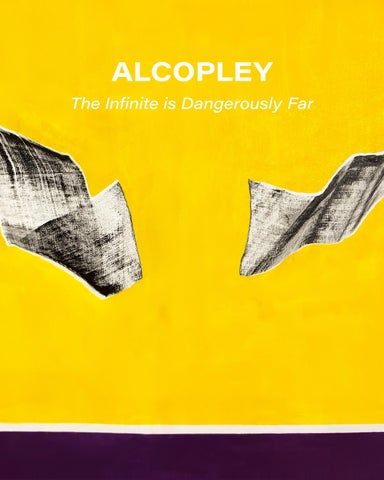
ALCOPLEY The Infinite is Dangerously Far
ALCOPLEY The Infinite is Dangerously Far
October 15 - November 15, 2026
SHAMNOSKI GALLERY 115 East 72nd Street
ALCOPLEY The Infinite is Dangerously Far “In a poem you read your sounds. In a drawing you read your silences.” — Alcopley, epigram in a letter to James Johnson Sweeney “Alcopley: The Infinite is Dangerously Far” is an examination of Alcopley’s brushstroke across decades of an artist teaching himself, again and again, how to say more with less. In 1959, after a self-imposed exile from America to follow his wife Nina Tryggvadottir to Europe, Alcopley returned to New York City, one week before the New Year. He was home again, but more importantly, he was free again. Free not from formal oppression or physical shackles, but of the formalism and rigidity that constrained him and his art-making during his time in Europe. With his brush now unfettered, he began anew in 1960. Markedly different from the Abstract Expressionist styled work of the 1950s, Alcopley pivoted, as all artists did in the face of looming extinction from Pop Art. His brushstroke was still finding its vocabulary, still busy with incident and action, still layered with the marks of a hand working out what it wanted to say. Over the years that follow, that vocabulary would narrow and sharpen, gesture by gesture, until it arrives at a body of large-scale canvases in which everything inessential has been stripped away, and a single sweep of the brush is left to carry the whole weight of the picture. There is a moment, just before the brush meets the canvas, when everything is still possible and nothing has yet been risked. Herman Cherry, who watched his friend work for forty years, called this the true subject of Alcopley’s art. “Danger lurks,” he wrote, “at the point when his loaded brush touches the canvas.” Choice, in that instant, is a cliffhanger full of suspense. What follows is a single sweep, a curve, a stroke that cannot not be corrected or softened. It is either right or it is nothing. By the final years represented in this exhibition, Alcopley had reduced his language to its barest terms: one gesture, or two, laid across a field of a single, resonant color. The stroke might rest low and settle, as it does in At Sea, or lift and open like a pair of wings pulling apart, as in “Untitled.” It might hang in pairs, curved and calligraphic, suspended over red in Equilibrium, or drift outward like something already leaving the frame, as in Beyond. The particulars changed painting to painting, but the wager did not. It was the same wager, made and remade, for thirty years. Everything rides on a single, unrepeatable act. Alcopley knew what he was risking because he had spent half his life studying what makes things move. As Alfred Copley, the physician and physiologist, he devoted himself to the question of flow itself. His studies included the flow of blood, the flow of matter, and the flow that never rests. “Everything flows,” he liked to say, borrowing a phrase that Heraclitus spoke twenty five centuries earlier on the banks of a river that, as the philosopher warned, no one steps into twice.
Democritus, too, believed the invisible world was made of particles in constant motion. Alcopley’s own scientific life, spent founding the disciplines of biorheology and hemorheology, was in a real sense a lifelong pursuit of that same ancient intuition, carried out first in the laboratory and then, with a loaded brush on canvas. He never pretended these were separate lives. “In my pictures,” he wrote, “the basic vision is related to modern science and the world view derived from it.” His paintings were not illustrations of cells or molecules but rather, as the philosopher Heinrich Blücher described them, something stranger and more direct. They were a kind of letter-less writing, as though the universe revealed itself unmediated, without the interference of language. Alcopley moved through the twentieth century in the company of people who thought about invisible forces for a living. Martin Heidegger, whom he counted as a friend, wrote about the silences in his drawings. Edgard Varèse, the composer who built music from noise and rhythm the way Alcopley built paintings from gesture and space, remained close to him for decades. Jean Arp, Sonia Delaunay, Willem de Kooning, Franz Kline, Jackson Pollock, Mark Rothko were not merely distant influences but drinking companions and debating partners at the Cedar Bar and The Club he helped found on a corner of Washington Square. Hannah Arendt was among his first friends in America. He quoted Henry James to explain himself: one does nothing of value in art, James wrote, unless one has some general idea. Alcopley’s idea, stated plainly and pursued for sixty years, was to show meaning in the movement of structures in space. The brushstroke was where all of this converged. Alcopley, through his work, examined the physics of flow, the philosophy of change, and the discipline of gesture. Stanton Macdonald Wright once described this kind of mark making as the Unique Gesture, the moment when form, color, and space fuse into one skin with a single motion. Eleanor Heartney, reviewing Alcopley’s late work in Art in America, saw the same paradox that every serious critic of Alcopley has circled back to: an uneasy, thrilling tension between abandon and control, gestures that feel spontaneous yet seem, on the ground beneath them, entirely deliberate. This was the effect Cherry most admired in his friend’s work. “Once a mark is made on the twodimensional canvas surface,” he wrote, “the space falls into place. It is a felt space,” not merely an unpainted one. In the late canvases, the field surrounding each gesture behaves exactly this way. It does not recede behind the stroke so much as press in around it, charged by the act that has just taken place within it. A field of deep green, of red, of yellow, becomes as active as the gesture it surrounds. Only rarely did Alcopley allow the field itself to become a place rather than a void. In Equilibrium, the twin strokes hang suspended over a field of red so saturated it seems to generate its own heat, radiating outward from beneath the gesture rather than simply supporting it. In Beyond, the field turns to yellow, and the stroke lifts and thins until the whole canvas seems to carry the feeling of flight, as though the gesture were already leaving the ground beneath it. These are unique admissions in a body of work that otherwise insists its gestures answer only to space itself.
Above: Alcopley on his roof in New York, 1963. Photo Credit: Fred Stein. Previous page: Alcopley in his New York studio, 1952. Photo Credit: Fred Stein.
Alcopley, once asked to explain his lifelong fascination with the concept of infinity, painted its symbol without knowing it. The numeral used on the cover of the catalog for his 1987 exhibition with seven fellow New York artists, turned on its side, becomes the sign for the infinite. It was his own brushstroke, but rediscovered sideways. That is the whole of his art in a single accident: reach far enough with one gesture and you may find you have touched something enormous and ungovernable. The infinite is dangerously far. But it is also, in the space of one loaded stroke, suddenly and briefly within reach. James Johnson Sweeney believed the lines Alcopley once wrote, “in a drawing you read the silences,” held the key to everything he made. When standing before the paintings in this exhibition, from the searching multiplicity of the 1960s to the single, unrepeatable gestures of his final years, the viewer is invited to look with intention. Look long enough at the space around each stroke, and you begin to feel what Alcopley felt every time he lifted the brush: the distance between control and chance, between the physical and the infinite, is not very far at all. It only feels that way in the instant before you cross it. - Matthew Shamnoski
ALCOPLEY Equilibrium, 1977 Oil on canvas 68 x 56 3/8 in
ALCOPLEY Beyond, 1979 Oil on canvas 59 x 81 in
ALCOPLEY At Sea, 1986 Oil on canvas 56 x 50 1/8 in
ALCOPLEY Untitled, 1972 Oil on linen 68 x 38 1/16 in
ALCOPLEY Space Travels, 1967 Oil on canvas 25 1/8 x 28 1/4 in
ALCOPLEY Untitled, 1966 Oil on linen on board 12 1/8 x 14 1/4 in
ALCOPLEY Untitled, 1970 Oil on canvas on board 18 x 10 3/4 in
ALCOPLEY Untitled, 1967 Oil and acrylic on canvaspaper 18 x 23 3/4 in
ALCOPLEY Untitled, 1960 Acrylic on paperboard 20 x 30 in
ALCOPLEY New York: Blue March, 1961 Acrylic on paperboard 30 x 20 in
ALCOPLEY New York Window Parade, 1961 Acrylic on paperboard 20 x 30 in
ALCOPLEY Untitled, 1961 Oil and acrylic on paperboard 20 x 30 in
ALCOPLEY Untitled, 1960 Oil on paperboard 20 x 30 in
ALCOPLEY Untitled, 1960 Oil on paperboard 30 x 20 in
ALCOPLEY Untitled, 1960 Ink on paperboard 30 x 20 in
ALCOPLEY Untitled, 1960 Oil on paperboard 30 x 20 in
ALCOPLEY Untitled, 1960 Oil on paperboard 30 x 20 in
ALCOPLEY Untitled, 1984 Ink on paper 14 x 10 3/4 in
Selected Exhibitions Selected Solo Exhibitions 2009 David Findlay Jr. Gallery, New York, NY 1993 Art in General, New York, NY 1989 Galerie Melnikow, Heidelberg, Germany 1983 Galerie Suzanne Fischer, “Altes Dampfbad,” Baden-Baden, Germany 1982 Treffpunkt Kunst, Saarlouis, Germany 1978 Galerie Rudolf Zwirner, Köln, Germany 1978 Mandeville Art Gallery, University of California, San Diego, CA 1977 Municipal Art Museum, Reykjavik, Iceland 1969 Israel Museum, Jerusalem, Israel 1967 Goethe House, New York, NY 1965 Galerie Schueler, Berlin, Germany 1964 Byron Gallery, New York, NY 1962 Stedelijk Museum, Amsterdam, The Netherlands 1962 Galerie van de Loo, Munich, Germany 1959 Drian Gallery, London, UK 1956 Galerie Bing, Paris, France 1950 Passedoit Gallery, New York, NY Selected Group Exhibitions 2007 “Triad: The Work of Alcopley, Herman Cherry and Reuben Kadish,” David Findlay Jr. Fine Art, New York, NY 2006 “9th St.: Nine Artists from the 9th Street Show,” David Findlay Jr. Fine Art, New York, NY 2003–2004 “Textiles: On or off the Wall: Selection of Tapestries and Carpets 1920s–1970s,” The Art Institute of Chicago, Chicago, IL 1987 “Eight New York Artists,” Herbert F. Johnson Museum of Art, Cornell University, Ithaca, NY 1986 “USA American Abstract Artists 50th Anniversary Celebration 1936–1986,” The Bronx Museum of the Arts, Bronx, NY 1971 “Art and Science,” Tel Aviv Museum, Israel 1964 “Schrift und Bild,” Stedelijk Museum, Amsterdam, The Netherlands 1963 22nd International Watercolor Biennial, Brooklyn Museum, NYC 1962 “Wit and Whimsy in 20th Century Art,” Museum of Modern Art, New York, NY 1957 “50 Years of Abstraction,” Galerie Creuze, Paris, France 1956 “Arts in France and in the World,” Musée d’Art Moderne de la Ville de Paris 1951 “9th Street Show,” New York, NY
Museum Collections Museum of Modern Art, New York Metropolitan Museum of Art, New York Whitney Museum of American Art, New York Guggenheim Museum, New York Smithsonian American Art Museum, Washington, DC National Museum of Modern Art, Tokyo Stedelijk Museum, Amsterdam Sandberg Collection, Stedelijk Museum, Amsterdam Centre Pompidou, Paris Musée d’Art et d’Industrie, Saint-Étienne, France Staatliche Kunstsammlungen Kupferstich-Kabinett, Dresden The Israel Museum, Jerusalem National Gallery of Iceland, Reykjavik University Art Museum, University of California, Berkeley The Art Institute of Chicago Seattle Art Museum
Alcopley in New York, 1984. Photo Credit: Budd.
This catalogue has been produced on the occasion of the exhibition of “Alcopley: The Infinite is Dangerously Far,” October 15 to November 15, 2026. All images © copyright the Estate of Alcopley. Essay by Matthew Shamnoski. Publication © Shamnoski Gallery. All rights reserved. Reproduction of contents prohibited. Shamnoski Gallery 115 East 72nd Street, #1B New York, NY 10021 Matthew@shamnoski.com 570.362.4207 www.shamnoski.com
The infinite Is dangerously Far The finite Is dangerously Close Art Is dangerously In Between And art Is dangerously Alive - Alcopley
SHAMNOSKI GALLERY