SHALHEVET HIGH SCHOOL • Los Angeles, CA October 2016 - Elul 5777 - Volume 17, Issue 1 shalhevetboilingpoint.com
School makes LGBT inclusion official policy Rabbi Segal hopes first-ever ‘pledge’ will set an example for other Orthodox schools By alec fields, Co-Editor-in-Chief
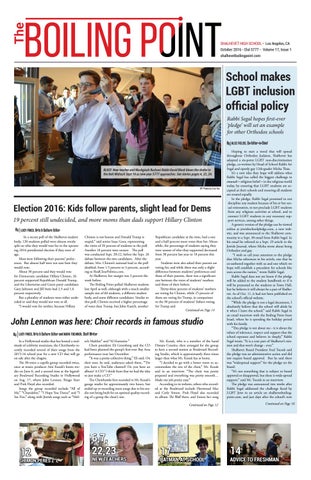
BLAST: New teacher and Mashgiach Ruchani Rabbi David Block blows the shofar in the Beit Midrash Sept 14 as new year 5777 approaches. See stories pages 4, 22, 24.
BP Photo by Ezra Fax
Election 2016: Kids follow parents, slight lead for Dems 19 percent still undecided, and more moms than dads support Hillary Clinton By LUCY FRIED, Arts & Culture Editor In a recent poll of the Shalhevet student body, 120 students polled were almost evenly split on who they would vote for in the upcoming 2016 presidential election if they were of age. Most were following their parents’ preferences. But almost half were not sure how they would vote. About 30 percent said they would vote for Democratic candidate Hillary Clinton, 26 percent supported Republican Donald Trump, and the Libertarian and Green party candidates Gary Johnson and Jill Stein had 2.5 and 1.6 percent respectively. But a plurality of students were either undecided or said they would not vote at all. “I would vote for neither, because Hillary
Clinton is not honest and Donald Trump is stupid,” said senior Isaac Goor, representing the views of 20 percent of students in the poll. Another 18 percent were unsure. The poll was conducted Sept. 20-22, before the Sept. 26 debate between the two candidates. After the debate, Mrs. Clinton’s national lead in the poll doubled, from 1.5 percent to 3 percent, according to RealClearPolitics.com. At Shalhevet, her margin was 3 percent the week before. The Boiling Point polled Shalhevet students last April as well, although with a much smaller sample size of 60 students, a different student body, and some different candidates. Similar to this poll, Clinton received a higher percentage of votes than Trump, but John Kasich, another
Republican candidate at the time, had a one and a half percent more votes than her. Meanwhile, the percentage of students saying they were unsure of who they supported decreased from 38 percent last year to 18 percent this year. Students were also asked their parents are voting for, and while there was only a slight difference between students’ preferences and those of their parents, there was a significant one between the votes of students’ mothers and those of their fathers. Thirty-three percent of students’ mothers are voting for Clinton, while 25 percent of them are voting for Trump, in comparison to the 30 percent of students’ fathers voting for Trump and Continued on Page 14
John Lennon was here: Choir records in famous studio By LUCY FRIED, Arts & Culture Editor and Maya tochner, Staff Writer In a Hollywood studio that has hosted a multitude of celebrity musicians, the Choirhawks recently recorded several of their songs from the 2015-16 school year for a new CD that will go on sale after the chagim. The 30-voice a capella group recorded twice, once at music producer Ami Kozak’s home studio on June 6, and a second time at the legendary Boulevard Recording Studio in Hollywood on Aug. 17, where John Lennon, Ringo Starr and Pink Floyd also recorded. Songs the group recorded include “All of Me,” “Chandelier,” “I Hope You Dance” and “I See Fire,” along with Jewish songs such as “Mel-
ech Malchei” and “Al Hanissim.” Choir president Eli Greenberg said the CD had been planned the group’s first-ever Bay Area performance tour last December. “It was a pretty collective thing,” Eli said. On their tour, he said, audiences asked them, “‘Do you have a YouTube channel? Do you have an album? A CD?’ I think from that we had the idea to just make a CD.” The Choirhawks first recorded in Mr. Kozak’s garage studio for approximately two hours, but ended up re-recording most songs due to his studio not being built for an optimal quality recording of a group the choir’s size.
Mr. Kozak, who is a member of the band Distant Cousins, then arranged for the group to have a second session at Boulevard Recording Studio, which is approximately three times larger than what Mr. Kozak has at home. “I decided to go with a better room to accommodate the size of the choir,” Mr. Kozak said in an interview. “The choir was pretty prepared and everything was pretty smooth… Made my job pretty easy.” According to its website, others who recorded at the Boulevard include Fleetwood Mac and Carly Simon. Pink Floyd also recorded its album The Wall there, and Simon her song
Hoping to start a trend that will spread throughout Orthodox Judaism, Shalhevet has adopted a six-point LGBT non-discrimination pledge, co-written by Head of School Rabbi Ari Segal and openly gay 12th-grader Micha Thau. It’s a new idea they hope will address what Rabbi Segal has called the biggest challenge to emunah – religious belief – in the religious world today, by ensuring that LGBT students are accepted at their schools and ensuring all students are treated equally. In the pledge, Rabbi Segal promised to not discipline any student because of his or her sexual orientation, to not preclude LGBT students from any religious activities at school, and to connect LGBT students to any necessary support services, among other things. A generic version of the pledge can be viewed online at jewishschoolpledge.com, a new website, and was announced to the Shalhevet community in a Sept. 30 email from Rabbi Segal. In his email he referred to a Sept. 29 article in the Jewish Journal, where Micha wrote about being Orthodox and gay. “I wish to call your attention to the pledge that Micha references in his article, one that he co-authored together with us and one which we hope will establish a precedent for schools like ours across the nation,” wrote Rabbi Segal. Rabbi Segal does not yet know if the pledge will be added to the student handbook or if it will be presented to the students at Town Hall, but he believes it will always be a part of Shalhevet. As of Oct. 11, it had not been published on the school’s official website. “While the pledge is not a legal document, I absolutely believe that the school will abide by it when I leave the school,” said Rabbi Segal in an email interview with the Boiling Point from Israel, where he is spending the holiday period with his family. “This pledge is not about me - it is about the values of tolerance, respect and support that the school espouses and believes in deeply,” Rabbi Segal wrote. “It is a core part of Shalhevet’s mission and that won’t change - ever.” Shalhevet Board President Fred Toczek said the pledge was an administrative action and did not require board approval. But he said there was “widespread support” for the pledge on the board. “It’s not something that is subject to board approval or disapproval, but there is wide-spread support,” said Mr. Toczek in an interview. The pledge was announced two weeks after Rabbi Segal addressed the challenge faced by LGBT Jews in an article on shalhevetboilingpoint.com, and just days after the school’s new Continued on Page 16
Continued on Page 12
12
SHIMON PERES Z”L
6,7, 22,23
NEW TEACHERS
17
BATMAN AT SCHOOL
14
ADVICE TO FRESHMAN
16
The Boiling Point • October 2016• Torah
TORAH
OCTOBER 2016
A pledge to include School makes LGBT inclusion official policy, hoping to set an example for Modern Orthodox schools Continued from Page 1 and they live in fear then we haven’t done ev- Straight Alliance (GSA) club on campus, and RabGay-Straight erything we can, so we decided to develop this bi Segal announced the creation of a GSA in Town Alliance met pledge,” said Rabbi Segal. “If there are students in Hall on Sep. 22. The pledge also has an ambition: to have other for the first your school who are scared and don’t know where schools sign off on these the school stands, that’s not time. or similar standards or “As they go a place where students, those create their own version off to college, students at least, can be their We’re trying to make something that a of a pledge.“Different students invari- best selves, can do their best things work for differably face the learning.” lot of Jews can agree on, and it’s very ent schools and none The pledge was created in painful moral difficult. of us are trying to dilemma created large part because of Micha’s -Micha Thau, 12th Grade impose our vision by the seemingly experiences, and in the hope of the pledge on intractable conflict: that LGBT students in Shalany other school,” believing in the pri- hevet and other schools will gal. “What we want to macy and validity of feel comfortable, according to Rabbi Segal and said Rabbi Seencourage other schools to do and other commuthe Torah on the one Micha. “One of the reasons that I didn’t come out was nities to do is to make their own pledge or have hand, and following their hearts’ sense of morality with because I didn’t know how my school would re- their own conversation on this issue.” “We should celebrate schools and communities act,” said Miregard to lovcha in an inter- that have the conversation cause for some commuing and accepting For two years he was worried whether he view with the nities it is much harder to have the conversation,” their gay friends – or Boiling Point. he added. perhaps “coming out” would be kicked out, expelled, whether we Micha, who created the new pledge website “So I thought themselves—on the other,” would tell him he couldn’t be a gabbai or daven maybe if I had himself in anticipation of Rabbi Segal’s announcewrote Rabbi Segal. or lain, he just had no idea. the school and ment, said the pledge was created for a religiously Micha, in his Jewish other schools diverse group of schools and certain concessions Journal article, described -Rabbi Ari Segal, Head of School put out these that he didn’t mind under the circumstances. struggling before comDefinitions of religious activities and incorcommitments ing out. that they porating the words “gender identity” along with “My religion, my family, my friends, my presence at my wouldn’t expel kids who came out of the closet, “sexual orientation” in the pledge would have been school, would, in my mind, all be in or harass or discriminate against them, then more better, he said. “The reason is that language makes people feel serious jeopardy if I dared to reveal kids would be apt to come out of the closet.” While Micha struggled,Rabbi Segal thought very uncomfortable, and we want to reach the the truth to anyone,” wrote Miwidest breadth of schools and institutions,” said it was obvious that Shalhevet would be accepting. cha. “For two years he was worried whether he Micha. “It’s just more to work on for the future. Rabbi Segal signed the pledge, co-created by senior would be kicked out, expelled, whether we would We’re trying to make something that a lot of Jews Micha Thau, Rabbi Segal tell him he couldn’t be a gabbai or daven or lain, he can agree on, and it’s very difficult.” Eshel has already been in contact with at least and the Orthodox LGBT just had no idea,” said Rabbi Segal in an interview. support group Eshel, so “I just assumed that he, that everyone, took for one other school, according to Micha, but neither that LGBT students granted that of course we wouldn’t kick a student Rabbi Segal nor Micha plan on actively advertising would know that out, of course the student could be fully participa- the pledge. Instead, they think the pledge will sell itself. they are accepted at tory in everything we do.” “We think we will have parents going up to the Micha, too, thought it was necessary for ShalShalhevet. school and saying ‘sign this,’” said Micha. “ We ’r e hevet to be proactive about its stance. Rabbi Segal agreed that Shalhevet’s pledge “This is important, because there is a real danvery supportive and tolerant, ger in preventing kids from coming out,” said Mi- would inspire people to take action, but he did not but if our cha. “If you didn’t make your decision clear, you rule out the possibility of changing strategies if the s t u d e n t s make that person afraid, and if you make that pledge does not initially succeed. “If it doesn’t seem to be working, obviously d o n ’ t person afraid, they may wind up doing something k n o w that is going to harm them or harm other people we’ll change our approach,” Rabbi Segal said. or both. “By making your position clear, you let other people know that this is a safe environment for them.” Other elements of the six-part pledge are an agreement that sexual orientation cannot affect a potential student’s application for admission; a promise not to permit any student, teacher or administrator to discriminate; and a stipulation that Shalhevet will not refer students to “reparative” or “conversion” therapy. The pledge also advocates sponsoring a Gay-
The Boiling Point • October 2016• Torah
17
Gay-Straight Alliance draws 15 at first meeting By Alec Fields, Co-Editor-in-Chief Less than two weeks after calling the Torah’s called the “The biggest challenge to ’emunah’ of views on homosexuality the biggest challenge our time.” (See related story, Page 1.) In his Op-Ed on shahevetboilingpoint.com to emunah, or religious belief, of our time, Shalhevet’s first-ever Gay-Straight Alliance (GSA), Rabbi Segal explained the challenges faced by created by head of school Rabbi Ari Segal, held LGBT Modern Orthodox Jews and said that more must be done to help. its introductory meeting. “Young people in the LGBT community have Led by school guidance counselor Rachel Hecht and Rabbi David Block, Mashgiach told me that they feel invisible when we counsel Ruchani or spiritual advisor, seven students and them in private; they feel somewhat loved, but six teachers attended the meeting held in room only unofficially, ‘tolerated,’ but not embraced,” 309 to show support for Shalhevet’s LGBT stu- Rabbi Segal wrote. “This state of limbo cannot persist.” dents. Micha, a senior, believes the GSA will help Sophomore Nomi Willis, who was told last year by Principle Reb Noam Weissman that she non-LGBT students be more tolerant. “It’s about what it means could not wear her “leto be an ally and what it galize gay” t-shirt at It’s about what it means to be means to be supportive,” school, participated. said Micha. “It’s a very, very “It’s important that an ally and what it means to be important skill to learn beShahevet have a GSA supportive. cause people make a lot of because it’s in such a -Micha Thau, 12th Grade mistakes.” community where it Micha declined to go into might not be completely specifics, but said that he has accepted to be gay,” said Nomi. “I want to be a part of making people feel heard many misconceptions about LGBT stucomfortable and making it a main stream thing dents at school. “[There are] a lot of misconceptions about to support people who want to come out or just what it means to be a gay person,” said Micha. want to support gay rights.” Announced at Town Hall Sept. 22 by Rabbi “It’s important that a lot of that stuff gets disSegal, the club will be geared towards teaching pelled. “People don’t exactly know what it means to students how to be “allies” of LGBT students, according to Rachel Hecht and Shalhevet’s only be supportive, and I think this GSA will really openly gay student, Micha Thau, who is helping give a clear definition of what it means to be an ally and how important that is.” the club. Micha acknowledged that LGBT students not Since the meeting took place during Tuesday lunch when underclassmen’s and upperclassmen’s yet “out” might be afraid to attend the meeting, lunch period do not overlap, not all students were and said he would not have gone himself before present at the same time and the meeting time he came out as gay. “Even though I know that I wouldn’t have may have been unclear to students. “This is important enough that there should gone, just knowing that there’s a group of stuhave been more attendance,” said Micha. “I dents who cared enough to go would have made think that we can do a better job of publicity. me feel a lot of safer,” said Micha. “I think it will People didn’t really know what was happening or land up doing a lot of good.” In his Op-Ed, Rabbi Segal said it is now how it was happening.” The club is a part of a larger effort by Shalhe- known that LGBT students, including many in vet to provide support for LGBT students. Rab- Orthodox day schools, struggle painfully with bi Segal also signed a pledge written by Micha, fears that they would be rejected if people knew detailing more ways to solve what Rabbi Segal what their sexuality was. At the same time, their
peers struggle with a disconnect between what Ju- Orthodox community, with real life families and daism says and the love and acceptance they feel friends. What may seem like an interesting sociological debate in truth is creating crushing pain, for their friends. “The reconciliation of the Torah’s discussion anxiety, and general turmoil for people about of homosexuality represents the single most for- whom we care deeply.” While the plan for the GSA and details like midable religious challenge for our young people the weekly meeting today,” Rabbi time have yet to be deSegal wrote. The reconciliation of the Torah’s discussion cided, Micha believes “More young it will make a differpeople are of homosexuality represents the single most ence. ‘coming out’ formidable religious challenge for our young “I’m hoping that than ever bepeople today. whatever direction this fore, and that goes, it will be a positive repeatedly -Rabbi Ari Segal, Head of School force for change at our puts a face to school,” said Micha. this theologi cal challenge. “These weighty issues do not live in the abstract,” he continued. “They powerfully and emotionally impact genuine individuals living in our
Rabbi Segal calls conflict between Torah’s, society’s views of LGBT individuals the greatest challenge to emunah of our time’ By Alec Fields and Ma’ayan Waldman, Co-Editors-in-Chief Calling it “the greatest challenge to emunah (faith) in our time,” Head of School Rabbi Ari Segal has published an article urging religious leaders, particularly in education, to take an active approach to the pressing conflict between Orthodox Judaism and homosexuality. In a 1,868-word piece published this afternoon, he offered ideas as to how the Jewish community can move from an attitude of “mere tolerance” to a place of thoughtful engagement that will “bring our young people closer to Torah and Halacha -- not further away.” To put it plainly, ‘being nice’ cannot serve as the end goal,” said Rabbi Segal. “Basic kindness is but the starting point of human decency.” While not stating any official game plan for conquering this issue, Rabbi Segal suggested establishing school LGBT support groups, celebrating Orthodox LGBT individuals, and encouraging support from their fellow students. “Gay students deserve the same friendship and solidarity as anyone else,” Rabbi Segal wrote, “especially as Jews trying under the most challenging of circumstances to navigate the Torah and observe its commandments.” Rabbi Segal’s article described a religious struggle not only among LGBT students, but among their friends and peers. “As they go off to college, students invariably face the painful moral dilemma created by the seemingly intractable conflict: believing in the primacy and validity of the Torah on the one
hand, and following their hearts’ sense of morality with regard to loving and accepting their gay friends – or perhaps “coming out” themselves—on the other,” Rabbi Segal wrote. “All too often, this earnest challenge results in our children quietly losing faith in the Torah as a moral way of life.” “The Torah in Vayikra, Chapter 18, verse 22, says: “You shall not lie down with a male as with a woman: this is an abomination,” and Rabbi Segal acknowledged a religious dissonance that could occur. He called on Gedolim -- religious leaders -- to find a solution. He specifically mentioned the leaders of Yeshiva University, where he and most of Shalhevet’s Judaic Studies teachers studied or received ordination. “I will leave the discussion of this massive theological question to the Gedolim of our generation,” he wrote. “But I beg the YU Roshei Yeshiva and the Gedolim of our community to take up the discussion now.... Our Gedolim rightly claim the mantle of Torah leadership for our community but they must assert themselves. They must fill the vacuum that exists right now. “If not,” he said, “the difficult and vital issue will be addressed by those to their right and left.” Meanwhile, schools and students should not only embrace LGBT people, but must confront the religious issue, Rabbi Segal wrote.
“Steering away from the issue might feel safe, but that avoi ance is detrimental and dangerous,” he wrote. “Rather than avoid, we must actively and thoughtfully engage. Even just taking those initial steps, I believe, will alleviate the burden of this theological struggle, and will help prevent those tempted to throw in the theological towel to circumvent the tension altogether.” Another school that has taken up this issue is Salanter Akiba Riverdale (SAR) Academy of Riverdale, N.Y. Shortly after the June 12 Pulse nightclub shooting in Orlando, SAR Principal Rabbi Tully Harcztark expressed solidarity with LGBT students at a school vigil and prayer service. That was on June 14, after Shalhevet’s school year was over. In an interview later with Tablet magazine, Rabbi Harcsztark said that it was a time for his community to “reflect, to ensure that our environment is a safe environment and we model that for others as well.”
Page Design by Abbi Sentchuk and Noa Segal Photo Illustration by Ezra Fax
22
Opinion
EDITORIALS
Let students help solve the schedule problem By The Boiling point editorial board
We’ve all come to expect the moans and groans of stressed-out juniors and seniors. But sophomores? Freshmen? This year’s new schedule, which was imposed on the students, rather than decided on democratically, burdens underclassmen by shortening their lunch period to about half an hour, and adding an extra class period to their day. That means less time for them to rest, bond with their friends and upperclassmen, and receive in-school teacher support. It also means upperclassmen can’t find their math teachers, most of whom teach during the MAP period that is the second half of upperclassmen’s lunch. Moreover, student-run clubs that used to
meet during a full lunch period are losing precious meeting time and attendance. With a 30- or 37-minute lunch for underclassmen, depending on the day, clubs such as Finance, Film, Fashion, Politics, and Firehawks 4 Israel are struggling to meet, and when they do, attendance is down from past years, even though school enrollment is up. Like any other issue that affects our school, we see a clear way to solve this year’s schedule crisis. And that is with student input. The Just Community provides all the tools we need to tackle this problem – transparency of reasoning, communal buy-in for whatever is decided, and perhaps most important, the engine of student creativity. Some might say that if students are com-
plaining so much, they should have spoken up earlier. But when these schedule changes were being considered – over a period of three years, according to Alec Fields’ report in this issue – students were completely unaware they were even under discussion. This year’s schedule poses a threat to the overall culture of Shalhevet and we believe it must be addressed as soon as possible. Next year – as Rabbi Segal suggested at a Sept. 8 news conference with Boiling Point editors – seems pretty far away. Scheduling is undoubtedly one of the hardest tasks of a school, especially one that tries to do as many things well as Shalhevet does. But that should not stop us from trying to fix it. Let the students help.
LGBT pledge: A moment of opportunity for all of us By The Boiling point editorial board
We wholeheartedly commend Rabbi Segal and the board for pioneering LGBT support within the greater Modern Orthodox community, making Shalhevet a model for thoughtful transformation within halachic boundaries. And now that Rabbi Segal has done his part, we the students need to do ours. No true culture change is possible unless it comes from the ground up. It is only with student support and action that we can truly create a culture of LGBT tolerance and acceptance inside our school. One of the pillars of Rabbi Segal’s initiative was announcing a Gay-Straight Alliance with the goal of teaching students how to be allies of LGBT students. However, at the first GSA meeting, only 13
The Boiling Point
people – six of whom were teachers – showed up. This was probably not meant as a slight, but we know all too well that LGBT students have not always felt welcome in Shalhevet. Jenny Newman ’11 told the Boiling Point that her teachers and friends had said ignorant things in front of her about homosexuality. “My classmates at Shalhevet thought spreading the rumor that I was a lesbian was one of the most insulting things they could come up with,” she told the Boiling Point in an interview in 2015. Even in the past few years, students have been hesitant to tell people about their homosexual identity. Micha Thau, an openly gay senior, wrote in an editorial published in the Jewish Journal that before coming out, he felt
that his entire life would be in jeopardy if he “dared to reveal the truth to anyone.” So we need to go the extra mile. Now, the platform is here. It is time to step up our game. The first step is just showing up. Rather than eating lunch with friends, on days that GSA meets, come and eat lunch in that room. And there is more we can do. Social media is a powerful tool. A simple like or comment on an LGBT post can be transformative – even on the Boiling Point Facebook page or website. Let’s show that our minds and hearts are open. Let’s live the culture that our administration and school are spearheading.
National Scholastic Press Association Pacemaker Finalist 2015, 2014, 2012 Online Pacemaker Finalist 2015
Co-Editors-in-Chief Alec Fields Ma’ayan Waldman Senior Editor Zev Kent Community Editor Hannah Jannol
Photography Editor Ezra Fax Layout Editors Abbi Sentchuk Tara Chriki Honor Fuchs
Outside News Editor Jacob Feitelberg
Advertising Editors Rebecca Sentchuk Matan Mamman
Torah Editor Nicole Soussana
Graphics Editor Zev Kupferman
Opinion Editor Benjamin Zaghi Features Editor Zev Kent Arts & Culture Editor Lucy Fried Sports Editor Clara Sandler 2016 THE BOILING POINT
Story of the Year Awards 2014, 2012, 2011, 2010 All-American 2009, 2012, 2014
Website Editor-in-Chief Jordan Levine Faculty Adviser Mrs. Joelle Keene
Simon J. Rockower Awards 2013, 2014, 2015, 2016
Sweepstakes Awards 2016
First Place Awards in Jewish Scholastic Journalism
Live stream of Glouberman Games Nov. 10 -13
National Award Winner 2007-2014
Gold Crown Award 2013, 2014, 2015, 2016 Gold Circle Awards 2011-2014 Columbia Scholastic
2014 and 2013
The Boiling Point is the student-produced newspaper of Shalhevet High School and is published 6-8 times yearly. Unsigned ditorials represent the majority view of the members of the Editorial Board, which consists of the Editor-in-Chief, Deputy Editor-In-Chief, Managing Editor, Senior Editor, Web Editor, Opinion Editor, Community Editor and Faculty Advisor. The Boiling Point welcomes submissions for signed editorials from members of the Shalhevet Community, and the final decision about print-
ing them is made by the Editorial Board. Letters to the Editor may be submitted via e-mail to shalhevetboilingpoint@gmail.com. The Boiling Point reserves the right to edit letters and opinion submissions and all become the property of The Boiling Point. Signed editorials and advertisements in The Boiling Point purchased by third-party organizations do not necessarily reflect the opinions of the Editorial Board or The Boiling Point as a whole. For information on advertising, please
write to Advertising Editor Rebecca Sentchuk at b.sentchuk@gmail.com The Boiling Point encourages readers to inform the newspaper regarding any possible factual errors found in print or online by emailing us as at shalhevetboilingpoint@gmail.com. When appropriate, we will fix the story online, and correct the error on Page 2 or on this page in the next print edition.
shalhevet boilingpoint. com
When we know it, you’ll know it.