SHALHEVET HIGH SCHOOL • Los Angeles, CA March 2018 • Adar 5778 • Vol. 18, Issue 4 shalhevetboilingpoint.com
High school shooting in Florida prompts security meeting
COLOR WAR
SMASHED
Officials say Shalhevet is ‘one of the safest schools in California’; first-ever lockdown drill is set By Tyler Ekaireb, Outside News Editor Shalhevet responded to last month’s Florida high school shooting by remembering the victims and holding an hour-long assembly to reassure the community about campus safety. “I’m not gonna kid you and say you’re safe from anything possible,” said Mr. Ivan Wolkind, Shalhevet parent, LAPD officer and head of the Community Security Initiative at the Los Angeles Jewish Federation. “There is no guarantee of safety. The world is a dangerous place.” But he and the school’s two lead security consultants said the building’s heavy, driveway-to-ceiling gate, operated from the security booth, is unusual for a high school, and is staffed by gun-carrying ex-military and law enforcement personnel whose training exceeds industry standards. “This is one of the safest schools in California,” said Mr. Randy Rangel, CEO of Strategic Emergency Response Concepts and a 27-year veteran of the Los Angeles Police Department. Mr. Rangel said his company had been chosen for Shalhevet by Mr. Wolkind, whose children are in the ninth and 12th grades here. “Ivan picked us for a reason,” Mr. Rangel said. Mr. Wolkind said school officials have never refused a request for security upgrades. “We [at the Federation] have an advanced system of communication, site visits, and we push schools to take security seriously,” said Mr. Wolkind. “Shalhevet takes security very seriously.” The assembly, held during an extended Mincha period on Ta’anit Esther Feb. 28, was mostly devoted to a discussion regarding security procedures in the wake of the Feb. 14 shooting attack that killed 17 at Marjory Stoneman Douglas High School in Parkland, Fla. Mr. Charles Law of Law Security, which employs Shalhevet’s guards, said advanced training had started long before the Parkland massacre. “Everything that could possibly be done to make this site secure is being done,” said Mr. Law. Officials also took questions from students, who asked about metal detectors, lockdown drills, and whether teachers should carry guns. Mr. Wolkind said officials have decided that for now, metal detectors are not necessary at the school’s entrance, outside of high-risk events. Metal detectors were present for the Maccabeat concert, which garnered a large audience beyond the Shalhevet community. “We put them up if a situation warrants it,” he said. “I guarantee you we think about these things.” “We could turn this place into Fort Knox [but] we don’t think that’s warranted,” he added. “Where I work, at the Jewish Federation, we consider ourselves a higher profile target. No one enters without a metal detector.” While all of the school’s guards are armed, he said, he opposed teachers carrying guns -- a possibility proposed earlier that week by President Donald J. Trump. “When Randy [Rangel] teaches Chumash,” Mr. Wolkind said, “the rabbis can carry guns.”
BP Photos by Neima Fax
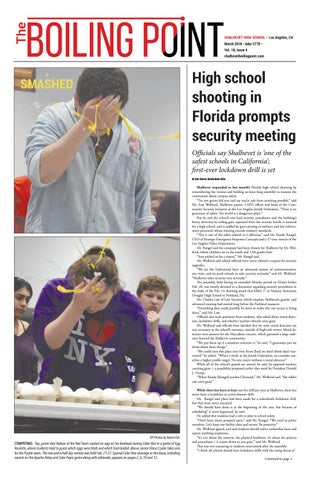
COMPETING: Top, junior Ami Nelson of the Red Team cracked an egg on his forehead during Color War in a game of Egg Roulette, where students tried to guess which eggs were fresh and which hard-boiled. Above, senior Elana Czuker takes one for the Purple team. The two-and-a-half day contest was held Feb. 21-22. Special Color War coverage in this issue, including reports on the Apache Relay and Coke-Pepsi game along with editorials, appears on pages 2, 6, 10 and 12..
While there has been at least one fire drill per year at Shalhevet, there has never been a lockdown or active-shooter drill. Mr. Rangel said plans had been made for a schoolwide lockdown drill, but they were never executed. “We should have done it at the beginning of the year, but because of scheduling” it never happened, he said. He added that students had a role to play in school safety. “Don’t leave doors propped open,” said Mr. Rangel. “We need to police ourselves. Let’s keep our facility clear and secure. Be proactive.” Mr. Wolkind agreed, and said students should notice unfamiliar faces and report anything suspicious. “It’s not about the cameras, the physical hardware, it’s about the policies and procedures – it comes down to you guys,” said Mr. Wolkind. That was not reassuring to students interviewed after the assembly. “I think all schools should have lockdown drills with the rising threat of Continued on page 4
2
The Boiling Point • March 2018 • Community
New media arts and journalism classes offered to freshmen Second semester electives offer more variety as department experiments with curriculum By Sivan Karz, Staff Writer Freshmen rushed to their phones, laptops and iPads Jan. 19 to submit their preferences for second semester electives, something never offered before at Shalhevet. After 14 years of Music Appreciation filling both semesters of ninth grade, this year Shalhevet offered three different electives for their second semester, though not everyone had the same choices. Just a few hours before the end of a week-long semester break, General Studies Principal Daniel Weslow sent out an email to all parents of ninth-graders informing them of the change. “Due to enormous growth and success of our choir and student newspaper, The Boiling Point, Ms. Keene will be focusing more of her time on her leadership of these co-curriculars,” Mr. Weslow wrote. “This adjustment will allow our ninth-grade students a unique opportunity to engage in a more robust elective program in the second semester.” The three electives are Music Appreciation and two new classes: Visual Arts, and Journalism. Mrs. Keene is continuing to teach one music class, as well as the new journalism class. The new art class is being taught by Mrs. Samantha Garelick, in Room B102, which according to Mrs. Garelick was almost like a blank canvas which she could transform into an art studio. The room is now very colorful, with students’ artwork plastered BP Photo by Neima Fax all over the walls, which Mrs. Garelick thought would inspire the students when they walked in. It also has plastic tarping on the EXPLORE: Mrs. Samantha Garelick, right, explained materials to Michelle Navi and Yehuda Zadeh in the new art room, B102. floor, to protect the carpet. Mrs. Garelick said that in Ms. Salem’s 10th-grade course, stu“I think it’s very helpful and I really enjoy it,” said Yael. “It’s re- the Google form students filled out with their preferences, all students spend a lot of time sketching, while in her two Visual Arts classes, ninth-graders are being exposed to all different ways to look ally helping me and impacting me in ways that Music Appreciation dents who had Music Appreciation during their MAP 2 period was not. We’re learning grammar and punctuation and the goals of were placed in Visual Arts, even if it was not their first option. at art, including paint and collage. Contrastingly, everyone who had had music during MAP 1 was “I just want to give everyone a chance to explore art for them- journalism, and how to interview people in an appropriate way.” placed in either music or journalism, and none could take Visual Freshman Max Wintner said he’s enjoying his second semester selves,” said Mrs. Garelick. “I think it’s really giving them a chance of Music Appreciation, where the class is preparing to write music Arts. Each of the three classes meets twice a week. to have a break from some of the more tradiSince students were assigned to MAP periods based on their for an “orchestra” of instruments made out tional learning and instead be able to tap into math classes, it was impossible for students to switch their MAP of vegetables. their creative side.” periods. But according to Mr. Weslow, all students got either their “I really love the new elective change,” “This is someting that came Freshman Michael Dahan said they do said Max. “We are learning a lot more in- first- or second-choice option. many different things in the art class, someup organically. At this point A Boiling Point survey conducted on Schoology a week after the teresting things in music, such as how to times learning about the history of art and change was implemented found that 82 percent of students were read and write music.” all options are on the table... even venturing outdoors for inspiration. happy with the second semester elective change, even if they were The change was made possible by the “Last class, we went outside to take picWe can be thoughtful about hiring of Mrs. Garelick, who Mr. Weslow not placed in their first elective option. tures,” Michael said. “This is kind of something that came up organically,” said Mr. said had been working under the mentorhow we approach it and we Gaby Bentolila said Mrs. Garelick taught Weslow. “I think the appropriate next step would be for our team ship of Ms. Salem. the students that you don’t need specific or can take our time with it.” and Ms. Keene and Roen and Sam to kind of get together and Mr. Weslow said no change was planned traditional art supplies in order to create art. -- Mr. Daniel Weslow, to the 10th-grade visual arts curriculum, discuss a plan for moving forward, whether that’s staying with the “For example, in order to make abstract which is a required course taught by Ms. same format we’ve had for many years or if that’s kind of continuing paintings, we used celery,” Gaby said. General Studies Principal Salem called Composition and Design. In with this elective option opt in class… At this point all options are Mrs. Garelick has many plans she hopes an interview with the Boiling Point, Mr. on the table.” the class will have time to do in the future. Mr. Weslow also said they will collect student feedback on how Weslow explained that the students who “The kids are gonna be working on… crethey feel the semester went in in deciding what to do in the future. take art in ninth grade will not be covering the same material next ating their own pieces of art through using spray paint, acrylics, “It’s something that we don’t need to lock in by the time Pesach year as they did with Ms. Garelick, so all freshmen will be on the collage, and 3D.” comes,” he said. “We can be thoughtful about how we approach it same page in their sophomore year. Freshman Yael Rubin is in the journalism class, one never ofHowever, not everything went well with the change. Despite and we can take our time with it.” fered before at Shalhevet.
mar
APR
mar 7-10 Galbut tournament sun, mar 11 daylight savings starts fri, mar 16 yom iyun mar 13-18 cspa conference mar 14-18 robotics trip mar 15-19 sarachek tournament mar 22-25 penn model congress Fri, Mar 30 First Night of Pesach Sat, Apr 7 Last day of Pesach Thurs, Apr 12 Yom hashoah Wed, Apr 18 Yom hazikaron Thurs, apr 19 yom haatzmaut Apr 22-26 Gettysburg Trip
For breaking news updates, download our App: SHSBoilingPoint
IN THIS ISSUE: Community, Pages 1 - 3 Outside News, Page 4 Features, Pages 5 - 7 Arts, Pages 8 - 9 Opinion, Page 10 Torah, Page 11 Sports, Page 12
MORE ON THE WEB: Updates from Sarachek and Galbut basketball tournaments OSCARS: Short reviews of all nine Best Picture nominees OSCARS: Live blog of the ceremony by Sadie Toczek and Jacob Joseph Lefkowitz Brooks VIDEO: Color War Hungry Hungry Hippos game Interviews with students on Color War VIDEO: Color War Hungry Hungry Hippos game VIDEO: Scenes from Color War Coke/Pepsi game
Editor’s Note: Focus on color war For many students, Color War is the highlight of the school year; for everyone it’s the most elaborate of any schoolwide activity. This year it was even longer than last, running from 3:30 p.m. Tuesday until 8:30 p.m. Thursday, Feb. 20 - 22. Teams were made up of all the students in each grade. Freshmen wore black, sophomores wore green, juniors sported red and the senior class of 2018 donned purple. They wore it not only in their clothes but also on their faces with paint, in their hair with colored spray and any other way they could find to express pride for their team. All day Wednesday and Thursday, the grades competed against each other in a myriad of competitions, vying for an overall first place title. This year’s seniors, the class of 2018, had won it last year and the year before, so everyone’s drive to win was intense. Events ranged from the fast-paced Apache Race to quirky games like the Egg Roulette and Hungry Hungry Hippos, to less physical contests like the skit, “College Bowl,” an art competition and the team song. Four students from each grade were selected by the Student Activities Committee (SAC) to be team captains. Numerous faculty members, led by Judaic Studies teacher Ms. Ilana Wilner, Student Activities Dean Dr. Jonathan
Ravanshenas and SAC co-chairs Summer Gershon and Ariel Cohen, planned, coordinated and judged the events. In the end, the seniors were said to have received the most points for the third year in a row. The sophomores came in second, the juniors came in third and the 9th grade came in last, officials reported. As usual, there was some debate over who placed where and how. As in past years, point totals were not shared with students or The Boiling Point by the referees, who worried it might hurt students who did not receive a lot of points and that they might then argue with the referees about it. So we can’t provide those details in this issue. Still, one contest is the Boiling Point Coverage competition, in which each team is assigned one event to cover. Some of the articles and photos in this issue were submitted for points -- you can find them on pages 1, 7 and 12, along with original editorials on page 6. We hope you enjoy reliving it in these pages. And for the record, the seniors won the Coverage competition, and the freshmen came in second, according to Mrs. Keene, who judged it. -- Hannah Jannol, Editor-in-Chief
The Boiling Point • March 2018 • Community
3
Annual JSPA conference helps students see journalism through Jewish lens By Kate Orlanski, Staff Writer
For better or for worse or for two dollars By SHANA LUNZER, StAff CoLUmNiSt Na’aseh v’nishma, doing what is expected of us and then understanding why we are doing it, is the foundation of Judaism. So a few weeks ago, when senior and Fairness Committee co-chair Jonah Sanders told me that Fairness was collecting two dollars from students to pay for something, I without question or knowledge of what it was for took out my wallet. He thanked me and said the committee was having a really hard time collecting the money. Two months ago, we had left our schoolwide Shabbaton at Brandeis-Bardin with two broken windows in our wake. With no student coming forward to take responsibility, the school was left to figure out how to pay for the damage, and not destroy an already tense relationship with the camp. The decision was given to the Fairness Committee, which decided that the fairest course of action was to have each student contribute two dollars. I was shocked, and further disappointed, when this became so contentious that it required a discussion at Town Hall. Part of the argument at Town Hall was that the entire student body should not be punished for one student’s actions; the student who broke the window should pay for it. No one is arguing that it is the ideal that the student responsible has not owned up. But that isn’t what the collection is about. The $2 is not a punishment, it is a natural part of being a part of a community. If we are going take pride in the successes of the basketball and debate teams, announce Boiling Point awards at Town Hall and cancel class for Drama Department performances, then it is imperative that we all stand together and take responsibility for the failures of every student, not just the successes. Two years ago, hours of school were cancelled for a Just Community re-orientation, because the administration and the Agenda Committee understood that it is essential to the existence of Shalhevet for every individual in the building to see that they are a part of a greater whole -- otherwise known as the Just Community. The re-orientation wasn’t about putting aside our personal needs or goals. It was about aligning them with the school’s mission and the greater good of our community. The Fairness Committee announced that they would be collecting $2 from “every student” as we are all members of a community and as such share this communal responsibility. What the Fairness Committee forgot in all this, is that that Just Community is not just comprised of students, but of teachers and administrators as well. If the school wants to hold on to the claim that the teachers and administration are equal members of our community, then they too must be held equally responsible for the failings of a student, who was their responsibility to teach and inspire. Though the Fairness Committee didn’t request money from the faculty, they shouldn’t have had to. Head of School, Rabbi Ari Segal should have been the first to pay the money as the guiding example for the student body. Even more shocking is since the announcement, only 30 percent of the students have paid, including only two of the eight grade-level Fairness Committee reps. In a school where when one falls we all fall, this participation rate -- especially among our leaders -- is unacceptable and shameful. Coming to Shalhevet is a commitment to something greater than yourself, and if a student does not accept that they are part of this incredible community for better or for worse, then as Rabbi Segal said when people chose inappropriate names for the Color War Kahoot, “You don’t belong here.”
About 40 young journalists mingled in a high-ceilinged multi-purpose room, snapping photos on digital cameras and wielding pencils, notebooks and laptops. The air filled with the buzz of meeting new people and the energy that comes with a day off of school. Some munched on sprinkle cookies and sipped tea, and some introduced themselves to unfamiliar faces. But the three-day event they had arrived for was not being held in a school or convention center. It was at a local shul -- Beth Jacob Congregation in Beverly Hills, which was hosting the fifth annual convention and Shabbaton of the Jewish Scholastic Press Association. Held Feb. 1 - 3, it was the group’s biggest conference to date, with participants from Atlanta Jewish Academy, Margolin Hebrew Academy of Memphis, Tenn., and Charles E Smith Jewish Day School of Rockville, Md., as well as Shalhevet, Milken, De Toledo, Hamilton and Harvard-Westlake high schools in Los Angeles. Beth Jacob’s Rabbi Kalman Topp gave the opening talk on Thursday morning, about Jewish ethics in journalism. He explained the connection between those two seemingly unrelated topics. “Journalism educates and informs people,” Rabbi Topp told the group gathered in his synagogue’s social hall. “I think it is a Jewish value, and Judaism believes that it’s important for a Jew to be informed. Only if we are informed about what’s going on in the world, in our community, in our school, will we be involved.” The Torah supports this, he said. For example, in Parshat Pekudei, which he said translated to “accountings and reckonings,” Moses is challenged about a missing 1,775 shekels. Some criticize anyone who would question him, but the text shows that Moses passes the test, bolstering everyone’s confidence in their leadership. “A great value of journalism is that it holds leaders accountable,” said Rabbi Topp. “It was incredible to think that the Jewish people had questions about the action and leadership of Moshe… so that is a value of journalism... “Human beings don’t work well when there is no accountability,” he continued. “I think journalism helps create that culture of holding leaders and individuals in the community accountable.” According to its website, JSPA focuses on “looking at journalism through a Jewish lens.” It accomplishes this by sharing ideas, presenting workshops that give insight on journalism with themes revolving around Judaism, and also giving out awards to articles with Jewish subjects. There were workshops on Thursday and Friday and more discussions and lectures on Shabbat. The conference is cosponsored by the American Jewish Press Association and Shalhevet and led by Ms. Joelle Keene, faculty adviser of The Boiling Point, who explained the ties between Judaism and journalism. JSPA’s motto is the verse from Vayikra: “Do not go about being a talebearer among your people, but do not stand idly by the blood of your neighbor. I am the Lord.” “Many of the things that people criticize journalism for, and get upset about journalism for, could be solved by just following Jewish values,” Mrs. Keene said in opening the conference Thursday morning. “So by keeping a Jewish perspective on what we’re doing, we could make our journalism more important, more impactful, and better, and that’s what we’re here to learn how to do.” This opening statement set the tone for the rest of the weekend. There were workshops on how to cover Israel and Jewish-related topics in college media, given by Shalhevet alumnus Zev Hurwitz ‘11; on using journalism to heal the world, given by Jewish Journal reporter Eitan Arom; and on Jews’ responsibility in opinion writing in mainstream media, given by Pepperdine University law professor Dr. Avi Helfand, who also teaches a course at Shalhevet. The Shabbat portion of the conference featured a Friday night dinner and talk by keynote
speaker Ari Goldman, a professor at Columbia University’s Graduate School of Journalism and former religion reporter for the New York Times. Prof. Goldman described reading the New York Times as a child on his way to yeshiva in the morning, and being told by his rabbis that he should study his Gemara instead and read the paper by getting up a little earlier. He also said that while he has studied and written about many religions and respects the deep truths in them all, Judaism is the truest to him. He compared Judaism to his wife, the writer Shira Dicker who also spoke at the conference, who he said was the most beautiful and perfect woman in the world -- for him. Judaism was not the only topic discussed at the conference. Sports reporting, copyright
alyze in terms of what parts might be libelous. And Boiling Point editors Hila Machmali and Gilad Spitzer gave a lecture called “Tales From the Cutting Edge,” in which they described staff roles and workflow for the website, including managing mistakes and push notifications. “Gilad and I spoke about what it’s like running the Boiling Point website, what we found works and what does not work in the past few years,” said Hila. “We also spoke about the process of developing the app and what we found was successful and not successful throughout the process. “It was a great opportunity to be able to share your experience with other newspapers,” added Hila. The conference concluded on Saturday with
BP Photo by Neima Fax
ADVOCATE: Eitan Arom, former senior writer at the Jewish Journal, told JSPA attendees how journalism can represent the downtrodden while still being true to jornalistic principles. He has publicized of the plight of the Yazidi minority in Iraq. law, news photography and how to cover your own community were also taught. Jennifer Medina, National Correspondent for the New York Times, talked about covering disasters and described how to go about interviewing someone who was a victim. She said the way to express solidarity was to ask questions and listen. People who are suffering, she said, want to be heard. “The most effective way to get people to talk is to be polite and respectful and empathetic, and really listen to people,” said Medina. Los Angeles Times Senior Calendar Editor Richard Nordwind described the role of movie, music, art and other reviewers in the internet age. Jessica Nassau, adviser of the Lion’s Tale at Charles. E. Smith, gave two workshops on
Human beings don’t work well when there is no accountability. I think journalism helps create that culture of holding leaders and individuals in the community accountable. -- Rabbi Kalman Topp, Beth Jacob Congregation page design. Kathleen Neumeyer, former faculty adviser of the Harvard-Westlake Chronicle, brought a new question to the floor: what is the point of high school journalism? “What’s your purpose?” Ms. Neumeyer asked the group. “Who are you?” She then asked the audience a series of questions to get them to think about this. Attorney Joseph Lipner gave a lecture titled “Freedom of the Press in Religious High Schools,” and brought hypothetical high school news stories he had written for students to an-
Shabbat lunch and the highly-anticipated moral dilemma, in which participants discussed a scenario in which a top high school basketball player decides not to play his senior year, and the school paper publishes a story about it. The basketball player then asks the paper to take the article down from the internet until he gets his college acceptances. Most students thought the paper should take the story down, but a vocal minority said it should stay up, and a lively debate followed. When it was over, at least one student had changed his mind. It was JSPA’s fifth conference. Some students had come for the second or third time. Mira Berenbaum, editor-in-chief of The Roar at Milken Community Jewish High School, was there for the second year in a row. “I learned so many valuable skills last year that I wanted to come back,” Mira said. “I was able to bring two of our younger staff writers so that they can continue the legacy once I leave.” Yisrael Wiener, a junior at Margolin Yeshiva Boys High School, attended for the first time. “I want to learn about other papers, how I can apply things from other papers to my paper,” said Yisrael. “I want to become a better writer, journalist.” Shalhevet sophomore Neima Fax appreciated the variety of topics. “Each person came from a different background and had different stories to tell from their different experiences, which really showed in what they taught us,” Neima said. Another feature event of the conference was the award ceremony Friday night. Awards were given to students who submitted prize-worthy articles, layout pieces, photographs and videos having to do with Judaism. Boiling Point Editor-in-Chief Hannah Jannol won the Grand Prize in Jewish Scholastic Journalism for her story about what it was like to be the child of a rabbi. The school with the most winning entries was Charles E. Smith of Maryland, which won five first-place awards in categories ranging from ongong reporting to graphic design.
4
Outside News MARCH 2018
Florida shooting prompts schoolwide security assembly Officials detail safety of building; first-ever lockdown drill is set Continued from page 1
here to review our entire security stance.” Ms. Emerson said Shalhevet faculty school shootings being a problem now,” said and security are trained to deal with an freshman Max Wintner. “People should know active shooter. what to do and be prepared,” All five teachers who were interFellow freshman Yakov Berg agreed. viewed by Boiling Point reported receiv“I honestly don’t know what I would do in ing instructions on emergency scenarios, that situation,” said Yakov. “I have not received though none had had the opportunity to any training or drills from Shalhevet, but I have practice them. from my previous school.” “We had courses,” said history teacher Executive Director Sarah Emerson later said Mr. William Reusch. “A guy came in and that Mr. Rangel had conducted talked about the shooter a review of school security when last year.” he was contracted last fall, and A recent Boiling Point “I honestly don’t that the previously scheduled poll found that 17 percent know what I would lockdown drill would take place of Shalhevet households before Pesach break. own firearms, and the do in that situation. Every Jewish school survast majority of students I have not received veyed by the Boiling Point has where they are kept. any training or drills know had a lockdown or active shootThe family with whom from Shalhevet, er drill within the last year. the Florida killer lived Schools whose students were kept his guns locked in a but I have from my contacted were Frisch Acadesafe, yet he still managed previous school.” my, N.J.; Salanter-Akiva-Riverto gain access to them, dale (SAR), N.Y.; Katz Yeshiva -- Yaakov Berg, according to the Miami High School, Fla.; Berman He9th grade Sun-Sentinel. brew Academy, Md.; Frankel With a semi-automatic Jewish Academy, Mich.; Gindi AR-15 rifle, Nikolas Cruz Maimonides Academy, Calif.; killed 14 students and BP Photos taken by Alyssa Wallack Fuchs Mizrachi School, Ohio; and Pressman three teachers at Stoneman Douglas, his SAFETY: Security team leaders Ivan Wolkind, Charles Law and Randy Rangel answered student questions in the gym. Academy, Calif. alma mater. He eventually abandoned the “There’s been conversation among faculty for weapon and joined the thousand-strong “This kid exhibited every single known red people are constantly shifting through things.” the last several years about having a lockdown procession of student evacuees with their flag, from killing animals to having a cache of drill,” said Aviva Walls, Dean of Academic Affairs. hands above their heads. Wednesday’s assembly closed with junior “I think it’s really important that we trust our He was arrested just over an hour later while weapons to disruptive behavior to saying he security to the security professionals and let edu- walking several miles away from the school. He is wanted to be a school shooter,” Howard Finkel- Bailey Mendelson reading a poem written by a cators be educators.” currently being held at Broward County jail un- stein, the Broward County public defender, told student who survived the shooting in Parkland, the New York Times. Fla. The student, Elizabeth Eaton, is a junior at A recent email sent to Shalhevet faculty reaf- der suicide watch. Shalhevet guidance counselor Esther R’bibo Stoneman Douglas, is the daughter of a close firmed plans for a lockdown drill and provided an Many are wondering just how the 19-year-old aims to gauge the welfare of students long before friend of Bailey’s mother, Ms. Deb Pomerantz. overview of security protocols. perpetrator gained access to both the weapon and The poem described Elizabeth’s day Feb. 14, “[Mr. Rangel] works with school districts and the high school from which he had been expelled, something could reach such a point. “We seek out stu- which started off with “an unusual feeling.” private school systems around the Southern Cali- and were outraged that years of dents to check in on fornia area reviewing their security plans and im- warning signs had gone unheedtheir general well-beIt’s been two hours sitting in the same spot plementing best practices based on his experience ed -- ultimately culminating with ing,” Ms. R’bibo said. We hope we don’t hear anyone else has been shot I think it’s really important with LAPD,” said Ms. Emerson in an interview. one of the worst mass shootings “We might get a reNews keeps updating, the casualties increasing “Randy came in and did a full analysis of our in U.S. history. that we trust our security to ferral from a parent or Continuing to hope we can keep breathing security plan, emergency preparedness and our The Broward County Sheriff’s thesecurityprofessionalsand other to check in with […] security through Charles [Law], and various secu- Office received approximately 20 leteducatorsbeeducators.” a student.” It’s been three hours now and the crying hasn’t rity protocols and policies that we had in place.” calls concerning Cruz over the She said a troubled stopped past few years, though none re-- Aviva Walls, student is not likely to I’m stuck in my place sitting here still shocked The threat of gun violence has become a sulted in an arrest. Dean of Academic Affairs be dangerous and that How long does it take to help us leave growing reality of education, and Shalhevet adIn 2016, a mental health the school does not All we want to do is to be able to breathe ministration maintains that the school is pre- agency investigated Cruz after keep a list of potential pared. he posted graphic videos of selfaggressors. When Bailey had finished reading, Ms. Walls “We do have an emergency plan in place that harm and communicated his intentions of pur“We have lots of feelings, but that doesn’t nec- slowly read the names of all 14 students and three provides for various scenarios that was prepared chasing a gun. in conjunction with our security team,” said Ms. And after finding hate symbols and racial essarily mean we are going to act on those feel- faculty who were killed. Emerson. slurs scrawled on his book bag, with claims by his ings,” she added. “It becomes an issue if it is going Staff writers Kate Orlanski and Shayna Becker “We continue to work with them regularly to mother that his ADHD, depression, and autism to go to a different level. “There is a general idea of checking in with evcontributed to this story. update it. Randy, Charles and Ivan [...] have been were under control, he was not hospitalized. ery student,” she said. “A list isn’t relevant because
FEatures
5
MARCH 2018
Clothing company creates student entrepreneurship at the click of a button Boys wait for weekly arrivals of hard-to-find clothes and sell them on the internet at huge mark-ups By Clara Sandler, Community Editor It’s 8 a.m. and a regular Thursday morning for most Shalhevet students, but for Ben-Tsion Oliel, Sam Navon, Josh Weindling, Sam Navon and Asher Dauer, it’s time to get down to business. They are waiting for the Supreme “drop,” so that they can buy clothes, resell them, and bring home the big bucks. Students around Shalhevet are buying Supreme and other expensive skateboarding brands -- like the Japanese company Bape, Off-White, and sneaker brands like Palace, Adidas’ Kanye West’s Yeezys and UltraBoosts, and Nike’s Jordans -- and reselling them at highly inflated prices. The biggest is Supreme, a clothing company founded in 1994, which specializes in clothing for skateboarding, hip-hop and rock cultures. It’s popular because it’s produced in such limited quantity that people want it even if they are not into those cultures, because they like to be the only ones who have it. They also want to be like the celebrities like Victoria Beckham, Kanye West and John Mayer, who wear the clothing. The clothing is usually just solid-color hoodies or t-shirts, but also features graphics with Supreme’s logo in different languages, pictures of celebrities like Michael Jackson and Kermit the Frog, or explicit political jokes. The clothing looks like regular sports-oriented clothing but has the Supreme logo instead of the team name. The fabrics are mostly soft, though some are shiny and some have small, unconventional geometric patterns. The brand is also known for its high retail value and even higher resale value. And this is where Shalhevet students come in. Supreme releases a severely-limited supply of new clothing -an extensive internet search could not determine how many of each -- every Thursday morning, and people around the globe wait for the “drop” of new clothing online, buy the clothing online and then resell the items once they receive them to their friends or even to random people for highly inflated prices -- because people really want the clothing. “It’s a normal clothing company, but they only release a limited supply of everything, so there’s more demand,” said junior Sam Navon. According to Sam, “hype,” or excitement, around specific items is what gets the higher resale value. A hoodie will be between $180 and $200 retail, and if it’s a “hype” hoodie -- one that attracts particular interest -- the resale value can be “upwards of $1,000,” he said. “The more rare it is, the more hype there is around it,” said Sam. “These prices that Supreme puts out in stores are good prices compared to what they resell for. But if Supreme wanted to make everything $1,000, things would still sell out because it’s just the nature and how hype it is. “It’s all just psychological,” he continued. “People think it’s so cool, they want to have the most, they want to have the most limited. So they get out and spend a lot of money.” Supreme’s weekly drops contain hats, scarves, jackets, hoodies, underwear and t-shirts that are mostly within the Shalhevet dress code. They have different patterns like zig-zags, simple solid colors or references to pop-culture or politics, come in many colors, but all their products have the signature Supreme logo. Shalhevet students wear the basic sweatshirts if they wear the clothing at all, but more students are into reselling than wearing the clothing themselves. But its allure is not always how it looks. “Hype-beasts” are those who are said to buy items just because they says Supreme and are sought after. “When people get their hands on this kind of stuff that resales for a lot, people aren’t buying it because they love the way it looks,” said junior Asher Dauer. Rather, it’s “because of the rarity of the item and how limited it is.” Asher sells Supreme, Yeezys, Off-White, Bape, Palace and Adi-
das Ultraboost, and thinks he’s made about $1,000 in his first year. Sophomore Ben-Tsion Oliel sells Supreme, Adidas and “anything I can get my hands on that can make me money,” he said. He thinks he has sold between 15 and 20 items and has made almost $1,000 so far. Ben-Tsion said he’s always been interested in business. In middle school, he would sell candy because he had a coupon at Walgreens. These days, he focuses on the profit. “I bought a shirt for $50 that I resold for $250, and another shirt that I will make the same amount of money on,” Ben-Tsion said. “I don’t usually go for things that I can make less than $100 on easily.” Sophomore Josh Weindling says that he has definitely made a profit selling Supreme, Bape and Adidas Yeezys, but doesn’t know exactly how much. At least one Shalhevet seller is in a group chat where he receives information about surprise drops and special merchandise that he’s supposed to be paying $100 a month to be in, but actually pays nothing because he has a friend who got him in for free. . He did not want to identify himself because he didn’t want people to know how invested he’d become. Students got into the business by seeing their friends wear Supreme apparel. “It was cool clothing,” said Sam. “I liked it, I liked to wear it, I liked how much money was in it and how much opportunity there
was to make money if you acquire these pieces and resell them.” Ben-Tsion got into the business last year through a family friend who also sells and gave him tips. Everyone’s parents know, and they are happy with their children’s businesses, as long as they don’t conflict with school. Ben-Tsion Oliel’s mom, Mrs. Rebecca Oliel, is proud of her son. “I am very proud of my son’s ‘business’ and how responsible he is about it,” Mrs. Oliel wrote in an email to the Boiling Point. “It’s more like a hobby and definitely not an obsession here at home! “We trusted him, and now can say that Ben-Tsion has never let his hobby overwhelm him: as long as he is serious and committed to his studies, it works perfectly.” Sam’s parents like that he’s making his own money “They think that it’s good that I’m getting into a certain type of business and that I’m making my own money,” he said. Asher’s parents were nervous at first. “Originally they thought it might get in the way of school and take up too much of my time, but I’ve managed to do it and not interfere with my schoolwork,” said Asher. One person who actually wears Supreme is junior Katia Surpin, who buys her Supreme apparel directly from the website instead of from people. She said she has spent somewhere between $350 and $400 so far. “I bought a jacket and I have a shirt,” Katia said. “I like simple hoodies and shirts and I was looking online, and I work at synagogue and I had money and thought that I might as well buy something I want.”
B’H
color war a crazy intense
6
The Boiling Point • March 2018 • Features
Apache Relay ends in knockout gam By Hannah Jannol, Editor-in-Chief The Apache Race competition is known by students to be the most intense and taxing in Color War, and this year it was no different. It offers an apparently large number of points, incorporating 20 mini-competitions over the course of 45 minutes to an hour, depending on the speed of students. This year it took about 50 minutes to be completed by all the teams, which have been divided by grade as of two years ago. But what made this year’s competition so tense was not the teams’ speed but the multiple penalties, rumors of cheating and an eventual tie between the juniors and seniors, which later resulted in a victory for the 11th grade Red team. Also, new games were added, such as Chubby Bunny, a game in which competitors must say “chubby bunny” with as
BP Photo by Ashley Botnick
many chubby bunny candies in their mouths as possible. Senior and Purple Team member Arman Marghzar was the of one penalty. Between mini-competitions, the person to fini must carry a baton quickly to the next event. The Purple team st to select Arman as its official “baton runner” so someone who ished a difficult task would not have to then rush the baton up multiple flights of stairs. The last competition was the “Hawaiian Hula Hoop,” and final task was to take the baton to the gym. Whoever got there fi Arman was told by his teammates to drop the baton from floor to a team member on the first floor if it was very close at th the race, instead of running the baton downstairs. It was close at so he did drop it to a fellow team member. “Honestly at first I was really angry and I thought throwing good idea,” Arman said. “Then I realized of course we should b ized for that. It defeated the purpose of the relay. It was a fair ment, and it was stupid of me to do that as our team was des the moment.” The penalty was that the seniors had 10 seconds added to it had taken them to get to the gym, which put them at a disad However, the juniors were also penalized for using the scho entrance to access the gym, which was prohibited. Head of School Rabbi Ari Segal announced the two penal cel each other out.” He and Color War leaders Rabbi Ari Schw Judaic Studies teacher Ms. Ilana Wilner and the SAC co-chair a game of knockout would break the tie between the two upper teams. Knockout is a game in which two people at a time try to s kets, and participants may “knock out” the opponent’s ball. If player two rotations to make a shot, he or she is eliminated. Competitors from the Purple Team were seniors Loren Edr Zaghi and Ben Mashiach, all members of the varsity basketball as were the Red team’s players Zack Muller, Talia Abel and Ash Team faculty advisers Rabbi Yagil Tsaidi (Purple) and Rabbi berg (Red) also played. Rabbi Segal said it was Rabbi Schwarzberg’s idea to brea
Mysterious egg genius By Tobey Lee, Sports Editor
BP Photo by Neima Fax
In the middle of the second day of the Shalhevet Color War, three boys and three each grade lined up to discover whether the egg they would smash on their head wo or hard boiled. It was time for Egg Roulette. And they had no chance of winning. Senior Ben Mashiach won the competition Feb. 22 for the third year in a row, could tell whether or not an egg had been cooked using only his eyes. Even he doesn’t know quite how he does it. “It’s all sight,” said Ben. “I just look at it, I get a vibe… [It’s] hard-boiled and I s my head.” He said he has been using this tactic since the first time he won, in his sophomo also said that the event was one of the best in Color War. “It’s definitely one of the greatest events of Color War, because everyone’s there and it’s such a messy thing,” Ben said. “If you mess up, everyone’s going to laugh at According to Color War organizer and Judaic Studies teacher Ilana Wilner, out o set up on folding tables in the gym, 160 were hard-boiled and 140 were still raw. Ms. Wilner told students to point that they wanted to select, and the on their heads. If the egg was hardstudent would move on to the next Students would come up and ch No, they couldn’t touch it first, hold spin it around - common techniqu ognizing hard-boiled eggs in your re Freshman Josh Harrison and so Ben-Tsion Oliel, Kikuyo Shaw, Golfiz were the first to be out, leavin with yellow goo dripping down thei onto their shirts. Sophomores Eliezer Lasry and kowitz-Brooks, and junior Ami N cracked eggs that were raw, sending of the tournament while gaining la
BP Photo by Zoey Botnick
CLOCKWISE FROM TOP R while Science Department prepares to smash a hardEgg Roulette; the 12th-gra sophomore Kiku Shaw trie
The Boiling Point • March 2018 • Features
me after a tie caused by penalties
recipient ish a task trategized o just finp or down
then the first won. the third he end of t the end,
g it was a be penalr punishsperate in
o the time dvantage. ool’s back
lties “canwarzberg, rs decided rclassmen
score basit takes a
ry, Benny l teams -her Dauer. Schwarz-
ak the tie
with a knockout game,. “We sort of huddled up,” Rabbi Segal said. “Y’know there were too many factors, competing penalties and bonuses. We decided we couldn’t end the Apache on a penalty, basically. We wanted a winner-take-all situation.” SAC co-chair Summer Gershon said she thought it was a good tiebreaker, and could be used in the future for other competitions. Because everyone can watch the knockout game, there is a decreased risk of cheating or other controversy. “This way everyone can see what’s going on,” said Summer. She added that she wished she did not have to make those tough calls. “Color War is always fun, but as a referee I didn’t enjoy it,” she said. “I would have chosen to be on a team, because being a ref is a lot of planning, I got no sleep, and I didn’t like judging my friends or asking people to quiet down.” Talia Abel of the Red team was undecided about the tiebreaker. “I do think it was a good compromise because it’s a great way of settling a tie,” she said. “I also don’t think it was fair because we should have won in the first place.” Arman was also told to go to the wrong location several times by students on opposing teams. “When you’re running around the school as fast as you can high on adrenaline you just hear someone say a location and you just bolt off,” he said. “It was a mistake I made for listening to the other team, and they shouldn’t be penalized for that. It was a smart strategy to throw me off.” He and others thought the seniors still did well because of teamwork -- a core principle of the Apache, since it requires so many people to be coordinated in the right places at the right times. “I was really proud of how we performed,” Arman said. “It showed how much of a family we really are by working so well together.” Purple Team captain Loren Edry agreed. “It was super competitive, which I loved,” said Loren. “We all used a lot of teamwork, which is super important.” Students who participated also enjoyed the Apache Race. Sophomore and Green Team member Jonah Tochner played a game in which he had to throw a water balloon into a basket on top of
someone’s head without breaking the balloon. “It’s a lot of fun and builds team camaraderie -- you have to be in sync all the time,” said Jonah. “It was just a fun game to play with my friends on a hot day.” He said he had to throw the ball lightly into the basket so it would not pop, and made sure he matched up his movements with the movement of his friend’s basket. Junior Honor Fuchs played a game in which she had to pronounce certain words with a large mouthguard on. Her teammates had to try to figure out what she was saying. “It was hilarious,” Honor said. “‘Boxing’ was really difficult to say with a mouthguard in. I yelled a lot, and I couldn’t pronounce the ‘b’ with a mouthguard in.”
BP Photo by Ashley Botnick
BP Photo by Jacqueline Englanoff
strikes again
e girls from ould be raw
w, saying he
smash it on
ore year. He
e watching t you.” of 300 eggs
t to the egg en smash it -boiled, the round. hoose one. d it first, or ues for recefrigerator. ophomores and Leah ng the table ir faces and
Jacob LefNelson all g them out aughs from
the crowd. Sophomore Caroline Edry smashed an egg that was raw, knocking the sophomores out of contention. Freshman Samson Taxon then smashed an egg that was raw, leaving only juniors and seniors left in the competition -- which was how much of the prior day-and-a-half had gone at Color War. Left standing were Clara Sandler for the juniors and Ben Mashiach for the seniors. Ms. Wilner then paused the match to explain how the rules would go. Since the round had started with Ben, if Clara smashed a raw egg, the Purple team -- the senior class -- would win. But if Ben smashed a hard-boiled egg, Clara would still get a chance, since Ben had started the round. Clara would have to find a hardboiled egg for the juniors’ Red team to win. At that point, Ben made an offer to Clara: if he smashed 10 eggs and even one of them was raw, the 11th-grade Red Team would win. However, if none of them were raw, the the senior Purple team would win. Students erupted, and the Red team advised Clara to accept the offer. Leaders for the Purple team demanded Ben withdraw it, however, and on the next turn, Clara received a raw egg -- crowning Ben the champion of Egg Roulette for the third year in a row. Ben expressed some wonder that the competition was so popular. “It even has like this… competition sort of thing where like everyone gets over-excited about something so stupid like eggs,” he said. But junior Amir Maman agreed that it is one of the best events Color War has to offer. “I think it’s one of the most exciting events in Color War, definitely the most hyped one,” said Amir.
BP Photo by Tobey Lee
BP Photo by Neima Fax
RIGHT: Seniors Aidel Townsley and Rosie Wolkind tried to read a secret message on pieces of paper using their chemistry knowledge t chair Dr. Pavel Lieb watched; junior Ami Nelson reacted to a correct answer in the College Bowl competition; senior Ben Mashiach -boiled egg against his forehead in Egg Roulette; Judaic Studies teacher and Color War coordinator Ms. Ilana Wilner explains the rules of ade Purple team huddles and cheers before the start of the Apache Race; sophomore Zev Kupferman joins the Apache cloth sack race; es to gather as many balloons as possible in her basket in the Hungry Hungry Hippos competition. Page Design by Noa Segal
7
8
Arts & Culture MARCH 2018
Showcasing feminism through fashion that’s modest By Hannah Jannol, Editor-in-Chief This year’s fashion show had two major stars: modest clothing and a feminist theme. These two highlights may seem contradictory: asking women to cover up is viewed in many feminist circles to be anti-woman, and a fashion show might not seem like the place to showcase feminist values. But Shalhevet’s student Fashion Club managed to bring the two together in an evening event in the gym on Sunday, Feb. 18. It started with the very first walk down the runway. Sophomore Jacqueline Englanoff opened the show, wearing a navy blue shirt from Karen Michelle with a large, bright orange ruffle. In the past, ruffles on women’s clothing were seen as demure, ladylike and highly feminine. They were associated with the outfits of Southern belles, the epitome of delicate femininity. After all -- a ruffle is a frill, and what is more girly than a frill? But the look actually fit the times, since recently the ruffle has made a comeback, and in a modern way. Instead of a dress or skirt that is all ruffle, the “power ruffle” puts an avant-garde twist on the classic. Jacqueline paired the outfit with a plain pencil skirt from the store -- a staple of many girls’ wardrobes at the school -- and with Adidas sneakers, another trend owned by students both both female and male. This is the Fashion Club’s third year and it was the group’s third show. Designers included Karen Michelle, Raju Official and Polka Dots and Moonbeams, a clothing store that does not aim to
I think this is a celebration of externals in an appropriate way. They’re not saying women should be hidden, they just need to be celebrated in an appropriate way. -- Ms. Atara Segal, Judaic Studies be modest or to target a Jewish clientele, unlike Michelle or Raju Official. Also present was “The Drive,” a student project to get pads and tampons for women in need created by senior Sarina Finn and junior Nomi Willis. They collected 20 packages total and $34 to buy feminine hygiene care supplies. Sarina herself walked in the show, wearing black basics under a large baby-pink fur vest. “I wanted to wear someone exciting, so I immediately ran to the vest when I saw it in the store,” Sarina said. The presidents of the Fashion Club, juniors Kira Faerstein, Jackie Faerstein and Gabby Grunfeld took the models to the stores with the clothing they would be modeling. “I think it really brought me out of my comfort zone,” Sarina added. “I usually don’t wear statement pieces like that, I learned a lot about how I wear my own clothes.” But the biggest statement of all from Sarina’s walk was that at the end of the catwalk, she snapped a photo of the audience with a pastel green Polaroid camera. “I saw it in the dressing room and immediately knew I could do something different and make the audience excited,” she said. “It was also a statement about, everyone is always taking photos of the models, but it’s about the audience as well, I think it was an interesting reflexive statement.” All of this was against the backdrop of modesty. The fashion show’s slogan is “tzniut can be cute.” Tzniut (pronounced tznee-OOT) means modesty in Hebrew, and many contemporary feminists argue that modesty is anti-feminist, and even misogynistic. Those with this view see modesty as
an oppressive sexualization of women’s bodies, and have organized protests across the country against school dress codes which prohibit girls from showing shoulders, or too much thigh. This might make bringing together religious modesty with feminism a difficult feat, but the Fashion Club’s show demonstrated a way in which girls could be tzanua, modest, while celebrating themselves and their looks. “It showed us a different type of modesty, a different side of modesty,” said Sarina. The idea of tzniut being in conflict with modern feminism was a topic of a Shalhevet Institute event this past November. The Institute titled it “Tzniut in the Age of #MeToo.” Judaic Studies faculty member and Yoetzet Halacha student Ms. Atara Segal spoke at the event, and commented on the fashion show as an attendee. “I think this is a celebration of externals in an appropriate way,” Ms. Segal said at the show. “They’re not saying women should be hidden, they just need to be celebrated in an appropriate way.” All the outfits, bold and trendy yet classic, stayed within Shalhevet’s tzanua school dress code. Kira, Jackie and Gaby said they brought in Polka Dots and Moonbeams to show that modest clothing is easy to find and fashionable in the mainstream. The clothing from the store, which is located on Third Street near the Beverly Center, was some of the most exciting and fresh. Junior Elinore Kerendian wore a camouflage denim jacket with patches of colorful sequins. One look which received a lot of applause was a red velvet dress covered in butterflies worn by senior Maia Zelkha. As the girls waited to walk on the runway and show off their look, they stood behind what is used as a mechitza on school days. The mechitza is used to cover women from men and vice versa during prayer -- really the ultimate symbol of modesty. It was unintentionally symbolic that before the girls exposed their outfits to the all-female audience, they hid behind that same gender divider. But it reflected the show’s fashionable amalgamation of tzniut and celebratory revealing. After each walk, the models returned behind the mechitza -- showing one can be very much in the public view, but sometimes standing behind the mechitza is the right thing to do. The show presidents were not focused so much on the fashion of the show, but more on the mission of the club and offering a catwalk where a lot of the models were allowed to pick their own outfits, and felt comfortable in whatever they were wearing. “The goal was to make sure everyone would enjoy their clothes,” Kira said. “We wanted them to be comfortable but we are a bit limited by tzniut, and a lot of tzniut clothing is geared toward older women.” Profits from the show were donated to the National Council for Jewish Women, an organization which builds “awareness and advocate[s] for vital issues that affect the women, children and families of Los Angeles including children’s rights, economic justice, healthcare, human trafficking, immigration reform, reproductive justice, LGBTQ+ rights, and gender-related violence,” according to their website. The NCJW also has eight thrift stores around Los Angeles. Most of the vendors were businesses founded and run by female entrepreneurs of all ages. Businesses varied from beauty products to clothing and jewelry, and included one jewelry booth run by junior Adira Waldman. Fashion is always indicative of culture and zeitgeist, so the inclusion of feminist thought and bold fashion statements at Shalhevet were fitting for this year.
BP Photos by Honor Fuchs
RUNWAY: Clockwise from top: Freshman Rena Harkham modeled a white dress at the Fashion Clubs third annual “Tzniut Can Be Cute” show in the gym Feb. 18, as student models waiting their turns stood behind the woodand-metal mechitza; junior Talia Abel walked down the catwalk in an outfit from Polka Dots and Moonbeams and her own sneakers; Ariella Khakshooey modeled a black skirt and jean jacket from Karen Michelle.
The Boiling Point • March 2018 • Arts & Culture
9
‘Black Panther’ leaps over Hollywood barriers Boseman, who fills him with strength with humility and creates a character more like a real person and less cartoonish The world has seen many superhero than the usual superhero. movies. Black Panther is much more. The film crushes a long-held HolThe 18th movie in the Marvel Cinematlywood claim that the severe lack of ic Universe -- a series of movies based on minority stars in major films was caused Marvel comic book characters --- director not by bias but by economic considerRyan Coogler’s depiction of the African suations -- the idea that films with blacks perhero is a refreshing and groundbreaking in lead roles would not sell tickets. With masterpiece that addresses huge worldwide a $201.7 million opening weekend in issues with sympathy, insight and hope. North America, Black Panther had the Revolutionary in everything from its biggest February opening weekend and story line and geographic focus to its castthe fifth biggest ever. It’s a Hollywood ing, it tells the story of T’challa -- the Black mainstream production that appeals to all Panther, first created by Marvel in 1966 audiences. but downplayed with the rise of a political It may be uncomfortable for white movement by the same name -- who is a audiences going to a superhero movie and prince of the fictional country of Wakanda, seeing barely anyone who looks like them. Marvel Studios and has recently ascended to the throne That feeling is what minority children following the assassination of his father. experience almost any time they visit HERO: Chadwick Boseman plays the title role, and nearly every member of the cast is black. Wakanda is a beacon of advancement the movies. White people take represennot in a past or future vision of America or tation in popular culture for granted. with no connection to Wakanda but the stories he remembers. in outer space but in the middle of Africa. Literally every other Marvel movie’s Eventually, N’Jadaka comes to the conclusion that it is It is a theoretical nation that was never colonized, but rather ruled main character is white. African-American children have only been Wakanda’s responsibility to help disadvantaged people everywhere by African leaders and possessing a vibrant history and culture. able to see themselves reflected in minor superhero characters, who share African ancestry. After training for years as a soldier The nation is also rich, due to its surplus of vibranium, a rare like Falcon in Captain America: The Winter Soldier, Nick Fury and mercenary, he returns to his homeland to take the throne metal with magical properties. in The Avengers and War Machine in Iron Man. If superheros are from T’challa -- not for the power and glory though, but for a The movie’s antagonist is named Erik Killmonger, played by supposed to be inspirational, it is intolerable that for years Marvel genuinely moral cause. Michael B. Jordan. Smooth talking and quick-witted, this fiery has said that African American children can aspire to play merely But to do it, he wants Wakancharacter joins the ranks of the best vilsupporting roles. dan secret operatives around lains in movie history. Killmonger -- born Black Panther is a strong black hero and the unquestioned star the world to overthrow major N’Jadaka -- is not motivated by evil. He of his own film. It may be uncomfortable for white governments, resulting in massive plays the complex role of an anti-villain, There is no bountiful African state like Wakanda in the real casualties. audiences going to a superhero one with respectable intentions but who world. Colonization disrupted the ancient social structure that Thus in its two hours and 15 uses destructive means to accomplish had shaped Africa and resulted in the cycles of poverty and war movie and seeing barely anyone who minutes, Black Panther manages to them. we see now. But Black Panther is not only attempting to show confront a range of modern issues looks like them. That feeling is what Killmonger grew up outside of the what could have been if colonization had not occured. It makes -- among them cultural appropriaWakandan utopia, in Oakland, Calithe point that anyone can shine as bright as Wakanda if given an minority children experience almost tion, the responsibilities of a nation, opportunity. fornia, and experienced the struggles of and combating racism. any time they visit the movies. black Americans, all the while knowIt makes that point many ways -- including that fact that the All but two major characters ing of the riches in Wakanda from his film itself is like none before it, and will undoubtedly be looked are played by Africans or AfricanWakandan father, N’Jobu. After N’Jobu back on as a turning point for representation in not only superAmerican, setting a new mark in is murdered, N’Jadaka is left alone and hero flicks but all major films. superhero film history. T’challa himself is played by Chadwick
By jacob joseph lefkowitz brooks, features editor
In ‘Lady Bird,’ a teenager finds clarity in old genre made new By Aidel Townsley, Opinion Editor The classic coming-of-age story, known as a bildungsroman, has been written and rewritten throughout history, its name coined in the late 18th century and the form itself documented since the Homer’s Odyssey, 1,000 years before that. Lady Bird, which was nominated for the Best Picture Oscar, is a classic bildungsroman with a modern twist. Set in 2002 and directed and written by Greta Gerwig, it establishes its comingof-age identity right in the title: the character known as “Ladybird” is asked early on whether that’s her given name, and she responds: “Yes, it was given to me -- by me.” She is a spunky senior
in high school who wants to leave her self-contained neighborhood of Sacramento for bigger and better things in New York, away from her tumultuous relationship with her mother, away from her religious high school, and far from her house “on the wrong side of the tracks.” And while that plot line sounds as classically quirky as many a young adult novel, that is kind of the point. Like a lot of teenagers, Ladybird tries a little bit too hard to be her own person, crossing the line in moments that show she is forgetting to listen to herself in her quest to be honest and unique. But at her core, Ladybird is truly a woman who pulls no punches when it comes to what she wants and ultimately who she wants to be.
Merie Wallace/A24
Star: Saoirse Ronan plays a quirky high school senior in Ladybird.
Because it is so classic in this way, and not get their endorsement, but you will always because it has received so much hype -- it won have their love. 15 2018 Golden Globe Awards, including Best This acknowledgment and growth is a key Motion Picture, Musical or Comedy -- it is norpart of any bildungsroman. Trying to answer mal to assume the hype stems partly from most her questions about life, she eventually accepts people’s lack of exposure to independent films. and cherishes the family and town she had been And while that is definitely part of the reason it desperate to leave. is so well-loved, there is so Lady Bird the much more. movie, unlike the First of all, Ms. Gerwig character and unlike Her reckless ambition, conveys a modern undermany bad teen flicks, trepidation and uncertainty standing of human duality. is not trying too hard Ladybird is not always the to be unique, or to about what she wants pay hero, and those who hurt reinvent the cominghomage to teens’ ability to her are not entirely bad. The of-age story, or to boy who lies to her father is create new movie be completely stupid withcoping with his own father’s techniques. The movie out an ounce of apathy. terminal illness, and the disis too honest for that. approving nun has a wicked But this honesty sense of humor. is something that hits Ladybird herself has everyone hard because faintly pock-marked skin, a skirt that hangs a litit is something we rarely are able to see laid out tle too long for her to be naturally popular, and a in front of us so clearly. Extremely dramatic and tendency to say the first thing that comes to her heart wrenching scenes will end and there is no mind -- but with fear of ridicule by her peers. break between the ending and her smiling in a All this makes her believable. The characters all new scene. It depicts clearly the way that things look (shocker!) like real teenagers. Her reckless that feel earth-shattering one second become ambition, trepidation and uncertainty about distant memories the next, and the challenges what she wants pay homage to teens’ ability to be that seem impossible to overcome become happy completely stupid without an ounce of apathy. days with new confrontations. Then there’s her dual relationship with her Lady Bird is also laugh-out-loud funny, with mother, played by Oscar-nominated Laurie Metscenes like Ladybird and her best friend eating calf. Her mother loves her dearly, but they fight the church school’s communion crackers and constantly. Ladybird is no longer a child who can talking about masturbation, and a football coach be told what to do, but she is far from being aldirecting a school play as though it is a football right on her own and desperately seeks approval game. from her mother. This is the truth of becoming It depicts the life of an honest and flawed an adult and navigating the new type of relation- teenager whose struggle is neither minimized nor ship that forms between child and parent. revered. Watch this movie it is easy to see why it At the end of the movie, Ladybird reaches an is teenagers act in ways that are baffling but not important conclusion about parents: you might necessarily ill-intentioned.
10
Opinion
MARCH 2018
EDITORIALS Playing with passion By The Boiling Point Editorial Board
Color War at Shalhevet is an event of intense competition among the four grades, during which the school exudes an air of excitement and ruach (spirit) that lasts for two-and-a-half days. It creates bonds between students who would not have connected otherwise, through the common desire to win, pride in watching classmates perform and compete, and being forced to collaborate creatively. However, Color War can also be divisive and hostile, adjectives antithetical to the event’s purpose and values but that reflect the passion of the day. From disputes over which team sprinted fastest when the moderators yelled “Pepsi!” to questions about who objectively cheered the loudest, every event creates room for disagreement and charges of bias. This year, the class of 2018 won Color
War for the third year in a row, bringing sheer thrill to the Purple team while inciting mixed reactions in the rest of the student body. There were claims of a rigged competition and an unfair scoring system, and since the seniors had chanted “THREE-PEAT” countless times throughout the contest, some wondered whether it was really just a coincolor war cidence that their hopes came true.. Others thought claims of unfairness unjustified, fueled only by the heat of the event, and saying that the senior victory just signified their superior Color War skills. This side felt seniors’ hard work and attitude had paid off, granting a victory that they deserved. We believe that Color War’s intensity every moment - from individual events to when the final winner is announced - can cause people to lose sight of the larger picture and larger
goals. At Shalhevet, students are encouraged to be invested in every aspect of their education, whether Color War, academic classes or co-curriculars. The mindset of enthusiasm makes the knock-out competition currently happening the most important thing the world, and everything else unimportant. No matter the speculations about “threepeat” or anything else, what’s most inspiring and beautiful about Color War is the communal unity seen both during and after the games. First comes competition and intensity, and sometimes aggressive desire to win. And then Shalhevet emerges as Shalhevet. No longer divided by colors, the community regains perspective, appreciating the bonding experience and fun competition, while putting controversy and divisiveness to rest. Two weeks out, hopefully we all have done that.
wrong with the world in 2018. More than that, Color War so well exemplifies ways in which people, especially teenagers, can have fun in a socially and environmentally conscious way. The fashion competition used materials like plastic and paper scraps to make clothing. Most games did not use electricity. That was an impressive feat by the Student Activities Committee and faculty, showing ways teenagers can still have fun without using technology, wasting paper or creating pollution. That made the one event which was less environmentally conscious stand out: Egg Roulette. While it was fun to watch senior Ben Mashiach get the right egg each time while less gifted students smashed raw yolks and whites into their hair, approximately 150 eggs were wasted for a game Feb. 22. Egg Roulette is a contest to see who can guess whether an egg is raw or hard-boiled; choosing a raw one meant not only a gooey mess but also elimination from the game. But those eggs could have been breakfast for 100 people. Moreover, one egg consumes
about 50 gallons of water, according to The New York Times, given the amount of water it takes to grow the feed for the chickens and make sure the birds themselves have enough water to drink. An egg is a high-protein food source, each one containing more than six grams of protein. That means Egg Roulette used about 900 grams of protein and 7,500 gallons of water. Some might say these things weren’t wasted, since the eggs were used for the purpose of fun and competition for students. But there are a lot of other ways to bring high schoolers together without using things that are scarce. If it had been fewer eggs -- say, 30 -- it may have been less inappropriate, or at least less noticeable. But`as it was, Egg Roulette stood out as wasteful, unnecessary and insensitive to the socio-economic and environmental climate of Los Angeles. SAC can make Color War even better next year by greatly reducing the number of eggs, or by eliminating Egg Roulette altogether.
Playing with food By The Boiling Point Editorial Board
On any given day at school, one can see students hunched over, staring at screens, their fingers restless from typing away yet another essay, assignment or email. Pairs of eyes are tired from the constant blue light, and the near seven hours of sitting per day takes a toll on posture and energy. Students are on technology all the time, and most of their entertainment also involves electricity or the use of fossil fuels from driving around town to various hang-outs and restaurants. But during Color War, this evaporates. Students’ eyes are not downcast on a screen, but rather level with a classmate who is screaming a chant, strategizing for a competition, or singing a team song. With homework and tests pushed off, kids and faculty were given a time to truly be present. Students were actively engaging with a task as a cohesive collective, loudly cheering one another on, dancing and singing, tossing balls or watching quirky games like Chubby Bunny or Hungry Hippos. It is a veritable antidote to so much that is
The Boiling Point
Editor-in-Chief Hannah Jannol
Sweepstakes Awards, Blue and Gold Comprehensive Writing Award 2016
Simon J. Rockower Awards 2013, 2014, 2015, 2016
Story of the Year Awards 2014, 2012, 2011, 2010 All-American 2009, 2012, 2014
Layout Editors Maya Miro Honor Fuchs Sarah Feuer Ellie Orlanski
Opinion Editor Aidel Townsley
2013, 2014, 2016, 2017, 2018
Pacemaker Finalist 2015, 2014, 2012 Online Pacemaker Finalist 2015, 2017, 2018
Community Editor Clara Sandler
Torah Editor Lucy Fried
International First Place Award 2011-2016
National Scholastic Press Association
Managing Editor Noa Segal
Outside News Editor Tyler Ekairab
National Award Winners 2007-2017
Awards in Jewish Scholastic Journalism
Deputy Editor-In-Chief Jacob Feitelberg
Gold Crown Award 2013, 2014, 2015, 2016, 2017 Gold Circle Awards 2011-2017 Columbia Scholastic Press Association
Features Editor Jacob Joseph Lefkowitz Brooks Arts & Culture Editor Nicholas Fields Sports Editor Tobey Lee Faculty Adviser Mrs. Joelle Keene
Advertising Editors Jonathan Fishman Leor Kaminski Graphic Design Editor Zev Kupferman Website Editor-in-Chief Hila Machmali Deputy Web Editor-in-Chief Gilad Spitzer Photography Editors Neima Fax Alyssa Wallack Zoey Botnick
THE BOILING POINT is the student-produced newspaper of Shalhevet High School and a public forum for the students and the community. Unsigned editorials represent the majority view of the members of the Editorial Board, which consists of the Editor-in-Chief, Managing Editor, Deputy Editor-in-Chief, Web Editor, Community Editor and Faculty Advisor. We welcome submissions for signed editorials from members of the Shalhevet Community, and the final decision about printing them is made by the Editorial Board. Letters to the Editor may be submitted via e-mail to shalhevetboilingpoint@gmail.com. The Boiling Point reserves the right to edit letters and opinion submissions and all become the property of The Boiling Point. Signed opinion articles and advertisements in The Boiling Point purchased by third parties do not necessarily reflect the opinions of the Editorial Board or The Boiling Point as a whole. To advertise, please contact an Advertising Editor at 2019.j.fishman@shalhevet.org or 2019.l.kaminski@shalhevet.org. The Boiling Point encourages readers to inform the newspaper of any possible factual errors found in print or online by emailing us as at shalhevetboilingpoint@gmail.com. When appropriate, we will fix the story online, and correct the error on Page 2 or on this page in the next print edition. Policies on conflict of interest and the use of anonymous sources can be viewed at shalhevetboilingpoint.com under the “About” tab.
11
TORAH
MARCH 2018
Torah dedication puts spotlight on Sephardic Jewry By Sivan Karz, Staff Writer Shalhevet welcomed its first-ever Sephardic Torah on Feb. 15, Rosh Chodesh Adar. After a schoolwide Sephardic-style davening in the gym, students, faculty and family members carried the celebration outside, where attendees paraded and circled with the new Torah around the parking lot as Jewish music blasted through speakers. Tall and heavy in its ornate silver tik, the scroll was donated by the family of 11th-graders Mikey and Isaac Kahtan and is now read in the Sephardic minyan each week on Monday and Thursday mornings. Judaic Studies teacher Rabbi Daniel Bouskila, who led an all-school davening that day, said the new scroll would enhance that minyan. In Sephardic tradition, the Torah stands upright while it is read, while in Ashkenaz tradition it is flat on a table. “Symbolically it stands out as a symbol of Sephardic heritage and culture and pride, which I think is a really important piece for the identity of the students who pray in the Sephardic minyan,” said Rabbi Bouskila, “and I think
it’s also important for the identity of Shalhevet.” A Boiling Point survey conducted on Schoology March 5 found that approximately 68 percent of Shalhevet students are AshkeBP Photo By Neima Fax BP Photo By Zoey Botnick nazic, and about 32 percent are Sephardic. Ashkenaz refers to SCROLL: Left, junior Adam Ritz helped carry a tallit as the new Sephardic Torah was paraded around Northern and Western Europe, while Sephardic Jews originate the parking lot in its case, called a tik. Right, senior Ilan Bouskila was first to chant from the scroll. from most other places, particuSephardic Torahs are read standing vertically, while Ashkenazic Torahs are read lying flat on a table. larly Spain and Northern Africa. There have been Sephardic Sarit Ashkenazi ‘17. Until now, it was housed at just a few weeks before their discussion. minyans but only Ashkenazi ToEven though Shalhevet generally uses Ashkerah scrolls at school. This year there is a Sephar- Kahal Joseph Congregation in Westwood, where nazic style all school prayers, the unique Sephardic minyan in the the family prays. “I remember when this Torah was made,” said dic davening on Thursday was “very much in the mornings before first period, at the Isaac. “It was a really big deal to my family, so spirit of Shalhevet.” “Whenever I or others have suggested to insame time as the seeing it here where I go to school and where I clude Sephardic voices and teachings” to school popular Hashka- pray everyday just means a lot to me. “The value of having a Sephardic Torah at an officials, he said, “they’ve immediately wanted to. ma minyan. The Kahtan Ashkenaz school is really big,” he added. “I think It’s a work in progress, but they’ve always been family commis- it’s really special that we have such a diverse and very conscious of wanting to make it an inclusive sioned the scroll big community so that we can have both Ashke- environment.” After returning into the gym, senior Ilan about 10 years naz and Sephardic Torahs.” Rabbi Bouskila presided at the wedding of Bouskila -- Rabbi Bouskila’s son -- read from the ago in memory of Shimon Faraj Mikey and Isaac’s parents, Mickey and Haim new Sephardic Torah. Senior Tali Schlacht said that day was her first Iny, great-grand- Kahtan, who were also on hand for the celebrafather of Michael tion. He suggested to them last fall that they con- time being in a Sephardic davening. “I think it’s nice that they have Sephardic and and Isaac Kahtan sider donating the scroll to Shalhevet now that as well as alumna there was a Sephardic minyan, which was started Ashkenaz together and celebrating,” Tali said.
I remember when this Torah was made. It was a really big deal to my family, so seeing it here where I go to school and where I pray everyday just means a lot to me.
-- Isaac Kahtan, 11th grade
Megillat Esther: A confluence of divinity and chance By hannah jannol, editor-in-chief Among the five Megillot and the five books of Moses, the story of Esther transcends in complexity and uniqueness. Most women in Chumash and the Scrolls serve as obedient accompaniment to male protagonists. A few lucky Biblical women may dominate with a plot of infertility, through which with the help of God, they are able to establish their worthiness (only) through childbirth. Most tales in Tanach echo one after the other with a prophet, a miracle, and ubiquitous presence of the Divine. But Megillat Esther avoids all of these. Typical themes are not overt. Instead, two contrasting worldviews are able to emerge and juxtapose, one about fate and the supernatural God, and the other espousing natural theology and chance. This conflict is evident throughout the plot. Mordecai’s triumphant horse ride is a human event, but the lottery that is set up to determine the date when the Jews’ would have been slaughtered -- purim -- is the very epitome of chance. However, the idea of chance is not really existent in Jewish thought -- all occurrences are a part of a grand plan -- so Achashverosh’s nocturnal revelation and the Jews’ victory of Purim cannot be seen as isolated events. Rather, these can only be miraculous moments of fate. So this begs the question: Why is the Megillah’s title so emblematic of something as secular as chance? This is the exact question the author of the Megillah wants the reader to ask. If Purim appears to be a secular historical fiction, then why does it center around a religious nation? Simply put, why is God absent in a story about Jewish people? Shalhevet Tanach students read the work of the scholar Michal V. Fox, who states, “To remove God from a story is a deliberate, significant act, and cannot be taken for granted.” But while not conspicuous, religion and the Divine are evident in Megillat Esther with just a bit of examination. The protagonist’s name, Esther, means “hidden,” likely a reference to God’s role in the story. The idea of faith is discreetly alluded to multiple times;
Mordecai tells Esther that if she does reveal Haman’s plot and her own Jewish identity to the king, “‘then relief and deliverance will arise for the Jews from another place.’” Two verses later, Esther asks the Jewish nation to fast for three days in preparation for battle. Fasting is not customary among atheists. Though one could say fasts have secular “mentally cleansing” benefits, it is not something non-believers do, especially in preparation for battle. After fasting, the Jews miraculously win the war. Thus, story’s “natural” human events -- the Jews’ victory at battle, Achashverosh’s nighttime discovery, and the king’s attraction to Esther in the first place -- are de facto acts of God for the Jewish people. And so the structure of the Scroll of Esther reconciles two seemingly conflicting worldviews: the idea that the world operates through a supernatural fate, and the notion of a world with minimal intervention from a Divine being. Though dominated by human events, many of the plot twists of the Megillah seem too good to be true, or to be entirely natural. Ergo, the entire Megillah can be seen as a glorious intersection of chance and fate. The most compelling expression of this junction is the Pur(im), the lottery. Haman likely chose by his own chance to destroy the Jews. After all, why would God want the Jews to have a plot against them? Yet the trajectory of the lottery is not pure chance. In Biblical times, lotteries were so popular because they were a way to communicate with God. People believed God would sway their hand to the right number, name or stick, as in the also Biblical story of Yonah. Therefore, Haman’s lottery was an act of cleromancy, making the raffle an act of chance as well as fate. Besides, other than seeking Godly intervention, why would Haman use strips of paper and a hat to pick a date to kill the Jews? God
did intervene — He picked that date, the 14th of Adar, which gave Jews ample time to fast and prepare for battle, get Esther in to the queenship, and get Mordecai in to the king’s good graces. Thus, the lottery -- the foundational moment of the entire Megillah -- is a confluence of chance and fate.
BP Illustration By Eva Suissa
12
Sports
MARCH 2018
Seniors win ‘Coke-Pepsi’ game on disputed call, and juniors cry foul team to play.aaas If the judge called “Coke,” one member from each pair would run to the other side, and if he or The stakes were high as a sea of students, each she called “Pepsi,” the other member would run. grade wearing a different color, flooded into the The phrase “Seven-up” would force everyone to gym for the last event of the first day of Color freeze in place, and if “Dr. Pepper” was called, War. The whole school was there, some 250 stu- then each pair would link arms in the center. These were the basic rules of the game. But dents and about 50 staff. Seniors wore purple, juniors wore red, sophomores wore green and fresh- Shalhevet’s Student Activities Committee, which ran Color War, had added a twist. If the judge man wore black. “At that point in the day, the Black team was called out “Rabbi Block” -- a Shalhevet Judaic already losing, so I just wanted everyone to have Studies teacher -- each pair had to cry, “Oy yoy.” fun and have a good time,” said freshman captain And if the judge called “Shakespeare,” they had to Shani Menna. “After all, that’s what Color War is jump up and down and say, “To be or not to be.” If a pair did not do the move correctly or was about anyway.” not fast enough, they would But the popular barbe eliminated. Additionally, bat mitzvah game called anyone who moved when The next morning, Rabbi Ari “Coke/Pepsi” became one they weren’t supposed to of the most hotly conSchwarzberg jokingly settled would be out. The last pair tested of Color War and still in would win and get the dispute, announcing that introduced an abundance 500 points for their team. of tension and dispute into the winning points from the For the first couple of the two-day contest, as the rounds, nothing happened. juniors and seniors battled game would be given to the Soon after, judges began at the end. sophomore Green team. This eliminating pairs. The Black Some thought the seteam was the first to be fully niors’ eventual victory was provoked groans from both removed from the game, folarbitrary, while the seniors Purple and Red teams until lowed by the Green team. argued that they should “I got out in Coke and have won sooner and that SAC chairs Ariel Cohen and Pepsi because they said Coke judges had prolonged the Summer Gershon announced while we were already on game to give the juniors Coke, and I moved so I got more chances. And everythis would not be the case. out,” said freshman Joey Bluone agreed the judging had mofe. “It was still fun.” gone on too long. Joey was not the only per“The judges kept redoing it after someone got out, they just kept putting them back in and re- son to get out this way, as it was the main method used to disqualify people. It was used repeatedly starting,” said freshman Akiva Rubin. Coke/Pepsi is a giant back-and-forth race in until most of the contenders were gone. Finally, there was only one pair each representwhich pairs standing on either side of a room respond to calls of particular words. After hearing a ing the Red and Green teams, and two representdvar Torah about Purim from senior Ilan Bouski- ing Purple. However, it was getting harder to cut la, each color sent in about 13 pairs from its players. In an attempt to get people out more quickly,
By Molly Litvak, Staff Writer, and Lucy Fried, Torah Editor
BP Photo by Zoey Botnick
SAFE: Members of the Red and Green teams ran to their partners’ laps as they tried to stay in the game. SAC adviser Ms. Ilana Wilner announced, “Last chances, what more do you want?” commented one to the other side is out -- doesn’t matter if you senior Elie Helfand, referring to security guard Oscar Hernandez. did the right thing, you’re out.” Zack Hirschhorn also argued that the juniors The atmosphere of the gym became tense and excited as the last few pairs tried their best to win. were let off the hook many times. “You lost four rounds ago. Dauer admits it,” Multiple times, the judges were forced to quiet down members of the teams who were watching Zack commented in all caps. Akiva Rubin thought judges kept Purple pairs because they were making too much noise. It was not unusual for a player or team member to argue in the game on purpose even if they weren’t actua judge when they were eliminated. Eventually ally better than pairs of other colors. “By the end there was so many more Purple the last Green pair lost and soon after that there was only one pair from each from Team Purple team members [in the game] than other team members,” said Akiva. and Team Red. At a school-wide davening the next morning, Junior Hannah Friedman, who was a part of the second-to-last Red pair to be eliminated, felt Rabbi Ari Schwarzberg jokingly settled the dispute, announcing that the winher team should have won. ning points from the game would “It seemed like they kept doing re-dos until the Purple team color war be given to the sophomore Green team. This provoked groans from won,” said Hannah. both Purple and Red teams until The final junior pair was Asher Dauer and Sam Navon, and the last senior SAC chairs Ariel Cohen and Summer Gershon pair was twin brothers Sam and Zack Hirschhorn. announced this would not be the case. Ariel did not participate in the competition The judges repeatedly called one pair out and but still had something to say about it. then changed their minds. “That was one of the most intense games of Team members started complaining. Accusations of bias sprung from both the seniors and Coke and Pepsi I’ve ever seen,” Ariel said.“I’m the juniors as the judging continued and the com- glad it finally came to an end but it was fun.” Purim was only days away. In his dvar Topetitiveness increased. Finally, the juniors were called out when they rah, Ilan spoke about the importance of matanot failed to jump up and down on the word “Shake- l’evyonim, the commandment on Purim to give gifts or money to the poor. He specifically emphaspeare.” They disagreed with this call. “Well for starters we didn’t lose, we actually sized the importance of it in the eyes of the Ramwon,” Sam Navon said later. “The rules were for bam -- Maimonides, -- who said it came before all when they call ‘Shakespeare’ you bounce up and other mitzvot on Purim. “The Rambam says that the mitzvah of down, we did that and the other team didn’t yet, matanot l’evyonim is so important and so powerthey allowed the game to keep going. “The refereeing was just absurd, and they gave ful that we should spend more time on matanot them these 500 points they didn’t deserve… Ash- l’evyonim than of all the other mitzvot on Purim combined,” said Ilan. er and I won that, we were faster and better.’ “We shouldn’t be staying at home, we Debates continued on Schoology hours after school had ended. There, seniors defended the shouldn’t be spending our time giving gifts to our friends, we should spend the vast majority of our Purple team’s win. “Oscar was the judge and called multiple time on matanot l’evyonim.” times that we won and they kept giving you
Are kids a year older better at basketball? Maybe yes, maybe no He also enjoyed playing against his older brother, Firehawk VarJudge and SAC Co-Chair Ariel Cohen. Freshman Max Wintner said that playing opposite students who sity star Benny Zaghi. “It was pretty fun -- I even told him like after the game like he In the middle of the first day of Color War, all four teams faced were older than he is was scary. “Definitely intimidating going up against people who I knew played really well,” said Joseph. off in basketball, with the juniors defeating the seniors in both girls But he said it was scary playing against the older boys, at least and boys games, and the sophomores beating the freshman in both were going to be better ball players, and also people who I didn’t at first. know so much,” said Max. boys and girls games. “They all got jerseys, headbands, wristbands… so like it was a But he enjoyed it anyway. All games were held in the gym Feb. 22. Winners received 500 “It was also a great bonding experience, cause we got to work little intimidating,” he said. points toward their total Color War score, according to Color War He said the turning point of the game was a call made by athletic together to compete against the other grade,” director Ryan Coleman against the seniors, a said Max, who plays for the lane violation called on senior Ben Mashiach. Firehawk JV basketball team. color war “Big play of the game was Ryan calling He also said that playing that line violation, that was a huge play for well on the defensive side was us,” he said. the key. The Green team sophomore girls easily defeated the freshman “We knew we couldn’t beat them one on one, so we tried to spread it out and see how we girls of the black team. They were led by star Firehawks Kikuyo Shaw and Maital Hiller, who was also one of the sophomore capcan force them turnovers,” he said. The junior and senior girls squared off first, tains. Finally, the sophomore boys faced off against the freshman boys, with the junior girls winning. The senior girls had an opportunity to win the game, but could and though the game was tight throughout, the sophomores got the win at the end, defeating the freshman. not hit their final shot. Sophomore Ari Schlacht said the freshman played well, and that The junior and senior boys then squared off, and the game was tight throughout. It went to the sophomores had underestimated them going into the game. “They definitely put up much more of a fight than we anticidouble overtime, with Zach Muller hitting the game-winning layup, securing the victory for pated,” said Ari. He also said that some keys to winning the game were shooting. the juniors, Team Red. “We shot the three ball well… which I think [is] the reason that Junior Joseph Zaghi said staying calm was we won,” he said. the key. BP Photo by Neima Fax “I think it was just like staying composed WINNER: Firehawk basketball star Maital Hiller heads for the basket as cause most of the game we were down, but we freshman as freshman Sarah Namvar catches up. always kept the game close,” said Joseph.
By Tobey Lee, Sports Editor