The Boiling Point SHALHEVET HIGH SCHOOL • Los Angeles, CA • June 2015 - Sivan 5775 • Volume 15, Issue 5 • shalhevetboilingpoint.com
Chaotic election causes storm over procedures By Zev Kent, Staff Writer
2015
CONGRATS
BP Photo by Alec Fields
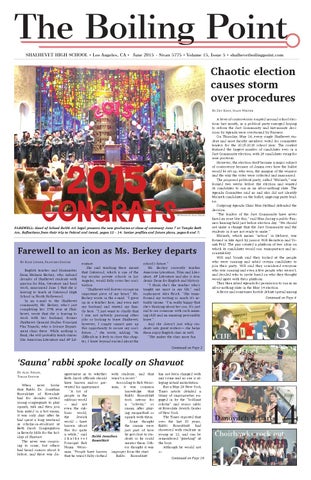
FAREWELL: Head of School Rabbi Ari Segal presents the new graduates at close of ceremony June 7 at Temple Beth Am. Reflections from their trip to Poland and Israel, pages 12 - 14. Senior profiles and future plans, pages 6 and 7.
Farewell to an icon as Ms. Berkey departs By Rose Lipner, Features Editor English teacher and Humanities Dean Melanie Berkey, who imbued decades of Shalhevet students with passion for film, literature and hard work, announced June 1 that she is leaving to teach at Oakwood High School in North Hollywood. In an e-mail to the Shalhevet community, Ms. Berkey, who’s just completing her 17th year at Shalhevet, wrote that she is leaving to work with her husband, former Shalhevet General Studies Principal Phu Tranchi, who is Science Department chair there. While nothing is final, she will probably teach classes like American Literature and AP Lit-
erature. She said teaching there meant that Oakwood, which is one of the top secular private schools in Los Angeles, would fully cover her son’s tuition. “Shalhevet will forever occupy an important piece of my heart,” Ms. Berkey wrote in the e-mail. “I grew up as a teacher here, and even met my husband and started my family here. “I just want to clarify that I was not actively pursuing other jobs or looking to leave Shalhevet; however, I simply cannot pass up this opportunity to secure my son’s future…,” she wrote, adding, “As difficult as it feels to close this chapter, I leave beyond excited about the
school’s future.” Ms. Berkey currently teaches American Literature, Film and Literature, AP Literature and also is Academic Dean for English and History. “I think she’s the teacher who’s taught me most in my life,” said sophomore Alex Reich. “She transformed my writing so much it’s actually insane. “I’m really happy that she’s thinking about her son. It’s just sad to see someone with such amazing skill and an amazing personality leave.” And she doesn’t just whip students into great writers— she helps them enjoy English class as well. “She makes the class more fun Continued on Page 2
‘Sauna’ rabbi spoke locally on Shavuot By Alec Fields, Torah Editor When news broke that Rabbi Dr. Jonathan Rosenblatt of Riverdale had for decades invited young congregants to play squash, talk and then join him naked in a hot sauna, it was only days after he had spent a long weekend as scholar-in-residence at Beth Jacob Congregation in Beverly Hills for the holiday of Shavuot. The news was surprising to some, but others had heard rumors about it before, and there was dis-
agreement as to whether with students, and that Beth Jacob officials should wasn’t a secret.” According to Reb Weisshave known and-or preman, it was common vented his appearance. knowledge that “A lot of Rabbi Rosenblatt people in the took interns for rabbinic world a “schvitz,” or -- and not sauna, after playeven the rabing racquetball or binic world, squash with them. the Jewish Some thought world -- have the saunas were known about just part of how this for quite jewishworldwatch.org he got close to stua while,” said Rabbi Jonathan dents so he could S h a l h e v e t Rosenblatt mentor them. OthPrincipal Reb ers thought it was Noam Weissman. “People have known improper from the start. Rabbi Rosenblatt that he wasn’t fully clothed
has not been charged with any crime and no one is alleging actual molestation. But a May 29 New York Times article detailed a litany of improprieties engaged in by the “brilliant scholar” and senior rabbi at Riverdale Jewish Center of New York. The Times reported that over the last 30 years, Rabbi Rosenblatt had showered with students as young as 12, and can be remembered “gawking” at the boys. Although he would not BO
Continued on Page 19
A bevy of controversies erupted around school elections last month, as a political party emerged hoping to reform the Just Community and last-minute decisions by Agenda were overturned by Fairness. On Thursday, May 14, every single Shalhevet student and most faculty members voted for committee leaders for the 2015-2016 school year. The contest featured the largest number of candidates ever in a Just Community election, with 26 candidates vying for nine positions. However, the election itself became a major subject of controversy because of drama over how the ballot would be set up, who won, the margins of the winners and the way the votes were collected and announced. The proposed political party, called “Ma’aseh,” was formed two weeks before the election and wanted its candidates to run as an all-or-nothing slate. The Agenda Committee said no and also did not identify Ma’aseh candidates on the ballot, angering party leaders. Outgoing Agenda Chair Max Helfand defended the decision. “The leaders of the Just Community have never faced an issue like this,” said Max during a public Fairness hearing held just before election day. “We should not make a change that the Just Community and the students in it are not ready to make.” Ma’aseh, which means “action” in Hebrew, was formed in late April by juniors Will Bernstein and Yonah Feld. The pair created a platform of two ideas on which its candidates would run: transparency and accountability. Will and Yonah said they looked at the people who were running and asked certain candidates to join their party. Will said they considered everyone who was running and even a few people who weren’t, and decided who to invite based on who they thought would agree with their platform. They then asked Agenda for permission to run as an all-or-nothing slate in the May 14 election. A fierce and sometimes hostile debate spread among Continued on Page 4
CIJE
3
Poland/Israel
12 14
Danovit! departs
Choirhawks rock out
12 12
The Boiling Point • June 2015 • Community
2
Farewell to an icon as Ms. Berkey leaves for Oakwood Continued from Page 1 on Facebook. for all of us,” said sophomore Alex Silberstein. “We riods. “One of the all time greats. leaving behind an incredThrough Shalhevet’s rollercoaster years, teachers have don’t just sit down and break the books down, but we perible legacy and an endless roster of students who sing her formed a unique bond with Ms. Berkey. sonalize and relate them to our lives.” “In her film class, she teaches Frtiz Lang’s Metropolis praises!” wrote alumna Gaby Grossman ’08. Ms. Berkey graduated from Yale University and came to Benny Balasz ’14 wrote, “Only had her for a semester, Shalhevet in 1997, working under former English Depart- which I happened to stumble upon channel surfing,” said ment Chair Dr. James Forman until 2004 when he left and Jewish History teacher Mr. Feld. “I became obsessed with but it’s characters like her that made Shalhevet such an she became chair. She was also responsible for bringing the film, so she invited me to have a joint lesson where I amazing community.” And current junior Shirin Nataneli summed up the feelcurrent General Studies Principal Mr. Roy Danovitch into explain why it resonates so much with me. “It’s become an annual tradition and truly is one of the ings of many with a tearful emoji and the simple comment, the department, filling Dr. Forman’s spot. “noo.” Ironically, Dr. Forman left to chair the EngOn ratemyteachers.com, Ms. Berkey boasts a lish department at Buckley School in Sherman nearly perfect five stars and many glowing comOaks, explaining that he would be able to send his ments. daughter there. “She is so invested in her work, is helpful whenAs English Department Chair, Ms. Berkey deever necessary, and just exudes intelligence and veloped new courses, such as film and creative competence,” said one anonymous student on the writing, and changed the nature of the ninth grade website. “Getting back an essay with checks pepperclass to focus more on writing— particularly with ing it would make my day, and the comments she the Collins Writing Program. Along with Ms. Maleaves on each report card are rivaled only by Mrs. likov, she also spearheaded a peer to peer academSunshine.” ic structure, where teachers speak with each other So what’s her teaching secret? to learn how to improve. “I always hold a really high intellectual bar for Even with these accomplishments, Ms. Berkey my students,” said Ms. Berkey. “And I really enable still hopes that the English Department will move different kinds of students to reach that bar.” away from regional literature—like American LitIn addition to teaching English, Ms. Berkey also erature and British Literature—and come up with has a knack for sports. She played on Yale’s softball a more meaningful and engaging focus. team and also initiated a girls’ volleyball and softball In 2009, Ms. Berkey received the Milken Famteam at Shalhevet. She coached the girls’ volleyball ily Foundation’s Outstanding Jewish Educator team until 2009. Award, the same award that Ms. Katarina Malikov BP Photo by Gaby Benelyahu Much of her personal life has also developed at won this year. INSPIRE: Ms. Berkey challenges students in English classroom Shalhevet. She and former General Studies PrinciAs chair of the English Department, Ms. Berkey pal, Mr. Tranchi married in 2006 and had a son, brought Ms. Michelle Crincoli into the high school Oliver, in 2010. and has developed a close mentoring relationship As one of the longest teachers ever to have stayed at with her. You can often find Ms. Berkey and Ms. Crincoli highlights of my year,” he said. Dr. Yoss, too, shares a special camaraderie with Ms. Shalhevet, Ms. Berkey offers her wishes for the future of discussing lesson plans and curriculum in the hallway or the school: Berkey. during their lunch break. “My hope is that Shalhevet students use their strong “I need her here because I need someone to tell my jokes “She’s not only a mentor, but also a friend,” said Ms. Crincoli. “It’s been invaluable to have her as a mentor and to everyday and for some more balance in the school,” Dr. foundation, their identity and their commitment to Judaism as a base with which they can engage with the rest of Yoss said. it’s hard to see a future without her.” After the Boiling Point posted about her leave on Face- the world,” Ms. Berkey said. “Shalhevet students have so Ms. Berkey has worked under five principals and has been through both Shalhevet’s tumultuous and stable pe- book, current students and alumni shared mixed feelings much potential in this world.”
Letter from the editor: A correction
July Sat.
25
By Rose Lipner, Features Editor
Erev Tisha a Ba’av
August 24-28 AP Bootcamp
27
Thurs.
Freshman Orientation/BBQ
27-31 College Essay Bootcamp
31
Mon.
Grades 1O-12 Orientation
September Wed.
2
First Day of Class
Tues.
22
Erev Yom Kippur
13
Sun.
Erev Rosh Hashana
“Cheatology,” the Boiling Point’s Page 1 article in April about student cheating using the Schoology school social communication system, originally contained a number of errors. Some were mistakes in mathematical calculations, and the Boiling Point quickly corrected them in a second print edition four days later. They are also corrected here. Online publication was delayed until the math was set right. Most significantly, 50 percent of students admitted to cheating on Schoology, not 40 percent as reported last month. In addition, a flaw in the structure of the questions raises doubts about some of the article’s conclusions. It seems likely that, as the article stated, more students cheat on Scho-
windows on the internet while taking a Schoology test or quiz? Have you ever looked at your notes on your iPad or laptop while taking a Schoology test or quiz? Totalling up “yes” responses to all of the Schoology questions, 50 percent of students (49 out of 98) said they had cheated on Schoology. Then came just one question about paper cheating: Have you ever looked at hidden materials while taking a test on paper? Designers of the poll meant that to question encompass all forms of paper cheating – including, for example, looking at others’ papers during the test itself. But it is possible that some people thought it meant only hidden materials such as the internet or class notes.
ology exams than on paper. But it is less likely that cheating on Schoology is double what it is on paper exams. This is because the poll, conducted March 3 and involving 98 of Shalhevet’s 186 students, asked three questions about Schoology cheating and only one about cheating on paper, and the one about paper was worded in a possibly confusing way. The poll asked these three questions about Schoology cheating: Have you ever gained access to a Schoology test through other methods? Have you ever visited other sites or
Nineteen percent – 20 students out of 98 – answered yes to that question, leading to the story’s possibly false conclusion that cheating on paper was only half what it is on Schoology. On the flip side, it is also possible that people responded “yes” to using class notes during a Schoology test but actually had not cheated, because use of notes during that test was allowed. When the mistakes were discovered, editors asked AP Statistics teacher Ms. Atara Segal to examine the responses and compare them to
the analysis the Boiling Point reported. “The premise of the story wasn’t wrong,” Ms. Segal said after reviewing the original poll papers. “The most important finding was that students found that there was more cheating on Schoology.” She based that partly on answers to another question: “Based on your own experience and what you have observed, you think there is more cheating on Schoology or on paper?” Sixty-two percent said Schoology and 38 percent said paper. That question, she said, might be the most reliable of all. “Statistically, one way to get good data is to ask people what they think others do,” Ms. Segal said. “People might be embarrassed to admit that they do it, so they’re more likely to report what other people do.” She also said the cause of more Schoology cheating had not been established at all, and that various causes were possible. “What is particularly shocking is that Shalhevet students, who dedicate their four years of learning to moral development, are cheating,” Ms. Segal added. Boiling Point faculty adviser Mrs. Joelle Keene said the paper planned to re-poll the student body next fall with clearer questions. “I do hope that by highlighting this problem, even if the details were wrong, we drew attention to a serious cheating problem,” said Mrs. Keene. “Perhaps even our incorrect story will encourage people not cheat on finals.” She added that it had been a good learning experience for the paper’s staff. “Polling is harder than it looks,” Mrs. Keene said.
The Boiling Point • June 2015 • Community
3
5,000 likes exempt Talmud class from final By Benny Zaghi, Staff Writer
BP Photo by Andrew Lanvin
INVENT: Sophomores Zev Kent, Ezra Fax and Eytan Rosenman at the CIJE conference in Irvine May 20.
CIJE students at conference offer tech inventions for daily life By Hannah Jannol, Staff Writer
Rosenman created an alarm clock system for pills, which alerts users when they need to take their pills. An LCD A moisture sensor that tells users when their plants screen tells how to the medication should be taken, and require watering. A robotic pair of legs that can be pro- the whole device is controlled by a fingerprint scanner grammed to different speeds. A pillow alarm clock. A so that it’s all child-safe. fork that tells its users when they are eating too quickly. Inspired by long, boring drives home stuck in L.A. These are just a few of 80 robotic biomedical projects traffic, freshmen Amin Lari, Daniel Lorell, Jacob Feitpresented at the 2nd Annual West Coast CIJE conference elberg and Noah Mermelstein created a machine May 20 in Orange County. that changes the music playing in a car according to the Held in Irvine at the Jewish day school Tarbut driver’s mood, which is measured by body temperature V’Torah, about 240 Jewish high schoolers attended from and heartrate, taken by a pulse sensor. The faster a per10 Jewish schools all over Southern California. Thirty son’s pulse, the more upbeat, exciting music would emaShalhevet students attended, along with CIJE coach and nate from the buyer’s phone. science teacher Ms. Melanie Fine. Dean Neutel of Tarbut V’Torah created with two othCIJE -- an acronym for Center for Initiatives in Jewish er teenaged engineers a set of blinds which close when Education -- is actually a national foundation promoting detecting heat, so as to preserve the energy of users, as science and technology education in Jewish schools. At well as limit air-conditioning usage. Shalhevet , it is an engineering and robotics class split in Jonathan Mizrachi, a YULA freshman, was inspired to two sections, the freshman class, which met on Mon- by a scene from Back to the Future 2 to create a self-tying days and Wednesdays this year, and the sophomore and shoe. At the click of a button, motors connected to the junior group, which met Tuesdays and Thursdays. shoelaces pull them back and tighten them. “Today is the culmination of all their hard work.” After an hour of students roaming free to look at othMs. Fine said as excited students approached her for er projects, the judging period began. Ms. Fine and Heicomputer chargers, assisdi Theisen, director of STEM tance and relief. “I expect programs at Tarbut, were the kids are going to renew among judges at the event. their motivation for why Our students have done some absolutely “I think the kids came up they did this in the first amazing projects. Things that adults with 20, 30, with really creative ideas to place.” 40 years of experience could not manage to do. real world problems,” said Nerves and excitement Ms. Thiesen. “I’m amazed at -- Adrian Krag, West Coast CIJE director were high and the huge how much coding the kids room buzzed with tension learned in a year or two, that as students quickly set up they could actually build their projects, with each working prototypes.” group assigned its own table in the auditorium. Students For some students, the judging period was less eventimmediately plugged in their projects and scanned their ful. Sam Hirschorn hoped for a more strenuous judging computer screens for last-minute bugs in the code or process. wiring. “The annoying thing at the CIJE fair was that we Scanning the scene with possibly more excitement worked on these projects for eight months, and at the than the kids themselves were Ms. Fine and Mr. Adrian conference; five points, creativity, five points, enthusiKrag, CIJE’s West Coast Director of Operations, who had asm, five points for work ethic and team work skills. I worked closely with every student in CIJE on the West thought that was really annoying.” Coast, not just those at Shalhevet. Mr. Krag new better Also present at the conference was former Shalhevet than anyone what a long, grueling, yet educational pro- math and science teacher Mr. Chris Buckley, who will be cess preparing for that day had been. teaching CIJE at Valley Torah next year. “I am more nervous than excited,” said Mr. Krag, “I think there were a lot of good ideas out there, a watching from the back of the auditorium, “because lot of original thinking,” Mr. Buckley said. “I think one there are so many things going on and there are hun- thing that could be improved upon in the future is maydreds of thousands of things that could go wrong, and I be have a greater percentage of projects that work, that just want everybody to have a good experience.” do what they’re designed to do.” Four projects, he said, were already not working Nearing the end of the day, Shalhevet tech expert when they got to the fair. But at the end of the inter- Yossie Frankel gave a speech highlighting the imporview, his point was positive. tance of CIJE, explaining that only 20 percent of people “Our students have done some absolutely amazing can do what 60 percent of careers require in the 21st projects,” Mr. Krag said. “Things that adults with 20, 30, century, technologically speaking. 40 years of experience could not manage to do, some of Mr. Frankel ended the speech by proclaiming, “We our freshman and sophomores have pulled off.” are preparing for tomorrow, today.” By 10:30 AM, nearly all the students had arrived. A CIJE was started at Shalhevet last year by former scidiverse array of enterprises presented themselves. ence teacher Dr. Jay Smallwood, and this year was orThe “Alarm Clock Pillow” was developed by Shalhe- ganized by Ms. Fine. This year’s program struggled with vet sophomores Alec Fields, Isaac Goor, and Noah Su- a new teacher and lack of a science room in the school’s issa ,” who designed a pillow that vibrates and beeps at temporary facility at the JCC. wake-up time. The new building, set to open this summer, has two Fellow sophomores Ezra Fax, Zev Kent and Eytan large science labs.
A lucky Shalhevet 10th grade class made a deal that exempted them from a Tanach final this year. Back on May 14, sophomore Rebecca Sentchuk proposed to Judaic Studies teacher Rabbi Ari Schwarzberg that if a picture of him that the class posted on Instagram hit enough “likes,” the class would not have to take a final exam. Rabbi Schwarzberg happily accepted the deal and even decreased the original amount of required likes to 5,000 from the 10,000 originally proposed, saying he was excited to receive recognition and become famous. “Every class is different, every class has its own identity,” Rabbi Schwarzberg said. “That manifests itself in terms of the style of assessments, style of teaching, and the shtick that exists in class.” Class members Lindsay Schacht and Layla Galek, then posted a picture on Facebook amd tweeted it to one of Rabbi Schwarzberg’s favorite Jewish commentators, Yoram Hazony, an Israeli political pundit and president of the Herzl Institute in Jerusalem. At first, both fell far short of the number required, though on the upside, Layla’s was re-tweeted by Dr. Hazony. But then class member Aron Cohen got involved. Aron is the owner of the Instagram account called @lakersalldayeveryday, which has more than 42,000 followers. His account is famous for its posts about the Lakers. At first, Aron was unsure of whether he should post the picture, since he believed it could jeopardize his following. Some Laker fans might unfollow him, he feared, since Rabbi Schwarzberg’s picture would be a pretty random post on a Lakers-oriented account. “In the beginning I was worried that I was going to lose followers, but I gained more,” Aron said. Nevertheless, he decided to post the picture. The account actually grew by about 75 followers, because people were tagged on the picture saw the account and some signed on. Instagram “In the beginDOUBLE-TAP: Students ning the class was shared this photo of Rabbi very doubtful,” Ari Schwarzberg on FaceLayla said. “They book and Instagram. thought we couldn’t get it, but once we got thousands of likes people got very excited.” Three days after the post, Rabbi Schwarzberg’s picture on Instagram hit 5,000 likes. The teacher was in total shock, oblivious to the fact that Aron had a famous account. “I thought they had no chance to reach 5,000 likes -- I told them let’s see if you can reach 1,000 likes and then we will talk,” Rabbi Schwarzberg said. It wasn’t the first time that Rabbi Schwarzberg has chosen not to give a final. Last year he only gave one. “A final doesn’t really evaluate how someone does in a class,” Rabbi Schwarzberg said. He said he already been considering not giving a final to this class, and the proposed deal offered a chance to learn something new. “It’s a great exercise for team bonding, community building, and forming a relationship,” Rabbi Schwarzberg said. Meanwhile, he gave students who wanted one the option to take a final after all. Several did, hoping to improve their semester grades. “I am happy for my classmates for getting out of it, but I am upset that I still need to take it,” said Noah Suissa.
The Boiling Point • June 2015 • Community
4
Micah Gill wins Agenda, Ma’aseh takes one spot Continued from Page 1
the student body about whether a political party was a good idea. Some people who were running for office were upset that they were had not been invited to join the party. Others were upset that Ma’aseh candidates would run as an all-or-nothing slate, putting non-slate candidates at a disadvantage. But Will said previous elections had been popularity contests and winning candidates had been ineffective. “With our coalition, we told the student body what they can expect from us,” said Will. “Now they can hold us accountable to our ideals, because they know what they are. “We want to create a Bill of Rights for the Just Community constitution. We need to set some standards so the Fairness Committee can make decisions based on the text that the Just Community was founded on.” Will ran for Agenda Chair, Eric Bazak for Agenda vice chair and Rosie Wolkind for Agenda secretary. Kian Margzhar and Henry Wineburgh ran for co-chairs of Fairness. All of them were defeated except Rosie. Instead, Micah Gill, this year’s vice chair, was elected Agenda Chair. Alec Fields was elected vice chair, defeating Bennett Schneier by a very small margin, with Eric Bazak coming in third. Jonah Gill and Jacob Dauer were elected Fairness co-chairs. In addition to Kian marghzar and Henry Wineburgh, they also defeated Derek Orenshein and Josh Joffe. Laly Chriki and Boaz Willis were elected as co-chairs of the Student Activities Committee (SAC) – though Boaz has been in Israel this semester and campaigned via internet. Laly run with Rachel Sentchuk and Boaz with Noah Rothman, but voters could vote for any two candidates, so the winning pair had not run as a team. Jordan Levine defeated Maayan Waldman for SAC vice president, and Ariel Cohen defeated Yonatan Khalil and Nicole Miles for SAC secretary. In the days leading up to the vote, Agenda Committee held a Town Hall about Ma’aseh’s requests. Student opinion was sharply divided as to what Agenda should do. Agenda posted a poll on Schoology to help it decide whether the slate system would be allowed, although it did not promise to abide by the poll’s results. Twenty-nine students voted in favor of letting the Ma’aseh party exist and run as
one slate; 35 were against the idea of a party at all; and 27 thought that students should be allowed to run with a coalition in terms of ideals, but not as an all-or-nothing slate. Max Helfand, Just Community advisor Mr. Roy Danovtitch, and Fairness Co-chair Goldie Fields met and came to what they called a compromise conclusion that fit the vote of the students: that the students could run and campaign as coalition members, but that the ballot would not mention the BP Photo by Goldie Fields Ma’aseh party. POLLS: Students line up to vote in Just Community elections outside the JCC Auditorium on May “The coalition idea is out of 14. An all-time high of 29 candidates ran for nine spots positions on Agenda, Fairness and SAC. step with the Just Community tradition,” said Max in an interview with the Boiling Point. “We “If Bennett felt that he had a Fairness about what to do,” said Editor-in-Chief-deswanted to make a decision based on what case, then it is unfortunate that he did not ignate Eric Bazak. “In the end Mrs. Keene the community was ready for. If the stu- bring one,” said Alec. “Ultimately it was his took the vote totals down, because Rabbi dents felt they were ready for a change, we decision not to bring one, for whatever rea- Segal was very upset at the seniors on Boilwould’ve made the change.” son.” ing Point and she didn’t want there to be But that was not the end of the drama. There was more controversy after the tension on the Poland-Israel trip.” The day before elections, 29 speeches votes were counted. For the first time in They had not been reposted as of June had to be crammed into a special assembly school history, Agenda released some of 11. Students’ attention turned to finals, and lasting one hour. The usual post-speeches the vote totals -- for the winning and first- the matter seemed to have been tabled until debate and questions involving Fairness runner-up candidates only -- to the Boiling the start of next year. and Agenda chair candidates were can- Point, which published them immediately Micah Gill thought the excitement had celled due to time constraints. on its website. been a good thing. Election day came and students lined It was the first time this had been done, “I think that these elections were good up to vote for who they thought should be and candidates had not been told in ad- for the Just Community,” Micah said. “The the new leaders of the Just Community. Ac- vance that it would happen. Some elections Just Community is great in theory and I’m cording to Mr. Danovitch and other observ- were extremely close, some were moderate- glad that everyone was able to turn this into ers including representatives of the Boiling ly close and others saw huge gaps between a thing that they can take advantage of and Point, more people than usual voted. winners and losers. take pride in.” But hoping for 100 percent participaThis immediately started another huge tion, Goldie Fields – who was in charge controversy and was taken up at of the ballots – used her cellphone to call a subsequent Town Hall. Many everyone who didn’t vote. If they couldn’t felt that the information was not come to the lobby, she took their votes over important enough to be worth the phone. causing hurt feelings and emThat meant not all voting was anony- barrassment among candidates mous. It also meant people were voting for who had lost. or against Goldie’s brother – Alec Fields, The numbers were taken running for Agenda vice chair – with her on down by Boiling Point faculty the phone line. adviser Mrs. Joelle Keene, after Some said that might have influenced the BP’s Editorial Board could them to vote for Alec, who in the end de- not agree on how to handle feated Bennett Schneier by only two votes. them. Rabbi Segal had e-mail Bennett considered taking Goldie to the several seniors expressing his Fairness Committee for influencing the vote dismay, within hours of he and in favor of Alec and compromising its valid- they leaving together on the seity. He decided not to, but would not say nior Poland-Israel trip. why. “There was a big debate Alec was disappointed. amongst the Editorial Board
In Feld v. Dano, two friends square off over Just Community politics By Zev Kent, Staff Writer After the Fairness Committee announced a decision affirming Agenda’s refusal to let the Ma’aseh party run as a slate, Dean of Students Mr. Jason Feld filed a new Fairness case against General Studies Principal Mr. Roy Danovitch, saying he had “overstepped his boundaries.” A public Fairness hearing was held May 11, attended by about nine students attended, plus committee members. They heard the two administrators -- who are good friends -- charge each other with damaging the Just Community and compare the matter to an important decision of the U.S. Supreme Court. “What he did was in essence damage the way the Just Community ought to function,” said Mr. Feld of Mr. Danovitch during the hearing. “He ignored the basic logic behind the rules of fairness. I am afraid if you don’t take this issue seriously it has potential
to damage the Just Community for many years to come.” Mr. Feld compared it to the 1803 U.S. Supreme Court decision in Marbury v. Madison, which set the precedent for what the Supreme Court would be allowed to do in the future, saying the case would set a precedent for the Fairness Committee. “Certain members of the Just Community wanted to run in an election, went through a fair process, and were disenfranchised,” Mr. Feld said. “Not only were those students dismissed, but so were a huge percentage of the students, who voted to play this out. “It isn’t fair. It goes against Just Community and explicitly goes against purpose of why Shalhevet was founded.” Mr. Danovitch, in turn, accused Mr. Feld of being part of the Ma’aseh party, partly because party organizer Yonah Feld is his son. “Mr. Feld is, as we all know, working in concert with certain members of the
Ma’aseh party, and has done significant damage to the Just Community generally and the election process specifically,” said Mr. Danovitch in a prepared statement at the hearing. “Mr. Feld is the one who blithely ignores and repudiates the will of The Just Community,” he continued. “Mr. Feld continues to advise Ma’aseh in secret, without openly admitting his role in their coalition, and his influence on their political platform -- a platform which only became public after he pressured Ma’aseh following a Town Hall discussion about the topic.” Mr. Danovitch said Mr. Feld also tried to rush the Fairness Committee into acting quickly to capitalize on Ma’aseh’s momentum, noting that the dean had criticized Fairness leaders on Schoology for not responding to his hearing request between 9 pm and 9 am the next day. “Mr. Feld is the one who rebukes The
BP Photo by Ezra Fax
TALLY: Agenda and Fairness leaders counted ballots May 15 in the third-floor administrative office. Absent students voted by phone.
Fairness Committee in public,” Mr. Danovitch said, “for not responding to his request in a manner that satisfies his hasty desire for a hearing that produces a result that “adopts [Ma’aseh’s] proposal, ‘as is’ and without delay” and “extends the campaign season to make up for the lost days due to unneeded deliberation.” In the end, the Fairness Committee decided in favor of Mr. Danovitch and Agenda, saying that Ma’aseh had never made a specific request about the ballot. “Because a formal proposal was never given to the Agenda Committee, this issue is now null and void,” wrote Fairness Cochairs Goldie Fields and Daniel Steinberg in a Schoology announcement. They encouraged anyone in favor of a coalition to write a formal proposal for next year.
The Boiling Point • June 2015 • Fea!res
9
The Boiling Point • June 2015 • Fea!res
10
s n o i t ec f e R r o i n Se from
BP P
Poland I sang, because I can By Shana Chriki, 12th Grade Shoes. Millions of shoes clumped together, they looked like one. Big shoes, women’s shoes, kid’s shoes and baby shoes. As I stared at the tiny shoe in the box to my left I couldn’t stop thinking about my little brother. If we’d been born 70 years ago, this could have been us. He could’ve been holding my hand as we walked through the camps of Majdanek. I had seen pictures of piles of shoes many times throughout my Holocaust education, but now I saw the shoes in the place where they were taken, stolen. My pink Nikes, that
1 Page design by Michelle Hirschhorn
7
I wore to avoid getting my white high-tops dirty in the rain, hugged my feet as I lifted my heels into a tiptoe, craning my neck to glimpse the endless pathway of shoes. Tears were flowing down my face as I imagined my brother, Elie, beside me. It was so hard to fathom how people had the ability to kill precious children and babies — didn’t they too have children in their family that those little shoes reminded them of? We walked into the crematorium at Majdanek, where a group of us presented a talk about daily life there, and then we lit three candles in memory of those who perished at this atrocious site. As we sat with our rabbis, we sang because we can, we sang because we survived. Sitting by the crematorium I imagined bodies being burned, envisioned the ashes that were once bodies, and didn’t feel comfortable joining in singing Hinei lo yanum vlo yishan, shomer Yisroel – the Guardian of Israel neither
slumbers nor sleeps. I know they weren’t n essarily songs of happiness, but still, I felt G absence, and I couldn’t bring myself to sin Jewish songs with my friends. It was too h When we reached the last song, Rabbi asked that we all sing together. He said he understood that we were having a hard tim but pleaded that we try the best we can. As sat looking at the ovens, I sang, I sang with classmates as we held each other. I sang be it is my job to show Hitler that we’re still h and thriving at that. I sang because it is my duty to ignite th memory of the many Jewish people who d in this death camp. I sang because even th I felt God’s absence, I also believe that He exists. I sang because I can.
JOURNEY: Arriving in Warsaw May 18, the class of 2015 spent five days visiting Holocaust sites in Poland as they began their senior trip. 1. A mix of emotions flooded students sitting on a hard floor in front of the ovens at Majdanek; 2. One barracks at Majdanek has been completely filled with shoes taken from prisoners as they arrived; 3. In Auschwitz, students viewed a gas chamber which was destroyed by the Nazis as the Red Army approached at the end of the war; 4. At the famed Yeshivat Chochmei Lublin in Poland May 19, Avishai Rabin (second from left) lained the parsha as Mati Hurwitz, Daniel Steinberg and Max Helfand loo the Rosh Chodesh Torah reading; 5. A guide told seniors the story of the Chozeh of Lublin beside his grave May 19. 6. Gazing into the walled-off ovens of the crematorium, seniors’ reflections in the clear barrier connected the present with the past 7. Clearly visible from the surrounding city of Lublin, the chimney at Majdanek jutted into a blue sky in a scene of unsettling beauty as the seniors approached.
Majdanek: Endless death in the heart of a city
By Sigal Spitzer, Staff Columnist “With your permission, a quick moment of silence until we reach our final destination,” said Yonatan, our tour guide, en route to Majdanek. I didn’t think the moment of silence would last until we arrived at the concentration camp. Someone was bound to ruin the silent 20-or-so-minute drive, I thought, as I stared at the yellow and red public transportation busses overcrowding the streets of Poland. There were schoolchildren holding hands crossing the street to get to school and adults completing their weekly shopping at the local fresh fruit market. Life was normal and the city was vibrant, as the moment of silence on the bus continued. All of a sudden, about 45 seconds after Yonatan asked for quiet, the bus arrived in the still, yet scenic plot of land – Majdanek. It was surrounded with endless barbed wire and interminable watch towers. The tall grass swayed in the breezy and sunny May day. Dark brown bunkers lined the fields and the tall
chimney of the crematorium did not hide the Nazi secret. A massive pile of ash filled a monumental rock just outside of the camp and birds peacefully chirped as they flew around above us. It was strangely beautiful. But as the moment of silence on the bus was broken by curse words and deep gasps, I started to cry. For the first time in my life, after almost 18 years of Holocaust education, the millions of photos and thousands of videos I had seen became a reality. It was no longer a black-and-white stream of evilness rotating across my TV, no longer a resentful thought in my mind based upon stories heard from survivors. The death camps and labor camps were real. They existed in the middle of Poland. In the heart of a city. I thought: what if I had arrived at the camp just 70 years earlier? Would I survive? Would I be tortured? Would I ever see my family again? To my surprise, Majdanek was a colorful camp lined with green trees, brown buildings, red and orange shoes, blue gas stains and purple flower buds. It was not a camp located in the middle of the forest, but rather in the heart of Lublin. The beauty contrasted with its disgusting history. As we walked into Majdanek, our teacher Ruthie Skaist handed out Israeli flags. I grabbed one from her hand and wrapped it around me for protection. Inside, we began to follow the story of Helene Birnbaum, who
was 13 when she arrived with her mother. They were quickly separated as she went to the showers and her mother to the gas chambers. Standing at the selection barrack where Helene and her mom were separated, I noticed a park adjacent to the camp. A woman walked by with her black lab and red leash. A group of men jogged by in neon colors and trendy Nike shoes. Strange. How could the death of 360,000 Jews have taken place in the midst of a city? How could the Polish have let this happen? Why did the prisoners not run away to Lublin? So many questions flooded my mind as I somberly followed Helene’s path. We walked through the clothing swap station, where Helene records her older cousin taking care of her after her mother was killed. She was forced to strip naked in a room full of woman who did the same. Her older cousin was brave enough to steal a nicer pair of shoes, but Helene would not resist against the Nazis. We continued to where Helene’s mother took her last footsteps – into the gas chamber. There were two rooms. Both are still equipped with gas that can turn the room into another deathbed in seconds. The evil inside again contrasted with the beauty outside, the green tall grass and shining hot sun. We followed Helene’s footsteps around the camp. First to a barrack lined with thousands upon thousands of shoes. Each shoe
with a different story, of a all lost during the war. Th triple-decker bunk beds th space for 150. It was too h the room. I can’t imagine enced in the middle of sum Finally, we reached the ably, we began to sing. In sang. We belted out Ve’Za Beit Yisroel and Ve’hi Shea Some continued to cry. So room. And some remained si two hours spent inside the
The Boiling Point • June 2015 • Fea!res
11
Auschwitz-Birkenau: A merger of silence and speech By Alexa Fishman, Editor In Cheif I used to think that silence was something to avoid. Something awkward. The sign of a lull in a conversation. But today, I experienced a different kind of speechlessness. I watched as my friends sat apart from one another — not talking — on the steps overlooking the crematorium at Birkenau. For the first time, I felt comfort in silence. Nobody had to speak because the tears and silence said it all. After experiencing Majdanek yesterday, I believed that Auschwitz I and II could not be more traumatic. I had gotten sick to my stomach at Majdanek, and I even left the group for a few minutes to close my eyes and force myself to take deep breaths. As we set out on the hour-long bus ride to the town of Oswiecim, I promised myself that I would handle Auschwitz I and Birkenau better than Majdanek. I vowed not to fall apart in my hotel room again once we returned. As we began our walk into Birkenau, the largest and most deadly sub-camp of Auschwitz, I felt as though I was in a black-and-white photograph. I marched along the train tracks and approached the large, brown building that signified the start of the death camp. We shuffled single file, overwhelmed at the sheer size of the facility. Nobody was talking but we held hands.
Photo by Goldie Fields
2
necGod’s ng hard. Segal
Soon, we passed a giant field of brick chimneys — barracks that had been destroyed the Nazis; all that remained were hundreds of chimneys. We walked past the women’s camp, a cable car and the ramp used for the selection. And then the tears came. Our group stood in a circle next to the destroyed gas chamber and crematorium and sang. As I powerfully belted out Ani Maamin Bemunah Sheleima, which means I believe in God with full faith, a thought suddenly crossed my mind. I wanted to yell at everyone who called the Nazis “dehumanized” throughout our trip here. People claimed that the Nazis were so far gone that they didn’t have an ounce of morality in them, but that couldn’t be true. Clearly they knew how despicable their gas chambers were, which is why the facility now lay in broken piles of rubble — scattered and broken piles like the ashes of my people in a mound at Majdanek. The Nazis destroyed their gas chambers before the Red Army could liberate the camp, apparently attempting to protect their reputations. After we finished singing, Ruthie and Reb Noam handed us letters that our parents wrote to us. I welcomed the surprise. I
sat alone at the foot of the gas chamber and read my letter, which reminded me of my responsibility to speak up. My dad wrote to me about my relatives in America, who along with most American Jews did not lobby and fight for the Jews in camps, despite the rumors that reached them. Although I was surrounded by silence, I vowed to myself that if I needed to fight for my people, I would. Whether it was BDS or violent anti-Semitism, I wouldn’t make the same mistake that American Jews during the war did. I experienced simultaneously such profound silence and such a desire to speak out, criticize and teach. Although they don’t usually work together, I finally understand how profound silence and powerful speech could coexist. Here in Poland anything goes.
3
me sI h my ecause here,
BP Photo by Goldie Fields
Connecting WITH GENERATIONS in the home of ‘daf yomi - LUBLIN’
he died hough
4 By Mati Hurwitz, Sports Editor
oked on during
y
a different individual Jew, Then to Barrack 14 filled with hat squeezed 500 people into hot for me to even remain in what the inmates experimmer. e crematorium. Uncomfortthe middle of Majdanek, we akeni Legadel, Achenu Kol eamda as one cohesive family. ome flashed smiles across the
ilent, still in the shock of our e camp.
6
On our first day in Poland, I had my first true experience with European Jewry in Lublin. Not just because we visited the horrific camp in Majdanek, but because I got to connect with generations of Jews of the past, Jews with different backgrounds and upbringings. My day and primary experience started at Yeshivat Chachmei Lublin (YCL), when I felt connected to the top talmidei chachamim of the 1930s. That yeshiva was run by R’ Meir Shapira – who also instituted daf yomi study and spread it throughout the world – and was home to the brightest and sharpest students, who could only be admitted by passing the famous pin test. Next year I am going to one of the most prominent yeshivot and Torah centers in the world, Yeshivat Har Etzion (“The Gush”), and I really enjoyed learning about the greatness of YCL. It was a humbling experience, because I know that I would never be capable of passing the YCL admission exam. BThe Germans ransacked the place, the yeshiva never regained its prominence and the world lost an incredible Torah center. However, we Shalhevet seniors honored its legacy yesterday! As part of a group presentation, Jeremy Glouberman and I taught part of Tuesday’s daf yomi, or daily page of Gemara. In Ketubot 106a, the Gemara discusses a series of rabbis and numbers of their students who left their yeshivot. Jeremy and I connected it to how Rav Shapira mobilized Torah study for both elite and non-elite Torah learners by spreading daf yomi. Even when a large chunk of the world’s Talmud Torah was lost, whether from the destruction of YCL or the Amoraim’s fleeing from their yeshivot almost 2,000 years ago, the Jewish people have constantly been creative and found new ways to keep the fire of learning burning. Daf yomi is not an intense study of Talmud, but it connects Jews across the world every single day. Earlier in the morning, Jeremy and I had stumbled upon a Gemara Ketubot in the
yeshiva. We felt instantly connected to the globalization of Talmud Torah. When we were teaching our rabbis and fellow tudents, I felt like I was a middle man between Rav Shapira and the common Jew. I felt empowered: I was embodying the creation of one of the most impactful Talmud Torah programs in the world in the place where it was born! I felt the spirit of Jewish resilience and strength at YCL more than at any moment in Majdanek or the cemeteries we visited. The Nazis destroyed the greatest yeshiva, but thanks to Rav Shapira, among others, they could not kill the flame of our people and its thirst for Torah. The experience in YCL made even more powerful because earlier in the day, we had danced and sung Hallel. It was Rosh Chodesh Sivan, and another Orthodox high school, Kushner of New Jersey, was also at YCL that morning. We circled up with them and melodically praised Hashem. Then, before we left, Jeremy and I put our own copies of the daf yomi on each shtender in the shul at YCL, hoping that whoever might walk in could learn the daf and connect to Jews worldwide in the original founding home of daf yomi. While YCL was definitely the highlight of my day Tuesday, I felt linked to not only the elite religious scholars of Poland, but to all sects of Judaism. We visited the gravesites of the Chozeh of Lublin and R’ Noam Elimelech, two legendary Hassidic figures. As students and our guide shared stories of those two men, I started connecting to Hassidism. I really am not a big fan of Hassidic Judaism and find some of its practices very odd and questionable, but for once I almost felt like one of them. Although it was very abnormal, we rejoiced and danced around the grave of R’ Elimelech. Instead of being solemn and sorrowful at a kever, we embodied the Hassidic spirit by joyously celebrating God, life, and Judaism. In between the two cemeteries, we spent hours in Majdanek at the concentration camp. I was not too emotional, but fascinated with
the beautiful fields at the camp and as I pondered how much brilliance and time had gone into its construction and the plotting of the Holocaust. I had a religious experience not only mourning the loss of hundreds of thousands at Majdanek, but wondering how the Nazis devised their plan to wipe out the Jews and were able to build these camps so meticulously. Walking through museum exhibits and recalling personal accounts, I learned about how the Nazis psychologically broke down the Jewish people. But as we sang in the crematorium, I definitely felt my final connection of the day: to all Jews. Not just frum Jews and Talmud scholars or Hassidim, but any kind of Jewish person who had been in Poland. Nothing mattered to me except the fact that we all share the same faith. Secular or religious -- every kind of Jew suffered in Majdanek. I think I felt their spirits was when we sang “Acheinu” right next to the ovens in which the Nazis turned us into ashes. Me’afeila l’ora! we shouted! “From darkness to light!” The poor victims of the Holocaust suffered in darkness, but as the strong people we are, Am Yisrael rose from the ashes into the light. The theme of this trip is Me’afeila l’ora, as we go from Poland to our gift of Israel and connect the rich history of our people. The Jewish people will never be wiped out and I am so glad I had the opportunity in a single day to be exposed to every sect of our eternal faith and become the next link in the chain.
5
The Boiling Point • June 2015 • Fea!res
12
HEADING HOME WITH a deepening reservoir of questions By Margo Feuer, Managing Editor When I thought about the senior Poland-Israel Experience during my three years at Shalhevet, “Poland” was the word that stood out most to me. I’ve been to Israel numerous times with both touring groups and family. While I was excited to visit my Jewish homeland with my classmates, my thoughts focused almost exclusively on concentration camps and mass graves. I came into this trip anticipating important and reflective experiences. I knew Poland would affect me deeply, and it did. I had my share of tears, heartache, hope and inspiration at the railroad tracks of Birkenau. I felt a deeper connection to my Jewish roots than ever before. Though to a more extreme extent than I thought possible, I experienced what I had anticipated. It was exactly what I needed and it’s impossible to overstate how important it has been. While I spent hours feeling nervous and scared for Poland, I didn’t spend too much time pondering what I would feel in Israel. Israel feels like home. I didn’t an-
ticipate this leg of the trip with fear or angst, so I didn’t consider how this experience would differ from others – either because I’d be coming from Poland or because a Shalhevet trip would differ from previous ones. A new awareness of Israel blindsided me like a ton of brinks. Over the past week-and-a-half, I have seen nooks and crannies of Israel I never knew existed. My relationship with Israel has been revolutionized. At once, I have a more intimate understanding of Israel and feel a larger chasm than ever between what I know and what I need to answer. I also feel a greater motivation than ever to change those question marks into periods. But tonight as I head home, I carry much more than just punctuation marks. We visited groups such as Hashomer Hachadash, a group of volunteers who protect Jewish farms from criminals; Tikvot, an organization that aids wounded soldiers and terror victims through sports; and Dialogue Through Dark,
a museum that simulates the life of the blind. From such adventures, I emerge from this trip more sensitive and aware;I will be more considerate and sympathetic of others’ situations and struggles as I better understand their hardships. And having traveled from Poland to Israel, I also am more of aware of my personal mezeg avir – literally, weather. The pain I felt at Majdanek, the gratitude that overcame me at the Wolbrom Forest and the social growth from being with 30 classmates for over two weeks, will never leave me. More attuned with my natural tendencies and goals for the future, I land in LA more mature and personally aware.
BP Photo by Goldie Fields
2 HOME: After Poland came Israel. 1. Seniors hunt for ancient artifacts at the Temple Mount Sifting Project on May 26. 2. A local artist in Tzfat May 27 describes how kabbalah practice inspires his art. 3. Seniors learn about Ha’Shomer Ha’Chadash, a volunteer program in which people build fences out of rock to protect the animals of Jewish farmers. 4. Seniors listen to a guide during their tour of Tzfat May 26. They also sometimes gathered for informal davening outdoors.
1 Becoming the phoenix By Mati Hurwitz, Sports Editor When we moved from Poland to Israel, we experienced the l phoenix of Jewish history: the rebirth from ashes. We saw the corruption of the Nazis and the demolition of European Jewry in the camps and in the old Jewish villages. We learned Rabbi Shlomo Carlebach’s famous Krakow niggun and chanted it seemingly everywhere we went. This song starts off slow and becomes gradually festive — like our trip. And so the rhythm of our experience picked up as we got into Israel, as we were truly engulfed by not just a Jewish community, but the Jewish People. One memory I’m always going to have is davening Kaballat Shabbat in a random cat square near our Jerusalem hotel. We journeyed through narrow alleys to a dumpy site that had a mini-amphitheater type seating arrangement with stray cats wandering around. All of a sudden, a man shouted out his window, “When are you starting Arvit?” He didn’t show. But at the end of our tefillah, an unfamiliar face arose from the girls’ side and thanked us for contributing to her Friday night. She told us her name was “Chen,” which none of us have heard of as a name before. I thought it was really cool that she found Chen, favor, in our prayer and de-
cided to join us in the middle of an alleyway. With her, we sang the very tune we had carried from Poland, the Krakow niggun. As Shavuos was closing that Sunday, our class gathered outside in an area in between our hotel and a neighboring high-rise. We made our own little kumzits to finish off our holiday and screamed timeless Jewish songs. We sang tov lehodot l’Hashem – it is good to give thanks to God — and once more, the Kraków niggun. A man about six floors up opened his door and came out onto his balcony. With a fist pumping about 100 feet above us, this man joined into our song. He called for the others in his room to watch what was going on in the Lev Yerushalayim common area. Our voices didn’t just reach up a few flights of stairs. Our melodies connected us with world Jewry. That is the power of Jewish songs. They are what our forefathers passed down from generation to generation and what connect Jews all over the globe. Perhaps a simple yid humming a melody is the true driving force behind the continuity of our people. On our trip, I for sure have felt that power.
s n o i t c e L f e R r o Seni from
3
Israel
4
13
Outside News
THE BOILING POINT
JUNE 2015
Firehawks raise money for victims in Nepal By Elon Glouberman, Staff Writer
The money raised in the boxes raised the total to an even $3,580. The final amount came as a surprise even to the fundIn just over two weeks, Shalhevet students raised alraisers. most $3,580 in donations for humanitarian organizations “One thing I expected was support from parents, but I working in relief for the homeless and injured victims of still would have never predicted getting that much support the devastating earthquake in Nepal. from the community,” said Will. “It really said something A team of students calling themselves Firehawks for about our Shalhevet community which was very impresNepal, led by junior Will Bernstein, used Facebook, emails sive.” and Schoology announcements in an effort to raise A week later, the money was handed to as much money possible for the affected Nepalese. school controller Errol Briggs while Firehawks On April 25, a 7.8 magnitude earthquake struck for Nepal decided where to send it. They dea small Nepalese village, Chapagaun, killing more cided to split the sum into two halves, for the than 8,000 people and leaving tens of thousands American Red Cross and the American Jewish severely injured and homeless. Emergency efforts Joint Distribution Committee (JDC). The Red of help and relief immediately germinated all Cross’s activities had been widely publicized. around the globe, ranging from charitable dona“Of course being from a Jewish school, we tions to physical humanitarian aide in Nepal. also wanted to support a Jewish organization,” According to the New York Times, many difsaid Will, “so after researching several organiferent countries, including Israel, the United zations online, we came across the JDC, which States and Japan, sent search teams in an effort to had men on the ground in Nepal.” rescue survivors. Both organizations have done humanitarian When the news came to Shalhevet High School, work for Nepal as well as other countries affectstudents at first did not know how to respond. ed by the earthquake. The shake also triggered “I was kind of shocked,” said freshman Rosie an avalanche on Mount Everest, killing at least Wolkind. “These things happen every few years gofundme.com 19 climbers, making it the deadliest day on the and it doesn’t really resonate.” mountain in history. Rosie and Will joined with freshman Ariel Co- DEVASTATED: After the Himalayan country of Nepal was turned to rubble, According to its website, the Red Cross hen to form the new group, starting “Firehawks Shalhevet students eventually raised $3580 through social media and a cash box. raised $9 million in relief funds for Nepal since for Nepal” as a small meeting in the office of Genthe quake. According to its website, the JDC eral Studies Principal Mr. Roy Danovitch. After discussing several ideas, the team decided to launch a started donating from all over, sharing the links [to our works on long-term relief efforts and assistance that have website], and within a day we raised $1,000,” said Rosie saved hundreds of thousands of lives of people facing cricampaign to raise as much money possible. ses around the globe. “First we thought what it is we could raise and what we Wolkind. “It was amazing.” Will, Rosie and Ariel said the fact that they were able to Over the span of a week, the site acquired $3,100 from could actually send over, so we thought the most efficient thing to do was to raise money,” said Will in an interview. community members including parents, family supporters, help at all felt like an important achievement. “It proved to ourselves what we can accomplish, that The group immediately started a “gofundme” page administration workers, teachers, and students. By May 4, we can make an impact, and we are able to take an active a total of 53 people had donated through the website. through the popular online fundraising website. This alTo include students who wanted to pay in paper mon- role in society and leave somewhat of an impact,” Will lowed people from even outside the school to pay with the use of a credit card. The site also gives the option for ey, Ariel Cohen created two donation boxes for students said with a smile on his face. “People will see what happened in Nepal and ask, and teachers at the JCC. One was covered with red tissue donors to leave their names anonymous. ‘What can I do?’ We can raise 3,500 bucks. That’s what paper and photographs of Nepal, and the other sported The group’s original goal as set on the “gofundme” denim duct tape and zebra-print letters spelling “Nepal.” we can do.” page was $2,000. “When it got to $1,700 after a couple days, it was insane how so many people from the community came to support the cause,” Will said, “We then left the final goal at $3,000 and the amount we raised still kept on rising.” To spread the word, Rosie Wolkind sat down with Mr. Danovitch to write an email to the entire Shalhevet community, extending the pool of possible donors beyond the realm of the school. “As soon as the email went out, we saw that people
Muslims, Jews join together for prayer and a video in new citywide fellowship In late May, a video called “Two Faiths, One Prayer” appeared on YouTube, telling the story of a group of Jews and Muslims who prayed together outdoors five times around Los Angeles over the course of a day. The video had 23,000 hits in its first three days. Reb Tuli Skaist, former Shalhevet Judaic Studies teacher, was one of nine Jews involved in the project, and was interviewed by the Boiling Point along with Omar Ashraf, an observant Muslim from Dallas of Pakistani ancestry. A complete transcript is online at shalhevetboilingpoint.com. BP: Why did this group decide to pray together? Reb Tuli: I’m part of a fellowship called “New Ground.” It’s a group of Muslims and Jews who get together every other week and dialogue with one another. We learn about each other’s religions and we talk about difficult issues like the Palestinian-Israeli conflict. Part of the fellowship, aside from getting together, is that we’re supposed to come up with a project that is going to involve interface. During our first retreat, when it came time to pray, we were trying to figure who should pray where, and one of my fellow cohorts said, “Why don’t we just pray in the same room, what could be the problem with that?” Initially people were skeptical, but we did and there was something really special about it. So we decided to continue this, and eventually the idea kind of organically came out of this, like hey, why don’t we bring this to the public? BP: What did you gain from praying together? Reb Tuli: My personal prayer has been more meaningful when it’s shared together with other people, especially when shared with Muslims. There is something very beautiful and enchanting about Muslim prayer, and there is something very powerful about being able to share that space with this group. When you think of Jews and Muslims, you don’t think of them praying side-by-side.
Omar: Our first retreat was a month into the whole program. We were teaching Jews how we pray, and they were teaching us about Shabbat and how they pray. We decided we would pray together, and what came from that was a pretty powerful experience. There was some sort of concern that we wouldn’t be concentrating as much because it is pretty weird or different. But it actually was a very spiritually enhancing process for us all, which is why we tried bringing it to the city of L.A.
Courtesy of Omar Ashraf
MIXED: ‘New Ground’ members started their day of outdoor BP: When you pray in the same location, is it public prayer on the beach in Santa Monica. distracting? Reb Tuli: We all initially thought it would be. Muslim prayer is really different than Jewish prayer. It’s mind we are both davening to Hashem. As far as the group mostly just the leader speaking, and Jews pray out loud is concerned, we’re praying to the same God. and sing, so we didn’t want to be a distraction. BP: What have you gained or learned from the exBut we found that not only has it not been a distraction, but it’s been very inspiring. The words “Allahu Ach- perience? Omar: I think I’ve gained a lot. I have learned a lot bar” have always been trigger words to me, because it’s well known that those are the last words some people who about the Jewish faith, and about Israel and Palestine as commit extreme evil say before doing that evil. The entire well. Internally I learned a lot about Islam. Everything is meaning of those words have changed for me. When I’m done in a structured manner where we work on communiin davening and I hear those words, it sends a jolt through cation skills and conflict resolution through each session, my spines, like, wow God is great! It has taken on a new, and then we start talking about harder issues like IsraelPalestine. spiritual meaning for me. There is also an intro to Judaism and Islam. Those lecOmar: I was the Umam (leader) for the first time we prayed together, and I was hearing the chants by the Jew- tures help develop a greater understanding of religion and ish side but I didn’t feel my concentration breaking. If what’s going on in the world, and it has helped me be a anything I thought it was increased. I remember finish- better Muslim. Reb Tuli: Every single person has a narrative. You ing earlier and looking up to seeing Jewish prayer being completed and being in awe at what was happening. It was can’t really know another human’s story until they tell it to you. All the assumptions we make about each other are definitely symbolic. basically because we never took the time to listen to each other’s stories. For me it’s been very powerful to interact BP: Were there potential halachik issues with this? Reb Tuli: We haven’t found any. Rambam says very with a group of Muslims since before I never really knew clearly a Jew is allowed to enter a mosque. He poskens any Muslims. It has shifted my perspective of the world a (rules) that Islam is not avoda zara, idol worship. In my little bit.
The Boiling Point • June 2015 • Fea!res
14
11 YEARS OF From pet snakes to King Lear, departing General Studies Principal Roy Danovitch gave Shalhevet a different way to think about books, school and life.
By Eric Bazak, Outside News Editor The school was ready for this moment. There were student-produced videos, Town Hall farewell speeches, and even a new hiree for the General Studies principal position. But as General Studies Principal Mr. Roy Danovitch taught his last English classes last week and made his final impassioned speech to the community – a charge to the seniors at graduation June 7 – the community still struggled saying goodbye to one of the few remaining faculty members to bridge the “old” and “new” Shalhevet. “Old Shalhevet was a mythological fairly-land; the kids ruled the roost, everything was up for debate, and the school lurched forward, backwards, upside down, and sideways, eager to find itself,” Mr. Danovitch told the Class of 2015 and their families who had gathered for commencement at Temple Beth Am. “There were no executive committees, no public relations budgets, and no hashkama minyans,” he added, saying what everyone seemed to understand, whether or not they realized it was all factually true. “Shalhevet embraced dissonance in every corner; it was a school suffused with manic energy, spirited students, and a grand wizard, Dr. Friedman, sitting in his office, sans file cabinets, sans computer, but a giant aquarium behind his desk, and an apiary of birds cawing outside in the courtyard.” The new Shalhevet, he said, has procedures, protocols, mapping, and horizontal curricular integration, along with minimesters, Schoology, waiting lists, financial sustainability and a “glamorous new building.” He went on to say that the idea of a new or an old Shalhevet was actually a myth, and that the school had simply grown up, while keeping its uniqueness and “magic.” But true or false, whatever is to come, his departure marks the end of a time that was uniquely filled with his philosophical queries, humor, and enthusiasm.
Last summer, Mr. Danovitch sent an email stating that the 2014-15 school year would be his last as General Studies principal, later confirming it would be his last year at Shalhevet as well. Then on Feb. 26 this year, he announced he would be moving to New York to attain a Masters of Education degree from the Klingenstein Institute, a school leadership program at Columbia University. “Whenever you lose somebody like him its going to affect the school,” said Dr. Jerry Friedman, the founder of Shalhevet. Reflecting on his 11-year tenure in a recent interview, Mr. Danovitch – who prefers to be known by the more informal moniker of “Dano” – remembered his first few days at Shalhevet, when the copy machines were broken and everyone was passionately debating something. He said there were very few boundaries between the different constituents of the school, which made it a genuine community.
“I remember my first 12th-grade World Literature class, where my students were surprised I knew Hebrew,” said Dano, who was born in Beersheva, Israel, but had not worked in a Jewish school before. “They complained about my first Dostoevsky assignment and muttered a Hebrew curse word. But I understood them, and they turned completely white, and I understood then that I was a perfect fit at the school.” Over the years there were other of adventures. A student’s mother once asked Dano to adopt her pet snake. Dano agreed on impulse and kept the boa constrictor, naming it Edgar after a character in Shakespeare’s King Lear, his favorite play. He kept the huge snake in his office, caged most of the time, and fed it a mouse every week. Once, the snake made its way to the girls’ bathroom, causing a bit of havoc. He finally decided to give it to school custodian Jose Flores, whom he considers to be a much better owner. For a while he brought his dog, a pitt-lab mix, to school some days. His dog was named Barry Hussein Hubris III, named after President Barack Hussein Obama, who was known as Barry in high school in Hawaii.
Courtesy of Zev Hurwitz
Courtesy of Zev Hurwitz
#selfie
But a constant has been his off-beat but intense teaching style, which integrates philosophical and life discussions into his literature classes. “They were not typical discussions,” said alumnus Alex Fleshner ‘09, now an associate account strategist at Google, who stays in touch with Dano because of their shared love for basketball and the Lakers. “I think Dano helped broaden my perspective not only on my overall knowledge, but just the way I approach Courtesy of Zev Hurwitz some things in my life. Particularly, not sweating the small things and thinking COOPERATING: UJS members Zev Hurwitz and Jonah Saidian and Hibah Khan and Yasin Ahmed of the Muslim Students Association led a Town Hall bigger picture.” Mr. Danovitch’s classes taught Aviva meeting at UCSD in November. sld; Students Association led a Town Hal Brandes ’09 to follow her passions. “He taught me things no one else was “He was the personification of a great teacher who teaching,” said Aviva, who is also an actress. “I ended knew how to move around,” said Dr. Friedman. “He up majoring in philosophy because I loved what he used more of the Socratic and Kohlbergian approach taught, He made me question myself and my life. He as a teacher, where he had the students involved. He got me reading Kafka, who is now my favorite author. was the epitome of what I like as a teacher … and Because of all that we’ll always have a close bond.” when I came out of his classroom, I knew it was all He taught Shakespeare with emphases on vocab- worth it and working.” ulary and interweaving of themes, wanting students For his part, Mr. Danovitch called Dr. Friedman to struggle to find out the meaning of the words. He one of his greatest life role models. would tell his students that the only way to fail was “He is a visionary who lives and breathes the misby Spark-noting rather than reading the text. sion of the school, so when looking to make decisions For Penina Smith ’09, Dano’s class was a way I look to him as an example,” Mr. Danovitch said. “He through a very difficult junior year. During the sec- remains a huge role model to me and is one of the ond semester, Penina missed three months of school reasons I’m going to grad school -- because he always for medical reasons. encouraged me to take the next step.” “My medical issue gave me a whole new spin Dano said another role model was the late Beatrice on what we were reading -- especially Kafka -- and Levavi, another unique Shalhevet figure of the past, this newfound perspective is what really helped us who served first as Dr. Friedman’s assistant and then connect,” said Penina, who graduated from George as Admissions Director. Ms. Levavi died of pancreatic Washington University last year. “It was my first En- cancer in 2009. glish class at Shalhevet that really challenged the way They had many deep conversations, he said, and I thought and understood the world around me.” he still remembers when she put visine in Dr. FriedDr. Friedman, too, found Dano a cure for his ills. man’s eyes in the middle of a meeting. When he would have an aggravating day as Head of “She used to visit my class with parents when I School, he would walk to to Dano’s room and just was a young teacher, and she’d mesmerize me with watch. It always put him in a better mood. her knowledge of film, literature, history, and cul-
The Boiling Point • June 2015 • Fea!res
Courtesy of Zev Hurwitz
Courtesy of Screenshot
15 For two years he worked for a Swiss watch company in San Diego, returning when the economy was frozen after the Sep. 11 attacks and jobs were hard to find. He decided to travel to Southeast Asia and taught English to children in Laos, Thailand, and Cambodia. “It was that experience which inspired and motivated me to test out a career in education,” he said. Back in LA, he heard about a job opening at Shalhevet from English teacher Ms. Melanie Berkey, a friend from Crossroads who thought he should try out. He was hired by Dr. Friedman after giving a guest lesson where he taught Catcher in the Rye using Post-it notes. In the years since, has taught 9th- and 12th-grade World Literature, 10th-grade American Literature, and 11th-grade British Literature. “What is interesting about his whole tenure at Shalhevet is that because of his ‘Dano-ness,’ that classic Dano personality, I think he took a lot of people by surprise here,” said Ms. Berkey, who is moving on as well. “Nobody at the beginning would have anticipated he would have gone on to do what he has done here,” Ms. Berkey said. “Those same principles that he has brought here at the beginning -- to focus on students and just being a super creative and outside-of-the-box teacher -- those were definitely sustained.”
Dano was named Dean of Students in 2010, and one of his jobs was to lead Advisory. He called it “Maagal Hakshva” and modeled it on the Listening Circle model advocated by the Ojai Institute, whose leaders he brought to school to train the faculty. A year later, after Mr. Phu Tranchi stepped down as General Studies princiCourtesy of Screenshot pal to work on a doctoral degree, Rabbi COOPERATING: UJS members Zev Hurwitz and Jonah Saidian and Hibah Segal – a few months from taking over Khan and Yasin Ahmed of the Muslim Students Association led a Town Hall – chose Dano to fill the position. meeting at UCSD in November. sld; Students Association led a Town Hall It was an odd fit for a footloose iconoclast who was more at home in the critture,” Mr. Danovitch said. ic’s role. Dano worried about being considered “the But he got used to it. Though he taught hundreds of students how to man.” One thing he did was become increasingly identiread, write and think about books, Dano also tried to fied with the Just Community, though he was never teach and lead the whole community at once. Over officially given that role. This year he became more the years he organized a number of speakers and assemblies, some for students and involved with advising the Agenda Committee. He was a major advocate for Town Hall, sending out texts resome for parents. In 2011, at a movie minding people to come and threatening to suspend theater in Beverly seniors if they ditched. This year, he unilaterally imposed a draconian new Hills he hostcell phone policy partly just to get students to revolt. ed a For about a week, students caught using cellphones when not permitted had to leave their
leaves the school.” Another person influenced by Mr. Danovitch was Jewish History teacher Mr. Jason Feld, who called the departing principal the first close relationship he had at Shalhevet, based on their sharing a classroom and both wearing ripped jeans. “He is always someone I could rely on for a different perspective on a book or political event,” Mr. Feld said. “I’m going to miss him and he will be hard to replace.” In the final months of this year, there were many farewells between Dano and the school. At the annual Gala dinner on May 14, Mr. Danovitch was one of the honorees; Rabbi Segal spoke about him and presented a compass as a gift. Faculty at a goodbye party hosted by Admissions Director Natalie Weiss gave him a first-edition printing of a 19th-century biography of Shakespeare. Dano’s 10th-grade American Literature and 11thgrade British Literature classes both held goodbye parties. For his class, sophomore Yonatan Khalil produced a video of pictures of Dano posing with students. For a junior class Dano gave one last life lecture, about the beauty of imperfection. He had the class listen to the Beatle’s song “In My Life” and explained that there was an error on one of the musical notes. That single off note, however, actually enhanced the song. It was the same lecture he had heard from a favorite teacher in elementary school, who was secretly suffering from cancer at the time and died a few years later, and it stuck with him. “I think we’ll be losing a great person who brought a lot of life to the school,” said junior Daniella Banafsheha. “He really established what the Just Community means and the value of it in the Shalhevet system. He is an amazing teacher, and I’ll really miss him.” As the sounds of goodbyes begin to dim, the school now finds itself without one of its key members. Ms. Berkey said that different people must now try to fill in the void that will be left. “The school is in a place where nobody leaving is going to break it,” Ms. Berkey said prior to the announcement of her own resignation. “There is no one person who represents all of Shalhevet, but it is trying to figure out ways of when people leave to not replace them but fill in the voids left. Obviously, there is a lot of Just Community stuff and his vibe and spirit and all that he brings that everyone else is going to have to figure out how to compensate for.” For Dano, leaving Shalhevet and returning to school is just another testament to the what makes him, well, Dano. “Essentially, my life makes no linear or thematic sense, and I take joy in that,” he told the Boiling Point in an interview back in 2009. “I’m constantly going on adventures, asking questions, and juggling beliefs.” Wanting something fresh and new isn’t surprising. It’s just another symptom of being creative and unique – and of exactly what Shalhevet is going to miss.
Dan o -MITE screening and discussion on The Race to Nowhere, a film about students stressed to the point of suicide by too much homework. The same year he invited his father, the noted kidney specialist Dr. Gabriel Danovitch, to led an assembly about the importance and halachic permissibility of organ donation. Beginning in 2012, he fought to replace AP courses with less restrictive honors classes like Crossroads’, and held a community meeting about that too. The first of these SAS, or Shalhevet Advanced Studies, courses – Advanced Biology and the “Tipping Point” European history course – debuted last fall. He took the entire community to the Fairness Committee twice, once attacking its use of Facebook – calling it a “menace” -- and a second time to fight against cellphones. His last seminar, called “The Bubble,” was a look at Shalhevet insularity and co-sponsored by the Shalhevet Institute. Dano himself attended Crossroads School for Arts and Sciences in Santa Monica, and often mentions that he played high school basketball there with future NBA star Baron Davis. He graduated from UC Santa Barbara in 1999, still unsure of his profession.
phones at school for two whole days. The strategy worked, and Mr. Danovitch was delighted when a student decided to take him to the Fairness Committee, which formulated a new policy as a compromise. For his final event, he organized the first-ever Just Community Town Hall, where parents, alumni, and students gathered in the JCC Solarium the evening of April 27 for a meeting called “The Bubble,” about whether Shalhevet was too insulated from the world. Agenda Vice Chair Micah Gill said Dano taught people a lot of important life knowledge along the way. “I never had him as a teacher but I saw how good of a leader he was through the Just Community and personal questions,” Micah said. “He would constantly be teaching me what to do, how to have integrity, and how to be a leader. He always gave me his two cents, which I will keep long after he
Page Design by Michelle Hirschhorn
The Boiling Point • June 2015 • Opinion
16
Opinion
UNSIGNED EDITORIALS
Don’t wait until next spring to clean up election mess By the BP Editorial Board
This year’s Just Community elections were a mess. The rules were vague, leaving voters and candidates with both questions and misconceptions about rules as election day approached. When it came time to vote, choosing who to vote for seemed the least of our problems. Decisions made by Agenda and Fairness, which took charge of the election together, were made at the very last minute and could not possibly have been fully thought through in such a short period of time. At least five questions were handled in this way. 1. The new Ma’aseh political party asked to be listed on the ballot as a slate, with voters having to vote for everyone or no one on their list. At first, the Agenda Committee formulated a compromise by agreeing to indicate on the ballot who was part of the party. But just days before the election, they decided to not allow any form of a coalition at all. Voters arrived at the voting table to discover no indication on their ballots as to who was who.
2. Agenda’s decisions regarding the Ma’aseh party seemed arbitrary and rushed, based on intuition and a non-binding vote rather than the Just Community constitution or any precedent. It was then changed by the Fairness Committee just two days before the election, when there was not sufficient time for candidates to adjust their campaigns. 3. The Just Community voted three years ago to let voters vote for whoever they want, even if candidates pair up for the campaign. But this was not announced this year, so voters were surprised that candidates who ran their entire campaigns with a “co-“ candidate could be elected (or defeated) on their own. The result was that two separate pairs ran for SAC Chair and one member of each pair was elected, which came as a surprise to many. 4. Hoping to increase an already high turnout to 100 percent, Agenda and Fairness leaders telephoned students who did not vote and took their ballots over the phone. This was another spontaneous decision made without any prior consideration or community consent.
5. After the ballots were counted, a decision to release some of the vote totals to the community was decided in a matter of minutes by a group of Agenda and Fairness leaders who happened to be in the room at the end of the count. This was a change from previous policy and was not expected by voters or candidates. Some losing candidates were embarrassed at having their poor showings unexpectedly publicized and said they might not have run had they known. Unpredictable elections have been an ongoing problem for the Just Community, but that’s no reason to let the problem continue. With more candidates running than ever before, and interest in school issues higher than in past years, the community needs to devote some serious attention to the matter and decide on concrete rules. We look forward to weighing in on these details as they come before the community. But in the meantime, we strongly urge that next year, all of these issues will have been resolved long before campaign week.
Hail and farewell to two more of Shalhevet’s greatest By the BP Editorial Board Shalhevet has a Hall of Fame. No, not some building or display case that houses memorabilia of legendary athletes. It’s more like a list of the most illustrious administrators and faculty members the school has ever had. People who didn’t positively affect just the school, but also the students. Perhaps they even saved Shalhevet from a financial crisis or two. Add two more names to the list. A motorcycle-riding, zen master wanna-be, and a subtle but brilliant 17-time all-star have just been unanimously inducted. Dano and Ms. Berkey, leaving this month, have incalculably contributed to the school and to all of our lives. Both are English teach-
ers and both are known for their brilliance and senses of humor, but each brought unique qualities to the school and they ultimately complemented one another. Dano harnessed the school’s energy into passion. As General Studies principal, he spearheaded the Just Community, arranged big meetings on giant topics when he thought we needed it, and brought a terrific aura and vibrant atmosphere to the school -- and he enjoyed every minute of it, which made us enjoy it too. Ms. Berkey employed that passion into structure and fundamentals, and she always had a smile on her face, whether after making a snarky comment or because she’d had another great conversation with a student or
a whole class. As Department Chair and then Humanities Dean she inspired a dozen years of English teachers behind her and we hear she was pretty great at faculty meetings, too. Bottom line, this Dano-Berkey fusion led to better Gatsby essays and King Lear insights. It deepened students’ appreciation for literature, philosophy, culture and film. It helped us all find meaning in the text and learn thereby to write with meaning, too. So farewell Ms. Berkey and Mr. Danovitch. Thank you for all that you’ve done for the school. We know you will succeed in the future in whatever you set out to do. We are broken-hearted to see you go. And welcome to the Shalhevet Hall of Fame.
National Scholastic Press Association
THE BOILING POINT Editor-in-Chief Alexa Fishman
Executive Editor Goldie Fields
Community Editor Noah Rothman
Managing Editor Margo Feuer
Opinion Editor Maayan Waldman
Chief Layout Editor Michelle Hirschhorn
Sports Editor Mati Hurwitz
Layout Editor Noa Segal Michelle Greenberg Hannah Diamond
Torah Editor Alec Fields Features Editor Rose Lipner Outside News Editor Eric Bazak Arts & Culture Editor Mati Davis Faculty Advisor Mrs. Joelle Keene 2015 The Boiling Point
Photography Editor Jordan Levine Advertising Editor Shoshi Miller Technology Artist Gabe Silverstein Website Editor-in-Chief Nicole Feder
Pacemaker Finalist 2015, 2014, 2012 Online Pacemaker Finalist 2015 Story of the Year Awards 2014, 2012, 2011, 2010 All-American 2009, 2012, 2014
Simon J. Rockower Awards 2013, 2014, 2015
American Jewish Press Association 2015 Simon Rockower Award for Excellence in Jewish Journalism
Second Place
International First Place Award 2014, 2012, 2011 First Place Awards in Jewish Scholastic Journalism
Know it when we do.
National Award Winner 2007-2014
Gold Crown Award 2013, 2014, 2015 Gold Circle Awards 2011-2014 Columbia Scholastic Press Association
2014 and 2013
The Boiling Point is the student-produced newspaper of Shalhevet High School and is published 6-8 times yearly. Unsigned ditorials represent the majority view of the members of the Editorial Board, which consists of the Executive Editor, Editor-in-Chief, Managing Editor, Web Editor, Opinion Editor, Sports Editor and Faculty Advisor. The Boiling Point welcomes submissions for signed editorials from members of the Shalhevet Community, and the final decision about printing them is made by the Editorial Board.
Letters to the Editor may be submitted via e-mail to shalhevetboilingpoint@gmail.com. The Boiling Point reserves the right to edit letters and opinion submissions and all become the property of The Boiling Point. Signed editorials and advertisements in The Boiling Point purchased by third-party organizations do not necessarily reflect the opinions of the Editorial Board or The Boiling Point as a whole. For information on advertising, please write Advertising Editor Shoshi Miller at shoshimiller831@
gmail.com. The Boiling Point encourages readers to inform the newspaper regarding any possible factual errors found in print or online by emailing us as at shalhevetboilingpoint@gmail.com. When appropriate, we will fix the story online, and correct the error on Page 2 or on this page in the next print edition.
shalhevet boilingpoint. com
When we know it, you’ll know it.
The Boiling Point • June 2015 • Opinion
17
Farewell to Mad Men
A show that defined two eras -- theirs and ours By Micah Gill, Staff Columnist “What’s your favorite TV show?” is a question that I, and I am sure you, are frequently asked in our generation that is often defined by television. Until recently, when people asked me what my favorite show was, I couldn’t possibly say. I would begin to say one show, but another would pop into mind. I’d feel a responsibility to say one thing, but couldn’t deny the entertainment offered by another. I have never been capable of boiling my TV-watching habits down to a single show. But now I can. May 17 marked the series finale of the best show on earth. That show was Mad Men and it was close to a perfect show as any show in the history of television ever was. The first scene of the 92-episode saga showed an attractive man conducting business at a Madison Avenue advertisement agency called Sterling Cooper. He leaves the office and visits his girlfriend, who agrees to sleep with him at two o’clock on a business day, and then goes home, where he has a wife with curly blonde hair, two lovely children, and a front yard with a white picket fence. And this is our protagonist. This was our tragic hero. This was Don Draper. As far as I’m concerned, Don Draper was the single most complex character in TV history. Everything told you to root against him – chiefly, his 18 mistresses over the course of two marriages – but you just couldn’t. He was handsome, charismatic, talented,
the task of raising two younger brothers resting directly emotional and at times pathetic, and whenever Mad Men on her shoulders. came on, you hoped against hope that he wouldn’t pick Mad Men underscoresd, sometimes subtly and someup the young and cleavage-revealing bartender and instead go home to his wife, Betty, who thought he was in a times overtly, the issues and strife that real people encounter in real life. It didn’t tell the story of a man savbusiness meeting. ing the world or a child with superOh, and one more thing. powers; it told the story of an actual Don Draper wasn’t his real man in an actual world with actual name. Don Draper was the single most problems. If I were to tell you about complex character in TV Traveling through the ‘60s and Mad Men in one sentence, I ‘70s, Mad Men also explored the would tell you that it’s about a history. Everything told you to struggles of women, blacks and gays man, his colleagues and family root against him - chiefly, his 18 through developing some characters in a complex time in American mistresses over the course of two in the most unexpected ways. And history, all struggling to lead while all of this was going on, the meaningful lives. The show marriages - but you just couldn’t. show’s characters poured 369 drinks defines itself similarly: “In (at any time of day) over seven seathe 1960s New York City, in sons and smoked an astonishing 942 the ego-driven Golden Age of cigarettes (over 10 per episode). advertising, everyone is selling something and nothing is Its fashion – the way its characters were dressed – not what is seems.” Either description would prompt you to only captured and depicted the Madison Avenue setting change the channel. of the show, but showed us what made clothing classic. This is the hidden beauty of Mad Men. It’s the story That’s why Banana Republic, one of today’s most promiof life. It portrays issues that real people of this era nent fashion retailers, introduced a “Mad Men Collection” encountered. It detailed and magnified what in 2013, demonstrating the show’s timeless influence. was wrong with the world, what made Visually, Mad Men is cinematic porn. Creator Matthew marriages and what destroyed Weiner and his team managed to employ the best shots at them. Its historical accuracy the best times, and through this, captured the true emoprompted memories of childhood tion of the meticulously and flawlessly acted roles. and lifted the veil ovet what life truly From the colors to the costumes, from the depth to the was like at that time. drama, Mad Men really did have it all. Mad Men peered into the lives of not only The only thing left for you to do is watch the show, hotshot Don Draper-esque ad-men, but also a host which will forever be on Netflix. TV is often used to rot of very different characters. Peggy Olsen and Joan your brain and rarely do we stumble upon a series that Harris, two prominent women at Sterling Cooper, couldn’t go from one day to the next without being forces us to introspect. It draws you in with historical accuracy and glamor, and then forces you to watch the gawked at, ogled and patronized for being women next episode with its real, emotional and profound cast of in a male-dominated field. characters. Sally Draper, Don’s daughter, began the Mad Menis a show for everyone. It’s for adults remishow as an innocent child of no more than niscing about their childhoods, for teenagers apprehensix, and over seven seasons transforms sively awaiting their “real” lives to begin, and for the into an adult. She walks in on her people who are Don Draper and Peggy Olsen in 2015. father having an affair, watches I am a 17-year old high school boy who is about as her mother struggle through superficial as they come. I love clothing and sports and two marriages, creates have been known to attend a party or two, and it is rare role models just that anything can speak to me to this degree, let alone a to have them television show. And now I can say with confidence, Mad disappoint Men has impacted my life. her time and Finding diamonds in the rough is great, but recogniztime again, ing that a diamond is a diamond is another thing entirely. and ends the show with BP Drawing by Samantha Bernstein
America vs. Israel at the ballot box? Probably not By Avishai Rabin, 12th grade Having written my primary college essay on how much I identify with the positive qualities of taxes, I think it is safe to say I am fairly staunch in my political beliefs. As a young American who is about to turn 18 and gain the legal right to vote, I will soon finally be faced with the opportunity to exercise my right to vote for candidates and laws that closely represent my ideals. Unfortunately, a byproduct of this rite of passage is that I may be challenged with the quandary of whether or not to vote for a candidate who agrees with the Democrat part of me but not my Zionist side. This conundrum, posed in a recent Town Hall debate, is considered a very real possibility in the near future. With support for the Palestinian cause rising on college campuses and an overall decline in our current federal administration’s relationship with Israel, this daunting dilemma might actually appear in a future federal election. But probably not. Over the ruckus of pledges to support either Israel or America during Town Hall, I shook my head and remarked that such a situation would never realistically arise, at
least not in the foreseeable future. From having studied AP U.S. History and debated students from around the country in Model Congress, I have derived the conclusion that support for Israel is strategically and morally important enough to America that no candidate for presidency will ever pass the primaries without voicing staunch support of the Jewish homeland. Historically, America has displayed
Support for Israel is strategically and morally important enough to America that no candidate will ever pass the primaries without voicing staunch support of the Jewish homeland.
unwavering support for Israel. In fact, effective lobbying by Jewish Americans mandated that every governmental conversation with the then-USSR had to include at least one discussion of Soviet Jewry. We have even leaders with Anti-Semitism tendencies give their support to Israel. President Nixon’s infamous White House
tapes recorded a number of antiSemitic comments directed at his Secretary of State (Henry Kissinger), yet he still backed Israel and rescued it during the Yom Kippur War. I also reject the premise that our relationship with Israel has degraded to dangerous levels today. The Senate unanimously passed a bill last summer doubling funding to Israel for its Iron Dome defense system. AIPAC is as strong a committee as ever today, and the current realistic frontrunners in the 2016 election support Israel vehemently. I would remind anyone who questions the relationship between Israel and America that Sen. Robert Kennedy was murdered by a Muslim extremist who feared he was too close to Israel. Support for Israel is one of the few bi-partisan stances in Amer-
BP Drawing by Shannon Asiss
ica, because it is so beneficial to America that it has become central to American policy. Israel is our only Democratic ally in the Middle East, our chief military ally in training troops for combat against ISIS, and an important supplier of useful technology and medicine to American citizens, businesses and consumers. Democracy is not a zero-sum game. For one political party or candidate to support Israel its opposition does not need oppose it. To not recognize the importance of the conflict in the Middle East, and to refuse to support Israel in its struggle for peace, is to not be an educated Democrat or Republican. The Town Hall question was like asking whether your posture is supported more by your left leg or your right.
18
Torah JUNE 2015
Chief Rabbi of Efrat: Women should be spiritual leaders By Alec Fields, Torah Editor Women in Orthodox Judaism should be Torah scholars and spiritual leaders, even though they should not be called “rabbi” or “rabba,” according to Rabbi Shlomo Riskin. The Chief Rabbi of Efrat, a Modern Orthodox authority who is founder of the Ohr Torah Stone international network of yeshivas, spoke about women’s role in Judaism at an event co-sponsored by the Shalhevet Institute at B’nai event and returned to Israel when it was over. Before about 300 community members, Rabbi Riskin answered questions from B’nai David’s Rabbi Yosef Kanefsky, Shalhevet Institute director Rabbi Ari Schwarzberg, and the audience. His talk was titled: “Orthodox Female Spiritual Leadership: An Idea Whose Time Has Come.” “When I saw that there were young women who truly wanted to learn and could learn beautifully well, I saw it as being very necessary [to teach them],” said Rabbi Riskin. Throughout the nearly hourand-a-half question and answer session, Rabbi Riskin discussed examples of learned women in Tanach, various opinions on women’s learning and leadership, and what a woman scholar’s title should be. “I think this is a topic near and dear to the Shalhevet community,” said Rabbi Schwarzberg who helped organize the event
with B’nai David. “And at B’nai David they just made a decision to bring on a female full time as a clergy member.” Rabbi Riskin told the audience that he met with some letting women perform hakafot -the custom of carrying the Torah around the syngagogue, which was traditionally done only by men. So at that time, he consulted Rabbi Joseph Soloveitchik and Rabbi Moshe Feinstein – two of the most revered American rabbis of the 20th century. Both supported him. He said Rav Moshe told him he might not have started this practice himself, but that he should not stop. “He said to me, ‘If you don’t continue with it, some of the women may leave the synagogue and leave Orthodoxy -- so you must continue,’” he said. Rabbi Riskin then asked the Lubavitcher Rebbe, Rabbi Menachem Mendel Schneerson, and studied parts of the Talmud with him for nearly two hours until they arrived at an answer. “He told me: ‘Not only may you do it, you must do it given the nature of my synagogue,” said Rabbi Riskin. “[He also said to me:] ‘The world will be redeemed only through love and kindness and womens’ voice in Torah.’” After arriving at the conclusion that women can have leadership roles, Rabbi Riskin responded to a question from the audience asking what a woman leader’s title should be.
BP Photo By Alec Fields
CHANGE: Rabbi Riskin said Orthodox women’s leadership will continue if shuls that adopt it follow halacha. “I like the title Morateinu,” which is being used by Yeshivat Maharat graduate and Torah scholar Alissa Thomas-Newborn, the new assistant spiritual leader of B’nai David. He received immediate applause. He mentioned other titles as well, including manhigah ruchanit, spiritual leader, which he confers in the women’s yeshiva he founded in Efrat. In that yeshiva, men in Efrat’s rabbinical school. “I’ll say a word about the elephant in the room: the name I do not use is Rabbi or Rabba,” said Rabbi Riskin. “The rabbi is expected to read the Torah and very often to serve as the cantor of the congregation...This I do not believe women can do halakhically.” Elaborating, he explained a point about the halakhic concept of obligation. “Jewish law says, ‘If you are obligated to do something and I am obligated to do something, I can do it for you because we both have the same obligation,’” he said. “In terms of the public reading of the Torah, Jewish law says that the congregation of men is obligated to read the Torah and not the congregation of women.” He also said the controversy surrounding such changes was a good thing and that all view-
points should be respected. He quoted the late Israeli Prime Minister Golda Meir, who once declined to read a new version of the Passover Haggadah because, she said, she wanted her children to be reading the same words that her grandparents did. Asked about the acceptance of women spiritual leaders in the future, Rabbi Riskin said the answer lay with the audience. “It behooves congregations that are involved in the innovations to work very hard at upping the commitment to Jewish life and Jewish law everyday,” said Rabbi Riskin.“Only if innovations come from such communities will they really turn into the Judaism of the next century...and that’s a challenge really for the entire congregation.” To support his embrace of women’s spiritual leadership, he “So there are many, many models in the bible of women’s Torah leadership,” Rabbi Riskin said. “Sarah was a prophetess, and even a greater prophetess than Abraham was a prophet.” He also referenced the judge Devora; the daughters of Tzelovinced Moshe to change the law so women could inherit property; and medieval opinions. “Great people … urged the
possibility of women to choose Torah and give Torah rulings, halakhic rulings — Sefer HaChinuch and the Chida to mention only a few,” said Rabbi Riskin. He went on to quote Rabbi Eliyahu Bakshi-Doron, former Sephardic Chief Rabbi of Israel. “Rav Bakshi-Doron says that a woman who knows and has studied Torah can become a gedola hador, can become the lead Torah spokesman of the generation.” Rabbi Riskin was the founder and rabbi of Lincoln Square Synagogue in Manhattan before moving to Israel in 1983 to become founding chief rabbi of the settlement of Efrat. Located in the hills of the West Bank south of Jerusalem but inside the security fence, Efrat has about 10,000 people and 28 synagogues, he told the audience in Bnai David. Over the past couple of months there has been a question about whether or not the chief Rabbi of Israel will replace Rabbi Riskin because of his views on women’s leadership and on conversion. But the large crowd at B’nai David, which represented many area synagogues and schools, seemed to suggest that he continibility among Modern Orthodox Americans.
New app for Talmud curriculum gets a tryout by sophomores By Alec Fields, Torah Editor Enthusiasm was palpable in Rabbi David Stein’s 10th-grade Honors Talmud class May 29. After a month’s delay, the students were trying out the curriculum’s new app, planned for all Shalhevet students next year. The new app was designed by Rabbi original Talmud curriculum, called Lahav, that he authored with Principal Reb Noam Weissman. Pre-loaded with the parts of Gemara the curriculum covers, the interactive app enables iPad and computer users to both reference and annotate classroom materials. Also, anything a teacher does can be uploaded to a database that can be used by anyone who teaches using Lahav. “For every source in the curriculum, the app provides access to every teacher’s guide, every lesson plan, every assessment that any user has ever created on that particular source,” said Rabbi Stein. Since 2013, Shalhevet students have been highlighting and annotating the Gemara on iPads mostly using Notability, which can be mirrored on classroom TVs. But the new Lahav app has the Jastrow Talmud Dictionary embedded in it, and will let
them click on individual words for translations. During the classroom rollout, students used the app to learn a page of Gemara they had not previously studied, Eiruvim 53A. Initially, many students were excited to use the new features. words from the text with ease,” said Adam Taryle, “because normally it takes a lot of By the end of class, however, interest prevented the app from working. The students resumed using Notability. Still, the quick view they’d had of Lahav had already managed to change their expectations. “The app will be really helpful in the future, but as of now there are a lot of probLeon Levy liked it, too. “It looks like a good work in a progress,” said Leon. Rabbi Stein was happy with the outcome of the test. “The test today accomplished its goals, which were to allow me to identify some of those and kind of get some feedback,” said Rabbi Stein. “At the same time, its clear that the product is not done yet.”
Several schools have expressed interest in using the app and the curriculum, Rabbi Stein said, and one has signed up to use it this coming cials there did not want to discuss it publicly yet. “The app is actually going to be the platform with which we distribute [Lahav],” said Rabbi Stein. “For a new teacher who’s kind of never taught before
tion that we won.
-
“It costs tens of thousands of dollars to develop the app, so we needed to have the grant and the funding in place.” Once they had the funding, they began looking for local app development teams that could include the features contained BP Photo By Adam Taryle in Rabbi Stein’s ROLL-OUT: Students punctuate, translate, highearly mock-up. out, here you have light and take notes on new Judaic Studies app. They settled on DogTown Mehave examples of how it’s been done before. dia and a company called Propagate, which “Any user can upload materials to it; it’s had previously created an app to teach voopen sourced. It really allows for creation cabulary and reading. After the app was tested during class, of materials.” The app was created with funds from a students wrote down ideas for how to improve it. The app team plans to work over curriculum grant, Rabbi Stein said. “As a team, Noam and I and Rabbi Segal the summer to have it ready for fall. at some point came up with the vision for an app,” he said. “It was a component of
The Boiling Point
June 2015
Torah
19
Rabbi who sauna-ed with students in New York was scholar-in-residence at Beth Jacob on Shavuot No one alleges abuse, but disagreement as to whether his actions should have kept him from speaking Continued from Page 1 allow Rabbi Rosenblatt to speak at Shalhevet now, Reb “From what I knew about the rabbinic interns, I would not have had a problem with him speaking to our stuship with them and they were very comfortable with it.” As Beth Jacob’s scholar-in-residence, Rabbi Rosenblatt spoke to the community many times over the course of Shavuot and Shabbat, which this year were celebrated over a three-day chag that included Shabbat. Prior to holiday, Beth Jacob posted
But Mr. Rohatiner said since no one knew about the allegations in the article, there had been no impropriety by Beth Jacob. “On the basis of what I know, which is that no one had any inkling or knowledge of the issue, then there was abso-
“There were some people who were completely comfortable with it, and some people who were uncomfortable with it.” Rabbi Schwarzberg said he would have been uncomfortable with Rabbi Rosenblatt speaking at Shalhevet based on what he knew of him even before reading the article. people to have come speak to our students, and I don’t see the reason why we would want to bring someone that is even suspect of inappropriate behavior the value of bringing someone like him here.” Despite the controversy, many -- including Rabbi Schwarzberg -- agree that Rabbi Rosenblatt is a Torah scholar. “He is very smart, he is very charis-
the various lectures which would be held throughout the weekend, including the hol-
Shiur by Rabbi Dr. Jonathan Rosenblatt, 3:00 am to 3:45 am.” ger listed. No one at Beth Jacob would discuss why the shiur was cancelled. The New York Times article about Rabbi Rosenblatt came out after the change was made. PLANS: Beth Jacob Executive Rabbi Kalman Topp declined to speak to the Boiling Point, while associate Rabbi Adir Posey Fenigstein was repeatedly called, but he did not answer or respond to the Boiling Point’s request for an interview. Mr. Jess Dolgin, the incoming Beth Jacob president, was reached but also declined to comment. Mr. Marc Rohatiner, a member of both Beth Jacob’s and Shalhevet’s boards, hosted Rabbi Rosenblatt for lunch and a class at his house on Shabbat that weekend, but said he had no idea of the allegations until he read the article in the Times. “I have no knowledge of anyone having a hint of this in a million years would we have had him.” Rabbi Eli Broner, Beth Jacob’s youth director, was also surprised. someone like that and put our children at risk had they known that story.” Shalhevet Judaic Studies teacher Rabbi Ari Schwarzberg thought that most people had heard stories about Rabbi Rosenblatt. “Within the rabbinic circles, like at Yeshiva University and among my peers at college, I think a lot of people had known about the rumors but not necessarily everyone had know this was in the larger Orthodox rabbinic world.”
BP Photos by Alec Fields
the Jewish community didn’t know anything about this.” Current and former Los Angeles rabbis speaking both havior was known among rabbis. Former Rosh Kehilla of Yavneh and current Rabbi at Beth Avraham Yosef of Toronto, Rabbi N. Daniel Korobkin had not heard rumors himself, but after reading the Times article he learned that
I have no knolwedge of anyone having a hint of this -- I would be very surprised if anyone did. If we knew about the article coming out, never in a million years would we have had him. --Mr. Marc Rohatiner, Beth Jacob board member
others had known. “There were people who were aware that Rabbi Rosenblatt was in the habit of taking rabbinic interns, playing racquetball with them, and then going into the sauna afterwards,” said Rabbi Korobkin.
“He’s a tremendous, tremendous Rabtalmid chacham Reb Weissman. After hearing him speak multiple times and hosting him for Shabbat lunch, Mr. Rohatiner felt likewise. “I enjoyed having him over for Shaba lot from him.” According to media reports, Rabbi Rosenblatt has said he believes that he did not do anything wrong, but on the advice of his attorney, he is not
“If any of you feel that my behavior, even if innocent, Rosenblatt wrote in a letter to his congregants. Excerpts of the letter were published in the Jewish Daily Forward. “I want to assure you however that it was never my intention to cause any harm, nor did I ever do anything silence has been construed as my agreeing with my accusers, nothing could be further from the truth.” According to the Times, the Bronx district attorney’s “If something happened within the statute of limitaspokeswomen Terry Raskin told the paper. 9 that Rabbi Rosenblatt might be leaving his post at Riverdale Jewish Center, after the shul’s board voted 34-8 to down. Rabbi Schwarzberg said that in any case, the issue needs to be considered more broadly. “Our community really needs to start thinking about how we prevent any type of sexually inappropriate behavate behavior from our rabbinate.”
?
zalissue@gmail.com
20
THE BOILING POINT
Arts & Culture
JUNE 2015
Choirhawks and soloists show new side of Sheeran, Legend, Mars, 613 and more at spring concert By Mati Davis, Arts & Culture Editor
piano. JJ played a soft and sweet piano intro of “Little Talks,” by Of Monsters and Men, and then Laly and Daniel As people started filing into the Solarium for the chimed in. The sound that came out of that pair could only Choirhawks’ Spring Concert June 3, a late afternoon sun be described as heavenly, as Daniel’s powerful voice comshone through the glass windows from the breezeway and plemented Laly’s softer, sweeter one as they told the story a nervous talkativeness enveloped the crowd. of the lyrics with heartfelt believability. I’ve heard that Were they going to perform well or were they going to song too many times, but theirs was my favorite version. be dull? The next group that appeared was comprised of Shirel Lately Shalhevet’s choir has been perBenji, Jake Benyowitz, Asher Sebban, and forming mainstream songs, and posters Eli Greenberg. They sang “Battle Scars” by for the concert made by Gabe Silverstein Lupe Fiasco and Guy Sebastian. Eli Green’16 had advertised music by John Legend, berg revealed his gift for rapping, while Ed Sheeran and Bruno Mars. But when a newcomer Asher Sebban introduced his choir performs mainstream songs, they amazing solo voice. The others elevated are usually worse copies of the originals. Shirel’s already wonderful voice. The song But the JCC audience, which numgot faster as it progressed, which really bered more than 130, needn’t have worengaged the audience. When it was over, ried. Using inventive arrangements, lots cheers and applause exploded from the of solos and even some choreography, the crowd. Choirhawks transformed the songs they The rest of the choir performance went were performing to adapt to a choir and really nicely. In “All of Me” by John Legshowed that mainstream songs sung by a end, the solos jumped around the choir. choir can sound great. One soloist had a tiny hiccup, but it barely Clapping erupted from the audience as detracted. the choir walked in, boys wearing black “Al Hanissim” by 613 was one of the pants and shirts with red ties, and girls in high points in the concert. It showcased black skirts and white blouses. As they Ariella Cohen, whose strong voice and arranged themselves on risers according jazzy riffs rang around the entire room. by sections, Ms. Keene said the program Then the boys left the stage and the would be longer than usual: girls sang an arrangement by Shirel Benji “They learned very well, very fast.” of Sarit Haddad’s “Shema Yisrael.” The Still, I thought this performance was song was very simple and stripped – no going to be like past ones. I was wrong. instruments, no rhythm – which forced BP Photo by Goldie Fields The National Anthem was first. All the the audience to focus on the soloist. Shirel harmonies were incredibly tight, each SING: Shalhevet’s choir had one of its largest audiences ever in the Solarium at the JCC June 3. sang the song with a mesmerizing blend of section adding a different voice to the emotion and composure. mix, and their mastery of volume was noThough not as novel as the others, the ticeable. It was refreshing to hear something that has been in, Daniel Shoham and Laly Chriki began their solos. Dan- songs “Shir Haamek” and “Od Yavo Shalom” were magdone over and over in a new variation. Hatikvah also had a iel’s low voice and Laly’s high one glistened together. Eli nificent. The concert ended with a student-alumni version new twist to it, in a new arrangement by Ms. Keene. Greenberg, Rachel Spronz and JJ Helperin followed, and of “Nachamu” and mutual gifts between the seniors and Once the anthems had finished, the choir began the Rachel Glouberman and Asher Sebban lit up the refrain. Ms. Keene. main songs. “Count on Me” by Bruno Mars was sung with Anyone who missed this performance should find some When “I See Fire” ended, Ms. Keene came to the mia fluidity and gracefulness, the singers sitting next to each crophone. Even with all the inventions in the concert, Ms. way to see it on video. It was a night of creativity and other on the risers like friends on park benches and smiling Keene added another one, saying that some in the choir beauty, and it proved a point, too: celebrity pop artists playfully. An interesting bass line of bums and chings be- had formed smaller groups and arranged pieces on their may be writing the songs, but when it comes to performing gan and the girls started the melody. As the chorus started, own. them, they don’t have the last word. Jake Benyowitz began his signature beat-boxing. The song Laly Chriki, Daniel Shoham, and JJ Helprin went to the progressed and as the bridge was sung, all sections came together and harmony in all the voices sounded angelic. “Run to You” by Pentatonix was next, with its subtle changes in harmony and sung with the same haunting, lovely tone we’d heard on this piece before. Then the show really took off. Ed Sheeran’s “I See Fire” started with juniors Ariella Cohen and Shirel Benji in a simple but beautiful intro. As the rest of the choir joined