®
VOLUME 4 // ISSUE 4
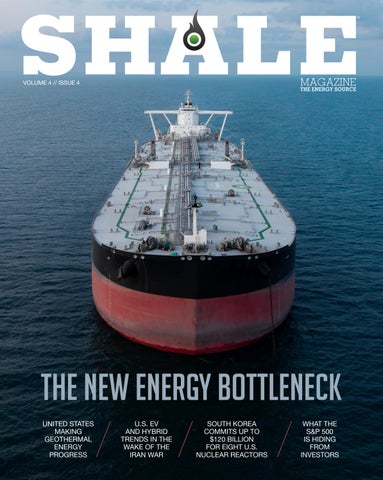
THE NEW ENERGY BOTTLENECK UNITED STATES MAKING GEOTHERMAL ENERGY PROGRESS
U.S. EV AND HYBRID TRENDS IN THE WAKE OF THE IRAN WAR
SOUTH KOREA COMMITS UP TO $120 BILLION FOR EIGHT U.S. NUCLEAR REACTORS
WHAT THE S&P 500 IS HIDING FROM INVESTORS
OIL & GAS PLAYERS | BUSINESS | TECHNOLOGY | POLICY Nationally Syndicated Where Houston’s energy leaders get heard –740 KTRH, a national powerhouse.
SUNDAYS 8PM-9PM / HOUSTON
THE ONLY OIL AND GAS
WHERE TO LISTEN
SYNDICATED NATIONALLY RADIO SHOW
SATURDAYS 7AM
KEYS 1460AM / 98.7FM
Corpus Christi
SUNDAYS 8PM-9PM
KFXR 1190AM / Simulcast on the iHeartRadio app Dallas / Fort Worth Worldwide
SATURDAYS 1PM-2PM KWEL 1070AM / 107.1FM
Midland Odessa Permian Basin
SUNDAYS 2PM-3PM The Answer 930AM
San Antonio / New Braunfels / San Marcos / Austin
MOST
LISTENED TO SHOW ON SUNDAY NIGHTS!
SUNDAYS 8PM-9PM
KTRH 740AM / Simulcast on the iHeartRadio app Houston / Worldwide
THANK YOU HOUSTON!
SATURDAYS 6AM-7AM, 11AM-12 PM SUNDAYS 6AM-7AM, 5PM-6PM AM 1440 Minneapolis, MN
TO LISTEN TO THE SHOW: Visit shalemag.com or download the iHeart mobile app to listen live!
HOUSTON | MIDLAND | ODESSA | AUSTIN DALLAS | SAN ANTONIO | CORPUS CHRISTI HOBBS, NM | LOUISIANA
THE ENERGY MIXX RADIO SHOW
ENERGY CONVERSATIONS BEYOND THE EVENT. Stay connected to the leaders, issues and conversations shaping America's energy industry.
2
VOLUME 4 // ISSUE 4
ENMEDIAGROUP.COM
LISTEN
FOLLOW
STAY CONNECTED
Live on stations nationwide or anywhere on the iHeartRadio app
@TheEnergyMixx on social media
News • Insights • Interviews Energy That Impacts Us All
WATKINS
WEDNESDAY, NOVEMBER 11
CONSTRUCTION COMPANY, LLC
purplewave.com
FLEET REPLACEMENT AUCTION
FN3580
11 SELLING
2 SELLING
FN3600
2023 Caterpillar 336 TC excavator
2014 Caterpillar D6T LGP / 572 pipelayer
2008 Caterpillar D6T XL with EZ Pipeline Padder
2024 Caterpillar D6 LGP VP dozer with ripper
2011 Caterpillar 140M VHP motor grader with ripper
FN3683
FN3665
FN3646
FN3521
FN3797
2019 Caterpillar TL1255D 12,000 lbs telehandler
2019 Caterpillar 259D skid steer loader
2015 Morooka MST2200 track carrier / dump bed
2014 Wolfe Man 8000 35” bucket wheel trencher
2014 Vermeer T855III crawler trencher
FN3528
FN3756
FN3784
FN3774
FN3656
2022 Caterpillar 420IT 4x4 backhoe with forks
2021 GMC Sierra 3500 4x4 Crew Cab flatbed pickup truck
2012 Peterbilt 337 fuel / lube truck with 1,000 gal
2016 Peterbilt 389 tri-axle heavy haul truck
2018 Load King 554/5 SSSF 65 ton quad-axle lowboy
15 SELLING
FN3616
3 SELLING
FN3632
BUILT ON TRUST. POWERED BY EXPERIENCE. 10% buyer’s premium applies. | Aaron McKee TX Lic #16401 | 866.608.9283
BUILT ON TRUST.
FN3611
2
VOLUME 4 // ISSUE 4
FACILITATING TRADE ACROSS THE GLOBAL MARKETPLACE The Port of Corpus Christi’s Foreign Trade Zone 122 program helps increase global competitiveness of U.S.-based companies. Foreign Trade Zone 122 can defer or reduce duty payments, streamline supply chain costs and help companies thrive in competitive domestic and foreign markets. LEARN MORE
SHALEMAG.COM
3
YOUR PIPELINE TO PREMIUM DISCOUNTS AND INDUSTRY EXPERTISE
WORKERS’ COMP FOR OIL AND GAS DONE RIGHT
Oil and gas expertise. It’s just one of the many advantages of membership in our Texas Oil & Gas Association Safety Group. As a member, you’ll have access to information and resources specific to the oil and gas industry, save about 12% on your workers’ comp premium and you can even earn double dividends. To see if your company qualifies, ask your agent or contact Group Administrator Neal Carlton at ncarlton@txogainsurance.com. TEXASMUTUAL.COM/TXOGA
Dividends are based on performance and are not guaranteed.
GREAT GOLF. GREATER PURPOSE.
27TH ANNUAL
CALIFORNIA CARL McCAIN GOLF INVITATIONAL MONDAY, NOVEMBER 9, 2026 SEVEN OAKS COUNTRY CLUB
2000 Grand Lakes Avenue | Bakersfield, CA 93311
PLAY. SPONSOR. VOLUNTEER. Help support energy industry individuals and families facing financial hardship due to medical expenses.
Last year’s foursomes and sponsorships sold out. Priority will be given to returning players.
Details & ways to get involved: carlmccain.org
17-0663 SHALE ad-3Q_FINAL.pdf
1
6/13/17
1:29 PM
VOLUME 4 // ISSUE 4
KYM BOLADO/CEO EDITOR-IN-CHIEF Robert Rapier
Providing energy for the world while staying committed to our values. Finding and producing the oil and natural gas the world needs is what we do. And our commitment to our SPIRIT Values—Safety, People, Integrity, Responsibility, Innovation and Teamwork— is how we do it. That includes caring about the environment and the communities where we live and work – now and into the future. © ConocoPhillips Company. 2017. All rights reserved.
www.conocophillips.com
CHIEF FINANCIAL OFFICER Suzel Diego CHIEF REVENUE & DIGITAL STRATEGY OFFICER Fernando Guerra VICE PRESIDENT OF OPERATIONS Amanda Jenkins PUBLICATION EDITOR Tyler Reed ASSOCIATE EDITOR David Porter VIDEO CONTENT EDITOR Barry Basse STAFF WRITERS Felicity Bradstock, Tyler Reed DESIGN DIRECTOR Elisa Giordano SALES & MARKETING Gargi Bhowal / gargi@shalemag.com ACCOUNT EXECUTIVES John Collins, Ashley Grimes, Doug Humphreys, Matt Reed
TOP FIRM 2018-2022
WE SELL, LEASE & MANAGE COMMERCIAL REAL ESTATE
CONTRIBUTING WRITERS Felicity Bradstock, Amanda Jenkins, Robert Rapier STAFF PHOTOGRAPHER Malcolm Perez EDITORIAL INTERN LeAnna Castro
www.shalemag.com For advertising information, please call 210.240.7188 or email james@shalemag.com. For editorial comments and suggestions, please email editor@shalemag.com.
YOUR SOUTH TEXAS COMMERCIAL REAL ESTATE CONNECTION SINCE 1975
(361)289-5168 | CraveyRealEstate.com 6
VOLUME 4 // ISSUE 4
SHALE MAGAZINE OFFICES: 9787 Katy Freeway, Houston, Texas 77024 5150 Broadway St., Suite 493, San Antonio, Texas 78209 For general inquiries, call 210.240.7188. Copyright © 2026 Shale Magazine. All rights reserved. Reproduction without the expressed written permission of the publisher is prohibited.
table of contents VOL UME 43 // ISSUE 41
10 cover story
THE NEW ENERGY BOTTLENECK industry
18 Texas Must Fix Power Supply Bottleneck to Meet Rising Electricity Demand
20 United States Making
Geothermal Energy Progress
22 Why The Diesel-Gasoline
Price Gap Has Grown So Large
24 United States Playing Catch-Up to China in Minerals and Batteries
26 U.S. EV and Hybrid Trends in the Wake of the Iran War
40 Trump’s Coal Plant Extensions 52 Major Investment Targets Face Questions Over Cost, Reliability and Federal Authority
Alaska’s Transmission Infrastructure
policy
42 House Committee
a Nuclear Battery Inside DOME
30 Senate Bill Would Let
FERC Site Transmission and Make Data Centers Pay
34 The United States Doubles
Down on Mineral Mining Ambitions
DREAMSTIME
36 The Government May
Be Sitting on Critical Minerals at Its Own Cleanup Sites
Advances Six Nuclear Permitting Bills as Startup Reactor CEOs Testify on Pilot Gains
business
48 South Korea Commits Up to $120 Billion for Eight U.S. Nuclear Reactors
54 Deployable Energy Will Test
finance
58 What the S&P 500
Is Hiding From Investors
60 How to Invest When the Fed Is Raising Interest Rates
SHALEMAG.COM
7
LETTER FROM THE EDITOR-IN-CHIEF
Energy systems rarely fail in just one place. That is one of the lessons running through this issue of Shale Magazine. Over the past several months, much of the attention in global energy markets has focused on the Strait of Hormuz and the effect of war on crude oil supplies. But as the system adjusted, the pressure did not disappear. It moved. Our cover story, “The New Energy Bottleneck,” looks at what happened next. Middle Eastern crude exports recovered substantially as producers relied more heavily on pipelines, alternative ports, ship-to-ship transfers, and other routes around disrupted waters. Yet diesel remained unusually expensive, refinery capacity in Russia and the Middle East stayed constrained, tanker rates soared, and another critical shipping corridor came under greater pressure in the Red Sea. The result is an energy crisis increasingly defined not by whether resources exist, but by whether they can be processed, transported, insured, stored, and delivered where they are needed. That question of deliverability appears throughout this issue. In Texas, rapidly rising electricity demand is exposing limits in both power generation and transmission. Alaska is confronting a similar challenge on a very different scale as new investment targets transmission infrastructure needed to connect distant regions and strengthen reliability. Nuclear energy is also receiving renewed attention, from plans involving South Korean investment in U.S. reactors to new efforts to streamline permitting and test advanced reactor designs. The same pressures are reshaping transportation and industrial markets. We examine why diesel has become so much more expensive than gasoline, how hybrid vehicles are gaining ground even as electric-vehicle growth slows in the United States, and why geothermal energy is beginning to move from promise toward commercial deployment. We also look at the growing competition over critical
8
VOLUME 4 // ISSUE 4
minerals and battery supply chains, where the United States is trying to reduce its dependence on China while policymakers debate how quickly domestic mining, processing, and manufacturing can expand. Those policy choices increasingly overlap with broader questions about affordability and economic growth. Data centers are driving forecasts for enormous increases in electricity demand, prompting lawmakers to consider who should pay for the transmission infrastructure required to serve them. At the same time, federal efforts to keep coal plants operating have raised difficult questions about reliability, cost, and the limits of emergency authority. Even our finance section reflects the same environment. Higher interest rates change the relative appeal of income investments, while the growing concentration of the S&P 500 reminds investors that a strong headline index does not always mean strength is broadly shared across the market. If there is a common thread in this issue, it is that energy security is becoming less about any single fuel or technology and more about the strength of the entire system. Resources matter, but so do refineries, power plants, pipelines, transmission lines, ports, storage facilities, and the financial capacity to build and maintain them. The next phase of the energy transition may be determined as much by infrastructure and resilience as by the resources themselves. Thank you for reading Shale Magazine.
ROBERT RAPIER Editor-in-Chief SHALE Magazine
9%
50% LOWER FAILURE RATE
21%
HIGHER GROWTH RATE
24-33%
SAVINGS ON
HR ADMINISTRATION
LOWER TURNOVER RATE
2X
MORE PARTICIPATION IN RETIREMENT PLANS
Source: NAPEO publications: Professional Employer Organizations: Fueling Small Business Growth, September 2013, and Professional Employer Organizations: Keeping Turnover Low and Survival High, September 2014, by Laurie Bassi and Dan McMurrer
The numbers don’t lie. Tapping into Insperity’s depth, breadth and level of care can help your company run better, grow faster and make more money. Now, how can we help you improve your bottom line? insperity.com/PEO-inc | 800-465-3800 michaels.murphy@insperity.com
HR and Business Performance Solutions from Insperity: Workforce Optimization Human Capital Management | Payroll Services | Time and Attendance | Performance Management Organizational Planning | Recruiting Services | Employment Screening | Financial Services Expense Management | Retirement Services | Insurance Services 82-1180 | SAL-P0415-629 SHALEMAG.COM
9
cover story
The New Energy Bottleneck 10
VOLUME 4 // ISSUE 4
ABDULLAH AL OSMAN/DREAMSTIME.COM
By: Robert Rapier
question is whether those resources can be processed, moved, insured, stored, and delivered through a system in which several critical pieces of infrastructure are under pressure at the same time.
HOW WAR IS SHIFTING THE GLOBAL ENERGY CRISIS When I wrote The Great Energy Realignment several months ago, the central question was how the global energy system would cope with a sustained disruption of the Strait of Hormuz. For most of my career, a closure of Hormuz had been one of those dire scenarios that analysts modeled. When the war involving Iran, Israel, and the United States finally turned that theoretical risk into a real disruption, I expected oil prices to remain much higher than they ultimately did. Instead, the system adapted through a combination of emergency inventories, alternate pipelines, changing trade flows, increased production elsewhere, and lower demand. That adaptability became one of the major themes of The Great Energy Realignment. Saudi Arabia and the United Arab Emirates pushed more crude through routes that bypassed Hormuz, China drew on inventories
12
VOLUME 4 // ISSUE 4
accumulated when oil was cheaper, refiners adjusted crude slates, and producers outside the Persian Gulf increased their contribution to global supply. Those adjustments did not make the disruption disappear, but they prevented the loss of Gulf exports from creating the sustained $150-per-barrel oil market that once seemed entirely plausible. The developments since then have revealed the other side of that story. The global energy system successfully moved around some of the original constraints, but it did not eliminate them. Instead, the pressure has increasingly shifted downstream into refining, tanker capacity, shipping insurance, storage, and transportation infrastructure. Crude oil exports from the Middle East have recovered substantially, yet diesel remains unusually scarce and expensive, Russian and Middle Eastern refinery capacity has been damaged or constrained, tanker rates have soared, and the Red Sea has become another major source of risk. That evolution changes the current energy crisis. The world still possesses enormous quantities of oil and natural gas, and production itself is not the primary limitation in many of the markets experiencing the greatest stress. Increasingly, the
The Strait of Hormuz remains the clearest example of how quickly the energy system can adapt when the economic incentive is large enough. Before the war, roughly 21 million barrels per day of crude oil, condensate, and petroleum products moved through the Strait of Hormuz, equivalent to about one-fifth of global petroleum liquids consumption. About one-fifth of global LNG trade also passed through the Strait, making it one of the most important energy chokepoints on the planet. When commercial traffic collapsed following the outbreak of fighting, the immediate concern was that millions of barrels per day of Persian Gulf production would simply disappear from the market for an extended period. That did not happen. Gulf producers increasingly relied on bypass pipelines, terminals outside the Persian Gulf, and ship-to-ship transfers near Oman to move crude around the disrupted Strait. By early October, overall Middle Eastern crude exports had recovered close to prewar levels even though traffic through Hormuz remained well below normal. In early October, crude flows through the Strait were running at about 10.1 million barrels per day, roughly 74% of prewar crude flows, while exports through the Gulf of Oman and Red Sea had risen to 6.7 million barrels per day, more than twice their prewar level. Taken together, those alternate flows were enough to offset much of the loss through Hormuz. That recovery is evidence of a remarkably adaptable energy system, but it should not be mistaken for a return to normal conditions. Oil that once moved through relatively straightforward routes is now being redirected through more complicated and expensive ones, with additional handling, longer voyages, elevated insurance premiums, and much higher tanker rates. Reuters reported that tanker costs from the Middle East to Asia have exceeded $1.2 million per day in some cases, which helps explain why oil prices have remained elevated even as physical exports have recovered. The distinction between crude availability and delivered energy has therefore become much more important. The oil still exists, and in many cases it is still being produced,
PNIESEN/DREAMSTIME.COM, YULIYA ERMAKOVA/DREAMSTIME.COM
THE BOTTLENECK MOVES DOWNSTREAM
but getting it from a field in the Persian Gulf to a refinery in Asia or Europe or California now requires more infrastructure, more logistics, and considerably more money. What initially looked like a straightforward crude-supply problem has gradually evolved into a broader problem of deliverability.
CRUDE RECOVERED FASTER THAN REFINED PRODUCTS The refining system has been much less successful at absorbing the shock, which is why diesel has become one of the clearest indicators of where the pressure has moved. In September, U.S. retail gasoline prices averaged $4.35 per gallon, while diesel averaged $6.29 per gallon. That extraordinary gap developed even though U.S. refineries were operating at high utilization rates and domestic distillate production remained strong. The problem is that crude oil and diesel are not interchangeable. Crude must reach a refinery capable of processing it, and the refinery must then produce the particular mix of gasoline, diesel, jet fuel, and other products that the market requires. Different crude oils have different characteristics, refinery configurations vary significantly, and there are physical limits on how far refiners can shift their product yields in response to changing prices. Those limitations are important because global refinery output has been constrained in several important regions at the same time. EIA has attributed the tight global distillate market to reduced refining activity in Russia, China, and the Middle East. U.S. distillate production averaged about 5.1 million barrels per day from January through August, the highest level since 2019, and refinery utilization was running near 97% in September. Yet U.S. distillate inventories were still 13% below the five-year seasonal average because strong international prices encouraged exports at the same time overseas supplies were being reduced. This is why record or near-record U.S. crude production does not guarantee inexpensive diesel. American refiners can run close to their physical limits while global buyers compete aggressively for the products they produce. When refinery capacity is damaged elsewhere, additional demand is shifted toward the facilities that remain in operation, including those on the U.S. Gulf Coast.
The same dynamic is likely to persist beyond the immediate crisis. EIA expects distillate markets to remain tight well into 2027. Its October outlook projects East Coast inventories to remain 20% to 30% below the five-year average through the coming winter, with conditions gradually improving later next year. That suggests the current diesel problem is not simply a brief consequence of one event in the Persian Gulf, but the result of several overlapping disruptions across the global refining system.
RUSSIA SHOWS WHY REFINERIES MATTER Russia's experience since the invasion of Ukraine helps illustrate why refining capacity has become so important. During the early stages of the war, much of the attention focused on Russian crude oil and natural gas exports. Europe rapidly reduced its dependence on Russian pipeline energy, while Russian crude that once went west was increasingly redirected toward China, India, and other Asian customers. The
shift was expensive and disruptive, but the global crude market ultimately proved capable of rerouting enormous volumes. Refineries do not have that flexibility. A tanker carrying Russian crude can change destinations if a buyer in Europe disappears, but a damaged refinery is a different story. Refineries are fixed industrial complexes made up of distillation units, hydrotreaters, crackers, utilities, storage tanks, pipelines, and loading facilities that must operate together. When important units are damaged or taken offline, the market loses the ability to turn crude into usable products even if crude production itself continues. Repeated Ukrainian attacks have made that distinction increasingly important. Russian refinery damage, along with reduced Middle Eastern refining activity, has contributed significantly to the global diesel shortage. The IEA reported in September that combined net diesel and gasoil exports from Russia and the Gulf were 1.6 million barrels per day lower in August than in February, creating a supply deficit that could not be repaired simply by restoring crude production. Russia has also restricted diesel exports, adding another layer of pressure to the market. President Vladimir Putin has said
SHALEMAG.COM
13
Western sanctions are preventing Russian diesel from reaching global markets, while Deputy Prime Minister Alexander Novak has indicated that some exports could resume once domestic production returns to surplus. For consumers, the distinction between crude and refined products eventually becomes visible at the pump. The world can have adequate crude supplies while still facing shortages of diesel, jet fuel, or gasoline because the facilities needed to convert that crude into finished products are unavailable. That is fundamentally different from the classic energy crisis in which the primary problem is insufficient oil coming out of the ground.
TWO CHOKEPOINTS, ONE ENERGY SYSTEM
14
VOLUME 4 // ISSUE 4
Hormuz but then encounters serious security problems in the Red Sea or Bab el-Mandeb, part of the advantage provided by the East-West Pipeline disappears. What looked like redundancy at one point in the system can still depend on another vulnerable chokepoint farther downstream. That is one of the most important lessons emerging from the current conflict. Energy resilience cannot be measured simply by counting pipelines, terminals, or refineries individually. The entire chain has to function, from production through transportation, processing, storage, and final delivery. A pipeline does little good if the terminal at the other end is inaccessible, while a refinery cannot contribute much if crude cannot reach it or finished products cannot leave. The same principle applies well beyond the Middle East. Europe discovered after Russia's invasion of Ukraine that replacing Russian pipeline gas required more than simply finding another producer. It needed LNG terminals, additional shipping, sufficient storage, pipeline connections, and enough regasification capacity to move the new supply through the continent. Redundancy is therefore a system characteristic rather than the feature of a single asset.
SHIPPING COSTS HAVE BECOME PART OF THE ENERGY SHOCK Transportation has always been part of the cost of energy, but under ordinary conditions it is easy to overlook because freight markets usually function in the background. Tankers arrive, cargoes are unloaded, and transportation costs are incorporated into the delivered price without attracting much public attention. The scale of the current disruption has made those costs impossible to ignore. Freight and insurance expenses have risen dramatically because tankers are operating through active conflict zones and relying on routes that are longer and more complicated than the ones they replaced. Some vessels have to wait for safer transit windows, others participate in ship-to-ship transfers, and still others travel much farther to avoid threatened waters altogether. Those
DREAMSTIME
The expansion of the conflict into Yemen adds another layer of risk because it places a second major maritime chokepoint under pressure. The Bab el-Mandeb Strait connects the Red Sea with the Gulf of Aden and the Indian Ocean, making it essential for ships traveling between the Suez Canal and Asian markets. Iran-backed Houthi forces have increasingly threatened Saudi interests and commercial shipping in the region, prompting Saudi Arabia to re-enter the Yemen conflict with airstrikes and support for government forces attempting to retake the Bab el-Mandeb coastline. The strategic implications are particularly important for Saudi Arabia because the kingdom has spent decades building infrastructure specifically designed to reduce its dependence on the Strait of Hormuz. Its East-West Pipeline carries crude from eastern production areas across the country to the Red Sea port of Yanbu, giving Saudi Arabia an alternative export route when traffic through Hormuz is disrupted. In theory, that redundancy provides exactly the kind of flexibility the current crisis has demonstrated is so valuable. That vulnerability has already been demonstrated. Saudi Arabia temporarily shut the East-West Pipeline in September after drone attacks, briefly interrupting crude loadings at Yanbu before operations resumed. By early October, the pipeline was again carrying large volumes of crude, but the episode underscored an important limitation of redundancy: infrastructure built to bypass one chokepoint can itself become a target. The problem is that an alternate route is useful only if the entire route remains available. If Saudi crude can bypass
provide one measure of the crisis, but they cannot capture all of the additional costs generated by shipping delays, insurance premiums, damaged infrastructure, product shortages, and longer transportation routes.
FROM JUST-IN-TIME TO JUST-IN-CASE
changes reduce the effective capacity of the tanker fleet because the same vessel completes fewer voyages over a given period. The oil market’s current problem has increasingly become one of logistics rather than outright supply. Even as Middle Eastern exports recovered, elevated freight and insurance costs kept the delivered price of oil high, particularly for Asian refiners. The fact that crude can leave the Middle East therefore does not mean the market is functioning normally, because buyers are paying significantly more to obtain and transport those barrels. The effects of those higher transportation costs extend far beyond crude oil. Diesel powers much of the trucking, rail, agricultural, construction, and industrial activity that moves goods through the economy, while marine fuels are embedded in the cost of international trade. Higher energy transportation costs therefore work their way into food, manufactured goods, building materials, and countless other products long after the original fuel transaction has taken place. This broader inflationary effect helps explain why the logistics bottleneck may ultimately prove more consequential than the initial crude disruption. Benchmark oil prices
The cumulative effect of these disruptions is beginning to change the way the energy industry thinks about infrastructure. For several decades, companies across many industries pursued a "just-in-time" model that minimized inventories and avoided spending capital on infrastructure that might sit partially unused. The approach improved efficiency and returns under normal conditions, but it was also assumed that supply chains would remain sufficiently reliable to deliver what was needed when needed. The past several years have challenged that assumption. Russia's invasion of Ukraine disrupted gas and oil flows, the Iran war threatened Hormuz, and the escalation in Yemen has placed pressure on the Red Sea and Bab el-Mandeb. At the same time, refinery damage and low product inventories have demonstrated that even when crude remains available, the capacity to transform and move it cannot always be replaced quickly. Oil executives are now explicitly talking about moving from “just-in-time” toward “just-in-case.” At the Energy Intelligence Forum in London in October, executives discussed the need for additional pipelines and export routes that could reduce reliance on vulnerable corridors. TotalEnergies has backed an Iraq-to-Syria pipeline and plans to expand pipeline capacity to the UAE port of Fujairah, while BP, ConocoPhillips, Chevron, and others are evaluating additional Iraqi and Mediterranean export options. Those projects illustrate a fundamental tradeoff. Redundant infrastructure is expensive, and some of it may operate below capacity for long periods. Spare pipelines, storage tanks, export terminals, and refinery capacity can look inefficient when markets are calm, particularly when investors are focused on maximizing returns from existing assets. The economics change when the primary system fails. A pipeline that appears underutilized during normal periods can suddenly become strategically invaluable when a chokepoint is closed. Extra storage can carry an ongoing cost until inventories are needed to bridge a disruption, while spare refining capacity
can look unnecessary until several major facilities go offline at the same time. The challenge for governments and companies is determining how much redundancy is worth paying for before the next crisis rather than after it has already begun. That calculation is familiar to anyone who has worked around critical industrial infrastructure. Refineries and chemical plants routinely use backup systems, parallel pumps, emergency generators, spare equipment, and multiple layers of protection because the consequences of failure can far exceed the cost of redundancy. The global energy system is increasingly confronting the same question on a much larger scale.
THE BUFFERS ARE BEING USED UP Infrastructure is only one form of insurance against disruption. Inventories provide another, and they played an important role in preventing the first phase of the Hormuz crisis from becoming even more severe. The International Energy Agency and member governments coordinated extraordinarily large releases of emergency stocks, while China drew heavily on crude inventories accumulated before the war. Commercial inventories elsewhere gave refiners and consumers additional time to adjust to changing supply routes. Those measures demonstrated why inventories exist, but they also highlighted their limitations. A barrel taken out of storage solves today's supply problem only by reducing the cushion available tomorrow. If inventories are not replenished before another disruption occurs, the system enters the next crisis with less room to maneuver. That problem is becoming more important because the disruptions are increasingly overlapping. Hormuz remains unstable, tanker attacks continue, diesel inventories are low, Russian refinery capacity is impaired, and the conflict in Yemen is threatening another major shipping corridor. Vitol CEO Russell Hardy warned in early October that depleted Western inventories had left the market with relatively little margin for additional disruption even as Middle Eastern exports improved. Recent developments at Hormuz reinforce that concern. Reuters recently reported that tanker attacks and incidents of harassment reached their highest weekly level since the start of the Iran war, while commodityvessel traffic through the Strait briefly fell to its lowest daily level since July. Alternative routes have so far compensated for much of
SHALEMAG.COM
15
THE REAL CONSTRAINT IS DELIVERABILITY The developments of the past several months reinforce a point that was already emerging in The Great Energy Realignment. The defining energy question is increasingly not simply what resources a country possesses, but whether those resources can be turned into useful energy and delivered reliably when normal systems are under stress. The world still has abundant crude oil. The United States is producing record volumes, Saudi Arabia and the UAE retain enormous reserves, Russia remains one of the world's largest petroleum producers, and countries such as Canada, Brazil, and Guyana continue adding supply. Yet those resources alone do not guarantee that diesel, jet fuel, gasoline, or natural gas will be available at the place and time consumers need them. A barrel of oil must move from the field through gathering systems and pipelines to a terminal. A tanker must be available, insurable, and willing to enter the relevant waters, after which the crude must reach a refinery capable of processing it. The resulting products then have to move through another network of pipelines, ships, rail systems, storage terminals, and trucks before they reach the final customer. Every stage of that process contains both capacity and potential vulnerability. When resources are plentiful but deliverability becomes scarce, the strategic value shifts toward the infrastructure that keeps those resources moving. Refinery capacity, pipelines, tanker fleets, ports, storage terminals, alternative export routes, and even insurance capacity become much more important than they appear during normal market conditions. This is also why the current crisis could
16
VOLUME 4 // ISSUE 4
shape investment long after the wars themselves are over. Governments and energy companies now have recent evidence of the costs associated with depending too heavily on a single supplier, refinery, route, or chokepoint. Some of the infrastructure built in response will inevitably look redundant when conditions eventually stabilize, but redundancy is precisely what gives a system the ability to withstand the next disruption.
THE NEXT PHASE OF THE GREAT ENERGY REALIGNMENT The Great Energy Realignment was ultimately about the return of energy security as a strategic priority. Russia's invasion of Ukraine changed the direction of major oil and natural gas flows, while Europe traded heavy dependence on Russian pipelines for a more diverse and more expensive supply system built partly around LNG. China accumulated inventories and expanded its energy options, India used its refining capacity and access to multiple suppliers to strengthen its position, and the United States benefited from abundant domestic production while remaining deeply connected to international energy markets. The Iran war added another lesson by demonstrating the continuing power of geography. The global system adapted to the loss of normal traffic through Hormuz, but doing so required emergency inventories, alternative pipelines, new shipping arrangements, higher freight rates, and substantial changes in trade. The subsequent pressure on diesel, refining, and Red Sea shipping has shown that solving one bottleneck can simply move the problem elsewhere. The next stage of the realignment is therefore becoming clearer. The world is not facing a simple shortage of oil, natural gas, or energy resources. The more persistent challenge is maintaining the physical systems needed to convert those resources into useful energy and deliver them through an increasingly complicated geopolitical environment. For decades, much of the energy industry pursued efficiency because redundancy is expensive. Spare capacity can depress returns, inventories tie up capital, and duplicate infrastructure may appear wasteful during long periods of stability. Consumers and taxpayers ultimately bear much of the cost of maintaining those extra options.
The events of the past several years have provided an equally clear demonstration of the cost of having too few options. Russia's invasion exposed the strategic vulnerability created by Europe's dependence on a dominant natural-gas supplier, Hormuz exposed the world's reliance on a narrow maritime corridor, and the fighting in Yemen has highlighted the vulnerability of a Red Sea route that itself provides an alternative to the Persian Gulf. At the same time, damage to Russian and Middle Eastern refineries has shown that abundant crude does not guarantee adequate diesel, while declining inventories have demonstrated
DEPOSIT PHOTOS
that decline, but the need to rely increasingly on those routes demonstrates how little slack remains in parts of the system. The global energy system has shown considerably more resilience than I expected when the war began, and that remains an important conclusion. But resilience is not the same as unlimited capacity. Much of the system's success has come from drawing inventories, utilizing alternate routes more heavily, paying much higher transportation costs, and pushing surviving infrastructure harder.
that emergency reserves can buy time without replacing functioning infrastructure. That is the connection between The Great Energy Realignment and what is happening now. Energy security increasingly depends
not merely on possessing resources, but on maintaining enough infrastructure, redundancy, storage, and transportation flexibility to keep those resources moving when part of the system fails. The countries
and companies that recognize that distinction are likely to be much better positioned for the next disruption than those that continue to optimize only for the lowestcost system under normal conditions.
About the author: Robert Rapier is a chemical engineer in the energy industry and Editor-in-Chief of Shale Magazine. Robert has over 30 years of international engineering experience in the chemicals, oil and gas, and renewable energy industries and holds several patents related to his work. He has worked in the areas of oil refining, oil production, synthetic fuels, biomass to energy, and alcohol production. He is author of multiple newsletters for Investing Daily and of the book Power Plays. Robert has appeared on 60 Minutes, The History Channel, CNBC, Business News Network, CBC, and PBS. His energy-themed articles have appeared in numerous media outlets, including the Wall Street Journal, Washington Post, Christian Science Monitor, and The Economist.
SHALEMAG.COM
17
Texas Must Fix Power Supply Bottleneck to Meet Rising Electricity Demand By: Felicity Bradstock
18
VOLUME 4 // ISSUE 4
JACOB SORENSEN/DREAMSTIME.COM
INDUSTRY
T
exas’s energy demand is expected to rise sharply over the next decade as the population grows, industry expands, and more data centers launch operations in the state. Texas is rapidly becoming a major green energy hub, as well as being a longstanding oil and gas powerhouse, with energy output expected to increase substantially over the next decade. However, a major limitation stands in the way of this expansion – a transmission infrastructure bottleneck. If Texas cannot address constraints on its grid infrastructure, the state may struggle to meet rising power demand.
The demand on the Texas energy grid is expected to nearly double by 2032, reaching around 175 gigawatts (GW), according to estimates from the grid operator the Electric Reliability Council of Texas (ERCOT).
Texas Power Demand Outlook The demand on the Texas energy grid is expected to nearly double by 2032, reaching around 175 gigawatts (GW), according to estimates from the grid operator the Electric Reliability Council of Texas (ERCOT). The rapid rise in power demand is driven by a range of factors, including a growing population, industrial expansion, and the influx of data centers, according to ERCOT’s CEO, Pablo Vegas. Regulators are confident that the increase in electricity generation, through new solar power and battery storage projects, will meet the growing demand; however, there are rising concerns around the bottlenecks in the state’s transmission network. The high temperatures in Texas in July led ERCOT to report a record-breaking electricity demand of 91.1 GW on July 22, far higher than the 85.5 GW record set in August 2023. ERCOT said it had no issue providing this power, reporting an excess of more than 20 GW of generation relative to demand. A recent expansion in the state’s solar capacity has contributed significantly to this generation, at times accounting for up to 45% of electricity demand.
Casey Bell, the Infocast Texas Clean Energy Summit’s executive briefing chairman, which was held in August. “Of those 188 GW, 82 GW currently have interconnection studies under review. Another 22 GW have studies approved or have actually been approved to energize. 7 GW of large load are connected, up 30% on the year. 14 GW of large load are in advanced planning, which is up 60%. So, the big question is, how are we going to interconnect all of those large loads safely, reliably, and expeditiously?” Bell said.
Addressing the Bottleneck While power generation has expanded significantly in Texas in recent years, utilities have not kept pace with the transmission network upgrades needed to reliably deliver this power to customers. ERCOT reported a large-load queue growth of over 200 GW since 2024, citing data centers, manufacturing, cryptocurrency, and industrial oil and gas development as the main drivers. “We now are at about 188 GW in the large load interconnection queue, up 70% since March of this year,” explained
Grid Expansion ERCOT is moving ahead with a roughly $33 billion grid expansion plan that includes more than 2,400 miles of 765-kV high-voltage transmission lines. This aims to address the lack of transmission capacity that is holding back developers looking to invest in the state. ERCOT is responsible for around 90% of the electricity load and power demand in Texas. The operator’s transmission plan includes the extension of high-voltage transmission in ERCOT West, Far West and North, and the Permian Basin. It is expected to reduce power curtailment of wind and solar power in West Texas where the accelerated development of clean energy projects has outpaced transmission infrastructure. However, because it can take several years to complete new transmission lines, the bottleneck is expected to persist in the short term as the state’s power demand continues to rise. According to an ERCOT forecast from December 2025, summer and winter planning reserve margins in Texas’s transmission infrastructure will decrease from 2026 through 2030, reaching negative levels by 2028. ERCOT’s high-voltage transmission expansion is not expected to be completed
until 2030, meaning that “the transmission gap will persist through most of this decade. So, new generation and new load face the same bottlenecks,” Aparajita Datta, an Energy Policy Associate at the University of Houston’s UH Energy division, told Reuters. Halting Data Center Development Fears over the transmission gap have led Texas Governor Greg Abbott to make Texas the first major data center hub to pause new grid connections for data centers while the state government assesses operators’ plans for the facilities. Governor Abbott cited concerns about future energy supply and demand as the reason for the pause on development. The announcement of the interconnection pause in early August led the U.S. Energy Information Administration to lower its forecast for electricity demand growth in Texas to 6% in 2027, down from 14%. While a halt to data center development could provide the buffer needed for ERCOT to catch up on grid expansion and modernization, the operator will need to regularly reassess the state’s power demand outlook to plan for future infrastructure improvements and help mitigate potential transmission gaps. About the author: Felicity Bradstock is a freelance writer specializing in Energy and Industry. She has a Master’s in International Development from the University of Birmingham, UK, and is now based in Mexico City.
SHALEMAG.COM
19
INDUSTRY
United States Making Geothermal Energy Progress By: Felicity Bradstock
The United States is powering ahead in geothermal energy thanks to high levels of federal and private funding for a wide range of projects, as well as broad political support. The Trump administration has continued to support geothermal energy through federal policy and funding, building on initiatives launched under the Biden administration. What Is Geothermal Energy? Geothermal energy is produced by drilling into hot rock and geothermal reservoirs beneath the Earth’s surface. The Earth’s core is around 5,200 degrees Celsius (°C), while rock and water in the Earth’s crust can reach temperatures of around 370°C. Energy companies can access thermal energy and warm water deposits in rocks by drilling reservoirs just a few miles deep, using this heat to drive turbines to produce carbon-free electricity. There are a variety of geothermal energy systems, from direct-use to district-heating systems, geothermal power plants, and geothermal heat pumps, which use either the Earth’s high temperatures near the surface or drill miles deep to access higher temperatures. Geothermal energy can be used for heating or cooling, as well as to generate clean electricity from high- or medium-temperature resources
20
VOLUME 4 // ISSUE 4
in tectonically active regions worldwide. In 2025, the United States accounted for 23% of installed global geothermal capacity and led in operating capacity, with 3.7 GW. However, in 2025, geothermal power plants produced just 0.4% of total U.S. utility-scale electricity generation. California is home to 53 of the country’s 99 geothermal power plants, while Nevada hosts 32, Oregon and Utah each have 4, Hawaii and Alaska each have 2, and Idaho and New Mexico each have 1. Trump Administration Geothermal Drive Since taking office in January 2025, President Trump has often voiced opposition to a wide range of renewable energy sources, such as wind and solar power, while championing fossil fuels, including oil, gas, and coal. This stance has been reflected in the wide range of executive orders focused on energy and changes in policy over the last year and a half. However, the Trump administration has shown support for geothermal energy, both through policy and funding. The U.S. Secretary of Energy, Chris Wright, signed his first Secretarial Order in early February 2025 entitled “Unleash [the] Golden Era of American Energy Dominance”, in which he explicitly supports the use of geothermal energy for heating. In addition, advances in enhanced geothermal systems have improved the economics and expanded the
potential geographic reach of geothermal development. Bipartisan support for geothermal energy, technological advancements, and increased public and private investments have helped drive sectoral growth, with further advances expected over the coming decade. U.S. Geothermal Energy Potential Thanks to broad public and private support for the energy source, 1.16 gigawatts (GW) of geothermal energy are now expected to come online by 2028, according to Global Energy Monitor’s Global Geothermal Power Tracker. This would represent a meaningful expansion of the U.S. geothermal sector. The U.S. Department of Energy (DOE) aims to reach 5 GW of geothermal energy capacity by the end of the decade as part of its Liftoff program, and 90 GW by mid-century. The DOE is also aiming to reduce the cost of geothermal power per megawatt-hour by 90% by 2035, as part of its Enhanced Geothermal Shot initiative. Federal Funding and Commercial Progress On September 3rd, the DOE established the new Geothermal Center of Excellence at the National Laboratory of the Rockies in Colorado, which will lead research on geothermal energy alongside the DOE’s National Energy Technology Laboratory. The DOE said in a statement, “The Center will unite expertise and world-class capabilities from across DOE’s National Laboratories to accelerate the discovery and development of gigawatt-scale geothermal energy, resource discovery, and commercial development.” Later in September, the DOE announced that it had selected 21 projects for up to $99 million in funding (subject to award negotiations) to advance geothermal energy development. Recipients include the geothermal startup Fervo Energy, which was selected for two projects: an enhanced geothermal systems demonstration in Idaho and exploration drilling in Nevada. Fervo, which was founded in 2017, has also secured $10 million from Liberty Energy in 2022 and an additional $462 million in Series E funding in 2025. Fervo has been developing its Cape Station project near Milford, Utah, using drilling and hydraulic-fracturing techniques adapted from the oil and gas industry. The project achieved first power in September, and its first 33-MW GeoBlock reached commercial operation on October 1. Fervo describes Cape Station as the first greenfield enhanced geothermal development in the world to achieve contractual commercial operation. Geothermal remains a small part of the U.S. power mix, but it now has something it lacked for much of its history: technologies that could dramatically expand where it can be developed. If projects such as Fervo’s Cape Station demonstrate that enhanced geothermal systems can operate reliably and economically at commercial scale, geothermal could become a much more important source of round-the-clock power as U.S. electricity demand grows.
About the author: Felicity Bradstock is a freelance writer specializing in Energy and Industry. She has a Master’s in International Development from the University of Birmingham, UK, and is now based in Mexico City. JIMMY LOPES/DREAMSTIME.COM
SHALEMAG.COM
21
INDUSTRY
Why The Diesel-Gasoline Price Gap Has Grown So Large By: Robert Rapier
T
here was a time when diesel fuel was usually cheaper than gasoline in the United States. That relationship began to change about 20 years ago, and since then diesel has generally traded at a premium. Today, that premium is not just persistent but unusually large, which raises an obvious question: how did we get from gasoline typically costing more than diesel to diesel costing substantially more than gasoline? The answer has two parts. The first is structural and goes back to the mid-2000s, when changes in fuel specifications, taxes, refining economics, and global demand fundamentally altered the relationship between gasoline and diesel prices. The second is more immediate. In 2026, refinery disruptions, geopolitical conflicts, low inventories, and reduced exports from major suppliers have pushed the global diesel market into an unusually tight position. Understanding the difference between those long-term and short-term forces explains both why diesel usually costs more and why the gap is so large right now. Diesel Was Once The Cheaper Fuel Before the mid-2000s, diesel was often cheaper than regular gasoline in the United States. There were exceptions, particularly during cold winters when heating-oil demand strengthened, but the longer-term pattern generally favored diesel. That began to change around 2004, and according to the Energy Information Administration, on-highway diesel prices have been higher than regular gasoline prices almost continuously since September of that year. That shift is clearly visible in the historical data I examined in my 2023 article on the subject. In the decade before 2005, gasoline generally traded at a small premium to diesel. After that, the relationship reversed, and diesel became the more expensive fuel in most years. The timing is important because it coincided with a major change in the way U.S. refiners had to produce highway diesel.
22
VOLUME 4 // ISSUE 4
Ultra-Low-Sulfur Diesel Changed The Economics Beginning in the mid-2000s, U.S. refiners had to dramatically reduce the sulfur content of highway diesel. That was an important environmental improvement because sulfur emissions contribute to air pollution and acid rain, but it also made diesel more expensive to produce. Refineries invested billions of dollars in new hydrotreating and sulfur-removal equipment, and those investments increased capital and operating costs and made compliant diesel more expensive to produce and distribute. My earlier article focused heavily on this transition because the timing lines up closely with the point at which diesel’s historical discount disappeared. EIA now describes the persistent diesel premium as the result of several factors working together, including strong global demand for diesel and other distillates, the higher cost of producing low-sulfur diesel, and federal taxes that are six cents per gallon higher on diesel than on gasoline. None of those factors explains every short-term price movement, but together they created a structural premium that had not existed to the same degree before 2004. Once diesel became more expensive to produce and more tightly linked to global distillate markets, the old relationship with gasoline never really returned. Diesel Became A Global Commodity Another important change has been the globalization of the diesel market. Gasoline is also traded internationally, but diesel and other middle distillates occupy an especially important role in the global economy because they power trucking, agriculture, construction, mining, shipping, industrial equipment, and heating systems. Strong demand in Europe, China, India, and the United States has kept pressure on global distillate balances for years. That means U.S. diesel prices are increasingly influenced by events far beyond U.S. borders. Even when domestic production
is strong, refiners can export diesel into higherpriced international markets, tying domestic prices more closely to global supply and demand. This is one reason it is misleading to look only at U.S. crude oil production and assume that abundant domestic oil should automatically translate into cheap diesel. The United States can produce plenty of crude while still facing tight supplies of refined products. Crude oil has to be processed in the right refineries, into the right products, and then moved through the right transportation system. Those constraints matter just as much as the amount of oil coming out of the ground. 2022 Showed How Quickly The Premium Can Explode The most dramatic recent example came in 2022, when Russia’s invasion of Ukraine disrupted global energy markets. Diesel was hit particularly hard. Russia was a major supplier of crude oil, refined products, and feedstocks to Europe and other markets, so sanctions and trade restrictions forced a rapid reshuffling of global flows. Gasoline prices rose sharply as well, but diesel supplies tightened even more, pushing the diesel premium to record levels. In my earlier article, I noted that the gasoline-diesel spread reached a record in 2022. At the time, the disruption from Russia explained why a structural premium suddenly became an extreme one. The market eventually adjusted as trade routes shifted, refinery operations stabilized, and inventories recovered, but that normalization did not last. Why The Gap Is So Large Again In 2026 The current situation resembles 2022 in one important respect: global diesel supply has again been disrupted more severely than gasoline supply. EIA recently reported that global distillate supplies are tight because of reduced refining activity in Russia, China, and the Middle East. At the same time, U.S. refiners have been running near maximum utilization, with domestic distillate production averaging about 5.1 million barrels per day
IMAGEEGAMI/DREAMSTIME.COM
Refining Margins Are A Consequence, Not A Cause Refining margins have risen sharply, and major refiners are benefiting from the tight market. But those high margins are a consequence of constrained diesel supply relative to demand rather than the original cause of the shortage. When refinery capacity is disrupted, exports are curtailed, and inventories fall, the value of the remaining barrels rises. Refiners that can continue producing diesel benefit from that scarcity, but the scarcity comes first. This distinction is important because high margins are sometimes cited as evidence that refiners decided to raise prices, when in reality the margin expansion is largely the market’s response to a shortage of refined product.
through August, the highest level since 2019. That point is worth emphasizing because it shows that the current problem is not simply a collapse in U.S. refinery output. American refiners are producing large volumes of diesel, but global demand for those barrels has increased at the same time that supplies elsewhere have fallen. As exports increased, U.S. inventories declined, and by midSeptember distillate inventories were about 13% below the five-year seasonal average even though summer is normally a period when inventories build ahead of winter. Since then, the global situation has become even tighter. Russia has restricted diesel exports as refinery infrastructure has been damaged, China has curtailed fuel exports to protect domestic supplies, and Middle Eastern refining and shipping have been disrupted by the conflict involving Iran. Tanker costs and insurance rates have also risen, making it more expensive to move refined products around the world. The result is a global scramble for middle distillates. Both gasoline and diesel are affected by higher crude prices, but diesel is being squeezed more severely because the product itself is in shorter supply relative to demand. That is why the diesel-gasoline spread has widened so dramatically. The Price Gap Is Now Extraordinary As of October 5, the national average price of on-highway diesel was $6.199 per
gallon, compared with $4.354 for regular gasoline—a spread of about $1.85 per gallon. Diesel averaged a nominal record $6.29 per gallon in September, according to EIA, and remained above $6 nationally in early October. That gap is not primarily the result of a sudden increase in diesel taxes or some new change in fuel specifications. Those structural factors help explain why diesel usually costs more than gasoline, but they do not explain why the premium is so large today. The current premium reflects a very tight global distillate market layered on top of the long-term changes that already made diesel the more expensive fuel. That distinction is important because it separates the underlying reason diesel normally carries a premium from the temporary forces that can cause that premium to explode.
Diesel Is A Different Market Than Gasoline The broader lesson is that gasoline and diesel may come from the same barrel of crude oil, but they are not interchangeable products. They serve different markets, have different seasonal demand patterns, require different processing, and face different global supply pressures. A refinery cannot simply turn every barrel of crude into whichever product happens to be most expensive that day because refinery configuration, crude quality, product specifications, and physical operating limits all constrain what can be produced. That is why abundant crude oil does not guarantee cheap diesel. The United States can produce record amounts of oil, run refineries near capacity, and still face expensive diesel if global product markets remain tight. Twenty years ago, gasoline was often the more expensive fuel. Then diesel moved to a structural premium, and today that premium has widened dramatically because the global market for diesel and other middle distillates is again under severe strain. Until those supply constraints ease, diesel is likely to remain much more expensive than gasoline.
About the author: Robert Rapier is a chemical engineer in the energy industry, the Chief Energy Analyst for Energy Network Media Group and Editor-in-Chief of Shale Magazine. Robert has over 30 years of international engineering experience in the chemicals, oil and gas, and renewable energy industries and holds several patents related to his work. He has worked in the areas of oil refining, oil production, synthetic fuels, biomass to energy, and alcohol production. He is author of multiple newsletters for Investing Daily and of the book Power Plays. Robert has appeared on 60 Minutes, The History Channel, CNBC, Business News Network, CBC, and PBS. His energy-themed articles have appeared in numerous media outlets, including the Wall Street Journal, Washington Post, Christian Science Monitor, and The Economist.
SHALEMAG.COM
23
INDUSTRY
United States Playing Catch-Up to China in Minerals and Batteries By: Felicity Bradstock
T
he United States aims to increase domestic manufacturing and improve its battery technology in the coming years to compete with China. However, the North American giant is playing catch-up following years of development in China. Critical Minerals Dominance President Trump has stated aims to develop the United States’ capabilities in areas such as critical minerals and battery technology, in a bid to reduce reliance on China. In 2025, the Trump administration began seeking deals across Asia to secure U.S. rare earth supplies, after China put export controls on key rare-earth elements. The sector’s development could eventually help weaken China’s dominance in the global supply chain for critical minerals. However, developing mining operations and strengthening supply chains could take several years, meaning that the United States is expected to remain reliant on China for rare earths well into the 2030s. China has been investing in developing and expanding its rare-earth supply chain for decades. In 2024, China accounted for around 60% of global rare-earth mining output, followed by Myanmar, Australia and the United States, according to the International Energy Agency (IEA). Its dominance is even greater in separation and refining, where China represented about 91% of global production. Tu Le, the founder of the innovation & management consulting firm Sino Auto Insights, explained, “It takes decades and tens, if not hundreds of billions of dollars” to achieve the kind of comprehensive scale across the supply chain that China has achieved. Le added, “We don’t have decades. We have five, six, seven years to try to become competitive.” Trump Administration Mineral and Battery Progress The Trump administration has launched or supported over 180 critical-minerals-related projects since taking office last year, according
24
VOLUME 4 // ISSUE 4
to a White House official, although these projects must still undergo due diligence and meet conditions to receive funding. Meanwhile, announced U.S. government non-equity investment in rare-earth and production and processing reached $7.6 billion from the start of 2025 through June 2026, more than four times the $1.8 billion announced from 2020 through 2024, according to the Center for Strategic and International Studies. As the United States attempts to develop its critical mineral mining and enhance supply chains, the government is also trying to build up the country’s battery supply chain. This follows the cancellation of several battery manufacturing projects introduced under President Biden, as the Trump administration shifted its focus away from electric vehicle production and sales. In October 2025, the U.S. Department of Energy (DOE) announced that it had canceled $700 million in grants, including some earmarked for batteries and manufacturing. However, President Trump has shown greater support for expanding the U.S. battery industry in recent months, particularly as a means of countering China’s sectoral dominance. Vying for Battery Dominance In addition to mineral mining, China’s strongest role in battery production is in refining and processing. Its control of the industry allowed it to impose strict export controls on rare earths, as well as other minerals and processing equipment, in 2025. China has also significantly developed its battery component manufacturing sector over the past decade as it has scaled up domestic electric vehicle production, meaning that China now produces approximately 85% of the world’s EV battery cathode active material and over 90% of anode active material, according to the IEA. It also produces around 80% of the world’s battery cells. The IEA stressed that the lack of investment in midstream stages in countries such as the United States “poses a growing risk to global supply security.” Therefore, to compete with China’s dominance in the global
battery storage industry, the United States must develop capacity in mining and refining, as well as battery component manufacturing. In August, the DOE announced plans to award $500 million to seven companies in the fields of battery minerals or materials, manufacturing, or recycling. This is the first Trump administration financing round of two $3 billion DOE battery technology and materials programs established under the Biden-era Infrastructure Investment and Jobs Act. Several companies selected for DOE funding target areas where China has a strong presence. For example, battery-anode producer Coreshell Technologies was selected for up to $50 million in federal funding, while Waterleaf P1 HoldCo, a Lilac Solutions company, was selected for up to $100 million for a lithium extraction and refining project in Utah. Tu Le highlighted the progress in the United States, as well as some of the challenges in scaling operations to compete with China. Le explained, “We have a ton of innovation coming out of the United States… These small fledgling companies are super innovative, but getting and building prototypes of what they’re trying to sell is one thing. Being able to mass produce them at a high-quality level, repeatably in the millions of units is another thing entirely.” Reducing U.S. reliance on China will depend on whether investment translates into competitive, large-scale battery production. While funding and innovation are helping build domestic capacity, closing the gap will require time, cost reductions and stronger supply chains.
About the author: Felicity Bradstock is a freelance writer specializing in Energy and Industry. She has a Master’s in International Development from the University of Birmingham, UK, and is now based in Mexico City.
ANDRII ZORII/DREAMSTIME.COM
SHALEMAG.COM
25
INDUSTRY
U.S. EV and Hybrid Trends in the Wake of the Iran War By: Felicity Bradstock
United States EV and Hybrid 2025 Performance The sale of battery electric vehicles and plug-in hybrid vehicles decreased in 2025, according to estimates from the independent analyst and consultancy firm Omdia. The firm cited the expiration of tax credits at the end of September – the New Clean Vehicle Credit and the Qualified Commercial Clean Vehicle Credit – as one reason for the decline in sales.
26
VOLUME 4 // ISSUE 4
Electrified vehicles collectively accounted for about 22% of U.S. light-duty vehicle sales in 2025, up from 20% in 2024. Within that group, conventional hybrids continued to gain market share even as battery-electric and plug-in hybrid sales declined. Because conventional HEVs do not plug in, they were not eligible for the federal tax credits that expired in September. What’s Happening in 2026? That divergence continued into the second half of the year. Through September, U.S. battery-electric sales were down about 31% from a year earlier, while conventional hybrid sales were up 23%. Sales of HEVs were especially strong, contributing a record 16% of light-duty vehicle sales, according to estimates from Omdia. A Global Shift Globally, EV sales are expected to hit a record high this year, with 29% of all new cars purchased worldwide being either fully battery-powered
The sale of battery electric vehicles and plug-in hybrid vehicles decreased in 2025, according to estimates from the independent analyst and consultancy firm Omdia. models or plug-in hybrids, according to a report from the International Energy Agency (IEA). This would mark a significant increase from just 4% in 2020. The rise is far higher than automakers expected, given the slower increases in recent years, with some analysts citing the U.S. war with Iran and the closure of the Strait of Hormuz, which drove up oil and gasoline prices, as a major reason for the shift. This year, EV uptake is growing faster
in some markets hit harder by the fuel price increase, such as parts of Africa and Southeast Asia. The sale of internal combustion engine (ICE) vehicles is expected to reach its lowest level since the early 2000s in 2026. Meanwhile, EV sales are expected to increase globally, despite recent declines in EV sales in the world’s two largest automobile markets, China and the United States. Since the Iran war commenced in February, the Brent benchmark
SURASAK PETCHANG/DREAMSTIME.COM
T
he sale of electric vehicles (EVs) and hybrid electric vehicles (HEVs) has grown significantly over the last decade as automakers offer a wider variety of models, from more affordable to luxury options, with substantial improvements in performance and range. However, the share of EVs and HEVs in the United States market has increased more slowly than many automakers previously predicted, leading some to backtrack on EV production targets.
crude price has increased by over 25%, and EV sales roughly doubled in Australia, Brazil, India and South Korea compared with the same period in 2025. While vehicle sales fluctuate for a range of reasons, such as government policies and economic conditions, there is reason to suggest that the increased interest in EVs and HEVs is linked to rising fossil fuel prices. For example, online searches for EVs increased
considerably since the beginning of the war, according to an analysis by BloombergNEF, with some of the biggest increases in countries that have seen the sharpest rise in fuel prices. Meanwhile, the IEA stated in a July report, “The crisis has clearly reinforced the case for E.V.s as a way to address energy security and fuel cost concerns.” As such, at least a dozen governments have announced new policies to encourage EV
uptake since the beginning of the conflict, as countries have sought to curb their imports of expensive oil, as seen in Ireland, the Netherlands, Chile, and Spain.
The Tide is Turning in the U.S. In the United States, HEVs remain more popular than fully electric options. U.S. sales of HEVs increased by 37% in the two months following the start of the Iran war, according to data from research firm Motor Intelligence. Analysts and car dealers suggest this may be because HEVs rely on a lithium-ion battery and an electric motor to assist the gas engine, thereby saving fuel. In addition, hybrids are often less expensive than EVs and offer a wider range of models in the U.S. market. Further, owners are not required to learn a new technology or remember to plug their cars in at night to charge. In the United States, the South Korean automaker Kia saw hybrid sales increase to 35% of total sales in April, up from 30% in March, while Japan’s Toyota Motor reported that its electrified sales increased by 34%, driven mainly by the hybrid business. Interest in HEVs was already growing in the U.S. market, and rising fuel prices may have prompted some consumers who were already considering the shift from ICE to HEV to bite the bullet. And, as several governments worldwide introduce policies aimed at encouraging the shift and fossil fuel prices remain highly volatile, this could well be a wise decision.
About the author: Felicity Bradstock is a freelance writer specializing in Energy and Industry. She has a Master’s in International Development from the University of Birmingham, UK, and is now based in Mexico City.
SHALEMAG.COM
27
POLICY
Senate Bill Would Let FERC Site Transmission and Make Data Centers Pay By: Amanda Jenkins
30
VOLUME 4 // ISSUE 4
law. It was introduced September 30 as S. 5653 and referred to the Senate Energy and Natural Resources Committee. Committee consideration, possible amendments, passage by both chambers, and presidential approval would still be required for it to become law. What the bill would change at FERC The bill’s transmission provisions would alter how federal backstop siting authority works. Under current Section 216 of the Federal Power Act, FERC’s backstop authority operates in conjunction with Department of Energy designations of National Interest Electric Transmission Corridors. In general terms, DOE identifies areas where transmission limitations or congestion may be harming consumers, and FERC can exercise specified siting authority under defined circumstances, including certain situations involving state inaction or denial.
The proposed legislation would remove the requirement that a project first be located within a DOE-designated corridor before FERC can use the expanded authority contemplated by the bill. It would allow FERC to issue permits for qualifying interstate transmission facilities directly, subject to the bill’s standards and procedures. That does not mean FERC would receive unlimited control over every local distribution project or retail electricity decision.
The bill text includes a savings provision stating that the legislation would not give FERC authority over retail electricity sales or local distribution. The practical effect would be to create a more direct federal pathway for selected interstate projects. That could matter for lines that cross multiple states, connect distant generation to growing load centers, or address congestion that cannot be resolved through a single state proceeding.
SNEHITDESIGN/DREAMSTIME.COM
ENMG Analysis The Bipartisan American Affordability and Jobs Act of 2026 would make two significant changes to U.S. electricity policy if enacted. It would expand the Federal Energy Regulatory Commission’s authority to site certain interstate transmission projects and require data centers and other computational loads of at least 20 megawatts to pay their full associated transmission and incremental costs. The bill was introduced in the Senate on September 30 by Senators Martin Heinrich, Mike Lee, Shelley Moore Capito, and Sheldon Whitehouse, who are bipartisan leaders of the Senate Energy and Natural Resources and Environment and Public Works committees. As the Senate Energy and Natural Resources Committee announced, the legislation is intended to reform federal permitting, expand grid infrastructure, and address the cost effects of rapidly growing electricity demand. The proposal is not enacted
and cost recovery for large loads. New transmission is not the only response. Reconductoring, advanced conductors, grid-enhancing technologies, storage, flexible load, and better operational data may increase effective capacity on existing infrastructure. ENMG has also examined the DOE’s SPARK transmission upgrade program and the DOE’s cancellation of three Biden-era transmission corridors, developments that illustrate the continuing debate over federal authority, local control, and the pace of grid construction.
Why transmission siting has become more urgent The U.S. grid is managing a difficult mismatch between where electricity is generated and where demand is growing. Wind and solar projects are often developed in regions with strong natural resources, while major demand centers are concentrated around cities, manufacturing corridors, ports, and increasingly large computing campuses. Natural gas, nuclear, hydroelectric power, coal, battery storage, and other resources also depend on transmission or distribution infrastructure when electricity must move beyond the point of generation.
At the same time, interconnection queues contain large volumes of proposed generation and storage awaiting studies, network upgrades, and commercial decisions. Congestion can prevent lowercost resources from reaching customers and can increase dependence on local generation during periods of high demand. The Department of Energy and FERC have also been examining faster pathways for large electricity users. ENMG previously reported on the DOE’s push for faster large-load interconnection at FERC, including efforts to improve study procedures, readiness requirements,
The right of first refusal dispute The legislation would also prohibit federal rights of first refusal for transmission facilities selected in regional or interregional plans. A right of first refusal is the ability of an incumbent utility or transmission owner to build a project selected through a regional planning process before outside developers can compete for the work. Supporters of these rights argue that incumbent utilities already understand local systems, have established relationships with regulators and landowners, and remain responsible for operating and maintaining the infrastructure. They contend that continuity can reduce reliability risks and simplify project execution. Opponents argue that automatic preference can limit competition, increase project costs, and reduce incentives to complete projects quickly. Allowing independent developers to compete could bring alternative financing structures, construction expertise, or lower-cost proposals. The tradeoff is not simply between utilities and private developers. A competitive process must still establish clear reliability standards, ownership responsibilities, cost controls, and accountability for delays. Removing a right of first refusal could increase competition, but it would not by itself guarantee faster construction or lower rates. The bill’s approach would therefore place greater emphasis on regional planning and competitive project development. How FERC, regional transmission organizations, independent system operators, state regulators, and incumbent utilities would implement that framework would be important if the proposal advances.
SHALEMAG.COM
31
The proposed cost rule could protect residential customers, small businesses, and other ratepayers from subsidizing infrastructure built primarily for a large computational customer.
What to watch next The immediate issue is whether the Senate Energy and Natural Resources Committee schedules hearings or markup and whether lawmakers revise the transmission and computational-load language. Key questions include:
What the 20 MW data center provision would do The cost-allocation language is directed at a specific category of large load. It would apply to data centers and other computational loads of 20 megawatts or more, rather than to all data centers or all commercial customers. For covered loads, the bill would require the owners and operators to pay the full associated transmission and incremental costs connected to serving the load. It would also prevent those costs from being recovered from other customers. As Utility Dive reported, the proposal includes provisions addressing exit charges and the allocation of incremental costs for computational loads at or above the 20 MW threshold. That distinction matters. A 20 MW facility may require more than a simple service connection. Its demand could trigger substation work, transmission upgrades, network reinforcement, protection changes, and additional generation or capacity arrangements. The bill seeks to ensure that the customer driving those investments carries the associated financial responsibility. The language does not state that every existing data center would immediately face a new charge. It addresses covered computational loads at or above the threshold within the bill’s proposed framework. Implementation details, including how costs would be identified and assigned, could become a major subject of committee debate and regulatory interpretation.
• How would FERC determine which interstate projects qualify for the expanded siting authority?
Benefits and limitations for the energy system The proposed cost rule could protect residential customers, small businesses, and other ratepayers from subsidizing infrastructure built primarily for a large computational customer. It could also give utilities and developers clearer financial signals before construction begins.
For data center companies, full cost responsibility could increase project expenses and affect site selection. Locations with existing transmission capacity, nearby generation, or flexible operating arrangements could become more attractive. Some developers may respond by adding batteries, onsite generation, flexible computing schedules, or long-term power contracts. ENMG has covered flexible interconnection for data center load, an approach in which large customers agree to operate within defined limits during constrained conditions. Flexible interconnection could help some facilities connect sooner, but it does not eliminate the need for new generation, transmission, fuel supply, or distribution equipment when demand continues to grow. The provision could also influence the generation mix. Natural gas may provide firm power in regions with available pipeline capacity. Existing nuclear and hydroelectric plants may become more valuable to large customers seeking continuous electricity. Wind and solar can contribute energy, while batteries and flexible computing may help manage periods of variability. Manufacturing facilities, hydrogen projects, industrial electrification, and other large loads could face similar questions about who pays for network expansion, although the bill’s specific computational-load provisions do not automatically apply to every large industrial customer. There are limitations as well. Assigning costs to data centers may protect other ratepayers, but it will not resolve permitting delays, equipment shortages, transformer constraints, or the availability of generation. A federal siting pathway may shorten one part of the process while leaving landowner negotiations, environmental review, Tribal consultation, state requirements, and judicial challenges in place.
• What environmental, Tribal, state, and local review requirements would remain? • How would regional planners structure competition after federal rights of first refusal are prohibited? • How would utilities calculate the full associated and incremental costs of a 20 MW or larger computational load? • Would the rules apply to new facilities, expansions, or changes in service arrangements? • How would the bill interact with existing FERC large-load proceedings and state cost-allocation rules? • Can Congress reach agreement on a proposal that expands federal authority while protecting ratepayers and local interests? The bill responds to real gridplanning pressures: rising electricity demand, congested transmission paths, long interconnection queues, and the concentration of new computing load in particular regions. Its proposed solution combines stronger federal siting authority, more competition among transmission developers, and greater cost responsibility for large data centers. Whether that combination can attract enough support to become law remains uncertain. For now, the legislation is best understood as an opening framework for debate rather than a change in current law.
About the author: Amanda Jenkins is Vice President & Washington Bureau Chief at Energy Network Media Group, where she leads digital publishing operations and website management across the company’s media platforms. She oversees content workflows, platform optimization, SEO performance, and multimedia execution, ensuring content is produced efficiently and presented with accuracy and credibility. With a background in journalism and digital communications, Amanda brings a practical, systems-driven approach to managing media operations across digital and broadcast channels. While her role is focused on operational leadership, she remains closely connected to the editorial process and continues to contribute written and video-based explainers, reflecting her ongoing passion for writing, education, and clear reporting.
32
VOLUME 4 // ISSUE 4
POLICY
The United States Doubles Down on Mineral Mining Ambitions
T
he United States is doubling down on plans to secure critical minerals through domestic mining and refining projects. Interest in critical mineral mining grew under the Biden administration, as a range of minerals are needed to produce many of the technologies supported by the 2022 Inflation Reduction Act (IRA). The Trump administration has accelerated efforts to expand domestic mining, aiming to reduce U.S. dependence on
34
VOLUME 4 // ISSUE 4
foreign suppliers and strengthen its position in energy and technology supply chains. What are Critical Minerals and Why Are They Important? Critical minerals are those considered essential to countries’ economies or development, with several of them needed for a wide range of modern technologies. They are key for the defense, healthcare, and electronics sectors, as well as for renewable
energy technologies. Copper, lithium, nickel, cobalt, graphite, rare earth elements, aluminum, manganese, silicon, and silver are used in clean energy technologies, including wind turbines, solar panels, semiconductors, EV batteries, and transmission infrastructure. Critical mineral mining currently remains concentrated in a small handful of resourcerich countries. Global demand for critical minerals is expected to more than double by 2030 and quadruple by 2050, prompting
IHOR LUKIANENKO/DREAMSTIME.COM
By: Felicity Bradstock
domestic critical minerals supply chains, from mining to manufacturing to recycling. Between 2021 and 2024, the private sector announced over $120 billion in investments in battery and critical mineral supply chains. The International Energy Agency’s Global Critical Minerals Outlook 2025 showed that, for 19 out of 20 important strategic minerals, China is the world’s leading refiner, with an average market share of 70%. The growing reliance on China for critical minerals has also helped encourage the United States to accelerate the development of its critical mineral mining and refining activities to support both energy and national security. Trump’s Critical Mineral Progress President Trump has often voiced his support for mineral mining, particularly to counter China’s dominance in the sector. In August, Trump said he planned to make the U.S. the “minerals superpower of the world” and curb reliance on market leader China. This followed news that the government would invest over “$2 billion in funding in critical mining and mining-related projects to revitalize the industry and over $180 million in mining school investments to bolster the American mining workforce.” Meanwhile, the Department of Energy announced $500 million for seven selected projects aimed at expanding domestic critical-mineral processing, battery manufacturing and recycling capacity. In September, the House passed a bill that would make all mining and mineral processing projects eligible for accelerated permitting. The Protecting Domestic Mining Act (H.R. 1501) would provide all types of mining with expedited federal environmental (FAST-41) permitting for specific infrastructure projects. The move, which passed 218-201, would overturn a Biden administration proposal to limit FAST-41 permitting eligibility to mining, processing, and recycling minerals. governments to race to develop new mining projects to meet the growing demand. Biden Support for Critical Minerals During his first weeks in office, President Biden signed Executive Order 14017, America’s Supply Chains, thereby mandating a 100-day review of U.S. critical mineral supply chains. Following the report’s recommendations, the Biden Administration mobilized significant resources to strengthen
Land and Environmental Concerns While the importance of critical mineral production and processing is broadly agreed across the political spectrum, there are concerns about the management of domestic mining. In July, President Trump reduced the size of two national monuments in Utah. In the following month, at least nine mining claims were staked for the land, which is no longer protected from development, according to public records. National monument designation can
restrict new mining, drilling and other forms of development in order to protect specified cultural, historic or scientific resources. Removing that status could allow for development in ecologically important areas of the United States. The area between the Bears Ears and Grand StaircaseEscalante national monuments provides a vast wildlife habitat and is archaeologically significant. The region contains deposits of uranium and other mineral resources. President Trump also signed an executive order in 2025 calling for deep-sea mining to secure critical minerals for the United States, a move that has been widely criticized by the international community. In 1994, the autonomous International Seabed Authority (ISA) was established under the United Nations Convention on the Law of the Sea (UNCLOS) to oversee and regulate global offshore mining activities. The ISA has long restricted deep-sea mining as it works to understand the potential implications of mining activities on marine life and ecosystems. If Trump acts unilaterally on seabed mining, it has the potential to incentivize other countries to do the same, which could undermine the authority of the ISA. Both the Biden and Trump administrations have highlighted the importance of developing U.S. domestic mineral mining activities to support national security and establish the country as a major global energy and tech power. While the U.S. is unlikely to decrease its dependence on foreign minerals altogether, new mining and refining activities could help it to diversify its supply. However, mining expansion is likely to face permitting, environmental, and community opposition, which could hinder the pace of development.
About the author: Felicity Bradstock is a freelance writer specializing in Energy and Industry. She has a Master’s in International Development from the University of Birmingham, UK, and is now based in Mexico City.
SHALEMAG.COM
35
POLICY
The Government May Be Sitting on Critical Minerals at Its Own Cleanup Sites By: Amanda Jenkins
36
VOLUME 4 // ISSUE 4
A nuclear legacy being evaluated as an industrial resource The five sites reflect different chapters of the nation’s Cold War and early commercial nuclear history. Paducah and Portsmouth were gaseous diffusion uranium enrichment plants. Their operations depended on extensive networks of process equipment, piping, electrical systems, structural steel, heat exchangers, shielding materials, and other industrial components. Oak Ridge hosted uranium enrichment and government research operations and remains one of the country’s most important nuclear science and technology centers. The Nevada National Security Site was used for nuclear weapons testing and associated national security activities. Moab, Utah, is associated with uranium mill tailings remediation, where contaminated materials from uranium processing have required long-term management and disposal. These facilities do not resemble conventional mines. Much of the potentially useful material is likely to be found in legacy infrastructure, process equipment, scrap metal, piping, structural components, and residues rather than in naturally occurring ore bodies. Copper, aluminum, lead, tungsten, vanadium, platinum, silver, and selenium in this context are largely associated with engineered systems or stored materials. That distinction matters. Recovering metal from a dismantled industrial component is fundamentally different from mining and refining a mineral deposit. The material may already be concentrated and accessible, but it may also be contaminated, difficult
to characterize, irregularly distributed, or expensive to remove safely. The inventory is broader than conventional critical minerals The list released by DOE includes both metals and other materials. That makes it important to avoid treating every item as a conventional critical-mineral resource. Cesium-137, for example, is a radioactive isotope, not a conventionally recoverable industrial metal in the same way as copper or tungsten. Its inclusion signals that some materials in the inventory may carry radiological considerations and would require different handling, packaging, transportation, and regulatory controls. The same caution applies to chloride, fluorine, and lithium hydride. Their potential value would
JUSTLIGHT/DREAMSTIME.COM
ENMG Analysis The U.S. Department of Energy is asking private industry whether materials remaining at five federal environmental cleanup sites could be transferred, processed, or reused in domestic supply chains. The initiative could create a pathway for recovering value from legacy nuclear and industrial infrastructure, but it is not a mining program, a subsidy, or a guaranteed commercial opportunity. DOE said its Office of Environmental Management is seeking industry input on surplus critical minerals and other materials at sites in Paducah, Kentucky; Portsmouth, Ohio; Oak Ridge, Tennessee; the Nevada National Security Site; and Moab, Utah. The materials inventory includes aluminum, cesium-137, chloride, copper, fluorine, lead, lithium hydride, platinum, selenium, silver, tungsten, and vanadium. Interested parties must submit responses by November 2, 2026, at 5:00 p.m. ET, using the email address and instructions listed in DOE’s current SAM.gov notice. Responses must be submitted in Microsoft Word format, limited to five pages and follow the specified formatting requirements. The department has emphasized that this is an early-stage information-gathering exercise. DOE is not offering funding, awarding a contract, or transferring title to the materials through the request. Any industry partner would be responsible for extraction, processing, characterization, decontamination where necessary, and transportation. That cost structure will determine whether the materials move beyond an inventory document.
depend on their chemical form, concentration, condition, contamination status, and suitability for a specific industrial application. A material appearing on an inventory list does not mean it is immediately usable as a commercial feedstock. For industry, the first questions will likely involve characterization: • • • • • • •
What is the physical form of each material? How much is available at each location? Is the material contaminated, and if so, with what? Can it be decontaminated economically? What permits would be required for removal and transport? Can the recovered material meet commercial specifications? Who would accept the liability associated with processing or reuse?
Until those questions are answered, the inventory represents potential rather than supply. Why above-ground recovery matters to manufacturers The strategic argument for recovery is straightforward. New mines for copper, tungsten, vanadium and other industrial materials can
require long development cycles, extensive permitting, substantial capital investment, and new transportation infrastructure. In some jurisdictions, a mine can take decades to move from discovery through permitting, construction, production, and expansion. Recovering material that is already above ground and concentrated in engineered equipment could theoretically shorten the pathway to domestic supply. It may also reduce the need to discard usable material as waste, provided the material can be safely separated from the cleanup process. That potential has implications beyond mining. Copper is essential to electrical equipment, motors, transformers, transmission systems, industrial machinery, and many forms of power infrastructure. Tungsten is used in hard materials and specialized industrial applications. Vanadium can support alloy production and other industrial uses. Aluminum, lead, silver, platinum, and selenium also serve a range of manufacturing, chemical, electronic, and energy-related markets. However, potential industrial relevance does not guarantee commercial viability. Recovered material must be consistent, traceable, legally transferable, and competitive with conventional supply. It must also meet the technical specifications
SHALEMAG.COM
37
The Office of Environmental Management’s primary mission is environmental remediation and risk reduction. Materials recovery is potentially compatible with that mission, but it is not the mission itself. required by manufacturers. If the cost of removing, sorting, treating, packaging, and transporting the material exceeds its market value, recovery may not make economic sense. DOE is testing the market without taking on the commercial risk The expression-of-interest structure places much of the early financial risk on prospective industry partners. Companies would need to bring their own technical expertise and equipment and pay the costs of extraction, processing, and transportation. That arrangement may attract companies with specialized capabilities in metal recovery, industrial recycling, radiological characterization, waste treatment, or materials processing. It could also discourage smaller firms that have promising technologies but lack the balance sheet or insurance capacity required to operate at a federal cleanup site. The distinction between an expression of interest and a contract is central. DOE is asking what industry could do, what materials it might want, and under what commercial conditions. The agency is not promising to purchase recovered products, reimburse development costs, provide a subsidy, or grant a company exclusive rights to the inventories. For DOE, the approach offers a way to test market demand before committing to a formal procurement or program structure. For industry, it is an opportunity to shape future options, but not a guarantee of revenue. Recovery could help cleanup, but it could also complicate it The Office of Environmental Management’s primary mission is environmental remediation and risk reduction. Materials recovery is potentially compatible with that mission, but it is not the mission itself. Adding recovery activities to a cleanup site could affect work sequencing, schedules, cost baselines, worker-protection plans, waste classifications, and regulatory reviews. Removing equipment for reuse may require additional surveys and documentation. A component that appears valuable could become a regulated waste stream if contamination cannot be removed or if no qualified end user exists. The tradeoff is therefore practical rather than ideological. Recovery could reduce disposal volumes, create industrial value, and support domestic supply chains. At the same time, an aggressive focus on recovery could delay remediation if commercial processing becomes more complicated than planned. Communities near the five sites may see potential benefits from new industrial activity, specialized jobs, and expanded use of local contractors. They may also face additional truck traffic, handling operations, and public concerns about radiological safety. Those impacts would need to be addressed through site-
specific environmental, safety, and regulatory processes. The economic question is not simply whether a material has value. It is whether that value remains after all obligations associated with a federal nuclear cleanup site have been met. Industry Day and the next decision points DOE held a virtual industry day on September 30 to explain the expression of interest, answer questions, and gather information about market demand and industrial capabilities. The next immediate milestone is the November 2 response deadline. Companies considering a submission will need to identify the materials and sites of interest, describe their technical capabilities, explain potential end uses, and address how they would manage characterization, extraction, processing, transportation, and regulatory compliance. After the response period, readers should watch for several developments: 1. Whether DOE identifies enough commercial interest to move toward formal agreements. 2. Whether companies view the inventories as economically recoverable after cleanup and transportation costs. 3. How DOE separates conventional metals from radioactive isotopes and chemically distinct materials. 4. Whether recovery activities can be integrated without delaying remediation. 5. Whether the effort produces measurable domestic supply or remains an exploratory reuse initiative. The proposal’s significance lies less in the size of the initial inventory than in the policy question it raises. Federal cleanup sites contain materials created by earlier energy and national security programs. DOE is now asking whether some of those materials can be managed as industrial resources without compromising safety, cleanup obligations, or public trust. For now, the answer remains uncertain. The November submissions should provide the first indication of whether the government’s legacy materials can become a practical source of domestic supply, or whether the costs of recovery will outweigh the value of what remains.
About the author: Amanda Jenkins is Vice President & Washington Bureau Chief at Energy Network Media Group, where she leads digital publishing operations and website management across the company’s media platforms. She oversees content workflows, platform optimization, SEO performance, and multimedia execution, ensuring content is produced efficiently and presented with accuracy and credibility. With a background in journalism and digital communications, Amanda brings a practical, systems-driven approach to managing media operations across digital and broadcast channels. While her role is focused on operational leadership, she remains closely connected to the editorial process and continues to contribute written and video-based explainers, reflecting her ongoing passion for writing, education, and clear reporting.
38
VOLUME 4 // ISSUE 4
SHALEMAG.COM
39
POLICY
Trump’s Coal Plant Extensions Face Questions Over Cost, Reliability and Federal Authority
T
he Trump administration has been using emergency orders and federal financing to keep coal plants running over the last year, to keep various facilities that were due to be decommissioned in operation. This reflects President Trump’s broader support for expanding the U.S. fossil fuel industry as part of his energy agenda. The decision to continue supporting coal operations has led to backlash from environmental groups and renewable energy supporters. In addition, some states and operators have launched legal action over concerns around effective energy production and the cost of keeping plants online.
40
VOLUME 4 // ISSUE 4
Trump Administration on Coal Upon coming into office in January 2025, President Trump declared a National Energy Emergency. Trump vowed to reverse “the war on American coal by stopping the premature shutdown of coal-fired power plants, and expanding coal infrastructure to improve grid reliability, lower energy costs, and support American coal workers.” In February this year, Trump welcomed lawmakers, industry leaders, and miners from across the country to the White House “Champion of Coal” event, where he signed an Executive Order directing the Department of War to purchase coal power, celebrated the Tennessee Valley Authority’s recommitment
to coal, and was honored by coal miners as the “Undisputed Champion of Beautiful, Clean Coal”. In the event, Trump stressed his unwavering support for coal. Then, in June, the U.S. Department of Energy (DoE) reaffirmed its commitment to America’s coal mining industry by announcing its intent to save or support an additional 17 coal plants and one export facility. This brought the total number of coal plants supported or “saved” by the DoE to 45, representing 40 gigawatts (GW) of power. The DoE stated, “As a result of the Trump Administration’s actions, at least 42 coal mines will likely remain in operation.” It also estimated that roughly $50 billion in costs for
LEUNG CHO PAN/DREAMSTIME.COM
By: Felicity Bradstock
During peak summer demand, Coloradans deserve continued access to affordable, reliable, and secure energy to power and cool their homes.” In 2016, the operator decided that closing Craig 1 was the most cost-effective option for its customers and to meet air quality requirements. However, in response, Xcel Energy has spent over $4 million to keep the Craig Unit 1 coal plant online, despite still calling for plans to close the plant to be followed through on. Craig Unit 1 generated relatively little electricity during the first half of 2026, although DOE later cited EIA data showing 56,782 MWh of net generation from January through June.
building new power generation have been saved and that DoE investments will generate approximately an additional $1.7 billion in private-sector investment to revitalize the coal industry. The Colorado Case Energy Secretary Chris Wright issued an emergency order on March 30, one day before Craig Unit 1 was scheduled to retire, directing its owners to keep the Colorado coal unit available for operation. DOE extended the order again on June 26.
The order directed Tri-State Generation and Transmission Association (Tri-State), Platte River Power Authority, Salt River Project, PacifiCorp, and Public Service Company of Colorado (a subsidiary of Xcel Energy) to take all measures necessary to ensure that Craig Unit 1 is available to operate at the direction of the Southwest Power Pool (SPP). At the time, Wright said, “Taking reliable generation off the grid compromises energy reliability and needlessly raises energy costs for Americans…
Federal Court Rejects Trump’s Bid to Keep Michigan Coal Plant Running While some operators are following federal orders to keep coal plants running, some of those emergency orders have now encountered successful legal challenges. In September, a federal court ruled that the DoE had exceeded its authority in using emergency power to force operators to keep a coalfired power plant in Michigan open past its scheduled retirement date last year. The decision was the result of a court case brought by environmental groups and three states – Michigan, Illinois, and Minnesota – to allow for the decommissioning of the 64-year-old JH Campbell Generating plant. The U.S. Court of Appeals for the District of Columbia Circuit agreed with the plaintiffs that there was no real emergency under the law. Appeals court judge Cornelia Pillard wrote for a unanimous three-judge panel, saying that the Federal Power Act, which allows emergency orders, “is essentially a narrow, last-resort backstop”. Pillard added that by reversing the Campbell plant’s “long and carefully planned retirement … the results are disruptive.”
In addition, there was “no ‘emergency’ within the meaning” of the statute, the judge said. The Michigan case is just one of several legal disputes that have arisen after the Trump administration decided to use emergency powers to force several coal-fired plants online. Contrary to what the Trump administration has suggested, studies have shown that continuing to operate some coal plants, in states such as Indiana, Colorado, Florida, and Washington, is increasing ratepayer bills and adding air and water pollution that could have been avoided. Keeping the Michigan plant open beyond its May 2025 retirement has cost around $259 million to date, according to new financial filings, which many critics of the plan believe ratepayers will be expected to pay. The Michigan ruling could significantly affect challenges to other coal-plant extensions because the D.C. Circuit adopted a narrow interpretation of DOE’s emergency authority under Section 202(c). Moving forward, further study of the plant extensions carried out over the past year could better inform future energy policy.
About the author: Felicity Bradstock is a freelance writer specializing in Energy and Industry. She has a Master’s in International Development from the University of Birmingham, UK, and is now based in Mexico City.
SHALEMAG.COM
41
POLICY
House Committee Advances Six Nuclear Permitting Bills as Startup Reactor CEOs Testify on Pilot Gains By: Amanda Jenkins
The measures address several parts of the nuclear system at once. They would revise licensing procedures for fuel recycling and uranium enrichment, make some uncontested Nuclear Regulatory Commission hearings optional, update the role of the Advisory Committee on Reactor Safeguards, improve NRC compensation, and require greater transparency from the Department of Energy in reactor authorization decisions. As the committee said, the
42
VOLUME 4 // ISSUE 4
package is intended to improve the NRC licensing process and support a more resilient domestic nuclear supply chain. The legislative action came as the House Science, Space, and Technology Committee’s energy subcommittee held a September 2 hearing titled “Powering the Nuclear Renaissance: Accelerating U.S. Leadership in Advanced Nuclear Reactors.” Testimony from three startup executives linked the permitting debate to recent
CHARLES KNOWLES/DREAMSTIME.COM
The House Energy and Commerce Committee advanced six bipartisan nuclear permitting reform bills on September 2, sending them toward possible consideration by the full House.
technical milestones under the DOE Reactor Pilot Program, while university and national laboratory witnesses emphasized the workforce and research capacity needed to sustain that momentum. Together, the events show that Congress is approaching advanced nuclear development from two directions: reforming the regulatory and fuel-cycle infrastructure, and evaluating whether federal demonstration programs can move reactor concepts from design into hardware. Six bills target different bottlenecks The six measures are not a single
licensing overhaul. Each addresses a narrower procedural or institutional issue. The Nuclear REFUEL Act, or Nuclear Recycling Efficient Fuels Utilizing Expedited Licensing Act, would clarify that certain nuclear fuel recycling facilities can be licensed under existing fuel-cycle facility frameworks rather than being treated as production facilities. That distinction matters because production facilities generally face a more burdensome licensing structure than facilities handling fuel-cycle activities under an established framework. For developers, the intended result is a more predictable route for facilities that recycle or reprocess nuclear materials without isolating plutonium in the manner associated with traditional productionfacility classifications. The bill does not eliminate NRC review. It changes which statutory licensing framework applies. The American Enrichment Deployment Act addresses uranium enrichment facilities. The legislation would align enrichment licensing more closely with procedures used for other fuel-cycle facilities and allow construction to begin before the NRC has issued a complete license, subject to the developer accepting the financial risk. Authorization to operate would still depend on NRC approval. That provision could shorten the calendar for domestic enrichment projects, but it also shifts more early-stage risk to project sponsors and their investors. If a facility is built before final authorization and later encounters technical or regulatory problems, the cost would not disappear. It would be absorbed by the developer, its lenders, or potentially other parties supporting the project. The fuel-cycle provisions are significant because advanced reactors may require fuel forms and enrichment services that are not widely available in the United States. ENMG previously examined the domestic fuel challenge in its coverage of the Centrus and DOE HALEU supply-chain contract. Licensing reform alone cannot create enrichment capacity, conversion plants, fuel fabrication lines, or transportation infrastructure, but it may affect how quickly those assets can be developed. The Efficient Nuclear Licensing Hearings Act would make uncontested NRC hearings optional rather than mandatory. Supporters argue that the agency should not be required to conduct a formal hearing when no party has raised a specific issue, particularly because the NRC already provides multiple opportunities for public participation.
The tradeoff is procedural. Removing an automatic hearing could allow staff and commissioners to focus time on contested or technically significant matters. Critics of such changes could argue that formal hearings provide an important public record even when an application is not challenged. The bill, as described by committee members, would not prevent affected parties from requesting a hearing on specific issues. The Nuclear Advisory Committee Reform Act would narrow and update the work of the Advisory Committee on Reactor Safeguards, directing its attention toward novel, safetysignificant reactor design issues that have not already been resolved. The proposal attempts to preserve independent technical review while reducing repetitive work as the NRC evaluates multiple designs with similar characteristics. The NRC Staff Pay Alignment Act addresses a less visible but consequential bottleneck: competition for specialized engineers, scientists, and licensing professionals. The agency must retain enough expertise to review applications, oversee construction, evaluate operating performance, and respond to emerging technologies. If experienced staff leave for higher-paying positions in the private sector, faster statutory deadlines may not produce faster or better reviews. The DOE Nuclear Transparency Act would require greater disclosure from the Department of Energy in reactor authorization decisions. That provision could improve public and congressional visibility into federal demonstration programs, although the effect will depend on what information is released, when it is released, and how sensitive security or proprietary material is handled. Energies Media reported that the six measures advanced unanimously during the September 2 markup. The next legislative questions are whether the full House schedules floor votes, whether the Senate takes up comparable legislation, and whether differences between the chambers can be resolved. The bills do not replace the NRC’s reactor licensing pathways The legislation should not be confused with a wholesale replacement of the NRC’s reactor licensing system. Under traditional Part 50 regulation, a developer generally proceeds through a construction permit followed by a separate operating license. Part 52 provides a more standardized framework that can include early site permits, design certifications, and
SHALEMAG.COM
43
combined licenses authorizing construction and operation under defined conditions. Advanced reactor companies have also been watching the development of the technology-inclusive Part 53 framework. ENMG has previously explained the distinctions in its coverage of the NRC advanced reactor licensing framework. Part 53 is intended to provide a riskinformed, performance-based pathway better suited to non-light-water designs and other advanced concepts. The six House bills mainly address statutory procedures around licensing, hearings, fuel-cycle facilities, agency staffing, and DOE transparency. They do not mean that an advanced reactor can bypass safety analysis, safeguards review, environmental requirements, construction oversight, or operating authorization. They also do not convert DOE demonstration approval into an NRC commercial license. That distinction is important because the Reactor Pilot Program milestones discussed at the September 2 hearing involved test reactors reaching criticality. Criticality means that a controlled nuclear chain reaction was achieved. In the reported demonstrations, the reactors reached zero-power fueled criticality, allowing developers and federal partners to collect reactor physics and systems data. Criticality is not commercial operation. It does not demonstrate that a reactor has completed NRC licensing, operated at full power, connected to the grid, produced electricity for customers, or met commercial cost and reliability targets. Those steps remain ahead. Startup executives point to Reactor Pilot Program gains Isaiah Taylor of Valar Atomics, Matt Loszak of Aalo Atomics, and Jordan Bramble of Antares Nuclear testified about their companies’ progress under the DOE Reactor Pilot Program. The executives described test reactors reaching criticality on or before the July 4 target established for the program. Bramble called the RPP “an unequivocal success,” according to hearing coverage, while describing the value of validating reactor physics, control systems, and fuel-handling capabilities alongside federal partners. Loszak urged Congress to make the program permanent and argued that demonstration data gathered under DOE oversight should
be usable in subsequent NRC reviews. That proposal raises an important question about regulatory credit. Data from a federal demonstration could reduce duplication if it is generated under rigorous, documented conditions and addresses questions relevant to an NRC application. However, DOE testing and NRC licensing serve different purposes. The NRC must independently determine whether a specific facility, design, site, operator, and safety case meet its legal requirements. The hearing also included Steven Shannon, head of nuclear engineering at North Carolina State University, and Joe Hoagland of Oak Ridge National Laboratory. Shannon said NC State’s nuclear engineering program recently enrolled more than 100 students, more than double its enrollment three years earlier. That growth is encouraging, but it does not immediately solve the industry’s workforce needs. Nuclear projects require experienced licensing specialists, reactor operators, radiation-protection personnel, welders, quality-assurance professionals, construction managers, fuel-cycle workers, and regulators. New graduates will take time to enter the workforce, and federal agencies must compete with developers and engineering firms for many of the same people. Fuel, manufacturing, and the broader energy system The permitting package matters beyond reactor companies. Utilities could gain more options for replacing retiring coal capacity or adding firm generation to regions facing rising electricity demand. Data centers and manufacturers may view advanced reactors as potential sources of long-duration power, although commercial availability and economics remain unproven for most designs. The connection to artificial intelligence is part of the broader federal policy push. ENMG has covered the administration’s nuclear and AI strategy in its analysis of the executive orders linking advanced reactors to the AI power boom. Faster licensing could help nuclear developers compete for high-load industrial customers, but nuclear will be only one part of the response. Natural gas remains important for dispatchable generation, while wind, solar, batteries, hydroelectric power, transmission, and demand management will continue to shape regional electricity markets. Fuel availability may be just as important
as reactor approval. Developers pursuing higher-assay fuels need enrichment, conversion, fabrication, transport, and safeguards capabilities. The House bills could support those activities by reducing uncertainty around facility licensing, but they do not guarantee financing, commercial demand, or successful construction. Ratepayers are also part of the equation. A more predictable licensing process could reduce delays and financing costs, but a shorter review does not guarantee lower electricity prices. First-of-a-kind nuclear projects can face construction, supply-chain, and financing risks. Utilities and regulators will need to determine how those risks are allocated before projects become part of customer rates. What to watch next The immediate test is legislative. The House must decide whether to bring the bills to the floor, and the Senate would need to consider its own version or take up House-passed legislation. The final language will determine how much authority remains with the NRC, how public participation is structured, and whether DOE transparency requirements are sufficiently specific to produce useful oversight. The regulatory test will be implementation. If Congress changes hearing requirements, advisory review, staff compensation, or fuel-cycle licensing procedures, the NRC and DOE will need clear rules, adequate personnel, and consistent public guidance. The technical test will be whether pilot-program results translate into licensed, financed, and operating facilities. The next milestones include additional testing, fuel qualification, site approvals, manufacturing scale-up, NRC applications, construction, power operation, and commercial performance. The House action is therefore meaningful, but it is not the same as a completed nuclear buildout. It establishes a bipartisan legislative signal that lawmakers see licensing capacity, fuel supply, and institutional expertise as connected parts of the deployment challenge. Whether that signal produces new generating capacity will depend on the details of the final laws and the industry’s ability to meet the safety, engineering, workforce, and financial requirements that follow.
About the author: Amanda Jenkins is Vice President & Washington Bureau Chief at Energy Network Media Group, where she leads digital publishing operations and website management across the company’s media platforms. She oversees content workflows, platform optimization, SEO performance, and multimedia execution, ensuring content is produced efficiently and presented with accuracy and credibility. With a background in journalism and digital communications, Amanda brings a practical, systems-driven approach to managing media operations across digital and broadcast channels. While her role is focused on operational leadership, she remains closely connected to the editorial process and continues to contribute written and video-based explainers, reflecting her ongoing passion for writing, education, and clear reporting.
44
VOLUME 4 // ISSUE 4
Own the Network. Broker the Deals.
BE YOUR OWN BOSS!
• Built for Networkers & Entrepreneurs • Leverage Your Network • Grow with a Proven System
Start Your Business Today SCAN HERE TO APPLY NOW
OR Call Barron Perales
(210) 281-1111 46
VOLUME 4 // ISSUE 4
BUSINESS
South Korea Commits Up to $120 Billion for Eight U.S. Nuclear Reactors By: Amanda Jenkins
ENMG Analysis South Korea has committed up to $120 billion to a U.S. nuclear power program involving eight large reactors, creating a potential pipeline of nearly 9.5 gigawatts of nameplate capacity while deepening commercial ties between Westinghouse and South Korea’s nuclear industry. The U.S. Department of Commerce announced the agreement on September 30 as part of a broader $200 billion South Korean investment package covering three energy projects. The nuclear initiative, known as Project Power, is the largest of the three. The package also includes a $22.3 billion natural gas power plant in Texas and a review of potential South Korean participation in the Alaska LNG project, which U.S. officials have valued at more than $50 billion. South Korean officials have emphasized that no investment commitment has yet been made and that participation will depend on commercial viability and domestic approvals. The $200 billion energy package is itself part of a larger $350 billion South Korean investment plan that includes $150 billion earmarked for U.S. shipbuilding. As the Commerce Department announced, the nuclear framework is intended to support energy production, industrial capacity, national security, and the expansion of the U.S. nuclear supply chain. The announcement is consequential, but it is not yet equivalent to eight final investment decisions or eight fully licensed construction projects. What Project Power includes The United States and South Korea agreed to a “comprehensive cooperation framework” covering two APR1400 reactors and six Westinghouse AP1000 reactors. The signatories include both governments, Westinghouse, Korea Electric Power Corporation, or KEPCO, and Korea Hydro & Nuclear Power, or KHNP. Brookfield Asset Management, which is part owner of Westinghouse, said the six AP1000 reactors are expected to be deployed as twin units across three federal sites. The two APR1400 reactors would also be built at federal sites. However, specific locations, construction schedules, ownership arrangements, and commercial contracts have not been finalized. Commerce Secretary Howard Lutnick identified Ohio, Tennessee, South Carolina, and Kentucky during a September 30 briefing. Those states may therefore become central to the program, but
48
the public announcement did not identify exact plant sites. Nuclear Newswire reported that $100 billion of the Project Power commitment would be directed toward construction costs, while $20 billion would be reserved for contingencies. The two countries also agreed to transfer a $10 billion advance payment by the end of 2026, subject to applicable domestic legal requirements. That payment is intended to support the immediate purchase of long-lead equipment. The advance payment would be an important early step, particularly for components that can require years of manufacturing, but it would not mean that reactor construction has begun. Procurement, site preparation, licensing, financing, and final contracting would still remain ahead. The reactor mix and its potential output The AP1000 and APR1400 are both gigawatt-scale pressurized water reactors, but they are different designs developed through separate industrial and national programs. The Westinghouse AP1000 has a nameplate capacity of 1,110 megawatts electric, or MWe. Six units would represent approximately 6,660 MWe of nameplate capacity. The Korean APR1400 is rated at 1,400 MWe, so two units would add another 2,800 MWe. Together, the proposed fleet would total approximately 9,460 MWe of nameplate capacity. That figure describes the maximum rated output under specified operating conditions. It does not guarantee that the reactors would produce 9,460 megawatt-hours, or MWh, in every hour. Actual generation would depend on capacity factors, refueling outages, maintenance, grid dispatch, regulatory requirements, and operating performance. If all eight units operated at full nameplate output for one hour, they could produce 9,460 MWh, but annual production would be lower than a simple multiplication of capacity by every hour of the year. The designs also have operating histories outside the proposed program. Eight APR1400 reactors are currently online, including four in South Korea and four in the United Arab Emirates. Six AP1000 reactors are online, including two in the United States and four in China. Licensing is a central difference The AP1000 already has an operating presence in the United States, but additional units would still require project-specific regulatory approvals. Site reviews, environmental evaluations, construction authorization, inspections, and operating approvals
VLASTAS/DREAMSTIME.COM
VOLUME 4 // ISSUE 4
would remain part of the Nuclear Regulatory Commission process. The APR1400 presents a different regulatory question. Although the NRC certified the standard APR1400 design in 2019, no APR1400 has been built in the United States. A domestic project would still require site-specific licensing, environmental review, construction verification and operating authorization under U.S. requirements. The fact that APR1400 units operate in South Korea and the UAE provides operating experience, but foreign operating experience does not substitute for the remaining U.S. licensing steps. That distinction reportedly contributed to the delay preceding the September 30 announcement. One reported concern involved the proposed domestic deployment of KHNP’s APR1400 design,
which has NRC certification but no U.S. construction history. The framework therefore creates a commercial pathway for the technology, but it does not settle how long the U.S. regulatory process will take or whether the two APR1400 projects will advance on the same schedule as the AP1000 units. The agreement also includes the possibility that KEPCO and KHNP could acquire a “significant minority” stake in Westinghouse. Brookfield said the framework provides for a potential Korean “cornerstone equity investment” of between 5% and 10% in Westinghouse, with final terms to be negotiated. That ownership possibility could align Korean capital, engineering capabilities, and project development interests more closely with
SHALEMAG.COM
49
Westinghouse’s U.S. and international reactor pipeline. It also introduces additional questions about governance, intellectual property, export controls, and the allocation of commercial returns. Why the investment matters to the U.S. energy system Project Power arrives as utilities and policymakers assess how to meet rising electricity demand from data centers, advanced manufacturing, semiconductor production, hydrogen projects, and wider electrification. Large nuclear plants can provide continuous generation, but they require substantial capital, lengthy permitting, specialized labor, and long-lead equipment. The program’s $20 billion contingency reserve recognizes that construction risk is a major part of nuclear project economics. Whether the reserve is sufficient will depend on site conditions, design maturity, supply-chain capacity, labor availability, financing terms, and regulatory timing. Federal financing will likely be part of the broader discussion. The Office of Energy Dominance Financing’s more than $289 billion in available loan authority illustrates how federal credit support is being positioned to assist nuclear infrastructure, transmission and other firm-power projects. That figure describes authority available to lend, not capital already committed or deployed. Federal loans or guarantees can improve project bankability, but they do not remove construction risk or shift all costs away from taxpayers and customers. The projects would also affect the natural gas and LNG sectors. Project Star would add a major gas-fired generation asset in Texas, while Project North would expand Alaska’s LNG ambitions. Together with the nuclear investment, the three-project package indicates that South Korea’s U.S. energy strategy is not limited to one technology. Nuclear could provide firm electricity over the long term, gas could offer dispatchable generation during the construction and transition periods, and LNG would support an export-oriented fuel project. The effect on wind, solar, storage, and transmission would depend on where the reactors are ultimately located and how regional grid planners treat their capacity. Nuclear generation can reduce the amount of new gas-fired capacity required in some markets, but large reactors also need robust transmission connections and a system capable of managing planned outages. They are not substitutes for every form of grid infrastructure. The relationship between large reactors and major electricity consumers will also be important. ENMG’s coverage of nuclear capacity expansion and the UPRISE policy framework has examined how reactor projects could be paired with data centers and other large loads. Long-term power contracts could help support financing, but they would need to address transmission costs, reliability obligations, outage planning, and the risk that projected load growth does not materialize as expected. Who benefits and who carries the risk U.S. reactor manufacturers, engineering firms, construction companies, uranium suppliers, component manufacturers, organized
labor, and host communities could benefit if Project Power advances into construction. The program could also provide a stronger domestic market for nuclear-grade steel, forgings, pumps, instrumentation, electrical equipment, and other specialized components. South Korean companies would gain access to U.S. projects and potentially a larger role in the American nuclear supply chain. Westinghouse could benefit from additional AP1000 orders and a closer commercial relationship with KEPCO and KHNP. The arrangement could also support the broader U.S. objective of exporting nuclear technology. The limitations are substantial. The framework provides for up to $120 billion, and that is an announced commitment rather than capital already deployed. No final investment decision has been announced for all eight reactors. Exact sites and schedules remain open, and the APR1400 design, while NRC-certified, has no U.S. construction history. The $10 billion advance payment is directed toward long-lead items, not a guarantee that every planned unit will reach commercial operation. Ratepayers and taxpayers could face exposure if projects experience delays, cost overruns, or changes in electricity demand. Host communities would need to evaluate land use, water requirements, emergency planning, workforce needs, spent-fuel management, and the economic effects of large construction projects. Competing power projects could also be affected if limited transmission capacity, skilled labor, or federal financing is concentrated in the Project Power pipeline. Westinghouse President and CEO Dan Sumner said the announcement marked “a defining moment for the future of U.S. nuclear energy and for the longstanding partnership between the United States and the Republic of Korea.” Commerce Secretary Lutnick said the goal was to build the supply chain needed for the United States to become “the exporter of the world of nuclear.” Those statements describe the strategic ambition. The next phase will determine whether the framework can be converted into licensed, financed, and constructible projects. What to watch next The most important indicators will be the identification of federal sites, the structure of the $10 billion advance payment, and the signing of binding engineering, procurement, and construction agreements. Observers should also watch for NRC actions involving the APR1400, formal financing commitments, ownership negotiations involving Westinghouse, supplier contracts, workforce agreements, and transmission planning in Ohio, Tennessee, South Carolina, and Kentucky. Project Power has the potential to expand the U.S. nuclear fleet and rebuild parts of its supply chain. Its present status, however, is best understood as a large and strategically important framework whose commercial and regulatory tests have only begun.
About the author: Amanda Jenkins is Vice President & Washington Bureau Chief at Energy Network Media Group, where she leads digital publishing operations and website management across the company’s media platforms. She oversees content workflows, platform optimization, SEO performance, and multimedia execution, ensuring content is produced efficiently and presented with accuracy and credibility. With a background in journalism and digital communications, Amanda brings a practical, systems-driven approach to managing media operations across digital and broadcast channels. While her role is focused on operational leadership, she remains closely connected to the editorial process and continues to contribute written and video-based explainers, reflecting her ongoing passion for writing, education, and clear reporting.
50
VOLUME 4 // ISSUE 4
Vision for the Future CPS Energy is committed to a future of innovative power generation solutions, and we are focused on engaging in conversations with our customers and community partners. Listening to feedback from our diverse community ensures decisions are made with a clear understanding of our customers’ views on resiliency, climate, innovation, and equity.
CONNECTING • LISTENING • ENGAGING • SERVING
cpsenergy.com
CONNECT. SHARE IDEAS. DISCUSS. SHALEMAG.COM
51
BUSINESS
Major Investment Targets Alaska’s Transmission Infrastructure By: Felicity Bradstock
T
he Trump administration announced major plans in October to address shortcomings in Alaska’s transmission infrastructure, supported by up to $150 million in federal funding to enhance the state’s grid. The investment is expected to strengthen Alaska’s grid, reducing the risk of power cuts and directly benefiting Alaskans and utilities alike. Infrastructure Challenges in Alaska At present, Alaska’s Railbelt grid operates largely as a fragile, single linear string. This means that if any part of the system is knocked offline by extreme weather, wildfires, or structural issues, the entire grid can split, leading to widespread power outages. This was seen in 2019, when a wildfire near Cooper Landing shut down part of the Sterling-to-Quartz Creek transmission line for four months during the summer. This increased reliance on natural gas and caused the water at the dam to overflow, wasting energy. The outage is estimated to have cost Railbelt ratepayers about $12 million in higher replacement-power costs. Years of underinvestment in Alaska’s aging transmission infrastructure have also led to severe capacity constraints. In addition, the sheer length of the connection means that “line loss” cannot be helped. Up to one-fifth of the energy sent from Bradley Lake to Fairbanks is thought to be lost at certain times of the year due to this issue. The Beluga-Healy Transmission Project On October 5, the United States Department of Energy (DoE) announced
52
VOLUME 4 // ISSUE 4
plans to deploy Defense Production Act (DPA) funding to build a second high-voltage connection between Southcentral and Interior Alaska. The Department of Energy announced its intent to provide up to $150 million in DPA funding for the Alaska Energy Authority’s Beluga-Healy Transmission Project, with the remaining approximately $268 million expected to come from non-DPA sources, for a preliminary total project cost of about $418 million. The project will include the development of 223 miles of new transmission line connecting Beluga and Healy, providing grid operators with an additional connection to transport power between Alaska’s most densely populated communities and major military installations. This is expected to drive down electricity costs and strengthen grid reliability for approximately 75% of Alaska’s population, according to the DoE. U.S. Secretary of Energy Chris Wright stated, “Supporting improvements to Alaska’s transmission infrastructure with Defense Production Act funds reflects the Trump Administration’s commitment to strengthening national security, improving grid reliability, and lowering electricity costs.” Wright said that a meeting with the Alaska Energy Authority confirmed the need to support an expansion of Alaska’s energy infrastructure. He added that “This project will not only support the major U.S. military expansion currently underway in Alaska, but also mining and other resource development critical to our national security.” The DPA funding fits into Alaska’s broader energy-security strategy by treating the state’s vulnerable
electrical grid as a critical component of national defense and economic sovereignty, particularly as the Railbelt grid supplies power to five military bases. Making the Beluga-Healy Transmission Project a Reality To construct the new transmission line, developers must consider the vast array of environmental challenges. Building 223 miles of high-voltage lines through Alaska’s sub-Arctic interior requires navigating permafrost, mountain passes, and dense wilderness. Project approval will also ultimately depend on the proposal clearing complex environmental reviews and securing right-of-way permits across a patchwork of federal, state, municipal, and Alaska Native Corporation lands. In addition, while the funding announcement demonstrates the Trump administration’s commitment to strengthening Alaska’s transmission network, much of the remaining project financing has not yet been finalized. It remains uncertain whether this funding gap will be covered by alternative federal grants, state appropriations, or loans taken out by the AEA. Initial DPA funding will contribute to planning, engineering, and permitting costs, with construction of the second line not expected to commence until after 2030. Meanwhile, Southcentral Alaska, the state’s most populous region, is facing a natural gas shortage. This suggests that in addition to strengthening Alaska’s transmission network, the government must also find or develop alternative energy sources to connect to the updated grid once it comes online. In early October, President Trump announced plans for South Korea to invest roughly $200 billion in U.S. projects, including an Alaska liquefied natural gas pipeline. However, South Korean President Lee Jae Myung said that South Korea’s participation in the development depended on the project meeting commercial viability and domestic legal requirements. The joint statement issued by the two countries’ governments said the Alaska project was subject to “commercial reasonableness” and included no investment figures. While there are significant hurdles to overcome, the October DoE funding announcement addresses the need to strengthen Alaska’s highly vulnerable grid system. Committing such a high level of federal funding to the project could also encourage private funders to help fill the funding gap. However, achieving regulatory approval for the Beluga-Healy Transmission Project could take several years, during which time the region will likely remain prone to power cuts.
About the author: Felicity Bradstock is a freelance writer specializing in Energy and Industry. She has a Master’s in International Development from the University of Birmingham, UK, and is now based in Mexico City. TOM DOWD/DREAMSTIME.COM
SHALEMAG.COM
53
BUSINESS
Deployable Energy Will Test a Nuclear Battery Inside DOME By: Amanda Jenkins
54
MICHAELVI/DREAMSTIME.COM
VOLUME 4 // ISSUE 4
ENMG Analysis Deployable Energy has been selected to conduct the second reactor trial at the Demonstration of Microreactor Experiments, or DOME, facility at Idaho National Laboratory in 2027. The Houston-based company plans to test its 1-megawatt-electric Nuclear Unity Battery, a transportable microreactor that uses light-water moderation and helium cooling. The National Reactor Innovation Center announced the selection after evaluating applications submitted during the latest competitive process. The campaign will be self-funded and is expected to follow Radiant’s inaugural DOME test campaign, which began in 2026. The selection matters because it moves Deployable Energy’s design from an earlier criticality milestone toward a higher-power demonstration in a dedicated, contained facility. It also places the Unity reactor within a broader federal effort to create test pathways for advanced reactors before they enter the commercial licensing process. From criticality to power operation Deployable Energy’s Unity reactor achieved criticality late on June 30, 2026, with the Department of Energy announcing the milestone on July 1. The company was one of the reactors that met the July 4 criticality target established under Executive Order 14301. Criticality is an important nuclear engineering milestone, but it does not mean that a reactor is producing electricity for customers. In a zero-power or low-power criticality test, operators establish and measure a self-sustaining nuclear chain reaction while keeping thermal power near the minimum needed to evaluate reactor physics and system behavior. Such a test can provide information about fuel behavior, neutron distribution, control systems, instrumentation and predicted operating margins. It does not, by itself, demonstrate sustained heat removal, electricity generation, power-conversion performance or long-duration operation. That distinction is central to the next phase. The DOME campaign is intended to move the Unity design toward higher-power operation in a facility built to manage fueled microreactor experiments. The result should be a more demanding test of the reactor’s controls, heat-transfer systems, safety procedures and integration with electrical equipment.
What a nuclear battery actually is The term “nuclear battery” can create confusion because it does not describe an electrochemical battery like those used in electric vehicles or grid-scale energy storage systems. In this context, a nuclear battery is a sealed, transportable reactor designed for long periods of operation with limited onsite intervention. It generates heat through fission and uses a power-conversion system to turn that heat into electricity. The reactor is intended to be moved as a packaged unit or in large transportable components, depending on the final design and applicable regulations. A conventional microreactor also produces relatively small amounts of power compared with a large commercial nuclear plant. The distinction is that “microreactor” describes the reactor’s scale and deployment concept, while “nuclear battery” emphasizes the Unity system’s sealed, transportable and potentially long-duration operating model. Neither term should be confused with a grid-scale battery. An electrochemical battery stores electricity produced elsewhere and releases it later. A nuclear battery generates electricity continuously from nuclear fuel, subject to operating limits, maintenance requirements, fuel management and regulatory controls. That distinction affects the markets the technology could serve. A transportable reactor could eventually be considered for remote industrial sites, isolated communities, military installations, maritime applications or high-value commercial loads. But those applications would require more than a successful reactor test. They would also depend on transportation approvals, security arrangements, fuel logistics, site licensing and economics. Understanding the power numbers Deployable Energy’s Nuclear Unity Battery is designed to produce 1 MWe, or one megawatt of electric output. DOME, meanwhile, is designed to host fueled experiments producing up to 20 MWt, or 20 megawatts of thermal energy. Those are different measurements. • MWt measures heat produced by the reactor. • MWe measures electricity delivered after the heat passes through a power-conversion system.
A reactor’s thermal output is higher than its electric output because no heat engine converts all reactor heat into electricity. Some energy is rejected through cooling systems, while additional power is consumed by pumps, controls and other plant equipment. The precise relationship depends on the reactor’s operating temperature, coolant, turbine or power-conversion technology and overall plant design. For that reason, a 1-MWe reactor does not represent a 1-MWt thermal system, and the 20-MWt DOME limit is not the amount of electricity the facility can deliver to the grid. Instead, the DOME limit defines the maximum thermal scale of experiments the test bed is designed to accommodate. Deployable Energy’s planned unit would operate well below that ceiling based on its stated electric rating, although the reactor’s final thermal rating and test conditions will determine the exact operating profile. Why the Unity design is technically unusual The Unity reactor is described as light-water moderated and helium cooled. Each term refers to a different function inside the reactor system. A moderator slows neutrons produced by fission. Slower neutrons can increase the likelihood of further fission in certain fuel and core arrangements, helping sustain the chain reaction. Light water, or ordinary water, is widely used as a moderator in commercial nuclear reactors. The coolant performs a separate job. It carries heat away from the reactor core and transfers that heat to a power-conversion system or another heat-transfer loop. In the Unity design, helium serves as the coolant. Helium is chemically inert and has a low tendency to become radioactive through neutron activation. However, the radiological behavior of a helium coolant system still depends on impurities, tritium production, operating conditions and interactions with reactor materials. Combining light-water moderation with helium cooling is an unusual arrangement because the moderator and coolant are not the same material. That separation can provide design flexibility, but it also creates additional engineering requirements. The reactor must control water placement and behavior in the core while maintaining reliable helium circulation and heat transfer. The test campaign will be important for determining how those systems perform together outside a physics-only demonstration.
SHALEMAG.COM
55
THE POTENTIAL BENEFIT OF A TRANSPORTABLE REACTOR IS NOT SIMPLY ITS SIZE. THE VALUE WOULD COME FROM COMBINING RELIABLE GENERATION WITH A DEPLOYMENT MODEL THAT CAN SERVE LOCATIONS WHERE TRANSMISSION EXPANSION, FUEL DELIVERY OR CONVENTIONAL PLANT CONSTRUCTION IS DIFFICULT. What DOME provides and what it does not DOME opened in April 2026 inside a repurposed containment structure at Idaho National Laboratory. The facility is designed to host fueled microreactor experiments producing up to 20 MWt in a controlled environment. NRIC describes DOME as a test capability for advanced reactor developers seeking operational data before commercial deployment. The facility provides containment, instrumentation, safety systems and a federal research setting in which developers can conduct experiments under DOE authorization. That pathway is different from commercial licensing by the Nuclear Regulatory Commission. A reactor tested at a DOE national laboratory is operating under the authorization, safety analysis and site controls established for that federal facility. A commercial reactor deployed at a private industrial site, data center or maritime location would require a separate regulatory pathway involving the NRC and potentially other federal, state and local authorities. Testing under DOE authorization can reduce some barriers to obtaining early data, but it does not constitute commercial approval. Results from DOME could support future licensing work, but they will not eliminate the need for site-specific reviews, environmental analysis, security planning, emergency preparedness and fuel controls. A broader test program is taking shape Deployable Energy’s DOME campaign is one part of a broader development program. The DOME experiment is the company’s
planned full-power demonstration at INL. Deployable Energy has also been selected for a separate maritime demonstration with Hornbeck Offshore under the second round of the Nuclear Energy Launch Pad. The two demonstrations could allow Deployable Energy to examine the Unity technology in different operating contexts. The contained DOME experiment can evaluate reactor performance, electricity production, heat removal, controls and system integration at full power. The maritime demonstration would introduce different requirements involving vessel integration, space constraints, motion, maintenance access, emergency response and offshore security. The company’s criticality milestone and the broader July 4 reactor achievements are discussed in ENMG’s coverage of the July 4 criticality milestone. The next tests will need to show whether initial reactor physics results can translate into reliable power production. The development also arrives as federal policymakers examine ways to expand nuclear capacity to support rising electricity demand. The DOE’s nuclear capacity expansion strategy focuses heavily on existing nuclear assets and larger capacity additions, while microreactors represent a separate pathway based on modular manufacturing and distributed deployment. What to watch in 2027 Several issues will determine the significance of the DOME test:
2. How effectively helium removes heat under operating conditions 3. Whether the power-conversion system produces usable electricity 4. How the reactor responds to startup, shutdown and load changes 5. What fuel and component performance data the campaign produces 6. Whether the results support the company’s full-power and maritime demonstrations 7. How DOE and NRC authorities treat data from the federal test environment 8. What transportation, security and siting requirements emerge for commercial deployment The potential benefit of a transportable reactor is not simply its size. The value would come from combining reliable generation with a deployment model that can serve locations where transmission expansion, fuel delivery or conventional plant construction is difficult. The limitations are equally important. A reactor that can be transported still requires a controlled supply chain, secure handling, trained operators, regulatory approval and a plan for fuel management and eventual decommissioning. It must also compete with natural gas generation, renewable power paired with storage, grid upgrades and other firm-power options. Deployable Energy’s 2027 DOME trial will not settle those questions. It will, however, provide an opportunity to test whether a nuclear battery can move beyond criticality and toward sustained power operation in a contained, federally authorized environment. For the advanced nuclear sector, that transition is one of the most consequential steps between a working reactor concept and a commercially deployable energy system.
1. Whether the Unity reactor reaches and maintains its planned power level
About the author: Amanda Jenkins is Vice President & Washington Bureau Chief at Energy Network Media Group, where she leads digital publishing operations and website management across the company’s media platforms. She oversees content workflows, platform optimization, SEO performance, and multimedia execution, ensuring content is produced efficiently and presented with accuracy and credibility. With a background in journalism and digital communications, Amanda brings a practical, systems-driven approach to managing media operations across digital and broadcast channels. While her role is focused on operational leadership, she remains closely connected to the editorial process and continues to contribute written and video-based explainers, reflecting her ongoing passion for writing, education, and clear reporting.
56
VOLUME 4 // ISSUE 4
Opening Doors in San Antonio Since 1974
ONLY TEXANS TEXANS
KNOW HOW TO FEED
Reaping the earth’s bounty is what we do best. That’s why you should plan your next offsite onsite by catering with Freebirds. From custom-rolled burritos to an entire burrito bar, your folks will attend this meeting and even look forward to the next. Place your order now.
KING REALTORS is dedicated to helping San Antonio and the oil industry with their real estate needs. If you are looking to buy or sell a property, call us and say you saw it in SHALE Magazine!
Freebirds World Burrito San Antonio & South Texas Catering Sales Manager Josie Nieves P: 210-560-5002 F: 866-421-0876 jnieves@freebirds.com
TABITHA KING 210.414.4255
5600 Broadway Avenue • San Antonio, TX 78209 KingRealtors.com tabitha@kingrealtors.com
FINANCE
What the S&P 500 Is Hiding From Investors By: Robert Rapier
I
f you have looked at the major market indexes recently, you might conclude that stocks are doing extremely well. The S&P 500 has been trading close to its record high, while the Nasdaq has recently pushed into record territory. Yet many investors looking at their own portfolios may be wondering why they aren’t experiencing anything close to those gains. There is a simple explanation. When we say “the market” is near a record, we are usually talking about a marketcapitalization-weighted index such as the S&P 500. That means the largest companies have far more influence on the index than the smallest ones. But what that really means is some of the biggest stocks in the market have been dramatically outperforming much of everything else. A Few Giants Can Move the Entire Index The S&P 500 contains about 500 of America’s largest publicly traded companies, but they don’t each count equally. A company’s weight in the index is determined primarily by its market capitalization. Nvidia, Apple and Microsoft therefore have vastly more influence on the S&P 500 than a company near the bottom of the index. As of August 31, the 10 largest companies represented 37.8% of the entire S&P 500. The single largest constituent accounted for 8.1%. In other words, roughly 2% of the companies in the index controlled nearly 38% of its movement. There is nothing inherently wrong with that. The S&P 500 is designed to reflect the market value of large U.S. companies, and capitalization weighting has worked extremely well for investors over long periods. But investors need to understand
58
VOLUME 4 // ISSUE 4
what the index is actually telling them. A strong S&P 500 does not necessarily mean that most stocks are rising strongly. Some of the breadth measures in late September were striking. On one trading day, 90 stocks on the New York Stock Exchange hit new 52-week lows while only 22 reached new highs. At the same time, the equal-weight version of the index remained about 4.6% below its record, while the
Russell 2000 index of smaller companies was still roughly 6.6% below its high. The equal-weight S&P 500 contains essentially the same stocks as the regular S&P 500 but gives each company approximately the same influence at each quarterly rebalancing. If Nvidia rises 5% while a much smaller S&P 500 constituent falls 5%, those moves roughly cancel each other in the equal-weight index. In the regular S&P
500, Nvidia’s move has vastly more impact. That makes the equal-weight index a useful way to ask a different question: How is the typical large U.S. stock doing?
GAEWCHIANGMA/DREAMSTIME.COM
The Difference Is Market Breadth Investors use the term “market breadth” to describe how widely gains or losses are distributed across the market. A market in which hundreds of stocks are advancing together has broad participation. A market being pulled higher by a relatively small group of very large companies has narrower breadth. Some of the recent breadth measures have been striking. On one trading day this week, 90 stocks on the New York Stock Exchange hit new 52-week lows while only 22 reached new highs. On the Nasdaq, 139 stocks hit new lows compared with 101 new highs. Even within the S&P 500, 26 stocks touched new lows while only five reached new highs, despite the index itself sitting less than 1% below its record. That doesn’t mean the market is necessarily about to fall. Breadth can narrow for long periods while the major indexes continue climbing, especially when the companies leading the market are producing strong earnings growth. It also isn’t accurate to claim that only a handful of stocks have participated in the entire 2026 advance. The equal-weight index had performed quite well earlier in the year. Rather, the important point is that the most recent move toward record territory has again become much more dependent on the largest technology and AI-related companies. That means the headline indexes can look stronger than the experience of many investors who hold a more diversified mix of stocks. The Relationship to Your Portfolio Suppose you own 25 stocks spread across utilities, energy, health care, financials, consumer staples and industrials. You may have a well-diversified portfolio of profitable companies yet still trail the S&P 500 during a period when a handful of trillion-dollar technology companies are driving the index. That doesn’t automatically mean you have constructed a bad portfolio. It may simply mean that your portfolio is designed differently from the benchmark against which you are comparing it. An income-oriented investor, for example, probably shouldn’t expect a portfolio emphasizing utilities, pipelines, REITs and dividend stocks to perfectly track an index increasingly influenced by giant technology
companies. Those holdings have different risk characteristics, different income profiles and often respond differently to interest rates and economic conditions. The same issue works in reverse. Investors who simply own an S&P 500 index fund may believe they have a broadly diversified portfolio because they own roughly 500 companies. Technically they do. But with the top 10 positions accounting for nearly 38% of the index, they also have substantial exposure to a relatively small group of mega-cap companies. That concentration has been rewarding while those companies have led the market. It also means their future performance will have an unusually large influence on index returns. Don’t Chase the Index This is where investors can get themselves into trouble. When the S&P 500 repeatedly makes headlines for approaching record highs while their own portfolios lag, the temptation is to sell whatever isn’t working and pile into the stocks that have already produced the largest gains. Sometimes that works. Sometimes it means buying yesterday’s winners at elevated valuations just before leadership changes. Market leadership has always rotated. Technology dominates for a period, then energy may outperform. Large caps lead, followed eventually by small caps. Growth stocks can dominate for years before value comes back into favor. Investors who constantly rebuild their portfolios around whichever category has performed best recently often end up buying after much of the move has already occurred. A better approach is to understand why your portfolio is behaving differently. If your holdings are producing the earnings, cash flow and dividends you expected when you
bought them, short-term underperformance versus a concentrated index isn’t necessarily a reason to abandon the strategy. On the other hand, persistent underperformance caused by deteriorating businesses deserves a very different response. The Big Picture The S&P 500 remains one of the best gauges we have of the value of large American companies. But no single index can tell the entire story of the stock market. The recent market action is telling us that America’s largest companies—particularly some of its biggest technology companies— are performing very well. Other measures are telling us that the strength beneath the surface is considerably more uneven. The equal-weight S&P 500 remains farther from its record, small caps have lagged, and recent new-high/new-low data show substantial weakness among individual stocks. So, if you hear that “the market” is near an all-time high and then look at your portfolio and wonder what you are missing, the answer may be nothing. The S&P 500 isn’t lying. But in a market this concentrated, it isn’t telling you the whole story either. If the idea resonates — that a portfolio built around utilities, pipelines, and dividend-paying infrastructure isn’t broken just because it doesn’t move with a techdominated index — I’d invite you to take a closer look at the portfolios I’ve built inside Utility Forecaster. My Income Portfolio holds essential-service companies across two actively managed sleeves: last year it returned 10.7% with a 4.8% yield and less than half the market’s volatility. My Growth Portfolio returned 16.5%. These aren’t S&P 500 substitutes. They’re built to pay you in any economy — including one where a handful of mega-cap names carry the headlines.
About the author: Robert Rapier is a chemical engineer in the energy industry, the Chief Energy Analyst for Energy Network Media Group and Editor-in-Chief of Shale Magazine. Robert has over 30 years of international engineering experience in the chemicals, oil and gas, and renewable energy industries and holds several patents related to his work. He has worked in the areas of oil refining, oil production, synthetic fuels, biomass to energy, and alcohol production. He is author of multiple newsletters for Investing Daily and of the book Power Plays. Robert has appeared on 60 Minutes, The History Channel, CNBC, Business News Network, CBC, and PBS. His energy-themed articles have appeared in numerous media outlets, including the Wall Street Journal, Washington Post, Christian Science Monitor, and The Economist.
SHALEMAG.COM
59
FINANCE
How to Invest When the Fed Is Raising Interest Rates By: Robert Rapier FOR THE FIRST TIME IN MORE THAN THREE YEARS, THE FEDERAL RESERVE IS RAISING INTEREST RATES. AT ITS SEPTEMBER MEETING, THE FED INCREASED THE FEDERAL FUNDS TARGET RANGE BY A QUARTER PERCENTAGE POINT TO 3.75%– 4.00%, AND MOST POLICYMAKERS INDICATED THAT ANOTHER INCREASE WOULD LIKELY BE APPROPRIATE BY YEAR-END. THE MEDIAN FED PROJECTION NOW PUTS THE FEDERAL FUNDS RATE AT ABOUT 4.1% AT THE END OF BOTH 2026 AND 2027. That marks a significant change in the investment landscape. For much of the past several years, investors were focused on when the Fed might cut rates. Now the question is how high rates may go and how long they could remain elevated. The answer is important because higher interest rates change the relative attractiveness of almost every major asset class. Why the Fed Is Tightening The Fed’s problem is not primarily a weak economy. Economic activity has remained relatively resilient, and unemployment is still low. Inflation, however, remains well above the Fed’s 2% target. Policymakers now expect Personal Consumption
60
VOLUME 4 // ISSUE 4
Expenditures inflation of 3.7% this year and core PCE inflation of 3.4%. They do not expect headline inflation to return to 2% until 2029. Higher rates are designed to reduce demand. Mortgages, auto loans, credit cards, business loans, and other forms of financing become more expensive, encouraging consumers and businesses to borrow and spend less. Over time, that should relieve some pressure on prices. The difficulty is that monetary policy works partly by slowing the
economy, so the Fed is trying to cool inflation without causing more economic damage than necessary. For investors, the important point is that the price of money has gone up. That changes the hurdle every investment has to clear. Cash Becomes More Competitive One of the clearest beneficiaries of higher interest rates is cash. When shortterm rates were near zero, money market funds, Treasury bills, and savings accounts offered almost no return. Investors were pushed toward stocks and longer-term bonds simply to earn meaningful income. That changes as the Fed tightens. Treasury bills, money market funds, certificates of deposit, and high-yield savings accounts generally become more attractive. An investor who can earn 4% or more with very little risk may be less willing to accept a 3% dividend yield from a stock whose price can fall 20%. That doesn’t mean investors should abandon stocks for cash. Stocks still offer much greater long-term growth potential. But higher cash yields raise the standard that riskier investments must meet.
PHUNNUNIPHON.GMAIL.COM/DEPOSITPHOTOS
Bonds Improve Rising rates are initially painful for existing bondholders because bond prices generally fall when market yields rise. A bond paying 3% becomes less valuable when comparable new bonds are yielding 5%. The longer the maturity, the more sensitive the bond tends to be. But there is a positive side. Higher yields mean investors buying new bonds can earn more income. That improves the future return potential of fixed income. While rates are still rising, I generally prefer shorter maturities because they allow investors to reinvest sooner at potentially higher yields. Once the Fed appears to be near the end of the tightening cycle, longer-duration bonds can become more interesting because they allow investors to lock in attractive yields before rates eventually decline. Dividend Stocks Face More Competition Utilities, real estate investment trusts, telecommunications companies, and other high-yield stocks often compete directly with bonds for income-oriented investors. When Treasury yields rise, that competition becomes tougher. A utility yielding 4% looks appealing when Treasuries yield 2%. It looks less
compelling if Treasuries yield 5%. That can put downward pressure on valuations even if the underlying company remains healthy. Higher rates can also increase financing costs. Utilities and REITs are capital-intensive businesses that frequently carry substantial debt. As older debt matures, refinancing at higher rates can reduce cash flow and make future projects more expensive. That doesn’t mean these sectors should be avoided. Strong companies with growing earnings and dividends can still perform well. But balance-sheet quality becomes more important when money is no longer cheap. Highly Leveraged Companies Become More Vulnerable This same principle applies across the market. Companies that built their business models around inexpensive financing face a tougher environment as debt matures and has to be refinanced. A company replacing debt that once cost 3% with new debt costing 6% can experience a significant increase in interest expense. That can reduce earnings, weaken free cash flow, and in extreme cases threaten dividends. This is one reason I tend to favor quality during tightening cycles. Companies with strong balance sheets, dependable cash generation, and modest debt have much more flexibility than companies that need continuing access to cheap capital. Expensive Growth Stocks Can Feel the Pressure Higher rates can also weigh on richly valued growth stocks. A company’s valuation reflects, in part, the present value of the cash it is expected to generate in the future. When interest rates rise, those distant cash flows are discounted more heavily. That effect is most pronounced for companies whose profits are expected far into the future. Mature businesses producing substantial cash today are generally less sensitive than speculative companies valued mainly on what they might earn years from now. Quality growth stocks can certainly continue to perform during a tightening cycle, particularly if earnings are rising rapidly. But higher rates tend to make investors less forgiving of excessive valuations.
investors need to rebuild their portfolios every time the Fed moves rates by a quarter point. It does mean the relative attractiveness of different investments changes as the cost of money changes. Cash and short-term fixed income become more competitive. Highly leveraged companies face greater refinancing risk. Dividend stocks have to compete with higher bond yields, while expensive growth stocks become more sensitive to valuation pressure. The broader lesson is simple: when money is cheap, markets can forgive a lot. When the price of money rises, quality matters more. That is the standard I apply in Utility Forecaster. I screen nearly 390 essentialservice companies — utilities, pipelines, water, telecom — for the balance-sheet strength I described above, and then for the one thing a bond cannot offer: earnings and dividends that grow. Investors are usually told to pick two out of safety, income and growth. With U.S. electricity demand entering a sustained growth phase after nearly two decades of little net growth, I don’t believe this group forces that choice anymore.
About the author: Robert Rapier is a chemical engineer in the energy industry, the Chief Energy Analyst for Energy Network Media Group and Editor-in-Chief of Shale Magazine. Robert has over 30 years of international engineering experience in the chemicals, oil and gas, and renewable energy industries and holds several patents related to his work. He has worked in the areas of oil refining, oil production, synthetic fuels, biomass to energy, and alcohol production. He is author of multiple newsletters for Investing Daily and of the book Power Plays. Robert has appeared on 60 Minutes, The History Channel, CNBC, Business News Network, CBC, and PBS. His energy-themed articles have appeared in numerous media outlets, including the Wall Street Journal, Washington Post, Christian Science Monitor, and The Economist.
The Big Picture The Fed’s latest projections suggest that interest rates may remain restrictive for some time. That doesn’t mean
SHALEMAG.COM
61
Rise above the River Walk for elevated experiences in this cultural epicenter. Unmatched skyline vistas, magnetic gathering places, refined guest rooms, and celebrated cuisine await at Thompson San Antonio – Riverwalk.
SHALE CORPORATE RATE $179 BASED ON AVAILABILITY
For more information call or email, james@shalemag.com 210 240-7188
115 LEXINGTON AVE 210.942.6019
www.hyatt.com/hotel/thompson-hotels
62
VOLUME 4 // ISSUE 4
SHALEMAG.COM
63
VOLUME 4 // ISSUE 4
4
VOLUME 4 // ISSUE 4