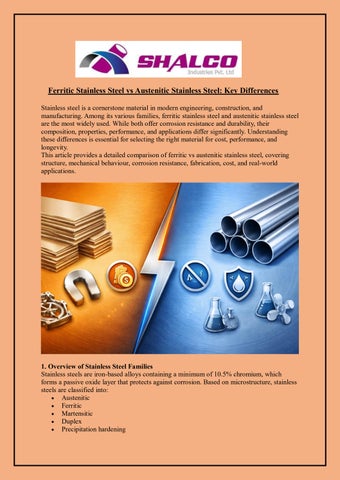
Ferritic Stainless Steel vs Austenitic Stainless Steel: Key Differences Stainless steel is a cornerstone material in modern engineering, construction, and manufacturing. Among its various families, ferritic stainless steel and austenitic stainless steel are the most widely used. While both offer corrosion resistance and durability, their composition, properties, performance, and applications differ significantly. Understanding these differences is essential for selecting the right material for cost, performance, and longevity. This article provides a detailed comparison of ferritic vs austenitic stainless steel, covering structure, mechanical behaviour, corrosion resistance, fabrication, cost, and real-world applications.
1. Overview of Stainless Steel Families Stainless steels are iron-based alloys containing a minimum of 10.5% chromium, which forms a passive oxide layer that protects against corrosion. Based on microstructure, stainless steels are classified into: Austenitic Ferritic Martensitic Duplex Precipitation hardening
Among these, austenitic and ferritic stainless steels dominate commercial and industrial usage. Ferritic Stainless Steel: Ferritic stainless steel is an iron–chromium alloy containing little to no nickel, typically with chromium content between 10.5% and 30%. It has a body-centered cubic (BCC) crystal structure, which makes it magnetic and gives it good resistance to stress corrosion cracking. Ferritic stainless steels offer moderate corrosion resistance, good thermal conductivity, lower thermal expansion, and stable performance at elevated temperatures. They are cost-effective due to the absence of nickel but have lower ductility and toughness compared to austenitic grades, especially in low-temperature or high-impact applications. Austenitic Stainless Steel: Austenitic stainless steel contains higher levels of chromium and significant nickel, which stabilizes its face-centered cubic (FCC) structure and makes it generally non-magnetic in the annealed condition. This structure provides excellent ductility, toughness, and formability, along with superior corrosion resistance in aggressive environments such as chemical processing, marine, and food industries. Austenitic stainless steels perform well across a wide temperature range, including cryogenic conditions, but are more expensive and prone to stress corrosion cracking in chloride-rich environments compared to ferritic steels. 2. Chemical Composition Differences Ferritic Stainless Steel Chromium: 10.5%–30% Carbon: Very low (<0.08%) Nickel: Minimal or none Common grades: 409, 430, 439, 446 Ferritic stainless steels rely mainly on chromium for corrosion resistance and do not contain significant nickel. Austenitic Stainless Steel Chromium: 16%–26% Nickel: 6%–22% Carbon: Low Common grades: 304, 316, 321, 310 Nickel stabilizes the austenitic structure, giving these steels superior ductility and corrosion resistance. Key Difference: Austenitic steels contain high nickel; ferritic steels are nickel-free or low-nickel. 3. Microstructure and Crystal Structure Ferritic Stainless Steel o Body-Centered Cubic (BCC) structure o Magnetic o Stable at room temperature Austenitic Stainless Steel o Face-Centered Cubic (FCC) structure o Non-magnetic (in annealed condition) o Stable over a wide temperature range
The FCC structure of austenitic steel allows greater atomic movement, contributing to higher ductility and toughness. 4. Mechanical Properties Comparison Property Strength Ductility
Ferritic Stainless Steel Moderate Lower
Austenitic Stainless Steel Moderate to high Excellent
Toughness Hardening Impact resistance
Moderate Not heat-treatable Limited at low temp
Very high Work-hardening Excellent
Key Insight: Austenitic stainless steel performs better in high-impact and low-temperature environments, while ferritic steel is adequate for moderate-load applications. 5. Corrosion Resistance Ferritic Stainless Steel Good resistance to: o Atmospheric corrosion o Stress corrosion cracking (SCC) Moderate resistance to: o Chlorides o Acidic environments Austenitic Stainless Steel Excellent resistance to: o Chlorides (especially 316) o Acids and chemicals o Marine and coastal environments Stress Corrosion Cracking Advantage: Ferritic steels are highly resistant to SCC, making them suitable for chloride-rich environments where austenitic steels may fail under stress. 6. Fabrication and Weldability Ferritic Stainless Steel Easier to machine Lower thermal expansion Weldable, but: o Requires control to avoid grain growth o Limited toughness in welded zones Austenitic Stainless Steel Excellent weldability High formability Higher thermal expansion Susceptible to distortion during welding Fabrication Verdict: Austenitic stainless steel is preferred for complex forming and deep drawing, while ferritic steel is chosen for simpler fabricated components.
7. Heat Resistance and Thermal Properties Ferritic Stainless Steel o Better resistance to oxidation at high temperatures o Lower thermal expansion o Better thermal conductivity Austenitic Stainless Steel o Maintains strength at high temperatures o Higher thermal expansion o Lower thermal conductivity Ferritic stainless steels are often preferred in exhaust systems and heat exchangers due to their dimensional stability under heat. 8. Magnetic Properties Ferritic Stainless Steel: Magnetic Austenitic Stainless Steel: Non-magnetic (may become slightly magnetic after cold working) This property is important in electrical, electronic, and automotive applications where magnetic behavior matters. 9. Cost Considerations Ferritic Stainless Steel Lower cost Stable pricing Less affected by nickel market fluctuations Austenitic Stainless Steel Higher cost Price volatility due to nickel content Cost Advantage: Ferritic stainless steel is a cost-effective alternative where high ductility and extreme corrosion resistance are not required. 10. Typical Applications Ferritic Stainless Steel Applications Automotive exhaust systems Kitchen appliances Washing machines Architectural trim Heat exchangers Fuel tanks Austenitic Stainless Steel Applications Food and beverage processing Chemical and pharmaceutical plants Marine equipment Medical devices Cryogenic vessels Pressure vessels 11. Environmental and Sustainability Aspects Ferritic stainless steels have:
Lower carbon footprint Higher recyclability Reduced dependency on critical alloys (nickel) This makes ferritic stainless steel increasingly popular in sustainable manufacturing and automotive lightweighting. o o o
12. Choosing Between Ferritic and Austenitic Stainless Steel Choose Ferritic Stainless Steel when: Cost efficiency is critical Stress corrosion cracking resistance is needed Moderate corrosion resistance is sufficient Thermal stability is important Choose Austenitic Stainless Steel when: High corrosion resistance is required Excellent formability and toughness are needed Low-temperature performance matters Hygienic and chemical resistance standards are high Conclusion Both ferritic and austenitic stainless steels play vital roles across industries. Austenitic stainless steel dominates applications requiring superior corrosion resistance, toughness, and formability, while ferritic stainless steel offers a cost-effective, SCC-resistant, and thermally stable alternative for many structural and automotive uses. The right choice depends on environment, mechanical demands, fabrication needs, and budget. By understanding their key differences, engineers and decision-makers can select the most efficient and reliable material for their specific application.