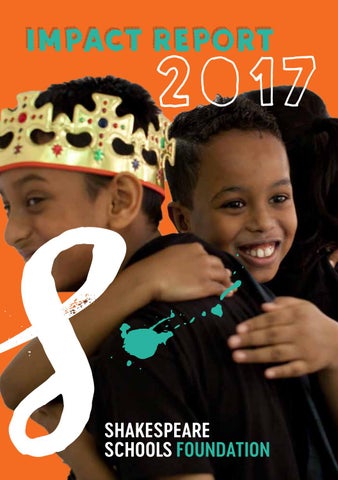
Impact report
2017
1
“To see my own class on stage, brimming with self confidence was one of the proudest moments of my teaching life. Thank you for reminding me why I wanted to become a teacher in the first place. I can’t think of many opportunities offered to primary school children that give them the chance to be treated with such respect by adults, and the chance to show just how good they can be if adults believe in them.” Laura Mitchell, Teacher-Director, Pollockshields Primary School, Glasgow
Introduction Executive Summary
4
Our work Theory of Change Mission, Objectives, Values The Need for SSF The Festival Journey Foundation Projects
6 7 8 10 12
Our reach Where We Work Student Demographics Audience Demographics
14 16 18
Our impact Life Skills 20 Academic Attainment 24 Inclusivity and Diversity 28 Foundations and futures Revolution to Democracy 32 Methodology 34 Funding and Governance 35 How You Can Help 36 Keep in Touch 38
Transforming lives through the unique power of Shakespeare Shakespeare Schools Foundation is a cultural education charity that gives young people of any ability and background the skills they need to succeed in life. At the heart of our work is our annual Festival - the world’s largest youth drama project. Months of preparation culminate in performances in professional theatres nationwide; a journey which builds confidence and self esteem to last a lifetime. 2
3
wE...
2017 was a revolutionary year for Shakespeare Schools Foundation. delivered our thrilling annual Festival and workshops to 1,006 schools across the UK took the Festival to eight new towns and cities for the first time ran two immersive Foundation projects; at Queensmill School and Rushmere Hall School worked with students from Pupil Referral Units in the Festival for the first time delivered more than double the number of additional workshops than 2016 added comprehensive schemes of work and curriculum resources to our offer to schools saw schools embrace our ‘Season of Revolution’ across the country in the most creative Festival yet The findings in this report demonstrate that our work continues to make a difference. We see strong positive changes for our beneficiaries: students are more confident and their attainment increases; teachers’ practice improves; and audiences are more engaged with their local community and the arts.
4
Our work is reaching those who can benefit most from engaging with the arts.
Students
99%
831
of teachers agreed that their students’ confidence increased. 78% strongly agreed.
86%
14,252
of participating students were eligible for Free School Meals. The UK average is 15%.
11%
14,252
of students have a statement of special education needs. The UK average is 3%.
806
of teachers reported that their students’ academic attainment improved. 33% strongly agreed.
Teachers
93%
822 of teachers said that their teaching improved as a result of the Festival. 54% strongly agreed.
Audience
96%
12%
180 of audience members thought that the evening’s performance had brought the local community together.
1/3
Introduction
Executive Summary
324 of Festival schools are located in postcodes in the top three deciles on the Index of Multiple Deprivation.
In 2018, we want to do even better. We will set even higher targets for working with disadvantged schools through the Festival, our Foundation projects and our curriculum resources.
“I really enjoyed the Shakespeare Festival because it felt like I had just conquered the world. It was the best day of my life!” Student, 9, Old Catton Junior School, Norwich
5
There are three key moments in the process where our impact is most profound... At the performance students...
During rehearsals students...
isolation and bullying decreases increased ambition
supportive of others
improved interpersonal skills and teamwork
treated like a professional
higher attainment self-pride
increased resilience more engaged with learning
work with new students and share their work
become less afraid of taking risks
At workshops students... Key Rehearsal inputs and effects Workshop inputs and effects Performance Day inputs and effects Combined effects 66
leads to
2
Shakespeare becomes engaging and relevant
feel contributions are valued
are given a voice and see the effect of feedback
1
promote life skills, social cohesion and ambition
experience an inclusive and collaborate process
increased empathy
improved communication
Our objectives are to:
communicate Shakespeare in a fun and active way
theatre and arts seem more accessible
experience working in a professional context
discover new Shakesepare plays
attend regular rehearsals
shared sense of responsibility and ownership
perform to an audience of family and friends
Transforming lives through the unique power of Shakespeare
3
promote educational attainment, especially in literacy, literature and the performing arts
provide a unique cultural and creative experience to young people from disadvantaged backgrounds
Our values are a statement of intent. They embody the visceral, energetic and ambitious way in which we work to fulfil our mission. Aspirational With us people achieve the impossible. By using difficult texts, professional theatres and a rigorous, supportive process we make learning ambitious.
Our work
Theory of Change
Experiental We offer a visceral, practical and enriching approach. Months of preparation culminate in a rare and exhilarating event. Diverse We embrace the diverse characters, styles and stories of Shakespeare. We ensure it is accessible to the widest range of people and places. Uniting Shakespeare wrote of both royalty and rebels. We believe his plays are the best way to bring people together; from uniting a cast to bringing a community into a theatre. Thrilling SSF knows playing Shakespeare is not just fun, it can also be terrifying, hilarious and deeply moving. Everyone involved learns more about what it means to be human. Transformative We know that what we do has the power to changes lives. 7
Our work
Why It’s Crucial With SSF, young people learn how much they can achieve. We give them the opportunity to develop vital life skills of confidence, collaboration and communication. Our impact lasts a lifetime. This report demonstrates how our vital work combats three significant issues for young people...
“Employability of students who study arts subjects is higher and they are more likely to stay in employment.” Arts Council England, ‘The Value of Arts and Culture to People and Society: An Evidence Review’, 2014.
8
1. Struggling with the pressures of modern life
2. Leaving school lacking essential life skills
3. Lacking essential access to Arts activities
Young people are increasingly struggling with depression, stress, anxiety, bullying, sexualisation, a pressure to ‘fit in’, and concerns about the pressures of school. The result is a fragmented generation, more used to interacting via screens than in real life. The Good Childhood Report 2017 found that there was a “significant decrease in happiness with friends and life as a whole” for 8 to 15 year-olds. With SSF, young people learn to think deeply and creatively while being empowered to express themselves and be brave.
Our society needs a generation who are resilient, adaptable, creative, excellent collaborators and top communicators. Yet, the British Chamber of Commerce Workforce Survey 2014 reported that 88% of firms believe school leavers are not prepared for work and 57% believe this is due to a lack of “soft skills” such as communication, team working and resilience. SSF provides essential access to a cultural, creative, collaborative process where young people develop these key life skills.
Evidence shows that poverty and achievement are closely linked. In England, just over a third of children on free school meals achieve the expected standard at Key Stage 2 (‘The State of the Nation’, HMG, November 2017). Arts Council England’s research piece “The Value of Arts and Culture to People and Society” (2014) found that students from low income families who take part in arts activities at school are three times more likely to get a degree than children from low income families who do not engage in arts activities at school.
8
9
At SSF’s core is the world’s largest youth drama festival. Every year we work with thousands of students and hundreds of teachers from primary, secondary and special schools the length and breadth of the UK. Months of preparation culminate in exhilarating performance evenings; young people performing Shakespeare in professional theatres, raising aspirations and unlocking the potential of everyone involved. Here’s how it works:
1
Sep - March Welcome to the Festival Schools meet their dedicated Festival Coordinator, who will guide them through the thrilling months ahead. Teachers rated support from their Coordinator 7.2/8 on average.
2
The Teacher-Director Workshop We give teachers everything they need to take their play from page to stage. From storytelling to staging, lighting to language, teachers are left inspired to begin rehearsals with their company. 97% of teachers rated the workshops as ‘very good’ or ‘excellent’.
5
Sep - Oct
583
The Company Workshop Working with SSF’s theatre professionals, the company of young people develop their performance skills, share work in progress and take their play to the next level. “The students had a great time and came away with a new sense of energy and lots to consider and talk about. Both workshop leaders were brilliant!”
815
Phil Branch, Teacher-Director, The Wavell School, Farnborough
March
Our unique resources Teachers choose their play, browse our extensive bank of resources, share tips in our online forum and get inspiration from the SSF team and other TeacherDirectors. 9/10 teachers rated our resources as ‘very good’ or ‘excellent’.
3
May
6
Oct - Nov
820
The Inclusive Teacher Workshop We train teachers from special schools in inclusive practice in a workshop that caters for all needs and offers an opportunity to share best practice. “No matter the requirement of the school, I would tell them that SSF would cover it.”
10
June
Our work
4
From Page to Stage: The Festival Journey
Mike Freeman, Teacher-Director, Strathmore School, Richmond
Students perform on a professional stage In a celebratory finale to the Festival journey, the company unite on stage with other local schools in an exhilarating performance in front of the local community. “Our students gain so much not only from the creative process and the rehearsals but also the performance and the feedback they receive. I am immensely proud of our students.” Brandon Mills, Headteacher, Brookfields Special School, Reading
up to
30,000
young people gain new skills and develop confidence 11
SSF reaches out to schools in areas of the UK that haven’t yet experienced the Festival and those who want to add to their Festival journey. Immersive projects In 2017, we built on the success of pilot projects to devise more bespoke immersive projects for schools. The first was an ambitious whole school project with Queensmill, a school for young people on the autistic spectrum, where we worked with every child and teacher. The second was a speech and language project with Rushmere Hall Primary School in which we measured the impact of our creative process on children with communication difficulties.
case study
Curriculum resources To complement these bespoke projects and the Festival, we launched a range of exciting
classroom resources that make Shakespeare exciting and give participants new tools and insights. These resources are closely linked to the curriculum and assessment objectives for every school type. They are well resourced and differentiated, with clear reading, writing and drama outcomes.
Jane Giebeler, Teacher-Director, Longstone Primary School, Edinburgh
Workshops SSF’s collaborative, active approach encourages learning in a safe and creative environment. We have a range of full or half day workshops available to all UK schools. They range from CPD provision to student workshops for all key stages, and bespoke offers.
Using Shakespeare with young people with autism For three weeks over the summer term, SSF collaborated with Queensmill School, a specialist school in London for young people on the autistic spectrum, taking every class on an immersive discovery of The Tempest. With daily sessions on theme and character, pupils aged 3-25 experienced the world of the play according to their needs and interests, with the aim of developing their communication skills, imagination and confidence. Exploring the sensory world of the sea, discovering the monster’s cave and creating magical spells triggered playful interactions and enjoyment for the young people across the project. The chants of “Aye Aye Captain” and “Ban Ban Caliban” filled the school. In a unique culmination of the project, every class performed their own show, after which a parent commented:
12
“Pupils who you might think would not enjoy Shakespeare or have significant barriers to learning have literally shone in some of these lessons with their perceptive contributions, and it’s clear that they understand what they are learning.”
Our work
Foundation Projects
“It was amazing seeing all the young people, all of whom at this school have very complex autism, and generally extremely limited communication and interaction, with smiles on every face, really entering into character. So please, bring us more Shakespeare!” 13
@jotcugh78 First time I’ve ever seen my girl on stage! Can’t quite find the words for what it has done for her/us! Thank you so much #AutismAwareness #trueinclusion
Scotland
5 primary schools 6 secondary schools
@AdranSaesYGYBD Much Ado yn BAROD ar gyfer heno! Ni mor excited!!!!
@Year6PDCS We have all loved being part of another successful @SSF_UK production. Thanks for all your kind words and support. As always, your staff have been superb! We’ll see you again next year! #OurStage
14
6 theatres 9 performance nights
114 theatres 258 performance nights
3 theatres 4 performance nights
Wales
Northern Ireland
24,346 young people 1,006 schools 136 professional theatres
England
Through our annual Festival and Foundation projects, we are proud to work with thousands of children of any ability and background nationwide - from Inverness to Ipswich, Belfast to Brighton...
13 theatres 21 performance nights 32 primary schools 33 secondary schools 4 special schools
11 primary schools 21 secondary schools 1 special school 1 international school
Our Reach
Where We Work
385 primary schools 407 secondary schools 94 special schools 6 international schools 890 additional teachers trained @tamaraeluned “I’m confused, we’ve been working on this for months and it’s all I’ve been thinking about, but now it’s over I’m not tired at all. I should be tired!” Welcome to the amazing buzz of theatre-induced adrenaline, young sir!
@jevansjill You simply cannot underestimate the impact this can Festival can have on the confidence and self esteem of young people. Long may it continue. Into our eleventh year and still loving it! 15
SSF knows that Shakespeare is for everyone. All our work is fully inclusive, bringing together diverse communities to aspire and achieve through Shakespeare.
27%
“It’s the fact that any school can take part. Each pupil learns to work as part of a team and they encourage each other to do their best regardless of how big or small their own part is.” Julia Woodrow, Audience Member, The Orchard Theatre, Dartford
11,227
of participating students were from minority ethnic backgrounds. The UK average is 25%.*
12%
Our Reach
Student Demographics
14,252
of participating students were eligible for Free School Meals. The UK average is 15%.*
11%
14,252
of participating students speak English as an additional language (compared to the UK average of 15%*).
“One young student who has EAL and SEN has made great progress in his practical work and resulting written evidence through performing in the festival. His social skills are developing and his confidence has grown.” Julie Salisbury, Teacher-Director, Blacon High School, Chester 16
11%
14,252
of participating students had a statement of SEN (compared to the UK average of 3%*).
*Statistics compiled from: ‘Annual enrolments at schools and in funded pre-school education in Northern Ireland’, 2016/17; ‘DfE Schools, pupils and their characteristics’, 2017; ‘Summary Statistics for Schools in Scotland’, No. 8: 2017 Edition; ‘Statistics for Wales, School Census Results’ 2017. 17
“I like the way it encourages children of all ages and abilities to take part and to have an in interest in Shakespeare.”
SSF brings new, diverse audiences to theatres on performance evenings, uniting local communities in the celebratory finale of the Festival process. Close to 65,000 people saw a Festival performance in 2017. Last year, we launched a pilot audience evaluation. We trialled online evaluation in partnership with ticketing software company Spektrix and venue the Northern Stage. We engaged with audiences on performance nights at seven of our Festival theatres with the help of Civil Service Fast Stream volunteers. Of this small sample:
51%
Audience Member, The Albany, Deptford
“My daughter was beaming with confidence! As were all the cast from their school. Some cried saying how proud they were!”
195
of audience members at SSF shows were BAME (compared to 10% national average*).
36%
123
of audience members at SSF shows live in postcodes ranking in the top three deciles on the index of multiple deprivation.
99%
190
of audience members enjoyed the evening’s performance.
18
Our Reach
Audience Demographics
99%
Audience Member, Theatre Severn, Shrewsbury
188
of audience members said that the performance positively changed their perception of young people in the community.
64%
122
of audience members hadn’t been to that theatre before and 98% of them wanted to return.
*Arts Council England, ‘Analysis of Theatre in England’, 2016.
“The performances from all schools were amazing. Thoroughly enjoyed the whole evening and was truly amazed at how talented they all were, being so young!” Audience Member, Northern Stage, Newcastle
19
Our Impact
Life Skills Every year we help thousands of young people gain the skills they need to succeed in life. Through our process we raise aspirations, broaden horizons and send confidence soaring. Students develop pride in themselves, through increased empathy, articulacy and resilience.
99%
831
case study
of teachers agreed that their students’ confidence increased. 78% strongly agreed.
96%
829
of teachers said that their students were more resilient having taken part in the Festival. 69% strongly agreed.
Sandra Cochrane, Teacher-Director, St Anthony’s School, Margate “A previous pupil who had autism had been monosyllabic for his entire school career, having been with us since the age of 5. He began to engage in drama in year 9 with simple exercises learnt at an SSF training day. With three weeks to go before the performance he stepped in and took on sthe role of Macbeth with great flair. As a result of the performance staff and pupils alike began to see him in a new light, his confidence grew and his sense of humour began to shine through. He became more outgoing and engaged people in conversation rather than being passive. It was a remarkable transformation for him. The increased confidence has now allowed him to travel independently to Canterbury and take a place on a mainstream art college course.“
“One student was bordering on being permanently excluded from our school for his very poor behaviour. I dragged him into this show as he has innate talent. It has saved him, given him a purpose, and a sense of belonging. We are all rather overwhelmed by how well he has done and the positive impact it has had on him. The show and this SSF experience has literally made the world of difference to him and has given him the self-worth he was lacking.” Sara Young, Secondary School Teacher, London
20
21
SSF’s inclusive ethos and flexible approach allows students of all abilities to flourish. Young people with profound communication challenges and mental health difficulties find that the process breaks down barriers and gives them a new outlook on life.
“The team at Shakespeare Schools Foundation are endlessly positive, imaginative and enthusiastic, showing a genuine and admirable willingness to improvise and adapt according to the complex needs of children with autism and thus enabling them to succeed in many, many ways. Thank you!”
Our Impact
Life Skills
Freddie Adu, Headteacher, Queensmill School, Shepherd’s Bush
case study
94% Emily, SSF Alumni, The Artrix, Bromsgrove, 2013 “I took part whilst I was really struggling with my mental health. Taking part in the Festival gave me not only a distraction and something to look forward to, but a coping method and a connection with a team of people who really cared. My drama family helped and supported me through so much and I wouldn’t have even come into contact with a lot of them if it wasn’t for the festival. Taking part in the festival helped build my confidence and resilience, which in turn helped me to recover from my mental health problems and cope with all the world has thrown at me, including chronic illness. Although I’ve not been involved in theatre since, I still have the acting bug and would love to walk the boards again. Doing the festival at such a difficult time made me realise that I can do anything I put my mind to, no matter the forces against me.” 22
16
of teachers at Queensmill told us that their students improved in their interactions with one another. 25% strongly agreed.
100%
15
of teachers at Queensmill said that their students developed the way they communicate. 27% strongly agreed.
“He came to us as a selective mute, and he’s discovered his lion’s voice. Through… drama, he’s developed his voice.” Rosina Cleave, Teacher, Rushmere Hall Primary School, Ipswich 23
Our Impact
Academic Attainment
case study
Engaging and grappling with Shakespearean text not only raises students’ attainment in English, but across the curriculum. Our active approach unlocks learning potential in young people and increases and deepens their engagement in class.
Kim Karam, Teacher-Director, Castleview Primary School, Edinburgh
“Rarely have I seen such noticeable improvements throughout the curriculum following an intervention or project. Working intensively on this Shakespeare play has sharpened the focus of the students and awoken a renewed interest in reading, vocabulary and intention. This play, and the associated study, has been the impetus some students needed to engage with new texts and to read aloud with increased confidence, fluency and expression. The fact that many of our performers are also using strategies to manage their dyslexia, EAL challenges or other possible barriers to accessing Shakespearean language, provides us with another reason to feel proud at their achievements. Participants are demonstrating an increased ‘Growth Mindset’ or ’can do’ attitude, and using their performance as a pivotal moment that they will use as a reference point for years to come: the time they realised that fear and excitement are manageable, that obstacles can be overcome with hard work and dedication; and, with the right support and encouragement, anything is possible. I feel two pupil quotes summarise the impact for me; “It made me feel fine and happy. It made me feel like I was flying. I am better at reading. I’m getting way more plays.” and “After reading the script I started wanting to read more books.” As a teacher, this is more than I could have hoped for. For this class, at this time, performing Shakespeare at the Church Hill Theatre has been shown to be a powerful, enduring and successful endeavour.”
24
86%
807
90%
823
of teachers reported that their students’ attainment in English had improved. 32% strongly agreed.
of teachers said that their students were more enthusiastic about school and learning. 50% strongly agreed.
93%
86%
822
of teachers said that their teaching had improved as a result of the Festival. 54% strongly agreed.
806
of teachers reported that their students’ academic attainment had improved. 33% strongly agreed. 25
Our workshops and Foundation projects enhance creative opportunities for learning in the classroom, providing platforms for students of all abilities to achieve. Our CPD and differentiated resources provide teachers with the confidence and tools to explore challenging language and complex themes with their students. Away from a formal learning environment, young people have a chance to shine which increases their passion for studying.
“This workshop was one of the best experiences that our students have had at KS4 and we will certainly be looking to offer our KS3 students a SSF workshop during the coming academic year. I cannot recommend this experience too highly and I will be speaking to both secondary schools and our primary partner schools about this at every opportunity.”
Our Impact
Academic Attainment
Jane Moss-Blundell, Head of English, Harrogate High School, Harrogate
“The whole workshop was a fantastic opportunity for pupils to fall in love with Shakespeare. They thoroughly enjoyed it from start to finish. For me as a class teacher the wonder of it was watching children blossom and shine who would not normally do so.” Susan Aincough, Class Teacher, Burbage Junior School, Hinckley
26
27
Our Impact
Inclusivity and Diversity SSF knows that Shakespeare is for everyone. We bring together students of all ages, abilities and backgrounds from every type of school, where each is celebrated for their creativity, contribution and effort. In all of our work, we strive to make sure no child is left out. The Festival is non-competitive and we recognise that the journey that students go on is as important as the final performance. We encourage processes to be led by young people, and we value all voices.
97
special schools took part (7% of all special schools in the UK, compared with 4% of all mainstream schools). 28
93%
221
81%
221
of students said that they enjoy working as a team more having taken part in the Festival. 74% strongly agreed.
of students said that they find it easier to understand how other people feel. 41% strongly agreed.
100%
95%
73
of special school teachers said that their students had exceeded expectations. 88% strongly agreed.
73
of special school teachers said that students’ resilience increased. 51% strongly agreed.
1/3
324
of participating schools are located in postcodes in the top three deciles on the Index of Multiple Deprivation.
98%
73
of special schools teachers said that their students’ pride in themselves had increased. 79% strongly agreed. 29
Children from disadvantaged backgrounds, children with disabilities, children who speak different languages, children who have no idea who Shakespeare is - all of them take part and have the chance to widen their horizons and fulfil their potential.
Markethill Primary School and St Patrick’s Crossmaglen Primary School, Market Place Theatre and Arts Centre, Armagh “In 2017, two primary schools from very different areas of County Armagh took part in SSF as two mixed casts through the Shared Education Programme with the aim to bring together young people and communities of different backgrounds and religions. One school is close to the border, the pupils are taught in an Irish medium unit and the majority are from a nationalist Catholic background. The other school is closer to Armagh and the majority of pupils are from a unionist Protestant background. Both communities were affected by the Troubles.
Our Impact
From Aberdeen to Aberystwyth, Birmingham to Belfast, inner-city to seaside town, SSF is for all young people.
case study case study
Inclusivity and Diversity
At the start, parents from both communities were sceptical and some did not want their children going to the other school to rehearse. Instead the students met in a community hall between the two schools each week. Students began to integrate, working with adults and young people from the other school, discovering things about each other’s communities with some learning Irish. They were no longer students from two different schools but identified as the companies of Hamlet and Macbeth.
“They are much more confident in expressing themselves, more willing to take part in a range of activities and have a greater interest in Shakespeare. It has also had an enormous impact on their compassion towards other.”
Taking part in Shared Education through SSF has been markedly different from previously classroom-based activities. The pupils have integrated, made friends and worked together in a way they have never seen. SSF has brought them together. On the performance night, the two communities came together, parents from what recently were two divided areas sat next to each other and celebrated the incredible journey that their young people had been on.”
Clare Appleby, The Arbours Primary Academy, Northampton 30
31
It’s very easy to identify with the unsettled spirit Henry VI expresses. We live in a world where whether online, at home, or on the streets - there are great pressures and uncertainties. These require our children to be resilient and adaptable, excellent collaborators and top communicators. SSF wants to equip and embolden the next generation, not just to face but to prosper in whatever is to come. It’s why our charity exists. The impact you’ve been reading about in these pages shows that we’re doing just that. From communities in Northern Ireland using the Festival as a catalyst to break down walls, to children on the brink of exclusion whose lives are turned around, the legacy of our work is profound and exciting. It shows that Shakespeare as it was meant to be - owned and loved at a community level - has an extraordinary capacity to raise attainment and aspirations across society. SSF is now 18 years old and we’re celebrating with the Season of Democracy: championing equality and diversity, encouraging every child and teacher to use their voice, and working in new place to reach those who haven’t yet had the chance to change their own lives through this unique vehicle. We hope you’ll join us in 2018 to see for yourselves, how thousands of different young people, just like this participant, can say:
Will Forder, Teacher-Director, Whitehill Primary School, Gravesend “A year 5 child could barely read before we started. He worked extremely hard and as a result learnt 10 lines of Shakespeare by himself! When reading in class he sat staring in different directions and would not engage. We worked through the play and I gave him a new role with slightly more words. He took it on and learnt the words – we worked through this together so that he knew what the words meant and what he had to do. In class he began reading independently. This involved reading aloud but doing it willingly both with a teacher and without one. After speaking to his mother, he has also been much more willing to read at home and is reading 2-3 short books per week. His reading level had progressed because of his engagement with the Shakespeare script. Learning the words by heart and saying them in front of an audience of 300 seemed to give him a huge boost in confidence which has carried through into his reading at home.”
Foundations and futures
“O heaven! that one might read the book of fate, and see the revolution of the times.”
case study
What Next? From Revolution to Democracy
“Now I am more confident to try something new, all because of Shakespeare.”
Ruth Brock, Chief Executive 32
33
SSF uses rigorous evaluation techniques to measure our impact on participants and improve our offer to schools. Data Collection • Teachers were asked to complete a survey at the end of the Festival process, where they rated, on a scale of one to eight, the impact on their students and themselves. This encompased all aspects of our work. • All attendees evaluated our CPD workshops through surveys and teachers were able to opt in to provide specific feedback on the company workshop. • All our surveys provide free space for comments and feedback. • An optional survey at the beginning of the Festival process, to which roughly 300 teachers responded, allowed SSF to track data for individual schools. • Teachers were asked to provide demographic data on the students in their company when they submitted their cast list before the performance day. • Student surveys were also distributed via teachers following their performance. • A successful trial with ticketing company Spektrix was launched, allowing us to collect demographic data from audience members at the Northern Stage and receive feedback through a digital survey. Volunteers collected further audience data at venues in London, Manchester and Glasgow using the same survey.
34
•
As we approach our 18th birthday, we are collecting data to measure the impact on participants who have taken part since 2000, through our digital alumni survey.
Successes Digital Evaluation Moving our evaluation process online has increased response rates, allowed for instant improvement to programmes, and improved the quality of our data. Student Demographic Data An increase in the number of schools providing data was facilitated by teachers submitting it online before the performance day. Audience Evaluation We delivered successful pilot programmes which will be rolled out to more theatres in 2018. Improvements Experiential Evaluation We aim to facilitate experiential evaluation in special schools to allow all participants to respond, no matter their method of communication. Student Evaluation We want to hear the voices of our beneficiariesv more loudly through greater student response and formation of a youth panel. Audience Evaluation We will encourage theatres to distribute our audience survey digitally and extend our network of evaluation volunteers.
Funding and Governance SSF relies on the help of our committed supporters: trusts and foundations, individual donors and partners. Our work would not be possible without their generosity. Every pound we receive is spent wisely:
70% on the Festival 11% on fundraising 10% on office costs 7% on support costs 2% on merchandise and workshops
Foundations and futures
Methodology
Headline supporter SBT’s mission is to support high growth potential social enterprises to scale-up their impact. They do so by investing cash grants and professional support from their eight partner organisations in a carefully selected portfolio of social enterprises. SSF is extremely proud to have had invaluable support from SBT since 2013. 35
Each year we have to raise £1 million to continue our essential work. There are lots of ways you can help us transform lives and give young people the skills and confidence they need to succeed in life.
£60 supports one SEN child through the Festival process
Become a regular supporter From £5 per month you’ll be helping a teenager with special needs perform alongside their peers from mainstream schools.
£240 supports an entire school through the Festival process £600 supports an entire night of performances (four schools, up to 140 young people)
Come to our Events
From £10 per month you’ll be enabling three young people to raise their ambitions & increase attainment.
We host lots of exciting events throughout the year, come along and support SSF while enjoying a night of thrilling entertainment.
From £20 per month supports a whole cast’s participation in the Festival, giving greater confidence and resilience to up to 35 young people.
Remember us in your will
From £50/month you’ll be helping over 100 young people across four different schools to perform onstage in a professional theatre. From £100/month provides vital resources for young people and their schools to immerse themselves in Shakespeare’s plays, including advice from leading actors and directors on how to mount the best possible performance. From £250 per month you will be creating opportunities for hundreds of young people across the UK, allowing them to build vital skills of teamwork, communication and selfconfidence that last a lifetime.
36
Know that you will be leaving the gift of increased life chances for the next generation.
Fundraise for us Use your skills and talents to raise money for SSF. Get in touch for a Fundraising Pack and to ensure our team will be cheering you on!
Foundations and futures
How You Can Help
Make a donation - Give SSF an 18th birthday gift!
Stay in touch Join our mailing list, follow us on social media, drop us an email, pick up the phone or write us a letter, we’d love to hear from you. 37
Keep In Touch Shakespeare Schools Foundation 140 London Wall London EC2Y 5DN shakespeareschools.org 020 7601 1800 @SSF_UK Ruth Brock, Chief Executive ceo@shakespeareschools.org Grateful thanks to the Trusts and Foundations that supported our work in 2017: April Trust • Children’s Charity Circle Bradford and District • Chivers Trust • Cumbria Community Foundation, • D G Marshall of Cambridge Trust • Doris Field Charitable Trust • Essex Community Foundation • Fort Foundation • Four Acre Trust • Gowling WLG (UK) Charitable Trust • Hall Charitable Trust • Hyde Park Place Estate Charity • J C J Eaton Charitable Trust • John Jarrold Trust • Keith & Joan Mindelsohn Charitable Trust • Lord and Lady Somerleyton’s Charitable Trust • Margaret Davies Charity • Old Possum’s Practical Trust • P F Charitable Trust • Pilkington Charities Fund • Rokeby Educational Trust • Roy Hudson Trust • Sir James Knott Trust • Sobell Foundation • Staffordshire Masonic Charitable Association • Stanley Smith Charitable Memorial Fund • Teale Charity Trust • The Boris Karloff Charitable Foundation • The Dorothy Johnson Charitable Trust • The Dwek Family Charitable Trust • The Edmund Godson Charity • The Foyle Foundation • The Frank Litchfield General Charitable Trust • The Gibbs Charitable Trust • The Hartsheath Charitable Trust • The Helen Jean Cope Charity • The Jack Lane Charitable Trust • The James Beattie Charitable Trust • The Jane Hodge Foundation • The Jessie Spencer Trust • The Leatherseller’s Company Charitable Fund • The Mackintosh Foundation • The Morwoods Charitable Trust • The Openwork Foundation • The Paul Bassham Charitable Trust • The Roger and Douglas Turner Charitable Trust • The Roger and Ingrid Pilkington Trust • The Roland Callingham Foundation • The Rutland Trust • The Scarfe Charitable Trust • The Simon Digby Charitable Trust • The Trades House of Glasgow • The Wixamtree Trust • The Worshipful Company of Launders Benevolent Trust Fund • Unity Theatre Trust • Waynflete Charitable Trust Shakespeare Schools Foundation is a registered charity, number 1164676, and a limited company (England and Wales), number 9883201. Registered Office: 3rd Floor, 140 London Wall, London EC2Y 5DN. 38
The photographs in this report are courtesy of Splaat Media, Helen Hasse Photography and Holly Clark Photography. 39
“We will never know how far the ripples of this project will travel into the future of these young actors and through the school’s wider community.” Kim Karam, Teacher-Director, Castleview Primary School, Edinburgh
Trustees Andrew Jackson (Chair) Petrina de Gouttes Geraint Talfan Davies Guy Davies (Treasurer) James Hadley Laura King Menna McGregor Jude Ragan
40
Patrons Jenny Agutter OBE Nicholas Allott Ruby Bentall Dame Judi Dench CH Hugh Dennis Christopher Eccleston Alfred Enoch Ralph Fiennes Jamila Gavin John Heffernan Sir Nicholas Hytner Lindsay Johns Paterson Joseph
Kwame Kwei-Armah Francesca Martinez Philip Pullman CBE Lord Puttnam CBE Matthew Rhys Michael Rosen Simon Russell Beale CBE Sir Tom Stoppard Dame Harriet Walter Education Advisors Colin Hall Dame Alison Peacock