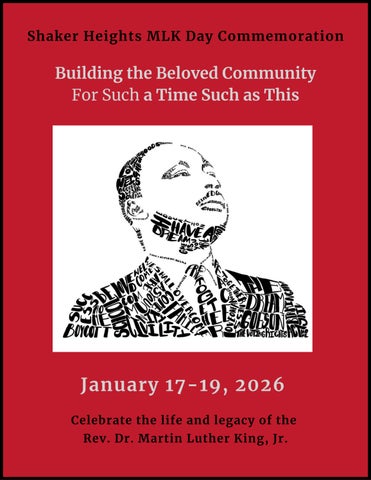
Shaker Heights MLK Day Commemoration
Building the Beloved Community For Such a Time Such as This
January 17-19, 2026 Celebrate the life and legacy of the Rev. Dr. Martin Luther King, Jr.
Calendar of Events Saturday, January 17, from 10 a.m.-Noon Support local nonprofit organizations in a drive-through donation drive at the Shaker Heights Middle School. More details about items in need can be found at shakerpto.org/mlk2026
Sunday, January 18, from 1:30-3:30 p.m. All residents are invited to the 2 n d Annual MLK Day Community Conversation & Meal. Join us as we consider how we can live out Dr. King’s dream in this time and place. Local favorite, Zanzibar Soul Fusion, will cater the free community meal. Meet us at St. Dominic School at 3455 Norwood Rd.
Monday, January 19, 2026 Follow along with this mulit-media learning guide to gain a deeper understanding of Dr. King and the Civil Rights Movement. We encourage you to consider how YOU can create a Beloved Community throughout the year.
Table of Contents
Martin Luther King, Jr. ..................................
4
Coretta Scott King .........................................
5
Gandhi ............................................................
6
Kasturba Gandhi ............................................
7
Philosophy of Nonviolence ...........................
8
6 Principles of Nonviolence ..........................
9
The Civil Rights Movement ........................... 10 Pivotal Moments in the Movement ............... 11 Otis Moss, Jr. .................................................. 12 Edwina Moss .................................................. 13 Dr. King's Visit to Shaker Heights ................ 14 Conversations in Courage ............................. 15 Civil Rights to Human Rights ........................ 16 Rev. Naomi Tutu ............................................ 17 Beloved Community ....................................... 18 For Such a Time as This ................................. 19
Special thanks to the many volunteers who contributed to this guide including: Students and staff at the Innovative Center for Personalized Learning, Student Group on Race Relations, Shaker Schools Foundation, Family And Community Engagement Center, Shaker Heights Public Library, and the Shaker Heights Parent Teacher Organization.
Martin Luther King, Jr. Rev. Dr. Martin Luther King, Jr. was born on January 15, 1929, in Atlanta, Georgia. There, he grew up with his three siblings and parents, Reverend Martin Luther King Sr. and Alberta King. Spanning from 1894 to 1975, King's maternal grandfather, Adam Daniel Williams, and King’s father, Martin Luther King Sr., were Senior pastors at Ebenezer Baptist Church, creating a foundation for his life’s work. At 15 years old, King began studying for a sociology degree at Morehouse College, an all-male Historically Black Colleges & Universities (HBCU). King was crowned Valedictorian of his class in 1948, then went on to attend Crozer Theological Seminary in Pennsylvania. It was here that King first learned about Gandhi and became inspired by his nonviolent resistance techniques. He finished ministry school in 1951, then completed his dissertation on systematic theology at Boston University in April 1955. That same year, when Dr. King was just 26 years old, he coordinated the 13-month Montgomery Bus Boycott, which ended with the Supreme Court ruling that segregation on public buses was unconstitutional. This successful nonviolent mass protest served as an example for future civil rights campaigns with Dr. King as the leader of the national movement. In 1964, he was awarded the prestigious Nobel Peace Prize for being “the first person in the Western world to have shown us that a struggle can be waged without violence.”
Martin Luther King, Jr (animated video)
Coretta Scott King Coretta Scott King was an African American civil rights leader, activist, author, mother, and the wife of Rev. Dr. Martin Luther King, Jr. She was born April 27, 1927, in Marion, Alabama, to Obadiah Scott and Bernice McMurray Scott. During her childhood, she was known to use singing and playing the violin as a form of activism. Scott King attended Antioch College in Yellow Springs, Ohio, where she studied music before transferring to the New England Conservatory. She met her future husband, Martin Luther King, Jr., while they were both students in Boston. Scott King was already an activist, and soon, they began to work side by side in the fight for equality. During her lifetime, Scott King took part in many official international trips as a leader of the Civil Rights Movement, including a pilgrimage to India in 1959 to learn more about Gandhi and South Africa in 1994 to attend Nelson Mandela’s inauguration as the first Black president. After her husband's martyrdom, Mrs. King successfully lobbied for his birthday to become a federal holiday. Dr. King is only one of two individuals to be honored with a National holiday in recognition of their birthday. She continually took action to make the world a better place long after Dr. King's departure. Coretta Scott King passed away on January 30, 2006. She was laid in state at Georgia's State Capitol, being the first woman and African American to receive that honor.
Online Sources for Additional Learning Her Story (video of Coretta Scott King) 135 years of Social Transformation at Ebenezer
Gandhi Mohandas Karamchand Gandhi was born in India on October 2, 1869. During his lifetime, Gandhi pioneered the philosophy of nonviolent resistance and helped to free the Indian people from British rule. His birthday is observed annually as the International Day of Nonviolence in recognition of his worldwide impact. Gandhi was raised with beliefs to include non-injury to all living things, fasting, and meditation. He wed Kasturba at age 13 in an arranged marriage and obtained a law degree in London by 18 years old. Gandhi first endured racial discrimination while living in South Africa. Despite having a first-class ticket, he was forcibly removed from the train for refusing to go to the lower-class section. In 1894, Gandhi officially began to mobilize others by forming the Natal Indian Congress then created a passive resistance movement called satyagraha. Between 1906-1913, thousands of Indians in South Africa joined him in nonviolent protests. Due to pressure from the British government, the South African government abolished the poll tax and recognized Indian marriages. After 21 years in South Africa, Gandhi and his family moved back to India where he focused the satyagraha campaign on Indian Independence. He became leader of the Indian National Congress in 1925, organized the Salt March in 1930, and started the Quit India Movement in 1942. Gandhi became internationally known for using hunger strikes and his own imprisonment to advance social change. He inspired tens of thousands of Indians to join him in the nonviolent fight against Britain, ultimately winning their independence on August 15, 1947. Gandhi was honored with the nicknames: Father of India and Mahatma, meaning great soul. Gandhi suffered martyrdom by an extremist, but before his death, he wrote passionately about his philosophies. Through this work, Gandhi’s legacy lives on inspiring future generations of activists including Martin Luther King, Jr. and Nelson Mandela.
Kasturba Gandhi Born in 1869 to Gokuldas and Vrajkunwar Kapadia, Kasturba was the wife and integral partner to one of the most prominent figures in world history. She was also a leading activist for social, economic, and political equality in her own right. Kasturba is often remembered as a simple and gentle person, but it was her obstinance, tenacity, and self-discipline that helped her stay committed to the goals of freedom. She was one of the first satyagrahis protesting the South African government in 1913 and by 1932, British officials regarded Kasturba to be as much of a threat to law and order as her husband. She believed women were better suited to lead mass protests and actively involved them in the campaign. For example, Kasturba dictated an appeal in the journal Young India for women to spin and produce their own yarn as a way to be self-reliant during the mass boycott on foreign cloth. The spinning wheel would become a symbol of Indian independence.
Gandhi (animated video)
Kasturba was arrested several times for civil disobedience and during her imprisonment would be kept separate from inmates because of her persuasive influence on others. It was 1944 during solitary confinement at the Aga Khan Palace when Kasturba would succumb to an illness. Sarojini Naidu, the first woman to hold the office of Governor in the Dominion of India, described Kasturba as “The living symbol of Indian womanhood. Never once did her feet falter or her heart quail on the steep path of perpetual sacrifice.”
Philosophy of Nonviolence Dr. King was very inspired by the teachings of Mahatma Gandhi and drew upon the concept of nonviolence. Over the course of his life, King developed Six Principles of Nonviolence. In the book, Stride Towards Freedom, he describes these fundamental tenets as a lifestyle meant to be embraced for creating social change. The Civil Rights Movement was led by Dr. King, but millions of African Americans joined him in nonviolent civil disobedience, economic boycotts, creative arts, and communication with government officials. Unfortunately, peaceful protests were often met with violent resistance. The Children's Crusade in 1963 and Edmund Pettus Bridge march in 1965 are just two examples that gained national attention securing dramatic changes for equal rights under the law. Dr. King was often compared to less pacifistic civil rights activists, including Malcom X. In an interview addressing this comparison Dr. King stated, “I have met Malcolm X, but circumstances didn't enable me to talk with him for more than a minute. I totally disagree with many of his political and philosophical views, as I understand them. He is very articulate, as you say. I don't want to seem to sound as if I feel so self-righteous, or absolutist, that I think I have the only truth, the only way. Maybe he does have some of the answer. But I know that I have so often felt that I wished that he would talk less of violence, because I don't think that violence can solve our problem.”
Nonviolence has been practiced within national borders in India and the United States and in regions of Africa with spectacular success. - Rev. Dr. Martin Luther King, Jr., 1965
Dr. King’s Philosophy of Nonviolence Principle One: Nonviolence is a way of life for courageous people Principle Two: Nonviolence seeks to win friendship and understanding Principle Three: Nonviolence seeks to defeat injustice, or evil, not people Principle Four: Nonviolence holds that unearned, voluntary suffering for a just cause can educate and transform people and societies Principle Five: Nonviolence chooses love instead of hate Principle Six: Nonviolence believes that the universe is on the side of justice Recommended Readings PK-4: The Youngest Marcher by Cynthia Levinson 5-8th: One Crazy Summer by Rita Williams-Garcia Teens+: March [trilogy] by John Lewis
Civil Rights Movement The Civil Rights Movement, (1950-1960’s), was a nonviolent social movement and campaign in the United States striving to abolish legalized racial segregation and discrimination. Introduced in the Southern United States as early as 1887, Jim Crow laws legalized segregation based on race in public areas including schools, parks, drinking fountains, restaurants, restrooms, buses, and trains. Black Americans were also denied the right to vote based on racially motivated criteria. In 1896, the Supreme Court upheld these discriminatory laws ruling that “separate but equal” was constitutional in the Plessy v. Ferguson case. The start of the Civil Rights Movement came in 1954 when the U.S. Supreme Court unanimously agreed that “separate educational facilities are inherently unequal.” This landmark ruling in Brown v. Board of Education ordered desegregation of school systems and set the precedent for other government structures to follow. Civil rights attorney, Thurgood Marshall, would become the first Black justice in 1967 after presenting 29 successful cases before the Supreme Court. Dr. King is the most recognized name of the Civil Rights Movement, but many honorable men were on the forefront with him. Women and children also played vital roles in bringing about social change. For example: Diane Nash organized influential sit-ins and Freedom Rides; Ella Baker focused on grassroots organizing and voting rights; 6 year old Ruby Bridges desegregated an all-white school. Countless people engaged in nonviolent civil disobedience, creating an example still used today.
Gandhian method of nonviolent resistance became the guiding light of our movement - Rev. Dr. Martin Luther King, Jr., 1960
Pivotal Moments in the Movement December 5, 1955 - Montgomery Bus Boycott January 10, 1957 - Southern Christian Leadership Conference
September 1957 - Little Rock School Desegregation February 1, 1960 - Greensboro Sit-in May 4, 1961 - Freedom Rides June 23, 1963 - Freedom Walk in Detroit April 16, 1963 - Letter from Birmingham Jail May 2, 1963 - Children's Crusade August 28, 1963 - March on Washington September 15, 1963 - 16th Street Baptist Church July 2, 1964 - Civil Rights Act 1964 December 10, 1964 - Nobel Peace Prize March 1965 - Selma to Montgomery March August 6, 1965 - Voting Rights Act April 4, 1967 - Beyond Vietnam February 1968 - Memphis Sanitation Worker Strike April 4, 1968 - Assassination of Martin Luther King, Jr. May 12, 1968 - Poor People's Campaign
Otis Moss, Jr. Rev. Dr. Otis Moss, Jr. has been fighting for social justice issues since the Civil Rights Movement. Rev. Moss was born on February 26, 1935 to Magnolia Moss and Otis Moss, Sr. Orphaned at 16 years old, he went on to earn his Bachelor of Arts degree from Morehouse College in 1956, where he befriended Dr. King. Rev. Moss participated in every major struggle during the Civil Rights Movement. He was arrested for sit-ins pushing for desegregation, helped to plan the March on Washington, and marched from Selma to Montgomery for voting rights, just to name a few. He was recognized for these sacrifices by being inducted into the International Civil Rights Walk of Fame. Rev. Moss received his Master of Divinity Degree and a Doctor of Ministry Degree. In 1975, he became the pastor of Olivet Institutional Baptist Church in Cleveland. As the leader of one of the area's most powerful churches for 33 years, he advocated for quality housing, education and medical care. In 1997, Rev. Moss partnered with University Hospitals for the Otis Moss, Jr. University Hospitals Health Center offering high-quality patient care in a spiritually supportive environment with integrated social and economic services. Rev. Moss has counseled thousands of our neighbors and three presidents, received numerous awards, holds eight honorary degrees, and has preached the gospel around the world. Shaker Heights was honored to have him be the guest speaker for the 2023 Commemoration.
Edwina Moss Edwina Hudson Smith Moss has played a supportive role to many well known Civil Rights leaders including her husband, Otis Moss, Jr., and Martin Luther King, Jr. Edwina's activism first began as the President for the Youth Council of a local NAACP chapter, but it was a student-led rally with Dr. King that steered her towards the contributions she is known for. From 1961-66, Edwina worked as the assistant to Wyatt Tee Walker and Andrew Young, Executive Directors for the Southern Christian Leadership Conference (SCLC) directly under Dr. King’s leadership. She helped to organize the Civil Rights Movement by working in the background with many other influential women whom she often acknowledges. “Young women, older women, women all over the South were really the major leaders in the Movement. The men got all the credit because they were out front. But the women were really the backbone of the movement.” Edwina worked with the SCLC until she married Otis Moss, Jr. in a ceremony officiated by their friend, Martin Luther King, Jr. They have three children, Kevin, Daphne (deceased), and Otis, III. They are also the proud grandparents of five grandchildren and two great-granddaughters.
Maltz Museum
Watch
Interactive Biography
Reverend Otis and Edwina Moss Share
Rev. Dr. Otis Moss Jr.
Memories of Martin Luther King Jr.
2023 MLK Day Commemoration Rev. Moss, Jr.’s Speech on a Beloved Community in Shaker Heights
Dr. King's Visit to Shaker Rev. Dr. Martin Luther King, Jr. made a visit to Shaker Heights, Ohio in 1965, when he was 36 years old. Although Dr. King was invited by Rev. Dr. Joan Brown Campbell and her husband Rev. Dr. Albert M. Pennybacker of Heights Christian Church, he was not permitted to speak in the sanctuary. Instead, some officials used the excuse that the facilities were under construction. Undaunted, the Reverends arranged for him to speak outside on the side porch of Heights Christian Church on Van Aken Blvd. Due to threats of violence to members of the congregation and many residents, a police officer spent the night inside the church before the event to help protect the property. While many people did not support Dr. King’s visit, it is estimated that about 1,000 people attended the weekday speech to hear him talk about the Civil Rights mission. Dr. King’s many visits to the greater Cleveland area were in large part to help Carl Stoke’s political campaigns. Carl Stokes was eventually elected mayor of Cleveland, Ohio in November 1967, thus making him the first African American mayor of a major city.
We have come a long, long way, but we have a long, long way to go before the problem is solved. - Rev. Dr. Martin Luther King, Jr., 1964
Conversations in Courage The Shaker Arts Council presents a documentary on the controversial visit to Shaker Heights by Dr. Martin Luther King, Jr. The story is told through interviews with people who were involved directly in bringing Dr. King here, as well as those who could provide historical perspective to the event. This film recounts the social and racial divisions among members of the Shaker Heights community, and it presents the broader social and racial tensions of the 1960’s Civil Rights movement.
Recommended Readings How can we continue to fulfill Dr. King's dream in Shaker as we move forward together?
PK-4: Sit-In: How Four Friends Stood Up By Sitting Down by Andrea Davis Pinkney
5th-8th: Harbor Me by Jacqueline Woodson Teens+: Stamped: Racism, Antiracism, and You by Jason Reynolds and Ibram X. Kendi
Watch MLK Visit to Heights Christian Church
Civil Rights to Human Rights Apartheid in South Africa was a system of laws which enforced racial segregation between the white minority and non-white majority which began in the 1948 election. For almost 50 years a series of legislation established separate public facilities between races, banned interracial marriages, degraded education for non-white students, and striped Black South Africans of their citizenship and thus their political rights. These policies also gave 80% of the land to the white minority, forcibly moving Black South Africans to Bantustans, and required non-whites to carry official documents in certain areas. This legal discrimination was oftentimes enforced by the government through violence. Martin Luther King, Jr. drew many parallels between the racial oppression in South Africa and the struggles of Black America. He believed the worst racism existed in South Africa though, even referring to the white rulers as “spectacular savages and brutes.” In 1966, Dr. King applied for a travel visa to speak at South African universities and with religious groups, but was denied entry into the country by the all-white government. King continued to urge international governments to economically and politically boycott the country. During this time, while many leaders in the anti-apartheid movement were imprisoned, Archbishop Desmond Tutu was able to publicly condemn the government due to his prominent role in the church. His international impact helped to facilitate South Africa’s first democratic election in 1994. Archbishop Tutu was awarded the Nobel Peace Prize, America’s Presidential Medal of Freedom, and even a key to the City of Cleveland!
Rev. Naomi Tutu Born in 1960, Nontombi Naomi Tutu is the third child of Archbishop Desmond and Nomalizo Leah Tutu. While Naomi is an ordained Episcopalian minister like her father, she credits her grandmothers as her greatest early influence. Rev. Tutu lived in many countries growing up including South Africa, Swaziland, and England before moving to the United States in 1978 to attend Berea College in Kentucky. This liberal arts college has an inclusive history as being the first in the south to be racially integrated and coeducational. Despite this, Tutu has been quoted to say that her experiences in the U.S. have been “like another South Africa, basically.” Her professional career has included everything from development consultant to an educator, and describes her life mission as being "to lift girls and women above the limitations of race, economics and gender.” By the early 2000’s Rev. Tutu was recognized as a leader on gender issues, race relations, and the intersection between them. She decided to follow in her father’s footsteps and graduated from Virginia Theological Seminary. Rev. Tutu is currently a priest associate at All Saints' Episcopal Church in Atlanta and a much sought-after public speaker. Shaker Heights was thrilled to welcome her as our guest of honor at the 2024 MLK Commemoration.
Online Resources for Additional Learning Shakerite: Empathy is a Series of Baby Steps Watch: My Humanity is Caught up in Yours Watch: The City Club of Cleveland All: Apartheid: 46 years in 90 seconds Teens+: The Rise and Fall of Apartheid
Beloved Community The term ‘Beloved Community’ was originally coined in 1913 by Josiah Royce, a Harvard University professor. Royce founded Fellowship of Reconciliation as an interfaith organization created to grow a movement of people dedicated to peace through nonviolence. Martin Luther King, Jr. became a member of the Fellowship of Reconciliation during the Montgomery Bus Boycotts citing Beloved Community as the end goal of the protest. The term became more popularized as he referenced it many times throughout the years and in various speeches. He recognized that conflict exists in life, but the beloved community could be achieved peacefully by employing the Six Principles of Nonviolence and Six Steps to Social Change.
In the Beloved Community, caring and compassion drive political policies that support the worldwide elimination of poverty and hunger and all forms of bigotry and violence. The Beloved Community is a state of heart and mind, a spirit of hope and goodwill that transcends all boundaries and barriers and embraces all creation. - Coretta Scott King
For Such a Time as This Though Rev. Dr. Martin Luther King, Jr. was assassinated at 39 years old in Memphis, Tennessee, his legacy lives on. The work that MLK championed during the Civil Rights Movement continues through each of us. There are many opportunities for you to create a Beloved Community here in Shaker Heights. Toni Morrison February 18, 2026 - 2027 will be a yearlong celebration of the life, literature, and legacy of Morrison. Look for statewide events honoring the Lorain, Ohio native and the first black woman to win the Nobel Prize in Literature. Shaker Heights Public Library Check out a book today! Or visit our Calendar of Events to see all of the high-quality programs we offer year round
City of Shaker Heights Get connected to our community by attending meetings and Culture & Engagement email updates. Sankofa Showcasing Shaker students’ passion through dance, song, spoken word, and drama, this Shaker Heights High School club celebrates Black history while raising awareness about social issues in the Black community.
IT STARTS WITH ME You can help make MLK’s Dream come true. Get involved! Participate in the FREE Composting Program Donate to the Little Free Pantry & Little Free Libraries Eliminate food insecurity at Access2Equity A2E Join the nonpartisan group League of Women Voters Watch Witness to History
The Martin Luther King, Jr Commemoration and Celebration was achieved through the collaborative efforts of:
The City of Shaker Heights The Shaker Heights City School District The Shaker Heights Public Library