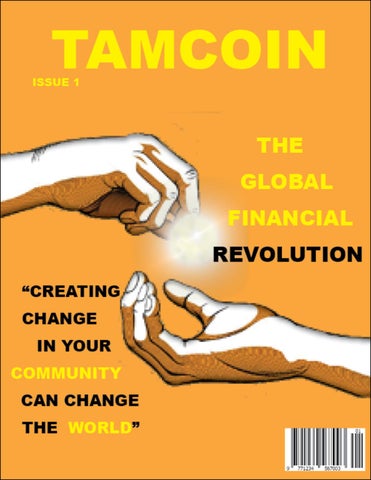
Maya B.Charles Professor Shaka McGlotten New Black Ethnographies 10 November 2018 Annotated Anthropological Resources 1.Eyal, Ittay, and Emin Gün Sirer. “Majority Is Not Enough: Bitcoin Mining Is Vulnerable.” Communications of the ACM , July 2018, pp. 95–102. https://dl.acm.org/citation.cfm?id=3212998 The purpose of my research is to investigate a cryptocurrency called “Tamcoin” and its founders. Even though I am objective on the topic of my research a lot of it’s discussion comes from it’s founders who show the creation of “Tamcoin” in a positive light. This has led me to seek sources who also shares the cons and flaws of cryptocurrency. This articles focuses on how the cryptocurrency “Bitcoin” is vulnerable due to its process of mining and I want to use these issues brought up in the article to be implemented into the discussion of Tamcoin. “Central to Bitcoin’s operation is a global, public log, called the blockchain, that records all transactions between Bitcoin clients. The security of the blockchain is established by a chain of cryptographic puzzles, solved by a loosely-organized network of participants called miners.” This reveals how miners who solve cryptopuzzles can record a set of transactions. The article also brings up self-mining which is strategy of where miners forumulate groups to collude and increase their revenue. The problem with this is that it was created with the invention to decentralize production and distribution of money and selfish mining actually results in the cryptocurrency to become centralized. Finding out different issues with cryptocurrencies will allow me to be more objective with my investigation and provide deeper investigated questions. 2. Narayanan, Arvind, et al. Bitcoin and Cryptocurrency Technologies: a Comprehensive Introduction. Princeton University Press, 2016.
https://bit.ly/2DUBa0N This book goes into a very detailed introduction of bitcoin and also cryptocurrency. The sections I find to be quite integral to my research is the discussion of what a cryptocurrency actually needs to formulate value. They state, “ To create a free-floating digital currency that is likely to acquire real value, you need to have something that’s scarce by design. In fact, scarcity is also the reason gold or diamonds have been used as a backing for money. In the digital rela, one way to achieve scarcity is to design the system so that minting money requires solving a computational problem (or “puzzle”) that takes a while to crack.” I found this to be really helpful because it made me have to dive deeper in how to make Tamcoin a more scarce type of cryptocurrency. The purpose of Tamcoin originally is so it can build black wealth but in its start it has to be something scarce as well because it won’t ever develop value if its given to everyone immediately.
3. SOMPOLINSKY, YONATAN, and AVIV ZOHAR. “Bitcoin’s Underlying Incentives.” Communications of the ACM, vol. 61, no. 3, Mar. 2018, pp. 45–53. EBSCOhost, doi:10.1145/3152481. http://ezproxy.purchase.edu:2048/login?url=http://search.ebscohost.com/login.aspx?direct=true& db=bth&AN=128238103&site=eds-live “Bitcoin’s rate of block creation is kept roughly constant by the protocol: Blocks are created at random intervals of roughly 10 minutes in expectation. The difficulty of the proof-of-work required to generate blocks increases automatically if blocks are created too quickly. This mechanism has been put in place to ensure that blocks do not flood nodes as more computational power is added to the system. The system thus provides payments to miners at a relatively constant rate, regardless of the amount of computational power invested in mining” This source is helpful because it goes in to incentives of Bitcoin that aren’t stressed often on the surface of it’s discussion. Also with Tamcoin the codes are given to specific people in a peer to peer way for them to be accessed but then they also have to altered and changed rather quickly to ensure the block rate of creation stays constant. 4. Chen, Edith, et al. “Full-Length Article: The Great Recession and Health Risks in African American Youth.” Brain Behavior and Immunity, vol. 53, Mar. 2016, pp. 234–241. EBSCOhost, doi:10.1016/j.bbi.2015.12.015 http://ezproxy.purchase.edu:2048/login?url=http://search.ebscohost.com/login.aspx?direc t=true&db=edselp&AN=S0889159115300763&site=eds-live. Overall the series of oppression that black youth are subjected to in America can be traumatizing and have an effect on their health. It is shown through studies that this trauma can be even more damaging when poverty is added to the equation. “Overall, these findings suggest that the health profiles of African American youth may in part be shaped by environmental macro-economic societal conditions, and that effects on biological markers can be detected relatively early in life.” This source is helpful because my research discusses the economic issues that affect the black community. The source also mentions “the more time adolescents spent under economic hardship, the higher their epigenetic aging”
5. Rothwell, David W. 1.david.rothwell@oregonstate.ed., and Annie2 McEwen. “Comparing Child Poverty Risk by Family Structure During the 2008 Recession.” Journal of Marriage & Family, vol. 79, no. 5, Oct. 2017, pp. 1224–1240. EBSCOhost, doi:10.1111/jomf.12421. http://ezproxy.purchase.edu:2048/login?url=http://search.ebscohost.com/login.aspx?direc t=true&db=eue&AN=125012490&site=eds-live
“Despite the magnitude of cushioning by U.S. policy, the United States still posts the highest child poverty rates and the highest gap in poverty rates between children relative to the overall population. In comparative terms, U.S. family policy could invest more in raising the economic standards of American children with families.” This contributes to my research because poverty in America with children is not publicized enough in the country. For examples there are commercials about how to save children in foreign countries but it’s also important to stress how there are kids in America who are also living in poverty. The amount of poverty in America is not public knowledge and also have been put into the image “welfare queens” or not being able to pull themselves from their boot straps” 6. John Hagan, and Holly Foster. “Mass Incarceration, Parental Imprisonment, and the Great Recession: Intergenerational Sources of Severe Deprivation in America.” RSF: The Russell Sage Foundation Journal of the Social Sciences, Vol 1, Iss 2, Pp 80-107 (2015), no. 2, 2015, p. 80. EBSCOhost, doi:10.7758/RSF.2015.1.2.05. http://ezproxy.purchase.edu:2048/login?url=http://search.ebscohost.com/login.aspx?direct=true& db=edsdoj&AN=edsdoj.9c550489ae8a48adbeffceebaa4ab8fc&site=eds-live Black Americans are incarcerated five times more than white people and this results in the economical issues the black community often has to face.“Young adult children who have had a father or mother imprisoned are at increased risk of experiencing socioeconomic deprivation, including inadequate access to food.” This source also helps to reflect the Maslow Hierarchy I discuss in my research and how black americans have a harder time reaching this due to systematic oppression.
By The Associated Press -. “African-American Unemployment Rate Falls to 17-Year Low.” AP Financial News, Associated Press DBA Press Association, 6 Oct. 2017. EBSCOhost, ezproxy.purchase.edu:2048/login?url=http://search.ebscohost.com/login.aspx?direct=true&db=n sm&AN=APe32fbea2fe394c95a20e527cf60081bc&site=eds-live. http://ezproxy.purchase.edu:2048/login?url=http://search.ebscohost.com/login.aspx?direct=true& db=nsm&AN=APe32fbea2fe394c95a20e527cf60081bc&site=eds-live This source is beneficial to me because the release of Tamcoin is 2042 and my study shows the rate of unemployment for African-Americans had fallen drastically. “The unemployment rate for African-Americans fell to a 17-year low in September, and the rates for all other major racial and ethnic groups also dropped.”