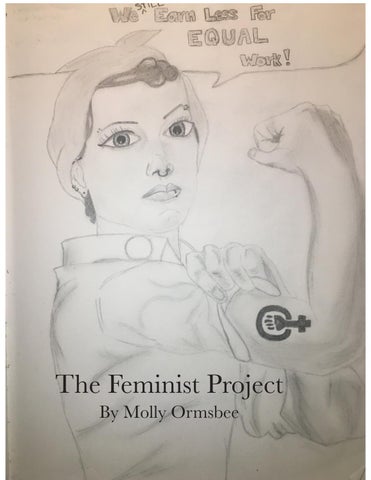
The Feminist Project By Molly Ormsbee
Introduction Today is Thursday, September 27. The year is 3018. My name is Carol and I am a feminist anthropologist, hoping to travel back in time 1,000 years to 2018. I am aware that at this time in our history, the fate of the earth was a concern due to the way humans had treated their environment. Ecology in 3018 is vastly different from what it once was 1,000 years ago. Though the world may not look extremely different, carbon emissions and global warming have taken a toll on mankind. In order to survive, humans had to adapt and mutate in order to handle the extreme temperatures and conditions of the environment. Many humans suffered from Erythema due to the harsh UV radiation. However, those who survived still experienced a permanent reddening of the skin. All survivors of these environmental conditions have this adaptation of their bodies. As a result of this environmental change, there has been a decrease in division among people based on race. People still have different backgrounds and different cultural experiences. However, racism has become a much smaller issue, since the world has evolved so much over time. This sparked major changes in society that led us to the world we are living in now, in 3018. Today, when I look around, I see little division among people. Discrimination still exists, though. There are still changes to come in our modern society. For example, women are still fighting for their equality to men, though they have made great strides. Gay and transgender people also still fight to be treated with equal respect in America. It is for these reasons that I have devoted my anthropological research to feminism specifically and it is why I want to travel back in time to examine feminists 1,000 years ago, how they operated, and how they differ from our community today in 3018. I am aware of the many changes that may have occurred in our society over the past 1,000 years, which is why I am curious about the world my ancestors experienced in 2018. In the year 3018, I am both an anthropologist and a feminist. I believe in the equal treatment of women. Our society has made great strides in women’s rights over the years, so I am also curious to see how this was different so many years ago, in 2018. I graduated college with a degree in anthropology as well as gender studies. My past work has included research and study on women’s issues in the past. It wasn’t until recently that a colleague captured my interest in race and its impact on our previous societies. My colleague studies our history with race and gender in society, often starting striking conversations about its vast influence on our history and our actions as a whole. We came up with an idea for a groundbreaking anthropological study that would bring our two passions together. I have traveled back 1,000 years to 2018. Unfortunately, my partner wasn’t able to join me on this journey, so I took it upon myself to document both race, gender, and feminism in the year 2018, in comparison to our modern arge. My mission was to document the differences in the way we perceive “race” in our differing societies as well as the differences in women’s rights, gay and transgender rights, and how these subjects may or may not relate to one another. I am aware that in 2018 race created more division in our society than we have now. I wanted to discover just how much this impacted the rest of this society’s social issues. Were race and feminism related in 2018? Were different races equally represented? Were trans women equally represented? These are all questions I answered and documented on my academic journey into the past.
Ecology in 3018 VS 2018 Ecology in 3018 is vastly different from what it once was 1,000 years ago. Though the world may not look extremely different, carbon emissions and global warming have taken a toll on mankind. In order to survive, humans had to adapt and mutate in order to handle the extreme temperatures and conditions of the environment. The exposure to UV radiation caused humans to develop Erythema, a reddening of the skin. Those who survived had a permanent effect on their skin. The redness did not go away and it became an adaptation that allowed them to survive in these harsh conditions. This exposure to global warming for so long caused human skin to become red over a long period of time. The effects of global warming caused a great deal of damage to the stratosphere and humans were no longer protected from harsh ultraviolet radiation from the sun. Eventually, human skin began to burn and blister. Some humans didn’t survive, but others had bodies that were able to adapt. This was what caused the change in skin color and the adaptations that allowed them to survive under these harsh UV rays. Other adaptations that followed were decreased hair growth, development of a nictitating membrane (third eyelid) for protection and lubrication of the eyes, and a third lung (to make breathing and survival possible within the harsh environmental conditions). These are simply adaptations that happened over time that allowed some humans to remain on earth. This world is not a dystopia, but it is different from the world we are familiar with in 2018. The world I see in 2018 is so different from what I’m used to. Everything is green and it appears to be healthy. The differences in their environment shows even more differences in their bodies. Their skin is so smooth and beautiful. There are people of all different skin tones and types. No one has (or needs) a nictitating membrane. Seeing these changes and the differences in all these people makes me wonder how it affects them as a society. I see so much division among these people. In feminism specifically, I see a lot of conflict for the minority races. Many of these women seem to feel as though their issues are not being represented and they are being overshadowed by white feminists. This division is causing problems because their issues are getting ignored by their society and a community that claims they are fighting for all women’s issues.
These are just small examples of the environemntal changes on the body in the year 3018.
Time Travel
This is the device used to travel back in time to 2018. Above, you can see all the parts included in the technology. (Time Travel Platform, Communication Devices, Date Entry Console, Travel Date Monitor, and Connection Cable) all noted above.
Spirituaity in 3018 VS 2018 In this future world, spirituality and religious practices are not extremely different from what they were in 2018. The only exception is a new spiritual way of thinking that has emerged among women in the future. In the year 3018, women have made great progress in the fight for equal rights and power in their society. In 2018, the future looked grim for women. More and more women spoke out about their assaults and were silenced, they had to live in a world where their leader was misogynistic and cruel, and often times, it seemed better to pretend there were no problems at all than to speak out and be blamed for the pain that others had inflicted on them. Over time, the #metoo movements grew and women began to come together and take actions together. American women formed a coalition, each banding together in their smaller communities. A new spirituality emerged among these women that promoted a sense of sisterhood and empowerment in their growing communities. This spirituality was expressed by women in a number of ways. For example, these women come together to practice self-love, meditation, self-reflection and how they can channel all of these elements into their lives as feminists to empower themselves and other women. They use these gatherings to develop a connection to themselves as women and consciously embody both spirituality and feminism, rather than shifting between the two. They are fierce and empowered, yet they still allow themselves to trust their own spirit and their own femininity. In the past, there was often pressure for women to be though and reject this notion of stereotypical femininity if they identified as a feminist. However, now in 3018, being a feminist is not only about equality, it is about freedom, spirituality, and celebrating who you are as a woman (regardless of how stereotypically feminine you are). After conducting my research in 2018, I found that feminists did not have this same family effect in their communities. Women did not stand together the way they do in the future. In 2018, there were black feminists, white feminists, spanish feminists, etc. Women were divided due to their ties in the LGBTQ community. Trans women were not treated with the same respect as the other women and they also had been pushed aside as if their issues didn’t matter. So many general differences among these people have divided them. This created a problem because it drowned out the voices of people who had so many important things to say. The misrepresentation of different types of women has caused the awareness of these specific issues to be lost. In 2018, the issues that matter to white women drown out the problems faced by trans women, black women, spanish women, etc. These women are frustrated because they aren’t being listened to. They don’t have the spirituality of the feminists in the future. They didn’t build themselves a home that they can all share together. They are divided based on their race, gender, and sexual orientations.
Fieldnotes It is October, 2018 in the United States and I have traveled back in time, from October 3018. People seem to be very divided in general (between race, gender, politics, and belief systems) There have been a lot of shootings, hate crimes, police brutality against black people, riots, and misrepresentation of black women’s issues in the year 2018 and a few years prior to it that these women seem to be upset about I interviewed one woman, Aamna Mohdin, who was a reporter in 2018 Mohdin says that “black women tend to identify as feminists more than white women” I also interviewed Lauren Fannin (researcher from Georgia State University) and she said that “ideal femininity was out of reach for black women for so long” and it is for this reason that her research shows that wearing feminine clothes was a positive predictor for feminism in black women, while it was a negative predictor for white women It appears that black women are more driven to promote feminist ideals, but their issues aren’t being equally represented in feminist movements I am interested in the division of feminists among races (mainly black and white) I attended a protest for women’s rights It is busy, loud, full of people, but they are mainly white I interviewed S.T. Holloway at the protest and she said, “It represented the continued neglect, dismissal and disregard of the issues affecting black women and other women of color” These women tell me that 53% of white women voted for their current president, Donald Trump, who is a strong example of the racism and sexism that continues in this country right now These women are not happy with the way things are going on right now The black women in particular are not being equally represented by their fellow feminists Trans women also are not treated equally in these communities I interviewed Chimamanda Ngozi Adichie, who believed transgender women’s experiences should not be “conflated” with other women’s experiences She says, “I don’t think it’s a good thing to talk about women’s issues being exactly the same as the issues of trans women because I don’t think that’s true” The problem trans women are facing is that feminists in these communities are demanding “women only” spaces, implying that trans women are not truly women I interviewed Katharine Jenkins who said, “We’ve suggested that the argument for excluding trans women from women’s spaces on grounds of ‘safety’ may rest on a prior assumption that trans women are not (‘real’) women. This charge may be found puzzling. Proponents of that argument might say, in reply, something like the following: “If ‘woman’ means ‘female’, then trans women are not women – whatever they and others might say about it. But if trans women want to be addressed by their preferred names and pronouns and referred to as ‘women’, we’re happy enough to oblige in most situations.” I am shocked by the information I have found so far. These women are so different from what I have experience in 3018. I have never experience this kind of division. In this past world, I am experiencing inequality, judgement, and an imbalance of power. The white women are heard more than the others, yet they don’t represent all the issues of these women. They are only representing the issues of the other white women. Only a small fraction of these women are supporting each other, no matter what their race and I want to find more information on why this movement has been so divided. I am even more shocked to find that transgender women might be facing even bigger
problems in this community. Not only are they being treated as if they are not equals, these women are refusing to address them as the gender they identify as. These feminists are trying to claim that trans women are not “real� women, which seems extremely closed minded and ignorant, even for this time period. I am also shocked to find that this argument is more supported than it is being discouraged. This argument has a lot of support and it is very difficult for me to understand why. I have never seen so much division in a group that claims to be fighting for equality. This point in my research has been extremely disappointing.
Interviews Patricia Hill Collins (University of Cincinnati): What is it like to be a black feminist? I often feel like I am an outsider within. Sometimes this can be helpful, but other times it is hard to get people to listen. Do you feel like you are accepted as a feminist with these other women or are the communities more divided? I feel like black women have been pushed to create “Black feminism”, so we now have different feminist groups for different races. Does this division make it difficult for you to inform people and make positive changes for women in our society? While Black feminist thought may be recorded by others, it is produced by Black women. Each group of women is only speaking to their own issues. What happens when one group drowns out another? What happens when people only care about the problems white women face in our society? This is where division hurts the movement. How would you say other black women feel about this division or misunderstanding of diverse issues in feminist communities? While Black feminist activists may work on behalf of Black women, they rarely project separatist solutions to Black female oppression. Rather, the vision is one that takes its stand on the solidarity of humanity. We know we need to stand together to see a change, rather than creating our own racial subgenres of feminism. Meredith Talusan (Trans feminist and journalist) How do you feel affected by the stigma of being a feminist who is also a trans woman? There are so few trans women of color like me who have overcome the systemic discrimination that pervades our lives, and recognize the need to amplify the voices of my trans siblings. I am keenly aware that it has been through directly confronting injustice that my communities have survived and persisted. In a way, being excluded from these movements has made me stronger because I have to fight even harder for my rights. Why is it so hard for trans women to be accepted in these communities? Trans women and gender-nonconforming femmes have always been marginalized at best if not outright excluded from the American feminist movement. Even among cisgender women who don’t believe that someone needs to be born with a vagina to be a woman, we continue to be seen not as potential leaders with unique knowledge, but either as victims or as tokens to include, as long as our opinions don’t stray too far from the majority. Transgender women are also accused of behaving like men. Why is it important that transgender rights are heard in these movements and what can they do to benefit feminist communities? To find its way, the feminist movement needs guidance and inspiration from trans women and femmes. Cisgender white women are deemed nasty when they behave in a way that challenges gender norms. But trans women and femmes’ very existence is rooted in rebellion against gender expectations: we defy the patriarchy’s fundamental assumption that any person “born” male would never want to give up that privilege. Tonya Adams (Resident of New York City) How would you best describe what it’s like to be a black woman in America? I would describe being a black woman in America as having another full time job. When you are a black person, whether your male or female, you will be looked at by most people as being suspicious, lazy, and an uneducated. All of which is not true for most blacks. Being a black woman is even harder. We have
our first job which is working harder at anything we do because we are a woman first and a black woman second. We are looked over for opportunities that we are qualified or overqualified for because of who we are. Then our second job is raising our family. We have to worry every time one of our family members go outside, especially the black males of the family, because of the complexion of their skin. Are you interested in the feminist movement? Do you consider yourself to be a feminist? Why or why not? I am interested in the feminist movement. I would not consider myself to be a feminist, but I do believe in rights for all people and women should have more rights than they do now. I appreciate all of the women that have fought and continue to fight for all of the rights that we have as women today. But when considering rights for people as a whole, that is something that we in America should continue to fight for. Do you feel like problems for black women and problems for white women are equally represented in the current feminist movements in America? The problem for both black and white women are equally represented in the current feminist movements in America up to a point. We all are fighting for the same things, but white women would get more rights than black women just because of the way American thinks. Black women are overlooked for a lot of opportunities because of who we are. There are some people in America who choose to not get to know what we can bring to table. Would you say that you see feminism as a unified movement or is it still divided based on race and sexual orientation? It is still divided based on race and sexual orientation. Men, no matter what race will always be considered superior over others by America’s standards. When is comes to race, it becomes more divided. A white man will get more respect than a black man. A white women will get less respect than a white man, but more than a black man. A black woman will receive the less respect than all of them combined. And others who do not view themselves as male or female receive less respect than everyone. It is still a racial and sexual orientation situation and will always be a racial and sexual orientation situation. When you see the recent events in relation to the feminist movement (women’s march, support for Dr. Blasey Ford, etc.) do you see much diversity among these activists? Yes, I do. Not as much diversity as I would like to see. I think the numbers are increasing each time as far as diversity goes. The biggest issue is that a lot of people are not open minded. People did not have a problem with a woman who married her chandelier, but will have an issue with two woman getting married. There are protest against same-sex marriages, but not against someone who wants to marry an inanimate object. That is a problem. Do you ever feel marginalized as a black woman in America? Yes I do. I feel marginalized as a woman and more so as a black woman in America. I do not think that will ever change in America, because the marginalization of women goes beyond America. How would you like to see black women’s rights being represented in the future? The question should be, “Will black women’s rights ever be represented in the future?” There was a time during 9/11 when people thought that racism was not a thing anymore, because everyone got together to help each other. There is a difference between helping each other during a disaster and helping each other in general. Women’s rights have never really been represented from the beginning of time. According to the Bible, the only reason why Eve exist is because it was to be a companion for Adam. For her to be created, a rib had to be taken from Adam and given to her. This is one of the reasons why men believe that they are the more superior class. That is still the thought process today of some people. I would like to see all changes made to benefit women in future. For women to have the same equal rights as men do. Will this ever happen, I do not think so.
Sources 1. Mohdin, Aamna. “For Black Women, Femininity And Feminism Are Not Mutually Exclusive”. Quartzy, 2018, https://qz.com/quartzy/1158081/for-black-women-femininity-and-feminism-are-not-mutually-exclusive/. Accessed 25 Oct 2018. 2. Rogo, Paula. “Why Are Some Black Women Skipping This Year’s Women’s March?” Essence, Essence Communications, 20 Jan. 2018, www.essence.com/culture/black-women-boycott-womens-march/. 3. Patricia Hill Collins; Learning from the Outsider Within: The Sociological Significance of Black Feminist Thought, Social Problems, Volume 33, Issue 6, 1 December 1986, Pages s14–s32, https://doi. org/10.2307/800672 4. Schmidt, Samantha. “Women’s Issues Are Different from Trans Women’s Issues, Feminist Author Says, Sparking Criticism.” The Washington Post, WP Company, 13 Mar. 2017, www.washingtonpost. com/news/morning-mix/wp/2017/03/13/womens-issues-are-different-from-trans-womens-issues-feminist-author-says-sparking-criticism/?noredirect=on&utm_term=.1aa98c7582f1. 5. Finlayson, Lorna, et al. “‘I’m Not Transphobic, but...”: A Feminist Case against the Feminist Case against Trans Inclusivity.” Versobooks.com, Verso Books, www.versobooks.com/blogs/4090-i-m-nottransphobic-but-a-feminist-case-against-the-feminist-case-against-trans-inclusivity. 6. Talusan, Meredith. “Why the Feminist Movement Needs Trans Women and Femmes.” Them., Them., 21 Jan. 2018, www.them.us/story/weve-always-been-nasty. 7. Harrison, F. V. (1990), Feminism in Anthropological Perspective.. Transforming Anthropology, 1: 2527. doi:10.1525/tran.1990.1.2.25 8. SAMANTRAI, R. (2004), Black Feminist Anthropology: Theory, Politics, Praxis and Poetics. American Anthropologist, 106: 201-202. doi:10.1525/aa.2004.106.1.20 9. Rodriguez, C. (2007), Black Feminist Anthropology for the 21st Century. Anthropology News, 48: 7-8 . doi:10.1525/an.2007.48.7. 10. Schuller, M. (2015), Introduction to Special Issue: Seeing Obama’s Election through the Black Americas: Ethnographic Perspectives as a Mirror. Transform Anthropol, 23: 63-68. doi:10.1111/ traa.12044 11. Bolles, L. (2013), Telling the Story Straight: Black Feminist Intellectual Thought in Anthropology. Transform Anthropol, 21: 57-71. doi:10.1111/traa.12000