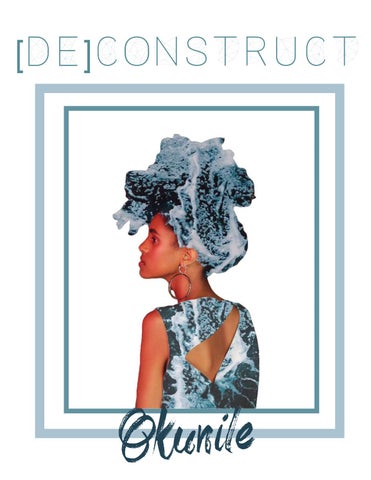
[De]construct
Okunile
` Mise en Scene This month’s issue of [De]Constructed is dedicated entirely to the artists and creators living and working in the Okunile Arts district. As [De]Constructed’s resident anthropologist and designer, I spent two weeks crashing on couches, sitting in on studio sessions, and hanging out with contributors to the city’s burgeoning art scene. It was truly an honor to watch these designers, musicians, painters, and organizers at work. Througout my time in Okunile, many things became aparent. One; that art can always be political, expressive, and narrative. Every artist I’ve encountered here in the city created pieces that either reflected themes of identity, politics, trauma (historical or otherwise,) and power relations. And two;These consistent themes speak directly to the black experience as whole in a post colonial society. Many of the inividuals I talked to spoke at length about uncovering histories, reconnecting with cultural practices, and reclaiming and asserting aspects of blackness that were fetishized and co-opted by white people. In a sense, this issue details the “deconstructing” currently being done by artists and thinkers surrounding the structures that served to marginalize and oppress people of color. This process has been centuries in the making–– from the dismantling of the institution of American slavery, to the civil rights movement, to Black Lives Matter, to the more recent push to collect, document, and construct the untold and little known stories of black creators.
These ideas of reconstruction and reclaiming are at the very core of the Okunile city-state. Founded 90 years ago, after major flooding began to overwhelm the the South-eastern United States, Okunile was one of the first floating cities to be dedicated. The first inhabitants of the city were mostly people of color hailing from Louisiana, Florida, Georgia, the Haiti, Jamaica, and many other islands of the coast. Okunile quickly became a cultural hub, attracting many young students, intellectuals, scientists, and artists. The state established sanctions to protect and preserve culturally and historically significant items early on, creating an accessible archive for all of it’s citizens. Obviously, no city is with out its flaws, though Okunile’s democrat ic-socialist economy favors creators and laborers over lrge businesses. The role of race in Okunile is much less murky and inhibiting than it is back on the main land. Though racial and ethnic identity are a source of pride, the majority of inhabitants are from such mixed backgrounds that they have no true “race.” Seeing as race is a social construct, the emphasis on heritage, over “black” or “white,” is more prominent. Knowing your heritage gives one a sense of kinship and identity, but it doesn’t make anyone person more superior than the other. Okunile is truly a melting pot in this way, as race is ambigous and blended.
Art collective My first day in Okunile was spent in the company of 3D rendering Artist, Zakia Banks, and her partner Dorian. I spent the afternoon in their studio getting to know them and chatting about their upcoming Interactive Arts thesis.
Zakia was waiting for me at her studio. I had promised I’d be there at 2pm, but I missed the 12:30 air ship from Manhattan, so I didn’t arrive until after 3. By the time I got there, Zakia and her partner Dorian had already set up the interface and were ready to do a test of the avatars. It’s It organized chaos in the studio. The holo-glass walls were completely cluttered with archival social media posts, digital renderings, and videos of a young woman I didn’t recognize. The pair were completely engrossed in their work; Dorian pulled pixels toto gether with their fingers across the glass, starting to flesh out a human form while Zakia rapidly cross referenced photos of the unknown woman. They’ve been working on a responsive art piece for a few months now, trying to make a sentient digital recreation of deceased persons, Dorian tells me. When I greeted her, Zakia was in the midst of rendering images of her great, great, great, great, great grandmother into motion capture holograms. They were interactive––based on 100 year-old facebook posts, vlogs, photographs, and anecdotal accounts that were then coded into the image’s personality; essentially replicated memory. Zakia and Dorian informed me that this is for their Interactive Arts thesis, they are both graduating in May.
Dorian swiped away the windows they were working in, and strolled into the kitchen area. I sat at the counter, a clean slab of pale mint recycled glass, sketching Zakia. Dorian leans on their elbows next to me, they take note of my sketch, complimenting my rendering technique. They ask me if I want a cup of rooibos tea, and I accepted the offer. Dorian’s skirt twirls a bit when they turn to get the mugs. The skirt hits them about mid calf. It’s a beautiful maroon, gold, orange, yellow, and white satin taffeta Ankara print that pops against Dorian’s skin. It contrasts with their cropped blue sweater with holographic projectors woven into the knit. I ask Dorian about the inspiration for their outfit, curious as to what informed their choices. They tell me they were satisfying their love of West African patterns and desire to look feminine. Dorian confessed the skirt used to belong to their cousin Binta who is currently studying in Nigeria. Zakia, overhears our exchange and enters the kitchen. Dorian smiles, a slight chuckle in their voice as they refer her to my sketch. Her hair is tucked beneath an orange and blue head wrap decorated with a single blue jewel. Her face is framed by ear-cuff coms and a beaded choker that holds up chains of healing energy crystals. She has a very eco-conscious wardrobe, comprised of recycled fabrics and ethically sourced materials. She wears a recycled plastic
Zakia
Banks
_______________________________
Zakia’s hair wrap, heavily inspired by Erykah Badu, is woven from recycled cotton. She wears a several crystals such as agate and aquamarine to channel healing vibrations. Her dress is made inspired by Pablo Rabanne’s 1960s linked disk dresses. Zakia’s dress is temperature sensitive and changes color with her mood. Her shirt is fashioned from recycled plastic organza that blocks out UV radiation. sea foam green organza shirt and a color changing disc link dress. She pats my back in approval, noting that I captured her style well. She squeezed Dorian’s hand and kissed them on the cheek before asking us what we want for dinner. I shrug and tell her it’s up to them, I’m not picky. pick They both decided on shrimp etouffe.
Zakia’s ear cuffs also function as a headset communication device. The beadwork on her dress and shoes is inspired by Kenyan beadwork.
Getting Schooled Two days ago I boarded an air ship to Okunile to spend two weeks with OUA art collective. I initially met up with two young Interactive arts students, Zakia and Dorian, to watch them collaborate on their thesis. The objective is to understand how Okunile’s black students’ and artist’s fashion choices reflect the recent curation and publication of black narratives and how this ties into the presentation of self identity. I met up with Dorian Rae, an IA student with a concentration in costume performance, in Tazewell Square to talk about their personal take on black representation.
Dorian: For me I think it’s learning where we came from. Thinking about people like Quinta… Did Zakia tell you she was a gender studies professor? It’s super awesome to know that 100 years ago, Quinta was advocating for people like me to use Dorian: Not a problem! I honestly don’t the bathroom of our choice. It’s wild, looking through her social media and learning mind, it’s a welcome break from my thesis. Working on those digital render- what kind of person she was. Discovering ings of Zakia’s, I don’t know how many the intricacies of the lives of people who allowed for your existence really puts your greats, grandmother has been wild. own experience into perspective. It makes you wonder what those people went Nick: I want to know, Dorian, what inthrough. spired you two to take on such a momentous project? Why digitally resurNick: Am I correct in saying that it’s really rect someone you never knew? important to you to acknowledge the strugDorian: To be honest, I’ve always had gles and triumphs of those who came a fascination with history. I don’t know before you? Nick: I really appreciate you taking time out of your weekend to indulge my curiosity. I loved being in your studio, the holograms of Quinta? are coming out really amazing.
why, but something about the intangibility of the past makes me want to reach for it more. I think Zakia and I both had this idea that by digging through history we would discover something about ourselves. Does that sound silly?
Dorian: Yes, absolutely. For me there is a longing to preserve and honor the history and achievements of the people who led us here. Whether it be black artists and entertainers like Michael Jean Basquiat, Erykah Badu, Josephine Baker, and Spike Lee or activists and thinkers like Malcolm X, James Baldwin, Angela Davis, and Maya Nick: It doesn’t sound silly at all. I totally understand, it’s one of the reasons Angelou, to the countless unknown slaves. I’m studying anthropology. In a similar They all helped contribute to a world where black people have the freedoms we enjoy vein, what do you think the impact of in 2117 and I want to express that. this project is to you?
DoriaN Rae
––––––––––––––––––––––––––––––––––––––––
Dorian’s sweater is knit with holographic data storage units, much like a blu ray disk (the predecessor to this technology.) They use an optical interface that encodes, stores and reacts to bio and environmental information such as heart rate, body temperature, and weather patterns. The holograms change the the functions of the sweater to respond to these conditions. Dorian’s skirt pays homage to and is inspired by their West African heritage. It is fashioned from recycled fabrics and features a stunning ankara print. Their boots are made of a high polymer recycled plastic that adjust to ground density, densit weight shifts, and are water proof.
I want to proudly represent my identity. I wear that identity on my sleeve. Nick: Do you think that the Black Excellence exhibit at the costume institute has brought to light the vast achievements and talents of black artists and designers? It’s a really monumental acknowledgement, seeing as no other institution has housed an ex clusively black collection. Dorian: Absolutely. You know, 100 years ago white people didn’t know, or didn’t care to know how much black people contributed to art, science, and culture. I’m inspired by it all, every single day. I’m here because of all those contributions from people every century up until now didn’t want to acac knowledge. I mean learning about how culture was dictated well into the 2030s… it’s almost as if white people didn’t even acknowledge that black people did anything significant…. it’s crazy! No one wanted to acknowledge that Elvis stole his whole act from people like Chuck Berry or that the Egyptians were black… they lived in Africa for fuck’s sake. It’s really mad to us now because after Michelle Obama 90 years ago, history has slowly been revised to tell narratives other than the white ones. So now those people who were forgotten about are studied and memorialized in our history. It’s one of the missions of Okunile, to preserve the history and culture of black people.
I know my mom’s family came from Trinidad, but my dad is a whole other story. Most black people who lived in the U.S. can only assume their roots are West African. Did you know Okunile comes from the West African Yoruba words Okun, for ocean, and Ile, for home. Nick: I honestly had no idea that’s where the name came from. Dorian: We created this floating country, a home on the ocean, to celebrate and construct our histories. Living here has afforded me the opportunity to be exposed to centuries of culture that I otherwise wouldn’t have access to. I can now definitively say that I carry the legacies of people like Marsha P. Johnson and Alvin Ailey. I carry West Africa with me, I carry Trinidad with me. I express these histories through being authentically myself and creating the image I feel best portrays who I am. I am proud to be a non binary person of color. I am proud to wear African textiles and styles. I am proud to pay homage to my idols; Basquiat, Grace Jones, Langston Hughes, and Billie Holiday. I’m proud to be black.
Nick: I totally agree with you, it’s sad that entire histories were erased. Dorian, can you tell me what histories, narratives, and people inspires you? Dorian I want to say my heritage inDorian: spires me, but it’s muddied, you know? The slave trade, the diaspora, it all denies you a greater history.
Flexible, 1984, Jean-Michel Basquiat
Dorian’s connection to the past, their strong desire to relate to and project the ideas of individuals they never knew speaks to the collective need for young black artists in Okunile to construct greater narratives. It is through the exploration of histories and cultural practices that they find not only inspiration, but a basis for shaping how they want to be seen. Dorian sees themselves represented and reflected in the current media; whether it be artistic or intellectual property, they are connecting to the idea of being worthy of notice. By seeing someone that mirrors some aspect of their own person, Dorian feels they are now granted the ability to be unapologetic about previously popo liced traits. By seeing an androgynous black icon like Grace Jones be appreciated instead of fetishized or sensationalized, Dorian has given themselves permission to move through the social spheres of Okunile performing their respective identity in safety. Because of the telling of black narratives, both visually and vocally, Dorian’s presentation of self; a queer non binary person of color, presents little threat to the structures in place.
Born again to the Rhythm During my stay in Okunile, Zakia and Dorian put me onto a street artist and musician called Gidi. Zakia played me a few of his tracks and I was instantly hooked. His music had a rhythm that was almost archaic; chanting and humming laid over electronic beats and woodwind instrumentals. There were so many layers to his music, so much history in it. I scrolled through his virtual gallery; moving murals that pulsed and danced with his music. I had noticed during my interview with Halima that she also had a projection of a piece by Gidi. She had told me that Gidi was one of the last people to see New Orleans before it totally flooded. This was depicted often in his art; themes of spirituality, death, and rebirth, motifs of water. His motion mural titled Sister Yemaya, graces the cover of this Zine. I felt that his art encapsulated many of the ideas touched upon by Zakia, Dorian, Halima, and other Collective members. His portraits and pieces told narratives of connecting to a deeper spirituality, a sunken history. Though his work mostly depicts female identified individuals, the represent a sort of avatar–– a face to claim a mutual story. Through his use of story telling and the reclaiming of the black body, Gidi has been able to counter western standards of beauty–– not just physical features, but beauty in terms of aesthetics. His use of the “lesser” senses in his art; sight, sound, smell, taste, touch, have enabled him to make his art accessible to the masses and tangible. Gidi’s art isn’t bound to a museum, it is meant for the public, this is his identity. The publicizing of black histories and art has allowed for some one like Gidi to project himself as
a presence and an idea, rather than just some weird art guy. He has taken the idea of a white artist, like Andy Warhol or Banksy and staked a claim that artists of color are allowed to be experimental, bizarre, jarring, and avant garde. I unfortunately did not get the opportunity to interview Gidi, as he was very difficult to track down, but I do have plans to return to Okunile and hopefully I will be able to sit down with him then.
GIDI
_____________________________________
Gidi is wearing a beaded tank-top modeled after corsets from the dinka tribe. The beads are made of recycled glass and absorb solar rays. His pants are made of an advanced moisture wicking cotton and inspired by the shenti, or kilt-like garment, worn by men in ancient egypt. Gidi’s tattoos take inspiration from Keith Haring’s body paintings as well as Yoruba body art.
An afternoon With Halima I sat down with the curator of the Black Excellence exhibit currently on display at the Okunile Costume Institute, Halima Ikeda. She’s only in her mid twenties and already she’s built up a pretty impressive résumé. She has organized, produced, and designed shows and gallery spaces for up and coming artists such as Zakia Banks and the prolific musician and artist, Gidi. Through our dialogue I hoped to uncover Halima’s take on the reclaiming of black history and the recent rise in support of Afrocentric arts. Halima sat at her desk, a chaotic lack of organization abounded. She sifted through the files open on her tablet, her graceful fingers scrolling quickly across the screen. She peered over the rims of her bright sea foam acrylic glasses, the images from the tablet appearing and disapdisap pearing in sync on the pink lenses. She smiled, pulling up a photo gallery and opening it to reveal a shot of a little girl, draped in garments that were much to big for her. I asked who the girl in the picture was, though I was sure I already knew the answer.
We created this floating country, a home on the ocean, to Celebrate and construct our histories. I carry the legacies of peoeple who came before Me. I express These Histories, being authentically Myself. I am Proud to be black. -Dorian
“That’s me when I was six, can’t you tell?” She laughed. Halima had a graceful, poised demeanor. She sat upright and professional, though she wasn’t afraid of looking silly at times throughout our afternoon together. Her office was cozy; slated hexagonal wood panels made up the majority of the door side wall, dispersing into the familiar clear hologlas–– it almost looked like a honey comb. The walls were decorated with various prints, photographs, and art pieces. Above her desk there were several masks. She noticed me admiring them. Pointing
from left to right she detailed the origins of each one. “The one on the end is a Noh mask. It used to be used in Japanese theater when all the female roles were played by men. The middle one is a Haitian carnival mask, and the other end is an Ashanti mask from Ghana.” The carnival mask was the likeness of a blue jaguar, it had an almost unearthly quality to it. I surveyed the rest of the artifacts in the tiny office; antique photographs of 90s Harlem, a kimono fashioned from West African fabrics, and a projection of one of Gidi’s murals on the ceiling–– a beautiful woman whose hair flowed out into an ocean, the movement of the waves clearly visible. After my brief survey of her office I began the interview.
Nick: Halima, what got you interested in curation? Halima: It’s a visual industry. I’m a very visual person, as you can tell, so it just kind of felt right? I don’t know exactly, but there is something incredibly mystifying about the power objects hold over us, the power to make us feel. I suppose I felt like it was important for me to be able to share that sentiment with other people. Nick: So tell me a bit about Black Excellence, how did it come about? Halima: I was sitting up late one night with my mum and my girlfriend, just talking. Kara was new to the city at the time. She had been living in Georgia, but she took a job teaching sculpture at the University. That’s how we met, she came to one of my shows. Anyway, we were talking with my Anywa mum, helping K learn the city, the history and such. Okunile has only been around for about 75 years, ever since the sea level rose and swallowed up the Caribbean, Florida, New Orleans, New York city–– I could go on about all the places that don’t exist anymore. It was through detailing the history that I realized that huge pieces of black achievement have been lost to not only time, but to colonialism and racism. This late night epiphany seemed like a pipe dream at the time, but then 2 years ago I became the cucu rator for the Costume Institute and have been working tirelessly ever since to make the magic happen. I wanted the other people of this city to be able to interact with our collective history. I wanted to show the brilliance of well known designers like Stephen Burrows and Patrick Kelly and the talent of those we didn’t know the names of.
Nick: Tell me in your words why representation matters, why is this exhibit significant? Halima: Representation is so important; it shapes the way we see ourselves. When you are exposed to images and portrayals that paint a positive picture of someone like you–– whether it be the same gender, race, class, sexuality–– it shapes the way you see yourself. Seeing black artists and designers reprep resented in a public sphere gives us a sense of power. We don’t have to sit and wonder “Do I matter?” anymore. Showing the people of Okunile the products of black creativity allows them to claim ownership of something, that for years wasn’t afforded to them, their voices, their bodies, their minds.
Featured above from left to right are works by: Patrick Kelly, Willi Smith, Dapper Dan, Stephen Burrows, and Duro Olowu. Now featured at the Okunile Costume Institute’s Black Excellence exhibit. (Running until April 2118.)
Nick: What does reclaiming mean to you? What are you reclaiming? Halima: Personally, reclaiming is about taking ownership. Not just owning, but taking our history and our ways of being back. In Black Excellence, it’s about taking what white capitalism saw as a way to sell the black body, a way to fetishize and commercialize black culture, and using it to assert out heritage. For me this means connecting with and
exploring my mum’s British-Jamaican roots as well as my Japanese ancestry on my dad’s side. I guess you could call it a process of discovery; discovering my identity and and all the history that comes with it. –––––––––––––––––––––––– Through the interview with Ms. Ikeda, it became apparent that black people are still rooting out the remnants of capitalism, colonialism, racism, and policing. The ideas of defining oneself by their heritage is just as strong, if not stronger, than it was 100 years ago.
It is because of the deeply embedded racism and capitalism that black artists and intellectuals are only now beginning to make headway in reclaiming and taking ownership of something that was never really anyone’s to own; their voices. The act of fighting capitalist structures and implementing more communal based socialist centers has allowed black creators to re-focus their energies from combatting the policing of their bodies to celebrating and embodying being black.
Halima Ikeda
________________________________
Her glasses are the latest optical display technology, allowing her to browse through files, take photographs, and video chat all at once. Inspired by Keith Haring’s body paint done on Grace Jones, Halima’s top is made of recycled plastic. The textile is infused with bio-medical nanotechnology that keeps monitors her vitals and body temperature and adjusts accordingly Her trousers are inspired by fashion designer Stephen Burrows, 1970s color blocked garments as well as Angelina print fabrics. Lastly, her necklace and bracelets are inspired by traditional Kenyan jewelry.
Arts District
• Photo: Karen Walker eyewear ©