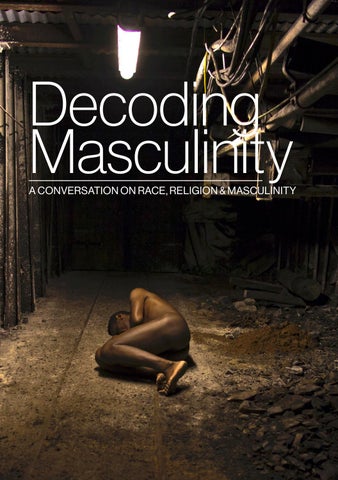
Decoding Masculinity
A CONVERSATION ON RACE, RELIGION & MASCULINITY
WELCOME. How do you define Masculinity? ‘Decoding Masculinity’ - A conversation on Race, Religion & Masculinity; is a panel discussion of practicing artists, activists, writers, poets and film-makers exploring how these intersections have been challenged through time and place. Which social constructs add value or demean masculinity in the creative sectors? How do we envision these constructs in the future? Today’s Itinerary. 1000 - Welcome & Event begins 1010 - Panel Presentations 1100 - Panel discussion starts 1130 - Open floor discussion starts 1215 - Post Networking Lunch Our Safe Space Policy. Shades of Noir is committed to providing an inclusive and supportive space for all attendees at our events. SoN believes all guests should be free from intimidation or harassment, resulting from prejudice or discrimination on the grounds of age, disability, marital or maternity/paternity status, race, religious beliefs, sexual orientation, gender identity, trans status, socio-economic status, or ideology or culture, or any other form of distinction. Disability Access Needs? Please do let us know if you have any disability access needs e.g do you use british sign language, have difficulty using stairs, or need us to allow space for a guide dog? Let us know asap so we can do our best to accommodate you!
2 // DECODING MASCULINITY.
KEY QUESTIONS. How have the intersections of masculinity been challenged through time and place? Which social constructs add value or demean masculinity in the creative sectors? How do we envision these constructs in the future? How does your work add to the narrative of Masculinity?
DECODING MASCULINITY. // 3
EQUALITY, DIVERSITY AND THE CREATIVE CASE. These extracts are from a larger report published by Arts Council, England in December 2015. Please find more data and context on their website.
Diversity of the workforce National Portfolio Organisations (NPO) and Major Partner Museums (MPM)
4 // DECODING MASCULINITY.
How diverse is our workforce? Diversity of Arts Council England staff in 2014/5 by job level
Grants for the Arts Success and eligibility rates for diverse applicants
DECODING MASCULINITY. // 5
KEY DATA: MENTAL HEALTH. Statistics on mental health and men. Compiled by the Men’s Health Forum, June 2016. Please find more data and context on their website. SUMMARY • • • • •
Just over three out of four suicides (76%) are by men and suicide is the biggest cause of death for men under 35 (Reference: ONS) 12.5% of men in the UK are suffering from one of the common mental health disorders Men are nearly three times more likely than women to become alcohol dependent (8.7% of men are alcohol dependent compared to 3.3% of women - Health and Social Care Information Centre) Men are more likely to use (and die from) illegal drugs Men are less likely to access psychological therapies than women. Only 36% of referrals to IAPT (Increasing Access to Psychological Therapies) are men.
SUICIDE • • • • •
Although suicide is not one of the main causes of death in men overall, it is the single most common cause of death in men under 45 (References: Department of Health). In 2014 there were 6,122 suicides in the UK. Of the total number of suicides, 76% were males and 24% were females. (Reference: ONS) The age-standardised suicide rates in 2014 were 16.8 deaths per 100,000 population for males (down from 17.8) and 5.2 deaths per 100,000 population for females (up from 4.8). Suicides rates have been consistently lower in females than in males over the past three decades (Reference: ONS). The suicide rate was highest in middle-aged men (45 to 59-year old age groups). The suicide rate for this group was 23.9 deaths per 100,000 population – only slightly lower than the record high seen in 2013 (Reference: ONS).
6 // DECODING MASCULINITY.
DECODING MASCULINITY. // 7
OUR PANELISTS.
Joe Sellman - Leava. Joe Sellman-Leava is an internationally acclaimed writer, performer, visual artist and is co-artistic director of Worklight Theatre - a UK based company who make personal work which reflects the ever-changing world around us. He is currently touring his award-winning solo, autobiographical, show - Labels which takes a look at Identity and Britishness in the 21st Century through the story of his family’s history. As well as this, he is writing a follow-up solo piece, Love Thy Monster, a reflection on male aggression and Fix, an ensemble piece responding to addiction in modern Britain. @JoeSellmanLeava
Caleb Femi. Caleb is an English teacher, filmmaker, and photographer. As a filmmaker and photographer, Caleb’s work has recently centred around the deconstruction of Black British masculine culture. He has an ongoing series called ‘softer images of black men’ and has given talks and readings around the country on the ‘Roadman culture’. Caleb has released two documentaries ‘What Did Love Taste Like In The 70s?’ and ‘Heartbreak & Grime’ to good international reception. Caleb is also the Young People’s Laureate for London. @CalebFemi5
8 // DECODING MASCULINITY.
Ebun A. Sodipo. I identify as a queer, non-binary person. I am of dual nationality, having lived in London for the last 11 years of my life, the previous 11 spent in Lagos and Abuja, Nigeria which allows me, I think, a unique perspective on socially/culturally sanctioned behaviours. I went to secondary school in Slough, which is significantly demographically different from the institutions I went onto. I studied for a Foundation Diploma in Art at Kingston University and am now a recent graduate from Camberwell College of Arts, where I studied Fine Art Sculpture for three years. In my artistic practice, I explore identities, in particular, marginalised identities, their constructions and the situations necessary for this constructing. Recently, however, my work is dealing with how Black identities are produced and disseminated in digital spaces. At the moment I am involved in weekly conversations with Black Camberwell students and graduates, a reading group and we are working on a show together. ebunasodipo.tumblr.com stuffandthyngs.tumblr.com
Sabah Choudrey. Sabah is a queer Muslim social justice fighter and currently works with METRO Charity and Gendered Intelligence in London as a Trans Youth Support Worker whilst training to be a psychotherapist. Sabah likes to talk about hair, feelings, and identity, and gave a TEDx talk in Brixton 2015, sharing their experiences of being a hairy brown girl, an angry brown man and a queer brown person. One of the co-founders of Trans Pride Brighton, the only one of it’s kind in the UK, celebrating the trans and non-binary community. Sabah has been published on The Huffington Post and Black Girl Dangerous and writes regularly on sabahchoudrey.com @SabahChoudrey
DECODING MASCULINITY. // 9
Othello De’Souza-Hartley . Chair. Othello De’Souza-Hartley is a London based visual artist working in photography and film. De’Souza-Hartley was awarded an MA in Fine Art from Camberwell College of Art and previously studied photography at Central St Martins. De’Souza-Hartley’s work is inspired by the local, narratives of the body in relation to the history of place and coded space, and the complexities of identity formation. His work challenges notions of social and cultural normativity. He presents his subjects as components of an enigma, or indeed as enigmas themselves, suspended in a moment of timelessness, where the confines of age, race and gender have the potential to dissipate and be redefined. His work has anthropological sensibility, by revealing the psychological and social conditions of his subjects, he seeks to strip away the veneer between a person and their world. De’SouzaHartley’s works illuminate the forgotten narratives of the ordinary stranger; from the working class man to the community protagonist. Influenced by moody, classical painting aesthetics; the subtleties of tonal colours and composition, ‘De’Souza-Hartley’s imagery is often an intoxicating paradox within a silent world; dark, but resolutely beautiful’. De’Souza-Hartley is the recipient of numerous commissions including the National Portrait Gallery, The Photographers’ Gallery, Victoria Albert Museum, Camden Arts Centre and Platform for Art. He has had solo exhibitions at The Museum of Liverpool, The Camden Arts Centre, and The Underground Gallery, De’Souza-Hartley is also a visiting lecturer at Ravensbourne and the University of Arts London www.othellodesouzahartley.com 10 // DECODING MASCULINITY.
KEY TERMS. AFAB
Assigned female at birth
AMAB
Assigned male at birth
Ally
A person of one social identity group who stands up in support of members of another group; typically a member of a dominant group standing beside member(s) of a group being discriminated against or treated unjustly
Cisgender
Denoting or relating to a person whose self-identity conforms with the gender that corresponds to their biological sex; not transgender.
Colonial Masculinity
On one hand it’s the scripts given to White, European, Colonising men. A masculinity defined against the behaviours of colonial subjects who could be considered men. At the same time, it’s the scripts beaten, disciplined into colonial subjects of what a colonised male subject should be, do, aspire to.
Critical Race Theory A theoretical framework in the social sciences focused upon the application of critical theory, a critical examination of society and culture, to the intersection of race, law, and power. CRT proposes that white supremacy and racial power are maintained over time, and that the law may play a role in this process and investigated the possibility of transforming the relationship between law and racial power. Cultural Appropriation This almost always involves members of the dominant culture (or those who identify with it) “borrowing” from the cultures of minority groups. Diaspora
scattered populations whose origins lie within a smaller geographic locale. Diaspora can also refer to the movement of the population from its original homeland.
Black
A member of a dark-skinned people, especially one of African, Australian and Caribbean Aboriginal ancestry. A term used in certain countries, often in socially based systems of racial classification or of ethnicity.
DECODING MASCULINITY. // 11
Black Masculinity
‘‘Black masculinity is defined in three overarching categories: perception, expectation, and representation. It is impossible to define Black masculinity without addressing the stereotypes that are attributed to the portrayals of Black men in our society’’. - Audre Lorde.
Black Feminism
The belief that sexism, class oppression, gender identity and racism are impossible to separate. These concepts relate to each other through intersectionality
Brown
Brown or brown people is a racial and ethnic classification. Like black people and white people, it is a metaphor for race based on human skin color. ... In Brazil, brown people is a cognate term for pardo
Desi
A term referring to something or someone who is from the Indian subcontinent. The Indian subcontinent is comprised of the following major countries: India, Pakistan, Bangladesh, Sri Lanka, Nepal, Bhutan, and the Maldives.
LGBTQIA
Lesbian, Gay, Bisexual, Transgender, Queer, Questioning, Intersex and Asexual
Equality
A state in which all individuals or social groups are treated fairly, equally and no less favourably; be it by virtue of their race, gender, disability, religion or belief, sexual orientation or age. Equality stands for inclusion and is against discrimination.
Fascism
A form of radical authoritarian nationalism that came to prominence in early 20th-century Europe, influenced by national syndicalism. Fascism originated in Italy during World War I and spread to other European countries.
Female
The biological term for the sex of an organism, referring to animals and humans or plants. The sex of most mammals, including humans, is genetically determined by XX for females.
Female Masculinity
A new understanding of masculine behaviors and identities which go against the societal norm of embodying masculinity.
Feminism
Fight for equality of all genders.
12 // DECODING MASCULINITY.
Femininity
A set of behaviours, presentations and roles which are culturally associated with being a woman and/or possessing female sex characteristics. People of any gender identity or sexual orientation can be feminine, but those who are assigned female at birth often experience societal pressure to be so.
Gender
Gender refers to a person's experience of their identity relative to the categories of masculinity and femininity and any other genders recognised by their society. Every person's gender is a complex and unique experience, and it can be difficult to express this gender to others.
Gender Fluid
A gender identity which refers to a gender which varies over time. A gender fluid person may at any time identify as male, female, neutrois, or any other non-binary identity, or some combination of identities.
Gender Queer
Gender queer is an umbrella term with a similar meaning to nonbinary. It can be used to describe any gender identities other than man and woman, thus outside of the gender binary.
Hypermasculinity
Term for the exaggeration of male stereotypical behavior, such as an emphasis on physical strength, aggression, and sexuality. Â
Heteronormative
The belief that people can only fall into distinct and complementary genders (man and woman) with fixed traditional gender roles. It assumes that heterosexuality is the only sexual orientation or the only norm.
Hegemonic masculinity
Is defined as the current configuration of practice that legitimizes men's dominant position in society and which justifies the subordination of women, and other marginalized ways of being a man. AKA Toxic Mascilinity
Homohysteria
is the fear of being thought queer because of behavior that is typically considered gender atypical.
DECODING MASCULINITY. // 13
Intersectional
Is a concept often used in critical theories to describe the ways in which oppressive institutions (racism, sexism, homophobia, transphobia, ableism, xenophobia, classism, etc.) are interconnected and cannot be examined separately from one another. The concept first came from legal scholar KimberlĂŠ Crenshaw in 1989 and is largely used in critical theories, especially Feminist theory, when discussing systematic oppression. When possible, credit KimberlĂŠ Crenshaw for coining the term "intersectionality" and bringing the concept to wider attention
Intersectional Feminism
A perspective within feminism that doesn't exclude people from the movement based on their Gender, Race and Class.
Intersex
An intersex person has sex characteristics e.g.sexual anatomy, reproductive organs, and/or chromosome patterns that do not fit the typical definition of male or female. This may be apparent at birth or become so later in life.
Inclusive Masculinity Men becoming more inclusive within their gender. Islamophobia
The prejudice, hatred, or bigotry directed towards Islam or Muslims.
Racism
The belief that all members of each race possess characteristics, abilities, or qualities specific to that race, especially so as to distinguish it as inferior or superior to another race/s.
Male
The biological term for a sex of an organism, referring to animals and humans or plants. The sex of most mammals, including humans, is genetically determined by XY for males.
Man
is a gender identity which is part of the gender binary. Man is a term used for adults, and corresponds to the terms boy (for children), male (adjective) and masculinity.
Masculinity
is a set of behaviours, presentations and roles which are culturally associated with being a man and/or possessing male sex characteristics. People of any gender identity or sexual orientation can be masculine, but those who are assigned male at birth often experience societal pressure to be so. Transgender people who are masculine may be described as transmasculine.
14 // DECODING MASCULINITY.
Manhood
The notion of manhood is exclusively concerned with the concept of being the ‘breadwinner’, which agitates hierarchical structures, provoking one to be ‘tough’ and stimulates phrases such as “act like a man”, which is, by far, more complex than just an ‘act’.
Marginalise
To relegate to the fringes, out of the mainstream; make seem unimportant:to place in a position of marginal importance, influence, or power.
Masculinity
A set of behaviours, presentations, and roles which are culturally associated with being a man and/or possessing male sex characteristics. People of any gender identity or sexual orientation can be masculine, but those who are assigned male at birth often experience societal pressure to be so.
Masculinity Bias
Bias toward the observation of/interviews with males in a culture.
Matriarchy
A form of social organization in which the mother or oldest female is the head of the family, and descent and relationship are reckoned through the female line; government or rule by a woman or women
Misogyny
Hatred of, contempt for, or prejudice against women or girls. Misogyny can be manifested in numerous ways, including social exclusion, sex discrimination, hostility, androcentrism, patriarchy, male privilege, belittling of women, violence against women, and sexual objectification.
Misogynoir
A term referring to misogyny directed towards Black women, where race and gender both play roles in bias.
Mixedraceness
A person that descends of two or more different races; also known as mixed, biracial or multiracial.
Muslim
A follower of the religion of Islam.
Non -Binary
A form of gender identity which reject the gender binary.
Oppression
When a person or a group of people are subjected to unfair treatment by those in positions of power.
Patriarchy
A social system in which Males hold primary power, predominate in roles of political leadership, moral authority, social privilege and control of property at the specific exclusion of men, at least to a large degree.
DECODING MASCULINITY. // 15
Pedagogies Of Social the art of teaching through the lenses of Social Justice. This Justice includes utilising an intersectional approach to race, gender, faith, disability, class... POC
People of Colour
Political Blackness
Political blackness is the idea that all non-white people can define themselves under one term: black.
Privilege
A special right, advantage, or immunity granted or available only to a particular person or group.
Prejudice
Hatred towards someone based on their identity. Example: An oppressed person of colour can be prejudice against privileged races but cannot be racist.
Pro Black
Definition of PRO: For; in respect of; on account of; in behalf of. Thus, to be pro-Black doesn't mean to be anti-white.
QTIPOC
Queer Trans and Intersex People of Colour
Queer
An umbrella term for sexual and gender minorities that are not heterosexual and/or cisgender.
Resistant femininity
Women embodying resistant femininity reject the conventional norms of femininity in society and adopt liberated lifestyles and identities.
Representation
Refers to equality in opportunity and visibility. For example, representative media is media that is reflective of the variety of races, cultures, genders or religions that its entire readership belongs to.
Roadman
A colloquial term or slang used homogeneously, to describe a character who literally spends a lot of his time on the streets without “real purpose�. He knows the ins and outs of his area and may stereotypically be involved or associated with gangs and/ or the selling of drugs. Stereotypically dressed in a full tracksuit and characterised as being aggressive. The term is also often used humorously, as a result, the roadman is less likely to be feared by his peers, in comparison to how he is feared by those outside of the culture/inner city.
16 // DECODING MASCULINITY.
Roadman Culture
Pertaining to the character of the roadman; it is a culture of hypermasculinity with many similarities to gang culture. There is a strong brotherhood, but also a very rigid and inflexible idea of what it means to be a man. The roadman culture often fosters a lot of aggression and triggers unhealthy emotional complexes in its members and towards women.
Social Justice
Social justice is the fair and just relation between the individual and society.
Stereotyping
When you judge a group of people who are different from you based on your own and/or others opinions and/or encounters.
Trans-Man
Someone who is both a man and transgender/transsexual. Trans men were assigned female at birth but their gender identity is male.
Trans-Masculine
A term used to describe transgender people who were assigned female at birth, but identify with masculinity to a greater extent than with femininity.
White supremacy
An ideology centered upon the belief, and promotion of the belief, that white people are superior. It is argued by critical race theorist that all white people have a level of white supremacy values because of the media, education and politics have embedded whiteness as superior in society.
White Washing
A term used to describe white actors or actress playing nonfictional and historical non-white character roles. Therefore writing and disconnecting historical events and achievements to the non-white community
Xenophobia
Fear and hatred of strangers or foreigners or of anything that is strange or foreign.
Learn more gender related keywords here: gender.wikia.com
DECODING MASCULINITY. // 17
SABAH CHOUDREY. Shades of Noir caught up with Sabah Choudrey to find out a bit more about them and their perspective on Masculinity. SON: Sabah, you use two pronouns, and alternate between the two. Can you tell us more about that and reasons why some folks choose to use more than one pronoun? and why; describe your first experience of using pronouns? SC: When I first started using and asking people to use he, him and his pronouns, it felt kind of weird and jarring. It felt like: ‘Who are they talking about?’ - ‘Oh, ye, me!’; that was four years ago, maybe five and it still feels the same, it never really felt comfortable. It took me a while to understand why and I realised, once I started feeling a lot more comfortable with my trans-gender, it was because people ‘see’ the man. This word ‘Man’ I’ve just never felt comfortable with. When I first came out as trans, I used to ask: ‘just call me a guy, or a tans-guy’, I just couldn’t say man or boy. I just couldn’t say it. I don’t feel connected to pronouns really. Because I feel like, people gender pronouns and to me, only genders are genderless, I think pronouns are gendered. Masculine pronouns shouldn’t mean male or they shouldn’t mean female. I mean, it’s a good indicator It’s just my gender that belongs to my gender. 18 // DECODING MASCULINITY.
It’s a problem because when I tell people I use he, him, his pronouns then people interact with me as if I’m a man and if I use she, her pronouns they interact with me as if I’m a woman. SON: As co-founder of Trans Pride Brighton; the first of its kind and also creator of support spaces for queer, trans, and intersex people of colour and for LGBT and queer desi people - could you speak a bit about how important it was for you to create these spaces when you did and why? SC: I wasn’t really thinking about how much this would benefit the community or how important it was. I was just so isolated and lonely and sad and just hurt, you know, that I just felt like I was coming to terms with all these things, being trans, being brown, being desi and just feeling really alone. It was absolutely necessary that I carved out these spaces. I learnt a lesson, that if you want a space, especially if are under these intersections, you have to do it yourself, or you will be alone, you won’t get anything. People aren’t thinking about us. Either that pain pushes you to more pain or it pushes you towards change or power. I can consume you, mainstream trans and mainstream LGBT spaces aren’t thinking about people of colour so, I guess I was lucky enough to just have the energy to do that.
SON: Could you tell us about the intersections of your own identity and writing your book ‘Inclusivity’. SC:I started working in the third sector and volunteering with LGBT charities in Brighton, maybe even before I realised that I was also on these intersections, which were not being represented or talked about and I just got tired of being tokenised. I was just doing so much and having the same conversations with different white LGBT people and organisations and it gets so tiring to run through my own experiences again, and again and again, almost like reliving the trauma of ‘oh yeah these things are so racist’. It’s so much effort! I was super exhausted and I just thought: ‘Why isn’t this just written down somewhere?’ So that was the whole point of writing ‘Inclusivity’. It’s a professional guide but and it’s so polite, compared to how I would be in person. I need it to be that really polite voice that I can’t put on again and again and again. Like that really palatable, acceptable, angry and brown voice. That white people need sometimes. It was just made for people that were just asking me to teach them. I wrote it pretty fast, in probably two months. I’ve been thinking of writing a textbook, to make it more in depth, like a practical handbook. Watch this space!
SC: I feel like I did when I was living in Brighton because there was only one way to be queer and it was white. So, I felt like I had separated my brownness and my queerness and it was really mainly when I realised that they were actually never separate and I realised I could never actually separate them. If I even have the choice, would it matter? Would it change how people experience me? Would it change any of my experiences? I don’t think so, because I’m always going to be Brown AND.. SON: How would you define Masculinity? SC: I’m not really sure anymore. I think that it’s something that people have labeled me as, trans-masculine; I think I picked that up after someone pushed me under that umbrella. Cause then it feels like I’m a man then I’m not a man, like one step back. I feel like masculinity doesn’t give me much room for femininity which is another thing that I feel is a part of me more than ever. Masculinity to me is restricting. Masculinity to me is boring. And unfortunately, Masculinity to me is safe.
SON: Would you ever choose the possibility to separate your brownness and queerness? why?
DECODING MASCULINITY. // 19
DOMAS GLATKAUSKAS.
.
BA Fine Art Painting, Wimbledon College of Art.
How do you define Masculinity? Masculinity is an ability to perform action without too much emotional, philosophical attachment, a sort of a force which does not include too much thinking and is necessary for attaining simple goals like putting up a shelf or carrying something heavy. I think these days masculinity can be seen as a negative aspect, perhaps mixed up with a male figure, where women can be masculine as well, sometimes not even noticing that. Masculinity in a way can be mixed and combined with stubbornness , fixed way of performing actions. What ‘constructs’ do you feel add value or demonise masculinity in the creative sectors? I feel like simply the society that we are living in, the buildings that we can see are being built, the way that we treat Mother (note’ mother, gender:woman) Earth, the way that some religious conditionings have taught us to treat women is a perfect ‘construct’ of how to demonise masculinity . What would add value is to be masculine enough to hold ourselves, our masculine brain wanting more and have at least one International day of Silence throughout the world. A construct that adds value is a male deconstructing his house to build a garden or a house for homeless or a man listening to others, just listening, not speaking. It’s basically anything opposite of where and how we live today. How do you think these ‘constructs’ will change over time? I think these construct will invert themselves, very, very slowly and become so much more gentle. It’s all to do with personality and how we can change ourselves without blaming others, reflect that to our surroundings, our conversations. Another thing is the way we speak to each other, what speak about. The image is changing already, the subjects of what we are speaking about on the day to day basis, what the masses are speaking about, what the newspapers are writing, well maybe not the newspapers. It’s how we start and where we start. How does your work add to the narrative of Masculinity? It can be big and massive and not have that much thought in it. In first few weeks in university i put on an exhibition which had massive painting, they were done quick and they were about 2m tall and 8m long, but the lack of attention to detail and lack of asking questions and consideration about the subject of paintings, about the space which I was taking up made me super exhausted, I became an enemy of myself and destroyed some of the pieces of work. I think that is a good example of masculinity. A good lesson for me for sure.
20 // DECODING MASCULINITY.
DECODING MASCULINITY. // 21
ELAINE ANG.
. CCW Foundation 2013
How do you define Masculinity? This picture. I often associate it with power, dominance e.g. dominating a space… competitiveness…the ‘let me explain/ show this to you’ kind of experience.. What ‘constructs’ do you feel add value or demonise masculinity in the creative sectors? I think, even for myself, we often tend to examine masculinity in a negative way, seeing the man as a potential perpetrator or associating masculinity with being hard, aggressive, intrusive etc. But I also see how these are stereotypes/ rituals of playing up “masculinity” and not all men find or identify themselves in such positions of power. I am instead interested in a failure of such male myths to explore masculinity through male emotionality, vulnerability, powerlessness etc.
22 // DECODING MASCULINITY.
How do you think these ‘constructs’ will change over time? I think the ideal of masculinity is slowly evolving / dissolving and male dominance in society is being constantly challenged and I hope even so in gallery/exhibition representation. I believe by owning these gestures of femininity and masculinity and not allowing it to be stuck within the gender binary, we are allowing ourselves to develop new body languages that break down these ‘constructs’. How does your work add to the narrative of Masculinity? I explore areas such as rage, aggression, dominance, and even violence and attempt to inhabit this space of masculinity through my own body and experience in order to understand and uncover territories and conventions of masculinity.
DECODING MASCULINITY. // 23
HANNAH ENNIS. BA Fashion Design, London College of Fashion
How do you define Masculinity? To me true masculinity is owned by men who fully embrace their personality and overcome society’s expectations to be a respectful, self-aware and emotional human being. What ‘constructs’ do you feel add value or demonise masculinity in the creative sectors? Especially within film and media men are often portrayed as hyper humans who are strong and don’t show their emotions, men are seldom portrayed as weak or emotional or when they show emotions it is in combination of winning a woman’s heart or in a very aggressive and ‘heroic’ way. How do you think these ‘constructs’ will change over time? I hope that the current conflicts about gender and the strive for gender equality will blur the lines between the portrayal of men and women in films and the media, so that the focus is on the human being. How does your work add to the narrative of Masculinity? In my work I question traditional shapes and norms in menswear and try to widen the horizons for men to express themselves through their clothes. 24 // DECODING MASCULINITY.
DECODING MASCULINITY. // 25
KERSHAW LAWRENCE.
.
BA Fine Art Sculpture, Wimbledon College of Art.
How do you define Masculinity? Masculinity in my opinion should not be defined singularly, either within my opinion or yours. Masculinity is different within every being. Masculinity is not gender specific, it is a within all of us. However Masculinity for me is about upholding a moral conduct of respect, strength and emotionality.
26 // DECODING MASCULINITY.
What ‘constructs’ do you feel add value or demonise masculinity in the creative sectors? Within art education I think it can be said that more females study the arts than males, why is this? I feel stemming from this area of debate are deeper issues. Within the creative sector for generations males have been more recognised than females and these issues still continue without resolve. I think often there is a sense of masculinity as a bad omen not only within the arts industries but all industries, males are often haunted by their gender due to the controlling and oppressive histories males have activated in the past. For me issues of history are deeply ingrained within these debates, how does humanity carry the weight of our forefathers doings and how do we install change. What is the modern man? How will these men myself included develop. Other issues of manhood are also culturally ingrained, issues surrounding what the archetypal man is. From the moment you are born be it female or male you inherit a system of conduct prescribed to you by your society, I for one don’t believe in this and some would call me less of a male. I don’t conduct myself like many of my generation and I have no male friends, I wear makeup and I dress differently (I am not gay, however this question seems to be so important to males, why?). I have issues connecting with my own gender because many males don’t understand me, and they don’t understand themselves. Some people would say the modern world is different and issues surrounding identity and sexuality are being dealt with, I would say there is much work to be done to the minds of many and to the many who believe masculinity to be a set of rules (a prescribed construct) How do you think these ‘constructs’ will change over time? I would hope constructs surrounding these issues would become invalid, people would become more open and set ways and ideas surrounding masculinity wouldn’t be important. How does your work add to the narrative of Masculinity? As an ethnic minority male my work explores Afro-Caribbean religion. My grandfather was an Afro-Caribbean shaman/healer belonging to the sect called Santeria, Santeria is alike the other Afro-Caribbean Magico-religious sects such as Vodou. These sects are syncretised primarily with traditional African religion and Catholicism as a result of the transatlantic slave trade. Due to the death of my grandfather I was not initiated into Santeria, questions of Masculinity within my work are about mystery, loss and reconnection. As a developing shaman having not been taught my peoples ways I have taken my own path reforming my peoples traditions into a new shamanic methodology founded within sculpture.
DECODING MASCULINITY. // 27
SAMIYA YOUNIS. BA Fine Art Sculpture, Wimbledon College of Art.
How do you define Masculinity? I define masculinity as having strength, determination, resilience and most importantly having a voice. What ‘constructs’ do you feel add value or demonise masculinity in the creative sectors? I feel in the creative sector there is some ethnic diversity which allows ethnic minority women artists to have a voice. How do you think these ‘constructs’ will change over time? Over time ethnic minority women will be able to stand alone, represent themselves as individual artists as opposed to being labeled as black artists. How does your work add to the narrative of Masculinity? My work is very bold, direct and resilient. It explores, confronts and tackles issues that have arisen due to male dominance, traditions, culture, misinterpretations of religion and subordination.
28 // DECODING MASCULINITY.
DECODING MASCULINITY. // 29
FURTHER READING. Books: Alexander, B.K., 2006. Performing Black masculinity: Race, culture, and queer identity. Rowman Altamira. Berger.J. (1973) The ways of seeing Penguin Butler.J. (1998) The visual culture reader second edition New York Routledge Calhoun, C. (1994a) Social Theory and the Politics of Identity in Calhoun, C. (ed.) Social Theory and the Politics of Identity. Oxford: Blackwell, pp. 9-36 Calhoun, C. (1994b) Preface in Calhoun, C. (ed.) Social Theory and the Politics of Identity. Oxford: Blackwell, pp. 1-8 Collins, P.H., 2004. Black sexual politics: African Americans, gender, and the new racism. Routledge. D’Emilio, J. (1983) Sexual Politics, Sexual Communities: The Makings of a Sexual Minority in the United States, 1940-1970. 2 edn. Chicago: University of Chicago Press D’Emilio, J. (1993) ‘Capitalism and Gay Identity’ in Abelove, H., Barale, M.A., Halperin, D.M. (ed.) The Lesbian And Gay Studies Reader. London: Routledge, pp. 467-476. Foucault, M (1982) ‘Sex, Power, and the Politics of Identity’ Interview with Foucault. Interviewed by B. Gallagher and A. Wilson for The Advocate, 7 August. in Rabinow, P. Ethics: Subjectivity and Truth, Volume 1. 2000. London: The Penguin Press, pp. 163-173 hooks.b. (2004) We Real Cool, black men and masculinity Routledge Lemert, C. (1994) Dark Thoughts About the Self in Calhoun, C. (ed.) Social Theory and the Politics of Identity. Oxford: Blackwell, pp. 100-130 Lorde, A. (1983, c1982) Zami, a new spelling of my name /Trumansburg, N.Y. : Crossing Press Mapplethorpe.R. (1986) The black book, edition 3 Berlin, Schirmer/Mosel Rutherford.J.(1998) Male Order, unwrapping Masculinity, London, Lawrence and wishat London 30 // DECODING MASCULINITY.
Schippers, M., 2007. Recovering the feminine other: Masculinity, femininity, and gender hegemony. Theory and society, 36(1), pp.85-102. Tirosh, Y. (2007) ‘Protecting Transgressive Identities: A Contemporary Challenge for Antidiscrimination Law’ New York University School of Law. Available at: http://www. law.nyu.edu/sites/default/files/upload_documents/grftiroshpaper.pdf (Accessed 21/11/2015) Valentova, J.V., Kleismer, K., Havliček, J., Neustupa, J., (2014) ‘Shape Differences Between the Faces of Homosexual and Heterosexual Men’. Archives of Sexual Behaviour, 43 (2), pp. 353-361 Yancy, George. Black Bodies, White Gazes: The Continuing Significance of Race. Lanham, MD: Rowman & Littlefield Pub. 2008.
Essays & Journals: Freeman, C., 2001. Is local: global as feminine: masculine? Rethinking the gender of globalization. Signs, 26(4), pp.1007-1037. De’Souza-Hartley, O. What are the dominant forces on the construction of masculinity for men, and particularly black men, within contemporary society. MA Fine Art Research Paper. (Available on Request) Ferber, A.L., 2007. The construction of black masculinity white supremacy now and then. Journal of Sport & Social Issues, 31(1), pp.11-24. https://www.researchgate.net/profile/ Abby_Ferber/publication/249676040_The_Construction_of_Black_Masculinity_ White_Supremacy_Now_and_Then/links/564e162f08aeafc2aab18faf.pdf Gray, H., 1995. Black masculinity and visual culture. Callaloo, 18(2), pp.401-405. http:// sites.middlebury.edu/soan191/files/2013/08/hermangray.pdf Identity: An International Journal of Theory and Research http://www.identitysrif.org/ iijtrHome/ NORMA: International Journal of Masculinity Studies http://www.tandfonline.com/loi/ rnor20 Sodipo A. E, 2016. Transgressive Identities: Becoming Unfixed https://ebunasodipo. wordpress.com/2016/06/06/transgressive-identities-becoming-unfixed/ The Men’s Studies Press http://www.mensstudies.info/?p=1452
DECODING MASCULINITY. // 31
Online Articles: ArteFact Magazine - Who is the Black Man? - Cheyanne Ntangu www.artefactmagazine.com/2016/10/26/who-is-the-black-man/ USA’s Mr. Robot actually does everything True Detective pretends to do www.vox.com/2015/7/29/9068135/mr-robot-usa-true-detective A surprising number of Americans don’t see themselves as hyper-masculine or hyperfeminine - www.vox.com/2015/4/9/8376971/americans-gender-vox-poll The Guardian - A celebration of Black Fathers. www.theguardian.com/lifeandstyle/2016/jul/02/a-celebration-of-black-fathers The Root - The Impact Of Absent Fathers On Mental Health Of Black Boys www.theroot.com/articles/culture/2016/01/the_impact_of_absent_fathers_on_the_ mental_health_of_black_boys/ Gal - Dem: ‘Being Black: Going Crazy? Shows We Need More Conversations About Mental Health’. - Taheira Overmeyer www.gal-dem.com/new-documentary-black-going-crazy-shows-cant-always-pray/ AfroPunk: UK Black Boys Don’t Cry Project Re-imagines Black Masculinity - Eye Candy www.afropunk.com/profiles/blogs/uk-black-boys-don-t-cry-project-reimaginesblack-masculinity Masculinity In The Digital Age www.huffingtonpost.co.uk/lana-mcdonagh/masculinity-in-the-digita_b_12616868.html
The Invisible Masculinities of Indian Men www.voicemalemagazine.org/the-invisible-masculinities-of-indian-men In Defence of Traditional Indian Masculinity www.japantimes.co.jp/opinion/2014/03/23/commentary/world-commentary/ in-defense-of-traditional-indian-masculinity/#.WCRlBaOcYdU “Soushoku:” Men and the Changing Definition of Masculinity in Japan www.sugataresearch.com/news/blog/2015/02/16/soushoku-men-and-thechanging-definition-of-masculinity-in-japan/ Donald Trump’s Toxic Masculinity- Jared Yates Sexton -Oct 16 www.nytimes.com/2016/10/13/opinion/donald-trumps-toxic-masculinity.html
32 // DECODING MASCULINITY.
HELPFUL ORGANISATIONS. AAPF
The African American Policy Forum (AAPF) is an innovative think tank that connects academics, activists and policy-makers to promote efforts to dismantle structural inequality. We utilize new ideas and innovative perspectives to transform public discourse and policy. We promote frameworks and strategies that address a vision of racial justice that embraces the intersections of race, gender, class, and the array of barriers that disempower those who are marginalized in society. AAPF is dedicated to advancing and expanding racial justice, gender equality, and the indivisibility of all human rights, both in the U.S. and internationally. www.aapf.org
Black British Academics
We are an independent organisation working proactively to enhance race equality across the higher education sector. OUR MISSION • To enhance the voice and visibility of staff and students of colour within higher education. • To highlight the value of the intellectual, social and cultural capital of staff and students of colour and their contribution to the knowledge economy. • To promote collaboration among academics in the areas of teaching, research and professional practice through networks, events and other relevant activities. • To encourage academics to contribute to social change through teaching, research, professional practice and academic citizenship. • To shape policy and practice around race equality within HEIs and HE sector organisations. @BLACKBAcademics // blackbritishacademics.co.uk
Black Fathers Support Group
The Black Fathers support group is an organization whose mission is to reach men and boys where they live, work, play, and pray with sickness prevention messages and tools, screening programs, educational material, advocacy opportunities, and patient referrals. @bfsgUK
DECODING MASCULINITY. // 33
Consented
Consented is a multi-media platform for those who aren’t accurately represented by the mainstream. Consented was founded in 2015 as an independent project looking to add more diversity to the status quo through our website and our Youtube channel. Based in London with contributors from around the world, Consented welcomes the ideas of any who want to break the mantra of the norm. If you have any questions, requests, media inquiries, contributions, comments or suggestions, please do not hesitate to contact us here. Consented accept comments, criticisms and contribution. Keep up to date with all our work here by signing up to our newsletter. consented.co.uk Consented Upcoming Event: ‘Dissecting Masculinity III’ Following on from Dissecting Masculinity 2.0 in September, consented.co.uk brings you Dissecting Masculinity III to continue the exploration and dissection of masculinity and gendered social norms. Our workshops will explore why men are more likely to suffer from addiction, open a dialogue to deconstruct sex in a patriarchal world, explore the themes of black masculinity and dissect “road man culture” and its relationship with masculinity.
JawaabUK
Building a grassroots youth movement against hate, racism, and Islamophobia.jawaab. org.uk @JawaabUK
Media Diversified
Is a young and growing non-profit organisation which seeks to cultivate and promote skilled writers of colour by providing advice and contacts and by promoting content online through its own platform. Live since July 2013, the initiative is already diversifying the UK’s media landscape, providing important, challenging and original content which contributes to ongoing global discussions on issues of social justice, equality, gender, politics, economics and pop culture. @WritersofColour
The Black Man Can
TheBlackManCan created in April of 2010 is on a mission to actively promote a positive black male image. TheBlackManCan seeks to become the #1 Source for Positive Images and Narratives of Boys and Men of Color. @theblackmancan // theblackmancan.org
34 // DECODING MASCULINITY.
SOCIAL JUSTICE WARRIORS/EDUCATORS. Kat Blaque- Youtuber Kat Blaque is a transgender African American feminist vlogger, YouTube personality, activist and illustrator. In 2010, she began to vlog more publicly about her life and made an concerted effort to produce a channel with educational content about feminism, gender identity, race, and other social justice issues. www.youtube.com/channel/UCxFWzKZa74SyAqpJyVlG5Ew
Franchesca Ramsey- Youtuber
Ramsey’s YouTube channel contains topical and socially conscious comedy sketches and song parodies among other videos. Her chescalocs channel is about natural hair. In 2015, Ramsey became the host of the MTV web series Decoded where she takes on racism and culture. www.youtube.com/user/chescaleigh/featured
Son of Baldwin
Winner of the 2014 Black Weblog Award for Best LGBT Blog Inspired by the incomparable work of authors James Baldwin, Toni Morrison, Alice Walker, Marlon Riggs, Audre Lorde, Joseph Beam and other progressive thinkers and literary figures, Son of Baldwin is the literary, sociopolitical, psychosexual, popcultural blog exploring, critically, issues that matter to queer people of color and their allies. We discuss matters of race, sexuality, gender, gender-identity, disability, class, and the intersections thereof. FB & Tw: sonofbaldwinfb
Keith Dube
Writer and Radar Radio Host, creator of the documentary ‘Being Black, Going Crazy?’ for BBC @MrExposed // keithdube.co
J. I. Darsini
I’m primarily concerned with the question of what healing, transformation, and revolution mean not just in a systemic/structural context, or merely in the context of particular identities and kinds of social membership, but in the context of people and humanness. sftn.tumblr.com DECODING MASCULINITY. // 35
Dr Gabriel
Dr Gabriel is a full-time academic at Bournemouth University in the faculty of Media and Communication and during her academic career has lectured in journalism, media, politics and corporate marketing communications. She is concerned with contributing to social change through the innovation of pedagogies of social justice and cultural democracy and prides herself on creative thinking and embedding her philosophy of social justice and equality across teaching, research and professional practice.
Jacob Joyce
Jacob V Joyce is a non binary interdisciplinary artist that disrupts commercial and community spaces with queer and decolonial, creative interventions. Currently working as an illustrator for Global Justice Now, Jacob creates the artwork for international human rights campaigns as well as comic books and zines addressing personal and global instances of systemic oppression. As a member of the sorryyoufeeluncomfortable collective and the front person for the band Screaming Toenail, Jacob’s work brings satirical and theatrical critiques to institutional and every day instances of marginalisation. As well as self-publishing a number of illustrated books addressing a variety of political issues, Jacob performs spoken word and solo electronic music which combines ritualistic voice looping with poetic strategies of resistance. In the past, Jacob has curated a number of exhibitions including the two week Brixton based festival Survival Guides which featured art works, performances, and workshops by over 50 artists. Jacob was one of many activists involved in organising the five London Queer Social Centres and more recently the QTIPOC (queer trans intersex people of colour) lead/centred Queer Picnic. Studying a Masters in Art and Politics at Goldsmiths until 2018 Jacob intends to continue using art to support and encourage working class, Poc, LGBTQIA and other groups who are perpetually disenfranchised by UK governments to communally and autonomously take direct action and force structural changes in our political @jacobvjoyce // Jacobvjoyce.com
Travis Alabanza
Travis Alabanza is a Black, transfemme performance artist and writer that works and survives in London. Their work uses live performance, with a combination of poetry, soundscape, projection and theatrics, to create confrontational art surrounding their experience of being Black and Trans and survival. travisalabanza.co.uk // @travisalabanza
Wasif sayyed
Wasif.Scion. [exit elai immortal] Heavy Light Illum. Shadowless. A Hip-Hop artist, writer, music engineer & child educator. @WasifScion
36 // DECODING MASCULINITY.
HASHTAGS TO FOLLOW. #BlackLivesMatter
An activist movement in the United States that began in the wake of the July 2013 acquittal of George Zimmerman in the Florida shooting death of African-American teen Trayvon Martin. The Black Lives Matter movement campaigns against police brutality in the United States against African-Americans.
#blackboysdontcry
BBDC (Black Boys Don’t Cry) created by IGGYLDN is a project designed to deconstruct the ideals of black masculinity and manhood in the 21st century. BBDC is led by three creative mediums (spoken word, videography and photography) in order to bring to light the challenges that young black men face in today’s society.
#BLACKTRANSEVERYTHING
@BlackTransMedia reframes the value and worth of black trans people by building community/media/education for racial and gender justice.
TWITTER USERS TO FOLLOW. @GNBlackPride @centerblacklgbt @MarvinsCorridor @wasifscion @bellhooks @ForHarriet
DECODING MASCULINITY. // 37
YOUR NOTES.
38 // DECODING MASCULINITY.
WITH THANKS TO. OUR PANELISTS & CONTRIBUTORS. Phase 4 Shades of Noir Team Panelists: Joe Sellman- Leava Ebun A. Sodipo Sabah Choudrey Caleb Femi Chair: Othello De’Souza-Hartley Contributors: Samiya Younis Kershaw Lawrence Hannah Ennis Domas Glatkauskas Elaine Ang UAL staff: Patricia Ellis
OUR SUPPORTER.
DECODING MASCULINITY. // 39
W: shadesofnoir.org.uk E: info@shadesofnoir.org.uk Tw: @shadesofnoir • Fb: shadesofnoir
WE SALUTE YOU!
Decoding Masculinity © Shades of Noir 2016