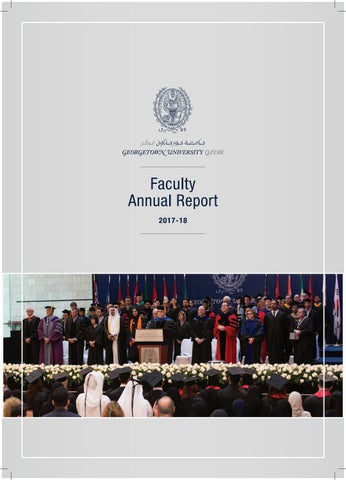
Faculty Annual Report 2017-18
Faculty Annual Report 2017-18 This is a report on the teaching, research, and service of faculty at Georgetown University in Qatar (GU-Q) during the 2017-18 academic year.
© 2018 by Georgetown University in Qatar. All rights reserved.
P.O. BOX 23689 • DOHA, QATAR QATAR.GEORGETOWN.EDU
Contents MEET THE FACULTY ......................................... 1 ACADEMIC DEANS.......................................... 10 PUBLICATIONS............................................... 11 ACADEMIC ACTIVITIES AND INITIATIVES . . ......... 16 CENTER FOR INTERNATIONAL AND REGIONAL STUDIES ................................ 37 COLLABORATIVE RESEARCH INITIATIVES.......... 39 STUDENT DEVELOPMENT................................. 43 ACADEMIC AND COMMUNITY SERVICE.............. 47
Meet the Faculty The academic programs delivered at Georgetown University in Qatar (GU-Q), centered on the Bachelor of Science in Foreign Service (BSFS) degree, require a diverse faculty of the highest caliber. The GU-Q faculty are established scholars from the broad disciplines of anthropology, economics, government, international relations and political science, history, languages and literature, philosophy, and theology. Faculty specializations include migration and diaspora studies, global markets, international trade and development economics (on the micro and macro levels), political economy, comparative and international politics, elite and agrarian politics, media and politics, the history and historiography of social movements, colonialism and nationalism, diplomatic history and world history, Arabic, English and French languages, literature and literary criticism, comparative world literature, ethics, distributive justice, bio-ethics, metaphysics, Christian, Islamic, Hindu, Buddhist and Confucian theology, law, mysticism and institutions. Professional areas of interest range the globe: from the U.S. to China, Vietnam to India and Pakistan, Ireland and the U.K. to Spain and Russia, to virtually all points within the Middle East and the Gulf. Furthermore, faculty member qualifications to research and teach these subjects have been earned from some of the world’s most prestigious institutions, while most have also been affiliated with eminent institutions before joining GU-Q.
Sohaira Siddiqui
1
•
FACULTY A N N U A L R E PORT 2017- 18
Abdul Rahman Chameseddine
ANTHROPOLOGY ROGAIA M. ABUSHARAF Ph.D., University of Connecticut Professor of Anthropology Research interests: culture and politics, anthropology of gender, human rights, and migration and diaspora issues in Sudan, the Gulf, U.S.A., Canada, and the U.K.
ECONOMICS ALEXIS ANTONIADES Ph.D., Columbia University Associate Professor of Economics; Director of International Economics Research interests: international macroeconomics; global markets; big data; and the economies of the Gulf countries
JOSE ASTURIAS
ZHAOYANG HOU Ph.D., George Washington University Assistant Professor of Economics Research interests: development economics; applied econometrics; international economics, with a special interest in micro-economic development issues in China
JACK ROSSBACH
Ph.D., University of Minnesota Assistant Professor of Economics
Ph.D., University of Minnesota Assistant Professor of Economics
Research interests: international trade and macroeconomics, with a special interest in growth
Research interests: international trade and growth, with a focus on how linkages across firms and countries shape the global economy
MONGOLJIN BATSAIKHAN
M. DANIEL WESTBROOK
Ph.D., Brown University Assistant Professor of Economics
Ph.D., Ohio State University Associate Professor of Economics; Curricular Chair of International Economics
Research interests: development and experimental economics, with a special interest in industrial organization; entrepreneurship; SMEs; and social capital
Research interests: applied micro-econometrics; and economic development in Vietnam M eet t h e Faculty
•
2
GOVERNMENT, INTERNATIONAL RELATIONS AND POLITICAL SCIENCE SONIA ALONSO SAENZ DE OGER Ph.D., Juan March Institute Associate Professor of Government; Curricular Chair of International Politics Research interests: federalism and devolution; party competition in Western democracies; the democratic deficit in the E ropean Union; electoral behavior in Western Europe; and democratization and ethnic conflict in Western democracies
UDAY CHANDRA Ph.D., Yale University Assistant Professor of Government Research interests: critical agrarian studies; political anthropology; postcolonial theory; South Asian studies, with a special interest in state-society relations; power and resistance; political violence; agrarian change; rural-urban migration; popular religion; and the philosophy of the social sciences
AMANDA GARRETT Ph.D., Harvard University Assistant Professor of Political Science Research interests: comparative and international politics, with a focus on the implications of migration and ethnic diversity in advanced democracies 3
•
FACULTY A N N U A L R E PORT 2017- 18
ANATOL LIEVEN Ph.D., University of Cambridge Professor of Government Research interests: Islamist terrorism and insurgency; contemporary warfare; U.S. and Western strategy; the countries of the former Soviet Union and the greater Middle East, especially Pakistan, Afghanistan and Iran
MEHRAN KAMRAVA Ph.D., Cambridge University Professor of Government; Director of the Center for International and Regional Studies (CIRS) Research interests: comparative politics; political development; and Middle Eastern politics
RORY MILLER Ph.D., King’s College London Professor of Government; Director of the Media and Politics Certificate Research interests: external intervention in the contemporary Middle East; the politics of small states in the international system; comparative peace processes; political and economic development of regional groupings; Ireland and the Middle East; private sector development and conflict resolution; and British Middle East policy
GERD NONNEMAN Ph.D., University of Exeter Professor of Government Research interests: politics and international relations of the Middle East; Muslim communities in Europe; and comparative political and economic liberalization
CLYDE WILCOX Ph.D., Ohio State University Professor of Government; Director of the Certificate in American Studies Research interests: American and comparative politics, including religion and politics; gender politics; interest groups; public opinion and electoral behavior; campaign finance; and science fiction and politics
MOHAMED ZAYANI Ph.D., Indiana University Professor of Critical Theory; Director of the Certificate in Media and Politics (Fall 2017) Research interests: cultural studies; and communication studies and political science, with particular focus on the evolving dynamics of global communication in the Middle East and the Arab World
HARRY VERHOEVEN Ph.D., University of Oxford Assistant Professor of Government Research interests: elite politics; and ideology and international relations, with a focus on Africa and the Middle East
M eet t h e Faculty
•
4
HISTORY GABOR AGOSTON
PHOEBE MUSANDU
Ph.D., Hungarian Academy of Sciences Associate Professor of History
Ph.D., University of California, Los Angeles Assistant Professor of History
Research interests: early modern Ottoman history; Ottoman-Habsburg rivalry and frontiers; and early modern military history
Research interests: African history; African historical methodology; and mass media and women’s history
ABDULLAH AL-ARIAN
MAX OIDTMANN
Ph.D., Georgetown University Assistant Professor of History
Ph.D., Harvard University Assistant Professor of History
Research interests: Islamic social movements; modern Egypt; Muslims in the U.S.; and the history of U.S. policy towards the Middle East
Research interests: Chinese history, with a focus on late imperial China (1368-1912) and inner Asia (Islamic Central Asia, Tibet, Mongolia, and Manchuria)
EDWARD JAMES KOLLA Ph.D., Johns Hopkins University Assistant Professor of History Research interests: European international relations; political, cultural and intellectual history, with a focus on the history of international law
MOHAMMED REZA PIRBHAI Ph.D., University of Toronto Associate Professor of History; Curricular Chair of International History Research interests: South Asian and world history, with a focus on Islamic thought and institutions in modern South Asia; colonialism; nationalism; and gender
JAMES REARDON-ANDERSON Ph.D., Columbia University Professor of History; Faculty Chair Research interests: modern Chinese history 5
•
FACULTY A N N U A L R E PORT 2017- 18
AMIRA SONBOL Ph.D., Georgetown University Professor of History Research interests: modern Egypt; and Islamic history and law, with a focus on women, gender and Islam
KARINE WALTHER Ph.D., Columbia University Associate Professor of History Research interests: U.S. history; and the U.S. in the world, with a focus on the Middle East
ISLAMIC STUDIES AHMAD DALLAL Ph.D., Columbia University Professor and Dean of GU-Q Research interests: Islamic disciplines of learning in medieval and early modern Islamic societies; the development of traditional and exact Islamic sciences; Islamic medieval thought; the earlymodern evolution of Islamic revivalism and intellectual movements; and Islamic law
SOHAIRA SIDDIQUI Ph.D., University of California, Santa Barbara Assistant Professor of Theology Research interests: classical Islamic legal theory (usul ul-fiqh); classical Islamic political thought; the development and intersection of legal thought and political thought from the 9th to 11th centuries; and secularism and modernity in relation to Islamic law and Muslims in the West
AYMAN SHABANA Ph.D., University of California, Los Angeles Associate Research Professor of Theology Research interests: Islamic legal and intellectual history; Islamic law and ethics; human rights; and bioethics.
M eet t h e Faculty
•
6
LANGUAGES AND LITERATURE: ARABIC MAHMOUD AL-ASHIRI Ph.D., Fayoum University (Cairo University) Associate Professor of Arabic
M.A., American University in Cairo Instructor, Arabic
Research interests: Arabic language, literary criticism, and poetry
Research interests: teaching Arabic heritage students; Computer Language Assisted Learning; Arabic linguistics and literature
ABBAS AL-TONSI M.A., Cairo University Senior Lecturer, Arabic; Curricular Chair of the Arabic Program Research interests: Arabic language; literary criticism; and Arabic media and politics
ABDUL RAHMAN M. CHAMSEDDINE M.A., American University of Beirut Instructor, Arabic Research interests: Arabic terminology of early Islam, with a focus on Quranic terms that describe religious identities and other social groupings
AMIRA EL-ZEIN Ph.D., Georgetown University Associate Professor of Arabic; Director of the Certificate of Arab and Regional Studies Research interests: Arabic classical and contemporary literature; and Sufism in medieval and contemporary Islam 7
•
HANY FAZZA
FACULTY A N N U A L R E PORT 2017- 18
OMAR KHALIFAH Ph.D., Columbia University Assistant Professor of Arabic Research interests: Arabic literature (modern); world literature; textual and visual representations of memory; and cinema and nationalism in the Arab world
YEHIA MOHAMED Ph.D., Cairo University Assistant Professor of Arabic Research interests: applied linguistics (language acquisition and error analysis); phonology; and language changes and sociolinguistics
HANA ZABARAH Ph.D., Georgetown University Assistant Professor of Arabic Research interests: Arabic language, literature, and linguistics
LANGUAGES AND LITERATURE: ENGLISH IAN ALMOND
FIRAT OR UC
Ph.D., University of Edinburgh Professor of English
Ph.D., Duke University Assistant Professor of English
Research interests: comparative world literature, with a tri-continental emphasis on Mexico, Bengal and Turkey
Research interests: postcolonial global literatures; cultural and literary studies of the Middle East; translation studies; and transnational cinema
AMY NESTOR Ph.D., The State University of New York, Buffalo Assistant Professor of English Research interests: American and African-American literature; war and trauma; poetics; and literary theory
LANGUAGES AND LITERATURE: FRENCH PATRICK MEADOWS Ph.D., Princeton University Associate Professor of French Research interests: French/ Francophone literature and its relationship with philosophy and symbolism
M eet t h e Faculty
•
8
PHILOSOPHY JEREMY KOONS Ph.D., Georgetown University Associate Professor of Philosophy Research interests: ethics (theoretical and applied); social and political philosophy; epistemology; philosophy of mind and language; metaphysics; and philosophy of religion
KARL WIDERQUIST Ph.D., Oxford University; Ph.D., City University of New York Associate Professor of Philosophy Research interests: distributive justice or the ethics of “who has what”
THEOLOGY AKINTUNDE E. AKINADE Ph.D., Union Theological Seminary Professor of Theology; Curricular Chair of Culture and Politics Research interests: African religions; religion and immigration; inter-cultural studies; comparative religions; Christian thought; and ChristianMuslim relations
9
•
FACULTY A N N U A L R E PORT 2017- 18
PATRICK LAUDE Ph.D., Indiana University Professor of Theology Research interests: comparative mysticism; poetry and mysticism; and Western representations and interpretations of Asian spiritual and wisdom traditions
Academic Deans Academic deans are responsible for curricular oversight. They provide support to faculty members, ensure cohesive and collaborative teaching and learning across a variety of platforms and disciplines, and holistically mentor and care for GU-Q students’ education. Some of the academic deans listed below also occasionally offer courses in their fields of specialization. BRENDAN HILL
JAMES MACGREGOR
Ph.D., Georgetown University Associate Dean for Students Research interests: church and legal history, focusing specifically on the criminalization of sin and the creation of a godly society at the dawn of the modern era in England
KAI-HENRIK BARTH Ph.D., University of Minnesota Senior Assistant Dean for Faculty Affairs and Research Administration Research interests: nuclear energy; nuclear proliferation and international security; energy policy; climate change; and science and technology in international affairs
Ph.D., University of Cincinnati Associate Dean for Academic Affairs Research interests: books of hours and prayer to saints in late medieval England
HEATHER KERST M.A., Georgetown University Senior Assistant Dean for the Bachelor of Science in Forgeign Service (BSFS) Program Research interests: cultural arts and social change in modern Latin America
JULIEN MOUTTE
ANNE NEBEL Ph.D., Lancaster University Senior Assistant Dean for Teaching, Learning, and Assessment and Director of Academic Services Research interests: critical discourse analysis; stylistics; writing pedagogies; and writing across the discipline
CHRISTINE SCHIW IETZ
M.A., Institut du Commerce Assistant Dean for Academic Affairs
Ph.D., American University Assistant Dean for Academic Affairs
Research interests: human resources; and academic counseling
Research interests: society and new technologies; gender roles; and peace, security, and international development A cademic D eans
•
10
Publications Members of the GU-Q faculty are prolific authors. In the 2017-18 academic year they published 12 books (single-authored works, edited collections and a translation), 12 book chapters, and 14 articles in peer-reviewed journals. Reflecting a range of disciplinary backgrounds and research interests, these works address such topics as economics, literature (including an original work of poetry), history, international law, media, metaphysics, politics, and religion. They range in focus from the Gulf and the Middle East, Africa, Europe, North America, and parts of Asia, such as India and China. The importance of the research findings is reflected in the prestige of the presses that publish them, which include Cambridge University Press, Columbia University Press, Cornell University Press, Oxford University Press, State University of New York Press, University of Minnesota Press, Hurst, Routledge, and Sage. The peer-reviewed journals in which these works have appeared are equally as impressive and include Q1 journals such as Annual Review of Economics, Comparative European Politics, Politics and Religion, and Sociology of Islam. The academic year’s publications together constitute a major body of work of the highest standards, and significantly help to establish Qatar as a global center of knowledge production. James Reardon-Anderson
Mehran Kamrava
11
•
FACULT Y A N N U A L R E PORT 2017- 18
BOOKS: AUTHORED AND EDITED Al-Hakim, Tawfiq. Show Me God. Translation by Abdul Rahman Chamseddine. Beirut: Dar Nelson, 2018.
El-Zein, Amira. Is This Devastation for Me Alone? Beirut: Al-Mu’assasah al-Arabiyyah lil-Dirasat wa l-Nashr, 2018.
Berry, Jeffery and Wilcox, Clyde. The Interest Group Society (6th edition). New York: Routledge, 2018.
Kamrava, Mehran, ed. The Great Game in West Asia: Iran, Turkey and the South Caucasus. London: Oxford University Press/ Hurst, 2017.
Dallal, Ahmad. Islam without Europe: Traditions of Reform in Eighteenth Century Islamic Thought. North Carolina: University of North Carolina Press, 2018.
Kamrava, Mehran. Troubled Waters: Insecurity in the Persian Gulf. New York: Cornell University Press, 2018.
P ublications
•
12
BOOKS: AUTHORED AND EDITED
13
•
Kolla, Edward James. Sovereignty, International Law, and the French Revolution. Cambridge: Cambridge University Press, 2017.
ReardonAnderson, James, ed. The Red Star and the Crescent: China and the Middle East. London: Oxford University Press/ Hurst, 2018.
Laude, Patrick. Shimmering Mirrors: Reality and Appearance in Contemplative Metaphysics East and West. New York: SUNY Press, 2017.
Rozell, Mark J. and Clyde Wilcox, eds. God at the Grassroots 2016: The Christian Right in American Politics. Lanham: Roman and Littlefield, 2017.
Oidtmann, Max. Forging the Golden Urn: The Qing Empire and the Politics of Reincarnation in Tibet. New York: Columbia University Press, 2018.
Zayani, Mohamed, ed. Digital Middle East: State and Society in the Information Age. London: Oxford University Press/ Hurst, 2018.
FACULT Y A N N U A L R E PORT 2017- 18
BOOK CHAPTERS Al-Arian, Abdullah. “The Revival of Protest in Egypt on the Eve of Sadat.” In Routledge Handbook of the Global Sixties, edited by Chen Jian, Martin Klimke, Masha Kirasirova, Mary Nolan, Marilyn Young, and Joanna Waley-Cohen. New York: Routledge, 2018, pp. 494-512. Al-Arian, Abdullah and Hafsa Kanjwal. “The Perils of American Muslim Politics.” In With Stones in Our Hands: Reflections on Racism, Muslims, and U.S. Empire, edited by Sohail Daulatzai and Rana Junaid. University of Minnesota Press, 2018, pp. 16-34. Chandra, Uday. “Intimate Antagonisms: Ahmad Dallal, Max Oidtmann, and Gerd Nonneman Adivasis and the State in Contemporary India.” In Indigeneity on the Move: Varying Manifestations of a Contested Concept, edited by Eva Lieven, Anatol. “West Asia since 1900: Living Through Gerharz, Nasir Uddin, and Pradeep Chakkarath. Oxford the Wreck of Empires.” In The Great Game in West Asia: and New York: Berghahn Books, 2017, pp. 221-39. Turkey, Iran and the South Caucasus, edited by Mehran Kamrava. Oxford and New York: Oxford University Press, Chandra, Uday. “The 2014 National Elections from 2017, pp. 31-56. the Margins of Modern India.” In Rise of Saffron Power: Reflections on Indian Politics, edited by Mujibur Rehman. Miller, Rory. “Resilience and the (Un)Limits of Small New Delhi: Routledge, 2018, pp. 263-78. State Power: Qatar during the Gulf Crisis.” In Qatar’s Resilience: A Model of Resisting Blockade and the Power Chandra, Uday and Lipika Kamra. “Maoism and the of Small States, edited by Ezzeddine Abdelmoula and Masses: Critical Reflections on Revolutionary Praxis Haoues Taguia. Doha: Al Jazeera Studies Center, 2018. and Subaltern Agency.” In Revolutionary Violence versus Democracy: Narratives from India, edited by Ajay Ruiz-Rufino, Rubén and Sonia Alonso. “Democracy Gudavarthy. New Delhi: Sage Publications, 2017, pp. without Choice: Citizens’ Perceptions of Government’s 191-221. Autonomy during the Eurozone Crisis.” In Democracy and Crisis: Challenges in Turbulent Times, edited by Wolfgang Dallal, Ahmad. “Rethinking Authority: Trends in Merkel and Sascha Kneip. New York: Springer, 2018 pp. Eighteenth Century Hadith Studies.” In Islam in der 197-228. Moderne; Moderne im Islam. Eine Festscrift fur Reinhard Schulze, edited by F. Zemmin, J. Stephan, and M. Verhoeven, Harry. “Nelson Mandela and Changing Corrado, Leiden: E.J. Brill, 2018, pp. 212-33. Agendas of Pan-Africanism: African Liberation Politics from 1950 to the Present.” In Nelson Rolihlahla Mandela: Kamrava, Mehran. “The China Model and the Middle Decolonial Ethics of Liberation and Servant Leadership, East.” In The Red Star and the Crescent: China and the edited by Sabelo J. Ndlovu-Gatsheni and Busani Middle East, edited by James Reardon-Anderson. New Ngcaweni. Trenton: Africa World Press, 2017, pp. 137-61. York: Oxford University Press, 2017, pp. 59-79. Wilcox, Clyde. “The Last Temptation of the Christian Lieven, Anatol. “Limiting Migration to Preserve European Right.” In God at the Grassroots 2016: The Christian Social Peace.” In Debating Migration to Europe: Welfare Right in American Politics, edited by Mark J. Rozell and versus Identity, edited by Raffaele Marchetti. U.K.: Clyde Wilcox. Lanham: Roman and Littlefield, 2017, pp. Routledge, 2017, pp. 35-54. 181-92. P ublications
•
14
ARTICLES IN REFEREED JOURNALS Agoston, Gabor. “Hungría, frontera militar.” Desperta Ferro: Historia moderna, 32, 2018, pp. 12–17. Alonso, Sonia, and Rubén Ruiz-Rufino. “The Costs of Responsibility for the Political Establishment of the Eurozone (1999–2015).” Party Politics, 2018, pp. 1-17. Alonso, Sonia, Matthias Scantamburlo and Braulio Gómez. “Democratic Regeneration in European Peripheral Regions: A New Politics for the Territory?” West European Politics, 41, no. 2, 2017, pp. 1-25. Alonso, Sonia, Braulio Gómez and Laura Cabeza. “Disentangling Peripheral Parties’ Issue Packages in Subnational Elections.” Comparative European Politics 15, no. 2, 2017, pp. 240-63. De Oliveira, Ricardo Soares and Harry Verhoeven. “Taming Intervention: Sovereignty, Statehood and Political Order.” Survival 60, no. 2, 2018, pp. 7-32.
Kamrava, Mehran. “Qatari Foreign Policy and the Exercise of Subtle Power.” International Studies Journal 14, no. 2, 2017, pp. 91-123. Laude, Patrick. “Between Ideological Formatting and Subjective Experience: The Blurring Lines of New Religious Identities.” Interdisciplinary Journal of Research on Religion 13, 2017, pp. 31-36. Laude, Patrick. “Means to the End and End of the Means: Reflections on Guru, Mantra, Upāya and Upeya.” Aditi, Centre Aditi d’Etudes sur la Tradition Hindoue 1, 2018, pp. 181-92. Rossbach, Jack, Timothy J. Kehoe, and Pau S. Pujolas. “Quantitative Trade Models: Developments and Challenges.” Annual Review of Economics 9, no.1, 2017, pp. 295-325.
Kamrava, Mehran. “Leading the Faithful: Religious Authority in the Contemporary Middle East.” Sociology of Islam 6, no. 2, 2018, pp. 97-115.
Ayman Shabana
Sonia Alonzo
Shabana, Ayman. “Empowerment of Women between Law and Science.” HAWWA: Journal of the Women in the Middle East and the Islamic World 15, 2017, pp. 193-218.
Kamrava, Mehran. “Hierarchy and Instability in the Middle East Regional Order.” International Studies Journal 14, no. 4, 2018, pp. 1-35.
15
•
FACULT Y A N N U A L R E PORT 2017- 18
Wilcox, Clyde and David T. Buckley. “Religious Change, Political Incentives, and Explaining Religious-Secular Relations in the United States and the Philippines.” Politics and Religion 10, no. 2, 2017, pp. 543-66.
Academic Activities and Initiatives In addition to their publications, faculty research and expertise is disseminated in a variety of other ways in Qatar and beyond. As members of the global intellectual community, faculty members regularly deliver keynote addresses and are invited to lecture on their areas of expertise. They both participate in and host international conferences, symposia, workshops and study groups. Initiatives and activities hosted by GU-Q provide opportunities to invite renowned colleagues from leading global institutions to speak and interact with faculty and students, those of other academic institutions in Qatar, as well as members of the Qatari public. The public is also invited to participate in book launches by GU-Q faculty members and benefit from faculty expertise at the Faculty Seminar Series. Online and media presence furthers the university’s aims of disseminating knowledge and bringing together scholars, the business community, and other members of the public across the region and beyond. GU-Q builds and maintains a number of websites, provides expert opinions for the media, and maintains an active social media presence.
Patrick Laude
Indian Ocean Symposium
A cademic A ctivities and I nitiatives
•
16
KEYNOTE ADDRESSES
Edward Kolla
Anatol Lieven
Agoston, Gabor. “Military and Fiscal Transformation in the Ottoman Empire in the 16th through 18th Centuries.” Conference Keynote Address, Military Revolution, Fiscal State, and Fiscal-Military State in Europe from the 16th to the 18th Centuries, Institute of History Research Centre for the Humanities, Hungarian Academy of Sciences, Budapest, June 2018. Lieven, Anatol. “Dialogue of Civilisations Rhodes Forum.” Keynote Address, Dialog of Civilization Research Institute, Greece, October 2017. Lieven, Anatol. “Birth of the New World: Conflicts and Responsibility.” Keynote Address, Valdai Discussion Club Session, World Festival of Youth and Students, Sochi, October 2017.
Uday Chandra
Lieven, Anatol. “A Different Kind of Cold War: Russia as the ‘Third West’.” Keynote Address, A Year That Shook the World: European and Eurasian Responses to America’s Withdrawal Conference, Princeton University, New Jersey, May 2018. Verhoeven, Harry. “Mega Dams and African Development: Small is Beautiful?” Keynote Address, Dams in Africa Conference, Eduardo Mondlane University and Point Sud, Maputo, June 2018.
Iam Almond and Max Oidtmann
17
•
FACULT Y A N N U A L R E PORT 2017- 18
INVITED LECTURES
Phoebe Musandu
Rory Miller
Agoston, Gabor. “Ottoman Archives and Historiography.” Lecture, İstanbul Araştırma ve Eğitim Vakfı, Istanbul Foundation for Research and Education, Istanbul, June 2018.
Miller, Rory. “Russia and the Palestine Issue in the Trump Era.” Lecture, Symposium on Russia and the Middle East, Doha Institute of Graduate Studies, Doha, March 2018.
Chandra, Uday. “Hindu Nationalism, Populism, and Democracy in India.” Lecture, University of Connecticut, Connecticut, October 2017.
Nonneman, Gerd. “The 2017 Qatar Crisis in Light of Long-Term Patterns and Recent Changes.” Lecture, Gulf Studies Forum, Doha Institute of Graduate Studies, Doha, December 2017.
Dallal, Ahmad. “The Jews of Yemen: Intertwined Identities and the Distortions of Contemporary Historiography.” Lecture, W. Michael Blumenthal Academy of the Jewish Museum Berlin and the EUME Research Program, Forum Transregionale Studien, Berlin, October 2017.
Nonneman, Gerd. “The Qatar Crisis and the Changing Foreign Policy Environment in the GCC.” Lecture, Middle East Institute, National University of Singapore, Singapore, March 2018.
Dallal, Ahmad. “Interdisciplinarity: Theoretical Promise and Institutional Challenges.” Lecture, The Doha Institute for Graduate Studies, Doha, April 2018.
Nonneman, Gerd. “The Qatar Crisis: What it Means for the Gulf.” Rajaratnam School of International Studies, NTU, Singapore. March 2018.
Miller, Rory. “The Soldier and the State in the Middle East.” Lecture, Austrian National Defense Academy, Vienna, September 2017.
Pirbhai, Mohammed Reza. “Standing Up to the Field Marshal: Fatima Jinnah of Pakistan.” Lecture, Afkar-eTaza International Conference, Lahore, January 2018.
Miller, Rory. “Ireland and the Balfour Declaration: 100 Years on.” Lecture, Institute of Contemporary History, Trinity College, Dublin, November 2017.
Verhoeven, Harry. “Why Comrades Go To War: Liberation Politics and the Outbreak of Africa’s Deadliest Conflict.” Lecure, National Museum, Kenya, Nairobi, January 2018
Miller, Rory. “The U.S. Perspective on the 2017 Gulf Crisis.” Lecture, Istanbul Security Conference 2017, Istanbul, November 2017.
Verhoeven, Harry. “Environmental Politics in the Middle East.” Lecture, Paris Institute of Political Studies, Paris, April 2018.
A cademic A ctivities and I nitiatives
•
18
CONFERENCES, WORKSHOPS, AND SYMPOSIA
GENDER GENDER JUSTICE AT THE GENDER INTERSECTIONS JUSTICE AT THE JUSTICE AT THE OF LEGALINTERSECTIONS INTERSECTIONS OF LEGAL PRACTICES AND OF LEGAL PRACTICES AND SOCIOPOLITICAL PRACTICES AND SOCIOPOLITICAL SOCIOPOLITICAL TRANSFORMATION TRANSFORMATION TRANSFORMATION October 29-30, 2017 October 29-30, 2017 Faculty Conference Room Faculty Conference Room Georgetown University in Qatar
October 29-30, 2017 Faculty Conference Room Georgetown University in Qatar
RSVP: guqevents@georgetown.edu
RSVP: guqevents@georgetown.edu
Georgetown University in Qatar RSVP: guqevents@georgetown.edu
For more information, visit: https://www.qatar.georgetown.edu/faculty/ For more information, visit: faculty-workshops/gender-justice-workshop
https://www.qatar.georgetown.edu/faculty/ faculty-workshops/gender-justice-workshop
For more information, visit: https://www.qatar.georgetown.edu/faculty/ faculty-workshops/gender-justice-workshop
This symposium brings together scholars, This symposium brings together scholars, researchers and activists to consider the predicament researchers and activists to consider the predicament and the promise pivoting around gender politics and the promise pivoting around gender politics This symposium brings together scholars, as grounded in cultures and societies from a variety as grounded in cultures and societies from a variety of disciplines and international contexts. of disciplines and international contexts. researchers and activists to consider the predicament
and the promise pivoting around gender politics as grounded in cultures and societies from a variety of disciplines and international contexts.
OCTOBER 29-30, 2017
Amira Sonbol
19
•
FACULT Y A N N U A L R E PORT 2017- 18
Gender Justice Workshop This workshop bought together scholars and activists to consider the predicament and the promise of gender politics as grounded in cultures and societies, from a variety of disciplines and international contexts. The gathering covered a vast array of engagements with the intertwined culture and politics to expound the ways in which law, citizenship, tradition, and modernity and the challenges they constitute in achieving gender equilibrium. Both theoretical and practical presentations addressing a range of subjects were included in reflections on the persistent absence of equality in the third millennium and in the road ahead.
International Conference of the Council of Research on Values and Philosophy, Washington DC International Conference of the Council of Research International Conference of the Council of Research Re-Learning to Be Human for Global Times: on Values and Philosophy, Washington DC on Values and Philosophy, Washington DC
Philosophy as Love of Wisdom Re-Learning to Be Human for Global Times: and Its Relevance to the Global Philosophy as Love of Wisdom Philosophy as Love of Wisdom and Its Relevance Crisis to the Global of Meaning and Its Relevance to the Global Re-Learning to Be Human for Global Times:
Crisis of Meaning Georgetown University in Qatar Georgetown University in Qatar January 7-8, 2018
January 7-8, 2018
Crisis of Meaning Georgetown University in Qatar January 7-8, 2018
JANUARY 7-8, 2018 Re-Learning to be Human for Global Times Conference The international conference of the Washington, D.C.-based Council of Research on Values and Philosophy was hosted at GU-Q. The event explored the various ways in which a holistic concept of philosophy is relevant to our current, environmental, spiritual and socioeconomic global crisis, and provided ways to address its challenges.
Patrick Laude
A cademic A ctivities and I nitiatives
•
20
CONFERENCES, WORKSHOPS, AND SYMPOSIA
Artworks included in World on the Horizon: Swahili Art Across the Indian Ocean, Krannert Art Museum at the University of Illinois, 2017. Artworks included in World on the Horizon: Swahili Art Across the Indian Ocean, Krannert Art Museum at the University of Illinois, 2017.
Oceanic Circularities
Oceanic Circularities
Artworks included in World on the Horizon: Swahili Art Across the Indian Ocean, Krannert Art Museum at the University of Illinois, 2017.
Oceanic Circularities
ARTS, IDEOLOGIES, ARTS, IDEOLOGIES, ARTS, IDEOLOGIES, AND IDENTITIES INIDENTITIES AND IDENTITIES IN AND IN THE INDIAN OCEAN THE INDIAN OCEAN January 25, 2018 Georgetown University in Qatar
THE INDIAN OCEAN January 25, 2018 Georgetown University in Qatar
For more information, visit: https://www.qatar.georgetown.edu/ios2018
January 25, 2018 Georgetown University in Qatar For more information, visit: https://www.qatar.georgetown.edu/ios2018
For more information, visit: https://www.qatar.georgetown.edu/ios2018
Uday Chandra and Harry Verhoeven
JANUARY 25, 2018 Annual Indian Ocean Symposium “Oceanic Circularities: Arts, Ideologies and Identities in the Indian Ocean” This symposium brought together world-class experts from across the Indian Ocean to explore how the immaterial and the material interact with each other and how certain types of political economy have given rise to and been shaped by ideologies, identities, and social currents, from the Horn of Africa to Southeast Asia. At issue were the legacies of socialism and enduring Marxist/Leninist-inspired political projects and their impact on the Indian Ocean’s human landscape, how artists and architects around the Ocean world expressed change and continuity in their environment, and how this influenced social, political and religious debates and understandings.
21
•
FACULT Y A N N U A L R E PORT 2017- 18
Anatol Lieven
MARCH 19–20, 2018 Follow-up Workshop The Global Indian Ocean: States, Societies and Markets beyond Liberal Order Workshop As part of the GU-Q multi-year project on “Liberal Order and its Alternatives in the Indian Ocean,” a group of faculty organized a follow-up workshop to substantially advance deep thinking around this core subject. The outcome of the workshop was the development of a manuscript that will be submitted as an edited volume to a world-class publisher. This workshop was the project’s capstone meeting aimed at refining participants’ draft papers presented during the previous year’s faculty conference. After a year of additional research and developing the book project’s theme, the workshop’s in-depth, focused discussion with core participants and external readers helped to transition the papers from being “high potential” into cuttingedge finished products, both theoretically and empirically, following this extensive vetting of ideas and editing of texts. A cademic A ctivities and I nitiatives
•
22
CONFERENCES, WORKSHOPS, AND SYMPOSIA
Marx and Lenin Marx and Lenin in Africa in Africa and Asia and Asia April 9, 2018
10:00 am - 11:15 am
April 9, 2018
10:00 am - 11:15 am
Marx and Lenin in Africa and Asia April 9, 2018
10:00 am - 11:15 am
Socialism after Genocide: the Left in South-East Asia post 1965
Socialism after Genocide: the Left in South-East Asia post 1965
Speaker: Kevin Fogg, Oxford University
Speaker: Kevin Fogg, Oxford University
Discussant: Imad Mansour, Qatar University
Socialism after Genocide: the Left in South-East Asia post 1965 Speaker: Kevin Fogg, Oxford University
Discussant: Imad Mansour, Qatar University
Discussant: Imad Mansour, Qatar University
11:30 am - 12:45 pm
11:30 am - 12:45 pm
‘The Engineers of the Human Soul’: Socialism, Personhood 11:30 am - 12:45and pm Temporality in Mozambique
‘The Engineers of the Human Soul’: Socialism, Personhood and Temporality in Mozambique
Temporality Discussant: Rogaia AbuSharaf, Georgetown University in Qatar in Mozambique
Discussant: Rogaia AbuSharaf, Georgetown University in Qatar
‘The and Engineers Personhood Speaker: Jason Sumich, German Institute for Global Area Studiesof the Human Soul’: Socialism, Speaker: Jason Sumich, and German Institute for Global and Area Studies Speaker: Jason Sumich, German Institute for Global and Area Studies Guests are welcome to attend select papers discussions.
Discussant: Rogaia AbuSharaf, Georgetown UniversityGuests in Qatar are welcome to attend select papers discussions.
RSVP: guqevents@georgetown.edu
RSVP: guqevents@georgetown.edu
Guests are welcome to attend select papers discussions. RSVP: guqevents@georgetown.edu
Rogaia Abusharaf
APRIL 9, 2018 Marx and Lenin in Africa and Asia Workshop This workshop explored new angles on how communist and socialist legacies have shaped African and Asian societies domestically and internationally. Participants focused on the ways in which African and Asian actors have influenced each other since decolonization and the 1955 Bandung conference. The workshop comprehensively mapped out the ways in which Marxism-Leninism challenged religious practices and institutions after decolonization, influenced foreign policy trajectories of even stalwart U.S. allies, and continues to loom large in the historiography of war and genocide in South East Asia.
23
•
FACULT Y A N N U A L R E PORT 2017- 18
Democracy contra Liberalism
A WORKSHOP Democracy contra Liberalism
Democracy contra Liberalism
April 22, 2018 10:00 AM Georgetown University in Qatar
April 22, 2018 10:00 AM Georgetown University in Qatar
A WORKSHOP
RSVP: guqevents@georgetown.edu About the workshop:
April 22, 2018 10:00 AM Georgetown University in Qatar RSVP: guqevents@georgetown.edu
A WORKSHOP
RSVP: guqevents@georgetown.edu About the workshop:
These days pundits often lament the global retreat of liberalism and democracy. They say that democracy – liberalism’s crucible – These days pundits often lament the global retreat of liberalism and democracy. They say that democracy – liberalism’s crucible – is besieged by ‹populist›, authoritarian, right-wing, anti-liberal politics. Yet populist and authoritarian leaders, whether Trump or is besieged by ‹populist›, authoritarian, right-wing, anti-liberal politics. Yet populist and authoritarian leaders, whether Trump or Aboutdemocratic the workshop: Modi or Putin or Orban, are avowed democrats. When in power, they do not tend to dismantle institutions, but, on Modi or Putin or Orban, are avowed democrats. When in power, they do not tend to dismantle democratic institutions, but, on the contrary, often endorse democracy in its more direct, one may say purer, forms, like referendums, which the verylament advocatesthe of global retreat of liberalism and democracy.the contrary, oftendemocracy endorse democracy in its more direct, one These days pundits often They say that – liberalism’s crucible – may say purer, forms, like referendums, which the very advocates of liberal democracy so stridently oppose. Western political theory, which sees democracy as an essentially liberal institution, built liberal democracy so stridently oppose. WesternTrump politicalortheory, which sees democracy as an essentially liberal institution, built is besieged by ‹populist›, authoritarian, right-wing, anti-liberal politics. Yet populist and authoritarian leaders, whether on values of freedom and equality, has failed to reckon with the clash of democratic politics and liberal ideology around the world, onto values of freedom and equality, has failed tobut, reckon Modi or Putin or Orban, are avowed democrats. When in power, they do not tend dismantle democratic institutions, onwith the clash of democratic politics and liberal ideology around the world, including liberalism’s Euro-American heartlands. including liberalism’s Euro-American heartlands.
the contrary, often endorse democracy in its more direct, one may say purer, forms, like referendums, which the very advocates of
This workshop brings anthropologists, historians and political theorists into a conversation thatdemocracy will begin with holding oppose. Western political theory, which sees democracy This workshop anthropologists, historians andbuilt political theorists into a conversation that will begin with holding liberal so stridently as anbrings essentially liberal institution, liberalism and democracy apart. What may the rise of non-liberal, illiberal or anti-liberal forms of democracy tell us about how liberalism and democracy apart. What may the rise of non-liberal, illiberal or anti-liberal forms of democracy tell us about how on values of freedom and equality, has failed to reckon with the clash of democratic politics and liberal ideology around the world, we conceptualise the global varieties of democratic politics, and indeed democracy as such? What political and intellectual lessons we conceptualise the global varieties of democratic politics, and indeed democracy as such? What political and intellectual lessons including liberalism’s Euro-American heartlands. might be drawn from democracies, often sans liberalism, of postcolonial Asia, Africa, and Latin America? How may vernacular might be drawn from democracies, often sans liberalism, of postcolonial Asia, Africa, and Latin America? How may vernacular democratic cultures help develop a clearer vision of politics around the globe, and a more true-to-life theory of democracy than democratic cultures help develop a clearer vision of politics around the globe, and a more true-to-life theory of democracy than This workshop brings anthropologists, historians and political theorists into a conversation that will begin with holding the crumbling liberal certitudes have so far allowed? the crumbling liberal certitudes have so far allowed?
liberalism and democracy apart. What may the rise of non-liberal, illiberal or anti-liberal forms of democracy tell us about how
we conceptualise the global varieties of democratic politics, and indeed democracy as such? What political and intellectual lessons For more information on the program, please visit the website at For more information on the program, please visit the website at https://www.qatar.georgetown.edu/faculty/faculty-workshops/democracy-contra-liberalism-workshop might be drawn from democracies, often sans liberalism, of postcolonial Asia, Africa, and Latin America?https://www.qatar.georgetown.edu/faculty/faculty-workshops/democracy-contra-liberalism-workshop How may vernacular democratic cultures help develop a clearer vision of politics around the globe, and a more true-to-life theory of democracy than the crumbling liberal certitudes have so far allowed?
For more information on the program, please visit the website at https://www.qatar.georgetown.edu/faculty/faculty-workshops/democracy-contra-liberalism-workshop
Uday Chandra
APRIL 22, 2018 Democracy Contra Liberalism Workshop Anthropologists, historians and political theorists gathered for a conversation that separated liberalism from democracy to examine the conceptualization of democratic politics in light of the rise of non-liberal, illiberal or anti-liberal forms of democracy. Topics also included lessons learned from democracies of postcolonial Asia, Africa, and Latin America, vernacular democratic cultures, and the development of a more true-to-life theory of democracy than crumbling liberal certitudes have so far allowed.
A cademic A ctivities and I nitiatives
•
24
GU-Q FACULTY SEMINAR SERIES The Faculty Seminar Series provides a forum for GU-Q faculty and guests to present their work with the goal of furthering their research through presentation and feedback. The seminars also serve to connect faculty with their colleagues at other regional and international universities by bringing in outside speakers and creating a forum for peer review and discussion. It has the ancillary goal of increasing GU-Q’s academic reputation through allowing outside faculty to experience the welcoming environment and intellectual rigor found at GU-Q. During the 2017–18 academic year, the GU-Q Faculty Seminar Series welcomed speakers from: • • • •
Doha Institute of Graduate Studies Qatar University Northwestern University in Qatar institutions based in Australia, China, Spain, the UAE, the UK, and the United States • distinguished independent researchers Talks covered a diverse range of subjects including the economics of basic income (both theoretically and as implemented in Australia), the Afghan Taliban, foreign security assistance in Iraq, Putin’s Russia, hydro-politics in the Nile Basin, agriculture in Brazil, Muslims in the U.S., Muslims in China, U.S.-Arab relations during the Cold War, political and social life in Lebanon, the Ottomans and the making of the modern Middle East, the Qing dynasty and Tibet, gender and the U.S. presidency, and theorizing refugee issues.
FALL 2017 “Transitioning to a Basic Income in Australia: Policy Innovation, Preparedness and Implementation” Jennifer Mays, human services course coordinator, School of Public Health and Social Work, Queensland University of Technology “Justice and Solidarity in a Divided World” Grace Ji-Sun Kim, associate professor of theology, Earlham School of Religion “The Role of Analogy in Rhetoric and Cross-Cultural Communication” Asun Lopez-Varala, associate professor, Facultad Filología, Universidad Complutense de Madrid “Micro-Histories of Southern Afghanistan and the Taliban” Alex Strick van Linschoten, independent researcher “The Causes and Consequences of Agricultural Specialization in Brazil” Heitor Pellegrina, assistant professor of economics, New York University in Abu Dhabi “The Political Economy of Basic Income Experiments” Karl Widerquist, associate professor of philosophy, Georgetown University in Qatar “When Does Foreign Security Assistance Undermine Local Security Providers: Evidence from Iraq” Austin Knuppe, Ph.D. candidate in political science, Ohio State University “How Many Babies Did Putin Eat Last Month? A Report from the Valdai Conference” Anatol Lieven, professor of government, Georgetown University in Qatar
Hanny Fazza and Yehia Mohamed
25
•
FACULT Y A N N U A L R E PORT 2017- 18
Max Oidtmann
Nadine Hamdan
SPRING 2018 “Muslims in America: Lessons in the Globalization of Islam in the Modern Era” Kambiz Ghaneabassiri, professor of religion, Reed College “Envisioning the Arab Future: Modernization in U.S.-Arab Relations, 1945-1967” Nathan Citino, professor of Middle East history, Rice University “Rule of Experts in the Nile Basin–Can They Change the Hydropolitical Trajectory?” Ana Cascao, independent researcher “War is Coming: Between Past and Future Violence in Lebanon” Sami Hermez, professor of anthropology, Northwestern University in Qatar “The Last Ottoman Generation and the Making of the Modern Middle East” Michael Provence, professor of Middle East history, University of California, San Diego “Logic and Critical Thinking: An Introduction for Muslim Students” Edward Moad, assistant professor of philosophy, Qatar University “The Gendered Executive: The American Presidency, Human Rights, and Women” Janet Martin, professor of government and legal studies, Bowdoin College
“What It Means to Be Lebanese in the Voice of Hizbullah” Nadine Hamdan, research fellow, Georgetown University in Qatar “The Palestinian Bedouin in Israel: Negotiating Loyalty and Critique in the Settler-Colonial State” Sophie Richter-Devroe, associate professor, Doha Institute for Graduate Studies “Halal, Qingzhen and Toyyiban; Everyday Practice of Islam in China” Jianfu Ma, professor of cultural anthropology, North Minzu University of China “Muslim Identity Politics” Khadijah Elshayyal, postdoctoral research fellow at the Alwaleed Centre for the Study of Islam in the Contemporary World, University of Edinburgh “Legal Pluralism and Religious Piety in 19th-Century Tibet” Max Oidtmann, assistant professor of history, Georgetown University in Qatar “Refugee Discrimination–The Good, the Bad, and the Politically Expedient” Kieran Oberman, lecturer in political theory, University of Edinburgh
C enter for I nternational and R egional S tudies
•
26
PUBLIC LECTURES AND FACULTY BOOK LAUNCHES Public Lectures Public lectures are faculty-initiated events aimed at introducing worldclass scholars and researchers to GU-Q and the wider community in Qatar. Lectures have attracted media attention and wide attendance, and elicit lively interaction and attentive interest from the audience. The visit often combines both a public lecture and a panel discussion with researchers, scholars and students of the education community in Qatar. During the 2017–18 academic year, GU-Q hosted six public lectures delivered by prominent academics from the U.S. and the UK, as well as the U.S. Ambassador to Qatar.
Firat Oruc
Omar Khalifa
Sohaira Siddiqui
Karine Walther and IIan Pappe
27
•
FACULT Y A N N U A L R E PORT 2017- 18
Faculty Book Launches GU-Q’s book launch events showcase faculty book publications and are held at the GU-Q Bookstore. They are open for Education City and the wider Qatar community to attend, discuss, and celebrate this significant culmination of GU-Q faculty research.
Abstract
Abstract
Caravan of Martyrs examines the transformation of sacrificial ideology and ritual in Caravan of Martyrs examines the transformation of sacrificial ideology and ritual in Afghanistan from the beginning of the war in 1978 to the present. Sacrifice is viewed here as a Afghanistan from the beginning of the war in 1978 to the present. Sacrifice is viewed here as a simple machine for transforming biological death into diverse forms of social meaning. Beginning with simple machine for transforming biological death into diverse forms of social meaning. Beginning with Abstract a discussion of sacrifice as an instrument of peacemaking in the context of tribal feud, the book considers how a discussion of sacrifice as an instrument of peacemaking in the context of tribal feud, the book considers how Caravan of Martyrs examines the transformation ideologywasand ritual sacrifice in the form of martyrdom was used as an instrument of political power by the Islamic political parties that rose sacrifice in of thesacrificial form of martyrdom used as anin instrument of political power by the Islamic political parties that rose up to oppose the Soviet occupiers in the 1980s. The book continues with an analysis of Taliban efforts to recast sacrifice as public to oppose the present. Soviet occupiers in the bookascontinues with an analysis of Taliban efforts to recast sacrifice as public Afghanistan from the beginning of the war inup1978 to the Sacrifice is 1980s. viewedThehere a scapegoating rituals intended to legitimize their authority, and then continues with an examination of the role of “Afghan most for notably scapegoating rituals intended to legitimize authority, and then continues simpleArabs,” machine transforming biological death into diverse forms of socialtheir meaning. Beginning with with an examination of the role of “Afghan Arabs,” most notably Abdullah ‘Azzam and Osama bin Laden, in transforming martyrdom from a retrospective conferral of status on the dead to the active pursuit of Abdullah ‘Azzam and Osama bin Laden, in transforming martyrdom from a retrospective conferral of status on the dead to the active pursuit of a discussion of sacrifice as an instrument of peacemaking in the context of tribal feud, the book considers how sacrificial death by the living. The book then looks at the development of suicide bombing in Afghanistan following September 11th. In contrast sacrificial death by the living. The book then looks at the development of suicide bombing in Afghanistan following September 11th. In contrast incultural the form of and martyrdom of political power the Islamic political partiesCaravan that rose to most analyses that focus either on strategy or psychology, Caravan of Martyrs views suicide sacrifice bombing in terms relates it towas the used as an instrument to most analyses that focusbyeither on strategy or psychology, of Martyrs views suicide bombing in cultural terms and relates it to the up to oppose occupiers the 1980s. with an of Taliban efforts to recastoccupation sacrificeand as public structural and moral dilemmas created by American occupation and control. The final chapters focus onthe theSoviet role of Facebook andinother forms of The book continues structural andanalysis moral dilemmas created by American control. The final chapters focus on the role of Facebook and other forms of social media in creating a new cult of martyrs among Afghan youth and rituals considers the implications of the risetheir of suicide bombing. social mediaofinthe creating a new cult of Arabs,” martyrs among Afghan youth and considers the implications of the rise of suicide bombing. scapegoating intended to legitimize authority, and then continues with an examination role of “Afghan most notably
Abdullah ‘Azzam and Osama bin Laden, in transforming martyrdom from a retrospective conferral of status on the dead to the active pursuit of sacrificial death by the living. The book then looks at the development of suicide bombing in Afghanistan following September 11th. In contrast to most analyses that focus either on strategy or psychology, Caravan of Martyrs views suicide bombing in cultural terms and relates it to the structural and moral dilemmas created by American occupation and control. The final chapters focus on the role of Facebook and other forms of social media in creating a new cult of martyrs among Afghan youth and considers the implications of the rise of suicide bombing.
OCTOBER 2017 Caravan of Martyrs: Sacrifice and Suicide Bombing in Afghanistan David Edwards, Williams College In this public lecture, David Edwards discussed his new book Caravan of Martyrs, which explores the rise of suicide bombing in the context of cultural beliefs and rituals of sacrifice in Afghanistan, and related it to the structural and moral dilemmas created by American occupation.
David Edwards
C ollaborative R esearch I nitiatives
•
28
PUBLIC LECTURES
JANUARY 2018 Palestine in the Trump Era: Opportunities and Calamities Ilan Pappe, University of Exeter Historian, social activist, and author Professor Ilan Pappé discussed the opportunities and challenges facing Palestine during the term of President Donald Trump. Pappé also appraised opportunities that may arise from the controversial decision to move the location of the U.S. Embassy to Jerusalem.
IIan Pappe
29
•
FACULT Y A N N U A L R E PORT 2017- 18
"Envisioning the Arab Future: Modernization in US-Arab Relations, 1945-1967"
"Envisioning the Arab Future: Modernization in US-Arab Relations, 1945-1967"
by
Nathan Citino, Rice University
Nathan Citino, Rice University
by Nathan Citino, Rice University Moderator: Karine Walther, GU-Q
"Envisioning the Arab Future: Modernization in US-Arab Relations, 1945-1967"
by
Moderator: Karine Walther, GU-Q
Moderator: Karine Walther, GU-Q
Tuesday, January 23, 2018
Tuesday, January 23, 2018
6:00 - 8:00 pm
Tuesday, January 23, 2018
Location: EPS
6:00 - 8:00 pm
Location: EPS
Georgetown University Building
Location: EPS
Georgetown University Building
Education City - Doha, Qatar
6:00 - 8:00 pm
Education City - Doha, Qatar
Georgetown University Building Education City - Doha, Qatar
Please RSVP via this form
Abstract
Please RSVP via this form
Please RSVP via this form
Abstract
Decades before 9/11 and the “Arab Spring,” U.S. and Arab elites contended Decades before 9/11 and the “Arab Spring,” U.S. and Arab elites contended over the future of the Middle East. Through research in Arabic and English, over the future of the Middle East. Through research in Arabic and English, Abstract historian Nathan J. Citino details how Americans and Arabs –nationalists, historian Nathan J. Citino details how Americans and Arabs –nationalists, Islamists, and communists – disputed the purpose of modernization within a Islamists, and communists – disputed the purpose of modernization within a shared set of cold-war-era concepts. Faith inDecades linear progress, the9/11 idea and that the “Arab Spring,” U.S. and shared setelites of cold-war-era concepts. Faith in linear progress, the idea that before Arab contended society functioned as a “system,” and a fascination with future speed united society functioned a “system,” and a fascination with speed united elites over the of theelites Middle East. Through research in Arabic andasEnglish, otherwise divided by language and politics. By uncovering a shared history of divided by language and politics. By uncovering a shared history of J. Citino details how Americans otherwise and Arabs –nationalists, modernization between Arabs and Americans,historian ProfessorNathan Citino challenges modernization between Arabs and Americans, Professor Citino challenges Islamists, and communists modernization assumptions about a “clash of civilizations” and profoundly reinterprets the – disputed the purpose of assumptions about awithin “clash aof civilizations” and profoundly reinterprets the antecedents of today’s crises. today’s crises. shared set of cold-war-era concepts. Faith in linearantecedents progress,of the idea that
society functioned as a “system,” and a fascination with speed united elites otherwise divided by language and politics. By uncovering a shared history of modernization between Arabs and Americans, Professor Citinois required challenges Photo identification to gain entrance into the Georgetown Building • Limited parking will be assumptions about a “clash of civilizations” and profoundly reinterprets the available on-site with overflow parking available in the Ceremonial Court and adjacent to QFIS available on-site with overflow parking available in the Ceremonial Court and adjacent to QFIS antecedents of today’s crises.
Photo identification is required to gain entrance into the Georgetown Building • Limited parking will be
•| Accommodation requests related to a disability can be made by dialing 4457-8458
•| Accommodation requests related to a disability can be made by dialing 4457-8458
Photo identification is required to gain entrance into the Georgetown Building • Limited parking will be available on-site with overflow parking available in the Ceremonial Court and adjacent to QFIS
•| Accommodation requests related to a disability can be made by dialing 4457-8458
JANUARY 2018 Envisioning the Arab Future: Modernization in U.S.-Arab Relations, 1945-1967 Nathan J. Citino, Rice University The shared history of modernization between Arabs and Americans was the topic of this public lecture held at GU-Q, where Professor Nathan J. Citino shared insights from his recent book, Envisioning the Arab Future: Modernization in U.S.-Arab Relations, 1945–67. “The study of past Arab-American relations can help us to see contemporary issues in new ways,” explained Citino. The book assesses the regional implications of U.S. power while examining a range of topics that transcend the Arab-Israeli conflict, such as travel, community, gender, oil, and agriculture in both the U.S. and the Middle East.
Nathan Citino
His talk focused on modernization as a key theme of U.S.-Arab relations during the Cold War and included case studies of global Arab travel and conflicts over the development of post-revolutionary Iraq.
Faculty C ontributions to S tudent D evelopment
•
30
PUBLIC LECTURES
Navigating the Storm:
Navigating the Storm: U.S.-GCC RELATIONS U.S.-GCC RELATIONS U.S.-GCC RELATIONS IN AN ERA OF IN AN ERA OF IN AN ERA OF DISRUPTIONDISRUPTION DISRUPTION Navigating the Storm:
by Ambassador Daniel Benjamin by Ambassador Daniel Benjamin
by Ambassador Daniel Benjamin
Date: Wednesday, February 7, 2018 Venue: EPS, Georgetown University in Qatar Time: 6:00 PM
Date: Wednesday, February 7, 2018 Venue: EPS, Georgetown University in Qatar Time: 6:00 PM
RSVP: guqevents@georgetown.edu About the lecture:
Date: Wednesday, February 7, 2018 Venue: EPS, Georgetown University in Qatar Time: 6:00 PM RSVP: guqevents@georgetown.edu
RSVP: guqevents@georgetown.edu About the lecture:
2017 witnessed a dramatic shift in US policy toward the Persian Gulf region, as Washington embraced an approach that focuses heavily 2017 witnessed a dramatic shift in US policy toward the Persian Gulf region, as Washington embraced an approach that focuses heavily on big states and did not shy away from taking sides against longtime partners in regional disputes. Washington is also pursuing a on big states and did not shy away from taking sides against longtime partners in regional disputes. Washington is also pursuing a confrontational course with Iran while showing little regard for the views of most regional actors. No one can predict how durable this confrontational course with Iran while showing little regard for the views of most regional actors. No one can predict how durable this conduct may be, but a long-term US move toward a more “offshore” strategy is possible, and sustained, robust growth in domestic US energy conduct may be, but a long-term US move toward a more “offshore” strategy is possible, and sustained, robust growth in domestic US energy a dramatic shift have in USa number policy toward Gulf region, as Washington embraced approach that focuses production is changing how American policymakers think about the2017 region.witnessed Regional Persian Gulf players of steps the they Persian can production is changing howan American policymakers thinkheavily about the region. Regional Persian Gulf players have a number of steps they can on big states and did not shy away from taking sides against longtime partners in regional disputes. Washington is also pursuing a take to strengthen their voice in US deliberations. take to strengthen their voice in US deliberations.
About the lecture:
About the speaker:
confrontational course with Iran while showing little regard for the views of most regional actors. No one can predict how durable this conduct may be, but a long-term US move toward a more “offshore” strategy is possible, Aboutand thesustained, speaker:robust growth in domestic US energy production is changing how American policymakers think about the region. Regional Persian Gulf players have a number of steps they can
Ambassador Daniel Benjamin is Director of the John Sloan Dickey Center for International Understanding at Dartmouth College. He take to strengthen their voice in co-author US deliberations. previously served as Coordinator for Counterterrorism at the U.S. State Department, 2009-2012. He is the of the award-winning The Age of Sacred Terror (2002), was a speechwriter for President Bill Clinton, and a foreign correspondent for TIME Magazine and the Wall Street Journal.
About the speaker:
Ambassador Daniel Benjamin is Director of the John Sloan Dickey Center for International Understanding at Dartmouth College. He previously served as Coordinator for Counterterrorism at the U.S. State Department, 2009-2012. He is the co-author of the award-winning The Age of Sacred Terror (2002), was a speechwriter for President Bill Clinton, and a foreign correspondent for TIME Magazine and the Wall Street Journal.
Ambassador Daniel Benjamin is Director of the John Sloan Dickey Center for International Understanding at Dartmouth College. He previously served as Coordinator for Counterterrorism at the U.S. State Department, 2009-2012. He is the co-author of the award-winning The Age of Sacred Terror (2002), was a speechwriter for President Bill Clinton, and a foreign correspondent for TIME Magazine and the Wall Street Journal.
FEBR UARY 2018 Navigating the Storm: U.S.-GCC Relations in an Era of Disruption Ambassador Daniel Benjamin
Daniel Benjamin and Rogaia Abusharaf
31
•
FACULT Y A N N U A L R E PORT 2017- 18
Ambassador Benjamin offered insight into recent shifts in U.S. policy towards the Gulf region at this public lecture. He discussed the changing nature of U.S. involvement in the Gulf, including its engagements with disputes between nations and its stance towards regional powers. He also offered advice on how Gulf countries can strengthen their voice in U.S. deliberations, even as the nation moves to decrease its reliance on foreign energy imports.
PROBING PROBINGTHE ISLAMIC PROBING THE ISLAMIC THE ISLAMIC SECULAR SECULAR SECULAR PRELIMINARY LEGAL, POLITICAL
PRELIMINARY LEGAL, POLITICAL PRELIMINARY LEGAL, POLITICAL AND THEOLOGICAL IMPLICATIONS AND THEOLOGICAL IMPLICATIONS AND THEOLOGICAL IMPLICATIONS
Professor Sherman JacksonProfessor Sherman Jackson Professor Sherman Jackson Moderated by: Sohaira Siddiqui Assistant Professor of Theology at GU-Q
Monday, March 26, 2018 6:00 PM Georgetown University in Qatar RSVP: guqevents@georgetown.edu
About the speaker:
Moderated by: Sohaira Siddiqui Assistant Professor of Theology at GU-Q
Monday, March 26, 2018 6:00 PM Georgetown University in Qatar RSVP: guqevents@georgetown.edu
Dr. Sherman Jackson is the King Faisal Chair of Islamic Thought and Culture, and Professor of Religion and American Studies and Ethnicity at the University of Southern California (USC). He was formerly the Arthur F. Thurnau Professor of Near Eastern Studies and Visiting Professor of Law and Professor of Afro-American Studies at the University of Michigan (Ann Arbor).
About the speaker:
Moderated by: Sohaira Siddiqui Assistant Professor of Theology at GU-Q
Monday, March 26, 2018 6:00 PM Georgetown University in Qatar RSVP: guqevents@georgetown.edu
About the speaker: Dr. Sherman Jackson is the King Faisal Chair of Islamic Thought and Culture, and Professor of Religion and American Studies and Ethnicity at the University of Southern California (USC). He was formerly the Arthur F. Thurnau Professor of Near Eastern Studies and Visiting Professor of Law and Professor of Afro-American Studies at the University of Michigan (Ann Arbor).
He is the author of several books, including Islamic Law and the State: The Constitutional Jurisprudence of Shihab al-Din al-Qarafi He is the author of several books, including Islamic Law and the State: The Constitutional Jurisprudence of Shihab al-Din al-Qarafi (E.J. Brill, 1996), On the Boundaries of Theological Tolerance in Islam: AbuDr. Hamid al-Ghazali's Faysalisal-Tafriqa(Oxford, Brill, 1996), On the Boundaries of Theological Tolerance Sherman Jackson the King Faisal2002), ChairIslam of Islamic Thought and Culture, and(E.J. Professor of Religion and American Studies and in Islam: Abu Hamid al-Ghazali's Faysal al-Tafriqa(Oxford, 2002), Islam and the Blackamerican: Looking Towards the Third Resurrection (Oxford, 2005) Islamat and theUniversity Problem of of Black SufferingCalifornia (Oxford, (USC). He was formerly the Arthur andF.the Blackamerican: Looking Towards the Third Resurrection Ethnicity the Southern Thurnau Professor of Near Eastern Studies and (Oxford, 2005) Islam and the Problem of Black Suffering (Oxford, 2009), and most recently Sufism for Non-Sufis? Ibn Ata Allah al-Sakandari’s Taj al-Arus(Oxford, and most(Ann recently Sufism for Non-Sufis? Ibn Ata Allah al-Sakandari’s Taj al-Arus(Oxford, 2012). Visiting Professor2012). of Law and Professor of Afro-American Studies at the University2009), of Michigan Arbor). Dr. Jackson is listed by the Religion Newswriters Foundation’s ReligionLink as among the top ten experts on Islam in America and Dr. Jackson is listed by the Religion Newswriters Foundation’s ReligionLink as among the top ten experts on Islam in America and He isIslamic the author of Studies severalCenter books, including Islamic Law and the State: The Constitutional of Shihab al-Din al-Qarafi was named among the 500 most influential Muslims in the world by the Royal Strategic in Amman, Jordan was namedJurisprudence among the 500 most influential Muslims in the world by the Royal Islamic Strategic Studies Center in Amman, Jordan (E.J. Brill, 1996), On the Boundaries of Theological Tolerance in Islam: Abu Hamidandal-Ghazali's Faysal al-Tafriqa(Oxford, 2002), Islam Understanding. and the Prince Alwaleed Bin Talal Center for Muslim-Christian Understanding. the Prince Alwaleed Bin Talal Center for Muslim-Christian
and the Blackamerican: Looking Towards the Third Resurrection (Oxford, 2005) Islam and the Problem of Black Suffering (Oxford, 2009), and most recently Sufism for Non-Sufis? Ibn Ata Allah al-Sakandari’s Taj al-Arus(Oxford, 2012).
Dr. Jackson is listed by the Religion Newswriters Foundation’s ReligionLink as among the top ten experts on Islam in America and was named among the 500 most influential Muslims in the world by the Royal Islamic Strategic Studies Center in Amman, Jordan and the Prince Alwaleed Bin Talal Center for Muslim-Christian Understanding.
MARCH 2018 Probing the Islamic Secular: Preliminary Legal, Political, and Theological Implications Sherman Jackson, University of South California Professor Jackson spoke about his research on the contribution of Islamic secular thought to developing modern Islamic governance structures based in Shari’a related to his forthcoming book, tentatively titled Beyond Good and Evil: Shari’ah and the Challenge of the Islamic Secular.
Sherman Jackson
Faculty C ontributions to S tudent D evelopment
•
32
PUBLIC LECTURES
'How Does Western Democracy Stand Today?'
'How Does Western Democracy Stand Today?'
A public lecture by
Professor John Dunn University of Cambridge About the lecture:
6:00 pm, Sunday, April 22, 2018 Georgetown University in Qatar
A public lecture by
RSVP: guqevents@georgetown.edu
Professor John Dunn University of Cambridge
Representative democracy is the hegemonic regime form of the western world and was recently offered confidently to the globe at large as the uniquely appropriate form for modern government. Does the experience of its working over the last decade in its western heartlands require a less sanguine assessment of its political capacities?
About the speaker:
About the lecture:
'How Does Western Democracy Stand Today?'
A public lecture by
Professor John Dunn
6:00 pm, Sunday, April 22, 2018 University of Cambridge Georgetown University in Qatar
6:00 pm, Sunday, April 22, 2018 Georgetown University in Qatar RSVP: guqevents@georgetown.edu
RSVP: guqevents@georgetown.edu About the lecture:
Representative democracy is the hegemonic regime form of the western world and was recently offered confidently to the globe at large as the uniquely appropriate form for modern government. Does the experience of its working over the last decade in its western heartlands require a less sanguine assessment of its political capacities?
About the speaker:
Representative democracy is the hegemonic regime form of the western world and was recently offered confidently to the globe at large as the
John Dunn is Emeritus Professor at King's College in Cambridge University. He is well known, along with Quentin Skinner and JGA Pocock, John Dunn is Emeritus Professor at King's College in Cambridge University. He is well known, along with Quentin Skinner and JGA Pocock, uniquely appropriate form offormore modern over the lasttexts decade in itspolitical westernthought heartlands for approaching classic texts of modern political thought in their historical contexts. He is the author than agovernment. dozen books onDoes themesthe experience of its working for approaching classic of modern in their require historical contexts. He is the author of more than a dozen books on themes a less assessment of its political capacities? as diverse as Lockean liberalism, the comparative politics of revolutions, andsanguine statebuilding in Africa. Throughout his writings, Professor Dunn as diverse as Lockean liberalism, the comparative politics of revolutions, and statebuilding in Africa. Throughout his writings, Professor Dunn has critically examined the unbounded claims for reason in liberal and socialist thought, and reflected on the limits to our collective hubris has critically examined the unbounded claims for reason in liberal and socialist thought, and reflected on the limits to our collective hubris over democracy as a political ideal. over democracy as a political ideal. About the speaker:
John Dunn is Emeritus Professor at King's College in Cambridge University. He is well known, along with Quentin Skinner and JGA Pocock, for approaching classic texts of modern political thought in their historical contexts. He is the author of more than a dozen books on themes as diverse as Lockean liberalism, the comparative politics of revolutions, and statebuilding in Africa. Throughout his writings, Professor Dunn has critically examined the unbounded claims for reason in liberal and socialist thought, and reflected on the limits to our collective hubris over democracy as a political ideal.
APRIL 2018 How does Western Democracy Stand Today? John Dunn, University of Cambridge John Dunn discussed the misguided way in which western populations have come to think about democracy. He offered advice on how to think politically in order to understand politics better, particularly related to recent political experiences. John Dunn
33
•
FACULT Y A N N U A L R E PORT 2017- 18
FACULTY BOOK LAUNCHES
Book Launch Book Launch WHY COMRADES GO TO WAR By Harry Verhoeven Date : September 25, 2017 Time : 6:00 p.m. Venue : Bookstore, Georgetown University in Qatar Education City About the book
WHY COMRADES GO TO WAR By Harry Verhoeven Date : September 25, 2017 Time : 6:00 p.m. Venue : Bookstore, Georgetown University in Qatar Education City
Book Launch WHY COMRADES GO TO WAR By Harry Verhoeven Date : September 25, 2017 Time : 6:00 p.m. Venue : Bookstore, Georgetown University in Qatar Education City About the book
What was the cause of the worst war in African history, a confrontation that claimed the lives of millions of people in the Great Lakes Region? What was the cause of the worst war in African history, a confrontation that claimed the lives of millions of people in the Great Lakes Region? About the Why did the bloodiest conflict since the end of the Second World War erupt and howbook do the belligerents justify resorting to such extreme violence? Why did the bloodiest conflict since the end of the Second World War erupt and how do the belligerents justify resorting to such extreme violence? the cause of against the worst war Seso in African history,ofa confrontation that claimed the lives of millions of people inMarxists the Great Region? In October 1996, a motley crew of ageing Marxists and unemployedWhat youthwas coalesced to revolt Mobutu Seko, president Zaire/Congo In October 1996, a motley crew of ageing andLakes unemployed youth coalesced to revolt against Mobutu Seso Seko, president of Zaire/Congo since 1965. Backed by a Rwanda-led regional coalition that drew support fromthe Asmara to Luanda, they marched overend 1,500 kilometers in seven since do 1965. by a Rwanda-led regional coalition thatextreme drew support from Asmara to Luanda, they marched over 1,500 kilometers in seven Why did bloodiest conflict since the of the Second World War erupt and how theBacked belligerents justify resorting to such violence? months to crush the dictatorship. To the Congolese rebels and their Pan-Africanist allies, the vanquishing of the Mobutu regime represented nothing months to crush the dictatorship. To the Congolese rebels and their Pan-Africanist allies, the vanquishing of the Mobutu regime represented nothing In October 1996, a motley crew of ageing Marxists and unemployed youth coalesced to revolt against Mobutu Seso Seko, president of Zaire/Congo short of a ‘second independence’ for Congo and Central Africa as a whole and the dawning of a new regional order of peace and security. short of a ‘second independence’ for Congo and Central Africa as a whole and the dawning of a new regional order of peace and security. since 1965. Backed by a Rwanda-led regional coalition that drew support from Asmara to Luanda, they marched over 1,500 kilometers in seven Within fifteen months, however, Central Africa’s ‘liberation peace’ would collapse, triggering a cataclysmic fratricide between the heroes of the war Within fifteen months, however, Central Africa’s ‘liberation peace’ would collapse, triggering a cataclysmic fratricide between the heroes of the war months to crush the dictatorship. theprotagonists Congolesefrom rebels and their Pan-Africanistagainst allies,Mobutu the vanquishing Mobutu regime represented against Mobutu and igniting the deadliest conflict since 1945. Uniquely drawing on hundreds of interviewsTowith Congo, Rwanda, and igniting of thethe deadliest conflict since 1945. Uniquelynothing drawing on hundreds of interviews with protagonists from Congo, Rwanda, short of ‘second for Congo andoffers Central Africa as a whole and theAngola, dawning of a Tanzania, new regional order of South peaceAfrica, and Belgium, security.France, the UK and the US, WHY COMRADES GO TO WAR offers a novel theoretical Angola, Uganda, Tanzania, Ethiopia, Eritrea, South Africa, Belgium, France, theaUK and theindependence’ US, WHY COMRADES GO TO WAR a novel theoretical Uganda, Ethiopia, Eritrea, and empirical account of Africa’s Great War. empirical aaccount of Africa’s Great War.between the heroes of the war Within fifteen months, however, Central Africa’s ‘liberation peace’ would collapse,and triggering cataclysmic fratricide
About the Author
against Mobutu and igniting the deadliest conflict since 1945. Uniquely drawingAbout on hundreds of interviews with protagonists from Congo, Rwanda, the Author
Uganda, Tanzania, Eritrea, South Africa, Belgium, France, the UKProfessor and theHarry US, Verhoeven WHY COMRADES TO WAR offers aService, novelGeorgetown theoreticalUniversity in Qatar. He is also an associate member of the Professor Harry Verhoeven teaches at the School of Foreign Service,Angola, Georgetown University in Qatar.Ethiopia, He is also an associate member of the teaches at GO the School of Foreign and empirical Africa’s his Great War. (St Cross College) and Department of Politics and International Relations (DPIR) at the University of Oxford,account where heof completed doctorate Department of Politics and International Relations (DPIR) at the University of Oxford, where he completed his doctorate (St Cross College) and worked as a postdoctoral fellow (DPIR) and junior research fellow (Wolfson College). He was a founder of the Oxford University China-Africa Network worked as a postdoctoral fellow (DPIR) and junior research fellow (Wolfson College). He was a founder of the Oxford University China-Africa Network in 2008-2009 and remains a co-convenor of OUCAN. In 2016-2017,About he servedthe as a visiting scholar at Cambridge University. in 2008-2009 and remains a co-convenor of OUCAN. In 2016-2017, he served as a visiting scholar at Cambridge University. Author Harry Verhoeven is the author of Water, Civilisation and Power in Sudan: The Political Economy of Military-Islamist State Building (Cambridge Harry Verhoeven is the author of Water, Civilisation and Power in Sudan: The Political Economy of Military-Islamist State Building (Cambridge Professor Harry Verhoeven teaches at the School of Foreign Service, Georgetown University in Qatar. He is also an associate member of the University Press, 2015) and the editor of Environmental Politics in the Middle East. Local Struggles, Regional Imaginaries, Global Connections University Press, 2015) and the editor of Environmental Politics in the Middle East. Local Struggles, Regional Imaginaries, Global Connections Department of Politics and International Relations (DPIR) at the University of Oxford, where he completed doctorate (St Cross College) and (Hurst/Oxford University Press, forthcoming). (Hurst/Oxford University Press,his forthcoming). worked as a postdoctoral fellow (DPIR) and junior research fellow (Wolfson College). He was a founder of the Oxford University China-Africa Network
Link to the book: https://global.oup.com/academic/product/why-comrades-go-to-war-9780190611354?cc=us&lang=en& to the book: https://global.oup.com/academic/product/why-comrades-go-to-war-9780190611354?cc=us&lang=en& in 2008-2009 and remains a co-convenor of OUCAN. In 2016-2017, he served asLink a visiting scholar at Cambridge University.
Harry Verhoeven is the author of Water, Civilisation and Power in Sudan: The Political Economy of Military-Islamist State Building (Cambridge University Press, 2015) and the editor of Environmental Politics in the Middle East. Local Struggles, Regional Imaginaries, Global Connections (Hurst/Oxford University Press, forthcoming). Link to the book: https://global.oup.com/academic/product/why-comrades-go-to-war-9780190611354?cc=us&lang=en&
Harry Verhoeven
SEPTEMBER 2017 Why Comrades Go to War by Harry Verhoeven and Philip Roessler Why would allies, who successfully ousted a military dictator in an attempt to create a new era of peace and security, turn on each other? A book on the deadliest conflict since the Second World War aims to answer this question, through the analysis of hundreds of interviews with those involved in and impacted by the conflict. Why Comrades Go to War: Liberation Politics and the Outbreak of Africa’s Deadliest Conflict offers new insight into the Second Congo war.
A cademic and C ommunity S ervice
•
34
MYK ET C
K H JAC
NA A JIN
IM A I – FAT
BH 8 PI R
719 276
ZA M. RE
978 110
MYK ET C K H JAC NA A JIN IM A I – FAT
BH 8 PI R
719 276
978 110
ing ed k
HAI
About the Book
PIR
BH A I
de her h outsi a Jinna 1947. n: Fatim July 9th es). illustratio India on Jacket Getty Imag Delhi, pperfoto/ in New house Popper/Po by Paul (Photo Ltd McL eod by Hart desig ned t Jacke
Date : October 25, 2017 Time : 6:00 PM Venue : Bookstore, GU-Q Campus RSVP : guqevents@georgetown.edu prin
dom
e By M. R
hor, ah – aut ” ima Jinn Nat ion th of Fat r of the e the dea . Her “Mothe sed sinc ks in full n as the hav e pas and wor Pak ista Raj, as yea rs wn in her life Brit ish h fifty nt an kno er the tack le Althoug pre side esw om m und phy to bio gra run for ion alis and stat a ly nat vist ing olar ing her slim acti e, inc lud firs t sch n to Mu . Exa min is the e the stat trib utio sou rces Pirb hai – this dat al con m, hiv soli and con ed arc en in Isla oun d rts to l “ne w unt app bac kgr on wom iou s effo colonia viou sly Asi a and of the her var th ugh pre l lens Sou th wel l as der n Sou told thro ore tica ship on 4, are ed in mo lism , the the scholar rest nia of ugh in 196 inte colo text tho se role thro der and the con ista ni g for all of gen life in Jinn ah’s the Pak l rea din the mes s Fat ima faci ng st esse ntia larl y the ass esse llen ges of its mo Thi s is ly cha , par ticu erie nce the ear wom an.” exp hist ory d and mic m live ion alis and Isla din ary Asi an extr aor slim nat vist . ugh the ts of Mu ale acti d thro the roo tial fem ory at rev eale inf luen or of hist His stat e as profess e 2013. ocia te ar sinc ics in Qat n an ass suc h top Ser vice has bee on I s A eign ish H ting RB of For m, Brit his wri Z A PI ion alis s School M. R E Asi a and du nat vers ity’ Oxf ord n Sou th and Hin , tow n Uni Mo der ed in the George l His tory s, Mu slim sed on app ear llec tua itut ion s hav e h is focu Inte inst arc focu n hor of rese ion al , Mo der ugh t and the aut in reg His tory mic tho gen der He is also Asia n 9). as Isla wa. and of , l (200 lism text and Haw , Jou rna n Con colonia Stu dies mic Law th Asia Asia n ok of Isla in a Sou Sou th Isla m Han dbo rna l of ider ing Asia : Jou d Rec ons Sou th title k the boo
e u n th ted i
g d kin nite
dom
About the Author
Although 50 years have passed since the death of Fatima Jinnah – M. Reza Pirbhai is an associate professor, specializing in South author, activist and stateswoman known in Pakistan as the ‘mother world history. His research is focused on Islam in AboutAsian theand Book of the nation’ - this is the first scholarly biography to tackle her life modern South Asia. He earned a doctorate in history from the 50 years have passed theBefore deathjoining of Fatima Jinnah – in full. Her background and contribution to Muslim nationalismAlthough University of Toronto (Canada)since in 2004. the faculty under the British Raj, as well as her various efforts to consolidateauthor, at Georgetown, he was assistantknown professor the University of ‘mother activist and stateswoman inatPakistan as the the state, including a run for president in 1964, are told throughof the nation’ Manitoba (Canada) Associate Professor at Louisiana State her life - this is theand first scholarly biography to tackle previously untapped archival sources. Examining her life in the University (USA). His articles/book chapters on such topics as in full. Her background and contribution to Muslim nationalism context of scholarship on South Asia and on women in Islam, Islamic law and theology, Hindu and Muslim nationalism, British under the British Raj,and as well asinher various efforts to consolidate Pirbhai assesses Fatima Jinnah’s role through the theoretical lens travel literature, gender modern South Asia, have appeared the state, including run for president 1964, areHistory, told through of the colonial ‘new woman’. This is essential reading for all those in the Journal ofa Asian History, ModerninIntellectual South interested in modern South Asian and Islamic history, particularly Asia:untapped Journal of South Asiansources. Studies and Hawwa: Journal thethe previously archival Examining her lifeof in the themes of gender and colonialism, the roots of Muslim contextWomen of the Middle East andAsia the and Islamic . He isinalso the of scholarship on South onWorld women Islam, nationalism and the early challenges facing the Pakistani state, author of the book Reconsidering Islam in a South Asian Context, Pirbhai published assesses by Fatima Jinnah’s role through the theoretical lens as shown through the extraordinary lived experience of its most E.J. Brill (2009). of the colonial ‘new woman’. This is essential reading for all those influential female activist.
interested in modern South Asian and Islamic history, particularly the themes of gender and colonialism, the roots of Muslim nationalism and the early challenges facing the Pakistani state, as shown through the extraordinary lived experience of its most influential female activist.
n na h
it e un n th ted i
PIR B
on
M
Ji Fat i ma
prin
e N a ti
AUNCH BOOK L : Jinnah Fatima R MOTHE NATION OF THE
HAI
ZA M. RE
ide her ah outs ma Jinn 1947. on: Fati . July 9th illustrati y Images) India on Jacket Delhi, oto/Gett in New Popperf house l Popper/ by Pau (Photo Ltd t McL eod Har by d designe Jacket
dom
r o f th
h CHaof thJienNantioan tim aN U F A L K er O o th
PIR B
de her h outsi a Jinna 1947. n: Fatim July 9th es). illustratio India on Jacket Getty Imag Delhi, pperfoto/ in New house Popper/Po by Paul (Photo Ltd McL eod by Hart desig ned t Jacke
M o th e
n na h
n na h
hor, ah – aut ” ima Jinn Nat ion th of Fat r of the e the dea . Her “Mothe sed sinc ks in full n as the hav e pas and wor Pak ista Raj, as yea rs wn in her life Brit ish h fifty nt an kno er the tack le Althoug pre side esw om m und phy to bio gra run for ion alis and stat a ly nat vist ing olar ing her slim acti e, inc lud firs t sch n to Mu . Exa min is the e the stat trib utio sou rces Pirb hai – this dat al con m, hiv soli and con ed arc en in Isla oun d rts to l “ne w unt app bac kgr on wom iou s effo colonia viou sly Asi a and of the her var th ugh pre l lens Sou th wel l as der n Sou told thro ore tica ship on 4, are ed in mo lism , the the scholar rest nia of ugh in 196 inte colo text tho se role thro der and the con ista ni g for all of gen life in Jinn ah’s the Pak l rea din the mes s Fat ima faci ng st esse ntia larl y the ass esse llen ges of its mo Thi s is ly cha , par ticu erie nce the ear wom an.” exp hist ory d and mic m live ion alis and Isla din ary Asi an extr aor slim nat vist . ugh the ts of Mu ale acti d thro the roo tial fem ory at rev eale inf luen or of hist His stat e as profess e 2013. ocia te ar sinc ics in Qat n an ass suc h top Ser vice has bee on I s A eign ish H ting RB of For m, Brit his wri Z A PI ion alis s School M. R E Asi a and du nat vers ity’ Oxf ord n Sou th and Hin , tow n Uni Mo der ed in the George l His tory s, Mu slim sed on app ear llec tua itut ion s hav e h is focu Inte inst arc focu n hor of rese ion al , Mo der ugh t and the aut in reg His tory mic tho gender He is also Asia n 9). as Isla wa. and of , l (200 lism text and Haw , Jou rna n Con colonia Stu dies mic Law th Asia Asia n ok of Isla in a Sou Sou th Isla m Han dbo rna l of ider ing Asia : Jou d Rec ons Sou th title k the boo
, aut hor nah – im a Jin Na tion” th of Fat of the r the dea other since ful l. He the “M rks in e pas sed ista n as and wo Raj, as rs hav in Pak life yea tish wn y her Bri kle gh fift ma n kno der the sid ent y to tac Alt hou tes wo sm un for pre gra ph ion ali t and sta rly bio g her ing a run slim nat act ivis t schola mi nin inc lud s. Exa on to Mu sta te, the firs ai uti is rce the s trib Pir bh – thi ida te hiv al sou Isla m, and con con sol w ped arc oun d me n in rts to ial “ne bac kgr y un tap on wo iou s effo colon viousl a and her var s of the th Asi oug h pre n Sou th we ll as on Sou tica l len told thr mo der rsh ip , the ore 4, are ste d in schola ial ism in 196 oug h the int ere colon tex t of thr se e and con tho ’s rol the ista ni gen der g for all life in a Jin nah the Pak me s of rea din ing the Fat im ial fac es the st ent ly ass ess llen ges its mo is is ess ticu lar enc e of n.” Th ear ly cha tor y, par woma d exp eri and the mic his ali sm nar y live and Isla nat ion raordi Asi an t. ext slim ivis ts of Mu ale act oug h the ed thr the roo y at nti al fem rev eal his tor inf lue sor of sta te as 3. His profes ce 201 oci ate tar sin n an ass e in Qa h top ics on suc I has bee n Ser vic tish itin gs For eig R BH A his wr sm , Bri ool of Z A PI a and ion ali y’s Sch M. R E th Asi du nat ive rsit Sou Ox ford Hin n Un Mo der eto wn ed in the slim and tor y, Ge org al His ns, Mu use d on e app ear tio ctu foc hav is elle titu ch foc us hor of der n Int res ear t and ins ion al o the aut in reg tor y, Mo c though als His der mi is an . a. He as Isla , and gen l of Asi Ha ww xt (20 09) ial ism , Jou rna Conte colon die s and c Law Asi an an Stu Isla mi Sou th th Asi boo k of m in a l of Sou Isla Ha nd g rna ide rin Asi a: Jou Rec ons Sou th k titl ed the boo
Ji Fat i ma
M
Ji Fat i ma
HAI
Fat oithmer of th e Nati on
M
HAI
h a Ji n na
g d kin nite
PIR B
AUNCH L K O O B : BO Jinnah a m i : t h a F Jinna Fatima THER TION O M R E H h T N na HE NAJinnah T h MOTHtEi m AaTIJOi n a N F n O n i n J io a hai OFFa e r o f thie Na t Fat ima Fateizm irb M ozth a Pirbha .R aP
Ji n nti oan h a m i t a F oth e r of th e Na
PIR B
the u ed in
FACULTY BOOK LAUNCHES
By M
M o th e
r o f th
ZA M. RE
e N a ti
PIR B
on
HAI
Date : October 25, 2017 Time : 6:00 PM Venue : Bookstore, GU-Q Campus RSVP : guqevents@georgetown.edu About the Book
hai eza Pirb By M. R
Date : October 25, 2017 Time : 6:00 PM Venue : Bookstore, GU-Q Campus RSVP : guqevents@georgetown.edu About the Author
Although 50 years have passed since the death of Fatima Jinnah – M. Reza Pirbhai is an associate professor, specializing in South author, activist and stateswoman known in Pakistan as the ‘mother Asian and world history. His research is focused on Islam in About the Author of the nation’ - this is the first scholarly biography to tackle her life modern South Asia. He earned a doctorate in history from the M. Reza is an associate professor, specializing in South University of Toronto (Canada) in 2004. Before joining the faculty in full.Pirbhai Her background and contribution to Muslim nationalism British Raj, as well her various efforts to on consolidate at Georgetown, he was assistant professor at the University of Asianunder andthe world history. His as research is focused Islam in the state, including a run for president in 1964, are told through modern South Asia. He earned a doctorate in history from the Manitoba (Canada) and Associate Professor at Louisiana State previously untapped archival sources. Examining her life in the University (USA). His articles/book chapters on such topics as University of Toronto (Canada) in 2004. Before joining the faculty context of scholarship on South Asia and on women in Islam, Islamic law and theology, Hindu and Muslim nationalism, British at Georgetown, heFatima was assistant professor at the University Pirbhai assesses Jinnah’s role through the theoretical lens of travel literature, and gender in modern South Asia, have appeared Manitoba (Canada) Associate Professor at Louisiana State in the Journal of Asian History, Modern Intellectual History, South of the colonial ‘newand woman’ . This is essential reading for all those interested in modern South Asian and Islamic history, particularly University (USA). His articles/book chapters on such topics as Asia: Journal of South Asian Studies and Hawwa: Journal of the the themes of theology, gender and Hindu colonialism, roots ofnationalism, Muslim Islamic law and and the Muslim BritishWomen of the Middle East and the Islamic World. He is also the nationalism and the early challenges facing the Pakistani state, author of the book Reconsidering Islam in a South Asian Context, travel literature, and gender in modern South Asia, have appeared as shown through the extraordinary lived experience of its most published by E.J. Brill (2009). Journalfemale of Asian History, Modern Intellectual History, South in the influential activist.
Asia: Journal of South Asian Studies and Hawwa: Journal of the Women of the Middle East and the Islamic World. He is also the author of the book Reconsidering Islam in a South Asian Context, published by E.J. Brill (2009).
OCTOBER 2017 Fatima Jinnah: Mother of the Nation by Mohammed Reza Pirbhai
Mohammed Reza Pirbhai
35
•
FACULT Y A N N U A L R E PORT 2017- 18
She’s called the “Mother of the Nation” by the people of Pakistan, but how much is really known about the life of Fatima Jinnah? A new book from Mohammed Reza Pirbhai hopes to shed some light on the woman behind the name. In the 50 years since her death, Fatima Jinnah: Mother of the Nation is the first scholarly biography to focus on the life of the author, activist, and stateswoman in full.
Book Launch Book Launch
Prehistoric Myths in Modern Political Philosophy By Karl Widerquist and Grant S. McCall
Prehistoric Myths in Modern Political Philosophy
Book Launch
By Karl Widerquist and Grant S. McCall
By Karl Widerquist and Grant S. McCall
Prehistoric Myths in Modern Political Philosophy
Date : November 14, 2017 Date : November 14, 2017 Time : 6:00 PM Time : 6:00 PM Venue : Bookstore, Georgetown University in Qatar Venue : Bookstore, Georgetown University in Qatar RSVP : guqevents@georgetown.edu
Date : November 14, 2017 Time : 6:00 PM Venue : Bookstore, Georgetown University in Qatar RSVP : guqevents@georgetown.edu
About the book
About the book
RSVP : guqevents@georgetown.edu
Prehistoric Myths in Modern Political Philosophy delves into claims about the benefits of modern societies that are often passed on without Prehistoric Myths in Modern Political Philosophy delves into claims about the benefits of modern societies that are often passed on without question or critique. Drawing upon evidence in the fields of archaeology and anthropology, it investigates the commonly held beliefs surrounding question or critique. Drawing upon evidence in the fields of archaeology and anthropology, it investigates the commonly held beliefs surrounding About the book matters such as the state of nature, the origin of property, the originPrehistoric of government, and in theModern primordialPolitical nature ofPhilosophy inequality and war. into claims about the benefits mattersofsuch as the state of nature, of passed property,on thewithout origin of government, and the primordial nature of inequality and war. Myths delves modern societies thatthe areorigin often The book, the first in a two-part series, is the result of Widerquist’s long-held in the claims madeupon aboutevidence prehistoricin societies. The book, theitfirst in a two-partthe series, is the resultheld of Widerquist’s long-held interest in the claims made about prehistoric societies. questioninterest or critique. Drawing the fields of archaeology and anthropology, investigates commonly beliefs surrounding
About the Author
matters such as the state of nature, the origin of property, the origin of government, and the primordial nature of inequality and war.
About the Author
The book,Hethe first in aintwo-part series, is the result ofis Widerquist’s in the claims about prehistoric societies. Karl Widerquist is an Associate Professor at SFS-Qatar, Georgetown University. specializes political philosophy. His research mostly in the long-held interest Karl Widerquist is an made Associate Professor at SFS-Qatar, Georgetown University. He specializes in political philosophy. His research is mostly in the area of distributive justice—the ethics of who has what. He holds two doctorates—one in Political Theory from Oxford University (2006) and one area of distributive justice—the ethics of who has what. He holds two doctorates—one in Political Theory from Oxford University (2006) and one in Economics from the City University of New York (1996). He is theAbout coauthor ofthe 'Prehistoric Myths in Modern Political Philosophy' (Edinburgh in Economics from the City University of New York (1996). He is the coauthor of 'Prehistoric Myths in Modern Political Philosophy' (Edinburgh Author University Press 2017) and author of 'Independence, Propertylessness, and Basic Income: A Theory of Freedom as the Power to Say No' (Palgrave University Press 2017) and author of 'Independence, Propertylessness, and Basic Income: A Theory of Freedom as the Power to Say No' (Palgrave Widerquist is an (Wiley-Blackwell Associate Professor SFS-Qatar, Georgetown University. HeMacmillan specializes in political philosophy. His research is mostly in the Macmillan 2013). He is coeditor of 'Basic Income: An Anthology of Karl Contemporary Research' 2013),at 'Alaska’s Permanent Fund 2013). He is coeditor of 'Basic Income: An Anthology of Contemporary Research' (Wiley-Blackwell 2013), 'Alaska’s Permanent Fund of 'Exporting distributive of the whoPermanent has what. HeDividend holds two doctorates—one in Political Theory from Oxford University (2006) and 2012), one 'Exporting the Alaska Model: Adapting the Permanent Fund Dividend Dividend: Examining its Suitability as a Model' (Palgrave Macmillanarea 2012), the justice—the Alaska Model:ethics Adapting Fund Dividend: Examining its Suitability as a Model' (Palgrave Macmillan for Reform around the World» (Palgrave Macmillan 2012), and 'thein Ethics and Economics theCity BasicUniversity Income Guarantee' 2005).He He is was for Reform around (Palgrave Macmillan 2012), and 'the Ethics and Economics of the Basic Income Guarantee' (Ashgate 2005). He was Economics from ofthe of New (Ashgate York (1996). the coauthor of 'Prehistoric MythstheinWorld» Modern Political Philosophy' (Edinburgh a founding editor of the journal “Basic Income Studies,” and he hasUniversity published more a twenty and book chapters. His articles founding A editor of the “Basic Studies,” and No' he has published more than a twenty scholarly articles and book chapters. His articles Pressthan 2017) andscholarly authorarticles of 'Independence, Propertylessness, and BasicaIncome: Theory ofjournal Freedom asIncome the Power to Say (Palgrave have appeared in a broad range of journals such as 'Analyse & Kritik;' the 'Eastern Economic Journal;' 'Ethnoarchaeology;' 'Political Studies;' have appeared in a broad range of journals such as 'Analyse & Kritik;' the 'Eastern Economic Journal;' 'Ethnoarchaeology;' 'Political Studies;' Macmillan 2013). He is coeditor of 'Basic Income: An Anthology of Contemporary'Politics Research' (Wiley-Blackwell 2013), 'Alaska’s Permanent Fund 'Politics and Society;' 'Politics, Philosophy, and Economics;' the 'Journal of Socio-Economics;' and 'Utilitas.' He has been the co-chair of BIEN for and Society;' 'Politics, Philosophy, and Economics;' the 'Journal of Socio-Economics;' and 'Utilitas.' He has been the co-chair of BIEN for Dividend: Examining its Suitability asitsa Model' (Palgrave Macmillan 2012), 'Exporting Alaska Model: Adapting thefounders Permanent Dividend several years. Karl Widerquist was one of the founders of the U.S. Basic Income Guarantee (USBIG) Network and coordinator its first ten years several the years. Karl Widerquist was one of the of theFund U.S. Basic Income Guarantee (USBIG) Network and its coordinator its first ten years Reform the World» (Palgrave Macmillan and 'the ofHetheNewsFlash Basic Income Guarantee' (Ashgate He was 2000-2010. He NewsFlash editor for USBIG 2010-2015 and for thefor Basic Incomearound Earth Network (BIEN) 2010-2015. He was one of2012), the founders of Ethics and Economics 2000-2010. editor for USBIG 2010-2015 and 2005). for the Basic Income Earth Network (BIEN) 2010-2015. He was one of the founders of BIEN’s news website, Basic Income News, and its principle editor foraits first four years. BIEN’s news Basic Income News, and principle editor for first four years. founding editor of the journal “Basic Income Studies,” and he has published more than a website, twenty scholarly articles anditsbook chapters. Hisitsarticles have appeared in a broad range of journals such as 'Analyse & Kritik;' the 'Eastern Economic Journal;' 'Ethnoarchaeology;' 'Political Studies;' 'Politics and Society;' 'Politics, Philosophy, and Economics;' the 'Journal of Socio-Economics;' and 'Utilitas.' He has been the co-chair of BIEN for several years. Karl Widerquist was one of the founders of the U.S. Basic Income Guarantee (USBIG) Network and its coordinator its first ten years 2000-2010. He NewsFlash editor for USBIG 2010-2015 and for the Basic Income Earth Network (BIEN) 2010-2015. He was one of the founders of BIEN’s news website, Basic Income News, and its principle editor for its first four years.
NOVEMBER 2017 Prehistoric Myths in Modern Political Philosophy by Karl Widerquist and Grant S. McCall
Karl Widerquist
Are our beliefs about prehistoric and small-scale societies based on evidence or prejudice? Karl Widerquist believes that contemporary political philosophers have spread unverified beliefs about prehistory, and he explains why in his book Prehistoric Myths in Modern Political Philosophy. The book delves into claims about the benefits of modern societies that are often passed on without question or critique.
A cademic and C ommunity S ervice
•
36
Center for International and Regional Studies Established in 2005, the Center for International and Regional Studies (CIRS) is GU-Q’s premier research institute devoted to the academic study of regional and international issues through dialogue and exchange of ideas, research and scholarship, and engagement with national and international scholars, opinion-makers, practitioners, and activists. CIRS is directed by Mehran Kamrava, professor of government, who has held the role since the center’s inception.
Jeremy Koons
37
•
FACULT Y A N N U A L R E PORT 2017- 18
Rogaia Abusharaf
FACULTY CONTRIBUTIONS TO CIRS During the 2017-18 academic year, the following GU-Q faculty members participated in CIRS-organized events and received CIRS-sponsored research support:
Rogaia Mustafa Abusharaf Rogaia Abusharaf was awarded a CIRS research grant, and participated in the working group “Mobility, Displacement, and Forced Migration in the Middle East,” held in December 2017.
Gerd Nonneman Gerd Nonneman served as a panelist for the event “Crisis in the GCC: Causes, Consequences and Prospects,” on September 17, 2017, and the discussion “Tensions in the Middle East: A Tentative Assessment,” in November 2017. Firat Oruc Firat Oruc participated in the research roundtable “Supporting Social Science Research in a Turbulent Middle East,” in November 2017. Ayman Shabana
Abdullah Al-Arian
Abdullah Al-Arian Abdullah Al-Arian participated in the research roundtable “Supporting Social Science Research in a Turbulent Middle East,” held November 29, 2017. Mongoljin Batsaikhan Mongoljin Batsaikhan was awarded the GU-Q faculty fellowship, which entails a course release per academic year to enable concentration on a research project in line with CIRS’s research agenda. He also participated in the focused discussion “Parental Discrimination over Diverse Schools: Evidence from a Randomized Online Survey in Denmark,” held in November 2017. Jeremy Koons Jeremy Koons had his book manuscript “The Ethics of Wilfrid Sellars” serve as the subject of a faculty research workshop in November 2017.
Ayman Shabana Ayman Shabana was a research roundtable participant for “Science and Scientific Production in the Middle East,” held in February 2018. Karl Widerquist Karl Widerquist’s book manuscript “The Devil’s in the Caveats: A Critical Analysis of Basic Income Experiments for Researchers, Policymakers, and Citizens,” was the subject of peer review during the faculty research workshop in March 2018.
Anatol Lieven Anatol Lieven acted as a working group participant for “Water and Conflict in the Middle East,” held in April 2018. C enter for I nternational and R egional S tudies
•
38
Collaborative Research Initiatives As part of Education City’s vibrant campus, GU-Q seeks to engage with colleagues from other universities in Education City as well as institutions across Qatar, the region and the globe, through substantive and innovative research that emerges out of the wide ranging expertise of faculty. Opportunities for research collaborations abound through current research interest groups such as the Indian Ocean World, and innovative web platforms.
Other Mohamed Collaborative Zayani Event?
Yehia Mohamed and the Arabic Book Club
Alexis Antoniades
Clyde WIlcox
39
•
FACULT Y A N N U A L R E PORT 2017- 18
THE INDIAN OCEAN WORLD WORKING GROUP Indian Ocean Working group researchers meet regularly to discuss books and to plan conferences, symposia, and other events that promote research around connectivities in the Indian Ocean World. The Indian Ocean Working group, which is currently housed at GU-Q, was originally founded by: Rogaia Abusharaf, GU-Q Abdalla Babood, Qatar University Phoebe Musandu, GU-Q Sandra Richards, Northwestern University in Qatar • Ahmad Sikainga, Ohio State University • Amira Sonbol, GU-Q • • • •
PROJECT EVENTS GU-Q has hosted three annual international symposia, which reviewed diasporic circularities in the Indian Ocean World. These events brought together global scholars to explore the Indian Ocean’s connectivities, histories, and networks and rethink issues of mobility, cartography, maritime history, aesthetic, and cultural exchanges that have been taking place for thousands of years. The working group has also hosted two international symposiums: one was at Cambridge University, and another at the College of Charleston.
WHY IT’S IMPORTANT Although the Indian Ocean World has a history of interconnectivity and exchange spanning millennia, it has only recently started to attract scholarly attention. As a consequence, studies on this region of the world lag behind those of movement and connectivity in the relatively more recent Atlantic World. Linkages around the Indian Ocean unite the Red Sea, large swathes of the African continent, the Middle East, and South and East Asia. Over millennia, people, languages, ideas, religions, technologies, plants, animals, precious stones, metals, and a vast array of raw and manufactured commodities crisscrossed the vibrant corridors of the Indian Ocean to lands bordering it and beyond.
RE-MAPPING THE REGION In addition to building robust research interests, the group is working to provide a “re-mapping” of the region through case studies that offer a variety of perspectives on circularities and identities forged in the wider Indian Ocean region. With this re-mapping project, the group endeavors not only to advance knowledge of the region but also to initiate discussion about overlapping African and Indian diasporas. This aim is supported by a newly launched website where researchers can virtually meet and share their thoughts and work. Over time, the group’s monthly discussions have attracted an increasing number of faculty, students, and staff from institutions in Qatar. C ollaborative R esearch I nitiatives
•
40
GU-Q FACULTY WEB PLATFORM: AL-FIRIJ Al-Firij is the Qatari word for neighborhood—the place where people socialize and converse about issues concerning those who live there. Subjects range from marriage and local community celebrations to international news and events. Under the leadership of Amira Sonbol, GU-Q faculty members, elaborate and build on this tradition of open discussion by providing an online platform for communicating research and the ideas they are debating and writing about.
Amira Sonbol
This website allows for the exchange of knowledge and ideas between GU-Q faculty and students, Georgetown University in Washington, D.C., Education City affiliates, Qatar University, international universities, and other scholars. Al-Firij is also a venue for sharing GU-Q faculty research and includes microsites on the following topics.
100 + WOMEN
RE-MAPPING AFRICA AND THE INDIAN OCEAN The Re-Mapping Africa and the Indian Ocean microsite is an interactive method for sharing ideas. The website includes a number of historical maps, and their respective stories, and allows site visitors to engage in dialogue about the content. Visitors can also add content or receive feedback about their own research. 41
•
FACULT Y A N N U A L R E PORT 2017- 18
The 100+ Women microsite is currently under development and explores Arab women of the past and present, focusing on women’s lived realities. Visitors to the site will be able to explore short biographies, view a photo gallery, and upload their own content (which will be vetted before joining the website database). The site will feature stories of the everyday lived experiences of 100 women (picked randomly from the user-generated database), from the famous to the ordinary.
Waqf Workshop
TRACING WAQF The Tracing Waqf microsite studies the impact of a historical shift in the concept of awqaf (endowment) from an institution serving societal needs into a power card wielded by state authorities. Dominant discourses on awaqf today refer to waqf in solely religious terms, which has resulted in a limitation of the use of its revenues to religious purposes such as mosque-building, giving zakat (charity) through ‘ulama (religious leader) control, and da’wa (spreading religious messages). Historically, control of awaqf was decided by its donor and not limited to religious uses as is the case today. The administration of awaqf was controlled by communities and not by the central state as it is in large parts of the Islamic world today. The Tracing Waqf website uses primary resources and manuscripts, such as digital copies of historical documents, to put waqf into its original and wider historical context. This broad awaqf concept includes supporting hospitals, educational facilities, housing, the needy, and providing clean drinking water, in addition to supporting mosques and other religious functions. Waqf Workshop This year, a waqf workshop was held to discuss and enrich the research guiding the awqaf online research platform, and produce an outcome to be published on the
site. The workshop proceedings have been edited into a film, and individual lectures will be included as part of the material of the web page. The workshop participants concluded that the next subject for research, discussion and inclusion on the web page should be the madrasa (Quranic school) due to the centrality of education to premodern waqfs. To learn more, visit http://firij.georgetown.domains/ C ollaborative R esearch I nitiatives
•
42
Student Development Virtually all of the academic activities and initiatives previously mentioned are open to students and they are encouraged to participate. Members of the GU-Q faculty are committed to the idea that learning expands far beyond the classroom. Students are engaged outside the classroom in a number of ways considered essential to their growth as intellectually curious and socially conscious individuals. GU-Q faculty are also active in advising student conferences, organizations, and clubs that students themselves administer and through which they pursue interests in various intellectual, cultural and social realms. Nurturing the research and writing skills of their own students, as well as all students in Qatar, is one of the most important tasks of GU-Q faculty, contributing to the development of future academics, both Qatari and non-Qatari. Mentoring student theses at GU-Q is an activity faculty greatly value, and one that has produced a fine body of student research and writing. Faculty also act as mentors and examiners for graduate theses produced at other institutions. Zones of Conflict, Zones of Peace is a further initiative that combines creditbearing classroom learning with field work in the area of focus. Together, these activities help students to develop their skills and provides an opportunity to serve in leadership roles in various walks of life in Qatar and beyond.
Alexis Antoniades
Faculty Procession, Commencement
43
•
FACULT Y A N N U A L R E PORT 2017- 18
ZONES OF CONFLICT, ZONES OF PEACE Established in 2007, the award-winning cocurricular program, Zones of Conflict, Zones of Peace (ZCZP), enables students to study conflict management and resolution through experience. The program takes students to zones of ethnic, political, religious, and social conflict, with the goal of improving their understanding of both the causes of conflict and what it takes to reconcile. In 2018, the program was converted to a 3-credit course, including a travel component. Trips occur during the summer and are comprised of 10-15 students as well as faculty and staff members. The trips last one to two weeks and involve meetings with politicians, journalists, community organizers, and other changemakers in the destination zone, as well as visits to points of historical interest.The program has taken students to sites of historical conflict and reconciliation in countries around
Max Oidtman and ZCZP in China
the world, including Japan, Rwanda, Germany, Poland, Northern Ireland, East Timor, Cambodia, Cyprus, South Africa, Bosnia and Herzegovina, Oman, and Zanzibar.
SUMMER 2018 In the 2017–18 academic year, Max Oidtmann brought 14 students to China to gain first hand insight into the history of Islam and Muslims in the country. Over the course of 12 days, the students toured five cities in China. The students visited mosques and religious sites in Beijing, Yinchuan, Lanzhou, Linxia, and Xining, and met with faculty and students from three universities which have a significant or minority Muslim student population.
Max Oidtman and ZCZP in China
ZCZP in Japan and Kai-Henrik Barth
S tudent D evelopment
•
44
THESIS MENTORING During the 2017–18 academic year, 11 GU-Q students wrote Honors or Certificate theses and were mentored by nine faculty members in International Economics, International History, and International Politics degree programs, as well as the Certificates in Arab and Regional Studies, and in Media and Politics. Ahmad Dallal and Karine Walther with Emma Morgensen
MAJOR IN INTERNATIONAL ECONOMICS: Yara Alkahala. “Discrimination, Voice and Trust: An Experimental Approach.” Mentor: Mongoljin Batsaikhan Obadah Khaled Diab. “Ramifications of Conflict on Education: Assessing Functionality of Schools and Estimating Welfare Costs in Syria.” Mentor: Daniel Westbrook Tanya Grover. “Retail Adjustments to Economic Shocks.” Mentor: Alexis Antoniades Wessam Kanes. “Returns to Education on Poverty Reduction and Labor Market Outcomes.” Mentor: Daniel Westbrook Halak Sheth. “Economic Outcomes of Road Infrastructure in India: The Case of the Golden Quadrilateral.” Mentor: Jose Asturias
MAJOR IN INTERNATIONAL HISTORY:
GRADUATE STUDY MENTORSHIP AND THESIS EXAMINATION: Martin Lestra. “Treading Diverging Paths: Donor Proliferation and Aid Transparency in Qatar and the United Arab Emirates.” Thesis towards Ph.D. Candidature at European University Institute (Italy). Fall 2017. Examiner: Gerd Nonneman
Haya Al-Thani. “‘By Any Means Necessary’: Malcolm X, Ghana and the International Struggle for Black Freedom.” Mentor: Karine Walther Emma Morgensen. “Refusing the Uniform: Immigrant and Ethnic Minority Women’s Activism in Denmark, 1967-1997.” Mentor: Karine Walther
MAJOR IN INTERNATIONAL POLITICS: CERTIFICATE IN ARAB AND REGIONAL STUDIES: Hissa Al-Badr. “The Nature of the Relationship between Charitable Organizations in Qatar and U.A.E.” Mentor: Mehran Kamrava
CERTIFICATE IN MEDIA AND POLITICS: Ghalya Al-Hail. “The Tension between Reality and Normative Ethics.” Mentor: Amy Nestor 45
•
FACULT Y A N N U A L R E PORT 2017- 18
AlMaha Al-Neama. “Saudi Arabia’s ‘Soft’ CounterTerror Strategy: The Effectiveness of Prevention, Rehabilitation, and Aftercare Programs in the War against Radicalization.” Mentor: Rory Miller Jihane Benamar. “Greening the Agriculture System: Morocco’s Political Failure in Building a Sustainable Model for Development.” Mentor: Harry Verhoeven
STUDENT CLUB MENTORSHIP Abbas Al-Tonsi
Firat Oruc, Abdullah Al-Arian, Rory Miller, and Harry Verhoeven
In addition to teaching, GU-Q faculty members devote their time to supporting students in their self-organizing and leadership development efforts outside of the classroom, including acting as club advisors. During 2017–18, faculty members acted as advisors for the following student clubs:
AL LIWAN CLUB Abbas Al-Tonsi acts as advisor to the Al Liwan Club which promotes an increased awareness about the language, culture and social heritage of Qatar through creative mediums. The club aims to connect the large expatriate population on campus with Qatari culture through cultural exchange trips, cultural conversations, national film screenings, and the celebration of Qatar National Day.
MUSIC, ARTS, AND CULTURE CLUB Ian Almond advises the Music, Arts and Culture Club which engages with the Georgetown community by holding events that distinguish different cultures around the world and establishes a platform for robust discussion. The club promotes music, arts and culture on campus. It connects students with cultural projects within the community, arranging visits to museums, philharmonic concerts, and various other musical recitals.
DEBATE CLUB SOUTH ASIAN SOCIETY Anatol Lieven advises the Debate Club, whose primary aim is to field the debate team at various debating tournaments. In addition, the club is responsible for promoting a culture of debate on campus. The club is also responsible for training students to be debaters and adjudicators. The club participates in campus initiatives, such as Beyond the Headlines and Pardon the Interruption. The faculty mentor is responsible for coaching the debate team, ensuring that they are prepared for inter-university championships and annual national competitions.
Mohammed Reza Pirbhai advises the South Asian Society, which educates the university community on economic, social, legal and political aspects of South Asia. It creates the conditions for healthy debates on current issues that are affecting the region. In addition, the club celebrates regional festivals such as Diwali, Jashan e Baharan, and others.
WOMEN’S SOCIETY FILM SOCIETY CLUB Abdullah Al-Arian was the faculty advisor to the Film Society Club, which hosts film screenings, organizes post-screening discussions, arranges visits to the cinema, and teaches film-making to interested students.
Karine Walther is an advisor to the Women’s Society, which educates, engages, empowers, and creates a community where women feel confident and comfortable at work. The club spreads awareness about issues that affect women, sparks conversation about concerns facing women in the Middle East, and assists Hoya women who are experiencing discrimination—an aim that works synchronously with Georgetown’s Jesuit values. S tudent D evelopment
•
46
Academic and Community Service GU-Q faculty are actively involved in providing academic and community services locally and internationally. Faculty members serve on editorial boards and offer services as peer-reviewers for academic presses and journals. They also take turns as members of the Institutional Review Board, which assesses the compliance with international standards of human subject research. Faculty members contribute editorial and opinion pieces to the media, and make time for interviews on television and radio programs. In addition, faculty members act as consultants for various think-tanks and institutions, serve on accreditation committees, provide briefings to governments and their embassies, and volunteer to teach at various levels of the community. The following is a brief sampling of some of the discipline and community service performed this year.
Jeremy Koons
Ian Almond
47
•
FACULT Y A N N U A L R E PORT 2017- 18
COMMITTEE AND COUNCIL MEMBERS ADVISORY AND EXECUTIVE BOARD / COMMITTEE: Dallal, Ahmad. Arab Social Science Monitor. Arab Council for the Social Sciences. Advisory Board Member. Miller, Rory. Middle East Papers Series. University of Durham. Advisory Board Member. Nonneman, Gerd. Abdullah Bin Hamad Al-Attiyah International Foundation for Energy and Sustainable Development, Qatar. Advisory Board Member. Nonneman, Gerd. Association of Gulf and Arabian Peninsula Studies. Executive Board Member.
ACCREDITATION COMMITTEE:
Nonneman, Gerd. College of Applied and Supporting Studies, King Fahd University of Petroleum and Mineral Resources, Saudi Arabia. Advisory Board Member. Nonneman, Gerd. International Affairs. Royal Institute of International Affairs. Review Advisory Board for the Middle East and North Africa. Nonneman, Gerd. Social and Economic Survey Research Institute, Qatar University, Qatar. Advisory Board Member.
Laude, Patrick. Undergraduate and Graduate Programs in Religious Studies at Nur Mubarak University, Almaty, Kazakhstan. Accreditation Committee Member.
SCIENTIFIC COUNCIL: Alonso, Sonia. Apuntes Electorales. Instituto Electoral del Estado de Mexico. Scientific Council Member.
Nonneman, Gerd. World Congress of Middle Eastern Studies. Executive Committee Member.
EDITORS AND EDITORIAL BOARDS Abusharaf, Rogaia. HAWWA: Journal of the Women in the Middle East and the Islamic World. Brill. Editor in Chief. Agoston, Gabor. Turkish Historical Review. University of Cambridge/ Brill. Editorial Board Member.
Nonneman, Gerd. Ethnopolitics. Taylor Francis. Editorial Board Member. Nonneman, Gerd. Civil Wars. Taylor Francis. Editorial Board Member. Volume 4
Issue 2
December 2014
ISSN 4764-2153
Journal of
Arabian Studies Arabia, the Gulf, and the Red Sea
Agoston, Gabor. Hadtörténelmi Közlemények (Quarterly of Military History). Institute of Military History. Editorial Board Member. Alonso, Sonia. Recerca: Revista de Pensament i Anàlisi. Universitat Jaume I de Castellón. Editorial Board Member. Chandra, Uday. Journal of Contemporary Asia. Routledge/Taylor Francis. Editorial Board Member. Miller, Rory. Middle Eastern Studies. Routledge/Taylor Francis. Editorial Board Member.
Sonbol, Amira. HAWWA: Journal of the Women in the Middle East and the Islamic World. Brill. Founding Editor.
Nonneman, Gerd. Journal of Arabian Studies. Routledge/Taylor Francis. Founding Editor. Pirbhai, Mohammed Reza. HAWWA: Journal of the Women in the Middle East and the Islamic World. Brill. Editorial Board Member.
Verhoeven, Harry. Intelligence and National Security in Africa and the Middle East. Cambridge University Press Book Series. Editor. Wilcox, Clyde. Social Science Quarterly. Wiley-Blackwell. Editorial Board Member. Wilcox, Clyde. Extrapolation. Liverpool University Press. Editorial Board Member. A cademic and C ommunity S ervice
•
48
IN THE MEDIA Faculty members are often called to serve as experts on news and talk shows on television and the radio with national, regional and global reach. They also publish their analysis and opinion pieces in magazines and other print and digital media platforms. In 2017–18, the following GU-Q faculty members were featured in the media:
Gerd Nonneman
Al-Arian, Abdullah. “Football and the GCC Crisis.” AlJazeera, January 2018. Almond, Ian. “Misrecognising the Problem: Douglas Murray’s The Strange Death of Europe.” Middle East Eye, August 2017. Almond, Ian. “Is There Room for Critical Thinking in Islam?” AlJazeera, April 2018. Kamrava, Mehran. “Architect of Sanctions.” Tehran Times, July 2017.
Laude, Patrick. “Largeur d’esprit?” Ultreia! Winter 2018. Laude, Patrick. “Qui est le maître?” Ultreia! Spring 2018. Laude, Patrick. “Le plus grand service.” Ultreia! Summer 2018. Laude, Patrick. “Quand la modernité transforme les identités religieuses.” Figaro Vox 2, November 2017. Lieven, Anatol. “The Only Force That Can Beat Climate Change is the U.S. Army.” Foreign Affairs, January 2018.
Kamrava, Mehran. “Arab Countries Meet in Cairo to Discuss Sanctions against Qatar.” National Public Radio, July 2017.
Miller, Rory. “The Qatar Crisis Cuts Deep.” The National Interest, July 2017.
Kamrava, Mehran. “Qatar Weathers the Storm.” Asia Times, March 2018.
Miller, Rory. “Neighborhood Wrath.” The Week, July 2017.
Kamrava, Mehran. “Saudi and UAE Try to Undermine Iran and Qatar Wherever and Whenever Possible.” Tehran Times, March 2018.
Miller, Rory. “Saudi Arabia’s Security Alliances.” Foreign Affairs, October 2017.
Kamrava, Mehran. “Strings Attached?” Albawaba, June 2018. Laude, Patrick. “La confusion du psychique et du spiritual.” Ultreia! Fall 2017. 49
•
FACULT Y A N N U A L R E PORT 2017- 18
Miller, Rory. “International Actors and the New Balance of Power in the Gulf.” AlJazeera, March 2018. Miller, Rory. “The Gulf Crisis: How It All Started.” AlJazeera, June 2018.
Rory Miller, The Gulf Crisis, U.S. Mediation and Future Trends
Alexis Antoniades, Qatar at a Crossroads
Miller, Rory. “The Siege of Qatar.” AlJazeera, June 2018.
Pirbhai, Mohammed Reza. “Rohingya and the Myth of Buddhist Tolerance.” Counterpunch, September 2017.
Nonneman, Gerd. “Weckruf fur Katar.” ARD, April 2018.
Pirbhai, Mohammed Reza. “Taj Mahal: Monument to Love, Scene of Hate.” Counterpunch, October 2017.
Nonneman, Gerd. “That Qatar is a rogue state is absolute nonsense.” VRT Radio 1 Belgium, December 2017. Nonneman, Gerd. “Gulf Arab row rattles Trump’s antiIran axis.” Reuters, May 2017. Nonneman, Gerd. “Qatari exiles, largely unknown, boosted by diplomatic crisis.” by Jon Gambrell, Associated Press, September 2017. Nonneman, Gerd. “The $1bn hostage deal that enraged Qatar’s Gulf rivals.” by Erika Solomon. Financial Times, June 2017.
Verhoeven, Harry. “What Happened to Africa’s Revolutions?” BBC Radio 4, November 2017. Verhoeven, Harry. “France’s President Macron will be asking China for G5 Sahel Support, Leverage.” RFI, December 2017. Verhoeven, Harry. “What Triggered Unrest in Ethiopia?” AlJazeera, February 2018. Interview. Verhoeven, Harry. “An Eastern Problem for Ethiopia’s New Leader.” AlJazeera, April 2018.
Nonneman, Gerd. Qatar TV. Nonneman, Gerd. The Economist. Nonneman, Gerd. “Princely feuds in the Persian Gulf thwart Trump’s efforts to resolve the Qatar dispute.” by Liz Sly. The Washington Post, May 2018.
A cademic and C ommunity S ervice
•
50
GU-Q INSTITUTIONAL REVIEW BOARD Human subject research at the university is governed by the GU-Q Institutional Review Board (IRB). This review body has been established in accordance with the requirements of the Qatar Ministry of Public Health Policy and governs research conducted or supported by GU-Q. The IRB is responsible for the review and approval of investigator protocols as well as development and implementation of university policy and procedures governing human subject research. Members of the IRB generally serve two year terms on a rolling basis.
This practice allows the board to benefit from the fresh perspectives of new members, widely disseminate knowledge of committee policies and procedures among the faculty, and distribute the workload of regulatory compliance while still maintaining the continuity and institutional memory of the committees. In 2017–18, the IRB included the following GU-Q faculty members: • • • • •
Rory Miller (Chair) Ayman Shabana (Vice Chair) Mohammed Reza Pirbhai Hana Zabarah Jose Asturias
Mohammed Reza Pirbhai
HELP PROGRAM GU-Q faculty members volunteer their time to teach members of the community who would otherwise not have access to quality instruction through the Hoya Empowerment and
Learning Program (HELP). HELP is a student-led initiative that delivers English and Arabic language, as well as financial and computer literacy classes for members of the
GU-Q service provider community. Participating instructors spend four hours a week teaching classes. In 2017–18, Ian Almond is due recognition for his time and effort.
GU-Q COMMUNITY EDUCATION PROGRAM The GU-Q Community Education Program regularly engages faculty to provide members of the public with the opportunity to learn a new skill or explore personal interests through a diverse range of courses. In Spring 2018, two classes were offered by GU-Q faculty members: • James Reardon-Anderson offered a smaller version of the required BSFS core course, “Map of the Modern World.”
James Reardon-Anderson
51
•
FACULT Y A N N U A L R E PORT 2017- 18
• Clyde Wilcox taught a popular course titled, “Hillary Clinton, Donald Trump, and the American Presidency.”
BRIEFINGS AND CONSULTANCY GU-Q faculty members frequently lend their expertise to organizations outside of academia, both in Qatar and internationally. The activities of two particularly active faculty members during the 2017–18 academic year are detailed below.
RORY MILLER Rory Miller organized a private roundtable presentation for senior management and staff on the topic, “The Strategic Dialogue between the United States and Qatar and Its Impact on the Gulf Crisis” at the Al Jazeera Center for Studies in Qatar. Miller also draws on his expertise to regularly provide briefings to embassies and ministries located in Qatar. Miller helped serve the community by teaching two courses—Capability Management Commanders, and Operational Art and Planning—at the Officer Training Institute of Ahmed bin Mohammed Military College in Qatar. He also organized contributors and advised on curriculum at the military colleges’ first Defence Attaché Training Course.
GERD NONNEMAN Gerd Nonneman’s expertise in politics of the Gulf is in great demand locally and internationally. During the 2017–18 academic year, Nonneman provided briefings to Doha-based ambassadors and senior diplomats representing Germany, Singapore, Germany, UK, Belgium, the Netherlands and Sweden. He also provided briefings to senior foreign ministry officials from Sweden, the United States of America, Australia, and the Netherlands. For Qatar, Nonneman provided a brief to the Minister of Foreign Affairs, and for the United States he briefed the U.S. Congress Chiefs of Staff delegation. Nonneman’s consultancy work included providing Shell Qatar with an overview of the regional economic and geopolitical situation, and providing advice to Shell Global on the politics and economics of the Gulf region.
A cademic and C ommunity S ervice
•
52
Mahmoud Al-Ashiri
Patrick Laude
Hany Fazza
Amy Nestor
Akintunde Akinade
53
•
FACULT Y A N N U A L R E PORT 2017- 18
Omar Khalifa
P.O. BOX 23689 • DOHA, QATAR QATAR.GEORGETOWN.EDU