THE BANNER Inspiring Excellence, Building Character - since 1912
Beautifully Human Seoul Foreign School Magazine, Spring 2026
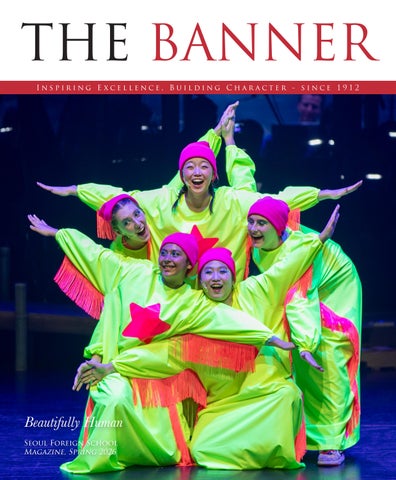
High School fall production The SpongeBob Musical. Photo by Nicholas Ha (G10)
Features 6
Humans of SFS Seven generations of students have called SFS home. What were they like? Let's find out!
16 32
The Invisible Threads We are saying goodbye and see you soon to our 130 seniors. Thank you for the memories! Ken Jennings ’92 Interview Announcing the SFS Alumna of the year 2026 and celebrating her 50th SFS anniversary.
4
From the Head of School and Board Chair
42
School Happenings Academics, Sports, and Arts
62
Communities
86
Class Notes
96
Advancement
106 Games
From the Head of School Dear SFS Community, There is something wonderfully unpredictable about being human. We make plans that do not quite work out, find ourselves in places we never expected to be, and occasionally cross paths with people we thought we had left behind years ago. Some of our most meaningful experiences are not the ones we carefully planned, but the ones that took us by surprise. Often, it is the smallest moments that stay with us the longest. In Pied Beauty, one of my favourite poets, Gerard Manley Hopkins, gives thanks for the things that don’t quite fit a pattern: All things counter, original, spare, strange; Whatever is fickle, freckled (who knows how?) At the beginning of this school year, we chose Human Connection as our schoolwide theme. In a world where technology is transforming how we learn, work, and communicate, it felt important to place our shared humanity at the centre of our conversations. This is not about resisting progress. On the contrary, we have much to gain from the possibilities ahead. But as we embrace them, we should also celebrate the wonderfully imperfect, unpredictable, and deeply personal experiences that make life meaningful. This edition of The Banner, Beautifully Human, captures that spirit particularly well. In our Elementary STEM classrooms, students discover that failure is not the opposite of learning, but often the beginning of it. Ken Jennings ’92 reminds us of the value of curiosity, knowledge, and embracing our quirks. And in our “20 Questions” with Dr. Piotr Kocyk, students get to know the person behind the title, including some rather unexpected opinions about cereal. I also somehow found myself contributing a “Head of School Ultimate Playlist”. I thoroughly enjoyed putting 4
it together, although I remain unconvinced that the world needed such an extensive insight into my musical tastes. I shall leave you to judge the editorial wisdom of that particular decision. Elsewhere in this issue, The Invisible Threads brings together stories of unexpected encounters and remarkable coincidences shared by members of our alumni community. They are a lovely reminder of how even the briefest encounters can bring back memories, rekindle friendships, or make the world feel unexpectedly small. As educators, we naturally spend a great deal of time thinking about outcomes, achievements, and preparing students for what comes next. All of that matters enormously. But education is also found in the moments between those milestones: the mistakes that teach us humility, the conversations that change our perspective, the friendships that sustain us, and the unexpected experiences that shape our lives. At SFS, we have the privilege of creating a place where those moments happen every day. A place where students can take risks, make mistakes, discover their passions, and form connections that may last a lifetime. Not because we expect them to be perfect, but because we recognise the value of each individual and the potential of who they may become. I hope this edition of The Banner brings a smile, perhaps a memory or two, and a reminder that some of the most beautiful things about being human are the ones we could never have planned. God bless, Colm Flanagan Head of School
The BANNER | From the Head of School
THE BANNER Seoul Foreign School Magazine, Fall 2026
From the Board Chair
Team Published by: Seoul Foreign School External Relations Department Editor-in-chief: Cyrielle Bazin Design and Photography: Juhie Suh Editors: Jae Hee Suh, AhYoung Chi Editorial Contributor: Sumin Park A special thank you to everyone who contributed to this issue.
Dear SFS Community,
Address Seoul Foreign School 39 Yeonhui-ro 22-gil Yeonhui-dong Seodaemun-gu Seoul, South Korea, 03723 www.seoulforeign.org
For me, the spelling bee started and ended not in Robb Hall but with family. The night before, while doing homework, I had yelled out to my father in the other room, asking whether “receive” was spelled “ei” or “ie.” He promptly answered “ie.” I thought “ei” looked better, but my dad was a professor. He must be right. When I lost, my mother decreed that as punishment, I would keep a diary every day that summer. “But Umma,” I protested, “Appa told me to spell it that way!” The Appa excuse did not work.
Unless otherwise noted, articles may be reprinted without permission — as long as they are not edited or revised — with appropriate credit given to “The Banner, the magazine for Seoul Foreign School.” *All efforts have been made to check details and consistency. Please contact communications@ seoulforeign.org with any questions. ** All content in this publication is original, unless otherwise stated. Artificial intelligence tools may have been used solely to enhance readability or clarity. The Banner magazine upholds the same standards of integrity we expect from our students, ensuring authenticity, responsibility, and transparency in every piece of published work. Cover:'The Sardine Devotees' featuring Grace Kwon, Monet Jung, Numa McKinley, Sophia Myers, and Aarvi Singh, from The SpongeBob Musical, the high school fall production. Photo by Nicholas Ha, Grade 10 student.
When I was a third grader at SFS, I came in second in the school-wide spelling bee, on a word that was crazy simple: “receive.” I had spelled “maharajah” and other much harder words perfectly, but I stumbled on this one. As I made the walk of shame from the stage of the old Robb Hall back to my seat, my homeroom teacher whispered to me, “i before e, except after c.” But what she said next was more memorable: “The teachers were running a pool for the winner. I bet on you.”
What stunned me most, though, was Mrs. Goodale’s bet. Besides the shock that our Christian school’s teachers were gambling (!), and on student achievements (!), I had never known a teacher to place that much faith in me. I suspect I was the odds-on favorite in that pool, but I don’t think a teacher had ever, before or after, believed in me quite so openly. Our theme for this issue is “Beautifully Human,” and the spelling bee had it all: a fallible father, an immovable mother, a reluctant diarist, and a teacher whose bet mattered more than any prize. I went on to win many first-place prizes at SFS, but placing second that day was a blessing. Nearly fifty years later, I still carry Mrs. Goodale’s faith with me. Best wishes for a happy, and beautifully human, holiday season. Hyungji Park ’85 Chair of the Board of Governors
Fall 2026 | From the Board Chair
5
HUMANS OF SFS By Rohwi Ahn & Eugene Jeong
Grade 11 Students from High School PoV
Editor’s Note. Every day, we pass familiar faces around campus, but how much do we really know about the people behind them? Inspired by Humans of New York, the students of PoV set out to discover the stories within our own SFS community. Through interviews and portraits of eight students, faculty, and staff, they explored the experiences, challenges, and connections that shape who we are beyond our everyday roles. Some interviews were conducted in Korean, with students translating both their questions and the responses to bring these stories to life in English. Told in each person's own voice, these stories invite us to look beyond the familiar and discover what makes us beautifully human.
humans_of_SFS Seoul, Korea
humans_of_SFS My name is William Doubek, and I'm in Grade 11 at SFS. Before coming here, I lived in Malaysia for four years, and before that, I spent almost my whole life in England.
Something people might not expect about me is that I'm actually kind of shy. If you see me around school, I'm usually saying hi to people or socializing with friends. But there are times when I feel almost scared to talk to someone. I think socializing is a huge life skill, but it's also okay not to feel comfortable doing it all the time. When I first joined SFS, I didn't know anybody, so putting myself out there took a lot more courage than people might realize. Looking back, I think my first impression could have gone better. When you're new, people form opinions about you in the first few days, and those impressions can stick. I probably would have waited a little longer before trying to put myself out there. Timing is super important.
Photo and story by Rohwi Ahn (G11) and Eugene Jeong (G11)
What really made a difference was when a group of guys came up and introduced themselves to me. Until then, it had always been me reaching out to people, so that was super impactful. During my first few days, some students also invited me to join them for lunch. That small action led to a really nice friendship.
8
The BANNER | Feature
Now that I've been here for a year, I feel pretty well settled in socially. But something I'm still figuring out is who I want to be. I think who you are is who you surround yourself with, and as I enter DP, school is getting real now. If I want to excel in the future, I'll probably have to make some compromises, whether that's hanging out with friends less, playing fewer sports, or spending less time playing games. I always like to say, when you work hard, you have to work hard, but when you play, you also have to play hard. I'm still figuring out to what degree.
humans_of_SFS
humans_of_SFS My name is Jeun Wootak,
Seoul, Korea
and I’ve driven for SFS for the last 12 years. Every morning at six, long before any teachers or students arrive on campus, I’m already at school, getting the buses ready for the morning run. I’ve been driving school buses for almost 20 years now, having driven for a Korean elementary school for 9 years prior to joining SFS. What many people don’t know about me is that my career didn’t start out as a bus driver—when I was young, I started with repairing office machines. Then I got seriously ill and needed a major surgery, and afterward I started driving. Many people here don’t know this part about me. I think we bus drivers fade out of most people’s lives when the buses are not running. People imagine we only drive, but after the morning run, we follow a pretty busy routine that most people at school don’t know about. Typically, we start our day with breakfast, then inspections, cleaning, and vehicle maintenance on every bus. Once that’s over, it’s almost noon, and after eating lunch, it becomes time to prepare for the afternoon runs again. On some days, there are field trips, so we have to accommodate those requests as well. So yes, we’re busier than you might think!
A couple of years ago, my mother passed away. It was a hard time for me. My colleagues, understanding my hardship, began supporting me in the smallest but the most touching ways: someone quietly giving me a hug or a pat on the shoulder, or leaving a cup of coffee when I was tired. None of them were big gestures, but they gave me strength. I’m also still learning, despite nearing the end of my working years. Cars keep changing, especially electric ones, so I keep studying them to understand how I can do better with maintenance or keeping my students safe. I’m also nearing retirement, so I’ve begun wondering what’s next for me. At the end of the day, there’s still a lot of life left after this job.
Photo and story by Eugene Jeong (G11)
Our real job is keeping students safe, and that isn’t always easy. We carry children all the way from kindergarten to high school, and they all want to do different things. The little ones in front are chatty, while the older students in the back just want to rest.
Fall 2026 | Feature
9
humans_of_SFS Seoul, Korea
humans_of_SFS My name is Reina Choi,
and I teach IB mathematics in the high school. I think many students picture teachers as figures who always have the answers and have everything under control, but the truth is that we’re also learning, still making mistakes, and still worrying about whether we’re making the right decisions, both in and out of the classroom.
Photo and story by Rohwi Ahn (G11) and Eugene Jeong (G11)
I remember spending hours preparing a lesson hoping that it would allow students to understand a math concept easily, only to see my students get confused by it or respond in ways I hadn’t expected while designing the lesson. I used to get disappointed at myself when these unexpected moments happened, because I wanted every lesson to work perfectly. But somewhere along the way I realized that things don’t have to go perfectly to be meaningful, and that the unexpected moments are really where I learn the most, about teaching and about my students.
10
The BANNER | Feature
One of the bravest things I’ve done was present my experiences with the IB curriculum in front of a room full of Korean public school teachers, most of whom I assumed had far more teaching experience than I did. I was nervous, and I wondered whether I would be able to share anything meaningful with them. But instead of focusing on my nervousness, I realized that the reason I was there wasn't to show how much I knew, but to share my genuine experiences. In the end, the workshop went well, and it taught me that courage isn't necessarily about being the most experienced or knowledgeable person in the room, but about believing that your own experiences have value and being willing to share them with others. The things that carry me through my days are small, but I find them significant. Gestures as simple as a “Thank you, Ms. Choi” after class or a student telling me that they finally understand something I explained remind me why I became a teacher and allow me to keep pushing forward.
humans_of_SFS Seoul, Korea
humans_of_SFS My name is Minho Cho,
and I work as the Manager of Security at SFS. Looking at myself now, I am a big guy, and people may assume I am not very athletic. But I used to be quite good at sports. I once competed in a triathlon hosted by the Eighth United States Army and finished third. I am not what I used to be, but my passion for sports is still very much alive. When I joined the school soccer club, led by Kim Hyung-gil, I thought I could play as well as I used to. But once I got out on the field, I realized my body could no longer keep up with my mind the way it once did. These days, I care less about skill or winning and more about sweating and laughing with my teammates.
I am still learning about myself, and a few principles guide me. If something needs to be done by someone, I do it. If it is mine to do, I give it my best. If it has to be done anyway, I do it cheerfully. If it will need doing someday, I will do it now. I keep reminding myself of these principles, learning them, and continually working to put them into practice.
Photo and story by Rohwi Ahn (G11)
Being where I am requires courage too. When I first started working here, I was very shy, and approaching other teachers and colleagues first was not easy. Now I make an effort to be brave, greeting people and starting conversations myself. I am still a little awkward at it, but I enjoy the process of growing closer to my colleagues. Family has always been my greatest source of strength. From the moment my older daughter and younger daughter were born, my life became more meaningful and happier. My two daughters are what drive me to keep striving to become a better person.
Fall 2026 | Feature
11
humans_of_SFS Seoul, Korea
humans_of_SFS My name is Aidan Kong,
and I'm currently a senior at SFS. I've attended SFS since I was young, so I've developed a lot of long relationships with people from the Elementary School, British School, and Middle School, including teachers and even younger siblings of my friends. Being able to find people to talk to anywhere around campus is something I really enjoy. One thing that didn't go the way I hoped was during my freshman year, when I injured myself pretty badly a few days before volleyball tryouts. I wasn't able to try out at all, and it made a really big dip in the start of my high school journey. But because I kept trying to convince the coaches to let me participate, I ended up getting to know people from the Athletics department much earlier than I otherwise would have.
Photo and story by Rohwi Ahn (G11) and Eugene Jeong (G11)
As I've gotten older, I've realized how important those relationships with teachers can be. When I was younger, I thought there was a clear boundary between students and teachers. It actually took a lot of courage to approach them in a more playful, personal way. Now, as a senior, having teachers I can comfortably talk to about college applications, grades, or even my mental health feels really relieving. They're trusted adults who understand what we're going through at school.
12
The BANNER | Feature
But something I'm still learning is how to let go of things. I'm a little ambitious at times, and I often hold on to more than I can actually manage. Coming into senior year, I tried to balance extracurricular activities with doing well academically, without realizing how much my lifestyle was deteriorating. Some nights, I'd work, lie down for two minutes, and pass out for the entire night. I know that letting go of some things would make life easier, but there's always that hope that I can do everything well. I'm still learning to make peace with the fact that I can't do everything great. I think ambition is good, but we're human, and there's a limit to how much we can handle.
humans_of_SFS
humans_of_SFS My name is Dana Cha, and
Seoul, Korea
if you’ve seen me working as a producer for SFS productions, especially helping with costumes and designing posters, you’d probably guess I studied the arts. Most people find it surprising to find out that I never did. I studied pre-med, went on to dental school, and later earned a master’s in applied linguistics. Maybe this science background is why I love robotics and support our school’s VEX team. I’ve always loved learning, and along the way I’ve picked up several musical instruments and a paintbrush. My path to working at SFS wasn’t a straight line. My first job was over 20 years ago at the Tokyo Korean School, where I taught for six years until my son Alex was born. After coming back to Korea, I spent three years at the Korean Scholarship Foundation and five at EBS, the broadcasting company. But my passion for the performing arts and various activities at SFS really began when I was a parent who loved volunteering, especially helping with costumes for theater productions. When a position opened in performing arts, I applied and gave up my previous career. I’d always loved working in schools, and here I finally felt the warm interactions with students that I never truly found at the front of a classroom. Here, I realized that as much as I teach the students, I learn a lot from them too. Years ago, a student I taught all the way back at TKS told me I was the reason that she decided to become a teacher. I think that educators severely underestimate the difference we are able to make in students’ lives, and I always try to make a good one every day.
After almost five years of supervising VEX, I’ve watched beginners grow into builders. One student told me he initially joined robotics only because his mom made him. Now he’s really into it, and I am proud of his personal journey and the progress he was able to make. My goal is simple: to retire peacefully, with every student safe. Until then, I’m happy to keep learning from them.
Photo and story by Eugene Jeong (G11)
Courage, for me, is saying no. I want everyone to be happy, but I’ve learned that being kind doesn’t always mean saying yes, even when I feel bad about it.
Fall 2026 | Feature
13
humans_of_SFS Seoul, Korea
humans_of_SFS My name is Jee Hye Ha, and
I have worked at SFS since 1991. Working here was my second job. I also have a married daughter, which means I have a son-in-law! I can be impatient, but I have always tried to solve problems the right way, and I think that is why I have been able to stay so long. When I joined, the school had about 1,000 students and 100 teachers. Today there are 1,600 students and roughly 400 teachers and staff. That growth brought a great deal of extra work, and I had hoped things would run smoothly through it. There were times when the sheer number of people and the resulting workload made that impossible. Some moments asked more of me than people might realize. I care about the staff I work with and about how the school responds to them, so I sometimes had to raise necessary issues directly. Each time, it took more courage than I expected. I still hope that the staff who remain will receive better benefits in the future.
Photo and story by Rohwi Ahn (G11)
The person I remember most is Mr. Underwood, whom I met when I came for my interview in the spring of 1991. A few months later, when I started working here, I saw him in a worn undershirt with a towel around his neck. He was working through the hot weather with only a fan on, to save electricity. I have since worked under five heads of school, including Mr. Colm Flanagan, and Mr. Underwood, the first, is the one I remember best.
14
The BANNER | Feature
The person I remember most is Mr. Underwood, whom I met when I came for my interview in the spring of 1991. A few months later, when I started working here, I saw him in a worn undershirt with a towel around his neck. He was working through the hot weather with only a fan on to save electricity. I have since worked under five heads of school, including Mr. Colm Flanagan, and Mr. Underwood, the first, is the one I remember best. Honestly, I’m still learning about myself. I am not a simple person, but a multi-layered one, and by my own standards, I sometimes judge others too quickly. That will probably remain my homework. I hope to learn to see the world one beat slower, rather than only through those standards.
humans_of_SFS Seoul, Korea
humans_of_SFS My name is Won Lee, and
I'm currently a senior at SFS. Something people might be surprised to know about me is that I used to do gymnastics competitively. I went to a Korean school where I was basically a fulltime athlete. Later, I switched to competitive diving, and some of my former teammates even competed in the Paris Olympics. But out of every sport I've tried, volleyball brings me the most joy. I love it. Choosing volleyball wasn't easy. I started much later than other players, and I had to work two or three times as hard to catch up. I also had to convince my mom that I wanted to pursue volleyball instead of diving, which was something I was already good at.
That was a really difficult time for me, but it also made me realize how lucky I am to have such good friends. During junior year, we had a little friend group that would get together for sleepovers, bake, eat ice cream, and do stupid stuff. Those moments might not sound like much, but when I was struggling, they meant everything. I could just enjoy being with them without worrying about anything else. Now that I'm a senior, I want to be that kind of person for my underclassmen. I see so many of them as my little siblings, and I genuinely care about them. I hope I can be someone they feel comfortable talking to or asking for advice. I've attended eight different schools, but SFS has been special because of the people here. I'm sad that my time is coming to an end. I wish I could stay longer, and I hope I can keep these friendships even after I leave. 19 12
Photo and story by Rohwi Ahn (G11) and Eugene Jeong (G11)
During the summer between sophomore and junior year, I spent six weeks in Boston pursuing my dream of getting recruited for volleyball. I attended ten recruitment camps, mostly on my own, without family or friends nearby. It was exhausting and lonely. I would go to camp, study by myself, and then do it all over again. When I returned without a recruitment offer, I felt like I'd wasted my summer.
Fall 2026 | Feature
15
THE INVISIBLE THREADS
We asked alumni to share their “What are the chances?” SFS moments. What came back were stories of unexpected encounters, old friendships, new connections, and the many ways our paths continue to cross long after we've left SFS.
It started with a simple question:
Have you ever had one of those “What are the chances?” SFS moments?
Yunah Ough ’18
Maybe you unexpectedly crossed paths with someone from SFS somewhere in the world. Maybe you discovered an SFS connection you never knew you had. Maybe two seemingly unrelated parts of your life turned out to have SFS in common. We knew these stories were out there. We just didn’t know quite how many—or how different they would be. Some were exactly what you might imagine: two people, thousands of miles from Seoul, somehow finding themselves in exactly the same place at exactly the same time.
I sat outside while waiting for my friend when I looked up and made eye contact with a stranger walking by. We both did a double take and said each other’s names at the same time. I had run into a student who graduated a year after me at SFS. It turned out he had permanently relocated to Paris. I remember thinking: What a coincidence that two people from the same high school, who had never kept in touch after graduating and had moved to opposite ends of the world, happened to be in the exact same spot at the exact same time. If my friend hadn’t needed to use that café’s restroom at that exact minute, we never would have crossed paths.
Like Paris. David Park ’84 Yes, and it is a wild story. I was about 20, going around the world. My second stop would be in Paris. I thought I saw a friend whom I hadn’t seen since the 8th grade at SFS on the crowded streets of Paris. I called out, “Han?” Han Sull was his name. And to my surprise, he started looking around to see who called his name! This would not be the first time we met like this. After we graduated and were beginning our careers, my friends and I went out partying. Nightclub. We got a shared private room. And who was in the other shared room...Han... Have not seen him since. Haha.
18
In September 2022, I was on a Europe trip toward the end of my studies at the University of Melbourne. We were in Paris and one of my friends had to use the restroom, so we stopped at the first café we saw.
The BANNER | Feature
We chatted for a few minutes and went on with our day separately. What astonished me even more was that later that same evening, we ran into each other again at the Louvre!
And apparently Paris is particularly good at this.
Not every SFS connection begins with a chance encounter. Sometimes, all it takes is a familiar name in an unexpected place.
Peter Dorow ’79 When I was in fifth or sixth grade at SFS, I had a friend from Holland named Dirk Buitelaar ‘79. We spent quite a lot of time together. He enjoyed sports, and he had a fascination with aviation, especially his country’s flag carrier, KLM Royal Dutch Airlines. Dirk and his family soon left Korea, and we did not stay in touch. Fast-forward about 26 years. I was working for Northwest Airlines, and in 1999 we held our annual Sales Conference in Las Vegas, along with our partner airline, KLM. As I sat in a breakout session one day, I was scanning a list of conference participants when I came across the name: Dirk Buitelaar — KLM. My first thought was that perhaps it was a common name in Holland. But my curiosity got the best of me, and at a reception that evening I asked a KLM colleague to point out Dirk. As soon as I saw him, I knew it was the same Dirk. I walked over and introduced myself. He didn’t make the connection immediately, so I said, “Seoul Foreign School, Korea, sixth grade!” Then his face lit up, and we spent the next half hour catching up. Dirk and I stayed in touch for quite a while after that, reconnecting at conferences and even co-hosting a joint agency sales team meeting in Amsterdam.
The 1927 Yearbook
A chance meeting? Perhaps. But there are threads that tie SFS people together and make these encounters more likely. Many of us were and are drawn to international business and travel.
Fall 2026 | Feature
19
Wayne Kim ’95 Around 2010, I was a Public Defender in Virginia, outside the DC suburbs. I was in court when I saw another Korean attorney. First of all, there aren't many Korean attorneys practicing in courthouses, let alone doing criminal defense. It isn't exactly the make-your-parents-proud type of profession, especially since many of the clients may be guilty. We looked at each other, and the other attorney said I looked familiar. We went through the whole game. Maybe we went to college together? Law school? Neighboring schools? After fifteen minutes, nothing. I was ready to leave it alone. Then the other attorney asked, “Did you go to Seoul Foreign School?” Instant connection. Alfred Lee ’00, Suyong Min ’93, Duyeon Kim ’98, and Wayne Kim ’95.
It turned out to be Suyong Min ’93. I don't recall ever talking to her in high school. She was two grades above me, but in the SFS universe, that is enough. We've stayed in touch ever since. Another SFSer I didn't talk to at all in school, but forged a friendship with because...you know, SFS.
There it was:
threads. We had asked about coincidence. But as the stories came in, coincidence started to feel like only part of what people were describing. Sometimes, an unexpected encounter was just the beginning of a connection that might never have happened otherwise. 20
The BANNER | Feature
Kai Shim ’23 Sometimes one connection simply led to another.
And another.
And another.
About a week before a conference football game against Georgia Tech, Tyler Myung ‘23 reached out out of the blue to say he was planning to come to Boston for the game. We hadn’t kept in close touch, but after spending the better part of growing up seeing each other every day in the halls and in class, it felt completely natural to offer him my place. He took me up on it, and we had a great time catching up while I showed him around the city. Then, at the game itself, we randomly ran into Justin Chung ’20, who now works in Boston. He’s a familiar 선배 who also used to live in my neighborhood, and it was a fun surprise to spot another familiar SFS face in a stadium full of people. What stuck with me most is that wherever you go, around the country or the world, there’s a good chance someone from SFS is nearby, and more often than not they’re happy to welcome you in. It’s a special thing to have.
Inwoo Sohn ’24 While I was in San Diego, I found myself connecting with SFS in many unexpected ways through church. When I was church hopping, I visited a fairly small church of around 25 people and happened to run into someone who had also gone to SFS. She was three or four grades above me and had actually been in Angels Haven with Sophia, a club I was also part of. Later, after I settled into my church, we had a freshman introductory dinner at my pastor’s house. While talking with the pastor’s wife, I found out that her college roommate had gone to SFS! As I got to know more people at church, I learned that one of the guys happened to be Judah’s childhood friend. Then, at a college retreat called AMI West, I met students from churches in Northern California and discovered that they were friends with many SFS students too.
Fall 2026 | Feature
21
Sometimes, the connection is a familiar face or a shared friend.
And sometimes, it's someone you've never met, whose work has already found its way into your life.
Jordan Kim ’23 I'm working on a three-year Mellon Mays project at Washington University in St. Louis on courtroom narratives and racial meaning in interminority trials, focusing on People v. Soon Ja Du and People v. Peter Liang. Paula Yoo's Rising from the Ashes: Los Angeles, 1992 became one of my key sources and easily one of my favorite reads. Her work on the Du case and the broader context of the LA uprising has been deeply influential to how I approach the trial.
Paula Yoo ‘87 at the SFS HS Library during her visit in October 2024.
One day, while scrolling through Instagram, I noticed a familiar cover. SFS's account had posted it, announcing Paula as Alum of the Year. That's how I learned the author I'd been reading so closely was an SFS alumna. I tried to reach her through Instagram but couldn't get through, so last November I wrote to the SFS Alumni Office, hoping to ask her questions for my thesis. They introduced us, and Paula has been a huge help with my research ever since. What are the chances that a book I found for a project at WashU would lead me right back to SFS?
And sometimes, the degrees of separation become almost comical.
YJ Choi ’24 After I moved into my new university accommodation, I realized that one of my flatmates was Korean! With our shared cultural background, we immediately hit it off, sharing our experiences of being international students from Korea studying in London. Although my friend had never lived in Korea, we eventually discovered that her close friend, who attended another international school in Korea, was friends with my friend from SFS. So my flatmate was my SFS friend’s friend’s friend! The relationship with my flatmate felt so natural because of this connection, and I really felt how SFS could help me form relationships even with people I had never met before, in a brand-new environment. :) 22
The BANNER | Feature
But not all threads lead outward.
Janice and Jae, reunited years later
Some circle back. Janice and Jae celebrating Korea Day at SFS in Junior Kindergarten
Finding Our Way Back Yuna Han ’22 I was best friends with my classmate, Sofía Masondo, from around Year 6 to Year 9, and she left after we both graduated from the British School.
Janice Tsui ’24
I had deleted all my social media accounts to study for my IB exams, which also meant that I accidentally lost her number and email. We went years without being able to reach each other.
I started attending SFS in 2010 when I was in Junior Kindergarten (JK). I met a guy named Jae Seungjae Hong, who became my best friend from JK through first grade. We were in the same friend group and even in the same first-grade class!
After finally securing my spot at UCL, I bumped into her on campus during Fresher’s Week. Not only were we both at UCL, we had ended up in the same degree and the same student accommodation! We caught up again as if our friendship had never taken a break. I couldn’t have been more shocked and grateful that we crossed paths again after so many years.
Then he moved to Hong Kong. Since we were so young, we didn't really have our own way of keeping in touch, so naturally, we lost contact. I heard he eventually moved back to Korea and attended another international school, but we still couldn't reconnect. We went nearly ten years without talking. After all those years, we somehow randomly found each other again on Instagram and Snapchat. Like, what are the chances that I would find him on Instagram after all that time? We had grown up in different countries and lived completely different lives since we last knew each other as little kids at SFS. What makes this reconnection even more special is that we became best friends again, just like we were in Junior Kindergarten!! And now we live so close to each other! I'm in New Jersey and he's in New York City, so we've been able to see each other and hang out in the U.S. We call each other our homeboy (hb) and homegirl (hg) because we really brought our childhood friendship back together again.
Yuna and Sofía at university.
It feels like our friendship with each other came full circle.
Fall 2026 | Feature
23
Sometimes, reconnecting with an old friend feels as though no time has passed at all. But of course, time has passed. And sometimes, the surprise is realizing just how much life has happened in between.
Andrew “Pooka” Paik ’09 I left SFS in 2003 and finished growing up, at least geographically, back in NYC. For years, I didn't see anyone I had known there. My SFS friends belonged to a part of my life that felt very far away. Then, during my first year of college, I walked into a small deli on Thayer Street in Providence and saw AK. His name is Andrew Kim, but there were so many Andrews in our grade that we had long ago sorted ourselves by initials and nicknames: I was AP, he was AK, alongside Andy H and another Andrew. I hadn't seen AK since I left SFS nearly six years earlier. What struck me first was the sheer improbability of it. I had moved back to New York, eventually chosen Johnson & Wales, and somehow ended up in Providence, where AK was attending Brown. We had chosen the same city without knowing it. But I remember something else about that encounter too. Seeing an old friend after so many years is not quite the same as returning to the past. AK was still unmistakably AK, but he was also someone I didn't fully know anymore. Six years had happened to both of us. Standing there, I became aware not only of how much I had missed him, but of everything I had missed in between. And still, there he was. I've thought about that moment many times since. There was something beautiful in the fact that two lives could move so far from the place where they first crossed, take entirely separate routes, and then, for no particular reason, meet again in a deli in Providence. Maybe that is what SFS has come to mean to me with time. You can leave it. You can cross oceans, change cities, grow into someone your childhood friends have never met. And yet every so often, impossibly, someone from that old world appears. They say your name the way they knew it then. You recognize something in each other that all those intervening years haven't quite managed to erase. And, for a moment, the distance collapses.
24
The BANNER | Feature
Alex and his 2 older kids.
Sometimes the circle is almost literal.
Alex Paik ’04 I had just moved to a new apartment a few months prior. One night I was pushing a stroller with my two daughters back home after an evening walk. As I approached my apartment, I could tell there was another family coming up behind me, also with a stroller. As I entered the code for the keypad, the man and woman behind us caught up. They had come to the same section of the apartment building as me! So I turned around and said, with my most nonchalant face, “Hi Lynn.” Because in those last few seconds I had recognized a voice I’d known for many years. It was my classmate Lynn Chung ’04, whom I had not seen in 10–15 years. Laughter and shock ensued. Lynn was visiting from the UK with her one-year-old son to see her parents—who, it turned out, lived three floors above me. What makes this funnier is that shortly after I first met Lynn on the school bus in fifth grade, I ran into her outside our local bathhouse (me with my dad, her with her mom). We realized that not only did we live near each other, but we frequented the same bathhouse. How embarrassing! Who would have known that, literally 30 years later, I would for the second time in my life move into close proximity to her parents? The following day we caught up. She came over and met my wife, and our babies played together while we swapped baby-rearing battle stories over coffee. Hopefully our babies will become good friends and hang out whenever her family is in town (and in our building!) to visit the grandparents!
Fall 2026 | Feature
Lynn and her family.
25
A school is built to bring people together for a time. A few years. Maybe more. Sometimes much less. Then people leave. That is especially true of an international school. Families move. Teachers move. Students graduate and scatter. Friends who once saw each other every morning suddenly live on opposite sides of the world. But leaving a place is not necessarily the same as leaving behind the people we knew there. Sometimes it takes decades before we discover that.
Eunice (Paik) Kim ’91 Kasumi (Iida) Widner ’91 and I reconnected a few years ago after not seeing each other since graduation in 1991. We used to play volleyball together at SFS! We both ended up in the Bay Area for work, and we both have high school-age sons who play baseball. As it turns out, my son Colin's former travel baseball coach is also the high school baseball coach for Kasumi's son Liam. We've even had the chance to meet on the baseball field when our sons play against each other.
Across Generations
Leila (Wombacher) Knox, Eunice, and Kasumi — Class of 1991
26
The BANNER | Feature
Sometimes the connection reaches back another generation entirely.
Hazel (Ycu) Tanga ’88 When my son was a freshman at USC in 2018, he joined the dance team Chaotic 3. One weekend, he came home and said, “Mom, one of the dancers on my team went to an international school in Seoul!”
Danny Wang ’22 My grandmother was once interviewed by a woman about her experience as part of the Chinese community in Korea and its history here.
Naturally, I was so excited. When I was at Hazel and Caroline at graduation dinner. SFS, there were only two international schools in Seoul: Seoul International School and SFS. So of course, I made him ask her which one!
I later found out that the woman who interviewed her was actually the mother of my SFS classmate, Semin Kim ’22. I had no idea there was any connection between them beforehand, and apparently my grandmother and Semin’s mom still keep in touch once in a while. I always thought it was a pretty funny “What are the chances?” connection, especially since it came through my grandmother completely independently of SFS.
If you knew my son, you would know he has the selective memory of an ant. He either forgot or did not think it was important enough to ask.
And sometimes the thread was there before SFS entered the story at all.
Fast-forward four years to 2022. We were at a graduation dinner with his friends and their parents, and I finally met Caroline, the dancer who went to an “international school” in Seoul.
Charles Choi ’80
This time, I asked her myself. As it turns out, it was SFS! Class of 2017! And as luck would have it, we had just read in the newsletter that Mr. Jack Moon was retiring from SFS. Mr. Moon was my Biology teacher, and it turns out he was Caroline’s teacher too. Two SFS students, nearly thirty years apart, shaped by the same classroom. Today, Caroline is like family. Her mom, Jenny, and I are closer than ever, brought together by our shared love of BTS. We are proud ARMY Ajummas, and we have seen each other practically every year since our children graduated from USC.
Back in the early 1970s, when we were still living in Southern California, my father received a call from his college friend, who happened to be in town. They agreed to meet for dinner along with their wives. When they met, my mother saw Charles’ mother (left) and Mrs. Soonja Lee (right) his wife and realized that they were actually high school friends back in Korea, though neither knew who the other had married. At the time, I had no idea we would eventually be moving to Korea, much less that I would be attending Seoul Foreign School. As it turns out, the wife—my mother’s high school friend—was Mrs. Soon Ja Lee, who would later become a Math teacher at SFS. They remained close friends until my mother’s passing in 2023. I’m grateful that Mrs. Lee and my mother had a friendship that lasted over seventy years.
Fall 2026 | Feature
27
Seventy years. By this point, “What are the chances?” begins to feel like a very small question. Because these stories are not really about probability. They are about people. About the strange way someone can disappear completely from the landscape of our lives and then suddenly walk back into it. About the things we carry with us, even as time blurs so much else. The unmistakable memory of a face, a name, or a voice.
A Voice You Remember Edie Moon ’77 Years ago, in the ’80s, I taught a brilliant theatre student named Mia Yoo ‘89. I taught her in high school and directed her in a number of plays. She was at the top of her game—a natural. Years later, I went to see some theatre at a festival in Seoul with my colleague Patti Kearney. It was a version of The Trojan Women. It was immersive in every way and experimental in the best way. As I was waiting for the play to start, I heard the most remarkable voice singing in Ancient Greek. The more I listened, the more I was sure I knew that voice. As the lights came up and I could see more clearly, I realized it was my student Mia Yoo. Again, she was phenomenal. After the show, I ran back to find her and we had the most wonderful reunion. Soon after that, she became Artistic Director of La MaMa in New York City. Since then, I have met her there at a performance, watched her on the Tony Awards, and generally tried to follow her trajectory as an artist.
28
The BANNER | Feature
Jason Garwood ’05 Mr. Brunk was my fifth-grade teacher at SFS and my favorite, though you’re not supposed to pick favorites. (Many of us thought he looked a bit like Colonel Sanders.) He was warm but stern. Not scary, just no nonsense. I don’t remember this myself, but he once told my parents that on mornings when I got to school early, I skipped the playground and came straight to his classroom to sit quietly at my desk until the bell. Maybe I was angling for more Brunk Bucks. Around the time I finished college, I came back to visit campus. I hadn’t seen Mr. Brunk in over a decade, and he had long since left SFS and moved back to the States. I was walking the winding path between the middle school and the old high school, toward the Korean gate, when I ran into him. He happened to be visiting that same day. We caught up for a few minutes and went our separate ways, but we stayed in touch on Facebook for years after. I always hoped to visit him in Kansas someday. I never got the chance, and he has since passed away. If I had taken a different route to the high school office, or arrived a minute earlier or later, I would have missed him. I’m grateful I didn’t.
Perhaps that is part of why these stories stay with us. Most of the time, we don't know when an ordinary moment will eventually become important. We don't know which conversations will turn into friendships. Which classmates will reappear. Which teachers we will get one more chance to see. And after reading story after story about people finding one another again, another question began to emerge: Are these encounters really as unlikely as we think? Mike Chi ’96 wasn't so sure.
Mike Chi ’96 The first time I ran into an SFS alum I hadn't known at school was a few years after I returned to Korea in 2007. I think it was around 2013 or 2014, at a random New Year's get-together with several Korean-American expat friends. A friend I'd known from my years in LA introduced me to a young woman, and right out of the gate, he told me she was an SFS alum, Class of 2004! More than a “What are the chances?” moment, it was more of an “SFS does continue after my graduation!” moment. Sure, I'd run into classmates over the years, including people who graduated before and after me, but they were all people I'd known during my time at SFS. This was different. Here was someone who had experienced SFS years after I'd left, and yet we shared that connection. We all go off on our own adventures into the world, but SFS keeps going, with new students and new stories long after we've left. Meeting that Class of ’04 alum made me realize it wasn't so much “What are the chances?” but more “YUKSHI SFS!” We're everywhere! I remember during college and my professional life in LA, I'd occasionally meet people who would say, “Oh, you're from SFS? Gosh, you guys are everywhere!” At the time, I hadn't actually met an SFS alum “in the wild” other than people I already knew, so I was intrigued by these elusive SFSers! But think about it. For over a hundred years, SFS has been sending alumni into every corner of the world, and it's only natural that we'll run into some along the way.
And maybe that's why it's not so much a feeling of surprise, but one of familiarity and belonging. When you've grown up in an international school, you're often figuring out who you are while living within a culture that's not quite yours, but also very much yours. It's a shared experience that's difficult to explain unless you've lived it. So when you encounter someone else who understands that experience, there's something comforting, maybe even cathartic, about it. That “YUKSHI!” is a statement of relief. A feeling of kinship. A reminder that even though we come from different backgrounds and have gone our separate ways, there's something that connects us. And maybe it's also a kind of answer to that feeling of being alone when we first leave SFS and go out into the world. It's knowing that I won't be truly alone anywhere in the world because somewhere out there, there's SFS family who will gladly reach out and connect, to sit with us awhile.
Maybe he is right. Maybe, after more than a century of people coming through SFS and then scattering across the world, the remarkable thing isn't that their paths sometimes cross. Maybe it's how quickly a shared piece of history can make a stranger familiar. How a name, a teacher, a memory, a place— or simply three letters—can shorten the distance between two people.
Fall 2026 | Feature
29
And sometimes, the people we meet through SFS become far more than familiar. Sometimes they become part of the lives we could never have planned for.
The People We Couldn’t Have Planned For Jenny James, Former Faculty I met Chris Rydberg when I was hired onto the SFS High School faculty in 2006. I was a one-year sabbatical fill hire. I returned to the States after that year, but two years later Kevin Baker called and asked if I wanted to return to SFS. I was ecstatic and jumped at the chance. When I returned in 2009, I met lifelong friends and rekindled friendships with former colleagues. I was also asked to mentor a new hire, Myleah Walker. Myleah and I became great friends and colleagues...and she and Chris ended up falling in love and getting married within the year.
World together! Then our medical journeys crossed in another way. Chris, a Type 1 diabetic, began having serious health issues of his own. A conversation with Myleah about our experience eventually helped lead Chris to specialized kidney care in Florida. He later received the kidney and pancreas transplant he desperately needed. I never knew in 2006 that the friends and colleagues I met at SFS would be so integral in my life years later, or that our medical journeys would mirror each other through pregnancies, transplants, and lifelong friendship.
Fast-forward to 2013, when I became pregnant with my first child and Myleah became pregnant with hers. Our children were born three weeks apart: Samantha June on March 11 and my son, Noah Benjamin, on March 29. But Noah had severe medical issues. Their family has been a lifeline for us in times of great need. They were the first to contribute to Noah’s kidney transplant fund. Sammie and Noah play Minecraft weekly, even though they now live in Florida and we are in Oregon. When he’s in the hospital, he calls Sammie. Myleah and Chris have opened their hearts and home to us whenever we’ve needed a respite. Once, after a severe bout with norovirus, Noah was very sick and had lost 12 pounds. Myleah helped him put seven of those pounds back on with her homemade pancakes. Another time, after we overcame a kidney transplant rejection episode, we celebrated the win at Disney
30
The James and Rydberg families, San Diego June 2026.
The BANNER | Feature
We started with coincidence. We asked alumni to tell us about the moment that made them stop and think:
What are the chances? And they did. A crowded street in Paris. A name on a conference list in Las Vegas. A football stadium in Boston. A university flat in London. A voice in a darkened theatre. A familiar face on the winding path toward the Korean gate. But somewhere along the way, the question began to change.One alum had already put words to it before we did: “A chance meeting? Perhaps. But there are threads that tie SFS people together and make these encounters more likely.” For more than a century, people have come to SFS and shared a part of their lives here. They have scattered across cities, countries, universities, careers, families, communities and lives that could never have been mapped in advance.
And still, every once in a while, one thread crosses another.
Sometimes for a fleeting moment. Sometimes after thirty years apart. Sometimes long enough for two children to grow up together, too.
Maybe the remarkable part isn't that our paths cross. Maybe it's everything that can happen when they do. 1912 Fall 2026 | Feature
31
KEN JENNINGS ‘92 KNOWS A THING OR TWO: INTERVIEW WITH THE BANNER
F
You spent 11 years of your childhood at SFS, and you're back here today for the first time in more than a decade. Walking around campus, I'm sure the school looks very different. Is there anything you can still hold on to, things that haven't changed?
THE BANNER: We know what happened to Ken Jennings after SFS, but who was Ken Jennings at SFS?
I wanted a picture in front of the gate. The iconic Korean gate hasn’t changed. Chicago Pizza at the bottom of the hill hasn’t changed—unless the pizza is good now, in which case that would be a change. Other than that, I know I’m back, but it’s too different. There’s a melancholy nostalgia: I’m very happy to be back, but you can’t really go home again. Is this the Han(한)? Am I feeling the Han? I’m not sure.
rom SFS quiz team member to Jeopardy! champion and host, Ken Jennings ‘92 returned to campus in October 2026 for a long-awaited homecoming. Named SFS Alumnus of the Year in 2021, Ken was finally able to make his visit five years later, spending the day with students across all divisions. Before leaving campus, he sat down with The Banner to talk about his 11 years at SFS and the interests and experiences that shaped him. Our conversation covered everything from embracing our quirks to why knowing things still matters.
Ken Jennings: I was probably a pretty nerdy kid. My teachers would have known I was likely to grab a World Book Encyclopedia or a book of world records and read it for fun instead of paying attention in class. My second-grade teacher put me by the world map, and I looked at it all day instead of focusing on what was happening in the classroom. I was a curious kid who liked knowing a lot of weird facts, and that hasn’t changed. I remember the superlative I was voted for—something like “Loves SFS”—and I think that’s true. It was a novelty to have a Caucasian kid here for as long as I was who wasn’t a faculty or missionary kid. I really loved this place, and I still do. I think a lot about how I’d be a very different person without the atmosphere at SFS. 34
Was there a moment today that made you feel 16 again? I had so much fun with all the assemblies and games we did, but the moment that really took me back was when the bell rang and the kids started running for the buses. I remembered that I’ve had a recurring dream for more than 30 years about missing the SFS bus. I come back to SFS in my dreams very often, even though I don’t get to visit in person much. It hit me: this is the thing. I have to hurry. I don’t want to wait for the late bus. You spoke today about leaning into the things that make you weird. Is that something you've always believed in, and something you taught your kids as they were growing up? I tried to encourage my kids’ obsessions and rabbit holes. Maybe a previous generation of parents would have said, “No, you’re a little too into trains,” but I think we now understand
The BANNER | Feature
"I think today’s kids are much better at embracing what makes them weird. At some point, you realize that’s what makes you special. The thing that makes you weird isn’t a stigma; it’s an opportunity."
that there are many kinds of human brains. The adults in my life, my parents and SFS teachers, were supportive of my weird, geeky fascinations. I’m a big believer in that philosophy of life because SFS was also where I became a little embarrassed. You realize it’s not a hit with girls to know Captain Kirk’s middle name. Having nerdy obsessions can make you feel odd. Now, having come out on national TV as that kind of person, I feel that things were different then. People were embarrassed by something nerdy or weird about themselves. I think today’s kids are much better at embracing what makes them weird. At some point, you realize that’s what makes you special. The thing that makes you weird isn’t a stigma; it’s an opportunity. You’re absolutely right. It used to be uncool to be weird, but Gen Z and Gen Alpha seem to embrace being outside the box. Let’s get a little philosophical. When you think about the future of humanity and the kids you saw today, does that make you optimistic, or are you worried? My kids have taught me a lot about accepting your own weirdness and other people’s. I’m not worried about that. I do feel lucky to be part of the last generation that got a mature brain without a screen in my pocket to look at. There probably won’t be another generation like that. I worry about the things we all think about with technology: attention span, what AI might do to cognition, the economy, or employment. But I came away feeling hopeful about the kids I saw today. We played a lot of Jeopardy and quiz games, and you could see some people get the eye of the tiger. Some clearly had that thing. I thought, first, we’re going to be okay. Second, I’m probably
going to see her on Jeopardy! at some point. What’s something you became interested in for absolutely no reason that you’re glad you pursued? SFS was a great place, and hopefully still is, for students to explore their weird obsessions. It was a forgiving environment. Teachers let me get away with a lot if I wanted to try something unusual on a class project or put something weird in the paper or yearbook. In some cases, they found out afterward that I’d put something weird in the paper or yearbook. I became interested in modern graphic design when I was editing the yearbook as a senior. When I worked on the paper, I was interested in a late-’80s style of satire, like Spy magazine and Saturday Night Live. A lot of that showed up in my work here. To this day, I’m a design and typography nerd. I have a favorite font and a least favorite font. That interest in typefaces came from working on the SFS newspaper and yearbook. I have to ask: what’s your favorite font? I still love Garamond. The ’92 Crusader is set entirely in Garamond, and it’s a beautiful font. Unfortunately, some of the title fonts I picked haven’t aged so well. One is now the title font in the much-derided low-budget movie The Room. That’s the font I used in the senior section of the yearbook, so apologies to the Class of ’92. And your least favorite font? What’s the one? It’s not Comic Sans, but it’s that other really cheesy, handwritten farmers-market font. This is the kind of thing that makes me want to look it up on my phone. It’s hard for me to keep my hands off my phone when I can’t remember the name
Fall 2026 | Feature
35
"Knowledge creates connections and understanding that don’t come from information retrieved through Google or AI. In short, facts matter in many ways."
of something, which happens more and more with age. I don’t love Papyrus, but I kind of do love Papyrus. I saw a Comic Sans tombstone the other day. That’s a mistake you can’t come back from, I think. You mentioned reaching for your phone to look something up, and you famously competed against a computer. Today, with AI, computers can compile and retrieve information faster than the human brain. Do you think it's still necessary to know things in 2026? I do. I’ll always stand up for personal knowledge and expertise. Setting aside all the costs of AI, which are substantial—environmental, social, and economic—I do find some use cases compelling. It’s good at finding a certain kind of intangible, hard-to-pin-down thing that used to be difficult to search for. If you vaguely remember something, AI can be helpful. I do use it occasionally as a tool, even though I hate generative AI and what it’s done to creative fields. But knowledge in our heads has real value. There are more important cognitive tasks, like problem-solving and teaching kids how to think, but those tasks don’t work without fuel. The fuel is the facts you know. We’re all the sum of what we’ve learned, and it’s always better to know something than not to know it. When we make a decision, it’s based on the facts available to us. If we don’t have those facts from lived experience, we 36
probably aren’t going to sit down and Google all of them. If you meet someone new and they tell you where they’re from, Googling it doesn’t help in the same way as already knowing something about the place. It creates a bond if you can say, “I’ve been there,” or “I know who’s from there,” or “I’ve heard about that place.” Knowledge creates connections and understanding that don’t come from information retrieved through Google or AI. In short, facts matter in many ways. Jeopardy! is obviously a game about facts and knowing things, but viewers also become deeply invested in the contestants. Why does a program about knowing things create such a personal connection with the people viewers see on TV? For me, it was always the joy of seeing smarts and expertise rewarded, which real life doesn’t always provide—sometimes quite the opposite. Jeopardy! is a little half-hour microcosm where it’s a pure meritocracy. The smartest people are immediately rewarded in real time for knowing something. It feels good when something in your head pays off in reality. It’s validating. The whole show is built on that idea: it feels good to yell out an answer at the TV, and you admire the people doing it. Jeopardy! also benefits from its legacy. It’s more than 60 years old. People have fond autobiographical memories of watching it with their dad or grandmother, in a dorm with friends, or in other settings. It’s an institution at this point. You probably couldn’t start Jeopardy! as a new show today. No network would
The BANNER | Feature
Fall 2026 | Feature
37
believe in a show that smart, fast, and highbrow. Luckily, it’s a perfect format, and it has built a lot of goodwill over the decades. I take the job seriously because I know there’s a lot of institutional goodwill I have to honor. Building on that, how did you cope with the pressure the first time you were asked to host, knowing the show carries so much history and legacy and had such a charismatic host as its face for so long? The first time was particularly difficult because Alex had just passed away, only a few weeks earlier. It was difficult emotionally for me and everyone on the show, not to mention the viewers. It was unclear whether the show could survive that kind of transition. I felt lucky to have a little bit of a legacy connection with Alex. There was an illusion of continuity because I had shared the stage with him, and I benefited from that. The crew and staff were supportive of the new guy. They put me through boot camp and tried to teach me how to do it. That was the only way to survive. Hosting wasn’t in my skill set. But being a contestant on Jeopardy! is so intense and stressful that I really didn’t have stage fright. Being a contestant on Jeopardy! will cure your stage fright for the rest of your life. Today I faced SFS middle schoolers and didn’t bat an eye. They were loud.
What’s your favorite thing about meeting new people?
They were pretty loud. It seems to be their thing. It is their thing. You grew up as a third-culture kid. Do you think that changed the way you view the world? If so, how? 38
I didn’t realize it at the time, but growing up overseas was great. Later, I met people who had never left their hometown until college, and I suddenly understood the contrast. I came to Korea at a young age, six or seven. Suddenly, you’re dropped into a part of the world where, let’s not sugarcoat it, things are very different. But this culture is much older than ours and is doing great despite the differences. You internalize the idea that things can be different and still be fine. There’s a lot to learn. I think there are adults who haven’t learned that yet, but I learned it in second grade, thanks in part to moving to Korea and especially to SFS.
I like meeting new people because there might be a chance for a connection. They might know where I’m from, or I might know where they’re from. We might share an alma mater, a pastime, or an acquaintance.
The BANNER | Feature
"There was something about SFS beyond the curriculum or the faculty, who were all great. It was a very competitive learning environment, but also a place where students supported each other’s obsessions and eccentricities."
But what really gets my ears twitching is the possibility that they know something I don’t. What if this person is really into model railroads and I get to hear about them? It might be a Jeopardy! interview, and I get to hear about model railroads for 15 seconds. Or it might be a plane flight, and I have to pretend to be asleep if the person keeps talking about them. It’s interesting when someone knows something you don’t. It’s like discovering a new podcast: “I’m going to hear something new and learn something new right now.” On that note, what’s the last thing you learned—the latest addition to your catalog of facts? As I was heading into the library today, a middle schooler ran up to me with a fact about a terrifying spider from Madagascar. I said, “Thank you for letting me into your world and sharing that with me.” Most people would have to seek that out. If you’re the host of Jeopardy!, people might run up to you with a weird trivia fact or a trivia question. It’s a nice perk of the job. Does it ever get tiring to be known as the smart guy? You’re always disappointing people. My wife knows that the smart guy might not know where his keys are, or might call one of the kids by the dog’s name. Jeopardy! smarts and street smarts are very different things, and we’re all absent-minded sometimes. You spent a lot of time with our kids today, from elementary students to seniors. They obviously look very different from when you were at SFS. Did you see something in them that felt very SFS to you? The vibe seemed unchanged. Everyone was so happy. Maybe
I’m thinking of the moment when people were pouring out of classrooms, and maybe they were happy because they were going home, but they looked excited. Their genuine smiles reminded me of old yearbook photos of me and my classmates in elementary school. There was something about SFS beyond the curriculum or the faculty, who were all great. It was a very competitive learning environment, but also a place where students supported each other’s obsessions and eccentricities. I’m still on a group chat with some SFS friends. If we remember a weird book from the SFS library that we were obsessed with, we try to track it down online. We might spend weeks looking for the right title. Those formative experiences happen when you’re young, and they seem to happen regularly at this place.
Fall 2026 | Feature
39
What extracurricular activities were you involved in when you were at SFS? I did a lot of extracurriculars, some of them just for my transcript. I was on the student council at some point, but I wasn’t especially invested in planning the carnival. I was the Spanish Club secretary, I think, and we barely met. No disrespect to the Spanish Club, but I put a lot of time into the things I was passionate about. In my senior year, I probably spent more time figuring out the yearbook or coming up with some high-concept cartoon for the paper than I did on my IB diploma. In hindsight, maybe that was the right thing to do because I did fine. My grades were fine. It felt like my first job, a high-pressure job. There’s nothing better than having something you’re convinced is important—something that obsesses you. Our kids are still like that today.
40
I believe it. You were also involved in The Spirit. Yes. I was a cartoon editor, and then cartoon editor for The Spirit. A couple of my friends were the editors-in-chief. They knew I loved design, logos, and typefaces. We had a different Spirit logo every month that year, so I designed a new one—or one of us did—every month. We didn’t have to do that, and no one asked us to. I’m not sure anyone noticed. Do people read The Spirit? It’s unclear, but it mattered to us. I heard you got in trouble for your contribution to The Spirit. Do you mind sharing that? My run-ins with gentle discipline at SFS all came from having our hands on the wheel of the newspaper and yearbook and thinking, “What can we get away with?” We replaced the advice column in the newspaper with a gossip column. I was called into the principal’s office because a high school newspaper
The BANNER | Feature
"It’s normal to feel like an outcast, even if you aren’t one. You’ll generally overestimate how much of an outcast you are during your tween and teen years. The world is a wonderful place where you’ll find your people... But if you make that effort, you’ll find people who are into the same things you are, and it’ll feel like coming home."
probably shouldn’t have a gossip column filled with blind items about students, the administration, school policy, and which activities we thought were worthwhile. We got a gentle talking-to about how The Spirit should be a little nicer. They probably weren’t wrong. If you could meet the Ken Jennings who graduated in ‘92, what would you tell him that he wouldn’t believe? Tell him something he won’t believe? [Long pause] At one point, you’ll have a girlfriend. He probably would have keeled over. Hang in there, kids—it’s going to be okay. There’s someone for you, unless you’re not into that, in which case that’s fine. You’ll probably have a cat. There are probably students at SFS right now with very particular obsessions who think those things make them weird, outcasts, or unable to fit in. What would you want to tell them? It’s normal to feel like an outcast, even if you aren’t one. You’ll generally overestimate how much of an outcast you are during your tween and teen years. The world is a wonderful place where you’ll find your people. It might take some effort, and effort isn’t always a young person’s strong suit. But if you make that effort, you’ll find people who are into the same things you are, and it’ll feel like coming home. You’ve been incredibly generous with us today—with your time and your talent—and patient with everything we’ve put you through.
But seriously, you've been incredibly generous. Is that because it's SFS and you feel a lot of love for the school, or are you generally someone who's generous with your time and likes giving back? I like to be seen as someone who’s generous with his time. If you’re a public figure, I feel you owe it to the world to put on a brave face, whether you’re in the mood or not. But this was an easy ask. What a pleasure to come back to SFS. I provided a graduation address a few years ago, but it was during the pandemic, so I couldn’t come in person. I was the one bothering AhYoung Chi in the alumni office, saying, “Listen, I never got to come back to campus. When do I get to come back?” AhYoung and everyone else here were lovely to work with. I feel like you did me a favor. The least I could do was moderate some quiz games and spend time with the kids, which was a genuine pleasure. Last question: can you give us one random piece of trivia? As I understand it—and it’s not my field—koala fingerprints are indistinguishable from human fingerprints. You can’t tell them apart. It’s not very practical information unless you’re a koala criminal—or a human criminal trying to frame a koala. But that’s what’s beautiful about trivia: it can be impractical. A fact can enrich you and broaden your world even when you know you’ll never use it. Thank you so much. That was really fun. 19 12
Thank you for noticing. I’m a peach. We can all agree. Fall 2026 | Feature
41
Acad emics
STEM:
Built to Fail, Designed to Learn By Rachelle Ryness
Elementary School STEM Coordinator / Digital Learning Specialist “We learn wisdom from failure much more than from success. We often discover what will do, by finding out what will not do; and probably he who never made a mistake never made a discovery.” — Samuel Smiles, Self-Help (1859)
I
n the world of academia, the focus is frequently on achieving high grades or excellent test scores because that is what is considered “success.” Attention is given to the end result: the diploma, the trophy, the award, the published novel, the visible signs of success. Sometimes, though, in our pursuit of excellence, we forget that the failures encountered on our journey matter as much, sometimes more, than the success itself. We are quick to define failure as the opposite of success, when in actuality, it is not. In elementary STEM, failure is expected. Failure is part of the learning process. To begin the year in STEM, all grade levels were given various engineering challenges. One challenge for grades 2–5 was to build two matching structures with wooden blocks and index cards as a table group. There were four parameters for the construction of the matching structures: • First: The structures had to each be built on their own piece of A3 paper, and the papers for each structure could be any distance apart but could not touch. • Second: Every wooden block (both rectangular prism and cube) and index card must be used. • Third: No wooden block or index card could touch the bare surface of the table; blocks and cards could only rest on the paper or on other blocks and cards. • Fourth: The structures had to be a symmetrical pair, either clones or mirror images. An additional factor in the challenge was that while each table was given exactly 40 index cards, the number of wooden blocks was not the same. Some tables had an even number of both cubes and rectangular blocks while others had an even number of one shape and an odd number of the other, or an odd number of both shapes. Students were given 20–25 minutes to
42
build their structures, with part of that time spent planning as a table group how they were going to use the materials to meet the parameters. At the end of the build time, all students did a gallery walk so that they could see how their classmates responded to the challenge. While some tables were able to successfully meet all four parameters, not every group was able to meet all four, and they technically “failed.” For some, the failure was that they didn't finish building their structures because one or both of their structures collapsed while being built and they ran out of time to fix it. For others, they failed to figure out what to do with the odd number of materials and made structures that were not matching. Those failures stopped being failures during the discussion after the gallery walk. Students were able to identify what they learned from the experience and share strategies they gained from observing what their classmates did to meet the parameters. In the end, no one failed because they walked away more knowledgeable, more experienced, and better prepared for the next challenge. Educators are asked, “What are the criteria for success?” for lessons, activities, projects, and assessments. Criteria for success is necessary to know how to measure growth. The criteria for success in STEM are: 1. Did you try your best that day? 2. What did you do when something didn’t go the way you expected? 3. Can you explain something you learned? Sometimes in STEM, students will make things that don’t work the way they wanted or don’t look like a perfect model, and that is okay. They will try things and they will fail. Those failures are just as important as any success. In STEM, failure is expected because failure grows the traits that are the most beautifully human: creativity, perseverance, and resilience.
The BANNER | Academics
Fall 2026 | Academics
43
Acad emics
Forest School:
Beautifully Balanced By John Kett
British School Assistant Principal
W
hen Miss Sarah Patterson and I first shared an idea for enhancing the curriculum offer at Seoul Foreign British School with members of the Senior Leadership Team, one piece of feedback that stood out to me was a comment from the Head of School who had noticed how the Forest School approach is not linked to technology. In our conversation, there had been no mention of screens, applications or AI tools. In a world where so much of the conversation recently has been about how technology should or shouldn’t be a part of the ‘what’, ‘how’ or ‘why’ of educating young people, Forest School, for all intents and purposes, is about connecting people with the outdoors and extending one's gaze from a screen a few inches in front of them to look more deeply and broadly in an environment without walls; to engage with curiosity and wonder in an environment beyond the safety of the classroom or homes we live and work in. To be clear, this is not to say technology = bad, being outside = good. The move to ensure Forest School as part of our curriculum is about protecting time for the things that matter, and to support the intention of balance in the educational offer.
44
I would be concerned by any educator who advocated wholly for a curriculum comprised of outside, Forest School, experiences (delightful though this may sound!), as I would be of an educator who championed only screen-based education. Surely it has to be a balance, and not even a balance of these two things but of all the great things we are able to offer young people as educators that ultimately help our children grow as respectful, curious, informed and well-rounded people; ultimately it is about offering the education our children so richly deserve. For those who feel any degree of anxiety about the pace with which technological developments are advancing, you are not alone! In the last few weeks, headlining news items have highlighted several concerning developments, one such article included a warning from industry leaders about potential ‘catastrophic risks’ of AI, with some tech bosses from major firms advocating for a slow down to the developments in AI. The soothing mantra: ‘what makes us human will ensure our relevance’ does not necessarily offer the comfort with which the words are intended. Right now, we’re not especially good at what makes us human. The first time I heard we were living in
The BANNER | Academics
Fall 2026 | Academics
45
Acad emics
a VUCA (volatile, uncertain, complex, ambiguous) world was a decade ago, although the term originated in the early 1990s, and the last thirty years have shown no regression in the pace of change. Humans are not hardwired for dealing well with these levels of change. Our skills of slowing, considering, reflecting and taking care can be bypassed by a need to self-protect. Forest School alone is not the answer, but “it takes courage by individuals and communities to lead in a way that honours and protects the wisdom of the human spirit” (Brené Brown). Forest School is an intentional move by our leaders to foster deep connection, community, collaboration and thinking. The inspiration for this development is threefold. The first I have touched on already. Forest School is an enhancement that no other element of our curriculum perfectly matches. And yet it complements everything else we do, helping us to ensure balance in all things. To support this approach, the British School Forest curriculum has been carefully mapped using the ICA model of curriculum design, placing the learner at the centre and connecting to three core components: subject (knowledge, skills and understanding); international (global competence), and 46
personal (our core values). The second inspiration for Forest School is more practical. Geography. The forest is right there. A literal stone’s throw from our building, few schools I know of have such immediate and easy access to a resource as SFS does to its forest. A little further away and a short amble, Ansan Mountain also provides an incredible environment for learning and exploration by our students. And finally, returning to the curriculum design image with the learner at the centre, the most important motivation of all for developing our Forest School: the impact on children. Forest School creates a different set of conditions for learning, supporting wellbeing, attention, agency, curiosity, relationships, physical development and connection with the natural world, and there is a growing evidence base supporting these outcomes. The interconnected and holistic image of the tree with its roots grounded in a sense of self and wellbeing, the trunk symbolising the core learning experiences and the flourishing canopy representing growth and the fruit of service, for me, demonstrates all the key parts of this exciting development.
The BANNER | Academics
Fall 2026 | Academics
Beautifully Human: British School Mental Health Awareness Week - Dressup Day.
47
Acad emics
Building a Thinking Economy
Why the best learning sometimes happens when teachers step back By Timothy Fuller Bazin High School Teacher
W
hat does it really mean to help ‘the big kids’ think for themselves?
What does it really mean to help ‘the big kids’ think for themselves? As teachers (and parents), we spend a lot of time helping young people. We explain, encourage, reassure, and sometimes jump in with answers before they've had a chance to figure things out. But what if, occasionally, we're helping a tad too much? That's a question I've been asking myself after reading Peter Liljedahl's Building Thinking Classrooms in Mathematics. Although the book focuses on mathematics, it got me thinking about my own Grade 11 Economics classroom at Seoul Foreign School. Am I giving students enough opportunities to think independently? Or am I sometimes doing too much of the thinking for them? I've been experimenting with a few changes. And, rather unexpectedly, some of them involve Scottish dancing, whiteboards, and Pokémon stickers. IT STARTS WITH A DANCE Every year, my Economics students learn a traditional Scottish dance. There are awkward moments, confused expressions, and the occasional collision. As you might imagine, not everyone is particularly enthusiastic about dancing with
48
their classmates! But eventually, the steps come together, the laughter starts, and something wonderful happens. Students begin working as a team. We also sing songs about poverty, choices, and the challenges people face around the world. Who would have expected an Economics classroom to have a choir line by the second week of school?
The BANNER | Academics
Of course, Scottish dancing doesn't teach students much about inflation or unemployment. But it does teach them to listen, take risks, communicate, and support one another. And those skills matter enormously when the real academic challenges begin. MAKING THINKING VISIBLE Walk into my classroom and you'll often find students standing around large whiteboards rather than sitting quietly at desks. They're drawing diagrams, debating answers, making mistakes, and occasionally erasing everything to start again. That's exactly what I want. Whiteboards make thinking visible. Students can see one another's ideas, question them, and build on them. There's something wonderfully freeing about an answer that can be rubbed out and improved. It also allows me to see how students are thinking, rather than simply checking whether they've arrived at the correct answer. THE POWER OF NOT GIVING THE ANSWER One of the hardest things for any teacher, or parent, is resisting the temptation to jump in when a young person is struggling. When a student asks, "Sir, is this right?" my favourite response is often, "Is it?" Admittedly, this doesn't always go down well!
But there's a purpose behind the question. Instead of immediately confirming an answer, I want students to explain their thinking, check their reasoning, and develop the confidence to trust their own judgment. Sometimes I'll offer a hint. Sometimes I'll ask another question. And sometimes I'll challenge them to take their thinking a little further. There's even the occasional Pokémon sticker for those who rise to the challenge. The aim isn't to make learning unnecessarily difficult. It's to help students discover that they're capable of working through difficulties themselves.
Fall 2026 | Academics
49
Acad emics
"But can we have meaningful relationships with AI companions and most importantly, can it replace human relationships?"
GIVING STUDENTS ROOM TO CHOOSE
when a grade is awarded.
Students also have some freedom over where and how they work. Some prefer standing at whiteboards. Others work together on the floor, while some find a quiet corner where they can concentrate.
A disappointing result can be the beginning of improvement rather than the end of the story. It creates more work for us as teachers, certainly. But seeing students become more willing to learn from mistakes makes that effort worthwhile.
We also mix up groups in unusual ways. Students might be asked to find someone taller than themselves, someone who owns a pet, or someone who prefers red to black. It's a simple way to encourage conversation and help students work with different classmates.
FINDING THE RIGHT BALANCE
I've come to realise, though, that more choice isn't always better. What matters is giving students meaningful choices while keeping expectations clear. Freedom works best when students understand what they're trying to achieve. A TEST DOESN'T HAVE TO BE THE END Assessment is another area where we've been trying something different. For many students, a test can feel like a final verdict on their ability. One disappointing grade can overshadow weeks of hard work. Together with my co-teacher, Mr. Pollock, we've introduced opportunities on Thursdays for students to request another assessment and demonstrate what they've learned. It's not a free pass. Students still need to meet the same academic expectations, and these opportunities depend on the time we have available. But it sends an important message: learning doesn't have to stop 50
None of this means teachers should stop teaching or leave students to figure everything out on their own. Quite the opposite. Good teaching involves knowing when to guide, when to encourage, and when to step aside. And perhaps that's true of parenting, too. Whether we're helping with homework, watching our children struggle with a difficult decision, or encouraging them to try something new, there's a delicate balance between offering support and allowing independence. My classroom is still a work in progress. I'm constantly learning from students, colleagues, and sometimes my own mistakes. But one thing is becoming increasingly clear: our job isn't simply to help young people find the right answers. It's to help them become confident enough to ask questions, make mistakes, think independently, and discover answers for themselves. And that may be one of the most valuable things we can teach them.
The BANNER | Academics
Beautifully Human: High School Field Day. Photo by Joon Woo Jeong, G10. Fall 2026 | Academics
51
Acad emics
BEAUTIFUL OOPS!
LEARNING TO CELEBRATE MISTAKES What if making a mistake were something to celebrate rather than hide? In two of our youngest learning communities, teachers are helping children discover that getting something wrong can be an important part of getting something right. From enthusiastic classroom applause to a jar filled with mistakes, these small moments are teaching some big lessons about learning, confidence, and being beautifully human. 52
The BANNER | Academics
The Mistake Jar By Mari Stephenson Elementary School Teacher
Ev
ery year, as I walk down the quiet hallways toward my empty kindergarten classroom, I contemplate the one lesson I truly want my students to carry with them for the rest of their lives: that it is completely okay to make mistakes. On the very first day of school, I introduce my students to our classroom Mistake Jar, a practice my teaching assistant and I have developed over the past three years. Whenever we as teachers make an error, the children are encouraged to spot it. More importantly, they must also catch us in the act of correcting it, showing them that even the adults they look up to make mistakes and work to fix them. Every time a mistake is caught and corrected, we add it to the jar. And when it gets full, the whole class celebrates with a party! This simple tool completely transforms our classroom culture, turning mistakes into something to celebrate rather than something to fear or feel ashamed of. Our students internalize this mindset deeply. Audrey often reminds us that “mistakes are how we learn, Miss Mari,” while Ian shares that “mistakes are how we learn to be better so that we can become better and learn better.” This mindset directly supports one of our core Approaches to Learning (ATL) focus areas in kindergarten: Self-Management Skills. Within this domain, children learn to demonstrate perseverance, take responsibility for their errors, and recognize that making mistakes is a natural part of the learning process. By encouraging themselves and others through setbacks, they build a genuine growth mindset. Ultimately, by actively welcoming and celebrating mistakes, we teach our children that perfection is not the goal. Instead, true confidence, resilience, and growth come from trying, practicing, and learning from our failures along the way. Fall 2026 | Academics
53
Acad emics
Magical Mistakes By Elizabeth Li
British School Teacher
“M
rs. Li — I MADE A MISTAKE!” a child exclaims from the back of the class.
“Yeah!!!!!!!” replies the rest of the class, congratulating them and bursting into applause. It might seem like an unusual response to a mistake. After all, we live in a world where social media and society often encourage us to present only the most polished and perfect version of ourselves. We carefully choose what we share, what we say, and, sometimes, even what parts of ourselves we allow others to see. But what happens when we hide our mistakes? We hide a part of ourselves, too. We put pressure on ourselves to maintain a facade of perfection, as though making a mistake somehow diminishes our worth. Yet mistakes are an inevitable part of being human — and, more importantly, they are an essential part of learning. When we embrace our mistakes rather than hide them, we can recognise them for what they really are: opportunities to reflect, adapt, and grow. In our classroom, we have tried to change the way we think about mistakes. A mistake isn't something to be embarrassed about or something to hide. It is something to celebrate. It tells us that we have challenged ourselves, tried something new, and, perhaps most importantly, learned something along the way. Imagine if we all responded to our own mistakes with the same enthusiasm as my students did that day. Instead of thinking, “I got it wrong,” perhaps we could think, “What can I learn from this?” Because making a mistake doesn't mean we have failed. It means we are learning. And learning should always be celebrated. 54
The BANNER | Academics
Fall 2026 | Academics
55
Acad emics
What Helps When Things Get Difficult? By Rafael Jimenez
Middle School Learning Support Teacher
Let’s start with ourselves:
WHEN THINGS GET HARD, WHAT DO YOU DO?
Take a moment to look at the wheel above. It represents something we all use every day: our executive functions (EF). These skills help us organize our lives, manage our time, stay focused, regulate emotions, and adapt when things don't go as planned. Now, let’s try a little experiment. There are no right or wrong answers, and you don't have to share your choices with anyone. How well do you know yourself? Follow these instructions: • Grab a pencil and look at the executive-function wheel. Find your strength. Put a star next to one skill you feel confident using. ✴ • Find your challenge. Circle one skill you would like to improve.
• Ask yourself a question. When does this skill become difficult for me? Perhaps you're excellent at organizing your day but struggle when plans change. Maybe you are great at planning projects, but find it difficult to get started. Executive functions are essential throughout our lives. Research shows our EF abilities develop into early adulthood, but using them effectively requires adapting to different goals, experiences, and situations. Simply put, we will continue to find strategies that work for us throughout our lives. 56
Think about the last time you felt overwhelmed, forgot something important, or struggled to complete a task. Did you make a list? Set a reminder? Take a break? Ask someone for help? Now, here's a harder question: would you feel comfortable telling someone you struggle with organization, managing emotions, or simply getting started? Recognizing a challenge is one thing. Sharing it with someone requires vulnerability and trust. As adults, we use many strategies to manage daily life, often without anyone noticing. But asking for help, trying something new, or admitting a strategy isn't working can still be uncomfortable for all of us. SO WHAT IF WE MADE THESE CONVERSATIONS MORE NATURAL, FOR OURSELVES AND FOR EVERYONE IN OUR COMMUNITY? During a recent small-group activity with middle school students, I used this same wheel. Students first recognized their strengths, then privately identified something to work on, and gradually shared their experiences and strategies with one another. During this session, a student shared that completing homework independently in their bedroom was difficult. They would alternate between playing video games and working, and although that seemed fine to them, they disliked arguing with their mom whenever she checked on their progress.
The BANNER | Academics
Another student offered a simple suggestion: Why not finish your homework in the kitchen, show your mom that you're done, and then enjoy your free time? They tried the strategy for several weeks and loved it! What I find meaningful about this experience isn't just that they completed their homework. They got feedback from a peer, tried something different, and found a strategy that worked for them. In teachers’ words, this student took ownership of their learning. This reminds me that supporting each other isn't always about providing solutions. Sometimes, it's about creating opportunities to discover our own strategies. Living in Seoul, we're surrounded by convenience. We order groceries online, and things arrive at our doors. At school, we prepare extra pencils, notebooks, and materials when students forget theirs. Those supports are helpful, but convenience can
also remove some of the small moments where we learn to plan, prepare, remember, regulate, and try again. I sometimes think about this when I see older students frustrated because they arrive at an important test with an uncharged computer or without the materials they need. These moments are rarely about a lack of ability; they are often about skills that still need practice. The challenge for adults is not to remove support, but to use it wisely: to help without always stepping in, and to gradually hand responsibility back. So how can we prepare them for these moments without removing needed support? Harvard’s Center on the Developing Child emphasizes that executive function skills develop through supportive relationships, repeated practice, and a gradual shift from dependence to independence. In other words, independence is not something we suddenly expect from young people. It is something we help them rehearse, one small responsibility at a time.
Fall 2026 | Academics
57
Acad emics
The National Center for Learning Disabilities encourages families to start small, involve children in choosing strategies, and model the organizational habits they use. I believe opportunities to practice can begin with simple everyday activities. Here are a few I share with families to help their children navigate the increasingly complex world of executive functioning. INVITE YOUR CHILD TO THE GROCERY SHOP Ask your child to find a specific item while you follow along. This could be rice, laundry soap, or an unfamiliar item. As they become more confident, give them a longer list. Eventually, let them plan and manage a shopping trip with your support when needed.
strategies with you, too. You might be surprised! Perhaps independence isn't about learning to do everything alone. It's about understanding ourselves, developing strategies, knowing when to ask for help, and feeling confident enough to try something different. And that applies to adults just as much as it does to children. Before you pass this page, think about the skill you circled at the beginning. What is one small thing you could try differently this week? Who could you ask for help or share your experience with? What might you discover if you gave yourself permission to try, make mistakes, and try again? Maybe being beautifully human isn't about having everything figured out. It's about recognizing that we're all still learning, finding the courage to try something different, and helping one another along the way.
SET TIMES FOR INTENTIONAL ORGANIZATION AT HOME Organize a closet, bedroom, or study space together. Encourage your child to decide where things belong and create a simple system to make everyday routines easier. INVITE YOUR CHILD FOR A MEANINGFUL CONVERSATION Share something you're working on yourself. Talk about what feels difficult, what helps you, and what you might try differently next time. Give young people opportunities to share their own 58
References: • National Center for Learning Disabilities, Executive Function 101, particularly its guidance on organization, starting small, family routines, and modeling strategies.. • Center on the Developing Child at Harvard University, Three Principles to Improve Outcomes for Children and Families, and Enhancing and Practicing Executive Function Skills. • Doebel (2020), Rethinking Executive Function and Its Development, and the 2023. Nature Communications study of executive-function maturation.
The BANNER | Academics
Beautifully Human: Middle School back to school tug-of-war. Fall 2026 | Academics
59
Acad emics
“Catch Her and Run”:
When Change Runs Backwards One Senior’s Exploration of Ala Kachuu, Kyrgyz Bride Kidnapping
By Jina Song Grade 12 Student
E
ach summer in Kyrgyzstan, something changed. Some years, the untouched wildgrass of the Ala-Archa Mountains became a road. Other years, Seoul’s old orange Haechi Taxis turned up on Kyrgyz streets, as if they had migrated there for second lives as family cars. Visiting my grandparents at the rural college where they serve vocational missionaries—a professor and a nurse—I’ve spent countless summers with students and local kids in Ivanovka. Freshman year, a couple of girls and I wanted to buy a board game at the mall. One of the other kids called out after us to be careful, mentioning something about ala kachuu. Suddenly, the girls’ laughter faltered. “Don’t joke about that,” one of them said. I turned to Altynaia, a sixteen-year-old and one of my closest friends there. “What does ala kachuu mean?” “It means ‘catch her and run’ in Kyrgyz,” Altynaia explained. The other girls told me that ala kachuu usually involves the prospective groom and his friends kidnapping the “bride.” I struggled to grasp the distance between the nomadic custom I was hearing and the Kyrgyzstan I thought I knew. The girls I knew were studying at university, talking about business, travel, and their futures; some people at the college where we were staying knew victims, too. So the next summer, armed with my phone and a crash course in documentary-making scrambled from blogs and YouTube, I started filming. My first interview was with Ainora, a cook at the rural college known for her laghman and the
60
savory steam that filled the cafeteria long before lunch began. Altynaia and a few of the other girls lingered nearby, translating, clarifying, and occasionally taking over the interview with more questions. Ainora paused before finishing her story about a girl who used to be her classmate, kidnapped by her boyfriend decades ago: “When the girl refused to marry her captor, he killed her.” One interviewee described ala kachuu as something that had “changed” since ancient times. Meanwhile, Mahabit, one of the university students, pushed back instead: “Girls have all rights to education now,” she told me. “Girls have [the] right to choose their own life.” The pattern of an older practice losing ground to a younger generation seemed clear to me. But then the numbers started pushing back. Non-consensual bride kidnapping remains illegal today. Nevertheless, 82 reported ala kachuu cases were pending during 2020; only 3 had reached court. According to a 2022 UN report, bride kidnapping still begins nearly a quarter of all marriages in Kyrgyzstan. Ala kachuu began to look far from ancient. I scoured across the oldest Kyrgyz works, like the Epic of Manas, for traces of evidence that ala kachuu was indeed a tradition. Again and again, that trail kept ending in nothing. The gap grew stranger the more I read. In Osh, 64% of police officers had described bride kidnapping as “normal,” while 82% viewed bride kidnapping as “provoked” by the women
The BANNER | Academics
From When the Colors Seep In.
themselves. Change, apparently, didn’t always come with progress. Gaps continued to emerge between what institutions said, what people accepted, and what women actually lived. The Extended Essay, the IB Diploma’s 4,000-word independent research project, gave me room to keep following the question. I first wanted to use numbers to bolster what interviews could suggest from experience. I tried to turn the question into numbers, tracing what ala kachuu might cost a woman in education, work experience, and lifetime earnings. Since our first Extended Essay meeting, Mr. Bazin, my Extended Essay advisor, kept pushing me to ask what the numbers could actually prove and where they stopped. The data curves could show patterns, but not pinpoint how much ala kachuu itself shaped them. History helped me trace how ala kachuu became tradition. Economics helped explain why some families might still choose it. But the hardest questions remained in the gaps: why some police called it “normal,” why mothers defended it, and why women sometimes stayed. One break, I passed Mr. Trevor from the History Department in the hallway and somehow ended up explaining the question I’d been circling for weeks: why would anyone keep ala kachuu going? He listened, then put it more bluntly: “So, what are the benefits?” Some explanations made more sense than I wanted them to. I kept wondering whether I was forcing the evidence toward the conclusion I already wanted to hold. After a long pause, I admitted that bride kidnapping was about a third cheaper for
the men according to some sources—no dowry, just the cheaper kalym, or “ransom,” and no lengthy courtships, either. Tradition could explain coercion; discounted marriage could not make it acceptable. By senior summer, the cleanest answers started to feel less convincing. The story I thought I captured through a sixminute documentary as a freshman could no longer fit into four thousand words by senior year, tumbling far beyond advocacy. I returned with more questions, and asked them more slowly. Men and women spoke about ala kachuu with a jarring ease. One afternoon, an older woman listened to my questions from a wooden bench outside the cafeteria, then just shrugged. “Every good marriage begins with tears,” she said. She told me it was a Kyrgyz proverb. I wrote it down, then caught myself staring at the words. How had pain become something ordinary enough to turn into a proverb? The next time I return to Kyrgyzstan, I hope to find a change beyond wildgrass and taxi colors. In a way, I expected change to be a process of slowly abandoning old customs. Yet ala kachuu showed me that societies can reach back into history, reshaping it to return under the label of tradition. I hope that ala kachuu can change instead of repeating. Mahabit, a university student I had spent time with that summer, once put it simply: “We’re not objects to steal.” I hope one day those words sound less like a declaration and more like something too ordinary to need saying. When the Colors Seep In
Fall 2026 | Academics
61
62
The BANNER | Communities
Comm unities
20 Questions with
Dr. Piotr
Dr. Piotr Kocyk may be new to his role as High School Principal, but he’s no stranger to SFS. After seven years in our community, we thought it was time for students to get to know him a little better! We invited High School students to submit their burning questions for Dr. Piotr, whether serious, curious, or just for fun. We selected 20 for him to answer. From his approach to leadership to his favorite cologne and a rather controversial opinion about cereal, here’s what our students wanted to know!
1
Are you really Darth Vader?
No, I am not. That was my attempt to grab your attention and make a dramatic entrance. I am a warm and friendly person, but I also set high standards for myself and for others. So perhaps Darth Vader and I share one thing: ambition. I promise to use it for good.
2
I would probably be a nerdy, quirky kid. You would find me on the EJ Moon stage and in STUCO, most likely holding a clipboard and a color-coded schedule. I am an organizer and a man of action, so if there was an event, I would be the one asking, “Has anyone seen the sign-up sheet?” and then handing out the tasks. I’d like to think my classmates would call it leadership. They might call it something else, but they’d still show up, especially if snacks were involved. Dr. Piotr in childhood.
4
If you weren't a principal what would you be?
If you were a student at SFS, what would you be known for?
3
I had a few favorites: definitely biology, but also geography and history. High school was a time when I tried almost everything: drama, choir, AQT, orientation races, and dance. My school was strongly focused on academics, so we didn’t have much sport, and I’ll admit I am a little jealous when I look at what SFS high school students can do.
When you were a kid what was your favorite subject?
I would be a university researcher, a doctor, or a cook. I did seriously consider medicine, but physics and I had a polite breakup (yes, even Dr Piotr is imperfect!), and I never sat the medical school entrance exams. Instead, I was offered a place at university to study plant communities and the chemical signalling of forests. Yes, trees talk to each other, and they can be quite dramatic about it. My friends and mentors were stunned when I turned the offer down to become a teacher. Looking back, I did not leave the world of fascinating communicators, I simply swapped trees for teenagers. The signals are different, but the drama is similar. Along the way, I also discovered that I could be a decent cook and baker. My family and friends are generous test subjects, and so far nobody has filed a complaint. Still, whatever the alternative career, I know I can always come back to the classroom, because that is where my heart is.
Fall 2026 | Communities
63
Comm unities This may sound a bit odd, but I wanted to be more like you: a student who explores something new every day, challenges themselves, and feels creative. I craved a challenge and wanted to give my brain something big to chew on. A PhD is a huge commitment, especially while working full-time at school, so it taught me self-discipline and time management. Pomodoro sessions, chunking, interleaving, and brain breaks all sound very familiar to me! I learned a great deal about myself as a learner. It was challenging, but absolutely worth it.
6
If you could get insanely good at one thing what would it be?
I would love to speak several languages, read music, play an instrument, and be good at one sport, maybe swimming. For now, my ambition is simpler: to get really good at listening, being present, and working with people. That is a lifelong project, but I’m enjoying the training.
7
If you could borrow one biological ability from another species, what would you choose and why?
Dogs can sniff out diseases, including certain cancers, long before a doctor’s equipment can. Imagine being able to detect illness early and help someone get treatment in time. I’d also love to notice things that humans completely miss, like the smell of brand-new books arriving at the library or fresh baguettes baking at CRAVE cafe, which would let me be first in line every morning. Of course, there’s a catch. I might regret it, because a school hallway would hit my senses on a whole new level. With a dog’s nose, I’d smell every sports bag, every mystery lunchbox, and every cloud of body spray within fifty meters. Still, I’d be the first to know when the baguettes come out of the oven, so I’d happily take the deal, as long as I’m allowed to turn off my smell power whenever things get too gross.
8
What's your favorite color?
It is an easy one to guess: it is blue, but not just any blue. I like sapphire, steel, and Prussian blue.
9
What is your favourite perfume/cologne in your niche perfume collection and would you recommend others to try it? I like dark, sophisticated, unconventional scents, with a deep appreciation for sensuality, complexity, and atmosphere. I
64
have many favourites, but they share one thing: contrast. I like darkness balanced with sweetness, smoke with warmth, and complex ingredients. I look for a cologne with character, tension, and depth. In other words, I want a fragrance with a story, not just a pleasant smell. My recommendation is to try different profiles and find the one that speaks to you, not necessarily the one that attracts others. A fragrance should tell your story and be your own statement.
10
Which European football team do you support?
FC Barcelona, mainly because Robert Lewandowski played for them.
11
Important question: Do you put cereal or milk first? Explain your reasoning.
Always milk first. I cannot stand soggy cereal. My cereal must stay crispy and crunchy, and I will defend this position with conviction.
12
If you could pick a favourite grade, which one would it be?
Honestly, I can’t pick one. Grade 9 still feels like the bridge between childhood and adulthood. Grade 10 students amaze me with their growth and the unexpected passions that show up in the Personal Project. Grade 11 feels more serious, as students start making their university choices. Grade 12 is a rollercoaster of emotions, with good and not-so-good choices made almost every day. Each grade has its own character, and I enjoy it most when you are not afraid to show it.
13
What kinds of students do you like in our school? (not the common responses like hardworking students but students that grab your attention just for who they are) I like all of our high school students, but I have a soft spot for those who are wellbalanced, curious about others and the world, and ask lots of questions. Bonus points for the questions I can’t answer immediately.
The BANNER | Communities
Dr. Piotr in primay years.
5
What made you want to become a Doctor?
The hardest part is changing gears, sometimes every few minutes. Let me give you a typical morning. At 8:00 I am interviewing a brilliant teacher candidate and thinking about how lucky our students would be to learn from her. At 8:45 I am staring at a budget spreadsheet, trying to convince a column of numbers to cooperate. At 9:15 a student stops me in the corridor with a question so thoughtful that I forget I was on my way somewhere else. By 10:00 I am meeting with parents about a community event, and nobody has yet told me what the budget spreadsheet decided to do. A principal works with individuals, teams, systems, and communities, and each one speaks a different language. In one hour I might need to be a recruiter, an accountant, a counselor, and a diplomat, and I’m not always sure which hat I’m wearing when I walk into the room! What I have learned is that I am never bored, because no two days are alike. The unpredictability is also the hardest part. Some days the most important work is the one I didn’t plan, and learning to welcome that, rather than fight it, has been one of my biggest lessons as a leader.
15
What is a mistake you made earlier in your career that taught you a better way to lead?
Mistakes are by-products of learning. If you want to learn something new, you will make some. Early in my career, I made decisions driven by emotional impulse: anger, euphoria, or fear. I once answered a frustrating email within two minutes of reading it. It was a masterpiece of clarity and conviction, and I hit send feeling very pleased with myself. By the next morning, I had learned three new facts that made my reply look much less brilliant, and I spent the day politely taking it back. That was the day I realized emotions should never be the main driver of a decision, though they are an important signal. Now I wait for the feelings to settle, re-examine the situation, listen to others, and look for data. My rule of thumb is simple: if I want to hit “send” really badly, it can probably wait until tomorrow.
16
How do you make people listen?
I wish I had a magic formula! What I have discovered is that to be listened to, you first need to listen carefully to others. It is also about showing genuine interest and care. I try to stay
curious about people and connect with them by speaking their language, or simply vibing with them.
17
If you were an SFS student, what kind of teacher would you like to have? Qualities of a good teacher for you. I was lucky to have a few good teachers, and they shared three qualities: passion for teaching and learning, genuine care for students, and a strong desire to make a difference and help others grow. I believe good teachers are, first of all, good communicators. They are interested in people, curious about the world, and never afraid to say “I don’t know, let’s find out together.” Above all, I would want teachers who inspire students and truly connect with them, the kind you remember long after you have forgotten the homework deadlines.
18
If you had an extra $100,000 to spend on SFS today, but it could not go toward textbooks or test scores, where would you spend it? I would buy hundreds of board games, giant chess and Jenga sets, table football, canvases for drawing, and comfortable furniture, all to encourage students to spend time with each other rather than with their phones. And, because every great project needs a bit of indulgence, I would add a popcorn machine and a chocolate fondue fountain. For research purposes, of course.
19
What is your favorite event at SFS?
I love Christmas, so anything related to it: the Christmas Bazaar and the concerts. I also love graduation events, where I feel proud and a little sentimental at the same time.
20
What do you hope students say about you long after they graduate and leave this school? I hope our graduates come back to SFS and say: “We had a great time, and we learned far beyond the curriculum.” I hope they remember making friends, having fun, learning something unexpected, and feeling part of a community.
Fall 2026 | Communities
Dr. Piotr at prom.
14
What is the hardest part of your job that nobody ever sees or thanks you for?
66
The BANNER | Communities
Comm unities
Enduring Connections in Advisory:
The United Onions of 6WR By Roxanne Wong
Middle School MYP Teacher
O
ne of the most beautiful things about being human is the enduring connections made between people. Advisory time in Middle School is one of the best times to foster relationships. In Advisory, friendships are made, bonds are created, and social skills are activated in ways that are vital for a preteen or young teenager’s life. Having said that, there are a few rare times when an Advisory is put together and the myriad of factors somehow gel even more beautifully to create something that transcends being mere classmates into something more like magic. The United Onions of 6WR were just that.
and their parents once talking about how they seemed like an actual family. They had ideas and would follow through without zero teacher input. They organized activities that included everyone. Most importantly, they all somehow enjoyed just being with each other — talking, playing, laughing, planning events… it was really rare and special how truly united they were. In fact, they also created a group chat just for themselves that they used throughout the summer, and a few of them told me that staying connected through the group chat was one of the highlights of their summer!
Having been a Middle School teacher and advisor for almost a decade, I cannot take any credit for the magic that was sparked with the United Onions. Part of the beauty of being human is taking delight in the things that happen beyond our control. All I know is that I have never had a group of 6th grade students band together to create so many things outside of school time in such a cohesive and collaborative way, completely self-motivated and spurred on by their own recognition of being forces of change in the world.
Here is how the students described the magic of being a United Onion:
From the first month of school, it was clear that there was something different about the United Onions. They were the first 6th grade advisory I’ve ever known that decided to coordinate outfits for Picture Day… and managed to fully pull it off! A look at last year’s yearbook will confirm what Philip says below: the onion theme really carried throughout the entire year. There were times in the year when I would see the students disagree but then almost immediately resolve their differences in an honestly magical manner. I remember I sent an email to them
“We started as a name called United Onions. This name was not just a silly, humorous name for me. It was an illustration of who we were and what defined 6WR. We had a great sense of humor, and we were very delightful and bright all the time. We even launched a party at the end of the year to celebrate the advisory's end and Ms. Wong herself. Because of how unique and standout we were in the cluster of advisories, I think our spirit itself made United Onions so special.”
Fall 2026 | Communities
YOM U N S O U L
67
Comm unities “I think it was really nice because it felt more of a friend group than an advisory because we all played together and had fun together.”
“I think this group was really special because we all got along well even with mixed genders sometimes! I really enjoyed the time we were an advisory, Ms. Wong was a great advisor.”
CORA HOLBROOK
ANNIE WISE
“At first, many of us didn’t know each other. I personally never thought we would get along, since we were so diverse. I later realized I was wrong. We ended up finding many similarities among each other and always enjoyed working together, especially when Ms. Wong was included. What makes us so special is how, while we are all unique, we work together surprisingly well. We allow ourselves to learn from each other, and by the end of the year, everyone was able to evolve from an onion seed at the start of the year, slowly developing into a full onion! I truly enjoyed being a part of Ms. Wong’s advisory, and I don’t think any committee will ever be capable of topping the United Onions of 6WR.”
“Having our own onion theme was really ‘the advisory experience.” PHILIP SUH
One of the factors that fostered such a strong connection between the United Onions was the enthusiasm and support of parents behind the scenes. Here are some things the parents of the United Onions had to share:
EMMA HONG
“Being part of the United Onions was always something I looked forward to. Every single advisory class we would always have so much fun and we all shared ideas and this is like one of the first times [I’ve experienced this]. Our whole class didn’t judge and we all had fun. I think advisory was definitely one of the highlights of my year and I got to know a lot of people I didn’t already know. This specific group of people I didn’t really know and I didn’t know how I would get along with them, but it was overall really fun. Even without advisory anymore, we all still talk, which is really funny.”
“Being human is truly special when we can make those around us feel cared for and loved. Love is the ultimate source of energy—unlimited, powerful, and endless. The United Onions was truly one of a kind because every single member went above and beyond to look out for one another. I vividly remember the surprise party in June to appreciate Ms. Wong; she was over the moon! Moreover, nothing ever stopped Ms. Wong from showing how deeply she cared for every member of the group. The bond between everyone was undeniable, and as a parent, watching it unfold was deeply heartwarming. We feel so lucky to have been a part of it.”
CAITLIN WOO
68
The BANNER | Communities
S T E L L A K I M , E M M A’S M OM
“I used to think that advisory classes were just “filler” classes where students spent time without doing anything meaningful. But I was wrong. When my son was part of the United Onions, I saw him establishing ties with his classmates and his advisory teacher in ways that he didn't in other classes. The relationship was much more personal and deep. He even took the initiative to write a daily journal during summer break even though his advisory class was over. He told me that his friends in the United Onions were doing the same thing! This showed me that the relationships he built while being part of the United Onions was not bound by space (his class) and time (his school year). The relationships would last even after he moved up a grade and joined another advisory class. And to me this is what makes an advisory class special.” J E N N I F E R O H , J E R OM E ’S M OM
“My daughter was, and still is, deeply connected with the United Onions. When asked about her day, she would often respond with something that a fellow Onion did that was entertaining, or how the time in advisory was the best time of the day, or about how Ms. Wong played games with them and really understood their minds as middle schoolers. When it came to the end of the year, my daughter helped organize a surprise for Ms. Wong that included decorating the classroom, special treats, and a gift of a canvas with a sketched onion and all their signatures. Somehow they were able to surprise Ms. Wong without giving her any hints or letting her see the setup taking place. Throughout the summer following the school year, the chat remained very active and the students were checking in with each other, sending funny jokes, and chatting back and forth about the World Cup games. Now, as the next school year has started and the students are in different advisories, the United Onions remain strong and they often check in with each other. There was a student that I didn't realize my daughter knew, and when I asked her how she knew him, she replied, "Well, he's an Onion, so of course he's my friend." I have no doubt that the United Onions will remain close throughout their time at SFS.”
“The United Onions was a special place of personal care and attention providing a reprieve from the academic day. As a parent, I appreciated the positive upbeat emails. I especially realized the value of the advisory when the youth took it upon themselves to show their gratitude in the spring.”
S O P H I E H O L B R O O K , C O R A’S M OM
LU C I A W I S E , A N N I E ’S M OM
When I first heard about the theme for this issue of The Banner, I immediately knew I had to find a way to highlight the United Onions, and reading through the contributions from the students and parents further confirmed my thoughts. Their words reiterate how lasting friendships were formed in this wonderfully flawed, silly, and energetic mishmash of personalities that ended up being one of the most beautifully human experiences. I feel really lucky to have been able to bear witness to this experience and to be a part of this wonderful, enduring advisory.
Fall 2026 | Communities
69
Curiosity Walk by Mari Stephenson's kindergarten class into the forest at the back of campus.
Comm unities
Ready for the World: A Parent’s Perspective By Erika Lee SFS Parent
I
had the privilege to be a parent volunteer during an SFS Open House the other day and help interested parents show around campus. When they asked me why I chose SFS for my children, I didn’t hesitate to answer because the IB and SFS prepare my kids to compete on the global stage. I mentioned how the SFS team represented the Republic of Korea in the Global Round of the 2026 National Economics Challenge in Oxford, England, over the summer. Three rising seniors (Jayden L., Kyubin K. and Simi L.) and a rising junior (Sungwoo L.) competed against 25 teams from all around the world and represented themselves, the school and the country extremely well. I had the rare privilege to see these boys in action and I was greatly impressed not only with their performance but their maturity, acumen, team work and presence of mind as well. I was proud to see how they worked together as a team building on their individual strengths while supporting each other to achieve impressive results. I was also humbled by how dedicated they were to each other and to the process, how they worked crazy hours to do all the prep work to get ready for each day. I also am grateful to Mr Timothy Bazin, their economics advisor for the competition, to be available and guide the boys as needed at all hours of the day and night. All kids participating were smart, they had to be to be
70
invited to this round. However, the IB training gave our kids a clear advantage to be able to do a vast amount of research in a short period of time, synthesize that information and build a strong argument understanding not only the big picture but the various nuances of each argument/counter argument that could be made as well. Our boys won their Debate round with their defense of responses to disruptive innovation, and won “Best Speaker” and “Outstanding Delegate” awards. Our boys won the Critical Thinking round and those in the room who heard them and other teams told me later that our boys were a level above the competition. Our students were noticed by the judges, one of whom was an admissions officer for one of the colleges at Oxford. It seems SFS and the IB program train the kids for exactly these situations. Honestly, what better preparation for a changing world in the middle of a paradigm shift than the ability to research, think, and come up with creative solutions to complex problems on the global stage. Well done boys and well done SFS! My sincere hope is that our students will have similar opportunities to participate and compete worldwide in other disciplines as well. I am confident that our kids would do just as well as the economics team in science, design, writing, and everything else.
The BANNER | Communities
Fall 2026 | Communities
71
Comm unities
Mr. Flanagan’s Ultimate Playlist
" What an extravagance, and apologies for the audacity to impose my musical tastes on our community. However, the process of choosing songs that resonate with our theme of Beautifully Human brought me back to the 1970s and 80s when I would spend more time creating cassette tapes of my favourite songs than on all of my schoolwork. Interestingly, at least to me, once I'd whittled the list down from several hundred to below 30, I realised that pretty much all of the tracks contain a sense of melancholy and nostalgia. Perhaps that means one important part of being human is connected to those more reflective elements of life. If the theme had been 'Alive,' it would have been a very different list. I recommend the process. PS - if you don't love at least half of these songs, we could never be friends!" - Colm Flanagan
Listen on Spotify!
Seoul Foreign School · 29 songs, 1 hr 45 min
72
List
#
Title
Album
1
A Girl Like You Edwyn Collins
Gorgeous George
3:56
2
Miss You The Rolling Stones
Some Girls
4:48
3
Come Here Kath Bloom
Finally
2:50
4
Chan Chan Buena Vista Social Club
Buena Vista Social Club
4:18
5
Cheek to Cheek Ella Fitzgerald & Louis Armstrong
The Complete Ella And Louis On Verve
5:54
6
Everything I Am Is Yours Villagers
Darling Arithmetic
3:30
7
Petite Fleur Sidney Bechet
Les Années Bechet
3:30
8
All of Me Billie Holiday
Lady Day: The Complete Billie Holiday On...
3:01
9
There's a Rhythm Ron Sexsmith
Ron Sexsmith
3:11
10
Temptation Tom Waits
Beautiful Maladies: The Island Years
3:51
11
If... The Divine Comedy
A Short Album About Love
4:25
12
The Ship Song Nick Cave & The Bad Seeds
The Good Son (2010 Remaster)
5:14
13
Wade in the Water The Staple Singers
For What It's Worth
3:00
14
Across 110th Street Bobby Womack
Midnight Mover: The Bobby Womack Story
3:50
15
I Fall to Pieces Patsy Cline
Showcase
2:51
16
It Don't Mean a Thing Duke Ellington and His Orchestra
Ellington In Order, Volume 4 (1932)
3:10
17
In Dreams Roy Orbison
In Dreams
2:50
18
I've Seen That Face Before (Libertango) Grace Jones
Nightclubbing
4:30
19
That Leaving Feeling Stuart A. Staples
Leaving Songs
4:02
20
Amsterdam (Live) Jacques Brel
Olympia 64
3:22
21
Raglan Road Luke Kelly
The Best of Luke Kelly
4:17
22
Ghost Town The Specials
Stereo-Typical: A's, B's & Rarities
3:39
23
Tilt Scott Walker
Tilt
5:13
24
Life During Wartime (Live) Talking Heads
Stop Making Sense (Live)
5:51
25
You Should Be Dancing Bee Gees
The Ultimate Bee Gees
4:16
26
One Dove Antony and the Johnsons
The Crying Light
5:34
27
There Is a Light That Never Goes Out The Smiths
The Queen Is Dead
4:04
28
E lucevan le stelle Luciano Pavarotti
Puccini: Tosca - Highlights
2:56
29
Der Leiermann Dietrich Fischer-Dieskau
Schubert: Winsterreise
3:39
The BANNER | Communities
Beautifully Human: Pre-K Pumpkin Patch.
Fall 2026 | Communities
73
74
The BANNER | Feature
Arts High School Production
The SpongeBob Musical Reflections...
We asked some of the cast and crew members to reflect on their experience of putting together this year's High School musical The SpongeBob Musical.
Jaeun Oh G11
SpongeBob SquarePants
I’ve always been a part of SFS’s theatre program and this initially just felt like another year where I can audition for the musical and have fun with my peers. I never really watched SpongeBob as a kid but ever since I was younger I had a really weird talent of doing the iconic laugh that I actually used in the show. I’m so grateful to be able to play the main character within this musical and it only motivated me more when I joined the DP program and I could just act like a kid again during rehearsals. The most challenging part was pacing myself so that I wouldn’t burn out before or during the show. SpongeBob almost never leaves the stage during the show and I had to make sure not only to maintain the character but also to make sure that I was doing okay physically and mentally. Fall 2026 | Arts
I made sure to keep a good momentum and relied a lot on my other cast members since this show wasn’t just about the leads but also the ensemble to bring Bikini Bottom alive, by working together for almost every single scene which definitely helped me out a lot. For me, I’m most proud of the fact that I was able to go out of my comfort zone and just give the character my all without caring how others see or think about me. SpongeBob is a very outgoing and optimistic character and playing him really required me to just act like a kid even when it felt embarrassing to do. It really changed my perspective on how I should just stop caring about what others think and just do what makes me happy, just like what SpongeBob does. If being a part of this musical has taught me anything, it would be that I should stay in the present and just enjoy each moment like it’s the best day ever. 75
Arts something profoundly human in the act of storytelling. SpongeBob may have marked the end of that chapter for me at SFS, but my experience within this production also reminded me how fortunate I am to have lived it with a beautifully supportive community.
I would be doing a rap…? Plankton’s song, “When The Going Gets Tough,” also terrified me about the role. I’d never considered rapping; I don’t think I did the rap in its entirety in front of others until about a month into rehearsals. Looking back, I think the role of Plankton scared me a lot. Because of its ridiculousness and because it didn't come to me naturally. SpongeBob was my 13th show and I thought I had seen it all; I hadn’t. Being forced to get comfortable with the fear of making a fool of myself, and to do so in full confidence, is where I grew.
Mimi Kim G12 Sandy Cheeks
After four years on the SFS stage, I found my final chapter in an unexpected place: at the bottom of the sea, as Sandy Cheeks. What was really interesting about SpongeBob was how closely the production's message reflected the experience of bringing it to life. Much like the residents of Bikini Bottom, the cast came together with different personalities, perspectives, and strengths, each contributing something no one else could to create something none of us could have made alone. Rehearsals carried on as they always had: lines to memorize, choreography to clean, and another opening night approaching. Yet beneath that familiar rhythm was also the fact that I wouldn't get to do this again, here, with this group of people. So, what I'll carry with me is the accumulation of four years building imaginary worlds and finding 76
Rowan Thompson G12 Sheldon Plankton, French Narrator
SpongeBob the Musical took me a lot of time to warm up to. I auditioned anyway, because my desire to have a senior bow outweighed my apprehensions. I ended up receiving the villain role, Sheldon J. Plankton. I was delighted to play a villain after the better part of a decade with no villain roles; but it took me time to warm up to calling the role “mine”. But I vastly underestimated the show. It was funny, a little dark, and shockingly existential. The songs were catchy. And The BANNER | Feature
Edward Chung G10
Patrick Star, A Big Chorus of Sponges
I joined The SpongeBob Musical mostly because I had already been doing it since 7th grade and I had watched a recording of the musical. I mostly wanted
to be an actor once again because I have the most experience in that and also because it's just a fun experience to act in. I had to accept that even though I had an idea for how I wanted the show to look or what I wanted my character to do, I had to come to terms with the fact that I am not the director of the SpongeBob Musical and I have my own limitations that I have to deal with. This experience is most memorable because I was able to make a lot more friends than I thought I would be able to make, which is always fun if you know a lot of people backstage. It gives me a reminder of why I joined theatre and acting in the first place and gives me the motivation to come back every year.
breaks the fourth wall to physically interact with the audience was definitely a challenge I faced during this year’s high school musical. I was unfamiliar with how to make specific movement or acting choices since breaking the actorto-audience wall required improvisation and wit; I doubted my capabilities as an actor to bring this character to life. But being a performer on stage means to take another step outside of what I know I can do, and honing unfamiliar skills to make it my own. I tried exploring different ideas, improvising in different ways, and at the end it was such a unique experiment. It was truly a fun and awakening production and for a moment I sought a new side of myself.
how much of a valuable experience performing in the spring play was last year, and a lot of my friends from then were auditioning for this show and encouraged me to audition. A challenging moment for me was having to learn the dance for a particular song, which I think people from the cast can guess. It had been my first time ever dancing in a proper performance, or really dancing at all. At first, I was super nervous about having to dance in front of a theater full of people. However, as rehearsals progressed, I decided to fully commit myself to the bit. This is one of the many things I love about being part of theater–it forces me to do things I am not typically comfortable with and break the boundaries of what I think I am capable of doing, allowing me to grow as a person and a performer. Overall, being in this musical has been an amazing, memorable, valuable experience for me. I find being part of such an epic production and bringing what I can to the table to be really fulfilling, in a way that is different from being part of any other team. The community within this musical has become one that is extremely close through the wild journey that we went through together to pull off this show. Every success, mistake, tear, laughter, rehearsal, and performance with them are moments I will continue to cherish.
Monet Jung G10
Patchy the Pirate, with 7 other roles
Playing the role Patchy the Pirate, who is an immersive character that
Toby Kim G10
Performing on stage surrounded by a set bursting with color, blaring stage lights, and cast members I've gotten to know so well over the past months is truly exhilarating. This was an experience with many challenges that forced me to grow, but ultimately was filled with joy, love, and a sense of closely knit community and friendship.
Old Man Jenkins, with 5 other roles
At first, I was really hesitant about joining the musical this year. Ultimately, I decided to audition after remembering Fall 2026 | Arts
77
Arts Taehwan Kim G9 Violin, Pit Orchestra
Something that motivated me to join The SpongeBob Musical pit band was my sheer passion for music. I love playing the violin, and I felt that the pit band would be a good opportunity to explore that passion further. One challenge we faced was matching our tempo to the actors on stage. Unlike a traditional orchestra where the conductor maintains the tempo, we had to constantly adjust to the cast’s singing and dancing. Through this process, I’ve learned the importance of teamwork and flexibility. Looking back, this experience was meaningful because it allowed me to appreciate a part of the musical that often goes unnoticed. Most importantly, we had lots of fun playing music together.
Junxi Lui G9
Jiyu Lee G12
My motivation to join the SpongeBob Pit Band was to practice my skills in cooperating with other people on stage, especially this time with both the pit and the cast. I could use this not only to practice my music skills, but also my listening skills and the ability to play together. There were several moments where it felt challenging, including times where I could not keep up with the pit and kept jamming wrong notes into the keyboard. I then started to look at Mrs. Johnson's gestures and the people around me, and slowly, I found the right feeling and pace. Looking back, I am proud of my improvement on cooperating with other people in a band, and I'm sure I’ll carry this memory with me for a long time.
As someone who's been doing Crusader Live for four years, I knew I wanted to spend my senior year managing one of the school's largest productions.
Keyboard, Pit Orchestra
78
Stage Manager, Crusader Live
Between building Bikini Bottom and filming the actors during dance rehearsals, I think the biggest challenge was the time crunch of getting everything ready. This year felt like it went by much faster, and the production required so much attention to detail from everyone involved; while it was really exhausting at times, I think it led the cast to support each other so much more. This year, being my last musical at SFS, was really special, and I think I'll never forget how amazing and passionate my last ever group of actors was.
The BANNER | Feature
Hara Colton G10
Philip Yoon G12
Stage Crew
Assistant Light Designer & Playback Operator
I joined The SpongeBob Musical because I love how lighting can shape a story without saying a word. This show was particularly exciting: Bikini Bottom demanded a world that felt playful, chaotic, and somehow believable. The challenge was making all those shifts happen seamlessly. A cue could look perfect in rehearsal, then feel completely different once actors, music, and scenery came together. I learned to listen as much as I watched, adjusting to the people around me rather than treating the show like a sequence of programmed instructions. What I’ll remember most isn’t any single lighting effect, but the moment everything clicked: dozens of students, each doing something different, creating one world together
Joon Woo Jeong G10
I joined Crusader Live because I like the idea of working behind the scenes to keep things running smoothly, so that the only time the audience really recognizes that you’re there is at the end of the show, when you’re taking your bow and they think to themselves, “Who are you?” Of course, there were challenging moments during both rehearsal and actual performances alike. Everyone in the crew, pit and cast alike has to admit they messed up at least five times (if not more…) during Spongebob the Musical, but I learned that even in the face of these mistakes, the people around us are able to adapt and work together to move past problems and create a result that we can still be proud of. That will always be the most memorable part for me: growing through our mistakes and sharing these experiences together. I love seeing a community form throughout a production, with people who are strangers at the beginning and almost family at the end.
Assistant Stage Manager, Crusader Live
I chose to become Assistant Stage Manager after experiencing our last year’s musical Beauty & the Beast from backstage. When being behind such a production, inevitably some of the magic on stage is lost. For every blackout, some stage prop goes out, and you get to see actors exiting and trying their absolute best to change costumes before their next entrance. Even when something on stage wasn’t cleared properly, or someone’s costume got sent to the other side of the stage, I enjoyed it all. I think only having three shows makes every mistake more regrettable, but also gives me the idea of “There’s nothing we can do about it now.” Especially for our last show. We can’t always choose perfection, and sometimes just have to let it all go.
79
The Fall BANNER 2026 || Alumni Alumni
79
Alu mni
What Are the Chances? We asked. You answered.
When we invited SFS alumni and former faculty to share their “What are the chances?” moments, we heard stories of unexpected encounters, surprising discoveries, and coincidences in places near and far.
This happened a long time ago—1980 or 1981. I had graduated from Colgate University and was attending Cornell for my MBA. I went back to Colgate for either Homecoming or Alumni Weekend and was standing outside my favorite bar, The Olde Stone Jug, when I saw a friend of mine who had graduated in 1978.
Greg, Grade 9 (19
Gregory Siegelman ’75
72 yearbook)
The response was overwhelming, with far more stories than we could fit into The Invisible Threads (page XX). We're sharing a few more here. As it turns out, you never quite know where an SFS connection might appear!
He had a lady friend with him, and as we talked, I kept thinking she looked very familiar. Finally, I asked her if she had lived in South Korea and if her name was Charlotte Brown, SFS Class of 1973.
(1973 yearbo Charlotte, Grade 12
ok)
Turns out it was!
80
David Park ’03 I work remotely for a small company of fewer than 100 employees. Imagine my surprise when I found out that my fellow Product Designer, on a team of three, also went to SFS! Peggy (Pei-Shyuan) Tsai ‘12 attended the British School and Middle School several years after I did. This was the first time I had ever met anyone from SFS “in the wild,” so I was very excited to talk about our shared memories. Even with the age gap, we knew many of the same teachers, including Mr. Lyso and Mrs. Moon. It was a great bonding moment to have shortly after joining a new company. :)
Her brother, Bruce Brown ’75, had been one of my friends in Korea. Charlotte eventually married my Colgate friend, and we are Facebook friends today.
g Island Oyster
rant Ho their favorite restau David and Peggy at in San Francisco. ng ildi Bu ry Fer the Co. at
The BANNER | Alumni
Ien Chi ‘09 There have been a handful of times when simply mentioning SFS has sparked an unexpected connection in a conversation. One of those moments happened a couple of months ago at a young people's church retreat in Boston. Before one of the main worship services, I was hanging out in the back when I struck up a conversation with a guy who looked about my age. As we were talking about where we were from, he mentioned that he'd gone to school in Korea. When I asked him where, he said SFS! It turned out that he'd attended SFS in middle school, while I'd been there in high school. We ended up sharing some great memories of the campus and our experiences there.
Ben Kim ’15 One summer in Boston, I was hosting one of the Bible studies for church when a college student named Michelle joined us. After exchanging pleasantries, she said, “Ben, I think I know you.” Initially, I was taken aback. She was close to a decade younger than me, and I felt I had no reason to know a college student. Then she said, “Do you remember AWANA?” It clicked immediately. When I was serving as an AWANA LIT as a high schooler, she had been one of the elementary school T&T attendees. Even funnier, she joked that she had not been a good student, and I told her she had actually been one of my favorite students to interact with at the time.
Hillary (Marshall) Chapman, Former Faculty
It was summer. I had long ago left SFS, moved home to Oregon, and was enjoying a walk on Cannon Beach with my dad. Up ahead, I could have sworn I saw my former colleague Wyatt Wilcox. And sure enough, as we got closer, it was Wyatt, walking toward us on the beach! We hugged and caught up on everything that had happened since we last saw each other. The Wilcoxes had moved, Susie was moving up in leadership, and Wyatt was pursuing other ventures. It was lovely to remember that “Once a Crusader, Always a Crusader,” and that you will always have the time you spent at SFS together.
Brettina Ang ‘97 My “What are the chances?” moment happened a few years ago when I reconnected with Mona Meng ’98 at a mutual friend's daughter's birthday party in Brooklyn, New York. We hadn't seen each other in years, but we've been hanging out ever since! Here's a fun photo of our daughters together five years ago, during COVID, with Mona and her husband in the background.
Brettina’s
Fall 2026 | Alumni
and Mon
a’s daugh te
rs
81
Alu mni
Naoko (Ogi) Mori ’02 My husband's colleague's wife is also from SFS! Both families happened to be living in Beijing at the same time, from 2015 to 2017. We found out about the connection while randomly chatting about our backgrounds. We were both expats back then and also gave birth to our first children around the same time, so our bond became stronger over the years.
Taryn Carr, Former Faculty During our time at SFS, our youngest son Hamish was in elementary school with Zoe DeBoer. They performed together in a musical showcase and both had lead roles in the Grade 4 production of Madagascar. Once we were settled back in New Zealand, Phil and I began teaching at Kristin School in Auckland, and who should we bump into but Zoe? We’ve had the privilege of chatting with her many times over the years. Both she and Hamish graduate at the end of 2026 and are heading off to university. Then last year, I was teaching a Grade 5 class and had two students who had previously been at SFS British School. It was so good to connect with their families, and it really helped the students settle into their new school knowing that I could relate to their lives in South Korea.
Jae Lim ‘94 Gosh, the world is so small! I run into SFS alumni, or people who know SFS alumni, in so many different corners of the world. A more recent encounter that I often talk about happened when Kathleen Edwards ‘97 came to perform in Seattle in 2024. While I didn't have many memories of Kathleen herself, I knew her older brother Timothy Edwards ‘93. We'd shared a few late bus rides and worked together on SFS theater productions. I also knew Kathleen was close friends with Liselot Eckhardt ‘95, another SFS alum. Liselot and I used to interact on social media in the 2010s, often talking about The Walking Dead TV series. But she'd eventually disappeared from social media, and I'd often wondered how she was doing. Part of my reason for going to Kathleen's performance was hoping I'd get a chance to speak with her afterward. I wanted to ask how she and Timothy were doing, but I also hoped she might know how Liselot was. I did get to see Kathleen after the show, and although our conversation was brief, it was a really touching catch-up. Shortly afterward, I was able to reconnect with Liselot and tell her that I'd seen Kathleen and that we'd talked about her.
Jae and Kathlee
n in Seattle.
82
The BANNER | Alumni
Leila (Wombacher) Knox ‘91 Living in the Bay Area, I'm constantly running into SFS alumni! About 17 years ago, I discovered through Facebook, which was still relatively new at the time, that a close friend from high school, Hadley (Haekyong) Yun ’90, and I had been living less than half a mile apart for several years in the East Bay. We're both still here, and our daughters ended up attending the same preschool, middle school, and high school. More recently, at our reunion this past February, I discovered that our cat's veterinarian is married to an SFS alum, Andrew Yoo ‘93, who was two years behind me at school. And following the reunion, I learned that Andrew had accepted a job at the same company where I work. The best part about being an SFS alum is that I have friends all over the world. In March, my son and I visited Paris, where we spent time with my Class of 1991 classmate and close friend Fabienne Grandamy. A couple of years ago, we flew to Los Angeles to meet up with Malin (Hulting) Wittig ’91 and Ralf Wittig ’92 for a Jeopardy! taping, where we got to see another former schoolmate, Ken Jennings ’92! SFS has always been an important part of my life, especially since my mother also taught there for seven years. I continue to hold my SFS family close, wherever they may be.
Daniel Moon ’11 When I was in college, I had a huge crush on a girl and wanted to take her to a formal gathering, which we simply called “formal.” The problem was that we didn't really know each other. We just knew of each other through mutual connections. She was a very pretty girl who had lots of guys fawning over her and had been the homecoming queen of her high school, if that puts things into context. One day during lunch, I told my friends that I wanted to ask her to formal but had no idea how to go about it. We barely knew each other. Of course, they gave me the same generic advice anyone would give: just go for it. I was so nervous and had no idea how I was going to pull this off, but I finally approached the table where she was sitting with a friend. I introduced myself to both of them, and somewhere in the conversation, I mentioned that I was from Korea and had attended a school called SFS. By sheer coincidence, her friend had also attended SFS, just during a different time period! We started talking about the campus, the teachers, and all the memories and stories we had from our time there. It was such a genuine connection that I immediately felt more comfortable and confident. Suddenly, it didn't feel like some random guy approaching a girl he had a crush on. It felt like a “What are the chances?” moment that everyone was enjoying, including the girl I had originally come over to talk to. After a lengthy conversation with her friend, I finally turned my attention back to the girl I was hoping to ask to formal. I asked if she was planning to go. She said she wanted to, but didn't have a date. That was my moment. I seized the opportunity and asked her. She accepted! We had a great time, and I remember feeling like the luckiest guy.
Daniel and
rmal.
For those who are curious, no, we did not become an item. We just remained friends. (She was still attached to her ex.) Maybe I should have asked the friend who went to SFS instead, but that's how the story goes!
Drew at fo
Fall 2026 | Alumni
83
AND STILL WAITING... Debi (Dignan) Wallace ‘84 I’ve been waiting for this to happen to me! I even wear my huge red SFS sweatshirt when I go out into the city, hoping it will happen! But I just can’t think of a time that it actually has happened by chance!
With Heartfelt Thanks To everyone who shared a story with us, thank you! You made us laugh out loud, brought tears to our eyes, and had us saying, “There's no way!” more than once. We loved every unexpected connection, rediscovered friendship, and little piece of SFS history you shared. We wish we could have included them all, but please know how much we enjoyed reading each and every one.
Additional contributors: Grace An ‘23, Sangyeon Chae ‘14, Nobie Ebihara ‘83, Martha Hale ‘73, Joseph Hong ‘17, Jon Kidney ‘77, Caitlin Kim ‘24, Joseph Kim ‘96, Tyler Kim ‘24, Nick Park ‘93, Ryan Yewoong Park ‘25, Irene Shin ‘24, David Tarlow ‘92, Skylar Won ‘23
84
The BANNER | Alumni
Alu mni
2026 Alumni Committee Award Recipient :
Royce In '26
T
he 2026 Alumni Committee Award was presented to Royce In ‘26, whose deep appreciation for the history, community, and legacy of SFS left a strong impression on the Alumni Committee. Selected by committee members representing classes from 1965 to 2025, the award recognizes a senior who has made the most of their time at SFS and demonstrates a strong commitment to remaining connected to the school after graduation. Royce stood out for his sincerity, thoughtfulness, and clear sense of stewardship toward SFS. In his application and interview, he reflected not only on his own experience as a student, but also on what it means to become part of a school story that stretches back more than a century. He imagined an alumni network that feels less like “a list of names” and more like “an ongoing conversation” between students and alumni across generations. Perhaps the best example of that outlook came from Royce’s time as editor-in-chief of The Spirit. While digging through old issues for design inspiration, he made an unexpected discovery: 2026 marked the newspaper’s 50th anniversary. What started as a little archival digging turned into a much bigger undertaking. Royce set out to create a commemorative anniversary issue, tracking down former editors and alumni he had never met and inviting them to share memories of an SFS
Economics course taught by former U.S. Soccer president Sunil Gulati. Even his surroundings come with a little history: Royce points out that his dorm, built in 1912, is as old as SFS. He is, as he puts it, “getting used to it…!”
very different from the one he knew. The process was not always easy, with unanswered emails and moments of uncertainty along the way, but the final publication became both a celebration of The Spirit and a reflection of the enduring connections that tie generations of SFS students together. More importantly, the experience changed the way Royce thought about leadership. In his words, it was “not as an individual performance, but as stewardship of something larger than myself.” A few months later, Royce is beginning his own chapter beyond SFS as a first-year student at Columbia University. And there is already plenty to report. He is working his way through Columbia’s Core Curriculum, with Literature Humanities providing a particularly steady supply of reading, while also venturing into new territory with an introductory Principles of Fall 2026 | Alumni
Fortunately, Columbia’s Mondaythrough-Thursday academic week leaves Fridays open, and Royce has been making good use of them. He’s exploring New York with friends, enjoying the food and seemingly endless events, and even made it to the U.S. Open. Amid everything new, though, there are familiar people on his mind. He says he definitely misses SFS, particularly his teachers and his 후배들—the younger students he left behind. Royce’s time at Columbia will also take a different turn next year. After receiving confirmation of his KATUSA assignment, he plans to take a leave of absence to complete his military service in Korea. Knowing that pause is ahead has given him an added reason to make the most of this first year. His goal, he says, is simply to “soak in and cherish everything” before he goes. As the Alumni Committee Award recipient, Royce will serve as a liaison between SFS and the Class of 2026. Before graduation, he wrote that becoming an alumnus meant contributing to SFS’s legacy rather than simply benefiting from it. Now, as he settles into life beyond SFS, he is beginning to discover what being part of that legacy will look like for him.
85
Alu mni
HELLO FROM THE ALUMNI ENGAGEMENT OFFICE
have meant to us.
Class Notes T
here is so much beauty in simply being human. Not necessarily in the grand moments or extraordinary achievements, but in the everyday experiences we share—the conversations, coincidences, shared laughter, and unexpected connections that become part of our stories. So often, it's only when we pause to reflect that we recognize how much these seemingly ordinary moments
Earlier this year, we invited alumni to share their stories of chance encounters, unexpected reunions, and the surprising ways their SFS connections have crossed paths over the years. I thought we might receive a handful of short anecdotes. Instead, the stories came pouring in, bringing with them so much laughter, warmth, joy, and even a few tears. Some were funny, some were touching, and others were so wonderfully unexpected that you almost couldn't make them up. What stayed with me most was not just the number of stories we received, but the generosity and enthusiasm with which they were shared. It was a lovely reminder of how much there is still to discover about this community and the lives that continue to intersect in ways we could never have anticipated.
The Banner always welcomes your Class Notes and submissions. To submit, please reply to emails or send notes to alumni@seoulforeign.org.
70
We were delighted to welcome back Masumi and John O'Donnell ‘70 to the SFS campus on September 14, 2026, during their visit to Korea to celebrate the 60th Anniversary of the U.S. Peace Corps in Korea, organized by the Korea Foundation. During their visit, they met with our Head of School and Director of Advancement to hear about how SFS continues to thrive and grow. As they toured the campus, we were especially grateful for the opportunity to see their names recognized in several locations throughout the school—a meaningful reminder of their enduring support and the lasting impact they have had on the SFS community. Their generosity has become part of the daily life of our students and has helped shape the growth of our school. We are deeply grateful for their continued connection to SFS and for the many ways they continue to be a part of our community!
As we look ahead to another year of alumni gatherings, I'm excited for the opportunities to discover more of these stories and create new ones together. With visits planned along the U.S. East Coast and across several European cities, we look forward to welcoming familiar faces, meeting alumni for the first time, and seeing where these connections take us next. Thank you, as always, for sharing your stories, your milestones, and a little piece of your lives with us. It is a joy to be part of a community that continues to surprise, inspire, and bring people together in such beautifully human ways. The Banner always welcomes your Class Notes and submissions. To submit, please reply to emails or send notes to alumni@seoulforeign.org. AhYoung Chi Associate Director of Communications and Alumni Engagement
86
The BANNER | Class Notes
Colm Flanagan, John O'Donnell ‘70, Masumi O’Donnell, and Yoojin Um.
76
Anne Emmerich ‘76 returned to SFS this spring during a vacation in Korea with her grandson, his wife, and her family. Anne attended SFS from 1964 to 1967 and currently lives in Boise, Idaho, with her husband, Frank. Having previously visited campus for the Centennial Celebration in
Anne Emmerich ‘76 with her husband.
2012, she was excited to see the new high school building, which had not yet been constructed during her last visit. One of Anne’s goals for this trip was to stop by the Spirit Shop to pick up SFS merchandise for her sisters. With two older sisters who also attended SFS, she continues to stay connected to SFS.
Congratulations to David Underwood ‘77, who has been named the recipient of the 2026 Voice of the Heartland Award, presented by the Great Lakes Independent Booksellers Association and Midwest Independent Booksellers Association. The award recognizes David’s decades of support for independent booksellers and his contributions to the bookselling community across the Great Lakes and Midwest. David recently retired from Penguin Random House after a long career in publishing. Congratulations, David, on this well-deserved recognition! Read more about David and the award at www. heartlandfallforum.org/voice-of-theheartland.html.
‘04. Earlier that day, Charles and Sam visited SFS and walked around campus, marveling at how much had changed over the years. It was Charles’ first time seeing the new High School, and as an engineer, he was especially impressed by the design technology labs and the equipment available to today’s students.
83/84
Nobie Ebihara ‘83 and Debi Dignan Wallace ‘84 reunited near Botany Bay in Sydney, Australia, in November 2025—almost 42 years after their high school days together! Debi joked that after that much time, they had to rely on Facebook to know who they were looking for. The reunion also marked Nobie’s first visit to Sydney in 21 years, after having previously spent four years there as an expat. Pictured are Debi and her husband, Brent, with Nobie and his wife, Naoko.
77/78
More than 50 years after first meeting at SFS, Rosa Santos Hiestand ‘78 and Eva Kim ‘77 remain close friends. Although Eva graduated a year early and is officially a member of the Class of 1977, she has long remained connected with her classmates from the Class of 1978. Today, both are helping lead preparations for a milestone celebration as members of the reunion committee planning the Class of 1978’s 50th Reunion, which will take place in Seoul in spring 2028. Their enduring friendship is a wonderful reminder of the lifelong connections that begin at SFS.
David Underwood ‘77.
80/83/84/04
A visit to Seoul by Charles Choi ‘80, James Rhee ‘80, and John Theis ‘80, who all live in the U.S., brought together a group of SFS alumni for dinner and a chance to catch up. Joining them for the evening were Sam Lim ‘83, David Park ‘84, and Joel Hwang
Rosa Santos Hiestand ‘77 and Eva Kim ‘77. Left to right: Sam Lim ‘83, David Park ‘84, Joel Hwang ‘04, Charles Choi ‘80, James Rhee ‘80, and John Theis ‘80. Fall 2026 | Class Notes
Nobie Ebihara ‘83 and Debi Dignan Wallace ‘84 with their spouses.
Debi Dignan Wallace ‘84 returned to SFS with her husband, Brent, during a muchneeded holiday in Korea. Debi attended SFS from kindergarten through Grade 12, giving her a unique perspective on the many changes the campus has seen over the years. During their trip, she and Brent also enjoyed lunch with Jennie Purvis ‘83. Now living in Sydney, Australia, Debi works for her church. Their visit to Seoul was especially significant because it marked a return to the place where they first met 42 years ago. On May 8, 1984, Brent visited SFS (for only two hours!) as part of a brass band that performed at a school assembly. That’s how their story began. Today, they enjoy spending time 87
us better understand what we want and inspire meaningful personal and professional growth. Drawing on personal experiences, interviews with athletes, college counselors, and researchers, and even a Cover photo of Stacy Kim ‘86’s new book, Envy. bit of modern Korean history, Stacy offers a fresh perspective on an emotion we all experience but rarely talk about.
Debi Dignan Wallace ‘84 with her husband.
with their children and grandchildren and were delighted to revisit the place where it all started.
85
A trip to Korea this summer brought Hemi Lee-Gallagher ‘85 and her family to SFS. Although they had just arrived from Japan and were a bit tired from their travels, they enjoyed seeing how much the campus has changed since Hemi was a student. Like many alumni, they exited through the back gate to Yonsei University, retracing a familiar route from her school days. One highlight of the visit was seeing the high school classroom dedicated to her mother, Mrs. Soonja Lee, a beloved SFS math teacher.
87/89
Jennifer (Estes) Pederson ‘87, Philip Estes ‘89 with Jen’s husband and Mr. Minho Cho, SFS Head of Security. For the first time since their family left Korea in 1979, Jennifer Estes Pedersen ‘87 and her younger brother, Philip Estes ‘89, returned to SFS together this summer. Walking up the familiar hill and through the Elementary School brought back warm memories of childhood, including, for Philip, a Halloween parade through those same hallways dressed as a shepherd. Though they attended SFS only during their elementary years, the visit reminded Jennifer and Philip just how deeply those years have stayed with them. And that nearly 50 years later, they are still very much part of the SFS alumni community.
86
88
It’s a reunion!
For Jasper, Laura, and Sarah, it was their first time seeing the “new” High School building, and for all of them, there was plenty of laughter as they reminisced about their school days, including a few questionable teenage decisions and memories of getting into trouble! They also marveled at the facilities and resources available to today's students, many of which they could only have dreamed of during their own SFS years. As luck would have it, former faculty member Helen Rader was also on campus visiting family, leading to an impromptu lunch reunion with Helen, Jennie (Rader) Purvis ‘83, and Helen's son, Paul Rader ‘04. What a treat to see so many familiar faces reunited at SFS!
Hemi Lee-Gallagher ‘85 with her family.
Congratulations to Stacy S. Kim, Ph.D. ‘86, on the publication of her new book, Envy: Why Wanting What They Have Is the Key to Getting What You Want, released on October 20, 2026, by Hachette GCP Balance. In her book, Stacy challenges the idea that envy is simply a negative emotion, exploring how it can instead help
‘91 gathered at SFS with their families. Jasper, who attended SFS in kindergarten before returning in his sophomore year, initiated the visit while in Seoul with his wife, Amanda, for the 2026 IKAA Korea Gathering (International Korean Adoptee Associations). It was his first time on campus since graduating in 1989! Sarah and Laura, who were also attending the IKAA Gathering, joined the tour, followed by Bruce and his wife, Angie, who were vacationing in Korea.
Dan Kowach ‘89, Tim Kowach ‘89, and Nathan Kowach ‘93.
89/91
What started as a simple campus visit turned into quite the reunion when Jasper Cho ‘89, Bruce Richter ‘90, Laura Underwood ‘90, and Sarah (Underwood) Weber The BANNER | Class Notes
89/93
Brothers Dan Kowach ‘89, Tim Kowach ‘89, and Nathan Kowach ‘93 visited SFS with their family in June, returning to a place they knew as young children more than four decades ago. The three attended SFS for a few years during elementary school while their parents served as missionaries
city outside London and frequently travel to Croatia, where Sergej is from. Their daughter, Ella, is studying at the University of Oxford.
95
Dan Kowach ‘89, Tim Kowach ‘89, and Nathan Kowach ‘93.
in Korea, before the family moved back to the United States in 1980. Today, all three brothers have followed a path into ministry, with two serving as missionaries in Korea and the third working as an assistant pastor and administrator of a Christian school in Illinois. It was a pleasure to welcome the Kowach family back to campus!
During her first visit to Seoul in 35 years, Stephanie Koh ‘95 came back to SFS with her two sons. A student from Grade 5 through Grade 9, Stephanie enjoyed seeing how the campus has evolved over the years while sharing a place that was such an important part of her childhood with her family. One memorable moment was talking with the campus security guard, who has been at SFS for more than 30 years. She also reunited with classmates John Min ‘95 and Eugene Kim ‘95 for the first time in 35 years. Originally from Los Angeles and now based in New York City, Stephanie has a therapy practice specializing in children with autism, anxiety, ADHD, and other developmental disabilities.
93
Janet Coull Trisic ‘93 stopped by SFS while visiting Seoul with her family and enjoyed walking around campus and showing them where she spent her Middle School years. Having joined us at our London alumni gathering last December, it was especially nice to see Janet again—this time back at SFS! After leaving Seoul, Janet returned to the UK to finish high school and later completed both her undergraduate and postgraduate studies there, where she met her husband, Sergej. She has spent her career in political communications and currently works as a Director of Communications in the UK Parliament. Janet and Sergej live in a small
Janet Coull Trisic ‘93 with her family.
Brettina Ang ‘97 with her family.
99
Sabrina (Beckering) Caldwell ‘99 spent two years at SFS in Grades 5 and 6 (1991–1993), and during a recent trip to Korea, she was excited to share a little piece of her childhood with her two children, ages 6 and 9. The family enjoyed exploring campus together, revisiting old memories, and making a few new ones along the way. The visit was apparently a hit with her daughter, who couldn't stop talking about all the chocolate she enjoyed at “mama's old school”! In fact, visiting SFS ranked among her top two favorite experiences of their trip so far. Sabrina shared that if her family ever moves back to Seoul, she would love for her children to attend SFS, too.
Stephanie Koh ‘95 with John Min ‘95 and Eugene Kim ‘95.
97
Brettina Ang ‘97 visited SFS with her husband and children while in Seoul. Having attended SFS from kindergarten through Grade 8 before moving to Jakarta, Brettina enjoyed seeing how much the campus has changed while rediscovering familiar places. The Middle School atrium immediately brought back memories, and she was delighted to find that the gym felt "exactly the same," even remembering band class beneath it. She also laughed that the Elementary School lobby, which had seemed enormous as a child, felt much smaller today. Brettina now lives in New York, where she works in the fintech industry. Fall 2026 | Class Notes
Sabrina Caldwell ‘99 with her two kids.
00/06
A summer trip to Korea gave Sungjoon Cho ‘00 and Yoonhee (Kristina Cho) Kim ‘06 the opportunity to return to SFS with their families. Walking through campus together brought back many memories from their years as students, 89
basketball! Athletics became a big part of her SFS experience as she played volleyball, basketball, and soccer. Back in the gym, Naoko was delighted to find championship banners and team photos from her years as a student. And she even noticed that the UAC flooring was still the same. It all felt weirdly nostalgic. After living in Singapore from 2023 to 2026, Naoko and her family moved back to Japan this spring.
Sungjoon Cho ‘00, Yoonhee Kim ‘06, and their families.
and they shared that the visit left a lasting impression on their families as well. It was a special opportunity to share a place that played such an important role in their own childhoods with their families. Yoonhee, who attended SFS from Grade 2 through Grade 12, now lives in Palo Alto, California, where she works as a clinical psychologist after completing her doctoral training at Stanford University with a specialization in pediatric chronic pain. Sungjoon, who attended SFS from Middle School through graduation, lives nearby in San Mateo with his wife and three children. In 2023, he founded Fortitude Ventures, a venture capital firm that invests in earlystage startups.
03
Thomas Kleu ‘03 took advantage of a layover in Seoul to return to SFS and revisit the campus where he attended Grades 6 through 10. He was especially excited to see the Middle School, where he spent most of his years as a student, and shared that he still keeps in touch with several friends from his SFS days. Another highlight was visiting the swimming pool. As a member of the first swim team formed after it opened, Thomas enjoyed reminiscing about those early days in the pool. After leaving Korea, he moved to Australia and later settled in Vancouver, Canada, where he currently lives with his family and works in the travel industry.
David Park ‘03 with his sister and her family.
07
Rob Hwang ‘07 attended the San Francisco Alumni Reunion in February 2026, reconnecting with fellow alumni from across the decades. When he came to Seoul in May, he continued the reunion spirit with a visit to campus and the chance to catch up with friends Paul Rader ‘04 and Harry Creech ‘05.
02
90
Naoko (Ogi) Mori ‘02 brought her husband and two children for a walk around SFS and found plenty of reminders of her High School years. SFS was Naoko’s first English-speaking school when she arrived as a freshman, and she remembers Mr. Brumsickle, her EAL teacher, helping her learn both English and
Thomas Kleu ‘03 with his wife.
Naoko (Ogi) Mori ‘02 and her family.
David Park ‘03 stopped by SFS during a family trip to Korea with his sister and her family. The visit came during his nephews' first trip to Korea, giving David the opportunity to share with them the school where he spent his high school years after attending SFS from Grade 8 through graduation. Seeing the campus together made for a memorable stop during their visit. Now based in Murrieta, California, David works remotely as a Staff Product Designer in the tech industry.
Rob Hwang ‘07 with Paul Rader ‘04 and Harry Creech ‘05.
The BANNER | Class Notes
10
On her first trip to Seoul in nearly ten years, Krystal Pak ‘10 made time to visit SFS. Having attended SFS from
Krystal Pak ‘10.
Grade 2 through Grade 6, she especially enjoyed revisiting the Elementary and Middle School areas, where many of her childhood memories were made. During her visit, she also had the chance to reconnect with an old SFS friend. Now living in Orange County, California, Krystal recently celebrated her marriage in November 2025 and works as a Data Analytics Consultant with Kaiser Permanente Medical Foundation.
11
For Ben Neumann ‘11, playing football was practically all he did at SFS—or so he joked during a recent campus visit! A self-proclaimed football fanatic, Ben recalled spending countless hours on the field, even on weekends, since his family lived nearby. After attending kindergarten at the British School, Ben moved to Cairo before returning to SFS for Grades 6–12, and the school holds many fond memories for him and his family. That shared love of football gave Ben plenty to talk about with Harry Creech ‘05, a football fanatic himself. Ben also caught up with Paul Rader ‘04, who played soccer with his older brother, Sebastian, and has stayed in touch over the years. Sebastian even returned to SFS for a brief time to help coach the football program. Ben also saw Adam Teather, who taught Sebastian in Cairo, and Rebecca Emrich, who played an important role during Ben’s time as an HL Biology student. Now based in Amsterdam, Ben works in marketing and communications for an airline group and is looking forward to another milestone this fall: his wedding in September.
Daniel Moon ‘11 returned to SFS while in Seoul as a delegate for the Korean American Chamber of Commerce Houston, and one of the highlights was reuniting with Mrs. MinSung Kim, his Grade 9 Korean teacher. When she asked whether he could still speak Korean well, Daniel quickly replied, “YES, better, thanks to you!” The feeling was mutual, as Mrs. Kim immediately remembered his personality and energy as a student, and the two had a wonderful time reminiscing about his SFS years. Daniel attended SFS from 2004 to 2011 and had no shortage of memories, easily recalling teachers and stories from his time here. He played violin in the orchestra, drums in the jazz band, and soccer before eventually finding his way to DJing—including DJing both his senior Homecoming dance and Prom. Daniel graduated from The College of Wooster with a B.A. in Neuroscience and later earned an M.S. in Human Factors from Cornell University. Now based in Houston, Texas, he works as a Senior AI Conversational Analyst.
Tim Cho ‘11 with his friends.
He was also involved in MUN, speech and debate, and cross country during his SFS years. After graduating, Tim studied Politics, Philosophy, and Economics (PPE) at the University of Pennsylvania. He is now based in San Francisco, working in philanthropy.
13
A honeymoon trip to Korea brought Devin Bennett ‘13 and his wife, Clare Foley, to SFS, where Devin spent much of his childhood. His parents, Jim and Claudette Bennett, were both SFS teachers, and the family lived in the faculty apartments on campus. As a third culture kid, Korea was the place Devin had lived the longest until recently, making his years here especially meaningful. He was excited to show Clare the school and the place he once called home, although he was surprised by just how much had changed! Devin first discovered his passion for music while learning to play the trombone at SFS, eventually pursuing music at university and building a career
Daniel Moon ‘11 with Mrs. MinSung Kim.
Ben Neumann ‘11 with Paul Rader ‘04.
Timothy Cho ‘11 brought three friends along for a visit to SFS, eager to see the new High School building and revisit some familiar places. As much as Tim enjoyed taking it all in, one of the highlights of the visit was seeing his friends so curious about his SFS years, taking their time exploring campus and trying to imagine what he was like as a student! A former StuCo President, Tim recalled organizing Homecoming dances in the gym, while a visit to the Lyso Center brought back memories of playing the baritone in band. Fall 2026 | Class Notes
Devin Bennett ‘13 with his wife.
91
in the field. Now based in New York, he works with Musicians' Wellness of North America.
15
Hanna Ough ‘15 hadn’t planned on visiting SFS while in Seoul, but her partner convinced her to stop by so he could see where she grew up. And he had good reason to be curious—Hanna attended SFS from SK through Grade 12, making her nearly a lifer! Now based in Melbourne, Australia, Hanna works in Clinical Psychology with children at a hospital.
office. From 2022 to 2024, she served as Johns Hopkins' Korea representative for undergraduate admissions, visiting SFS numerous times, making admissions decisions, and leading committee discussions for applicants from Korea and territories across East Asia, Southeast Asia, Oceania, and the United States. She now works as a college admissions consultant, guiding families through the college admissions process. Members of the Class of 2016 continued celebrating their 10-year reunion with a gathering in London this June, following their larger class reunion in New York City in May. Pictured from left to right are Robert Chance, Matthieu Bärtels, Olivia Han, Monika Marczuk, Sofia Migues, and Edward Drummond. It has been wonderful to see the Class of 2016 reconnecting across the globe as they celebrate this milestone year.
Hanna Ough ‘15 with her partner.
16
We were delighted to welcome Olivia Han ‘16 back to campus in May, this time as an alumna rather than a college admissions representative. Since graduating magna cum laude from Boston University in 2020 and being inducted into Phi Beta Kappa, Olivia has worked across the education sector. She first worked at a college admissions consulting firm in Korea, followed by a Boston-based edtech startup, and later in Johns Hopkins University's undergraduate admissions
Class of 2016 in London.
Matan Hatami ‘16 visited SFS with his fiancée and enjoyed exploring the campus where he spent his early elementary school years while his parents were posted to Korea with the Embassy. Walking around brought back memories, although Matan joked that he couldn't always tell whether they were his own memories or ones he had pieced together over the years from photos and stories! After leaving SFS, Matan returned to Israel, where he recently completed an extended period of military service. He is now pursuing a master's degree in Financial Mathematics at Bar-Ilan University, while his fiancée is studying medicine.
16/18/23
Omer Argaman ‘16, Nadav Argaman ‘18, and Alon Argaman ‘23 returned to SFS with their parents, youngest sibling, and girlfriends for a family visit that was a long time coming! Omer had stopped by campus two years earlier while visiting Korea, and apparently made the rest of the family jealous enough that they decided to come back together. For most of the family, it was their first time back in 14 years. They wanted to see everything, and they spent more than three hours exploring campus and sharing memories. Alon, the youngest of the three brothers to attend SFS, surprised everyone with how vividly and accurately he remembered his early years at the British School. Having arrived with little English, he recalled receiving special permission to venture up to the fourth floor, normally off-limits to the little ones, to find his older brother Omer whenever he needed help translating! Now living in Israel, the Argaman family clearly hadn't forgotten
Omer ‘16, Nadav ‘18, Alon Argaman ‘23, and the Argaman family.
Olivia Han ‘16.
92
Matan Hatami ‘16 with fiance.
The BANNER | Class Notes
their time at SFS. It was such a joy to welcome the whole family back and share in their excitement as they revisited a place filled with childhood and family memories.
18
Janet Lee ‘18 stopped by campus this spring for a visit and hoped to reconnect with several former teachers. Although scheduling conflicts prevented her from seeing everyone she had hoped to meet, her visit sparked an outpouring of warm memories from faculty who remembered her fondly from her years at SFS. One teacher shared that Janet’s alumni edition of PST remains one of his favorites and was eager to pass along the message that Vida Nueva continues to thrive. Janet recently graduated from the Columbia University College of Dental Medicine and will begin an orthodontics residency at the University of California, San Francisco this July. We congratulate Janet on this exciting next chapter and look forward to welcoming her back to campus again!
Janet Lee ‘18.
18/21/24
Memories and plenty of laughter filled their time back on campus when Pia Jensen ‘18, Thies Jensen ‘21, and Line Jensen ‘24 visited SFS with their parents. Even in spaces that have changed— including the High School building that Pia never attended—they remarked on how familiar the campus still felt, right down to how everything looked and smelled the same. As they walked around, the siblings traded shared memories alongside their own. One particularly funny moment came at the British School when they ran into Mr. Sykes, who taught
Pia Jensen ‘18, Thies Jensen ‘21, Line Jensen ‘24, and their parents.
Thies in Year 6 during his first year at SFS. Mr. Sykes immediately recognized their mother but not the three grown children standing beside her. After greeting her, he asked, “How’s Thies?” sending the whole family into laughter. Their journeys since SFS reflect the international lives they grew up with. Pia graduated from SFS before attending university in the Netherlands and is now pursuing a PhD at Georg-August University Göttingen, studying socialecological interactions in agricultural and forestry systems. Thies completed his schooling in Italy and is now writing his master’s thesis in Computer Science, while Line finished high school in New York and is studying Communications and Graphic Design. All three are now studying in Germany while their parents remain in the United States—a TCK role reversal the siblings joke about as they wait for their parents to finally “come home.” Wherever home may be these days, it was a joy to welcome the Jensen family back home to SFS!
19
A student from 2004 to 2007, Bailey Morris ‘19 was excited to walk around the SFS campus this spring with her family. It was a chance to reconnect with a place that was part of her early years and to see how the campus has evolved over time. Bailey is currently studying abroad in Taiwan and will begin law school this fall. We wish her all the best as she embarks on this exciting next chapter.
Fall 2026 | Class Notes
Bailey Morris ‘19.
20
After 13 years away, Stella Lee ‘20 was excited to visit Korea again, this time with her partner, Theo. Stella attended SFS through Grade 5 before moving several times due to her parents’ embassy work, eventually graduating from a school in Morocco. She later attended university in Florida, where she met Theo, and they now live in Miami. Their Seoul vacation has been filled with plenty of good food, and they even added the SFS High School cafeteria to their culinary adventures! They enjoyed lunch surrounded by current students, with live busking performances adding to the atmosphere.
Stella Lee ‘20 with her partner.
22
Sophia Sohn ‘22 graduated summa cum laude from Boston College with a bachelor's degree in International Studies and a minor in Managing for Social Impact. She shared how much she loved her time at BC and has been excited to see more SFS students join the Boston College community in recent years. After enjoying a graduation trip to Vietnam and Japan with 93
her college roommates, Sophia returned to Seoul to show them around the city before beginning her next adventure in New York City, where she has started a consulting role with Deloitte. Congratulations, Sophia, on an exciting new chapter!
from the University of Jyväskylä in Finland and has already begun a master's degree in Environmental Science there. Congratulations, Sara, on this exciting milestone! We also want to thank Sara for always stopping by to visit whenever she's back in Korea—it is always a pleasure to welcome her back to campus.
23/25 Rachel Cho ‘22.
Sophia Sohn ‘22.
Eric Waligora ‘22 returned to Seoul this summer to spend time with family and friends following his college graduation before moving back to the United States. During his visit, he stopped by SFS to catch up with former teachers and reconnect with the community, continuing a tradition of staying connected whenever he's back in town. Eric is taking a gap year and plans to live with his grandmother near Washington, D.C., while working with humanitarian NGOs or a U.S. government organization.
school memories she misses most are from her time spent in productions. Her final show as a senior was certainly memorable, though perhaps not in the way she would have chosen. COVID cases among the cast delayed opening night, and when another actor became sick, the production had to get creative to make sure the show could go on—with only family members in the audience. Now Rachel is returning to that familiar world as Assistant Arts Director for the British School musical. She recently graduated from Northwestern University with a degree in Psychology (and minors in Legal Studies and English Literature) and is taking a gap year to prepare for the LSAT, with an interest in family and children’s law. Being back on campus from the other side of things feels a little strange, she says, but she’s excited to be back in the theater world that meant so much to her as a student.
Sisters Calla Doh ‘23 and Claire Doh ‘25 returned to SFS, where they spent much of their childhood at the British School before moving to the US. Although they left SFS years before graduation, they remained close with many classmates and have continued to stay connected with the SFS community. As they walked through the campus, classrooms, and outdoor spaces, memories from their years at school came flooding back. Claire especially enjoyed revisiting the dance studio where she first discovered ballet, a passion she continued through high school until an ACL injury brought that chapter to a close. Calla is entering her fourth year at Rice University, where she has conducted climate changerelated research and studied in India, Ecuador, Morocco, and Nepal. She will continue her global studies this semester in Tunisia and Italy. Claire recently completed her first year at the University of Pennsylvania. Their younger brother also attended SFS and is currently in high school in the US.
23
Sara Sundquist ‘23 graduated with her bachelor's degree in Environmental and Aquatic Sciences
Calla Doh ‘23 and Claire Doh ‘25.
Eric Waligora ‘22 and Yuna Han ‘22.
23
Rachel Cho ‘22 is back at SFS this year, this time on the other side of the stage! Theater was one of the biggest parts of Rachel’s life as an SFS student, and some of the high
It was such a joy to welcome Lance Jones ‘23 and Keahi Brumsickle ‘23 back to campus! Best friends during their SFS years and still going strong, the
Sara Sundquist ‘23.
94
The BANNER | Class Notes
two brought plenty of laughter and their familiar silliness with them. As luck would have it, they stopped by to see Mr. Paul Kim just before a Vida team meeting and ended up sharing their “4th day” journeys with the current Vida team. What an unexpected and truly special treat for everyone!
classroom—a fitting spot for one of the “Wecies,” as the group calls themselves. YJ shared that the Wecies still regularly keep in touch even after leaving SFS. This fall, YJ begins her third and final year at King’s College London. Over the summer, she has been working as a research fellow and intern at the university, exploring blind spots in research related to migration, conflict, peacebuilding, violence, and other areas connected to the concept of “sanctuary,” while considering ways the university could further develop its research in these areas.
25/28
During their first trip back to Korea this summer since moving to California ten years ago, Abigail Lee ‘25 and Elias Lee ‘28 returned to SFS with their family. Abigail attended the British School for five years, with Elias joining her a few years later. Their nostalgia began before they even reached campus when they spotted an SFS bus driving through the city and could hardly contain their excitement! Although many of their former teachers have since moved on, walking around campus felt surprisingly familiar and brought back plenty of happy memories. Abigail is entering her second year at Boston University, while Elias is beginning his junior year of high school.
Lance Jones ‘23 and Keahi Brumsickle ‘23.
24
We enjoyed catching up with Dayeon Lee ‘24 over delicious tacos this summer. Dayeon is entering her third year in the medical program at Semmelweis University in Budapest, Hungary, and recently spent a month interning at the International Vaccine Institute in Seoul. It was great to hear about life in Budapest, her studies, and how she has been spending her summer back in Seoul.
YJ Choi ‘24 with Mr. Tim Bazin.
24
Louis Seongho Lee ‘24 stopped by SFS to catch up with former teachers and enjoyed an unexpected reunion with current seniors Jiwoo Kim ‘27 and Sejik Lee ‘27, with whom he had participated in Shalom Vida Nueva. It was a lovely little Vida reunion! Louis is currently on leave from the University of Southern California as he awaits the start of his military service.
Nahee Hong ‘26, Royce In ‘26, and Erin Kim ‘26.
26
From SFS to Columbia University— Nahee Hong ‘26, Royce In ‘26, and Erin Kim ‘26 are all enjoying their first year at Columbia University in New York City. How wonderful to see these three SFS alumni together and all smiles as they begin this exciting new chapter!
Dayeon Lee ‘24.
YJ Choi ‘24 stopped by SFS this summer and made sure to visit Mr. Tim Bazin, her former World Economics Cup (WEC) advisor. The two posed in front of an old WEC study sheet still hanging in his
Louis Seongho Lee ‘24 with Jiwoo Kim ‘27 and Sejik Lee ‘27. Fall 2026 | Class Notes
Abigail Lee ‘25, Elias Lee ‘28, and parents.
95
Advan cement
Philanthropy Builds Community By Yoojin Um
Director of Advancement After more than 20 years at Seoul Foreign School, I have had the privilege of witnessing many chapters in our school’s story. As I reflect on my own journey and the ways I have contributed to SFS, I have also found myself thinking more deeply about philanthropy and the powerful role it has played in shaping our community. A school is built with more than just bricks and mortar. It is built by people—the students who fill its classrooms, the educators who inspire them, the families who become part of its story, and the community that believes in its future. For more than a century, SFS has been a community school, and philanthropy has been part of that story from the very beginning. Founded in 1912 to serve the children of missionaries living in Korea, SFS was sustained by a community that came together to support its students and its mission. As SFS and Korea have grown and changed together, that spirit of community has remained at the heart of who we are. Philanthropy at SFS has always meant more than financial giving. It is the giving of time, treasure, and talent—the parent who volunteers, the alum who returns to share their experience, the teacher who gives extra time and care to a student, and the donor who helps create new opportunities. Each contribution becomes part of something larger. Throughout our history, our community has come together during times of challenge and change—from periods of war and Korea’s rapid development to the excitement of the 1988 Olympics and, more recently, the challenges of COVID-19. These moments remind us that the history of SFS is deeply connected to the community around us. We have grown together. Philanthropy has also helped turn our aspirations for students into tangible opportunities. The new High School building, British School Playground, soccer field upgrades, Golf Training Facility, and many other campus improvements have enhanced the SFS experience. Through the Annual Fund and a variety of funds, our community continues to support programs and initiatives throughout the school year, helping sustain the 96
opportunities and traditions that make SFS special. This year, we are continuing that tradition by Reimagining Robb Hall Theatre. For generations, Robb Hall has been a place where students have found their voices, shared their talents, and brought our community together. As our school has grown, so have the needs of our students, and the theatre has reached a point where it no longer fully meets those needs. Reimagining Robb Hall is an opportunity to create a more flexible and inspiring space for the next generation—for performances, arts education, exhibitions, assemblies, author visits, community gatherings, and the many moments that make school life memorable. It is an investment not simply in a facility but in the experiences and opportunities that will happen there. Perhaps what I value most about philanthropy is that it gives us a way to remain connected. For current families, it is a way to help shape the community they are part of today. For alumni and former families, it is a way to stay connected to a place that helped shape their lives. And for those of us who have spent many years at SFS, it is a way to give back to a community that has given us so much. During my time at SFS, I have seen firsthand how individual contributions can become part of something much bigger—a shared effort that continues to shape the experiences of students and families today while creating opportunities for those who will come after us. That is the power of philanthropy: it connects us to one another, strengthens our community, and helps shape what comes next. I am grateful to have been part of the SFS story for more than two decades, and I look forward to seeing how our community continues to build on that legacy for the generations to come. With much appreciation, Yoojin Um Director of Advancement
The BANNER | Advancement
For more information on giving
Fall 2026 | Advancement
97
Advan cement SCHOLARSHIP AWARD RECIPIENTS
The American Journal of Health Promotion Award - Emma Han ’27 “The American Journal of Health Promotion Award,” sponsored annually by our SFS alumnus, Michael O’Donnell ‘70, is awarded to an SFS Junior who best exemplifies optimal health in physical, intellectual, social, emotional, and spiritual dimensions. Emma Han ‘27 was the recipient in 2026.
E
mma was selected for this award not only for her commitment to health and wellness, but for the way she consistently lives out those values with intention, balance, and quiet leadership throughout her time at SFS. A standout athlete in our community, Emma has distinguished herself across three sports seasons, demonstrating exceptional discipline, resilience, and teamwork. As a threesport athlete, she has consistently led by example, serving as a positive role model for her peers both on and off the field. Her dedication to athletics is matched by her active engagement in academics and school life, reflecting a well-rounded approach to personal growth and achievement. What is particularly noteworthy, however, is Emma’s growth during the transition from the MYP to the
DP. Like many students, she faced challenges adjusting to the increased demands of the program. Rather than becoming discouraged or simply working harder, Emma learned to work more effectively. She sought out feedback, reflected honestly on her strengths and areas for growth, and took meaningful action on the advice she received. This level of selfawareness and maturity has been a defining factor in her success. A key to Emma’s achievement appears to be her ability to maintain balance and exercise self-discipline. She arrives at school rested and prepared to engage fully in her learning. When given opportunities for independent work, she remains focused and purposeful, avoiding distractions and making the most of her time. Her commitment to rest, wellbeing, and healthy routines demonstrates a deep understanding
that sustained success depends on both physical and mental health. Beyond athletics and academics, Emma is an active member of the Ambassadors program, where she helps foster a welcoming and inclusive school community. She leads with empathy, authenticity, and kindness, helping others feel valued and supported. These qualities are grounded in strong personal values and faith, which guide the way she interacts with others and carries herself each day. Taken together, Emma embodies the spirit of this award. She not only pursues a healthy and balanced lifestyle herself, but also models those values in ways that positively influence and inspire those around her.
2025 International Businessperson of the Future Award - Philip Cho ’26 The “International Businessperson of the Future Award” is given to a graduating senior who is pursuing a college degree leading to a career involved in the private international business sector. This scholarship was endowed anonymously in honor of Kevin and Ellen O’Donnell. Kevin O’Donnell forged a career in international business and along the way, he brought the Peace Corps to Korea. Ellen O’Donnell spent her early years in China, the daughter of medical missionaries. She happily moved a family of eight children from Ohio to Korea, to support her husband’s
98
The BANNER | Advancement
SCHOLARSHIP AWARD RECIPIENTS dream. Throughout their lives, Kevin and Ellen have been positive role models for values and ethics. It is in their honor that the Seoul Foreign School International Businessperson of the Future Award is presented to the graduating student who best exemplifies a strong set of personal ethics and fairness in dealing with others, who shows a facility for exchange, and who visualizes a career supporting international understanding through private enterprise and business development. The recipient was Philip Cho ‘26.
P
hilip Cho has been named the recipient of the International Businessperson of the Future Award in recognition of his exceptional entrepreneurial spirit, innovative thinking, and commitment to creating meaningful social impact. Throughout his time at SFS, Philip has distinguished himself as a student who combines business acumen with a genuine desire to improve the lives of others. His passion for sustainability and agriculture first became evident through a personal farming venture that he independently launched. Teaching himself agricultural techniques, Philip rented farmland, cultivated crops, and developed a deeper understanding of the challenges and opportunities within the agricultural sector. His entrepreneurial mindset extends far beyond personal projects. At SFS, Philip worked closely with Crave Dining to introduce a healthier grilled chicken menu option after identifying a need for more nutritious food choices on campus. He also co-founded Flourish, a student-led farming initiative that transformed rooftop space at the high school into a productive garden. Crops grown through the project were harvested and donated to a local soup kitchen, providing ingredients for approximately 300 meals and demonstrating how student innovation can directly benefit the broader community. Driven by a desire to address environmental challenges, Philip
partnered with school stakeholders to explore a composting initiative aimed at reducing food waste and promoting sustainability practices on campus. His commitment to community impact is also reflected in his CAS experiences, many of which focused on serving others through practical and sustainable solutions. Among Philip’s most impressive endeavors is a technology project that combines agriculture and artificial intelligence. Recognizing the challenges faced by local farmers, he taught himself coding in order to develop a platform that provides real-time produce pricing information, helping farmers make more informed business decisions. The project has attracted significant interest and may potentially receive support from the Korean government. Philip’s leadership contributions have been equally remarkable. He serves as Founder and President of the Young Investors Society, Founder and President of Flourish, Vice President of SKYMUN, and an SFS Student Ambassador. Across each role, he has demonstrated initiative, vision, and the ability to bring people together around meaningful goals.
majoring in Agricultural Business. He will attend University of California, Irvine, while also holding a deferred pathway opportunity with Cornell University. Those who know Philip describe him as one of the most respectful, positive, and genuine students in his graduating class. Whether leading organizations, developing innovative solutions, or serving his community, he approaches every endeavor with humility, purpose, and determination. Philip embodies the qualities of a future business leader—one who understands that success is measured not only by innovation and achievement, but also by the positive impact one creates for others. For these reasons, he is a truly deserving recipient of the International Businessperson of the Future Award.
Academically, Philip has pursued his passion for business through the IB Diploma Programme, studying Business Management at Higher Level and completing his Extended Essay in the subject. He plans to continue exploring the intersection of business, agriculture, and innovation at the university level, with the goal of
Fall 2026 | Advancement
99
SCHOLARSHIP AWARD RECIPIENTS
Langston K. Rogde Memorial Visual and Performing Arts Scholarship Award - Jiwoo (Alice) Yoon ’26 This scholarship has been sponsored by Langston K. Rodge (Former Assistant Head of School — Operations) and Linda Rodge (Former Faculty) to a graduating senior who has demonstrated outstanding talent and abilities in either Performing or Visual Arts. The recipient of the “Langston K. Rogde Memorial Visual and Performing Arts Scholarship Award” was Jiwoo (Alice) Yoon ‘26.
A
lice is a highly deserving recipient of this award, having demonstrated exceptional talent, dedication, and artistic growth throughout her time in the visual arts program. Her passion for art extends well beyond the classroom, and she plans to continue pursuing visual arts in higher education. One of the most remarkable aspects of Alice’s future plans is her acceptance into the Brown | RISD Dual Degree Program, making her the first student in SFS history to earn admission to this prestigious program. Widely regarded as one of the most selective undergraduate art and academic programs in the United States, the Brown | RISD Dual Degree Program requires applicants to gain admission independently to both Brown University and the Rhode Island School of Design before being considered by a joint selection committee. The program seeks students who demonstrate not only exceptional academic and artistic achievement, but also a clear interdisciplinary vision that requires intensive study in both liberal arts and studio art. With a cohort of approximately 15 students admitted each year, it is an extraordinary accomplishment and a testament to
100
Alice’s unique talents and potential. From the moment she entered the studio, Alice distinguished herself through her consistency, focus, and commitment to her craft. On any given day, she can be found completely immersed in her work— intentional, thoughtful, and deeply engaged in the creative process. Her dedication to artistic expression is evident in every piece she creates; nothing is rushed or superficial. Instead, she approaches each project with care, curiosity, and a genuine desire to grow as an artist. Particularly impressive is Alice’s Process Portfolio, which reflects the seriousness and maturity with which she approaches her artistic development. She actively researches both established and emerging artists, embraces new influences, and consistently allows those discoveries to challenge and expand her perspective. Over the past year, she has become increasingly adventurous in her ideation, moving beyond initial concepts to create nuanced, layered work that demonstrates both technical mastery and conceptual depth. Much of Alice’s body of work consists of highly sophisticated drawings and paintings that she
The BANNER | Advancement
deconstructs and reassembles into compelling explorations of water and fluidity. Using water as a visual metaphor for identity, time, and transformation, she creates work that is not only visually striking but also intellectually engaging. These pieces reveal an artist who thinks deeply about the relationship between meaning and form, producing work that extends well beyond technical excellence. In addition to her artistic ability, Alice is one of the most organized and reliable students in the program. Success in visual arts requires students to balance multiple roles—as artists, designers, curators, and writers— and Alice manages each of these responsibilities with remarkable skill and professionalism. She has an exceptional ability to navigate complex projects while continuing to create artwork that is deeply personal, thoughtful, and resonant. Alice represents the very best of what young artists can achieve when passion is matched by discipline, intellectual curiosity, and a commitment to continual growth. We are excited to see the impact she will make as she continues her artistic journey.
SCHOLARSHIP AWARD RECIPIENTS
Jack R. Moon Biology Scholarship Isabella Fich ’27 With Jack Moon’s retirement in December 2019, we announced the launch of the “Jack R. Moon Biology Scholarship” to honor Jack’s 35 years of service at Seoul Foreign School and to help continue his passion for Biology and model the tradition of inspiring academic and creative excellence. This award of $1,000 (USD) is awarded to a Grade 11 student who has a passion for Biology and exhibits the mission and values of Seoul Foreign School. With the generous support of our SFS community, we were able to present the Scholarship for the fifth year. The 2026 recipient of this award was Isabella Fich ‘27 and she shares her summer experience below.
T
his summer, I used the Jack R. Moon Biology Scholarship to help fund my participation in the Young Dentist Summer Experience in London. The programme involved a one-week stay at UCL and gave me insight into different aspects of dentistry, including patient communication, diagnosis, clinical decision-making, and practical skills. Over the past two years, I have spent a lot of time considering what I would like to study and pursue as a career. My interest in biology developed through taking HL Biology, particularly during our units on gas exchange, transport, homeostasis, muscles, and movement, which made me more interested in human physiology. At the same time, being involved in several service clubs and opportunities throughout high school pushed me towards a career where I could work directly with and help others. I originally applied for the scholarship because I wanted greater insight into what a career in dentistry would actually involve. As studying dentistry is a significant commitment to a vocational career, I wanted a more realistic understanding of the profession before deciding whether it was the right path for me.
to explore dentistry alongside other students with similar interests while learning directly from dental students and practising dentists in the UK. My favourite day was when we learned about different types of dental X-rays, how to interpret them, and how they can be used to identify possible diagnoses. It was one of the moments where dentistry felt much more real to me, because I could see how scientific knowledge is used in actual clinical decision-making. Being able to spend a week studying in London was also a valuable part of the experience. Staying in university accommodation, attending sessions at UCL, and exploring the
city gave me a better sense of what studying in London could be like in the future. I also really valued being surrounded by students with similar interests and forming friendships with people who were considering similar academic and career paths. The scholarship gave me the opportunity to take part in an experience that allowed me to explore these interests in much greater depth than I could have through school alone. Being in the process of submitting university applications, the experience has been especially valuable in helping me reflect on what I want to study and the kind of career I hope to pursue.
During the programme, I was able
Fall 2026 | Advancement
101
2025-2026
Advan cement
W
e continue to be inspired by the incredible generosity and support of our SFS community. We are delighted to share that, in the past 2025–2026 year, we received a recordbreaking KRW 834,776,562 through 623 gifts, marking a remarkable milestone in our community's philanthropic support. These contributions have made a meaningful difference across many areas of school life, supporting IBDP program equipment, service learning, professional development for our faculty and staff, academic programs, Forest School, prestigious author visits, facility improvements through the Annual Fund, future capital projects through the Building for the Future Fund, scholarships, and other important initiatives. The generosity of our donors and the commitment of our community continue to be a tremendous source of inspiration and motivation. As we strive to maintain our high standards of education and provide students with a wide range of meaningful learning opportunities, philanthropic support remains essential to helping us fulfill our mission. Thank you for your continued generosity, trust, and commitment to SFS. We look forward to building on this momentum together in the 2026–2027 school year and are deeply grateful for your ongoing support of our students and school community.
2025–2026 DONATIONS RECEIVED Annual Fund
KRW 682,487,658
Building for the Future Fund
KRW 66,795,608
Jack R. Moon Biology Scholarship
KRW 10,391,040
Temp. Restricted Fund
KRW 69,019,556
Endowment
KRW 1,092,700
Gifts in Kind
KRW 4,990,000
TOTAL
102
KRW 834,776,562
Donors
Faculty and Staff (F/S), Alumni (A) (USD 1 = KRW 1,380.1)
The Heritage Club
$ 100,000 + KRW 100,000,000 +
1912 Society
$ 50,000 - 99,999 KRW 50,000,000 - 99,999,999
The Millennium Club
$ 10,000 - 49,999 KRW 10,000,000 - 49,999,999
Red and Black Club
$ 5,000 - 9,999 KRW 5,000,000 - 9,999,999
The Crusader Club
$ 2,500 - 4,999 KRW 2,500,000 - 4,999,999
The Crest Club
$ 1,000 - 2,499 KRW 1,000,000 - 2,499,999
Centennial Club
$ 100 - 999 KRW 100,000 - 999,999
The Legacy Club
Under $ 99 Under KRW 99,999
Annual Fund THE HERITAGE CLUB Friends of Seoul Foreign School Mee Elizabeth ’75 and Ho Youn Kim (A)
THE MILLENNIUM CLUB Ian Chung ’36 M. James and Sarah (Hubbard) ’71 Gunberg Family (A) Junghan Kim and Kyungmi Lee Jacob Sihyun Kim ’37 Yihan Kim ’32 The Kwon Family - Bryan ’22 and Grace ’30 Elliott ’36 and Ethan ’38 Park Seo Eun (Claire) ’35 and Seo Woong (Andrew) ’38 Park Robert J. Pyun ’28
RED AND BLACK CLUB Anonymous (1) The Choi-Walsh Family - Quinton ’38 Ashley Chung ’38 and Family Colm and Sinead Flanagan (F/S) Goldman Sachs Matching Gift Jun Family - Christian ’37 and Sarah ’38 Sieun (Ashley) Kay ’31
The BANNER | Advancement
Maryclaire Seo Yeon Kelly ’35 Doyi (Elsa) Kim ’32 Josephine ’22 and Jeneve ’27 Lee Yule ’31 and Jeanne ’33 Lee Jennifer Oh and Yon Sog Choi Jimin (Madison) Paik ’32 Family Davin ’29 and Leia ’35 Park Family of Hanna ’36 and Theo ’39 Schoenherr Lee Taedu Son ’32
THE CRUSADER CLUB Hugo ’26, Mathilde ’21, Marieke and Jeff Doherty (F/S) Noah Heo ’35 Roel Kim ’34 The Kho Family Family of Jacob Park ’33, ’01 (A)
THE CREST CLUB Anonymous (1) Isaiah ’38, Abe ’35, Tim and Cyrielle Bazin (F/S) Sean, Stephanie, Spencer ’37 and Sullivan Cary ’39 Family (F/S) Minjoon ’32 and Guipeum ’32 Chang Philip Cho ’98 (A) Eric Choi Siwoo ’24 and Hyunwoo ’28 Chung Claire Francis (F/S) Eason Ha ’26 Michael and Danielle Jarvis Lucchesi (F/S) Agnes Ji (F/S) Joon Woo Jeong ’29 Gahyun (Ellis) Kim ’33 Hamin (Olivia) Kim ’29 Joanne Kim ’28 Joohun ’22 and Jueun ’25 Kim Family of Hana ’24 and Aidan ’28 Kopp Nancy Le Nezet and Adam Bernard (F/S) Chloe Lee ’31 and Yoojin Um (F/S) Edward Kyun Lee and Family Seojin Lee ’27 Piotr, Marta, Jonasz ’27 and Aurelia ’31 Mazowiecki-Kocyk (F/S) Charlotte McMurray ’32 James, Haegeun, Emily ’33 and Olivia ’33 No Susan Park and Minhoo Bae (F/S) The Prest Family (F/S) Hoon Sagong Seodaemun Volleyball Association
Shannon and Justin Smith (F/S) Ruby (Yewon) Song ’33 Joanna and James Yoo (F/S) Ian Yoon ’37
CENTENNIAL CLUB Anonymous (12) Jihoon Ahn ’28 Dong-Joon (Andrew) An ’24 and MinSung Kim (F/S) Kurt, Andreea, and Zoey ’38 Amundson (F/S) Jason Arnot (F/S) Jamie Bacigalupo Song (F/S) Lisa and Arnaud Boulestreau (F/S) Melissa Brabon (F/S) Lexis Fridden Calimlim ’30 (F/S) SooJin Cho (F/S) Hana Choi (F/S) Makayla Choi (F/S) Moses Choi, Dahee Kim, Adeline Lia Choi ’34 Reina Choi (F/S) Andrew Chung ’97, Soo Youn Nam, Farrah ’29 and Micah ’34 Chung (A) Chan Kun Chung (F/S) Gwilym and Jyll Cox (F/S) Peter Dorow ’79 and Cerise Kogl (A) The Elliott Family (F/S) The Feitosa Family (F/S) Ann Fuell Neal and Tamara Garbett Kelly and Tu Anh Gilmore (F/S) Kirsten Gray (F/S) Heejin ’03 and Matthew Gregory (A) Fuheng (Theo) Guan ’37 Jee Hye Ha (F/S) Ellen Hahm ’08 (A) Dongho Han (F/S) Anett and Till Herrmann Kristin Hexter (F/S) The Holbrook Family (F/S) Choongpyo Hong (F/S) David and Judy Hwang Won Joo Hwang (F/S) Izzy ’28 and Dolly ’30 Innes Eugene ’28 and Ah In ’32 Jeong Bryan and Rebecca Johnson (F/S) John Johnson ’69 (A) Samuel Joo ’13 (A) Fall 2026 | Advancement
Jiyoung Jung (F/S) Jungkyo Jung (F/S) Suho Jung ’35 Seung Min Kang (F/S) Sophia Kang (F/S) Yoon Kang (F/S) Catherine Keep (F/S) Anna Kim (F/S) Crystal Kim (F/S) Esther H. Kim (F/S) Hannah Kim (F/S) Jean Kim (F/S) Marie Kim (F/S) Minseok Kim, Safe One Nikki Kim (F/S) Paul, SueKyung, Hazel and Othniel Kim (F/S)
Michael and Ketklao Knox (F/S) Eunha Ko (F/S) Sarah Ko (F/S) Dongwook Koh (F/S) Soora Koh (F/S) Jachun (Samuel) Ku (F/S) Jae Eun Lah (F/S) Annie Lee ’02 (A) Eunjoo Lee (F/S) Helen Lee (F/S) Hugh Heungsang Lee (F/S) Jayden Wonwoo Lee ’27 Jenn Lee (F/S) Jinseop Lee (F/S) Joshua Jihan Lee ’32 Kyoungjae Lee (F/S) Seunghee Lee (F/S) Seungjae Lee (F/S) Arabella Lespine (F/S) Marcus Li ’27 and Leo Malik ’31 (F/S) Sooyeon Lim (F/S) Yanghee Lim (F/S) Vasile Lozneanu (F/S) Zuzana Matusova (F/S) Nat McClintick (F/S) Elizabeth McGarroch-Slack (F/S) Donghoon Moon (F/S) Rebecca Murray (F/S) In Memory of Hugh O’Donnell (A) Dooyoung Park (F/S) Sarah Park (F/S) 103
Solnae Park (F/S) Susan Pope Chandler ’90 (A) Maria Puy Lopez and Benjamin Welter (F/S) Paul ’04 and Hannah Rader (F/S) Jacqueline Sadohara Safe One Staff Jany Shim (F/S) Angela and Shin Son (F/S) Hyesoon Shin (F/S) Grace Song (F/S) Chris Sykes and Family (F/S) The Teather Family (F/S) Kelly Yuan Tian (F/S) Diego ’23 and Felipe ’26 Torrealba Peter ’73 and Diana Underwood (A) Nico and Carolyn Visahan (F/S) The Walker Family (F/S) Geoff and Marlene Ward (F/S) Matt, Dee Dee, Lily ’24 and Olivia ’26 Wasmund Mia and Joshua Yaniw (F/S) Jeonghee Yoon (F/S) Hanwen ’30 and Xianwen ’37 Zhang
THE LEGACY CLUB Anonymous (11) Mira Ahn (F/S) Younjin Ahn (F/S) Man Ok Baik, Safe One Joanna Brown (F/S) Sam Brunner (F/S) Lychelle Bruski (F/S) Timothy Cho ’11 (A) Ja Yong Choi (F/S) Hannah Chung (F/S) Cristina Cockrum (F/S) Ben Damaso (F/S) Kang Hoe Do (F/S) Yves Donval (F/S) Ling Guo (F/S) Haruka Hattori (F/S) Seong Hoon Hong (F/S) Michelle Hwang (F/S) Rafael Jimenez and Ana Mazul (F/S) HoSe Jeong (F/S) Wootak Jeun (F/S) Jin Hyuck Joo (F/S) Dongsuk Kang (F/S) 104
Sang Oh Kang (F/S) Borah Kim (F/S) Chul Hoi Kim (F/S) Daisy Kim (F/S) Hyung Gil Kim (F/S) Jihwan Kim (F/S) Jinny Kim (F/S) Jiyeon Kim (F/S) Nampil Kim (F/S) Sung Duck Kim (F/S) Hong Seo Koo (F/S) Seongeun Kye (F/S) Christine Lee (F/S) Jaehun Lee (F/S) Jiwon Lee (F/S) Jeong Seob Lee (F/S) Jungmeen Lee (F/S) Jung Young Lee (F/S) Seogyeong Lee (F/S) Seungwoo Lee (F/S) Sua Lee (F/S) Cathy Lorenz (F/S) Christina Yuan Sheng Luo (F/S) Andrew Palmer (F/S) Indira Pappaterra (F/S) Jay Park (F/S) Justin Park (F/S) The Pollock Family (F/S) Alena Pyne (F/S) Woochul Seol (F/S) Dong Jin Shin (F/S) Hamin Song (F/S) Kee Ryeung Song (F/S) Stephenson (F/S) Gracie Suk (F/S) Aaron Thompson and Candace TaylorWeber (F/S) Lily and Simon Trevor (F/S) Elizabeth Watson (F/S) Angie Won (F/S) Emma Woo (F/S) Jeannie Wyse (F/S) Chang Kun Yang (F/S) Changsun Yoo (F/S) Jiyae Yoon (F/S) Dwayne Zamora (F/S) Peize Zhao ’33 (F/S) Xin Zhao (F/S) The BANNER | Advancement
Building for the Future Fund THE MILLENNIUM CLUB The Bang Family – Samuel J. ’01, Najin (Seung), Timothy ’38 and Daniel ’38 (A) Adithya ’30 and Sahana ’30 Iyer
RED AND BLACK CLUB Family of Dong-Yeob Daniel Hyon ’27 The Min Family – John ’95, Hyeseung, Halyn ’27 and Seojoon ’30 (A)
THE CREST CLUB Jinsung Bang ’29 Dae Woon Kim (F/S) Hyungji Park ’85, Dongkyun Nicholas ’22 and Seoyun Natalie ’24 Kim (A) Jessica ’15, Michael ’18 and Stephanie ’25 Woo (F/S)
CENTENNIAL CLUB Youngwoo Cho (F/S) Lilly and Scott Day (F/S) Emily ’31, Jake ’33, Julie and Nate Doelling (F/S) Catie Han (F/S) Emma Han ’27 and Erin Han ’30 (F/S) Yerin (Amy) Kim ’32 and Yhu-Bin Lee (F/S) Jina Lee (F/S) Moonjin Lee (F/S) Juyeon You (F/S)
THE LEGACY CLUB Sumin Park (F/S)
Endowment CENTENNIAL CLUB Anonymous (2) Louise Fernandez-Hergrave (F/S)
THE LEGACY CLUB Ikhwan Kwon (F/S)
Jack R. Moon Temporarily Biology Scholarship Restricted Funds THE CREST CLUB
THE MILLENNIUM CLUB
John ’04 and Stephanie ’05 Black (F/S) (A) Jerome and Silvia Kim (F/S) Jack and Edie ’77 Moon (A) Jennie Rader Purvis ’83 (F/S) (A)
International Fair Committee Ian ’37 and Sean ’40 Kim
CENTENNIAL CLUB Anonymous (1) AhYoung Chi and David Han (F/S) Minho Cho (F/S) Katy Freeman (F/S) Brian Hall (A) Annique Jugant McGregor ’87 (A) Chris Een-soo Kim (F/S) Ki-Teh Kim ’99 (A) Gene ’93 and Theresa Moon (A) Neal Murphy and Trisha Hornickel (F/S) David Tarlow ’92 (A)
RED AND BLACK CLUB Eaton Corporation Younghan, Grace and Isaac ’34 Hahm (F/S) Royce ’26 and Lucas ’29 In The Striffler Family (A)
THE CRUSADER CLUB Edward ’38 and Philip ’39 Choi Family Jian Lee ’34 Yule ’31 and Jeanne ’33 Lee SFS Catholic Mass (F/S)
THE CREST CLUB Celine Jin (F/S) In Honor of Kevin and Ellen O’Donnell (A)
THE LEGACY CLUB Anno Chang ’15 (A) Jong Chul Choi (F/S)
Gifts in Kind Devin Allen (F/S) Harrison Creech (F/S) Mark Edwards (F/S) Frieze Seoul Michelle Hwang (F/S) Paul Kim JaeHo Shim
Fall 2026 | Advancement
105
uzz P d r Wo s s o r C
le
Christmas Time!
106
The BANNER | Games
e! m i T Math
Math Time!
How Many?
Fall 2026 | Games
107
Count
!
How many?
108
The BANNER | Games
Help Santa!
Maze
Help Santa deliver presents through the chimneys (don't miss any!). Use stairs, ladders, and , for the Santa's safeness, don't let him jump or climb up the walls!
Fall 2026 | Games
109
Find
D
nce e r e f if
s!
Happy Christmas! Can you find 10 differences between the two pictures?
110
The BANNER | Games
airs P e h t h c t a M
!
Match the pairs: find the exact mirror copy for every row of skating penguins.
Fall 2026 | Games
111
Throughout the Mental Health Awareness week, our British School students explored different themes through four fun dress-up days, focusing on celebrating emotions, practicing gratitude, prioritizing self-care through sleep and rest, and building resilience together as a supportive community.
Seoul Foreign School 39 Yeonhui-ro 22-gil Yeonhui-dong, Seodaemun-gu Seoul, South Korea 03723 www.seoulforeign.org For the digital version of this issue, scan the QR code or visit https://bit.ly/banner2026spring