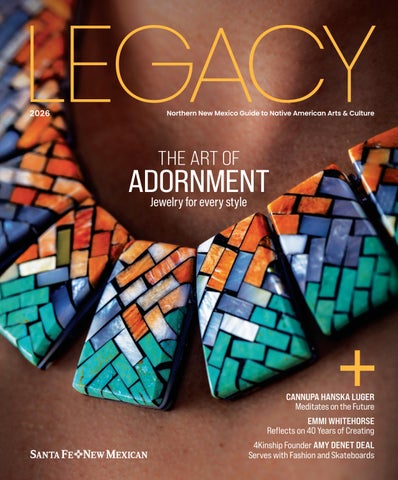
2026
Northern New Mexico Guide to Native American Arts & Culture
THE ART OF
ADORNMENT Jewelry for every style
mkandco.com | (505) 603-0191
Santa Fe
Aspen
Fort Worth
Scottsdale
78 E San Francisco St
402 S Galena St
6102 Camp Bowie Blvd
7237 E Main St
Karen Abeita
Sunshine Reeves Marcellus Medina
8TH ANNUAL
Free Indian Market
SATURDAY-SUNDAY, AUGUST 15-16 FEDERAL PARK • SANTA FE (2 BLOCKS FROM PLAZA)
Anthony Lovato
Ambrose Teasyatwho
Arland Ben
Tolpi-yine Simbola ON THE PLAZA
Sterling Silver, 22 karat & Niobium Cuffs Sterling Silver & 22 karat Rings Sterling Silver Earrings
61 Old Santa Fe Trail, Santa Fe, NM 87501 505-983-9241 maloufontheplaza.com Online Shopping Available
Hopi Pete
Reversible Pendant & Rings
Sterling Silver, Kingman, Tibetan, Bisbee, Royston & Sleeping Beauty Turquoise
ON THE PLAZA
61 Old Santa Fe Trail, Santa Fe, NM 87501 505-983-9241 maloufontheplaza.com Online Shopping Available
David Rosales Supersmith
ON THE PLAZA
Trunk Show Fri - Sun 10-5
Navajo Weaving Collection Sterling Silver & Inlay Bolos, Buckles, Rings, Cuff
61 Old Santa Fe Trail, Santa Fe, NM 87501 505-983-9241 maloufontheplaza.com Online Shopping Available
photo: Eric Swanson
Beaded Pendant Necklaces Sterling Silver, Fox, Pixie & Damali Turquoise
Scott Diffrient modern artifacts
ON THE PLAZA
61 Old Santa Fe Trail, Santa Fe, NM 87501 505-983-9241 maloufontheplaza.com Online Shopping Available
“Smoking for Sunshine, Rain, Cattle, and Corn” by Duyauestewa (Tyler Polelonema)
ARTIST HOPID
Ancestral Symbols, Modern Masterpieces The exhibit features forty artworks by five Hopi artists from the group Artist Hopid formed in 1973. The artists include Lomawywesa (Michael Kabotie), Honvantewa (Terrance Talaswaima), Dawakema (Milland Lomakema), Coochsiwukioma (Delbridge Honanie), and Neil David Sr. Artist Hopid strived to break free of the traditional “Studio Style” that emerged from the Santa Fe Indian School between the 1930s -1950s.
A MIDISSAGE RECEPTION
7 AUGUST 2026 4:00 -7:00 PM Curator’s Talk 5:00 PM 221 Canyon Road, Santa Fe | adobegallery.com | 505.955.0550
NATIVE MARKET SALE Live Online, August 11 – 12 View all lots at our Baca Railyard Showroom and online at santafeartauction.com
MALCOLM FURLOW (Choctaw, 1946 - 2023) Lord of the Dawn (Quannah Parker) acrylic on canvas, 58 1/8 x 46 1/8 in. Estimate: $8,000 – $12,00
UPCOMING CALENDAR August 11–12 September 15–16 November 6–7 December 5–15 February 2027
Native Market Contemporary Art, Design + Photography The Signature Sale Etcetera Holiday Sale Native Arts
WELCOMING CONSIGNMENTS YEAR-ROUND CONSIGN@SANTAFEARTAUCTION.COM
932 Railfan Road, Santa Fe, NM 505.954.5858 @santafeartauction
Photo by: Nedret Gürler Photo by: Nedret Gürler
Navajo Rug Rug Sales Sales •• Cleaning Cleaning •• Restoration Navajo Restoration www.rugmanofsantafe.com www.rugmanofsantafe.com 130 Lincoln Ave. Suite A Santa Fe 130 Lincoln Ave. Suite A Santa Fe
505.988.2393 505.988.2393
AUGUST 14, 15 & 16, 2026 BUFFALO THUNDER RESORT & CASINO
INDOOR / OUTDOOR MARKET • FILMS DANCE GROUPS • BANDS • FOOD TRUCKS www.poehcenter.org/pathways
BuffaloThunderResort.com
PoehCenter.org
2026 Gathering for Native American Cancer Care Saturday, October 3 • 10 AM–2 PM Buffalo Thunder Resort • FREE Event Registration Open Now!
Our Mission To help the people of Northern New Mexico navigate their cancer journey with hope, dignity,
Cultivating Cancer Connections
and needed support. cffnm.org
2026 Program Overview • Welcome & FREE breakfast • Navigating a Cancer Diagnosis information & testimonials • FREE nourishing lunch • Educational materials • Self-care gift bag • Drawings for exciting prizes (You must be present to win.)
Learn more and register:
CFFNM.org/NativeHealth Check online for updates & speakers.
chrispaynestudio@aol.com 505-690-5195
CHRIS PAYNE & PHARAOH ADOBE MUD CO. COLLABORATING TO DESIGN ADOBE & ART.
Where timeless artistry meets enduring tradition. Together, Chris Payne Studio and Pharaoh Adobe Mud Co. create spaces that honor the heritage of the Southwest-blending hand-crafted adobe craftmanship with original bronze sculptures and one-of-a-kind artwork to build homes and environments that are as soulful as they are strong.
TAKE HOME A TREASURE FROM INDIAN COUNTRY
BUY WORKS PRODUCED BY MEMBERS OF FEDERALLY RECOGNIZED TRIBES The Indian Arts and Crafts Board offers a Source Directory of American Indian and Alaska Native Businesses that sell authentic Indian art and craftwork, available at www.doi.gov/iacb. Under the Indian Arts and Crafts Act, it is unlawful to offer or display for sale, or sell, any art or craftwork in a manner that falsely suggests it is Indian made. For a free brochure on the Indian Arts and Crafts Act, including how to file a complaint, please contact: U.S. Department of the Interior | Indian Arts and Crafts Board Toll Free: 1-888-278-3253 | Email: iacb@ios.doi.gov
WWW.DOI.GOV/IACB Denise Wallace, Chugach Sugpiaq, Belt Buckle, Sedna and the Shaman, ©1994
FOLLOW US
NATIVE AMERICAN ARTS & CULTURE
15
chuck Sabatino
OWNER Robin Martin PUBLISHER Patrick Dorsey EXECUTIVE EDITOR Bill Church EDITORIAL Magazine Editor, Ashley M. Biggers abiggers@sfnewmexican.com Designer, Linda M. Peters linda@swelldesign.net Copy Editor, Peg Goldstein CONTRIBUTORS Nathan Burton, Gabriela Campos, Ungelbah Dávila, Tira Howard, Devon Jackson, Jen Judge, Lanee Lee, Jennifer Levin, Gabriella Marks, Douglas Merriam, Elizabeth Miller, Emily Withnall, and Jim Weber ADVERTISING Chief Advertising and Marketing Director Wendy Ortega Classified Advertising Manager Laura Harding Multimedia Sales Manager Ryan Tremont ADVERTISING SALES Mayra Aldaz Maria Lopez Garcia Kandice Meyer Deb Meyers Vanessa Ruedeman ADVERTISING ART DEPARTMENT Designers, Elspeth Hilbert, Rick Artiaga, Justin Bixler
Big &Small Gems
2026 Northern New Mexico Guide to Native American Arts & Culture
PRODUCTION Operations Director, Robert Bauwens Prepress Manager, Anthony Welch Assistant Production Director, Brenda Shaffer DISTRIBUTION Circulation Director, Michael Reichard TECHNOLOGY Technology Director, Michael Campbell
Artist Reception August 7, 2026 • 4 to 6pm
WEB santafenewmexican.com Office: 150 Washington Ave. #105
Hours: 8 a.m.–5 p.m. Monday–Friday ON THE COVER
M cLarry f i n e a r t 16
LEGACY 2026
Christy Bird wears an inlay necklace by Janalee Valencia. Read more on page 85. COVER PHOTO By Gabriella Marks
Advertising Information: 505-995-3852 Delivery: 505-986-3010, 800-873-3372
For copies of this magazine and to subscribe to The New Mexican, call 505-986-3010 or email circulation@sfnewmexican.com.
L A U R A
G I L P I N
PHOTOGRAPHER July 17 – August 29, 2026
Storm over La Bajada, 1946, mural-sized gelatin silver print,
Scheinbaum & Russek is honored to present an exquisite selection of Laura Gilpin’s work to our community. Gilpin was a long-time Santa Fe resident and renowned photographer. Since her death in 1979, her photographs have rarely been shown in Santa Fe. Included in this exhibition are two extraordinary mural-sized prints and rare exquisite examples of her early, masterful platinum prints much admired by photographers and connoisseurs alike.
www.photographydealers.com • srltd@photographydealers.com call for appointment and directions 505-988-5116
Santa Fe’s #1 Realtor. “ Darlene and her team are by far the most professional
and service oriented real estate team we’ve ever worked with throughout a lifetime of buying and selling homes.” – Julie S., Zillow Review
★★★★★
Santa Fe draws people who appreciate artistry, authenticity, and exceptional quality. Real estate is no different. For more than 25 years, Darlene Streit has helped buyers and sellers navigate Santa Fe’s most sought-after properties with insight, discretion, and expertise. Together with her dedicated team, she delivers a level of service that makes every transaction smooth, informed, and rewarding. Call her today.
View more homes and land > S A N TA F E R E A L E S TAT E P R O P E RT Y
871 Camino Francisca | 4BD/6BA | $3,750,000
820 Camino Atalaya | 6BD/8BA | $3,700,000
39 Yana Drive | 4BD/7BA | $2,250,000
Discover the Darlene Difference. SANTA FE’S #1 REAL ESTATE BROKER | OVER $2.75B SALES VOLUME DARLENE STREIT | 505.920.8001 | 417 PALACE AVENUE, SANTA FE | SantaFeRealEstateProperty.com
#1 Broker in Santa Fe based on total sales volume according to Santa Fe Association of Realtors data. © Sotheby’s International Realty, Inc. All rights reserved. Sotheby’s International Realty® is a registered trademark. This material is based upon information which we consider reliable but because it has been supplied by third parties, we cannot represent that it is accurate or complete and it should not be relied upon as such. This offering is subject to errors, omissions, changes including price or withdrawal without notice. If your property is listed with a real estate broker, please disregard. It is not our intention to solicit the offerings of other real estate brokers. We are happy to work with them and cooperate fully. Operated by Sotheby’s International Realty, Inc. Real estate agents affiliated with Sotheby’s International Realty, Inc. are independent contractor sales associates and are not employees of Sotheby’s International Realty, Inc. Sotheby’s International Realty, 417 Palace Avenue, Santa Fe, NM 87501, 505.920.8001, 505.988.2533. Equal Housing Opportunity.
DISCOVER SOMETHING SPECIAL IN THE LAND OF ENCHANTMENT
Published August 7, 2026
49
Departments
113 Eat & Drink
Chef Ray Naranjo is bringing
Indigenous foodways back to Northern New Mexico — one food truck stop at a time.
24 Calendar
Art markets, museum exhibitions, concerts, Photos (clockwise from top): By Jen Judge, by Nathan Burton/The New Mexican, courtesy Blue Rain Gallery, by Douglas Merriam
and more — during Santa Fe Indian Market weekend and throughout August
116 Gallery Guide
Ten galleries showcasing Native and
35 Q&A
non-Native artists this month
IAIA president Dr. Shelly Lowe reflects
122 Artists Lists
on educating Native artists today.
39 Listen
116
Jazz musician Delbert Anderson connects
with history and culture, one note at a time.
Meet the presenting artists at Santa Fe
Indian Market, Free Indian Market, and Pathways Indigenous Arts Festival.
43 Read
Founded by poet Kinsale Drake,
the NDN Girls Book Club brings books to Indigenous youths.
46 Art
Indian Theater: Native Performance,
Art, and Self-Determination Since 1969 comes to SITE Santa Fe.
49 Go
In honor of the Route 66 centennial,
cruise into the western New Mexico town of Gallup for vibrant art and culture.
108 Shop 113
Potter Robert King leaves a seat
at the table open for others with Duende Gallery.
35 NATIVE AMERICAN ARTS & CULTURE
19
INSIDE THIS ISSUE Features 54 The Weavers’ Path
Meet two families evolving the Diné tradition. By Emily Withnall
59 Welcome Back to Sky City
I Am Clay: Acoma Life in Figures brings
the pueblo to the Museum of International Folk Art. By Jennifer Levin
67 In Beauty
Over a 40-year career, Emmi Whitehorse’s
affinity for making sensory impressions of the natural world remains a constant. A retrospective at the Wheelwright Museum of the American Indian explores the artist’s evolution. By Elizabeth Miller | Portraits by Tira Howard
72 In Process
Multidisciplinary artist and cultural
innovator Cannupa Hanska Luger’s work meditates on possibilities. By Elizabeth Miller | Portraits by Tira Howard
79 Indigenous Perspectives
Photographer Zoë Urness makes images
85 The Art of Adornment
Meet jewelers tapping into tradition as they pursue their individual artistry. By Ashley M. Biggers Photography by Gabriella Marks
Plus: Learn more about models Edwin Felter and Christy Bird on page 102
85
97 Milling Fashion
Blue Bird Flour sacks have become a
symbol of identity and reliance. See how Native designers and artists are incorporating them in their creations. By Ungelbah Dávila
100 Good Relative
4Kinship founder Amy Denet Deal strives
to be a good matriarch as she connects with her Indigenous identity. By Ashley M. Biggers Photography by Gabriella Marks
105 Playing with Blocks
Running Horse Studio’s Jimmy Dean Horn
presses one-of-a-kind, sustainable designs. By Ashley M. Biggers Photography by Gabriella Marks
20
LEGACY 2026
67
97
Photos (clockwise from top): By Gabriella Marks; courtesy Penny Singer; by Addison Doty, courtesy Wheelwright Museum of the American Indian
with collaboration and authenticity. By Ungelbah Dávila Photography by Zoë Marieh Urness
N AT I V E A M E R I C A N AR T GROUP EXHIBITION August 13, 2026 Artist Reception: Thursday, August 13th 5 pm – 7 pm Featuring Karen Clarkson, Upton “Greyshoes” Ethelbah Jr., Dan Friday, Jesse Littlebird, Ira Lujan, Spooner Marcus, Thomas Breeze Marcus, Sheridan MacKnight, Jody Naranjo, Chris Pappan, Gabriel Mozart Abeyta (Ugly Pie), Dolores Purdy, Lisa Holt and Harlan Reano, Ryan Singer, Raven Skyriver, and Helen K. Tindel. Jesse Littlebird, Clouds Building No. 14, oil and acrylic on canvas, 16" h x 20" w
P R E S T O N S I N G L E TA R Y The Good, the Bad and the Raven New Glass Sculptures August 14 – 27, 2026 Artist Reception: Friday, August 14th from 5 – 7 pm
Preston Singletary, Knowing the World, blown and sand-carved glass, 10.5" h x 24" w x 7" d
544 South Guadalupe Street, Santa Fe, NM 87501 | 505.954.9902 | www.blueraingallery.com
22
LEGACY 2026
CALENDAR
HAPPENINGS
Ken Fury’s The Birth of Stars, made with acrylic, spray paint, and airbrush on leather, appears in the Museum of Contemporary Native Art’s Ken Fury & Gary Medina Cook: Contemporary Genízaro Art.
24
LEGACY 2026
Photos (left to right) Courtesy of the artist and the Museum of Contemporary Native Art, courtesy of King Galleries
Your guide to gallery openings, art markets, museum exhibitions, concerts, and more
GALLERIES August 7 5–7 p.m. Artist Reception Hecho a Mano debuts two exhibitions, one featuring new work from landscape painter Daniel McCoy (Muscogee Creek/Citizen Band Potawatomi) and the group show Geometry of Culture, featuring the work of Terran Last Gun (Piikani) and others. Hecho a Mano 129 W. Palace Ave. hechoamano.org
August 7 5–7 p.m. Artist Reception Meet the artists behind Legacy Gallery’s fifth annual Forever West show, a major group exhibition celebrating the enduring power, beauty, and evolution of western art. Legacy Gallery 225 Canyon Road legacygallery.com
August 8 1–3 p.m. Gallery Talk View classic works in clay by Maria Martinez, Tony Da, Margaret Tafoya, and Nampeyo of Hano in a compilation of important historic pottery. Hear Charles King speak about the history of these pieces and their connections to contemporary innovations in Native art. King Galleries 130 Lincoln Ave., Suite D kinggalleries.com
August 13 4 p.m. Navajo Weaving Talk Guest speaker Antonia Clark from Toh-Atin Gallery presents on Navajo weaving. Sorrel Sky Gallery 125 W. Palace Ave. sorrelsky.com
August 13 5–7 p.m. Artist Reception for Native Art Group Show Blue Rain Gallery welcomes the artists featured in its Native group show, including Karen Clarkson, Upton “Greyshoes” Ethelbah Jr., Dan Friday, Jesse Littlebird, Ira Lujan, Spooner Marcus, Thomas Breeze Marcus, Sheridan MacKnight, Jody Naranjo, Chris Pappan, Gabriel Mozart Abeyta (Ugly Pie), Dolores Purdy, Lisa Holt and Harlan Reano, Ryan Singer, Raven Skyriver, and Helen K. Tindel. Spanning paintings, works on paper, mixed media, traditional Pueblo pottery, and studio glass, the
exhibition offers a compelling exploration of material, form, and cultural expression. Blue Rain Gallery 544 S. Guadalupe Street blueraingallery.com
August 13
5–7 p.m. The Legacy of Ben Nighthorse Campbell Sorrel Sky Gallery’s Native artists, including Ray Tracey, Shane Hendren, Victoria Adams, Jeremy Salazar, and Kim Seyesnem Obrzut, honor former U.S. representative and senator and lauded jeweler Ben Nighthorse Campbell (1933–2025). Sorrel Sky Gallery 125 W. Palace Ave. sorrelsky.com
August 14–15, 11 a.m.–3 p.m. both days
Glassblowing Demonstrations Blue Rain Gallery presents artist demonstrations by Preston Singletary, Dan Friday, Ira Lujan, Raven Skyriver, and Spooner Marcus. Blue Rain Gallery 544 S. Guadalupe St. blueraingallery.com
August 14 2–5 p.m. Artist Reception King Galleries opens its annual Indian Market show with an artist reception. The show includes new works by 20 Native American potters, painters, and carvers. King Galleries 130 Lincoln Ave., Suite D kinggalleries.com
August 14
4 p.m. Star York Retrospective Talk Bronze sculptor Star York reflects on her 50th year as an artist. Sorrel Sky Gallery 125 W. Palace Ave. sorrelsky.com
August 15
Robert Rivera, Maria Goler Baca, David Knowlton, and many more for a group show featuring its roster of represented artists. Sorrel Sky Gallery 125 W. Palace Ave. sorrelsky.com
August 14 5–7 p.m. Artist Reception The Museum of Contemporary Native Arts welcomes the artists of three exhibitions: States of Erosion: Reshaping and Reclaiming, Ken Fury & Gary Medina Cook: Contemporary Genízaro Art, and Dakota Mace: Shímásání Bila’ (My Grandmother’s Hand). Museum of Contemporary Native Arts 108 Cathedral Place iaia.edu/mocna
August 14 5–7 p.m. Artist Reception Blue Rain Gallery welcomes Preston Singletary for the release of new work exploring the rich visual language of Tlingit formline, through which he transforms traditional motifs of animals, clan crests, and spiritual beings into luminous, dimensional forms. Blue Rain Gallery 544 S. Guadalupe St. blueraingallery.com
August 14 5–7 p.m. Artist Reception Manitou Galleries showcases the work of Aaron Hazel, who offers a fresh and deeply personal perspective within contemporary western and Native-inspired art. Manitou Galleries 123 W. Palace Ave. legacygallery.com
August 14
4–6 p.m. Reception Turner Carroll Gallery opens Native Prints, a selection of print and multimedia work by Native American artists including Jeffery Gibson, former representative artist of the United States at the Venice Biennale; Apache Skateboards founder Douglas Miles; Santa Feans Cara Romero, Virgil Ortiz, and Neal Ambrose Smith; and the legendary Jaune Quick-to-See Smith (1940–2025). Turner Carroll Gallery 725 Canyon Road turnercarrollgallery.com
MARKETS August 6–9
10 a.m.–5 p.m. Whitehawk Antique Indian & Ethnographic Art Show Retailers from around the world offer expertly curated finds. Tickets: general admission $25 plus fees; preview from $175. Santa Fe Community Convention Center 201 W. Marcy St. whitehawkshows.com
August 11–12
Santa Fe Art Auction Native Market Presented by a leading Southwest art auction house, the event features Native American works in a variety of mediums, from paintings and textiles to works on paper and baskets. The auction includes pieces by Native artists practicing today and historic objects. Santa Fe Art Auction 932 Railfan Road santafeartauction.com
August 12–14
Wednesday, 3–6 p.m. Thursday and Friday, 8 a.m.–4 p.m. Wheelwright Museum Benefit Sale The museum’s largest fundraiser offers the opportunity to shop for amazing, unique, and vintage works of art. The sale features jewelry, pottery, textiles, paintings, and more. All proceeds directly support the museum’s programming and exhibition needs. The Wednesday early-bird event is ticketed. Tickets: online. Wheelwright Museum of the American Indian 704 Camino Lejo, wheelwright.org
August 14–15
August 14
5 p.m. Reception for All-Artist Show Sorrel Sky welcomes Star York, Thom Ross, Lisa Gordon, Maura Allen,
5 to 7 p.m. Artist Reception Obscura Gallery welcomes editorial and commercial photographer Brian Adams (Inuit) and Sara Stacke at a book talk and exhibition opening for In Light and Shadow, a landmark photography collection exclusively featuring the work of Indigenous Americans. Obscura Gallery 225 Delgado St. obscuragallery.net
This vessel by Tony Da epitomizes the works on display at King Galleries.
Friday, 8 a.m.–4 p.m. Saturday, 10 a.m.–2 p.m. Artists’ Market The Wheelwright Museum hosts its annual outdoor market featuring artists working in a variety of mediums. Confirmed artists include Gail Bird (Santo Domingo/Laguna) and Yazzie Johnson (Diné), Dylan Coriz (Santo Domingo), and Harold Littlebird (Santo Domingo/Laguna). Wheelwright Museum of the American Indian 704 Camino Lejo, wheelwright.org
NATIVE AMERICAN ARTS & CULTURE
25
CALENDAR EVENT SPOTLIGHT S ANTA FE P L AYH OUS E PRESENTS
BAD MEDICINE
SANTA FE INDIAN MARKET AUGUST 15–16 8 A.M.– 5 P.M.
BY P.C. VERRONE | DIRECTED BY LAUREN AND TAYLOR TRUJILLO
AUGUST 6–30
142 E. DE VARGAS STREET NM SANTA FE
*
The largest Native art market in the country, with around 1,000 artists representing 200 tribal nations, returns to Santa Fe for its 104th year. The free event, which is also one of the most prestigious markets in the nation, unspools from the Santa Fe Plaza, with booths on many surrounding streets. Artists showcase a vast array of traditional and contemporary Native work, including jewelry, pottery, textiles, paintings, beadwork, baskets, and sculpture. During the event, Indigenous musicians and dance groups perform at the Plaza bandstand. On Friday, August 14, the top artists of the year are celebrated at a ceremony and luncheon (11:30 a.m.; $250), followed by a sneak peek of the award-winning art (2 p.m.; $100). The general public can also preview the works, including the Best of Show, that afternoon (4:30–6:30 p.m.; $50). Buy tickets in advance for Saturday’s gala benefiting the education and advocacy work of the Southwestern Association for Indian Arts, the entity that organizes Indian Market. The event includes a lavish cocktail reception and a live art auction (5 p.m.; $400). Sunday brings the Native American Regalia Showcase, where participants of all ages share beautiful and culturally significant traditional clothing, dance regalia, and family heirlooms on the Plaza bandstand stage (9 a.m.; free). Later that day, today’s fashions hit the runway for the hottest ticket in town: the Native Fashion Show (3 p.m.; from $30). For the full list of artists at Santa Fe Indian Market, see page 122.
Art market: Santa Fe Plaza Ticketed events: Santa Fe Community Convention Center, 201 W. Marcy St., swaia.org
26
LEGACY 2026
Photos: By Jim Weber/The New Mexican
The award-winning figurative carving of Robert Stephen Albert at the 2025 Santa Fe Indian Market
design � installation � maintenance
EVENT SPOTLIGHT
FREE INDIAN MARKET AUGUST 15–16
8 A.M.– 5 P.M.
Eight years after creating Free Indian Market, founders Gregory and Angie Schaaf retired from the market. They tapped John Gonzales, a tribal administrator at San Ildefonso Pueblo, to take over as producer and director, turning the market into a Native-led endeavor. Gonzales had his own successful career as a potter but was on hiatus until he exhibited at Free Indian Market last year. The market’s atmosphere immediately drew him in. “I got the feeling I had from the first Santa Fe Indian Market I did in 1991. It had a nice atmosphere, a slower pace. It was a family-oriented show back in those days. You were able to spend days with family, friends, acquaintances, and collectors. I felt that at Free Indian Market. I really, really want to continue that and build on that,” he says. The market unfolds in the shade of Federal Park, adjacent to Santa Fe Indian Market at the end of Lincoln Avenue, and it features many tribal elders who exhibit their work at no cost. In family booth spaces, generations of artists show their creations together, speak their Native languages, and celebrate their traditional arts. The 500 or so artists hail primarily from New Mexico, but some travel from as far away as Montana to attend. They work in a variety of mediums, creating everything from fine art and pottery to screen-printed T-shirts. Gonzales says he hopes the show continues to showcase the work of tribal elders who are “not as intensely focused on production and marketing” but focus instead on their cultural connection to the work. “In our cultures, when you make something, there’s a connection there — you’re breathing life into clay or silver. When you’re intensely focused on production, that can be lost.” For the full list of artists at Free Indian Market, see page 124.
Federal Park
freeindianmarket.org
100 S. Federal Place
EXCEPTIONAL EXCEPTIONA L ARRANGEMENTS FOR ALL SEASONS
505-982-4005
www.clemensandassociates.com
Thank You
For celebrating 100 years of the Traditional Spanish Market
Thank you to our artists, volunteers, sponsors, and visitors for helping make our Centennial Celebration unforgettable.
Save The Date
Winter Spanish Martket December 5th & 6th 2026 Jeremiah Ringleb with the Oak Canyon Dancers prepares to perform at the 2025 Free Indian Market.
WWW.TRADITIONALSPANISHMARKET.ORG
NATIVE AMERICAN ARTS & CULTURE
27
CALENDAR EVENT SPOTLIGHT
PATHWAYS INDIGENOUS ARTS FESTIVAL AUGUST 14–16 Owned by Pojoaque Pueblo, the Poeh Cultural Center, which organizes Pathways Indigenous Arts Festival, has long been a destination for cultural understanding and advocacy. Pathways grew out of the center’s work training and supporting artists during the opportunity-scarce COVID-19 pandemic, says executive director Karl Duncan. “In talking with artists, it was clear they were really in need of another venue to sell their work during Indian Market,” he recalls. Five years later, it’s clear the event “really complements everything going on in the Santa Fe area that weekend.” Since its 2021 debut, Pathways has grown to include 350 artists in indoor and outdoor booths, showcasing everything from traditional pottery to bespoke hats and decorated cookies. The three-day event also includes 50 film showings, ranging from IAIA student films to full-length professional documentaries and narrative works. Around 20 bands, solo musicians, and dance groups perform, and around a dozen food trucks, including Manko (see page 113), showcase the breadth of Native foods. “This is the Indigenous creative culture economy at its best,” Duncan says. “The funds cycle back. The event is held on Native land, it benefits the Native tribal program, which helps us run the event the following year and our programming in cultural arts. And of course it benefits Indigenous entrepreneurs in whatever business they have, from apparel to beauty products, in a place that welcomes them. For many of them, this is the biggest show they have of the year.” For the full list of artists at Pathways, see page 125.
BANKING THAT FEELS LIKE HOME At State ECU, we know that banking isn’t just about numbers—it’s about people. From
everyday needs to life’s big milestones, our
team is here to guide, support, and celebrate
with you. Because when your credit union feels like home, everything else feels a little easier.
Learn more at secunm.org
800.983.7328 | SECUNM.ORG 28
LEGACY 2026
The pottery of Clarence Cruz (Ohkay Owingeh Pueblo) at the 2025 Pathways Indigenous Arts Festival
Photos (from left): By Jim Weber/The New Mexican, courtesy of the artist and Sovereign Santa Fe
Buffalo Thunder Resort and Casino 20 Buffalo Thunder Trail poehcenter.org/pathways
EVENT SPOTLIGHT
SOVEREIGN SANTA FE AUGUST 14–16
10 A.M.– 7 P.M.
Sovereign Santa Fe shows works such as Diné Today by Elton Manygoats. During a weekend showcasing the breadth of Native creativity, Sovereign Santa Fe is a go-to for the New School of Native painting, sculpture, fashion, and more. The free contemporary Native art exhibition started with an artist’s rejection from Santa Fe Indian Market. In response, Randy Barton, Craig George, Monte Little, and others decided to hold a pop-up show of contemporary Native art. Mentor and leading artist Tony Abeyta hosted the event in his studio in 2018. The next year, when La Fonda on the Plaza had a last-minute vacancy, Abeyta made the connection there. Now in its seventh year, Sovereign Santa Fe overflows the Lumpkins Ballroom and Mezzanine above the hotel lobby. Barton, George, and Little continue to show their work, along with dozens of other artists, including Carly Treece, Kylie ThunderHawk, Elton Manygoats, True Archdale, Micah Wesley, and Derayna DeClay. They draw upon the work of greats such as Helen Hardin and Fritz Scholder, who are “artists that shifted the work,” according to Greg Farah, Sovereign Santa Fe producer and owner of FaraHNHeight Fine Art. The artists of Sovereign Santa Fe work in that vein. “These artists are Indigenous — and they possibly incorporate identity and iconography — but they’re artists first and foremost. In the world of Native art, a lot of artists feel they are pigeonholed. A lot of artists want to work outside that,” he says. Farah curates the show along with Abeyta, who’s also an adviser, reaching out to artists individually with invitations to submit work. The event also includes a marketplace on the mezzanine with around 20 vendors, such as the silversmith business Whirlinglog & Arrow and body product creator Brenda’s Botanicals. This year marks the third Sovereignly Fit runway show. Curated and produced by Loren Aragon of Towering Stone, the fashion show features a range of creativity from both established and emerging Native designers. It runs Friday and Saturday evening; doors open at 6:30 p.m. Tickets for the fashion show are available at toweringstone.com. This year, part of the proceeds from the sale of art benefits the Sacred Defense Fund, a Native-led New Mexico nonprofit that fights for Indigenous sovereignty, environmental justice, and sacred site protection.
Arch Archival hhival ll Custom Framing Since Arch Archival ival Custom Framing Since 1996 Arch Archival hival l Custom Framing Since 19961996 Arch Archival hivall Custom Framing Since 1996 Serving Serving Serving Serving Northern New Mexico’s Northern New Mexico’s Northern New Northern Mexico’s New Mexico’s Museums, Galleries, Museums, Galleries, Museums, Galleries, Museums, Galleries, Artists & Locals Artists & Locals Artists & Locals Artists & Locals
W. Alameda St. | Santa Fe NM 1415 W.1415 Alameda St. St. |St. Santa Fe NM 1415 W. Alameda || Santa Fe NM 1415 W. Alameda Santa Fe NM 505.982.4397 | info@fineartframers.com 505.982.4397 | info@fineartframers.com 505.982.4397 505.982.4397 || info@fineartframers.com info@fineartframers.com
La Fonda on the Plaza 100 E. San Francisco St. farahnheight.com/sovereign
NATIVE AMERICAN ARTS & CULTURE
29
CALENDAR Ortiz has developed Revolt 1680/2180, an expansive project that brings global attention to Po’pay, the Tewa leader who united Pueblo communities in resistance against Spanish occupation, and to the strength of Pueblo culture. In this exhibition, Ortiz and Eric F. Garcia reclaim this history, presenting a visionary narrative and powerful dialogue between Pueblo and Spanish perspectives grounded in friendship, shared history, and critical reflection. The exhibition explores the enduring spirit of the Pueblo people through a dynamic convergence of clay, painting, fashion, film, and installation. New Mexico Museum of Art, Vladem Contemporary 404 Montezuma Ave. nmartmuseum.org
Through November 30 I Am Clay: Acoma Life in Figures This community-curated project focuses on figurative pottery from Acoma. The exhibition is the Museum of International Folk Art’s contribution to the national Craft in America initiative, marking the 250th anniversary of the founding of the United States. Museum of International Folk Art 706 Camino Lejo internationalfolkart.org
Virgil Ortiz’s Po’pay 2180 – beneath the storms of Blindfall appears in Continuum: Blindfall, First Strike at Vladem Contemporary.
MUSEUMS Through October 3 Emmi Whitehorse: Intimate Landscapes This retrospective of the painter’s work unfolds in two parts. Part I I: Line and Form (1990–2020s) features a new painting created for the show. Wheelwright Museum of the American Indian 704 Camino Lejo wheelwright.org
Through August 17 Makowa: The Worlds Above Us This exhibition connects science, stories, and observations of the skies through the artwork of Indigenous peoples of the Southwest. Museum of Indian Arts and Culture 710 Camino Lejo indianartsandculture.org
30
LEGACY 2026
Through September 7 Indian Theater : Native Performance, Art, and Self-Determination Since 1969 Curated by Candice Hopkins (Carcross/Tagish First Nation), this is the first major exhibition to center performance as an origin point for the development of contemporary Native art. SITE Santa Fe 1606 Paseo de Peralta sitesantafe.org
Through September 7 Tewa Nangeh/Tewa Country Co-curated by artist Jason Garcia (Santa Clara Pueblo) and Bess Murphy, Luce Curator of Art and Social Practice at the Georgia O’Keeffe Museum, this exhibition honors Tewa people, art, culture, and landscapes while drawing awareness to the erasure of the Tewa presence from the story
of Georgia O’Keeffe in Northern New Mexico. Georgia O’Keeffe Museum 217 Johnson St. okeeffemuseum.org
Through October 17 Silver Honors Stone: The Work of Julian Lovato In the first solo show dedicated to Julian Lovato, the Wheelwright Museum of the American Indian exhibits 80 works from the Santo Domingo jeweler’s career. In the process, the exhibition tracks how Native American jewelry evolved through the 20th century and the legacy of Lovato’s work today. Wheelwright Museum of the American Indian 704 Camino Lejo wheelwright.org
Through October 18 Continuum: Blindfall, First Strike For more than two decades, Virgil
States of Erosion: Reshaping and Reclaiming This exhibition reclaims and transforms spaces through light, sound, installations, and twodimensional artworks. Museum of Contemporary Native Arts 108 Cathedral Place iaia.edu/mocna
Through January 7, 2027 Ken Fury & Gary Medina Cook: Contemporary Genízaro Art New Mexico–based artists explore Genízaro cultural narratives of the Southwest. Museum of Contemporary Native Arts 108 Cathedral Place iaia.edu/mocna
Through January 7, 2027 Dakota Mace: Shímásání Bila’ (My Grandmother’s Hand) Mace reinterprets Diné stories and culture through experimental photography. Museum of Contemporary Native Arts 108 Cathedral Place iaia.edu/mocna
Through March 7, 2027 Stars and Stripes and First Americans The stars and stripes of the American flag are found everywhere today: on clothing, billboards, and bumper
Photos (left to right): © Virgil Ortiz, courtesy Vladem Contemporary; courtesy Blue Rain Gallery
Through January 7, 2027
stickers — and in Native art. This exhibition explores images of the flag in Native work, both realistic and abstract, as each generation interprets the flag within a dialogue about identity, sovereignty, and cultural revitalization. Museum of Indian Arts and Culture 710 Camino Lejo indianartsandculture.org
Through March 7, 2027 Route 66 Is Indian Country In honor of Route 66’s centennial, this exhibition explores the tradition of roadside stands along the Mother Road. Today, tribally owned enterprises (such as casinos and multi-plaza gas stations) have replaced the curio shops, and Pueblo people are leading cultural tourism initiatives that support their economic development and reclaim cultural narratives. Museum of Indian Arts and Culture 710 Camino Lejo indianartsandculture.org
Through June 27, 2027 A Question of Power Using photographs, videos, and audio interviews, this exhibition tells the story of three Diné women — Sarah Jane White, Lucie A. Willie, and Molley Hogue — who helped
defeat construction of a coal-fired power plant on the Navajo Nation. New Mexico History Museum 113 Lincoln Ave. nmhistorymuseum.org
PERFORMING ARTS August 14
7 p.m. IndigenousWays Festival In partnership with Lensic 360, IndigenousWays presents an open-air celebration of art, culture, and storytelling. Tickets: free. Santa Fe Railyard Plaza indigenousways.org
Our curated artisan tile, specialty wool carpet, wood floors and stone bring custom enduring design to every project.
Through August 20
Fridays and Saturdays 7:30 p.m. Saturdays and Sundays 2 p.m. Bad Medicine Native American academics settle into their new home in Massachusetts but soon wonder if there might be something insidious beneath the sleepy town. Tickets: from $20. Santa Fe Playhouse 142 E. De Vargas St. santafeplayhouse.org — Compiled by AMB
A Gallery Of Artistic Surfaces From design to installation, our coordination ensures that your project is seamless. Hours: 10:00-4:00 Monday-Thursday • Appointments preferred.
Dolores Purdy’s The Caddo Girl Stroll, colored pencil on ledger paper, is among the works at Blue Rain Gallery’s group show.
NATIVE AMERICAN ARTS & CULTURE
31
Celebrating 53 Years Celebrating 53 Years of the Pueblo Opera Program! of the Pueblo Opera Program!
MADAMA MADAMA BUTTERFLY BUTTERFLY Puccini Puccini
THE MAGIC THE MAGIC FLUTE FLUTE Mozart Mozart
santafeopera.org | 505-986-5900 santafeopera.org | 505-986-5900
EUGENE EUGENE ONEGIN ONEGIN Tchaikovsky Tchaikovsky
RODELINDA RODELINDA Handel Handel
LILI ELBE LILI ELBE Picker / Stollman Picker / Stollman
Photo by Mariah Olesen Photo by Mariah Olesen
Explore Our Explore Season Our Season
dian malouf made in the usa
worrell gallery 103 Washington ave 505-989-4900 artist’s reception august 13 4:30pm-6:30pm trunk show august 14-16
34
LEGACY 2026
Q&A
Dr. Shelly Lowe The IAIA president reflects on educating Native artists today. AS TOLD TO JENNIFER LEVIN PHOTOGRAPHY BY NATHAN BURTON
S
helly Lowe (Navajo) met social scientist and research professor Mary Jo Fox (Comanche/Cherokee) at the University of Arizona, where the size of the campus and layers of bureaucracy were intimidating to the sophomore. “I took her Native American women course, and she took me under her wing,” says Lowe, now president of the Institute of American Indian Arts, a public tribal school founded in Santa Fe in 1962. As Lowe accompanied Fox to meetings of local and national organizations, she also researched participation and success rates of Native American college students, which sparked her interest in higher education. Lowe went on to earn a doctorate in educational policy studies and practice from the University of Arizona. She was an assistant dean and director of the Native American Cultural Center at Yale University and directed the Harvard University Native American Program before serving as chair of the National Endowment for the Humanities. She became president of IAIA on August 1, 2025, after the retirement of longtime president Robert Martin. She brought a career’s worth of insight into national arts, culture, and education administration to mentor students at an institution designed by and for Native artists. First things first — how is IAIA addressing the Trump administration’s budget proposal eliminating the school’s federal funding, which accounts for 75 percent of the budget?
This year, like last year, the president’s proposed budget has zeroed-out funding for IAIA. We have lots of support among our congressional appropriators from across the country and New Mexico. We got flat funding last year [matching the more than $13 million in appropriations from the previous year] because of congressional support, and I don’t anticipate us having a zero budget in this next year. Tell me about the school’s impact. What’s the value of an art school for Native students?
IAIA was created through congressional legislation as an institute of American, Alaskan, and Hawaiian Native arts and culture, because these cultures are the original art and culture forms of this country. Art has been an economy in tribal communities for hundreds of years. It is a way for people to have a meaningful lifestyle that can support their families. We always look at higher education as giving you this stamp that says you have some knowledge and professionalism. It’s the same for our students. They learn new and unique ways to do their art, to take those tools into contemporary professions like television and film. Our students do that with the connection to what it means to be Native. Institute of American Indian Arts president Shelly Lowe on campus in April 2026
NATIVE AMERICAN ARTS & CULTURE
35
Q&A What did you learn working for the Ivies that you’ve reinterpreted for IAIA?
I learned the ways they garner attention for fundraising and other kinds of support. The more prominent universities will highlight the work of a Native student not necessarily to highlight the student’s strengths and where they came from but to highlight the resources the institution has been able to bring in to support them — “Look at what we did to help this person persevere!” — when the bulk of these students’ support came from their families and communities, and the institution actually caused them quite a bit of stress. Telling real stories and being very positive about the strengths of our communities has always been one of my goals. IAIA is known for being on the cutting edge of technology, and you just launched a new computer science major.
I’m still learning about the computer science major — it’s brand new! We have this amazing Fab Lab, and the capacity of the Digital Dome just keeps expanding. Our students and faculty are extending digital output into realms we haven’t seen before. What happens when I put a sensor on a plant and I play music? Does the plant move? What is it thinking? These students will probably be immersive artists working in film or in game technology or at Meow Wolf [a Santa Fe–based immersive art and entertainment company]. And they’re going to be Native in every world they’re in. Is there controversy around this use of technology for people who want to stick to purely traditional ways of making?
The conversation is evolving. You can absolutely do your work without incorporating technology whatsoever. But there is opportunity to expand on that if you want. The question becomes: How do we be responsible in terms of incorporating AI, supporting AI use, and what does that mean? We’re in the process of hiring a new provost, and it will be that person’s task to create an AI policy. What is IAIA’s legacy — its role in the Santa Fe art scene and beyond?
IAIA was created to enhance, support, and promote the continuation of Native KESHi Legacy Ad 9-7-26.pdf 1 7/7/26 2:00 PM arts and culture. So the legacy that comes out of that work is all of these amazing
alumni who have been part of the institution from the beginning and continue to support the work of the institution. IAIA has a reverberating message that flows outside the institution and outside of our community, not just into Santa Fe but into a national and global scene. The most fun thing about being here after working for all these institutions for all these years . . . is that you always come across an IAIA graduate in an exhibition or being highLowe looks at student artwork inside the Balzer Contemporary Edge Gallery. lighted some way nationally or globally. Your faculty and graduates are household names in and out of the art world — Sterlin Harjo, Jeffrey Gibson, Rose B. Simpson, Brandon Hobson, Ramona Emerson, Tommy Orange, Cara Romero. I could keep going!
We see that IAIA’s graduates are making a difference all over the world, sharing a message about Native contemporary art, sharing an empowering narrative about who Native people are. They are the people keeping the focus on Native arts and culture alive through art, TV shows, books. We see this cyclical thing where people are really interested in Natives in one decade, and that goes away for a while and then it comes back. But we are always invested. We are always doing the work. Our alumni continue to do the work. Our graduates feel so strongly about the legacy that they continue to tell us what IAIA should be and how it can support its students. What do you see for the future?
My goal is to learn from the institution and to build a vision collectively with the faculty, staff, students, and alumni. I spent much of this year meeting one on one with departments and sharing information about each other as a way for me to get to know the community. Based in Santa Fe, Jennifer Levin is a freelance journalist specializing in arts and culture.
45th Anniversary 2026 Market Events Amethyst Songbird with Turquoise Corn Maiden by Kateri Quandelacy Sanchez Zuni Pueblo - Acoma Pueblo
Wednesday, August 12th Fabian Tsethlikai
Zuni Pueblo, Jewelry & Zuni Fetish Carvings
Thursday, August 13th Nelson Yatsattie
Zuni Pueblo, Jewelry & Zuni Fetish Carvings
Friday, August 14th @ 2-5 PM
C
Sandra Quandelacy
M
Zuni Pueblo, Jewelry & Zuni Fetish Carvings
Y
Kateri Quandelacy Sanchez Zuni Pueblo - Acoma Pueblo, Jewelry & Zuni Fetish Carvings
CM
MY
Saturday August 15th
CY
Zuni Youth Enrichment Program (ZYEP)
CMY
Artists Apprenticeship Participants
K
Evalena Boone
Zuni Pueblo, Zuni Fetish Carvings
Stewart Quandelacy & Priscilla Lasiloo Zuni Pueblo, Zuni Fetish Carvings
santa fe, nm since 1981 227 Don Gaspar Avenue 505-989-8728
www.keshi.com 36
LEGACY 2026
Sunday August 16th
Zuni Youth Enrichment Program (ZYEP) Artists Apprenticeship Participants
Camille Bernal
Taos Pueblo, Pottery
Angelina Medina
Acoma Pueblo - Zia Pueblo - Zuni Pueblo, Pottery
NATIVE AMERICAN ARTS & CULTURE
37
MAR 20, 2026 - FEB 21, 2027
• is ur
• que joa Po
Sandia • San Felipe
•S an Ild ef on s
o anta Clara • Santo D a•S om An ing o•
• Nambé • Ohkay O una win Lag ge h•
ta an •S
•
Ta o
z• me Je
50 s•
Pi c
Experience the rich traditions of Pueblo pottery during the Indian Pueblo Cultural Center’s 50th anniversary celebration
Gateway to Pueblo Culture since 1976
e qu su Te
i • Acoma • a • Zun Coc • Zi hit i•
Isl et a
2401 12TH STREET NW ALBUQUERQUE, NM 87104 IN DIAN PUEB LO.ORG
W I T H SUP P ORT F RO M
Martina Vigil and Florentino Montoya (San Ildefonso), Storage Jar with lid, c. 1905, clay and paint, 20 ½ x 26 in. Collection of the School for Advanced Research: IAF.1221. Photo by Addison Doty.
LISTEN
In Full Swing
Photo: By Maurice Johnson, courtesy of Delbert Anderson
Jazz musician Delbert Anderson connects with history and culture, one note at a time.
BY DEVON JACKSON
I
f you happen to attend a performance by Delbert Anderson in the next couple of years, there’s a good chance you’ll see he and his bandmates stop mid-tune and linger on a single note played in unison. It could last a half a minute, a minute, or even longer. The note is reminiscent of John Cage’s notorious 1952 arrangement “4'33",” in which musicians were instructed not to play their instruments. But where Cage’s piece came out of the avant-garde and had to do with silence and listening, Anderson work is designed to reflect history. “The Long Walk: 1,674 Days” takes audiences into one of the most painful incidents in Diné history — an 1863–1866 forced relocation, during which
Kit Carson and the U.S. Army drove 10,000 Diné people from their homelands. They traveled up to 450 miles, to New Mexico’s Bosque Redondo, which became an internment camp. Thousands died from exposure, starvation, or illness during the walk or at the reservation. Diné survivors returned to their homelands in 1868. Anderson composed “The Long Walk” to be played slowly over time to represent his people’s lengthy separation and imprisonment. He played the composition’s first note for the public on November 1, 2023; he will play the final note in front of an audience on June 1, 2028, at the Bosque Redondo Memorial at the Fort Sumner Historic Site.
Delbert Anderson trumpets Diné history via his composition The Long Walk.
NATIVE AMERICAN ARTS & CULTURE
39
The Delbert Anderson Quartet, featuring (left to right) pianist Robert Muller, drummer Khalill Brown, Delbert Anderson, and bassist Evan Suiter
But this meaningful song is only one part of Anderson’s impressive musical legacy. Born on the Navajo Reservation in Shiprock in 1986, Anderson followed his father’s work to Kirtland, where at Grace B. Wilson Elementary School he was exposed to his future calling. A jazz trio came to the school to introduce the genre to students. (On the following day, kids chose instruments for band class.) “At the very end,” recalls Anderson, “the lead guy, John Pennington, he just started wailing on his trombone. And he said, ‘What I was doing was called improvisation. That’s music that comes from inside us — not from the sheet music.’ I thought that was really cool.” The next day Anderson tried the trombone, but he couldn’t produce any notes. The teacher suggested he try the trumpet instead. “I went over and made two little squeaks, and everyone was like, ‘Yeah, you’re a trumpet player.’” He also took inspiration from his teacher Janet Isham, who one day had Anderson play his trumpet for her class and afterward told the kids, “I want you to play like Delbert, because he’s playing it perfectly,” he recalls. “That’s when I thought, ‘Wow, I’m good at this. I should stay in it.’ That really motivated me and started connecting with me on a personal level.” By seventh grade he was playing in the San Juan College jazz band. After high school, he accepted a full ride to Eastern New Mexico University (ENMU), where he played trumpet and majored in music education. “My first jazz instructor there really had a great approach, saying, ‘I’m not going to tell you what not to play. I’m just here to guide you.’ He let me really experiment,” says Anderson. “That’s where my love for improvisation and self-expression really started to increase and what led me toward my own culture.” In 2010, Anderson moved to Farmington to start a family. He also got a job at San Juan Regional Medical Center, where he worked for three years before reinvesting himself in music. “I took a different route from guys who went to the Manhattan School of Music or Berklee. And I’ve noticed they sound very similar because they have the same idea of an approach to music,” Anderson says. After trying to start a band numerous times, first an eight-piece group, then a six, he finally settled on a trio in 2013 — mostly because the same two guys always showed up: bassist Mike McLuhan and drummer Nicholas Lucero. Intent on standing out from other jazz trios, Anderson encouraged his new bandmates to bring in elements they loved. McLuhan brought his love of the Grateful Dead and jam bands, while Lucero added funk and Latin grooves. Anderson delved deeper into Diné music and “found these things called spinning songs [songs traditionally sung while spinning wool or weaving], so I brought that to the table. And we started to make our own tunes at that point, with a Native American flair to it.” 40
LEGACY 2026
Musically, the result was a mélange. “We needed a product that’s different,” he says. “We contribute very equally, but we found that midpoint between pieces from my Diné stories and history, stories about the land, and normal jazz standards. It’s almost like fusion music. It was very intentional.” “We have this relationship with each other that’s like having a whole set of brothers,” he continues. “Everyone’s heart is in the right spot, and every time we play it’s a really good hang.” And even though life as a jazz musician in the Four Corners region might appear nigh impossible, “I don’t think I would’ve been able to find what I’m doing right now if I were in New York or Chicago or some bigger market,” muses Anderson. “This area, Kirtland, is like my personal practice room. It’s shut off from the big-city players and all the popular things going on right now. I don’t pay any attention to that stuff.” And if he were in a bigger city, he’d be doing what most other jazz players are doing: trying to be the best sideman possible. “Out here, because we have so much time and space and everything, I can create my own thing and just focus on that,” he says. He’s also co-director of the Julia Keefe Indigenous Big Band. The 16-piece all-Indigenous band performs originals and pays tribute to Indigenous jazz musicians of the past. Anderson says, “It’s super-important. It’s like we’re making our own network on how to go about not just playing music but the business side too. When these younger musicians come in, it gives them a whole new outlook, like, ‘Wow, I didn’t know we could do that. That we could just build our own thing.’” He’s also founded an eponymous quartet, with Robert Muller on piano, Khalill Brown on drums, and Evan Suiter on bass. In June he premiered his first musical, Walking in Harmony, in Idyllwild, California. The idea for his Long Walk piece emerged while he ate sushi with composer (and ENMU grad) Franklin Piland. They started talking about silence, then about Phoenix’s Ascension Chamber (a meditation and sound frequency healing center), then Cage’s “4'33".” He thought, ‘Wouldn’t it be cool to draw out the piece so that it’d take years to complete? Another piece fell into place when Anderson attended the Institute of American Indian Arts for a residency in 2023. He learned about Diné musician Jacob C. Morgan (1879–1950), who played cornet with the Government Indian Band and toured everywhere from St. Louis to Paris, and he ruminated on the musical possibilities of the Long Walk. He also remembered a journal about the walk he’d read back in 2006. In it, a captain talked about seeing a boy and girl asking about their parents. A couple sentences from the scene stayed with him: “How did they move forward? They stayed together.” At IAIA, he revived a melody he created at ENMU in 2006 and built on it. He planned his opus, both in the choice of notes and how it would be played around the length of the forced relocation from 1863 to 1868: 1,674 days. “I ended up taking a 50-note melody and spread that over four and a half years,” explains Anderson. “Everything’s in rhythm. Everything is according to notation. None of this is random. It’s all mathematically correct.” For instance, an eighth note equals 16 days. A quarter note equals almost a month. “There are two viewpoints on the Long Walk,” Anderson says. “One, the more traditional stance, is you never talk about it anymore. Like, ‘Move on. Don’t say anything about it.’ The other viewpoint, of traditional and nontraditional elders, is, ‘We need to retell the story.’ I went with the second viewpoint.” Anderson’s piece has grown from a personal journey to a communal one. Other musicians are invited to join the journey of remembrance and reflection, and to post their own one-note performances on social media, tagging them with #thelongwalk and #hwéeldi (a Diné term for a place of immense hardship). He played the 28th note solo on April 28. Each note is paired with 50 facts about the walk. “So people, even those who aren’t Diné . . . can receive some type of education. And those who are participating, they make community events out of these — a community teaching point that’s really cool. It’s like, ‘Hey. This is what happened. This is how we can come together and heal from it.’” For more information and performance dates, visit delbertanderson.com.
Devon Jackson is a Santa Fe–based writer and editor. He’s written for “The New York Times,” “People,” “Sports Illustrated,” and “Discover,” among other publications. He edits the “Home” magazine for the “The New Mexican.”
Photo: By Ungelbah Dávila, courtesy Delbert Anderson
LISTEN
NATIVE AMERICAN ARTS & CULTURE
41
Compassionate Compassionate care careininSanta SantaFeFe Your Your health health is important, is important, and you anddeserve you deserve care that care puts that puts you first you — first — whether whether it’s anit’s emergency an emergency or a routine or a routine checkup. checkup. At CHRISTUS At CHRISTUS Health Health in in SantaSanta Fe, our Fe,mission our mission is to extend is to extend the healing the healing ministry ministry of Jesus of Jesus Christ Christ by by Scan orScan call or call 505.982.5014 505.982.5014 for for more information. more information.
26-1771900
26-1771900
providing providing compassionate, compassionate, expert expert care to care help to you helpkeep you keep livingliving the life theyou life you love.love. VisitVisit us atus CHRISTUShealth.org at CHRISTUShealth.org to learn to learn more.more.
READ
Photos (from top): By Erica Elan, courtesy NDN Girls Book Club
HOW TO SAVE A LIFE
Founded by poet Kinsale Drake, the NDN Girls Book Club brings books to Indigenous youths. BY JENNIFER LEVIN You’re a little girl who loves books. Your favorite novels are worn from rereading. Your notebook is filled with poems and stories. One morning you spot a bright pink van heading across the reservation where you live. The NDN Girls Book Club has arrived.
“
W
e like to say NDN Girls started the group for younger versions of ourselves — but the boys don’t have to go to a separate club. Everyone is invited,” says NDN founder Kinsale Drake (Diné), an award-winning poet. The four-year-old nonprofit distributes books by Native authors to Native youths. After its founding in 2022, with support from the First Peoples Fund, the organization distributed 12,000 books in 2023 and 2024 via pop-up events in communities where access to books is inconsistent, such as the Hopi and Navajo reservations. In 2025 NDN took its annual mobile Book Fest to Alaska, traveling by ferry and puddle jumper to hold events in Tlingit and Haida communities. The organization also hosts writing workshops, author readings, and other events at urban Indian centers, Native schools and libraries, art galleries, and art markets. During Indian Market weekend, it lands in Santa Fe with events at El Rey Court on Thursday, August 13, and on the Santa Fe Plaza on Friday, August 14. It’s a personal mission for Drake, who reached for the written word as a teenager wrestling with grief and sadness — big emotions that drove her to poetry. She doesn’t remember the first poem she wrote, but she remembers the first time a teacher encouraged her and suggested she enter the Scholastic Art & Writing Awards, a decision that landed her in the National Student Poets Program at age 17. “That organization changed my life,” she says. “I had no idea those kinds of opportunities existed for young writers.” Meeting other writers and getting involved in writing workshops offered a sense of community she’d never anticipated as a young bookworm, although she did find friends in online fandoms. “I met my best friend, Lily Painter [Kiowa/Winnebago], because we were both nerding out over the Percy Jackson series by Rick Riordan when we were 13 or 14,” she explains. She adds, “This is very full circle, because she co-founded the book club with me, and now I’m narrating audiobooks, and I got to narrate one of Riordan’s books.” As a Yale University English major, Drake found herself more interested in classes about critical race theory and federal Indian law than medieval literature. So she expanded her studies, taking inspiration from Native and Black feminist gathering spaces of the 1960s and ’70s while researching college retention rates of Native students, who leave college at much higher rates than any other group. When it was time to turn her education into action, “I was thinking of a dream organization with the gathering aspect of a book club. But at the most basic core, I was asking what I could do to show up for families and students. And that would be giving out free books by Native authors.” From top: Some of the books distributed by the NDN Girls Book Club. Club founder Kinsale Drake with influential supporters Demetria Buck, Rubia Buck, and Amber Midthunder.
NATIVE AMERICAN ARTS & CULTURE
43
READ
She was writing all the while. Her college thesis was a poetry manuscript, which she began submitting to contests after her 2022 graduation. The collection won the 2023 National Poetry Series competition and was published as The Sky Was Once a Dark Blanket, which soars across the Southwest landscape, exploring relationships between Native people and the natural world, pop culture, and what it means to be Indigenous and queer. Drake has received numerous fellowships and awards, including the Academy of American Poets Prize, the Joy Harjo Poetry Award, and the Young Native Playwrights Award. Focusing on her second book has been challenging because “I’m always ready to put community work before my own writing,” she says. “It’s so hard to sit down and write when all you want to do is hang out with other writers and hear about what they’re doing.” Drake, Painter, and the organization’s small staff of like-minded friends headed to Oklahoma for the 2026 Book Fest in May, starting in Oklahoma City with a vendor fair featuring music, food, and books galore. Drake explains that the pink truck they took to Hopi and Navajo lands in 2024 was a loaner. They loved it so much that they’ve raised funds to buy their own bookmobile, which will allow them to travel as a team to far-flung locations and set up pop-up book fairs under an awning, with rolling book carts. The truck “will be fun and pink and covered in illustrations, and it will generate visceral excitement when they see us coming,” she says. The NDN Girls Book Club distributes children’s and young adult titles, poetry books, the latest literary releases, and numerous anthologies, including two major collections edited by former U.S. poet laureate Joy Harjo, Living Nations, Living Words: An Anthology of First Peoples Poetry and When the Light of the World Was Subdued, Our Songs Came Through: A Norton Anthology of Native Nations Poetry. Drake says they are currently emphasizing books by Native authors susceptible to banning and censorship, and those written by people of marginalized genders, both to support writers who might have trouble getting their work to readers and to support readers who need to see writers and characters who look like them. “There’s an urgency to it that non-Natives don’t quite grasp,” she says. “We’re dealing with high suicide rates and poor mental health in our communities, which are intricately tied to the stories we have access to and the representation in those stories, how we see ourselves reflected. Books can save people’s lives.”
I was thinking of a dream organization with the gathering aspect of a book club. But at the most basic core, I was asking what I could do to show up for families and students. And that would be giving out free books by Native authors.
— KINSALE DRAKE
IF YOU GO HOSH and NDN Girls Book Club
August 13, 6–9 p.m. El Rey Court, 1862 Cerrillos Road
Celebrate the book club’s new collaborative clothing line with HOSH. The event features music by Cherokee singer-songwriter Ken Pomeroy and friends, plus free books by Indigenous authors. NDN Girls Book Club Pop-Up
August 14, 11 a.m.–4 p.m. Santa Fe Plaza
Follow the NDN Girls Book Club (@ndngirlsbookclub) on Instagram to see where they’ll be next and visit ndngirlsbookclub.org to access a variety of resources for readers and writers, including information about grants and residencies, downloadable writing exercises, reading lists, an Indigenous poet map, and historic Native writings about self-determination and collective building. The NDN Girls Book Club also offers a book discussion group through a partnership with the All My Relations podcast, which hosts author interviews and live and online reader gatherings. From top: Readers line up for a book club distribution. Drake (right) with fellow writer and poet Lily Painter.
44
LEGACY 2026
Photos (from top): By Wade Adakai, courtesy NDN Girls Book Club
The pop-up features new books by Indigenous authors and new collaborations with Eighth Generation, HOSH, and more.
LA FONDA’S GIFT SHOP
HF Coors | Pendleton | Nu Peru | Los Poblanos Santa Fe Spirits | Sandy Vaillancourt | Jan Barboglio L A FONDA ON THE PLAZA 10 0 E S A N F R A N C I S C O S T. SANTA FE, NEW MEXICO
|
E S T . 19 2 2
W W W. D E T O U R S AT L A F O N D A . CO M
ART
THE STAGE IS THE PLACE WHERE WE EXIST Indian Theater exhibition comes to SITE Santa Fe. BY JENNIFER LEVIN
W
hen Indians of All Tribes occupied Alcatraz Island in 1969, they called for the enforcement of treaty rights. The Native activists included many artists from the politically and creatively radical Berkeley street theater scene. At the same time, about 1,150 miles away in Santa Fe, high school students and faculty at the Institute of American Indian Arts (IAIA) were enacting their vision for Native performance. These simultaneous galvanizing moments undergird contemporary Native art as explored in Indian Theater: Native Performance, Art, and Self-Determination Since 1969, a traveling exhibition curated by Candice Hopkins (Carcross/ Tagish First Nation), on view at SITE Santa Fe through September 7. The impetus for the exhibition came as a question posed by Lauren Cornell, artistic director of the Hessell Museum of Art at Bard College, where Indian Theater opened in 2023. She “asked me: If you were to organize an exhibition on Native art that filled a gap in the contemporary art world, what might it focus on?” Hopkins writes in the exhibition’s companion book, Native Visual Sovereignty: A Reader on Art and Performance. Indian Theater includes more than 100 artworks by 44 artists and collectives, including New Red Order, Spiderwoman Theater, James Luna (Payómkawichum, Ipai, and Mexican), Jeffrey Gibson (Mississippi Band of Choctaw and Cherokee), Nicholas Galanin (Tinglit/Unanga ), and Marie Watt (Seneca and German/Scottish/Iñupiaq). The exhibition is the first to center performance as an origin point for contemporary Native art and addresses performance broadly as live theater, sculpture, public interventions, and collective actions. In the exhibition’s entryway, viewers encounter text from IAIA’s 1969 treatise on Native performance, Indian Theatre: An Experiment in Progress. Lloyd Kiva New (then president of IAIA), drama instructor Rolland Meinholtz, and their students co-authored the credo, in which they wrote, “We believe that an exciting American Indian theatre can be evolved out of the framework of Indian traditions. We think this evolution must come from the most sensitive approaches imaginable in order not to misuse or cheapen the original nature of Indian forms, most of which are closely tied to religion.”
46
LEGACY 2026
The full treatise is displayed with a video of students performing their plays at the Paolo Soleri Amphitheater, built for that purpose in 1970. Painter Linda Lomahaftewa (Hopi/Choctaw) designed the wallpaper in the gallery when she was enrolled in an IAIA printmaking class with New. Her design was printed onto curtains for dorm rooms and is now part of the collection at IAIA’s Museum of Contemporary Native Art (MoCNA). It also appears in the 1971 cult classic Billy Jack, which was filmed in part at the Santa Fe Indian School, where IAIA was first located. Lomahaftewa graduated with IAIA’s first high school class in 1965. In 1969 she was studying at the San Francisco Art Institute, coming of age in the swirl of experimental art and politics that led to the occupation of Alcatraz. “You don’t think about it in those terms when you’re going through it,” she says. “All I can think is that I was able to survive among all the new things that were happening at that time.” She later returned to Santa Fe, spending her career teaching at IAIA, which introduced its college program in 1975. Indian Theater extends beyond SITE Santa Fe to MoCNA, which hosts Cannupa Hanska Luger’s (Mandan, Hidatsa, Arikara/Lakota) Mirror Shield Project. Luger began the project in 2016, during a residency at IAIA, to support Water Protectors fighting the Dakota Access Pipeline. It’s a theatrical spectacle when streams of Water Protectors parade silently with their reflective shields held aloft. “The stage is the place where we exist,” Luger says. “This is society participating in the work of creating ceremony. Using a protective structure to reflect your aggressor is an old archetype that we see in folklore, in Greek theater.” Accompanying shield-making workshops are held wherever the project is displayed. “This body of work is disguised as art,” Luger explains. “It was really a way to engage folks who wanted to do something but didn’t know how.”
In this installation view of Indian Theater, Eric-Paul Riege’s earrings for the big god (forefront) command attention.
Photos (clockwise from left): By Brad Tone, by Olympia Shannon, and by Brad Tone, all courtesy SITE Santa Fe
As part of the book launch for Native Visual Sovereignty, Santa Fe–based artist Erica Lord (Athabaskan/Iñupiaq) performs The Artifact Piece, Revisited, a re-creation of groundbreaking work by the late James Luna (Payómkawichum, Ipai, and Mexican), who first performed The Artifact Piece in 1987. A gallery in Indian Theater is devoted to his influential works, and the exhibition includes a screening of never-before-seen performances from his archives. In The Artifact Piece, Luna positioned himself in a museum display, as if he were made of wax. When people gathered around him, he would get up and get a drink of water, explains SITE Santa Fe curator Brandee Caoba. “He was flipping the idea that Indigenous cultures [are] waning but are living and breathing. Erica’s reinterpretation prompts reflection on the objectification of Indigenous bodies and cultures within a museum space.” Eric-Paul Riege (Diné) performs a multi-component piece, (my god, YE’ii [1–2]) (jaatłoh4Ye’iitsoh [1–6]) (a loom between Me+U, dah ‘iistł’ ó), on Saturday, August 15, as part of the book launch for Native Visual Sovereignty. Riege works in performance and fiber — “both at the same time, not separately.” The Gallup native comes from a family of weavers and says the craft was born into his body. The theatrical aspects “are because I’ve always been a flamboyant showboat.” He creates soft sculpture versions of Diné regalia and jewelry that he both wears and moves through. “My installations are a little too close for comfort because I want you to have to touch the items or have them touch you.” Riege stress-tests the oversized beads, earrings, rings, and other objects to make sure they can withstand being tossed around in performance. He intentionally subverts the hands-off rules of the fine art world and the Native art world’s obsession with purity of materials. “I mix high and low,” he says. “I use sheep’s hide, but I also use plushy blankets from Walmart or clip-in hair from Claire’s.” Caoba says, “The celebration of Indian Theater is around the multigenerational coming together of all these types of storytelling — performance, video art, sound art, installation — at a time when the world is very focused on Native storytelling.” Caoba was Lomahaftewa’s student at IAIA, as was Luger. “Old as I am, I am a two-dimensional artist, but I appreciate poetry, filmmaking, historical events, performance,” Lomahaftewa says. “I think: How can I do something like Cannupa? How would I create a piece that encompasses all of that? I’m impressed by this generation’s ability to pull so much in.”
Luger says teachers like Lomahaftewa encouraging students to explore beyond customary Native art pushed him toward using multiple materials and forms. “[Native artists] weren’t always allowed to do that, but they wanted us to represent ourselves — not the market.” He recalls watching Billy Jack with classmates, looking for their teachers as extras in scenes at the movie’s Freedom School for Native youths. “It’s a silly kung fu movie, but seeing representations of the instructors we were learning from, when they were our age or younger, you begin to recognize the collective drive towards expressing the totality of Native people.”
IF YOU GO Indian Theater: Native Performance, Art, and Self-Determination Since 1969 is on view at SITE Santa Fe (1606 Paseo de Peralta, 505-989-1199, sitesantafe.org) through September 7. The Native Visual Sovereignty book launch takes place Saturday, August 15, from 12:30 p.m. to 4 p.m. It includes readings from the book as well as performances of Artifact Piece, Revisited by Lord at 12:30 p.m. and (my god, YE’ii [1-2]) by Riege at 3:15 p.m.
New Red Order is the name of the collaborative “public secret society” that created this installation, which reflects the artists’ mission to explore and amplify the Indigenous experience. Top: Wopila | Lineage II by Dyani White Hawk (Sicangu Lakota)
NATIVE AMERICAN ARTS & CULTURE
47
Contemporary Southwest Jewelry and Fine Diamonds
N E W Tapestry Series with Sleeping Beauty Turquoise and Bezel Set Diamonds
on the P laza 60 East San Francisco St. | Suite 218 | Santa Fe, NM 87501 | 505.983.4562 | SantaFeGoldworks.com 48
GuestLife.indd 1
LEGACY 2026
3/3/21 9:39 AM
GO
GALLUP DETOUR In honor of the Route 66 centennial, cruise into the western New Mexico town for vibrant art and culture. BY ASHLEY M. BIGGERS
Photo: By Jen Judge
C Gallup has more than 30 murals depicting local history and culture. On the west-facing wall of the Octavia Fellin Library, this mural by Zuni Pueblo artist Geddy Epaloose depicts representations of his pueblo’s lifeways and the town’s railroad history.
ruising into Gallup along I-40, miles of red sandstone cliffs quickly transition into quirkier sights: a Muffler Man cowboy, a gravity-defying tow truck on a tower, and glowing neon signs. These roadside attractions nod to the town’s iconic Route 66 status, which Bobby Troup’s 1946 song “(Get Your Kicks on) Route 66” cemented into the zeitgeist. When Route 66 arrived in Gallup — some 200 miles west of Santa Fe, on the edge of the Navajo Nation, and near Zuni Pueblo — it ushered in a new era for the town, which has long been a hub for Native-made art. Gallup’s artists changed their styles to accommodate the preferences of tourists in automobiles, just as they had done earlier when the first railroad travelers arrived. Today, this legacy continues with the town’s stable of trading posts representing some 1,000 Native artists according to the local tourism board. But the trading posts are just one facet of Gallup. Although long driven by commerce, today’s art scene effervesces from many corners with creativity and complexity — and still represents a worthy detour a century after the cross-country route was founded. NATIVE AMERICAN ARTS & CULTURE
49
GO Railroad Days
The George Galanis Multicultural Center grounds visitors in the region’s artistic practices. A display of sandpainting — created by Diné healers who poured colored sands in ceremonies such as the Blessing Way — explores how the ritual designs were made. In another exhibit, Duane Dishta–made figures from the late 1960s represent all known Zuni katsinas — the only known set of its kind. A Diné weaving still on the loom invites visitors to feel the Churro sheep’s wool and the piece’s warp and weft. Accessibility is key for cultural center director Teri Frazier (Laguna-Hopi/ Chippewa), who organizes Native art and culture exhibitions and recalls being disconnected from her own people’s creations when she visited the Smithsonian’s National Museum of the American Indian. “We pride ourselves on people being able to touch things,” she says. Visitors can flip through The North American Indian, photographer Edward Curtis’s expansive volumes of more than 2,200 photographs and 5,000 pages of text in which he chronicled Native American lives. Frazier, who is a descendant of one of Curtis’s subjects, believes he respected the people and cultures he photographed. Although some viewers celebrate the images for their aesthetic and ethnographic value, some fault them for being staged and overly romanticized — criticisms that still echo through discussions of art depicting Natives today. Frazier invites conversation about these and other works. “Open minds are learning minds. I want people to ask questions. And we try to provide the most authentic answers we have,” she says. Elsewhere in the center, painted horses, children’s drawings, historic photographs, uniforms, and other artifacts pay homage to the Navajo Code Talkers, soldiers who created and spoke an unbreakable code using their Diné language
during World War II and who helped the town lay claim to one of its many nicknames: “Most Patriotic Small Town.” Historic dioramas depict Gallup’s 1881 beginnings as a railroad outpost. The town owes its name to David Gallup, a railroad paymaster who established it as the place where workers would get paid. The cultural center doubles as the Amtrak station, and a ground floor café serves hungry passengers when the train rumbles through. Gallupians — yes, that Gulliver’s Travels–adjacent name is how they refer to themselves — are so accustomed to train whistles that they regularly talk over them as though they don’t hear the piercing sound. From the center, more artistic sights sit within walking distance. Gallup chronicles its history and creative spirit with some 30 murals downtown, including Be Sargent’s Navajo Code Talkers’ Mural and Lawrence Spencer’s mural celebrating Native arts at Perry Null Trading Company — one of 20-some Gallup trading posts that tout the affordability of their jewelry, pottery, and rugs.
The Trading Post Legacy
The sidewalk medallion outside Richardson’s Trading Post in Gallup dates the store to 1913. That’s true. But Billy Keeler, the shop’s current owner, tracks his family’s connections to the business back seven generations to the 1840s, when an ancestor began trading on what is now the Navajo Nation. The trading post moved into town just a year after New Mexico gained statehood. “It’s always been a family-run operation and has always passed through the generations. It’s a responsibility that I inherited. It’s not about nostalgia; it’s about the trust we’ve built with the Native community,” Keeler says.
Richardson’s Trading Post has been trading rugs, baskets, pottery, jewelry, and other art in Gallup since 1913.
50
LEGACY 2026
Photo: By Jen Judge
cohort. It serves one in five of McKinley County’s 72,000 residents, says executive director Rose Eason. “Gallup is the most creative place I’ve ever lived,” she observes. The well-traveled director has previously called New York City, London, and Denver home. “The creativity here is on another level. It’s just the whole approach people have to life. They’re good with their hands. They’re problem-solvers. The whole city and broader community vibrate with people making their own lives and expressing their creativity.” Centered at its ART123 Gallery, the nonprofit surfaces creativity in every form, including the abstract landscapes of Jerry Brown (Diné) and the photographs of Cherille Williams (Diné), to name just two examples. “Gallupians tend to think of art as a product and a commodity, even among the artists themselves,” Eason says of the town’s vast trading post business. “But this way to make a living is really storytelling and culture keeping.” The gallery gathers artists pursuing art for its own sake and for their own sake. Down the block, an all-Native advisory board oversees the small but powerful LOOM Gallery, gallupARTS’s second gallery, which spotlights emerging, cutting-edge Indigenous artists. “The artists showing at LOOM are creating for different art markets; they aren’t supported by Gallup,” Eason says. They include fiber, installation, and performance artist Eric-Paul Riege (Diné), who has exhibited at and now advises LOOM. His work appears at SITE Santa Fe this summer and has been exhibited at many other prestigious galleries and museums. Riege and many others show their work elsewhere but live and work in Gallup to remain rooted in their home community, Eason says. Even as it presses the boundaries of art making and appreciation in Gallup — one of its latest endeavors is an George Galanis Multicultural Center director Teri Frazier holds a print by photographer Edward Curtis. The cultural augmented reality public art tour — gallupARTS is also center explores Curtis’s work and legacy. protecting New Deal art that dates to the early days of Route 66. The town’s 123-object New Deal art collection includes Spanish colonial–style tinwork and furnishings, murals, prints, and When his family business began, the shop was one among a dozen and a half paintings, but the crown jewel is the McKinley County Courthouse, where trading posts where people could barter for the goods they needed. These architecture, murals, and paintings collide. Accessible via guided tours, days, Keeler says, his business operates on a cash and pawn basis, with artists the working building features sandpainting-style murals by an uncredited sometimes parking their turquoise jewelry or hand-tooled leather saddles Indigenous artist along stairwells, doorways, and archways, tracking the in the store for short-term loans. In this way the shop serves as quasi–safe evolution of Diné sandpainting from an exclusively religious practice into a deposit box (some pawn items aren’t for sale) and a bank. The practice is a western art form. In the district attorney’s office, the 1942 mural Zuni Pottery holdover from the early days of the trading posts, when tribal members strugMakers by Anna Keener Wilton chronicles the A:shiwi pottery-making process gled to find banks that would loan them money. step by step. The inventory is a sprawling display of concho belts, squash blossom neckIn the courtroom, a massive 2,000-square-foot site-specific mural by laces, Zuni petit point earrings, Hopi katsinas, pottery, and other items. Lloyd Moylan tells a version of southwestern history across the room’s walls. A dedicated rug room showcases Diné weavings and can be browsed with an Painting in muted tones of blue, gray, and brown, Moylan uses the room’s employee upon request. “We have rugs that go back to the 1890s and pieces corners to mark turning points — from prehistoric times through the era of of jewelry that have been made yesterday. If you want vintage, we have it. Ancestral Puebloans to Spanish settlement and the railroad’s arrival. While If you want modern, we have it,” Keeler says. Moylan was certainly a product of his time — the mural depicts Indigenous Although trading posts are known for traditional art forms, Richardson’s people stereotypically at some points — Eason points out how he deviated increasingly works with young silversmiths who bring a modern eye to herifrom dominant historical narratives. The Pueblo Revolt has pride of place tage jewelry designs. “They just have a fresh approach to what’s been done in above a doorway, the composition drawing the viewer’s eye. The only figure the past,” Keeler says. “It’s a dying art, and we want them to be able to come in the mural looking out at the viewer is a Native woman on the Long Walk, in and know we’ll work with them.” as though to ensure the audience doesn’t look away. Over the years, Richardson’s has expanded down the block, adding a gallery Embedded in the New Deal art collection are questions that swirl around that allows the business to display other art forms, including contemporary Gallup art: Who has the right to tell historical and cultural stories? How can paintings. “We want to give people a full sense of what we have,” he says. artists balance supporting themselves and pursing their creativity? There may not be easy answers, but it’s compelling watching this art town grapple with Beyond the Trading Posts the questions. gallupARTS has an even broader take on the local art scene. It’s the umbrella for vast programming, including two galleries and artist talks, paint-andsip nights, art classes, public art projects, and an artistic entrepreneurship
Ashley M. Biggers serves as magazine editor of “The New Mexican.” NATIVE AMERICAN ARTS & CULTURE
51
GO
IF YOU GO
Check out Gallup Arts Crawls monthly April through October. Later in 2026 the family-friendly events with gallery openings, crafts, and live music are held September 12 and October 10, from 7 to 9 p.m. The Gallup 9th Street Flea Market rivals other large art markets with more than 500 vendors each week selling food, crafts, jewelry, and household goods. The free event is open select Fridays and every Saturday; check the website (gallup9th.com) for dates. Check out Visit Gallup’s online map to tour the town’s murals (visitgallup.com/ directory/downtown-mural-walking-tour). Shopping abounds downtown throughout the year. Fiber artists can browse the bounty at Weaving in Beauty, which sells raw wool and teaches classes (213 W. Coal Ave., 505-297-6343, weavinginbeauty.com). Foot-weary shoppers can pull on cowboy boots and handcrafted moccasins at City Electric Shoe Shop (230 W. Coal Ave., 505-863-5252, cityelectricshoeshop.com). Want to get around town faster? Pick up a skate deck painted by a local artist at Dalone Skateboards (103 W. Highway 66, 505-297-3250).
52
LEGACY 2026
Southwestern fare is on the menu at Jerry’s Café (406 W. Coal Ave., 505-722-6775). Opt for the green chile, which locals voted best in the city. New Mexican classics are served alongside handmade jewelry at Earl’s Family Restaurant (1400 E. Highway 66, 505-863-4201, earls-family.shop), where artists walk the dining room selling their creations. For house-blend espresso drinks, biscuit sandwiches, and a slate of baked goods, head to Gallup Coffee Company (201 W. Coal Ave., 505-410-2505, gallupcoffeecompany.com). 305 Fire Pizza serves piping-hot sourdough-crust pies straight from its wood-fired oven (305 S. Second St., 505-481-3861, 305fire.com). For an overnight getaway, book a room at the 1936 El Rancho Hotel (1000 E. Highway 66, 505-863-9311, elranchohotelgallup.com), where the likes of Spencer Tracy, Katharine Hepburn, Kirk Douglas, and other Hollywood stars stayed while filming in the area. Linger in the national park lodge–style lobby before climbing the double staircase to the guest rooms, whose pandemic-era refresh gave them a contemporary southwestern verve and modern amenities. Running as long as Santa Fe’s legendary Indian Market, the Gallup Inter-Tribal Indian Ceremonial (gallupceremonial.com) takes place every August. This year, from July 31 to August 9, the 104th annual event hosts art shows, 5k runs, rodeos, fashion shows, parades, dances, and evening performances downtown and at Red Rock Park. For more information, check out visitgallup.com.
El Rancho Hotel’s lobby welcomes Hollywood stars and Route 66 travelers in grand style.
Photo: By Jen Judge
Tour the George Galanis Multicultural Center (201 E. Highway 66, 505-728-8048, gallupculturalcenter.org), stop in Richardson’s Trading Post (223 W. Highway 66, 505-722-4762, richardsontrading.com), and see the latest exhibitions at LOOM Indigenous Art Gallery (209 W. Coal Ave., 505-488-2136, galluparts.org/loomgallery). ART123 Gallery (123 W. Coal Ave., 505-488-2136, galluparts.org/ art123gallery) showcases 66 Artists on Route 66, featuring art and souvenirs inspired by the Mother Road, on view through August 8. Join gallupARTS for free tours of the McKinley County Courthouse on the last Saturday of the month at 1:30 p.m. View the Gallup New Deal Art Virtual Museum anytime at gallupnewdealart.org.
Join
let beauty
surround you Melanie A. Yazzie POLLINATOR WOMAN fabricated aluminum, edition 40 © 2022 24.75” × 19” × 11.25” Yazzie’s “pollinators” are symbols of empowerment and the possibilities of creating good things. This widely exhibited artist follows her Navajo principals of seeking beauty, balance and harmony.
Brenda Kingery CHALDEANS OF UR acrylic on canvas ©2019 26” × 62”
|
Inspired by her own Chickasaw culture, Kingery is also impacted by her travels and life in other countries. Her paintings, described as narrative symbolism, reflect her history, experiences, and the way she sees her environment.
|
GLENN GREEN GALLERIES + Sculpture Garden Santa Fe-Tesuque / Scottsdale
136 Tesuque Village Road, Santa Fe (Tesuque), NM 87506
(505) 820-0008
est. 1966
take an online tour!
glenngreengalleries.com
take an online tour!
The Weavers’ Path Two families evolving the Diné tradition BY EMILY WITHNALL
Barbara Teller Ornelas holds a Two Grey Hills– style weaving at the Museum of Indian Arts and Culture.
54
LEGACY 2026
Photos (clockwise): By Nathan Burton/The New Mexican; by Gabriella Marks, courtesy SWAIA; by Nathan Burton/The New Mexican
W
hen I meet master weavers Barbara Teller Ornelas and Michael Paul Teller Ornelas in Santa Fe, I am catching them midway into their journey to Canyon de Chelly, where the mother and son team will be teaching 19 Diné students to weave. Nineties pop music fills the hotel lobby as they chat with me about their plans for this year’s Indian Market. “I’ve been going to Indian Market for 42 years,” says Barbara. Michael adds, “My favorite joke is that I’m 41 years old and I’ve been to Indian Market 42 years.” “The first year, I was pregnant with him,” says Barbara. “So that’s how it started. And I taught both my daughter and my son the art of weaving.” Master weaver Lola Cody also brought her children to Indian Market every year. Her daughter Melissa remembers the market as a transition between summer and the start of school. “As a kid that was my financial independence, selling a rug and being able to choose my own school clothes, my own Jordans,” Melissa says. “The goal was to buy Nike Airs . . . it was a tangible thing as a kid.” In their 70s now, Barbara Teller Ornelas and Lola Cody are elders in their art form and elders at Indian Market. Between them, they have earned innumerable awards for their work. Barbara has taken home the coveted Best of Show prize twice, and Lola earned the award in 2014. The women’s expertise has been honed over decades and across three generations for Lola and five generations for Barbara. As Diné elders and master weavers, they have prioritized passing their skills on to their children, grandchildren, and others eager to learn. To the casual viewer, Michael’s red-and-black Iron Man rug and Melissa’s bright Pac-Man-inspired patterns might seem like departures from their mothers’ work and that of the Diné weavers before them. But they are continuing a legacy of cultural experimentation and historical adaptation that Diné weavers have engaged in for centuries. For the Teller Ornelas and Cody families, there is no tension between old and new. Innovation is tradition. Barbara was raised in the Two Grey Hills weaving tradition. Her father worked at the Two Grey Hills Trading Post. In the summers he took Barbara to his mother’s house in White Rock, New Mexico, where she watched her grandmother weave and began learning to weave herself at around age 5. “My grandmother Nellie [Pesklaki Teller], she always said, ‘This is what you’re gonna be doing. . . . You’re gonna travel the world and show people what we do.’ She kind of saw my future,” Barbara says. Like many other Indigenous people in her generation, Barbara attended boarding school — hers in Toadlena — where she was not permitted to engage in her cultural practices. She describes her summers at home as “cram sessions” that included speaking Navajo, weaving, and learning songs and prayers connected to weaving. Later, when she enrolled in college in Phoenix to study business, she decided to leave weaving behind, but homesickness prompted her to reach for it again. Distinct styles of weaving thrived across the Navajo Nation after the Long Walk, when the U.S. military forced about 10,000 Diné and Ndé people to walk as far as 450 miles to Bosque Redondo in a series of marches between 1864 and 1866. They were then interned at the reservation. When surviving Diné people returned to the Navajo Nation in 1868, they found that most of their Navajo-Churro sheep had been killed, save for a small number of flocks Diné shepherds had managed to hide in remote places, such as Canyon de Chelly. The Diné relied on their sheep for milk, wool, and meat, and as they worked to repopulate their flocks, Diné weavers sold their art at trading posts. After the Long Walk, hundreds of trading posts dotted the borders and lands of the 27,000 square miles encompassing the Navajo Nation. Due to the vast and sparsely
Above: Lola Cody took home best in class honors from last year’s Indian Market in grand style; her weaving is 8 by 14 feet. Left: Michael Paul Teller Ornelas holds his weaving Binary Star at the Museum of Indian Arts and Culture.
NATIVE AMERICAN ARTS & CULTURE
55
Melissa Cody (right) has taken weaving in new directions in works such as Into the Depths, She Rappels.
56
LEGACY 2026
populated geography of the reservation, trading posts were often hundreds of miles apart. Each boasted its own distinct weaving style to promote exclusivity to buyers, who were primarily Anglo-Americans. Around 10 historic trading posts remain on the Navajo Nation now. Two Grey Hills Trading Post (now called the Toadlena Trading Post) is one of them. It has supported the continuance of the Two Grey Hills style in which Barbara Ornelas was raised. The style features symmetrical geometric patterns in the natural colors of the Churro sheep’s wool — white, gray, brown, and black.
Barbara realized she could support her family with her weaving when she was awarded a four-year artist residency at the Heard Museum in Phoenix. There she demonstrated her technique and began to garner interest and commissions. The Heard also exposed her to many other styles of weaving and uses of color, so she broke with Two Grey Hills tradition and branched out to make Ganado and Burntwater rugs, among other types, much to her family’s chagrin. “When I came home for the holidays [my family] held this big meeting with me, and they were like, ‘You can’t weave other styles. That’s not permitted. Two Grey Hills Trading Post will not deal with you,’” Barbara remembers. “And I was telling them that I’m not going through the trading post anymore. I’m selling direct to customers.” Her family came around. Inspired by Barbara’s new path, her sister Rosann Lee began using bright colors and different patterns in her own weavings and found success selling them to eager customers at the Two Grey Hills Trading Post. The sisters worked together on a rug that was named Best of Show at the 1987 Indian Market — one of the first of many awards that they and another sister, Lynda Teller Pete, would earn. Barbara’s work has been shown at numerous prestigious museums, including the Smithsonian’s National Museum of the American Indian, the Autry Museum of the American West, the Art Institute of Chicago, and the British Museum. Lola Cody grew up in Old Leupp, Arizona, pursing another regional style: Storm Pattern weaving, characterized by reds, blacks, tans, whites, and lightning bolts. She also wove eyedazzler, Ganado red, and contemporary designs. With several styles at her fingertips, she felt free to explore and experiment. Starting at age 5, she learned to weave by watching her mother. Along with her siblings, she learned to card the wool and spin it. “We had to do everything on our own — collect all our colors and do all the dying ourselves,” Lola says. “The area that we lived in, the vegetation is very sparse. So the only thing that we could use was the rabbitbrush to get different shades of yellow, green, and gold. And the walnuts — you can get different shades, like the dark brown, maybe light brown.” In 2025 Lola won best of class — her fourth time to do so — at Indian Market for a grand, 8-by-14-foot Two Grey Hills–style rug that took her two years to weave. And that doesn’t include the time it took her to raise her multicolored Navajo-Churro sheep, sheer them, and spin the wool. Lola is known for double-sided rugs that are striped on one side and have an intricate pattern on the other. Lola shares with Barbara an instinct for business, and she’s been known to hold onto a piece for as long as it takes to sell it for what it’s worth. Her 2025 Indian Market award-winning rug sold to Crystal Bridges Museum of American Art in Arkansas, and her work can be found in collections across the country, from the Smithsonian’s National Museum of the American Indian to the Eiteljorg Museum and the Heard Museum. Melissa Cody says her mom taught her to see the value in her own work as master weaver. “She would say, ‘Don’t sell yourself short in trying to make a quick sale. There’s always going to be somebody who appreciates what you’ve created,’” Melissa says. “As my career progressed, I’ve really made it known that these are [the] kind of standards that I accept for myself as a successful fine artist — not a craftsperson, not just a ‘woman artist,’ but as a full-blown fine artist.” While Lola learned to sheer sheep; card, spin, and dye wool; and build a loom before she began weaving, Melissa learned the full process backward. “I was looking at one of my photo albums, and it was for my fifth birthday,” Melissa says. “My loom is in the background, and I already had something woven on it. So I learned at 4.” At age 8,
Photos (left to right): © Melissa Cody, courtesy of the artist and Garth Greenan Gallery, New York; by Graham Nystrom, courtesy Garth Greenan Gallery
in 1991, she received her first blue ribbon from Indian Market in the youth category. “With my mom I learned how to do multiple styles. Having all of those styles in our repertoire allows us to venture off and do a lot of experimentation,” Melissa says. “That’s what we’re doing now, with my mom’s transitional pieces and then me with the Germantown samplers.” Melissa studied at the Institute of American Indian Arts, where she experimented with color and design and learned to develop a thesis for each of her weavings. “For every Navajo textile, the size is predetermined, and you have an idea of what materials you’re gonna use, so there’s a lot of forward thought already happening,” she says. “That led me to this idea of a thesis. What does the design need to be? Even if it was still a style that was a regional pattern or a traditional pattern, there was this layering of ideas and then this layering of meaning.” In a departure from her mother, Melissa also began using a mechanized jacquard loom in addition to a traditional loom. For her jacquard weavings, Melissa sends a coded digital design to Belgium, where the work is produced. This allows for design and color combinations she can’t achieve on a standing loom. Melissa’s Germantown sampler is a nod to the Germantown style, which originated during the Long Walk. While incarcerated at Bosque Redondo, Diné prisoners were issued military blankets and jackets made of colorful plied wool. Diné weavers unraveled the textiles and rewove them into traditional designs. Melissa’s vibrant Germantown weavings Deep Brain Stimulation and Dopamine Regression feature geometric video game patterns that reference her father’s journey with Parkinson’s disease. Her work is represented by the Garth Greenan Gallery in New York and has been featured in exhibitions nationally and internationally, from MoMA PS1 to the Museu de Arte de São Paulo. Michael Paul Teller Ornelas has also carried the family weaving legacy forward, along with his mother’s creative impulses for pushing at the boundaries of tradition. Michael studied computer science in college, and he often uses coding to create his designs, which include depictions of Iron Man, Spider Man, and Poké Balls. “I read like 200 comics issues of Iron Man, and that design pattern sort of has gotten into my head,” Michael says. “When you’re programming, there’s this thing called recursion, where you have a program and then within the program, you have the same program. And it does something to some bit of information. And you keep going down, down, down until you get to the very tail end. And then you go back up, and it builds upon itself from this, like a seed. And it gets bigger and bigger. But you’re constantly reapplying the same design onto that.” “At first I was a little upset because he would design his patterns on the computer,” Barbara says. “And I was like, ‘You can’t do that. You just can’t.’ And he goes, ‘Mom, you’re always bucking the system. This is my way of doing that.’” Michael’s work is showcased via Eighth Generation in Seattle. Both Barbara and Michael also sell their work on their family website, Teller Weavers. In their 40s now, Michael and Melissa are master weavers in their own right. While they share much in common, they grew up in very different parts of the Navajo Nation and didn’t know of other families like theirs, where weaving was passed from one generation to the next. Between boarding schools and the Indian Relocation Act of 1956, which sought to assimilate Indigenous people into mainstream American life, the weaving traditions of many Diné families skipped generations or were lost. Barbara and her sister Lynda have taught at Diné College and the Heard Museum for many years to remedy this loss. “A lot of [students] say, ‘My great grandmother . . . used to be a weaver. I have all her tools, and I don’t know how to
use them; would you show me how to do that?’” says Barbara. “We find out that a lot of those students, their moms went back east and worked for the government. . . . We got students that were 79 or in their 60s because they wanted to relearn the process.” Melissa has three children (the youngest is a few months old; the oldest is 5), and like her they are growing up with weaving as a part of everyday life. Barbara’s daughter, Sierra Ornelas, is also a weaver and is passing her knowledge down to her children with help from Barbara and Lynda. “You always hear people say weaving is a dying art. It’s not,” Barbara says. “When COVID happened, a lot of the weavers went back to the old way. They started raising sheep, they started carding, they started spinning, weaving from scratch, learning how to do the dyes, because there was really no place else to go but stay home. They’re starting to really relearn those processes.” At every juncture in history, the Diné have carried their weaving forward, adapting and innovating to sustain themselves, their families, and their spiritual and cultural traditions. As tools, colors, and designs change, the dedication to the art and its deep cultural importance remains. “In the Navajo stories, they say we learned how to weave from Spider Woman, and she learned how to weave from watching the spiders,” Barbara says. “When the spider weaves a web, it leaves a trail. . . . In my family, the way I was taught by my grandmother was that the weaver’s path is a representation of your line that goes from one weaving to the next.” Whether this line reflects one artist’s body of work, a family’s, or a culture’s, the weaver’s path persists. “We’re keeping our legacy alive,” Barbara says.
Find Barbara and Michael Teller Ornelas at Indian Market and online at tellerweavers.com. Eighth Generation (eighth generation.com) also showcases Michael’s designs. See Lola Cody’s work at Indian Market and online at lolascody.artspan.com. Find Melissa Cody’s work at Garth Greenan Gallery (garthgreenan.com).
NATIVE AMERICAN ARTS & CULTURE
57
On View
Museum Galleries | Santa Fe M Visit gokm.org 'r m're in 'rmati'n ,
Michael Namingha Disaster #8 il#+c*een 'n can.a+ × in e'*gia Keeffe Pelvis Series, Red with Yellow 1945 "$ '& &. + × 4 "& /, & ' & *". , '$$ ,"'& Gift of the Georgia O Keeffe Foundation © Georgia O Keeffe useu% L 1997 3 4 Jason Garcia TEWA TALES OF SUSPENSE ! #134 Fogeri 1977 ‘Welcome to Tewa Country ’ 2025 and processed clay %ineral pig%ents traditional outdoor firing using ue lo pottery techni)ues 5 × 13 in | Georgia O Keeffe Pedernal 1941 Oil on can.as 19 × 30 1/4 in Georgia O Keeffe useu% Gift of the Georgia O Keeffe Foundation © Georgia O Keeffe useu% 2006 5 172 .
,
.
.
’
,
. |
’
. [
’
. [
’
.
.
.
.
.
,
.
.
.
,
.
,
.
,
’
.
] |
]
.
.
,
.
’
.
,
.
,
.
.
’
-
.
Welcome Back to Sky City I Am Clay: Acoma Life in Figures brings the pueblo to the Museum of International Folk Art. BY JENNIFER LEVIN
Photo: By Addison Ray, courtesy Museum of International Folk Art
A
coma sand is a rich ocher that shifts with the wind, rain, and snow, revealing old pot sherds. Potters gather and grind up the pieces, which they use to bind wet clay, and they grind locally occurring minerals, such as hematite, to make pigments, a practice that extends back more than 30 generations. Acoma Pueblo’s Sky City sits atop a 357-foot mesa, 60 miles west of Albuquerque, and is one of the oldest continuously inhabited villages in the United States. The village has no electricity or running water, yet residents live there year-round in homes passed down through generations. More family members crowd into the mesa-top residences during summer and on weekends and feast days. Many pueblo members sell their pottery to visitors, who are welcomed to the village via guided tours. “It’s a living, thriving community, settled after we left our ancestral homelands and migrated here,” says Brian Vallo, former Acoma Pueblo governor, cultural consultant, and guest curator for I Am Clay: Acoma Life in Figures at the Museum of International Folk Art. The exhibition of Acoma figurative pottery — an oft overlooked style — furthers collaborations between the New Mexico state museum system and New Mexico pueblos and nations as collecting institutions reconsider who has the authority to tell Pueblo stories. Vallo curates alongside four Acoma potters (Prudy Correa, Claudia Mitchell, Marilyn Ray, and Maria “Lilly” Salvador) who serve as community advisers for the exhibition, supported by Laura Addison, MOIFA’s curator of European and American folk art collections. Most of the 120 items in I Am Clay — figures of men, women, turkeys, turtles, owls, and snakes; swan banks; cow pitchers; face pots; storytellers; and more — are from the museum’s Alexander Girard collection, bought or commissioned by the folk art connoisseur in the 1950s, ’60s, and ’70s. Addison says Girard likely collected the pieces with an eye toward creating a village scene similar to those in MOIFA’s permanent exhibition Multiple Visions: A Common Bond, which features numerous vignettes of community life from around the world. But the Acoma collection had never been displayed, and until Vallo ran across it during a collections tour in MOIFA’s basement, no one at Acoma Pueblo knew it existed. Even more astonishing was its selection of human and animal forms made by well-known potters, including Lucy M. Lewis (1890–1992), who is credited for helping revive 11th-century Mimbres-style pottery with black lines on white slip, and Marie Z. Chino (1907–1982), who won her first award at Indian Market in 1922 and was known for blending geometric forms from Mogollon pottery with traditional Pueblo symbols. “Our Acoma women made so many potteries, but we never knew where they ended up,” says Mitchell, Lewis’s granddaughter. “I saw a little bear that my grandmother did. It’s like, ‘Hello, nice to meet you!’ They are living beings to us, so we greet them like we would a relative.”
Acoma potter and exhibit community adviser Marilyn Ray created this storyteller in the 1980s from Acoma clay and mineral paints.
NATIVE AMERICAN ARTS & CULTURE
59
Acoma pottery is well-known for its vessels with thin white walls, black and orange hues, and delicate, complicated geometric patterns. However, Acoma also has a long history of decorative functional pottery and figurative design, Addison explains. This is showcased in the exhibit via several historic pieces borrowed from the School for Advanced Research and the Museum of Indian Arts and Culture, including a well-used wedding vase and a canteen shaped like a turtle. That pottery was influenced by ancestral wares, Vallo says, thus creating an unbroken line into the middle 20th century and Girard’s collection. Vallo surfaced this collection while he was advising the museum on a reinterpretation project for the Girard Museum. I Am Clay sets a new standard for the kind of collaborative curation envisioned by Indigenous consultants. “The pueblo was given full authority to create the narrative,” says Vallo, who has worked with museums around the country, including the Field Museum in Chicago and the Metropolitan Museum of Art in New York. As director of the Indian Arts Research Center at the School for Advanced Research, he led the development of collaboration guidelines for relationship-building between Indigenous tribes and museums. Acoma designers created the look of I Am Clay, which features photomurals depicting the monolithic rock formations that surround Sky City and its stacked pueblo buildings. Wall cases hold traditional vessels and figurative pottery from the late 19th and early 20th centuries, and a video features the four advisers working with clay and talking about their lives as potters at the Sky City Cultural Center. Vallo trucked loads of Acoma sand to Santa Fe to create the ground for the village scene in the central cases, constructed to evoke the monoliths and left open on top, so the figures can breathe. “The most important part of this was bringing Acoma here,” he says.
Clockwise this page: Acoma potters have long created decorative functional pottery, such as this 1960s cow pitcher by Mabel Brown and this 1982 canteen by Rebecca Lucario. Influential potter Frances Torivio created these standing figures in the 1960s.
60
LEGACY 2026
Photos (clockwise this spread): Addison Doty x2, by Jonathan Sims/No Reservations Productions x2, and by Kate Macuen. All images courtesy Museum of International Folk Art.
A New Standard
Most of the 120 items in I Am Clay — figures of men, women, turkeys, turtles, owls,and snakes; swan banks; cow pitchers; face pots; storytellers; and more — are from the museum’s Alexander Girard collection, bought or commissioned by the folk art connoisseur in the 1950s, 60s, and 70s.
“She wants to shape herself” Many pieces in I Am Clay are unsigned, attributed to “Artist once known.” But early in the curatorial process, when viewing some unsigned figures in a village scene, Salvador recognized her mother’s artistry at once. Frances Torivio was known for giving her face pots red cheeks, and Salvador remembers her making pieces for a male collector. “When I saw all the pieces, I said, ‘You’re all here! Why are you hidden in this cellar? You need to be where people can see you smile and talk to you!’” Torivio taught Salvador how to work with clay when she was 9 years old. All the advisers learned from their mothers, grandmothers, and aunts, a generational and spiritual gift passed down from the Clay Mother. “When our great ancestors came from the North, from emergence, they were looking for haak’u — a place ready, a place prepared,” Salvador says. “All in the Acoma valley, the clay is there.” The advisers were struck by Torivio’s female figures, who wear Navajo-style rather than Acoma clothing and jewelry, while the male figures wear traditional Acoma headbands. One of the enjoyable mysteries in the process, the curators say, was wondering what the potters were thinking when they created and what led them to certain ideas. “She wants to shape herself,” Salvador says of the Clay Mother — so nothing gets made that doesn’t want to be made. “When you look at each piece, you notice they are all smiling,” Mitchell says. “You know the maker was having a good day and so happy to be able to make these pieces and share them with everyone.” Acoma Pueblo artist and exhibit adviser Prudy Correa forms figures by hand.
NATIVE AMERICAN ARTS & CULTURE
61
Each adviser also contributed a commissioned piece to I Am Clay. Salvador’s Butterfly Maiden honors her mother, reinterpreting Torivio’s red cheeks into star shapes. Mitchell created a ram figure, Ray a nativity set, and Correa a storyteller. Many traditions influence Acoma figurative pottery. The storyteller figure comes from Cochiti. (It was Cochiti potter Helen Cordero who encouraged Torivio and Lucy M. Lewis to work more figuratively.) Acoma potters embraced the owl form from Zuni. Some Acoma potters found inspiration during interactions at the Gallup Intertribal Indian Ceremonial and Santa Fe Indian Market, where peoples from various pueblos and tribal nations gather. Vallo says that although there are no words for art or artist in the Acoma language, potters describe someone with a gift of creativity as stiwichai’shu. Salvador is stiwichai’shu because she is patient with her clay. “My mother said I shape my pieces just like my grandma — ‘just perfect,’” she says. Ray is stiwichai’shu for her experimentation with new pigments from mineral deposits at Acoma, broadening her palette into pinks and purples. The shades appear on her When Grandpa Speaks, a large, joyous storyteller, on loan from Sky City’s Haak’u Museum, with children climbing upon a grandfather figure and with kittens, puppies, and ladybugs climbing upon the children. “I got tired of the basic orange and black, so my sisters and I started looking for colored dirt,” she says. “There are so many colors that Mother Earth has within her. I’m always anxious to use a new color.” Throughout the curatorial process, the advisers met frequently at the Sky City Cultural Center to discuss the exhibition, work with clay, and talk about their lives for the video that accompanies the exhibition. Vallo and the advisers are looking forward to bringing I Am Clay to the Haak’u Museum in 2027 so that more members of their community can interact with the objects and contemporary potters can take inspiration from this exquisite collection. And they want to welcome the figures home. “We’re all connected to them,” Correa says. She recalls the day a piece of Acoma pottery arrived from another museum. They all happened to be there when it was taken out of its crate. “As soon as we opened the box, the lights flickered. We knew they were so happy to be back at Acoma.” 62
LEGACY 2026
Clockwise: Acoma Pueblo artist and exhibit adviser Marilyn Ray forms figures. Snakes by Lucy M. Lewis (Acoma Pueblo), ca. 1960s, and a lamb by Anita Lowden (Acoma Pueblo), ca. 1960. All figures were hand-built with Acoma clay and painted with mineral pigment.
I Am Clay is the Museum of International Fork Art’s contribution to the national Craft in America initiative, Handwork: Celebrating American Craft 2026, which marks the 250th anniversary of the founding of the United States. I Am Clay is on view in MOIFA’s Gallery of Conscience (706 Camino Lejo, 505-476-1204, moifa.org) through November 20. It opens for a yearlong exhibition at the Haak’u Museum at the Sky City Cultural Center (505-552-7861, skycityacoma.org) in February 2027.
Photos (clockwise): Video still by Jonathan Sims/No Reservations Productions, and by Addison Doty x2. All images courtesy of Museum of International Folk Art.
The Gift of Creativity
Delaware Bandolier Bag Circa 1840 to 1860
$75,000
For a private viewing at a historic John Gaw Meem residence in Albuquerque please call 808-517-7154
markblackburnart.com NATIVE AMERICAN ARTS & CULTURE
63
64
LEGACY 2026
NATIVE AMERICAN ARTS & CULTURE
65
FRITZ SCHOLDER THE RAW IMMEDIACY AND CHROMATIC VIBRATIONS OF FRITZ SCHOLDER’S PRINTS
FRTIZ SCHOLDER | (Detail) Indian Portrait in Roma, 1978. Etching and aquatint 62 x 43 in (157.48 x 109.22 cm), photo by Marylene Mey © Estate of the Artist
31 JULY – 5 SEPT 2026 66
LEGACY 2026
SANTA FE, NM | zanebennettgallery.com | 505.982.8111
Over a 40-year career, Emmi Whitehorse’s affinity for making sensory impressions of the natural world remains a constant. A retrospective at the Wheelwright Museum of the American Indian explores the artist’s evolution.
Photo: By Tira Howard
BY ELIZABETH MILLER
Emmi Whitehorse in her studio
NATIVE AMERICAN ARTS & CULTURE
67
Whitehorse was born in Crownpoint, New Mexico, and grew up in remote, rural parts of the Navajo Nation. Her house didn’t have electricity, much less TV. For entertainment, she had comic books and coloring books. Even then, she was playing with imagery, blending crayon colors and learning about perspective — for example, by studying how a comic book superhero’s punching fist was drawn to look bigger than the rest of the body. She would even draw in the sand, smoothing the surface with her palm before she started and then again afterward to erase. She loves anime; the talking animals, leading full and complicated lives, remind her of the stories her grandmother told, like how Coyote lost his once lovely coat and eyes and regained scraps of fur and seeds in their place. Early on, she also noticed how the patterns in her grandmother’s weavings created a sense of depth and movement, even on a flat surface. As she watched her grandmother’s sheep — an incredibly boring task she says — those hours staring over the landscape turned to watching the sunlight move through scattering clouds and scrutinizing small, diverting details, like the path left by an animal’s feet. “It kind of forced me to look at small things,” she says. “Really, really looking at nature.” She attended college at the University of New Mexico on a scholarship for Diné students. She’d considered Hawaii, but her mother wanted her close to home. She took a few 68
LEGACY 2026
Photos (clockwise): By Addison Doty, courtesy of the artist and Wheelwright Museum of the American Indian (Globular Star Cluster and Charting a Walk About) and Garth Greenan Gallery, New York (Marsh Grasses)
A
ll spring, while one of Emmi Whitehorse’s new paintings, Marsh Grasses, waited in her studio for its June debut at the Wheelwright Museum of the American Indian, she savored the chance to look at it, and to notice its shifts. “Sometimes it feels like you’re on the edge of a pond, a dark pond. There’s dusk — darkness is arriving,” she says. Looking at the skeletal treelike forms emerging from a blackish-purple field, she first wondered: Is that a forest in the distance? “Then you kind of go, ‘Oh, I am looking at a bog.’ There’s things growing or starting to poke up from this bog. You don’t know if it’s going to be reeds or little stalks of plants that will come up, mushrooms that might pop up. There’s all this guessing game that you kind of have to do looking at it. It’s always changing.” Even four decades into her career as an artist, Whitehorse still dives into the unknown, letting the painting lead in how colors and shapes develop. She was working on several pieces when Marsh Grasses rose as the obvious choice as the capstone for Emmi Whitehorse: Intimate Landscapes, on view at the Wheelwright this year. The exhibition explores her evolution as an artist and showcases how some themes have endured since the 1980s. But the exhibition also creates space for Whitehorse’s core ethos, which is to reflect her sensory experiences of the natural world and invite viewers to share some piece of those sensations. The exhibition appears in two parts: Light and Space (which closed June 15) and Line and Form. The parts are also generally demarcated by time, with Part I featuring work from 1980 to the early 2000s and Part II (including Marsh Grasses), on view until October 3, covering the 1990s to the present. Only about 20 pieces appear in each part so that each can be displayed with a sense of spaciousness. Every time she visits the gallery, the exhibition’s curator, Hadley Welch Jensen, says she notices something different in the myriad forms, scattered organic traces, and plays of light and color that evoke vast southwestern desert landscapes. “The more time you spend with it, the more it reveals itself to you,” Jensen says.
pre-law classes but found them dull, so she tried the art department. It wasn’t easy making her way as a woman and a Native artist; she and other female students were encouraged to consider training to become teachers instead. “But we just kind of closed our ears and continued,” Whitehorse says. She was curious and tried everything — painting, ceramics, welding. She found a few professors who accepted Native artists without expecting them to re-create the pottery, jewelry, and rugs for which their tribes were known. She stayed through a master’s degree in printmaking, in part because those professors promoted an openminded space that encouraged experimenting. She’s often referred to as a painter, but she works in mixed media, blending pencil, ink, pastels, and ink washes onto paper that is then mounted onto canvas and sealed with acrylic. On campus, she met the makings of the Grey Canyon Group, a collaborative of Natives asserting themselves as contemporary artists. She and Jaune Quick-to-See Smith (Confederated Salish and Kootenai Nation) — whom she’d stumbled into in a hallway — Conrad House (Diné), Paul Willeto (Diné), Felice Lucero (San Felipe Pueblo), and Larry Emerson (Diné) put together group exhibitions that traveled among museums when no curator or gallerist would take a solo show from any one of them. They supported one another. When their first show opened at the Wheelwright in 1980, Whitehorse recalls exhibition attendees hissing at them. “They said, ‘What the heck are you guys doing? You should be home making pottery like your grandparents,’” she says. “We just kind of backed out the door and slumped out to the local pizza place together.” But through the Grey Canyon Group, Jensen says, Whitehorse and her collaborators started a new trajectory for Native artists, opening space for those who followed to depart from traditional media and iconography. What they
endured then also paved the way for Whitehorse to return to the Wheelwright, first in 1991 for a solo exhibition and now triumphant as an internationally celebrated artist for an audience already deeply familiar with her current work and surprised by some of her early pieces. Emmi Whitehorse: Intimate Landscapes includes some of the work Whitehorse created while in college, including her first-ever lithograph and collages made with chalk, pencil, and paper that she had hand-dyed, part of the Kin Náh Zin (Standing Ruins) series, which she continued through the 1980s. She hadn’t seen some of those pieces since donating them to the Wheelwright in 1999, when she was running short on storage space. Returning to them was revelatory, Whitehorse says, and she cringed a little, seeing her own wobbly legs from that era. Some of her motifs, like using three red marks as her signature, were just taking shape. The pieces are smaller, limited by a college student’s frugality, but they show a growing confidence about her vision and a visual language for reflecting the land she had lived and worked on in northwestern New Mexico’s high desert. That land was what she knew best, and she wanted to draw what she knew. She calls that series “the nucleus of what came,” the formation of what would grow, for her, into an expansive universe. “Now you get to see what the rest of that world looks like,” Whitehorse says. “There’s a line of continuity, but there’s also a lot of change.” In the stylized and geometric forms, her work echoes European artists Paul Klee and Joan Miró. But she claims more affinity with American abstract painter Mark Rothko and color field paintings, which feature blocks of color. “She’s working in a space that other artists have opened, but her style is really all her own,” Jensen says.
The exhibition explores her evolution as an artist and showcases how some themes have endured since the 1980s. But the exhibition also creates space for Whitehorse’s core ethos, which is to reflect her sensory experiences of the natural world and invite viewers to share some piece of those sensations.
Clockwise: Whitehorse’s Globular Star Cluster, Marsh Grasses, and Charting a Walk About
“It’s just this layering and building of dark, light, and drawing, and then eventually, at some point, I have to make up my mind it’s done,” she says. “Sometimes I have way too much fun and I just draw and draw.” The works are densely packed, Jensen says, “but there’s also such a visual balance to them.” The most obvious shift over Whitehorse’s career is in size: Her earlier works were smaller, like peeping through little round openings. She has since moved to a grander scale, on paper up to 60 by 90 inches. “Now you’re literally in this environment, in the space. You’re experiencing the air, the movements that little critters make on the surface or underground, burrowing around,” she says. “You get to see more of that or experience that.” After showing at the Venice Biennale in 2024, Whitehorse landed joint representation by the New York galleries Garth Greenan and White Cube, which first exhibited her work in Paris in autumn 2025. She’s on bizarre new ground, she says, noting an invitation to sign with the Whitney Museum of American Art to have her work displayed, along with that of other contemporary artists, on a new screensaver for TVs. Whitehorse is still watching, still curious, still gathering details from her encounters, from the artwork she sees. Even people she meets in the airport have had their influence, like the Tibetan monks in saffron robes who inspired the orange-red hues in the Water Series, a collection of more understated works from the early 2000s that resemble watery surfaces. Jensen uses the terms sensory abstraction and sensory impression to describe Whitehorse’s process of recording her experiences through visual art. Her work evokes the feeling of being on a landscape, untethered from directly representing that scene. Consider, for example, that many paintings in the Water Series are predominantly red, but so too is water in a certain light or a certain canyon. A close eye also notices the technical mastery in her marks, the way she creates texture on an ostensibly flat surface and on paper — it has to be paper. Which means her paintings lack some of the permanence of oil and canvas, and so might also be seen as ephemeral experiences, just like the experiences of the landscape and phenomena those paintings reflect.
Emmi Whitehorse: Intimate
Landscapes is on view through October 3 at the Wheelwright
Museum of the American Indian
(704 Camino Lejo, 505-982-4636, wheelwright.org). Her work is also included in Rooted
Strong: Visions of America from New Mexico, on view through October 4 at the
New Mexico Museum of Art
(107 W. Palace Ave., 505-476-5064, nmartmuseum.org.) See more
of her catalog via Garth Greenan Gallery at garthgreenan.com.
From top: Whitehorse in her studio. Whitehorse began her Kin Nah Zin series in college.
Photos (from top): By Tira Howard; by Addison Doty, courtesy of the artist and the Wheelwright Museum of the American Indian
Each painting is inscribed to a particular time and place for Whitehorse. If not wholly autobiographical, the works are still deeply personal. Some of the paintings are named for places her family inhabited. She looks at seedpods or imagines pollen drifting on the wind as she draws. She brings pine cones flattened to fibrous threads to her studio to contemplate like models. Organic materials — such as leaves, blossoms, and curled vines — gird her aesthetic and the forms that adorn her paintings. It’s all part of the atmosphere we live in, with nature floating around us. “It’s like a soup,” she says. “You’re walking around in the soup.” “I think we forget that all these things, all these wonderful things that are around us . . . we’re a part of it,” she says. “We forget, so I try to put that unseen beauty right in front of your nose.” She also references a song from a Diné healing ceremony: “In beauty you walk. In beauty you stand.” “Her work has never looked specifically Native, yet it’s completely grounded in those ideas and in her relationship to land and her culture,” says John Addison, who represented Whitehorse’s paintings for years through Addison Arts. She works with pencils, chalk, oil bars, and crayons on paper laid flat on a table in a studio filled with natural light. She starts by “scribbling,” because the plain white surface of a blank piece of paper is tough to look at. Then she fills in color, which obliterates some drawings and illuminates others. Then she steps back and looks. “Things kind of present themselves,” she says, “and then you just kind of go, ‘Okay, this needs to be enhanced over here. This needs balance over here.’ . . . A drop of water can cause chaos that just ripples across, and so then you have to deal with that rippling effect that’s going across. I like doing stuff like that.” At some point she’ll get stuck and climb her ladder for a different view of a piece and then recognize the next spot to focus on. She usually has at least five paintings going at a time, moving among them as inspiration steers or simply waiting for paint to dry before she layers more over it. She saves little packets of desiccants that come packed in clothing to help wet places dry faster. They work better than a fan.
El Paragua is Celebrating our 60th Anniversary. Founded in 1966 by Luis and Frances Atencio.
The Atencio Family welcomes you to enjoy our Award winning Northern New Mexican Recipes in our Historic 150 year old building.
E L PA R A G UA E S PA Ñ O L A , N E W M E X I CO 1966-2026 A 60 Year Legacy of Award-winning, traditional Northern New Mexican Recipes
Serving Premier New Mexican Cuisine, Choice Steaks, Seafood & Authentic Margaritas
Join Us for Lunch or Dinner | Enjoy a Drink at our Full Service Bar Open Thursday, Friday and Saturday 11am-9pm 603 Santa Cruz Rd. in Española (25 miles North of Santa Fe) 505-753-3211
NATIVE AMERICAN ARTS & CULTURE
71
72
LEGACY 2026
In Process
MULTIDISCIPLINARY ARTIST AND CULTURAL INNOVATOR CANNUPA HANSKA LUGER’S WORK MEDITATES ON POSSIBILITIES. BY ELIZABETH MILLER
Photos (left to right): By Tira Howard, courtesy of the artist
o surface in Cannupa Hanska Luger’s multistory studio is spared from shouldering a load of tools, works in progress, or art supplies. The exception is a short table that will soon hold sections of a pronghorn skeleton Luger is carving from black clay. Already, a dark bison skull perches on a dining table, its features mutated with duplicated jaws and a central third eye, the arc of spine waiting for an adornment of closed-cell packing foam scraps and yarn woven to resemble muscle fibers. When finished, the sculptures will appear as though they were skinned. Luger will present them on tables embellished with scrolls and scallops that recall the Victorian era. Table drawers will be left open, displaying clay tongues, a reference to historic bison slaughters, when hunters took just the animals’ hides and tongues, leaving the rest of the body to rot. “I think a lot of the creativity, a lot of the inspiration comes from the weirdness of the society we live in,” Luger (Mandan/Hidatsa/Arikara/Lakota) says, “and my basic knowledge of materials, and then that process of getting to know them better.” His Santa Fe–area studio reflects both his overflowing creativity and the multiple mediums in which he works. The studio’s ground floor houses his clay materials, a refrigerator-sized electric kiln, and a welding setup. A garage
door allows large pieces, like the life-sized bison sculpture, to exit fully formed. Upstairs, three sewing machines are kept separate from the dirtier clay work, near bins of wool felt and sporting goods equipment used to make regalia. The top floor holds a media center for editing film. Even if he doesn’t often repeat his process or results, he applies what he learns from one material or project to the next. That learning keeps him excited to return to the studio to continue wrangling with difficult and thorny ideas about what it means to be Native in America, what it means to create Native art, and how the challenges of this moment might create opportunities for envisioning a different future. Luger was born on North Dakota’s Standing Rock Reservation. His mother, Kathy Whitman-Elk Woman, is also a sculptor and painter. She moved him and his siblings out of North Dakota because there was no market there for her art. So Luger spent his school years in Phoenix, positioned between his mother’s business opportunities in California and New Mexico. (He spent summers on the Standing Rock and Fort Berthold reservations in North Dakota.) For years Santa Fe Indian Market fed them, Luger says, with the sculptures she sold there providing a significant portion of the family’s annual income. As a child, he often spent markets curled up under a table at her booth, overhearing conversations.
Left to right: Cannupa Hanska Luger at his studio. Luger’s pieces This Is Not a Snake, One Who Checks, and One Who Balances appeared at the Heard Museum in 2020.
NATIVE AMERICAN ARTS & CULTURE
73
Even if he doesn’t often repeat his process or results, he applies what he learns from one material or project to the next. That learning keeps him excited to return to the studio to continue wrangling with difficult and thorny ideas about what it means to be Native in America, what it means to create Native art, and how the challenges of this moment might create opportunities for envisioning a different future. To him, what’s most interesting is what he learns and that every time he gets a little better. He gestures to the drying pronghorn skull. The pronghorn rib cage is better because he learned a whole skull’s worth about building first. Now the rib cage is teaching him too. He learned that he should have scraped the clay of the whole cylinder-like rib cage first and then cut out the ribs rather than cutting the ribs first and spending a day scraping each individually. “Now that I’m wiser through the act of doing this all day . . . next time it will be better,” he says. “I think that’s how we actually progress. It’s not these big wow moments that change the world. It’s these subtle progressions that make you more efficient, more effective, less wasteful.” He hopes that when the outcome — the artwork — goes out into the world, those pieces might also seed small changes or greater wisdom. He shifts mediums, in part, to broaden his audience. When the bison and pronghorn sculptures debut in September at the Garth Greenan Gallery in New York City, it’ll mark the second time he’s brought bison to the metropolis. In April 2025, he aired the video installation Midéegaadi in Times Square. It showed dancers in regalia calling bison back to the land. “I’m trying to reach as many people as possible,” he says. “The art world is [not] large enough. I want to see societal change.” Since being designated the national mammal in 2016, bison have earned some favor, but more as a symbol than as an animal repopulating on the Great Plains, supporting biodiversity and carbon sequestration. Placing bison in a New York gallery isn’t an obvious pathway to driving that conversation, but, Lugar says, “artwork has legs you can’t imagine.” He also decided to make at least some of his work mass-distributable by publishing SURVIVA in 2025. The book riffs off a field manual from an army surplus store his wife gave him as a joke. Essentially, it’s a graphic novel that shares the ethos behind his ongoing Future Ancestral Technologies series, in which he crafts objects for carrying cultural knowledge into the future from plastic, not from breakable, decaying materials. The project has him creating regalia with nylon yarn and plastic sports equipment. Photos (clockwise): Courtesy Garth Greenan Gallery, New York; by Tira Howard; by Gabriel Fermin for Cannupa Hanska Luger Studio, courtesy of the artist; by Kate Russel Photography, courtesy of the artist
Luger was in his 20s and living in Washington one summer when his mother asked him to come help her at Indian Market. There, an Institute of American Indian Arts recruiter spotted him painting pocket-sized canvases — similar to drawing in a sketchbook — and encouraged him to consider the school. He’d had no intentions of going to college, but at the suggestion, he thought, “Why not?” At IAIA, he started with painting and then decided to try other mediums. He fell in love with clay. “Then it just made me a better person,” he says. “Clay will humble you. It still humbles me to this day.” Piles of broken pieces around his studio remind him of lessons learned. He knows exactly how and why they broke — “I’m never surprised. I know what I did and the steps previous that compromised these things. So it’s always a net gain. When it breaks, you’re like, ‘Well, I’ll never do that again.’” After completing his BFA at IAIA in 2011, he bought a property near Glorieta, where he still lives with his wife, Ginger Dunnill, and their two sons. His acclaimed art has stacked honors: a Smithsonian Artist Research Fellowship, a Guggenheim Fellowship, and the New Mexico Governor’s Award for Excellence in the Arts in 2025. He’s exhibited at the Whitney Biennial at the Whitney Museum of American Art and the Metropolitan Museum of Art, and his work is included in the collections of the National Gallery of Art in Washington, DC; the Detroit Institute of Arts; the San Francisco Museum of Modern Art; and the Los Angeles County Museum of Art. His book SURVIVA: A Future Ancestral Field Guide won the 2026 PEN/Jean Stein Book Award. The judges recognized it as a “love song: to Earth, to community, to all who understand the only possible future is one that returns to Indigenous lifeways.” Luger begins by picturing the artwork he wants to create, imagines it disassembled to its components, and reverse-engineers how to construct it. From there, the material directs him. He shifts modalities (sculpture, installation, video, dance, performance) and materials (billboards, beads, a van) for each project. “I’m in it for the process,” he says. “The outcome is the byproduct, and it’s the record. It’s the thing people can read afterwards.”
74
LEGACY 2026
This page: Luger works in multiple mediums, including acrylic on canvas in Kill Time (above) and performance art/film in New Myth. Future Ancestral Technologies. Opposite page: Luger’s (Be)longing from 2019 made of ceramic, steel, and fiber
It’s a thought process he’s extended through other works, such as a billboard that towers over Vancouver, British Columbia, with the words “We Survive You,” in a manner both triumphant and imposing, alongside regalia-clad warrior figures. The billboard is exhibited as part of Vancouver Art Gallery’s show Future Geographies: Art in the Century of Climate Change, up through January 10, 2027. He’s also part of the Museum of International Folk Art’s Truths Be Told: Artists Activate Traditions, which shows the work of a dozen international artists who draw upon folk traditions to call out social inequities, reverse erasure, and drive social change. It’s on view through January 7, 2027. And his work appears in SITE Santa Fe’s Indian Theater (see page 46). Early on, Luger knew he would be different from the Indian Market artists he grew up near. He recalls being annoyed by patrons repeating the same questions, deeply offended by haggling, and troubled by the sense that in seeking marketability, artists often trended toward the most acceptable reproductions of a culture — romantic ideals. “Those romantic ideals are true, but they are not complete,” he says. “Our totality is where our humanity exists.” His work aims to reflect a wider view of the Native experience that includes what it has meant to survive centuries of colonialism and that acknowledges the contributions Native people have made to the society that enveloped them. An example is the interstate that runs through Glorieta Pass, which follows ancient pathways. “We have contributed profoundly to the United States, and not simply as mascots,” he says. “As navigators, as wayfinders, as astronomers, as doctors — there’s so many other ways, but those have been omitted from the public awareness.” The political atmosphere in the United States is trending away from welcoming those views, with troubling stories rewritten and only the best versions
of historic figures surfaced. But in that rewriting, Luger says, perhaps Native people could reimagine their place in those stories and how that history is told. “If American history is make-believe, how do we repair our past by imagining our future? How do we participate actively as imaginative entities?” he asks. His work is politically charged, but it’s also personal. He’s drawn to bison as culturally significant for his tribe, as well as out of his own survivor’s guilt: Bison were slaughtered to near extinction to obliterate Native people by eliminating a crucial food source. Both survived, but cultures were deeply altered by that trauma. Luger’s ancestors were not able to preserve their tradition of making pottery while struggling to survive attempts at genocide and erasure. But Luger found his way and learned, as he likes to, from the process and the material itself. “The relationships that human beings and human hands have had with this material is continuous — it’s a continuum,” he says. “So even when there is a gap in that exchange, the materials of production remember each other.” It’s like the bison, he says: When massive storms would bring a flash floods that reshaped the landscape, bison would change their migration routes. But they never stopped migrating. After years of hustling at Indian Market to make a living, his mother recently moved back to North Dakota. Her tribal community has hired her to create the murals and monumental sculptures she has always wanted to make. “A lot of what people are investing in is her as elder, as somebody who’s left and come back, who made an impact, represented the community, and now they can celebrate her,” he says. To his eye, he’s still striving to earn his revered elder status, showing he can become someone to be celebrated. Learn more about Luger’s work at cannupahanska.com and at garthgreenan.com. NATIVE AMERICAN ARTS & CULTURE
75
ALLAN HOUSER
Photograph by Paul Horpedahl
the universal story
Allan Houser Sculpture Garden and Galleries 505-982-4705 76
LEGACY 2026
|
allanhouser.com
GREGORY LOMAYESVA
NEW WORK 2026 ON VIEW AUGUST 12-16 OPENING RECEPTION WEDNESDAY, AUGUST 12 5:30 – 8:30PM
ALLAN HOUSER GALLERY 125 Lincoln Avenue #112, Santa Fe, NM 87501 | TEL (505) 982-4705
NATIVE AMERICAN ARTS & CULTURE
77
FAUST GALLERY GALLERY NEW FAUST NEW SANTA SANTAFE FELOCATION LOCATION INDAINMARKET MARKET2026 2025 | AUGUST INDIAN AUGUST15TH 14TH- -17TH 16TH
MONONGYE FAMILY INLIAD BRACELET
TOMAS LASANSKY | “American Dignity with Peace Pipe”| 91” X 47” W
SONWAI | 18K GOLD INLAID FIGURE CORAL BOLO
FRIDAY AUGUST AUGUST 15TH 14TH GALLERY GALLERY OPENING FRIDAY OPENING 44 PM PM -- 66 PM PM FAUST GALLERY SANTA FE | 142 LINCOLN STREET | SANTA FE | NM | 87501 | SUITE #102 FAUSTGALLERY.COM | @FAUSTGALLERY | 480.200.4290 | BILL@FAUSTGALLERY.COM | BILL@FAUSTGALLERY.COM FAUSTFAUSTGALLERY.COM GALLERY SANTA FE || @FAUSTGALLERY 150 WEST MARCY| 480.200.4290 | STREET | SANTA FE | NM | 87501 | SUITE #103
78
LEGACY 2026
Photographer Zoë Marieh Urness makes images with collaboration and authenticity. BY UNGELBAH DÁVILA PHOTOGRAPHY BY ZOË MARIEH URNESS
P
hotographer Zoë Marieh Urness (Tlingit and Cherokee) carries her livelihood on her back. Camera in hand and young child in tow, she travels to create award-winning photos. For her, home spans Indian Country, into the houses, where families invite her and her daughter to eat with them and capture the day-to-day practices that keep their communities thriving. “It’s not art,” Urness says from her second home in Santa Fe, where she and her 4-year-old stay when they’re not in the Pacific Northwest. “It’s our identity. It’s who we are. It just so happens to be art in other people’s eyes.” Her work has achieved fine art status for its ability to capture cultural moments. After her photo December 5, 2016, Standing Rock appeared on the cover of the May 2017 issue of World Literature Today, it was nominated for a Pulitzer Prize. Her series Indigenous Motherhood earned her a 2022 Sony Alpha Female+ grant. And in 2025 she earned best of division in photography at Santa Fe Indian Market for Culture Pop, her take on paintings and prints by 1990s German artist Michael Moebius, whose portraits show celebrities, such as Audrey Hepburn and Marilyn Monroe, blowing up bubble gum.
Photographer Zoë Marieh Urness. Below: Strength Together by Urness.
NATIVE AMERICAN ARTS & CULTURE
79
80
LEGACY 2026
“
Urness focuses on collaboration and authenticity, allowing photography subjects to represent themselves and their communities on their own terms. When she moved to Santa Fe, she met other Indigenous artists who welcomed her into their communities, where she was able to organically photograph people and scenes as they happened. “While I was living in Hollywood, it was a theme there. One of my collectors in LA when I moved there had a digital artwork of the queen of England blowing bubble gum in their home,” Urness says. “I was missing LA and thinking of inspiration, and those were all American and European icons. I thought, ‘What if I had an Indigenous representation of that widely recognized work by Michael Moebius?’” She later made her award-winning image with Acosia Red Elk (Umatilla) as her model. Her journey into photography began long before she made her professional mark. She credits her uncle Brian Wallace, a longtime Tlingit photographer in Alaska, for inspiring the nomadic, story-driven life she now leads. “My uncle was a photographer for 30 years, and I got to see his lifestyle,” she says. “He was traveling all over, and I was like, ‘Oh, I want that life.’” She’s carrying that legacy into another generation with her nephew, whom she recently took on expeditions in Alaska and Canada. “He wants that same freedom,” she says. “He wants to be able to tell stories but also pack up a van and go see where the wind takes him. It’s becoming kind of a family tradition.” Urness began developing her signature style while attending Brooks Institute of Photography in Santa Barbara, California, where students were required to create a final portfolio centered around something meaningful to them. “I pushed it into ‘Who am I and where do I come from?’” she remembers. That line of inquiry led to one of her most iconic photographs, Raven Tells His Story in the Fog, an image of a Tlingit raven dancer atop a tree stump. It earned recognition at Santa Fe Indian Market and is featured in New York Historical’s landmark exhibition House Made of Dawn: Art by Native Americans 1880 to Now, Selections from the Hsu-Tang Collection, up through August 16. “That photo unlocked my fine art photography career,” she observes. Though she studied commercial photography, Urness said her Indigenous upbringing already gave her a foundation in narrative. “It’s in our roots. It’s in our being Native and Indigenous and our storytelling. Photography school helped me package it in a commercial way,” she says. After her academic career, she spent a decade based in Santa Fe exploring her perspective. Urness captures some of her portraits on mediumformat black-and-white film. For her, photos made on film, using light and water and elements in the darkroom, have a tangible staying power that isn’t found in digital formats. So she uses film for shoots she hopes will leave
a lasting footprint. But she also makes digital images, editing them in post-production to reach the sepia-tone palette that has become a trademark of her work. “I still hover in both worlds,” she says. “The film is to honor the traditions and the legacy and the heritage.” She sees sepia as blurring the line between past and present. “I like to take people on a little journey,” she says. “These are modern people that live here today. I took these pictures two weeks ago, and people go, ‘Oh my God. I didn’t know people still looked like that.’ They don’t understand that we’re still here.” Urness notes the complicated history of photographing Indigenous people, including the influence of Edward Curtis, whose heavily stylized portraits have drawn criticism for staging and cultural inaccuracies.
Left: December 5, 2026, Standing Rock was nominated for a Pulitzer Prize. Above: Culture Pop earned a 2025 best of division award at Indian Market.
NATIVE AMERICAN ARTS & CULTURE
81
Find Zoë Marieh Urness’s work at Indian Market and online at zoeurnessphoto.com.
“I would never ask somebody to wear something they normally wouldn’t wear,” she says, referring to Curtis’s practice. “I’m lucky enough if they bring their own regalia.” Urness focuses on collaboration and authenticity, allowing photography subjects to represent themselves and their communities on their own terms. When she moved to Santa Fe, she met other Indigenous artists who welcomed her into their communities, where she was able to organically photograph people and scenes as they happened. “One invite led to multiple other photos. The art world cracked that open,” she recalls. “I think how you feel about something really shines through in your photography.” One of her recent images features a Diné mother and daughter standing back to back with bows drawn, with the sweeping landscape of Monument Valley behind them. The photograph, shot on film, captures both strength and continuity between generations, Urness says. The practice of photography itself feels almost spiritual to her. “It’s about the sun and shadow. It’s an organic chemistry.” As Urness prepares for this year’s Indian Market, she’s planning more colorful images. “I’m going to have some surprises with my color contemporary body of work,” she says. Urness approaches photography carefully and intentionally, often shooting only seasonally and waiting for inspiration to arrive naturally. “This is the time of year where my dreams start to happen,” she says. “I wake up writing down all these places I’ve gone, all these faces I’ve met, all these ideas happening in my dream world. Then I’m ready to go shoot.” Ungelbah Dávila is a Diné writer, photographer, and storyteller living in Bosque Farms, New Mexico.
82
LEGACY 2026
Left to right: Urness captures sepia-toned scenes in Raven, Renae, Dem-I-Thia and Dog Soldiers from Northern Cheyenne.
Founded by Luis and Frances Atencio. Serving Northern New Mexico since 1958.
Serving New Mexican Cuisine DINE IN OR CARRY OUT
Serving New Mexican Cuisine
505-753-8226 DINE IN OR CARRY OUT
enisiuC nacixeM weN gniv reS Serving New Mexican Cuisine DINE IN OR CARRY OUT
T505-753-8226 UO YRRAC RO NI ENID
6228-357-505
356 SUITE B. HIGHWAY 68 in Ohkay Owingeh Located next to Moving Arts
OPEN
505-753-8226 356 SUITE B. HIGHWAY 68 Ohkay 356inSUITE B. Owingeh HIGHWAY 68 Located next toOwingeh Moving Arts in Ohkay Located next to Moving Arts
OPEN OPEN MONDAY-SATURDAY MONDAY-SATURDAY 7AM-7PM 7AM-7PM ONLINE ONLINE ORDERING ORDERING available atat available
ELPARASOL.COM ELPARASOL.COM NATIVE AMERICAN ARTS & CULTURE
83
“Coyote Tails No. 1” 2017 © Cara Romero. Archival Photography. 30” X 30”
Saints & Sinners Est. 1963
Ca n t i n a ★ Me rc h a n d i s e ★ Sp i ri ts 503 S. Riverside Dr., Española, Nuevo Mexico | 505-753-2757 | www.saintsandsinnersnm.com
THE ART OF
Adornment
From the earliest people who gathered objects from the earth to adorn their bodies, Native-made jewelry has been shaped by cultural heritage and historical events. Designs reflect innovation, survival, and, of course, beauty. These jewelers tap into tradition as they pursue their individual artistry. BY ASHLEY M. BIGGERS
PHOTOGRAPHY BY GABRIELLA MARKS
Models Christy Bird and Edwin Felter wear pieces by the featured jewelers. Bird wears a necklace by Janalee Valencia, a concho belt by Darryl Dean Begay, a cuff by Isaiah Ortiz, and a ring by Robert Whitehair Begay. Felter wears earrings by Isaiah Ortiz, a necklace by Jimmy “Ca’win” Calabaza, a cuff by Darryl Dean Begay (right hand), and a cuff and ring by Isaiah Ortiz. Hair and makeup by Albuquerque/Santa Fe– based artist Cassandra Chama (Jemez Pueblo). Find her on Instagram @xcass_m28x.
NATIVE AMERICAN ARTS & CULTURE
85
Isaiah Ortiz uses various gemstones in his designs, including turquoise from the Sleeping Beauty, Bisbee, and Royston mines in rings and cuffs, ametrine (a combination of yellow citrine and purple amethyst), orange spiny oyster, and Montana moss agate (in Felter’s bolo left and opposite).
Isaiah Ortiz Isaiah Ortiz (San Felipe) grew up at the workbench of his silversmithing father. Setting and polishing stones was the family business, and when he turned 14 participation was required, much as it is in family restaurants where the youngest members bus tables after school. At 18, Ortiz branched out on his own, earning a certificate to sell via the Native American Artisans Portal Program at the Palace of the Governors, where Native peoples roll out blankets to sell their creations, from jewelry to pottery. He also began defining his signature style: jewelry that appears almost fractured, as though someone has thrown a traditional sterling silver cuff against the wall, picked up the pieces, and knit the broken pieces together again. His creative process isn’t far off from that description. He cuts each piece of silver freehand and solders pieces in place to create his desired effect, a mix of polished silver and black (oxidized) spaces. “It started off real simple. Now it’s very maxed out with the carving, and a lot more of the dark areas exposed instead of silver showing,” he says of his style evolution. “It’s free-form. . . . It just comes natural. I don’t have a stencil or a pattern or anything. I just start from the center and work my way out.” The results are statement-making, even daring, modern pieces that can never be duplicated.
86
LEGACY 2026
He’s driven not by a specific aesthetic but by the desire to top himself. “I’ve tested the limits of how much more detailed I could get each piece. The inspiration is the challenge if I could do it,” he says. Many of his pieces are set with gems, which often drive the design. He’s drawn to odd shapes with sharp corners rather than the smooth ovals many other jewelers select. Although turquoise appears in his accessories, he also sets unusual stones like rutilated quartz, amethyst, Montana moss agate, and ametrine (a two-colored quartz with zones of amethyst and citrine). He’s drawn to large statement pieces. His father long advised him that large pieces don’t sell, particularly at the Palace of the Governors portal. “I think that pushed me to just do the opposite,” he chuckles. He describes the Palace of the Governors as the “premier spot on the Santa Fe Plaza. . . . I feel privileged to be part of that program. You meet so many different people,” he says. His work appears in the permanent collections of Santa Fe’s Wheelwright Museum of the American Indian and in the Southwest Museum of the American Indian in Los Angeles. He’s shown his work at Indian Market since 1998. This year, among other pieces, he plans a matching set with a bolo tie, bracelet, and ring. Find Ortiz’s jewelry at Indian Market and via Instagram @islandortizjewelry.
NATIVE AMERICAN ARTS & CULTURE
87
88
LEGACY 2026
Christy Bird wears necklaces by Janalee Valencia, who is known for intricate inlay work and making her pieces double sided.
Janalee Valencia In 2025 Janalee Valencia (San Felipe) earned the best of classification award for jewelry at Santa Fe Indian Market for a reversable mosaic inlay necklace. A first for Valencia, the honor was years in the making. Valencia began helping her parents, Charlene and Frank Reano, in high school, stringing beads and polishing strands to prepare for Indian Market. The duo began passing down techniques learned from Frank’s mother, Clara Lovato Reano (Santo Domingo Pueblo), and tapped into trends sparked by Frank’s sister Angie Reano Owen, who is credited with reviving Ancestral Puebloan mosaic inlay techniques. Valencia was raised in this artistic tradition in her parents’ studio. When doing lapidary work, Valencia most enjoyed spending time with her parents. “I worked side by side with my mom,” she recalls. She also traveled extensively with them, driving to shows across the Southwest and East Coast. After 20 years at her parents’ side, Valencia began making her own pieces three years ago, after her father’s death. “He always wanted me to learn a lot from them. When he passed, it gave me the inspiration. I know he’s there. He’s always around me,” she says. She felt her father’s presence intensely on the day of her Indian Market win. As she was driving through the Sangre de Cristo Mountains to pick up family members to join her at the Santa Fe Community Convention Center awards luncheon, a deer ran across the road. “I turned and it made eye contact. I knew it was my dad. He was saying, ‘You’re gonna do good today.’ Not congratulations. Just the strength,” she recalls.
Her win was a particular coup, since she had initially been wait-listed for the market and was able to enter only by showing at her mother’s booth. She has adopted her mother’s approach of mentally imagining a finished piece before she begins — not always an easy task, since gems and shells change color during the cutting, inlaying, and polishing processes. The work comes naturally to her, her hands reaching for stones and shaping necklaces guided by years of muscle memory. Valencia carries on many of her grandmother’s and parents’ techniques, including making double-sided necklaces, which can take weeks to finish as she perfectly fits each side into the other. “My pieces are all unique. I can never duplicate a piece. Once I envision and I do it, that’s it. I can never create a second one the same,” she says. She distinguishes her work with bright colors and colorful combinations. Last year’s award-winning piece featured white clamshell, mother-of-pearl, orange spiny oyster shell, verdant serpentine, Kingman turquoise, and brilliant blue lapis. The mother of six is still planning her creations for this year’s Indian Market, but two things are certain: Her family will be by her side, literally and spiritually. And her designs will be memorable. Find Valencia’s jewelry at Indian Market and online via Pittsburgh’s Four Winds Gallery: fourwindsgallery.com.
NATIVE AMERICAN ARTS & CULTURE
89
Above (clockwise): A dragonfly cuff by Darryl Dean Begay and a floral cuff by Rebecca Begay. Concho belt representing Rebecca Begay’s healing journey. Pendant and ring by Robert Whitehair Begay.
Darryl Dean Begay and Rebecca Begay Jewelry tells a story. Often the wearer tells the story by selecting an adornment as a symbol or expression of their unique aesthetic. Sometimes the jeweler tells a cultural or personal story via motifs or technique. Husband-and-wife duo Darryl Dean Begay (Diné) and Rebecca Begay (Diné) certainly do this, but their storytelling is more expansive — as it was in their 2009 Santa Fe Indian Market Best of Show belt, Return from the Long Walk, which conveyed the pride and courage of the Diné as they reestablished their lives and culture after being forcibly removed from their homeland. Figures representing a Navajo Code Talker, former golf pro Notah Begay III, and Jacoby Ellsbury, the first MLB player of Diné descent, parade around the belt. Darryl became an award-winning artist “by pure accident,” he says. “I was supposed to be an accountant.” However, one summer, while spending time back on the Navajo Nation in Arizona, his uncle Bobby Begay asked him for help with jewelry making. “When I was helping him make it, it felt so natural. I loved it,” he recalls. In 1997 his uncle taught him the basics of tufa casting. This traditional Diné silversmithing technique involves carving a design in tufa (soft, porous rock) and pouring molten silver into the mold. Darryl met Rebecca when they were both students at Northern Arizona University, where she had — after a brief stint as a business administration major — begun pursuing her long-held love of art, though she initially focused on other mediums. “I didn’t think a whole lot about jewelry until I started doing it. It was kind of a struggle for me,” she recalls. Then she met Darryl, who showed her how tufa casting began with drawing, and it was a match — and not just with the art form. As their careers progressed, they began a family, and Rebecca spent much of her time raising their three sons. They’ve worked together and separately; each has established their unique design approach. Rebecca, who has completed fellowships with the Wheelwright Museum of the American Indian and Indian Market, frequently draws flowers and butterflies. On one belt she tells the personal narrative of illness via scenes on each concho. As the belt wraps around, the viewer follows a butterfly that is caught in a spider’s web and has broken wing, is healed in God’s hands, and re-emerges healed. 90
LEGACY 2026
While Rebecca prefers minimal stones, Darryl is an avid turquoise collector. His selection of high-grade American turquoise includes sought-after cabochons from places that have been mined out and are no longer producing. He creates custom pieces around these gems, which are collectors’ items even before being set into jewelry. His designs range from geometric shapes to natural forms like dragonflies to human figures. He credits mentors such as Raymond C. Yazzie and Hopi artist Verma Nequatewa, who goes by the name Sonwai and is Charles Loloma’s niece, for furthering his technique. Early on in his career, he met Sonwai while bagging groceries at a Smith’s market. “I was starstruck because these guys are rock stars, you know?” he says. While carrying her groceries to her car, he peppered her with questions about tufa casting. She invited him to her home to learn some of the techniques Loloma had taught her. “Early in my career, I did a lot of figures, anything that was tied into the Navajo culture. The last decade was more stonework. The stone was the star,” he says. “There’s a style that Native American jewelry is known for. I want to be outside that box. Sometimes I work in rubies or other stones that don’t look like Native jewelry. That’s what Charles Loloma did; he went outside the box. I think my style — like Bruce Lee says — there is no style at all.” Robert Whitehair Begay, the duo’s youngest son, is the next chapter in the family’s jewelry legacy. Begay, 23, grew up attending Indian Market and was bitten by same turquoise-collecting bug as his father. He completed a six-month graduate jeweler’s program at the Gemological Institute of America, where he studied setting precious gems, including diamonds. Since his return, he’s turning to tufa casting in 18-karat gold. At the spring 2026 Heard Museum Guild Indian Fair & Market, he earned a first-place ribbon for a belt buckle and a second-place ribbon for a bolo tie fittingly named Blessings of the Generations. Find Darryl Dean Begay and Rebecca Begay’s jewelry at Indian Market; at Sorrel Sky Gallery, Sunwest Silver, Case Trading Post, and other local galleries; and on Instagram @darryld_begay. See Robert Whitehair Begay’s work on Instagram @rwb.jewelry.
Felter wears a bolo, cuff, and concho belt by Darryl Dean Begay. The Taos Pueblo Trading Center belt, available at Case Trading Post, features the pueblo and various figures representing groups that have historically traded there, including Zuni Pueblo, Navajo, Hopi, and Northern Plains peoples.
NATIVE AMERICAN ARTS & CULTURE
91
92
LEGACY 2026
Left to right: Bird models Calabaza’s versatile drape necklace. Bird wears a jet woven collar, a jet and turquoise firecracker necklace with side drops, a jet and turquoise treasure necklace, and a jet and turquoise bangle. Calabaza shows his bead making and silversmithing skills in a side box necklace.
Jimmy “Caʼwin” Calabaza
Jimmy Calabaza (Santo Domingo), who is also known as Ca’win, is the kind of jeweler others in the medium look up to. He’s been a steady presence in the scene since the late 1970s and has been showing at Indian Market for more than 50 years. He’s known equally for lapidary work, silversmithing, and making gemstone beads. As is customary for his pueblo, he continues to cut, shape, and polish gemstones by hand, which is increasingly rare among today’s jewelers. He learned heritage techniques from his grandparents Antonio and Andrea Garcia and parents Lorenzo Calabaza (a silversmith and beadmaker) and Celestina Calabaza (a beadmaker and potter). From the age of 7, he assisted them. Back then, they boiled the turquoise in animal fat to stabilize it. They washed the pieces and sat around sharing stories while they rubbed the stones on their Levis to finish cleaning the fat from the stones. In his early career, Calabaza worked as a diesel auto mechanic. He made jewelry on the side, selling it for a little extra cash or trading for a rug or the like. When he was suddenly laid off from his job at American Gypsum Company, he decided to make his jewelry career work. His wife, Olivia, became his manager and chief salesperson, boldly walking into galleries and asking the first employee she saw to buy the jewelry. After a little tutelage in the procedure, they sold his first piece. “The first piece that we ever sold was $350, and I thought we won the lottery,” she recalls. Over the decades, he’s explored and mastered techniques that have become his signatures. His “treasure necklaces” or “granny necklaces” (which look like everything in them was collected from a grandmother’s house) are multi-strand pieces with a vibrant mix of stones and shells — a historic specialty of his home pueblo.
His “side box” pieces feature a double strand of turquoise beads and a side piece of silver with a stone set in it. “Those are pieces that people just love,” Olivia observes. He’s also known for bold — and astonishingly large — pendants and bracelets. His work appears in the collections of the Smithsonian National Museum of the American Indian, the Southwest Museum in Los Angeles, and the Museum of Indian Arts and Culture in Santa Fe, to name a few. Regardless of the end creation, Calabaza’s designs always begin in nature — the lush green of his grandparents’ orchards he recalls from childhood, the hues of the sky at sunrise and sunset, the color shifts with the seasons. His artist statement reflects his connection to a creative force larger than himself: “Having the ability to create art is not manmade. It is God given. We are born into this earth with different abilities, no matter what the gift, if it is not nurtured, it will not blossom as it comes from deep within one’s spiritual being, being able to live in the past by creating now what our forefathers left, and being able to live in the future when we are gone by creating in the present.” At this stage in his career, Calabaza continues to love the joy his pieces bring to collectors and is gratified by the preservation of the art form as he passes it down to future generations, including his children Naomi, Estefanita, Tyson, Santiago, and Deon, who also make jewelry and often exhibit alongside their father. During the COVID-19 pandemic, he began teaching Naomi’s two sons, the only grandchildren who have shown interest in silversmithing and lapidary work — at least for now. Find Calabaza’s jewelry at Indian Market and Santa Fe’s True West Gallery: truewestgallery.com. NATIVE AMERICAN ARTS & CULTURE
93
ABOUT THE MODELS
Felter wears collector’s items by Jimmy “Ca’win” Calabaza.
Like a River
Edwin Felter flows between his pursuits.
E
dwin Felter (Nambé Pueblo) is a consummate multi-hyphenate: model-teacher-singer-jeweler. He debuted as a model in 2014, when he walked for Taos designer Patricia Michaels in SWAIA’s Native Fashion Show during Indian Market. Since then, he’s modeled for a variety of Indigenous designers, including Sky Eagle Collection, Penny Singer, and Blue Mountain Eagle. “It’s hard to be handsome,” he chuckles. He enjoys the community and connections that emerge from this type of work and embraces opportunities that present themselves. However, Felter says he’s also given up a lot of offers to teach and fulfill his cultural obligations. For many years, Felter taught at Pojoaque Valley middle and high schools. He first taught science, but when the schools’ language teacher passed away, he took over teaching Tewa to sixth through 12th graders. He had learned Tewa as a child — often by peppering his relatives with his curious questions. He’s eager to teach the next generation, gently integrating vocabulary into interactions with children
94
LEGACY 2026
even outside the classroom. He left his teaching position at the school earlier this year but will continue to instruct at his home pueblo, where he lives and serves as a traditional leader. He participates in ceremonial dances at his pueblo and creates regalia for himself and others. He has also plied his language and musical talents as the lead singer for the Lightning Boy Foundation for more than a decade. The nonprofit’s founder, George Rivera, heard him singing at traditional pueblo activities and invited him to become the dance group’s voice. Felter’s singing now accompanies youth hoop dancers as they perform around New Mexico and across the globe. In his free time, he also composes music and casts tufa jewelry. “I’m driven by my own desire to create things with my hands. I always have to be making things,” he says. “I just live like a river,” he continues. “I keep flowing.” — AMB Follow Felter on Instagram @edmiyster.
Ready to Fly
Christy Bird walks catwalks as she raises her sons.
C
hristy Bird made her first runway appearance when she was an infant. Her mother, Doreen Bird, walked for Taos designer Patricia Michaels and brought her daughter into the spotlight. Bird (Santo Domingo Pueblo), who has many relatives in the entertainment industry, appeared in her first TV show at 4 after her mother secured roles for several family members. She recalls having to pretend to be dead for her part in Into the West (2005), a miniseries produced by Steven Spielberg and DreamWorks, filmed partly in Santa Fe. Now 28, she’s been in the business for decades. Another career milestones came in 2014, when she appeared and sang in a Coca-Cola commercial for the Super Bowl. The commercial featured Americans singing “America the Beautiful” in nine different languages. Bird recruited family members to help her translate the lyrics into Keres, one of several languages spoken in New Mexico’s pueblos. The commercial was met with intense debate, with some viewers asserting that the song should be sung only in English — as well as arguing that everyone in the United States should speak English. Others, including Bird, felt the commercial reflected the country’s diversity. The criticism hit hard for the then 16-year-old, who stepped back from acting after the controversy. “I had to get my energy back,” the Albuquerque-based model says. “I learned that you have to have the strength to get what you want but also the strength to hold it.” In 2016 she came back to the runway for SWAIA’s Native Fashion Show during Indian Market. In the years since, she’s worked
with designers such as Himikalas Pamela Baker, Lauren Good Day, Michaels, and Sky Eagle Collection. Her modeling has also taken her around the globe, including to Paris Indigenous Fashion Week, where she walked in shows for Sage Mountainflower, MEKA Clothing, and Bruno Henry, and to Australia Fashion Week, where she strutted the catwalk for Cheryl Creed, Coleen Tighe-Johnson of Buluuy Mirrii, and others. She has also become a model coach and mentor and has begun producing fashion shows of her own, such as Albuquerque’s Rock the Block in June. She serves as CEO of her family’s entertainment business, BirdNCo. At 19, Bird became a mother. When she did, many people expected her to stop her career. “People tell you that life is over, that you can’t do what you want,” she says. “I understand it’s not all about me, but I want to show them you can do anything you set your mind to.” Instead of halting her passions, she brings her sons — Esquipule, 9, and Joseph, 7 — along to her jobs so they can see her pursuing her dreams. Both boys are competitive runners, participating in the Junior Olympics. It’s become a family sport. “Running has helped with my mental health. I always say, ‘Depression can’t hit a moving target,’” she says. Motherhood and family also ground her. “Family is the most important thing to me,” she says. “The hard work that I do is for them too. You have to work hard for the things you want, but it can be done in an unconventional way. I don’t want this just for myself.” — AMB Keep up with Bird on Instagram @birdchristy_.
Bird wears jewelry from the Begay family, including a pendant from Robert Whitehair Begay, cuffs from Darryl Dean Begay and Rebecca Begay, and a concho belt by Rebecca Begay.
NATIVE AMERICAN ARTS & CULTURE
95
SUNRISE and FLINT C O N T E M P O R A RY N AT I V E A M E R I C A N A RT
M AT T H E W B A H E • A M A N D A R A Q U E L D O R VA L C H A N E L L E G A L L A G H E R • H O C K E AY E V I E D G A R H E A P O F B I R D S V I C T O R I A H U B B A R D • D AV I D J O H N S • T O M J O N E S ARMOND LARA • WARREN REALRIDER M I K A E L A S H A F E R • R Y L E YA Z Z I E
HOCK E AYE VI EDGAR HEAP OF BIRDS | (Detail) Buffalo Stampede over Brass Army Horn, 2025 18 monoprints and 18 ghost prints on paper, 30 x 22 inches each Photo by Brandon Snyder, courtesy of the artist
It can be broken into the smallest chips of bone and tears. It can be put back together with sunrise and flint. —Joy Harjo, “The Everlasting”
SANTA FE, NM | zanebennettgallery.com | 505.982.8111
96
31 JULY – 5 SEPT 2026
LEGACY 2026 CORRECTED MARGIN Legacy 26 Full Page Ad Sunrise and Flint v2.indd 1
7/7/26 11:56 AM
MILLING FASHION Blue Bird Flour sacks have become a symbol of identity and reliance.
Photo: Courtesy Penny Singer
I
BY UNGELBAH DÁVILA
imagine my Diné grandmother seeing how the Blue Bird Flour logo has exploded across Indian Country and giggling. She’d probably look at the fashion and art created with flour sacks and tell us, “I could do that!” And I suspect she could have. Native women have a superpower to re-create utilitarian objects, turning them into museum pieces. Or as usually happens, to keep creating until museums pay attention. But I can’t imagine my grandma — a survivor of an Indian boarding school and the Great Depression, the mother of eight children and many more grandchildren, who would have been 100 this year — ever believing something as mundane and ubiquitous as a flour sack would become a cultural icon. I only wish she had lived to embrace her Blue Bird era, because I know it would have been incredible. The Diné’s connection to flour began in the 1860s at the Bosque Redondo Reservation, when the U.S. Army rationed flour to those interned there and introduced it into Diné diets. In the generations since, countless women have pulled open bags of flour, with poofs of white powder rising like mist before their faces, to cook foods that have become synonymous with Indigenous cuisine, such as frybread. From the time the brand launched in the 1930s, Blue Bird’s sacks were primed for reuse. The imagery of that now iconic bluebird perched upon a wheat stack has become a symbol of Diné and Pueblo identity and a representation of Indigenous reliance across Turtle Island. It is a touchstone that connects us to the kitchens of our childhoods. Even in homes as simple as mine, I hang my daughter’s first baby blanket, a quilt her grandmother made from Blue Bird Flour sacks. But the flour sacks likely would have endured even if they weren’t graphically beautiful. I ask Diné multimedia artist Melanie Yazzie, “Do you ever wonder where we would be today had the Blue Bird Flour sack been plain and unattractive?” Without hesitation she replies, “We would have still made it beautiful.” In Yazzie’s childhood home, the flour was used for all the baking. “After you use the sack, it gets washed, and then we’d sew it together to make tablecloths or to cover mutton when we butchered,” Yazzie recalls. Penny Singer showed a full Blue Bird Flour–inspired look on the runway at Native Fashion Week Santa Fe in 2025.
NATIVE AMERICAN ARTS & CULTURE
97
During the 1993 exhibit, Yazzie recalled seeing a pair of Diné elders looking at her quilt and crying. Worried she had offended them, she approached. They told her that when they were children, their mother made their undergarments with Blue Bird Flour sacks. They were ashamed of them because the other children teased them. “Then she saw my quilt hanging in the museum, and when she tried to touch it, the guard told her she couldn’t because it was important artwork,” Yazzie recalls. “The elder said, ‘When I grew up, it was shameful, and now it’s being guarded in this museum.’ That was beautiful.” In 2015 the Denver Art Museum exhibited the quilt again and now houses it in its permanent collection. “The sacks were hard to get in the early days,” Yazzie says. “Now you can find the flour in lots of grocery stores, and it just shows the power of our story. I like to see them out there and prominent. It’s powerful.” The Cortez Milling Company, which produces the Blue Bird brand, sells more than 600,000 bags of the flour each year — both within and beyond the Navajo Nation — according to The Navajo Times. Yazzie is one of many Native artists and fashion designers to use the sacks in their art. For Diné fashion designer Penny Singer, who lives in Teec Nos Pos on the New Mexico–Arizona border, each bag represents an important piece of Diné history. As with Yazzie, Singer’s craft began behind a sewing machine at home. Her garments incorporate many different materials, but Blue Bird Flour sacks are as much a part of her cultural and style story as are velvet and silk. 98
LEGACY 2026
Photos (left to right): By Ungelbah Dávila, courtesy of the artist and Denver Art Museum
The flour sacks are still made of sturdy cotton, once a prized commodity that could be used for countless dayto-day tasks in a time when money was as scarce as transportation to commercial marketplaces. A single Blue Bird Flour bag could have a generations-long life as it morphed from being a carrier for the hearty food staple to being used for countless other purposes. Yazzie, who is a professor at the University of Colorado – Boulder, still owns Blue Bird sacks that belonged to her mother, with origins than can be traced back decades. This is the power of an Indigenous woman’s hands — to turn the simple into sustenance that is at the same time art. Just as each pinch of flour goes toward feeding her people through measurements only her hands can feel, each flour bag is a valuable material she can transform into something meant to clothe, swaddle, and protect her loved ones. The life that one blade of wheat can live is comparable to the lives of Native people — enduring. Yazzie first exhibited her quilt featuring Blue Bird Flour sacks, My Quilt, at the Institute of American Indian Arts in 1993. She blended the sack cloth with screen prints of her certificate of Indian blood, a document that proves someone is an enrolled member of a tribe according to tribal and federal blood quantum guidelines.
She first used the sacks for a puffer vest designed to resemble the fullness of a bag of flour, which she debuted at Native Fashion Week Santa Fe in 2025. When she gathered all her empty flour bags, she noticed there were grease stains on one, which prompted her to name the garment the Greasy Blue Bird Puff Vest. “I saw it and thought, ‘Oh my God, there’s that grease stain,’” Singer says. “But I left it. It’s just a term we say — ‘That’s greasy.’ But then I thought, why not? It’s real. It’s part of the story.” She also incorporated the material in a handbag and an upcycled pair of jeans. For the Diné, Blue Bird “is a known signature flour for frybread, and making garments is my way of sharing that history in Diné-style fashion,” Singer says. As all birds do, Blue Bird has migrated beyond the Four Corners region. Cathy Short, a citizen of the Potawatomi Nation living in Santa Fe, makes an annual 560-mile round-trip to Cortez, Colorado, to pick up Blue Bird sacks for her contemporary fashion designs. Standing at the mill and watching the flour being created and bagged gives her a special appreciation for the material. Her work features in Blue Bird, an exhibition of Blue Bird flour sacks in Native design at Phoenix’s Heard Museum running until March 7, 2027. Coming from a woodlands people of the Great Lakes who were relocated
The Diné’s connection to flour began in the 1860s at the Bosque Redondo Reservation, when the U.S. Army rationed flour to those interned there and introduced it into Diné diets. In the generations since, countless women have pulled open bags of flour, with poofs of white powder rising like mist before their faces, to cook foods that have become synonymous with Indigenous cuisine, such as frybread. to present-day Oklahoma, Short considers herself pantribal. A respect for many nations comes through in her use of Blue Bird sack cloth, as well as the floral and geometric designs she uses alongside the sacks. This year she’s making children’s overalls, teddy bears, and adult shirts with the material. She’s also sewing denim jackets that combine Blue Bird fabric with Potawatomi ribbon work. Living in Pueblo land, Short wanted to incorporate Indigenous imagery from her current base into her designs. “I think all Native artists are ahead if they recognize other tribes as well as their own,” she says. “We have far more power if we pull together.”
Penny Singer and Cathy Short are at Indian Market. You can also see Singer’s work on Instagram @pennysinger. Short’s work is only available at the market and via commissions. Glenn Green Galleries represents Melanie Yazzie’s work. She debuts new work and appears at an artist reception at the gallery August 13, from 2 to 5 p.m. View it online at glenngreengalleries.com.
Opposite page: Cathy Short creates denim jackets, shirts, children’s overalls, and even stuffed bears with Blue Bird Flour fabric. Below: Melanie Yazzie’s My Quilt incorporates Blue Bird Flour sacks and screen prints of her certificate of Indian blood.
NATIVE AMERICAN ARTS & CULTURE
99
Good Relative
4Kinship founder Amy Denet Deal strives to be a good matriarch as she connects with her Indigenous identity. BY ASHLEY M. BIGGERS
I
PHOTOGRAPHY BY GABRIELLA MARKS
“ woke up this morning and knew I had to dye green,” says 4Kinship founder Amy Denet Deal (Diné) a week after May’s Native Fashion Week. The designer had dyed some 300 garments in the lead-up to Fashion Week, which sparks shows and pop-ups beyond SWAIA’s main event. But there’s still more to do. Across her Siler Rufina District studio and retail space in Santa Fe, piles of historic textiles await upcycling, including a set of 1940s curtains she intends to fashion into a new life. “Every day is creating new things because we move one-of-a-kind items,” Denet Deal says. She founded her sustainable fashion company 11 years ago after leaving a more than 30-year career in the corporate fashion world. “It’s a way different business than going into production with larger quantities because you have to treat each one as an individual piece for restoration, re-colorization, or reconstruction and then photograph it, write the product description, and program it on the web,” she says. 100
LEGACY 2026
4Kinship designs aren’t the only ones offered here. Custom apparel from Taos-based Genízaro designer Josh Tafoya fills a rack and beckons visitors in from the window display. Denet Deal sells apparel, jewelry, paintings, and home goods from emerging Indigenous designers to further their careers — a reflection of her greater mission to be a matriarch by caring for her fellow Indigenous peoples. Denet Deal didn’t always identify with her indigeneity. Her mother was relocated from their homelands to Ohio, where she became pregnant. Denet Deal was adopted by a white family, who, though loving, could not provide the cultural sense of belonging she craved. From an early age, she was drawn to fashion — even amid the cornfields of rural Indiana, where she grew up. “We had no fashion there at all. I don’t even know if there was one store in our town. I started sewing at 6 or 7 years old,” she recalls. She began making her dolls’ clothes and later, in middle school, her own. “Mostly I was trying to make things
Left to right: Amy Denet Deal’s color work brings life to this upcycled vintage collared shirt paired with a kente cloth skirt. Denet Deal wears an upcycled military trench coat with neon fringe. 4Kinship’s store sells goods by other Native creatives, including Nellie Tsosie’s wild foraged piñon balm. Denet Deal dons an upcycled 1980s Southwest shirt, a 1970s painted leather jacket, and a Running Horse Studio ballcap.
that were in Seventeen magazine. It was a big deal for me to get that magazine. I would run down the lane of where I lived to check the mail because that was my fashion bible.” She attended the Fashion Institute of Technology in New York City at 19. “There was no looking back after that. I just knew that this is what I wanted to do,” she says. Her first job was making technical mountain biking clothing for Cannondale, which led to ever-increasing leadership and design roles at Reebok, Puma, and other top companies. “It was just this crazy career of being in the right place at the right time, but I learned how to innovate and constantly think ahead instead of looking back. I was always looking forward,” she says. “That’s served me well — not being scared to try new things and to experiment and fail. If you’re not failing on a steady basis, you’re not trying hard enough. You have to try new things. You have to experiment in life or just become static, and stuck, and excruciatingly unhappy.” Her willingness to take leaps of faith served her in the next phase of her career and life. Raising her daughter, she impressed upon her the importance of being a conscious citizen in the world. As she continued to work in mass production companies, she began to hear the hollowness of her words. “I visited the factories. I knew what was going on. I couldn’t be authentic to my kid,” Denet Deal says. After running her own consulting company from Los Angeles for a decade, she relocated to New Mexico in 2019. She initially landed in Albuquerque and moved to Santa Fe in 2021. She sold 4Kinship’s curated vintage finds and upcycled designs from a shop on Canyon Road before relocating to the company’s current headquarters. The move to New Mexico also presented the opportunity to connect with her heritage. “I knew it was time that I had to figure this part of who I was out,” she says. Since her arrival, being part of an arena full of Indigenous people at Albuquerque’s Gathering of Nations Powwow, the overflowing streets of Santa Fe Indian Market, and a school filled with Native children in Two Grey Hills have been a balm. “It’s these moments where [I see] that’s how my life could have been. All those years I just didn’t know where to go,” she says. She considers herself age six and a half in Indigenous cultural years — a young person with a
learner’s mind, whose shaky legs are bound to stumble as she finds her footing. Yet she lives in the older, tenured body of a 60-something, with decades of experience in delivering creativity on a timeline. One of the most difficult parts of this cultural entry, she says, is “understanding the inequity that has been caused by colonization and forced assimilation. That’s something I deal with still all the time: trying to figure out ways that I can be not somebody that fixes the problem but somebody that can — in some way, shape, or form — be of service.” During the COVID-19 pandemic, her desire to serve crystalized in the creation a Two Grey Hills skate park. On the reservation, where the pandemic struck disproportionately hard, she saw children who were isolated, without many of the technological tools that were allowing other children, like her daughter, to connect with friends. She set out to create a skate park but knew nothing about building such a gathering place. NATIVE AMERICAN ARTS & CULTURE
101
A vintage jacket pairs with an upcycled dress from Denet Deal’s Wear Your Truth collection. 4Kinship often showcases the work of Taos-based Josh Tafoya, who won the Cooper Hewitt National Design Award for fashion design this year.
She called upon singer/songwriter Jewel, whom she knew from styling for gigs, who made a connection with skateboard legend Tony Hawk. The pieces began to fall into place. “My community was so into doing this together. It shows what a Navajo chapter can do when they want the best for their kids,” she says. “As an auntie, I wanted the best for the kids. Everybody that so generously donated to that project wanted the best for the kids. And it just happened. It happened in six weeks,” she says. The effort earned her recognition as a CNN Champion for Change. Since the Diné Skate Garden Project opened in 2022, she’s continued to fundraise for its expansion and operation. Bathrooms, with responsible waste disposal, are currently on her wish list. She’s also distributed more than 8,000 skateboards in total; she handed out nearly 8,000 pairs of shoes last year alone. (Not to mention the 64,000 diapers, 24,000 baby wipes, and 7,200 toothbrushes she also distributed.) She collaborates with Diné skateboarder and “shreducator” Shawn “Shine” Harrison to offer weekly lessons at the park. She operates and raises funds for the park using the same philosophy of experimentation she applies to fashion. Being a good matriarch guides her design approach. 4Kinship’s garments rarely display Native motifs or symbols, but Indigenous philosophies of sustainability and reciprocity guide every aspect of the business. Often inspired by the deserts, skies, and rainbows of New Mexico, Denet Deal paints vintage finds, often ones that are ripped, stained, or threadbare. “It can be such a sad, broken thing that nobody would ever wear, and I can turn in into the most exquisite new life through the colorization process,” she says. Sometimes a particular textile, such as brocade curtains, will guide her designs; other times she finds inspiration from red carpet fashions that she can translate into looks of her own. Sometimes she’s guided by her hands alone as she cuts, dyes, and mends. She wakes each day and answers creativity’s call. “I’m ripping things apart and putting them back together again. Mending is a metaphor for healing. It keeps me sane in these really crazy times,” she observes. Collectors build outfits around her statement-making pieces, which range from highend items to more accessible T-shirts in the Wear Your Truth collection that proclaim, “Land Back” or “Water Is Life.” 102
LEGACY 2026
Beyond her own fashion creations, she also hopes to build the creative economy for the next generation. She daydreams about college fairs for Native youths interested in design, and training programs and jobs in fabrication for them in New Mexico. There’s already an up-and-coming Indigenous designer in the family: Denet Deal’s daughter graduated from Central Saint Martins in May and is pursuing textile design. “I’m actually probably busier than I was at the height of my corporate career, just because I have shit to get done. I’m on a timeline,” she says. “I’m working legacy through my brand — to create opportunities and bridges for the next generation, because that’s who’s going to be here when I’m not here. That’s just thinking in terms of reprogramming my brain, of thinking from an Indigenous cultural context. Every decision I make is not for now. It’s for who’s going to come after me.”
IF YOU GO 1300 Rufina Circle, Suite B-1, 4kinship.com. Check Instagram for pop-ups and events during Santa Fe Indian Market and beyond @4kinship.
Free Wind Sensor ($420 value) on motorized retractable awnings
Free Tahoma ($500 value) with purchase of 2 or more motorized units screens or awnings *While supplies last
(505) 474-6460 PAT I O W I N D & S O L A R S C R E E N S / / W I N D O W & D O O R AW N I N G S S H A D E S A I L S / / R A M A D A S / / F I X E D & R E T R A C TA B L E O P T I O N S
NATIVE AMERICAN ARTS & CULTURE
103
®
See our Cake Menu online at www.dairyqueen/espanola Visit Dairy Queen in Española 1702 N Riverside Dr., Española, NM 87532 • (505) 753-5887 Open Monday-Sunday 9am-9pm
Playing with
Blocks
Running Horse Studio’s Jimmy Dean Horn presses one-of-a-kind, sustainable designs. BY ASHLEY M. BIGGERS PHOTOGRAPHY BY GABRIELLA MARKS
J
immy Dean Horn (Chickasaw) spreads golden yellow paint with a roller, dips a wood block carved with the letter E in the paint, and places the letter on a white T-shirt. He picks up a piece of branch, its surface worn smooth through use and shaped perfectly to his hand, places it on top of the block, and presses. When he lifts it, the E in what will become “Eat the Rich” is emblazoned on the shirt.
Jimmy Dean Horn pivoted from printing on paper (above right) into fashion by collaborating with Stewart Colgate on jackets.
NATIVE AMERICAN ARTS & CULTURE
105
Horn is printing in a corner of his Running Horse Studio atelier on Guadalupe Street, where designs are made and displayed. “Fashion was forced upon me,” he says. After years of people asking for his paper prints to be pressed into clothing, he relented. The pivot has opened new pathways for Horn to share his designs, which mix Chickasaw symbolism and western iconography, with new audiences. Horn’s military father kept the family on the road, and growing up he had little to no opportunity to connect to his Chickasaw heritage. In high school, Horn gravitated toward graffiti — art he “could put up quickly and not get caught,” he says. He ingratiated himself with the popular crowd by spray painting his high school mascot on the sidewalks of rival teams’ schools and, with a different group of cool kids, making posters for local bands. His art teacher spotted his talent and encouraged him to think beyond the job he’d envisioned for himself: McDonald’s manager. After graduating from the prestigious Pratt Institute, he landed in the advertising agency world, where his graphic design clients included DuPont, American Express, and Panasonic. “I lost my mind doing that,” he says. In his off hours he restored vintage motorcycles, relishing working with his hands. A two-month road trip to Los Angeles for his wife’s work (he’s married to commercial and fine art
106
LEGACY 2026
Horn continues to create intaglio dry point and block prints (left) as he brings his art into other mediums.
muralist Marcine Franckowiak) connected him with the owner of DicE Magazine, an international custom motorcycle publication. He spent just over five years as the associate creative director, designer, and editor of the “Easy Rider meets art magazine.” Through it all, he continued creating intaglio dry point and block prints, which he first brought to Santa Fe Indian Market five years ago and continues to show. In 2022 he earned second-place ribbons in his Indian Market categories for two different prints. He’s also shown at the Museum of Contemporary Native Arts and at Hecho a Mano and form & concept galleries. As he and Franckowiak continued to make connections in Santa Fe, moving to the City Different turned from dream to reality. Horn still takes design gigs for companies like Harley-Davidson and the History Channel, creating branded campaigns, merchandise, flyers, and more. He also designed the cover of notable Indigenous chef and frequent Santa Fe visitor Sean Sherman’s latest cookbook, Turtle Island: Foods and Traditions of the Indigenous Peoples of North America, and has made band tees for musicians such as Jacob Shije (Santa Clara). His work also appears in Designed to Be Red: Native American & Indigenous Poster Works, an exhibition and book by Poster House (out the first week of October) celebrating Native graphic art. His printing took a fashionable turn when he connected with Stewart Colgate, a master of repurposing antique textiles and co-founder of Chimayo Jackets Santa Fe. The two have collaborated on half a dozen jackets, some of which feature fabric that’s more than 50 years old. Each design is pressed by hand. Although he appreciates the jackets’ artistry, he also recognizes that their $1,200 price tags mean they aren’t attainable for everyone. He began thrifting clothing to print more accessible garments. “I’m not partaking in fast fashion,” the printmaker-turned-designer says. He opts for clothing made from natural fibers and quality construction. Some of the garments bear stains or holes from wear, which he prefers to leave. “It’s had a life before, and it’s going to have a life after. It’s a reminder that this is not a new piece. You’re just its caretaker,” he observes. Horn prints free-form. With a garment on the table, like a jazz musician riffing with musical notes, he pulls from his 400 blocks, mixing, arranging, and rearranging; layering, picking up on “mistakes,” and creating anew. “It’s a flow state, stream of consciousness,” he says. “I don’t know where it’s going. The idea of not knowing the outcome is what I like about printmaking.” His hand-carved printing blocks incorporate imagery of his own as well as designs drawn from his Chickasaw heritage. Some echo Moundville pottery. Others reflect designs of Chickasaw tattoos — an important part of tribal heritage that the state of Oklahoma banned in 1963 and didn’t allow again until 2006. Over the years, he’s reconnected with his indigeneity through trips to the Chickasaw Annual Meeting and Festival, where he plays stickball, learns the language, and hears some stories communally that were pushed from his grandmother’s memory at Indian boarding school and unspoken upon her return. In some cases, his block designs begin with a Chickasaw motif. Then he draws it again and again, evolving it through the subtle iteration of the human hand into an image that is both rooted in heritage and distinctly his own. His first full collection hit the runway at the 2025 Native Fashion Week Santa Fe. Models walked in a red pearl snap shirt with lightning bolts and arrowheads descending from the collar, a sweatshirt with a buffalo camouflage pattern and a white buffalo stamped on the chest, and a “chopper daddy” leather biker jacket with striped sleeves, to name a few. Since this debut, and a rainy 2025 Indian Market guerrilla fashion show, a handful of celebrities have sported Running Horse Studio designs. He’s created touring looks for Choctaw singer Samantha Crain’s band and outfitted Sean Sherman for the 2026 James Beard Awards
Horn prints free-form. With a garment on the table, like a jazz musician riffing with musical notes, he pulls from his 400 blocks, mixing, arranging, and rearranging; layering, picking up on “mistakes,” and creating anew. ceremony. Actor Kiowa Gordon also donned Running Horse Studio apparel for the premier of season 4 of Dark Winds, pairing a blazer printed with feather and horse designs with striped pants with a repeating triangle pattern. Horn sees his creations “not as modern regalia but as modern Indigenous wear.” Although the designs are available to anyone who wants to wear them, he spends extra time with people outside his culture, ensuring they understand what they’re wearing. “Some knowledge, some symbols must be gifted to a person,” he says. “Most of it is just the knowledge that an Indigenous person made it. I try to have something for everyone,” he says. That includes T-shirts and hats with the Running Horse Studio logo — a wild-eyed steed running free that Horn selected from a series of preexisting prints after a conversation with his father. The studio/showroom is chockablock with this merchandise, prints in progress, and finished designs, including hand-pressed tees with statements such as “Land Back.” As he prints each unique design, a Chikashshanompa (Chickasaw language) sign nearby proclaims, “Illayy’sha Katihma” — We’re still here.
IF YOU GO Jimmy Dean Horn/Running Horse Studio presents a collection at the SWAIA Indian Market Native Fashion Show on August 16 at 3 p.m. Tickets (which usually sell out in advance) are available online at swaia.org. Visit the studio any time at 409 S. Guadalupe St. or online at runninghorsestudio.square.site.
Horn prints in his Running Horse Studio, for which he’s created a line of merchandise.
NATIVE AMERICAN ARTS & CULTURE
107
SHOP
An Extra Chair
Potter Robert King leaves a seat at the table open for others with Duende Gallery. BY DEVON JACKSON
PHOTOGRAPHY BY JIM WEBER
I
“
want to challenge people’s perceptions of beauty.” It’s a bold statement, but Robert King (Choctaw), an Oklahoma-born and -raised artist who lives and creates in Galisteo, works to back it up. He co-founded Duende Gallery in the Santa Fe County town two years ago with his partner Jaime Herrell. That’s where he shows his own pottery, which is deeply rooted in the land, and works by other artists who share his boundary-pushing ethos. Speaking from inside his gallery, located in a former dance hall dating to the 1890s, King cites the influence of Soetsu Yanagi, a Japanese art critic who founded the mingei folk craft movement 100 years ago. “He talked about that interplay between beauty and ugly,” says King, who applies Yanagi’s ideas to art, to the New Mexico landscape, and to his and Herrell’s own identities and goals: “People move in droves to Santa Fe to look out on this landscape — but it’s not all glossy and pristine. There’s a ruggedness, a rawness to it. And that’s part of the beauty, part of the draw.” Originally from Oklahoma’s Choctaw Nation Reservation, King was very visual and creative as a kid but was also a science nerd, like his three brothers. His dad had a heart attack when King was 13. When King saw him in the ICU, “hooked up to all those machines and the doctors, busy as bees around him, that was really powerful for me and felt sort of magical.” The experience cemented his path to becoming a doctor.
This page: Duende Gallery operates in the state’s oldest dance hall. Artist Robert King (left) arranges work with the Tamarind Institute’s Ben Schoenberg and gallery director Jaime Herrell at Duende Gallery in Galisteo for Marking the Margin. Opposite page: Duende co-founders Herrell and King
108
LEGACY 2026
Recognizing the need for more physicians on the reservation and in rural communities, he set up a family practice in his hometown of Buffalo Valley, Oklahoma, and soon after a residency program in Talihina, Oklahoma, that trained other doctors “in a culturally appropriate way” to work in rural areas. Instead of those doctors going back to where they came from, most (80 percent) of them remained. Yet amid all this meaningful work, King felt a void. “There are all these parts of me that I felt like medicine doesn’t really allow,” he explains. “It doesn’t really allow you to be truly vulnerable, to make mistakes and just say, ‘Dang, that was a mistake.’ It sort of forces you into this robotic way of dealing with people and situations that just is not good. For me, as someone who’s been a creative artist my whole life, I just didn’t fit into that. And at the end of the day, it was time for me to do something a little more emotionally nuanced.” Having been to Santa Fe several times over the years, he came here in 2021, started working at a pottery studio, and began teaching himself all he could about ceramics and pottery. Six months later he started looking for a home and studio. A self-described “country mouse,” he sought somewhere outside the City Different. Around that same time, he landed on an online picture of Herrell, a 2024 graduate of museum studies from the Institute of American Indian Arts, installing some work. Smitten, he reached out. On her way to a summer program at the Smithsonian’s National Museum of the American Indian, Herrell told King they could meet the next day or in three months. They hung out the next day, talked all summer, and later started Duende.
NATIVE AMERICAN ARTS & CULTURE
109
SHOP Strongly influenced by Japanese and Korean ceramics, King comes “from a place of knowing that I contain multitudes, and things are always moving me and shaping me — not just my indigeneity,” he says. “While that’s a huge part of it, I bring my training as a physician, the places I’ve lived, the relationships I’ve had. All those things are part of the gumbo.”
King gathers clay for his pottery from Galisteo, giving each vessel a distinct sense of place.
IF YOU GO Duende Gallery: 5637 NM 41, Galisteo, 505-466-6737, duendegallery.net. For more on Robert King’s work, visit robertkingstudio.com.
110
LEGACY 2026
Originally from southeastern Colorado, Herrell (enrolled citizen of the Cherokee Nation) has been curating shows for a decade and also arrived in Santa Fe in 2021. “We have a lot in common,” Herrell says of King. “We’re both mixed Indigenous people. We’re both living here where we’re not originally from. We’re both very involved in the arts, particularly Indigenous art, but we also have more nuanced viewpoints, like the way that we think Indigenous art should be talked about and the way contemporary Indigenous art should be placed in museums [not siloed] and settings. . . . We think good works should be in dialogue with each other.” Which is why most of their Duende exhibitions have mixed Indigenous works and King’s pottery alongside the work of non-Native artists. Their current show, Marking the Margin, up until November 30, reflects that philosophy. It shows works from artists as seemingly unrelated as Kerry James Marshall, known for his paintings of Black figures, and Santa Fean Harmony Hammond, a leader in the feminist art movement. Duende’s not just King’s gallery or a gallery that mostly represents Indigenous artists; it’s more inclusive, and questioning. “If this is the mecca of Indigenous art, how do we continue to empower Indigenous folks and generations with the right to represent themselves?” asks Herrell. “How do we use our space to make sure that Santa Fe continues to be a leading contemporary art space? Not just a space to come and buy historical artifacts but a space that’s part of the global conversation about artists.” Strongly influenced by Japanese and Korean ceramics, King comes “from a place of knowing that I contain multitudes, and things are always moving me and shaping me — not just my indigeneity,” he says. “While that’s a huge part of it, I bring my training as a physician, the places I’ve lived, the relationships I’ve had. All those things are part of the gumbo.” As analytical as ever, King says, “I’m very, very interested in the science, which in many ways makes pottery perfect, because it’s that perfect marriage of science and art. For me, human anatomy is a part of who I am in the way that my brain works, and sometimes even subconsciously I’ll incorporate little bits of human anatomy into my pots. I’ll add little bumps here, or maybe a vein on something, beautiful anatomical landscapes of the body.” He has also asked, “Whose shoulders am I standing on?” And whose land? His pieces come from materials in and around Galisteo: volcanic stone, ash, sand, wild clay — and a unique cache of white clay that he uses for some of his slips. “So much of the work that I make,” says King, “is highly textured, highly organic. It’s nuanced in many cases, and I think best experienced in close proximity.” King also listens. To the land. To its materials. “The way I make my pots is almost always I let them tell the story of their creation. I let them tell their own stories,” he says. “As Native people, it’s super important to be able to just speak your story without someone else translating.” He also listens to the clay, often asking for its permission before beginning. “I’d really like to make this piece with you,” King will say. “Do you trust me to do that?” He explains, “It’s a request. I’m asking the clay to play with me, to move from the place it’s been for maybe a million years. Sometimes it agrees and we make something really beautiful and meaningful.” The result is work that could not be done anywhere else. “It’s unique not to Santa Fe but to Galisteo,” adds King. “So much of it is resonating with the energy that’s here, through the materials. I’m afraid if I moved to another location, part of me would be lost, and so part of what I do would sort of fall apart.” His palette resides mostly in blacks, whites, and browns. “It’s not that I don’t love color,” he laughs. “It’s because that’s the color the [clay] is.” Plus it’s hard to take something brown and turn it, say, orange after firing it to 2,200 degrees. “It just doesn’t work that way.” In addition to his work at Duende, King makes his third appearance at Indian Market this summer. He’s earned a blue ribbon in abstract sculpture each time he’s participated previously. “Here I am with my strange, very contemporary pots — pots people haven’t seen anything like at market or really anywhere,” says King. “But I’m a firm believer, as is Jamie [Schulze, executive director of SWAIA], that there’s room for me and other people like me who are making work that doesn’t maybe fit into the mainstream or maybe even fit into what people come to market expecting.” “It’s really important to have all sorts of art at market,” says King. “And I feel affirmed by being there. Besides, because of my mixed lineage, I don’t fit neatly into the boxes anyway. . . . I’ve got a lot of things I want to talk about, not just my racial identity.” He realized early on that with that indigeneity comes responsibilities. “I can remember my elders being like, ‘What are you going to do?’” King says. “There’s an expectation, and it’s historical. It goes back generations and generations, and so that [influenced] me strongly.” Which is why he’s returning to Indian Market — to pave the way for others. “I’ll always have an extra chair,” he says. “So that other people can come in and have a seat at the table. Other people will be able to get in behind you. That’s the right kind of thing. The best way to add to the diaspora is to bring your true authenticity to it.”
NATIVE AMERICAN ARTS & CULTURE
111
112
LEGACY 2026
EAT & DRINK
Rolling with Native Cuisine Chef Ray Naranjo is bringing Indigenous foodways back to Northern New Mexico — one food truck stop at a time. BY LANEE LEE
PHOTOGRAPHY BY DOUGLAS MERRIAM
I
“ come every Thursday when Manko’s in town,” the guy next to me says matter-of-factly, a little proud. He ordered the Brisket Mac. He says everything’s good at the Native American fusion food truck, but the brisket and the Cactus Turkey Sandwich are the ones. We’re standing in line while Manko Native American Fusion does a brisk business in the Bathtub Row Brewing Co-op parking lot in Los Alamos. The gray-and-red truck is plastered with pro-Native stickers — a collage of Indigenous pride, politics, and humor. As the parent of a small child, I notice certain ones, like “Fox in Mocs by Dr. Sioux” and a pink glitter “Rez Love” heart that my daughter would appreciate. A mural of a Pueblo design and an anime-style portrait of the truck’s chef, Ray Naranjo (Santa Clara Pueblo), decorate the truck’s sides. Before the food arrives, Manko makes it clear: Native pride is on the plate here. Two women snap selfies with Naranjo. The chef leans out, flashing a peace sign in his red “Decolonized” cap. Since his April appearance on the Food Network’s Chopped, scenes like this are common at Manko. Naranjo is having a moment — but his food has always been good. Manko means “come and eat” in Tewa — fitting for Naranjo’s blend of comfort food and cultural mission. The menu bridges two worlds. The Brisket Mac, with smoked brisket, green chile, and BBQ sauce, sits in contrast to the Berries & Bird Seed Salad, with grilled or crispy chicken served over baby spinach, feta cheese, and heirloom tomatoes, and finished with a triple berry vinaigrette. It also includes its namesake “bird seed” — popped amaranth, quinoa, roasted sunflower seeds, and candied pumpkin seeds — ingredients that recur throughout the menu, not just as garnish but as a statement.
Chef Ray Naranjo serves Indigenous cuisine out of his Manko food truck.
NATIVE AMERICAN ARTS & CULTURE
113
EAT & DRINK “These are warrior foods,” Naranjo says of the salad toppings, which all come from plants that grow in Northern New Mexico and were staples of the precontact Indigenous diet. “They were reserved for the warrior class for their energy.” Asked about his cap, Naranjo says, “Decolonization is remembering who we are through ancestral food, bringing back what we’ve forgotten. We used to eat very healthy; but now fast food has made us sick.” Naranjo grew up on his home pueblo north of Santa Fe. Cooking began as survival — feeding his family. Yet he’s also a Scottsdale Culinary Institute Le Cordon Bleu grad who became an executive chef at age 23. Over the next two decades, he cooked in hotel and casino kitchens across the Southwest, including at El Monte Sagrado resort in Taos, Angel Fire Resort in Angel Fire, and eventually the Indian Pueblo Cultural Center in Albuquerque. There he began experimenting with pre-contact ingredients, though he says many diners weren’t ready for them yet. The chef’s connection to these ingredients first came in 2013 through the Pueblo Food Experience. Founded by Santa Clara sculptor and seed saver Roxanne Swentzell, the project recruited volunteers of Pueblo descent to spend 30 days eating only pre-contact foods, such as rabbit, beans, sunchokes, and waterfowl. Prior to the project, “a lot of people were actually ill, and [the pre-contact diet] actually helped them,” Naranjo recalls. “Through this experience, I was able to reconnect with our Indigenous part of the culinary world.” Connection begat creation, launching Manko five years ago. Naranjo describes his style as “comfort food with mild fusions.” Every dish has a story he says. The Berries & Bird Seed Salad is rooted in Pueblo ceremony. The mac and cheese dishes nod to commodity foods given to Native communities. “People in our area think of mac and cheese as the Kraft box,” he says. “This is like an upscale
Manko’s Berries & Bird Seed Salad and (above) Avanyu Fusion Bowl
114
LEGACY 2026
Manko means “come and eat” in Tewa — fitting for Naranjo’s blend of comfort food and cultural mission.
comfort thing — it changes people’s perspective of what they’re expecting.” A new menu item, the Avanyu Fusion Bowl (Avanyu is a Tewa water serpent), which features grilled or crispy chicken served over jasmine rice, topped with roasted corn, grilled squash, and edamame and drizzled with teppanyaki sauce, takes the Three Sisters (corn, beans, and squash) through an Asian pantry. The standout for me is the Cactus Turkey Sandwich. Naranjo describes it as a Monte Cristo reworked with local Indigenous ingredients, and that’s exactly what it is: crispy Texas toast dribbled with bright pink prickly pear syrup, and inside is turkey, cheese, and spicy green chile, with a fairy dusting of powdered sugar that ties the whole sweet/savory thing together. It’s serious culinary creativity with a side of play. The reaction from his own community was mixed at the beginning. “People were disconnected from these foods,” Naranjo says. “Today, they’re seeing what we’re doing.” That attention has spread nationwide. Naranjo appeared on Chopped as part of the show’s first all-Indigenous lineup using pre-contact ingredients, alongside chefs Justin Pioche (Diné; also a New Mexican and a friend of Naranjo’s), Mariah Gladstone (Blackfeet and Cherokee), and Jessica Walks First (Menominee). One of the judges, a frequent visitor to Santa Fe, was award-winning chef Sean Sherman (Oglala Lakota Sioux), owner of the Minneapolis-based restaurants Indígena by Owamni and ŠHOTÁ Indigenous BBQ by Owamni. Naranjo was eliminated in the entrée round — his sweet corn ice cream got lost in the blue corn grits of the bison dish — but he didn’t flinch. “I don’t see that as a loss at all,” he says. It was the first time someone from his community had appeared on a show like this. Since the episode, he’s had a “firestorm” of interviews and opportunities. The selfie line was just a preview. Yet Naranjo continues to show up every day, running the Manko truck with his grown children as they pursue college. The truck regularly appears at the Pojoaque Farmers Market at the Poeh Cultural Center, at various locations in Española, and at Bathtub Row Brewing in Los Alamos. Brick-and-mortar plans, for either Española or Santa Fe, are still in the works. When you grow up on the rez, he says, you’re told you have to leave to make something of yourself. “But I’m trying to show you can make a difference where you’re at.” Follow Manko on Facebook and Instagram (@chef_ray_naranjo) for the weekly truck schedule. Manko appears at the Pathways Indigenous Arts Festival at Buffalo Thunder Resort, August 14–16.
NATIVE AMERICAN ARTS & CULTURE
115
GALLERY GUIDE
ART AROUND TOWN
Beyond the markets, Santa Fe galleries celebrate modern pottery masters, Indigenous photography, and more. GALLERIES FEATURING NATIVE ARTISTS
BLUE RAIN GALLERY 544 S. GUADALUPE STREET I 505-954-9902 I BLUERAINGALLERY.COM
Set in the Railyard, Blue Rain Gallery represents established contemporary artists working in a variety of mediums. Opening with an artist reception from 5 to 7 p.m. on August 13, this year’s Native group show features Karen Clarkson, Upton “Greyshoes” Ethelbah Jr., Dan Friday, Jesse Littlebird, Ira Lujan, Spooner Marcus, Thomas Breeze Marcus, Sheridan MacKnight, Jody Naranjo, Chris Pappan, Gabriel Mozart Abeyta (Ugly Pie), Dolores Purdy, Lisa Holt and Harlan Reano, Ryan Singer, Raven Skyriver, and Helen K. Tindel. Spanning paintings, works on paper, mixed media, traditional Pueblo pottery, and studio glass, the exhibition offers a compelling exploration of material, form, and cultural expression. Preeminent glass artist Preston Singletary also releases new work in an exhibition opening with a reception from 5 to 7 p.m. on August 14. Singletary has long been at the forefront of merging Indigenous Northwest Coast design with the expressive possibilities of contemporary glass. In this new body of work, he continues to explore the rich visual language of Tlingit formline — transforming traditional motifs of animals, clan crests, and spiritual beings into luminous, dimensional forms. Closing out the month, Santa Fe artist Kathryn Stedham presents West: Reimagined, running through September 10. Stedham is widely recognized for her monumental landscapes and expressive brushwork, offering a contemporary and deeply personal interpretation of the American West. In this new body of work, she reexamines the visual language of the western landscape, moving beyond traditional depictions to explore a more nuanced and introspective perspective. The show opens with an artist reception from 5 to 7 p.m. on August 28.
Tyler Polelonema: Cloud Blowers
ADOBE GALLERY Ensconced on Canyon Road, the stellar Adobe Gallery celebrates its 50th anniversary with a landmark exhibition of Hopi modernist masterpieces. Running through September 1, Ancestral Symbols, Modern Masterpieces: Documenting the Sacred Narratives and History of the Hopi People centers the work of the Artist Hopid movement, whose members included Michael Kabotie, Terrance Talaswaima, Neil David Sr., Delbridge Honanie, Tyler Polelonema, Bevins Yuyaheova, and the featured artist of this collection, self-taught master Milland Lomakema (1941–2021). The movement shattered expectations of “Bambi-style” Native American painting — a flat, decorative aesthetic — instead utilizing visual arts as a sophisticated tool to document Hopi history, ritual, and complex cultural realities. “As we celebrate our 50th year, it is an honor to present works that are not only beautiful but historically significant,” says Adobe Gallery owner Alexander Anthony via a press release. “These are masterworks like those that reside in the permanent collections of the Heard Museum and the Smithsonian; bringing them together for this anniversary exhibit allows us to feel the enduring pulse of Hopi life.” 116
LEGACY 2026
Lisa Holt and Harlan Reano: Untitled pot, natural clay with acrylic paint, 14.25 inches high by 15 inches in diameter
Photos: Courtesy of the galleries
221 CANYON ROAD I 505-955-0550 I ADOBEGALLERY.COM
For much of its history, photography formally excluded the visions of Indigenous American photographers, but that doesn’t mean they haven’t been capturing images. Running August 14 through September 26, In Light and Shadow counters this long-standing exclusion with a landmark photography show of Indigenous American work. It sheds new light on the understanding of Indigenous America — and thereby the Americas in general. The exhibition includes selections from the accompanying book by editorial and commercial photographer Brian Adams (Inuit) and Sara Stacke, who five years ago began assembling a digital library of Indigenous photographers’ images from the 1800s to the present. Images from the likes of Jennie Ross Cobb, the earliest known Indigenous American woman photographer; Arhuaco documentarian Amado Villafaña Chaparro; and 20-something Native Hawaiian Kapuleiikealoonalani Flores offer a firsthand look at the people, cultures, and evolving traditions of Indigenous America while countering colonial narratives. The exhibition opens with a book signing and artist reception on August 15, from 5 to 7 p.m. Daniel McCoy: Scene Along the Rio Grande, acrylic on canvas, 46 by 70 inches
HECHO A MANO 129 W. PALACE AVE. I 505-916-1341 I HECHOAMANO.ORG
In its Plaza-adjacent gallery, Hecho a Mano curates works from New Mexican and Mexican artists that sit “at the intersection of imagination, innovation, and tradition.” Works are both folk and fine, with price points at each end of the spectrum. This month, the gallery offers two shows. The first features new works from Daniel McCoy (Muscogee Creek/Citizen Band Potawatomi), who has spent years living and working along the Rio Grande. He illustrates that close connection to the land, drawing from pop art, the tradition of Native flatstyle painting, late-1960s poster aesthetics, and 1970s comics to create bold landscapes. The group show Geometry of Culture spotlights the literal geometry in artists’ work and reflects the greater cultural geometry that inspires them. For example, Santa Fe–based artist Terran Last Gun (Piikani) integrates forms from Blackfoot-painted lodges, hides, and war shirts to explore relationships between color, shape, land, cosmos, and identity. The show also features Skye Tafoya, Lehuauakea and Ian Kuali’i, and Nancy Ariza. It opens with an artist reception from 5 to 7 p.m. on August 7. Both shows run through August 30.
Fritz Scholder: Indian Portrait in Roma
ZANE BENNETT CONTEMPORARY ART 435 S. GUADALUPE ST. I 505-982-8111 I ZANEBENNETTGALLERY.COM
Brian Adams: Kaktovik, Alaska, 2025, featuring Marie Rexford preparing muktuk for the village’s Thanksgiving Day feast, 17 by 17 inches
OBSCURA GALLERY
225 DELGADO STREET I 505-577-6708 I OBSCURAGALLERY.NET
Just off Canyon Road, Obscura Gallery aims to showcase the finest contemporary and vintage contributions to the history of photography.
In its spacious Railyard gallery, Zane Bennett exhibits editioned works on paper, paintings, and sculpture by modern contemporary artists. Running through September 5, The Raw Immediacy and Chromatic Vibrations of Fritz Scholder’s Prints explores the expressive and often dissonant colors and intense figurative distortions of Scholder’s fine art prints. Scholder (Luiseño; 1937–2005) initially felt no compulsion to foreground his Indigenous heritage. Only after experiencing exasperation with falsely idealized representations of indigeneity in the broader context of America’s national mythos did Scholder depict Native Americans, realizing “that someone needed to paint the Indian differently.” This exhibition, featuring works from Scholder’s prolific print practice, embraces his logic of expression and mastery of color. His Natives are human, occupants of a socioeconomic system conditioned by extraction and ever-expanding growth. Scholder captures the nuances of their experiences with conflict, forced removal, and broken promises that have yet to be reckoned with — not with political symbolism but with paradoxical subjects rendered in his signature edgy palette. NATIVE AMERICAN ARTS & CULTURE
117
TURNER CARROLL GALLERY Set along Canyon Road, Turner Carroll Gallery represents a global roster of museum-collected artists. Native Prints, running August 14–17, features a selection of print and multimedia work by Native American artists including Jeffery Gibson, former representative artist of the United States at the Venice Biennale; Apache Skateboards founder Douglas Miles; Santa Feans Cara Romero, Virgil Ortiz, and Neal Ambrose-Smith; and the legendary Jaune Quick-to-See Smith (1940–2025). The show opens with a reception on August 14 from 4 to 6 p.m. An exhibition featuring print and archival works from Christo and JeanneClaude also opens that day and runs through September 10. The innovative duo created monumental environmental artworks that transformed landscapes and urban spaces. They are best known for their large-scale fabric wrapping works at the Berlin Reichstag and along the Australian coastline. For the first time, their family collection is exhibited alongside archival material from Landfall Press, where their prints were produced.
Jeffrey Gibson: Mirror in the Sky
RIDE THE LIVING LEGACY OF THE OLD WEST Experience a defining piece of Northern New Mexico and Southern Colorado history aboard the Cumbres & Toltec Scenic Railroad, a 64-mile National Historic Landmark where coal-fired steam locomotives still bring the 1880s to life. Climb 10,015-foot Cumbres Pass, trace the rim of Toltec Gorge, and journey through rugged mountain landscapes little changed by time. Depart from Chama, New Mexico or Antonito, Colorado — just a scenic drive from Santa Fe or Taos.
BOOK YOUR RIDE AT cumbrestoltec.com 1-888-286-2737
SantaFeNewMexican_AUG_9.0417x5.4833.indd 1
118
LEGACY 2026
America’s most historic scenic railroad 7/7/26 7:52 AM
Photos: Courtesy of the galleries
725 CANYON ROAD I 505-986-9800 I TURNERCARROLLGALLERY.COM
GALLERY GUIDE
SAN FRANCISCO STREET GALLERY 50 E. SAN FRANCISCO ST. I 505-982-0689 I SFSGALLERY.COM
Just off the Plaza, San Francisco Street Gallery showcases a diverse collection of traditional and contemporary creations. On August 15 and 16, it features new works from Oklahoma native Robert Taylor, who has been exhibiting his work in Santa Fe since the 1980s. Taylor’s maternal grandfather introduced him to Native traditions through powwows, and his wildlife painter uncle encouraged his artistic interests. A U.S. military veteran, Taylor has earned recognition for his powerful visual storytelling and deeply symbolic narratives. He often employs exaggerated proportions in his work: Enlarged hands suggest intellect and creative ability; grounded, oversized feet symbolize humanity’s physical connection to the earth. His paintings are rooted in Native identity, history, and spirituality and aim to keep viewers engaged with layered stories that transcend time and place. Already known for his larger-than-life compositions, he now takes his vision in a bold new direction, translating his intricate imagery onto even bigger canvases.
Robert Taylor: American Spirit, acrylic on canvas, 60 by 48 inches
Join Us This Summer! Free Museum Admission August 12–15
MARKET ARTISTS FOR AUGUST 2026 Dylan Coriz
Daniel Jim
Chessney Sevier
Ione Coriz
Janice Black Elk Jim
Jackie Sevier
(Santo Domingo) (Santo Domingo)
Cippy Crazyhorse (Cochiti)
(Navajo)
(Northern Arapaho)
(Rosebud Lakota)
Yazzie Johnson
(Jemez)
Jonah Hill
(Hopi/Quechan)
Kevin Honyouti (Hopi)
Ronald Honyouti (Hopi)
THURSDAY, AUGUST 13 8 am–4 pm Benefit Sale
(Santo Domingo/ Laguna)
Robert Tenorio
Shop to support the museum
Raynard Lalo
Robert Micheal Weahkee
(Navajo)
Felicia Fragua
Deanna Tenorio (Santo Domingo/ Pomo)
Waddie Crazyhorse & Gail Bird (Cochiti)
(Northern Arapaho)
(Hopi)
Shanna Patterson Lalo
(Santo Domingo)
(Zuni)
FRIDAY, AUGUST 14 8 am–4 pm Benefit Sale &
Artists’ Market
(Hopi)
SATURDAY, AUGUST 15
Harold Littlebird (Santo Domingo/ Laguna)
10 am–2 pm Artists’ Market 10 am–4 pm Museum open
wheelwright.org
|
505.982.4636
|
704 Camino Lejo, Santa Fe, NM 87505
Photographs of objects by Addison Doty. Portraits of Waddie Crazyhorse and Jackie Sevier by Razelle Benally (Oglala Lakota/Diné).
NATIVE AMERICAN ARTS & CULTURE
119
GALLERIES FEATURING NON-NATIVE ARTISTS
AURELIA GALLERY 414 CANYON ROAD I 505-501-2915 I AURELIAGALLERY.COM
Set on Canyon Road in a historic adobe, Aurelia Gallery is owned by Romanianborn fine art photographer Marius Muresanu. Led by that artistic eye, the gallery curates a variety of established and emerging artists from the United States and around the globe working in photography, painting, sculpture, and digital art. Open through September 13, an exhibition of Fernando Zúñiga’s recent works illustrates the artist’s use of animals and pop culture characters to explore issues central to the human experience — truth, conscience, decadence, and cruelty. The works frequently employ the symbol of the dinosaur to represent evolution, both personal and species wide, and navigate the edges of rational/irrational, composed/chaotic, and known/unknown. He frequently uses charcoal as a poetic gesture to evoke the transformation of objects — much like when carbon itself becomes something new under heat and pressure. The exhibition opens with an artist reception on August 7.
Pot by Jared Tso
KING GALLERIES Just off the Plaza, King Galleries represents the Pueblo pottery of many of today’s leading artists. Since 1996, gallery owner Charles King has juried Santa Fe Indian Market and the Heard Museum Guild Indian Fair & Market, and he brings his keen eye to the works featured in the gallery. On August 8, from 1 to 3 p.m., view classic works in clay by Maria Martinez, Tony Da, Margaret Tafoya, and Nampeyo of Hano in a compilation of important historic pottery and hear King speak about these pieces and their connections to contemporary innovations in Native art. On August 14, from 2 to 5 p.m., the gallery opens its annual Indian Market show with an artist reception. The show includes new works by 20 gallery potters, painters, and carvers, both established and new, including Nancy Youngblood, Les Namingha, Tammy Garcia, Jennifer Tafoya, Jared Tso, Jeff Suina, Russell Sanchez, Steve Lucas, Daniel Begay, Chris Youngblood, Sergio Lugo, Joseph Lugo, Chase Kahwinhut L EGACY HH Tafoya, Mavasta Honyouti, and Kwani Povi Winder. Earles, Stephanie
Photos: Courtesy of the galleries
130 LINCOLN AVE., SUITE D I 480-481-0187 I KINGGALLERIES.COM
By Fernando Zúñiga
For northern New Mexico. For our shared home. Forever.
For Santa Fe. For Española. For Las Vegas. For Mora. For Native Tribes, Pueblos & Nations. For School Programs. For the Arts. For Affordable Housing. For Food Security. For the Environment. For Equity.
C HA M PI O N T H E CAU S ES YOU CAR E ABOU T. Since 1981, the Santa Fe Community Foundation has been a trusted philanthropic partner for New Mexicans like you. Reach out to us to start building your legacy, today.
santafecf.org
120
LEGACY 2026
|
505.988.9715
|
giving@santafecf.org
Equity • Perseverance • Listening • Generosity
GALLERY GUIDE
MANITOU GALLERIES AND LEGACY GALLERY MANITOU GALLERIES: 123 W. PALACE AVE. I 505-986-0440; LEGACY GALLERY I 225 CANYON ROAD I 505-986-9833 I LEGACYGALLERY.COM
Just off the Plaza, Manitou Galleries showcases a collection of traditional and contemporary representational paintings, sculpture, and fine jewelry. Opening with an artist reception from 5 to 7 p.m. on August 14 and running through August 23, Aaron Hazel’s solo exhibition offers a fresh and deeply personal perspective within contemporary western and Native-inspired art. Hazel’s distinctive visual language blends narrative, symbolism, and technical precision, creating works that are both culturally resonant and artistically innovative. This month, Manitou’s sister gallery on Canyon Road, Legacy Gallery, presents its fifth annual Forever West show, a major group exhibition celebrating the enduring power, beauty, and evolution of western art. Running through August 17, the exhibition brings together leading contemporary artists including Kyle Polzin, John Moyers, Terri Kelly Moyers, Jason Rich, Chad Poppleton, Don Oelze, G. Russell Case, Rachel Brownlee, Bill Anton, and Martin Grelle. The exhibition highlights a range of artistic approaches — from traditional realism to contemporary interpretations — demonstrating the vitality and ongoing relevance of western art today. It opens with a reception on August 7 from 5 to 7 p.m. — Compiled by AMB
Aaron Hazel: Chief Bell Rock
Connie Tsosie Gaussoin
Jerry Gaussoin Jr.
Tsosie-Gaussoin.com
@JerryGJewelry jerrygjewelry.com 910-489-6192 F R E E I N D I A N M A R K E T | B O OT H #5 | AT T H E F E D E R A L C O U RT H O U S E PA R K NATIVE AMERICAN ARTS & CULTURE
121
Santa Fe Indian Market Artists List August 15–16, 2026 Santa Fe Plaza and Surrounding Streets For more information, visit swaia.org
A
Alexander Abeyta Benina Abeyta Harvey Abeyta Keidibah Abeyta Lester Abeyta Luciano Abeyta Mariano Abeyta Richard Abeyta Sabrina Abeyta Sharon Abeyta Victoria Adams Avery Aguilar Beatrice Aguilar Joseph Aguilar Mary Aguilar Richard Aguilar Robert Albert George Alexander Renee Allen Justus Allen-Holy Bear Marla Allison Carlon Ami Calvin Analla Jr. Ephraim Anderson Gabriel Anderson Frederica Antonio Melissa Antonio Olathe Antonio Allen Aragon Irveta Aragon Lance Aragon Loren Aragon Nellie Aragon Sarah Aragon Venancio Aragon Cody Artis Steven Arviso Natasha Ashley Brokeshoulder Kevin Aspaas Keri Ataumbi
B
Matthew Bahe Francisco Bailon Virginia Ballenger Aaron Baumgardner Alexander Becenti Nanibaa Beck Abraham Begay Anthony Begay Berdine Begay Corey Begay Daniel Begay Darryl Begay Dorothy Begay Eddie Begay Erick Begay Ernest Begay Sr. Gerard Begay Gloria Begay Isiah Begay Lee Begay Leroy Begay
122
LEGACY 2026
Luther Begay Mary Begay Michael Begay Narbona Begay Nikyle Begay Readda Begay Rebecca Begay Rena Begay Robert Begay Tedra Begay Fred Begay Jr Harrison Begay Jr. Daryl Begaye Marwin Begaye Roberta Begaye Sylvia Begaye Patricia Belgarde-Cornelius Apaolo Benally Ernest Benally Giovanni Benally Jackson Benally Jefferson Benally Jennifer Benally Ryan Benally Veronica Benally Randall Beyale Leona Bia Norman Bia Heidi BigKnife Michael Billie Hunter Billy Jolene Bird Leslie Bitsie Jr. James Black Sally Black Catherine Black Horse Beverly Blacksheep Edmund Blackwell Peter Boome Autumn Borts-Medlock Debra Box Karen Box Anderson Maria Boyd Sarena Boyd Kiani Brahmer Heidi Brandow Jacalyn Bread Jade Bread Wakeah Bread Roger Broer Aaron Brokeshoulder Randall Brokeshoulder Leonard Brown Mary Helen Brown Vina Brown Tomeya Brugh Nocona Burgess
C
Aaron Cajero Althea Cajero Dana Cajero Darius Cajero Esther Cajero
Joe Cajero Jr. Jose Cajero Sr. Teri Cajero Jimmy “Ca’win” Calabaza Gerard Calabaza Joseph Calabaza Mary Calabaza Valerie Calabaza Valerie Calabaza Milford Calamity Henry Calladitto Mark Calladitto Myles Calladitto Poeceillmana Calnimptewa Caroline Carpio Franklin Carrillo Fritz Casuse Mosgaadace Casuse Clayton Caté Lorraine Caté Jeremy Cavin Avis Charley Berdina Charley Darius Charley Karen Charley Lee Charley Matthew Charley Ric Charlie Manuel Chavarria Christopher Chavez Dana Chavez Harvey Chavez Jared Chavez Joseph Chavez Julian Chavez LeJeune Chavez Richard Chavez Margaret Chavez-Thomas DuWayne Chee Frank Chee Norris Chee Ryan Chee Raymond Chee Sr. Darance Chimerica Shaylene Chino Hollis Chitto Randall Chitto Dennis Chuculate Kelly Church Josephine Cirullo Ahnesah Clark Carl Clark Irene Clark Jessica Clark Karen Clarkson Monty Claw Alice Cling Lola Cody Titus Cody Carolyn Concho George Concho Jr. Marcus Coochwikvia Calandra Cook Phyllis Coonsis Joseph Coriz Melvin Cornshucker Prudence Correa Vivian Cottrell Taina Crawford Edison Cummings Dolores Curran Cheyenne Custer Gary Custer Christopher Cutler
D
Ramon Dalangyawma David Dalasohya Steven Darden Dawn Dark Mountain Tehya Davis Alexa Day Aydrian Day James Day Alicia De La Cruz Jared DeCelles Jon DeCelles Aspen Decker Shawn Deel Leslie Deer Myron Denetclaw Marian Denipah Amy Der-Ironstar Nichole DeRoin-Davidson Ellsworth Desmond Ishkoten Dougi Carol Douglas Causandra Dukepoo Quinton Duran Debra Duwyenie Mary Duwyenie Preston Duwyenie
E
Hollie Eagle Speaker Camdon Eagle Speaker-Ware Chase Earles Elizabeth Earles Max Early James Ebelacker Dee Edaakie Keith Edaakie Raylan Edaakie Sheryl Edaakie Anthony Emerson Terrance Emery Jr. Elaine Emmons Oliver Enjady Evangeline Enoah Esther Escarcega Upton Ethelbah Jr. Doreen Etsitty Garrett Etsitty
F
Gloria Fain Thomas Farris Erik Fender Martha Fender Anita Ferguson Cathleen Fernandez Mark Fischer Sean Rising Sun Flanagan Juanita Fogarty Gordon Foley Cynthia Fowler Frank Fowler Myron Fowler Chrislyn Fragua Clifford Fragua Glendora Fragua Linda Fragua Florence Francis Gabriel Frey Daniel Frost
G
Laura Gachupin Lorraine Gala Lewis Waabigwan Galindo
Aaron Garcia Gloria Garcia Jason Garcia Jody Garcia Michael Garcia Nelson Garcia Nicole Garcia Ray Garcia Ryan Gashweseoma Duran Gasper Anthony Gatewood Leonard Gene Isaiah George Monica Glasses Naiomi Glasses Tyler Glasses Jr. Ronni Leigh Goeman Stonehorse Goeman Gabriel Gonzales Isabel Gonzales Lauren Good Day M. Goodman Caleigha Gotthardt Cheyenne Grabiec Destiny Green Kehala Greene Smith Robert Greenwood Darryl Growing Thunder Joyce Growing Thunder Ramey Growing Thunder Marritta Growing Thunder Fogarty Terrance Guardipee Wayne Gunville Melony Gutierrez Kathy Gutierrez-Naranjo Sunshine Guzman
H
Clarissa Hale Vernon Hale Jr. Carl Hank Crystal Hanna Jessica Harjo Tina Harness Cheyenne Harris Elizabeth Harris Floyd (Bill) Harris Larsen Harris Jr. Jimmie Harrison Rowan Harrison Sheldon Harvey Vernon Haskie Carol Hatathlie Creighton Hawk Yonavea Hawkins Hayden Haynes Della Hebah Wade Henderson Shane Hendren Fiona Henry Karma Henry Ronnie Henry Emil Her Many Horses Gilbert Herrera Tim Herrera Suzanne Herrera Naranjo Jennifer Hicks Carrie Hill Jonah Hill Caleb Hoffman Arthur Holmes Jr. Charlene Holy Bear Ernest Honanie Jerolyn Honwytewa
Richard Honyouti Aaron Honyumptewa Homana Honyumptewa Ronald Honyumptewa Lily Hope Kathryn Hopkins Kevin Horace Jimmy Dean Horn Ivan Howard Suzanne Hudson Donna Humetewa Kaye Zoe Hundley Raven Hunt Cody Hunter Wilma Hunter-Pine
I
Bradley Imotichey
J
Nicholas Jackson Margaret Jacobs Mary Jacobs Samantha Jacobs Darlene James Peter James Damian Jim Damien Jim Harrison Jim Stevevost Jim Thomas Jim Alfred Joe Bruce Joe Bryan Joe Larry Joe Penélope Joe Rylan Joe Alvin John Doris John Myleka John Terion John Kenneth Johnson Norvin Johnson Parker Johnson Robertson Johnson Skye Johnson Donald Johnston Heather Johnston Deborah Jojola Grant Jonathan Micqaela Jones-Crouch Delores Juanico Marietta Juanico Melvin Juanico Wilfred Jumbo
K
Marlowe Katoney Yancey Katoney Wilfred Kaye Wilmer Kaye Brendan Kayquaptewa Eric Kayquaptewa Horace Kayquoptewa Wilmetta Kayquoptewa Debra Keazer Carl Kelm Nofretiri Ketah-Roxas Cristoff Keyonnie Julius Keyonnie Jaimoe Kibby Georgia Kieyoomia Carina King James King Robert King
Elizabeth Kirk Michael Kirk Patrick Knowles Lucion Koinva Leah Kolakowski Kathryn Kooyahoema Renferd Koruh Derrick Kosea Dawn Kulberg
L
Yolanda La Mone Saige LaFountain Samuel LaFountain Raynard Lalo Bruce Lane Cree LaRance Steve LaRance Tara Largo Terran Last Gun Kendra Lastiyano Joseph Latoma Christie Latone Charlene Laughing Mona Laughing Brent Learned Erik Lee Leanne Lee Kyle Lee-Anderson Trent Lee-Anderson Wyatt Lee-Anderson Crystal Lepscier George Levi Halcyon Levi Jordynn Lewis Sharon Lewis Edward Lewis III Melissa Lewis-Barnes Alice Lister David Lister Davida Lister Ernie Lister Monty Little Nanibah Little Merlin Little Thunder Irene Livingston Jacob Livingston Jay Livingston Jaysen Livingston Linley Logan Josephine Lomahaptewa Jessica Lomatewama Justin Lomatewama Gerald Lomaventema Kayden Lomawaima Kurt Lomawaima Jessie Longbrake Estella Loretto Glenda Loretto Jonathan Loretto Laverne Loretto-Tosa Corina Louis Andrew Lovato Calvin Lovato Martine Lovato Monica Lovato Pilar Lovato Ray Lovato Rebecca Lucario Joseph Lugo Sergio Lugo Carol Lujan Deborah Lujan Tanya Lujan Tara Lujan-Baker Rita Lush
M
Antonio Mace Tanya Mace Sean Macias Sheridan MacKnight Daniel Madalena Garrett Maho Suyma Maho Mae Mallahan-Tompson Benson Manygoats Florence Manygoats Keileb Manygoats Samuel Manymules Eric Marcus Anderson Marion Arla Marquez Bobby Martin Darylene Martin Leon Martinez Marvin Martinez Dallin Maybee Glenda McKay Jennifer Medina Dorothy Medina-Emery Rochelle Medlock William Mendoza Bobbie Meszaros Patricia Michaels Scott Middleton Kaitlyn Mike Sam Minkler Wanesia Misquadace Ann Mitchell Reginald Mitchell Katrina Mitten Mark Moquino Ty Moquino Beverly Moran Lisa Morehead-Hillman Jacob Morgan Grant Morris Ramona Morrow Sage Mountainflower John Murie William Murphy Morris Muskett
N
Tahnibaa Naataanii Naats Tla’a Naats Tla’a Jerome Nakagawa Wayland Namingha Angela Naranjo Dusty Naranjo Eli Naranjo Frances Naranjo Johnathan Naranjo Kevin Naranjo Madeline Naranjo Monica Naranjo Sammy Naranjo Silas Naranjo Cordell Naseyoma Elroy Natachu Jr. Thomas Natseway Emmett Navakuku Albert Nells Alberta Nells Hastiin Nells Benjamin Nelson Bennie Nelson Peter Nelson Verma Nequatewa Calvin Nez
Q
Darienne Nez DeAnna Nez Henry Nez Leonard Nez Marian Nez Nicholas Nez Valerie Ngamoki Jazmin Novak Elvira Nowlin
Jayne Quam Kandis Quam Talia Quandelacy Becky Quinlan
R
O
Nancy Oakley Jamie Okuma Sandra Okuma Lyle Omeasoo Barbara Teller Ornelas Michael Teller Ornelas Isaiah Ortiz Mary Ortiz Ricardo Ortiz Virgil Ortiz Golga Oscar Angie Owen Cornelio Owen Rena Owen Bazille Owen-Reese
P
Farrell Pacheco Reyes Pacheco Betty Padilla Pahponee Barbara Palczewski Caelan Paloma Gabriel Paloma Ryan Panana Sallyann Paschall Felisha Patricio Jaquelyn Patricio Kylie Patricio Robert Patricio TobieMae Patricio Earl Patterson Jr. Alisa Peacock Maya Pena Carey Perkins Karhatiron Perkins Roger Perkins Shane Perley-Dutcher Norbert Peshlakai Franklin Peters Summer Peters Anderson Peynetsa Anderson Peynetsa Adrian Pinnecoose Cordell Platero Enoch Platero Melvin Platero Dallen Plummer Earl Plummer Lance Plummer Jovanna Poblano Veronica Poblano Delmar Polacca Tayron Polequaptewa Auri Poseyesva Adriana Poulette Kevin Pourier Shaydee Pretends Eagle Murisa Printup Christopher Pruitt Pat Pruitt Kiera Pyke Michelle Pyke
Traci Rabbit Tonya Rafael Timothy Ramel Monica Raphael Christal Ratt Caroline Ravenshead Emilie Ravenshead Marilyn Ray Darby Raymond-Overstreet Arnold Reano Charlene Reano Debra Reano Harlan Reano Janie Reano Joe Reano Rox Red Corn Mudge Osceola Red Shirt Clarence Redcorn Clifford Redeye III Kendra Redhouse Lauren Reed Jonessa Reid Rueben Richards Osamuskwasis Roan Jesse Robbins Natalie Robinson Miller Tessa Robledo Shaun Rogers William Rogers Cienna Romero Mateo Romero Santiago Romero Shelby Rowe Gary Roybal Loa Ryan Teresa Ryan
S
Jeremy Salazar Maria Salvador Maria Samora Stuart Sampson Alex Sanchez Alisha Sanchez Kateri Sanchez Linda Sanchez Russell Sanchez Leonard Sanders Cody Sanderson Caroline Sando David Sanipass Nelda Schrupp Gilmore Scott Louzetta Scott Maleah Scott Rainard Scott Raynard Scott Lyle Secatero Theresa Secord Dee Setalla Shaax’ Saani Lindsey Shakespeare Rosabelle Shepherd Cathleen Short Christopher Short Eddy Shorty
NATIVE AMERICAN ARTS & CULTURE
123
Perry Shorty Quaid Shorty Nellie Shorty Begay Gabriel Sice Troy Sice Deborah Silversmith Jeremy Singer Monty Singer Penny Singer Ryan Singer Marvin Slim Michael Slim Herman Smith Patrick Smith Shannon Smith Keith Smith Jr. Eli Snow Sean Snyder Reanna Sockabasin Donald Sockyma Matagi Sorensen Randee Spruce Gregory Standridge Adrian Stevens Ian Stevens Mark Stevens Shannon Stevens Harold Stevens Jr. Isaiah Stewart Alexandra Stock Robin Stockton David Suazo Rose Suazo Xavian Suazo Bernice Suazo Naranjo
Jeff Suina Rose SunRhodes
T
Jennifer Tafoya Lorenzo Tafoya Mary Tafoya Stephanie Tafoya Jalen Taho Mark Taho Jason Takala Roy Talahaftewa Erin Tapahe Eugene Tapahe Terry Tapia Thomas Tapia Rosie Taylor Feliciano Tenorio Leslie Tenorio Thomas Tenorio J. Bryon Test Ria Thundercloud Andrea Tidwell Alvin Todacheene Michael Todacheene Rosemary Toehe Tracy Tohannie B. Tom Elizabeth Mary Tom Mary L. Tom Jack Tom Numunaina Tootoosis Ukunaapitu Tootoosis Amirah Tosa Wilma Tosa
Free Indian Market Artists List August 15–16, 2026 Federal Park For more information, visit freeindianmarket.org
A
Frances Abeita Karen Abeita Mary Abeita Gabriel Abeyta Adam Aguilar Clifford Aguilar John Aguilar Mary Aguilar Wayne Aguilar Amber Alcott Albert Alvidrez Chanté American Horse Dorothy Ami Emerson Ami Priscilla Apache Dona Lewis Aragon Lottie Archuleta Andre Arellanez MadebyRezKidz Natalie Arellanez MadebyRezKidz Martha Arquero Lenora Arrietta Cheryl Arviso
124
LEGACY 2026
Geraldine Arviso Samson Arviso Ambroise Atencio
B
Angela Baca Annie Baca James F. Baca Jaylene Baca Joe Baca Angel & Ralph Bailon April Bailon Dominic Bailon Florence Bailon Timothy Bailon Jessica Bearskin Ben Begay Gerald Begay Larry Begay Mary Lou Begay Shonto Begay Racquel Toni Begaye Vernon Begaye Arland Ben Fernando Benally Jose Benavidez
Ellouise Toya George Toya Mariam Toya Maxine Toya Michael Toya Loren Tsalabutie Raymond Tsalate Olin Tsingine Geraldine Tso Jared Tso James Tsoodle Malachi Tsoodle-Nelson Darrick Tsosie Everton Tsosie Hiro Tsosie Leonard Tsosie Lyndon Tsosie Nelson Tsosie Pauline Tsosie Richard Tsosie Michelle Tsosie-Sisneros Neecy Twinem Keetahni Tyler
U
Kristen Upham Zoë Urness
V
Josephine Valdez Janalee Valencia Jason Valencia Daniel Vallo Carson Vicenti LaDonna Victoriano
Mary Benavidez Charles Bird Mike Bird-Romero Season Black Leland Boone Issac Bowannie Jolene Bowannie Melissa Bowannie Harrison Boyd Yolanda Bydonie
C
De Alva Calabaza Doris Calabaza Eva M Calabaza Terrence Campbell Donovan Candelaria Garreth Casuse Jodi Casuse-Seuth Martin Cata Avery Caté Barbara Caté Bernice Caté Jasmine Caté Mary Caté Ricardo Caté Dave Chavarria Emilio Chavez Kevin Chavez Marguerite Chavez Mary Chavez Melva Chavez (Beatrice) Toby Chavez James Dakota Chee Evelyn Chee
Cletus Victorino Sandra Victorino Felix Vigil Lonnie Vigil
W
Wesley Willie Holly Wilson Laura Wong-Whitebear David Worcester
Y
Piki Wadsworth Karin Walkingstick Adrian Wall Kathleen Wall David Wallace Denise Wallace Elizabeth Wallace Loren Wallowingbull Daniel Walters Gertrude Walters Shondinii Walters Roy Walters Jr. Deana Ward Tim Washburn Tami Watt Robin Waynee Bryan Waytula Daniel Weahkee Manuel Weahkee Sharon Weahkee Jason Wesaw Tillier Wesley Gaylan Westika Ann-erika White Bird Edwin Whitesinger Taina Whitethorne-Begay Diamond Williams Sayo’:kl^ Williams JT Willie
Angie Yazzie Christopher Yazzie Donovan Yazzie Janet Yazzie Lance Yazzie Larry Yazzie Peterson Yazzie Timmy Yazzie Monte Yellow Bird Sr. Rosie Yellowhair Alvin Yellowhorse Bryon Yellowhorse Alvina Yepa Marcella Yepa Stephen Young Jr. Nancy Youngblood
Ronald Chee Thompson Arviso Chicharello Lorraine Chinana Gloria Chino Aiden Chopito Andrew Chopito Michele Ondelacy Chopito Yukva Coochyamptewa Davis Coonsis Ray Corbine Angelita R. Coriz Bill Coriz Connie Coriz Dorothy A. Coriz Douglas Coriz Dylan Coriz Erlina Coriz Ione Coriz Javin Coriz Joseph F. Coriz Julian Coriz Kenneth Coriz Lila Coriz Natalie Coriz Paul Coriz Tonita Coriz Taina Crawford Angelita Crespin Chaslyn Crespin Chery Crespin Delbert Crespin Donovan Crespin Joann Crespin Nancy Crespin Regina Crespin Reina Crespin
Terecita Crespin Torevia Crespin Cameron Curley Leon Curley Jr. Jennifer Curtis
Artist list current through July 7, 2026
D
Waldo Davis Adam Dawahoya Richard Dawavendewa Sikuyva Dawavendewa Darlene Deale Jeff DeMent Don Dewa Angela Diahkah Teddy Draper Jr. Bea Duran
E
Dominic East Ola Eriacho Jolene Eustace Mary Jane Eustace
F
Peggy Fontenot Alfreda Fragua Norma J. Fragua Aaron Freeland
G
Clara Gachupin Delia Gachupin Adam Garcia Anthony Garcia Emily B. Garcia
Gilbert Dino Garcia Inez M. Garcia Mary Jane Garcia Maynard Garcia Micah Garcia Ophelia Garcia Randy Garcia Ray D. Garcia Stephanie Garcia Tiffany Garcia Connie Tsosie Gaussoin Jerry E. Gaussoin Jr. Mikah Gibson Latana Gleason Michael Gleason Ronald Gleason Glenn Gomez Barbara Gonzales Cavan Gonzales Derek Gonzales Jeanne Gonzales John Gonzales Leyland Gonzales Melanie Gonzales Myron Gonzales Betty Goodluck Nanabah Goodluck Claudia Grover Wally Grover
H
Lester Harragarra Jason Harvey Brion Hattie Jr. Arnold Herrera Tomas Herrera Kara Honanie Sara Honanie Iva Honyestewa Ron Honyouti Ryan Honyumptewa Arlene Howesa Delvin Huma Paul Huma Mel Huskie
J
Christina Jackson Marita Jackson Celeste James Darlene James Betty John Milton John Pete Johnson Darrell Jumbo
K
Gloria Kahe Hale Kahe Valerie Kahe Lewis Kayquoptewa RaeAnn Kayquoptewa Stephanie Kayquoptewa Aiden Keevama Elroy Kewanyama Leiam Kewanyama Lakarrie Kinale Leyton Klee Theresa Klee Michael Koiyaquaptewa Kyle Kootswatewa
L
Carlos Laate Lawrence Laate
Yolanda Laate David Lalo, Sr. Donna Lasiloo Pamela Lasiloo Russell Lee Freddie Leekya Christopher Lewis Edward Lewis Ethan Lewis Judy Lewis Lynn Lewis Diane Lewis-Garcia Dolores Lewis-Garcia Lisa Little-Concho Nichole Loma Cheryl Lomakema Caryl Lomatewama VJ Loretto Nanette T. Loretto-Sando Reycita Louis Gilbert Louis, Jr. Anthony Lovato Lupe Lovato Matthew Lovato Irvin Lucero Rose Mae Lucero Carol Lucero-Gachupin
M
Gloria Mahle Lydia Mahle DJ Mariano Homer Marks Jr. Evan Martin Adam Martinez Pauline Martinez Melvin Masquat Samuel Masyumptewa James McCabe Stephen McCullough Elizabeth Medina Marlene Melchor Jonathan Mike Douglas Miles Missing & Murdered Indigenous Women and Relatives Claudia Mitchell Toney Mitchell Mary Mitchell-Trejo Paul Molina Shirley Molina Henry Montes Paul T. Montoya Bernice Moquino Gary Moquino Jen Moquino Marcus C. Moquino Nat Moquino Pamela Moquino Randy Moquino Sheldon Moquino Zaiera Moquino Barbara Goodluck Morgan
N
Tyra Naha-Leslie Tyra Naha-Leslie Hyrum Namoki Adelle T. Nampeyo Vernida Polacca Nampeyo Charles D. Naranjo Justin Naranjo Margaret Naranjo Kaitlyn Navakuku Grace Navasie
White Swann Navasie Christine Nelson L. Eugene Nelson Calvert Tate Nevaquaya Edward Tate Nevaquaya Ned Nez Redwing T. Nez Sidney Jr & Arlene Nez Christopher Nieto Scott Nieto
O
Breydon Othole Leander Othole Liza Othole
P
Rose Pacheco Ricky Padilla Cordell Pajarito Joel Pajarito Marla Pajarito Noah Pajarito Yesenia Pajarito Rufina Ruby Panana Clayton Panteah Allen Bruce Paquin Chase Paquin Skylar Patterson Claudia Peina Amado M. Peña, Jr. Roger Perkins Christopher B. Peshlakai Terri Pete Agnes Peynetsa Priscilla Peynetsa David Pino Delphine Pino Bernadette Poleahla Barbara Poley Orin Poley Frank Poolheco Theresa Poolheco Auri Poseyesva Devon Poseyesva
Q
Andrew Quam Daphne Quam Quintin Quam
R
September Rain Elizabeth Ramirez Dennis Ramone Daniel Reeves Barbara Robidoux Anita “Pauline” Romero Eileen Rosetta Francine S. Rosetta Joe V. Rosetta Kelsey Rosetta Matilda Rosetta Phyllis Rosetta Raymond Rosetta
S
Nyla Sahmie Gilbert AbelSanchez Kathleen “Kathy” Sanchez Wayland P. Sanchez Geraldine Sandia Adele Sandoval Bethany Sandoval Lester Sandoval
Pearl Sandoval Ralph Sarracino Dylan Satala Elmer Satala, Jr. Scarlett Sedillo Edward Seechoma Chelsea Sekakuku Kevin Sekakuku Alberta Selina Alberta Selina Weaver Selina Weaver Selina Geneva Scott Shabi Isabella Shelendewa Paige Shelendewa Lorenzo Shirley Jacqueline Shutiva-Montano Tuvumsie Silas Michelle Silver Noreen Simplicio Richelle Skeet-Sandoval Bertha Smith Jennifer Jesse Smith Timothy Coyote Smith Stanford Pueblo Alumni Alicia Star Shundine Danielle Suazo Dena M Suina Lloyd Suina Mary Vangie Suina Odetta Suina Randi Suina Antwan Swimmer
T
Eric Tafoya Gwen Tafoya Harriet Tafoya Judy Tafoya Kevin Tafoya Hershel Talashoma Wenona Tapia Eli Taylor Ambrose Teasyatwho Elnora Teasyatwho Cher Teasyatwho-Henry Leander Tenakhongva Clark Tenakhonva Matilda Tenorio Michael D. Tenorio Nellie Tenorio Robert Tenorio Robert L. Tenorio Roy Tenorio Sedilio Tenorio Shannon Tenorio Simon Tenorio Sophie Tenorio-Benally Elmer Thompson Herb Thompson Veronica Thompson Lena Toledo-Moore Dee (Delaine) Tootsie Kimberly Toribio Elvis “Tsee-Pin” Torres Bertina Tosa Anita F. Toya Bertilla Toya Illiana Toya Karen Eileen Toya Maria R. Toya Melesia Toya Rosalie Toya Vernida Toya Joseph A. Trujillo
Cassandra Tsalate Charlotte Tsalate Daren Tsalate Sherine Tsatt Tamarah Tsinnie Geraldine Tso Joe Tsosie Kaibah Tsosie Robert Dale Tsosie Zonnie Tsosie Carmelita Tyler Keeaero Tyler Keetahni Tyler
U
Aprilene Unkestine
V
Fidel E. Valencia Kami Valencia Merlinda Valencia Ronald Valencia Henry Vallo Joy Vallo Kim Vallo Sheila Vandever Billy Veale Cassandra Victorino Georgia Vigil Richelle Vigil
W
Newsun Sage Wanya Alvanessa Nutumya Waters Michael Wathogoma Will Wauneka Danielle Westika Elise Westika Todd Westika Edward Whitethorne George Willis Cliff Wilson
Y
Brian Yatsattie Jimmy Yawakia Ben Yazzie Emerson Yazzie Katie Yazzie Stanford Yazzie Emma Yepa Florence (Flo) Yepa Alexander Youvella, Sr. Elsie Yoyokie Gary Yoyokie Jarrett L. Yoyokie
Z
Stephanie Zuni Artist list current through July 17, 2026
NATIVE AMERICAN ARTS & CULTURE
125
Poeh Cultural Center presents Pathways Indigenous Arts Festival Artists List August 14–16, 2026 Buffalo Thunder Resort & Casino For more information, visit poehcenter.org/pathways OUTDOOR ARTISTS
A
Ashley Aguilar Sherry Aragon Marco Arviso Louise Ashkie Larry Ashkie Christine Atencio
B
Samuel Baca Amariah Bahe Tierra Begay Adele Begay Ashley Begaye Anita Bernal Stewart Billie Marie Bitsui Marie Bradley Brad Brooks
C
Wilbert Calabaza Josiah Candelaria James Candelaria Dwayne Charley Tammy Coriz-Mendex Prisanne Crespin Osavio Crespin
D
Quentin Darrell Shonie De La Rosa Amy Der-Ironstar Dennis Dewa
E
Christopher Edaakie
G
Clifford Garcia Julia A Garcia Robertson Goodluck Orion & Orizon Goodluck Isabelle Grover Lori Gutierrez
H
Twynoya Henry Twynoya Henry Darold Honwisiwma
J
Tyrone Jeff Aarika Jiron Darrell Joe Peter Johnson
K
Claudette Kasero Miranda Kitts
126
LEGACY 2026
L
Hollie Laban Donna Lasiloo Devan Lomayaoma Roberta Lovato Roberta Lovato Diego Lovato Denise Lucario Adrian Lucario
M
Patricia Maestas Dannae Mahape Evonne Martinez Joseph McCosar Elizabeth McKenize Annette Montoya
N
Alicia Nequatewa Ricardo Nez Monica Nuvamsa
P
Iesha Pacheco Irwin Pecos Maya Perez Jolyn Peters
Y
Venaya Yazzie Ryan Yazzie Victoria J Yazzie
INDOOR ARTISTS
A
Tamra Abeita Allen Abeyta Michael Adams Janie Aguilar Kendra Ahsona Geraldine Alvarez Charlotte Alvarez Frank Andrews Mary Aragon Adrian Arnett Woniya Arquero Dominic & Imogene Arquero-Goodshot Jerald Arviso Victoria Atencio
B
Alvin Baca David Baca Cindy Bancroft Lisa Bautista William & Florence Beck Evangeline Begay Leander Begay Jonavan Begay Phillip Belone Sheryl Benally Jamie Bennett Donna Bennett Cassandra Bloedel Kiani Brahmer Rose Brown Ashley Browning
C
Clifford Reano Miranda Red Shirt Jennifer Riley Rochelle Roanhorse Nizhoni Rogers Brian Romereau Laurie Ann Romero Sandra Romero Shannon Romero Nicholas Rosetta
Marie Calabaza Donovan Candelaria Roger Candelaria Dane Candeleria Martin Cata Eydie Chavez Justshaina Clitso Shirley Coriz Joan Coriz Andrew Coriz Cedric Coriz Clarence Cruz Johnny Cruz Vangie & Joseph Cruz Garcia
S
D
R
Gerrell Sam Tashinah Sandoval
T
Myra Tafoya Helen Tafoya Kiowa Taryole Mary R Toledo Michael Trombley Jeannette Trujillo Marcelina Trujillo Diane Tully
V
Rod Velarde Verna Vigil Alice Vigil
W
Tyanna/Donnie Willie Tyanna Willie Daniel Winans
Stephanie Dahozy Anselm Davis Justin Davis Lorenzo Daw Rhiannon Douma Jerry Dunbar Zachary Emerson Contreta/Kevin Endwarrior Leonard Eschiti Phyllis Etcitty Kimberlee Evans Edwina Fragua-Johnson
G
Daryl Gaco Merle Garcia Tony Garcia Leandro Garcia Loretta Garcia Jasmin Gonzales Aaron Gonzales
Thelma Gonzales Katherine Gorospe Rose M Gutierrez-Suazo
H
Lynnette Haozous Marsha Hedrick Cynthia Herrera Antone Honanie Dwight Honyouti
J
Geri James Keith Jim Lora Jim Paul Johnson Erin Juanico
K
Josephine Kie Joann Kieyoomia
L
Yolanda La Mone Kiera Lasiloo Kiera Lasiloo Eva Lewis Saturn Lopez Eric Louis Jade Lovato Jason Lovato Michelle Lowden Jamita Loya Jadene Loya Addelina Lucero Lupita Lucero Reggie Lynch
M
Alex Hawke Manitopyes Erin Martinez Danielle Martinez Sheila Martinez Mel Masquat Eleanor McCabe Angelo McHorse Johnny Medina McCraigie Jerome Michelback Cyndy Milda Sharon Miller Leilanie Miller Desideria Montoya Clarice Moquino Marie Moquino Andi Murphy Mary Naranjo Angela Naranjo Joseph Naranjo Victoria Naranjo Evelyn F Naranjo
O
Tamani Ortiz
P
Carlene Pacheco Regene Padilla Stephanie Patricio/Nez Wade Patton Wesley Platero David Platero Christina Pocowatchit Jerome Polingyumptewa Edna Poolheco Christine Porter Tony Purley Mallery Quetawki
R
Dave & Denelle Reano Charlotte Reano Rodrigo Redhouse Tessa Riley Robert Romero Desann Romero Linda Rosetta Mary V. Rosetta Martin & Arvada Rosetta
S
Sylvan Sahmea Phillip Scott Mary Seymour Adrianne Shabi Alvin Shaw Evangeline Shelde Jaymie Sheppard Lydge Silas Michelle Slim David Sloan Rudy Smith Eddison Soohafyah Yvonne SpottedHorse Gene Swallow
T
Denise Tafoya Perfilia Talachy Frankie Tapia Clyde Tenorio Jocelyn A.K. Tenorio Kenneth Tenorio Odelia Tenorio Tom Tewa Wilma Tiger Ronald & Sylvia Toledo Melanie Torres Melanie Torres Raymond Trujillo Shannon Trujillo Lenaya Tso Betty Tsosie Betty Tsosie
V
Alena Vallo Jacob Vallo Ryan Vallo Srutiimi Vallo Kurt Vasquez Janicelynn Yazzie Cris Velarde Myisha Velarde Carol Velarde-Brewer Josie Viarrial
W
Killy Wenger Robie White Stephen White
Y
Courtney Yazzie Ryaniel Yazzie Alyce Yellowhair Chad YellowJohn Dena Yepa Justin Youvella Artist list current through June 29, 2026
Discover
Kokoman Fine Wines the Ultimate destination for exclusive spirits, vibrant Saturday wine tastings, distinctive craft beers, and the very best in locally sourced wines, beers and spirits. Located at
34 Cities of Gold Road 12 miles north of Santa Fe along US Highway 285
(505) 455-2219
Open Mon-Sat: 9:00 am – 9:00 pm Sunday: 10:00 am – 6:00 pm
NATIVE AMERICAN ARTS & CULTURE
127
2026 ADVERTISERS INDEX Adobe Gallery, page 8
MK & Co. Fine Jewelry, inside front cover
Allan Houser Sculpture Garden and Galleries, pages 76–77
Pharoah Adobe Mud Co., page 14
Atrisco Heritage Foundation, page 27 Blue Rain Gallery, page 21
Arts Festival, page 12
The Rugman of Santa Fe, page 10
Christus St. Vincent, page 42
Saints and Sinners, page 84
Clemens & Associates, page 27
San Francisco St. Gallery, page 23
Cumbres & Toltec Scenic Railroad, page 118
Sandia Casino, back cover
Dairy Queen, page 104
Santa Fe Art Auction, page 9
El Museo Cultural, page 127 El Paragua, page 71 El Parasol North, page 83 Española Lowrider Phenomena, page 29 Faust Gallery, page 78 Federico, page 33 Fine Art Framers, page 29 First National Bank, page 34 Free Indian Market, page 1 Georgia O’Keeffe Museum, page 58 Glen Green Galleries, page 53 The Golden Eye, page 26 IAIA Museum of Contemporary Native Art, page 41 Indian Arts and Crafts Board, page 15 Jerry Gaussoin Jewelry, page 121 Keshi, page 36
LEGACY 2026
Poeh Center presents Pathways Indigenous
Cancer Foundation of New Mexico, page 13
Dian Malouf Jewelry, page 34
128
Pinto Ranch, page 11
Santa Fe Awning, page 103 Santa Fe Community Foundation, page 120 Santa Fe Fiesta, pages 64–65 Santa Fe Goldworks, page 48 Santa Fe Independent Film Festival, page 112 Santa Fe Opera, page 32 Santa Fe Playhouse, page 26 Santa Fe Railyard Community Corporation, page 37 Scheinbaum & Russek Ltd., page 17 School for Advanced Research, page 38 Sorrel Sky Gallery, pages 6–7 Sotheby’s International Realty Associate Broker Deborah Torres, page 115
Sotheby’s International Realty Broker Darlene Streit, page 18
Sotheby’s International Realty Associate Broker Matt Sargent, page 111
Kokoman Liquors, page 127
State Employees Credit Union, page 28
La Fonda on the Plaza, page 45
Stoddard Creative, page 127
Malouf on the Plaza, page 2–5
Thunderbird, page 22
Mari Lopez, page 31
Tresa Vorenberg Goldsmiths, page 29
Mark Blackburn Art, page 63
Wheelwright Museum of the American Indian, page 119
McCleary Fine Art, page 16
Zane Bennett Contemporary Art, pages 66 and 96
SANTA FE INDIAN MARKET 2026 FRIDAY, AUGUST 14 2 to 5 p.m. SATURDAY, AUGUST 15 Artist Demonstrations
LES NAMINGHA
NANCY YOUNGBLOOD
RUSSELL SANCHEZ
TAMMY GARCIA
JENNIFER TAFOYA AND CHRIS YOUNGBLOOD
JEFF SUINA
JARED TSO
Scan the QR code for full artist list and event details
DANIEL BEGAY
130 LINCOLN AVE, SUITE D, SANTA FE, NM 480.440.3912
I-25 & TRAMWAY | ALBUQUERQUE, NM | 505.796.7500 | SANDIACASINO.COM