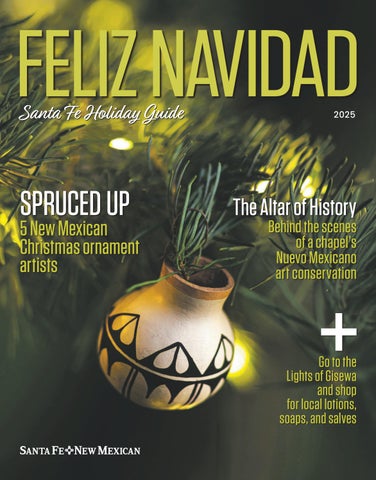
2025
SPRUCED UP
5 New Mexican Christmas ornament artists
The Altar of History
Behind the scenes of a chapel’s Nuevo Mexicano art conservation
Go to the Lights of Gisewa and shop for local lotions, soaps, and salves
Reduce Reuse Recycle Happy Holidays!
4
FELIZ NAVIDAD 2025
Santa Fe & Northern New Mexico Holiday Guide 5
C H R I S T US ST. VINCE N T E NTRADA CO NTENTA URGENT CARE
We’re here for you when you need us. CHRISTUS St. Vincent Urgent Care provides you with immediate access to expert care for your minor conditions, including treatment of colds/flu, ear infections, asthma exacerbations, minor injuries, strep, abdominal issues, cuts, sprains, broken bones and workforce injury exams. With walk-in and scheduled appointments available, our team is always prepared to care for you.
CHRISTUS St. Vincent Entrada Contenta Health Center 5501 Herrera Drive Santa Fe, New Mexico 87507 (505) 913-4180
6
FELIZ NAVIDAD 2025
FOR INFO
& TICKETS
A FESTIVE LIGHT WALK AND MUSIC EXPERIENCE THROUGH THE GARDEN DECEMBER 18-31 (CLOSED 12/24-25) visitsfbg.org/laluz 505•471•9103 8
FELIZ NAVIDAD 2025
Santa Fe & Northern New Mexico Holiday Guide 9
FELIZ NAVIDAD
OWNER Robin Martin PUBLISHER Patrick Dorsey EXECUTIVE EDITOR Bill Church EDITORIAL Magazine Editor Ashley M. Biggers abiggers@sfnewmexican.com Designer Linda M. Peters linda@swelldesign.net Copy Editor Peg Goldstein CONTRIBUTORS Tira Howard, Kelly Koepke, Jennifer Levin, Gabriella Marks, Adele Oliveira, Steven St. John, and Emily Withnall ADVERTISING Chief Advertising and Marketing Director Wendy Ortega Classified Advertising Manager Laura Harding ADVERTISING SALES Mayra Aldaz, Maria Lopez Garcia Deb Meyers, Veronica Rigales Vanessa Ruedeman, Trina Thomas ADVERTISING ART DEPARTMENT Designers Elspeth Hilbert, Rick Artiaga, Justin Bixler PRODUCTION Operations Director, Robert Bauwens Prepress Manager, Anthony Welch Assistant Production Director, Brenda Shaffer
DISTRIBUTION Circulation Director, Michael Reichard
The Gift of Golondrinas
TECHNOLOGY Technology Director, Michael Campbell
Get your loved ones a full year of membership to El Rancho de Las Golondrinas: plans offer free and discounted entrance to all festivals, free access to the Museum grounds, discounts in our Museum Store and more.
WEB santafenewmexican.com
Includes The Santa Fe Wine Festival, Renaissance Faire, Harvest Festival and more! Scan the QR code or visit www.golondrinas.org/membership.
ON THE COVER
A gourd ornament by Sean Morningstar. Read more about New Mexico– made ornaments beginning on page 45.
COVER PHOTO By Tira Howard Partially funded by the city of Santa Fe Arts Commission and the 1% Lodgers’ Tax, County of Santa Fe Lodgers’ Tax, and New Mexico Arts.
10
FELIZ NAVIDAD 2025
ADDRESS Office: 150 Washington Ave. #105 Hours: 8 a.m.–5 p.m. Monday–Friday Advertising Information: 505-995-3852 Delivery: 505-986-3010, 800-873-3372 For copies of this magazine, call 505-986-3010 or email circulation@sfnewmexican.com. To subscribe to The New Mexican call 505-986-3010.
100
CENTENNIAL
Santa Fe & Northern New Mexico Holiday Guide 11
1700 Hospital Drive Santa Fe, NM 87505 | Phone: 505-988-2121 12
FELIZ NAVIDAD 2025
Photos (clockwise): By Tira Howard, by Gabriella Marks, by Steven St. John, courtesy Bison Star Naturals, by Michael G. Seamans/The New Mexican
Published November 28, 2025
INSIDE THIS ISSUE
45
Departments
Features
12
34
CALENDAR
SHINE YOUR SWEET LIGHT
Festive concerts, community gatherings, and art markets to celebrate the season
For young local Jews, Chanukah is key to Jewish pride. By Jennifer Levin
Event Spotlight: Holidays at the Palace welcomes families to a landmark.
51
23
OUTDOORS
Drift into a snowy Valles Caldera with new seasonal programs as the preserve marks its 25th anniversary.
25
READ
Santa Fe author Douglas Preston’s titles include chart-topping thrillers — with a new one out this year — and a holiday children’s book with a home-town bent.
37
PROTECTING THE HEARTPLACE
Pueblos are restoring and revitalizing architecture on their tribal lands — and preserving culture in the process. By Emily Withnall Photography by Steven St. John
GO
Road-trip to Jemez Springs for Lights of Gisewa.
THE ALTAR OF TIME
45
51
ALL THE TRIMMINGS
MAKERS 31
40
Santeros conserved a notable historic altar screen in Chamita’s Capilla de San Pedro for the next generation of the faithful. By Ashley M. Biggers Photography by Gabriella Marks
31
Winter doesn’t have to mean dry skin with these locally made and sourced body products perfect for gifting.
40
37
Five New Mexican makers create seasonal Christmas ornaments with heart. By Ashley M. Biggers Photography by Tira Howard Santa Fe & Northern New Mexico Holiday Guide 13
CALENDAR
Left to right: TJ and Amanda Grundler with daughters Isabella and Anya clap and cheer following the lighting of the first candle on the menorah to celebrate the first night of Chanukah on the plaza in 2024.
HOLIDAY HAPPENINGS
Your guide to seasonal art markets, celebrations, and concerts ART MARKETS NOVEMBER 29, 10 A.M.–6 P.M. NOVEMBER 30, 9 A.M.–4 P.M. SWAIA Winter Indian Market This holiday market includes jewelry, pottery, paintings, textiles, and other creations by 150-plus Indigenous artists. Santa Fe Community Convention Center, 201 W. Marcy St. Tickets: online. swaia.org DECEMBER 6, 9 A.M.–5 P.M. DECEMBER 7, 9:30 A.M.–4 P.M. Winter Spanish Market Browse Spanish colonial arts, from jewelry to textiles, made by modern masters. Santa Fe Community Convention Center, 201 W. Marcy St. Tickets: free. traditionalspanishmarket.org DECEMBER 12, 3–9 P.M. String of Lights Holiday Market Browse the booths of 60-plus local makers at the 10th annual market. Santa Fe Farmers Market Pavilion. Free to shop. highdesertmarkets.com 14
FELIZ NAVIDAD 2025
DECEMBER 13, 10 A.M.–4 P.M. DECEMBER 14, 10 A.M.–3 P.M. Winter Youth Show, Native American Artisans Portal Program Young relatives of current Native American Artisans Portal Program members display and sell their artwork in the museum lobby. The show celebrates the legacy of program artists and offers visitors a chance to support young artisans during the holidays. New Mexico History Museum, 113 Lincoln Ave. Free to attend. nmhistorymuseum.org
Ongoing
SATURDAYS, 9 A.M.–2 P.M. Santa Fe Artists Market Browse pottery, jewelry, paintings, photography, sculpture, and more from local artists and craftspeople. North of the water tower at the Railyard. Free to shop. santafeartistsmarket.com SUNDAYS, 10 A.M.–3 P.M. Railyard Artisan Market Purchase fine art and crafts directly
from artists for holiday gifts and special occasions. Santa Fe Farmers Market Pavilion. Free to shop. santafefarmersmarket.com
SUNDAYS, 10 A.M.–4 P.M. El Mercado at El Museo Cultural de Santa Fe A year-round market with more than 50 vendors selling goods from around the world. El Museo Cultural, 555 Camino de La Familia. elmuseocultural.org
HOLIDAY FESTIVITIES NOVEMBER 28, 5:30 P.M. Tree Lighting on the Plaza Enjoy goodies from vendors and caroling as the Plaza’s trees are illuminated for the season with lights and holiday decor. Festivities start at 4:30 p.m. with entertainment on the bandstand. Santa and Mrs. Claus make an appearance. The mayor, city councilors, and other dignitaries preside over the main event. Santa Fe Plaza. Free. santafenm.gov
DECEMBER 6, 10 A.M.–6 P.M. DECEMBER 7 10 A.M.–4 P.M. Chama Christmas in the Mountains Road-trip to the town of Chama for carriage rides, a visit to Santa's workshop, a cookie crawl, a tree lighting, a holiday train, and more. chamachristmas.com DECEMBER 7, 5:30–7 P.M. Las Posadas on the Plaza This traditional holiday pageant re-creates Mary and Joseph’s search for shelter in the days leading up to the birth of Jesus. Local volunteers present the event, which begins with a candlelit procession at 5:30 p.m. and concludes with carols. Arrive at 5 p.m. for candle preparations. Free. Santa Fe Plaza. nmhistorymuseum.org DECEMBER 12, 5:30–7:30 P.M. Holidays at the Palace Since 1982, Holidays at the Palace has celebrated the season with hot cider, cookies, live music, crafts, and a visit from Santa Claus. Free (donations of nonperishable food welcome). Enter at Palace of the Governors, 105 W. Palace Ave. nmhistorymuseum.org
DECEMBER 12–13 Lights of Gisewa at Jemez Historic Site Celebrate New Mexico traditions at Jemez Historic Site’s annual holiday event. The historic Gisewa Pueblo and San José de los Jemez Mission glow with hundreds of farolitos. The evening’s program includes traditional Native American music and Pueblo dancers performing between two bonfires. The historic site also hosts arts and crafts, with food available for purchase. Jemez Historic Site (NM 4, just north of Jemez Springs). Tickets: online. nmhistoricsites.org/jemez DECEMBER 14, 3:30 P.M. Chanukah on the Plaza Chanukah Kickoff Mark the first night of Chanukah with music from klezmer musician Jordan Wax, gelt, latkes, and the lighting of the giant chile menorah. Santa Fe Plaza. Free. santafejcc.com DECEMBER 18, 10:30–11:30 A.M. Celebrate the Solstice Make an evergreen wreath with the Santa Fe Children’s Museum Seeds & Sprouts program. Santa Fe Children’s Museum, 1050 Old Pecos Trail. Free with admission. santafechildrensmuseum.org
Photos (left to right): By Gabriela Campos/The New Mexican, by Michael G. Seamans/The New Mexican
DECEMBER 18–31, 4:30–7:30 P.M. NIGHTLY La Luz de Las Noches The Santa Fe Botanical Garden sparkles with holiday lights and farolitos. Wander the paths to discover live music (see schedule online), light bites, and
holiday cheer. Santa and Mrs. Claus appear December 20–23. Closed December 24 and 25. Tickets: $29.95 adults, $9.95 youth. Santa Fe Botanical Garden, 715 Camino Lejo. visitsfbg.org
DECEMBER 19, 2–4 P.M. Celebrate the Solstice Construct your own lantern to light the long night during this special Fine Art Friday. Santa Fe Children’s Museum, 1050 Old Pecos Trail. Free with admission. santafechildrensmuseum.org DECEMBER 19, 4:30 P.M. Shabbat Chanukah Community Dinner Traditional Chanukah dinner with brisket, latkes, challah, soup, and more. Santa Fe Jewish Center, 230 W. Manhattan Ave. Tickets: register online. santafejcc.com
Discover
the Ultimate destination for excclusive spirits, vibrant Saturday wine tastings, distiinctive craft beers, and the very best in locallyy sourceed wines, beers and spirits. Also offering holiday gift sets, hooliday brews, specialty liquors, gift cards and more!
DECEMBER 20, 2–4 P.M. Solstice Science Saturday Learn about the science of the seasons at this special Science Saturday. Santa Fe Children’s Museum, 1050 Old Pecos Trail. Free with admission. santafechildrensmuseum.org DECEMBER 24, 6–9 P.M. Farolito Walk Thousands of farolitos cast a glow on the centuries-old buildings lining Canyon Road. Luminarias decorate the road, keeping shoppers warm. Join in the caroling and stop by galleries for hot cider. Vehicular traffic is prohibited from 5:30 to 10 p.m. on Canyon Road, Acequia Madre Street, and Delgado Street. Free. Canyon Road. farolitowalk.com
Located at
34 Cities of Gold Road 12 miles north of Santa Fe along US Highway 285
(505) 455-2219
Openn Mon-Sat: 9:00 am – 9:00 pm p Sunday: 10:00 am – 6:00 pm
There is enough bitter in the world, gift something Sweet! Introducing
Enchanted Biscochitos • Mint
• Chile • Lavender
Come see us at our NEW LOCATION 128 E Marcy St., Santa Fe, NM Revelers warm themselves by the fire during the Farolito Walk on Canyon Road on Christmas Eve 2024.
Santa Fe & Northern New Mexico Holiday Guide 15
DECEMBER 4–JANUARY 4 THURSDAYS–SATURDAYS 7:30 P.M. SUNDAYS 2 P.M. The Mystery of Edwin Drood Santa Fe Playhouse presents a production based on Charles Dickens’s final, unfinished novel. The comedy musical invites the audience to solve its mystery by choosing the identity of the murderer. The show opens December 4 and 5 with paywhat-you-will previews. Tickets: from $21. Santa Fe Playhouse, 142 E. De Vargas St. santafeplayhouse.org
CALENDAR
DECEMBER 31, 11 A.M.–1 P.M. Noon Year’s Eve Celebrate New Year’s Eve before bedtime (with a balloon drop at noon) with special guests and activities to ring in 2026 with the family. Santa Fe Children’s Museum, 1050 Old Pecos Trail. Event fee may apply. santafechildrensmuseum.org
Eight-month-old Astrid Tollefson watches in fascination as the chiles on her aunt Samantha Rigo’s necklace flash during the tree lighting on the Plaza ceremony in 2024.
PERFORMING ARTS DECEMBER 2, 7 P.M. Sounds of the Season In a community tradition dating to 1865, the all-volunteer Santa Fe Concert Band gives a holiday show, featuring “The Eighth Candle,” “Sleigh Ride,” and traditional and contemporary carol medleys. Tickets: free. Lensic Performing Arts
Center, 211 W. San Francisco St. santafeconcertband.org
DECEMBER 3, 7:30 P.M. DakhaBrakha The Ukrainian quartet performs complex rhythmic and melodic structures from India, Arabia, Africa, and Australia. Tickets: from $61. Lensic Performing Arts Center, 211 W. San Francisco St. lensic.org
DECEMBER 6–7, 7 P.M. Santa Fe Inclusive Special Needs Talent Showcase Presented by Teatro Paraguas and Jodi McGinnis, this showcase features a variety of performances, including dance and magic. Free; donations accepted. Teatro Paraguas, 3205 Calle Marie. teatroparaguasnm.org
Photos: By Jim Weber/The New Mexican; by Jamie Harmon, courtesy Lensic Performing Arts Center
DECEMBER 31, 8 P.M.–12:15 A.M. New Year’s Eve on the Plaza Ring in 2026 with family and friends on the historic Santa Fe Plaza. Local bands perform on the bandstand until the stroke of midnight. Then a Zia (used with permission of Zia Pueblo) is raised against a backdrop of fireworks launched from the roof of La Fonda, Santa Fe’s oldest hotel. The Kiwanis Club of Santa Fe provides hot chocolate and bizcochitos. Dress warmly and remember that no alcohol consumption is permitted on the Plaza. Free. Santa Fe Plaza. santafe.org/nye
DECEMBER 5, 4–7 P.M. Lighting of Ledoux The Harwood Museum of Art and its Ledoux Street neighbors celebrate the holiday season with bonfires and farolitos, performances, free museum admission, holiday art making, an artist market, and festive cheer. Free. Ledoux Street. harwoodmuseum.org
The Squirrel Nut Zippers will perform at the Lensic.
16
FELIZ NAVIDAD 2025
Please visit us STORE IN a season ll long!
Santa Fe & Northern New Mexico Holiday Guide 17
CALENDAR
DECEMBER 7, 4 P.M. Sounds of the Season Led by Maestro Guillermo Figueroa, the Santa Fe Symphony Orchestra is joined on stage by the Santa Fe Symphony Youth Orchestra, led by William Waag, for a side-by-side performance of holiday selections. Tickets: from $35. Lensic Performing Arts Center, 211 W. San Francisco St. santafesymphony.org DECEMBER 9, 7 P.M. Carols & Choruses The Santa Fe Symphony presents the Symphony Chorus, the Symphony Chamber Singers, the Symphony Choral Scholars, members of the recently formed Youth Choruses, and the Symphony Brass and Chamber Ensembles for a familyfriendly celebration of the season. Tickets: free; no reservations required. 18
FELIZ NAVIDAD 2025
Cathedral Basilica of Saint Francis of Assisi, 131 Cathedral Place. santafesymphony.org
DECEMBER 12–21 FRIDAY 7 P.M. SATURDAY–SUNDAY 2 P.M. A Musical Piñata for Christmas In the 13th annual community celebration, enjoy traditional New Mexican and Mexican carols, dance, poetry, and skits. The familyfriendly program ends with an appearance by Santa Claus and a celebratory piñata breaking. Tickets: $15 adults, $5 children. Teatro Paraguas, 3205 Calle Marie. teatroparaguasnm.org DECEMBER 13–14, 3 P.M. Look Above and Beyond — Winter The Santa Fe Women’s Ensemble presents its holiday concert featuring classics like “Mary Had a Baby”
and “Ode to Joy,” along with lesserknown songs that evoke the season. Tickets: from $30. First Presbyterian Church, 208 Grant Ave. sfwe.org
DECEMBER 13, 1 AND 7:30 P.M. DECEMBER 14, 1 AND 5 P.M. The Nutcracker Aspen Santa Fe Ballet’s 35th anniversary season continues with The Nutcracker, starring Haley Schwan and Patrick Yocum of Boston Ballet. The holiday performance unites professional dancers and children from ASFB’s educational programs. Tickets: TBA. Lensic Performing Arts Center, 211 W. San Francisco St. aspensantafeballet.com DECEMBER 13, 16, 18, 19, 20, 7 P.M. DECEMBER 21, 4 AND 7:30 P.M. Carols and Lullabies: Luminarias Santa Fe Desert Chorale presents its annual Winter Festival, featuring
beloved carols and new musical gems, plus Latin American seasonal folk tunes. Join pianist Nathan Salazar and 24 professional vocal artists in a celebration of light, joy, and hope. Tickets: from $11. Cathedral Basilica of Saint Francis of Assisi, 131 Cathedral Place. desertchorale.org
DECEMBER 17, 7:30 P.M. The Klezmatics: Happy Joyous Hanukkah Celebrate the holidays with the Grammy-winning klezmer superstars who revolutionized Yiddish music. Their genre-blending sound draws from Latin stomps, jazz riffs, and rhythms of the Balkans, the Middle East, Africa, and America, making klezmer relevant to new generations. Tickets: from $36. Lensic Performing Arts Center, 211 W. San Francisco St. lensic.org
Photo: Courtesy Lensic Performing Arts Center
Joe Illick and the New Year's Eve Orchestra return to the Lensic.
Santa Fe & Northern New Mexico Holiday Guide 19
for a unique holiday concert. Tickets: from $35. Lensic Performing Arts Center, 211 W. San Francisco St. santafesymphony.org
CALENDAR
DECEMBER 27–28, 7 P.M. Chuscales and Friends Compañia Chuscales and Mina Fajardo present a flamenco concert for winter. Tickets: $25–$28. Teatro Paraguas, 3205 Calle Marie. teatroparaguasnm.org
DECEMBER 19, 7:30 P.M. Mariachi Christmas Ring in the holiday season with a showcase of the music and folklórico dance of Mexico at Christmas. Popejoy Hall, 203 Cornell Drive, Albuquerque. popejoypresents.com DECEMBER 19, 7:30 P.M. Squirrel Nut Zippers Christmas Caravan The band brings its joyous, raucous Christmas Caravan tour back on the road, performing hits from holidays past. Tickets: from $54. Lensic Performing Arts Center, 211 W. San Francisco St. lensic.org DECEMBER 20, 11 A.M. Andrea Chénier The Met: Live in HD series brings Giordano’s passionate tragedy to the screen, starring tenor Piotr Beczała as the virtuous poet who falls victim to the intrigue and violence of the French Revolution. Tickets: TBA.
Holly Maiz smiles as she strolls Canyon Road on Christmas Eve 2024.
Lensic Performing Arts Center, 211 W. San Francisco St. lensic.org
DECEMBER 20, 4 P.M. DECEMBER 21, 3 P.M. Bach Festival: A Baroque Christmas Under the direction of Colin Jacobsen and Stephen Redfield, Santa Fe Pro Musica presents its Bach Ensemble performing Telemann, Bach, and Handel. Tickets: from $33. St. Francis Auditorium at the New Mexico Museum of Art, 107 W. Palace Ave. sfpromusica.org DECEMBER 20–21, 7 P.M. Holiday Flamenco 2025 Compañia Chuscales and Mina
Locally owned and operated since 1985
Beautiful ul, fine jewelry including watches, bracelets, crosses, necklaces, engagement rings, earrings and more.
Small town prices and great customer service
Barbara Serna Owner
108 Paseo de Onate, Ste B, Española, NM Open Mon, Tue, Wed, & Fri 10am-5:30pm, and Sat 10am-2pm | Closed Thurs and Sun
20
FELIZ NAVIDAD 2025
Fajardo present a flamenco extravaganza. Tickets: $30 general admission, $25 seniors and students. Teatro Paraguas, 3205 Calle Marie. teatroparaguasnm.org
DECEMBER 24, 2 P.M. Christmas Eve — Vivaldi’s Four Seasons Santa Fe Pro Musica’s orchestra performs selections from Vivaldi in honor of the holiday. Tickets: from $26. Lensic Performing Arts Center, 211 W. San Francisco St. sfpromusica.org DECEMBER 27, 7 P.M. Nosotros Popular Latin dance band Nosotros joins forces with the Santa Fe Symphony
DECEMBER 29–DECEMBER 30, 7:30 P.M. Bach Festival: Bach and Beyond Presented by Santa Fe Pro Musica under the direction of Colin Jacobsen, the Santa Fe Pro Musica Orchestra presents selections from Bach, Arvo Pärt, and Britten. Tickets: from $33. Lensic Performing Arts Center, 211 W. San Francisco St. sfpromusica.org DECEMBER 31, 1 AND 5 P.M. Joe Illick & the New Year’s Eve Orchestra Santa Fe’s beloved Joe Illick fills the stage with esteemed musicians and choral singers to kick off the year. The 2025 concert features Beethoven’s Symphony No. 7 and renowned violinist Augustin Hadelich, who performs as soloist in Samuel Barber’s violin concerto. Families are encouraged to attend the 1 p.m. show. Tickets for 1 p.m. performance: $27, $6 for children 12 and under. Tickets for 5 p.m. performance: from $38. Lensic Performing Arts Center, 211 W. San Francisco St. lensic.org
Photo: By Michael G. Seamans/The New Mexican
DECEMBER 18 AND 19, 7:30 P.M. Bach Festival: Goldberg Variations Presented by Santa Fe Pro Musica, Colin Jacobsen (violin), Nicholas Cords (viola), and Edward Arron (cello) perform Bach’s Goldberg Variations. Lensic Performing Arts Center, 211 W. San Francisco St. sfpromusica.org
GO GREEN THIS HOLIDAY SEASON, LITERALLY. GIVE YOURSELF THE GIFT OF FRESH, CLEAN, AND SUSTAINABLE STYLE.
1091 St. Francis Drive | 400 N. Guadalupe St. 913 Old Pecos Trail | 2801 Rodeo Rd.
drycleaningsantafe.com 505-982-8603
VOTED SANTA FE’S BEST DRY CLEANER
6 YEARS IN A ROW
LOCALLY OWNED FOR 63 YEARS
Santa Fe & Northern New Mexico Holiday Guide 21
CALENDAR SPOTLIGHT
Holidays at the Palace
Photos: By Jim Weber/The New Mexican
E
AD
ach December since 1982, the Palace of the Governors has opened its doors for Holidays at the Palace, a beloved tradition for Santa Feans. The building on the north side of the Plaza dates to 1610 and is the “oldest public building in continuous use constructed by European settlers in the continental United States,” according to the New Mexico History Museum’s website. During the free event, visitors can wander the beloved iconic building, whose halls are decked with Christmas trees and seasonal decorations. As visitors duck through low doorways, the festivities can feel like stepping back in time, to when soldiers, government officials, merchants, and dignitaries celebrated the season during the National Historic Landmark’s four centuries of use. Live music awaits in several rooms, including one where visitors can gaze through clear floor panels that expose the building’s historic footings. Outside, flickering farolitos light courtyard paths leading to stations for hot cider and holiday cookies, and to the seat of honor, where Santa Claus greets children eager to share their holiday wish lists. Santa hands out Palace of the Governors holiday coloring books to each of his visitors. Across the courtyard, in a former stable, a working museum exhibit showcases New Mexico’s printing traditions. During Holidays at the Palace, guests can step inside the intimate print shop and operate one of the historic presses, feeling the solid thump of the press arm as it inks a design onto a paper bag for a future farolito. This year’s event also includes a piñata contest and a photo station looking out from the Palace’s ceremonial doors to the lighted Plaza. Holidays at the Palace happens Friday, December 12, from 5:30 to 7:30 p.m. The New Mexico History Museum closes at 3 p.m. to prepare for the event. Admission is free. Donations of — AMB nonperishable food items are accepted.
Clockwise: Santa Claus, played by Harvey VanSickle, lets Guillaume Kilgore Valerio, 4, tug on his beard to prove that it's the real deal during the 2024 Holidays at the Palace. Visitors wander the decked-out halls at the Palace of the Governors. Ryder Kerr, 2, takes a closer look at the farolitos lining the courtyard. Students in Margaret Carpenter's nonprofit Suzuki violin program perform classic holiday tunes during the 2024 Holidays at the Palace.
Santa Fe & Northern New Mexico Holiday Guide 23
Twas’ the Night Before Christmas... ….and our very own Anton of Pixel Images has transformed into the classic European Santa of yesteryear, to the delight of kids from 1 to 99! Santa Photos: Nov 30: 12-5p Dec 5, 12, 15-18: 2-5p Dec 6, 7, 13, 14: 11a-5p Dec 19: 12-6p Dec 20-23: 11a-6p Christmas Eve: 11a-4p Packages starting at $39.95. Call 505-989-8118 for more info.
Free Parking • North Guadalupe & Paseo de Peralta • Walking Distance from Railyard & Plaza 505-982-2655 • DeVargasCenter.com • #DiscoverDeVargas • 24
FELIZ NAVIDAD 2025
DRIF T IN TO
OUTDOORS
A Snowy Valles Caldera New seasonal programs and trail grooming toast the preserve’s 25th anniversary.
Photos (from top): Courtesy NPS, by Luis Sánchez Saturno/The New Mexican
I
BY ELIZABETH MILLER
n deep winter, snow usually covers the meadows and braided creeks that carve the vast basin at Valles Caldera National Preserve. It’s often deep enough to free cross-country skiers and snowshoers to roam as they seek vistas of frosted pines and the caldera rim ringing the horizon. Park rangers here sometimes joke that they’ve been stationed in Greenland instead of outside Los Alamos, especially when temperatures drop as low as –30°F and storms frame the road with 5 feet of snow. But on the January morning I set out to ski in the preserve, the season’s snowfall was slim, with grass threading through the meager snow cover underfoot. So I hiked instead, boots gripping a thin snow crust, cold biting at any inch of bare skin, and wind spinning flakes into spirals beneath a brilliant blue sky. The Valles Caldera National Preserve marked 25 years as public land in July, which coincided with another anniversary: 10 years under National Park Service management. The switch in accessibility from private land to public is hitting its stride, with growing options for enjoying the lands in every season.
Winter driving access to the Valles Caldera closes at the Cabin District, a cluster of historic buildings, some roughly 100 years old. One now houses the Volcano Discovery Center and its interpretive displays. But from the Cabin District a backcountry road offers a relatively easy snowshoe, ski, or hike — if the unpredictable weather demands it — of almost a mile to History Grove, a rare stand of oldgrowth ponderosa pines. The route is a favorite for Lauren Ray, visual information specialist for the preserve, who skis out every winter — conditions allowing — to contemplate the uniquely enormous ponderosa pines and the view over Valle Grande, the 14-mile-wide caldera that’s the preserve’s centerpiece. “The vastness, the expansiveness, I think that strikes most people,” Ray says. “That has drawn people for a long time, and it’s cool to be a part of that.” The land here is sacred to many of the area’s Native American tribes, whose history with and use of it dates back millennia. A land grant transferred the area to private ownership in 1860, and it was closed to public access until 2000. In recent winters, Park Service staff have added recreational options, including grooming about 5 to 6 miles of trails for cross-country skiing and snowshoeing (with separate lanes for each group). Skiers can check for groomed routes from the welcome station to the Cabin District, with forks that split toward History Grove or South Mountain. Another trail loops around Cerro La Jara, one of the cinder cones jutting up out of the basin south of the welcome station. “That’s very popular because it’s flat, it’s short, it’s easy to get done in about an hour,” Ray says. Rangers also guide moonlit snowshoeing around Cerro La Jara and ski tours that showcase the winter soundscape. During dark-sky events, visitors can catch a full moon or stargaze in the caldera. It’s worth braving the cold, Ray says. She adds, “This place completely transforms from season to season.” Elizabeth Miller is an award-winning freelance journalist based in Santa Fe.
Greg and Maria Foster hit the snowshoe trails at the Valles Caldera National Preserve during the 2024 Winter Fest. Above: Golden hour at Cerro Abrigo.
Check for events online, including the 2026 Valles Caldera National Preserve Winter Fest, when family-friendly ranger- and self-guided activities include story times, crafts, scavenger hunts, and hikes. Los Amigos de Valles Caldera (the association that manages the preserve’s bookstore) offers daily snowshoe rentals in the park. For more information, visit nps.gov/vall.
Santa Fe & Northern New Mexico Holiday Guide 25
Ride the desert wave to
MALIBU SKIN & GOODS Gift your skin a Holiday Glow GIVE THE GIFT OF:
Facials MakeUp Tutorials Artisanal Gifts
Holiday Gift Baskets OUR FEATURED PRODUCTS:
Exculsive Jane Iredale retailer in Santa Fe
Whether you’re indulging in
a luminous facial, flawless event glam, or treating someone to a relaxing spa experience, we’ve curated beauty from head to toe.
ASPEN INSPIRED JEWELRY
26
FELIZ NAVIDAD 2025
SHOP LOCAL THIS SEASON!
518 OLD SANTA FE TRAIL TRAIL, A #4 - PLAZA BONITA Booking & gift cards available online
ma alibu-skin.com
At Home with Range
READ
Author Douglas Preston’s titles include chart-topping thrillers and a holiday children’s book with a hometown bent.
A
n overview of writer and Santa Fe local Douglas Preston’s life story sounds like a description of one of his bestselling books: part thriller, part detective noir, and part adventure saga. It includes milestones like helping uncover an ancient city in the Honduran jungle (the basis for 2017’s The Lost City of the Monkey God); retracing an Italian serial killer’s long-cold trail, which he chronicled in 2006’s The Monster of Florence; and relocating to the wilds of New Mexico, whose Indigenous cultures and remote locales inspired his latest novel, Badlands, published in June.
BY ADELE OLIVEIRA He’s published more than 35 titles across fiction and nonfiction — including many in collaboration with a longtime friend, author and editor Lincoln Child — and written dozens of expedition-based articles for magazines like National Geographic and The New Yorker. In recent years, one project has kept him closer to home and off the page — though he couldn’t stay away for long. Along with author pal George R.R. Martin and entrepreneur Bill Banowsky, Preston is a co-owner of Sky Railway, which offers a Christmas train experience for families built around the story of Pablito, a purple dragon Preston dreamt
Photo: Courtesy Douglas Preston
AD
up and — reflecting the author’s range — wrote about in the children’s book Santa’s Dragon, illustrated by Raya Golden. Preston’s writing (and speaking) style is conversational, wry, and immediately engaging, like listening to a favorite uncle tell a story. He was born in Massachusetts and first came to New Mexico as a boy, attending summer camp at Cottonwood Gulch near Thoreau, between Gallup and Grants. In the mid-1980s, frustrated with a well-paying but creatively unfulfilling job at the American Museum of Natural History in New York City and wanting to be a full-time writer with a lower cost of living, Preston and his then girlfriend packed a Subaru to the gills and lit out for Santa Fe, sight unseen. “When I got to Santa Fe, I loved it immediately, knew that it was where I wanted to live, and she hated it,” Preston says from his home in Maine, where he spends part of the year. “She wanted to write for film and television, so we separated. She moved to LA, where she found great success writing for MTV and Disney. I stayed in Santa Fe struggling, making no money at all. She called me up about a year after she moved away — we were still friends — and she said, ‘I just got my brokerage statement, and I’m a millionaire. How much money do you have?’ And I said, ‘Go to hell. I’m still poor,’” Preston laughs. After seven or eight years as a struggling writer, Preston sold two movies scripts in one year and solidified the creative partnership with Child that changed his circumstances. Their collaboration is now the stuff of legend, yielding dozens of books, including the bestselling Pendergast series, starring FBI special agent Aloysius Pendergast. Preston describes how their creative partnership began. After the anticlimactic publication of Preston’s first book, Dinosaurs in the Attic, Child wanted to do something special to commemorate the experience. So they took a secret late-night tour of the Natural History Museum. “We ended up in the old Hall of the Cretaceous, with just the emergency fluorescent lighting on. It was really creepy, much more dramatic than the professional lighting,” Preston remembers. “Lincoln turned to me and said, ‘My God, this is the scariest building in the world. We have got to set a thriller in this building.’ I said I didn’t know how to write a thriller, and he said, ‘Well, I do.’” The resulting book was Relic, the first book in which Pendergast appears. Author and company co-owner Douglas Preston aboard the engine of a Sky Railway train.
Santa Fe & Northern New Mexico Holiday Guide 27
READ
In the beginning, when Preston still lived in New York, he and Child met in person, ostensibly to write. “We’d sit around and drink some very nice single malt whiskey and talk about what fine fellows we were and complain about things,” Preston says. “We didn’t get any work done at all.” Early on, Child was more of the ideas man while Preston did most of the actual writing. These days, after plotting a new book, they split up the chapters they’re going to write before swapping them for the other to edit. Neither likes being rewritten, but their trust is such that it’s become their system. “We challenge each other, and we don’t let anything slip by,” Preston says. “We massacre each other’s little darlings.” Their latest collaboration, Badlands, the fifth book in a series about Nora Kelly, pairs the archaeologist with FBI agent Corrie Swanson to investigate the mysterious death of a woman found in the desert with Chacoan artifacts clutched in her hands. Currently, Preston is at work on a new nonfiction title about a tumultuous period called the Pleasant Valley War, which took place in frontier Arizona from 1887 to 1892. (He first heard the story over 30 years ago while retracing Coronado’s route for Cities of Gold.) “It was a feud between two families, but it was also a range war. It involved the railroad and a cattle company. So many currents of western history came together in this strange and violent incident,” Preston explains. When he’s not writing, he serves as president of the Authors Guild, the country’s oldest and largest profes28
FELIZ NAVIDAD 2025
sional organization for writers. The group is at the forefront of tackling emerging questions of the digital age, such as filing lawsuits against tech giants like OpenAI for training large language models on books without getting permission or compensating authors. (In 2020 Preston testified about the ineffectiveness of the Digital Millennium Copyright Act’s notice and takedown system the before the Senate Judiciary Committee’s Subcommittee on Intellectual Property.) Preston loves Santa Fe as much as when he first arrived. He’s an enthusiastic participant in the Santa Fe International Literary Festival and a proponent of the railroad he co-owns, noting, “In buying the defunct Santa Fe Southern Railroad and turning it into Sky Railway, George, Bill, and I are glad we were able to save an incredibly important part of Santa Fe history — and transform it into something that all Santa Feans can enjoy. In the four years since we revived the railroad, the Christmas train has been our most popular and beloved train experience.” Preston pairs the train ride with Santa’s Dragon, a story whose illustrations bring to life the Santa Fe setting. The main characters have distinctly New Mexican names: Protagonist Pablito’s full name is Pablo el Dragón Morado de Fuego y Humo (aka Pablo the Purple Dragon of Fire and Smoke) while the villain dragon is F.T. Mocosbabeantes Colmillofeo el Tercero, which translates to F.T. Soggybooger Scraggletooth the Third.
“I loved writing a children’s book. It wasn’t a particular challenge since I’ve never grown up myself — and a good story for children has the same qualities as one for adults,” Preston says. “After it was published, I was curious to see how kids would like it, so I joined — incognito — some groups of children listening to the story being read to them, and I was surprised and delighted at how much they seemed to love it.” Part of what makes the train ride so special is the narrative attached to the journey, encouraging young visitors to engage with the immersive, multi-textural story around them. Concerning a steady decline in the number of American adults who read for fun (it’s now only 16 percent according to 2025 American Time Use Survey data analyzed by researchers from University College London and the University of Florida), Preston says he isn’t surprised. But he isn’t as discouraged as he might be either. “In our culture, storytelling has expanded way beyond books,” he explains. While some of that is “toxic” (the “doomscrolling and conspiracy mongering”), Preston maintains that “storytelling is built into our genes as a significant part of our evolution as a species. . . . Most people are still consuming stories.” For more information on Douglas Preston’s latest works, visit prestonchild.com. Connect with the Authors Guild at authorsguild.org. Learn how to climb aboard the latest Sky Railway theme train at skyrailway.com.
Photos: Courtesy Douglas Preston and the publishers
Preston explores the New Mexican badlands and then pens his desert adventures into thrillers such as Badlands and the children's picture book Santa’s Dragon.
FOSTER’S FOSTER’S HOTEL HOTEL & & SALOON SALOON -- SINCE SINCE 1881 1881
AA historical historical landmark landmark
FOSTER’S HOTEL & SALOON - SINCE 1881
A historical landmark
Local Local beers beers on on tap, tap, wine wine & & spirits. spirits.
Bar Open: Friday - Tuesday 11am - Closing • Wednesday & Thursday 1pm - Closing of 11am operation vary please call to confirm Bar Open: Friday - Hours Tuesday - Closing • Wednesday & Thursday 1pm - Closing
operation please callCumbres to confirm& Toltec Scenic Railroad 393 Terrace Ave | ChamaHours NM | of Once blockvary north of the 575-756-2296
393 Terrace Ave | Chama NM | Once block north of the Cumbres & Toltec Scenic Railroad 575-756-2296 s a n t a s a n t a
f e f e
s a n t a
f e
17
November
2026 Lensic Performing Arts Center Santa Fe, New Mexico
HOMEGOODS, GOODS, TEXTILES, TEXTILES, FOLK HOME GOODS TEXTILES FOLK ART, ART FURNITURE, FURNITURE HOME FOLK ART, FURNITURE, APPAREL, JEWELRY, GIFTS AND APPAREL JEWELRY GIFTS AND ANDMORE MORE APPAREL, JEWELRY, GIFTS MORE HOME GOODS, TEXTILES, FOLK ART, FURNITURE, APPAREL, JEWELRY, GIFTS AND MORE E S T. 1989 E S T. 1989
www.leslieflynt.com E S T. 1989 www.leslieflynt.com
225 Canyon Road • Santa Fe, NM • 505.955.9901 225 Canyonwww.leslieflynt.com Road • Santa Fe, NM • 505.955.9901 MON-SATRoad 10-5, SUN 11-4Fe, PARKING 225 Canyon • Santa NM • AVAILABLE 505.955.9901
Santa Fe & Northern New Mexico Holiday Guide 29
HEARING & BALANCE
TRUST YOUR HEARING CARE TO SANTA FE’S ONLY COMPREHENSIVE ENT PHYSICIANINTEGRATED AUDIOLOGY TEAM. Hearing loss isn’t always just a natural part of aging or the result of loud noise exposure. It can also stem from an underlying medical condition like ear infections or benign tumors, which require expert medical diagnosis and treatment from an ENT doctor. At Southwestern Hearing & Balance, we’re proud to be Santa Fe’s only ENT physician-integrated hearing health team. That means our audiologists work closely with four local ENT providers—Dr. David Brown, Dr. Nizhoni Denipah, Dr. Lily Love and Dr. David Gallegos—to provide comprehensive hearing care to patients.
If our team suspects an ear-related medical issue is contributing to a patient’s hearing loss, we will refer them to one of our trusted ENT partners for further evaluation. Similarly, if one of our partner ENT doctors has a patient with a risk factor for hearing loss, such as high blood pressure or taking ototoxic (hearing-damaging) medications, they can easily refer them to Southwestern Hearing & Balance for a hearing test. This strong collaboration between our audiologists and local ENT physicians ensures every patient receives the most thorough and best coordinated health care possible.
THE SOUTHWESTERN HEARING & BALANCE TEAM not only monitors, maintains and improves your hearing, but also identifies and treats any physical abnormalities or illnesses of your ear and auditory system. Our independent center is dedicated to the principle that hearing loss and balance issues are medical problems that require collaboration between ENT physicians and audiologists to provide patients with the best coordinated care.
Our team dispenses hearing aids from the top manufacturers in the industry. These manufacturers provide not only technology but also excellent service based on our standards. We are committed to providing compassionate, comprehensive care for you and your family.
SOUTHWESTERN HEARING & BALANCE SERVICES INCLUDE: •
Hearing aid dispensing and fitting using Real-Ear Verification
•
Repair and maintenance of hearing aids from most manufacturers
•
Hearing testing performed in soundproof booths by licensed doctors of audiology
•
Follow-up care for rehabilitation of hearing loss
•
Tinnitus evaluation and management strategies
•
Vestibular diagnostic assessments
Ready to learn more about the latest hearing technology or take the first step toward treating your hearing loss? Southwestern Hearing & Balance is now accepting new patients. Call to schedule an appointment (505) 946-3955 or visit our website to learn more.
435 St. Michaels Drive, Suite B104, Santa Fe, NM 87505
HEARING & BALANCE
(505) 946-3955
www.HearSantaFe.com
You never know what you’ll know find You never You never know w at Uli’s…
you’ll find at Ul
you’ll find at Uli’s
Clothes for Clotheseveryone! for everyon
Gifts for everyo
208 W. San Francisco St - 505 986 0577 Ulissantafe.com
Uli’s Santa Fe
208 W. San Francisco St 505 986 0577 Ulissantafe.com 208 W.. San Francisco St 505 986 0577 Ulissantafe.com
Celebrating 30 Years in Santa Fe Italian-inspired, value-oriented, excellent quality, and fiercely neighborhood focused. 322 Garfield Street • AndiamoSantaFe.com • (505) 995-9595 32
FELIZ NAVIDAD 2025
GO
All Is Bright Lights of Gisewa event illuminates the Jemez Historic Site. BY ADELE OLIVEIRA PHOTOGRAPHY BY MICHAEL G. SEAMANS
T
Attendees at the 2024 Lights of Gisewa gather amid the lluminated remains of the San José de los Jémez Mission.
he last full moon of 2024, the Cold Moon, has just risen above the ridge line, bathing the Jemez Mountains in a dull golden glow as we march off the shuttle bus and into the frosty air. Our group crosses the two-lane road as a huddled herd, walking expectantly toward the Jemez Historic Site, toward light, drumming, and song. Striking to see at any hour or season, the site is particularly spectacular during the Lights of Gisewa, held over two evenings each December, when the structures are adorned with hundreds of farolitos, when dancers and drummers from Jemez and nearby pueblos come to perform between two large crackling luminarias. (In Northern New Mexico, lit votive candles in sand-filled paper bags are known as farolitos, while bonfires are called luminarias.) Casting shadows in the moonlight, the farolitos twinkle like fallen stars, lining the irregular stone walls of the buildings. As we make our way onto the grounds, our voices fade into awed silence. Even my two incessantly chatty children have nothing to say. By the remnants of what was once San José de los Jémez Mission, its roof now open to the sky, visitors crowd close around the doors, pressing up to the barricade, phone cameras held aloft — not unlike the scene at the Louvre in Mona Lisa’s gallery. But any image captured via smartphone is a mere facsimile of the farolitos ascending the altar steps before us, an ephemeral offering to the night and to the season. Wendi Laws, Jemez Historic Site regional manager during the 2024 event, who has since left the site, says leadership prioritizes events that spark community engagement, that “speak to the public and make them experience emotions when they’re visiting our sites. This is just a beautiful one. It has a very magical feel to it,” she says. “We’ve just kept adding to it and adding to it — like the performances and the local vendors — and it’s grown into something that has a life of its own.” Santa Fe & Northern New Mexico Holiday Guide 33
GO When the Lights of Gisewa debuted circa 2000, organizers modeled it on other seasonal area events, like Santa Fe’s Canyon Road farolito walk and Albuquerque’s Old Town holiday parade, says Marlon Magdalena, instructional coordinator supervisor at Jemez Historic Site and a Jemez Pueblo tribal member. In the early years, the event was much smaller, drawing a crowd of just a few hundred each evening. “We used to bring people up to the site by horse-drawn carriage,” Magdalena recalls. In 2024, about 2,500 people attended the event across both nights and were ferried to and from the site on regularly circulating shuttles. When it first started, the event was called Light Among the Ruins, but the name has since been updated and made more precise, acknowledging the ancestral name of the village.
34
FELIZ NAVIDAD 2025
What is now Jemez Historic Site includes both San José de los Jémez Mission and Gisewa Pueblo Site. It nestles in San Diego Canyon alongside the Jemez River, in an area first inhabited during the 14th century by the ancestors of the present-day Jemez people, according to the National Park Service, which recognizes the site as a National Historic Landmark. The word gisewa comes from the Towa language and translates to “boiling water place” — hot springs are nearby. It is also the name of the circa-1300 village that was well established by the time the Spanish arrived. San José de los Jémez Mission was built in 1621–1622 and, thanks to the Mexico City architectural training of Father Gerómino de Zárate Salmerón, had an almost 40-foot-tall octagonal bell tower, an unusual structure for the area. (While Zárate Salmerón designed the mission, the men and women of Jemez Pueblo built it out of wood, plaster, and limestone using their own traditional methods.) The vestiges of both the mission and the village now fall under the historic site’s umbrella. The NPS notes that Indigenous resistance to Spanish colonization persisted in Northern New Mexico prior to 1680 Pueblo Revolt. That clash, collision, and combination of
cultures is evident and literal at Gisewa, where ceremonial kivas abut the crumbling walls of the mission. Contemplating the weight of Gisewa’s violent history and trying to reconcile it with the beautiful scene created each December takes effort, and perhaps that’s part of the point, at least for nontribal visitors. (Tribal members from Jemez and other pueblos around the state attend the event for free. Magdalena estimates that between 300 and 500 tribal members attended in 2024.)
“It’s very important to note that Jemez Pueblo still actively uses this site for cultural ceremonies and that this site belongs to the pueblo,” Laws says. “That’s the reasoning behind booking performances from the pueblos, so they can share their culture, and most of the vendors come from Jemez or nearby. We’ve tried to move away from it just being a holiday event to trying to [include] more local history and specifically the history of the people of Jemez Pueblo.” My family and I wander the 1,400-foot-long interpretative path (visitors should stick to the paved sidewalk and not wander into the structures, even if the farolitos do) and arrive at the edge of a crowd. Between two luminarias, we watch a group of dancers from Jemez — dressed in regalia, glass beads glinting in the firelight, little clouds of dust at their feet — perform to the sound of drumbeats, so deep and resonant that they reverberate in our chests. Watching the performance is our favorite part, and Magdalena says the same. “The church at the site is from the period of colonization and kind of represents these two conflicting ideas together,” Laws says. “You can experience that history in New Mexico and see how the Pueblo people are still existing today. They’re still here. They’re still celebrating in the winter. Visitors can see that history is still living today.” Lights of Gisewa flickers at Jemez Historic Site December 12 and 13, 2025. Tickets are $20 for adults. Visit my.nmculture. org for information and to purchase timed tickets. Adele Oliveira grew up in Santa Fe and lives there with her family.
Clockwise from left: Brendan Garcia performs a traditional dance with the Northern and Southern Dance Group during the 2024 Lights of Gisewa. A visitor takes a photo at Gisewa Pueblo Site. Mark Pavlus holds his eight-month old son, Gregory, as they warm by a bonfire. People gather around a bonfire. Farolitos illuminate the Jemez Historic Site at the 2024 Lights of Gisewa.
Santa Fe & Northern New Mexico Holiday Guide 35
SHINE your
SWEET L IGH T BY JENNIFER LEVIN
Esther Itkin hands out gelt as part of the Santa Fe Jewish Center’s Chanukah on the Plaza celebration in 2024. Below: Esther and Rabbi Shmuel Itkin’s son, Mendel, gets in the seasonal spirit.
ewish holidays hinge on retelling stories. At Passover, we recall the Israelites escaping slavery in Egypt. For Purim, it’s a foiled plot to exterminate Jews in ancient Persia. And during the eight days of Chanukah, we talk about the miracle of oil. “A little more than 2,000 years ago, after a split in the Greek Empire, the king of the [Seleucid Empire], Antiochus, saw how the Jews had their own learning, their own way of connecting to God, so he decreed their holidays and traditions to be illegal, so that everybody would be the same,” explains Rabbi Shmuel Itkin, 26, who runs the Manhattan Avenue Deli at the Santa Fe Jewish Center. Judah Maccabee led a small army to fight this forced assimilation, while at the same time, “you have teachers hiding in caves to teach children the Torah, and this is where you get the dreidel,” Itkin says. “Children would be outside, watching for soldiers, pretending they were just playing with a top. The dreidel symbolizes us fighting to stay spiritually strong.” After several years of battle, with many heroes and heroines, the Maccabees retook the Second Temple in Jerusalem. So the story goes, they discovered an unopened cruse of sanctified olive oil with which to light the menorah — just enough to let the light shine through the temple’s windows for one night. “To get more oil would take seven days,” Itkin continues, “but the menorah is still shining the next night, and the next, and the next, until finally, on the eighth night, they have new olive oil. The miracle symbolizes that God supports their efforts to stand up for who they are and that he appreciates their struggle.” As vital as this story is to the ongoing existence of the Jewish people, Chanukah is considered a minor holiday, far less important than the fall High Holidays or Passover, which comes in spring. Yet it’s one of the most recognizable Jewish holidays in the United States because after World War II, American Jews who emigrated at the turn of the century, as well as those who fled the Third Reich, began emphasizing Chanukah to their children as a way to reinforce Jewish identity in
the face of overwhelming social pressure to celebrate Christmas. Today we greet Chanukah with parties, festive foods, and sometimes presents and public events. So why do Jews refer to it as minor? During major holidays, Halachic (religious) law prohibits everyday activities like working, cooking, or driving, “but Chanukah isn’t so high stakes,” explains Talya Horowitz, 25, who works in the after-school program at the Jewish Center. “Chanukah is something we add to our lives. We don’t have to stop what we’re doing — we don’t even go to synagogue. Chanukah is celebrating being Jewish in everyday life.” “We put the menorah in the window, or on the Santa Fe Plaza, because it’s a celebration that we share with the world,” says the rabbi’s wife, Esther Itkin, 26, and a born-and-raised Santa Fean, who directs children’s education at the center. “We invite others to experience the miracle, experience the light of the menorah as a symbol of freedom of religion, freedom to be diverse and proud of where you come from. That’s why Chanukah is shared in a way that no other Jewish holiday is.” Horowitz and Itkin are among a group of young Santa Feans leaning into their Jewish identity who have joined me, a Chicago transplant who has lived in Santa Fe for decades, around the deli table for a platter of piping hot latkes — potato pancakes fried in olive oil to symbolize the Chanukah miracle. Others include Horowitz’s husband, Chaim (a dental student, age 27), who along with his wife relocated from a large Orthodox community in Upstate New York; Aaron Moskowitz, 40, a Seattle transplant who runs the deli’s kitchen; Asher Ireland, 24, who’s in Santa Fe on a one-year fellowship with the Bureau of Land Management; and Rabbi Itkin, who grew up in Scranton, Pennsylvania. Santa Fe’s Jewish population is relatively active for a small town, but especially among younger people, it takes effort to seek out and build community, Moskowitz says. Though levels of religious observance vary, everyone at the table finds community at local synagogues and at the Jewish Center, which attracts people from every Jewish movement, including Orthodox, Conservative, Reform, Reconstructionist, and Renewal (denominations that are unrelated to political ideology). Ireland has been outspoken about his identity since age 10, when he moved to Salt Lake City and found that “no one in my community knew what Judaism was. Anything they’d learned about it was through their church, and the vision was 2,000 years old. So I was bringing dreidels with me at Chanukah, a menorah for show and tell, to show that we’re a living, vibrant people.” He continues to
J
36
FELIZ NAVIDAD 2025
Photos (clockwise): By Gabriela Campos/The New Mexican, courtesy Devorah Leah Levertov, courtesy of the Horowitz family, by Gabriela Campos/The New Mexican, courtesy of the Itkin family
Left to right: Rabbi Itkin checks on customers during lunch hour at Manhattan Avenue Deli. Talya and Chaim Horowitz with their daughter during Chanukah 2023. Below: Aaron Moskowitz prepares meals in the Manhattan Avenue Deli kitchen.
speak about the need for education about Judaism outside of Jewish spaces, so that children needn’t feel responsible for combatting antisemitism or countering ancient misinformation among their peers. Such a struggle is sadly typical for many Jewish children and adults, even in Santa Fe, where antisemitism usually comes through conversation or political posturing rather than threats or violence. “Sometimes my Jewish identity becomes people’s sole focus [because] they’re trying to understand what I think about Gaza and the war, which makes me feel tokenized and commodified,” says Moskowitz. Moskowitz and I were raised by a generation taught to downplay or hide their ethnicity out of fear of discrimination, yet we’ve always chosen to lean into our Jewish identities. “I just want to do my own thing, and the world can think what it wants,” Moskowitz says. He cooks many of his grandmother’s recipes in the deli kitchen. The latke recipe comes from Pinsk, a city in Belarus. “Food and family are central in Judaism, so anything that makes me think of and talk about my ancestors is like they’re affecting the world beyond their lifetime, which is also important in Judaism.” As for perpetuating Jewish pride to the next generation, “starting a family has been very important for me,” says Talya Horowitz, feeding a bite of latke to her 2-year-old daughter. “I instill in my daughter a love for who she is. Yes, there are people who want to tell us who they think we are, but I’m showing her that she can have confidence in who she is.” Jews in the United States usually celebrate Chanukah with latkes, an Ashkenazi staple. In New Mexico, you’ll also find Sephardic treats like empanadas, while global Chanukah celebrations feature sfenj (Moroccan doughnuts), samsas (walnut-stuffed dumplings from Uzbekistan), kibbet yatkeen (Syrian pumpkin patties), buñuelos (fried dough popular in Mexico, Cuba, and Colombia), and keftes de prasa (leek fritters popular in Turkey, Greece, and Romania). They’re all frying at once in Israel, where Jews from around the world live among Mizrahi (Middle Eastern) Jews, whose ancestors have lived there for thousands of years. In most American cities, you can feel Christmas in the air for weeks leading up to it. “That’s how it is in Israel for Chanukah,” says Chaim Horowitz. “Everyone has their menorahs out, and you can smell the oil.” Olives produce oil when they’re crushed, says Esther Itkin. “And that’s when they shine and thrive. Throughout history, under any condition, Jews keep creating light. That’s the amazing thing about human beings in general — the ability to create life and joy and happiness.”
Latke Specials for the Chanukah Season
Latkes are available every day at Manhattan Avenue Deli, fresh and hot, served with a side of applesauce. But from late October through the end of the year, “loaded latkes” are on special. “You can get a latke topped with brisket, pastrami, or lox,” says Aaron Moskowitz, who has perfected his grandmother’s recipe for shredded potatoes and onions deep fried in olive oil. “We’ve experimented with all different textures, and whether we use matzoh meal, breadcrumbs, or potato starch to bind the batter, but her original recipe with sourdough breadcrumbs seems to be the favorite.” You can top your brisket latke with fresh roasted green chile or have a brisket latke sandwich, another item on the Chanukah specials menu. There’s also cream cheese to dress up your lox (cured salmon) — although it’s a vegan version to keep the dish kosher (adhering to a Jewish dietary law, which restricts the mixing of meat and milk products). For your sweet tooth, the deli offers sufganiyot — round, jelly-filled, and sugar-dusted doughnuts popular in Israel during Chanukah — as well as its regular array of babka, strudel, and rugelach, all of which are popular holiday dessert items.
Santa Fe & Northern New Mexico Holiday Guide 37
JEWELRY, DIAMONDS, SCRAP GOLD, SILVER COINS, CURRENCIES, ESTATE COLLECTIONS
38
FELIZ NAVIDAD 2025
BY EMILY WITHNALL PORTRAITS BY STEVEN ST. JOHN
F
Brian Vallo contributed to the design of the Sky City Cultural Center & Haak’u Museum at Acoma Pueblo — an example of how contemporary Pueblo architecture is evolving in the hands of Indigenous architects and community members.
rom a distance, the Sky City Cultural Center & Haak’u Museum at Acoma Pueblo blends in with the land around it: The lines of the building mimic those of the mesa above, and long vertical windows imitate the strips of sky that punctuate rock spires. The center’s stucco reflects all six colors found in the surrounding rock and earth. Glittering mica panels in the museum are an echo of the Milky Way arcing over the pueblo at night. According to Brian Vallo, former Acoma governor and founding director of the cultural center, travelers who turn south off I-40 toward the center are reenacting Acoma’s migration story. The people of Acoma came down from their place of emergence in the north, from Mesa Verde and Chaco Canyon, to build their village in the sky. The 40,000-square-foot cultural center was built at the base of the mesa below the village of Acoma nearly 20 years ago, joining a continuum of Pueblo-designed and -built structures such as the great houses at Mesa Verde National Park and Chaco Culture National Historical Park. Although stone remains of these structures stand today, Pueblo architects know the houses would have been covered by mud when inhabited. The cultural center thus incorporates exposed rock into some walls to honor the passage of time and to reveal what will remain for future generations. Acoma’s architectural heritage informed the center’s design, along with a thoughtful, community-led discussion about the building’s environmental and cultural sustainability. The Sky City Cultural Center is just one example of many among the 19 pueblos in New Mexico that offers a window into the renewal and revitalization of existing Pueblo architecture and the creation of new culturally grounded structures over the past five decades. This year marks the 50th anniversary of the Indian Self-Determination and Education Assistance Act (ISDEAA), which restored tribal governance, including tribal oversight of federal programs. The act enabled tribes to once again build houses that reflect their distinct cultural beliefs and practices. Architectural design is one way Pueblo people are recapturing sovereignty over their lands and homes. Prior to 1975, this was not possible. The U.S. Department of Housing and Urban Development (HUD) oversaw the building of wood-framed two-bedroom suburban homes with pitched roofs on reservations and pueblos, regardless of landscape or climate. Lynn Paxson, who has Indigenous heritage and is an emeritus professor of architecture at Iowa State University and an affiliate of the Indigenous Design + Planning Institute at UNM’s School of Architecture, says that like Spanish colonizers before them, HUD contractors saw “good architecture” as being permanent and finished — a view that clashes with Indigenous Pueblo beliefs. Santa Fe & Northern New Mexico Holiday Guide 39
“There is an understanding [in Pueblo communities] of a building as a living place that has a life, that needs maintenance in a loving kind of way,” Paxson says. She says that Pueblos consider their houses as living entities, which grow and change over time, eventually returning to the earth. When community members come together to replaster and repair one another’s homes, it is part of a ritual of maintaining these living buildings. Historically, construction was “also about how it comes into the land or comes up from the land. Its place in the larger landscape . . . the relationship to sacred mountains, the celestial — both lunar and solar,” Paxson says. Reclaiming this understanding has helped Pueblo people reshape their homes as well as their HeartPlaces — the ceremonial centers around which homes are built — as living places. Theodore Jojola (Isleta Pueblo), an emeritus and regents’ professor within the Community & Regional Planning Program at UNM’s School of Architecture, observes the misconception, even within Pueblo communities, that the plaza — both the word and the space — arrived with the Spanish. However, such spaces, and tribal words describing them, predate European contact. The use of Spanish words prevails, an example being pueblo as a label for largely agrarian New Mexican tribal communities with multistory adobe buildings. Reclaiming language is important for both dispelling misconceptions and for restoring knowledge and connection to place. “HeartPlace represents our relationship, and it’s exemplified in terms of how we use this type of ceremony and pageantry within this area,” Jojola says. “[HeartPlace] has all sorts of different types of metaphorical meanings within the various cultural groups, whether it’s Tewa, Towa, Keres — whatever the case may be. Each of them have unique identifiers that then have been formulated from our own notion of indigeneity and how our villages evolved in the forms that we have.” The passage of ISDEAA in 1975 enabled each pueblo to oversee preservation of HeartPlaces and construction of new buildings according to its own particular needs. “Chaco Canyon was built by Pueblo people. When I stand there and look around at that beautiful masonry, complex facilities, structurally very advanced — they knew how to make the best use of the earth . . . for heating, for cooling, for views — it’s just beautiful,” says architect Cynthia FigueroaMcInteer (Laguna Pueblo/Pascua Yaqui.). “So that tradition is there. But when you have people being put on reservations and so much government intervention — I don’t want to say it goes away, because in Laguna you don’t say you lost something. They say it’s been set aside — so that concept of not really losing things. It’s still there.” Chacoans and later generations of Puebloans used the distinctive landscape features around them for building materials and to inspire their architectural approach. Some built with stones, others with mud or clay, and other with terrones — sod bricks cut from the banks of rivers, with roots embedded to keep the soil clumped. Nearly all Pueblo groups plastered walls with mud to insulate buildings. In areas where mica is prevalent in the clay, the buildings — like the pottery created in those pueblos — sparkled with the mineral. Whether a pueblo chooses to preserve old adobe buildings or build new ones depends in part on whether the tradition of community replastering has remained or can be revitalized. Architectural project manager Garron Yepa (Diné/ Walatowa) says the decision to return to mud plaster means homework for the community for the lifetime of the building. Theodore Jojola, director of UNM's Indigenous Design + Planning Institute, sits at the Indian Pueblo Cultural Center, where he contributed to an exhibition on contemporary Pueblo architecture.
40
FELIZ NAVIDAD 2025
Photo: By Matt Dahlseid/The New Mexican
Figueroa-McInteer remembers helping Carrie Olguin, a family friend who asked the children to call her Che’ee (Tewa for “grandmother”), plaster and whitewash the inside of her home. “Che’ee said it was the woman’s responsibility to care for the home. She said, ‘I’m not just talking about cooking and cleaning. You have to take care of the physical structure.’” Later, in school at UNM, Figueroa-McInteer looked at historic photographs of the Indigenous building processes and noticed that Indigenous people shown building structures were usually women. “Many years ago I started saying that Native American women have always been architects,” she says. Pueblo design was, and remains, attuned to the movement of the sun and moon, the direction of the winds, and the connection between earth and sky. Important for cultural and spiritual reasons, the connection between earth and sky is a particularly challenging architectural problem to solve in pueblos, especially as they adapt to the needs and expectations of today’s inhabitants, which is vital to ensuring that pueblos are places people want to continue living. As a part of his work for AOS Architects (now Mass Design Group), Yepa helped implement architectural preservation at Ohkay Owingeh. The pueblo assembled a cultural committee to establish, draft, and enact preservation guidelines. The guidelines consider both nonhistorical amenities — things like plumbing and refrigerators — and particular cultural needs at Ohkay Owingeh, such as the decision to bury power lines to retain the earth–sky connection. “AOS received a grant to look for all of the federal and state archives of historic imagery so we could see through time how buildings may have morphed just from the advent of photography. . . . But that doesn’t mean that’s the most important image or condition of the village,” says Yepa. “It was in existence 500 to 800 years before [photography] at a minimum. . . . So having that stepped-back view and having those conversations, that takes time.” Decisions that navigate the line between preservation and contemporary needs are not always easy, and Yepa says such conversations can vary not only from pueblo to pueblo but also from family to family. The guidelines at Ohkay Owingeh could serve as a template for other pueblos, but ultimately, he says, accommodating different cultural needs requires specificity. For example, kinship is often deeply tied to descendants who have inherited homes, so those relationships have to be a part of the conversation about preservation. Jojola inherited a traditional adobe home from his father. But he and his partner, Kahstoserakwathe Paulette Moore (Mohawk), have no direct heirs to pass it on to, so they are planning the expansion of their Isleta home for future use as a community center. Jojola envisions a space where Isleta community members can gather for media production and the continued revitalization and nurturing of language, culture, and agriculture. Decisions about incorporating modern amenities into a pueblo renovation often include whether or not to hide a mini-split or how to handle solar panels or carports. “One of the big things in a lot of our talks is whether or not the use of satellite dishes is acceptable,” says Yepa. “A lot of historic preservationists say, ‘No, that’s just exposing how new it is.’ [But] what’s wrong with that? These people are living there. They don’t get to have those amenities? There’s a car sitting out front. You have to put your inclinations for what historic preservation is aside and let the community speak about what they want to preserve moving forward.” In Laguna, Figueroa-McInteer consulted with her relatives and two women elders, Clara Jean Green and Julia Herrera, to learn from their cultural knowledge of residen-
Excavated remnants of an ancient complex of 140 rooms sit atop the mesa at Puye Cliff Dwellings. The tribally managed landmark reflects Indigenous understandings of structures over time.
tial building design. She subsequently requested that the tribal housing authority include their considerations when designing pueblo homes. The guidelines included ensuring that the main entrance to a home faces east, so people can pray and greet the sun in the morning; creating an outdoor space for an horno and food drying; having space to feed six to eight people and two cooks at the same time; and providing an option for heating or cooking with wood. “In many of the pueblos, they still have throws. It’s usually towards the end of a harvest. It’s a great way of sharing. You’ll go to a feast day, and maybe the clan members for a dancer will bring out baskets full of food, and it gets thrown into the crowd,” says Figueroa-McInteer. “A lot of times people will have throws at their homes on their saint’s day . . . . so having a house with a flat roof is really important, but when you had HUD homes with pitched roofs, that went away.” Communities are also preserving uninhabited buildings for a variety of pueblo-specific economic, cultural, and spiritual reasons. Santa Clara Pueblo’s Puye Cliff Dwellings — among only a few tribally managed historic landmarks — are an example of this type of preservation. As a part of an architecture conference, Yepa and others heard from historic landmark staff about the restoration of two ancient dwellings based off their footprints. In addition, people from various pueblos shared insights about applying for grant funding, technical approaches to restoration and building, and more. “It was Indians talking to other Indians about what we do, who we are, what our experiences have been, and it was just very congenial, family-focused. People were genuinely interested in each other. . . . It was just like this opportunity to be amongst each other with this subject,” says Yepa. “That was just a quick two-day convening, and that’s the kind of thing that a lot of folks are not necessarily spending time investigating further because we have housing shortages, we have all these other issues that are pulling us away from the ability to dream about what our future looks like.” As the past informs the present, designs for new pueblo buildings consider both cultural needs and future generations. Paxson shares that Rina Swentzell of Santa Clara, the first Indigenous woman to study or train to become an architect by contemporary professional standards, prioritized the legacy of Pueblo architectural knowledge. “She said, ‘We don’t need outsiders to come in and build for us. We need to build for ourselves,’” says Paxson. “Native people see the cycle like a spiral, so every time you go around, there are changes or improvements or modifications that have to do with where the environment or culture is at that moment — and always with an eye way out in the future.” Theodore Jojola and Lynn Paxson are co-curators of the exhibition Restorying Our HeartPlaces: Contemporary Pueblo Architecture at the Indian Pueblo Cultural Center in Albuquerque. The exhibition is on view through December 7, 2025, and focuses on the revival of Pueblo architecture following the 1975 Indian Self-Determination Act.
Emily Withnall is a writer and editor. She lives in Santa Fe. Find her work at emilywithnall.com.
Santa Fe & Northern New Mexico Holiday Guide 41
THE ALTAR OF TIME
Santeros conserved a notable historic altar screen in Chamita’s Capilla de San Pedro for the next generation of the faithful. BY ASHLEY M. BIGGERS PHOTOGRAPHY BY GABRIELLA MARKS
C
apilla de San Pedro is tucked down a narrow lane off County Road 56 in Chamita. The small chapel has played an outsize role in the hamlet 18 miles south of Abiquiú. It was built in the early 1700s, but fire destroyed the original structure, burning much of its history. The adobe standing today dates to the early 1800s — as does the notable altar screen inside. Mayordomo David Salazar observes that the capilla has been a hub for Chamita families for centuries, hosting everything from baptisms to funerals, the latter reflected in the cemetery outside the chapel, where silk graveside flowers fade in the New Mexico sun. “It’s still a glue for the community. It really is,” Salazar says. “It brings people together in joyful times and sorrowful times. It still brings people together to show love that we have for the Lord.” During the holiday season, the capilla hosts Las Posadas, a nine-day Advent celebration, ending on Christmas Eve, that reenacts Mary and Joseph’s search for lodging in Bethlehem before the birth of Jesus. For the Christmas pageant and throughout the year, the faithful gather before a soaring altar screen painted around 1820 by santero Pedro Antonio Fresquís (1749–1831), known as the Truchas Master and considered the first New Mexico–born santero. San Ignacio de Loyola, the Virgen de Guadalupe, San Antonio de Padua, and others now gaze upon the parishioners in sharp detail and fresh color thanks to a 2024 conservation aimed at maintaining the notable altar screen for another 200 years. Felix López, a working santero set to mark his 50th year at Traditional Spanish Market in 2026, spotted the altar screen and Fresquís’s identifiable style during a visit to Chamita. Both santeros hail from Santa Cruz, though centuries apart. López was already familiar with Fresquís’s work from his involvement with projects at Santa Cruz de la Cañada in the 1970s and again in the late 1990s, at the Santuario de Chimayó in the early 2000s, and later at churches in Truchas, Cordova, and Las Trampas. 42
FELIZ NAVIDAD 2025
López immediately saw that during an earlier conservation project, the Capilla de San Pedro altar screen had been almost cartoonishly overpainted. “I didn’t like the way the altar screen looked when I walked in. . . . Whoever did the job was well intentioned, but the results were not very good,” López says. The overpainting was “primitive,” adds santero Gustavo Victor Goler, who grew up in a family of art conservators and has operated a conservation studio specializing in santos since 1986. (“I just got a few new patients at the santo hospital this week,” he says as an aside.) Goler and López oversaw the Chamita altar screen’s conservation. The duo knew the project would be more extensive than previous ones they’d completed. In other historic churches, they had focused on stabilizing structures and preserving artwork. “It was going to be the first time we removed the top layer [of paint]. Technically, this was a more difficult piece to work on,” Goler says. With the approval of the Archbishop’s Commission for the Preservation of Historic New Mexico Churches and the church’s five mayordomos (Salazar,
Phillis Sanchez-Trujillo, Perry Sanchez, Lorena Salazar Garcia, and Will Segura), López and Goler moved forward with conserving the altar screen along with eight bultos, one of which Fresquís carved. Anastasio Casados (1820–1850), José Rafael Aragón (1796–1862), and José Manuel Benavides (aka the Santo Niño Santero; active 1830–1860) carved the others. The altar screen rises at one end of the 50-foot long capilla, with a dozen pews and Stations of the Cross leading to the masterpiece. Some thought the altar may have come from a different church and been placed at Capilla de San Pedro, Goler says, but the conservation work revealed that this was not the case. Three support beams in the altar were anchored in the mud walls. “You really couldn’t have done that unless you were building around the altar itself,” Goler says. The altar is largely intact, except for a remate — a curved piece at the top — depicting the Holy Trinity. It likely fell off when its leather tie gave way; it was purchased and donated to the Denver Art Museum in 1971. It remains part of the museum’s collection today. Though there’s been talk of returning the remate to the church, there’s not yet a vocal movement for this repatriation. The standing altar showed signs of its age, having endured centuries in an environment without climate control, its wood expanding and contracting with the seasons and weather. Conservation began with the injection of adhesives into the screen’s painted panels to stabilize them. The conservators then pulled back the oil-based overpaint to reveal the water-based paint used by Fresquís and other early Nuevo Mexicano artists. Once they uncovered and cleaned the original paintings, they applied conservators’ varnish to preserve them and make any work they did reversible by future conservators. They then applied minor replacement pigment over the varnish. They repaired some signs of wear, such as a 3-inch hole in San Ignacio’s gown, and left other imperfections, such as a gully down the altar’s right side caused by water damage. They considered both the archdiocese’s direction and parishioners’ feedback in their choices. “We don’t repair every single thing. It’s important to keep the piece looking as original as possible to show its age, its history,” Goler says. “As long as it’s stable, the crack doesn’t bother me. I’m a conservative conservator — I want to do as little as possible to make it one cohesive piece.” The santeros are unique among conservators, who typically have an academic and/or museum background but lack hands-on experience. “Carving helps in conservation,” López observes. As a self-taught santero, López says, “I didn’t have a mentor. I started from scratch. I had to figure out what my ancestors did. It took a lot of experimentation.” He perfected his art over the decades — and conservation furthered his expertise by exposing him to the masterworks of previous generations. Goler says conservation has helped him see how previous artists have approached techniques like sgraffito and the mixing of gesso, which have informed how he creates new works. Nuevo Mexico Profundo funded the conservation — as it has done at several other Northern New Mexico churches. Founded in 2018 and established as a nonprofit organization in 2022, Nuevo Mexico Profundo grew out of the work of professor and author Frank Graziano, the John D. MacArthur Professor Emeritus of Hispanic Studies at Connecticut College. Graziano retired to the Land of Enchantment in 2016 in part to write a book on historic New Mexican churches. His research revealed many in disrepair and without the resources to shore up the historic structures. He began leading tours to foster appreciation for the churches, but restoration was still “a distant, hopeful dream,” he recalls. A New Mexico Magazine article galvanized connections with funders, who began to finance structural restorations and then art conservation. “People ask, ‘Why would you restore churches no one uses?’” Graziano says. He explains, “Churches are so critical to the identity of New Mexico. It’s basic cultural preservation. We have vernacular folk art that’s unique. Some of it has disappeared from its original context. We have a responsibility to conserve what’s remaining. Seeing them in context is so moving.”
Clockwise: Santeros Felix López and Gustavo Victor Goler conserved this altar screen by Pedro Antonio Fresquís at Chamita's Capilla de San Pedro. Mayordomo David Salazar assisted.
Santa Fe & Northern New Mexico Holiday Guide 43
44
FELIZ NAVIDAD 2025
include the community,” Goler says. And not just out respect. Out of foresight. Community members will be the art’s hands-on caretakers after the conservation is complete. The conservators consider the art’s presence in its original context when planning their approach. “The mayordomos will continue to clean this,” Goler says. He elaborates, “This is not a museum setting. We make [the altar] more sturdy and then say, ‘Take it easy on the Windex.’ People love the Pine-Sol. It makes everything shiny.” Salazar says he found it inspiring to see how the conservators worked — rolling square inch by square inch with homemade cotton swabs dipped in paint remover and acetone. “It would take us days for a little area, but that’s what it took,” Salazar says. “You’re discovering what’s underneath. All of a sudden, you have one eyeball, then another eyeball,” Goler says with a bit of wonder even after decades in conservation work.
Conservation photos: By Henry Johnson, courtesy Nuevo Mexico Profundo
The need for art conservation grew out of conversations with priests and mayordomos, and projects have taken place at Santa Cruz de la Cañada, San Antonio de Padua Church in Cordova, and San José de Gracia in Las Trampas, all with López and Goler working as conservators. Graziano says after these conservations, he thought the group was done preserving historic art. López’s Chamita find changed his mind. The group raised more than $25,000 for the Chamita conservation via connections with private donors. “We know a few people who are interested, dedicated, and supportive,” Graziano says. “Most donations are unsolicited.” The organization’s work continues with santero Nicolas Otero’s construction of a new altar at San Francisco de Asis in Golden and other recently funded projects. Otero trained with López and Goler during several conservation projects, including in Chamita. But he wasn’t the only one learning about conservation work there. López and Goler also hire locals to assist with conservation. In Chamita, they hired Salazar, who has served as a mayordomo for 40 years. “It’s important to
In the Chamita altar, he was surprised to discover sgraffito — a design technique in which the artist scratches through a wet layer of paint to reveal contrasting color beneath. It’s a hallmark of Fresquís’s work, but the overpainting had obscured these details. Only careful paint removal revealed white stars on the Virgin de Guadalupe’s robe and the delicate braid climbing the blue robe of San Antonio de Padua. Goler says the overpainting may have inadvertently protected delicate details like these, which may otherwise have been lost to the centuries. “We’re not in this to make a bunch of money. We work as cheaply as we can. We put in our own effort to make it happen and to preserve everything. We save it for the next generation,” Goler says. However, the involvement of the next generation feels tenuous. Salazar says he’s watched the community of the faithful dwindle. Each year for the June 29 San Pedro Feast Day rites, mayordomos process with the capilla’s San Pedro bulto down Chamita’s main road. It’s a tradition for each family to meet them at the
gate, invite them in for refreshments and prayers, and process with them to the next house. Fewer and fewer families are meeting them at the gates each year. “The traditions have passed away. I wish they didn’t,” Salazar sighs. “People have to get involved as mayordomos and leaders or things start to fall apart,” Goler says. Someone has to step up.” Capilla de San Pedro hosts Las Posadas between December 16 and 24. The public is welcome to attend. Call David Salazar at 505-901-7555 for details. For more information on Nuevo Mexico Profundo’s tours and conservation projects, visit nuevo-mexico-profundo.com. See Gustavo Victor Goler's work in a group show featuring new devotional retablos and bultos at Blue Rain Gallery (bluerain gallery.com) December 12–25. Ashley M. Biggers serves as magazine editor for “The New Mexican.”
Salazar, López, and Goler oversaw the conservation at the Chamita chapel. Opposite page (from top, left to right): López stabilizes the altar. The capilla’s San Pedro bulto before and after conservation. The conservation removed a top layer of paint and centuries of wear.
Santa Fe & Northern New Mexico Holiday Guide 45
THE RAINBOW MAN SINCE 1945
Visit the eight rooms of The Rainbow Man . Specializing in Antique & Contemporary Native American Arts Jewelry . Folk Art . Vintage Chimayo Weavings . Original Photography . Photogravures & Goltones by Edward S. Cutis 107 East Place Ave. Santa Fe NM, 87501 . 505-982-8706 therainbowman1945@gmail.com . therainbowman.com 46
FELIZ NAVIDAD 2025
BY ASHLEY M. BIGGERS PHOTOGRAPHY BY TIRA HOWARD Many cherish collecting and decorating family Christmas trees with ornaments that represent shared values, reflect moments and memories from the past year,
and create a celebratory atmosphere. Just off the Plaza, Susan’s Christmas Shop
and The Shop — A Christmas Store are troves of festivity year-round, especially for ornaments made in New Mexico. Among their stables of artists, these five create baubles that reflect our local culture. Get ready to deck the halls.
Loren WallowingBull
I
deas Loren WallowingBull (Jemez Pueblo) had been daydreaming about for pottery subjects coalesced while he was watching his pueblo’s holiday feast day eagle dances. WallowingBull had grown up in an adopted family of potters from the Corn Maiden Clan, who formed clay Christmas ornaments reflecting their lineage. WallowingBull picked up clay himself around age 5, making snakes, bears, and then storytellers. But he also sought out new subjects. “I wanted to do something different. I had a desire to make birds to connect to my birth mother clan — the Eagle Clan,” he recalls. He began making eagle storyteller sculptures, and observing eagle dances helped the last puzzle piece fall into place. It led to him creating holiday eagle baubles representing leadership, power, strength, and freedom. His repertoire has expanded into other avian subjects, including roosters, turkeys, ravens, owls, and hummingbirds. Each is a symbol of different qualities in his Pueblo belief system. Ravens represent boldness and skill; owls represent courage, wisdom, and prosperity, he says. He uses pottery techniques handed down through his adopted family to mold each form, including digging out clay, drying it on the porch, grinding it into a fine powder, and sifting out rocks and roots before mixing it into a workable medium. He uses both his hands and hand tools to shape figures and paints them with natural pigments, blending Pueblo motifs and original designs. “I freehand them. I don’t use pencils. Each is off the top of my head and something different,” he says. WallowingBull says he has a spiritual connection to the process. His culture teaches him that because clay is from Mother Earth, it is as alive as he is. It can feel everything he is feeling. “You can’t disrespect it. If you’re feeling down and depressed, you have to put it down until you feel better,” he says. “I talk to my clay when I’m forming it, putting in my good thoughts and prayers, and telling it [that it] will have a good home to go to.”
Find Loren WallowingBull’s ornaments at Susan’s Christmas Shop (115 E. Palace Ave., 505-983-2127, susanschristmasshop.com). His larger sculptural works are available at Andrea Fisher Fine Pottery in Santa Fe and each August at the Pathways Indigenous Arts Festival. Santa Fe & Northern New Mexico Holiday Guide 47
Kenny Gallegos
A
lbuquerque artist Kenny Gallegos grew up in the trading post business. His parents operated Alray’s Indian Jewelry for decades, and framing for the store’s sand paintings provided Gallegos an early entry into woodworking. At 16 he bought his first saw and wood to make frames. It was a short hop into furniture making for Gallegos, and his tables and chairs quickly found homes at places such as Little Anita’s restaurant. “I was good at it, and it was good money,” he says. He didn’t venture into ornament making until 2009, when the theft of tools valuing an estimated $40,000 left him seeking a woodworking outlet that didn’t require costly power tools. At first he created cross necklaces. However, when a woman at the Albuquerque Flea Market requested ornaments rather than necklaces, he quickly pulled out a knife, cut down the leather necklace cords, and discovered a new creative avenue. The woman bought a dozen “ornaments” on the spot. Gallegos later took samples of his decorations to The Shop — A Christmas Store. When the store sold out of the samples within the week and placed an order for seven dozen more, Gallegos knew he had a winning product. He now creates crosses and Zia ornaments for various outlets. He taps into his Northern New Mexico upbringing by sourcing cedar and pine on private and national forest land around Mora, as well as farther south in the Manzano Mountains. He takes raw material from wherever he can find it, including aged barns and fences. “I cut my own wood freehand on the table saw to get it rough, then work it down,” he says. His varied source material means that every cross is one of a kind, which lends each a charming handmade quality. Gallegos, who is a certified welder and has branched into silversmithing as well, often incorporates cement and horseshoe nails into his creations. It’s a symbolically fitting choice for the Christian, and an aesthetic one. He often donates his work to God’s Warehouse, a nonprofit organization providing food and resources to homeless people in the Duke City’s International District. He also uses some of his profits to purchase jackets and socks for the same population. The creative process drives his work. “I love changing the designs all the time. I have 100 different designs. Every week or two I come up with a different design,” he says.
48
FELIZ NAVIDAD 2025
Find Kenny Gallegos’s work at The Shop — A Christmas Store (116 E. Palace Ave., 505-983-4823, theshopchristmas.com); at El Potrero Trading Post and El Rancho de Chimayó in Chimayó; in Taos and Las Vegas; and at various trading posts along I-40.
Kathy O’Neill
A
t 76, recycled tin artist Kathy O’Neill still feels like a “young hippie.” She first arrived in Santa Fe in 1968 to attend the College of Santa Fe, where she was once kicked out of class for wearing pants. Later, after she had a daughter, she needed a job and found one working in the studio of then emerging artist Fred Prescott, now well-known for his brightly colored sculptures. As Prescott leaned into metal and away from wood, O’Neill kept the wood business going on her own. She then took a tinworking class to add another medium to her repertoire. “Some of my friends were taking it, and I thought, ‘I’ll do that too.’ Back then, Santa Fe was a smaller art community,” she recalls. She spent her last $5 on a sheet of tin. When she wanted to keep going and didn’t have the funds to do so, she noticed junk piles full of old tin lying around her El Valle home. That was all she needed to continue. When she met her husband, Bob Easton (he passed away in 2008), he saw the beauty of her unique creations and helped her formalize both her business and her production methods. Easton, who had a cabinetry shop, built her a press, which she still uses to cut out around 20 designs to this day. Susan Topp Weber, proprietor of Susan’s Christmas Shop, met the artist on a studio tour and added O’Neill’s hearts, Zias, chiles, and other ornaments to her inventory. That was some 40 years ago. O’Neill loves working with recycled — and often found — materials. She goes to Capital Scrap Metals Inc. to troll the heaps with a magnet on a stick. She favors Zia bottle caps from Santa Fe Brewing Company and other caps with local pride, as well as unusual finds, such as a bottle cap decorated with a hummingbird. Sometimes she paints the tin; sometimes she leaves it the original color. “That’s the neat thing about recycled art: The material speaks to you and tells you what needs to be done. It’s not like a blank canvas,” she says. “As with everything, there’s a step or two that’s not as much fun. I’ve got to clean the tin that’s covered in who knows what, open it, and flatten it. But once I’m into it, I’m into it.” Over the decades, O’Neill has made other objects out of bottle caps and tin — earrings, necklaces, mirror frames, lampshades, switch plate covers, and more. However, now that her production has slowed and she’s alone in the workshop, she focuses on keeping up with orders for her 40-some ornament designs, from dogs and cats to boots and hot air balloons. “I feel so lucky to have more demand for my art than I can fill and have fun making it. I’m very lucky that this is the sort of life that I always dreamed of when I was younger and working part-time or secretary jobs,” she says. “This is what I love doing.”
Find Kathy O’Neill’s ornaments at Susan’s Christmas Shop (115 E. Palace Ave., 505-983-2127, susanschristmasshop.com). Santa Fe & Northern New Mexico Holiday Guide 49
Larry Jacquez
G
rowing up on the Jicarilla Apache Reservation near Dulce, New Mexico, Larry Jacquez learned a variety of art skills. However, it wasn’t until he left home at 16 and came under the tutelage of folk artist David Alvarez that he began carving the angels, saints, and nativities for which he’s now well-known. “I grew up drawing,” Jacquez says. “Now I literally draw with a bandsaw.” Forty years have passed, and his carved angels, nativities, and St. Francis and San Pasqual ornaments now bedeck Christmas trees far and wide. He’s sold his work at The Shop — A Christmas Store for going on 30 years. “It took a long time to build my name. You don’t just walk into a gallery and start selling your work. There are a lot of starving artists out there,” he says. He now creates several thousand ornaments each year for this shop and others. Jacquez gathers cottonwood branches from along the Rio Grande bosque and driftwood from places such as Cochiti Lake. His bandsaw is hardly his only tool — he uses all manner of grinders, sanders, and blades to shape wood into the figures and faces of his popular saints. He enjoys when customers share stories about his angels, which they often use to represent a deceased loved one or a moment when they felt a guardian angel watching over them. Jacquez holds his faith close and often gifts angels when he thinks they’re needed — as he did at Christus St. Vincent Regional Medical Center, where one of his angels hangs over a nurses’ station. According to his artist statement, he aims to “help others whenever and wherever he can and work to become a better person and a more proficient artist.”
Find Larry Jacquez’s work at The Shop — A Christmas Store (116 E. Palace Ave., 505-983-4823, theshopchristmas.com), as well as at Sunwest on the Plaza, The Rainbow Man, and the shops at the Cathedral Basilica of Saint Francis of Assisi, the Loretto Chapel, and El Santuario de Chimayó.
Sean Morningstar
S
Find Sean Morningstar’s ornaments at Susan’s Christmas Shop (115 E. Palace Ave., 505-983-2127, susanschristmasshop.com). 50
FELIZ NAVIDAD 2025
ean Morningstar’s ornaments come straight from the field. Formed from gourds rather than clay, Morningstar’s petite pots start when he sows seeds two years before the ornaments ever make it onto a tree. The Cochiti Pueblo artist scatters seeds in February, trellises vines throughout the summer, and leaves the fruit until the cold season cues picking. He lays the gourds to dry in a shed for months before cutting off the tops to leave 2- to 3inch-round vessels. He paints them with images handed down by his family, Pueblo revival motifs, and his own contemporary designs. He favors his own creations, which include horny toads, salamanders, turkeys, and hummingbirds. He has a deep connection to the flitting avians, which are messengers from heaven in his Pueblo spiritual beliefs and remind him of his daughter Hummingbird, who died when she was young. He grew up doodling and says he’s always been fascinated by expression through art. As time passed, he worked in clay and paint. The gourds he saw around his pueblo made him wonder how he could incorporate them into his work. In his 20s, he landed on making gourd ornaments. He took his creations to Susan’s Christmas Shop in 2007 and now sells around a thousand a year through the store. “When people come here and visit New Mexico, they take a little piece of the culture back with them. They share stories and make [my ornaments] a part of their own traditions and pass them down to their family members,” Morningstar says. “I can envision that happening, and that’s very special.”
We are a yarnie’s paradise! Call the store for more details! MUSICAL WHODUNNIT Rupert Holmes’s
THE MYSTERY OF EDWIN DROOD Directed by Joey Rodriguez
Santa Fe’s Fiber Arts Store
Dec. 4 - Dec. 28, 2025
We are a yarnie’s paradise! New Mexico’s Fiber Arts Store We are a yarnie’s paradise! We are a yarnie’s paradise!
Based on Charles Dickens’ final unfinished novel, this hilarious whodunit musical invites the audience to solve its mystery by choosing the identity of the murderer.
Call store for Callthe the store for more details! more details! Santa Fe’s Fiberfor Arts Store Call the store We are a yarnie’s paradise!
SANTA FE PLAYHOUSE
S a ve 1 5 w it h c o d% e
PA S A
moreFe’s details! Santa Fiber Arts Store We are a yarnie’s paradise!
Call the store for more details!
Call the store for more details!
1807 Second St. Suite 2, Santa Fe, NM 87505 (505) 995-9649 • www.lookingglassyarn.com Mention this ad with your store purchase for Free set of Chili Stitch Markers!
TICKETS: 505-988-4262 santafeplayhouse.org
142 East De Vargas St. Santa Fe, NM 87501
Bedding, Bath & Home Decor
Libeco . Missoni Home . Sferra . Bella Notte . Abyss Habidecor . Home Treasures . Peacock Alley Kevin O'Brien . Ardmore . Kinzig Design . Scandia . Traditions Linens . Coyuchi . John Robshaw . Yves Delorme DeVargas Center 173 Paseo de Peralta Santa Fe, NM 87501 pandorasantafe.shop • (505)982-3298 Santa Fe & Northern New Mexico Holiday Guide 51
CRAFTING DREAMS BECOME REALITY @ HACER SANTA FE
I Make – You Make – We Make Yarn • Fabric • Classes Felting • Embroidery • Accessories Building Community Connections 213 E Marcy St. | Santa Fe, NM 76501 | 505-644-92 276 https://hacersantafe.com/
52
FELIZ NAVIDAD 2025
Nature’s Balm
MAKERS
BY KELLY KOEPKE Winter’s dry air and overheated indoor spaces can make skin feel tight, drawn, and in need of serious hydration. These three makers create skin-nourishing products using local ingredients in small batches for you and as gifts for others.
Bison Star Naturals
Photos: Courtesy Bison Star Naturals
T
he name of Angelo and Jacquelene McHorse’s line of locally sourced organic body care products comes from a misunderstanding. The couple met on freshman move-in day at Fort Lewis College in Durango in 2007. When Angelo brought Jackie home to meet his Taos family, a young relative heard “bison star” instead of Brisson-Stahl — Jackie’s last name. The humorous memory became a joke that eventually became the name of their company. “We started from a need within our own home,” explains Jackie of the family’s hobby, which began in 2013. “With three kids, we wanted to incorporate more clean body care products in our day-to day use. Once we started making them, we found that the quality of clean body care resonated with our community.” Angelo had been managing Red Willow Farm, where he grew a variety of herbs and, when not on the clock, experimented with body product formulations. He developed body products through self-guided research and trial and error, using his family as test subjects. The couple officially launched their business in early 2018 with their sage pine bar soap (the ground, locally grown sage serves as both coloring and exfoliant) and sage pine and lavender lotions. They first sold at farmers markets and tribal events. (Angelo is an enrolled member of Taos Pueblo.) The lotions drew interest from other retailers and quickly opened the door to the wholesale and online marketplace that dominates their production. The sage pine lotion remains a bestselling product. They’ve since added liquid soaps, shampoos and conditioners, bath salts, and lip balms — a can’t-leave-home-without-it item for Jackie — all in the fresh scents of sage and piñon, lavender, cedar, and rose. The company uses no animal products, dyes, or artificial fragrances, ensuring that their entire line is gentle enough for the whole family. The products have found fans among outdoorsy folks, Indigenous peoples, and travelers. Customers also appreciate the ability to refill empty product bottles at a reduced cost at the company’s El Prado storefront, as well as at the Taos Farmers Market (when it is operating seasonally). Products from Bison Star Naturals are available at more than 60 independent retail locations, including several national parks, the Albuquerque Sunport and the Phoenix airport, and notable Santa Fe partners: the Museum of Contemporary Native Arts, the Georgia O’Keeffe Museum, and Cielo Handcrafted. The Blake hotel in Taos Ski Valley stocks the full line of sage pine products, including bath salts. Each product draws inspiration from the couple’s Taos home and the signature smells of Northern New Mexico’s deserts and mountains. “These scents capture the essence of where we live and operate. We also wanted to make something that visitors could bring home with them to remind them of their time here,” Jackie says.
Bison Star Naturals founders Angelo and Jacquelene McHorse created lip balm and the popular lavender and sage pine lotions.
Bison Star Naturals: 1029 Paseo del Pueblo Norte, Suite 2, El Prado I bisonstarnaturals.com Santa Fe & Northern New Mexico Holiday Guide 53
MAKERS
Ámúu Body
S
cience and traditional herbalism coalesce in Ámúu Body, a skin care line from owner and product developer Minuet Whitney, who chose the company’s name, which means “to honor and care for your body,” from an unwritten Indigenous language. She combines her experience as an herbalist with her biology degree from New Mexico Highlands University to formulate her line of body and face oils, salves, cleansers, and facial and hair treatments. “My products provide vitamins and other nutrients that skin needs to be plump and vibrant and absorb products properly while not stripping the skin barrier,” Whitney says, referencing the protective layer on the surface of the skin. “For me, clean means from the earth to your skin without unnecessary preservatives or chemicals.” Raised in Ilfeld, New Mexico (between Santa Fe and Las Vegas), Whitney grew up off the grid. Her mother loved plants, flowers, and natural remedies, and she instilled that same love in her daughter. Whitney studied with herbalists, curanderas, and traditional medicine practitioners before taking online coursework in herbalism. In 2017, she launched Ámúu Body as a virtual apothecary and consultancy offering her handmade natural tonics, tinctures, syrups, and teas — as well as skin care. She came to realize that most commercial skin care products aren’t great for the skin and set out to treat her own acne via products she created. “Even if you visit the ‘green beauty’ aisle, a lot of the ingredients — preservatives and chemical agents — are not clean and not necessary. They are put there only for shelf stability,” she says. Inspired by walking through California eucalyptus forests, she developed her first and still consistently bestselling product: Hemp + Eucalyptus Cleansing Oil. The simple ingredients achieved the desired effect of healthy skin for her, and they’re appropriate for people with all skin types. The face oil helps restore the skin barrier and includes just the right amount of natural preservatives to be safe and shelf stable, Whitney says. Her renewing face oil, made with Southwest botanicals, is another popular product. These products have earned attention from Glamour and British Vogue, and her Brightening Pads with turmeric and kojic acid caught the attention of Vanity Fair. Despite their popularity, because Whitney makes every product herself, she supplies retailers with only 10 to 20 items in each category at a time — and they sell out quickly. She also vets retailers to ensure they adhere to her own philosophies and ethics of clean, healthful products and practices. Find Ámúu Body products at Ojo Caliente Mineral Springs Resort & Spa; in Santa Fe at Chainé and at Ojo Santa Fe Resort & Spa; in Albuquerque at New Nuevo and Sage & Pine Holistic Skincare; and on the Ámúu Body website.
Ámúu Body founder Minuet Whitney creates products such as her Sacred Red Clay and Healing Salve in small batches.
54
FELIZ NAVIDAD 2025
Photos: By Samantha Ruble, courtesy Ámúu Body
amuubody.com
HOLIDAY BAZAAR
This December, Many Mothers and ILE IFE are hosting a Holiday Bazaar, offering a mix of artisan and flea market, with lots of great, affordable finds!
Support Local Mom-crafters & Artsy Kids Shop Handmade Crafts Vintage & Artisan Finds Raffle Prizes 12:00 PM - 5:00 PM | Saturday, December 6, 2025 The Center for Progress & Justice 1420 Cerrillos Road, Santa Fe, NM The same building as the Santa Fe Indigenous Center
Ca nd le s
Willison West Santa Fe’s only recycle art gallery!
Transform Your Home for the Holidays Get ready for family gatherings, cozy nights, and festive celebrations! Our beautiful selection of flooring options will bring warmth, comfort, and timeless style to every room.
Let’s make your home shine this season Call or stop by our showroom to schedule your free estimate today!
All local crafted art & art gifts! Shop online www. willisonwest .com Visit us Thurs-Sat: 10am-6pm 1189 Parkway Dr. #E4 Plenty of FREE parking!
Visit us at: 3005 S. St. Francis Dr., Suite 2C, Santa Fe, NM 87505 505-988-3022 | dominguezcarpetonesantafe.com Santa Fe & Northern New Mexico Holiday Guide 55
MAKERS
Brenda’s Botanicals
R
aised in Cerro, New Mexico, Brenda Archuleta says piñon was part of her Spanish and Indigenous forebears’ lives for generations. Her family harvested wood, nuts, and medicine from the trees during her childhood. Called trementina, piñon sap contains natural antiseptic and healing qualities, which makes it perfect for treating skin conditions like psoriasis, eczema, and general dryness. “My grandparents and great-grandparents would go piñon picking and collect the sap, even using it as gum. They also would use the variety of plants around them as remedies instead of going to doctors for ailments. They passed down that generational knowledge to me,” Archuleta says. After college and while operating a retail gift shop in Taos for more than a decade, she put herself through massage school in a bid to work with and be of service to people one on one. “Then I wanted to explore making products that would be beneficial for people’s skin,” she says of her dive into the healing properties of pine needles. Research and experimentation resulted in the trementina salve, oils, and lip balms she began selling at small area markets, including the Taos Pueblo market. When the COVID pandemic forced her to close her massage business, she put her energy into developing a full line of piñon botanicals. “I went to a distillation workshop in Utah to learn about conifer distillation in 2021. I gained more knowledge, and my business continues to grow with my traditional remedies that have been used in Northern New Mexico for centuries. It’s my joy to share this medicine that honors the spirituality of plants and people,” she says. She gathers her piñon from the Taos area and combines this central ingredient with others such as lavender, sage, juniper, and ylang-ylang (oil from the flowers of a tropical tree) to create several different body oils and salves. She also offers nourishing and hydrating soaps — goat’s milk piñon, cedarwood piñon, and lavender piñon — and a rich and moisturizing piñon sap lotion. Archuleta says the customers she greets at farmers and artisan markets in Albuquerque, Santa Fe, Los Alamos, and Taos rave about the results, especially those with arthritis or other pain. Customers can also find her oils, salves, and soaps at Ten Thousand Waves and La Fonda on the Plaza in Santa Fe; Ojo Santa Fe and Ojo Caliente resorts; at retailers in Albuquerque, Taos, and Dixon; and on her website. “So many people want to take a little bit of New Mexico home with them when they visit, and I love to share these healing products that have been in our culture for hundreds of years,” she says. brendasbotanicalstaos.com
Brenda's Botanicals founder Brenda Archuleta uses piñon in products such as lip balm, salve, body mist, and incense.
56
FELIZ NAVIDAD 2025
Photos: Courtesy Brenda’s Botanicals
Kelly Koepke is a Santa Fe–based freelance writer who loves the smell of piñon, especially on a snowy winter night.
Santa Fe Antiques days Tues Dec May-
Santa Fe’s only Antique Mall
1006 Marquez Place Santa Fe NM, 87505 santafeantiques@gmail.com
Satur days YearRoun d
Visit Our Farmers - Artists - Gift Shop - Cafes 8am - 1pm EVERY SUNDAY 10am - 3pm All Local Artisans!
SHOP: Fine Arts * Crafts * Jewelry Health & Beauty * Home Goods
SantaFeFarmersMarket.com
505.982.0017
LIKE US ON
santafeantiquemall.com
Join MANYMOTHERS’
BOARD OF DIRECTORS Are you interested in contributing your time, experience, and talent to support the sustainability and growth of Many Mothers? We now have openings on our Board of Directors, and we invite you to apply. Please join us to nurture this nonprofit as we expand and sustain our vital offerings. (505) 983-5984 | info@manymothers.org www.manymothers.org/volunteer
Advent & Christmas Events With St. John’s United Methodist
Sunday, December 14: 9:30am Worship: Christmas Cantata Sunday Christmas Eve, Wednesday, December 24: 12:00pm Christmas Eve Candlelight Service 4:00pm Christmas Eve Candlelight Service Sunday, December 28: 9:30am Worship: Fun & Festive Sweater and Pajama Day! *Brunch to Follow Visit us at www.sjumcsantafe.org Santa Fe & Northern New Mexico Holiday Guide 57
Mid-Winter Songs Celebrate the beauty of the season with Lauridsen’s five-movement Mid-Winter Songs and many holiday favorites.
George Case, Music Director
season
Saturday, December 6 at 4 pm Sunday, December 7 at 4 pm
First Presbyterian Church, Santa Fe Adults: $30 Under 18: free
sdcchorale.org
Melanie A. Yazzie (Diné/Navajo) “Grandmother” Aluminum edition 8 © 2018 60” x 25” x 21”
136 TESUQUE VILLA LA L AGE RD., SANTA FE NEW MEXICO 87506 505-8 820-0 0008
Fine Art Framers Supports Democracy
The Arts Flourish In A Free, Just, and Democratic Society 58
FELIZ NAVIDAD 2025
The Gift of Comfort Cozy blankets, New Mexico spiced candles , and bestselling books make perfect gifts for cold days ahead.
This holiday season shop from local vendors and artisans at the Georgia O’Keeffe Museum Store in -person or online.
505-946-1001 | gokm.org/store
Unwrap Amazing Savings on the Zwilling family of brands! Find the perfect gifts for everyone on your list
Zwilling Enfinigy 1 L Electric Kettle SALE $79.99! Reg. $99.99
Zwilling Dragon Carbon Steel Wok SALE $119.99! Reg. $179.99
Zwilling Pro 7 Pc Block Set with Bonus Sharpener SALE $299.99! Reg. $479.99
Staub Enameled Cast Iron 7 Qt Cocotte SALE $299.99! Reg. $469.99
MIYABI KAIZEN II 6.5” Bunka Knife SALE $159.99! Reg. $184.99
Staub Enameled Cast Iron 4 Qt Cocotte SALE $149.99! Reg. $369.99 Zwilling 8 Pc Steak Knife Set with Wood Case SALE $59.99! Reg. $99.99
us in-store for even more promos! Visit Visit us in-store for even more promos! 505.988.3394 | lascosascooking.com 505.988.3394 | lascosascooking.com DeVargas Center Santa Fe Locally Owned | Loyalty DeVargas CenterProgram Santa Fe| Price Matching Policy Locally Owned | Loyalty Program Matching All Those Things| Price for the Kitchen!Policy