BAY TIMES S
A
N
F
R
A
N
C
I
S
C
O
LGBTQ News & Calendar for the Bay Area
CELEBRATING SIX DECADES Est. 1978
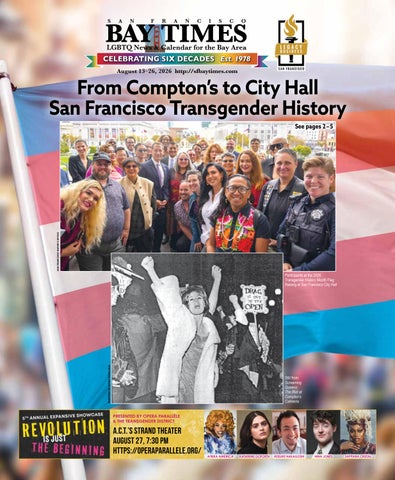
From Compton’s to City Hall San Francisco Transgender History
SAN FRANCISCO MAYOR’S OFFICE
See pages 2–5
COURTESY OF OPERA PARALLÈLE.
Participants at the 2026 Transgender History Month Flag Raising at San Francisco City Hall
Still from Screaming Queens: The Riot at Compton’s Cafeteria PRESENTED BY OPERA PARALLÈLE & THE TRANSGENDER DISTRICT
A.C.T.’s Strand Theater August 27, 7:30 pm https://operaparallele.org/
AFRIKA AMERICA
KATHERINE GOFORTH
KEISUKE NAKAGOSHI
NINA JONES
SAPPHIRA CRISTÁL
About Our Cover August 2026 marks the fifth Transgender History Month observed in San Francisco. Former Mayor London Breed declared the first such month in August 2021, making San Francisco the first city in the U.S. to do so. Santa Clara declared August as Transgender History Month in 2022, followed by San Diego in 2024 and Windsor in 2025. In 2023, California officially became the first state in the nation to recognize August as Transgender History Month statewide. San Francisco is widely recognized as a world leader in transgender civil rights, policy innovation, and sanctuary protections. The city’s trans history reached a pivotal flashpoint in August 1966 with the Compton’s Cafeteria Riot in the Tenderloin district, where trans women, drag queens, and gender-nonconforming patrons fought back against police harassment three years before Stonewall. Building on this legacy of self-advocacy, local organizers—including Reed Erickson,
Wendy Kohler, a support group at GLIDE Memorial Church, and with Officer Elliott Blackstone serving as the SFPD LGBTQ+ community liaison—founded the National Transsexual Counseling Unit in 1968, creating the nation’s first peer-led support organization. San Francisco continued to blaze trails in healthcare and local governance, becoming in 1999 the first major U.S. city to provide gender-affirming surgery benefits for municipal employees. The city made history again in 2017 with the designation of the Compton’s Transgender Cultural District—the world’s first legally recognized trans cultural zone—and commemorated this enduring movement in 2020 by painting a monumental Black Trans Lives Matter street
mural at the intersection where the 1966 uprising began. Ongoing municipal budget deficits, however, and shifting federal policies have triggered major friction between city officials and local advocates. For example, San Francisco’s Guaranteed Income for Transgender People (GIFT) pilot program launched in 2023 provided low-income trans residents with monthly stipends, but was sunsetted due to municipal funding shortfalls alongside legal challenges from conservative groups. The San Francisco Office of Transgender Initiatives and the programs it oversees or partners with were previously threatened with budget constraints and reductions. Trans-focused municipal programs and community initia-
tives have faced both direct and indirect cuts. Another challenge is to accurately and comprehensively document transgender history. Historian and filmmaker Susan Stryker in the 2005 documentary Screaming Queens: The Riot at Compton’s Cafeteria addressed the wellknown “archival silence” regarding Compton’s due to lack of both media coverage at the time and preservation of the arrest logs. Just some of the efforts to counter the silence are featured in this issue of the San Francisco Bay Times. (Cover primary images: A gathering of some of the participants, including Mayor Daniel Lurie, Honey Mahogany, and San Francisco Bay Times columnist Kate Brown of the Dykes on Bikes®, at the 2026 Transgender History Month Flag Raising ceremony at San Francisco City Hall on August 7, 2026. Credit: San Francisco Mayor’s Office; Still from Screaming Queens: The Riot at Compton’s Cafeteria. Courtesy of Opera Parallèle)
Transgender History Month 2026 Kick0ff By Joanie Juster
The program at the Mayor’s
History Month Flag Raising at San Francisco City Hall.
Mayor Lurie spoke directly about the elephant in the room—the confrontations with police that concluded this year’s Trans March. Acknowledging the threats to the trans community that are coming from the federal government, he talked about the need to strengthen the safety net that supports the community by providing funding for community organizations, and also by enhancing cultural competency training for
MAYOR DANIEL LURIE PHOTO
Founded in 2021 by mayoral proclamation thanks to the advocacy of Jupiter Peraza and the Transgender District, Transgender History Month became officially recognized statewide in 2023. It is celebrated in August to commemorate the 1966 Compton’s Cafeteria Riot in the Tenderloin, an event widely recognized as a pivotal moment in the fight for transgender rights. It aims to honor and celebrate the leaders and trailblazers in the trans community who have led the way for others, to shine a light on transgender leaders who have played key roles in local and global history, and to promote learning about transgender people and their history through libraries, community groups, and other venues that can educate people, and foster Jupiter Peraza held up a Certificate understanding and connecof Honor at the 2026 Transgender tions.
Trans activist Cecilia Chung echoed the mayor’s call for safety, saying, “If trans people can be safe in this city, then everyone can be safe in this city ... . Try not to dehumanize us, because we’re all part of this social fabric we call San Francisco.”
Cecilia Chung and Honey Mahogany were among the
San Francisco community leaders who joined Mayor A common theme among all the speakers Daniel Lurie for the 2026 Transgender History Month was the need for trans people to tell their Flag Raising on August 7. stories, and share their history. Activist and historian Megan Rohrer is the author of San Francisco’s Transgender District and leads walking tours of the district. He shared compelling stories of early transgender activists Carlos Lara and Diana Summers, who in the 1960s defied repeated efforts by San Francisco police to silence them. Rohrer said, “When these things are taken from us, we take to the streets, and tell these stories.” Using the Participants applauded during examples of pioneers like Activist Cecilia Chung was honored during the 2026 Transgender History Lara, Summers, and the
(continued on page 5)
the Transgender History Month ceremony at San Francisco City Hall on Friday, August 7.
Month ceremony at San Francisco City Hall.
S AN F R ANC IS C O BAY T IM ES
AUGUS T 13, 2026
3
MAYOR DANIEL LURIE PHOTO
Another big win was partnering with the city for the Fair Chance Ordinance (FCO) that protects transgender people and others fleeing from persecution in other states by ensuring that employers and affordable housing providers cannot discriminate based on out-of-state criminal convictions or arrests for conduct that is lawful in California, related to drag performances, gender-affirming care, abortion-related healthcare, or spontaneous abortion. The FCO goes into effect on August 10, 2026. https://tinyurl.com/FCOsf
police and other city employees. He said, “Every San Franciscan should feel safe, heard, and supported.”
PHOTO BY MIKE KIRSCHNER
Office did all that, and more. Honey Mahogany opened the formal program by listing some of the accomplishments of San Francisco’s Office of Transgender Initiatives, the Trans Advisory Committee, and the community organizations that worked hard this past year to secure funding in the city’s budget despite threatened cuts at the federal, state, and local level.
PHOTO BY MIKE KIRSCHNER
Transgender History Month received its official kickoff on August 7, 2026, with a celebration in San Francisco City Hall that featured the raising of the transgender flag on The Mayor’s Balcony, a program of community leaders speaking about progress that has been made, and the ongoing need for further work to be done to ensure the safety, security, and wellbeing of transgender people.
History Will Find Its Voice at Expansive, Where the Legacy of Compton’s Will Be Remembered Through Song By Pamela Sevilla
Sixty years later, a group of transgender and nonbinary classical artists will revisit that history through music. Expansive: Revolution Is Just the Beginning, presented by Opera Parallèle and The Transgender District, will organize its program around four chapters tracing life before, during, and after the 1966 uprising. The approach raises an intriguing artistic question: How can songs written in different eras and traditions convey the experiences of people whose lives were rarely preserved in official accounts?
The program will begin, not with the riot itself, but with something quieter: people arriving in San Francisco, searching for community, finding friendship, navigating loneliness, discovering hope. Goforth shared, “We begin in the middle of things, with a young woman, and a young Nicole Paiement man ... . We’re not in Joyce’s Ireland, but in San Francisco’s Tenderloin District, in the hotel where the ‘Queens’ stay. Where did trans people come from, why were they coming here, and what could they expect once they arrived? And yet, what was the beauty in those experiences?” “We hear three different stories of what that could’ve been like,” Goforth continued. “The Wanderer, not at home anywhere, least of all here. The Dreamer, whose life still has magic in it, no matter what she’s gone through. The Mourner, holding lost friends and loved ones close, wishing things would change.” The program draws on music, spoken word, and projections, including Samuel Barber’s “Solitary Hotel,” Andre Previn’s “I Want SA N FRANCISCO BAY T I ME S
Magic,” Schubert’s “Der Wanderer,” and Flaherty and Ahrens’ “Make Them Hear You.” The result is not a history lesson set to music, but an invitation to hear familiar works differently—through the hopes, losses, and resilience of San Francisco’s transgender community. Anniversaries can easily turn acts of resistance into civic folklore: safely admired, neatly dated, and separated from the people who lived them.
Curator and tenor Katherine Goforth collaborated with Opera Parallèle Founder and Artistic Director Nicole Paiement to shape the program in four movements: “We Had Nowhere to Go,” “It Ain’t a Party,” “One at a Time,” and “Still Fighting.” Together, they Katherine Goforth trace an emotional journey from displacement and isolation to resistance, grief, and continuing struggle.
4
SCREAMING QUEENS FILM PHOTO
Before the Compton’s Cafeteria Riot became a landmark in transgender history, Compton’s was part of daily life in the Tenderloin: a neighborhood where transgender women, drag performers, and queer young people built community amid persistent harassment and exclusion.
Music resists that flattening. It restores uncertainty, longing, anger, humor, and hope—the emotions that official histories rarely preserve. Giving emotional form to historical experience is one of opera’s oldest traditions. For centuries, composers have used music to illuminate the emotional truths behind historical events. We don’t remember Fidelio, Nabucco, or Les Misérables because they recount history with documentary precision. We remember them because they make us feel what freedom, oppression, hope, and courage sound like. Now in its fifth year, Expansive has become an annual showcase dedicated to transgender and nonbinary classical artists, demonstrating how the classical tradition continues to evolve through new voices. This year’s performers include bass-baritone Sapphira Cristál— known to many from RuPaul’s Drag Race but equally celebrated as a classically trained opera singer—tenor and curator Katherine Goforth, and mezzo-soprano Nina Jones, with pianist Keisuke Nakagoshi and host Afrika America. Their repertoire moves among opera, art song, Sapphira Cristál
AU GU ST 1 3 , 2 0 2 6
spirituals, musical theater, and contemporary music—genres that carry different histories but share the power to turn private feeling into public expression. San Francisco has always understood that culture doesn’t simply preserve history; it shapes how history is remembered. From murals to public art to performance, the city’s artists have long interpreted the stories that define its civic identity. Through Expansive, Opera Parallèle and The Transgender District extend that tradition, inviting audiences to remember Compton’s Cafeteria, not only through historical accounts, but through music. Breonna McCree, Co-Executive Director of The Transgender District, said, “Through this showcase, we continue to center transgender and gender-expansive artists in the classical field, celebrating their brilliance while creating pathways for future generations of artists who are too often overlooked. This work reminds Breonna McCree us that representa-
Keisuke Nakagoshi
Nina Jones
tion is not enough; we must continue investing in visibility, opportunity, and the revolutionary power of our stories.” Representation is where the story begins, not where it ends. Classical music becomes richer when more artists are invited to shape it, reinterpret it, and expand its traditions. Audiences deserve to see themselves reflected on stage—but the art form itself also benefits from the perspectives these artists bring. The voices featured this year are not exceptions to classical music. They are part of its future. Compton’s is remembered as a turning point, but history is made not only in turning points. It is made in the search for safety, friendship, dignity, and belonging—and in the artists who continue to carry those stories forward, this time in song. Expansive: Revolution Is Just the Beginning will be presented Aug. 27, 2026, at A.C.T.’s Strand Theater. General Admission is $25. For tickets and more information, visit https://operaparallele.org/ Pamela Sevilla is a marketing consultant who previously worked for over seven years at San Francisco Opera and served on the board of Bocón Arts, a youth theater and arts education organization.
Afrika America
Community Treasures From the GLBT Historical Society Archives Photos courtesy of GLBT Historical Society
Where We Made Room: A New Exhibition Exploring Queer & Trans Home
The show brings together archival images of domestic life, personal photographs, original drawings, and a listening station where visitors can record their own memories of home, creating a living archive where intergenerational memory becomes a form of resistance. “Aleo is a talented, multifaceted, emerging Bay Area artist whose commitment to portraying queer and trans stories through art provides new ways of telling our histories, and offers us a blueprint for imagining the future,” says Elena Gross, Director of Exhibitions & Public Programs for the Society. “This exhibition is a reminder that we are all living and making history every day. The everyday, the small, the mundane is also history. Who knows what will be important to someone 20, 30, 40 years from now? My hope is that people leave with a greater appreciation for their own homes, for their chosen or birth families, and for what it means to take care of one another.”
PHOTO BY JASMINE SINGH ROSADO
Marking Transgender History Month is the latest exhibition at the GLBT Historical Society Museum. Where We Made Room, a solo exhibition and archival installation by artist Aleo Landeta, explores the queer and trans home as a space carved out, imagined, and fought for. Drawing on the society’s archives, Landeta layers large-scale cyanotypes on silk with hand-drawn interiors based on the homes of Bay Area queer and trans elders, including Lou Sullivan, Phyllis Lyon and Del Martin, and Victoria Fernandez (aka Vicki Starr).
Aleo Landeta
Where We Made Room is now on view at the GLBT Historical Society Museum. Come experience it for yourself, and add your own memory of home to the living archive. Plan your visit at https://www.glbthistory.org/room About the Artist Aleo Landeta (they/them) is a trans and Latine visual artist and educator based in Oakland whose practice spans drawing, painting, installation, and public programming. Their work centers queer joy as liberation, drawing from lived experience and the communities that have held space for them to live authentically. They have been exhibited at MACLA, Bedford Gallery, Berkeley Art Center, and Jonathan Carver Moore, among others, with work held in the permanent collection of the Bakersfield Museum of Art. Learn more about their work at https://aleolandeta.com/
JUSTER (continued from page 3) trans women who fought in the Compton’s Cafeteria riot, he said, “Telling stories saves lives, changes policy, and helps policing become better.” Katie Conry, Executive Director of the Tenderloin Museum; and iconic trans activist, performer, and co-creator of Compton’s Cafeteria Riot Donna Personna also emphasized the importance of learning and sharing the community’s history. Personna, who just turned 80, declared, “I was magically sent here to witness history in the making, and to tell these
stories. Nobody gave us anything. We earned it!” After so many references to the Compton’s Cafeteria Riot, the program ended with an electrifying excerpt from the play. Wendy Sorrells performed a fiery monologue that made very clear why the discrimination and dehumanization experienced by the trans community can boil up and explode in events like the Compton’s Cafeteria and Stonewall riots. The fierce activism that rose out of those events has led directly to the progress we see today—and the battles that continue
to be fought throughout the country and the world in the search for equality, safety, and respect. Celebrate Transgender History Month by reading about this community’s history, by standing up and fighting for trans rights, and by seeing Compton’s Cafeteria Riot. https://tinyurl.com/CCRtix26 Joanie Juster is a long-time community volunteer, activist, and ally. S AN F R ANC IS C O BAY T IM ES
AUGUS T 13, 2026
5
OAKLAND PRIDE Welcome to Oakland Pride 2026
BAY TIMES S
A
N
F
R
A
N
C
I
S
C
O
LGBTQ News & Calendar for the Bay Area
CELEBRATING SIX DECADES Est. 1978
By Joe Hawkins
Welcome to Oakland, home of California’s most ethnically diverse LGBTQIA+ populations, and one of the largest concentrations of LGBTQIA+ people in the nation. This year’s Oakland Pride theme is “Pride, Power, and People,” celebrating the rich culture, history of local activism, and resilience of our beautiful city. In January of this year, the Oakland Pride board of directors voted to dissolve and allow the Oakland LGBTQ Community Center to take over Pride making it a program of the Center. As a Co-Founder of Oakland Pride and of the Center, it was a full-circle moment for me and a pivotal moment for our Center. Under the Center’s umbrella, Oakland Pride is now part of our year-round mission to enhance and sustain the well-being of LGBTQIA+ individuals and our families and allies, by providing educational, social, and health-related activities, programs, and services.
Joe Hawkins
will continue to fight the hate, discrimination, and bias directed at our queer and trans community, and hold our local and national governments accountable for the health and safety of our community. Join us as we promote a message of belonging, inclusion, and mutual respect that encourages individuals to live and lead openly with pride.
We could not have created this first of its kind LGBTQIA+ service network in Oakland without your support. Together, we
Joe Hawkins is the CEO and Co-Founder of Oakland Pride and the Oakland LGBTQ Community Center.
Oakland Pride: Joy in Motion As a Bay Area native and founder of Gypsy Love Productions, I’ve devoted my career to creating connection and making art that celebrates love, movement, and our shared humanity. I’ve had the privilege of performing at Pride celebrations throughout the Bay Area, including the Main Stages of both San Francisco Pride and Oakland Pride. Oakland Pride memories remain among my favorites.
Magic was in the air when I joined my longtime collaborator, the incomparable “improvolinist” and San Francisco Bay Times columnist Kippy Marks, and international percussionist Drumspyder as “LoveMarks Music” to open Oakland Pride’s Main Stage 11 years ago for the legendary Sheila E (video here: https://bit.ly/4g0YM3x ). Sharing a lineup with one of music’s most extraordinary icons was exhilarating and unforgettable—but what stayed with me even more was the energy of the crowd.
PHOTO BY DVPIX.NET
Featured artist Gypsy Love (second from right), accompanied by electric violinist Kippy Marks (right) performed on the Main Stage at San Francisco Pride. 6
SA N FRANCISCO BAY T I ME S
By Gypsy Love
Oakland has always danced to its own beat. It’s a city where art fuels activism, culture is cherished, and neighbors show up for one another. That spirit is woven into every Oakland Pride celebration. More than an event, it’s a joyful expression of belonging that welcomes everyone exactly as they are.
Pride has always been more than a parade. It’s a declaration of love. And, while every Pride event has its own personality, Oakland Pride stands out as one of the most powerful stages for love to shine.
Everywhere I looked, I saw joy in motion. Queer and trans community members, allies, families, elders, and young people filled the streets with music, laughter, and fearless self-expression. Artists transformed public spaces into living galleries. Community organizations connected people with vital resources. The parade overflowed with color, creativity, and contagious enthusiasm. The bliss was palpable. That’s because Oakland Pride isn’t simply a festival. It’s a living reminder of what’s pos-
AU GU ST 1 3 , 2 0 2 6
Happy Oakland Pride! Joe Hawkins
sible when people gather in the name of love instead of fear. At a time when LGBTQ+ rights continue to face challenges across the country and so many communities are navigating uncertainty, Pride carries renewed significance. These gatherings are more than opportunities to dance together; they are acts of visibility, affirmation, and resilience. They remind us that joy itself can be revolutionary, and that standing together is a powerful form of resistance. As an artist and passionate LGBTQ+ ally, I’ve witnessed how music and movement dissolve barriers that words alone cannot. A song can unite complete strangers on a dance floor. A shared rhythm can transform isolation into connection. In those moments, differences fade, compassion grows, and we remember how we’re all connected. That’s the magic of Oakland Pride. It creates space for people to embrace who they are while strengthening the bonds that unite us. It reminds us that diversity isn’t something to tolerate; it’s something to treasure. In a world that feels painfully divided, that message couldn’t be more important. Oakland Pride embodies everything I love about the Bay Area: fearless creativity, radiant self-expression, and an unwavering commitment to inclusion. I’m deeply grateful for
PHOTO BY ROBBIE SWEENY
For 16 years, Oakland Pride has gathered our community together to let our city know that we are here. The Oakland LGBTQ Community Center has, since 2017, created critically-needed programs and services that include our Town Youth Club, Trans Wellness Center, Glenn Burke Clinic, Aging with Pride program, Food Pantry program, and a variety of wellness services to address our health needs.
In 2022, the Center’s leadership worked with community members to establish Oakland and the East Bay’s first and only LGBTQ Cultural District, encompassing the Lakeshore/Grand Lake districts. We recently helped name a new plaza “Moore Hope Plaza” in honor of the legacy of lesbian-identified community activists Peggy Moore and Hope Wood, and will soon open our new elder-centered and intergenerational space called Lakeshore Lavender Lounge.
Gypsy Love performed on the Main Stage at Oakland Pride, accompanied by Kippy Marks and Drumspyder.
the memories I’ve made there, the exquisite artists I’ve shared the stage with, and the countless people whose openness and kindness continue to inspire my work. As we look ahead, may we continue to dance, lift each other up, and advocate for a future where every person can shine boldly and love freely. Pride is a promise we make to one another, and, year after year, Oakland Pride fulfills that promise with art and soul. Gypsy Love is an award-winning recording artist, former “San Francisco Bay Times” astrology columnist, and passionate LGBTQ+ ally. Her latest dance singles “Synchronicity” and “Fly Robin Fly” are lifting spirits and moving bodies around the world; available on all major streaming platforms. Learn more at https://gypsyloveproductions.com/
OAKLAND PRIDE
BAY TIMES S
At a time when LGBTQIA+ communities across the country are facing unprecedented attacks from our own federal government, we are also witnessing powerful victories driven by people coming together and demanding change. For Oaklanders, that spirit is part of their DNA and woven into the history of the city. That is why the 2026 Oakland Pride Parade & Festival theme is Celebrating Pride, Power, and People. The theme reflects Oakland’s long history of progressive activism, rooted in collective action and carried forward by individuals and groups who have stepped up to demand justice for all, regardless of who they are. Oakland has always been a bastion of diversity, activism, celebration, and culture, and Oakland Pride remains a powerful embodiment of the Town’s soul. Oakland Leaders and Supporters Share Thoughts About Pride “Oakland Pride has always been more than a festival. It is a celebration of our resilience, our diversity, and our collective power. As Pride enters this new chapter as a program of the Oakland LGBTQ Community Center, we’re excited to build on decades of history while investing in the future of LGBTQIA+ people throughout Oakland and the Bay Area through year-round programming here at the LGBTQ Center.” — Joe Hawkins, CEO and Co-founder, Oakland LGBTQ Community Center “Gilead is proud to sponsor Oakland Pride reflecting our longstanding commitment to the Oakland community and our belief that scientific innovation, health equity, and community partnership go hand in hand. Oakland Pride provides an important opportunity to celebrate LGBTQ+ voices, support HIV awareness and prevention, and work alongside local organizations that are creating meaningful change. Together, we can continue building healthier, more inclusive communities for everyone.” —Jane Stafford, Executive Director, Gilead Sciences, Inc. “Since 2010, Oakland Pride has been an influential coalition dedicated to educating the greater Bay Area and promoting equality, social justice, civic involvement, and responsibility within Oakland and neighboring communities. Kaiser Permanente is a proud sponsor of the 2026 Oakland Pride, supporting a powerful day of celebration, community, and culture on Sunday, August 16, at Frank H. Ogawa Plaza and surrounding streets. The day begins with the Oakland Pride Parade, kicking off at 10:30 am and making its way through the heart
of Downtown—free and open to the public. This year’s theme, Celebrating Pride, Power, and People, honors Oakland’s legacy of activism and the strength of a community that continues to organize, uplift, and celebrate one another in the face of ongoing challenges.”
N
F
R
A
N
C
I
S
C
O
LGBTQ News & Calendar for the Bay Area
CELEBRATING SIX DECADES Est. 1978
Oakland Pride 2026 Parade and Festival Headliners In its first year as a program of the Oakland LGBTQ Community Center, the Oakland Pride Parade & Festival recently announced this year’s theme and featured performers for Sunday, August 16, 2026.
A
Photos courtesy of oaklandprideofficial.org
Oakland Pride 2026 Parade Grand Marshals
—Kaiser Permanente, Parade Sponsor “This year’s festival would not be possible without the incredible support of our sponsors, partners, and community members who believe in Oakland Pride’s mission. Their investment helps us create a safe, welcoming, and world-class event while ensuring that Pride remains accessible and impactful for our community. We invite businesses and organizations who share our values to join us in making this year’s celebration our strongest yet.” —Manifair Hwang, Director of Sponsorships and Strategic Partnerships, Oakland Pride “The Oakland Pride Parade has always been the heart of our celebration, bringing together thousands of people from across the Bay Area to march, celebrate, and stand in solidarity with our LGBTQIA+ community. Whether you’re walking in the parade, cheering from the sidelines, or joining us at the festival afterward, Oakland Pride is about showing the strength, diversity, and resilience of our community. We can’t wait to welcome everyone to Downtown Oakland this month.” —Brandon Harami, Director of Operations, Oakland Pride “We are thrilled that Pride is happening in August to round out a vibrant summer in Oakland. We celebrate diversity and inclusivity in Oakland throughout the year but, during Pride, The Town shines even brighter. Visit Oakland is proud to support Oakland Pride and honor leaders in our LGBTQ+ community with our Pride Honors awards.” —Peter Gamez, President & CEO, Visit Oakland Featured Headliners This year, Oakland Pride is proud to welcome an incredible lineup of local and international artists from across the LGBTQIA+ community and those who stand with us. Main Stage – Amerie Grammy-nominated R&B singer, songwriter, and author Amerie has captivated audiences for more than two decades with hits including “1 Thing,” “Why Don’t We Fall in Love,” and “Talkin’ to Me.” A longtime LGBTQ+ ally and Pride performer, Amerie has built a devoted queer fanbase through her electrifying live performances, unmistakable voice, and enduring influence on contemporary R&B.
Amerie
S AN F R ANC IS C O BAY T IM ES
Fey AUGUS T 13, 2026
7
OAKLAND PRIDE
BAY TIMES S
A
N
F
R
A
N
C
I
S
C
O
LGBTQ News & Calendar for the Bay Area
CELEBRATING SIX DECADES Est. 1978
Oakland Pride 2026 Parade and Festival Headliners
Photos courtesy of oaklandprideofficial.org
Latin Stage – FEY A Latin pop icon and one of the best-selling Mexican artists of the 1990s, Fey rose to fame with dance-pop hits like “Azúcar Amargo.” With more than 10 million records sold worldwide, she remains a beloved figure in Latin pop and continues to tour internationally. In 2006, she was honored with a GLAAD Media Award for her support of the LGBTQ+ community, further cementing her status as a longtime ally. Oakland Pride thanks Que Rico Productions and Club Papi for producing the Latin Stage this year.
Chrissy Chlapecka
Terrell Carter
who has done incredible work uplifting the LGBTQ+ and Black communities. Star Amerasu: Star Amerasu is a transgender Oakland icon, DJ, and independent pop artist known for genre-blending sounds and a bold visual identity. Through digital releases and live performances, Star Amerasu continues to push creative boundaries while representing Oakland’s vibrant queer artistic community.
Lady Alma
House Stage – Lady Alma A global house music powerhouse, Lady Alma has spent more than two decades inspiring dance floors with her unmistakable voice and uplifting anthems including “Happiness,” “It’s House Music,” and “Let It Fall.” A beloved figure in the house music community—whose roots are deeply intertwined with Black and Latino LGBTQ+ culture— Lady Alma has become a fixture at Pride celebrations and dance festivals around the world, bringing soulful energy, joy, and connection everywhere she performs. Oakland Pride thanks DJ David Harness for his work producing the House Stage this year. Featured Supporting Acts Chrissy Chlapecka: Chrissy Chlapecka is a rising pop and hyperpop artist who broke out through TikTok and the “BimboTok” movement, blending high-gloss pop with queer, feminist aesthetics. Named one of Rolling Stone’s “Brightest Pop Stars to Watch,” she has built a devoted Gen Z following with bold, campy, high-energy tracks. Chrissy Chlapecka is a proud lesbian and centers LGBTQ+ performers and voices in her music.
La Cruz: A Venezuelan singer, songwriter, and openly queer Latin pop artist, La Cruz creates music that combines reggaeton, pop, and electronic influences. Known for his unapologetic authenticity and rapidly growing international fanbase, La Cruz has become one of Latin music’s most exciting emerging voices. Gala Varo: One of Mexico’s most celebrated drag performers, Galo Varo is known for her stunning visuals, powerhouse stage presence, and unforgettable performances. Rising to international prominence through Drag Race México and RuPaul’s Drag Race Global All Stars, Gala Varo has become a fan favorite around the world. Oakland Pride is thrilled to welcome her to this year’s celebration for a performance that will embodu artistry, authenticity, and queer excellence. NYTE SKOOL: NYTE SKOOL is a proudly gay artist born and raised in Oak-
Terrell Carter: A powerhouse vocalist and actor best known for his work in Tyler Perry’s hit Netflix series Beauty in Black and Lee Daniels’ Fox musical drama Empire, Terrell Carter’s music blends R&B, gospel, and inspirational themes, delivered with a commanding voice and emotional stage presence. He is an openly gay man 8
SA N FRANCISCO BAY T I ME S
AU GU ST 1 3 , 2 0 2 6
Star Amerasu
land whose music blends unapologetic authenticity, Bay Area energy, and infectious pop and hip-hop influences. Fresh off winning the 2026 Oakland Pride Talent Show, NYTE SKOOL has quickly become one of the city’s emerging LGBTQ+ voices, using music to celebrate self-expression, resilience, and community. Representing The Town with pride, NYTE SKOOL will bring a high-energy performance that will reflect the creativity and diversity of Oakland’s next generation of artists. FAQs The Oakland Pride Parade will take place on Sunday, August 16, 2026, at 10:30 am. The parade will be free to watch along Broadway and this Transgender History Month will feature an East Bay Trans March contingent, in partnership with Brutha’s Rising, Trans Wellness Center, and other community-based trans groups. The Pride Festival will also take place on Sunday, August 16, 2026, in Downtown Oakland at Frank Ogawa Plaza. The Festival will open at 11 am and entry will be free before 12:30 pm. Official Events Official Oakland Pride Pre-Festival events kicked off in Oakland’s Lakeshore LGBTQ Cultural District on August 12, 2026, at noon with the Moore Hope Plaza renaming ceremony in front of the LGBTQ Center
La Cruz
Gala Varo
building on Lakeshore and Lake Park, and, later that evening, the annual Cinemama Reel Queer Flix took place at the iconic Grand Lake Theater. The festival honored Bay Area LGBTQ+ films from the past and present. Please see the Oakland Pride website for a growing list of activities taking place during the Oakland Pride week: https://www.oaklandprideofficial.org/ About Oakland Pride Oakland Pride is the East Bay’s longest running and largest LGBTQIA+ cultural celebration, bringing together tens of thousands of attendees each year for a day of community, advocacy, information gathering, entertainment, and celebration. In 2026, Oakland Pride entered a new chapter as a program of the Oakland LGBTQ Community Center, ensuring that proceeds from the Festival will not only help produce Pride but will also directly support services and programs for LGBTQIA+ people through the Center’s year-round programming. Oakland Pride thanks the sponsors including Parade sponsor Kaiser Permanente and Festival sponsor Gilead, as well as PG&E, Marqueta, the Golden State Valkyries, and many others. To purchase advance tickets and for additional information: https://www.oaklandprideofficial.org/
Good News, Bad News
‘Surviving Voices: AIDS Caregivers’ Premiere
In Case You Missed It Joanie Juster Good News From Unexpected Places Anyone who truly cares about democracy, the future of our country, and the survival of our planet has had plenty to wring their hands about. Between climate change-induced fires burning up much of the world, historic deadly heat waves, a steady stream of idiocy and corruption flowing out of Washington, D.C., and ongoing wars and the attendant massive human suffering that inevitably ensues, things can indeed look bleak. But we must never forget that, often pushed off the front page by all of the above, there is indeed good news to be found. On a local level, there is good news indeed: After a fierce, prolonged, and highly coordinated effort by a coalition of local nonprofits and activist groups, much of the funding that was endangered during San Francisco’s recent budget battles has been restored, protecting much of the safety net that so many of San Francisco’s most vulnerable communities rely upon. On a national level, check this out: In Georgia, of all places, every single antiLGBTQ+ bill that was on the ballot in their recent election was defeated. Yep, all fifteen of them. These were extremist bills aimed at banning puberty blockers for trans youth, criminalizing librarians for making LGBTQ+-friendly books available to minors, targeting trans student athletes and their access to locker rooms, bathroom bills, healthcare bans, book bans, and more. Every single bill was defeated by the voters. Georgia voters organized, testified, made phone calls, and made their voices heard loud and clear: No hate in this state. But wait, there’s more! There were five similar anti-LGBTQ+ bills on the ballot in Florida. Four of the five were defeated and in Florida, home of Ron DeSantis and Mar a Lago, no less. Let that sink in. If this can be done in Georgia and Florida, it can be done elsewhere. We can win if we work. We can win if we organize. We can win if we try. Let’s get to work; the midterms are only 80+ days away. But in Other News The deadly attack during the Berlin Christopher Street Day in Germany, the alarming escalation of brutal ICE raids and killings, and a recent, disturbing surge in gun violence in the Bay Area are just a few reminders of the dangers that arise from hate and intolerance. How do we survive in a world with so much brutality and intoler-
In 1990, at a time when AIDS was devastating San Francisco, I applied to become a Shanti volunteer. The intense training was transformative, and the work of providing support for people facing the end of their lives was humbling, and life-changing. A film premiering in San Francisco will share the stories of people who chose to step forward to care for people with AIDS when the rest of the world was abandoning them. This new film by Jorg Fockele, Surviving Voices: AIDS Caregivers, is part of the National AIDS Memorial’s ongoing film series about the pandemic. In preparing this film, Fockele and his team spoke to over 50 caregivers around the country, and, while not all of them appear on screen, their stories and insights left a profound impression on the film. The program will also include a 12-minute interview with Butch McKay, an AIDS activist, caregiver, and director of the Positive Living Program at Oasis, Florida. Butch passed away a few months ago, leaving behind a far-reaching legacy of kindness and compassion. He was beloved by the countless people whose lives he touched with his enormous heart.
of the AIDS pandemic—before we even had a name for it—the leather community started finding ways to help, by raising money for people too sick to work, going into the bars and clubs to build peer-education networks, and helping create and promote safer-sex guidelines. Their work provided a lifeline for many, rising above the fear and stigma of those early years to build, not just safety nets, but also community and connection.
Sisters of Perpetual Indulgence boulder already in place, the Leather Community boulder will continue to further honor the communities whose courage, care, and defiance carried the AIDS response forward when so much of the world looked away ... . They wrote the rules for staying alive when the rest of the world was still arguing about whether the epidemic was real ... (they) turned hard-won knowledge of
Leather community leaders Race Bannon and Aaron Baldwin, along with National AIDS Memorial CEO John Cunningham, recently announced a new initiative to raise funds to design, carve, and install a new memorial boulder in the Grove, as a permanent public tribute to the leather community. As they said in their social media post announcing this project, “Together with the
NATIONAL AIDS MEMORIAL GROVE PHOTO
ance? Each of us must find our own path to get through the dark days with our souls and our sanity intact. For me, the answer is always community, and kindness. We must rely on each other, and lift each other up.
(continued on page 18)
The world premiere of Surviving Voices: AIDS Caregivers and the Butch McKay interview will take place as part of the SF Queer Film Fest at the Roxie Theater on Saturday, August 22, at 4 pm. This special screening will be presented by the National AIDS Memorial and the Sisters of Perpetual Indulgence. A panel discussion will follow the screening and will feature panelists Alex U. Inn, Fernando Castillo, Rebecca Denison, and Dr. Paul Volberding; it will be moderated by Sister Roma. Get your tickets now; this one will sell out: https://tinyurl.com/SV26NAM Leather Community to be Honored in AIDS Memorial Grove The AIDS Memorial Grove is a sacred space for honoring and remembering the names of many who died of AIDS. But the Grove is also dedicated to honoring the compassion, sacrifices, and hard work of many who stepped up to help their community through this devastating crisis by tending the sick, raising funds for their care, educating their peers about safer sex, cleaning houses, delivering meals, fighting red tape to gain access to treatments, and so much more. Throughout the Grove you can find boulders engraved with the names of individuals or groups who provided exceptional service to people with AIDS. One such group is soon to be honored with a new commemorative boulder in the Grove: the leather community. In the earliest days S AN F R ANC IS C O BAY T IM ES
AUGUS T 13, 2026
9
The Many Realities of Rio
6/26 and Beyond Stuart Gaffney and John Lewis Rio de Janeiro: the setting could not be more stunning. Sugarloaf Mountain rises from the sea. Mount Corcovado’s iconic Christ the Redeemer statue, arms outstretched, looks over the city from the mountain peak. At Ipanema and Copacabana beaches, gay and nongay men clad in Speedos and women in thong swimsuits soak up the sun and romp in the surf. At dusk, we relaxed in the ocean while a glorious sunset turned the sea golden to the west and a full moon rose and glistened on the water to the east. We ate incredible food from fish moqueca to creamy shrimp boba to pirarucú fish that melted in our mouths. We indulged in fresh, pure açaí, sweet and tart jaboticaba berries, tangy and tingly jambú flowers and leaves— and even effervescent, lemony (right) Rocinha favela climbing Amazonian ants. But there’s a darker side to visit-
Photos courtesy of John Lewis and Stuart Gaffney
ing Brazil and to its history. Ten kilometers north of Sugarloaf in the historic center of Rio lie the ruins of the Valongo Wharf. It was there that an estimated 900,000 enslaved Africans arrived in the Americas, after being subjected to horrific Tia Ciata is widely known as the matriarch of samba. Pictured here conditions on are John Lewis and Stuart Gaffney at Casa de Tia Ciata with Tia the Atlantic pas- Ciata’s great granddaughter, Gracy Mary Moreira, and her son, Nilson Moreira. sage, which
View of Rio from peak of Sugarloaf Mountain
Closeup of Ethiopian woman featured in the mural We Are One by Eduardo Kobra. The mural, on Olympic Boulevard, was painted for the 2016 Rio Olympics.
up a steep hillside in Rio
Bartô Macuxi’s work, Mother of the Forest Mural by @tebla.art. The strength and legacy of our ancestry that moves us daily. Museu Memorial Pretos Novos
Archaeological ruins of Valongo Wharf, UNESCO World Heritage Site, where approximately 900,000 enslaved Africans arrived in Brazil
Brazil was the last country to abolish slavery, doing so in many did not survive. At 1888, fifty years after England the wharf, they began did. The enslavement of miltheir new lives as slaves in lions of Africans, along with Brazil, where they experiPortuguese actions that resulted enced extraordinary cruelin the deaths of millions of ty and human debaseindigenous Brazilians and the ment, with many literally An LGBTQ inclusive painting by Wark at decimation of many of their worked to death. UNES- the Wark shop in Rocinha cultures, continues to have a CO declared the Valongo profound effect on Brazil cenWharf a World Heritage turies later. Site in 2017 as “the most But there is much joy and welimportant physical evicome to be found in these comdence associated with the munities today. Indigenous historic arrival of enslaved community leaders are preservAfricans on the American ing and rejuvenating their culcontinent.” tures. And, just down the street Brazil’s history of slavery from the Valongo Wharf, is the is particularly brutal. Of historic Casa de Tia Ciata, the the approximately 12 milhouse of the renowned Bahian lion Africans enslaved in woman, popularly known as the Americas, 5.5 million Sunday samba circle singing in Tia Ciata, who migrated to (or approximately 45 per- Gamboa, an Afro-Brazilian Heritage (continued on page 18) cent) were taken to Brazil. neighborhood in Rio
10
SAN F RANCISCO BAY T I ME S
AU GU ST 1 3 , 2 0 2 6
Riding for the Next Generation of Gender Outlaws By Kate Brown, Ph.D.
Tales From Two Wheels Acme Theatre Company, a 501(c)(3) nonprofit youth-led theatre group run for and by young people, hosted Enemies of All Nations Night on Friday, July 31, 2026, at the Wyatt Pavilion in Davis. Members and prospects of the San Francisco Dykes on Bikes® (DOB) were honored to attend in support of the young performers and their work. The evening brought together a preshow drag performance by the Davis Drag Club, Acme Theatre Company’s production of The Pirate’s Wife, and a post-show community panel. An alum of Acme Theatre Company reached out and invited Dykes on Bikes to attend because organizers wanted the young performers to know that the larger queer community was behind them. We were proud to show up in solidarity and help create a welcoming environment where the students could focus on their performance and enjoy their night. The welcome was immediate. As Prospect Scotia later recalled, the cast came outside to watch as our motorcycles rumbled in, excited and visibly happy that we had shown up. It was a simple but memorable moment that captured the spirit of the invitation; the young performers knew their community was there for them.
The focus of the evening was The Pirate’s Wife, a reimagining of the story of Anne Bonny and Mary Read, two pirates who dressed as men and challenged the gender expectations of the early 1700s. The young cast brought humor, energy, and heart to a story about people finding ways to survive, resist the roles imposed upon them, and fight another day. Although the story takes place more than three centuries ago, its questions remain familiar. Who gets to define who we are? What happens when we reject the limitations placed upon us? How do we find the courage to live authentically when the world tells us to be someone else? The evening concluded with a powerful post-show panel featuring two cast members, two members of the Davis Drag Club, and Dykes on Bikes Board member Michelle and Prospect Scotia. The conversation explored what it means for queer adults to be invited into a story told by teenagers, how drag and theatre challenge expectations, and what has changed, or not changed, in the way LGBTQ+ people show up in public. With trans rights and drag increasingly under attack, the panel returned to the importance of being visible, taking up space, and supporting young people as they discover who they are. The most personal reflections centered on what panelists wished they had heard at that age: You do not have to make yourself smaller. You are not alone. There is a community ready to welcome you.
PHOTO COURTESY OF PHOTOGRAPHER CLARA, SAN FRANCISCO DYKES ON BIKES
For Board member Clara, both the invitation and the opportunity to participate felt especially personal.
Enemies of All Nations Night began with thw preshow performance by members of the Davis Drag Club, setting the tone for an evening rooted in joy, self-expression, and defining yourself on your own terms.
Photos courtesy of Dykes on Bikes®
Prospect Scotia captured the joy of the night: “Seeing a troupe of enthusiastic teenage thespians breathe spirit into a play about a lesbian pirate romance, a transgender cartographer whose egg finally cracks in a splendid red gown, and drunken gay and queer sailors cavorting around the stage and bantering in Victorian English will stick a smile on your face long after the night has vanished. Speaking with this troupe of actors afterward during the panel discussion was a sheer delight. It is heartening to realize Jessica Huitt, member of the Board of Directors of the Acme Theater Company, with San Francisco Dykes on Bikes outside of the Wyatt Pavilion in Davis, California, on there are so many July 31, 2026 good things happenthe celebration they deserved. ing in the world.” That message was at the heart of the entire evening. For fifty years, Dykes on Bikes has understood the power of visible presence. We have shown up on our motorcycles for gay proms, led motorcades for VIPs, and carried pink torches in celebration and protest. Showing up in support of a youth theatre production was a new experience for us, but the purpose was familiar. Our motorcycles may announce our arrival, but our presence can also offer reassurance, create belonging, and remind young people that they have a community standing beside them. The young people of Acme Theatre Company demonstrated the same boldness that has driven generations of queer artists and activists. They were not simply performing a historical story about gender outlaws. They were using theatre to ask questions, challenge expectations, and imagine a world where people have greater freedom to define themselves.
Panel discussion with members of the Acme Theater Company, Davis Drag Club, and Scotia and Michelle of the San Francisco Dykes on Bikes (second and first from right, respectively)
12
SAN F RANCISCO BAY T I ME S
AU GU ST 1 3 , 2 0 2 6
We were honored to be invited and grateful to Acme Theatre Company, the Davis Drag Club, the cast, organizers, families, and community members who welcomed us. It was moving to watch the young artists take the stage, tell their story, and receive
Acme Theatre Company gives young people the opportunity to lead, create, and tell stories that matter to them. Please consider supporting this nonprofit by attending a future production, volunteering, making a donation, or sharing its work with others. Supporting youth-led theatre helps ensure that young people have the space, encouragement, and freedom to keep creating. And, if your community needs Dykes on Bikes to show up, reach out to us. Creating affirming spaces, making room, and helping people feel supported is exactly what we do. We just happen to do it on motorcycles. We’ll be bringing that same spirit of visibility and community to the Oakland Pride Parade on Sunday, August 16, 2026. Listen for the roar of Dykes on Bikes as the Parade kicks off at 10:30 am. The following weekend, on Saturday, August 22, we’ll be back on the road for our next group ride, led by patch-holder Ann (aka Scooby). The ride will follow part of the Clear Lake shoreline before climbing Cobb Mountain for an early lunch at Cobb Mountain Pizza. From there, we will take the twists and tight turns of Highway 175 into Middletown, ending with a refreshing drink on the back patio at Nobles Saloon. With beautiful lake views, mountain roads, lunch, and good company, we expect it to be a fantastic day to be out on our bikes. Kate Brown, Ph.D., is the President of San Francisco Dykes on Bikes® Women’s Motorcycle Contingent. https://www.dykesonbikes.org/
PHOTO COURTESY OF PHOTOGRAPHER HOPE RAYMOND AND THE ACME THEATER COMPANY
Dykes on Bikes®
“As a former theater kid myself, being invited to show up and support queer and trans youth in a production like this means so much to me,” she said. “As Dykes on Bikes, we know the importance of showing up authentically and taking up space, and hopefully that’s what we’ve inspired those youth to do.”
Roland Schembari and Bill Hartman, Co-Founders Randy Alfred, Founding News Editor, 1978 Kim Corsaro, Publisher 1981-2011
2261 Market Street, No. 309 San Francisco CA 94114 Phone: 415-601-2113 Email: editor@sfbaytimes.com www.sfbaytimes.com
LGBTQ+ Women’s Community Leader and Montclair Women’s Cultural Arts Club Founder Barbara ‘Boo’ Price Dies
____________________________
The Bay Times was the first newspaper in California, and among the first in the world, to be jointly and equally produced by lesbians and gay men. We honor our history and the paper’s ability to build and strengthen unity in our community. The Bay Times is proud to be the first and only LGBTQ newspaper in San Francisco to be named a Legacy Business, recognizing that it is a longstanding, community-serving business that is a valuable cultural asset to the city.
Dr. Betty L. Sullivan/Jennifer L. Viegas Co-Publishers & Co-Editors
Beth Greene, John Signer, Michael Delgado Design & Production
Kate Laws Business Manager Kit Kennedy Poet-In-Residence J.H. Herren Technology Director Carla Ramos Web Coordinator Mario Ordonez Distribution Juan R. Davila Volunteer Coordinator ____________________________
CONTRIBUTORS Writers Rink, Sister Dana Van Iquity, Ann Rostow, Patrick Carney, Leslie Sbrocco, David Landis, Gary M. Kramer, Joanie Juster, Robert Holgate, Eduardo Morales, Dennis McMillan, Tim Seelig, Rafael Mandelman, Jewelle Gomez, Rebecca Kaplan, Bill Lipsky, Beth Schnitzer, Rowena Brown, Kippy Marks, Ian Fullmer, Donna Sachet, Gary Virginia, Derek Barnes, Marcy Adelman, Jan Wahl, Stuart Gaffney & John Lewis, Brandon Miller, Howard Steiermann, Fernando Camino, Honey Mahogany, Kate Kendell Photographers Rink, Paul Margolis, Bill Wilson, Jerome Parmer, Michael Kirschner, Sandy Morris, Abby Zimberg, Joanie Juster, Ken Lew ____________________________
ADVERTISING Display Advertising Standard Rate Cards http://sfbaytimes.com/ or 415-601-2113 Custom ad sizes are available. Ads are reviewed by the publishers. National Advertising: Contact Bay Times / San Francisco. Represented by Rivendell Media: 908-232-2021
One of the nation’s most impactful and dedicated leaders of the LGBTQ+ women’s community, Barbara “Boo” Price, recently passed following a heart attack. She previously had been in declining health for some time. A post on social media shared by friends noted that, in the hours before her passing, “she noticed a partially open door in her room and asked the nurse if that was the exit, because she was ready to leave. A few hours later, she did just that—moving on to another realm, but never out of our hearts.” Over her remarkable life, Price was an athlete, attorney, producer, founder of the Montclair Women’s Cultural Arts Club, leader of a San Francisco Bay Times San Francisco Pride Parade contingent highlighting the Women’s Music genre, and so much more. Her extensive network and ability to strengthen community benefited LGBTQ+ individuals, and particularly lesbians, not only locally and nationally but also internationally. A tribute to her will be included in an upcoming issue of the Bay Times. In May 2015, the Bay Times highlighted her club—an important East Bay venue and gathering spot—upon its closing ( https://bit.ly/4go4jm3 ).
Circulation is verified by an independent agency. Reprints by permission only. ____________________________
© 2026 Sullivan Communications, Inc Join the San Francisco Bay Times Email List
14
SAN F RANCISCO BAY T I ME S
AU GU ST 1 3 , 2 0 2 6
GLBT Fortnight in Review By Ann Rostow Times I just checked the American Civil Liberties Union’s graph of anti-GLBT bills around the states. Of the 530 such bills introduced, 337 have been defeated, 40 have been passed into law, and 84 are advancing. The rest have been introduced but have yet to go forward. We’ve always seen large numbers of anti-gay and anti-trans bills filed as state legislatures get into action, many of them so bizarre and nonsensical that your eyes pop, and most of them destined to languish in limbo until the session ends or they just die. Back in the day, only a handful actually made it past the lawmakers and onto a governor’s desk, and they were easy to cover in, um, let’s say, a GLBT news roundup. That is no longer the case. I can’t keep up with 40 new laws and maybe 100 more in progress. Some of the “defeated” bills have reappeared in the active files, or even the enacted lists. And, no, I can’t keep up with these machinations either. I can follow some of the most outrageous news makers, such as the Kansas law that invalidated the drivers’ licenses of transgender motorists from one day to the next, or maybe the Idaho bathroom law that carried a potential felony charge (halted by a court for the moment), but the rest are a firehose of assaults on transgender citizens and their parents. It’s like trying to use an umbrella in a hurricane. And the chaos from state lawmakers is far from our only struggle. In Washington state, midterm voters will consider an anti-trans sports initiative that will require all girls taking part in both pubic school sports and nonprofit sports groups to get documentation from a health care provider that proves their biological sex based on “reproductive anatomy, genetic makeup, or normal endogenously produced testosterone levels.” I gather students are already required to get a checkup before the school year, but the intrusive sex checks would be something new (and horrible). The bizarre ballot initiative is backed by a hedge fund manager named Brian Heywood, who has spent $2.23 million (according to Ballotpedia) and founded “Let’s Go Washington” to promote this plan. He’s also pushing a measure to remove certain taxes on high income Washingtonians and another to allow parents to opt their kids out of sex ed classes. A couple of other states have anti-trans sports measures on the ballot, but this is the first I’ve heard of any proposal to force cisgender women and girls to prove their gender. It’s bad enough to scrutinize transgender athletes, but putting all girls through a medical sex verification when transgender girls in sports are a fraction of one percent of sportswomen is jaw dropping. But it’s on the fracking ballot! More Tough Times Glancing through headlines, I see that Michigan will no longer defend its ban on conversion therapy, now that the Supreme Court ruled in favor of a Christian counsellor in
Colorado who claimed that the law against this dangerous practice violated her free speech rights. Thanks for nothing, Justices. If I recall correctly, even our liberal friends voted against Colorado based on the flawed notion that the Rocky Mountain state targeted one viewpoint (being gay is bad) and allowed another (being gay is okay). That’s like complaining that a statewide limit on smoking in public violates the First Amendment rights of nicotine addicts. We also, of course, have the attacks from the administration itself. We’ve been covering the two major lawsuits aiming to protect transgender service members, but, meanwhile, these patriotic Americans are regularly being ousted by the Defense Department after sham trials. A recent New York Times article described the closed-door hearings where Trumpy military panels rubber stamp the administration’s policies, kicking out decorated service members regardless of their records and despite the words of witnesses who testify to their abilities and courage. Oh, and then there was the crazed ISIS adherent who drove a van into a crowd at Berlin’s Pride celebration, killing one woman and injuring 30 other people before he was shot by police. The crucible of being GLBT in 2025 and 2026 is intensifying. But we also can report that over 300,000 people lined the canals in Amsterdam on August 1 to revel in the main event of the multi-day celebration of World Pride. Dutch Prime Minister Rob Jetten, who is gay, rode on one of the 80 or so boats that passed by a memorial to the victims of Berlin’s Christopher Street parade. The next evening, or actually Monday at 2:30 am, Madonna hit the stage at the final night’s music gala with Kylie Minogue in tow, sending the audiences into paroxysms of excitement. Whatever else, we still know how to party. Wither Kindness? Do you remember the Michigan hair stylist who posted an anti-gay statement in 2023? It read: “If a human identifies as anything other than man/woman, please seek services at your local pet groomer. You are not welcome at this salon. Period.” I don’t remember her either, but she was charged with violating state civil rights law and she now has to pay court costs for several would-be clients who sued. Since transgender men and women obviously identify as men or women, I’m not sure who she meant to send to the pet shops. She also has to attend six months of anti-discrimination training. That was the only vaguely positive story I’ve found in the last hour or so of looking. It’s depressing to report setback after setback. The full Eleventh Circuit upheld a ban on drag shows in Florida. A school in Virginia just terminated a Gay Straight Alliance after parents and people on social media complained. (I thought we won those debates twenty years ago. Remember the Equal Access Act?) In a break from bad news, I sidetracked over to the New York Times Ethi-
cist column, where a questioner asks: “Am I Obligated to Tell My Friends How Bad Their Botox Looks?” What? Why would the “ethicist,” who is too long-winded to hold my interest as a rule, even entertain such a mean-spirited idea? This unpleasant person claims to be concerned for their friends’ well-being. “I do not think they are happy, because they seem increasingly critical of themselves, and I do not think they realize how extreme it has become,” they explain. Just how many friends with bad Botox jobs does this person have? The Ethicist advises that, if a friend “seems increasingly unhappy or self-critical, you can talk with her about whether the aesthetic that med spas promote is undermining her confidence. “But maybe keep to yourself the part about how “bizarre” you think these women look.” Maybe? Why on Earth would someone think it appropriate to write to the Times about such a cruel idea? The letter was clearly a good decision since it was published, which shows how much I know. But really. Do you honestly think that telling your friends “how bad their Botox looks” will help them become happier and less critical about themselves? When did people get so heartless? And when did “should I be cruel or not” become an ethical dilemma? What A Piece of Work Is Man Here’s a thing. George Santos is in trouble for placing a bet on Kalshi that he would not be attending Trump’s State of the Union last February. He then posted: “I’m going to be there for the State of Union in the gallery, guys,” and didn’t actually go, winning $17,000 and change. I don’t know where to start with this one (which I probably shouldn’t have started to begin with). Like all of you, I’m familiar with Kalshi, but, like many of you, I’ve never looked at it closely. I know that it lets you bet on all sorts of probabilities, but who (other than Santos) would bet on whether or not George Santos, who was not in office, would be going to the State of the Union? What else can you bet on? Will Patrick Mahomes get a haircut on Wednesday? Will someone get run over and killed by a red 1968 Mustang this weekend? Santos, who claimed he missed his flight to D.C., was investigated and then settled with the Commodity Futures Trading Commission. He had to cough up the dough and also pay a $17,000 penalty. It kind of stuns me that people are still getting into trouble for grift and fraud while the Trumps and others run rampant over the law. And speaking of no-good-niks, did I mention that Alan Chambers was caught soliciting a 14-year-old boy last May? My wife just saw this and sent it to me, but I think I missed it at the time. Normally, we don’t rehash old news, but Alan Chambers is different. He was the president of Exodus International, the organization that purported to cure men of homosexuality. In 2013,
he closed Exodus and issued a public apology acknowledging (Wikipedia tells me) that he had been “imprisoned in a worldview that’s neither honoring towards our fellow human beings nor Biblical.” He appeared to backtrack from the whole idea that sexual orientation could be reversed, but, as far as I can tell, he remained mired in an incoherent Christian mindset that called for, I don’t know, everyone to love everyone and follow Jesus in some way. He certainly didn’t embrace having a mature, authentic life as a gay man, which seems clear now that he’s been nailed for having a months-long online relationship with an undercover cop who claimed to be 14 years old. Eventually, Chambers arranged to meet the “boy,” and was promptly arrested and charged with three felonies. He’s out on bail for now, but presumably headed for trial and/or jail. What a sad sack. Lesbians Behaving Normally I was considering writing about a trio of lesbians who were all involved in an online lifestyle and therapy service, but who are now suing each other. This obnoxious-sounding trio was the subject of a tiresome article that I tried to read but couldn’t finish. Now I can’t even find it. I did, however, spend quite a while searching for it on the lesbian news pages, reading about a lesbian mud wrestling match at Lollapalooza, which looked simply like women who may or may not have been lesbians messing around in some slime. I read several love letters between Eleanor Roosevelt and Lorena Hickok and learned that there’s a 72-unit apartment complex reserved for lesbians in Berlin. I encountered an animated book about animal sex called Poking the Squid, which includes references to lesbian albatrosses that (somehow) steal sperm from males to conceive with their Sapphic mates. Oh, and I was warned not to go to Senegal, one of 45 countries that prosecute gay women. At one point, I ran into this headline: “A TikTok influencer has delighted the internet with a video describing why he believes ‘lesbians are an elevated form of the human race.’” The influencer, “That Steve Guy,” went over to his lesbian neighbors’ house for dinner. “We walked in, and their house smelled like sandalwood,” he wrote. “They had all the food set up in the kitchen: two types of wings, crispy fries, grilled zucchini strips, real baked beans, street corn, mussels tossed in a white wine sauce, and we had silk pie for dessert. And somehow, they cleaned up while we were there, and we didn’t see it happen, and when we left, they gave us wildflower seeds and a succulent.” They sound like sisters, albeit the kind I might avoid. Or maybe not. I love mussels in white wine.
S AN FR ANC IS C O BAY T IM ES
(continued on page 18) AUGUS T 13, 2026
15
Richmond/Ermet Aid Foundation’s 32nd Help Is on the Way Raises Critical Funds Help Is on the Way XXXII: Broadway & Beyond, hosted at the Marines’ Memorial Theatre on August 2, 2026, delivered an unforgettable night of world-class entertainment while serving as a vital fundraiser. The event raised crucial funds for two major initiatives: Project Open Hand, which delivers nutritious meals to homebound seniors and individuals with severe disabilities, and Richmond/Ermet Aid Foundation’s (REAF’s) Small Emergency Grants Program, which provides short-term financial assistance to people navigating sudden personal crises. Co-chaired by REAF board members Sophie Azouaou and Dr. Greg Hammer, the evening commenced with a televised greeting from Governor Gavin Newsom. Lieutenant Governor Eleni Kounalakis subsequently presented Azouaou with a gubernatorial commendation honoring her dedicated community service. Azouaou was further celebrated throughout the night, receiving commendations from San Francisco Mayor Daniel Lurie and State Treasurer Fiona Ma, as well as the prestigious REAF Community Award. The spotlight then turned to a stellar lineup featuring stars of stage and screen alongside the touring Broadway cast of Disney’s Beauty and the Beast. Despite a demanding schedule of eight weekly shows, the cast rehearsed entirely new music and choreography to deliver an inspiring performance centered on hope and unity. The show included a successful Fund-a-Need drive and live auction before concluding with an emotional ensemble rendition of REAF’s classic anthem, “Help Is on the Way,” written by David Friedman. The festivities wrapped up with an elegant VIP reception chaired by Stephanie Block in the Grand Ballroom at the Beacon Grand Hotel. Attendees mingled with the cast while enjoying fine wine, cocktails, and gourmet bites. The high-profile crowd included, in addition to Lieutenant Governor Kounalakis and State Treasurer Ma, distinguished figures such as Haute Living founder Olivia Decker, Stanford’s Dr. Oliver Dorigo, luxury real estate agent Joel Goodrich, and San Francisco International Airport advisor Francis Tsang. Next up for REAF will be Pride in Paradise on October 24, 2026, in Palm Springs. For more information: https://bit.ly/3RV6vZ3
16
SAN F RANCISCO BAY T I ME S
AU GU ST 1 3 , 2 0 2 6
BAY TIMES S
A
N
F
R
A
N
C
I
S
C
O
LGBTQ News & Calendar for the Bay Area
CELEBRATING SIX DECADES Est. 1978
Photos by Mahelly Ferreira for Drew Altizer Photography
“To live is the rarest thing in the world. Most people just exist, that is all.” —Oscar Wilde
By Donna Sachet
W
hen Barbara Richmond and Peggy Ermet each lost their sons to the AIDS pandemic, they resolved to turn their grief into action, forming the Richmond/Ermet Aid Foundation (REAF) with the loving help of friends Ken Henderson and Joe Seiler. With the rolodexes of both sons in hand, full of entertainers’ contact information, the Richmond/Ermet Aid Foundation began to bring major talent to San Francisco for musical performances to benefit various charitable causes. Thirty-two years later, Help is on the Way continues to attract enthusiastic audiences for crowd-pleasing shows throughout the year, including their most recent one on August 2, 2026, at the Marines’ Memorial Theatre.
During the brief intermission and a bustling reception with the cast afterwards at the Hotel Beacon Grand, we grabbed our escort Jack Garcia to catch up with so many friends, including Jeff Doney & Adam Thier, Gary Virginia, Brent Marek, Doug Waggener, Ben Wong & Fred Giron, Larry Horowitz, fellow Bay Times columnist Beth Schnitzer, Cameron Stiehl, Gary Donna Sachet and her dog Peanut were photographed with a Thackeray, Joel vista of the Golden Gate Bridge on September 22, 2023. Goodrich, John Newmeyer, Patrik Gallineaux visiting from Florida, Jim Neuman from Palm Springs, and to our great surprise and delight Daru Kawalkowski, looking as fabulous as ever! Following intermission, popular auctioneer Lenny Broberg from Palm Springs returned for the night to goad the audience to bid on several items as well as simply offering generous gifts in support of the night. All proceeds benefit the special emergency grants fund of REAF and Project Open Hand. Lenny’s special technique, combining humor and local knowledge, along with a reading of some letters of appreciation from former recipients of REAF assistance, elicited very generous bids all around.
PHOTO BY GARY VIRGINIA
Friday, August 14 Therapy Mr. Imperial Leather Matty Zamora’s fundraiser Benefiting Queer Lifespace Lonestar Saloon, 1354 Harrison Street 5–8 pm Free! www.imperialcouncilsf.org
PHOTO BY RANDELL WHITEHEAD
Help Is on the Way XXXII: Broadway & Beyond brought together members of the traveling cast of Beauty & the Beast and a number of San Francisco favorites for a delightful evening of music and caring. The night started with some well-deserved praise for long-time Board member Sophie Asaoaou, including from Lieutenant Governor Eleni Kounalakis on behalf of Governor Gavin Newsom and State Treasurer Fiona Ma, and recognition of other supportive sponsors and board members. Then members of the cast of Beauty & The Beast, on their one night off from regular performances, presented solos, duets, and group production numbers that had the audience roaring. They Donna celebrates “Leather Season” by hosting a brunch with really threw their hearts and friends each year. On September 24, 2003, she received a proclamation of appreciation from State Senator Scott Wiener as souls into this show! Other friends, including Sister Roma, looked on. favorites, including David Burnham, Davis Gaines, Lilliana Lili Yang, and the dynamic Leanne Borghesi, gave wonderful performances as well, all with the excellent support of a talented instrumental ensemble.
Saturday, August 15 Annual Empress Tea Honoring José Sarria, Empress I, Widow Norton Empresses, hats, and high tea Twin Peaks Tavern, 401 Castro Street 3–5 pm Free! www.imperialcouncilsf.org Friday, August 21 Castro Night Market Celebration of Orphan Andy’s founders starting at 6 pm on the Main Stage Donna Sachet performance, plus DJ, other performers, vendors, and more 5–8 pm Free!
The show ended, as all previous Help Is on the Way shows have ended, with the entire cast joining on stage to sing “Help Is on the Way,” written by David Friedman. The lyrics of the song perfectly reflect the organization that has delivered on that promise of help for those in need for decades. REAF presents other periodic shows during the year and, like so many groups, they are always looking for new supporters, so keep an eye out and don’t miss a single one! Donna Sachet is a celebrated performer, fundraiser, activist, and philanthropist who has dedicated over two decades to the LGBTQ Community in San Francisco. Contact her at empsachet@gmail.com
PHOTO BY SHAWN NORTHCUTT
S AN FR ANC IS C O BAY T IM ES
AUGUS T 13, 2026
17
JUSTER (continued from pg 9)
LEWIS/GAFFNEY (continued from pg 10)
ROSTOW (continued from pg 15)
risk and pleasure into life-saving practice, at a moment when that knowledge saved lives no one else was working to save.”
Rio and who many consider the matriarch of samba and an integral force in the development of the musical genre. When we visited the house, now a cultural center, we were warmly greeted by Tia Ciata’s great granddaughter, Gracy Mary Moreira, and her son, Nilson Moreira. When we attended their Sunday samba circle nearby, we were enthralled by the music and danced and clapped with many community members.
Finally, I discovered (on PinkNews) the term: “black cat lesbian,” which refers to a lesbian who, um, acts like a black cat. “This lesbian is femme, mysteriously sexy, and can sometimes be a bit of a mean girl—if you get on the wrong side of her.” According to Rosie Turner, whoever she may be: “You’re probably going to find your black cat on the sofa watching a murder documentary, painting their claws, or [reading] horoscopes under a blanket.”
The initial fundraising goal for the Leather Community boulder is $15,000. Should donations exceed that goal, the excess funds will help create two other memorial boulders: one recognizing the efforts of caregivers—those who stepped forward to tend the sick and dying during the worst years of the pandemic, as well as those still helping people living with HIV today. Another boulder is also planned, to honor the efforts of activists whose persistent, strategic, inescapable actions forced the government and the business world to pay attention and provide funding, research, and drugs that would save lives. They demanded action, and their actions changed the course of the pandemic, and saved countless lives. To contribute to these new memorials in the AIDS Memorial Grove: https://tinyurl.com/NAMBoulder I Stand With Science and I Stand With Fauci Research has shown that Dr. Fauci’s work to create PEPFAR has saved over 25 million lives. The recent attempt at character assassination by Senator Rand Paul and his Republican cronies was straight out of Senator Joe McCarthy’s historically evil playbook. It was a dark day for this country: absolutely despicable, unethical, and unAmerican. No thank you, Senator Paul. I stand with science. I stand with Dr. Fauci. Joanie Juster is a long-time community volunteer, activist, and ally.
In Rio, we also visited Rocinha, Rio’s largest favela with a population of 72,000 to 100,000 or more. Favelas in Rio are communities of economically disadvantaged Brazilians of color, who live in very simple, small homes, many of which are built by community members themselves, on some of Rio’s steep slopes. The houses are crowded together with narrow pathways, winding through the houses, businesses, and schools on what was originally considered undesirable hilly real estate, away from the shore. Visiting Rocinha requires going on a tour. We knew we had the right tour guide for us when we asked how she learned to speak English, and she replied, “watching every season of RuPaul’s Drag Race.” Although favelas have substantial challenges on many levels, our guide introduced us to the warmth of the Rocinha community. We were particularly gratified to find explicit LGBTIQ-themed artwork in the tiny shop of the internationally recognized mural painter Wark, who calls Rocinha home. John Lewis and Stuart Gaffney, together for over three decades, were plaintiffs in the California case for equal marriage rights decided by the California Supreme Court in 2008. Their leadership in the grassroots organization Marriage Equality USA contributed to making same-sex marriage legal nationwide in 2015. Today, they continue to educate and advocate for marriage equality and LGBTIQ+ rights worldwide.
Visit the New Castro Street Cam #5 Presented by the San Francisco Bay Times in partnership with Cliff ’s Variety, Orphan Andy’s, and SoulCycle
Watch 24/7 livestreaming views of The Castro Theatre, along with other landmarks. www.sfbaytimes.com/castro-street-cam/ 18
SAN F RANCISCO BAY T I ME S
AU GU ST 1 3 , 2 0 2 6
One alternative to that oddball is a “golden retriever lesbian,” a masculine woman who acts like a happy puppy. “They’re just excited to be there, they love people, they love hanging with you, they want to please who[m]ever they’re with.” Please, no. arostow@aol.com
remember 98% of it when I land back to Earth. One of the magic wonders is that the dentist or hygienist can just flip the switch over to pure oxygen, and, in 3 minutes, the old Tim returns. He’s not all that welcome. We miss the smart one. It is not pain-free. There is still plenty of poking, scraping, digging, tooth assaulting. You can feel it. You just don’t care. No white knuckles on the arm rests.
TLC: Tears, Laughs and Conversation Dr. Tim Seelig I went to the dentist recently. My blood pressure elevated in anticipation, probably because my appointment was for a “deep cleaning.” I need that for my condo or carpet, not my teeth! If you have a strong reaction to dentists, stop reading now. Upon arrival, I was presented with a “Comfort Menu” at the check-in. I could select a luxury pillow, earphones, blindfold, or warm blanket. Fancy. Those were all free. I chose the one “comfort” item that was not free: nitrous oxide.
THOMAS ROWLANDSON/WIKIPEDIA
I love nitrous. It’s to blame for this article. It was the nitrous’ suggestion. I have loved it for a very long time. It’s been around since the mid-19th century. I have not loved it that long, but others have. Apparently, it is going out of style with dentists. When that happens, I will no longer be going!
When I got home, I asked Bobby to do some research to find a legal recreational drug that would do the exact thing nitrous does. No luck. I know some of you are thinking there are, but they are not exact replicas. I am not a good drug taker of any kind. I’ll share a big secret with you all. I am a little controlling. Drugs by their very nature force you to let go of that. I can’t. I think the reason nitrous is my friend is that it is administered in a very safe environment. I feel safe lying back in the very comfortable easy chair with all the comfort items. There is someone standing there helping guide my journey. And there is no dizziness, and I know it will be over in exactly 45 minutes. I did offer the hygienist a tip if he would extend it for 15 minutes. Nope. My two lives have provided competing songs about nitrous and dentists. In the church we had a favorite hymn. I’ve been singing it with a little word change. “Oh, how I love nitrous, because it first loved me.” The other one is Bette Midler’s “Long John Blues.” “I got a dentist who’s over seven feet tall. His name is Doctor Long John.” I’d love to share more, but this is a nice paper! These and a few others have combined to make my “Ode to Nitrous.”
I was first introduced to nitrous 30 years ago in Dallas by Dr. Boyd, my wonderful lesbian dentist. She was the first dentist to offer me nitrous at every cleaning. I got my teeth cleaned a lot. In the early days, I would laugh under gas. I don’t laugh anymore. I think it’s because I don’t know these dentists or hygienists and they don’t laugh at the jokes I make when they remove the tiny pick and spit sucker from my mouth.
There is so much more to share about a lifetime of regular dentist visits. I’m grateful that my parents held dental hygiene in high regard. It didn’t stop them from playing dentist at home. They always tied a loose tooth to a doorknob and slammed the door. It was an inexpensive extraction. We thought that’s the way all kids lost teeth. The Tooth Fairy brought coins. My grandkids’ Tooth Fairy brings Bitcoin.
Even though I no longer have a receptive audience for my humor while gassed, I am brilliant for the 45 minutes. It helps me plan ... not just my life, but Bobby’s and for my choir, and to solve the entire world’s problems at the same time. Unfortunately, I don’t
When my big boy teeth came in, I had a gap between my front teeth. That was not good. I got braces. There was no such thing as fancy Invisalign. Nope. It was brutal in the 1960s. After a couple of years, the braces were removed and, lo and behold, the gap
returned. I was OK with it, until around 19. By that time, I had decided to pursue singing as a career. Professional headshots looking like Goofy, Sponge Bob, or the cover of Mad Magazine wouldn’t work. On went the braces again. When the front teeth came together, they removed the braces and quickly installed crowns on either side of my front teeth to hold those suckers shut! Crowns at age 20. It worked. I am now that old man who makes all the people in the dentist office come look at my two front crowns that are still in perfect shape after 55 years. My hygienist told me the materials used 50 years ago were far better than they use now. He said the new inserts are like cell phones—designed to need replacement. Many of you will remember I have been to Mexico the last two years for dental work. That was when a bridge had a $4,500 co-pay. Why so expensive? My son is a financial planner. His firm deals mostly with people in the dental field. In talking with him, he said it is two-fold. The first is the expense of dental school. The average debt for graduates is $300,000 to $500,000. Repayment on a
SCREENSHOT/ABC7 NEWS
Ode to Nitrous
ABC7 News reported on June 22, 2026 that San Francisco Supervisor Danny Sauter has proposed a ban on the retail sale of nitrous oxide.
20-year loan is around $5400 a month and can be much more. The second is the cost to establish a practice. Most new graduates are unable to do that until years after graduation. They work for someone else to be able to make it. These numbers are reason enough for a lot of empathy for our dental workers. I don’t know what the future holds for me and my relationship with dentists in general, but I will always have fond memories of my BFF nitrous—even if the specifics fail me. I’ll keep singing my Ode in praise of the experience and hope to have many more to come. Dr. Tim Seelig is the Conductor Laureate of the San Francisco Gay Men’s Chorus. http://www.timseelig.com/
Depiction of a 19th century laughing gas party S AN FR ANC IS C O BAY T IM ES
AUGUS T 13, 2026
19
San Francisco LGBTQ+ Timeline – Part Four 1980–1983: Fighting for Our Lives San Francisco’s KQED TV 9 produced and aired a documentary about BDSM. Michael Smith founded Black and White Men Together both “to provide a social, consciousness-raising, and support group for gay men interested in interracial relationships” and “to combat racism, homophobia, and discrimination.” Gay Run ‘80, the first gay-organized footrace sanctioned by the Amateur Athletic Union, attracted participants from 10 states, ages 15 to 63.
Faces from Our LGBT Past
1981 Patrick Cowley, pioneer of early electronic music and creator of hi-NRG, an uptempo style of disco, had the number 1 hit, “Menergy,” an open, undisguised celebration of gay clubs and their backrooms, on the Billboard Hot Dance Music/Club Playchart.
Dr. Bill Lipsky (Editor’s Note: The following is part four of Bill Lipsky’s timeline of LGBTQ+ history starting with the 19th century. The first part ran in the June 11, 2026, issue of the San Francisco Bay Times.) When the Village People—whose hit recordings already included “San Francisco (You’ve Got Me),” “Macho Man,” and “Y.M.C.A”— released Live and Sleazy in October 1979, they made “I’m Ready for the 80s” its lead single because, “There’s hope in ev’ry heart and love on ev’ry face/The 80s promise ev’rything is just gonna be great.” Continued social and political progress for lesbians and gays seemed inevitable. Then the impossible, the unthinkable happened. The LGBT community became victim to one of the most devastating plagues since the Middle Ages. No one knows when the virus that became infamous as HIV first infected San Franciscans, which years later was discovered to be present in blood samples taken for hepatitis studies during the 1970s, but, by early 1981, rumors of a “gay cancer” were circulating in the community. Responding to the oncoming devastation, LGBT San Franciscans from all backgrounds began to create the services that HIV/AIDS sufferers needed when no private organizations or public agencies were willing to help. Amazingly, at a time when “Life, Liberty, and the pursuit of Happiness” took on new, imperative challenges, they also persisted in their fight to gain those “certain unalienable Rights to which all people are endowed by their Creator.”
Woody Tennant became San Francisco’s first openly gay police officer. (Learn more about Tennant by watching this SFGATE video: https://bit.ly/4fP1oml ) Atlas Savings and Loan Association, the world’s first financial services institution created specifically for lesbian and gay clients, opened its doors for business at the corner of Market and Duboce streets.
The Women’s Building hosted Becoming Visible, credited as the first-ever conference for Black lesbian women.
The San Francisco Chronicle hired Randy Shilts as a national correspondent, “the first openly gay reporter with a gay ‘beat’ in the American mainstream press.” After several nights of protesting at the N’Touch on Polk Street, which had suddenly started requiring Asian and Pacific Islanders to show three forms of ID to be admitted, activists
The Old Crow on Market Street, which claimed to be the city’s oldest gay bar at the time, closed after 45 years in business. SAN F RANCISCO BAY T I ME S
Appointed to the San Francisco Municipal Court by California Governor Jerry Brown, Mary C. Morgan became the first openly lesbian judge in American history. With a brief article of just nine paragraphs on an inside page, the San Francisco Chronicle informed its readers for the first time about “a mysterious outbreak of a sometimes fatal pneumonia among gay men” in “San Francisco and several other major cities.” Ray Perea won the first International Mr. Drummer contest. Bobbi Campbell (aka Sister Florence Nightmare), the sixteenth resident of San Francisco to be diagnosed with Kaposi’s sarcoma and the first person in the United States, if not the world, to come out publicly as living with what later would be known as AIDS, posted a placard in the window of Star Pharmacy at 18th and Castro streets to warn the community of the danger it faced. 1982
1980
20
established the Association of Lesbian and Gay Asians, which eventually forced the club to change its discriminatory policy.
J U LY 3 0 , 2 0 2 6
Initially called Gay-Related Immune Deficiency (GRID), the tragedy of AIDS united San Francisco’s LGBT communities and their friends to provide the services people living with HIV needed when existing agencies did not help, including the Kaposi’s Sarcoma Foundation (now the San Francisco AIDS Foundation) at 520 Castro Street, only the second organization in the United States created specifically to respond to the growing pandemic. Guided by Sisters Florence Nightmare, RN,
and Roz Erection (née Baruch Golden), both public health nurses, the Sisters of Perpetual Indulgence created Play Fair!, believed to be “the world’s first safer sex pamphlet;” raised the funds for it to be printed, and then distributed 16,000 copies at San Francisco’s Gay Freedom Day celebration, where Canyon Sam was the first person of Asian heritage to emcee the event. Dr. Tom Waddell, a former Olympian, founded the Gay Games, first held in San Francisco, where Tina Turner performed at the opening ceremonies, and which is now the world’s largest sporting event organized by and for LGBT athletes. The Sisters of Perpetual Indulgence hosted the 2nd Annual Castro Dog Show and Parade, one of the world’s earliest events to raise funds to battle the gay community’s emerging health crisis, where Shirley MacLaine judged categories that included Best Buns, Best Trick, Best Smile, and Best of Show. Bobbi Campbell and Dan Turner organized People With AIDS San Francisco, the first organization of, for, and by people with AIDS and AIDS-related complex (ARC). Hank Wilson and Ron Lanza opened the Valencia Rose, believed to be the first gayowned and gay-operated comedy club in the nation, in what was formerly the site of a mortuary. Published in San Francisco, Gay Sports (continued on page 21)
San Francisco LGBTQ+ Timeline – Part Four (continued from page 20)
featured outfielder Glenn Burke, co-creator of the high five and the first major league baseball player to come out as gay, on the cover of its premier issue. With a poster showing her on a broom soaring over City Hall skywriting “Surrender Diane,” Sister Boom Boom (née Jack Fertig) ran for the Board of Supervisors. (“Diane” referred to then San Francisco Mayor Dianne Feinstein.)
helpless victims, and focusing on their social and emotional well-being, as well as their physical ailments. The Valencia Street Fair brought attention to the emerging women’s community in the Mission District. Adult film icon Al Parker and International Mr. Leather 1983 Coulter “Colt” Thomas served as judges at the first San Francisco Leather Daddy’s Boy Contest, won by Jeff Banks, which raised $6,100 for the AIDS Emergency Fund. The Parker Sisters introduced Gay Monopoly, “a fabulous celebration of gay life,” where game pieces included jeeps, teddy bears, blow driers, leather caps, handcuffs, and stiletto heels. Properties included Castro Street, DuPont Circle, Biscayne Boulevard, and Folsom Street. Players put up bars and bathhouses, not houses and hotels, and money included $3 bills to spend in a fantasy world that reality was rapidly overwhelming. Bill Lipsky, Ph.D., author of “LGBTQ+ Trailblazers of San Francisco” (2023) and “Gay and Lesbian San Francisco” (2006), is a member of the Rainbow Honor Walk board of directors.
Founded by Rick Booth and Alan Selby, later known as “the Mayor of Folsom Street,” the AIDS Emergency Fund placed penny jars on the counters of local businesses to raise money for direct emergency cash assistance to people with HIV/AIDS who could no longer pay for food, housing, medical care, and other basic living costs. 1983 The AIDS Candlelight Memorial March filled Market Street from the Castro to City Hall, the first time people with HIV/AIDS held a public demonstration in San Francisco. The community-led, multidisciplinary San Francisco Model, first implemented in Wards 86 and 5B of the city’s General Hospital, revolutionized care for people with AIDS by viewing them as individuals, not
Valencia Rose S AN FR ANC IS C O BAY T IM ES
AUGUS T 13, 2026
21
BAY TIMES S
A
N
F
R
A
N
C
I
S
C
O
LGBTQ News & Calendar for the Bay Area
CELEBRATING SIX DECADES Est. 1978
Jane Schoenbrun Talks About Their Award-Winning New Queer Film Teenage Sex and Death at Camp Miasma Miasma series. As the film folds in on itself, Kris’s relationship with Billy gets complicated.
Gary M. Kramer The new film of trans and non-binary writer/director Jane Schoenbrun, Teenage Sex and Death at Camp Miasma, is an astonishing homage to slasher films yet it also presents a sensitive queer love story. The movie won the Queer Palm at this year’s Cannes Film Festival and the audience award at Frameline50 earlier this summer.
Gary M. Kramer: Teenage Sex and Death at Camp Miasma is very strategic in how it acknowledges and portrays horror film tropes. Can you discuss how you incorporated everything from the killer’s heavy breathing to references to Psycho, to even a line about jump scares? Jane Schoenbrun: It’s one of these genres with rituals that are so deeply ingrained in the genre that watching slasher movies can sometimes feel like sports. You are kind of waiting for the next kill, or you kind of know the order in which the characters are going to get killed. So much of the language of the slasher film—which comes from Hitchcock and The Texas Chainsaw Massacre, and Friday the 13th, etc.—are these wellworn tropes that are immediately distinguishable. Being self-aware of them in the film is nothing new. Scream was one of my favorite movies as a kid, and it was getting a lot of mileage out of acknowledging and sort of subverting these well-worn tropes of the slasher film. That wasn’t necessarily all I wanted to do, although I think it is very fun to acknowledge the trope and then find a way to subvert it. As [I am] a writer and a fan of the genre, it becomes a way to communicate. But I had something specific that I wanted to communicate. It wasn’t just about pointing out all the clichés and then doing them. It was about putting it in the parlance of the movie—remaking something. Many of these tropes, from the girl running with her breasts bouncing in the woods, to the heavy-breathing killer leering from behind the camera at the coeds, are just dripping with Freudian meaning. I wanted to find ways to subvert and remake the way that those tropes have dealt with gender nonconformance. I wanted to update them so that, instead of being weird and misogynist and heterosexual, as those movies often
are, there was something that was liberating and queer and playful in the way I was interpreting those well-worn tropes. Gary M. Kramer: One of the many things I loved about your film was the production design, which had so many brilliant details. But I also admired the film shifting in and out of reality, in and out of the Camp Miasma films, and then blurring the lines between them. Can you talk about creating that? Jane Schoenbrun: It’s like a form of filmmaking I’ve always enjoyed, where the characters are getting together to make a movie or write a book and then slowly the elements from the fiction within the fiction seep into fiction that we are watching. Barton Fink was a major influence for me. Swimming Pool was another, [as was] Persona, and Mulholland Drive, and David Lynch in general. I look for structures through which I can create a film language that allows me
Gary M. Kramer: There is a very critical episode in the Camp Miasma film where Little Death’s origin story is recounted, and Kris explains it is transphobic. Your film-within-a-film can be read as a story about trans fear. But I also f lash on the idea of transness when both Billy and Kris talk about dissociating during sex. What was your intention here? Jane Schoenbrun: The movie came out of a period in my life when I was still early in my transition, but far enough along that I was starting to feel good in my body and myself for the first time in my life. I was starting to work on being able to have a non-dissociative relationship to sex, which was something that was never available to me before transition because I literally wasn’t the person who I was. And so much of the healing of that trauma and learning how to have a positive relationship to myself post-transition involved coming into myself sexually the way that many people, (continued on page 38)
sequels, toys, games, and even a New Yorker cartoon. The central plot has Kris (Hannah Einbinder), a filmmaker, meeting with the reclusive actress Billy (Gillian Anderson)—the final girl in the original film— to see if she will participate in the reboot of the franchise. What transpires between the two women becomes far more complicated than just a job interview. Billy may be seducing Kris, who wants to learn how Billy captured a certain look in her eye when her character is threatened by “Little Death” ( Jack Haven), the killer of the Camp
©MUBI
©MUBI
Schoenbrun has a deep appreciation for the horror genre. The opening credits of Teenage Sex and Death at Camp Miasma reveal how the original Camp Miasma film spawned
Schoenbrun spoke with me for the San Franscisco Bay Times about making Teenage Sex and Death at Camp Miasma and the impact of slasher films.
©MUBI
Film
to express something through these wellworn genres that hasn’t been expressed before. [It is] this idea of movies within movies that become our movie, or change in certain ways; this liminality of the things that we’re watching being both real and fictional. The relationship between those two things being just something that’s oozing, or changing or constantly being subverted, has been in my work from the very beginning. I would go so far as to say that it’s like the building blocks structurally of how I’ve learned to communicate cinematically.
S AN FR ANC IS C O BAY T IM ES
AUGUS T 13 , 2026
23
By Sister Dana Van Iquity Sister Dana sez, “When Trump continually lies that ‘America is in the Golden Age,’ I must assume he means all that tacky, gaudy gold plastered all over the White House and his many unearned gold trophies!” We are fewer than 100 days until the big, bad midterm elections. Sister Dana sez, “I am imagining a Big Blue Wave— thanks to us queers voting Democratic nationwide!” Dore (Up Your Alley) Fair was so much fun, especially the small stage of leather men doing aerobics led humorously by Sister Roma with whom I happily took a snapshot. I also truly enjoyed the afterparty at my dear friend Steve Pi’s garden and garage.
The Trump administration has weakened America’s counterterrorism defenses by downsizing staff, politicizing intelligence, cutting grants, and forcing federal agents to focus on immigration enforcement, according to a new report by Democratic lawmakers on the Senate Homeland Security Committee. The MadMinistration’s actions have left Americans far more vulnerable to a potential terrorist act, and left law enforcement officers and agents without the tools to protect our nation. Sister Dana sez, “Now that Repugnicans in the Senate have confirmed unqualified, ‘Big Lie’ guy Jay Clayton as Trump’s Director of National Intelligence, we need to practice dropping to our knees and hiding under our desks! It’s World War III!” FABULOSA BOOKS is presenting another of their informative, inspirational Author Talks at 498 Castro Street at 6 pm on August 16, 2026. Come enjoy a Q&A with Dr. William Stell, who has written “BORN AGAIN QUEER.” From where did evangelical homophobia come anyway? Most evangelicals feel entitled to hate LGBTQ people and deprive us from our civil rights—backing their bigotry with supposed Bible verses. Side note: Didn’t Jesus say there is only one commandment, to love thy neighbor as thyself? Hello!? We queers are your neighbor! This book shows the history of evangelical gay activism
PHOTO BY CHRIS MICHAELSON
Sister Dana Sez: Words of Wisdumb from a Fun Nun
Artist and educator Aleo Landeta met with Sister Dana Van Iquity on August 4, 2026, at the opening of their exhibit Where We Make Room now on display at the GLBT Historical Society Museum.
versus the making of anti-gay Xtianity. Exceptional! I was so impressed by a recent TV interview about winning back voters, when former Wisconsin Democratic Chair Ben Wikler (who ran to be the chair of the DNC, but unfortunately lost) addressed several important issues we Democrats should campaign on. He said that, when we win the midterm election, there will be three topics to consider: abolishing the electoral college to be just one person and one vote, doing away with the filibuster, and setting term limits for members of the Supreme Court. Sister Dana sez, “Amen and so be it!” Celebrate Bay Area poets, musicians, storytellers, and showpeople. Who will win the performance of the night and be broadcast on KALW? Share your creative sparkle. Come to KALW’s Most Best Open Mic! The Bay Area’s finest performers will shine at KALW 91.7 FM. Host Charlie Getter will gather a homegrown harvest of poets, musicians, and storytellers with something to say. Getter writes and performs poems in San Francisco. He’s been a part of the 16th and Mission Chalk Circle Performance through all its different iterations and names for the last 21 years. He’s had three books of poetry published and his fourth, Why? Explained, is out now. Stay until the end to find out who will win the performance of the night. The event will be free with an RSVP—and you are welcome to donate what you want. It will take place on Friday, August 28, 2026, with doors opening at 5 pm, performance 5:30 pm, 220 Montgomery Street, two blocks from BART/MUNI. https://www.kalw.org/ Recent studies have found that there have been 534 federal investigations into 383 threats against 286 judges since October, according to data managed by the U.S. Marshals Service. Sister Dana sez, “Hey Trump, quit encouraging your ‘loyal’ January 6 insurrectionists to dox judges that you hate, and start acting presidential. I realize that’s a stretch for you—but it’s a start!” August is officially recognized as Transgender History Month in San Francisco and the state of California. The annual
24
SAN F RANCISCO BAY T I ME S
AU GU ST 1 3 , 2 0 2 6
observance honors the contributions, culture, and resilience of the transgender community while commemorating major historical milestones. Ken Jennings, original grand winner and now host of TV’s Jeopardy!, proved that he is a champion in more ways than one. Let me just quote his bold statement: “Honestly, I don’t think there’s an issue today I care about on a personal level more deeply than trans rights,” he wrote on the social media site Bluesky, an alternative to evil Elon Musk’s X. “And it’s rough out there right now. Bigots on one side of the political aisle and too many cowards on the other.” Jennings reaches around eight million viewers every night on a major broadcast network, and he’s not afraid to make it clear that trans rights are a top concern of his. Sister Dana sez, “In the proper rules of ‘Jeopardy!,’ let me respond as a contestant: ‘What is Trans Activism?’” Where We Made Room is an ongoing stupendous solo exhibition at the GLBT Historical Museum, 4127 18th Street and archival installation by artist Aleo Landeta, exploring the queer and trans home as a space carved out, imagined, and fought for. Drawing on the GLBT Historical Society Archives, Landeta layers largescale cyanotypes on silk with hand-drawn interiors based on the homes of such Bay Area queer and trans elders as Lou Sullivan, Phyllis Lyon & Del Martin, and Victoria Fernandez (Vicki Starr). The show brings together archival images of domestic life, personal photographs, original drawings, and a listening station where visitors can record their own memories of home, creating a living archive where intergenerational memory becomes a form of resistance. Come “home” with Landeta. https://www.glbthistory.org/ Sister Dana sez, “Warm congratulations to winner of Michigan U.S Senate primary, Dr. Abdul El-Sayed, in his progressive paper-thin marginal victory against his opponent moderate Haley Stevens, with whom he promised to closely work with when he is Senator!” (continued on page 38)
BAY TIMES S
A
N
F
R
A
N
C
I
S
C
O
LGBTQ News & Calendar for the Bay Area
CELEBRATING SIX DECADES Est. 1978
New Fromm Institute Class Starts This Fall: Songs, Supporting Players, and Scandals in American Film
Off the Wahl Jan Wahl
Some of the best advice I ever received includes the words “stay curious.” No matter the age or circumstances, feeding the brain is important and fun. For years, I have done this as a professor at the Fromm Institute at the University of San Francisco (USF). And where else can I be called Professor Wahl? The Fromm Institute is in a standalone building on the USF campus. It was started in 1976 by educators and philanthropists Hanna and Alfred Fromm. It’s an institute for lifelong learning, and the subjects are dynamic and academic: courses in literature, history, politics, science, film, and the arts. It’s for adults 50 and older, providing a vibrant community for intellectual engagement. All of us teach our passions, with courses running eight weeks long.
Beginning September 14, 2026, I’ll be teaching a class titled Songs, Supporting Players, and Scandals in American Film. Since last year’s class had dancing as a topic, I thought I would start with songs, so we will have clips and info on everyone from Garland to Gaga. Sometimes it’ll be a humorous song or a ballad used to move a romance along.
and The Election and Girls in the Band: Women in Jazz with Professor Sonny Buxton, who has long named Ella Fitzgerald among his core group of cherished jazz artists. You might remember Rothmann from his many years at KGO and Buxton, who “retired” after 28 years on KCSM. They both remain active and are skilled instructors.
Next up will be supporting players: someone charismatic like the Bay Area’s own Eve Arden, the eccentric Parker Posey, the twisted Steve Buscemi, or any number of colorful characters. Sometimes stars turn into character players by becoming the drunk, the nosy neighbor, or the murderer. After this class, you’ll never look at casting a movie the same way again.
There are so many other courses to choose from too, each costing $175 for eight-class sessions. Fromm Executive Director Derek Leighnor helps select an amazing variety of subjects taught by articulate, experienced professors. He stresses that Fromm is academic, so, instead of providing yoga, it provides the philosophy of yoga, the lyrics and hidden meanings of Cole Porter, rather than how to play his music. Fromm gets us out of isolation and into learning. Who could ask for anything more?
One doesn’t talk about Hollywood without talking about scandal; it’s been around Tinseltown since the beginning of film and continues to this day. We’ll travel from morphine addiction to alcoholism, from crazy courtroom cases to unresolved murders. It’s not true that all publicity is good publicity, and some of these cases have been hidden for years.
My class will be online, and you can learn more at the Fromm website ( https://bit.ly/4wMOAmq ). Be sure to check out the other classes. Two that I particularly look forward to are Around the Political World with John Rothmann,
Ella Fitzgerald
Steve Buscemi
Jan Wahl is a Hollywood historian and film critic on various broadcast outlets. She has two Emmys and many awards for her longtime work on behalf of film buffs and the LGBTQ community.
Jan Wahl and the Art of Storytelling At the heart of every lywood, pioneerabsorbing novel, movie, ing filmmakers, song, university course, iconic character and even conversation performers, and with friends is storytelling. focused exploraWe all have stories to tell, tions of genres but some people excel in like film noir and this art of communication political thrillsuch that their words and ers. Leveraging work grab our attention, her background as stay in our memories, and a San Francisco have a positive impact State alumna and on our lives. Two-time former Hollywood Emmy Award-winner and documentary proSan Francisco Bay Times ducer, she presJohn Travolta with Jan Wahl columnist Jan Wahl is ents lectures that this sort of individual, who is every much seamlessly blend insider studio lore with a star and personality as the performers, thoughtful, approachable analysis. filmmakers, and writers she celebrates in Her latest class, which will begin this fall, her work, which includes teaching at the is no exception. As Wahl shares in this Fromm Institute for Lifelong Learning at issue, it will concern “Songs, Supportthe University of San Francisco. ing Players, and Scandals in American Instructing adult students, Wahl crafts Film.” Last year, she incorporated favorrich courses centered on golden-age Holite dance moments from iconic films into 26
SAN F RANCISCO BAY T I ME S
AU GU ST 1 3 , 2 0 2 6
her course, and soon she will be exploring songs. “Singin’ in the Rain” comes to mind, as she joyfully mentions it in her longstanding voicemail; even something as usually mundane as a phone recording becomes a work of art in Wahl’s world. Easily recognized by her trademark hats and quick-witted movie commentary, Wahl remains a celebrated staple of Northern California media. While many know her from her decades of broadcasts on outlets like KRON-TV and KGO Radio, the veteran film critic and entertainment historian continues to channel her extensive Hollywood background into her thriving career as an educator. Outside of conventional university classrooms, Wahl developed a custom course titled “Critical Thinking of the Mass Media,” delivering it across academic institutions, civic groups, and corporate workshops. The program prompted participants to look past simple entertainment
to examine how media narratives influence societal values, power structures, and cultural trends. Through this strong emphasis on media literacy, she empowered audiences to thoughtfully deconstruct news coverage, cinematic works, and modern digital messaging. Her spirited, dialogue-driven teaching approach sparks lively debate, prompting attendees to consider what their personal movie tastes reveal about their own lives. Over decades spent as an instructor and speaker, Wahl has deeply influenced how local audiences appreciate the big screen. By fusing rich historical insight with an unbridled enthusiasm for movies, she turns every presentation into an inspiring lesson on the craft of storytelling. Ultimately, her educational legacy rests on fostering a sharper, more cinema-literate public. Read more about Wahl’s new class and other Fromm courses this fall season in the catalog at: https://bit.ly/4q6WQuU
Outside Lands 2026 Weekend: Sellout Crowds and Pride-Packed Story and photos by Jerome Parmer
San Francisco’s annual foggy summer musical celebration Outside Lands was a jam-packed sellout with crowds of over 75.000 enthusiastic fans mobbing the multi-stage festival in Golden Gate Park. Classic mid-60s overcast San Francisco weather was no impediment to the fun and festivities as crowds streamed in steadily starting at noon each day. This year’s queer-centric Dolores Stage located at the eastern end of the polo field was a destination for many and a stopover for most everyone. Friday’s Hot Goth GF, Oasis, and Polyglamorous put together a weekend of DJ sets, dancers, and performers who had the dance floor packed and the crowd energized. Standouts included Kori King, DJ Beverly Chills, Hostess Nicki Jizz, Tito Soto, and DJ Vrok. “Reparations” was the theme on Saturday, intended to highlight and honor queer Black performers. Our festival coverage focused on the outstanding talent and performances gifted to the audience by several LGBTQ+ performers. Having to choose from so many options at this multiple stage venue is both a blessing and a curse, but it’s a nice problem to have. One of the most talked about performances of the festival was delivered by Ethel Cain on the main Lands End stage. Her songwriting and singing are simply amazing, and she’s just 28 years old. Many in the audience, including myself, were moved to tears by the end of her set. The raw emotion and intensity carried through in her delivery was so incredibly powerful. Standout songs included “Thoroughfare,” “Crush,” and “American Teenager” as the closer. Another highlight was also emotionally compelling, multiple Grammy Award (with band Boygenius) winner Lucy
28
SAN F RANCISCO BAY T I ME S
AU GU ST 1 3 , 2 0 2 6
Dacus’s solo set that had the crowd swaying and singing along. Midway through, she was joined for a duet onstage with Boygenius bandmate Julien Baker. Highlights were “Bullseye” with Julien, “True Blue,” and “Night Shift.” Relaxed and at ease onstage, she played at least seven or eight different guitars for her ten-song set. Ally Evenson brought her unique indie rock and wonderful voice to the Panhandle Stage on Saturday afternoon. On the schedule early in the day, she deserved a larger audience, but those who were wise enough to seek her out were appreciative of her talent. Durand Bernarr is an artist whom I was not familiar with prior to this past weekend. My mistake! He just flat out owned the stage and the audience during the middle of Friday afternoon on the Lands End stage. A singer-songwriter, producer, and DJ, he mixed soul, R&B and rap influences that reflect his experience traveling with his sound engineer father (working for Earth, Wind & Fire). He has listed Erykah Badu, Little Richard, and Rick James as influences. Circling back to the Dolores stage, I heard repeatedly from many attendees how much they enjoyed their time at the hot pink LGBTQ+ oasis. It was easy to work off the chill on the dance floor there with the awesome beats the DJs dished out for the entire weekend! This was my first time at Outside Lands, and basking in the warm pink glow was clearly a key part of the experience for so many, myself included! Jerome Parmer is an Oakland-based photographer who has photographed political, LGBTQ+, music, and other events in the Bay Area. Follow his current work on Instagram @drj_oakland and visit his website at https://www.fotospeak.com/
BAY TIMES S
A
N
F
R
A
N
C
I
S
C
O
LGBTQ News & Calendar for the Bay Area
CELEBRATING SIX DECADES Est. 1978
Top of your stack Recommendations from Book Passage
Etna (fiction - hardcover) by Paul Yoon
Named a most anticipated book of 2026 by The New York Times, Time and Lithub, Etna is the latest novel from beloved author and winner of The Story Prize, Paul Yoon. This is the unforgettable story of a working dog, Etna, who, after a devastating war, embarks on an odyssey in the hopes of returning home. Etna is a novel about the power of an idea, about never giving up, and ultimately about finding hope in the direst of times. Life of M (fiction - hardcover) by Rachel Cusk The movie star M in this novel is one of the most recognizable faces of our time. Her image is everywhere. It has been like that since she was a child. Now, a writer has decided to pay close attention to M’s life in the hope of understanding who she really is. What follows is a thrilling investigation of who we are, and who we pretend to be, at this late stage of modern life when we are so often mesmerized by the images we see everywhere. It cuts through a world of noise and spectacle to bring us an eerie music of immense power and beauty.
The Rise and Fall of the Artificial State (nonfiction hardcover) by Jill Lepore
Building on an essay in The New Yorker in 2024, Lepore’s clarion call traces our increasing dependence on and strangulation by data. With Orwellian overtones, The Rise and Fall of the Artificial State demonstrates how technology has corroded global democracy, leading to the destruction of both human community and capacity for self-government. It warns of the creation of a new form of AI government, a digital citizen’s assembly, where AI will recommend the course of action to humans in place of human-run legislatures. Upcoming Events Saturday, August 15 @ 4 pm (non-ticketed Corte Madera store) Scott Simon with Caroline Simon, Ulysses S. Cat: And Other Animals I Have Known From the beloved host of NPR’s Weekend Edition Saturday, Scott Simon joins us in celebration of his new book Ulysses S. Cat, a collection of moving tales of the marvelous animals who have crossed his path. Scott will be joined by his wife, Caroline Simon.
Thursday, August 20 @ 6 pm (non-ticketed - Corte Madera store) Michael Chatfield, The Ten Realms, Vol. 1
International bestselling author Michael Chatfield presents his addicting and rip-roaring new book, The Ten Realms, Vol. 1: The TwoWeek Curse, about which Matt Dinniman, New York Times bestselling author of Dungeon Crawler Carl, says, “Once this crazy ride starts, you’ll never want to get off.” Sunday, August 23 @ 7 pm (ticketed Dominican University) Congressman Jared Huffman with Peter Coyote, No Prophets: The Fight to Save Democracy from Christian Nationalism In this new release, Congressman Huffman provides a behind-the-scenes look at the extent of Christian nationalism’s reach in our government and discusses the ongoing fight to defend the separation of church and state. Congressman Huffman will be joined in conversation by accomplished actor, Emmy Award-winning narrator, and distinguished writer, Peter Coyote. https://www.bookpassage.com
S AN FR ANC IS C O BAY T IM ES
AUGUS T 13 , 2026
29
BAY TIMES S
A
N
F
R
A
N
C
I
S
C
O
LGBTQ News & Calendar for the Bay Area
CELEBRATING SIX DECADES Est. 1978
Report From CheeseCon
trade show. The spirit is cooperative, and the mission is education; the idea being that sharing information benefits everyone in the cheese world.
Over the Rainbow Cheese Counter Gordon Edgar Last month, I took some time away from Rainbow to attend the annual American Cheese Society (ACS) Conference in Louisville, Kentucky. When folks come into the store and ask me where I have been, and I respond “CheeseCon!” they seem to want to know more. Maybe you do too. The American Cheese Society Conference includes three days of education, tasting, and cheesy camaraderie. Of course, I tasted lots of great cheeses—and I will write about those when they start coming into the store—but mostly what is so special about this conference is that, while it brings together cheese professionals from all over the hemisphere, it is more conference than
This year, not for the first time, there was a lot of talk of environmental impacts of dairy and how to mitigate problems both for the survival of cheesemakers and survival of the planet. Probably my favorite panel was on building the future of grass-based dairy. Not only were the speakers Alice Melendez and Joe Tomandi tremendous, but also the Dairy Grazing Alliance seems to want to push forward a legal definition for grass-based dairy, something CheeseCon 2026 Judging and Competition Awards ceremony that has never existed before. It will customed to dealing with take years, but as a cheesemonger who has such fresh cheeses and to explain to customers why meat has a styles that non-Latine grass-based certification and dairy doesn’t, stores don’t know enough this is something I have wanted for years. about. I also attended a great panel about Mexican CheeseCon 2026 display from 2024 and 2025 Best in Show winner Fromagerie Possibly the most fun and Mexican-style cheeses and the chalLa Station of Quebec panel I went to was getlenges they face on retail shelves. Two of ting a guided tour of the panelist’s visit the cheese makers we like—Quesos to cheese caves in the U.S. Olivia Haver Navarro from Jalisco, Mexico, and Don Froylan Creamery from Oregon—discussed won a Daphne Zepos Teaching Endowment award to spend a year researching different the quality problems they face getting their operations. I have been to a lot of cheese cheese to consumers with mongers unacrooms and cheese caves over the years, but even I got to see pictures and hear stories of a few places I have never been to before. Like most of the panels, cooperation was stressed. When you do something very uncommon on this continent—like building or converting a cave for cheese aging—you have to talk to some of the other few people who do it as well. Lastly, I got to attend a workshop on British cheddars. The idea, about nine months ago, was to get a bunch of the traditional cheddar makers together and make a few vats of cheese using the same milk, but using different traditional methods to see what would happen. To be honest, it was a little early to taste and draw huge conclusions, but the workshop has already been instructive for the cheesemakers themselves. Cheesemaking can be an isolated job, geographically speaking, and many of the makers were surprised to find out that not everyone took the same steps to produce what is considered to be the same style of cheese. This kind of cross-pollination by people who, in other industries, would be considered rivals is what makes the ACS conference so special. And, as someone who wrote a book about the history of American cheddar, I can tell you that these moments of communication have big impacts, historically speaking. They are why cheddar was the most popular cheese in the U.S. for 150 years. Gathering together has value in a lot of ways and one of the things that came out of the conference was a new Queer Cheese Guilde. The Guilde is still in the process of forming, but their statement
30
SAN F RANCISCO BAY T I ME S
AU GU ST 1 3 , 2 0 2 6
Gordon Edgar with Lisa Lopez of Quesos Navarro at the 2026 CheeseCon
post-conference was, “The goal of the Queer Cheese Guilde is to give safe space, power, and voice to those like us who are looking to build community in an ever-growing industry.” If you are a cheese professional, you can find their Instagram page under that name and check it out. I am glad to be back in San Francisco, but I think you can see why the conference is always a highlight of my cheese year. Gordon Edgar loves cheese and worker co-ops and has been combining these infatuations as the cheese buyer for Rainbow Grocery Cooperative since 1994. He serves on the American Cheese Society Judging and Competition Committee and is a member of the Guilde Internationale des Fromagers. Edgar has written two books on cheese—”Cheesemonger” (2010) and “Cheddar” (2015)—and lives in San Francisco with his adorable white mini schnauzer named Fillmore Grumble. He writes about grief, and sometimes cheese, at https://bit.ly/42IwYf0
BAY TIMES S
A
N
F
R
A
N
C
I
S
C
O
LGBTQ News & Calendar for the Bay Area
CELEBRATING SIX DECADES Est. 1978
Napa Wine Tastings for Free? Yup, It’s a New Thing
The Gay Gourmet David Landis Remember back in the day when Napa wine tastings were free? The idea was that you’d traipse up to Napa, try some tasty wines, and then be encouraged to buy. Not so anymore. These days, Napa wine tastings typically start at $75/person for several small pours, and can run as high as $180 or more per person. Forget the old idea that tastings were part of the marketing push; nowadays, it seems as if they are a cost center for wineries. According to NBC News, “Global and U.S. wine consumption is dropping due to shifts in demographics, health awareness, and market competition. World consumption has hit multi-decade lows, driven by younger generations drinking less alcohol, inflation, and a massive market oversupply.”
But, in my humble opinion, one winery that offers free tastings stands alone, and is the best: namely, Nemerever Vineyards in Oakville. This is not your typical corporate largescale operation. In fact, you have to book in advance because it’s so small. The proprietor, Bill Nemerever, conducts many of the tastings himself. The tours are tailored to your group and are intimate, with a maximum of 6 people at one time.
Plus, they’re dog friendly! What could be better? Bill is an affable guy who delights in showing off his small-scale enterprise to tourists from around the world. How did it begin? He and his wife were looking to buy some property in Oakville (through a classified ad, no less!), and found this estate with a built-in vineyard (now approximately 10 acres). They reconstructed the house and added a wine cave, along with an entire winemaking operation. Then, it was off to the veritable viniculture races. The Gay Gourmet had a lovely, personalized tour with Bill, my husband, and our poodle mix Gaston—who clearly loved the many vino aromas while exploring the wine cave. I asked Bill why he doesn’t charge for tastings. “I figure,” he commented, “it’s marketing. If people like our wines, they buy them. The market is fractured, and boomers buy wine, but their wine cellars are full.” He further explains, “There is an oversupply, prices are high, and the government says wine is not good for you.” So, trying to entice new buyers, he decided to switch things up. What a refreshing approach! The winemaker at Nemerever Vineyards is Jeff Ames. He took over as chief winemaker in 2015. He partners closely on the estate wines with colleague and associate winemaker Dave Grega. As part of the process, Jeff’s PHOTO BY DAVID LANDIS
So, why hasn’t the wine industry taken notice? At the newly-reopened Robert Mondavi Winery, they are launching new “luxury” wine tastings that
Well, the Gay Gourmet has your back. Several wineries have actually looked at the trends, and some are offering wine tastings for free. Vineyards at Nemerever SFGate remarked that, “Freemark Abbey offers a complimentary 30-minute bar tasting of current releases on Thursdays and Sundays. The stand-up experience accommodates up to four guests and requires advance booking. Raymond also provides a complimentary welcome flight featuring three signature estate wines underneath its peaceful grove canopy. Vincent Arroyo Winery, located just outside Calistoga, is a working family farm that completely waives tasting fees for groups of four or less ... and V. Sattui now offers free tastings Tuesdays, Wednesdays, and Thursdays in honor of its 50th anniversary.”
The Redwood Room at The Clift Royal Sonesta San Francisco
Nemerever Vineyards Co-Founder Bill Nemerever with David Landis in the winery’s hillside wine cave
approach is not to intervene. He avoids filtering the wines to feature the distinct and tasty terroir of the eastern Oakville hillsides. Under Ames’ direction, Nemerever maintains a highly exclusive, single-vineyard production of a few hundred cases— exclusively of cabernet sauvignon—per year. Are the tastings chintzy? Absolutely not! For your free tasting, you get a healthy pour of 10 different wines. How are they? In a word, exquisite. The vineyard is down the road from Silver Oak, Screaming Eagle is next door, and Plump Jack is across the street. Needless to say, they’re in good regional company, with superb soil influence. I’ve abandoned some of the California cabernet sauvignon wines in recent years because they’re just too much: too much fruit, too many tannins, and too much alcohol. Nemerever wines are the exact opposite. They retain the positive aspects of Napa’s big reds, but without the astringent punch. Many have more of a European, Bordeaux style that is like velvet to the tongue. Here are my Nemerever favorites: - the 2021 Cabernet, priced at $125 per bottle, which was rated 98 points by The Wine Illuminati. It has an alcohol content of 14.5%, and reflects a mellow style that pairs well with food; - the 2014 Block 4 select Cabernet, also priced at $125/bottle, has an alcohol content of 13.7%, and is another selection that is pleasing to the palate; - plus, the 2007 Nemerever, a more exclusive offering at $225/bottle, has a bigger alcohol content of 14.6%, but is smooth as silk.
A selection of drinks at The Redwood Room 32
SAN F RANCISCO BAY T I ME S
(L-R) David Landis; Sean Dowdall; vocalist Sacha Boutros; Mark Evans; and Davide Vieira Leal at the Redwood Room AU GU ST 1 3 , 2 0 2 6
Besides buying directly from the winery, where can you find these fine wines? For one, La Toque restaurant at the Westin (continued on page 33)
PHOTO BY DAVID LANDIS
start at $180/person. Granted, these are special wines and often include small bites, but still, really?!
Dustin Valette and Wine Ambassadors Clay and Carrie Mauritson. Held from 1–4 pm, with VIP access beginning at noon, Indulge Sonoma will offer guests the opportunity to sample offerings from more than 50 local culinary and beverage partners, while enjoying live entertainment and the vibrant atmosphere that will celebrate Sonoma County’s renowned wine and food wine culture. Proceeds from Indulge Sonoma will benefit Becoming Independent, a Sonoma County nonprofit that supports adults with intellectual and developmental disabilities through programs that promote independence, employment, and community inclusion.
(continued from page 32) in Napa serves them, along with the Vintner’s Collective tasting room in downtown Napa. So, when you’re planning your next wine country excursion, why pay the high prices? Book a free tour at Nemerever, and you’ll be happy you did. Bits and Bites I just revisited San Francisco’s iconic Redwood Room at the Clift Royal Sonesta Hotel, which now has live music. It’s like our local version of the classic Bemelmans Bar at the Café Carlyle in New York. The room, with its replica Klimt paintings, is elegant, modern deco, sophisticated, and quiet enough that you can talk. The food is scrumptious: We sampled a satisfying, succulent smashburger; an ahi tuna tartare on a crunchy blue corn tortilla; crispy thicker-style fries; and a juicy, but crusty, fried chicken sandwich. Classic drinks (think terrific martinis with a heavy pour) complement some crafty new-style cocktails like Mr. Clift, which consists of Jack Daniels, Carpano Antica, bitters, and cherry. The singer, Grammy nominated vocalist Sacha Boutros, and her marvelous band, set the right mood with jazz standards, bossa nova, and French classics. The Redwood Room has always been one of San Francisco’s treasures. With live performances, there’s now even more reason to return. Indulge Sonoma, Sonoma County’s premier culinary and beverage festival, will return on Saturday, September 12, 2026, bringing together the region’s finest restaurants, wineries, breweries, distilleries, and artisan food producers for an afternoon of exceptional flavors and community connection. This year’s event will be led by Culinary Ambassador Chef
SusieCakes is marking National Dog Day (August 26) with a month-long Dog Days of Summer promotion, running through August at its seven Bay Area bakeries. For every Dog Frosted Sugar Cookie and Susie’s PupCake sold, $1 goes directly to Muttville Senior Dog Rescue. The lineup also includes Susie’s PupCakes (sold in boxes of four, for dog consumption), and a custom dog decorated cake. According to the San Francisco Chronicle, the famed and historic Julius’ Castle restaurant on the city’s panoramic Telegraph Hill (a Gay Gourmet “blast from the past” favorite) will reopen its doors in September, says owner Paul Scott. “Wanting to rescue a place beloved by generations of San Franciscans,” the Chronicle explained, “he faced red tape, legal battles, sliding hillsides, and even a small fire along the way.” Now, the majority of building permits have been issued, a chef has been hired, and the iconic, if aging, building has been refurbished. “I didn’t realize this was going to figure so large in my life,” Scott commented. “But it’s been for the good, because it’s such a big part of San Francisco history.” Let’s all make plans to visit when reservations open. Nemerever Vineyards: https://www.nemerever.com/ Redwood Room at the Clift Royal Sonesta Hotel: https://www.redwoodroomsf.com/ Indulge Sonoma: https://tinyurl.com/42x469t7 Becoming Independent: https://becomingindependent.org/ SusieCakes: https://susiecakes.com/ Julius’ Castle: https://www.juliuscastle.com/ David Landis, aka “The Gay Gourmet,” is a foodie, a freelance writer, and a retired PR maven. You can email him at: davidlandissf@gmail.com Or visit him online at: www.gaygourmetsf.com S AN FR ANC IS C O BAY T IM ES
AUGUS T 13 , 2026
33
BAY TIMES S
A
N
F
R
A
N
C
I
S
C
O
LGBTQ News & Calendar for the Bay Area
CELEBRATING SIX DECADES Est. 1978
The Market Is Never the Same Twice
Photos courtesy of Pacfic Coast Farmers’ Market Association
Farmers’ Market Finds Johanna Klaiman Another National Farmers’ Market Week has come and gone, arriving and departing almost as quickly as the season’s sweetest produce. At the Castro Farmers’ Market, the annual celebration fell right in the middle of another Wednesday evening filled with overflowing produce stands, familiar faces, and conversations between neighbors. In a way, that’s fitting. Farmers’ markets were never meant to be celebrated for just one week each year. They reveal themselves in the ordinary rhythm of Wednesday after Wednesday.
One of the joys of becoming a regular at the Castro Farmers’ Market is realizing that no two visits are ever quite the same. Unlike a grocery store, where the produce section changes little from week to week, the market keeps time with the
season. The displays are never permanent. There’s a duality to the way they shift, almost imperceptibly and all at once. One week the figs pile high. Sweet and hot peppers arrive in vibrant shades of red, orange, and yellow. Melons reach their peak before quietly making room for autumn’s harvest. The market is never announced as new; it simply is. Seasonality also invites curiosity. Where else can you ask someone to explain the difference between a peacotum and a nectaplum? (For curious minds: a peacotum is a hybrid of a peach, plum, and apricot, while a nectaplum is a white nectarine crossed with a plum.) Or ask which melon is the sweetest this week, whether the grapes are ready, or the best way to cook okra for the first time. The answers matter because they come from the people who know. The person handing you a basket of tomatoes or recommending a particular summer squash is often the same person who planted it, harvested it, and loaded it onto a truck before sunrise. The conversation may only last a minute or two, but it has a way of lingering. You leave, not only knowing what to buy, but also why this week, and why now. Perhaps that’s what National Farmers’ Market Week has always been trying to celebrate—not a single week on the calendar, but a way of shopping that asks us to pay attention: to the season, to the people growing our food, and to the small moments of connection that happen across a market table. National Farmers’ Market Week may be over, but those moments continue every Wednesday evening in the Castro.
34
SAN F RANCISCO BAY T I ME S
AU GU ST 1 3 , 2 0 2 6
The next time you’re at the Castro Farmers’ Market, slow down for a moment. Ask Alice Allard what’s tasting best this week at Allard Farms. Try microgreens for the first time from Super Duper Microgreens. Pick up a loaf of sourdough from Bernal Bakery, or leave with an ingredient you’ve never cooked before. You’ll leave with groceries, of course. But, if you’re lucky, you’ll leave with a better sense of the season, the people who grow your food, and the community that gathers around it each week in a place that’s never quite the same twice. Johanna Klaiman is the Social Media Specialist at the Pacific Coast Farmers’ Market Association.
Bay Times Dines
BAY TIMES S
A
N
F
R
A
N
C
I
S
C
O
LGBTQ News & Calendar for the Bay Area
CELEBRATING SIX DECADES Est. 1978
Dirty Laundry: What Seaweed Can Teach Us About Cleaning Up Our Mess Cocktails With Dina by Dina Novarr Somewhere off the coast of Africa, a hunk of brown algae the size of a small country decided this was its year. The Great Atlantic Sargassum Belt is currently drifting toward Florida, Mexico, and the Caribbean in what researchers are calling a record-breaking bloom, nine million tons and climbing, which in scientist-speak means “we are mildly panicking but in a peer-reviewed way.” Nine million tons isn’t a beach nuisance. It’s a geological event with a smell. Once sargassum washes ashore and starts decomposing, it throws off hydrogen sulfide, science’s polite way of saying the ocean burped up a deviled egg and instantly regretted it. Tourism boards from Cancún to Pompano Beach are locked in a Sisyphean rake-off, clearing beaches at dawn only to watch the seaweed reclaim its territory by lunch. People, however, are actually doing something useful with it. Researchers at the University of the West Indies are extracting sodium alginate from sargassum to make biodegradable packaging. A pair of Cal Poly grads built a company called Ecoplasticity around sargassum-based coatings that could replace plastic linings in food containers. Engineers have pressed it into particleboard for interior construction. Companies like Carbonwave are turning it into vegan leather. None of this is solving the crisis at the scale it’s happening—most of it is still lab-to-pilot stage—but it’s proof the stuff isn’t purely a liability. It’s underused raw material that happens to smell terrible on the way in. While the sargassum crisis represents a massive environmental challenge, some are finding creative uses for seaweed. This includes, by way of the Golden Gate Bridge, a craft gin that finds harmony in what others treat as waste. Marin Coastal Gin, made by Sausalito Liquor Co , is built around foraged nori seaweed, and it did not get there by accident. Founder Scott Jampol spent a decade in marketing at OpenTable before deciding he was done. It was not a midlife crisis, he’ll tell you, but an educated change of direction. At fifty years old, and instead of buying a motorcycle, he enrolled in Moonshine University in Louisville, partnered with a master distiller, and spent a year formulating a gin that tasted like Northern California instead of your grandmother’s medicine cabinet. There’s a version of this story where a guy in his fifties quits his job and everyone quietly worries about him. This is the other version, where he reclaims his time doing something he actually loves and it turns out great. The gin itself consists of nori seaweed foraged along the Sonoma coast, angelica root and seed sourced from Strong Arm Farm in Santa Rosa, California orange and lemon
peel, and two types of junipers, all going into the still together. It comes out at 45% ABV, and, by design, it doesn’t taste like the ocean. Jampol has said as much himself that the goal was never a briny gin; it was a smoother, brighter one, with the nori working quietly in the background instead of announcing itself. It is, in every sense, the anti-sargassum: a seaweed that shows up, does its job, and doesn’t demand a state of emergency from the local governor. But the thoughtfulness doesn’t stop at the botanical bill. The vessel itself is a masterclass in circularity, housed in 100% recycled glass from Spain, and sealed with a fully compostable 50% cork50% charcoal stopper that looks more like a design choice than a waste-management solution. It’s a sharp reminder that, while seaweed belongs in the surf, our packaging does not. By building a bottle designed to return to the earth or the furnace rather than the tide, it challenges the convenient fiction that our trash simply “disappears” once it leaves the bin because, unlike the Sargassum Belt, our empty bottles have no business reclaiming a coastline three thousand miles away. Call it what it is: a reminder that most of what ends up fouling our oceans, plastic, runoff, and our own dirty laundry started on land. Sargassum blooms are a symptom as much as a menace. The fix isn’t glamorous. It’s raking beaches, funding weird bioplastic startups, and, once in a while, a guy in Marin deciding at 50 that the smartest thing he could do with his life was to distill some seaweed into something worth drinking. Dirty Laundry A riff on the White Linen, minus the pretense of anything staying clean. 1.5 oz Marin Coastal Gin 1 oz fresh lemon juice 0.5 oz St. Germain Liqueur 0.5 oz simple syrup 0.5 oz Cynar amaro 3–4 cucumber slices 3–4 oz club soda Combine everything but amaro and club soda in a shaker. Muddle cucumber, add ice, and shake. Double strain over ice into a collins glass. Top with club soda and float the amaro on top. Watch the amaro drip down over the white linen! (Recipe by Michael Hodge, Co-Founder, Sausalito Liquor Co.) San Francisco-based Dina Novarr enjoys sharing her passion for fine wines, spirits, non-alcoholic craft beverages, and more with others. S AN FR ANC IS C O BAY T IM ES
AUGUS T 13 , 2026
35
Masc Heroes of the QPA Queer Photo Archive at Queer Arts Featured Photos by Rink
Spanning seven decades of history, the Rebels, Criminals, Pioneers: Masc Heroes of the QPA Queer Photo Archive (1906–1976) exhibit acts as a visual montage of masculine ancestors who boldly defied societal norms. Featuring nearly fifty large-format vintage news photographs, the collection at Queer Arts Featured through September 27, 2026, brings together early 20th century “passing” men, courageous mid-century butches, and stunning gender-variant AFAB individuals. From theatrical performers to everyday trailblazers, this powerful assemblage—co-curated by Leo Vargha and Jenni Olson—offers undeniable proof that masculine queer identity has deep, uninterrupted roots throughout history. At the heart of the archive are stories of profound courage, highlighting individuals like Jack Starr, Joe Foley, Charles Williams, and James Phipps, who faced arrest simply for existing authentically as men. The exhibition also honors landmark figures of trans history, including Sir Ewan Forbes—a Scottish baron who openly lived as a trans man in the 1950s—and Steve Dain, a California teacher who launched a vital fight for trans rights in the 1970s. Vargha, who is a Warren Wilson College archivist and student filmmaker, worked alongside veteran queer film historian Olson to create this exhibit that captures both the cultural fascination with masculine expression and the enduring legacy of those who lived it. https://www.queerartsfeatured.com/
As Heard on the Street ... What is a favorite Bay Area city besides SF? compiled by Rink
CJ Haven
“Oakland because it is a good vibe community”
36
SAN F RANCISCO BAY T I ME S
Lauro Gonzalez
“Nevada City because it is close to nature and quiet”
AU GU ST 1 3 , 2 0 2 6
David Maldonado
“The Alameda Flea Market, downtown, and at the beach”
Rebeka Rodriquez Mondragón
“Pacifica’s Gray Whale Beach”
Let’s Go Home!
There Has Never Been a Better Time to Adopt a Cat If you’ve been thinking about adding a feline friend to your family, there has never been a better time to adopt a cat from Oakland Animal Services (OAS). Like many shelters across the country, OAS sees a major increase in cats and kittens needing care during the summer months. Since the start of kitten season, we have welcomed more than 800 cats and kittens into our shelter, with new arrivals continuing to come through our doors every day. The first weeks of life are especially important for kittens. Our team and our amazing foster volunteers work around the clock to make sure they receive the care, attention, and support they need, but there is no substitute for a safe and loving home. Each adoption helps create space and resources for another animal waiting for help. When you adopt a cat, you’re not only changing that cat’s future—you’re helping the next cat who needs us, too. To help more cats find their families this summer, adoption fees for all cats and kittens are currently waived. Every adopted cat goes home spayed or neutered, microchipped, vaccinated, and ready to begin their new life. Whether you’re hoping to bring home a playful kitten, adopt a bonded pair, or find a calm companion to curl up with at the end of the day, our Adoption Team is here to help you find the right fit. Meet Aiden & Kayan Aiden and Kayan are two handsome brothers who came to OAS after losing the home and family they knew. At just 7 months old, they still have their whole lives ahead of them, and they’re hoping to find a family who will give them the love and stability they deserve. We hope you’ll stop by, meet some of the wonderful cats in our care, and discover just how many amazing companions are waiting for a place to call home. We look forward to welcoming you!
The OAS adoption process focuses on Aiden and Kayan matching you with a pet who is a good fit for you and your family. Come by during open adoption hours Thursdays 12–7 pm and Fridays/Saturdays/Sundays 12–3 pm to adopt your new best friend, or to learn more about the OAS adoption process. Please see the OAS website to learn more about how you can help by adopting, fostering, volunteering, and donating: https://www.oaklandanimalservices.org/
Le Creuset 4.5-Quart Dutch Oven in New Color, Nectar Warmed by the sun and sweetened by nature, Nectar evokes the honeyed warmth of a late summer harvest. The iconic Le Creuset Dutch oven is indispensable in the kitchens of home cooks and professional chefs alike. $419.99
Mahogany 100% Indian Cotton Table Linens Beautiful hand-screened prints are on tablecloths in two sizes with matching placemats, table runners, and napkins also available. 60”x90” $59.99 and 60”x120” $67.99 Keep up with Cliff’s Variety news at Facebook ( https://bit.ly/4qh1Xbb ) & IG @hilario_sf S AN FR ANC IS C O BAY T IM ES
AUGUS T 13 , 2026
37
KRAMER (continued from pg 23) I think, do when they are teenagers. I was experiencing that in my mid-30s. So much of it was about undoing an image of myself as a “monster” that I believe is very much something that was taught to me in the 90s by movies like Silence of the Lambs. If you trace this genre, the slasher film has always been obsessed with the gender-nonconforming killer, from Psycho to Dressed to Kill, to Leatherface in The Texas Chainsaw Massacre, to the deviance and sexual repression of a Michael Myers or a Jason Voorhees [in Halloween and Friday the 13th, respectively]. I think that those are movies that I found both comforting and also disturbing, because they showed me an image of transness that was inherently disgusting. But at least it was an image of transness. I was fascinated by those movies and drawn to those movies, but, ultimately, when it came time to learn how to see myself, I needed to destroy that image of Buffalo Bill in his woman suit, [in Silence of the Lambs.] I think, in many ways, that is psychically what I’m trying to do in the movie—to literally remake these tropes of the trans monster into something that, instead of being an object of fear and disgust, could be desirable in some way. Gary M. Kramer: You absolutely link sex and death in the film with the killer character Little Death. What connections do you make with this? There is an idea of sin and punishment, but one could also read some of the action as empowerment. Jane Schoenbrun: Very early on, I was reading a lot of [French philosopher Gilles] Deleuze, and I would describe it to myself as a Deleuze-ian slasher. There’s this idea in Deleuze of humans as desiring machines. The goal isn’t even necessarily to have desire fulfilled. It is to create the circumstances through which you can desire in a healthy, rich, and diverse way, which is kind of a sex-positive message at the end of the day. I found that so interesting when I would watch a slasher film—even though these films are, obviously, a ritual that is imbued with so much violence, and, as you say, sin, punishment, murder, blood, guts, misogyny, etc. But the process of watching these
things wasn’t upsetting. It was, in many ways, joyful, right? There is something that feels libidinal, or celebratory, or ritualistic in watching a movie where people are getting chopped up and blood is spraying in geysers all over the place. It feels to me like some kind of fertility dance or something. I really wanted to make a movie where that line between fear and desire, which I think has always been a little screwy in the slasher film, was completely reversed, so that you’re never really scared of someone dying in the movie. In fact, death carries with it this almost, like, sublime pleasure. And that’s because it’s a movie. As the characters acknowledge as the movie goes on, “If it gets too real, you can turn it off.” It is very much a movie about play, and a movie about learning how to enjoy things that feel unsafe in a way that is safe.
in Teenage Sex and Death at Camp Miasma, I have to ask: What is your favorite candy? Jane Schoenbrun: Well, in the movie, I’m not lying when Hannah’s character says, “These are the best,” and shows the Jolly Rancher fruit chews. There are a lot of different types of Jolly Rancher gummies, but it’s those fruit chews specifically that hit like nothing else. And that’s not product placement. No candy brands were involved in this film. This is pure love of the game.
Sandy’s Sketches By Sandy Morris
Gary M. Kramer: How would you fare as a final girl? Jane Schoenbrun: I don’t know that I’d make it to final girl. I’d be the stoner who is second to last. Gary M. Kramer: Given all the candy consumed by the characters
SISTER DANA (continued from pg 24) The Tony Award-Winning San Francisco Mime Troupe has opened their 67th season with: WRECKAGE: A Musical Tragicomedy written by Michael Gene Sullivan, now through September 7 in various venues throughout the Bay Area and beyond. WRECKAGE asks the political question: How are we going to survive and rebuild in the rubble left from the economic, social, and psychological devastation of the idiotic kleptocrats? Hey, this is not the future, or the democracy, we were promised! But the real question is: When it’s all over, will there be enough left to build something new out of this wreckage? Fascinating! For info and schedule, check https://www.sfmt.org/ “Conjuring Power: Roots & Futures of Queer & Trans Movements” is a multimedia art exhibition on view from now through August 23 at the Yerba Buena 38
SAN F RANCISCO BAY T I ME S
Center for the Arts at 701 Mission Street in San Francisco. Co-curated by Tina V. Aguirre and Caro De Robertis, the showcase explores how queer and trans communities use creativity and archives to build culture and sustain movements across generations. https://ybca.org/ This year, Burning Man in the Black Rock Desert of Nevada will happen from August 30 to Labor Day September 7, with the big finale of this gigantic wooden figure being ceremoniously set on fire. This year, it has the art theme “Axis Mundi,” focusing on the cosmic center connecting humanity and nature. Sister Dana sez, “I began attending Burning Man proudly and openly as a nun yearly from 1985– 2001. Alas, I had to stop because I became just too old to endure the extreme heat and to sleep in the dirty damn dust!”
AU GU ST 1 3 , 2 0 2 6
Gary M. Kramer is the author of “Independent Queer Cinema: Reviews and Interviews,” and the co-editor of “Directory of World Cinema: Argentina.” He teaches Short Attention Span Cinema at the Bryn Mawr Film Institute, is a member of the Advisory Board for the journal Short Film Studies, and is the moderator for Cinema Salon, a weekly film discussion group. Follow him on IG @garyemkramer
The Beach Bum
Gary M. Kramer: The deaths in the film are mostly over-the-top with copious bloodletting. How did you come up with the violence and determine the right amount of bloodshed? Jane Schoenbrun: My first two films were a lot darker and deal with psychic terrain that is pretty upsetting. This one is dealing with stuff that is essentially joyful and playful. Those first two films don’t have any blood in them; it’s all internal torment, and it’s disturbing in a very internal, interior way. This film came from a time when I was happy, and I wanted to make something that, like, was a little bit of a sigh, or an exhale, or letting my hair down. I remember that the first scene needed a literal fountain of blood spraying high up into the air, marking the territory that this is going to be a film that is very different from what I’ve done before. It is sticky and playful and filled with flesh and fluids in a way that my work hasn’t been to date.
© 2026 Gary M. Kramer
The Beach Bum
Sandy Morris has been making art for the last 60 years. She says, “My pen, ink, and pencil drawings usually start with no preconceived idea—just drawing a straight or curved line or two. From there, my imagination takes over. I build upon the piece. My works range from the whimsical to the political, to emotions, and everything in between.”