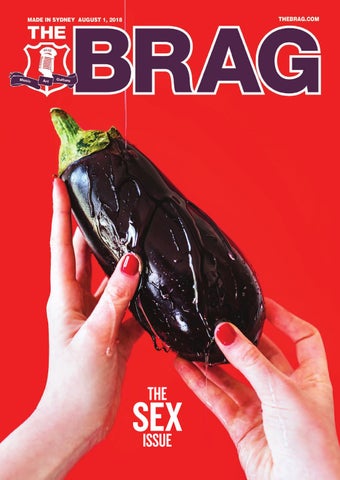
COURTNEY BARNETT SEX THE
ISSUE
DISCOVER THE FUTURE OF MUSIC 4 – 7 SEPTEMBER Fortitude Valley, Brisbane
bigsound.org.au MUSIC FESTIVAL PRESENTED BY
thebrag.com
BRAG :: 740 :: 01:08:18 :: 3
LEARN WHY
EVERY ARTIST IN THE COUNTRY NEEDS THIS APP
Pitches your music monthly Builds your network Saves you money every month Opens career doors Hit producer beat catalogues Online 'Artists Strategy' Education Song Writing Holidays Subscribers recieve a free ticket to 2-Day Seminar (RRP: $1497)
WWW.GROWMYMUSIC.COM 4 :: BRAG :: 740 :: 01:08:18
thebrag.com
thebrag.com
BRAG :: 740 :: 01:08:18 :: 5
6 :: BRAG :: 740 :: 01:08:18
thebrag.com
2018 AUSTRALIAN MUSIC WEEK
Cronulla Beach November 7-11
MUSICCONFERENCE | NOV 7-9
Listen and Learn from music industry leaders. Interact and participate in relevant panel discussions. Meet like-minded people and build your network.
LIVESHOWS | NOV 7-10
150+PERFORMANCES 10VENUES 5DAYS
Australian and International artists playing multiple venues over 4 nights, buy a ticket and venue hop to see as many great shows as possible.
FILMFESTIVAL | NOV 10-11
Tickets on sale 2nd August
More information and applications at australianmusicweek.com
australianmusicweek.com SUPPORTED BY
GOLD COAST
MUSIC AWARDS
thebrag.com
BRAG :: 740 :: 01:08:18 :: 7
this month what you’ll find inside…
ISSUE 740: Wednesday August 1, 2018 EDITOR: Joseph Earp joseph.earp@seventhstreet.media FEATURES EDITOR: Allison Gallagher NEWS: Nathan Jolly, Tyler Jenke, Bianca Davino, Lars Brandle
22
ART DIRECTOR: Sarah Bryant PHOTOGRAPHER: Ashley Mar COVER PHOTO: Brianna Elton (Instagram: @BriannaElton) THE DRIZZLER: Ciaran Toomey ADVERTISING: Josh Burrows - 0411 025 674 josh.burrows@seventhstreet.media PUBLISHER: Seventh Street Media CEO, SEVENTH STREET MEDIA: Luke Girgis - luke.girgis@ seventhstreet.media MANAGING EDITOR: Poppy Reid poppy.reid@seventhstreet.media THE GODFATHER: BnJ GIG GUIDE COORDINATOR: Allison Gallagher - gigguide@seventhstreet. media REGULAR CONTRIBUTORS: Arca Bayburt, Lars Brandle, Tanja Brinks Toubro, Emily Gibb, Emily Meller, Adam Norris, Holly Pereira, Daniel Prior, Natalie Rogers, Erin Rooney, Anna Rose, Spencer Scott, Natalie Salvo, Aaron Streatfeild, Augustus Welby, Zanda Wilson, David James Young
“It’s hard to keep yourself informed, and the enemies of sex take advantage of that.”
Please send mail NOT ACCOUNTS direct to this NEW address Level 2, 9-13 Bibby St, Chiswick NSW 2046 ACCOUNTS RECEIVABLE: Carrie Huang accountsseventhstreet.vc (02) 9713 92692, 9-13 Bibby St, Chiswick NSW 2046 DEADLINES: Editorial: Thursday 5pm (no extensions) Ad bookings: Last Wednesday of the month 12pm (no extensions) Finished art: Last Thursday of the month 5pm (no extensions) Ad cancellations: Last Wednesday of the month 12pm Deadlines are strictly adhered to. Published by Seventh Street Media Pty Ltd All content copyrighted to Seventh Street Media 2017 DISTRIBUTION: Wanna get the BRAG? Email jessica.milinovic@seventhstreet.media PRINTED BY SPOTPRESS: spotpress.com.au 24 – 26 Lilian Fowler Place, Marrickville NSW 2204 EDITORIAL POLICY: The views and opinions expressed in this publication are not necessarily those of the publisher, editors or staff of the BRAG.
regulars 10 67 65 72-74 73 74
The Frontline The Watcher Game On Gig picks Drawn Out Giveaway
like us:
THE BRAG
12-16
What We Talk About When We Talk About Tinder
45
Lucy Le Masurier
17
As A Trans Person, My Sexuality Is Always Political
46-47
Kieran Butler
18
All Animals Want Is Peace
48
Pamela Pirovic
19
How I Found Love In A Swinger’s Club
49
Luke John Matthew Arnold
20-21
The Great Nipple Debate
50-52
22-25
Liara Roux
Resist And Release: Queer Politics On The Dance Floor
26-27
The Sheer Existential Horror Of Sex Ed
53 The Craziest Place I’ve Had Sex
28-31
Harmonia Nyx
54-55
We Got Our In-House Movie Critic To Review Porn
32-33
Sex, Death, And Murderous A.I.
56-57
The History Of Sex In Video Games
34-35
Betty Davis: Too Nasty For Then
58-60
Firework
36-37
I Tried Out Positions From The Kama Sutra
62-63
Choke
38-40
Blood, Sex, And Freedom: The Erotic Thrillers Of Brian DePalma
64
Winners Of The Bad Sex Award, Reviewed
66
Twin Peaks
41
Beatrice McBride
68-69
Deaf Wish
42-44
Samuel Leighton-Dore
70-71
Idles
Liara Roux photo Ashley Lake
8 :: BRAG :: 740 :: 01:08:18
follow us:
@TheBrag
thebrag.com
STEVE BALBI
STAIRWAY TO HEAVEN ROCK & ROLL BLACK DOG KASHMIR THE RAIN SONG PLUS MANY MORE...
Guest Vocalists
(Noiseworks / Mi-Sex)
DALLAS FRASCA
MARK DACOSTA * FRANK LAKOUDIS AND INTRODUCING
NICOLE HAWKINS (Grandhour - Melb)
E R T A E H T E T A T S 0 0 1 6 3 1 r te s a tm e k c ti m p 8 T P E S 5 1 T A S PLUS AN ALL-STAR BAND, INCLUDING STRING SECTION, UNDER THE CREATIVE DIRECTION OF JOSEPH CALDERAZZO
WHOLELOTTALOVE.COM.AU thebrag.com
BRAG :: 740 :: 01:08:18 :: 9
the frontline
With Nathan Jolly, Tyler Jenke, and Brandon John
LUNA NO MORE?
The Social Network
FAILBOOK I can’t imagine you’d have a happy home life if you happened to work for Divorce Online. Or maybe the constant reminders of love lost, hearts broken, and trust breached would make you double down and appreciate what you have. Either way, the intrepid reporters from that website have uncovered a few startling statistics: a third of all divorce paperwork filed in 2011 contained the word ‘Facebook’. To add to this, the American Academy of Matrimonial Lawyers (which sounds like the best name for an emo band ever) claim that four out of five U.S. divorce attorneys “say social networking in divorce proceedings is on the rise.” Divorce lawyer Marian Rosen told ABC News “We’ve had instances where they pull up Facebook in the course of a deposition. Once it’s out there for the world, it’s very difficult … to erase from the past. There are going to be trails that can be followed.”
GETTA POD OF THIS
Podcasts focusing on true crime and unresolved mysteries have become all the rage in recent years. With big names such as Serial flooding your Twitter feeds over the last little while, these podcasts have been vital in helping to renew interest in cold cases. Now, a new Natalie Wood program aims to solve the mysterious death of American actress Natalie Wood. Born in 1938, Natalie Wood was a hugely famous American actress, best known for her work in a West Side Story, Rebel Without A Cause, and Miracle On 34th Street. However, her career was tragically cut short in 1981 when the 43-year-old drowned in mysterious circumstances. Having died during a boat trip to Santa Catalina Island off the Californian coast, the actress’ passing has long been a subject of debate. While others were on the boat, including the captain and her husband, fellow actor Robert Wagner, they reportedly never saw anything, and Wagner himself has long been considered a suspect. Needless to say, it’s the sort of thing that is worthy of a Hollywood film in its own right, but now, almost 37 years after the fact, a new podcast hopes to put the mystery to rest once and for all. As U.S. Weekly reports, Fatal Voyage: The Mysterious Death of Natalie Wood is a new twelve-part series which aims to tell the whole story in an attempt to get to the bottom of the mystery.
Few could imagine Sydney’s harbour without its iconic mainstay Luna Park, but its owners are now saying the park is under a dark cloud of uncertainty following a “terrible” court decision. As News.com.au reports, the Land and Environment Court has ruled that the park would not be allowed to install a new ride, the Flying Carousel, without development approval, meaning that the park will now have to submit a new application every time it wishes to install a new ride, or even move an existing one. Of course, this would mean a constant stream of opportunities for complaints about noise, traffic and more from nearby residents, leaving the park to stagnate under a pile of objections. “We are deeply disappointed by this decision, which places a big question mark over the long-term viability of one of Sydney’s best-known and most-loved destinations,” managing director Peter Hearne has told Fairfax.
THE END OF COKE ZERO From Wednesday August 1, Coke Zero will no longer be manufactured, and retailers and shoppers are not at all happy. Woolies even went so far as to tell media they wanted to continue selling the drink due to customer demand. Coke No Sugar has replaced the drink, launching last month, but although 3.5 million cans have sold so far, people still aren’t happy with the change. Still, the company is putting a positive spin on it all. “It is no surprise that people are preferring it over Coke Zero – just as we have seen where we have launched this new recipe around the world,” Coca-Cola Australia marketing director Lucie Austin wrote in a statement. “We are also seeing that the rapid growth of Coke No Sugar is helping to expand the low and no sugar drinks category overall.”
Trevor Noah
NOAH THANK YOU There’s a growing call for Trevor Noah’s upcoming tour of Australia to be boycotted after a clip featuring the comedian’s insensitive, racist, and sexist comments towards Indigenous women surfaced on Twitter. The clip, which was uploaded to YouTube under the title of “Women Of All Races Are Beautiful” features Noah focusing on race and the concept of beauty, but has come under fire for containing derogatory comments directed towards Australian Indigenous women. “All women of every race can be beautiful,” Noah begins in his routine. “And I know some of you are sitting there now going, ‘Oh Trevor, yeah, but I’ve never seen a beautiful Aborigine’. Yeah, but you know what you say? You say ‘yet’, that’s what you say; ‘yet’. Plus it’s not always about looks, maybe Aborigine women do special things, maybe they’ll just like, jump on top of you,” he concludes, before imitating the sound of a didgeridoo while inferring oral sex. The clip was picked up on Twitter by former NRL player Joe Williams who took Noah to task, calling his comments “unacceptable”. “As a man of colour, you are usually in point with racism and divide,” he begins. “Here you are perpetrating and encouraging racial abuse!
10 :: BRAG :: 740 :: 01:08:18
thebrag.com
NEW SINGLE OUT NOW
BRISBANE
Fri 6th July, Bloodhound Bar
SYDNEY
Wed 12th July, Waywards
BYRON BAY
Sat 14th July, The Brewery
PLTSMUSIC.COM thebrag.com
BRAG :: 740 :: 01:08:18 :: 11
COVER STORY
What We Talk About When We Talk About Tinder:
COVER STORY
Or, Adventures in The Information-Gathering Age By Belinda Quinn
Dating by Ian Dooley thebrag.com
BRAG :: 740 :: 01:08:18 :: 13
COVER STORY
“Tinder only continues to grow. It currently claims to instigate ‘one million dates per week’, ‘1.6 billion swipes per day’ and is used in over 190 countries.” “Lovelessness is a boon to consumerism.” – bell hooks, All About Love.
T
he Match Group, an international conglomerate that owns Tinder, OkCupid, and PlentyOfFish is a sheer force of nature. So it’s helpful, given the company’s evergrowing commercial interest in algorithm development and data mining, to contemplate how their sites participate in – as opposed to simply reflecting – the ebbs and flows of intimacy, connection, and romantic and sexual interaction. And how an increasing, overbearing presence of capitalistic ideology within our love and sex lives might impact on our relationships. The overwhelming and ever-growing reach of corporate tech giants Google, Amazon, and Facebook has led former Google design ethicist Tristan Harris to note that “a handful of people working at a handful of tech companies steer the thoughts of billions of people every day.” And Tinder only continues to grow. It currently claims to instigate “one million dates per week”, “1.6 billion swipes per day”, and is used in over 190 countries. In what’s often deemed ‘the sexual marketplace’, we’re currently seeing a growing desire for instant gratification. “Fixating on wants and needs, which consumerism encourages us to do, promotes a psychological state of endless craving,” writes activist and visionary bell hooks in her book, All About Love: New Visions. “Advertising is one of the cultural mediums that has most sanctioned lying. Keeping people in a constant state of lack, in perpetual desire, strengthens the marketplace economy.” Similar to Facebook’s predecessor FaceMash – an interactive website built by Zuckerberg where users rated the attractiveness of women on his campus – Tinder co-founder Sean Rad said in Time Magazine in 2014, “We always saw Tinder, the interface, as a game.” Tinder uses an ELO-desirability score. Some profiles are ranked higher than others, all in a bid to connect users its algorithms (and therefore, the algorithm’s designers) believe are in the same league. According to Tinder data analyst Chris Dumler, “Every swipe is in a way casting a vote.” According to New Yorker writer Jia Tolentino, “sexual value continues to accrue to abled over disabled, cis over trans, thin over fat, tall over short, white over non-white, rich over poor.” If existing widespread oppressive beliefs about the sexual worth of minorities are instilled into Tinder through a voting system, surely there should be interventions put in place to ensure these algorithms don’t discriminate against its users.
I
n late 2017, French journalist Judith Duportail went to extreme lengths to gain access to her Tinder data. Enlisting a privacy expert and a human rights lawyer, she eventually received 800 pages back from the company, and was shocked to learn that Tinder knows everything from
14 :: BRAG :: 740 :: 01:08:18
Morning Wood by Charles Deluvio
Tinder is yet to include non-binary genders on sign up, and automatically assumes that women are attracted to men, and vice versa. In Doing It: Women Tell The Truth About Great Sex, Melbourne writer Giselle Au-Nhien Nguyen includes a quote from one of her interviewees. “When you are seen, when you are included, you have more agency – you have more power.”
thebrag.com
COVER STORY
“Tinder ranks some profiles higher than others, all in a bid to connect users its algorithms believe are in the same league.” the race of the person you’re most likely to match with to the average amount of time someone spends on your picture before they swipe. Luke Stark, a digital technology sociologist at Dartmouth University, writes in Duportail’s article, “Apps such as Tinder are taking advantage of a simple emotional phenomenon; we can’t feel data. This is why seeing everything printed strikes you. We are physical creatures. We need materiality.” In a bid to become more transparent, this year Tinder responded to changing EU privacy laws by allowing anyone access to their data with the click of a button. Unlike Duportail’s experience, reading my own 33-pages of data was underwhelming. It might be a mark of my generation, but I don’t think much of Tinder or other companies selling my images or my (often stunted) flirtations via the app. It feels too distant; too obscure for me to fully realise the societal cost of my information being sold to third party advertisers. These transactions feel invisible, almost inexistent. The potential reward of “finding” romantic intimacy is more tempting, overshadowing the risk of contributing information – and therefore power – to various companies that may impact our future. And even though Tinder claims it is becoming more transparent, their matching tools are integral to their intellectual properly – meaning they have no responsibility to disclose exactly how their algorithms are designed or the logic that they’re built on. In Duportail’s article for The Guardian, privacy activist Paul-Olivier Dehaye writes, “We are leaning towards an even more intangible world where data collected about you will decide even larger facets of your life. Eventually, your whole existence will be affected.” And while this might seem like a conspiracy theory or the foundations for an episode of Black Mirror, social control systems built off the back of data collection aren’t as far off as they seem. In China, a ‘social credit’ system that uses the collation of data on its citizens is being planned for integration by the government in 2020. In 'Dockless Bikes, Data-Capitalism', PhD student and sessional academic Nicolas Ozolins examines how dockless bikes have been used to survey the movements of citizens by major corporationss, writing that the data gained for this system will be “used to assign individuals a number that represents their ‘trustworthiness’”. People with low scores will have restrictions placed on them, including on their freedom to travel.” And he says with Australia’s recent Identity-matching Services Bill 2018, we could potentially be heading in a similar direction.
T
his year, London academic Laura Thompson published I Can Be Your Tinder Nightmare, a revealing – albeit somewhat terrifying – body of research that unpacked the intention behind men’s explicit misogynistic harassment within online dating.
Analysing 526 messaging exchanges collected and posted by curated Instagram accounts Bye Felipe and Tinder Nightmares, she found that these men’s abusive reactions to rejection or being ignored were often an attempt to discipline women who’ve been granted access to power over the last century. Thompson writes that these men, knowingly or not, are attempting to “reposition women and femininity as sexually subordinate to masculinity and men.” While this form of oppressive behaviour is mostly an extension of power structures that enable violence against minorities, she writes that these apps and websites “provide the social tools for [misogynistic behaviour] to flourish. “Looking at Bye Felipe, it’s just the sheer amount and the repetition of it – it’s quite arresting I think. Especially some of the quite violent ones and rape threat ones,” explains Thompson over Skype to the BRAG. These messages all seem to all use a similar rhetoric, indicating these reactions are affirmed and seen as rational reactions from within their online social bubbles. “That’s why I wrote that paper – to pull apart the themes of different discourses that they’re pulling on, because they haven’t just popped out of nowhere. It hasn’t just suddenly come along because Tinder is now a thing. They’re pulling on some quite old sexist tropes and ideas: you know, the figure of the slut, for example,” explains Thompson. This disciplinary behaviour can be found in a more sinister movement: incels (self-described “involuntary celibates”). This year in Toronto, Alek Minassian called for an “Incel Rebellion” and massacred ten people while injuring another 16. And he isn’t the first to respond to his perceived sexual rejections in a murderous rage. At the core, incels are entitled and self-victimising. They direct vile and dehumanising hatred at the same women they desire. They believe sex is about dominance, rather than a mutual, creative giving and receiving of pleasure. In the New York Times’ Amanda Taub asserted that the incel mentality speaks to “broader resentments” among men in the West in response to shifting gender politics post Me Too movement, sexual revolutions, and self-esteem movements and online dating, which have given women more choice. Thompson writes in I Can Be Your Tinder Nightmare that the men in her study “depict the dating app as a transactional space for sex where women are to be used as a ‘‘free’’ source of sex.” And Nguyen asserts that online dating has exasperated a sense of disposability, explaining that, “some online daters fail to understand that casual sex is not mutually exclusive with respect.” In The Guardian article A Broken Idea Of Sex Is Flourishing; Blame Capitalism, Rebecca Solnit writes, “Despite half a century of feminist reform and revolution, sex is still often understood through the models capitalism provides. Sex is a transaction … it is not imagined as something two people do that might be affectionate and playful and collaborative, but that one person gets.”
Asked what Laura Thompson thinks the consequences are for having a capitalist framework for viewing people as a marketed product to consume, she says, “You hear of all these bad behaviours – you know ghosting, bread crumbing – we have all these terms now for all these basically crappy things that people do to each other whilst dating. “And I’m sure that these less than ideal ways of relating to other people have always existed and have always been to some extent in a dating landscape, but it does seem more common. There’s less incentive really to treat people decently if you’ve got lots of other different options and you can just get back on Tinder and keep looking,” she says. “People seem to be really terrified of intimacy,” Thompson says of her interviews with women. “Dating’s really difficult.” She laughs. “If you can just toss people off and you don’t have to get too emotionally involved with anyone, then you keep yourself a bit more protected I guess.” While collective changes in Western folk’s relationship towards intimacy are hard to measure, Thompson believes social and economic changes over the last few decades could have had an effect; from small communities becoming fewer and far between, to people increasingly moving for work. “People are a lot more displaced. I think it’s pretty hard to argue against the fact that there is definitely more of a fracturing in wider society,” she says. In Sarah Schuman’s Conflict Is Not Abuse, she attributes an increasing reliance communication via email and messaging as a contributor to a loss of intimacy in our lives. And Harold Kushner writes in When All You’ve Ever Wanted Isn’t Enough, “I am afraid that [younger generations] will grow up looking for intimacy without risk.”
T
he call-out culture of Bye Felipe and Tinder Nightmares has Thompson conflicted. “On the one hand whilst shame does play an important role in getting people to reflect on behaviours and whether it’s socially acceptable or not, and whether they should toe the line and behave better, I do think that there’s just a lot of shame being thrown around online. Sometimes it becomes quite divisive and people get more entrenched in their different camps,” she says. But the accounts are quite useful when it comes to drawing attention to just how pervasive online sexual harassment is. “Women can see, ‘Oh it’s not just me that has to put up with this bullshit’,” Thompson explains. There are endless Instagram accounts dedicated to calling out bad dating manners. While Bye Felipe and Tinder Nightmares focus more on volatile reactions to rejection, 24-four-year-old Shelby Lorman’s awardsforgoodboys tackles more insidious drains on emotional labour in casual intimate relationships; she finds catharsis in satirical, snarky quips.
“If you live in regional and rural areas, having access to your minority group through
a specialist app can allow access to lovers and friends you’d never have met otherwise.”“ thebrag.com
BRAG :: 740 :: 01:08:18 :: 15
COVER STORY
“Tinder knows everything from the race of the person you’re most likely to match with to the average amount of time someone spends on your picture before they swipe.” “[Women are] just constantly trying to figure out how to deflect unwanted advances without provoking a man … [there’s] just an underlying sense of fear at ‘what might happen here’, which I found really, really depressing. There’s just this constant managing of men’s emotions, and I don’t even know if they’re aware of it, but these women – some more than others – really seem to take personal responsibility for them sometimes,” she says. Lorman hoped that awardsforgoodboys would help let women know that they’re not alone; it asks all people in intimate relationships to hold each other to better standards. “It’s dually horrifying and extremely validating to see how many people have ‘been there’ about so much of my content,” she told Huffington Post. “I don’t think Bye Felipe and [platforms] like it will change the behaviour of individual men, but I’m not sure that’s the point of it,” explains Thompson. “I think we just need to be having broader conversations around things like consent and I think people just need to learn better frustration tolerance.” She laughs. “I don’t know how you’re going to do that unless you get a whole bunch of these men in therapy.”
T
inder and apps like it can be equally empowering tools. There are apps dedicated for people with STIs (PositiveSingles), to lovers of beards (Bristlr).
If you live in regional and rural areas, having access to your minority group through a specialist app can allow access to lovers and friends you’d never have met otherwise – and it’s a beautiful thing that gaining access to your minority group is becoming easier. Plus, self-editing can be a boon for people with disabilities that affect confidence around verbal communication. Coming from a conservative Vietnamese family and suffering from sexual pain disorder vaginismus in her former relationships, in Doing It, Nguyen went as far as to say that online platforms gave her the tools to become the “architect of [her] own pleasure.” According to Thompson, the presence of more choice – while it might lead to increases in lessening of commitment – has allowed for further experimentation. She says, “People can learn a lot about themselves and what different relationships … can look like by dating widely and more casually – and that’s not a bad thing.”
ublished in 2000, bell hook’s All About Love: New Visions reimagined what it meant to pursue love. The author and activist writes that when women persist in intellectual thought on seeking love, they’re often seen as desperate, needy and deep in overthought. “No one thinks she is rigorously engaged in a philosophical undertaking wherein she is endeavoring to understand the metaphysical meaning of love in everyday life,” asserts hooks. And 18 years since it was published, it seems that to sit and stew on love is often still perceived as undesirable.
P
16 :: BRAG :: 740 :: 01:08:18
On the topic of emotional labour, Thompson says, “that is a huge theme. It is a big thing that’s come out of my interviews, this general sense of real weariness, which can sometimes almost turn into apathy and passiveness.
Unporn by Annie Spratt
To the Huffington Post, she defines these ‘good boys’ as “the ones who wear a feminist badge on their backpack and put ‘ally’ in their Tinder profile but can’t quite understand why it’s a problem that they, as the only dude-identifying person in the room, continually speaks first in their Women’s Studies class.”
While capitalism is often linked with terms like ‘innovation’, the most innovative lessons I’ve been given in love, sex and relationships haven’t come from money-driven start-ups or apps. They’ve come from friendships that have pushed me to do better. They’ve come from visionaries like bell hooks, Audre Lorde, and writers like Sarah Schulman, who re-envision a world where love is transformative: a committed action, rather than a feeling we simply submit to.
thebrag.com
FEATURE
AS A TRANS PERSON,
MY SEXUALITY
IS ALWAYS POLITICAL BY ALLISON GALLAGHER
T
he sexuality of trans people, and in particular trans women, has been simultaneously silenced and sensationalized, both erased and fetishized, for as long as trans people have existed in public consciousness. The cis gaze at once renders us both entirely unfuckable and extremely desirous. Ultimately, these two competing discourses both exist to do more or less the same thing – control the narrative over trans women’s sexuality, and our bodies in general. I’m a 25-year old trans woman. When I first started transitioning, I deeply internalized the idea that sex was not something that I was allowed to experience. Part of that is because what we collectively imagine trans women’s sexuality to be is cloaked in shame and guilt. I think it took a long time for me to be unapologetic about my transness and my queerness when it came to expressing my sexuality; to not feel like I had to be demure or restrained so that I wouldn’t reinforce people’s pre-conceived stereotypes about trans women and sexuality. This is a poem that I wrote last year that was included in my chapbook Parenthetical Bodies, entitled ‘teeth’. Our teeth are like grappling hooks against resistant concrete slabs, surfaces we didn’t choose hardened by our histories
Now, I’m not so self-indulgent that I think every time I get laid it’s some revolutionary act. But I do think there’s a lot of power – both in a personal sense and a political one – in reclaiming that narrative, by openly talking about our sexuality as trans people who’ve had a discourse imposed on us. It’s empowering to actively subvert, reclaim and have
by transphobes) but what I am saying is that it’s probably a good idea in general to think about how your ‘preferences’ may be, at least in some small way, rooted in race, cissexism, and so on. There’s also a level of care that I think you have to have when you’re a cis person who is having sex with trans people. It’s important to have a conversation about what parts of their bodies they’re okay with being touched; if there are any they aren’t okay with being touched; what they call parts of their bodies.
“IF YOU’RE INTO MEN, BUT WOULDN’T BE COMFORTABLE SLEEPING WITH A MAN WITH A VAGINA, WHAT DOES THAT SAY ABOUT HOW MUCH YOUR SEXUAL PREFERENCES ARE TIED UP IN CISSEXISM?”
Like, am I allowed to just fucking exist as a trans person with a fairly boring sex life? This all kind of ties back into a larger conversation: whose bodies get regulated; what kind of bodies are allowed to have control over their own narrative; what kind of bodies don’t.
“AM I ALLOWED TO JUST FUCKING EXIST AS A TRANS PERSON WITH A FAIRLY BORING SEX LIFE?”
“I’M NOT SO HAT TT N E G L U D N I F SEL TIME Y R E V E K N I I TH ME O S S ’ T I D I A I GET L ACT.” Y R A N O I T U L REVO thebrag.com
The narrative that trans women’s sexuality is nonexistent comes from a long-established history of transmisogyny, which also ties in a lot to other things like traditional masculinity and homophobia. In my case, I identify as a lesbian and I think there’s maybe a kind of privilege that comes with that. So much of the violence, abuse and harassment that trans women experience simply for wanting to pursue their sexuality is at the hands of straight cis men who can’t deal with the threat to hegemonic heterosexuality and masculinity that comes with a trans woman outwardly expressing an unapologetic desire for sex. It’s kind of an enigmatic thing for a trans woman to not assume that their sexuality should be hid and that they don’t have to be secretive about it. At the same time, there is perhaps an assumption that as a trans person, any time I engage in sexual activity it is a wild, raucous free-for all or something. Sorry to disappoint, but I’m actually a remarkably beige sex-haver. Which I think, again, circles back to that idea of trans women’s sexuality being both something secret and silent and taboo, but also sultry and provocative and sensationalized.
We create unmapped terrain the cartography of our cocks and our cunts defying the lines they’ve drawn around our bodies to keep us from ever touching too close Every ungodly orgasm like a cum-covered middle fi nger to those who’d rather we destroy ourselves than love each other
ownership of a narrative that has been used against you and people like you for decades.
If you’re a cis person (that is, not trans), you have a certain responsibility to examine your privilege when it comes to sexuality. It’s also important to be reflective about how you imagine yourself within that – if you’re into men, but wouldn’t be comfortable sleeping with a man with a vagina, for instance, what does that say about how much your sexual preferences are tied up in cissexism? If you can’t imagine ever having sex with a trans woman, based solely on the shape of their genitals, is it the case that you can only conceive women as walking vaginas? The way that, you know, misogynists do? I’m not saying that you have to fuck anybody (which is how this idea often gets presented
It’s important that you’re actively trying to make sex an emotionally safe experience for the person that you’re fucking. I don’t really think that’s even something that you have to think about only in the context of trans people either – it goes without saying that everyone has different comfort levels and preferences as far as what makes them feel safe. At the end of the day, I think it’s about recognizing that trans people, like everyone else who fucks, are three-dimensional, individual people, not these homogenous, one-size-fits-all categories. I think we’re coming (no pun intended), to a place where trans people finally have some control over the narrative when it comes to our sexuality and expressing that sexuality, and I’m really glad about that. The fact that the media has – for literal decades – portrayed trans women as amoral perverts or unfuckable non-entities when it comes to sex has probably stopped an awful lot of people feeling comfortable in who they are. It’s time for that narrative to change.
“IT’S EMPOW TO ACTIVELY ERING S RECLAIM AN UBVERT, D OWNERSHIP HAVE NARRATIVE OF A BEEN USED A THAT HAS G AND PEOPLE AINST YOU LIKE FOR DECADE YOU S.” BRAG :: 740 :: 01:08:18 :: 17
FEATURE CONTENT WARNING: THIS STORY CONTAINS DISCUSSIONS OF RAPE
All Animals Want Is
PEACE BY PHOEBE LOOMES
“Rape victims are an idea. They’re a nebulous thing.”
W
hen I told my best friend about how I felt after being raped, he told me the things I was saying were really taboo.
Rape victims are an idea. They’re a nebulous thing. Being raped for me was a dream state. I had tried to get away, but I was drugged and before I could escape, I was in a bed half passed out. For hours I was sometimes awake, sometimes asleep. I remember crying. I also remember laughing. I also remember fighting. I also remember orgasming. I have always struggled to believe the world is full of predators. We are all animals. My aunty was once picked up whilst hitchhiking by Ivan Milat, and his brother. Her car had broken down on the Hume Highway near the Belanglo State Forest, on a stretch of road synonymous with quietly disappearing tourists. Her and her husband got into the car, in the early nineties, in an era before smartphones, and let the two brothers drive them towards what they believed was going to be Newcastle.
the earth underneath some very heavy ancient knowledge. It felt very heavy and very allconsuming and very natural and ancient. I felt like I was underneath Niagara Falls, all the time. What I experienced was PTSD. What I experienced was water torture. When I spoke about giving up sex, people said, ‘At least you can masturbate!’ This was not the case. I remember in the wake of my rape, I engaged in a few months of wild promiscuity, where I slept with somewhere in the vicinity of a half century of men. I was baseless and raw and most likely frightening, saying, ‘Slap my face,’ and other weird things. I always ended up in tears.
After a year of intensive trauma therapy I was bored with not being able to have an orgasm. I decided to see a traditional Chinese Herbalist and Acupuncturist. Her name was Jade. She spoke to me for a while about my life and my love of karma yoga and my toxic obsession with forgiving my rapist. She cried. She told me I was an animal in a field, and I was running. Every muscle was exhausted; every cell was depleted. My aunty told me she never called the police after Ivan Milat picked her up. ‘It seemed like when my husband started to make trouble in the back of the car, he assessed we’d be a hassle to kill,’ she said. ‘He’d taken the internal handles off the doors in the back of the car, so we couldn’t let ourselves out. But he pulled over after his brother had menaced us for a while with a handgun he pulled out of the glove box. We were about six kilometres from the highway, so we walked back and as soon as we were out of the car I just wanted to be away from them and safe.’
“What I experienced was PTSD. What I experienced was water torture.”
At some stage, Ivan swerved violently onto an unpaved road without warning. ‘We’re going to a party!’ He said wildly. Her husband pulled out a knife and said, ‘If you don’t let us out of the car, there is going to be huge trouble for you.’ My rapist did similar things to me. ‘Drink this! Scull it!’ I have always been a tough girl; a fighter; outspoken; a feminist. I was raised by criminal barrister who would come to meetings with my school principal and tell him off when I was incendiary and outspoken to my teachers. I have always felt invincible and walked through the world without fear. I know sexism, I know rape culture, and I have laughed in its face. I have always thought, ‘These things aren’t real; they are things people are trying to enforce on me.’ I have always had great empathy for women who were raped; intellectually I understood rape, I raged against it, but I secretly believed in my mind that it could never happen to me. I thought, ‘I am too tough, I am too smart.’ It was somewhat like when I took LSD as a teenager, and I realised very quickly that drugs change everything. After I was raped, the reality of my stupidity kept falling on me and tunneling through me, every moment, like I was a river beneath the riverbed, deep underground, pummeled into
Talking about these things is taboo – because rape victims aren’t real. They’re not people you know. When you do know a rape victim, they share their experiences with you when they’re weak – drunk, upset, vulnerable – then quickly walk away from it like and disassociate the experience from their personality and narrative. The victim inside is a ghost, a person that died, that they speak about with shameful grief. Because of this dissonance, I have had so many friends turn their backs on me out of sheer disbelief. ‘Why didn’t you press charges?’ is an arrow often thrown at me. ‘But you are so tough!’ Is another one. ‘How could you let that happen to you?’ I have no answers for these things, because they aren’t really questions. Rape is an animal act carried out by beasts in weird, demon riddled fi elds. It’s a reality I still can’t make sense of, and I often lapse into toxic thinking, about my own karma, and past lives, and what I deserve. There’s a theory that animals can fl ow through states of terror and calm with great ease. A leopard can chase a gazelle, and the gazelle can be coursing with adrenaline and cortisol, its muscles all at attention. Moments later, the gazelle will shake momentarily, then be chewing grass and gazing serenely over the plains. All animals want is peace.
‘You don’t think about reporting it. You just want to run and never think about it again.’ I would say about trauma that it never goes away, but every day you get better at finding ways to deal with horrors that intrude into your mind. The thoughts that would take over my body every time I tried to have a conversation with a man still happen every time I have a conversation with a man. But I don’t collapse and run and cry. After six months of sessions with Jade, she told me she was going to clear the trauma blockages from my body. For half a year she’d gently been needling my feet and between my eyes. This time she drew out thicker needles and pierced my skin. During acupuncture, the needles are inserted into your skin, then you’re left there for about twenty minutes while your pulse comes down to a very low resting rate. What happens during this time is, according to Chinese Doctors, when your ‘chi unblocks.’ Jade pulled the first needle from my wrist and the whole room rattled with wind, the wooden venetians banging against the closed window and Jade’s hair blowing backwards. I exploded in tears while Jade grabbed at her throat and choked sharply. I then walked, not ran, down onto the Coogee foreshore in front of the practice and looked serenely over the ocean. For the first time in 18 months I felt peaceful, while I finally accepted I was just an animal who had been attacked. ■
“I have always had great empathy for women who were raped, but I secretly believed in my mind that it could never happen to me.” 18 :: BRAG :: 740 :: 01:08:18
thebrag.com
FEATURE CONTENT WARNING: THIS STORY CONTAINS EXPLICIT DESCRIPTIONS OF SEX. IT IS NOT SUITABLE FOR READERS UNDER THE AGE OF 18.
How I Found True Happiness At A
SWINGER’S CLUB BY SARAH BRIDGERS
“I had a strange time with my sexuality growing up.”
I
had a strange time with my sexuality growing up. I developed really early; I was that girl who suddenly scored the hot, sticky interest of every boy in her primary school because she came back from summer holidays wearing real bras while all her friends were still in crop tops. But I also enthusiastically discovered the joys of masturbation really young too, in my bath tub, alone, using the water from the shower head to come to a bubbly climax. So as far as I was concerned, I didn’t really need boys. Sure, some of them were cute, and I was flattered when they wanted to talk to me, but only one really caught my eye – and even he was only interesting to me as a friend. His name was Hector. He was into the same things as me – Star Wars, video games, and yes, enthusiastic masturbation. We got drunk together at 16, and I got him to show me his cock. It was the first one I had seen outside of porn. It was long; thick; beautiful. I kissed it once, right on the tip, and felt the wet smack of what I would later learn was pre-cum. That was as far as we went. I told him I was tired, and pretended to drift off while he lay next to me. He started beating his dick as soon as he thought I was asleep. I did wonder if he was thinking of me as he did it – but even then, I knew he was my friend, nothing more. Over the next few years, Hector and I were both unlucky in love. Despite my libido, I was shy, and had a hard time connecting with guys. Hector was the same. He dated with his cock, which meant he’d hang on to relationships long after they should have come to an end, if the sex was good enough. He would date guys too – he dated one American boy long-distance for five years. But everything always fell apart in the end. One day, after a particularly bad break-up, Hector came around to my place. We both got trashed. At one point, slurring his words, he suggested that we try fucking. We got on so well in all other parts of our life; why didn’t we try that? But I was worried – frightened that sex might ruin our friendship. He practically deflated right there in the bed. So, desperate to boost his mood, I suggested we try something different. Why didn’t we go to a swinger’s club? That way we could fuck if not together, then side by side. Maybe, if the feeling took us, we could give each other a little head. Hector enthusiastically agreed.
A few days later, we went. I was surprisingly nervous. I didn’t know what it was going to be like; who was going to be there. What if everyone else was gross? So consider me genuinely surprised when I discovered the inside of the club was warm; inviting. There were animal print cushions thrown around the room; condom dispenser machines; tubes of lube; and there, in the middle of the room, an inviting, sparkling sex swing. Neither Hector nor I needed prompting. He found himself an older couple – two women, in their mid-to-late 30s. Within moments, one was giving him head, while the other straddled his face. And I stripped off and sat on the swing, my nipples rock hard, making uninterrupted eye contact with a young, shy-looking blonde woman sitting across from me and touching herself while I went back and forth, inching towards climax. Maybe this all sounds gross to you. I can imagine how it might. It sounds depraved, I suppose. Maybe a happier version of this story would end with Hector and I fucking; with us discovering that we desperately love one another; that we couldn’t bear to live without the other person. But that’s not what happened. Hector and I did fuck that night, briefly, after he was done with his couple, and I was done with the swing. We did it doggy. He entered me gently, his exhale hot on my back; one free hand rubbing my clit. But before long, we found we got distracted. I caught the eye of the hot shy blonde while Hector was in me, and, sensing an opportunity, she came over and spread herself before me. I began eating her out; noticing as a long, red, beautiful rash of excitement began spreading over her stomach. And Hector, rather than get involved, stood back slowly and watched, a smile across his face. This is what I discovered in that club. Not that Hector was secretly the man of my dreams, but that I was the woman of my own dreams. That I could be the beautiful, sexualised goddess part of me had always wanted to be since teenagehood. And I think Hector felt something similar. I saw it, fl ashing in his eyes.
“Over the next few years, Hector and I were both unlucky in love. Despite my libido, I was shy, and had a hard time connecting with guys.”
We stayed for hours. I was giddy with myself; giddy with the hot scent of sex. Someone had come on my chest; a woman, one half of Hector’s couple, was eating it off me, taking long licks of my skin as she did so. It was all skin, all around me; every inch of it warm, and wet, and throbbing, and wanting. And, for the first time in my life, I felt it: pure, uninterrupted contentment. ■
“This is what I discovered in that club. Not that Hector was secretly the man of my dreams, but that I was the woman of my own dreams.” thebrag.com
BRAG :: 740 :: 01:08:18 :: 19
FEATURE
“PURITANICAL PAINTERS KNEW FULL WELL THAT UNCLOTHED
The Great Nipple Debate By Charlie Arthur n 1485, an acclaimed German portrait painter named Hans Memling unveiled his supposed masterpiece. A carefully-detailed triptych, it depicts three figures; the one on the left, a hideous skeleton sporting a gaping wound; the one on the right, a demonic, black-taloned horror, his midriff the snarling fanged face of an ogre. But it’s the central image that is the most concerning. There, completely naked, stands a woman, a small dog behind her, and a long, thin mirror in her hand. The central image’s title? Vanity. In a lot of ways, this one assuming image – the height of a thoroughly ordinary fifteenth century painter’s whole career – sums up the entire rotten core of classical art. Acclaimed critic John Berger put it best in Ways Of Seeing, a book released to tie into his BBC television series of the same name. “You painted a naked woman because you enjoyed looking at her,” wrote Berger. “Then you put a mirror in her hand and you called the painting Vanity, thus morally condemning the woman whose nakedness you had depicted for your own pleasure.” This is the attitude that underpins so much of classical nudist art. Puritanical painters knew full well that unclothed flesh would be welcomed by their wealthy patrons; they were aware that capturing the female form would bring them in countless accolades, and further commissions. But their disregard for women – their hatred, even – compelled them to condemn the very bodies that they spent hours and hours studying, and rendering into oils. They were torn between their desire for fame, for money, for flesh, and their deep, almost crippling hatred of women.
Men – particularly the cantankerous, straight white men that disproportionately make up the community of art curators and buyers – desire bodies only if they can control them. These days, such an attitude has snuck its way into the world of social media. According to the conservative policies of social platforms like Instagram, women’s bodies are offensive in ways that men’s bodies aren’t. A woman’s nipple, according to the site, is pornographic, whereas a man’s nipple is as thoroughly inoffensive as an elbow, or an exposed neck. And women who show their bodies – who take that power back into their own hands – are denigrated and abused. For an entire generation of power-hungry, rich, straight white men, this is the way it goes then, in art as well as life: the female form exists as something to be viewed; to be controlled. It does not belong to a woman – it belongs to the men who line up to view her; to paint her; to possess her. And like all evil attitudes, this one is pervasive; it sinks deep into the consciousness. John Berger, great cultural critic and feminist that he was, put it well once more. “A woman is always accompanied, except when quite alone, and perhaps even then, by her own image of herself,” he wrote. “While she is walking across a room or weeping at the death of her father, she cannot avoid envisioning herself walking or weeping. From earliest childhood she is taught and persuaded to survey herself continually. She has to survey everything she is and everything she does, because how she appears to others – and particularly how she appears to men – is of crucial importance for what is normally thought of as the success of her life.” These are the blatant truths of art; of Instagram; of modern life. It is up to us now to rail against them. It is up to us now to regain control of our own image.
“WOMEN ARE TO BE CONDEMNED AS MORALLY OUTRAGEOUS – AS PROMISCUOUS DEVIANTS – IF EVER THEY TAKE THAT SEXUAL POWER INTO THEIR OWN HANDS AND USE IT THEMSELVES, FOR THEIR OWN PLEASURE.”
Illustration by Celeste Mountjoy, AKA Filthyratbag
Nor has Memling’s rancid, hypocritical worldview gone out of style in the hundreds of years since he died a rich, successful man. No. This is the attitude that the stuffy old bores that have served as our self-appointed cultural gate keepers for decades still hold. According to this pervasive attitude, women’s bodies are to be desired, but they are also to be censored. Whenever possible, women are to be reduced wholly to their naked form. But, even then, they are also to be condemned as morally outrageous – as promiscuous deviants –
if ever they take that sexual power into their own hands and use it themselves, for their own pleasure.
“CLASSICAL ARTISTS WERE TORN BETWEEN THEIR DESIRE FOR FAME, FOR 20 :: BRAG :: 740 :: 01:08:18
thebrag.com
FEATURE
FLESH WOULD BE WELCOMED BY THEIR WEALTHY PATRONS.”
MONEY, FOR FLESH, AND THEIR DEEP, ALMOST CRIPPLING HATRED OF WOMEN.” thebrag.com
BRAG :: 740 :: 01:08:18 :: 21
F E A T U R E
Liara Roux: “The majority of people in America believe in person sex work shouldn’t be a crime” By Joseph Earp
L
iara Roux is an artist, advocate, and cultural powerhouse; a director of erotic art and adult media who has spent years pushing for the rights of sex workers, and against censorship in all its increasingly insidious forms. A true multi-hyphenate, Roux has won acclaim for work across multiple fi elds and genres, from a recent sensitive, subtly directed video with adult performer Viktor Belmont, to a heart-rending, emotionally honest piece written for Motherboard. Whether working as a painter, a writer, or a director, Roux’s work is defi ned by its great empathy, and power – by the way it uproots traditional binaries and creates something fun, erotic, tender, subversive, and, above all, powerfully human in the process. As the powers that be have fought to censor adult art, introducing a bill, FOSTA/SESTA that forces private companies like Patreon into banning adult entertainers, Roux has fought back. But despite the policies of even so-called “progressive” politicians like Bernie Sanders, who voted in support of FOSTA/SESTA, Roux remains optimistic. “You could even say electing a President who has been in softcore porn is a move towards sex work friendly public consciousness,” Roux tells the BRAG. “Though that one may be more hypocritical than representative of an attitude shift.” This interview has been edited and condensed for clarity.
I still create in a variety of mediums, but I feel very lucky now to have the privilege of using high quality equipment and working with super talented professionals to make things. It’s a less intimate experience than making something with my own hands, but satisfies a lot of the same urges. At some point, I may merge my two creative paths more – for now there’s a lot of art that I’ve made under a different name. You have written very honestly about State violence faced by sex workers. Do you think that more members of the general public are coming to understand the issues that sex workers frequently face? LR: I do think the public is starting to be concerned in a more meaningful matter. A lot of this is due to the unceasing hard work of sex worker advocates and organizers standing up for themselves, but some seems to just be in the zeitgeist. We’ll see if the Stormy Daniels fad is a partisan obsession or if people are starting to listen to her on a deeper level: I was encouraged to see her use our hashtag #LetUsSurvive after her arrest [in July] (in the very kind of sting we’re told is to make things safer for sex workers.) I do think that prohibitionists made a strategic error in their public relations campaign dedicated to recasting all sex workers as victims. They needed to convince the public that every sex worker ad was “an instance of potential trafficking” in order to push legislation that took sex worker websites offline. This is actually a bit of a historical shift, since sex work is often criminalized under the idea that sex workers are a public health risk and agents of moral decay.
“Prohibitionists made a strategic error in their public relations campaign dedicated to recasting all sex workers as victims.” 22 :: BRAG :: 740 :: 01:08:18
“Sex workers are really isolated in some ways, even when they are in a community, since many of us try to put on a strong face to our peers and in our branding.” If all sex workers are victims, and the public is starting to be trained to “listen to victims” and “listen to survivors”, then when sex workers talk about how law enforcement and the rescue industry are major agents of abuse and harm in their lives, then they are now more relatable sources than when they were considered “bad guys” themselves. You have also written very beautifully about coming out as a sex worker; about your history with chronic pain; about coming out as queer. Since the Motherboard article went live, did you have a lot of people get in touch with you, and share their own experiences? LR: People in our community certainly bond over shared struggles: it seems almost all of us are queer and a significant portion are people who cannot work normal jobs with their physical or mental disabilities. I’ve actually connected with almost a dozen sex workers who share my specific Ehlers-Danlos Syndrome – but I knew almost all of them before I even came out about it publicly! Sex workers are really isolated in some ways, even when they are in a community, since many of us try to put on a strong face to our peers and in our branding. This isn’t a problem unique to sex work – many freelancers and wage workers must hide their struggles or risk seeming unreliable or troublesome – but it does seem that many people use sex work as a means of survival, or even thriving, while dealing with issues that keep them from working other jobs. Can you explain FOSTA/SESTA to people who might not understand the bill? LR: FOSTA/SESTA was a bill marketed as targeting “online child sex trafficking” but is a thinly disguised attack on all kinds of legal sexual expression and consensual in-person sex work. It only takes a few minutes to see this – in the final language of the
thebrag.com
Liara Roux photo Ashley Lake
The BRAG: How did you get into photography and directing? Was it something that you loved growing up? Liara Roux: I’ve always made things, kind of as a compulsion. I’ve painted, drawn, sculpted, taken photos, and so on. I also wrote poetry and fiction, and had a long period where I was extremely interested in selfies on a very intense level.
F E A T U R E
thebrag.com
BRAG :: 740 :: 01:08:18 :: 23
F E A T U R E
F E A T U R E
Liara Roux: “The majority of people in America believe in person sex work shouldn’t be a crime” continued…
criminal law created by the bill wording about “force”, “coercion” or “fraud” was removed along with any indication of age or consent being an issue. Rather, the law is purely concerned with the “facilitation” of “prostitution” – terms that aren’t defined well on a federal level. I don’t think it’s unintentional that this law has resulted in a huge loss of resources from dating to sex education to harm reduction initiatives. It was designed expressly to sow such confusion and force businesses to do the dirty work of censoring their own platforms under the threat of criminal charges or massive lawsuits. It’s a way for the government to stamp out free expression while holding their hands up and saying the platforms are responsible for their content. Why do you think even ‘progressive’ politicians like Bernie Sanders voted for FOSTA/SESTA? LR: A major part of it is a lack of education – sex workers themselves don’t have the budgets, generally, to fly themselves to congress to lobby (although we do sometimes: we just had a massive Sex Worker Lobby Day) so politicians and their aids only hear from “survivors” picked by non-profits with huge budgets. Their stories are valid, but no more valid than other survivors or workers, and the people trotted out before congress always are willing to denounce the entire industry due to their experiences. The other reason is pretty obvious – no one wants to vote against a bill against trafficking. The prohibitionists have been so successful creating this panic, and so good at selling their solutions, that most politicians considered it a no-brainer win or a huge risk to vote against in a nearing election season. When I met with an aide to Nancy Pelosi during Lobby Day, they honestly had no idea what the bill was. They were like, “Oh, I heard of that, wasn’t that to protect children from sex trafficking?” How did the censoring of your Patreon effect you? LR: When Patreon started censoring adult content en masse, our first concern was for the most vulnerable users on the platform. Many of the people who have crawled up from abject poverty with Patreon are people who don’t have the privilege of making “erotica” with expensive equipment and aesthetics and using big academic words to describe their content and validate it to the idea of “art”. They just make porn, and their fans want to support them. And honestly, there’s nothing wrong with that – I just make porn too! We knew that the classist definitions of creativity and art employed by Patreon would impact those on the platform who actually needed the money the most. As a high-earning creator, it was hard for me too: my income fell to 1/5th of what I was making before and I had to put all video production on hold for months since the budgeting no longer lined up to pay performers and creators fair wages. I’m privileged enough that I was able create my own site and integrate it with an adult_friendly payment processor, but even that ended up being beyond my own programming skills and time and required me to pay thousands to a developer and even more for fees to processors just to take payments. Liara Roux photo Ashley Lake
“It’s hard to keep yourself informed, and the enemies of sex take advantage of that.” thebrag.com
“When Patreon kicked us off many said, ‘There are plenty of platforms for porn, just go somewhere else!’ but the reality is those options are dwindling.” A lot of people have had to move to platforms that take bigger cuts – sometimes as much as 60 per cent – and some, in conjunction with the loss of other resources, have become homeless and ended up in really dire situations. These things need to be looked at in the context of the entire climate – when Patreon kicked us off many said, “there are plenty of platforms for porn, just go somewhere else!” but the reality is those options are dwindling and in conjunction with an increase in banking discrimination, a lot of people are really suffering. With FOSTA/SESTA and the censoring of platforms like Patreon, do you think that culture is becoming more conservative? Or is this just a bump in the road? LR: I actually think the culture as a whole is becoming less conservative. The majority of people in America believe in person sex work shouldn’t be a crime. People love shows that feature sex workers like Westworld and are addicted to the latest political news about Stormy Daniels. You could even say electing a President who has been in softcore porn is a move towards sex work friendly public consciousness – though that one may be more hypocritical than representative of an attitude shift. The problem is we have the Government creating really terrible laws and companies enforcing really terrible policies. This is a small group of people with a huge amount of power. Americans don’t want porn off the internet! They don’t want strippers arrested! But when they’re not actively working against this kind of censorship and moral crusading, not actively keeping themselves educated about the issues, Americans are very subject to falling prey to propaganda by prohibitionists (like the trafficking panic) and complacent about risks to their own freedom of speech. It’s hard to keep yourself informed, and the enemies of sex take advantage of that. It’s really a cycle, because if sex workers are kicked off platforms where they can speak for themselves, it makes it a lot easier for other people to speak for them. Many of those people take big salaries at “anti-trafficking” non-profits that provide zero resources for actual victims, mostly focusing on funneling sex workers into “the system” through arrest. Lots of cops and politicians have made their careers on abusing sex workers while presenting themselves as heroes. What is your proudest achievement? LR: Any time I double fist a friend, I feel very proud of myself. Your recent video with Viktor Belmont is so tender, and really genuinely moving. Was that one of your aims for the video? LR: My aim for my porn is usually to showcase the chemistry between myself and the other performer. While it does require a fair amount of work to convey the intimacy that one actually feels when having sex, I like to let as much as possible happen naturally instead of trying to dictate a mood. Before a scene we spend time going over what we like and don’t like, and one of the benefits of being an independent producer is that I don’t have any sort of set requirements like “cumshot!” or “now anal!” I like being able to make a space where performers get to do things they’re excited about doing; perhaps sometimes things they don’t get to do as much in other scenes. BRAG :: 740 :: 01:08:18 :: 25
L
isten, everybody’s gotta learn about the birds and the bees sooner or later. Problem is, nobody on the planet (and this is a scientific fact) has ever been taught about reproduction, sexual health, hormones and the like in a measured, positive way. There’s not a human being on the planet Earth who doesn’t have some horrible story about their tone deaf parents trying to limply talk them through a euphemism-slathered discussion of ‘canoodling’, or their knuckle-headed gym teacher spluttering their way through the story of menstruation. To that end, and for your pleasure, we asked some of our contributors and friends to lay out their own sex ed horror stories. Here, to trigger you into flashbacks so profound they’ll ruin the rest of your day, are stories about the lingering psychological scars The Talk can leave.
Lucy Reynolds:
Lloyd Williams:
I grew up in a small rural town, which would have been horrible for almost anyone, but felt particularly horrible for me, given that I knew I probably wasn’t straight from the age of 11. Worse still, I attended a tiny high school – there were 14 students all up – which meant that when it came time for us to learn about the birds and the bees, we did it together, sitting in a boiling school hall, all crammed in and sweaty.
I’m pretty sure the teachers at my private all-boys school drew straws to see which one of them got the misfortune of talking a gym full of 13-year-olds through the importance of popping a rubber on yerself before getting down to it. How else could one explain the fact that I was given The Talk not by a PDHPE teacher, or a trained professional, but instead by a cantankerous knuckle of a man who took Earth And Environmental science and probably hadn’t engaged in carnal embrace himself since 1984.
Oh, and did I forget to mention arguably my favourite part: the P.E. teacher, that poor sap tasked with telling eight girls and six hormonal young men about the miracle of sexual activity, was my own goddamn father. I shit you not. I had to sit there on the damp, sticky hall floor, and listen as my father – a true blue Aussie bloke if ever you met one – powered through a 90 minute talk about periods, and vaginas, and STIs, and the proper application of a condom.
The whole thing was a cringe-worthy sham, but the highlight was probably when ole Mister E&E tried to put a rubber on a distinctly blackened banana. He squeezed the thing too hard, and a plume of greying fruit splooge flew across the hall, hitting a young lad square in the face. It was memorable, to say the least.
It was so horrible that I faked being sick for the next two weeks. I’m pretty sure that my father knew that I wasn’t really ill, but he let me stay at home anyway – I think he was just as keen to avoid seeing me around the school corridors as I was to see him.
\
26 :: BRAG :: 740 :: 01:08:18
thebrag.com
Phoebe Loomes:
Georgia Moloney:
I went to a Steiner School which champions turning kids into shoes off, doors open while you shower, tie dye-wearing hippies. The thrust of my education was tree climbing, watercolour painting, poetry writing, learning the order of the colours in the rainbow, wood carving, leather work, memorizing Greek legends like the journey of Jason and the Argonauts and the legendary beauty of Helen of Troy. It was all about demystifying our essential nature – finding your inner goodness every day.
As those unlucky enough to attend a non-denominal Christian school for 13 years would know, you encounter very little talk about sex, except that it’s shameful. All of the teachings I got were reminiscent of the iconic, “if you have sex, you will get pregnant and die” line from Mean Girls.
When it was time for us to learn about sex it was all about giggling and fun and smashing taboos. The first thing they did was bring a female teacher into the classroom for gender parity. They then asked all us ten and 11-yearolds to list every word we knew of that related to sex. My memory is not sparkly and clear – I was a child. But I do remember looking at the classroom chalkboard at the end of the ensuing verbal melee and the image fusing into my mind forever. Basically, the teachers wrote down every filthy word we had ever heard of and then explained it to us. ‘DICK’ and ‘PUSSY’ and ‘VAGINA’ and ‘PENIS’ and ‘FUCK’ and ‘SEMEN’ were all strewn across the board. It was like something you might find on the set of a movie about a visionary man, a la A Beautiful Mind, except instead of the protagonist being a mathematician he was a, erm, sex addict? Hippies, amiright?
In year nine, we had a whole term dedicated to reproduction. I feel like maybe this was the school’s attempt to cover sex-ed without really covering sex-ed. We learned how to label the male reproductive system, but were taught nothing about consent. We answered exam questions about the timeframes of foetal development, but weren’t properly taught how to actually use contraception. One lesson, the entire class were given plastic cups of water. We were instructed to share water by pouring it into four other classmates’ cups, representing sexual contact with them. Naughty! Once we’d finished figuratively copulating, a few drops of a chemical I cannot recall were put into each cup. This caused many people’s water to turn pink, meaning you’d caught the STD from a fellow classmate – scandalous! Only a few people had this ‘STD’ in their cups to start with, but 75 per cent of the class ended up with pink cup of water in their hand by the end.
SICK OF YOUR CASH GOING UP IN
Basically, they’d ruined their lives by participating in the forbidden act. However, despite the memorable experience, I’m sure plenty of my classmates still ended up catching something later on. Tragic.
The University of New South Wales (UNSW) is conducting a program that would like to offer you support to quit smoking and improve your health.
FREE STOP SMOKING PRODUCTS
FREE SUPPORT
FREE QUIT ADVICE
This is a telephone-based program. You will be reimbursed a maximum $120 for your time. Our participants have said this offer has been an amazing opportunity to kick-start their most recent quit attempt. HC Number: 16888
Interested in finding out more?
Call 1800 290 612 TODAY thebrag.com
AW3563572
CRICOS Provider Code 00098G
BRAG :: 740 :: 01:08:18 :: 27
F E A T U R E
Harmonia Nyx: Life as an Australian escort By Poppy Reid
A
few years ago, when Harmonia Nyx had just started out in the full-service industry, she was on a boat with an escort agency’s high-profile client. She was enjoying the conversation, the views of Sydney Harbour; earlier, she and a select group of escorts had been taken out to a Michelin star restaurant for lunch, and later for dinner and cocktails. She was paid $5,000. She didn’t even sleep with him. Harmonia, the immortal Greek goddess of harmony and concord, and Nyx, the Greek goddess of the night, is a fi tting sobriquet for the woman now curled up beside me on her couch. Rugged up in a blanket and black hooded jumper, Nyx is petting her small white puff of a dog that’s nestled in beside her. She’s gracefully and candidly answering personal, at times intrusive, questions about her life. Today, Nyx’s people writ large are undergoing a revolution of sorts. Sex workers are increasingly moving online, where not only is it safer, but the workers are more free to name their own price, and control the who, where, when and hows. They’re also supported by health and safety guidelines, and while stigma and discrimination isn’t disappearing any time soon, they’re protected by the law in most Australian States.
This interview has been edited and condensed for clarity.
The BRAG: How do you describe your job? Harmonia Nyx: I tell people openly and bluntly what it is: I am a topless waitress and I escort. [When I’m] topless waitressing I’m normally doing Buck’s parties, birthday parties, and that’s exactly what it is; it’s like a party. It’s like going to a party with your boobs out. It’s not hard. There’s nothing about it that’s hard; there’s nothing to it. The main objective is to entertain and serve drinks. On the escorting side of things, well, men and sometimes couples book me for sex mostly, and also for companionship. The roles are quite different. There’s nothing about it that’s hard? HN: I don’t think that it’s hard. Other people might think that it’s hard; they may have a bad time if they meet shitty clients. But I don’t really have that view. I don’t have shitty clients.
“It’s like going to a party with your boobs out. It’s not hard. There’s nothing about it that’s hard.” 28 :: BRAG :: 740 :: 01:08:18
“I don’t have shitty clients.” How did it all start? HN: I had a friend who was working at [Sydney strip club] Men’s Gallery, and I thought I could waitress and get tips and have a cool second job too. At the time I worked so much. I had a regular day job and when I started waitressing at Men Gallery I worked about 120 hours a week. I was very tired all the time. After about five years of that, I thought to myself: I have worked in this environment for years now and I pretty much know what goes on with the strippers and the dancers behind the curtains and they’re doing nothing. It’s easy; they’re just chilling out, having a chit chat – having a good time basically. I just thought to myself that I could do that one or two times a week and earn the same amount of money as I was earning as a waitress working five nights a week. So that’s why I did that.
Harmonia Nyx photo Gavin Creative and Dan Short
Why do you think that you don’t have that view? HN: I’m a positive person. I feel like I’m just not going to be in a shitty situation; it’s never been like that. As cliché as it sounds, I’m going to get positive things coming to me because that’s what I give out. It’s the law of attraction.
thebrag.com
“I don’t know who my first client was; it just happened one day.” Then how did you make the jump to being a topless waitress / escort? HN: I ended up working for an escort agency for two-and-a-half years where I booked the girls out and did their accounts. Some of these girls would have horror stories; just like bad experiences where the man who walked in was, you know, off-putting, a bit stinky, probably quite obese. I would just think to myself, ‘Fuck that, like I couldn’t do that. I don’t want to open the door to a horror story.’ I don’t know who my first client was; it just happened one day. It could have happened on a topless waitressing job, because sometimes they book with the option for full service. If you’re having a good time and you’re getting along, and you feel a connection with someone… Sometimes there would be people that I would actually pick up at a bar, like they’re actually my type of person. I think that’s how.
thebrag.com
How does the escorting part of your job work now? HN: I have a profile on Scarlet Blue; customers message me directly to organise a time to see me. I do incalls and outcalls. I also get some of my escorting jobs off other girls in the industry who have their own agency or long-standing clients. Is there a competitive part of the job, or has it been quite sisterhood-like? HN: It is competitive. This conversation comes up a lot in the industry. We want to empower, help and trust each other. The community of women I know have policies and procedures in place to try and maintain a fair and honest working world for us all. There are some women all about the sisterhood and then there are some women who are all about the money and may be sneaky and go against our code of ethics or carelessly put girls in harm's way. This
BRAG :: 740 :: 01:08:18 :: 29
F E A T U R E
never goes unnoticed and it is to the detriment of those particular women. Who doesn’t want sisterhood? What’s the average that women charge per hour? HN: I think it’s probably between $500 and $650; mine’s $650. But I know some people who charge $700. Some people charge $800 and $900, which I think is a bit ludicrous but hey whatever. It’s your body do whatever you want. What do you take as commission when you’re at home on the couch and women are seeing your clients? HN: More than enough considering I’m just lounging around. [Laughs.] Is having a community of girls you trust safer than working through an agency? HN: I know a lot of girls in the industry; a lot of us are friends and we are there for each other. We know what type of clients we have and if other girls have had a bad time with particular clients. We communicate every day, and if issues arise we band together to work them out. So in that way I would say yes, it is safer.
“I know a lot of girls in the industry; a lot of us are friends and we are there for each other.” 30 :: BRAG :: 740 :: 01:08:18
What’s the benefit of going through Scarlet Blue as opposed to going through your own community? HN: I get more money; I’m not answering to anyone. There’s no middle person. I answer to myself and set my own rules. So Scarlet Blue doesn’t take a cut? HN: They are an advertising platform; they aren’t an agent. I pay them $132 a month to advertise on their site. What about your safety? Do you use security? HN: If I wanted security I could get some but I don’t do that; most girls don’t to be honest with you. Firstly, I don’t go to private residences. So that’s for my safety. The only time I would do that is if there are a group of girls going to entertain or if the client has been verified by myself or my contact. I generally go to hotels because you’re seen walking in. Also, I generally tell my sister or someone that I know where I am, the name of the person, the room number, and all these kinds of things so people know where I am. You’ve never had a horror story or have a friend who’s got one? HN: I don’t have one but I have heard some off other girls. They’re horror stories in terms of, you know, there’s a young girl and then there’s an old, sweaty, gross guy. I mean come on, did you seriously think you weren’t going to get at least one person that wasn’t going to be boyfriend material? I haven’t had a gross person; I’m so lucky. I’ve some more intense stories that are a bit scary but they aren’t mine to share. Would you ever feign sickness to get out of a job if you weren’t attracted to the guy? HN: No, I wouldn’t do that because then that would be bad for my reputation. I would probably just use lube. [Laughs.] I haven’t come across that; I would probably vomit in my throat a little bit but I wouldn’t pretend to be sick.
Harmonia Nyx photo Gavin Creative and Dan Short
But as I mentioned before, some girls put you in not-so-good situations. Some agencies are run well and take care of their girls too. Some don’t. It’s like everything in life; there is always good and bad. I haven’t been run by an agent for escorting, I manage myself. I can kind of tell when someone is wasting my time [on Scarlet Blue]. If someone wants to chat and get a fucking hard on just by talking to me or texting, I just cut those people off straight away. Or if they ask me for photos I’m just like, ‘No I don’t send photos’. Some enquiries will be like, ‘Let me see a photo of your feet’, ‘Let me suck your feet’; they’re never going to book. You get a knack for knowing who is wasting your time and who isn’t.
“I don’t go to private residences. So that’s for my safety.”
thebrag.com
Harmonia Nyx: Life as an Australian escort continued…
Do you think society’s view of the full service industry has changed since around the time you first started waitressing seven years ago? HN: I’m living right in it, so I’m not really having anything external coming at me about it. I don’t really talk to people who are not in the industry. Actually, I should do this as an experiment: to sit down at a table full of people who are nonworkers, because normally when I go to parties they are all girls that work or their clients, so it’s normal for me. Do you find the industry’s ties to drugs challenging? HN: It’s something I do think about, and that’s why I’d rather do full service as it’s not as prominent. You can’t be going and working three or four nights a week and be taking drugs every night – that’s not good for your health. It’s not a challenge for me but the thing is, if you don’t partake in drugs you probably won’t get picked. Having said that, not all clients want you to.
S Story teellers W Wanted
What is your big no? HN: I don’t do anal sex. Fuck that. I’d do it if you’re my boyfriend, not someone I’m seeing, and not a total stranger. Have you ever caught feelings? HN: Yeah, yeah I probably have caught feelings. What do you do? HN: Nothing, you can’t do anything. You have to be professional. Even if they’re single? HN: You can catch feelings, but they might not think of you in that way so then you’re just fucking up a good thing. Have you had a boyfriend while you’ve done this job? HN: Yeah. They met me on a Buck’s party so they knew what I did. I was only with him for six months; he ended up being a flip-flop. [Laughs]. Is there an intrinsic trait that many of your clients share? HN: Lots of my clients are older: they’ve lived their life, they’ve been married, they’ve got kids, they’re successful businessmen and they’re not married anymore. They’re just having a good time and they’re genuinely good people. I don’t have any clingers or anything like that. My clients are very normal, adjusted, fun, friendly, generous people. I have been lucky. Do you want to do this job for the rest of your life? HN: I do have a plan. I want to open a healing centre for troubled youths. It’ll include transpersonal art therapy and yoga and meditation classes. We’ll also have a sound therapy room and a movement room. There’s nothing like it in Sydney yet; it’s very holistic. It’s in the making, stay tuned! Is there a part of the role, not necessarily the actual sex, that you love the most? HN: I just like meeting new people: interesting people that have done things in their lives. People that can offer me wisdom and knowledge. I like the social aspect of it. It’s nice just sitting down opposite a successful gentleman engaging in conversation over a wine, or at dinner. I could sit at a long lunch for hours or we often go boating or go away; it’s nice.
OPEN DAY Sat 11 Aug
“It’s nice just sitting down opposite a successful gentleman engaging in conversation over a wine, or at dinner.” thebrag.com
BRAG :: 740 :: 01:08:18 :: 31
FEATURE
SEX, DEATH,
" Companies
that have spent years pioneering lifelike, non-sentient
silicone sex dolls are now shifting their focus into A.I."
32 :: BRAG :: 740 :: 01:08:18
thebrag.com
FEATURE
AND MURDEROUS A.I.:
Or, What’s The Problem With Intelligent Sex Dolls Anyway? BY LAUREN EILEEN
"These technologies are on the way. They are inevitable. They will disperse whole industries; recondition human behaviour."
W
hen we think of transcendence, we tend to imagine it in deeply spiritual, profound terms. It’s not difficult to work out why. Transhumanists, a sect of thinkers who believe that the accelerated rate of human learning suggests that we will one day hit a point of ultimate intellectual saturation, can sound surprisingly like priests when they’re on a roll. For them, technology provides an opportunity to disrupt the prison of our bodies, and become better than evolution ever intended us to be; to build a heaven of our own making right here on Earth, constructed out of apps, and devices, and endless rivers of code. To become literal walking Gods, capable of true spiritual transcendence. But when technology does begin to disrupt our bodies – when it begins to take shortcuts through strange new technological territory – such a revolution may feel less spiritual than we expect. Indeed, all signs point to it emerging in a distinctly smuttier form. Long before we are willingly turning ourselves into cyborgs, replacing faulty human bodies with optimised bionic ones, we will almost certainly be fucking robots.
" Whether
we
like it or not, Illustration by Celeste Mountjoy, AKA Filthyratbag
sex dolls are coming."
" Sure,
thebrag.com
The technology is already largely here. Companies that have spent years pioneering lifelike, non-sentient silicone sex dolls are now shifting their focus into A.I. and robotics. Take Realdoll. For decades, the Californian start-up dominated the market with their line of smiling, silent dolls – they were one of the first companies to pioneer the use of magnets to hold dolls’ faces, penises and vaginas in place. Now, they have launched a sister company, Realbotix, with aims of dominating the intelligent sex doll market. “We’re working to create the next generation of the well-known anatomically correct RealDolls, which we intend to blend with Artificial Intelligence, robotics, touch sensors, internal heaters, virtual and augmented reality interfaces,” claims the Realbotix website. And right there, slap bang on the front page, there’s an ad for Harmony, an app that
allows users to talk dirty with buxom, smiling strings of code. At the moment, the physical dolls themselves are crude. Henry, Realbotix’s male, Englishaccented sex doll, is about as life-like as a model at Disney’s Hall Of Presidents: his eyes go buggy and unfocused when he talks; his mouth sags. And sure, users can load any penis model they like onto Henry, but it’s much harder to talk to him than it is to fuck him: as Allure notes, at this stage, he can only recite poetry, and murmur jokes. Sex dolls capable of carrying out conversations – of loving – are still some years off. Even the Realbotix’s ability to “remember and talk naturally” is in crude and primitive stages; conducting a conversation with the likes of Henry is about as easy as pulling out your phone and chatting to Siri. There are some, of course, who find the idea of A.I. sex robots abhorrent – and more still who consider them a safety risk waiting to happen. Late last year, a security defence consultant named Dr Nick Patterson kicked off a wave of online horror when he suggested that a sex doll could be remotely repurposed to murder. “Hackers can hack into a robot or a robotic device and have full control of the connections, arms, legs and other attached tools like in some cases knives or welding devices,” Patterson told The Star Online. “Once a robot is hacked, the hacker has full control and can issue instructions to the robot.” Such concerns are linked to a wider hysteria about artificial intelligence – hysteria fanned by men like Elon Musk and Stephen Hawking, who have both separately called the forthcoming A.I. revolution the ultimate threat to human life. But there’s also evidence to suggest that such worries are akin to the “population bomb” fears that ran rampant in the seventies, or the Y2K worries that stirred before the millennia – a lot of fearful frothing over nothing. Philosopher Steven Pinker has even countered that the fear of A.I. speaks to our deep cultural misogyny. Hundreds of years of aggression committed by men has led us to equate power with violence, and genocide – men like Musk assume that anything as intelligent as a human will
naturally be as aggressive as one too. But no matter how much they might currently look humanoid, robots are not – and will never be – flesh and blood. They have the propensity to be something else; something better. Not, mind you, that we can ignore the ethical worries already being stirred up by sex robots. “[The] big challenge will be from artificial intelligences that are capable of complex thought and behaviour,” philosopher Sam Shpall told the BRAG earlier this year. “Would you choose to date an A.I. if it is likely to satisfy all your desires better than a human being? Would this be irrational or wrong, and if so why? I’m unsatisfied with my own thinking about these questions.” Dating a robot is, after all, a different story than fucking one, and some thinkers like Lily Eva Frank argue that for a robot to truly love a human, it would have to have “feelings and internal experiences. You might even say that it would have to be selfaware.” Which, needless to say, creates further problems. Is it right to create intelligent life and then condemn it to servitude; to buy and sell it? How is that different to slavery? And what, as Frank has suggested, happens if that self-awareness causes sex robots to spurn their chosen human owner? “[Consciousness] would leave open the possibility that the sex bot might not want to have sex with you, which sort of defeats the purpose of developing these technologies in the first place,” Frank has said. These technologies are on the way. They are inevitable. They will disperse whole industries; recondition human behaviour. They will change the way we talk, and think, and yes, the way we fuck. It would be wrong for us to ignore the revolutionary promise sex dolls pose. But it would be wrong for us to fear them too. Instead, we should begin the hard, thankless work of reconsidering what we mean when we talk about love, and sex, and relationships. We should prepare for sex dolls capable of intimacy, and intellect, and composure. Because, whether we like it or not, they are coming.
users can load any penis model they like onto intelligent sex doll
Henry, but it’s much harder to talk to him than it is to fuck him
."
BRAG :: 740 :: 01:08:18 :: 33
“Through her lyrics, Davis strongly asserts her sexuality and fights against objectification.�
34 :: BRAG :: 740 :: 01:08:18
thebrag.com
FEATURE
Betty Davis:
Too Nasty For Then
Tim Byrnes investigates the cult appeal of Betty Davis, the performer who dares bring sexuality into the mainstream
T
he sexual revolution of the 1960s grew louder in the next decade. Pop culture in the 1970s became sexier, signified by one of the biggest songs of 1973 being Marvin Gaye’s timeless ode to procreation ‘Let’s Get It On’. And that very same year saw the release of the brilliant self-titled debut album by raunchy funk-queen Betty Davis. While the stigma around sex appeared to be in decline, the burial of Davis’ album showed that some expressions of sexual desire weren’t welcome, especially those as revolutionary as hers.
“Radio stations that played her sexually explicit music were picketed by religious groups, with one receiving a bomb threat.” continued their sexual conquests. When women did this, they were accused of cruelty and reducing their significant-other to tears, as Gaye did in ‘I Heard It Through The Grapevine’.
Like many celebrity women of the ’70s, Davis was dismissed by men. Born Betty Mabry, Davis is mostly known for her short-lived marriage to jazz legend Miles Davis. She introduced him to new fashions and new sounds, inspiring the 1970 album that revived his waning career, Bitches Brew (the title was her idea). Unfortunately, their relationship was plagued by Miles’ jealousy and violent temper, culminating in him divorcing her after a year of marriage. She barely registered in Davis’ 1990 autobiography, praising her as “a free spirit” and “talented as a motherfucker”, but dismissed her as a “high-class groupie”. Upon escaping Miles’ tyranny, she explored her sexuality and created her own unique sound.
Davis explored this double-standard on ‘Your Man My Man’, where rather than confronting a romantic rival she suggests they share this lothario and use him like the sexual object like he does to them. After all, as she sings, “It’s all the same”.
Davis’ self-titled debut is a colossal slab of erotically-charged funk. Her vocals are passionate, raw and untamed, and they practically overpower professional backing-singers and future stars The Pointer Sisters and Sylvester on ‘Game Is My Middle Name’. But her lyrics reveal progressive insights into sexuality and maleand-female relations that, at the time, shocked listeners.
Her strongest ‘no-means-no’ statement is ‘Anti Love Song’, where she tells a past lover, “No, I don’t wanna love you because I know how you are,” revealing a toxicity in the relationship. “I know how you like to be in charge, but with me you know you couldn’t control me,” she later sings, her old flame unable to cope with her boldness. It’s one of the few songs she refrains from screaming, instead calmly purring and displaying complete control over the situation.
While songs like ‘Let’s Get It On’ express the virtues of free love, the male-dominated point-of-view of the time expected women to be faithful while men
Through her lyrics, Davis strongly asserts her sexuality and fights against objectification. As she sings on ‘If I’m In Luck I Might Get Picked Up’, even though she’s “wrigglin' my fanny” it doesn’t give anyone the right to harass her. “This is my night out,” she defiantly sings, “So all you lady haters don’t be cruel to me”; significantly contrasting her lyrics to hits like ‘He Hit Me (And It Felt Like A Kiss)’ by The Crystals.
Davis was well-aware of how much society feared a strong black woman, paying tribute to one on
“Upon escaping Miles’ tyranny, Betty explored her sexuality and created her own unique sound.” thebrag.com
‘Steppin’ In Her I. Miller Shoes’, based on the late Devon Wilson. Wilson was Hendrix’ girlfriend and muse, inspiring songs “some sad, some sweet, some said were very mean”. Unfortunately, as Davis recounts in the song, “she was used and abused by many men”. It was a fate Davis suffered through her own career. Radio stations that played her sexually explicit music were picketed by religious groups, with one receiving a bomb threat. Patrons walked out of her raucous live shows; they were so famously wild that KISS reneged her support slot, fearing she’d steal the show. “I’m very aggressive on stage, and men usually don’t like aggressive women,” she told Jet Magazine. “They usually like submissive women, or women who pretend to be submissive.” The one that hurt most was the National Association for the Advancement of Coloured People (NAACP), who suggested she was a disgrace to her race for ingraining prejudices about ‘loose black women’; “I’m coloured and they’re trying to stop my advancement,” she retorted. Despite the backlash, Davis continued recording and performing, including releasing a third on major label Island Records. After that album’s failure, Island demanded she cover her skin and relinquish control to other producers and writers. Dismayed, she walked away and disappeared, refusing to perform again. In her absence, Davis has inspired the next generation. Reissues of her albums and documentaries have seen her reappraised. Artists like Peaches and Joi have praised Davis’ influence, and Prince said of her music, “This is what we aim for”. Betty Davis’ sexual politics were too much for the ’70s, but the world has finally caught up.
BRAG :: 740 :: 01:08:18 :: 35
FEATURE
I Tried Out Positions From The Kama Sutra, And All I Got Was This Crushing Sense Of My Own Physical Inadequacy By Billie Wilde
L
it’s not broke, don’t fix it’ attitude towards sex isten, everything that you’re about to positions. To be honest with you – and every read is going to made me sound like ounce of my 19-year-old, Mohawk-sporting, lipthe most boring, plain rice cracker, pierced self wants to reject saying this – I really Milquetoast sonofabitch alive, so don’t stray often from missionary, 69, doggy before we get started, I feel the need style, or reverse cowgirl. Why would you? I to let you know that I do generally like to live can get all of the fun that I want out of those my life a little dangerously. I like spicy food; I positions. have jumped out of two planes; I take drugs and I drink more than I And even then, I’m not necessarily probably should; and, “I really don’t stray often even a big fan of doggy style; as as a rebellious 13-yeara bisexual man, circumstance old I once pierced my from missionary, 69, sometimes forces me to adopt own nipple and hid the doggy style, that particular position, and I view ensuing infection from or reverse cowgirl. it with the same reticence that I my parents for two whole adopt when visiting the elderly weeks, only giving in Why would you?” grandmother whose will I am trying and telling them the to keep my clammy hands firmly upon. truth when I one day pulled up my shirt and discovered that my nipple was the size of a So no. I don’t often go for big, splashy displays small apple, and a nauseating shade of black of sexual prowess. And I wouldn’t have even to boot. considered that a problem, until recently, when a Tinder date honest to God looked over her Nonetheless, I do not, as a rule, extend that shoulder while she was on top of me, reverse sense of adventure into my sex life. I take a ‘if
cowgirl style, and said, with a polite disdain in her voice I have only otherwise heard used by a stranger the back of whose heel I accidentally stepped on: “would you mind if we did something a little bit more… Interesting?” I didn’t even really know what to say. I was gobsmacked. Meekly, knowing full well how I was about to sound, I suggested 69. She considered it for what felt like a long, long time, and then quietly uttered, “No, I guess we’ll keep at this, then.” Well, I gotta tell you, my confidence was so crushed, my cock almost got sucked back inside myself. The humiliating experience unlocked (or should that be ‘broke’?) something in me. I became m determined to discover my sense of sexual se u adventure. Where else to startt tthen, he I thought, ho g but the veritable manual off erotic t c wonder, won r the Kama Sutra? With the help p of of a trusted ste ed fuckbuddy, a spare afternoon, and o n a oo nd an online nlin copy of the sex manual,l I tried ed three hrr e separate a e positions. Spoiler alert: r it didn’t d dn go g well. we
Position No. 1:
The WallHumper, AKA: Capricorn isten, te I’m not gonna lie: I was far too confident before this project began. ip Flipping through positions, none seemed particularly challenging. I’m a fit(ish) uy I have the semblance of a six-pack, and I don’t find I get out of breath uy guy: nn n n while running for the bus, for example. How hard was any of this going to be? The answer: very. My partner and I began our session with a position we affectionately dubbed ‘The Wallhumper’. I positioned myself so my legs were straight up against the wall, at a 90-degree angle. She then pressed herself up against the wall over where I laid, and lowered herself down onto me. Two problems quickly emerged: one, my partner is quite tall. This meant that she had to squat down real low for me to effectively thrust into her. Within moments, she was getting calf cramps (she wanted me to add at this stage that she’s a personal trainer, so it’s not as though she wasn’t fit enough for this task). To try and help this situation, I tried to thrust up into her. But the exertion of doing what were basically abdominal thrusts led me to accidentally knee her right in the face. Which kinda leads to the second problem: I was lying down (relatively) comfortably, but my poor partner had her face inches from the wall. All the up and down motion meant that before long, she was basically grinding her nose up and down against the less-clean-than-I’d-like-to-admit surface of my bedroom ss to say, none of this felt very erotic. Neither of us were even close to Needless i before we decided that it was time to move on, and try something completion
“I positioned myself so my legs were straight up against the wall, at a 90-degree angle. She then pressed herself up against the wall over where I laid, and lowered herself down onto me.” 36 :: BRAG :: 740 :: 01:08:18
thebrag.com
FEATURE
Position No. 2:
The Rug Burn, AKA: Plow “Unlike with the WallHumper, which revealed its evils relatively slowly, like a tumour, the Plow was immediately problematic.”
I
could sense that my poor partner was already losing enthusiasm for this misguided project, so when choosing the next position, I decided on something that seemed as easy on her as possible. That turned out to be the unsexily titled position the ‘Plow’. Basically, my partner got down on her hands and knees, doggy style. But rather than me getting down on my hands and knees too, I stood straight up behind her, picked up her legs, and lifted her back half off the ground. Unlike with the WallHumper, which revealed its evils relatively slowly, like a tumour, the Plow was immediately problematic. Given my partner’s height, I had to pull her legs up comically high to even get close to her pussy, and had to spend a frustratingly long amount of time banging around trying to get inside her. Worse still, aware that I was pushing the boundaries of a casual sexual relationship, I was desperately apologising at the same time, my voice unpleasantly reedy and very obviously strained. When I finally did enter her, things got worse, not better. My hand-eye co-ordination has always been problematic – I’ve never been able to pull off that whole, ‘pat your head and rub your tummy at the same time' trick – so with every thrust, I was flopping out of my partner. We were about as rhythmic and graceful as two grounded dolphins, banging about against of each other, gasping for air. And even when we did finally manage some semblance of consistent fucking, the Plow’s other name revealed itself: my poor partner’s arms starting going back and forth against the carpet, causing immediate and painful friction burns. I was tired; she was hurt. I felt less like we had engaged in a bout of sensuous lovemaking, and more like we had spent the afternoon messily trying to murder one another.
Position No. 3:
The Trance-Like State, AKA: Clock
I
am not a person who likes to give up easily. Determined to not let my afternoon of rug burn, face kicks, and nose grinding go to waste, I begged my by then genuinely irritated fuckbuddy to hang back and let me give the whole thing one more go. More out of pity than anything else, she agreed. After ten minutes of furious clicking, I settled on another position. “This one looks fun!” I grimaced with the forced sense of adventure parents use when trying to get their children into a particularly boring museum exhibit. Anyway, long story short, our final position, the ‘Clock’ was anything but fun. I did a handstand in front of the wall, my erect dick facing outwards, while my partner stood in front of me and gave me a blowjob. Well, I mean, she was meant to give me a blowjob. I nailed the handstand part okay, which was a relief – I don’t think I've done any gymnastics for about ten years – but the sound of my legs thumping heavily against the wall frightened my poor roommate. He came bursting in, genuine concern on his face, to see me upside down, my face bright red, and my poor naked fuckbuddy scrambling for a bedsheet with which to protect her modesty. We were embarrassed; he was fucking mortified. He looked like he had seen his therapist in close carnal embrace with his family dog: I have never seen a look of such revulsion, horror, and shame on another human being’s face before. Anyway, needless to say, that ruined the mood somewhat. Credit to my partner: she did agree to give the position one more go after my dumbfounded roommate left. But yet again, we didn’t get past the handstand stage: as soon as I flipped upside down, all the blood rushed immediately to my head, and I started yelping about passing out. Finally, we called it a day. I thanked my partner profusely for her time, lay on my bed, and spent the next three hours quietly soaking in shame.
“My roommate looked like he had seen his therapist in close carnal embrace with his family dog: I have never seen a look of such revulsion, horror, and shame on another human being’s face before.”
I do feel like I learnt a lesson from all this, though, and, at the risk of sounding like Barney the purple fucking dinosaur, I’m gonna share it with you in summation. It really is true that you should follow your heart, and be who you want to be. Sex is personal. Sex is a reflection of your innermost desires. As the great Orson Welles once said, don’t ever live someone else’s dreams for them. If you’re happy fucking missionary for the rest of your life, then hey: I’m goddamn happy for you too friend. thebrag.com
BRAG :: 740 :: 01:08:18 :: 37
FEATURE
By Manuela Lazic
Y
ou may feel either disgusted or excited by the recent news that a film inspired by infamous producer Harvey Weinstein is already in the works. What is undeniably thrilling – in simultaneously a good and a bad way – is that the screenwriter-director behind the project is none other than Brian De Palma.
Particularly in the 1980s, but sporadically throughout his whole career, this quintessentially American director has made several sexually-charged movies which, even if they rarely fit comfortably in the erotic thriller genre, have all depicted eroticism and sexuality in all their complexity. Inspired by his hero Alfred Hitchcock, but working in a more liberated moral climate, De Palma has never shied away from the uncomfortable aspects of sex. Instead, he tends to search its darkest corners, sometimes to questionable effect, but more often with such artistry and courage as to make the viewer feel seen in their unease. If watching our darkest fears and desires represented on screen with genuine intelligence and cinematic flair doesn’t make us any less self-conscious, it can still make us feel less alone in the dark. De Palma’s biggest early success was not an erotic thriller, but it was nevertheless fully centred on sex – and specifically, a female sexuality rarely shown in mainstream cinema. Based on Stephen King’s first novel, Carrie (1976) is a horror movie about a teenage girl, played by Sissy Spacek, whose first periods are particularly traumatic. Sheltered from the world by her tyrannical religious mother (the great Piper Laurie), Carrie struggles to make herself accepted by the horny girls and boys at her school and unleashes a bloody and supernatural vengeance on them when they publicly shame her.
38 :: BRAG :: 740 :: 01:08:18
On prom night, a gang of hyper-sexual teens trick her into getting her angelic white dress and fair face splattered with pig blood, right when she gets crowned homecoming queen. The metaphor isn’t subtle: puberty is a terrible time and the beginning of a special kind of body horror for women. De Palma doesn’t show any sex scenes in the film, but depicts the two students responsible for Carrie’s humiliation as at once hateful and extremely sexy: Nancy Allen and John Travolta as Chris and Billy have a tense relationship that reeks of teenage sexual excitement, but also violence: when Billy murders the pig to set up Carrie’s humiliation, Chris shrieks with orgasmic excitement. Sex, it seems, is for bad people. Yet De Palma isn’t simply against sex. Like Hitchcock before him, he finds great pleasure in the dance of attraction and romance. Although Carrie is fooled into going to the ball, her date Tommy (William Katt) first invites her out of charity (pushed by his kind girlfriend Sue, played by regular De Palma collaborator Amy Irving), and then grows to genuinely like her. Their slowmotion dancing progresses awkwardly and tenderly, because De Palma understands that intimacy is always at once intimidating and joyful.
“De Palma has never shied away from the uncomfortable aspects of sex.”
When Tommy kisses Carrie, even though he doesn’t need to, De Palma’s camera spins around the couple as they forget the room, the people and their differences and get lost in that tender moment. However horrific, Carrie’s deadly rage when her maturity is ridiculed is understandable – and deeply sad. By focusing on Carrie even when she becomes a murderess, De Palma suggests that it was her schoolmates’ (and mother’s) accusatory attitude towards her sexual awakening, rather than that awakening itself, that sowed the seeds of destruction.
thebrag.com
COVER FEATURE
arts in focus
“On prom night, a gang of hypersexual teens trick Carrie into getting her angelic white dress and fair face splattered with pig blood.”
Dressed To Kill
The message conveyed through the core enigma of Dressed To Kill (which I won’t spoil here) is similarly ambiguous, and such shocking uncertainty can rightly test the patience of spectators – especially today. Yet there is a way of reading the twisted psychology of the film’s killer as a cry for sexual liberation. Painted in broad genre strokes, Dressed To Kill ultimately mourns the difficulty of living one’s sexual truth. Interestingly, De Palma allows the prostitute character Liz (Nancy Allen again, who was the director’s wife at the time) to become more independent throughout the film, using her sexuality as an empowering asset and developing a platonic relationship with the young Peter (the incredible Keith Gordon) as they investigate his mother Kate’s death. Unlike Carrie, Liz knows everything about sex, and this makes her better able to handle men.
he years following Dressed To Kill saw De Palma focus on the thriller genre more heavily and to mixed reviews; although Blow Out (1981) wasn’t a big hit, it has recently been canonized as a classic and ranks amongst his greatest work. John Travolta plays a sound recordist for exploitation films who accidentally catches on tape what he suspects to be the murder of a politician that many people want to cover up as an accident. 1983’s Scarface also has De Palma distance himself from the psychology of sex to focus instead on the evil of capitalism and greed (although Al Pacino’s line “say hello to my little friend” parodies porno come-ons).
T Carrie
D
e Palma’s sexual politics are complex, and perhaps nowhere more confusing than in his 1980 film Dressed To Kill. Truly erotic and thrilling, the movie is much more explicitly about sex and its dangers than Carrie. Kate Miller (Angie Dickinson) is a sexually frustrated middle-aged woman who dreams of steamy embraces with her husband in the shower. After much doubt (expressed to her psychiatrist, played by Michael Caine), she has a tryst with a mysterious stranger who she meets at the Philadelphia Museum of Art. Here, De Palma revels in the pair’s game of cat and mouse, as he plays hard to get and hides in different rooms of the gallery. The camera sways across the space, catching glimpses of him and translating Kate’s point of view, but also her exhilarated feeling as she decides to let go of her middleclass correctness and pursue her head-spinning attraction. When Kate wakes up in the man’s hotel room, her face is radiant – until she finds test results on his desk indicating that the man has an STD. This brutal and very early-‘80s twist no doubt leaves a bad taste: is De Palma punishing Kate for her promiscuity in the age of AIDS? Yet what immediately follows sheds a new light on her discovery, and on De Palma’s intentions. Rushing to the elevator, Kate realises she has forgotten her wedding ring in the room. It is after having recovered it that she gets in the elevator with the mysterious woman who will kill her. Perhaps if she hadn’t worried about her ring, symbolising the heteronormative and oppressive family unit, Kate wouldn’t have died – and who knows what the sexually transmitted disease really was? De Palma doesn’t ignore the risks of sexual emancipation, but presents the classic social mores as more directly destructive.
thebrag.com
Without both of these films, however, De Palma perhaps wouldn’t have been able to make Body Double in 1984, arguably the most erotic of his thrillers – and my favourite of his films. In his New York Times review, Vincent Canby rightly claimed that Blow Out “exclusively concern[s] the mechanics of movie making” as the protagonist reconstructs the scene of the crime through audio and video recordings. This awareness of the constructed nature of perception is key to Body Double’s voyeurism and twist (semi-revealed in its very title). With its exaggerated bloodbaths, Scarface prepared the terrain for the intensely gruesome and inflated violence that bursts through Body Double as well. The protagonist of Body Double is Jake Scully (Craig Wasson), a struggling actor in Los Angeles – already, De Palma’s meta approach is evident. Like Hitchcock’s heroes, Jake is an everyman without much to show for himself who soon gets embroiled in a sordid story of voyeurism and murder. He meets Sam (Gregg Henry), a generous colleague who, touched by Jake’s recent loss of a cheating girlfriend and a place to stay, offers him to do some house sitting for a friend of his. The place is a modern (for the 1980s) apartment perched on the hills, with large glass windows and a telescope. Before leaving, Sam shows Jake how to use this device to look on the dance routine that a sexy female neighbour performs in her bedroom night after night. Contrary to Jimmy Stewart in Hitchcock’s Rear Window, Jake can leave the house and look for the culprit after he sees the woman getting attacked by a mysterious figure. De Palma implicates the viewer throughout the film, from the sexy peeping to the investigation-as-stalking that leads Jake to actually meet Gloria (Deborah Shelton), the beautiful woman he is trying to protect. Through Jake’s eyes, we see and sense his irresistible attraction as well as his guilty anguish. Similarly to the
“De Palma’s sexual politics are complex, and perhaps nowhere more confusing than in his 1980 film Dressed To Kill.” BRAG :: 740 :: 01:08:18 :: 39
arts in focus
Body Double
Passion
“De Palma likes to watch, but he knows that we do too and he catches us watching.” museum chase in Dressed To Kill, Jake discreetly pursues Gloria in a shopping mall, but here, De Palma doubles down on the perversion of voyeurism: not only does Jake (and the spectator) get to glimpse at the woman changing her underwear in a boutique, but he is also simultaneously being observed by the suspicious store clerk and a security guard. If that weren’t daunting enough, Jake then notices that the dark man menacing Gloria is also staring at her – and perhaps at himself (and thus at the audience). Inquisitive gazes cross each other, and the spectator, like Jake, is at once excited and ashamed. De Palma understands that attraction is the meeting of curiosity and sex, and that when curiosity goes too far, sex can become dangerous. Unlike the master of suspense, who often kept a cerebral distance from his own hang-ups and fetishes, De Palma indulges explicitly in every aspect of Jake’s erotic compulsions and complexes. Echoing the camera’s dance in Carrie (and also nodding to Vertigo) De Palma once again circles around Jake and Gloria as they make out with an intensity that would be ridiculous if it weren’t so exciting and beautifully rendered. In that moment, Gloria becomes a sublimation of the unattainable, unknown and beautiful woman: she makes Jake’s head spin and transcends her passive role as object of adoration. Suddenly, she runs away, leaving Jake helpless and even more distressed than before. Far from the femme fatale that the man has to tame, Gloria has more agency than her admirer. For Jake’s problem is essentially a sexual one: as his acting coach shouts at him, he’s ‘gotta act,’ in the streets and in the sheets. The double entendre is a nice postmodern touch (Craig Wasson isn’t exactly a movie star, even if I do find his acting terrific), but also to be taken literally. Jake is too riddled by fear of inadequacy and too comfortable in his position as voyeur to truly have any control on the events around him. If he wants to find out what exactly is happening to Gloria and to himself, he will have to snap out of his paralysing funk. The gateway to his emancipation will be, of course, sex.
“De Palma doesn’t ignore the risks of sexual emancipation, but presents the classic social mores as more directly destructive.” 40 :: BRAG :: 740 :: 01:08:18
I
n the course of his investigation, Jake ends up having to enter the world of the porn film industry, and De Palma presents this plunge into the more threatening and morally corrupt recesses of sexuality with more enthusiasm and skill than he’s demonstrated previously. Jake suddenly finds himself following the lead singer of the band Frankie Goes To Hollywood as he serenades him to ‘Relax’, guiding our hero through a nightclub populated with leather-clad men and barely clad women.
The music-video-like sequence is esoteric and fun, and ends in Jake meeting Holly Body (Melanie Griffith, committed and hilarious) and having sex with her against a wall as the camera, again, whirls around them. This moment is particularly baffling in its explicitness, but the reveal that the scene was merely part of a porn film – with the previously voyeuristic camera “caught in the act” via a reflection in a mirror – that Jake and Holly were filming doubles down on the confusion. De Palma likes to watch, but he knows that we do too and he catches us watching. Yet there’s no harm in that, as long as it is paired with action: although he will struggle and repeatedly fail, Jake will get a bit better at acting on his instincts, but only after he reconciles himself with his sexual desires. It really was only a matter of time until De Palma made a film titled Femme Fatale. After Body Double, this 2002 production might be the closest thing to an erotic thriller that the director has yet made, but he once again plays freely with the already hard to define tropes of the genre. The woman of the title is, this time, the lead character: it is her story that we are following, rather than that of a hopeless man she attracts and fools. Laure (the impressive Rebecca Romijn) is a thief who one day, for no other reason than she wants to, decides to double-cross her two (male) accomplices, stealing diamonds off a female model she seduces on the Cannes Film Festival red carpet (as postmodern as De Palma gets), and escaping to Paris. The convoluted plot that follows is not worth summarising, but the central idea is that Laure uses her sexuality as well as her acting chops (she lies to everyone, audience included) to get what she wants. Unlike Jake Scully in Body Double, she isn’t afraid to act on her desires – most of the time. The consequences of a single moment of weakness are damning and push Laure to rely on sex not for liberation, but for entrapment in the suffocating yet hopefully safer embrace of marriage. Always partial to a twist or two, De Palma doesn’t leave it at that and turns Laure into one of his strongest and most uplifting characters, which once again discredits the accusations of misogyny often made against him. The latest De Palma erotic thriller, made ten years after Femme Fatale, might be his worst film, and not the most sex-positive. Passion (such a generic title isn’t a good omen) is the frustratingly complicated story of Christine (Rachel McAdams, whose commitment saves the film from total ridicule), a businesswoman manipulating her assistant Isabelle (a struggling Noomi Rapace) with encouragements and exploitation. Sex is Christine’s tool, but also becomes Isabelle’s when her boss starts to destroy her reputation for sleeping with her boyfriend. When Christine is found murdered, Isabelle is arrested, but things soon get ever more complex, with De Palma exploiting the smartphone technology that his modern characters use (and abusing his own penchant for plot twists). Christine’s sexual desires had been perverted by power and lead to her and Isabelle’s demise, and De Palma puts the blame on money rather than sex itself – yet one misses the psychological and cinematic flair of his earlier work, in particular Carrie, Body Double and even Dressed to Kill. It doesn’t really make sense to say that Passion sees De Palma parodying himself, since he’s always been self-reflexive, yet this film feels less confident and thought-through. Perhaps tackling as shockingly morbid a story as that of Weinstein will give the director more leeway to be as provocative yet eye-opening about the complexities of sex as he used to be – or perhaps dealing with a fictionalised but nevertheless real story will be disastrous. In the meantime, we can all just ‘Relax’ and rewatch De Palma’s best erotic thrillers, contuining to examine how deliciously exposed and uncomfortable they make us feel. ■
thebrag.com
FEATURE
SEX AS MACHINERY
Joseph Earp talks to artist/musician/writer Beatrice McBride about her bold new venture
The BRAG: At what point in your life did you know you wanted to make art? Beatrice McBride: Well, I’ve always made art, but I suppose the more I age the more I hunger to create art that’s more socially present. Who are your creative influences and why? BM: Andy Warhol and Takashi Murakami are two of my biggest creative influences. Their art really pushes boundaries, especially in terms of commercialising and commodifying art, which is something that really interests me. Art that infiltrates society through what is effectively merchandise really intrigues me – especially when it comes in the form of fashion. You are a multi-hyphenate artist. What is your creative process like? Do you work every day? BM: I don’t have one creative process. It varies from each form. With songwriting, I sometimes just get this intense urge to create, and I have to rush to find a pen or get to a piano. With poetry I find that it just comes out without any control: I’m always jotting down things. It’s really just a manifestation of how I view the world. However, there are still times when it’s just a matter of sitting down and grinding it out. I try to work on something creative every day, but that doesn’t always happen. Do you find making art very different from writing poetry? BM: It’s definitely very different but it’s related right down to the bone. It’s all intertwined on an emotional and conceptual level, but often expressed very differently. I find that my poetry is a lot more obvious and personal and flows more freely, whereas art making is more calculated and constructed. When did you first come up with the idea for the shirts? BM: Years ago. I came up with the idea while thinking about all the hang-ups society still has about sex; especially religious institutions. I basically figure as long as it’s consensual between willing parties, what’s the issue? I also got to thinking about sex as a machine that drives a big part of society, and that’s where the Nike slogan comes into play. I also believe in trying before you buy – waiting for marriage is so 19th Century. I put it on a t-shirt because I wanted to provoke people in an accessible way. Hopefully the more people wear them the more conversations we have about sex. Do you print the shirts yourself? How long does it take to make each shirt? BM: I actually hand-paint them at the moment, but I’m moving towards screen printing them to make the process faster. It takes a day to paint just one t-shirt at the moment. I’m also looking into more ethical ways to produce the actual t-shirt. What have you found the response to the shirts has been like so far? BM: It’s funny; people that comment on the t-shirt are always super ecstatic about it. They either want one or want to take a photo of it. I’ve never had a negative reaction towards the t-shirt. But occasionally, you’ll get a few weird looks on the street. You wonder why – and then you remember you’re wearing the t-shirt!
B
eatrice McBride exudes art. A multi-hyphenate quadruple threat, McBride has variously worked as a model, an artist, a musician, and a poet. Nor, it’s worth noting, is she some jack of all trades, master of none: she’s not one of those flighty artists who, in their enthusiasm, make the mistake of spreading themselves too thin across too many disciplines. Her art, whether it be her gorgeous, carefully rendered love poems, or her subversive songs, all come from the same acutely honest place. She is that rarest of things: a creator with true vision. Her latest venture? A line of t-shirts emblazoned with the following bold message: Premarital Sex. Just Do It. Designed as a way of tackling an oppressive, increasingly prudish society, McBride’s shirts are available here: beatricemcbride.com/merch/premaritalsex. Excitingly, McBride is offering a discount to all BRAG readers; just punch BRAGMAG in as an offer code to get 50 per cent off the limited edition art objects.
thebrag.com
What is your dream job? BM: My dream job consists of so many components, but basically being a touring singer, a songwriter, and an artist involved in lots of charity and community work. I want to arouse people from their technology comas and get them to re-engage with life and community and start liberating themselves from their perceived views of how they should be or act. Tell me something you’ve never told an interviewer before. BM: I wish people would stop judging me based on my appearance. BRAG :: 740 :: 01:08:18 :: 41
FEATURE
“I’ve had a lot of very not-intimate sex. Something that I’m very interested in is non-sexual intimacy between men.” THE BRAG: Tell me about your most recent work. I read that you’re halfway through your second book, How To Be A Big Strong Man? Samuel Leighton-Dore: How To Be A Big Strong Man is my way of dealing with my own feelings around masculinity that I’ve carried since childhood. I’m drawing illustrations that challenge the concept of masculinity and broaden the definition by using language that men would be comfortable with. It was brought on by the fact that, while I previously thought I got bullied as a kid because I was gay, looking back on it I don’t think I would have been bullied if I was gay and more traditionally masculine – I was bullied for not fitting into an idea of what a boy should be. And then there was the conflicting notion that the first people I remember being sexually attracted to were the ones who were bullying me. That’s gotta do some damage deep down somewhere [laughs]. Things get a bit complicated when that happens. SL-D: Yeah. I’m trying to work through those feelings and I’m exploring how complicit I am in these damaging social ideals and what can I do to loosen my own grip on what I feel masculinity should be. It sounds like a good way of learning where those feelings come from and why you might desire people who hurt you. SL-D: It’s certainly cheaper than therapy [laughs].
HOW TO BE A BIG STRONG MAN:
Samuel Leighton-Dore And Speaking Up When You’re Feeling Blue By Belinda Quinn For Gold Coast-based artist and writer/director Samuel Leighton-Dore, the act of philosophising over sex, gender and sexuality proved essential to his survival throughout his youth. And now, when he’s not working as a regular contributor for SBS Sexuality, Leighton-Dore can be found painting playful and chaotic orgy murals (one of which was recently taken down by Sydney University after just a day); or carefully crafting cheeky ceramic vases where flowers bloom from the rims of bums and the tips of willies. A particular artwork of Leighton-Dore’s that’s currently striking a chord is Phrenology Of The Dick, a spoof on the labelled sculptures of the brain that became popular in the late 19th Century, when personalities were thought to be biologically predestined and easily identified by the shape of one’s skull. His ceramic penis sculpture is covered in scribbled phrases like “my dad’s was bigger”, “toughen up princess”, and “actual intimacy makes me cry.’” Through frequent endearing giggles and a warming earnestness, the jack-of-all-trades discusses his ever-growing oeuvre, how to improve Western culture’s relationship with sex, and what it means to redefine manliness. This interview has been condensed and edited for clarity.
“I don’t think I would have been bullied if I was gay and more traditionally masculine.” 42 :: BRAG :: 740 :: 01:08:18
Have your artworks had any particularly strong reactions recently? SL-D: Well, I’m using my Phrenology Of The Dick sculptures – which are a nod to those classic psychology sculptures [of the brain] – to break down what fuels a man’s sense of masculinity and using some of my own stories there. I remember one time I was lining up for a slippery dip at a swimming pool when I was eight and I got an erection – it got pointed at and everyone laughed at me. I associated an erection with negative experience for years after that – and I still do. The end. Erections are bad [laughs]. But I think for people who bury stories and bury those negative experiences, it builds up into this well of anger. I’m not sure if you’ve ever had a guy go soft on you during sex, but they can become either really sad or really angry real quick [laughs]. It’s telling that men are so defensive of what they feel represents them as a man, which is so often their dick. Yeah, I have experienced that. One guy was like, ‘It’s you’, and I was like, ‘I don’t know if it is…’ SL-D: Totally! And it’s like, it shouldn’t be an embarrassing thing. It’s fine! SL-D: It’s totally fine! And of course, none of this is an excuse for awful behaviour, but I do think there’s something to be said for starting a home-team conversation as a man with a dick about why we hold certain aspects of ourselves in such high regard and others in such shame. I was talking to an academic for another article in this issue about whether people are becoming more closed off towards intimacy; it seems it’s a hard thing to measure. SL-D: Well, it depends on whether you conflate intimacy with sex. I’ve had a lot of very not-intimate sex. Something that I’m very interested in is non-sexual intimacy between men. Like general closeness and connection? SL-D: Yeah. I think men and boys have been trained from a young age to avoid vulnerability and emotions and closeness, which manifests into this sense of isolation, which you see especially in rural areas. Of
thebrag.com
FEATURE
course we have our ‘mate’ culture, but it’s so rarely expressed with emotion. It’s very slap-on-the-back as opposed to, ‘How are you going? I’m having a hard time. Wanna spend some time together?’ or by saying, ‘I love you’ to a good friend. Or by openly crying? SL-D: Yeah, exactly! So I wonder how male behaviour could change if that was something that was unlearnt and we could start being closer. What do you think are some key changes that our society needs to undergo in order for individuals to have a better relationship towards sex? SL-D: Well, look at social media. We still can’t post photos of female nipples, which is telling of the time we’re living in. And my orgy mural was taken down at Sydney Uni after one day because people found it offensive. It’s all quite predictable stuff. But it creates this idea that we’re ashamed of our bodies and we’re embarrassed about sex, which I find really interesting. Especially when we’ve all got naked bodies and we’ve always had them – and one thing that connects most people is our sense of sexuality. I find it really strange that we demonise that. I mean, why aren’t more people going to sex shops? People are having really average sex for years and years and years and are too afraid to talk about it. People will end a relationship before they decide to put any meaningful work into their sex, which I find just bizarre. So I think really – and this is one thing I like to try to do with my work – we need to just break the ice on that conversation in a way where it doesn’t feel clinical, in a way that’s accessible. I’ve always found it’s easier to start a conversation with a laugh or a smile rather than coming in with statistics and facts. I think a lot of people can find that off putting. I like to put something out there that is at first glance fun, and funny, and understandable. Yeah, I think the research or the statistics take can be a little alienating sometimes. SL-D: Yeah, totally. You can read stats on someone’s sex life, but that’s not going to inspire you to go out and buy anal beads [laughs]. You should at least feel comfortable to talk about it and ask questions. And I think that people have every right to watch what their children see, and try and protect them from certain aspects of sexuality, but I think what you see in the evening news is so much more offensive and impactful than the human body. I do think that there needs to be some reshuffling of priorities in the censorship area. I sat down with my parents to watch the evening news a while back. It was one disturbing murder case after the next – it was fucked! SL-D: Totally! It’s just like, ‘Here’s a five-year-old girl in Iran and crying bloody faces.’ ‘These kids have just been torn away from their parents, let’s ask them how they’re feeling!’ And this is all normal. It’s such a dose of dismal. I think with that as a touching point, it’s really bizarre that people seem to be so offended by innately positive, creative works that depict sexuality. It’s just talking about how to have a good root, right? SL-D: Exactly, and that’s really all I care about. That’s what my work boils down to: ‘How to have a good root’ – a Ted Talk. I watched your interview with Alain de Botton on meme affirmations on love. SL-D: Ugh, I’m obsessed with him. He’s my daddy. He follows me on Twitter, but he never replies. But I think he hears me, so I don’t care. I tell people he’s my mentor [laughs]. We haven’t spoken since the interview. But I do really enjoy his philosophies and his digestible ways of looking at certain aspects of human behaviour for sure. Over the past few years, have you had to reevaluate how you approach romantic love? SL-D: I’m in a long-term relationship; I’m with my boyfriend Brad, he’s lovely. We’re not in an open relationship, but we definitely have monogamy as a guideline, not a rule, which I think has been really helpful. We can have conversations without jumping
“You can read stats on someone’s sex life, but that’s not going to inspire you to go out and buy anal beads.” thebrag.com
BRAG :: 740 :: 01:08:18 :: 43
FEATURE
“People are having really average sex for years and years and years and are too afraid to talk about it.”
down each other’s throat. I’m always re-evaluating and reflecting on sexuality and romantic love. I think we put so much pressure on our partners to be great all the time and to fulfil everything. I always think it’s bizarre when someone breaks up with their partner for cheating. I think an affair should be grounds for a really healthy conversation and that could make a relationship a lot better. I saw mental health is one of your writing areas. SL-D: Yeah, I’m always depressed so I guess it’s always
there. I think because I had such a difficult childhood and so much of that was grounded in my mental health and my sexuality, one is often prodding the other one along. What do you think has been missing from the current public discourse concerning mental health? SL-D: I mean, if you look at the rates of suicide in men I think there’s definitely still an aspect of mental health that men don’t feel like they can engage with, be it because it’s not masculine or it’s too vulnerable, or x, y,
z. I’ve always been too open about it so I don’t relate. Aside from making treatment more accessible for everyone, I think there probably needs to be a lot more done to remove stigma, especially in remote and rural communities. And working to encourage men and boys to speak up about their depression and anxiety and mental health struggles, because for some reason we think it’s unmanly to do so, but we’re the ones killing ourselves, so… A lot of men struggle with mental health. And they struggle with violence. Is there a correlation? Men would benefit from talking about their feelings instead of punching them out.
“Men would benefit from talking about their feelings instead of punching them out.”
So, you’re pretty much a jack-of-all-trades. What’s your day-to-day look like and how do you manage creative and mental burnout? SL-D: I get up really early most days. I try and do at least an hour of my own creative work before I start my nine-to-five. Also, you’ll find me at the same corner of the same street every morning on my way to the gym. I am always on a clock. But that’s just because I’m a Cancer. I’m very sensitive and I need some kind of structure. And I think having a lot of creative outlets helps. I don’t really burn out, but I do get really depressed if I’m not making anything. I really enjoy finding other young creatives, queer creatives from around the world. It’s nice to take a step back and not focus on the gatekeepers, but focus on the people next to me and make stuff with them instead of trying to get people’s approval for larger projects. What do you think drives you to create art and to write? SL-D: I think there’s a chance for me to amplify certain messages and voices, and to be what I’ve always wanted to see. My straight, female friends were very active during the plebiscite and I felt like they shouldered a lot of the emotional burden of that campaign. A part of me feels driven to do the same thing for women in a way that isn’t taking up their space, but rather helping to shoulder some of that. If I could have a girlfriend open up Facebook when she’s feeling really shit about the way men have treated her and the way men are in the media and you know, someone has just vandalised a memorial and all this shit’s happening… If I can put a picture up and acknowledge, admit and address the fact that men have a misguided idea of what makes them sexy or strong then I’d like to think that’s in a very small way helping to create a mood of change.
44 :: BRAG :: 740 :: 01:08:18
thebrag.com
FEATURE
Lucy Le Masurier:
A MULTITUDE OF VOICES
thebrag.com
'A.' from Censor This This,, 2017
'I.' from Censor This This,, 2017
The BRAG: How do you define your creative concerns? Lucy Le Masurier: That’s a question! My practice looks at representation and the affect of visibility/invisibility on Queer and marginalised or oppressed folk. I’m aiming to question and complicate dominant structures that work within image-based mediums – i.e. patriarchal, colonial, white, cisgendered, heteronormative structures – and my work aims to subvert these, or at the very least work outside of them. At the core I want to be an ethical practitioner, and use my privileged position as a photographer to platform other voices in my work. Community, ethics, and honest representation, if you want a quick summary of my work!
Who or what are your inspirations? LM: Susan Sontag, she’s a poetic genius. I get wanker points for that, don’t I? My students really inspire me too, to be quite honest. I hope they’re not reading this. Has your artwork changed or influenced your own perception of yourself? Do you find things out about yourself through your art? LM: Constantly. I find myself hating what I do or what I’ve made because as my politics grow and develop I look back on my work and find it deeply problematic. But I’m very self-critical. I find working helps me negotiate some big issues and challenges me. It upsets me, but we should be upset by our work.
“To look at a history of photography is to look at a history of oppression.”
Has your artistic practice changed since you first started out? LM: One thousand per cent. My work has always been politically minded, in that I was concerned with ‘feminist’ issues. But my understanding of feminism was very basic six years ago, and very concerned with me and my own experience of womanhood. My practice now is about other people, about community, and about hearing voices outside of myself in order to platform the Queer communities around me. There are so many voices that we need to hear, and mine is close to the bottom of that list.
Do you find anything about your medium challenging? LM: Photography is complicated, but at the same time incredibly simple. To understand and read photography is to understand and read the world. That, I suppose, is the major problem. I don’t find working with photography difficult personally, but I find the way it is used and abused by other people deeply disturbing. To look at a history of photography is to look at a history of oppression, and that’s something that still continues today in a very real way. It’s something all photographic practitioners need to consider constantly, in my emerging artist’s opinion.
It should challenge us to the point of some kind of emotional response, otherwise what are we doing it for? The people I work with help this process though, and without them my work would be nothing. Their voices are what makes my work worth doing, and I’ve learnt so much from being in the studio with them. Do you ever consider the commercial appeal of your work at any point during your practice? LM: Nope. Sorry, I don’t have much more to say on that. I just don’t bother thinking about it, because I feel incredibly lucky and privileged to even be able to make work at all, let alone on the rare occasion that it sells. But I am not against selling, please buy my work. What’s something you’ve never told anyone about your art practice? LM: [Laughs.] Jesus. Probably that using a camera still confuses the fuck out of me. The whole thing is just like this magic box that steals people’s essence and puts it on paper. We’re all just slaves to the box, man. But that’s not a secret, really.
“There are so many voices that we need to hear, and mine is close to the bottom of that list.”
“Photography is complicated, but at the same time incredibly simple. To understand and read photography is to understand and read the world.”
Joseph Earp discusses oppression, complexity, and community with Australian photographer Lucy Le Masurier
BRAG :: 740 :: 01:08:18 :: 45
FEATURE
Kieran Butler:
EXPRESSING THE INEXPRESSIBLE “Ever since I can remember I’ve suffered really bad performance anxiety.” The BRAG: How do you define your creative concerns? Kieran Butler: My practice is all about exploring non-binary philosophies at the intersection of histories of photography and gender identity, and what form they could take. I am fascinated and excited by all things that are considered to sit outside of a binary, be it people, lived experiences, gender, material, objects, or images. I prefer to think of all of these things as sitting in a spectrum, a cosmos, or a fluid state rather than this rigid framework of opposites and exclusive options. Has your artistic practice changed since you first started out? KB: I consider my practice to be constantly changing as I learn and grow as a person. At art school I started out making art about art. I steered clear of any kind of subject matter that involved my personal voice or politics of almost any kind. This is mainly because I had moved from a conservative rural town: I was learning to navigate my own queerness/non-binary identity, and wanted to know and understand my place, my voice, my history, and find my community before I did anything political or personal. Now my work is all about queer/non-binary lived experiences and histories. It used to be really minimal and controlled. Now I want it to be in your face, loud and unavoidable. I want people to notice it and listen. What is your art-making process like? Do you follow any kind of routine? KB: My process depends on what form the work is taking. I don’t entirely plan the works I make: I don’t draw a diagram and map out every single detail before I start. I tend to make as I go and follow with my intuition. I let the forms I work in dictate what’s possible – it’s a little more exciting because it’s not always certain what the outcome will be. This is especially true to the performance works I’ve been doing recently, which are all about awkwardness, vulnerability and intimacy. I don’t rehearse because if I am feeling awkward and vulnerable hopefully my audience will feed from that and share in a truer experience of those feelings. Do you find anything about your medium(s) challenging?
KB: I find performing so hard – harder than any of the image based works I make. Ever since I can remember I’ve suffered really bad performance anxiety. If I ever got up on a stage I would be really shaky, sick, forget my voice or lines, stop breathing and I couldn’t move. Since I’ve become more self-aware – I mean self-accepting; more confident in my identity and my history; knowing where I want to be, who I am and people showing kindness to me – I’ve had the ability to push through my anxiety and use it to help me create the work I need to. [Still], that doesn’t make it less difficult: I still have a moment where I want to turn around and leave, or I will vomit before I perform. Who or what are your inspirations? KB: My community and my family. I am so inspired by those around me who dare to live their truths and be their most authentic selves. Has your artwork changed or influenced your own perception of yourself? Do you find things out about yourself through your art? KB: More so and more often I am learning about myself through my art making. It’s helped me find clarity about who I am – a non-binary Australian from Mauritian decent who goes by the pronoun they, them, theirs. I probably wouldn’t have stated that two years ago. Do you ever consider the commercial appeal of your work at any point during your practice? KB: Not really, I practice for me and my community and those are main motivations. I think any kind of commercial appeal is a bonus. However, I do strive to make my work accessible to as many audiences as possible. By this I mean I want anyone – from someone with no experience or education in art, to someone who has a PHD in renaissance painting – to be able to find meaning in my work and enter from their point of view. What’s something you’ve never told anyone about your art practice? KB: I’m an open book when it comes to my work and my practice, so there’s not much I keep secret. I just won’t tell you which parts are photoshopped and which parts aren’t.
“My work is all about queer/non-binary lived experiences and histories. It used to be really minimal and controlled. Now I want it to be in your face, loud and unavoidable.” 46 :: BRAG :: 740 :: 01:08:18
thebrag.com
Kieran Butler, 'We are not related by blood, but by blood', 2018. Digital print on cotton pima, quilted King single fitted bed sheet. 107 cm x 203 cm x 50 cm. Image courtesy of the artist.
Kieran Butler, 'Portrait of Pollux (this is me),' 2018. Digital image file, dimensions variable. Image courtesy of the artist.
Brianna Elton chats to performance artist and photographer Kieran Butler about their bold, uncompromising work
thebrag.com
BRAG :: 740 :: 01:08:18 :: 47
FEATURE
Pamela Pirovic:
THE BODY ELECTRIC
Brianna Elton talks art, photography and inspiration with photographer Pamela Pirovic
'Homage To Sarah Lucas' by Pamela Pirovic
“The process of artmaking provides a means for me to push boundaries of what I ‘can’ and ‘cannot do’ as a woman.” The BRAG: How do you define your creative concerns? Pamela Pirovic: My creative practice has a lot to do with the everyday. I tend to explore the nature of everyday life and relationships, including the way I grew up in relation to cultural, societal, and familial concerns and values. Has your artistic practice changed since you first started out? PP: Definitely. Initially I didn’t really understand what art was about, but after spending four years at art school I have a better understanding of what my work is and the artists who influence my thinking. In saying that, I think being an artist is also about not knowing. At art school I began with photography as my main medium but have progressed to include both video and performance art in my practice. What is your art-making process like? Do you follow any kind of routine? PP: At the moment, I generally try to create new work on my days off – [I work] as a photographer’s assistant. It gives me time to think about what I could be making next or what direction I want to go in. As an individual, I sometimes struggle to articulate my ideas and I think making art is my way of doing that. If it works, it’s wonderful. If it doesn’t – shit happens, try again. Do you find anything about your medium challenging? PP: Sometimes I find the technical aspects of editing photographs and videos slightly challenging. I am constantly learning how to use different editing tools and how to make the most out of the resources available to me. [Also], it is difficult to make photographs that are interesting and have an impact for longer than a few seconds in a highly saturated, image-based world. What inspires you? PP: My inspiration generally comes from my dayto-day life. Sometimes it can be a perception or encounter that unsettles me. I like to reference predecessors in the art world who have engaged in similar themes, such as the British artist Sarah Lucas who I reference in my latest work, Homage To Sarah Lucas. Has your artwork changed or influenced your own perception of yourself? PP: On a personal level, the process of art-making provides a means for me to push boundaries of what I ‘can’ and ‘cannot do’ as a woman. It’s become a natural and tangible way for me to communicate ideas about sexuality, ageing and gender roles. In doing so, my practice has given me the confidence to express everyday concerns with a broad audience. Do you ever consider the commercial appeal of your work at any point during your practice? PP: Sometimes the thought of selling my work and making a comfortable living off it appeals to me. In reality, I just want to make what I want to make – and if people like it or take something away from it then I think that is more valuable than commercial [appeal]. Alternatively, if they give me criticism about the work, then that gives me an opportunity to reflect on my process and decide whether to reject or accept their criticism as a means to improve my practice in the future. If I did try making work for commercial appeal I think it would give me a headache.
“As an individual, I sometimes struggle to articulate my ideas and I think making art is my way of doing that.” 48 :: BRAG :: 740 :: 01:08:18
What’s something you’ve never told anyone about your art practice? PP: I guess sometimes I don’t know what I’m doing, but I just try to make it up as I go along and the incidental moments can be much better than the initial thought or execution anyway. It’s always nice when people care about what you say – even if it is naïve or a utopian ideal you hope to make a difference.
thebrag.com
FEATURE
“I have an inner guilt that I’m always repping circumcised penises and never uncircumcised in my art.”
Luke John Matthew Arnold:
FREEDOM THROUGH FLAIR
“I have learnt Brianna Elton learns what makes acclaimed Sydney-based artist Luke John Matthew Arnold tick to take my work more seriously The BRAG: How do you define your creative concerns? subway graffiti, composition, colour choices; it was always so alive Luke John Matthew Arnold: I wouldn’t necessarily call them and electric. Mirdidingkingathi Juwarnda Sally Gabori’s paintings and give my concerns, but my work revolves around consistent concepts of always blow me away as well, with the strength and vibrancy of the sexuality, gender, and social stereotypes. colours she uses and their striking contrasts. Other than artists, drawings I draw a lot of inspiration from my childhood growing up in the Has your artistic practice changed since you first started out? Sutherland Shire, back in a time when it wasn’t always the most more time and LJMA: I have learnt to take my work more seriously and give my inclusive place to live and thrive as a budding gay kid. drawings more time and consideration, rather than peppering consideration, every background with a few extra dicks just to fill in the gaps. Has your artwork changed or influenced your own perception There’s also a language or ‘code’ that has developed in my of yourself? Do you find things out about yourself through your rather than work where a lot of the recurring images in my drawings actually art? symbolise something or someone to me. I didn’t aim to be cryptic LJMA: My art has let me break through barriers and shake off fears peppering every though; it just kind of rolled out that way. about myself and my sexuality. My drawings literally started as a way to force myself to confront my sexuality and to fight an internalised background with What is your art-making process like? Do you follow any kind homophobia. Creating camp, in-your-face works and making them of routine? public on social media pushed me way out of my comfort zone and a few extra LJMA: There is actually a very strict routine, where I always need yet it also pushed me into a creative, loving, welcoming and inclusive a word or phrase first. Then I do everything in multiples of three, community I always wished I belonged to. My art was this sort of dicks just to fill so I need to come up with at least three ideas in the same style or vehicle that took me from being shit-scared about who I really was to template before I get going. Once I have the three phrases locked a place of complete self-acceptance and freedom. in the gaps.” down, I centre the story around it. Even with my ceramics and new textile works I’m creating, it is all very much about text before imagery. Do you find anything about your medium challenging? LJMA: I guess the whole drawing part? [Laughs] My art background is in metalsmithing and textile sculpture so drawing has never been one of my strong suits. If I want to draw, say a budgie, I’ll still have to Google an image and sit there and learn how to draw it in my style for an hour. It has been a long process of accepting and appreciating my imperfect, rough style, but I’ve gotten there. Who or what are your inspirations? LJMA: I was always drawn to Keith Haring’s work since a kid. His
Do you ever consider the commercial appeal of your work at any point during your practice? LJMA: Nope, not really. Some things have ‘taken off’ in a commercial sense, which is awesome, but it is never what I set out to do. What’s something you’ve never told anyone about your art practice? LJMA: I have an inner guilt that I’m always repping circumcised penises and never uncircumcised in my art. Perhaps its foreskin envy; perhaps it’s a loss I’m yet to come to terms with; perhaps it’s just laziness?
“It has been a long process of accepting and appreciating my imperfect, rough style, but I’ve gotten there.” thebrag.com
BRAG :: 740 :: 01:08:18 :: 49
FEATURE
RESIST AND RELEASE:
Queer Politics On The Dance Floor
By Joanna Di Mattia
H
eartbeats and house beats fuse throughout Robin Campillo’s award-winning film BPM (Beats Per Minute). Set in the early 1990s, it brings us in close to the activities of the Paris branch of ACT UP (AIDs Coalition to Unleash Power), of which Campillo was a member.
BPM is a film of bodies, blood, and beats erected on a porous boundary between the personal and the political. Weekly meetings, debates, and public actions against government and pharmaceutical industry failures around HIV prevention and treatment flow into the dark womb of the dance club and the privacy of the bedroom. All reinforce a ferocious sense of community. Arnaud Rebotini’s score connects house music to the human heartbeat. Rather than simply suggesting dancing is an escape from a difficult day, a direct line is drawn from one form of protest to another. In BPM, queer people put their bodies on the line, on the streets and in clubs. This link is most profoundly felt in BPM’s final two minutes. Sean (Nahuel Pérez Biscayart), a founding ACT UP member and one of its fiercest activists, has died. Angry and grief-stricken, the group propels themselves into a medical insurance company dinner, throwing Sean’s ashes across buffet tables. Among them is Sean’s lover, the HIV-negative Nathan (Arnaud Valois), who we also see, in sharply intercut shots, in bed with Thibault (Antoine Reinartz), the group’s chair. Nathan is overcome by sorrow. The music intensifies. BPM’s ‘deep house’ influenced theme incorporates a beep that mimics the sound of a heart monitor. 120 beats per minute – the measure of an elevated heartbeat, the same measure as most house music (and the film’s original title). Strobe lighting enters the demonstration and sex scenes as they morph into a new scene at a club where the activists are now dancing. There have been other dance club scenes in BPM, but none rendered with such urgency or frantic ecstasy. Faces are dramatically ripped in and out of focus by the strobe. Bodies thrash against stasis; in every move, there is a sense of forward motion, of life pushing on, of people desperate to be seen, even as the screen turns black and silent.
“BPM is a film of bodies, blood, and beats erected on a porous boundary between the personal and the political.” 50 :: BRAG :: 740 :: 01:08:18
n BPM, as in other queer themed films like A Fantastic Woman (2017), Blue Is The Warmest Colour (2013), and Head On (1998), dancing allows the body to express many things. Dancing conveys bliss, desire, grief, and unity. Dancing brings Sean and Nathan together as they dance to Mr Fingers’ ‘What About This Love?’ Dancing is a social activity and a solo one; people are effectively alone together in the dark.
I
But Campillo positions his dance scenes after a protest action, allowing the elation and sense of togetherness his characters feel as they fight for their lives to explode on the dance floor. Individual identities might be subsumed in the darkness, but a collective spirit is lit. Dancing in BPM is always simultaneously political and pleasurable; always both an act of resistance and of release. In BPM dancing is a reminder that the body exists in the world. The film’s first dance scene follows a protest action at Melton Pharm. Like the protest, the dance club throbs with life. The camera stays close, absorbed with the faces of the activists, concentrated on how they experience the moment. Everyone is happy to be together and to be alive. Sean, Thibault, Sophie (Adèle Haenel), Jérémie (Ariel Borenstein), and the others are living with a disease that is still, at this time, a death sentence. Dancing intensifies sensation, allowing them to be simultaneously in and out of their bodies, when illness constantly reminds them that their body is in decline. But while movement grounds them in the very real physical experience of their bodies, it also allows them to transcend it. Dancing takes on a spiritual, ritualistic quality, temporarily taking them out of this world and into another one.
thebrag.com
FEATURE
he American iteration of Queer As Folk also imagined the gay dance club as a site for transcendence. Queer As Folk begins and ends at Babylon, the fictional Pittsburgh dance club that features prominently across the show’s five seasons. Gay men dance to the “thumpa thumpa” – the literal beat of the music but also, as one character describes it, “the gay pulse that keeps on beating no matter what.”
T
Babylon is a space that slows and even freezes time. Inside, under the nightly lightshow, gay men never grow old and everything is always beautiful. While Queer As Folk’s detractors were quick to suggest it promoted a negative view of gay men obsessed with youth and beauty, the significance of Babylon to the show’s political project was actually far deeper. In season two, Michael (Hal Sparks) dates Ben Bruckner (Robert Gant), a HIV-positive man and professor of gay studies. Early in their serodiscordant relationship, Ben says that he wants to go out “to experience the now.” The scene cuts to Babylon, which surprises Michael, who assumes his Buddhist boyfriend meant something more spiritual. But Ben explains that dance is an act of worship that celebrates life. “This tribe I visited in New Guinea would dance until they collapsed. It’s how they freed themselves – from their bodies, from time.”
during the Stonewall riots on June 28, 1969, to protest police infringements on what they could and couldn’t do with their bodies. Until the 1970s, bars were the only public place in which queer people could meet each other. Greenwich Village’s Stonewall Inn was a bar, but it was also, specifically, the only gay bar in New York City that allowed dancing – a place where queer people came to interact physically in ways other public spaces didn’t allow them to. Slow dancing with a person of the same sex at this time must have felt like an incendiary act. House music was born in the early 1980s, rising from the ashes of disco, which had emerged in the early 1970s from the gay community, at private afterhours dance parties and gay bathhouses in New York. In its earliest incarnations, house extended disco’s original profile – it was music made by and for queer people of colour to dance to collectively. DJ Frankie Knuckles (often called ‘The Godfather of House’) and his best friend Larry Levan emerged from this scene. Knuckles moved to Chicago, taking up residency as DJ at the Warehouse. Levan remained in New York at Paradise Garage. Knuckles mixed disco with funk and hip-hop, Levan, with gospel and soul, but both created music that asserted the right of marginalised bodies to assemble as a community. House music became associated with defiance and celebration, transforming dancing into a joyous protest in praise of equality
and diversity. As the scene developed, its lyrics advocated freedom, feeling good, and survival. But dance clubs are about more than the music they play. They are also essential to the social life of the queer community. Dance clubs are a space for queer people to be together with other people like them. They enable bodily freedom for queer men and women – to dance, to talk, to hook up, and even to fuck. Dance clubs provide opportunities for pleasure and intimacy. They are a space that affirms queer identity, where people can dress how they like, say what they like, and do what they like, without fear or judgment. Ideally then, gay dance clubs are also safe spaces. Because they are mostly queer only spaces, they offer a refuge from the outside straight world that might not understand, want to see, or even wishes to do queer people harm. The June 12, 2016 shooting at Orlando’s Pulse Nightclub was a direct attack on all of this. When Omar Mateen killed 49 people and wounded 53 others on the club’s weekly Latin Night, he didn’t just shoot at queer Latinos, but also at the sanctity of a safe, communal space. s Justin Torres wrote for The Washington Post the day after the Pulse attack, the club was a sanctuary from the outside world, “a world that politicizes every aspect of your identity” where
A
“Bodies thrash against stasis; in every move, there is a sense of forward motion, of life pushing on, of people desperate to be seen, even as the screen turns black and silent.” “Dancing is a social activity and a solo one; people are effectively alone together in the dark.”
In the world outside the dance club, queer people have to contend with disease, discrimination, and violence. But Babylon provides a space to live in the “now” even in the face of adversity; for queer bodies to assemble together en masse, to move as one, unified in resistance to everything that seeks to destroy them.
D
ancing in a gay club is then undeniably a political, even revolutionary activity. BPM’s dance scenes, when measured beside the rest of Campillo’s film, may seem small: there are four of them, five if you count a scene where Sean and Nathan stand silently together at the bar. But their significance is anything but minor when considered in relation to the history of dance music, and its particular connection to queer history, where the dance floor is a radical space. The history of gay clubs and dance music is, like that of AIDS in the queer community, a cultural and political story told through the body. Queer New Yorkers put their bodies on the line
thebrag.com
BRAG :: 740 :: 01:08:18 :: 51
FEATURE
“dance clubs are about more than the music they play. They are also essential to the social life of the queer community.”
“they call you an abomination.” For its patrons, Pulse promised the possibility of transformation; a space for queer people to see themselves “reflected in the beauty of others.” This promise was violated. As Torres lamented, “You didn’t come here to be a martyr, you came to live.” The club’s meaning had changed. On Queer As Folk, Babylon begins as a pleasure palace but by the middle of season three the dance club’s meaning shifts and darkens, emerging as a contested space where the personal and political collide like never before. A mayoral candidate, Chief of Police Stockwell, makes it his mission to clean up Liberty Avenue, the queer hub around which the series centres. As part of this “family values” program, the backroom at Babylon – where men have sex with other men – is temporarily closed. For defiantly queer Brian Kinney (Gale Harold), whose agency is taking care of Stockwell’s campaign advertising, this attack on his sexual freedom in the space he most frequently exercises it, impels him to fight back. Babylon isn’t just a place where Brian goes to dance and fuck. The club’s existence is tied to his radical view of his sexuality as an identity in complete opposition to and defiance of heterosexual norms. In one of Queer As Folk’s most thrilling moments, Brian forcibly reopens the backroom at Babylon with a sledgehammer. That he does this to the thumping beats of ’Battleflag’ by Lo Fidelity AllStars makes it all the more rousing. “Got a revolution behind my eyes, we got to get up and organise.” The song is a call to arms that Brian answers as he spends the rest of season three working to bring Stockwell’s campaign undone.
“Babylon provides a space to live in the “now” even in the face of adversity; for queer bodies to assemble together on mass, to move as one, unified in resistance to everything that seeks to destroy them.”
Babylon’s meaning changes once more in Queer as Folk’s final season, after a hate crime fuelled bomb decimates the club during a fundraiser staged to stop a homophobic legislative bill. Bodies have been murdered here; Babylon is no longer a playground. By this time, Brian owns the club. “Now, it’s a battleground,” he says, when explaining why he won’t rebuild or reopen it. But Babylon has always been on the frontline of queer resistance; a place where characters have argued, protested, and discovered themselves. As Michael tells Brian in the series finale, “It’s who we are. It’s what made us.” When Babylon magically returns to its former glory and Brian dances on in the series’ final scene, it’s clear that the joyous moments are as vital as the battles. In the end, the dance floor contains multitudes. In BPM, during the first dance scene after the Melton Pharm action, everyone is happy and unified, but something darker looms too. A visual reminder of the group’s mortality lurks in the air, in the space between their bodies. The camera rises up from the dancers, the light catching dust particles that float then congeal into blood cells. The dance club scene bleeds into a weekly meeting where the group hears about new therapies. Life and death are entangled. There is no in between. As Sean tells Nathan, “we’re either alive or dead.” Dance music grew from a subculture whose members were decimated by a ”big disease with a little name” (as Prince sang on 1987’s ’Sign O’ the Times’). Classic house mutated into techno and acid house in the UK and Europe by the tail end of the 1980s. What was once a scene for the marginalised became straighter and whiter, until its queer DNA was almost completely destroyed. BPM’s dance club scenes are also a protest against and a memorial for the loss of these bodies and this world, and for those, like Campillo, who survived. Queer bodies keep moving. The beat goes on.
52 :: BRAG :: 740 :: 01:08:18
thebrag.com
FEATURE
From The Battleground To The Movies:
THE CRAZIEST PLACE I’VE EVER HAD SEX The craziest place I ever had sex would have to be during wartime after a bombing drill in Kuwait. It was mid-February, 2003, close to my birthday. I’d been in the country since the end of January. We had just finished with a bomb scare a few days before. Basically, we had cement a number of tunnels set up outside our tents just in case another bomb attack was inbound.
my girlfriend at the time and I knew her well enough to understand what turned her on, and when she was horny. Well, after a few minutes the Master Sargent came by and gave us the report, bossing us about – you’re going too slow, this and that needs to be fixed just in case – and as soon as he was gone, she was on me, turned on as all hell.
I was with my girlfriend in Kuwait at the time – she would later become my wife – and we had to do a timed chemical/bomb attack and everyone had to be completely suited up and in the tunnels in under a minute. Well, given the scare a few days before, I decided that during all this crazy shit I was going to mess with her.
During war time we have these things called berms that set the boundaries of the safe zone [editor: a berm is a mountain of raised earth utilised during wartime, designed to guard against tanks]. Anyone spotted close to these berms on the other side are considered hostile and will be dealt with as such. Well, I knew this full well. Given the situation, I was aware that everyone was going to be in on the drills, so there wouldn’t be many on watch near the berms. Because of that, I decided that the best place to get the deed done was gonna be on the other side of this berm.
“THE CRAZIEST PLACE I EVER HAD SEX WOULD HAVE TO BE DURING WARTIME AFTER A BOMBING DRILL IN KUWAIT.”
Needless to say the adrenaline of it all worked in my favor. She was very receptive and willing. If you have never been in a gas mask, well, it gets kinda hard to see out of. I was messing with her: grabbing her butt, and rubbing her pussy through the NBC suit and such. I was just doing anything I could to get her worked up.
All was going very well at this point, 'cause she was grabbing at my dick and holding on to me as tight as she could. Like I said, she was
My boyfriend and I used to make a game out of the most outrageous places we could get it on. Don’t ask me why. In most other avenues, we’re the most boring queers around: we’re the pair that'll hang back during a festival, and go home before 8PM so we can get a good night’s sleep. One of us is a goddamn librarian, for fuck’s sake. But yeah. When it comes to finding new places to fuck, we are insatiable. He’s given me a handjob in the back of more Ubers than I would care to mention. He went down on me in one too, once. That was significantly more of a challenge, given the Uber driver was one of those chatty lads, who wanted to know exactly what I did, where I came from, who my mother’s great aunt was. I put my jacket over my boyfriend’s head while he sucked me off. I don’t think I broke eye contact with the Uber driver in the rear mirror either, or stopped my babble of inane chatter. I’m a pro like that.
So while everyone else was dealing with all this drill shit, we bolted to the other side of camp and fucked like crazy. It was insane. There was all this shit going on – just the possibility that we’d die at almost any time. It was the best sex and orgasm ever.
The craziest place my boyfriend and I ever had sex was at the top of a slide at a playground. I have to point out it was after dark, of course – I’m not a weirdo. And we were more on the stairs than the actual slide; I don’t think either of us would have been able to get a proper grip if we’d been on the slide. I was so scared we would get caught. It was the first time I’d ever had sex “out in the open”, but my boyfriend likes the thrill of possibly getting caught. Me? Not so much. I just make him hurry. There’s also been lots of car sex. We used to work together, so we’d go to the parking lot and get it on after dark. Oh, and we also went at it during the day in a cemetery once – but it wasn’t one that people visit very often, so we were fine. Our daughter was conceived on the hood of a car. I know that sounds so trashy, but it was at the top of this mountain near our house at the end of a deadend road in the middle of the night with no one around. It was actually kinda romantic. It was cold outside, but the hood of the car was warm. It was so nice.
Not me, but a friend of mine had sex in an empty church during a wedding reception. I can’t really give you any more info than that, because, despite my constant pressure, he’s never filled me in further than that, unfortunately.
I got to third base in a funeral home. Meh.
For an April Fool’s Day prank, I hid my cock in the bottom of a box of popcorn while my wife of ten years and I were at the movies. We were watching one of the Resident Evil movies: I don’t remember which one. Just before the film started, she went to the loo. I opened up the bottom of the box, and stuck my dick in. I thought it’d be really hot; that we’d share the popcorn, eating it till the level of the popcorn got down far enough, and then she could jerk me off or something. Anyway, that didn’t happen. She went for a really big handful, and accidentally scratched up my dick with her nails. The salt from the popcorn immediately got into the cuts, so I yelped and shot straight up. Popcorn went everywhere. My dick was hanging out of my pants. It was a bad time. I’ve never watched a Resident Evil movie since.
“THE CRAZIEST PLACE MY BOYFRIEND AND I EVER HAD SEX WAS AT THE TOP OF A SLIDE AT A PLAYGROUND. I HAVE TO POINT OUT IT WAS AFTER DARK, OF COURSE – I’M NOT A WEIRDO.” thebrag.com
BRAG :: 740 :: 01:08:18 :: 53
arts in focus
FEATURE
We Asked Our Very Serious In-House Movie Critic To Review
PORN
– And He Loved It
By Lloyd Murphy
B
efore last week, when I was contacted by the illustrious folks over at The BRAG to write this article, I would have told you that narrative pornography was dead in the water. Prior to my submergence in the world of epic, high budget skin flicks, I incorrectly reasoned that in our fast-paced, streaming saturated world, no-one would want to sit, bug-eyed and horny, through 20 minutes of plot spouted out by actors for whom acting is – one would have to assume – a secondary consideration. Surely, I reasoned, punters are en masse turning their backs on lengthy nudies and settling instead for montages of buggery, doing away with all the “Oh, you’re here to fix the taps are you?” plotting altogether and getting straight to the good stuff.
“Surely, I reaso their backs on ned, punters are en masse lengthy nudies turning a n d s ettlin for montages o f buggery?” g instead 54 :: BRAG :: 740 :: 01:08:18
I was wrong. Narrative pornography is a burgeoning business. Of course, porn is changing, disrupted as it has been by the internet – but despite the groundswell support rising to meet the amateur porn categories, there is still a space for character-driven, heavily plotted nudies. I watched a bunch of them. Here are my thoughts.
thebrag.com
arts in focus
Dick And Morty D I R E C T O R : V U K O . 2 0 1 7.
đ&#x;?†đ&#x;?† I have a soft spot for the Asylum, those peddlers of Hollywood blockbuster knock-offs designed to trick your grandma into picking you up a copy of Transmorphers rather than Transformers for your 16th birthday. Sure, there films aren’t good – not in the traditional sense we use that word – but they’re always entertaining, albeit in a “how did they get away with throwing this schlock up on the screenâ€? kinda way. Through the writing of this article, I have learned that there’s a similar attempt at disrupting the market in pornography (although presumably, there are less grandmothers buying their progeny skin flicks as presents than there are biddies shuffling through the Kmart line with a copy of Transmorphers 2 in their frail little hands.) There is a whole world of porn parodies, designed less for hardcore nudie aesthetes and more for reaping those easily-earned curiosity clicks. Case in point being Dick And Morty, a decidedly cheap looking skin flick released to some degree of media fanfare at the end of last year. Less a coherent, sustained riff on the overwhelming popular animated comedy Rick And Morty and more a series of cobbled-together sex jokes intercut with some less than enthusiastic screwing, it’s a disappointment on a number of fronts. More irritating than anything, however, is its furious disdain for anything resembling a narrative. Turning one’s back on story is fine in principle, of course, but Dick And Morty wants to have its cake and eat it too, hinting at its parent show’s penchant for overstuffed storylines without ever taking a character arc to, ahem, completion. I’m totally down for butt plugs and vaguely incestuous boning – just nail down your storyline first, hey?
ography n r o p e v ti a r r a “N ess.� in s u b g in n o e g is a bur
3 Wishes DIRECTOR: STORMY DANIELS. 20 01.
đ&#x;?†đ&#x;?†đ&#x;?†đ&#x;?† Stormy Daniels is probably best known these days for her (alleged) connection to the U.S. President Donald Trump – she claims to have slept with him back in the late nineties. It’s a shame, really. In a fairer, kinder world, she would be best known for her capable hand as a director, and in particular for the frankly extraordinary work she did helming the skin flick 3 Wishes. The tale of a put-upon office worker, Jerry (a very diverse and committed Eric Masterson) who trades in his immortal soul for three wishes provided by a mysterious femme fatale, 3 Wishes is a striking blend of competent framing and plotting, and neat, auteuristic fl ourishes. As a fi lmmaker, Daniels resembles some kind of unholy cross between Robert Bresson and Peter Greenaway; she’s at once staid and structured, and yet fanciful and outlandish. The fi lm’s sets are very clearly sets, adding a nice, knowing, metatextual layer of artifi ce, and the subtle, bizarre way 3 Wishes’ antagonist is introduced (a muscly assistant lights her cigarillo with his own burning fi ngers!) has an understated charm all of its own. I’ll have to admit, I did initially fi nd it rather hard to tell who was who – identifying different styles of pubic hair became the best way of charting character arcs – and sometimes the setup for all the buggery does get a little rushed (we cut to a lengthy bout of cunnilingus within the first four minutes). But hey, Mean Streets isn’t perfect either, and Daniels’ 3 Wishes has all the scrappy energy of that Scorsese debut.
Pirates
Deep Throat
DIRECTOR: JOONE. 20 05.
DIRECTOR: GERARD DAMIANO. 1972.
đ&#x;?†đ&#x;?†
đ&#x;?†đ&#x;?†đ&#x;?†đ&#x;?†
Pirates was, at the time of its release, the highest-budgeted porn film in history. I can’t really say that all the money is up there on the screen. An epic bruncheon of buggery and bosoms, it was designed to capitalise on the success of the Pirates Of Caribbean films, but trades in Johnny Depp’s whiskeyaddled giggling for the significantly lustier slur of Jesse Jane. Directed by Joone, the film makes the cardinal sin of going too plot-heavy. Much like the Disneyproduced epics it was designed to emulate, it quickly gets itself bogged down in excessive back-andfro-ing, as a group of devious pirates find themselves going up against a distinct, totally separate and fully-fleshed band of, um, well, devious pirates. Oh, and there’s a mystical “staff� thrown in there somewhere (cue the jokes you’re probably expecting). Not that it’s all bad. The editing style is nausea-inducing, everyone’s so slathered in lube it looks like they are going to decompose into a small pile of goo at any moment, and the plot goes right off the rails around minute two, but at least the score is excellent. Adding a real sense of stakes to the proceedings, it moves from leery muzak stylings to genuinely tense, full orchestra, Hans Zimmer-esque brashness. It rules. Oh, and aside from its score, undoubtedly the best thing about Pirates is the write-up it got in the New York Times. “Pirates,� ran the story, “is a relatively high-budget story of a group of ragtag sailors who go searching for a crew of evil pirates who have a plan for world domination. Also, many of the characters in the movie have sex with one another.�
Deep Throat was one of the first pornographic films to feature a “plot� – although that might well be a generous way to describe what happens in the surreal, Linda Lovelace-starring film. Not that it really matters. The joys of Deep Throat are not in the loose narrative, a story that sets a young woman with a clitoris in her throat on a collision course with a doctor’s office worth of lusty young men, but instead in the little details. Director Gerard Damiano (the Orson Welles of the golden age of pornography) knows how to wring the most out of his alternately odd and orgasmic mise-enscenes. A different director might be tempted to play his outlandish set-up for laughs, but instead, Damiano is obviously trying to go for sincerity, not silliness. That his clit-throated heroine has spent her life struggling to find sexual satisfaction is played as a genuine tragedy, and the film’s happy ending has a lightness of touch reminiscent of the best work of Douglas Sirk or Agnes Varda.
“The editing style is nausea-inducing, everyone’s so slathered in lube it looks like they are going to decompose into a small pile of goo at any moment, and the plot goes right off the rails around minute two.� thebrag.com
BRAG :: 740 :: 01:08:18 :: 55
FEATURE
The History Of
SEX IN VIDEO GAMES By Adam Johnson
I
t has been said that every time a new technology is developed, the first thing people attempt to use it for is to commune with the dead. I don’t know if I entirely agree with that. From where I sit, it’s more like, every time a new technology is developed, the first thing people attempt to use it for is jacking it. I betcha, within minutes of ole mate Alexander Graham Bell inventing the telephone, he was using it to get his rocks off.
Pictured above: Custer's Revenge and below: Grand Theft Auto
Case in point? From the dawn of video gaming, developers have been producing graphic, er, graphics, honing new ways to digitally render the naked human form. Of course, that sexuality is often rather softcore – think the illogically buxom Lara Croft of the early Tomb Raider games, or the gaggle of barely-clothed fighters in Mortal Kombat. But every now and then, developers decide to go for it and create some hardcore gaming – triple A titles that are about as sleazy as a sex shop’s worth of smut.
Not, mind you, that developers seem to understand how human sex actually works. In the overstuffed history of commercial video game production, no major publisher has ever nailed a sensual, truly erotic sex scene. Instead, perhaps assuming their audience is nothing but a gaggle of horny nerds with about as much understanding of nuance as a pitbull pumped with Viagra, developers have instead repeatedly programmed leery, unpleasant sex scenes that denigrate both women at large, and the very people playing them. One of the earliest examples of developers going whole hog and programming explicit content in their games is the extraordinarily racist and tone deaf Custer’s Revenge. In it, you play as Custer, he of the doomed last stand. Sporting nothing but a bandana, a cowboy hat, some boots, and a disproportionately large erection, you must make your way through a gauntlet of arrows, so that you might wheedle your way up to a native
“The sex in Grand Theft Auto is about as erotic as two dolls being bumped up against one another.”
56 :: BRAG :: 740 :: 01:08:18
thebrag.com
FEATURE
“In the overstuffed history of commercial video game production, no major publisher has ever nailed a sensual, truly erotic sex scene.” Pictured above: Leisure Suit Larry and below: Eidos advertising for Deathtrap Dungeon
It also caused the first real anti-video games stir in the mainstream media – and for good reason. Although the game’s instructional booklet advised that if children were to see the explicit ending of Custer’s Revenge, they should be told that “Custer and the maiden are just dancing”, the game was criticised by women’s rights groups, Native American advocacy groups, and the press at large.
scandal broke into popular consciousness. Rather than being stirred by content in the actual game, however, this next bout of moral furore was prompted by a hidden level – namely, the “Hot Coffee” secret stuffed into Grand Theft Auto: San Andreas. In this “normally inaccessible” section of the game, players invite their girlfriend around for “coffee” only to then engage in blocky, pixelated intercourse with them. At least this time around the digital sex scene was considerably less offensive. Indeed, these days the screenshots from the then offensive material look endearingly quaint: you can barely see anything, so ill-defined and blurry are the characters, and their sex is about as erotic as two dolls being bumped up against one another.
It was years before the next major video games
But even as graphics have improved, and games
American woman tied to a pole on the opposite end of the screen and sleep with her. It’s gross, distinctly icky stuff – there’s a reason that the game was recently voted one of the worst ever made, beating out even the widely despised E.T. Atari game.
thebrag.com
have grown increasingly beautiful to the eye, still sex in video games is uniformly grotty. Of all the examples of recent years, perhaps none is more egregious than the opening of the recentish Duke Nukem: Forever, in which the main character receives a bout of fellatio from a pair of distinctly young-looking twins. As the world at large becomes less and less conservative, and becomes increasingly open to nuanced depictions of sex between consenting adults, it seems that video games are still trapped back in the dark ages. After all, the mascot for adult video game entertainment is a wide-collared, slicked back, distinctly leery creep named Leisure Suit Larry. That should tell one everything they need to know about where games are at, and how far they have to come.
BRAG :: 740 :: 01:08:18 :: 57
SHORT STORY
P Cameron Colwell is a journalist and author of short fiction.
Firework BY C A M E R O N C O LW E L L
T
here was nothing erotic about this.
The leather of the couch stuck to the bottom of Isaiah’s thigh. The class was in the middle of a cleared cafe, an old building, with wooden flooring and the drone of cars ever-present past the window. It was a trendy, full of mismatched mugs. The cafe’s manager, an aproned, worn-looking woman named Francine, rang a bell. Isaiah shifted position, wrapping his arms around his legs, moving his feet to the edge of the pillow. Paper fl ipped over easels. He had to sit like this for ten minutes. He wondered what to think about. He tried to name every Pokemon in order and got to Weedle before he couldn’t remember the name of the yellow one it evolves into. Next, he tried the periodic table, only he couldn’t even be sure what came after Helium.
“He wanted to be looked at by a man with no recoil, the way Noah had once looked at him.” The house was huge, a McMansion nestled within bushland, and it had a pool. He was with a bunch of other men, mostly, and quickly found himself high out of his mind. His only awareness of fireworks was a dim memory of someone mentioning that they’d brought back a bunch from Canberra, before he was watching them streak into the sky, bursting into pink and gold and green. He was having fun. Noah had been around. Other boys were leaving the pool, water dripping off their slim tight bodies and splattering black onto the wood below. Thinking that he needed another drink, he walked the deck. There was laughter coming from the yard as more fireworks rose into the sky.
Isaiah longed for the white robe currently lying on the arm of the couch. The middle-aged lady in the rainbow kaftan kept grinning at him after he inadvertently caught her eye. The slip of a boy with a curly undercut and a denim jacket was looking a little guilty as he drew – but it might have just been because he was taking too long just staring at Isaiah, trying to capture his angles, his bumps, his contours. The burn running up his torso. Nobody was thinking about sex, he reminded himself. They were all too busy working. Francine emphasised it before he started his fi rst session. The light from the streetlight outside the front of the cafe reflected harshly on her glasses. He stared at her. Now and then she stuck her tongue out at him and he had to fight not to smile.
“Nobody was thinking about sex, he reminded himself.”
His first awareness of the firework that did it was when he turned. Someone had yelled out, and he saw the sparkling rocket. Later, he would find out, it had been set in the ground wonky, had fallen, and shot directly at his upper torso. Of course, as it happened, he was only aware of an almighty bursting sound from in front of him, followed by an all-consuming sensation of heat. In a way, he didn’t know what actually happened. He passed out from the pain. When he opened his eyes he was aware of someone hosing cold water onto his skin, and that he had been laid down in preparation for the ambulance. Isaiah was curious about what the boy with the undercut had drawn. He was struck by what he saw. Isaiah in charcoal was rendered hot. The strength of his jaw accentuated, for instance; the way his round hairless gut accumulated over his skinny body; the oddness of him. The burn that could be mistaken for a shadow drawn by an overzealous amateur. “I like yours,” he said, coming over.
The bell rang. “Okay, good, we’ll have a bit of a break.” Francine said. Isaiah put the robe around himself and got off the couch. He wanted to look at the pictures of himself, but also could not think of anything he wanted to do less. Francine slipped him two gold notes and told him he was doing a good job. The woman in the kaftan smiled at him some more and told him he was exquisite to paint – “It’s good, when I saw you walk in, I didn’t see the – I didn’t notice, er, but I was thinking, I’m so bored of drawing all these skinny arty boys.” She couldn’t name the burn; that was funny. “But you’re different.”
The man blinked dully at him, then gave a practised smile of self-deprecation. “You’ve got a nice body.”
Isaiah remembered the night the accident happened as a blur, maybe composed of memories of what he termed internally as his “hedonistic days”. He’d been invited to a New Year’s Eve party the year he graduated from the acting academy, and was drying off from a dip in a pool with his arms around a deck’s black fence in his boardies.
“Lee,” he said. “From NIDA.”
“Thanks.” Before he could get back to his seat, the boy said, “You’re Isaiah, right?” He did a search for a match in his memory to the guy’s face and came up blank. “Yes. I’m sorry, I –"
“Oh! Right, yeah, sure,” Isaiah said. He vaguely recognised him from some of the parties, now that he thought of it. The bell rang. “I’ll see you, then.”
“In a way, he didn’t know what actually happened. He passed out from the pain.” 58 :: BRAG :: 740 :: 01:08:18
Isaiah went back to the couch and stripped again. He stuck his elbow on the leather and flexed like he had muscle to do so. Grinned at Lee as he was drawn. If he asked himself why he did it, why he made this affectation, most of the time he couldn’t say why. But as Lee looked at
thebrag.com
SHORT STORY
“When he got discharged, he felt like a machine that had forgotten how to function.” him, he had a suspicion that it was something to do with that look; one of interest. He wanted to be looked at by a man with no recoil, the way Noah had once looked at him. Weeks spent in a hospital with a face that looked like most of it had been scrubbed off with a scour broke his fitness regime, and when he got discharged, he felt like a machine that had forgotten how to function. Even if the burn magically disappeared, his body would still exist in the realm of the ordinary. “We’re not fucking tonight, are we?” Isaiah asked that afternoon, in their shared bedroom. He’d been wearing just the trackies he’d slept the night before. Maybe that was part of Noah’s irritation – he wasn’t bothering to cover up what he looked like now. His Xbox controller was in his hands.
“I guess,” Isaiah said. “Oh, cool,” he said, squinting at something on the screen. “Wait — can you afford it? I’m sort of running out of money, so…” “Centrelink came through last week,” he said. After he’d stopped getting shifts at the grocery store where he worked, he couldn’t face the prospect of fatalistic applications. They only lead to interviews where they’d see what he looked like. Why would they hire him when there were dozens of other willing workers with the same skills as him, but without a face and a neck which looked like his did? But he had the life drawing classes. It wasn’t much, but enough to get him out of the house now and again. Isaiah reminded himself that he couldn’t be that mad at Noah’s distance. And yet, and yet. To be invisible in his own home. As always, the feeling of having clothes on was strange afterwards. Like having an itchy and unwieldy second skin. He sat on the couch, drinking wine Francine had produced, chatting to her, and exchanging tired goodbyes with the artists who bothered to give them. Afterwards, Isaiah thought about how he was to get home. The cafe was about 30
“Not tonight.” “Can I ask why?” “You’re not obligated an answer, no.” “Well, I would like one.” “I’m just not in the mood. Babe.” He added the last word like an afterthought, like he’d forgotten they were in love and just remembered. Isaiah only resented him a little: he’d been promised a relationship that was smooth and easy, presented to the world as a carefully curated series of photographs of the two of them in aesthetic locations. He’d gotten trauma and complexity instead. Noah was putting up with it, and only hinted at it sometimes. The really painful part, the part which made Isaiah not want to touch him at all, either, was the note of pity in his voice. Grouchy, Isaiah got up and dressed, going to the clothes horse and putting on a print shirt of black denim emblazoned with little pizzas. It was expensive even on sale, but he’d bought it in a moment of despair at his new form and the sales assistant had called him cute so he liked it. He wore it with denim shorts, and a pair of white sneakers.
“His body felt more like a body than usual.” minutes walk from his sharehouse. He could call Noah, but then Noah might be angry. He was drained of defences, and any disapproval – of any sort – might crush him. Uber? Nah, he would walk. He looked at Lee some more, gathering his pieces, and played out a fantasy in his head. They’d go to one of the bars on this street afterwards; find out they have mutual interests and things in common; sleep together. He looked like the type. But then this was Newtown, so most of the men did. Outside, the cold seemed to rush through the fabric of his hoodie. His body felt more like a body than usual. Lee was walking away under the amber streetlights and the awnings of the bars and restaurants with his rolled-up drawings of Isaiah in his hands. He was seized with a sudden urge to run to the boy, steal the drawings of himself, take them home and burn them. Instead, he decided he might as well get a bus.
“Where are you going?” Noah asked.
As he turned down the street, an old blue Commodore pulled over. It was Lee. He rolled down the window. “Need a lift?” He asked.
“Been invited out for drinks,” Isaiah said.
“Sure,” Isaiah said. He told him his street name. “Is it on your way?”
“Is Tuesday night drinks becoming regular for you, now?”
“Sort of,” the guy said. He opened the door and climbed into the car.
“‘We’re not fucking tonight, are we?’ Isaiah asked that afternoon, in their shared bedroom.”
In the ensuing quiet, Isaiah readied himself for the usual questions: How’d he get the job? Was it hot for him? Did he ever get an erection? Halfway there, he thought he should say something: “Sorry for forgetting you,” he said. “It’s been a while. How’s acting going?”
thebrag.com
BRAG :: 740 :: 01:08:18 :: 59
SHORT STORY
Firework CONTINUED…
“Oh, I’m not an actor. I studied design,” Lee said. “Well. How’s that going?” He asked. “Not well enough to pay the bills, just yet, but the jobs keep coming, so I must be doing something right,” he said. “And how’s your acting?” How do you think? “Sort of dried up,” Isaiah said. “After the burn.” “Oh, right,” Lee said. They drove on. Then, one of Lee’s hands crept to Isaiah’s thigh, as they were driving. “Got any plans tonight?” Isaiah asked. “Nah.” They were coming up to Isaiah’s house. He thought of getting out, going to bed, sleeping back to back with Noah. Lee withdrew his hand. Maybe he was embarrassed, maybe Isaiah should have done something. Him and Noah did not sleep with other men. But was it such a sin if they didn’t sleep with one another either? Lee looked at him. Then a part of Isaiah went, ‘Oh, that’s going to happen.’ It was excruciating. Just kiss me, Isaiah thought. Impossible things to say sprang to mind: do you have some place we can go to, let’s just do it here, you can look at me naked all night. “You really don’t remember?” Lee asked. “Would’ve been three years ago.” “Remember what?” “I asked you out, once.” It would’ve been during the era where he escaped from his parents in the form of a student apartment and drinks. “I don’t know. A lot happened that year. A lot of guys,” he said. “Look, fair enough.” Lee said. “Christ. Seeing you naked for that long was tough. Without being able to do anything about it. I realised I was gay ‘cos of you. When I saw you in one of the plays. A Midsummer Night’s Dream.” Isaiah had been Puck. He’d worn a costume that featured a wreath of fake ivy leaves and a skimpy skirt. “I helped with the set and I was obsessed with you. I’d close my eyes and there you’d be. I came every night, just to see you.” “Oh,” Isaiah said. “Well, glad I could help. Now look at me.” Lee shrugged. If something was going to happen it’d happen now. “It’s not so bad.” Lee replaced his hand on Isaiah’s leg. At his touch, at the sight of Lee’s head moving towards his, Isaiah moved backward. “No. No, we can’t.” Lee nodded, his eyes sad. “Well, then. See you ‘round.” Isaiah left the car.
60 :: BRAG :: 740 :: 01:08:18
“Maybe one day they’d become so apart – so silent and so separate – that he could pack his things and go with no fuss.” At home, nobody else was up, and he poured himself another glass of wine. He went outside afterwards and the moon was out and he felt so little and small he was sure its silver beams would come right through his fleshly form. He took a seat, and sensed that somewhere tonight a threshold had been crossed. He tallied up all the thoughts he’d had that night, and for the first time saw clearly that ‘The End’ had become a certainty, now. He and Noah were at their close. It was a dreadful thought, but also with the potential to be delayed. He thought of what kept him from considering it before and found it was a fear of regression; a regression into the years and years where he was convinced nobody would love him; a regression halted by meeting Noah at a predrinks hosted by a mutual friend. By 11:30 they were kissing sweatily on a dancefloor in Surry Hills, and by 1:30 they were cuddling in their undies on an air mattress on their friend’s apartment floor. He did not want to go back to that doubt. His grief took the form of the one word drumming in his head: ‘Over, over, over.’ What was the alternative? This life, of sneaking, of being ignored, their continued drifting apart as sure as the drifting of continents. Maybe one day they’d become so apart – so silent and so separate – that he could pack his things and go with no fuss. Nostalgia made its case, as he poured another glass of wine to take outside. Remember: the day they finished moving into the house together, the fuck they’d shared in the bed, the post-coital bliss that’d warmed him everywhere and seemed eternal. Remember: their third date, a bench in Camperdown Park, resting his head on Noah’s shoulder, realising that there was an absence of the fatalism that defined his usual hopeless-seeming early dates. Remember: that dance-floor, and the lights, and the boy with the slick black hair and the buttonup shirt that was just a little more high-end than their friends, and the way he had turned in the middle of a Lorde remix and looked into Noah’s eyes and thought that, yes, he had been chosen, before he leaned in for that kiss. Oh God, he thought. None of them in their ephemerality could quite oust the great black certainty that he was occupying the afterlife of his relationship, a lingering shade of something that had been and then dissolved. When he crept inside, taking a moment to remove his shoes, he took off his t-shirt as he walked. It was dark inside the room, and he walked around the bed and settled into his half, seeing the risen shape of Noah next to him. He took off his jeans, and pulled the blanket over him. Noah grunted in his sleep, and then one muscular arm reached around and pulled Isaiah in. He couldn’t put too much meaning in what he assumed was a vestigial unconscious gesture from a passed time. He wanted the sun to never rise, the light to never come, the breakage to be forever delayed. But it would not happen. It would be day, soon. But not yet, he thought. He still had this sightless warmth. M
thebrag.com
N O K C SU IS
TH
y p p a H day! h t r i B
ur o y k Checemail!!
Send a lemon to someone you love (hate)
Loveu yo
u o y Why ad? m
Deliver-A-Lemon is a service that allows you to send anyone a Lemon with a personalised message on it. Thinking of sending a Birthday, Congrats, Get Well Soon card? This is a quirky and hilarious alternative to the traditional card!
deliveralemon.com.au thebrag.com
BRAG :: 740 :: 01:08:18 :: 61
SHORT STORY Content warning: This story features breath control play, which can be dangerous and involves risks.
Choke BY P O P P Y R E I D
I
’m in that beautiful space between being inebriated and having diamonds between my thighs. It’s a sweet spot I chase often, but as I stare at him from across the beer-slicked bar it has just hit its acme.
At first glance he is everything I avoid; everything I find repulsive. His attempt at growing a beard is pitiful and patchy, his hair is far too long, and the hint of a tattoo peering out from under his white t-shirt could be a grey-wash tribute to a past female conquest – although it’s more likely an untouched effigy. He is just the dead-end I am looking for.
“When the dizzying rush of unfamiliar heat washes over me and the hairs on my arms go erect, just like he will later, I feel sick.” “You look just like her,” he says, almost surprised that I exist.
The air leaves the room as soon as our eyes meet and I spend the next few seconds coaxing my throat to open again. I watch his gaze move down my body and stop at my skirt as I walk towards him, and I let my hips sway in a way I know he’ll like. “What can I get you,” he says from behind the bar, busying himself with a washcloth. “You,” I smile, surprising even myself. When the dizzying rush of unfamiliar heat washes over me and the hairs on my arms go erect, just like he will later, I feel sick. How could this mop-headed degenerate who smells like mistakes and marijuana make my sternum slick with nervous sweat? Why, when he touched my arm to tell me to meet him in the store room at the back did it make me feel the drip of readiness? I close the door behind me and he’s, frustratingly, seated on a milk crate. “Sit,” he taps the blue crate next to him and moves to open a cheap bottle of sparkling wine. I want to know everything about him and nothing at the same time. I so desperately want him to be awful, to be uneducated, uninteresting, even chauvinistic, but he doesn’t seem to be any of those things. He talks for some time but I’m not following: my panties are soaked and I can’t concentrate. He must have said something, as he starts to lift up the sleeve of his t-shirt, but the white noise in my brain is firing warnings so loud I find it hard to stay composed. He scrunches his sleeve further up his left arm. He appears to have little strength; his upper arms about as thick as the wrists of most men I’d dated. The cotton of his shirt frames the tattoo of a beautiful woman.
“I’m in that beautiful space between being inebriated and having diamonds between my thighs.” 62 :: BRAG :: 740 :: 01:08:18
Without thinking, without knowing what I was about to do, I stand up, take the bottle from his hand and set it down on the cold concrete. I straddle him, my limbs turning colloidal with reticence. I reach behind his neck and slide my hand down the top of his back. He’s broader than I expected, but then again, every presumption I had is numbed by the overpowering torture of not recognising my own reactions. He encases my ribcage with his hands, his touch an extension of my own, and like a sinewy ribbon we let our hands dance lower and lower. In that moment, when we haven’t even kissed yet, I wonder if we are real at all. I peel my top off and let him survey my breasts. His hands dance from side to side as he grows harder between my legs. Just when I think I have completely lost all my sass, all the nonchalant buoyancy that stops me from catching feelings, I notice his breathing has quickened. I peer at him quizzically through a panelled gap in my hair: it’s covering my nipples, and tickles the sides of my bellybutton. He mouths something he has no control over and thrusts my head back gently, pressing his slack-mouthed lips against the soft dent at the base of my throat. It’s his mouth that has me most uninhibited. The way it curves at the sides of his jawline and gives his teeth just enough space to not take all the attention away. Acting on instinct, I lean in and kiss his lips. I want him to take me right here and now. If he lay me down and buried his face into my cunt I wouldn’t stop him. He lifts me up to stand, holding my thighs against him and pushing himself hard into me as he presses my back against a metal shelf. Napkins, a few bottles and a small box of lemons crash loudly to the floor. He laughs, and I can feel the deep throb of a bruise forming at the small of my back. I’m glad, thankful even, that when he removes my underwear he doesn’t do the same. I’m finding it difficult to keep him in steady focus as it is. If my convulses are met with his bare skin, I think I may faint. I touch his face and bring his eyes to my level. “Okay,” I whisper into his lips. “Choke me with my hair.” Almost instinctively, he knows what to do. He gathers my hair to one
thebrag.com
SHORT STORY P Poppy Reid is
a Sydney-based journalist and author of short fiction.
side, pulling a few strands loose in the process and proffering the sweet sting of pain I’m searching for. Wrapping it around the middle of my throat, he’s methodical in his approach, positioning the rope of tresses hard against my vagus nerve. I reach down and touch myself while he pulls tightly on the end. He’s breathing heavily now, ignorantly thinking this autoerotic spectacle is for him. It arrives slowly and then all at once; warm, clean, euphoria rushes over me as oxygen leaves my brain. I tap his hand so I don’t pass out, motioning for him to stop. I let the dizzying aftermath and my orgasm bathe me in white hot light. His stunned expression switches to annoyance. “Fuck. I have to get back,” he says. He seems almost frustrated now. “Perfect timing,” I smile, reaching for my singlet. “Let me give you my number.” He assumes I want it and writes it down on one of the napkins; perhaps forgetting it’s 2018 and no one does this anymore. Typical. “Thanks.” I feign interest. He kisses me long and hard, letting his lips pause for a moment against mine, before leaving the room and closing the door softly behind him. I don’t stay long. I gather my things, along with the rest of the wine, but need to make one thing clear. I place the napkin with his name and number scribbled on it in clear sight; on the floor. M
Illustration by Katie Taylor
“If he lay me down and buried his face into my cunt I wouldn’t stop him.”
thebrag.com
BRAG :: 740 :: 01:08:18 :: 63
FEATURE
Flamingos And Fornication:
BAD SEX IN FICTION AWARD NOMINEES, REVIEWED By Joseph Earp
Since 1993, those valiant crusaders over at Literary Review magazine have been doing god’s work and handing out the award for Bad Sex In Fiction. Like a smuttier, slightly more highbrow version of the Razzies – the anti-Oscars handed out for the worst films of the year – the Bad Sex In Fiction award aims to “honour” otherwise capable authors who seem to have no bloody idea how nooky works. From bouts of cunnilingus compared to the flapping of flamingo tongues, to a hot and steamy frolicking set on a freezing cold beach, the panel have bestowed books written by singularly distinguished authors with the poisoned chalice of the prize. Everyone from
The Tobacconist
by Robert Seethaler, nominated in 2016 THE EXTRACT: “He closed his eyes and heard himself make a gurgling sound. And as his trousers slipped down his legs all the burdens of his life to date seemed to fall away from him; he tipped back his head and faced up into the darkness beneath the ceiling, and for one blessed moment he felt as if he could understand the things of this world in all their immeasurable beauty. How strange they are, he thought, life and all of these things. Then he felt Anezka slide down before him to the floor, felt her hands grab his naked buttocks and draw him to her. ‘Come, sonny boy!’ he heard her whisper, and with a smile he let go.” OUR VERDICT: Using the word ‘gurgling’ in any sex scene should be considered a goddamn war crime. I mean, I hate to break it to you, but if you’re ‘gurgling’ during sex, something is deeply wrong with you, and I’d advise you head to a doctor quick smart. Also, if someone said ‘Come, sonny boy!’ as I was about to, y’know, come, I think my sex organ would whither like a flower in a microwave.
“She grabbed at his dick, which was leaping around like a shower dropped in an empty bath … and he shot three more times, in thick stripes on her chest. Like Zorro.” The Seventh Function Of Language
trumped-up neo-Nazi Morrissey to celebrity chef Giles Coren to Tom Wolfe himself has been showered with the plaudit. That said, like any awards body, although the folks at Literary Review often hit it out of the park, sometimes they hand out their prizes unfairly, heaping disdain onto authors who don’t entirely deserve it. To that end, here’s a list of some of the prize’s illustrious nominees, and our verdict on whether or not they deserved the unpleasant distinction of the prize.
“He closed his eyes and heard himself make a gurgling sound.” The Destroyers
by Christopher Bollen, nominated in 2017 THE EXTRACT: “On the stone porch, in the hot, mountain air, we grapple with our clothing, which, in the darkness, becomes as complicated as mountaineering gear. Her black shirt around her neck, mine unbuttoned, our shorts and underwear slid to our ankles, we seem to be moving at avalanche speed and also, unfortunately, with avalanche precision.” OUR VERDICT:
I mean, 90 per cent of this is totally acceptable, but I have no fucking clue what’s going on in that final little break. What in god’s name does “avalanche precision” mean? Is that meant to be ironic, given avalanches are pretty much the least precise things in the entire world? And why “unfortunately”? Like a pirouette that ends in a broken ankle, this passage is.
Winkler
by Giles Coren, nominated in 2005 THE EXTRACT: “And he came hard in her mouth and his dick jumped around and rattled on her teeth and he blacked out and she took his dick out of her mouth and lifted herself from his face and whipped the pillow away and he gasped and glugged at the air, and he came again so hard that his dick wrenched out of her hand and a shot of it hit him straight in the eye and stung like nothing he’d ever had in there, and he yelled with the pain, but the yell could have been anything, and as she grabbed at his dick, which was leaping around like a shower dropped in an empty bath, she scratched his back deeply with the nails of both hands and he shot three more times, in thick stripes on her chest. Like Zorro.” OUR VERDICT:
Pfft, did they mix up the bad sex in fiction and the amazing sex in fiction award back in 2005? ‘Cause this shit is golden.
by Laurent Binet, nominated in 2017
THE EXTRACT: “He puts his hands on Bianca’s shoulders and slips off her low-cut top. Suddenly inspired, he whispers into her ear, as if to himself: ‘I desire the landscape that is enveloped in this woman, a landscape I do not know but that I can feel, and until I have unfolded that landscape, I will not be happy …’ Bianca shivers with pleasure. Simon whispers to her with an authority that he has never felt before: ‘Let’s construct an assemblage.’ OUR VERDICT: Okay, this one’s a little unfair. Sure, divorced from its context, this ‘sex scene’ reads like something torn from the diaries of a horny teenager who has only just discovered Nietzsche – but that’s exactly the point of The Seventh Function Of Language, a wormy, wordy book that fuses literary criticism, philosophy, and the espionage thriller into one delicious goopy mess. It’s cringeworthily amusing, but it’s meant to be. Leave Binet alone, Literary Review.
Dorian (An Imitation)
by Will Self, nominated in 2002 THE EXTRACT: “In one fluid movement Herman rolled forward on to his knees, grasped Dorian by the shoulders, and kissed him. Such suction. They were like two flamingos, each attempting to filter the nutriment out of the other with great slurps of their muscular tongues. Adam’s apples bobbed in the crap gloaming.” OUR VERDICT:
Given I consider Will Self one of the greatest writers currently living, maybe I’m a little biased in saying this, but there’s no way this extract is half as laughable as it is made out to be. I mean, everyone knows that flamingos, bottom-feeders that they are, have particularly flat and erotic tongues, right? … Right?!
“I desire the landscape that is enveloped in this woman, a landscape I do not know but that I can feel, and until I have unfolded that landscape, I will not be happy.” 64 :: BRAG :: 740 :: 01:08:18
thebrag.com
game on Gaming news and reviews with Adam Guetti
AUG
2018
New Releases
As we approach the back half of the year, the video game release calendar starts to heat up with a wealth of new titles. First up on Tuesday August 7 is Overcooked 2, an unassuming kitchen experience that’s bound to win you over with its charm and chaotic cooperative mayhem. It’ll be made fresh for PS4, XBO and Switch. Next up on Friday August 10 is the latest iteration of EA’s NFL series, Madden NFL 19. Expect your usual tweaks to the brutal athletic gameplay when it
Oz Comic-Con
tackles its way onto PS4, XBO and PC. If you prefer your games with a heavy dose of zombies, then perhaps check out The Walking Dead: The Final Season, which concludes its story for PS4, XBO and PC fans. It’s out Tuesday August 14. Jump ahead to Friday August 24 and lead heads can put pedal to metal with F1 2018 and enjoy its expanded career mode. Alternatively, if soccer is more your thing, Pro
Evolution Soccer 2019 hopes to gain a head start on the FIFA juggernaut by launching on PS4, XBO and PC on Thursday August 30. More licenced teams a rejig of myClub should help sweeten the deal. Finally wrapping things up on Friday August 31 is both Divinity: Original Sin II and Naruto To Boruto: Shinobi Striker. The former presents an opportunity to control a flesh-eating Elf in a sandbox RPG, while the latter is an online multiplayer fighter based on the popular Naruto anime series.
reviewroundup
By Adam Guetti
Review: Mario Tennis Aces
PAX Australia
Having already moved on from that time of the year again WHAT’S It’s Melbourne, OZ Comic-Con where pop culture fans from ON makes its way to Sydney from around the country hop on a Saturday September 29 to plane to Melbourne for their Sunday September 30. Setting annual PAX AUS visit. This year it’s up shop within the International all kicking off from Friday October 26 Convention Centre, the event will be to Sunday October 28 at the Melbourne the perfect place to check out a range Convention Centre, and make no of panels, dress in your favourite doubt about it, there will be no shortage cosplay, and stock up on more goodies of activities to partake in. Whether you than you can carry. choose to check out upcoming local games at the Indie Showcase, compete in Even better still, there’s a slew of a range of tournaments or just settle in for celebrity guests to see live on stage some casual tabletop freeplay, the choice including the voice of Disney’s Kim is all yours! Possible, Christy Carlson Romano, and star of both Altered Carbon and With the convention having now The 100, Dichen Lachman. Tickets absorbed the EB Expo, this is one event start at $17.50, and can be purchased worth clearing your calendar for. For a from ozcomiccon.com. full schedule of upcoming panels and events, or to purchase tickets, visit aus. paxsite.com.
Review: The Crew 2 (PS4, XBO, PC)
Review: Crash Bandicoot N. Sane Trilogy (Switch, XBO, PC)
(Switch)
I fter a pretty big misfire on the Wii U, the Mario Tennis series is back and manages to avoid a fatal double fault. Mario Tennis Aces skilfully introduces enough new mechanics, like the incredibly tense Zone Shot, to keep games quick and exciting. The career mode, meanwhile, lacks the depth fans were craving, but is 4 a still a welcome addition that provides plenty more hours of longevity outside of multiplayer.
A
f you’re a racing fan, there’s a lot to like with The Crew 2. The introduction of boats and aeroplanes injects a refreshing level of variety to the foundations already laid by the first game, and having the freedom to switch between disciplines on the fly is a serious blast. The rejigged approach to narrative, meanwhile, is less successful – ditching the schlocky action movie approach in favour of a handful of incredibly clichéd rivals to best. Hopefully 3 a better balance can be struck for the next roadtrip.
P
reviously a PlayStation 4 exclusive, everybody’s favourite bandicoot has made the jump to more platforms, and the good news is that the core experience remains unchanged. The N. Sane Trilogy’s recreated levels are a joy to play through, even when they occasionally frustrate the hell out you. The fact that this may be many Xbox and Nintendo gamers’ introduction to the series is only further reason to mark this as a must-play. 3.5
Review: NieR: Automata – Become As Gods Edition (XBO)
Review: Wolfenstein II: The New Colossus (Switch)
uch like DOOM’s release last year, Wolfenstein II: The New Colossus’ biggest achievement is that it has managed to squeeze itself onto the Switch as well as it has. The core experience remains unchanged: it’s still a dark and engaging tale that should be experienced by any Nintendo gamer or shooter aficionado alike. The visuals understandably take a hit, as does the 4 framerate in handheld mode, but both are worthy sacrifices for quality gaming on the go.
M
thebrag.com
N
ier: Automata was a truly spectacular RPG when it first launched last year, with a fascinating world and engaging characters that actually managed to tug on a heartstring or two. The fact that this new Become As Gods Edition supports 4K visuals, includes all prior DLC and is cheaper than ever before is an absolute win for Xbox One gamers. Do the right thing and add this stunner to your collection.
4.5
BRAG :: 740 :: 01:08:18 :: 65
FEATURE
■ TV
Dana Ashbrook: The Beating Heart Of Twin Peaks Geordie Gray chats to Dana Ashbrook, the rugged charmer best known for his role as Bobby Briggs in Twin Peaks
B
obby Briggs, rebel and raconteur turned sensitive cop, is the beating heart of Twin Peaks. He’s been that for some 25 years; he’s a fan favourite, and one of the show’s most complex, nuanced characters. Just when you think you’ve got Bobby nailed down, he does something unexpected. He surprises you, either with a moment of malice, or with great affection and sensitivity. He is that rarest of things: a raw, uncompromised human being. The man who plays him, Dana Ashbrook, is just as honest. In conversation, he is invigoratingly polite and friendly; he admits to loving Australians, and laughs deeply and richly while telling stories of his time on set. That’s not even to mention his humility: he credits David Lynch, creator of Twin Peaks and one of the most remarkable American artists of the last century, as his guiding force. “There’s a huge element of trust [with David],” Ashbrook says, warmly. “You believe in what he’s doing. He’s thought it out, he’s mulled it over, he’s worked every angle and there’s a reason that it is the way it is.” This interview has been edited and condsened for clarity.
The BRAG: Bobby went through significant character development in the 25-year gap between the original series and The Return. In the lead up to playing this new version of Bobby did you find yourself thinking about what you wanted to do with him a lot, or did you figure it out in the moment? Dana Ashbrook: I just followed what was written honestly: it was all there in the script. Well, we didn’t get the whole script, we just got the stuff that we were involved in. So, I just kind of followed the script.
[Cameron] and Sabrina Sutherland. Sabrina was on the original and now she’s like the main producer of the show. Cori Glazer, the supervisor came back too. I mean it was crazy.
I mean, I speculated what it’d be like coming back with my friends. I was like, ‘What the hell? What’s happening with my character?’ It was really cool to see what they did. It made a lot of sense to me.
Do you have a favourite memory from shooting the series that you’d like to talk about? DA: Honestly, in the old show, there was some great stuff that I loved doing with Madchen [Amick, who plays Shelly]. Madchen and I got along very well and we loved working together. It shows; she’s just an awesome person and an awesome actress.
Was Bobby anything like you thought he would be? DA: I didn’t really have any concrete assumptions as to what the character was going to be. I thought about the funny stuff, you know, like, ‘Is Bobby gonna be like 400 pounds’ or whatever. Y’know, like silly stuff. I didn’t know if he was going to be with Shelly still. I was hoping he was still going to be with Shelly but it didn’t quite work out. What was the first day back on set like for you? Did it feel familiar, or did you have to discover it all again? DA: It was pretty familiar. A lot of the original people from the TV show on the crew side came back. The director, obviously, and Scott 66 :: BRAG :: 740 :: 01:08:18
We started the whole show up in Washington, and we went back up there when we shot [The Return] and it was kind of like our old home. We got to work in the diner and be in the mountains, surrounded by trees and all that stuff. There was a very strong Twin Peaks magic up there.
What is it like working with David Lynch? DA: There’s a huge element of trust there. You believe in what he’s doing. He’s thought it out, he’s mulled it over, he’s worked every angle and there’s a reason that it is the way it is. So, with that being said, being on a set with a guy like that is really fun. You all know what’s going on: there’s no frustration. I mean there might be some frustration like time restraints and all that, but as far as the story goes, it’s perfect harmony. He’s the guy that has all the answers: you don’t have to go to anybody else.
What is the best piece of direction David Lynch has ever given you? DA: The best direction that was given to me as a young man; it was funny. Madchen and I, in the early years, when we were doing our first series, we had kissing scenes. We were always asking, ‘On a scale of 10, from one to 10, where should this kiss be on the scale?’ You know what I mean? Just to know what we were doing; whether it was supposed to be really hot or just a quickie, whatever. David would always say ‘an eleven!’ What does it mean to you to have been a part of Twin Peaks? It’s amazing. David has given me every job that I’ve ever gotten. Every person that’s ever hired me always has a soft spot for Twin Peaks. I’m lucky in that fashion. It means everything. It’s the one thing in my career that separates me from everything else. It’s so rare that you get something that breaks through the white noise. I didn’t really have much to do with it, I just got to ride the coattail of it. That’s what it meant to me. It was the highlight of my career. What: Twin Peaks – In Conversation With The Stars With: Dana Ashbrook, Al Strobel, Michael Horse, Sheryl Lee, Kimmy Robertson, and Sabrina S. Sutherland When: Saturday September 1 Where: ICC Arena thebrag.com
What’s new to streaming?
ew to stre n am s at’
ing
W h
arts in focus
“As a young actor, Cruise excelled at playing confident men forced to rebuild their lives: young guns who inherit and then lose the world.”
WITH JOSEPH EARP
T
here is no living movie star that can do the things Tom Cruise does. Some of the classic legends come close, perhaps; Errol Flynn has the same manic, crackling energy; Steve McQueen a similar way of moving – swiftly but with considerable patience, as though made from fluid. Yet these days, Cruise operates in a territory entirely of his own. Perhaps that’s why the film industry at large spends a considerable amount of time searching for the next Cruise. And perhaps that’s also why they have spent the last few decades throwing their empty hands up. No-one comes close to Cruise; noone equals his penchant for risk-taking, either on new projects and directors, or on set. Hell, even the stars that prove willing to forgo stunt doubles and do the action themselves draw a line that Tom Cruise doesn’t. Which other modern actor would hang themselves off the side of a moving plane? And yet Cruise’s real genius lies in his penchant for reinvention. Like a cinematic Bowie, he has moved through a series of distinct stages. First, there was the era of what Ebert dubbed “The Cruise Picture”. As a young actor, he excelled at playing confident men forced to rebuild their lives: young guns who inherit and then lose the world. Think the ultra confident Charlie Babbitt of Rain Man (available now on Stan); the slick Maverick of Top Gun; Joel Goodson, the sweltering, sexualised heart of Risky Business. These are men who start their pictures good, briefly falter, and then end up even greater; players whose worlds are opened up by unexpected tragedies that only serve to guide them to brighter paths.
“There is no living movie star that can do the things Tom Cruise does.”
Other actors might have chosen to play that kind of character their whole life, honing their skills rather than expanding them. Instead, Cruise allowed his roles to darken; to sour, ever so slightly. From Oliver Stone’s furious, sweat-drenched Born On The Fourth Of July, to his image-inverting turn in Paul Thomas Anderson’s Magnolia, Cruise quietly and carefully began riffing on his legacy. Suddenly, he was not playing likeable, arrogant confidence men; he was playing troubled vampires (Interview With The Vampire’s Lestat); wealthy doctors thrown into a fresh, ugly hell of their own libidinous making (Eyes Wide Shut’s Dr. Bill Harford); murderers, leeches, and morally compromised young lawyers, as in The Firm (playing now on Netflix). Even his legacy-solidifying turn in Jerry Maguire (available now on Stan) is darker than people remember. It’s a performance of tics and grimaces; of fluttering hands, and sudden, dramatic outbursts of energy. He is an exposed wire in that film, a house fire going down in the middle of an otherwise extraordinarily restrained and subtle rom-com.
Risky Business
No, the inverting came later, kicked off by his swollen turn as Les Grossman in Tropic Thunder. With that vicious caricature, the actor began actively fighting his type. And in Mission: Impossible – Ghost Protocol (available now on Netflix), an extraordinary film in an extraordinary series, Cruise transformed Ethan Hunt from a walking Stanley knife, capable of taking down anyone anywhere, into a rangy, force of chaos.
Top Gun
Indeed, in the hands of Christopher McQuarrie, one of Cruise’s most accomplished and ingenious collaborators, that has become Hunt’s character note. He is skilled, of course; a man capable of orchestrating a plot to hijack the British Prime Minister, or to take down a self-proclaimed militant pacifist aching to start Jerry McGuire a nuclear war. But it is not just his skills that get him results. It is the dumb force of fate; a sheer, honed sense of luck that gets him through impossible shoot-outs, and near drownings, and the life-threatening plots he faces on a seemingly monthly basis. In that way, Hunt has been moulded to suit Cruise, just as Jack Reacher, the live wire drifter at the heart of McQuarrie’s excellent film of the same name (available now on Netflix), belongs to Cruise from the very first frame. That is in part because McQuarrie knows how to use Cruise – knows that he can flip from earthquake to gentle tremor in a millisecond – and in part because Cruise is that rarest kind of actor: one that understands himself, without pretence or arrogance. While other actors take vanity projects to reinforce an outdated image of themselves, Cruise understands himself wholly. He knows how to play into his reputation – Edge Of Tomorrow (available on Netflix), does this ingeniously, setting him up as a smiling figurehead before revealing his anxiety, and his pain – and he knows how to subvert it. He is a true original; a cinematic magician who has spent his entire career playing with – and sometimes abandoning altogether – his personas.
This is the other important thing about Cruise; the vicious energy of him. Even when playing good men, as he frequently did during a third era that lasted from the black as tar Mission: Impossible 2 film to the under appreciated Valkyrie (streaming now on Stan), his performances always make him seem one bad day away from total self-destruction. He is still owed accolades for his turn in Steven Spielberg’s ragged, deeply paranoid War Of The Worlds. He is no hero in that film. Somehow, despite possessing one of the most recognisable faces on the planet, he shrunk himself into obscurity, becoming a walking collection of horrified looks, stabbing flourishes, and debrisdrenched desperation. He didn’t invert his persona – he plucked it apart, reducing it to its most primal, intense form.
“Cruise is an exposed wire in Jerry Maguire, a house fire going down in the middle of an otherwise extraordinarily restrained and subtle rom com.” thebrag.com
Mission: Impossible - Fallout
BRAG :: 740 :: 01:08:18 :: 67
MUSIC
“NONE OF US ABIDE BY
[THAT’S] FUCKING
Idles:
Little Coffins Of Anger Belinda Quinn talks to Joe Talbot of Idles about sitting with grief and the road to healing
“TALKING ABOUT SADNESS AND ANGER IS THE KEY TO A MORE FRUITFUL AND
PROGRESSIVE LIFE.” 68 :: BRAG :: 740 :: 01:08:18
’ll mend, I’ll mend, I’ll mend,” reassures Idles’s Joe Talbot on the lumbering and tender track ‘June’, repeating the words until they stick. It’s a meditation; a promise. Recent years haven’t been easy on the 33-year-old Brit. In the beginning of producing their second record, his daughter, Agatha, died during birth. And as a result, Joy As An Act Of Resistance is a spiralling, aching, and heart-warmingly hopeful record.
“I
“Our music, it’s all supposed to be diegetic to what I am living in, and what we are living in. So our ethos as a band is to be as honest as possible,” explains Talbot over a severely delayed phone line. It’s not the first time he’s been struck with loss. Following his stepfather’s death, the recovering alcoholic spent his late teens caring for his mother after a stroke left her co-dependent.
The responsibility weighed on him, and consequentially, their debut album Brutalism tackled the NHS and the anger he felt at a system that failed her, whose life might have been elongated if public health policies weren’t governed under conservatives. An increasingly cohesive and refined sound began to take shape in Brutalism; Idles’ songs became more propulsive, guttural and structurally distinct, yet still full of Talbot’s tongue-in-cheek, snarky witticisms that call out racist ideology and homophobia. In the advent of Brexit, Trump’s election, and Australia’s growingly conservative government, it feels like there’s a growing pocket of artists around the world who are becoming increasingly open to baring their wounds to their audiences. “Beyond what’s happened with my life, and my daughter, and my mother or whatever, there’s a lot of trauma going on ideologically and emotionally all over the place. “I’m not saying I’m special in any way … People don’t really know what’s going on at the moment. Brexit was a trauma. I don’t mean that in a melodramatic way, I’m not
thebrag.com
FEATURE
THE RULES OF THE ROCK STAR, DEAD, AND ARCHAIC, AND MISOGYNISTIC, AND BORING.”
“HAVE LITTLE PRACTICES OF BEING NICE TO YOURSELF THROUGH HARD TIMES.
IT’S A NICE LITTLE REMINDER THAT YOU’RE STILL IMPORTANT AND YOUR STILL IMPORTANT TO YOU.” audience are] going, ‘Thank you so much for sharing, here’s my shit.’ And we’re like, ‘Thank you for sharing, here’s some more shit’.” He laughs. “With the second album, now I’ve got heaps of more shit and I’m like, ‘I’ve got you family, that’s cool.’” Each show starts with Talbot giving his bandmates a friendly smooch, and he’s spoken out before about wishing for wall of deaths to be replaced with walls of hugs. “[Our music is about] the dissolution of the ego. None of us abide by the rules of the rock star, [that’s] fucking dead, and archaic, and misogynistic, and boring,” he says. “[We want to do] something way more important than just us wanking on stage.” The conversation often takes a few swift turns without needing much to push Talbot along; he moves onto online manners. “If I go on YouTube comments, it’s like being in a male toilet cubicle. I don’t know if you’ve ever been in one. There’s just loads of angry men scrawling on the walls writing disgusting shit; it’s just fucking vile because they have no emotional outlet. It’s just a little coffin of anger. They just get in and start scrawling weird shit on the walls and you’re like, ‘What’s wrong with these men?’” he says. In ‘Samaritans’, he sings, “I’m real boy-boy and I cry / I love myself and I want to try.” He’s committed to challenging what it means to be masculine and tough, and part of that means communicating honestly. “Through counselling and everything that me and my partner have been through, I’ve realised that being open and talking about grief, and talking about pain, and talking about sadness and anger is the key to a more fruitful and progressive life.”
on my alcohol. Don’t worry about it.’ And that’s not being vulnerable, that’s the opposite.” The way his partner got Talbot to open up was to let him in on her own struggles.
Asked what advice he’d give to young men who are experiencing grief and loss, he says to find a safe space to sit with those feelings, and to feel them in full before approaching anyone. “Accepting sadness, accepting anger is a key,” he explains.
Asked how his community has helped him along his road to healing after their daughter’s death, he attributes the heft of the work to his partner. “I thought I was open and honest before, and I wasn’t really,” he says. “The way I was dealing with grief was quite caustic really. It’s a silent killer. I was becoming more and more reliant on alcohol and drugs. I would start to talk about my habits, and talk about my rage towards friends. I’d start clamming up.
The musicality of Idles points to a self-destructive, internalised aggression that can so often be found in white-boy punk rock that’s infused with rage – but Joy is an absolute critique of holding onto that aggression. In the soulful, yet gritty ‘Cry To Me’, he sings: “Here I am boy, cry for me … loneliness is just a waste of time … I will hold you and tell you everything is alright.”
And stay off the piss and drugs. “That isn’t ever gonna help, ever. It’s a sure way to not be you anymore … I’m still grieving for my daughter, but it’s a lot more manageable now … Just be proactive and just learnt to love yourself a bit more. Keep yourself well-groomed and eat well and have little practices of being nice to yourself through hard times. It’s a nice little reminder that you’re still important.”
“I was like, ‘I don’t enjoy admitting when I’m a fucking bastard at times’ … [When] it came to criticism, I was like, ‘No, no, I’m alright. I’ll get there you know. I’ll cut back
“[Our music is] not just about us unravelling, it’s also about the audience feeling comfortable in unravelling [too],” explains Talbot. “We’re getting a mirrored thing where [the
feeling sorry for myself with it, but it was traumatic,” he explains.
What: Joy As An Act Of Resistance is out through Inertia on Friday August 31
“[OUR MUSIC IS] NOT JUST ABOUT US UNRAVELLING, IT’S ALSO ABOUT THE AUDIENCE
FEELING COMFORTABLE IN UNRAVELLING [TOO].” thebrag.com
BRAG :: 740 :: 01:08:18 :: 69
Doug Wallen chats to Lee Parker, bassist for Aussie legends and new Sub Pop-signee Deaf Wish
Deaf Wish:
Taking Turns
“THE NEW ALBUM HAS CHANGED
EVERYTHING.”
D
eaf Wish may be signed to heavyweight US indie label Sub Pop, but they’re still the same volatile outliers who’ve been kicking around Melbourne for a full decade now. Their fi fth album. Lithium Zion, fi nds the quartet revelling in contrast as much as ever, balancing those loping, lacerating guitars with serpentine detours that make for a more textured take on noisy punk. And everyone gets a turn at the mic, including bassist Lee Parker, who joined after the band had recorded
70 :: BRAG :: 740 :: 01:08:18
2015’s Pain. Despite having never sung in any of his previous bands, Parker takes the lead on ‘Metal Carnage’ and delivers vocal parts closer to spoken word on ‘Ox’, as well as back-up parts across the record. “That’s a huge part of feeling invested and belonging in the band,” says Parker, who credits guitarists Sarah Hardiman and Jensen Tjhung and drummer Daniel Twomey with encouraging him to contribute. “It was new to me,” he adds, “and it’s really changed my perspective and made things a lot more fun.” thebrag.com
FEATURE
“IN A LOT OF PUNK BANDS,
THERE’S ONLY ONE GEAR.”
a stubborn focus on shifting dynamics. The new album’s second single, ‘The Rat Is Back’, changes course several times in its own right, while three members of the band sing on ‘Deep Blue Cheated’ alone. That makes for a fairly unpredictable listen. “We laboured over the track order,” Parker admits. “We spent a lot of time on that.” The same goes for set lists: when supporting Amyl & The Sniffers the night before our interview, Parker says Deaf Wish worked at reconciling the band’s multiple sides for an audience that was different to their usual one. “There are probably three different gears,” he says. “There are the most extreme loud songs, some gentle ones and then stuff in the middle. I like the challenge of working with those dynamics, because most bands I’ve played in are pretty much one dynamic.” Laughing, he adds: “In a lot of punk bands, there’s only one gear.” Again, that changing dynamic owes a lot to the band’s shared vocal and songwriting roles. “There’s no preciousness about who gets more vocal time,” says Parker. “If you want to sing a song, you write it and we work on it together. The music’s pretty much done collaboratively. There hasn’t been much premeditation [in terms of] how much each person sings. It’s just natural.” Most bands also make it into a proper studio before their fifth album rolls around, but Deaf Wish had always just made the most of makeshift warehouses and practice spaces. That changed with Lithium Zion, which was recorded mostly at Head Gap in Melbourne with engineer Nao Anzai. As with Pain, though, there wasn’t extended grappling with take after take, as most of the songs were captured within four or five stabs. Some were done in just two takes, and Parker is pretty sure that album opener ‘Easy’ is actually a first take, though the band did do some overdubs in Anzai’s personal studio before signing off on the album.
“IF YOU WANT TO SING A SONG, YOU WRITE IT AND WE WORK ON IT TOGETHER. THE MUSIC’S PRETTY MUCH
DONE COLLABORATIVELY.” As Parker approaches his second anniversary of playing in Deaf Wish – having taken over for bassist Nick Pratt, who now plays in Life Strike – he feels like very much a part of the band. While he was brought on for that US tour in 2015, it was a European trip the following year that really confirmed his position. “That was the best tour I’ve been on in any band,” he beams. “I started unlearning Nick’s parts to a certain extent, and started playing the way I would play.” Deaf Wish will return to Europe in the northern autumn, supporting label mates Hot Snakes. That should be different again from their first European jaunt, comprised mostly of self-booked headlining gigs. They’re doing the US again too, following launches in Sydney and Melbourne that will include a support slot from Tissue, a visiting Seattle duo featuring Sub Pop employee Dean Whitmore.
Deaf Wish photo by Ela Stiles
Prior to joining Deaf Wish in late 2015 for an American tour, Parker had played drums with Brisbane shoegaze band Loomer and on nearly half of Adalita’s 2013 album All Day Venus. But it was after playing bass in TOL – featuring members of Lakes and Zond – that he was tapped for the spot in Deaf Wish. “I think that’s where Jensen saw that I was capable of playing a bass guitar to an appropriate level,” Parker deadpans.
provocation of lead single ‘FFS’ as well as the slower, more ballad-ish ‘Afraid For You’, both featuring Hardiman on lead vocals. The instrumental title track reminds us just how effective Deaf Wish are at barrelling, muscled Krautrock, while the delirious, 76-second ‘Hitachi Jackhammer’ bleeds over with mouthy snideness. It’s gnashing underground rock with an undeniable melodic heart, even when the songs dive headlong into arty abrasion.
He fits in perfectly on Lithium Zion, which covers a startling amount of ground. There’s the acid-laced
As with every Deaf Wish album, going back to 2007’s self-titled debut and 2009’s Reality & Visions, there’s
thebrag.com
And with the release of Lithium Zion, the world at large can finally hear Parker’s contributions to Deaf Wish’s curveballing sound. “Before this record came out,” he says, “I felt like I was along for the ride on all of their good work. I didn’t like I’d earned my keep. But the new album has changed everything.” Where: Marrickville Bowling Club When: Friday August 3 And: Lithium Zion is out now through Sub Pop
BRAG :: 740 :: 01:08:18 :: 71
g g guide gig g Submit your gig and club listings, head to: thebrag.com/gig-guide.
PICK OF THE THE MONTH
P!nk
Courtney Barnett
P!nk
SATURDAY AUGUST 25
Qudos Bank Arena, Sydney CBD. Saturday August 4. 8pm. $101.75.
Sydney Opera House, Bennelong Point.
Courtney Barnett 8pm. $54.
For whatever reason, we Australians bloody love P!nk. I suppose we’re kinda her go-to; the country she swings around to whenever she needs to build an extension on her house. Help her out and head along to her Sydney shows, won’tcha?
WEDNESDAY AUGUST 1 The Preatures Rafters Bar, Bathurst. 8pm. $18.40.
Moaning Lisa
Vancouver Sleep Clinic Oxford Art Factory, Darlinghurst. 8pm. $23.36.
THURSDAY AUGUST 2
Cosmo’s Midnight Metro Theatre, Sydney CBD. 8pm. $34.50.
Sly Withers Rad Bar, Wollongong. 8pm. Free.
Harmony The Factory Floor, Marrickville. 8pm. $18
The Preatures The Marlin Hotel, Ulladulla. 8pm. $34.70.
P!nk Qudos Bank Arena, Sydney CBD. 8pm. $101.75.
Caligula’s Horse Oxford Art Factory, Darlinghurst. 8pm. $34.70. Clea The Bank Hotel, Newtown. 8pm. Free.
The Bank Hotel, Newtown. Friday August 10. 8pm. $12.25. Moaning Lisa are one of the most fascinating, dynamic acts Australia has to offer right now. Catch them in all of their frenetic glory in the intimate confines of the Bank Hotel.
72 :: BRAG :: 740 :: 01:08:18
SATURDAY AUGUST 4
Peach Fur The Bank Hotel, Newtown. 10pm. Free.
FRIDAY AUGUST 3
Moaning Lisa
Nardean Leadbelly, Newtown. 8pm. Free.
Furnace And The Fundamentals Enmore Theatre, Newtown. 8pm. $46.10. Kuren Lannsdowne Hotel, Chippendale. 8pm. $12.
SUNDAY AUGUST 5 The Sea Gypsies Lansdowne Hotel, Chippendale. 8pm. Free. Xavier Rudd Civic Theatre Newcastle, Newcastle. 8pm. $14.50.
MONDAY AUGUST 6 P!nk Quduos Bank Arena, Sydney CBD. 8pm. $101.75.
thebrag.com
WITH LOOSE TOOTH 1.
Draw yourself
2.
Draw the cover of your debut album, Keep Up
Loose Tooth, purveyors of jangly, shoegaze-inspired pop, are one of the most fascinating acts in Australia right now. Operating out of Melbourne’s own Milk! Records, their work spins from upbeat, glittery chorus-lines to lyrics steeped in just a splash of melancholia and darkness. The end result? Dark, utterly joyful boppers that belong in a league entirely of their own. In celebration of the band releasing their excellent debut record, Keep Up, we asked them four questions, and they drew us some answers.
Eves Karydas
3.
Draw your ideal rider
Eves Karydas
Lansdowne Hotel, Chippendale. Thursday August 16. 8pm. $17.85. Eves Karydas, formerly known as Eves The Behaviour, is a musical chameleon, shifting sounds, monikers, and styles at the drop of a hat. Check out her freshest new form when she hits the Lansdowne.
TUESDAY AUGUST 7 P!nk Quduos Bank Arena, Sydney CBD. 8pm. $101.75.
Moaning Lisa The Bank Hotel, Newtown. 8pm. $12.25.
SATURDAY AUGUST 11
The White Three Band Leadbelly, Newtown. 8pm. $11.50.
Hideous Sun Demon The Chippendale Hotel, Chippendale. 8pm. $12.25.
WEDNESDAY AUGUST 8
Laura Jean Oxford Art Factory, Darlinghurst. $21.30.
Katy Steele Leadbelly Newtown, Newtown. 8pm. $21.50.
TUESDAY AUGUST 14
Lez Zeppelin Heritage Hotel, Bulli. 8pm. Free.
THURSDAY AUGUST 9 The Tipsy Scholars Lansdowne Hotel, Chippendale. 8pm. Free. Totty Rad Bar, Wollongong. 8pm. Free.
FRIDAY AUGUST 10 Drunk Mums Lansdowne Hotel, Chippendale. 8pm. $14.50.
thebrag.com
Katy Perry Qudos Bank Arena, Sydney. 8pm. $71.70.
THURSDAY AUGUST 16 Almond Soy Rad Bar, Wollongong. 8pm. Free. Eves Karydas Lansdowne Hotel, Chippendale. 8pm. $17.85. Katy Perry Qudos Bank Arena, Sydney. 8pm. $71.70.
FRIDAY AUGUST 17 The Babe Rainbow Oxford Art Factory,
Sydney CBD. 8pm. $23.36. Katy Perry Qudos Bank Arena, Sydney. 8pm. $71.70.
SATURDAY AUGUST 18 Bob Dylan ICC Sydney Theatre, Sydney CBD. 8pm. $109.90.
MONDAY AUGUST 20 Bob Dylan Win Entertainment Centre, Wollongong. 8pm. $109.90.
4.
Draw your favourite musician of all-time
TUESDAY AUGUST 21 Human Nature The Star Event Centre, Pyrmont. 8pm. $69.90.
WEDNESDAY AUGUST 22 Bob Dylan Win Entertainment Centre, Wollongong. 8pm. $109.90. Flight Facilities Enmore Theatre, Newtown. $71.80. Z-Star Trinity Brass Monkey, Cronulla. 7pm. Free.
BRAG :: 740 :: 01:08:18 :: 73
g g guide gig g Submit your gig and club listings, head to: thebrag.com/gig-guide.
Have a gig or club listing to get in The BRAG? You can now submit your gig and club listings. Head to thebrag.com/gig-guide.
Pagan
Lansdowne Hotel, Chippendale. Friday August 31. 8pm. $14.30. Between Pagan and High Tension, Australia’s hard rock scene is going through something of a renaissance as of late. Make sure you head along to the former band’s blackening set, which will be sure to tremble the walls of the Lansdowne.
For our full gig and club listings, head to thebrag. com/gigguide.
Pagan
THURSDAY AUGUST 23
free stuff
Bill Hunt Leadbelly, Newtown. 8pm. Free.
head to: thebrag.com/freeshit
Gretta Ray Oxford Art Factory, Darlinghurst CBD. 8pm. $20.30.
WIN A x2 PASS
FRIDAY AUGUST 24 Mammal The Cambridge Hotel, Newcastle West. 8pm. Free. Muto Rad Bar, Wollong. 8pm. Free. Odette Oxford Art Factory, Darlinghurst. 8pm. $23.36.
KIN A future sci-fi cult classic, Kin tells the story of a young hero, his ex-con brother, and a small troupe of particularly unpleasant soldiers, headed by James Franco in full gurn mode. Boasting Blade Runner-inspired visuals and oodles of heart, the film has Aussie roots; it was directed by Jonathan and Josh Baker, and is based on their short film Bag Man. Intrigued? We have ten double passes available for the film; to enter, head over to thebrag.com/ freeshit, won’tcha? 74 :: BRAG :: 740 :: 01:08:18
TUESDAY AUGUST 28 Movements UniBar, Wollongong. 8pm. Free.
WEDNESDAY AUGUST 29 Movements UniBar, Wollongong. 8pm. Free. Phantastic Ferniture Oxford Art Factory, Darlinghurst. 8pm. $18.25.
THURSDAY AUGUST 30 Hollow Coves Lansdowne Hotel, Chippendale. 8pm. $12.10.
FRIDAY AUGUST 31
SATURDAY AUGUST 25
Freewyo The Chippendale Hotel, Chippendale. 8pm. Free.
Courtney Barnett Sydney Opera House, Sydney CBD. 8pm. $54.
Pagan Lansdowne Hotel, Chippendale. 8pm. $14.30.
SUNDAY AUGUST 26 Andrew W.K. Manning Bar, Camperdown. 8pm. $62.85. Odette Oxford Art Factory, Darlinghurst. 8pm. $23.36.
SATURDAY SEPTEMBER 1 Amy Shark Enmore Theatre, Newtown. 8pm. $58.15.
TUESDAY SEPTEMBER 4 The White Tree Band Leadbelly, Newtown. 8pm. Free.
thebrag.com
FOR ONE NIGHT ONLY!
PERFORMED IN ITS ENTIRETY
& MORE
VERY SPECIAL GUESTS
SAT 10 NOV I SYDNEY ICC THEATRE ON SALE 1PM FRI 4 MAY Ticket info at livenation.com.au
N E X T C L A S S E S S TA R T S E P T E M B E R At SAE, you’ll learn the skills you need to create your future in Creative Media. With Fee-Help* available on all Bachelor, Associate Degree and Diploma courses, you can learn now and pay later. Start your creative career sooner; join the SAE crew today. *Visit sae.edu.au for information on FEE-HELP.
ENROL TODAY SAE.EDU.AU | 1800 723 338