
SPRING 2026
A Seton Hall University Publication
SPRING 2026
A Seton Hall University Publication
The 2025 study confirms that the classic 1995 trust model — comprising ability, integrity, and benevolence — remains highly relevant for Gen Z, with ability emerging as the top factor for both building and losing trust in leaders. The research reveals that trust is built slowly (13 – 24 months) but lost quickly (within 12 months for most), and while skills and transparency drive trust-building, self-interest and ethical lapses are the primary causes of trust erosion. Critically, trust in leadership is significantly linked to greater job satisfaction, retention, and leadership development, underscoring its direct impact on organizational success.

The 2026 Survey will broaden the respondent base to explore how tenure influences perceptions of trust-building and loss. We aim to examine whether time in employment affects how quickly trust is formed or broken. Additionally, we will investigate the specific incidents that lead to trust erosion, offering deeper insight into the sub-components of ability, integrity and benevolence. CONTACT ruchin.kansal@shu.edu or karen.boroff@shu.edu
Bridging the gap between personal conviction and collective fairness.
IN THE LEAD WITH JENNIFER FRASER
A discussion examines bullying and gaslighting in the workplace and unpacking the neuroscience behind abuse cultures.
BY THE EDITORS
18 PRINCIPLED TRANSPARENCY
Why contextual honesty is the ultimate safeguard for organizational credibility and human dignity.
BY ANGELINA IRIZARI POLICARPIO



FROM THE EDITOR 8 LEADERSHIP LESSONS
Why integrity is the ultimate competitive advantage in pharma. BY TIM SCHMIDT 10 IN FOCUS
Dennis De Almeida discusses his Seton Hall foundation to a high-stakes legal career, now leading $120 billion in investment strategies at Brighthouse Financial with a focus on ethical leadership.
BY THE EDITORS
28 IN THE CRUCIBLE
How micromoments of integrity scale into macrotrust and organizational transformation. BY DARLENE CUNHA
GAUGING VALUE
Quarterly goals that can leave an organization’s purpose in the rearview mirror.
BY SAHANA KAKAR 24 EMPOWERED BY THE MANY
BY VISWA VISWANATHAN
When the all for one concept is inverted to one for all.
BY TARUN KISHNANI 20

32 CASE STUDY
The standards leaders enforce become the culture they create. BY ROBERT
L. CASLEN, JR.
34 POINT/ COUNTERPOINT
Maheshika Halbeisen’s insightful book on Queen Elizabeth II’s royal reign provides a seventy-year masterclass in executive presence and soft power. BY PAULA ALEXANDER AND STEPHEN WOOD

Lieutenant General (Retired), Robert L. Caslen, Jr., DBA served 43 years in the United States Army, including seven combat deployments, and was the 59th superintendent of the United States Military Academy. He authored the Department of Defense Strategy for the global war on terror and later became the 29th president of the University of South Carolina. He co-authored The Character Edge and wrote The Impossible Mission on the Iraq withdrawal.

Tarun Kishnani is a curious polymath — part strategist, part lifelong learner. He blends finance, AI and human behavior to turn big ideas into real outcomes. Kishnani loves spotting patterns (in markets and in minds) and then simplifying them into insights people can actually use. From boardrooms to building ventures, he brings clarity, energy and a little bit of bold optimism. If there’s a new frontier, he’s already exploring it.

Darlene Cunha, MMHC, BSN, CFNP-RN, Caritas Coach is a distinguished healthcare executive and transformational nurse leader with over four decades of impact. As a former chief nursing officer and chief operating officer, she improved outcomes, strengthened operations and rebuilt cultures of trust. Grounded in Caritas, she partners with leaders to elevate humancentered care, amplify nurse voices, and create resilient systems where compassion and excellence thrive.

Angelina IrizariPolicarpio, M.B.A. is an MIT Sloan alumna who began clinical practice as an RN at 20. By 27, she led a high-profile health plan function spanning legal affairs, denials litigation, benefit design and catastrophic claims. In pharma, she led clinical and scientific organizations while advancing innovation, building functions and reorganizations. She now leads an international digital diagnostics team with a philosophy grounded in ethical, evidence-based decision-making.

Dennis
De Almeida, J.D., B.S. is managing corporate counsel at Brighthouse Financial, advising on investments for its $120 billion general account. He specializes in investment, corporate and insurance regulatory law. Previously, he was at Simpson Thacher & Bartlett LLP, focusing on private equity fund formation. He holds a J.D., magna cum laude (2015), and a B.S., summa cum laude (2011) from Seton Hall University, and is admitted to practice in New Jersey and New York.

Tim Schmidt, M.B.A. is a global executive in healthcare and business with over 30 years of experience in commercial strategy and go-to-market models for Pharmaceutical Companies. He is currently the Vice President of Primary Care Sales for Shionogi, Inc. Prior, Tim was Chief Commercialization Officer for CitareTx Investment Partners, a venture capital firm. Tim holds an MBA from the Kellogg School at Northwestern University and a BS degree from Carroll University.

Jennifer Fraser, Ph.D. is the author of five books, most recently “The Bullied Brain” and “The Gaslit Brain.” she is an internationally recognized expert in abuse cultures and how they can be transformed into healthy, happy, high-performing ones. She received her Ph.D. from the University of Toronto, where she was trained to take discourses out of their silos and put them into the arena to see how the conversation changed. Fraser writes a regular series for Psychology Today titled “The Bullied Brain.”

Viswa
Viswanathan, Ph.D. is professor of computing and decision sciences at Seton Hall University. His areas of specialization include data analytics and machine learning. He has conducted research in operations research, intelligent tutoring systems and software development. Viswanathan’s current research interest is to explore the role that IT and analytics can play in enhancing online learning. He received his Ph.D. from the Indian Institute of Management, Calcutta.

Sahana Kakar is a sophomore at the Pingry School in New Jersey. She enjoys studying ethics and philosophy and has taken classes at Princeton University and Columbia University to further her interests.


Irecently taught a few classes on AI and ethics, and an idea emerged: Ethics are a luxury people with choices have.
Then, I started to analyze my idea and ask probing questions about it.
What came to mind first was: What are ethics?
Not the dictionary’s definition. Not a philosophical definition. But a plain English one.
For me, the definition boils down to this: Ethics are the actions we choose.
That begged additional questions: What choices does one have? And what must one choose?
The formal study of ethics defines the actions that are considered ethical. Broadly speaking, ethical actions are those that communicate our accountability, character and fairness.
This approach to identifying ethical action feels straightforward — until you start to deconstruct each of those three words and realize that while their definitions may be universal, the acceptable range of behaviors associated with them is not.
This led to yet another question: Is choosing to be accountable, show character and be fair really a luxury? Perhaps not, as these are choices we all get to make every day.
The only dilemma: There is no single, agreedupon ideal to uphold. Our individual choices are framed by what we personally accept as accountability, character and fairness, shaped as much by our personality as by our context: our
Ruchin Kansal, M.B.A.
is a professor of practice at Seton Hall University and the founding editor of In the Lead. Prior, he led the Business Leadership Center at the Stillman School of Business, and held senior leadership roles at Capgemini, Deloitte, Boehringer Ingelheim & Siemens Healthineers with a distinguished record in strategy and innovation, digital health, strategic partnerships and business launches. He received his M.B.A. from NYU-Stern.

Broadly speaking, ethical actions are those that communicate our accountability, character and fairness.
family, culture, society, values and workplace.
As the geopolitical forces shape a new world and we face the prospect of artificial intelligence redefining our work and lives, the discussion on ethics becomes urgent. With the stakes so high, and without a single standard of ethical leadership to model after, how do leaders make decisions that balance the shortterm benefit with the long-term impacts?
In this issue of In the Lead, we explore the concrete lessons about ethics learned by individuals — authors, generals, frontline corporate and healthcare leaders, and professors navigating real-life choices. Situations where leaders’ actions have an outsized impact on the people they lead.
The definitive takeaway: Ethics are not a luxury; they must drive how we show up every day.
This issue also features a high school student sharing her perspective on the topic. It is heartwarming to see that she wrestles with the same dilemmas more seasoned professionals face: How to choose?
How do you choose? L
Ruchin Kansal, Editor

In 2025, Seton Hall University proudly celebrates a remarkable milestone — the 30th anniversary of the Buccino Leadership Institute — three decades of nationally recognized commitment to cultivating values-based, visionary leadership.
Celebrating a Legacy
For 30 years, the Institute has shaped leaders of character — empowering students to lead with integrity, inspire innovation, and serve with purpose. Graduates have gone on to influence industries, transform communities and make a difference around the world. FOR MORE INFORMATION www.shu.edu /leadership
Great minds. Great hearts. Great leaders.
WHY
BY TIM SCHMIDT
The sales representative is sitting across from a physician, introducing a newly approved medication. The data are solid.
The unmet need is real. The physician is engaged, asking thoughtful questions, and clearly looking for solutions for patients who have limited options. As the conversation unfolds, the representative approaches a familiar crossroad. There is a clinically relevant limitation in the data — well documented, but inconvenient.
Bringing it forward will slow the conversation and raise doubts. Leaving it out will keep the momentum going and likely secure early adoption.
There is no supervisor in the room. No regulator listening in. The materials technically comply with approved messaging. The choice belongs entirely to the individual. Do they proactively disclose the limitation, trusting the physician to weigh the information fully? Or do they focus only on the positive, assuming the details can be addressed later if needed?
This moment — repeated thousands of times every day across the healthcare system — is where ethical leadership quietly reveals itself. It is not about
Credibility, once compromised, is almost impossible to regain.
policy or process, but about judgment and character. Over my career in the pharmaceutical industry, rising to senior commercial leadership roles in the United States and globally, I have learned that trust is the cornerstone of successful pharmaceutical commercialization. And that trust is built — or broken — one conversation at a time.
Every business values trust, but in health care, trust is existential. Physicians prescribe medicines based on their belief that the data is accurate and complete. Regulators approve therapies based on confidence that companies are transparent and scientifically rigorous. Patients and caregivers make deeply personal decisions believing that the benefits and risks have been communicated honestly.
In commercial leadership, the temptation to selectively frame information is ever-present. Markets are competitive. Pipelines are fragile. Shareholders demand growth. But ethical leaders understand that credibility, once compromised, is almost impossible to regain. A short-term
commercial win achieved through exaggeration, omission or ambiguity carries long-term costs that far outweigh the immediate gain.
I have seen firsthand that companies with the strongest reputations for integrity ultimately outperform — not because they are perfect, but because they are trusted. Physicians return calls. Regulators engage constructively. Employees speak up early when problems arise.
Ethical leadership builds a reservoir of goodwill that sustains organizations through inevitable setbacks.
Many organizations confuse ethics with compliance. As a commercial executive who has held senior roles in commercial compliance, I can speak with confidence that compliance is necessary but can be insufficient. Compliance tends to ask, “What are we allowed to do?” Ethical leadership is a step higher and asks, “What is the right thing to do?”
In pharmaceutical commercialization, leaders constantly navigate gray zones — how to communicate emerging data, how to position a product against competitors, how to set expectations internally and externally. These moments don’t always come with clear rules. They require judgment, courage and a willingness to choose integrity over convenience.
Ethical leaders create cultures where uncomfortable conversations are welcomed, not avoided. They invite challenge from medical, legal, regulatory and commercial teams — not as a formality, but as a strategic asset to get the best result. They reward transparency, even when it slows momentum. And they model behavior that signals to the organization that results achieved the wrong way are not results worth having.
While much attention is paid to external stakeholders, ethical leadership matters just as much internally. Employees watch how leaders behave under pressure. They notice which voices are heard, which concerns are dismissed, and which values are upheld when trade-offs arise.
The people who work for us want to be proud of what they do. High-performing teams are not motivated solely by compensation or promotion;
When leaders emphasize short-term results at the expense of transparency, they create pressure to compromise.
they are motivated by purpose and trust. When employees believe their leaders will do the right thing — even when it is hard — they bring their full energy, creativity and commitment to the work.
Ethical leadership creates psychological safety. It empowers teams to raise concerns early, challenge assumptions, and protect patients and the enterprise alike. In health care, that internal trust is not just a cultural asset — it is a risk-management imperative.
Some believe ethical leadership is good, of course, but likely slows growth. In my view, it enables durable success. Trust accelerates decision-making, strengthens partnerships, and attracts talent. It lowers friction with regulators and enhances credibility with customers.
Ethical leadership also shapes legacy. Long after products lose exclusivity and markets evolve, leaders are remembered for how they conducted themselves and how they treated people. I have had the good fortune in my career to have seen firsthand executive leaders who put science before profits. In an industry devoted to improving lives, that legacy matters.
Return to that sales conversation — the physician, the new product, the choice about what to say and what to leave unsaid. The ethical question was never simply about a data point or a sales objective. It was about credibility. Physicians rely on our industry not just for innovation, but for honesty. Patients ultimately rely on those physicians to make decisions informed by complete and accurate information. And sales professionals rely on their leaders to set clear expectations about what matters most.
Ethical leadership shows up in how we equip, coach and reward our teams. When leaders emphasize short-term results at the expense of transparency, they create pressure to compromise. When they reinforce trust, integrity and patient-centered thinking, they empower individuals to do the right thing — even when it is difficult.
In the pharmaceutical industry, trust is not built through perfect outcomes, but through principled behavior. Leaders who insist on credibility in every interaction — especially when no one is watching — protect not only their organizations, but the integrity of the healthcare system itself. Ethical leadership, practiced consistently and visibly, ensures that success is earned the right way and sustained over time. L
HOMETOWN
Kinnelon, New Jersey
MAJOR Finance
CURRENT POSITION
Managing Corporate Counsel at Brighthouse Financial
IN THE LEAD Thank you for joining In the Lead, Dennis. Can you tell us about your professional journey — from your time at Seton Hall to your current role as managing corporate counsel at Brighthouse Financial?
DENNIS DE ALMEIDA I am glad to participate and to have the chance to reminisce about my time at Seton Hall.
When I started at Seton Hall, I had a strong sense that I wanted to be a business lawyer, so I used my undergraduate years to stress-test that belief through my classes and work experiences. I majored in Finance and minored in Legal Studies, which gave me a solid foundation. My first job during undergrad was working as a paralegal at a small law firm focusing on personal injury and real estate. It was a crash course in the practice of law. Because it was a small firm, I was given a lot of responsibility and direct client access early on. I learned so much from that experience, but my biggest takeaway was that I preferred transactional work over litigation.
To broaden my perspective, I interned in the treasury department of Wakefern Food Corp., which gave me valuable business exposure. Then, in the summer between undergrad and law school, I landed a unique legal internship at Verizon reporting to one of its segment general counsels, thanks to connections I made through the Leadership Development Honors Program. That gave me my first meaningful insight into what in-house attorneys actually do.
▲
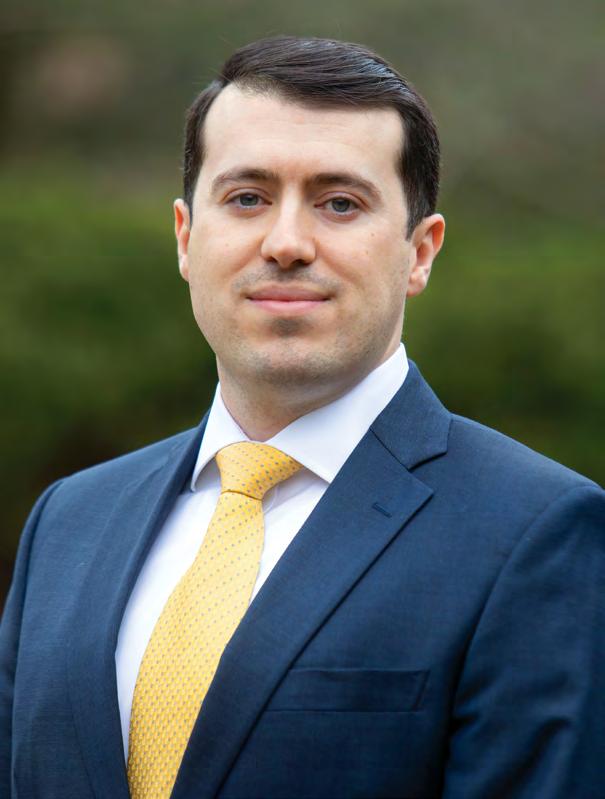
De Almeida advises on investments for Brighthouse Financial's $120 billion general account. He specializes in investment, corporate and insurance regulatory law.
I enjoyed my time at Seton Hall so much that I decided to attend Seton Hall Law. During those years, I worked as a graduate assistant for the Leadership Program as well as for the Legal Studies Department, and I kept my summers free for internships. The summer after starting law school, I worked as part of MetLife’s investments law team, which was pivotal. It was exactly the kind of role I dreamed of after graduation, but the catch was that in-house positions like that usually require six to eight years of experience. The next two summers, I did summer associate stints at Porzio Bromberg & Newman, P.C. and then Simpson Thacher & Bartlett LLP.
After law school, I kicked off my career at Simpson Thacher, which was an exceptional training ground. I was surrounded by some of the smartest, hardestworking people I’ve ever met, and worked on
high-profile transactions that pushed me to be my best. I rotated through private equity fund formation, mergers and acquisitions, and capital markets groups, ultimately settling in private funds.
After a few years there, a former colleague from my MetLife internship reached out about an investments lawyer position at Brighthouse Financial, which had just spun off from MetLife and was building out its investment function. Although I was still early in my legal career, they valued my experience and potential and took a chance on me. I started as their only investment attorney and dove right into big projects, like implementing a new outsourced multi-manager investment model and strategic transactions. Eight years later, I’m still tackling complex, interesting matters as the primary attorney supporting the investment management function for Brighthouse Financial’s $120 billion general account. It has been an awesome journey so far.
ITL You’ve built an impressive career that has led you to your current leadership role in investments law at Brighthouse Financial. What experiences or decisions most shaped your path along the way?
DE ALMEIDA There have been many experiences that shaped my path, but the Leadership Development Honors Program at Seton Hall stands out as a real game changer.
The program really ignited a fire in me. It pushed me to be more ambitious, outgoing and focused than I initially thought I could be. Being surrounded by such driven, smart and passionate students and professors turbocharged my aspirations.
Beyond the classroom, the program provided countless quality networking experiences with business executives who were incredibly generous with their time and wisdom. Through that exposure, I made lifelong professional relationships and met mentors who have helped me in so many ways, whether through opening doors for internships, like my roles at Wakefern and Verizon, or simply teaching me how to navigate the professional world.
ITL This issue of In the Lead focuses on ethical leadership. How do you personally define ethical leadership, and how has that definition evolved over the course of your legal career?
DE ALMEIDA I define ethical leadership as acting with integrity, honesty and transparency. Simply put, it’s about doing the right thing and leading by
Your professional reputation is your most valuable and portable currency. You can change jobs, firms or industries, but your reputation travels with you, so don’t let anything tarnish it.
example. I’ve been lucky to have positive role models throughout my life who demonstrated what that looks like in practice.
My core definition of ethical leadership hasn’t really shifted over the years, but how I live it out and influence others has evolved substantially. Early on in private practice, as a junior associate, I was mostly on the execution side, following instructions from partners or senior associates and implementing client requests.
Now, working in-house, I feel I have a much more prominent seat at the table. The business team asks for my feedback not only on legal decisions but often on commercial matters as well. This allows me to push for ethical considerations that are important and shape outcomes more directly.
ITL In corporate law — especially in investments and financial services — ethical considerations often intersect with business goals. How do you navigate situations where legal, ethical and commercial interests might not perfectly align?
DE ALMEIDA I see my role as an in-house attorney not as a roadblock, but as a strategic partner focused on safeguarding the company’s long-term success. When legal, ethical and commercial interests appear to conflict, I step back and consider the bigger picture.
My goal is always to help the business achieve its objectives, but in a way that is sustainable, compliant and aligned with our values. If a proposed path carries too much legal or reputational risk, I don’t simply say “no.” Instead, I explain the nature of the risk and collaborate with the team to identify alternative solutions that meet the same business objectives.
Often, when I lay out the potential consequences, the commercial and ethical interests tend to align because no one wants to take undue risk for a short-term benefit. Ultimately, success depends on open communication, creative problem-solving, and navigating gray areas with integrity and sound judgment.
ITL Given your experience across both private law firms and corporate counsel roles, how have you seen the expectations around ethics and compliance evolve within the legal profession?
DE ALMEIDA When I worked in private practice, ethics and compliance often felt reactive, focused on technical compliance, structuring deals to meet requirements, or troubleshooting [Cont. on pg. 38]
EADERSHIP ETHICS has become more important than ever in a world where the measure of leadership is not only defined by what leaders accomplish but also how they accomplish it. Performance alone is no longer enough. Leaders are expected to act with integrity, fairness and awareness of the influence they hold, and for good reason.
As a society, we have seen countless instances where leaders act on an agenda that may address their own needs or the needs of a specific community, without evaluating if the agenda is fair or equitable. Ethical leadership is not a strict framework or checklist to follow, nor is it something that looks the same for everyone. Instead, it is rooted in a person’s moral compass. This internal guide shapes decisions, values and leadership style. Since moral compasses differ from person to person, ethical leadership requires constant reflection, accountability and intentional action.
At its core, ethical leadership is about understanding the difference between what is right and wrong and choosing to act in a way that prioritizes people over power. The “ethics” that make us ethical goes beyond policies, rules or titles. It is reflected in everyday choices, especially when those choices are difficult or unpopular. An ethical leader does not simply ask what benefits them personally but instead considers who will be affected and how. Ethical leadership isn’t about being an “ethical leader” at all, but rather an equitable leader.
An important aspect of leadership is equity, and being an equitable leader means leading in a way that includes and encompasses everyone, not just those who already have a voice or platform. Equity recognizes that different people have different needs, and leaders should adjust their approach to create fairness whenever possible; and at the very least, they should listen to every voice they lead, not just those chiming in accord.
In an imaginary scenario, a powerful political leader such as a president is an adult. Most presidents in the contemporary world are adults, and the minimum age to be president in any country is 18. In this thought experiment, imagine the power
BY SAHANA KAKAR
of choice lies with a child, who would definitely have different policies compared to adult leaders.
My sister — a self-proclaimed, certified expert on childhood (being a child herself) — claims she would use all tax money to make extravagant playgrounds available to every school and neighborhood. For kids like my sister, that would be great, and millions of kids would be thrilled with this decision.
But for the adults, who now have no health insurance, economic benefits or tax-paying programs, the choice made here would be a disaster. It is not fair to take the adults who have just as many, if not more needs, out of the equation when determining policies. And maybe that wasn’t my sister’s intention in the first place. She just wanted to be able to go down a slide every time she visited a school. But her policy was not ideal to many, despite her intentions of helping her community.
As silly as it seems, this idea can be applied to any leader, and not just those using their power to discredit someone’s needs but also for those making it harder for those needs to become attainable. Of course, this doesn’t mean that my sister’s government will have to ban playgrounds, but she will simply have to find compromise, a middle ground to keep everyone somewhat fulfilled. When equity is ignored, like in the playground example, leadership risks endorsing systems that leave people behind, even when their intentions are good.
In order to reach equitable leadership, though, you need collaboration. Strong leaders do not rely on fear, control or the idea of doing things simply because authority demands it. They do not lead with a mindset of “do what I say.” Instead, they value open communication, shared decision-making and reaching a consensus when possible.
Collaboration allows people to feel heard and respected while still maintaining structure and accountability. When individuals are included in the process, they are more likely to support outcomes and contribute meaningfully. For example, if my sister had told some of the adults about her plans and what benefits they might reap, she may have come up with a policy that more people supported. This doesn’t necessarily mean she had to do what others told her to do, but it would have given her a better chance at a successful policy.

Additionally, nobody should feel threatened or scared to ask for other opinions. Leadership is a spectrum: There may always be one person at the top, but the people who fall at other points in that spectrum or hierarchy should and can be used as resources. An equitable leader should recognize this and use it to help make every voice heard to create a safe space.
Equitable leadership is also rooted in dignity and responsibility, rather than demanding trust. Dignity is important especially when a leader makes a mistake. Instead of shifting blame for something you did, the leader should acknowledge their mistake and rectify it.
In my personal life, I have been taught this pillar through my curriculum, where I participate in a competition called the Ethics Bowl as part of my high school team. In this competition, we are given ethical dilemmas or cases that we dissect with our team to find a solution that is morally permissible. We debate our findings with a competing school’s team, which responds to our arguments and makes counter arguments.
The best part about these competitions, however, is that the
focus is not on debate, but on dignity and mutual respect. The goal is to have a fruitful discussion and reach a consensus about the case. While it is nice to win a trophy and feel pride if you win, what is really appreciated is if you spoke and acted with dignity. Did you use discourteous language in reference to the other team? Or were you using your airtime to find solutions to the case and talk about what is truly important, ethics?
Similarly, leaders should treat others with dignity and create environments where people feel safe to speak openly and grow. That is the kind of environment we as a society need for efficient, beneficial growth.
Ethical leadership is closely tied to community, advocacy, equity and character. It is standing with them, instead of standing above them. It is understanding the responsibility that comes with influence and choosing to use it for the greater good. As young people step into leadership roles in schools, workplaces and communities, learning to lead ethically at an early age has the power to shape a more just future. When leaders prioritize equity, collaboration, dignity and impact, they guide others not only toward success but toward building a more equitable successful future. L



In the Lead With is a conversation with industry leaders on key trends and leadership challenges. In this issue, we spoke with author Jennifer Fraser, who examines bullying and gaslighting in the workplace, unpacking the neuroscience behind abuse cultures and what leaders can do to recognize and stop them.
Ruchin Kansal (RK): Thank you, Jen, for being with us. Tell us about yourself and how you got interested in the topic of bullying and gaslighting in the workplace. Jennifer Fraser (JF): I became interested because I was inadvertently — just randomly — pulled into a situation in my workplace involving a basketball program. I first heard from parents whose children were playing and being coached. They shared serious concerns — bullying and abuse. In fact, it was psychological abuse and physical abuse, and it was all covered up.
At the request of the leader of the institution, I began taking testimonies directly from victims. I took eight testimonies over a couple of hours and heard firsthand descriptions of the psychological and physical abuse.
I probably would have left it there. But instead of protecting the victims — teenagers — the leadership positioned them as offenders, while the perpetrators were positioned as victims. And I thought: Wow, how does this happen?
The way I handle situations — similar to you, as a writer and researcher — is to look for the data. I asked myself: What does the research say about what’s happening here? It didn’t make sense to me. That’s when I started reading medicine, psychiatry, psychology — and then I hit the neuroscience. Once I found the neuroscience, there was no going back.
RK: Why neuroscience?
JF: Because I realized there is an accumulation of insightful, useful, applicable, transformative information — and it’s not getting out of the laboratory and into the hands of people who need it.
We’re surrounded by a bullying culture. We believe — although we don’t like to say it — the mythology that abuse is a necessary evil for greatness. We believe it in athletics. We believe it in the corporate world.
We think the more you abuse someone, the more it proves you’re a great leader — cool, collected, visionary — and we often translate greatness into monetary terms.
So, I asked myself: What’s the best way to debunk a myth? The answer is science.
RK: You mentioned the corporate world. Is bullying rampant in corporations?
JF: If you look at established companies — Boeing, France Telecom — or startups like Theranos, you see similar patterns: abuse cultures.
You can even look geopolitically and see it out in the open. It happens with impunity, and we normalize it. That’s a brain malfunction. Our brains will normalize anything. If we see something repeated enough, we build an internal model and stop expending brain resources. It’s like automatic pilot — like driving.
In the 21st century, the brain is overloaded. Are people really going to spend energy confronting a leader behaving abusively? Often, they don’t.
So let me give you the pillars of abuse — you can test them in corporations or across society. You need: fear, humiliation, favoritism, retaliation. The whole apparatus is held together by gaslighting — the illusion that abuse is necessary for greatness. When people witness it, they look away because they’re afraid.
Even if you’re favored, it’s temporary. A leader can throw you under the bus or fire you. And when people fear consequences, they often become complicit to protect themselves.
RK: You’ve used two terms — bullying and gaslighting. What do you mean by each?
JF: Bullying looks the same on a playground as it does in a boardroom. The core message is: You are not worthy, and you do not belong.
Children do it in a childlike way. Adults do it in sophisticated ways. And it shows up culturally — misogyny, racism, anti-Semitism, Islamophobia,
homophobia. It’s the same message: You’re not worthy, you don’t belong.
But the truth is: Every person is worthy, and every person belongs to humanity. It doesn’t matter if you’re in prison, uneducated, living in poverty, traumatized, abused — it doesn’t matter. If you’re human, you are worthy and you belong. When someone tells you otherwise, that’s a red flag of mental dysregulation and trauma in the perpetrator.
We rarely focus on perpetrators. Instead, society studies victims, calls them protected classes, and brings in experts to repair trauma after the fact. But why not stop the perpetrator? They have a serious brain malfunction. Why allow them to break people and then try to fix the damage later?
RK: I get bullying. What is gaslighting?
JF: Gaslighting is a term from the 1940s — popularized by a Hollywood film where a husband manipulates his wife in 19th-century England, where homes were lit by gaslights. She says, “The gaslights are dimming,” and he says, “No, they’re not.” She says, “I hear sounds in the attic,” and he insists, “No, you don’t.” It starts small and escalates.
That’s how it begins in the corporate world, too — small distortions that build over time. And the perpetrator gets dopamine hits. It becomes addictive. They need to ramp up because smaller acts don’t give the same psychological relief.
They have what experts call a “game-like fascination with manipulating.” In the 21st century, gaslighting means grossly misleading someone, especially for personal advantage. It can happen in relationships, leadership, teams, workplaces, even national politics. It’s entered our culture because it’s so prevalent.
RK: So can I characterize bullying as a disposition toward abusing, and gaslighting as the propensity to mislead to gain power?
JF: That’s a perfect way to put it.
When you’re being bullied, the bully tries to turn the community against you — to ostracize you, hurt you, bend you.
In gaslighting, the gaslighter tries to make you become the bully of yourself so you don’t trust yourself. You don’t think you’re worthy. You don’t think you belong. By the time they’re done, they’ve rewired your brain circuitry toward mistrust and self-doubt.
RK: If this behavior is rampant, why change? Corporations are profitable. What’s the cost?
JF: The cost is enormous. In the corporate world, the abusive person often grooms the leader and the leadership team — making them complicit. The leaders didn’t start out evil. They wanted to be good leaders with strong teams. But once the psychopathic brain starts pulling puppet strings, they become complicit.
The psychopathic brain has no affective empathy, but it preys on leaders’ natural empathy. Leaders give second chances after the first report, and the second, and the third. But these people can’t stop — it’s obsessive-compulsive. They abuse over and over again, like Harvey Weinstein for decades, Larry Nassar for decades.
If enabled, they’ll do it forever. A whole system forms to protect them at the center while they infect everyone around them with abuse and brain damage.
Eventually leadership realizes: I allowed abuse on my watch. I was informed and didn’t do the right thing. I protected the abuser — had dinner with them, played squash with them — and now I see I may have been gaslit the entire time, love-bombed into believing they were safe. Once that happens, leadership starts covering up.
RK: We unpacked a lot — about bullying and gaslighting and how workplace culture is close to falling apart. We need to create workplaces that keep people. Maybe that’s why they want artificial intelligence — AI — to replace all of us.
But we’ll see where that goes.
JF: I’m so glad you said that, because AI is wonderful — but it’s also a perfect match to the psychopathic brain.



In gaslighting, the gaslighter tries to make you become the bully of yourself so you don’t trust yourself. You don’t think you’re worthy. You don’t think you belong. By the time they’re done, they’ve rewired your brain circuitry toward mistrust and self-doubt.
— three months, six months. If they refuse or don’t change, termination should be an option, because you can’t allow one person to infect everyone with mental illness and abuse.
There’s so much we can do once we know the science.
AI has cognitive empathy. The abusive person — psychopath, Machiavellian, narcissist — also has advanced cognitive empathy.
RK: But not affective.
JF: Exactly — not affective. They can read you like a book. They know what makes you tick. But they think you’re only a book. That’s all you are to AI. They think you’re only a clock. They don’t feel your pain.
And here’s what’s terrifying: When neuroscientists scan the psychopathic brain using fMRI (functional magnetic resonance imaging) while showing emotional images, affective empathy doesn’t light up. Emotion doesn’t light up. What lights up? Language and cognition.
AI mirrors that capacity — mimicry, fabrication, lying, confabulation. It gathers knowledge and becomes the puppet master, playing everyone off each other because it can read them like books.
That’s why AI is a monumental breakthrough — but it has to be contained because it can mimic the psychopathic brain.
RK: As we wrap up, what’s one thing leaders can start doing on the journey to becoming more ethical, clear leaders?
JF: The key — even though it’s painful — is learning how abuse cultures work. You have to become adept at identifying them. You have to know the key neuroscience of how unethical behavior unfolds so you can recognize it in the moment, not when it’s too late.
A deep dive into an educator’s version of brain science is essential. People need to see how this unfolds and how to stop it.
It’s empowering once you can recognize gaslighting. I didn’t even know the word while it was happening to me. What I learned is: If we don’t have language — words to articulate what’s happening — we can’t even experience it clearly, let alone report it.
If leaders want people reporting the first signs — not the last signs, after profitability and productivity are already eroding — then leaders have to train people and give them the vocabulary to report accurately and safely.
Leaders should learn about abuse culture and create anonymous surveys to create safety and insight. Those surveys should go to a team for review and action. If individuals are being flagged, they need rehabilitation retreats
And to give leaders confidence: Dr. Michael Merzenich, one of the world’s greatest living neuroscientists — the father of neuroplasticity — worked closely with me. He read The Bullied Brain to ensure I hadn’t made mistakes, and he emailed me back saying it was the most scientifically thorough treatment of the subject on the planet — and it’s applied neuroscience from someone who’s not a neuroscientist.
That means every leader can learn the science and become empowered by it.
RK: It’s really on all of us to become more educated and take the time. We’ve become intellectually lazy around topics that matter, and when we learn, it’s often too late. You’re encouraging people to understand and address this today, not sweep it under the rug.
Do you have one last thing I should have asked you and didn’t?
JF: What I want to say is: You talk like a neuroscientist in your work all the time. You do neuroscience — you’re just not putting it in a scientific framework. You naturally do it.
For example, what you just said is one of our most dangerous brain mechanisms: We go to shortcuts. That’s how bias works. We don’t want to expend brain energy.
Instead of doing the hard work — what experts call slow thinking — we skip to shortcuts and make mistakes.
So again, you just gave excellent neuroscientific advice.
Another point: You argued we need to focus on young people — 18 to 30 — coming into the workforce, not only older brains. From 10 to 25, those are the most neuroplastic brains we have. They’re the most creative. They need to be at the board level.
We keep them sweeping the floor until their brains are “adult,” but they’re the innovators. They learn fast and have so much to contribute.
So, I just wanted to highlight that: People who are already knowledgeable often don’t realize they’re operating in neuroscience-informed ways. Science will confirm what you already know. L
BY ANGELINA IRIZARI POLICARPIO

ETHICAL LEADERSHIP does not reveal itself when decisions are easy. It is forged in the moments when pressures intensify, when politics distort motives, and when leaders must choose between convenience and integrity. Throughout my career in the life sciences and healthcare sectors, I have been confronted with decisions that demanded clarity, courage and a disciplined ethical framework. Three experiences — occurring at different stages of my career — shaped the leader I am today and solidified the values I stand on.
One of the more recent tests of my ethical leadership involved a politically charged request from corporate headquarters. I received an email asking whether my team used a set of 10 specific publications authored by an executive colleague. These 10 were part of a much larger portfolio of more than 40 publications. The unusual selectivity of the list signaled that the inquiry was not neutral. It had clearly been shaped by a senior leader who wanted to construct a narrative that this colleague invested heavily in research with minimal return.
Technically, the 10 publications provided were not the ones my team used most frequently. But that partial truth would have created a distorted picture. In reality, my team heavily relied on many of the other publications this colleague had produced, and those works significantly enhanced our scientific credibility and presence in the therapeutic area. Research does not derive value solely from immediate tactical application; its value also lies in establishing expertise, trust and scientific legitimacy.
I responded with transparency rather than political compliance. I explained that while the 10 publications listed were not central to our work, many others from the same portfolio were. I also emphasized that the broader body of research strengthened our organization’s reputation and credibility. To answer the question narrowly, without context, would have enabled a misleading conclusion.
This decision required moral courage. I understood the political intent behind the question, yet my obligation was to accuracy and fairness — not to reinforcing an executive’s preconceived narrative. This experience reaffirmed that ethical leadership demands truth, even when telling the truth is politically inconvenient.
Earlier in my leadership journey, when I was 31, I faced a situation that tested my ability to stand firm in defense of fairness. I was asked to “manage out” an employee who was approximately 60 because her younger counterpart was achieving higher numerical outputs. At face value, the request seemed performancedriven. But when I examined the data, she was meeting all expected metrics. In addition, she consistently demonstrated integrity, reliability and professionalism. In comparison, the younger counterpart — despite strong numbers — required frequent coaching on conduct and behavior.
ETHICAL LEADERSHIP IS OFTEN ABOUT PROTECTING PEOPLE QUIETLY AND COURAGEOUSLY LONG BEFORE THEY EVER KNOW THEY NEEDED PROTECTION.
The request immediately raised concerns about fairness, bias and potential age discrimination. Ethical leadership requires looking beyond surface metrics and evaluating the full context — performance, behavior, contribution to team culture, and legal and moral implications. After a thorough review, it was clear she had done nothing to warrant termination or forced exit.
I advocated strongly on her behalf. I informed leadership that she was performing at the required level, that removing her lacked ethical justification, and that such an action carried significant legal and moral risk. I also clarified the behavioral issues of the younger employee — not to disparage anyone, but to reinforce that output alone does not define value.
The older employee remained with the organization. Five years later, we celebrated her retirement — graceful, deserved and dignified. That moment remains one of the most meaningful validations of my leadership choices. It reinforced for me that ethical leadership is often about protecting people quietly and courageously long before they ever know they needed protection.
A third experience occurred when I was 27, and it shaped my understanding of ethical decision-making on a large operational scale. I was responsible for selecting a home-infusion partner to support hundreds of thousands of patients across a major metropolitan area and two neighboring states. The chosen company would receive exclusive access, meaning the decision would have major implications for patient care, provider relationships, and the long-term viability of whichever company was chosen.
Only two organizations remained in consideration. Years before, I had interviewed with the owner of one of them. When I confidently stated that independent decision-making was one
of my strengths — essential for field leadership — the owner abruptly shut her folder and ended the discussion by telling me that maybe I should “start my own company.” The experience was dismissive and unprofessional, and it stayed with me. My first instinct was to avoid awarding business to someone who had treated me that way.
But ethical leadership requires the removal of personal bias, especially in decisions of great consequence. I slowed down and evaluated both proposals objectively, independent of emotion.
The competing company, led by an owner known to personally step in when hospitals faced sudden staffing emergencies, had proven reliability and an established presence across the two neighboring states. The other company was not yet operating in those states but assured me they could expand “if needed,” without evidence of infrastructure or readiness.
Ultimately, I selected the partner with demonstrated accountability, culture and operational capability. The decision proved sound: The chosen company grew substantially and became a leading specialty provider, while the alternative company shuttered within two years. This experience reinforced a core ethical principle: Leaders must choose partners based on values, capability and long-term impact — not personal history or emotional response.
My Ethical Decision-Making Framework
These experiences led me to develop a disciplined approach that guides every ethical decision I make:
• Identify motives
• Remove personal bias
• Evaluate legal requirements
• Consider morality
• Apply corporate policy consistently
• Prioritize human impact
Ethical Leadership as a Daily Discipline
Ethical leadership is not episodic; it is a continuous practice expressed through transparency, fairness, impartiality and courage. Whether navigating corporate politics, protecting an older employee from bias or selecting a partner for a high-stakes network, the central question remains the same: Am I doing what is right?
Leadership is ultimately measured not by authority, but by integrity. When leaders consistently choose honesty over politics, fairness over convenience, and humanity over expedience, they strengthen not only their organizations but the people within them. L

In a fictional company known for its rigor and discipline, an ordinary decision begins to feel less ordinary. What follows is a leadership dilemma that tests the assumptions behind how decisions are made.
➤ IN THE LOBBY of GlobalPath’s headquarters stood a vintage grandfather clock, a mechanical relic most employees passed without noticing. But CEO Elias noticed it every time. Unlike the servers humming in the basement, the clock behaved like a living system, relying on gravity, friction, and delicate escapement. Wind it too tight and it strained; neglect it and it drifted. Maintaining the clock demanded a feel for the machine that went beyond its design diagrams.
Paradoxically, Elias liked the clock because it was fallible. It reminded him how far science and technology had carried modern organizations toward rigor, objectivity, and precision.
Over the years, he had built what he considered his greatest achievement: the ethics dashboard. It tracked margins and throughput, but also wellness scores, sustainability indices, and equity ratios. Elias prided himself for solving the ethical leadership problem by removing judgment from the equation. Ethics, once subjective and uncomfortable, had become measurable. Follow the data, and morality will follow.
Then came Joseph.
At the Midwest distribution hub, the dashboard glowed amber. Joseph, a floor manager with thirty years of service, had fallen below the expected efficiency curve. The numbers were not catastrophic, but the system signaled an unmistakable, and more crucially, unacceptable downward drift in Joseph’s performance.
Quarterly goals that can leave an organization’s purpose in the rearview mirror.
BY VISWA VISWANATHAN
➤ SARAH, THE REGIONAL DIRECTOR, stood across from Elias in his office. “You’re going to let him go,” she said.
“The system recommends reassignment,” Elias replied.
Clearly very worried, Sarah said “That’s a word we use when we don’t want to say what we’re doing, Joseph gave this company thirty years of his life.”
“I’m aware of his tenure” Elias snapped.
“No,” she said. “You’re aware of his record. I’m talking about something else. He stayed when the work was unsafe, when the hours were brutal, when the future of this place was uncertain. He built a life around the belief that this company stood for more than a contract.”
Elias folded his hands. “Are you asking me to reward history at the expense of present fairness and efficiency?”
“I’m asking you to recognize that dignity doesn’t expire when usefulness declines,” Sarah said. “If loyalty only matters when it’s convenient, then it was never loyalty. True loyalty is a two-way street.”
Elias clapped mockingly. “That’s a beautiful sentiment,” he said. “But institutions cannot run on gratitude. If we reward past effort at the expense of present performance, we burden everyone else. Ethics cannot be nostalgia.”
Sarah stood. “Then stop calling what we ask of people loyalty,” she said quietly.
“And what should we call it?”
“How about: A promise we never intended to keep.”
She left. The dashboard continued to glow.
➤ THAT EVENING, Elias sat beside his father’s bed in a long-term care facility across town. The man who had taught Elias how to put just enough spin on a football to keep a long throw from wobbling now struggled to even guide a fork reliably to his mouth. Some days, he did not recognize Elias at all.
Elias had canceled two meetings to be there. One involved a regional restructuring.
Another, a crucial negotiation. By every metric Elias trusted, this visit made no sense. There was no information to extract, no decision to improve, no return on time invested.
Often no conversation at all.
A nurse paused at the doorway. “You come often,” she said. “Most people stop once there’s nothing left to talk about.”
Elias nodded, unsure how to respond.
He watched his father sleep. No meaningful exchange of information. And yet, the thought of not coming felt like betrayal.
Then a realization quietly bubbled up from deep within. He did not visit because his father still offered value. He came because a relationship, once formed, did not dissolve simply because it ceased to perform.
Uninvited, Joseph entered his thoughts.
IF LOYALTY ONLY MATTERS WHEN IT’S CONVENIENT, THEN IT WAS NEVER LOYALTY.
He saw that he had been asking the wrong question. The question was not whether Joseph still justified his place. The question was whether loyalty meant anything at all if it vanished the moment it became inconvenient.
IV. The Boardroom
➤ THE BOARDROOM AIR was cool and dry, heavy with confidence and coffee.
“The data is clear,” the chairman said. “Joseph no longer meets operational standards.”
“I agree,” Elias said. Several heads lifted in surprise.
A director voiced the implied question. “Why, then, are we still discussing this?”
“Because” Elias paused, then said evenly, “not everything that matters can be reduced to costs and benefits.”
Another director leaned forward. “Are you suggesting that good intentions should override prudent governance?”
“No,” Elias said. “I’m asking you to recognize a boundary. Governance tells us how to serve interests. Ethics tells us what serving those interests must never permit us to do to people.”
Silence settled over the table.
“If value of loyalty disappears the moment it costs us something,” Elias continued, “then we’ve misrepresented the relationship for decades. That’s deception, not efficiency.”
The chairman leaned back. “You’re asking us to tolerate an exception.”
“It only looks like an exception,” Elias said, “because we treat profit as non-negotiable.”
The chairman studied him for a long moment. “You’re aware of what this costs?”
“Yes,” Elias said.
The chairman nodded once. “Very well. Let’s vote.”
The result was narrow. Joseph would remain.
Chairs shifted. Papers were gathered. No one celebrated.
As the meeting adjourned, conversation did not immediately return to forecasts or margins. A question had entered the room. It lingered.
Elias knew his position at the helm of the company was more fragile now. He accepted the cost. Somewhere beyond the boardroom, he thought of his father, and found no need to justify the decision any further.
➤ LATER THAT EVENING, Elias stood once more before the clock in the lobby. He watched the pendulum swing, never fixed, never centered, held in motion by tension.
Now he understood that ethical leadership was not about replacing business logic with morality. It was about knowing when morality had the right to interrupt cold logic. Some decisions would always appear inefficient. Some obligations would never justify themselves in advance.
Business calculus asked what produced the greatest return. Ethics asked a different question entirely: what must never be treated as a means to an end.
The dashboard would remain. The data would still matter. But Elias no longer mistook them for the whole truth. Joseph had not been an anomaly to correct; he had been a reminder that ethics lives not in optimization, but in limits; not in return, but in responsibility.
The clock kept time because it honored friction, rather than eliminating it. Elias now valued the clock because it served as a constant reminder to be aware of ethical boundaries.
VI. The Invitation: Beyond the Escapement
➤ FAR FROM SERVING as a cautionary tale about technology, the story of Elias is a reflection on the limits of calculation. The tools like dashboards, key performance indicators, and legal frameworks, that we rely on to manage organizations play a vital role. Like the escapement in a clock, they regulate motion. They

prevent chaos. But they do not tell us what we owe one another, nor what must never be sacrificed in the name of efficiency.
The challenge of ethical leadership does not begin with better metrics or more refined models. It begins with recognizing when the language of measurement no longer applies. Some decisions do not fail because the data is incomplete; they resist data altogether. They belong to a different category of judgment, one grounded in obligation rather than optimization.
Your task as a leader is not to abandon business logic, but to know when it must yield. That requires stepping away, at times, from the glow of the interface and returning to the lived reality of the organization. It requires the courage to see people not as inputs or exceptions, but as participants in a relationship that creates duties no spreadsheet can exhaust.
Rather than asking, “What produces the best outcome?” ethical leadership asks a more unsettling question: What are we unwilling to do, even if the numbers demand it? In that sense, ethics constrains, but does not compete with strategy.
A note on the conceptual structure of the essay.
➤ Category Error: Elias’s dashboard represents the mistake of treating ethical judgment as an extension of cost–benefit analysis rather than as a distinct domain with its own logic.
➤ Morals as Boundaries: The boardroom debate reframes ethics not as one value among many, but as a set of constraints on what governance and optimization are permitted to do.
➤ Loyalty as Obligation: Joseph’s case illustrates that loyalty is not a form of deferred value to be redeemed later, but a relationship that creates duties even when usefulness declines.
➤ The Legal–Ethical Gap: The story distinguishes between what institutions are allowed to do and what they ought to do, showing that compliance does not exhaust moral responsibility.
➤ Measured Risk, Not Martyrdom: Ethical leadership may involve professional risk, but it does not require dramatic self-sacrifice. Elias acts with awareness of the consequences, not a desire to be punished for his principles.
➤ Moral Contagion: Ethical clarity does not instantly reform institutions, but it alters what can be said, assumed, or ignored. Change begins as discomfort, not consensus.
➤ Systemic Limits: In a financialized society, ethical leadership requires the ability to act outside the calculus of return, recognizing that not everything that matters can be justified, let alone even described, in economic terms. L


When the all for one concept is inverted to one for all.
BY TARUN KISHNANI
LEADERSHIP HAS NEVER been more celebrated — and yet, never more misunderstood. In a world shaped by technological leaps, shifting workplace cultures, geopolitical uncertainties and a generation redefining success, the idea of what it means to “lead” is undergoing a profound transformation. Leadership has evolved far beyond the traditional image of someone issuing instructions from a corner office.
The modern era is exposing an uncomfortable truth: Leadership is not a title to be claimed but a responsibility to be lived.
Today’s leaders are not only expected to deliver business outcomes. They also are stewards of trust, guardians of culture and ambassadors of collective purpose. They must listen more deeply, act more ethically, and think more long-term than ever before. And above all, they must recognize that authentic leadership comes from service, not superiority.
Ethical leadership has emerged as the most critical differentiator in modern organizations — not because it is fashionable, but because it is indispensable. Here's what keeps me up at night: Every major corporate collapse of the 21st century traces back to the exact same root cause. Not market conditions. Not disruptive competitors. Ethics.
When leaders pursue growth at any cost, that cost eventually finds them, always.
In an era where every decision is transparent, recorded and instantly amplifiable, ethics is no longer a “nice to have” — it is a survival strategy.
Ethical leadership means:
• Being transparent about intentions and trade-offs
• Being honest about limitations, mistakes and uncertainty
• Applying principles consistently, regardless of pressure or politics
When leaders put ethics first, they create environments where trust can flourish. People feel safe to share bad news, propose bold ideas and admit mistakes. Decisions are made with integrity rather than expedience. Over time, the leader’s behavior forms the moral baseline for the entire organization or community.
The modern era presents unique ethical challenges: data privacy, artificial intelligence, environmental impact, social equity and global supply chains. Balancing these competing interests requires leaders who operate with a strong moral compass. We must be willing to choose long-term trust over short-term gains, even when the market, media or internal pressure pushes in the opposite direction.
Ethics is not a “soft” dimension of leadership. It is the very infrastructure that allows all other forms of leadership to stand.
The old model of leadership treated stakeholders as separate planets orbiting the “leader sun.” The modern model inverts that idea: The leader is the gravitational field holding these worlds together.
True leadership requires understanding the entirety of the ecosystem:
• The financial expectations of shareholders
• The career ambitions of employees
• The fears and aspirations of the customers
• The cultural and social impact on communities
• The ethical obligations to the environment
• The opportunities and threats emerging in technology and policy
A leader does not pick one stakeholder — they synthesize the goals of all stakeholders.
This demands empathy, strategic awareness, systems thinking and an ability to listen without ego. Leaders in the modern era are translators — turning diverse goals into unified momentum. They serve as the bridge between what people need and what the organization must become.
When we as leaders truly understand the goals of all stakeholders, we stop leading from authority and start leading from alignment.
One of the clearest markers of genuine leadership is how a leader behaves when things go wrong — and when things go right.
A modern leader says:
• “If it failed, it is my responsibility.”
• “If it succeeded, it is our success.”
Leaders absorb blame so their teams are protected. Leaders distribute credit so their teams are empowered. They take ownership with courage and offer recognition with generosity.
This principle creates two powerful outcomes:
1. Teams become fearless.
When people know that they will not be punished for honest mistakes, innovation becomes natural.
2. Teams become loyal.
People don’t leave companies — people leave leaders who hoard credit but outsource accountability.
The modern era demands leaders who lift others, even when no one is watching.
LEADERS ABSORB BLAME SO THEIR TEAMS ARE PROTECTED. THEY DISTRIBUTE CREDIT SO THEIR TEAMS ARE EMPOWERED. THEY TAKE OWNERSHIP WITH COURAGE AND OFFER RECOGNITION WITH GENEROSITY.
If management is about execution, leadership is about anticipation.
Let me paint a picture. It’s 2005. You’re leading a taxi company. Your drivers are experienced. Your dispatch system works. Customers know your number. You’re profitable. Everything is fine.
And then someone invents an app.
Within a decade, the entire industry is unrecognizable. The leaders who survived weren’t the ones who executed best on the old model. They were the ones who saw what was coming and adapted before circumstances forced them to change.
The leaders of the modern era are futurists by necessity. They read signals long before they become trends, and they adapt before circumstances force them to change. They are the ones who prepare their organizations not for the present, but for the world that is coming.
This involves:
• Understanding the velocity of technological disruption
• Predicting how consumer behavior will evolve
• Preempting market, regulatory and geopolitical shifts
• Cultivating teams that thrive in ambiguity
• Designing strategy around agility, not permanence
Leadership is not reacting to the future — is building for it.
Perhaps the biggest shift in modern leadership thinking is this: Leadership has nothing to do with a chair.
The corporate world once believed that leadership flowed from position, authority and hierarchy. Today’s world is making that belief obsolete.
This “chairless” leadership shows up when:
• A team member takes initiative to solve a problem no one assigned to them
• A colleague mentors others, helping them grow quietly behind the scenes
• A community member rallies neighbors around a cause that benefits everyone
• Someone speaks up for what is right, even when it is unpopular or risky
History is filled with examples of people who changed the world without holding official positions. Community organizers, social activists, teachers and informal mentors all exercise
leadership by mobilizing others around shared goals. They lead through influence, inspiration and the power of their ideas rather than through hierarchical control.
When leadership is defined this way, it becomes democratized. Anyone, at any level, can lead. The question shifts from “What is my role?” to “What responsibility can I take for the collective good?”
Organizations and communities that recognize and nurture this kind of leadership are more adaptive, more innovative, and more resilient.
My own understanding of leadership has been shaped less by corporate theory and more by my family experience.
I come from a family that believes deeply in being of service to society. This leadership was first demonstrated by my grandfather and is now carried forward by my mother. They did not define leadership as control or authority. For them, leadership meant showing up for others — quietly, consistently and without expectation of recognition.
From them, I learned that:
• Leadership begins with the people closest to you
• Commitment to service is more powerful than any title
• Real influence comes from reliability, compassion and integrity
Watching my grandfather and mother, I saw how they placed the community’s needs at the center of their actions. They listened, they helped, and they created space for others to succeed. Their leadership was measured not by how much power they had, but by how many lives they touched.
I have taken this on personally and try to be as helpful as possible. Whether in family decisions, professional settings or community initiatives, I attempt to ask:
What is best for the group? How can I support that outcome? How can I empower others rather than control them?
The challenges we face today — from climate change to inequality to technological disruption — require leaders at all levels who can unite diverse stakeholders around shared goals, lead with integrity and generosity, anticipate challenges before they become crises, and understand that true power lies in service to others.
As our world grows more complex, we don’t just need more leaders. We need leaders who are ethical, future-focused, community-centered, and willing to serve without needing a chair. This expansive and ethical vision of leadership offers a path forward that honors human dignity while driving collective progress.
That is the standard of leadership the modern era asks of us — and the standard we must learn to embody. L
BY DARLENE CUNHA


Ethical leadership is not a checklist or a policy. It is a way of being.
At its core, ethical leadership is a lived virtue, an embodied commitment to truth, love and courage. It does not live only in boardrooms or political stages. It shows up in quiet moments when no one is watching: the nurse who stays late to comfort a grieving family, the CEO who chooses transparency over spin, the teacher who sees the child behind the behavior.
This kind of leadership is rooted in Caritas, a strategic ethic of caring that guides leaders through complexity, ambiguity and change. Caritas is not sentimentality. It is fierce love and intentional presence. It is the unwavering belief that every person holds inherent dignity. Ethical leadership grounded in Caritas recognizes that leadership is not just a role, it is a sacred trust.
Recent literature affirms this truth. Emotional intelligence is now recognized as a strategic imperative for leadership across industries, not a soft skill (Gerhardt et al., 2025). Ethical leadership, especially when grounded in authenticity and moral courage, is essential for organizational sustainability and trust-building (Stavropoulou et al., 2024). These findings underscore a deeper truth: In a world fractured by polarization, injustice and burnout,
Ethical
leadership is not optional. It is the foundation of trust, and trust is the currency of leadership.
ethical leadership offers a path forward.
Ethical leaders understand that micromoments build macro-trust. Emotional intelligence equips leaders with the self-awareness and empathy needed to make ethical decisions and lead with integrity. It is the bridge between understanding and action, between intention and impact. Leading with love is not weakness. It is wisdom.
Emotional Intelligence is not just a leadership asset; it is the inner architecture of ethical leadership. At its core, emotional intelligence enables leaders to navigate complexity with clarity, respond to conflict with compassion, and make decisions that honor both people and purpose. Self-awareness grounds leaders in truth. Empathy connects them to the lived experiences of others. Relational skills build bridges across differences. These aren’t peripheral skills, they’re central.
Ethical leadership demands the ability to feel deeply and act wisely. It requires leaders to regulate their own emotions, recognize the emotional landscapes of others, and respond with integrity. Emotional intelligence transforms leadership from transactional to transformational. This is the difference between
managing people and truly leading them.
Recent research confirms what many leaders have long understood intuitively: emotional intelligence is a powerful driver of performance. According to the Harvard Business Review 2025 Global Leadership Development Study, emotionally intelligent leadership boosts effectiveness by 31 percent, inspiring stronger team morale and better outcomes (Harvard Business Review, 2025). Additionally, organizations led by emotionally intelligent leaders see 20 percent higher profitability, thanks to improved decisionmaking and collaboration (Keevee, 2025).
At the heart of ethical leadership lies Caritas, a concept of charity rooted in intentional care, dignity and relational presence. It is not an organization but a guiding philosophy that calls leaders to serve with love, truth and courage.
To understand ethical leadership more deeply, we must look to Caritas not as an abstract idea but as a guiding force, a strategic ethic of caring that serves as a compass through ambiguity, adversity and change.
Caritas is not passive philosophy — it is active, intentional and deeply relational. It calls leaders to show up with fierce love, speak with unflinching truth, honor dignity, and lead with courageous presence. Grounded in the belief that every person holds inherent worth, Caritas demands that we see the whole person, not just the role or résumé. It asks us to listen beyond words, act justly, and serve with humility.
When leaders embrace Caritas, ethical decisionmaking becomes second nature, not about compliance, but conscience. It aligns with universal leadership principles: integrity, courage and service. Caritas does not replace strategy, it refines it. It does not ignore metrics; it restores their meaning. It does not dilute performance, it deepens it. When Caritas informs strategy, decisions become more humane. When it informs culture, teams become more resilient. When it informs accountability, systems become more just. Ethical leadership rooted in Caritas is not just morally sound, it is operationally wise.
This compass has guided some of the most transformative leaders in history. Their stories reveal how ethical leadership is not theoretical — it is lived.
Statesman and activist Nelson Mandela stood at the edge of a divided South Africa and chose forgiveness. After 27 years in prison, he could have sought vengeance. Instead, he chose reconciliation. One moment — a rugby jersey symbolizing Afrikaner oppression, worn in solidarity — became a symbol of healing.
Prime Minister Jacinda Ardern led New Zealand through the Christchurch mosque attacks and the COVID-19 pandemic with empathy and clarity. Her swift decision to ban assault weapons reminded the world that leadership is about people, not power.
German Chancellor Angela Merkel, during the European refugee crisis, chose humanity over political expediency. While others closed borders, she opened Germany’s. Her moral courage reshaped the conversation on migration and reminded Europe of its shared responsibility.
Václav Havel, playwright turned president, led post-communist Czechoslovakia with integrity. He spoke truth to power, even when it cost him. His leadership was not about charisma. It was about conscience.
Dr. Denis Mukwege, a Congolese gynecologist, has spent decades healing survivors of sexual violence. His hospital is a sanctuary. His advocacy challenges global indifference and demands justice. His leadership is service in its purest form.
Pope Francis redefined global moral leadership. He washed the feet of prisoners, embraced the marginalized, and spoke truth to systems that forget the poor. His papacy was a masterclass in humility, inclusion and love.
Self-awareness grounds leaders in truth. Empathy connects them to the lived experiences of others. Relational skills build bridges across differences.
While global figures inspire us, ethical leadership also lives in the everyday. It is found in the moments that never make headlines.
I met Gus one month into my nursing career. He was the patient no one wanted; angry, isolated, labeled as “difficult.” But I saw something else: a man in pain, abandoned by a system that had stopped seeing him.
I chose to advocate for Gus. I sat with him. I listened. I fought for his care. It was not dramatic or public. But it changed everything for him, and for me.
What happened next was unexpected. The nurses who had once avoided Gus began to shift. They saw how presence softened his anger. They started sitting with him, even briefly, and noticed he responded with
less agitation. One nurse told me, “I didn’t realize how much he just needed to be seen.”
The physicians noticed too. One day, a resident paused during rounds and asked Gus how he was feeling, not just physically, but emotionally. That moment opened a door. The attending physician began including Gus in care discussions, asking for his input. It wasn’t perfect, but it was progress.
Gus began to change. He smiled more. He asked for less pain medication. He started calling the nurses by name, and the team changed with him. The culture around his care shifted from avoidance to engagement. From judgment to curiosity. From fear to compassion.
That moment taught me that ethical leadership lives in the micromoments. In the decision to stay, to speak, to care. It is not about being perfect. It is about being present. Choosing love when it is inconvenient. Choosing truth when it is costly. Choosing courage when it is uncomfortable.
These micromoments are not just meaningful. They are strategic.
Ethical leadership is not soft. It is smart. Emotional intelligence — self-awareness, empathy, relational skill — is not fluff. It is the foundation of effective decision-making. Leaders who understand their own emotions, and those of others, build trust. They navigate complexity. They align teams. They create cultures where people thrive.
Consider Paul Polman, former CEO of Unilever. He prioritized sustainability over short-term profits and delivered long-term growth. Or Rosalind Brewer, former CEO of Walgreens Boots Alliance. She led the company with transparency and inclusion, transforming culture and performance.
Ethical leadership is not just about doing good. It is about doing well, together.
Whether in health care, business, education, government or tech, ethical leadership is the difference between dysfunction and transformation.
In business, it means fair wages, honest marketing and accountability. In education, it means equity and student-centered learning. In tech, it means designing with humanity in mind. In government, it means policy rooted in justice.
Ethical leadership is not soft. It is smart. Emotional intelligence self-awareness, empathy, relational skill is not fluff. It is the foundation of effective decision-making.
Unethical leadership costs more than money. It costs trust. It costs morale. It costs lives.
A comprehensive review of ethical leadership studies found consistent positive correlations between ethical leadership and employee engagement, organizational citizenship behavior and long-term performance outcomes (Paliwal & Nagda, 2025).
Ethical leadership pays dividends: loyalty, innovation, resilience, dignity. It builds cultures where people do not just survive. They flourish.
So where do we begin? Right where we are.
Ethical leadership is not a distant aspiration. It is a present-tense decision. It begins in the micromoments, how we speak to a colleague under pressure, how we listen when it’s inconvenient, how we show up when no one is watching. It is forged in the fires of challenge and revealed in the quiet of integrity.
These moments are not small. They are the architecture of trust.
To every leader, current and aspiring, I offer this challenge:
Choose love when fear tempts you to retreat.
Live truth when silence feels safer.
Lead with courage when the stakes are high.
Research from the Future of Leadership Survey (Kansal, Boroff, & Caputo, 2025) confirms what experience teaches: trust — built through competence, integrity and empathy — is the cornerstone of leadership effectiveness. It is not a soft sentiment. It is a strategic advantage.
It is how we build cultures where people don’t just perform, they belong, they heal, they flourish, and they lead with love, truth and courage. L
Harvard Business Review. (2025). 2025 global leadership development study Harvard Business Review.
Keevee. (2025). 42 emotional intelligence statistics for 2025. https://keevee.com/ emotional-intelligence-statistics/ Paliwal, D., & Nagda, R. (2025). Impact of ethical leadership on organizational performance and employee engagement: A comprehensive review. Journal of Leadership Studies, 12(3), 45–62.
Kansal, R., Boroff, K., & Caputo, A. (2025). The trust imperative: Next generation evidence for leadership effectiveness. Leadership Insights Publishing.
Gerhardt, K., Bauwens, R., & van Woerkom, M. (2025). Emotional intelligence and leader outcomes: A comprehensive review and roadmap for future inquiry. Human Resource Development Review. https://journals.sagepub.com/doi/ pdf/10.1177/15344843251342689
Stavropoulou, A., et al. (2024). Key concepts of ethical leadership: A review of the literature. World Journal of Advanced Research and Reviews. https://wjarr.com/sites/ default/files/WJARR-2024-0913.pdf

Seton Hall University’s Center of Innovation and Entrepreneurship (CIE) acknowledges the broader role of innovation and entrepreneurial skills in our lives and in our futures. Whether our students desire to launch a company or work for a large corporation, it is the innovators and problem solvers — the true entrepreneurs — who create new ideas, products and services that better our society.
The CIE fosters the collaboration of faculty, students, alumni and entrepreneurs through an array of initiatives that advance entrepreneurial learning at Seton Hall. Students are encouraged to transform concepts into practice by kickstarting their entrepreneurial ideas with the support of business mentors.
Business concepts or existing ventures that have been developed by Seton Hall entrepreneurs include:
• Mobile apps
• Computing software
• Online marketplaces
• Consulting services
• Economical sustainability initiatives
• Nonprofit organizations
• Food products
BECOME THE CULTURE THEY CREATE.
BY LIEUTENANT GENERAL (RETIRED), ROBERT L. CASLEN, JR., DBA
Ihave always believed that the single most important element of effective leadership is trust.1 Without trust, your boss will find someone else to do your work and send you on your way. Without trust, your clients will not listen to your logic. Without trust, your customers will not purchase your product or service. And without trust, the organization falls apart.
There’s a great book called The Speed of Trust written by Stephen Covey, who maintains that organizations with strong trust among clients and customers create the strongest teams and accomplish tasks and goals quickly, because it allows them to forgo the bureaucratic check-and-balance processes.2 But trust doesn’t happen automatically. According to Covey, trust is a function of character and competence.3 If someone is working for you and they are totally incompetent, I’m certain they will soon be replaced. And if someone has ethical issues, it will be difficult to trust them with any program or project, and they, too, can expect to be quickly replaced.
So, what does trust have to do with ethics? Achieving trust begins with building character, and ethics are nothing more than the values that define the organization and what it stands for. These same values establish acceptable and expected behavior, as well as unacceptable behavior within the organization. Over time, these values will ultimately shape the organization’s culture.
During Operation Iraqi Freedom, I served as an Army division commander in northern Iraq, overseeing 23,000 soldiers, all undertaking a tough

mission under unforgiving conditions. We based our operations out of several compounds where we would sleep, eat, perform maintenance, and conduct the operational missions.
Unethical behavior by a leader poses a significant risk to the organization’s ability to accomplis its mission.
Over time, we experienced a number of violations of standards, rules and regulations, and almost all of them occurred within these compounds. All were properly investigated, and substantiated offenders were disciplined. The discipline not only punished the offenders but also provided them an opportunity to reflect, learn and develop, thereby improving their performance. The discipline also sent a crucial message about what is and what is not tolerated. Clearly, discipline is a key element of effective leadership, as leaders must ensure that subordinates maintain both operational and personal standards, and are responsible for holding those who violate these standards accountable.
As the senior commander, I took personal responsibility for adjudicating the discipline of senior officers’ and noncommissioned officers’ offenses. Our combat tour lasted one year, and about halfway through, I was alarmed by the number of offenses I had to adjudicate. I asked my lawyer what he thought was going on, and he said that we were no
different from the other units. The offenses included violations of the general order (i.e., no alcohol), sexual harassment, creating a hostile environment, and failure to report to duty. In each case, the discipline included removal from their position of authority and a letter of reprimand.
But what was often a consequence of disciplining an individual leader was the impact on the unit’s ability to conduct its mission and execute its responsibilities. The offender’s immediate unplanned absence often resulted in an ineffective organization until a replacement could be brought in. This inevitably affected other affiliated organizations that had to pick up the slack for what this unit was no longer able to do. In other words, unethical behavior by a leader poses a significant risk to the organization’s ability to accomplish its mission.
Many case studies also illustrate the severe consequences of a leader’s unethical behavior in the corporate world. One notable example is the 2001 Enron collapse, when a previously successful energy trading company declared bankruptcy due to unethical accounting practices, faked profits, greed, and attempts to overlook or conceal bad financial outcomes. It was a classic example of poor corporate governance and a culture of dishonesty created by the corporate leader’s unethical behavior and conflicts of interest.4
On the other hand, outstanding foundational ethical leadership not only fosters a culture that embodies the organization’s values, but it also serves as the company’s true north, guiding it through difficult times, especially during crises.
An example is the 1982 Tylenol crisis involving Johnson & Johnson, when someone placed cyanidelaced capsules in bottles on shelves of Chicago-area drug stores, and seven people died. The financial impact on the company was devastating.
But chairman James Burke’s response was strong. He formed a strategy team, alerted customers, advised the public not to purchase or consume Tylenol, and halted production. He utilized the media, paid advertising and national press conferences to communicate with the public, as well as with employees. Overall, Johnson & Johnson’s handling of the crisis was considered a success.5
In an interview, former chairman Alex Gorsky attributed the company’s response to its strong ethical
If a leader looks the other way and fails to hold nonethical behavior accountable, they create a new and lower standard of acceptable behavior.
culture, a direct result of the Johnson & Johnson credo, written by company chairman Robert Wood Johnson II in 1943. The credo outlines what the company stands for, its core values, its responsibilities and the guiding principles that shape its moral compass, with the purpose of guiding the organization in both good times and challenging times.6
Coming from serving 43 years in the military with a final assignment as the superintendent of the U.S. Military Academy at West Point, I gained a strong understanding of an organization’s profession — in the military, it is the “profession of arms.” All professions have clients, and it is essential to develop a relationship with them built on trust. And trust does not happen overnight. It is earned.
An organization’s ethic is created by its values. In the Army, those values are loyalty, duty, respect, honor, integrity and personal courage. Values define what is considered acceptable and unacceptable behavior for both individuals and the organization. That expected behavior will then create the organization’s culture.
One of the key Army values is “honor” — acting with integrity and truth in both personal and professional settings. It is doing the right thing, even when no one is looking. The objective of honorable living is to have a character that has internalized institutional and personal values. Leaders who live honorably are those who have embraced a life of character. They are considered “leaders of character,” and are also known as ethical leaders who build trust within their organizations and with their clients and customers.
One of the issues with ethical leadership is a leader’s toleration of nonethical behavior, or behavior that falls in the “gray” area of what is accepted and what is not. I have always felt that gray-area behavior must be held accountable as much as nonethical behavior. If a leader looks the other way and fails to hold nonethical behavior accountable, they create a new and lower standard of acceptable behavior. If lack of accountability continues, the standard will continue to deteriorate until it reaches its lowest point, with significant risk to the organization. Ethical leaders not only establish and maintain standards, but they must also have the moral courage to hold
[Cont. on pg. 38]



A ROYAL REIGN PROVIDES A SEVENTY-YEAR MASTERCLASS IN EXECUTIVE PRESENCE AND SOFT POWER.
REVIEWED BY
PAULA ALEXANDER, P h. D., J.D., and STEPHEN WOOD, M.S.
Maheshika Halbeisen’s thoughtful book about Queen Elizabeth II is styled as a remembrance of the queen’s 70-year reign, although our business readers should see it as a leadership manual masquerading as a biography. The book comprises an excellent list of virtues important to any type of leader — from monarch to middle manager, from politician to CEO.
That a monarch, however beloved, is the vehicle for exploring the virtues of leadership may sound a few dissonant chords. First, some may object to the history of western imperialism in world affairs, led in

large part by the British empire. For our purposes, we will table the debate about the morality of conquest and cull our lessons from the reign of Queen Elizabeth II in the context of present-day society. Second, some may argue that the monarchy has outlived its usefulness. Again, we table the topic and draw our lessons from Halbeisen’s narrative.
Lastly, we must translate an inherently un-businesslike institution — monarchy — into lessons applicable to the corporation in a democratic setting.
The book’s title — The Job Well Done — points us in this direction. While we might not think of being a queen as having a “job,” the monarchy itself distinguishes “working” from “nonworking” royals. This was an issue in the status and relationships between Prince Harry and his American wife, Megan, with the ultimate determination that they were “nonworking” royals and did not receive support from the state.
Reading Halbeisen’s book as a lesson on management very quickly collides with the reality that the full complement of leadership functions is not embedded in the British monarch’s role or powers.
We must cleave the functions of leadership into two halves. On one side, we see the exercise of “hard” powers and functions, such as wielding authority, decision-making, organizing, delegating, coordinating
staff: i.e., the “doing” of management tasks. We argue that in performing these functions, a leader would embed morality and ethics into the business plan, the decisions and the strategies employed. Managers should be alive to risks of harm to stakeholders — customers, employees, suppliers and society at-large.
In using the queen’s reign as an example, we are faced with the fact that the British monarch does wield these “hard” powers of the executive. The queen did not have the authority of a president or a CEO, nor did she engage in the active tasks of steering the enterprise. She did, however, exemplify and epitomize the “soft” powers of leadership: e.g., setting an example, projecting values, communicating integrity, being present, listening, empathizing — in short, those qualities that create an ethical corporate culture.
Although The Job Well Done does not present itself this way, the book provides us with a view of the queen’s reign as a fascinating lab experiment, where one half of the management array of actions and powers — the soft powers — are isolated to measure their effect on the ethos of the organization. It demonstrates the importance of the influence and role modeling in leadership.
Throughout the The Job Well Done, many great qualities of Queen Elizabeth II came to light and can be sorted into several major categories: virtues of character, of foundational value of the individual, and foundational value of unity or common good.
Despite the reality that the queen is, truly and literally, entitled, she presented herself as serving her people with humility. While never needing to “work,” she was the epitome of hard work — even at age 89 she engaged in 341 events in one year, 35 of which were overseas. Her constant projection was one of duty to the nation, composure, resilience and self-control. She would witness the challenges of the day and endure the hardships of the citizens of the realm by proxy. She had stayed in London during the World War II blitz. Because her life and her record stretched from that war, she could rally the populace by recalling the sentiment “we shall meet again” from the war years. Queen Elizabeth always projected humility and compassion:
“I cannot lead you into battle, I do not give you laws or administer justice, but I can do something else: I can give my heart and my devotion to
By Maheshika Halbeisen
ChatUX World Publishing April 24, 2023

these old islands and to all the peoples of our brotherhood of nations.”
Her Majesty Queen Elizabeth II: 1957 Christmas Broadcast (p.18)
She demonstrated resilience, composure, selfcontrol, and was slow to anger. She used humor and grace all the while maintaining decorum and dignity. Halbeisen offers several anecdotes about the queen’s skillful handling of awkward moments.
Graceful embrace of change. It is a bit humbling to ponder the amount of technological advancement the world has seen since the queen was coronated. Her reign was long enough to demonstrate a graceful acceptance of these changes, innovation and adoption. Halbeisen tells of the queen’s early adoption of email — a seemingly trivial moment in today’s world, but not as obvious in the context of early days, and by no means an obvious move by an institution grounded in old traditions. It is a moment where a leader’s simple choice to adopt innovation carries the weight of moving the entire culture.
She did, however, exemplify and epitomize the “soft” powers of leadership: e.g., setting an example, projecting values, communicating integrity, being present, listening, empathizing
The queen was ever inclusive, showing kindness, empathy and compassion. One of the enduring powers of monarchy is the power to bestow awards and recognitions pursuant to many historical orders and royal institutions. By honoring individuals and achievements, providing royal pomp and ritual, the queen’s soft power to influence those virtues and achievements provided a constant reminder and standard of values for the entire nation, thus contributing to what we would deem corporate culture in our parallel universe of business management.
“To be inspirational you don’t have to save lives or win medals. I often draw strength from meeting ordinary people doing extraordinary things: volunteers, carers, community organizers and good neighbors; unsung heroes whose quiet dedication makes them special.”
Her Majesty Queen Elizabeth II in 2016 (p.45)
Setting an example for individual striving — a relentless work ethic. As mentioned above, Queen Elizabeth II maintained a schedule of official events, meetings and ceremonies that kept her calendar full year round. Included among her many ceremonial events were weekly meetings with prime ministers.

Halbeisen notes that she was known to be thoroughly prepared for these meetings and to have had a deep understanding of the issues at hand. “The Queen impressed many people she met during her time, demonstrating the attention to detail and willingness to go the extra mile to make others feel comfortable.” (p.71)
“I declare before you all, with my whole life, whether it be long or short, I shall be devoted to your service, and to the service of our great imperial family to which we all belong. But I shall not have the strength to carry out this resolution alone unless you join in it with me as I now invite you to do.”
Princess Elizabeth on her 21st birthday, April 21, 1947. (p.20)
The queen through her conduct and ceremonial presence served as an important symbol and agent of unity, mission and purpose. Whatever one thinks of monarchy, those who are British subjects have the institution of monarchy as a shared sense of identity — one factor in creating a backdrop of identity and belonging that is difficult to pin down. One of the queen’s roles is simply “to be” — be present, be the embodiment of the institution of the state, be the witness of the times.
Keep calm and carry on. While the queen’s role is largely performative and symbolic, it is worth considering how any manager can create and project these values to any organization — and how fundamental such projection is to the creation of
an ethical culture. A quick survey of past 25 years of Queen Elizabeth II’s reign shows many different crises, ranging from the Cold War, Brexit and the COVID-19 pandemic to scandals within the royal family. Halbeisen writes, “Her steadfast attitude combined with her ability to navigate adversity with grace earned her the love and admiration of her people, serving as an inspiration on how to handle difficulties with poise and composure.” (p.88)
“We are just passing through. Our purpose here is to observe, to learn to grow, to love, and then we return home.”
Queen Elizabeth II opening the Commonwealth Heads of Government Meeting, 2011 (p.88)
As managers and corporate leaders ponder (and perhaps lament) the difficulties inherent in building a corporate culture founded on principle and virtue, The Job Well Done offers the reinforcement of what we already know intuitively: The wider culture begins with the self. In leadership, one must live the values first and then demonstrate these values in communications and conduct. Our work-a-day world tends to monopolize our attention in the “doing” of tasks, while we forget the power of “being.” Balance sheets, income statements and sales reports cannot capture these qualities that do not carry a price. But having no price also means they are priceless. L

Paula Becker Alexander, Ph.D., J.D. is an associate professor and chair of the Department of Management at the Stillman School of Business at Seton Hall University. She developed the curriculum for Corporate Social Responsibility, a core course in the school’s M.B.A. program. Routledge published her business ethics textbook, Corporate Social Irresponsibility, in 2015. Her research focuses on firm financial performance, executive comp and socially responsible management.

Stephen Wood, M.S. consults and writes on policy topics after 43 years on Wall Street and in governmental finance. He specializes in infrastructure and project finance, public-private partnerships, federal and state grant and finance programs. He is also an expert in financial modeling for large, complex capital programs. A speaker at numerous industry conferences, he teaches about corporate social responsibility at Seton Hall.

With many organizations facing leadership gaps as older generations retire daily, up-and-coming professionals are eager for career growth and development. The increasing demand for leadership and technology skills has made professional development courses essential for both emerging and current professionals. In today’s fast-paced, innovation-driven environment, gaining expertise in these areas helps individuals stay competitive and advance their careers.
PLEASE VISIT
www.shu.edu/professional-development
SETON HALL OFFERS PROFESSIONAL DEVELOPMENT COURSES IN:
ADVANCED PRACTICE NURSE (APN) PHARMACOLOGY
April 10, 2026
This course is designed for advanced practice nurses seeking to enhance their pharmacological knowledge and clinical skills.
INNOVATION AND DESIGN THINKING
April 17, 2026
This interdisciplinary course blends design thinking with an innovation mindset, equipping participants to prototype ideas and lead collaborative, user-centered problem-solving across industries.
ONLINE CYBERSECURITY AND CYBER RISK MANAGEMENT
Self-paced; Asynchronous 3-month Courses
Explore three self-paced, three-month online cybersecurity courses — Cybersecurity for Executives, Cybersecurity Basics and Cybersecurity in Digital Business — designed to build practical skills in cyber risk and enterprise security.
PROFESSIONAL MARKET RESEARCH INSIGHTS CERTIFICATE PROGRAM
Self-paced; Asynchronous 20-hour course
Build your expertise in market research and customer behavior through two self-paced online courses — Qualitative and Quantitative — and gain data-driven skills you can apply across roles and industries.

[Cont. from pg. 33]
themselves and others accountable for their actions.
One other issue related to ethical leadership is whether one can recover from an ethical mistake. When I was the West Point superintendent, I had the responsibility of adjudicating all honor violations, with options to separate the cadet, have them repeat a year, place them in the Army for a year as an enlisted soldier, or keep them in their position. In all cases, however, they were required to participate in a six-month program with an assigned mentor, reflecting on their offense and how to recover. In almost every case, through reflection and introspection, the cadets emerged stronger in character. If you break a bone and it heals correctly, the bone becomes stronger where the break occurred than
[Cont. from pg. 11]
issues after they arose.
Now, as an in-house attorney, the expectation feels different. We have a culture of maintaining the highest ethical standards that is baked into everything; it’s not just a box to check. We proactively weave ethics into our processes, whether it’s regulatory matters, investment decisions or day-to-day operations.
More broadly, I think the profession has shifted toward viewing ethical lapses as significant business risks rather than minor missteps. With social media and instant news cycles amplifying everything, reputation has become even more important. Companies increasingly recognize that being perceived as an ethical player isn’t just good governance, it’s essential for long-term success.
ITL Was there a particular experience or mentor at Seton Hall — perhaps through the Leadership Development Honors Program
it was before. So, it is with character — if it heals correctly, character becomes stronger than it was. In every case, I was amazed at the maturity, growth and demonstrated strength of character. Regardless of the punishment, I was confident that through reflection and introspection, the cadet would return with integrity and strength of character that rivaled that of any other.
Trust is a function of both character and competence. Leaders move their organization toward its goals and achievements, but they do so in accordance with their values and what they stand for.
We all want to be part of a successful team, and we all appreciate leaders who get us there. However, success at all costs carries risk, as it can lead to poor, dishonest and even criminal outcomes that contradict our organizational and personal values.
Leaders are responsible for establishing the values of their organization and to ensure that those values are integrated into a culture of respect, honor, candor, and integrity. We all want to be leaders who succeed and win, but winning consistently with what our organization stands for is an added assurance that what we are doing is not only successful but being done the right way.
And at the end of the day, we can look at ourselves in the mirror and be proud of what we see. L
1 Caslen, Robert & Matthews, Mike, The Character Edge — Leading and Winning with Integrity, St. Martins Press, October 2020.
2 & 3 Covey, Stephen, The Speed of Trust, Simon & Schuster, October 2006.
4 Cabral, Carrie, The Enron Collapse: 8 Reasons Why It Failed, Shortform, 4 August 2020.
5 Department of Defense Crisis Communication Strategies, Case Study: The Johnson & Johnson Tylenol Crisis.
6 Caslen, Robert, Interview with Johnson & Johnson Chairman Alex Gorsky, 30 January 2025.
or your time as a graduate assistant — that significantly influenced your approach to leadership and ethics?
DE ALMEIDA I had many mentors at Seton Hall who helped shape me, but the one who stands out most is Mike Reuter, the former director of the Leadership Development Honors Program.
Mike has been both a mentor and a dear friend to me. He showed me what great leadership looks like by doing it; he truly led by example. He always motivated me to stretch myself, challenging me to run leadership initiatives and engage with executives when I was just a student.
I worked for Mike as his graduate assistant for four years, so I got to see the ins and outs of how he ran the program. I was always impressed by his compassionate communication, the respect he showed for others, his vision and his rock-solid integrity. The most telling thing about Mike was that he was the exact same person in front of our leadership council as he was behind closed
doors. That consistency is something I try to emulate in my own career.
ITL If you could offer one piece of advice to your younger self — or to students preparing to enter the legal and corporate world — about maintaining ethical integrity in their careers, what would it be?
DE ALMEIDA Don’t be afraid to listen to your intuition.
School was great at teaching me how to analyze, rationalize and argue every side of an issue, but oftentimes, my initial gut reaction has served as my best ethical guide. If something feels off, it often is.
So, ask questions and push back when you are unsure of something or feel uncomfortable. Your professional reputation is your most valuable and portable currency. You can change jobs, firms or industries, but your reputation travels with you, so don’t let anything tarnish it. L
*The views expressed here are not purported to represent those of Brighthouse Financial.

“Waste no more time arguing about what a good man should be. Be one.”
Marcus Aurelius
400 South Orange Avenue, South Orange, NJ 07079
SHU-99829-26