KEYNOTE INSIGHTS
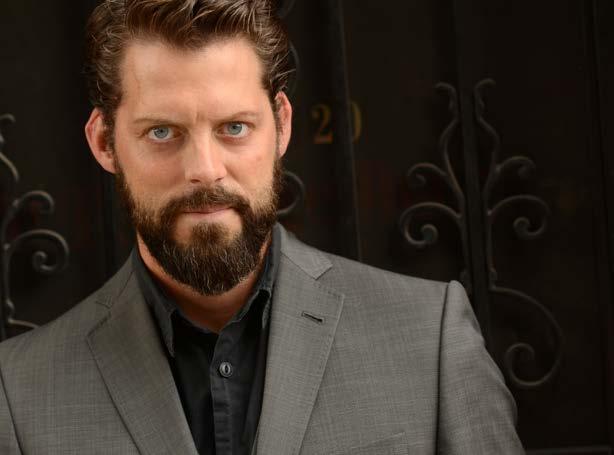
Actors Beth Leavel and David Furr
Playwright Leslie Kimbell
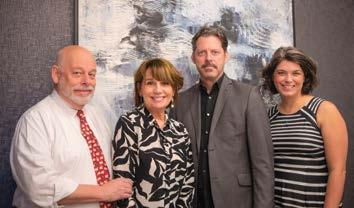
Designers Jeffrey D. Kmiec, Raquel Adorno, Pablo Santiago & Cricket S. Myers PLAYWRIGHT

Actors Beth Leavel and David Furr
Playwright Leslie Kimbell
Designers Jeffrey D. Kmiec, Raquel Adorno, Pablo Santiago & Cricket S. Myers PLAYWRIGHT
Distinguished Career Award recipient Beth Leavel offers lessons on lifelong learning, bravery, and the power of theatre to change lives by Iris
Goode-Middleton, Ph.D.
How David Furr turned a quarter-century of Broadway, Shakespeare, and television into the most useful curriculum a theatre student could hope for by Kenzi James
Theater, inclusion, and the fight for belonging — an interview with playwright Leslie Kimbell by Thomas Rodman
Seamus M. Bourne The Outside the Box: Design & Tech Solutions column will return in the Fall/Winter edition.
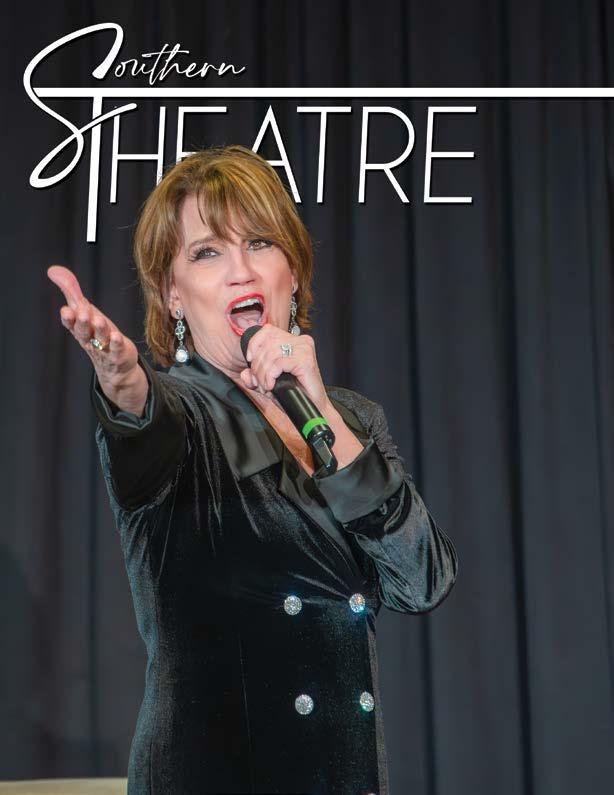
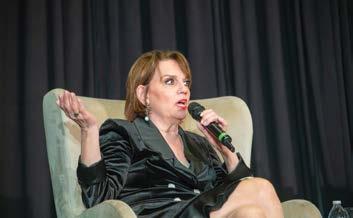
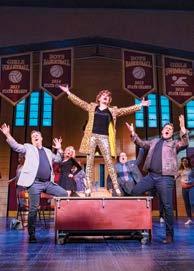
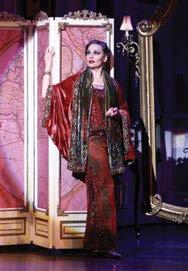
Tony Award-winning actor Beth Leavel brought the house down at the SETC Convention 2026, with a keynote address that included musical numbers, witty banter, loads of theatre knowledge, and even a costume change. The SETC Distinguished Career Award recipient reminded the audience that a career in theatre thrives on curiosity, mentorship, and the courage to bring a truthful voice to every scene. Photo by Marlyss Stovall.
Jane Davis
Interviews with Getchell Award-winning playwrights Douglas Chang and Alex Dremann, with excerpts of their plays

At the 77th Annual SETC Convention, an unmistakable energy filled the air; one defined by creativity, collaboration, and a shared love of theatre. Thousands of artists, educators, and students gathered to celebrate the craft in all its forms, transforming Chattanooga, TN into a vibrant hub of performance and possibility.
During the Convention, attendees experienced an inspiring array of productions, workshops, and conversations. High school and university participants engaged alongside seasoned professors, actors, and playwrights, creating a dynamic exchange of ideas across generations. The Convention’s keynote series brought exceptional insight from leading scenic, lighting, costume, and sound designers, alongside a powerful Distinguished Career conversation that honored a lifetime of artistic contribution.
In these pages, you’ll find highlights from several Convention events and a rich collection of photographs capturing the spirit of the special moments. This Spring issue invites you to relive the joy, artistry, and inspiration that made SETC’s 2026 gathering unforgettable. Onwards,

EDITOR-IN-CHIEF
Sharrell D. Luckett, PhD
SETC PRESIDENT
Jeremy Kisling
SETC EXECUTIVE DIRECTOR
Joanna Sheehan Bell
ADVERTISING
Thomas Pinckney, thomas@setc.org
BUSINESS & ADVERTISING OFFICE
Southern Theatre Conference
717 Green Valley Road, Ste. 200 Greensboro, NC 27408
info@setc.org
PUBLICATIONS COMMITTEE
Becky Becker, Clemson University (SC)
Ricky Ramón, Howard University (DC)
EDITORIAL BOARD
Maisha Akbar, Fort Valley State University (GA)
Tom Alsip, University of New Hampshire
Carlton V. Bell II, SETC VP of Finance
Keith Arthur Bolden, Spelman College (GA)
Amy Cuomo, University of West Georgia
Caroline Jane Davis, Furman University (SC)
David Glenn, Sanford University (AL)
Iris Goode-Middleton, PhD, Hampton University (VA)
Kenzi James, NYC Secondary Educator & Artist-Scholar
Kylta Kazuschyk, Louisiana State University
Sarah McCarroll, Georgia Southern University
Tiffany Dupont Novak, Actors Theatre of Louisville (KY)
Thomas Rodman, Alabama State University
Jonathon Taylor, East Tennessee State University
Chalethia Williams, Miles College (AL)
OUTSIDE THE BOX EDITOR to be announced
THEATRE ON THE PAGE EDITOR
Sarah McCarroll, Georgia Southern University (GA)
COLUMNISTS
Jonathan M. Lassiter, PhD, Lassiter Health Initiatives
Frederick Marte, B.A.M. Studio Ambassador
LAYOUT EDITOR
Scott Snyder, Muhlenberg College (PA)
ASSISTANT TO THE EDITOR-IN-CHIEF
Nikki Baldwin
NOTE ON SUBMISSIONS
Southern Theatre welcomes submissions of articles pertaining to all aspects of theatre. Preference will be given to subject matter linked to theatre activity in the Southeastern United States. Articles are evaluated by the editor and members of the Editorial Board. Criteria for evaluation include: suitability, clarity, significance, depth of treatment and accuracy. Please query the editor via email before sending articles. Stories should not exceed 3,000 words. Color photos (300 dpi in .jpeg or .tiff format) and a brief identification of the author should accompany all articles. Send queries and stories to nikki@setc.org
Southern Theatre (ISSNL: 0584-4738) is published two times a year by the Southeastern Theatre Conference, Inc., a nonprofit organization, for its membership and others interested in theatre. Copyright © 2026 by Southeastern Theatre Conference, Inc., 717 Green Valley Road, Ste. 200, Greensboro, NC, 27408.All rights reserved. Reproductions in whole or part without permission is prohibited.
Subscription: Included in

When I think about what makes SETC special, I keep coming back to the importance of gathering. As theatre artists, we spend so much of our lives thinking about how to gather audiences. We think about invitation, access, and what it means to bring people together for something live and shared. But gathering artists matters too. We gather to learn, audition, teach, hire, collaborate, and imagine what comes next. In a field that can often feel scattered by geography, resources, and career stage, places of meaningful gathering matter even more.
At our convention in Chattanooga this March, we were reminded that when theatre people gather, opportunity follows. Students arrived looking for a first opening. Educators and mentors came to guide the next generation. Professionals came to recruit, teach, and reconnect. Institutions came because SETC remains one of the few places where so many parts of the theatre ecosystem still meet in one place.
What I value most about SETC is that it is practical in the best sense of the word. It helps people build skills, find work, and form the relationships that shape careers. It helps sustain theatre by connecting people to opportunity.
If you care about the future of live theatre, there is a place for you here. I hope you will make a plan to gather with us in the coming year, whether that means auditioning, proposing a workshop, stepping into leadership, or being in the room with us in Lexington.

SETC is so much more than our annual convention, but the convention is the culmination of our work as an organization. This year’s convention had me thinking about our industry’s growth potential in new ways. I was astonished and entertained by festival performances, and excited to share space with so many creative theatrical artists. I was inspired by the words of David Furr and Leslie Kimbell, and I was blown away by the critical mass of entertainment that is contained in Beth Leavel.
Last year at this time, we were excited about appointing a new Executive Director and refining our governance structure. I am pleased and proud to report that we have accomplished both goals. If you have not already met our new Executive Director, Joanna Sheehan Bell, drop her a line. She wants to get to know all of us. Our new governance structure has streamlined key decision-making processes, helping make our organization more nimble and ready for growth in the years to come. As this great work began so many years ago, it continues. Our hope and our vision are to make SETC and the industry stronger and more impactful simply by “connecting you to opportunities in theatre.”
Mental Wellness & the Artist
by Jonathan Mathias Lassiter, PhD
Submit your mental wellness questions for Dr. Lassiter. Questions from students, theatre professionals, and educators are all welcome, and you can request to remain anonymous or not, it's up to you. Ask your questions at bit.ly/DrLassiter
I’m so frustrated. My parents only want me to apply to PWIs for theatre. But I’m Black, and I’m really interested in attending an HBCU because I want a certain type of educational experience. I’m sure I won’t be tokenized there. How can I convince my parents to let me follow my dreams?
Thank you for writing in with this question. First, I want to normalize your emotions. I get how frustrating, disappointing, and down right discouraging it can be when your loved ones don’t seem to support your decisions. These types of conflict are often inevitable as we become the unique versions of our selves that are rooted in our familial background but destined to sprout far beyond our home base. As an emerging adult (i.e., ages approximately 18 –29), you are currently in a moment of life that African-centered psychologists have described as becoming. Becoming is a developmental moment of life where one comes into the fullness of their self-expression balanced by values that promote growth and integrity. Said another way, you are in a natural developmental period where you are coming to know and express yourself in a way that is authentic and unique. As unpleasant as conflict with parents

can be, it is also an opportunity to let them in on your journey of becoming. College is one primary environment where this moment of becoming happens for many emerging adults. Thus, ensuring that your becoming occurs in a place that allows for authenticity and integrity is essential. Conversing with your parents about your college choices is an opportunity to share your perspective and learn more about your parents’ motivations regarding not just where you attend college, or what you major in, but this essential moment of becoming. My advice for navigating this conversation focuses on curiosity, facts, and emotional expression. Lead with curiosity. Part of any successful conflict resolution is gathering information to understand the other party. Start by asking your parents about how they feel (i.e., what emotions come up for them) when they think about you attending an HBCU. Query them about what are their goals for your education and future. Listen with openness and curiosity.
Listen to understand, not respond. Make a mental note of where there are commonalities and differences in emotions and goals. Validate their perspective (e.g., “I understand;” “What I hear you saying is…”).
Next, share the facts about the wonderful benefits of attending an HBCU. Many well-meaning parents are misinformed about the value of attending an HBCU due to internalizing white supremacy myths about the inferiority of anything considered “Black.” The truth of the matter is that HBCUs have tremendous academic, career, and long-term health benefits for Black students. In addition to having more exposure to Black faculty, classmates, and curriculum topics, scientists have found that Black students who enroll in an HBCU have a significantly higher likelihood of graduating with their Bachelor’s degree as well as have a higher household income by the age of 30 compared to students who do not attend an HBCU. Students who attend HBCUs develop a bigger, more connected network of other Black students (and future professionals/artists) than those who attend PWIs. Furthermore, attending an HBCU has been associated with better memory, language skills, and overall brain functioning compared to those who attended a PWI.
Finally, share your emotions. Express how passionate you are about theatre and the HBCU you want to attend. Let them see how much attending the HBCU will mean to your happiness and overall well-being. Most parents want nothing more than for their children to thrive. Let them know that attending an HBCU is the perfect environment for you to grow. n

(he/him) is a licensed clinical psychologist in private practice in New York City, certified in Optimal Conceptual Theory/Belief Systems Analysis — an African-centered psychotherapy. His book, How I Know White People Are Crazy and Other Stories, was published in November 2025 by Legacy Lit Books.

by Frederick Marte, LMSW
In each edition of H@ndle Your Business, Frederick will tell you about online resources that performers and theatre professionals need, and showcase theatre companies and organizations that want to connect wit YOU online.
Saludo, buenas! Have you been h@ndling your business? If so, then you’re on track to making your theatre dreams a reality. If not, below you’ll find some insight to guide you as you expand how you think about theatre and performance. What actually inspires you? What other forms of creativity are you engaging with? And how does your identity and culture show up in your craft? When you begin asking yourself these questions, you move beyond the idea that theatre only exists on a stage Theatre is performance, but performance is not limited to theatre. It exists in spoken word, movement, digital storytelling, and even in our daily interactions when we express ourselves. When you open yourself up to other forms of art, you gain tools that add value and depth to your work. Film can teach you pacing and visual storytelling. Music can shape rhythm and tone. Visual art can influ ence how you build worlds and characters. And most importantly, your lived experiences and identities shape the stories you choose to tell and how you tell them.
With that said, the two h@ndles that’ll be high lighted speak to how theatre goes beyond traditional spaces and how identity and storytelling intersect in meaningful ways. These social media accounts ground us in the fact that theatre is not just about entertaining, but about expression, reflection, and connection.
Instagram: @mothstories
Website: themoth.org
Instagram: @natblacktheatre
Website: nationalblacktheatre.org

The Moth is a storytelling organization that centers real people sharing real experiences. It may seem a bit nontraditional since the focus is solely on the individual and what they bring to the stage, but it is absolutely performance. Each storyteller draws from their lived experience to bring their words to life. What makes this platform valuable is its emphasis on authenticity. There are no elaborate sets or cos tumes, just a person and their voice. Connecting with @mothstories can help you see how your own experiences can be shaped into performance. It challenges you to find meaning within the narrative itself, without relying on the design and technical elements like lighting, set, and sound. As a theatre artist, this is a reminder that some of the most powerful work comes from simply being honest and present. It also reinforces the idea that storytelling is deeply tied to identity, and that your perspective matters.
The National Black Theatre is rooted in creating work that centers Black stories, culture, and innovation within the arts. They highlight performances, artist opportunities, and conversations that show how theatre connects to community, culture, and social impact. The organization strives to “reclaim our community’s focus and agency in shaping our narratives, freeing artists and audiences alike from historical misconceptions and stereotypical limitations.”

Following @natblacktheatre will expose you to how identity shapes performance and creative work. Their focus is not only on representation, but also on ownership and being intentional about how lived experiences are expressed on stage. Spaces like this push us to think critically about whose voices are centered, how narratives are developed, and where we see ourselves within that process. Theatre can and should be a way to connect with audiences, especially when it speaks to what is happening in the world around us. Theatre is not one thing. It is fluid, evolving, and influenced by the world around us. When you allow yourself to be inspired by different creative mediums and ground it in your identity, your work becomes more intentional and impactful. n
A mentor once told me, “a script is dead until the artist brings it to life.” Finding meaning in the words before the spectacle and theatrics come in allows you to fully understand the character, making it easier to connect those words to action and emotion.

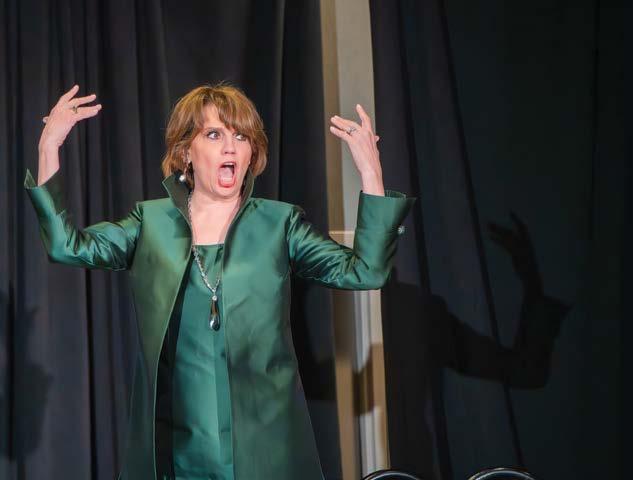
The doorbell rings precisely on time at a quiet hotel suite. Beth Leavel opens the door with a smile that feels almost like a wink. She settles onto the couch, script in hand, legs tucked neatly beneath her, and the room instantly lightens with her natural humor. She possesses the kind of warmth that says, “We’re about to do something truly serious, but let’s not forget to laugh at ourselves first.” She speaks gently about
the day’s prep work for an upcoming production of the world premiere of a new work, When Playwrights Kill by playwright Matthew Lombardo. She jokes about memorizing her lines and her enthusiasm for being in the comedic play that does not require her to sing. She is a pro who is breathtaking and larger than life while never taking herself too seriously. Even at the peak of her success, Leavel treats the craft with discipline, curiosity, and a healthy dose of humor that reminds us storytelling is joy as much as labor. As she prepares for her next role, we get a rare window into the playful heart behind a career built on truth, timing, and a fearless willingness to laugh at the process.
Beth Leavel, the Tony-winning force whose career braids North Carolinian roots with Broadway brilliance, stood as SETC’s 2026 Distinguished Career Award keynote speaker with a message that resonated from backstage to the rafters. Her storied career includes 12 Broadway shows — her Broadway debut in the original production of 42nd Street, the original production of The Prom, and her Tony-Award winning performance in The Drowsy Chaperone A lifelong student of the craft, Leavel spoke to aspiring actors, seasoned performers, educators, and regional theatre makers about the stubborn, joyful work of preparing for performance, embracing rejection as a natural companion on the road to success, and the powerful impact the art of theatre has on us all.
Her keynote address reminded attendees that the heart of theatre, whether in New York’s glittering houses or a school auditorium, thrives on curiosity, mentorship, and the courage to bring a truthful voice to every scene. This year also marks Leavel’s second time joining SETC as the keynote speaker after previously delivering the address in 2009. And given her playfulness and skill, it’s fair to joke that she might be the first keynote speaker to turn the address into a full-on performance with songs, accompaniment, witty banter, loads of theatre knowledge and a costume change.
“I’m still, still not quite done. Still got a little more marinating to do.”
“I still feel like I am a perpetual student. Every show I do, every director, every choreographer, every music teacher, every voice coach; I feel like
I’m still not quite done, still got a little bit more marinating to do.” Beth Leavel’s opening line anchors an ethos that runs through her career, a belief in constant growth and relentless curiosity. In her telling, the journey began in North Carolina, where theatre was not a family tradition and the memory of that first moment in a high school auditorium remains a compass — a memory of walking into the band room on the first day of rehearsal and realizing that she had found the people she had been looking for all her life. It was a moment that suggested that what she discovered was not merely a hobby, but a passion. Her college years deepened the conviction. At Meredith College she earned a degree in social work counseling, a choice that Beth frames with clarity as a reminder that listening and responding are the heartbeats of acting. A teacher there opened her eyes to the vast possibilities of a life on stage. Leavel describes herself as a sponge soaking up technique, craft, and storytelling while continuing to wrestle with math and religion and other non-theatre requirements. The hunger for performance continued to grow at University of North Carolina. A pivotal moment came in her life with an invitation to consider New York as a destination from a mentor, Linda Vanfordson, who recognized Beth’s potential. The suggestion frightened her because she was not sure if she was ready, yet the seed was planted. Her decision to pursue an MFA marked a turning point. She applied to the MFA program at University of North Carolina Greensboro (UNCG), a choice she described as life changing. There, the faculty that included Dr. John Joy, a Broadway veteran, came with a practical, alive sense of how performance can be both craft and vocation. Her thesis, Hello Dolly, became a pivotal moment of proof that rigorous study could translate into professional possibility. After graduate school, she came to SETC and got a job interning at a theatre company that led her to get her Equity card. She moved to New York City beginning a professional arc defined not by luck alone, but by deliberate preparation.
“Follow your heart and your passion. Don’t compare yourself to anyone else.”
“Nothing prepares you for Broadway except Broadway,” says the maxim that sits at the core of
If theatre is your heartbeat and your passion, you have to find out. n c “ “
to Broadway, she joined the Broadway company and spent four years in that high-energy role. It was a demanding, athletic kind of show, a dance-heavy production that required not only singing and acting but also an unyielding regard for the body as an instrument. “You are an athlete,” she reflects, acknowledging that even though she did not consider herself a natural dancer she trained and learned to tap. The memory of wishing she had stayed longer at Betty Kovac’s school of dance reminds us that mastery is as much about perseverance as timing. She speaks of leaning on training and discipline to protect her body, and to balance the physical demands with the emotional core of the character while performing.
her breakout moment and the realities of life in the nation’s theatre capital. She continues, “Many actors cut their teeth in regional theatres, but Broadway remains its own training ground, a space where every day presents a different test of stamina, precision and presence.”
Leavel’s breakout came with the first national tour of 42nd Street, where she portrayed Anytime Annie. When the show moved
The actor’s discipline extends beyond technique. It is a philosophy of care for craft and self. Beth’s approach includes a daily commitment to body work, rhythm, breath, and the spiritual stamina to face the next performance. Beyond the stagecraft she embraces a mentorship culture, taking on roles as a teacher and mentor to younger performers including
In a candid session with Princeton Middleton, a rising eighth-grader who will be attending Kecoughtan High School’s Onstage Academy in the fall, Beth Leavel lays out five essential pillars for cultivating a durable and joyful career in theatre. The principles emphasize listening to your heart, the value of ongoing education, the power of an individual voice, the inevitability of growth through development, and the strength to persevere through rejection. These five points compress a lifetime of experience into a concise guide for the next generation of performers.
1. Follow your heart and your passion.
Your path should align with what truly moves you. If acting is your heartbeat, pursue it with intention and commitment, rather than chasing a path that looks glamorous from the outside.
2. Commit to ongoing study and craft.
Treat acting as a lifelong education. Seek out classes, workshops, community programs, and opportunities to study theatre history, voice, movement, and storytelling. Knowledge deepens performance.
3. Develop your own authentic voice.
Don’t imitate others you admire. Observe, learn, and borrow wisely, but prioritize bringing your unique perspective to every role. Sing your truth in every scene, even when it’s hard.
4. Embrace the development journey.
Understand that most shows grow through readings, workshops, and regional runs before they reach Broadway or the national stages. Be patient, trust the process, and contribute bravely at every stage of development.
5. Build resilience and a healthy relationship with rejection.
Auditions are not personal verdicts. Learn from every room, grow from every note, and leave each audition with no regrets about giving your best performance. Stay curious, stay kind and keep showing up.
—Princeton Middleton and Iris Goode-Middleton, Ph.D.
swings covering major tracks and other ensemble workers passing along what she has learned through years of practice and performance.
“Art changes lives. Musical comedies change lives.”
Leavel’s passion exudes as she begins talking about the process of show development from beginning to end. Each show has its own rhythm, but a common arc emerges: table work, a 29-hour reading and workshops that flesh out the material before a full production.
The Prom offers a vivid case study of a workshop-to-stage experience. Casey Nicholaw, the writing team, and a chorus of collaborators gathered around a table more than a decade ago to begin shaping what would become one of Broadway’s favorite modern musicals. The developers wrote the role that Beth would inhabit and the cast included familiar faces, older more established performers who joked about being the olds in a show shared with younger talent. What followed was a 29-hour reading, an intensive week-long workshop environment with actors performing the full piece with limited resources. The workshop is not the final product; it is a proving ground in which ideas are tested, songs are refined and structural relationships observed under the gaze of producers, investors and audiences in controlled settings.
For The Prom, the Atlanta workshop hosted at the Alliance Theatre was transformative. The audience’s response to the material helped shape the book’s pacing choices and musical moments that might otherwise have remained theoretical. Feedback from the stage to the audience floor became the engine driving the show’s evolution to Broadway. The trajectory from reading, to workshop, to regional performance, and finally to the Broadway stage underscores Beth’s point that success is born from a responsive iteration process. The life cycle of a show, its readings, workshops and regional runs become as important as its ultimate Broadway debut in today’s ecosystem of new work development.
The through line is clear. Broadway
glamour rests on a stubborn non-glamorous truth: the work must be done in rooms that encourage risk, mistakes, and rapid recalibration. For Beth, this is not a critique of the process, but a celebration of collaboration, iteration, and shared purpose. The Prom, notably as a show she was able to participate in from inception to Broadway, profoundly impacted audiences, making many feel validated, seen, and celebrated, and her knowledge of the power of theatre to help others fuels her continued passion for the craft.
“The heart of theatre thrives on curiosity, mentorship, and the courage to bring a truthful voice to every scene.”
“Characters who have a strong, distinct voice and perspective that differs from your own — yet can’t differ too much from your own — are the richest on stage.” Beth explains her approach to character work is finding a truth close to her own voice, then unleashing brave, sometimes audacious choices to test what resonates with the text. A safe rehearsal
room is essential for experimentation and growth. The art of bravery in rehearsal is not about reckless risk but about a disciplined willingness to try, fail, and return with a more honest performance.
“Humor lands most truthfully when it is rooted in real emotional experience as the guiding principle,” Beth says. The ability to evoke laughter while revealing vulnerability is a rare art that a performer who can ride that line with consistent sincerity earns the audience’s trust and attention. Leavel’s work in lean, immediate pieces where the stage demands a different emotional register from the big ensemble energy of a Broadway hit demonstrates the breadth of her range. In these moments she proves she can carry a quieter emotional current while still delivering the warmth and humor that make her storytelling so inviting.
“Auditions
“Your job isn’t to book the gig; your job is to audition, to grow, to bring yourself into the room and leave with no regrets about giving
your best performance.” Beth offers practical wisdom gained over years in the business. The road to Broadway is paved with auditions that do not lead to jobs. Beth says, “Rejection is part of the gig. It’s not personal; it’s about fit and timing.” The counsel Beth gives is practical and honest: “Leave each audition with the sense that you did your best, learned something and are ready to move forward.”
Addressing the question of managing disappointment she notes that not every dream project will align with timing or a performer’s skill set, yet this is part of the craft’s learning curve. The message is not one of resignation, but of resilience to have the ability to grieve briefly, then rechannel energy toward growth, new opportunities and a renewed commitment to one’s own voice.
Her guidance for young actors is centered on authenticity. Beth emphasizes listening to one’s heart, pursuing craft with intention, avoiding constant comparison with peers, and embracing varied pathways to learning — acting classes, college courses,
independent workshops, and live theatre experience provide a multitude of opportunities to study and grow. Her broader point is that each artist’s singular voice is their greatest gift.
The heart of theatre, whether in Broadway houses or a town theatre, thrives on curiosity, mentorship, and the courage to bring a truthful voice to every scene. Beth adds this keynote to the country’s ongoing conversation about education and theatre. Her career has become a living classroom, a model for how a performer’s education does not end with a diploma but continues in mentorship, collaboration, and the ongoing development of new works. In theatre, where audiences are deeply connected to community and educational partnerships, her message resonates as a call to action to invest in local talent, to foster opportunities for new plays and
musicals, and to support the next generation of directors, writers, and performers who will carry theatre into a vibrant future.
Beth Leavel’s life in theatre, rooted in North Carolina, refined in New York, and celebrated on Broadway, offers a remarkable story of persistence, curiosity, and the belief that education is a lifelong partnership with the stage. Her keynote message that art changes lives and that true artistry grows from training, brave experimentation and a listening heart speaks directly to all theatre artists who understand that theatre is a shared experience built in rehearsal rooms and carried out onto stages all across the world. n

byKenziJames
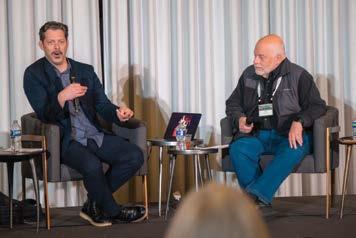
On March 5, 2026, the Chattanooga, Tennessee Convention Center was full of theater educators, directors, designers, and emerging practitioners who had gathered for the annual Southeastern Theatre Conference Convention. The keynote address for alumni recognition that day belonged to David Furr — a Greensboro, North Carolina, native, who has spent more than 25 years doing
what most theatre students only dream about. He has stood on Broadway stages with Tonywinning legends, jousted with iambic pentameter in Central Park, played every register from Greek tragedy to slap-stick farce, navigated the intimate geometry of a soap opera camera, and appeared in dozens of the most-watched episodic dramas on American television. The honor at SETC was a recognition not merely of a career, but of a way of moving through the profession that the conference’s membership could recognize and admire: disciplined, curious, generous, and above all else, practical.
That last word matters. When learning about Furr’s perspective on acting, theatre and performance, one word he used several times was “practical.” Practical derives from the Greek praktikos — meaning “fit for action, concerned with action” — and it carries at least four distinct meanings in English. It can mean something that is concerned with the actual doing of something rather than mere theory. It can describe a person who is sensible and realistic about what can be achieved. It can refer to something that is so nearly complete as to be effective — practical certainty. And in the world of stage management, a “practical” is a prop or set element that genuinely functions: a lamp that truly lights up, a stove that actually burns. All four of those definitions fuse into a single portrait when one examines the career of David Furr. He is an actor who understands the theoretical and also understands that it can sometimes limit one’s theatrical process. He has built his career on the actual doing, and he has carried that commitment — intact, undiluted, and ever more refined — into his work as a professor of acting for the camera at the University of North Carolina Greensboro.
David Furr grew up in Greensboro — he graduated from Page High School, then drove west to Appalachian State University, where he earned a Bachelor of Arts in Interdisciplinary Studies with a concentration in film and theatre in 1994. Even at that stage, the dual focus was telling: Furr was drawn not to one medium, but to the conversation between them. After Appalachian State, he pursued a Master of Fine Arts in Acting from the Alabama Shakespeare Festival, University of Alabama’s Professional Actor Training Program.
The combination of intensive classical training — Shakespeare in repertory, the whole machinery of the Elizabethan stage, alongside the rigorous technique of graduate actor training — gave Furr something that would define his professional fingerprint: he arrived in New York not just eager, but equipped.
The years that followed were the years every serious theatre actor knows well: regional theatres, Off-Broadway stages, the steady accumulation of craft and all the personal development in between. Furr appeared in leading regional houses across the country, sharpening his range and building the kind of physical and vocal instrument that Broadway demands. He performed in well over half the plays in the Shakespearean canon — an extraordinary breadth by any measure — at major theatres from coast to coast. He was not merely checking titles off a list. Each production was a laboratory, and the plays of Shakespeare were the most demanding experiments available: verse that requires technical precision in the mouth but must sound like spontaneous thought in the ear, characters who speak in metaphors that have to land as muscle memory rather than literary gesture. Furr understood that Shakespeare, in this sense, is the most practical training ground an actor can inhabit. Every line is an action. Every image is a choice. Nothing works if it stays abstract.
Furr’s Broadway career is not that of a single celebrated moment; it is a long, varied, and distinguished body of work. He appeared in Tonynominated revivals of King Lear, Who’s Afraid of Virginia Woolf?, The Importance of Being Earnest, Noises Off (Tony nomination), and Burn This, as well as productions including The Rivals, Accent on Youth, and Cymbeline. These are not productions that fall into a single genre or stylistic category. Edward Albee’s scorched-earth psychological warfare in Who’s Afraid of Virginia Woolf? is an entirely different animal from Oscar Wilde’s glittering epigrammatic wit in The Importance of Being Earnest; both are entirely different again from the Restoration energy of The Rivals and the earthy Shakespearean demands of Cymbeline. To have acquitted oneself credibly across all of that terrain — and to have done so as a recurring Broadway presence rather than a one-production wonder
The message of Furr’s professional life is essentially this: be a practical actor … in the fullest Greek sense. Be concerned with action. Do the work. Serve the play. Master the instrument.
— is to have demonstrated exactly what the second definition of “practical” means: the sensible, realistic, disciplined approach of someone who understands what it actually takes to sustain a career.
If there is a single production that crystallizes Furr’s particular genius, it may well be the Roundabout Theatre Company’s 2016 revival of Michael Frayn’s Noises Off, directed by Jeremy Herrin and starring an ensemble that included Andrea Martin, Campbell Scott, and Megan Hilty. The play is a masterwork of theatrical farce: a show-within-a-show that demands from its cast not only split-second comic timing, but also a virtuosic command of the body, because the physical humor in Noises Off must be choreographed with the precision of a ballet while appearing to be catastrophic accident. Furr played Garry Lejeune, described by critics as an inarticulate, volatile leading man — a character that requires a performer to play bad acting convincingly, which is, paradoxically, one of the most sophisticated things an actor can do. The Associated Press noted that Furr was “a true revelation,” observing that simply watching him bluster or frantically rush around was enough to make “your ribs hurt.” The Tony committee agreed: Furr earned a nomination for Best Featured Actor in a Play, alongside Drama Desk and Tony nominations that marked the production as a landmark revival. What Furr’s performance in Noises Off illustrated, in the most public way imaginable, is the principle that physical comedy is not a lesser cousin of dramatic acting — it is, in fact, one of its most demanding expressions. Physical comedy of the Noises Off variety requires structural thinking: every pratfall, every slammed door, every sardine-waving entrance must be built on an honest emotional logic, or the audience senses the machinery and the laughter dies. Furr had learned this in the Shakespeare plays — where every comic scene, every bit of clownery, lives or dies on the actor’s willingness to play it truly — and he brought that lesson to Broadway’s biggest comedy stage garnering him the 2016 Tony nomination for Best Featured Actor in a Play. This is what it means to have a body
of work rather than a career of disconnected engagements: the lessons of each form accumulate, and the actor becomes more capable of everything.
Among Furr’s professional honors, the ones that feel most deeply earned are the awards for his Shakespearean work. His 2012 performances in The Public Theatre’s celebrated Shakespeare in the Park — the beloved free summer series in Central Park that has introduced millions of New Yorkers to classical theatre — earned him both the Falstaff Award and the Actors’ Equity Association’s St. Clair Bayfield Award, the latter recognizing the best performance in a supporting role by an actor in a Shakespearean play in the New York metropolitan area. The 2012 Bayfield was awarded for his performance as Orlando in As You Like It — a role that demands romantic ardor, comic lightness, and an athlete’s relationship with the physical world of the Forest of Arden. Shakespeare in the Park is also, it should be noted, one of the great democratic proving grounds of American theatre: actors must project to audiences of thousands in the open air while maintaining an intimacy that makes every character feel human and immediate. It is, in the most literal sense, practical theatre — theatre that works, under conditions that test every technique an actor possesses.
The significance of Furr’s depth in the Shakespearean canon cannot be overstated as a foundation for understanding his later versatility. Shakespeare’s plays encompass human situations, nuanced registers of language, a variety of social class which also includes comic and tragic experience; the culmination of these details make this a challenging genre to master but an arsenal of tools applicable to multiple modes of dramatic performance. An actor who has genuinely inhabited that range — who has felt the moral weight of tragedy and the bodily intelligence of comedy from the inside — has been trained, even if unconsciously, to move across genres.
Furr’s television career is its own education in range. His earliest recurring television credit is a stretch on All My Children, the long-running ABC daytime drama, where he appeared in five episodes between 2004 and 2009. Soap opera is routinely dismissed by theatre practitioners as a lesser form, but working actors know better: the demands of daytime drama are severe in their own right. Soap opera is shot at speed, often with minimal rehearsal, in an environment where emotional continuity must be maintained across long taping days and interleaved storylines. The camera is always close; there is nowhere for a false emotion to hide. An actor who has survived soap opera with his technique intact — who has learned to be genuinely present within those conditions — has acquired something that no conservatory class can fully replicate.
The episodic television work that followed is a remarkable testament to Furr’s range and reliability, in an industry where guest and recurring roles demand that an actor arrive fully prepared, integrate instantly into an
established world, and deliver memorable work in limited screen time. Furr’s credits include Law & Order: SVU, The Good Wife, The Americans, TURN: Washington’s Spies, Mr. Mercedes, Bull (in a recurring role of seven episodes), Iron Fist, The Blacklist, The Man in the High Castle — where he played the disturbing historical figure George Lincoln Rockwell — New Amsterdam, The Equalizer, and many others. Each of these productions has its own tonal register, its own storytelling rhythm, its own visual grammar. The actor who navigates them successfully is, again, a practical artist in the fullest sense: someone who can read the room of any production and serve its specific demands without losing themselves.
The pinnacle of Furr’s television career to date arrived with HBO’s The Gilded Age, Julian Fellowes’s lavish drama set in the Gilded Age of New York’s aristocracy — a show that its creator deliberately populated with Broadway veterans, describing the ensemble in some circles as the “Avengers of Theatre.” Furr appeared in eight episodes of Season 2 as Dashiell Montgomery, earning a Screen Actors Guild Award nomination as part of the ensemble cast. The role placed him alongside some of the most decorated Broadway actors of his generation in a production that
demanded both the sweeping emotional scale of period drama and the camera-specific restraint that separates stage acting from screen acting. The SAG nomination was for Outstanding Performance by an Ensemble in a Drama Series — a recognition that speaks to the quality of the collective work, which is precisely how Furr has always understood and valued the theatre: as a collective enterprise, not a solo exhibition.
When the College of Visual and Performing Arts at UNC Greensboro announced David Furr’s appointment as Assistant Professor of Acting for the Camera in the spring of 2025, the announcement noted that he brought over 25 years of professional experience across Broadway, Off-Broadway, television, film, regional theatre, voiceover, and audiobook narration. The fall 2025 semester was his homecoming in both senses: a return to Greensboro, where he had grown up, and a return to the act of teaching, which had been part of his professional life for more than 15 years through workshops, coaching sessions, and masterclasses. UNCG recruited Furr with the explicit goal of having him share his industry experience while maintaining an active performance career — an arrangement that
keeps him, as the third definition of “practical” would have it, functionally active: a working practitioner who teaches.
Furr has spoken publicly about his teaching approach in ways that reveal the same core sensibility. He has described his goal as reshaping the way young professionals think about the auditioning experience, which he sees as characteristically disempowering in how it is framed. His reframe is essentially practical in the philosophical sense: treat an audition as a business meeting. You are a potential partner assessing fit, not a supplicant being judged. This is not wishful positive thinking; it is a strategic reorientation that is grounded in the actual economics and social dynamics of the professional industry. Furr has also spoken about the importance of humility and kindness — virtues he observed and valued in his work alongside major stars including the late Andre Braugher, David Hyde Pierce, and Woody Harrelson. The lessons he draws from those encounters are professional ethics: how you behave on a set is as much a part of your career as how you perform.
The courses Furr teaches at UNCG are built around the specific demands of on-camera performance — a field that the School of Theatre takes seriously as a separate discipline from stage acting, encompassing feature film, episodic drama, sitcoms, and commercials.
The intersection of his training and his career makes him an unusually well-suited teacher for this subject. He has, quite literally, done all of it. He has spoken Shakespeare under the open sky in Central Park. He has navigated the physical chaos of Frayn’s backstage farce on the Broadway stage. He has held an emotional center through the rapid-fire production rhythms of daytime television. He has inhabited the measured restraint that HBO prestige drama demands. Each of those experiences feeds the others, and all of them feed his classroom.
The Southeastern Theatre Conference, founded in 1949, is one of the oldest and most respected regional theatre organizations in the United States, bringing together educators, students, and professionals from across the Southeast each year. To be invited to deliver the keynote address for alumni recognition is to be recognized not simply as a successful individual but as someone whose career embodies values and lessons the profession wants to pass forward. The choice of Furr for this year’s address was not incidental. His career is, in itself, a kind of text — one that can be read and taught. It demonstrates that range is not a distraction from depth but its complement; that the actor who masters Shakespeare could be better prepared for farce; that the actor who understands farce knows something essential about tragedy; that the actor who has worked in soap opera is well-equipped for the camera than the one who has only read about it.
The message of Furr’s professional life — the one that a Southeastern Theatre Conference audience would carry home from Chattanooga — is essentially this: be a practical actor. Not in the diminished sense of the word, not the resigned pragmatism of someone who has abandoned larger ambitions, but in the fullest Greek sense. Be concerned with action. Do the work. Serve the play. Master the instrument. And then, when the form changes around you — when the camera replaces the proscenium, when the comedy replaces the tragedy, when the 400-seat house becomes a 32 inch
screen — trust that the work you have done is genuinely transferable, because it is rooted in something true about human behavior rather than in the conventions of any one style.
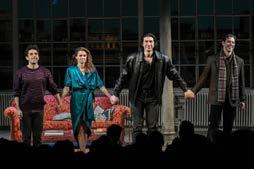
There is a fourth meaning of “practical” worth returning to here: the theatrical term for a set element that actually functions. In Noises Off, the sardines that are endlessly misplaced, the plates that clatter, the doors that slam and swing — these are practicals. They work. And when they fail to work on cue, the comedy fails. Everything in that production depends on the practicals functioning. The metaphor is apt for Furr’s career as a whole. He is, himself, a practical — an actor who actually functions, in every environment he is placed in, across every genre and form the profession has offered him. The Tony nomination, the SAG nomination, the Equity Shakespeare award, the decades of episodic television work, the soap opera training, the Broadway revivals, the Shakespeare in the Park — each of these is evidence not of celebrity or of a single bright moment, but of an instrument that has been built to work and that goes on working.
The students who pass through David Furr’s classroom at UNC Greensboro are receiving something that cannot be fully simulated: instruction from someone who did not just study the industry but inhabited it, shaped it in small ways, and was shaped by it in larger ones. Professor Furr says, “Not only is it important to me to teach the practical nuts and bolts of working with the camera, like hitting marks, moving with the camera, understanding editing, use of eyes, but I also try to arm students with things they can really do in their approach to acting, things that they can throw their arms around — practical things that in turn permit the more elusive elements of acting to manifest when the time comes.” They are receiving the benefit of 25
years of practical choices — the choice to stay in the work even when the forms changed, to accept the soap opera and master its demands, to bring Shakespeare’s physical intelligence into Broadway’s most demanding physical comedy, to carry the discipline of stage acting into the intimate and unforgiving frame of the television camera. When they go out to audition, if Furr’s lessons take root, they will walk in thinking of themselves as partners in a business meeting rather than supplicants before a panel. They will understand that humility and craft are not opposites of ambition but its deepest expression. And they will know, because a man who received the 2026 SETC alumni honor in Chattanooga told them from experience, that a career built on the practical — on the actual doing, the honest inhabiting, the relentless showing up — is the only kind of career that lasts.
David Furr is Assistant Professor of Acting for the Camera at the University of North Carolina Greensboro’s School of Theatre. He was honored as the keynote speaker for alumni recognition at the 2026 Southeastern Theatre Conference Convention in Chattanooga, Tennessee. n

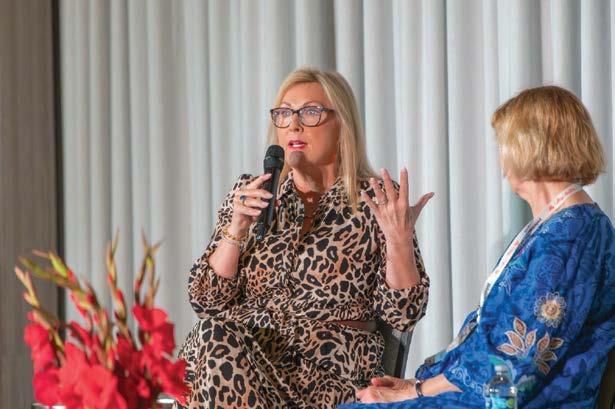
Leslie Kimbell has spent her career telling stories that are bold, funny, and rooted in a shared human experience. As a published playwright with Concord Theatricals, a recipient of the Georgia Theater Conference’s Playwright Hall of Fame Award, and a longtime advocate for LGBTQIA equity, her work sits at the crossroads of art and impact. Her latest play, The Four Old Broads Christmas Extravaganza, was made available for licensing on March 19 after its first performance in Mayfield, Kentucky, last December. The following conversation is based on a recent interview and excerpts from a luncheon speech Kimbell gave at the Southeastern Theatre Conference, offering a closer look at the person behind the work.
How did you get involved in theatre?
The theatre bug bit me when I was about 10 years old, but my journey into playwriting didn’t begin until I was 39 years old. I was a wife and mother of two very rambunctious little boys. Although I had performed in theatre as a child, the first time I came back and stepped on stage as an adult was just… it was so amazing and overwhelming, and the audience laughter, it just hit me right away.
I found myself back in a rehearsal room doing Barefoot in the Park. And I felt something in that moment that I had not felt in so many years. I was excited with possibility and a new purpose and a new beginning. But what I didn’t know then was that that moment would lead to an entirely new purpose for my life.
And so, the Waffle House. Flash forward a few years. It was 2015, and I was at the Waffle House enjoying my scattered, smothered, and covered with a group of my theatre friends. We were tired and loud and we were having a good time with some of that inappropriate lady talk that sometimes happens at those after rehearsal dinners.
My friend, Billie Nye-Muller, who was a precious grandmother of seven, she suddenly popped off the most wildly out of character and highly inappropriate joke that I have ever heard in my life. It just came flying out of her mouth.
And after our initial stunned silence, I remember saying, “That would be the most perfect line in a play.” And I wrote it down on a napkin and I took it home.
Did it feel like a part of your life reopening again after all that time?
It did. It absolutely did. And it was a whole new beginning for me.
The person that played my daughter in that play (Barefoot in the Park) ended up directing the premieres of my first three plays. We became really good friends, and we were on the same wavelength about everything. And she just saw my vision, and so I just gave those shows over to her, and she directed the first three. So this last one, I ended up taking it to a theatre there. But yeah, it really did. Coming back to the theatre changed the whole course of my life.
Leslie, you’ve certainly done, well, a lot of everything. People talk about you as a playwright today, but looking at the things you’ve done, certainly acting, but then designer, director, all kinds of other things. Have you been doing a lot of these things at the same time, or was it all sequential?
Well, no. So, well, yes and no. When I was very young, in my teens, I was doing design work. But in my 20s and 30s, I did burlesque and I traveled all over the world. I was a headliner. And I traveled, and I was in Vegas, and I did burlesque. I did that for 19 years, and I loved it until I didn’t.
But then I really wanted to start a family. And of course, as a child, I did theatre. And so, coming back to the theatre was… I had been on a stage for 19 years of my life. And then suddenly I was not.
“ “
Diversity can’t just be a value that we whisper in our theatres. It has to be a commitment that we show.
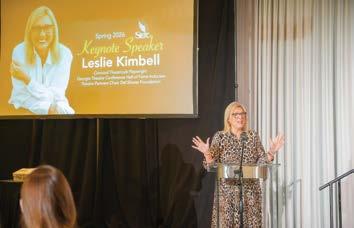
And I mean, it was insane to suddenly be out of that spotlight. I was at home one day, and I was like, “What am I going to do with my life?” And my husband and I had… We were starting our family, and I just happened to see an advertisement for an audition for a theatre show. And I said, “Oh my God, I remember theatre. Theatre was so fun. I’m going to go and audition.” And I ended up getting cast, and it changed me, that little audition. It was literally two sentences in the back of the newspaper. It changed my whole life. It did, because that got me to a point where I was reading scripts. And I started getting involved with theatre people, and I started going and seeing shows.
So what are some of the best memories or experiences you’ve had in your life? What did you enjoy the most? You said the burlesque was one of the high points. What else?
Well, I would say raising my children, and now my grandchildren. Four grandchildren. I have a fifth one coming in July. My family is the most important thing in my life. Outside of my family, I have traveled a lot, and I’ve enjoyed seeing the world. Of course I love to get to New York whenever I can. I love to go to Broadway and see shows. And I
actually had an opportunity last year for the first time to help direct a show in New York. Which was really incredible.
Through the Del Shores Foundation, we help playwrights and screenwriters from the LGBT community find a voice and find a platform. And one of our playwrights, Jiggs Burgess, had written a really wonderful play called Wounded. And it went to the Soho Playhouse, and it was just incredible. And I got to be an assistant director with Del Shores, and that was an incredible experience.
Yes, it’s an incredible, incredible play. And they had three wonderful actors come out from Los Angeles to do it, and it was very well received. It was very thrilling. It just happened to coincide. I had decided to take a writing trip and go to New York for a month to just be alone. I had rented a room, and I was just going to go there to write. And it just happened to be at a time when they were doing the show, and so Del asked me to be his assistant director. And it was incredible. It was an incredible experience. It was a big highlight.
What is your main goal being a playwright?
Well, initially when I wrote my first play, I wanted to give voice to… I wanted senior
citizens — seniors — to have a leading voice. Because I noticed not just at the theatre I was with at the time, but I started looking around at surrounding theatres at the shows they were doing, and I noticed that there just weren’t parts for a lot of people over 50. It was for a lot of young people. And I thought, wow, there’s a lot of people that want to be on the stage that are over 50, that are over 60, and I want to write something for them where they’re the main character, they’re not just the bit part. And so that’s why I wrote my first play, and as it turns out, it became very popular, and so I started writing the sequels for them. But that’s why I wrote those. And of course I’m writing other characters, I’m writing other stories. My play Packing Up Polly is about four women in their 40s, so it’s not for senior citizens. And the new play that I’m writing is — I’m writing a new play now that has people of all ages in it. It has nine characters from the age of 21 to the age of 70. So I mean, I am writing for all different ages, but the point of my four old broads series, which there are four now, was for seniors.
Your message today at the luncheon was about voices for all kinds of people. Has that always been a part of you?
I would say that’s always been something that I have felt passionate about from a young age… But especially now, more than ever. Diversity and inclusion are so important to me, and I’m always — I’m very vocal about it. Always. And I think that we all should be. One of the things that most upsets me is that we don’t give our audiences the opportunity sometimes to make a decision for themselves, and that we feel like we have to protect our audience from certain subject matter, and that we don’t think that our audience is capable of understanding certain subjects, or that we’re going to drive our audience away. I certainly long for a time when we can play in our season without worrying about that.
Now, this may sound like a story about me, but it isn’t. I’m just one example of what can happen when someone is given a space and a seat at the table. And I didn’t get here alone.
None of us do. My story exists because someone opened a door for me. And not everyone gets that door. And so, that’s where this conversation has to shift. From individual success to our collective responsibility. From celebrating theatre to asking the harder questions about access and visibility and whose voices are still waiting to be heard. Because I think that’s why theatre matters far more than we sometimes admit. Diversity can’t just be a value that we whisper in our theatres. It has to be a commitment that we show.
I’m going to take a moment to share a very personal story with you. And it’s very difficult for me. But this is a story about why I recently chose to leave my beloved theatre after 19 years. I was a founding member of this theatre group and I was the vice president. And I loved this theatre with my own soul. And I had worked tirelessly for it. From sweeping the floors and selling concessions to community outreach and even writing grants for the theatre. And I helped it grow from its very beginning. And it meant the world to me.
And one of the things that I did for this theatre was create and solely maintain their social media. For about 12 years. And I created graphics and banners and audition announcements, volunteer opportunities, ticket giveaways, that sort of thing. And every year on June 1st, I would post “Happy Pride Month.” All are welcome. This theatre is the same space. This is the last Pride post that I posted. And for 12 years there were no, there was nothing negative said from our board. Nothing negative was said from our audience, from anyone on social media, nothing.
And then in June of ’24, ironically Pride Month, during a board meeting, another longtime founding board member out of nowhere abruptly took over the meeting and said that my Pride post that year was controversial. And said that if I continued to post anything else LGBT, that it would drive away our audience. And then she referenced some made-up complaints to give the impression that her viewpoint had a broader support than it did. And the conversation that followed in that board meeting, and the biased opinions of some of those board members
was shocking. Because these were people that I had poured out blood, sweat, and tears with for 19 years. And one of those comments still rings in my ears. The board president leaned across the table and he said, “Well, Leslie, times are changing.” And I was so taken aback I couldn’t speak. I just sat there and tears were rolling down my face.
Now this is a long story, but the short version is that through a very thinly veiled motion, that board of directors voted that I was no longer allowed to post any holiday greetings at all. No Thanksgiving, no Easter, no Christmas, not even World Theatre Day. Just so that Happy Pride would never be posted on their social media again. And what hurt the most wasn’t that decision; it was that sudden forced silence. Because silence is loud. And the local LGBTQ community heard that silence and they let me know. They let me know that that silence suddenly felt like exclusion. Now you guys, this isn’t about politics, it’s about belonging.
What is your best piece of advice for a young person going into theatre today?
Take your time and believe in yourself. And you want to take your time and you want to believe in yourself, and you don’t want to ever let anyone… I think I remember when I was a camp counselor, and we would always say, “Don’t ever yuck anybody’s yum.”
nThis is my hope for the future:
A bigger table… where artists from every background feel genuinely and openly welcome… where inclusion matters more than worrying about who might walk away.
cAnd belonging isn’t something that we can’t have, at least it shouldn’t be. It needs to be something that we show. It was an incredibly difficult decision, but I resigned from my beloved theatre. And I grieved 19 years of love when that open acceptance was silenced. And it was heartbreaking, it really was.
But leaving taught me something important. Sometimes loving theatre means being honest about what you can and you cannot accept. And I’m sharing this today because it reflects a broader issue that we’re still facing in theatres across our country. Even in spaces that we all consider progressive, homophobia and racism and transphobia still exists. It just does, especially in leadership.
Don’t ever let anyone yuck your yum. Don’t ever let anybody hide your light. Because there are a lot of people out there who think they know everything, and they may try to bring you down, and don’t let them do that. There are so many… I personally know a couple of people who are doing beautiful work in theatre now, and early on they had people who told them that they weren’t going to make it. That they would never do anything. That they would never be an actor. They would never be this. They would never… and thankfully, they didn’t listen. But I have to think about all the people who maybe did listen. And so, that’s why I say don’t let anybody yuck your yum. Don’t let anybody blow out your light. Don’t let anybody blow out your candle. Just believe in yourself. And keep going because you can do it. You absolutely can. If you want it, you can succeed. I believe that. I mean, I didn’t get started until I was 39. n

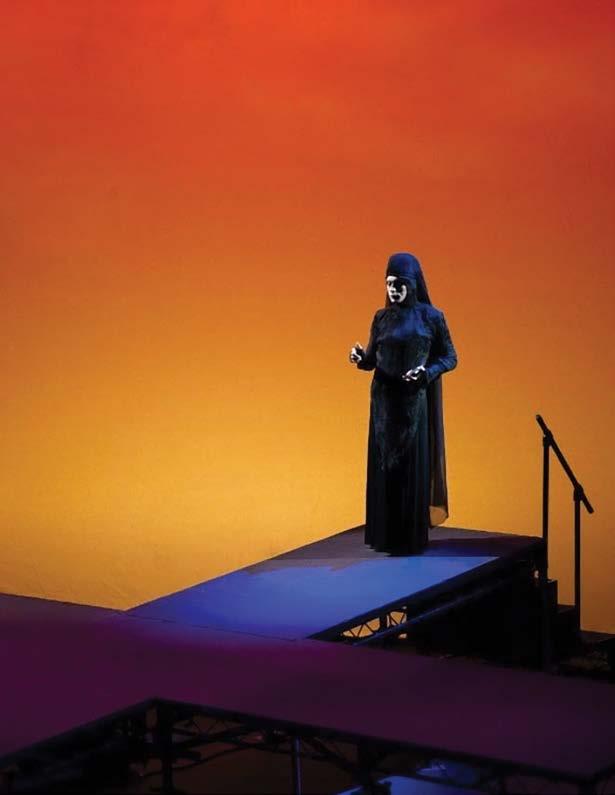
EnduringLessonsofDesignfrom the2026SETCDesignKeynotes
byRickyRamón
The March 2026 Southeastern Theatre Conference (SETC) Convention in Chattanooga served as a vibrant nexus for thousands of artists, educators, and technicians. For those of us who spend our lives at tech tables in darkened rooms, it is a visceral reminder that theatrical design is never merely a technical exercise; it is a profound extension of the human beings sitting behind the monitors. The worlds we manifest on stage are shaped by our anxieties, philosophies, and hard-won wisdom.
For the young student, the lesson is clear: your technical skill is the floor, but your humanity is the ceiling. A set is not just lumber; a lighting cue is not just illumination. They are physical manifestations of how a designer navigates the world and honors the people within it. This year’s Designers’ Keynote honorees — Jeffrey D. Kmiec (Scenic Design), Raquel Adorno (Costume Design), Pablo Santiago (Lighting Design), and Cricket S. Myers (Sound Design) — exemplify this beautifully. When we look past their staggering resumes, we find four artists whose professional brilliance is anchored entirely by a unifying worldview: the best designers view themselves not as lone visionaries, but as empathetic citizens committed to genuine collaboration and human decency.
x2. Dismantling the Myth: Scenic Designer Jeffrey D. Kmiec

Jeffrey D. Kmiec is an award-winning scenic designer whose career seamlessly bridges live theatre and television. Stepping to the podium in Chattanooga, he immediately disarmed the room with his profound self-awareness and practical approach to a highly subjective industry. For Kmiec, the path into the theatre was a family affair, having grown up helping his scenic designer mother in the paint shop. But the philosophy that sustains his career today has nothing to do with ego.
“I’ve made a career out of saying as little as possible,” he joked to the crowd. “Truly, nobody needs to hear about the thousands of nail-biting,
anxiety-ridden, impostor-syndrome-laden hours of studio time it has taken to build any sort of career.”
However, his rhetoric strips away the pretense to reveal a harder truth: your portfolio might get you the first meeting, but your character gets you the second. Kmiec actively rejects the idea of the solitary, tortured genius, favoring professional decency over artistic ego.
“Every major job I’ve had came from someone who knew me, someone who trusted me,” he explained earnestly. “Someone who said, ‘He’s solid. He shows up.’ For students entering the industry, that matters more than we like to admit. Reliability is the most underrated form of genius in a collaborative medium.”
During his keynote, he drew a hilarious parallel between theatrical tech and the lessons of early childhood education. Referencing his wife’s
— Scenic Designer Jeffrey D. Kmiec c “ “ n
Reliability is the most underrated form of genius in a collaborative medium.


career as a kindergarten teacher, he noted the behavioral challenges she faced in her classroom were bizarrely similar to his tech weeks.
“It became a running joke in our house: would you rather work with a roomful of five-year-old sociopaths… or 50-year-old sociopaths?” he asked to roaring laughter. “Ultimately, it teaches us that the bare-minimum lessons we’re supposed to learn in kindergarten still apply in adulthood. The bare minimum isn’t glamorous. It won’t get you featured in a design magazine. But it will get you rehired.”
This means showing up on time, treating every collaborator as a human being, and never being the difficult person in the room.
Even with a resume spanning Apple+, NBC, and The Lyric Opera, Kmiec acknowledges the psychological hurdles of the creative process. “Self-doubt is a constant presence in the studio, and the best you can ever do is take a deep breath and keep pushing forward,” he reflects. By shifting focus to the shared goal, he views design as a communal language. “Collaboration is the engine, and my work only gets better the more I remember to listen.”
Kmiec left the audience with a philosophy that speaks directly to the human condition: “Sets get struck. Paint gets covered. Shows close. But relationships last.”
www.jeffreydkmiec.com

Raquel Adorno, an assistant professor of design at Northwestern University and a Joseph Jefferson Award winner, views her work as a deeply personal sensory experience. Her costumes do not merely clothe the actors; they reveal the internal pulse of the characters.
Her journey to costume design is wonderfully unconventional, rooted initially in vocal performance. Armed with degrees in opera, Adorno approaches the stage from a different artistic angle. Rather than leaving that musicality behind, she weaves it directly into her worldview and visual storytelling. She approaches a script not merely as a blueprint for garments, but as a symphony.
“I think this is why I love designing

musicals or plays with music and underscoring,” Adorno explains. “I’m the kind of person who sees images in my mind when I hear text or listen to music. It’s very personal and evocative to me.”
This holistic view of art makes her a vital presence in the classroom at Northwestern. For Adorno, teaching is not a separate gig meant to fill time between shows; it is the continuation of her artistic identity. “My design work is my research,” she says simply. “They go hand-in-hand.”
Her primary goal as an educator is to help young artists find out who they actually are, urging them to prioritize their unique perspective over mere technical proficiency. “Hone your POV,” Adorno frequently tells her students. “It’s why you’re hired. It’s what has the power to make your work amazing.”
Furthermore, Adorno operates with a distinct awareness of the artist’s responsibility to the future. She is highly mindful of the
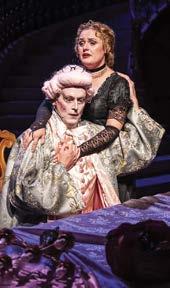


footprint of theatrical production. When asked about the biggest challenges facing the next generation of designers, her answer bypassed budgets and networking, focusing instead on global survival.
“Sustainability and environmental impact,” she states firmly. “Be mindful about the impact of your process on the planet.”
What truly grounds her practice,

Lighting designer Pablo Santiago’s career serves as a testament to the profound courage required to honor one’s creative evolution. Originally from Chiapas, Mexico, Santiago spent 15 years established in the high-stakes Hollywood film industry. His decision to abandon a lucrative, 15-year career as a cinematographer to pursue an MFA at UCLA was not merely a career shift; it was an act of artistic bravery. He chose the uncertainty of the theatrical space — where abstraction and expressionism thrive — over the comfort of a predictable industry, teaching students that it is never too late to pivot toward the work that truly speaks to your soul.
however, is a profound appreciation for the act of creation itself. Even amidst the stress of academic deadlines and regional theatre openings, Adorno remains tethered to the joy of making. “Beauty, telling stories, process,” she reflects when discussing what keeps her inspired. “I find the process of making art exciting and sustaining.”
www.raqueladorno.com
the leap, abandoning his Hollywood goals to pursue an MFA at UCLA. “I fell in love with all the possibilities for lighting in the theatrical space,” he shares. “In the theatrical space there is more room for abstraction and expressionism, which I loved from the start.”
Today, his daily life is driven by an unyielding desire for connection. He views lighting as an active participant in the narrative. “Storytelling — finding ways to tell a story… different kinds of stories in different kinds of genres,” he notes regarding his inspiration. He is fascinated by “the visceral reaction/conversation lighting design has with the audience.”
nMost people who do make it is because they were resilient and not so much because they were talented.
cDuring that time, theatre was a creative outlet squeezed between massive, lucrative film shoots. “While working in the film industry in lighting… I began to design for live performance — modern dance… working for local dance companies in small theatres,” Santiago recalls. “I did it in between film jobs, as a side gig without really thinking this was going to become my full-time job.”
Santiago’s philosophy is rooted in listening to that creative push. He eventually took
Those 15 years in the film trenches gifted Santiago with a grounded psychological resilience. He approaches the tech table with the calm demeanor of someone who has navigated multi-million-dollar sets, allowing him to maintain perspective when theatrical stress inevitably rises.
“I think the biggest advantage/lesson/ experience I got from working in big films in the film industry is the experience of being in the room — being in the room when big shows and big decisions are getting made,” Santiago notes. “Sometimes you are in situations where you have to produce an appropriate, wonderful design moment when others are looking over your shoulder, while the timeframe is short and the storytelling moment is big, and that feeling is the same
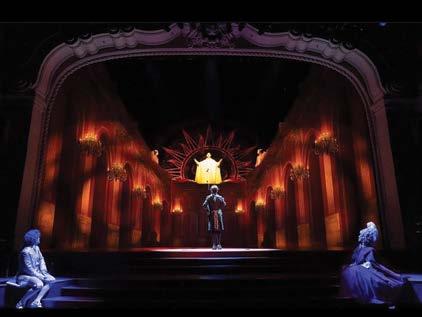
wherever you go.”
This psychological grounding allows him to embrace the emotional weight of a scene rather than just providing technical illumination. Santiago fundamentally rejects the traditional notion that theatrical lighting should be invisible or purely supportive.
During his keynote, he recalled a transformative moment when a director told him a cue he wrote was “pretty.”
“He then proceeded to say, ‘That is not a compliment, that’s not good. Pretty is boring,’” Santiago shared. “He then said, ‘There has to be tension in the light… there
A Tony Award nominee and Drama Desk Award winner, Cricket S. Myers creates sonic landscapes that feel like physical presences in the room. But before she ever touches a sound board, Myers approaches her work with the open, empathetic mind of a reader.
For Myers, sound design is an act of emo-
has to be something slightly off. If there is something slightly off, then the audience will continue to try to figure out what is this thing that doesn’t quite feel comfortable.’”
This realization shaped his entire worldview on design, leading him to realize that lighting must have a courageous point of view. He urged the Chattanooga audience to stop trying to emulate others and instead find their own distinct voices.
“Don’t focus on pretty. Pretty can be boring. Don’t just focus on illumination without an opinion, because it becomes forgettable,” Santiago advised. “Be courageous
tional tracking. As she stated clearly during her keynote address, “Sound design, like other theatre design, is about storytelling.” When approaching a new script, she consciously avoids looking for technical cues or obvious sound effects. Instead, she reads the play simply to enjoy the story, tracking the emotional shifts and the human moments where the narrative takes a sudden turn.
“I like to read the script as a story first, like
and do design with a point of view, because that becomes memorable.”
When reflecting on the broader challenges of building a career, his advice to the next generation transcended technical skills and focused purely on human resilience. Passing on advice he once received, he reminded the room that survival in the arts is a test of endurance.
“Most people who do make it is because they were resilient and not so much because they were talented,” he noted. “There are so many talented people that never made it because they gave up. So just don’t give up.”
www.pablosantiagodesign.com
I am just reading a book,” Myers explains. “I enjoy the story, the journey, and don’t take any notes.

Then after sitting with it for a bit, I go back and make notes about emotions, shifts, beat changes, places where the journey takes a turn.”
She isn’t just looking for places to put au-

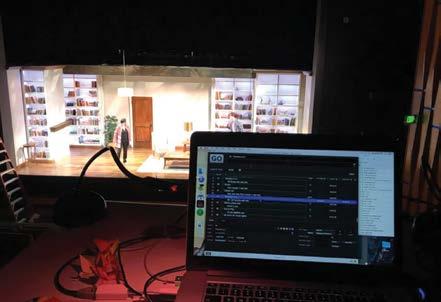
dio; she is looking for the heartbeat of the scene. “Those are the moments that interest me and I find a way to bring those moments forward in the sound design.”
During her keynote, Myers laid bare the interpersonal fortitude required to thrive without losing one’s soul. She actively dismantled the tired trope that brilliance requires being “difficult.” Her rhetoric redefines professional strength as the ability to be both excellent and empathetic. “I learned that I could be really good at what I do and also really nice,” she told the audience. This is the crucial takeaway for the next generation: kindness is not a weakness in the rehearsal room; it is a strategic asset. By choosing which battles to fight and viewing herself as a vital part of a unified team, she proved that lasting careers are built on the bedrock of community and mutual respect.
Myers is deeply candid about the hustle required to build a sustainable reputation. “A lot of the challenges I see are about the nature of the business,” she shares, “finding a way to make a living as you build your reputation and make connections.”
But the antidote to that struggle, she insists, is the community around you. “I built those relationships, I built friendships, I built a community. My community of theatre makers, of storytellers lift me up, they energize me. We support each other, we comfort each other, we learn from each other.”
Her ultimate philosophy is a beautiful, urgent reminder of why we dedicate our lives to the dark rooms of the theatre. “The best productions are when the whole team comes together and makes something unified and beautiful — something that makes the audience feel,” Myers concluded. “Never forget that you love this. Grab every opportunity that comes along to tell those stories. You won’t regret it.”
www.cricketsmyers.com
Listening to the collective wisdom of Kmiec, Adorno, Santiago, and Myers, a beautiful, grounding truth emerges. Yes, they are absolute masters of their respective crafts. But what truly makes them
A sound designer’s perspective.
exceptional is how they choose to move through the world.
They prioritize kindness over ego. They understand that making good art requires leaving space for self-doubt, remaining calm under intense pressure, and caring deeply about the environmental and emotional impact of their work. They view theatre not as an opportunity to showcase their individual genius, but as a shared space to forge community.
The 2026 SETC Design Keynotes served as a powerful reminder that the best designers are, above all else, deeply collaborative thinkers. By bringing their full, empathetic selves to the tech table, they ensure that the heartbeat of live theatre remains stronger than ever. n

EmilyMcClainleadsa2026Teachers’Instituteworkshop.

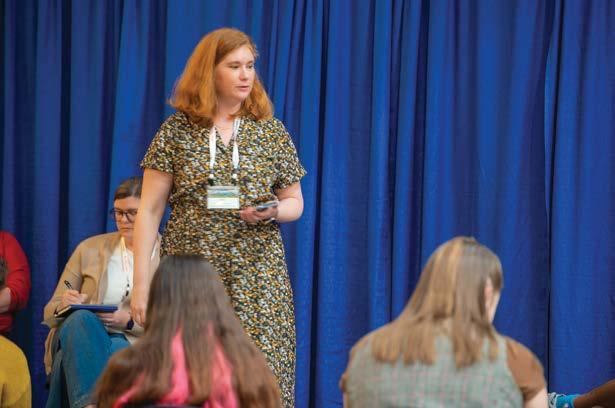
Ihn a cultural moment when both the arts and education face increasing pressures, the question of how theatre teachers can cultivate future artists while strengthening essential academic skills remains critically important. Yet these challenges also open space for innovation and renewed purpose. Playwright and educator Emily McClain explored this potential at this year’s Teachers’ Institute, a half-day professional
development program for K–12 educators offered annually at SETC’s Convention since 2006.
Emily McClain is a published playwright and theatre educator at the School of the Arts at Central Gwinnett High School. A 20-year veteran educator and recipient of SETC’s Innovative Playwriting Instruction Award, McClain brings a powerful blend of professional playwriting experience and classroom expertise. Her plays have been produced across the United States and internationally, with honors including the William Faulkner Literary Prize, the Henley Rose Prize, and the Essential Theatre New Play award (2018 & 2025). She is published through Next Stage Press and Ghostlight Publications and is an active member of the Dramatists Guild. Her keynote focused on practical tools for playwriting and contemporary storytelling, offering theatre educators three “toolboxes” of strategies: Emotive Formatting and Evocative Stage Directions, Classroom Practices to Strengthen Creative Muscles, and Utilizing New Media and Alternative Systems for Delivery. Together, her approaches are designed to help students craft original, relevant work in today’s digital world.
What follows is a conversation with McClain about her process, her philosophy as both an artist and educator, and the role theatre teachers play in shaping the next generation of storytellers.
What was your process preparing for the Teachers’ Institute? How did you decide on the “toolboxes” framework, and what were you most hoping participants took away from your facilitation?
My grandfather and my father are both craftsmen and woodworkers, so the concept of “the right tool for the right job” is something I heard a lot growing up and I really like that metaphor for creative writing because it allows for people to decide what the “right tool” looks like for their project. My job as a theatre teacher is to share a large range of tools in any area, be it acting techniques or approaches to design, or in this case, ways to create original stories for the stage. What I love about this approach to teaching theatre is that I’m instilling the core value in my students that there’s no single tool that’s going to work in every circumstance, so successful theatre makers collect all the tools they can so they can evaluate
which tools from their toolbox will work best for them this time around. I’m hoping participants at the Teachers’ Institute found the exercises useful and that they feel empowered to implement them in their classroom in a way that works for them and their students.
In the session, you talked a lot about how theatre teachers can “build a bridge” between drama and English & Language Arts (ELA) in ways that support students’ literacy and their broader success in the classroom. Can you say more about the value of arts education and its impacts on student wellbeing and success?
Throughout my time in theatre education, I have had so many students who don’t find school to be a place where they have historically felt successful. In several cases they told me, “If it wasn’t for your class, I wouldn’t even bother coming to school at all.” I’m sure most theatre teachers have had similar experiences. We’ve all seen the research that shows that students who participate in the fine arts have a lower average number of discipline infractions, more improvement in their writing test scores, and increased likelihood of college aspirations.
When our classrooms become places where students find academic success through activities like dramatic writing, we can be a part of changing the dynamic of how students see themselves in traditional academic settings and how they feel about school in general. Focusing on literacy-based skills such as how to analyze a play, identifying themes and symbolism, or understanding plot structure, are transferable skills to the ELA classroom.
Specifically with dramatic writing, students are encouraged to use the written form in a way that celebrates their unique voice, but they first must understand how to manipulate language at a certain level to do this effectively. For students that might have holes in their foundational knowledge regarding conventions of grammar or parts of speech, looking at these concepts through the lens of emotive formatting gives the information a tangible, practical purpose that helps students understand concepts in a new way.
As an instructor of theatre, how do you approach grading? Is it fair to assert that the discipline is purely subjective? Why or why not?
When our classrooms become places where students find academic success through activities like dramatic writing, we can be a part of changing the dynamic of how students see themselves in traditional academic settings and how they feel about school in general. c “ “ n
by Marlyss Stovall
Grading policy in any artistic space benefits from transparency. Students need to know what aspects of their performances are being assessed at each stage of the production process. In my performance-focused classes, I use an evolving rubric system throughout a semester with criteria that get stacked on top of existing elements. For example, in an initial performance project I might just be grading on projection and articulation but not memorization or characterization yet. As they gain proficiency, I add more categories to the rubric to help them focus on higher-level concepts of performance while still maintaining the expectation that they retain their knowledge from earlier assignments. It’s pretty standard teaching methodology to scaffold in this way, but I’m transparent with students at the beginning of each unit about which criteria are being added each time. I carry this over to the dramatic writing classroom but instead of basic acting mechanics, I start with formatting and structure for introductory assignments.
Starting from a fairly objective place (e.g. Did you distinguish spoken dialogue from stage directions in a consistent way? Did you number your pages? Does your scene have a clear beginning, middle, and end?) allows students to latch onto specific criteria they can achieve to be successful. In later writing assignments, they will have defined parameters they are working on for each writing sample. Topics like using stage directions to enhance visual aspects of the story, creating distinct character voices using emotive formatting, and working with competing character objectives in a two-person scene are all examples of higher-level criteria.
I also want to build writing stamina through consistent classroom practices, such as a daily warmup exercise that students are selected at random to share. Every student must share once within a calendar month, and
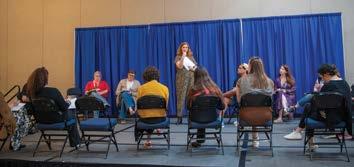
they receive a completion grade for doing so. I also make space for students to pass if their name is called, but if they haven’t shared anything by the end of the month, the assignment is marked incomplete and recorded as a zero. Students may share their actual writing sample or simply explain the approach they used to respond to the prompt. I leave it purposefully open-ended because the important learning objective in this is creating the habit of writing, not necessarily the end product.
Classroom structures like the daily writing warm up give another category that is extremely objective to provide balance to grades that are by their nature more subjective. I think the creative writing classroom could become a space where the instructor’s personal preference and bias might creep into the grading, and we must guard against that impulse as much as possible.
How do you balance your career as an educator with your professional practice as a playwright? How does your artistic experience inform how you show up in the classroom, and vice versa?
I wrote plays casually in college (shout out to Berry College class of ’05!) then I graduated and started teaching high school theatre in 2005. I didn’t start seriously writing plays until 2017. One reason for this lull in my playwriting practice was the incredibly overwhelming nature of being a theatre teacher. It is an all-encompassing job, especially early in your career, so finding the time and — more importantly! — the energy to follow a creative spark is challenging. The last thing I wanted to do after a
full day of teaching and running an after-school program was sit down at my computer and work on my writing.
It wasn’t until I found my “groove” as a teacher (and got a little better at setting work/ life boundaries for myself) that I had the urge to be creative again in that way. However, I believe directing as much as I did in those early years made me a much stronger playwright when I did eventually get back to it. I knew through my own artistic process of trial-and-error what types of plays worked for me and what questions I was interested in exploring in my writing.
I’m a better director now because of my work as a playwright as well, especially in how I communicate complex ideas to performers. So, the work I do in the professional playwriting space informs the work I do in the educational space and vice versa. They’re two equal and interconnected halves of my artistic life.
Since many teachers may be looking for additional support as they introduce playwriting into their curriculum, professional resources can make a big difference. As a member of the Dramatists Guild, which of their tools or publications do you find most helpful for theatre educators?
The “A More Inclusive Canon” list on the Educator Resources section of the Dramatists Guild website is an excellent starting point for educators that want to bring new voices into their classrooms. It has tons of suggestions of playwrights from all different backgrounds and perspectives. It’s really great and they
keep adding to it! Obviously, David LindsayAbaire’s short play “Can I Change The Words or Music?” pokes fun at theatre educators who make changes without permission, but I find it’s a great choice to use humor in this context because it helps diffuse a potentially contentious situation where theatre teachers could feel a little called out by their behaviors regarding changing work and hopefully nudge them toward more artistically ethical paths in the future so they set a better example for their students.
Can you share a program or practice that has been especially meaningful for your theatre students?
If the opportunity to produce student work exists within your school season, I strongly urge you to take advantage of that because there is something incredibly magical about the pride that comes from students seeing their writing come to life. At my school we produce a 10-Minute Play Festival every spring and
it’s an amazing opportunity for our 11th and 12th grade students. The plays are written by senior Dramatic Writing students in the fall, assigned to directing and design students in the Advanced Production class, and cast from the members of the 11th and 12th grade Acting Studio class. It allows playwriting students to have the full production experience on a manageable scale while also giving the students valuable directing, design, and performing opportunities they wouldn’t have had otherwise. It’s one of my favorite nights of the school year!
What guidance would you offer theatre teachers who are introducing playwriting into their curricula for the first time?
Start integrating playwriting in the space where you feel most comfortable as an instructor. If monologue coaching is one of your strengths, you know what makes a powerful performance piece in that arena and you can use those skills to help guide students towards
writing their own. I would also encourage teachers to create a defined goal for the playwriting activity: short scenes to share in class based on a prompt, imagining what a character they’re playing would say 10 years in the future and writing a monologue to share that, etc. Having playwriting be in service of a performance piece is a great way to start because the stakes are fairly low and the parameters are clear for the students.
Want to learn more about Emily’s work? Her plays are available on the New Play Exchange, and you can learn about her consultation, workshop, and service offerings at emilymcclainplays.com.

The Charles M. Getchell New Play Contest, dedicated to the discovery and development of worthy new plays and playwrights, is one of the flagship awards of the Southeastern Theatre Conference. In this edition of Southern Theatre, we print interviews with the award-winning playwrights from both 2025 and 2026, along with excerpts from their awardwinning plays, both selected from a field of more than 300 submissions.

Alex Dremann is a Philadelphia-based playwright with over 500 play productions around the world, including the U.S., South Korea, Australia, England and Denmark. He studied playwriting at the University of Southern California and has been a member of the playwright workshops reWrights in Los Angeles, The Group in NYC and Philadelphia Dramatists Center in Philadelphia. Full length plays include: Split Pea Pod (The Brick Playhouse), Postcoital Variations (Philadelphia Theatre Workshop), The :nv:s:ble Play (PTW, Madlab Theatre, Theatre of NOTE & Cone Man Running) and The Pear-Shaped Man Fights Crime (PlayPenn workshop reading). Evenings of his collected short plays include: Slap Happy (Madlab Theatre), B-Sides, Rarities and Unreleased Tracks (Wilmington City Theatre), Bipolar by Thursday (Theatre Neo) and 13 Lemonade Ave. (Secret Room Theatre). Published plays include On the Porch One Crisp Spring Morning in Humana Festival 2009: The Complete Plays and Great Short Comedies: Volume 4. He was a Producing Artistic Director for SKITSoid and Secret Room Theatre in Philadelphia from 2004 to 2011 and served as a nominator for the Philadelphia Barrymore Theatre Awards from 2001-2009. He is a current member of the Philadelphia Dramatists Center and the Dramatists Guild. More information about Alex’s work can be found at alexdremann.com.
CAROLINE JANE DAVIS: What first led you to consider playwriting as a professional pursuit, and how long did it take before you identified as a “playwright”? How did you know that was the path for you?
ALEX DREMANN: It was a circuitous route to get there. I wanted to be a writer since junior high, and I wrote a ton of short stories and attempted some novels before I ended up in a screenwriting class. That teacher — when I handed in my screenplay with 20-page scenes of people sitting
around talking — figured it out and sent me to a Tuesday night playwright’s group at the Brick Playhouse in Philadelphia. As soon as I heard actors reading my plays, I knew he was right. That led me to getting my master’s at USC for playwriting and I’ve been writing plays ever since.
CJD: Parts of your career led you to development spaces that no longer exist, like the Humana Festival. How has the loss of that infrastructure changed the experience of developing
new work? What are the gifts and challenges of being a playwright today?
AD: So many of the big development programs I was dying to get into have either folded or dramatically reduced their scope over the years that I’ve been writing. Those programs are just not financially viable, and theatres need established plays that will sell tickets, so they have little incentive to develop new work. I’m assuming some of this is just cyclical and things will swing back at some point. But for now, it’s up
to the playwright to find or create their own playwriting group or get their friends around a dining room table to read drafts of their plays. Zoom playwright groups are one positive thing that came out of the pandemic. It’s not nearly the same as hearing actors live in the room with you, but you can connect with writers in other time zones. Anything I can do to get the play out of my head and into the mouths of live actors is helpful in my development process.
CJD: Considering the current landscape, what advice would you give to playwrights at the early stages of their writing careers?
AD: I feel like many of the lessons I’ve learned over the years are changing, so rule #1 would be to stay flexible. I don’t know how this A.I. apocalypse is going to affect the playwriting world, but I hold on to the fact that live theatre is one of the few things A.I. can’t touch. Advice-wise, I would say something I still haven’t quite learned, and that is when a play is really not working, go work on something else for a while. Nine times out of 10, what you learned from the block on the first play will make the second play a lot better and a lot easier to write. It sounds so obvious, but I have wasted a lot of time over the years trying to write something that is just not working.
When a play is really not working, go work on something else for a while. Nine times out of 10, what you learned from the block on the first play will make the second play a lot better and a lot easier to write.
Dramatists Guild where hundreds of playwrights try to write a play during the month of April and report to the group on their progress. Three pages a day for 30 days would theoretically make a full length play by the end of the month. I wasn’t nearly that disciplined, but I did try to write every day when I participated and got maybe 30 pages total. The goal was to not overthink — not make a bunch of notes or plan anything or outline — just write the next three pages of dialogue and see where it went.
CJD: Is this approach reflective of your playwriting process overall, or does your process shift from project to project?
AD: I don’t normally work that way, but it was definitely refreshing. It was just the right play at the right time. It did sit for a while after the end of April before I figured out structurally where I wanted to go with it.
about the near-future dystopia of how happiness is commodified by big tech and how humans might navigate their emotions in that world — particularly how to process love and sadness. Helen and Phil do everything in their power to appear to be the perfectly happy couple when the reality is a whole different story.
CJD: After the reading, respondent Sheri Wilner-Deering noted her delight in the play’s humor. The work might aptly be described as a “dystopian comedy,” which is a combination of characteristics we don’t see together very often on stage. Is this combination characteristic of your writing more broadly, or did something specific about this story call for levity?
AD: There is an element of humor in everything I try to write. It doesn’t always work, but when it does, I really enjoy the juxtaposition against bigger topics. I have another play called The Cure, which is on the surface an intense drama about a mother investigating her son’s suicide, but there is lots of humor in that play and I think that’s why the play works as well as it does. For omniHappy, the world of this future dystopia is just so naturally ridiculous that it lent itself pretty easily to finding comedy in their horrifying reality.
CJD: In the Getchell response session, you mentioned that this play was born out of the Dramatists Guild’s End of Play.® initiative. Could you share a little bit about that initiative and how you engaged in that process to create omniHappy?
AD: End of Play.® is a program run by the
CJD: Without spoiling too much, because there’s a lot in omniHappy I imagine you want readers to discover on their own, I do want to set some expectations about what kind of story this is. The talkback touched on a lot of it: AI, corporate dystopia, the relationship between Helen and Phil… “post-love love” was how some respondents described it. You mentioned Gwyneth Paltrow’s famous “conscious uncoupling” as an early inspiration, and that’s part of it, but there’s so much more going on. How do you talk about this play when someone asks? What’s the heart of it for you?
AD: I do get tongue-tied when trying to elevator-pitch this play because there are so many different parts to it — but I’d say something
CJD: Looking forward, where do you hope omniHappy goes from here? What kinds of theatre companies and audiences do you hope encounter this play, and what do you hope they take away from it?
AD: I’ll make some edits based on the reading and the feedback I got at SETC and then I’ll continue to send this play out in the hopes that a theatre will eventually produce it. The goal is mid-sized theatres with audiences that are willing to experiment with new work. If it does get a full production, my dream is that audiences laugh their way through the 90 minutes but then it sparks discussions in the car ride home about how close we are actually getting to this dystopia. n
5 actors (4F, 1M) playing 7 characters
HELEN: Female, 30s. Scientist at the University of Pennsylvania. Tendency for anxiety. Married to Phil. Perhaps loves her work more than Phil.
PHIL: Male, 30s. Too empathetic. Married to Helen. In love with Darcy.
DARCY: Female, 30s-40s. Helen’s boss at Penn. Lots of hidden ambition.
MRS. FLANAGAN: Female, 50s+. Cranky, off-stage voice only.
OMNI: Female, ageless. All-knowing big data with predictive A.I. powers. Disembodied voice only.
RIGHT TWIN: Female, any age. Ensures societal happiness at all costs. Polar physical opposite of Left Twin. (Played by the same actor playing Omni.)
LEFT TWIN: Female, any age. Secretly thinks unhappiness can be healthy. Polar physical opposite of Right Twin. (Played by the same actor playing Mrs. Flanagan.)
The first floor of Helen and Phil’s tiny Trinity on a narrow cobblestone street in Philadelphia. The living room and part of the kitchen are visible. A window and a door face the street. A tight spiral staircase goes up to the second floor with a door next to it that opens to more stairs spiraling down into the basement. There is an awesome couch, lots of plants, and antique rugs on original hardwood floors and built-in bookshelves around a tiny fireplace. There are hooks on the wall near the door to hang coats and a spot underneath where they leave their shoes (this is a no-shoes household). Everything is cozy, charmingly-cluttered and lived-in.
Note
A Philadelphia Trinity is a very small 18th or 19th century townhouse with three oneroom floors of less than 400 square feet each, vertically stacked and connected by a
compact spiral staircase.
Time
The very near future.
Synopsis
Helen and Phil are living in a pristine near-future dystopian Philadelphia where mega tech company Omni controls everything about their lives and their data. Omni’s only goal is to keep its customers happy and spending money. If a customer becomes unhappy, Omni tasks the person causing the unhappiness with killing (or “churning”) the unhappy customer. Today’s the day Omni detects Phil has become unhappy, so Helen is tasked with churning her husband… which makes her unhappy. But Helen is a neuroscientist at the University of Pennsylvania and has been working on a research project that might save both their lives — and doom all of humanity to omniHappiness.
Alex Dremann
alexdremann@icloud.com newplayexchange.org/users/1498/ alex-dremann
Excerpt
DARCY has just walked with HELEN home from work and they are mid-conversation by the front door, both genuinely happy. HELEN places her phone and keys are on the small table by the door and takes off her coat and shoes during the following.
DARCY: Come on, we should celebrate.
HELEN: Don’t jinx it.
DARCY: What’s to jinx? You did it.
HELEN: Almost, almost did it.
DARCY: (to the voice assistant) Hey Omni, what is the current serotonin level of the third rat in Alzheimer’s-Muon Study number 7-1-7 at the University of Pennsylvania Neurochemistry Lab?
OMNI: (voice assistant) The third rat in Alzheimer’s-Muon Study Number 7-1-7 is holding steady at 337 nanograms per milliliter.
DARCY: See? Muons. Who would have thought?
HELEN: Promising, but not a cure.
DARCY: Come on. One drink.
HELEN: No, can’t. Phil’s on his way home and it’s my night to cook. Plus I’m starving.
DARCY: Because you skipped lunch.
HELEN: I did?
DARCY: In the zone, scribbling in that notebook all day. On paper. So retro.
HELEN: It helps me think, map it all out.
DARCY: If this works, someday that notebook will be on display in a museum.
HELEN’s phone chirps with a text notification, but DARCY, standing next to the table, is the first to see it.
DARCY: (hint of alarm) Oh. (smiles) Not sure I was supposed to see this.
DARCY hands the phone to HELEN who momentarily blanches when she sees the text, but recovers quickly. The happiness is fake now, but almost completely convincing.
HELEN: OK. Slight change of plans, re: my evening, re: dinner.
DARCY: Unfortunate. I know you love him.
HELEN: Well, he is my husband.
DARCY: I can help. I guess should help.
HELEN: I never thought he’d— (smiles) Onward. I need a plan. (Checking her omniWatch) Phil takes the 4:39 every day.
DARCY: And today is an every day. Which gets him to omniJefferson Station at—?
HELEN: Two minutes ago. He’ll stop for a sour cream donut at omniReading Terminal.
DARCY: Then he’ll walk down 11th Street, and cut over, which gets him here at, what, 5:43. We’ve got about six minutes.
HELEN: Mrs. Flanagan will grab his elbow and give him the gout update, as per.
DARCY: Ah, I forgot about Mrs. Gout and her lawn chair.
HELEN: Mr. Flanagan won’t let her smoke in the house.
HELEN opens the window and yells out.
HELEN: Mrs. Flanagan?
MRS. FLANAGAN: Fuck you, Helen!
HELEN: Do not talk to Phil about your gout!
MRS. FLANAGAN: No!
HELEN: He does not care.
MRS. FLANAGAN: I don’t care!
HELEN: I’m going to push you out of that lawn chair.
MRS. FLANAGAN: Good!
HELEN: I need him home and I don’t want you flapping that gouty jaw at him all night.
MRS. FLANAGAN: I’ll flap whatever I want at whoever I want whenever I want. Shut your fucking window!
HELEN: Shut your fucking window!
MRS. FLANAGAN: I’m OUTSIDE!
HELEN shuts the fucking window.
HELEN: Can I kill her?
DARCY: Absolutely, but after you kill Phil.
HELEN: So how am I going to do it? Gun? Poison? A log?
DARCY: A log?
HELEN: From the fireplace.
DARCY: That doesn’t sound very efficient.
HELEN: I thought you wanted to help.
DARCY: Don’t hit him with a log.
HELEN: I can’t think.
DARCY: Maybe get some Thai food?
HELEN: For dinner? Nah, too much with the peanuts.
DARCY: There’s a new Thai place on Spruce.
HELEN: Fine, but still, I need a plan.
DARCY: The plan is Thai.
HELEN: I mean the murder. The body. The plan.
DARCY: Just make it look like an accident.
HELEN: Peanuts!
DARCY: Just now she gets it. Though technically your idea.
HELEN: Phil is allergic to peanuts.
DARCY: Yes. People allergic to peanuts are very easy to kill.
HELEN: He’s really allergic. Why are so many people suddenly allergic to peanuts?
DARCY: It’s the fluoro-plastic micro-particles in everything. Breaking down our
cellular structures. Our bronchi.
HELEN: I don’t think that’s it.
DARCY: It’s as good a theory as any.
HELEN: Is it really?
DARCY: It’s 5:37.
HELEN: Right. Good. (beat) I usually cook on Tuesdays.
DARCY: And, what?
HELEN: And it’s Tuesday. I do Tuesday, Thursday. Phil does Monday, Wednesday. We take-out or go-out on the weekends. All very equitable. Phil will know something is afoot.
DARCY: So don’t feel like it, then tell him you don’t feel like it, then order the peanutty Thai.
HELEN: I need a menu.
DARCY: There’s probably one on your door knob. (HELEN opens the door. There is indeed a menu attached to the doorknob.)
HELEN: Right. Because of course.
DARCY: Wait. Better Phil brings it in.
HELEN: Fingerprints and all that.
DARCY: Exactly.
HELEN shuts the door.
HELEN: He’s probably allergic to the menu.
DARCY: …
HELEN: Because it was in the same room as the satay.
DARCY: Yeah, I get it, it’s just stupid.
HELEN: I’m curious what percentage of people in Thailand are allergic to peanuts compared to the U.S.
DARCY: I’m not.
HELEN: With no basis in fact, I would postulate less.
DARCY: I read somewhere we’re two percent plastic already. At some point the body is going to adapt and humans will be like biologically plastic.
HELEN: That doesn’t make any sense.
DARCY: I should go.
HELEN: He’s not going to be here for another four minutes.
DARCY: I don’t want to see him on Camac. Or at all.
HELEN: Who’s he going to tell if he’s dead?
DARCY: If you fail.
HELEN: I don’t fail. I can’t fail.
OMNI: You won’t fail. n

Interview by Amy Cuomo
Emmy Award winning producer, writer, and director Douglas Chang has worked in public television, film, music video and the performing arts. He produced Live from Lincoln Center for nearly a decade, earning a Primetime Emmy for Sweeney Todd: The Demon Barber of Fleet Street — In Concert with the New York Philharmonic; his production of Rodgers & Hammerstein’s Carousel received a nomination as well. Chang also wrote and directed the films Absent Father and Pile On!
Douglas Chang is also a playwright. Descriptions of his plays can be found on the National New Play Network (NPX). His drama Minor Bird won the 2025 Charles M. Getchell New Play Award and received a reading at last year’s Southeastern Theatre Conference Convention. In February, University of West Georgia’s theatre playwriting professor, Amy Cuomo, sat down with Chang to discuss his work.
AMY CUOMO: As an Emmy award-winning television producer and filmmaker, you’re fluent in storytelling on the screen. What compels you to write for the stage?
DOUGLAS CHANG: Well, I always wanted to write for the stage, ever since I was a kid. My parents took me to see shows on Broadway. I got to see people like Rex Harrison, Julie Harris, and Yul Brenner in the revival of The King and I. They were incredible legends. It was an exciting time in theatre. I caught the bug. My family didn’t have an arts background, so there wasn’t much of a road map for me to figure out what I was going to do with my life. I vaguely had this idea that I would love to write for the theatre. I started writing little things in the theatre grad program at NYU. At the time, all the screenwriters wanted to write for Steven Spielberg and all the theatre writers wanted to write like Sam Shepard, but even though I like and respect both of them, that wasn’t exactly what I wanted to do. And so, I politely got kicked out and ended up in the cinema studies program and started working on films and TV. After a very, very long winding road, I ended up working with theatre people at my job at Live from Lincoln Center. And I said, “You know what? I should start writing again.” I put together this play, and then the pandemic hit, and I ended up writing seven plays. There was nothing else for us to do. So that’s what I’ve been doing.
AC: You’ve started to answer my next question, which is how has your work with major theatrical figures like James Lapine and Dominique Morisseau influenced your writing?
DC: I’m not sure if I could qualify or quantify how it happens, but you can find hints of my responses to their work in my own. Working with James Lapine was particularly fun, because James being James — he would sneak into the editing room to make sure that he got his vision correct. I got to learn an awful lot about the process of storytelling for the stage. It was a unique and strange opportunity to float between the two worlds of television and film.
AC: I read that Minor Bird was inspired by the controversy surrounding the release of Harper Lee’s Go Set A Watchman. What did you find so compelling about that cultural moment that you wrote a play about it?
DC: I fell into it, because, like so many people, when Go Set a Watchman first came out, there was a lot of reporting about it that wasn’t [very positive]. There were all sorts of rumors being thrown around questioning whether Lee really wanted the book published, whether she was being taken advantage of, whether it was really the book that she would have written. I originally avoided the novel because I wanted to preserve my love of To Kill a Mockingbird
Then I started reading the reviews a little more closely, and I started realizing, they’re not really talking about the book here. They’re talking about Atticus Finch. And they almost seem personally offended at the way he was being portrayed. I started digging deeper, and it emerged that this was actually not a sequel, but the original book. And then you have to ask, “Why did she deviate from that story to the one that she eventually came out with? What’s in that original story that got passed over for the final work?”
I also felt a certain connection with Harper Lee in the sense that I’m first generation Chinese American growing up in the ’60s and ’70s. I felt very connected to the Civil Rights movement, and at the same time, I got this feeling that I was tangential to the whole thing. I suspect Harper Lee was also feeling a little outside the story. This position made me try to figure out what she was trying to say about civil rights. The very complex view that she was trying to represent in Go Set a Watchman was really about her own upbringing, and her own very interesting place in that historic world. I felt a sympathy with her viewpoint. You can be supportive and still be an outsider in the whole thing. That’s part of what I’m trying to get at in the play.
AC: When I was reading the play, it seemed like your depiction of the South was very much in line with Harper Lee’s depiction of the South, which
brings me to the question, is this Harper Lee’s vision of the Southern U.S. or yours?
DC: I think a little of both. I have spent a fair amount of time in the South, just traveling around. My sense of Harper Lee’s experience of the South was an important part of how I thought about the whole region. Whether or not it was a true picture, it was a picture that was burned into my brain. The play is really about how people see each other and a very large piece of the play is about how our pictures of different regions, like the South, get distorted and simplified for our own uses. If you’re coming from the New York publishing world at that time when To Kill a Mockingbird is being written, they needed to see the South in a certain way. That vision was something that came out of more of their own need to create a mythology that made sense to them rather than to really figure out what is going on there.
AC: In addition to Minor Bird, you’ve written several other plays, and they’re all different genres: comedy, tragedy, and mystery. Do you have a different process for each play, or do you have a standard process you use when you write?
DC: That’s a good question. I have a process where each play complements the previous plays. Each play is a little different and the process changes with each play. The thing that I’ve discovered over time is that I start to write without really knowing quite where I’m going with it. There’s some idea that hooks me. I don’t do outlines; I let it form as it goes along, but it is not until I find the structural dimension, some motif that I discover that is specific to the play, before I know how the story’s told.
With Minor Bird it was the conception of masks that I stole from Eugene O’Neill. But each play only fully forms in my head when I land upon that stylistic device.
AC: I think sitting down to write without an outline is brave. Very brave.
DC: It gestates, and as you go further you start to see the outlines, and the outlines become stronger and stronger as you go along. By the end of it, you know, maybe not exactly where you’re going, but you feel a very strong momentum that pulls you along and you see the things coming together and falling apart in a way that you hadn’t originally conceived. This may be a cliche, but I always feel like I discover something that I had no idea the work was about very late into the writing of the play.
With Minor Bird, it was especially true because I had started the play about six months before the pandemic hit. I had just finished the first act. I like to write by hand, in notebooks. It makes me feel more connected to the words. I was rushing out to drop my son off at a Taekwondo test, and we left my bag in the cab. I never got it back. So, I lost the entire first act, and I had to start writing again. I spent about a week hoping that it would show up and that some good-natured person would call me. It never happened. Then I said, “You know, this will be a good test of whether you should be writing plays. Let’s start again.” Starting again from that point made the focus a lot stronger. The second time around things came together. I hadn’t conceived of the idea of bringing some of the characters back in a masked form until after I hit the second act.
AC: When you’re reading the play, and the masked
Cast of Characters:
LETITIA, a lawyer, black, mid- to late-40s. LUCY, her daughter, 15.
MAGGIE, executor of the Birdsell Trust, white, late-50s.
BELINDA, her daughter, mid-30s.
CHARLOTTE, a.k.a., Leigh Birdsell, Maggie’s aunt, white, 89.
DAVÓNE, 19 years old, black. PERKINS, a police officer, 40s.
Setting
A house in a suburb of Alabama.
Time
Late summer, not so long ago.
character appears, it’s very much a surprise. Winning the Getchell Award is a milestone. How might that recognition shape the next stages of the play’s life?
DC: Well, I’m hoping that someone will be interested in giving it a full production. I would really love to see the play premiere somewhere in the South and having that recognition from the SETC was a huge affirmation that I was on the right track with the play, and that it was touching the right notes; touching all the subjects that are so important to me. I’m still hoping that we can find a great producer to throw it on stage and see what happens. Despite the fact the Charlotte character is very much at its center, it is an ensemble piece. Being somebody who works in the visual media, TV, and broadcasting, I would love to be able to film it. My hope is more people get to see it, and it starts a conversation.
AC: This article will be read by playwrights and playwriting teachers and aspiring artists. Any words of wisdom as they try to hone their craft?
DC: My biggest advice, and I try to do this with whatever I do, whether it’s supervising people as a producer, or being a lonely writer, is always — and this is what I learned from very hard experiences — know yourself and be confident in your vision. I was way too timid when I was younger, and I shouldn’t have been. Thinking back to my experience at NYU, if I had an inkling about where I wanted to go with my writing, I probably would have gotten there a lot faster. But at the same time, all the experiences, plus and minus, all end up in your work and become part of you. And you should never throw anything out. n
Synopsis
Charlotte is the author of a celebrated novel set in the Deep South, fictionally recalling her father’s heroic efforts to harbor a black man unjustly accused of a crime. Now in her 80s, she shoots and kills a black teen who has trespassed on her property. When Letitia, an AfricanAmerican lawyer from New York, comes down to assist in the case, and the boy’s uncle Davóne, who is barely older than the victim himself, seeks to confront the old recluse and get “satisfaction”
— whatever that means — Charlotte’s life story unravels, leading to explosive encounters with Davóne, her relatives, and ghosts of her past.
For Production
Scrap Metal Media scrapmetalmedia@outlook.com (301) 906-0943
Excerpt
Parlour, end of Act I. Letitia has arranged for Davóne to meet Charlotte, the celebrated Southern writer who shot and killed his nephew. But he and Letitia’s daughter Lucy go off exploring the house on their own, prompting her relatives to call the police.
DAVÓNE: Man, you called the cops on me?
LETITIA: Get over here!
(Wraps LUCY in a protective hug. To DAVÓNE:) What the hell were the two of you thinking? Haven’t we seen enough accidents around here?
MAGGIE: Don’t talk about us like we’s a bunch of barbarians. Aren’t you the ones who keep tramping over our property like it was a playground?
LETITIA: You’d better leave — before the police come.
DAVÓNE wavers, glancing at LUCY for direction.
LUCY: Go!
He makes a dash for the door.
LETITIA: Walk! Don’t run.
DAVÓNE slows his pace to a stiff, brisk walk, then turns.
DAVÓNE: You call it an accident?
He disappears behind the wall. LUCY makes a move to follow him out.
LETITIA: No, Lucy. You stay right where you are.
The DOOR slams. They all freeze, momentarily at a loss. Only the MYNAH BIRD continues screeching at the top of its lungs. Finally, MAGGIE breaks the spell.
MAGGIE: Now do you see, dear, why it was a bad idea?
LETITIA: (Looking out the window.) The police have arrived.
MAGGIE: I’m sorry we had to do that, I truly am. But we can’t be sure of his intentions.
BELINDA: What were his intentions?
LUCY: We wanted to see the bird.
BELINDA: Jesus! You almost give us a heart attack!
A furious KNOCKING on the front door.
PERKINS: (O.S.) Charlotte! Maggie! Y’all okay in there?
MAGGIE: Let him in. Yes, we’re fine now, Eugene. False alarm I’m afraid.
(As BELINDA heads into the hallway, CHARLOTTE, O.S., lets out a blood-curdling scream from the kitchen.)
Oh, dear Lord, what now?
CHARLOTTE: (O.S.) You stay away from me, you hear? Go away!
PERKINS rushes in, gun drawn, followed by BELINDA. The MYNAH BIRD shrieks O.S.)
PERKINS: What’s happening? What’s the situation?
CHARLOTTE: (O.S.) Leave me alone! Keep him — Keep him away!
PERKINS: (Racing toward the kitchen.) He might have snuck in the back way.
MAGGIE: Come on, Bee.
PERKINS: You best stay here, Maggie.
MAGGIE: No, sir. I’m going in. Thinks he can scare me in my own home?
Chases after PERKINS behind the wall. BELINDA stays behind. LETITIA eyes her with apprehension.
LETITIA: It couldn’t have been him.
BELINDA: It wasn’t. Charlotte’s always seeing things. It ain’t just black people. I suspect they come in every color. That kid was just unlucky to be real.
Picks up the manuscript and offers it to LETITIA. Take it. I mean, give it back when you’re done with it, but — Come on! Take it! It’s not doing anything but feeding the mold spores here.
LETITIA stuffs the manuscript awkwardly into her purse. Careful!
LETITIA: Won’t she miss it?
BELINDA: Maggie don’t give a damn excepting she don’t know what’s in it. That’s what she’s afraid of.
LETITIA: Tell them we had to leave. Tell them — tell them I went looking for the boy — trying to get him to listen to reason, or whatever. I’ll be back in touch once I’ve had it out with him. What he did wasn’t right…
BELINDA: But it wasn’t the worst thing either.
LETITIA: Agreed. Come on, Lucy. She heads for the door. LUCY follows, stealing a last glance at BELINDA as she goes. The door is heard closing. BELINDA collapses into one of the chairs and sighs. She picks up LETITIA’s coffee cup and gives its contents a swirl. The MYNAH BIRD is still whistling O.S.
BELINDA: Not even a thank you. That’s northern etiquette for you.
She digs into her pocket, pulls out a cigarette, then stuffs it back into her pocket when she hears the others returning.
PERKINS: I don’t know, Maggie. I think we had better take a conservative approach with regard to this incident. Fact is he didn’t cause any harm now, did he?
MAGGIE wheels CHARLOTTE in on the wheelchair. CHARLOTTE appears spent but is otherwise alert.
MAGGIE: No harm? What about Charlotte?
PERKINS: She says it wasn’t him and I believe her.
MAGGIE: She doesn’t even know what he looks like.
PERKINS: She knows what color he is. I’d rather see this whole incident pass without comment. If I tried to arrest him, you’d have the whole south side of town camped out on your front lawn.
MAGGIE: Charlotte, tell me the truth. Did that boy try to threaten you?
CHARLOTTE: Yes.
MAGGIE: You see, Eugene?
CHARLOTTE: He came into the yard with a can of spray paint and I shot him. It was all I could do.
Suddenly shouts at the top of her lungs. Why’d he have to be so God damn perfect?
MYNAH BIRD shrieks like a banshee, O.S.
PERKINS: What she just say?
BELINDA: Aw, don’t listen to her. She’s just babbling again.
MYNAH BIRD: (O.S.) Catch a [expletive] by the toe! Catch a [expletive] by the toe!
MAGGIE: Oh, dear Lord, will that bird ever stop mouthing its obscenities?
CHARLOTTE: I know how to make it stop. All eyes are turned toward her now. You just throw a curtain over her cage. CURTAIN. END OF ACT I. n
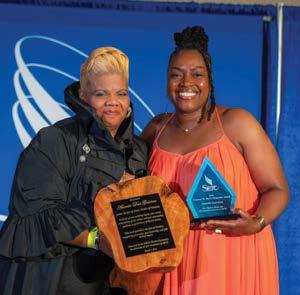
The Suzanne M. Davis Memorial Award was created in memory of Suzie Davis, wife of Harry Davis, one of the founders of SETC and its 10th president. The award recognizes an individual who, over an extended number of years, has been outstanding in service to SETC. It is the highest award that SETC can bestow upon one of its own members.
This year’s Suzanne M. Davis Memorial Award was presented to Annette Grevious. Annette has been a Professor of Speech and Drama and Theatre Program Coordinator at Claflin University in Orangeburg, South Carolina, for nearly 24 years. She received her Master of Fine Arts in theatre performance from the University of Louisville, a Bachelor of Arts in theatre from Brenau University, and an Associate of Arts in speech and drama from Gainesville College. Her research interests include Black Theatre as well as the similarities and differences among students at HBCUs and PWIs as it relates to perception and the study of acting techniques. She is working on a commissioned project to educate and uplift the service of African American patriots from South Carolina who served in the American Revolutionary War. The project is funded by the SC250 Commission.
The award was presented by Ursula Robinson. n
Nick Trusty is the 2026 Graduate Student recipient of the Young Scholars Award. Nick received a dual Bachelor of Arts degree in theatre and psychology from James Madison University and is currently pursuing a combined Master of Letters/Master of Fine Arts degree in Shakespeare and Performance at Mary Baldwin University.
It is easy to consider the environmental concerns of our present day to be the result of industrialization and incredible technological advancements. As the planet warms and the Anthropocene becomes clearly defined, environmental degradation feels like a contemporary issue. Even still, much before the industrial revolution of the eighteenth-century, those in sixteenth and seventeenth-century England got the first taste of ecological problems we now feel today. Indeed, the ecological attitudes expressed in the texts of Shakespeare and his contemporaries are contemporary to us today. The purpose of this paper is twofold: to demonstrate that early modern plays have a great deal to say about the relationship between people and their environments and that we can hear and heed these works in our modern context with little to no translation. In this paper, I examine animal commodification, deforestation, war’s destruction of environments, and more in five early modern texts. n

101+ Tips and Tricks Every Prop Maker Should Know
by Ben Hohman
Focal Press, 2024; ISBN: 978-10324-70085 194 pages. Price $48.99 (paperback)
Ben Hohman’s 101+ Tips and Tricks Every Prop Maker Should Know promises to serve anyone who might pass through a prop shop, from novices to seasoned professionals, and it delivers. As someone who has spent parts of 25 years in various theatrical shops, I wasn’t sure what new insights I’d find. Turns out, I found quite a lot. This book is well organized and not overly technical, making it approachable and practical. In a department where the workload can feel overwhelming, having a few clever strategies at your disposal quickly is invaluable.
Given Hohman’s role as Properties Director at the Utah Shakespeare Festival, I expected many tips and tricks to rely on resources available only to large companies. While some do, the majority are universally applicable and easy to integrate into any prop workflow. Whether you’re working in a professional shop or a classroom setting, these ideas can save time, reduce stress, and spark creativity.
The book’s structure groups related tips and tricks into chapters, making navigation intuitive. One standout is chapter two, “Prop Math,” where Hohman transforms dreaded middle school algebra word problems into practical, prop-focused examples, calculating chair heights from research photos or determining fabric yardage for box pleats. For someone who has never had
Mental Wellness & the Artist by
Book Review by
Jonathan Mathias Lassiter, PhD
Seamus M. Bourne

a strong grasp of algebra, this chapter was a revelation. Suddenly, those word problems that once caused headaches become tools for precision and efficiency.
Another highlight is “Prop Reference.” Hohman opens with, “One of the most fascinating things about props is the research” (107). This section is a treasure trove of information, guiding readers through potential rabbit holes — from cask terminologies to beer glass shapes, wine bottle specifics, and Emily Post-like table settings. Hohman has done the legwork and presents it all in a concise, accessible format that makes research both efficient and enjoyable. For anyone who has ever lost hours chasing down obscure details on newspaper paper and print sizes, this chapter is invaluable.
Hohman has been in the prop business for over 30 years, and his experience shines through in chapter ten, “Prop Perspectives.” This section focuses on “soft skills.” He reminds us, “It’s not rocket science, and we are not curing cancer. That being said, we are doing important work. The ability for people to come to the theatre or other places where live art is performed creates a special bond that is hard to describe” (141). Tips here range from encouraging experimentation to committing to lifelong learning, because at the end of the day, we’re all storytellers. And when things get cut, as they inevitably do, remember it’s not personal.
If there’s one improvement I’d hope for in a future edition, it would be color photos, especially in chapter five, “Paint and Finishing.” The written guidance here is excellent, and while there are black and white images, color pictures would be far more informative. Visual learners, in particular, would benefit from seeing the nuances of aging and distressing that blackand-white photos can’t fully convey.
Overall, 101+ Tips and Tricks Every Prop Maker Should Know is more than a collection of helpful hints — it’s a toolkit for efficiency, creativity, and confidence in the art of prop making. Whether you’re a student just stepping into the shop or a veteran looking for fresh ideas, Hohman’s book earns a permanent spot on your shelf. It’s the kind of resource you’ll return to, not just for solutions, but for inspiration. n