SPECIAL NCOT EDITION 2026
NEWS
Newsletter of SETC on National Conference on Outdoor Theatre
CONTENTS Thoughts from the President’s Desk Page 1
Dracula in Review Page 3
Rooted in Place Page 5
Job Listings & More Page 12
What If Theater Became Indispensable? Page 13
2026 NCOT Awards Recipients Page 17
Something Entertaining to Cook Page 19
www.setc.org
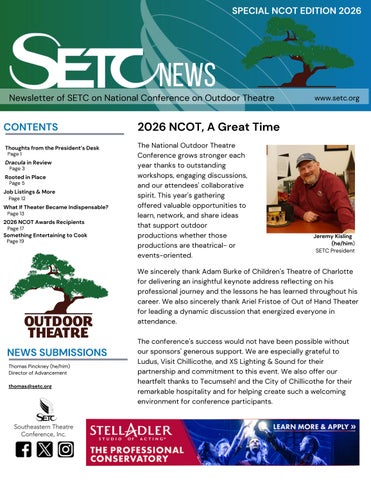
2026 NCOT, A Great Time The National Outdoor Theatre Conference grows stronger each year thanks to outstanding workshops, engaging discussions, and our attendees' collaborative spirit. This year's gathering offered valuable opportunities to learn, network, and share ideas that support outdoor productions whether those productions are theatrical- or events-oriented.
Jeremy Kisling (he/him) SETC President
We sincerely thank Adam Burke of Children's Theatre of Charlotte for delivering an insightful keynote address reflecting on his professional journey and the lessons he has learned throughout his career. We also sincerely thank Ariel Fristoe of Out of Hand Theater for leading a dynamic discussion that energized everyone in attendance.
NEWS SUBMISSIONS Thomas Pinckney (he/him) Director of Advancement thomas@setc.org
The conference's success would not have been possible without our sponsors' generous support. We are especially grateful to Ludus, Visit Chillicothe, and XS Lighting & Sound for their partnership and commitment to this event. We also offer our heartfelt thanks to Tecumseh! and the City of Chillicothe for their remarkable hospitality and for helping create such a welcoming environment for conference participants.
SPECIAL NCOT EDITION 2026
NEWS
Connecting You to Opportunities in Theatre Nationwide
Central Office SETC 717 Green Valley Road Suite 200, Office 244 Greensboro, North Carolina 27408 336 265 7489 info@setc.org
Executive Committee Jeremy Kisling (he/him) President Ginger Poole Avis (she/her) VP of Finance & Advancement Ian Andersen (he/him) VP of States Jack Benjamin (he/him) Elected Past President c.j (they/them) VP of Opportunity & Access Caroline Jane Davis (she/her) Secretary Iris Goode-Middleton (she/her) VP of Communications Matthew Leckenbusch (he/him) VP of Programming Darren Michael (he/him) VP of Festivals Lily Vetter (she/her) VP of Engagement
continued from the previous page continued continuedfrom from the the previous previous page page
As we look ahead, our vision for the National Outdoor Theatre Conference continues to expand. We are committed to creating a forum where entertainment professionals can exchange ideas, build meaningful connections, and explore innovative approaches to producing live performance in outdoor spaces. Whether your organization operates in a permanent outdoor venue, presents site-specific work, or explores opportunities beyond traditional theatre walls, we hope this and future conferences will continue to serve as a valuable resource and gathering place for our field. We look forward to next year as we head west to the beautiful Tuacahn Center for the Arts in Utah. We hope you will join us as we continue building a vibrant national community dedicated to the art of outdoor performance. Together, we can learn from one another, celebrate our unique traditions, and explore new ways to engage audiences through the power of live theatre outdoors.
ADVERTISE with us! SETC offers several affordable ways to put your program in front of a broad audience. Email us for more information.
Send your news to Thomas Pinckney Director of Advancement thomas@setc.org.
www.setc.org
SPECIAL NCOT EDITION 2026
2
SPECIAL NCOT EDITION 2026
NEWS
Dracula Under the Stars: A Frightfully Good Time in Chillicothe! What better way to spend an October evening than with Dracula, a haunted trail, and a few unexpected screams? During the 2026 National Convention on Outdoor Theatre (NCOT) in Chillicothe, Ohio, attendees experienced The Immortal Dracula, an original production written by local playwright and performer Caleb Dean Johnson, presented at the Tecumseh Outdoor Drama & Concert Venue.
Beth Watkins Brown (she/her) SETC Producer & Director of Festivals and Special Events
This 60-minute, no-intermission performance brought gothic storytelling to life beneath the evening sky. Cory Fitzsimmons commanded the stage as Dracula, joined by Robert Neal as Van Helsing, Caleb Dean Johnson as Quincy Morris, and a spirited ensemble that made the experience tantalizingly theatrical. The cast's energy, strong character work, and impressive use of the expansive outdoor stage kept audiences engaged as the story unfolded. As darkness settled over the amphitheater, the combination of dramatic lighting, captivating performances, and the surrounding landscape transformed the stage into a world of gothic mystery. The atmosphere was perfectly suited for a night with Dracula, but the adventure was far from over! continued on next page
www.setc.org
SPECIAL NCOT EDITION 2026
3
SPECIAL NCOT EDITION 2026
NEWS
Connecting You to Opportunities in Theatre Nationwide
Following the performance, attendees ventured into Haunted Mountain, where eerie encounters, unexpected surprises, and a few well-timed scares brought plenty of screams and laughter. The haunted trail struck a delightful balance between spooky and entertaining, making it just as much fun as it was frightening.
Central Office SETC 717 Green Valley Road Suite 200, Office 244 Greensboro, North Carolina 27408 336 265 7489 info@setc.org
Central Office Team Joanna Sheehan Bell (she/her) Executive Director
Maegan McNerney Azar (she/her) Staff Board Liaison Nikki Baldwin (she/her) Digital Operations Specialist
Beth Watkins Brown (she/her) Producer and Director of SETC Festivals and Special Events
continued from the previous page
Cory Fitzsimmons in The Immortal Dracula
Together, The Immortal Dracula and Haunted Mountain delivered an evening filled with theatrical thrills, memorable performances, and a little mischievous fun. It was a wonderful reminder that outdoor theatre doesn't just tell a story. Sometimes, it invites you to step right into one! After all, what's October without a little theatrical fright?
Marci Duncan (she/her) Director of Auditions
Sharell Luckett, PHD (she/her) Editor-in-Chief, Southern Theatre Magazine
Thomas Pinckney(he/him) Director of Advancement
Rachel Zwerver (she/her) Operations & Communications Coordinator
ADVERTISE with us!
The Cast of The Immortal Dracula, at NCOT host Tecumsah!
SETC offers several affordable ways to put your program in front of a broad audience. Email us for more information.
Send your news to Thomas Pinckney Director of Advancement thomas@setc.org.
www.setc.org
SPECIAL NCOT EDITION 2026
4
SPECIAL NCOT EDITION 2026
NEWS
continued from the previous page
Rooted in Place, Reaching Forward As artists, leaders, and lovers of live performance, we often find ourselves grappling with a fundamental question: Why do we do what we do? In an era dominated by instantaneous digital content, streaming platforms, and virtual experiences, why do we continue to champion the act of gathering in a physical space? The answer lies at the core of human connection, a truth that outdoor drama and regional theatre have embodied for generations.
Adam Burke (he/him) Artistic Director at The Children's Theatre of Charlotte
Lessons from the Open Air My first professional acting job was at the outdoor drama Tecumseh. It was grueling, magical and unforgettable. Boy, I was so proud to be making $91 a week as a “frontiersman/soldier” and at the age of 18, I was convinced I had made it! At least until I got poison ivy. That summer I learned how to ride and care for a horse, how to march in formation as a soldier, how to perform stunts like the highfall, and which little green leaves I shouldn’t touch. It was a fantastic first theatre job.
The SETC Annual Convention Outdoor Theatre Panel has been scheduled for Wednesday, March 3, 2027 at 6:30PM.
www.setc.org
I had no idea at the time how profoundly that experience would shape my understanding of what theatre could be.
continued on next page
SPECIAL NCOT EDITION 2026
5
SPECIAL NCOT EDITION 2026
NEWS Since then, my career has taken me through outdoor drama, Western-themed entertainment parks, haunted houses, various regional theatres, and eventually to my current role as artistic director of Children's Theatre of Charlotte. Each of those experiences taught me something about the business of theatre, but they also taught me something more fundamental: we aren't simply selling tickets. We are creating experiences. And increasingly, I believe that distinction matters now more than ever.
The Importance of Place Outdoor drama has a unique relationship with its surroundings. The landscape is not simply a backdrop. It is part of the storytelling. At Tecumseh, the Ohio Valley is inseparable from the story being told. At Unto These Hills, the mountains of Cherokee, North Carolina, provide a living connection to the history and culture of the Eastern Cherokee. At The Lost Colony, Roanoke Island becomes part of an experience rooted in the history of the first English attempt at colonization in America. Each of these environments contributes to the transformational experience. This reality became even clearer to me as a parent. Visiting the North Carolina Renaissance Festival with my children, I watched my oldest son absorb the sensory magic of the environment: the costumes, the atmosphere, the community gathering. Years later, for his 16th birthday, he didn't ask for a gadget or a party at home; he asked to return to the festival with his friends. Today, as a college student, it remains a seasonal tradition that brings him back home. He returns to experience something in person, fully present, shared with people he cares about. Think about that for a moment. An experience created years ago has become an enduring tradition, something that connects people across generations and gives them a reason to gather in person. That is the power of place. For me, being rooted in place means having a deep, meaningful connection to a physical location, a community, or an environment. It means stability, tradition, belonging, and local relevance. It also means understanding that the relationship between a performance and its audience extends well beyond the time spent watching the show. continued on next page
www.setc.org
SPECIAL NCOT EDITION 2026
6
SPECIAL NCOT EDITION 2026
NEWS
When I returned to Tecumseh fifteen years after my first summer there, this time as the director, I was struck by how emotionally connected I remained to the place. The trees, the buildings, even the smells brought back memories I hadn't realized I had retained. I remembered a hike I had taken during my first summer, years earlier, with a longtime actor in the company, someone who seemed to serve as a caretaker of the place and its stories. During that walk, this actor, Raymond Speakman, brought us to an enormous, ancient tree. We stopped and he put his hand on the tree. He told us the tree was so old that it had likely been there during the time of the play and that it was entirely possible that Tecumseh and Simon Kenton had sat under that tree. And it was possible that they had also touched the tree. Wow. Was that historically accurate? I have no idea. But the possibility was enough to change how I understood the landscape. The tree was literally rooted in place. But it also represented something more: the way stories, traditions, and memories become embedded in a community. This is what theatre can do. It can transform a location into a place of belonging.
The Challenge of a Disconnected World If being rooted in place is so important, what does it mean to reach forward? Perhaps we should begin by considering what happens when we become disconnected from place. We live in a world increasingly designed to eliminate the need to go anywhere. While technology offers remarkable convenience, allowing us to stream entertainment, order meals, and work without leaving our homes, it also contributes to a documented rise in social isolation. I remember, in 1999, the excitement surrounding the release of Star Wars: Episode I – The Phantom Menace. My friends and I made plans, bought tickets, arrived ridiculously early, and stood in line with hundreds of strangers. We talked, waited, speculated, and eventually poured into the theatre together. The movie itself may not have lived up to sixteen years of anticipation (my kids disagree with me on this point…but they are objectively wrong, it was terrible), but I wouldn't trade that experience for anything. Today, however, a major film release might arrive directly on a streaming platform. Which is great for an introvert like me! I can stay home by myself and watch it. This is a perfect example of technology making our lives more convenient. But something is lost when the shared experience becomes an individual one. continued on next page
www.setc.org
SPECIAL NCOT EDITION 2026
7
SPECIAL NCOT EDITION 2026
NEWS
Dr. Michelle Lim, clinical psychologist in her new book The Lonely Generation, states, “It must be said that the nature of childhood has changed dramatically over the past few decades.” The list of factors Lim identifies includes: Our hyper competitive education culture Digital technology The shift towards smaller families The decline of third spaces The high cost of living Hybrid working Hybrid learning The decline of religion And the rise of automation Young people are being offered fewer and fewer opportunities to form meaningful connections. Social isolation is more than a lifestyle preference. It is a significant societal challenge. Research and public health organizations, including the Centers for Disease Control and Prevention and the World Health Organization, have drawn attention to the consequences of prolonged loneliness and social isolation including increased risks for depression and anxiety, heart disease and stroke, cognitive decline and earlier death. And this is where theatre has an extraordinary opportunity.
Experiences Worth Leaving Home For During the pandemic, Children's Theatre of Charlotte, like many organizations, moved into the digital space. We embraced technology. We filmed performances, partnered with school districts, and created virtual experiences for students who were unable to gather in person. Some of the work was terrific. We even received a Drama League Award nomination for Outstanding Digital Theater. Yet, even as we embraced those possibilities, I kept returning to one thought: this cannot replace being together. Technology wasn't the enemy. Isolation was. That distinction has become increasingly important to me. The question is not whether technology is good or bad. The question is: Does technology bring people together, or does it make it easier for us to remain apart? For years, live theatre organizations have had to defend the value of the experience. Why should someone drive to a theatre, find parking, walk to their seat, sit beside strangers, and perhaps endure unpredictable weather or mosquitoes when they can stay home and be entertained? continued on next page
www.setc.org
SPECIAL NCOT EDITION 2026
8
SPECIAL NCOT EDITION 2026
NEWS
But perhaps we’ve been looking at the question backwards. In a world increasingly designed so that people never have to leave home, our responsibility is to create experiences worth leaving home for. That's what outdoor drama does. That's what Renaissance festivals do. That's what live theatre does. That's what happens when a family drives into the mountains of Cherokee, or when somebody walks onto Roanoke Island, or when thousands of people step through the gates of a Renaissance festival. We create reasons for people to go somewhere, experience something, and be together. And that may make our work more important now than it was twenty years ago. At Children's Theatre of Charlotte, we have begun exploring how theatre can help address the needs of an increasingly disconnected population. One example emerged through Mecklenburg County’s “Age-Friendly Mecklenburg” initiative. Conversations with County leadership about the area's growing population of retirees lead them to begin asking the question, “How do we create opportunities for these people to remain socially connected?” We recognized that Children's Theatre already had an important relationship with this population. Grandparents regularly brought grandchildren to our classes, camps, and performances. We also had volunteer opportunities that could bring those generations together. What we lacked was an intentional strategy. We proposed an initiative called "The Grands," designed to create activities and events specifically for grandparents and grandchildren to experience together. The county agreed to fund Children's Theatre of Charlotte to help test the initiative. It is a relatively small example, but it represents a much larger possibility: arts organizations can become active partners in addressing the social needs of their communities. We don't simply make performances. We make places where people can belong.
Reaching Forward Without Losing Our Roots The future of live performance depends on our willingness to innovate, experiment, and discover new ways of telling stories. Technology is changing the possibilities for sound, lighting, projection, and audience engagement. Contemporary storytelling is opening doors to new audiences and new perspectives. But innovation does not require abandoning the things that make our work meaningful. continued on the next page
www.setc.org
SPECIAL NCOT EDITION 2026
9
SPECIAL NCOT EDITION 2026
NEWS
A seemingly small change at Tecumseh completely transformed the storytelling. The narration used to be voiced by actors like Ron Perlman and Graham Greene. The strategy was to have a recognizable actor be the voice of the story. When I returned a few years ago, however, it had changed from the voice of a famous actor to the voice of a character. And more importantly, it changed to a female voice: the voice of the character Tecumapese–Tecumseh’s older sister. In the story, she is the only main character left alive to tell the story. Shifting from a male to a female voice had such a remarkable impact on the tone of the story…and is so relevant here and now. That is reaching forward. Not abandoning the story. Not abandoning the place. Not abandoning the tradition. Finding a new way to reveal what was already there.
The Next Generation is Looking for Connection There is another reason to be optimistic about the future of live performance. I recently read an article with this headline: “A ‘quiet revolution’: Why young people are swapping social media for lunch dates, vinyl records and brick phones.” In this article, the University of Sheffield’s digital media lecturer, Ysabel Gerrard, said going offline is a way for young people to take back control of their lives. Social media forces media users to go through an extremely exhausting process of having to create an identity and edit themselves. There’s an unbelievable wealth of literature now to tell us that the person we are on social media is not, and cannot be, the same person who we are in face to face settings. It’s so much more than a trend. Young people are beginning to intentionally seek ways of being offline. Not because they suddenly hate technology, but because they want experiences in which they can be present. Authentic. Together. And if that is true, look at what we have to offer. An audience member is sitting in the amphitheatre under the sky. The performance begins while the sun is still shining. Birds are chirping in the surrounding landscape. Gradually, the sun sets, the temperature changes, and the stars emerge. Fireflies begin to move through the darkness.
continued on the next page
www.setc.org
SPECIAL NCOT EDITION 2026
10
SPECIAL NCOT EDITION 2026
NEWS
None of that is a projection. None of it is virtual.
You are there. With other people. In that place. At that moment. A part of that memory. Creating that experience, together. That is an extraordinary thing to offer an audience. Particularly if, as Ysabel Gerrard suggests, people are already searching for experiences that will keep them “offline.”
A Future Built on Belonging The theme "Rooted in Place, Reaching Forward" captures something essential about the future of live theatre. We must remain connected to the places, histories, communities, and traditions that give our work meaning. At the same time, we must be willing to evolve. We must embrace new technologies, experiment with new storytelling techniques, develop new partnerships, and discover new ways to invite people into our spaces. But we should never lose sight of what makes the experience valuable in the first place. Our greatest asset is not the technology on our stages, the size of our budgets, or even the stories we tell. It is our ability to bring people together in a world that increasingly gives them reasons to stay apart. We have an opportunity to create experiences that encourage grandparents and grandchildren to spend time together, that give young people a place to connect, that invite communities to celebrate their shared histories, and that allow strangers to sit beside one another and experience something extraordinary. In a world increasingly designed so that we never have to leave home, our work gives us a reason to leave. A reason to gather. A reason to explore. A reason to belong. We are not simply preserving an art form or maintaining a collection of traditions. We are creating spaces for human connection, and that is the most important thing theatre can offer the future. We are proudly rooted in place. And the possibilities for where we go from here are extraordinary.
(Highlights from Adam Burke’s Keynote Speech at the Institute of National Convention on Outdoor Theatre on October 7, 2026. The theme of the conference was Rooted in Place, Reaching Forward.)
www.setc.org
SPECIAL NCOT EDITION 2026
11
SPECIAL NCOT EDITION 2026
NEWS Got any bright ideas?
continued from the previous page
JOB LISTINGS
Artist in Residence, Scenic Design (Faculty) Regent University, Virginia Beach, VA Assistant Professor of Practice, Technical Theatre, Film, & Directing Anderson University, Anderson SC Assistant Professor, Theater Auburn University, Auburn AL
Assistant Professor of Teaching in Stage Drama University of California, Irvine - Dept of Drama, Irvine CA
Take the next step in your career! Explore these and many more available positions at the SETC Theatre Job Board.
To post a job listing, click here Thanks to SETC’s Contributors
Email your newsletter article suggestions to Thomas Pinckney at thomas@setc.org
www.setc.org
Heather Hamar Nadia Yetman Lizzeth Serna Kathy Swango Tommy Woodburn Madeline Butler Kacie Endsley Emily Miller Harley Baker Theresa Tsolis Helen Spence Jamie Harkin Hannah Tyson Daniel LoBuono Wahl Bennett Milliken Kimberly Shively Ollie Maxted Darren Michael Jacey Robinson Mary Parker Mike Eversole Cole German Please consider making a monthly, annual, or even occasional contribution to SETC. It is tax-deductible and is the best way to ensure our organization's stability. To make a donation to SETC, click here
SPECIAL NCOT EDITION 2026
12
SPECIAL NCOT EDITION 2026
NEWS What If Theater Became Indispensable? What if the future of nonprofit theater isn't about getting more people into theaters, but getting more theater into people's lives? Across the country, nonprofit theaters are struggling. Audiences are shrinking, costs are rising, and theaters are closing. For decades, we've responded to these challenges by trying to sell more tickets, raise more money, and reduce expenses. But what if the problem isn't how we're operating our theaters? What if it's what we're asking our theaters to do? At Atlanta's Out of Hand Theater, we've spent the last 25 years exploring a different approach. We call it Civic Theater: theater for public good that brings people together to deepen understanding, build relationships, and inspire action on issues that shape community life.
Ariel Fristoe (she/her) Founder and Artistic Director of Out of Hand Theater
It's an approach that has transformed our theater, growing our annual revenue from $296,000 in 2018 to nearly $2 million today, while making more than 90% of our programming free to participants. And we believe it offers a promising path forward for the field.
What Does Civic Theater Look Like? Imagine arriving at a neighbor's home for a cocktail party. You meet people you've never met before, enjoy some food and conversation, and settle in to watch a short, professionally produced play. The play tells the story of a family struggling to afford housing in Atlanta. It's funny, moving, provocative, and deeply human. You recognize something of yourself in the characters, even if their circumstances are very different from yours. continued on the next page
www.setc.org
SPECIAL NCOT EDITION 2026
13
SPECIAL NCOT EDITION 2026
NEWS
continued from the previous page Afterward, representatives from local organizations share information about housing and economic opportunity. Then you join a facilitated conversation about what you've experienced, what you've learned, and what your community might do. You leave with new knowledge, new relationships, and perhaps a new commitment to action. That's Civic Theater. At Out of Hand, we use a simple formula:
Art + Information + Conversation = Social Impact. Art opens hearts. Information opens minds. Conversation inspires action. Our Shows in Homes program brings professional theater into 50 living rooms across metro Atlanta each year. We've explored gun violence, immigration detention, mass incarceration, HIV/AIDS, and other pressing issues in collaboration with organizations working to address them. Our upcoming production, Anybody's Game by Kelundra Smith, explores Atlanta's affordability crisis and economic mobility, in partnership with Mayor Andre Dickens, United Way of Greater Atlanta, and the Atlanta Regional Commission. Our Out of Hand Dinners bring people together around shared meals, short plays, and facilitated conversations. And our Creative Kids program provides free theater education to students in some of Atlanta's highest-poverty schools. We perform in homes, schools, churches, community centers, and conference rooms. We don't wait for audiences to come to us. We go to them.
The Art Is the Point It's important to understand that Civic Theater isn't simply using theater to deliver information or promote a cause. The artistic experience itself is what makes theater uniquely powerful. Artists transform research, data, and lived experience into stories that are entertaining, emotionally engaging, and memorable. Theater helps us imagine lives different from our own. It makes complicated issues personal. It creates empathy, curiosity, and sometimes productive discomfort. continued on the next page
www.setc.org
SPECIAL NCOT EDITION 2026
14
SPECIAL NCOT EDITION 2026
NEWS
continued from the previous page
Information can change what we know. But stories can change what we care about. And what we care about shapes what we do. Civic Theater also creates exciting artistic opportunities. At Out of Hand, we commission playwrights to develop original work in collaboration with community partners and people directly affected by the issues we're exploring. The resulting plays must succeed as theater, not lectures. They need compelling characters, conflict, humor, surprise, and emotional truth. The community's needs don't diminish artistic excellence. They challenge us to achieve it in new ways.
A Different Business Model Civic Theater isn't just a different way of making art. It's a different way of sustaining it. Traditional nonprofit theaters depend heavily on ticket sales and donations from people who value theater. Civic Theater creates opportunities to earn revenue and attract support from organizations that value what theater can accomplish. At Out of Hand, we collaborate with nonprofits, schools, universities, government agencies, foundations, and businesses. These partners invest in programs that advance their missions while supporting professional theater artists. Instead of asking only, "Who will pay to see this play?" we also ask, "Who needs what theater can do?" The answers open up entirely new possibilities. Our model also changes the economics of production. Performing in existing community spaces reduces facility and production costs. Working with partners helps us reach people who might never purchase a theater ticket. And developing original work creates opportunities for licensing, training, and replication. Today, ticket sales account for less than 5% of Out of Hand's revenue. Our growth has come primarily through partnerships, contracts, grants, and other investments in the public value of our work. We haven't abandoned artistic excellence to become financially sustainable. We've found new ways to sustain artistic excellence by making it valuable to more people. continued on the next page
www.setc.org
SPECIAL NCOT EDITION 2026
15
SPECIAL NCOT EDITION 2026
NEWS
What Could This Mean for Your Theater? Civic Theater isn't an entirely new invention. Community-rooted, culturally specific, and artist-led theaters have been practicing versions of it for generations. What's new is the possibility of bringing these practices into the center of the nonprofit theater movement and building sustainable business models around them. And you don't have to transform your entire organization to begin.
Try one Find a community organization addressing an issue that matters locally. Ask what they're trying to accomplish and how theater might help. Commission a short play, create a participatory performance, or pair an existing production with a community conversation. Invite people who don't usually attend your theater. Listen to what happens. The possibilities extend to educational theaters, too. Imagine students collaborating with community partners to create work that matters beyond the classroom, developing their artistry while discovering new professional opportunities and ways to contribute to civic life. Civic Theater can create new roles for playwrights, actors, directors, teaching artists, facilitators, producers, and arts administrators. It asks us to think of theater not simply as an entertainment product, but as an essential community resource.
A Movement Worth Building Recently, theater leaders from across the country gathered in Boston to explore the future of Theater for Public Good. We're beginning to imagine how organizations already doing extraordinary community-rooted work can collaborate to demonstrate their value, develop sustainable business models, and build a national movement. I believe the future of nonprofit theater depends on expanding our understanding of whom we serve and why our work matters. We have something extraordinary to offer: the ability to bring people together, help them see the world through someone else's eyes, and imagine possibilities they couldn't see before. In a time of loneliness, polarization, and growing distrust, those abilities aren't luxuries. They're essential. continued on the next page
www.setc.org
SPECIAL NCOT EDITION 2026
16
SPECIAL NCOT EDITION 2026
NEWS
continued from the previous page
What if we stopped asking how to save our theaters and started asking how our theaters could help our communities thrive? We might discover that the best way to secure theater's future is to make it indispensable to everyone else's. Ariel Fristoe is the founder and artistic director of Atlanta's Out of Hand Theater, recognized by The New York Times as one of the Best Theater of 2020 and recipient of the Georgia Governor's Award for the Arts and Humanities and the Bloomberg Public Art Challenge. Learn more at outofhandtheater.com.
2026 NCOT Awards Recipients This October the National Convention on Outdoor Theatre (NCOT) recognized three remarkable individuals who have made, and continue to make, an impact on outdoor theatre and their communities. The Mark R. Sumner Award and the Scott J. Parker Award were presented at the 63rd Annual NCOT in Chillicothe, OH hosted by The Scioto Society/Tecumseh! outdoor drama. Established in 1990, the Sumner Award recognizes significant contributions by an individual to a specific outdoor drama, or to the outdoor drama movement as a whole. This year NCOT recognized Saul Elkin, founder and Artistic Director of Shakespeare in Delaware Park, for his immense contributions to the industry. He had a distinguished career as faculty member and department chair of the University of Buffalo’s theatre department, culminating in his retirement as Distinguished Professor Emeritus in 2008.
Lance Culpepper (he/him) Chair, Outdoor Theatre Committee
continued on the next page
www.setc.org
SPECIAL NCOT EDITION 2026
17
SPECIAL NCOT EDITION 2026
NEWS
continued from the previous page
In 1976, Saul founded Shakespeare in Delaware Park (Buffalo, NY) inspired by the Public Theatre’s model of free Shakespeare. Sean Crawford shared when nominating Saul that “Saul’s legacy is irrevocably tied to his commitment to bringing live theatre to the masses, breaking down barriers to access, and fostering civic pride in the heart of the Northeast’s Rust Belt.” Saul’s body of work and his impact on his community and lives of his students truly speaks for itself. The Scott J. Parker Award was presented to Anne and Mike Eversole for their exceptional volunteer service to Tecumseh! and the Scioto Society. Anne and Mike jumped into service 11 years ago. “They have volunteered to do everything from cook and serve food to our veterans on Veteran’s Appreciation Night, to getting in costume and operating our Escape Room each year,” Brandon Smith, producer of Tecumseh! “Anne and Mike are truly some of the best people I’ve ever met, and I consider myself lucky to have been put in a position that allows me to be in their midst many times every year.”
Saul Elkin (he/him) 2026 Sumner Awardee
As we celebrate this year's award recipients, we remind ourselves that recognizing our artists and volunteers is an acknowledgement of those individuals who strengthen our communities. Our artists bring the beauty and vision that inspire us, while our volunteers provide the dedicated heart and hands that lift us up. By honoring their achievements, we do more than say thank you—we fuel the collective creativity and connection that make our community a vibrant, supportive, and truly wonderful place to live.
Anne (she/her) and Mike (he/him) Eversole, and members of the Tecumseh Board of Directors The Evesoles were the 2026 Scott J. Parker Awardees
www.setc.org
SPECIAL NCOT EDITION 2026
18
SPECIAL NCOT EDITION 2026
NEWS
continued from the previous page
Something Entertaining To Cook From the SETC archives
Artichoke and Grapefruit Salad submitted by Jo Ann Lawrence INGREDIENTS 15 oz. can artichoke hearts, drained ¼ cup salad oil 2 Tbsp. vinegar 1 tsp. Worcestershire sauce ½ tsp. salt ¼ tsp. pepper 1 Tbsp. snipped parsley 3 c. torn iceberg lettuce 2 c. torn romaine 2 c. torn endive 2 pink grapefruit, sectioned, seeded (remove the skin on each section)
Thomas Pinckney (he/him) SETC Director of Advancement
Cut each Artichoke in half. Combine oil, vinegar, Worcestershire sauce, salt, pepper, and parsley. Pour dressing over artichokes in a bowl; cover and chill for 3-4 hours, or overnight. In a large bowl, combine the iceberg lettuce, romaine, endive, and grapefruit sections. Add artichoke with dressing; toss. Serves 6-8.
Next up: Hazel Hall’s Pot Roast with Rutabaga
www.setc.org
SPECIAL NCOT EDITION 2026
19