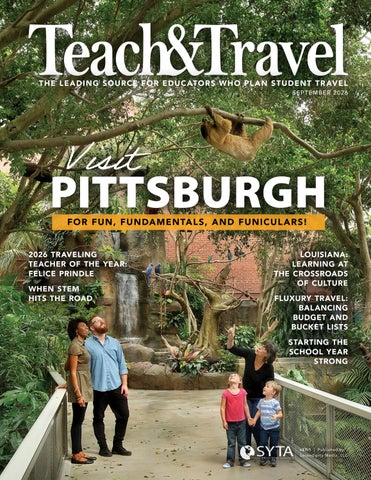
Teach&Travel THE LE A D I N G SOU RCE FO R E DUC ATO R S W H O PL A N S TU DE NT TR AVEL
SEPTEMBER 2026
Visit
PITTSBURGH FOR FUN , FUNDAMENTAL S, AND FUNICUL AR S!
2026 TRAVELING TEACHER OF THE YEAR: FELICE PRINDLE WHEN STEM HITS THE ROAD
LOUISIANA: LEARNING AT THE CROSSROADS OF CULTURE FLUXURY TRAVEL: BALANCING BUDGET AND BUCKET LISTS STARTING THE SCHOOL YEAR STRONG
SYTA
S T U D E N T & Y O U T H T R AV E L A S S O C I AT I O N
v27i1 | P u b l i s h e d by S e re n d i p i t y M e d ia, LLC
T E AC H T R AV E L .O R G
/
S Y TA .O R G
1
2
T E AC H & T R AV E L M AG A Z I N E | S E P T E M B E R 2 0 2 6
IN THIS ISSUE VOLUME 27 ISSUE 1 SEPTEMBER 2026 Cover Photo © National Aviar y, Elliot Cramer
PUBLISHER OF TEACH & TRAVEL SERENDIPIT Y MEDIA, LLC www.serendipity-media.com | (866) 252-7108
FE ATURES 20 LOUISIANA: Learning at the Crossroads of Culture
THE TEAM K ASIE SMITH, President & Publisher KRIS BISCHOF, Sales & Marketing Manager COURTNEY VAN HAGEN, Art Director CLAIRE CHAPIN, Graphic Designer JOSH VEAL, Editorial Manager
26 VISIT PITTSBURGH for Fun, Fundamentals, and Funiculars!
32 THE MEDITERRANEAN: One Journey, Millenia of Histor y
HANNAH HOHMAN, Marketing Coordinator MEGAN MARSHALL, Accounting & Operations Specialist MAGGIE MUTCH, Communications & Event Coordinator
DEPAR TMENT S 8 STAYING EDUCATED
YOUR MEDIA CONSULTANTS (866) 252-7108 K ARY MOENING, kary@serendipity-media.com LILY MUNDELL, lily@serendipity-media.com
MEMBERS OF: AMERICAN BUS ASSOCIATION CIRCLE MICHIGAN NATIONAL TOUR ASSOCIATION ONTARIO MOTOR COACH ASSOCIATION STUDENT & YOUTH TRAVEL ASSOCIATION
Star ting the School Year Strong
10 PROFILE 2026 Traveling Teach of the Year: Felice Prindle
16 SAFE TRAVELS Chaperones Who Make the Difference
36 TRIP BEHAVIOR Fluxur y Travel: Balancing Budget and Bucket Lists
38 EXPERIENCES When STEM Hits the Road
40 STUDENTS SPEAK SUBSCRIPTION INFORMATION Teach & Travel – The Official Publication of SYTA may be obtained by filling out the subscription card or calling 866-252-7108. Subscribe online at https://hello.teachtravel.org/teach-travel-subscribe. Teach & Travel is published bimonthly by Serendipity Media, LLC; 519 Ada Dr. SE, Ste 201, Ada, MI 49301. Subscription information may be obtained through the above address, by calling 866-252-7108, or by logging on to www.teachtravel.org. POSTMASTER: Send address changes to Teach & Travel c/o Serendipity Media, LLC; 519 Ada Dr. SE, Ste 201, Ada, MI 49301. All rights reserved. Teach & Travel content may not be photocopied or reproduced or redistributed without the consent of the publisher.
One Conversation at a Time
NEWS + UPDATES 2 SYTA PRESIDENT’S LETTER 4 TRAVEL NEWS 6 DESTINATION UPDATES
© 2026 Serendipity Media, LLC
T E AC H T R AV E L .O R G
/
S Y TA .O R G
1
N OT E | S Y TA P R E S I D E N T
DAVE HENLEY SYTA President Director of Operations, Grand Classroom
A
It’s an honor to begin my term as SYTA President. Thanks to the hard work of Past President Brent Imrie, the SYTA Board, and tireless staff, SYTA is in a great position following the successful conference in Pittsburgh. My goal is to help us take it a step further. My entire career has been devoted to student and youth travel and I’m excited to continue pushing SYTA forward with a member-driven approach. It was great seeing and meeting many of you for the first time at the annual conference. Your feedback, input, and perspective will help me guide SYTA on the road ahead as together we continue to provide life enhancing experiences for today’s students and young people. Be sure to check out every Teach & Travel for important updates, great destinations, and empowering business perspectives. This issue explores many of the ideas shaping student travel today. We visit three outstanding destinations—Louisiana, Pittsburgh, and the Mediterranean—each offering its own unique blend of history, culture, and hands-on learning opportunities for student groups. We’re also proud to recognize this year’s Traveling Teacher of the Year, Felice Prindle, whose commitment to experiential education exemplifies the impact passionate educators have on their students. You’ll meet another inspiring educator as we discuss her innovative “STEM On the Road” travel programs and the many ways immersive experiences can bring science, technology, engineering, and mathematics to life. Preparing students for successful travel extends well beyond choosing an itinerary, so this issue also looks at several practical topics for educators and travel professionals alike. We explore how to mindfully step back into the new schoolyear, share guidance on preparing effective chaperones, and examine the growing trend of “f luxury travel” and what it could mean for student travel in the years ahead. As always, we’re honored to feature the winning essay from this year’s The World Is A Classroom student essay contest, offering a firsthand reminder of the lasting impact educational travel can have on a young person’s life. Thank you for being a part of the premier association dedicated to student and youth travel. You, the educators, and group leaders you serve make a world of difference for the youth you host.
S T R AT E G I C PA R T N ER S
PR E M I U M PA R T N E R S
2
T E AC H & T R AV E L M AG A Z I N E | S E P T E M B E R 2 0 2 6
CO R P O R AT E PA R T N E R S
T H O U G H T L E A D E R PA R T N E R
T E AC H T R AV E L .O R G
/
S Y TA .O R G
3
T R AV E L N E W S
SYTA YOUTH FOUNDATION ROAD SCHOLARSHIP The SYTA Youth Foundation (SYF) established the Road Scholarship program in 2002 to award funds to youth who are unable to afford the cost of student group trips. Based on the belief that travel is essential for a complete education, it is SYF’s goal to make a positive difference, through travel, in the young lives of our global citizens. Since its inception, SYF has impacted more than 7,200 students. A Road Scholarship is financial aid granted to individuals or groups of five or more who have been nominated by a teacher or youth group leader and who meet criteria within five categories:
ACHIE VEMENT • NEED • INITIATIVE/INVOLVEMENT • SERVICE/CITIZENSHIP • CONNEC TION The grants are vetted and approved through the SYF Board of Trustees. APPLICATION PERIOD:
TRIPS MARCH 2027 – AUGUST 2027 Application Opens September 21, 2026 Application Closes November 6, 2026
TRIPS AUGUST 2027 – FEBRUARY 2028 Application Opens Januar y 25, 2027 Application Closes March 26, 2027
Announced the week of December 6, 2026
Announced the week of April 19, 2027
WHO CAN APPLY? Students in grades K-12 and 18 or younger at the time of travel will be considered. Nominations must be submitted by an educator, program leader or designated school official, Nominations submitted by parents or guardians will not be considered. HOW MUCH IS AWARDED? Up to $1,000 USD will be awarded to an individual and a maximum of $5,000 USD will be awarded to a group nomination. Nominations requesting an award higher than the maximum will not be considered. FOR MORE INFORMATION: Visit https://sytayouthfoundation.org/road-scholarship | Email info@sytayouthfoundation.org. The grants are vetted and approved through the SYF Board of Trustees.
4
T E AC H & T R AV E L M AG A Z I N E | S E P T E M B E R 2 0 2 6
T E AC H T R AV E L .O R G
/
S Y TA .O R G
5
D E S T I N AT I O N U P DAT E S
Photo © Rockefeller Center
HAUTE CUISINE Elevate your next lunch to an unforgettable experience at Rockefeller Center! Now at Top of the Rock, groups can enjoy lunch 70 f loors above New York City. In the heart of the city, Top of the Rock offers three f loors of breathtaking panoramic views. From Central Park to Lower Manhattan, guests enjoy lunch alongside unmatched views of New York City’s most recognizable landmarks. Each Boxed Lunch Combo includes Top of the Rock admission and a meal with a sandwich, chips, and bottled water. Accommodations are available to suit all dietary needs. The boxed lunch offering is available daily from 11 a.m. to 2 p.m. for groups from 10 to 100 people. With dedicated dining space, tables, and chairs on the deck, guests can eat, relax, and enjoy 360 views of the iconic city skyline. To book your visit, email groups@rockefellercenter.com. See you at the Top!
FORGE WHAT’S NEXT Defined by grit, authenticity, and reinvention, Pittsburgh is a place that honors the past while celebrating the future. From steel and energy to robotics, AI, and the
6
arts—Pittsburgh is a place where new ideas take shape and young bold thinkers thrive. Honor Pittsburgh icons with a visit to the Andy Warhol Museum or the Roberto Clemente Museum.
T E AC H & T R AV E L M AG A Z I N E | S E P T E M B E R 2 0 2 6
Learn more about Pittsburgh’s role as “the city that built America” with a trip to Senator John Heinz History Center, voted three years in a row as the nation’s top history museum by USA Today readers.
Photo © Heinz Histor y Center
of professional musicians. These interactive workshops are designed to strengthen both individual skills and ensemble performance while inspiring young musicians to take the next step in their musical journey. Groups attending a New York Philharmonic concert can also enhance their experience with preconcert talks, post-concert Q&A sessions, or a guided tour of Lincoln Center. Learn more at nyphil.org. Explore classrooms representing cultures from around the world at the Nationality Rooms at the Cathedral of Learning, just across the street from the Carnegie Museum of Art and Natural History. Refuel with a Primanti Brothers sandwich and cool off with ice cream from Millie’s. STEM away from the ordinary with an out of this world experience at the Moonshot Museum and explore the science of speed at the Kamin Science Center. And lastly, no Pittsburgh experience is complete without a trip aboard the Gateway Clipper to cruise the three rivers or the breathtaking views to experience while on a trip along the Duquesne Incline. Learn more at visitpittsburgh.com
VALLEY LIVING At Hotel UMass, hospitality extends far beyond a comfortable stay. As the only hotel located on the UMass Amherst campus, we’re uniquely positioned to introduce visitors to the culture, history, and attractions that make Amherst and the Pioneer Valley one of New England’s most rewarding destinations. To encourage guests to explore
the region, Hotel UMass created the Experience Passport—a program featuring exclusive offers from local partners and attractions. Guests can discover iconic destinations such as the Emily Dickinson Museum, Eric Carle Museum of Picture Book Art, Yiddish Book Center, Tree House Brewing Company, Yankee Candle Village, Magic Wings Butterfly Conservatory, UMass Athletics, the Academy of Music Theatre, and many more. The passport also inspires visitors to experience local restaurants, farmers, markets, scenic hiking trails, live entertainment, and unique shopping throughout the Pioneer Valley. Whether visiting a campus tour, conference, graduation, or weekend getaway, Hotel UMass proudly serves as both a welcoming hotel and a gateway to the best of Amherst. Visit hotelumass.com for more information.
STRING THEORY The New York Philharmonic offers student groups more than the chance to hear one of the world’s premier orchestras perform. Music ensembles can deepen their visit through hands-on educational experiences led by Philharmonic musicians and teaching artists. Pre-professional bands and orchestras can participate in collaborative clinics, sectionals or master classes that focus on technique, musicianship, rehearsal strategies and performance interpretation, giving students an inside look at the standards and practices
T E AC H T R AV E L .O R G
/
S Y TA .O R G
7
S TAY I N G E D U C AT E D BY JOSH VE AL
STARTING THE SCHOOL YEAR STRONG
E
Every school year begins with a fresh opportunity. New students, new routines and new possibilities fill classrooms with anticipation, but they also bring a long to-do list. The opening weeks can feel overwhelming as teachers establish expectations, build relationships and settle into new rhythms. The good news? The habits developed during those first days often shape the rest of the year. Here are some tips to keep in mind. BUILD RELATIONSHIPS BEFORE ANYTHING ELSE Academic success starts with connection. Before diving into curriculum, invest time in creating a classroom community built on trust and respect. Give students opportunities to get to know one another and to help shape the classroom culture. Developing a classroom agreement together, for example, gives students ownership of expectations rather than simply asking them to follow a list of rules. When students feel heard and valued, they’re more likely to invest in the learning environment. The same principle applies beyond your classroom. Collaborate with colleagues, observe one another’s classrooms and share ideas. Great schools are built by educators who learn from each other.
8
T E AC H & T R AV E L M AG A Z I N E | S E P T E M B E R 2 0 2 6
ESTABLISH CLEAR ROUTINES Students thrive when they know what to expect. From the first day, establish consistent procedures for everything from entering the classroom and submitting assignments to transitioning between activities. Clearly posting the day’s schedule and previewing each lesson helps students feel confident and focused. Consistency also extends to classroom management. Calm, predictable responses are far more effective than raising your voice. When expectations remain steady day after day, students begin to regulate their own behavior, creating a more productive learning environment for everyone. COMMUNICATE WITH INTENTION Strong classrooms are built on strong communication. Teach students not only how to express themselves, but also how to listen. Skills like summarizing, asking clarifying questions and considering another person’s perspective help students become better collaborators both inside and outside the classroom. Communication is equally important for teachers. Clear instructions, visible daily agendas and regular check-ins reduce confusion and keep everyone moving in the same direction.
ENCOURAGE CURIOSIT Y AND GROWTH The beginning of a school year is the perfect time to establish that learning involves taking risks. Celebrate effort as much as success, and normalize mistakes as part of the learning process. Whether it’s trying a new instructional strategy yourself or encouraging students to tackle challenging problems, demonstrating perseverance teaches an important lesson: growth comes through practice, not perfection. TAKE CARE OF YOURSELF Teachers naturally devote enormous energy to their students, but sustaining that effort requires setting healthy boundaries. Be thoughtful about new commitments, protect your personal time when possible and recognize that you don’t have to say yes to every opportunity. Burnout benefits no one, and the school year is a marathon, not a sprint. REMEMBER TO ENJOY THE JOURNEY Amid lesson plans, meetings and classroom management, don’t lose sight of why you became an educator. Celebrate small victories. Laugh with your students. Be curious alongside them. Whether through an engaging read-aloud, a successful science experiment, a meaningful field trip or an unexpected classroom discussion, the moments students remember most are often the ones filled with joy and discovery.
T E AC H T R AV E L .O R G
/
S Y TA .O R G
9
PROFILE
2026 TR AVELING TEACHER OF THE YEAR
FELICE PRINDLE BY ALLISON K AY BANNISTER
FINDING THE HEARTBEAT OF HUMANITY IN THE HEART OF THE CARIBBEAN
T
Talk with Felice Prindle, 2026’s Traveling Teacher of the Year, and you’ll see her get easily choked up about the life-changing experience she’s had as the leader of Titan Service Scholars, a service learning program that has taken her and groups of dedicated students to Cuba, the Bateyes of the Dominican Republic, and beyond. The story of how she got here starts decades earlier, however. Before Felice Prindle became a counselor at Webster Thomas High School in New York, she earned her undergraduate degree in hospitality. She worked in the industry for several years, on both the hotel and the restaurant sides, in the U.S. and in Italy. Being a world traveler since she was just three years old put her on this career path, but it was a deep desire for relationship building that led her to change direction and pursue a Masters in School Counseling.
10
T E AC H & T R AV E L M AG A Z I N E | S E P T E M B E R 2 0 2 6
One of Felice’s first counseling jobs was at a school in a small, rural town in Bloomfield, New York. There, she developed a connection with a group of ambitious students who were seeking a more meaningful educational travel experience than what schools typically offer. They wanted to go to a place where they could use the Spanish language they were studying, so the focus was on the Caribbean, Latin America, and South America. And, they were interested in more than simply visiting a school or meeting a family for a day; they wanted to make a difference. After numerous phone calls, Felice finally found an operator who understood the assignment. They just happened to have a new program they were launching that would take students to Cuba. “We would get to stay in an eco-lodge, and it just sounded fantastic, very real, very immersive,” she says. “So, I pitched it to my students, and, of course, the idea of being pioneers; the first people to go to Cuba in over 50 years was really exciting.” They then had the challenge of selling the idea to the very conservative Board of Education, but it went over better than expected and was approved! That was in 2016, and that was how the global impact side of the school’s service learning program started. Today, at Webster Thomas, a larger school that’s closer to her home, Felice has been running the Titan Service Scholars program for the past five years. It’s available for all of the school’s 1,200 students, as well as alumni. In about 10 years’ time, between her previous and current school, Felice has taken 300-plus students on global impact projects to Cuba, Peru, Puerto Rico, and the Dominican Republic. It’s the work they’ve done in the Bateyes region of the Dominican Republic that feels most significant. These sugarcane cutting communities, which are mostly composed of marginalized Haitian migrant workers, are largely without basic necessities; the types of daily essentials that many people take for granted.
Photos © Felice Prindle
BY ALLISON K AY BANNISTER
So, much of what they do is related to infrastructure: laying cement f loors, building latrines, and performing other types of physical labor to help provide better conditions and create lasting change. Most recently, after the loss of USAID funding, her alumni groups have also been co-facilitating mobile clinics that allocate medicine and supplies. “To have my students be able to engage in real service, not charity, and foster these really lasting relationships and partnerships throughout our community—and then be able to do that globally— is far more rewarding than anything that can happen in a classroom,” Felice says. Since 2021, she’s been returning every six months to the Dominican Republic Batey settlements of La Mora, La Plaza, and Monte Coca, either with current students over winter break or alumni groups in summer. Felice notes that these are unfunded volunteer projects with no budget. No one, including herself, gets paid and lodging is never in a hotel, but typically in dormitory centers affiliated with churches. Alumni projects involve a homestay, where they reside with families, take bucket showers, cook food together, and celebrate together. They become truly connected and share a lived experience with the people they are engaged with. This type of immersion is not without risks, so they do plenty of preparation, collaborating with organizations such as Passport Health, getting all the needed vaccines, and learning about water and food safety. They also spend a lot of time studying up on the critical issues that are impacting the communities that they’re going to. “We read newspaper articles and watch documentaries,” Felice says. “And, obviously, we also talk directly with the Batey residents and families, so students enter projects ready to give all of their heart and all of their soul.” Felice also credits Off beat Travel as an invaluable partner. Their offerings are designed and led by people who call the places they serve home, and part of their mission is to “Create equity in the travel industry by ensuring the people in the places we visit have ownership of the design, implementation, management and economic benefits of travel to their communities.” While it’s clear that the projects they take on greatly benefit those living in these impoverished areas, what is not to be overlooked is how it shapes the students, alumni, and faculty involved. Webster Thomas High School’s service program
I always tell them: WE ARE FOCUSING ON RESPECT OVER CONSUMPTION, we are focusing on relationships over Instagram content. We are meeting people and connecting with other hearts that now will replace the dots on the map. BEHIND A HEADLINE THAT WE READ IN THE NEWSPAPER, THERE ARE PEOPLE.”
T E AC H T R AV E L .O R G
/
S Y TA .O R G
11
PROFILE
is the second largest program available to students after sports, and it attracts all kinds of students from different social groups. “Service is a great equalizer,” Felice says. “You don’t have to be smart; you don’t have to be athletic; you just have to be willing to pick up a shovel and hand mix cement. You can have the most popular kid, you can have the music kid, you can have the football player, you can have the valedictorian… and they all bring different strengths to a project.” To help articulate how much of an effect these projects have, Felice asked some of the participants from over the years to weigh in. One of the school’s varsity baseball players, now an alum, said: “It changed the trajectory of my life, and I knew that I wanted to do more in the world. It ended up changing my major in college. I thought I was going to do sports management, and now I’m an elementary teacher. It took my learning past the classroom and impacted how I grew, and it also impacts how I see the world and how I act in it every single day.” Another former student who was an academic high performer said: “It opened up new experiences and new connections. I was socially anxious before, but now, as a result of service, I can open up. I have confidence. I can think better on my feet, and I can react in a way that’s ethical and just, and I want more for others.” Felice sees many graduates who have been in the program go into fields such as nonprofit management, nursing, teaching, and other “helping” professions. While much of the inspiration comes from the actual projects and interactions, there’s also Felice at the helm, making sure her students understand the bigger picture. “I teach my students that our ability to travel really depends on
12
T E AC H & T R AV E L M AG A Z I N E | S E P T E M B E R 2 0 2 6
global systems of inequality, and colonialism runs deep in the travel industry,” she says. “I always tell them: We are focusing on respect over consumption, we are focusing on relationships over Instagram content. We are meeting people and connecting with other hearts that now will replace the dots on the map. Behind a headline that we read in the newspaper, there are people.” Each project they undertake allows students and alumni the opportunity to grow intercultural competence, increase comprehension of shared humanity, and gain profound knowledge about themselves and the world. “I’m proud to do it,” Felice says. “I’ve found my purpose.”
To have my students be able to engage in real service [...] is FAR MORE REWARDING THAN ANYTHING THAT CAN HAPPEN IN A CLASSROOM.
EVERY STUDENT SHOULD TRAVEL A -Z Travels is dedicated to creating customized tours aligned with your curriculum goals and budget.
Educational Travel Specialists for Middle & High School Tours
TEACHERS TRAVEL FREE
info@a-ztravels.com / a-ztravels.com
T E AC H T R AV E L .O R G
/
S Y TA .O R G
13
14
T E AC H & T R AV E L M AG A Z I N E | S E P T E M B E R 2 0 2 6
T E AC H T R AV E L .O R G
/
S Y TA .O R G
15
SA FE T R AV E L S
CHAPERONES WHO MAKE THE DIFFERENCE
A
A great itinerary can make a student trip memorable, but the right chaperones can make it successful. They help keep students safe, reinforce expectations, solve problems on the f ly and, perhaps most importantly, allow teachers to focus on creating meaningful learning experiences instead of constantly putting out fires. Of course, not every well-meaning volunteer is automatically a great fit. An unprepared chaperone can create as many challenges as they solve, leaving educators feeling like they’re supervising adults as much as students. Taking time to carefully select and prepare your chaperone team before departure pays dividends throughout the trip.
16
START WITH POLICIES Before recruiting anyone, review your school’s or district’s requirements. Many schools have established policies regarding student-to-chaperone ratios, background checks, fingerprinting and other clearances. These guidelines should form the foundation of your selection process. If you’re able to choose from mu ltiple volu nteers, don’t si mply recr u it enough adu lts to meet t he m i n i mu m ratio. Hav i ng a n ext ra chaperone or t wo prov ides va luable f lex ibi l it y i f someone needs to accompa ny a n i l l st udent, ha nd le a n emergency or step away tempora ri ly.
T E AC H & T R AV E L M AG A Z I N E | S E P T E M B E R 2 0 2 6
COMPLEMENT YOUR GROUP The best chaperones bring not just enthusiasm, but skills and experience that strengthen the trip. Teachers, administrators, PTA members and booster organization volunteers often make excellent candidates because they’re already familiar with working alongside students and typically have required clearances in place. Parents can also be outstanding chaperones, but only when they understand that they’re there to support the entire group, not just their own child. Travel experience is another valuable asset. Adults who are comfortable navigating airports, public transportation, hotels or
BY JOSH VE AL
international destinations can confidently guide students through unfamiliar situations while helping less experienced travelers feel at ease. Medical experience is equally valuable. A school nurse, physician, EMT or another healthcare professional can be an invaluable resource when managing medications, food allergies or unexpected illnesses. If you’re traveling internationally, language skills or familiarity with local customs can be another welcome advantage. Finally, consider your student population. Whenever possible, your chaperone team should include both male and female adults when supervising mixed-gender groups. A good sense of humor certainly doesn’t hurt either. SET EXPECTATIONS Many chaperone issues stem not from poor intentions but from misunderstandings. That’s why expectations should be discussed— and preferably documented—well before departure. Cover practical questions such as whether chaperones travel free or at a reduced cost, room assignments, scheduled free time and participation requirements. Will they actively join activities or simply supervise students? How many students will each adult oversee? Will they be responsible for emergency procedures? One message deserves particular emphasis: This is not a personal vacation. Every decision should prioritize the students’ experience. Chaperones shouldn’t skip scheduled activities, wander off independently or ignore meeting times because they’d rather sightsee on their own. When adults fail to follow the itinerary, students often miss out on experiences they’ve worked hard to earn.
TRAIN FOR THE UNEXPECTED Preparation extends beyond logistics. Every chaperone should know exactly what to do if something goes wrong. Review emergency procedures before the trip begins. Chaperones should know how to respond if a student becomes separated from the group, experiences a medical emergency or violates behavioral expectations. Provide each adult with important contact information, including emergency phone numbers, hotel addresses, the teacher leader’s contact information, tour operator contacts and a complete itinerary. If students have medical conditions, dietary restrictions or required medications, chaperones should understand what symptoms to watch for and how to respond appropriately. Many educators also assemble small emergency kits containing bandages, sanitizer, wipes, over-the-counter medications and other useful supplies. Technology can further simplify communication. Messaging platforms such as WhatsApp or other widely available apps allow leaders to quickly communicate schedule updates, locate groups or respond to unexpected situations without relying on expensive phone plans.
f lexibility, patience and a willingness to embrace new experiences. Encourage chaperones to attend pretrip meetings, participate in fundraising when appropriate and become familiar with the educational goals behind the itinerary. The more invested they are before departure, the more effective they’ll be once the trip begins.
MODEL THE BEHAVIOR YOU EXPECT Students pay close attention to the adults traveling alongside them. Chaperones should understand all student expectations regarding dress, language, cellphone use, curfews, social media, public behavior and local customs. Consistent enforcement prevents confusion and demonstrates that expectations apply equally to everyone. Perhaps even more importantly, chaperones should model the qualities educators hope students develop through travel: curiosity, respect for different cultures,
T E AC H T R AV E L .O R G
/
S Y TA .O R G
17
18
T E AC H & T R AV E L M AG A Z I N E | S E P T E M B E R 2 0 2 6
T E AC H T R AV E L .O R G
/
S Y TA .O R G
19
U N I T E D S TAT E S | L o u i s i a n a
LOUISIANA:
LEARNING AT THE CROSSROADS OF CULTURE
L
Louisiana is unlike anywhere else in the United States. It’s a place where French, Spanish, African, Caribbean and Native American inf luences have blended over centuries to create a culture all its own. And it’s a culture that students can experience through music, food, architecture, landscapes and traditions. For educators planning a student tour, Louisiana offers exceptional cross-curricular opportunities. History, civics, environmental science, music, literature and culinary arts all intersect here, creating an immersive classroom where lessons come alive. Most student groups begin in New Orleans, brimming with history. Students can explore the iconic French Quarter, stroll through Jackson Square, admire St. Louis Cathedral and walk along the Mississippi River. Guided tours reveal how colonial powers, immigration, trade and geography transformed New Orleans into one of America’s most culturally significant cities. Photos © New Orleans & Company
20
T E AC H & T R AV E L M AG A Z I N E | S E P T E M B E R 2 0 2 6
Photos © (top) Adobe Stock, (bot tom) Paul Broussard
BY JOSH VE AL
No visit would be complete without experiencing the city that gave birth to jazz. Throughout New Orleans, students can hear live music performed in the very city where the genre originated. Educational performances and workshops introduce young musicians to the evolution of jazz while illustrating how African, European and Caribbean musical traditions merged to create an entirely new American art form. The arts continue at venues throughout the city, where student performance groups can attend concerts, clinics and cultural performances that showcase Louisiana’s remarkable musical heritage. Consider the historic St. Louis Cathedral, the beautiful Orpheum Theater, and the sprawling estate of Houmas House and Gardens. Located within scenic City Park, the New Orleans Museum of Art offers students the opportunity to explore more than 5,000 years of artistic achievement. Its collections range from European masterpieces and American art to African, Asian and contemporary works, providing meaningful connections to history, culture and global studies. Outside, the adjoining Sydney and Walda Besthoff Sculpture Garden combines art and nature, encouraging students to experience large-scale sculptures in a beautifully landscaped setting. Then, dedicated to the art and artists of the American South, the Ogden Museum of Southern Art introduces students to the region’s diverse cultures, histories and perspectives through paintings, photography, sculpture and mixed-media works. Rotating exhibitions and an expansive permanent collection explore themes including identity, social change, music and everyday life, making the museum an engaging stop for groups studying American history, visual arts and Southern culture. One of New Orleans’ premier educational attractions is the National W WII Museum. Frequently ranked among the nation’s finest museums, it takes students beyond textbook accounts through immersive exhibits, restored aircraft, oral histories and interactive displays. Rather than simply learning dates and battles, students gain a personal understanding of the sacrifices and decisions that shaped the course of the war.
History also extends well beyond museum walls. Just outside New Orleans, Louisiana’s River Parishes provide a deeper look at the state’s complex past. Stretching along the Mississippi River between New Orleans and Baton Rouge, this region is home to historic plantations, churches and communities that illustrate Louisiana’s agricultural, cultural and economic development. Modern tours encourage thoughtful conversations about both the grandeur of plantation life and the realities of slavery, helping students examine difficult chapters of American history through multiple perspectives. The River Parishes are also an excellent place to experience Creole culture, regional cuisine and local traditions that continue to define southern Louisiana today. Continuing upriver brings groups to Baton Rouge, where students can visit the Louisiana State Capitol, tour museums exploring state government and political history, and learn about the Mississippi River’s continuing importance to transportation, commerce and industry. Louisiana’s natural landscapes offer equally valuable educational opportunities. Guided swamp and bayou tours transform environmental science lessons into unforgettable experiences as students travel through towering cypress forests while spotting alligators, turtles, wading birds and other native wildlife. Along the way, guides explain the critical role wetlands play in f lood control, wildlife habitat and protecting coastal communities from hurricanes. These firsthand encounters naturally spark discussions about conservation, coastal erosion and climate resilience—issues that continue to shape Louisiana’s future.
T E AC H T R AV E L .O R G
/
S Y TA .O R G
21
U N I T E D S TAT E S | L o u i s i a n a
Of course, Louisiana’s story wouldn’t be complete without its cuisine. Whether sampling gumbo, jambalaya, po’boys or beignets, groups experience how generations of French, Spanish, African and Caribbean inf luences combined to create one of America’s most celebrated culinary traditions. Cooking demonstrations and local restaurants further illustrate how geography, agriculture and immigration continue to inf luence the region’s identity. For groups looking to add an evening activity, US Ghost Adventures offers walking tours that blend folklore with history throughout the French Quarter. While the ghost stories capture students’ imaginations, the tours also introduce the city’s historic buildings, inf luential residents and significant events that inspired many of New Orleans’ enduring legends. Another popular stop is Mardi Gras World, where students go behind the scenes to see the enormous f loats and artistic craftsmanship that bring New Orleans’ world-famous celebration to life. The attraction offers insight into local traditions while showcasing careers in art, engineering, design and event production. The Audubon Aquarium and Audubon Zoo offer student groups an engaging way to bring science lessons to life through up-close encounters with wildlife and ecosystems from
around the world. Located in New Orleans, the Aquarium features immersive exhibits showcasing the Gulf of Mexico, the Mississippi River, coral reefs, sharks, penguins, and thousands of aquatic animals, while the Zoo is home to more than 2,000 animals representing habitats from the African savanna to the Louisiana swamp. Together, they provide hands-on learning opportunities that reinforce classroom lessons in biology, ecology, conservation, and environmental stewardship. Throughout the year, festivals celebrating jazz, blues, food, literature and local heritage fill communities across the state. Depending on travel dates, students may find themselves immersed in celebrations that demonstrate how Louisiana continues to preserve its traditions while welcoming new generations to participate. Perhaps that’s what makes Louisiana such an effective educational destination. History isn’t confined to museum exhibits. Music isn’t reserved for concert halls. Science happens aboard swamp boats, culture is experienced around the dinner table, and every neighborhood offers another story waiting to be discovered. Photos © Audubon Aquarium, Audubon Zoo
22
T E AC H & T R AV E L M AG A Z I N E | S E P T E M B E R 2 0 2 6
T E AC H T R AV E L .O R G
/
S Y TA .O R G
23
24
T E AC H & T R AV E L M AG A Z I N E | S E P T E M B E R 2 0 2 6
T E AC H T R AV E L .O R G
/
S Y TA .O R G
25
NORTH AMERICA | Pittsburgh
Visit PITTSBURGH for FUN, FUNDAMENTALS, AND FUNICUL ARS!
L
Looking for a single destination that covers all angles of education, plus entertainment and convenient dining? Steel City is an ideal choice, with something for every student interest. A blend of science, history, culture, sports, nature, space exploration, engineering, and arts makes Pittsburgh the ultimate STEAM hub. Start building your itinerary with these top picks from Visit Pittsburgh! The city’s most visited museum, Kamin Science Center is filled with interactive learning opportunities, with hands-on exhibits, a planetarium, an IMAX theater, and more. While there, don’t miss the museum’s newest exhibit: Science of Speed. With a multi-level, indoor, all-electric kart track and cutting-edge racing simulators, as well as an exhibit that delves into motion, force, and engineering, it’s a way to see the fastest machines come to life. The Moonshot Museum continues to explore wonder and spark imagination with multiple space-themed displays.
26
T E AC H & T R AV E L M AG A Z I N E | S E P T E M B E R 2 0 2 6
BY ALLISON K AY BANNISTER
In addition to seeing real spacecraft being assembled, students can look to the stars and see themselves one day among them. The museum is operated by the Astrobotic Foundation and shares the building with robotics company Astrobotic, further enhancing the visit with an in-depth look at the modern space industry. Keeping in the academic theme, Carnegie Museum of Natural History, is a logical next stop. It’s one of the largest natural history museums in the U.S. and home to one of the best collections of dinosaur fossils, with highlights such as Diplodocus carnegii (“Dippy”) and the world’s first scientifically recognized T-Rex. There’s also a hall of minerals and gems and Paleolab, a working paleontology lab. Don’t leave without checking out the Carnegie Museum of Art, which is included in admission. While in the area, head over to the University of Pittsburgh’s Nationality Rooms within the Cathedral of Learning. There are 31 themed rooms total, celebrating the cultural heritage and architectural styles of the ethnic groups that helped shape the city. Most of the rooms are used by students as active, working classrooms. Heinz History Center presents more views into the past, specifically focusing on the Pittsburgh region. Learn about H.J. Heinz company, see real props from the set of Mr. Rogers Neighborhood, and step inside the Franco Harris Sports Museum, which has memorabilia and a focus on the physics of movement in athletics. Stay in the sports arena with a behind-the-scenes Acrisure Stadium Blitz Tour, which provides a walk through the Pittsburgh Steelers’ locker rooms and the FedEx Great Hall, home to the Terrible Towel Wall. Educational aspects include topics such as turf management, stadium architecture, and the role of sports technology. Get ready for a little leisure with a Gateway Clipper Sightseeing Cruise. It runs along Pittsburgh’s converging three rivers, and offers a from-the-water perspective of landmarks, architecture, bridge engineering, and river navigation, as well as an examination of the city’s transformation from industry to innovation. Switching gears to the world of wildlife, next up is Pittsburgh Zoo & Aquarium. More than 8,000 animals representing over 600 species reside here, from African elephants to zebras, plus crocodiles, penguins, sharks, and more. There are also specialized programs for student groups of all ages in the areas of zoology, marine biology, and conservation. Round out your animal encounters at the National Aviary, where 500 birds from around the world feather their nests. An indoor facility, it showcases both local and exotic bird species in naturalistic habitats and provides lessons in ecology, animal biology, and biodiversity. For an added surprise, you might also Photos © Pit tsburgh Zoo/Paul Selvaggio, National Aviar y/Elliot Cramer, Heinz Histor y Center, Carnegie Museum of Natural Histor y/Julie Kahlbaugh
T E AC H T R AV E L .O R G
/
S Y TA .O R G
27
NORTH AMERICA | Pittsburgh
get to hang out with a two-toed sloth, or spot f lying foxes, hedgehogs, tortoises, and chameleons! Rivers of Steel at the 92-foot-tall Carrie Furnaces National Historic Landmark is another point of interest with customizable historical, engineering, or art-focused experiences for students. Tours in and around the pre-WWII iron-making facility range from Industrial and Guided Machine Shop to Arts & Grounds and Hands-On Graffiti. Morning and afternoon tours are available seasonally from May through October. Take a break and take in some art and entertainment in downtown Pittsburgh’s Cultural District. It houses a number of theatres with performances ranging from musicals and plays to symphony orchestra, opera, and dance. Be sure to ask about matinee shows and group ticket offerings. The 14-square block area also has retail shops and dining galore, plus public parks, art galleries, and art installations.
Getting hungry yet? Be sure to take your student group to the “Almost Famous Since 1933” Primanti Brothers. They’re known for their classic, Pittsburgh-style sandwiches served as an all-in-one meal—complete with fries and coleslaw stacked inside. Originally invented as an option that busy steel workers and truck drivers could eat with one hand, the sandwiches are a must-try for a tasty bite of history. Also keep an eye out for Eat ‘n Park, a popular spot for breakfast, lunch, dinner, and sweet treats. There are several of this Pittsburgh-founded restaurant chain around the city, and they’re notably student-friendly with a casual setting. Be sure to grab one of their iconic smiley-face cookies to go! And, weren’t funiculars promised? Yes, yes they were. There are two of these hillside railways right near each other: the Monongahela Incline and the Duquesne Incline. Built in 1870, Monongahela is the oldest continuously operating funicular in the U.S. But, if you only have time for one, Duquesne is largely considered superior for its panoramic skyline views, restored wooden cable cars, and a museum at the upper station. Hop on, if you’re so inclined! Photos © Primanti Brothers/Julie Kahlbaugh, Rivers of Steel, Pit tsburgh Zoo/Paul Selvaggio
28
T E AC H & T R AV E L M AG A Z I N E | S E P T E M B E R 2 0 2 6
T E AC H T R AV E L .O R G
/
S Y TA .O R G
29
30
T E AC H & T R AV E L M AG A Z I N E | S E P T E M B E R 2 0 2 6
T E AC H T R AV E L .O R G
/
S Y TA .O R G
31
I N T E R N AT I O N A L | T h e M e d i t e r r a n e a n
The Mediterranean: ONE JOURNEY, MILLENNIA OF HISTORY
F Photos © Adobe Stock
32
For student groups, few destinations pack as much educational value into a single itinerary as the Mediterranean. Within a relatively compact region, students can stand in the birthplace of democracy, explore the heart of the Roman Empire, admire Renaissance masterpieces, and experience cultures that continue to shape the modern world. Whether your itinerary focuses on Italy, Greece, Spain or beyond, the Mediterranean offers opportunities to connect classroom lessons in history, art, literature, religion, government, science, and geography with unforgettable firsthand experiences. One of the greatest advantages of Mediterranean travel is the ease of building a well-rounded itinerary. Historic landmarks, museums, archaeological sites, local cuisine, performing arts, and coastal landscapes often sit just minutes apart, allowing groups to maximize every day of their trip. Educational tour operators frequently combine multiple countries into 10- to 15-day programs that move seamlessly between major cities by coach, ferry, or high-speed rail.
T E AC H & T R AV E L M AG A Z I N E | S E P T E M B E R 2 0 2 6
Italy
ANCIENT ROME MEETS THE RENAISSANCE
Italy is often the cornerstone of a Mediterranean itinerary, offering an unmatched combination of ancient history, world-famous art, and vibrant modern culture. Rome alone can easily fill several days. Student groups typically begin with guided tours of the Colosseum, where gladiators once battled before thousands of spectators, followed by the Roman Forum, the political and commercial center of the ancient empire. Capitoline Hill provides sweeping views while introducing students to the foundations of Roman government. A visit to Vatican City adds another dimension. Students can tour St. Peter’s Basilica, marvel at Michelangelo’s artistic achievements, and explore the Vatican Museums, home to one of the world’s most significant collections of art and antiquities. These experiences naturally complement classroom discussions of religion, Renaissance history, and Western art. Florence shifts the focus from ancient civilization to the Renaissance. Walking tours through Piazza della Signoria and the historic center introduce students to the city that helped redefine European art and culture. Many itineraries include leather workshops, allowing students to observe one of Florence’s centuries-old artisan traditions while learning how craftsmanship continues to support the local economy. Venice offers a completely different perspective. Rather than streets, students travel along canals while learning how commerce transformed the city into one of Europe’s great maritime powers. Visits often include St. Mark’s Square, St. Mark’s Basilica, the Doge’s Palace, and demonstrations of traditional Murano glassblowing, illustrating how local craftsmanship has been preserved for generations. South of Rome, Pompeii remains one of Italy’s most compelling educational experiences. Frozen beneath volcanic ash after Mount Vesuvius erupted in A.D. 79, the remarkably preserved city gives students an unparalleled glimpse into everyday Roman life. Walking its streets provides an immersive lesson in archaeology, geology, and ancient civilization.
Greece
LESSONS CARVED IN STONE Few destinations bring history to life quite like Greece. Athens serves as an outdoor classroom for students studying democracy, philosophy, mythology, and classical architecture. Guided visits typically begin atop the Acropolis, where the Parthenon still dominates the skyline nearly 2,500 years after its construction. Nearby temples, monuments, and archaeological sites reveal how ancient Athens became one of history’s most inf luential cities. Additional stops often include the Temple of Olympian Zeus, Hadrian’s Arch, Syntagma Square, and the Panathenaic Stadium— the site of the first modern Olympic Games in 1896. Exploring the lively Plaka neighborhood allows students to experience contemporary Greek culture alongside ancient history. Many educational itineraries also travel to Delphi, once considered the center of the ancient world. Here, students can examine the Sanctuary of Apollo, the Temple of Apollo, and the ancient theater while learning about Greek religion, mythology, and political inf luence. Some programs even incorporate interactive discussions about the Parthenon Sculptures and cultural preservation, encouraging students to examine differing perspectives on museum collections and cultural heritage. Groups with additional travel time may continue to Greece’s islands. Santorini offers dramatic volcanic landscapes and opportunities to discuss geology, while Crete introduces students to the Minoan civilization through archaeological sites and museums. Ferry travel between islands also provides students with a firsthand understanding of how geography has shaped Mediterranean commerce and culture for thousands of years.
T E AC H T R AV E L .O R G
/
S Y TA .O R G
33
I N T E R N AT I O N A L | T h e M e d i t e r r a n e a n
Spain
ART, ARCHITECTURE, AND LIVING TRADITIONS Spain brings another layer tothea Mediterranean experience by blending Roman history, Moorish inf luences, Gothic architecture, and vibrant contemporary culture. Madrid introduces students to Spain’s royal history through the Royal Palace and bustling plazas like Puerta del Sol and Plaza Mayor. Walking tours through Gran Vía and surrounding neighborhoods showcase both historic landmarks and modern city life. Art students especially benefit from visits to world-renowned museums featuring works by Goya, Velázquez, Picasso, and other Spanish masters. Barcelona offers an entirely different atmosphere. The city’s distinctive architecture is highlighted by Antoni Gaudí’s Sagrada Família, whose innovative design demonstrates the intersection of engineering, architecture, and artistic vision. Walking through the Gothic Quarter introduces students to medieval streets while reinforcing lessons about urban development across centuries. Many groups also experience a traditional f lamenco performance, providing insight into Spanish music, dance, and regional cultural traditions. Food experiences featuring tapas or authentic paella further immerse students in local customs while demonstrating how cuisine ref lects geography and history.
LEARNING BEYOND THE LANDMARKS Some of the Mediterranean’s most valuable educational moments happen outside museums and archaeological sites. Food markets introduce students to regional agriculture and culinary traditions. Local cooking demonstrations provide hands-on opportunities to explore Mediterranean ingredients and healthy eating habits. Artisan workshops—from Venetian glassblowing to Florentine leatherworking—showcase traditional trades that continue to support local economies. Even simple activities such as riding ferries, navigating historic city centers, or ordering meals in another language encourage students to develop confidence, adaptability, and cross-cultural communication skills. Evenings often include authentic local experiences such as Greek dinners accompanied by traditional music and dancing or Spanish cultural performances that showcase regional traditions still celebrated today.
BUILDING A MEDITERRANEAN ITINERARY One of the strengths of Mediterranean travel is its f lexibility. Groups focused on ancient history might concentrate on Rome, Pompeii, Athens, and Delphi. Art-focused programs can emphasize Florence, Venice, Rome, Madrid, and Barcelona. And of course, the Mediterranean Sea itself is vast, bordered by 22 countries—we’ve highlighted three of them here, but you could also visit Turkey, Croatia, Egypt, Morocco and more. Along the way, students encounter iconic landmarks including the Colosseum, Roman Forum, Vatican City, Pompeii, St. Mark’s Basilica, the Acropolis, Delphi, the Royal Palace of Madrid, Plaza Mayor, and the Sagrada Família. They participate in artisan demonstrations, sample regional cuisine, experience local music and dance, and explore cities whose inf luence continues to shape politics, art, architecture, and culture around the world.
34
T E AC H & T R AV E L M AG A Z I N E | S E P T E M B E R 2 0 2 6
THE LEADING SOURCE FOR EDUCATORS WHO PLAN STUDENT TRAVEL For young people, travel is an education in itself. It helps them build self-esteem, independence, tolerance and cultural understanding, while breaking down barriers to a child’s personal, educational and social development. Patterns and habits embraced when traveling at an early age are known to influence future decisions. The benefits of travel go beyond education. Increasingly, governments and businesses are recognizing the positive effects of youth travel as a powerful life experience that promotes economic development, job fulfillment and cultural understanding. Learn more at teachtravel.org
T E AC H T R AV E L .O R G
/
S Y TA .O R G
35
T R I P B E H AV I O R
FLUXURY TRAVEL: BALANCING BUDGET AND BUCKET LISTS
A
A new travel trend is “f luxury travel.” Not familiar with this term? It is a fairly novel idea born out of consumers having to pay more for excursions. Travelers have had to make hard decisions about when, where, and how to travel. Tara Cappel, founder of FTLO Travel, stated, “Rather than choosing between all-out luxury and strict budget travel, travelers are going to be more f lexible and creative with how they spend their vacation, mixing high and low.” Usually, educational journeys are structured on shoestring budgets to allow as many students as possible to afford the trip. However, there are ways to incorporate unique experiences into the trip (the luxury) combined with affordable options (budget). “Fluxury travel allows travelers to reach bucket list destinations and have unique
36
opportunities without overspending, making aspirational travel feel more attainable,” Cappel said. How does this work? Student travel groups may want to experience an overnight stay in a 4-star or 5-star hotel in New York City, for example. The first or last night of the trip could include accommodation at The Ritz or The Hyatt Times Square. The remainder of the trip, the group stays in simpler and less expensive accommodations. This gives the students an opportunity to experience a night of luxury. During a journey around Egypt, our tour group spent one night in a 5-star hotel in Luxor. I will never forget walking into the hotel lobby and seeing the marble f loors. When I arrived at my hotel room, I had a balcony that overlooked the hotel pool, but more importantly, the Nile
T E AC H & T R AV E L M AG A Z I N E | S E P T E M B E R 2 0 2 6
River. That trip was 20 years ago, and I still vividly remember that night of luxury and what the hotel looked like. Alternatively, educators may spend big for once-in-lifetime experiences like Michelin star dining. A meal in Le Cinq in Paris would cost 100 Euros or more per person, but think about the unique experience for the students and educators. Participants would dress appropriately, use proper table etiquette, and eat food unlike anything they have ever tried before. Years ago, I led a group of college students to South Africa. We ate dinner at the Gold Restaurant in Cape Town, South Africa. There were fourteen courses, and included food from all parts of Africa. One of the courses was homemade bread served in a f lower pot. When we asked the waiter about how the bread was made, he invited us to the kitchen to
BY JULIE BECK
Fluxur y travel allows travelers to mix premium, exceptional comfort, and custom-made experiences WITH A STR ATEG IC APPROACH TO E XPLORING THE WORLD THAT MA XIMIZES VALUE R ATHE R THAN JUST MINIMIZING COSTS.
watch it being baked. Throughout the meal, there was live drumming and Mali puppets. I suspect that was not only to entertain us, but to give us a break from one course to another. Did I enjoy the food in all fourteen courses? No, but I have never forgotten this incredible experience. For the remainder of our trip in Africa, we ate simpler and less expensive meals. Mind you, the cost of a Michelin star restaurant in South Africa is much cheaper than one in Paris, but it is the experience that you are seeking for your students that matters. Perhaps your group wants to attend or participate in a unique celebration or a once-in-a lifetime event like a sporting event (World Cup, Final Four, Super Bowl, Olympics, International Special Olympics) or a special occasion (Rose Bowl Parade, Tall Ship Parade, Macy’s Thanksgiving Day Parade, Presidential Inauguration, Mardi Gras, Cherry Blossom Festival). Traveling to destinations that host special events involves planning well in advance, and I recommend using a SYTA company to help coordinate the logistics (accommodations, transportation, and tickets to the event, if required). The cost to visit these locations will be higher, due to the inf lux of visitors expected, but the experiences for your students will last a lifetime. Fluxury travel could also include a unique experience like a behind-
the-scenes tour at Radio City or Rockefeller Center in New York City, a swim with the manatees in Florida, a boat ride behind Niagara Falls or through the canals of Amsterdam, going to the top of the Eiffel Tower or Big Ben, taking a tour of Buckingham Palace or Palace of Versailles, and so many other opportunities. I have led high school and college students on many USA and overseas trips. During the planning process, I survey students to find out the top three activities they want to do at the selected destination. Once the results are tallied, I then ask the students if they want to spend more money on experiences or accommodations, transportation or meals. Every time, they chose experiences and are willing to make sacrifices on transportation (using public transportation versus a tour bus), accommodations (stay at 2-star and 3-star hotels or farther away from the main city) and meals (eat at less expensive restaurants). Fluxury travel allows travelers to mix premium, exceptional comfort, and custom-made experiences with a strategic approach to exploring the world that maximizes value rather than just minimizing costs. It’s the perfect combination for educational travel that focuses on learning, gaining knowledge, and intellectual or personal growth.
T E AC H T R AV E L .O R G
/
S Y TA .O R G
37
EXPERIENCES
WHEN STEM HITS THE ROAD
K
Kimberly McCallum is a second-grade teacher at Liberty STEM Elementary in Sapulpa, Oklahoma. In her role leading the STEM club, she established and has grown the district’s travel program to three trips per year with students in elementary and middle school— including a drive down to NASA in Texas, and f lying trips to places like Maine, Alabama and South Dakota. Her STEM on the Road trips provide opportunities and experiences that cannot be matched in the classroom. Students get hands-on experiences that increase engagement and understanding, develop critical thinking and problem solving, and encourage creativity. “All that they see and do brings clarity to previous learning and provides a foundation for future topics,” McCallum said. WHY STEM FOR THESE TRIPS? Our students, we’re in the middle of Oklahoma. They read about an ocean, “Okay, it’s salt water, the waves are strong, there’s a tide.” But when we’re in Galveston, and they get hit in the face with a wave, and they taste the salt water, and they feel the power, and they see the tide going in and out, when they come back and read about that, they understand it in a whole different way than they ever did before. And that’s why I started the trips. We were made a STEM school in 2014 or so. That’s how I tied it in and tried to sell it to administration. If they had made us an art school, I’d be trying to go to New York to the theater. DO YOU HAVE A STRONG MEMORY OF SEEING THAT LEARNING IN ACTION? We went to South Dakota in 2021, to Sanford Underground Research Facility in an old mine, and when they took over this space, they had to figure out how to transport supplies up and down, and that was one of their challenges. So, they split our kids into teams, and they said, “Here’s your challenge, you need to design a device that will travel down and back up. It’s got to become level with this, so you could roll supplies on and get them down and out,” and things like that. Yes, it was a very small scale, done out of straws and paper and tape and tubes and things, but it was a very practical problem they actually have, and gave to our kids on a smaller scale.
38
T E AC H & T R AV E L M AG A Z I N E | S E P T E M B E R 2 0 2 6
AS A TITLE I SCHOOL, FUNDRAISING IS CRUCIAL FOR THESE TRIPS. CAN YOU TALK ABOUT WHAT’S WORKED FOR YOU? I try to do very little selling, because most of the time it’s really overpriced and not what anybody wants anyway. Some of our most successful events, we do a daddy daughter dance, open to our students but also anybody in the community. We do a books and bingo night, where our students get to earn free bingo games through a reading program that we have, and the parents bring them because they’ve got free games to play, and then the parents buy games for themselves, plus the
concession stand, and that does pretty well. And we’ve had a long running partnership with the local Masons and local businesses. Note: An extended version of this interview, with more stories and ideas, is available at teachtravel.org.
AD INDEX
A-Z Travels
13
New York City Ballet
13
Alabama Tourism Department
15
New York Philharmonic
18
Bob Rogers Travel
C4
PhotoVision, Inc.
9
Broadway in Chicago
24
Pigeon Forge Department of Tourism
24
Disney Theatrical
14
Richmond Region Tourism
25
Empire State Building Observatory
13
Ron Jon Surf Shop of Florida, Inc.
30
Gateway Arch & Riverboats at the Gateway Arch
17
Salem Witch Museum
5
Graceland/Elvis Presley Enterprises
5
Sevierville Convention & Visitors Bureau / Chamber of Commerce
31
Group Sales Box Office at Broadway.com
3
Shores & Islands Ohio
19
Hotel UMASS
5
Teach & Travel
35
Interactive Experience Unleashed
37
Travel With Barb
5
Landry’s
7
Visit Montgomery County
18
Marine Corps Heritage Foundation
30
Virgina Beach CVB
C2
Mirvish Productions
23
Visit Pittsburgh
29
MTD Research
35
World of Coca-Cola Museum
C3
www.a-ztravels.com www.alabama.travel
www.bobrogerstravel.com www.broadwayinchicago.com www.disneytheatricalsales.com www.esbnyc.com
www.gatewayarch.com/groups www.graceland.com
www.broadway.com/groups www.hotelumass.com
www.interactiveexperienceunleashed.com www.landrysinc.com www.usmcmuseum.com/education.html www.mirvish.com
www.mtdresearch.com
www.nycballet.com www.nyphil.org
www.grouptravelvideos.com www.pigeonforgetours.com www.visitrichmondva.com www.ronjonsurfshop.com
www.salemwitchmuseum.com
www.visitsevierville.com
www.shoresandislands.com www.teachtravel.org www.travelwithbarb.com www.visitmontgomery.com
www.visitvirginiabeach.com/group-travel www.visitpittsburgh.com www.cokeurl.com/SchoolTrips
T E AC H T R AV E L .O R G
/
S Y TA .O R G
39
STUDENTS SPEAK
|
2026 WORLD IS A CLASSROOM WINNER
ONE CONVERSATION AT A TIME
N
Nestled among the grand stone towers in San Gimignano, Italy, sits an unremarkable truff le shop. The outside of the store is identical to the surrounding buildings: rough, earthy stone warmed by the Tuscan sun, with red f lowers blooming in cracked pots beside the doorway. The air conditioning cuts through the thick heat and a faint umami smell wafts through the store. To me, however, this shop is anything but generic. Before entering that store, my trip in Italy had been underscored by a quiet shame of being the typical tourist, always saying the wrong thing or offending someone. I’d taken Italian for three years, and had been so excited to use what I’d learned in real life, but I still felt inadequate. I felt that each mistake would be scrutinized, and I found myself thinking, ‘Why even try? You’re going to offend someone.’ However, my mindset shifted in that mundane truff le shop. The shopkeeper greeted us with a warm smile, and she instantly switched to English when she realized we were American. It struck me that she could switch languages so confidently. I knew if I didn’t reciprocate at that moment, I never would. So, with shaky hands, I clutched a cool glass bottle of truff le salt and asked, “dove si può pagare per questo?” (Where would one pay for this?) Immediately, the woman lit up and switched her language to match. She enthusiastically asked me how I could speak Italian, how long ago I started learning, and how I liked the country. Her joy shocked me, and even as I stumbled through responses, her smile only grew. “You speak beautifully,” she told me in Italian, and I have never forgotten it since. Simply the fact that I made an effort
Our words, no matter how imperfect, CAN STILL FOSTER CURIOSITY, EXPOSE US TO NEW WAYS OF LIFE, AND HELP US UNDERSTAND EACH OTHER. Despite the challenges, the connections and memories foreign language offers will always be worth struggling for.
40
T E AC H & T R AV E L M AG A Z I N E | S E P T E M B E R 2 0 2 6
BY CL AIRE HEISE Heise, 17, is a senior at Bishop Watterson High School in Columbus, Ohio
to connect with her in her language, despite my anxiety, was special to her. I couldn’t stop after seeing how something so simple made her so happy. With newfound confidence, I spoke in Italian with a waiter in a small restaurant in Capri, and he had the same reaction. In his gravelly voice he shared stories of growing up in Germany, how he came to Italy, and his struggles assimilating. At the end of our lunch, he waved me goodbye with a smile and a boisterous “Ciao, bella!” Although these interactions were seemingly simple, they helped me understand why I love language so much. In a place where I didn’t know the people, the culture, or the way of life, language became an intensely personal link to strangers. It brings people together by giving them a means to communicate, yes, but the shopkeeper and waiter showed me that it’s more than that. Language is not easy. It constantly changes, encompasses personal histories and cultures, and is often completely foreign. It’s scary, but the more I prepare to study linguistics in college, the more I know that we cannot hesitate to try. Our words, no matter how imperfect, can still foster curiosity, expose us to new ways of life, and help us understand each other. Despite the challenges, the connections and memories foreign language offers will always be worth struggling for.
T E AC H T R AV E L .O R G
/
S Y TA .O R G
41
42
T E AC H & T R AV E L M AG A Z I N E | S E P T E M B E R 2 0 2 6